Computer Science
Grade XII
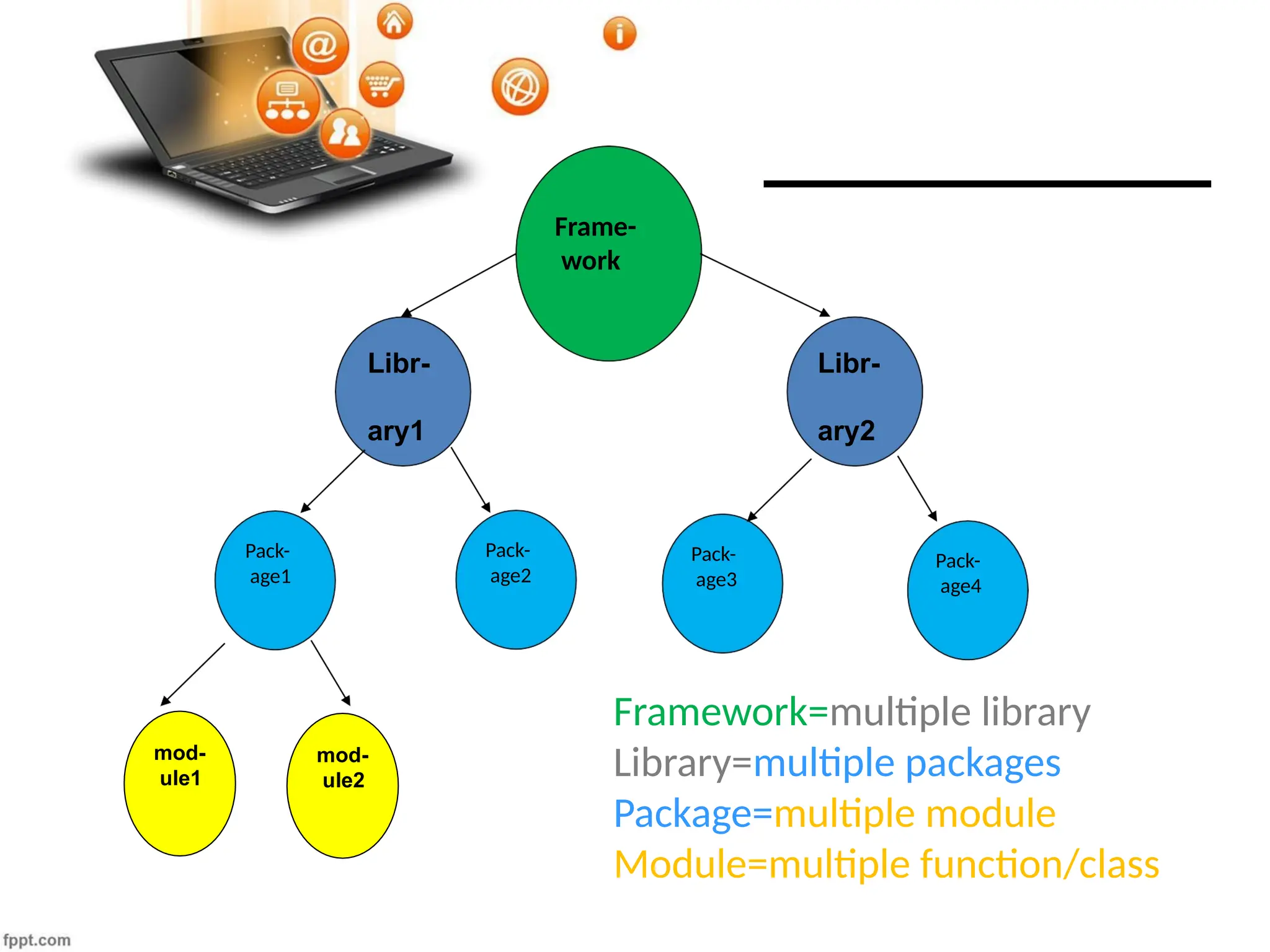
Frame-
work
Libr-
ary1
Libr-
ary2
Pack-
age1
Pack-
age2
Pack-
age3
Pack-
age4
mod-
ule1
mod-
ule2
Framework=multiple library
Library=multiple packages
Package=multiple module
Module=multiple function/class
Using
Python Libraries
must be clear
while
Following
terms
project/program.
1.Module
2.Package
3.Library
4.Framework
1. Using
Module
developing any
python
-It is a file which contains
python functions/global
variables/clases etc. It is just .py file which has python executable code /
statement.For example: Let’s create a file usermodule.py
def hello_message(user_name):
return “Hello " + name
Now we can import usermodule.py module either in python interpreter or
other py file.
import usermodule
print usermodule.hello_message(“India")
Using
Python Libraries
How to import modules in Python?
Python module can be accessed in any of following way.
●
Python import statement import math
print(“2 to the power 3 is ", math.pow(2,3))
Just similar to math ,user defined module can be accessed using
import
statement
●
Import with renaming import math as mt
print(“2 to the power 3 is ", mt.pow(2,3))
print(“2 to the power 3 is ", pow(2,3))
Using
Python Libraries
2. Using Package - It is namespace that contains multiple package or modules. It is a
directory which contains a special file init .py
Let’s create a directory geometry. Now this package contains multiple packages / modules to handle
user related requests.
geometry/ # top level package
init.py
rectangle/ # first subpackage
init .py
area_rect.py
perimeter_rect.py
circle/ # second subpackage
init.py
area_circ.py
perimeter_circ.py
Now we can import it in following way in other .py file from
geometry.rectangle import area_rect
from geometry.circle import perimeter_circ
Using
Python Libraries
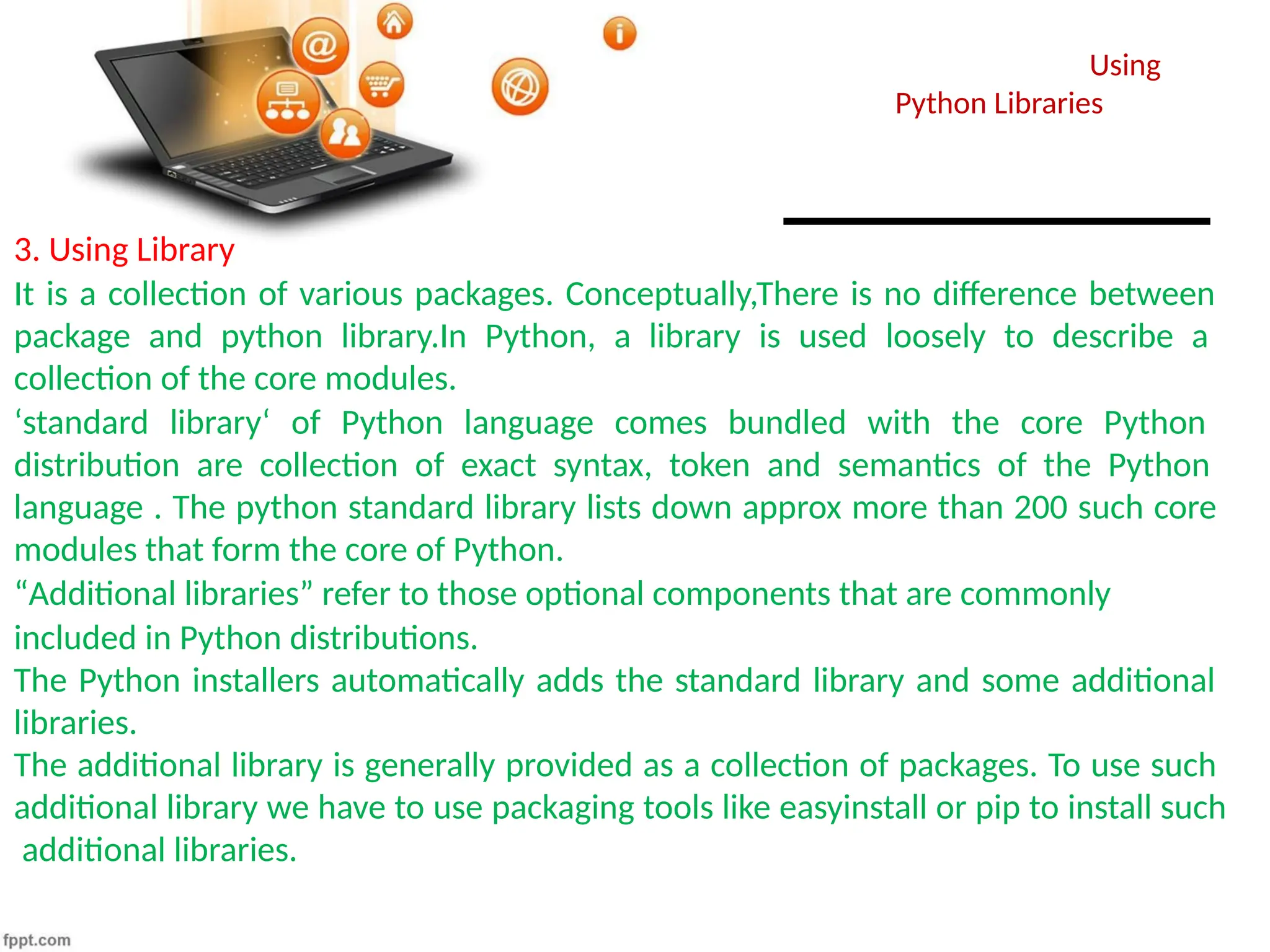
3. Using Library
It is a collection of various packages. Conceptually,There is no difference between
package and python library.In Python, a library is used loosely to describe a
collection of the core modules.
‘standard library‘ of Python language comes bundled with the core Python
distribution are collection of exact syntax, token and semantics of the Python
language . The python standard library lists down approx more than 200 such core
modules that form the core of Python.
“Additional libraries” refer to those optional components that are commonly
included in Python distributions.
The Python installers automatically adds the standard library and some additional
libraries.
The additional library is generally provided as a collection of packages. To use such
additional library we have to use packaging tools like easyinstall or pip to install such
additional libraries.
Using
Python Libraries
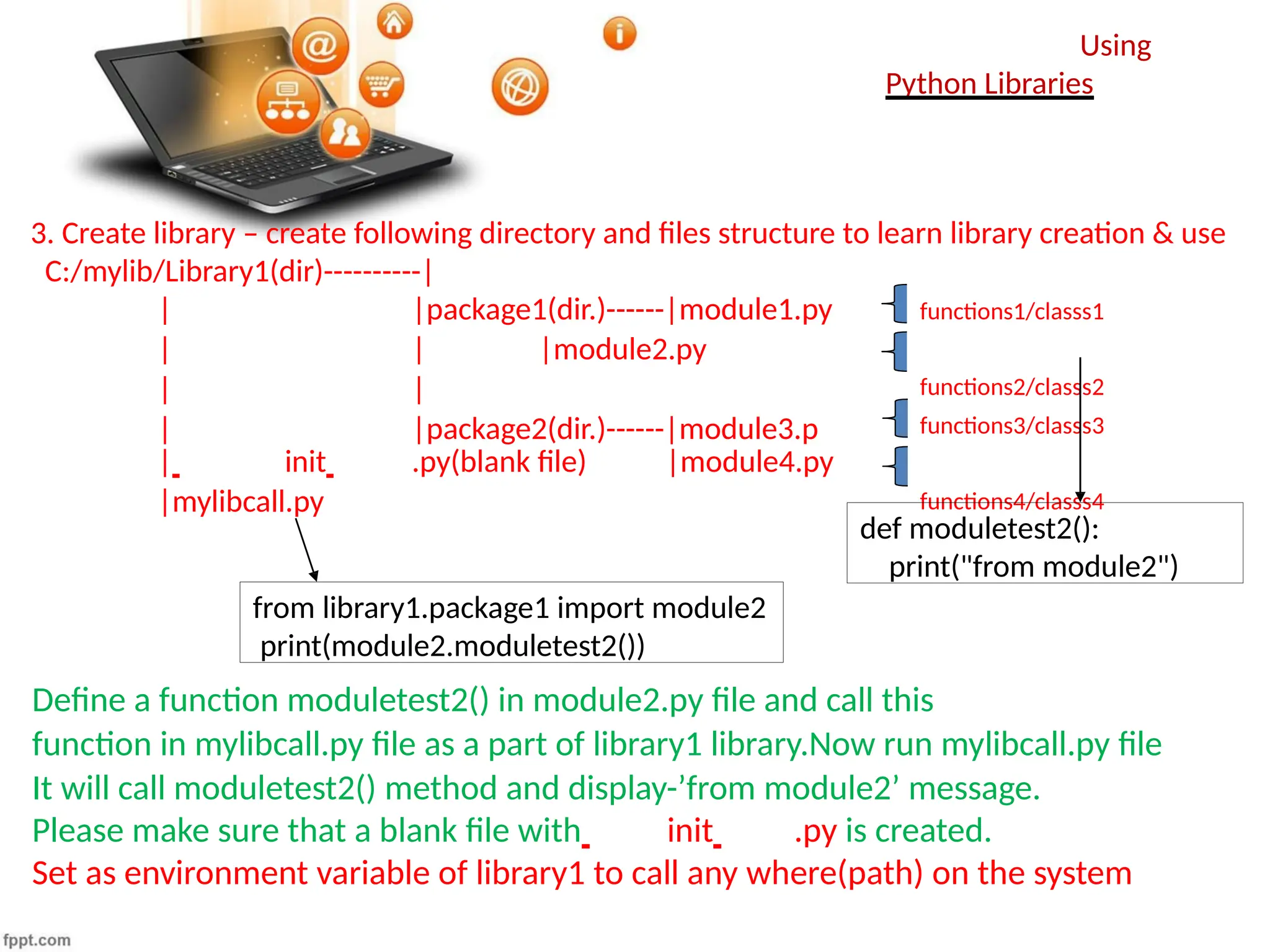
3. Create library – create following directory and files structure to learn library creation & use
C:/mylib/Library1(dir)----------|
functions1/classs1
functions2/classs2
|
|
|
|
|package1(dir.)------|module1.py
| |module2.py
|
|package2(dir.)------|module3.p functions3/classs3
functions4/classs4
| init .py(blank file) |module4.py
|mylibcall.py
def moduletest2():
print("from module2")
from library1.package1 import module2
print(module2.moduletest2())
Define a function moduletest2() in module2.py file and call this
function in mylibcall.py file as a part of library1 library.Now run mylibcall.py file
It will call moduletest2() method and display-’from module2’ message.
Please make sure that a blank file with init .py is created.
Set as environment variable of library1 to call any where(path) on the system
Using
Python Libraries
4. Using Framework
Framework is like a collection of various libraries which architects
some more component.
For e.g. Django which has various in-built libraries like
Auth, user, database connector etc.
Recursion
Python also accepts function recursion, which means a
defined function can call itself. Recursion is a common
mathematical and programming concept. It means that a
function calls itself. This has the benefit of meaning that
you can loop through data to reach a result.
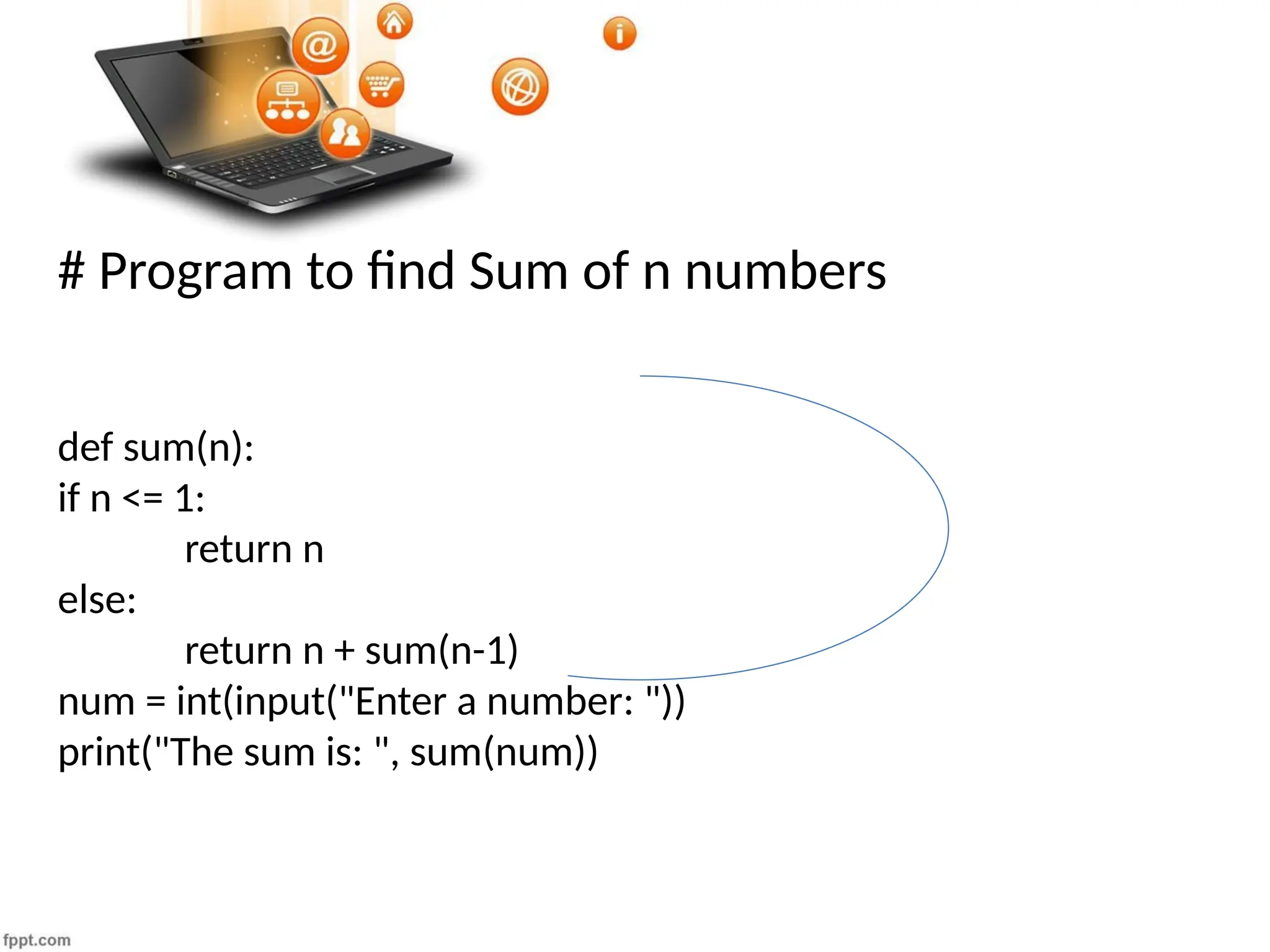
# Program to find Sum of n numbers
def sum(n):
if n <= 1:
return n
else:
return n + sum(n-1)
num = int(input("Enter a number: "))
print("The sum is: ", sum(num))
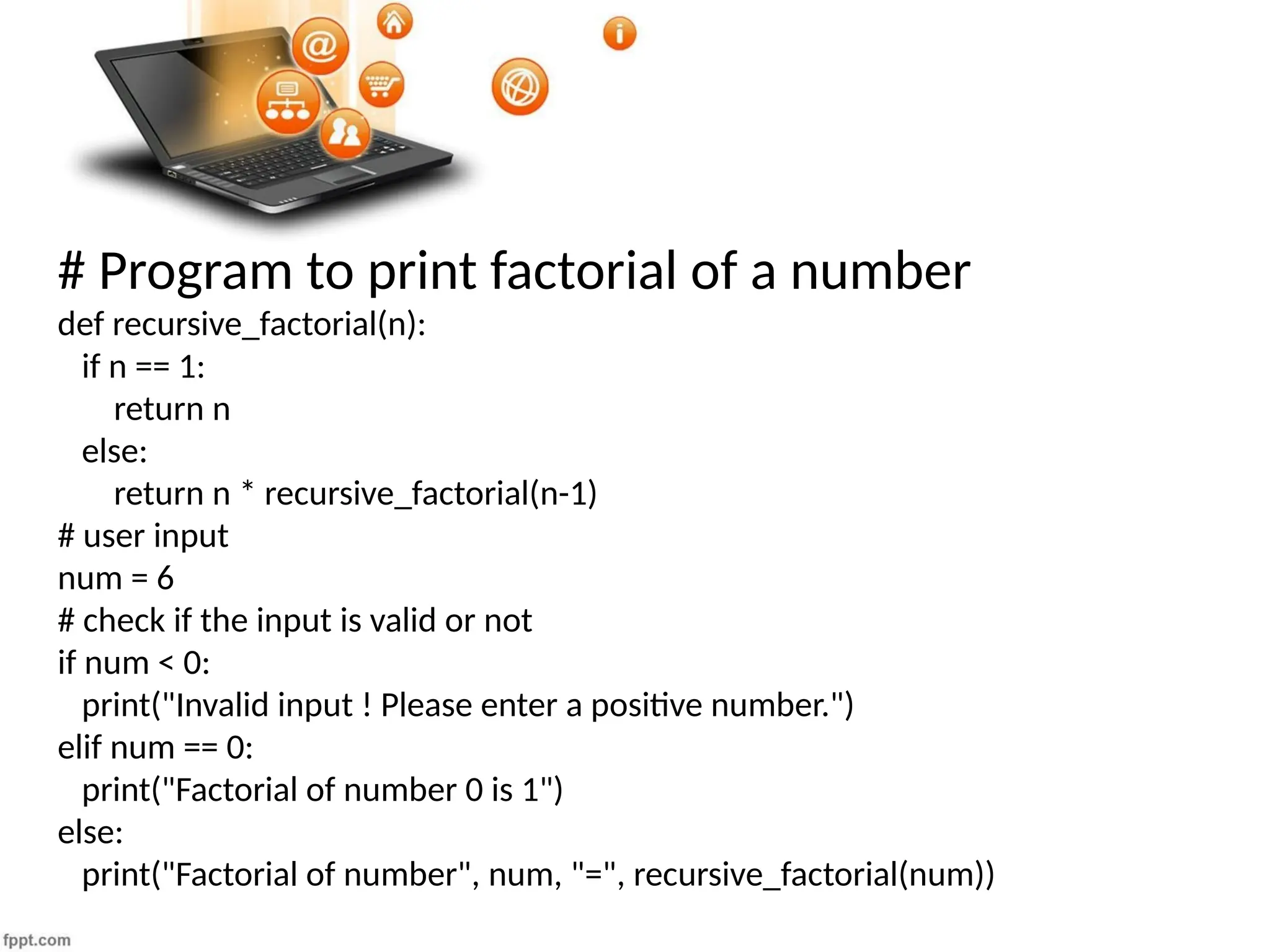
# Program to print factorial of a number
def recursive_factorial(n):
if n == 1:
return n
else:
return n * recursive_factorial(n-1)
# user input
num = 6
# check if the input is valid or not
if num < 0:
print("Invalid input ! Please enter a positive number.")
elif num == 0:
print("Factorial of number 0 is 1")
else:
print("Factorial of number", num, "=", recursive_factorial(num))
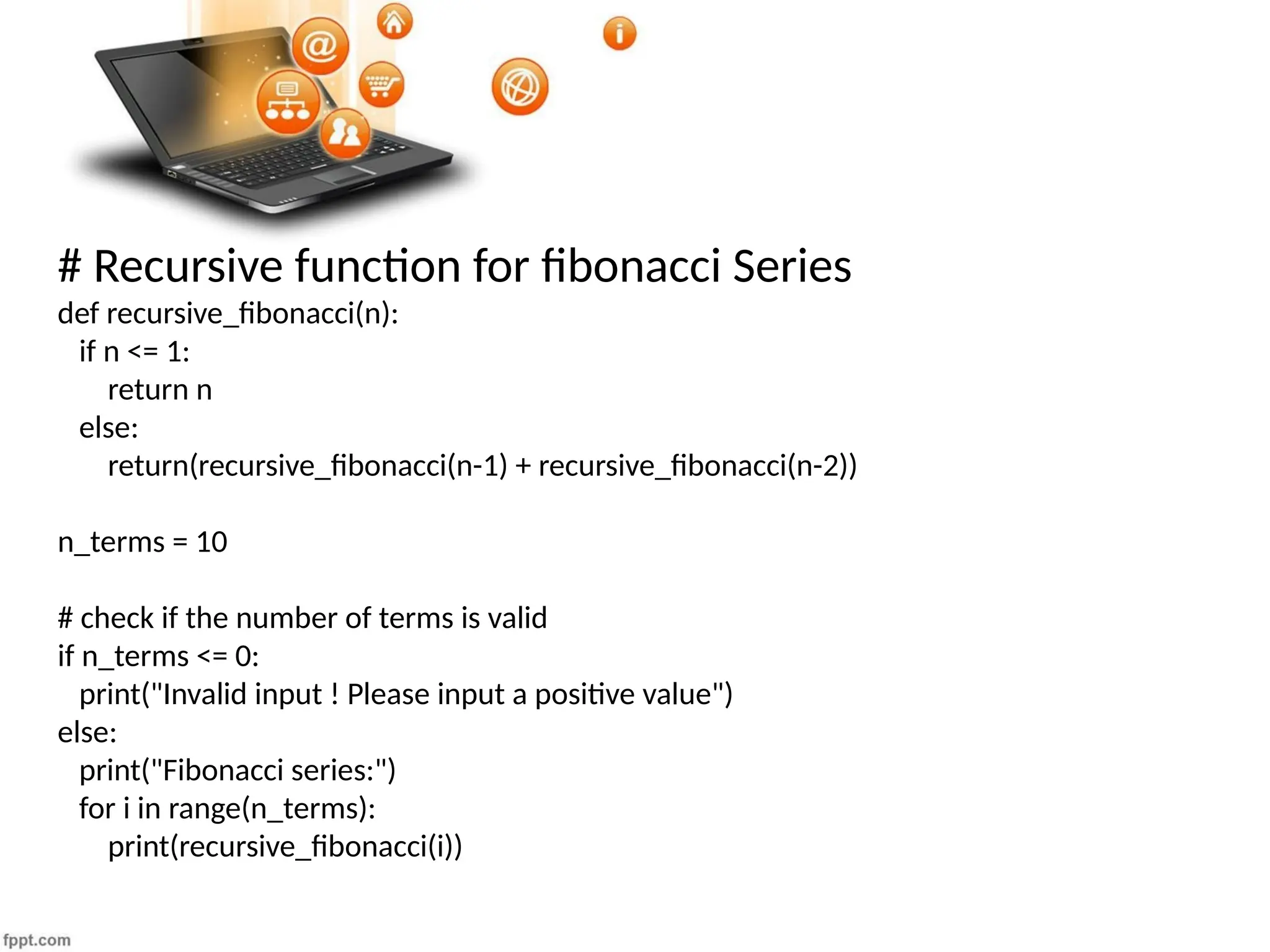
# Recursive function for fibonacci Series
def recursive_fibonacci(n):
if n <= 1:
return n
else:
return(recursive_fibonacci(n-1) + recursive_fibonacci(n-2))
n_terms = 10
# check if the number of terms is valid
if n_terms <= 0:
print("Invalid input ! Please input a positive value")
else:
print("Fibonacci series:")
for i in range(n_terms):
print(recursive_fibonacci(i))
Using python libraries.pptx , easy ppt to study class 12

Using python libraries.pptx , easy ppt to study class 12

  • 1.
  • 2.
  • 3.
    Using Python Libraries must beclear while Following terms project/program. 1.Module 2.Package 3.Library 4.Framework 1. Using Module developing any python -It is a file which contains python functions/global variables/clases etc. It is just .py file which has python executable code / statement.For example: Let’s create a file usermodule.py def hello_message(user_name): return “Hello " + name Now we can import usermodule.py module either in python interpreter or other py file. import usermodule print usermodule.hello_message(“India")
  • 4.
    Using Python Libraries How toimport modules in Python? Python module can be accessed in any of following way. ● Python import statement import math print(“2 to the power 3 is ", math.pow(2,3)) Just similar to math ,user defined module can be accessed using import statement ● Import with renaming import math as mt print(“2 to the power 3 is ", mt.pow(2,3)) print(“2 to the power 3 is ", pow(2,3))
  • 6.
    Using Python Libraries 2. UsingPackage - It is namespace that contains multiple package or modules. It is a directory which contains a special file init .py Let’s create a directory geometry. Now this package contains multiple packages / modules to handle user related requests. geometry/ # top level package init.py rectangle/ # first subpackage init .py area_rect.py perimeter_rect.py circle/ # second subpackage init.py area_circ.py perimeter_circ.py Now we can import it in following way in other .py file from geometry.rectangle import area_rect from geometry.circle import perimeter_circ
  • 7.
    Using Python Libraries 3. UsingLibrary It is a collection of various packages. Conceptually,There is no difference between package and python library.In Python, a library is used loosely to describe a collection of the core modules. ‘standard library‘ of Python language comes bundled with the core Python distribution are collection of exact syntax, token and semantics of the Python language . The python standard library lists down approx more than 200 such core modules that form the core of Python. “Additional libraries” refer to those optional components that are commonly included in Python distributions. The Python installers automatically adds the standard library and some additional libraries. The additional library is generally provided as a collection of packages. To use such additional library we have to use packaging tools like easyinstall or pip to install such additional libraries.
  • 8.
    Using Python Libraries 3. Createlibrary – create following directory and files structure to learn library creation & use C:/mylib/Library1(dir)----------| functions1/classs1 functions2/classs2 | | | | |package1(dir.)------|module1.py | |module2.py | |package2(dir.)------|module3.p functions3/classs3 functions4/classs4 | init .py(blank file) |module4.py |mylibcall.py def moduletest2(): print("from module2") from library1.package1 import module2 print(module2.moduletest2()) Define a function moduletest2() in module2.py file and call this function in mylibcall.py file as a part of library1 library.Now run mylibcall.py file It will call moduletest2() method and display-’from module2’ message. Please make sure that a blank file with init .py is created. Set as environment variable of library1 to call any where(path) on the system
  • 9.
    Using Python Libraries 4. UsingFramework Framework is like a collection of various libraries which architects some more component. For e.g. Django which has various in-built libraries like Auth, user, database connector etc.
  • 10.
    Recursion Python also acceptsfunction recursion, which means a defined function can call itself. Recursion is a common mathematical and programming concept. It means that a function calls itself. This has the benefit of meaning that you can loop through data to reach a result.
  • 11.
    # Program tofind Sum of n numbers def sum(n): if n <= 1: return n else: return n + sum(n-1) num = int(input("Enter a number: ")) print("The sum is: ", sum(num))
  • 12.
    # Program toprint factorial of a number def recursive_factorial(n): if n == 1: return n else: return n * recursive_factorial(n-1) # user input num = 6 # check if the input is valid or not if num < 0: print("Invalid input ! Please enter a positive number.") elif num == 0: print("Factorial of number 0 is 1") else: print("Factorial of number", num, "=", recursive_factorial(num))
  • 13.
    # Recursive functionfor fibonacci Series def recursive_fibonacci(n): if n <= 1: return n else: return(recursive_fibonacci(n-1) + recursive_fibonacci(n-2)) n_terms = 10 # check if the number of terms is valid if n_terms <= 0: print("Invalid input ! Please input a positive value") else: print("Fibonacci series:") for i in range(n_terms): print(recursive_fibonacci(i))