Using Information Technology 11th Edition
Williams Test Bank download
https://testbankfan.com/product/using-information-
technology-11th-edition-williams-test-bank/
Find test banks or solution manuals at testbankfan.com today!
We believe these products will be a great fit for you. Click
the link to download now, or visit testbankfan.com
to discover even more!
Using Information Technology 10th Edition Williams Test
Bank
https://testbankfan.com/product/using-information-technology-10th-
edition-williams-test-bank/
Using Information Technology 10th Edition Williams
Solutions Manual
https://testbankfan.com/product/using-information-technology-10th-
edition-williams-solutions-manual/
Information Technology for Management 11th Edition Turban
Test Bank
https://testbankfan.com/product/information-technology-for-
management-11th-edition-turban-test-bank/
Crafting and Executing Strategy Concepts and Cases 22nd
Edition Thompson Solutions Manual
https://testbankfan.com/product/crafting-and-executing-strategy-
concepts-and-cases-22nd-edition-thompson-solutions-manual/
Introductory Chemistry Atoms First 5th Edition Russo Test
Bank
https://testbankfan.com/product/introductory-chemistry-atoms-
first-5th-edition-russo-test-bank/
Calculus of a Single Variable 10th Edition Larson Test
Bank
https://testbankfan.com/product/calculus-of-a-single-variable-10th-
edition-larson-test-bank/
Child Family School Community Socialization and Support
9th Edition Berns Test Bank
https://testbankfan.com/product/child-family-school-community-
socialization-and-support-9th-edition-berns-test-bank/
Illustrated Course Guide Microsoft Office 365 and Access
2016 Introductory 1st Edition Friedrichsen Test Bank
https://testbankfan.com/product/illustrated-course-guide-microsoft-
office-365-and-access-2016-introductory-1st-edition-friedrichsen-test-
bank/
International Macroeconomics 4th Edition Feenstra
Solutions Manual
https://testbankfan.com/product/international-macroeconomics-4th-
edition-feenstra-solutions-manual/
Intermediate Algebra 12th Edition Bittinger Solutions
Manual
https://testbankfan.com/product/intermediate-algebra-12th-edition-
bittinger-solutions-manual/
6-1
Copyright © 2015 McGraw-Hill Education. All rights reserved. No reproduction or distribution without the prior written consent of
McGraw-Hill Education.
Chapter 06
Communications, Networks, and Cyberthreats: The Wired and
Wireless World
Multiple Choice Questions
1. Communications signals represented in a binary format are said to be ________.
A. continuous
B. digital
C. sequential
D. analog
2. Each zero and one signal represents a ________.
A. bit
B. byte
C. kilobyte
D. megabyte
3. Which of the following is NOT an analog device?
A. speedometer
B. tire-pressure gauge
C. thermometer
D. smartphone
6-2
Copyright © 2015 McGraw-Hill Education. All rights reserved. No reproduction or distribution without the prior written consent of
McGraw-Hill Education.
4. Signals such as sound and temperature, which continuously vary in strength and quality, are
said to be _________.
A. spontaneous
B. digital
C. sequential
D. analog
5. The ________ is a device that converts digital computer signals into analog signals so that
they can be sent over a telephone line.
A. printer
B. scanner
C. modem
D. digitizer
6. A person sending a document over a phone line by converting a computer's digital signals to
analog signals uses a ________.
A. printer
B. scanner
C. digitizer
D. modem
7. A ________ is a system of interconnected computers, telephones, or communications devices
that can communicate and share resources.
A. terminal
B. router
C. network
D. server
6-3
Copyright © 2015 McGraw-Hill Education. All rights reserved. No reproduction or distribution without the prior written consent of
McGraw-Hill Education.
8. A network that covers a wide geographical area is called a ________.
A. LAN
B. WAN
C. MAN
D. HAN
9. A network that covers a city or a suburb is called a ________.
A. WAN
B. LAN
C. MAN
D. Internet
10. Networks are structured in two principle ways: client/server and ________.
A. intranet
B. host computer
C. extranet
D. peer to peer
11. A network that operates without relying on a server is the ________ network.
A. peer-to-peer
B. client/server
C. host-to-host
D. master/slave
6-4
Copyright © 2015 McGraw-Hill Education. All rights reserved. No reproduction or distribution without the prior written consent of
McGraw-Hill Education.
12. A computer that acts like a disk drive, storing the programs and data files shared by users on
a LAN, is the ________ server.
A. file
B. web
C. host
D. mail
13. If an organization's internal private network uses the same infrastructure and standards of
the Internet, then the private network is a(n) ________.
A. extranet
B. intranet
C. LAN
D. MAN
14. A virtual private network may include ________.
A. a company intranet
B. a company extranet
C. a company LAN
D. any of these
15. A(n) ________ is a system of hardware and/or software that protects a computer or a network
from intruders.
A. VPN
B. intranet
C. firewall
D. protocol
6-5
Copyright © 2015 McGraw-Hill Education. All rights reserved. No reproduction or distribution without the prior written consent of
McGraw-Hill Education.
16. A ________ is the set of rules that govern the exchange of data between hardware and/or
software components in a communications network.
A. host
B. protocol
C. database
D. packet
17. A mainframe computer that controls a large network is called the ________ computer.
A. slave
B. host
C. client
D. node
18. Any device that is attached to a network is referred to as a ________.
A. server
B. host
C. node
D. router
19. A ________ is a fixed-length block of data for transmission.
A. node
B. protocol
C. packet
D. backbone
6-6
Copyright © 2015 McGraw-Hill Education. All rights reserved. No reproduction or distribution without the prior written consent of
McGraw-Hill Education.
20. A common connection device that connects computers to a network and that sends
messages (checks packets) between sender and receiver nodes is called a ________.
A. router
B. gateway
C. switch
D. bridge
21. To create larger networks, a bridge connects the same types of networks, and a ________
connects dissimilar networks.
A. router
B. gateway
C. hub
D. host
22. A device that joins multiple wired and/or wireless networks in a home office is a ________.
A. node
B. router
C. bridge
D. firewall
23. In an organization, all computer networks are connected to the Internet by a "main highway"
called a ________.
A. skeleton
B. backbone
C. gateway
D. router
6-7
Copyright © 2015 McGraw-Hill Education. All rights reserved. No reproduction or distribution without the prior written consent of
McGraw-Hill Education.
24. Which of these is NOT a network topology?
A. ring
B. bus
C. hub
D. star
25. In the ________ network topology, communications devices are connected to a single cable
with two endpoints.
A. ring
B. bus
C. star
D. peer-to-peer
26. What kind of topology (layout) is used by a network that connects all computers and
communications devices in a continuous loop?
A. ring
B. bus
C. star
D. peer-to-peer
27. What kind of topology (layout) is used by a network that connects all its computers and
communications devices to a central server?
A. ring
B. bus
C. star
D. peer-to-peer
6-8
Copyright © 2015 McGraw-Hill Education. All rights reserved. No reproduction or distribution without the prior written consent of
McGraw-Hill Education.
28. ________ is the most common and most widely used LAN technology, with networked devices
in close proximity; it can be used with almost any kind of computer. Most microcomputers
come with a port for this type of network connection, which uses cable.
A. Fiber-optic
B. Internet
C. Token ring
D. Ethernet
29. A communications medium is a channel; there are three types of wired communications
media. The one consisting of two strands of insulated copper wire, used by tradition
telephone systems, is known as ________.
A. twisted-pair
B. coaxial
C. fiber-optic
D. straight wire
30. What wired channel, commonly used for cable TV, consists of an insulated copper wire
wrapped in a solid or braided shield placed in an external cover?
A. twisted-pair
B. coaxial
C. straight wire
D. fiber-optic
31. A type of wired communications technology used to connect equipment in a home network is
the following:
A. Ethernet
B. HomePNA
C. HomePlug
D. any of these
6-9
Copyright © 2015 McGraw-Hill Education. All rights reserved. No reproduction or distribution without the prior written consent of
McGraw-Hill Education.
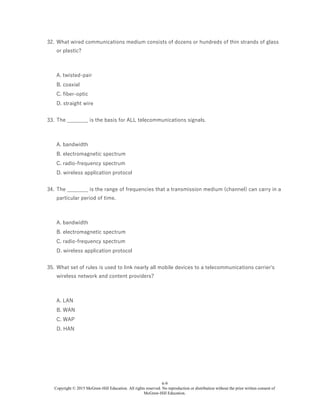
32. What wired communications medium consists of dozens or hundreds of thin strands of glass
or plastic?
A. twisted-pair
B. coaxial
C. fiber-optic
D. straight wire
33. The ________ is the basis for ALL telecommunications signals.
A. bandwidth
B. electromagnetic spectrum
C. radio-frequency spectrum
D. wireless application protocol
34. The ________ is the range of frequencies that a transmission medium (channel) can carry in a
particular period of time.
A. bandwidth
B. electromagnetic spectrum
C. radio-frequency spectrum
D. wireless application protocol
35. What set of rules is used to link nearly all mobile devices to a telecommunications carrier's
wireless network and content providers?
A. LAN
B. WAN
C. WAP
D. HAN
6-10
Copyright © 2015 McGraw-Hill Education. All rights reserved. No reproduction or distribution without the prior written consent of
McGraw-Hill Education.
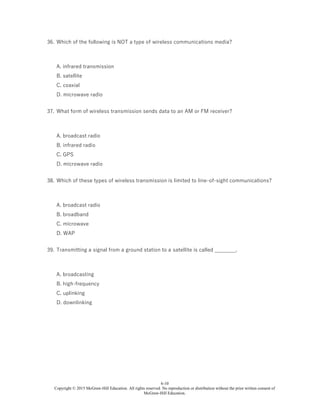
36. Which of the following is NOT a type of wireless communications media?
A. infrared transmission
B. satellite
C. coaxial
D. microwave radio
37. What form of wireless transmission sends data to an AM or FM receiver?
A. broadcast radio
B. infrared radio
C. GPS
D. microwave radio
38. Which of these types of wireless transmission is limited to line-of-sight communications?
A. broadcast radio
B. broadband
C. microwave
D. WAP
39. Transmitting a signal from a ground station to a satellite is called ________.
A. broadcasting
B. high-frequency
C. uplinking
D. downlinking
6-11
Copyright © 2015 McGraw-Hill Education. All rights reserved. No reproduction or distribution without the prior written consent of
McGraw-Hill Education.
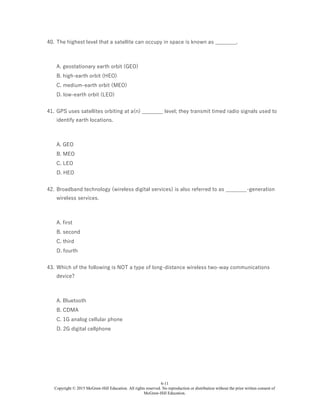
40. The highest level that a satellite can occupy in space is known as ________.
A. geostationary earth orbit (GEO)
B. high-earth orbit (HEO)
C. medium-earth orbit (MEO)
D. low-earth orbit (LEO)
41. GPS uses satellites orbiting at a(n) ________ level; they transmit timed radio signals used to
identify earth locations.
A. GEO
B. MEO
C. LEO
D. HEO
42. Broadband technology (wireless digital services) is also referred to as ________-generation
wireless services.
A. first
B. second
C. third
D. fourth
43. Which of the following is NOT a type of long-distance wireless two-way communications
device?
A. Bluetooth
B. CDMA
C. 1G analog cellular phone
D. 2G digital cellphone
6-12
Copyright © 2015 McGraw-Hill Education. All rights reserved. No reproduction or distribution without the prior written consent of
McGraw-Hill Education.
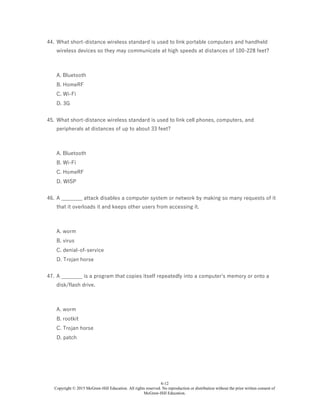
44. What short-distance wireless standard is used to link portable computers and handheld
wireless devices so they may communicate at high speeds at distances of 100-228 feet?
A. Bluetooth
B. HomeRF
C. Wi-Fi
D. 3G
45. What short-distance wireless standard is used to link cell phones, computers, and
peripherals at distances of up to about 33 feet?
A. Bluetooth
B. Wi-Fi
C. HomeRF
D. WISP
46. A ________ attack disables a computer system or network by making so many requests of it
that it overloads it and keeps other users from accessing it.
A. worm
B. virus
C. denial-of-service
D. Trojan horse
47. A ________ is a program that copies itself repeatedly into a computer's memory or onto a
disk/flash drive.
A. worm
B. rootkit
C. Trojan horse
D. patch
6-13
Copyright © 2015 McGraw-Hill Education. All rights reserved. No reproduction or distribution without the prior written consent of
McGraw-Hill Education.
48. Which of these is NOT a type of malware?
A. worm
B. virus
C. Trojan horse
D. denial-of-service attack
49. A botmaster uses malware to hijack hundreds or thousands of computers and controls them
remotely; the controlled computers are called ________.
A. robots
B. zombies
C. worms
D. logic bombs
50. Which of the following is NOT a way to spread a virus?
A. flash drives
B. scanning a picture
C. e-mail attachment
D. downloaded games or other software
51. Antivirus software protects files and computer systems in all of these ways EXCEPT which
one?
A. scans the hard drive for signatures that uniquely identify a virus
B. looks for suspicious viruslike behavior
C. goes out on the Internet and looks for viruses
D. destroys the virus
6-14
Copyright © 2015 McGraw-Hill Education. All rights reserved. No reproduction or distribution without the prior written consent of
McGraw-Hill Education.
52. What is the science, often used in computer security systems, of measuring individual body
characteristics?
A. encryption
B. decryption
C. rootkit
D. biometrics
53. What is the process of altering readable data (plain text) into unreadable form to prevent
unauthorized access?
A. encryption
B. decryption
C. password
D. biometrics
True / False Questions
54. Analog refers to communications signals represented in a binary format.
True False
55. Signals such as sound and temperature, which continuously vary in strength and quality, are
said to be digital.
True False
56. A thermometer and a speedometer are examples of analog devices.
True False
6-15
Copyright © 2015 McGraw-Hill Education. All rights reserved. No reproduction or distribution without the prior written consent of
McGraw-Hill Education.
57. Telephones have always been digital devices.
True False
58. A modem converts digital signals into analog signals so they can be sent over a telephone
line.
True False
59. "Modem" is short for modulate/demodulate.
True False
60. Capturing music digitally means that one has an exact duplicate of the music.
True False
61. A network is a system of interconnected computers and communications devices that can
communicate and share resources.
True False
62. The Internet is a WAN.
True False
63. A LAN is a type of network that covers a wide geographical area.
True False
64. Client/server networks and peer-to-peer networks are the same except that the first type of
network uses a mainframe and the second type uses only microcomputers.
True False
Random documents with unrelated
content Scribd suggests to you:
The Project Gutenberg eBook of Mary Jane Married:
Tales of a Village Inn
This ebook is for the use of anyone anywhere in the United States
and most other parts of the world at no cost and with almost no
restrictions whatsoever. You may copy it, give it away or re-use it
under the terms of the Project Gutenberg License included with this
ebook or online at www.gutenberg.org. If you are not located in the
United States, you will have to check the laws of the country where
you are located before using this eBook.
Title: Mary Jane Married: Tales of a Village Inn
Author: George R. Sims
Release date: December 12, 2019 [eBook #60899]
Most recently updated: October 17, 2024
Language: English
Credits: Chuck Greif and the Online Distributed Proofreading Team
*** START OF THE PROJECT GUTENBERG EBOOK MARY JANE
MARRIED: TALES OF A VILLAGE INN ***
MARY JANE MARRIED
UNIFORM WITH THE PRESENT VOLUME.
Post 8vo, illustrated boards, 2s.; cloth, 2s. 6d.
MARY JANE’S MEMOIRS.
By GEORGE R. SIMS.
WITH A PHOTOGRAPHED PORTRAIT OF MARY JANE.
“A quite Defoe-like revelation. It is, in effect, a series of social sketches
drawn by a keen and humorous observer. Can be heartily recommended to
all and sundry.”—Globe.
“A very entertaining autobiography.... Mary Jane has a faculty for
observing character, and a power of delineating its movements and
development, not distantly related to those of Mr. Sims himself. Mary Jane
has so full a fund of exciting incident to draw upon, and so pleasant a
manner of philosophizing, in her homely way, upon the ups and downs of a
servant’s life, that should she ever take the field as a novelist independently
of her present sponsor, he will have a formidable rival to contend with.”—
Scotsman.
“Mr. Sims has portrayed in an amusing manner the trials, woes, and
triumphs of domestic servants. There is such an amount of truthfulness in
the narrative that we can almost accept the portrait of Mary Jane as that of
the authoress of the memoirs Mr. Sims is supposed to edit, and to believe
that it is really genuine.”—Metropolitan.
“There are some pages in these memoirs which it is impossible to read
without laughing heartily, while the chapters devoted to the account of the
Chelsea mystery are almost tragic in their intense realism.... Dickens never
did anything better than ‘Mrs. Three-doors-up,’ or ‘Mr. Saxon, the author,
and his mother-in-law.’. The book is full of unvarnished naturalism of a
healthy, sensible, wholesome kind. It is quite the best thing Mr. Sims has
yet written.”—Whitehall Review.
“Those who have not yet made Miss Buffham’s acquaintance will here
find in her a very entertaining narrator of vast experiences in the way of
domestic service.”—Daily News.
“Much of the book is broad comedy, and most laughter-provoking, and
reminds one of the best of the famous ‘Mrs. Brown.’. Generally, the book is
remarkable for its Defoe-like verisimilitude, and added to this is an
inexhaustible fund of humour and broad though harmless fun.”—Public
Opinion.
“Genuine amusement awaits the public in the perusal of Mary Jane’s
experiences, edited by the popular writer who has put them into book form.
This view of the world from the housemaid’s pantry is full of shrewd
observation and apparently unconscious humour, and is throughout
diverting.”—Morning Post.
“Mary Jane’s experience of domestic service makes a very entertaining
book. She sees some strange things, and describes them in a lively, good-
tempered way.”—St. James’s Gazette.
“Mr. Sims is a clever story-teller, but he is to be admired for his
philanthropic spirit even more than for his artistic skill. Mary Jane’s
observations are shrewd and suggestive. There is a realistic tone about the
whole which makes these records interesting.”—Congregational Review.
ALSO BY GEORGE R. SIMS.
Each the same size and prices.
ROGUES AND VAGABONDS.
THE RING O’ BELLS.
LONDON: CHATTO & WINDUS, PICCADILLY.
MARY JANE MARRIED
Tales of a Village Inn
BY
GEORGE R. SIMS
AUTHOR OF “MARY JANE’S MEMOIRS,” “THE DAGONET BALLADS,”
“ROGUES AND VAGABONDS,” “THE RING O’ BELLS,” ETC.
London
CHATTO & WINDUS, PICCADILLY
1888
[The right of translation is reserved]
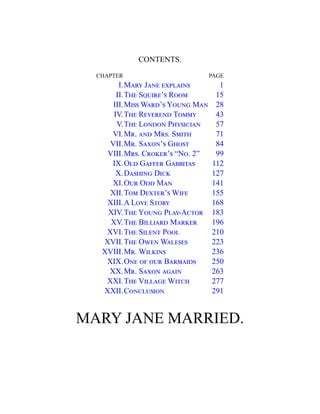
CONTENTS.
CHAPTER PAGE
I.Mary Jane explains 1
II.The Squire’s Room 15
III.Miss Ward’s Young Man 28
IV.The Reverend Tommy 43
V.The London Physician 57
VI.Mr. and Mrs. Smith 71
VII.Mr. Saxon’s Ghost 84
VIII.Mrs. Croker’s “No. 2” 99
IX.Old Gaffer Gabbitas 112
X.Dashing Dick 127
XI.Our Odd Man 141
XII.Tom Dexter’s Wife 155
XIII.A Love Story 168
XIV.The Young Play-Actor 183
XV.The Billiard Marker 196
XVI.The Silent Pool 210
XVII.The Owen Waleses 223
XVIII.Mr. Wilkins 236
XIX.One of our Barmaids 250
XX.Mr. Saxon again 263
XXI.The Village Witch 277
XXII.Conclusion 291
MARY JANE MARRIED.
CHAPTER I.
MARY JANE EXPLAINS.
It is no use my trying to stop myself. I’m sure I’ve tried hard enough.
When I changed my name from Mary Jane Buffham to Mary Jane Beckett
by marrying Harry, my sailor sweetheart (God bless him!), I said to myself
—Now, Mary Jane, my girl, no more pens and ink. You’ve written a book
and had it published, and the newspaper gentlemen have been most kind in
what they said about it. You’d better be satisfied with that, and do your duty
in that state of life unto which you have been called, that state being
mistress of a sweet little hotel—inn, some people will call it, but it’s quite
as much right to be called an hotel as lots of places that have “Hotel” up in
big letters all over them—in a pretty village not very far from London. Of
course I have enough to do, though Harry takes a good deal off my
shoulders; but there are so many things that a landlady can do to make a
house comfortable that a landlord can’t, and I take a great pride in my dear
little home, and everybody says it’s a picture, and so it is. Harry says it’s my
training as a thorough servant that makes me such a good mistress, and I
dare say it is. Our house is called “The Stretford Arms,” and we put “Hotel”
on the signboard underneath it soon after we had it, and made it pretty and
comfortable, so that people—nice people—came to stay at it.
But, oh dear me, before we got it what a lot of trouble we had! If you
have read my “Memoirs” you know all about me and Harry, and how I left
service to marry him, and he made up his mind—having a bit of money
saved, and some come to him from a relative—to take a nice little inn in the
country; not a public-house, but something better, with plenty of garden to
it for us to have flowers, and fruit, and fowls, and all that sort of thing; and
we made up our minds we’d have one with a porch and trellis-work, and
roses growing over it, and lattice windows, like we’d seen in a play before
we were married.
We hadn’t gone into business when my book came out in a volume.
When the publisher sent me a copy, I thought, “Oh, how proud I shall be
when I show this to Harry!” I declare I could have cried with rage when I
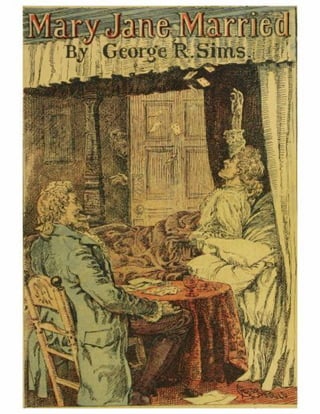
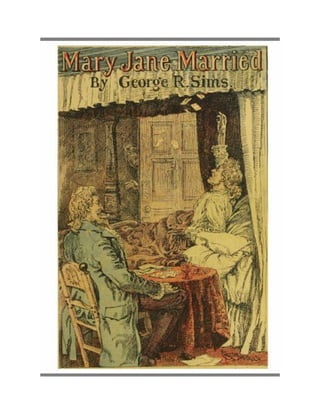
took the brown paper off and saw the cover. It was most wicked, and upset
me awfully. There on the cover was a picture of me sitting in my kitchen
with a horrid, grinning policeman, with his arm round my waist. I threw the
book on the floor, the tears streaming down my face. It was such a bitter
disappointment.
Harry came in while I was crying, and he said, “Why, my lass, what’s
the matter with you?” And I sobbed out, pointing to the book, “Look at that,
Harry!” Harry picked the book up, and when he saw the cover his face went
crimson under the sunburn.
He said, “Did this ever happen, Mary Jane?” and I said, “No, Harry. Do
you think I would ever have demeaned myself like that?”
He looked at the grinning idiot of a policeman for a minute, and then he
brought his fist down hard right on his nose (the policeman’s). Then he said,
“Put it out of my sight, and never let me see it again.” But presently he said,
“There must be something about you and a policeman in the book, or they
wouldn’t have put him hugging you on the cover. Which chapter is it? I’ll
read it and see what the truth of this business is.”
I recollected then that there was something about a policeman, so I said,
“No, Harry, dear, don’t read it now; you’re not in a fit state of mind. But
whatever there is, I swear he didn’t sit in my kitchen with his arm round my
waist; and he—he—he wasn’t—a grinning idiot like that.”
I took the book away from Harry, and wouldn’t let him see it then. But
he kept on about it all the evening, and I could see it had made him jealous
as well as savage; and it was very hard—all through that horrid picture the
pleasure I had looked forward to was quite spoilt. But so it is in this world;
and how often it happens that what we have been longing for to be a
pleasure to us, when it comes is only a disappointment and a misery!
Harry said to me that evening that he would go to London and see the
publishers, and have it out with them about the picture. He said it was a
libel on my character, and he wasn’t going to have his wife stuck about on
all the bookstalls in a policeman’s arms. But, I said to him, the publishers
didn’t mean any harm, and it was no good being cross with them, or making
a disturbance at their office.
But some time afterwards I wrote a little note to Messrs. Chatto and
Windus about it, and Mr. Chatto wrote back that he was very sorry the
picture had caused words between me and my husband, and, in the next
editions, it should be altered, and soon after that he sent me a proof of the
new cover, and it was Harry with his arm round my waist instead of the
policeman, which makes all the difference.
There were many things that I shouldn’t have written, perhaps, if I’d
been quite sure that they would be published, and my husband would read
them; but, after all, there was no harm, and I only wrote the truth. I wrote
what I saw, and it was because it was the real experience of a real servant
that people read it, and, as I have reason to know, liked it. And now, after I
have been landlady of a village hotel, doing a nice trade both in the bar and
in the coffee-room (why coffee-room, I don’t know, for there is less coffee
drunk in it than anything), I find myself putting down what I have seen and
heard on paper, just as I did in my “Memoirs.”
People say to me sometimes, “Law, now, fancy your noticing that!—I
never did;” and that’s the secret of my being an authoress, I suppose. I keep
my eyes open, and my ears too; and if I see a character, I like to watch it,
and find out all about it.
I’ve seen some strange characters in our inn, I can tell you; and as to the
people in the village, why, when you come to know their stories, you find
out that every place is a little world in itself, with its own dramas being
played out in people’s lives just the same as in big towns. Yes, there are
village tragedies and village comedies, and the village inn is the place to
hear all about them. I haven’t got an imagination, so I can’t invent things,
and I think it’s a good thing for me, because I might be tempted to make up
stories, which are never so good as those that really happen. I thought when
I came to this village I should have nothing to write about, but I hadn’t been
in it long before I found my mistake. I hear a lot, of course, in the bar-
parlour, because it’s like a club, and all the chatty people come there of an
evening and talk their neighbours over, and I hear lots more in the house
from the market women and from our cook and the people about the place,
and I can promise you that I have learnt some real romances of real life—
rich and poor, too—since I became the landlady of the ‘Stretford Arms.’
We didn’t get into the place all at once. Oh dear me, what an anxious
time it was till we found what we wanted! and the way we were tried to be
“done,” as Harry calls it, was something dreadful. Harry said he supposed,
being a sailor, people thought he didn’t know anything; but when we came
to compare notes with other people who had started in the business, we
found our experiences of trying to become licensed victuallers was quite a
common one.
We had a beautiful honeymoon first; but I’m not going to write anything
about that, except that we were very happy—so happy that when I thanked
God for my dear, kind husband and my happy life, the tears used to come
into my eyes. But all that time is sacred. It is something between two
people, and not to put into print. I don’t think a honeymoon would come out
well in print. It is only people who are having honeymoons who would
understand it.
After we had had a nice long honeymoon, Harry began to think it was
time we looked out for something; so he said, “Now, little woman, this is all
very nice and lazy and lovely, but we must begin to think about the future.
The sooner we look for a place the better.”
So every day we read the advertisements in the papers of public-houses
and inns and hotels in the country which were for sale.
Whenever we saw “nice home,” or “lovely garden,” or “comfortable
home just suited to a young married couple,” we wrote at once for full
particulars. When we wrote to the agents about the best ones, I found that it
was very like the paragon servants advertised—they had just been disposed
of, but the agent had several others equally nice on hand if we would call.
It was very annoying to find all the “lovely gardens” and “charming
homes,” which were so cheap, just gone, and to get instead of them
particulars of a horrid place at the corner of a dirty lane, with only a back
yard to it, or something of that sort.
We went to see some of the places the agents or brokers sent us, and they
were very much nicer in the advertisements than they were in themselves.
One house we went to look at we thought would do, though the situation
seemed lonely. We wrote we would come to see it on a certain day, and
when we got there, certainly there was no mistake about its doing a good
trade. They asked a lot of money for it, but the bar was full, and in the
coffee-room were men who looked like farmers having dinner and ordering
wine, and smoking fourpenny cigars quite fast. And while we were having
dinner with the landlord in his room, the servant kept coming in and saying,
“Gentleman wants a room, sir,” till presently all the rooms were gone, and
people had to be turned away.
“It’s like that now nearly always,” said the landlord. “If it wasn’t that I
must go out to Australia, to my brother, who is dying, and going to leave me
a fortune made at the diggings, I wouldn’t part with the house for
anything.”
“Where do the people all come from?” said Harry. “The station’s two
miles off.”
“Oh,” said the landlord, “there’s something against the Railway Hotel—
it’s haunted, I believe, and this last month everybody comes on here. If you
like to start the fly business as well, you’ll make a lot of money at that. Flys
to meet the trains would fill you up every day.”
We went away from the house quite convinced that it was a great
bargain, and Harry said he thought we might as well settle with the agents,
for we couldn’t do better.
But when we got to the station we had just missed a train, and had an
hour to wait, so we went to the Railway Hotel. I sat down in a little room,
and had some tea, while Harry went into the smoke-room to hear the talk,
and see if he could find out about the place being haunted, and if it was
likely to be haunted long.
In half an hour he came back looking very queer. “Mary Jane,” he said,
“that swab ought to be prosecuted”—meaning the landlord of the inn we
had been after.
Then he told me what he’d found out in the smoke-room, hearing a man
talk, who, of course, didn’t know who Harry was. He was making quite a
joke about what he called the landlord’s “artful dodge,” and he let it all out.
It seems the place we had been after had been going down for months,
and the landlord had made up his mind to get out of it before he lost all his
capital. So to get a good price he had been getting a lot of loafers and
fellows about the village to come in and have drinks with him and fill up
the place, and the day we came nobody paid for anything, and the farmers
in the coffee-room were all his friends, and it was one man who kept taking
all the bedrooms that the servant came in about when we were there.
Wasn’t it wicked? But it opened our eyes, and showed us that there are
tricks in every trade, and that we should have to be very careful how we
took a place by its appearance.
But, cautious as we were after that, we had one or two narrow escapes,
and I may as well tell you something about them as a warning to young
people going into business. Of course we laughed at the tricks tried to be
played on us, because we escaped being taken in, but if we had invested our
money and lost it all in a worthless concern, we shouldn’t have been able to
laugh. Perhaps Harry would have had to get another ship, and I should have
had to get another situation, and be a servant again. And a nice thing that
would have been with my ba——
But I must not anticipate events. I know more about writing now than I
did when I put my “Memoirs” together, and I’m going to see if I can’t write
a book about our inn, and our village, and all that happened in them,
without troubling the gentleman who was so kind to me over my first book.
I wish he had seen to the outside as well as the inside, and prevented that
nasty, impertinent, grinning policeman behaving so disgracefully in my
kitchen on the cover.
I say we can afford to laugh now; and there are many things in life to
laugh at when we are on the safe side that we might cry at if we weren’t. I
know that I always laugh when people say about me not having changed my
initials, but being Mary Jane Beckett instead of Mary Jane Buffham, and
they quote the old proverb:
“Change your name and not the letter,
Change for the worse and not the better.”
I laugh, because I have changed for the better; and Harry’s as good as
gold and as gentle as a baby—well, a good deal gentler, for I shouldn’t like
Harry to pull my hair, and put his finger in my eye, and kick me like my ba
——
But I am anticipating again.
I was writing about the houses we went to look at before we fixed on the
‘Stretford Arms.’ There was one not quite in the country, but out in a suburb
of London—a new sort of a suburb: rather melancholy, like new suburbs are
when some of the houses are only skeletons, and the fields are half field and
half brickyard, and old iron and broken china lie scattered about, with a
dead cat in a pond that’s been nearly used up and just shows the cat’s head;
and a bit of rotten plank above the inch or so of clay-coloured water. And
there’s generally a little boy standing on the plank, and making it squeeze
down into the water and jump up again, and smothering himself up to the
eyes in squirts of the dirty, filthy water, which seems to be quite a favourite
amusement with little suburban boys and girls. I suppose it’s through so
much building always going on.
We went to look at a nice house, that certainly was very cheap and nicely
fitted up, in this new suburb; and there was a fair garden and a bit of a field
at the back. It stood on the high-road, or what would be the high-road when
the suburb was finished, and we were told it would one day be a fine
property, as houses were letting fast, and all being built in the new pretty
way; you know what I mean—a lot of coloured glass and corners to them,
and wood railings dotted about here and there, something like the Swiss
Cottage, where the omnibuses stop—Queen Anne, I think they call them.
We wanted to be more out of town, but we heard such glowing accounts
from the broker about this place, we hesitated to let it go. The landlord, we
were told, was giving up the business because he had to go to a warmer
climate for the winter, being in bad health, and, having lost his wife, he had
nobody to leave behind to look after the place. If ever you try to take a
business, dear reader, I dare say you will find, as we did, that the people
who are going to sell it to you never give up because things aren’t good, but
always because they’ve made so much money they don’t want any more, or
because they have to go and live a long way off. I suppose it wouldn’t do to
be quite truthful in advertising a business for sale, any more than in giving a
servant a character. If the whole truth and nothing but the truth was told in
these cases, I fancy very few businesses would change hands and very few
servants get places.
We had only seen this house in the new suburb once on a very fine day
in the autumn, and it looked very nice, as I told you; but, as luck would
have it, we made up our minds to go down without saying we were coming,
one wet Saturday afternoon. “Let’s see how it looks in bad weather,” said
Harry. So I put on my thick boots and my waterproof, and off we went.
Certainly that new suburb didn’t look lively in the rain. The mud was up
to your ankles in the new roads, and the unfinished houses looked soaked to
the skin, and seemed to steam with the damp.
When we got to the house we went in and asked for the landlord. “He’s
very ill in bed,” said the barmaid, who had her face tied up with a
handkerchief.
“What’s the matter with him?” said Harry.
“Rheumatics,” said the barmaid. “He’s regular bent double, and twisted
into knots with it.”
The barmaid didn’t know us or our business, so Harry gave me a look
not to say anything, and then he got the girl on to talk about the house.
“House!” she said, putting her hand to her swollen face; “ ’tain’t a house;
it’s a mausolium—it’s a mortchery. Why, the cat as belongs to the place
can’t hardly crawl for the rheumatiz. And the master, who came here a
healthy, upright young man a year ago, he’s a wreck, that’s what he is, and
the missis died here. If he don’t sell the place and get out of it soon he’ll die
here too.”
“And how long have you been barmaid here?” asked Harry.
“Oh, I ain’t the regular barmaid. She’s gone away ill. I’m the ’ousemaid;
but I serve in the bar when any one wants anything, which isn’t often now,
for the people declare as they catch cold only standing in the place.”
“What’s the matter with it?” I asked.
“What’s the matter with it?” said the girl. “Why, damp’s the matter with
it. It was built wet, and it’ll never get dry. And there ain’t no drainage yet;
and when it rains—— Well, you should see our cellars!”
“I think I will,” said Harry, “if you’ll allow me;” and by pitying the girl,
and one thing and another, Harry managed to get her to let him see the
cellars.
It was really something shocking. The cellars were full of water, and the
beer and the spirits were actually floating about.
“It’s only on days when it’s pouring wet we get like that,” said the girl;
“but the damp’s always in the house.”
“Yes,” said Harry, “it would be.” With that he finished his glass of beer
and biscuit, and said “Good day,” without troubling to leave word for the
landlord that he had called.
“My dear,” he said, when we got outside, “I don’t think this place’ll do. I
want a business ashore, not afloat.”
“Oh, Harry,” I said, almost with a little sob, for it did seem as if we were
never to be dealt fairly with—“oh, Harry,” I said, “isn’t it dreadful? Fancy
that we might have gone into that place and died there for all these people
cared.”
“Self-preservation, my dear,” said Harry; “it’s only a natural thing, if you
come to think of it. This poor fellow wants to get out, and to get himself out
he must let somebody else in. So long as he doesn’t die there, it doesn’t
much matter to him who does.”
I didn’t answer, but I felt quite sad all the way home. It seemed to me
that life was one great game of cheat your neighbour, and I began to wonder
if to get on in business we should have to cheat our neighbours too. And
that evening, when we were in our lodgings, sitting by the nice cosy fire,
and I was doing my work, and Harry was smoking his big brown
meerschaum pipe, I told him how sad I felt about all this trickery and
deceit, and I asked him if perhaps there might not be some business that we
could buy that wasn’t so full of traps and dodges as the public-house
business. He shook his head, and said, “No. He was sure a nice little
country inn was what would suit us, and it was only a question of waiting a
little, and keeping our wits about us, and we should get what we wanted,
and be none the worse for the experiences we picked up in the search.”
And we did pick up some experiences, and I wish I had time to write
them all out: I am sure that hundreds of thousands of pounds of hard-earned
money would be saved, and many suffering women and helpless children be
shielded from misery.
Harry has got his eyes pretty wide open, and he knows how to take care
of himself, but he has often said to me that in trying to get a public-house he
met more land-sharks lying in wait for his money than ever he saw in
Ratcliff Highway lying in wait for the sailors. I should like to show up some
of these nice little advertisements of desirable houses you see in the daily
papers, but perhaps it wouldn’t do. I’m always so afraid of that law which
sends you to prison for writing what is true—the law of libel, I think it is
called. But this I will say, that I hope no young married couple with a bit of
money will ever take a public-house except through a really respectable
broker. Don’t be led away by a beautiful description: and when you call on
the broker and he won’t tell you where it is till you have signed a paper,
don’t sign it. If you do you’ll have to pay for it. The broker and the man
who is selling the property will “cut you up”—that’s what Harry calls it—
between them, and you’ll probably go into the house only to leave it for the
place which is called “the house,” and where there are plenty of people who
have got there through putting all their little fortune into one of these “first-
class houses” as advertised.
We had plenty of them tried on us, and of course we saw plenty of
genuine concerns. Some brokers are very nice, and all is square and above-
board; and they let you know all about the property, and tell you the truth
about it, and don’t make you sign anything before they tell you where it is
to be seen.
At one place which wasn’t a swindle we had an adventure which I can’t
help telling. It was a very pretty place just by a lock on the river, with
gardens and roses, and a place for a pony, and quite a pretty view, and the
rooms very cosy and comfortable, and Harry and I quite fell in love with it.
“I do believe this place will do, dear,” I said, being quite worn out with
seeing so many.
“Yes,” said Harry, “it’s a perfect little paradise. I think we could be very
happy here, my darling, and the customers seem nice, quiet sort of people,
don’t they?”
We talked like that before we’d made our business known and been
shown over the place.
Presently we went round the outhouses, and as I was going on a little
ahead I went into one before our guide came up. I went right in, and then I
gave a shriek and ran out, feeling as if I should fall to the ground.
There, lying on the straw, stark and staring, I had seen the dead body of a
man, and, oh, that dreadful face! I shall never forget it while I live.
“What’s the matter?” cried Harry, running to me and catching me in his
arms just as I was fainting.
“Oh, oh!” I gasped; “there’s a dead man in there.”
“Oh, that’s nothing,” said the guide. “There’s always something of the
sort in that shed. It’s kept on purpose.”
“What!” I stammered; “always a corpse there?”
“Yes, ma’am. You see, most of the people as throws theirselves into the
river get carried into this lock, so we’re always on the look-out for ’em, and
this is the inquest house. Lor’, ma’am, you wouldn’t believe what a lot of
custom they bodies bring to the house! What with friends coming to
identify ’em, and the inquest and the funeral, it’s a very good thing for the
house, I can tell you.”
“Oh, Harry,” I said, as soon as I felt a little better; “I could never be
happy here. Fancy these roses and flowers, and yet always a corpse on the
premises. Let’s go away; we don’t want to see any more.”
But we did get settled at last. We found the place where I’m writing
these Memoirs—the ‘Stretford Arms.’ It is called so after the Stretfords,
who were the great family here, and it’s on what used to be their property,
and nice people they were—some of them—but a queer lot some of the
others, with stories in the family to make the Police News Sunday-school
reading to them. The house is very pretty, quite countryfied, and standing
back from the road, with a garden on each side of it, and lots of trees. And
the windows are latticed, and there are creepers growing all over the walls,
and it looks really just like the pretty house Harry and I saw in the
melodrama and fell in love with.
We got it through a respectable broker, who was very useful to us, and
told us everything we had to do, and put us right with the brewer and the
distiller, and managed “the change” for us capitally, and gave us excellent
advice about the house and the class of customers we should have to deal
with, and was very obliging in every way.
He told us that it was just the house to suit us, and we should just suit the
house. He said it was a mistake to suppose that a man who could manage
one house could manage another. “There are men for houses and houses for
men,” he said, “and this was the house for a quiet, energetic young couple,
with taste and pleasing manners, and plenty of domestic management.”
It was nice of him—wasn’t it?—to say that, and he didn’t charge for it in
the bill. He explained that it was a house which might easily be worked up
into a little country hotel, if it had a good housewife to look after it; and
Harry and I both felt that we really were lucky to get it, and we made up our
minds to try and make it a nice, quiet hotel for London people, who wanted
a few days in the country, to come and stay at.
I remember hearing my old master, Mr. Saxon, say how nice it was to
know a really pretty country inn where one could have a room and breathe
pure air for a few days, and eat simple food, and get away from the fog and
the smoke, and feel truly rural.
“Harry,” I said, “as soon as we’re straight, and everything’s in order, I’ll
write and let a lot of my old masters and mistresses know where I am.
Perhaps with their recommendation we might get a nice little connection
together for the hotel part. The local people will keep the bar going all
right.”
“Yes,” said Harry, “that wouldn’t be a bad plan; and don’t you think that
literary gentleman you lived with—the one that had the bad liver—might
come, and recommend his friends? I should think it was just the house for a
literary gentleman. Why, I believe I could write poetry here, myself.”
The dear old goose!—I should like to see his poetry. He’s always saying
that some day he shall write his Memoirs, and then I shall be nowhere.
Oh dear, what fun it would be! But he wouldn’t have patience to go on
long; he hates pens and ink.
But when he said about the literary people I didn’t answer all at once. I
should like Mr. Saxon to come, but I don’t think I should like it to be a
literary house altogether. Literary gentlemen are so queer in their ways, and
they are not so particular as they might be with the ink, and they do burn the
gas so late, and some of them smoke in bed; and there was another thing—
if we had a lot of literary people down, they might get hold of the characters
and the stories of the place, and then where would my book be?
So I said, “No, dear; I think we’ll ask Mr. Saxon to come, but we won’t
try to get any more writers just yet. What we want are nice, quiet married
couples and respectable elderly gentlemen—people who can appreciate
peace and quietness, and won’t give much trouble.”
Ah me! when I think of the respectable elderly gentleman who did come,
and then remember that I thought elderly respectable gentlemen were
desirable guests, I feel inclined to——
* * * * *
Oh, dear, dear, how unkind of you, baby! You needn’t have woke up just
as I’ve got a few minutes to myself. All right, dear, mamma’s coming. Bless
his big blue eyes! Oh, he is so like Harry!
CHAPTER II.
THE SQUIRE’S ROOM.
After we got into our new house everything was very strange at first.
Harry knew something about the business, having been with a relative, who
was in the same line, for six months that he didn’t go to sea; but to me it
was something quite new.
We took on the people who had been with the late owners, and that was a
great help to us—one girl, the barmaid, being a very nice young woman,
and a great comfort to me, telling me many things quietly that prevented me
looking foolish through not knowing.
She was about four-and-twenty, and rather pretty; Miss Ward her name
was, and she didn’t mind turning her hand to anything, and would help me
about the house, and was quite a companion to me. She said she was very
glad we had taken the place, because she hadn’t been comfortable with the
people who had left it. The master was all right, but his wife was very stuck
up, having been the daughter of a Government clerk, and she wouldn’t have
anything to do with the business, saying it was lowering, and only dressed
herself up and sat in her own room, and read novels, and wanted everybody
about the place to attend on her instead of the customers, and was very
proud and haughty if any of them said “Good evening, mum,” to her, hardly
having a civil word for them, though it was their money she dressed herself
up on.
She and her husband were going to have a real hotel instead of an inn,
she having come into money, which was why we got the place so cheap.
Certainly it was left beautifully clean, that I will say; and there was an
air of gentility about the place that was comforting. When Harry had first
talked about going into this sort of business I felt rather nervous. My idea of
an inn was a place where there were quarrels and fights, and where you had
to put people out, and where wives came crying about ten o’clock to fetch
their husbands home.
But I felt quite easy in my mind as soon as we were settled down in the
‘Stretford Arms,’ and very nice and cosy it was of an evening in our parlour,
with three or four nice respectable people sitting and smoking, and Harry,
“the landlord” (dear me, how funny it was to hear him called “landlord” at
first!), smoking his pipe with them, and me doing my needlework. Every
now and then Harry would have to get up and go into the bar, to help Miss
Ward, and say a word or two to the customers, but they were all respectable
people; and the light and the warmth and the comfort made a nice dozy,
contented, sleek feeling come over me.
I don’t know what made me think it, but the first night in our little
parlour I felt as if I ought to purr, because I felt just as I should think a cat
must feel when she settles down comfortably in front of the fire, on that
round place that is in the middle of a fender.
I didn’t go into the bar much, having the house to see to, and getting the
rooms to look pretty, and fitting them up as bedrooms, we being quite
determined to make it a little hotel where people could stop.
We made one of the rooms look very pretty, and bought some old
volumes of Punch and Fun for it, and a picture or two, and called it the
coffee-room; and we kept another room for the local people to have bread
and cheese and chops in. As soon as we were quite ready we had “Hotel”
put up big, and I wrote nice letters to all my masters and mistresses, and I
wrote specially to Mr. Saxon, asking for his patronage.
I was very anxious to get him, because I thought perhaps if we made him
comfortable he would put us a nice paragraph in some of the papers he
wrote for, and that would be a good advertisement.
I soon began to find out a good deal about our customers and our
neighbours, and the people who lived in the village. The most famous
people, as I have said before, were the Stretfords, the family whose land our
house was on, and whose arms were on our signboard.
We hadn’t anything to do with the Stretfords ourselves, and they didn’t
live in the place any longer, the house having passed to a stranger, and all
the property being in other people’s hands, but the place was saturated with
stories of the old Squire’s goings-on. Poor old Squire! He was dead long
before we took his “Arms,” and everything belonging to him had gone
except his name; but the old people still spoke of him with love and
admiration, and seemed proud of the dreadful things he had done.
When I say dreadful I don’t mean low dreadful, but high dreadful—that
is, things a gentleman may do that are not right, but still gentlemanly—or,
rather, they were gentlemanly in the Squire’s time, but wouldn’t be thought
so nowadays.
I’ve heard old people tell of “the days when they were young,” and the
things that were thought nothing of then for a gentleman to do. There is a
dear old gentleman with long white hair who uses our house, who lived
servant in a great family in London sixty years ago, and his father before
him, and the stories he tells about the young “bloods”—that is what he calls
them—are really wonderful.
They were a nice lot certainly in those days. If they went on like it now
they would be had up before a magistrate, and not allowed to mix with
respectable people. They were great drinkers and great fighters and great
gamblers, and thought nothing of staggering about the streets and creating a
disturbance with the watch or pulling off knockers, and doing just the sort
of mischief that only very young fellows and little rough boys do in the
streets now.
Squire Stretford was one of the good old sort of country gentlemen, with
red faces and ruffled shirts, who carried snuffboxes and sticks with a tassel
to them, and didn’t think it any harm to take a little too much to drink of an
evening. And he was a great gambler, and would go up to London to his
club and gamble, till, bit by bit, he had to part with all his property to pay
his debts.
He had a daughter, a fine, handsome girl she was, so I was told, and a
lovely rider. Miss Diana her name was, and she was in love with a young
fellow who lived at a great house not far from the Hall—a Mr. George
Owen. His father was a pawnbroker in London, having several shops; but
the son had been to Oxford, and had never had anything to do with taking in
people’s watches and blankets and flat-irons. When Miss Diana told her
papa that if she couldn’t have George Owen she would never have anybody,
he was in a dreadful rage. “Good heavens, Di,” he said, “you must be mad!
Marry a fellow who lends money on poor people’s shirts and flannel
petticoats? Marry the man that’s got our plate, and your poor mother’s
jewels; a Jew rascal, who only lends about a quarter what things are worth,
and sells them in a year if you don’t redeem them? Why, you’ll be
proposing the dashed fellow who serves me with a writ for my son-in-law
next!”
It was no good for the poor young lady to argue that young Mr. Owen
was a private gentleman, and hadn’t anything to do with the business—the
old Squire wouldn’t listen to her. “If ever you marry that man, Di,” he said,
“you’re no daughter of mine, and I’ll never speak to you again as long as I
live.”
Miss Di never said any more, but moped a good deal; and Mr. Owen
never came to the Squire to ask for her hand, because, of course, she’d told
him that it was no use.
But the Squire went on just as reckless as before, gambling and enjoying
himself, and being up in London more than ever.
One morning he came down by the first train from London, looking very
pale, and he went straight up to the Hall, and got there just as Miss Di had
come down to breakfast. “Di,” he said, “I’m going away, and you’ll have to
go away too. I’ve lost the Hall.”
It was true; he’d actually played for the Hall, the old place where he was
born, and lost it at cards, having parted with everything else long before.
They say that altogether he must have gambled away a hundred thousand
pounds—at any rate he was ruined, for all his estate and all his property had
been lost, and he was in debt.
Miss Di looked at her pa, and said, “What am I to do?”
“Come abroad with me,” he said; “we must live cheaply for a little while
somewhere.”
“No, I sha’n’t,” said the girl; “as long as you kept a home for me, I
obeyed you as your daughter. As you have gambled my home away, I shall
go where there is one for me. I shall marry George Owen.”
And marry him she did very soon after. The Squire wasn’t at the
wedding, you may be sure. He went away abroad, and lived there for years
—how nobody knew; and strangers took the Hall and the lands; and the
name of Stretford, that had been in the place for hundreds of years, died out
of it; the village inn, the ‘Stretford Arms,’ being the only thing that kept it
alive.
And it was in the best bedroom of that inn—a dear old-fashioned room it
is, with a great four-post bedstead, and an old oak chest, and a big fireplace
with old brass dogs for the logs of wood—that the old Squire lay, years
afterwards, dying.
It was years before we came to the place, but the room the old Squire lay
in seemed a sacred place to me directly I had heard the story, and over and
over again when I’ve had a fire lighted there for a guest who was expected,
I’ve stood and watched the firelight flickering on the old oak panels, and
I’ve seen the old Squire’s handsome face lying on the pillow of the great
four-post bedstead.
He had come back from abroad, terribly broken and ill and poor. He said
he knew he was dying, and he wanted to die as near the old place as
possible. He wouldn’t have anything to do with his daughter, Mrs. Owen,
and would never take a penny from her, though she was very rich; and when
he came back, and she wanted to see him and get him to consent to be taken
to her house, he said, “No, he didn’t want to die in pawn. He’d as soon have
the sheriff’s officer or a Jew money-lender sitting by his death-bed as a
pawnbroker or a pawnbroker’s wife.”
It’s wonderful how with some people this family pride will keep up to
the last. Of course it isn’t so much nowadays, when ladies of title marry rich
tradesmen, and are very glad to get them, and noblemen don’t mind making
a marine-store dealer’s daughter a lady, if her pa has enough money to give
her a fine dowry.
But the Squire was one of the proud old sort that began to go out when
railways began to come in. That’s how Mr. Wilkins, the parish clerk, who
uses our parlour regularly of an evening, puts it. It was Mr. Wilkins—quite
a character in his way, as you’ll say when you know more about him—who
told me the story of the old Squire after whose Arms our house is named.
The people who had our house at the time were the Squire’s butler and
his wife, and of course they made their dear old master as comfortable as
they could, and made his bill as light as possible, for he would pay for
everything with the little bit of money he’d got, and would swear just as he
used to do in former days if they didn’t let him have his bill regularly.
One day he said to the doctor, “Doctor, how long do you think I shall
live?”
“Why do you ask?” said the doctor.
“Because I must cut my cloth according to my measure,” said the Squire.
“I want to know how long I’ve got to spread my money over. My funeral
will be all right, because I’ve paid for that beforehand.”
Which he had, as was found out afterwards.
Well, the doctor was in a fix. He knew if he said a long time the poor old
gentleman would begin to starve himself and do without his wine, and if he
said a short time he thought it would be cruel; so he said that it all depended
upon the turn his illness took.
It was in the winter time that the Squire lay ill at the “Arms,” and
Christmas was coming.
As it came nearer, the Squire grew weaker and weaker, and everybody
saw he was going home. One evening the landlady went up to the Squire’s
rooms, and found him out of bed with his dressing-gown on, sitting in a
chair and looking out of the window. It was a bright, frosty evening and the
moon was up, and you could see a long way off.
She went in on tiptoe, fancying he might be asleep, and not wanting to
wake him, and she saw he was looking out over the fields right away to the
old Hall. It stood out in the moonlight far away, looking very haunted and
gloomy, as it often does now when I look at it from that very window.
The tears were running down the old man’s face, and he was quite
sobbing, and the landlady heard him say to himself, “The dear old place!
Ah! if I could only have died there I could have died happy.”
Mr. Owen used to come every day to ask after the Squire, and the
landlady told him about this, and he set about thinking if something
couldn’t be managed. He knew the Squire wouldn’t take charity or be
beholden to anybody, or accept a favour; and the thing was—how could he
be got back to the Hall believing it was his own?
Mr. Owen told his wife—the Squire’s daughter—and they both put their
heads together, as the saying is. Miss Di, as she was always called about
here, suddenly had an idea, and Mr. Owen went to London that night.
The next day the Squire was told that an old friend wanted to see him,
and when he was told it was a friend of the old wild days he said, “Let him
come—let him come.”
The friend was Colonel Rackstraw—that was the name, I think—a great
gambler, like the Squire—and it was to him the Squire had lost the Hall.
It was quite a meeting, those two old fellows seeing each other again,
they say, and they began to talk about old times and the adventures they had
had, and the Squire got quite chirrupy, and chuckled at things they
remembered.
“Ah, Rackstraw,” says the Squire presently, “I never had your luck; you
were always a lucky dog, and you broke me at last. I didn’t mind anything
but the old place—that settled me.”
“Well,” says the Colonel, “I haven’t done much good by it. There it
stands. The people I let it to have cleared out (which wasn’t true), and I’ll
sell it cheap.” (He’d sold it long ago, and the people living in it were big
wholesale tailors.)
“So the old place is for sale?” says the Squire.
“Yes; will you buy it?”
“I, my dear fellow! I’m a pauper.”
“Of course, of course; I forgot,” says the old Colonel. “Well, I’ve come
to cheer you up a bit. I suppose you never touch the pictures now?”
“No, no,” says the Squire, “not for a long time. I haven’t had any money
to lose.”
“I should like to have had a quiet game with you for auld lang syne,”
says the Colonel. “Shall I ring for a pack?”
“I should like it. I should like to have one more turn with you, old friend,
before I die; but—but——”
“Oh, come, it’ll do you good—cheer you up; and as to the stakes—well,
we’ll play for silver, just to make the game interesting.”
After a lot of coaxing the old Squire consented, and the Colonel got the
cards, and pulled a table up to the bed, and they began to play.
The Squire soon forgot everything in playing. The old excitement came
back; his cheeks got red, and his eyes grew bright, and he kept making
jokes just as they say he used to do.
He had wonderful luck, for he won everything, and he was so excited he
must have fancied himself back again at the club by the way he went on.
When he had won they made the stakes higher, and he kept winning, till he
had won quite a lot. The Colonel had bank-notes in his pocket and he paid
them over, and presently he said—
“Look here, Stretford, I’ll play you double or quits the lot.”
The Squire was like a boy now. “All right,” he said; “come on.” He won,
and the Colonel had to owe him a lot of money.
When the Squire was quite worked up the Colonel cried out, “A
thousand!” He lost it. “Double or quits!” He lost again—and so on till he
had lost a fortune: and then he pretended to be awfully wild, and brought
his fist down on the table and shouted out, “Confound it, I’m not going to
be beaten! I’ll play you the Hall against what you’ve won.”
I wish you could hear Mr. Wilkins tell the story as he told it to Harry and
me in our bar parlour. He made us quite hot the way he described this game
with the Colonel and the dying Squire, and he made it quite real, which I
can’t do in writing. We were quite carried away, and I knew when it came to
the Hall being staked, and Mr. Wilkins described the Squire sitting up,
almost at death’s door, and laughing and shouting, and evidently carried
away by “the ruling passion” (that’s what Mr. Wilkins called it), that he
must have believed himself back again at his club and the devil-may-care
fellow he was in those days.
“Done!” said the Squire.
And then they played for the old Hall that the Squire had lost ten years
ago.
And the Squire won it!
As he won the game he flung the cards up in the air, and shouted out so
loud that the landlady ran up, thinking he was in a fit or something.
“I’ve won it!” he cried. “Thank God—thank God!” Then he fell back on
the bed, and burst out crying like a child.
The doctor came in to him and gave him something, and by-and-by they
got him to sleep.
“He’ll rally a bit,” said the doctor; “the excitement’s done him good, but
he’ll go back again all the quicker afterwards.”
* * * * *
The next morning it was all over the village that the Squire was better,
and was going back to the Hall again; that he’d come into money or
something, and had bought it back again. Mr. Owen arranged everything—
him and Miss Di—or Mrs. Owen, I should say.
The people came from far and near, and gathered about the old place
when they heard that the Squire was coming, and they determined to give
him a grand welcome.
Welcome to our website – the perfect destination for book lovers and
knowledge seekers. We believe that every book holds a new world,
offering opportunities for learning, discovery, and personal growth.
That’s why we are dedicated to bringing you a diverse collection of
books, ranging from classic literature and specialized publications to
self-development guides and children's books.
More than just a book-buying platform, we strive to be a bridge
connecting you with timeless cultural and intellectual values. With an
elegant, user-friendly interface and a smart search system, you can
quickly find the books that best suit your interests. Additionally,
our special promotions and home delivery services help you save time
and fully enjoy the joy of reading.
Join us on a journey of knowledge exploration, passion nurturing, and
personal growth every day!
testbankfan.com


Using Information Technology 11th Edition Williams Test Bank

  • 1.
    Using Information Technology11th Edition Williams Test Bank download https://testbankfan.com/product/using-information- technology-11th-edition-williams-test-bank/ Find test banks or solution manuals at testbankfan.com today!

  • 2.
    We believe theseproducts will be a great fit for you. Click the link to download now, or visit testbankfan.com to discover even more! Using Information Technology 10th Edition Williams Test Bank https://testbankfan.com/product/using-information-technology-10th- edition-williams-test-bank/ Using Information Technology 10th Edition Williams Solutions Manual https://testbankfan.com/product/using-information-technology-10th- edition-williams-solutions-manual/ Information Technology for Management 11th Edition Turban Test Bank https://testbankfan.com/product/information-technology-for- management-11th-edition-turban-test-bank/ Crafting and Executing Strategy Concepts and Cases 22nd Edition Thompson Solutions Manual https://testbankfan.com/product/crafting-and-executing-strategy- concepts-and-cases-22nd-edition-thompson-solutions-manual/
  • 3.
    Introductory Chemistry AtomsFirst 5th Edition Russo Test Bank https://testbankfan.com/product/introductory-chemistry-atoms- first-5th-edition-russo-test-bank/ Calculus of a Single Variable 10th Edition Larson Test Bank https://testbankfan.com/product/calculus-of-a-single-variable-10th- edition-larson-test-bank/ Child Family School Community Socialization and Support 9th Edition Berns Test Bank https://testbankfan.com/product/child-family-school-community- socialization-and-support-9th-edition-berns-test-bank/ Illustrated Course Guide Microsoft Office 365 and Access 2016 Introductory 1st Edition Friedrichsen Test Bank https://testbankfan.com/product/illustrated-course-guide-microsoft- office-365-and-access-2016-introductory-1st-edition-friedrichsen-test- bank/ International Macroeconomics 4th Edition Feenstra Solutions Manual https://testbankfan.com/product/international-macroeconomics-4th- edition-feenstra-solutions-manual/
  • 4.
    Intermediate Algebra 12thEdition Bittinger Solutions Manual https://testbankfan.com/product/intermediate-algebra-12th-edition- bittinger-solutions-manual/
  • 5.
    6-1 Copyright © 2015McGraw-Hill Education. All rights reserved. No reproduction or distribution without the prior written consent of McGraw-Hill Education. Chapter 06 Communications, Networks, and Cyberthreats: The Wired and Wireless World Multiple Choice Questions 1. Communications signals represented in a binary format are said to be ________. A. continuous B. digital C. sequential D. analog 2. Each zero and one signal represents a ________. A. bit B. byte C. kilobyte D. megabyte 3. Which of the following is NOT an analog device? A. speedometer B. tire-pressure gauge C. thermometer D. smartphone
  • 6.
    6-2 Copyright © 2015McGraw-Hill Education. All rights reserved. No reproduction or distribution without the prior written consent of McGraw-Hill Education. 4. Signals such as sound and temperature, which continuously vary in strength and quality, are said to be _________. A. spontaneous B. digital C. sequential D. analog 5. The ________ is a device that converts digital computer signals into analog signals so that they can be sent over a telephone line. A. printer B. scanner C. modem D. digitizer 6. A person sending a document over a phone line by converting a computer's digital signals to analog signals uses a ________. A. printer B. scanner C. digitizer D. modem 7. A ________ is a system of interconnected computers, telephones, or communications devices that can communicate and share resources. A. terminal B. router C. network D. server
  • 7.
    6-3 Copyright © 2015McGraw-Hill Education. All rights reserved. No reproduction or distribution without the prior written consent of McGraw-Hill Education. 8. A network that covers a wide geographical area is called a ________. A. LAN B. WAN C. MAN D. HAN 9. A network that covers a city or a suburb is called a ________. A. WAN B. LAN C. MAN D. Internet 10. Networks are structured in two principle ways: client/server and ________. A. intranet B. host computer C. extranet D. peer to peer 11. A network that operates without relying on a server is the ________ network. A. peer-to-peer B. client/server C. host-to-host D. master/slave
  • 8.
    6-4 Copyright © 2015McGraw-Hill Education. All rights reserved. No reproduction or distribution without the prior written consent of McGraw-Hill Education. 12. A computer that acts like a disk drive, storing the programs and data files shared by users on a LAN, is the ________ server. A. file B. web C. host D. mail 13. If an organization's internal private network uses the same infrastructure and standards of the Internet, then the private network is a(n) ________. A. extranet B. intranet C. LAN D. MAN 14. A virtual private network may include ________. A. a company intranet B. a company extranet C. a company LAN D. any of these 15. A(n) ________ is a system of hardware and/or software that protects a computer or a network from intruders. A. VPN B. intranet C. firewall D. protocol
  • 9.
    6-5 Copyright © 2015McGraw-Hill Education. All rights reserved. No reproduction or distribution without the prior written consent of McGraw-Hill Education. 16. A ________ is the set of rules that govern the exchange of data between hardware and/or software components in a communications network. A. host B. protocol C. database D. packet 17. A mainframe computer that controls a large network is called the ________ computer. A. slave B. host C. client D. node 18. Any device that is attached to a network is referred to as a ________. A. server B. host C. node D. router 19. A ________ is a fixed-length block of data for transmission. A. node B. protocol C. packet D. backbone
  • 10.
    6-6 Copyright © 2015McGraw-Hill Education. All rights reserved. No reproduction or distribution without the prior written consent of McGraw-Hill Education. 20. A common connection device that connects computers to a network and that sends messages (checks packets) between sender and receiver nodes is called a ________. A. router B. gateway C. switch D. bridge 21. To create larger networks, a bridge connects the same types of networks, and a ________ connects dissimilar networks. A. router B. gateway C. hub D. host 22. A device that joins multiple wired and/or wireless networks in a home office is a ________. A. node B. router C. bridge D. firewall 23. In an organization, all computer networks are connected to the Internet by a "main highway" called a ________. A. skeleton B. backbone C. gateway D. router
  • 11.
    6-7 Copyright © 2015McGraw-Hill Education. All rights reserved. No reproduction or distribution without the prior written consent of McGraw-Hill Education. 24. Which of these is NOT a network topology? A. ring B. bus C. hub D. star 25. In the ________ network topology, communications devices are connected to a single cable with two endpoints. A. ring B. bus C. star D. peer-to-peer 26. What kind of topology (layout) is used by a network that connects all computers and communications devices in a continuous loop? A. ring B. bus C. star D. peer-to-peer 27. What kind of topology (layout) is used by a network that connects all its computers and communications devices to a central server? A. ring B. bus C. star D. peer-to-peer
  • 12.
    6-8 Copyright © 2015McGraw-Hill Education. All rights reserved. No reproduction or distribution without the prior written consent of McGraw-Hill Education. 28. ________ is the most common and most widely used LAN technology, with networked devices in close proximity; it can be used with almost any kind of computer. Most microcomputers come with a port for this type of network connection, which uses cable. A. Fiber-optic B. Internet C. Token ring D. Ethernet 29. A communications medium is a channel; there are three types of wired communications media. The one consisting of two strands of insulated copper wire, used by tradition telephone systems, is known as ________. A. twisted-pair B. coaxial C. fiber-optic D. straight wire 30. What wired channel, commonly used for cable TV, consists of an insulated copper wire wrapped in a solid or braided shield placed in an external cover? A. twisted-pair B. coaxial C. straight wire D. fiber-optic 31. A type of wired communications technology used to connect equipment in a home network is the following: A. Ethernet B. HomePNA C. HomePlug D. any of these
  • 13.
    6-9 Copyright © 2015McGraw-Hill Education. All rights reserved. No reproduction or distribution without the prior written consent of McGraw-Hill Education. 32. What wired communications medium consists of dozens or hundreds of thin strands of glass or plastic? A. twisted-pair B. coaxial C. fiber-optic D. straight wire 33. The ________ is the basis for ALL telecommunications signals. A. bandwidth B. electromagnetic spectrum C. radio-frequency spectrum D. wireless application protocol 34. The ________ is the range of frequencies that a transmission medium (channel) can carry in a particular period of time. A. bandwidth B. electromagnetic spectrum C. radio-frequency spectrum D. wireless application protocol 35. What set of rules is used to link nearly all mobile devices to a telecommunications carrier's wireless network and content providers? A. LAN B. WAN C. WAP D. HAN
  • 14.
    6-10 Copyright © 2015McGraw-Hill Education. All rights reserved. No reproduction or distribution without the prior written consent of McGraw-Hill Education. 36. Which of the following is NOT a type of wireless communications media? A. infrared transmission B. satellite C. coaxial D. microwave radio 37. What form of wireless transmission sends data to an AM or FM receiver? A. broadcast radio B. infrared radio C. GPS D. microwave radio 38. Which of these types of wireless transmission is limited to line-of-sight communications? A. broadcast radio B. broadband C. microwave D. WAP 39. Transmitting a signal from a ground station to a satellite is called ________. A. broadcasting B. high-frequency C. uplinking D. downlinking
  • 15.
    6-11 Copyright © 2015McGraw-Hill Education. All rights reserved. No reproduction or distribution without the prior written consent of McGraw-Hill Education. 40. The highest level that a satellite can occupy in space is known as ________. A. geostationary earth orbit (GEO) B. high-earth orbit (HEO) C. medium-earth orbit (MEO) D. low-earth orbit (LEO) 41. GPS uses satellites orbiting at a(n) ________ level; they transmit timed radio signals used to identify earth locations. A. GEO B. MEO C. LEO D. HEO 42. Broadband technology (wireless digital services) is also referred to as ________-generation wireless services. A. first B. second C. third D. fourth 43. Which of the following is NOT a type of long-distance wireless two-way communications device? A. Bluetooth B. CDMA C. 1G analog cellular phone D. 2G digital cellphone
  • 16.
    6-12 Copyright © 2015McGraw-Hill Education. All rights reserved. No reproduction or distribution without the prior written consent of McGraw-Hill Education. 44. What short-distance wireless standard is used to link portable computers and handheld wireless devices so they may communicate at high speeds at distances of 100-228 feet? A. Bluetooth B. HomeRF C. Wi-Fi D. 3G 45. What short-distance wireless standard is used to link cell phones, computers, and peripherals at distances of up to about 33 feet? A. Bluetooth B. Wi-Fi C. HomeRF D. WISP 46. A ________ attack disables a computer system or network by making so many requests of it that it overloads it and keeps other users from accessing it. A. worm B. virus C. denial-of-service D. Trojan horse 47. A ________ is a program that copies itself repeatedly into a computer's memory or onto a disk/flash drive. A. worm B. rootkit C. Trojan horse D. patch
  • 17.
    6-13 Copyright © 2015McGraw-Hill Education. All rights reserved. No reproduction or distribution without the prior written consent of McGraw-Hill Education. 48. Which of these is NOT a type of malware? A. worm B. virus C. Trojan horse D. denial-of-service attack 49. A botmaster uses malware to hijack hundreds or thousands of computers and controls them remotely; the controlled computers are called ________. A. robots B. zombies C. worms D. logic bombs 50. Which of the following is NOT a way to spread a virus? A. flash drives B. scanning a picture C. e-mail attachment D. downloaded games or other software 51. Antivirus software protects files and computer systems in all of these ways EXCEPT which one? A. scans the hard drive for signatures that uniquely identify a virus B. looks for suspicious viruslike behavior C. goes out on the Internet and looks for viruses D. destroys the virus
  • 18.
    6-14 Copyright © 2015McGraw-Hill Education. All rights reserved. No reproduction or distribution without the prior written consent of McGraw-Hill Education. 52. What is the science, often used in computer security systems, of measuring individual body characteristics? A. encryption B. decryption C. rootkit D. biometrics 53. What is the process of altering readable data (plain text) into unreadable form to prevent unauthorized access? A. encryption B. decryption C. password D. biometrics True / False Questions 54. Analog refers to communications signals represented in a binary format. True False 55. Signals such as sound and temperature, which continuously vary in strength and quality, are said to be digital. True False 56. A thermometer and a speedometer are examples of analog devices. True False
  • 19.
    6-15 Copyright © 2015McGraw-Hill Education. All rights reserved. No reproduction or distribution without the prior written consent of McGraw-Hill Education. 57. Telephones have always been digital devices. True False 58. A modem converts digital signals into analog signals so they can be sent over a telephone line. True False 59. "Modem" is short for modulate/demodulate. True False 60. Capturing music digitally means that one has an exact duplicate of the music. True False 61. A network is a system of interconnected computers and communications devices that can communicate and share resources. True False 62. The Internet is a WAN. True False 63. A LAN is a type of network that covers a wide geographical area. True False 64. Client/server networks and peer-to-peer networks are the same except that the first type of network uses a mainframe and the second type uses only microcomputers. True False
  • 20.
    Random documents withunrelated content Scribd suggests to you:
  • 24.
    The Project GutenbergeBook of Mary Jane Married: Tales of a Village Inn
  • 25.
    This ebook isfor the use of anyone anywhere in the United States and most other parts of the world at no cost and with almost no restrictions whatsoever. You may copy it, give it away or re-use it under the terms of the Project Gutenberg License included with this ebook or online at www.gutenberg.org. If you are not located in the United States, you will have to check the laws of the country where you are located before using this eBook. Title: Mary Jane Married: Tales of a Village Inn Author: George R. Sims Release date: December 12, 2019 [eBook #60899] Most recently updated: October 17, 2024 Language: English Credits: Chuck Greif and the Online Distributed Proofreading Team *** START OF THE PROJECT GUTENBERG EBOOK MARY JANE MARRIED: TALES OF A VILLAGE INN ***
  • 26.
    MARY JANE MARRIED UNIFORMWITH THE PRESENT VOLUME. Post 8vo, illustrated boards, 2s.; cloth, 2s. 6d. MARY JANE’S MEMOIRS. By GEORGE R. SIMS. WITH A PHOTOGRAPHED PORTRAIT OF MARY JANE. “A quite Defoe-like revelation. It is, in effect, a series of social sketches drawn by a keen and humorous observer. Can be heartily recommended to all and sundry.”—Globe. “A very entertaining autobiography.... Mary Jane has a faculty for observing character, and a power of delineating its movements and development, not distantly related to those of Mr. Sims himself. Mary Jane has so full a fund of exciting incident to draw upon, and so pleasant a manner of philosophizing, in her homely way, upon the ups and downs of a servant’s life, that should she ever take the field as a novelist independently of her present sponsor, he will have a formidable rival to contend with.”— Scotsman. “Mr. Sims has portrayed in an amusing manner the trials, woes, and triumphs of domestic servants. There is such an amount of truthfulness in the narrative that we can almost accept the portrait of Mary Jane as that of the authoress of the memoirs Mr. Sims is supposed to edit, and to believe that it is really genuine.”—Metropolitan. “There are some pages in these memoirs which it is impossible to read without laughing heartily, while the chapters devoted to the account of the Chelsea mystery are almost tragic in their intense realism.... Dickens never did anything better than ‘Mrs. Three-doors-up,’ or ‘Mr. Saxon, the author, and his mother-in-law.’. The book is full of unvarnished naturalism of a
  • 27.
    healthy, sensible, wholesomekind. It is quite the best thing Mr. Sims has yet written.”—Whitehall Review. “Those who have not yet made Miss Buffham’s acquaintance will here find in her a very entertaining narrator of vast experiences in the way of domestic service.”—Daily News. “Much of the book is broad comedy, and most laughter-provoking, and reminds one of the best of the famous ‘Mrs. Brown.’. Generally, the book is remarkable for its Defoe-like verisimilitude, and added to this is an inexhaustible fund of humour and broad though harmless fun.”—Public Opinion. “Genuine amusement awaits the public in the perusal of Mary Jane’s experiences, edited by the popular writer who has put them into book form. This view of the world from the housemaid’s pantry is full of shrewd observation and apparently unconscious humour, and is throughout diverting.”—Morning Post. “Mary Jane’s experience of domestic service makes a very entertaining book. She sees some strange things, and describes them in a lively, good- tempered way.”—St. James’s Gazette. “Mr. Sims is a clever story-teller, but he is to be admired for his philanthropic spirit even more than for his artistic skill. Mary Jane’s observations are shrewd and suggestive. There is a realistic tone about the whole which makes these records interesting.”—Congregational Review. ALSO BY GEORGE R. SIMS. Each the same size and prices. ROGUES AND VAGABONDS. THE RING O’ BELLS. LONDON: CHATTO & WINDUS, PICCADILLY. MARY JANE MARRIED Tales of a Village Inn BY
  • 28.
    GEORGE R. SIMS AUTHOROF “MARY JANE’S MEMOIRS,” “THE DAGONET BALLADS,” “ROGUES AND VAGABONDS,” “THE RING O’ BELLS,” ETC. London CHATTO & WINDUS, PICCADILLY 1888 [The right of translation is reserved]
  • 29.
    CONTENTS. CHAPTER PAGE I.Mary Janeexplains 1 II.The Squire’s Room 15 III.Miss Ward’s Young Man 28 IV.The Reverend Tommy 43 V.The London Physician 57 VI.Mr. and Mrs. Smith 71 VII.Mr. Saxon’s Ghost 84 VIII.Mrs. Croker’s “No. 2” 99 IX.Old Gaffer Gabbitas 112 X.Dashing Dick 127 XI.Our Odd Man 141 XII.Tom Dexter’s Wife 155 XIII.A Love Story 168 XIV.The Young Play-Actor 183 XV.The Billiard Marker 196 XVI.The Silent Pool 210 XVII.The Owen Waleses 223 XVIII.Mr. Wilkins 236 XIX.One of our Barmaids 250 XX.Mr. Saxon again 263 XXI.The Village Witch 277 XXII.Conclusion 291 MARY JANE MARRIED.
  • 30.
    CHAPTER I. MARY JANEEXPLAINS. It is no use my trying to stop myself. I’m sure I’ve tried hard enough. When I changed my name from Mary Jane Buffham to Mary Jane Beckett by marrying Harry, my sailor sweetheart (God bless him!), I said to myself —Now, Mary Jane, my girl, no more pens and ink. You’ve written a book and had it published, and the newspaper gentlemen have been most kind in what they said about it. You’d better be satisfied with that, and do your duty in that state of life unto which you have been called, that state being mistress of a sweet little hotel—inn, some people will call it, but it’s quite as much right to be called an hotel as lots of places that have “Hotel” up in big letters all over them—in a pretty village not very far from London. Of course I have enough to do, though Harry takes a good deal off my shoulders; but there are so many things that a landlady can do to make a house comfortable that a landlord can’t, and I take a great pride in my dear little home, and everybody says it’s a picture, and so it is. Harry says it’s my training as a thorough servant that makes me such a good mistress, and I dare say it is. Our house is called “The Stretford Arms,” and we put “Hotel” on the signboard underneath it soon after we had it, and made it pretty and comfortable, so that people—nice people—came to stay at it. But, oh dear me, before we got it what a lot of trouble we had! If you have read my “Memoirs” you know all about me and Harry, and how I left service to marry him, and he made up his mind—having a bit of money saved, and some come to him from a relative—to take a nice little inn in the country; not a public-house, but something better, with plenty of garden to it for us to have flowers, and fruit, and fowls, and all that sort of thing; and we made up our minds we’d have one with a porch and trellis-work, and roses growing over it, and lattice windows, like we’d seen in a play before we were married. We hadn’t gone into business when my book came out in a volume. When the publisher sent me a copy, I thought, “Oh, how proud I shall be when I show this to Harry!” I declare I could have cried with rage when I took the brown paper off and saw the cover. It was most wicked, and upset
  • 31.
    me awfully. Thereon the cover was a picture of me sitting in my kitchen with a horrid, grinning policeman, with his arm round my waist. I threw the book on the floor, the tears streaming down my face. It was such a bitter disappointment. Harry came in while I was crying, and he said, “Why, my lass, what’s the matter with you?” And I sobbed out, pointing to the book, “Look at that, Harry!” Harry picked the book up, and when he saw the cover his face went crimson under the sunburn. He said, “Did this ever happen, Mary Jane?” and I said, “No, Harry. Do you think I would ever have demeaned myself like that?” He looked at the grinning idiot of a policeman for a minute, and then he brought his fist down hard right on his nose (the policeman’s). Then he said, “Put it out of my sight, and never let me see it again.” But presently he said, “There must be something about you and a policeman in the book, or they wouldn’t have put him hugging you on the cover. Which chapter is it? I’ll read it and see what the truth of this business is.” I recollected then that there was something about a policeman, so I said, “No, Harry, dear, don’t read it now; you’re not in a fit state of mind. But whatever there is, I swear he didn’t sit in my kitchen with his arm round my waist; and he—he—he wasn’t—a grinning idiot like that.” I took the book away from Harry, and wouldn’t let him see it then. But he kept on about it all the evening, and I could see it had made him jealous as well as savage; and it was very hard—all through that horrid picture the pleasure I had looked forward to was quite spoilt. But so it is in this world; and how often it happens that what we have been longing for to be a pleasure to us, when it comes is only a disappointment and a misery! Harry said to me that evening that he would go to London and see the publishers, and have it out with them about the picture. He said it was a libel on my character, and he wasn’t going to have his wife stuck about on all the bookstalls in a policeman’s arms. But, I said to him, the publishers didn’t mean any harm, and it was no good being cross with them, or making a disturbance at their office. But some time afterwards I wrote a little note to Messrs. Chatto and Windus about it, and Mr. Chatto wrote back that he was very sorry the picture had caused words between me and my husband, and, in the next editions, it should be altered, and soon after that he sent me a proof of the
  • 32.
    new cover, andit was Harry with his arm round my waist instead of the policeman, which makes all the difference. There were many things that I shouldn’t have written, perhaps, if I’d been quite sure that they would be published, and my husband would read them; but, after all, there was no harm, and I only wrote the truth. I wrote what I saw, and it was because it was the real experience of a real servant that people read it, and, as I have reason to know, liked it. And now, after I have been landlady of a village hotel, doing a nice trade both in the bar and in the coffee-room (why coffee-room, I don’t know, for there is less coffee drunk in it than anything), I find myself putting down what I have seen and heard on paper, just as I did in my “Memoirs.” People say to me sometimes, “Law, now, fancy your noticing that!—I never did;” and that’s the secret of my being an authoress, I suppose. I keep my eyes open, and my ears too; and if I see a character, I like to watch it, and find out all about it. I’ve seen some strange characters in our inn, I can tell you; and as to the people in the village, why, when you come to know their stories, you find out that every place is a little world in itself, with its own dramas being played out in people’s lives just the same as in big towns. Yes, there are village tragedies and village comedies, and the village inn is the place to hear all about them. I haven’t got an imagination, so I can’t invent things, and I think it’s a good thing for me, because I might be tempted to make up stories, which are never so good as those that really happen. I thought when I came to this village I should have nothing to write about, but I hadn’t been in it long before I found my mistake. I hear a lot, of course, in the bar- parlour, because it’s like a club, and all the chatty people come there of an evening and talk their neighbours over, and I hear lots more in the house from the market women and from our cook and the people about the place, and I can promise you that I have learnt some real romances of real life— rich and poor, too—since I became the landlady of the ‘Stretford Arms.’ We didn’t get into the place all at once. Oh dear me, what an anxious time it was till we found what we wanted! and the way we were tried to be “done,” as Harry calls it, was something dreadful. Harry said he supposed, being a sailor, people thought he didn’t know anything; but when we came to compare notes with other people who had started in the business, we
  • 33.
    found our experiencesof trying to become licensed victuallers was quite a common one. We had a beautiful honeymoon first; but I’m not going to write anything about that, except that we were very happy—so happy that when I thanked God for my dear, kind husband and my happy life, the tears used to come into my eyes. But all that time is sacred. It is something between two people, and not to put into print. I don’t think a honeymoon would come out well in print. It is only people who are having honeymoons who would understand it. After we had had a nice long honeymoon, Harry began to think it was time we looked out for something; so he said, “Now, little woman, this is all very nice and lazy and lovely, but we must begin to think about the future. The sooner we look for a place the better.” So every day we read the advertisements in the papers of public-houses and inns and hotels in the country which were for sale. Whenever we saw “nice home,” or “lovely garden,” or “comfortable home just suited to a young married couple,” we wrote at once for full particulars. When we wrote to the agents about the best ones, I found that it was very like the paragon servants advertised—they had just been disposed of, but the agent had several others equally nice on hand if we would call. It was very annoying to find all the “lovely gardens” and “charming homes,” which were so cheap, just gone, and to get instead of them particulars of a horrid place at the corner of a dirty lane, with only a back yard to it, or something of that sort. We went to see some of the places the agents or brokers sent us, and they were very much nicer in the advertisements than they were in themselves. One house we went to look at we thought would do, though the situation seemed lonely. We wrote we would come to see it on a certain day, and when we got there, certainly there was no mistake about its doing a good trade. They asked a lot of money for it, but the bar was full, and in the coffee-room were men who looked like farmers having dinner and ordering wine, and smoking fourpenny cigars quite fast. And while we were having dinner with the landlord in his room, the servant kept coming in and saying, “Gentleman wants a room, sir,” till presently all the rooms were gone, and people had to be turned away.
  • 34.
    “It’s like thatnow nearly always,” said the landlord. “If it wasn’t that I must go out to Australia, to my brother, who is dying, and going to leave me a fortune made at the diggings, I wouldn’t part with the house for anything.” “Where do the people all come from?” said Harry. “The station’s two miles off.” “Oh,” said the landlord, “there’s something against the Railway Hotel— it’s haunted, I believe, and this last month everybody comes on here. If you like to start the fly business as well, you’ll make a lot of money at that. Flys to meet the trains would fill you up every day.” We went away from the house quite convinced that it was a great bargain, and Harry said he thought we might as well settle with the agents, for we couldn’t do better. But when we got to the station we had just missed a train, and had an hour to wait, so we went to the Railway Hotel. I sat down in a little room, and had some tea, while Harry went into the smoke-room to hear the talk, and see if he could find out about the place being haunted, and if it was likely to be haunted long. In half an hour he came back looking very queer. “Mary Jane,” he said, “that swab ought to be prosecuted”—meaning the landlord of the inn we had been after. Then he told me what he’d found out in the smoke-room, hearing a man talk, who, of course, didn’t know who Harry was. He was making quite a joke about what he called the landlord’s “artful dodge,” and he let it all out. It seems the place we had been after had been going down for months, and the landlord had made up his mind to get out of it before he lost all his capital. So to get a good price he had been getting a lot of loafers and fellows about the village to come in and have drinks with him and fill up the place, and the day we came nobody paid for anything, and the farmers in the coffee-room were all his friends, and it was one man who kept taking all the bedrooms that the servant came in about when we were there. Wasn’t it wicked? But it opened our eyes, and showed us that there are tricks in every trade, and that we should have to be very careful how we took a place by its appearance. But, cautious as we were after that, we had one or two narrow escapes, and I may as well tell you something about them as a warning to young
  • 35.
    people going intobusiness. Of course we laughed at the tricks tried to be played on us, because we escaped being taken in, but if we had invested our money and lost it all in a worthless concern, we shouldn’t have been able to laugh. Perhaps Harry would have had to get another ship, and I should have had to get another situation, and be a servant again. And a nice thing that would have been with my ba—— But I must not anticipate events. I know more about writing now than I did when I put my “Memoirs” together, and I’m going to see if I can’t write a book about our inn, and our village, and all that happened in them, without troubling the gentleman who was so kind to me over my first book. I wish he had seen to the outside as well as the inside, and prevented that nasty, impertinent, grinning policeman behaving so disgracefully in my kitchen on the cover. I say we can afford to laugh now; and there are many things in life to laugh at when we are on the safe side that we might cry at if we weren’t. I know that I always laugh when people say about me not having changed my initials, but being Mary Jane Beckett instead of Mary Jane Buffham, and they quote the old proverb: “Change your name and not the letter, Change for the worse and not the better.” I laugh, because I have changed for the better; and Harry’s as good as gold and as gentle as a baby—well, a good deal gentler, for I shouldn’t like Harry to pull my hair, and put his finger in my eye, and kick me like my ba —— But I am anticipating again. I was writing about the houses we went to look at before we fixed on the ‘Stretford Arms.’ There was one not quite in the country, but out in a suburb of London—a new sort of a suburb: rather melancholy, like new suburbs are when some of the houses are only skeletons, and the fields are half field and half brickyard, and old iron and broken china lie scattered about, with a dead cat in a pond that’s been nearly used up and just shows the cat’s head; and a bit of rotten plank above the inch or so of clay-coloured water. And there’s generally a little boy standing on the plank, and making it squeeze down into the water and jump up again, and smothering himself up to the eyes in squirts of the dirty, filthy water, which seems to be quite a favourite
  • 36.
    amusement with littlesuburban boys and girls. I suppose it’s through so much building always going on. We went to look at a nice house, that certainly was very cheap and nicely fitted up, in this new suburb; and there was a fair garden and a bit of a field at the back. It stood on the high-road, or what would be the high-road when the suburb was finished, and we were told it would one day be a fine property, as houses were letting fast, and all being built in the new pretty way; you know what I mean—a lot of coloured glass and corners to them, and wood railings dotted about here and there, something like the Swiss Cottage, where the omnibuses stop—Queen Anne, I think they call them. We wanted to be more out of town, but we heard such glowing accounts from the broker about this place, we hesitated to let it go. The landlord, we were told, was giving up the business because he had to go to a warmer climate for the winter, being in bad health, and, having lost his wife, he had nobody to leave behind to look after the place. If ever you try to take a business, dear reader, I dare say you will find, as we did, that the people who are going to sell it to you never give up because things aren’t good, but always because they’ve made so much money they don’t want any more, or because they have to go and live a long way off. I suppose it wouldn’t do to be quite truthful in advertising a business for sale, any more than in giving a servant a character. If the whole truth and nothing but the truth was told in these cases, I fancy very few businesses would change hands and very few servants get places. We had only seen this house in the new suburb once on a very fine day in the autumn, and it looked very nice, as I told you; but, as luck would have it, we made up our minds to go down without saying we were coming, one wet Saturday afternoon. “Let’s see how it looks in bad weather,” said Harry. So I put on my thick boots and my waterproof, and off we went. Certainly that new suburb didn’t look lively in the rain. The mud was up to your ankles in the new roads, and the unfinished houses looked soaked to the skin, and seemed to steam with the damp. When we got to the house we went in and asked for the landlord. “He’s very ill in bed,” said the barmaid, who had her face tied up with a handkerchief. “What’s the matter with him?” said Harry.
  • 37.
    “Rheumatics,” said thebarmaid. “He’s regular bent double, and twisted into knots with it.” The barmaid didn’t know us or our business, so Harry gave me a look not to say anything, and then he got the girl on to talk about the house. “House!” she said, putting her hand to her swollen face; “ ’tain’t a house; it’s a mausolium—it’s a mortchery. Why, the cat as belongs to the place can’t hardly crawl for the rheumatiz. And the master, who came here a healthy, upright young man a year ago, he’s a wreck, that’s what he is, and the missis died here. If he don’t sell the place and get out of it soon he’ll die here too.” “And how long have you been barmaid here?” asked Harry. “Oh, I ain’t the regular barmaid. She’s gone away ill. I’m the ’ousemaid; but I serve in the bar when any one wants anything, which isn’t often now, for the people declare as they catch cold only standing in the place.” “What’s the matter with it?” I asked. “What’s the matter with it?” said the girl. “Why, damp’s the matter with it. It was built wet, and it’ll never get dry. And there ain’t no drainage yet; and when it rains—— Well, you should see our cellars!” “I think I will,” said Harry, “if you’ll allow me;” and by pitying the girl, and one thing and another, Harry managed to get her to let him see the cellars. It was really something shocking. The cellars were full of water, and the beer and the spirits were actually floating about. “It’s only on days when it’s pouring wet we get like that,” said the girl; “but the damp’s always in the house.” “Yes,” said Harry, “it would be.” With that he finished his glass of beer and biscuit, and said “Good day,” without troubling to leave word for the landlord that he had called. “My dear,” he said, when we got outside, “I don’t think this place’ll do. I want a business ashore, not afloat.” “Oh, Harry,” I said, almost with a little sob, for it did seem as if we were never to be dealt fairly with—“oh, Harry,” I said, “isn’t it dreadful? Fancy that we might have gone into that place and died there for all these people cared.”
  • 38.
    “Self-preservation, my dear,”said Harry; “it’s only a natural thing, if you come to think of it. This poor fellow wants to get out, and to get himself out he must let somebody else in. So long as he doesn’t die there, it doesn’t much matter to him who does.” I didn’t answer, but I felt quite sad all the way home. It seemed to me that life was one great game of cheat your neighbour, and I began to wonder if to get on in business we should have to cheat our neighbours too. And that evening, when we were in our lodgings, sitting by the nice cosy fire, and I was doing my work, and Harry was smoking his big brown meerschaum pipe, I told him how sad I felt about all this trickery and deceit, and I asked him if perhaps there might not be some business that we could buy that wasn’t so full of traps and dodges as the public-house business. He shook his head, and said, “No. He was sure a nice little country inn was what would suit us, and it was only a question of waiting a little, and keeping our wits about us, and we should get what we wanted, and be none the worse for the experiences we picked up in the search.” And we did pick up some experiences, and I wish I had time to write them all out: I am sure that hundreds of thousands of pounds of hard-earned money would be saved, and many suffering women and helpless children be shielded from misery. Harry has got his eyes pretty wide open, and he knows how to take care of himself, but he has often said to me that in trying to get a public-house he met more land-sharks lying in wait for his money than ever he saw in Ratcliff Highway lying in wait for the sailors. I should like to show up some of these nice little advertisements of desirable houses you see in the daily papers, but perhaps it wouldn’t do. I’m always so afraid of that law which sends you to prison for writing what is true—the law of libel, I think it is called. But this I will say, that I hope no young married couple with a bit of money will ever take a public-house except through a really respectable broker. Don’t be led away by a beautiful description: and when you call on the broker and he won’t tell you where it is till you have signed a paper, don’t sign it. If you do you’ll have to pay for it. The broker and the man who is selling the property will “cut you up”—that’s what Harry calls it— between them, and you’ll probably go into the house only to leave it for the place which is called “the house,” and where there are plenty of people who have got there through putting all their little fortune into one of these “first- class houses” as advertised.
  • 39.
    We had plentyof them tried on us, and of course we saw plenty of genuine concerns. Some brokers are very nice, and all is square and above- board; and they let you know all about the property, and tell you the truth about it, and don’t make you sign anything before they tell you where it is to be seen. At one place which wasn’t a swindle we had an adventure which I can’t help telling. It was a very pretty place just by a lock on the river, with gardens and roses, and a place for a pony, and quite a pretty view, and the rooms very cosy and comfortable, and Harry and I quite fell in love with it. “I do believe this place will do, dear,” I said, being quite worn out with seeing so many. “Yes,” said Harry, “it’s a perfect little paradise. I think we could be very happy here, my darling, and the customers seem nice, quiet sort of people, don’t they?” We talked like that before we’d made our business known and been shown over the place. Presently we went round the outhouses, and as I was going on a little ahead I went into one before our guide came up. I went right in, and then I gave a shriek and ran out, feeling as if I should fall to the ground. There, lying on the straw, stark and staring, I had seen the dead body of a man, and, oh, that dreadful face! I shall never forget it while I live. “What’s the matter?” cried Harry, running to me and catching me in his arms just as I was fainting. “Oh, oh!” I gasped; “there’s a dead man in there.” “Oh, that’s nothing,” said the guide. “There’s always something of the sort in that shed. It’s kept on purpose.” “What!” I stammered; “always a corpse there?” “Yes, ma’am. You see, most of the people as throws theirselves into the river get carried into this lock, so we’re always on the look-out for ’em, and this is the inquest house. Lor’, ma’am, you wouldn’t believe what a lot of custom they bodies bring to the house! What with friends coming to identify ’em, and the inquest and the funeral, it’s a very good thing for the house, I can tell you.” “Oh, Harry,” I said, as soon as I felt a little better; “I could never be happy here. Fancy these roses and flowers, and yet always a corpse on the
  • 40.
    premises. Let’s goaway; we don’t want to see any more.” But we did get settled at last. We found the place where I’m writing these Memoirs—the ‘Stretford Arms.’ It is called so after the Stretfords, who were the great family here, and it’s on what used to be their property, and nice people they were—some of them—but a queer lot some of the others, with stories in the family to make the Police News Sunday-school reading to them. The house is very pretty, quite countryfied, and standing back from the road, with a garden on each side of it, and lots of trees. And the windows are latticed, and there are creepers growing all over the walls, and it looks really just like the pretty house Harry and I saw in the melodrama and fell in love with. We got it through a respectable broker, who was very useful to us, and told us everything we had to do, and put us right with the brewer and the distiller, and managed “the change” for us capitally, and gave us excellent advice about the house and the class of customers we should have to deal with, and was very obliging in every way. He told us that it was just the house to suit us, and we should just suit the house. He said it was a mistake to suppose that a man who could manage one house could manage another. “There are men for houses and houses for men,” he said, “and this was the house for a quiet, energetic young couple, with taste and pleasing manners, and plenty of domestic management.” It was nice of him—wasn’t it?—to say that, and he didn’t charge for it in the bill. He explained that it was a house which might easily be worked up into a little country hotel, if it had a good housewife to look after it; and Harry and I both felt that we really were lucky to get it, and we made up our minds to try and make it a nice, quiet hotel for London people, who wanted a few days in the country, to come and stay at. I remember hearing my old master, Mr. Saxon, say how nice it was to know a really pretty country inn where one could have a room and breathe pure air for a few days, and eat simple food, and get away from the fog and the smoke, and feel truly rural. “Harry,” I said, “as soon as we’re straight, and everything’s in order, I’ll write and let a lot of my old masters and mistresses know where I am. Perhaps with their recommendation we might get a nice little connection together for the hotel part. The local people will keep the bar going all right.”
  • 41.
    “Yes,” said Harry,“that wouldn’t be a bad plan; and don’t you think that literary gentleman you lived with—the one that had the bad liver—might come, and recommend his friends? I should think it was just the house for a literary gentleman. Why, I believe I could write poetry here, myself.” The dear old goose!—I should like to see his poetry. He’s always saying that some day he shall write his Memoirs, and then I shall be nowhere. Oh dear, what fun it would be! But he wouldn’t have patience to go on long; he hates pens and ink. But when he said about the literary people I didn’t answer all at once. I should like Mr. Saxon to come, but I don’t think I should like it to be a literary house altogether. Literary gentlemen are so queer in their ways, and they are not so particular as they might be with the ink, and they do burn the gas so late, and some of them smoke in bed; and there was another thing— if we had a lot of literary people down, they might get hold of the characters and the stories of the place, and then where would my book be? So I said, “No, dear; I think we’ll ask Mr. Saxon to come, but we won’t try to get any more writers just yet. What we want are nice, quiet married couples and respectable elderly gentlemen—people who can appreciate peace and quietness, and won’t give much trouble.” Ah me! when I think of the respectable elderly gentleman who did come, and then remember that I thought elderly respectable gentlemen were desirable guests, I feel inclined to—— * * * * * Oh, dear, dear, how unkind of you, baby! You needn’t have woke up just as I’ve got a few minutes to myself. All right, dear, mamma’s coming. Bless his big blue eyes! Oh, he is so like Harry!
  • 42.
    CHAPTER II. THE SQUIRE’SROOM. After we got into our new house everything was very strange at first. Harry knew something about the business, having been with a relative, who was in the same line, for six months that he didn’t go to sea; but to me it was something quite new. We took on the people who had been with the late owners, and that was a great help to us—one girl, the barmaid, being a very nice young woman, and a great comfort to me, telling me many things quietly that prevented me looking foolish through not knowing. She was about four-and-twenty, and rather pretty; Miss Ward her name was, and she didn’t mind turning her hand to anything, and would help me about the house, and was quite a companion to me. She said she was very glad we had taken the place, because she hadn’t been comfortable with the people who had left it. The master was all right, but his wife was very stuck up, having been the daughter of a Government clerk, and she wouldn’t have anything to do with the business, saying it was lowering, and only dressed herself up and sat in her own room, and read novels, and wanted everybody about the place to attend on her instead of the customers, and was very proud and haughty if any of them said “Good evening, mum,” to her, hardly having a civil word for them, though it was their money she dressed herself up on. She and her husband were going to have a real hotel instead of an inn, she having come into money, which was why we got the place so cheap. Certainly it was left beautifully clean, that I will say; and there was an air of gentility about the place that was comforting. When Harry had first talked about going into this sort of business I felt rather nervous. My idea of an inn was a place where there were quarrels and fights, and where you had to put people out, and where wives came crying about ten o’clock to fetch their husbands home. But I felt quite easy in my mind as soon as we were settled down in the ‘Stretford Arms,’ and very nice and cosy it was of an evening in our parlour, with three or four nice respectable people sitting and smoking, and Harry,
  • 43.
    “the landlord” (dearme, how funny it was to hear him called “landlord” at first!), smoking his pipe with them, and me doing my needlework. Every now and then Harry would have to get up and go into the bar, to help Miss Ward, and say a word or two to the customers, but they were all respectable people; and the light and the warmth and the comfort made a nice dozy, contented, sleek feeling come over me. I don’t know what made me think it, but the first night in our little parlour I felt as if I ought to purr, because I felt just as I should think a cat must feel when she settles down comfortably in front of the fire, on that round place that is in the middle of a fender. I didn’t go into the bar much, having the house to see to, and getting the rooms to look pretty, and fitting them up as bedrooms, we being quite determined to make it a little hotel where people could stop. We made one of the rooms look very pretty, and bought some old volumes of Punch and Fun for it, and a picture or two, and called it the coffee-room; and we kept another room for the local people to have bread and cheese and chops in. As soon as we were quite ready we had “Hotel” put up big, and I wrote nice letters to all my masters and mistresses, and I wrote specially to Mr. Saxon, asking for his patronage. I was very anxious to get him, because I thought perhaps if we made him comfortable he would put us a nice paragraph in some of the papers he wrote for, and that would be a good advertisement. I soon began to find out a good deal about our customers and our neighbours, and the people who lived in the village. The most famous people, as I have said before, were the Stretfords, the family whose land our house was on, and whose arms were on our signboard. We hadn’t anything to do with the Stretfords ourselves, and they didn’t live in the place any longer, the house having passed to a stranger, and all the property being in other people’s hands, but the place was saturated with stories of the old Squire’s goings-on. Poor old Squire! He was dead long before we took his “Arms,” and everything belonging to him had gone except his name; but the old people still spoke of him with love and admiration, and seemed proud of the dreadful things he had done. When I say dreadful I don’t mean low dreadful, but high dreadful—that is, things a gentleman may do that are not right, but still gentlemanly—or,
  • 44.
    rather, they weregentlemanly in the Squire’s time, but wouldn’t be thought so nowadays. I’ve heard old people tell of “the days when they were young,” and the things that were thought nothing of then for a gentleman to do. There is a dear old gentleman with long white hair who uses our house, who lived servant in a great family in London sixty years ago, and his father before him, and the stories he tells about the young “bloods”—that is what he calls them—are really wonderful. They were a nice lot certainly in those days. If they went on like it now they would be had up before a magistrate, and not allowed to mix with respectable people. They were great drinkers and great fighters and great gamblers, and thought nothing of staggering about the streets and creating a disturbance with the watch or pulling off knockers, and doing just the sort of mischief that only very young fellows and little rough boys do in the streets now. Squire Stretford was one of the good old sort of country gentlemen, with red faces and ruffled shirts, who carried snuffboxes and sticks with a tassel to them, and didn’t think it any harm to take a little too much to drink of an evening. And he was a great gambler, and would go up to London to his club and gamble, till, bit by bit, he had to part with all his property to pay his debts. He had a daughter, a fine, handsome girl she was, so I was told, and a lovely rider. Miss Diana her name was, and she was in love with a young fellow who lived at a great house not far from the Hall—a Mr. George Owen. His father was a pawnbroker in London, having several shops; but the son had been to Oxford, and had never had anything to do with taking in people’s watches and blankets and flat-irons. When Miss Diana told her papa that if she couldn’t have George Owen she would never have anybody, he was in a dreadful rage. “Good heavens, Di,” he said, “you must be mad! Marry a fellow who lends money on poor people’s shirts and flannel petticoats? Marry the man that’s got our plate, and your poor mother’s jewels; a Jew rascal, who only lends about a quarter what things are worth, and sells them in a year if you don’t redeem them? Why, you’ll be proposing the dashed fellow who serves me with a writ for my son-in-law next!”
  • 45.
    It was nogood for the poor young lady to argue that young Mr. Owen was a private gentleman, and hadn’t anything to do with the business—the old Squire wouldn’t listen to her. “If ever you marry that man, Di,” he said, “you’re no daughter of mine, and I’ll never speak to you again as long as I live.” Miss Di never said any more, but moped a good deal; and Mr. Owen never came to the Squire to ask for her hand, because, of course, she’d told him that it was no use. But the Squire went on just as reckless as before, gambling and enjoying himself, and being up in London more than ever. One morning he came down by the first train from London, looking very pale, and he went straight up to the Hall, and got there just as Miss Di had come down to breakfast. “Di,” he said, “I’m going away, and you’ll have to go away too. I’ve lost the Hall.” It was true; he’d actually played for the Hall, the old place where he was born, and lost it at cards, having parted with everything else long before. They say that altogether he must have gambled away a hundred thousand pounds—at any rate he was ruined, for all his estate and all his property had been lost, and he was in debt. Miss Di looked at her pa, and said, “What am I to do?” “Come abroad with me,” he said; “we must live cheaply for a little while somewhere.” “No, I sha’n’t,” said the girl; “as long as you kept a home for me, I obeyed you as your daughter. As you have gambled my home away, I shall go where there is one for me. I shall marry George Owen.” And marry him she did very soon after. The Squire wasn’t at the wedding, you may be sure. He went away abroad, and lived there for years —how nobody knew; and strangers took the Hall and the lands; and the name of Stretford, that had been in the place for hundreds of years, died out of it; the village inn, the ‘Stretford Arms,’ being the only thing that kept it alive. And it was in the best bedroom of that inn—a dear old-fashioned room it is, with a great four-post bedstead, and an old oak chest, and a big fireplace with old brass dogs for the logs of wood—that the old Squire lay, years afterwards, dying.
  • 46.
    It was yearsbefore we came to the place, but the room the old Squire lay in seemed a sacred place to me directly I had heard the story, and over and over again when I’ve had a fire lighted there for a guest who was expected, I’ve stood and watched the firelight flickering on the old oak panels, and I’ve seen the old Squire’s handsome face lying on the pillow of the great four-post bedstead. He had come back from abroad, terribly broken and ill and poor. He said he knew he was dying, and he wanted to die as near the old place as possible. He wouldn’t have anything to do with his daughter, Mrs. Owen, and would never take a penny from her, though she was very rich; and when he came back, and she wanted to see him and get him to consent to be taken to her house, he said, “No, he didn’t want to die in pawn. He’d as soon have the sheriff’s officer or a Jew money-lender sitting by his death-bed as a pawnbroker or a pawnbroker’s wife.” It’s wonderful how with some people this family pride will keep up to the last. Of course it isn’t so much nowadays, when ladies of title marry rich tradesmen, and are very glad to get them, and noblemen don’t mind making a marine-store dealer’s daughter a lady, if her pa has enough money to give her a fine dowry. But the Squire was one of the proud old sort that began to go out when railways began to come in. That’s how Mr. Wilkins, the parish clerk, who uses our parlour regularly of an evening, puts it. It was Mr. Wilkins—quite a character in his way, as you’ll say when you know more about him—who told me the story of the old Squire after whose Arms our house is named. The people who had our house at the time were the Squire’s butler and his wife, and of course they made their dear old master as comfortable as they could, and made his bill as light as possible, for he would pay for everything with the little bit of money he’d got, and would swear just as he used to do in former days if they didn’t let him have his bill regularly. One day he said to the doctor, “Doctor, how long do you think I shall live?” “Why do you ask?” said the doctor. “Because I must cut my cloth according to my measure,” said the Squire. “I want to know how long I’ve got to spread my money over. My funeral will be all right, because I’ve paid for that beforehand.” Which he had, as was found out afterwards.
  • 47.
    Well, the doctorwas in a fix. He knew if he said a long time the poor old gentleman would begin to starve himself and do without his wine, and if he said a short time he thought it would be cruel; so he said that it all depended upon the turn his illness took. It was in the winter time that the Squire lay ill at the “Arms,” and Christmas was coming. As it came nearer, the Squire grew weaker and weaker, and everybody saw he was going home. One evening the landlady went up to the Squire’s rooms, and found him out of bed with his dressing-gown on, sitting in a chair and looking out of the window. It was a bright, frosty evening and the moon was up, and you could see a long way off. She went in on tiptoe, fancying he might be asleep, and not wanting to wake him, and she saw he was looking out over the fields right away to the old Hall. It stood out in the moonlight far away, looking very haunted and gloomy, as it often does now when I look at it from that very window. The tears were running down the old man’s face, and he was quite sobbing, and the landlady heard him say to himself, “The dear old place! Ah! if I could only have died there I could have died happy.” Mr. Owen used to come every day to ask after the Squire, and the landlady told him about this, and he set about thinking if something couldn’t be managed. He knew the Squire wouldn’t take charity or be beholden to anybody, or accept a favour; and the thing was—how could he be got back to the Hall believing it was his own? Mr. Owen told his wife—the Squire’s daughter—and they both put their heads together, as the saying is. Miss Di, as she was always called about here, suddenly had an idea, and Mr. Owen went to London that night. The next day the Squire was told that an old friend wanted to see him, and when he was told it was a friend of the old wild days he said, “Let him come—let him come.” The friend was Colonel Rackstraw—that was the name, I think—a great gambler, like the Squire—and it was to him the Squire had lost the Hall. It was quite a meeting, those two old fellows seeing each other again, they say, and they began to talk about old times and the adventures they had had, and the Squire got quite chirrupy, and chuckled at things they remembered.
  • 48.
    “Ah, Rackstraw,” saysthe Squire presently, “I never had your luck; you were always a lucky dog, and you broke me at last. I didn’t mind anything but the old place—that settled me.” “Well,” says the Colonel, “I haven’t done much good by it. There it stands. The people I let it to have cleared out (which wasn’t true), and I’ll sell it cheap.” (He’d sold it long ago, and the people living in it were big wholesale tailors.) “So the old place is for sale?” says the Squire. “Yes; will you buy it?” “I, my dear fellow! I’m a pauper.” “Of course, of course; I forgot,” says the old Colonel. “Well, I’ve come to cheer you up a bit. I suppose you never touch the pictures now?” “No, no,” says the Squire, “not for a long time. I haven’t had any money to lose.” “I should like to have had a quiet game with you for auld lang syne,” says the Colonel. “Shall I ring for a pack?” “I should like it. I should like to have one more turn with you, old friend, before I die; but—but——” “Oh, come, it’ll do you good—cheer you up; and as to the stakes—well, we’ll play for silver, just to make the game interesting.” After a lot of coaxing the old Squire consented, and the Colonel got the cards, and pulled a table up to the bed, and they began to play. The Squire soon forgot everything in playing. The old excitement came back; his cheeks got red, and his eyes grew bright, and he kept making jokes just as they say he used to do. He had wonderful luck, for he won everything, and he was so excited he must have fancied himself back again at the club by the way he went on. When he had won they made the stakes higher, and he kept winning, till he had won quite a lot. The Colonel had bank-notes in his pocket and he paid them over, and presently he said— “Look here, Stretford, I’ll play you double or quits the lot.” The Squire was like a boy now. “All right,” he said; “come on.” He won, and the Colonel had to owe him a lot of money.
  • 49.
    When the Squirewas quite worked up the Colonel cried out, “A thousand!” He lost it. “Double or quits!” He lost again—and so on till he had lost a fortune: and then he pretended to be awfully wild, and brought his fist down on the table and shouted out, “Confound it, I’m not going to be beaten! I’ll play you the Hall against what you’ve won.” I wish you could hear Mr. Wilkins tell the story as he told it to Harry and me in our bar parlour. He made us quite hot the way he described this game with the Colonel and the dying Squire, and he made it quite real, which I can’t do in writing. We were quite carried away, and I knew when it came to the Hall being staked, and Mr. Wilkins described the Squire sitting up, almost at death’s door, and laughing and shouting, and evidently carried away by “the ruling passion” (that’s what Mr. Wilkins called it), that he must have believed himself back again at his club and the devil-may-care fellow he was in those days. “Done!” said the Squire. And then they played for the old Hall that the Squire had lost ten years ago. And the Squire won it! As he won the game he flung the cards up in the air, and shouted out so loud that the landlady ran up, thinking he was in a fit or something. “I’ve won it!” he cried. “Thank God—thank God!” Then he fell back on the bed, and burst out crying like a child. The doctor came in to him and gave him something, and by-and-by they got him to sleep. “He’ll rally a bit,” said the doctor; “the excitement’s done him good, but he’ll go back again all the quicker afterwards.” * * * * * The next morning it was all over the village that the Squire was better, and was going back to the Hall again; that he’d come into money or something, and had bought it back again. Mr. Owen arranged everything— him and Miss Di—or Mrs. Owen, I should say. The people came from far and near, and gathered about the old place when they heard that the Squire was coming, and they determined to give him a grand welcome.
  • 50.
    Welcome to ourwebsite – the perfect destination for book lovers and knowledge seekers. We believe that every book holds a new world, offering opportunities for learning, discovery, and personal growth. That’s why we are dedicated to bringing you a diverse collection of books, ranging from classic literature and specialized publications to self-development guides and children's books. More than just a book-buying platform, we strive to be a bridge connecting you with timeless cultural and intellectual values. With an elegant, user-friendly interface and a smart search system, you can quickly find the books that best suit your interests. Additionally, our special promotions and home delivery services help you save time and fully enjoy the joy of reading. Join us on a journey of knowledge exploration, passion nurturing, and personal growth every day! testbankfan.com