Using for
engagement and data collection
Presentation to the District of Columbia
Department of Energy & Environment
By Carrie E. Seltzer, Ph.D.
Program Manager of National Geographic’s Great Nature
Project
October 15, 2015
How many species live in DC?
• “The forests, waters,
meadows, and wetlands
in the District provide
habitat for
approximately 240
species of birds, 78 fish,
29 mammals, 21
reptiles, 19 amphibians,
and thousands of
invertebrates.”
C.E. Seltzer, National Geographic. CC BY
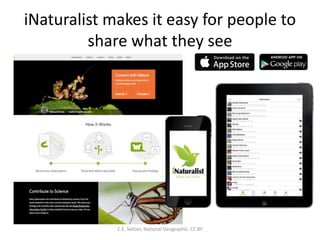
iNaturalist makes it easy for people to
share what they see
C.E. Seltzer, National Geographic. CC BY
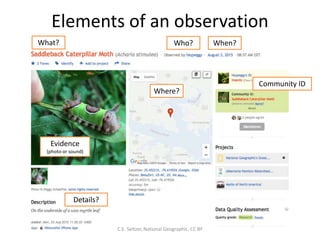
Elements of an observation
C.E. Seltzer, National Geographic. CC BY
What? Who? When?
Where?
Details?
Community ID
Evidence
(photo or sound)
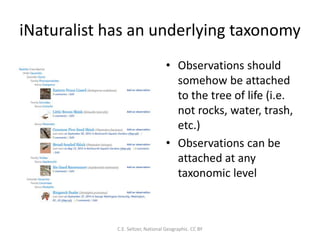
iNaturalist has an underlying taxonomy
• Observations should
somehow be attached
to the tree of life (i.e.
not rocks, water, trash,
etc.)
• Observations can be
attached at any
taxonomic level
C.E. Seltzer, National Geographic. CC BY
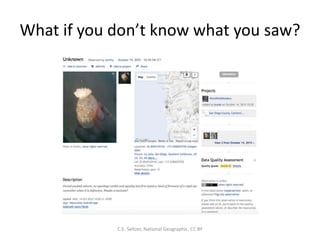
What if you don’t know what you saw?
C.E. Seltzer, National Geographic. CC BY
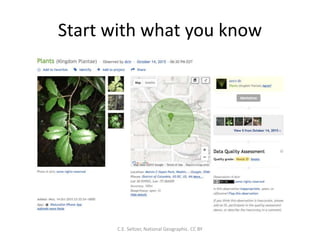
Start with what you know
C.E. Seltzer, National Geographic. CC BY
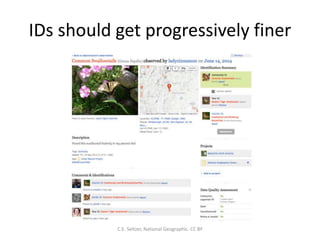
IDs should get progressively finer
C.E. Seltzer, National Geographic. CC BY
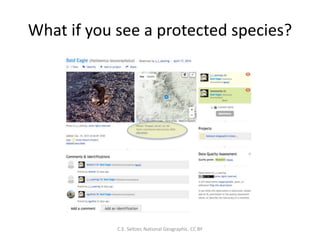
What if you see a protected species?
C.E. Seltzer, National Geographic. CC BY
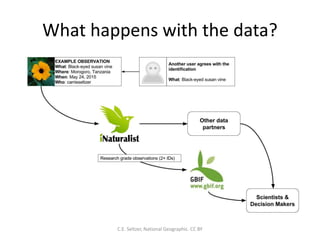
What happens with the data?
C.E. Seltzer, National Geographic. CC BY
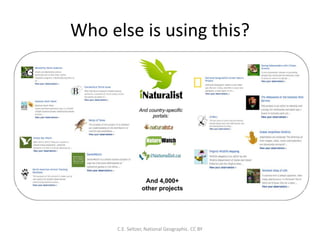
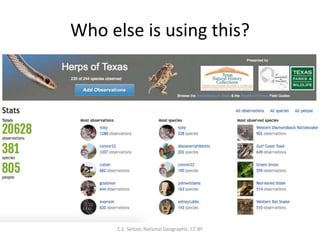
Who else is using this?
C.E. Seltzer, National Geographic. CC BY
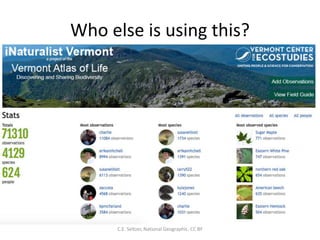
Who else is using this?
• Texas
• Vermont
C.E. Seltzer, National Geographic. CC BY
Who else is using this?
• Texas
• Vermont
C.E. Seltzer, National Geographic. CC BY
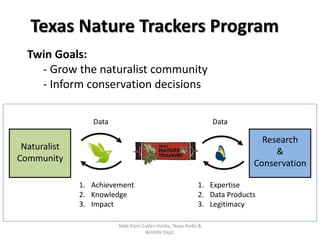
Texas Nature Trackers Program
Naturalist
Community
Research
&
Conservation
Data
1. Expertise
2. Data Products
3. Legitimacy
Data
1. Achievement
2. Knowledge
3. Impact
Twin Goals:
- Grow the naturalist community
- Inform conservation decisions
Slide from Cullen Hanks, Texas Parks &
Wildlife Dept.
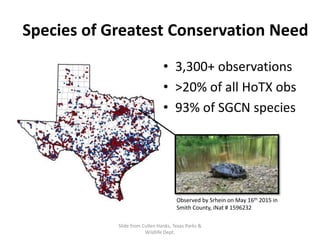
Species of Greatest Conservation Need
• 3,300+ observations
• >20% of all HoTX obs
• 93% of SGCN species
Observed by Srhein on May 16th 2015 in
Smith County, iNat # 1596232
Slide from Cullen Hanks, Texas Parks &
Wildlife Dept.
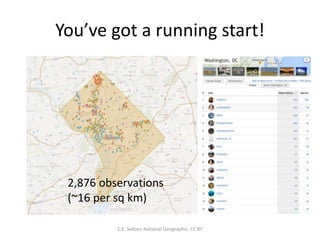
You’ve got a running start!
C.E. Seltzer, National Geographic. CC BY
2,876 observations
(~16 per sq km)
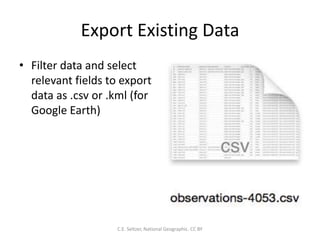
Export Existing Data
• Filter data and select
relevant fields to export
data as .csv or .kml (for
Google Earth)
C.E. Seltzer, National Geographic. CC BY
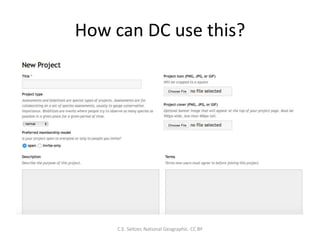
How can DC use this?
C.E. Seltzer, National Geographic. CC BY
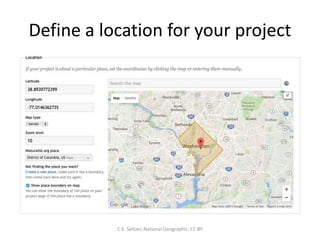
Define a location for your project
C.E. Seltzer, National Geographic. CC BY
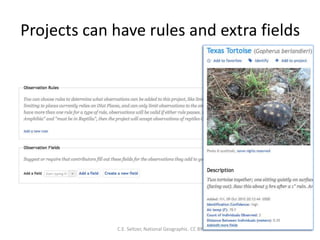
Projects can have rules and extra fields
C.E. Seltzer, National Geographic. CC BY
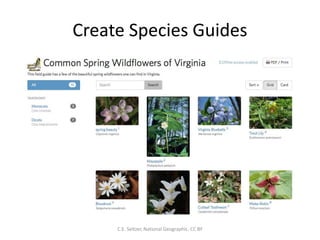
Create Species Guides
C.E. Seltzer, National Geographic. CC BY
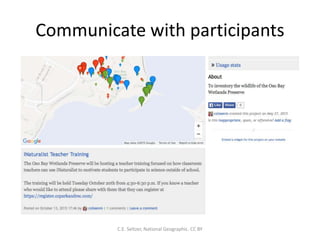
Communicate with participants
C.E. Seltzer, National Geographic. CC BY
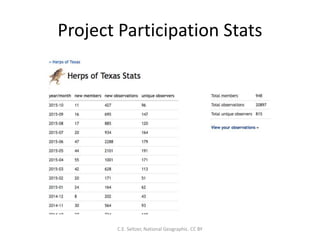
Project Participation Stats
C.E. Seltzer, National Geographic. CC BY
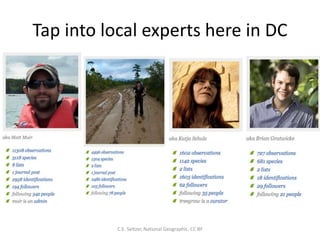
Tap into local experts here in DC
C.E. Seltzer, National Geographic. CC BY
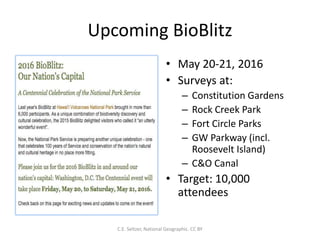
Upcoming BioBlitz
• May 20-21, 2016
• Surveys at:
– Constitution Gardens
– Rock Creek Park
– Fort Circle Parks
– GW Parkway (incl.
Roosevelt Island)
– C&O Canal
• Target: 10,000
attendees
C.E. Seltzer, National Geographic. CC BY
What CAN’T you do with iNaturalist?
• Abiotic recording/monitoring (water quality,
precipitation, temperature, air quality, etc.)
• Recording/mapping entire plant communities
• Absence (iNat is best for presence-only)
• Difficult to record metadata around sampling
effort
• Not a GIS itself, but you can use the data in
another GIS.
C.E. Seltzer, National Geographic. CC BY
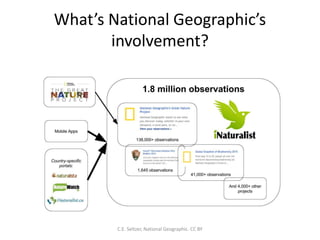
What’s National Geographic’s
involvement?
C.E. Seltzer, National Geographic. CC BY
Other possible local partners
• Biophilic DC
• Audubon
• Rock Creek Conservancy
• Anacostia Watershed Society
• City Wildlife
• DC Master Naturalists
C.E. Seltzer, National Geographic. CC BY
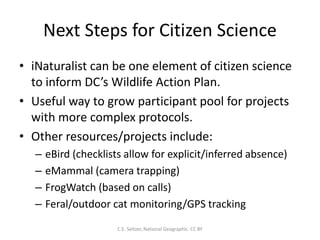
Next Steps for Citizen Science
• iNaturalist can be one element of citizen science
to inform DC’s Wildlife Action Plan.
• Useful way to grow participant pool for projects
with more complex protocols.
• Other resources/projects include:
– eBird (checklists allow for explicit/inferred absence)
– eMammal (camera trapping)
– FrogWatch (based on calls)
– Feral/outdoor cat monitoring/GPS tracking
C.E. Seltzer, National Geographic. CC BY
Note for re-using this presentation
• Please do! Just credit me (CC BY 4.0)
• Most of the images on the slides are just
screen captures from iNaturalist.
• Some of them are composites I created in
Google Drawings. Email me at
cseltzer@ngs.org to get access to these if you
want to edit them (or use the concept to
recreate your own).
C.E. Seltzer, National Geographic. CC BY

Using iNaturalist for engagement and data collection

  • 1.
    Using for engagement anddata collection Presentation to the District of Columbia Department of Energy & Environment By Carrie E. Seltzer, Ph.D. Program Manager of National Geographic’s Great Nature Project October 15, 2015
  • 2.
    How many specieslive in DC? • “The forests, waters, meadows, and wetlands in the District provide habitat for approximately 240 species of birds, 78 fish, 29 mammals, 21 reptiles, 19 amphibians, and thousands of invertebrates.” C.E. Seltzer, National Geographic. CC BY
  • 3.
    iNaturalist makes iteasy for people to share what they see C.E. Seltzer, National Geographic. CC BY
  • 4.
    Elements of anobservation C.E. Seltzer, National Geographic. CC BY What? Who? When? Where? Details? Community ID Evidence (photo or sound)
  • 5.
    iNaturalist has anunderlying taxonomy • Observations should somehow be attached to the tree of life (i.e. not rocks, water, trash, etc.) • Observations can be attached at any taxonomic level C.E. Seltzer, National Geographic. CC BY
  • 6.
    What if youdon’t know what you saw? C.E. Seltzer, National Geographic. CC BY
  • 7.
    Start with whatyou know C.E. Seltzer, National Geographic. CC BY
  • 8.
    IDs should getprogressively finer C.E. Seltzer, National Geographic. CC BY
  • 9.
    What if yousee a protected species? C.E. Seltzer, National Geographic. CC BY
  • 10.
    What happens withthe data? C.E. Seltzer, National Geographic. CC BY
  • 11.
    Who else isusing this? C.E. Seltzer, National Geographic. CC BY
  • 12.
    Who else isusing this? • Texas • Vermont C.E. Seltzer, National Geographic. CC BY
  • 13.
    Who else isusing this? • Texas • Vermont C.E. Seltzer, National Geographic. CC BY
  • 14.
    Texas Nature TrackersProgram Naturalist Community Research & Conservation Data 1. Expertise 2. Data Products 3. Legitimacy Data 1. Achievement 2. Knowledge 3. Impact Twin Goals: - Grow the naturalist community - Inform conservation decisions Slide from Cullen Hanks, Texas Parks & Wildlife Dept.
  • 15.
    Species of GreatestConservation Need • 3,300+ observations • >20% of all HoTX obs • 93% of SGCN species Observed by Srhein on May 16th 2015 in Smith County, iNat # 1596232 Slide from Cullen Hanks, Texas Parks & Wildlife Dept.
  • 16.
    You’ve got arunning start! C.E. Seltzer, National Geographic. CC BY 2,876 observations (~16 per sq km)
  • 17.
    Export Existing Data •Filter data and select relevant fields to export data as .csv or .kml (for Google Earth) C.E. Seltzer, National Geographic. CC BY
  • 18.
    How can DCuse this? C.E. Seltzer, National Geographic. CC BY
  • 19.
    Define a locationfor your project C.E. Seltzer, National Geographic. CC BY
  • 20.
    Projects can haverules and extra fields C.E. Seltzer, National Geographic. CC BY
  • 21.
    Create Species Guides C.E.Seltzer, National Geographic. CC BY
  • 22.
    Communicate with participants C.E.Seltzer, National Geographic. CC BY
  • 23.
    Project Participation Stats C.E.Seltzer, National Geographic. CC BY
  • 24.
    Tap into localexperts here in DC C.E. Seltzer, National Geographic. CC BY
  • 25.
    Upcoming BioBlitz • May20-21, 2016 • Surveys at: – Constitution Gardens – Rock Creek Park – Fort Circle Parks – GW Parkway (incl. Roosevelt Island) – C&O Canal • Target: 10,000 attendees C.E. Seltzer, National Geographic. CC BY
  • 26.
    What CAN’T youdo with iNaturalist? • Abiotic recording/monitoring (water quality, precipitation, temperature, air quality, etc.) • Recording/mapping entire plant communities • Absence (iNat is best for presence-only) • Difficult to record metadata around sampling effort • Not a GIS itself, but you can use the data in another GIS. C.E. Seltzer, National Geographic. CC BY
  • 27.
    What’s National Geographic’s involvement? C.E.Seltzer, National Geographic. CC BY
  • 28.
    Other possible localpartners • Biophilic DC • Audubon • Rock Creek Conservancy • Anacostia Watershed Society • City Wildlife • DC Master Naturalists C.E. Seltzer, National Geographic. CC BY
  • 29.
    Next Steps forCitizen Science • iNaturalist can be one element of citizen science to inform DC’s Wildlife Action Plan. • Useful way to grow participant pool for projects with more complex protocols. • Other resources/projects include: – eBird (checklists allow for explicit/inferred absence) – eMammal (camera trapping) – FrogWatch (based on calls) – Feral/outdoor cat monitoring/GPS tracking C.E. Seltzer, National Geographic. CC BY
  • 30.
    Note for re-usingthis presentation • Please do! Just credit me (CC BY 4.0) • Most of the images on the slides are just screen captures from iNaturalist. • Some of them are composites I created in Google Drawings. Email me at cseltzer@ngs.org to get access to these if you want to edit them (or use the concept to recreate your own). C.E. Seltzer, National Geographic. CC BY

Editor's Notes

  • #3 There’s a lot we still don’t know about what lives in DC.
  • #4 iNaturalist.org is a place for people to share their observations of biodiversity from anywhere in the world.
  • #13 From the project description: “It started with a simple question. How many species occur in Vermont? You’d think we’d know this for a small state steeped in a rich tradition of naturalists dating back to Zadock Thompson and his seminal 1842 work on the natural history of Vermont. But, the simple answer was, no one really knew. We do know how many species there are of some of the popular taxonomic groups like birds (currently 382) and mammals (58). But how many invertebrates are there in Vermont? A back-of-the-envelope estimate puts the number at just over 21,400 species! There are about 2,150 species of plants, with approximately 1,400 native plants. Not including protists, bacteria or viruses, we humans share Vermont with at least 26,000 to 45,000 species, although no one knows for sure just how many.”
  • #14 From their project description: “The purpose of this project is to enhance our understanding of the distribution of reptiles and amphibians in Texas. Our highest priority is to collect information on Species of Greatest Conservation Need (SGCN). However, we hope this project will lead to a better understanding of the distribution of all reptile and amphibian species in Texas and we encourage others to use this data for research and conservation purposes.”
  • #18 View and export project stats
  • #19 ANYONE can make a new project.
  • #20 ANYONE can make a new project.
  • #21 ANYONE can make a new project.
  • #22 Write journal posts that will be shared with people who join your project and elect to receive updates via a once-daily iNaturalist updates email.
  • #23 Write journal posts that will be shared with people who join your project and elect to receive updates via a once-daily iNaturalist updates email.
  • #24 View and export project stats
  • #25 Biologist for US FWS, Botanist with NatureServe, Entomologist at EOL, and Herpetologist at the National Zoo
  • #27 There is some prototype checklist-type functionality (called “Trips”) but it’s not well developed or widely used yet.
  • #28 Nat Geo has two main points of involvement with iNaturalist. One is that the Great Nature Project, which I manage, is a portal into iNaturalist as well as a project within iNaturalist. Our goal is to encourage people to share their encounters with biodiversity by creating additional learning opportunities and promoting citizen science. We would love, for example, to encourage our DC-area users to submit observations of DC’s SGCNs. The second point of iNat-NatGeo involvement is via BioBlitzes. Every year we do a big event with NPS and this year it will be in DC again, and everyone will be encouraged to record observations using iNaturalist. (explain diagram showing how observations enter iNat and can be in more than one project).