USING DIRECT QUOTATIONS:
A Guide to Selecting, Integrating, and
Citing in APA Style (7th ed).
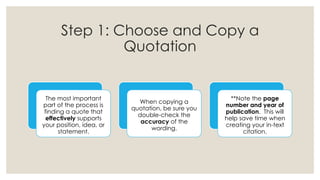
Step 1: Choose and Copy a
Quotation
The most important
part of the process is
finding a quote that
effectively supports
your position, idea, or
statement.
When copying a
quotation, be sure you
double-check the
accuracy of the
wording.
**Note the page
number and year of
publication. This will
help save time when
creating your in-text
citation.
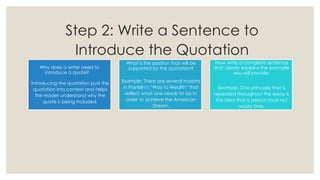
Step 2: Write a Sentence to
Introduce the Quotation
Why does a writer need to
introduce a quote?
Introducing the quotation puts the
quotation into context and helps
the reader understand why the
quote is being included.
What is the position that will be
supported by the quotation?
Example: There are several maxims
in Franklin’s “Way to Wealth” that
reflect what one needs to do in
order to achieve the American
Dream.
Now write a complete sentence
that clearly explains the example
you will provide.
Example: One principle that is
repeated throughout the essay is
the idea that a person must not
waste time.
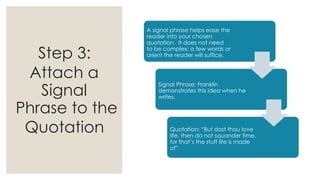
Step 3:
Attach a
Signal
Phrase to the
Quotation
A signal phrase helps ease the
reader into your chosen
quotation. It does not need
to be complex; a few words or
orient the reader will suffice.
Signal Phrase: Franklin
demonstrates this idea when he
writes,
Quotation: “But dost thou love
life, then do not squander time,
for that’s the stuff life is made
of”
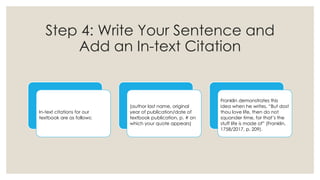
Step 4: Write Your Sentence and
Add an In-text Citation
In-text citations for our
textbook are as follows:
(author last name, original
year of publication/date of
textbook publication, p. # on
which your quote appears)
Franklin demonstrates this
idea when he writes, “But dost
thou love life, then do not
squander time, for that’s the
stuff life is made of” (Franklin,
1758/2017, p. 209).
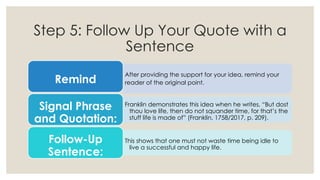
Step 5: Follow Up Your Quote with a
Sentence
After providing the support for your
reader of the original point.
idea, remind your
Remind
Franklin demonstrates this idea when he writes, “But dost
thou love life, then do not squander time, for that’s the
stuff life is made of” (Franklin, 1758/2017, p. 209).
Signal Phrase
and Quotation:
This shows that one must not waste time being idle to
live a successful and happy life.
Follow-Up
Sentence:
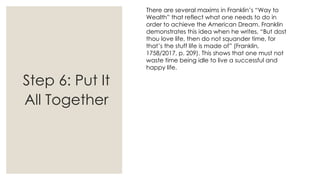
There are several maxims in Franklin’s “Way to
Wealth” that reflect what one needs to do in
order to achieve the American Dream. Franklin
demonstrates this idea when he writes, “But dost
thou love life, then do not squander time, for
that’s the stuff life is made of” (Franklin,
1758/2017, p. 209). This shows that one must not
waste time being idle to live a successful and
happy life.
Step 6: Put It
All Together
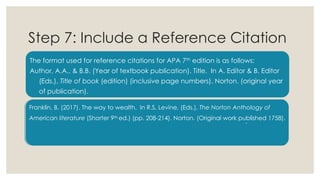
Step 7: Include a Reference Citation
The format used for reference citations for APA 7th edition is as follows:
Author, A.A., & B.B. (Year of textbook publication). Title. In A. Editor & B. Editor
(Eds.), Title of book (edition) (inclusive page numbers). Norton. (original year
of publication).
Franklin, B. (2017). The way to wealth. In R.S. Levine, (Eds.), The Norton Anthology of
American literature (Shorter 9th ed.) (pp. 208-214). Norton. (Original work published 1758).
-
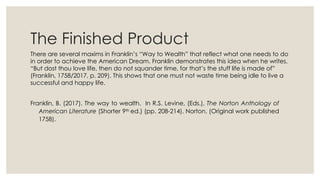
The Finished Product
There are several maxims in Franklin’s “Way to Wealth” that reflect what one needs to do
in order to achieve the American Dream. Franklin demonstrates this idea when he writes,
“But dost thou love life, then do not squander time, for that’s the stuff life is made of”
(Franklin, 1758/2017, p. 209). This shows that one must not waste time being idle to live a
successful and happy life.
Franklin, B. (2017). The way to wealth. In R.S. Levine, (Eds.), The Norton Anthology of
American Literature (Shorter 9th ed.) (pp. 208-214). Norton. (Original work published
1758).
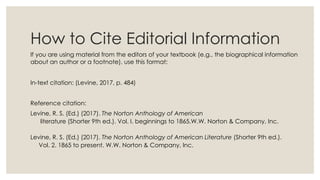
How to Cite Editorial Information
If you are using material from the editors of your textbook (e.g., the biographical information
about an author or a footnote), use this format:
In-text citation: (Levine, 2017, p. 484)
Reference citation:
Levine, R. S. (Ed.) (2017). The Norton Anthology of American
literature (Shorter 9th ed.). Vol. I. beginnings to 1865.W.W. Norton & Company, Inc.
Levine, R. S. (Ed.) (2017). The Norton Anthology of American Literature (Shorter 9th ed.).
Vol. 2. 1865 to present. W.W. Norton & Company, Inc.
Using direct quotations

Using direct quotations

  • 1.
    USING DIRECT QUOTATIONS: AGuide to Selecting, Integrating, and Citing in APA Style (7th ed).
  • 2.
    Step 1: Chooseand Copy a Quotation The most important part of the process is finding a quote that effectively supports your position, idea, or statement. When copying a quotation, be sure you double-check the accuracy of the wording. **Note the page number and year of publication. This will help save time when creating your in-text citation.
  • 3.
    Step 2: Writea Sentence to Introduce the Quotation Why does a writer need to introduce a quote? Introducing the quotation puts the quotation into context and helps the reader understand why the quote is being included. What is the position that will be supported by the quotation? Example: There are several maxims in Franklin’s “Way to Wealth” that reflect what one needs to do in order to achieve the American Dream. Now write a complete sentence that clearly explains the example you will provide. Example: One principle that is repeated throughout the essay is the idea that a person must not waste time.
  • 4.
    Step 3: Attach a Signal Phraseto the Quotation A signal phrase helps ease the reader into your chosen quotation. It does not need to be complex; a few words or orient the reader will suffice. Signal Phrase: Franklin demonstrates this idea when he writes, Quotation: “But dost thou love life, then do not squander time, for that’s the stuff life is made of”
  • 5.
    Step 4: WriteYour Sentence and Add an In-text Citation In-text citations for our textbook are as follows: (author last name, original year of publication/date of textbook publication, p. # on which your quote appears) Franklin demonstrates this idea when he writes, “But dost thou love life, then do not squander time, for that’s the stuff life is made of” (Franklin, 1758/2017, p. 209).
  • 6.
    Step 5: FollowUp Your Quote with a Sentence After providing the support for your reader of the original point. idea, remind your Remind Franklin demonstrates this idea when he writes, “But dost thou love life, then do not squander time, for that’s the stuff life is made of” (Franklin, 1758/2017, p. 209). Signal Phrase and Quotation: This shows that one must not waste time being idle to live a successful and happy life. Follow-Up Sentence:
  • 7.
    There are severalmaxims in Franklin’s “Way to Wealth” that reflect what one needs to do in order to achieve the American Dream. Franklin demonstrates this idea when he writes, “But dost thou love life, then do not squander time, for that’s the stuff life is made of” (Franklin, 1758/2017, p. 209). This shows that one must not waste time being idle to live a successful and happy life. Step 6: Put It All Together
  • 8.
    Step 7: Includea Reference Citation The format used for reference citations for APA 7th edition is as follows: Author, A.A., & B.B. (Year of textbook publication). Title. In A. Editor & B. Editor (Eds.), Title of book (edition) (inclusive page numbers). Norton. (original year of publication). Franklin, B. (2017). The way to wealth. In R.S. Levine, (Eds.), The Norton Anthology of American literature (Shorter 9th ed.) (pp. 208-214). Norton. (Original work published 1758). -
  • 9.
    The Finished Product Thereare several maxims in Franklin’s “Way to Wealth” that reflect what one needs to do in order to achieve the American Dream. Franklin demonstrates this idea when he writes, “But dost thou love life, then do not squander time, for that’s the stuff life is made of” (Franklin, 1758/2017, p. 209). This shows that one must not waste time being idle to live a successful and happy life. Franklin, B. (2017). The way to wealth. In R.S. Levine, (Eds.), The Norton Anthology of American Literature (Shorter 9th ed.) (pp. 208-214). Norton. (Original work published 1758).
  • 10.
    How to CiteEditorial Information If you are using material from the editors of your textbook (e.g., the biographical information about an author or a footnote), use this format: In-text citation: (Levine, 2017, p. 484) Reference citation: Levine, R. S. (Ed.) (2017). The Norton Anthology of American literature (Shorter 9th ed.). Vol. I. beginnings to 1865.W.W. Norton & Company, Inc. Levine, R. S. (Ed.) (2017). The Norton Anthology of American Literature (Shorter 9th ed.). Vol. 2. 1865 to present. W.W. Norton & Company, Inc.