Week 2-Day 1
Look around you and list down 5
materials and classify whether it is
useful or harmful.
Why do we need to
know which materials
are useful and harmful?
Matter is all around us. It
can take many forms and
has many properties. While
some materials have useful
properties, other materials
can also be harmful.
Do you consider the
picture as useful
material?
Now, look at the picture.
Why?
When do we consider a
material is useful?
Materials are considered
useful when it serves a
purpose.
For example:
Are those materials being
presented useful to you? Why?
In your Mathematics Class, are
you using rulers or any measuring
materials?
Is it useful or harmful?
Why?
Example:
Water is essential to human,
animals and plants.
Why?
When do we consider a
material is Harmful?
For example:
Batteries can provide energy
to different equipment but
it is harmful because of its
content.
Group 1.
Classify the different materials as useful or harmful. Paste it
inside the heart shape if useful and triangle shape if harmful.
Group 2.
Determine which of the activities below is desirable or
harmful. Write D. if Desirable and H if Harmful.
Group 3.
Identify the following materials whether they are useful or
harmful. Write U for useful, or H for Harmful.
Group Activity:
Group Work
Presentation
Write U is the material is
useful and H if it is harmful.
We must be aware if a material is
useful and harmful.
For example:
During Arts lesson, we are
using scissors in doing activities,
be mindful in using this material
because it can cause cuts or injury.
How can we
determine if a
material is Harmful?
How can we determine
if a material is Useful?
Directions: Identify whether they are useful or harmful by
putting a check mark ( ) on the appropriate column.
✓
Week 2-Day 2
Identify the following materials if
it is useful or harmful.
Based on the given images, how did you
classify them as useful or harmful?
Observe the pictures below.
There are different Materials found at
home and at school. The following
materials are important because they
are used in our daily activities.
It is important to identify whether a
certain material is harmful or
useful.
For Example:
A broken glass jar
can cause cuts or
injury.
Some materials are toxic.
Toxic substances may also be present in the things
you commonly use such as paints, cleaners, fumes,
gels, or powders.
These materials may bring
harm to your health,
environment, and other
organisms when not used
properly. That’s why you
should be careful when
handling and using different
materials.
The following are
common signs in
product labels
which can help
consumers decide
whether the
product is useful
or harmful.
Reading product labels can help you identify
whether the product is useful or harmful. These
simple symbols in labels give ideas on how to use
and store the product properly, and to help prevent
accidents from happening and therefore save lives.
Identify the following materials whether they are
useful or harmful. Write U for useful, or H for
Harmful.
Observe the picture below.
Can you see the sign or
symbol in the product
label?
What is the given symbol?
Is it harmful or not?
Why?
Various household products are found in our homes.
These are composed of different materials with different
properties. It is therefore important for consumers to read
product labels. Through product labels, consumers become
aware of whether the product is harmful or not.
Read each situation below and choose the best answer. Write the
letter only.
1. Your aunt gave you chocolates as birthday presents. You
were very excited to share it with your younger brother who
loves chocolates, but when you read the label, you noticed
that some have food allergen warning. Some of these contain
peanuts, which can cause allergy to your brother. What will
you do?
A. I will still give him the chocolates and ignore the effects.
B. I will choose the one without peanuts and give it to him.
C. He will not be given any chocolate because he has an
allergy.
D. I will go to the grocery store and buy candies for my
brother.
2. Father came home from work. Upon entering the gate,
he disinfects his hands by using 70% alcohol. However,
Mother was carrying a lighted candle and about to
approach Father. What is the best thing to do?
A. Mother may bring a kerosene lamp instead of a
candle.
B. Let her continue to approach Father with a lighted
candle.
C. Tell Mother to put out the flame before going to the
gate.
D. Bring more bottles of alcohol for Father.
3. Your best friend bought a cough syrup from the pharmacy. You noticed
that the medicine is expired already. What are you going to say to her?
A. Continue to take medicine.
B. Do not take the cough syrup.
C. Mix it with new medicine.
D. Scold the pharmacist for giving expired medicine.
4. Mang Lito is a farmer. He used commercial pesticides in controlling pests
in his rice field. Where can he store this poisonous product?
A. at the kitchen sink
B. on top of the dining table
C. in a closed and secured cabinet
D. under the table
5. Your Muslim friend visited your home. After some time,
you decided to prepare food for lunch. What food
products are you going to serve?
A. meat products
B. any available food
C. Halal certified food
D. dairy products
Week 2-Day 3
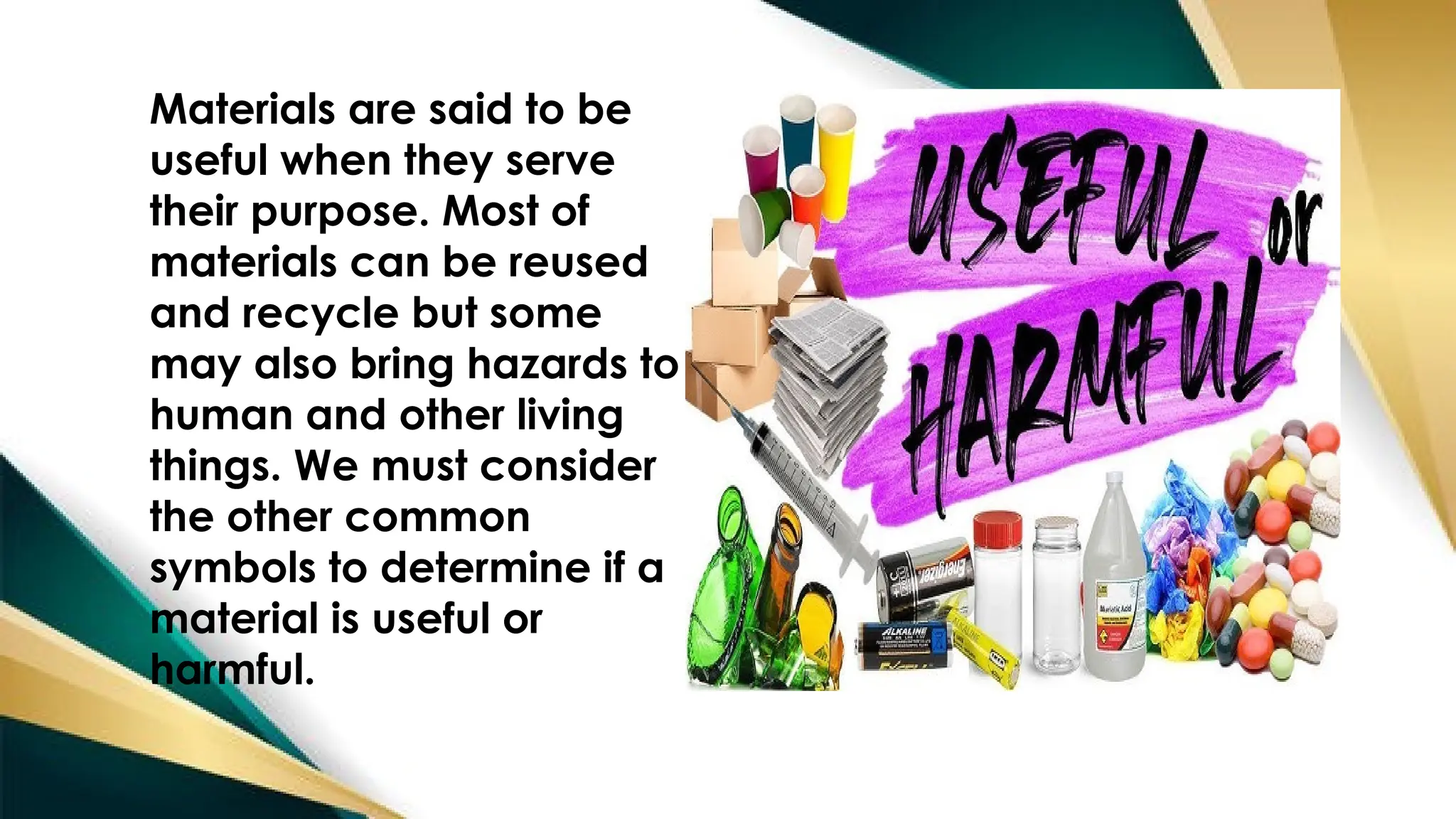
Observe the objects in the picture.
Are those materials are dangerous/toxic/flammable?
What can you say about the objects?
Materials are said to be
useful when they serve
their purpose. Most of
materials can be reused
and recycle but some
may also bring hazards to
human and other living
things. We must consider
the other common
symbols to determine if a
material is useful or
harmful.
The following are the other common signs in product
labels which can help consumers decide whether the
product is useful or harmful.
These simple
symbols in labels
give ideas on how
to use and store
the product
properly, and to
help prevent
accidents from
happening and
therefore save
lives.
Directions: Study the pictures below and match the
common product labels to its corresponding product.
How could you figure
out if a material is useful
or harmful?
It is important to read the label of product in order for
the costumer to be aware of whether useful or
harmful.
Why is it important to read the
product label?
For example:
Directions: Write True if the statement is correct, and write
False if it is incorrect.
1. Consumers must read product labels when buying grocery
items.
2. Place fertilizers in containers and label them as
poisonous.
3. Throw away anywhere the plastic bottles after using
them.
4. Labels are not important in classifying materials as to
useful or harmful.
5. Food allergen warnings are helpful especially for those
who have allergies.
Week 2-Day 4
Thumbs Up Thumbs Down
If you saw a product label like the
picture, what is the meaning of it?
(It is poisonous or toxic and
harmful to human body)
Look at the following images.
Waste
How do you
manage your
waste at home?
Waste
The waste humans create while enjoying
outdoor/indoor spaces can have severe
impacts if not disposed properly. It is
crucial to anticipate the types of waste
you will need to dispose of and know
the proper techniques for disposing of
each type of waste in the area you are
visiting. Leave No Trace encourages
outdoor/indoor enthusiasts to consider
the impacts they leave behind, which
will undoubtedly affect other people,
water, and wildlife.
It is easy to segregate waste at your home. You can use color-
coded bins like green, blue, and yellow for waste segregation
and identification. Segregate organic and biodegradable waste,
such as food waste and garden waste, in green.
*Waste Segregation
The organic waste can be used for
composting. Furthermore, you can use
yellow for glass & paper and blue for
plastic and non-biodegradable waste.
*Practicing the 5Rs Technique
Draw a happy face if it is useful and sad
face if harmful.
In our daily activities, we must
know how to determine if a
material is hazardous or not.
Always follow the instruction of
the product before using it.
How are we going to dispose
the used material so that it will
not be harmful?
Week 2-Day 5
Weekly Assessment

Useful and Harmful Materials in found at home

  • 1.
  • 2.
    Look around youand list down 5 materials and classify whether it is useful or harmful.
  • 3.
    Why do weneed to know which materials are useful and harmful?
  • 4.
    Matter is allaround us. It can take many forms and has many properties. While some materials have useful properties, other materials can also be harmful.
  • 5.
    Do you considerthe picture as useful material? Now, look at the picture. Why?
  • 6.
    When do weconsider a material is useful? Materials are considered useful when it serves a purpose. For example: Are those materials being presented useful to you? Why?
  • 7.
    In your MathematicsClass, are you using rulers or any measuring materials? Is it useful or harmful? Why?
  • 8.
    Example: Water is essentialto human, animals and plants. Why?
  • 9.
    When do weconsider a material is Harmful? For example: Batteries can provide energy to different equipment but it is harmful because of its content.
  • 11.
    Group 1. Classify thedifferent materials as useful or harmful. Paste it inside the heart shape if useful and triangle shape if harmful. Group 2. Determine which of the activities below is desirable or harmful. Write D. if Desirable and H if Harmful. Group 3. Identify the following materials whether they are useful or harmful. Write U for useful, or H for Harmful. Group Activity:
  • 12.
  • 13.
    Write U isthe material is useful and H if it is harmful.
  • 14.
    We must beaware if a material is useful and harmful. For example: During Arts lesson, we are using scissors in doing activities, be mindful in using this material because it can cause cuts or injury.
  • 15.
    How can we determineif a material is Harmful? How can we determine if a material is Useful?
  • 16.
    Directions: Identify whetherthey are useful or harmful by putting a check mark ( ) on the appropriate column. ✓
  • 17.
  • 18.
    Identify the followingmaterials if it is useful or harmful. Based on the given images, how did you classify them as useful or harmful?
  • 19.
    Observe the picturesbelow. There are different Materials found at home and at school. The following materials are important because they are used in our daily activities.
  • 20.
    It is importantto identify whether a certain material is harmful or useful. For Example: A broken glass jar can cause cuts or injury.
  • 21.
    Some materials aretoxic. Toxic substances may also be present in the things you commonly use such as paints, cleaners, fumes, gels, or powders. These materials may bring harm to your health, environment, and other organisms when not used properly. That’s why you should be careful when handling and using different materials.
  • 22.
    The following are commonsigns in product labels which can help consumers decide whether the product is useful or harmful.
  • 23.
    Reading product labelscan help you identify whether the product is useful or harmful. These simple symbols in labels give ideas on how to use and store the product properly, and to help prevent accidents from happening and therefore save lives.
  • 24.
    Identify the followingmaterials whether they are useful or harmful. Write U for useful, or H for Harmful.
  • 25.
    Observe the picturebelow. Can you see the sign or symbol in the product label? What is the given symbol? Is it harmful or not? Why?
  • 26.
    Various household productsare found in our homes. These are composed of different materials with different properties. It is therefore important for consumers to read product labels. Through product labels, consumers become aware of whether the product is harmful or not.
  • 27.
    Read each situationbelow and choose the best answer. Write the letter only. 1. Your aunt gave you chocolates as birthday presents. You were very excited to share it with your younger brother who loves chocolates, but when you read the label, you noticed that some have food allergen warning. Some of these contain peanuts, which can cause allergy to your brother. What will you do? A. I will still give him the chocolates and ignore the effects. B. I will choose the one without peanuts and give it to him. C. He will not be given any chocolate because he has an allergy. D. I will go to the grocery store and buy candies for my brother.
  • 28.
    2. Father camehome from work. Upon entering the gate, he disinfects his hands by using 70% alcohol. However, Mother was carrying a lighted candle and about to approach Father. What is the best thing to do? A. Mother may bring a kerosene lamp instead of a candle. B. Let her continue to approach Father with a lighted candle. C. Tell Mother to put out the flame before going to the gate. D. Bring more bottles of alcohol for Father.
  • 29.
    3. Your bestfriend bought a cough syrup from the pharmacy. You noticed that the medicine is expired already. What are you going to say to her? A. Continue to take medicine. B. Do not take the cough syrup. C. Mix it with new medicine. D. Scold the pharmacist for giving expired medicine. 4. Mang Lito is a farmer. He used commercial pesticides in controlling pests in his rice field. Where can he store this poisonous product? A. at the kitchen sink B. on top of the dining table C. in a closed and secured cabinet D. under the table
  • 30.
    5. Your Muslimfriend visited your home. After some time, you decided to prepare food for lunch. What food products are you going to serve? A. meat products B. any available food C. Halal certified food D. dairy products
  • 31.
  • 32.
    Observe the objectsin the picture. Are those materials are dangerous/toxic/flammable? What can you say about the objects?
  • 33.
    Materials are saidto be useful when they serve their purpose. Most of materials can be reused and recycle but some may also bring hazards to human and other living things. We must consider the other common symbols to determine if a material is useful or harmful.
  • 34.
    The following arethe other common signs in product labels which can help consumers decide whether the product is useful or harmful. These simple symbols in labels give ideas on how to use and store the product properly, and to help prevent accidents from happening and therefore save lives.
  • 35.
    Directions: Study thepictures below and match the common product labels to its corresponding product.
  • 37.
    How could youfigure out if a material is useful or harmful?
  • 38.
    It is importantto read the label of product in order for the costumer to be aware of whether useful or harmful. Why is it important to read the product label? For example:
  • 39.
    Directions: Write Trueif the statement is correct, and write False if it is incorrect. 1. Consumers must read product labels when buying grocery items. 2. Place fertilizers in containers and label them as poisonous. 3. Throw away anywhere the plastic bottles after using them. 4. Labels are not important in classifying materials as to useful or harmful. 5. Food allergen warnings are helpful especially for those who have allergies.
  • 40.
  • 41.
  • 42.
    If you sawa product label like the picture, what is the meaning of it? (It is poisonous or toxic and harmful to human body)
  • 43.
    Look at thefollowing images. Waste How do you manage your waste at home?
  • 44.
    Waste The waste humanscreate while enjoying outdoor/indoor spaces can have severe impacts if not disposed properly. It is crucial to anticipate the types of waste you will need to dispose of and know the proper techniques for disposing of each type of waste in the area you are visiting. Leave No Trace encourages outdoor/indoor enthusiasts to consider the impacts they leave behind, which will undoubtedly affect other people, water, and wildlife.
  • 45.
    It is easyto segregate waste at your home. You can use color- coded bins like green, blue, and yellow for waste segregation and identification. Segregate organic and biodegradable waste, such as food waste and garden waste, in green. *Waste Segregation The organic waste can be used for composting. Furthermore, you can use yellow for glass & paper and blue for plastic and non-biodegradable waste. *Practicing the 5Rs Technique
  • 46.
  • 47.
    Draw a happyface if it is useful and sad face if harmful.
  • 48.
    In our dailyactivities, we must know how to determine if a material is hazardous or not. Always follow the instruction of the product before using it.
  • 49.
    How are wegoing to dispose the used material so that it will not be harmful?
  • 51.
  • 52.