U S M A R K E T E N T R Y


FOR FAST-GROWING STARTUPS
N O V E M B E R 2 0 T H , 2 0 2 0
D R A K E T A L K S
PA R T N E R


D R A K E S TA R
Vitaly M. Golomb
F O U N D E R


L 2 C O U N S E L
Louis Lehot
Your Hosts
2
Large Tech

Focused M&A


Advisory Firm
27 senior partners


100+ team focused on TMC


Over 370+ transactions
Leaders
#1 in TMC cross-border midcap

#2 in TMC global midcap


11 Awards 2018-2020
Global Presence
9 of
fi
ces in 6 countries


Plus partnerships in:


Dubai, Israel, Japan, and Singapore


70% of deals cross-border
Mobility &

New Energy
20+ Focused on


Mobility & New Energy


Senior Advisory Board


Deep Relationships


with Leaders and investors
3
200+ Companies


Represented
> 80 billion raised


> 20 VC and private equity


fi
rm relationships
From Garage

 to Global
Representing clients at all


stages of growth and throughout


their life span
Outside


General Counsel
For emerging private


growth companies


in the innovation economy
Company


Side Counsel
4
Investor counsel in angel,


seed and venture capital


fi
nancings and M&A sales
C E O


D R A G O N B O AT. I O
Becky Flint
PA R T N E R


O N E WAY V E N T U R E S
Eugene Malobrodsky
M A N A G I N G PA R T N E R


M I G H T Y C A P I TA L
SC Moatti
Your Panelists
5
Agenda

VC Market 2020 and 2021 Trajectory


Entering the US Market

Panel Q&A


Slides and Video will be available after the webinar
6
VC Market 2020
7
2020 US Deal Activity Remains Surprisingly Strong
VC deal activity by quarter
Source: PitchBook-NVCA Venture Monitor as of Sept 30, 2020 8
2020 US Deal Activity Remains Surprisingly Strong
Mega-deals approach 2019
fi
gures
US VC mega-deal activity
Large deals growing
US VC (#) by size
Source: PitchBook-NVCA Venture Monitor as of Sept 30, 2020 9
A Reopening of the IPO Window
VC exit activity by quarter
Source: PitchBook-NVCA Venture Monitor as of Sept 30, 2020 10
Early Stage VC
2020 Early-stage VC unlikely to match 2019
Source: PitchBook-NVCA Venture Monitor as of Sept 30, 2020 11
Early Stage VC
Q3 deal activity shows notable rebound
Source: PitchBook-NVCA Venture Monitor as of Sept 30, 2020 12
Late-Stage VC
US late-stage VC deal activity
Source: PitchBook-NVCA Venture Monitor as of Sept 30, 2020 13
Late-Stage VC
US late-stage VC deal activity
Source: PitchBook-NVCA Venture Monitor as of Sept 30, 2020 14
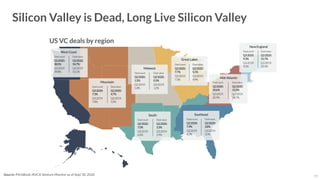
Silicon Valley is Dead, Long Live Silicon Valley
US VC deals by region
Source: PitchBook-NVCA Venture Monitor as of Sept 30, 2020 15
Global Venture Trends
Source: Venture Pulse, Q2’20. Global Analysis of Venture Funding, KPMG Private Enterprise. 16
Global Median Pre-Money Valuation
Source: Venture Pulse, Q2’20. Global Analysis of Venture Funding, KPMG Private Enterprise. 17
Global Median Pre-Money Valuation
Source: Venture Pulse, Q2’20. Global Analysis of Venture Funding, KPMG Private Enterprise. 18
Looking Ahead to 2021
19
Change in Investment Activity since COVID-19
Source: 500 Startups - The Impact of COVID-19 on the Early-Stage Investment Climate: Q3 2020 20
What Stage Do You Plan to Focus on in 2021?
Source: 500 Startups - The Impact of COVID-19 on the Early-Stage Investment Climate: Q3 2020 21
What Sectors Do You Plan to Focus on in 2021?
Source: 500 Startups - The Impact of COVID-19 on the Early-Stage Investment Climate: Q3 2020 22
Private Equity Will Continue to Play in VC
Source: PitchBook
Growth equity deals ($) by sector
23
So When Should You Come To US?
Further reading:


Golomb.net/foreignfounder/
24
Strategies and Tactics
25
Setting Up in the US
What are my choices?


• Go direct


• Branch


• Subsidiary


• “Flip” – creating US Holding Company
Setting Up in the US: Fundraising
Fundraising: Accessing US Venture Capital


• Will US VC invest directly in foreign company?


• Are you ready for VC
fi
nancing?


• VC
fi
nancings
Setting Up in the US: Subsidiary
• Objective: Established foreign company (“TechCo”) needs US subsidiary for local presence
and contracting, hiring, bene
fi
ts, limited liability, IP/tax structuring


• Key Steps:


• Delaware corporation


• One Shareholder


• One Director (or more)


• Of
fi
cers: President, Chief Financial Of
fi
cer, Secretary


• Common Stock (ordinary share equivalent)

• Timing: as fast as 1 day


• “Qualify” in California or other States where operate


• Consider operations and need for intercompany IP agreement


• Consider tax optimization and intercompany services agreement and transfer pricing
“Flips” – Setting Up a New US Parent
• Objective: TechCo needs access to US venture capital and focus operations in US


• Process: “Flip” the business from abroad to the U.S. by inserting a new US “Parent” company
above TechCo


• Key Steps:


• Incorporate a new Delaware company (“US Newco”)


• Existing shareholders of TechCo contribute their TechCo shares to Newco in exchange for US
Newco shares


• NewCo seeks US venture
fi
nancing – using $ to fund operations in the US and for TechCo


• Business conducted in US by US Newco; certain foreign activities continue through TechCo or
other subsidiaries, as needed


• CEO and sales staff typically US based


• R&D; technical, development and support staff abroad
“Flips” – Setting Up a New US Parent
“Flips”to US seen from: Western Europe, Israel, Australia, Canada


• Tax issues/valuation of TechCo – tax rollover/deferral


• Tax considerations going forward


• IP – Keep IP in TechCo or migrate to US


• US Newco management and capital structure


• Consents/approvals of TechCo and viability of
fl
ip


• Compel exchange of TechCo shares for US Newco shares?


• Effect
fl
ip sooner rather than later, prior to creation of signi
fi
cant ‘value’ in TechCo


• Required legal and accounting team in place for transaction


• Time/expenses to effect
fl
ip
“Flips” – Setting Up a New US Parent
P R E - R E S T R U C T U R I N G P O S T- R E S T R U C T U R I N G
Non-US Corp
Shareholder 2Shareholder 1
US NewCo
Shareholder 1 Shareholder 2
Non-US Corp
Intercompany
Relationship
New Investors
Intercompany Agreements – Five Compensation Methods
Option 1: US is a service provider


• US of
fi
ce provides sales and marketing services and/or R&D services and earns a cost
plus return


• Home country parent bills customers and retains other activities
Home Co. Customers
US Office
Sales, marketing, R&D servicesPayments for services
Intercompany Agreements – Five Compensation Methods
Option 2: US is a distributor


• US of
fi
ce can be compensated as a distributor earning a targeted operating margin


• US of
fi
ce with the US offi ce billing customers
Home Co.
Customers
US Office
Distribution rights, goodsEarnings minus operating margin
Distribution
Intercompany Agreements – Five Compensation Methods
Option 3: US licenses IP from home country parent


• US is an entrepreneur licensing IP from home country parent and paying a royalty to
the home country parent


• US of
fi
ce engaging in high end activities and billing customers
Home Co.
Customers
US Office
RoyaltyIP license
Intercompany Agreements – Five Compensation Methods
Option 4: US buys IP from home country parent


• Migration of IP to US with US becoming the parent and the residual pro
fi
t claimant
Home Co.
Customers
US Office
Migration of IP to US with
US becoming the Parent
Intercompany Agreements – Five Compensation Methods
Option 5: US and home country parent cost share IP development with each
retaining the rights speci
fi
c to their territory


• US pays for the rights to use the IP in its territory and then co-develops the IP with
the home country parent
Home Co. Home Customers
US Office US Customers
Co-develop IPRight to use IP
U.S. Startup Formation Basics: Type of Entity
C corporation vs. S corporation or LLC


• Primary Distinction for Domestic Investors


• Double taxation v. single layer of tax


A. C Corporations are subject to “double taxation” — tax on both (a) pro
fi
ts of US subsidiary and (b)
distributions to home country parent


B. “Pass-through entities” (LLC, Branch Of
fi
ce) are not themselves subject to US income tax; all pro
fi
ts
and losses are passed through to parent


• This distinction is less relevant for non-US investors as they are not afforded
the bene
fi
t of a single layer of tax
U.S. Startup Formation Basics: Type of Entity
We typically recommend using a C Corporation


for the following reasons


• Limited liability for parent company for acts of US of
fi
ce


• Protects the parent’s books and records from investigation by US tax
authorities or US litigants


• More certainty as to revenue and expenses attributable to US


• Incentive stock options are easier to administer through a C Corporation
U.S. Startup Formation Basics: Type of Entity
We recommend incorporating in Delaware


• Broader ability to limit monetary liability of directors for breaches of the duty
of care


• Broader ability to indemnify of
fi
cers and directors


• Greater
fl
exibility to adopt measures to protect against hostile takeovers


• General reputation of Delaware law as more favorable to management,
combined with the greater predictability of Delaware case law.


• Section 2115 of the California Corporations Code applies to Delaware
corporations which have signi
fi
cant operations in the State of California and
more than 50% of their outstanding voting securities held by California
residents.
• A foreign entity can engage employees to do business in the U.S.


• Employment contracts are not required and if used do not require speci
fi
c
terms.


• Independent contractors must be truly independent and not be closely
directed by the principal.
U.S. Startup Formation Basics: Employment
Venture Capital Financing
Convertible Debt vs. Equity – the “Form” of the security


Convertible Debt:

• Now a stand alone
fi
nancing (typically up to $1.5M)


• Investment converts into next equity round on same terms at a discount


• Faster


• Often no diligence (or limited)


• Investors are individuals, angel groups, VCs

• Simple documents (document generator)


• Fast (1-2 weeks)


• Lower transaction expenses


• Company often leads (solicitation package)
Venture Capital Financing
Convertible Debt vs. Equity – the “Form” of the security


Equity:


• Preferred equity


• Typical venture model terms (see NVCA model documents)


• Rights and preferences and higher valuation than common stock


• Contemplated to be successive rounds of
fi
nancing at increasing valuation as
the company progresses


• Takes more time than convertible debt
fi
nancing (3-5 weeks)


• Due diligence and negotiation of terms and multiple investment agreements


• Higher transaction expenses and company reimburses investor counsel


• Investor leads
Venture Capital Financing
General considerations


• “Best in sector” standard


• Partnership for the future


• Decisions now (structure; valuation; terms; vetos) impact the future


• Company capitalization table needs to be dynamic


• No common stock
fi
nancings!


• Have your house in order


• Be prepared for due diligence


• Expect a process and the need to build relationships

• Sell business
fi
rst then address jurisdiction/structure issues with your
proposed new partner
C E O


D R A G O N B O AT. I O
Becky Flint
PA R T N E R


O N E WAY V E N T U R E S
Eugene Malobrodsky
M A N A G I N G PA R T N E R


M I G H T Y C A P I TA L
SC Moatti
Q&A
XX
Thank You
vitaly.golomb@drakestar.com
Vitaly M. Golomb
louis.lehot@l2counsel.com
Louis Lehot

US Market Entry for Fast-Growing Startups

  • 1.
    U S MA R K E T E N T R Y FOR FAST-GROWING STARTUPS N O V E M B E R 2 0 T H , 2 0 2 0 D R A K E T A L K S
  • 2.
    PA R TN E R D R A K E S TA R Vitaly M. Golomb F O U N D E R L 2 C O U N S E L Louis Lehot Your Hosts 2
  • 3.
    Large Tech Focused M&A AdvisoryFirm 27 senior partners 100+ team focused on TMC Over 370+ transactions Leaders #1 in TMC cross-border midcap #2 in TMC global midcap 11 Awards 2018-2020 Global Presence 9 of fi ces in 6 countries Plus partnerships in: Dubai, Israel, Japan, and Singapore 70% of deals cross-border Mobility & New Energy 20+ Focused on Mobility & New Energy Senior Advisory Board Deep Relationships with Leaders and investors 3
  • 4.
    200+ Companies Represented > 80billion raised > 20 VC and private equity fi rm relationships From Garage to Global Representing clients at all stages of growth and throughout their life span Outside General Counsel For emerging private growth companies in the innovation economy Company Side Counsel 4 Investor counsel in angel, seed and venture capital fi nancings and M&A sales
  • 5.
    C E O DR A G O N B O AT. I O Becky Flint PA R T N E R O N E WAY V E N T U R E S Eugene Malobrodsky M A N A G I N G PA R T N E R M I G H T Y C A P I TA L SC Moatti Your Panelists 5
  • 6.
    Agenda VC Market 2020and 2021 Trajectory Entering the US Market Panel Q&A Slides and Video will be available after the webinar 6
  • 7.
  • 8.
    2020 US DealActivity Remains Surprisingly Strong VC deal activity by quarter Source: PitchBook-NVCA Venture Monitor as of Sept 30, 2020 8
  • 9.
    2020 US DealActivity Remains Surprisingly Strong Mega-deals approach 2019 fi gures US VC mega-deal activity Large deals growing US VC (#) by size Source: PitchBook-NVCA Venture Monitor as of Sept 30, 2020 9
  • 10.
    A Reopening ofthe IPO Window VC exit activity by quarter Source: PitchBook-NVCA Venture Monitor as of Sept 30, 2020 10
  • 11.
    Early Stage VC 2020Early-stage VC unlikely to match 2019 Source: PitchBook-NVCA Venture Monitor as of Sept 30, 2020 11
  • 12.
    Early Stage VC Q3deal activity shows notable rebound Source: PitchBook-NVCA Venture Monitor as of Sept 30, 2020 12
  • 13.
    Late-Stage VC US late-stageVC deal activity Source: PitchBook-NVCA Venture Monitor as of Sept 30, 2020 13
  • 14.
    Late-Stage VC US late-stageVC deal activity Source: PitchBook-NVCA Venture Monitor as of Sept 30, 2020 14
  • 15.
    Silicon Valley isDead, Long Live Silicon Valley US VC deals by region Source: PitchBook-NVCA Venture Monitor as of Sept 30, 2020 15
  • 16.
    Global Venture Trends Source:Venture Pulse, Q2’20. Global Analysis of Venture Funding, KPMG Private Enterprise. 16
  • 17.
    Global Median Pre-MoneyValuation Source: Venture Pulse, Q2’20. Global Analysis of Venture Funding, KPMG Private Enterprise. 17
  • 18.
    Global Median Pre-MoneyValuation Source: Venture Pulse, Q2’20. Global Analysis of Venture Funding, KPMG Private Enterprise. 18
  • 19.
  • 20.
    Change in InvestmentActivity since COVID-19 Source: 500 Startups - The Impact of COVID-19 on the Early-Stage Investment Climate: Q3 2020 20
  • 21.
    What Stage DoYou Plan to Focus on in 2021? Source: 500 Startups - The Impact of COVID-19 on the Early-Stage Investment Climate: Q3 2020 21
  • 22.
    What Sectors DoYou Plan to Focus on in 2021? Source: 500 Startups - The Impact of COVID-19 on the Early-Stage Investment Climate: Q3 2020 22
  • 23.
    Private Equity WillContinue to Play in VC Source: PitchBook Growth equity deals ($) by sector 23
  • 24.
    So When ShouldYou Come To US? Further reading: Golomb.net/foreignfounder/ 24
  • 25.
  • 26.
    Setting Up inthe US What are my choices? • Go direct • Branch • Subsidiary • “Flip” – creating US Holding Company
  • 27.
    Setting Up inthe US: Fundraising Fundraising: Accessing US Venture Capital • Will US VC invest directly in foreign company? • Are you ready for VC fi nancing? • VC fi nancings
  • 28.
    Setting Up inthe US: Subsidiary • Objective: Established foreign company (“TechCo”) needs US subsidiary for local presence and contracting, hiring, bene fi ts, limited liability, IP/tax structuring • Key Steps: • Delaware corporation • One Shareholder • One Director (or more) • Of fi cers: President, Chief Financial Of fi cer, Secretary • Common Stock (ordinary share equivalent) • Timing: as fast as 1 day • “Qualify” in California or other States where operate • Consider operations and need for intercompany IP agreement • Consider tax optimization and intercompany services agreement and transfer pricing
  • 29.
    “Flips” – SettingUp a New US Parent • Objective: TechCo needs access to US venture capital and focus operations in US • Process: “Flip” the business from abroad to the U.S. by inserting a new US “Parent” company above TechCo • Key Steps: • Incorporate a new Delaware company (“US Newco”) • Existing shareholders of TechCo contribute their TechCo shares to Newco in exchange for US Newco shares • NewCo seeks US venture fi nancing – using $ to fund operations in the US and for TechCo • Business conducted in US by US Newco; certain foreign activities continue through TechCo or other subsidiaries, as needed • CEO and sales staff typically US based • R&D; technical, development and support staff abroad
  • 30.
    “Flips” – SettingUp a New US Parent “Flips”to US seen from: Western Europe, Israel, Australia, Canada • Tax issues/valuation of TechCo – tax rollover/deferral • Tax considerations going forward • IP – Keep IP in TechCo or migrate to US • US Newco management and capital structure • Consents/approvals of TechCo and viability of fl ip • Compel exchange of TechCo shares for US Newco shares? • Effect fl ip sooner rather than later, prior to creation of signi fi cant ‘value’ in TechCo • Required legal and accounting team in place for transaction • Time/expenses to effect fl ip
  • 31.
    “Flips” – SettingUp a New US Parent P R E - R E S T R U C T U R I N G P O S T- R E S T R U C T U R I N G Non-US Corp Shareholder 2Shareholder 1 US NewCo Shareholder 1 Shareholder 2 Non-US Corp Intercompany Relationship New Investors
  • 32.
    Intercompany Agreements –Five Compensation Methods Option 1: US is a service provider • US of fi ce provides sales and marketing services and/or R&D services and earns a cost plus return • Home country parent bills customers and retains other activities Home Co. Customers US Office Sales, marketing, R&D servicesPayments for services
  • 33.
    Intercompany Agreements –Five Compensation Methods Option 2: US is a distributor • US of fi ce can be compensated as a distributor earning a targeted operating margin • US of fi ce with the US offi ce billing customers Home Co. Customers US Office Distribution rights, goodsEarnings minus operating margin Distribution
  • 34.
    Intercompany Agreements –Five Compensation Methods Option 3: US licenses IP from home country parent • US is an entrepreneur licensing IP from home country parent and paying a royalty to the home country parent • US of fi ce engaging in high end activities and billing customers Home Co. Customers US Office RoyaltyIP license
  • 35.
    Intercompany Agreements –Five Compensation Methods Option 4: US buys IP from home country parent • Migration of IP to US with US becoming the parent and the residual pro fi t claimant Home Co. Customers US Office Migration of IP to US with US becoming the Parent
  • 36.
    Intercompany Agreements –Five Compensation Methods Option 5: US and home country parent cost share IP development with each retaining the rights speci fi c to their territory • US pays for the rights to use the IP in its territory and then co-develops the IP with the home country parent Home Co. Home Customers US Office US Customers Co-develop IPRight to use IP
  • 37.
    U.S. Startup FormationBasics: Type of Entity C corporation vs. S corporation or LLC • Primary Distinction for Domestic Investors • Double taxation v. single layer of tax A. C Corporations are subject to “double taxation” — tax on both (a) pro fi ts of US subsidiary and (b) distributions to home country parent B. “Pass-through entities” (LLC, Branch Of fi ce) are not themselves subject to US income tax; all pro fi ts and losses are passed through to parent • This distinction is less relevant for non-US investors as they are not afforded the bene fi t of a single layer of tax
  • 38.
    U.S. Startup FormationBasics: Type of Entity We typically recommend using a C Corporation for the following reasons • Limited liability for parent company for acts of US of fi ce • Protects the parent’s books and records from investigation by US tax authorities or US litigants • More certainty as to revenue and expenses attributable to US • Incentive stock options are easier to administer through a C Corporation
  • 39.
    U.S. Startup FormationBasics: Type of Entity We recommend incorporating in Delaware • Broader ability to limit monetary liability of directors for breaches of the duty of care • Broader ability to indemnify of fi cers and directors • Greater fl exibility to adopt measures to protect against hostile takeovers • General reputation of Delaware law as more favorable to management, combined with the greater predictability of Delaware case law. • Section 2115 of the California Corporations Code applies to Delaware corporations which have signi fi cant operations in the State of California and more than 50% of their outstanding voting securities held by California residents.
  • 40.
    • A foreignentity can engage employees to do business in the U.S. • Employment contracts are not required and if used do not require speci fi c terms. • Independent contractors must be truly independent and not be closely directed by the principal. U.S. Startup Formation Basics: Employment
  • 41.
    Venture Capital Financing ConvertibleDebt vs. Equity – the “Form” of the security Convertible Debt: • Now a stand alone fi nancing (typically up to $1.5M) • Investment converts into next equity round on same terms at a discount • Faster • Often no diligence (or limited) • Investors are individuals, angel groups, VCs • Simple documents (document generator) • Fast (1-2 weeks) • Lower transaction expenses • Company often leads (solicitation package)
  • 42.
    Venture Capital Financing ConvertibleDebt vs. Equity – the “Form” of the security Equity: • Preferred equity • Typical venture model terms (see NVCA model documents) • Rights and preferences and higher valuation than common stock • Contemplated to be successive rounds of fi nancing at increasing valuation as the company progresses • Takes more time than convertible debt fi nancing (3-5 weeks) • Due diligence and negotiation of terms and multiple investment agreements • Higher transaction expenses and company reimburses investor counsel • Investor leads
  • 43.
    Venture Capital Financing Generalconsiderations • “Best in sector” standard • Partnership for the future • Decisions now (structure; valuation; terms; vetos) impact the future • Company capitalization table needs to be dynamic • No common stock fi nancings! • Have your house in order • Be prepared for due diligence • Expect a process and the need to build relationships • Sell business fi rst then address jurisdiction/structure issues with your proposed new partner
  • 44.
    C E O DR A G O N B O AT. I O Becky Flint PA R T N E R O N E WAY V E N T U R E S Eugene Malobrodsky M A N A G I N G PA R T N E R M I G H T Y C A P I TA L SC Moatti Q&A XX
  • 45.
    Thank You vitaly.golomb@drakestar.com Vitaly M.Golomb louis.lehot@l2counsel.com Louis Lehot