METHODS
§ Conduct literature Review
§ Two categories: self-management of HIV and other chronic
illnesses,
§ mHealthy technological interventions
§ Qualitative Analysis
§ Data was collected at the Joint Clinical Research Centre
(JCRC) in Kampala, Uganda
§ Five (5) focus discussion groups with adolescents (2),
caregivers (2) and health care providers (1)
§ Data analyses using Dedoose®:
§ Thematic analysis using themes and sub-themes
developed from the data
§ Three rounds of data coding by research team
§ Analysis focused on identifying self-management
needs/challenges and barriers as defined by adolescents,
caregivers and health care providers.
BACKGROUND
• In sub-Saharan Africa, approximately 23.5 million people are living
with HIV and population expected to increase.
• 1.5 million people living with HIV in Uganda
• 96,000 children under the age 14
• Approx. 150,000 youth (ages 15 – 24)
• Young people living with HIV face several which lead to poor
adherence to antiretroviral therapy:
• Lack of disclosure
• Mental health problems
• Access to counseling and emotional support
• Low general knowledge about HIV
• Few existing studies and interventions on self-management for young
people living with HIV in resource-limited areas like Uganda.
OBJECTIVE
• The overall goal of this project is to increase rates of adherence to
antiretroviral therapy and promote mental and physical wellness among
adolescents living with HIV.
• This goal will be achieved by developing an accessible technology
driven intervention to address the self-management needs of young
people living with HIV in Uganda.
• The website or an app will aid Ugandan adolescents living
HIV/AIDS self-manage their disease by improving their
knowledge about the disease and equipping them with skills
to manage mental health problems, adherence to
medications, HIV stigma, disclosure of their HIV status.
• The following activities have been undertaken in preparation for
developing this app:
• A literature review was conducted on articles regarding self-
management of and technological interventions for young
people with HIV and other chronic illnesses
• Focus group discussions conducted with adolescents,
caregivers and health providers, to identify the priority
needs and challenges.
• This information will inform the development of the website/app, which
will then be tested with adolescents.
RESULTS
• Several self-management challenges and needs emerged from the focus
group discussions, including:
• Adherence to medications
• Lack of knowledge or misinformation
• HIV stigma and discrimination including unwanted disclosure
of HIV status
• Managing intimate relationships i.e. disclosure to sexual
partners and prevention of HIV transmission
• School and job success
• All participants identified the need for health education or counseling to
bridge knowledge gaps and address misinformation, and provide guidance
on potential resources for adolescents and caregivers.
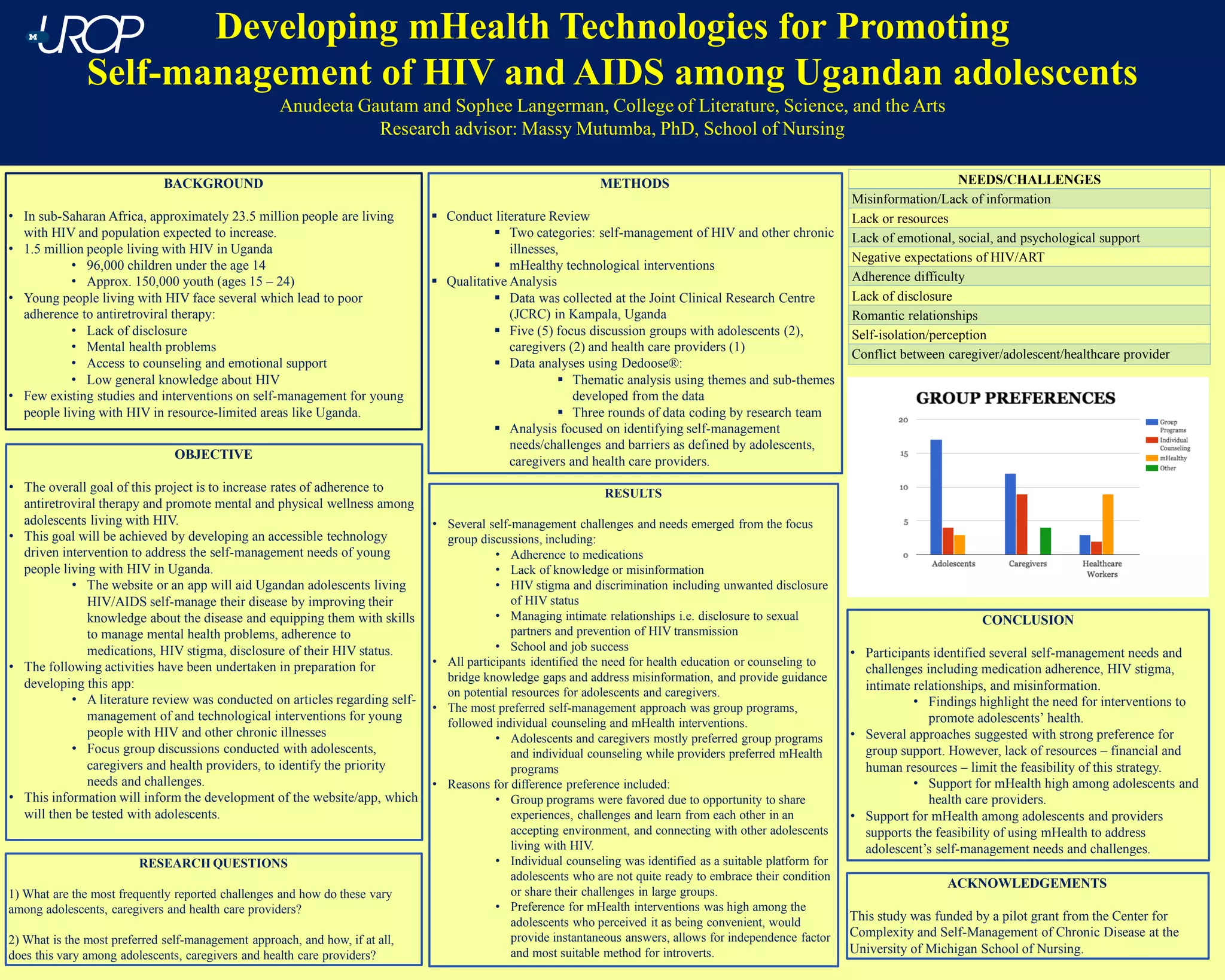
• The most preferred self-management approach was group programs,
followed individual counseling and mHealth interventions.
• Adolescents and caregivers mostly preferred group programs
and individual counseling while providers preferred mHealth
programs
• Reasons for difference preference included:
• Group programs were favored due to opportunity to share
experiences, challenges and learn from each other in an
accepting environment, and connecting with other adolescents
living with HIV.
• Individual counseling was identified as a suitable platform for
adolescents who are not quite ready to embrace their condition
or share their challenges in large groups.
• Preference for mHealth interventions was high among the
adolescents who perceived it as being convenient, would
provide instantaneous answers, allows for independence factor
and most suitable method for introverts.
Developing mHealth Technologies for Promoting
Self-management of HIV and AIDS among Ugandan adolescents
Anudeeta Gautam and Sophee Langerman, College of Literature, Science, and the Arts
Research advisor: Massy Mutumba, PhD, School of Nursing
RESEARCH QUESTIONS
1) What are the most frequently reported challenges and how do these vary
among adolescents, caregivers and health care providers?
2) What is the most preferred self-management approach, and how, if at all,
does this vary among adolescents, caregivers and health care providers?
ACKNOWLEDGEMENTS
This study was funded by a pilot grant from the Center for
Complexity and Self-Management of Chronic Disease at the
University of Michigan School of Nursing.
CONCLUSION
• Participants identified several self-management needs and
challenges including medication adherence, HIV stigma,
intimate relationships, and misinformation.
• Findings highlight the need for interventions to
promote adolescents’ health.
• Several approaches suggested with strong preference for
group support. However, lack of resources – financial and
human resources – limit the feasibility of this strategy.
• Support for mHealth high among adolescents and
health care providers.
• Support for mHealth among adolescents and providers
supports the feasibility of using mHealth to address
adolescent’s self-management needs and challenges.
NEEDS/CHALLENGES
Misinformation/Lack of information
Lack or resources
Lack of emotional, social, and psychological support
Negative expectations of HIV/ART
Adherence difficulty
Lack of disclosure
Romantic relationships
Self-isolation/perception
Conflict between caregiver/adolescent/healthcare provider

UROP Symposium 2017 Poster

  • 1.
    METHODS § Conduct literatureReview § Two categories: self-management of HIV and other chronic illnesses, § mHealthy technological interventions § Qualitative Analysis § Data was collected at the Joint Clinical Research Centre (JCRC) in Kampala, Uganda § Five (5) focus discussion groups with adolescents (2), caregivers (2) and health care providers (1) § Data analyses using Dedoose®: § Thematic analysis using themes and sub-themes developed from the data § Three rounds of data coding by research team § Analysis focused on identifying self-management needs/challenges and barriers as defined by adolescents, caregivers and health care providers. BACKGROUND • In sub-Saharan Africa, approximately 23.5 million people are living with HIV and population expected to increase. • 1.5 million people living with HIV in Uganda • 96,000 children under the age 14 • Approx. 150,000 youth (ages 15 – 24) • Young people living with HIV face several which lead to poor adherence to antiretroviral therapy: • Lack of disclosure • Mental health problems • Access to counseling and emotional support • Low general knowledge about HIV • Few existing studies and interventions on self-management for young people living with HIV in resource-limited areas like Uganda. OBJECTIVE • The overall goal of this project is to increase rates of adherence to antiretroviral therapy and promote mental and physical wellness among adolescents living with HIV. • This goal will be achieved by developing an accessible technology driven intervention to address the self-management needs of young people living with HIV in Uganda. • The website or an app will aid Ugandan adolescents living HIV/AIDS self-manage their disease by improving their knowledge about the disease and equipping them with skills to manage mental health problems, adherence to medications, HIV stigma, disclosure of their HIV status. • The following activities have been undertaken in preparation for developing this app: • A literature review was conducted on articles regarding self- management of and technological interventions for young people with HIV and other chronic illnesses • Focus group discussions conducted with adolescents, caregivers and health providers, to identify the priority needs and challenges. • This information will inform the development of the website/app, which will then be tested with adolescents. RESULTS • Several self-management challenges and needs emerged from the focus group discussions, including: • Adherence to medications • Lack of knowledge or misinformation • HIV stigma and discrimination including unwanted disclosure of HIV status • Managing intimate relationships i.e. disclosure to sexual partners and prevention of HIV transmission • School and job success • All participants identified the need for health education or counseling to bridge knowledge gaps and address misinformation, and provide guidance on potential resources for adolescents and caregivers. • The most preferred self-management approach was group programs, followed individual counseling and mHealth interventions. • Adolescents and caregivers mostly preferred group programs and individual counseling while providers preferred mHealth programs • Reasons for difference preference included: • Group programs were favored due to opportunity to share experiences, challenges and learn from each other in an accepting environment, and connecting with other adolescents living with HIV. • Individual counseling was identified as a suitable platform for adolescents who are not quite ready to embrace their condition or share their challenges in large groups. • Preference for mHealth interventions was high among the adolescents who perceived it as being convenient, would provide instantaneous answers, allows for independence factor and most suitable method for introverts. Developing mHealth Technologies for Promoting Self-management of HIV and AIDS among Ugandan adolescents Anudeeta Gautam and Sophee Langerman, College of Literature, Science, and the Arts Research advisor: Massy Mutumba, PhD, School of Nursing RESEARCH QUESTIONS 1) What are the most frequently reported challenges and how do these vary among adolescents, caregivers and health care providers? 2) What is the most preferred self-management approach, and how, if at all, does this vary among adolescents, caregivers and health care providers? ACKNOWLEDGEMENTS This study was funded by a pilot grant from the Center for Complexity and Self-Management of Chronic Disease at the University of Michigan School of Nursing. CONCLUSION • Participants identified several self-management needs and challenges including medication adherence, HIV stigma, intimate relationships, and misinformation. • Findings highlight the need for interventions to promote adolescents’ health. • Several approaches suggested with strong preference for group support. However, lack of resources – financial and human resources – limit the feasibility of this strategy. • Support for mHealth high among adolescents and health care providers. • Support for mHealth among adolescents and providers supports the feasibility of using mHealth to address adolescent’s self-management needs and challenges. NEEDS/CHALLENGES Misinformation/Lack of information Lack or resources Lack of emotional, social, and psychological support Negative expectations of HIV/ART Adherence difficulty Lack of disclosure Romantic relationships Self-isolation/perception Conflict between caregiver/adolescent/healthcare provider