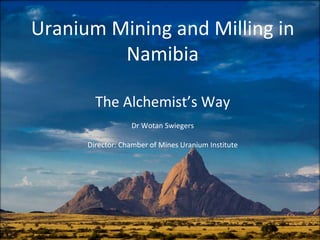
Uranium Mining and Milling in 
Namibia
The Alchemist’s Way
Dr Wotan Swiegers
Director: Chamber of Mines Uranium Institute
“ Read the old books and see the future” Emperor Augustus
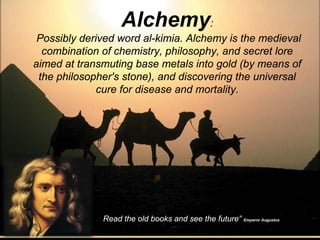
Alchemy:
Possibly derived word al-kimia. Alchemy is the medieval
combination of chemistry, philosophy, and secret lore
aimed at transmuting base metals into gold (by means of
the philosopher's stone), and discovering the universal
cure for disease and mortality.
Scientific transmutation has
been routinely performed in
many nuclear physics-related
laboratories and facilities, like
particle accelerators, nuclear
power stations and nuclear
weapons as a by-product of
fission and other physical
processes.
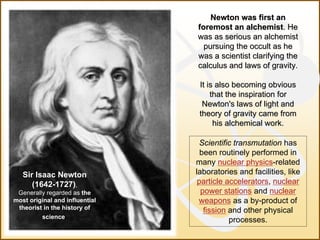
Newton was first anNewton was first an
foremost an alchemistforemost an alchemist. He. He
was as serious an alchemistwas as serious an alchemist
pursuing the occult as hepursuing the occult as he
was a scientist clarifying thewas a scientist clarifying the
calculus and laws of gravity.calculus and laws of gravity.
It is also becoming obviousIt is also becoming obvious
that the inspiration forthat the inspiration for
Newton's laws of light andNewton's laws of light and
theory of gravity came fromtheory of gravity came from
his alchemical work.his alchemical work.
Sir Isaac Newton
(1642-1727),
Generally regarded as the
most original and influential
theorist in the history of
science.
From Wikipedia, the free encyclopedia
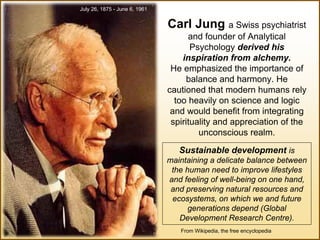
July 26, 1875 - June 6, 1961
Carl Jung a Swiss psychiatrist
and founder of Analytical
Psychology derived his
inspiration from alchemy.
He emphasized the importance of
balance and harmony. He
cautioned that modern humans rely
too heavily on science and logic
and would benefit from integrating
spirituality and appreciation of the
unconscious realm.
.Sustainable development is
maintaining a delicate balance between
the human need to improve lifestyles
and feeling of well-being on one hand,
and preserving natural resources and
ecosystems, on which we and future
generations depend (Global
Development Research Centre).
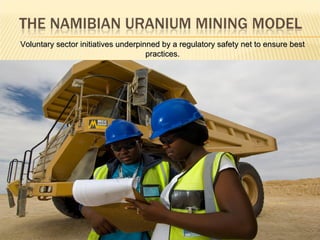
Voluntary sector initiatives underpinned by a regulatory safetyVoluntary sector initiatives underpinned by a regulatory safety net to ensure bestnet to ensure best
practices.practices.
Source: AREVA
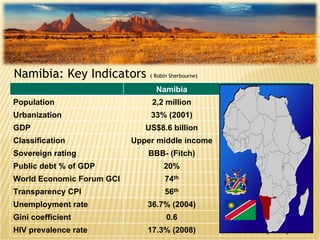
Namibia South Africa
Population 2,2 million 48 million
Urbanization 33% (2001) 61% (2008)
GDP US$8.6 billion US$276.4 billion
Classification Upper middle income Upper middle income
Sovereign rating BBB- (Fitch) BBB+ (Fitch)
Public debt % of GDP 20% 28%
World Economic Forum GCI 74th 45th
Transparency CPI 56th 55th
Unemployment rate 36.7% (2004) 24% (2009)
Gini coefficient 0.6 0.578
HIV prevalence rate 17.3% (2008) 18.1% (2007)
Namibia: Key Indicators ( Robin Sherbourne)
 As a developing country Namibia has to deal with the challenges of 
poverty, unemployment, a growing demand for energy, a 
decreased life expectancy and about 100,000 orphans that need 
education, health and housing.
 Uranium exploration, mining, processing and transportation are 
significant employers of Namibians, with some workforces 
comprising up to 90 per cent of indigenous employees. The 
industry's employees are mostly rural and regional residents.
 Depending on the number of new uranium mines brought into 
production some 4000 ‐ 6000 new jobs would be created, almost 
doubling the current mine employment level.
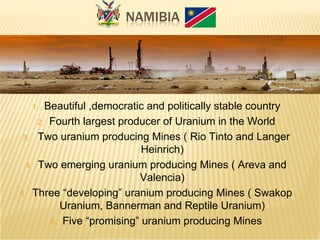
1. Beautiful ,democratic and politically stable country
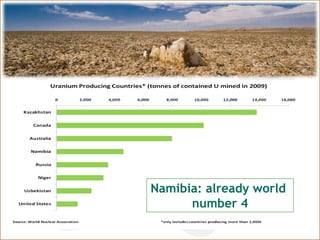
2. Fourth largest producer of Uranium in the World
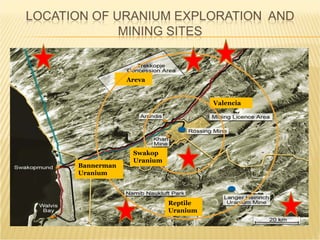
3. Two uranium producing Mines ( Rio Tinto and Langer
Heinrich)
4. Two emerging uranium producing Mines ( Areva and
Valencia)
5. Three “developing” uranium producing Mines ( Swakop
Uranium, Bannerman and Reptile Uranium)
6. Five “promising” uranium producing Mines
Source: AREVA
Namibia: already world
number 4
1
0
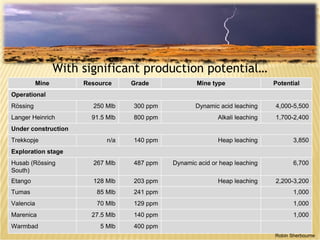
Mine Resource Grade Mine type Potential
Operational
Rössing 250 Mlb 300 ppm Dynamic acid leaching 4,000-5,500
Langer Heinrich 91.5 Mlb 800 ppm Alkali leaching 1,700-2,400
Under construction
Trekkopje n/a 140 ppm Heap leaching 3,850
Exploration stage
Husab (Rössing
South)
267 Mlb 487 ppm Dynamic acid or heap leaching 6,700
Etango 128 Mlb 203 ppm Heap leaching 2,200-3,200
Tumas 85 Mlb 241 ppm 1,000
Valencia 70 Mlb 129 ppm 1,000
Marenica 27.5 Mlb 140 ppm 1,000
Warmbad 5 Mlb 400 ppm
With significant production potential…
Robin Sherbourne
Areva
Valencia
Reptile
Uranium
Swakop
Uranium
Bannerman
Uranium
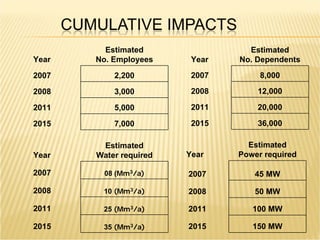
Year
Estimated
No. Employees
2007 2,200
2008 3,000
2011 5,000
2015 7,000
Year
Estimated
Power required
2007 45 MW
2008 50 MW
2011 100 MW
2015 150 MW
Year
Estimated
No. Dependents
2007 8,000
2008 12,000
2011 20,000
2015 36,000
Year
Estimated
Water required
2007 08 (Mm3/a)
2008 10 (Mm3/a)
2011 25 (Mm3/a)
2015 35 (Mm3/a)
Challenge = International
Protecting the Brand (best practices and
legislation)
Challenge = National
Create harmony with competing and
opposing forces ( Public, Government, Mines,
Tourism and Anti- Nuke)
Challenge = “Making it stick” with the
currency of ‘goodwill and synergy.’
“ Do not let what you cannot do, interfere
with what you can do” John Wooden
 Namibia is now the world’s 4th largest producer of uranium and Namibian 
uranium is produced only for export and is used only for peaceful purposes in 
civil nuclear power stations overseas.
 Uranium is valuable to Namibia both as an export earner and as a contributor to 
global climate relief.
 Namibia has a significant expansion opportunity, as we have nearly 20% of the 
world’s uranium recoverable at reasonable cost, yet we supply only 12% of the 
world market.
 The uranium industry is expected to continue to contribute significantly to the 
Namibian economy. The sector is expected to grow from 5.54% of Namibian 
GDP in 2008 to 14.78% in 2015. Contribution to the fiscus is expected to more 
than double from the current N$1.1bn to N$2.6bn in 2015.
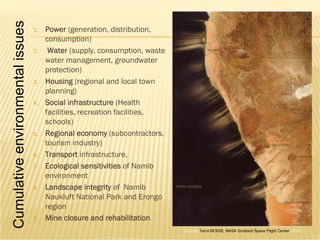
1. Power (generation, distribution,
consumption)
2. Water (supply, consumption, waste
water management, groundwater
protection)
3. Housing (regional and local town
planning)
4. Social infrastructure (Health
facilities, recreation facilities,
schools)
5. Regional economy (subcontractors,
tourism industry)
6. Transport infrastructure,
7. Ecological sensitivities of Namib
environment
8. Landscape integrity of Namib
Naukluft National Park and Erongo
region
9. Mine closure and rehabilitation
Source: Terra MODIS, NASA Goddard Space Flight Center (2007)
Cumulativeenvironmentalissues
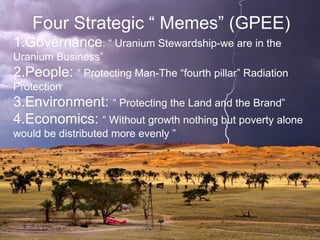
Four Strategic “ Memes” (GPEE)
1.Governance: “ Uranium Stewardship-we are in the
Uranium Business”
2.People: “ Protecting Man-The “fourth pillar” Radiation
Protection
3.Environment: “ Protecting the Land and the Brand”
4.Economics: “ Without growth nothing but poverty alone
would be distributed more evenly ”
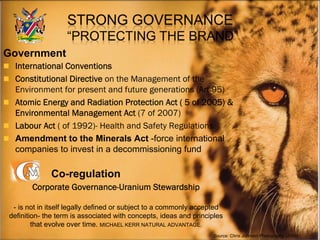
 International Conventions
 Constitutional Directive on the Management of the
Environment for present and future generations (Art 95)
 Atomic Energy and Radiation Protection Act ( 5 of 2005) &
Environmental Management Act (7 of 2007)
 Labour Act ( of 1992)- Health and Safety Regulations
 Amendment to the Minerals Act -force international
companies to invest in a decommissioning fund
Corporate Governance-Uranium Stewardship
- is not in itself legally defined or subject to a commonly accepted
definition- the term is associated with concepts, ideas and principles
that evolve over time. MICHAEL KERR NATURAL ADVANTAGE.
Government
Co-regulation
Source: Chris Johnson Photography (2008)
1. Uranium Information Centre: Ensure effective communication, 
advocacy and correct information dissemination for and about the
Uranium Industry 
2. Uranium Training Centre: Ensure accredited Health, Environment and 
Radiation Safety and Security training courses  for the Uranium Industry
3. Occupational Medical Centre ( WISSARD, REMS & CARE) 
4. Health, Environment and Radiation Safety and Security (HERSS) 
Committee & Working Groups
5. Implement best practice in Health, Environment and Radiation Safety 
and Security in the Uranium Industry
6. Develop and Implement an in‐house Chamber of Mines Auditing 
System
Governance (Uranium Stewardship Committee)
Regulations Stewardship GP GL
Education ( Uranium Institute)
CodeofConduct
Ringfence-NSX
HERSSStandards
CumulativeImpacts
ImplementHERSS
WGWater
WGPower
WGSEMP
Stewardship is a powerful mindset for taking responsibility for you’re actions.
PROTECT MAN,LAND & BRANDPROTECT MAN,LAND & BRAND
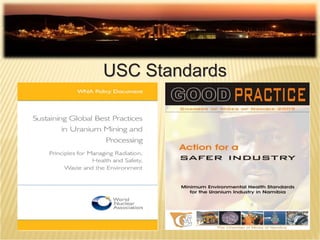
USC StandardsUSC Standards
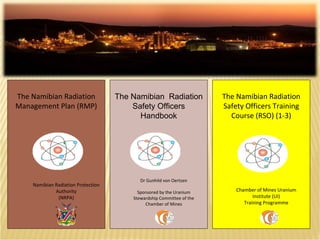
The Namibian Radiation
Safety Officers
Handbook
Dr Gunhild von Oertzen
Sponsored by the Uranium 
Stewardship Committee of the 
Chamber of Mines
The Namibian Radiation 
Safety Officers Training 
Course (RSO) (1‐3)
The Namibian Radiation 
Management Plan (RMP)
Namibian Radiation Protection 
Authority
(NRPA)
Chamber of Mines Uranium 
Institute (UI)
Training Programme
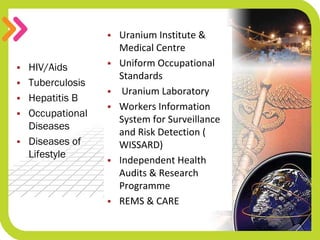
 Uranium Institute & 
Medical Centre
 Uniform Occupational 
Standards
 Uranium Laboratory  
 Workers Information 
System for Surveillance 
and Risk Detection ( 
WISSARD)
 Independent Health 
Audits & Research 
Programme
 REMS & CARE
 HIV/Aids
 Tuberculosis
 Hepatitis B
 Occupational
Diseases
 Diseases of
Lifestyle
Geological Survey of Namibia (GSN)
Bundesanstalt für Geowissenschaften und Rohstoffe (BGR)
Ministry of Mines and Energy
Strategic Environmental Assessment (SEA)
for Uranium Mining in Erongo Region
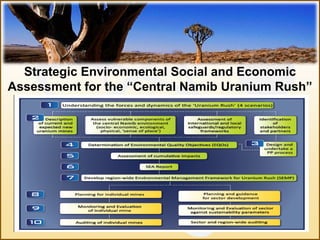
Strategic Environmental Social and Economic
Assessment for the “Central Namib Uranium Rush”
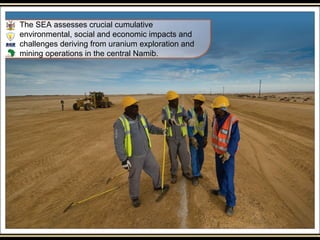
The SEA assesses crucial cumulative
environmental, social and economic impacts and
challenges deriving from uranium exploration and
mining operations in the central Namib.
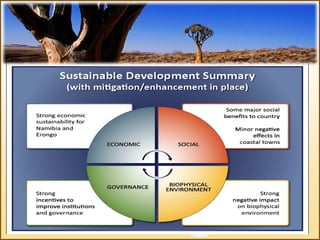
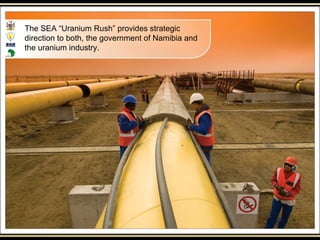
The SEA “Uranium Rush” provides strategic
direction to both, the government of Namibia and
the uranium industry.
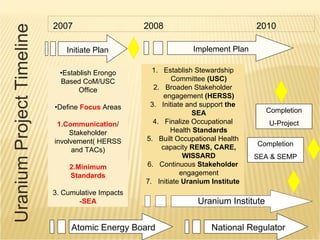
UraniumProjectTimeline
2007 2008 2010
Initiate Plan
•Establish Erongo
Based CoM/USC
Office
•Define Focus Areas
1.Communication/
Stakeholder
involvement( HERSS
and TACs)
2.Minimum
Standards
3. Cumulative Impacts
-SEA
Implement Plan
1. Establish Stewardship
Committee (USC)
2. Broaden Stakeholder
engagement (HERSS)
3. Initiate and support the
SEA
4. Finalize Occupational
Health Standards
5. Built Occupational Health
capacity REMS, CARE,
WISSARD
6. Continuous Stakeholder
engagement
7. Initiate Uranium Institute
Completion
SEA & SEMP
Uranium Institute
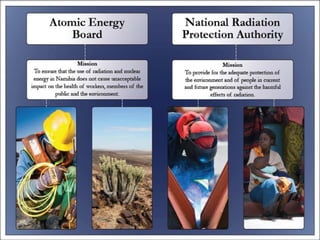
Atomic Energy Board
Completion
U-Project
National Regulator
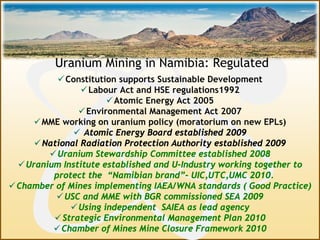
Constitution supports Sustainable Development
Labour Act and HSE regulations1992
Atomic Energy Act 2005
Environmental Management Act 2007
MME working on uranium policy (moratorium on new EPLs)
 Atomic Energy Board established 2009
National Radiation Protection Authority established 2009
Uranium Stewardship Committee established 2008
Uranium Institute established and U-Industry working together to
protect the “Namibian brand”- UIC,UTC,UMC 2010.
Chamber of Mines implementing IAEA/WNA standards ( Good Practice)
USC and MME with BGR commissioned SEA 2009
Using independent SAIEA as lead agency
Strategic Environmental Management Plan 2010
Chamber of Mines Mine Closure Framework 2010
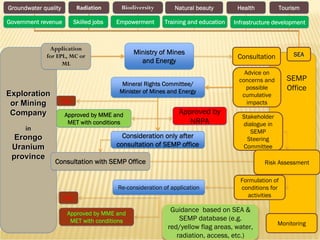
Uranium Mining in Namibia: Regulated
RadiationRadiationGroundwater qualityGroundwater quality BiodiversityBiodiversity TourismTourism
Exploration
or Mining
Company
in
Erongo
Uranium
province
ExplorationExploration
or Miningor Mining
CompanyCompany
inin
ErongoErongo
UraniumUranium
provinceprovince
Ministry of Mines
and Energy
Ministry of Mines
and Energy
Approved by MME and
MET with conditions
Approved by MME and
MET with conditions
NoNo
SEMP
Office
SEMP
Office
Natural beautyNatural beauty
Mineral Rights Committee/
Minister of Mines and Energy
Mineral Rights Committee/
Minister of Mines and Energy
Application
for EPL, MC or
ML
Application
for EPL, MC or
ML
Consultation with SEMP OfficeConsultation with SEMP Office
Monitoring
Consultation
Consideration only after
consultation of SEMP office
Consideration only after
consultation of SEMP office
Advice on
concerns and
possible
cumulative
impacts
NoNo
Re-consideration of applicationRe-consideration of application
Infrastructure developmentInfrastructure developmentTraining and educationTraining and education
HealthHealth
EmpowermentEmpowermentGovernment revenueGovernment revenue Skilled jobsSkilled jobs
Formulation of
conditions for
activities
Stakeholder
dialogue in
SEMP
Steering
Committee
Risk Assessment
Approved by MME and
MET with conditions
Approved by MME and
MET with conditions
SEASEA
Approved by
NRPA
Approved by
NRPA
Guidance based on SEA &
SEMP database (e.g.
red/yellow flag areas, water,
radiation, access, etc.)
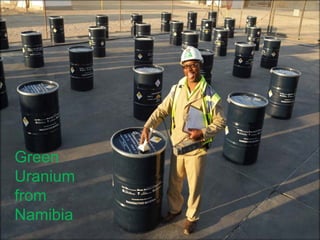
Green
Uranium
from
Namibia
Thank you very much for
your attention
Acknowledgement:
Sponsor: EPA: Keith Baldry
Frank Harris
Chamber of Mines of Namibia
Gottfried Poenninghaus

Uranium mining and milling in namibia swiegers

  • 1.
  • 2.
    “ Read theold books and see the future” Emperor Augustus Alchemy: Possibly derived word al-kimia. Alchemy is the medieval combination of chemistry, philosophy, and secret lore aimed at transmuting base metals into gold (by means of the philosopher's stone), and discovering the universal cure for disease and mortality.
  • 3.
    Scientific transmutation has beenroutinely performed in many nuclear physics-related laboratories and facilities, like particle accelerators, nuclear power stations and nuclear weapons as a by-product of fission and other physical processes. Newton was first anNewton was first an foremost an alchemistforemost an alchemist. He. He was as serious an alchemistwas as serious an alchemist pursuing the occult as hepursuing the occult as he was a scientist clarifying thewas a scientist clarifying the calculus and laws of gravity.calculus and laws of gravity. It is also becoming obviousIt is also becoming obvious that the inspiration forthat the inspiration for Newton's laws of light andNewton's laws of light and theory of gravity came fromtheory of gravity came from his alchemical work.his alchemical work. Sir Isaac Newton (1642-1727), Generally regarded as the most original and influential theorist in the history of science.
  • 4.
    From Wikipedia, thefree encyclopedia July 26, 1875 - June 6, 1961 Carl Jung a Swiss psychiatrist and founder of Analytical Psychology derived his inspiration from alchemy. He emphasized the importance of balance and harmony. He cautioned that modern humans rely too heavily on science and logic and would benefit from integrating spirituality and appreciation of the unconscious realm. .Sustainable development is maintaining a delicate balance between the human need to improve lifestyles and feeling of well-being on one hand, and preserving natural resources and ecosystems, on which we and future generations depend (Global Development Research Centre).
  • 5.
    Voluntary sector initiativesunderpinned by a regulatory safetyVoluntary sector initiatives underpinned by a regulatory safety net to ensure bestnet to ensure best practices.practices. Source: AREVA
  • 6.
    Namibia South Africa Population2,2 million 48 million Urbanization 33% (2001) 61% (2008) GDP US$8.6 billion US$276.4 billion Classification Upper middle income Upper middle income Sovereign rating BBB- (Fitch) BBB+ (Fitch) Public debt % of GDP 20% 28% World Economic Forum GCI 74th 45th Transparency CPI 56th 55th Unemployment rate 36.7% (2004) 24% (2009) Gini coefficient 0.6 0.578 HIV prevalence rate 17.3% (2008) 18.1% (2007) Namibia: Key Indicators ( Robin Sherbourne)
  • 7.
  • 8.
    1. Beautiful ,democraticand politically stable country 2. Fourth largest producer of Uranium in the World 3. Two uranium producing Mines ( Rio Tinto and Langer Heinrich) 4. Two emerging uranium producing Mines ( Areva and Valencia) 5. Three “developing” uranium producing Mines ( Swakop Uranium, Bannerman and Reptile Uranium) 6. Five “promising” uranium producing Mines Source: AREVA
  • 9.
  • 10.
    1 0 Mine Resource GradeMine type Potential Operational Rössing 250 Mlb 300 ppm Dynamic acid leaching 4,000-5,500 Langer Heinrich 91.5 Mlb 800 ppm Alkali leaching 1,700-2,400 Under construction Trekkopje n/a 140 ppm Heap leaching 3,850 Exploration stage Husab (Rössing South) 267 Mlb 487 ppm Dynamic acid or heap leaching 6,700 Etango 128 Mlb 203 ppm Heap leaching 2,200-3,200 Tumas 85 Mlb 241 ppm 1,000 Valencia 70 Mlb 129 ppm 1,000 Marenica 27.5 Mlb 140 ppm 1,000 Warmbad 5 Mlb 400 ppm With significant production potential… Robin Sherbourne
  • 11.
  • 12.
    Year Estimated No. Employees 2007 2,200 20083,000 2011 5,000 2015 7,000 Year Estimated Power required 2007 45 MW 2008 50 MW 2011 100 MW 2015 150 MW Year Estimated No. Dependents 2007 8,000 2008 12,000 2011 20,000 2015 36,000 Year Estimated Water required 2007 08 (Mm3/a) 2008 10 (Mm3/a) 2011 25 (Mm3/a) 2015 35 (Mm3/a)
  • 13.
    Challenge = International Protectingthe Brand (best practices and legislation) Challenge = National Create harmony with competing and opposing forces ( Public, Government, Mines, Tourism and Anti- Nuke) Challenge = “Making it stick” with the currency of ‘goodwill and synergy.’ “ Do not let what you cannot do, interfere with what you can do” John Wooden
  • 14.
     Namibia is now the world’s 4th largest producer of uranium and Namibian  uranium is produced only for export and is used only for peaceful purposes in  civil nuclear power stations overseas.  Uranium is valuable to Namibia both as an export earner and as acontributor to  global climate relief.  Namibia has a significant expansion opportunity, as we have nearly 20% of the  world’s uranium recoverable at reasonable cost, yet we supply only 12% of the  world market.  The uranium industry is expected to continue to contribute significantly to the  Namibian economy. The sector is expected to grow from 5.54% of Namibian  GDP in 2008 to 14.78% in 2015. Contribution to the fiscus is expected to more  than double from the current N$1.1bn to N$2.6bn in 2015.
  • 15.
    1. Power (generation,distribution, consumption) 2. Water (supply, consumption, waste water management, groundwater protection) 3. Housing (regional and local town planning) 4. Social infrastructure (Health facilities, recreation facilities, schools) 5. Regional economy (subcontractors, tourism industry) 6. Transport infrastructure, 7. Ecological sensitivities of Namib environment 8. Landscape integrity of Namib Naukluft National Park and Erongo region 9. Mine closure and rehabilitation Source: Terra MODIS, NASA Goddard Space Flight Center (2007) Cumulativeenvironmentalissues
  • 16.
    Four Strategic “Memes” (GPEE) 1.Governance: “ Uranium Stewardship-we are in the Uranium Business” 2.People: “ Protecting Man-The “fourth pillar” Radiation Protection 3.Environment: “ Protecting the Land and the Brand” 4.Economics: “ Without growth nothing but poverty alone would be distributed more evenly ”
  • 17.
     International Conventions Constitutional Directive on the Management of the Environment for present and future generations (Art 95)  Atomic Energy and Radiation Protection Act ( 5 of 2005) & Environmental Management Act (7 of 2007)  Labour Act ( of 1992)- Health and Safety Regulations  Amendment to the Minerals Act -force international companies to invest in a decommissioning fund Corporate Governance-Uranium Stewardship - is not in itself legally defined or subject to a commonly accepted definition- the term is associated with concepts, ideas and principles that evolve over time. MICHAEL KERR NATURAL ADVANTAGE. Government Co-regulation Source: Chris Johnson Photography (2008)
  • 18.
    1. Uranium Information Centre: Ensure effective communication,  advocacy and correct information dissemination for and about the Uranium Industry  2. Uranium Training Centre: Ensure accredited Health, Environment and  Radiation Safety and Security training courses  for the Uranium Industry 3.Occupational Medical Centre ( WISSARD, REMS & CARE)  4. Health, Environment and Radiation Safety and Security (HERSS)  Committee & Working Groups 5. Implement best practice in Health, Environment and Radiation Safety  and Security in the Uranium Industry 6. Develop and Implement an in‐house Chamber of Mines Auditing  System
  • 19.
    Governance (Uranium StewardshipCommittee) Regulations Stewardship GP GL Education ( Uranium Institute) CodeofConduct Ringfence-NSX HERSSStandards CumulativeImpacts ImplementHERSS WGWater WGPower WGSEMP Stewardship is a powerful mindset for taking responsibility for you’re actions. PROTECT MAN,LAND & BRANDPROTECT MAN,LAND & BRAND
  • 20.
  • 21.
    The Namibian Radiation SafetyOfficers Handbook Dr Gunhild von Oertzen Sponsored by the Uranium  Stewardship Committee of the  Chamber of Mines The Namibian Radiation  Safety Officers Training  Course (RSO) (1‐3) The Namibian Radiation  Management Plan (RMP) Namibian Radiation Protection  Authority (NRPA) Chamber of Mines Uranium  Institute (UI) Training Programme
  • 22.
     Uranium Institute &  Medical Centre  Uniform Occupational  Standards Uranium Laboratory    Workers Information  System for Surveillance  and Risk Detection (  WISSARD)  Independent Health  Audits & Research  Programme  REMS & CARE  HIV/Aids  Tuberculosis  Hepatitis B  Occupational Diseases  Diseases of Lifestyle
  • 23.
    Geological Survey ofNamibia (GSN) Bundesanstalt für Geowissenschaften und Rohstoffe (BGR) Ministry of Mines and Energy Strategic Environmental Assessment (SEA) for Uranium Mining in Erongo Region
  • 24.
    Strategic Environmental Socialand Economic Assessment for the “Central Namib Uranium Rush”
  • 25.
    The SEA assessescrucial cumulative environmental, social and economic impacts and challenges deriving from uranium exploration and mining operations in the central Namib.
  • 26.
    The SEA “UraniumRush” provides strategic direction to both, the government of Namibia and the uranium industry.
  • 28.
    UraniumProjectTimeline 2007 2008 2010 InitiatePlan •Establish Erongo Based CoM/USC Office •Define Focus Areas 1.Communication/ Stakeholder involvement( HERSS and TACs) 2.Minimum Standards 3. Cumulative Impacts -SEA Implement Plan 1. Establish Stewardship Committee (USC) 2. Broaden Stakeholder engagement (HERSS) 3. Initiate and support the SEA 4. Finalize Occupational Health Standards 5. Built Occupational Health capacity REMS, CARE, WISSARD 6. Continuous Stakeholder engagement 7. Initiate Uranium Institute Completion SEA & SEMP Uranium Institute Atomic Energy Board Completion U-Project National Regulator
  • 29.
    Constitution supports SustainableDevelopment Labour Act and HSE regulations1992 Atomic Energy Act 2005 Environmental Management Act 2007 MME working on uranium policy (moratorium on new EPLs)  Atomic Energy Board established 2009 National Radiation Protection Authority established 2009 Uranium Stewardship Committee established 2008 Uranium Institute established and U-Industry working together to protect the “Namibian brand”- UIC,UTC,UMC 2010. Chamber of Mines implementing IAEA/WNA standards ( Good Practice) USC and MME with BGR commissioned SEA 2009 Using independent SAIEA as lead agency Strategic Environmental Management Plan 2010 Chamber of Mines Mine Closure Framework 2010 Uranium Mining in Namibia: Regulated
  • 31.
    RadiationRadiationGroundwater qualityGroundwater qualityBiodiversityBiodiversity TourismTourism Exploration or Mining Company in Erongo Uranium province ExplorationExploration or Miningor Mining CompanyCompany inin ErongoErongo UraniumUranium provinceprovince Ministry of Mines and Energy Ministry of Mines and Energy Approved by MME and MET with conditions Approved by MME and MET with conditions NoNo SEMP Office SEMP Office Natural beautyNatural beauty Mineral Rights Committee/ Minister of Mines and Energy Mineral Rights Committee/ Minister of Mines and Energy Application for EPL, MC or ML Application for EPL, MC or ML Consultation with SEMP OfficeConsultation with SEMP Office Monitoring Consultation Consideration only after consultation of SEMP office Consideration only after consultation of SEMP office Advice on concerns and possible cumulative impacts NoNo Re-consideration of applicationRe-consideration of application Infrastructure developmentInfrastructure developmentTraining and educationTraining and education HealthHealth EmpowermentEmpowermentGovernment revenueGovernment revenue Skilled jobsSkilled jobs Formulation of conditions for activities Stakeholder dialogue in SEMP Steering Committee Risk Assessment Approved by MME and MET with conditions Approved by MME and MET with conditions SEASEA Approved by NRPA Approved by NRPA Guidance based on SEA & SEMP database (e.g. red/yellow flag areas, water, radiation, access, etc.)
  • 32.
  • 33.
    Thank you verymuch for your attention Acknowledgement: Sponsor: EPA: Keith Baldry Frank Harris Chamber of Mines of Namibia Gottfried Poenninghaus