Government strives to have a workforce which reflects gender balance and women candidates are encouraged to apply.
EXAMINATION NOTICE NO. 04/2018-CSP DATE :07/02/2018
(LAST DATE FOR RECEIPT OF APPLICATIONS: 06/03/2018) of CIVIL SERVICES EXAMINATION, 2018
(The Commission’s Website: www.upsc.gov.in)
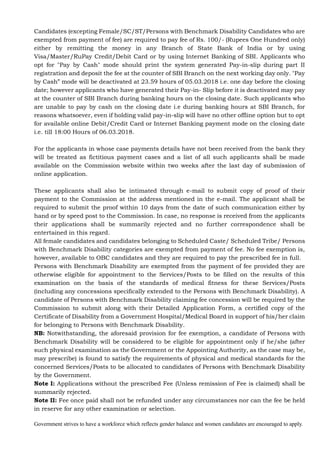
IMPORTANT
1. CANDIDATES TO ENSURE THEIR ELIGIBILITY FOR THE EXAMINATION: The Candidates
applying for the examination should ensure that they fulfill all eligibility conditions for
admission to examination. Their admission to all the stages of the examination will be
purely provisional subject to satisfying the prescribed eligibility conditions. Mere issue of
admission certificate to the candidate will not imply that his/her candidature has been
finally cleared by the Commission. The Commission takes up verification of eligibility
conditions with reference to original documents only after the candidate has qualified for
Interview/Personality Test.
2. HOW TO APPLY:
Candidates are required to apply Online by using the website
http://www.upsconline.nic.in Detailed instructions for filling up online applications are
available on the above mentioned website. Brief Instructions for filling up the "Online
Application Form" given in Appendix-II.
3. LAST DATE FOR RECEIPT OF APPLICATIONS :
The online Applications can be filled up to 6th March, 2018 till 6:00 PM. The eligible
candidates shall be issued an e-Admission Certificate three weeks before the
commencement of the examination. The e- Admission Certificate will be made
available in the UPSC website [www.upsc.gov.in] for downloading by candidates. No
Admission Certificate will be sent by post.
4. PENALTY FOR WRONG ANSWERS:
Candidates should note that there will be penalty (negative marking) for wrong answers
marked by a candidate in the Objective Type Question Papers.
5. FACILITATION COUNTER FOR GUIDANCE OF CANDIDATES:
In case of any guidance/information/clarification regarding their applications,
candidature etc. candidates can contact UPSC’s Facilitation Counter near gate ‘C’ of its
campus in person or over Telephone No. 011-23385271/011-23381125/011-23098543 on
working days between 10.00 hrs and 17.00 hrs.
7. MOBILE PHONES BANNED:
(a) The use of any mobile phone (even in switched off mode), pager or any electronic equipment or
programmable device or storage media like pen drive, smart watches etc. or camera or blue tooth devices
or any other equipment or related accessories either in working or switched off mode capable of being
used as a communication device during the examination is strictly prohibited. Any infringement of
these instructions shall entail disciplinary action including ban from future
examinations.
(b) Candidates are advised in their own interest not to bring any of the banned items
including mobile phones/pagers to the venue of the examination, as arrangement for
safe-keeping cannot be assured.
8. Candidates are advised not to bring any valuable/costly items to the Examination Halls, as
safe-keeping of the same cannot be assured. Commission will not be responsible for any loss in
this regard.
Government strives to have a workforce which reflects gender balance and women candidates are encouraged to apply.
F. No. 1/7/2017-E.I(B) : Preliminary Examination of the Civil Services Examination for
recruitment to the Services and Posts mentioned below will be held by the Union Public Service
Commission on 3rd June, 2018 in accordance with the Rules published by the Department of
Personnel & Training in the Gazette of India Extraordinary dated 7th February, 2018.
(i) Indian Administrative Service.
(ii) Indian Foreign Service.
(iii) Indian Police Service.
(iv) Indian P & T Accounts & Finance Service, Group ‘A’.
(v) Indian Audit and Accounts Service, Group ‘A’.
(vi) Indian Revenue Service (Customs and Central Excise), Group ‘A’.
(vii) Indian Defence Accounts Service, Group ‘A’.
(viii) Indian Revenue Service (I.T.), Group ‘A’.
(ix) Indian Ordnance Factories Service, Group ‘A’ (Assistant Works Manager, Administration).
(x) Indian Postal Service, Group ‘A’.
(xi) Indian Civil Accounts Service, Group ‘A’.
(xii) Indian Railway Traffic Service, Group ‘A’.
(xiii) Indian Railway Accounts Service, Group 'A'.
(xiv) Indian Railway Personnel Service, Group ‘A’.
(xv) Post of Assistant Security Commissioner in Railway Protection Force, Group ‘A’
(xvi) Indian Defence Estates Service, Group ‘A’.
(xvii) Indian Information Service (Junior Grade), Group ‘A’.
(xviii) Indian Trade Service, Group 'A'.
(xix) Indian Corporate Law Service, Group "A".
(xx) Armed Forces Headquarters Civil Service, Group ‘B’ (Section Officer’s Grade).
(xxi) Delhi, Andaman & Nicobar Islands, Lakshadweep, Daman & Diu and Dadra & Nagar
Haveli Civil Service, Group 'B'.
(xxii) Delhi, Andaman & Nicobar Islands, Lakshadweep, Daman & Diu and Dadra & Nagar
Haveli Police Service, Group 'B'.
(xxiii) Pondicherry Civil Service, Group 'B'.
(xxiv) Pondicherry Police Service, Group ‘B’.
The number of vacancies to be filled on the result of the examination is expected to be
approximately 782 which include 32 vacancies reserved for Persons with Benchmark Disability
Category, i.e. 13 vacancies for candidates of (a) blindness and low vision; 8 Vacancies for (b)
deaf and hard of hearing; 9 Vacancies for (c) locomotor disability including cerebral palsy, leprosy
cured, dwarfism, acid attack victims and muscular dystrophy; and 2 Vacancies for (e) multiple
disabilities from amongst persons under clauses (a) to (c) including deaf-blindness. The final
number of vacancies may undergo change after getting firm number of vacancies from Cadre
Controlling Authorities. Reservation will be made for candidates belonging to Scheduled Castes.
Scheduled Tribes, Other Backward Classes and Persons with Benchmark Disability in respect
of vacancies as may be fixed by the Government.
As per the decision taken by the Government for increasing the access of
unemployed to job opportunities, the Commission will publicly disclose the scores of
the candidates (obtained in the Written Examination and Interview/Personality Test)
through the public portals. The disclosure will be made in respect of only those
candidates who will appear in the Interview/Personality Test for the Civil Service
Government strives to have a workforce which reflects gender balance and women candidates are encouraged to apply.
Examination and are not finally recommended for appointment. The information
shared through this disclosure scheme about the non-recommended candidates may
be used by other public and private recruitment agencies to appoint suitable
candidates from the information made available in the public portal.
Candidates will be required to give their options at the time of Interview/Personality
Test, while acknowledging the e-summon letter mailed to them for interview. A
candidate may opt out of the scheme also and in that case his/her details will not be
published by the Commission.
Besides sharing of the information of the non-recommended candidates for the
examinations conducted by the Commission, the Commission will not assume any
responsibility of liability for the method and manner in which information related to
candidates who appear at the Commission’s Examinations/ Selections is utilized by
other private of public organizations.
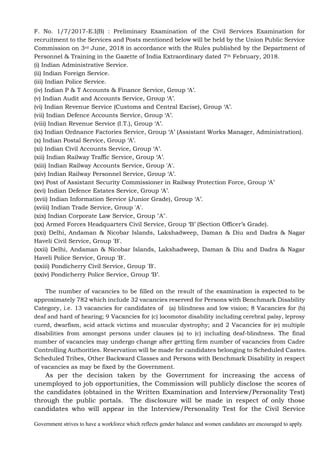
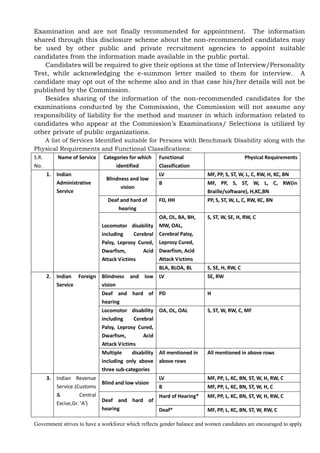
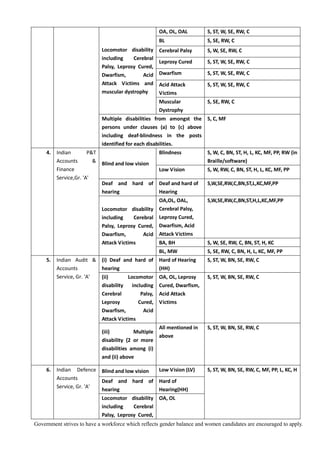
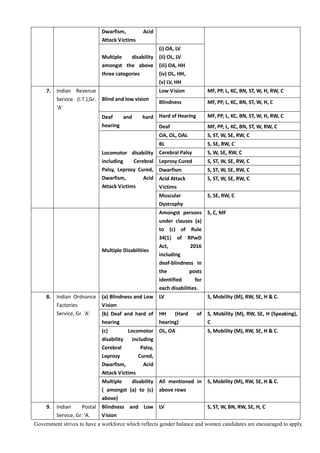
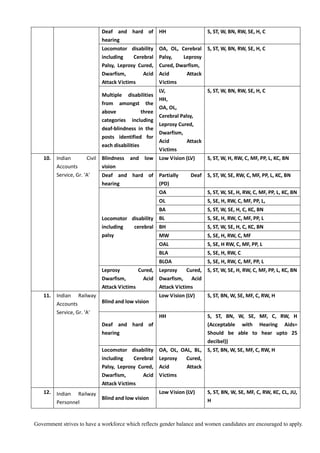
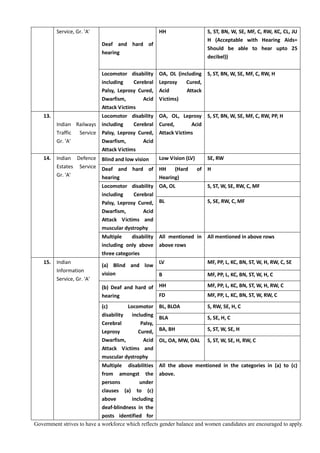
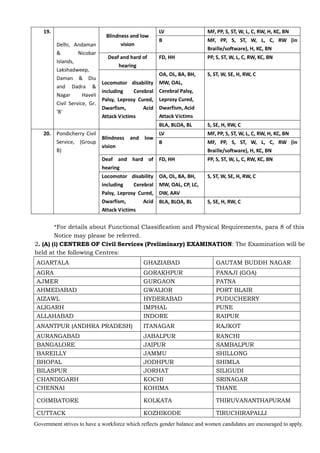
A list of Services Identified suitable for Persons with Benchmark Disability along with the
Physical Requirements and Functional Classifications:
S.R.
No.
Name of Service Categories for which
identified
Functional
Classification
Physical Requirements
1. Indian
Administrative
Service
Blindness and low
vision
LV MF, PP, S, ST, W, L, C, RW, H, KC, BN
B MF, PP, S, ST, W, L, C, RW(in
Braille/software), H,KC,BN
Deaf and hard of
hearing
FD, HH PP, S, ST, W, L, C, RW, KC, BN
Locomotor disability
including Cerebral
Palsy, Leprosy Cured,
Dwarfism, Acid
Attack Victims
OA, OL, BA, BH,
MW, OAL,
Cerebral Palsy,
Leprosy Cured,
Dwarfism, Acid
Attack Victims
S, ST, W, SE, H, RW, C
BLA, BLOA, BL S, SE, H, RW, C
2. Indian Foreign
Service
Blindness and low
vision
LV SE, RW
Deaf and hard of
hearing
PD H
Locomotor disability
including Cerebral
Palsy, Leprosy Cured,
Dwarfism, Acid
Attack Victims
OA, OL, OAL S, ST, W, RW, C, MF
Multiple disability
including only above
three sub-categories
All mentioned in
above rows
All mentioned in above rows
3. Indian Revenue
Service (Customs
& Central
Excise,Gr. 'A')
Blind and low vision
LV MF, PP, L, KC, BN, ST, W, H, RW, C
B MF, PP, L, KC, BN, ST, W, H, C
Deaf and hard of
hearing
Hard of Hearing* MF, PP, L, KC, BN, ST, W, H, RW, C
Deaf* MF, PP, L, KC, BN, ST, W, RW, C
Government strives to have a workforce which reflects gender balance and women candidates are encouraged to apply.
Locomotor disability
including Cerebral
Palsy, Leprosy Cured,
Dwarfism, Acid
Attack Victims and
muscular dystrophy
OA, OL, OAL S, ST, W, SE, RW, C
BL S, SE, RW, C
Cerebral Palsy S, W, SE, RW, C
Leprosy Cured S, ST, W, SE, RW, C
Dwarfism S, ST, W, SE, RW, C
Acid Attack
Victims
S, ST, W, SE, RW, C
Muscular
Dystrophy
S, SE, RW, C
Multiple disabilities from amongst the
persons under clauses (a) to (c) above
including deaf-blindness in the posts
identified for each disabilities.
S, C, MF
4. Indian P&T
Accounts &
Finance
Service,Gr. 'A'
Blind and low vision
Blindness S, W, C, BN, ST, H, L, KC, MF, PP, RW (in
Braille/software)
Low Vision S, W, RW, C, BN, ST, H, L, KC, MF, PP
Deaf and hard of
hearing
Deaf and hard of
Hearing
S,W,SE,RW,C,BN,ST,L,KC,MF,PP
Locomotor disability
including Cerebral
Palsy, Leprosy Cured,
Dwarfism, Acid
Attack Victims
OA,OL, OAL,
Cerebral Palsy,
Leprosy Cured,
Dwarfism, Acid
Attack Victims
S,W,SE,RW,C,BN,ST,H,L,KC,MF,PP
BA, BH S, W, SE, RW, C, BN, ST, H, KC
BL, MW S, SE, RW, C, BN, H, L, KC, MF, PP
5. Indian Audit &
Accounts
Service, Gr. 'A'
(i) Deaf and hard of
hearing
Hard of Hearing
(HH)
S, ST, W, BN, SE, RW, C
(ii) Locomotor
disability including
Cerebral Palsy,
Leprosy Cured,
Dwarfism, Acid
Attack Victims
OA, OL, Leprosy
Cured, Dwarfism,
Acid Attack
Victims
S, ST, W, BN, SE, RW, C
(iii) Multiple
disability {2 or more
disabilities among (i)
and (ii) above
All mentioned in
above
S, ST, W, BN, SE, RW, C
6. Indian Defence
Accounts
Service, Gr. 'A'
Blind and low vision Low Vision (LV) S, ST, W, BN, SE, RW, C, MF, PP, L, KC, H
Deaf and hard of
hearing
Hard of
Hearing(HH)
Locomotor disability
including Cerebral
Palsy, Leprosy Cured,
OA, OL
Government strives to have a workforce which reflects gender balance and women candidates are encouraged to apply.
Dwarfism, Acid
Attack Victims
Multiple disability
amongst the above
three categories
(i) OA, LV
(ii) OL, LV
(iii) OA, HH
(iv) OL, HH,
(v) LV, HH
7. Indian Revenue
Service (I.T.),Gr.
‘A’
Blind and low vision
Low Vision MF, PP, L, KC, BN, ST, W, H, RW, C
Blindness MF, PP, L, KC, BN, ST, W, H, C
Deaf and hard
hearing
Hard of Hearing MF, PP, L, KC, BN, ST, W, H, RW, C
Deaf MF, PP, L, KC, BN, ST, W, RW, C
Locomotor disability
including Cerebral
Palsy, Leprosy Cured,
Dwarfism, Acid
Attack Victims
OA, OL, OAL S, ST, W, SE, RW, C
BL S, SE, RW, C
Cerebral Palsy S, W, SE, RW, C
Leprosy Cured S, ST, W, SE, RW, C
Dwarfism S, ST, W, SE, RW, C
Acid Attack
Victims
S, ST, W, SE, RW, C
Muscular
Dystrophy
S, SE, RW, C
Multiple Disabilities
Amongst persons
under clauses (a)
to (c) of Rule
34(1) of RPwD
Act, 2016
including
deaf-blindness in
the posts
identified for
each disabilities.
S, C, MF
8. Indian Ordnance
Factories
Service, Gr. 'A'
(a) Blindness and Low
Vision
LV S, Mobility (M), RW, SE, H & C.
(b) Deaf and hard of
hearing
HH (Hard of
hearing)
S, Mobility (M), RW, SE, H (Speaking),
C
(c) Locomotor
disability including
Cerebral Palsy,
Leprosy Cured,
Dwarfism, Acid
Attack Victims
OL, OA S, Mobility (M), RW, SE, H & C.
Multiple disability
( amongst (a) to (c)
above)
All mentioned in
above rows
S, Mobility (M), RW, SE, H & C.
9. Indian Postal
Service, Gr. 'A.
Blindness and Low
Vision
LV S, ST, W, BN, RW, SE, H, C
Government strives to have a workforce which reflects gender balance and women candidates are encouraged to apply.
Deaf and hard of
hearing
HH S, ST, W, BN, RW, SE, H, C
Locomotor disability
including Cerebral
Palsy, Leprosy Cured,
Dwarfism, Acid
Attack Victims
OA, OL, Cerebral
Palsy, Leprosy
Cured, Dwarfism,
Acid Attack
Victims
S, ST, W, BN, RW, SE, H, C
Multiple disabilities
from amongst the
above three
categories including
deaf-blindness in the
posts identified for
each disabilities
LV,
HH,
OA, OL,
Cerebral Palsy,
Leprosy Cured,
Dwarfism,
Acid Attack
Victims
S, ST, W, BN, RW, SE, H, C
10. Indian Civil
Accounts
Service, Gr. 'A'
Blindness and low
vision
Low Vision (LV) S, ST, W, H, RW, C, MF, PP, L, KC, BN
Deaf and hard of
hearing
Partially Deaf
(PD)
S, ST, W, SE, RW, C, MF, PP, L, KC, BN
Locomotor disability
including cerebral
palsy
OA S, ST, W, SE, H, RW, C, MF, PP, L, KC, BN
OL S, SE, H, RW, C, MF, PP, L,
BA S, ST, W, SE, H, C, KC, BN
BL S, SE, H, RW, C, MF, PP, L
BH S, ST, W, SE, H, C, KC, BN
MW S, SE, H, RW, C, MF
OAL S, SE, H RW, C, MF, PP, L
BLA S, SE, H, RW, C
BLOA S, SE, H, RW, C, MF, PP, L
Leprosy Cured,
Dwarfism, Acid
Attack Victims
Leprosy Cured,
Dwarfism, Acid
Attack Victims
S, ST, W, SE, H, RW, C, MF, PP, L, KC, BN
11. Indian Railway
Accounts
Service, Gr. 'A'
Blind and low vision
Low Vision (LV) S, ST, BN, W, SE, MF, C, RW, H
Deaf and hard of
hearing
HH S, ST, BN, W, SE, MF, C, RW, H
(Acceptable with Hearing Aids=
Should be able to hear upto 25
decibel))
Locomotor disability
including Cerebral
Palsy, Leprosy Cured,
Dwarfism, Acid
Attack Victims
OA, OL, OAL, BL,
Leprosy Cured,
Acid Attack
Victims
S, ST, BN, W, SE, MF, C, RW, H
12. Indian Railway
Personnel
Blind and low vision
Low Vision (LV) S, ST, BN, W, SE, MF, C, RW, KC, CL, JU,
H
Government strives to have a workforce which reflects gender balance and women candidates are encouraged to apply.
Service, Gr. 'A'
Deaf and hard of
hearing
HH S, ST, BN, W, SE, MF, C, RW, KC, CL, JU
H (Acceptable with Hearing Aids=
Should be able to hear upto 25
decibel))
Locomotor disability
including Cerebral
Palsy, Leprosy Cured,
Dwarfism, Acid
Attack Victims
OA, OL (including
Leprosy Cured,
Acid Attack
Victims)
S, ST, BN, W, SE, MF, C, RW, H
13.
Indian Railways
Traffic Service
Gr. 'A'
Locomotor disability
including Cerebral
Palsy, Leprosy Cured,
Dwarfism, Acid
Attack Victims
OA, OL, Leprosy
Cured, Acid
Attack Victims
S, ST, BN, W, SE, MF, C, RW, PP, H
14. Indian Defence
Estates Service
Gr. 'A'
Blind and low vision Low Vision (LV) SE, RW
Deaf and hard of
hearing
HH (Hard of
Hearing)
H
Locomotor disability
including Cerebral
Palsy, Leprosy Cured,
Dwarfism, Acid
Attack Victims and
muscular dystrophy
OA, OL S, ST, W, SE, RW, C, MF
BL S, SE, RW, C, MF
Multiple disability
including only above
three categories
All mentioned in
above rows
All mentioned in above rows
15. Indian
Information
Service, Gr. 'A'
(a) Blind and low
vision
LV MF, PP, L, KC, BN, ST, W, H, RW, C, SE
B MF, PP, L, KC, BN, ST, W, H, C
(b) Deaf and hard of
hearing
HH MF, PP, L, KC, BN, ST, W, H, RW, C
FD MF, PP, L, KC, BN, ST, W, RW, C
(c) Locomotor
disability including
Cerebral Palsy,
Leprosy Cured,
Dwarfism, Acid
Attack Victims and
muscular dystrophy
BL, BLOA S, RW, SE, H, C
BLA S, SE, H, C
BA, BH S, ST, W, SE, H
OL, OA, MW, OAL S, ST, W, SE, H, RW, C
Multiple disabilities
from amongst the
persons under
clauses (a) to (c)
above including
deaf-blindness in the
posts identified for
All the above mentioned in the categories in (a) to (c)
above.
Government strives to have a workforce which reflects gender balance and women candidates are encouraged to apply.
each disabilities.
16. Indian Trade
Service Gr. ‘A’
Blind and low vision
Low Vision (LV) MF, PP, L, KC, BN, ST, W, H, RW, C
Blind (B) MF, PP, L, KC, BN, ST, W, H, C
Deaf and hard of
hearing
Partially Deaf
(PD)
MF, PP, L, KC, BN, ST, W, H, RW, C
Fully Deaf ( FD) MF, PP, L, KC, BN, ST, W, RW, C
Locomotor disability
including Cerebral
Palsy, Leprosy Cured,
Dwarfism, Acid
Attack Victims and
muscular dystrophy
OL, OA, OAL, MW S, ST, W, SE, H, RW, C
BL, BLOA S, SE, H, RW, C
BLA S, SE, H, C
BA, BH S, ST, SE, H, C
Multiple disabilities from amongst persons under above categories except
combination of full blind and full deaf.
17. Indian Corporate
Law Service
Blind and low vision Low Vision (LV) SE, RW, C, M, S, BN, ST, H
Deaf and hard of
hearing
Deaf (D) SE, RW, C, M, S, BN, ST
Hard of
Hearing(HH)
SE, RW, C, M, S, BN, ST, H
Locomotor disability
including Cerebral
Palsy, Leprosy Cured,
Dwarfism, Acid
Attack Victims and
muscular dystrophy
OA, OL, OAL SE, RW, C, M, S, BN, ST, H
BL SE, RW, C, M, S, BN, H
Leprosy Cured
(LC)
SE, RW, C, M, S, BN, ST, H
Dwarfism (DW) SE, RW, C, M, S, BN, ST, H
Acid Attack
Victims (AAV)
SE, RW, C, M, S, BN, ST, H
Muscular
Dystrophy
(MDy*)
SE, RW, C, M, S, BN, ST, H
Multiple disabilities
(MD) [2 or more
disabilities among
the above three
categories]
Multiple
disabilities (MD)
[2 or more
disabilities among
the above three
categories]
SE, RW, C, M, S, BN
18. Armed Forces
Headquarters
Civil Service,
Gr.'B' (Section
Officers' Grade)
Blindness and Low
Vision
B S, ST, W, BN, MF, RW (in
braille/software), H, C
LV S, ST, W, BN, MF, RW, H, C
Deaf and Hard of
Hearing
FD, HH S, ST, W, BN, MF, SE, RW, C
Locomotor disability
including Cerebral
Palsy, Leprosy Cured,
Dwarfism, Acid
Attack Victims and
muscular dystrophy
OA, OL, MW, OAL,
Cerebral Palsy,
Leprosy Cured,
Dwarfism, Acid
Attack Victims
S, ST, W, BN, MF, SE, RW, H, C
BLOA, BL S, SE, H, RW, C
Government strives to have a workforce which reflects gender balance and women candidates are encouraged to apply.
19.
Delhi, Andaman
& Nicobar
Islands,
Lakshadweep,
Daman & Diu
and Dadra &
Nagar Haveli
Civil Service, Gr.
'B'
Blindness and low
vision
LV MF, PP, S, ST, W, L, C, RW, H, KC, BN
B MF, PP, S, ST, W, L, C, RW (in
Braille/software), H, KC, BN
Deaf and hard of
hearing
FD, HH PP, S, ST, W, L, C, RW, KC, BN
Locomotor disability
including Cerebral
Palsy, Leprosy Cured,
Dwarfism, Acid
Attack Victims
OA, OL, BA, BH,
MW, OAL,
Cerebral Palsy,
Leprosy Cured,
Dwarfism, Acid
Attack Victims
S, ST, W, SE, H, RW, C
BLA, BLOA, BL S, SE, H, RW, C
20. Pondicherry Civil
Service, (Group
B)
Blindness and low
vision
LV MF, PP, S, ST, W, L, C, RW, H, KC, BN
B MF, PP, S, ST, W, L, C, RW (in
Braille/software), H, KC, BN
Deaf and hard of
hearing
FD, HH PP, S, ST, W, L, C, RW, KC, BN
Locomotor disability
including Cerebral
Palsy, Leprosy Cured,
Dwarfism, Acid
Attack Victims
OA, OL, BA, BH,
MW, OAL, CP, LC,
DW, AAV
S, ST, W, SE, H, RW, C
BLA, BLOA, BL S, SE, H, RW, C
*For details about Functional Classification and Physical Requirements, para 8 of this
Notice may please be referred.
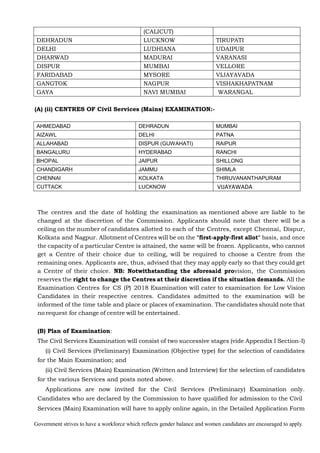
2. (A) (i) CENTRES OF Civil Services (Preliminary) EXAMINATION: The Examination will be
held at the following Centres:
AGARTALA GHAZIABAD GAUTAM BUDDH NAGAR
AGRA GORAKHPUR PANAJI (GOA)
AJMER GURGAON PATNA
AHMEDABAD GWALIOR PORT BLAIR
AIZAWL HYDERABAD PUDUCHERRY
ALIGARH IMPHAL PUNE
ALLAHABAD INDORE RAIPUR
ANANTPUR (ANDHRA PRADESH) ITANAGAR RAJKOT
AURANGABAD JABALPUR RANCHI
BANGALORE JAIPUR SAMBALPUR
BAREILLY JAMMU SHILLONG
BHOPAL JODHPUR SHIMLA
BILASPUR JORHAT SILIGUDI
CHANDIGARH KOCHI SRINAGAR
CHENNAI KOHIMA THANE
COIMBATORE KOLKATA THIRUVANANTHAPURAM
CUTTACK KOZHIKODE TIRUCHIRAPALLI
Government strives to have a workforce which reflects gender balance and women candidates are encouraged to apply.
(CALICUT)
DEHRADUN LUCKNOW TIRUPATI
DELHI LUDHIANA UDAIPUR
DHARWAD MADURAI VARANASI
DISPUR MUMBAI VELLORE
FARIDABAD MYSORE VIJAYAVADA
GANGTOK NAGPUR VISHAKHAPATNAM
GAYA NAVI MUMBAI WARANGAL
(A) (ii) CENTRES OF Civil Services (Mains) EXAMINATION:-
AHMEDABAD DEHRADUN MUMBAI
AIZAWL DELHI PATNA
ALLAHABAD DISPUR (GUWAHATI) RAIPUR
BANGALURU HYDERABAD RANCHI
BHOPAL JAIPUR SHILLONG
CHANDIGARH JAMMU SHIMLA
CHENNAI KOLKATA THIRUVANANTHAPURAM
CUTTACK LUCKNOW VIJAYAWADA
The centres and the date of holding the examination as mentioned above are liable to be
changed at the discretion of the Commission. Applicants should note that there will be a
ceiling on the number of candidates allotted to each of the Centres, except Chennai, Dispur,
Kolkata and Nagpur. Allotment of Centres will be on the "first-apply-first allot" basis, and once
the capacity of a particular Centre is attained, the same will be frozen. Applicants, who cannot
get a Centre of their choice due to ceiling, will be required to choose a Centre from the
remaining ones. Applicants are, thus, advised that they may apply early so that they could get
a Centre of their choice. NB: Notwithstanding the aforesaid provision, the Commission
reserves the right to change the Centres at their discretion if the situation demands. All the
Examination Centres for CS (P) 2018 Examination will cater to examination for Low Vision
Candidates in their respective centres. Candidates admitted to the examination will be
informed of the time table and place or places of examination. The candidates should note that
no request for change of centre will be entertained.
(B) Plan of Examination:
The Civil Services Examination will consist of two successive stages (vide Appendix I Section-I)
(i) Civil Services (Preliminary) Examination (Objective type) for the selection of candidates
for the Main Examination; and
(ii) Civil Services (Main) Examination (Written and Interview) for the selection of candidates
for the various Services and posts noted above.
Applications are now invited for the Civil Services (Preliminary) Examination only.
Candidates who are declared by the Commission to have qualified for admission to the Civil
Services (Main) Examination will have to apply online again, in the Detailed Application Form
Government strives to have a workforce which reflects gender balance and women candidates are encouraged to apply.
which would be made available to them. The Main Examination is likely to be held in
September 2018.
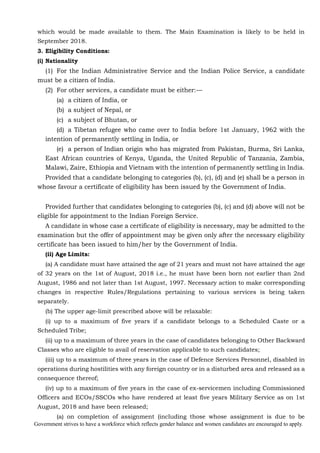
3. Eligibility Conditions:
(i) Nationality
(1) For the Indian Administrative Service and the Indian Police Service, a candidate
must be a citizen of India.
(2) For other services, a candidate must be either:—
(a) a citizen of India, or
(b) a subject of Nepal, or
(c) a subject of Bhutan, or
(d) a Tibetan refugee who came over to India before 1st January, 1962 with the
intention of permanently settling in India, or
(e) a person of Indian origin who has migrated from Pakistan, Burma, Sri Lanka,
East African countries of Kenya, Uganda, the United Republic of Tanzania, Zambia,
Malawi, Zaire, Ethiopia and Vietnam with the intention of permanently settling in India.
Provided that a candidate belonging to categories (b), (c), (d) and (e) shall be a person in
whose favour a certificate of eligibility has been issued by the Government of India.
Provided further that candidates belonging to categories (b), (c) and (d) above will not be
eligible for appointment to the Indian Foreign Service.
A candidate in whose case a certificate of eligibility is necessary, may be admitted to the
examination but the offer of appointment may be given only after the necessary eligibility
certificate has been issued to him/her by the Government of India.
(ii) Age Limits:
(a) A candidate must have attained the age of 21 years and must not have attained the age
of 32 years on the 1st of August, 2018 i.e., he must have been born not earlier than 2nd
August, 1986 and not later than 1st August, 1997. Necessary action to make corresponding
changes in respective Rules/Regulations pertaining to various services is being taken
separately.
(b) The upper age-limit prescribed above will be relaxable:
(i) up to a maximum of five years if a candidate belongs to a Scheduled Caste or a
Scheduled Tribe;
(ii) up to a maximum of three years in the case of candidates belonging to Other Backward
Classes who are eligible to avail of reservation applicable to such candidates;
(iii) up to a maximum of three years in the case of Defence Services Personnel, disabled in
operations during hostilities with any foreign country or in a disturbed area and released as a
consequence thereof;
(iv) up to a maximum of five years in the case of ex-servicemen including Commissioned
Officers and ECOs/SSCOs who have rendered at least five years Military Service as on 1st
August, 2018 and have been released;
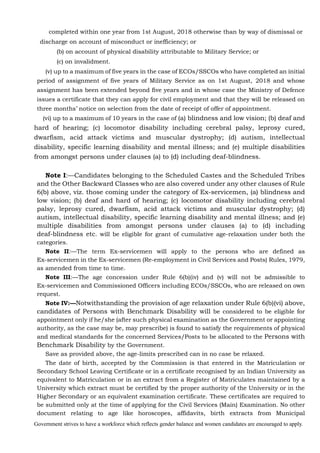
(a) on completion of assignment (including those whose assignment is due to be
Government strives to have a workforce which reflects gender balance and women candidates are encouraged to apply.
completed within one year from 1st August, 2018 otherwise than by way of dismissal or
discharge on account of misconduct or inefficiency; or
(b) on account of physical disability attributable to Military Service; or
(c) on invalidment.
(v) up to a maximum of five years in the case of ECOs/SSCOs who have completed an initial
period of assignment of five years of Military Service as on 1st August, 2018 and whose
assignment has been extended beyond five years and in whose case the Ministry of Defence
issues a certificate that they can apply for civil employment and that they will be released on
three months’ notice on selection from the date of receipt of offer of appointment.
(vi) up to a maximum of 10 years in the case of (a) blindness and low vision; (b) deaf and
hard of hearing; (c) locomotor disability including cerebral palsy, leprosy cured,
dwarfism, acid attack victims and muscular dystrophy; (d) autism, intellectual
disability, specific learning disability and mental illness; and (e) multiple disabilities
from amongst persons under clauses (a) to (d) including deaf-blindness.
Note I:—Candidates belonging to the Scheduled Castes and the Scheduled Tribes
and the Other Backward Classes who are also covered under any other clauses of Rule
6(b) above, viz. those coming under the category of Ex-servicemen, (a) blindness and
low vision; (b) deaf and hard of hearing; (c) locomotor disability including cerebral
palsy, leprosy cured, dwarfism, acid attack victims and muscular dystrophy; (d)
autism, intellectual disability, specific learning disability and mental illness; and (e)
multiple disabilities from amongst persons under clauses (a) to (d) including
deaf-blindness etc. will be eligible for grant of cumulative age-relaxation under both the
categories.
Note II:—The term Ex-servicemen will apply to the persons who are defined as
Ex-servicemen in the Ex-servicemen (Re-employment in Civil Services and Posts) Rules, 1979,
as amended from time to time.
Note III:—The age concession under Rule 6(b)(iv) and (v) will not be admissible to
Ex-servicemen and Commissioned Officers including ECOs/SSCOs, who are released on own
request.
Note IV:—Notwithstanding the provision of age relaxation under Rule 6(b)(vi) above,
candidates of Persons with Benchmark Disability will be considered to be eligible for
appointment only if he/she (after such physical examination as the Government or appointing
authority, as the case may be, may prescribe) is found to satisfy the requirements of physical
and medical standards for the concerned Services/Posts to be allocated to the Persons with
Benchmark Disability by the Government.
Save as provided above, the age-limits prescribed can in no case be relaxed.
The date of birth, accepted by the Commission is that entered in the Matriculation or
Secondary School Leaving Certificate or in a certificate recognised by an Indian University as
equivalent to Matriculation or in an extract from a Register of Matriculates maintained by a
University which extract must be certified by the proper authority of the University or in the
Higher Secondary or an equivalent examination certificate. These certificates are required to
be submitted only at the time of applying for the Civil Services (Main) Examination. No other
document relating to age like horoscopes, affidavits, birth extracts from Municipal
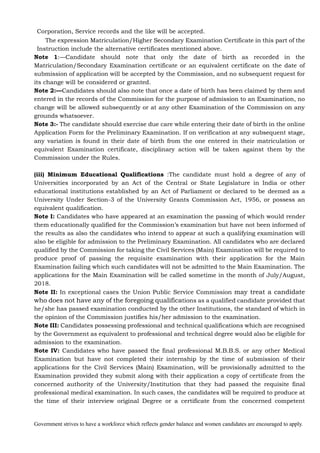
Government strives to have a workforce which reflects gender balance and women candidates are encouraged to apply.
Corporation, Service records and the like will be accepted.
The expression Matriculation/Higher Secondary Examination Certificate in this part of the
Instruction include the alternative certificates mentioned above.
Note 1:—Candidate should note that only the date of birth as recorded in the
Matriculation/Secondary Examination certificate or an equivalent certificate on the date of
submission of application will be accepted by the Commission, and no subsequent request for
its change will be considered or granted.
Note 2:—Candidates should also note that once a date of birth has been claimed by them and
entered in the records of the Commission for the purpose of admission to an Examination, no
change will be allowed subsequently or at any other Examination of the Commission on any
grounds whatsoever.
Note 3:- The candidate should exercise due care while entering their date of birth in the online
Application Form for the Preliminary Examination. If on verification at any subsequent stage,
any variation is found in their date of birth from the one entered in their matriculation or
equivalent Examination certificate, disciplinary action will be taken against them by the
Commission under the Rules.
(iii) Minimum Educational Qualifications :The candidate must hold a degree of any of
Universities incorporated by an Act of the Central or State Legislature in India or other
educational institutions established by an Act of Parliament or declared to be deemed as a
University Under Section-3 of the University Grants Commission Act, 1956, or possess an
equivalent qualification.
Note I: Candidates who have appeared at an examination the passing of which would render
them educationally qualified for the Commission’s examination but have not been informed of
the results as also the candidates who intend to appear at such a qualifying examination will
also be eligible for admission to the Preliminary Examination. All candidates who are declared
qualified by the Commission for taking the Civil Services (Main) Examination will be required to
produce proof of passing the requisite examination with their application for the Main
Examination failing which such candidates will not be admitted to the Main Examination. The
applications for the Main Examination will be called sometime in the month of July/August,
2018.
Note II: In exceptional cases the Union Public Service Commission may treat a candidate
who does not have any of the foregoing qualifications as a qualified candidate provided that
he/she has passed examination conducted by the other Institutions, the standard of which in
the opinion of the Commission justifies his/her admission to the examination.
Note III: Candidates possessing professional and technical qualifications which are recognised
by the Government as equivalent to professional and technical degree would also be eligible for
admission to the examination.
Note IV: Candidates who have passed the final professional M.B.B.S. or any other Medical
Examination but have not completed their internship by the time of submission of their
applications for the Civil Services (Main) Examination, will be provisionally admitted to the
Examination provided they submit along with their application a copy of certificate from the
concerned authority of the University/Institution that they had passed the requisite final
professional medical examination. In such cases, the candidates will be required to produce at
the time of their interview original Degree or a certificate from the concerned competent
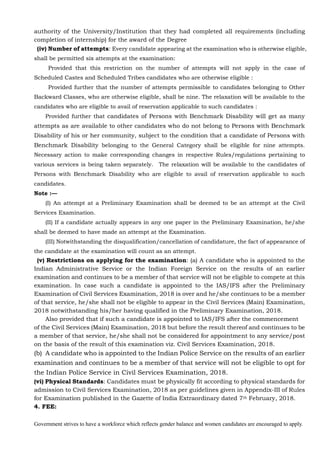
Government strives to have a workforce which reflects gender balance and women candidates are encouraged to apply.
authority of the University/Institution that they had completed all requirements (including
completion of internship) for the award of the Degree
(iv) Number of attempts: Every candidate appearing at the examination who is otherwise eligible,
shall be permitted six attempts at the examination:
Provided that this restriction on the number of attempts will not apply in the case of
Scheduled Castes and Scheduled Tribes candidates who are otherwise eligible :
Provided further that the number of attempts permissible to candidates belonging to Other
Backward Classes, who are otherwise eligible, shall be nine. The relaxation will be available to the
candidates who are eligible to avail of reservation applicable to such candidates :
Provided further that candidates of Persons with Benchmark Disability will get as many
attempts as are available to other candidates who do not belong to Persons with Benchmark
Disability of his or her community, subject to the condition that a candidate of Persons with
Benchmark Disability belonging to the General Category shall be eligible for nine attempts.
Necessary action to make corresponding changes in respective Rules/regulations pertaining to
various services is being taken separately. The relaxation will be available to the candidates of
Persons with Benchmark Disability who are eligible to avail of reservation applicable to such
candidates.
Note :—
(I) An attempt at a Preliminary Examination shall be deemed to be an attempt at the Civil
Services Examination.
(II) If a candidate actually appears in any one paper in the Preliminary Examination, he/she
shall be deemed to have made an attempt at the Examination.
(III) Notwithstanding the disqualification/cancellation of candidature, the fact of appearance of
the candidate at the examination will count as an attempt.
(v) Restrictions on applying for the examination: (a) A candidate who is appointed to the
Indian Administrative Service or the Indian Foreign Service on the results of an earlier
examination and continues to be a member of that service will not be eligible to compete at this
examination. In case such a candidate is appointed to the IAS/IFS after the Preliminary
Examination of Civil Services Examination, 2018 is over and he/she continues to be a member
of that service, he/she shall not be eligible to appear in the Civil Services (Main) Examination,
2018 notwithstanding his/her having qualified in the Preliminary Examination, 2018.
Also provided that if such a candidate is appointed to IAS/IFS after the commencement
of the Civil Services (Main) Examination, 2018 but before the result thereof and continues to be
a member of that service, he/she shall not be considered for appointment to any service/post
on the basis of the result of this examination viz. Civil Services Examination, 2018.
(b) A candidate who is appointed to the Indian Police Service on the results of an earlier
examination and continues to be a member of that service will not be eligible to opt for
the Indian Police Service in Civil Services Examination, 2018.
(vi) Physical Standards: Candidates must be physically fit according to physical standards for
admission to Civil Services Examination, 2018 as per guidelines given in Appendix-III of Rules
for Examination published in the Gazette of India Extraordinary dated 7th February, 2018.
4. FEE:
Government strives to have a workforce which reflects gender balance and women candidates are encouraged to apply.
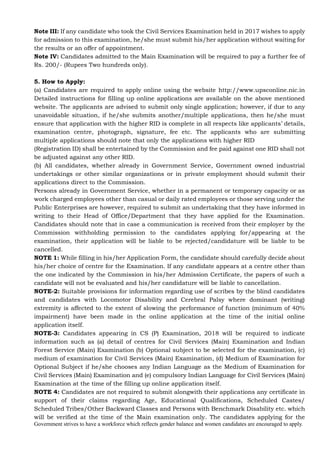
Candidates (excepting Female/SC/ST/Persons with Benchmark Disability Candidates who are
exempted from payment of fee) are required to pay fee of Rs. 100/- (Rupees One Hundred only)
either by remitting the money in any Branch of State Bank of India or by using
Visa/Master/RuPay Credit/Debit Card or by using Internet Banking of SBI. Applicants who
opt for "Pay by Cash" mode should print the system generated Pay-in-slip during part II
registration and deposit the fee at the counter of SBI Branch on the next working day only. "Pay
by Cash” mode will be deactivated at 23.59 hours of 05.03.2018 i.e. one day before the closing
date; however applicants who have generated their Pay-in- Slip before it is deactivated may pay
at the counter of SBI Branch during banking hours on the closing date. Such applicants who
are unable to pay by cash on the closing date i.e during banking hours at SBI Branch, for
reasons whatsoever, even if holding valid pay-in-slip will have no other offline option but to opt
for available online Debit/Credit Card or Internet Banking payment mode on the closing date
i.e. till 18:00 Hours of 06.03.2018.
For the applicants in whose case payments details have not been received from the bank they
will be treated as fictitious payment cases and a list of all such applicants shall be made
available on the Commission website within two weeks after the last day of submission of
online application.
These applicants shall also be intimated through e-mail to submit copy of proof of their
payment to the Commission at the address mentioned in the e-mail. The applicant shall be
required to submit the proof within 10 days from the date of such communication either by
hand or by speed post to the Commission. In case, no response is received from the applicants
their applications shall be summarily rejected and no further correspondence shall be
entertained in this regard.
All female candidates and candidates belonging to Scheduled Caste/ Scheduled Tribe/ Persons
with Benchmark Disability categories are exempted from payment of fee. No fee exemption is,
however, available to OBC candidates and they are required to pay the prescribed fee in full.
Persons with Benchmark Disability are exempted from the payment of fee provided they are
otherwise eligible for appointment to the Services/Posts to be filled on the results of this
examination on the basis of the standards of medical fitness for these Services/Posts
(including any concessions specifically extended to the Persons with Benchmark Disability). A
candidate of Persons with Benchmark Disability claiming fee concession will be required by the
Commission to submit along with their Detailed Application Form, a certified copy of the
Certificate of Disability from a Government Hospital/Medical Board in support of his/her claim
for belonging to Persons with Benchmark Disability.
NB: Notwithstanding, the aforesaid provision for fee exemption, a candidate of Persons with
Benchmark Disability will be considered to be eligible for appointment only if he/she (after
such physical examination as the Government or the Appointing Authority, as the case may be,
may prescribe) is found to satisfy the requirements of physical and medical standards for the
concerned Services/Posts to be allocated to candidates of Persons with Benchmark Disability
by the Government.
Note I: Applications without the prescribed Fee (Unless remission of Fee is claimed) shall be
summarily rejected.
Note II: Fee once paid shall not be refunded under any circumstances nor can the fee be held
in reserve for any other examination or selection.
Government strives to have a workforce which reflects gender balance and women candidates are encouraged to apply.
Note III: If any candidate who took the Civil Services Examination held in 2017 wishes to apply
for admission to this examination, he/she must submit his/her application without waiting for
the results or an offer of appointment.
Note IV: Candidates admitted to the Main Examination will be required to pay a further fee of
Rs. 200/- (Rupees Two hundreds only).
5. How to Apply:
(a) Candidates are required to apply online using the website http://www.upsconline.nic.in
Detailed instructions for filling up online applications are available on the above mentioned
website. The applicants are advised to submit only single application; however, if due to any
unavoidable situation, if he/she submits another/multiple applications, then he/she must
ensure that application with the higher RID is complete in all respects like applicants’ details,
examination centre, photograph, signature, fee etc. The applicants who are submitting
multiple applications should note that only the applications with higher RID
(Registration ID) shall be entertained by the Commission and fee paid against one RID shall not
be adjusted against any other RID.
(b) All candidates, whether already in Government Service, Government owned industrial
undertakings or other similar organizations or in private employment should submit their
applications direct to the Commission.
Persons already in Government Service, whether in a permanent or temporary capacity or as
work charged employees other than casual or daily rated employees or those serving under the
Public Enterprises are however, required to submit an undertaking that they have informed in
writing to their Head of Office/Department that they have applied for the Examination.
Candidates should note that in case a communication is received from their employer by the
Commission withholding permission to the candidates applying for/appearing at the
examination, their application will be liable to be rejected/candidature will be liable to be
cancelled.
NOTE 1: While filling in his/her Application Form, the candidate should carefully decide about
his/her choice of centre for the Examination. If any candidate appears at a centre other than
the one indicated by the Commission in his/her Admission Certificate, the papers of such a
candidate will not be evaluated and his/her candidature will be liable to cancellation.
NOTE-2: Suitable provisions for information regarding use of scribes by the blind candidates
and candidates with Locomotor Disability and Cerebral Palsy where dominant (writing)
extremity is affected to the extent of slowing the performance of function (minimum of 40%
impairment) have been made in the online application at the time of the initial online
application itself.
NOTE-3: Candidates appearing in CS (P) Examination, 2018 will be required to indicate
information such as (a) detail of centres for Civil Services (Main) Examination and Indian
Forest Service (Main) Examination (b) Optional subject to be selected for the examination, (c)
medium of examination for Civil Services (Main) Examination, (d) Medium of Examination for
Optional Subject if he/she chooses any Indian Language as the Medium of Examination for
Civil Services (Main) Examination and (e) compulsory Indian Language for Civil Services (Main)
Examination at the time of the filling up online application itself.
NOTE 4: Candidates are not required to submit alongwith their applications any certificate in
support of their claims regarding Age, Educational Qualifications, Scheduled Castes/
Scheduled Tribes/Other Backward Classes and Persons with Benchmark Disability etc. which
will be verified at the time of the Main examination only. The candidates applying for the
Government strives to have a workforce which reflects gender balance and women candidates are encouraged to apply.
examination should ensure that they fulfil all the eligibility conditions for admission to the
Examination. Their admission at all the stages of examination for which they are admitted by
the Commission viz. Preliminary Examination, Main (Written) Examination and Interview Test
will be purely provisional, subject to their satisfying the prescribed eligibility conditions. If on
verification at any time before or after the Preliminary Examination, Main (written)
Examination and Interview Test, it is found that they do not fulfil any of the eligibility
conditions; their candidature for the examination will be cancelled by the Commission. If any of
their claims is found to be incorrect, they may render themselves liable to disciplinary action by
the Commission in terms of Rule 14 of the Rules for the Civil Services Examination, 2018
reproduced below:
A candidate who is or has been declared by the Commission to be guilty of:
(i) Obtaining support for his/her candidature by the following means, namely:–
(a) offering illegal gratification to, or
(b) applying pressure on, or
(c) blackmailing, or threatening to blackmail any person connected with the conduct of the
examination, or
(ii) impersonating, or
(iii) procuring impersonation by any person,
or
(iv) submitting fabricated documents or documents which have been tampered with, or
(v) making statements which are incorrect or false or suppressing material information, or
(vi) resorting to the following means in connection with his/her candidature for the
examination, namely
(a) obtaining copy of question paper through improper means,
(b) finding out the particulars of the persons connected with secret work relating to the
examination.
(c) influencing the examiners, or
(vii) using unfair means during the examination, or
(viii)writing obscene matter or drawing obscene sketches in the scripts, or
(ix) misbehaving in the examination hall including tearing of the scripts, provoking fellow
examinees to boycott examination, creating a disorderly scene and the like, or
(x) harassing or doing bodily harm to the staff employed by the Commission for the conduct of
their examinations, or
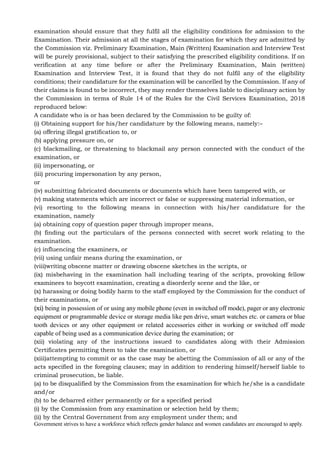
(xi) being in possession of or using any mobile phone (even in switched off mode), pager or any electronic
equipment or programmable device or storage media like pen drive, smart watches etc. or camera or blue
tooth devices or any other equipment or related accessories either in working or switched off mode
capable of being used as a communication device during the examination; or
(xii) violating any of the instructions issued to candidates along with their Admission
Certificates permitting them to take the examination, or
(xiii)attempting to commit or as the case may be abetting the Commission of all or any of the
acts specified in the foregoing clauses; may in addition to rendering himself/herself liable to
criminal prosecution, be liable.
(a) to be disqualified by the Commission from the examination for which he/she is a candidate
and/or
(b) to be debarred either permanently or for a specified period
(i) by the Commission from any examination or selection held by them;
(ii) by the Central Government from any employment under them; and
Government strives to have a workforce which reflects gender balance and women candidates are encouraged to apply.
(c) if he/she is already in service under Government to disciplinary action under the
appropriate Rules.
Provided that no penalty under these Rules shall be imposed except after
(i) giving the candidate an opportunity of making such representation, in writing as he/she
may wish to make in that behalf; and
(ii) taking the representation, if any, submitted by the candidate within the period allowed to
him/her into consideration.
6. Last date for receipt of applications: The Online Applications can be filled up to 6th March,
2018 till 18:00 Hrs.
7. Correspondence with the Commission:
The Commission will not enter into any correspondence with the candidates about their
candidature except in the following cases:
(i) The eligible candidates shall be issued an e-Admission Certificate three weeks before the
commencement of the examination. The e-Admission Certificate will be made available on the
UPSC website [www.upsc.gov.in] for downloading by candidates. No Admission Certificate will
be sent by post. If a candidate does not receive his e-Admission Certificate or any other
communication regarding his/her candidature for the examination three weeks before the
commencement of the examination, he/she should at once contact the Commission.
Information in this regard can also be obtained from the Facilitation Counter located in the
Commission’s Office either in person or over phone Nos. 011-23381125/011-
23385271/011-23098543. In case no communication is received in the Commission's Office
from the candidate regarding non-receipt of his/her e-Admission Certificate at least 3 weeks
before the examination, he/she himself/herself will be solely responsible for non-receipt of
his/her e- Admission Certificate. No candidate will ordinarily be allowed to take the
examination unless he/she holds a certificate of admission for the examination. On
downloading of e- Admission Certificate, check it carefully and bring discrepancies/errors, if
any, to the notice of UPSC immediately.
The candidates should note that their admission to the examination will be purely provisional
based on the information given by them in the Application Form. This will be subject to
verification of all the eligibility conditions by the UPSC.
The mere fact that a certificate of admission to the Examination has been issued to a
candidate, will not imply that his/her candidature has been finally cleared by the Commission
or that entries made by the candidate in his/her application for the Preliminary examination
have been accepted by the Commission as true and correct. Candidates may note that the
Commission takes up the verification of eligibility conditions of a candidate, with reference to
original documents, only after the candidate has qualified for Civil Services (Main)
Examination. Unless candidature is formally confirmed by the Commission, it continues to be
provisional.
The decision of the Commission as to the eligibility or otherwise of a candidate for admission to
the Examination shall be final.
Candidates should note that the name in the Admission Certificate in some cases, may be
abbreviated due to technical reasons.
(ii) In the event of a candidate downloading more than one Admission Certificate from the
Commission's website, he/she should use only one of these Admission Certificates for
appearing in the examination and report about the other(s) to the Commission's Office.
Government strives to have a workforce which reflects gender balance and women candidates are encouraged to apply.
(iii) Candidates are informed that as the Preliminary Examination is only a screening test, no
marks sheets will be supplied to successful or unsuccessful candidates and no correspondence
will be entertained by the Commission, in this regard.
(iv) Candidates must ensure that their emails IDs given in their online application are valid and
active.
Important: All communications to the Commission should invariably contain the following
particulars.
1. Name and year of the examination.
2. Registration ID (RID)
3. Roll Number (if received)
4. Name of candidate (in full and in block letters)
5. Complete postal address as given in the application.
N.B. I. Communication not containing the above particulars may not be attended to.
N.B. II. Candidates should also note down their RID number for future reference. They may be
required to indicate the same in connection with their candidature for the Civil Services (Main)
Examination.
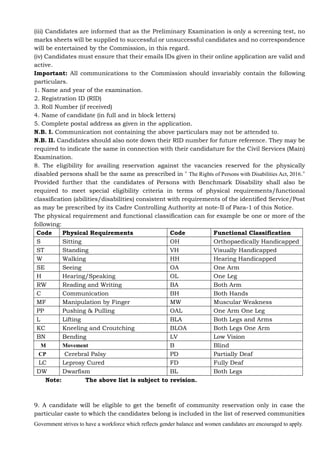
8. The eligibility for availing reservation against the vacancies reserved for the physically
disabled persons shall be the same as prescribed in " The Rights of Persons with Disabilities Act, 2016."
Provided further that the candidates of Persons with Benchmark Disability shall also be
required to meet special eligibility criteria in terms of physical requirements/functional
classification (abilities/disabilities) consistent with requirements of the identified Service/Post
as may be prescribed by its Cadre Controlling Authority at note-II of Para-1 of this Notice.
The physical requirement and functional classification can for example be one or more of the
following:
Code Physical Requirements Code Functional Classification
S Sitting OH Orthopaedically Handicapped
ST Standing VH Visually Handicapped
W Walking HH Hearing Handicapped
SE Seeing OA One Arm
H Hearing/Speaking OL One Leg
RW Reading and Writing BA Both Arm
C Communication BH Both Hands
MF Manipulation by Finger MW Muscular Weakness
PP Pushing & Pulling OAL One Arm One Leg
L Lifting BLA Both Legs and Arms
KC Kneeling and Croutching BLOA Both Legs One Arm
BN Bending LV Low Vision
M Movement B Blind
CP Cerebral Palsy PD Partially Deaf
LC Leprosy Cured FD Fully Deaf
DW Dwarfism BL Both Legs
Note: The above list is subject to revision.
9. A candidate will be eligible to get the benefit of community reservation only in case the
particular caste to which the candidates belong is included in the list of reserved communities
Government strives to have a workforce which reflects gender balance and women candidates are encouraged to apply.
issued by the Central Government. If a candidate indicates in his/her application form for Civil
Services (Preliminary) Examination that he/she belongs to General category but subsequently
writes to the Commission to change his/her category to a reserved one, such request shall not
be entertained by the Commission. Similar principle will be followed for candidates of Persons
with Benchmark Disabilities categories also. While the above principle will be followed in
general, there may be a few cases where there was a gap of not more than 3 months between
the issuance of a Government Notification enlisting a particular community in the list of any of
the reserved communities and the date of submission of the application by the candidate. In
such cases the request of change of community from general to reserved may be considered by
the Commission on merit. In case of a candidate unfortunately becoming physically disabled
during the course of the examination process, the candidate should produce valid document
showing him/her acquiring a disability to the extent of 40% or more as defined under The Rights
of Persons with Disabilities Act, 2016 to enable him/her to get the benefits of PwBD reservation.
10. Candidates seeking reservation/ relaxation benefits available for SC/ST/ OBC/Persons
with Benchmark Disability/Ex-servicemen must ensure that they are entitled to such
reservation/ relaxation as per eligibility prescribed in the Rules/Notice. They should also be in
possession of all the requisite certificates in the prescribed format in support of their claim as
stipulated in the Rules/ Notice for such benefits, and these certificates should be dated earlier
than the due date (closing date) of the application for Civil Services (Prelims) Examination,
2018.
11. Withdrawal of applications: NO request for withdrawal of candidature received from a
candidate after he/she has submitted his/her application will be entertained under any
circumstances.
(Raj Kumar)
JOINT SECRETARY
UNION PUBLIC SERVICE COMMISSION
132 THE GAZETTE OF INDIA: EXTRAORDINARY [PART I—SEC.1]
APPENDIX I
SECTION I
PLAN OF EXAMINATION
The competitive examination comprises two successive
stages :
(i) CivilServices(Preliminary)Examination(Objective
Type) for the selection of candidates for Main
Examination; and
(ii) Civil Services (Main) Examination (Written and
Interview) for the selection of candidates for the
various Services and posts.
2. The Preliminary Examination will consist of two
papers of Objective type (multiple choice questions) and carry
a maximum of 400 marks in the subjects set out in sub-section
(A) of Section II. This examination is meant to serve as a
screening test only; the marks obtained in the Preliminary
Examination by the candidates who are declared qualified for
admission to the Main Examination will not be counted for
determining their final order of merit. The number of candidates
to be admitted to the Main Examination will be about twelve to
thirteen times the total approximate number of vacancies to be
filled in the year through this examination. Only those
candidates who are declared by the Commission to have
qualified in the Preliminary Examination in the year will be
eligible for admission to the Main Examination of that year
provided they are otherwise eligible for admission, to the Main
Examination.
Note I : The Commission will draw a list of candidates to be
qualified for Civil Services (Main) Examination based on the
criterionofminimumqualifyingmarksof33%inGeneralStudies
Paper-II of Civil Services (Preliminary) Examination and total
qualifying marks of General Studies Paper-I of Civil Services
(Preliminary) Examination as may be determined by the
Commission.
Note II : There will be negative marking for incorrect answers
(as detailed below) for all questions except some of the
questions where the negative marking will be inbuilt in the
form of different marks being awarded to the most appropriate
and not so appropriate answer for such questions.
(i) There are four alternatives for the answers to every
question. For each question for which a wrong answer has
been given by the candidate, one-third (0.33) of the marks
assigned to that question will be deducted as penalty.
(ii) If a candidate gives more than one answer, it will be
treated as a wrong answer even if one of the given answers
happen to be correct and there will be same penalty as above
for that question.
(iii) If a question is left blank i.e. no answer is given by
the candidate, there will be no penalty for that question.
3. The Main Examination will consist of written
examination and an interview test. The written examination
will consist of 9 papers of conventional essay type in the
subjects set out in sub-section (B) of Section II out of which
two papers will be of qualifying in nature. Also see Note (ii)
under Para I of Section II (B) Marks obtained for all the
compulsory papers (Paper-I to Paper-VII) and Marks obtained
in Interview for Personality Test will be counted for ranking.
4.1 Candidates who obtain such minimum qualifying
marks in the written part of the Main Examination as may be
fixed by the Commission at their discretion, shall be summoned
by them for an interview for a Personality Test, vide sub-
section ‘C’ of Section II. The number of candidates to be
summouned for interview will be about twice of the number of
vacancies to be filled. The interview will carry 275 marks (with
no minimum qualifying marks).
4.2 Marks thus obtained by the candidates in the Main
Examination(writtenpartaswellasinterview)woulddetermine
their final ranking. Candidates will be allotted to the various
Services keeping in view their ranks in the examination and
the preferences expressed by them for the various Services
and posts.
SECTION II
Scheme and subjects for the Preliminary and Main
Examination.
A. PRELIMINARYEXAMINATION:
The Examination shall comprise of two compulsory
Papers of 200 marks each.
Note:
(i) Both the question papers will be of the objective
type (multiple choice questions).
(ii) The General Studies Paper-II of the Civil Services
(Preliminary) Examination will be a qualifying paper with
minimum qualifying marks fixed at 33%.
(iii) The question papers will be set both in Hindi and
English.
(iv) Details of the syllabi are indicated in Part A of
Section III.
(v) Each paper will be of two hours duration. Blind
candidates and the candidates withLocomotor Disability
and Cerebral Palsy where dominant (writing) extremity is
affected to the extent of slowing the performance of function
(minimum of 40% impairment) will; however, be allowed an
extra time of twenty minutes per hour for each paper.
B.MAINEXAMINATION:
The written examination will consist of the following
papers:—
Qualifying Papers :
Paper-A
(One of the Indian Language to be selected by the candidate
from the Languages included in the Eighth Schedule to the
Constitution). 300 Marks
¹Hkkx Iµ[k.M 1º Hkkjr dk jkti=k % vlk/kj.k 133
Paper-B
English 300 Marks
Papers to be counted for merit
Paper-I
Essay 250 Marks
Paper-II
General Studies-I 250 Marks
(Indian Heritage and Culture, History and
Geography of the World and Society)
Paper-III
GeneralStudies -II 250 Marks
(Governance, Constitution, Polity,
Social Justice and International relations)
Paper-IV
GeneralStudies-III 250 Marks
(Technology, Economic Development,
Bio-diversity, Environment, Security
and Disaster Management)
Paper-V
General Studies -IV 250 Marks
(Ethics, Integrity and Aptitude)
Paper-VI
Optional Subject - Paper 1 250 Marks
Paper-VII
Optional Subject - Paper 2 250 Marks
SubTotal (Written test) 1750 Marks
Personality Test 275 Marks
GrandTotal 2025 Marks
Candidatesmaychooseanyoneoftheoptionalsubjectsfrom
amongst the list of subjects given in para 2 below :—
NOTE:
(i) The papers on Indian languages and English (Paper A
and paper B) will be of Matriculation or equivalent standard
and will be of qualifying nature. The marks obtained in these
papers will not be counted for ranking.
(ii) Evaluation of the papers, namely, 'Essay', 'General
Studies' and Optional Subject of all the candidates would be
done simultaneously along with evaluation of their qualifying
papers on ‘Indian Languages’ and ‘English’ but the papers on
Éssay', General Studies and Optional Subject of only such
candidates will be taken cognizance who attain 25% marks in
‘Indian Language’ and 25% in English as minimum qualifying
standards in these qualifying papers.
(iii) The paper A on Indian Language will not, however, be
compulsory for candidates hailing from the States ofArunachal
Pradesh, Manipur, Meghalya, Mizoram, Nagaland and Sikkim.
(iv) The paper A on Indian Language will not, however, be
compulsory for Candidates belonging to Persons with
Benchmark Disability (only Hearing Impairment sub-category)
provided that they have been granted such exemption from
2nd or 3rd language courses by the concerned education
Board/University. The candidate needs to provide an
undertaking/self declaration in this regard in order to claim
such exemption to the Commission.
(v) Marks obtained by the candidates for the Paper I-VII
only will be counted for merit ranking. However, the Commis-
sion will have the discretion to fix qualifying marks in any or
all of these papers.
(vi) For the Language medium/literature of languages, the
scripts to be used by the candidates will be as under :—
Language Script
Assamese Assamese
Bengali Bengali
Gujarati Gujarati
Hindi Devanagari
Kannada Kannada
Kashmiri Persian
Konkani Devanagari
Malayalam Malayalam
Manipuri Bengali
Marathi Devanagari
Nepali Devanagari
Odia Odia
Punjabi Gurumukhi
Sanskrit Devanagari
Sindhi Devanagari orArabic
Tamil Tamil
Telugu Telugu
Urdu Persian
Bodo Devanagari
Dogri Devanagari
Maithilli Devanagari
Santhali Devanagari or Olchiki
Note: For Santhali language, question paper will be printed
in Devanagari script; but candidates will be free to
answer either in Devanagari script or in Olchiki.
2. List of optional subjects for Main Examination :
(i) Agriculture
(ii) Animal Husbandry and Veterinary Science
(iii) Anthropology
(iv) Botany
(v) Chemistry
(vi) Civil Engineering
(vii) Commerce and Accountancy
(viii) Economics
(ix) Electrical Engineering
134 THE GAZETTE OF INDIA: EXTRAORDINARY [PART I—SEC.1]
(x) Geography
(xi) Geology
(xii) History
(xiii) Law
(xiv) Management
(xv) Mathematics
(xvi) Mechanical Engineering
(xvii) Medical Science
(xviii) Philosophy
(xix) Physics
(xx) Political Science and International Relations
(xxi) Psychology
(xxii) PublicAdministration
(xxiii) Sociology
(xxiv) Statistics
(xxv) Zoology
(xxvi) Literature of any one of the following languages:
Assamese, Bengali, Bodo, Dogri, Gujarati, Hindi,
Kannada, Kashmiri, Konkani, Maithili, Malayalam, Manipuri,
Marathi,Nepali,Odia,Punjabi,Sanskrit,Santhali,Sindhi,Tamil,
Telugu, Urdu and English.
NOTE:
(i) The question papers for the examination will be of
conventional (essay) type.
(ii) Each paper will be of three hours duration.
(iii) Candidates will have the option to answer all the
question papers, except the Qualifying Language
Papers, Paper-A and Paper-B, in any one of the
languages included in the Eighth Schedule to the
Constitution of India or in English. Notwithstanding
this, the Candidate will have the choice to write the
Optional Papers in English also if candidates opt to
write Paper I-V except the Qualifying Language
Papers, Paper-A and Paper-B, in any one of the
language included in the Eighth Schedule to the
Constitution of India.
(iv) Candidates exercising the option to answer Papers
in any one of the languages included in the Eight
Schedule to the Constitution of India mentioned
above may, if they so desire, give English version
within brackets of only the description of the
technical terms, if any, in addition to the version in
the language opted by them. Candidates should,
however, note that if they misuse the above rule, a
deduction will be made on this account from the
total marks otherwise accruing to them and in
extreme cases; their script(s) will not be valued for
being in an unauthorized medium.
(vi) The question papers (other than the literature of
language papers) will be set in Hindi and English
only.
(vii) The details of the syllabi are set out in Part B of
Section III.
General Instructions (Preliminary as well as Main
Examination):
(i) Candidates must write the papers in their own hand.
In no circumstances will they be allowed the help of a scribe
to write the answers for them. However, blind candidates and
candidates with Locomotor Disability and Cerebral Palsy
where dominant (writing) extremity is affected to the extent of
slowing the performance of function (minimum of 40%
impairment) will be allowed to write the examination with the
help of a scribe in both the Civil Services (Preliminary) as well
as in the Civil Services (Main) Examination.
(ii) Compensatory time of twenty minutes per hour shall
be permitted for the Blind candidates and the candidates
with locomotor disability and cerebral palsy where dominant
(writing) extremity is affected to the extent of slowing the
performanceoffunction(minimumof40%impairment)inboth
the Civil Services (Preliminary) as well as in the Civil Services
(Main) Examination.
Note (1) : The eligibility conditions of a scribe, his/
her conduct inside the examination hall and the manner in
which and extent to which he/she can help the blind candidate
in writing the Civil Services Examination shall be governed by
the instructions issued by the UPSC in this regard.Violation of
all or any of the said instructions shall entail the cancellation
of the candidature of the blind candidate in addition to any
other action that the UPSC may take against the scribe.
Note (2) : For purpose of these rules the candidate
shall be deemed to be a blind candidate if the percentage of
visual impairment is Forty per cent (40%) or more. The criteria
for determining the percentage of visual impairment shall be
as follows :—
All with corrections Percentage
Better eye Worse eye
1 2 3 4
Category O 6/9—6/18 6/24 to 6/36 20%
Category I 6/18—6/36 6/60 to nil 40%
Category II 6/60—4/60 3/60 to nil 75%
or field of
vision 10°—20°
Category III 3/60—1/60 F.C. at 1 ft 100%
or field of to nil
vision 10°
Category IV F.C. at 1 ft to F.C. at 1 ft to 100%
nil nil
field of field of
vision 100° vision 100°
One eyed 6/6 F.C. at 1 ft to 30%
person nil
¹Hkkx Iµ[k.M 1º Hkkjr dk jkti=k % vlk/kj.k 135
Note (3) : For availing of the concession admissible to a
blind candidate, the candidate concerned shall produce a
certificate in the prescribed proforma from a Medical Board
constituted by the Central/State Governments along with their
application for the Main Examination.
Note (4) : The concession admissible to blind candidates
shall not be admissible to those suffering from Myopia.
(ii) The Commission have discretion to fix qualifying
marks in any or all the subjects of the examination.
(iii) If a candidate’s handwriting is not easily legible, a
deduction will be made on this account from the total marks
otherwise accruing to him.
(iv) Marks will not be allotted for mere superficial
knowledge.
(v) Credit will be given for orderly, effective and exact
expression combined with due economy of words in all
subjects of the examination.
(vi) In the question papers, wherever required, SI
units will be used.
(vii) Candidates should use only International form of
Indiannumerals(i.e.1,2,3,4,5,6etc.)whileansweringquestion
papers.
(viii) Candidates will be allowed the use of Scientific
(Non-Programmable type) Calculators at the conventional
(Essay) type examination of UPSC. Programmable type
calculators will however not be allowed and the use of such
calculators shall tantamount to resorting to unfair means by
the candidates. Loaning or interchanging of calculators in the
Examination Hall is not permitted.
It is also important to note that candidates are not
permitted to use calculators for answering objective type
papers (Test Booklets). They should not therefore bring the
same inside the Examination Hall.
C. InterviewTest
The candidate will be interviewed by a Board who will
have before them a record of his career. He will be asked
questions on matters of general interest. The object of the
interview is to assess the personal suitability of the candidate
for a career in public service by a Board of competent and
unbiased observers. The test is intended to judge the mental
calibre of a candidate. In broad terms this is really an
assessment of not only his intellectual qualities but also social
traits and his interest in current affairs. Some of the qualities
to be judged are mental alertness, critical powers of
assimilation, clear and logical exposition, balance of
judgement, variety and depth of interest, ability for social
cohesion and leadership, intellectual and moral integrity.
2. The technique of the interview is not that of a strict
cross-examination but of a natural, though directed and
purposive conversation which is intended to reveal the mental
qualities of the candidate.
3. The interview test is not intended to be a test either
of the specialised or general knowledge of the candidates
which has been already tested through their written papers.
Candidates are expected to have taken an intelligent interest
not only in their special subjects of academic study but also
in the events which are happening around them both within
and outside their own State or Country as well as in modern
currents of thought and in new discoveries which should
rouse the curiosity of well educated youth.
SECTION III
SYLLABI FOR THE EXAMINATION
NOTE : Candidates are advised to go through the
Syllabus published in this Section for the Preliminary
Examination and the Main Examination, as periodic revision
of syllabus has been done in several subjects.
PartA—Preliminary Examination
Paper I - (200 marks) Duration:Twohours
• Current events of national and international importance.
• History of India and Indian National Movement.
• IndianandWorldGeography-Physical,Social,Economic
Geography of India and the World.
• Indian Polity and Governance-Constitution, Political
System, Panchayati Raj, Public Policy, Rights Issues,
etc.
• Economic and Social Development-Sustainable
Development, Poverty, Inclusion, Demographics, Social
Sector Initiatives, etc.
• General issues on Environmental ecology, Bio-diversity
and ClimateChange - that do not require subject
specialization.
• General Science.
Paper II-(200 marks) Duration:Twohours
• Comprehension;
• Interpersonal skills including communication skills;
• Logical reasoning and analytical ability;
• Decision making and problem solving;
• General mental ability;
• Basic numeracy (numbers and their relations, orders of
magnitude, etc.) (Class X level), Data interpretation
(charts, graphs, tables, data sufficiency etc. — Class X
level);
Note 1 : Paper-II of the Civil Services (Preliminary) Examina-
tion will be a qualifying paper with minimum qualify-
ing marks fixed at 33%.
Note 2 : The questions will be of multiple choice, objective
type.
Note 3 : It is mandatory for the candidate to appear in both
the Papers of Civil Services (Prelim) Examination for
the purpose of evaluation. Therefore a candidate will
be disqualified in case he/she does not appear in
boththepapersofCivilServices(Prelim)Examination.
136 THE GAZETTE OF INDIA: EXTRAORDINARY [PART I—SEC.1]
PAPER-I
Essay : Candidates may be required to write essays on multiple
topics. They will be expected to keep closely to the subject of
the essay to arrange their ideas in orderly fashion, and to
write concisely. Credit will be given for effective and exact
expression.
PAPER-II
GeneralStudies-I:IndianHeritageandCulture,Historyand
GeographyoftheWorldandSociety.
• Indian culture will cover the salient aspects ofArt Forms,
literature andArchitecture from ancient to modern times.
• Modern Indian history from about the middle of the
eighteenth century until the present- significant events,
personalities, issues.
• The Freedom Struggle — its various stages and
important contributors/contributions from different
parts of the country.
• Post-independence consolidation and reorganization
within the country.
• Historyoftheworldwillincludeeventsfrom18thcentury
such as industrial revolution, world wars, redrawal of
national boundaries, colonization, decolonization,
political philosophies like communism, capitalism,
socialism etc.— their forms and effect on the society.
• Salient features of Indian Society, Diversity of India.
• Role of women and women’s organization, population
and associated issues, poverty and developmental
issues, urbanization, their problems and their remedies.
• Effects of globalization on Indian society.
• Social empowerment, communalism, regionalism &
secularism.
• Salient features of world’s physical geography.
• Distribution of key natural resources across the world
(including South Asia and the Indian sub-continent);
factors responsible for the location of primary,
secondary, and tertiary sector industries in various parts
of the world (including India).
• Important Geophysical phenomena such as
earthquakes, Tsunami, Volcanic activity, cyclone etc.,
geographical features and their location-changes in
critical geographical features (including water-bodies
and ice-caps) and in flora and fauna and the effects of
such changes.
PAPER-III
GeneralStudies-II:Governance,Constitution,Polity,Social
Justice and International relations.
• Indian Constitution—historical underpinnings,
evolution, features, amendments, significant provisions
and basic structure.
PartB—MainExamination
The main Examination is intended to assess the overall
intellectual traits and depth of understanding of candidates
rather than merely the range of their information and memory.
The nature and standard of questions in the General
Studies papers (Paper II to Paper V) will be such that a well-
educated person will be able to answer them without any
specialized study. The questions will be such as to test a
candidate’s general awareness of a variety of subjects, which
will have relevance for a career in Civil Services. The questions
are likely to test the candidate’s basic understanding of all
relevant issues, and ability to analyze, and take a view on
conflicting socio-economic goals, objectives and demands.
The candidates must give relevant, meaningful and succinct
answers.
The scope of the syllabus for optional subject papers
(Paper VI and Paper VII) for the examination is broadly of the
honours degree 1evel i.e. a level higher than the bachelors’
degree and lower than the masters’ degree. In the case of
Engineering, Medical Science and law, the level corresponds
to the bachelors’ degree.
Syllabi of the papers included in the scheme of Civil
Services (Main) Examination are given as follows :—
QUALIFYINGPAPERSONINDIANLANGUAGESAND
ENGLISH
The aim of the paper is to test the candidates's ability to
read and understand serious discursive prose, and to express
his ideas clearly and correctly, in English and Indian language
concerned.
The pattern of questions would be broadly as follows :
(i) Comprehension of given passages.
(ii) PrecisWriting.
(iii) Usage and Vocabulary.
(iv) Short Essays.
IndianLanguages:—
(i) comprehension of given passages.
(ii) PrecisWriting.
(iii) Usage and Vocabulary.
(iv) Short Essays.
(v) Translation from English to the Indian Language and
vice-versa.
Note 1 : The papers on Indian Languages and English will be
of Matriculation or equivalent standard and will be of
qualifying nature only. The marks obtained in these papers
will not be counted for ranking.
Note 2 : The candidates will have to answer the English and
Indian Languages papers in English and the respective Indian
language (except where translation is involved).
¹Hkkx Iµ[k.M 1º Hkkjr dk jkti=k % vlk/kj.k 137
PAPER-IV
GeneralStudies-III:Technology,EconomicDevelopment,Bio
diversity,Environment,SecurityandDisasterManagement
• Indian Economy and issues relating to planning,
mobilization, of resources, growth, development and
employment.
• Inclusive growth and issues arising from it.
• Government Budgeting.
• Major crops-cropping patterns in various parts of the
country, - different types of irrigation and irrigation
systems storage, transport and marketing of agricultural
produce and issues and related constraints; e-
technology in the aid of farmers.
• Issues related to direct and indirect farm subsidies and
minimum support prices; Public Distribution System-
objectives, functioning, limitations, revamping; issues
of buffer stocks and food security; Technology
missions; economics of animal-rearing.
• Food processing and related industries in India- scope’
and significance, location, upstream and downstream
requirements, supply chain management.
• Land reforms in India.
• Effects of liberalization on the economy, changes in
industrial policy and their effects on industrial growth.
• Infrastructure: Energy, Ports, Roads,Airports, Railways
etc.
• Investment models.
• Science and Technology- developments and their
applications and effects in everyday life.
• Achievements of Indians in science & technology;
indigenization of technology and developing new
technology.
• Awareness in the fields of IT, Space, Computers,
robotics, nano-technology, bio-technology and issues
relating to intellectual property rights.
• Conservation, environmental pollution and degradation,
environmental impact assessment.
• Disaster and disaster management.
• Linkages between development and spread of
extremism.
• Role of external state and non-state actors in creating
challenges to internal security.
• Challenges to internal security through communication
networks, role of media and social networking sites in
internal security challenges, basics of cyber security;
money-laundering and its prevention.
• Security challenges and their management in border
areas - linkages of organized crime with terrorism.
• Various Security forces and agencies and their mandate.
• Functions and responsibilities of the Union and the
States, issues and challenges pertaining to the federal
structure, devolution of powers and finances up to local
levels and challenges therein.
• Separation of powers between various organs dispute
redressal mechanisms and institutions.
• Comparison of the Indian constitutional scheme with
that of other countries.
• Parliament and State legislatures—structure,
functioning, conduct of business, powers & privileges
and issues arising out of these.
• Structure, organization and functioning of the Executive
and the Judiciary—Ministries and Departments of the
Government; pressure groups and formal/informal
associations and their role in the Polity.
• Salient features of the Representation of People’s Act.
• Appointment to various Constitutional posts, powers,
functions and responsibilities of various Constitutional
Bodies.
• Statutory, regulatory and various quasi-judicial bodies.
• Government policies and interventions for development
in various sectors and issues arising out of their design
and implementation.
• Development processes and the development industry
—the role of NGOs, SHGs, various groups and
associations, donors, charities, institutional and other
stakeholders.
• Welfare schemes for vulnerable sections of the
population by the Centre and States and the performance
of these schemes; mechanisms, laws, institutions and
Bodies constituted for the protection and betterment of
these vulnerable sections.
• Issues relating to development and management of
Social Sector/Services relating to Health, Education,
Human Resources.
• Issues relating to poverty and hunger.
• Important aspects of governance, transparency and
accountability, e-governance- applications, models,
successes, limitations, and potential; citizens charters,
transparency & accountability and institutional and
other measures.
• Role of civil services in a democracy.
• India and its neighborhood- relations.
• Bilateral, regional and global groupings and agreements
involving India and/or affecting India’s interests.
• Effect of policies and politics of developed and
developing countries on India’s interests, Indian
diaspora.
• Important International institutions, agencies and fora-
their structure, mandate.
138 THE GAZETTE OF INDIA: EXTRAORDINARY [PART I—SEC.1]
PAPER-V
GeneralStudies-IV:Ethics,IntegrityandAptitude
This paper will include questions to test the candidates’
attitude and approach to issues relating to integrity, probity
in public life and his problem solving approach to various
issues and conflicts faced by him in dealing with society.
Questions may utilise the case study approach to determine
these aspects. The following broad areas will be covered :
• Ethics and Human Interface: Essence, determinants and
consequences of Ethics in-human actions; dimensions
of ethics; ethics - in private and public relationships.
Human Values - lessons from the lives and teachings of
greatleaders,reformersandadministrators;roleoffamily
society and educational institutions in inculcating
values.
• Attitude: content, structure, function; its influence and
relation with thought and behaviour; moral and political
attitudes; social influence and persuasion.
• Aptitude and foundational values for Civil Service,
integrity, impartiality and non-partisanship, objectivity,
dedication to public service, empathy, tolerance and
compassion towards the weaker-sections.
• Emotional intelligence-concepts, and their utilities and
application in administration and governance.
• Contributions of moral thinkers and philosophers from
India and world.
• Public/Civil service values and Ethics in Public
administration: Status and problems; ethical concerns
and dilemmas in government and private institutions;
laws, rules, regulations and conscience as sources of
ethical guidance; accountability and ethical governance;
strengthening of ethical and moral values in governance;
ethical issues in international relations and funding;
corporate governance.
• Probity in Governance: Concept of public service;
Philosophical basis of governance and probity;
Information sharing and transparency in government,
Right to Information, Codes of Ethics, Codes of Conduct,
Citizen’s Charters, Work culture, Quality of service
delivery, Utilization of public funds, challenges of
corruption.
• Case Studies on above issues.
PAPER-VI&PAPERVII
OptionalSubjectPapersI&II
Candidate may choose any optional subject from
amongst the List of Optional Subjects given in Para 2.
AGRICULTURE
PAPER-I
Ecology and its relevance to man, natural resources,
their sustainable management and conservation. Physical and
social environment as factors of crop distribution and
production. Agro ecology; cropping pattern as indicators of
environments. Environmental pollution and associated hazards
to crops, animals and humans. Climate change—International
conventions and global initiatives. Green house effect and
global warming. Advance tools for ecosystem analysis—
Remote Sensing (RS) and Geographic Information Systems
(GIS).
Cropping patterns in different agro-climatic zones of
the country. Impact of high-yielding and short-duration
varieties on shifts in cropping patterns. Concepts of various
cropping, and farming systems. Organic and Precision farming.
Packageofpracticesforproductionofimportantcereals,pulses,
oil seeds, fibres, sugar, commercial and fodder crops.
Important features, and scope of various types of
forestry plantations such as social forestry, agro-forestry, and
natural forests : Propagation of forest plants. Forest products.
Agro-forestry and value addition. Conservation of forest flora
and fauna.
Weeds, their characteristics, dissemination and
association with various crops; their multiplications; cultural,
biological, and chemical control of weeds.
Soil—physical, chemical and biological properties.
Processes and factors of soil formation. Soils of India. Mineral
and organic constituents of soils and their role in maintaining
soil productivity. Essential plant nutrients and other beneficial
elements in soils and plants. Principles of soil fertility, soil
testing and fertiliser recommendations, integrated nutrient
management Biofertilizers. Losses of nitrogen in soil, nitrogen-
use efficiency in submerged rice soils, nitrogen fixation in
soils. Efficient phosphoruse and potassium use. Problem soils
and their reclamation. Soil factors affecting green house gas
emission.
Soil conservation, integrated watershed management.
Soil erosion and its management. Dry land agriculture and its
problems. Technology for stabilising agriculture production
in rainfed areas.
Water-use efficiency in relation to crop production,
criteria for scheduling irrigations, ways and means of reducing
run-off losses of irrigation water. Rainwater harvesting. Drip
and sprinkler irrigation. Drainage of water-logged soils, quality
of irrigation water, effect of industrial effluents on soil and
water pollution. Irrigation projects in India.
Farm management, scope, importance and
characteristics, farm planning. Optimum resource use and
budgeting. Economics of different types of farming systems.
Marketing management strategies for development, market
intelligence. Price fluctuations and their cost; role of co-
operatives in agricultural economy; types and systems of
farming and factors affecting them.Agricultural price policy.
Crop Insurance.
Agricultural extension, its importance and role, methods
of evaluation of extension programmes, socio-economic
survey and status of big, small and marginal farmers and
¹Hkkx Iµ[k.M 1º Hkkjr dk jkti=k % vlk/kj.k 139
landless agricultural labourers; Training programmes for
extension workers. Role of Krishi Vigyan Kendra’s (KVK) in
dissemination ofAgricultural technologies. Non-Government
Organisation (NGO) and self-help group approach for rural
development.
PAPER-II
Cell structure, function and cell cycle. Synthesis,
structure and function of genetic material. Laws of heredity.
Chromosome structure, chromosomal aberrations, linkage and
cross-over, and their significance in recombination breeding.
Polyploidy, euploids and aneuploids. Mutation—and their
role in crop improvement. Heritability, sterility and
incompatibility, classification and their application in crop
improvement. Cytoplasmic inheritance, sex-linked, sex-
influenced and sex-limited characters.
History of plant breeding. Modes of reproduction,
selfing and crossing techniques. Origin, evolution and
domestication of crop plants, center of origin, law of
homologous series, crop genetic resources—conservation
and utilization. Application of principles of plant breeding,
improvement of crop plants. Molecular markers and their
application in plant improvement. Pure-line selection, pedigree,
mass and recurrent selections, combining ability, its
significance in plant breeding. Heterosis and its exploitation.
Somatic hybridization. Breeding for disease and pest
resistance. Role of interspecific and intergeneric hybridization.
Role of genetic engineering and biotechnology in crop
improvement Gernetically modified crop plants.
Seed production and processing technologies. Seed
certification, Seed testing and storage. DNA finger printing
and seed registration. Role of public and private sectors in
seed production, and marketing. Intellectual Property Rights
(IPR) issues, WTO issues and its impact on Agriculture.
Principles of Plant Physiology with reference to plant
nutrition, absorption, translocation and metabolism of
nutrients. Soil-water-plant relationship.
Enzymes and plant pigments; photosynthesis—modern
concepts and factors affecting the process, aerobic and
anaerobic respiration; C3
, C4
and CAM mechanisms.
Carbohydrate, protein and fat metabolism. Growth and
development; photoperiodism and vernalization. Plant growth
substances and their role in crop production. Physiology of
seed development and germination; dormancy. Stress
physiology—draught, salt and water stress.
Major fruits, plantation crops, vegetables, spices and
flower crops. Package practices of major horticultural crops.
Protected cultivation and high tech horticulture. Post-harvest
technology and value addition of fruits and vegetables.
Landscaping and commercial floriculture. Medicinal and
aromatic plants. Role of fruits and vegetables in human
nutrition.
Diagnosis of pests and diseases of field crops,
vegetables, orchard and plantation crops and their economic
importance. Classification of pests and diseases and their
management. Intergrated pest and diseases management.
Storage pests and their management. Biological control of
pests and diseases. Epidemiology and forecasting of major
crop pests and diseases. Plant quarantine measures. Pesticides,
their formulation and modes of action.
Food production and consumption trends in India. Food
security and growing population—vision 2020. Reasons for
grain surplus. National and International food policies.
Production, procurement, distribution constraints.Availability
of foodgtrains, per capita expenditure on food. Trends in
poverty, Public Distribution System and Below Poverty Line
population, Targeted Public Distribution System (PDS), policy
implementation in context to globalization. Processing
constraints. Relation of food production to National Dietary
Guidelines and food consumption pattern. Food based dietary
approaches to eliminate hunger. Nutrient deficiency—Micro
nutrient deficiency : Protein Energy Malnutrition or Protein
Calorie Malnutrition (PEM or PCM), Micro nutrient deficiency
and HRD in context of work capacity of women and children.
Food grain productivity and food security.
ANIMAL HUSBANDRYANDVETERINARYSCIENCE
PAPER-I
1.Animal Nutrition :
1.1 Partitioning of food energy within the animal. Direct
and indirect calorimetry. Carbon—nitrogen balance
and comparative slaughter methods. Systems for
expressing energy value of foods in ruminants, pigs
and poultry. Energy requirements for maintenance,
growth, pregnancy, lactation, egg, wool, and meat
production.
1.2 Latest advances in protein nutrition. Energy protein
inter-relationships. Evaluation of protein quality. Use
of NPN compounds in ruminant diets. Protein
requirements for maintenance, growth, pregnancy,
lactation, egg, wool and meat production.
1.3 Major and trace minerals—Their sources,
physiological functions and deficiency symptoms.
Toxic minerals. Mineral interactions. Role of
fatsoluble and water—soluble vitamins in the body,
their sources and deficiency symptoms.
1.4 Feed additives—methane inhibitors, probiotics,
enzymes, antibiotics, hormones, oligosaccharides,
antioxidants, emulsifiers, mould inhibitors, buffers
etc. Use and abuse of growth promoters like
harmones and antibiotics—latest concepts.
1.5 Conservation of fodders. Storage of feeds and feed
ingredients. Recent advances in feed technology and
feed processing. Anti-nutritional and toxic factors
present in livestock feeds. Feed analysis and quality
control. Digestibility trials—direct, indirect and
indicator methods. Predicting feed intake in grazing
animals.
140 THE GAZETTE OF INDIA: EXTRAORDINARY [PART I—SEC.1]
1.6 Advances in ruminant nutrition. Nutrient
requirements. Balanced rations. Feeding of calves,
pregnant, work animals and breeding bulls. Strategies
for feeding milch animals during different stages of
lactationcycle.Effectoffeedingonmilkcomposition.
Feeding of goats for meat and milk production.
Feeding of sheep for meat and wool production.
1.7 SwineNutrition.Nutrientrequirements.Creep,starter,
grower and finisher rations. Feeding of pigs for lean
meat production. Low cost rations for swine.
1.8 Poultry nutrition. Special features of poultry nutrition.
Nutrient requirements for meat and egg production.
Formulation of rations for different classes of layers
and broilers.
2.Animal Physiology :
2.1 Physiology of blood and its circulation, respiration;
excretion. Endocrine glands in health and disease.
2.2 Blood constituents.—Properties and functions-blood
cell formation—Haemoglobin synthesis and
chemistry-plasma proteins production, classification
and properties, coagulation of blood; Haemorrhagic
disorders—anti-coagulants—blood groups—Blood
volume—Plasma expanders-Buffer systems in blood.
Biochemical tests and their significance in disease
diagnosis.
2.3 Circulation.—Physiology of heart, cardiac cycle,
heart sounds, heart beat, electrocardiograms. Work
and efficiency of heart—effect of ions on heart
function-metabolism of cardiac muscle, nervous and
chemical regulation of heart, effect of temperature
and stress on heart, blood pressuer and
hypertension, osmotic regulation, arterial pulse,
vasomotor regulation of circulation, shock. Coronary
and pulmonary circulation, Blood-Brain barrier
Cerebrospinal fluid-circulation in birds.
2.4 Respiration.—Mechanism of respiration, Transport
and exchange of gases-neural control of respiration-
Chemo-receptors-hypoxia-respiration in birds.
2.5 Excretion.—Structure and function of kidney-
formation of urine-methods of studying renal
function-renal regulation of acid-base balance :
physiological constituents of urine-renal failure-
passive venous congestion-Urinary secretion in
chicken-Sweat glands and their function. Bio-
chemical test for urinary dysfunction.
2.6 Endocrine glands.—Functional disorders—their
symptoms and diagnosis. Synthesis of hormones,
mechanism and control of secretion—hormonal
receptors-classification and function.
2.7 Growth and Animal Production.—Prenatal and
postnatal growth, maturation, growth curves,
measures of growth, factors affecting growth,
conformation, body composition, meat quality.
2.8 Physiology of Milk Production, Reproduction and
Digestion.—Current status of hormonal control of
mammary development, milk secretion and milk
ejection. Male and Female reproductive organs, their
components and functions. Digestive organs and
their functions.
2.9 Environmental Physiology.—Physiological relations
and their regulation; mechanisms of adaptation,
environmental factors and regulatory mechanisms
involved in animal behaviour, climatology—various
parameters and their importance. Animal ecology.
Physiology of behaviour. Effect of stress on health
and production.
3. AnimalReproduction :
Semen quality.—Preservation and Artificial
Insemination—Components of semen, composition
of spermatozoa, chemical and physical properties of
ejaculated semen, factors affecting semen in vivo
and in vitro. Factors affecting semen production and
quality, preservation, composition of diluents, sperm
concentration, transport of diluted semen. Deep
freezing techniques in cows, sheep, goats, swine and
poultry. Detection of oestrus and time of insemination
for better conception. Anoestrus and repeat
breeding.
4. LivestockProductionandManagement:
4.1 Commercial Dairy Farming.—Comparison of dairy
farming in India with advanced countries. Dairying
under mixed farming and as specialized farming,
economic dairy farming. Starting of a dairy farm,
Capital and land requirement, organization of the
dairy farm. Opportunities in dairy farming, factors
determining the efficiency of dairy animal. Heard
recording, budgeting cost of milk production, pricing
policy; Personnel Management. Developing Practical
and Economic rations for dairy cattle; supply of
greens throughout the year, feed and fodder
requirements of Dairy Farm. Feeding regimes for
young stock and bulls, heifers and breeding animals;
new trends in feeding young and adult stock; Feeding
records.
4.2 Commercial meat, egg and wool production.—
Development of practical and economic rations for
sheep, goats, pigs, rabbits and poultry. Supply of
greens, fodder, feeding regimes for young and mature
stock. New trends in enhancing production and
management. Capital and land requirements and
socio-economic concept.
4.3 Feeding and management of animals under drought,
flood and other natural calamities.
5. Genetics andAnimal Breeding :
5.1 History of animal genetics. Mitosis and Meiosis :
Mendelian inheritance; deviations to Mendelian
¹Hkkx Iµ[k.M 1º Hkkjr dk jkti=k % vlk/kj.k 141
genetics; Expression of genes; Linkage and crossing
over; Sex determination, sex influenced and sex
limited characters; Blood groups and polymorphism;
Chromosome aberrations; Cytoplasmic inheritance,
Gene and its structure; DNA as a genetic material;
Genetic code and protein synthesis; Recombinant
DNA technology. Mutations, types of mutations,
methods for detecting mutations and mutation rate,
Transgenesis.
5.2 Population Genetics applied to Animal Breeding—
Quantitative Vs. Qualitative traits; Hardy Weinberg
Law; Population Vs. Individual; Gene and genotypic
frequency; Forces changing gene frequency;
Random drift and small populations; Theory of path
coefficient; Inbreeding, methods of estimating
inbreeding coefficient, systems of inbreeding;
Effective population size; Breeding value, estimation
of breeding value, dominance and epistatic deviation;
Partitioning of variation; Genotype X environment
correlation and genotype X environment interaction;
role of multiple measurements; Resemblance between
relatives.
5.3 Breeding Systems.—Breeds of livestsock and
Poultry. Heritability, repeatability and genetic and
phenotypic correlations, their methods of estimation
and precision of estimates; Aids to selection and
their relative merits; Individual, pedigree, family and
within family selection; Pregnency testing; Methods
of selection; Construction of selection indices and
their uses; Comparative evaluation of genetic gains
through various selection methods; Indirect
selection and correlated response; Inbreeding, out
breeding, upgrading, cross-breeding and synthesis
of breeds; Crossing of inbred lines for commercial
production; Selection for general and specific
combining ability; Breeding for threshold characters.
Sireindex.
6. Extension :
Basic philosophy, objectives, concept and principles
of extension. Different Methods adopted to educate
farmers under rural conditions. Generation of
technology, its transfer and feedback. Problems and
constraints in transfer of technology. Animal
husbandry programmes for rural development.
PAPER-II
1.Anatomy,PharmacologyandHygiene:
1.1 Histology and Histological Techniques : Paraffin
embedding technique of tissue processing and H.E.
staining—Freezing microtomy—Microscopy Bright
field microscope and electron microscope. Cytology-
structure of cell organells and inclusions; cell
division-cell types—Tissues and their classification-
embryonic and adult tissues—Comparative
histology of organs—Vascular, Nervous, digestive,
respiratory, musculo-skeletal and urogenital
systems—Endocrine glands—Integuments—sense
organs.
1.2 Embryology.—Embryology of vertebrates with
special reference to aves and domestic mammals
gametogenesis-fertilization-germ layers-foetal
membranes and placentation-types of placenta in
domestic mammals-Teratology-twins and twinning-
organogenesis-germ layer derivatives-endodermal,
mesodermal and ectodermal derivatives.
1.3 Bovine Anatomy.—Regional Anatomy : Paranasal
sinuses of OX— surface anatomy of salivary glands.
Regional anatomy of infraorbital, maxillary, mandi-
buloalveolar, mental and cornnal nerve block.
Regional anatomy of paravertebral nerves, pudental
nerve, median, ulnar and radial nervestibial, fibular
and digital nerves—Cranial nerves-structures
involved in epidural anaesthesia-superficial lymph
nodes-surface anatomy of visceral organs of thoracic,
abdominal and pelvic cavities-comparative-features
of locomotor apparatus and their application in the
biomechanics of mammalian body.
1.4 Anatomy of Fowl.—Musculo-skeletal system-
functional anatomy in relation to respiration and
flying, digestion and egg production.
1.5 Pharmacology and therapeutics drugs.—Cellular
level of pharmacodynamics and pharmacokinetics.
Drugs acting on fluids and electrolyte balance. Drugs
acting on Autonomic nervous system. Modern
concepts of anaesthesia and dissociative
anaesthetics. Autocoids. Antimicrobials and
principles of chemotherapy in microbial infections.
Use of hormones in therapeutics—chemotherapy of
parasitic infections. Drug and economic concerns in
the Edible tissues of animals—chemotherapy of
Neoplastic diseases. Toxicity due to “insecticides,
plants, metals, non-metals, zootoxins and
mycotoxins”.
1.6 VeterinaryHygienewithreferencetowater,airand
habitation.—Assessment of pollution of water, air
and soil—Importance of climate in animal health—
effect of environment on animal function and
performance relationship between industrialisation
andanimalagriculture—animalhousingrequirements
for specific categories of domestic animals viz.
pregnant cows and sows, milking cows, broiler
birds—stress, strain and productivity in relation to
animal habitation.
2. Animal Diseases :
2.1 Etiology, epidemiology pathogenesis, symptoms,
post-moretem lesions, diagnosis, and control of
infectious diseases of cattle, sheep and goat, horses,
pigs and poultry.
142 THE GAZETTE OF INDIA: EXTRAORDINARY [PART I—SEC.1]
2.2 Etiology, epidemiology, symptoms, diagnosis,
treatment of production diseases of cattle, horse,
pig and poultry.
2.3 Deficiency diseases of domestic animals and birds.
2.4 Diagnosis and treatment of non-specific conditions
like impaction, Bloat, Diarrhoea, Indigestion,
dehydration, stroke, poisioning.
2.5 Diagnosis and treatment of neurological disorders.
2.6 Principlesandmethodsofimmunisationofanimals
againstspecificdiseases—hardimmunity—disease
free zones—‘zero’ disease concept—
chemoprophylaxis.
2.7 Anaesthesia.—local, regional and general-
prenesthetic medication. Symptoms and surgical
interference in fractures and dislocation. Hernia,
choking abomassal displacement—Caesarian
operations. Rumenotomy—Castrations.
2.8 Disease investigation techniques.—Materials for
laboratory investigation—Establishment. Animal
Health Centres—Disease free zone.
3. Veterinary Public Health :
3.1 Zoonoses.—Classification, definition, role of animals
and birds in prevalence and transmission of zoonotic
diseases—occupational zoonotic diseases.
3.2 Epidemiology.—Principle, definition of
epidemiologicalterms,applicationofepidemiological
measures in the study of diseases and disease control.
Epidemiological features of air, water and food borne
infections. OIE regulation, WTO, sanitary and
phytosanitary measures.
3.3 Veterinary Jurisprudence.—Rules and Regulations
for improvement of animal quality and prevention of
animal diseases—State and Central Rules for
prevention of animal and animal product borne
diseases—S.P. C.A.—Veterolegal cases—
Certificates—Materials and Methods of collection
of samples for veterolegal investigation.
4. Milk and Milk Products Technology :
4.1 Market Milk.—Quality, testing and grading of raw
milk. Processing, packaging, storing, distribution,
marketing defects and their control. Preparation of
the following milks : Pasteurized, standardized, toned,
double toned, sterilized, homogenized, reconstituted,
recombined and flavoured milks. Preparation of
cultured milks, cultures and their management,
yoghurt, Dahi, Lassi and Srikhand. Preparation of
flavoured and sterilized milks. Legal standards.
Sanitation requirement for clean and safe milk and
for the milk plant equipment.
4.2 Milk Products Technology.—Selection of raw
materials, processing, storing, distributing and
marketing milk products such as Cream, Butter, Ghee,
Khoa, Channa, Cheese, condensed, evaporated, dried
milk and baby food, lce cream and Kulfi; by-products,
whey products, butter milk, lactose and casein.
Testing, grading, judging milk products—BIS and
Agmark specifications, legal standards, quality
control nutritive properties. Packaging processing
and operational control. Costing of dairy products.
5. Meat Hygiene andTechnology :
5.1 MeatHygiene
5.1.1 Ante mortem care and management of food animals,
stunning, slaughter and dressing operations; abattoir
requirements and designs; Meat inspection
procedures and judgement of carcass meat cuts—
grading of carcass meat cuts—duties and functions
of Veterinarians in wholesome meat production.
5.1.2 Hygienicmethodsofhandlingproductionofmeat.—
Spoilage of meat and control measures—Post-
slaughter physicochemical changes in meat and
factors that influence them—Quality improvement
methods—Adulteration of meat and detection—
Regulatory provisions in Meat trade and Industry.
5.2 MeatTechnology
5.2.1 Physical and chemical characteristics of meat.—
Meat emulsions—Methods of preservation of
meat—Curing,canning,irradiation,packagingofmeat
and meat products, processing and formulations.
5.3 By-products.—Slaughter house by-products and
their utilisation—Edible and inedible by products—
Social and economic implications of proper utilisation
of slaughter house by-products—Organ products
for food and pharmaceuticals.
5.4 Poultry Products Technology.—Chemical
composition and nutritive value of poultry meat, pre-
slaughter care and management. Slaughtering
techniques, inspection, preservation of poultry meat
and products. Legal and BIS standards.
Structure composition and nutritive value of eggs
Microbial spoilage. Preservation and maintenance.
Marketing of poultry meat, eggs and products.
5.5 Rabbit/Fur Animal farming.—Rabbit meat
production. Disposal and utilization of fur and wool
and recycling of waste by products. Grading of wool.
ANTHROPOLOGY
PAPER-I
1.1 Meaning, Scope and development ofAnthropology.
1.2 Relationships with other disciplines : Social Sciences,
behavioural Sciences, Life Sciences, Medical
Sciences, Earth Sciences and Humanities.
1.3 Main branches of Anthropology, their scope and
relevance :
¹Hkkx Iµ[k.M 1º Hkkjr dk jkti=k % vlk/kj.k 143
(a) Social-culturalAnthropology.
(b) BiologicalAnthropology.
(c) Archaeological Anthropology.
(d) Linguistic Anthropology.
1.4 Human Evolution and emergence of Man :
(a) Biological and Cultural factors in human
evolution.
(b) Theories of Organic Evolution (Pre-Darwinian,
Darwinian and Post-Darwinian).
(c) Synthetic theory of evolution; Brief outline of
terms and concepts of evolutionary biology
(Doll’s rule, Cope’s rule, Gause’s rule,
parallelism, convergence, adaptive radiation,
and mosaic evolution).
1.5 Characteristics of Primates; Evolutionary Trend and
Primate Taxonomy; PrimateAdaptations; (Arboreal
and Terrestrial) Primate Taxonomy; Primate
Behaviour; Tertiary and Quaternary fossil primates;
LivingMajorPrimates;ComparativeAnatomyofMan
andApes; Skeletal changes due to erect posture and
its implications.
1.6 Phylogenetic status, characteristics and
geographical distribution of the following :
(a) Plio-preleistocene hominids in South and East
Africa—Australopithecines.
(b) Homo erectus : Africa (Paranthropus), Europe
(Homo erectus (heidelbergensis), Asia (Homo
erectus javanicus, Homo erectus pekinensis.
(c) Neanderthal man—La-chapelle-aux-saints
(Classical type), Mt. Carmel (Progressive type).
(d) Rhodesian man.
(e) Homo saoiens—Cromagnon, Grimaldi and
Chancelede.
1.7 The biological basis of Life : The Cell, DNA structure
and replication, Protein Synthesis, Gene, Mutation,
Chromosomes, and Cell Division.
1.8 (a) Principles of Prehistoric Archaeology.
Chronology : Relative and Absolute Dating
methods.
(b) Cultural Evolution—Broad Outlines of
Prehistoric cultures :
(i) Paleolithic
(ii) Mesolithic
(iii) Neolithic
(iv) Chalcolithic
(v) Copper-Bronze Age
(vi) IronAge
2.1 The Nature of Culture : The concept and
Characteristics of culture and civilization;
Ethnocentrism vis-a-vis cultural Relativism.
2.2 The Nature of Society : Concept of Society; Society
and Culture; Social Institution; Social groups; and
Social stratification.
2.3 Marriage : Definition and universality; Laws of
marriage (endogamy, exogamy, hypergamy,
hypogamy, incest taboo); Type of marriage
(monogamy, polygamy, polyandry, group marriage).
Functions of marriage; Marriage regulations
(preferential, prescriptive and proscriptive); Marriage
payments (bride wealth and dowry).
2.4 Family : Definition and universality; Family,
household and domestic groups; functions of family;
Types of family (from the perspectives of structure,
blood relation, marriage, residence and succession);
Impact of urbanization, industrialization and feminist
movements on family.
2.5 Kinship : Consanguinity andAffinity; Principles and
types of descent (Unilineal, Double, Bilateral
Ambilineal); Forms of descent groups (lineage, clan,
phratry, moiety and kindred); Kinship terminology
(descriptive and classificatory); Descent, Filiation
and Complimentary Filiation;Decent andAlliance.
3. Economic Organization : Meaning, scope and
relevance of economic anthropology; Formalist and
Substantivist debate; Principles governing
production, distribution and exchange (reciprocity,
redistribution and market), in communities, subsisting
on hunting and gathering, fishing, swiddening,
pastoralism, horticulture, and agriculture;
globalization and indigenous economic systems.
4. Political Organization and Social Control : Band,
tribe, chiefdom, kingdom and state; concepts of
power, authority and legitimacy; social control, law
and justice in simple Societies.
5. Religion : Anthropological approaches to the study
of religion (evolutionary, psychological and
functional); monotheism and polytheism; sacred and
profane; myths and rituals; forms of religion in tribal
and peasant Societies (animism, animatism, fetishism,
naturism and totemism); religion, magic and science
distinguished; magico-religious functionaries (priest,
shaman, medicine man, sorcerer and witch).
6. Anthropological theories :
(a) Classical evolutionism (Tylor, Morgan and
Frazer)
(b) Historical particularism (Boas) Diffusionism
(British, German andAmerican)
(c) Functionalism (Malinowski); Structural—
Functionlism (Radcliffe-Brown)
144 THE GAZETTE OF INDIA: EXTRAORDINARY [PART I—SEC.1]
(d) Structuralism (L’evi-Strauss and E. Leach)
(e) Culture and personality (Benedict, Mead,
Linton, Kardiner and Cora-du Bois)
(f) Neo—evolutionism (Childe, White, Steward,
Sahlins and Service)
(g) Cultural materialism (Harris)
(h) Symbolic and interpretive theories (Turner,
Schneider and Geertz)
(i) Cognitive theories (Tyler, Conklin)
(j) Post-modernism in anthropology.
7. Culture,LanguageandCommunication:
Nature, origin and characteristics of language; verbal
and non-verbal communication; social contex of
language use.
8. Research methods inAnthropology :
(a) Fieldwork tradition in anthropology
(b) Distinction between technique, method and
methodology
(c) Tools of data collection : observation, interview,
schedules, questionnaire, case study, genealogy,
life-history, oral history, secondary sources of
information, participatory methods.
(d) Analysis, interpretation and presentation of data.
9.1 Human Genetics : Methods and Application :
Methods for study of genetic principles in man-family
study (pedigree analysis, twin study, foster child,
co-twin method, cytogenetic method, chromosomal
and karyo-type analysis), biochemical methods,
immunological methods, D.N.A. technology and
recombinant technologies.
9.2 Mendelian genetics in man-family study, single
factor, multifactor, lethal, sub-lethal and polygenic
inheritance in man.
9.3 Concept of genetic polymorphism and selection,
Mendelian population, Hardy-Weinberg law; causes
and changes which bring down frequency-mutation,
isolation, migration, selection, inbreeding and genetic
drift. Consanguineous and non-consanguineous
mating,geneticload,geneticeffectofconsanguineous
and cousin marriages.
9.4 Chromosomes and chromosomal aberrations in man,
methodology.
(a) Numerical and structural aberrations (disorders).
(b) Sex chromosomal aberration- Klinefelter (XXY),
Turner (XO), Super female (XXX), intersex and
other syndromic disorders.
(c) Autosomal aberrations- Down syndrome, Patau,
Edward and Cri-du-chat syndromes.
(d) Genetic imprints in human disease, genetic
screening, genetic counseling, human DNA
profiling, gene mapping and genome study.
9.5 Race and racism, biological basis of morphological
variation of non-metric and characters. Racial criteria,
racial traits in relation to heredity and environment;
biological basis of racial classification, racial
differentiation and race crossing in man.
9.6 Age, sexandpopulationvariationasgeneticmarker :
ABO, Rh blood groups, HLA Hp, transferring, Gm,
blood enzymes. Physiological characteristics-Hb
level, body fat, pulse rate, respiratory functions and
sensory perceptions in different cultural and socio-
ecomomic groups.
9.7 ConceptsandmethodsofEcologicalAnthropology :
Bio-culturalAdaptations—Genetic and Non-genetic
factors. Man’s physiological responses to
environmental stresses: hot desert, cold, high altitude
climate.
9.8 EpidemiologicalAnthropology :Healthanddisease.
Infectious and non-infectious diseases, Nutritional
deficiency related diseases.
10. ConceptofhumangrowthandDevelopment :Stages
of growth—pre-natal, natal, infant, childhood,
adolescence, maturity, senescence.
—Factors affecting growth and development genetic,
environmental, biochemical, nutritional, cultural and
socio-economic.
—Ageing and senescence. Theories and
observations
—Biological and chronological longevity. Human
physique and somatotypes. Methodologies for
growth studies.
11.1 Relevance of menarche, menopause and
other bioevents to fertility. Fertility patterns and
differentials.
11.2 Demographic theories-biological, social and cultural.
11.3 Biological and socio-ecological factors influencing
fecundity, fertility, natality and mortality.
12. Applications of Anthropology : Anthropology of
sports, Nutritional anthropology, Anthroplogy in
designing of defence and other equipments, Forensic
Anthroplogy, Methods and principles of personal
identification and reconstruction, Applied human
genetics—Paternity diagnosis, genetic counselling
and eugenics, DNA technology in diseases and
medicine, serogenetics and cytogenetics in
reproductive biology.
PAPER-II
1.1 Evolution of the Indian Culture and Civilization—
Prehistoric (Palaeolithic, Mesolithic, Neolithic and
Neolithic-Chalcolithic), Protohistoric (Indus
Civilization). Pre-Harappan, Harappan and post-
Harappan cultures. Contributions of the tribal
cultures to Indian civilization.
¹Hkkx Iµ[k.M 1º Hkkjr dk jkti=k % vlk/kj.k 145
1.2 Palaeo—Anthropological evidences from India with
special reference to Siwaliks and Narmada basin
(Ramapithecus, Sivapithecus and Narmada Man).
1.3. Ethno-archaeology in India: The concept of ethno-
archaeology; Survivals and Parallels among the
hunting, foraging, fishing, pastoral and peasant
communities including arts and crafts producing
communities.
2. DemographicprofileofIndia—Ethnicandlinguistic
elements in the Indian population and their
distribution. Indian population—factors influencing
its structure and growth.
3.1 The structure and nature of traditional Indian social
system—Varnashram, Purushartha, Karma, Rina and
Rebirth.
3.2 Caste system in India— Structure and characteristics
Varna and caste, Theories of origin of caste system,
Dominant caste, Caste mobility, Future of caste
system, Jajmani system. Tribe-case continuum.
3.3 Sacred Complex and Nature-Man-Spirit Complex.
3.4. Impact of Buddhism, Jainism, Islam and Christianity
of Indian society.
4. Emergence, growth and development in India—
Contributions of the 18th, 19th and early 20th Century
scholar-administrators. Contributions of Indian
anthropologists to tribal and caste studies.
5.1 Indian Village—Significane of village study in India;
Indian village as a social system; Traditional and
changing patterns of settlement and inter-caste
relations;Agrarian relations in Indian villages; Impact
of globalization on Indian villages.
5.2 Linguistic and religious minorities and their social,
political and economic status.
5.3 Indigenous and exogenous processes of socio-
cultural change in Indian society: Sanskritization,
Westernization, Modernization; Inter-play of little and
great traditions; Panchayati Raj and social change;
Media and Social change.
6.1 Tribal situation in India—Bio-genetic variability,
linguistic and socio-economic characteristics of the
tribal populations and their distribution.
6.2 Problems of the tribal Communities—Land
alienation, poverty, indebtedness, low literacy, poor
educational facilities, unemployment, under-
employment, health and nutrition.
6.3 Developmental projects and their impact on tribal
displacement and problems of rehabilitation.
Development of forest policy and tribals. Impact of
urbanisation and industrialization on tribal
populations.
7.1 Problems of exploitation and deprivation of
Scheduled Castes, Scheduled Tribes and Other
Backward Classes. Constitutional safeguards for
Scheduled Tribes and Scheduled Castes.
7.2 Social change and contemporary tribal societies :
Impact of modern democratic institutions,
development programmes and welfare measures on
tribals and weaker sections.
7.3 The concept of ethnicity; Ethnic conflicts and
political developments; Unrest among tribal
communities; Regionalism and demand for
autonomy; Pseudo-tribalism. Social change among
the tribes during colonial and post-Independent India.
8.1 Impact of Hinduism, Buddhism, Christianity, Islam
and other religions on tribal societies.
8.2 Tribe and nation state—a comparative study of tribal
communities in India and other countries.
9.1 Historyofadministrationoftribalareas,tribalpolicies,
plans, programmes of tribal development and their
implementation. The concept of PTGs (Primitive
Tribal Groups), their distribution, special programmes
for their development. Role of N.G.O.s in tribal
development.
9.2 Role of anthropology in tribal and rural development.
9.3 Contributions of anthropology to the understanding
of regionalism, communalism and ethnic and political
movements.
BOTANY
PAPER-I
1. MicrobiologyandPlantPathology:
Structure and reproduction/multiplication of
viruses,viroids, bacteria, fungi and mycoplasma;
Applications of microbiology in agriculture, industry,
medicine and in control of soil and water pollution;
Prion and Prion hypothesis.
Important crop diseases caused by viruses, bacteria,
mycoplasma, fungi and nematodes; Modes of
infection and dissemination; Molecular basis of
infection and disease resistance/defence;
Physiology of parasitism and control measures.
Fungal toxins. Modelling and disease forecasting;
Plant quarantine.
2. Cryptogams:
Algae, fungi, lichens, bryophytes, pteridophytes-
structure and reproduction from evolutionary
viewpoint; Distribution of Cryptogams in India and
their ecological and economic importance.
3. Phanerogams :
Gymnosperms : Concept of Progymnosperms.
Classification and distribution of gymnosperms.
146 THE GAZETTE OF INDIA: EXTRAORDINARY [PART I—SEC.1]
Salient featuresof Cycadales,Ginkgoales,Coniferales
and Gnetales, their structure and reproduction.
General account of Cycadofilicales, Bennettitales and
Cordiaitailes; Geological time scale; Type of fossils
and their study techniques.
Angiosperms : Systematics, anatomy, embryology,
palynology and phylogency.
Taxonomichierarchy;InternationalCodeofBotanical
Nomenclature; Numerical taxomomy and
chemotaxomomy; Evidence from anatomy,
embryology and palynology.
Origin and evolution of angiosperms; Comparative
account of various systems of classification of
angiosperms; Study of angiospermic families—
Mangnoliaceae, Ranunculaceae, Brassicaceae,
Rosaceae, Fabaceae, Euphorbiaceae, Malvaceae,
Dipterocarpaceae, Apiaceae, Asclepiadaceae,
Verbenaceae, Solanaceae, Rubiaceae, Cucurbitaceae,
Asteraceae, Poaceae, Arecaceae, Liliaceae,
Musaceae and Orchidaceae.
Stomata and their types; Glandular and non-glandular
trichomes; Unusual secondary growth; Anatomy of
C3 and C4 plants; Xylem and phloem differentiation;
Wood anatomy.
Development of male and female gametophytes,
pollination, fertilization; Endosperm—its
development and function. Patterns of embryo
development; Polyembroyony, apomixes;
Applications of palynology; Experimental
embryology including pollen storage and test-tube
fertilization.
4. Plant Resource Development :
Domestication and introduction of plants; Origin of
cultivated plants, Vavilov’s centres of origin. Plants
as sources for food, fodder, fibres, spices, beverages,
edible oils, drugs, narcotics, insecticides, timber,
gums, resins and dyes; latex, cellulose, starch and
its products; Perfumery; Importance of Ethnobotany
in Indian context; Energy plantations; Botanical
Gardens and Herbaria.
5. Morphogenesis :
Totipotency, polarity, symmetry and differentiation;
Cell, tissue, organ and protoplast culture. Somatic
hybrids and Cybrids; Micropropagation; Somaclonal
variation and its applications; Pollen haploids,
embryo rescue methods and their applications.
PAPER-II
1. Cell Biology :
Techniques of cell biology. Prokaryotic and
eukaryotic cells—structural and ultrastructural
details; Structure and function of extracellular matrix
(cell wall) and membranes-cell adhesion, membrane
transport and vesicular transport; Structure and
function of cell organelles (chloroplasts,
mitochondria, ER, dictyosomes ribosomes,
endosomes,lysosomes, peroxisomes; Cytoskelaton
and microtubules; Nucleus, nucleolus, nuclear pore
complex; Chromatin and nucleosome; Cell signalling
and cell receptors; Signal transduction Mitosis and
meiosis; molecular basis of cell cycle. Numerical and
structural variations in chromosomes and their
significance; Chromatin organization and packaging
of genome; Polytene chromosomes; B-
chromosomes—structure, behaviour and
significance.
2. Genetics, Molecular Biology and Evolution :
Development of genetics, and gene versus allele
concepts (Pseudoalleles); Quantitative genetics and
multiple factors; Incomplete dominance, polygenic
inheritance, multiple alleles; Linkage and crossing
over of gene mapping including molecular maps (idea
of mapping, function); Sex chromosomes and sex-
linked inheritance; sex determination and molecular
basis of sex differentiation; Mutations (biochemical
and molecular basis); Cytoplasmic inheritance and
cytoplasmic genes (including genetics of male
sterility).
Structure and synthesis of nucleic acids and
proteins; Genetic code and regulation of gene
expression; Gene silencing; Multigene families;
Organic evolution-evidences, mechanism and
theories.
Role of RNA in origin and evolution.
3. Plant Breeding, Biotechnology and Biostatistics :
Methods of plant breeding—introduction, selection
and hybridization (pedigree, backcross, mass
selection, bulk method); Mutation, polyploidy, male
sterility and heterosis breeding. Use of apomixes in
plant breeding; DNA sequencing; Genetic
engineering—methods of transfer of genes;
Transgenic crops and biosafety aspects;
Development and use of molecular markers in plant
breeding; Tools and techniques—probe, southern
blotting, DNA fingerprinting, PCR and FISH.
Standard deviation and coefficient of variation (CV).
Tests of significance (Z-test, t-test and chi-square
tests). Probability and distributions (normal, binomial
and Poisson). Correlation and regression.
4. Physiology and Biochemistry :
Water relations, mineral nutrition and ion transport,
mineral deficiencies. Photosynthesis—photochemical
reactions, photophosphorylation and carbon fixation
pathways; C3, C4 and CAM pathways; Mechanism
of pholem transport, Respiration (anerobic and
aerobic, including fermentation)—electron transport
¹Hkkx Iµ[k.M 1º Hkkjr dk jkti=k % vlk/kj.k 147
chain and oxidative phosphorylation;
Photorespiration; Chemiosmotic theory and ATP
synthesis; Lipid metabolism; Nitrogen fixation and
nitrogen metabolism. Enzymes, coenzymes; Energy
transfer and energy conservation. Importance of
secondary metabolites. Pigments as photoreceptors
(plastidial pigments and phytochrome). Plant
movements; Photoperiodism and flowering,
vernalization, senescence; Growth substances—their
chemical nature, role and applications in agri-
horticulture; growth indices, growth movements.
Stress physiology (heat, water, salinity, metal); Fruit
and seed physiology. Dormancy, storage and
germination of seed. Fruit ripening—its molecular
basis and manipulation.
5. EcologyandPlantGeography:
Concept of ecosystem; Ecological factors. Concepts
and dynamics of community; Plant succession.
Concepts of biosphere; Ecosystems; Conservation;
Pollution and its control (including phytoreme-
diation); Plant indicators; Environment (Protection)
Act.
Forest types of India—‘Ecological and ecomomic
importance of forests, afforestation, deforestation
and social forestry; Endangered plants, endemism
IUCN categories, Red Data Books; Biodiversity and
its conservation; Protected Area Network;
Convention of Biological Diversity, Farmers’Rights;
and Intellectual Property Rights; Concept of
Sustainable Development; Biogeochemical cycles.
Global warming and climatic change; Invasive
species; Environmetal Impact Assessment;
Phytogeographical regions of India.
CHEMISTRY
PAPER-I
1. Atomic Structure :
Heisenberg's uncertainty principle Schrodinger wave
equation (time independent); Interpretation of wave
function, particle in one- dimensional box, quantum
numbers, hydrogen atom wave functions; Shapes of
s, p and d orbitals.
2. Chemicalbonding:
Ionic bond, characteristics of ionic compounds,
lattice energy, Born-Haber cycle; covalent bond and
its general characteristics, polarities of bonds in
molecules and their dipole moments; Valence bond
theory, concept of resonance and resonance energy;
Molecular orbital theory (LCAO method); bonding
H2 +,H2 He2
+toNe2
,NO,CO,HF,CN
–
, Comparison
of valence bond and molecular orbital theories, bond
order, bond strength and bond length.
3. Solid State :
Crystal systems; Designation of crystal faces, lattice
structures and unit cell; Bragg's law; X-ray diffraction
by crystals; Close packing, radius ratio rules,
calculation of some limiting radius ratio values;
Structures of NaCl, ZnS, CsCl, CaF2
; Stoichiometric
and nonstoichiometric defects, impurity defects,
semi-conductors.
4. TheGaseousState andTransport Phenomenon :
Equation of state for real gases, intermolecular
interactions, and critical phenomena and liquefaction
of gases; Maxwell’s distribution of speeds,
intermolecular collisions, collisions on the wall and
effusion; Thermal conductivity and viscosity of ideal
gases.
5. LiquidState:
Kelvin equation; Surface tension and surface enercy,
wetting and contact angle, interfacial tension and
capillary action.
6. Thermodynamics:
Work, heat and internal energy; first law of
thermodynamics.
Second law of thermodynamics; entropy as a state
function, entropy changes in various processes,
entropy-reversibility and irreversibility, Free energy
functions; Thermodynamic equation of state;
Maxwell relations;Temperature, volume and pressure
dependence of U, H, A, G, Cp and Cv, α and β ; J-T
effect and inversion temperature; criteria for
equilibrium, relation between equilibrium constant
and thermodynamic quantities; Nernst heat theorem,
introductory idea of third law of thermodynamics.
7. Phase Equilibria and Solutions :
Clausius-Clapeyron equation; phase diagram for a
pure substance; phase equilibria in binary systems,
partially miscible liquids—upper and lower critical
solution temperatures; partial molar quantities, their
significance and determination; excess
thermodynamic functions and their determination.
8. Electrochemistry :
Debye-Huckel theory of strong electrolytes and
Debye-Huckel limiting Law for various equilibrium
and transport properties.
Galvanic cells, concentration cells; electrochemical
series, measurement of e.m.f. of cells and its
applications fuel cells and batteries.
Processes at electrodes; double layer at the interface;
rate of charge transfer, current density; overpotential;
electroanalytical techniques : amperometry, ion
selective electrodes and their use.
148 THE GAZETTE OF INDIA: EXTRAORDINARY [PART I—SEC.1]
9. Chemical Kinetics:
Differential and integral rate equations for zeroth,
first, second and fractional order reactions; Rate
equations involving reverse, parallel, consecutive
and chain reactions; Branching chain and
explosions; effect of temperature and pressure on
rate constant. Study of fast reactions by stop-flow
and relaxation methods. Collisions and transition
state theories.
10. Photochemistry:
Absorption of light; decay of excited state by
different routes; photochemical reactions between
hydrogen and halogens and their quantum yields.
11. Surface Phenomena and Catalysis:
Adsorption from gases and solutions on solid
adsorbents; Langmuir and B.E.T. adsorption
isotherms; determination of surface area,
characteristics and mechanism of reaction on
heterogeneous catalysts.
12. Bio-inorganic Chemistry:
Metal ions in biological systems and their role in
ion-transport across the membranes (molecular
mechanism), oxygen-uptake proteins, cytochromes
and ferrodoxins.
13. CoordinationChemistry:
(i) Bonding in transition of metal complexes.Valence
bond theory, crystal field theory and its
modifications; applications of theories in the
explanation of magnetism and elctronic spectra
of metal complexes.
(ii) Isomerism in coordination compounds; IUPAC
nomenclature of coordination compounds;
stereochemistry of complexes with 4 and 6
coordination numbers; chelate effect and
polynuclear complexes; trans effect and its
theories; kinetics of substitution reactions in
square-planar complexes; thermodynamic and
kinetic stability of complexes.
(iii) EAN rule, Synthesis structure and reactivity of
metal carbonyls; carboxylate anions, carbonyl
hydrides and metal nitrosyl compounds.
(iv) Complexes with aromatic systems, synthesis,
structure and bonding in metal olefin complexes,
alkyne complexes and cyclopentadienyl
complexes; coordinative unsaturation, oxidative
addition reactions, insertion reactions, fluxional
molecules and their characterization; Compounds
with metal—metal bonds and metal atom clusters.
14. MainGroupChemistry:
Boranes, borazines, phosphazenes and cyclic
phosphazene, silicates and silicones, Interhalogen
compounds; Sulphur—nitrogen compounds,
noble gas compounds.
15. General Chemistry of ‘f’Block Element:
Lanthanides and actinides: separation, oxidation
states, magnetic and spectral properties;
lanthanide contraction.
PAPER-II
1. DelocalisedCovalent Bonding :
Aromaticity,anti-aromaticity;annulenes,azulenes,
tropolones, fulvenes, sydnones.
2. (i) Reaction mechanisms : General methods (both
kinetic and non-kinetic) of study of mechanisms
or organic reactions : isotopies, mathod cross-
over experiment, intermediate trapping,
stereochemistry; energy of activation;
thermodynamic control and kinetic control of
reactions.
(ii) Reactive intermediates : Generation, geometry,
stability and reactions of carboniumions and
carbanions, free radicals, carbenes, benzynes and
nitrenes.
(iii) Substitution reactions :—SN
1, SN
2, and SN
i,
mechanisms ; neighbouring group participation;
electrophilicandnucleophilicreactionsofaromatic
compounds including heterocyclic compounds—
pyrrole, furan, thiophene and indole.
(iv) Elimination reactions :—E1, E2 and E1cb
mechanisms; orientation in E2 reactions—
Saytzeff and Hoffmann; pyrolytic syn
elimination—acetate pyrolysis, Chugaev and
Cope eliminations.
(v) Addition reactions :—Electrophilic addition to
C=CandC≡C;nucleophilicadditiontoC=O,C≡N,
conjugated olefins and carbonyls.
(vi) Reactions and Rearrangements :—(a) Pinacol-
pinacolone,Hoffmann,Beckmann,Baeyer-Villiger,
Favorskii, Fries, Claisen, Cope, Stevens and
Wagner—Meerwein rearrangements.
(b) Aldol condensation, Claisen condensation,
Dieckmann, Perkin, Knoevenagel, Witting,
Clemmensen, Wolff-Kishner, Cannizzaro and
von Richter reactions; Stobbe, benzoin and
acyloin condensations; Fischer indole
synthesis, Skraup synthesis, Bischler-
Napieralski, Sandmeyer, Reimer-Tiemann and
Reformatsky reactions.
3. Pericyclic reactions :—Classification and
examples; Woodward-Hoffmann rules—
electrocyclic reactions, cycloaddition reactions
[2+2 and 4+2] and sigmatropic shifts [1, 3; 3, 3 and
1, 5], FMO approach.
¹Hkkx Iµ[k.M 1º Hkkjr dk jkti=k % vlk/kj.k 149
4.(i) PreparationandPropertiesofPolymers:Organic
polymerspolyethylene, polystyrene, polyvinyl
chloride, teflon, nylon, terylene, synthetic and
natural rubber.
(ii) Biopolymers: Structure of proteins, DNA and
RNA.
5. Synthetic Uses of Reagents:
OsO4
,HlO4
,CrO3
,Pb(OAc)4
,SeO2
,NBS,B2
H6
,Na-
Liquid NH3
, LiAIH4,
NaBH4
, n-BuLi,MCPBA.
6. Photochemistry :—Photochemical reactions of
simple organic compounds, excited and ground
states, singlet and triplet states, Norrish-Type I
and Type II reactions.
7. Spectroscopy:
Principle and applications in structure
elucidation :
(i) Rotational—Diatomic molecules; isotopic
substitution and rotational constants.
(ii) Vibrational—Diatomicmolecules,lineartriatomic
molecules, specific frequencies of functional
groups in polyatomic molecules.
(iii) Electronic—Singlet and triplet states. n→π∗ and
π→π∗ transitions; application to conjugated
double bonds and conjugated carbonyls
Woodward-Fieser rules; Charge transfer spectra.
(iv) Nuclear Magnetic Resonance (1
HNMR) : Basic
principle; chemical shift and spin-spin interaction
and coupling constants.
(v) Mass Spectrometry :—Parent peak, base peak,
metastable peak, McLafferty rearrangement.
CIVILENGINEERING
PAPER-I
1. Engineering Mechanics, Strength of Materials
and StructuralAnalysis.
1.1 Engineering Mechanics :
Units and Dimensions, SI Units,Vectors, Concept
of Force, Concept of particle and rigid body.
Concurrent, Non- Concurrent and parallel forces
in a plane, moment of force free body diagram,
conditionsofequilibrium,Principleofvirtualwork,
equivalent force system.
First and Second Moment of area, Mass moment
of Inertia.
Static Friction.
Kinematics and Kinetics:
Kinematics in cartesian Co-ordinates, motion
under uniform and non-uniform acceleration,
motion under gravity. Kinetics of particle :
Momentum and Energy principles, collision of
elastic bodies, rotation of rigid bodies.
1.2 Strength of Materials :
Simple Stress and Strain, Elastic constants, axially
loaded compression members, Shear force and
bending moment, theory of simple bending, Shear
Stress distribution across cross sections, Beams
of uniform strength.
Deflection of beams: Mecaulay’s method, Mohr’s
Moment area method, Conjugate beam method,
unit load method. Torsion of Shafts, Elastic
stability of columns, Euler’s, Rankine’s and Secant
formulae.
1.3 StructuralAnalysis :
Castiglianio’s theorems I and II, unit load method,
of consistent deformation applied to beams and
pin jointed trusses. Slope-deflection, moment
distribution.
Rolling loads and Influences lines : Influences
lines for Shear Force and Bending moment at a
sectionofabeam.Criteriaformaximumshearforce
and bending Moment in beams traversed by a
system of moving loads. Influences lines for
simply supported plane pin jointed trusses.
Arches : Three hinged, two hinged and fixed
arches, rib shortening and temperature effects.
Matrix mehods of analysis : Force method and
displacement method of analysis of indeterminate
beams and rigid frames.
PlasticAnalysis of beams and frames : Theory of
plastic bending, plastic analysis, statical method,
Mechanism method.
Unsymmetrical bending : Moment of inertia,
product of inertia, position of Neutral Axis and
Principal axes, calculation of bending stresses.
2. Design of Structures : Steel, Concrete and
MasonryStructures.
2.1 Structural Steel Design :
Structural steel : Factors of safety and load
factors. Riveted, bolted and welded joints and
connections. Design of tension and compression
members, beams of built up section, riveted and
welded plate girders, gantry girders, stancheons
with battens and lacings.
2.2 Design of Concrete and Masonry Structures :
Concept of mix design. Reinforced Concrete :
WorkingStressandLimitStatemethodofdesign—
Recommendations of I. S. codes. Design of one
way and two way slabs, stair-case slabs, simple
and continuous beams of rectangular, T and L
sections. Compression members under direct load
with or without eccentricity.
Cantilever and Counter fort type retaining walls.
150 THE GAZETTE OF INDIA: EXTRAORDINARY [PART I—SEC.1]
Water tanks : Design requirements for Rectangular
and circular tanks resting on ground.
Prestressed Concrete : Methods and systems of
prestressing, anchorages, Analysis and design
of sections for flexure based on working stress,
loss of prestress.
Design of brick masonry as per I. S. Codes
3. Fluid Mechanics, Open Channel Flow and
HydraulicMachines:
3.1 Fluid Mechanics :
Fluid properties and their role in fluid motion, fluid
statics including forces acting on plane and curve
surfaces.
Kinematics and Dynamics of Fluid flow :Velocity
and accelerations, stream lines, equation of
continuity, irrotational and rotational flow, velocity
potential and stream functions.
Continuity, momentum, energy equation, Navier
Stokes equation, Euler’s equation of motion,
applicationtofluidflowproblems,pipeflow, sluice
gates, weirs.
3.2 Dimensional Analysis and Similitude:
Buckingham’s Pi-theorem, dimensionless
parameters.
3.3 LaminarFlow:
Laminar flow between parallel, stationary and
moving plates, flow through tube.
3.4 Boundarylayer:
Laminar and turbulent boundary layer on a flat
plate, laminar sub-layer, smooth and rough
boundaries, drag and lift.
Turbulent flow through pipes : Characteristics of
turbulent flow, velocity distribution and variation
of pipe friction factor, hydraulic grade line and
total energy line.
3.5 OpenChannelFlow:
Uniform and non-uniform flows, momentum and
energy correction factors, specific energy and
specific force, critical depth, rapidly varied flow,
hydraulic jump, gradually varied flow,
classification of surface profiles, control section,
step method of integration of varied flow equation.
3.6 HydraulicMachinesandHydropower:
Hydraulic turbines, types classification, Choice
of turbines performance parameters, controls,
characteristics, specific speed.
Principles of hydropower development.
4. Geotechnical Engineering :
Soil Type and Structure—gradation and particle
size distribution—consistency limits.
Water in soil—capillary and structural—effective
stress and pore water pressure—permeability
concept—filed and laboratory determination of
permeability—Seepage pressure—quick sand
conditions—Shear strength determination—
Mohr Coulomb concept.
Compaction of soil—Laboratory and filed test.
Compressibility and consolidation concept—
consolidation theory—consolidation settlement
analysis.
Earth pressure theory and analysis for retaining
walls, Application for sheet piles and Braced
excavation.
Bearing capacity of soil—approaches for
analysis- Filed tests—settlement analysis—
stability of slope of earth walk.
Subsuface exploration of soils—methods
Foundation—Type and selection criteria for
foundation of structures—Design criteria for
foundation—Analysis of distribution of stress
for footings and pile—pile group action—pile
load test.
Ground improvement techniques.
PAPER—II
1. ConstructionTechnology,Equipment,Planning
andManagement
1.1 ConstructionTechnology
Engineering Materials :
Physical properties of construction materials with
respect to their use in construction—Stones,
Bricks and Tiles; Lime, Cement, different types of
Mortars and Concrete.
Specific use of ferro cement, fibre reinforced C.
C., High stength concrete.
Timber; Properties defects—common
preservation treatments.
Use and selection of materials for specific use like
Low Cost Housing, Mass Housing, High Rise
Buildings.
1.2 Construction :
Masonry principles using Brick, stone, Blocks—
construction detailing and strength
characteristics.
Types of plastering, pointing, flooring, roofing
and construction features.
Common repairs in buildings.
Principle of functional planning of building for
residents and specific use—Building code
provisions.
¹Hkkx Iµ[k.M 1º Hkkjr dk jkti=k % vlk/kj.k 151
Basic principles of detailed and approximate
estimating—specification writing and rate
analysis-principles of valuation of real property.
Machinery for earthwork, concreting and their
specific uses—Factors affecting selection of
equipments—operating cost of equipments.
1.3 CONSTRUCTION PLANNING AND
MANAGEMENT:
Construction activity—schedules—organization
for construction industry—Quality assurance
principles.
Use Basic principle of network—analysis in form
of CPM and PERT—their use in construction
monitoring, Cost optimization and resource
allocation.
Basic principles of Economic analysis and
methods.
Project profitability—Basic principles of Boot
approach to financial planning-simple toll fixation
criterions.
2. SurveyingandTransportation Engineering
2.1 Surveying : Common methods and instruments
for distance and angle measurement for CE
work—their use in plane table, traverse survey,
levelling work, triangulation, contouring and
topographical map.
Basic principles of photogrammetry and remote
sensing.
2.2 Railways Engineering : Permanent way—
components, types and their function-Functions
and Design constituents of turn and crossing—
Necessity of geometric design of track—Design
of station and yards.
2.3 HighwayEngineering:
Principles of Highway alignments—classification
and geometrical design elements and standards
for Roads.
Pavement structure for flexible and rigid
pavements—Design principles and methodology
of pavements.
Typical construction methods and standards of
materials for stabilized soil, WBM, Bituminous
works and CC roads.
Surface and sub-surface drainge arrangements for
roads—culvert structures.
Pavement distresses and strengthening by
overlays.
Traffic surveys and their application in traffic
planning—Typical design features for
channelized, intersection rotary etc.—signal
designs—standard Traffic signs and markings.
3. Hydrology,WaterResources and Engineering :
3.1 Hydrology:
Hydrological cycle, precipitation, evaporation,
transpiration, infiltration, overland flow,
hydrograph, flood frequency analyses, flood
routing through a reservoir, channel flow
routing—Muskingam method.
3.2 GroundWaterflow:
Specific yield, storage coefficient, coefficient of
permeability, confined and unconfined aquifers,
aquifers, aquitards, radial flow into a well under
confined and unconfined conditions.
3.3 Water Resources Engineering :
Ground and surface water resources, single and
multipurpose projects, storage capacity of
reservoirs, reservoir losses, reservoir
sedimentation.
3.4 Irrigation Engineering :
(i) Water requirements of crops : consumptive use,
duty and delta, irrigation methods and their
efficiencies.
(ii) Canals : Distribution systems for cannal irrigation,
canal capacity, canal losses, alignment of main
and distributory canals, most efficient section,
lined canals, their design, regime theory, critical
shear stress, bed load.
(iii) Water logging : causes and control, salinity.
(iv) Canal structures : Design of head regulators,
canal falls, aqueducts, metering flumes and canal
outlets.
(v) Diversion head work : Principles and design of
weirs on permeable and impermeable foundation,
Khosla’s theory, energy dissipation.
(vi) Storage works : Types of dams, design, principles
of rigid gravity stability analysis.
(vii) Spillways : Spillway types, energy dissipation.
(viii) River training : Objectives of river training,
methods of river training.
4. EnvironmentalEngineering
4.1 WaterSupply:
Predicting demand for water, impurities of water
and their significance, physical, chemical and
bacteriological analysis, waterborne diseases,
standards for potable water.
4.2 Intake ofWater:
Water treatment: principles of coagulation,
flocculation and sedimentation; slow-, rapid-,
pressure-, filters; chlorination, softening, removal
of taste, odour and salinity.
152 THE GAZETTE OF INDIA: EXTRAORDINARY [PART I—SEC.1]
4.3 Sewerage Systems :
Domestic and industrial wastes, store sewage—
separate and combined systems, flow through
sewers, design of sewers.
4.4 Sewage Characterisation :
BOD, COD, solids, dissolved oxygen, nitrogen
and TOC. Standards of disposal in normal water
course and on land.
4.5 SewageTreatment :
Working principles, units, chambers,
sedimentation tank, trickling filters, oxidation
ponds, activated sludge process, septic tank,
disposal of sludge, recycling of waste water.
4.6 Solid waste :
Collection and disposal in rural and urban
contexts, management of long-term ill-effects.
5. Environmentalpollution:
Sustainable development. Radioactive wastes and
disposal. Environmental impact assessment for
thermal power plants, mines, river valley projects.
Air pollution. Pollution control acts.
COMMERCE AND ACCOUNTANCY
PAPER-I
Accounting and Finance
Accounting,Taxation&Auditing
1. FinancingAccounting :
Accounting as a financial information system;
Impact of behavioural sciences. Accounting
Standards e.g., Accounting for Depreciation,
Inventories, Research and Development Costs,
Long-term Construction Contracts, Revenue
Recognition, Fixed Assets, Contingencies,
Foreign Exchange Transactions, Investments and
Government Grants, Cash Flow Statement,
Earnings per Share.
Accounting for Share Capital Transactions
including Bonus Shares, Right Shares.
Emplyees Stock Option and Buy-Back of
Securities.
Preparation and Presentation of Company Final
Accounts.
Amalgamations, Absorption and Reconstruction
of Companies.
2. CostAccounting :
Nature and functions of cost accounting.
Installation of Cost Accounting System. Cost
Concepts related to Income Measurement, Profit
Planning, Cost Control and Decision Making.
Methods of Costing: Job Costing, Process
Costing, Activity Based Costing.
Volume-cost-Profit Relationship as a tool of Profit
Planning.
Incremental Analysis/Differential Costing as a
Tool of Pricing Decisions, Product Decisions,
Make or Buy Decisions, Shut-Down Decisions
etc.
Techniques of Cost Control and Cost Reduction :
Budgeting as a Tool of Planning and Control.
Standard Costing and Variance Analysis.
ResponsibilityAccounting and Divisional Perfor-
mance Measurement.
3. Taxation:
IncomeTax: Definitions. Basis of charge; Incomes
which do not form part of total income. Simple
problemsof ComputationofIncome(ofindividuals
only) under various heads, i.e., Salaries, Income
from House Property, Profits and Gains from
BusinessorProfession,CapitalGains,Incomefrom
other sources, Income of other Persons included
in Assessee’s Total Income.
Set-off and Carry forward of Loss.
Deductions from Gross Total Income.
Salient Features/Provisions Related to VAT and
Services Tax.
4. Auditing :
CompanyAudit:Audit related to Divisible Profits,
Dividends, Special investigations, Tax audit.
Audit of Banking, Insurance, Non-Profit
Organization and Charitable Societies/Trusts/
Organizations.
Financial Management, Financial Institutions
andMarkets
1. FinancialManagement:
Finance Function : Nature, Scope and Objectives
of Financial Management : Risk and Return
Relationship.
Tools of Financial Analysis: Ratio Analysis,
Funds-Flow and Cash-Flow Statement.
Capital Budgeting Decisions: Process, Procedures
and Appraisal Methods. Risk and Uncertainty
Anlysis and Methods.
Cost of Capital : Concept, Computation of Specific
Costs and Weighted Average Cost of Capital.
CAPM as aTool of Determining Cost of Equity
Capital.
Financing Decisions: Theories of Capital
Structure—Net Income (NI)Approach.
¹Hkkx Iµ[k.M 1º Hkkjr dk jkti=k % vlk/kj.k 153
Net Operating Income (NOI) Approach, MM
Approach and Traditional Approach. Designing
of Capital structure: Types of Leverages
(Operating, Financial and Combined), EBIT-EPS
Analysis, and other Factors.
Dividend Decisions and Valuation of Firm :
Walter’s Model, MM Thesis, Gordan’s Model
Lintner’s Model. Factors Affecting Dividend
Policy.
Working Capital Management: Planning of
Working Capital. Determinants of Working
Capital. Components of Working Capital—Cash,
Inventory and Receivables.
Corporate Restructuring with focus on Mergers
and Acquisitions (Financial aspect only).
2. Financial Markets and Institutions :
Indian Financial System:An Overview
Money Markets: Participants, Structure and
Instruments. Commercial Banks. Reforms in
Banking Sector. Monetary and Credit Policy of
RBI. RBI as a Regulator.
Capital Market : Primary and Secondary Market.
Financial Market Instruments and Innovative
Debt Instruments; SEBI as a Regulator.
FinancialServices:MutualFunds,VentureCapital,
Credit RatingAgencies, Insurance and IRDA.
PAPER-II
Organisation Theory and Behaviours, Human Resource
ManagementandIndustrialRelations
OrganisationTheoryandBehaviour
1. Organisation Theory :
Nature and Concept of Organisation; External
Environment of Organisation—Technological,
Social, Political, Ecomomical and Legal;
Organizational Goals Primary and Secondary
Goals, Single and Multiple Goals; Management
by Objectives.
Evolution of Organisation theory : Classical Neo-
classical and system approach.
Modern Concepts of Organisation Theory :
Organisational Design, Organisational Structure
and Organisational Culture.
Organisational Design—Basic Challenges;
Differentiation and Intergration Process;
Centralization and Decentralization Process;
Standardization/Formalization and Mutual
Adjustment. Coordinating Formal and Informal
Organizations. Mechanistic and Organic
Structures.
Designing Organizational structures—Authority
and Control; Line and Staff Functions,
Specialization and Coordination. Types of
Organization Structure—Functional. Matrix
Structure, Project Structure. Nature and Basis of
Power, Sources of Power, Power Structure and
Politics. Impact of Information Technology on
Organizational Design and Structure.
Managing Organizational Culture.
2. Organisation Behaviour :
Meaning and Concept; Individual in organization:
Personality, Theories, and Determinants;
Pereception Meaning and Process.
Motivation : Concepts, Theories and Applica-
tions. Leadership—Theories and Styles. Quality
of Work Life (QWL): Meaning and its impact on
Performance, Ways of its Enhancement. Quality
Circles (QC)—Meaning and their Importance.
Management of Conflicts in Organizations. Trans-
actional Analysis, Organizational Effectiveness,
Management of Change.
Human Resources Management and Industrial
Relations
1. HumanResourcesManagement(HRM):
Meaning Nature and Scope of HRM, Human
Resource Planning, Job Analysis, Job
Description, Job Specification, Recruitment
Process, Selection Process, Orientational and
Placement, Training and Development Process,
PerformanceAppraisaland360°FeedBack,Salary
and Wage Administration, Job Evaluation,
Employee Welfare, Promotions, Transfers and
Separations.
2. Industrial Relations (IR) :
Meaning, Nature, Importance and Scope of IR,
Formation of Trade Union, Trade Union
Legislation, Trade Union Movement in India.
Recognition of Trade Unions, Problems of Trade
Unions in India. Impact of Liberalization on Trade
Union Movement.
Nature of Industrial Disputes: Strikes and
Lockouts, Causes of Disputes, Prevention and
Settlement of Disputes.
Worker’s Participation in Management:
Philosophy, Rationale, Present Day Status and
Future Prospects.
Adjudication and Collective Bargaining.
Industrial Relations in Public Enterprises
Absenteeism and Labour Turnover in Indian
Industries and their Causes and Remedies.
ILO and its Functions.
154 THE GAZETTE OF INDIA : EXTRAORDINARY [PART I—SEC.1]
ECONOMICS
PAPER—I
1.AdvancedMicroEconomics:
(a) Marshallian and Varrasiam Approaches to Price
determination.
(b) Alternative Distribution Theories; Ricardo, Kaldor,
Kaleeki.
(c) Markets Structure : Monopolistic Competition,
Duopoly, Oligopoly.
(d) ModernWelfare Criteria : Pareto Hicks and Scitovsky,
Arrow’s Impossibility Theorem, A. K. Sen’s Social
Welfare Function.
2. AdvanceMacroEconomics:
Approaches to Employment Income and Interest Rate
determination : Classical, Keynes (IS)-LM) curve,
Neo-classical synthesis and New classical, Theories
of Interest Rate determination and Interest Rate
Structure.
3. Money-Banking and Finance :
(a) Demand for and Supply of Money : Money Multiplier
Quantity Theory of Money (Fisher, Pique and
Friedman) and Keyne’s Theory on Demand for
Money, Goals and Instruments of Monetary
Management in Closed and Open Economies.
Relation between the Central Bank and theTreasury.
Proposal for ceiling on growth rate of money.
(b) Public Finance and its Role in market Economy : In
stabilisation of supply, allocative, of resources and
in distribution and development. Sources of
Government revenue, forms of Taxes and Subsidies,
their incidence and effects. Limits to taxation, loans,
crowding-out effects and limits to borrowings. Public
expenditure and its effects.
4. International Economics :
(a) Old and New theories of International Trade.
(i) Comparative advantage,
(ii) Terms of Trade and Offer Curve.
(iii) Product Cycle and Strategic Trade Theories.
(iv) Trade as an engine of growth and theories of
underdevelopment in an open economy.
(b) Forms of Protection : Tariff and quota.
(c) Balance of Payments Adjustment : Alternative
Approaches.
(i) Price versus income, income adjustments
under fixed exchange rates.
(ii) Theories of Policy Mix.
(iii) Exchange rate adjustments under capital
mobility.
(iv) Floating Rates and their Implications for
Developing Countries : Currency Boards.
(v) Trade Policy and Developing Countries.
(vi) BOP, adjustments and Policy Coordination in
open economy macromodel.
(vii) Speculative attacks.
(viii) Trade Blocks and Monetary Unions.
(ix) WTO : TRIMS, TRIPS, Domestic Measures,
Different Rounds of WTO talks.
5. GrowthandDevelopment:
(a)(i) Theories of growth : Harrod’s model;
(ii) Lewis model of development with surplus labour.
(iii) Balanced Unbalanced Growth.
(iv) Human Capitals and Economic Growth.
(v) Research and Development and Economic Growth.
(b) Process of Economic Development of less developed
courtries : Myrdal and Kuzments on economic
development and structural change : Role ofAgriculture
in Economic Development of less developed countries.
(c) Economic Development and International Trade and
Investment, Role of Multinationals.
(d) Planning and Economic Development : changing role of
Markets and Planning, Private-Public Partnership.
(e) Welfare indicators and measures of growth—Human
Development Indices. The basic needs approach.
(f) Development and Environmental Sustainability—
Renewable and Non-renewable Resources,
Environmental Degradation, Intergenerational equity
development.
PAPER-II
IndianEconomicsinPost-IndependenceEra:
Land System and its changes, Commercialization of
agriculture Drain theory, Laissez faire theory and critique.
Manufacture and Transport : Jute, Cotton, Railways, Money
and Credit.
IndianEconomyafterIndependence:
A. The Pre-Liberalization Era :
(i) Contribution ofVakil, Gadgil andV.K.R.V. Rao.
(ii) Agricultrure : Land Reforms and land tenure system,
GreenRevolutionandcapitalformationinagriculture.
(iii) Industry Trends in composition and growth, Role of
public and private sector, small scale and cottage
industries.
(iv) National and Per capita income : Patterns, trends,
aggregate and sectoral composition and changes
therein.
¹Hkkx Iµ[k.M 1º Hkkjr dk jkti=k % vlk/kj.k 155
(v) Broad factors determining National Income and
distribution, Measures of poverty, Trends in poverty
and inequality.
B. The Post-Liberalization Era :
(i) New Economic Reform andAgriculture :Agriculture
and WTO, Food processing, subsidies, Agricultural
prices and public distribution system, Impact of public
expenditure on agricultural growth.
(ii) New Economic Policy and Industry : Strategy of
industrialization, Privatization, Disinvestments, Role
of foreign direct investment and multinationals.
(iii) New Economic Policy and Trade : Intellectual
propertyrights:ImplicationsofTRIPS,TRIMS,GATS
and new EXIM policy.
(iv) New Exchange Rate Regime : Partial and full
convertibility, Capital account convertibility.
(v) New Economic Policy and Public Finance : Fiscal
ResponsibilityAct,Twelfth Finance Commission and
Fiscal Federalism and Fiscal Consolidation.
(vi) New Economic Policy and Monetary System. Role
of RBI under the new regime.
(vii) Planning : From central Planning to indivative
planning, Relation between planning and markets
for growth and decentralized planning : 73rd and 74th
Constitutional amendments.
(viii) NewEconomicPolicyandEmployment:Employment
and poverty, Rural wages, Employment Generation,
Povertyalleviationschemes,NewRural,Employment
Guarantee Scheme.
ELECTRICAL ENGINEERING
PAPER-I
1. Circuits—Theory :
Circuitcomponents;networkgraphs;KCL,KVL;Circuit
analysis methods : nodal analysis, mesh analysis; basic
network theorems and applications; transient analysis : RL,
RC and RLC circuits; sinusoidal steady state analysis; resonant
circuits; coupled circuits; balanced 3-phase circuits. Two-port
networks.
2. Signals and Systems :
Representation of continuous-time and discrete-time
signals and systems; LTI systems; convolution; impulse
response; time-domain analysis of LTI systems based on
convolution and differential/difference equations. Fourier
transform, Laplace transform, Z-transform, Transfer function.
Sampling and recovery of signals DFT, FFT Processing of
analog signals through discrete-time systems.
3.E.M.Theory:
Maxwell’s equations, wave propagation in bounded
media. Boundary conditions, reflection and refraction of plane
waves. Transmission lines : travelling and standing waves,
impedance matching, Smith chart.
4.Analog Electronics :
Characteristics and equivalent circuits (large and small-
signal) of Diode, BJT, JFET and MOSFET. Diode circuits :
Clipping, clamping, rectifier. Biasing and bias stability. FET
amplifiers. Current mirror;Amplifiers : single and multi-stage,
differential, operational feedback and power. Analysis of
amplifiers; frequency-response of amplifiers. OPAMPcircuits.
Filters; sinusoidal oscillators : criterion for oscillation; single-
transistor and OPAMP configurations. Function generators
and wave-shaping circuits. Linear and switching power
supplies.
5. Digital Electronics :
Boolean algebra; minimisation of Boolean functions;
logicgates;digitalICfamilies(DTL,TTL,ECL,MOS,CMOS).
Combinational circuits : arithmetic circuits, code converters,
multiplexers and decoders. Sequential circuits: latches and
flip-flops, counters and shift-registers. Comparators, timers,
multivibrators. Sample and hold circuits, ADCs and DACs.
Semiconductor memories. Logic implementation using
programmable devices (ROM, PLA, FPGA).
6. Energy Conversion :
Principles of electromechanical energy conversion :
Torque and emf in rotating machines. DC machines :
characteristics and performance analysis; starting and speed
control of motors. Transformers : principles of operation and
analysis; regulation, efficiency; 3-phase transformers.
3-phase induction machines and synchronous machines :
characteristics and performance analysis; speed control.
7. Power Electronics and Electric Drives :
Semi-conductor power devices : diode, transistor,
thyristor, triac, GTO and MOSFET-static characteristics and
principles of operation; triggering circuits; phase control
rectifiers; bridge converters : fully-controlled and half-
controlled; principles of thyristor choppers and inverters; DC-
DC converters; Switch mode inverter; basic concepts of speed
control of dc and ac motor drives applications of variable-
speed drives.
8. AnalogCommunication:
Random variables : continuous, discrete; probability,
probability functions. Statistical averages; probability models;
Random signals and noise : white noise, noise equivalent
bandwidth; signal transmission with noise; signal to noise
ratio. Linear CW modulation : Amplitude modulation : DSB,
DSB-SC and SSB. Modulators and Demodulators; Phase and
Frequency modulation : PM & FM signals; narrows band
FM; generation & detection of FM and PM, Deemphasis,
Preemphasis. CW modulation system : Superhetrodyne
receivers, AM receivers, communication receivers, FM
receivers, phase locked loop, SSB receiver Signal to noise
ratio calculation or AM and FM receivers.
156 THE GAZETTE OF INDIA : EXTRAORDINARY [PART I—SEC.1]
PAPER II
1. Control Systems :
Elements of control systems; block-diagram
representations; open-loop & closed-loop systems; principles
and applications of feed-back. Control system components.
LTI systems : time-domain and transform-domain analysis.
Stability : Routh Hurwitz criterion, root-loci, Bode-plots and
polor plots, Nyquist’s criterion; Design of lead-lad
compensators. Proportional, PI, PID controllers. State-variable
representation and analysis of control systems.
2. Microprocessors and Microcomputers :
PC organisation; CPU, instruction set, register settiming
diagram, programming, interrupts, memory interfacing, I/O
interfacing, programmable peripheral devices.
3.MeasurementandInstrumentation:
Error analysis; measurement of current voltage, power,
energy, power-factor, resistance, inductance, capacitance and
frequency; bridge measurements. Signal conditioning circuit;
Electronic measuring instruments : multimeter, CRO, digital
voltmeter, frequency counter, Q-meter, spectrum-analyser,
distoration-meter. Transducers : thermocouple, thermistor,
LVDT, strain-guage, piezo-electric crystal.
4. Power Systems:Analysis and Control :
Steady-state performance of overhead transmission
lines and cables; principles of active and reactive power
transfer and distribution; per-unit quantities; bus admittance
and impedance matrices; load flow; voltage control and power
factor correction; economic operation; symmetrical
components, analysis of symmetrical and unsymmetrical
faults. Concepts of system stability : swing curves and equal
area criterion. Static VAR system. Basic concepts of HVDC
transmission.
5. Power System Protection :
Principles of overcurrent, differential and distance
protection. Concept of solid state relays. Circuit brakers.
Computer aided protection : introduction; line, bus, generator,
transformer protection; numeric relays and application of DSP
to protection.
6. Digital Communication :
Pulse code modulation (PCM), defferential pulse code
modulation (DPCM), delta modulation (DM), Digital
modulation and demodulation schemes : amplitude, phase and
frequency keying schemes (ASK, PSK, FSK). Error control
coding : error detection and correction, linear block codes,
convolation codes. Information measure and source coding.
Data networks, 7-layer architecture.
GEOGRAPHY
PAPER I
PRINCIPLES OF GEOGRAPHY
PhysicalGeography :
1. Geomorphology : Factors controlling landform
development; endogenetic and exogenetic forces;
Origin and evolution of the earth’s crusts;
Fundamentals of geomagnetism; Physical conditions
of the earth’s interior; Geosynclines;Continentaldrift;
Isostasy; Plate tectonics; Recent views on mountain
building; Volcanicity; Earthquakes and Tsunamis;
Concepts of geomorphic cycles and Land scape
development; Denudation chronology; Channel
morphology; Erosion surfaces; Slope development;
Applied Geomorphology; Geomorphology,economic
geology and environment.
2. Climatology : Temperature and pressure belts of the
world; Heat budget of the earth; Atmospheric
circulation; Atmospheric stability and instability.
Planetary and local winds; Monsoons and jet
streams; Air masses and fronto; Temperate and
tropical cyclones; Types and distribution of
precipitation; Weather and Climate; Koppen’s
Thornthwaite’s and Trewar Tha’s classification of
world climate; Hydrological cycle; Global climatic
change, and role and response of man in climatic
changesApplied climatology and Urban climate.
3. Oceanography : Bottom topography of theAtlantic,
Indian and Pacific Oceans; Temperature and salinity
of the oceans; Heat and salt budgets, Ocean deposits;
Waves, currents and tides; Marine resources; biotic,
mineral and energy resources; Coral reefs coral
bleaching; Sea-level changes; Law of the sea and
marine pollution.
4. Biogeography : Genesis of soils; Classification and
distributionofsoils;Soilprofile;Soilerosion,Degrada-
tion and conservation; Factors influencing world
distribution of plants and animals; Problems of
deforestation and conservation measures; Social
forestry, agro-forestry; Wild life; Major gene pool
centres.
5. Environmental Geography : Principle ecology;
Human ecological adaptations; Influence of man on
ecology and environment; Global and regional
ecological changes and imbalances; Ecosystem their
management and conservation; Environmental
degradation, management and conservation;
Biodiversity and sustainable development;
Environmental policy; Environmental hazards and
remedial measures; Environmental education and
legislation.
HumanGeography:
1. Perspectives in Human Geography : Areal
differentiation; Regional synthesis; Dichotomy and
¹Hkkx Iµ[k.M 1º Hkkjr dk jkti=k % vlk/kj.k 157
dualism; Environmentalism; Quantitative revolution
and locational analysis;Radical, behavioural, human
and welfare approaches; Languages, religions and
secularisation; Cultural regions of the world; Human
development indix.
2. Economic Geography : World economic
development: measurement and problems; World
resources and their distribution; Energy crisis; the
limits to growth; World agriculture: typology of
agricultural regions; Agricultural inputs and
productivity; Food and nutritions problems; Food
security; famine: causes, effects and remedies; World
industries: location patterns and problems; Patterns
of world trade.
3. PopulationandSettlementGeography:Growthand
distribution of world population; Demographic
attributes; Causes and consequences of migration;
Concepts of over-under-and optimum population;
Population theories, world population problems and
policies, Social well-being and quality of life;
Population as social capital.
Types and patterns of rural settlements;
Environmental issues in rural settlements; Hierarchy
of urban settlements; Urban morphology; Concept
of primate city and rank-size rule; Functional
classification of towns; Sphere of urban influence;
Rural-urban fringe; Satellite towns; Problems and
remedies of urbanization; Sustainable development
of cities.
4. Regional Planning : Concept of a region; Types of
regions and methods of regionalisation; Growth
centres and growth poles; Regional imbalances;
Regional development strategies; Environmental
issues in regional planning; Planning for sustainable
development.
5. Models,TheoriesandLawsinHumanGeography:
System analysis in Human geography; Malthusian,
Marxian and demographic transition models; Central
Place theories of Christaller and Losch; Perroux and
Boudeville; Von Thunen’s model of agricultural
location; Weber’s model of industrial location;
Ostov’s model of stages of growth. Heart-land and
Rimland theories; Laws of international boundaries
and frontiers.
PAPER II
GEOGRAPHY OF INDIA
1. Physical Setting : Space relationship of India with
neighbouring countries; Structure and relief;
Drainage system and watersheds; Physiographic
regions; Mechanism of Indian monsoons and rainfall
patterns; Tropical cyclones and western
disturbances; Floods and droughts; Climatic
regions; Natural vegetation, Soil types and their
distributions.
2. Resources : Land, surface and ground water,
energy, minerals, biotic and marine resources, Forest
and wild life resources and their conservation;
Energy crisis.
3. Agriculture : Infrastructure: irrigation, seeds,
fertilizers, power; Institutional factors; land holdings,
land tenure and land reforms; Cropping pattern,
agricultural productivity, agricultural intensity, crop
combination, land capability; Agro and social-
forestry; Green revolution and its socio-economic
and ecological implications; Significance of dry
farming; Livestock resources and white revolution;
Aqua-culture; Sericulture, Agriculture and poultry;
Agricultural regionalisation; Agro-climatic zones;
Agro-ecological regions.
4. Industry : Evolution of industries;Locational factors
of cotton, jute, textile, iron and steel, aluminium,
fertiliser, paper, chemical and pharmaceutical,
automobile, cottage and ago-based industries;
Industrial houses and complexes including public
sector underkings; Industrial regionalisation; New
industrial policy; Multinationals and liberalisation;
Special Economic Zones; Tourism including
ecotourism.
5. Transport,CommunicationandTrade:Road,railway,
waterway, airway and pipeline net works and their
complementary roles in regional development;
Growing importance of ports on national and foreign
trade; Trade balance; Trade Policy; Export
processing zones; Developments in communication
and information technology and their impacts on
economy and society; Indian space programme.
6. Cultural Setting : Historical Perspective of Indian
Society; Racial linguistic and ethnic diversities;
religious minorities; Major tribes, tribal areas and
their problems; Cultural regions; Growth,distribution
and density of population; Demographic attributes:
sex-ratio, age structure, literacy rate, work-force,
dependency ratio, longevity; migration (inter-
regional, interaregional and international) and
associated problems; Population problems and
policies; Health indicators.
7. Settlements : Types, patterns and morphology of
rural settlements; Urban developments; Morphology
of Indian cities; Functional classification of Indian
cities; Conurbations and metropolitan regions; Urban
sprawl; Slums and asssociated problems; Town
planning; Problems of urbanisation and remedies.
8. RegionalDevelopmentandPlanning: Experienceof
regional planning in India; FiveYear Plans;Integrated
rural development programmes; Panchayati Raj and
decentralised planning;Command area development;
Watershed management; Planning for backward
area, desert, drought-prone, hill tribal area
158 THE GAZETTE OF INDIA : EXTRAORDINARY [PART I—SEC.1]
development; Multi-level planning; Regional
planning and development of island territories.
9. Political Aspects : Geographical basis of Indian
federalism; State reorganisation; Emergence of new
states; Regional consciousness and inter-state
issues; International boundary of India and related
issues; Cross-border terrorism; India’s role in world
affairs; Geopolitics of SouthAsia and Indian Ocean
realm.
10. Contemporary Issues : Ecological issues:
Environmental hazards: landslides, earthquakes,
Tsunamis, floods and droughts, epidemics; Issues
related to environmental pollution; Changes in
patterns of land use; Principles of environmental
impact assessment and environmental management;
Population explosion and food security;
Environmental degradation; Deforestation,
desertification and soil erosion; Problems of agrarian
and industrial unrest; Regional disparities in
economic development; Concept of sustainable
growth and development; Environmental awareness;
Linkage of rivers; Globalisation and Indian economy.
NOTE : Candidates will be required to answer one
compulsorymapquestionpertinenttosubjects
coveredbythispaper.
GEOLOGY
PAPER I
1. General Geology :
The Solar System, meteorites, origin and interior of the
earth and age of earth; Volcanoes—causes and products,
Volcanic belts. Earthquakes—causes, effects, seismic of zone
of India; Island arcs, trenches and mid-ocean ridges;
Continental drift; Seafloor spreading, plate tectonics. Isostasy.
2. Geomorphology and Remote Sensing :
Basic concepts of geomorphology. Weathering and soil
formations; Landforms, slopes and drainage. Geomorphic
cycles and their interpretation. Morphology and its relation
to structures and lithology; Coastal geomorphology;
Applications of geomorphology in mineral prospecting, civil
engineering; hydrology and environmental studies;
Geomorphology of Indian sub-continent.
Aerial photographs and their interpretation—merits and
limitations; The Electromagnetic spectrum. Orbiting
Satellites and Sensor Systems. Indian Remote Sensing
Satellites. Satellite data products; Applications of remote
sensing in geology; The Geographic Information System
(GIS) and Global Positioning System (GPS)—its applications.
3. Structural Geology :
Principles of geologic mapping and map reading,
projection diagrams, Stress and strain ellipsoid and stress-
strain relationships of elastic, plastic and viscous materials;
Strain markers in deformed rocks. Behaviour of minerals and
rocks under deformation conditions. Folds and faults
classification and mechanics; Structural analysis of folds,
foliations, lineations, joints and faults, unconformities; Time-
relationship between crystallization and deformation.
4. Paleontology :
Species—definition and nomenclature; Megafossils and
Microfossils. Modes of preservation of fossils; Different kinds
of microfossils; Application of microfossils in correlation,
petroleum exploration, paleoclimatic and paleoceanographic
studies; Evolutionary trend in Hominidae, Equidae and
Proboscidae. Siwalik fauna.
Gondwana flora and fauna and its importance; Index
fossils and their significance.
5.IndianStratigraphy:
Classification of stratigraphic sequences: lithostrati-
graphic, biostratigraphic, chrono-stratigraphic and
magnetostratigraphic and their interrelationships; Distribution
and classification of Precambrian rocks of India; Study of
stratigraphic distribution and lithology of Phanerozoic rocks
of India with reference to fauna, flora and economic
importance. Major boundary problems—Cambrian/
Precambrian, Permian/Triassic, Cretaceous/Tertiary and
Pliocene/Pleistocene; Study of climatic conditions,
paleogeography and igneous activity in the Indian sub-
continent in the geological past. Tectonic framework of India.
Evolution of the Himalayas.
6. Hydrogeology and Engineering Geology :
Hydrologic cycle and genetic classification of water;
Movement of subsurface water; Springs; Porosity,
permeability, hydraulic conductivity, transmissivity and
storage coefficient, classification of aquifers; Water-bearing
characteristics of rocks; Groundwater chemistry. Salt water
intrusion. Types of wells. Drainage basin morphometry;
Exploration for groundwater; Groundwater recharge;
Problems and management of groundwater; Rainwater
harvesting; Engineering properties of rocks; Geological
investigations for dams, tunnels highways, railway and
bridges; Rock as construction material; Landslides causes,
prevention and rehabilitation; Earthquake-resistant structures.
PAPER II
1. Mineralogy :
Classification of crystals into systems and classes of
symmetry; International system of crystallographic notation;
Use of projection diagrams to represent crystal symmetry;
Elements of X-ray crystallography.
Physical and chemical characters of rock forming silicate
mineral groups; Structural classification of silicates; Common
minerals of igneous and metamorphic rocks; Minerals of the
carbonate, phosphate, sulphide and halide groups; Clay
minerals.
¹Hkkx Iµ[k.M 1º Hkkjr dk jkti=k % vlk/kj.k 159
Optical properties of common rock forming minerals;
Pleochroism, extinction angle, double refraction, birefringence,
twinning and dispersion in minerals.
2. Igneous and Metamorphic Petrology :
Generationandcrystallisationofmagmas.Crystallisation
of albite—anorthite, diopside—anorthite and diopside—
wollastonite—silica systems. Bowen's Reaction Principle;
Magmatic differentiation and assimilation. Petrogenetic
significance of the textures and structures of igneous rocks.
Petrography and petrogenesis of granite, syenite, diorite, basic
and ultrabasic groups, charnockite, anorthosite and alkaline
rocks. Carbonatites. Deccan volcanic province.
Types and agents of metamorphism. Metamorphic
grades and zones; Phase rule. Facies of regional and contact
metamorphism; ACF and AKF diagrams; Textures and
structures of metamorphic rocks. Metamorphism of
arenaceous, argillaceous and basic rocks; Minerals
assemblages. Retrograde metamorphism; Metasomatism and
granitisation, migmatites. Granulite terrains of India.
3. Sedimenary Petrology :
Sedimentas and Sedimentary rocks: Processes of
formation; digenesis and lithification; Clastic and non-clastic
rocks-their classification, petrography and depositional
environment; Sedimentary facies and provenance. Sedimentary
structures and their significance. Heavy minerals and their
significance. Sedimentary basins of India.
4. EconomicGeology:
Ore, ore mineral and gangue, tenor of ore. Classification
of ore deposits; Processes of formation of mineral deposits;
Controls of ore localisation; Ore texures and structures;
Metallogenic epochs and provinces; Geology of the important
Indian deposits of aluminium, chromium, copper, gold, iron,
lead, zinc, manganese, titanium, uranium and thorium and
industrial minerals; Deposits of coal and petroleum in India,
NationalMineralPolicy;Conservationandutilizationofmineral
resources. Marine mineral resources and Law of Sea.
5. Mining Geology :
Methods of prospecting—geological, geophysical,
geochemical and geobotanical; Techniques of sampling.
Estimation of reserves of ore; Methods of exploration and
mining-metallic ores, industrial minerals, marine mineral
resources and building stones. Mineral beneficiation and ore
dressing.
6. GeochemistryandEnvironmentalGeology:
Cosmic abundance of elements. Composition of the
planets and meteorites. Structure and composition of earth
and distribution of elements. Trace elements. Elements of
crystal chemistry-types of chemical bonds, coordination
number. Isomorphism and polymorphism. Elementary
thermodynamics.
Natural hazards—floods, mass wasting, costal hazards,
earthquakes and volcanic activity and mitigation;
Environmental impact of urbanization, mining, industrial and
radioactive waste disposal, use of fertilizers, dumping of mine
waste and fly-ash. Pollution of ground and surface water,
marine pollution. Environment protection—legislative
measures in India; Sea level changes: causes and impact.
HISTORY
PAPER I
1. Sources
Archaeological sources :
Exploration, excavation, epigraphy, numismatics,
monuments.
Literary sources:
Indigenous: Primary and secondary; poetry, scientific
literature, literature, literature in regional languages, religious
literature.
Foreign account: Greek, Chinese andArab writers.
2. Pre-history and Proto-history :
Geographical factors; hunting and gathering (paleolithic
and mesolithic); Beginning of agriculture (neolithic and
chalcolithic).
3. IndusValley Civilization :
Origin, date, extent, characteristics-decline, survival and
significance, art and architecture.
4. Megalithic Cultures :
Distribution of pastoral and farming cultures outside
the Indus, Development of community life, Settlements,
Development of agriculture, Crafts, Pottery, and Iron industry.
5.Aryans andVedic Period :
Expansions of Aryans in India :
Vedic Period: Religious and philosophic literature;
Transformation from RigVedic period to the laterVedic period;
Political, social and economical life; Significance of the Vedic
Age; Evolution of Monarchy and Varna system.
6.PeriodofMahajanapadas:
Formation of States (Mahajanapada): Republics and
monarchies; Rise of urban centres; Trade routes; Economic
growth; Introduction of coinage; Spread of Jainism and
Buddism; Rise of Magadha and Nandas.
Iranian and Mecedonian invasions and their impact.
7.MauryanEmpire:
Foundation of the Mauryan Empire, Chandragupta,
Kautilya and Arthashastra; Ashoka; Concept of Dharma;
Edicts; Polity,Administration, Economy;Art, architecture and
sculpture; External contacts; Religion; Spread of religion;
Literature.
Disintegration of the empire; sungas and Kanvas.
8. Post-Mauryan Period (Indo-Greeks, Sakas, Kushanas,
Western Kshatrapas) :
Contact with outside world; growth of urban centres,
economy, coinage, development of religions, Mahayana, social
conditions, art, architecture, culture, literature and science.
160 THE GAZETTE OF INDIA : EXTRAORDINARY [PART I—SEC.1]
9. EarlyStateandSocietyinEasternIndia,DeccanandSouth
India:
Kharavela, The Satavahanas,Tamil States of the Sangam
Age; Administration, Economy, land grants, coinage, trade
guilds and urban centres; Buddhist centres; Sangam literature
and culture; Art and architecture.
10.Guptas,VakatakasandVardhanas:
Polity and administration, Economic conditions, Coinage
of the Guptas, Land grants, Decline of urban centres, Indian
feudalism, Caste system, Position of women, Education and
educational institutions; Nalanda, Vikramshila and Vallabhi,
Literature, scientific literature, art and architecture.
11. Regional States during Gupta Era:
The Kadambas, Pallavas, Chalukyas of Badami; Polity
and Administration, Trade guilds, Literature; growth of
Vaishnava and Saiva religions. Tamil Bhakit movement,
Shankaracharya; Vedanta; Institutions of temple and temple
architecture; Palas, Senas, Rashtrakutas, Paramaras, Polity and
administration; Cultural aspects. Arab conquest of Sind;
Alberuni, The Chaluky as of Kalyana, Cholas, Hoysalas,
Pandyas; Polity and Administration; Local Government;
Growth of art and architecture, religious sects, Institution of
temple and Mathas, Agraharas, education and literature,
economy and society.
12. Themes in Early Indian Cultural History:
Languages and texts, major stages in the evolution of
art and architecture, major philosophical thinkers and schools,
ideas in Science and Mathematics.
13. Early Medieval India, 750-1200:
— Polity: Major political developments in Northern India
and the peninsula, origin and the rise of Rajputs.
— The Cholas: administration, village economy and
society “Indian Feudalism”.
— Agrarian economy and urban settlements.
— Trade and commerce.
— Society: the status of the Brahman and the new social
order.
— Condition of women.
— Indian science and technology.
14. Cultural Traditions in India, 750-1200:
— Philosophy: Skankaracharya andVedanta, Ramanuja and
Vishishtadvaita, Madhva and Brahma-Mimansa.
— Religion:Formsandfeaturesofreligion,Tamildevotional
cult, growth of Bhakti, Islam and its arrival in India,
Sufism.
— Literature: Literature in Sanskrit, growth of Tamil
literature, literature in the newly developing languages,
Kalhan's Rajtarangini,Alberuni's India .
— Art and Architecture: Temple architecture, sculpture,
painting.
15. The Thirteenth Century:
— Establishment of the Delhi Sultanate: The Ghurian
invasions - factors behind Ghurian success.
— Economic, Social and cultural consequences.
— Foundation of Delhi Sultanate and early Turkish Sultans.
— Consolidation: The rule of Iltutmish and Balban.
16. The Fourteenth Century:
— “The Khalji Revolution”.
— Alauddin Khalji: Conquests and territorial expansion,
agrarian and economic measure.
— Muhammad Tughluq: Major projects, agrarian measures,
bureaucracy of Muhammad Tughluq.
— Firuz Tugluq:Agrarian measures, achievements in civil
engineering and public works, decline of the Sultanate,
foreign contacts and Ibn Battuta's account.
17. Society, Culture and Economy in the Thirteenth and
Fourteenth Centuries:
— Society: composition of rural society, ruling classes,
town dwellers, women, religious classes, caste and
slavery under the Sultanate, Bhakti movement, Sufi
movement.
— Culture: Persian literature, literature in the regional
languages of North India, literaute in the languages of
South India, Sultanate architecture and new structural
forms, painting, evolution of a composite culture.
— Economy: Agricultural Production, rise of urban
economy and non-agricultural production, trade and
commerce.
18. The Fifteenth and Early Sixteenth Century-Political
DevelopmentsandEconomy:
— Rise of Provincial Dynasties : Bengal, Kashmir (Zainul
Abedin), Gujarat.
— Malwa, Bahmanids.
— TheVijayanagara Empire.
— Lodis.
— Mughal Empire, first phase : Babur, Humayun.
— The Sur Empire : Sher Shah’s administration.
— Portuguese colonial enterprise, Bhakti and Sufi
Movements.
19. The Fifteenth and Early Sixteenth Century- Society and
culture:
— Regional cultures specificities.
— Literary traditions.
— Provincial architectural.
— Society, culture, literature and the arts in Vijayanagara
Empire.
¹Hkkx Iµ[k.M 1º Hkkjr dk jkti=k % vlk/kj.k 161
20. Akbar:
— Conquests and consolidation of empire.
— Establishment of jagir and mansab systems.
— Rajput policy.
— Evolution of religious and social outlook. Theory of
Sulh-i-kul and religious policy.
— Court patronage of art and technology.
21. Mughal Empire in the Seventeenth Century:
— Major administrative policies of Jahangir, Shahjahan and
Aurangzeb.
— The Empire and the Zamindars.
— Religious policies of Jahangir, Shahjahan and
Aurangzeb.
— Nature of the Mughal State.
— Late Seventeenth Century crisis and the revolts.
— TheAhom kingdom.
— Shivaji and the early Maratha Kingdom.
22. Economy and society, in the 16th and 17th Centuries:
— Population Agricultural and craft production.
— Towns, commerce with Europe through Dutch, English
and French companies : a trade revolution.
— Indian mercantile classes. Banking, insurance and credit
systems.
— Conditions of peasants, Condition of Women.
— Evolution of the Sikh community and the Khalsa Panth
23. CultureduringMughalEmpire:
— Persian histories and other literature
— Hindi and religious literatures.
— Mughal architecture.
— Mughal painting.
— Provincial architecture and painting.
— Classicalmusic.
— Science and technology.
24. The Eighteenth Century:
— Factors for the decline of the Mughal Empire.
— The regional principalities: Nizam’s Deccan, Bengal,
Awadh.
— Maratha ascendancy under the Peshwas.
— The Maratha fiscal and financial system.
— Emergence ofAfghan power Battle of Panipat, 1761.
— State of, political, cultural and economic, on eve of the
British conquest.
PAPER-II
1.EuropeanPenetrationintoIndia:
The Early European Settlements; The Portuguese and
the Dutch; The English and the French East India
Companies; Their struggle for supremacy; Carnatic
Wars; Bengal-The conflict between the English and the
Nawabs of Bengal; Siraj and the English; The Battle of
Plassey; Significance of Plassey.
2. British Expansion in India:
Bengal-Mir Jafar and Mir Kasim; The Battle of Buxar;
Mysore; The Marathas;The threeAnglo-Maratha Wars;
The Punjab.
3. Early Structure of the British Raj:
The Early administrative structure; From diarchy to
direct contol;The RegulatingAct (1773);The Pitt's India
Act (1784); The Charter Act (1833); The Voice of free
trade and the changing character of British colonial rule;
The English utilitarian and India.
4. Economic Impact of British Colonial Rule:
(a) LandrevenuesettlementsinBritishIndia;ThePermanent
Settlement; Ryotwari Settlement; Mahalwari Settlement;
Economic impact of the revenue arrangements;
Commercialization of agriculture; Rise of landless
agrarian labourers; Impoverishment of the rural society.
(b) Dislocation of traditional trade and commerce; De-
industrialisation; Decline of traditional crafts; Drain of
wealth; Economic transformation of India; Railroad and
communication network including telegraph and postal
services; Famine and poverty in the rural interior;
European business enterprise and its limitations.
5. Social and Cultural Developments:
The state of indigenous education, its dislocation;
Orientalist-Anglicist controversy, The introduction of
western education in India; The rise of press, literature
and public opinion; The rise of modern vernacular
literature; Progress of Science; Christian missionary
activities in India.
6. Social and Religious Reform Movements in Bengal and
OtherAreas:
Ram Mohan Roy, The Brahmo Movement;
Devendranath Tagore; Iswarchandra Vidyasagar; The
Young Bengal Movement; Dayanada Saraswati; The
social reform movements in India including Sati, widow
remarriage, child marriage etc.; The contribution of
Indian renaissance to the growth of modern India;
Islamic revivalism-the Feraizi and Wahabi Movements.
162 THE GAZETTE OF INDIA : EXTRAORDINARY [PART I—SEC.1]
7. Indian Response to British Rule:
Peasant movement and tribal uprisings in the 18th and
19th centuries including the Rangpur Dhing (1783), the
Kol Rebellion (1832), the Mopla Rebellion in Malabar
(1841-1920), the Santal Hul (1855), Indigo Rebellion
(1859-60), Deccan Uprising (1875) and the Munda
Ulgulan(1899-1900);TheGreatRevoltof1857—Origin,
character, casuses of failure, the consequences; The
shift in the character of peasant uprisings in the post-
1857 period; the peasant movements of the 1920s and
1930s.
8. Factors leading to the birth of Indian Nationalism;
Politics of Association; The Foundation of the Indian
National Congress; The Safety-valve thesis relating to
the birth of the Congress; Programme and objectives of
Early Congress; the social composition of early
Congress leadership; the Moderates and Extremists;
ThePartitionofBengal(1905);TheSwadeshiMovement
in Bengal; the economic and political aspects of
Swadeshi Movement; The beginning of revolutionary
extremism in India.
9. Rise of Gandhi; Character of Gandhian nationalism;
Gandhi's popular appeal; Rowlatt Satyagraha; the
Khilafat Movement; the Non-cooperation Movement;
National politics from the end of the Non-cooperation
movement to the beginning of the Civil Disobedience
Movement; the two phases of the Civil Disobedience
Movement; Simon Commission; The Nehru Report; the
Round Table Conferences; Nationalism and the Peasant
Movements; Nationalism and Working class
movements; Women and Indian youth and students in
Indian politics (1885-1947); the election of 1937 and the
formation of ministries; Cripps Mission; the Quit India
Movement; the Wavell Plan; The Cabinet Mission.
10. Constitutional Developments in the Colonial India
between 1858 and 1935.
11. Other strands in the National Movement.
The Revolutionaries: Bengal, the Punjab, Maharashtra,
U.P. the Madras Presidency, Outside India.
The Left; The Left within the Congress: Jawaharlal
Nehru, Subhas Chandra Bose, the Congress Socialist
Party; the Communist Party of India, other left parties.
12. Politics of Separatism; the Muslim League; the Hindu
Mahasabha; Communalism and the politics of partition;
Transfer of power; Independence.
13. Consolidation as a Nation; Nehru's Foreign Policy; India
and her neighbours (1947-1964); The linguistic
reorganisation of States (1935-1947); Regionalism and
regional inequality; Integration of Princely States;
Princes in electoral politics; the Question of National
Language.
14. Caste and Ethnicity after 1947; Backward Castes and
Tribes in post-colonial electoral politics; Dalit
movements.
15. Economic development and political change; Land
reforms; the politics of planning and rural reconstruction;
Ecology and environmental policy in post-colonial
India; Progress of Science.
16. EnlightenmentandModernideas:
(i) Major Ideas of Enlightenment : Kant, Rousseau.
(ii) Spread of Enlightenment in the colonies.
(iii) Rise of socialist ideas (up to Marx); spread of Marxian
Socialism.
17. Origins of Modern Politics :
(i) European States System
(ii) American Revolution and the Constitution
(iii) French Revolution andAftermath, 1789-1815
(iv) American Civil War with reference toAbraham Lincoln
and the abolition of slavery.
(v) British Democratic politics, 1815-1850 : Parliamentary
Reformers, Free Traders, Chartists.
18. Industrialization :
(i) English Industrial Revolution : Causes and Impact on
Society.
(ii) Industrialization in other countries : USA, Germany,
Russia, Japan.
(iii) Industrialization and Globalization.
19. Nation-State System :
(i) Rise of Nationalism in 19th century.
(ii) Nationalism : State-building in Germany and Italy.
(iii) Disintegration of Empires in the face of the emergence
of nationalities across the World.
20. Imperialism and Colonialism :
(i) South and South-East Asia.
(ii) LatinAmerica and SouthAfrica.
(iii) Australia.
(iv) Imperialism and free trade: Rise of neo-imperialism.
21. RevolutionandCounter-Revolution:
(i) 19th Century European revolutions.
(ii) The Russian Revolution of 1917-1921.
(iii) Fascist Counter-Revolution, Italy and Germany.
(iv) The Chinese Revolution of 1949.
22. World Wars :
(i) 1st and 2nd World Wars as Total Wars : Societal
implications.
(ii) World War I : Causes and Consequences.
(iii) World War II : Causes and Consequences.
¹Hkkx Iµ[k.M 1º Hkkjr dk jkti=k % vlk/kj.k 163
23.TheWorld afterWorldWarII:
(i) Emergence of Two power blocs.
(ii) Emergence of Third World and non-alignment
(iii) UNO and the global disputes.
24. Liberation from Colonial Rule :
(i) LatinAmerica-Bolivar.
(ii) Arab World-Egypt.
(iii) Africa-Apartheid to Democracy.
(iv) South-EastAsia-Vietnam.
25.DecolonizationandUnderdevelopment:
(i) Factors constraining Development ; Latin America,
Africa.
26.UnificationofEurope:
(i) Post War Foundations ; NATO and European
Community.
(ii) Consolidation and Expansion of European Community
(iii) European Union.
27. DisintegrationofSovietUnionandtheRiseoftheUnipolar
World:
(i) Factors leading to the collapse of Soviet Communism
and Soviet Union, 1985-1991.
(ii) Political Changes in East Europe 1989-2001.
(iii) End of the Cold War and US Ascendancy in the World
as the lone superpower.
LAW
PAPER-I
ConstitutionalandadministrativeLaw:
1. Constitution and Constitutionalism:The
distinctive features of the Constitution.
2. Fundamental Rights—Public interest litigation;
LegalAid; Legal services authority.
3. Relationship between Fundamental rights,
Directive principles and Fundamental duties.
4. Constitutional Position of the President and
relation with the Council of Ministers.
5. Governor and his powers.
6. Supreme Court and the High Courts:
(a) Appointments and transfer.
(b) Powers, functions and jurisdiction.
7. Centre, States and local bodies:
(a) Distribution of legislative powers between the
Union and the States.
(b) Local Bodies.
(c) Administrative relationship among Union,
State and Local Bodies.
(d) Eminent domain-State property-common
property-community property.
8. Legislative powers, privileges and immunities.
9. Services under the Union and the States:
(a) Recruitment and conditions of services;
Constitutional safeguards; Administrative
tribunals.
(b) Union Public Service Commission and State
Public Service Commissions—Power and
functions.
(c) Election Commission—Power and functions.
10. Emergency provisions.
11. Amendment of the Constitution.
12. Principle of Natural Justice—Emerging trends and
judicial approach.
13. Delegated legislation and its constitutionality.
14. Separation of powers and constitutional
governance.
15. Judicial review of administrative action.
16. Ombudsman: Lokayukta, Lokpal etc.
InternationalLaw:
1. Nature and Definition of International Law.
2. Relationship between International Law and
Municipal Law.
3. State Recognition and State Succession.
4. Law of the sea: Inland Waters, Territorial Sea,
Contiguous Zone, Continental Shelf, Exclusive
Economic Zone and High Seas.
5. Individuals: Nationality, statelessness; Human
Rights and procedures available for their
enforcement.
6. Territorial jurisdiction of States, Extradition and
Asylum.
7. Treaties : Formation, application, termination and
reservation.
8. United Nations : Its principal organs, powers
and functions and reform.
9. Peaceful settlement of disputes—different modes.
10. Lawful recourse to force : aggressions, self-
defence, intervention.
11. Fundamental principles of international
humanitarian law—International conventions and
contemporary developments.
12. Legality of the use of nuclear weapons; ban on
testing of nuclear weapons; Nuclear non-
proliferation treaty, CTST.
13. InternationalTerrorism, State sponsored terrorism,
Hijacking, International Criminal Court.
14. New International Economic Order and Monetary
Law : WTO,TRIPS, GATT, IMF,World Bank.
15. Protection and Improvement of the Human
Environment : International Efforts.
164 THE GAZETTE OF INDIA : EXTRAORDINARY [PART I—SEC.1]
PAPER II
LawofCrimes:—
1. General principles of Criminal liability : mens rea
and actus reus, mens rea in statutory offences.
2. Kinds of punishment and emerging trends as to
abolition of capital punishment.
3. Preparations and criminal attempt.
4. General exceptions.
5. Joint and constructive liability.
6. Abetment.
7. Criminal conspiracy.
8. Offences against the State.
9. Offences against public tranquility.
10. Offences against human body.
11. Offences against property.
12. Offences against women.
13. Defamation.
14. Prevention of CorruptionAct, 1988.
15. Protection of Civil Rights Act, 1955 and
subsequent legislative developments.
16. Plea bargaining.
Law of Torts
1. Nature and definition.
2. Liability based upon fault and strict liability;
Absolute liability.
3. Vicarious liability including State Liability.
4. General defences.
5. Joint tort fessors.
6. Remedies.
7. Negligence.
8. Defamation.
9. Nuisance.
10. Conspiracy.
11. False imprisonment.
12. Malicious prosecution.
13. Consumer ProtectionAct, 1986.
Lawof ContractsandMercantileLaw
1. Nature and formation of contract/E-contract.
2. Factors vitiating free consent.
3. Void, voidable, illegal and unenforceable
agreements.
4. Performance and discharge of contracts.
5. Quasi-contracts.
6. Consequences of breach of contract.
7. Contract of indemnity, guarantee and insurance.
8. Contract of agency.
9. Sale of goods and hire purchase.
10. Formation and dissolution of partnership.
11. Negotiable InstrumentsAct, 1881.
12. Arbitration and ConciliationAct, 1996.
13. Standard form contracts.
ContemporaryLegalDevelopments
1. Public Interest Litigation.
2. Intellectual property rights—Concept, types/
prospects.
3. Information Technology Law including Cyber
Laws—Concept, purpose/prospects.
4. Competition Law—Concept, purpose/prospects.
5. Alternate Dispute Resolution—Concept, types/
prospects.
6. Major statutes concerning environmental law.
7. Right to InformationAct.
8. Trial by media.
Literature of the following languages :
NOTE(i).—Acandidatemayberequiredtoanswersome
or all the Questions in the language concerned.
NOTE(ii).—Inregardtothelanguagesincludedinthe
Eighth Schedule to Constitution, the scripts will be the same
as indicated in Section II (B) of Appendix I relating to the
MainExamination.
NOTE(iii).—Candidatesshouldnotethatthequestions
not required to be answered in a specific language will have
tobeansweredinthelanguagemediumindicatedbythemfor
answering papers on Essay, General Studies and Optional
Subjects.
ASSAMESE
PAPER I
[Answers must be written inAssamese]
SectionA
Language
(a) History of the origin and development of the
Assamese Language —its position among the Indo-
Aryan language—periods in its history.
(b) Development of Assamese prose.
(c) Vowels and consonants of theAssamese Language—
Rules of phonetic changes with stress on Assamese
coming down from Old Indo-Aryan.
(d) Assamese vocabulary—and its sources.
(e) Morphology of the language—conjugation—enclitic
definitives and pleonastic suffixes.
(f) Dilectical divergences—the Standard colloquial and
the Kamrupi dialect in particular.
(g) Assamese script—its evolution through the ages till
19th centuryA.D.
Section B
Literary Criticism and Literary History
(a) Principles of literary criticism up to New criticism.
(b) Different literary genres.
(c) Development of literary forms inAssamese.
¹Hkkx Iµ[k.M 1º Hkkjr dk jkti=k % vlk/kj.k 165
(d) Development of literary criticism inAssamese.
(e) Periods of the literary history of Assam from the
earliest beginnings, i.e. from the period of the
charyyageeta with their socio-cultural background :
the proto Assamese Pre-Sankaradeva—
Sankaradeva—Post-Sankaradeva—Modern period
(from the coming of the Britishers)—Post-
Independence period. Special emphasis is to be given
on the Vaisnavite period, the gonaki and the post-
independence periods.
PAPER II
This paper will require first-hand reading of the texts
prescribed and will be designed to test the candidate’s critical
ability.
[Answers must be written inAssamese]
SectionA
Râmâyana (Ayodhyâ Kânda —by Madhava Kandali only)
Pârijât-Harana —by Sankaradeva.
Râsakrîdâ —by Sankaradeva (From
Kirtana Ghosa)
Bârgeet —by Madhavadeva.
Râjasûya —by Madhavadeva.
Kathâ-Bhâgavata —by Baikurthanath
(Books I and II) Bhattacharyya.
Gurucarit-Kathâ —ed. by Maheswar Neog.
(Sankaradeva’s Part only)
SECTION B
Mor Jeevan Soñwaran —by Lakshminath
Bezbaroa.
Kripâbar Borbaruâr —by Lakshminath
Kakatar Topola Bezbaroa.
Pratimâ —by Chandra Kumar
Agarwalla.
Gâonburhâ —by Padmanath Gohain
Barua.
Manomatî —by Rajanikanta
Bordoloi.
PuraniAsamîyâ Sâhitya —by Banikanta Kakati.
Kârengar Ligirî —by Jyotiprasad
Agarwalla
Jeevanar Bâtat —by Bina Barva
(Birinchi
KumarBarua)
Mrityunjoy —by Birendrakumar
Bhattacharyya
Samrât —by Navakanta Barua
BENGALI
PAPER 1
HistoryofLanguageandLiterature.
[Answers must be written in Bengali]
SectionA: Topics from the History of Bangla language
1. The chronological track from Proto Indo-European to
Bangla (Family tree with branches and approximate
dates).
2. Historical stages of Bangla (Old, Middle, New) and their
linguistic features.
3. Dialects of Bangla and their distinguishing
characteristics.
4. Elements of Bangla Vocabulary.
5. Forms of Bangla Literary Prose—Sadhu and Chalit.
6. Processes of language change relevant for Bangla :
Apinihiti (Anaptyxis), Abhishruti (umlaut),
Murdhanyibhavan (cerebralization), Nasikyibhavan
(Nasalization), Samibhavan (Assimilation), Sadrishya
(Analogy), Svaragama (Vowel insertion) —Adi
Svaragama, Madhya Svaragama or Svarabhakti,Antya
Svaragama, Svarasangati (Vowel harmony), y—shruti
and w—shruti.
7. Problems of standardization and reform of alphabet and
spelling, and those of transliteration and Romanization.
8. Phonology, Morphology and Syntax of Modern Bangla.
(Sounds of Modern Bangla, Conjuncts; word formations,
compounds; basic sentence patterns.)
Section B : Topics from the History of Bangla Literature.
1. Periodization of Bangla Literature : Old Bangla and
Middle Bangla.
2. Points of difference between modern and pre-modern
Bangla Literature.
3. Roots and reasons behind the emergence of modernity
in Bangla Literature.
4. Evolution of various Middle Bangla forms ; Mangal
Kavyas, Vaishnava lyrics, Adapted narratives
(Ramayana, Mahabharata, Bhagavata) and religious
biographies.
5. Secular forms in middle Bangla literature.
6. Narrative and lyric trends in the nineteenth century
Bangla poetry.
7. Development of prose.
8. Bangla dramatic literature (nineteenth century, Tagore,
Post-1944 Bangla drama).
9. Tagore and post-Tagoreans.
10. Fiction, major authors :
Bankimchandra, Tagore, Saratchandra, Bibhutibhusan,
Tarasankar, Manik ).
11. Women and Bangla literature : creators and created.
PAPER II
Prescribed texts for close study
[Answers must be written in Bengali]
SectionA
1. Vaishnava Padavali(Calcutta University)
Poems of Vidyapati, Chandidas, Jnanadas, Govindadas
and Balaramdas.
2. Chandimangal Kalketu episode by Mukunda (Sahitya
Akademi).
166 THE GAZETTE OF INDIA : EXTRAORDINARY [PART I—SEC.1]
3. Chaitanya Charitamrita, Madhya Lila by Krishnadas
Kaviraj (SahityaAkademi).
4. Meghnadbadh Kavya by Madhusudan Dutta.
5. Kapalkundala by Bankimchandra Chatterjee.
6. Samya and Bangadesher Krishak by Bankimchandra
Chatterjee.
7. Sonar Tari by Rabindranath Tagore.
8. Chhinnapatravali by Rabindranath Tagore.
Section B
9. Raktakarabi by Rabindranath Tagore.
10. Nabajatak by Rabindranath Tagore.
11. Grihadaha by Saratchandra Chatterjee.
12. Prabandha Samgraha,Vol. 1, by Pramatha Choudhuri.
13. Aranyak by Bibhutibhusan Banerjee.
14. Short stories by Manik Bandyopadhyay :Atashi Mami,
Pragaitihasik, Holud-Pora, Sarisrip, Haraner Natjamai,
Chhoto-Bokulpurer Jatri, Kustharogir Bou, Jakey Ghush
Ditey Hoy.
15. Shrestha Kavita by Jibanananda Das.
16. Jagori by Satinath Bhaduri.
17. EbamIndrajitbyBadalSircar.
PAPER I
History of Bodo Language and Literature
[Answers must be written in Bodo]
SectionA
Historyof BodoLanguage
1. Homeland, language family, its present status and its
mutual contact with Assamese.
2. (a) phonemes : Vowel and Consonant Phonemes
(b) Tones.
3. Morphology : Gender, Case and Case endings, Plural
suffix, Definitives, Verbal suffix.
4. Vocabulary and its sources.
5. Syntax : Types of sentences, Word Order
6. History of scripts used in writing Bodo Language since
inception.
Section B
HistoryofBodoLiterature
1. General introduction of Bodo folk Literature.
2. Contribution of the Missionaries.
3. Periodization of Bodo Literature.
4. Critical analysis of different genre (Poetry, Novel, Short
Story and Drama)
5. Translation Literature.
PaperII
The paper will require first-hand reading of the texts
prescribed and will be designed to test the critical ability of
thecandidates.
(Answers must be written in Bodo)
SectionA
(a) Khonthai-Methai
(Edited by Madaram Brahma & Rupnath Brahma.)
(b) Hathorkhi-Hala
(Edited by Pramod Chandra Brahma)
(c) Boroni Gudi SibsaArwAroz : Madaram Brahma
(d) Raja Nilambar : Dwarendra Nath Basumatary
(e) Bibar (prose section)
(Edited by Satish Chandra Basumatary).
Section B
(a) Bibi Bithai (Aida Nwi) : Bihuram Boro
(b) Radab : Samar Brahma Chaudhury
(c) Okhrang Gongse Nangou : Brajendra Kumar Brahma
(d) BaisaguArw Harimu : Laksheswar Brahma
(e) Gwdan Boro : Manoranjan Lahary
(f) Jujaini Or : Chittaranjan Muchahary
(g) Mwihoor : Dharanidhar Wary
(h) Hor Badi Khwmsi : Kamal Kumar Brahma
(i) Jaolia Dewan : Mangal Singh Hozowary
(j) Hagra Guduni Mwi : Nilkamal Brahma
DOGRI
PAPER I
HISTORY OF DOGRI LANGUAGE AND LITERATURE
(Answers must be written in Dogri)
SectionA
History of Dogri Language
1. Dogri language: Origin and development through
different stages.
2. Linguistic boundaries of Dogri and its dialects.
3. Characteristic features of Dogri Language.
4. Structure of Dogri Langauge:
(a) Sound Structure:
Segmental : Vowels and Consonants
Non-segmental : Length, Stress, Nasalization, Tone
and Junture.
(b) Morphology of Dogri:
(i) Inflection Categories: Gender, Number, Case,
Person, Tense and Voice.
(ii) Word Formation; use of prefixes, infixes and
suffixes.
(iii) Vocabulary: tatsam, tadbhav, foreign and
regional.
(c) Sentence Structure; Major Sentence-types and their
constituents, agreement and concord in Dogri syntax.
5. Dogri Language and Scripts: Dogre/Dogra Akkhar,
Devanagari and Persia.
¹Hkkx Iµ[k.M 1º Hkkjr dk jkti=k % vlk/kj.k 167
Section B
History of Dogri Language
1. A brief account of Pre-independence Dogri Literature:
Poetry & Prose.
2. Development of modern Dogri Poetry and main trends
in Dogri Poetry.
3. Development of Dogri short-story, main trends and
prominent short-story writers.
4. Development of Dogri Novel, main trends and
contribution of Dogri Novelists.
5. Development of Dogri Drama and contribution of
prominent playwrights.
6. Development of Dogri Prose; Essays, Memoirs and
travelogues.
7. An introduction to Dogri Folk Literature—Folk songs,
Folk tales 7 Ballads.
PAPER-II
TEXTUAL CRITICISM OF DOGRI LITERATURE
(Answers must be written in Dogri)
SectionA
Poetry
1. Azadi Paihle Di Dogri Kavita
The following poets:
Devi Ditta, Lakkhu, Ganga Ram, Ramdhan, Hardutt,
Pahari Gandhi Baba Kanshi Ram & PermanandAlmast
2. Modern Dogri Poetry
Azadi Bad Di Dogri Kavita
The following poets :
Kishan Smailpuri, Tara Smailpuri, Mohan Lal Sapolia,
Yash Sharma, K.S. Madhukar, Padma Sachdev, Jitendra
Udhampuri, Charan Singh and Prakash Premi
3. Sheeraza Dogri Number 102, GhazalAnk
The following poets :
Ram Lal Sharma,Ved Pal Deep, N.D. Jamwal, Shiv Ram
Deep,Ashwini Magotra and Virendra Kesar
4. Sheeraza Dogri Number 147, GhazalAnk
The following poets:
R.N. Shastri, Jitendra Udhampuri, Champa Sharma and
Darshan Darshi.
5. Ramayan (Epic) by Shambhu Nath Sharma (up to
Ayodhya Kand)
6. Veer Gulab (Khand Kavya) by Dinoo Bhai Pant.
Section B
Prose
1. Ajakani Dogri Kahani
The following Short Story Writers :
Madan Mohan Sharma, Narendra Khajuri and B.P. Sathe
2. Ajakani Dogri Kahani Part-II
The following Short Story Writers :
Ved Rahi, Narsingh Dev Jamwal, Om Goswami,
Chahttrapal, Lalit Magotra, Chaman Arora and Ratan
Kesar.
3. Khatha Kunj Bhag II
The following Story Writers :
OmVidyarthi, Champa Sharma and Krishan Sharma.
4. Meel Patthar (collection of short stories) by Bandhu
Sharma.
5. Kaiddi (Novel) by Desh Bandhu Dogra Nutan.
6. Nanga Rukkh (Novel) by O.P. Sharma Sarathi.
7. Nayaan (Drama) by Mohan Singh.
8. Satrang (A collection of one act plays).
The following play wrights :
Vishwa Nath Khajuria, Ram Nath Shastri, Jitendra
Sharma, Lalit Magotra and Madan Mohan Sharma.
9. Dogri Lalit Nibandh
The following authors:
Vishwa Nath Khajuria, Narayan Mishra, Balkrishan
Shastri,ShivNath,ShyamLalSharma,LakshmiNarayan,
D.C. Prashant, Ved Ghai, Kunwar Viyogi.
ENGLISH
The syllabus consists of two papers, designed to test a first-
hand and critical reading of texts prescribed from the following
periods in English Literature : Paper 1 : 1600-1900 and Paper 2 :
1900–1990.
There will be two compulsory questions in each paper : (a)A
short-notes question related to the topics for general study,
and (b)Acritical analysis of UNSEEN passages both in prose
and verse.
PAPER I
(Answers must be written in English)
Texts fordetailedstudyarelistedbelow.Candidateswillalso
berequiredtoshowadequateknowledgeofthefollowingtopics
andmovements:
The Renaissance; Elizabethan and Jacobean Drama;
Metaphysical Poetry; The Epic and the Mock-epic; Neo-
classicism; Satire; The Romantic Movement; The Rise of the
Novel; The VictorianAge.
SectionA
1. William Shakespeare : King Lear and The Tempest.
2. John Donne. The following poems :
–Canonization;
–Death be not proud;
–The Good Morrow;
–On his Mistress going to bed;
–The Relic;
168 THE GAZETTE OF INDIA : EXTRAORDINARY [PART I—SEC.1]
3. John Milton : Paradise Lost, I, II, IV, IX.
4. Alexander Pope. The Rape of the Lock.
5. William Wordsworth. The following poems :
– Ode on Intimations of Immortality.
– Tintern Abbey.
– Three years she grew.
– She dwelt among untrodden ways.
– Michael.
– Resolution and Independence.
– The World is too much with us.
– Milton, thou shouldst be living at this hour.
– Upon Westminster Bridge.
6. Alfred Tennyson : In Memoriam.
7. Henrik Ibsen :ADoll’s House
Section B
1. Jonathan Swift, Gulliver’s Travels.
2. Jane Austen. Pride and Prejudice.
3. Henry Fielding. Tom Jones.
4. Charles Dickens. Hard Times.
5. George Eliot. The Mill on the Floss.
6. Thomas Hardy. Tess of the d’Urbervilles.
7. Mark Twain. The Adventures of Huckleberry Finn.
PAPER II
(Answers must be written in English)
Texts fordetailedstudyarelistedbelow.Candidateswillalso
berequiredtoshowadequateknowledgeofthefollowingtopics
andmovements:
Modernism; Poets of the Thirties; The stream-
of-consciousness Novel; Absurd Drama; Colonialism and
Post-Colonialism; Indian Writing in English; Marxist,
Psychoanalytical and Feminist approaches to literature; Post-
Modernism.
SectionA
1. William ButlerYeats.The following poems :
– Easter 1916.
– The Second Coming.
– APrayer for my daughter.
– Sailing to Byzantium.
– The Tower.
– Among School Children.
– Leda and the Swan.
– Meru.
– LapisLazuli.
– The Second Coming.
– Byzantium.
2. T.S. Eliot.The following poems :
– The Love Song of J.Alfred Prufrock.
– Journey of the Magi.
– Burnt Norton.
3. W.H. Auden. The following poems :
– Partition
– Musee des Beaux Arts
– In Memory of W.B. Yeats
– Lay your sleeping head, my love
– The Unknown Citizen
– Consider
– Mundus Et Infans
– The Shield ofAchilles
– September 1, 1939
– Petition
4. John Osborne : Look Back inAnger.
5. Samuel Beckett. Waiting for Godot.
6. Philip Larkin. The following poems :
– Next
– Please
– Deceptions
– Afternoons
– Days
– Mr. Bleaney
7. A.K. Ramanujan. The following poems :
– Looking for a Cousin on a Swing
– A River
– Of Mothers, among other Things
– Love Poem for a Wife 1
– Small-Scale Reflections on a Great House
– Obituary
(All these poems are available in the anthology Ten
Twentieth Century Indian Poets, edited by
R. Parthasarthy, published by Oxford University
Press, New Delhi).
Section B
1. Joseph Conrad. Lord Jim.
2. James Joyce. Portrait of the Artist as a Young Man.
3. D.H. Lawrence. Sons and Lovers.
4. E.M. Forster. APassage to India.
5. Virginia Woolf. Mrs. Dalloway.
6. Raja Rao. Kanthapura.
7. V.S. Naipaul.AHouse for Mr. Biswas.
GUJARATI
PAPER I
(Answers must be written in Gujarati)
SectionA
GujaratiLanguage:FormandHistory
(1) History of Gujarati Language with special
reference to New Indo-Aryan i.e. last one
thousand years.
¹Hkkx Iµ[k.M 1º Hkkjr dk jkti=k % vlk/kj.k 169
(2) Significant features of the Gujarati language :
phonology, morphology and syntax.
(3) Major dialects : Surti, pattani, charotari and
Saurashtri.
History of Gujarati literature
Medieval:
4. Jaina tradition
5. Bhakti tradition : Sagun and Nirgun (Jnanmargi)
6. Non-sectarian tradition (Laukik parampara)
Modern:
7. Sudharak yug
8. Pandit yug
9. Gandhi yug
10. Anu-Gandhi yug
11. Adhunik yug
Section B
Literary Forms : (Salient features, history and development
of the following literary forms :)
(a) Medieval
1. Narratives : Rasa, Akhyan and Padyavarta
2. Lyrical: Pada
(b) Folk
3. Bhavai
(c) Modern
4. Fiction : Novel and Short Story
5. Drama
6. Literary Essay
7. Lyrical Poetry
(d) Criticism
8. History of theoretical Gujarati criticism
9. Recent research in folk tradition.
PAPER II
(Answers must be written in Gujarati)
The paper will require first-hand reading of the texts
prescribed and will be designed to test the critical ability of
the candidate.
SectionA
1. Medieval
(i) Vasantvilas phagu—AJNATKRUT
(ii) Kadambari—BHALAN
(iii) Sudamacharitra—PREMANAND
(iv) Chandrachandravatini varta—SHAMAL
(v) Akhegeeta—AKHO
2. Sudharakyug & Pandityug
(vi) Mari Hakikat—NARMADASHA
(vii) Farbasveerah—DALPATRAM
(viii) Saraswatichandra-Part 1—GOVARDHANRAM
TRIPATHI
(ix) Purvalap—‘KANT’(MANISHANKAR RATNAJI
BHATT)
(x) RainoParvat—RAMANBHAINEELKANTH
Section B
1. Gandhiyug&AnuGandhiyug
(i) Hind Swaraj—MOHANDAS KARAMCHAND
GANDHI
(ii) Patanni Prabhuta—KANHAIYALAL MUNSHI
(iii) KavyaniShakti—RAMNARAYANVISHWANATH
PATHAK
(iv) Saurashtrani Rasdhar-Part 1—ZAVERCHAND
MEGHANI
(v) Manvini Bhavai—PANNALALPATEL
(vi) Dhvani—RAJENDRASHAH
2.Adhunikyug
(vii) Saptapadi—UMASHANKAR JOSHI
(viii) Janantike—SURESHJOSHI
(ix) Ashwatthama—SITANSHUYASHASCHANDRA.
HINDI
PAPER I
(Answers must be written in Hindi)
SectionA
1. History of Hindi Language and Nagari Lipi
I. Grammatical and applied forms of Apbhransh,
Awahatta &Arambhik Hindi.
II. Development of Braj and Awadhi as Literary
language during medieval period.
III. Early form of Khari-boli in Siddha-Nath Sahitya,
Khusero, Sant Sahitaya, Rahim etc. and Dakhni
Hindi.
IV. Development of Khari-boli and Nagari Lipi during
19th Century.
V. Standardisation of Hindi Bhasha & Nagari Lipi.
VI. Development of Hindi as a National Language
during freedom movement.
VII. The development of Hindi as a National Language
of Union of India.
VIII. Scientific & Technical Development of Hindi
Language.
IX. Prominent dialects of Hindi and their inter-
relationship.
X. Salient features of Nagari Lipi and the efforts for
its reform & Standard form of Hindi.
XI. Grammatical structure of Standard Hindi.
170 THE GAZETTE OF INDIA : EXTRAORDINARY [PART I—SEC.1]
Section B
2. History of Hindi Literature
I. The relevance and importance of Hindi literature
and tradition of writing History of Hindi Literature.
II. Literary trends of the following four periods of
history of Hindi Literature.
A: Adikal—Sidh, Nath and Raso Sahitya.
Prominent poets—Chandvardai, Khusaro,
Hemchandra, Vidyapati.
B: Bhaktikal—Sant Kavyadhara, Sufi Kavyadhara,
Krishna Bhaktidhara and Ram Bhaktidhara.
Prominent Poets—Kabir, Jayasi, Sur & Tulsi.
C: Ritikal—Ritikavya, Ritibaddhkavya & Riti Mukta
Kavya. Prominent Poets—Keshav, Bihari,
Padmakar and Ghananand.
D: Adhunik Kal—
a. Renaissance, the development of Prose,
Bharatendu Mandal.
b. Prominent Writers—Bharatendu, Bal Krishna
Bhatt & Pratap Narain Mishra.
c. Prominent trends of modern Hindi Poetry:
Chhayavad,Pragativad,Prayogvad,NaiKavita,
Navgeet and Contemporary poetry and Janvadi
Kavita.
Prominent Poets—Maithili Sharan Gupta,
Prasad, Nirala, Mahadevi, Dinkar, Agyeya,
Muktibodh, Nagarjun.
3. KathaSahitya
B
A : Upanyas & Realism
B : The origin and development of Hindi Novels.
C : Prominent Novelists—Premchand, Jain-
endra, Yashpal, Renu and Bhism Sahani.
D : The origin and development of Hindi short story.
E : Prominent Short Story Writers—Premchand,
Prasad, Agyeya, Mohan Rakesh & Krishna
Sobti.
4. Drama & Theatre
A: The Origin & Development of Hindi Drama.
B: Prominent Dramatists—Bharatendu, Prasad,
Jagdish Chandra Mathur, Ram Kumar Verma,
Mohan Rakesh.
C: The development of Hindi Theatre.
5. Criticism
A: The origin and development of Hindi criticism :
Saiddhantik, Vyavharik, Pragativadi.
Manovishleshanvadi & Nai Alochana.
B: Prominent critics—Ramchandra Shukla, Hajari
Prasad Dwivedi, RamVilas Sharma & Nagendra.
6. The other form of Hindi prose—Lalit Nibandh,Rekhachitra,
Sansmaran,Yatra-vrittant.
PAPER II
(Answers must be written in Hindi)
The paper will require first-hand reading of the
prescribed texts and will test the critical ability of the
candidates.
SectionA
1. Kabir : Kabir Granthawali, Ed. Shyam
Sundar Das (First hundred Sakhis)
2. Soordas : Bhramar Geetsar, Ed. Ramchandra
Shukla (First hundred Padas)
3. Tulsidas : Ramcharit Manas (Sundar Kand)
Kavitawali (Uttarkand)
4. Jayasi : Padmawat Ed. Shyam Sundar Das
(Sinhal Dwip Khand &
Nagmativiyog Khand)
5. Bihari : Bihari Ratnakar Ed. Jagnnath
Prasad Ratnakar (First 100 Dohas)
6. Maithili Sharan : Bharat Bharati
Gupta
7. Prasad : Kamayani (Chinta and Shraddha
Sarg)
8. Nirala : Rag-Virag, Ed. Ram Vilas Sharma
(RamKiShaktiPooja&Kukurmutta)
9. Dinkar : Kurukshetra
10. Agyeya : Angan Ke Par Dwar (Asadhya
Veena)
11. Muktiboth : Brahm Rakhashas
12. Nagarjun : Badal Ko Ghirte Dekha Hai,Akal
Ke Bad, Harijan Gatha.
Section B
1. Bharatendu : Bharat Durdasha
2. Mohan Rakesh : Ashadh Ka Ek Din
3. Ramchandra : Chintamani (Part I) (Kavita Kya
Shukla Hai, ShraddhaAur Bhakti)
4. Dr. Satyendra : Nibandh Nilaya—Bal Krishna
Bhatt, Premchand, Gulab Rai,
Hajari Prasad Dwivedi, Ram Vilas
Sharma,Agyeya, Kuber Nath Rai.
5. Premchand Godan, Premchand ki
Sarvashreshtha Kahaniyan, Ed.
Amrit Rai/Manjusha—Prem
Chand ki Sarvashreshtha
Kahaniyan. Ed.Amrit Rai.
6. Prasad : Skandgupta
7. Yashpal : Divya
8. Phaniswar Nath : MailaAnchal
Renu
9. Mannu Bhandari : Mahabhoj
10. RajendraYadav : Ek Dunia Samanantar (All Stories)
¹Hkkx Iµ[k.M 1º Hkkjr dk jkti=k % vlk/kj.k 171
KANNADA
PAPER-I
(AnswersmustbewritteninKannada)
SectionA
A. HistoryofKannadaLanguage
What is Language ? General characteristics of Language.
Dravidian Family of Languages and its specific features.
Antiquity of Kannada Language. Different phases of
its Development.
Dialects of Kannada Language : Regional and Social.
Various aspects of developments of Kannada Language:
phonologicalandSemanticchanges.Languageborrowing.
B. HistoryofKannadaLiterature
Ancient Kannada literature : Influence and Trends, Poets for
study : Specified poets from Pampa to Ratnakara Varni
are to be studied in the light of contents, form and
expression : Pampa, Janna, Nagachandra.
Medieval Kannada literature : Influence and Trends.
Vachana Literature : Basavanna,Akka Mahadevi.
Medieval Poets : Harihara, Raghavanka, Kumara-Vyasa.
Dasa literature : Purandara and Kanaka.
Sangataya : Ratnakarvarni
C. Modern Kannada literature : Influence, trends and
ideologies, Navodaya, Pragatishila, Navya, Dalita and
Bandaya.
Section B
A. Poetics and Literary Criticism
Definition and concepts of poetry; Word, Meaning,
Alankara, Reeti, Rasa, Dhwani,Auchitya.
Interpretations of Rasa Sutra. Modern Trends of literary
criticism : Formalist, Historical, Marxist, Feminist, Post-
colonial criticism.
B. CulturalHistoryofKarnataka
Contribution of Dynasties to the culture of Karnataka:
Chalukyas of Badami and Kalyani, Rashtrakutas,
Hoysalas, Vijayanagara rulers, in literary context.
Major religions of Karnataka and their cultural
contribution.
Arts of Karnataka ; Sculpture, Architecture, Painting,
Music, Dance—in the literary context.
Unification of Karnataka and its impact of Kannada
literature.
PAPER-II
(AnswersmustbewritteninKannada)
The Paper will require first-hand reading of the Texts
prescribed and will be designed to test the critical ability of
the candidates.
SectionA
A. OldKannadaLiterature
1. Vikramaarjuna Vijaya of Pampa (Cantos 12 & 13),
(Mysore University Pub.)
2. Vaddaraadhane (Sukumaraswamyia Kathe,
Vidyutchorana Kathe)
B. MedievalKannadaLiterature
1. Vachana, Kammata, Ed. K. Marulasiddappa K.R.
Nagaraj (Bangalore University Pub.)
2. Janapriya Kanakasamputa, Ed. D. Javare Gowda
(Kannada and Culture Directorate, Bangalore)
3. Nambiyannana Ragale, Ed., T.N. Sreekantaiah (Ta.
Vem. Smaraka Grantha Male, Mysore)
4. Kumaravyasa Bharata : Karna Parva (Mysore
University)
5. BharateshaVaibhava Sangraha EdTa. Su. Shama Rao
(Mysore University)
Section B
A. ModernKannadaLiterature
1. Poetry : Hosagannada Kavite, Ed. G.H. Nayak
(Kannada Saahitya Parishattu,
Bangalore)
2. Novel : Bettada Jeeva—Shivarama Karanta
Madhavi—Anupama Niranjana
Odalaala-Deva-nuru Mahadeva
3. Short Story : Kannada Sanna Kathegalu, Ed. G.H.
Nayak (SahityaAcademy, New Delhi)
4. Drama: Shudra Tapaswi—Kuvempu.
Tughalak—Girish Karnad.
5. Vichara: Devaru—A.N. Moorty Rao (Pub: D.V.K.
Sahitya : Moorty, Mysore.)
B. Folk Literature :
1. Janapada Swaroopa—Dr. H.M. Nayak. (Ta. Vem.
Smaraka Grantha Male, Mysore.)
2. Janpada Geetaanjali—Ed. D. Javare Gowda.
(Pub : SahityaAcademy, New Delhi).
3. Kannada Janapada Kathegalu—Ed. J.S.
Paramashiviaah (Mysore University).
4. Beedi Makkalu Beledo. Ed. Kalegowda Nagavara
(Pub : Bangalore University).
5. Savirada Ogatugalu—Ed. S.G. Imrapura.
172 THE GAZETTE OF INDIA : EXTRAORDINARY [PART I—SEC.1]
KASHMIRI
PAPER-I
(Answers must be written in Kashmiri)
Section A
1. Genealogical relationship of the Kashmiri language:
various theories.
2. Areas of occurence and dialects (geographical/social)
3. Phonology and grammar:
i. Vowel and consonant system;
ii. Nouns and pronouns with various case inflections;
iii. Verbs: various types and tenses.
4. Syntactic structure:
i. Simple, active and declarative statements;
ii. Coordination;
iii. Relativisation.
Section B
1. Kashmiri literature in the 14th
century (Socio-cultural
and intellectual background with special reference to
Lal Dyad and Sheikhul Alam).
2. Nineteenth century Kashmiri literature (development of
various genres : vatsun; ghazal and mathnavi.
3. Kashmiriliteratureinthefirsthalfofthetwentiethcentury
(with special reference to Mahjoor and Azad; various
literary influences).
4. Modern Kashmiri literature (with special reference to
the development of the short story, drama, novel and
nazm).
PAPER-II
(Answers must be written in Kashmiri)
SectionA
1. Intensive study of Kashmiri poetry up to the nineteenth
century :
(i) Lal Dyad,
(ii) SheikhulAalam
(iii) Habba Khatoon
2. Kashmiri poetry : 19th Century
(i) Mahmood Gami (Vatsans)
(ii) Maqbool shah (Gulrez)
(iii) Rasool Mir (Ghazals)
(iv) Abdul Ahad Nadim (N’at)
(v) Krishanjoo Razdan (Shiv Lagun)
(vi) Sufi Poets (Test in Sanglaab, published by the Deptt.
of Kashmiri, University of Kashmir)
3. Twentieth Century Kashmiri poetry (text in Azich Kashir
Shairi, published by the Deptt. of Kashmiri, University
of Kashmir).
4. Literary criticism and research work : development and
various trends.
Section B
1. An analytical study of the short story in Kashmiri.
(i) Afsana Majmu’a, published by the Deptt. of
Kashmiri, University of Kashmir.
(ii) KashurAfsanaAz,published by the SahityaAkademi.
(iii) Hamasar Kashur Afsana, published by the Sahitya
Akademi.
The following short story writers only :Akhtar Mohi-ud Din,
Kamil, Hari Krishan Kaul, Hraday Kaul Bharti, Bansi Nirdosh,
Gulshan Majid.
2. Novel in Kashmiri :
(i) Mujrim by G. N. Gowhar
(ii) Marun—Ivan Ilyichun, (Kashmiri version of
Tolstoy’s) The Death of Ivan Ilyich (published by
Kashmiri Deptt.)
3. Drama in Kashmiri :
(i) Natuk Kariv Band by Hari Krishan Kaul
(ii) Qk Angy Natuk, ed. Motilal Keemu, published by
the SahityaAkademi.
(iii) Razi Oedipus, tr. Naji Munawar, published by the
SahityaAkademi.
4. Kashmiri Folk Literature :
(i) Kashur Luki Theatre by Mohammad Subhan Bhagat,
published by the Deptt. of Kashmiri, University of
Kashmir.
(ii) Kashiry Luki Beeth (all volumes) published by the
J&K CulturalAkademy.
KONKANI
PAPER-I
(Answers must be written in Konkani)
SectionA
History of the Konkani Language :
(i) Origin and development of the language and
influences on it.
(ii) Major variants of Konkani and their linguistic
features.
(iii) Grammatical and lexicographic work in Konkani,
including a study of cases, adverbs, indeclinables
and voices.
(iv) Old Standard Konkani, New Standard and
Standardisation problems.
Section B
History of Konkani Literature
Candidates would be expected to be well-acquainted with
Konkani literature and its social and cultural background and
consider the problems and issues arising out of them.
(i) History of Konkani literature from its probable
source to the present times, with emphasis on its
major works, writers and movements.
¹Hkkx Iµ[k.M 1º Hkkjr dk jkti=k % vlk/kj.k 173
(ii) Social and cultural background of the making of
Konkani literature from time to time.
(iii) Indian and Western influences on Konkani litera-
ture, from the earliest to modern times.
(iv) Modern literary trends in the various genres and
regions including a study of Konkani folklore.
PAPER-II
(Answers must be written in Konkani)
Textual Criticism of Konkani Literature
The paper will be designed to test the candidate’s critical
and analytical abilities. Candidates would be expected to be
well-acquainted with Konkani Literature and required to have
first-hand reading of the following texts :
SectionA: Prose
1. (a) Konkani Mansagangotri (excluding poetry) ed.
by Prof : Olivinho Gomes.
(b) Old Konkani language and literature—the
Portuguese Role
2. (a) Otmo Denvcharak—a novel byA. V. da Cruz.
(b) Vadoll ani Varem—a novel byAntonio Pereira.
(c) Devache Kurpen—a novel by V.J.P. Saldanha.
3. (a) Vajralikhani—Shenoy goem-bab-An anthology-
ed. by Shantaram Varde Valavalikar.
(b) Konkani Lalit Niband—Essays-ed. by Shyam
Verenkar.
(c) Teen Dasakam—An anthology—ed. by
Chandrakant Keni.
4. (a) Demand—Drama-by Pundalik Naik.
(b) Kadambini: AMiscellany of Modern Prose—ed.
by Prof. O.J.F. Gomes and Smt. P.S. Tadkodkar.
(c) Ratha Tujeo Ghudieo—by Smt. Jayanti Naik.
Section B : Poetry
1. (a) Ev ani Mori : Poetry by Eduardo Bruno de Souza.
(b) Abravanchem Yadnyadan—by Luis Mascarenhas.
2. (a) Godde Ramayan—ed. by R.K. Rao.
(b) Ratnahar I and II—collection of poems—ed. R. V.
Pandit.
3. (a) Zayo Zuyo—poems- Manohar L. Sardessai.
(b) Kanadi Mati Konkani Kavi—Anthology of
Poems—ed. Pratap Naik.
4. (a) Adrushatache Kalle—Poems by Pandurang
Bhangui.
(b) Yaman—Poems by Madhav Borkar.
MAITHILI
PAPER I
HISTORY OF MAITHILI LANGUAGE AND
ITS LITERATURE
(Answers must be written in Maithili)
PART A
History of Maithili Language
1. Place of Maithili in Indo-European Language family.
2. Origin and development of Maithili language. (Sanskrit,
Prakrit,Avhatt, Maithili)
3. Periodic division of Maithili Language. (Beginning,
Middle era, Modern era).
4. Maithili and its different dialects.
5. Relationship between Maithili and other Eastern
languages (Bengali,Asamese, Oriya)
6. Origin and Development of Tirhuta Script.
7. Pronouns and Verbs in Maithili Language.
PART B
History of Maithili Literature
1. BackgroundofMaithiliLiterature (Religious,Economic,
Social, Cultural).
2. Periodic division of Maithili literature.
3. Pre-Vidyapati Literature.
4. Vidyapati and his tradition.
5. Medieval Maithili Drama (Kirtaniya Natak,Ankia Nat,
Maithili dramas written in Nepal).
6. Maithili Folk Literature (Folk Tales, Folk Drama, Folk
Stories, Folk Songs).
7. Development of different literary forms in modern era :
(a) Prabandh-kavya
(b) Muktak-kavya
(c) Novel
(d) Short Story
(e) Drama
(f) Essay
(g) Criticism
(h) Memoirs
(i) Translation
8. Development of Maithili Magazines and Journals.
PAPER-II
(Answers must be written in Maithili)
The paper will require first-hand reading of the prescribed
texts and will test the critical ability of the candidates.
PART A
Poetry
1. VidyapatiGeet-Shati—Publisher: SahityaAkademi,New
Delhi (Lyrics— 1 to 50)
2. Govind Das Bhajanavali—Publisher : MaithiliAcadamy,
Patna (Lyrics— 1 to 25)
3. Krishnajanm—Manbodh
4. Mithilabhasha Ramayana—Chanda Jha (only Sunder-
Kand)
5. Rameshwar Charit Mithila Ramayan—Lal Das (only
Bal-kand)
6. Keechak-Vadh—Tantra Nath Jha.
7. Datta-Vati—Surendra Jah ‘Suman’ (only 1st and 2nd
Cantos).
174 THE GAZETTE OF INDIA : EXTRAORDINARY [PART I—SEC.1]
8. Chitra-Yatri
9. Samakaleen Maithili Kavita—Publisher: Sahitaya
Akademi, New Delhi.
PART-B
10. Varna Ratnakar—Jyotirishwar (only 2nd Kallol)
11. Khattar Kakak Tarang—Hari Mohan Jha
12. Lorik—VijayaManipadma
13. Prithvi Putra—Lalit
14. Bhaphait Chahak Jinagi—Sudhanshu ‘Shekhar’
Choudhary
15. Kriti Rajkamlak—Publisher: Maithili Acadamy, Patna
(First Ten Stories only)
16. Katha–Sangrah–Publisher: MaithiliAcadamy, Patna.
MALAYALAM
PAPER-I
(AnswersmustbewritteninMalayalam)
Section A
1—EarlyphaseofMalayalamLanguage:
1.1 Various theories : Origin from proto Dravidian,Tamil,
Sanskrit.
1.2 Relation betweenTamil and Malayalam : Six nayas of
A. R. Rajarajavarma.
1.3 Pattu School—Definition, Ramacharitam, later pattu
works—Niranam works and Krishnagatha.
2—Linguistic features of :
2.1 Manipravalam—definition. Language of early
manipravala works—Champu, Sandesakavya,
Chandrotsava, minor works. Later manipravala
works—medieval Champu andAttakkatha.
2.2 Folklore—Southern and Northern ballads, Mappila
songs.
2.3 Early Malayalam Prose—Bhashakautaliyam,
Brahmandapuranam,Attaprakaram, Kramadipika and
Nambiantamil.
3—StandardisationofMalayalam:
3.1 Peculiarities of the language of Pana, Kilippattu and
Tullal.
3.2 Contributions of indigenous and European mission-
aries to Malayalam.
3.3 Characteristics of contemporary Malayalam;
Malayalam as administrative language. Language of
scientific and technical literature—media language.
Section B
LITERARY HISTORY
4—AncientandMedievalLiterature:
4.1 Pattu—Ramacharitam, Niranam Works and
Krishnagatha.
4.2 Manipravalam—early and medieval manipravala
works including attakkatha and champu.
4.3 Folk Literature.
4.4 Kilippattu, Tullal and Mahakavya.
5—ModernLiterature—Poetry:
5.1 Venmani poets and contemporaries.
5.2 The advent of Romanticism—Poetry of Kavitraya
i.e., Asan, Ulloor and Vallathol.
5.3 Poetry after Kavitraya.
5.4 Modernism in Malayalam Poetry.
6—Modern Literature—Prose :
6.1 Drama.
6.2 Novel.
6.3 Short story.
6.4 Biography, travelogue, essay and criticism.
PAPER-II
(AnswersmustbewritteninMalayalam)
This paper will require first hand reading of the texts
prescribed and is designed to test the candidate’s critical
ability.
Section A
Unit1
1.1 Ramacharitam—Patalam1.
1.2 Kannassaramayanam—Balakandam first 25
stanzas.
1.3 Unnunilisandesam—Purvabhagam 25 slokas
including Prastavana.
1.4 Mahabharatham Kilippattu—Bhishmaparvam.
Unit2
2.1 KumaranAsan—Chintavisthayaya Sita.
2.2 Vailoppilli—Kutiyozhikkal.
2.3 G. Sankara Kurup—Perunthachan.
2.4 N.V. Krishna Variar—Tivandiyile pattu.
Unit3
3.1 O.N.V.—BhumikkoruCharamagitam.
3.2 Ayyappa Panicker—Kurukshetram.
3.3 Akkittam—Pandatha Messanthi.
3.4 Attur Ravivarma—Megharupan.
Section B
Unit4
4.1 O. Chanthu Menon—Indulekha.
4.2 Thakazhy—Chemmin.
4.3 O.V.Vijayan—Khasakkinte Ithihasam.
Unit5
5.1 M. T. Vasudevan Nair—Vanaprastham (Collection).
5.2 N. S. Madhavan—Higvitta (Collection).
5.3 C.J.Thomas—1128-ilCrime27.
Unit6
6.1 Kuttikrishna Marar—Bharataparyatanam.
6.2 M. K. Sanu—Nakshatrangalute Snehabhajanam.
6.3 V. T. Bhatttathirippad—Kannirum Kinavum.
¹Hkkx Iµ[k.M 1º Hkkjr dk jkti=k % vlk/kj.k 175
MANIPURI
PAPER-I
(Answers must be written in Manipuri)
Section A
Language :
(a) General characteristics of Manipuri Language and history
of its development; its importance and status among the
Tibeto-Burman Languages of North-East India; recent
development in the study of Manipuri Language;
evolution and study of old Manipuri script.
(b) Significant features of Manipuri Language :
(i) Phonology : Phoneme-vowels, consonants juncture,
tone, consonant cluster and its occurrence, syllable-
its structure, pattern and types.
(ii) Morphology : Word-class, root and its types; affix
and its types; grammatical categories-gender,
number, person, case, tense and aspects, process of
compounding (samas and sandhi).
(iii) Syntax : Word order; types of sentences, phrase
and clause structures.
Section B
(a) Literary History of Manipuri :
Early period (up to 17th Century)–Social and cultural
background; Themes, diction and style of the works.
Medieval period (18th and 19th Century)-Social, religious
and political background; Themes, diction and style of
the works.
Modern period-Growth of major literary forms; change
of Themes, diction and style.
(b) Manipuri Folk Literature :
Legend, Folktale, Folksong, Ballad, Proverb and Riddle.
(c) Aspects of Manipuri Culture :
Pre-Hindu Manipuri Faith;Advent of Hinduism and the
process of syncreticism;
Performing arts-Lai Haraoba, Maha Ras;
Indegenous games-Sagol Kangjei, Khong Kangjei,
Kang.
PAPER-II
(Answers must be written in Manipuri)
This paper will require first hand reading of the texts
prescribed and will be designed to test candidate’s critical
ability to assess them.
SectionA
OldandMedievalManipuriLiterature:
(a) Old Manipuri Literature :
1. O. Bhogeswar Singh (Ed.) : Numit Kappa
2. M. Gourachandra Singh (Ed.) : Thawanthaba Hiran
3. N. Khelchandra Singh (Ed.) : Naothingkhong
Phambal Kaba
4. M. Chandra Singh (Ed.) : Panthoibi Khonggul
(b) MedievalManipuriLiterature:
1. M. Chandra Singh (Ed.) : Samsok Ngamba
2. R.K. Snahal Singh (Ed.) : RamayanaAdi Kanda
3. N. Khelchandra Singh (Ed.) : Dhananjoy Laibu Ningba
4. O. Bhogeswar Singh (Ed.) : Chandrakirti Jila Changba
Section B
ModernManipuriLiterature:
(a) PoetryandEpic:
(I) Poetry :
(a) Manipuri Sheireng (Pub) Manipuri Sahitya Parishad, 1998
(Ed.)
Kh. Chaoba Singh : Pi Thadoi, Lamgi Chekla
Amada, Loktak
Dr. L. Kamal Singh : Nirjanata, Nirab Rajani
A. Minaketan Singh : Kamalda,Nonggumlalkkhoda.
L. Samarendra Singh : Ingagi Nong, Mamang
Leikai Thambal Satle
E. Nilakanta Singh : Manipur, Lamangnaba
Shri Biren : Tangkhul Hui
Th. Ibopishak : Anouba Thunglaba Jiba.
(b) Kanchi Sheireng. (Pub) Manipur University 1998 (Ed.)
Dr. L. Kamal Singh :Biswa-Prem
Shri Biren : Chaphadraba Laigi Yen
Th. Ibopishak : Norok Patal Prithivi
(II) Epic:
1. A. Dorendrajit Singh : Kansa Bodha
2. H. Anganghal Singh : Khamba-Thoibi Sheireng
(San-Senba, Lei Langba,
Shamu Khonggi Bichar)
(III)Drama:
1. S. Lalit Singh : Areppa Marup
2. G.C. Tongbra : Matric Pass
3. A. Samarendra : Judge Saheb ki Imung
(b) Novel, Short-story and Prose :
(I) Novel:
1. Dr. L. Kamal Singh : Madhabi
2. H. Anganghal Singh : Jahera
3. H. Guno Singh :Laman
4. Pacha Meetei : ImphalAmasung, Magi
Ishing, Nungsitki Phibam
(II) Short-story :
(a) Kanchi Warimacha (Pub) Manipur University 1997(Ed.)
R.K. Shitaljit Singh :KamalaKamala
M.K. Binodini : Eigi Thahoudraba Heitup
Lalu
Kh. Prakash : Wanom Shareng
176 THE GAZETTE OF INDIA: EXTRAORDINARY [PART I—SEC. 1]
(b) Parishadki Khangatlaba Warimacha (Pub) Manipuri
Sahitya Parishad 1994 (Ed.)
S. Nilbir Shastri : Loukhatpa
R.K. Elangba : Karinunggi
(c) Anouba Manipuri Warimacha (Pub) The Cultural Forum
Manipur 1992 (Ed.)
N. Kunjamohon Singh : Ijat Tanba
E. Dinamani : Nongthak Khongnang
(III) Prose:
(a) Warenggi Saklon [Due Part] (Pub) The Cultural Forum
Manipur 1992 (Ed.)
Kh. Chaoba Singh : Khamba-ThoibigiWari
Amasung Mahakavya
(b) KanchiWareng (Pub) Manipur University, 1998 (Ed.)
B. Manisana Shastri : Phajaba
Ch. Manihar Singh : Lai-Haraoba
(c) Apunba Wareng (Pub) Manipur University, 1986 (Ed.)
Ch. Pishak Singh : SamajAmasung Sanskriti
M.K. Binodini : Thoibidu Warouhouida
Eric Newton : Kalagi Mahousa (translated
by I.R. Babu)
(d) Manipuri Wareng (Pub) The Cultural Forum Manipur
1999(Ed.)
S. Krishnamohan Singh : Lan
MARATHI
PAPER-I
(Answers must be written in Marathi)
Section A
Language and Folk-lore
(a) Nature and Functions of Language
(with reference to Marathi)
Language as a signifying system : Langue and Parole;
Basic functions; Poetic Language; Standard Language
and dialect; Language variations according to social
parameters.
Linguistic features of Marathi in thirteenth century and
seventeenth century.
(b) Dialects of Marathi
Ahirani; Varhadi; Dangi.
(c) MarathiGrammar
Parts of Speech; Case-system; Prayog-vichar (Voice).
(d) Nature and kinds of Folk-lore
(with special reference to Marathi)
Lok-Geet, Lok Katha, Lok Natya.
Section B
(History of Literature and Literary Criticism)
(a) History of Marathi Literature
1. From beginning to 1818AD, with special reference to
the following : The Mahanubhava writers, the Varkari
poets, the Pandit poets, the Shahirs, Bakhar Literature.
2. From 1850 to 1990, with special reference to
developments in the following major forms : Poetry,
Fiction (Novel and Short Story), Drama; and major literary
currents and movements, Romantic, Realist, Modernist,
Dalit,Gramin,Feminist.
(b) Literary Criticism
1. Nature and function of Literature;
2. Evaluation of Literature;
3. Nature, Objectives and Methods of Criticism;
4. Literature, Culture and Society.
PAPER-II
(Answer must be written in Marathi)
Textual study of prescribed literary works.
The paper will require first-hand reading of the texts
prescribed and will be designed to test the candidate's critical
ability.
Section A
(Prose)
(1) ‘Smritisthala’
(2) Mahatma Jotiba Phule
‘‘Shetkaryacha Asud’
‘Sarvajanik Satyadharma’
(3) S.V. Ketkar
‘Brahmankanya’
(4) P.K.Atre
‘Sashtang Namaskar’
(5) Sharchchandra Muktibodh
‘Jana Hey Volatu Jethe’
(6) Uddhav Shelke
‘Shilan’
(7) Baburao Bagul
‘Jevha Mi Jaat Chorli Hoti’
(8) Gouri Deshpande
‘Ekek Paan Galavaya’
(9) P.I. Sonkamble
‘Athavaninche Pakshi’
Section B
(Poetry)
(1) ‘NamadevanchiAbhangawani’
Ed: Inamdar, Relekar, Mirajkar
Modern Book Depot, Pune
(2) ‘Painjan’
Ed : M.N.Adwant
Sahitya Prasar Kendra, Nagpur
¹Hkkx Iµ[k.M 1º Hkkjr dk jkti=k % vlk/kj.k 177
(3) ‘Damayanti-Swayamvar’
By Raghunath Pandit
(4) ‘Balakvinchi Kavita’
By Balkavi
(5) ‘Vishakha’
By Kusumagraj
(6) ‘Maridgandh’
ByVinda Karandikar
(7) ‘Jahirnama’
By Narayan Surve
(8) ‘Sandhyakalchya Kavita’
ByGrace
(9) ‘Ya Sattet Jeev Ramat Nahi’
By Namdev Dhasal
NEPALI
PAPER-I
(Answers must be written in Nepali)
Section A
1. History of the origin and development of Nepali
as one of the new Indo Aryan Languages.
2. Fundamentals of Nepali Grammar and phonology :
(i) Nominal forms and categories :—
Gender, Number, Case,Adjectives, Pronouns,
Avyayas
(ii) Verbal forms and categories :—
Tense, Aspects, Voice, Roots and Fixes
(iii) Nepali Swara and Vyanjana;
3. Major Dialects of Nepali
4. Standardisation and Modernisation of Nepali with
special reference to language movements (viz. Halanta
Bahiskar, Jharrovad etc.)
5. Teaching of Nepali language in India—Its history
and development with special reference to its socio-cultural
aspects.
Section B
1. History of Nepali literature with special reference
to its development in India.
2. Fundamental concepts and theories of Literature :
Kavya/Sahitya, Kavya Prayojan, Literary genres,
Shabda Shakti, Rasa,Alankara,Tragedy, Comedy,Aesthetics,
Stylistics.
3. Major literary trends and movements—
Swachchhandatavad, Yatharthavad, Astitwavad,
Ayamik Movement Contemporary Nepali writings,
Postmodernism.
4. Nepali folklores (the following folk-form only)—
Sawai, Jhyaurey, Selo, Sangini, Lahari.
PAPER-II
(Answers must be written in Nepali)
This paper will require first hand reading of the texts
prescribed below and questions will be designed to test the
candidate's critical acumen.
Section A
1. Santa Jnandil Das — Udaya Lahari
2. Lekhnath Poudyal — Tarun Tapasi
(VishramsIII,V,VI, XII, XV,XVIIIonly)
3. AgamSingGiri — Jaleko Pratibimba Royeko
Pratidhwani (The
following Poems only-
Prasawako
Chichyahatsanga
Byunjheko Ek Raat,
Chhorolai, Jaleko
Pratibimba : Royeko
Pratidhwani, Hamro
Akashmani Pani Hunchha
Ujyalo, Tihar).
4. Haribhakta Katuwal — Yo Zinadagi Khai Ke
Zindagi : (The following
poems only-Jeevan : Ek
Dristi, Yo Zindagi Khai
Ke Zindagi,Akashka Tara
KeTara, Hamilai Nirdho
Nasamjha, Khai Manyata
YahanAtmahutiko
Balidan Ko).
5. Balkrishna Sama — Prahlad.
6. Manbahadur Mukhia Andhyaroma
Banchneharu (The
following One-Act only-
Andhyaroma
Banchneharu' ‘Suskera’)
Section B
1. Indra Sundas — Sahara.
2. Lilbahadur Chhetri — Brahmaputra ko
Chheuchhau
3. Rupnarayan Sinha — Katha Navaratna
(The following
stories only—Biteka
Kura,JimmewariKasko,
Dhanamatiko Cinema—
Swapna,
Vidhwasta Jeevan).
178 THE GAZETTE OF INDIA: EXTRAORDINARY [PART I—SEC. 1]
4. Indrabahadur Rai — Vipana Katipaya (The
following stories only—
Raatbhari Huri Chalyo,
JayamayaAphumatra
LekhapaniAipugi, Bhagi,
Ghosh Babu, Chhutuaiyo).
5. Sanu Lama — KathaSampaad (The
following stories only—
Swasni Manchhey, Khani
Tarma Ekdin, Phurbale
Gaun Chhadyo, Asinapo
Manchhey).
6. Laxmi Prasad — LaxmiNibandha
Devkota Sangraha (The following
essays only—Sri
GaneshayaNamha,Nepali
Sahityako Itihasma
Sarvashrestha Purus,
Kalpana, Kala Ra
Jeevan, Gadha
Buddhiman ki Guru?)
7. Ramkrishna Sharma — Das Gorkha (The
following essays only—
Kavi, Samaj Ra Sahitya,
Sahityama Sapekshata,
Sahityik Ruchiko
Praudhata,Nepali
Sahityako Pragati).
ODIA
PAPER-I
(Answers must be written in Odia)
Section A
History of Odia Language
(i) Origin and development of Odia Language—
Influence ofAustric, Dravidian, Perso— Arabic
and English on Odia Language.
(ii) Phonetics and Phonemics : Vowels, Consonants
Principles of changes in Odia sounds.
(iii) Morphology : Morphemes (free, bound
compound and complex), derivational and
inflectional affixes, case inflection, conjugation
of verb.
(iv) Syntax : Kinds of sentences and their trans-
formation, structure of sentences.
(v) Semantics—Different types of change in
meaning. Euphemism.
(vi) Common errors in spellings, grammatical uses and
construction of sentences.
(vii) Regional variations in Odia Language (Western,
Southern and Northern Odia) and Dialects (Bhatri
and Desia).
Section B
History of Odia Literature
(i) Historical backgrounds (social, cultural and
political) of Odia Literature of different periods.
(ii) Ancient epics, ornate kavyas and padavalis.
(iii) Typical structural forms of Odia Literature (Koili,
Chautisa, Poi, Chaupadi, Champu).
(iv) Modern trends in poetry, drama short story, novel
essay and literary criticism.
PAPER-II
(Answers must be written in Odia)
Critical Study of texts—
The paper will require first hand reading of the text and
test the critical ability of the candidate.
Section A
Poetry
(Ancient)
1. Sãralã Dãs—Shanti Parva from Mahãbhãrata.
2. Jaganãth Dãs—Bhãgabata, XI Skadhã—Jadu
Avadhuta Sambãda.
(Medieval)
3. Dinakrushna Dãs—Raskallola—(Chhãndas—16
&34)
4. Upendra Bhanja—Lãvanyabati (Chhãndas—1 &
2).
(Modern)
5. Rãdhãnath Rãy—Chandrabhãgã.
6. Mãyãdhar Mänasinha—Jeevan—Chitã.
7. Sãtchidananda Routray—Kabitã—1962.
8. Ramãkãnta Ratha—Saptama Ritu.
Section B
Drama:
9. Manoranjan Dãs—Kätha-Ghoda.
10. Bijay Mishra—Tata Niranjanä.
Novel :
11. Fakir Mohan Senãpati—Chhamãna
Ãthaguntha.
12. Gopinãth Mohãnty—Dãnãpani.
Short Story :
13. Surendra Mohãnty—Marãlara Mrityu.
14. Manoj Dãs—LaxmiraAbhisãra.
Essay :
15. Chittaranjan Dãs—Tranga O Tadit (First Five
essays).
16. Chandra Sekhar Rath—Mun Satyadharmã
Kahuchhi (First five essays).
¹Hkkx Iµ[k.M 1º Hkkjr dk jkti=k % vlk/kj.k 179
Short Story (Sujan Singh, K. S. Virk, Prem
Parkash, Waryam Sandhu).
(d) Socio-cultural Sanskrit, Persian and Western.
Literary influences;
Essay (Puran Singh, Teja Singh,
Gurbaksh Singh).
LiteraryCriticism (S.S. Sekhon,Attar Singh, Kishan
Singh, Harbhajan Singh, Najam
Hussain Sayyad).
PAPER-II
Answers must be written in Punjabi in Gurumukhi script
This paper will require first-hand reading of the texts
prescribed and will be designed to test the candidate’s critical
ability.
Section A
(a) Sheikh Farid The complete Bani as included
in theAdi Granth.
(b) Guru Nanak Japu Ji. Baramah.Asa di Var.
(c) Bulleh Shah Kafian
(d) Waris Shah Heer
Section B
(a) Shah Mohammad Jangnama (Jang Singhan
teFirangian)
Dhani Ram Chatrik Chandan Vari
(Poet) Sufi Khana
Nawan Jahan
(b) Nanak Singh Chitta Lahu
(Novelist) Pavittar Papi
Ek Mian Do Talwaran
(c) Gurbaksh Singh Zindagi-di-Ras
(Essayist) Nawan Shivala
MerianAbhul Yadaan.
Balraj Sahni Mera Roosi Safarnama
(Travelogue) Mera Pakistani Safarnama
(d) BalwantGargi Loha Kutt
(Dramatist) Dhuni-di-Agg
Sultan Razia
Sant Singh Sekhon Sahityarth
(Critic) Parsidh Punjabi Kavi
Punjabi Kav Shiromani.
SANSKRIT
PAPER-I
There will be three questions as indicated in the Question
Paper which must be answered in Sanskrit. The Remaining
questions must be answered either in Sanskrit or in the medium
of examination opted by the candidate.
Section A
1. Significant features of the grammar, with particular stress
on Sanjna, Sandhi, Karaka, Samasa, Kartari and Karmani
vacyas (voice usages) (to be answered in Sanskrit).
~
~
PUNJABI
PAPER-I
Answers must be written in Punjabi in Gurumukhi script
Section A
(a) Origin of Punjabi Language; different stages of
development and recent development in Punjabi
Language; characteristics of Punjabi phonology and
the study of its tones; classification of vowels and
consonants.
(b) Punjabi morphology; the number-gender system
(animate and inanimate), prefixes, affixes and different
categories of Post positions; Punjabi word formation;
Tatsam.Tad Bhav. forms; Sentence structure, the notion
of subject and object in Punjabi; Noun and verb phrases.
(c) Language and dialect : the notions of dialect and idiolect:
major dialects of Punjabi : Pothohari, Majhi, Doabi,
Malwai, Paudhi; the validity of speech variation on the
basis of social stratification, the distinctive features of
various dialects with special reference to tones
Language and script; origin and development of
Gurumukhi; Suitability of Gurumukhi for Punjabi.
(d) Classical background : Nath Jogi Sahit.
Medieval Literature : Gurmat, Suti, Kissa and Var :
janamsakhis.
Section B
(a) Modern trends Mystic, romantic, progressive and
neomystic(VirSingh,Puran Singh,
MohanSingh,AmritaPritam,Bawa
Balwant, Pritam Singh Safeer, J. S.
Neki).
Experimentalist (Jasbir Singh
Ahluwalia, Ravinder Ravi, Ajaib
Kamal).
Aesthetes (Harbhajan Singh, Tara
Singh). Neo-progressive (Pash,
Jagtar, Patar).
(b) Folk Literature Folk songs, Folk tales, Riddles,
Proverbs.
Epic (Vir Singh, Avtar Singh Azad,
Mohan Singh).
Lyric (Gurus, Sufis and Modern
Lyricists-Mohan Singh, Amrita
Pritam, Shiv Kumar, Harbhajan
Singh).
(c) Drama (I.C. Nanda, Harcharan Singh,
Balwant Gargi, S.S. Sekhon,
Charan Das Sidhu).
Novel (Vir Singh, Nanak Singh, Jaswant
Singh Kanwal, K.S. Duggal,
Sukhbir,GurdialSingh,DalipKaur
Tiwana, Swaran Chandan).
~
180 THE GAZETTE OF INDIA: EXTRAORDINARY [PART I—SEC. 1]
2. (a) Main characteristics of Vedic Sanskrit language
(b) Prominent feature of classical Sanskrit language
(c) Contribution of Sanskrit to linguistic studies
3. General Knowledge of :—
(a) Literary history of Sanskrit
(b) Principal trends of literary criticism
(c) Ramayana
(d) Mahabharata
(e) The origin and development of literary geners of :
Mahakavya
Rupaka (drama)
Katha
Akhyayika
Campu
Khandakavya
Muktaka Kavya.
Section B
4. Essential of Indian Culture with stress on :
(a) Purusãrthas
(b) Samskãras
(c) Varnãsramavyavasthã
(d) Arts and fine arts
(e) Technical Sciences.
5. Trends of Indian Philosophy
(a) Mïmansã
(b) Vedãnta
(c) Nyaya
(d) Vaisesika
(e) Sãnkhya
(f) Yoga
(g) Bauddha
(h) Jaina
(i) Carvãka
6. Short Essay (in Sanskrit)
7. Unseen passage with the questions (to be answered in
Sanskrit).
PAPER-II
Question from Group 4 is to be answered in Sanskrit
only. Questions from Groups 1, 2 and 3 are to be answered
either in Sanskrit or in the medium opted by the candidate.
Section A
General study of the following groups :—
Group1 (a) Raghuvamsam—Kalidasa
(b) Kumarasambhavam—Kalidasa
(c) Kiratarjuniyam—Bharavi
(d) Sisupalavadham—Magha
(e) Naisadhiyacaritam—Sriharsa
(f) Kadambari—Banabhatta
(g) Dasakumaracaritam—Dandin
(h) Sivarajyodayam—S.B.Varnekar
Group2 (a) Isãvãsyopanisad
(b) Bhagavadgitã
(c) Sundarakanda of Valmiki’s
Ramayana
(d) Arthasastra of Kautilya
Group3 (a) Svapanavasavadattam—Bhasa
(b) Abhijnanasakuntalam—Kalidasa
(c) Mricchakatikam—Sudraka
(d) Mudraraksasam—Visakhadatta
(e) Uttararamacaritam—Bhavbhuti
(f) Ratnavali—Sriharshavardhana
(g) Venisamharam—Bhattanarayana
Group4 Short notes in Sanskrit on the following :—
(a) Meghadutam—Kalidasa
(b) Nitisatakam—Bhartrhari
(c) Pancatantra—
(d) Rajatarangini—Kalhana
(e) Harsacaritam—Banabhatta
(f) Amarukasatakam—Amaruka
(g) Gitagovindam—Jayadeva.
Section B
This section will require first hand reading of the
following selected texts :— (Questions from Groups 1 & 2 are
to be answered in Sanskrit only) Questions from Groups
3 and 4 are to be answered either in Sanskrit or in the Medium
opted by the candidate.
Group1 (a) Raghuvamsam—Canto I, Verses
1 to 10
(b) Kumarasambhavam—Canto I, Verses
1to10
(c) Kiratarjuniyaue—CantoI,Verses1to10
Group2 (a) Isavasyopanisad—Verses—1, 2, 4,
6, 7, 15 and 18
(b) Bhagavatgita II Chapter Verses
13 to 25
(c) Sundarakandam of Valmiki Canto
15, Verses 15 to 30 (Geeta Press
Edition)
Group3 (a) Meghadutam—Verses 1 to 10
(b) Nitisatakam—Verses 1 to 10 (Edited
by D.D. Kosambi Bharatiya Vidya
Bhavan Publication)
(c) Kadambari—Sukanasopadesa (only)
Group4 (a) Svapnavasavadattam Act VI
(b) AbhijnansakuntalamAct IV Verses
15 to 30 (M.R. Kale Edition)
(c) UttararamacaritamAct I Verses 31
to 47 (M.R. Kale Edition).
¹Hkkx Iµ[k.M 1º Hkkjr dk jkti=k % vlk/kj.k 181
SANTHALI
PAPER I
(Answers must be written in Santhali)
Section A
Part I—History of Santhali Language
1. Main Austric Language family, population and
distribution.
2. Grammatical structure of Santhali Language.
3. Important character of Santhali Language: Phonology,
Morphology, Syntax, Semantics, Translation,
Lexicography.
4. Impact of other languages of Santhali.
5. Standardization of Santhali Language.
Part II—History of Santhali Literature
1. Literary trend of the following four periods of history of
Santhali Literature.
(a) Ancient Literature before 1854.
(b) Missionary period Literature between 1855 to 1889
AD.
(c) Medieval period: Literature between 1890 to 1946
AD.
(d) Modern period : Literature from 1947AD to till date.
2. Writing tradition in History of Santhali literature.
Section-B
Literary forms—Main characteristics, history and development
of following literary forms.
Part I
Folk Literature in Santhali—folk song, folk tale, phrase,
idioms puzzles, and Kudum.
Part II
Modern literature in Santhali
1. Development of poetry and prominent poets.
2. Development of prose and prominent writers.
(i) Novels and prominent Novelists.
(ii) Stories and prominent story writers.
(iii) Drama and Prominent Dramatist.
(iv) Criticism and prominent critics.
(v) Essay, sketches, memoirs, travelogues and prominent
writers.
Santhali writers
Shyam Sundar Hembram, Pandit Raghunath Murmu,
Barha Beshra, Sadhu Ramchand Murmu, Narayan
Soren ‘Toresutam’, Sarda Prasad Kisku, Raghunath
Tudu, Kalipada Soren, Sakla Soren, Digamber
Hansda, Aditya Mitra ‘Santhali’, Babulal Murmu
‘Adivasi’,JadumaniBeshra,ArjunHembram,Krishna
Chandra Tudu, Rupchand Hansda, Kalendra Nath
Mandi, Mahadev, Hansda, Gour Chandra Murmu,
Thakur Prasad Murmu, Hara Prasad Murmu, Uday
NathMajhi,ParimalHembram,DhirendraNathBaske,
Shyam Charan Hembram, Damayanti Beshra,
T.K. Rapaj, Boyha Biswanath Tudu.
Part III
Cultural Heritage of Santhali tradition, customs, festival
and rituals (birth, marriage and death).
PAPER II
(Answers must be written in Santhali)
Section A
This paper will require in-depth reading of the following texts
and the questions will be designed to test the candidates’
critical ability.
Ancient Literature :
Prose
(a) Kherwal Bonso Dhorom Puthi—Majhi Ramdas Tudu
“Rasika”.
(b) Mare Hapramko Reyak Katha—L.O. Scrafsrud.
(c) Jomsim Binti Lita—Mangal Chandra Turkulumang
Soren.
(d) Marang Buru Binti—Kanailal Tudu.
Poetry
(a) Karam Sereng—Nunku Soren.
(b) Devi Dasain Sereng—Manindra Hansda.
(c) Horh Sereng—W.G.Archer.
(d) Baha Sereng—Balaram Tudu.
(e) Dong Sereng—Padmashri Bhagwat Murmu ‘Thakur’.
(f) Hor Sereng—Raghunath Murmu.
(g) Soros Sereng—Babulal Murmu “Adivasi”.
(h) More Sin More Ndia—Rup Chand Hansda.
(i) Judasi Madwa Latar—Tez Narayan Murmu.
Section B
ModernLiterature
PartI—Poetry
(a) Onorhen Baha Dhalwak—Paul Jujhar Soren.
(b) Asar Binti—Narayan Soren “Tore Sutam”.
(c) Chand Mala—Gora Chand Tudu.
(d) Onto Baha Mala—Aditya Mitra “Santhali”.
(e) Tiryo Tetang—Hari Har Hansda.
(f) Sisirjon Rar—Thakur Prasad Murmu.
PartII—Novels
(a) Harmawak Ato—R.Karstiars (Translator—R.K. Kisku
Rapaz).
(b) Manu Mati—Chandra Mohan Hansda.
(c) Ato Orak—Doman Hansdak.
(d) Ojoy Gada Dhiph re—Nathenial Murmu.
182 THE GAZETTE OF INDIA: EXTRAORDINARY [PART I—SEC. 1]
PartIII—Stories
(a) Jiyon Gada—Rup Chand Hansda and Jadumani Beshra.
(b) Mayajaal—DomanSahu‘Samir’andPadmashriBhagwat
Murmu ‘Thakur’.
PartIV—Drama
(a) Kherwar Bir—Pandit Raghunath Murmu.
(b) Juri Khatir—Dr. K.C. Tudu.
(c) Birsa Bir—Ravi Lal Tudu.
PartV—Biography
Santal Ko Ren Mayam Gohako—Dr. Biswanath Hansda.
SINDHI
PAPER I
Answers must be written in Sindhi
(Arabic or Devanagari Script)
Section A
1. (a) Origin and evolution of Sindhi language—views of
different scholars.
(b) Significant linguistic features of Sindhi language,
including those pertaining to its phonology,
morphology and syntax.
(c) Major dialects of the Sindhi language.
(d) Sindhi vocabulary—stages of its growth, including
those in the pre-partition and post-partition periods.
(e) Historical study of various Writing Systems (Scripts)
of Sindhi.
(f) Changes in the structure of Sindhi language in India,
after partition, due to influence of other languages
and social conditions.
Section B
2. Sindhi literature through the ages in context of socio-cultural
conditions in the respective periods :
(a) Early medieval literature upto 1350 A.D. including
folk literature.
(b) Late medieval period from 1350A.D. to 1850A.D.
(c) Renaissance period from 1850A.D. to 1947A.D.
(d) Modern period from 1947 and onwards.
(Literary genres in Modern Sindhi literature and
experiments in poetry, drama, novel, short story,
essay, literary criticism, biography, autobiography,
memoirs and travelogues.)
PAPER II
Answer must be written in Sindhi
(Arabic or Devanagari script)
This paper will require the first-hand reading of the
texts prescribed and will be designed to test the candidate’s
critical ability.
Section A
References to context and critical appreciation of the
texts included in this section.
(1) Poetry
a. ‘‘Shah Jo Choond Shair’’ : ed. H.I. Sadarangani,
Published by SahityaAkademi (First 100 pages).
b. ‘‘Sachal Jo Choond Kalam’’: ed. Kalyan B. Advani
Published by SahityaAkademi (Kafis only).
c. ‘‘Sami-a-ja Choond Sloka’’ : ed. B.H. Nagrani
Published by SahityaAkademi (First 100 pages).
d. ‘‘Shair-e-Bewas’’ : by Kishinchand Bewas
(“Saamoondi Sipoon’’portion only).
e. ‘‘Roshan Chhanvro’’: Narayan Shyam.
f. ‘‘Virhange Khapoi je Sindhi Shair jee Choond’’ :
ed. H.I. Sadarangani, published by Sahitya
Akademi.
(2) Drama
g. ‘‘Behtareen Sindhi Natak’’ (One-act Plays) :
Edited by M. Kamal Published by Gujarat Sindhi
Academy.
h. ‘‘Kako Kaloomal’’ (Full-length Play ) : by Madan
Jumani.
Section B
References to context and critical appreciation of the
texts included in this section.
a. ‘PakheearaValar KhanVichhrya’(Novel) : by Gobind
Malhi.
b. ‘Sat Deenhan’ (Novel) : by Krishin Khatwani.
c. ‘Choond Sindhi Kahanyoon’ (Short Stories) Vol.
III. : Edited by Prem Prakash, published by Sahitya
Akademi.
d. ‘Bandhan’ (Short Stories) : Sundari Uttamchandani.
e. ‘Behtareen Sindhi Mazmoon’ (Essays): Edited
by Hiro Thakur, published by Gujarat Sindhi
Academi.
f. ‘Sindhi Tanqeed’ (Criticism) : Edited by Harish
Vaswani : Published by SahityaAkademi.
g. ‘Mumhinjee Hayati-a-ja Sona Ropa varqa’
(Autobiography) : by Popati Hiranandani.
h. ‘‘Dr. Choithram Gidwani’’(Biography) : by Vishnu
Sharma.
TAMIL
PAPER I
Answers must be written in Tamil
Section A
Part 1: History of Tamil Language
Major Indian Language Families—The place of
Tamil among Indian Languages in general and Dravidian in
particular—Enumeration and Distribution of Dravidian
languages.
The language of Sangam Literature—The language of
medieval Tamil : Pallava Period only—Historical study of
¹Hkkx Iµ[k.M 1º Hkkjr dk jkti=k % vlk/kj.k 183
Nouns,Verbs, Adjectives, Adverbs—Tense markers and case
markers inTamil.
Borrowing of words from other languages intoTamil—
Regional and social dialects—difference between literary and
spoken Tamil.
Part 2 : History of Tamil Literature
Tolkappiyam-Sangam Literature—The division ofAkam
and Puram—The secular characteristics of Sangam
Literature—The development of Ethical literature—
Silappadikaram and Manimekalai.
Part 3 : DevotionalLiterature (Alwars and Nayanamars)
The bridal mysticism inAlwar hymns—Minor literary
forms (Tutu, Ula, Parani, Kuravanji).
Social factors for the development of Modern Tamil
Literature; Novel, Short Story and New Poetry—The impact
of various political ideologies on modern writings.
Section B
Part 1 : Recent trends in Tamil Studies
Approaches to criticism : Social, psychological,
historical and moralistic—the use of criticism—the various
techniques in literature; Ullurai, Iraicchi, Thonmam (Myth)
Otturuvagam (allegory), Angadam (Satire), Meyappadu,
Padimam(image),Kuriyeedu(Symbol),Irunmai(Ambiguity)—
The concept of comparative literature-the principle of
comparative literature.
Part 2 : Folk literature in Tamil
Ballads, Songs, proverbs and riddles—Sociological
study of Tamil folklore. Uses of translation—Translation of
Tamil works into other languages-Development of journalism
inTamil.
Part 3 : Cultural Heritage of the Tamils
Concept of Love andWar—Concept ofAram-the ethical
codes adopted by the ancient Tamils in their warfare-customs
beliefs, rituals, modes of worship in the five Thinais.
The Cultural changes as revealed in post sangam
literature—cultural fusion in the medieval period (Janism and
Buddhism). The development of arts and architecture through
the ages (Pallavas, later Cholas, and Nayaks). The impact of
various political, social, religious and cultural movements on
Tamil Society. The role of mass media in the cultural change
of contemporary Tamil society.
PAPER II
Answers must be written in Tamil
The paper will require first-hand reading of the text
prescribed and will be designed to test the critical ability of
the candidate.
Section A
Part 1 : Ancient Literature
(1) Kuruntokai (1—25 poems)
(2) Purananuru (182—200 poems)
(3) Tirukkural Porutpal: Arasiyalum Amaichiyalum
(from Iraimatchi toAvaianjamai).
Part 2 : Epic Literature
(1) Silappadikaram : Madhurai Kandam only.
(2) Kambaramayanam : Kumbakarunan Vadhai
Padalam.
Part 3 : Devotional Literature
(1) Tiruvasagam : Neetthal Vinnappam
(2) Tiruppavai : (Full Text).
Section B
ModernLiterature
Part 1 : Poetry
(1) Bharathiar : Kannan Pattu
(2) Bharathidasan : Kudumba Vilakku
(3) Naa. Kamarasan : Karappu Malarkal
Prose
(1) Mu. Varadharajanar :AramumArasiyalum
(2) C. N.Annadurai :Ye!Thazhntha Tamilagame.
Part 2 : Novel, Short Story and Drama
(1) Akilon ; Chittairappavai
(2) Jayakanthan : Gurupeedam
(3) Cho: YaurkkumVetkamillai
Part 3 : Folk Literature
(1) Muthuppattan kathai Edited by Na. Vanamamalai,
(Publication : Madurai Kamaraj University).
(2) Malaiyaruvi, Edited by Ki. Va Jagannathan
(Publication : Saraswathi Mahal, Thanjavur).
TELUGU
PAPER I
Answer must be written in Telugu
Section A : Language
1. Place of Telugu among Dravidian languages and its
antiquity—Etymological History of Telugu,Tenugu and
Andhra.
2. Major linguistic changes in phonological,
morphological, grammatical and syntactical levels, from
Proto-Dravidian to old Telugu and from old Telugu to
Modern Telugu.
3. Evolution of spoken Telugu when compared to classical
Telugu-Formal and functional view of Telugu
language.
4. Influence of other languages and its impact on Telugu.
5. Modernization of Telugu language :
(a) Linguistic and literary movements and their role in
modernization of Telugu.
(b) Role of media in modernization of Telugu (News-
papers, Radio, TV etc.)
184 THE GAZETTE OF INDIA: EXTRAORDINARY [PART I—SEC. 1]
(c) Problems of terminology and mechanisms in
coining new terms in Telugu in various discourses
including scientific and technical.
6. Dialects of Telugu—Regional and social variations and
problems of Standardization.
7. Syntax—Major divisions of Telugu sentences—simple,
complex and compound sentences—Noun and verb
predications—Processes of nominalization and
relativization—Direct and indirect reporting-conversion
processes.
8. Translation—Problems of translation, cultural, social
and idiomatic—Methods of translation—Approaches
to translation—Literary and other kinds of translation—
Various uses of translation.
Section B : Literature
1. LiteratureinPre-NannayaPeriod—MargaandDesipoetry.
2. Nannaya Period—Historical and literary background of
Andhra Mahabharata.
3. Saiva poets and their contribution—Dwipada, Sataka,
Ragada, Udaharana.
4. Tikkana and his place in Telugu literature.
5. Errana and his literary works—Nachana Somana and
his new approach to poetry.
6. Srinatha and Potana—Their works and contribution.
7. BhaktipoetsinTeluguliterature—Tallapaka Annamayya,
ramadasu, tyagayya.
8. Evolution of prabandhas—Kavya and prabandha.
9. Southern school of Telugu literature-raghunatha
Nayaka, chemakura vankatakavi and women poets-
Literary forms like yakshagana, prose and padakavita.
10. Modern Telugu Literature and literary forms—Novel,
Short Story, Drama, Playlet and poetic forms.
11. Literary Movements : Reformation, Nationalism,
Neo-classisicism, Romanticism and Progressive,
Revolutionary movements.
12. Digambarakavulu, feminist and dalit Literature.
13. Main divisions of folk literature—Performing folk arts.
PAPER II
Answer must be written in Telugu
This paper will require first hand reading of the
prescribed texts and will be designed to test the candidate’s
critical ability, which will be in relation to the following
approaches :—
(i) Aesthetic approach—Rassa, Dhawani, Vakroti and
Auchitya—Formal and Structural-Imagery and
Symbolism.
(ii) Sociological, Historical, Ideological, Psychological
approaches.
Section A
1. Nannaya-Dushyanta Chritra (Adiparva 4th Canto
verses 5—109).
2. Tikkana-Sri Krishna Rayabaramu (Udyoga parva-3rd
Canto verses 1—144).
3. Srinath-Guna Nidhi Katha (Kasikhandam, 4th Canto,
verses 76—133).
4. Pingali Surana-sugatri Salinulakatha (Kalapurno-
dayamu 4 Canto verses, 60—142).
5. Molla-Ramayanamu (Balakanda including avatarika).
6. KasulaPurushothamaKavi—AndhraNayaka Satakamu.
Section B
7. GurajadaAppa Rao—Animutyalu (Short stories).
8. Viswanatha Satyanarayana—Andhra prasasti.
9. Devulapalli Krishna Sastry—Krishnapaksham
(excluding Uravsi and Pravasam).
10. Sri Sri-Maha prastanam.
11. Jashuva-Gabbilam (Part I).
12. C. Narayana Reddy—Karpuravasanta rayalu.
13. Kanuparti Varalakshmamma—Sarada lekhalu (Part I).
14. Atreya—N.G.O.
15. Racha Konda Viswanatha Sastry—Alpajaeevi.
URDU
PAPER I
Answer must be written in Urdu
Section A
Development of Urdu Language
(a) Development of Indo-Aryan
(i) Old Indo-Aryan
(ii) Middle Indo-Aryan
(iii) New Indo-Aryan.
(b) Western Hindi and its dialects Brij Bhasha Khadi
Boli, Haryanavi, Kannauji, Bundeli—
Theories about the origin of Urdu language.
(c) Dakhani Urdu—origin and development, its
significant linguistic features.
(d) Social and Cultural roots of Urdu language— and its
distinctive features.
Script, Phonology, Morphology, Vocabulary.
Section B
(a) Genres and their development :
(i) Poetry: Ghazal, Masnavi, Qasida, Marsia, Rubai
Jadid Nazm.
(ii) Prose : Novel, Short Story, Dastan, Drama, Inshaiya,
Khutoot, Biography.
(b) Significant feaures of : (i) Deccani, Delhi and Lucknow
schools, (ii) Sir Syed movement, Romantic movement,
Progressive movement, Modernism.
(c) Literary Criticism and its development with reference
to Hali, Shibli, KaleemuddinAhmad, Ehtisham Hussain,
Ale-Ahmad Suroor.
(d) Essay writing (covering literary and imaginative
topics).
¹Hkkx Iµ[k.M 1º Hkkjr dk jkti=k % vlk/kj.k 185
PAPER II
Answer must be written in Urdu
This paper will require first hand reading of the texts
prescribed and will be designed to test the candidate's critical
ability.
Section A
1. MirAmman Bagho-Babar
2. Ghalib Intikhab-e-Khutoot-e
Ghalib
3. Mohd. Husain Azad Nairang-e-Khayal
4. Prem Chand Godan
5. Rajendra Singh Bedi Apne Dukh Mujhe Dedo
6. Abul KalamAzad Ghubar-e-Khatir
Section B
1. Mir Intikhab-e-Kalam-e-Mir
(Ed.Abdul Haq.)
2. Mir Hasan Sahrul Bayan
3. Ghalib Diwan-e-Ghalib
4. Iqbal Bal-e-Jibrail
5. Firaq Gul-e-Naghma
6. Faiz Dast-e-Saba
7. Akhtruliman Bint-e-Lamhat
MANAGEMENT
The candidate should make a study of the concept of
development of Management as science and art drawing
upon the contributions of leading thinkers of management
and apply the concepts to the real life of government and
business decision-making keeping in view the changes in
the strategic and operative environment.
PAPER I
1. Managerial Function and Process :
Concept and foundations of management, Evolution of
Management Thoughts; Managerial Functions—Planning,
Organizing, Controlling; Decision-making; Role of Manager,
Managerial skills; Entrepreneurship; Management of
innovation; Managing in a global environment, Flexible
Systems Management; Social responsibility and managerial
ethics; Process and customer orientation; Managerial
processes on direct and indirect value chain.
2. Organisational Behaviour and Design :
Conceptual model of organization behaviour; The
individual processes—personality, values and attitude,
perception, motivation, learning and reinforcement, work
stress and stress management; The dynamics of Organization
behaviour—power and politics, conflict and negotiation,
leadership process and styles, communication; The
Organizational Processes—decision-making, job design;
Classical, Neoclassical and Contingency approaches to
organizational design; Organizational theory and design—
Organizational culture, managing cultural diversity, learning
Organization; Organizational change and development;
Knowledge Based Enterprise—systems and processes;
Networked and virtual organizations.
3. Human Resource Management :
HR challenges; HRM functions; The future challenges
of HRM; Strategic Management of human resources; Human
resource planning; Job analysis; Job evaluation, Recruitment
and selection; Training and development; Promotion and
transfer; Performance management; Compensation
management and bnenefits; Employee morale and
productivity; Management of Organizational climate and
Industrial relations; Human resources accounting and audit;
Human resource information system; International human
resource management.
4.Accounting for Managers :
Financial accounting—concept, importance and scope,
generally accepted accounting principles, preparation of
financial statements with special reference to analysis of a
balance sheet and measurment of business income, inventory
valuation and depreciation, financial statement analysis, fund
flow analysis, the statement of cash flows; Management
accounting concept, need, imporance and scope; Cost
accounting—records and processes, cost ledger and control
accounts, reconciliation and integration bwtween financial
and cost accounts; Overhead cost and control, Job and
process costing, Budget and budgetary control, Performance
budgeting, Zero-base budgeting, relevant costing and costing
for decision-making, standard costing and variance analysis,
marginal costing and absorption costing.
5. Financial Management :
Goal of Finance Function. Concepts of value and return.
Valuation of bonds and Shares; Management of working
capital : Estimation and Financing; Management of cash,
receivables, inventory and current liabilities; Cost of
capital ; Capital budgeting; Financial and operating leverage;
Design of capital structure: theories and practices;
Shareholder value creation: dividend policy, corporate
financial policy and strategy, management of corporate
distress and restructuring strategy; Capital and money
markets: institutions and instruments; Leasing hire purchase
and venture capital; Regulation of capital market; Risk and
return: portfolio theory; CAPM;APT; Financial derivatives:
option, futures, swap; Recent reforms in financial sector.
6. Marketing Management :
Concept, evolution and scope; Marketing strategy
formulation and components of marketing plan; Segmenting
and targeting the market; Positioning and differentiating the
market offering;Analyzing competition;Analyzing consumer
markets; Industrial buyer behaviour; Market research;
Product strategy; Pricing strategies; Designing and managing
Marketing channels; Integrated marketing communications;
Building customer staisfaction, Value and retention; Services
186 THE GAZETTE OF INDIA: EXTRAORDINARY [PART I—SEC. 1]
and non-profit marketing; Ethics in marketing; Consumer
protection; Internet marketing; Retail management; Customer
relationship management; Concept of holistic marketing.
PAPER-II
1. QuantitativeTechniques in Decision-making :
Descriptive statistics—tabular, graphical and numerical
methods, introduction to probability, discrete and continuous
probability distributions, inferential statistics-sampling
distributions, central limit theorem, hypothesis testing for
differences between means and proportions, inference about
population variances, Chisquare and ANOVA, simple
correlation and regression, time series and forecasting,
decision theory, index numbers; Linear programming—
problem formulation, simplex method and graphical solution,
sensitivity analysis.
2. Production and Operations Management :
Fundamentals of operations management; Organizing
for production; Aggregate production planning, capacity
planning, plant design: process planning, plant size and scale
of operations, Management of facilities; Line balancing;
Equipment replacement and maintenance; Production control;
Supply, chain management—vendor evaluation and audit;
Quality management; Statistical process control, Six Sigma;
Flexibility and agility in manufacturing systems; World class
manufaturing; Project management concepts, R&D
management, Management of service operations; Role and
importance of materials management, value analysis, make or
buy decision; Inventory control, MRP; Waste management.
3. Management Information System :
Conceptual foundations of information systems;
Information theory; Information resource management;Types
of information Systems; Systems Development—Overview
of Systems and Design; System Development management
life-cycle, Designing online and distributed environments;
Implementation and control of project; Trends in information
technology; Managing data resources—Organising data.
DSSandRDBMS;EnterpriseResourcePlanning(ERP),Expert
systems, e-Business architecture, e-Governance; Information
systems planning, Flexibility in information systems; User
involvement; Evaluation of information systems.
4. Government Business Interface :
State participation in business, Interaction between
Government, Business and different Chambers of Commerce
and Industry in India; Government’s ploicy with regard to
Small Scale Industries; Government clearances for
establishing a new enterprise; Public Distribution System;
Government control over price and distribution; Consumer
ProtectionAct (CPA) andThe Role ofVoluntary Organizations
in protecting consumers’ rights; New Industrial Policy of the
Government : liberalization, deregulation and privatisation;
Indian planning system; Government policy concerning
development of Backward areas/regions; The Responsibilities
of the business as well as the Government to protect the
environment; Corporate Governance; Cyber Laws.
5. Strategic Cost Management :
Business policy as a field of study; Nature and scope
of strategic management, Strategic intent, vision, objectives
and policies; Process of strategic planning and implementa-
tion; Environmental analysis and internal analysis; SWOT
analysis; Tools and techniques for strategic analysis—Impact
matrix:Theexperiencecurve,BCGmatrix,GECmode,Industry
analysis, Concept of value chain; Strategic profile of a firm;
Framework for analysing competition; Competitive advantage
of a firm; Generic competitive strategies; Growth strategies—
expansion, integration and diversification; Concept of core
competence, Strategic flexibility; Reinventing strategy;
Strategy and structure; chief Executive and Board;
turnaround management; Management of strategic change;
Strategic alliances, Mergers and Acquisitions; Strategy and
corporate evolution in the Indian context.
6. International Business :
International Business Environment : Changing
composition of trade in goods and services; India’s Foreign
Trade: Policy and trends; Financing of International trade;
Regional Economic Cooperation; FTAs; Internationalisation
of service firms; International production; Operation
Management in International companies; International
Taxation; Global competitiveness and technological
developments; Global E-Business; Designing global
organisational structure and control; Multicultural
management; Global business strategy; Global marketing
strategies; Export Management; Export-Import procedures;
Joint Ventures; Foreign Investment: Foreign direct investment
and foreign portfolio investment; Cross-border Mergers and
Acquisitions; Foreign Exchange Risk Exposure Management;
World Financial Markets and International Banking; External
Debt Management; Country Risk Analysis.
MATHEMATICS
PAPER I
(1) LinearAlgebra :
Vector spaces over R and C, linear dependence and
independence, subspaces, bases, dimensions, Linear
transformations,rankandnullity,matrixofalineartransformation.
Algebra of Matrices; Row and column reduction,
Echelon form, congruence’s and similarity; Rankof a matrix;
Inverse of a matrix; Solution of system of linear equations;
Eigenvalues and eigenvectors, characteristic polynomial,
Cayley-Hamilton theorem, Symmetric, skew-symmetric,
Hermitian, skew-Hermitian, orthogonal and unitary matrices
and their eigenvalues.
(2) Calculus :
Real numbers, functions of a real variable, limits,
continuity, differentiability, mean-value theorem, Taylor’s
theorem with remainders, indeterminate forms, maxima and
minima, asymptotes; Curve tracing; Functions of two or
three variables; Limits, continuity, partial derivatives,
maxima and minima, Lagrange’s method of multipliers,
Jacobian.
¹Hkkx Iµ[k.M 1º Hkkjr dk jkti=k % vlk/kj.k 187
Riemann’s definition of definite integrals; Indefinite
integrals; Infinite and improper integral; Double and triple
integrals (evaluation techniques only); Areas, surface and
volumes.
(3)Analytic Geometry :
Cartesian and polar coordinates in three dimensions,
second degree equations in three variables, reduction to
Canonical forms; straight lines, shortest distance between
two skew lines, Plane, sphere, cone, cylinder, paraboloid,
ellipsoid, hyperboloid of one and two sheets and their
properties.
(4) Ordinary Differential Equations :
Formulation of differential equations; Equations of
first order and first degree, integrating factor; Orthogonal
trajectory; Equations of first order but not of first degree,
Clairaut’s equation, singular solution.
Second and higher order liner equations with constant
coefficients, complementary function, particular integral and
general solution.
Section order linear equations with variable coefficients,
Euler-Cauchy equation; Determination of complete solution
when one solution is known using method of variation of
parameters.
Laplace and Inverse Laplace transforms and their
properties, Laplace transforms of elementary functions.
Application to initial value problems for 2nd order linear
equations with constant coefficients.
(5) Dynamics and Statics :
Rectilinear motion, simple harmonic motion, motion in
a plane, projectiles; Constrained motion; Work and energy,
conservation of energy; Kepler’s laws, orbits under central
forces.
Equilibrium of a system of particles; Work and
potential energy, friction, Common catenary; Principle of
virtual work; Stability of equilibrium, equilibrium of forces
in three dimensions.
(6) VectorAnalysis :
Scalar and vector fields, differentiation of vector field
of a scalar variable; Gradient, divergence and curl in
cartesian and cylindrical coordinates; Higher order
derivatives; Vector identities and vector equation.
Application to geometry : Curves in space, curvature
and torsion; Serret-Furenet's formulae.
Gauss and Stokes’ theorems, Green's indentities.
PAPER II
(1)Algebra :
Groups, subgroups, cyclic groups, cosets, Lagrange’s
Theorem, normal subgroups, quotient groups, homomorphism
of groups, basic isomorphism theorems, permutation groups,
Cayley’s theorem.
Rings, subrings and ideals, homomorphisms of rings;
Integral domains, principal ideal domains, Euclidean domains
and unique factorization domains; Fields, quotient fields.
(2) RealAnalysis :
Real number system as an ordered field with least upper
bound property; Sequences, limit of a sequence, Cauchy
sequence, completeness of real line; Series and its
convergence, absolute and conditional convergence of series
of real and complex terms, rearrangement of series. Continuity
and uniform continuity of functions, properties of continuous
functions on compact sets.
Riemann integral, improper integrals; Fundamental
theorems of integral calculus.
Uniform convergence, continuity, differentiability and
integrability for sequences and series of functions; Partial
derivatives of functions of several (two or three) variables,
maximaandminima.
(3) ComplexAnalysis :
Analytic function, Cauchy-Riemann equations,
Cauchy's theorem, Cauchy's integral formula, power series,
representation of an analytic function, Taylor’s series;
Singularities; Laurent’s series; Cauchy’s residue theorem;
Contour integration.
(4) Linear Programming :
Linear programming problems, basic solution, basic
feasible solution and optimal solution; Graphical method and
simplex method of solutions; Duality.
Transportation and assignment problems.
(5) Partial Differential Equations :
Family of surfaces in three dimensions and formulation
of partial differential equations; Solution of quasilinear partial
differential equations of the first order, Cauchy’s method of
characteristics; Linear partial differential equations of the
second order with constant coefficients, canonical form;
Equation of a vibrating string, heat equation, Laplace
equation and their solutions.
(6) NumericalAnalysis and Computer Programming :
Numerical methods: Solution of algebraic and
transcendental equations of one variable by bisection, Regula-
Falsi and Newton-Raphson methods, solution of system of
linear equations by Gaussian Elimination and Gauss-Jorden
(direct), Gauss-Seidel (iterative) methods. Newton’s (forward
and backward) and interpolation, Lagrange’s interpolation.
Numerical integration: Trapezoidal rule, Simpson’s rule,
Gaussian quadrature formula.
Numerical solution of ordinary differential equations :
Eular and Runga Kutta methods.
Computer Programming : Binary system;Arithmeticand
logical operations on numbers; Octal and Hexadecimal
Systems; Conversion to and from decimal Systems; Algebra
of binary numbers.
188 THE GAZETTE OF INDIA: EXTRAORDINARY [PART I—SEC. 1]
Elements of computer systems and concept of memory;
Basic logic gates and truth tables, Boolean algebra, normal
forms.
Representation of unsigned integers, signed integers
and reals, double precision reals and long integers.
Algorithms and flow charts for solving numerical
analysis problems.
(7) Mechanics and Fluid Dynamics :
Generalised coordinates; D’Alembert’s principle and
Lagrange’s equations; Hamilton equations; Moment of inertia;
Motion of rigid bodies in two dimensions.
Equation of continuity; Euler’s equation of motion for
inviscid flow; Stream-lines, path of a particle; Potential flow;
Two-dimensionalandaxisymmetricmotion; Sources and sinks,
vortex motion; Navier-Stokes equation for a viscous fluid.
MECHANICALENGINEERING
PAPER I
1. Mechanics :
1.1 Mechanics of Rigid Bodies :
Equations of equilibrium in space and its application;
first and second moments of area; simple problems on friction;
kinematics of particles for plane motion; elementary particle
dynamics.
1.2 Mechanics of Deformable Bodies :
Generalized Hooke’s law and its application; design
problems on axial stress, shear stress and bearing stress;
material properties for dynamic loading; bending shear and
stresses in beams; determination of principle stresses and
strains-analytical and graphical; compound and combined
stresses; bi-axial stresses-thin walled pressure vessel;
material behaviour and design factors for dynamic load;
design of circular shafts for bending and torsional load only;
deflection of beam for statically determinate problems; theories
of failure.
2. Engineering Materials :
Basic concepts on structure of solids, common ferrous
and non-ferrous materials and their applications; heat-
treatment of steels; non-metalsplastics, cermics, composite
materials and nano-materials.
3. Theory of Machines :
Kinematic and dynamic analysis of plane mechanisms.
Cams, Gears and empicyclie gear trains, flywheels, governors,
balancing of rigid rotors, balancing of single and multicy-
linder engines, linear vibration analysis of mechanical systems
(single degree of freedom), Critical speeds and whirling of
shafts.
4. Manufacturing Science :
4.1 Manufacturing Process:
Machine tool engineering - Merhant’s force analysis:
Taylor’s tool life equation; conventional machining; NC and
CNC machining process; jigs and fixtures.
Non-conventional machining-EDM, ECM, ultrasonic,
water jet machining etc.; application of lasers and plasmas;
energy rate calculations.
Forming and welding processes-standard processes.
Metrology-concept of fits and tolerances; tools and
guages; comparators; inspection of length; position; profile
and surface finish.
4.2 Manufacturing Management :
System design: factory location—simple OR models;
plant layout-methods based; applications of engineering
economic analysis and break-even analysis for product
selection, process selection and capacity planning;
predetermined time standards.
System planning; forecasting methods based on
regression and decomposition, design and blancing of multi
model and stochastic assembly lines; inventory management-
probablistic inventory models for order time and order
quanitity determination; JIT systems; strategic sourcing;
managing inter plant logistics.
System operations and control: Scheduling algorithms
for job shops; applications of statistical methods for product
and process quality control applications of control charts for
mean, range, percent defective, number of defectives and
defects per unit; quality cost systems; management of
resources, organizations and risks in projects.
System improvement: Implementation of systems, such
as total quality management, developing and managing
flexible, lean and agile Organizations.
PAPER II
1.Thermodynamics, Gas DynamicsTurbine :
1.1 Basic concept of First-law and Second law of
Thermodynamics; concept of entropy and reversibility;
availability and unavailability and irreversibility.
1.2 Classification and properties of fluids;
incompressible and compressible fluids flows; effect of Mach
number and compressibility; continuity momentum and
energy equations; normal and oblique shocks; one
dimensional isentropic flow; flow or fluids in duct with
frictions that transfer.
1.3 Flow through fans, blowers and compressors; axial
and centrifugal flow configuration; design of fans and
compressors; single problems compresses and turbine
cascade; open and closed cycle gas turbines; work done in
the gas turbine; reheat and regenerators.
2. Heat Transfer :
2.1 Conduction heat transfer—general conduction
equation-Laplace, Poisson and Fourier equations; Fourier
law of conduction; one dimensional steady state heat
conduction applied to simple wall, solid and hollow cylinder
and spheres.
2.2 Convection heat transfer—Newton’s law of
convection; free and forces convection; heat transfer during
laminar and turbulent flow of an incompressible fluid over a
¹Hkkx Iµ[k.M 1º Hkkjr dk jkti=k % vlk/kj.k 189
flat plate; concepts of Nusselt number, hydrodynamic and
thermal boundary layer their thickness; Prandtl number;
analogy between heat and momentum transfer—Reynolds,
Colbum, Prandtl analogies; heat transfer during laminar and
turbulent flow through horizontal tubes; free convection from
horizontal and vertical plates.
2.3 Black body radiation—basic radiation laws such as
Stefan-boltzman, Planck distribution, Wein’s displacement
etc.
2.4 Basic heat exchanger analysis; classification of
heat exchangers.
3. Engines :
3.1 Classification, themodynamic cycles of operation;
determination of break power, indicated power, mechanical
efficiency, heat balance sheet, interpretation of performance
characteristics, petrol, gas and diesel engines.
3.2 Combustion in SI and CI engines, normal and
abnormal combustion; effect of working parameters on
knocking, reduction of knocking; Forms of combustion
chamber for SI and CI engines; rating of fuels; additives;
emission.
3.3 Different systems of IC engines-fuels; lubricating;
cooling and transmission systems. Alternate fuels in IC
engines.
4. Steam Engineering :
4.1 Steam generation—modified Ranking cycle analysis;
Modern steam boilers; steam at critical and supercritical
pressures; draught equipment; natural and artificial draught;
boiler fuels solid, liquid and gaseous fuels. Steam turbines—
Principle; types; compounding; impulse and reaction turbines;
axial thrust.
4.2 Steam nozzles—flow of steam in convergent and
divergent nozzle pressure at throat for maximum discharge
with different initial steam conditions such as wet, saturated
and superheated, effect of variation of back pressure;
supersaturated flow of steam in nozzles, Wilson line.
4.3 Rankine cycle with internal and external
irreversibility; reheat factor; reheating and regeneration,
methods of governing; back pressure and pass out turbines.
4.4 Steam power plants—combined cycle power
generation; heat recovery steam generators (HRSG) fired and
unfired, co-generation plants.
5. Refrigeration and Air-conditioning :
5.1 Vapour compression refrigeration cycle—cycle on
p-H & T-s diagrams; ecofriendly refrigerants—R 134a. 123;
Systems like evaporators, condensers, compressor, expansion
devices. Simple vapour absorption systems.
5.2 Psychrometry—properties; processes; charts;
sensible heating and cooling; humidification and
dehumidification effective temperature; air-conditioning load
calculation; simple duct design.
MEDICAL SCIENCE
PAPER I
1. HumanAnatomy:
Applied anatomy including blood and nerve supply of
upper and lower limbs and joints of shoulder, hip and knee.
Gross anatomy, blood supply and lymphatic drainage
of tongue, thyroid, mammary gland, stomach, liver, prostate,
gonads and uterus.
Applied anatomy of diaphragm, perineum and inguinal
region.
Clinical anatomy of kidney, urinary bladder, uterine
tubes, vas deferens.
Embryology : Placenta and placental barrier.
Development of heart, gut, kidney. uterus, ovary, testis and
their common congenital abnormalities.
Central and PeripheralAutonomicNervous System :
Gross and clinical anatomy of ventricles of brain, circulation
of cerebrospinal fluid; Neural pathways and lesions of
cutaneous sensations, hearing and vision; Cranial nerves
distribution and clinical significance; Components of
autonomic nervous system.
2. Human Physiology :
Conduction and transmission of impulse, mechanism
of contraction, neuromuscular transmission, reflexes, control
of equilibrium, posture and muscle tone, descending
pathways, functions of cerebellum, basal ganglia, Physiology
of sleep and consciousness.
Endocrine System : Mechanism of action of hormones;
formation, secretion, transport, metabolism, function and
regulation of secretion of pancreas and pituitary gland.
Physiology of Reproductive System : Pregnancy
menstrual cycle, lactation, pregnancy.
Blood : Development, regulation and fate of blood
cells.
Cardio-vascular, cardiac output, blood pressure,
regulation of cardiovascular functions.
3. Biochemistry :
Organ function tests—liver, kidney, thyroid Protein
synthesis.
Vitamins and minerals.
Restriction fragment length.
polymorphism (RFLP).
Polymerase chain reaction (PCR).
Radio-immunoassays (RIA).
4. Pathology :
Inflammation and repair, disturbances of growth and
cancer, Pathogenesis and histopathology of rheumatic and
ischaemic heart disease and diabetes mellitus. Differentiation
between benign, malignant, primary and metastatic
malignancies, Pathogenesis and histopathology of
190 THE GAZETTE OF INDIA: EXTRAORDINARY [PART I—SEC. 1]
bronchogenic carcinoma, carcinoma breast, oral cancer,
cancer cervix, leukemia, Etiology, pathogenesis and
histopathology of—cirrhosis liver, glomerulonephritis,
tuberculosis, acute osteomyelitis.
5. Microbiology :
Humoral and cell mediated immunity.
Diseases caused by and laboratory diagnosis of —
* Meningococcus, Saimonella
* Shigella, Herpes, Dengue, Polio
* HIV/AIDS, Malaria, E. Histolytica, Giardia
* Candida, Cryptococcus, Aspergillus.
6. Pharmacology :
Mechanism of action and side effects of the following
drugs :
* Antipyretics and analgesics, Antibiotics,
* Antimalaria,Antikala-azar,Antidiabetics,
* Antihypertensive, Antidiuretics, General and cardiac
vasodilators, Antiviral, Antiparasitic, Antifungal,
Immunosuppressants,
* Anticancer.
7. Forensic Medicine and Toxicology
Forensic examination of injuries and wounds;
Examination of blood and seminal stains; Poisoning, sedative
overdose, hanging, drowning, burns, DNA and finger print
study.
PAPER-II
1. General Medicine
Etiology, clinical features, diagnosis and principles of
management (including prevention) of—Typhoid, Rabies,
AIDS, Dengue, Kala-azar, Japanese Encephalitis.
Etiology, clinical features, diagnosis and principles of
management of :
Ischaemic heart disease, pulmonary embolism.
Bronchial asthma.
Pleural effusion, tuberculosis, Malabsorption
syndromes; acid peptic diseases, Viral hepatitis and cirrhosis
of liver.
Glomerulonephritis and pyelonephritis, renal failure,
nephrotic syndrome, renovascular hypertension,
complications of diabetes mellitus, coagulation disorders,
leukaemia, Hypo and hyper thyrodism, meningitis and
encephalitis.
Imaging in medical problems, ultrasound, echo-
cardiogram, CT scan, MRI.
Anxiety and Depressive Psychosis and schizophrenia
and ECT.
2. Paediatrics
Immunization, Baby friendly hospital, congenital
cyanotic heart disease, respiratory distress syndrome,
broncho— pneumonias, kernicterus. IMNCI classification
and management, PEM grading and management. ARI and
Diarrhea of under five and their management.
3. Dermatology
Psoriasis,Allergic dermatitis, scabies, eczema, vitiligo,
Stevan Johnson’s syndrome, Lichen Planus.
4. General Surgery
Clinical features, causes, diagnosis and principles
of management of cleft palate, harelip.
Laryngeal tumour, oral and esophageal tumours.
Peripheral arterial diseases, varicose veins, coarctation
of aorta.
Tumours of Thyroid, Adrenal, Glands.
Abscess cancer, fibroadenoma and adenosis of breast.
Bleeding peptic ulcer, tuberculosis of bowel, ulcerative
colitis, cancer stomach.
Renal mass, cancer prostatie.
Haemothorax, stones of Gall bladder, Kidney, Ureter
and Urinary Bladder.
Management of surgical conditions of Rectum, Anus
and Anal canal, Gall bladder and Bile ducts.
Splenomegaly, cholecystitis, portal hypertension, liver
abscess, peritonitis, carcinoma head of pancreas.
Fractures of spine, Colles’ fracture and bone tumors.
Endoscopy.
Laprascopic Surgery.
5. Obstetrics and Gynaecology including Family
Planning
Diagnosis of pregnancy.
Labour management, complications of 3rd stage,
Antepartum and postpartum hemorrhage, resuscitation of the
newborn, Management of abnormal life and difficult labour.
Management of small for date or premature newborn.
Diagnosis and management of anemia. Preeclampsia
and Toxaemias of pregnancy, Management of Post-
menopausal Syndrome.
Intra-uterine devices, pills, tubectomy and vasectomy.
Medical termination of pregnancy including legal aspects.
Cancer cervix.
Leucorrhoea, pelvic pain; infertility, dysfunctional
uterine bleeding (DUB), amenorrhoea, Fibroid and prolapse
of uterus.
6. Community Medicine (Preventive and Social Medicine)
Principles, methods approach and measurements of
Epidemiology.
Nutrition, nutritional diseases/diorders and Nutrition
Programmes.
Health information Collection, Analysis and
Presentation.
¹Hkkx Iµ[k.M 1º Hkkjr dk jkti=k % vlk/kj.k 191
Objectives, components and critical analysis of
National programmes for control/eradication of :
Malaria, Kala-azar, Filaria and Tuberculosis,
HIV/AIDS, STDs and Dengue.
Critical appraisal of Health care delivery system.
Health management and administration; Techniques,
Tools, Programme Implementation and Evaluation.
Objectives, Components, Goals and Status of
Reproductive and Child Health, National Rural Health Mission
and Millennium Development Goals.
Management of hospital and industrial waste.
PHILOSOPHY
PAPER-I
History and Problems of Philosophy
1. Plato and Aristotle : Ideas; Substance; Form and
Matter; Causation; Actuality and Potentiality.
2. Rationalism (Descartes, Spinoza, Leibniz); Cartesian
Method and Certain Knowledge; Substance; God;
Mind-Body Dualism; Determinism and Freedom.
3. Empiricism (Locke, Berkeley, Hume) : Theory of
Knowledge; Substance and Qualities; Self and God;
Scepticism.
4. Kant: Possibility of Synthetic a priori Judgments;
Space and Time; Categories; Ideas of Reason;
Antinomies; Critique of Proofs for the Existence of
God.
5. Hegel : Dialectical Method;Absolute Idealism.
6. Moore, Russell and Early Wittgenstein : Defence of
Commonsense; Refutation of Idealism; Logical
Atomism; Logical Constructions; Incomplete
Symbols; Picture Theory of Meaning; Sying and
Showing.
7. Logical Positivism : Verification Theory of Meaning;
Rejection of Metaphysics; Linguistic Theory of
Necessary Propositions.
8. Later Wittgenstein : Meaning and Use; Language-
games; Critique of Private Language.
9. Phenomenology (Husserl): Method; Theory of
Essences; Avoidance of Psychologism.
10. Existentialism (Kierkegaard, Sarte, Heidegger):
Existence and Essence; Choice, Responsibility and
Authentic Existence; Being-in-the-world and
Temporality.
11. Quine and Strawson : Critique of Empiricism; Theory
of Basic Particulars and Persons.
12. Carvaka : Theory of Knowlegde; Rejection of
Transcendent Entities.
13. Jainism : Theory of Reality; Saptabhanginaya;
Bondage and Liberation.
14. Schools of Buddhism : Prat Ityasamutpada;
Ksanikavada, Nairatmyavada.
15. Nyaya—Vaiesesika : Theory of Categories; Theory
ofAppearance; Theory of Pramana; Self, Liberation;
God; Proofs for the Existence of God; Theory of
Causation; Atomistic Theory of Creation.
16. Samkhya; Prakrit; Purusa; Causation; Liberation.
17. Yoga; Citta; Cittavrtti; Klesas; Samadhi; Kaivalya.
18. Mimamsa: Theory of Knowlegde.
19. Schools of Vedanta : Brahman; Isvara;Atman; Jiva;
Jagat; Maya; Avida; Adhyasa; Moksa;
Aprthaksiddhi; Pancavidhabheda.
20. Aurobindo: Evolution, Involution; Integral Yoga.
PAPER-II
Socio-Political Philosophy
1. Social and Political ldeals : Equality, Justice, Liberty.
2. Sovereignty :Austin, Bodin, Laski, Kautilya.
3. Individual and State : Rights; Duties and
Accountability.
4. Forms of Government : Monarchy; Theocracy and
Democracy.
5. Political Ideologies: Anarchism; Marxism and
Socialism.
6. Humanism; Secularism; Multi-culturalism.
7. Crime and Punishment : Corruption, Mass Violence,
Genocide, Capital Punishment.
8. Development and Social Progress.
9. Gender Discrimination : Female Foeticide, Land and
Property Rights; Empowerment.
10. Caste Discrimination : Gandhi andAmbedkar.
Philosophy of Religion
1. Notions of God : Attributes; Relation to Man and
the World. (Indian and Western).
2. Proofs for the Existence of God and their Critique
(Indian and Western).
3. Problem of Evil.
4. Soul : Immortality; Rebirth and Liberation.
5. Reason, Revelation and Faith.
6. Religious Experience : Nature and Object (Indian
and Western).
7. Religion without God.
8. Religion and Morality.
9. Religious Pluralism and the Problem ofAbsolute
Truth.
10. Nature of Religious Language : Analogical and
Symbolic; Cognitivist and Non-cognitive.
192 THE GAZETTE OF INDIA : EXTRAORDINARY [PART I—SEC.1]
PHYSICS
PAPER-I
1. (a) Mechanics of Particles :
Laws of motion; conservation of energy and momentum,
applications to rotating frames, centripetal and Coriolis
accelerations; Motion under a central force; Conservation of
angular momentum, Kepler’s laws; Fields and potentials;
Gravitational field and potential due to spherical bodies, Gauss
and Poisson equations, gravitational self-energy; Two-body
problem; Reduced mass; Rutherford scattering; Centre of mass
and laboratory reference frames.
(b) Mechanics of Rigid Bodies :
System of particles; Centre of mass, angular momentum,
equations of motion; Conservation theorems for energy,
momentum and angular momentum; Elastic and inelastic
collisions; Rigid Body; Degrees of freedom, Euler’s theorem,
angular velocity, angular momentum, moments of inertia,
theorems of parallel and perpendicular axes, equation of motion
for rotation; Molecular rotations (as rigid bodies); Di and tri-
atomic molecules; Precessional motion; top, gyroscope.
(c) Mechanics of Continuous Media :
Elasticity, Hooke’s law and elastic constants of isotropic
solids and their inter-relation; Streamline (Laminar) flow,
viscosity, Poiseuille’s equation, Bernoulli’s equation, Stokes’
law and applications.
(d) Special Relativity :
Michelson-Morely experiment and its implications;
Lorentz transformations length contraction, time dilation,
addition of relativistic velocities, aberration andDoppler effect,
mass-energy relation, simple applications to a decay process.
Four dimensional momentum vector; Covariance of equations
of physics.
2.Waves and Optics :
(a) Waves :
Simple harmonic motion, damped oscillation, forced
oscillation and resonance; Beats; Stationary waves in a string;
Pulses and wave packets; Phase and group velocities;
Reflection and refraction from Huygens’ principle.
(b)GeometrialOptics:
LawsofreflectionandrefractionfromFermat’sprinciple;
Matrix method in paraxial optic-thin lens formula, nodal planes,
system of two thin lenses, chromatic and spherical aberrations.
(c) Interference :
Interference of light -Young’s experiment, Newton’s
rings, interference by thin films, Michelson interferometer;
Multiple beam interference and Fabry Perot interferometer.
(d) Diffraction :
Fraunhofer diffraction -single slit, double slit,diffraction
grating, resolving power; Diffraction by a circular aperture and
the Airy pattern; Fresnel diffraction: half-period zones and
zone plates, circular aperture.
(e) Polarisation and Modern Optics :
Production and detection of linearly and circularly
polarized light; Double refraction, quarter wave plate; Optical
activity; Principles of fibre optics, attenuation; Pulse
dispersion in step index and parabolic index fibres; Material
dispersion, single mode fibers; Lasers-Einstein A and B
coefficients. Ruby and He-Ne lasers. Characteristics of laser
light-spatial and temporal coherence; Focusing of laser beams.
Three-level scheme for laser operation; Holography and simple
applications.
3. ElectricityandMagnetism:
(a) Electrostatics and Magnetostatics :
Laplace and Poisson equations in electrostatics and
their applications; Energy of a system of charges, multipole
expansion of scalar potential; Method of images and its
applications. Potential and field due to a dipole, force and
torque on a dipole in an external field; Dielectrics, polarisation.
Solutions to boundary-value problems-conducting and
dielectric spheres in a uniform electric field; Magnetic shell,
uniformly magnetised sphere; Ferromagnetic materials,
hysteresis, energy loss.
(b) Current Electricity :
Kirchhoff's laws and their applications. Biot-Savart law,
Ampere’s law, Faraday’s law, Lenz’ law. Self-and mutual-
inductances; Mean and rms values inAC circuits; DC andAC
circuits with R, L and C components; Series and parallel
resonance; Quality factor; Principle of transformer.
4. ElectromagneticWavesand BlackbodyRadiation:
Displacement current and Maxwell’s equations; Wave
equations in vacuum, Poynting theorem; Vector and scalar
potentials; Electromagnetic field tensor, covariance of
Maxwell’s equations;Wave equations in isotropic dielectrics,
reflection and refraction at the boundary of two dielectrics;
Fresnel’s relations; Total internal reflection; Normal and
anomalous dispersion; Rayleigh scattering; Blackbody
radiation and Planck ’s radiation law- Stefan-Boltzmann law,
Wien’s displacement law and Rayleigh-Jeans law.
5. Thermal and Statistical Physics :
(a) Thermodynamics:
Laws of thermodynamics, reversible and irreversible
processes, entropy; Isothermal, adiabatic, isobaric, isochoric
processes and entropy changes; Otto and Diesel engines,
Gibbs’ phase rule and chemical potential; Van der Waals
equation of state of a real gas, critical constants; Maxwell-
Boltzmann distribution of molecular velocities, transport
phenomena, equipartition and virial theorems; Dulong-Petit,
Einstein, and Debye’s theories of specific heat of solids;
Maxwell relations and application; Clausius-Clapeyron
equation.Adiabatic demagnetisation, Joule-Kelvin effect and
liquefaction of gases.
¹Hkkx Iµ[k.M 1º Hkkjr dk jkti=k % vlk/kj.k 193
(b) Statistical Physics :
Macro and micro states, statistical distributions,
Maxwell-Boltzmann, Bose-Einstein and Fermi-Dirac
Distributions, applications to specific heat of gases and
blackbody radiation; Concept of negative temperatures.
PAPER-II
1. Quantum Mechanics :
Wave-particle duality; Schroedinger equation and
expectation values; Uncertainty principle; Solutions of the
one-dimensional Schroedinger equation for free particle
(Gaussian wave-packet), particle in a box, particle in a finite
well, linear harmonic oscillator; Reflection and transmission
by a step potential and by a rectangular barrier; Particle in a
three dimensional box, density of states, free electron theory
of metals; Angular momentum; Hydrogen atom; Spin half
particles, properties of Pauli spin matrices.
2. Atomic and Molecular Physics :
Stern-Gerlach experiment, electron spin, fine structure
of hydrozen atom; L-S coupling, J-J coupling; Spectroscopic
notation of atomic states; Zeeman effect; Franck-Condon
principle and applications; Elementary theory of rotational,
vibrationalandelectronicspectraofdiatomicmolecules;Raman
effect and molecular structure; Laser Raman spectroscopy;
Importance of neutral hydrogen atom, molecular hydrogen
and molecular hydrogen ion in astronomy. Fluorescence and
Phosphorescence; Elementary theory and applications of
NMR and EPR; Elementary ideas about Lamb shift and its
significance.
3. Nuclear and Particle Physics :
Basic nuclear properties-size, binding energy, angular
momentum, parity, magnetic moment; Semi-empirical mass
formula and applications. Mass parabolas; Ground state of a
deuteron, magnetic moment and non-central forces; Meson
theory of nuclear forces; Salient features of nuclear forces;
Shell model of the nucleus - success and limitations;Violation
of parity in beta decay; Gamma decay and internal conversion;
Elementary ideas about Mossbauer spectroscopy; Q-value
of nuclear reactions; Nuclear fission and fusion, energy
production in stars. Nuclear reactors.
Classification of elementary particles and their
interactions; Conservation laws; Quark structure of hadrons :
Field quanta of electroweak and strong interactions;
Elementary ideas about unification of forces; Physics of
neutrinos.
4. Solid State Physics, Devices and Electronics :
Crystalline and amorphous structure of matter; Different
crystal systems, space groups; Methods of determination of
crystal structure; X-ray diffraction, scanning and transmission
electron microscopies; Band theory of solids—conductors,
insulators and semi-conductors; Thermal properties of solids,
specific heat, Debye theory; Magnetism: dia, para and
ferromagnetism; Elements of super-conductivity, Meissner
effect, Josephson junctions and applications; Elementary ideas
about high temperature super-conductivity.
Intrinsic and extrinsic semi-conductors- p-n-p and n-p-n
transistors; Amplifiers and oscillators. Op-amps; FET, JFET
and MOSFET; Digital electronics-Boolean identities, De
Morgan’s laws, Logic gates and truth tables. Simple logic
circuits; Thermistors, solar cells; Fundamentals of
microprocessors and digital computers.
POLITICAL SCIENCE AND INTERNATIONAL
RELATIONS
PAPER-I
Political Theory and Indian Politics :
1. Political Theory: meaning and approaches.
2. Theoriesofstate: Liberal,Neo-liberal,Marxist,Pluiralist,
post-colonial and Feminist.
3. Justice : Conceptions of justice with special reference
to Rawl’s theory of justice and its communitarian
critiques.
4. Equality : Social, political and economic; relationship
between equality and freedom;Affirmative action.
5. Rights : Meaning and theories; different kinds of rights;
Concept of Human Rights.
6. Democracy : Classical and contemporary theories;
different models of democracy—representative,
participatory and deliberative.
7. Concept of power : hegemony, ideology and legitimacy.
8. Political Ideologies : Liberalism, Socialism, Marxism,
Fascism, Gandhism and Feminism.
9. Indian Political Thought: Dharamshastra, Arthashastra
and Buddhist Traditions; Sir Syed Ahmed Khan, Sri
Aurobindo, M. K. Gandhi, B. R. Ambedkar, M. N. Roy.
10. Western PoliticalThought : Plato,Aristotle, Machiavelli,
Hobbes, Locke, John S. Mill, Marx, Gramsci, Hannah
Arendt.
IndianGovernment andPolitics
1. IndianNationalism:
(a) Political Strategies of India’s Freedom Struggle :
Constitutionalism to mass Satyagraha, Non-
cooperation, Civil Disobedience; Militant and
Revolutionary Movements, Peasant and Workers
Movements.
(b) Perspectives on Indian National Movement; Liberal,
Socialist and Marxist; Radical Humanist and Dalit.
2. Making of the Indian Constitution : Legacies of the
British rule; different social and political perspectives.
3. SalientFeaturesoftheIndianConstitution:ThePreamble,
Fundamental Rights and Duties, Directive Principles;
Parliamentary System and Amendment Procedures;
Judicial Review and Basic Structure doctrine.
194 THE GAZETTE OF INDIA : EXTRAORDINARY [PART I—SEC.1]
4. (a) Principal Organs of the Union Government : Envisaged
role and actual working of the Executive, Legislature
and Supreme Court.
(b) Principal Organs of the State Government : Envisaged
role and actual working of the Executive, Legislature
and High Courts.
5. Grassroots Democracy : Panchayati Raj and Municipal
Government; Significance of 73rd and 74th
Amendments; Grassroot movements.
6. Statutory Institutions/Commissions : Election
Commission, Comptroller andAuditor General, Finance
Commission,UnionPublicServiceCommission,National
CommissionforScheduledCastes,National Commission
for ScheduledTribes, National Commission forWomen;
National Human Rights Commission, National
Commission for Minorities, National Backward Classes
Commission.
7. Federalism : Constitutional provisions; changing nature
of centre-state relations; integrationist tendencies and
regional aspirations; inter-state disputes.
8. Planning and Economic development : Nehruvian and
Gandhian perspectives; Role of planning and public
sector; Green Revolution, land reforms and agrarian
relations; liberalization and economic reforms.
9. Caste, Religion and Ethnicity in Indian Politics.
10. Party System : National and regional political parties,
ideological and social bases of parties; Patterns of
coalition politics; Pressure groups, trends in electoral
behaviour; changing socio-economic profile of
Legislators.
11. Social Movement : Civil liberties and human rights
movements; women’s movements; environmentalist
movements.
PAPER-II
Comparative Politics and International Relations
Comparative PoliticalAnalysis and International Politics :
1. Comparative Politics : Nature and major approaches;
Political economy and political sociology perspectives;
Limitations of the comparative method.
2. State in Comparative Perspective : Characteristics and
changing nature of the State in capitalist and socialist
economies, and advanced industrial and developing
societies.
3. Politics of Representation and Participation : Political
parties, pressure groups and social movements in
advanced industrial and developing societies.
4. Globalisation : Responses from developed and
developing societies.
5. Approaches to the Study of International Relations :
Idealist, Realist, Marxist, Functionalist and Systems
theory.
6. Key Concepts in International Relations : National
interest, security and power; Balance of power and
deterrence; Transational actors and collective security;
World capitalist economy and globalisation.
7. Changing International Political Order :
(a) Rise of super powers; Strategic and ideological
Bipolarity, arms race and cold war; Nuclear threat;
(b) Non-aligned Movement :Aims and achievements.
(c) Collapse of the Soviet Union; Unipolarity and
American hegemony; Relevance of non-alignment
in the contemporary world.
8. Evolution of the International Economic System : From
Brettonwoods to WTO; Socialist economies and the
CMEA(CouncilforMutualEconomicAssistance);Third
World demand for new international economic order;
Globalisation of the world economy.
9. United Nations : Envisaged role and actual record;
Specialized UN agencies—aims and functioning; need
for UN reforms.
10. Regionalisation of World Politics : EU,ASEAN,APEC,
AARC, NAFTA.
11. Contemporary Global Concerns : Democracy, human
rights, environment, gender justice terrorism, nuclear
proliferation.
India and the World
1. Indian Foreign Policy : Determinants of foreign policy;
the institutions of policy-making; Continuity and
change.
2. India’s Contribution to the Non-Alignment Movement
Different phases; Current role.
3. India and South Asia :
(a) Regional Co-operation : SAARC-past performance
and future prospects.
(b) South Asia as a Free Trade Area.
(c) India’s “Look East” policy.
(d) Impediments to regional co-operation : River water
disputes; illegal cross border migration; Ethnic
conflicts and insurgencies; Border disputes.
4. India and the Global South : Relations with Africa and
LatinAmerica; Leadership role in the demand for NIEO
and WTO negotiations.
5. IndiaandtheGlobalCentresofPower:USA, EU, Japan,
China and Russia.
¹Hkkx Iµ[k.M 1º Hkkjr dk jkti=k % vlk/kj.k 195
6. India and the UN System: Role in UN Peace-keeping;
Demand for Permanent Seat in the Security Council.
7. India and the Nuclear Question : Changing perceptions
and policy.
8. Recent developments in Indian Foreign Policy : India’s
position on the recent crises in Afghanistan, Iraq and
WestAsia, growing relations with US and Isreal;Vision
of a new world order.
PSYCHOLOGY
PAPER-I
FoundationsofPsychology
1. Introduction : Definition of Psychology; Historical
antecedents of Psychology and trends in the 21st centrury;
Psychology and scientific methods; Psychology in relation
to other social sciences and natural sciences; Application of
Psychology to societal problems.
2. Methods of Psychology : Types of research :
Descriptive, evaluative, diagnostic and prognostic; Methods
of Research : Survey, observation, case-study and
experiments; Characteristics of experimental design and non-
experimental designs; quasi-experimental designs; Focussed
group discussions, brain storming, grounded theory approach.
3. Research methods : Major steps in psychological
research (problem statement, hypothesis formulation, research
design, sampling, tools of data collection, analysis and
interpretation and report writing); Fundamental versus applied
research; Methods of data collection (interview, observation,
questionnaire and case study). Research Designs (Ex-post
facto and experimental).Application of statistical techniques
(t-test, two-wayANOVA, correlation and regression and factor
analysis) item response theory.
4. Development of Human Behaviour : Growth and
development; Principles of development, Role of genetic and
environmental factors in determining human behaviour;
Influence of cultural factors in socialization; Life span
development—Characteristics, development tasks, promoting
psychological well-being across major stages of the life span.
5. Sensation, Attention and Perception : Sensation:
concepts of threshold, absolute and difference thresholds,
signal-detection and vigilance; Factors influencing attention
including set and characteristics of stimulus; Definition and
concept of perception, biological factors in perception;
Perceptual organization-influence of past experiences,
perceptual defence-factor influencing space and depth
perception, size estimation and perceptual readiness; The
plasticity of perception; Extrasensory perception; Culture and
perception, Subliminal perception.
6. Learning : Concepts and theories of learning
(Behaviourists, Gestaltalist and Information processing
models). The processes of extinction, discrimination and
generalisation. Programmed learning, probability learning, self
instructional learning, concepts, types and the schedules of
reinforcement, escape, avoidance and punishment, modelling
and social learning.
7. Memory : Encoding and remembering; Shot-term
memory,Long-termmemory,Sensorymemory,Iconicmemory,
Echoic memory: The Multistore model, levels of processing;
Organization and Mnemonic techniques to improve memory;
Theories of forgetting: decay, interference and retrieval failure:
Metamemory;Amnesia: Anterograde and retrograde.
8. Thinking and Problem Solving : Piaget’s theory of
cognitive development; Concept formation processes;
Information processing, Reasoning and problem solving,
Facilitating and hindering factors in problem solving, Methods
of problem solving: Creative thinking and fostering creativity;
Factors influencing decision making and judgement; Recent
trends.
9. Motivation and Emotion : Psychological and
physiological basis of motivation and emotion; Measurement
of motivation and emotion; Effects of motivation and emotion
on behaviour; Extrinsic and intrinsic motivation; Factors
influencing intrinsic motivation; Emotional competence and
the related issues.
10. Intelligence andAptitude : Concept of intelligence
and aptitude, Nature and theories of intelligence-Spearman,
Thurstone, Gulford Vernon, Sternberg and J.P. Das; Emotional
Intelligence, Social intelligence, measurement of intelligence
and aptitudes, concept of I Q deviation I Q, constancy of I Q;
Measurement of multiple intelligence; Fluid intelligence and
crystallized intelligence.
11. Personality : Definition and concept of personality;
Theories of personality (psychoanalytical, socio-cultural,
interpersonal, developmental, humanistic, behaviouristic, trait
and type approaches); Measurement of personality (projective
tests, pencil-paper test); The Indian approach to personality;
Training for personality development; Latest approaches like
big 5 factor theory; The notion of self in different traditions.
12. Attitudes, Values and Interests : Definitions of
attitudes, values and interests; Components of attitudes;
Formation and maintenance of attitudes. Measurement of
attitudes, values and interests. Theories of attitude changes,
strategies for fostering values. Formation of stereotypes and
prejudices; Changing other’s behaviour, Theories of
attribution; Recent trends.
13. LanguageandCommunication: Humanlanguage—
Properties, structure and linguistic hierarchy, Language
acquisition—predispotion, critical period hypothesis;
Theories of Language development—Skinner and Chomsky;
Process and types of communication—effective commu-
nication training.
196 THE GAZETTE OF INDIA : EXTRAORDINARY [PART I—SEC.1]
14. Issues and Perspectives in Modern Contemporary
Psychology : Computer application in the psychological
laboratory and psychological testing; Artificial intelligence;
Psychocybernetics; Study of consciousnessleep-wak
schedules; dreams, stimulus deprivation, meditation, hypnotic/
drug induced states; Extrasensory perception; Intersensory
perception; Simulation studies.
PAPER-II
Psychology : Issues and applications
1. Psychological Measurement of Individual
Differences :
The nature of individual differences. Characteristics
and construction of standardized psychological tests. Types
of psychological tests. Use, misuse and limitation of
psychological tests. Ethical issues in the use of psychological
tests.
2. Psychological well being and Mental Disorders :
Concept of health-ill health positive health, well being
casual factores in Mental disorders (Anxiety disorders, mood
disorders; schizophrenia and delusional disorders; personality
disorders, substance abuse disorders). Factors influencing
positive health, well being; lifestyle and quality of life;
Happiness disposition
3. TherapeuticApproaches:
Psychodynamic therapies. Behaviour therapies. Client
centered therapy. Cognitive therapies. Indigenous therapies
(Yoga, Meditation). Biofeedback therapy. Prevention and
rehabilitation of the mentally ill; Fostering mental health.
4. Work Psychology and Organisational Behaviour:
Personnel selection and training. Use of Psychological
tests in the industry. Training and human resource
development.Theories of work motivation. Herzberg, Maslow,
Adam Equity theory, Porter and Lawler, Vroom; Leadership
and participatory management; Advertising and marketing;
Stress and its management; Ergonomics; consumer
psychology; Managerial effectiveness; Transformational
leadersip; Senitivity training; Power and politics in
organizations.
5. ApplicationofPsychologytoEducationalField:
Psychological principles underlying effective teaching-
learning process. Learning styles. Gifted, retarded, learning
disabled and their training. Training for improving memory
and better academic achievement. Personality development
and value education. Educational, vocational guidance and
Career counselling. Use of Psychological tests in educational
institutions; Effective strategies in guidance programmes.
6. CommunityPsychology:
Definition and concept of Community Psychology. Use
of small groups in social action. Arousing Community
consciousness and action for handling social problems. Group
decision making and leadership for social change. Effective
strategies for social change.
7. Rehabilitation Psychology :
Primary, secondary and tertiary prevention
programmes—role of psychologists. Organising of services
for rehabilitation of physically, mentally and socially
challenged persons including old persons. Rehabilitation of
persons suffering from substance abuse, juvenile delinquency,
criminal behaviours. Rehabilitation of victims of violence.
RehabilitationofHIV/AIDSvictims,theroleofsocialagencies.
8. ApplicationofPsychologytodisadvantagedgroups:
The concepts of disadvantaged, deprivation social,
physical, cultural and economic consequences of
disadvantaged and deprived groups. Educating and
motivating the disadvantaged towards development; Relative
and prolonged deprivation.
9. Psychological problem of social integration :
The concept of social integration. The problem of caste,
class, religion and language conflicts and prejudice. Nature
and manifestation of prejudice between the ingroup and
outgroup. Casual factors of such conflicts and prejudices.
Psychological strategies for handling the conflicts and
prejudices. Measures to achieve social integration.
10. Application of Psychology in InformationTechnology
andMass Media:
The present scenario of information technology and
the mass media boom and the role of psychologists. Selection
and training of Psychology professionals to work in the field
of IT and mass media. Distance learning through IT and mass
media. Entrepreneurship through e-commerce. Multilevel
marketing. Impact of TV and fostering value through IT and
mass media. Psychological consequences of recent
developments in Information Technology.
11. PsychologyandEconomicdevelopment:
Achievement motivation and economic development.
Characteristics of entrepreneurial behaviour. Motivating and
Training people for entrepreneurship and economic
development; Consumer rights and consumer awareness,
Government policies for promotion of entrepreneurship among
youth including women entreprenures.
12. ApplicationofPsychologytoenvironmentandrelated
fields :
Environmental Psychology effects of noise, pollution
and crowding. Population Psychology : Psychological
consequence of population explosion and high population
density. Motivating for small family norms. Impact of rapid
scientific and technological growth on degradation of
environment.
13. Application of psychology in otherfields :
(a) Military Psychology
Devising psycological tests for defence personnel for
use in selection, Training, counseling; training psychologists
to work , with defence personnel in promoting positive health;
Human engineering in defence.
(b) Sports Psychology
Psychological interventions in improving performance
of athletes and sports. Persons participating in Individual and
TeamGames.
¹Hkkx Iµ[k.M 1º Hkkjr dk jkti=k % vlk/kj.k 197
(c) Media influences on pro and anti-social behaviour.
(d) Psychology ofTerrorism.
14. Psychology of Gender :
Issues of discrimination, Management of diversity;
Glassceilingeffect,Self-fulfillingprophesy,Women and Indian
society.
PUBLIC ADMINISTRATION
PAPER-I
AdministrationTheory
1. Introduction:
Meaning, scope and significance of PublicAdministra-
tion, Wilson’s vision of Public Administration, Evolution of
the discipline and its present status. New Public Administra-
tion, Public Choice approach; Challenges of liberalization,
Privatisation, Globalisation; Good Governance: concept and
application; New Public Management.
2. AdministrativeThought:
Scientific Management and Scientific Management
movement; Classical Theory; Weber’s bureaucratic model its
critique and post-Weberian Developments; Dynamic Admi-
nistration (Mary Parker Follett); Human Relations School
(Elton Mayo and others); Functions of the Executive (C.I.
Barnard); Simon’s decision-making theory; Participative Man-
agement (R. Likert, C.Argyris, D. McGregor.)
3. AdministrativeBehaviour:
Process and techniques of decision-making; Communi-
cation; Morale; Motivation Theories content, process and
contemporary; Theories of Leadership: Traditional and Mo-
dem:
4. Organisations :
Theories systems, contingency; Structure and forms:
Ministries and Departments, Corporations, Companies; Boards
and Commissions; Ad hoc, and advisory bodies; Headquar-
ters and Field relationships; Regulatory Authorities; Public-
Private Partnerships.
5. AccountabilityandControl:
Concepts of accountability and control; Legislative,
Executive and judicial control over administration; Citizen and
Administration; Role of media, interest groups, voluntary or-
ganizations; Civil society; Citizen’s Charters; Right to Infor-
mation; Social audit.
6. AdministrativeLaw:
Meaning, scope and significance; Dicey on
Administrative law; Delegated legislation;Administrative Tri-
bunals.
7. ComparativePublicAdministration:
Historical and sociological factors affecting administra-
tive systems; Administration and politics in different coun-
tries; Current status of Comparative Public Administration;
Ecology and administration; Riggsian models and their
critique.
8. DevelopmentDynamics:
Concept of development; Changing profile of develop-
ment administration; ‘Anti-development thesis’; Bureaucracy
and development; Strong state versus the market debate;
Impact of liberalisation on administration in developing
countries; Women and development the self-help group
movement.
9. PersonnelAdministration :
Importance of human resource development;
Recruitment, training, career advancement, position classifi-
cation, discipline, performance appraisal, promotion, pray and
service conditions; employer-employee relations, grievance
redressal mechanism; Code of conduct; Administrative
ethics.
10. Public Policy :
Models of policy-making and their critique; Processes
of conceptualisation, planning, implementation, monitoring,
evaluation and review and their limitations; State theories and
public policy formulation.
11. TechniquesofAdminstrativeImprovement:
Organisation and methods, Work study and work man-
agement; e-governance and information technology; Man-
agement aid tools like network analysis, MIS, PERT, CPM.
12. FinancialAdministration :
Monetary and fiscal policies: Public borrowings and
public debt Budgets types and forms; Budgetary process;
Financial accountability; Accounts and audit.
PAPER-II
Indian Administration
1. EvolutionofIndianAdministration:
KautilyaArthashastra; Mughal administration; Legacy
of British rule in politics and administration Indianization of
Public services, revenue administration, district Administra-
tion, local self Government. .
2. PhilosophicalandConstitutionalframeworkof
Government:
Salient features and value premises; Constitutionalism;
Political culture; Bureaucracy and democracy; Bureaucracy
and development.
3. Public Sector Undertakings :
Public sector in modern India; Forms of Public Sector
Undertakings; Problems of autonomy, accountability and con-
trol; Impact of liberalization and privatization.
4. UnionGovernmentandAdministration:
Executive, Parliament, Judiciary-structure, functions,
work processes; Recent trends; Intra-governmental relations;
Cabinet Secretariat; Prime Minister’s Office; Central Secre-
tariat; Ministries and Departments; Boards; Commissions;
Attached offices; Field organizations.
198 THE GAZETTE OF INDIA : EXTRAORDINARY [PART I—SEC.1]
5. Plans and Priorities :
Machinery of planning; Role, composition and functions
of the Planning Commission and the National Development
Council; ‘Indicative’ planning; Process of plan formulation at
Union and State levels; Constitutional Amendments (1992)
and decentralized planning for economic development and
social justice.
6. StateGovernmentandAdministration:
Union-State administrative, legislative and financial
relations; Role of the Finance Commission; Governor; Chief
Minister; Council of Ministers; Chief Secretary; State
Secretariat; Directorates.
7. DistrictAdministration since Independence :
Changing role of the Collector; Union-State-local
relations; Imperatives of development management and law
and order administration; District administration and
democratic decentralization.
8. Civil Services :
Constitutional position; Structure, recruitment, training
and capacity building; Good governance initiatives; Code of
conduct and discipline; Staff associations; Political rights;
Grievance redressal mechanism; Civil service neutrality; Civil
service activism.
9. Financial Management :
Budget as a political instrument; Parliamentary control
of public expenditure; Role of finance ministry in monetary
and fiscal area; Accounting techniques; Audit; Role of
Controller General ofAccounts and Comptroller andAuditor
General of India.
10. Administrative Reforms since Independence :
Major concerns; Important Committees and
Commissions; Reforms in financial management and human
resource development; Problems of implementation.
11. Rural Development :
Institutions and agencies since Independence; Rural
development programmes: foci and strategies; Decentralization
and Panchayati Raj; 73rd Constitutional amendment.
12. UrbanLocalGovernment:
Municipal governance: main features, structures,
finance and problem areas; 74th ConstitutionalAmendment;
Global-local debate; New localism; Development dynamics,
politics and administration with special reference to city
management.
13. LawandOrderAdministration:
British legacy; National Police Commission;
Investigative agencies; Role of Central and State Agencies
including para military forces in maintenance of law and order
and countering insurgency and terrorism; Criminalisation of
politics and administration; Police-public relations; Reforms
in Police.
14. Significant issues in IndianAdministration:
Values in public service; Regulatory Commissions;
National Human Rights Commission; Problems of
administration in coalition regimes; Citizen administration
interface; Corruption and administration; Disaster
management.
SOCIOLOGY
PAPER–I
FUNDAMENTALS OF SOCIOLOGY
1. Sociology - The Discipline:
(a) Modernity and social changes in Europe and
emergence of Sociology.
(b) Scope of the subject and comparison with other social
sciences.
(c) Sociology and common sense.
2. Sociology as Science:
(a) Science, scientific method and critique.
(b) Major theoretical strands of research methodology.
(c) Positivism and its critique.
(d) Fact value and objectivity.
( e) Non-positivist methodologies.
3. Research Methods andAnalysis:
(a) Qualitative and quantitative methods.
(b) Techniques of data collection.
(c ) Variables,sampling,hypothesis,reliabilityandvalidity.
4. Sociological Thinkers:
(a) KarlMarx-Historicalmaterialism,modeofproduction,
alienation, class struggle.
(b) Emile Durkhteim - Division of labour, social fact,
suicide, religion and society.
(c) Max Weber - Social action, ideal types, authority,
bureaucracy, protestant ethic and the spirit of
capitalism.
(d) Talcolt Parsons - Social system, pattern variables.
(e) Robert K. Merton - Latent and manifest functions,
conformity and deviance, reference groups.
(f) Mead - Self and identity.
5. Stratification and Mobility :
(a) Concepts - equality, inequality, hierarchy, exclusion,
poverty and deprivation.
(b) Theories of social stratification - Structural func
tionalist theory, Marxist theory, Weberian theory.
(c) Dimensions - Social stratification of class, status
groups, gender, ethnicity and race.
(d) Social mobility - open and closed systems, types of
mobility, sources and causes of mobility.
6.Works and Economic Life :
(a) Social organization of work in different types of
society - slave society, feudal society, industrial
capitalist society.
¹Hkkx Iµ[k.M 1º Hkkjr dk jkti=k % vlk/kj.k 199
(b) Formal and informal organization of work.
(c) Labour and society.
7. Politics and Society:
(a) Sociological theories of power.
(b) Power elite, bureaucracy, pressure groups and
political parties.
(c) Nation, state, citizenship, democracy, civil society,
ideology.
(d) Protest, agitation, social movements, collective
action, revolution.
8. Religion and Society :
(a) Sociological theories of religion.
(b) Types of religious practices: animism, monism,
pluralism, sects, cults.
(c) Religion in modern society: religion and science,
secularization, religious revivalism, fundamen
talism.
9. Systems of Kinship:
(a) Family, household, marriage.
(b) Types and forms of family.
(c) Lineage and descent.
(d) Patriarchy and sexual division of labour.
(e) Contemporary trends.
10. Social Change in Modern Society :
(a) Sociological theories of social change.
(b) Development and dependency.
(c) Agents of social change.
(d) Education and social change.
(e) Science, technology and social change.
PAPER–II
INDIAN SOCIETY: STRUCTURE AND CHANGE
A.IntroducingIndianSociety:
(i) Perspectives on the Study of Indian Society :
(a) Indology (G.S. Ghure).
(b) Structural functionalism (M. N. Srinivas).
(c) Marxist sociology (A. R. Desai).
(ii) Impact of colonial rule on Indian society :
(a) Social background of Indian nationalism.
(b) Modernization of Indian tradition.
(c) Protests and movements during the colonial
period.
(d) Social reforms.
B. Social Structure:
(i) Rural andAgrarian Social Structure:
(a) The idea of Indian village and village studies.
(b) Agrarian social structure—
evolution of land tenure system, land reforms.
(ii) Caste System:
(a) Perspectives on the study of caste systems: G. S.
Ghurye, M. N. Srinivas, Louis Dumont, Andre
Beteille.
(b) Features of caste system.
(c) Untouchability-forms and perspectives
(iii)Tribal Communities in India:
(a) Definitional problems.
(b) Geographical spread.
(c) Colonial policies and tribes.
(d) Issues of integration and autonomy.
(iv) Social Classes in India:
(a) Agrarian class structure.
(b) Industrial class structure.
(c) Middle classes in India.
(v) Systems of Kinship in India:
(a) Lineage and descent in India.
(b) Types of kinship systems.
(c) Family and marriage in India.
(d) Household dimensions of the family.
(e) Patriarchy, entitlements and sexual division of
labour.
(vi) Religion and Society :
(a) Religious communities in India.
(b) Problems of religious minorities.
C. Social Changes in India:
(i) Visions of Social Change in India:
(a) Idea of development planning and mixed economy.
(b) Constitution, law and social change.
(c) Education and social change.
(ii) RuralandAgrarianTransformationinIndia:
(a) Programmes of rural development, Community
Development Programme, cooperatives, poverty
alleviation schemes.
(b) Green revolution and social change.
(c) Changing modes of production in Indian agriculture.
(d) Problems of rural labour, bondage, migration.
(iii) IndustrializationandUrbanisationinIndia:
(a) Evolution of modern industry in India.
(b) Growth of urban settlements in India.
(c) Working class: structure, growth, class mobilization.
(d) Informal sector, child labour.
(e) Slums and deprivation in urban areas.
200 THE GAZETTE OF INDIA : EXTRAORDINARY [PART I—SEC.1]
(iv) Politics and Society :
(a) Nation, democracy and citizenship.
(b) Political parties, pressure groups, social and political
elite.
(c) Regionalism and decentralization of power.
(d) Secularization.
(v) SocialMovementsinModernIndia:
(a) Peasants and farmers movements.
(b) Women’s movement.
(c) Backward classes & Dalit movements.
(d) Environmental movements.
(e) Ethnicity and Identity movements.
(vi) PopulationDynamics:
(a) Population size, growth, composition and
distribution.
(b) Components of population growth: birth, death,
migration.
(c) Population Policy and family planning.
(d) Emerging issues: ageing, sex ratios, child and infant
mortality, reproductive health.
(vii) Challenges of Social Transformation :
(a) Crisis of development : displacement, environmental
problems and sustainability.
(b) Poverty, deprivation and inequalities.
(c) Violence against women.
(d) Caste conflicts.
(e) Ethnic conflicts, communalism, religious revivalism.
(f) Illiteracy and disparities in education.
STATISTICS
PAPER–I
1.Probability:
Sample space and events, probability measure and
probability space, random variable as a measurable function.
distribution function of a random variable, discrete and con-
tinuous-type random variable, probability mass function, prob-
ability density function, vector-valued random variable, mar-
ginal and conditional distributions, stochastic independence
of events and of random variables, expectation and moments
of a random variable, conditional expectation, convergence of
a sequence of random variable in distribution, in probability,
in path mean and almost everywhere, their criteria and inter-
relations, Chebyshev’s inequality and Khintchine’s weak law
of large numbers, strong law of large numbers and
Kolmogoroffs theorems, probability generating function,
moment generating function, characteristic function, inver-
sion theorem, Linderberg and Levy forms of central limit theo-
rem, standard discrete and continuous probability distribu-
tions.
2. Statistical Inference:
Consistency, unbiasedness, efficiency, sufficiency, com-
pleteness, ancillary statistics, factorization theorem, exponen-
tial family of distribution and its properties, uniformly mini-
mum variance unbiased (UMVU) estimation, Rao Blackwell
and Lehmann-Scheffe theorems, Cramer-Rao inequality for
single Parameter. Estimation by methods of moments, maxi-
mum likelihood, least squares, minimum chisquare and modi-
fiedminimumchisquare,propertiesofmaximumlikelihoodand
other estimators, asymptotic efficiency, prior and posterior
distributions, loss function, risk function, and minimax esti-
mator. Bayes estimators.
Non-randomised and randomised tests, critical function,
MP tests, Neyman-Pearson lemma, UMP tests, monotone like-
lihood ratio: similar and unbiased tests, UMPU tests for single
paramet likelihood ratio test and its asymptotic distribution.
Confidence bounds and its relation with tests.
Kolmogorov’s test for goodness of fit and its consis-
tency, sign test and its optimality. Wilcoxon signedranks test
and its consistency, Kolmogorov-Smirnov two sample test,
run test, Wilcoxon-Mann-Whitney test and median test, their
consistency and asymptotic normality.
Wald’s SPRT and its properties, Oc and ASN
functions for tests regarding parameters for Bernoulli, Pois-
son, normal and exponential distributions. Wald’s fundamen-
tal identity.
3. LinearInference and MultivariateAnalysis :
Linear statistical models, theory of least squares and
analysis of variance, Gauss-Markoff theory, normal equations,
least squares estimates and their precision, test of signifi-
cance and interval estimates based on least squares theory in
oneway, two-way and three-way classified data, regression
analysis, linear regression, curvilinear regression and orthogo-
nal polynomials, multiple regression, multiple and partial cor-
relations, estimation of variance and covariance components,
multivariate normal distribution, Mahalanobis’s D2
and
Hotelling’s T2
statistics and their applications and properties,
discriminant analysis, canonical correlations, principal com-
ponent analysis.
4. Sampling Theory and Design of Experiments :
An outline of fixed-population and super-population
approaches, distinctive features of finite population sampling,
propability sampling designs, simple random sampling with
and without replacement, stratified random sampling, sys-
tematic sampling and its efficacy, cluster sampling, twostage
and multi-stage sampling, ratio and regression methods of
estimation involving one or more auxiliary variables, two-phase
sampling, probability proportional to size sampling with and
¹Hkkx Iµ[k.M 1º Hkkjr dk jkti=k % vlk/kj.k 201
without replacement, the Hansen-Hurwitz and the Horvitz-
Thompson estimators, non-negative variance estimation with
reference to the Horvitz-Thompson estimator, non-sampling
errors.
Fixed effects model (two-way classification) random and
mixed effects models (two-way classification with equal ob-
servation per cell), CRD, RBD, LSD and their analyses, incom-
plete block designs, concepts of orthogonality and balance,
BIBD, missing plot technique, factorial experiments and 24
and 32
, confounding in factorial experiments, split-plot and
simple lattice designs, transformation of data Duncan’s
multiple range test.
PAPER II
1. Industrial Statistics
Process and product control, general theory of control
charts, different types of control charts for variables and
attributes, X, R, s, p, np and charts, cumulative sum chart.
Single, double, multiple and sequential sampling plans for
attributes, OC, ASN, AOQ and ATI curves, concepts of
producer’s and consumer’s risks, AQL, LTPD and AOQL,
Sampling plans for variables, Use of Dodge-Romin tables.
Conceptofreliability,failurerateandreliabilityfunctions,
reliability of series and parallel systems and other simple
configurations, renewal density and renewal function,
Failure models: exponential, Weibull, normal, lognormal.
Problems in life testing, censored and truncated experiments
for exponential models.
2. OptimizationTechniques :
Different types of models in Operations Research, their
construction and general methods of solution,
simulation and Monte-Carlo methods formulation of
Linear Programming (LP) problem, simple LP model and its
graphical solution, the simplex procedure, the two-phase
metbod and the M-technique with artificial variables, the du-
ality theory of LP and its economic interpretation, sensitivity
analysis, transpotation and assignment problems, rectangu-
lar games, two-person zerosum games, methods of solution
(graphical and algebraic).
Replacement of failing or deteriorating items, group and
individual replacement policies, concept of scientific inven-
tory management and analytical structure of inventory prob-
lems, simple models with deterministic and stochastic demand
with and without lead time, storage models with particular
reference to dam type.
Homogeneous discrete-time Markov chains, transition
probability matrix, classification of states and ergodic theo-
rems, homogeneous continuous-time Markov chains, Pois-
son process, elements of queuing theory, M/MI, M/M/K, G/
M/l and M/G/1 queues.
Solution of statistical problems on computers using well-
known statistical software packages like SPSS.
3. Quantitative Economics and Official Statistics:
Determination of trend, seasonal and cyclical
components, Box-Jenkins method, tests for stationary series,
ARIMA models and determination of orders of autoregressive
and moving average components, fore-casting.
Commonly used index numbers - Laspeyre’s, Paasche’s
and Fisher’s ideal index numbers, cham-base index number,
uses and limitations of index numbers, index number of
wholesale prices, consumer price, agricultural production and
industrial production, test fot index numbers -proportionality,
time-reversal, factor-reversal and circular.
General linear model, ordinary least square and
generalized least squares methods of estimation, problem of
multi-collinearity, consequences and solutions of multi-
collinearity, autocorrelation and its consequences,
heteroscedasticity of disturbances and its testing, test for
independence of disturbances concept of structure and model
for simultaneous equations, problem of identification-rank and
order conditions of identifiability, two-stage least sauare
method of estimation.
Present official statistical system in India relating to
population, agriculture, industrial production, trade and prices,
methods of collection of official statistics, their reliability and
limitations, principal publications containing such statistics,
various official agencies responsible for data collection and
their main functions.
4. DemographyandPsychometry:
Demographic data from census, registration, NSS other
surveys, their limitations. and uses, definition, construction
and uses of vital rates and ratios, measures of fertility,
reproduction rates, morbidity rate, standardized death rate,
complete and abridged life tables, construction of life tables
from vital statistics and census returns, uses of life tables,
logistic and other population growth curves, fitting a logistic
curve, population projection, stable population, quasi-stable
population, techniques in estimation of demographic
parameters, standard classification by cause of death, health
surveys and use of hospital statistics.
Methods of standardisation of scales and tests,
Z-scores, standard scores, T-scores, percentile scores,
intelligence quotient and its measurement and uses, validity
and reliability of test scores and its determination, use of factor
analysis and path analysis in psychometry.
ZOOLOGY
PAPER–I
1. Non-chordataandChordata:
(a) Classification and relationship of various phyla up
to subclasses: Acoelomate and Coelomate,
Protostomes and Deuterostomes, Bilateria and
Radiata; Status of Protista, Parazoa, Onychophora
and Hemichordata; Symmetry.
202 THE GAZETTE OF INDIA : EXTRAORDINARY [PART I—SEC.1]
(b) Protozoa: Locomotion, nutrition, reproduction, sex;
General features and life history of Paramaecium,
Monocystis. Plasmodium and Leishmania.
(c) Porifera: Skeleton, canal system and reproduction.
(d) Cnidaria: Polymorphism, defensive structures and
their mechanism; coral reefs and their formation;
metagenesis; general features and life history of
Obelia and Aurelia.
(e) Platyhelminthes: Parasitic adaptation; general
features and life history of Fasciola and Taenia and
their-Pathogenic symptoms.
(f) Nemathelminthes: General features, life history,
parasitic adaptation of Ascaris and Wuchereria.
(g) Annelida: Coelom and metamerism; modes of life in
polychaetes; general features and life history of
Nereis, earthworm and leach.
(h) Arthropoda: Larval forms and parasitism in
Crustacea; vision and respiration in arthropods
(Prawn, cockroach and scorpion); modification.
of mouth, parts in insects (cockroach, mosquito,
housefly, honey bee and butterfly), metapmor
phosis in insect and its hormonal regulation,
socialbehaviour ofApis and termites.
(i) Molluscs: Feeding, respiration, locomotion, general
features and life history of Lamellidens, Pila and
Sepia. Torsion and detorsion in gastropods.
(j) Echinodermata: Feeding, respiration, locomotion,
larval forms, general features and life history of
Asterias.
(k) Protochordata: Origin of chordates; general features
and life history of Branchiostoma and Herdmania.
(l) Pisces: Respiration, locomotion and migration.
(m) Amphibia: Origin of tetrapods, parental care,
paedomorphosis.
(n) Reptilia; Origin of reptiles, skull types, status of
Sphenodon and crocodiles.
(o) Aves: Origin of birds, flight adaptation,
migration.
(p) Mammalia: Origin of mammals, dentition, general
features of egg laying mammals, pouchedmammals,
aquatic mammals and primates, endocrine glands
(pituitary, thyroid, parathyroid, adrenal, pancreas,
gonads) and their interrelationships.
(q) Comparative functional anatomy of various
systems of vertebrates. (integument and its
derivatives, endoskeleton, locomotory organs,
digestive system,. respiratory system, circulatory
system including heart and aortic arches,
urinogenital system, brain and sense organs (eye
and ear).
2. Ecology :
(a) Biosphere: concept of biosphere; biomes,
Biogeochemical cycles, Human induced changes
in atmosphere including green house effect,
ecological succession, biomes and ecotones,
community ecology.
(b) Concept of ecosystem; structure and function of
ecosystem, types of ecosystem, ecological
succession, ecological adaptation.
(c) Population; characteristics, population dynamics,
population stabilization.
(d) Biodiversity and diversity conservation of natural
resources.
(e) Wildlife of India.
(f) Remote sensing for sustainable development.
(g) Environmental biodegradation; pollution and its
impact on biosphere and its prevention.
3.Ethology:
(a) Behaviour: Sensory filtering, responsiveness, sign
stimuli, learning, and memory, instinct, habituation,
conditioning, imprinting.
(b) Role of hormones in drive; role of pheromones in
alarm spreading; crypsis, predator detection,
predator tactics, social hierarchies in primates, social
organization in insects;
(c) Orientation, navigation, homing; biological rhythms:
biologicalclock,tidal,seasonalandcircadianrhythms.
(d) Methods of studying animal behaviour including
sexual conflict, selfishness, kinship and altruism.
4.EconomicZoology:
(a) Apiculture,sericulture,lacculture,carpculture,pearl
culture, prawn culture, vermiculture.
(b) Major infectious and communicable diseases
(malaria,filaria,tuberculosis,choleraandAIDS)their
vectors, pathogens and prevention.
(c) Cattle and livestock diseases, their pathogen
(helminths) and vectors (ticks, mites, Tabanus,
Stomoxys).
(d) Pests of sugar cane (Pyrilla perpusiella), oil seed
(Achaeajanata) and rice (Sitophilus oryzae).
(e) Transgenic animals.
(f) Medical biotechnology, human genetic disease and
genetic counselling, gene therapy.
(g) Forensic biotechnology.
5. Biostatistics :
Designing of experiments; null hypothesis; correlation,
regression, distribution and measure of central
tendency, chi square, student-test, F-test (one-way
& two-way F-test).
¹Hkkx Iµ[k.M 1º Hkkjr dk jkti=k % vlk/kj.k 203
6.Instrumentationmethods:
(a) Spectrophotometer, phase contrast and fluorescence
microscopy, radioactive tracer, ultra centrifuge, gel .
electrophoresis,PCR,ELISA,FISHand chromosome
painting.
(b) Electron microscopy (TEM, SEM).
PAPER II
1. Cell Biology :
(a) Structure and function of cell and its organelles
(nucleus, plasma membrane, mitochondria, Golgi
bodies, endoplasmic reticulum, ribosomes and
lysosomes), cell division (mitosis and meiosis),
mitotic spindle and mitotic apparatus, chromosome
movement chromosome type ploytene and lambrush,
organization of chromatin, heterochromatin, Cell
cycle regulation.
(b) Nucleic acid topology,DNAmotif, DNAreplication,
transcription, RNA processing, translation, protein
foldings and transport.
2. Genetics :
(a) Modern concept of gene, split gene, genetic
regulation, genetic, code.
(b) Sex chromosomes and their evolution, sex
determination in Drosophila and man.
(c) Mendel’s laws of inheritance, recombination,
linkage, multiple alleles, genetics of blood groups,
pedigree analysis, hereditary diseases in man.
(d) Mutations and mutagenesis.
(e) Recombinant DNA technology, plasmid, cosmid,
artificial chromosomes as vectors, transgenics, DNA
cloning and whole animal cloning (principles and
methods).
(f) Gene regulation and expression in prokaryotes and
eukaryotes.
(g) Signal molecules, cell death, defects in signaling
pathway and consequences.
(h) RFLP, RAPD andAFLF and application of RFLPin
DNAfinger-printing, ribozymetechnologies,human
genome project, genomics and protomics.
3.Evolution:
(a) Theories of origin of life.
(b) Theories of evolution; Natural selection, role of
mutation in evolution, evolutionary patterns,
molecular drive, mimicry, variation, isolation and
speciation.
(c) Evolutionofhorse,elephantandmanusingfossildata.
(d) Hardy-Weinberg Law.
(e) Continental drift and distribution of animals.
4. Systematics :
Zoological nomenclature, international code, cladistics,
molecular taxonomy and biodiversity.
5. Biochemistry :
(a) Structure and role of carbohydrates, fats, fatty acids,
cholesterol, proteins and amino-acids, nucleic acids.
Bioenergetics.
(b) Glycolysis and Krebs cycle, oxidation and reduc-
tion, oxidative phosphorylation; energy conserva-
tion and release, ATP, cycl cyclicAMP-its structure
and role.
(c) Hormone classification (steroid and peptide hor-
mones), biosynthesis and functions.
(d) Enzymes: types and mechanisms of action.
(e) Vitamins and co-enzymes.
(f) Immunoglobulin and immunity.
6. Physiology (with special reference to mammals) :
(a) Composition and constituents of blood; blood
groups and Rh factor in man; factors and mechanism
of coagulation; iron metabolism, acid-base balance,
thermo regulation, anticoagulants.
(b) Haemoglobin: Composition, types and role in trans-
port of oxygen and carbon dioxide.
(c) Digestion and absorption: Role of salivary glands,
liver, pancreas and intestinal glands.
(d) Excretion: nephron and regulation of urine forma-
tion; osmo-regulation and excretory product.
(e) Muscles: Types, mechanism of contraction of skel-
etal muscles, effects of exercise on muscles.
(f) Neuron: nerve impulse—its conduction and synap-
tic transmission; neurotransmitters.
(g) Vision, hearing and olfaction in man.
(h) Physiology of reproduction puberty and menopause
in human.
7. Developmental Biology :
(a) Gametogenesis; spermatogenesis, composition of
semen, in vitroand in vivocapacitation of mammalian
sperm, Oogenesis, totipotency; fertilization,
morphogenesis and morphogen; blastogeneis,
establishment of body axes formation, fate map,
gestulation in frog and chick; genes in development
in chick homeotic genes, development of eye and
heart, placenta in mammals.
(b) Cell lineage, cell to cell interaction, Genetic and in-
duced teratogenesis, role of thyroxine in control of
metamorphosisin amphibia, paedogenesis and neo-
teny, cell death, aging.
(c) Developmental genes in man, in vitro fertilization;
and embryo transfer; cloning.
(d) Stem cells: Sources, types and their use in human
welfare.
(e) Biogenetic law.
Appendix-II
Instructions to the Candidates for filling online
applications
Candidates are required to apply Online using the website www.upscon-
line.nic.in.
Salient features of the system of Online Application Form are given hereunder:
• Detailed instructions for filling up online applications are available on the above
mentioned website.
• Candidates will be required to complete the Online Application Form containing
two stages viz. Part-I and Part-II as per the instructions available in the above
mentioned site through drop down menus.
• The candidates are required to pay a fee of Rs.100/- Rupees One Hundred
only) [excepting SC/ST/ Female/Persons with Benchmark Disability
candidates who are exempted from payment of fee] either by depositing the
money in any branch of State Bank of India by cash, or by using net banking
facility of State Bank of India or by using any Visa/Master/RuPay Credit/
Debit Card.
• Before start filling up of Online Application, a candidate must have his/her
photograph and signature duly scanned in the jpg format in such a manner
that each file should not exceed 40 KB and must not be less than 3 KB in size
for the photograph and 1 KB for the signature.
• The Online applications (Part I and II) can be filled from 7th February, 2018
to 6th March, 2018 till 18:00 Hrs.
• Applicants should avoid submitting multiple applications. However, if due to
any unavoidable circumstances, any applicant submits multiple applications
then he/she must ensure that the applications with higher RID is complete
in all respects.
• In case of multiple applications, the applications with higher RID shall be
entertained by the Commission and fee paid against one RID shall not be
adjusted against any other RID.
• The applicants must ensure that while filling their Application Form, they are
providing their valid and active E-Mail IDs as the Commission may use
electronic mode of communication while contacting them at different stages
of examination process.
• The applicants are advised to check their emails at regular intervals and
ensure that the email addresses ending with @ nic.in are directed to their
inbox folder and not to the SPAM folder or any other folder.
• Candidates are strongly advised to apply online well in time
without waiting for the last date for submission of Online
Applications.
UPSC Recruitment 2018 Notification

UPSC Recruitment 2018 Notification

  • 1.
    Government strives tohave a workforce which reflects gender balance and women candidates are encouraged to apply. EXAMINATION NOTICE NO. 04/2018-CSP DATE :07/02/2018 (LAST DATE FOR RECEIPT OF APPLICATIONS: 06/03/2018) of CIVIL SERVICES EXAMINATION, 2018 (The Commission’s Website: www.upsc.gov.in) IMPORTANT 1. CANDIDATES TO ENSURE THEIR ELIGIBILITY FOR THE EXAMINATION: The Candidates applying for the examination should ensure that they fulfill all eligibility conditions for admission to examination. Their admission to all the stages of the examination will be purely provisional subject to satisfying the prescribed eligibility conditions. Mere issue of admission certificate to the candidate will not imply that his/her candidature has been finally cleared by the Commission. The Commission takes up verification of eligibility conditions with reference to original documents only after the candidate has qualified for Interview/Personality Test. 2. HOW TO APPLY: Candidates are required to apply Online by using the website http://www.upsconline.nic.in Detailed instructions for filling up online applications are available on the above mentioned website. Brief Instructions for filling up the "Online Application Form" given in Appendix-II. 3. LAST DATE FOR RECEIPT OF APPLICATIONS : The online Applications can be filled up to 6th March, 2018 till 6:00 PM. The eligible candidates shall be issued an e-Admission Certificate three weeks before the commencement of the examination. The e- Admission Certificate will be made available in the UPSC website [www.upsc.gov.in] for downloading by candidates. No Admission Certificate will be sent by post. 4. PENALTY FOR WRONG ANSWERS: Candidates should note that there will be penalty (negative marking) for wrong answers marked by a candidate in the Objective Type Question Papers. 5. FACILITATION COUNTER FOR GUIDANCE OF CANDIDATES: In case of any guidance/information/clarification regarding their applications, candidature etc. candidates can contact UPSC’s Facilitation Counter near gate ‘C’ of its campus in person or over Telephone No. 011-23385271/011-23381125/011-23098543 on working days between 10.00 hrs and 17.00 hrs. 7. MOBILE PHONES BANNED: (a) The use of any mobile phone (even in switched off mode), pager or any electronic equipment or programmable device or storage media like pen drive, smart watches etc. or camera or blue tooth devices or any other equipment or related accessories either in working or switched off mode capable of being used as a communication device during the examination is strictly prohibited. Any infringement of these instructions shall entail disciplinary action including ban from future examinations. (b) Candidates are advised in their own interest not to bring any of the banned items including mobile phones/pagers to the venue of the examination, as arrangement for safe-keeping cannot be assured. 8. Candidates are advised not to bring any valuable/costly items to the Examination Halls, as safe-keeping of the same cannot be assured. Commission will not be responsible for any loss in this regard.
  • 2.
    Government strives tohave a workforce which reflects gender balance and women candidates are encouraged to apply. F. No. 1/7/2017-E.I(B) : Preliminary Examination of the Civil Services Examination for recruitment to the Services and Posts mentioned below will be held by the Union Public Service Commission on 3rd June, 2018 in accordance with the Rules published by the Department of Personnel & Training in the Gazette of India Extraordinary dated 7th February, 2018. (i) Indian Administrative Service. (ii) Indian Foreign Service. (iii) Indian Police Service. (iv) Indian P & T Accounts & Finance Service, Group ‘A’. (v) Indian Audit and Accounts Service, Group ‘A’. (vi) Indian Revenue Service (Customs and Central Excise), Group ‘A’. (vii) Indian Defence Accounts Service, Group ‘A’. (viii) Indian Revenue Service (I.T.), Group ‘A’. (ix) Indian Ordnance Factories Service, Group ‘A’ (Assistant Works Manager, Administration). (x) Indian Postal Service, Group ‘A’. (xi) Indian Civil Accounts Service, Group ‘A’. (xii) Indian Railway Traffic Service, Group ‘A’. (xiii) Indian Railway Accounts Service, Group 'A'. (xiv) Indian Railway Personnel Service, Group ‘A’. (xv) Post of Assistant Security Commissioner in Railway Protection Force, Group ‘A’ (xvi) Indian Defence Estates Service, Group ‘A’. (xvii) Indian Information Service (Junior Grade), Group ‘A’. (xviii) Indian Trade Service, Group 'A'. (xix) Indian Corporate Law Service, Group "A". (xx) Armed Forces Headquarters Civil Service, Group ‘B’ (Section Officer’s Grade). (xxi) Delhi, Andaman & Nicobar Islands, Lakshadweep, Daman & Diu and Dadra & Nagar Haveli Civil Service, Group 'B'. (xxii) Delhi, Andaman & Nicobar Islands, Lakshadweep, Daman & Diu and Dadra & Nagar Haveli Police Service, Group 'B'. (xxiii) Pondicherry Civil Service, Group 'B'. (xxiv) Pondicherry Police Service, Group ‘B’. The number of vacancies to be filled on the result of the examination is expected to be approximately 782 which include 32 vacancies reserved for Persons with Benchmark Disability Category, i.e. 13 vacancies for candidates of (a) blindness and low vision; 8 Vacancies for (b) deaf and hard of hearing; 9 Vacancies for (c) locomotor disability including cerebral palsy, leprosy cured, dwarfism, acid attack victims and muscular dystrophy; and 2 Vacancies for (e) multiple disabilities from amongst persons under clauses (a) to (c) including deaf-blindness. The final number of vacancies may undergo change after getting firm number of vacancies from Cadre Controlling Authorities. Reservation will be made for candidates belonging to Scheduled Castes. Scheduled Tribes, Other Backward Classes and Persons with Benchmark Disability in respect of vacancies as may be fixed by the Government. As per the decision taken by the Government for increasing the access of unemployed to job opportunities, the Commission will publicly disclose the scores of the candidates (obtained in the Written Examination and Interview/Personality Test) through the public portals. The disclosure will be made in respect of only those candidates who will appear in the Interview/Personality Test for the Civil Service
  • 3.
    Government strives tohave a workforce which reflects gender balance and women candidates are encouraged to apply. Examination and are not finally recommended for appointment. The information shared through this disclosure scheme about the non-recommended candidates may be used by other public and private recruitment agencies to appoint suitable candidates from the information made available in the public portal. Candidates will be required to give their options at the time of Interview/Personality Test, while acknowledging the e-summon letter mailed to them for interview. A candidate may opt out of the scheme also and in that case his/her details will not be published by the Commission. Besides sharing of the information of the non-recommended candidates for the examinations conducted by the Commission, the Commission will not assume any responsibility of liability for the method and manner in which information related to candidates who appear at the Commission’s Examinations/ Selections is utilized by other private of public organizations. A list of Services Identified suitable for Persons with Benchmark Disability along with the Physical Requirements and Functional Classifications: S.R. No. Name of Service Categories for which identified Functional Classification Physical Requirements 1. Indian Administrative Service Blindness and low vision LV MF, PP, S, ST, W, L, C, RW, H, KC, BN B MF, PP, S, ST, W, L, C, RW(in Braille/software), H,KC,BN Deaf and hard of hearing FD, HH PP, S, ST, W, L, C, RW, KC, BN Locomotor disability including Cerebral Palsy, Leprosy Cured, Dwarfism, Acid Attack Victims OA, OL, BA, BH, MW, OAL, Cerebral Palsy, Leprosy Cured, Dwarfism, Acid Attack Victims S, ST, W, SE, H, RW, C BLA, BLOA, BL S, SE, H, RW, C 2. Indian Foreign Service Blindness and low vision LV SE, RW Deaf and hard of hearing PD H Locomotor disability including Cerebral Palsy, Leprosy Cured, Dwarfism, Acid Attack Victims OA, OL, OAL S, ST, W, RW, C, MF Multiple disability including only above three sub-categories All mentioned in above rows All mentioned in above rows 3. Indian Revenue Service (Customs & Central Excise,Gr. 'A') Blind and low vision LV MF, PP, L, KC, BN, ST, W, H, RW, C B MF, PP, L, KC, BN, ST, W, H, C Deaf and hard of hearing Hard of Hearing* MF, PP, L, KC, BN, ST, W, H, RW, C Deaf* MF, PP, L, KC, BN, ST, W, RW, C
  • 4.
    Government strives tohave a workforce which reflects gender balance and women candidates are encouraged to apply. Locomotor disability including Cerebral Palsy, Leprosy Cured, Dwarfism, Acid Attack Victims and muscular dystrophy OA, OL, OAL S, ST, W, SE, RW, C BL S, SE, RW, C Cerebral Palsy S, W, SE, RW, C Leprosy Cured S, ST, W, SE, RW, C Dwarfism S, ST, W, SE, RW, C Acid Attack Victims S, ST, W, SE, RW, C Muscular Dystrophy S, SE, RW, C Multiple disabilities from amongst the persons under clauses (a) to (c) above including deaf-blindness in the posts identified for each disabilities. S, C, MF 4. Indian P&T Accounts & Finance Service,Gr. 'A' Blind and low vision Blindness S, W, C, BN, ST, H, L, KC, MF, PP, RW (in Braille/software) Low Vision S, W, RW, C, BN, ST, H, L, KC, MF, PP Deaf and hard of hearing Deaf and hard of Hearing S,W,SE,RW,C,BN,ST,L,KC,MF,PP Locomotor disability including Cerebral Palsy, Leprosy Cured, Dwarfism, Acid Attack Victims OA,OL, OAL, Cerebral Palsy, Leprosy Cured, Dwarfism, Acid Attack Victims S,W,SE,RW,C,BN,ST,H,L,KC,MF,PP BA, BH S, W, SE, RW, C, BN, ST, H, KC BL, MW S, SE, RW, C, BN, H, L, KC, MF, PP 5. Indian Audit & Accounts Service, Gr. 'A' (i) Deaf and hard of hearing Hard of Hearing (HH) S, ST, W, BN, SE, RW, C (ii) Locomotor disability including Cerebral Palsy, Leprosy Cured, Dwarfism, Acid Attack Victims OA, OL, Leprosy Cured, Dwarfism, Acid Attack Victims S, ST, W, BN, SE, RW, C (iii) Multiple disability {2 or more disabilities among (i) and (ii) above All mentioned in above S, ST, W, BN, SE, RW, C 6. Indian Defence Accounts Service, Gr. 'A' Blind and low vision Low Vision (LV) S, ST, W, BN, SE, RW, C, MF, PP, L, KC, H Deaf and hard of hearing Hard of Hearing(HH) Locomotor disability including Cerebral Palsy, Leprosy Cured, OA, OL
  • 5.
    Government strives tohave a workforce which reflects gender balance and women candidates are encouraged to apply. Dwarfism, Acid Attack Victims Multiple disability amongst the above three categories (i) OA, LV (ii) OL, LV (iii) OA, HH (iv) OL, HH, (v) LV, HH 7. Indian Revenue Service (I.T.),Gr. ‘A’ Blind and low vision Low Vision MF, PP, L, KC, BN, ST, W, H, RW, C Blindness MF, PP, L, KC, BN, ST, W, H, C Deaf and hard hearing Hard of Hearing MF, PP, L, KC, BN, ST, W, H, RW, C Deaf MF, PP, L, KC, BN, ST, W, RW, C Locomotor disability including Cerebral Palsy, Leprosy Cured, Dwarfism, Acid Attack Victims OA, OL, OAL S, ST, W, SE, RW, C BL S, SE, RW, C Cerebral Palsy S, W, SE, RW, C Leprosy Cured S, ST, W, SE, RW, C Dwarfism S, ST, W, SE, RW, C Acid Attack Victims S, ST, W, SE, RW, C Muscular Dystrophy S, SE, RW, C Multiple Disabilities Amongst persons under clauses (a) to (c) of Rule 34(1) of RPwD Act, 2016 including deaf-blindness in the posts identified for each disabilities. S, C, MF 8. Indian Ordnance Factories Service, Gr. 'A' (a) Blindness and Low Vision LV S, Mobility (M), RW, SE, H & C. (b) Deaf and hard of hearing HH (Hard of hearing) S, Mobility (M), RW, SE, H (Speaking), C (c) Locomotor disability including Cerebral Palsy, Leprosy Cured, Dwarfism, Acid Attack Victims OL, OA S, Mobility (M), RW, SE, H & C. Multiple disability ( amongst (a) to (c) above) All mentioned in above rows S, Mobility (M), RW, SE, H & C. 9. Indian Postal Service, Gr. 'A. Blindness and Low Vision LV S, ST, W, BN, RW, SE, H, C
  • 6.
    Government strives tohave a workforce which reflects gender balance and women candidates are encouraged to apply. Deaf and hard of hearing HH S, ST, W, BN, RW, SE, H, C Locomotor disability including Cerebral Palsy, Leprosy Cured, Dwarfism, Acid Attack Victims OA, OL, Cerebral Palsy, Leprosy Cured, Dwarfism, Acid Attack Victims S, ST, W, BN, RW, SE, H, C Multiple disabilities from amongst the above three categories including deaf-blindness in the posts identified for each disabilities LV, HH, OA, OL, Cerebral Palsy, Leprosy Cured, Dwarfism, Acid Attack Victims S, ST, W, BN, RW, SE, H, C 10. Indian Civil Accounts Service, Gr. 'A' Blindness and low vision Low Vision (LV) S, ST, W, H, RW, C, MF, PP, L, KC, BN Deaf and hard of hearing Partially Deaf (PD) S, ST, W, SE, RW, C, MF, PP, L, KC, BN Locomotor disability including cerebral palsy OA S, ST, W, SE, H, RW, C, MF, PP, L, KC, BN OL S, SE, H, RW, C, MF, PP, L, BA S, ST, W, SE, H, C, KC, BN BL S, SE, H, RW, C, MF, PP, L BH S, ST, W, SE, H, C, KC, BN MW S, SE, H, RW, C, MF OAL S, SE, H RW, C, MF, PP, L BLA S, SE, H, RW, C BLOA S, SE, H, RW, C, MF, PP, L Leprosy Cured, Dwarfism, Acid Attack Victims Leprosy Cured, Dwarfism, Acid Attack Victims S, ST, W, SE, H, RW, C, MF, PP, L, KC, BN 11. Indian Railway Accounts Service, Gr. 'A' Blind and low vision Low Vision (LV) S, ST, BN, W, SE, MF, C, RW, H Deaf and hard of hearing HH S, ST, BN, W, SE, MF, C, RW, H (Acceptable with Hearing Aids= Should be able to hear upto 25 decibel)) Locomotor disability including Cerebral Palsy, Leprosy Cured, Dwarfism, Acid Attack Victims OA, OL, OAL, BL, Leprosy Cured, Acid Attack Victims S, ST, BN, W, SE, MF, C, RW, H 12. Indian Railway Personnel Blind and low vision Low Vision (LV) S, ST, BN, W, SE, MF, C, RW, KC, CL, JU, H
  • 7.
    Government strives tohave a workforce which reflects gender balance and women candidates are encouraged to apply. Service, Gr. 'A' Deaf and hard of hearing HH S, ST, BN, W, SE, MF, C, RW, KC, CL, JU H (Acceptable with Hearing Aids= Should be able to hear upto 25 decibel)) Locomotor disability including Cerebral Palsy, Leprosy Cured, Dwarfism, Acid Attack Victims OA, OL (including Leprosy Cured, Acid Attack Victims) S, ST, BN, W, SE, MF, C, RW, H 13. Indian Railways Traffic Service Gr. 'A' Locomotor disability including Cerebral Palsy, Leprosy Cured, Dwarfism, Acid Attack Victims OA, OL, Leprosy Cured, Acid Attack Victims S, ST, BN, W, SE, MF, C, RW, PP, H 14. Indian Defence Estates Service Gr. 'A' Blind and low vision Low Vision (LV) SE, RW Deaf and hard of hearing HH (Hard of Hearing) H Locomotor disability including Cerebral Palsy, Leprosy Cured, Dwarfism, Acid Attack Victims and muscular dystrophy OA, OL S, ST, W, SE, RW, C, MF BL S, SE, RW, C, MF Multiple disability including only above three categories All mentioned in above rows All mentioned in above rows 15. Indian Information Service, Gr. 'A' (a) Blind and low vision LV MF, PP, L, KC, BN, ST, W, H, RW, C, SE B MF, PP, L, KC, BN, ST, W, H, C (b) Deaf and hard of hearing HH MF, PP, L, KC, BN, ST, W, H, RW, C FD MF, PP, L, KC, BN, ST, W, RW, C (c) Locomotor disability including Cerebral Palsy, Leprosy Cured, Dwarfism, Acid Attack Victims and muscular dystrophy BL, BLOA S, RW, SE, H, C BLA S, SE, H, C BA, BH S, ST, W, SE, H OL, OA, MW, OAL S, ST, W, SE, H, RW, C Multiple disabilities from amongst the persons under clauses (a) to (c) above including deaf-blindness in the posts identified for All the above mentioned in the categories in (a) to (c) above.
  • 8.
    Government strives tohave a workforce which reflects gender balance and women candidates are encouraged to apply. each disabilities. 16. Indian Trade Service Gr. ‘A’ Blind and low vision Low Vision (LV) MF, PP, L, KC, BN, ST, W, H, RW, C Blind (B) MF, PP, L, KC, BN, ST, W, H, C Deaf and hard of hearing Partially Deaf (PD) MF, PP, L, KC, BN, ST, W, H, RW, C Fully Deaf ( FD) MF, PP, L, KC, BN, ST, W, RW, C Locomotor disability including Cerebral Palsy, Leprosy Cured, Dwarfism, Acid Attack Victims and muscular dystrophy OL, OA, OAL, MW S, ST, W, SE, H, RW, C BL, BLOA S, SE, H, RW, C BLA S, SE, H, C BA, BH S, ST, SE, H, C Multiple disabilities from amongst persons under above categories except combination of full blind and full deaf. 17. Indian Corporate Law Service Blind and low vision Low Vision (LV) SE, RW, C, M, S, BN, ST, H Deaf and hard of hearing Deaf (D) SE, RW, C, M, S, BN, ST Hard of Hearing(HH) SE, RW, C, M, S, BN, ST, H Locomotor disability including Cerebral Palsy, Leprosy Cured, Dwarfism, Acid Attack Victims and muscular dystrophy OA, OL, OAL SE, RW, C, M, S, BN, ST, H BL SE, RW, C, M, S, BN, H Leprosy Cured (LC) SE, RW, C, M, S, BN, ST, H Dwarfism (DW) SE, RW, C, M, S, BN, ST, H Acid Attack Victims (AAV) SE, RW, C, M, S, BN, ST, H Muscular Dystrophy (MDy*) SE, RW, C, M, S, BN, ST, H Multiple disabilities (MD) [2 or more disabilities among the above three categories] Multiple disabilities (MD) [2 or more disabilities among the above three categories] SE, RW, C, M, S, BN 18. Armed Forces Headquarters Civil Service, Gr.'B' (Section Officers' Grade) Blindness and Low Vision B S, ST, W, BN, MF, RW (in braille/software), H, C LV S, ST, W, BN, MF, RW, H, C Deaf and Hard of Hearing FD, HH S, ST, W, BN, MF, SE, RW, C Locomotor disability including Cerebral Palsy, Leprosy Cured, Dwarfism, Acid Attack Victims and muscular dystrophy OA, OL, MW, OAL, Cerebral Palsy, Leprosy Cured, Dwarfism, Acid Attack Victims S, ST, W, BN, MF, SE, RW, H, C BLOA, BL S, SE, H, RW, C
  • 9.
    Government strives tohave a workforce which reflects gender balance and women candidates are encouraged to apply. 19. Delhi, Andaman & Nicobar Islands, Lakshadweep, Daman & Diu and Dadra & Nagar Haveli Civil Service, Gr. 'B' Blindness and low vision LV MF, PP, S, ST, W, L, C, RW, H, KC, BN B MF, PP, S, ST, W, L, C, RW (in Braille/software), H, KC, BN Deaf and hard of hearing FD, HH PP, S, ST, W, L, C, RW, KC, BN Locomotor disability including Cerebral Palsy, Leprosy Cured, Dwarfism, Acid Attack Victims OA, OL, BA, BH, MW, OAL, Cerebral Palsy, Leprosy Cured, Dwarfism, Acid Attack Victims S, ST, W, SE, H, RW, C BLA, BLOA, BL S, SE, H, RW, C 20. Pondicherry Civil Service, (Group B) Blindness and low vision LV MF, PP, S, ST, W, L, C, RW, H, KC, BN B MF, PP, S, ST, W, L, C, RW (in Braille/software), H, KC, BN Deaf and hard of hearing FD, HH PP, S, ST, W, L, C, RW, KC, BN Locomotor disability including Cerebral Palsy, Leprosy Cured, Dwarfism, Acid Attack Victims OA, OL, BA, BH, MW, OAL, CP, LC, DW, AAV S, ST, W, SE, H, RW, C BLA, BLOA, BL S, SE, H, RW, C *For details about Functional Classification and Physical Requirements, para 8 of this Notice may please be referred. 2. (A) (i) CENTRES OF Civil Services (Preliminary) EXAMINATION: The Examination will be held at the following Centres: AGARTALA GHAZIABAD GAUTAM BUDDH NAGAR AGRA GORAKHPUR PANAJI (GOA) AJMER GURGAON PATNA AHMEDABAD GWALIOR PORT BLAIR AIZAWL HYDERABAD PUDUCHERRY ALIGARH IMPHAL PUNE ALLAHABAD INDORE RAIPUR ANANTPUR (ANDHRA PRADESH) ITANAGAR RAJKOT AURANGABAD JABALPUR RANCHI BANGALORE JAIPUR SAMBALPUR BAREILLY JAMMU SHILLONG BHOPAL JODHPUR SHIMLA BILASPUR JORHAT SILIGUDI CHANDIGARH KOCHI SRINAGAR CHENNAI KOHIMA THANE COIMBATORE KOLKATA THIRUVANANTHAPURAM CUTTACK KOZHIKODE TIRUCHIRAPALLI
  • 10.
    Government strives tohave a workforce which reflects gender balance and women candidates are encouraged to apply. (CALICUT) DEHRADUN LUCKNOW TIRUPATI DELHI LUDHIANA UDAIPUR DHARWAD MADURAI VARANASI DISPUR MUMBAI VELLORE FARIDABAD MYSORE VIJAYAVADA GANGTOK NAGPUR VISHAKHAPATNAM GAYA NAVI MUMBAI WARANGAL (A) (ii) CENTRES OF Civil Services (Mains) EXAMINATION:- AHMEDABAD DEHRADUN MUMBAI AIZAWL DELHI PATNA ALLAHABAD DISPUR (GUWAHATI) RAIPUR BANGALURU HYDERABAD RANCHI BHOPAL JAIPUR SHILLONG CHANDIGARH JAMMU SHIMLA CHENNAI KOLKATA THIRUVANANTHAPURAM CUTTACK LUCKNOW VIJAYAWADA The centres and the date of holding the examination as mentioned above are liable to be changed at the discretion of the Commission. Applicants should note that there will be a ceiling on the number of candidates allotted to each of the Centres, except Chennai, Dispur, Kolkata and Nagpur. Allotment of Centres will be on the "first-apply-first allot" basis, and once the capacity of a particular Centre is attained, the same will be frozen. Applicants, who cannot get a Centre of their choice due to ceiling, will be required to choose a Centre from the remaining ones. Applicants are, thus, advised that they may apply early so that they could get a Centre of their choice. NB: Notwithstanding the aforesaid provision, the Commission reserves the right to change the Centres at their discretion if the situation demands. All the Examination Centres for CS (P) 2018 Examination will cater to examination for Low Vision Candidates in their respective centres. Candidates admitted to the examination will be informed of the time table and place or places of examination. The candidates should note that no request for change of centre will be entertained. (B) Plan of Examination: The Civil Services Examination will consist of two successive stages (vide Appendix I Section-I) (i) Civil Services (Preliminary) Examination (Objective type) for the selection of candidates for the Main Examination; and (ii) Civil Services (Main) Examination (Written and Interview) for the selection of candidates for the various Services and posts noted above. Applications are now invited for the Civil Services (Preliminary) Examination only. Candidates who are declared by the Commission to have qualified for admission to the Civil Services (Main) Examination will have to apply online again, in the Detailed Application Form
  • 11.
    Government strives tohave a workforce which reflects gender balance and women candidates are encouraged to apply. which would be made available to them. The Main Examination is likely to be held in September 2018. 3. Eligibility Conditions: (i) Nationality (1) For the Indian Administrative Service and the Indian Police Service, a candidate must be a citizen of India. (2) For other services, a candidate must be either:— (a) a citizen of India, or (b) a subject of Nepal, or (c) a subject of Bhutan, or (d) a Tibetan refugee who came over to India before 1st January, 1962 with the intention of permanently settling in India, or (e) a person of Indian origin who has migrated from Pakistan, Burma, Sri Lanka, East African countries of Kenya, Uganda, the United Republic of Tanzania, Zambia, Malawi, Zaire, Ethiopia and Vietnam with the intention of permanently settling in India. Provided that a candidate belonging to categories (b), (c), (d) and (e) shall be a person in whose favour a certificate of eligibility has been issued by the Government of India. Provided further that candidates belonging to categories (b), (c) and (d) above will not be eligible for appointment to the Indian Foreign Service. A candidate in whose case a certificate of eligibility is necessary, may be admitted to the examination but the offer of appointment may be given only after the necessary eligibility certificate has been issued to him/her by the Government of India. (ii) Age Limits: (a) A candidate must have attained the age of 21 years and must not have attained the age of 32 years on the 1st of August, 2018 i.e., he must have been born not earlier than 2nd August, 1986 and not later than 1st August, 1997. Necessary action to make corresponding changes in respective Rules/Regulations pertaining to various services is being taken separately. (b) The upper age-limit prescribed above will be relaxable: (i) up to a maximum of five years if a candidate belongs to a Scheduled Caste or a Scheduled Tribe; (ii) up to a maximum of three years in the case of candidates belonging to Other Backward Classes who are eligible to avail of reservation applicable to such candidates; (iii) up to a maximum of three years in the case of Defence Services Personnel, disabled in operations during hostilities with any foreign country or in a disturbed area and released as a consequence thereof; (iv) up to a maximum of five years in the case of ex-servicemen including Commissioned Officers and ECOs/SSCOs who have rendered at least five years Military Service as on 1st August, 2018 and have been released; (a) on completion of assignment (including those whose assignment is due to be
  • 12.
    Government strives tohave a workforce which reflects gender balance and women candidates are encouraged to apply. completed within one year from 1st August, 2018 otherwise than by way of dismissal or discharge on account of misconduct or inefficiency; or (b) on account of physical disability attributable to Military Service; or (c) on invalidment. (v) up to a maximum of five years in the case of ECOs/SSCOs who have completed an initial period of assignment of five years of Military Service as on 1st August, 2018 and whose assignment has been extended beyond five years and in whose case the Ministry of Defence issues a certificate that they can apply for civil employment and that they will be released on three months’ notice on selection from the date of receipt of offer of appointment. (vi) up to a maximum of 10 years in the case of (a) blindness and low vision; (b) deaf and hard of hearing; (c) locomotor disability including cerebral palsy, leprosy cured, dwarfism, acid attack victims and muscular dystrophy; (d) autism, intellectual disability, specific learning disability and mental illness; and (e) multiple disabilities from amongst persons under clauses (a) to (d) including deaf-blindness. Note I:—Candidates belonging to the Scheduled Castes and the Scheduled Tribes and the Other Backward Classes who are also covered under any other clauses of Rule 6(b) above, viz. those coming under the category of Ex-servicemen, (a) blindness and low vision; (b) deaf and hard of hearing; (c) locomotor disability including cerebral palsy, leprosy cured, dwarfism, acid attack victims and muscular dystrophy; (d) autism, intellectual disability, specific learning disability and mental illness; and (e) multiple disabilities from amongst persons under clauses (a) to (d) including deaf-blindness etc. will be eligible for grant of cumulative age-relaxation under both the categories. Note II:—The term Ex-servicemen will apply to the persons who are defined as Ex-servicemen in the Ex-servicemen (Re-employment in Civil Services and Posts) Rules, 1979, as amended from time to time. Note III:—The age concession under Rule 6(b)(iv) and (v) will not be admissible to Ex-servicemen and Commissioned Officers including ECOs/SSCOs, who are released on own request. Note IV:—Notwithstanding the provision of age relaxation under Rule 6(b)(vi) above, candidates of Persons with Benchmark Disability will be considered to be eligible for appointment only if he/she (after such physical examination as the Government or appointing authority, as the case may be, may prescribe) is found to satisfy the requirements of physical and medical standards for the concerned Services/Posts to be allocated to the Persons with Benchmark Disability by the Government. Save as provided above, the age-limits prescribed can in no case be relaxed. The date of birth, accepted by the Commission is that entered in the Matriculation or Secondary School Leaving Certificate or in a certificate recognised by an Indian University as equivalent to Matriculation or in an extract from a Register of Matriculates maintained by a University which extract must be certified by the proper authority of the University or in the Higher Secondary or an equivalent examination certificate. These certificates are required to be submitted only at the time of applying for the Civil Services (Main) Examination. No other document relating to age like horoscopes, affidavits, birth extracts from Municipal
  • 13.
    Government strives tohave a workforce which reflects gender balance and women candidates are encouraged to apply. Corporation, Service records and the like will be accepted. The expression Matriculation/Higher Secondary Examination Certificate in this part of the Instruction include the alternative certificates mentioned above. Note 1:—Candidate should note that only the date of birth as recorded in the Matriculation/Secondary Examination certificate or an equivalent certificate on the date of submission of application will be accepted by the Commission, and no subsequent request for its change will be considered or granted. Note 2:—Candidates should also note that once a date of birth has been claimed by them and entered in the records of the Commission for the purpose of admission to an Examination, no change will be allowed subsequently or at any other Examination of the Commission on any grounds whatsoever. Note 3:- The candidate should exercise due care while entering their date of birth in the online Application Form for the Preliminary Examination. If on verification at any subsequent stage, any variation is found in their date of birth from the one entered in their matriculation or equivalent Examination certificate, disciplinary action will be taken against them by the Commission under the Rules. (iii) Minimum Educational Qualifications :The candidate must hold a degree of any of Universities incorporated by an Act of the Central or State Legislature in India or other educational institutions established by an Act of Parliament or declared to be deemed as a University Under Section-3 of the University Grants Commission Act, 1956, or possess an equivalent qualification. Note I: Candidates who have appeared at an examination the passing of which would render them educationally qualified for the Commission’s examination but have not been informed of the results as also the candidates who intend to appear at such a qualifying examination will also be eligible for admission to the Preliminary Examination. All candidates who are declared qualified by the Commission for taking the Civil Services (Main) Examination will be required to produce proof of passing the requisite examination with their application for the Main Examination failing which such candidates will not be admitted to the Main Examination. The applications for the Main Examination will be called sometime in the month of July/August, 2018. Note II: In exceptional cases the Union Public Service Commission may treat a candidate who does not have any of the foregoing qualifications as a qualified candidate provided that he/she has passed examination conducted by the other Institutions, the standard of which in the opinion of the Commission justifies his/her admission to the examination. Note III: Candidates possessing professional and technical qualifications which are recognised by the Government as equivalent to professional and technical degree would also be eligible for admission to the examination. Note IV: Candidates who have passed the final professional M.B.B.S. or any other Medical Examination but have not completed their internship by the time of submission of their applications for the Civil Services (Main) Examination, will be provisionally admitted to the Examination provided they submit along with their application a copy of certificate from the concerned authority of the University/Institution that they had passed the requisite final professional medical examination. In such cases, the candidates will be required to produce at the time of their interview original Degree or a certificate from the concerned competent
  • 14.
    Government strives tohave a workforce which reflects gender balance and women candidates are encouraged to apply. authority of the University/Institution that they had completed all requirements (including completion of internship) for the award of the Degree (iv) Number of attempts: Every candidate appearing at the examination who is otherwise eligible, shall be permitted six attempts at the examination: Provided that this restriction on the number of attempts will not apply in the case of Scheduled Castes and Scheduled Tribes candidates who are otherwise eligible : Provided further that the number of attempts permissible to candidates belonging to Other Backward Classes, who are otherwise eligible, shall be nine. The relaxation will be available to the candidates who are eligible to avail of reservation applicable to such candidates : Provided further that candidates of Persons with Benchmark Disability will get as many attempts as are available to other candidates who do not belong to Persons with Benchmark Disability of his or her community, subject to the condition that a candidate of Persons with Benchmark Disability belonging to the General Category shall be eligible for nine attempts. Necessary action to make corresponding changes in respective Rules/regulations pertaining to various services is being taken separately. The relaxation will be available to the candidates of Persons with Benchmark Disability who are eligible to avail of reservation applicable to such candidates. Note :— (I) An attempt at a Preliminary Examination shall be deemed to be an attempt at the Civil Services Examination. (II) If a candidate actually appears in any one paper in the Preliminary Examination, he/she shall be deemed to have made an attempt at the Examination. (III) Notwithstanding the disqualification/cancellation of candidature, the fact of appearance of the candidate at the examination will count as an attempt. (v) Restrictions on applying for the examination: (a) A candidate who is appointed to the Indian Administrative Service or the Indian Foreign Service on the results of an earlier examination and continues to be a member of that service will not be eligible to compete at this examination. In case such a candidate is appointed to the IAS/IFS after the Preliminary Examination of Civil Services Examination, 2018 is over and he/she continues to be a member of that service, he/she shall not be eligible to appear in the Civil Services (Main) Examination, 2018 notwithstanding his/her having qualified in the Preliminary Examination, 2018. Also provided that if such a candidate is appointed to IAS/IFS after the commencement of the Civil Services (Main) Examination, 2018 but before the result thereof and continues to be a member of that service, he/she shall not be considered for appointment to any service/post on the basis of the result of this examination viz. Civil Services Examination, 2018. (b) A candidate who is appointed to the Indian Police Service on the results of an earlier examination and continues to be a member of that service will not be eligible to opt for the Indian Police Service in Civil Services Examination, 2018. (vi) Physical Standards: Candidates must be physically fit according to physical standards for admission to Civil Services Examination, 2018 as per guidelines given in Appendix-III of Rules for Examination published in the Gazette of India Extraordinary dated 7th February, 2018. 4. FEE:
  • 15.
    Government strives tohave a workforce which reflects gender balance and women candidates are encouraged to apply. Candidates (excepting Female/SC/ST/Persons with Benchmark Disability Candidates who are exempted from payment of fee) are required to pay fee of Rs. 100/- (Rupees One Hundred only) either by remitting the money in any Branch of State Bank of India or by using Visa/Master/RuPay Credit/Debit Card or by using Internet Banking of SBI. Applicants who opt for "Pay by Cash" mode should print the system generated Pay-in-slip during part II registration and deposit the fee at the counter of SBI Branch on the next working day only. "Pay by Cash” mode will be deactivated at 23.59 hours of 05.03.2018 i.e. one day before the closing date; however applicants who have generated their Pay-in- Slip before it is deactivated may pay at the counter of SBI Branch during banking hours on the closing date. Such applicants who are unable to pay by cash on the closing date i.e during banking hours at SBI Branch, for reasons whatsoever, even if holding valid pay-in-slip will have no other offline option but to opt for available online Debit/Credit Card or Internet Banking payment mode on the closing date i.e. till 18:00 Hours of 06.03.2018. For the applicants in whose case payments details have not been received from the bank they will be treated as fictitious payment cases and a list of all such applicants shall be made available on the Commission website within two weeks after the last day of submission of online application. These applicants shall also be intimated through e-mail to submit copy of proof of their payment to the Commission at the address mentioned in the e-mail. The applicant shall be required to submit the proof within 10 days from the date of such communication either by hand or by speed post to the Commission. In case, no response is received from the applicants their applications shall be summarily rejected and no further correspondence shall be entertained in this regard. All female candidates and candidates belonging to Scheduled Caste/ Scheduled Tribe/ Persons with Benchmark Disability categories are exempted from payment of fee. No fee exemption is, however, available to OBC candidates and they are required to pay the prescribed fee in full. Persons with Benchmark Disability are exempted from the payment of fee provided they are otherwise eligible for appointment to the Services/Posts to be filled on the results of this examination on the basis of the standards of medical fitness for these Services/Posts (including any concessions specifically extended to the Persons with Benchmark Disability). A candidate of Persons with Benchmark Disability claiming fee concession will be required by the Commission to submit along with their Detailed Application Form, a certified copy of the Certificate of Disability from a Government Hospital/Medical Board in support of his/her claim for belonging to Persons with Benchmark Disability. NB: Notwithstanding, the aforesaid provision for fee exemption, a candidate of Persons with Benchmark Disability will be considered to be eligible for appointment only if he/she (after such physical examination as the Government or the Appointing Authority, as the case may be, may prescribe) is found to satisfy the requirements of physical and medical standards for the concerned Services/Posts to be allocated to candidates of Persons with Benchmark Disability by the Government. Note I: Applications without the prescribed Fee (Unless remission of Fee is claimed) shall be summarily rejected. Note II: Fee once paid shall not be refunded under any circumstances nor can the fee be held in reserve for any other examination or selection.
  • 16.
    Government strives tohave a workforce which reflects gender balance and women candidates are encouraged to apply. Note III: If any candidate who took the Civil Services Examination held in 2017 wishes to apply for admission to this examination, he/she must submit his/her application without waiting for the results or an offer of appointment. Note IV: Candidates admitted to the Main Examination will be required to pay a further fee of Rs. 200/- (Rupees Two hundreds only). 5. How to Apply: (a) Candidates are required to apply online using the website http://www.upsconline.nic.in Detailed instructions for filling up online applications are available on the above mentioned website. The applicants are advised to submit only single application; however, if due to any unavoidable situation, if he/she submits another/multiple applications, then he/she must ensure that application with the higher RID is complete in all respects like applicants’ details, examination centre, photograph, signature, fee etc. The applicants who are submitting multiple applications should note that only the applications with higher RID (Registration ID) shall be entertained by the Commission and fee paid against one RID shall not be adjusted against any other RID. (b) All candidates, whether already in Government Service, Government owned industrial undertakings or other similar organizations or in private employment should submit their applications direct to the Commission. Persons already in Government Service, whether in a permanent or temporary capacity or as work charged employees other than casual or daily rated employees or those serving under the Public Enterprises are however, required to submit an undertaking that they have informed in writing to their Head of Office/Department that they have applied for the Examination. Candidates should note that in case a communication is received from their employer by the Commission withholding permission to the candidates applying for/appearing at the examination, their application will be liable to be rejected/candidature will be liable to be cancelled. NOTE 1: While filling in his/her Application Form, the candidate should carefully decide about his/her choice of centre for the Examination. If any candidate appears at a centre other than the one indicated by the Commission in his/her Admission Certificate, the papers of such a candidate will not be evaluated and his/her candidature will be liable to cancellation. NOTE-2: Suitable provisions for information regarding use of scribes by the blind candidates and candidates with Locomotor Disability and Cerebral Palsy where dominant (writing) extremity is affected to the extent of slowing the performance of function (minimum of 40% impairment) have been made in the online application at the time of the initial online application itself. NOTE-3: Candidates appearing in CS (P) Examination, 2018 will be required to indicate information such as (a) detail of centres for Civil Services (Main) Examination and Indian Forest Service (Main) Examination (b) Optional subject to be selected for the examination, (c) medium of examination for Civil Services (Main) Examination, (d) Medium of Examination for Optional Subject if he/she chooses any Indian Language as the Medium of Examination for Civil Services (Main) Examination and (e) compulsory Indian Language for Civil Services (Main) Examination at the time of the filling up online application itself. NOTE 4: Candidates are not required to submit alongwith their applications any certificate in support of their claims regarding Age, Educational Qualifications, Scheduled Castes/ Scheduled Tribes/Other Backward Classes and Persons with Benchmark Disability etc. which will be verified at the time of the Main examination only. The candidates applying for the
  • 17.
    Government strives tohave a workforce which reflects gender balance and women candidates are encouraged to apply. examination should ensure that they fulfil all the eligibility conditions for admission to the Examination. Their admission at all the stages of examination for which they are admitted by the Commission viz. Preliminary Examination, Main (Written) Examination and Interview Test will be purely provisional, subject to their satisfying the prescribed eligibility conditions. If on verification at any time before or after the Preliminary Examination, Main (written) Examination and Interview Test, it is found that they do not fulfil any of the eligibility conditions; their candidature for the examination will be cancelled by the Commission. If any of their claims is found to be incorrect, they may render themselves liable to disciplinary action by the Commission in terms of Rule 14 of the Rules for the Civil Services Examination, 2018 reproduced below: A candidate who is or has been declared by the Commission to be guilty of: (i) Obtaining support for his/her candidature by the following means, namely:– (a) offering illegal gratification to, or (b) applying pressure on, or (c) blackmailing, or threatening to blackmail any person connected with the conduct of the examination, or (ii) impersonating, or (iii) procuring impersonation by any person, or (iv) submitting fabricated documents or documents which have been tampered with, or (v) making statements which are incorrect or false or suppressing material information, or (vi) resorting to the following means in connection with his/her candidature for the examination, namely (a) obtaining copy of question paper through improper means, (b) finding out the particulars of the persons connected with secret work relating to the examination. (c) influencing the examiners, or (vii) using unfair means during the examination, or (viii)writing obscene matter or drawing obscene sketches in the scripts, or (ix) misbehaving in the examination hall including tearing of the scripts, provoking fellow examinees to boycott examination, creating a disorderly scene and the like, or (x) harassing or doing bodily harm to the staff employed by the Commission for the conduct of their examinations, or (xi) being in possession of or using any mobile phone (even in switched off mode), pager or any electronic equipment or programmable device or storage media like pen drive, smart watches etc. or camera or blue tooth devices or any other equipment or related accessories either in working or switched off mode capable of being used as a communication device during the examination; or (xii) violating any of the instructions issued to candidates along with their Admission Certificates permitting them to take the examination, or (xiii)attempting to commit or as the case may be abetting the Commission of all or any of the acts specified in the foregoing clauses; may in addition to rendering himself/herself liable to criminal prosecution, be liable. (a) to be disqualified by the Commission from the examination for which he/she is a candidate and/or (b) to be debarred either permanently or for a specified period (i) by the Commission from any examination or selection held by them; (ii) by the Central Government from any employment under them; and
  • 18.
    Government strives tohave a workforce which reflects gender balance and women candidates are encouraged to apply. (c) if he/she is already in service under Government to disciplinary action under the appropriate Rules. Provided that no penalty under these Rules shall be imposed except after (i) giving the candidate an opportunity of making such representation, in writing as he/she may wish to make in that behalf; and (ii) taking the representation, if any, submitted by the candidate within the period allowed to him/her into consideration. 6. Last date for receipt of applications: The Online Applications can be filled up to 6th March, 2018 till 18:00 Hrs. 7. Correspondence with the Commission: The Commission will not enter into any correspondence with the candidates about their candidature except in the following cases: (i) The eligible candidates shall be issued an e-Admission Certificate three weeks before the commencement of the examination. The e-Admission Certificate will be made available on the UPSC website [www.upsc.gov.in] for downloading by candidates. No Admission Certificate will be sent by post. If a candidate does not receive his e-Admission Certificate or any other communication regarding his/her candidature for the examination three weeks before the commencement of the examination, he/she should at once contact the Commission. Information in this regard can also be obtained from the Facilitation Counter located in the Commission’s Office either in person or over phone Nos. 011-23381125/011- 23385271/011-23098543. In case no communication is received in the Commission's Office from the candidate regarding non-receipt of his/her e-Admission Certificate at least 3 weeks before the examination, he/she himself/herself will be solely responsible for non-receipt of his/her e- Admission Certificate. No candidate will ordinarily be allowed to take the examination unless he/she holds a certificate of admission for the examination. On downloading of e- Admission Certificate, check it carefully and bring discrepancies/errors, if any, to the notice of UPSC immediately. The candidates should note that their admission to the examination will be purely provisional based on the information given by them in the Application Form. This will be subject to verification of all the eligibility conditions by the UPSC. The mere fact that a certificate of admission to the Examination has been issued to a candidate, will not imply that his/her candidature has been finally cleared by the Commission or that entries made by the candidate in his/her application for the Preliminary examination have been accepted by the Commission as true and correct. Candidates may note that the Commission takes up the verification of eligibility conditions of a candidate, with reference to original documents, only after the candidate has qualified for Civil Services (Main) Examination. Unless candidature is formally confirmed by the Commission, it continues to be provisional. The decision of the Commission as to the eligibility or otherwise of a candidate for admission to the Examination shall be final. Candidates should note that the name in the Admission Certificate in some cases, may be abbreviated due to technical reasons. (ii) In the event of a candidate downloading more than one Admission Certificate from the Commission's website, he/she should use only one of these Admission Certificates for appearing in the examination and report about the other(s) to the Commission's Office.
  • 19.
    Government strives tohave a workforce which reflects gender balance and women candidates are encouraged to apply. (iii) Candidates are informed that as the Preliminary Examination is only a screening test, no marks sheets will be supplied to successful or unsuccessful candidates and no correspondence will be entertained by the Commission, in this regard. (iv) Candidates must ensure that their emails IDs given in their online application are valid and active. Important: All communications to the Commission should invariably contain the following particulars. 1. Name and year of the examination. 2. Registration ID (RID) 3. Roll Number (if received) 4. Name of candidate (in full and in block letters) 5. Complete postal address as given in the application. N.B. I. Communication not containing the above particulars may not be attended to. N.B. II. Candidates should also note down their RID number for future reference. They may be required to indicate the same in connection with their candidature for the Civil Services (Main) Examination. 8. The eligibility for availing reservation against the vacancies reserved for the physically disabled persons shall be the same as prescribed in " The Rights of Persons with Disabilities Act, 2016." Provided further that the candidates of Persons with Benchmark Disability shall also be required to meet special eligibility criteria in terms of physical requirements/functional classification (abilities/disabilities) consistent with requirements of the identified Service/Post as may be prescribed by its Cadre Controlling Authority at note-II of Para-1 of this Notice. The physical requirement and functional classification can for example be one or more of the following: Code Physical Requirements Code Functional Classification S Sitting OH Orthopaedically Handicapped ST Standing VH Visually Handicapped W Walking HH Hearing Handicapped SE Seeing OA One Arm H Hearing/Speaking OL One Leg RW Reading and Writing BA Both Arm C Communication BH Both Hands MF Manipulation by Finger MW Muscular Weakness PP Pushing & Pulling OAL One Arm One Leg L Lifting BLA Both Legs and Arms KC Kneeling and Croutching BLOA Both Legs One Arm BN Bending LV Low Vision M Movement B Blind CP Cerebral Palsy PD Partially Deaf LC Leprosy Cured FD Fully Deaf DW Dwarfism BL Both Legs Note: The above list is subject to revision. 9. A candidate will be eligible to get the benefit of community reservation only in case the particular caste to which the candidates belong is included in the list of reserved communities
  • 20.
    Government strives tohave a workforce which reflects gender balance and women candidates are encouraged to apply. issued by the Central Government. If a candidate indicates in his/her application form for Civil Services (Preliminary) Examination that he/she belongs to General category but subsequently writes to the Commission to change his/her category to a reserved one, such request shall not be entertained by the Commission. Similar principle will be followed for candidates of Persons with Benchmark Disabilities categories also. While the above principle will be followed in general, there may be a few cases where there was a gap of not more than 3 months between the issuance of a Government Notification enlisting a particular community in the list of any of the reserved communities and the date of submission of the application by the candidate. In such cases the request of change of community from general to reserved may be considered by the Commission on merit. In case of a candidate unfortunately becoming physically disabled during the course of the examination process, the candidate should produce valid document showing him/her acquiring a disability to the extent of 40% or more as defined under The Rights of Persons with Disabilities Act, 2016 to enable him/her to get the benefits of PwBD reservation. 10. Candidates seeking reservation/ relaxation benefits available for SC/ST/ OBC/Persons with Benchmark Disability/Ex-servicemen must ensure that they are entitled to such reservation/ relaxation as per eligibility prescribed in the Rules/Notice. They should also be in possession of all the requisite certificates in the prescribed format in support of their claim as stipulated in the Rules/ Notice for such benefits, and these certificates should be dated earlier than the due date (closing date) of the application for Civil Services (Prelims) Examination, 2018. 11. Withdrawal of applications: NO request for withdrawal of candidature received from a candidate after he/she has submitted his/her application will be entertained under any circumstances. (Raj Kumar) JOINT SECRETARY UNION PUBLIC SERVICE COMMISSION
  • 21.
    132 THE GAZETTEOF INDIA: EXTRAORDINARY [PART I—SEC.1] APPENDIX I SECTION I PLAN OF EXAMINATION The competitive examination comprises two successive stages : (i) CivilServices(Preliminary)Examination(Objective Type) for the selection of candidates for Main Examination; and (ii) Civil Services (Main) Examination (Written and Interview) for the selection of candidates for the various Services and posts. 2. The Preliminary Examination will consist of two papers of Objective type (multiple choice questions) and carry a maximum of 400 marks in the subjects set out in sub-section (A) of Section II. This examination is meant to serve as a screening test only; the marks obtained in the Preliminary Examination by the candidates who are declared qualified for admission to the Main Examination will not be counted for determining their final order of merit. The number of candidates to be admitted to the Main Examination will be about twelve to thirteen times the total approximate number of vacancies to be filled in the year through this examination. Only those candidates who are declared by the Commission to have qualified in the Preliminary Examination in the year will be eligible for admission to the Main Examination of that year provided they are otherwise eligible for admission, to the Main Examination. Note I : The Commission will draw a list of candidates to be qualified for Civil Services (Main) Examination based on the criterionofminimumqualifyingmarksof33%inGeneralStudies Paper-II of Civil Services (Preliminary) Examination and total qualifying marks of General Studies Paper-I of Civil Services (Preliminary) Examination as may be determined by the Commission. Note II : There will be negative marking for incorrect answers (as detailed below) for all questions except some of the questions where the negative marking will be inbuilt in the form of different marks being awarded to the most appropriate and not so appropriate answer for such questions. (i) There are four alternatives for the answers to every question. For each question for which a wrong answer has been given by the candidate, one-third (0.33) of the marks assigned to that question will be deducted as penalty. (ii) If a candidate gives more than one answer, it will be treated as a wrong answer even if one of the given answers happen to be correct and there will be same penalty as above for that question. (iii) If a question is left blank i.e. no answer is given by the candidate, there will be no penalty for that question. 3. The Main Examination will consist of written examination and an interview test. The written examination will consist of 9 papers of conventional essay type in the subjects set out in sub-section (B) of Section II out of which two papers will be of qualifying in nature. Also see Note (ii) under Para I of Section II (B) Marks obtained for all the compulsory papers (Paper-I to Paper-VII) and Marks obtained in Interview for Personality Test will be counted for ranking. 4.1 Candidates who obtain such minimum qualifying marks in the written part of the Main Examination as may be fixed by the Commission at their discretion, shall be summoned by them for an interview for a Personality Test, vide sub- section ‘C’ of Section II. The number of candidates to be summouned for interview will be about twice of the number of vacancies to be filled. The interview will carry 275 marks (with no minimum qualifying marks). 4.2 Marks thus obtained by the candidates in the Main Examination(writtenpartaswellasinterview)woulddetermine their final ranking. Candidates will be allotted to the various Services keeping in view their ranks in the examination and the preferences expressed by them for the various Services and posts. SECTION II Scheme and subjects for the Preliminary and Main Examination. A. PRELIMINARYEXAMINATION: The Examination shall comprise of two compulsory Papers of 200 marks each. Note: (i) Both the question papers will be of the objective type (multiple choice questions). (ii) The General Studies Paper-II of the Civil Services (Preliminary) Examination will be a qualifying paper with minimum qualifying marks fixed at 33%. (iii) The question papers will be set both in Hindi and English. (iv) Details of the syllabi are indicated in Part A of Section III. (v) Each paper will be of two hours duration. Blind candidates and the candidates withLocomotor Disability and Cerebral Palsy where dominant (writing) extremity is affected to the extent of slowing the performance of function (minimum of 40% impairment) will; however, be allowed an extra time of twenty minutes per hour for each paper. B.MAINEXAMINATION: The written examination will consist of the following papers:— Qualifying Papers : Paper-A (One of the Indian Language to be selected by the candidate from the Languages included in the Eighth Schedule to the Constitution). 300 Marks
  • 22.
    ¹Hkkx Iµ[k.M 1ºHkkjr dk jkti=k % vlk/kj.k 133 Paper-B English 300 Marks Papers to be counted for merit Paper-I Essay 250 Marks Paper-II General Studies-I 250 Marks (Indian Heritage and Culture, History and Geography of the World and Society) Paper-III GeneralStudies -II 250 Marks (Governance, Constitution, Polity, Social Justice and International relations) Paper-IV GeneralStudies-III 250 Marks (Technology, Economic Development, Bio-diversity, Environment, Security and Disaster Management) Paper-V General Studies -IV 250 Marks (Ethics, Integrity and Aptitude) Paper-VI Optional Subject - Paper 1 250 Marks Paper-VII Optional Subject - Paper 2 250 Marks SubTotal (Written test) 1750 Marks Personality Test 275 Marks GrandTotal 2025 Marks Candidatesmaychooseanyoneoftheoptionalsubjectsfrom amongst the list of subjects given in para 2 below :— NOTE: (i) The papers on Indian languages and English (Paper A and paper B) will be of Matriculation or equivalent standard and will be of qualifying nature. The marks obtained in these papers will not be counted for ranking. (ii) Evaluation of the papers, namely, 'Essay', 'General Studies' and Optional Subject of all the candidates would be done simultaneously along with evaluation of their qualifying papers on ‘Indian Languages’ and ‘English’ but the papers on Éssay', General Studies and Optional Subject of only such candidates will be taken cognizance who attain 25% marks in ‘Indian Language’ and 25% in English as minimum qualifying standards in these qualifying papers. (iii) The paper A on Indian Language will not, however, be compulsory for candidates hailing from the States ofArunachal Pradesh, Manipur, Meghalya, Mizoram, Nagaland and Sikkim. (iv) The paper A on Indian Language will not, however, be compulsory for Candidates belonging to Persons with Benchmark Disability (only Hearing Impairment sub-category) provided that they have been granted such exemption from 2nd or 3rd language courses by the concerned education Board/University. The candidate needs to provide an undertaking/self declaration in this regard in order to claim such exemption to the Commission. (v) Marks obtained by the candidates for the Paper I-VII only will be counted for merit ranking. However, the Commis- sion will have the discretion to fix qualifying marks in any or all of these papers. (vi) For the Language medium/literature of languages, the scripts to be used by the candidates will be as under :— Language Script Assamese Assamese Bengali Bengali Gujarati Gujarati Hindi Devanagari Kannada Kannada Kashmiri Persian Konkani Devanagari Malayalam Malayalam Manipuri Bengali Marathi Devanagari Nepali Devanagari Odia Odia Punjabi Gurumukhi Sanskrit Devanagari Sindhi Devanagari orArabic Tamil Tamil Telugu Telugu Urdu Persian Bodo Devanagari Dogri Devanagari Maithilli Devanagari Santhali Devanagari or Olchiki Note: For Santhali language, question paper will be printed in Devanagari script; but candidates will be free to answer either in Devanagari script or in Olchiki. 2. List of optional subjects for Main Examination : (i) Agriculture (ii) Animal Husbandry and Veterinary Science (iii) Anthropology (iv) Botany (v) Chemistry (vi) Civil Engineering (vii) Commerce and Accountancy (viii) Economics (ix) Electrical Engineering
  • 23.
    134 THE GAZETTEOF INDIA: EXTRAORDINARY [PART I—SEC.1] (x) Geography (xi) Geology (xii) History (xiii) Law (xiv) Management (xv) Mathematics (xvi) Mechanical Engineering (xvii) Medical Science (xviii) Philosophy (xix) Physics (xx) Political Science and International Relations (xxi) Psychology (xxii) PublicAdministration (xxiii) Sociology (xxiv) Statistics (xxv) Zoology (xxvi) Literature of any one of the following languages: Assamese, Bengali, Bodo, Dogri, Gujarati, Hindi, Kannada, Kashmiri, Konkani, Maithili, Malayalam, Manipuri, Marathi,Nepali,Odia,Punjabi,Sanskrit,Santhali,Sindhi,Tamil, Telugu, Urdu and English. NOTE: (i) The question papers for the examination will be of conventional (essay) type. (ii) Each paper will be of three hours duration. (iii) Candidates will have the option to answer all the question papers, except the Qualifying Language Papers, Paper-A and Paper-B, in any one of the languages included in the Eighth Schedule to the Constitution of India or in English. Notwithstanding this, the Candidate will have the choice to write the Optional Papers in English also if candidates opt to write Paper I-V except the Qualifying Language Papers, Paper-A and Paper-B, in any one of the language included in the Eighth Schedule to the Constitution of India. (iv) Candidates exercising the option to answer Papers in any one of the languages included in the Eight Schedule to the Constitution of India mentioned above may, if they so desire, give English version within brackets of only the description of the technical terms, if any, in addition to the version in the language opted by them. Candidates should, however, note that if they misuse the above rule, a deduction will be made on this account from the total marks otherwise accruing to them and in extreme cases; their script(s) will not be valued for being in an unauthorized medium. (vi) The question papers (other than the literature of language papers) will be set in Hindi and English only. (vii) The details of the syllabi are set out in Part B of Section III. General Instructions (Preliminary as well as Main Examination): (i) Candidates must write the papers in their own hand. In no circumstances will they be allowed the help of a scribe to write the answers for them. However, blind candidates and candidates with Locomotor Disability and Cerebral Palsy where dominant (writing) extremity is affected to the extent of slowing the performance of function (minimum of 40% impairment) will be allowed to write the examination with the help of a scribe in both the Civil Services (Preliminary) as well as in the Civil Services (Main) Examination. (ii) Compensatory time of twenty minutes per hour shall be permitted for the Blind candidates and the candidates with locomotor disability and cerebral palsy where dominant (writing) extremity is affected to the extent of slowing the performanceoffunction(minimumof40%impairment)inboth the Civil Services (Preliminary) as well as in the Civil Services (Main) Examination. Note (1) : The eligibility conditions of a scribe, his/ her conduct inside the examination hall and the manner in which and extent to which he/she can help the blind candidate in writing the Civil Services Examination shall be governed by the instructions issued by the UPSC in this regard.Violation of all or any of the said instructions shall entail the cancellation of the candidature of the blind candidate in addition to any other action that the UPSC may take against the scribe. Note (2) : For purpose of these rules the candidate shall be deemed to be a blind candidate if the percentage of visual impairment is Forty per cent (40%) or more. The criteria for determining the percentage of visual impairment shall be as follows :— All with corrections Percentage Better eye Worse eye 1 2 3 4 Category O 6/9—6/18 6/24 to 6/36 20% Category I 6/18—6/36 6/60 to nil 40% Category II 6/60—4/60 3/60 to nil 75% or field of vision 10°—20° Category III 3/60—1/60 F.C. at 1 ft 100% or field of to nil vision 10° Category IV F.C. at 1 ft to F.C. at 1 ft to 100% nil nil field of field of vision 100° vision 100° One eyed 6/6 F.C. at 1 ft to 30% person nil
  • 24.
    ¹Hkkx Iµ[k.M 1ºHkkjr dk jkti=k % vlk/kj.k 135 Note (3) : For availing of the concession admissible to a blind candidate, the candidate concerned shall produce a certificate in the prescribed proforma from a Medical Board constituted by the Central/State Governments along with their application for the Main Examination. Note (4) : The concession admissible to blind candidates shall not be admissible to those suffering from Myopia. (ii) The Commission have discretion to fix qualifying marks in any or all the subjects of the examination. (iii) If a candidate’s handwriting is not easily legible, a deduction will be made on this account from the total marks otherwise accruing to him. (iv) Marks will not be allotted for mere superficial knowledge. (v) Credit will be given for orderly, effective and exact expression combined with due economy of words in all subjects of the examination. (vi) In the question papers, wherever required, SI units will be used. (vii) Candidates should use only International form of Indiannumerals(i.e.1,2,3,4,5,6etc.)whileansweringquestion papers. (viii) Candidates will be allowed the use of Scientific (Non-Programmable type) Calculators at the conventional (Essay) type examination of UPSC. Programmable type calculators will however not be allowed and the use of such calculators shall tantamount to resorting to unfair means by the candidates. Loaning or interchanging of calculators in the Examination Hall is not permitted. It is also important to note that candidates are not permitted to use calculators for answering objective type papers (Test Booklets). They should not therefore bring the same inside the Examination Hall. C. InterviewTest The candidate will be interviewed by a Board who will have before them a record of his career. He will be asked questions on matters of general interest. The object of the interview is to assess the personal suitability of the candidate for a career in public service by a Board of competent and unbiased observers. The test is intended to judge the mental calibre of a candidate. In broad terms this is really an assessment of not only his intellectual qualities but also social traits and his interest in current affairs. Some of the qualities to be judged are mental alertness, critical powers of assimilation, clear and logical exposition, balance of judgement, variety and depth of interest, ability for social cohesion and leadership, intellectual and moral integrity. 2. The technique of the interview is not that of a strict cross-examination but of a natural, though directed and purposive conversation which is intended to reveal the mental qualities of the candidate. 3. The interview test is not intended to be a test either of the specialised or general knowledge of the candidates which has been already tested through their written papers. Candidates are expected to have taken an intelligent interest not only in their special subjects of academic study but also in the events which are happening around them both within and outside their own State or Country as well as in modern currents of thought and in new discoveries which should rouse the curiosity of well educated youth. SECTION III SYLLABI FOR THE EXAMINATION NOTE : Candidates are advised to go through the Syllabus published in this Section for the Preliminary Examination and the Main Examination, as periodic revision of syllabus has been done in several subjects. PartA—Preliminary Examination Paper I - (200 marks) Duration:Twohours • Current events of national and international importance. • History of India and Indian National Movement. • IndianandWorldGeography-Physical,Social,Economic Geography of India and the World. • Indian Polity and Governance-Constitution, Political System, Panchayati Raj, Public Policy, Rights Issues, etc. • Economic and Social Development-Sustainable Development, Poverty, Inclusion, Demographics, Social Sector Initiatives, etc. • General issues on Environmental ecology, Bio-diversity and ClimateChange - that do not require subject specialization. • General Science. Paper II-(200 marks) Duration:Twohours • Comprehension; • Interpersonal skills including communication skills; • Logical reasoning and analytical ability; • Decision making and problem solving; • General mental ability; • Basic numeracy (numbers and their relations, orders of magnitude, etc.) (Class X level), Data interpretation (charts, graphs, tables, data sufficiency etc. — Class X level); Note 1 : Paper-II of the Civil Services (Preliminary) Examina- tion will be a qualifying paper with minimum qualify- ing marks fixed at 33%. Note 2 : The questions will be of multiple choice, objective type. Note 3 : It is mandatory for the candidate to appear in both the Papers of Civil Services (Prelim) Examination for the purpose of evaluation. Therefore a candidate will be disqualified in case he/she does not appear in boththepapersofCivilServices(Prelim)Examination.
  • 25.
    136 THE GAZETTEOF INDIA: EXTRAORDINARY [PART I—SEC.1] PAPER-I Essay : Candidates may be required to write essays on multiple topics. They will be expected to keep closely to the subject of the essay to arrange their ideas in orderly fashion, and to write concisely. Credit will be given for effective and exact expression. PAPER-II GeneralStudies-I:IndianHeritageandCulture,Historyand GeographyoftheWorldandSociety. • Indian culture will cover the salient aspects ofArt Forms, literature andArchitecture from ancient to modern times. • Modern Indian history from about the middle of the eighteenth century until the present- significant events, personalities, issues. • The Freedom Struggle — its various stages and important contributors/contributions from different parts of the country. • Post-independence consolidation and reorganization within the country. • Historyoftheworldwillincludeeventsfrom18thcentury such as industrial revolution, world wars, redrawal of national boundaries, colonization, decolonization, political philosophies like communism, capitalism, socialism etc.— their forms and effect on the society. • Salient features of Indian Society, Diversity of India. • Role of women and women’s organization, population and associated issues, poverty and developmental issues, urbanization, their problems and their remedies. • Effects of globalization on Indian society. • Social empowerment, communalism, regionalism & secularism. • Salient features of world’s physical geography. • Distribution of key natural resources across the world (including South Asia and the Indian sub-continent); factors responsible for the location of primary, secondary, and tertiary sector industries in various parts of the world (including India). • Important Geophysical phenomena such as earthquakes, Tsunami, Volcanic activity, cyclone etc., geographical features and their location-changes in critical geographical features (including water-bodies and ice-caps) and in flora and fauna and the effects of such changes. PAPER-III GeneralStudies-II:Governance,Constitution,Polity,Social Justice and International relations. • Indian Constitution—historical underpinnings, evolution, features, amendments, significant provisions and basic structure. PartB—MainExamination The main Examination is intended to assess the overall intellectual traits and depth of understanding of candidates rather than merely the range of their information and memory. The nature and standard of questions in the General Studies papers (Paper II to Paper V) will be such that a well- educated person will be able to answer them without any specialized study. The questions will be such as to test a candidate’s general awareness of a variety of subjects, which will have relevance for a career in Civil Services. The questions are likely to test the candidate’s basic understanding of all relevant issues, and ability to analyze, and take a view on conflicting socio-economic goals, objectives and demands. The candidates must give relevant, meaningful and succinct answers. The scope of the syllabus for optional subject papers (Paper VI and Paper VII) for the examination is broadly of the honours degree 1evel i.e. a level higher than the bachelors’ degree and lower than the masters’ degree. In the case of Engineering, Medical Science and law, the level corresponds to the bachelors’ degree. Syllabi of the papers included in the scheme of Civil Services (Main) Examination are given as follows :— QUALIFYINGPAPERSONINDIANLANGUAGESAND ENGLISH The aim of the paper is to test the candidates's ability to read and understand serious discursive prose, and to express his ideas clearly and correctly, in English and Indian language concerned. The pattern of questions would be broadly as follows : (i) Comprehension of given passages. (ii) PrecisWriting. (iii) Usage and Vocabulary. (iv) Short Essays. IndianLanguages:— (i) comprehension of given passages. (ii) PrecisWriting. (iii) Usage and Vocabulary. (iv) Short Essays. (v) Translation from English to the Indian Language and vice-versa. Note 1 : The papers on Indian Languages and English will be of Matriculation or equivalent standard and will be of qualifying nature only. The marks obtained in these papers will not be counted for ranking. Note 2 : The candidates will have to answer the English and Indian Languages papers in English and the respective Indian language (except where translation is involved).
  • 26.
    ¹Hkkx Iµ[k.M 1ºHkkjr dk jkti=k % vlk/kj.k 137 PAPER-IV GeneralStudies-III:Technology,EconomicDevelopment,Bio diversity,Environment,SecurityandDisasterManagement • Indian Economy and issues relating to planning, mobilization, of resources, growth, development and employment. • Inclusive growth and issues arising from it. • Government Budgeting. • Major crops-cropping patterns in various parts of the country, - different types of irrigation and irrigation systems storage, transport and marketing of agricultural produce and issues and related constraints; e- technology in the aid of farmers. • Issues related to direct and indirect farm subsidies and minimum support prices; Public Distribution System- objectives, functioning, limitations, revamping; issues of buffer stocks and food security; Technology missions; economics of animal-rearing. • Food processing and related industries in India- scope’ and significance, location, upstream and downstream requirements, supply chain management. • Land reforms in India. • Effects of liberalization on the economy, changes in industrial policy and their effects on industrial growth. • Infrastructure: Energy, Ports, Roads,Airports, Railways etc. • Investment models. • Science and Technology- developments and their applications and effects in everyday life. • Achievements of Indians in science & technology; indigenization of technology and developing new technology. • Awareness in the fields of IT, Space, Computers, robotics, nano-technology, bio-technology and issues relating to intellectual property rights. • Conservation, environmental pollution and degradation, environmental impact assessment. • Disaster and disaster management. • Linkages between development and spread of extremism. • Role of external state and non-state actors in creating challenges to internal security. • Challenges to internal security through communication networks, role of media and social networking sites in internal security challenges, basics of cyber security; money-laundering and its prevention. • Security challenges and their management in border areas - linkages of organized crime with terrorism. • Various Security forces and agencies and their mandate. • Functions and responsibilities of the Union and the States, issues and challenges pertaining to the federal structure, devolution of powers and finances up to local levels and challenges therein. • Separation of powers between various organs dispute redressal mechanisms and institutions. • Comparison of the Indian constitutional scheme with that of other countries. • Parliament and State legislatures—structure, functioning, conduct of business, powers & privileges and issues arising out of these. • Structure, organization and functioning of the Executive and the Judiciary—Ministries and Departments of the Government; pressure groups and formal/informal associations and their role in the Polity. • Salient features of the Representation of People’s Act. • Appointment to various Constitutional posts, powers, functions and responsibilities of various Constitutional Bodies. • Statutory, regulatory and various quasi-judicial bodies. • Government policies and interventions for development in various sectors and issues arising out of their design and implementation. • Development processes and the development industry —the role of NGOs, SHGs, various groups and associations, donors, charities, institutional and other stakeholders. • Welfare schemes for vulnerable sections of the population by the Centre and States and the performance of these schemes; mechanisms, laws, institutions and Bodies constituted for the protection and betterment of these vulnerable sections. • Issues relating to development and management of Social Sector/Services relating to Health, Education, Human Resources. • Issues relating to poverty and hunger. • Important aspects of governance, transparency and accountability, e-governance- applications, models, successes, limitations, and potential; citizens charters, transparency & accountability and institutional and other measures. • Role of civil services in a democracy. • India and its neighborhood- relations. • Bilateral, regional and global groupings and agreements involving India and/or affecting India’s interests. • Effect of policies and politics of developed and developing countries on India’s interests, Indian diaspora. • Important International institutions, agencies and fora- their structure, mandate.
  • 27.
    138 THE GAZETTEOF INDIA: EXTRAORDINARY [PART I—SEC.1] PAPER-V GeneralStudies-IV:Ethics,IntegrityandAptitude This paper will include questions to test the candidates’ attitude and approach to issues relating to integrity, probity in public life and his problem solving approach to various issues and conflicts faced by him in dealing with society. Questions may utilise the case study approach to determine these aspects. The following broad areas will be covered : • Ethics and Human Interface: Essence, determinants and consequences of Ethics in-human actions; dimensions of ethics; ethics - in private and public relationships. Human Values - lessons from the lives and teachings of greatleaders,reformersandadministrators;roleoffamily society and educational institutions in inculcating values. • Attitude: content, structure, function; its influence and relation with thought and behaviour; moral and political attitudes; social influence and persuasion. • Aptitude and foundational values for Civil Service, integrity, impartiality and non-partisanship, objectivity, dedication to public service, empathy, tolerance and compassion towards the weaker-sections. • Emotional intelligence-concepts, and their utilities and application in administration and governance. • Contributions of moral thinkers and philosophers from India and world. • Public/Civil service values and Ethics in Public administration: Status and problems; ethical concerns and dilemmas in government and private institutions; laws, rules, regulations and conscience as sources of ethical guidance; accountability and ethical governance; strengthening of ethical and moral values in governance; ethical issues in international relations and funding; corporate governance. • Probity in Governance: Concept of public service; Philosophical basis of governance and probity; Information sharing and transparency in government, Right to Information, Codes of Ethics, Codes of Conduct, Citizen’s Charters, Work culture, Quality of service delivery, Utilization of public funds, challenges of corruption. • Case Studies on above issues. PAPER-VI&PAPERVII OptionalSubjectPapersI&II Candidate may choose any optional subject from amongst the List of Optional Subjects given in Para 2. AGRICULTURE PAPER-I Ecology and its relevance to man, natural resources, their sustainable management and conservation. Physical and social environment as factors of crop distribution and production. Agro ecology; cropping pattern as indicators of environments. Environmental pollution and associated hazards to crops, animals and humans. Climate change—International conventions and global initiatives. Green house effect and global warming. Advance tools for ecosystem analysis— Remote Sensing (RS) and Geographic Information Systems (GIS). Cropping patterns in different agro-climatic zones of the country. Impact of high-yielding and short-duration varieties on shifts in cropping patterns. Concepts of various cropping, and farming systems. Organic and Precision farming. Packageofpracticesforproductionofimportantcereals,pulses, oil seeds, fibres, sugar, commercial and fodder crops. Important features, and scope of various types of forestry plantations such as social forestry, agro-forestry, and natural forests : Propagation of forest plants. Forest products. Agro-forestry and value addition. Conservation of forest flora and fauna. Weeds, their characteristics, dissemination and association with various crops; their multiplications; cultural, biological, and chemical control of weeds. Soil—physical, chemical and biological properties. Processes and factors of soil formation. Soils of India. Mineral and organic constituents of soils and their role in maintaining soil productivity. Essential plant nutrients and other beneficial elements in soils and plants. Principles of soil fertility, soil testing and fertiliser recommendations, integrated nutrient management Biofertilizers. Losses of nitrogen in soil, nitrogen- use efficiency in submerged rice soils, nitrogen fixation in soils. Efficient phosphoruse and potassium use. Problem soils and their reclamation. Soil factors affecting green house gas emission. Soil conservation, integrated watershed management. Soil erosion and its management. Dry land agriculture and its problems. Technology for stabilising agriculture production in rainfed areas. Water-use efficiency in relation to crop production, criteria for scheduling irrigations, ways and means of reducing run-off losses of irrigation water. Rainwater harvesting. Drip and sprinkler irrigation. Drainage of water-logged soils, quality of irrigation water, effect of industrial effluents on soil and water pollution. Irrigation projects in India. Farm management, scope, importance and characteristics, farm planning. Optimum resource use and budgeting. Economics of different types of farming systems. Marketing management strategies for development, market intelligence. Price fluctuations and their cost; role of co- operatives in agricultural economy; types and systems of farming and factors affecting them.Agricultural price policy. Crop Insurance. Agricultural extension, its importance and role, methods of evaluation of extension programmes, socio-economic survey and status of big, small and marginal farmers and
  • 28.
    ¹Hkkx Iµ[k.M 1ºHkkjr dk jkti=k % vlk/kj.k 139 landless agricultural labourers; Training programmes for extension workers. Role of Krishi Vigyan Kendra’s (KVK) in dissemination ofAgricultural technologies. Non-Government Organisation (NGO) and self-help group approach for rural development. PAPER-II Cell structure, function and cell cycle. Synthesis, structure and function of genetic material. Laws of heredity. Chromosome structure, chromosomal aberrations, linkage and cross-over, and their significance in recombination breeding. Polyploidy, euploids and aneuploids. Mutation—and their role in crop improvement. Heritability, sterility and incompatibility, classification and their application in crop improvement. Cytoplasmic inheritance, sex-linked, sex- influenced and sex-limited characters. History of plant breeding. Modes of reproduction, selfing and crossing techniques. Origin, evolution and domestication of crop plants, center of origin, law of homologous series, crop genetic resources—conservation and utilization. Application of principles of plant breeding, improvement of crop plants. Molecular markers and their application in plant improvement. Pure-line selection, pedigree, mass and recurrent selections, combining ability, its significance in plant breeding. Heterosis and its exploitation. Somatic hybridization. Breeding for disease and pest resistance. Role of interspecific and intergeneric hybridization. Role of genetic engineering and biotechnology in crop improvement Gernetically modified crop plants. Seed production and processing technologies. Seed certification, Seed testing and storage. DNA finger printing and seed registration. Role of public and private sectors in seed production, and marketing. Intellectual Property Rights (IPR) issues, WTO issues and its impact on Agriculture. Principles of Plant Physiology with reference to plant nutrition, absorption, translocation and metabolism of nutrients. Soil-water-plant relationship. Enzymes and plant pigments; photosynthesis—modern concepts and factors affecting the process, aerobic and anaerobic respiration; C3 , C4 and CAM mechanisms. Carbohydrate, protein and fat metabolism. Growth and development; photoperiodism and vernalization. Plant growth substances and their role in crop production. Physiology of seed development and germination; dormancy. Stress physiology—draught, salt and water stress. Major fruits, plantation crops, vegetables, spices and flower crops. Package practices of major horticultural crops. Protected cultivation and high tech horticulture. Post-harvest technology and value addition of fruits and vegetables. Landscaping and commercial floriculture. Medicinal and aromatic plants. Role of fruits and vegetables in human nutrition. Diagnosis of pests and diseases of field crops, vegetables, orchard and plantation crops and their economic importance. Classification of pests and diseases and their management. Intergrated pest and diseases management. Storage pests and their management. Biological control of pests and diseases. Epidemiology and forecasting of major crop pests and diseases. Plant quarantine measures. Pesticides, their formulation and modes of action. Food production and consumption trends in India. Food security and growing population—vision 2020. Reasons for grain surplus. National and International food policies. Production, procurement, distribution constraints.Availability of foodgtrains, per capita expenditure on food. Trends in poverty, Public Distribution System and Below Poverty Line population, Targeted Public Distribution System (PDS), policy implementation in context to globalization. Processing constraints. Relation of food production to National Dietary Guidelines and food consumption pattern. Food based dietary approaches to eliminate hunger. Nutrient deficiency—Micro nutrient deficiency : Protein Energy Malnutrition or Protein Calorie Malnutrition (PEM or PCM), Micro nutrient deficiency and HRD in context of work capacity of women and children. Food grain productivity and food security. ANIMAL HUSBANDRYANDVETERINARYSCIENCE PAPER-I 1.Animal Nutrition : 1.1 Partitioning of food energy within the animal. Direct and indirect calorimetry. Carbon—nitrogen balance and comparative slaughter methods. Systems for expressing energy value of foods in ruminants, pigs and poultry. Energy requirements for maintenance, growth, pregnancy, lactation, egg, wool, and meat production. 1.2 Latest advances in protein nutrition. Energy protein inter-relationships. Evaluation of protein quality. Use of NPN compounds in ruminant diets. Protein requirements for maintenance, growth, pregnancy, lactation, egg, wool and meat production. 1.3 Major and trace minerals—Their sources, physiological functions and deficiency symptoms. Toxic minerals. Mineral interactions. Role of fatsoluble and water—soluble vitamins in the body, their sources and deficiency symptoms. 1.4 Feed additives—methane inhibitors, probiotics, enzymes, antibiotics, hormones, oligosaccharides, antioxidants, emulsifiers, mould inhibitors, buffers etc. Use and abuse of growth promoters like harmones and antibiotics—latest concepts. 1.5 Conservation of fodders. Storage of feeds and feed ingredients. Recent advances in feed technology and feed processing. Anti-nutritional and toxic factors present in livestock feeds. Feed analysis and quality control. Digestibility trials—direct, indirect and indicator methods. Predicting feed intake in grazing animals.
  • 29.
    140 THE GAZETTEOF INDIA: EXTRAORDINARY [PART I—SEC.1] 1.6 Advances in ruminant nutrition. Nutrient requirements. Balanced rations. Feeding of calves, pregnant, work animals and breeding bulls. Strategies for feeding milch animals during different stages of lactationcycle.Effectoffeedingonmilkcomposition. Feeding of goats for meat and milk production. Feeding of sheep for meat and wool production. 1.7 SwineNutrition.Nutrientrequirements.Creep,starter, grower and finisher rations. Feeding of pigs for lean meat production. Low cost rations for swine. 1.8 Poultry nutrition. Special features of poultry nutrition. Nutrient requirements for meat and egg production. Formulation of rations for different classes of layers and broilers. 2.Animal Physiology : 2.1 Physiology of blood and its circulation, respiration; excretion. Endocrine glands in health and disease. 2.2 Blood constituents.—Properties and functions-blood cell formation—Haemoglobin synthesis and chemistry-plasma proteins production, classification and properties, coagulation of blood; Haemorrhagic disorders—anti-coagulants—blood groups—Blood volume—Plasma expanders-Buffer systems in blood. Biochemical tests and their significance in disease diagnosis. 2.3 Circulation.—Physiology of heart, cardiac cycle, heart sounds, heart beat, electrocardiograms. Work and efficiency of heart—effect of ions on heart function-metabolism of cardiac muscle, nervous and chemical regulation of heart, effect of temperature and stress on heart, blood pressuer and hypertension, osmotic regulation, arterial pulse, vasomotor regulation of circulation, shock. Coronary and pulmonary circulation, Blood-Brain barrier Cerebrospinal fluid-circulation in birds. 2.4 Respiration.—Mechanism of respiration, Transport and exchange of gases-neural control of respiration- Chemo-receptors-hypoxia-respiration in birds. 2.5 Excretion.—Structure and function of kidney- formation of urine-methods of studying renal function-renal regulation of acid-base balance : physiological constituents of urine-renal failure- passive venous congestion-Urinary secretion in chicken-Sweat glands and their function. Bio- chemical test for urinary dysfunction. 2.6 Endocrine glands.—Functional disorders—their symptoms and diagnosis. Synthesis of hormones, mechanism and control of secretion—hormonal receptors-classification and function. 2.7 Growth and Animal Production.—Prenatal and postnatal growth, maturation, growth curves, measures of growth, factors affecting growth, conformation, body composition, meat quality. 2.8 Physiology of Milk Production, Reproduction and Digestion.—Current status of hormonal control of mammary development, milk secretion and milk ejection. Male and Female reproductive organs, their components and functions. Digestive organs and their functions. 2.9 Environmental Physiology.—Physiological relations and their regulation; mechanisms of adaptation, environmental factors and regulatory mechanisms involved in animal behaviour, climatology—various parameters and their importance. Animal ecology. Physiology of behaviour. Effect of stress on health and production. 3. AnimalReproduction : Semen quality.—Preservation and Artificial Insemination—Components of semen, composition of spermatozoa, chemical and physical properties of ejaculated semen, factors affecting semen in vivo and in vitro. Factors affecting semen production and quality, preservation, composition of diluents, sperm concentration, transport of diluted semen. Deep freezing techniques in cows, sheep, goats, swine and poultry. Detection of oestrus and time of insemination for better conception. Anoestrus and repeat breeding. 4. LivestockProductionandManagement: 4.1 Commercial Dairy Farming.—Comparison of dairy farming in India with advanced countries. Dairying under mixed farming and as specialized farming, economic dairy farming. Starting of a dairy farm, Capital and land requirement, organization of the dairy farm. Opportunities in dairy farming, factors determining the efficiency of dairy animal. Heard recording, budgeting cost of milk production, pricing policy; Personnel Management. Developing Practical and Economic rations for dairy cattle; supply of greens throughout the year, feed and fodder requirements of Dairy Farm. Feeding regimes for young stock and bulls, heifers and breeding animals; new trends in feeding young and adult stock; Feeding records. 4.2 Commercial meat, egg and wool production.— Development of practical and economic rations for sheep, goats, pigs, rabbits and poultry. Supply of greens, fodder, feeding regimes for young and mature stock. New trends in enhancing production and management. Capital and land requirements and socio-economic concept. 4.3 Feeding and management of animals under drought, flood and other natural calamities. 5. Genetics andAnimal Breeding : 5.1 History of animal genetics. Mitosis and Meiosis : Mendelian inheritance; deviations to Mendelian
  • 30.
    ¹Hkkx Iµ[k.M 1ºHkkjr dk jkti=k % vlk/kj.k 141 genetics; Expression of genes; Linkage and crossing over; Sex determination, sex influenced and sex limited characters; Blood groups and polymorphism; Chromosome aberrations; Cytoplasmic inheritance, Gene and its structure; DNA as a genetic material; Genetic code and protein synthesis; Recombinant DNA technology. Mutations, types of mutations, methods for detecting mutations and mutation rate, Transgenesis. 5.2 Population Genetics applied to Animal Breeding— Quantitative Vs. Qualitative traits; Hardy Weinberg Law; Population Vs. Individual; Gene and genotypic frequency; Forces changing gene frequency; Random drift and small populations; Theory of path coefficient; Inbreeding, methods of estimating inbreeding coefficient, systems of inbreeding; Effective population size; Breeding value, estimation of breeding value, dominance and epistatic deviation; Partitioning of variation; Genotype X environment correlation and genotype X environment interaction; role of multiple measurements; Resemblance between relatives. 5.3 Breeding Systems.—Breeds of livestsock and Poultry. Heritability, repeatability and genetic and phenotypic correlations, their methods of estimation and precision of estimates; Aids to selection and their relative merits; Individual, pedigree, family and within family selection; Pregnency testing; Methods of selection; Construction of selection indices and their uses; Comparative evaluation of genetic gains through various selection methods; Indirect selection and correlated response; Inbreeding, out breeding, upgrading, cross-breeding and synthesis of breeds; Crossing of inbred lines for commercial production; Selection for general and specific combining ability; Breeding for threshold characters. Sireindex. 6. Extension : Basic philosophy, objectives, concept and principles of extension. Different Methods adopted to educate farmers under rural conditions. Generation of technology, its transfer and feedback. Problems and constraints in transfer of technology. Animal husbandry programmes for rural development. PAPER-II 1.Anatomy,PharmacologyandHygiene: 1.1 Histology and Histological Techniques : Paraffin embedding technique of tissue processing and H.E. staining—Freezing microtomy—Microscopy Bright field microscope and electron microscope. Cytology- structure of cell organells and inclusions; cell division-cell types—Tissues and their classification- embryonic and adult tissues—Comparative histology of organs—Vascular, Nervous, digestive, respiratory, musculo-skeletal and urogenital systems—Endocrine glands—Integuments—sense organs. 1.2 Embryology.—Embryology of vertebrates with special reference to aves and domestic mammals gametogenesis-fertilization-germ layers-foetal membranes and placentation-types of placenta in domestic mammals-Teratology-twins and twinning- organogenesis-germ layer derivatives-endodermal, mesodermal and ectodermal derivatives. 1.3 Bovine Anatomy.—Regional Anatomy : Paranasal sinuses of OX— surface anatomy of salivary glands. Regional anatomy of infraorbital, maxillary, mandi- buloalveolar, mental and cornnal nerve block. Regional anatomy of paravertebral nerves, pudental nerve, median, ulnar and radial nervestibial, fibular and digital nerves—Cranial nerves-structures involved in epidural anaesthesia-superficial lymph nodes-surface anatomy of visceral organs of thoracic, abdominal and pelvic cavities-comparative-features of locomotor apparatus and their application in the biomechanics of mammalian body. 1.4 Anatomy of Fowl.—Musculo-skeletal system- functional anatomy in relation to respiration and flying, digestion and egg production. 1.5 Pharmacology and therapeutics drugs.—Cellular level of pharmacodynamics and pharmacokinetics. Drugs acting on fluids and electrolyte balance. Drugs acting on Autonomic nervous system. Modern concepts of anaesthesia and dissociative anaesthetics. Autocoids. Antimicrobials and principles of chemotherapy in microbial infections. Use of hormones in therapeutics—chemotherapy of parasitic infections. Drug and economic concerns in the Edible tissues of animals—chemotherapy of Neoplastic diseases. Toxicity due to “insecticides, plants, metals, non-metals, zootoxins and mycotoxins”. 1.6 VeterinaryHygienewithreferencetowater,airand habitation.—Assessment of pollution of water, air and soil—Importance of climate in animal health— effect of environment on animal function and performance relationship between industrialisation andanimalagriculture—animalhousingrequirements for specific categories of domestic animals viz. pregnant cows and sows, milking cows, broiler birds—stress, strain and productivity in relation to animal habitation. 2. Animal Diseases : 2.1 Etiology, epidemiology pathogenesis, symptoms, post-moretem lesions, diagnosis, and control of infectious diseases of cattle, sheep and goat, horses, pigs and poultry.
  • 31.
    142 THE GAZETTEOF INDIA: EXTRAORDINARY [PART I—SEC.1] 2.2 Etiology, epidemiology, symptoms, diagnosis, treatment of production diseases of cattle, horse, pig and poultry. 2.3 Deficiency diseases of domestic animals and birds. 2.4 Diagnosis and treatment of non-specific conditions like impaction, Bloat, Diarrhoea, Indigestion, dehydration, stroke, poisioning. 2.5 Diagnosis and treatment of neurological disorders. 2.6 Principlesandmethodsofimmunisationofanimals againstspecificdiseases—hardimmunity—disease free zones—‘zero’ disease concept— chemoprophylaxis. 2.7 Anaesthesia.—local, regional and general- prenesthetic medication. Symptoms and surgical interference in fractures and dislocation. Hernia, choking abomassal displacement—Caesarian operations. Rumenotomy—Castrations. 2.8 Disease investigation techniques.—Materials for laboratory investigation—Establishment. Animal Health Centres—Disease free zone. 3. Veterinary Public Health : 3.1 Zoonoses.—Classification, definition, role of animals and birds in prevalence and transmission of zoonotic diseases—occupational zoonotic diseases. 3.2 Epidemiology.—Principle, definition of epidemiologicalterms,applicationofepidemiological measures in the study of diseases and disease control. Epidemiological features of air, water and food borne infections. OIE regulation, WTO, sanitary and phytosanitary measures. 3.3 Veterinary Jurisprudence.—Rules and Regulations for improvement of animal quality and prevention of animal diseases—State and Central Rules for prevention of animal and animal product borne diseases—S.P. C.A.—Veterolegal cases— Certificates—Materials and Methods of collection of samples for veterolegal investigation. 4. Milk and Milk Products Technology : 4.1 Market Milk.—Quality, testing and grading of raw milk. Processing, packaging, storing, distribution, marketing defects and their control. Preparation of the following milks : Pasteurized, standardized, toned, double toned, sterilized, homogenized, reconstituted, recombined and flavoured milks. Preparation of cultured milks, cultures and their management, yoghurt, Dahi, Lassi and Srikhand. Preparation of flavoured and sterilized milks. Legal standards. Sanitation requirement for clean and safe milk and for the milk plant equipment. 4.2 Milk Products Technology.—Selection of raw materials, processing, storing, distributing and marketing milk products such as Cream, Butter, Ghee, Khoa, Channa, Cheese, condensed, evaporated, dried milk and baby food, lce cream and Kulfi; by-products, whey products, butter milk, lactose and casein. Testing, grading, judging milk products—BIS and Agmark specifications, legal standards, quality control nutritive properties. Packaging processing and operational control. Costing of dairy products. 5. Meat Hygiene andTechnology : 5.1 MeatHygiene 5.1.1 Ante mortem care and management of food animals, stunning, slaughter and dressing operations; abattoir requirements and designs; Meat inspection procedures and judgement of carcass meat cuts— grading of carcass meat cuts—duties and functions of Veterinarians in wholesome meat production. 5.1.2 Hygienicmethodsofhandlingproductionofmeat.— Spoilage of meat and control measures—Post- slaughter physicochemical changes in meat and factors that influence them—Quality improvement methods—Adulteration of meat and detection— Regulatory provisions in Meat trade and Industry. 5.2 MeatTechnology 5.2.1 Physical and chemical characteristics of meat.— Meat emulsions—Methods of preservation of meat—Curing,canning,irradiation,packagingofmeat and meat products, processing and formulations. 5.3 By-products.—Slaughter house by-products and their utilisation—Edible and inedible by products— Social and economic implications of proper utilisation of slaughter house by-products—Organ products for food and pharmaceuticals. 5.4 Poultry Products Technology.—Chemical composition and nutritive value of poultry meat, pre- slaughter care and management. Slaughtering techniques, inspection, preservation of poultry meat and products. Legal and BIS standards. Structure composition and nutritive value of eggs Microbial spoilage. Preservation and maintenance. Marketing of poultry meat, eggs and products. 5.5 Rabbit/Fur Animal farming.—Rabbit meat production. Disposal and utilization of fur and wool and recycling of waste by products. Grading of wool. ANTHROPOLOGY PAPER-I 1.1 Meaning, Scope and development ofAnthropology. 1.2 Relationships with other disciplines : Social Sciences, behavioural Sciences, Life Sciences, Medical Sciences, Earth Sciences and Humanities. 1.3 Main branches of Anthropology, their scope and relevance :
  • 32.
    ¹Hkkx Iµ[k.M 1ºHkkjr dk jkti=k % vlk/kj.k 143 (a) Social-culturalAnthropology. (b) BiologicalAnthropology. (c) Archaeological Anthropology. (d) Linguistic Anthropology. 1.4 Human Evolution and emergence of Man : (a) Biological and Cultural factors in human evolution. (b) Theories of Organic Evolution (Pre-Darwinian, Darwinian and Post-Darwinian). (c) Synthetic theory of evolution; Brief outline of terms and concepts of evolutionary biology (Doll’s rule, Cope’s rule, Gause’s rule, parallelism, convergence, adaptive radiation, and mosaic evolution). 1.5 Characteristics of Primates; Evolutionary Trend and Primate Taxonomy; PrimateAdaptations; (Arboreal and Terrestrial) Primate Taxonomy; Primate Behaviour; Tertiary and Quaternary fossil primates; LivingMajorPrimates;ComparativeAnatomyofMan andApes; Skeletal changes due to erect posture and its implications. 1.6 Phylogenetic status, characteristics and geographical distribution of the following : (a) Plio-preleistocene hominids in South and East Africa—Australopithecines. (b) Homo erectus : Africa (Paranthropus), Europe (Homo erectus (heidelbergensis), Asia (Homo erectus javanicus, Homo erectus pekinensis. (c) Neanderthal man—La-chapelle-aux-saints (Classical type), Mt. Carmel (Progressive type). (d) Rhodesian man. (e) Homo saoiens—Cromagnon, Grimaldi and Chancelede. 1.7 The biological basis of Life : The Cell, DNA structure and replication, Protein Synthesis, Gene, Mutation, Chromosomes, and Cell Division. 1.8 (a) Principles of Prehistoric Archaeology. Chronology : Relative and Absolute Dating methods. (b) Cultural Evolution—Broad Outlines of Prehistoric cultures : (i) Paleolithic (ii) Mesolithic (iii) Neolithic (iv) Chalcolithic (v) Copper-Bronze Age (vi) IronAge 2.1 The Nature of Culture : The concept and Characteristics of culture and civilization; Ethnocentrism vis-a-vis cultural Relativism. 2.2 The Nature of Society : Concept of Society; Society and Culture; Social Institution; Social groups; and Social stratification. 2.3 Marriage : Definition and universality; Laws of marriage (endogamy, exogamy, hypergamy, hypogamy, incest taboo); Type of marriage (monogamy, polygamy, polyandry, group marriage). Functions of marriage; Marriage regulations (preferential, prescriptive and proscriptive); Marriage payments (bride wealth and dowry). 2.4 Family : Definition and universality; Family, household and domestic groups; functions of family; Types of family (from the perspectives of structure, blood relation, marriage, residence and succession); Impact of urbanization, industrialization and feminist movements on family. 2.5 Kinship : Consanguinity andAffinity; Principles and types of descent (Unilineal, Double, Bilateral Ambilineal); Forms of descent groups (lineage, clan, phratry, moiety and kindred); Kinship terminology (descriptive and classificatory); Descent, Filiation and Complimentary Filiation;Decent andAlliance. 3. Economic Organization : Meaning, scope and relevance of economic anthropology; Formalist and Substantivist debate; Principles governing production, distribution and exchange (reciprocity, redistribution and market), in communities, subsisting on hunting and gathering, fishing, swiddening, pastoralism, horticulture, and agriculture; globalization and indigenous economic systems. 4. Political Organization and Social Control : Band, tribe, chiefdom, kingdom and state; concepts of power, authority and legitimacy; social control, law and justice in simple Societies. 5. Religion : Anthropological approaches to the study of religion (evolutionary, psychological and functional); monotheism and polytheism; sacred and profane; myths and rituals; forms of religion in tribal and peasant Societies (animism, animatism, fetishism, naturism and totemism); religion, magic and science distinguished; magico-religious functionaries (priest, shaman, medicine man, sorcerer and witch). 6. Anthropological theories : (a) Classical evolutionism (Tylor, Morgan and Frazer) (b) Historical particularism (Boas) Diffusionism (British, German andAmerican) (c) Functionalism (Malinowski); Structural— Functionlism (Radcliffe-Brown)
  • 33.
    144 THE GAZETTEOF INDIA: EXTRAORDINARY [PART I—SEC.1] (d) Structuralism (L’evi-Strauss and E. Leach) (e) Culture and personality (Benedict, Mead, Linton, Kardiner and Cora-du Bois) (f) Neo—evolutionism (Childe, White, Steward, Sahlins and Service) (g) Cultural materialism (Harris) (h) Symbolic and interpretive theories (Turner, Schneider and Geertz) (i) Cognitive theories (Tyler, Conklin) (j) Post-modernism in anthropology. 7. Culture,LanguageandCommunication: Nature, origin and characteristics of language; verbal and non-verbal communication; social contex of language use. 8. Research methods inAnthropology : (a) Fieldwork tradition in anthropology (b) Distinction between technique, method and methodology (c) Tools of data collection : observation, interview, schedules, questionnaire, case study, genealogy, life-history, oral history, secondary sources of information, participatory methods. (d) Analysis, interpretation and presentation of data. 9.1 Human Genetics : Methods and Application : Methods for study of genetic principles in man-family study (pedigree analysis, twin study, foster child, co-twin method, cytogenetic method, chromosomal and karyo-type analysis), biochemical methods, immunological methods, D.N.A. technology and recombinant technologies. 9.2 Mendelian genetics in man-family study, single factor, multifactor, lethal, sub-lethal and polygenic inheritance in man. 9.3 Concept of genetic polymorphism and selection, Mendelian population, Hardy-Weinberg law; causes and changes which bring down frequency-mutation, isolation, migration, selection, inbreeding and genetic drift. Consanguineous and non-consanguineous mating,geneticload,geneticeffectofconsanguineous and cousin marriages. 9.4 Chromosomes and chromosomal aberrations in man, methodology. (a) Numerical and structural aberrations (disorders). (b) Sex chromosomal aberration- Klinefelter (XXY), Turner (XO), Super female (XXX), intersex and other syndromic disorders. (c) Autosomal aberrations- Down syndrome, Patau, Edward and Cri-du-chat syndromes. (d) Genetic imprints in human disease, genetic screening, genetic counseling, human DNA profiling, gene mapping and genome study. 9.5 Race and racism, biological basis of morphological variation of non-metric and characters. Racial criteria, racial traits in relation to heredity and environment; biological basis of racial classification, racial differentiation and race crossing in man. 9.6 Age, sexandpopulationvariationasgeneticmarker : ABO, Rh blood groups, HLA Hp, transferring, Gm, blood enzymes. Physiological characteristics-Hb level, body fat, pulse rate, respiratory functions and sensory perceptions in different cultural and socio- ecomomic groups. 9.7 ConceptsandmethodsofEcologicalAnthropology : Bio-culturalAdaptations—Genetic and Non-genetic factors. Man’s physiological responses to environmental stresses: hot desert, cold, high altitude climate. 9.8 EpidemiologicalAnthropology :Healthanddisease. Infectious and non-infectious diseases, Nutritional deficiency related diseases. 10. ConceptofhumangrowthandDevelopment :Stages of growth—pre-natal, natal, infant, childhood, adolescence, maturity, senescence. —Factors affecting growth and development genetic, environmental, biochemical, nutritional, cultural and socio-economic. —Ageing and senescence. Theories and observations —Biological and chronological longevity. Human physique and somatotypes. Methodologies for growth studies. 11.1 Relevance of menarche, menopause and other bioevents to fertility. Fertility patterns and differentials. 11.2 Demographic theories-biological, social and cultural. 11.3 Biological and socio-ecological factors influencing fecundity, fertility, natality and mortality. 12. Applications of Anthropology : Anthropology of sports, Nutritional anthropology, Anthroplogy in designing of defence and other equipments, Forensic Anthroplogy, Methods and principles of personal identification and reconstruction, Applied human genetics—Paternity diagnosis, genetic counselling and eugenics, DNA technology in diseases and medicine, serogenetics and cytogenetics in reproductive biology. PAPER-II 1.1 Evolution of the Indian Culture and Civilization— Prehistoric (Palaeolithic, Mesolithic, Neolithic and Neolithic-Chalcolithic), Protohistoric (Indus Civilization). Pre-Harappan, Harappan and post- Harappan cultures. Contributions of the tribal cultures to Indian civilization.
  • 34.
    ¹Hkkx Iµ[k.M 1ºHkkjr dk jkti=k % vlk/kj.k 145 1.2 Palaeo—Anthropological evidences from India with special reference to Siwaliks and Narmada basin (Ramapithecus, Sivapithecus and Narmada Man). 1.3. Ethno-archaeology in India: The concept of ethno- archaeology; Survivals and Parallels among the hunting, foraging, fishing, pastoral and peasant communities including arts and crafts producing communities. 2. DemographicprofileofIndia—Ethnicandlinguistic elements in the Indian population and their distribution. Indian population—factors influencing its structure and growth. 3.1 The structure and nature of traditional Indian social system—Varnashram, Purushartha, Karma, Rina and Rebirth. 3.2 Caste system in India— Structure and characteristics Varna and caste, Theories of origin of caste system, Dominant caste, Caste mobility, Future of caste system, Jajmani system. Tribe-case continuum. 3.3 Sacred Complex and Nature-Man-Spirit Complex. 3.4. Impact of Buddhism, Jainism, Islam and Christianity of Indian society. 4. Emergence, growth and development in India— Contributions of the 18th, 19th and early 20th Century scholar-administrators. Contributions of Indian anthropologists to tribal and caste studies. 5.1 Indian Village—Significane of village study in India; Indian village as a social system; Traditional and changing patterns of settlement and inter-caste relations;Agrarian relations in Indian villages; Impact of globalization on Indian villages. 5.2 Linguistic and religious minorities and their social, political and economic status. 5.3 Indigenous and exogenous processes of socio- cultural change in Indian society: Sanskritization, Westernization, Modernization; Inter-play of little and great traditions; Panchayati Raj and social change; Media and Social change. 6.1 Tribal situation in India—Bio-genetic variability, linguistic and socio-economic characteristics of the tribal populations and their distribution. 6.2 Problems of the tribal Communities—Land alienation, poverty, indebtedness, low literacy, poor educational facilities, unemployment, under- employment, health and nutrition. 6.3 Developmental projects and their impact on tribal displacement and problems of rehabilitation. Development of forest policy and tribals. Impact of urbanisation and industrialization on tribal populations. 7.1 Problems of exploitation and deprivation of Scheduled Castes, Scheduled Tribes and Other Backward Classes. Constitutional safeguards for Scheduled Tribes and Scheduled Castes. 7.2 Social change and contemporary tribal societies : Impact of modern democratic institutions, development programmes and welfare measures on tribals and weaker sections. 7.3 The concept of ethnicity; Ethnic conflicts and political developments; Unrest among tribal communities; Regionalism and demand for autonomy; Pseudo-tribalism. Social change among the tribes during colonial and post-Independent India. 8.1 Impact of Hinduism, Buddhism, Christianity, Islam and other religions on tribal societies. 8.2 Tribe and nation state—a comparative study of tribal communities in India and other countries. 9.1 Historyofadministrationoftribalareas,tribalpolicies, plans, programmes of tribal development and their implementation. The concept of PTGs (Primitive Tribal Groups), their distribution, special programmes for their development. Role of N.G.O.s in tribal development. 9.2 Role of anthropology in tribal and rural development. 9.3 Contributions of anthropology to the understanding of regionalism, communalism and ethnic and political movements. BOTANY PAPER-I 1. MicrobiologyandPlantPathology: Structure and reproduction/multiplication of viruses,viroids, bacteria, fungi and mycoplasma; Applications of microbiology in agriculture, industry, medicine and in control of soil and water pollution; Prion and Prion hypothesis. Important crop diseases caused by viruses, bacteria, mycoplasma, fungi and nematodes; Modes of infection and dissemination; Molecular basis of infection and disease resistance/defence; Physiology of parasitism and control measures. Fungal toxins. Modelling and disease forecasting; Plant quarantine. 2. Cryptogams: Algae, fungi, lichens, bryophytes, pteridophytes- structure and reproduction from evolutionary viewpoint; Distribution of Cryptogams in India and their ecological and economic importance. 3. Phanerogams : Gymnosperms : Concept of Progymnosperms. Classification and distribution of gymnosperms.
  • 35.
    146 THE GAZETTEOF INDIA: EXTRAORDINARY [PART I—SEC.1] Salient featuresof Cycadales,Ginkgoales,Coniferales and Gnetales, their structure and reproduction. General account of Cycadofilicales, Bennettitales and Cordiaitailes; Geological time scale; Type of fossils and their study techniques. Angiosperms : Systematics, anatomy, embryology, palynology and phylogency. Taxonomichierarchy;InternationalCodeofBotanical Nomenclature; Numerical taxomomy and chemotaxomomy; Evidence from anatomy, embryology and palynology. Origin and evolution of angiosperms; Comparative account of various systems of classification of angiosperms; Study of angiospermic families— Mangnoliaceae, Ranunculaceae, Brassicaceae, Rosaceae, Fabaceae, Euphorbiaceae, Malvaceae, Dipterocarpaceae, Apiaceae, Asclepiadaceae, Verbenaceae, Solanaceae, Rubiaceae, Cucurbitaceae, Asteraceae, Poaceae, Arecaceae, Liliaceae, Musaceae and Orchidaceae. Stomata and their types; Glandular and non-glandular trichomes; Unusual secondary growth; Anatomy of C3 and C4 plants; Xylem and phloem differentiation; Wood anatomy. Development of male and female gametophytes, pollination, fertilization; Endosperm—its development and function. Patterns of embryo development; Polyembroyony, apomixes; Applications of palynology; Experimental embryology including pollen storage and test-tube fertilization. 4. Plant Resource Development : Domestication and introduction of plants; Origin of cultivated plants, Vavilov’s centres of origin. Plants as sources for food, fodder, fibres, spices, beverages, edible oils, drugs, narcotics, insecticides, timber, gums, resins and dyes; latex, cellulose, starch and its products; Perfumery; Importance of Ethnobotany in Indian context; Energy plantations; Botanical Gardens and Herbaria. 5. Morphogenesis : Totipotency, polarity, symmetry and differentiation; Cell, tissue, organ and protoplast culture. Somatic hybrids and Cybrids; Micropropagation; Somaclonal variation and its applications; Pollen haploids, embryo rescue methods and their applications. PAPER-II 1. Cell Biology : Techniques of cell biology. Prokaryotic and eukaryotic cells—structural and ultrastructural details; Structure and function of extracellular matrix (cell wall) and membranes-cell adhesion, membrane transport and vesicular transport; Structure and function of cell organelles (chloroplasts, mitochondria, ER, dictyosomes ribosomes, endosomes,lysosomes, peroxisomes; Cytoskelaton and microtubules; Nucleus, nucleolus, nuclear pore complex; Chromatin and nucleosome; Cell signalling and cell receptors; Signal transduction Mitosis and meiosis; molecular basis of cell cycle. Numerical and structural variations in chromosomes and their significance; Chromatin organization and packaging of genome; Polytene chromosomes; B- chromosomes—structure, behaviour and significance. 2. Genetics, Molecular Biology and Evolution : Development of genetics, and gene versus allele concepts (Pseudoalleles); Quantitative genetics and multiple factors; Incomplete dominance, polygenic inheritance, multiple alleles; Linkage and crossing over of gene mapping including molecular maps (idea of mapping, function); Sex chromosomes and sex- linked inheritance; sex determination and molecular basis of sex differentiation; Mutations (biochemical and molecular basis); Cytoplasmic inheritance and cytoplasmic genes (including genetics of male sterility). Structure and synthesis of nucleic acids and proteins; Genetic code and regulation of gene expression; Gene silencing; Multigene families; Organic evolution-evidences, mechanism and theories. Role of RNA in origin and evolution. 3. Plant Breeding, Biotechnology and Biostatistics : Methods of plant breeding—introduction, selection and hybridization (pedigree, backcross, mass selection, bulk method); Mutation, polyploidy, male sterility and heterosis breeding. Use of apomixes in plant breeding; DNA sequencing; Genetic engineering—methods of transfer of genes; Transgenic crops and biosafety aspects; Development and use of molecular markers in plant breeding; Tools and techniques—probe, southern blotting, DNA fingerprinting, PCR and FISH. Standard deviation and coefficient of variation (CV). Tests of significance (Z-test, t-test and chi-square tests). Probability and distributions (normal, binomial and Poisson). Correlation and regression. 4. Physiology and Biochemistry : Water relations, mineral nutrition and ion transport, mineral deficiencies. Photosynthesis—photochemical reactions, photophosphorylation and carbon fixation pathways; C3, C4 and CAM pathways; Mechanism of pholem transport, Respiration (anerobic and aerobic, including fermentation)—electron transport
  • 36.
    ¹Hkkx Iµ[k.M 1ºHkkjr dk jkti=k % vlk/kj.k 147 chain and oxidative phosphorylation; Photorespiration; Chemiosmotic theory and ATP synthesis; Lipid metabolism; Nitrogen fixation and nitrogen metabolism. Enzymes, coenzymes; Energy transfer and energy conservation. Importance of secondary metabolites. Pigments as photoreceptors (plastidial pigments and phytochrome). Plant movements; Photoperiodism and flowering, vernalization, senescence; Growth substances—their chemical nature, role and applications in agri- horticulture; growth indices, growth movements. Stress physiology (heat, water, salinity, metal); Fruit and seed physiology. Dormancy, storage and germination of seed. Fruit ripening—its molecular basis and manipulation. 5. EcologyandPlantGeography: Concept of ecosystem; Ecological factors. Concepts and dynamics of community; Plant succession. Concepts of biosphere; Ecosystems; Conservation; Pollution and its control (including phytoreme- diation); Plant indicators; Environment (Protection) Act. Forest types of India—‘Ecological and ecomomic importance of forests, afforestation, deforestation and social forestry; Endangered plants, endemism IUCN categories, Red Data Books; Biodiversity and its conservation; Protected Area Network; Convention of Biological Diversity, Farmers’Rights; and Intellectual Property Rights; Concept of Sustainable Development; Biogeochemical cycles. Global warming and climatic change; Invasive species; Environmetal Impact Assessment; Phytogeographical regions of India. CHEMISTRY PAPER-I 1. Atomic Structure : Heisenberg's uncertainty principle Schrodinger wave equation (time independent); Interpretation of wave function, particle in one- dimensional box, quantum numbers, hydrogen atom wave functions; Shapes of s, p and d orbitals. 2. Chemicalbonding: Ionic bond, characteristics of ionic compounds, lattice energy, Born-Haber cycle; covalent bond and its general characteristics, polarities of bonds in molecules and their dipole moments; Valence bond theory, concept of resonance and resonance energy; Molecular orbital theory (LCAO method); bonding H2 +,H2 He2 +toNe2 ,NO,CO,HF,CN – , Comparison of valence bond and molecular orbital theories, bond order, bond strength and bond length. 3. Solid State : Crystal systems; Designation of crystal faces, lattice structures and unit cell; Bragg's law; X-ray diffraction by crystals; Close packing, radius ratio rules, calculation of some limiting radius ratio values; Structures of NaCl, ZnS, CsCl, CaF2 ; Stoichiometric and nonstoichiometric defects, impurity defects, semi-conductors. 4. TheGaseousState andTransport Phenomenon : Equation of state for real gases, intermolecular interactions, and critical phenomena and liquefaction of gases; Maxwell’s distribution of speeds, intermolecular collisions, collisions on the wall and effusion; Thermal conductivity and viscosity of ideal gases. 5. LiquidState: Kelvin equation; Surface tension and surface enercy, wetting and contact angle, interfacial tension and capillary action. 6. Thermodynamics: Work, heat and internal energy; first law of thermodynamics. Second law of thermodynamics; entropy as a state function, entropy changes in various processes, entropy-reversibility and irreversibility, Free energy functions; Thermodynamic equation of state; Maxwell relations;Temperature, volume and pressure dependence of U, H, A, G, Cp and Cv, α and β ; J-T effect and inversion temperature; criteria for equilibrium, relation between equilibrium constant and thermodynamic quantities; Nernst heat theorem, introductory idea of third law of thermodynamics. 7. Phase Equilibria and Solutions : Clausius-Clapeyron equation; phase diagram for a pure substance; phase equilibria in binary systems, partially miscible liquids—upper and lower critical solution temperatures; partial molar quantities, their significance and determination; excess thermodynamic functions and their determination. 8. Electrochemistry : Debye-Huckel theory of strong electrolytes and Debye-Huckel limiting Law for various equilibrium and transport properties. Galvanic cells, concentration cells; electrochemical series, measurement of e.m.f. of cells and its applications fuel cells and batteries. Processes at electrodes; double layer at the interface; rate of charge transfer, current density; overpotential; electroanalytical techniques : amperometry, ion selective electrodes and their use.
  • 37.
    148 THE GAZETTEOF INDIA: EXTRAORDINARY [PART I—SEC.1] 9. Chemical Kinetics: Differential and integral rate equations for zeroth, first, second and fractional order reactions; Rate equations involving reverse, parallel, consecutive and chain reactions; Branching chain and explosions; effect of temperature and pressure on rate constant. Study of fast reactions by stop-flow and relaxation methods. Collisions and transition state theories. 10. Photochemistry: Absorption of light; decay of excited state by different routes; photochemical reactions between hydrogen and halogens and their quantum yields. 11. Surface Phenomena and Catalysis: Adsorption from gases and solutions on solid adsorbents; Langmuir and B.E.T. adsorption isotherms; determination of surface area, characteristics and mechanism of reaction on heterogeneous catalysts. 12. Bio-inorganic Chemistry: Metal ions in biological systems and their role in ion-transport across the membranes (molecular mechanism), oxygen-uptake proteins, cytochromes and ferrodoxins. 13. CoordinationChemistry: (i) Bonding in transition of metal complexes.Valence bond theory, crystal field theory and its modifications; applications of theories in the explanation of magnetism and elctronic spectra of metal complexes. (ii) Isomerism in coordination compounds; IUPAC nomenclature of coordination compounds; stereochemistry of complexes with 4 and 6 coordination numbers; chelate effect and polynuclear complexes; trans effect and its theories; kinetics of substitution reactions in square-planar complexes; thermodynamic and kinetic stability of complexes. (iii) EAN rule, Synthesis structure and reactivity of metal carbonyls; carboxylate anions, carbonyl hydrides and metal nitrosyl compounds. (iv) Complexes with aromatic systems, synthesis, structure and bonding in metal olefin complexes, alkyne complexes and cyclopentadienyl complexes; coordinative unsaturation, oxidative addition reactions, insertion reactions, fluxional molecules and their characterization; Compounds with metal—metal bonds and metal atom clusters. 14. MainGroupChemistry: Boranes, borazines, phosphazenes and cyclic phosphazene, silicates and silicones, Interhalogen compounds; Sulphur—nitrogen compounds, noble gas compounds. 15. General Chemistry of ‘f’Block Element: Lanthanides and actinides: separation, oxidation states, magnetic and spectral properties; lanthanide contraction. PAPER-II 1. DelocalisedCovalent Bonding : Aromaticity,anti-aromaticity;annulenes,azulenes, tropolones, fulvenes, sydnones. 2. (i) Reaction mechanisms : General methods (both kinetic and non-kinetic) of study of mechanisms or organic reactions : isotopies, mathod cross- over experiment, intermediate trapping, stereochemistry; energy of activation; thermodynamic control and kinetic control of reactions. (ii) Reactive intermediates : Generation, geometry, stability and reactions of carboniumions and carbanions, free radicals, carbenes, benzynes and nitrenes. (iii) Substitution reactions :—SN 1, SN 2, and SN i, mechanisms ; neighbouring group participation; electrophilicandnucleophilicreactionsofaromatic compounds including heterocyclic compounds— pyrrole, furan, thiophene and indole. (iv) Elimination reactions :—E1, E2 and E1cb mechanisms; orientation in E2 reactions— Saytzeff and Hoffmann; pyrolytic syn elimination—acetate pyrolysis, Chugaev and Cope eliminations. (v) Addition reactions :—Electrophilic addition to C=CandC≡C;nucleophilicadditiontoC=O,C≡N, conjugated olefins and carbonyls. (vi) Reactions and Rearrangements :—(a) Pinacol- pinacolone,Hoffmann,Beckmann,Baeyer-Villiger, Favorskii, Fries, Claisen, Cope, Stevens and Wagner—Meerwein rearrangements. (b) Aldol condensation, Claisen condensation, Dieckmann, Perkin, Knoevenagel, Witting, Clemmensen, Wolff-Kishner, Cannizzaro and von Richter reactions; Stobbe, benzoin and acyloin condensations; Fischer indole synthesis, Skraup synthesis, Bischler- Napieralski, Sandmeyer, Reimer-Tiemann and Reformatsky reactions. 3. Pericyclic reactions :—Classification and examples; Woodward-Hoffmann rules— electrocyclic reactions, cycloaddition reactions [2+2 and 4+2] and sigmatropic shifts [1, 3; 3, 3 and 1, 5], FMO approach.
  • 38.
    ¹Hkkx Iµ[k.M 1ºHkkjr dk jkti=k % vlk/kj.k 149 4.(i) PreparationandPropertiesofPolymers:Organic polymerspolyethylene, polystyrene, polyvinyl chloride, teflon, nylon, terylene, synthetic and natural rubber. (ii) Biopolymers: Structure of proteins, DNA and RNA. 5. Synthetic Uses of Reagents: OsO4 ,HlO4 ,CrO3 ,Pb(OAc)4 ,SeO2 ,NBS,B2 H6 ,Na- Liquid NH3 , LiAIH4, NaBH4 , n-BuLi,MCPBA. 6. Photochemistry :—Photochemical reactions of simple organic compounds, excited and ground states, singlet and triplet states, Norrish-Type I and Type II reactions. 7. Spectroscopy: Principle and applications in structure elucidation : (i) Rotational—Diatomic molecules; isotopic substitution and rotational constants. (ii) Vibrational—Diatomicmolecules,lineartriatomic molecules, specific frequencies of functional groups in polyatomic molecules. (iii) Electronic—Singlet and triplet states. n→π∗ and π→π∗ transitions; application to conjugated double bonds and conjugated carbonyls Woodward-Fieser rules; Charge transfer spectra. (iv) Nuclear Magnetic Resonance (1 HNMR) : Basic principle; chemical shift and spin-spin interaction and coupling constants. (v) Mass Spectrometry :—Parent peak, base peak, metastable peak, McLafferty rearrangement. CIVILENGINEERING PAPER-I 1. Engineering Mechanics, Strength of Materials and StructuralAnalysis. 1.1 Engineering Mechanics : Units and Dimensions, SI Units,Vectors, Concept of Force, Concept of particle and rigid body. Concurrent, Non- Concurrent and parallel forces in a plane, moment of force free body diagram, conditionsofequilibrium,Principleofvirtualwork, equivalent force system. First and Second Moment of area, Mass moment of Inertia. Static Friction. Kinematics and Kinetics: Kinematics in cartesian Co-ordinates, motion under uniform and non-uniform acceleration, motion under gravity. Kinetics of particle : Momentum and Energy principles, collision of elastic bodies, rotation of rigid bodies. 1.2 Strength of Materials : Simple Stress and Strain, Elastic constants, axially loaded compression members, Shear force and bending moment, theory of simple bending, Shear Stress distribution across cross sections, Beams of uniform strength. Deflection of beams: Mecaulay’s method, Mohr’s Moment area method, Conjugate beam method, unit load method. Torsion of Shafts, Elastic stability of columns, Euler’s, Rankine’s and Secant formulae. 1.3 StructuralAnalysis : Castiglianio’s theorems I and II, unit load method, of consistent deformation applied to beams and pin jointed trusses. Slope-deflection, moment distribution. Rolling loads and Influences lines : Influences lines for Shear Force and Bending moment at a sectionofabeam.Criteriaformaximumshearforce and bending Moment in beams traversed by a system of moving loads. Influences lines for simply supported plane pin jointed trusses. Arches : Three hinged, two hinged and fixed arches, rib shortening and temperature effects. Matrix mehods of analysis : Force method and displacement method of analysis of indeterminate beams and rigid frames. PlasticAnalysis of beams and frames : Theory of plastic bending, plastic analysis, statical method, Mechanism method. Unsymmetrical bending : Moment of inertia, product of inertia, position of Neutral Axis and Principal axes, calculation of bending stresses. 2. Design of Structures : Steel, Concrete and MasonryStructures. 2.1 Structural Steel Design : Structural steel : Factors of safety and load factors. Riveted, bolted and welded joints and connections. Design of tension and compression members, beams of built up section, riveted and welded plate girders, gantry girders, stancheons with battens and lacings. 2.2 Design of Concrete and Masonry Structures : Concept of mix design. Reinforced Concrete : WorkingStressandLimitStatemethodofdesign— Recommendations of I. S. codes. Design of one way and two way slabs, stair-case slabs, simple and continuous beams of rectangular, T and L sections. Compression members under direct load with or without eccentricity. Cantilever and Counter fort type retaining walls.
  • 39.
    150 THE GAZETTEOF INDIA: EXTRAORDINARY [PART I—SEC.1] Water tanks : Design requirements for Rectangular and circular tanks resting on ground. Prestressed Concrete : Methods and systems of prestressing, anchorages, Analysis and design of sections for flexure based on working stress, loss of prestress. Design of brick masonry as per I. S. Codes 3. Fluid Mechanics, Open Channel Flow and HydraulicMachines: 3.1 Fluid Mechanics : Fluid properties and their role in fluid motion, fluid statics including forces acting on plane and curve surfaces. Kinematics and Dynamics of Fluid flow :Velocity and accelerations, stream lines, equation of continuity, irrotational and rotational flow, velocity potential and stream functions. Continuity, momentum, energy equation, Navier Stokes equation, Euler’s equation of motion, applicationtofluidflowproblems,pipeflow, sluice gates, weirs. 3.2 Dimensional Analysis and Similitude: Buckingham’s Pi-theorem, dimensionless parameters. 3.3 LaminarFlow: Laminar flow between parallel, stationary and moving plates, flow through tube. 3.4 Boundarylayer: Laminar and turbulent boundary layer on a flat plate, laminar sub-layer, smooth and rough boundaries, drag and lift. Turbulent flow through pipes : Characteristics of turbulent flow, velocity distribution and variation of pipe friction factor, hydraulic grade line and total energy line. 3.5 OpenChannelFlow: Uniform and non-uniform flows, momentum and energy correction factors, specific energy and specific force, critical depth, rapidly varied flow, hydraulic jump, gradually varied flow, classification of surface profiles, control section, step method of integration of varied flow equation. 3.6 HydraulicMachinesandHydropower: Hydraulic turbines, types classification, Choice of turbines performance parameters, controls, characteristics, specific speed. Principles of hydropower development. 4. Geotechnical Engineering : Soil Type and Structure—gradation and particle size distribution—consistency limits. Water in soil—capillary and structural—effective stress and pore water pressure—permeability concept—filed and laboratory determination of permeability—Seepage pressure—quick sand conditions—Shear strength determination— Mohr Coulomb concept. Compaction of soil—Laboratory and filed test. Compressibility and consolidation concept— consolidation theory—consolidation settlement analysis. Earth pressure theory and analysis for retaining walls, Application for sheet piles and Braced excavation. Bearing capacity of soil—approaches for analysis- Filed tests—settlement analysis— stability of slope of earth walk. Subsuface exploration of soils—methods Foundation—Type and selection criteria for foundation of structures—Design criteria for foundation—Analysis of distribution of stress for footings and pile—pile group action—pile load test. Ground improvement techniques. PAPER—II 1. ConstructionTechnology,Equipment,Planning andManagement 1.1 ConstructionTechnology Engineering Materials : Physical properties of construction materials with respect to their use in construction—Stones, Bricks and Tiles; Lime, Cement, different types of Mortars and Concrete. Specific use of ferro cement, fibre reinforced C. C., High stength concrete. Timber; Properties defects—common preservation treatments. Use and selection of materials for specific use like Low Cost Housing, Mass Housing, High Rise Buildings. 1.2 Construction : Masonry principles using Brick, stone, Blocks— construction detailing and strength characteristics. Types of plastering, pointing, flooring, roofing and construction features. Common repairs in buildings. Principle of functional planning of building for residents and specific use—Building code provisions.
  • 40.
    ¹Hkkx Iµ[k.M 1ºHkkjr dk jkti=k % vlk/kj.k 151 Basic principles of detailed and approximate estimating—specification writing and rate analysis-principles of valuation of real property. Machinery for earthwork, concreting and their specific uses—Factors affecting selection of equipments—operating cost of equipments. 1.3 CONSTRUCTION PLANNING AND MANAGEMENT: Construction activity—schedules—organization for construction industry—Quality assurance principles. Use Basic principle of network—analysis in form of CPM and PERT—their use in construction monitoring, Cost optimization and resource allocation. Basic principles of Economic analysis and methods. Project profitability—Basic principles of Boot approach to financial planning-simple toll fixation criterions. 2. SurveyingandTransportation Engineering 2.1 Surveying : Common methods and instruments for distance and angle measurement for CE work—their use in plane table, traverse survey, levelling work, triangulation, contouring and topographical map. Basic principles of photogrammetry and remote sensing. 2.2 Railways Engineering : Permanent way— components, types and their function-Functions and Design constituents of turn and crossing— Necessity of geometric design of track—Design of station and yards. 2.3 HighwayEngineering: Principles of Highway alignments—classification and geometrical design elements and standards for Roads. Pavement structure for flexible and rigid pavements—Design principles and methodology of pavements. Typical construction methods and standards of materials for stabilized soil, WBM, Bituminous works and CC roads. Surface and sub-surface drainge arrangements for roads—culvert structures. Pavement distresses and strengthening by overlays. Traffic surveys and their application in traffic planning—Typical design features for channelized, intersection rotary etc.—signal designs—standard Traffic signs and markings. 3. Hydrology,WaterResources and Engineering : 3.1 Hydrology: Hydrological cycle, precipitation, evaporation, transpiration, infiltration, overland flow, hydrograph, flood frequency analyses, flood routing through a reservoir, channel flow routing—Muskingam method. 3.2 GroundWaterflow: Specific yield, storage coefficient, coefficient of permeability, confined and unconfined aquifers, aquifers, aquitards, radial flow into a well under confined and unconfined conditions. 3.3 Water Resources Engineering : Ground and surface water resources, single and multipurpose projects, storage capacity of reservoirs, reservoir losses, reservoir sedimentation. 3.4 Irrigation Engineering : (i) Water requirements of crops : consumptive use, duty and delta, irrigation methods and their efficiencies. (ii) Canals : Distribution systems for cannal irrigation, canal capacity, canal losses, alignment of main and distributory canals, most efficient section, lined canals, their design, regime theory, critical shear stress, bed load. (iii) Water logging : causes and control, salinity. (iv) Canal structures : Design of head regulators, canal falls, aqueducts, metering flumes and canal outlets. (v) Diversion head work : Principles and design of weirs on permeable and impermeable foundation, Khosla’s theory, energy dissipation. (vi) Storage works : Types of dams, design, principles of rigid gravity stability analysis. (vii) Spillways : Spillway types, energy dissipation. (viii) River training : Objectives of river training, methods of river training. 4. EnvironmentalEngineering 4.1 WaterSupply: Predicting demand for water, impurities of water and their significance, physical, chemical and bacteriological analysis, waterborne diseases, standards for potable water. 4.2 Intake ofWater: Water treatment: principles of coagulation, flocculation and sedimentation; slow-, rapid-, pressure-, filters; chlorination, softening, removal of taste, odour and salinity.
  • 41.
    152 THE GAZETTEOF INDIA: EXTRAORDINARY [PART I—SEC.1] 4.3 Sewerage Systems : Domestic and industrial wastes, store sewage— separate and combined systems, flow through sewers, design of sewers. 4.4 Sewage Characterisation : BOD, COD, solids, dissolved oxygen, nitrogen and TOC. Standards of disposal in normal water course and on land. 4.5 SewageTreatment : Working principles, units, chambers, sedimentation tank, trickling filters, oxidation ponds, activated sludge process, septic tank, disposal of sludge, recycling of waste water. 4.6 Solid waste : Collection and disposal in rural and urban contexts, management of long-term ill-effects. 5. Environmentalpollution: Sustainable development. Radioactive wastes and disposal. Environmental impact assessment for thermal power plants, mines, river valley projects. Air pollution. Pollution control acts. COMMERCE AND ACCOUNTANCY PAPER-I Accounting and Finance Accounting,Taxation&Auditing 1. FinancingAccounting : Accounting as a financial information system; Impact of behavioural sciences. Accounting Standards e.g., Accounting for Depreciation, Inventories, Research and Development Costs, Long-term Construction Contracts, Revenue Recognition, Fixed Assets, Contingencies, Foreign Exchange Transactions, Investments and Government Grants, Cash Flow Statement, Earnings per Share. Accounting for Share Capital Transactions including Bonus Shares, Right Shares. Emplyees Stock Option and Buy-Back of Securities. Preparation and Presentation of Company Final Accounts. Amalgamations, Absorption and Reconstruction of Companies. 2. CostAccounting : Nature and functions of cost accounting. Installation of Cost Accounting System. Cost Concepts related to Income Measurement, Profit Planning, Cost Control and Decision Making. Methods of Costing: Job Costing, Process Costing, Activity Based Costing. Volume-cost-Profit Relationship as a tool of Profit Planning. Incremental Analysis/Differential Costing as a Tool of Pricing Decisions, Product Decisions, Make or Buy Decisions, Shut-Down Decisions etc. Techniques of Cost Control and Cost Reduction : Budgeting as a Tool of Planning and Control. Standard Costing and Variance Analysis. ResponsibilityAccounting and Divisional Perfor- mance Measurement. 3. Taxation: IncomeTax: Definitions. Basis of charge; Incomes which do not form part of total income. Simple problemsof ComputationofIncome(ofindividuals only) under various heads, i.e., Salaries, Income from House Property, Profits and Gains from BusinessorProfession,CapitalGains,Incomefrom other sources, Income of other Persons included in Assessee’s Total Income. Set-off and Carry forward of Loss. Deductions from Gross Total Income. Salient Features/Provisions Related to VAT and Services Tax. 4. Auditing : CompanyAudit:Audit related to Divisible Profits, Dividends, Special investigations, Tax audit. Audit of Banking, Insurance, Non-Profit Organization and Charitable Societies/Trusts/ Organizations. Financial Management, Financial Institutions andMarkets 1. FinancialManagement: Finance Function : Nature, Scope and Objectives of Financial Management : Risk and Return Relationship. Tools of Financial Analysis: Ratio Analysis, Funds-Flow and Cash-Flow Statement. Capital Budgeting Decisions: Process, Procedures and Appraisal Methods. Risk and Uncertainty Anlysis and Methods. Cost of Capital : Concept, Computation of Specific Costs and Weighted Average Cost of Capital. CAPM as aTool of Determining Cost of Equity Capital. Financing Decisions: Theories of Capital Structure—Net Income (NI)Approach.
  • 42.
    ¹Hkkx Iµ[k.M 1ºHkkjr dk jkti=k % vlk/kj.k 153 Net Operating Income (NOI) Approach, MM Approach and Traditional Approach. Designing of Capital structure: Types of Leverages (Operating, Financial and Combined), EBIT-EPS Analysis, and other Factors. Dividend Decisions and Valuation of Firm : Walter’s Model, MM Thesis, Gordan’s Model Lintner’s Model. Factors Affecting Dividend Policy. Working Capital Management: Planning of Working Capital. Determinants of Working Capital. Components of Working Capital—Cash, Inventory and Receivables. Corporate Restructuring with focus on Mergers and Acquisitions (Financial aspect only). 2. Financial Markets and Institutions : Indian Financial System:An Overview Money Markets: Participants, Structure and Instruments. Commercial Banks. Reforms in Banking Sector. Monetary and Credit Policy of RBI. RBI as a Regulator. Capital Market : Primary and Secondary Market. Financial Market Instruments and Innovative Debt Instruments; SEBI as a Regulator. FinancialServices:MutualFunds,VentureCapital, Credit RatingAgencies, Insurance and IRDA. PAPER-II Organisation Theory and Behaviours, Human Resource ManagementandIndustrialRelations OrganisationTheoryandBehaviour 1. Organisation Theory : Nature and Concept of Organisation; External Environment of Organisation—Technological, Social, Political, Ecomomical and Legal; Organizational Goals Primary and Secondary Goals, Single and Multiple Goals; Management by Objectives. Evolution of Organisation theory : Classical Neo- classical and system approach. Modern Concepts of Organisation Theory : Organisational Design, Organisational Structure and Organisational Culture. Organisational Design—Basic Challenges; Differentiation and Intergration Process; Centralization and Decentralization Process; Standardization/Formalization and Mutual Adjustment. Coordinating Formal and Informal Organizations. Mechanistic and Organic Structures. Designing Organizational structures—Authority and Control; Line and Staff Functions, Specialization and Coordination. Types of Organization Structure—Functional. Matrix Structure, Project Structure. Nature and Basis of Power, Sources of Power, Power Structure and Politics. Impact of Information Technology on Organizational Design and Structure. Managing Organizational Culture. 2. Organisation Behaviour : Meaning and Concept; Individual in organization: Personality, Theories, and Determinants; Pereception Meaning and Process. Motivation : Concepts, Theories and Applica- tions. Leadership—Theories and Styles. Quality of Work Life (QWL): Meaning and its impact on Performance, Ways of its Enhancement. Quality Circles (QC)—Meaning and their Importance. Management of Conflicts in Organizations. Trans- actional Analysis, Organizational Effectiveness, Management of Change. Human Resources Management and Industrial Relations 1. HumanResourcesManagement(HRM): Meaning Nature and Scope of HRM, Human Resource Planning, Job Analysis, Job Description, Job Specification, Recruitment Process, Selection Process, Orientational and Placement, Training and Development Process, PerformanceAppraisaland360°FeedBack,Salary and Wage Administration, Job Evaluation, Employee Welfare, Promotions, Transfers and Separations. 2. Industrial Relations (IR) : Meaning, Nature, Importance and Scope of IR, Formation of Trade Union, Trade Union Legislation, Trade Union Movement in India. Recognition of Trade Unions, Problems of Trade Unions in India. Impact of Liberalization on Trade Union Movement. Nature of Industrial Disputes: Strikes and Lockouts, Causes of Disputes, Prevention and Settlement of Disputes. Worker’s Participation in Management: Philosophy, Rationale, Present Day Status and Future Prospects. Adjudication and Collective Bargaining. Industrial Relations in Public Enterprises Absenteeism and Labour Turnover in Indian Industries and their Causes and Remedies. ILO and its Functions.
  • 43.
    154 THE GAZETTEOF INDIA : EXTRAORDINARY [PART I—SEC.1] ECONOMICS PAPER—I 1.AdvancedMicroEconomics: (a) Marshallian and Varrasiam Approaches to Price determination. (b) Alternative Distribution Theories; Ricardo, Kaldor, Kaleeki. (c) Markets Structure : Monopolistic Competition, Duopoly, Oligopoly. (d) ModernWelfare Criteria : Pareto Hicks and Scitovsky, Arrow’s Impossibility Theorem, A. K. Sen’s Social Welfare Function. 2. AdvanceMacroEconomics: Approaches to Employment Income and Interest Rate determination : Classical, Keynes (IS)-LM) curve, Neo-classical synthesis and New classical, Theories of Interest Rate determination and Interest Rate Structure. 3. Money-Banking and Finance : (a) Demand for and Supply of Money : Money Multiplier Quantity Theory of Money (Fisher, Pique and Friedman) and Keyne’s Theory on Demand for Money, Goals and Instruments of Monetary Management in Closed and Open Economies. Relation between the Central Bank and theTreasury. Proposal for ceiling on growth rate of money. (b) Public Finance and its Role in market Economy : In stabilisation of supply, allocative, of resources and in distribution and development. Sources of Government revenue, forms of Taxes and Subsidies, their incidence and effects. Limits to taxation, loans, crowding-out effects and limits to borrowings. Public expenditure and its effects. 4. International Economics : (a) Old and New theories of International Trade. (i) Comparative advantage, (ii) Terms of Trade and Offer Curve. (iii) Product Cycle and Strategic Trade Theories. (iv) Trade as an engine of growth and theories of underdevelopment in an open economy. (b) Forms of Protection : Tariff and quota. (c) Balance of Payments Adjustment : Alternative Approaches. (i) Price versus income, income adjustments under fixed exchange rates. (ii) Theories of Policy Mix. (iii) Exchange rate adjustments under capital mobility. (iv) Floating Rates and their Implications for Developing Countries : Currency Boards. (v) Trade Policy and Developing Countries. (vi) BOP, adjustments and Policy Coordination in open economy macromodel. (vii) Speculative attacks. (viii) Trade Blocks and Monetary Unions. (ix) WTO : TRIMS, TRIPS, Domestic Measures, Different Rounds of WTO talks. 5. GrowthandDevelopment: (a)(i) Theories of growth : Harrod’s model; (ii) Lewis model of development with surplus labour. (iii) Balanced Unbalanced Growth. (iv) Human Capitals and Economic Growth. (v) Research and Development and Economic Growth. (b) Process of Economic Development of less developed courtries : Myrdal and Kuzments on economic development and structural change : Role ofAgriculture in Economic Development of less developed countries. (c) Economic Development and International Trade and Investment, Role of Multinationals. (d) Planning and Economic Development : changing role of Markets and Planning, Private-Public Partnership. (e) Welfare indicators and measures of growth—Human Development Indices. The basic needs approach. (f) Development and Environmental Sustainability— Renewable and Non-renewable Resources, Environmental Degradation, Intergenerational equity development. PAPER-II IndianEconomicsinPost-IndependenceEra: Land System and its changes, Commercialization of agriculture Drain theory, Laissez faire theory and critique. Manufacture and Transport : Jute, Cotton, Railways, Money and Credit. IndianEconomyafterIndependence: A. The Pre-Liberalization Era : (i) Contribution ofVakil, Gadgil andV.K.R.V. Rao. (ii) Agricultrure : Land Reforms and land tenure system, GreenRevolutionandcapitalformationinagriculture. (iii) Industry Trends in composition and growth, Role of public and private sector, small scale and cottage industries. (iv) National and Per capita income : Patterns, trends, aggregate and sectoral composition and changes therein.
  • 44.
    ¹Hkkx Iµ[k.M 1ºHkkjr dk jkti=k % vlk/kj.k 155 (v) Broad factors determining National Income and distribution, Measures of poverty, Trends in poverty and inequality. B. The Post-Liberalization Era : (i) New Economic Reform andAgriculture :Agriculture and WTO, Food processing, subsidies, Agricultural prices and public distribution system, Impact of public expenditure on agricultural growth. (ii) New Economic Policy and Industry : Strategy of industrialization, Privatization, Disinvestments, Role of foreign direct investment and multinationals. (iii) New Economic Policy and Trade : Intellectual propertyrights:ImplicationsofTRIPS,TRIMS,GATS and new EXIM policy. (iv) New Exchange Rate Regime : Partial and full convertibility, Capital account convertibility. (v) New Economic Policy and Public Finance : Fiscal ResponsibilityAct,Twelfth Finance Commission and Fiscal Federalism and Fiscal Consolidation. (vi) New Economic Policy and Monetary System. Role of RBI under the new regime. (vii) Planning : From central Planning to indivative planning, Relation between planning and markets for growth and decentralized planning : 73rd and 74th Constitutional amendments. (viii) NewEconomicPolicyandEmployment:Employment and poverty, Rural wages, Employment Generation, Povertyalleviationschemes,NewRural,Employment Guarantee Scheme. ELECTRICAL ENGINEERING PAPER-I 1. Circuits—Theory : Circuitcomponents;networkgraphs;KCL,KVL;Circuit analysis methods : nodal analysis, mesh analysis; basic network theorems and applications; transient analysis : RL, RC and RLC circuits; sinusoidal steady state analysis; resonant circuits; coupled circuits; balanced 3-phase circuits. Two-port networks. 2. Signals and Systems : Representation of continuous-time and discrete-time signals and systems; LTI systems; convolution; impulse response; time-domain analysis of LTI systems based on convolution and differential/difference equations. Fourier transform, Laplace transform, Z-transform, Transfer function. Sampling and recovery of signals DFT, FFT Processing of analog signals through discrete-time systems. 3.E.M.Theory: Maxwell’s equations, wave propagation in bounded media. Boundary conditions, reflection and refraction of plane waves. Transmission lines : travelling and standing waves, impedance matching, Smith chart. 4.Analog Electronics : Characteristics and equivalent circuits (large and small- signal) of Diode, BJT, JFET and MOSFET. Diode circuits : Clipping, clamping, rectifier. Biasing and bias stability. FET amplifiers. Current mirror;Amplifiers : single and multi-stage, differential, operational feedback and power. Analysis of amplifiers; frequency-response of amplifiers. OPAMPcircuits. Filters; sinusoidal oscillators : criterion for oscillation; single- transistor and OPAMP configurations. Function generators and wave-shaping circuits. Linear and switching power supplies. 5. Digital Electronics : Boolean algebra; minimisation of Boolean functions; logicgates;digitalICfamilies(DTL,TTL,ECL,MOS,CMOS). Combinational circuits : arithmetic circuits, code converters, multiplexers and decoders. Sequential circuits: latches and flip-flops, counters and shift-registers. Comparators, timers, multivibrators. Sample and hold circuits, ADCs and DACs. Semiconductor memories. Logic implementation using programmable devices (ROM, PLA, FPGA). 6. Energy Conversion : Principles of electromechanical energy conversion : Torque and emf in rotating machines. DC machines : characteristics and performance analysis; starting and speed control of motors. Transformers : principles of operation and analysis; regulation, efficiency; 3-phase transformers. 3-phase induction machines and synchronous machines : characteristics and performance analysis; speed control. 7. Power Electronics and Electric Drives : Semi-conductor power devices : diode, transistor, thyristor, triac, GTO and MOSFET-static characteristics and principles of operation; triggering circuits; phase control rectifiers; bridge converters : fully-controlled and half- controlled; principles of thyristor choppers and inverters; DC- DC converters; Switch mode inverter; basic concepts of speed control of dc and ac motor drives applications of variable- speed drives. 8. AnalogCommunication: Random variables : continuous, discrete; probability, probability functions. Statistical averages; probability models; Random signals and noise : white noise, noise equivalent bandwidth; signal transmission with noise; signal to noise ratio. Linear CW modulation : Amplitude modulation : DSB, DSB-SC and SSB. Modulators and Demodulators; Phase and Frequency modulation : PM & FM signals; narrows band FM; generation & detection of FM and PM, Deemphasis, Preemphasis. CW modulation system : Superhetrodyne receivers, AM receivers, communication receivers, FM receivers, phase locked loop, SSB receiver Signal to noise ratio calculation or AM and FM receivers.
  • 45.
    156 THE GAZETTEOF INDIA : EXTRAORDINARY [PART I—SEC.1] PAPER II 1. Control Systems : Elements of control systems; block-diagram representations; open-loop & closed-loop systems; principles and applications of feed-back. Control system components. LTI systems : time-domain and transform-domain analysis. Stability : Routh Hurwitz criterion, root-loci, Bode-plots and polor plots, Nyquist’s criterion; Design of lead-lad compensators. Proportional, PI, PID controllers. State-variable representation and analysis of control systems. 2. Microprocessors and Microcomputers : PC organisation; CPU, instruction set, register settiming diagram, programming, interrupts, memory interfacing, I/O interfacing, programmable peripheral devices. 3.MeasurementandInstrumentation: Error analysis; measurement of current voltage, power, energy, power-factor, resistance, inductance, capacitance and frequency; bridge measurements. Signal conditioning circuit; Electronic measuring instruments : multimeter, CRO, digital voltmeter, frequency counter, Q-meter, spectrum-analyser, distoration-meter. Transducers : thermocouple, thermistor, LVDT, strain-guage, piezo-electric crystal. 4. Power Systems:Analysis and Control : Steady-state performance of overhead transmission lines and cables; principles of active and reactive power transfer and distribution; per-unit quantities; bus admittance and impedance matrices; load flow; voltage control and power factor correction; economic operation; symmetrical components, analysis of symmetrical and unsymmetrical faults. Concepts of system stability : swing curves and equal area criterion. Static VAR system. Basic concepts of HVDC transmission. 5. Power System Protection : Principles of overcurrent, differential and distance protection. Concept of solid state relays. Circuit brakers. Computer aided protection : introduction; line, bus, generator, transformer protection; numeric relays and application of DSP to protection. 6. Digital Communication : Pulse code modulation (PCM), defferential pulse code modulation (DPCM), delta modulation (DM), Digital modulation and demodulation schemes : amplitude, phase and frequency keying schemes (ASK, PSK, FSK). Error control coding : error detection and correction, linear block codes, convolation codes. Information measure and source coding. Data networks, 7-layer architecture. GEOGRAPHY PAPER I PRINCIPLES OF GEOGRAPHY PhysicalGeography : 1. Geomorphology : Factors controlling landform development; endogenetic and exogenetic forces; Origin and evolution of the earth’s crusts; Fundamentals of geomagnetism; Physical conditions of the earth’s interior; Geosynclines;Continentaldrift; Isostasy; Plate tectonics; Recent views on mountain building; Volcanicity; Earthquakes and Tsunamis; Concepts of geomorphic cycles and Land scape development; Denudation chronology; Channel morphology; Erosion surfaces; Slope development; Applied Geomorphology; Geomorphology,economic geology and environment. 2. Climatology : Temperature and pressure belts of the world; Heat budget of the earth; Atmospheric circulation; Atmospheric stability and instability. Planetary and local winds; Monsoons and jet streams; Air masses and fronto; Temperate and tropical cyclones; Types and distribution of precipitation; Weather and Climate; Koppen’s Thornthwaite’s and Trewar Tha’s classification of world climate; Hydrological cycle; Global climatic change, and role and response of man in climatic changesApplied climatology and Urban climate. 3. Oceanography : Bottom topography of theAtlantic, Indian and Pacific Oceans; Temperature and salinity of the oceans; Heat and salt budgets, Ocean deposits; Waves, currents and tides; Marine resources; biotic, mineral and energy resources; Coral reefs coral bleaching; Sea-level changes; Law of the sea and marine pollution. 4. Biogeography : Genesis of soils; Classification and distributionofsoils;Soilprofile;Soilerosion,Degrada- tion and conservation; Factors influencing world distribution of plants and animals; Problems of deforestation and conservation measures; Social forestry, agro-forestry; Wild life; Major gene pool centres. 5. Environmental Geography : Principle ecology; Human ecological adaptations; Influence of man on ecology and environment; Global and regional ecological changes and imbalances; Ecosystem their management and conservation; Environmental degradation, management and conservation; Biodiversity and sustainable development; Environmental policy; Environmental hazards and remedial measures; Environmental education and legislation. HumanGeography: 1. Perspectives in Human Geography : Areal differentiation; Regional synthesis; Dichotomy and
  • 46.
    ¹Hkkx Iµ[k.M 1ºHkkjr dk jkti=k % vlk/kj.k 157 dualism; Environmentalism; Quantitative revolution and locational analysis;Radical, behavioural, human and welfare approaches; Languages, religions and secularisation; Cultural regions of the world; Human development indix. 2. Economic Geography : World economic development: measurement and problems; World resources and their distribution; Energy crisis; the limits to growth; World agriculture: typology of agricultural regions; Agricultural inputs and productivity; Food and nutritions problems; Food security; famine: causes, effects and remedies; World industries: location patterns and problems; Patterns of world trade. 3. PopulationandSettlementGeography:Growthand distribution of world population; Demographic attributes; Causes and consequences of migration; Concepts of over-under-and optimum population; Population theories, world population problems and policies, Social well-being and quality of life; Population as social capital. Types and patterns of rural settlements; Environmental issues in rural settlements; Hierarchy of urban settlements; Urban morphology; Concept of primate city and rank-size rule; Functional classification of towns; Sphere of urban influence; Rural-urban fringe; Satellite towns; Problems and remedies of urbanization; Sustainable development of cities. 4. Regional Planning : Concept of a region; Types of regions and methods of regionalisation; Growth centres and growth poles; Regional imbalances; Regional development strategies; Environmental issues in regional planning; Planning for sustainable development. 5. Models,TheoriesandLawsinHumanGeography: System analysis in Human geography; Malthusian, Marxian and demographic transition models; Central Place theories of Christaller and Losch; Perroux and Boudeville; Von Thunen’s model of agricultural location; Weber’s model of industrial location; Ostov’s model of stages of growth. Heart-land and Rimland theories; Laws of international boundaries and frontiers. PAPER II GEOGRAPHY OF INDIA 1. Physical Setting : Space relationship of India with neighbouring countries; Structure and relief; Drainage system and watersheds; Physiographic regions; Mechanism of Indian monsoons and rainfall patterns; Tropical cyclones and western disturbances; Floods and droughts; Climatic regions; Natural vegetation, Soil types and their distributions. 2. Resources : Land, surface and ground water, energy, minerals, biotic and marine resources, Forest and wild life resources and their conservation; Energy crisis. 3. Agriculture : Infrastructure: irrigation, seeds, fertilizers, power; Institutional factors; land holdings, land tenure and land reforms; Cropping pattern, agricultural productivity, agricultural intensity, crop combination, land capability; Agro and social- forestry; Green revolution and its socio-economic and ecological implications; Significance of dry farming; Livestock resources and white revolution; Aqua-culture; Sericulture, Agriculture and poultry; Agricultural regionalisation; Agro-climatic zones; Agro-ecological regions. 4. Industry : Evolution of industries;Locational factors of cotton, jute, textile, iron and steel, aluminium, fertiliser, paper, chemical and pharmaceutical, automobile, cottage and ago-based industries; Industrial houses and complexes including public sector underkings; Industrial regionalisation; New industrial policy; Multinationals and liberalisation; Special Economic Zones; Tourism including ecotourism. 5. Transport,CommunicationandTrade:Road,railway, waterway, airway and pipeline net works and their complementary roles in regional development; Growing importance of ports on national and foreign trade; Trade balance; Trade Policy; Export processing zones; Developments in communication and information technology and their impacts on economy and society; Indian space programme. 6. Cultural Setting : Historical Perspective of Indian Society; Racial linguistic and ethnic diversities; religious minorities; Major tribes, tribal areas and their problems; Cultural regions; Growth,distribution and density of population; Demographic attributes: sex-ratio, age structure, literacy rate, work-force, dependency ratio, longevity; migration (inter- regional, interaregional and international) and associated problems; Population problems and policies; Health indicators. 7. Settlements : Types, patterns and morphology of rural settlements; Urban developments; Morphology of Indian cities; Functional classification of Indian cities; Conurbations and metropolitan regions; Urban sprawl; Slums and asssociated problems; Town planning; Problems of urbanisation and remedies. 8. RegionalDevelopmentandPlanning: Experienceof regional planning in India; FiveYear Plans;Integrated rural development programmes; Panchayati Raj and decentralised planning;Command area development; Watershed management; Planning for backward area, desert, drought-prone, hill tribal area
  • 47.
    158 THE GAZETTEOF INDIA : EXTRAORDINARY [PART I—SEC.1] development; Multi-level planning; Regional planning and development of island territories. 9. Political Aspects : Geographical basis of Indian federalism; State reorganisation; Emergence of new states; Regional consciousness and inter-state issues; International boundary of India and related issues; Cross-border terrorism; India’s role in world affairs; Geopolitics of SouthAsia and Indian Ocean realm. 10. Contemporary Issues : Ecological issues: Environmental hazards: landslides, earthquakes, Tsunamis, floods and droughts, epidemics; Issues related to environmental pollution; Changes in patterns of land use; Principles of environmental impact assessment and environmental management; Population explosion and food security; Environmental degradation; Deforestation, desertification and soil erosion; Problems of agrarian and industrial unrest; Regional disparities in economic development; Concept of sustainable growth and development; Environmental awareness; Linkage of rivers; Globalisation and Indian economy. NOTE : Candidates will be required to answer one compulsorymapquestionpertinenttosubjects coveredbythispaper. GEOLOGY PAPER I 1. General Geology : The Solar System, meteorites, origin and interior of the earth and age of earth; Volcanoes—causes and products, Volcanic belts. Earthquakes—causes, effects, seismic of zone of India; Island arcs, trenches and mid-ocean ridges; Continental drift; Seafloor spreading, plate tectonics. Isostasy. 2. Geomorphology and Remote Sensing : Basic concepts of geomorphology. Weathering and soil formations; Landforms, slopes and drainage. Geomorphic cycles and their interpretation. Morphology and its relation to structures and lithology; Coastal geomorphology; Applications of geomorphology in mineral prospecting, civil engineering; hydrology and environmental studies; Geomorphology of Indian sub-continent. Aerial photographs and their interpretation—merits and limitations; The Electromagnetic spectrum. Orbiting Satellites and Sensor Systems. Indian Remote Sensing Satellites. Satellite data products; Applications of remote sensing in geology; The Geographic Information System (GIS) and Global Positioning System (GPS)—its applications. 3. Structural Geology : Principles of geologic mapping and map reading, projection diagrams, Stress and strain ellipsoid and stress- strain relationships of elastic, plastic and viscous materials; Strain markers in deformed rocks. Behaviour of minerals and rocks under deformation conditions. Folds and faults classification and mechanics; Structural analysis of folds, foliations, lineations, joints and faults, unconformities; Time- relationship between crystallization and deformation. 4. Paleontology : Species—definition and nomenclature; Megafossils and Microfossils. Modes of preservation of fossils; Different kinds of microfossils; Application of microfossils in correlation, petroleum exploration, paleoclimatic and paleoceanographic studies; Evolutionary trend in Hominidae, Equidae and Proboscidae. Siwalik fauna. Gondwana flora and fauna and its importance; Index fossils and their significance. 5.IndianStratigraphy: Classification of stratigraphic sequences: lithostrati- graphic, biostratigraphic, chrono-stratigraphic and magnetostratigraphic and their interrelationships; Distribution and classification of Precambrian rocks of India; Study of stratigraphic distribution and lithology of Phanerozoic rocks of India with reference to fauna, flora and economic importance. Major boundary problems—Cambrian/ Precambrian, Permian/Triassic, Cretaceous/Tertiary and Pliocene/Pleistocene; Study of climatic conditions, paleogeography and igneous activity in the Indian sub- continent in the geological past. Tectonic framework of India. Evolution of the Himalayas. 6. Hydrogeology and Engineering Geology : Hydrologic cycle and genetic classification of water; Movement of subsurface water; Springs; Porosity, permeability, hydraulic conductivity, transmissivity and storage coefficient, classification of aquifers; Water-bearing characteristics of rocks; Groundwater chemistry. Salt water intrusion. Types of wells. Drainage basin morphometry; Exploration for groundwater; Groundwater recharge; Problems and management of groundwater; Rainwater harvesting; Engineering properties of rocks; Geological investigations for dams, tunnels highways, railway and bridges; Rock as construction material; Landslides causes, prevention and rehabilitation; Earthquake-resistant structures. PAPER II 1. Mineralogy : Classification of crystals into systems and classes of symmetry; International system of crystallographic notation; Use of projection diagrams to represent crystal symmetry; Elements of X-ray crystallography. Physical and chemical characters of rock forming silicate mineral groups; Structural classification of silicates; Common minerals of igneous and metamorphic rocks; Minerals of the carbonate, phosphate, sulphide and halide groups; Clay minerals.
  • 48.
    ¹Hkkx Iµ[k.M 1ºHkkjr dk jkti=k % vlk/kj.k 159 Optical properties of common rock forming minerals; Pleochroism, extinction angle, double refraction, birefringence, twinning and dispersion in minerals. 2. Igneous and Metamorphic Petrology : Generationandcrystallisationofmagmas.Crystallisation of albite—anorthite, diopside—anorthite and diopside— wollastonite—silica systems. Bowen's Reaction Principle; Magmatic differentiation and assimilation. Petrogenetic significance of the textures and structures of igneous rocks. Petrography and petrogenesis of granite, syenite, diorite, basic and ultrabasic groups, charnockite, anorthosite and alkaline rocks. Carbonatites. Deccan volcanic province. Types and agents of metamorphism. Metamorphic grades and zones; Phase rule. Facies of regional and contact metamorphism; ACF and AKF diagrams; Textures and structures of metamorphic rocks. Metamorphism of arenaceous, argillaceous and basic rocks; Minerals assemblages. Retrograde metamorphism; Metasomatism and granitisation, migmatites. Granulite terrains of India. 3. Sedimenary Petrology : Sedimentas and Sedimentary rocks: Processes of formation; digenesis and lithification; Clastic and non-clastic rocks-their classification, petrography and depositional environment; Sedimentary facies and provenance. Sedimentary structures and their significance. Heavy minerals and their significance. Sedimentary basins of India. 4. EconomicGeology: Ore, ore mineral and gangue, tenor of ore. Classification of ore deposits; Processes of formation of mineral deposits; Controls of ore localisation; Ore texures and structures; Metallogenic epochs and provinces; Geology of the important Indian deposits of aluminium, chromium, copper, gold, iron, lead, zinc, manganese, titanium, uranium and thorium and industrial minerals; Deposits of coal and petroleum in India, NationalMineralPolicy;Conservationandutilizationofmineral resources. Marine mineral resources and Law of Sea. 5. Mining Geology : Methods of prospecting—geological, geophysical, geochemical and geobotanical; Techniques of sampling. Estimation of reserves of ore; Methods of exploration and mining-metallic ores, industrial minerals, marine mineral resources and building stones. Mineral beneficiation and ore dressing. 6. GeochemistryandEnvironmentalGeology: Cosmic abundance of elements. Composition of the planets and meteorites. Structure and composition of earth and distribution of elements. Trace elements. Elements of crystal chemistry-types of chemical bonds, coordination number. Isomorphism and polymorphism. Elementary thermodynamics. Natural hazards—floods, mass wasting, costal hazards, earthquakes and volcanic activity and mitigation; Environmental impact of urbanization, mining, industrial and radioactive waste disposal, use of fertilizers, dumping of mine waste and fly-ash. Pollution of ground and surface water, marine pollution. Environment protection—legislative measures in India; Sea level changes: causes and impact. HISTORY PAPER I 1. Sources Archaeological sources : Exploration, excavation, epigraphy, numismatics, monuments. Literary sources: Indigenous: Primary and secondary; poetry, scientific literature, literature, literature in regional languages, religious literature. Foreign account: Greek, Chinese andArab writers. 2. Pre-history and Proto-history : Geographical factors; hunting and gathering (paleolithic and mesolithic); Beginning of agriculture (neolithic and chalcolithic). 3. IndusValley Civilization : Origin, date, extent, characteristics-decline, survival and significance, art and architecture. 4. Megalithic Cultures : Distribution of pastoral and farming cultures outside the Indus, Development of community life, Settlements, Development of agriculture, Crafts, Pottery, and Iron industry. 5.Aryans andVedic Period : Expansions of Aryans in India : Vedic Period: Religious and philosophic literature; Transformation from RigVedic period to the laterVedic period; Political, social and economical life; Significance of the Vedic Age; Evolution of Monarchy and Varna system. 6.PeriodofMahajanapadas: Formation of States (Mahajanapada): Republics and monarchies; Rise of urban centres; Trade routes; Economic growth; Introduction of coinage; Spread of Jainism and Buddism; Rise of Magadha and Nandas. Iranian and Mecedonian invasions and their impact. 7.MauryanEmpire: Foundation of the Mauryan Empire, Chandragupta, Kautilya and Arthashastra; Ashoka; Concept of Dharma; Edicts; Polity,Administration, Economy;Art, architecture and sculpture; External contacts; Religion; Spread of religion; Literature. Disintegration of the empire; sungas and Kanvas. 8. Post-Mauryan Period (Indo-Greeks, Sakas, Kushanas, Western Kshatrapas) : Contact with outside world; growth of urban centres, economy, coinage, development of religions, Mahayana, social conditions, art, architecture, culture, literature and science.
  • 49.
    160 THE GAZETTEOF INDIA : EXTRAORDINARY [PART I—SEC.1] 9. EarlyStateandSocietyinEasternIndia,DeccanandSouth India: Kharavela, The Satavahanas,Tamil States of the Sangam Age; Administration, Economy, land grants, coinage, trade guilds and urban centres; Buddhist centres; Sangam literature and culture; Art and architecture. 10.Guptas,VakatakasandVardhanas: Polity and administration, Economic conditions, Coinage of the Guptas, Land grants, Decline of urban centres, Indian feudalism, Caste system, Position of women, Education and educational institutions; Nalanda, Vikramshila and Vallabhi, Literature, scientific literature, art and architecture. 11. Regional States during Gupta Era: The Kadambas, Pallavas, Chalukyas of Badami; Polity and Administration, Trade guilds, Literature; growth of Vaishnava and Saiva religions. Tamil Bhakit movement, Shankaracharya; Vedanta; Institutions of temple and temple architecture; Palas, Senas, Rashtrakutas, Paramaras, Polity and administration; Cultural aspects. Arab conquest of Sind; Alberuni, The Chaluky as of Kalyana, Cholas, Hoysalas, Pandyas; Polity and Administration; Local Government; Growth of art and architecture, religious sects, Institution of temple and Mathas, Agraharas, education and literature, economy and society. 12. Themes in Early Indian Cultural History: Languages and texts, major stages in the evolution of art and architecture, major philosophical thinkers and schools, ideas in Science and Mathematics. 13. Early Medieval India, 750-1200: — Polity: Major political developments in Northern India and the peninsula, origin and the rise of Rajputs. — The Cholas: administration, village economy and society “Indian Feudalism”. — Agrarian economy and urban settlements. — Trade and commerce. — Society: the status of the Brahman and the new social order. — Condition of women. — Indian science and technology. 14. Cultural Traditions in India, 750-1200: — Philosophy: Skankaracharya andVedanta, Ramanuja and Vishishtadvaita, Madhva and Brahma-Mimansa. — Religion:Formsandfeaturesofreligion,Tamildevotional cult, growth of Bhakti, Islam and its arrival in India, Sufism. — Literature: Literature in Sanskrit, growth of Tamil literature, literature in the newly developing languages, Kalhan's Rajtarangini,Alberuni's India . — Art and Architecture: Temple architecture, sculpture, painting. 15. The Thirteenth Century: — Establishment of the Delhi Sultanate: The Ghurian invasions - factors behind Ghurian success. — Economic, Social and cultural consequences. — Foundation of Delhi Sultanate and early Turkish Sultans. — Consolidation: The rule of Iltutmish and Balban. 16. The Fourteenth Century: — “The Khalji Revolution”. — Alauddin Khalji: Conquests and territorial expansion, agrarian and economic measure. — Muhammad Tughluq: Major projects, agrarian measures, bureaucracy of Muhammad Tughluq. — Firuz Tugluq:Agrarian measures, achievements in civil engineering and public works, decline of the Sultanate, foreign contacts and Ibn Battuta's account. 17. Society, Culture and Economy in the Thirteenth and Fourteenth Centuries: — Society: composition of rural society, ruling classes, town dwellers, women, religious classes, caste and slavery under the Sultanate, Bhakti movement, Sufi movement. — Culture: Persian literature, literature in the regional languages of North India, literaute in the languages of South India, Sultanate architecture and new structural forms, painting, evolution of a composite culture. — Economy: Agricultural Production, rise of urban economy and non-agricultural production, trade and commerce. 18. The Fifteenth and Early Sixteenth Century-Political DevelopmentsandEconomy: — Rise of Provincial Dynasties : Bengal, Kashmir (Zainul Abedin), Gujarat. — Malwa, Bahmanids. — TheVijayanagara Empire. — Lodis. — Mughal Empire, first phase : Babur, Humayun. — The Sur Empire : Sher Shah’s administration. — Portuguese colonial enterprise, Bhakti and Sufi Movements. 19. The Fifteenth and Early Sixteenth Century- Society and culture: — Regional cultures specificities. — Literary traditions. — Provincial architectural. — Society, culture, literature and the arts in Vijayanagara Empire.
  • 50.
    ¹Hkkx Iµ[k.M 1ºHkkjr dk jkti=k % vlk/kj.k 161 20. Akbar: — Conquests and consolidation of empire. — Establishment of jagir and mansab systems. — Rajput policy. — Evolution of religious and social outlook. Theory of Sulh-i-kul and religious policy. — Court patronage of art and technology. 21. Mughal Empire in the Seventeenth Century: — Major administrative policies of Jahangir, Shahjahan and Aurangzeb. — The Empire and the Zamindars. — Religious policies of Jahangir, Shahjahan and Aurangzeb. — Nature of the Mughal State. — Late Seventeenth Century crisis and the revolts. — TheAhom kingdom. — Shivaji and the early Maratha Kingdom. 22. Economy and society, in the 16th and 17th Centuries: — Population Agricultural and craft production. — Towns, commerce with Europe through Dutch, English and French companies : a trade revolution. — Indian mercantile classes. Banking, insurance and credit systems. — Conditions of peasants, Condition of Women. — Evolution of the Sikh community and the Khalsa Panth 23. CultureduringMughalEmpire: — Persian histories and other literature — Hindi and religious literatures. — Mughal architecture. — Mughal painting. — Provincial architecture and painting. — Classicalmusic. — Science and technology. 24. The Eighteenth Century: — Factors for the decline of the Mughal Empire. — The regional principalities: Nizam’s Deccan, Bengal, Awadh. — Maratha ascendancy under the Peshwas. — The Maratha fiscal and financial system. — Emergence ofAfghan power Battle of Panipat, 1761. — State of, political, cultural and economic, on eve of the British conquest. PAPER-II 1.EuropeanPenetrationintoIndia: The Early European Settlements; The Portuguese and the Dutch; The English and the French East India Companies; Their struggle for supremacy; Carnatic Wars; Bengal-The conflict between the English and the Nawabs of Bengal; Siraj and the English; The Battle of Plassey; Significance of Plassey. 2. British Expansion in India: Bengal-Mir Jafar and Mir Kasim; The Battle of Buxar; Mysore; The Marathas;The threeAnglo-Maratha Wars; The Punjab. 3. Early Structure of the British Raj: The Early administrative structure; From diarchy to direct contol;The RegulatingAct (1773);The Pitt's India Act (1784); The Charter Act (1833); The Voice of free trade and the changing character of British colonial rule; The English utilitarian and India. 4. Economic Impact of British Colonial Rule: (a) LandrevenuesettlementsinBritishIndia;ThePermanent Settlement; Ryotwari Settlement; Mahalwari Settlement; Economic impact of the revenue arrangements; Commercialization of agriculture; Rise of landless agrarian labourers; Impoverishment of the rural society. (b) Dislocation of traditional trade and commerce; De- industrialisation; Decline of traditional crafts; Drain of wealth; Economic transformation of India; Railroad and communication network including telegraph and postal services; Famine and poverty in the rural interior; European business enterprise and its limitations. 5. Social and Cultural Developments: The state of indigenous education, its dislocation; Orientalist-Anglicist controversy, The introduction of western education in India; The rise of press, literature and public opinion; The rise of modern vernacular literature; Progress of Science; Christian missionary activities in India. 6. Social and Religious Reform Movements in Bengal and OtherAreas: Ram Mohan Roy, The Brahmo Movement; Devendranath Tagore; Iswarchandra Vidyasagar; The Young Bengal Movement; Dayanada Saraswati; The social reform movements in India including Sati, widow remarriage, child marriage etc.; The contribution of Indian renaissance to the growth of modern India; Islamic revivalism-the Feraizi and Wahabi Movements.
  • 51.
    162 THE GAZETTEOF INDIA : EXTRAORDINARY [PART I—SEC.1] 7. Indian Response to British Rule: Peasant movement and tribal uprisings in the 18th and 19th centuries including the Rangpur Dhing (1783), the Kol Rebellion (1832), the Mopla Rebellion in Malabar (1841-1920), the Santal Hul (1855), Indigo Rebellion (1859-60), Deccan Uprising (1875) and the Munda Ulgulan(1899-1900);TheGreatRevoltof1857—Origin, character, casuses of failure, the consequences; The shift in the character of peasant uprisings in the post- 1857 period; the peasant movements of the 1920s and 1930s. 8. Factors leading to the birth of Indian Nationalism; Politics of Association; The Foundation of the Indian National Congress; The Safety-valve thesis relating to the birth of the Congress; Programme and objectives of Early Congress; the social composition of early Congress leadership; the Moderates and Extremists; ThePartitionofBengal(1905);TheSwadeshiMovement in Bengal; the economic and political aspects of Swadeshi Movement; The beginning of revolutionary extremism in India. 9. Rise of Gandhi; Character of Gandhian nationalism; Gandhi's popular appeal; Rowlatt Satyagraha; the Khilafat Movement; the Non-cooperation Movement; National politics from the end of the Non-cooperation movement to the beginning of the Civil Disobedience Movement; the two phases of the Civil Disobedience Movement; Simon Commission; The Nehru Report; the Round Table Conferences; Nationalism and the Peasant Movements; Nationalism and Working class movements; Women and Indian youth and students in Indian politics (1885-1947); the election of 1937 and the formation of ministries; Cripps Mission; the Quit India Movement; the Wavell Plan; The Cabinet Mission. 10. Constitutional Developments in the Colonial India between 1858 and 1935. 11. Other strands in the National Movement. The Revolutionaries: Bengal, the Punjab, Maharashtra, U.P. the Madras Presidency, Outside India. The Left; The Left within the Congress: Jawaharlal Nehru, Subhas Chandra Bose, the Congress Socialist Party; the Communist Party of India, other left parties. 12. Politics of Separatism; the Muslim League; the Hindu Mahasabha; Communalism and the politics of partition; Transfer of power; Independence. 13. Consolidation as a Nation; Nehru's Foreign Policy; India and her neighbours (1947-1964); The linguistic reorganisation of States (1935-1947); Regionalism and regional inequality; Integration of Princely States; Princes in electoral politics; the Question of National Language. 14. Caste and Ethnicity after 1947; Backward Castes and Tribes in post-colonial electoral politics; Dalit movements. 15. Economic development and political change; Land reforms; the politics of planning and rural reconstruction; Ecology and environmental policy in post-colonial India; Progress of Science. 16. EnlightenmentandModernideas: (i) Major Ideas of Enlightenment : Kant, Rousseau. (ii) Spread of Enlightenment in the colonies. (iii) Rise of socialist ideas (up to Marx); spread of Marxian Socialism. 17. Origins of Modern Politics : (i) European States System (ii) American Revolution and the Constitution (iii) French Revolution andAftermath, 1789-1815 (iv) American Civil War with reference toAbraham Lincoln and the abolition of slavery. (v) British Democratic politics, 1815-1850 : Parliamentary Reformers, Free Traders, Chartists. 18. Industrialization : (i) English Industrial Revolution : Causes and Impact on Society. (ii) Industrialization in other countries : USA, Germany, Russia, Japan. (iii) Industrialization and Globalization. 19. Nation-State System : (i) Rise of Nationalism in 19th century. (ii) Nationalism : State-building in Germany and Italy. (iii) Disintegration of Empires in the face of the emergence of nationalities across the World. 20. Imperialism and Colonialism : (i) South and South-East Asia. (ii) LatinAmerica and SouthAfrica. (iii) Australia. (iv) Imperialism and free trade: Rise of neo-imperialism. 21. RevolutionandCounter-Revolution: (i) 19th Century European revolutions. (ii) The Russian Revolution of 1917-1921. (iii) Fascist Counter-Revolution, Italy and Germany. (iv) The Chinese Revolution of 1949. 22. World Wars : (i) 1st and 2nd World Wars as Total Wars : Societal implications. (ii) World War I : Causes and Consequences. (iii) World War II : Causes and Consequences.
  • 52.
    ¹Hkkx Iµ[k.M 1ºHkkjr dk jkti=k % vlk/kj.k 163 23.TheWorld afterWorldWarII: (i) Emergence of Two power blocs. (ii) Emergence of Third World and non-alignment (iii) UNO and the global disputes. 24. Liberation from Colonial Rule : (i) LatinAmerica-Bolivar. (ii) Arab World-Egypt. (iii) Africa-Apartheid to Democracy. (iv) South-EastAsia-Vietnam. 25.DecolonizationandUnderdevelopment: (i) Factors constraining Development ; Latin America, Africa. 26.UnificationofEurope: (i) Post War Foundations ; NATO and European Community. (ii) Consolidation and Expansion of European Community (iii) European Union. 27. DisintegrationofSovietUnionandtheRiseoftheUnipolar World: (i) Factors leading to the collapse of Soviet Communism and Soviet Union, 1985-1991. (ii) Political Changes in East Europe 1989-2001. (iii) End of the Cold War and US Ascendancy in the World as the lone superpower. LAW PAPER-I ConstitutionalandadministrativeLaw: 1. Constitution and Constitutionalism:The distinctive features of the Constitution. 2. Fundamental Rights—Public interest litigation; LegalAid; Legal services authority. 3. Relationship between Fundamental rights, Directive principles and Fundamental duties. 4. Constitutional Position of the President and relation with the Council of Ministers. 5. Governor and his powers. 6. Supreme Court and the High Courts: (a) Appointments and transfer. (b) Powers, functions and jurisdiction. 7. Centre, States and local bodies: (a) Distribution of legislative powers between the Union and the States. (b) Local Bodies. (c) Administrative relationship among Union, State and Local Bodies. (d) Eminent domain-State property-common property-community property. 8. Legislative powers, privileges and immunities. 9. Services under the Union and the States: (a) Recruitment and conditions of services; Constitutional safeguards; Administrative tribunals. (b) Union Public Service Commission and State Public Service Commissions—Power and functions. (c) Election Commission—Power and functions. 10. Emergency provisions. 11. Amendment of the Constitution. 12. Principle of Natural Justice—Emerging trends and judicial approach. 13. Delegated legislation and its constitutionality. 14. Separation of powers and constitutional governance. 15. Judicial review of administrative action. 16. Ombudsman: Lokayukta, Lokpal etc. InternationalLaw: 1. Nature and Definition of International Law. 2. Relationship between International Law and Municipal Law. 3. State Recognition and State Succession. 4. Law of the sea: Inland Waters, Territorial Sea, Contiguous Zone, Continental Shelf, Exclusive Economic Zone and High Seas. 5. Individuals: Nationality, statelessness; Human Rights and procedures available for their enforcement. 6. Territorial jurisdiction of States, Extradition and Asylum. 7. Treaties : Formation, application, termination and reservation. 8. United Nations : Its principal organs, powers and functions and reform. 9. Peaceful settlement of disputes—different modes. 10. Lawful recourse to force : aggressions, self- defence, intervention. 11. Fundamental principles of international humanitarian law—International conventions and contemporary developments. 12. Legality of the use of nuclear weapons; ban on testing of nuclear weapons; Nuclear non- proliferation treaty, CTST. 13. InternationalTerrorism, State sponsored terrorism, Hijacking, International Criminal Court. 14. New International Economic Order and Monetary Law : WTO,TRIPS, GATT, IMF,World Bank. 15. Protection and Improvement of the Human Environment : International Efforts.
  • 53.
    164 THE GAZETTEOF INDIA : EXTRAORDINARY [PART I—SEC.1] PAPER II LawofCrimes:— 1. General principles of Criminal liability : mens rea and actus reus, mens rea in statutory offences. 2. Kinds of punishment and emerging trends as to abolition of capital punishment. 3. Preparations and criminal attempt. 4. General exceptions. 5. Joint and constructive liability. 6. Abetment. 7. Criminal conspiracy. 8. Offences against the State. 9. Offences against public tranquility. 10. Offences against human body. 11. Offences against property. 12. Offences against women. 13. Defamation. 14. Prevention of CorruptionAct, 1988. 15. Protection of Civil Rights Act, 1955 and subsequent legislative developments. 16. Plea bargaining. Law of Torts 1. Nature and definition. 2. Liability based upon fault and strict liability; Absolute liability. 3. Vicarious liability including State Liability. 4. General defences. 5. Joint tort fessors. 6. Remedies. 7. Negligence. 8. Defamation. 9. Nuisance. 10. Conspiracy. 11. False imprisonment. 12. Malicious prosecution. 13. Consumer ProtectionAct, 1986. Lawof ContractsandMercantileLaw 1. Nature and formation of contract/E-contract. 2. Factors vitiating free consent. 3. Void, voidable, illegal and unenforceable agreements. 4. Performance and discharge of contracts. 5. Quasi-contracts. 6. Consequences of breach of contract. 7. Contract of indemnity, guarantee and insurance. 8. Contract of agency. 9. Sale of goods and hire purchase. 10. Formation and dissolution of partnership. 11. Negotiable InstrumentsAct, 1881. 12. Arbitration and ConciliationAct, 1996. 13. Standard form contracts. ContemporaryLegalDevelopments 1. Public Interest Litigation. 2. Intellectual property rights—Concept, types/ prospects. 3. Information Technology Law including Cyber Laws—Concept, purpose/prospects. 4. Competition Law—Concept, purpose/prospects. 5. Alternate Dispute Resolution—Concept, types/ prospects. 6. Major statutes concerning environmental law. 7. Right to InformationAct. 8. Trial by media. Literature of the following languages : NOTE(i).—Acandidatemayberequiredtoanswersome or all the Questions in the language concerned. NOTE(ii).—Inregardtothelanguagesincludedinthe Eighth Schedule to Constitution, the scripts will be the same as indicated in Section II (B) of Appendix I relating to the MainExamination. NOTE(iii).—Candidatesshouldnotethatthequestions not required to be answered in a specific language will have tobeansweredinthelanguagemediumindicatedbythemfor answering papers on Essay, General Studies and Optional Subjects. ASSAMESE PAPER I [Answers must be written inAssamese] SectionA Language (a) History of the origin and development of the Assamese Language —its position among the Indo- Aryan language—periods in its history. (b) Development of Assamese prose. (c) Vowels and consonants of theAssamese Language— Rules of phonetic changes with stress on Assamese coming down from Old Indo-Aryan. (d) Assamese vocabulary—and its sources. (e) Morphology of the language—conjugation—enclitic definitives and pleonastic suffixes. (f) Dilectical divergences—the Standard colloquial and the Kamrupi dialect in particular. (g) Assamese script—its evolution through the ages till 19th centuryA.D. Section B Literary Criticism and Literary History (a) Principles of literary criticism up to New criticism. (b) Different literary genres. (c) Development of literary forms inAssamese.
  • 54.
    ¹Hkkx Iµ[k.M 1ºHkkjr dk jkti=k % vlk/kj.k 165 (d) Development of literary criticism inAssamese. (e) Periods of the literary history of Assam from the earliest beginnings, i.e. from the period of the charyyageeta with their socio-cultural background : the proto Assamese Pre-Sankaradeva— Sankaradeva—Post-Sankaradeva—Modern period (from the coming of the Britishers)—Post- Independence period. Special emphasis is to be given on the Vaisnavite period, the gonaki and the post- independence periods. PAPER II This paper will require first-hand reading of the texts prescribed and will be designed to test the candidate’s critical ability. [Answers must be written inAssamese] SectionA Râmâyana (Ayodhyâ Kânda —by Madhava Kandali only) Pârijât-Harana —by Sankaradeva. Râsakrîdâ —by Sankaradeva (From Kirtana Ghosa) Bârgeet —by Madhavadeva. Râjasûya —by Madhavadeva. Kathâ-Bhâgavata —by Baikurthanath (Books I and II) Bhattacharyya. Gurucarit-Kathâ —ed. by Maheswar Neog. (Sankaradeva’s Part only) SECTION B Mor Jeevan Soñwaran —by Lakshminath Bezbaroa. Kripâbar Borbaruâr —by Lakshminath Kakatar Topola Bezbaroa. Pratimâ —by Chandra Kumar Agarwalla. Gâonburhâ —by Padmanath Gohain Barua. Manomatî —by Rajanikanta Bordoloi. PuraniAsamîyâ Sâhitya —by Banikanta Kakati. Kârengar Ligirî —by Jyotiprasad Agarwalla Jeevanar Bâtat —by Bina Barva (Birinchi KumarBarua) Mrityunjoy —by Birendrakumar Bhattacharyya Samrât —by Navakanta Barua BENGALI PAPER 1 HistoryofLanguageandLiterature. [Answers must be written in Bengali] SectionA: Topics from the History of Bangla language 1. The chronological track from Proto Indo-European to Bangla (Family tree with branches and approximate dates). 2. Historical stages of Bangla (Old, Middle, New) and their linguistic features. 3. Dialects of Bangla and their distinguishing characteristics. 4. Elements of Bangla Vocabulary. 5. Forms of Bangla Literary Prose—Sadhu and Chalit. 6. Processes of language change relevant for Bangla : Apinihiti (Anaptyxis), Abhishruti (umlaut), Murdhanyibhavan (cerebralization), Nasikyibhavan (Nasalization), Samibhavan (Assimilation), Sadrishya (Analogy), Svaragama (Vowel insertion) —Adi Svaragama, Madhya Svaragama or Svarabhakti,Antya Svaragama, Svarasangati (Vowel harmony), y—shruti and w—shruti. 7. Problems of standardization and reform of alphabet and spelling, and those of transliteration and Romanization. 8. Phonology, Morphology and Syntax of Modern Bangla. (Sounds of Modern Bangla, Conjuncts; word formations, compounds; basic sentence patterns.) Section B : Topics from the History of Bangla Literature. 1. Periodization of Bangla Literature : Old Bangla and Middle Bangla. 2. Points of difference between modern and pre-modern Bangla Literature. 3. Roots and reasons behind the emergence of modernity in Bangla Literature. 4. Evolution of various Middle Bangla forms ; Mangal Kavyas, Vaishnava lyrics, Adapted narratives (Ramayana, Mahabharata, Bhagavata) and religious biographies. 5. Secular forms in middle Bangla literature. 6. Narrative and lyric trends in the nineteenth century Bangla poetry. 7. Development of prose. 8. Bangla dramatic literature (nineteenth century, Tagore, Post-1944 Bangla drama). 9. Tagore and post-Tagoreans. 10. Fiction, major authors : Bankimchandra, Tagore, Saratchandra, Bibhutibhusan, Tarasankar, Manik ). 11. Women and Bangla literature : creators and created. PAPER II Prescribed texts for close study [Answers must be written in Bengali] SectionA 1. Vaishnava Padavali(Calcutta University) Poems of Vidyapati, Chandidas, Jnanadas, Govindadas and Balaramdas. 2. Chandimangal Kalketu episode by Mukunda (Sahitya Akademi).
  • 55.
    166 THE GAZETTEOF INDIA : EXTRAORDINARY [PART I—SEC.1] 3. Chaitanya Charitamrita, Madhya Lila by Krishnadas Kaviraj (SahityaAkademi). 4. Meghnadbadh Kavya by Madhusudan Dutta. 5. Kapalkundala by Bankimchandra Chatterjee. 6. Samya and Bangadesher Krishak by Bankimchandra Chatterjee. 7. Sonar Tari by Rabindranath Tagore. 8. Chhinnapatravali by Rabindranath Tagore. Section B 9. Raktakarabi by Rabindranath Tagore. 10. Nabajatak by Rabindranath Tagore. 11. Grihadaha by Saratchandra Chatterjee. 12. Prabandha Samgraha,Vol. 1, by Pramatha Choudhuri. 13. Aranyak by Bibhutibhusan Banerjee. 14. Short stories by Manik Bandyopadhyay :Atashi Mami, Pragaitihasik, Holud-Pora, Sarisrip, Haraner Natjamai, Chhoto-Bokulpurer Jatri, Kustharogir Bou, Jakey Ghush Ditey Hoy. 15. Shrestha Kavita by Jibanananda Das. 16. Jagori by Satinath Bhaduri. 17. EbamIndrajitbyBadalSircar. PAPER I History of Bodo Language and Literature [Answers must be written in Bodo] SectionA Historyof BodoLanguage 1. Homeland, language family, its present status and its mutual contact with Assamese. 2. (a) phonemes : Vowel and Consonant Phonemes (b) Tones. 3. Morphology : Gender, Case and Case endings, Plural suffix, Definitives, Verbal suffix. 4. Vocabulary and its sources. 5. Syntax : Types of sentences, Word Order 6. History of scripts used in writing Bodo Language since inception. Section B HistoryofBodoLiterature 1. General introduction of Bodo folk Literature. 2. Contribution of the Missionaries. 3. Periodization of Bodo Literature. 4. Critical analysis of different genre (Poetry, Novel, Short Story and Drama) 5. Translation Literature. PaperII The paper will require first-hand reading of the texts prescribed and will be designed to test the critical ability of thecandidates. (Answers must be written in Bodo) SectionA (a) Khonthai-Methai (Edited by Madaram Brahma & Rupnath Brahma.) (b) Hathorkhi-Hala (Edited by Pramod Chandra Brahma) (c) Boroni Gudi SibsaArwAroz : Madaram Brahma (d) Raja Nilambar : Dwarendra Nath Basumatary (e) Bibar (prose section) (Edited by Satish Chandra Basumatary). Section B (a) Bibi Bithai (Aida Nwi) : Bihuram Boro (b) Radab : Samar Brahma Chaudhury (c) Okhrang Gongse Nangou : Brajendra Kumar Brahma (d) BaisaguArw Harimu : Laksheswar Brahma (e) Gwdan Boro : Manoranjan Lahary (f) Jujaini Or : Chittaranjan Muchahary (g) Mwihoor : Dharanidhar Wary (h) Hor Badi Khwmsi : Kamal Kumar Brahma (i) Jaolia Dewan : Mangal Singh Hozowary (j) Hagra Guduni Mwi : Nilkamal Brahma DOGRI PAPER I HISTORY OF DOGRI LANGUAGE AND LITERATURE (Answers must be written in Dogri) SectionA History of Dogri Language 1. Dogri language: Origin and development through different stages. 2. Linguistic boundaries of Dogri and its dialects. 3. Characteristic features of Dogri Language. 4. Structure of Dogri Langauge: (a) Sound Structure: Segmental : Vowels and Consonants Non-segmental : Length, Stress, Nasalization, Tone and Junture. (b) Morphology of Dogri: (i) Inflection Categories: Gender, Number, Case, Person, Tense and Voice. (ii) Word Formation; use of prefixes, infixes and suffixes. (iii) Vocabulary: tatsam, tadbhav, foreign and regional. (c) Sentence Structure; Major Sentence-types and their constituents, agreement and concord in Dogri syntax. 5. Dogri Language and Scripts: Dogre/Dogra Akkhar, Devanagari and Persia.
  • 56.
    ¹Hkkx Iµ[k.M 1ºHkkjr dk jkti=k % vlk/kj.k 167 Section B History of Dogri Language 1. A brief account of Pre-independence Dogri Literature: Poetry & Prose. 2. Development of modern Dogri Poetry and main trends in Dogri Poetry. 3. Development of Dogri short-story, main trends and prominent short-story writers. 4. Development of Dogri Novel, main trends and contribution of Dogri Novelists. 5. Development of Dogri Drama and contribution of prominent playwrights. 6. Development of Dogri Prose; Essays, Memoirs and travelogues. 7. An introduction to Dogri Folk Literature—Folk songs, Folk tales 7 Ballads. PAPER-II TEXTUAL CRITICISM OF DOGRI LITERATURE (Answers must be written in Dogri) SectionA Poetry 1. Azadi Paihle Di Dogri Kavita The following poets: Devi Ditta, Lakkhu, Ganga Ram, Ramdhan, Hardutt, Pahari Gandhi Baba Kanshi Ram & PermanandAlmast 2. Modern Dogri Poetry Azadi Bad Di Dogri Kavita The following poets : Kishan Smailpuri, Tara Smailpuri, Mohan Lal Sapolia, Yash Sharma, K.S. Madhukar, Padma Sachdev, Jitendra Udhampuri, Charan Singh and Prakash Premi 3. Sheeraza Dogri Number 102, GhazalAnk The following poets : Ram Lal Sharma,Ved Pal Deep, N.D. Jamwal, Shiv Ram Deep,Ashwini Magotra and Virendra Kesar 4. Sheeraza Dogri Number 147, GhazalAnk The following poets: R.N. Shastri, Jitendra Udhampuri, Champa Sharma and Darshan Darshi. 5. Ramayan (Epic) by Shambhu Nath Sharma (up to Ayodhya Kand) 6. Veer Gulab (Khand Kavya) by Dinoo Bhai Pant. Section B Prose 1. Ajakani Dogri Kahani The following Short Story Writers : Madan Mohan Sharma, Narendra Khajuri and B.P. Sathe 2. Ajakani Dogri Kahani Part-II The following Short Story Writers : Ved Rahi, Narsingh Dev Jamwal, Om Goswami, Chahttrapal, Lalit Magotra, Chaman Arora and Ratan Kesar. 3. Khatha Kunj Bhag II The following Story Writers : OmVidyarthi, Champa Sharma and Krishan Sharma. 4. Meel Patthar (collection of short stories) by Bandhu Sharma. 5. Kaiddi (Novel) by Desh Bandhu Dogra Nutan. 6. Nanga Rukkh (Novel) by O.P. Sharma Sarathi. 7. Nayaan (Drama) by Mohan Singh. 8. Satrang (A collection of one act plays). The following play wrights : Vishwa Nath Khajuria, Ram Nath Shastri, Jitendra Sharma, Lalit Magotra and Madan Mohan Sharma. 9. Dogri Lalit Nibandh The following authors: Vishwa Nath Khajuria, Narayan Mishra, Balkrishan Shastri,ShivNath,ShyamLalSharma,LakshmiNarayan, D.C. Prashant, Ved Ghai, Kunwar Viyogi. ENGLISH The syllabus consists of two papers, designed to test a first- hand and critical reading of texts prescribed from the following periods in English Literature : Paper 1 : 1600-1900 and Paper 2 : 1900–1990. There will be two compulsory questions in each paper : (a)A short-notes question related to the topics for general study, and (b)Acritical analysis of UNSEEN passages both in prose and verse. PAPER I (Answers must be written in English) Texts fordetailedstudyarelistedbelow.Candidateswillalso berequiredtoshowadequateknowledgeofthefollowingtopics andmovements: The Renaissance; Elizabethan and Jacobean Drama; Metaphysical Poetry; The Epic and the Mock-epic; Neo- classicism; Satire; The Romantic Movement; The Rise of the Novel; The VictorianAge. SectionA 1. William Shakespeare : King Lear and The Tempest. 2. John Donne. The following poems : –Canonization; –Death be not proud; –The Good Morrow; –On his Mistress going to bed; –The Relic;
  • 57.
    168 THE GAZETTEOF INDIA : EXTRAORDINARY [PART I—SEC.1] 3. John Milton : Paradise Lost, I, II, IV, IX. 4. Alexander Pope. The Rape of the Lock. 5. William Wordsworth. The following poems : – Ode on Intimations of Immortality. – Tintern Abbey. – Three years she grew. – She dwelt among untrodden ways. – Michael. – Resolution and Independence. – The World is too much with us. – Milton, thou shouldst be living at this hour. – Upon Westminster Bridge. 6. Alfred Tennyson : In Memoriam. 7. Henrik Ibsen :ADoll’s House Section B 1. Jonathan Swift, Gulliver’s Travels. 2. Jane Austen. Pride and Prejudice. 3. Henry Fielding. Tom Jones. 4. Charles Dickens. Hard Times. 5. George Eliot. The Mill on the Floss. 6. Thomas Hardy. Tess of the d’Urbervilles. 7. Mark Twain. The Adventures of Huckleberry Finn. PAPER II (Answers must be written in English) Texts fordetailedstudyarelistedbelow.Candidateswillalso berequiredtoshowadequateknowledgeofthefollowingtopics andmovements: Modernism; Poets of the Thirties; The stream- of-consciousness Novel; Absurd Drama; Colonialism and Post-Colonialism; Indian Writing in English; Marxist, Psychoanalytical and Feminist approaches to literature; Post- Modernism. SectionA 1. William ButlerYeats.The following poems : – Easter 1916. – The Second Coming. – APrayer for my daughter. – Sailing to Byzantium. – The Tower. – Among School Children. – Leda and the Swan. – Meru. – LapisLazuli. – The Second Coming. – Byzantium. 2. T.S. Eliot.The following poems : – The Love Song of J.Alfred Prufrock. – Journey of the Magi. – Burnt Norton. 3. W.H. Auden. The following poems : – Partition – Musee des Beaux Arts – In Memory of W.B. Yeats – Lay your sleeping head, my love – The Unknown Citizen – Consider – Mundus Et Infans – The Shield ofAchilles – September 1, 1939 – Petition 4. John Osborne : Look Back inAnger. 5. Samuel Beckett. Waiting for Godot. 6. Philip Larkin. The following poems : – Next – Please – Deceptions – Afternoons – Days – Mr. Bleaney 7. A.K. Ramanujan. The following poems : – Looking for a Cousin on a Swing – A River – Of Mothers, among other Things – Love Poem for a Wife 1 – Small-Scale Reflections on a Great House – Obituary (All these poems are available in the anthology Ten Twentieth Century Indian Poets, edited by R. Parthasarthy, published by Oxford University Press, New Delhi). Section B 1. Joseph Conrad. Lord Jim. 2. James Joyce. Portrait of the Artist as a Young Man. 3. D.H. Lawrence. Sons and Lovers. 4. E.M. Forster. APassage to India. 5. Virginia Woolf. Mrs. Dalloway. 6. Raja Rao. Kanthapura. 7. V.S. Naipaul.AHouse for Mr. Biswas. GUJARATI PAPER I (Answers must be written in Gujarati) SectionA GujaratiLanguage:FormandHistory (1) History of Gujarati Language with special reference to New Indo-Aryan i.e. last one thousand years.
  • 58.
    ¹Hkkx Iµ[k.M 1ºHkkjr dk jkti=k % vlk/kj.k 169 (2) Significant features of the Gujarati language : phonology, morphology and syntax. (3) Major dialects : Surti, pattani, charotari and Saurashtri. History of Gujarati literature Medieval: 4. Jaina tradition 5. Bhakti tradition : Sagun and Nirgun (Jnanmargi) 6. Non-sectarian tradition (Laukik parampara) Modern: 7. Sudharak yug 8. Pandit yug 9. Gandhi yug 10. Anu-Gandhi yug 11. Adhunik yug Section B Literary Forms : (Salient features, history and development of the following literary forms :) (a) Medieval 1. Narratives : Rasa, Akhyan and Padyavarta 2. Lyrical: Pada (b) Folk 3. Bhavai (c) Modern 4. Fiction : Novel and Short Story 5. Drama 6. Literary Essay 7. Lyrical Poetry (d) Criticism 8. History of theoretical Gujarati criticism 9. Recent research in folk tradition. PAPER II (Answers must be written in Gujarati) The paper will require first-hand reading of the texts prescribed and will be designed to test the critical ability of the candidate. SectionA 1. Medieval (i) Vasantvilas phagu—AJNATKRUT (ii) Kadambari—BHALAN (iii) Sudamacharitra—PREMANAND (iv) Chandrachandravatini varta—SHAMAL (v) Akhegeeta—AKHO 2. Sudharakyug & Pandityug (vi) Mari Hakikat—NARMADASHA (vii) Farbasveerah—DALPATRAM (viii) Saraswatichandra-Part 1—GOVARDHANRAM TRIPATHI (ix) Purvalap—‘KANT’(MANISHANKAR RATNAJI BHATT) (x) RainoParvat—RAMANBHAINEELKANTH Section B 1. Gandhiyug&AnuGandhiyug (i) Hind Swaraj—MOHANDAS KARAMCHAND GANDHI (ii) Patanni Prabhuta—KANHAIYALAL MUNSHI (iii) KavyaniShakti—RAMNARAYANVISHWANATH PATHAK (iv) Saurashtrani Rasdhar-Part 1—ZAVERCHAND MEGHANI (v) Manvini Bhavai—PANNALALPATEL (vi) Dhvani—RAJENDRASHAH 2.Adhunikyug (vii) Saptapadi—UMASHANKAR JOSHI (viii) Janantike—SURESHJOSHI (ix) Ashwatthama—SITANSHUYASHASCHANDRA. HINDI PAPER I (Answers must be written in Hindi) SectionA 1. History of Hindi Language and Nagari Lipi I. Grammatical and applied forms of Apbhransh, Awahatta &Arambhik Hindi. II. Development of Braj and Awadhi as Literary language during medieval period. III. Early form of Khari-boli in Siddha-Nath Sahitya, Khusero, Sant Sahitaya, Rahim etc. and Dakhni Hindi. IV. Development of Khari-boli and Nagari Lipi during 19th Century. V. Standardisation of Hindi Bhasha & Nagari Lipi. VI. Development of Hindi as a National Language during freedom movement. VII. The development of Hindi as a National Language of Union of India. VIII. Scientific & Technical Development of Hindi Language. IX. Prominent dialects of Hindi and their inter- relationship. X. Salient features of Nagari Lipi and the efforts for its reform & Standard form of Hindi. XI. Grammatical structure of Standard Hindi.
  • 59.
    170 THE GAZETTEOF INDIA : EXTRAORDINARY [PART I—SEC.1] Section B 2. History of Hindi Literature I. The relevance and importance of Hindi literature and tradition of writing History of Hindi Literature. II. Literary trends of the following four periods of history of Hindi Literature. A: Adikal—Sidh, Nath and Raso Sahitya. Prominent poets—Chandvardai, Khusaro, Hemchandra, Vidyapati. B: Bhaktikal—Sant Kavyadhara, Sufi Kavyadhara, Krishna Bhaktidhara and Ram Bhaktidhara. Prominent Poets—Kabir, Jayasi, Sur & Tulsi. C: Ritikal—Ritikavya, Ritibaddhkavya & Riti Mukta Kavya. Prominent Poets—Keshav, Bihari, Padmakar and Ghananand. D: Adhunik Kal— a. Renaissance, the development of Prose, Bharatendu Mandal. b. Prominent Writers—Bharatendu, Bal Krishna Bhatt & Pratap Narain Mishra. c. Prominent trends of modern Hindi Poetry: Chhayavad,Pragativad,Prayogvad,NaiKavita, Navgeet and Contemporary poetry and Janvadi Kavita. Prominent Poets—Maithili Sharan Gupta, Prasad, Nirala, Mahadevi, Dinkar, Agyeya, Muktibodh, Nagarjun. 3. KathaSahitya B A : Upanyas & Realism B : The origin and development of Hindi Novels. C : Prominent Novelists—Premchand, Jain- endra, Yashpal, Renu and Bhism Sahani. D : The origin and development of Hindi short story. E : Prominent Short Story Writers—Premchand, Prasad, Agyeya, Mohan Rakesh & Krishna Sobti. 4. Drama & Theatre A: The Origin & Development of Hindi Drama. B: Prominent Dramatists—Bharatendu, Prasad, Jagdish Chandra Mathur, Ram Kumar Verma, Mohan Rakesh. C: The development of Hindi Theatre. 5. Criticism A: The origin and development of Hindi criticism : Saiddhantik, Vyavharik, Pragativadi. Manovishleshanvadi & Nai Alochana. B: Prominent critics—Ramchandra Shukla, Hajari Prasad Dwivedi, RamVilas Sharma & Nagendra. 6. The other form of Hindi prose—Lalit Nibandh,Rekhachitra, Sansmaran,Yatra-vrittant. PAPER II (Answers must be written in Hindi) The paper will require first-hand reading of the prescribed texts and will test the critical ability of the candidates. SectionA 1. Kabir : Kabir Granthawali, Ed. Shyam Sundar Das (First hundred Sakhis) 2. Soordas : Bhramar Geetsar, Ed. Ramchandra Shukla (First hundred Padas) 3. Tulsidas : Ramcharit Manas (Sundar Kand) Kavitawali (Uttarkand) 4. Jayasi : Padmawat Ed. Shyam Sundar Das (Sinhal Dwip Khand & Nagmativiyog Khand) 5. Bihari : Bihari Ratnakar Ed. Jagnnath Prasad Ratnakar (First 100 Dohas) 6. Maithili Sharan : Bharat Bharati Gupta 7. Prasad : Kamayani (Chinta and Shraddha Sarg) 8. Nirala : Rag-Virag, Ed. Ram Vilas Sharma (RamKiShaktiPooja&Kukurmutta) 9. Dinkar : Kurukshetra 10. Agyeya : Angan Ke Par Dwar (Asadhya Veena) 11. Muktiboth : Brahm Rakhashas 12. Nagarjun : Badal Ko Ghirte Dekha Hai,Akal Ke Bad, Harijan Gatha. Section B 1. Bharatendu : Bharat Durdasha 2. Mohan Rakesh : Ashadh Ka Ek Din 3. Ramchandra : Chintamani (Part I) (Kavita Kya Shukla Hai, ShraddhaAur Bhakti) 4. Dr. Satyendra : Nibandh Nilaya—Bal Krishna Bhatt, Premchand, Gulab Rai, Hajari Prasad Dwivedi, Ram Vilas Sharma,Agyeya, Kuber Nath Rai. 5. Premchand Godan, Premchand ki Sarvashreshtha Kahaniyan, Ed. Amrit Rai/Manjusha—Prem Chand ki Sarvashreshtha Kahaniyan. Ed.Amrit Rai. 6. Prasad : Skandgupta 7. Yashpal : Divya 8. Phaniswar Nath : MailaAnchal Renu 9. Mannu Bhandari : Mahabhoj 10. RajendraYadav : Ek Dunia Samanantar (All Stories)
  • 60.
    ¹Hkkx Iµ[k.M 1ºHkkjr dk jkti=k % vlk/kj.k 171 KANNADA PAPER-I (AnswersmustbewritteninKannada) SectionA A. HistoryofKannadaLanguage What is Language ? General characteristics of Language. Dravidian Family of Languages and its specific features. Antiquity of Kannada Language. Different phases of its Development. Dialects of Kannada Language : Regional and Social. Various aspects of developments of Kannada Language: phonologicalandSemanticchanges.Languageborrowing. B. HistoryofKannadaLiterature Ancient Kannada literature : Influence and Trends, Poets for study : Specified poets from Pampa to Ratnakara Varni are to be studied in the light of contents, form and expression : Pampa, Janna, Nagachandra. Medieval Kannada literature : Influence and Trends. Vachana Literature : Basavanna,Akka Mahadevi. Medieval Poets : Harihara, Raghavanka, Kumara-Vyasa. Dasa literature : Purandara and Kanaka. Sangataya : Ratnakarvarni C. Modern Kannada literature : Influence, trends and ideologies, Navodaya, Pragatishila, Navya, Dalita and Bandaya. Section B A. Poetics and Literary Criticism Definition and concepts of poetry; Word, Meaning, Alankara, Reeti, Rasa, Dhwani,Auchitya. Interpretations of Rasa Sutra. Modern Trends of literary criticism : Formalist, Historical, Marxist, Feminist, Post- colonial criticism. B. CulturalHistoryofKarnataka Contribution of Dynasties to the culture of Karnataka: Chalukyas of Badami and Kalyani, Rashtrakutas, Hoysalas, Vijayanagara rulers, in literary context. Major religions of Karnataka and their cultural contribution. Arts of Karnataka ; Sculpture, Architecture, Painting, Music, Dance—in the literary context. Unification of Karnataka and its impact of Kannada literature. PAPER-II (AnswersmustbewritteninKannada) The Paper will require first-hand reading of the Texts prescribed and will be designed to test the critical ability of the candidates. SectionA A. OldKannadaLiterature 1. Vikramaarjuna Vijaya of Pampa (Cantos 12 & 13), (Mysore University Pub.) 2. Vaddaraadhane (Sukumaraswamyia Kathe, Vidyutchorana Kathe) B. MedievalKannadaLiterature 1. Vachana, Kammata, Ed. K. Marulasiddappa K.R. Nagaraj (Bangalore University Pub.) 2. Janapriya Kanakasamputa, Ed. D. Javare Gowda (Kannada and Culture Directorate, Bangalore) 3. Nambiyannana Ragale, Ed., T.N. Sreekantaiah (Ta. Vem. Smaraka Grantha Male, Mysore) 4. Kumaravyasa Bharata : Karna Parva (Mysore University) 5. BharateshaVaibhava Sangraha EdTa. Su. Shama Rao (Mysore University) Section B A. ModernKannadaLiterature 1. Poetry : Hosagannada Kavite, Ed. G.H. Nayak (Kannada Saahitya Parishattu, Bangalore) 2. Novel : Bettada Jeeva—Shivarama Karanta Madhavi—Anupama Niranjana Odalaala-Deva-nuru Mahadeva 3. Short Story : Kannada Sanna Kathegalu, Ed. G.H. Nayak (SahityaAcademy, New Delhi) 4. Drama: Shudra Tapaswi—Kuvempu. Tughalak—Girish Karnad. 5. Vichara: Devaru—A.N. Moorty Rao (Pub: D.V.K. Sahitya : Moorty, Mysore.) B. Folk Literature : 1. Janapada Swaroopa—Dr. H.M. Nayak. (Ta. Vem. Smaraka Grantha Male, Mysore.) 2. Janpada Geetaanjali—Ed. D. Javare Gowda. (Pub : SahityaAcademy, New Delhi). 3. Kannada Janapada Kathegalu—Ed. J.S. Paramashiviaah (Mysore University). 4. Beedi Makkalu Beledo. Ed. Kalegowda Nagavara (Pub : Bangalore University). 5. Savirada Ogatugalu—Ed. S.G. Imrapura.
  • 61.
    172 THE GAZETTEOF INDIA : EXTRAORDINARY [PART I—SEC.1] KASHMIRI PAPER-I (Answers must be written in Kashmiri) Section A 1. Genealogical relationship of the Kashmiri language: various theories. 2. Areas of occurence and dialects (geographical/social) 3. Phonology and grammar: i. Vowel and consonant system; ii. Nouns and pronouns with various case inflections; iii. Verbs: various types and tenses. 4. Syntactic structure: i. Simple, active and declarative statements; ii. Coordination; iii. Relativisation. Section B 1. Kashmiri literature in the 14th century (Socio-cultural and intellectual background with special reference to Lal Dyad and Sheikhul Alam). 2. Nineteenth century Kashmiri literature (development of various genres : vatsun; ghazal and mathnavi. 3. Kashmiriliteratureinthefirsthalfofthetwentiethcentury (with special reference to Mahjoor and Azad; various literary influences). 4. Modern Kashmiri literature (with special reference to the development of the short story, drama, novel and nazm). PAPER-II (Answers must be written in Kashmiri) SectionA 1. Intensive study of Kashmiri poetry up to the nineteenth century : (i) Lal Dyad, (ii) SheikhulAalam (iii) Habba Khatoon 2. Kashmiri poetry : 19th Century (i) Mahmood Gami (Vatsans) (ii) Maqbool shah (Gulrez) (iii) Rasool Mir (Ghazals) (iv) Abdul Ahad Nadim (N’at) (v) Krishanjoo Razdan (Shiv Lagun) (vi) Sufi Poets (Test in Sanglaab, published by the Deptt. of Kashmiri, University of Kashmir) 3. Twentieth Century Kashmiri poetry (text in Azich Kashir Shairi, published by the Deptt. of Kashmiri, University of Kashmir). 4. Literary criticism and research work : development and various trends. Section B 1. An analytical study of the short story in Kashmiri. (i) Afsana Majmu’a, published by the Deptt. of Kashmiri, University of Kashmir. (ii) KashurAfsanaAz,published by the SahityaAkademi. (iii) Hamasar Kashur Afsana, published by the Sahitya Akademi. The following short story writers only :Akhtar Mohi-ud Din, Kamil, Hari Krishan Kaul, Hraday Kaul Bharti, Bansi Nirdosh, Gulshan Majid. 2. Novel in Kashmiri : (i) Mujrim by G. N. Gowhar (ii) Marun—Ivan Ilyichun, (Kashmiri version of Tolstoy’s) The Death of Ivan Ilyich (published by Kashmiri Deptt.) 3. Drama in Kashmiri : (i) Natuk Kariv Band by Hari Krishan Kaul (ii) Qk Angy Natuk, ed. Motilal Keemu, published by the SahityaAkademi. (iii) Razi Oedipus, tr. Naji Munawar, published by the SahityaAkademi. 4. Kashmiri Folk Literature : (i) Kashur Luki Theatre by Mohammad Subhan Bhagat, published by the Deptt. of Kashmiri, University of Kashmir. (ii) Kashiry Luki Beeth (all volumes) published by the J&K CulturalAkademy. KONKANI PAPER-I (Answers must be written in Konkani) SectionA History of the Konkani Language : (i) Origin and development of the language and influences on it. (ii) Major variants of Konkani and their linguistic features. (iii) Grammatical and lexicographic work in Konkani, including a study of cases, adverbs, indeclinables and voices. (iv) Old Standard Konkani, New Standard and Standardisation problems. Section B History of Konkani Literature Candidates would be expected to be well-acquainted with Konkani literature and its social and cultural background and consider the problems and issues arising out of them. (i) History of Konkani literature from its probable source to the present times, with emphasis on its major works, writers and movements.
  • 62.
    ¹Hkkx Iµ[k.M 1ºHkkjr dk jkti=k % vlk/kj.k 173 (ii) Social and cultural background of the making of Konkani literature from time to time. (iii) Indian and Western influences on Konkani litera- ture, from the earliest to modern times. (iv) Modern literary trends in the various genres and regions including a study of Konkani folklore. PAPER-II (Answers must be written in Konkani) Textual Criticism of Konkani Literature The paper will be designed to test the candidate’s critical and analytical abilities. Candidates would be expected to be well-acquainted with Konkani Literature and required to have first-hand reading of the following texts : SectionA: Prose 1. (a) Konkani Mansagangotri (excluding poetry) ed. by Prof : Olivinho Gomes. (b) Old Konkani language and literature—the Portuguese Role 2. (a) Otmo Denvcharak—a novel byA. V. da Cruz. (b) Vadoll ani Varem—a novel byAntonio Pereira. (c) Devache Kurpen—a novel by V.J.P. Saldanha. 3. (a) Vajralikhani—Shenoy goem-bab-An anthology- ed. by Shantaram Varde Valavalikar. (b) Konkani Lalit Niband—Essays-ed. by Shyam Verenkar. (c) Teen Dasakam—An anthology—ed. by Chandrakant Keni. 4. (a) Demand—Drama-by Pundalik Naik. (b) Kadambini: AMiscellany of Modern Prose—ed. by Prof. O.J.F. Gomes and Smt. P.S. Tadkodkar. (c) Ratha Tujeo Ghudieo—by Smt. Jayanti Naik. Section B : Poetry 1. (a) Ev ani Mori : Poetry by Eduardo Bruno de Souza. (b) Abravanchem Yadnyadan—by Luis Mascarenhas. 2. (a) Godde Ramayan—ed. by R.K. Rao. (b) Ratnahar I and II—collection of poems—ed. R. V. Pandit. 3. (a) Zayo Zuyo—poems- Manohar L. Sardessai. (b) Kanadi Mati Konkani Kavi—Anthology of Poems—ed. Pratap Naik. 4. (a) Adrushatache Kalle—Poems by Pandurang Bhangui. (b) Yaman—Poems by Madhav Borkar. MAITHILI PAPER I HISTORY OF MAITHILI LANGUAGE AND ITS LITERATURE (Answers must be written in Maithili) PART A History of Maithili Language 1. Place of Maithili in Indo-European Language family. 2. Origin and development of Maithili language. (Sanskrit, Prakrit,Avhatt, Maithili) 3. Periodic division of Maithili Language. (Beginning, Middle era, Modern era). 4. Maithili and its different dialects. 5. Relationship between Maithili and other Eastern languages (Bengali,Asamese, Oriya) 6. Origin and Development of Tirhuta Script. 7. Pronouns and Verbs in Maithili Language. PART B History of Maithili Literature 1. BackgroundofMaithiliLiterature (Religious,Economic, Social, Cultural). 2. Periodic division of Maithili literature. 3. Pre-Vidyapati Literature. 4. Vidyapati and his tradition. 5. Medieval Maithili Drama (Kirtaniya Natak,Ankia Nat, Maithili dramas written in Nepal). 6. Maithili Folk Literature (Folk Tales, Folk Drama, Folk Stories, Folk Songs). 7. Development of different literary forms in modern era : (a) Prabandh-kavya (b) Muktak-kavya (c) Novel (d) Short Story (e) Drama (f) Essay (g) Criticism (h) Memoirs (i) Translation 8. Development of Maithili Magazines and Journals. PAPER-II (Answers must be written in Maithili) The paper will require first-hand reading of the prescribed texts and will test the critical ability of the candidates. PART A Poetry 1. VidyapatiGeet-Shati—Publisher: SahityaAkademi,New Delhi (Lyrics— 1 to 50) 2. Govind Das Bhajanavali—Publisher : MaithiliAcadamy, Patna (Lyrics— 1 to 25) 3. Krishnajanm—Manbodh 4. Mithilabhasha Ramayana—Chanda Jha (only Sunder- Kand) 5. Rameshwar Charit Mithila Ramayan—Lal Das (only Bal-kand) 6. Keechak-Vadh—Tantra Nath Jha. 7. Datta-Vati—Surendra Jah ‘Suman’ (only 1st and 2nd Cantos).
  • 63.
    174 THE GAZETTEOF INDIA : EXTRAORDINARY [PART I—SEC.1] 8. Chitra-Yatri 9. Samakaleen Maithili Kavita—Publisher: Sahitaya Akademi, New Delhi. PART-B 10. Varna Ratnakar—Jyotirishwar (only 2nd Kallol) 11. Khattar Kakak Tarang—Hari Mohan Jha 12. Lorik—VijayaManipadma 13. Prithvi Putra—Lalit 14. Bhaphait Chahak Jinagi—Sudhanshu ‘Shekhar’ Choudhary 15. Kriti Rajkamlak—Publisher: Maithili Acadamy, Patna (First Ten Stories only) 16. Katha–Sangrah–Publisher: MaithiliAcadamy, Patna. MALAYALAM PAPER-I (AnswersmustbewritteninMalayalam) Section A 1—EarlyphaseofMalayalamLanguage: 1.1 Various theories : Origin from proto Dravidian,Tamil, Sanskrit. 1.2 Relation betweenTamil and Malayalam : Six nayas of A. R. Rajarajavarma. 1.3 Pattu School—Definition, Ramacharitam, later pattu works—Niranam works and Krishnagatha. 2—Linguistic features of : 2.1 Manipravalam—definition. Language of early manipravala works—Champu, Sandesakavya, Chandrotsava, minor works. Later manipravala works—medieval Champu andAttakkatha. 2.2 Folklore—Southern and Northern ballads, Mappila songs. 2.3 Early Malayalam Prose—Bhashakautaliyam, Brahmandapuranam,Attaprakaram, Kramadipika and Nambiantamil. 3—StandardisationofMalayalam: 3.1 Peculiarities of the language of Pana, Kilippattu and Tullal. 3.2 Contributions of indigenous and European mission- aries to Malayalam. 3.3 Characteristics of contemporary Malayalam; Malayalam as administrative language. Language of scientific and technical literature—media language. Section B LITERARY HISTORY 4—AncientandMedievalLiterature: 4.1 Pattu—Ramacharitam, Niranam Works and Krishnagatha. 4.2 Manipravalam—early and medieval manipravala works including attakkatha and champu. 4.3 Folk Literature. 4.4 Kilippattu, Tullal and Mahakavya. 5—ModernLiterature—Poetry: 5.1 Venmani poets and contemporaries. 5.2 The advent of Romanticism—Poetry of Kavitraya i.e., Asan, Ulloor and Vallathol. 5.3 Poetry after Kavitraya. 5.4 Modernism in Malayalam Poetry. 6—Modern Literature—Prose : 6.1 Drama. 6.2 Novel. 6.3 Short story. 6.4 Biography, travelogue, essay and criticism. PAPER-II (AnswersmustbewritteninMalayalam) This paper will require first hand reading of the texts prescribed and is designed to test the candidate’s critical ability. Section A Unit1 1.1 Ramacharitam—Patalam1. 1.2 Kannassaramayanam—Balakandam first 25 stanzas. 1.3 Unnunilisandesam—Purvabhagam 25 slokas including Prastavana. 1.4 Mahabharatham Kilippattu—Bhishmaparvam. Unit2 2.1 KumaranAsan—Chintavisthayaya Sita. 2.2 Vailoppilli—Kutiyozhikkal. 2.3 G. Sankara Kurup—Perunthachan. 2.4 N.V. Krishna Variar—Tivandiyile pattu. Unit3 3.1 O.N.V.—BhumikkoruCharamagitam. 3.2 Ayyappa Panicker—Kurukshetram. 3.3 Akkittam—Pandatha Messanthi. 3.4 Attur Ravivarma—Megharupan. Section B Unit4 4.1 O. Chanthu Menon—Indulekha. 4.2 Thakazhy—Chemmin. 4.3 O.V.Vijayan—Khasakkinte Ithihasam. Unit5 5.1 M. T. Vasudevan Nair—Vanaprastham (Collection). 5.2 N. S. Madhavan—Higvitta (Collection). 5.3 C.J.Thomas—1128-ilCrime27. Unit6 6.1 Kuttikrishna Marar—Bharataparyatanam. 6.2 M. K. Sanu—Nakshatrangalute Snehabhajanam. 6.3 V. T. Bhatttathirippad—Kannirum Kinavum.
  • 64.
    ¹Hkkx Iµ[k.M 1ºHkkjr dk jkti=k % vlk/kj.k 175 MANIPURI PAPER-I (Answers must be written in Manipuri) Section A Language : (a) General characteristics of Manipuri Language and history of its development; its importance and status among the Tibeto-Burman Languages of North-East India; recent development in the study of Manipuri Language; evolution and study of old Manipuri script. (b) Significant features of Manipuri Language : (i) Phonology : Phoneme-vowels, consonants juncture, tone, consonant cluster and its occurrence, syllable- its structure, pattern and types. (ii) Morphology : Word-class, root and its types; affix and its types; grammatical categories-gender, number, person, case, tense and aspects, process of compounding (samas and sandhi). (iii) Syntax : Word order; types of sentences, phrase and clause structures. Section B (a) Literary History of Manipuri : Early period (up to 17th Century)–Social and cultural background; Themes, diction and style of the works. Medieval period (18th and 19th Century)-Social, religious and political background; Themes, diction and style of the works. Modern period-Growth of major literary forms; change of Themes, diction and style. (b) Manipuri Folk Literature : Legend, Folktale, Folksong, Ballad, Proverb and Riddle. (c) Aspects of Manipuri Culture : Pre-Hindu Manipuri Faith;Advent of Hinduism and the process of syncreticism; Performing arts-Lai Haraoba, Maha Ras; Indegenous games-Sagol Kangjei, Khong Kangjei, Kang. PAPER-II (Answers must be written in Manipuri) This paper will require first hand reading of the texts prescribed and will be designed to test candidate’s critical ability to assess them. SectionA OldandMedievalManipuriLiterature: (a) Old Manipuri Literature : 1. O. Bhogeswar Singh (Ed.) : Numit Kappa 2. M. Gourachandra Singh (Ed.) : Thawanthaba Hiran 3. N. Khelchandra Singh (Ed.) : Naothingkhong Phambal Kaba 4. M. Chandra Singh (Ed.) : Panthoibi Khonggul (b) MedievalManipuriLiterature: 1. M. Chandra Singh (Ed.) : Samsok Ngamba 2. R.K. Snahal Singh (Ed.) : RamayanaAdi Kanda 3. N. Khelchandra Singh (Ed.) : Dhananjoy Laibu Ningba 4. O. Bhogeswar Singh (Ed.) : Chandrakirti Jila Changba Section B ModernManipuriLiterature: (a) PoetryandEpic: (I) Poetry : (a) Manipuri Sheireng (Pub) Manipuri Sahitya Parishad, 1998 (Ed.) Kh. Chaoba Singh : Pi Thadoi, Lamgi Chekla Amada, Loktak Dr. L. Kamal Singh : Nirjanata, Nirab Rajani A. Minaketan Singh : Kamalda,Nonggumlalkkhoda. L. Samarendra Singh : Ingagi Nong, Mamang Leikai Thambal Satle E. Nilakanta Singh : Manipur, Lamangnaba Shri Biren : Tangkhul Hui Th. Ibopishak : Anouba Thunglaba Jiba. (b) Kanchi Sheireng. (Pub) Manipur University 1998 (Ed.) Dr. L. Kamal Singh :Biswa-Prem Shri Biren : Chaphadraba Laigi Yen Th. Ibopishak : Norok Patal Prithivi (II) Epic: 1. A. Dorendrajit Singh : Kansa Bodha 2. H. Anganghal Singh : Khamba-Thoibi Sheireng (San-Senba, Lei Langba, Shamu Khonggi Bichar) (III)Drama: 1. S. Lalit Singh : Areppa Marup 2. G.C. Tongbra : Matric Pass 3. A. Samarendra : Judge Saheb ki Imung (b) Novel, Short-story and Prose : (I) Novel: 1. Dr. L. Kamal Singh : Madhabi 2. H. Anganghal Singh : Jahera 3. H. Guno Singh :Laman 4. Pacha Meetei : ImphalAmasung, Magi Ishing, Nungsitki Phibam (II) Short-story : (a) Kanchi Warimacha (Pub) Manipur University 1997(Ed.) R.K. Shitaljit Singh :KamalaKamala M.K. Binodini : Eigi Thahoudraba Heitup Lalu Kh. Prakash : Wanom Shareng
  • 65.
    176 THE GAZETTEOF INDIA: EXTRAORDINARY [PART I—SEC. 1] (b) Parishadki Khangatlaba Warimacha (Pub) Manipuri Sahitya Parishad 1994 (Ed.) S. Nilbir Shastri : Loukhatpa R.K. Elangba : Karinunggi (c) Anouba Manipuri Warimacha (Pub) The Cultural Forum Manipur 1992 (Ed.) N. Kunjamohon Singh : Ijat Tanba E. Dinamani : Nongthak Khongnang (III) Prose: (a) Warenggi Saklon [Due Part] (Pub) The Cultural Forum Manipur 1992 (Ed.) Kh. Chaoba Singh : Khamba-ThoibigiWari Amasung Mahakavya (b) KanchiWareng (Pub) Manipur University, 1998 (Ed.) B. Manisana Shastri : Phajaba Ch. Manihar Singh : Lai-Haraoba (c) Apunba Wareng (Pub) Manipur University, 1986 (Ed.) Ch. Pishak Singh : SamajAmasung Sanskriti M.K. Binodini : Thoibidu Warouhouida Eric Newton : Kalagi Mahousa (translated by I.R. Babu) (d) Manipuri Wareng (Pub) The Cultural Forum Manipur 1999(Ed.) S. Krishnamohan Singh : Lan MARATHI PAPER-I (Answers must be written in Marathi) Section A Language and Folk-lore (a) Nature and Functions of Language (with reference to Marathi) Language as a signifying system : Langue and Parole; Basic functions; Poetic Language; Standard Language and dialect; Language variations according to social parameters. Linguistic features of Marathi in thirteenth century and seventeenth century. (b) Dialects of Marathi Ahirani; Varhadi; Dangi. (c) MarathiGrammar Parts of Speech; Case-system; Prayog-vichar (Voice). (d) Nature and kinds of Folk-lore (with special reference to Marathi) Lok-Geet, Lok Katha, Lok Natya. Section B (History of Literature and Literary Criticism) (a) History of Marathi Literature 1. From beginning to 1818AD, with special reference to the following : The Mahanubhava writers, the Varkari poets, the Pandit poets, the Shahirs, Bakhar Literature. 2. From 1850 to 1990, with special reference to developments in the following major forms : Poetry, Fiction (Novel and Short Story), Drama; and major literary currents and movements, Romantic, Realist, Modernist, Dalit,Gramin,Feminist. (b) Literary Criticism 1. Nature and function of Literature; 2. Evaluation of Literature; 3. Nature, Objectives and Methods of Criticism; 4. Literature, Culture and Society. PAPER-II (Answer must be written in Marathi) Textual study of prescribed literary works. The paper will require first-hand reading of the texts prescribed and will be designed to test the candidate's critical ability. Section A (Prose) (1) ‘Smritisthala’ (2) Mahatma Jotiba Phule ‘‘Shetkaryacha Asud’ ‘Sarvajanik Satyadharma’ (3) S.V. Ketkar ‘Brahmankanya’ (4) P.K.Atre ‘Sashtang Namaskar’ (5) Sharchchandra Muktibodh ‘Jana Hey Volatu Jethe’ (6) Uddhav Shelke ‘Shilan’ (7) Baburao Bagul ‘Jevha Mi Jaat Chorli Hoti’ (8) Gouri Deshpande ‘Ekek Paan Galavaya’ (9) P.I. Sonkamble ‘Athavaninche Pakshi’ Section B (Poetry) (1) ‘NamadevanchiAbhangawani’ Ed: Inamdar, Relekar, Mirajkar Modern Book Depot, Pune (2) ‘Painjan’ Ed : M.N.Adwant Sahitya Prasar Kendra, Nagpur
  • 66.
    ¹Hkkx Iµ[k.M 1ºHkkjr dk jkti=k % vlk/kj.k 177 (3) ‘Damayanti-Swayamvar’ By Raghunath Pandit (4) ‘Balakvinchi Kavita’ By Balkavi (5) ‘Vishakha’ By Kusumagraj (6) ‘Maridgandh’ ByVinda Karandikar (7) ‘Jahirnama’ By Narayan Surve (8) ‘Sandhyakalchya Kavita’ ByGrace (9) ‘Ya Sattet Jeev Ramat Nahi’ By Namdev Dhasal NEPALI PAPER-I (Answers must be written in Nepali) Section A 1. History of the origin and development of Nepali as one of the new Indo Aryan Languages. 2. Fundamentals of Nepali Grammar and phonology : (i) Nominal forms and categories :— Gender, Number, Case,Adjectives, Pronouns, Avyayas (ii) Verbal forms and categories :— Tense, Aspects, Voice, Roots and Fixes (iii) Nepali Swara and Vyanjana; 3. Major Dialects of Nepali 4. Standardisation and Modernisation of Nepali with special reference to language movements (viz. Halanta Bahiskar, Jharrovad etc.) 5. Teaching of Nepali language in India—Its history and development with special reference to its socio-cultural aspects. Section B 1. History of Nepali literature with special reference to its development in India. 2. Fundamental concepts and theories of Literature : Kavya/Sahitya, Kavya Prayojan, Literary genres, Shabda Shakti, Rasa,Alankara,Tragedy, Comedy,Aesthetics, Stylistics. 3. Major literary trends and movements— Swachchhandatavad, Yatharthavad, Astitwavad, Ayamik Movement Contemporary Nepali writings, Postmodernism. 4. Nepali folklores (the following folk-form only)— Sawai, Jhyaurey, Selo, Sangini, Lahari. PAPER-II (Answers must be written in Nepali) This paper will require first hand reading of the texts prescribed below and questions will be designed to test the candidate's critical acumen. Section A 1. Santa Jnandil Das — Udaya Lahari 2. Lekhnath Poudyal — Tarun Tapasi (VishramsIII,V,VI, XII, XV,XVIIIonly) 3. AgamSingGiri — Jaleko Pratibimba Royeko Pratidhwani (The following Poems only- Prasawako Chichyahatsanga Byunjheko Ek Raat, Chhorolai, Jaleko Pratibimba : Royeko Pratidhwani, Hamro Akashmani Pani Hunchha Ujyalo, Tihar). 4. Haribhakta Katuwal — Yo Zinadagi Khai Ke Zindagi : (The following poems only-Jeevan : Ek Dristi, Yo Zindagi Khai Ke Zindagi,Akashka Tara KeTara, Hamilai Nirdho Nasamjha, Khai Manyata YahanAtmahutiko Balidan Ko). 5. Balkrishna Sama — Prahlad. 6. Manbahadur Mukhia Andhyaroma Banchneharu (The following One-Act only- Andhyaroma Banchneharu' ‘Suskera’) Section B 1. Indra Sundas — Sahara. 2. Lilbahadur Chhetri — Brahmaputra ko Chheuchhau 3. Rupnarayan Sinha — Katha Navaratna (The following stories only—Biteka Kura,JimmewariKasko, Dhanamatiko Cinema— Swapna, Vidhwasta Jeevan).
  • 67.
    178 THE GAZETTEOF INDIA: EXTRAORDINARY [PART I—SEC. 1] 4. Indrabahadur Rai — Vipana Katipaya (The following stories only— Raatbhari Huri Chalyo, JayamayaAphumatra LekhapaniAipugi, Bhagi, Ghosh Babu, Chhutuaiyo). 5. Sanu Lama — KathaSampaad (The following stories only— Swasni Manchhey, Khani Tarma Ekdin, Phurbale Gaun Chhadyo, Asinapo Manchhey). 6. Laxmi Prasad — LaxmiNibandha Devkota Sangraha (The following essays only—Sri GaneshayaNamha,Nepali Sahityako Itihasma Sarvashrestha Purus, Kalpana, Kala Ra Jeevan, Gadha Buddhiman ki Guru?) 7. Ramkrishna Sharma — Das Gorkha (The following essays only— Kavi, Samaj Ra Sahitya, Sahityama Sapekshata, Sahityik Ruchiko Praudhata,Nepali Sahityako Pragati). ODIA PAPER-I (Answers must be written in Odia) Section A History of Odia Language (i) Origin and development of Odia Language— Influence ofAustric, Dravidian, Perso— Arabic and English on Odia Language. (ii) Phonetics and Phonemics : Vowels, Consonants Principles of changes in Odia sounds. (iii) Morphology : Morphemes (free, bound compound and complex), derivational and inflectional affixes, case inflection, conjugation of verb. (iv) Syntax : Kinds of sentences and their trans- formation, structure of sentences. (v) Semantics—Different types of change in meaning. Euphemism. (vi) Common errors in spellings, grammatical uses and construction of sentences. (vii) Regional variations in Odia Language (Western, Southern and Northern Odia) and Dialects (Bhatri and Desia). Section B History of Odia Literature (i) Historical backgrounds (social, cultural and political) of Odia Literature of different periods. (ii) Ancient epics, ornate kavyas and padavalis. (iii) Typical structural forms of Odia Literature (Koili, Chautisa, Poi, Chaupadi, Champu). (iv) Modern trends in poetry, drama short story, novel essay and literary criticism. PAPER-II (Answers must be written in Odia) Critical Study of texts— The paper will require first hand reading of the text and test the critical ability of the candidate. Section A Poetry (Ancient) 1. Sãralã Dãs—Shanti Parva from Mahãbhãrata. 2. Jaganãth Dãs—Bhãgabata, XI Skadhã—Jadu Avadhuta Sambãda. (Medieval) 3. Dinakrushna Dãs—Raskallola—(Chhãndas—16 &34) 4. Upendra Bhanja—Lãvanyabati (Chhãndas—1 & 2). (Modern) 5. Rãdhãnath Rãy—Chandrabhãgã. 6. Mãyãdhar Mänasinha—Jeevan—Chitã. 7. Sãtchidananda Routray—Kabitã—1962. 8. Ramãkãnta Ratha—Saptama Ritu. Section B Drama: 9. Manoranjan Dãs—Kätha-Ghoda. 10. Bijay Mishra—Tata Niranjanä. Novel : 11. Fakir Mohan Senãpati—Chhamãna Ãthaguntha. 12. Gopinãth Mohãnty—Dãnãpani. Short Story : 13. Surendra Mohãnty—Marãlara Mrityu. 14. Manoj Dãs—LaxmiraAbhisãra. Essay : 15. Chittaranjan Dãs—Tranga O Tadit (First Five essays). 16. Chandra Sekhar Rath—Mun Satyadharmã Kahuchhi (First five essays).
  • 68.
    ¹Hkkx Iµ[k.M 1ºHkkjr dk jkti=k % vlk/kj.k 179 Short Story (Sujan Singh, K. S. Virk, Prem Parkash, Waryam Sandhu). (d) Socio-cultural Sanskrit, Persian and Western. Literary influences; Essay (Puran Singh, Teja Singh, Gurbaksh Singh). LiteraryCriticism (S.S. Sekhon,Attar Singh, Kishan Singh, Harbhajan Singh, Najam Hussain Sayyad). PAPER-II Answers must be written in Punjabi in Gurumukhi script This paper will require first-hand reading of the texts prescribed and will be designed to test the candidate’s critical ability. Section A (a) Sheikh Farid The complete Bani as included in theAdi Granth. (b) Guru Nanak Japu Ji. Baramah.Asa di Var. (c) Bulleh Shah Kafian (d) Waris Shah Heer Section B (a) Shah Mohammad Jangnama (Jang Singhan teFirangian) Dhani Ram Chatrik Chandan Vari (Poet) Sufi Khana Nawan Jahan (b) Nanak Singh Chitta Lahu (Novelist) Pavittar Papi Ek Mian Do Talwaran (c) Gurbaksh Singh Zindagi-di-Ras (Essayist) Nawan Shivala MerianAbhul Yadaan. Balraj Sahni Mera Roosi Safarnama (Travelogue) Mera Pakistani Safarnama (d) BalwantGargi Loha Kutt (Dramatist) Dhuni-di-Agg Sultan Razia Sant Singh Sekhon Sahityarth (Critic) Parsidh Punjabi Kavi Punjabi Kav Shiromani. SANSKRIT PAPER-I There will be three questions as indicated in the Question Paper which must be answered in Sanskrit. The Remaining questions must be answered either in Sanskrit or in the medium of examination opted by the candidate. Section A 1. Significant features of the grammar, with particular stress on Sanjna, Sandhi, Karaka, Samasa, Kartari and Karmani vacyas (voice usages) (to be answered in Sanskrit). ~ ~ PUNJABI PAPER-I Answers must be written in Punjabi in Gurumukhi script Section A (a) Origin of Punjabi Language; different stages of development and recent development in Punjabi Language; characteristics of Punjabi phonology and the study of its tones; classification of vowels and consonants. (b) Punjabi morphology; the number-gender system (animate and inanimate), prefixes, affixes and different categories of Post positions; Punjabi word formation; Tatsam.Tad Bhav. forms; Sentence structure, the notion of subject and object in Punjabi; Noun and verb phrases. (c) Language and dialect : the notions of dialect and idiolect: major dialects of Punjabi : Pothohari, Majhi, Doabi, Malwai, Paudhi; the validity of speech variation on the basis of social stratification, the distinctive features of various dialects with special reference to tones Language and script; origin and development of Gurumukhi; Suitability of Gurumukhi for Punjabi. (d) Classical background : Nath Jogi Sahit. Medieval Literature : Gurmat, Suti, Kissa and Var : janamsakhis. Section B (a) Modern trends Mystic, romantic, progressive and neomystic(VirSingh,Puran Singh, MohanSingh,AmritaPritam,Bawa Balwant, Pritam Singh Safeer, J. S. Neki). Experimentalist (Jasbir Singh Ahluwalia, Ravinder Ravi, Ajaib Kamal). Aesthetes (Harbhajan Singh, Tara Singh). Neo-progressive (Pash, Jagtar, Patar). (b) Folk Literature Folk songs, Folk tales, Riddles, Proverbs. Epic (Vir Singh, Avtar Singh Azad, Mohan Singh). Lyric (Gurus, Sufis and Modern Lyricists-Mohan Singh, Amrita Pritam, Shiv Kumar, Harbhajan Singh). (c) Drama (I.C. Nanda, Harcharan Singh, Balwant Gargi, S.S. Sekhon, Charan Das Sidhu). Novel (Vir Singh, Nanak Singh, Jaswant Singh Kanwal, K.S. Duggal, Sukhbir,GurdialSingh,DalipKaur Tiwana, Swaran Chandan). ~
  • 69.
    180 THE GAZETTEOF INDIA: EXTRAORDINARY [PART I—SEC. 1] 2. (a) Main characteristics of Vedic Sanskrit language (b) Prominent feature of classical Sanskrit language (c) Contribution of Sanskrit to linguistic studies 3. General Knowledge of :— (a) Literary history of Sanskrit (b) Principal trends of literary criticism (c) Ramayana (d) Mahabharata (e) The origin and development of literary geners of : Mahakavya Rupaka (drama) Katha Akhyayika Campu Khandakavya Muktaka Kavya. Section B 4. Essential of Indian Culture with stress on : (a) Purusãrthas (b) Samskãras (c) Varnãsramavyavasthã (d) Arts and fine arts (e) Technical Sciences. 5. Trends of Indian Philosophy (a) Mïmansã (b) Vedãnta (c) Nyaya (d) Vaisesika (e) Sãnkhya (f) Yoga (g) Bauddha (h) Jaina (i) Carvãka 6. Short Essay (in Sanskrit) 7. Unseen passage with the questions (to be answered in Sanskrit). PAPER-II Question from Group 4 is to be answered in Sanskrit only. Questions from Groups 1, 2 and 3 are to be answered either in Sanskrit or in the medium opted by the candidate. Section A General study of the following groups :— Group1 (a) Raghuvamsam—Kalidasa (b) Kumarasambhavam—Kalidasa (c) Kiratarjuniyam—Bharavi (d) Sisupalavadham—Magha (e) Naisadhiyacaritam—Sriharsa (f) Kadambari—Banabhatta (g) Dasakumaracaritam—Dandin (h) Sivarajyodayam—S.B.Varnekar Group2 (a) Isãvãsyopanisad (b) Bhagavadgitã (c) Sundarakanda of Valmiki’s Ramayana (d) Arthasastra of Kautilya Group3 (a) Svapanavasavadattam—Bhasa (b) Abhijnanasakuntalam—Kalidasa (c) Mricchakatikam—Sudraka (d) Mudraraksasam—Visakhadatta (e) Uttararamacaritam—Bhavbhuti (f) Ratnavali—Sriharshavardhana (g) Venisamharam—Bhattanarayana Group4 Short notes in Sanskrit on the following :— (a) Meghadutam—Kalidasa (b) Nitisatakam—Bhartrhari (c) Pancatantra— (d) Rajatarangini—Kalhana (e) Harsacaritam—Banabhatta (f) Amarukasatakam—Amaruka (g) Gitagovindam—Jayadeva. Section B This section will require first hand reading of the following selected texts :— (Questions from Groups 1 & 2 are to be answered in Sanskrit only) Questions from Groups 3 and 4 are to be answered either in Sanskrit or in the Medium opted by the candidate. Group1 (a) Raghuvamsam—Canto I, Verses 1 to 10 (b) Kumarasambhavam—Canto I, Verses 1to10 (c) Kiratarjuniyaue—CantoI,Verses1to10 Group2 (a) Isavasyopanisad—Verses—1, 2, 4, 6, 7, 15 and 18 (b) Bhagavatgita II Chapter Verses 13 to 25 (c) Sundarakandam of Valmiki Canto 15, Verses 15 to 30 (Geeta Press Edition) Group3 (a) Meghadutam—Verses 1 to 10 (b) Nitisatakam—Verses 1 to 10 (Edited by D.D. Kosambi Bharatiya Vidya Bhavan Publication) (c) Kadambari—Sukanasopadesa (only) Group4 (a) Svapnavasavadattam Act VI (b) AbhijnansakuntalamAct IV Verses 15 to 30 (M.R. Kale Edition) (c) UttararamacaritamAct I Verses 31 to 47 (M.R. Kale Edition).
  • 70.
    ¹Hkkx Iµ[k.M 1ºHkkjr dk jkti=k % vlk/kj.k 181 SANTHALI PAPER I (Answers must be written in Santhali) Section A Part I—History of Santhali Language 1. Main Austric Language family, population and distribution. 2. Grammatical structure of Santhali Language. 3. Important character of Santhali Language: Phonology, Morphology, Syntax, Semantics, Translation, Lexicography. 4. Impact of other languages of Santhali. 5. Standardization of Santhali Language. Part II—History of Santhali Literature 1. Literary trend of the following four periods of history of Santhali Literature. (a) Ancient Literature before 1854. (b) Missionary period Literature between 1855 to 1889 AD. (c) Medieval period: Literature between 1890 to 1946 AD. (d) Modern period : Literature from 1947AD to till date. 2. Writing tradition in History of Santhali literature. Section-B Literary forms—Main characteristics, history and development of following literary forms. Part I Folk Literature in Santhali—folk song, folk tale, phrase, idioms puzzles, and Kudum. Part II Modern literature in Santhali 1. Development of poetry and prominent poets. 2. Development of prose and prominent writers. (i) Novels and prominent Novelists. (ii) Stories and prominent story writers. (iii) Drama and Prominent Dramatist. (iv) Criticism and prominent critics. (v) Essay, sketches, memoirs, travelogues and prominent writers. Santhali writers Shyam Sundar Hembram, Pandit Raghunath Murmu, Barha Beshra, Sadhu Ramchand Murmu, Narayan Soren ‘Toresutam’, Sarda Prasad Kisku, Raghunath Tudu, Kalipada Soren, Sakla Soren, Digamber Hansda, Aditya Mitra ‘Santhali’, Babulal Murmu ‘Adivasi’,JadumaniBeshra,ArjunHembram,Krishna Chandra Tudu, Rupchand Hansda, Kalendra Nath Mandi, Mahadev, Hansda, Gour Chandra Murmu, Thakur Prasad Murmu, Hara Prasad Murmu, Uday NathMajhi,ParimalHembram,DhirendraNathBaske, Shyam Charan Hembram, Damayanti Beshra, T.K. Rapaj, Boyha Biswanath Tudu. Part III Cultural Heritage of Santhali tradition, customs, festival and rituals (birth, marriage and death). PAPER II (Answers must be written in Santhali) Section A This paper will require in-depth reading of the following texts and the questions will be designed to test the candidates’ critical ability. Ancient Literature : Prose (a) Kherwal Bonso Dhorom Puthi—Majhi Ramdas Tudu “Rasika”. (b) Mare Hapramko Reyak Katha—L.O. Scrafsrud. (c) Jomsim Binti Lita—Mangal Chandra Turkulumang Soren. (d) Marang Buru Binti—Kanailal Tudu. Poetry (a) Karam Sereng—Nunku Soren. (b) Devi Dasain Sereng—Manindra Hansda. (c) Horh Sereng—W.G.Archer. (d) Baha Sereng—Balaram Tudu. (e) Dong Sereng—Padmashri Bhagwat Murmu ‘Thakur’. (f) Hor Sereng—Raghunath Murmu. (g) Soros Sereng—Babulal Murmu “Adivasi”. (h) More Sin More Ndia—Rup Chand Hansda. (i) Judasi Madwa Latar—Tez Narayan Murmu. Section B ModernLiterature PartI—Poetry (a) Onorhen Baha Dhalwak—Paul Jujhar Soren. (b) Asar Binti—Narayan Soren “Tore Sutam”. (c) Chand Mala—Gora Chand Tudu. (d) Onto Baha Mala—Aditya Mitra “Santhali”. (e) Tiryo Tetang—Hari Har Hansda. (f) Sisirjon Rar—Thakur Prasad Murmu. PartII—Novels (a) Harmawak Ato—R.Karstiars (Translator—R.K. Kisku Rapaz). (b) Manu Mati—Chandra Mohan Hansda. (c) Ato Orak—Doman Hansdak. (d) Ojoy Gada Dhiph re—Nathenial Murmu.
  • 71.
    182 THE GAZETTEOF INDIA: EXTRAORDINARY [PART I—SEC. 1] PartIII—Stories (a) Jiyon Gada—Rup Chand Hansda and Jadumani Beshra. (b) Mayajaal—DomanSahu‘Samir’andPadmashriBhagwat Murmu ‘Thakur’. PartIV—Drama (a) Kherwar Bir—Pandit Raghunath Murmu. (b) Juri Khatir—Dr. K.C. Tudu. (c) Birsa Bir—Ravi Lal Tudu. PartV—Biography Santal Ko Ren Mayam Gohako—Dr. Biswanath Hansda. SINDHI PAPER I Answers must be written in Sindhi (Arabic or Devanagari Script) Section A 1. (a) Origin and evolution of Sindhi language—views of different scholars. (b) Significant linguistic features of Sindhi language, including those pertaining to its phonology, morphology and syntax. (c) Major dialects of the Sindhi language. (d) Sindhi vocabulary—stages of its growth, including those in the pre-partition and post-partition periods. (e) Historical study of various Writing Systems (Scripts) of Sindhi. (f) Changes in the structure of Sindhi language in India, after partition, due to influence of other languages and social conditions. Section B 2. Sindhi literature through the ages in context of socio-cultural conditions in the respective periods : (a) Early medieval literature upto 1350 A.D. including folk literature. (b) Late medieval period from 1350A.D. to 1850A.D. (c) Renaissance period from 1850A.D. to 1947A.D. (d) Modern period from 1947 and onwards. (Literary genres in Modern Sindhi literature and experiments in poetry, drama, novel, short story, essay, literary criticism, biography, autobiography, memoirs and travelogues.) PAPER II Answer must be written in Sindhi (Arabic or Devanagari script) This paper will require the first-hand reading of the texts prescribed and will be designed to test the candidate’s critical ability. Section A References to context and critical appreciation of the texts included in this section. (1) Poetry a. ‘‘Shah Jo Choond Shair’’ : ed. H.I. Sadarangani, Published by SahityaAkademi (First 100 pages). b. ‘‘Sachal Jo Choond Kalam’’: ed. Kalyan B. Advani Published by SahityaAkademi (Kafis only). c. ‘‘Sami-a-ja Choond Sloka’’ : ed. B.H. Nagrani Published by SahityaAkademi (First 100 pages). d. ‘‘Shair-e-Bewas’’ : by Kishinchand Bewas (“Saamoondi Sipoon’’portion only). e. ‘‘Roshan Chhanvro’’: Narayan Shyam. f. ‘‘Virhange Khapoi je Sindhi Shair jee Choond’’ : ed. H.I. Sadarangani, published by Sahitya Akademi. (2) Drama g. ‘‘Behtareen Sindhi Natak’’ (One-act Plays) : Edited by M. Kamal Published by Gujarat Sindhi Academy. h. ‘‘Kako Kaloomal’’ (Full-length Play ) : by Madan Jumani. Section B References to context and critical appreciation of the texts included in this section. a. ‘PakheearaValar KhanVichhrya’(Novel) : by Gobind Malhi. b. ‘Sat Deenhan’ (Novel) : by Krishin Khatwani. c. ‘Choond Sindhi Kahanyoon’ (Short Stories) Vol. III. : Edited by Prem Prakash, published by Sahitya Akademi. d. ‘Bandhan’ (Short Stories) : Sundari Uttamchandani. e. ‘Behtareen Sindhi Mazmoon’ (Essays): Edited by Hiro Thakur, published by Gujarat Sindhi Academi. f. ‘Sindhi Tanqeed’ (Criticism) : Edited by Harish Vaswani : Published by SahityaAkademi. g. ‘Mumhinjee Hayati-a-ja Sona Ropa varqa’ (Autobiography) : by Popati Hiranandani. h. ‘‘Dr. Choithram Gidwani’’(Biography) : by Vishnu Sharma. TAMIL PAPER I Answers must be written in Tamil Section A Part 1: History of Tamil Language Major Indian Language Families—The place of Tamil among Indian Languages in general and Dravidian in particular—Enumeration and Distribution of Dravidian languages. The language of Sangam Literature—The language of medieval Tamil : Pallava Period only—Historical study of
  • 72.
    ¹Hkkx Iµ[k.M 1ºHkkjr dk jkti=k % vlk/kj.k 183 Nouns,Verbs, Adjectives, Adverbs—Tense markers and case markers inTamil. Borrowing of words from other languages intoTamil— Regional and social dialects—difference between literary and spoken Tamil. Part 2 : History of Tamil Literature Tolkappiyam-Sangam Literature—The division ofAkam and Puram—The secular characteristics of Sangam Literature—The development of Ethical literature— Silappadikaram and Manimekalai. Part 3 : DevotionalLiterature (Alwars and Nayanamars) The bridal mysticism inAlwar hymns—Minor literary forms (Tutu, Ula, Parani, Kuravanji). Social factors for the development of Modern Tamil Literature; Novel, Short Story and New Poetry—The impact of various political ideologies on modern writings. Section B Part 1 : Recent trends in Tamil Studies Approaches to criticism : Social, psychological, historical and moralistic—the use of criticism—the various techniques in literature; Ullurai, Iraicchi, Thonmam (Myth) Otturuvagam (allegory), Angadam (Satire), Meyappadu, Padimam(image),Kuriyeedu(Symbol),Irunmai(Ambiguity)— The concept of comparative literature-the principle of comparative literature. Part 2 : Folk literature in Tamil Ballads, Songs, proverbs and riddles—Sociological study of Tamil folklore. Uses of translation—Translation of Tamil works into other languages-Development of journalism inTamil. Part 3 : Cultural Heritage of the Tamils Concept of Love andWar—Concept ofAram-the ethical codes adopted by the ancient Tamils in their warfare-customs beliefs, rituals, modes of worship in the five Thinais. The Cultural changes as revealed in post sangam literature—cultural fusion in the medieval period (Janism and Buddhism). The development of arts and architecture through the ages (Pallavas, later Cholas, and Nayaks). The impact of various political, social, religious and cultural movements on Tamil Society. The role of mass media in the cultural change of contemporary Tamil society. PAPER II Answers must be written in Tamil The paper will require first-hand reading of the text prescribed and will be designed to test the critical ability of the candidate. Section A Part 1 : Ancient Literature (1) Kuruntokai (1—25 poems) (2) Purananuru (182—200 poems) (3) Tirukkural Porutpal: Arasiyalum Amaichiyalum (from Iraimatchi toAvaianjamai). Part 2 : Epic Literature (1) Silappadikaram : Madhurai Kandam only. (2) Kambaramayanam : Kumbakarunan Vadhai Padalam. Part 3 : Devotional Literature (1) Tiruvasagam : Neetthal Vinnappam (2) Tiruppavai : (Full Text). Section B ModernLiterature Part 1 : Poetry (1) Bharathiar : Kannan Pattu (2) Bharathidasan : Kudumba Vilakku (3) Naa. Kamarasan : Karappu Malarkal Prose (1) Mu. Varadharajanar :AramumArasiyalum (2) C. N.Annadurai :Ye!Thazhntha Tamilagame. Part 2 : Novel, Short Story and Drama (1) Akilon ; Chittairappavai (2) Jayakanthan : Gurupeedam (3) Cho: YaurkkumVetkamillai Part 3 : Folk Literature (1) Muthuppattan kathai Edited by Na. Vanamamalai, (Publication : Madurai Kamaraj University). (2) Malaiyaruvi, Edited by Ki. Va Jagannathan (Publication : Saraswathi Mahal, Thanjavur). TELUGU PAPER I Answer must be written in Telugu Section A : Language 1. Place of Telugu among Dravidian languages and its antiquity—Etymological History of Telugu,Tenugu and Andhra. 2. Major linguistic changes in phonological, morphological, grammatical and syntactical levels, from Proto-Dravidian to old Telugu and from old Telugu to Modern Telugu. 3. Evolution of spoken Telugu when compared to classical Telugu-Formal and functional view of Telugu language. 4. Influence of other languages and its impact on Telugu. 5. Modernization of Telugu language : (a) Linguistic and literary movements and their role in modernization of Telugu. (b) Role of media in modernization of Telugu (News- papers, Radio, TV etc.)
  • 73.
    184 THE GAZETTEOF INDIA: EXTRAORDINARY [PART I—SEC. 1] (c) Problems of terminology and mechanisms in coining new terms in Telugu in various discourses including scientific and technical. 6. Dialects of Telugu—Regional and social variations and problems of Standardization. 7. Syntax—Major divisions of Telugu sentences—simple, complex and compound sentences—Noun and verb predications—Processes of nominalization and relativization—Direct and indirect reporting-conversion processes. 8. Translation—Problems of translation, cultural, social and idiomatic—Methods of translation—Approaches to translation—Literary and other kinds of translation— Various uses of translation. Section B : Literature 1. LiteratureinPre-NannayaPeriod—MargaandDesipoetry. 2. Nannaya Period—Historical and literary background of Andhra Mahabharata. 3. Saiva poets and their contribution—Dwipada, Sataka, Ragada, Udaharana. 4. Tikkana and his place in Telugu literature. 5. Errana and his literary works—Nachana Somana and his new approach to poetry. 6. Srinatha and Potana—Their works and contribution. 7. BhaktipoetsinTeluguliterature—Tallapaka Annamayya, ramadasu, tyagayya. 8. Evolution of prabandhas—Kavya and prabandha. 9. Southern school of Telugu literature-raghunatha Nayaka, chemakura vankatakavi and women poets- Literary forms like yakshagana, prose and padakavita. 10. Modern Telugu Literature and literary forms—Novel, Short Story, Drama, Playlet and poetic forms. 11. Literary Movements : Reformation, Nationalism, Neo-classisicism, Romanticism and Progressive, Revolutionary movements. 12. Digambarakavulu, feminist and dalit Literature. 13. Main divisions of folk literature—Performing folk arts. PAPER II Answer must be written in Telugu This paper will require first hand reading of the prescribed texts and will be designed to test the candidate’s critical ability, which will be in relation to the following approaches :— (i) Aesthetic approach—Rassa, Dhawani, Vakroti and Auchitya—Formal and Structural-Imagery and Symbolism. (ii) Sociological, Historical, Ideological, Psychological approaches. Section A 1. Nannaya-Dushyanta Chritra (Adiparva 4th Canto verses 5—109). 2. Tikkana-Sri Krishna Rayabaramu (Udyoga parva-3rd Canto verses 1—144). 3. Srinath-Guna Nidhi Katha (Kasikhandam, 4th Canto, verses 76—133). 4. Pingali Surana-sugatri Salinulakatha (Kalapurno- dayamu 4 Canto verses, 60—142). 5. Molla-Ramayanamu (Balakanda including avatarika). 6. KasulaPurushothamaKavi—AndhraNayaka Satakamu. Section B 7. GurajadaAppa Rao—Animutyalu (Short stories). 8. Viswanatha Satyanarayana—Andhra prasasti. 9. Devulapalli Krishna Sastry—Krishnapaksham (excluding Uravsi and Pravasam). 10. Sri Sri-Maha prastanam. 11. Jashuva-Gabbilam (Part I). 12. C. Narayana Reddy—Karpuravasanta rayalu. 13. Kanuparti Varalakshmamma—Sarada lekhalu (Part I). 14. Atreya—N.G.O. 15. Racha Konda Viswanatha Sastry—Alpajaeevi. URDU PAPER I Answer must be written in Urdu Section A Development of Urdu Language (a) Development of Indo-Aryan (i) Old Indo-Aryan (ii) Middle Indo-Aryan (iii) New Indo-Aryan. (b) Western Hindi and its dialects Brij Bhasha Khadi Boli, Haryanavi, Kannauji, Bundeli— Theories about the origin of Urdu language. (c) Dakhani Urdu—origin and development, its significant linguistic features. (d) Social and Cultural roots of Urdu language— and its distinctive features. Script, Phonology, Morphology, Vocabulary. Section B (a) Genres and their development : (i) Poetry: Ghazal, Masnavi, Qasida, Marsia, Rubai Jadid Nazm. (ii) Prose : Novel, Short Story, Dastan, Drama, Inshaiya, Khutoot, Biography. (b) Significant feaures of : (i) Deccani, Delhi and Lucknow schools, (ii) Sir Syed movement, Romantic movement, Progressive movement, Modernism. (c) Literary Criticism and its development with reference to Hali, Shibli, KaleemuddinAhmad, Ehtisham Hussain, Ale-Ahmad Suroor. (d) Essay writing (covering literary and imaginative topics).
  • 74.
    ¹Hkkx Iµ[k.M 1ºHkkjr dk jkti=k % vlk/kj.k 185 PAPER II Answer must be written in Urdu This paper will require first hand reading of the texts prescribed and will be designed to test the candidate's critical ability. Section A 1. MirAmman Bagho-Babar 2. Ghalib Intikhab-e-Khutoot-e Ghalib 3. Mohd. Husain Azad Nairang-e-Khayal 4. Prem Chand Godan 5. Rajendra Singh Bedi Apne Dukh Mujhe Dedo 6. Abul KalamAzad Ghubar-e-Khatir Section B 1. Mir Intikhab-e-Kalam-e-Mir (Ed.Abdul Haq.) 2. Mir Hasan Sahrul Bayan 3. Ghalib Diwan-e-Ghalib 4. Iqbal Bal-e-Jibrail 5. Firaq Gul-e-Naghma 6. Faiz Dast-e-Saba 7. Akhtruliman Bint-e-Lamhat MANAGEMENT The candidate should make a study of the concept of development of Management as science and art drawing upon the contributions of leading thinkers of management and apply the concepts to the real life of government and business decision-making keeping in view the changes in the strategic and operative environment. PAPER I 1. Managerial Function and Process : Concept and foundations of management, Evolution of Management Thoughts; Managerial Functions—Planning, Organizing, Controlling; Decision-making; Role of Manager, Managerial skills; Entrepreneurship; Management of innovation; Managing in a global environment, Flexible Systems Management; Social responsibility and managerial ethics; Process and customer orientation; Managerial processes on direct and indirect value chain. 2. Organisational Behaviour and Design : Conceptual model of organization behaviour; The individual processes—personality, values and attitude, perception, motivation, learning and reinforcement, work stress and stress management; The dynamics of Organization behaviour—power and politics, conflict and negotiation, leadership process and styles, communication; The Organizational Processes—decision-making, job design; Classical, Neoclassical and Contingency approaches to organizational design; Organizational theory and design— Organizational culture, managing cultural diversity, learning Organization; Organizational change and development; Knowledge Based Enterprise—systems and processes; Networked and virtual organizations. 3. Human Resource Management : HR challenges; HRM functions; The future challenges of HRM; Strategic Management of human resources; Human resource planning; Job analysis; Job evaluation, Recruitment and selection; Training and development; Promotion and transfer; Performance management; Compensation management and bnenefits; Employee morale and productivity; Management of Organizational climate and Industrial relations; Human resources accounting and audit; Human resource information system; International human resource management. 4.Accounting for Managers : Financial accounting—concept, importance and scope, generally accepted accounting principles, preparation of financial statements with special reference to analysis of a balance sheet and measurment of business income, inventory valuation and depreciation, financial statement analysis, fund flow analysis, the statement of cash flows; Management accounting concept, need, imporance and scope; Cost accounting—records and processes, cost ledger and control accounts, reconciliation and integration bwtween financial and cost accounts; Overhead cost and control, Job and process costing, Budget and budgetary control, Performance budgeting, Zero-base budgeting, relevant costing and costing for decision-making, standard costing and variance analysis, marginal costing and absorption costing. 5. Financial Management : Goal of Finance Function. Concepts of value and return. Valuation of bonds and Shares; Management of working capital : Estimation and Financing; Management of cash, receivables, inventory and current liabilities; Cost of capital ; Capital budgeting; Financial and operating leverage; Design of capital structure: theories and practices; Shareholder value creation: dividend policy, corporate financial policy and strategy, management of corporate distress and restructuring strategy; Capital and money markets: institutions and instruments; Leasing hire purchase and venture capital; Regulation of capital market; Risk and return: portfolio theory; CAPM;APT; Financial derivatives: option, futures, swap; Recent reforms in financial sector. 6. Marketing Management : Concept, evolution and scope; Marketing strategy formulation and components of marketing plan; Segmenting and targeting the market; Positioning and differentiating the market offering;Analyzing competition;Analyzing consumer markets; Industrial buyer behaviour; Market research; Product strategy; Pricing strategies; Designing and managing Marketing channels; Integrated marketing communications; Building customer staisfaction, Value and retention; Services
  • 75.
    186 THE GAZETTEOF INDIA: EXTRAORDINARY [PART I—SEC. 1] and non-profit marketing; Ethics in marketing; Consumer protection; Internet marketing; Retail management; Customer relationship management; Concept of holistic marketing. PAPER-II 1. QuantitativeTechniques in Decision-making : Descriptive statistics—tabular, graphical and numerical methods, introduction to probability, discrete and continuous probability distributions, inferential statistics-sampling distributions, central limit theorem, hypothesis testing for differences between means and proportions, inference about population variances, Chisquare and ANOVA, simple correlation and regression, time series and forecasting, decision theory, index numbers; Linear programming— problem formulation, simplex method and graphical solution, sensitivity analysis. 2. Production and Operations Management : Fundamentals of operations management; Organizing for production; Aggregate production planning, capacity planning, plant design: process planning, plant size and scale of operations, Management of facilities; Line balancing; Equipment replacement and maintenance; Production control; Supply, chain management—vendor evaluation and audit; Quality management; Statistical process control, Six Sigma; Flexibility and agility in manufacturing systems; World class manufaturing; Project management concepts, R&D management, Management of service operations; Role and importance of materials management, value analysis, make or buy decision; Inventory control, MRP; Waste management. 3. Management Information System : Conceptual foundations of information systems; Information theory; Information resource management;Types of information Systems; Systems Development—Overview of Systems and Design; System Development management life-cycle, Designing online and distributed environments; Implementation and control of project; Trends in information technology; Managing data resources—Organising data. DSSandRDBMS;EnterpriseResourcePlanning(ERP),Expert systems, e-Business architecture, e-Governance; Information systems planning, Flexibility in information systems; User involvement; Evaluation of information systems. 4. Government Business Interface : State participation in business, Interaction between Government, Business and different Chambers of Commerce and Industry in India; Government’s ploicy with regard to Small Scale Industries; Government clearances for establishing a new enterprise; Public Distribution System; Government control over price and distribution; Consumer ProtectionAct (CPA) andThe Role ofVoluntary Organizations in protecting consumers’ rights; New Industrial Policy of the Government : liberalization, deregulation and privatisation; Indian planning system; Government policy concerning development of Backward areas/regions; The Responsibilities of the business as well as the Government to protect the environment; Corporate Governance; Cyber Laws. 5. Strategic Cost Management : Business policy as a field of study; Nature and scope of strategic management, Strategic intent, vision, objectives and policies; Process of strategic planning and implementa- tion; Environmental analysis and internal analysis; SWOT analysis; Tools and techniques for strategic analysis—Impact matrix:Theexperiencecurve,BCGmatrix,GECmode,Industry analysis, Concept of value chain; Strategic profile of a firm; Framework for analysing competition; Competitive advantage of a firm; Generic competitive strategies; Growth strategies— expansion, integration and diversification; Concept of core competence, Strategic flexibility; Reinventing strategy; Strategy and structure; chief Executive and Board; turnaround management; Management of strategic change; Strategic alliances, Mergers and Acquisitions; Strategy and corporate evolution in the Indian context. 6. International Business : International Business Environment : Changing composition of trade in goods and services; India’s Foreign Trade: Policy and trends; Financing of International trade; Regional Economic Cooperation; FTAs; Internationalisation of service firms; International production; Operation Management in International companies; International Taxation; Global competitiveness and technological developments; Global E-Business; Designing global organisational structure and control; Multicultural management; Global business strategy; Global marketing strategies; Export Management; Export-Import procedures; Joint Ventures; Foreign Investment: Foreign direct investment and foreign portfolio investment; Cross-border Mergers and Acquisitions; Foreign Exchange Risk Exposure Management; World Financial Markets and International Banking; External Debt Management; Country Risk Analysis. MATHEMATICS PAPER I (1) LinearAlgebra : Vector spaces over R and C, linear dependence and independence, subspaces, bases, dimensions, Linear transformations,rankandnullity,matrixofalineartransformation. Algebra of Matrices; Row and column reduction, Echelon form, congruence’s and similarity; Rankof a matrix; Inverse of a matrix; Solution of system of linear equations; Eigenvalues and eigenvectors, characteristic polynomial, Cayley-Hamilton theorem, Symmetric, skew-symmetric, Hermitian, skew-Hermitian, orthogonal and unitary matrices and their eigenvalues. (2) Calculus : Real numbers, functions of a real variable, limits, continuity, differentiability, mean-value theorem, Taylor’s theorem with remainders, indeterminate forms, maxima and minima, asymptotes; Curve tracing; Functions of two or three variables; Limits, continuity, partial derivatives, maxima and minima, Lagrange’s method of multipliers, Jacobian.
  • 76.
    ¹Hkkx Iµ[k.M 1ºHkkjr dk jkti=k % vlk/kj.k 187 Riemann’s definition of definite integrals; Indefinite integrals; Infinite and improper integral; Double and triple integrals (evaluation techniques only); Areas, surface and volumes. (3)Analytic Geometry : Cartesian and polar coordinates in three dimensions, second degree equations in three variables, reduction to Canonical forms; straight lines, shortest distance between two skew lines, Plane, sphere, cone, cylinder, paraboloid, ellipsoid, hyperboloid of one and two sheets and their properties. (4) Ordinary Differential Equations : Formulation of differential equations; Equations of first order and first degree, integrating factor; Orthogonal trajectory; Equations of first order but not of first degree, Clairaut’s equation, singular solution. Second and higher order liner equations with constant coefficients, complementary function, particular integral and general solution. Section order linear equations with variable coefficients, Euler-Cauchy equation; Determination of complete solution when one solution is known using method of variation of parameters. Laplace and Inverse Laplace transforms and their properties, Laplace transforms of elementary functions. Application to initial value problems for 2nd order linear equations with constant coefficients. (5) Dynamics and Statics : Rectilinear motion, simple harmonic motion, motion in a plane, projectiles; Constrained motion; Work and energy, conservation of energy; Kepler’s laws, orbits under central forces. Equilibrium of a system of particles; Work and potential energy, friction, Common catenary; Principle of virtual work; Stability of equilibrium, equilibrium of forces in three dimensions. (6) VectorAnalysis : Scalar and vector fields, differentiation of vector field of a scalar variable; Gradient, divergence and curl in cartesian and cylindrical coordinates; Higher order derivatives; Vector identities and vector equation. Application to geometry : Curves in space, curvature and torsion; Serret-Furenet's formulae. Gauss and Stokes’ theorems, Green's indentities. PAPER II (1)Algebra : Groups, subgroups, cyclic groups, cosets, Lagrange’s Theorem, normal subgroups, quotient groups, homomorphism of groups, basic isomorphism theorems, permutation groups, Cayley’s theorem. Rings, subrings and ideals, homomorphisms of rings; Integral domains, principal ideal domains, Euclidean domains and unique factorization domains; Fields, quotient fields. (2) RealAnalysis : Real number system as an ordered field with least upper bound property; Sequences, limit of a sequence, Cauchy sequence, completeness of real line; Series and its convergence, absolute and conditional convergence of series of real and complex terms, rearrangement of series. Continuity and uniform continuity of functions, properties of continuous functions on compact sets. Riemann integral, improper integrals; Fundamental theorems of integral calculus. Uniform convergence, continuity, differentiability and integrability for sequences and series of functions; Partial derivatives of functions of several (two or three) variables, maximaandminima. (3) ComplexAnalysis : Analytic function, Cauchy-Riemann equations, Cauchy's theorem, Cauchy's integral formula, power series, representation of an analytic function, Taylor’s series; Singularities; Laurent’s series; Cauchy’s residue theorem; Contour integration. (4) Linear Programming : Linear programming problems, basic solution, basic feasible solution and optimal solution; Graphical method and simplex method of solutions; Duality. Transportation and assignment problems. (5) Partial Differential Equations : Family of surfaces in three dimensions and formulation of partial differential equations; Solution of quasilinear partial differential equations of the first order, Cauchy’s method of characteristics; Linear partial differential equations of the second order with constant coefficients, canonical form; Equation of a vibrating string, heat equation, Laplace equation and their solutions. (6) NumericalAnalysis and Computer Programming : Numerical methods: Solution of algebraic and transcendental equations of one variable by bisection, Regula- Falsi and Newton-Raphson methods, solution of system of linear equations by Gaussian Elimination and Gauss-Jorden (direct), Gauss-Seidel (iterative) methods. Newton’s (forward and backward) and interpolation, Lagrange’s interpolation. Numerical integration: Trapezoidal rule, Simpson’s rule, Gaussian quadrature formula. Numerical solution of ordinary differential equations : Eular and Runga Kutta methods. Computer Programming : Binary system;Arithmeticand logical operations on numbers; Octal and Hexadecimal Systems; Conversion to and from decimal Systems; Algebra of binary numbers.
  • 77.
    188 THE GAZETTEOF INDIA: EXTRAORDINARY [PART I—SEC. 1] Elements of computer systems and concept of memory; Basic logic gates and truth tables, Boolean algebra, normal forms. Representation of unsigned integers, signed integers and reals, double precision reals and long integers. Algorithms and flow charts for solving numerical analysis problems. (7) Mechanics and Fluid Dynamics : Generalised coordinates; D’Alembert’s principle and Lagrange’s equations; Hamilton equations; Moment of inertia; Motion of rigid bodies in two dimensions. Equation of continuity; Euler’s equation of motion for inviscid flow; Stream-lines, path of a particle; Potential flow; Two-dimensionalandaxisymmetricmotion; Sources and sinks, vortex motion; Navier-Stokes equation for a viscous fluid. MECHANICALENGINEERING PAPER I 1. Mechanics : 1.1 Mechanics of Rigid Bodies : Equations of equilibrium in space and its application; first and second moments of area; simple problems on friction; kinematics of particles for plane motion; elementary particle dynamics. 1.2 Mechanics of Deformable Bodies : Generalized Hooke’s law and its application; design problems on axial stress, shear stress and bearing stress; material properties for dynamic loading; bending shear and stresses in beams; determination of principle stresses and strains-analytical and graphical; compound and combined stresses; bi-axial stresses-thin walled pressure vessel; material behaviour and design factors for dynamic load; design of circular shafts for bending and torsional load only; deflection of beam for statically determinate problems; theories of failure. 2. Engineering Materials : Basic concepts on structure of solids, common ferrous and non-ferrous materials and their applications; heat- treatment of steels; non-metalsplastics, cermics, composite materials and nano-materials. 3. Theory of Machines : Kinematic and dynamic analysis of plane mechanisms. Cams, Gears and empicyclie gear trains, flywheels, governors, balancing of rigid rotors, balancing of single and multicy- linder engines, linear vibration analysis of mechanical systems (single degree of freedom), Critical speeds and whirling of shafts. 4. Manufacturing Science : 4.1 Manufacturing Process: Machine tool engineering - Merhant’s force analysis: Taylor’s tool life equation; conventional machining; NC and CNC machining process; jigs and fixtures. Non-conventional machining-EDM, ECM, ultrasonic, water jet machining etc.; application of lasers and plasmas; energy rate calculations. Forming and welding processes-standard processes. Metrology-concept of fits and tolerances; tools and guages; comparators; inspection of length; position; profile and surface finish. 4.2 Manufacturing Management : System design: factory location—simple OR models; plant layout-methods based; applications of engineering economic analysis and break-even analysis for product selection, process selection and capacity planning; predetermined time standards. System planning; forecasting methods based on regression and decomposition, design and blancing of multi model and stochastic assembly lines; inventory management- probablistic inventory models for order time and order quanitity determination; JIT systems; strategic sourcing; managing inter plant logistics. System operations and control: Scheduling algorithms for job shops; applications of statistical methods for product and process quality control applications of control charts for mean, range, percent defective, number of defectives and defects per unit; quality cost systems; management of resources, organizations and risks in projects. System improvement: Implementation of systems, such as total quality management, developing and managing flexible, lean and agile Organizations. PAPER II 1.Thermodynamics, Gas DynamicsTurbine : 1.1 Basic concept of First-law and Second law of Thermodynamics; concept of entropy and reversibility; availability and unavailability and irreversibility. 1.2 Classification and properties of fluids; incompressible and compressible fluids flows; effect of Mach number and compressibility; continuity momentum and energy equations; normal and oblique shocks; one dimensional isentropic flow; flow or fluids in duct with frictions that transfer. 1.3 Flow through fans, blowers and compressors; axial and centrifugal flow configuration; design of fans and compressors; single problems compresses and turbine cascade; open and closed cycle gas turbines; work done in the gas turbine; reheat and regenerators. 2. Heat Transfer : 2.1 Conduction heat transfer—general conduction equation-Laplace, Poisson and Fourier equations; Fourier law of conduction; one dimensional steady state heat conduction applied to simple wall, solid and hollow cylinder and spheres. 2.2 Convection heat transfer—Newton’s law of convection; free and forces convection; heat transfer during laminar and turbulent flow of an incompressible fluid over a
  • 78.
    ¹Hkkx Iµ[k.M 1ºHkkjr dk jkti=k % vlk/kj.k 189 flat plate; concepts of Nusselt number, hydrodynamic and thermal boundary layer their thickness; Prandtl number; analogy between heat and momentum transfer—Reynolds, Colbum, Prandtl analogies; heat transfer during laminar and turbulent flow through horizontal tubes; free convection from horizontal and vertical plates. 2.3 Black body radiation—basic radiation laws such as Stefan-boltzman, Planck distribution, Wein’s displacement etc. 2.4 Basic heat exchanger analysis; classification of heat exchangers. 3. Engines : 3.1 Classification, themodynamic cycles of operation; determination of break power, indicated power, mechanical efficiency, heat balance sheet, interpretation of performance characteristics, petrol, gas and diesel engines. 3.2 Combustion in SI and CI engines, normal and abnormal combustion; effect of working parameters on knocking, reduction of knocking; Forms of combustion chamber for SI and CI engines; rating of fuels; additives; emission. 3.3 Different systems of IC engines-fuels; lubricating; cooling and transmission systems. Alternate fuels in IC engines. 4. Steam Engineering : 4.1 Steam generation—modified Ranking cycle analysis; Modern steam boilers; steam at critical and supercritical pressures; draught equipment; natural and artificial draught; boiler fuels solid, liquid and gaseous fuels. Steam turbines— Principle; types; compounding; impulse and reaction turbines; axial thrust. 4.2 Steam nozzles—flow of steam in convergent and divergent nozzle pressure at throat for maximum discharge with different initial steam conditions such as wet, saturated and superheated, effect of variation of back pressure; supersaturated flow of steam in nozzles, Wilson line. 4.3 Rankine cycle with internal and external irreversibility; reheat factor; reheating and regeneration, methods of governing; back pressure and pass out turbines. 4.4 Steam power plants—combined cycle power generation; heat recovery steam generators (HRSG) fired and unfired, co-generation plants. 5. Refrigeration and Air-conditioning : 5.1 Vapour compression refrigeration cycle—cycle on p-H & T-s diagrams; ecofriendly refrigerants—R 134a. 123; Systems like evaporators, condensers, compressor, expansion devices. Simple vapour absorption systems. 5.2 Psychrometry—properties; processes; charts; sensible heating and cooling; humidification and dehumidification effective temperature; air-conditioning load calculation; simple duct design. MEDICAL SCIENCE PAPER I 1. HumanAnatomy: Applied anatomy including blood and nerve supply of upper and lower limbs and joints of shoulder, hip and knee. Gross anatomy, blood supply and lymphatic drainage of tongue, thyroid, mammary gland, stomach, liver, prostate, gonads and uterus. Applied anatomy of diaphragm, perineum and inguinal region. Clinical anatomy of kidney, urinary bladder, uterine tubes, vas deferens. Embryology : Placenta and placental barrier. Development of heart, gut, kidney. uterus, ovary, testis and their common congenital abnormalities. Central and PeripheralAutonomicNervous System : Gross and clinical anatomy of ventricles of brain, circulation of cerebrospinal fluid; Neural pathways and lesions of cutaneous sensations, hearing and vision; Cranial nerves distribution and clinical significance; Components of autonomic nervous system. 2. Human Physiology : Conduction and transmission of impulse, mechanism of contraction, neuromuscular transmission, reflexes, control of equilibrium, posture and muscle tone, descending pathways, functions of cerebellum, basal ganglia, Physiology of sleep and consciousness. Endocrine System : Mechanism of action of hormones; formation, secretion, transport, metabolism, function and regulation of secretion of pancreas and pituitary gland. Physiology of Reproductive System : Pregnancy menstrual cycle, lactation, pregnancy. Blood : Development, regulation and fate of blood cells. Cardio-vascular, cardiac output, blood pressure, regulation of cardiovascular functions. 3. Biochemistry : Organ function tests—liver, kidney, thyroid Protein synthesis. Vitamins and minerals. Restriction fragment length. polymorphism (RFLP). Polymerase chain reaction (PCR). Radio-immunoassays (RIA). 4. Pathology : Inflammation and repair, disturbances of growth and cancer, Pathogenesis and histopathology of rheumatic and ischaemic heart disease and diabetes mellitus. Differentiation between benign, malignant, primary and metastatic malignancies, Pathogenesis and histopathology of
  • 79.
    190 THE GAZETTEOF INDIA: EXTRAORDINARY [PART I—SEC. 1] bronchogenic carcinoma, carcinoma breast, oral cancer, cancer cervix, leukemia, Etiology, pathogenesis and histopathology of—cirrhosis liver, glomerulonephritis, tuberculosis, acute osteomyelitis. 5. Microbiology : Humoral and cell mediated immunity. Diseases caused by and laboratory diagnosis of — * Meningococcus, Saimonella * Shigella, Herpes, Dengue, Polio * HIV/AIDS, Malaria, E. Histolytica, Giardia * Candida, Cryptococcus, Aspergillus. 6. Pharmacology : Mechanism of action and side effects of the following drugs : * Antipyretics and analgesics, Antibiotics, * Antimalaria,Antikala-azar,Antidiabetics, * Antihypertensive, Antidiuretics, General and cardiac vasodilators, Antiviral, Antiparasitic, Antifungal, Immunosuppressants, * Anticancer. 7. Forensic Medicine and Toxicology Forensic examination of injuries and wounds; Examination of blood and seminal stains; Poisoning, sedative overdose, hanging, drowning, burns, DNA and finger print study. PAPER-II 1. General Medicine Etiology, clinical features, diagnosis and principles of management (including prevention) of—Typhoid, Rabies, AIDS, Dengue, Kala-azar, Japanese Encephalitis. Etiology, clinical features, diagnosis and principles of management of : Ischaemic heart disease, pulmonary embolism. Bronchial asthma. Pleural effusion, tuberculosis, Malabsorption syndromes; acid peptic diseases, Viral hepatitis and cirrhosis of liver. Glomerulonephritis and pyelonephritis, renal failure, nephrotic syndrome, renovascular hypertension, complications of diabetes mellitus, coagulation disorders, leukaemia, Hypo and hyper thyrodism, meningitis and encephalitis. Imaging in medical problems, ultrasound, echo- cardiogram, CT scan, MRI. Anxiety and Depressive Psychosis and schizophrenia and ECT. 2. Paediatrics Immunization, Baby friendly hospital, congenital cyanotic heart disease, respiratory distress syndrome, broncho— pneumonias, kernicterus. IMNCI classification and management, PEM grading and management. ARI and Diarrhea of under five and their management. 3. Dermatology Psoriasis,Allergic dermatitis, scabies, eczema, vitiligo, Stevan Johnson’s syndrome, Lichen Planus. 4. General Surgery Clinical features, causes, diagnosis and principles of management of cleft palate, harelip. Laryngeal tumour, oral and esophageal tumours. Peripheral arterial diseases, varicose veins, coarctation of aorta. Tumours of Thyroid, Adrenal, Glands. Abscess cancer, fibroadenoma and adenosis of breast. Bleeding peptic ulcer, tuberculosis of bowel, ulcerative colitis, cancer stomach. Renal mass, cancer prostatie. Haemothorax, stones of Gall bladder, Kidney, Ureter and Urinary Bladder. Management of surgical conditions of Rectum, Anus and Anal canal, Gall bladder and Bile ducts. Splenomegaly, cholecystitis, portal hypertension, liver abscess, peritonitis, carcinoma head of pancreas. Fractures of spine, Colles’ fracture and bone tumors. Endoscopy. Laprascopic Surgery. 5. Obstetrics and Gynaecology including Family Planning Diagnosis of pregnancy. Labour management, complications of 3rd stage, Antepartum and postpartum hemorrhage, resuscitation of the newborn, Management of abnormal life and difficult labour. Management of small for date or premature newborn. Diagnosis and management of anemia. Preeclampsia and Toxaemias of pregnancy, Management of Post- menopausal Syndrome. Intra-uterine devices, pills, tubectomy and vasectomy. Medical termination of pregnancy including legal aspects. Cancer cervix. Leucorrhoea, pelvic pain; infertility, dysfunctional uterine bleeding (DUB), amenorrhoea, Fibroid and prolapse of uterus. 6. Community Medicine (Preventive and Social Medicine) Principles, methods approach and measurements of Epidemiology. Nutrition, nutritional diseases/diorders and Nutrition Programmes. Health information Collection, Analysis and Presentation.
  • 80.
    ¹Hkkx Iµ[k.M 1ºHkkjr dk jkti=k % vlk/kj.k 191 Objectives, components and critical analysis of National programmes for control/eradication of : Malaria, Kala-azar, Filaria and Tuberculosis, HIV/AIDS, STDs and Dengue. Critical appraisal of Health care delivery system. Health management and administration; Techniques, Tools, Programme Implementation and Evaluation. Objectives, Components, Goals and Status of Reproductive and Child Health, National Rural Health Mission and Millennium Development Goals. Management of hospital and industrial waste. PHILOSOPHY PAPER-I History and Problems of Philosophy 1. Plato and Aristotle : Ideas; Substance; Form and Matter; Causation; Actuality and Potentiality. 2. Rationalism (Descartes, Spinoza, Leibniz); Cartesian Method and Certain Knowledge; Substance; God; Mind-Body Dualism; Determinism and Freedom. 3. Empiricism (Locke, Berkeley, Hume) : Theory of Knowledge; Substance and Qualities; Self and God; Scepticism. 4. Kant: Possibility of Synthetic a priori Judgments; Space and Time; Categories; Ideas of Reason; Antinomies; Critique of Proofs for the Existence of God. 5. Hegel : Dialectical Method;Absolute Idealism. 6. Moore, Russell and Early Wittgenstein : Defence of Commonsense; Refutation of Idealism; Logical Atomism; Logical Constructions; Incomplete Symbols; Picture Theory of Meaning; Sying and Showing. 7. Logical Positivism : Verification Theory of Meaning; Rejection of Metaphysics; Linguistic Theory of Necessary Propositions. 8. Later Wittgenstein : Meaning and Use; Language- games; Critique of Private Language. 9. Phenomenology (Husserl): Method; Theory of Essences; Avoidance of Psychologism. 10. Existentialism (Kierkegaard, Sarte, Heidegger): Existence and Essence; Choice, Responsibility and Authentic Existence; Being-in-the-world and Temporality. 11. Quine and Strawson : Critique of Empiricism; Theory of Basic Particulars and Persons. 12. Carvaka : Theory of Knowlegde; Rejection of Transcendent Entities. 13. Jainism : Theory of Reality; Saptabhanginaya; Bondage and Liberation. 14. Schools of Buddhism : Prat Ityasamutpada; Ksanikavada, Nairatmyavada. 15. Nyaya—Vaiesesika : Theory of Categories; Theory ofAppearance; Theory of Pramana; Self, Liberation; God; Proofs for the Existence of God; Theory of Causation; Atomistic Theory of Creation. 16. Samkhya; Prakrit; Purusa; Causation; Liberation. 17. Yoga; Citta; Cittavrtti; Klesas; Samadhi; Kaivalya. 18. Mimamsa: Theory of Knowlegde. 19. Schools of Vedanta : Brahman; Isvara;Atman; Jiva; Jagat; Maya; Avida; Adhyasa; Moksa; Aprthaksiddhi; Pancavidhabheda. 20. Aurobindo: Evolution, Involution; Integral Yoga. PAPER-II Socio-Political Philosophy 1. Social and Political ldeals : Equality, Justice, Liberty. 2. Sovereignty :Austin, Bodin, Laski, Kautilya. 3. Individual and State : Rights; Duties and Accountability. 4. Forms of Government : Monarchy; Theocracy and Democracy. 5. Political Ideologies: Anarchism; Marxism and Socialism. 6. Humanism; Secularism; Multi-culturalism. 7. Crime and Punishment : Corruption, Mass Violence, Genocide, Capital Punishment. 8. Development and Social Progress. 9. Gender Discrimination : Female Foeticide, Land and Property Rights; Empowerment. 10. Caste Discrimination : Gandhi andAmbedkar. Philosophy of Religion 1. Notions of God : Attributes; Relation to Man and the World. (Indian and Western). 2. Proofs for the Existence of God and their Critique (Indian and Western). 3. Problem of Evil. 4. Soul : Immortality; Rebirth and Liberation. 5. Reason, Revelation and Faith. 6. Religious Experience : Nature and Object (Indian and Western). 7. Religion without God. 8. Religion and Morality. 9. Religious Pluralism and the Problem ofAbsolute Truth. 10. Nature of Religious Language : Analogical and Symbolic; Cognitivist and Non-cognitive.
  • 81.
    192 THE GAZETTEOF INDIA : EXTRAORDINARY [PART I—SEC.1] PHYSICS PAPER-I 1. (a) Mechanics of Particles : Laws of motion; conservation of energy and momentum, applications to rotating frames, centripetal and Coriolis accelerations; Motion under a central force; Conservation of angular momentum, Kepler’s laws; Fields and potentials; Gravitational field and potential due to spherical bodies, Gauss and Poisson equations, gravitational self-energy; Two-body problem; Reduced mass; Rutherford scattering; Centre of mass and laboratory reference frames. (b) Mechanics of Rigid Bodies : System of particles; Centre of mass, angular momentum, equations of motion; Conservation theorems for energy, momentum and angular momentum; Elastic and inelastic collisions; Rigid Body; Degrees of freedom, Euler’s theorem, angular velocity, angular momentum, moments of inertia, theorems of parallel and perpendicular axes, equation of motion for rotation; Molecular rotations (as rigid bodies); Di and tri- atomic molecules; Precessional motion; top, gyroscope. (c) Mechanics of Continuous Media : Elasticity, Hooke’s law and elastic constants of isotropic solids and their inter-relation; Streamline (Laminar) flow, viscosity, Poiseuille’s equation, Bernoulli’s equation, Stokes’ law and applications. (d) Special Relativity : Michelson-Morely experiment and its implications; Lorentz transformations length contraction, time dilation, addition of relativistic velocities, aberration andDoppler effect, mass-energy relation, simple applications to a decay process. Four dimensional momentum vector; Covariance of equations of physics. 2.Waves and Optics : (a) Waves : Simple harmonic motion, damped oscillation, forced oscillation and resonance; Beats; Stationary waves in a string; Pulses and wave packets; Phase and group velocities; Reflection and refraction from Huygens’ principle. (b)GeometrialOptics: LawsofreflectionandrefractionfromFermat’sprinciple; Matrix method in paraxial optic-thin lens formula, nodal planes, system of two thin lenses, chromatic and spherical aberrations. (c) Interference : Interference of light -Young’s experiment, Newton’s rings, interference by thin films, Michelson interferometer; Multiple beam interference and Fabry Perot interferometer. (d) Diffraction : Fraunhofer diffraction -single slit, double slit,diffraction grating, resolving power; Diffraction by a circular aperture and the Airy pattern; Fresnel diffraction: half-period zones and zone plates, circular aperture. (e) Polarisation and Modern Optics : Production and detection of linearly and circularly polarized light; Double refraction, quarter wave plate; Optical activity; Principles of fibre optics, attenuation; Pulse dispersion in step index and parabolic index fibres; Material dispersion, single mode fibers; Lasers-Einstein A and B coefficients. Ruby and He-Ne lasers. Characteristics of laser light-spatial and temporal coherence; Focusing of laser beams. Three-level scheme for laser operation; Holography and simple applications. 3. ElectricityandMagnetism: (a) Electrostatics and Magnetostatics : Laplace and Poisson equations in electrostatics and their applications; Energy of a system of charges, multipole expansion of scalar potential; Method of images and its applications. Potential and field due to a dipole, force and torque on a dipole in an external field; Dielectrics, polarisation. Solutions to boundary-value problems-conducting and dielectric spheres in a uniform electric field; Magnetic shell, uniformly magnetised sphere; Ferromagnetic materials, hysteresis, energy loss. (b) Current Electricity : Kirchhoff's laws and their applications. Biot-Savart law, Ampere’s law, Faraday’s law, Lenz’ law. Self-and mutual- inductances; Mean and rms values inAC circuits; DC andAC circuits with R, L and C components; Series and parallel resonance; Quality factor; Principle of transformer. 4. ElectromagneticWavesand BlackbodyRadiation: Displacement current and Maxwell’s equations; Wave equations in vacuum, Poynting theorem; Vector and scalar potentials; Electromagnetic field tensor, covariance of Maxwell’s equations;Wave equations in isotropic dielectrics, reflection and refraction at the boundary of two dielectrics; Fresnel’s relations; Total internal reflection; Normal and anomalous dispersion; Rayleigh scattering; Blackbody radiation and Planck ’s radiation law- Stefan-Boltzmann law, Wien’s displacement law and Rayleigh-Jeans law. 5. Thermal and Statistical Physics : (a) Thermodynamics: Laws of thermodynamics, reversible and irreversible processes, entropy; Isothermal, adiabatic, isobaric, isochoric processes and entropy changes; Otto and Diesel engines, Gibbs’ phase rule and chemical potential; Van der Waals equation of state of a real gas, critical constants; Maxwell- Boltzmann distribution of molecular velocities, transport phenomena, equipartition and virial theorems; Dulong-Petit, Einstein, and Debye’s theories of specific heat of solids; Maxwell relations and application; Clausius-Clapeyron equation.Adiabatic demagnetisation, Joule-Kelvin effect and liquefaction of gases.
  • 82.
    ¹Hkkx Iµ[k.M 1ºHkkjr dk jkti=k % vlk/kj.k 193 (b) Statistical Physics : Macro and micro states, statistical distributions, Maxwell-Boltzmann, Bose-Einstein and Fermi-Dirac Distributions, applications to specific heat of gases and blackbody radiation; Concept of negative temperatures. PAPER-II 1. Quantum Mechanics : Wave-particle duality; Schroedinger equation and expectation values; Uncertainty principle; Solutions of the one-dimensional Schroedinger equation for free particle (Gaussian wave-packet), particle in a box, particle in a finite well, linear harmonic oscillator; Reflection and transmission by a step potential and by a rectangular barrier; Particle in a three dimensional box, density of states, free electron theory of metals; Angular momentum; Hydrogen atom; Spin half particles, properties of Pauli spin matrices. 2. Atomic and Molecular Physics : Stern-Gerlach experiment, electron spin, fine structure of hydrozen atom; L-S coupling, J-J coupling; Spectroscopic notation of atomic states; Zeeman effect; Franck-Condon principle and applications; Elementary theory of rotational, vibrationalandelectronicspectraofdiatomicmolecules;Raman effect and molecular structure; Laser Raman spectroscopy; Importance of neutral hydrogen atom, molecular hydrogen and molecular hydrogen ion in astronomy. Fluorescence and Phosphorescence; Elementary theory and applications of NMR and EPR; Elementary ideas about Lamb shift and its significance. 3. Nuclear and Particle Physics : Basic nuclear properties-size, binding energy, angular momentum, parity, magnetic moment; Semi-empirical mass formula and applications. Mass parabolas; Ground state of a deuteron, magnetic moment and non-central forces; Meson theory of nuclear forces; Salient features of nuclear forces; Shell model of the nucleus - success and limitations;Violation of parity in beta decay; Gamma decay and internal conversion; Elementary ideas about Mossbauer spectroscopy; Q-value of nuclear reactions; Nuclear fission and fusion, energy production in stars. Nuclear reactors. Classification of elementary particles and their interactions; Conservation laws; Quark structure of hadrons : Field quanta of electroweak and strong interactions; Elementary ideas about unification of forces; Physics of neutrinos. 4. Solid State Physics, Devices and Electronics : Crystalline and amorphous structure of matter; Different crystal systems, space groups; Methods of determination of crystal structure; X-ray diffraction, scanning and transmission electron microscopies; Band theory of solids—conductors, insulators and semi-conductors; Thermal properties of solids, specific heat, Debye theory; Magnetism: dia, para and ferromagnetism; Elements of super-conductivity, Meissner effect, Josephson junctions and applications; Elementary ideas about high temperature super-conductivity. Intrinsic and extrinsic semi-conductors- p-n-p and n-p-n transistors; Amplifiers and oscillators. Op-amps; FET, JFET and MOSFET; Digital electronics-Boolean identities, De Morgan’s laws, Logic gates and truth tables. Simple logic circuits; Thermistors, solar cells; Fundamentals of microprocessors and digital computers. POLITICAL SCIENCE AND INTERNATIONAL RELATIONS PAPER-I Political Theory and Indian Politics : 1. Political Theory: meaning and approaches. 2. Theoriesofstate: Liberal,Neo-liberal,Marxist,Pluiralist, post-colonial and Feminist. 3. Justice : Conceptions of justice with special reference to Rawl’s theory of justice and its communitarian critiques. 4. Equality : Social, political and economic; relationship between equality and freedom;Affirmative action. 5. Rights : Meaning and theories; different kinds of rights; Concept of Human Rights. 6. Democracy : Classical and contemporary theories; different models of democracy—representative, participatory and deliberative. 7. Concept of power : hegemony, ideology and legitimacy. 8. Political Ideologies : Liberalism, Socialism, Marxism, Fascism, Gandhism and Feminism. 9. Indian Political Thought: Dharamshastra, Arthashastra and Buddhist Traditions; Sir Syed Ahmed Khan, Sri Aurobindo, M. K. Gandhi, B. R. Ambedkar, M. N. Roy. 10. Western PoliticalThought : Plato,Aristotle, Machiavelli, Hobbes, Locke, John S. Mill, Marx, Gramsci, Hannah Arendt. IndianGovernment andPolitics 1. IndianNationalism: (a) Political Strategies of India’s Freedom Struggle : Constitutionalism to mass Satyagraha, Non- cooperation, Civil Disobedience; Militant and Revolutionary Movements, Peasant and Workers Movements. (b) Perspectives on Indian National Movement; Liberal, Socialist and Marxist; Radical Humanist and Dalit. 2. Making of the Indian Constitution : Legacies of the British rule; different social and political perspectives. 3. SalientFeaturesoftheIndianConstitution:ThePreamble, Fundamental Rights and Duties, Directive Principles; Parliamentary System and Amendment Procedures; Judicial Review and Basic Structure doctrine.
  • 83.
    194 THE GAZETTEOF INDIA : EXTRAORDINARY [PART I—SEC.1] 4. (a) Principal Organs of the Union Government : Envisaged role and actual working of the Executive, Legislature and Supreme Court. (b) Principal Organs of the State Government : Envisaged role and actual working of the Executive, Legislature and High Courts. 5. Grassroots Democracy : Panchayati Raj and Municipal Government; Significance of 73rd and 74th Amendments; Grassroot movements. 6. Statutory Institutions/Commissions : Election Commission, Comptroller andAuditor General, Finance Commission,UnionPublicServiceCommission,National CommissionforScheduledCastes,National Commission for ScheduledTribes, National Commission forWomen; National Human Rights Commission, National Commission for Minorities, National Backward Classes Commission. 7. Federalism : Constitutional provisions; changing nature of centre-state relations; integrationist tendencies and regional aspirations; inter-state disputes. 8. Planning and Economic development : Nehruvian and Gandhian perspectives; Role of planning and public sector; Green Revolution, land reforms and agrarian relations; liberalization and economic reforms. 9. Caste, Religion and Ethnicity in Indian Politics. 10. Party System : National and regional political parties, ideological and social bases of parties; Patterns of coalition politics; Pressure groups, trends in electoral behaviour; changing socio-economic profile of Legislators. 11. Social Movement : Civil liberties and human rights movements; women’s movements; environmentalist movements. PAPER-II Comparative Politics and International Relations Comparative PoliticalAnalysis and International Politics : 1. Comparative Politics : Nature and major approaches; Political economy and political sociology perspectives; Limitations of the comparative method. 2. State in Comparative Perspective : Characteristics and changing nature of the State in capitalist and socialist economies, and advanced industrial and developing societies. 3. Politics of Representation and Participation : Political parties, pressure groups and social movements in advanced industrial and developing societies. 4. Globalisation : Responses from developed and developing societies. 5. Approaches to the Study of International Relations : Idealist, Realist, Marxist, Functionalist and Systems theory. 6. Key Concepts in International Relations : National interest, security and power; Balance of power and deterrence; Transational actors and collective security; World capitalist economy and globalisation. 7. Changing International Political Order : (a) Rise of super powers; Strategic and ideological Bipolarity, arms race and cold war; Nuclear threat; (b) Non-aligned Movement :Aims and achievements. (c) Collapse of the Soviet Union; Unipolarity and American hegemony; Relevance of non-alignment in the contemporary world. 8. Evolution of the International Economic System : From Brettonwoods to WTO; Socialist economies and the CMEA(CouncilforMutualEconomicAssistance);Third World demand for new international economic order; Globalisation of the world economy. 9. United Nations : Envisaged role and actual record; Specialized UN agencies—aims and functioning; need for UN reforms. 10. Regionalisation of World Politics : EU,ASEAN,APEC, AARC, NAFTA. 11. Contemporary Global Concerns : Democracy, human rights, environment, gender justice terrorism, nuclear proliferation. India and the World 1. Indian Foreign Policy : Determinants of foreign policy; the institutions of policy-making; Continuity and change. 2. India’s Contribution to the Non-Alignment Movement Different phases; Current role. 3. India and South Asia : (a) Regional Co-operation : SAARC-past performance and future prospects. (b) South Asia as a Free Trade Area. (c) India’s “Look East” policy. (d) Impediments to regional co-operation : River water disputes; illegal cross border migration; Ethnic conflicts and insurgencies; Border disputes. 4. India and the Global South : Relations with Africa and LatinAmerica; Leadership role in the demand for NIEO and WTO negotiations. 5. IndiaandtheGlobalCentresofPower:USA, EU, Japan, China and Russia.
  • 84.
    ¹Hkkx Iµ[k.M 1ºHkkjr dk jkti=k % vlk/kj.k 195 6. India and the UN System: Role in UN Peace-keeping; Demand for Permanent Seat in the Security Council. 7. India and the Nuclear Question : Changing perceptions and policy. 8. Recent developments in Indian Foreign Policy : India’s position on the recent crises in Afghanistan, Iraq and WestAsia, growing relations with US and Isreal;Vision of a new world order. PSYCHOLOGY PAPER-I FoundationsofPsychology 1. Introduction : Definition of Psychology; Historical antecedents of Psychology and trends in the 21st centrury; Psychology and scientific methods; Psychology in relation to other social sciences and natural sciences; Application of Psychology to societal problems. 2. Methods of Psychology : Types of research : Descriptive, evaluative, diagnostic and prognostic; Methods of Research : Survey, observation, case-study and experiments; Characteristics of experimental design and non- experimental designs; quasi-experimental designs; Focussed group discussions, brain storming, grounded theory approach. 3. Research methods : Major steps in psychological research (problem statement, hypothesis formulation, research design, sampling, tools of data collection, analysis and interpretation and report writing); Fundamental versus applied research; Methods of data collection (interview, observation, questionnaire and case study). Research Designs (Ex-post facto and experimental).Application of statistical techniques (t-test, two-wayANOVA, correlation and regression and factor analysis) item response theory. 4. Development of Human Behaviour : Growth and development; Principles of development, Role of genetic and environmental factors in determining human behaviour; Influence of cultural factors in socialization; Life span development—Characteristics, development tasks, promoting psychological well-being across major stages of the life span. 5. Sensation, Attention and Perception : Sensation: concepts of threshold, absolute and difference thresholds, signal-detection and vigilance; Factors influencing attention including set and characteristics of stimulus; Definition and concept of perception, biological factors in perception; Perceptual organization-influence of past experiences, perceptual defence-factor influencing space and depth perception, size estimation and perceptual readiness; The plasticity of perception; Extrasensory perception; Culture and perception, Subliminal perception. 6. Learning : Concepts and theories of learning (Behaviourists, Gestaltalist and Information processing models). The processes of extinction, discrimination and generalisation. Programmed learning, probability learning, self instructional learning, concepts, types and the schedules of reinforcement, escape, avoidance and punishment, modelling and social learning. 7. Memory : Encoding and remembering; Shot-term memory,Long-termmemory,Sensorymemory,Iconicmemory, Echoic memory: The Multistore model, levels of processing; Organization and Mnemonic techniques to improve memory; Theories of forgetting: decay, interference and retrieval failure: Metamemory;Amnesia: Anterograde and retrograde. 8. Thinking and Problem Solving : Piaget’s theory of cognitive development; Concept formation processes; Information processing, Reasoning and problem solving, Facilitating and hindering factors in problem solving, Methods of problem solving: Creative thinking and fostering creativity; Factors influencing decision making and judgement; Recent trends. 9. Motivation and Emotion : Psychological and physiological basis of motivation and emotion; Measurement of motivation and emotion; Effects of motivation and emotion on behaviour; Extrinsic and intrinsic motivation; Factors influencing intrinsic motivation; Emotional competence and the related issues. 10. Intelligence andAptitude : Concept of intelligence and aptitude, Nature and theories of intelligence-Spearman, Thurstone, Gulford Vernon, Sternberg and J.P. Das; Emotional Intelligence, Social intelligence, measurement of intelligence and aptitudes, concept of I Q deviation I Q, constancy of I Q; Measurement of multiple intelligence; Fluid intelligence and crystallized intelligence. 11. Personality : Definition and concept of personality; Theories of personality (psychoanalytical, socio-cultural, interpersonal, developmental, humanistic, behaviouristic, trait and type approaches); Measurement of personality (projective tests, pencil-paper test); The Indian approach to personality; Training for personality development; Latest approaches like big 5 factor theory; The notion of self in different traditions. 12. Attitudes, Values and Interests : Definitions of attitudes, values and interests; Components of attitudes; Formation and maintenance of attitudes. Measurement of attitudes, values and interests. Theories of attitude changes, strategies for fostering values. Formation of stereotypes and prejudices; Changing other’s behaviour, Theories of attribution; Recent trends. 13. LanguageandCommunication: Humanlanguage— Properties, structure and linguistic hierarchy, Language acquisition—predispotion, critical period hypothesis; Theories of Language development—Skinner and Chomsky; Process and types of communication—effective commu- nication training.
  • 85.
    196 THE GAZETTEOF INDIA : EXTRAORDINARY [PART I—SEC.1] 14. Issues and Perspectives in Modern Contemporary Psychology : Computer application in the psychological laboratory and psychological testing; Artificial intelligence; Psychocybernetics; Study of consciousnessleep-wak schedules; dreams, stimulus deprivation, meditation, hypnotic/ drug induced states; Extrasensory perception; Intersensory perception; Simulation studies. PAPER-II Psychology : Issues and applications 1. Psychological Measurement of Individual Differences : The nature of individual differences. Characteristics and construction of standardized psychological tests. Types of psychological tests. Use, misuse and limitation of psychological tests. Ethical issues in the use of psychological tests. 2. Psychological well being and Mental Disorders : Concept of health-ill health positive health, well being casual factores in Mental disorders (Anxiety disorders, mood disorders; schizophrenia and delusional disorders; personality disorders, substance abuse disorders). Factors influencing positive health, well being; lifestyle and quality of life; Happiness disposition 3. TherapeuticApproaches: Psychodynamic therapies. Behaviour therapies. Client centered therapy. Cognitive therapies. Indigenous therapies (Yoga, Meditation). Biofeedback therapy. Prevention and rehabilitation of the mentally ill; Fostering mental health. 4. Work Psychology and Organisational Behaviour: Personnel selection and training. Use of Psychological tests in the industry. Training and human resource development.Theories of work motivation. Herzberg, Maslow, Adam Equity theory, Porter and Lawler, Vroom; Leadership and participatory management; Advertising and marketing; Stress and its management; Ergonomics; consumer psychology; Managerial effectiveness; Transformational leadersip; Senitivity training; Power and politics in organizations. 5. ApplicationofPsychologytoEducationalField: Psychological principles underlying effective teaching- learning process. Learning styles. Gifted, retarded, learning disabled and their training. Training for improving memory and better academic achievement. Personality development and value education. Educational, vocational guidance and Career counselling. Use of Psychological tests in educational institutions; Effective strategies in guidance programmes. 6. CommunityPsychology: Definition and concept of Community Psychology. Use of small groups in social action. Arousing Community consciousness and action for handling social problems. Group decision making and leadership for social change. Effective strategies for social change. 7. Rehabilitation Psychology : Primary, secondary and tertiary prevention programmes—role of psychologists. Organising of services for rehabilitation of physically, mentally and socially challenged persons including old persons. Rehabilitation of persons suffering from substance abuse, juvenile delinquency, criminal behaviours. Rehabilitation of victims of violence. RehabilitationofHIV/AIDSvictims,theroleofsocialagencies. 8. ApplicationofPsychologytodisadvantagedgroups: The concepts of disadvantaged, deprivation social, physical, cultural and economic consequences of disadvantaged and deprived groups. Educating and motivating the disadvantaged towards development; Relative and prolonged deprivation. 9. Psychological problem of social integration : The concept of social integration. The problem of caste, class, religion and language conflicts and prejudice. Nature and manifestation of prejudice between the ingroup and outgroup. Casual factors of such conflicts and prejudices. Psychological strategies for handling the conflicts and prejudices. Measures to achieve social integration. 10. Application of Psychology in InformationTechnology andMass Media: The present scenario of information technology and the mass media boom and the role of psychologists. Selection and training of Psychology professionals to work in the field of IT and mass media. Distance learning through IT and mass media. Entrepreneurship through e-commerce. Multilevel marketing. Impact of TV and fostering value through IT and mass media. Psychological consequences of recent developments in Information Technology. 11. PsychologyandEconomicdevelopment: Achievement motivation and economic development. Characteristics of entrepreneurial behaviour. Motivating and Training people for entrepreneurship and economic development; Consumer rights and consumer awareness, Government policies for promotion of entrepreneurship among youth including women entreprenures. 12. ApplicationofPsychologytoenvironmentandrelated fields : Environmental Psychology effects of noise, pollution and crowding. Population Psychology : Psychological consequence of population explosion and high population density. Motivating for small family norms. Impact of rapid scientific and technological growth on degradation of environment. 13. Application of psychology in otherfields : (a) Military Psychology Devising psycological tests for defence personnel for use in selection, Training, counseling; training psychologists to work , with defence personnel in promoting positive health; Human engineering in defence. (b) Sports Psychology Psychological interventions in improving performance of athletes and sports. Persons participating in Individual and TeamGames.
  • 86.
    ¹Hkkx Iµ[k.M 1ºHkkjr dk jkti=k % vlk/kj.k 197 (c) Media influences on pro and anti-social behaviour. (d) Psychology ofTerrorism. 14. Psychology of Gender : Issues of discrimination, Management of diversity; Glassceilingeffect,Self-fulfillingprophesy,Women and Indian society. PUBLIC ADMINISTRATION PAPER-I AdministrationTheory 1. Introduction: Meaning, scope and significance of PublicAdministra- tion, Wilson’s vision of Public Administration, Evolution of the discipline and its present status. New Public Administra- tion, Public Choice approach; Challenges of liberalization, Privatisation, Globalisation; Good Governance: concept and application; New Public Management. 2. AdministrativeThought: Scientific Management and Scientific Management movement; Classical Theory; Weber’s bureaucratic model its critique and post-Weberian Developments; Dynamic Admi- nistration (Mary Parker Follett); Human Relations School (Elton Mayo and others); Functions of the Executive (C.I. Barnard); Simon’s decision-making theory; Participative Man- agement (R. Likert, C.Argyris, D. McGregor.) 3. AdministrativeBehaviour: Process and techniques of decision-making; Communi- cation; Morale; Motivation Theories content, process and contemporary; Theories of Leadership: Traditional and Mo- dem: 4. Organisations : Theories systems, contingency; Structure and forms: Ministries and Departments, Corporations, Companies; Boards and Commissions; Ad hoc, and advisory bodies; Headquar- ters and Field relationships; Regulatory Authorities; Public- Private Partnerships. 5. AccountabilityandControl: Concepts of accountability and control; Legislative, Executive and judicial control over administration; Citizen and Administration; Role of media, interest groups, voluntary or- ganizations; Civil society; Citizen’s Charters; Right to Infor- mation; Social audit. 6. AdministrativeLaw: Meaning, scope and significance; Dicey on Administrative law; Delegated legislation;Administrative Tri- bunals. 7. ComparativePublicAdministration: Historical and sociological factors affecting administra- tive systems; Administration and politics in different coun- tries; Current status of Comparative Public Administration; Ecology and administration; Riggsian models and their critique. 8. DevelopmentDynamics: Concept of development; Changing profile of develop- ment administration; ‘Anti-development thesis’; Bureaucracy and development; Strong state versus the market debate; Impact of liberalisation on administration in developing countries; Women and development the self-help group movement. 9. PersonnelAdministration : Importance of human resource development; Recruitment, training, career advancement, position classifi- cation, discipline, performance appraisal, promotion, pray and service conditions; employer-employee relations, grievance redressal mechanism; Code of conduct; Administrative ethics. 10. Public Policy : Models of policy-making and their critique; Processes of conceptualisation, planning, implementation, monitoring, evaluation and review and their limitations; State theories and public policy formulation. 11. TechniquesofAdminstrativeImprovement: Organisation and methods, Work study and work man- agement; e-governance and information technology; Man- agement aid tools like network analysis, MIS, PERT, CPM. 12. FinancialAdministration : Monetary and fiscal policies: Public borrowings and public debt Budgets types and forms; Budgetary process; Financial accountability; Accounts and audit. PAPER-II Indian Administration 1. EvolutionofIndianAdministration: KautilyaArthashastra; Mughal administration; Legacy of British rule in politics and administration Indianization of Public services, revenue administration, district Administra- tion, local self Government. . 2. PhilosophicalandConstitutionalframeworkof Government: Salient features and value premises; Constitutionalism; Political culture; Bureaucracy and democracy; Bureaucracy and development. 3. Public Sector Undertakings : Public sector in modern India; Forms of Public Sector Undertakings; Problems of autonomy, accountability and con- trol; Impact of liberalization and privatization. 4. UnionGovernmentandAdministration: Executive, Parliament, Judiciary-structure, functions, work processes; Recent trends; Intra-governmental relations; Cabinet Secretariat; Prime Minister’s Office; Central Secre- tariat; Ministries and Departments; Boards; Commissions; Attached offices; Field organizations.
  • 87.
    198 THE GAZETTEOF INDIA : EXTRAORDINARY [PART I—SEC.1] 5. Plans and Priorities : Machinery of planning; Role, composition and functions of the Planning Commission and the National Development Council; ‘Indicative’ planning; Process of plan formulation at Union and State levels; Constitutional Amendments (1992) and decentralized planning for economic development and social justice. 6. StateGovernmentandAdministration: Union-State administrative, legislative and financial relations; Role of the Finance Commission; Governor; Chief Minister; Council of Ministers; Chief Secretary; State Secretariat; Directorates. 7. DistrictAdministration since Independence : Changing role of the Collector; Union-State-local relations; Imperatives of development management and law and order administration; District administration and democratic decentralization. 8. Civil Services : Constitutional position; Structure, recruitment, training and capacity building; Good governance initiatives; Code of conduct and discipline; Staff associations; Political rights; Grievance redressal mechanism; Civil service neutrality; Civil service activism. 9. Financial Management : Budget as a political instrument; Parliamentary control of public expenditure; Role of finance ministry in monetary and fiscal area; Accounting techniques; Audit; Role of Controller General ofAccounts and Comptroller andAuditor General of India. 10. Administrative Reforms since Independence : Major concerns; Important Committees and Commissions; Reforms in financial management and human resource development; Problems of implementation. 11. Rural Development : Institutions and agencies since Independence; Rural development programmes: foci and strategies; Decentralization and Panchayati Raj; 73rd Constitutional amendment. 12. UrbanLocalGovernment: Municipal governance: main features, structures, finance and problem areas; 74th ConstitutionalAmendment; Global-local debate; New localism; Development dynamics, politics and administration with special reference to city management. 13. LawandOrderAdministration: British legacy; National Police Commission; Investigative agencies; Role of Central and State Agencies including para military forces in maintenance of law and order and countering insurgency and terrorism; Criminalisation of politics and administration; Police-public relations; Reforms in Police. 14. Significant issues in IndianAdministration: Values in public service; Regulatory Commissions; National Human Rights Commission; Problems of administration in coalition regimes; Citizen administration interface; Corruption and administration; Disaster management. SOCIOLOGY PAPER–I FUNDAMENTALS OF SOCIOLOGY 1. Sociology - The Discipline: (a) Modernity and social changes in Europe and emergence of Sociology. (b) Scope of the subject and comparison with other social sciences. (c) Sociology and common sense. 2. Sociology as Science: (a) Science, scientific method and critique. (b) Major theoretical strands of research methodology. (c) Positivism and its critique. (d) Fact value and objectivity. ( e) Non-positivist methodologies. 3. Research Methods andAnalysis: (a) Qualitative and quantitative methods. (b) Techniques of data collection. (c ) Variables,sampling,hypothesis,reliabilityandvalidity. 4. Sociological Thinkers: (a) KarlMarx-Historicalmaterialism,modeofproduction, alienation, class struggle. (b) Emile Durkhteim - Division of labour, social fact, suicide, religion and society. (c) Max Weber - Social action, ideal types, authority, bureaucracy, protestant ethic and the spirit of capitalism. (d) Talcolt Parsons - Social system, pattern variables. (e) Robert K. Merton - Latent and manifest functions, conformity and deviance, reference groups. (f) Mead - Self and identity. 5. Stratification and Mobility : (a) Concepts - equality, inequality, hierarchy, exclusion, poverty and deprivation. (b) Theories of social stratification - Structural func tionalist theory, Marxist theory, Weberian theory. (c) Dimensions - Social stratification of class, status groups, gender, ethnicity and race. (d) Social mobility - open and closed systems, types of mobility, sources and causes of mobility. 6.Works and Economic Life : (a) Social organization of work in different types of society - slave society, feudal society, industrial capitalist society.
  • 88.
    ¹Hkkx Iµ[k.M 1ºHkkjr dk jkti=k % vlk/kj.k 199 (b) Formal and informal organization of work. (c) Labour and society. 7. Politics and Society: (a) Sociological theories of power. (b) Power elite, bureaucracy, pressure groups and political parties. (c) Nation, state, citizenship, democracy, civil society, ideology. (d) Protest, agitation, social movements, collective action, revolution. 8. Religion and Society : (a) Sociological theories of religion. (b) Types of religious practices: animism, monism, pluralism, sects, cults. (c) Religion in modern society: religion and science, secularization, religious revivalism, fundamen talism. 9. Systems of Kinship: (a) Family, household, marriage. (b) Types and forms of family. (c) Lineage and descent. (d) Patriarchy and sexual division of labour. (e) Contemporary trends. 10. Social Change in Modern Society : (a) Sociological theories of social change. (b) Development and dependency. (c) Agents of social change. (d) Education and social change. (e) Science, technology and social change. PAPER–II INDIAN SOCIETY: STRUCTURE AND CHANGE A.IntroducingIndianSociety: (i) Perspectives on the Study of Indian Society : (a) Indology (G.S. Ghure). (b) Structural functionalism (M. N. Srinivas). (c) Marxist sociology (A. R. Desai). (ii) Impact of colonial rule on Indian society : (a) Social background of Indian nationalism. (b) Modernization of Indian tradition. (c) Protests and movements during the colonial period. (d) Social reforms. B. Social Structure: (i) Rural andAgrarian Social Structure: (a) The idea of Indian village and village studies. (b) Agrarian social structure— evolution of land tenure system, land reforms. (ii) Caste System: (a) Perspectives on the study of caste systems: G. S. Ghurye, M. N. Srinivas, Louis Dumont, Andre Beteille. (b) Features of caste system. (c) Untouchability-forms and perspectives (iii)Tribal Communities in India: (a) Definitional problems. (b) Geographical spread. (c) Colonial policies and tribes. (d) Issues of integration and autonomy. (iv) Social Classes in India: (a) Agrarian class structure. (b) Industrial class structure. (c) Middle classes in India. (v) Systems of Kinship in India: (a) Lineage and descent in India. (b) Types of kinship systems. (c) Family and marriage in India. (d) Household dimensions of the family. (e) Patriarchy, entitlements and sexual division of labour. (vi) Religion and Society : (a) Religious communities in India. (b) Problems of religious minorities. C. Social Changes in India: (i) Visions of Social Change in India: (a) Idea of development planning and mixed economy. (b) Constitution, law and social change. (c) Education and social change. (ii) RuralandAgrarianTransformationinIndia: (a) Programmes of rural development, Community Development Programme, cooperatives, poverty alleviation schemes. (b) Green revolution and social change. (c) Changing modes of production in Indian agriculture. (d) Problems of rural labour, bondage, migration. (iii) IndustrializationandUrbanisationinIndia: (a) Evolution of modern industry in India. (b) Growth of urban settlements in India. (c) Working class: structure, growth, class mobilization. (d) Informal sector, child labour. (e) Slums and deprivation in urban areas.
  • 89.
    200 THE GAZETTEOF INDIA : EXTRAORDINARY [PART I—SEC.1] (iv) Politics and Society : (a) Nation, democracy and citizenship. (b) Political parties, pressure groups, social and political elite. (c) Regionalism and decentralization of power. (d) Secularization. (v) SocialMovementsinModernIndia: (a) Peasants and farmers movements. (b) Women’s movement. (c) Backward classes & Dalit movements. (d) Environmental movements. (e) Ethnicity and Identity movements. (vi) PopulationDynamics: (a) Population size, growth, composition and distribution. (b) Components of population growth: birth, death, migration. (c) Population Policy and family planning. (d) Emerging issues: ageing, sex ratios, child and infant mortality, reproductive health. (vii) Challenges of Social Transformation : (a) Crisis of development : displacement, environmental problems and sustainability. (b) Poverty, deprivation and inequalities. (c) Violence against women. (d) Caste conflicts. (e) Ethnic conflicts, communalism, religious revivalism. (f) Illiteracy and disparities in education. STATISTICS PAPER–I 1.Probability: Sample space and events, probability measure and probability space, random variable as a measurable function. distribution function of a random variable, discrete and con- tinuous-type random variable, probability mass function, prob- ability density function, vector-valued random variable, mar- ginal and conditional distributions, stochastic independence of events and of random variables, expectation and moments of a random variable, conditional expectation, convergence of a sequence of random variable in distribution, in probability, in path mean and almost everywhere, their criteria and inter- relations, Chebyshev’s inequality and Khintchine’s weak law of large numbers, strong law of large numbers and Kolmogoroffs theorems, probability generating function, moment generating function, characteristic function, inver- sion theorem, Linderberg and Levy forms of central limit theo- rem, standard discrete and continuous probability distribu- tions. 2. Statistical Inference: Consistency, unbiasedness, efficiency, sufficiency, com- pleteness, ancillary statistics, factorization theorem, exponen- tial family of distribution and its properties, uniformly mini- mum variance unbiased (UMVU) estimation, Rao Blackwell and Lehmann-Scheffe theorems, Cramer-Rao inequality for single Parameter. Estimation by methods of moments, maxi- mum likelihood, least squares, minimum chisquare and modi- fiedminimumchisquare,propertiesofmaximumlikelihoodand other estimators, asymptotic efficiency, prior and posterior distributions, loss function, risk function, and minimax esti- mator. Bayes estimators. Non-randomised and randomised tests, critical function, MP tests, Neyman-Pearson lemma, UMP tests, monotone like- lihood ratio: similar and unbiased tests, UMPU tests for single paramet likelihood ratio test and its asymptotic distribution. Confidence bounds and its relation with tests. Kolmogorov’s test for goodness of fit and its consis- tency, sign test and its optimality. Wilcoxon signedranks test and its consistency, Kolmogorov-Smirnov two sample test, run test, Wilcoxon-Mann-Whitney test and median test, their consistency and asymptotic normality. Wald’s SPRT and its properties, Oc and ASN functions for tests regarding parameters for Bernoulli, Pois- son, normal and exponential distributions. Wald’s fundamen- tal identity. 3. LinearInference and MultivariateAnalysis : Linear statistical models, theory of least squares and analysis of variance, Gauss-Markoff theory, normal equations, least squares estimates and their precision, test of signifi- cance and interval estimates based on least squares theory in oneway, two-way and three-way classified data, regression analysis, linear regression, curvilinear regression and orthogo- nal polynomials, multiple regression, multiple and partial cor- relations, estimation of variance and covariance components, multivariate normal distribution, Mahalanobis’s D2 and Hotelling’s T2 statistics and their applications and properties, discriminant analysis, canonical correlations, principal com- ponent analysis. 4. Sampling Theory and Design of Experiments : An outline of fixed-population and super-population approaches, distinctive features of finite population sampling, propability sampling designs, simple random sampling with and without replacement, stratified random sampling, sys- tematic sampling and its efficacy, cluster sampling, twostage and multi-stage sampling, ratio and regression methods of estimation involving one or more auxiliary variables, two-phase sampling, probability proportional to size sampling with and
  • 90.
    ¹Hkkx Iµ[k.M 1ºHkkjr dk jkti=k % vlk/kj.k 201 without replacement, the Hansen-Hurwitz and the Horvitz- Thompson estimators, non-negative variance estimation with reference to the Horvitz-Thompson estimator, non-sampling errors. Fixed effects model (two-way classification) random and mixed effects models (two-way classification with equal ob- servation per cell), CRD, RBD, LSD and their analyses, incom- plete block designs, concepts of orthogonality and balance, BIBD, missing plot technique, factorial experiments and 24 and 32 , confounding in factorial experiments, split-plot and simple lattice designs, transformation of data Duncan’s multiple range test. PAPER II 1. Industrial Statistics Process and product control, general theory of control charts, different types of control charts for variables and attributes, X, R, s, p, np and charts, cumulative sum chart. Single, double, multiple and sequential sampling plans for attributes, OC, ASN, AOQ and ATI curves, concepts of producer’s and consumer’s risks, AQL, LTPD and AOQL, Sampling plans for variables, Use of Dodge-Romin tables. Conceptofreliability,failurerateandreliabilityfunctions, reliability of series and parallel systems and other simple configurations, renewal density and renewal function, Failure models: exponential, Weibull, normal, lognormal. Problems in life testing, censored and truncated experiments for exponential models. 2. OptimizationTechniques : Different types of models in Operations Research, their construction and general methods of solution, simulation and Monte-Carlo methods formulation of Linear Programming (LP) problem, simple LP model and its graphical solution, the simplex procedure, the two-phase metbod and the M-technique with artificial variables, the du- ality theory of LP and its economic interpretation, sensitivity analysis, transpotation and assignment problems, rectangu- lar games, two-person zerosum games, methods of solution (graphical and algebraic). Replacement of failing or deteriorating items, group and individual replacement policies, concept of scientific inven- tory management and analytical structure of inventory prob- lems, simple models with deterministic and stochastic demand with and without lead time, storage models with particular reference to dam type. Homogeneous discrete-time Markov chains, transition probability matrix, classification of states and ergodic theo- rems, homogeneous continuous-time Markov chains, Pois- son process, elements of queuing theory, M/MI, M/M/K, G/ M/l and M/G/1 queues. Solution of statistical problems on computers using well- known statistical software packages like SPSS. 3. Quantitative Economics and Official Statistics: Determination of trend, seasonal and cyclical components, Box-Jenkins method, tests for stationary series, ARIMA models and determination of orders of autoregressive and moving average components, fore-casting. Commonly used index numbers - Laspeyre’s, Paasche’s and Fisher’s ideal index numbers, cham-base index number, uses and limitations of index numbers, index number of wholesale prices, consumer price, agricultural production and industrial production, test fot index numbers -proportionality, time-reversal, factor-reversal and circular. General linear model, ordinary least square and generalized least squares methods of estimation, problem of multi-collinearity, consequences and solutions of multi- collinearity, autocorrelation and its consequences, heteroscedasticity of disturbances and its testing, test for independence of disturbances concept of structure and model for simultaneous equations, problem of identification-rank and order conditions of identifiability, two-stage least sauare method of estimation. Present official statistical system in India relating to population, agriculture, industrial production, trade and prices, methods of collection of official statistics, their reliability and limitations, principal publications containing such statistics, various official agencies responsible for data collection and their main functions. 4. DemographyandPsychometry: Demographic data from census, registration, NSS other surveys, their limitations. and uses, definition, construction and uses of vital rates and ratios, measures of fertility, reproduction rates, morbidity rate, standardized death rate, complete and abridged life tables, construction of life tables from vital statistics and census returns, uses of life tables, logistic and other population growth curves, fitting a logistic curve, population projection, stable population, quasi-stable population, techniques in estimation of demographic parameters, standard classification by cause of death, health surveys and use of hospital statistics. Methods of standardisation of scales and tests, Z-scores, standard scores, T-scores, percentile scores, intelligence quotient and its measurement and uses, validity and reliability of test scores and its determination, use of factor analysis and path analysis in psychometry. ZOOLOGY PAPER–I 1. Non-chordataandChordata: (a) Classification and relationship of various phyla up to subclasses: Acoelomate and Coelomate, Protostomes and Deuterostomes, Bilateria and Radiata; Status of Protista, Parazoa, Onychophora and Hemichordata; Symmetry.
  • 91.
    202 THE GAZETTEOF INDIA : EXTRAORDINARY [PART I—SEC.1] (b) Protozoa: Locomotion, nutrition, reproduction, sex; General features and life history of Paramaecium, Monocystis. Plasmodium and Leishmania. (c) Porifera: Skeleton, canal system and reproduction. (d) Cnidaria: Polymorphism, defensive structures and their mechanism; coral reefs and their formation; metagenesis; general features and life history of Obelia and Aurelia. (e) Platyhelminthes: Parasitic adaptation; general features and life history of Fasciola and Taenia and their-Pathogenic symptoms. (f) Nemathelminthes: General features, life history, parasitic adaptation of Ascaris and Wuchereria. (g) Annelida: Coelom and metamerism; modes of life in polychaetes; general features and life history of Nereis, earthworm and leach. (h) Arthropoda: Larval forms and parasitism in Crustacea; vision and respiration in arthropods (Prawn, cockroach and scorpion); modification. of mouth, parts in insects (cockroach, mosquito, housefly, honey bee and butterfly), metapmor phosis in insect and its hormonal regulation, socialbehaviour ofApis and termites. (i) Molluscs: Feeding, respiration, locomotion, general features and life history of Lamellidens, Pila and Sepia. Torsion and detorsion in gastropods. (j) Echinodermata: Feeding, respiration, locomotion, larval forms, general features and life history of Asterias. (k) Protochordata: Origin of chordates; general features and life history of Branchiostoma and Herdmania. (l) Pisces: Respiration, locomotion and migration. (m) Amphibia: Origin of tetrapods, parental care, paedomorphosis. (n) Reptilia; Origin of reptiles, skull types, status of Sphenodon and crocodiles. (o) Aves: Origin of birds, flight adaptation, migration. (p) Mammalia: Origin of mammals, dentition, general features of egg laying mammals, pouchedmammals, aquatic mammals and primates, endocrine glands (pituitary, thyroid, parathyroid, adrenal, pancreas, gonads) and their interrelationships. (q) Comparative functional anatomy of various systems of vertebrates. (integument and its derivatives, endoskeleton, locomotory organs, digestive system,. respiratory system, circulatory system including heart and aortic arches, urinogenital system, brain and sense organs (eye and ear). 2. Ecology : (a) Biosphere: concept of biosphere; biomes, Biogeochemical cycles, Human induced changes in atmosphere including green house effect, ecological succession, biomes and ecotones, community ecology. (b) Concept of ecosystem; structure and function of ecosystem, types of ecosystem, ecological succession, ecological adaptation. (c) Population; characteristics, population dynamics, population stabilization. (d) Biodiversity and diversity conservation of natural resources. (e) Wildlife of India. (f) Remote sensing for sustainable development. (g) Environmental biodegradation; pollution and its impact on biosphere and its prevention. 3.Ethology: (a) Behaviour: Sensory filtering, responsiveness, sign stimuli, learning, and memory, instinct, habituation, conditioning, imprinting. (b) Role of hormones in drive; role of pheromones in alarm spreading; crypsis, predator detection, predator tactics, social hierarchies in primates, social organization in insects; (c) Orientation, navigation, homing; biological rhythms: biologicalclock,tidal,seasonalandcircadianrhythms. (d) Methods of studying animal behaviour including sexual conflict, selfishness, kinship and altruism. 4.EconomicZoology: (a) Apiculture,sericulture,lacculture,carpculture,pearl culture, prawn culture, vermiculture. (b) Major infectious and communicable diseases (malaria,filaria,tuberculosis,choleraandAIDS)their vectors, pathogens and prevention. (c) Cattle and livestock diseases, their pathogen (helminths) and vectors (ticks, mites, Tabanus, Stomoxys). (d) Pests of sugar cane (Pyrilla perpusiella), oil seed (Achaeajanata) and rice (Sitophilus oryzae). (e) Transgenic animals. (f) Medical biotechnology, human genetic disease and genetic counselling, gene therapy. (g) Forensic biotechnology. 5. Biostatistics : Designing of experiments; null hypothesis; correlation, regression, distribution and measure of central tendency, chi square, student-test, F-test (one-way & two-way F-test).
  • 92.
    ¹Hkkx Iµ[k.M 1ºHkkjr dk jkti=k % vlk/kj.k 203 6.Instrumentationmethods: (a) Spectrophotometer, phase contrast and fluorescence microscopy, radioactive tracer, ultra centrifuge, gel . electrophoresis,PCR,ELISA,FISHand chromosome painting. (b) Electron microscopy (TEM, SEM). PAPER II 1. Cell Biology : (a) Structure and function of cell and its organelles (nucleus, plasma membrane, mitochondria, Golgi bodies, endoplasmic reticulum, ribosomes and lysosomes), cell division (mitosis and meiosis), mitotic spindle and mitotic apparatus, chromosome movement chromosome type ploytene and lambrush, organization of chromatin, heterochromatin, Cell cycle regulation. (b) Nucleic acid topology,DNAmotif, DNAreplication, transcription, RNA processing, translation, protein foldings and transport. 2. Genetics : (a) Modern concept of gene, split gene, genetic regulation, genetic, code. (b) Sex chromosomes and their evolution, sex determination in Drosophila and man. (c) Mendel’s laws of inheritance, recombination, linkage, multiple alleles, genetics of blood groups, pedigree analysis, hereditary diseases in man. (d) Mutations and mutagenesis. (e) Recombinant DNA technology, plasmid, cosmid, artificial chromosomes as vectors, transgenics, DNA cloning and whole animal cloning (principles and methods). (f) Gene regulation and expression in prokaryotes and eukaryotes. (g) Signal molecules, cell death, defects in signaling pathway and consequences. (h) RFLP, RAPD andAFLF and application of RFLPin DNAfinger-printing, ribozymetechnologies,human genome project, genomics and protomics. 3.Evolution: (a) Theories of origin of life. (b) Theories of evolution; Natural selection, role of mutation in evolution, evolutionary patterns, molecular drive, mimicry, variation, isolation and speciation. (c) Evolutionofhorse,elephantandmanusingfossildata. (d) Hardy-Weinberg Law. (e) Continental drift and distribution of animals. 4. Systematics : Zoological nomenclature, international code, cladistics, molecular taxonomy and biodiversity. 5. Biochemistry : (a) Structure and role of carbohydrates, fats, fatty acids, cholesterol, proteins and amino-acids, nucleic acids. Bioenergetics. (b) Glycolysis and Krebs cycle, oxidation and reduc- tion, oxidative phosphorylation; energy conserva- tion and release, ATP, cycl cyclicAMP-its structure and role. (c) Hormone classification (steroid and peptide hor- mones), biosynthesis and functions. (d) Enzymes: types and mechanisms of action. (e) Vitamins and co-enzymes. (f) Immunoglobulin and immunity. 6. Physiology (with special reference to mammals) : (a) Composition and constituents of blood; blood groups and Rh factor in man; factors and mechanism of coagulation; iron metabolism, acid-base balance, thermo regulation, anticoagulants. (b) Haemoglobin: Composition, types and role in trans- port of oxygen and carbon dioxide. (c) Digestion and absorption: Role of salivary glands, liver, pancreas and intestinal glands. (d) Excretion: nephron and regulation of urine forma- tion; osmo-regulation and excretory product. (e) Muscles: Types, mechanism of contraction of skel- etal muscles, effects of exercise on muscles. (f) Neuron: nerve impulse—its conduction and synap- tic transmission; neurotransmitters. (g) Vision, hearing and olfaction in man. (h) Physiology of reproduction puberty and menopause in human. 7. Developmental Biology : (a) Gametogenesis; spermatogenesis, composition of semen, in vitroand in vivocapacitation of mammalian sperm, Oogenesis, totipotency; fertilization, morphogenesis and morphogen; blastogeneis, establishment of body axes formation, fate map, gestulation in frog and chick; genes in development in chick homeotic genes, development of eye and heart, placenta in mammals. (b) Cell lineage, cell to cell interaction, Genetic and in- duced teratogenesis, role of thyroxine in control of metamorphosisin amphibia, paedogenesis and neo- teny, cell death, aging. (c) Developmental genes in man, in vitro fertilization; and embryo transfer; cloning. (d) Stem cells: Sources, types and their use in human welfare. (e) Biogenetic law.
  • 93.
    Appendix-II Instructions to theCandidates for filling online applications Candidates are required to apply Online using the website www.upscon- line.nic.in. Salient features of the system of Online Application Form are given hereunder: • Detailed instructions for filling up online applications are available on the above mentioned website. • Candidates will be required to complete the Online Application Form containing two stages viz. Part-I and Part-II as per the instructions available in the above mentioned site through drop down menus. • The candidates are required to pay a fee of Rs.100/- Rupees One Hundred only) [excepting SC/ST/ Female/Persons with Benchmark Disability candidates who are exempted from payment of fee] either by depositing the money in any branch of State Bank of India by cash, or by using net banking facility of State Bank of India or by using any Visa/Master/RuPay Credit/ Debit Card. • Before start filling up of Online Application, a candidate must have his/her photograph and signature duly scanned in the jpg format in such a manner that each file should not exceed 40 KB and must not be less than 3 KB in size for the photograph and 1 KB for the signature. • The Online applications (Part I and II) can be filled from 7th February, 2018 to 6th March, 2018 till 18:00 Hrs. • Applicants should avoid submitting multiple applications. However, if due to any unavoidable circumstances, any applicant submits multiple applications then he/she must ensure that the applications with higher RID is complete in all respects. • In case of multiple applications, the applications with higher RID shall be entertained by the Commission and fee paid against one RID shall not be adjusted against any other RID. • The applicants must ensure that while filling their Application Form, they are providing their valid and active E-Mail IDs as the Commission may use electronic mode of communication while contacting them at different stages of examination process. • The applicants are advised to check their emails at regular intervals and ensure that the email addresses ending with @ nic.in are directed to their inbox folder and not to the SPAM folder or any other folder. • Candidates are strongly advised to apply online well in time without waiting for the last date for submission of Online Applications.