KUMAR AYUSH
RO LL - 2015765
B.T ECH ME( AERO )
7T H SEMESTER
A E K A N S H R A W AT
R O L L - 2 0 1 5 7 4 0
B . T E C H M E ( A E R O )
7 T H S E M E S T E R
SUPERVISOR:-
DR. NITIN JOHRI
ASSOC. PROFESSOR
GRAPHIC ERA UNIVERSITY
03
05
15
07
13
12
INDEX
LITERATUR
E REVIEW
THEORETICAL
BACKGROUND
EXPERIMENTA
L SETUP
REFERENCES
GANTT
CHART
ABSTRAC
T
Content Of Presentation
S.N
O
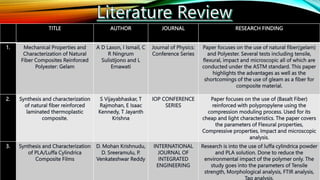
TITLE AUTHOR JOURNAL RESEARCH FINDING
1. Mechanical Properties and
Characterization of Natural
Fiber Composites Reinforced
Polyester: Gelam
A D Laxon, I Ismail, C
R Ningrum
Sulistijono and L
Ernawati
Journal of Physics:
Conference Series
Paper focuses on the use of natural fiber(gelam)
and Polyester. Several tests including tensile,
flexural, impact and microscopic all of which are
conducted under the ASTM standard. This paper
highlights the advantages as well as the
shortcomings of the use of gleam as a fiber for
composite material.
2. Synthesis and characterization
of natural fiber reinforced
laminated thermoplastic
composite.
S Vijayabhaskar, T
Rajmohan, E Isaac
Kennedy, T Jayanth
Krishna
IOP CONFERENCE
SERIES
Paper focuses on the use of (Basalt Fiber)
reinforced with polypropylene using the
compression moduling process. Used for its
cheap and light characteristics. The paper covers
the parameters of Flexural properties,
Compressive properties, Impact and microscopic
analysis.
3. Synthesis and Characterization
of PLA/Luffa Cylindrica
Composite Films
D. Mohan Krishnudu,
D. Sreeramulu, P.
Venkateshwar Reddy
INTERNATIONAL
JOURNAL OF
INTEGRATED
ENGINEERING
Research is into the use of luffa cylindrica powder
and PLA solution. Done to reduce the
environmental impact of the polymer only. The
study goes into the parameters of Tensile
strength, Morphological analysis, FTIR analysis,
Tag analysis.
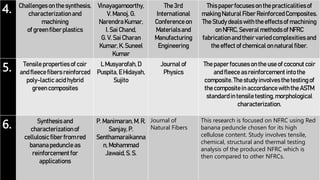
4. Challenges on the synthesis,
characterizationand
machining
of greenfiberplastics
Vinayagamoorthy,
V. Manoj,G.
NarendraKumar,
I. Sai Chand,
G. V. Sai Charan
Kumar, K.Suneel
Kumar
The 3rd
International
Conference on
Materialsand
Manufacturing
Engineering
Thispaperfocuses on the practicalitiesof
makingNaturalFiberReinforcedComposites.
The Study dealswiththe effects of machining
on NFRC, Several methodsof NFRC
fabricationandtheir variedcomplexities and
the effect of chemical on naturalfiber.
5. Tensile propertiesof coir
andfleece fibers reinforced
poly-lactic acidhybrid
greencomposites
L Musyarofah,D
Puspita, E Hidayah,
Sujito
Journal of
Physics
The paperfocuses on the use of coconut coir
andfleece asreinforcement intothe
composite. The study involves the testingof
the composite in accordancewiththe ASTM
standardin tensile testing,morphological
characterization.
6. Synthesis and
characterizationof
cellulosic fiberfrom red
bananapeduncle as
reinforcementfor
applications
P. Manimaran,M. R.
Sanjay, P.
Senthamaraikanna
n, Mohammad
Jawaid,S. S.
Journal of
Natural Fibers
This research is focused on NFRC using Red
banana peduncle chosen for its high
cellulose content. Study involves tensile,
chemical, structural and thermal testing
analysis of the produced NFRC which is
then compared to other NFRCs.
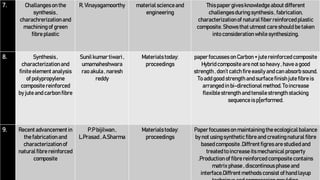
7. Challanges on the
synthesis,
charachrerizationand
machiningof green
fibre plastic
R. Vinayagamoorthy material scienceand
engineering
Thispaper givesknowledge about different
challengesduring synthesis, fabrication,
characterizationof naturalfiberreinforced plastic
composite. Shows that utmost care should be taken
into considerationwhile synthesizing.
8. Synthesis,
characterizationand
finiteelement analysis
of polypropylene
composite reinforced
by jute and carbon fibre
Sunilkumar tiwari,
umamaheshwara
rao akula , naresh
reddy
Materialstoday:
proceedings
paper focusses on Carbon + jute reinforced composite
Hybrid composite are not so heavy , have a good
strength , don’t catch fire easilyand can absorb sound.
To add good strength and surface finishjute fibre is
arranged in bi-directionalmethod. To increase
flexiblestrength and tensilestrength stacking
sequenceis p[erformed.
9. Recentadvancement in
the fabrication and
characterizationof
natural fibre reinforced
composite
P.P bijilwan,
L.Prasad , A.Sharma
Materialstoday:
proceedings
Paper focusseson maintainingthe ecological balance
by not usingsynthetic fibre and creatingnatural fibre
based composite .Diffrentfigres are studiedand
treated to increase itsmechanicalproperty
.Production of fibre reinforced composite contains
matrix phase , discontinous phase and
interface.Diffrentmethods consist of hand layup
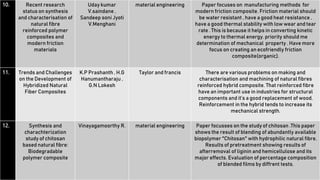
10. Recent research
status on synthesis
and characterisation of
natural fibre
reinforced polymer
composites and
modern friction
materials
Uday kumar
V.saindane ,
Sandeep soni Jyoti
V.Menghani
material engineering Paper focuses on manufacturing methods for
modern friction composite. Friction material should
be water resistant , have a good heat resistance ,
have a good thermal stability with low wear and tear
rate . This is because it helps in converting kinetic
energy to thermal energy. priority should me
determination of mechanical property . Have more
focus on creating an ecofriendly friction
composite(organic).
11. Trends and Challenges
on the Development of
Hybridized Natural
Fiber Composites
K.P Prashanth , H.G
Hanumantharaju ,
G.N Lokesh
Taylor and francis There are various problems on making and
characterisation and machining of natural fibres
reinforced hybrid composite. That reinforced fibre
have an important use in industries for structural
components and it’s a good replacement of wood.
Reinforcement in the hybrid tends to increase its
mechanical strength.
12. Synthesis and
charachterization
study of chitosan
based natural fibre:
Biodegradable
polymer composite
Vinayagamoorthy R. material engineering Paper focusses on the study of chitosan .This paper
shows the result of blending of abundantly available
biopolymer "Chitosan" with hydrophilic natural fibre.
Results of pretreatment showing results of
afterremoval of liginin and hemicellulose and its
major effects. Evaluation of percentage composition
of blended films by diffrent tests.
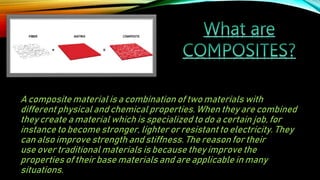
A composite material is a combination of two materials with
different physical and chemical properties. When they are combined
they create a material which is specialized to do a certain job, for
instance to become stronger, lighter or resistant to electricity. They
can also improve strength and stiffness. The reason for their
use over traditional materials is because they improve the
properties of their base materials and are applicable in many
situations.
Humanshaveused compositesfor thousands ofyears.In3400 B.C thefirst manmade
composites wereengineeredby the Mesopotamians inIraq. Theancientsocietyglued
wood strips on top of each otherat different anglesto createplywood. Following this, in
around2181 B.C theEgyptiansstarted to make deathmasks out of linenor papyrussoaked
in plaster.Later on, bothof thesesocietiesstarted to reinforcetheirmaterials with straw
to strengthenmud bricks, potteryand boats.
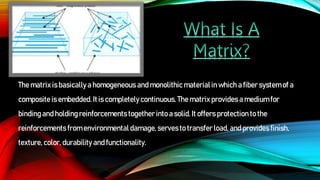
The matrix is basicallya homogeneous and monolithic materialin which a fiber systemof a
composite is embedded.It is completely continuous. The matrix provides a medium for
binding and holding reinforcements together into a solid. It offers protection to the
reinforcements from environmental damage,servesto transfer load, and provides finish,
texture, color, durability and functionality.
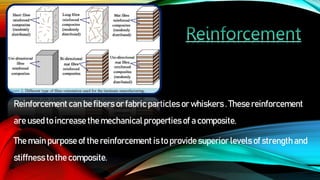
Reinforcement can be fibers or fabric particles or whiskers . These reinforcement
are used to increase the mechanical properties of a composite.
The main purpose of the reinforcement is to provide superior levels of strength and
stiffness to the composite.
• In todays world polymer hybrid composites are in growing demand as
replacement for synthetic fibers mainly due to their renewability and sustainability
and therefore we have chosen to work with coir-banana fiber reinforced in PLA
matrix.
• The reason for choosing coir and banana as our natural fiber is that both these
fibers are abundant and therefore readily available making them cheap for
manufacturing. We have also seen from above research that these fibers are light
weight, good strength, high degree of stiffness and tensile properties.
• The use of PLA as a matrix structure is justified by the fact that it shows
extraordinary degradability and decreased green house impact. It is also widely
used as an adhesive in industries. Since it is obtained from plants they can also be
used for food and medicinal containers.
• The method we will be using for making the composite would be the hand-layup
fabrication method in which the fiber reinforced composite are placed in a mold
layer by layer and bound together with resin.
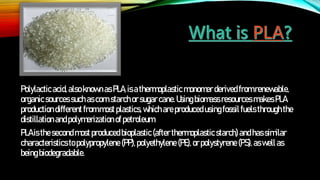
Polylacticacid,alsoknownasPLA,isathermoplastic monomer derivedfromrenewable,
organicsourcessuchas cornstarchorsugarcane.Usingbiomassresources makesPLA
productiondifferent frommostplastics,whichareproducedusingfossil fuels throughthe
distillationandpolymerization ofpetroleum.
PLAisthesecondmostproducedbioplastic(after thermoplasticstarch)andhassimilar
characteristicsto polypropylene (PP), polyethylene (PE), orpolystyrene (PS), aswell as
beingbiodegradable.
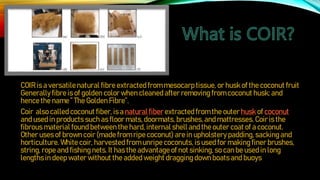
COIR is a versatilenatural fibre extracted from mesocarp tissue, or husk of the coconut fruit
Generallyfibre is of golden color when cleanedafter removing from coconut husk; and
hence the name ” The Golden Fibre”.
Coir also called coconut fiber, is a natural fiber extracted from the outer husk of coconut
and used in products such as floor mats, doormats, brushes, andmattresses. Coir is the
fibrous material found between the hard, internal shelland the outer coat of a coconut.
Other uses of brown coir (madefrom ripe coconut) are in upholstery padding, sackingand
horticulture. White coir, harvestedfrom unripe coconuts, is used for making finer brushes,
string, rope and fishingnets. It has the advantageof not sinking,so can be used in long
lengths in deep water without the addedweight draggingdown boats and buoys.
• Banana fabric is fabric made from the outer and inner peels of banana which are
both quite fibrous
• Banana fiber, a lingo-cellulosic fiber, obtained from the pseudo-stem of banana
plant (Musa sepientum), is a best fiber with relatively good mechanical properties.
• The chemical composition of banana fiber is cellulose, hemicellulose, and lignin.
• It is highly strong fiber and has smaller elongation with light weight.
• It has strong moisture absorption and releasing quality.
• used for making items like ropes, mats , apparel garments and home furnishings
making traditional dresses like kimono, and kamishimo .
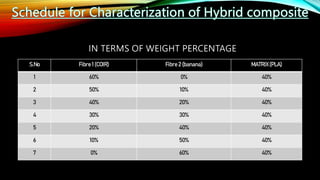
S.No Fibre 1 (COIR) Fibre 2 (banana) MATRIX(PLA)
1 60% 0% 40%
2 50% 10% 40%
3 40% 20% 40%
4 30% 30% 40%
5 20% 40% 40%
6 10% 50% 40%
7 0% 60% 40%
GANTT CHART:-
AUGUST SEPTEMBER OCTOBER NOVEMBER
Theoretical
study
Literature
Review
Problem
Identification
POWERPOINT
TIME
ACTIVITY
[1] Laksono A D, Ismail I, Ningrum C R, Sulistijono and Ernawati L 2021 Mechanical Properties and Morphological Characterisationof Waste Natural Fiber Composites Reinforced
Polyester: Gelam (Melaleuca Leucadendra) J. Phys. Conf. Ser. 1803
[2] Vijayabhaskar S, Rajmohan T, Kennedy E I and Krishna T J 2020 Synthesis and characterization of natural fiber reinforcedlaminated thermoplasticcomposite IOP Conf. Ser. Mater.
Sci. Eng. 954
[3] Krishnudu D M, SreeramuluD and Reddy P V 2020 Synthesis and Characterizationof PLA/LuffaCylindrica CompositeFilms Int. J. Integr.Eng. 12 1–7
[4] Manimaran P, Sanjay M R, Senthamaraikannan P, Jawaid M, Saravanakumar S S and George R 2019 Synthesisand characterizationof cellulosic fiber from red banana peduncle as
reinforcementfor potentialapplications J. Nat. Fibers 16 768–80
[5] Musyarofah L, Puspita D, Hidayah E and Sujito2019 Tensile propertiesof coir and fleecefibers reinforcedpoly-lactic acid hybrid green composites J. Phys. Conf. Ser. 1217
[6] Vinayagamoorthy R, Manoj I V., Narendra Kumar G, Sai Chand I, Sai Charan Kumar G V. and SuneelKumar K 2018 Challenges on the synthesis, characterization and machining of
green fiber plastics: A reviewIOP Conf. Ser. Mater. Sci. Eng. 390
[7] Ramesh M, Rajeshkumar L and Balaji D 2021 Influenceof Process Parameterson the Properties of AdditivelyManufactured Fiber-ReinforcedPolymer CompositeMaterials: A
Review J. Mater. Eng. Perform.30 4792–807
[8] Vinayagamoorthy R, Manoj I V., Narendra Kumar G, Sai Chand I, Sai Charan Kumar G V. and SuneelKumar K 2018 Challenges on the synthesis, characterizationand machining of
green fiber plastics: A reviewIOP Conf. Ser. Mater. Sci. Eng. 390
[9] Tiwari S K, Umamaheswara Rao A, ReddyN, Sharma H and Pandey J K 2021 Synthesis, characterization and finite element analysis of polypropylene
composite reinforced by jute and carbon fiber Mater. Today Proc. 46 10884–91
[10] Bijlwan P P, Prasad L and Sharma A 2021 Recent advancement in the fabrication and characterization of natural fiber reinforced composite:A review
Mater. Today Proc. 44 1718–22
[11] Saindane U V., Soni S and Menghani J V. 2019 Recent research status on synthesis and characterization of natural fibers reinforced polymercomposites
and modern friction materials - An overview Mater. Today Proc. 26 1616–20
[12] Prashanth K P, Hanumantharaju H G and Lokesh G N 2019 Synthesis and characterization study of chitosan based natural fiber: Biodegradablepolymer
composite AIP Conf. Proc. 2057
[13] R V 2020 Trends and Challenges on the Development of HybridizedNatural Fiber CompositesJ. Nat. Fibers 17 1757–74
---------THANK YOU--------

updated project presentation - Project Composite A.pptx

  • 1.
    KUMAR AYUSH RO LL- 2015765 B.T ECH ME( AERO ) 7T H SEMESTER A E K A N S H R A W AT R O L L - 2 0 1 5 7 4 0 B . T E C H M E ( A E R O ) 7 T H S E M E S T E R SUPERVISOR:- DR. NITIN JOHRI ASSOC. PROFESSOR GRAPHIC ERA UNIVERSITY
  • 2.
  • 3.
    S.N O TITLE AUTHOR JOURNALRESEARCH FINDING 1. Mechanical Properties and Characterization of Natural Fiber Composites Reinforced Polyester: Gelam A D Laxon, I Ismail, C R Ningrum Sulistijono and L Ernawati Journal of Physics: Conference Series Paper focuses on the use of natural fiber(gelam) and Polyester. Several tests including tensile, flexural, impact and microscopic all of which are conducted under the ASTM standard. This paper highlights the advantages as well as the shortcomings of the use of gleam as a fiber for composite material. 2. Synthesis and characterization of natural fiber reinforced laminated thermoplastic composite. S Vijayabhaskar, T Rajmohan, E Isaac Kennedy, T Jayanth Krishna IOP CONFERENCE SERIES Paper focuses on the use of (Basalt Fiber) reinforced with polypropylene using the compression moduling process. Used for its cheap and light characteristics. The paper covers the parameters of Flexural properties, Compressive properties, Impact and microscopic analysis. 3. Synthesis and Characterization of PLA/Luffa Cylindrica Composite Films D. Mohan Krishnudu, D. Sreeramulu, P. Venkateshwar Reddy INTERNATIONAL JOURNAL OF INTEGRATED ENGINEERING Research is into the use of luffa cylindrica powder and PLA solution. Done to reduce the environmental impact of the polymer only. The study goes into the parameters of Tensile strength, Morphological analysis, FTIR analysis, Tag analysis.
  • 4.
    4. Challenges onthe synthesis, characterizationand machining of greenfiberplastics Vinayagamoorthy, V. Manoj,G. NarendraKumar, I. Sai Chand, G. V. Sai Charan Kumar, K.Suneel Kumar The 3rd International Conference on Materialsand Manufacturing Engineering Thispaperfocuses on the practicalitiesof makingNaturalFiberReinforcedComposites. The Study dealswiththe effects of machining on NFRC, Several methodsof NFRC fabricationandtheir variedcomplexities and the effect of chemical on naturalfiber. 5. Tensile propertiesof coir andfleece fibers reinforced poly-lactic acidhybrid greencomposites L Musyarofah,D Puspita, E Hidayah, Sujito Journal of Physics The paperfocuses on the use of coconut coir andfleece asreinforcement intothe composite. The study involves the testingof the composite in accordancewiththe ASTM standardin tensile testing,morphological characterization. 6. Synthesis and characterizationof cellulosic fiberfrom red bananapeduncle as reinforcementfor applications P. Manimaran,M. R. Sanjay, P. Senthamaraikanna n, Mohammad Jawaid,S. S. Journal of Natural Fibers This research is focused on NFRC using Red banana peduncle chosen for its high cellulose content. Study involves tensile, chemical, structural and thermal testing analysis of the produced NFRC which is then compared to other NFRCs.
  • 5.
    7. Challanges onthe synthesis, charachrerizationand machiningof green fibre plastic R. Vinayagamoorthy material scienceand engineering Thispaper givesknowledge about different challengesduring synthesis, fabrication, characterizationof naturalfiberreinforced plastic composite. Shows that utmost care should be taken into considerationwhile synthesizing. 8. Synthesis, characterizationand finiteelement analysis of polypropylene composite reinforced by jute and carbon fibre Sunilkumar tiwari, umamaheshwara rao akula , naresh reddy Materialstoday: proceedings paper focusses on Carbon + jute reinforced composite Hybrid composite are not so heavy , have a good strength , don’t catch fire easilyand can absorb sound. To add good strength and surface finishjute fibre is arranged in bi-directionalmethod. To increase flexiblestrength and tensilestrength stacking sequenceis p[erformed. 9. Recentadvancement in the fabrication and characterizationof natural fibre reinforced composite P.P bijilwan, L.Prasad , A.Sharma Materialstoday: proceedings Paper focusseson maintainingthe ecological balance by not usingsynthetic fibre and creatingnatural fibre based composite .Diffrentfigres are studiedand treated to increase itsmechanicalproperty .Production of fibre reinforced composite contains matrix phase , discontinous phase and interface.Diffrentmethods consist of hand layup
  • 6.
    10. Recent research statuson synthesis and characterisation of natural fibre reinforced polymer composites and modern friction materials Uday kumar V.saindane , Sandeep soni Jyoti V.Menghani material engineering Paper focuses on manufacturing methods for modern friction composite. Friction material should be water resistant , have a good heat resistance , have a good thermal stability with low wear and tear rate . This is because it helps in converting kinetic energy to thermal energy. priority should me determination of mechanical property . Have more focus on creating an ecofriendly friction composite(organic). 11. Trends and Challenges on the Development of Hybridized Natural Fiber Composites K.P Prashanth , H.G Hanumantharaju , G.N Lokesh Taylor and francis There are various problems on making and characterisation and machining of natural fibres reinforced hybrid composite. That reinforced fibre have an important use in industries for structural components and it’s a good replacement of wood. Reinforcement in the hybrid tends to increase its mechanical strength. 12. Synthesis and charachterization study of chitosan based natural fibre: Biodegradable polymer composite Vinayagamoorthy R. material engineering Paper focusses on the study of chitosan .This paper shows the result of blending of abundantly available biopolymer "Chitosan" with hydrophilic natural fibre. Results of pretreatment showing results of afterremoval of liginin and hemicellulose and its major effects. Evaluation of percentage composition of blended films by diffrent tests.
  • 8.
    A composite materialis a combination of two materials with different physical and chemical properties. When they are combined they create a material which is specialized to do a certain job, for instance to become stronger, lighter or resistant to electricity. They can also improve strength and stiffness. The reason for their use over traditional materials is because they improve the properties of their base materials and are applicable in many situations.
  • 9.
    Humanshaveused compositesfor thousandsofyears.In3400 B.C thefirst manmade composites wereengineeredby the Mesopotamians inIraq. Theancientsocietyglued wood strips on top of each otherat different anglesto createplywood. Following this, in around2181 B.C theEgyptiansstarted to make deathmasks out of linenor papyrussoaked in plaster.Later on, bothof thesesocietiesstarted to reinforcetheirmaterials with straw to strengthenmud bricks, potteryand boats.
  • 10.
    The matrix isbasicallya homogeneous and monolithic materialin which a fiber systemof a composite is embedded.It is completely continuous. The matrix provides a medium for binding and holding reinforcements together into a solid. It offers protection to the reinforcements from environmental damage,servesto transfer load, and provides finish, texture, color, durability and functionality.
  • 11.
    Reinforcement can befibers or fabric particles or whiskers . These reinforcement are used to increase the mechanical properties of a composite. The main purpose of the reinforcement is to provide superior levels of strength and stiffness to the composite.
  • 12.
    • In todaysworld polymer hybrid composites are in growing demand as replacement for synthetic fibers mainly due to their renewability and sustainability and therefore we have chosen to work with coir-banana fiber reinforced in PLA matrix. • The reason for choosing coir and banana as our natural fiber is that both these fibers are abundant and therefore readily available making them cheap for manufacturing. We have also seen from above research that these fibers are light weight, good strength, high degree of stiffness and tensile properties. • The use of PLA as a matrix structure is justified by the fact that it shows extraordinary degradability and decreased green house impact. It is also widely used as an adhesive in industries. Since it is obtained from plants they can also be used for food and medicinal containers. • The method we will be using for making the composite would be the hand-layup fabrication method in which the fiber reinforced composite are placed in a mold layer by layer and bound together with resin.
  • 13.
    Polylacticacid,alsoknownasPLA,isathermoplastic monomer derivedfromrenewable, organicsourcessuchascornstarchorsugarcane.Usingbiomassresources makesPLA productiondifferent frommostplastics,whichareproducedusingfossil fuels throughthe distillationandpolymerization ofpetroleum. PLAisthesecondmostproducedbioplastic(after thermoplasticstarch)andhassimilar characteristicsto polypropylene (PP), polyethylene (PE), orpolystyrene (PS), aswell as beingbiodegradable.
  • 14.
    COIR is aversatilenatural fibre extracted from mesocarp tissue, or husk of the coconut fruit Generallyfibre is of golden color when cleanedafter removing from coconut husk; and hence the name ” The Golden Fibre”. Coir also called coconut fiber, is a natural fiber extracted from the outer husk of coconut and used in products such as floor mats, doormats, brushes, andmattresses. Coir is the fibrous material found between the hard, internal shelland the outer coat of a coconut. Other uses of brown coir (madefrom ripe coconut) are in upholstery padding, sackingand horticulture. White coir, harvestedfrom unripe coconuts, is used for making finer brushes, string, rope and fishingnets. It has the advantageof not sinking,so can be used in long lengths in deep water without the addedweight draggingdown boats and buoys.
  • 15.
    • Banana fabricis fabric made from the outer and inner peels of banana which are both quite fibrous • Banana fiber, a lingo-cellulosic fiber, obtained from the pseudo-stem of banana plant (Musa sepientum), is a best fiber with relatively good mechanical properties. • The chemical composition of banana fiber is cellulose, hemicellulose, and lignin. • It is highly strong fiber and has smaller elongation with light weight. • It has strong moisture absorption and releasing quality. • used for making items like ropes, mats , apparel garments and home furnishings making traditional dresses like kimono, and kamishimo .
  • 16.
    S.No Fibre 1(COIR) Fibre 2 (banana) MATRIX(PLA) 1 60% 0% 40% 2 50% 10% 40% 3 40% 20% 40% 4 30% 30% 40% 5 20% 40% 40% 6 10% 50% 40% 7 0% 60% 40%
  • 17.
    GANTT CHART:- AUGUST SEPTEMBEROCTOBER NOVEMBER Theoretical study Literature Review Problem Identification POWERPOINT TIME ACTIVITY
  • 18.
    [1] Laksono AD, Ismail I, Ningrum C R, Sulistijono and Ernawati L 2021 Mechanical Properties and Morphological Characterisationof Waste Natural Fiber Composites Reinforced Polyester: Gelam (Melaleuca Leucadendra) J. Phys. Conf. Ser. 1803 [2] Vijayabhaskar S, Rajmohan T, Kennedy E I and Krishna T J 2020 Synthesis and characterization of natural fiber reinforcedlaminated thermoplasticcomposite IOP Conf. Ser. Mater. Sci. Eng. 954 [3] Krishnudu D M, SreeramuluD and Reddy P V 2020 Synthesis and Characterizationof PLA/LuffaCylindrica CompositeFilms Int. J. Integr.Eng. 12 1–7 [4] Manimaran P, Sanjay M R, Senthamaraikannan P, Jawaid M, Saravanakumar S S and George R 2019 Synthesisand characterizationof cellulosic fiber from red banana peduncle as reinforcementfor potentialapplications J. Nat. Fibers 16 768–80 [5] Musyarofah L, Puspita D, Hidayah E and Sujito2019 Tensile propertiesof coir and fleecefibers reinforcedpoly-lactic acid hybrid green composites J. Phys. Conf. Ser. 1217 [6] Vinayagamoorthy R, Manoj I V., Narendra Kumar G, Sai Chand I, Sai Charan Kumar G V. and SuneelKumar K 2018 Challenges on the synthesis, characterization and machining of green fiber plastics: A reviewIOP Conf. Ser. Mater. Sci. Eng. 390 [7] Ramesh M, Rajeshkumar L and Balaji D 2021 Influenceof Process Parameterson the Properties of AdditivelyManufactured Fiber-ReinforcedPolymer CompositeMaterials: A Review J. Mater. Eng. Perform.30 4792–807 [8] Vinayagamoorthy R, Manoj I V., Narendra Kumar G, Sai Chand I, Sai Charan Kumar G V. and SuneelKumar K 2018 Challenges on the synthesis, characterizationand machining of green fiber plastics: A reviewIOP Conf. Ser. Mater. Sci. Eng. 390
  • 19.
    [9] Tiwari SK, Umamaheswara Rao A, ReddyN, Sharma H and Pandey J K 2021 Synthesis, characterization and finite element analysis of polypropylene composite reinforced by jute and carbon fiber Mater. Today Proc. 46 10884–91 [10] Bijlwan P P, Prasad L and Sharma A 2021 Recent advancement in the fabrication and characterization of natural fiber reinforced composite:A review Mater. Today Proc. 44 1718–22 [11] Saindane U V., Soni S and Menghani J V. 2019 Recent research status on synthesis and characterization of natural fibers reinforced polymercomposites and modern friction materials - An overview Mater. Today Proc. 26 1616–20 [12] Prashanth K P, Hanumantharaju H G and Lokesh G N 2019 Synthesis and characterization study of chitosan based natural fiber: Biodegradablepolymer composite AIP Conf. Proc. 2057 [13] R V 2020 Trends and Challenges on the Development of HybridizedNatural Fiber CompositesJ. Nat. Fibers 17 1757–74
  • 20.