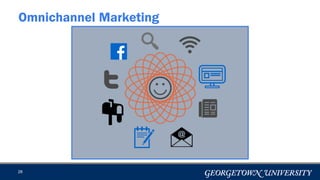
Omnichannel Marketing
Driving Consumer Behavior Across
Channels and Platforms
Leila Sidawy
Senior Marketing Manager
Georgetown University
School of Continuing Studies (SCS)
• Communicators must connect with consumers through user-
centric approach
• Omnichannel marketing is designed to deliver consistent and
compelling brand messages to target audiences:
– Across various platforms
– At multiple touch points
2
Introduction: Omnichannel Marketing
• Focuses on the overall consumer experience through a
holistic approach
• Communications are aligned across all channels yet are
channel- and audience-appropriate
• The key challenge of omnichannel marketing:
– All channels need to be on brand
3
Introduction: Omnichannel Marketing
• Omnichannel marketing can be implemented to market
degrees, programs, schools, etc.
• Demonstrate omnichannel approach, focusing on promoting
recruitment events
1. History of internal marketing
2. Omnichannel strategy for external marketing
4
Case Study: Recruitment Events
Background
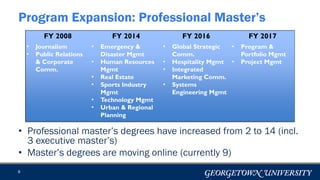
• Professional master’s degrees have increased from 2 to 14 (incl.
3 executive master’s)
• Master’s degrees are moving online (currently 9)
6
Program Expansion: Professional Master’s
FY 2008 FY 2014 FY 2016 FY 2017
• Journalism
• Public Relations
& Corporate
Comm.
• Emergency &
Disaster Mgmt
• Human Resources
Mgmt
• Real Estate
• Sports Industry
Mgmt
• Technology Mgmt
• Urban & Regional
Planning
• Global Strategic
Comm.
• Hospitality Mgmt
• Integrated
Marketing Comm.
• Systems
Engineering Mgmt
• Program &
Portfolio Mgmt
• Project Mgmt
7
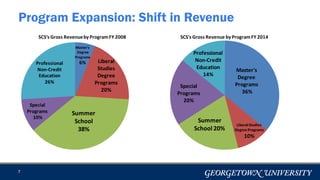
Program Expansion: Shift in Revenue
Master's
Degree
Programs
6% Liberal
Studies
Degree
Programs
20%
Summer
School
38%
Special
Programs
10%
Professional
Non-Credit
Education
26%
SCS’s Gross Revenueby ProgramFY 2008
Master's
Degree
Programs
36%
Liberal Studies
Degree Programs
10%
Summer
School 20%
Special
Programs
20%
Professional
Non-Credit
Education
14%
SCS's Gross Revenue by ProgramFY 2014
8
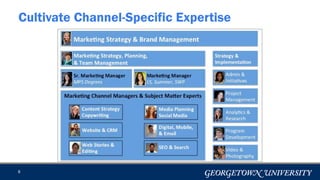
Cultivate Channel-Specific Expertise
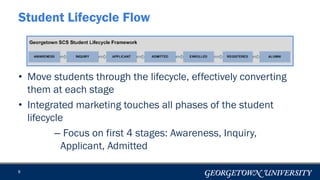
• Move students through the lifecycle, effectively converting
them at each stage
• Integrated marketing touches all phases of the student
lifecycle
– Focus on first 4 stages: Awareness, Inquiry,
Applicant, Admitted
9
Student Lifecycle Flow
Recruitment Events
11
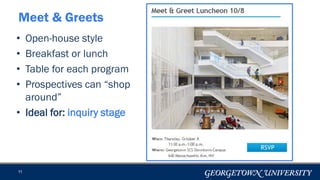
Meet & Greets
• Open-house style
• Breakfast or lunch
• Table for each program
• Prospectives can “shop
around”
• Ideal for: inquiry stage
12
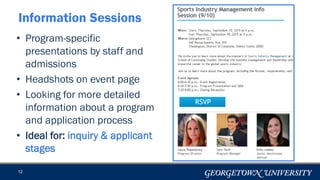
Information Sessions
• Program-specific
presentations by staff and
admissions
• Headshots on event page
• Looking for more detailed
information about a program
and application process
• Ideal for: inquiry & applicant
stages
13
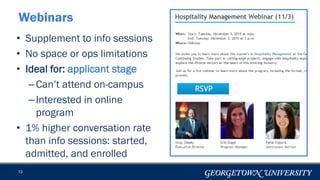
Webinars
• Supplement to info sessions
• No space or ops limitations
• Ideal for: applicant stage
–Can’t attend on-campus
–Interested in online
program
• 1% higher conversation rate
than info sessions: started,
admitted, and enrolled
14
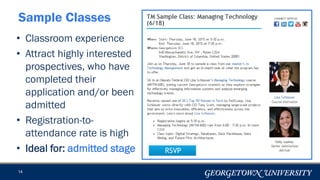
Sample Classes
• Classroom experience
• Attract highly interested
prospectives, who have
completed their
application and/or been
admitted
• Registration-to-
attendance rate is high
• Ideal for: admitted stage
Internal Marketing for
Recruitment Events
16
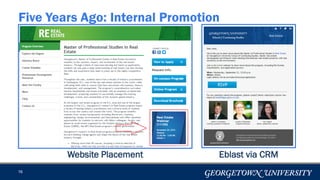
Five Years Ago: Internal Promotion
Website Placement Eblast via CRM
17
Moment of Realization
18
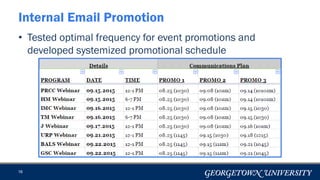
Internal Email Promotion
• Tested optimal frequency for event promotions and
developed systemized promotional schedule
19
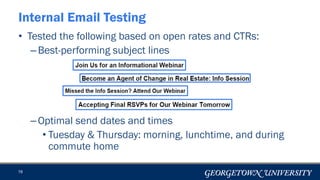
Internal Email Testing
• Tested the following based on open rates and CTRs:
–Best-performing subject lines
–Optimal send dates and times
• Tuesday & Thursday: morning, lunchtime, and during
commute home
Data-Driven Results
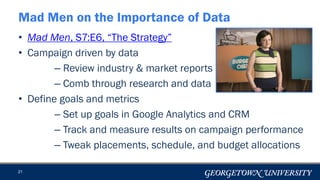
• Mad Men, S7:E6, “The Strategy”
• Campaign driven by data
– Review industry & market reports
– Comb through research and data
• Define goals and metrics
– Set up goals in Google Analytics and CRM
– Track and measure results on campaign performance
– Tweak placements, schedule, and budget allocations
21
Mad Men on the Importance of Data
22
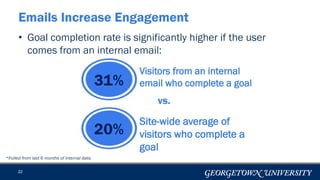
Emails Increase Engagement
31%
20%
Visitors from an internal
email who complete a goal
Site-wide average of
visitors who complete a
goal
*Pulled from last 6 months of internal data.
• Goal completion rate is significantly higher if the user
comes from an internal email:
vs.
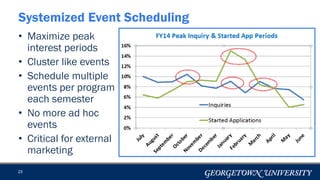
• Maximize peak
interest periods
• Cluster like events
• Schedule multiple
events per program
each semester
• No more ad hoc
events
• Critical for external
marketing
23
Systemized Event Scheduling
24
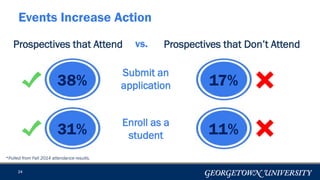
Events Increase Action
38%
31%
Submit an
application
Enroll as a
student
Prospectives that Attend
*Pulled from Fall 2014 attendance results.
17%
11%
Prospectives that Don’t Attendvs.
25
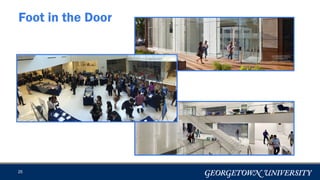
Foot in the Door
External, Omnichannel
Marketing for
Recruitment Events
• Time to put marketing dollars behind our event promotion
• Cast a wider net via omnichannel marketing
• With events scheduled semesters out, they can be promoted
via paid media channels
• Added bonus: always have an immediate action for
prospective students:
– “RSVP for an event” has more urgency than “learn
more”
27
External Promotion
28
Omnichannel Marketing
29
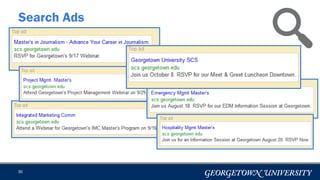
Search Ads
• SEO efforts alone are not enough
• Dedicate a budget to search ads
– Allocate some of that budget towards promoting
events
• Google AdWords is fairly easy to learn
• Test strength and performance of copy and CTAs
30
Search Ads
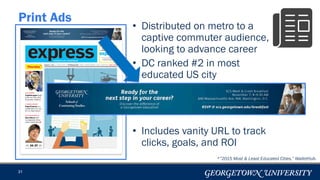
• Distributed on metro to a
captive commuter audience,
looking to advance career
• DC ranked #2 in most
educated US city
• Includes vanity URL to track
clicks, goals, and ROI
31
Print Ads
*”2015 Most & Least Educated Cities,” WalletHub.
32
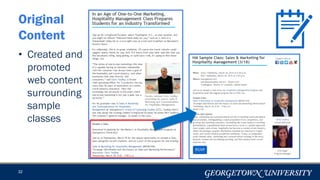
Original
Content
• Created and
promoted
web content
surrounding
sample
classes
33
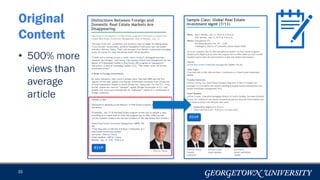
Original
Content
• 500% more
views than
average
article
34
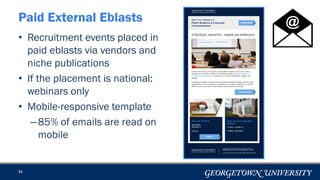
Paid External Eblasts
• Recruitment events placed in
paid eblasts via vendors and
niche publications
• If the placement is national:
webinars only
• Mobile-responsive template
–85% of emails are read on
mobile
35
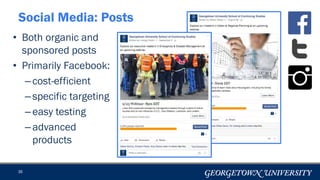
Social Media: Posts
• Both organic and
sponsored posts
• Primarily Facebook:
–cost-efficient
–specific targeting
–easy testing
–advanced
products
36
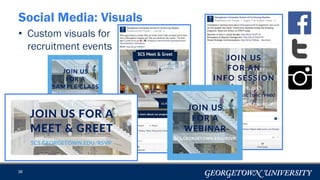
Social Media: Visuals
• Custom visuals for
recruitment events
37
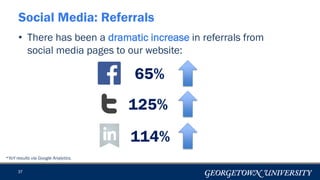
Social Media: Referrals
65%
125%
• There has been a dramatic increase in referrals from
social media pages to our website:
114%
*YoY results via Google Analytics.
38
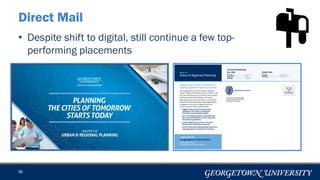
Direct Mail
• Despite shift to digital, still continue a few top-
performing placements
Key Takeaways
• Tailored mix of media relevant to the customer journey
• Create awareness & drive engagement, guiding prospective
students through the lifecycle
• Curated content can serve as a recruitment tool, not just a
conversion tool
• Advance planning allows you to maximize your placements
• Internal & external marketing work in tandem
40
Key Takeaways
Special thanks to the Strategy & Marketing team for providing
the data and creative in this presentation.
For further information, contact:
Leila Sidawy
Senior Marketing Manager
Georgetown University School of Continuing Studies
leila.sidawy@georgetown.edu

UPCEA_Sidawy_Omnichannel_Marketing_FINAL

  • 1.
    Omnichannel Marketing Driving ConsumerBehavior Across Channels and Platforms Leila Sidawy Senior Marketing Manager Georgetown University School of Continuing Studies (SCS)
  • 2.
    • Communicators mustconnect with consumers through user- centric approach • Omnichannel marketing is designed to deliver consistent and compelling brand messages to target audiences: – Across various platforms – At multiple touch points 2 Introduction: Omnichannel Marketing
  • 3.
    • Focuses onthe overall consumer experience through a holistic approach • Communications are aligned across all channels yet are channel- and audience-appropriate • The key challenge of omnichannel marketing: – All channels need to be on brand 3 Introduction: Omnichannel Marketing
  • 4.
    • Omnichannel marketingcan be implemented to market degrees, programs, schools, etc. • Demonstrate omnichannel approach, focusing on promoting recruitment events 1. History of internal marketing 2. Omnichannel strategy for external marketing 4 Case Study: Recruitment Events
  • 5.
  • 6.
    • Professional master’sdegrees have increased from 2 to 14 (incl. 3 executive master’s) • Master’s degrees are moving online (currently 9) 6 Program Expansion: Professional Master’s FY 2008 FY 2014 FY 2016 FY 2017 • Journalism • Public Relations & Corporate Comm. • Emergency & Disaster Mgmt • Human Resources Mgmt • Real Estate • Sports Industry Mgmt • Technology Mgmt • Urban & Regional Planning • Global Strategic Comm. • Hospitality Mgmt • Integrated Marketing Comm. • Systems Engineering Mgmt • Program & Portfolio Mgmt • Project Mgmt
  • 7.
    7 Program Expansion: Shiftin Revenue Master's Degree Programs 6% Liberal Studies Degree Programs 20% Summer School 38% Special Programs 10% Professional Non-Credit Education 26% SCS’s Gross Revenueby ProgramFY 2008 Master's Degree Programs 36% Liberal Studies Degree Programs 10% Summer School 20% Special Programs 20% Professional Non-Credit Education 14% SCS's Gross Revenue by ProgramFY 2014
  • 8.
  • 9.
    • Move studentsthrough the lifecycle, effectively converting them at each stage • Integrated marketing touches all phases of the student lifecycle – Focus on first 4 stages: Awareness, Inquiry, Applicant, Admitted 9 Student Lifecycle Flow
  • 10.
  • 11.
    11 Meet & Greets •Open-house style • Breakfast or lunch • Table for each program • Prospectives can “shop around” • Ideal for: inquiry stage
  • 12.
    12 Information Sessions • Program-specific presentationsby staff and admissions • Headshots on event page • Looking for more detailed information about a program and application process • Ideal for: inquiry & applicant stages
  • 13.
    13 Webinars • Supplement toinfo sessions • No space or ops limitations • Ideal for: applicant stage –Can’t attend on-campus –Interested in online program • 1% higher conversation rate than info sessions: started, admitted, and enrolled
  • 14.
    14 Sample Classes • Classroomexperience • Attract highly interested prospectives, who have completed their application and/or been admitted • Registration-to- attendance rate is high • Ideal for: admitted stage
  • 15.
  • 16.
    16 Five Years Ago:Internal Promotion Website Placement Eblast via CRM
  • 17.
  • 18.
    18 Internal Email Promotion •Tested optimal frequency for event promotions and developed systemized promotional schedule
  • 19.
    19 Internal Email Testing •Tested the following based on open rates and CTRs: –Best-performing subject lines –Optimal send dates and times • Tuesday & Thursday: morning, lunchtime, and during commute home
  • 20.
  • 21.
    • Mad Men,S7:E6, “The Strategy” • Campaign driven by data – Review industry & market reports – Comb through research and data • Define goals and metrics – Set up goals in Google Analytics and CRM – Track and measure results on campaign performance – Tweak placements, schedule, and budget allocations 21 Mad Men on the Importance of Data
  • 22.
    22 Emails Increase Engagement 31% 20% Visitorsfrom an internal email who complete a goal Site-wide average of visitors who complete a goal *Pulled from last 6 months of internal data. • Goal completion rate is significantly higher if the user comes from an internal email: vs.
  • 23.
    • Maximize peak interestperiods • Cluster like events • Schedule multiple events per program each semester • No more ad hoc events • Critical for external marketing 23 Systemized Event Scheduling
  • 24.
    24 Events Increase Action 38% 31% Submitan application Enroll as a student Prospectives that Attend *Pulled from Fall 2014 attendance results. 17% 11% Prospectives that Don’t Attendvs.
  • 25.
  • 26.
  • 27.
    • Time toput marketing dollars behind our event promotion • Cast a wider net via omnichannel marketing • With events scheduled semesters out, they can be promoted via paid media channels • Added bonus: always have an immediate action for prospective students: – “RSVP for an event” has more urgency than “learn more” 27 External Promotion
  • 28.
  • 29.
    29 Search Ads • SEOefforts alone are not enough • Dedicate a budget to search ads – Allocate some of that budget towards promoting events • Google AdWords is fairly easy to learn • Test strength and performance of copy and CTAs
  • 30.
  • 31.
    • Distributed onmetro to a captive commuter audience, looking to advance career • DC ranked #2 in most educated US city • Includes vanity URL to track clicks, goals, and ROI 31 Print Ads *”2015 Most & Least Educated Cities,” WalletHub.
  • 32.
    32 Original Content • Created and promoted webcontent surrounding sample classes
  • 33.
  • 34.
    34 Paid External Eblasts •Recruitment events placed in paid eblasts via vendors and niche publications • If the placement is national: webinars only • Mobile-responsive template –85% of emails are read on mobile
  • 35.
    35 Social Media: Posts •Both organic and sponsored posts • Primarily Facebook: –cost-efficient –specific targeting –easy testing –advanced products
  • 36.
    36 Social Media: Visuals •Custom visuals for recruitment events
  • 37.
    37 Social Media: Referrals 65% 125% •There has been a dramatic increase in referrals from social media pages to our website: 114% *YoY results via Google Analytics.
  • 38.
    38 Direct Mail • Despiteshift to digital, still continue a few top- performing placements
  • 39.
  • 40.
    • Tailored mixof media relevant to the customer journey • Create awareness & drive engagement, guiding prospective students through the lifecycle • Curated content can serve as a recruitment tool, not just a conversion tool • Advance planning allows you to maximize your placements • Internal & external marketing work in tandem 40 Key Takeaways
  • 41.
    Special thanks tothe Strategy & Marketing team for providing the data and creative in this presentation. For further information, contact: Leila Sidawy Senior Marketing Manager Georgetown University School of Continuing Studies leila.sidawy@georgetown.edu