What is Up Helly Aa?
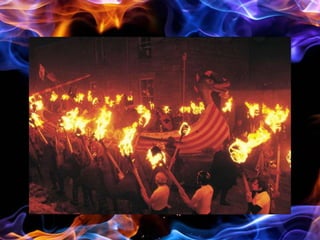
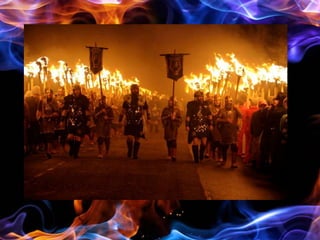
• Up Helly Aa refers to any of a variety of fire festivals held in
  Shetland, in Scotland, annually in the middle of winter to
  mark the end of the yule season. The festival involves a
  procession of up to a thousand guizers in Lerwick and
  considerably lower numbers in the more rural festivals,
  formed into squads who march through the town or village in
  a variety of themed costumes.
• The current Lerwick celebration grew out of the older yule
  tradition of tar barrelling which took place at Christmas and
  New Year as well as Up Helly Aa. Squads of young men
  would drag barrels of burning tar through town on sledges,
  making mischief. After the abolition of tar barrelling around
  1874–1880, permission was eventually obtained for torch
  processions. The first yule torch procession took place in
  1876. The first torch celebration on Up Helly Aa day took
  place in 1881. The following year the torchlit procession
  was significantly enhanced and institutionalised through a
  request by a Lerwick civic body to hold another Up Helly Aa
  torch procession for the visit of the Duke of Edinburgh. The
  first galley was burned in 1889.
Origins
• On old Christmas eve in 1824 a visiting
  Methodist missionary wrote in his diary that
  "the whole town was in an uproar: from
  twelve o clock last night until late this night
  blowing of horns, beating of drums, tinkling of
  old tin kettles, firing of guns, shouting,
  bawling, fiddling, fifeing, drinking, fighting.
  This was the state of the town all the night –
  the street was as thronged with people as any
  fair I ever saw in England."
As Lerwick grew in size the celebrations became more elaborate.
Sometime about 1840 the participants introduced burning tar
barrels into the proceedings. "Sometimes", as one observer
wrote, "there were two tubs fastened to a great raft-like frame
knocked together at the Docks, whence the combustibles were
generally obtained. Two chains were fastened to the bogie
asupporting the capacious tub or tar-barrel . . . eked to these
were two strong ropes on which a motley mob, wearing masks
for the most part, fastened. A party of about a dozen were told
off to stir up the molten contents.
Around 1870 a group of young men in the town with
intellectual interests injected a series of new ideas into
the proceedings. First, they improvised the name Up-
Helly-Aa, and gradually postponed the celebrations until
the end of January. Secondly, they introduced a far more
elaborate element of disguise - "guizing" - into the new
festival.
Thirdly, they inaugurated a torchlight procession. At the
same time they were toying with the idea of introducing
Viking themes to their new festival. The first signs of this
new development appeared in 1877, but it was not until
the late 1880s that a Viking long ship - the "galley" -
appeared, and as late as 1906 that a "Guizer Jarl", the
chief guizer, arrived on the scene. It was not until after
the First World War that there was a squad of Vikings, the
"Guizer Jarl's Squad", in the procession every year.
Up to the Second World War Up-Helly-Aa was
overwhelmingly a festival of young working class
men - women have never taken part in the
procession - and during the depression years the
operation was run on a shoestring. In the winter
of 1931-32 there was an unsuccessful move to
cancel the festival because of the dire economic
situation in the town.
Since 1949, when the festival resumed after the
war, much has changed and much has remained
the same. That year the BBC recorded a major
radio programme on Up-Helly-Aa, and from that
moment Up-Helly-Aa - not noted for its split-
second timing before the war - became a model
of efficient organisation. The numbers
participating in the festival have become much
greater, and the resources required
correspondingly larger.
|
• Whereas in the 19th century individuals kept
  open house to welcome the guizers on Up-
  Helly-Aa night, men and women now co-
  operate to open large halls throughout the
  town to entertain them. However, despite the
  changes, there are numerous threads
  connecting the Up-Helly-Aa of today with its
  predecessors 150 years ago.
•


    THANK YOU FOR YOUR ATTENTION

Up helly aa

  • 2.
    What is UpHelly Aa? • Up Helly Aa refers to any of a variety of fire festivals held in Shetland, in Scotland, annually in the middle of winter to mark the end of the yule season. The festival involves a procession of up to a thousand guizers in Lerwick and considerably lower numbers in the more rural festivals, formed into squads who march through the town or village in a variety of themed costumes.
  • 3.
    • The currentLerwick celebration grew out of the older yule tradition of tar barrelling which took place at Christmas and New Year as well as Up Helly Aa. Squads of young men would drag barrels of burning tar through town on sledges, making mischief. After the abolition of tar barrelling around 1874–1880, permission was eventually obtained for torch processions. The first yule torch procession took place in 1876. The first torch celebration on Up Helly Aa day took place in 1881. The following year the torchlit procession was significantly enhanced and institutionalised through a request by a Lerwick civic body to hold another Up Helly Aa torch procession for the visit of the Duke of Edinburgh. The first galley was burned in 1889.
  • 5.
    Origins • On oldChristmas eve in 1824 a visiting Methodist missionary wrote in his diary that "the whole town was in an uproar: from twelve o clock last night until late this night blowing of horns, beating of drums, tinkling of old tin kettles, firing of guns, shouting, bawling, fiddling, fifeing, drinking, fighting. This was the state of the town all the night – the street was as thronged with people as any fair I ever saw in England."
  • 6.
    As Lerwick grewin size the celebrations became more elaborate. Sometime about 1840 the participants introduced burning tar barrels into the proceedings. "Sometimes", as one observer wrote, "there were two tubs fastened to a great raft-like frame knocked together at the Docks, whence the combustibles were generally obtained. Two chains were fastened to the bogie asupporting the capacious tub or tar-barrel . . . eked to these were two strong ropes on which a motley mob, wearing masks for the most part, fastened. A party of about a dozen were told off to stir up the molten contents.
  • 7.
    Around 1870 agroup of young men in the town with intellectual interests injected a series of new ideas into the proceedings. First, they improvised the name Up- Helly-Aa, and gradually postponed the celebrations until the end of January. Secondly, they introduced a far more elaborate element of disguise - "guizing" - into the new festival. Thirdly, they inaugurated a torchlight procession. At the same time they were toying with the idea of introducing Viking themes to their new festival. The first signs of this new development appeared in 1877, but it was not until the late 1880s that a Viking long ship - the "galley" - appeared, and as late as 1906 that a "Guizer Jarl", the chief guizer, arrived on the scene. It was not until after the First World War that there was a squad of Vikings, the "Guizer Jarl's Squad", in the procession every year.
  • 9.
    Up to theSecond World War Up-Helly-Aa was overwhelmingly a festival of young working class men - women have never taken part in the procession - and during the depression years the operation was run on a shoestring. In the winter of 1931-32 there was an unsuccessful move to cancel the festival because of the dire economic situation in the town.
  • 10.
    Since 1949, whenthe festival resumed after the war, much has changed and much has remained the same. That year the BBC recorded a major radio programme on Up-Helly-Aa, and from that moment Up-Helly-Aa - not noted for its split- second timing before the war - became a model of efficient organisation. The numbers participating in the festival have become much greater, and the resources required correspondingly larger. |
  • 11.
    • Whereas inthe 19th century individuals kept open house to welcome the guizers on Up- Helly-Aa night, men and women now co- operate to open large halls throughout the town to entertain them. However, despite the changes, there are numerous threads connecting the Up-Helly-Aa of today with its predecessors 150 years ago.
  • 12.
    THANK YOU FOR YOUR ATTENTION