United Nations Nations Unies
UNSD/UNWTO Workshop
Madrid 17/20 July 2006
Forms of tourism
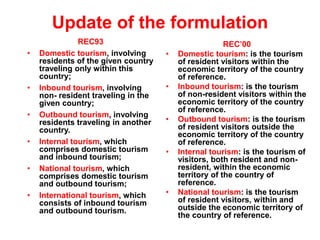
Update of the formulation
REC93
• Domestic tourism, involving
residents of the given country
traveling only within this
country;
• Inbound tourism, involving
non- resident traveling in the
given country;
• Outbound tourism, involving
residents traveling in another
country.
• Internal tourism, which
comprises domestic tourism
and inbound tourism;
• National tourism, which
comprises domestic tourism
and outbound tourism;
• International tourism, which
consists of inbound tourism
and outbound tourism.
REC’00
• Domestic tourism: is the tourism
of resident visitors within the
economic territory of the country
of reference.
• Inbound tourism: is the tourism
of non-resident visitors within the
economic territory of the country
of reference.
• Outbound tourism: is the tourism
of resident visitors outside the
economic territory of the country
of reference.
• Internal tourism: is the tourism of
visitors, both resident and non-
resident, within the economic
territory of the country of
reference.
• National tourism: is the tourism
of resident visitors, within and
outside the economic territory of
the country of reference.
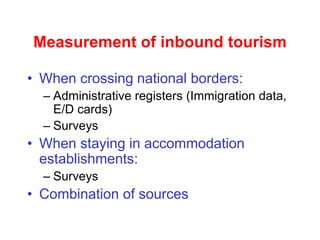
Measurement of inbound tourism
• When crossing national borders:
– Administrative registers (Immigration data,
E/D cards)
– Surveys
• When staying in accommodation
establishments:
– Surveys
• Combination of sources
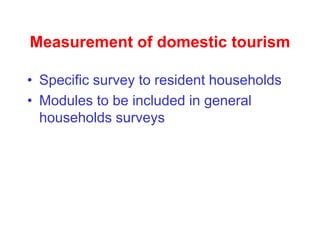
Measurement of domestic tourism
• Specific survey to resident households
• Modules to be included in general
households surveys
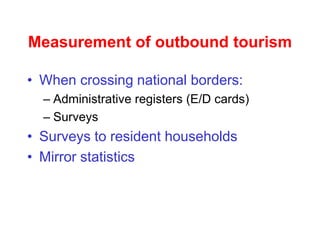
Measurement of outbound tourism
• When crossing national borders:
– Administrative registers (E/D cards)
– Surveys
• Surveys to resident households
• Mirror statistics
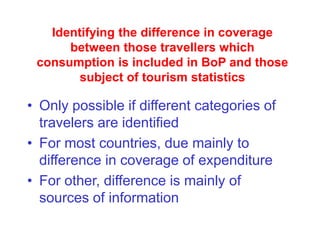
Identifying the difference in coverage
between those travellers which
consumption is included in BoP and those
subject of tourism statistics
• Only possible if different categories of
travelers are identified
• For most countries, due mainly to
difference in coverage of expenditure
• For other, difference is mainly of
sources of information
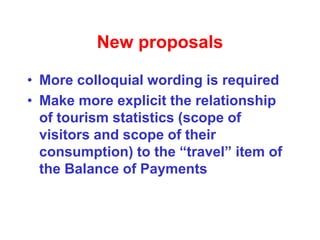
New proposals
• More colloquial wording is required
• Make more explicit the relationship
of tourism statistics (scope of
visitors and scope of their
consumption) to the “travel” item of
the Balance of Payments

UNWTO presentation - item 9.ppt

  • 1.
    United Nations NationsUnies UNSD/UNWTO Workshop Madrid 17/20 July 2006 Forms of tourism
  • 2.
    Update of theformulation REC93 • Domestic tourism, involving residents of the given country traveling only within this country; • Inbound tourism, involving non- resident traveling in the given country; • Outbound tourism, involving residents traveling in another country. • Internal tourism, which comprises domestic tourism and inbound tourism; • National tourism, which comprises domestic tourism and outbound tourism; • International tourism, which consists of inbound tourism and outbound tourism. REC’00 • Domestic tourism: is the tourism of resident visitors within the economic territory of the country of reference. • Inbound tourism: is the tourism of non-resident visitors within the economic territory of the country of reference. • Outbound tourism: is the tourism of resident visitors outside the economic territory of the country of reference. • Internal tourism: is the tourism of visitors, both resident and non- resident, within the economic territory of the country of reference. • National tourism: is the tourism of resident visitors, within and outside the economic territory of the country of reference.
  • 3.
    Measurement of inboundtourism • When crossing national borders: – Administrative registers (Immigration data, E/D cards) – Surveys • When staying in accommodation establishments: – Surveys • Combination of sources
  • 4.
    Measurement of domestictourism • Specific survey to resident households • Modules to be included in general households surveys
  • 5.
    Measurement of outboundtourism • When crossing national borders: – Administrative registers (E/D cards) – Surveys • Surveys to resident households • Mirror statistics
  • 6.
    Identifying the differencein coverage between those travellers which consumption is included in BoP and those subject of tourism statistics • Only possible if different categories of travelers are identified • For most countries, due mainly to difference in coverage of expenditure • For other, difference is mainly of sources of information
  • 7.
    New proposals • Morecolloquial wording is required • Make more explicit the relationship of tourism statistics (scope of visitors and scope of their consumption) to the “travel” item of the Balance of Payments