Unveiling the Solar
System's Secrets
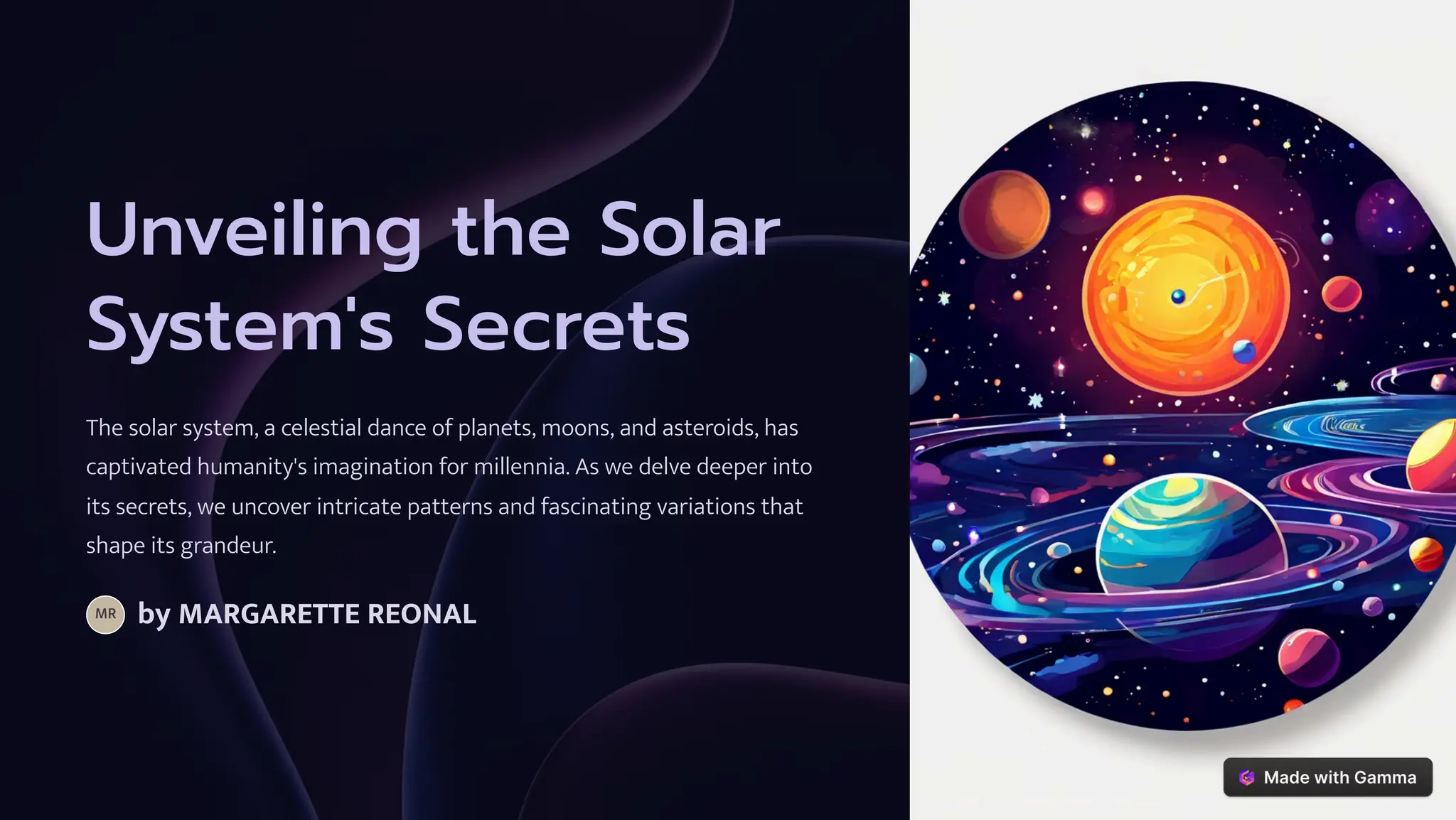
The solar system, a celestial dance of planets, moons, and asteroids, has
captivated humanity's imagination for millennia. As we delve deeper into
its secrets, we uncover intricate patterns and fascinating variations that
shape its grandeur.
by MARGARETTE REONAL
MR
The Sun's Central Role
The sun, our star, holds a commanding presence in the solar system, commanding over 99% of its mass. Its
gravitational pull governs the orbits of all celestial bodies, dictating their paths and movements. Yet, it is the outer
planets that hold the majority of the solar system's angular momentum.
Solar Dominance
The sun's immense gravitational force dictates the
orbits of all planets, asteroids, and comets in the solar
system.
Outer Planet Influence
While the sun holds most of the mass, the outer planets
contribute significantly to the solar system's angular
momentum.
Planetary Harmony:
Elliptical Orbits
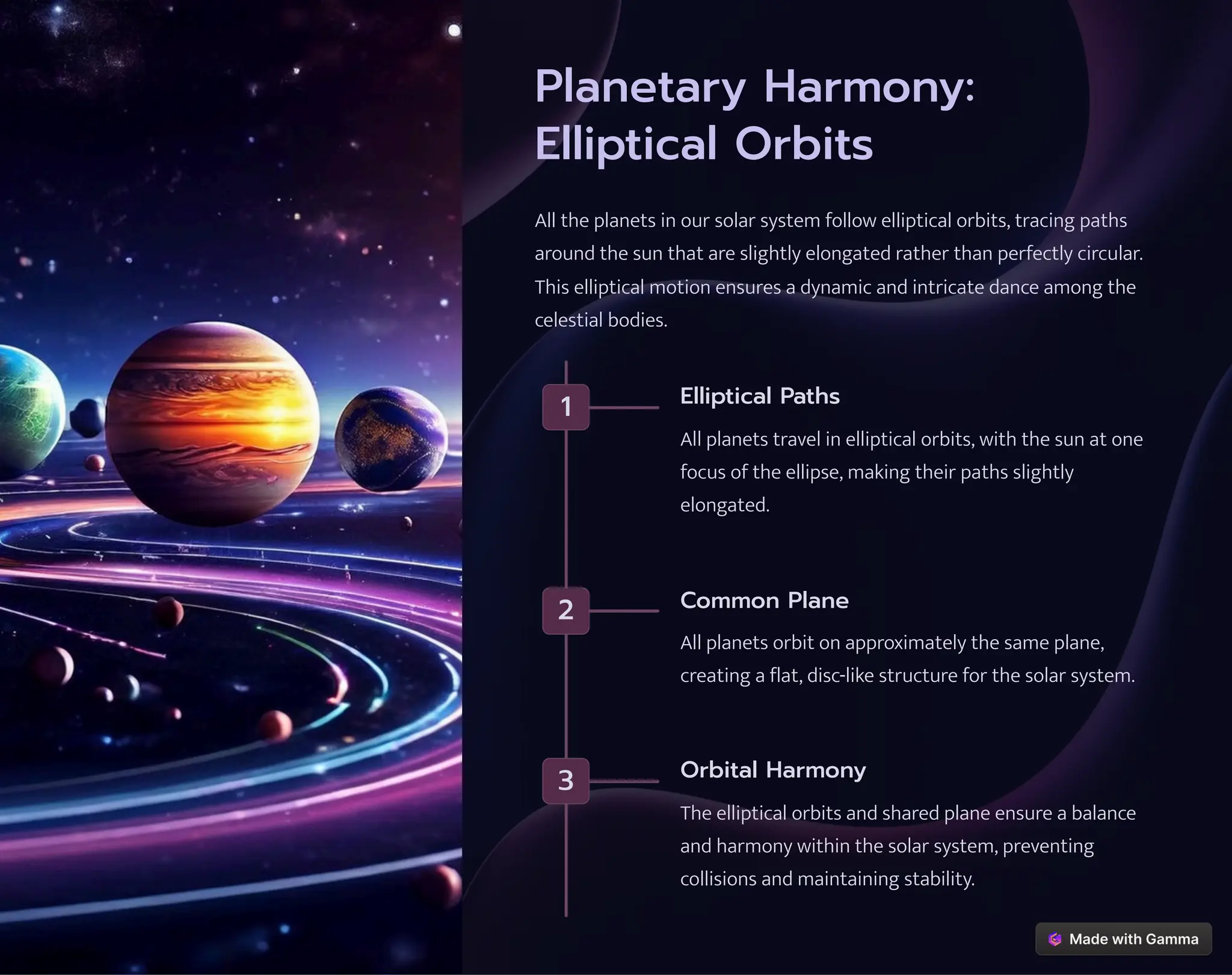
All the planets in our solar system follow elliptical orbits, tracing paths
around the sun that are slightly elongated rather than perfectly circular.
This elliptical motion ensures a dynamic and intricate dance among the
celestial bodies.
1 Elliptical Paths
All planets travel in elliptical orbits, with the sun at one
focus of the ellipse, making their paths slightly
elongated.
2 Common Plane
All planets orbit on approximately the same plane,
creating a flat, disc-like structure for the solar system.
3 Orbital Harmony
The elliptical orbits and shared plane ensure a balance
and harmony within the solar system, preventing
collisions and maintaining stability.
Planetary Periods: A
Distance-Based Rhythm
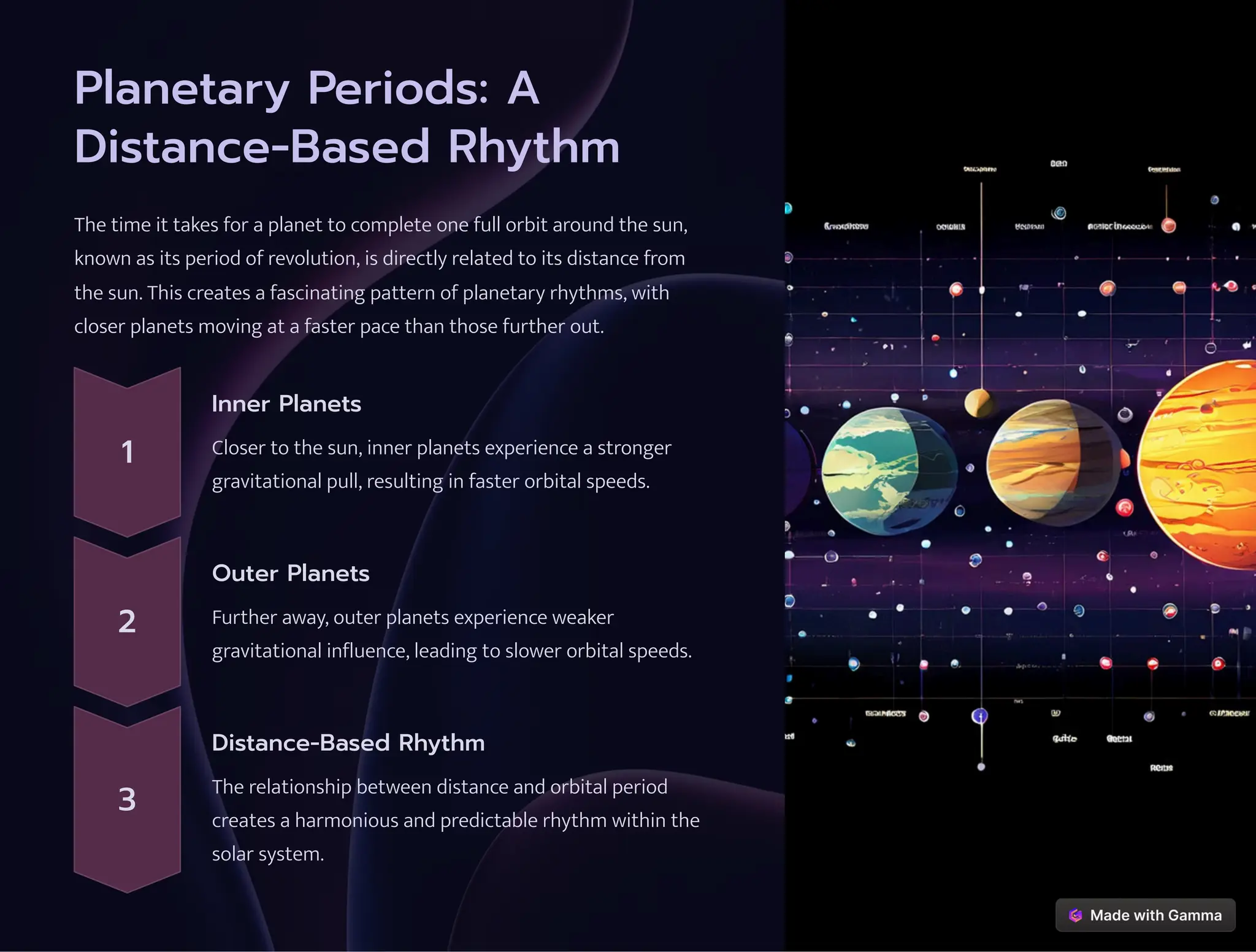
The time it takes for a planet to complete one full orbit around the sun,
known as its period of revolution, is directly related to its distance from
the sun. This creates a fascinating pattern of planetary rhythms, with
closer planets moving at a faster pace than those further out.
1
Inner Planets
Closer to the sun, inner planets experience a stronger
gravitational pull, resulting in faster orbital speeds.
2
Outer Planets
Further away, outer planets experience weaker
gravitational influence, leading to slower orbital speeds.
3
Distance-Based Rhythm
The relationship between distance and orbital period
creates a harmonious and predictable rhythm within the
solar system.
A Regular Arrangement:
The Titius-Bode Law
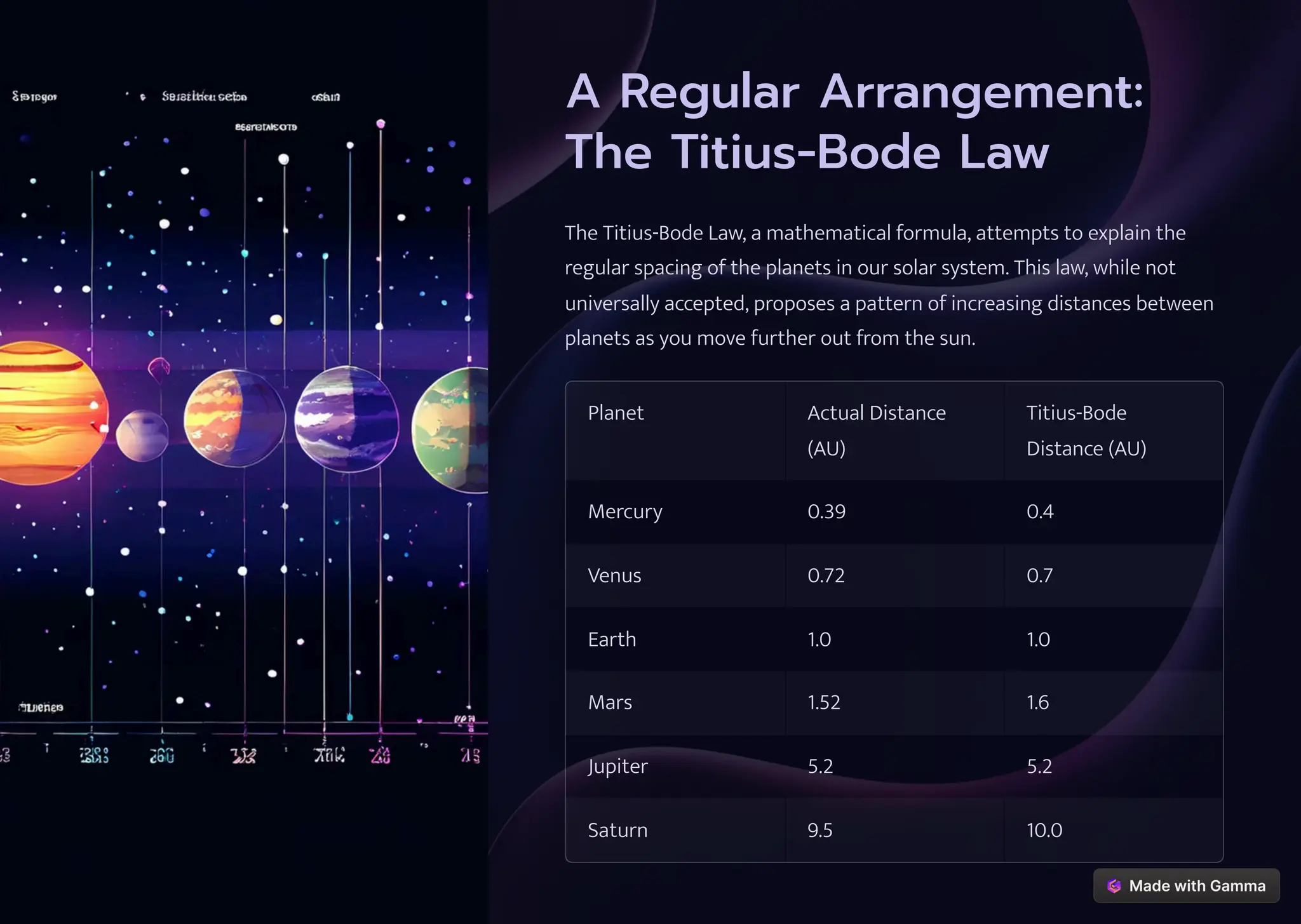
The Titius-Bode Law, a mathematical formula, attempts to explain the
regular spacing of the planets in our solar system. This law, while not
universally accepted, proposes a pattern of increasing distances between
planets as you move further out from the sun.
Planet Actual Distance
(AU)
Titius-Bode
Distance (AU)
Mercury 0.39 0.4
Venus 0.72 0.7
Earth 1.0 1.0
Mars 1.52 1.6
Jupiter 5.2 5.2
Saturn 9.5 10.0
The Terrestrial Worlds:
Inner Planets
The inner planets, Mercury, Venus, Earth, and Mars, are collectively known
as the terrestrial planets due to their solid, rocky surfaces. These planets
share characteristics like slower rotation, thinner atmospheres, and
higher densities compared to their gas giant counterparts.
1 Composition
Made of materials with high melting points, including silicates,
iron, and nickel, these planets are dense and solid.
2 Rotation
They rotate at slower speeds compared to the gas giants, with
their days lasting longer than their years.
3 Atmosphere
They possess thin or nonexistent atmospheres, lacking the thick
layers of gas present on the outer planets.
4 Volatiles
They have lower contents of volatile elements such as hydrogen,
helium, and noble gases, leading to a different chemical makeup.
The Gas Giants: Outer
Planets
The outer planets - Jupiter, Saturn, Uranus, and Neptune - are referred to
as gas giants due to their massive sizes and composition dominated by
gases. They exhibit distinct characteristics compared to the inner planets,
including faster rotation, thick atmospheres, and fluid interiors.
Rapid Rotation
These planets spin at remarkably fast speeds, making their days much
shorter than their years.
Thick Atmospheres
Encased in thick layers of gas, primarily hydrogen and helium, these
planets have distinct atmospheric features.
Fluid Interiors
Their interiors are composed of fluid elements, including hydrogen,
helium, and ices, creating a dynamic and constantly changing structure.
Element Abundance: From
Universe to Earth
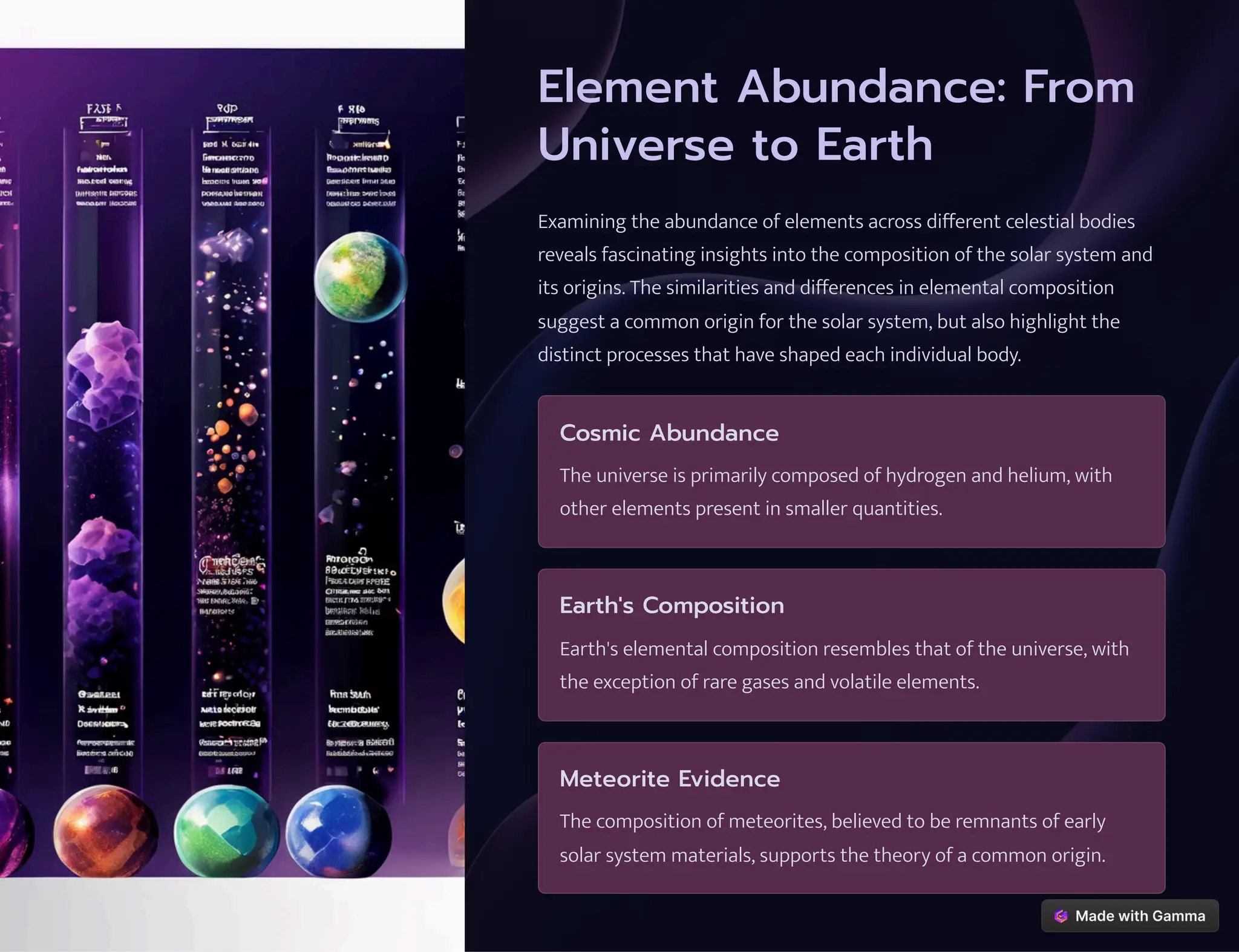
Examining the abundance of elements across different celestial bodies
reveals fascinating insights into the composition of the solar system and
its origins. The similarities and differences in elemental composition
suggest a common origin for the solar system, but also highlight the
distinct processes that have shaped each individual body.
Cosmic Abundance
The universe is primarily composed of hydrogen and helium, with
other elements present in smaller quantities.
Earth's Composition
Earth's elemental composition resembles that of the universe, with
the exception of rare gases and volatile elements.
Meteorite Evidence
The composition of meteorites, believed to be remnants of early
solar system materials, supports the theory of a common origin.

Unveiling-the-Solar-Systems-Secrets.pdf.

  • 1.
    Unveiling the Solar System'sSecrets The solar system, a celestial dance of planets, moons, and asteroids, has captivated humanity's imagination for millennia. As we delve deeper into its secrets, we uncover intricate patterns and fascinating variations that shape its grandeur. by MARGARETTE REONAL MR
  • 2.
    The Sun's CentralRole The sun, our star, holds a commanding presence in the solar system, commanding over 99% of its mass. Its gravitational pull governs the orbits of all celestial bodies, dictating their paths and movements. Yet, it is the outer planets that hold the majority of the solar system's angular momentum. Solar Dominance The sun's immense gravitational force dictates the orbits of all planets, asteroids, and comets in the solar system. Outer Planet Influence While the sun holds most of the mass, the outer planets contribute significantly to the solar system's angular momentum.
  • 3.
    Planetary Harmony: Elliptical Orbits Allthe planets in our solar system follow elliptical orbits, tracing paths around the sun that are slightly elongated rather than perfectly circular. This elliptical motion ensures a dynamic and intricate dance among the celestial bodies. 1 Elliptical Paths All planets travel in elliptical orbits, with the sun at one focus of the ellipse, making their paths slightly elongated. 2 Common Plane All planets orbit on approximately the same plane, creating a flat, disc-like structure for the solar system. 3 Orbital Harmony The elliptical orbits and shared plane ensure a balance and harmony within the solar system, preventing collisions and maintaining stability.
  • 4.
    Planetary Periods: A Distance-BasedRhythm The time it takes for a planet to complete one full orbit around the sun, known as its period of revolution, is directly related to its distance from the sun. This creates a fascinating pattern of planetary rhythms, with closer planets moving at a faster pace than those further out. 1 Inner Planets Closer to the sun, inner planets experience a stronger gravitational pull, resulting in faster orbital speeds. 2 Outer Planets Further away, outer planets experience weaker gravitational influence, leading to slower orbital speeds. 3 Distance-Based Rhythm The relationship between distance and orbital period creates a harmonious and predictable rhythm within the solar system.
  • 5.
    A Regular Arrangement: TheTitius-Bode Law The Titius-Bode Law, a mathematical formula, attempts to explain the regular spacing of the planets in our solar system. This law, while not universally accepted, proposes a pattern of increasing distances between planets as you move further out from the sun. Planet Actual Distance (AU) Titius-Bode Distance (AU) Mercury 0.39 0.4 Venus 0.72 0.7 Earth 1.0 1.0 Mars 1.52 1.6 Jupiter 5.2 5.2 Saturn 9.5 10.0
  • 6.
    The Terrestrial Worlds: InnerPlanets The inner planets, Mercury, Venus, Earth, and Mars, are collectively known as the terrestrial planets due to their solid, rocky surfaces. These planets share characteristics like slower rotation, thinner atmospheres, and higher densities compared to their gas giant counterparts. 1 Composition Made of materials with high melting points, including silicates, iron, and nickel, these planets are dense and solid. 2 Rotation They rotate at slower speeds compared to the gas giants, with their days lasting longer than their years. 3 Atmosphere They possess thin or nonexistent atmospheres, lacking the thick layers of gas present on the outer planets. 4 Volatiles They have lower contents of volatile elements such as hydrogen, helium, and noble gases, leading to a different chemical makeup.
  • 7.
    The Gas Giants:Outer Planets The outer planets - Jupiter, Saturn, Uranus, and Neptune - are referred to as gas giants due to their massive sizes and composition dominated by gases. They exhibit distinct characteristics compared to the inner planets, including faster rotation, thick atmospheres, and fluid interiors. Rapid Rotation These planets spin at remarkably fast speeds, making their days much shorter than their years. Thick Atmospheres Encased in thick layers of gas, primarily hydrogen and helium, these planets have distinct atmospheric features. Fluid Interiors Their interiors are composed of fluid elements, including hydrogen, helium, and ices, creating a dynamic and constantly changing structure.
  • 8.
    Element Abundance: From Universeto Earth Examining the abundance of elements across different celestial bodies reveals fascinating insights into the composition of the solar system and its origins. The similarities and differences in elemental composition suggest a common origin for the solar system, but also highlight the distinct processes that have shaped each individual body. Cosmic Abundance The universe is primarily composed of hydrogen and helium, with other elements present in smaller quantities. Earth's Composition Earth's elemental composition resembles that of the universe, with the exception of rare gases and volatile elements. Meteorite Evidence The composition of meteorites, believed to be remnants of early solar system materials, supports the theory of a common origin.