MACHINE LEARNING USING PYTHON & R,
WHY PYTHON IS PREFERABLE OVER R ?
Group activity by- Suhani, Apoorva, Daksh, Ayush, Sompriya
(CSE-B, Group-9)
OVERVIEW :
1. ACKNOWLEDGEMENT
2. BIOGRAPHY
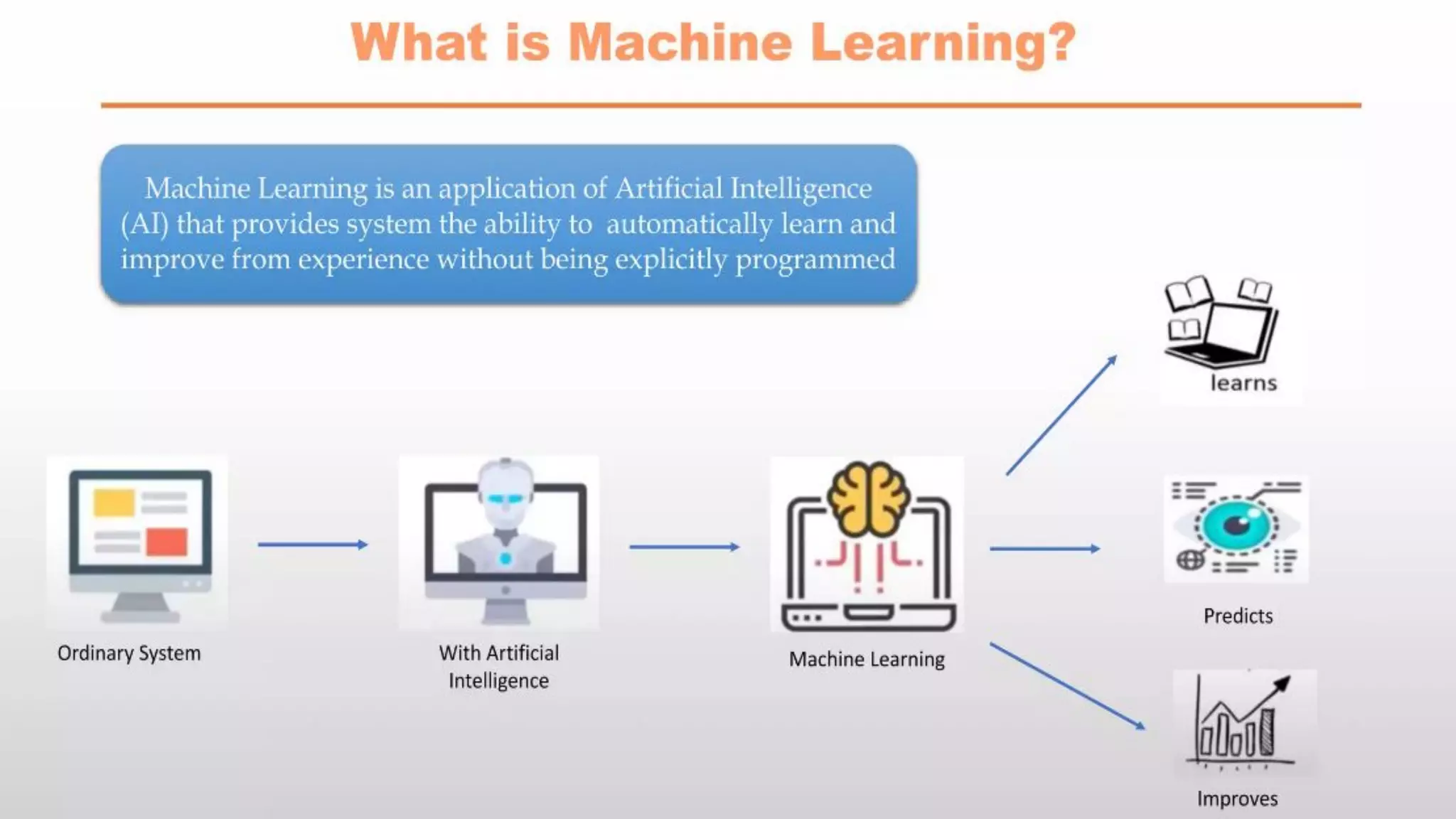
3. WHAT IS MACHINE LEARNING ?
4. TYPES & CLASSIFICATION
5. MACHINE LEARNING USING PYTHON
6. MACHINE LEARNING USING R
7. WHY PYTHON IS MORE PREFERABLE THAN R ?
8. BUSINESS NEWS
9. QUIZ
10. BIBLIOGRAPHY
ACKNOWLEDGMENT
We would like to thank all of the people who helped us with this project,
without their support and guidance it wouldn’t have been possible. We
appreciate Ms. Astha Goyal (CSE-B proctor) for her guidance and supervision.
Our parents as well as friends were constantly encouraging us throughout the
process when we felt discouraged or became frustrated because they knew
how much work went into this venture so that is why we want to extend them
thanks too!
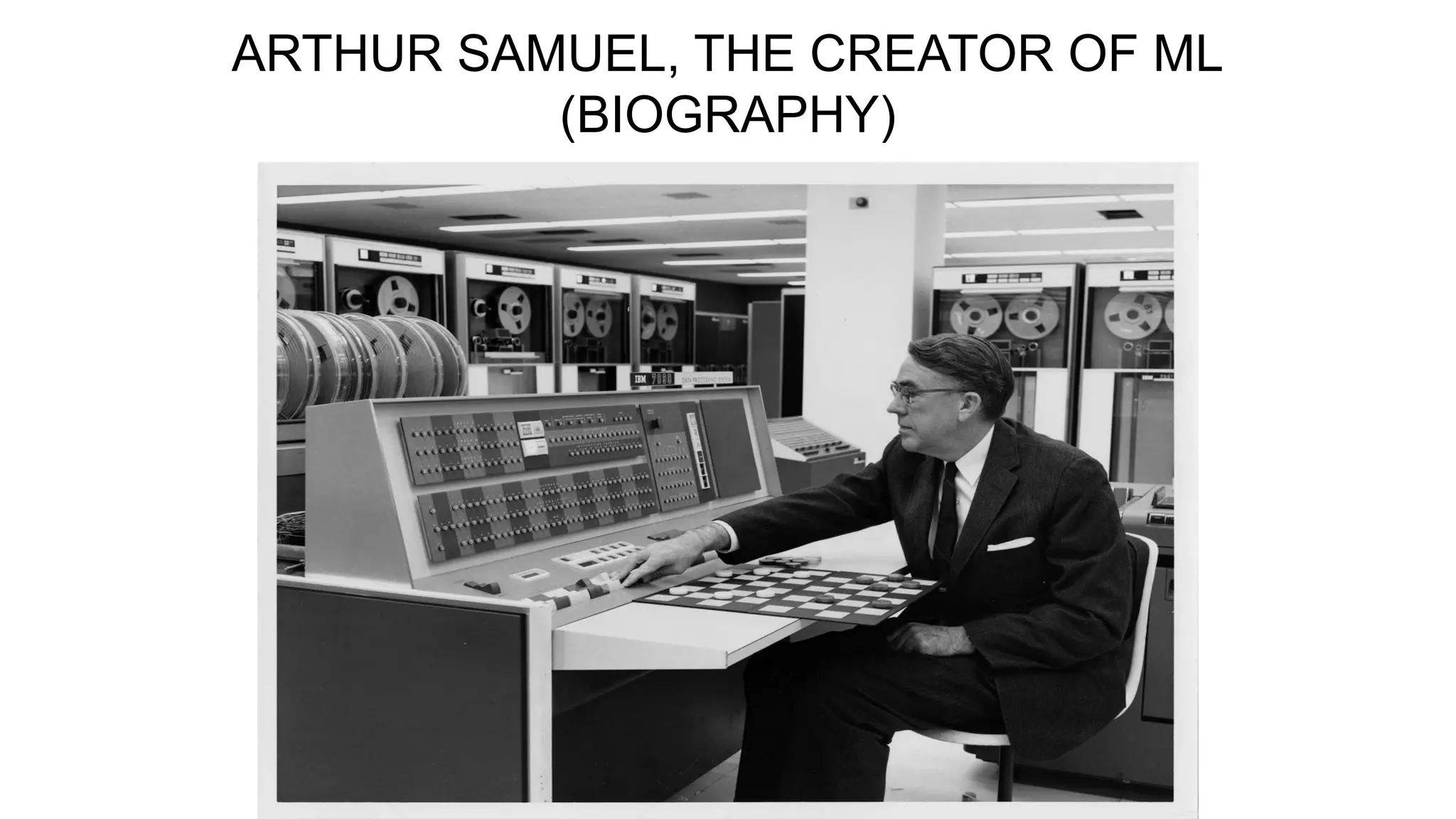
ARTHUR SAMUEL, THE CREATOR OF ML
(BIOGRAPHY)
Arthur Lee Samuel is credited with one of the first software hash tables, and influencing early research in using
transistors for computers at IBM. He initiated the ILLIAC project at the University of Illinois which was dedicated to a
series of supercomputers. Samuel worked on a program to play the game of checkers electronically.
After his work for Bell Laboratories since 1928, mostly on vacuum tubes, including improvements of Radar during
World War II, the distinguished electrical engineer Arthur Lee Samuel (1901-1990), became a professor of electrical
engineering at the University of Illinois at Urbana–Champaign, where he initiated the ILLIAC project. ILLIAC (Illinois
Automatic Computer) was a series of supercomputers, built at a variety of locations. In 1949, Samuel left the
University before its first computer was complete, and joined IBM’s Poughkeepsie Laboratory in New York, where he
would conceive and carry out his most successful work. Samuel is credited with one of the first software hash
tables, and influencing early research in using transistors for computers at IBM. There he also continued his seminal
research on machine learning.
In Poughkeepsie, while working on IBM’s first stored program computer, the 701, Samuel found himself talking with
one of the chief designers of the computer, about the word size that should be used—32 or 36 bits. Then he started
to ask himself which would be better for his checkers playing program and, to find out, he started to write it again but
using the instruction set of the unfinished 701. Later Samuel realized that teaching computers to play games is very
fruitful for developing tactics appropriate to general problems—I became so intrigued with this general problem of
writing a program that would appear to exhibit intelligence that it was to occupy my thoughts during almost every free
moment for the entire duration of my employment by IBM and indeed for some years beyond. The main driver of the
machine was a search tree of the board positions reachable from the current state.
Samuel was the first person to do any serious programming on the 701 and as such had no system utilities to call on. In
particular he had no assembler and had to write everything using the op codes and addresses. As he had only a very
limited amount of available computer memory, he implemented what is now called alpha-beta pruning. Instead of
searching each path until it came to the game’s conclusion, Samuel developed a scoring function based on the position of
the board at any given time, which tried to measure the chance of winning for each side at the given position.
The program chose its move based on a minimax strategy, meaning it made the move that optimized the value of this
function, assuming that the opponent was trying to optimize the value of the same function from its point of view.
Possessing great creativity and essentially working alone, doing his own programming, Arthur Samuel also designed
various mechanisms by which his program could improve its skills. In what he called rote learning (or generalization
learning), the program remembered every position it had already seen, along with the terminal value of the reward function.
This technique effectively extended the search depth at each of these positions. He also used underlying techniques as
mutable evaluation functions, hill climbing, and signature tables.
Eventually the 701 was built and it incorporated some changes to the instruction set suggested by Samuel as the result of
his work on checkers. Being the first really large non-numerical program it influenced the instruction set of all subsequent
IBM machines. As Samuel was frightened that the machine might never be completed or that it might be radically changed,
he wrote the checkers program as a set of small self-contained modules loaded by a central module—a sort of primitive
operating system. He got it all to run on the first experimental model of the 701.
Later programs reevaluated the reward function based on input from professional gamers. Samuel also had it play
thousands of games against itself as another way of learning. With all of this work, his program reached a respectable
amateur status, and was the first to play any board game at this high a level. After his retirement from IBM in 1966,
Samuel continued to work on checkers until the mid-1970s, at which point his program achieved sufficient skill to
challenge a respectable amateur.
Samuel completed his first checker program on the IBM 701, and when it was about to be demonstrated, Thomas J.
Watson, Sr., the founder and president of IBM, remarked that the demonstration would raise the price of IBM stock by 15
points. It really did. Samuel was eventually put in charge of a pure research effort after persuading the Watsons that IBM
needed to do pure research and not just product development.
INTRODUCTION TO DATA IN ML
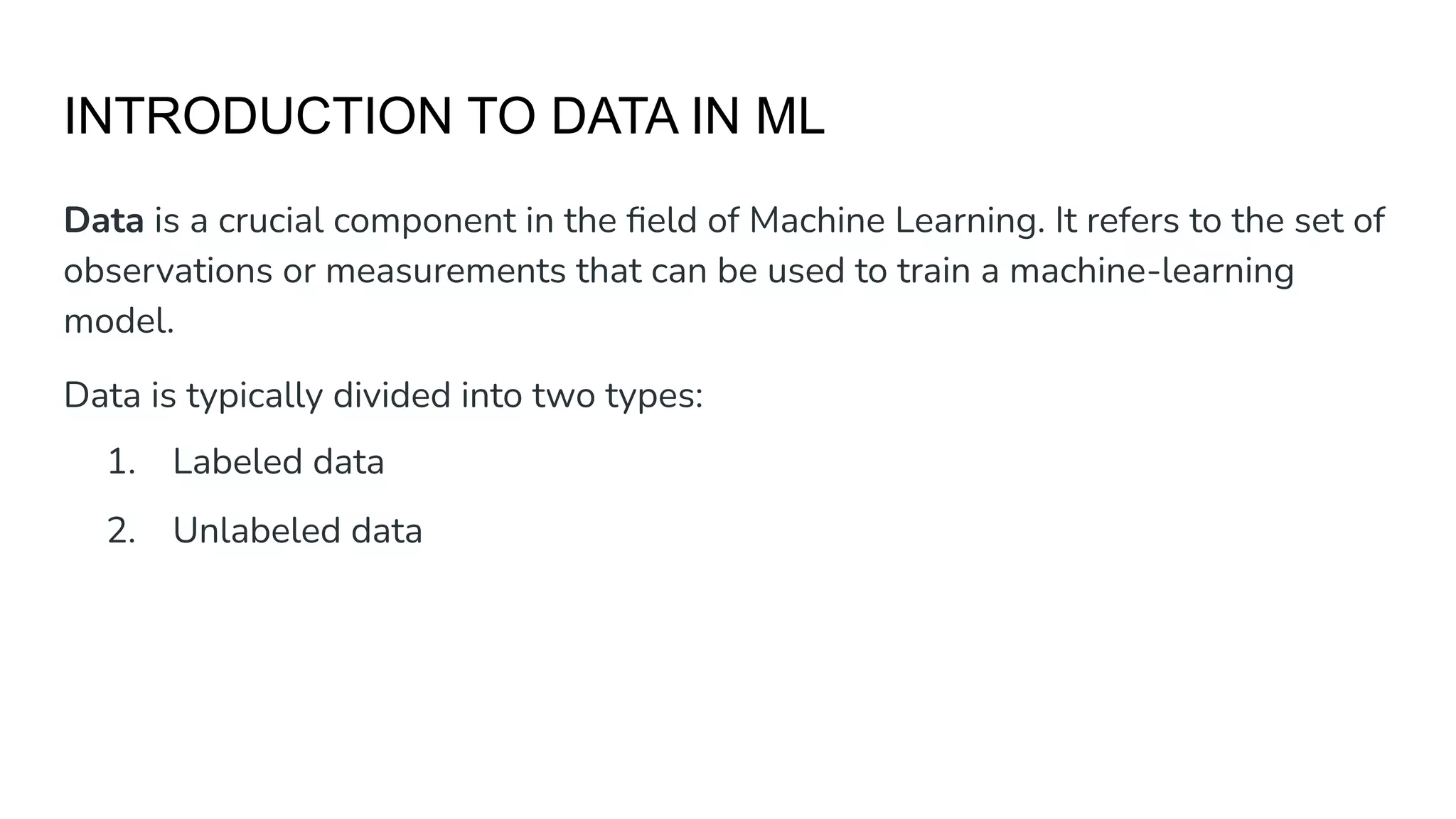
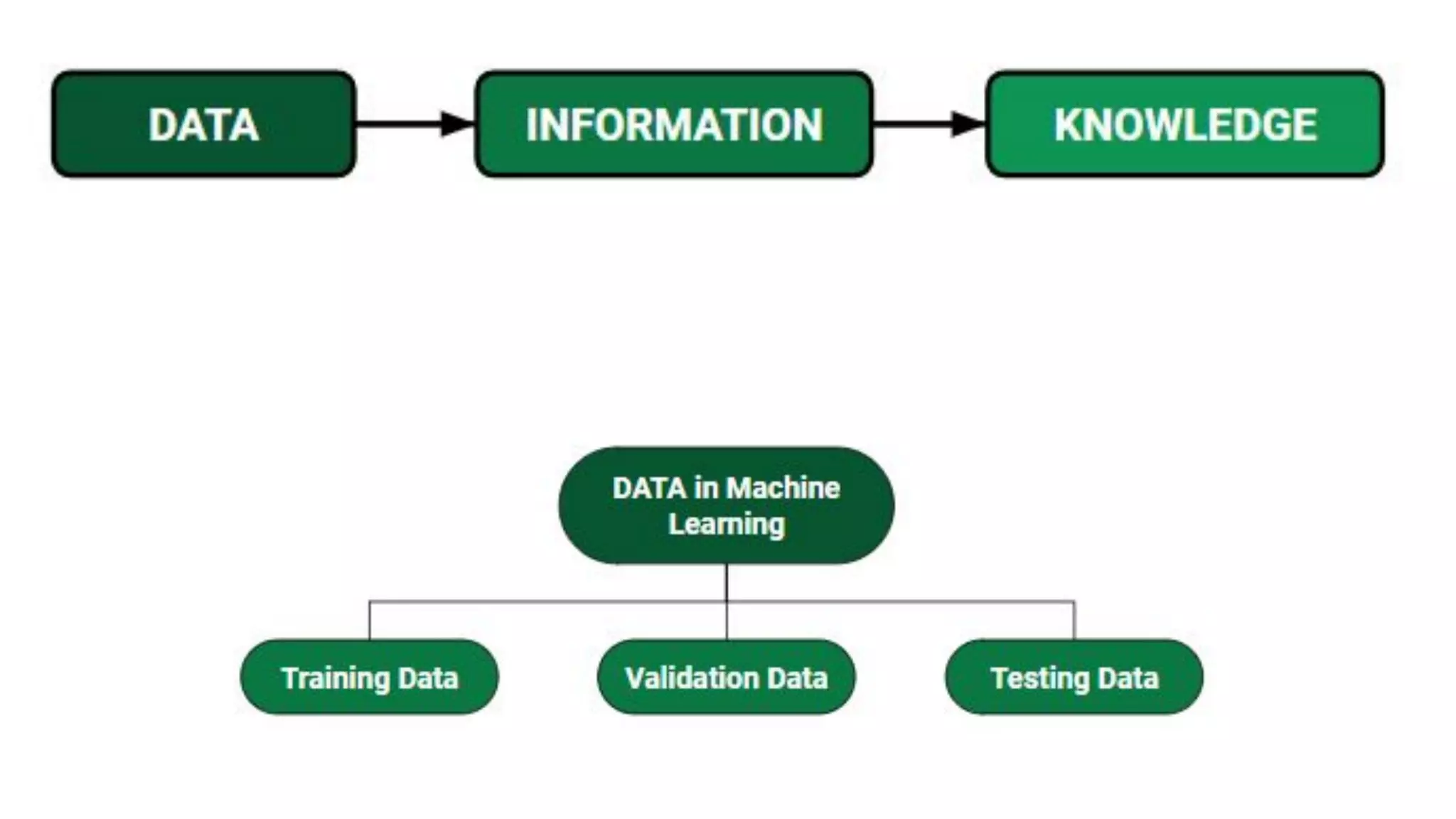
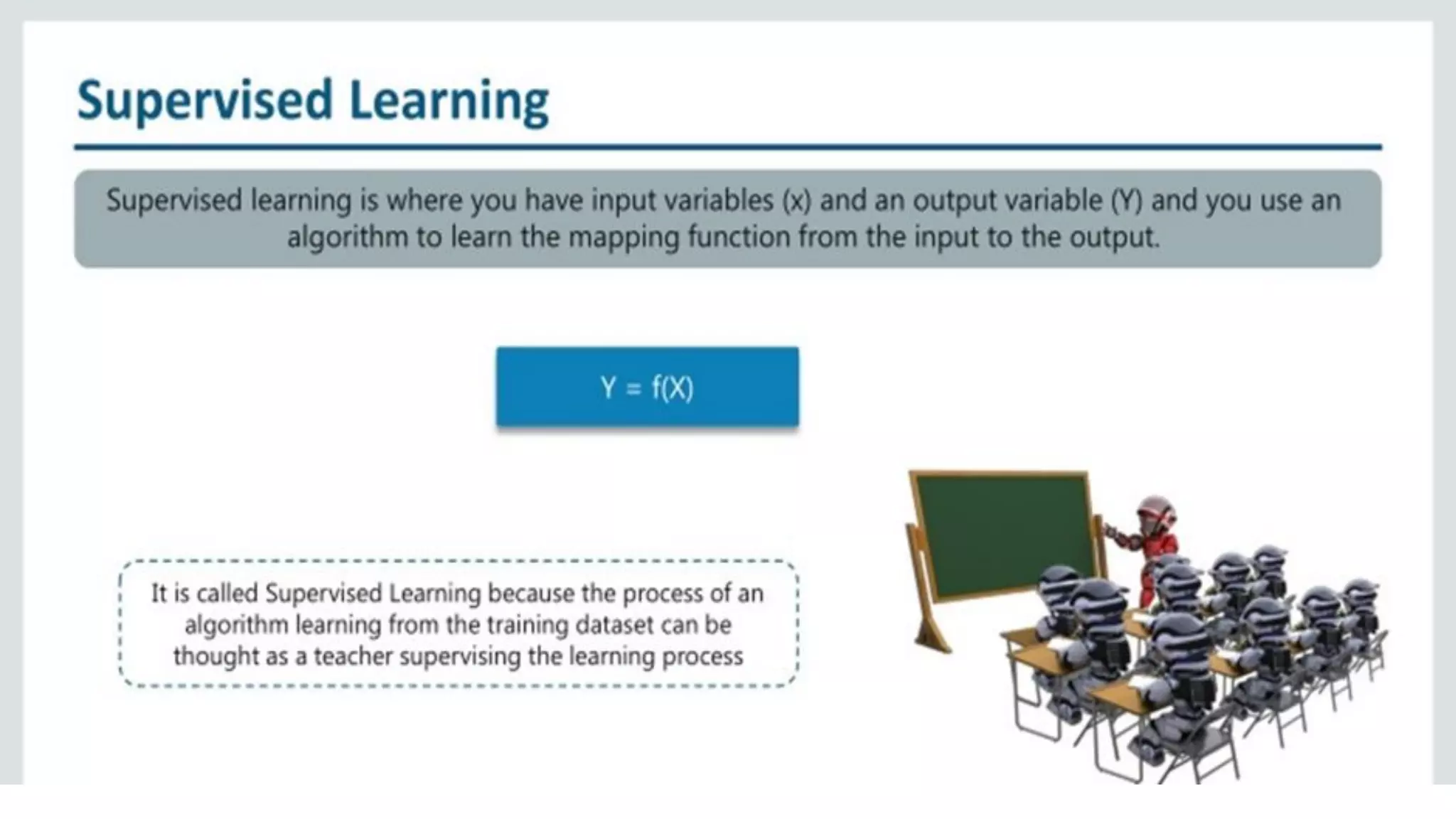
Data is a crucial component in the field of Machine Learning. It refers to the set of
observations or measurements that can be used to train a machine-learning
model.
Data is typically divided into two types:
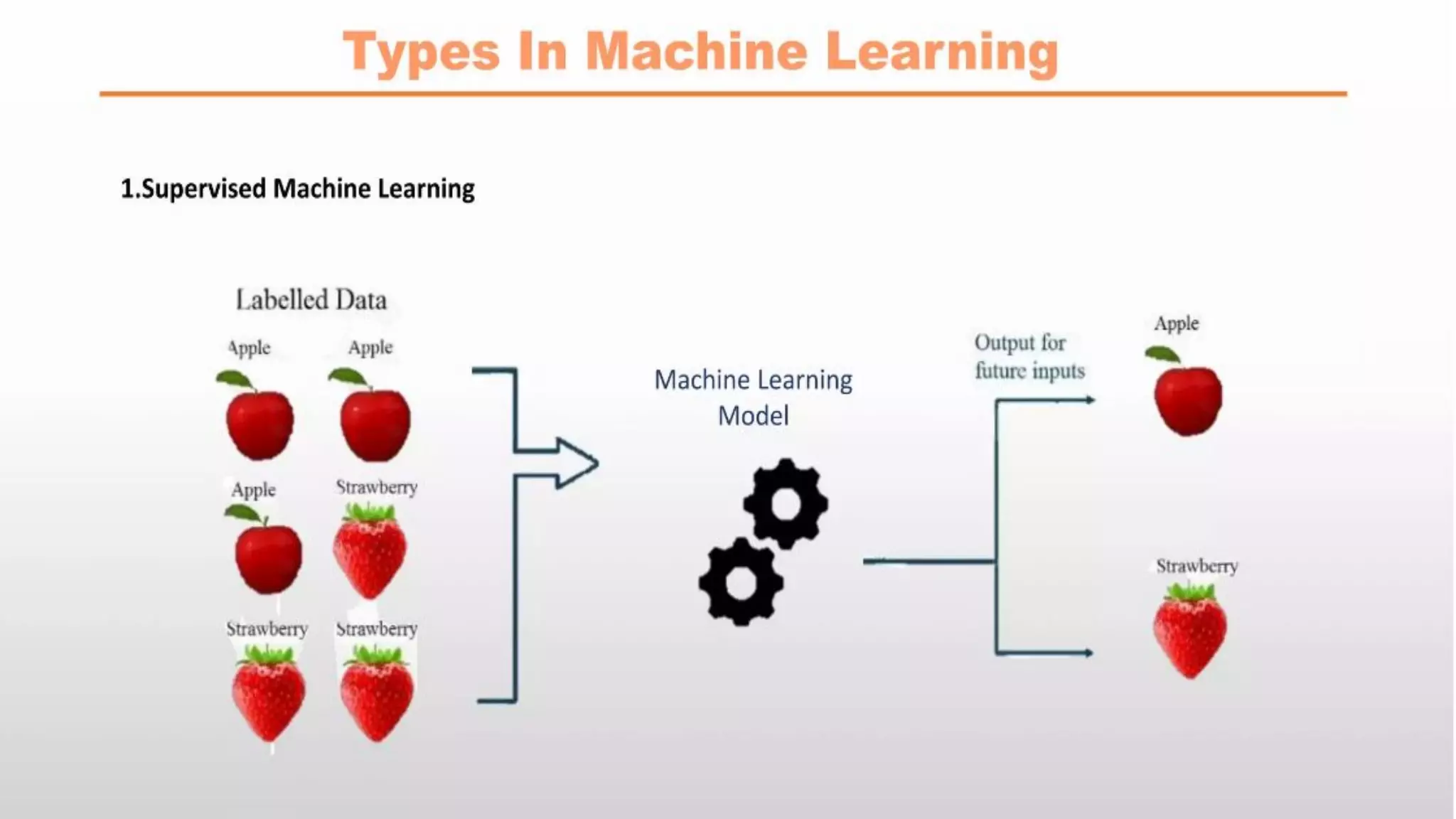
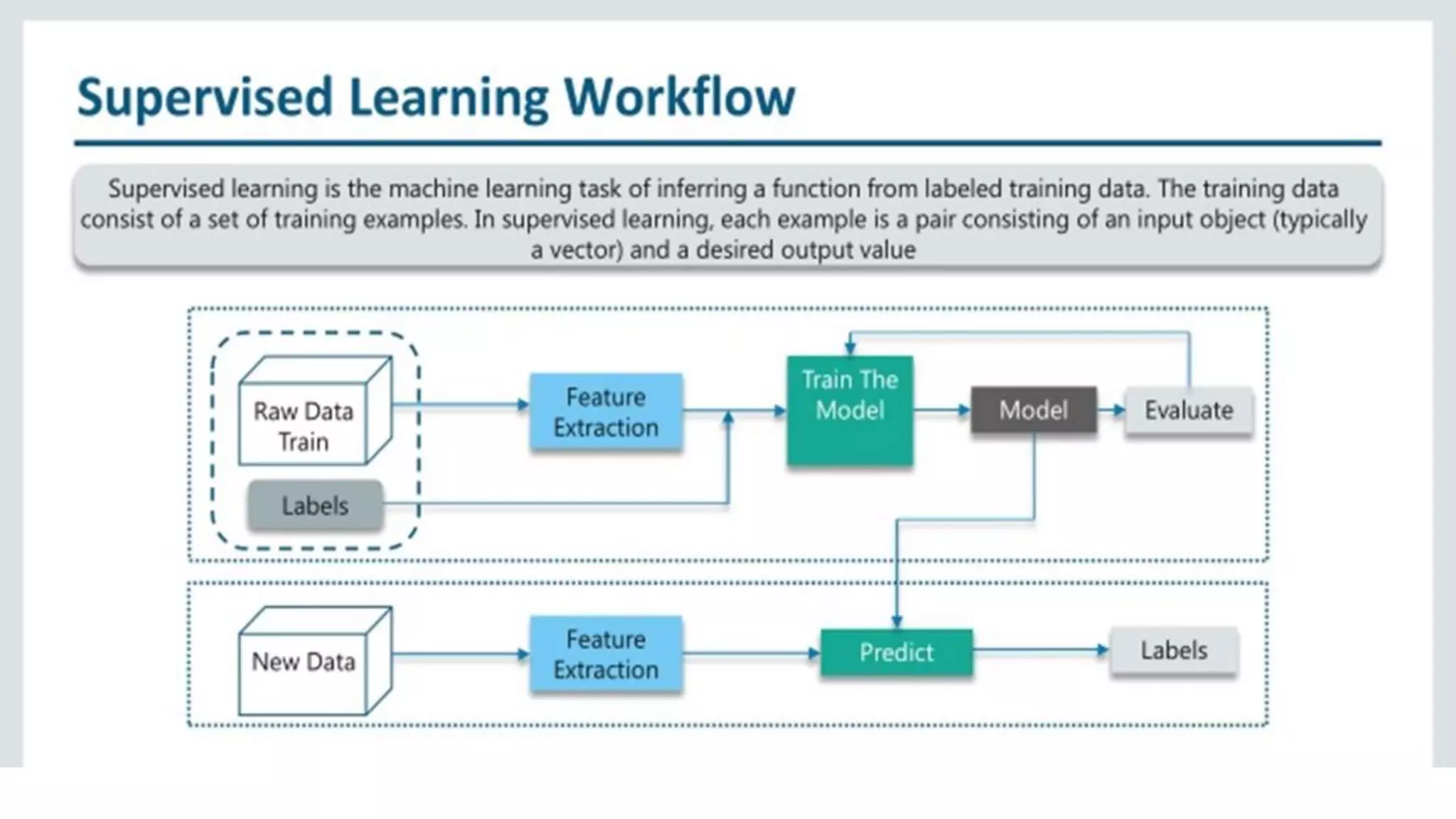
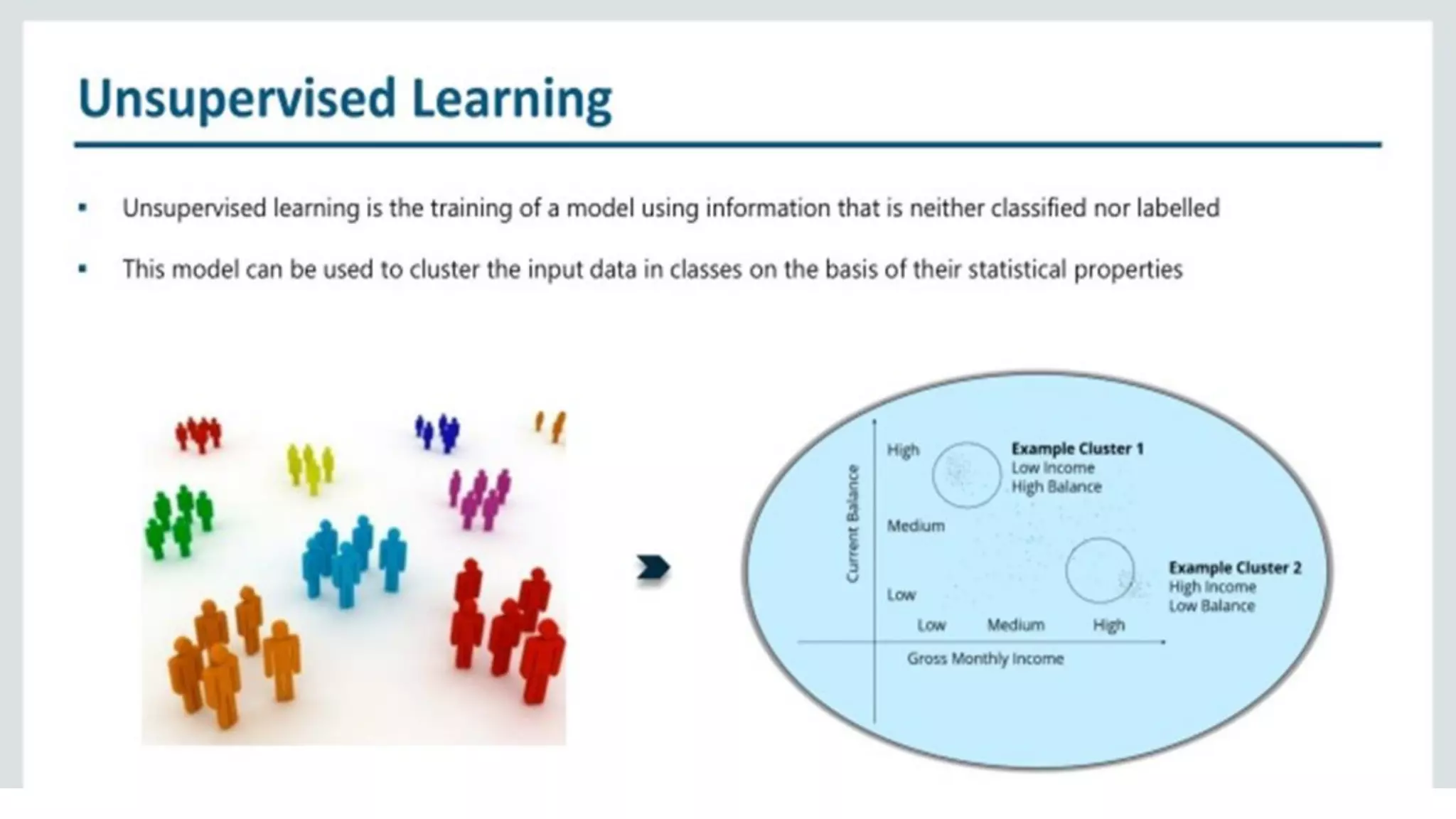
1. Labeled data
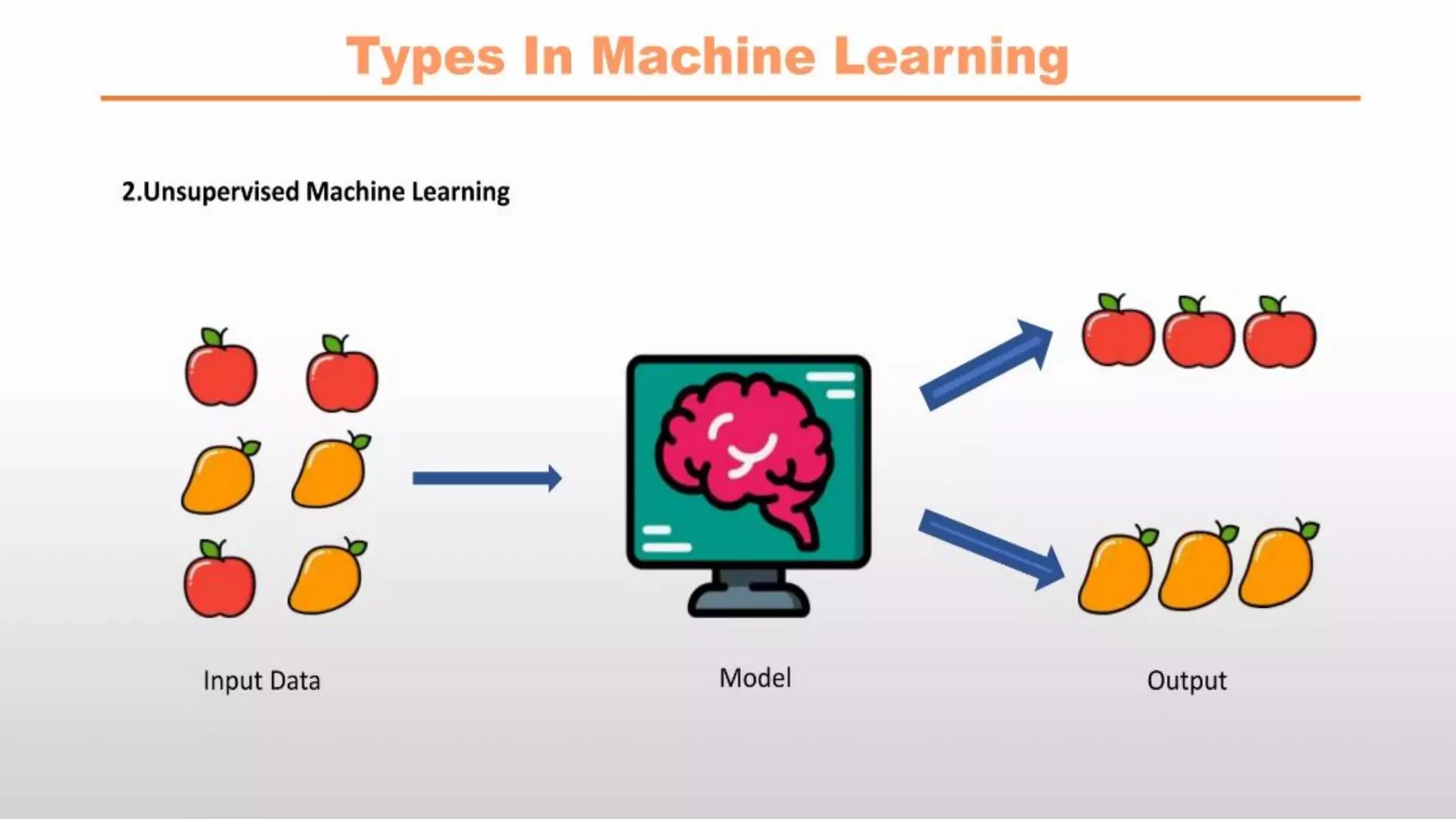
2. Unlabeled data
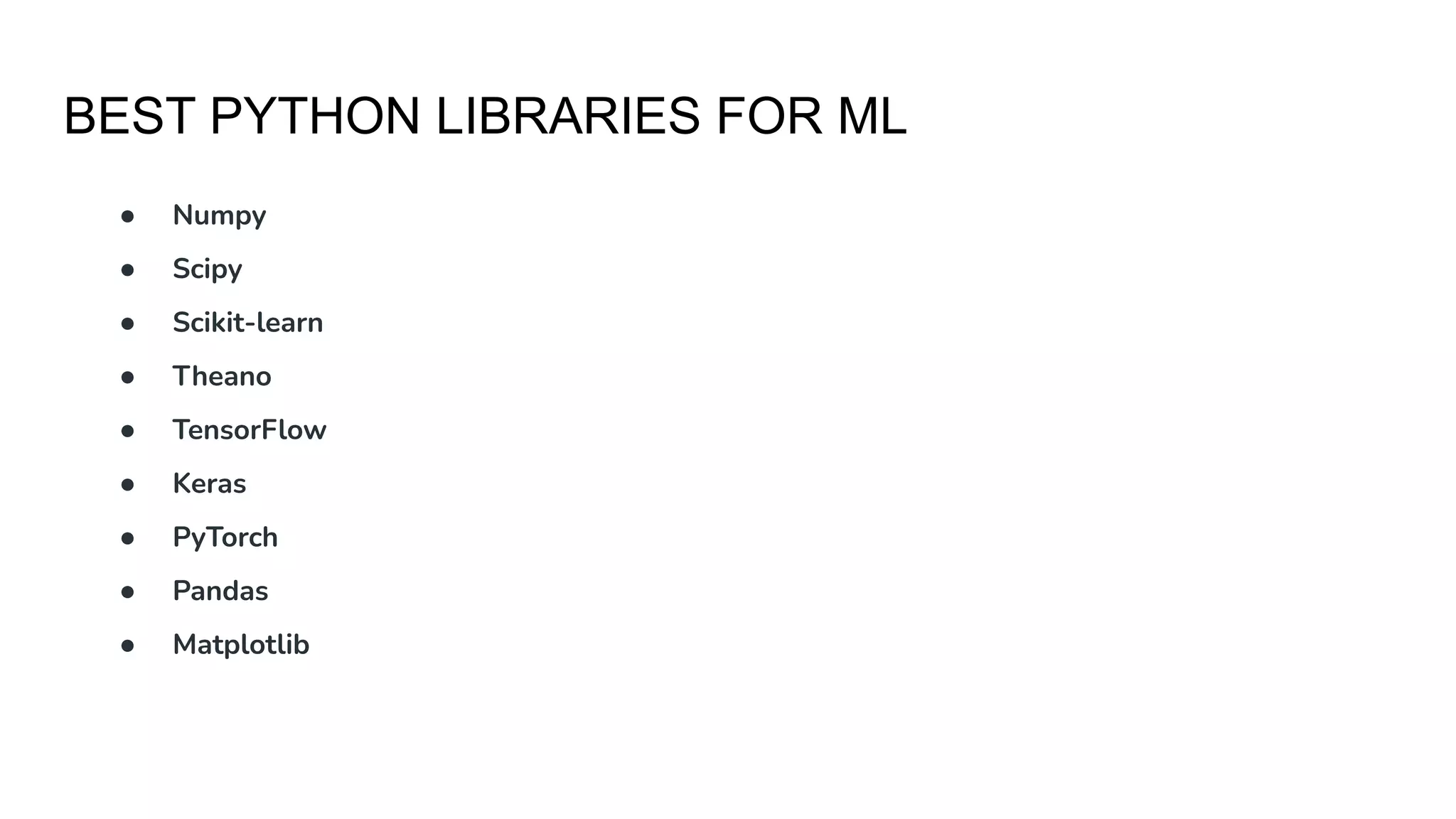
BEST PYTHON LIBRARIES FOR ML
● Numpy
● Scipy
● Scikit-learn
● Theano
● TensorFlow
● Keras
● PyTorch
● Pandas
● Matplotlib
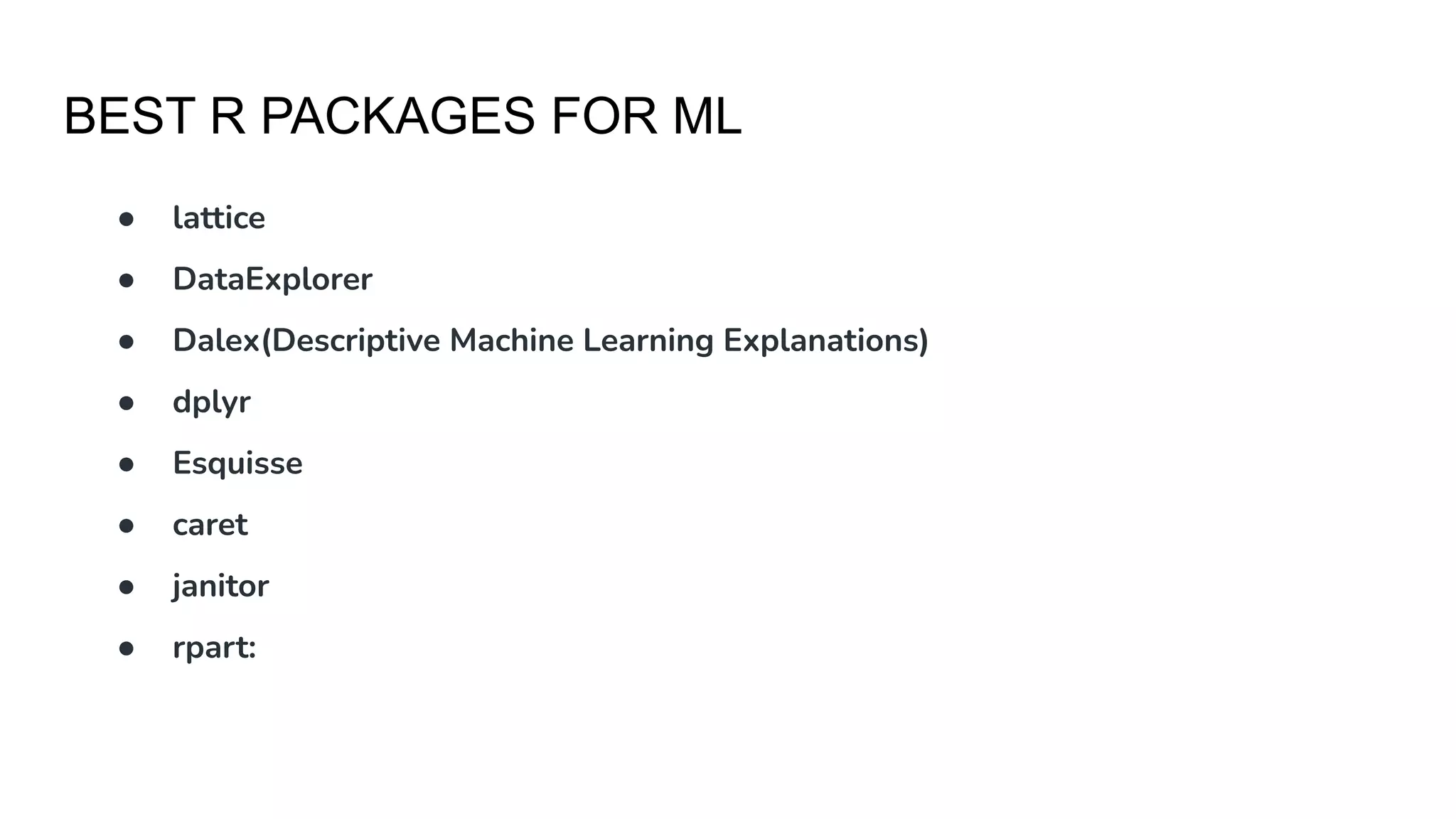
BEST R PACKAGES FOR ML
● lattice
● DataExplorer
● Dalex(Descriptive Machine Learning Explanations)
● dplyr
● Esquisse
● caret
● janitor
● rpart:
WHY PYTHON IS MORE PREFERABLE THAN R FOR ML ?
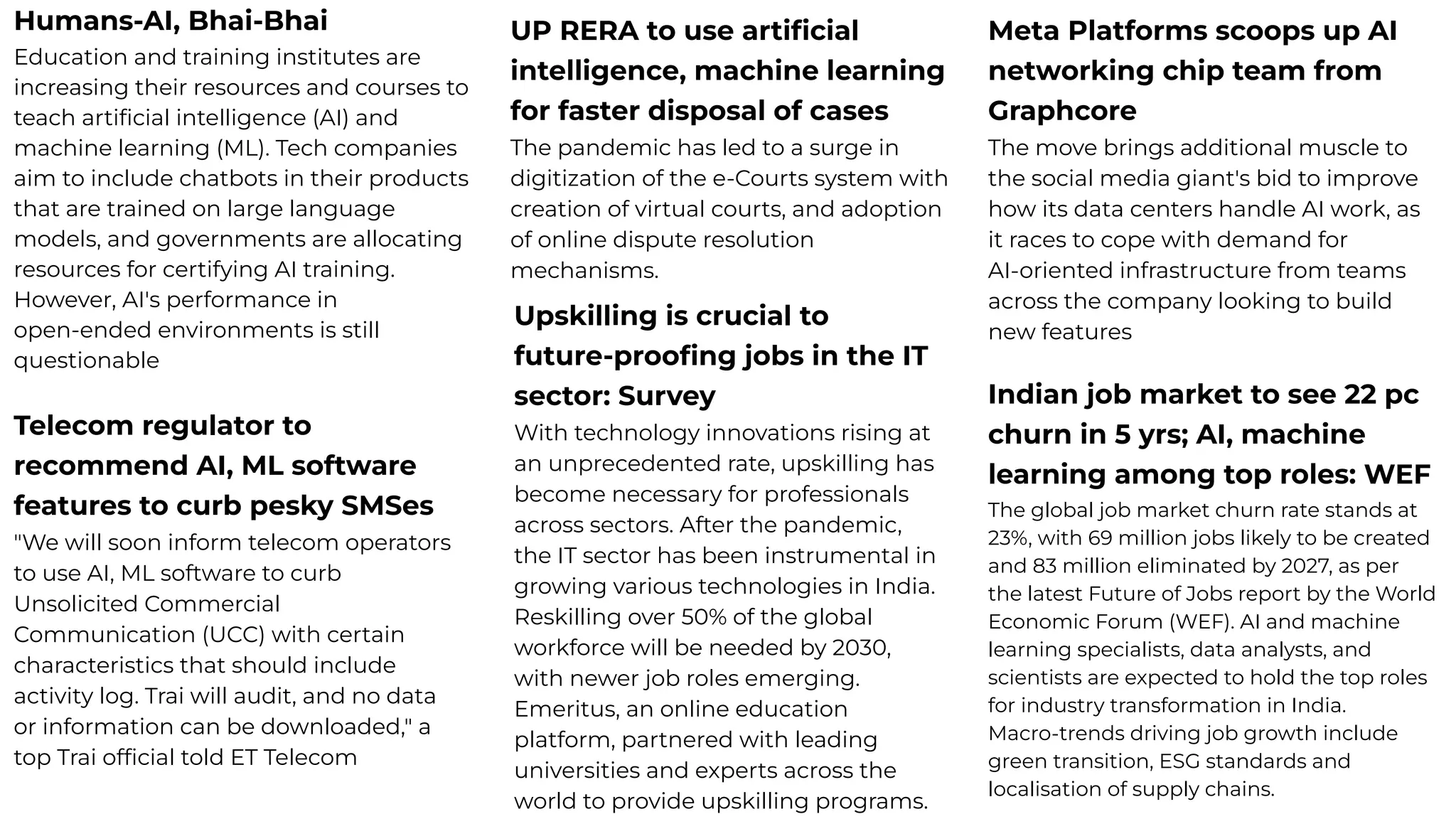
Humans-AI, Bhai-Bhai
Education and training institutes are
increasing their resources and courses to
teach artificial intelligence (AI) and
machine learning (ML). Tech companies
aim to include chatbots in their products
that are trained on large language
models, and governments are allocating
resources for certifying AI training.
However, AI's performance in
open-ended environments is still
questionable
UP RERA to use artificial
intelligence, machine learning
for faster disposal of cases
The pandemic has led to a surge in
digitization of the e-Courts system with
creation of virtual courts, and adoption
of online dispute resolution
mechanisms.
Meta Platforms scoops up AI
networking chip team from
Graphcore
The move brings additional muscle to
the social media giant's bid to improve
how its data centers handle AI work, as
it races to cope with demand for
AI-oriented infrastructure from teams
across the company looking to build
new features
Upskilling is crucial to
future-proofing jobs in the IT
sector: Survey
With technology innovations rising at
an unprecedented rate, upskilling has
become necessary for professionals
across sectors. After the pandemic,
the IT sector has been instrumental in
growing various technologies in India.
Reskilling over 50% of the global
workforce will be needed by 2030,
with newer job roles emerging.
Emeritus, an online education
platform, partnered with leading
universities and experts across the
world to provide upskilling programs.
Indian job market to see 22 pc
churn in 5 yrs; AI, machine
learning among top roles: WEF
The global job market churn rate stands at
23%, with 69 million jobs likely to be created
and 83 million eliminated by 2027, as per
the latest Future of Jobs report by the World
Economic Forum (WEF). AI and machine
learning specialists, data analysts, and
scientists are expected to hold the top roles
for industry transformation in India.
Macro-trends driving job growth include
green transition, ESG standards and
localisation of supply chains.
Telecom regulator to
recommend AI, ML software
features to curb pesky SMSes
"We will soon inform telecom operators
to use AI, ML software to curb
Unsolicited Commercial
Communication (UCC) with certain
characteristics that should include
activity log. Trai will audit, and no data
or information can be downloaded," a
top Trai official told ET Telecom
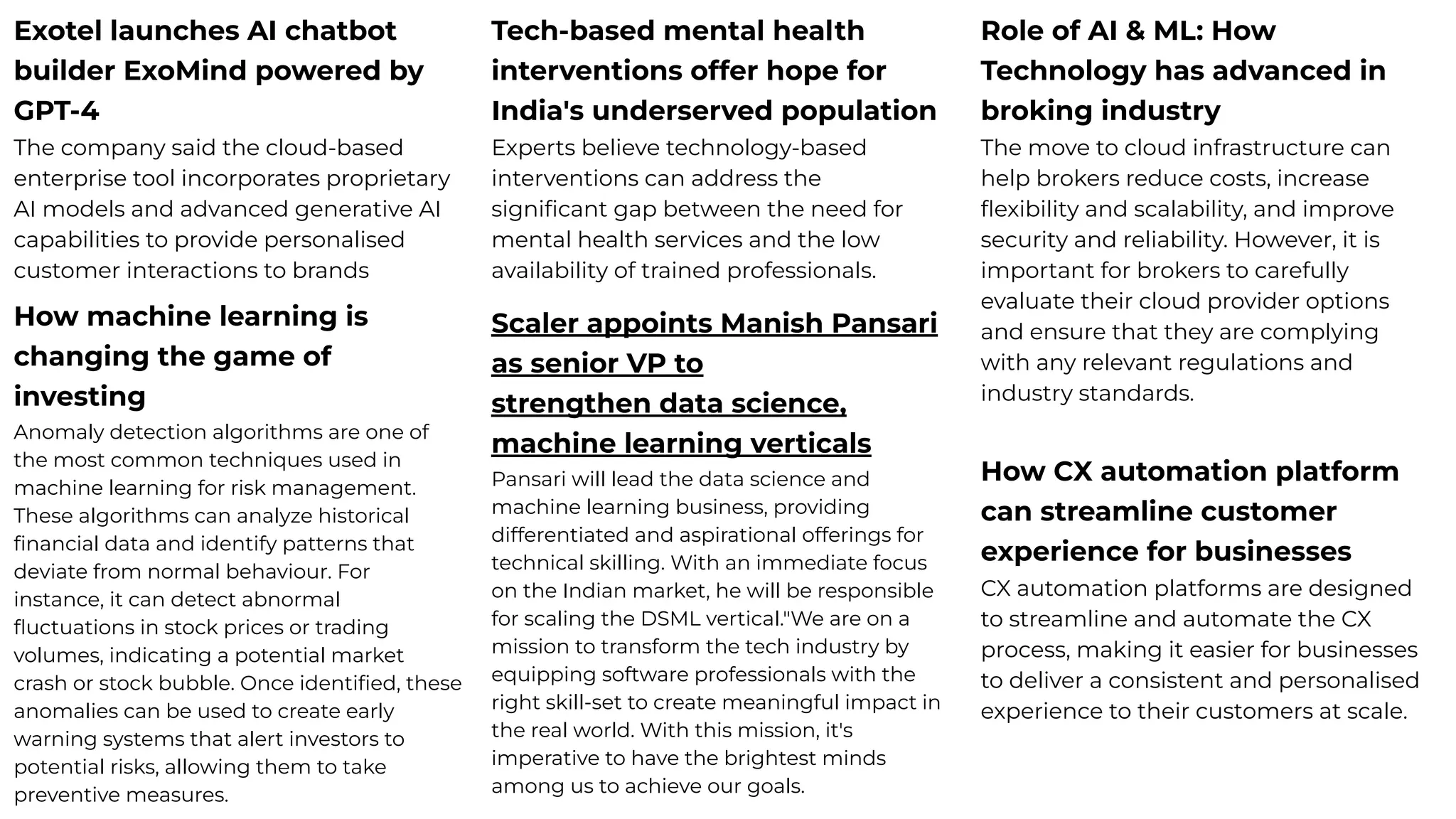
Exotel launches AI chatbot
builder ExoMind powered by
GPT-4
The company said the cloud-based
enterprise tool incorporates proprietary
AI models and advanced generative AI
capabilities to provide personalised
customer interactions to brands
Tech-based mental health
interventions offer hope for
India's underserved population
Experts believe technology-based
interventions can address the
significant gap between the need for
mental health services and the low
availability of trained professionals.
Role of AI & ML: How
Technology has advanced in
broking industry
The move to cloud infrastructure can
help brokers reduce costs, increase
flexibility and scalability, and improve
security and reliability. However, it is
important for brokers to carefully
evaluate their cloud provider options
and ensure that they are complying
with any relevant regulations and
industry standards.
How CX automation platform
can streamline customer
experience for businesses
CX automation platforms are designed
to streamline and automate the CX
process, making it easier for businesses
to deliver a consistent and personalised
experience to their customers at scale.
How machine learning is
changing the game of
investing
Anomaly detection algorithms are one of
the most common techniques used in
machine learning for risk management.
These algorithms can analyze historical
financial data and identify patterns that
deviate from normal behaviour. For
instance, it can detect abnormal
fluctuations in stock prices or trading
volumes, indicating a potential market
crash or stock bubble. Once identified, these
anomalies can be used to create early
warning systems that alert investors to
potential risks, allowing them to take
preventive measures.
Scaler appoints Manish Pansari
as senior VP to
strengthen data science,
machine learning verticals
Pansari will lead the data science and
machine learning business, providing
differentiated and aspirational offerings for
technical skilling. With an immediate focus
on the Indian market, he will be responsible
for scaling the DSML vertical."We are on a
mission to transform the tech industry by
equipping software professionals with the
right skill-set to create meaningful impact in
the real world. With this mission, it's
imperative to have the brightest minds
among us to achieve our goals.
BIBLIOGRAPHY
https://economictimes.indiatimes.com/topic/machine-learning
https://www.geeksforgeeks.org/machine-learning/
http://infolab.stanford.edu/pub/voy/museum/samuel.html
https://www.w3schools.com/python/python_ml_data_distribution.asp
Untitled presentation.pdf

Untitled presentation.pdf

  • 1.
    MACHINE LEARNING USINGPYTHON & R, WHY PYTHON IS PREFERABLE OVER R ? Group activity by- Suhani, Apoorva, Daksh, Ayush, Sompriya (CSE-B, Group-9)
  • 2.
    OVERVIEW : 1. ACKNOWLEDGEMENT 2.BIOGRAPHY 3. WHAT IS MACHINE LEARNING ? 4. TYPES & CLASSIFICATION 5. MACHINE LEARNING USING PYTHON 6. MACHINE LEARNING USING R 7. WHY PYTHON IS MORE PREFERABLE THAN R ? 8. BUSINESS NEWS 9. QUIZ 10. BIBLIOGRAPHY
  • 3.
    ACKNOWLEDGMENT We would liketo thank all of the people who helped us with this project, without their support and guidance it wouldn’t have been possible. We appreciate Ms. Astha Goyal (CSE-B proctor) for her guidance and supervision. Our parents as well as friends were constantly encouraging us throughout the process when we felt discouraged or became frustrated because they knew how much work went into this venture so that is why we want to extend them thanks too!
  • 4.
    ARTHUR SAMUEL, THECREATOR OF ML (BIOGRAPHY)
  • 5.
    Arthur Lee Samuelis credited with one of the first software hash tables, and influencing early research in using transistors for computers at IBM. He initiated the ILLIAC project at the University of Illinois which was dedicated to a series of supercomputers. Samuel worked on a program to play the game of checkers electronically. After his work for Bell Laboratories since 1928, mostly on vacuum tubes, including improvements of Radar during World War II, the distinguished electrical engineer Arthur Lee Samuel (1901-1990), became a professor of electrical engineering at the University of Illinois at Urbana–Champaign, where he initiated the ILLIAC project. ILLIAC (Illinois Automatic Computer) was a series of supercomputers, built at a variety of locations. In 1949, Samuel left the University before its first computer was complete, and joined IBM’s Poughkeepsie Laboratory in New York, where he would conceive and carry out his most successful work. Samuel is credited with one of the first software hash tables, and influencing early research in using transistors for computers at IBM. There he also continued his seminal research on machine learning. In Poughkeepsie, while working on IBM’s first stored program computer, the 701, Samuel found himself talking with one of the chief designers of the computer, about the word size that should be used—32 or 36 bits. Then he started to ask himself which would be better for his checkers playing program and, to find out, he started to write it again but using the instruction set of the unfinished 701. Later Samuel realized that teaching computers to play games is very fruitful for developing tactics appropriate to general problems—I became so intrigued with this general problem of writing a program that would appear to exhibit intelligence that it was to occupy my thoughts during almost every free moment for the entire duration of my employment by IBM and indeed for some years beyond. The main driver of the machine was a search tree of the board positions reachable from the current state.
  • 6.
    Samuel was thefirst person to do any serious programming on the 701 and as such had no system utilities to call on. In particular he had no assembler and had to write everything using the op codes and addresses. As he had only a very limited amount of available computer memory, he implemented what is now called alpha-beta pruning. Instead of searching each path until it came to the game’s conclusion, Samuel developed a scoring function based on the position of the board at any given time, which tried to measure the chance of winning for each side at the given position. The program chose its move based on a minimax strategy, meaning it made the move that optimized the value of this function, assuming that the opponent was trying to optimize the value of the same function from its point of view. Possessing great creativity and essentially working alone, doing his own programming, Arthur Samuel also designed various mechanisms by which his program could improve its skills. In what he called rote learning (or generalization learning), the program remembered every position it had already seen, along with the terminal value of the reward function. This technique effectively extended the search depth at each of these positions. He also used underlying techniques as mutable evaluation functions, hill climbing, and signature tables. Eventually the 701 was built and it incorporated some changes to the instruction set suggested by Samuel as the result of his work on checkers. Being the first really large non-numerical program it influenced the instruction set of all subsequent IBM machines. As Samuel was frightened that the machine might never be completed or that it might be radically changed, he wrote the checkers program as a set of small self-contained modules loaded by a central module—a sort of primitive operating system. He got it all to run on the first experimental model of the 701. Later programs reevaluated the reward function based on input from professional gamers. Samuel also had it play thousands of games against itself as another way of learning. With all of this work, his program reached a respectable amateur status, and was the first to play any board game at this high a level. After his retirement from IBM in 1966,
  • 7.
    Samuel continued towork on checkers until the mid-1970s, at which point his program achieved sufficient skill to challenge a respectable amateur. Samuel completed his first checker program on the IBM 701, and when it was about to be demonstrated, Thomas J. Watson, Sr., the founder and president of IBM, remarked that the demonstration would raise the price of IBM stock by 15 points. It really did. Samuel was eventually put in charge of a pure research effort after persuading the Watsons that IBM needed to do pure research and not just product development.
  • 10.
    INTRODUCTION TO DATAIN ML Data is a crucial component in the field of Machine Learning. It refers to the set of observations or measurements that can be used to train a machine-learning model. Data is typically divided into two types: 1. Labeled data 2. Unlabeled data
  • 29.
    BEST PYTHON LIBRARIESFOR ML ● Numpy ● Scipy ● Scikit-learn ● Theano ● TensorFlow ● Keras ● PyTorch ● Pandas ● Matplotlib
  • 30.
    BEST R PACKAGESFOR ML ● lattice ● DataExplorer ● Dalex(Descriptive Machine Learning Explanations) ● dplyr ● Esquisse ● caret ● janitor ● rpart:
  • 31.
    WHY PYTHON ISMORE PREFERABLE THAN R FOR ML ?
  • 33.
    Humans-AI, Bhai-Bhai Education andtraining institutes are increasing their resources and courses to teach artificial intelligence (AI) and machine learning (ML). Tech companies aim to include chatbots in their products that are trained on large language models, and governments are allocating resources for certifying AI training. However, AI's performance in open-ended environments is still questionable UP RERA to use artificial intelligence, machine learning for faster disposal of cases The pandemic has led to a surge in digitization of the e-Courts system with creation of virtual courts, and adoption of online dispute resolution mechanisms. Meta Platforms scoops up AI networking chip team from Graphcore The move brings additional muscle to the social media giant's bid to improve how its data centers handle AI work, as it races to cope with demand for AI-oriented infrastructure from teams across the company looking to build new features Upskilling is crucial to future-proofing jobs in the IT sector: Survey With technology innovations rising at an unprecedented rate, upskilling has become necessary for professionals across sectors. After the pandemic, the IT sector has been instrumental in growing various technologies in India. Reskilling over 50% of the global workforce will be needed by 2030, with newer job roles emerging. Emeritus, an online education platform, partnered with leading universities and experts across the world to provide upskilling programs. Indian job market to see 22 pc churn in 5 yrs; AI, machine learning among top roles: WEF The global job market churn rate stands at 23%, with 69 million jobs likely to be created and 83 million eliminated by 2027, as per the latest Future of Jobs report by the World Economic Forum (WEF). AI and machine learning specialists, data analysts, and scientists are expected to hold the top roles for industry transformation in India. Macro-trends driving job growth include green transition, ESG standards and localisation of supply chains. Telecom regulator to recommend AI, ML software features to curb pesky SMSes "We will soon inform telecom operators to use AI, ML software to curb Unsolicited Commercial Communication (UCC) with certain characteristics that should include activity log. Trai will audit, and no data or information can be downloaded," a top Trai official told ET Telecom
  • 34.
    Exotel launches AIchatbot builder ExoMind powered by GPT-4 The company said the cloud-based enterprise tool incorporates proprietary AI models and advanced generative AI capabilities to provide personalised customer interactions to brands Tech-based mental health interventions offer hope for India's underserved population Experts believe technology-based interventions can address the significant gap between the need for mental health services and the low availability of trained professionals. Role of AI & ML: How Technology has advanced in broking industry The move to cloud infrastructure can help brokers reduce costs, increase flexibility and scalability, and improve security and reliability. However, it is important for brokers to carefully evaluate their cloud provider options and ensure that they are complying with any relevant regulations and industry standards. How CX automation platform can streamline customer experience for businesses CX automation platforms are designed to streamline and automate the CX process, making it easier for businesses to deliver a consistent and personalised experience to their customers at scale. How machine learning is changing the game of investing Anomaly detection algorithms are one of the most common techniques used in machine learning for risk management. These algorithms can analyze historical financial data and identify patterns that deviate from normal behaviour. For instance, it can detect abnormal fluctuations in stock prices or trading volumes, indicating a potential market crash or stock bubble. Once identified, these anomalies can be used to create early warning systems that alert investors to potential risks, allowing them to take preventive measures. Scaler appoints Manish Pansari as senior VP to strengthen data science, machine learning verticals Pansari will lead the data science and machine learning business, providing differentiated and aspirational offerings for technical skilling. With an immediate focus on the Indian market, he will be responsible for scaling the DSML vertical."We are on a mission to transform the tech industry by equipping software professionals with the right skill-set to create meaningful impact in the real world. With this mission, it's imperative to have the brightest minds among us to achieve our goals.
  • 35.