Machine Learning
Machine Learning is a sub branch of
artificial Intelligence in which the computer
is programmed to behave like human.
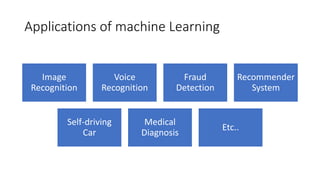
Applications of machine Learning
Image
Recognition
Voice
Recognition
Fraud
Detection
Recommender
System
Self-driving
Car
Medical
Diagnosis
Etc..
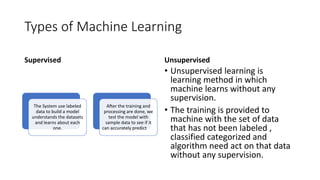
Types of Machine Learning
Supervised
The System use labeled
data to build a model
understands the datasets
and learns about each
one.
After the training and
processing are done, we
test the model with
sample data to see if it
can accurately predict
Unsupervised
• Unsupervised learning is
learning method in which
machine learns without any
supervision.
• The training is provided to
machine with the set of data
that has not been labeled ,
classified categorized and
algorithm need act on that data
without any supervision.
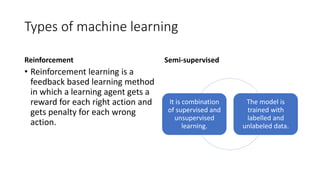
Types of machine learning
Reinforcement
• Reinforcement learning is a
feedback based learning method
in which a learning agent gets a
reward for each right action and
gets penalty for each wrong
action.
Semi-supervised
It is combination
of supervised and
unsupervised
learning.
The model is
trained with
labelled and
unlabeled data.
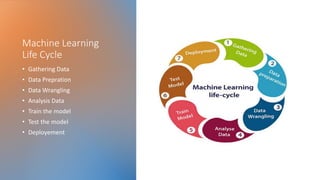
Machine Learning
Life Cycle
• Gathering Data
• Data Prepration
• Data Wrangling
• Analysis Data
• Train the model
• Test the model
• Deployement
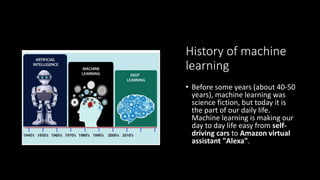
History of machine
learning
• Before some years (about 40-50
years), machine learning was
science fiction, but today it is
the part of our daily life.
Machine learning is making our
day to day life easy from self-
driving cars to Amazon virtual
assistant "Alexa".
The early history of Machine Learning (Pre-1940):
• 1834: In 1834, Charles Babbage, the father of the computer, conceived a
device that could be programmed with punch cards. However, the machine
was never built, but all modern computers rely on its logical structure.
• 1936: In 1936, Alan Turing gave a theory that how a machine can
determine and execute a set of instructions.
• 1940: In 1940, the first manually operated computer, "ENIAC" was
invented, which was the first electronic general-purpose computer. After
that stored program computer such as EDSAC in 1949 and EDVAC in 1951
were invented.
• 1943: In 1943, a human neural network was modeled with an electrical
circuit. In 1950, the scientists started applying their idea to work and
analyzed how human neurons might work.
• 1950: In 1950, Alan Turing published a seminal paper, "Computer
Machinery and Intelligence," on the topic of artificial intelligence. In
his paper, he asked, "Can machines think?"
• 1952: Arthur Samuel, who was the pioneer of machine learning,
created a program that helped an IBM computer to play a checkers
game. It performed better more it played.
• 1959: In 1959, the term "Machine Learning" was first coined
by Arthur Samuel.
• The duration of 1974 to 1980 was the tough time for AI and ML
researchers, and this duration was called as AI winter.
• In this duration, failure of machine translation occurred, and people
had reduced their interest from AI, which led to reduced funding by
the government to the researches.
• 1959: In 1959, the first neural network was applied to a real-world
problem to remove echoes over phone lines using an adaptive filter.
• 1985: In 1985, Terry Sejnowski and Charles Rosenberg invented a
neural network NETtalk, which was able to teach itself how to
correctly pronounce 20,000 words in one week.
• 1997: The IBM's Deep blue intelligent computer won the chess game
against the chess expert Garry Kasparov, and it became the first
computer which had beaten a human chess expert.
• Geoffrey Hinton and his group presented the idea of profound getting
the hang of utilizing profound conviction organizations.
• The Elastic Compute Cloud (EC2) was launched by Amazon to provide
scalable computing resources that made it easier to create and
implement machine learning models.

Introduction to Machine Learning.pptx

  • 1.
    Machine Learning Machine Learningis a sub branch of artificial Intelligence in which the computer is programmed to behave like human.
  • 2.
    Applications of machineLearning Image Recognition Voice Recognition Fraud Detection Recommender System Self-driving Car Medical Diagnosis Etc..
  • 3.
    Types of MachineLearning Supervised The System use labeled data to build a model understands the datasets and learns about each one. After the training and processing are done, we test the model with sample data to see if it can accurately predict Unsupervised • Unsupervised learning is learning method in which machine learns without any supervision. • The training is provided to machine with the set of data that has not been labeled , classified categorized and algorithm need act on that data without any supervision.
  • 4.
    Types of machinelearning Reinforcement • Reinforcement learning is a feedback based learning method in which a learning agent gets a reward for each right action and gets penalty for each wrong action. Semi-supervised It is combination of supervised and unsupervised learning. The model is trained with labelled and unlabeled data.
  • 5.
    Machine Learning Life Cycle •Gathering Data • Data Prepration • Data Wrangling • Analysis Data • Train the model • Test the model • Deployement
  • 6.
    History of machine learning •Before some years (about 40-50 years), machine learning was science fiction, but today it is the part of our daily life. Machine learning is making our day to day life easy from self- driving cars to Amazon virtual assistant "Alexa".
  • 7.
    The early historyof Machine Learning (Pre-1940): • 1834: In 1834, Charles Babbage, the father of the computer, conceived a device that could be programmed with punch cards. However, the machine was never built, but all modern computers rely on its logical structure. • 1936: In 1936, Alan Turing gave a theory that how a machine can determine and execute a set of instructions. • 1940: In 1940, the first manually operated computer, "ENIAC" was invented, which was the first electronic general-purpose computer. After that stored program computer such as EDSAC in 1949 and EDVAC in 1951 were invented. • 1943: In 1943, a human neural network was modeled with an electrical circuit. In 1950, the scientists started applying their idea to work and analyzed how human neurons might work.
  • 8.
    • 1950: In1950, Alan Turing published a seminal paper, "Computer Machinery and Intelligence," on the topic of artificial intelligence. In his paper, he asked, "Can machines think?" • 1952: Arthur Samuel, who was the pioneer of machine learning, created a program that helped an IBM computer to play a checkers game. It performed better more it played. • 1959: In 1959, the term "Machine Learning" was first coined by Arthur Samuel. • The duration of 1974 to 1980 was the tough time for AI and ML researchers, and this duration was called as AI winter. • In this duration, failure of machine translation occurred, and people had reduced their interest from AI, which led to reduced funding by the government to the researches.
  • 9.
    • 1959: In1959, the first neural network was applied to a real-world problem to remove echoes over phone lines using an adaptive filter. • 1985: In 1985, Terry Sejnowski and Charles Rosenberg invented a neural network NETtalk, which was able to teach itself how to correctly pronounce 20,000 words in one week. • 1997: The IBM's Deep blue intelligent computer won the chess game against the chess expert Garry Kasparov, and it became the first computer which had beaten a human chess expert. • Geoffrey Hinton and his group presented the idea of profound getting the hang of utilizing profound conviction organizations. • The Elastic Compute Cloud (EC2) was launched by Amazon to provide scalable computing resources that made it easier to create and implement machine learning models.