Identifying object
relationships ,attributes ,
        methods,
Types of relationships
• Association
• Super-sub structure (generalization
  hierarchy)
• Aggregation and part of a structure
Association
• Represents physical or conceptual
  connection between 2 or more objects
• Binary association
  – Line connecting 2 classes
• Ternary and higher order association
  – Diamond connecting to a class symbol by line
• Association name is written above or
  below the name
• Includes name of the role
Cont..
• Identifying association
• Common association pattern
• Eliminating unnecessary association
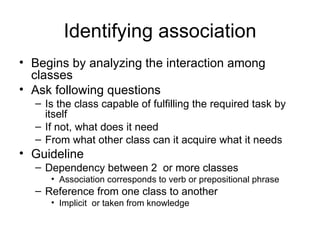
Identifying association
• Begins by analyzing the interaction among
  classes
• Ask following questions
  – Is the class capable of fulfilling the required task by
    itself
  – If not, what does it need
  – From what other class can it acquire what it needs
• Guideline
  – Dependency between 2 or more classes
     • Association corresponds to verb or prepositional phrase
  – Reference from one class to another
     • Implicit or taken from knowledge
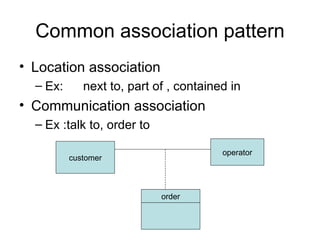
Common association pattern
• Location association
  – Ex:      next to, part of , contained in
• Communication association
  – Ex :talk to, order to

                                        operator
          customer


                            order
Eliminate unnecessary association
• Implementation association
   – Defer implementation specific association to design phase
   – Not concerned about relationship among business objects
• Ternary association
   – Complicate the representation
   – Req
      • Restate ternary association to binary association
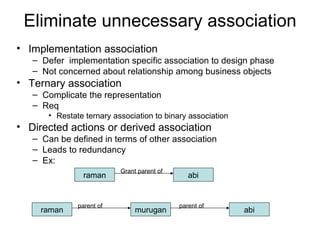
• Directed actions or derived association
   – Can be defined in terms of other association
   – Leads to redundancy
   – Ex:
                          Grant parent of
                raman                          abi


              parent of                     parent of
     raman                     murugan                      abi
Super-sub class relationships
• Generalization hierarchy
• Represents the inheritance relationship bw
  related class
• Parent class
  – Super class
  – Ancestor
Guidelines to identify
Super-sub class relationships (cont..)
 – Top down
    • Look for noun phrases composed of various adjectives in a
      class name
        – Ex: youth member, adult member
 – Bottom up
    • Look for classes with similar attribute and methods
 – Reusability
    • Move attribute and behavior as high as possible in the
      hierarchy
 – Multiple inheritance
    • Avoid excessive use of multiple inheritance. Leads to
      complications
A part of realtionships-aggregation
• Represents a situation where a class
  consists of several component classes
• Properties
  – Transitivity
     • A is part of B , B is part of C, then A is part of C
  – Antisymmetry
     • A is part of B, but B is not part of A
Representation of aggregation
• Container and collection
  – hollow diamond
• Composition
  – Solid diamond
  – Ex:
     • Car and its parts
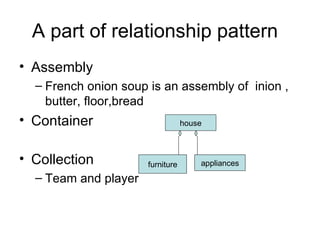
A part of relationship pattern
• Assembly
  – French onion soup is an assembly of inion ,
    butter, floor,bread
• Container                       house


• Collection          furniture       appliances
  – Team and player

Unt 3 attributes, methods, relationships-1

  • 1.
  • 2.
    Types of relationships •Association • Super-sub structure (generalization hierarchy) • Aggregation and part of a structure
  • 3.
    Association • Represents physicalor conceptual connection between 2 or more objects • Binary association – Line connecting 2 classes • Ternary and higher order association – Diamond connecting to a class symbol by line • Association name is written above or below the name • Includes name of the role
  • 4.
    Cont.. • Identifying association •Common association pattern • Eliminating unnecessary association
  • 5.
    Identifying association • Beginsby analyzing the interaction among classes • Ask following questions – Is the class capable of fulfilling the required task by itself – If not, what does it need – From what other class can it acquire what it needs • Guideline – Dependency between 2 or more classes • Association corresponds to verb or prepositional phrase – Reference from one class to another • Implicit or taken from knowledge
  • 6.
    Common association pattern •Location association – Ex: next to, part of , contained in • Communication association – Ex :talk to, order to operator customer order
  • 7.
    Eliminate unnecessary association •Implementation association – Defer implementation specific association to design phase – Not concerned about relationship among business objects • Ternary association – Complicate the representation – Req • Restate ternary association to binary association • Directed actions or derived association – Can be defined in terms of other association – Leads to redundancy – Ex: Grant parent of raman abi parent of parent of raman murugan abi
  • 8.
    Super-sub class relationships •Generalization hierarchy • Represents the inheritance relationship bw related class • Parent class – Super class – Ancestor
  • 9.
    Guidelines to identify Super-subclass relationships (cont..) – Top down • Look for noun phrases composed of various adjectives in a class name – Ex: youth member, adult member – Bottom up • Look for classes with similar attribute and methods – Reusability • Move attribute and behavior as high as possible in the hierarchy – Multiple inheritance • Avoid excessive use of multiple inheritance. Leads to complications
  • 10.
    A part ofrealtionships-aggregation • Represents a situation where a class consists of several component classes • Properties – Transitivity • A is part of B , B is part of C, then A is part of C – Antisymmetry • A is part of B, but B is not part of A
  • 11.
    Representation of aggregation •Container and collection – hollow diamond • Composition – Solid diamond – Ex: • Car and its parts
  • 12.
    A part ofrelationship pattern • Assembly – French onion soup is an assembly of inion , butter, floor,bread • Container house • Collection furniture appliances – Team and player