Object Analysis

   classification
Classification theory
• Process of checking to see if an object
  belongs to a category or a class
Approaches for identifying classes
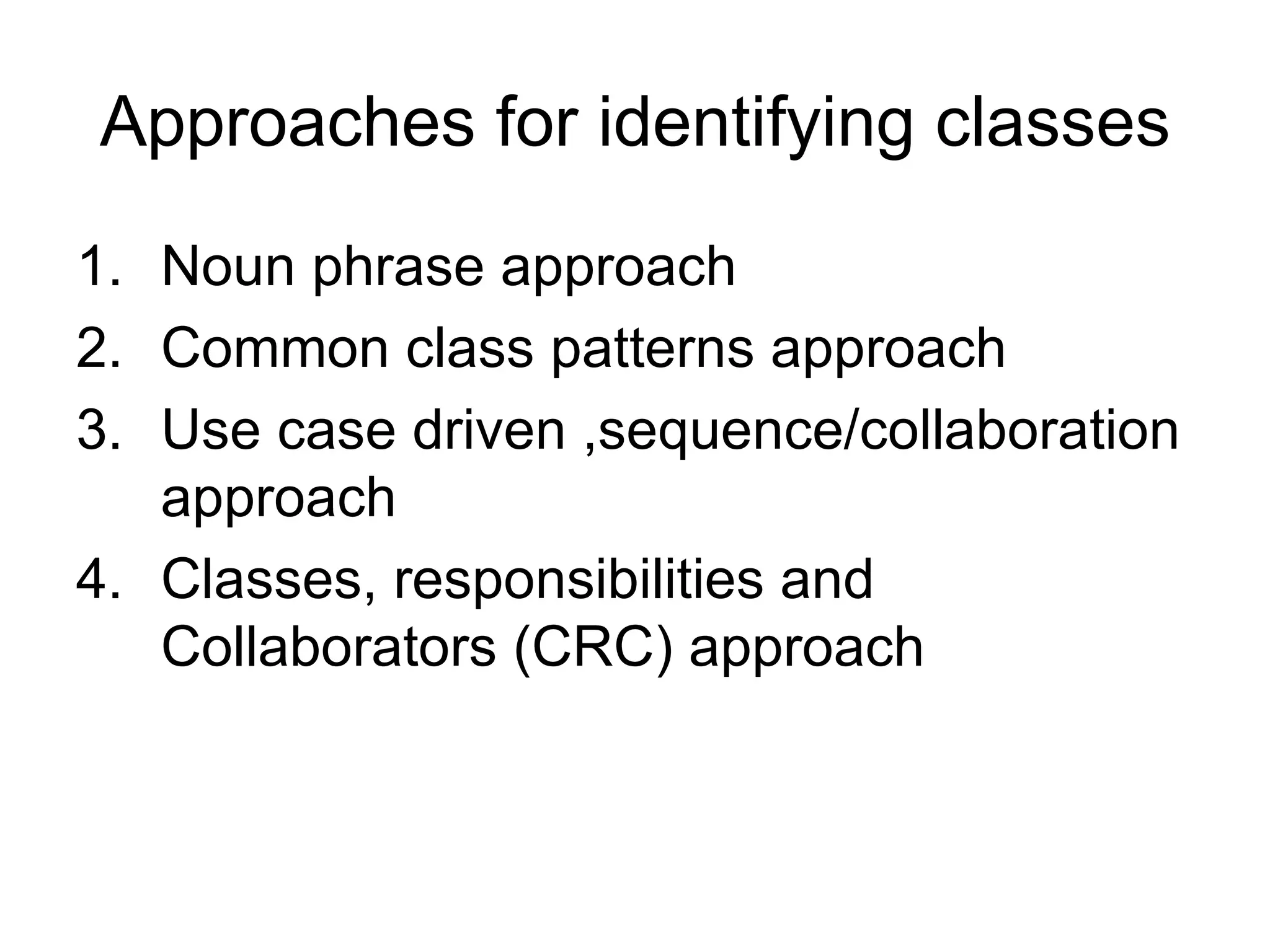
1. Noun phrase approach
2. Common class patterns approach
3. Use case driven ,sequence/collaboration
   approach
4. Classes, responsibilities and
   Collaborators (CRC) approach
Noun phrase approach
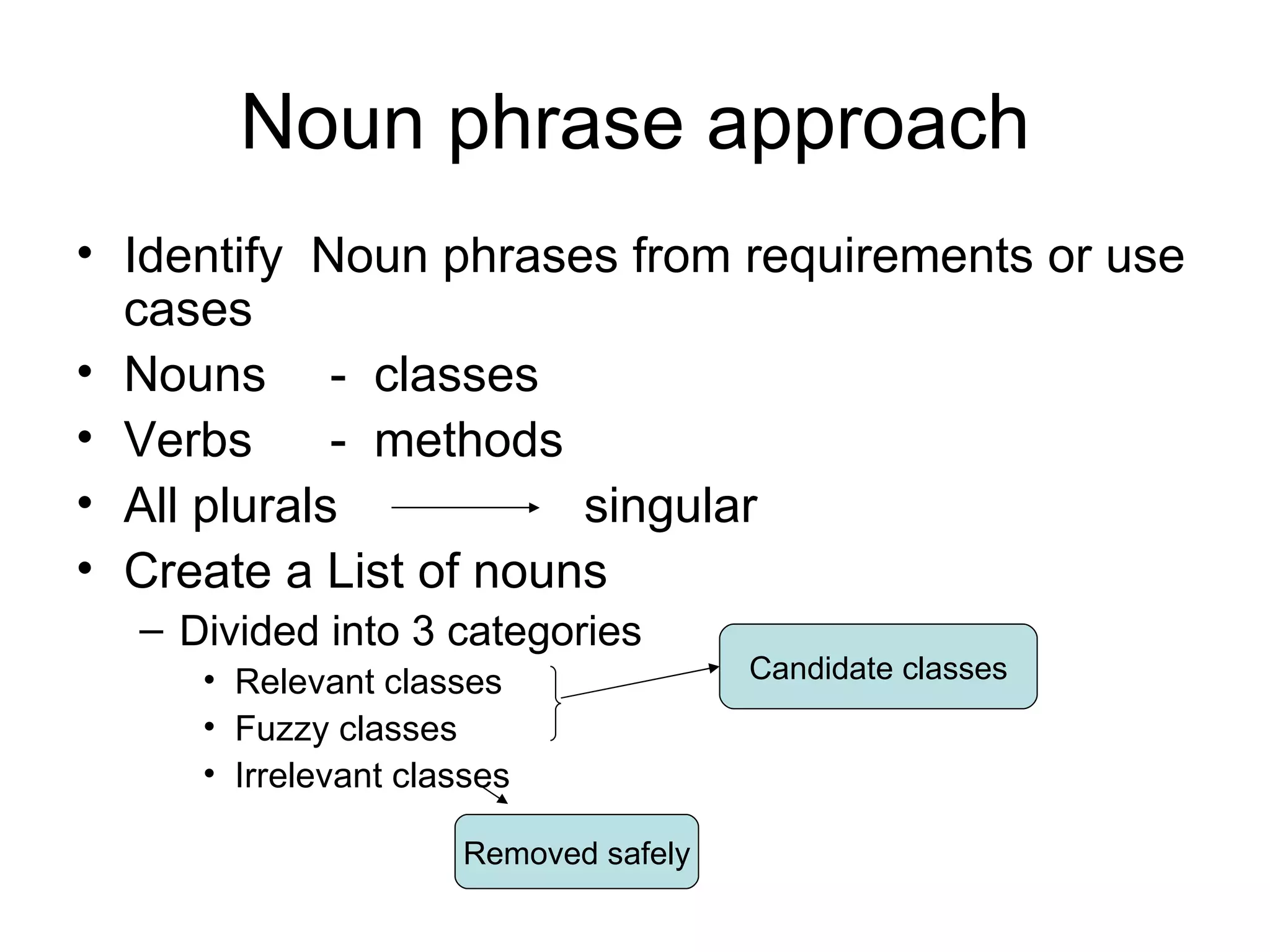
• Identify Noun phrases from requirements or use
  cases
• Nouns - classes
• Verbs      - methods
• All plurals          singular
• Create a List of nouns
  – Divided into 3 categories
     • Relevant classes               Candidate classes
     • Fuzzy classes
     • Irrelevant classes

                     Removed safely
cont…
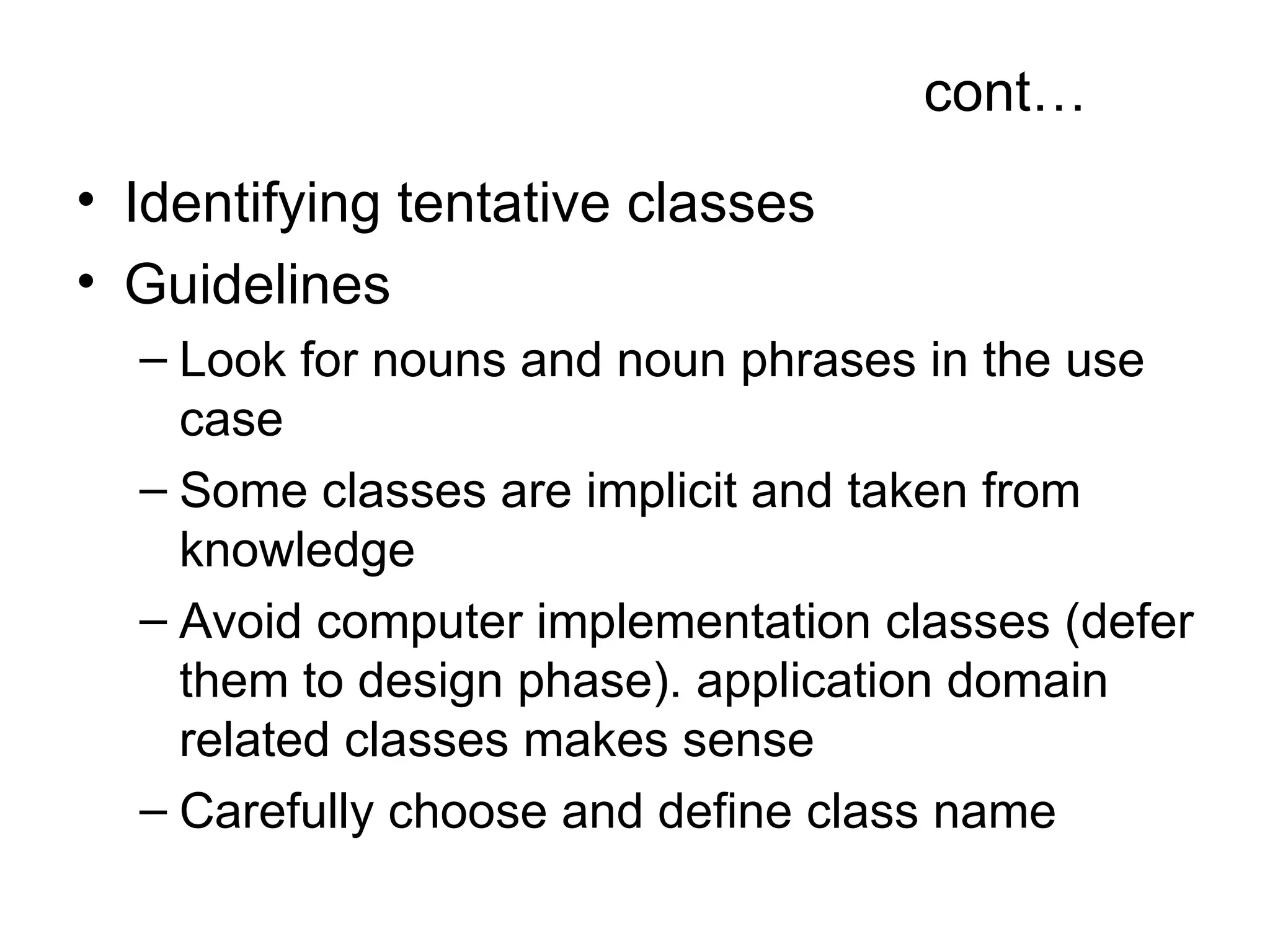
• Identifying tentative classes
• Guidelines
  – Look for nouns and noun phrases in the use
    case
  – Some classes are implicit and taken from
    knowledge
  – Avoid computer implementation classes (defer
    them to design phase). application domain
    related classes makes sense
  – Carefully choose and define class name
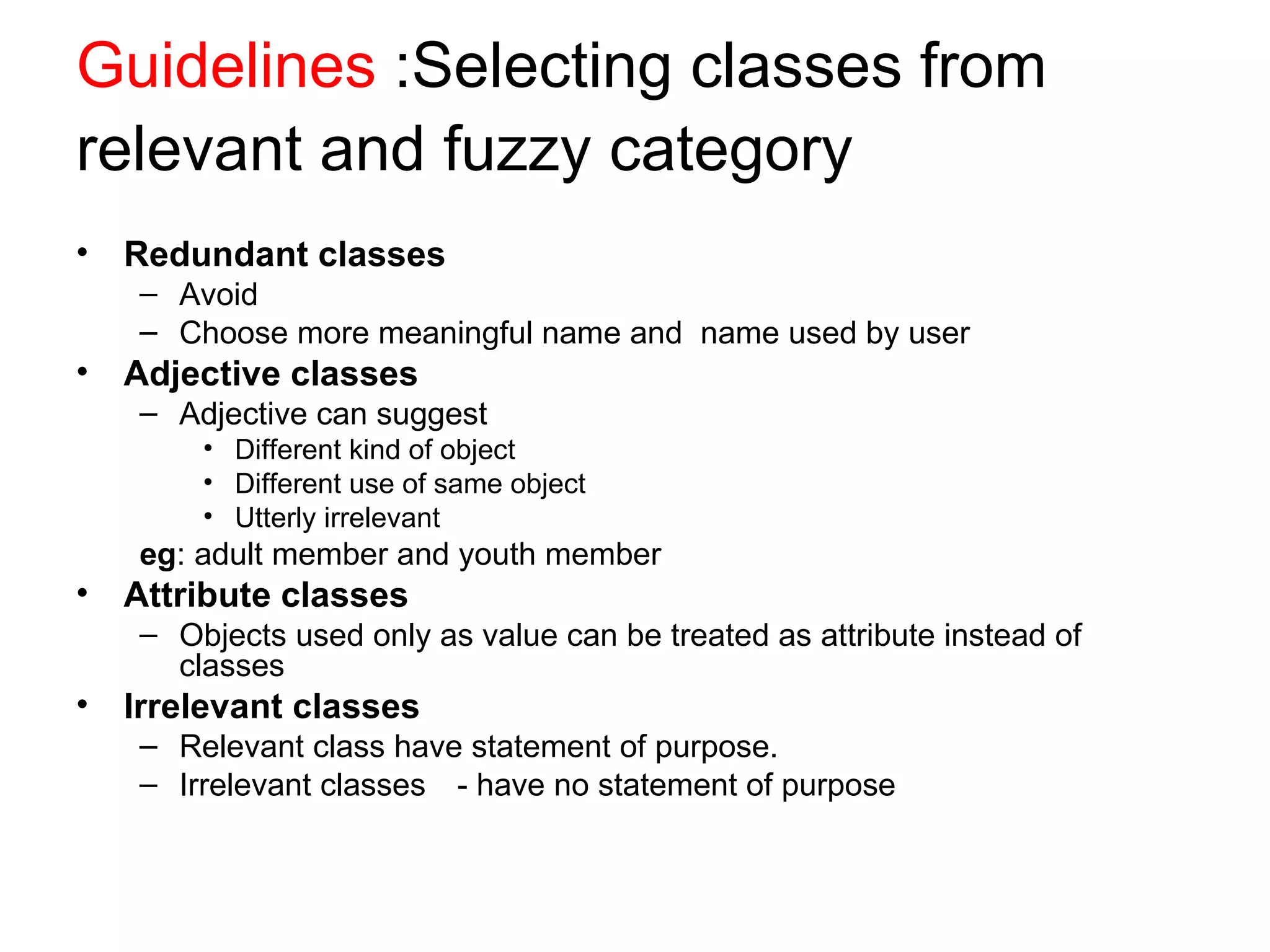
Guidelines :Selecting classes from
relevant and fuzzy category
• Redundant classes
   – Avoid
   – Choose more meaningful name and name used by user
• Adjective classes
   – Adjective can suggest
       • Different kind of object
       • Different use of same object
       • Utterly irrelevant
   eg: adult member and youth member
• Attribute classes
   – Objects used only as value can be treated as attribute instead of
     classes
• Irrelevant classes
   – Relevant class have statement of purpose.
   – Irrelevant classes - have no statement of purpose
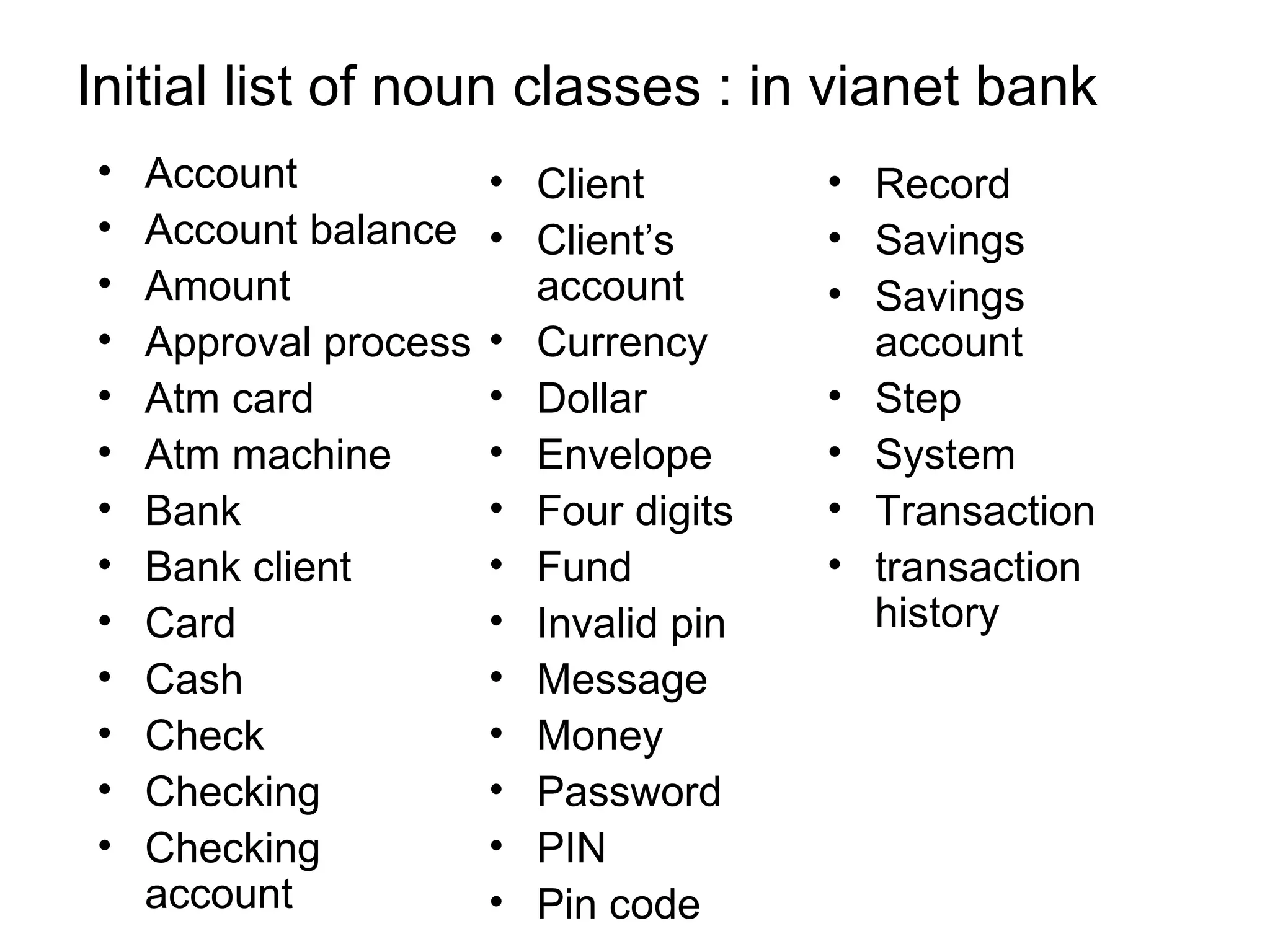
Initial list of noun classes : in vianet bank
•   Account            • Client        • Record
•   Account balance    • Client’s      • Savings
•   Amount               account       • Savings
•   Approval process   • Currency        account
•   Atm card           • Dollar        • Step
•   Atm machine        • Envelope      • System
•   Bank               • Four digits   • Transaction
•   Bank client        • Fund          • transaction
•   Card               • Invalid pin     history
•   Cash               • Message
•   Check              • Money
•   Checking           • Password
•   Checking           • PIN
    account            • Pin code
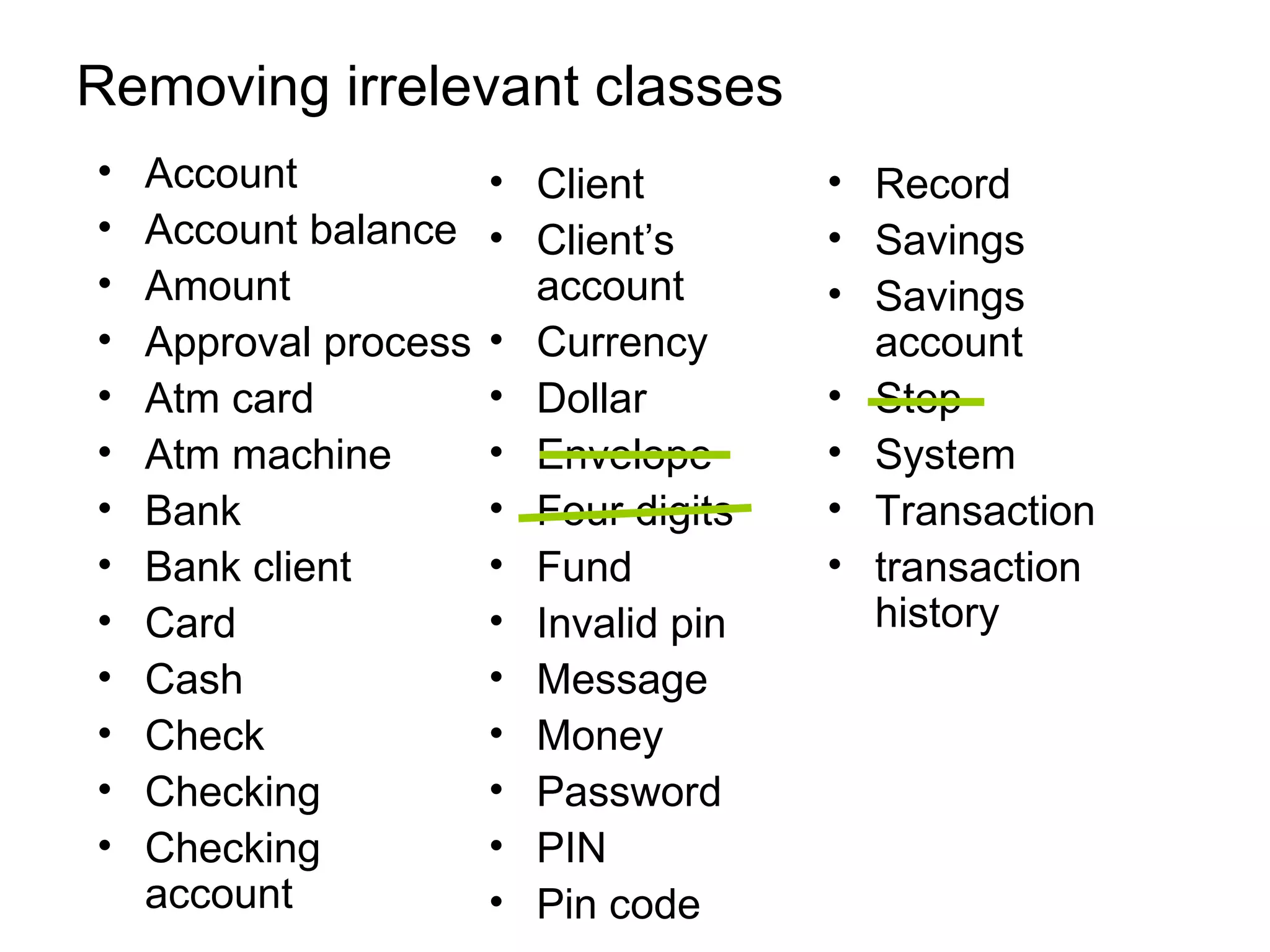
Removing irrelevant classes
•   Account            • Client        • Record
•   Account balance    • Client’s      • Savings
•   Amount               account       • Savings
•   Approval process   • Currency        account
•   Atm card           • Dollar        • Step
•   Atm machine        • Envelope      • System
•   Bank               • Four digits   • Transaction
•   Bank client        • Fund          • transaction
•   Card               • Invalid pin     history
•   Cash               • Message
•   Check              • Money
•   Checking           • Password
•   Checking           • PIN
    account            • Pin code
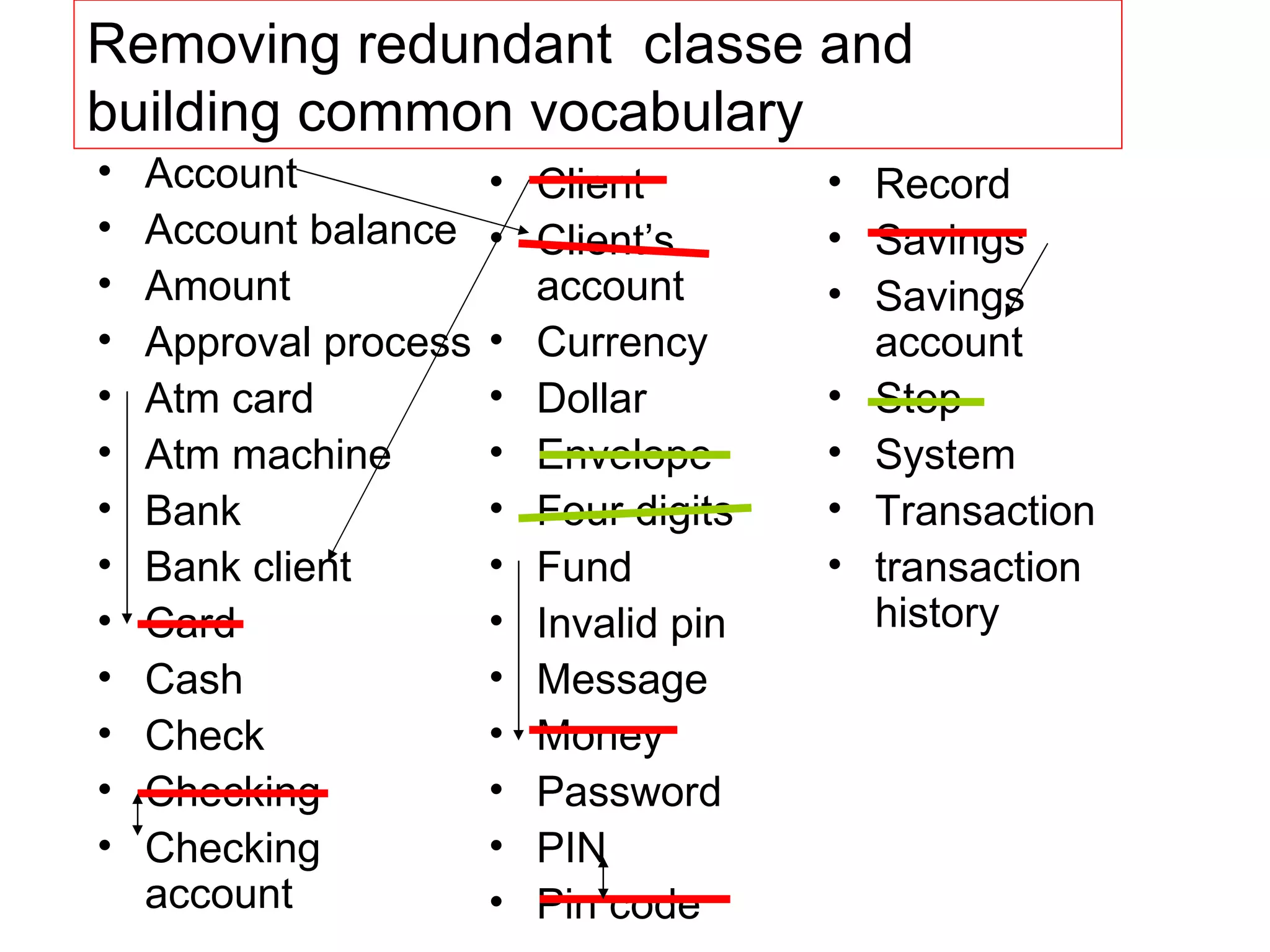
Removing redundant classe and
building common vocabulary
•   Account            • Client        • Record
•   Account balance    • Client’s      • Savings
•   Amount               account       • Savings
•   Approval process   • Currency        account
•   Atm card           • Dollar        • Step
•   Atm machine        • Envelope      • System
•   Bank               • Four digits   • Transaction
•   Bank client        • Fund          • transaction
•   Card               • Invalid pin     history
•   Cash               • Message
•   Check              • Money
•   Checking           • Password
•   Checking           • PIN
    account            • Pin code
Reviewing the classes containing
            adjectives
• When class represented by noun behaves
  differently when adjective is applied to it,
  then separate class has to be created
• In this ex no such classes
Reviewing the possible attributes


• Noun phrases used only as values should
  be treated as attributes
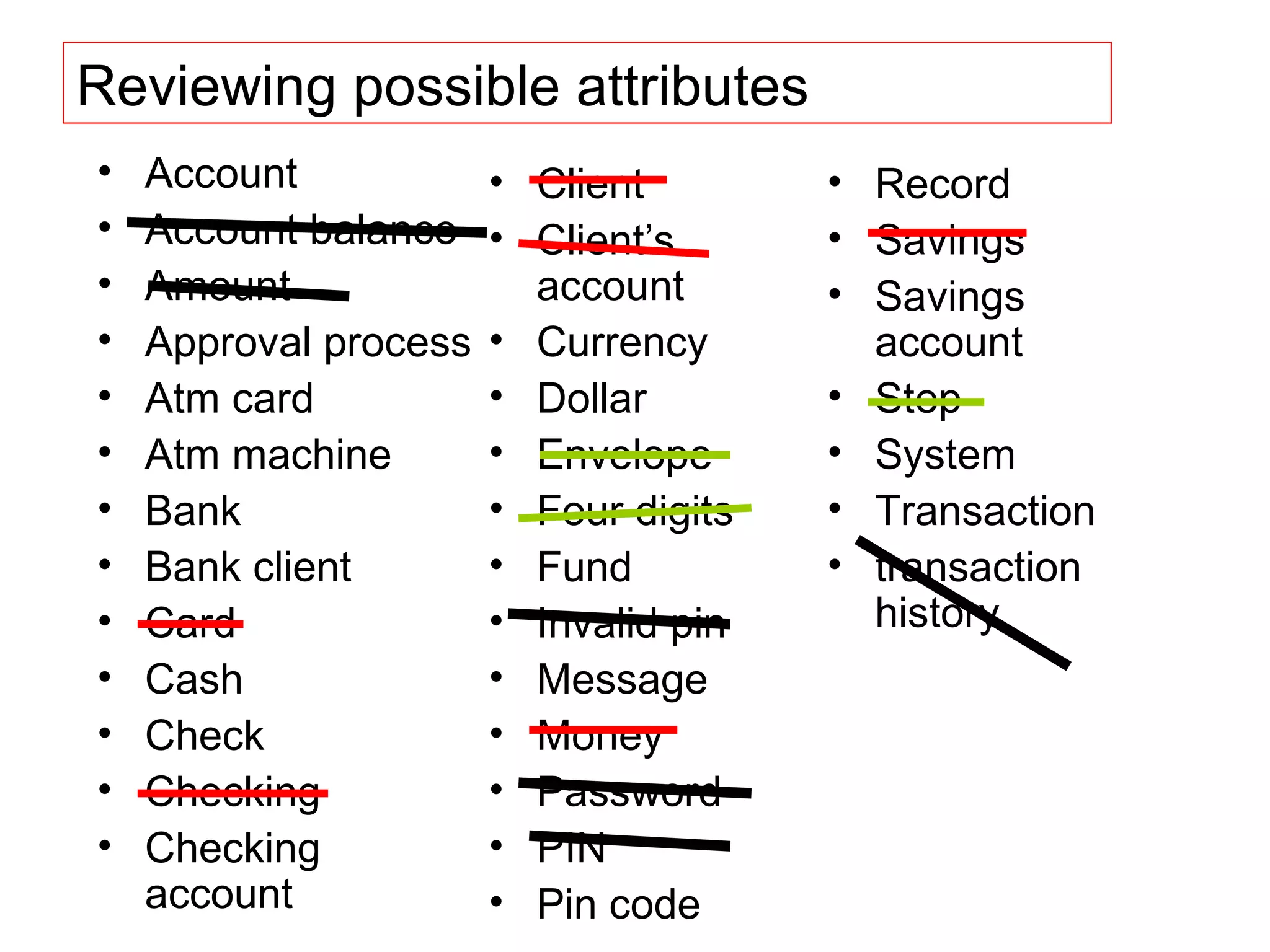
Reviewing possible attributes
•   Account            • Client        • Record
•   Account balance    • Client’s      • Savings
•   Amount               account       • Savings
•   Approval process   • Currency        account
•   Atm card           • Dollar        • Step
•   Atm machine        • Envelope      • System
•   Bank               • Four digits   • Transaction
•   Bank client        • Fund          • transaction
•   Card               • Invalid pin     history
•   Cash               • Message
•   Check              • Money
•   Checking           • Password
•   Checking           • PIN
    account            • Pin code
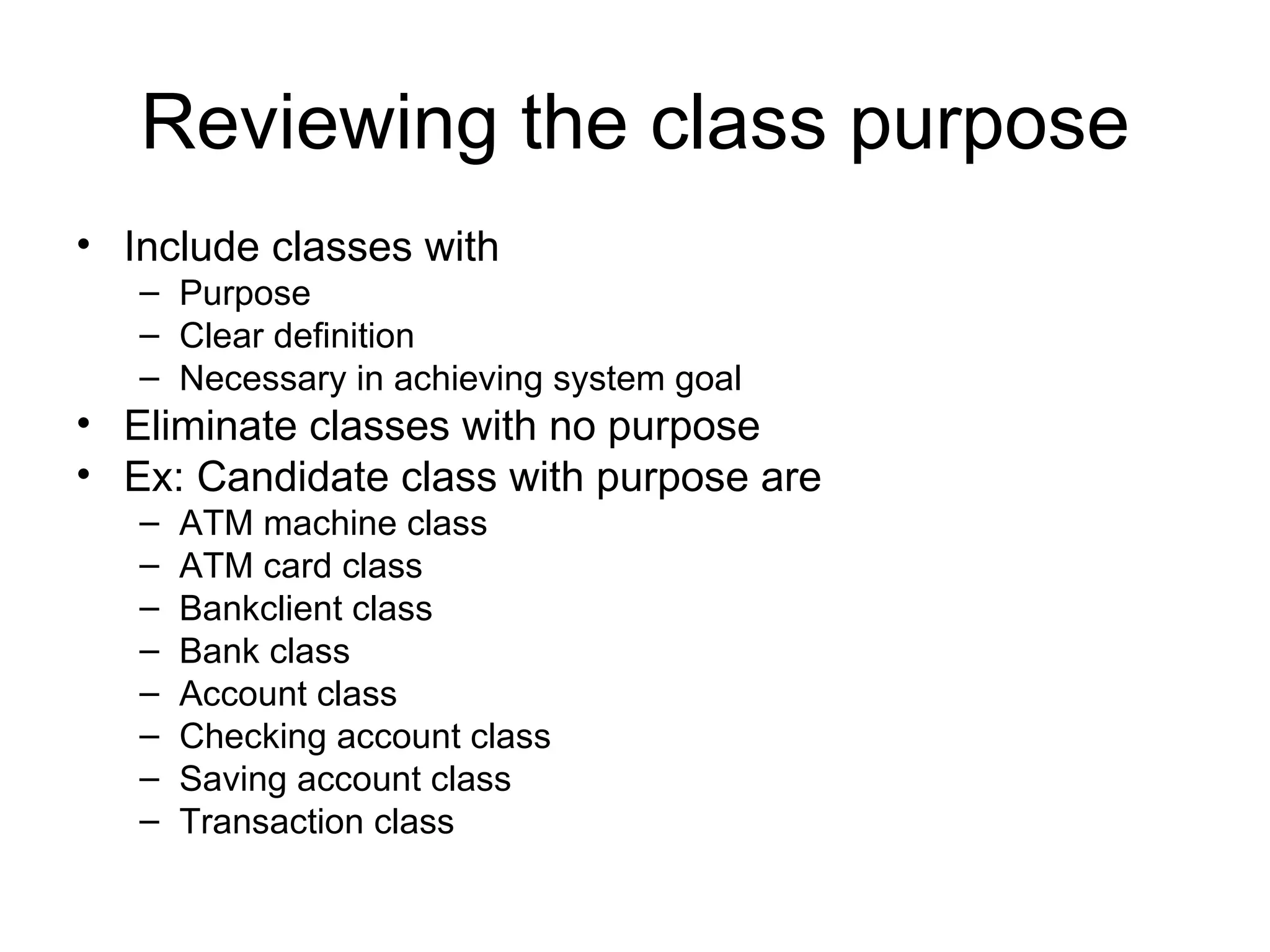
Reviewing the class purpose
• Include classes with
   – Purpose
   – Clear definition
   – Necessary in achieving system goal
• Eliminate classes with no purpose
• Ex: Candidate class with purpose are
   –   ATM machine class
   –   ATM card class
   –   Bankclient class
   –   Bank class
   –   Account class
   –   Checking account class
   –   Saving account class
   –   Transaction class
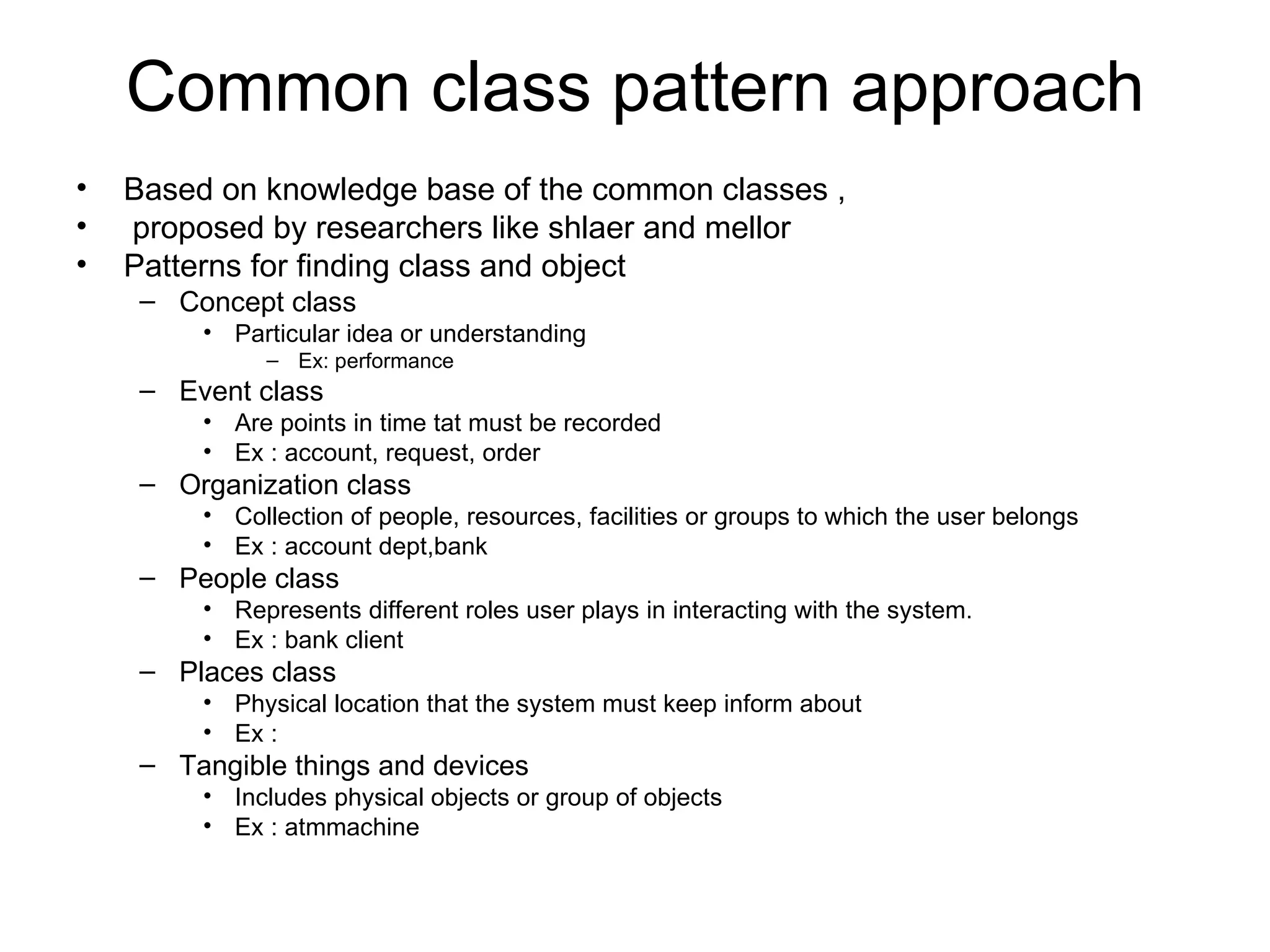
Common class pattern approach
•   Based on knowledge base of the common classes ,
•   proposed by researchers like shlaer and mellor
•   Patterns for finding class and object
     – Concept class
         • Particular idea or understanding
              – Ex: performance
     – Event class
         • Are points in time tat must be recorded
         • Ex : account, request, order
     – Organization class
         • Collection of people, resources, facilities or groups to which the user belongs
         • Ex : account dept,bank
     – People class
         • Represents different roles user plays in interacting with the system.
         • Ex : bank client
     – Places class
         • Physical location that the system must keep inform about
         • Ex :
     – Tangible things and devices
         • Includes physical objects or group of objects
         • Ex : atmmachine
Use case driven approach
• Identifying classes and their usage
  through sequence collaboration modelling
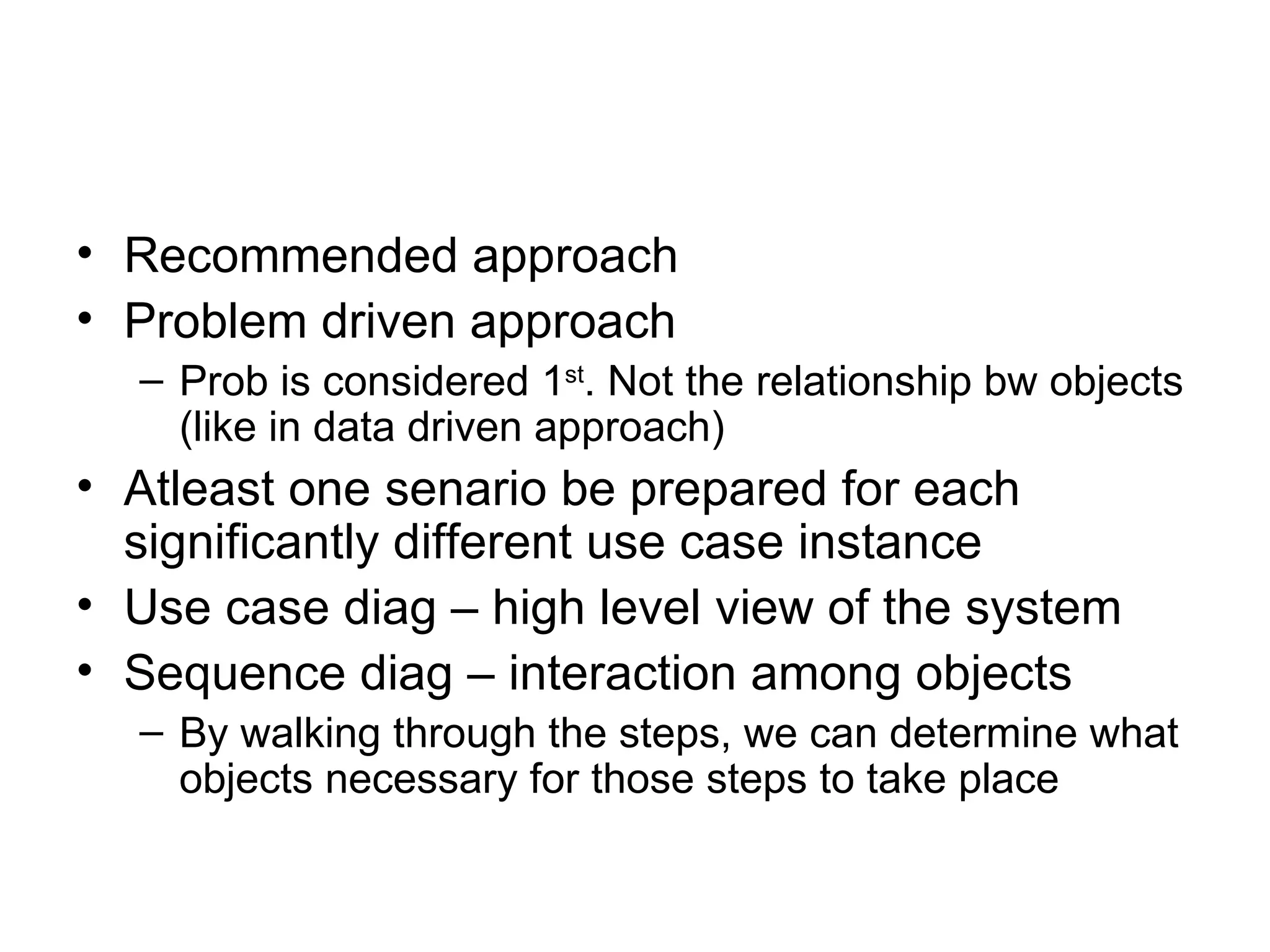
• Recommended approach
• Problem driven approach
  – Prob is considered 1st. Not the relationship bw objects
    (like in data driven approach)
• Atleast one senario be prepared for each
  significantly different use case instance
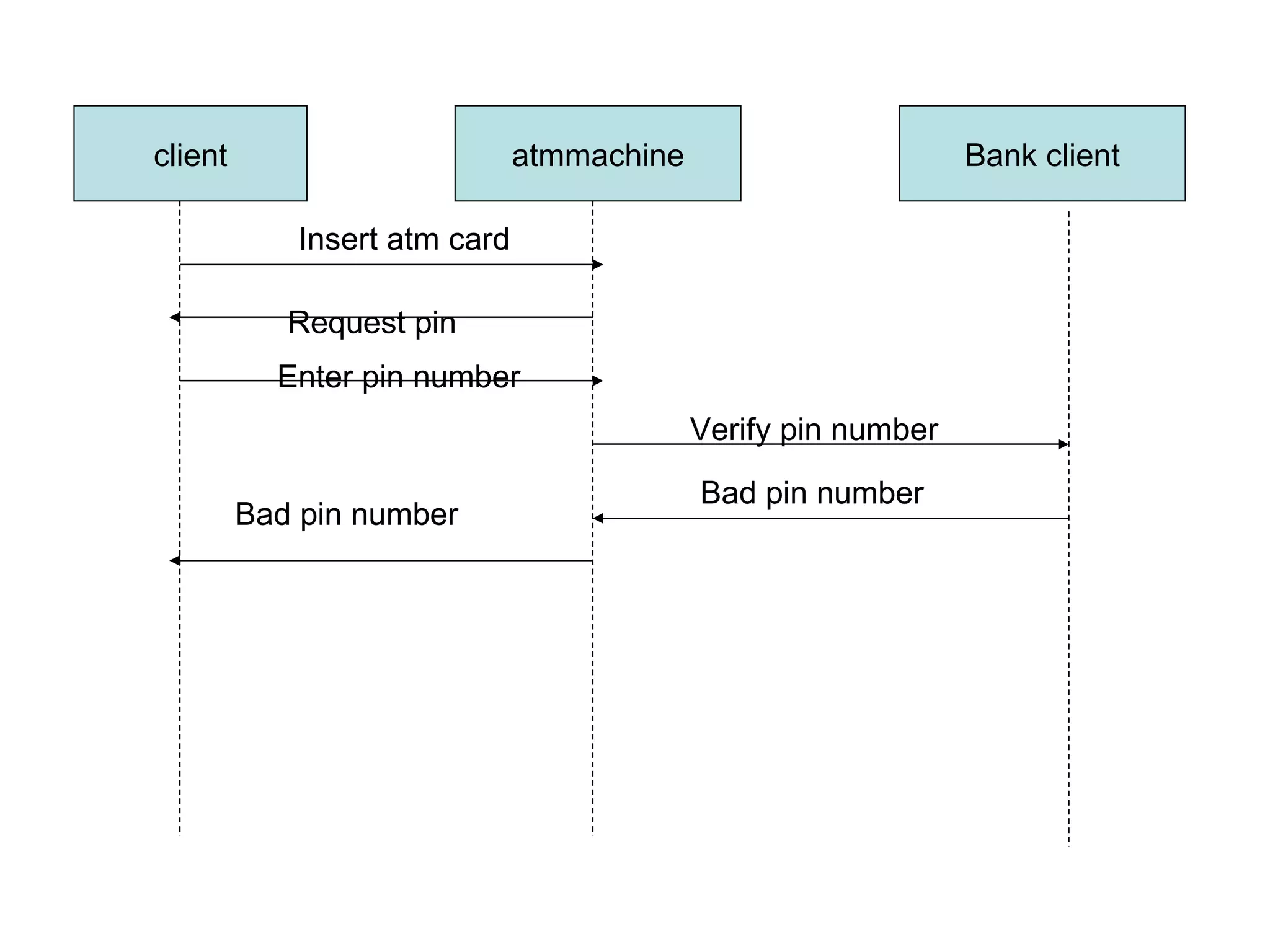
• Use case diag – high level view of the system
• Sequence diag – interaction among objects
  – By walking through the steps, we can determine what
    objects necessary for those steps to take place
client                        atmmachine                       Bank client

            Insert atm card

            Request pin
           Enter pin number
                                           Verify pin number

                                           Bad pin number
         Bad pin number
Classes , Responsibilities, and
           Collaborators
• Classes ,responsibilities, collaborators
   – Leads to identifying its attributes and methods
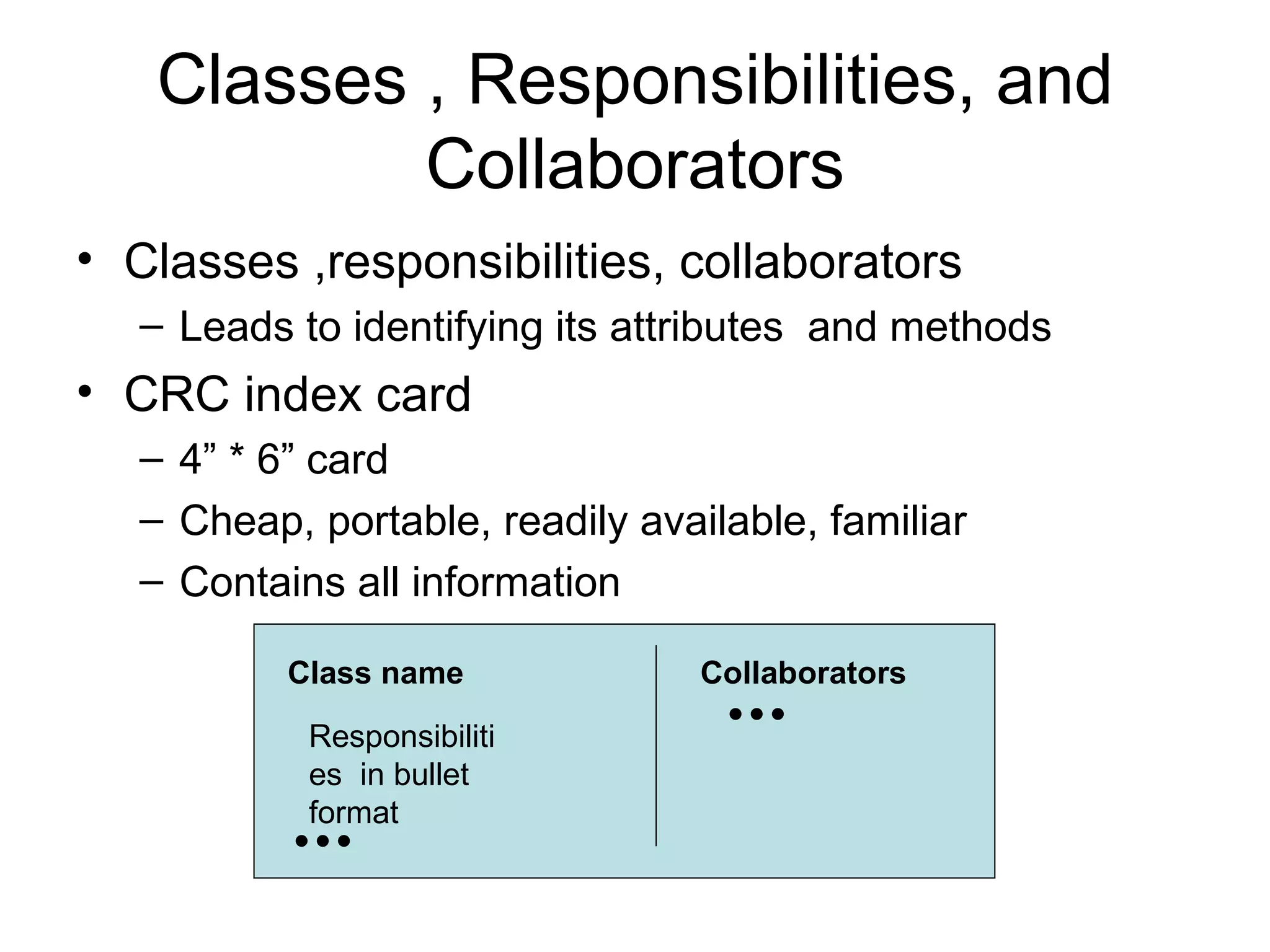
• CRC index card
   – 4” * 6” card
   – Cheap, portable, readily available, familiar
   – Contains all information

           Class name             Collaborators

            Responsibiliti
            es in bullet
            format
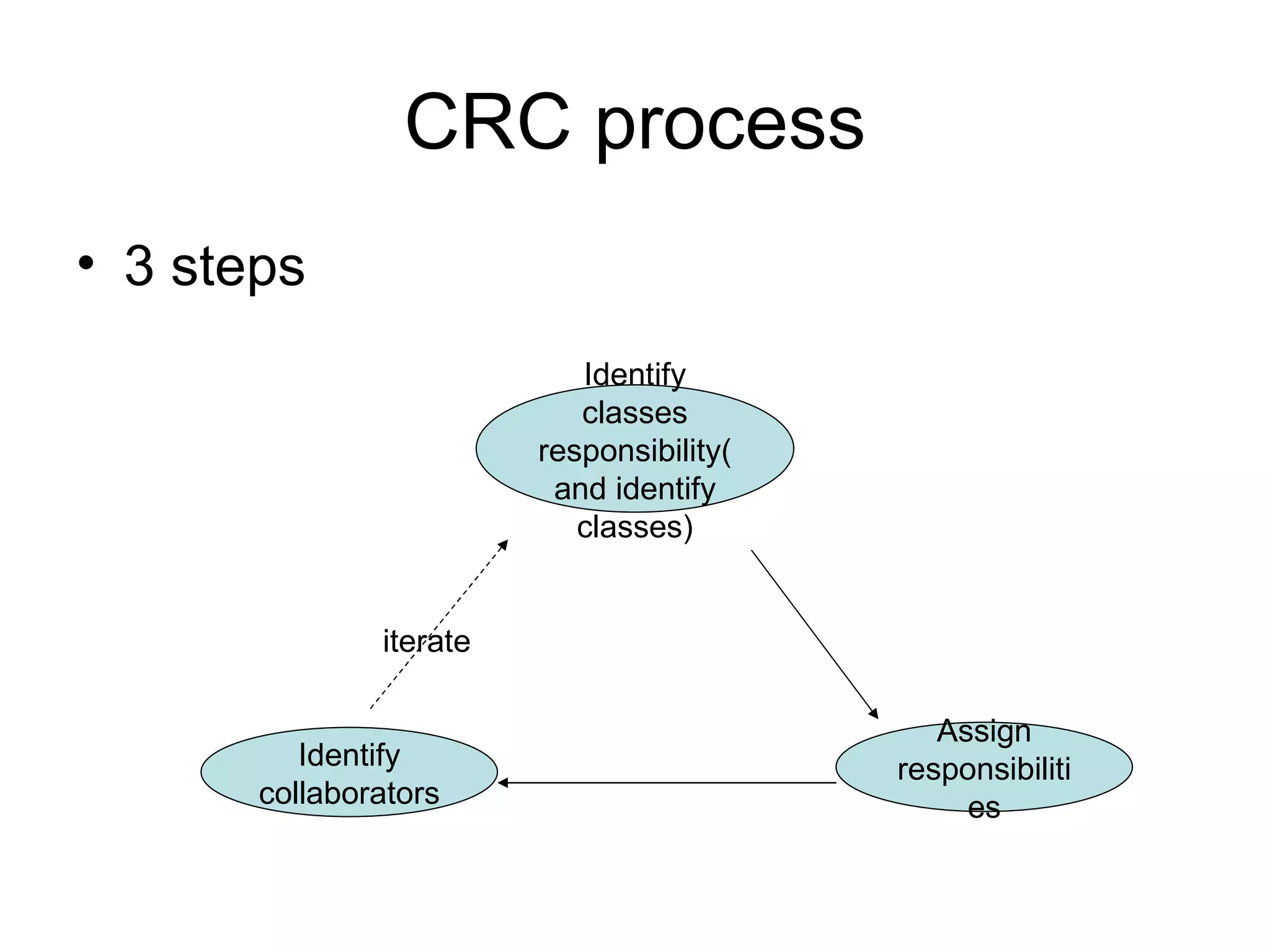
CRC process
• 3 steps
                            Identify
                            classes
                         responsibility(
                          and identify
                            classes)


               iterate

                                              Assign
          Identify                         responsibiliti
       collaborators                            es
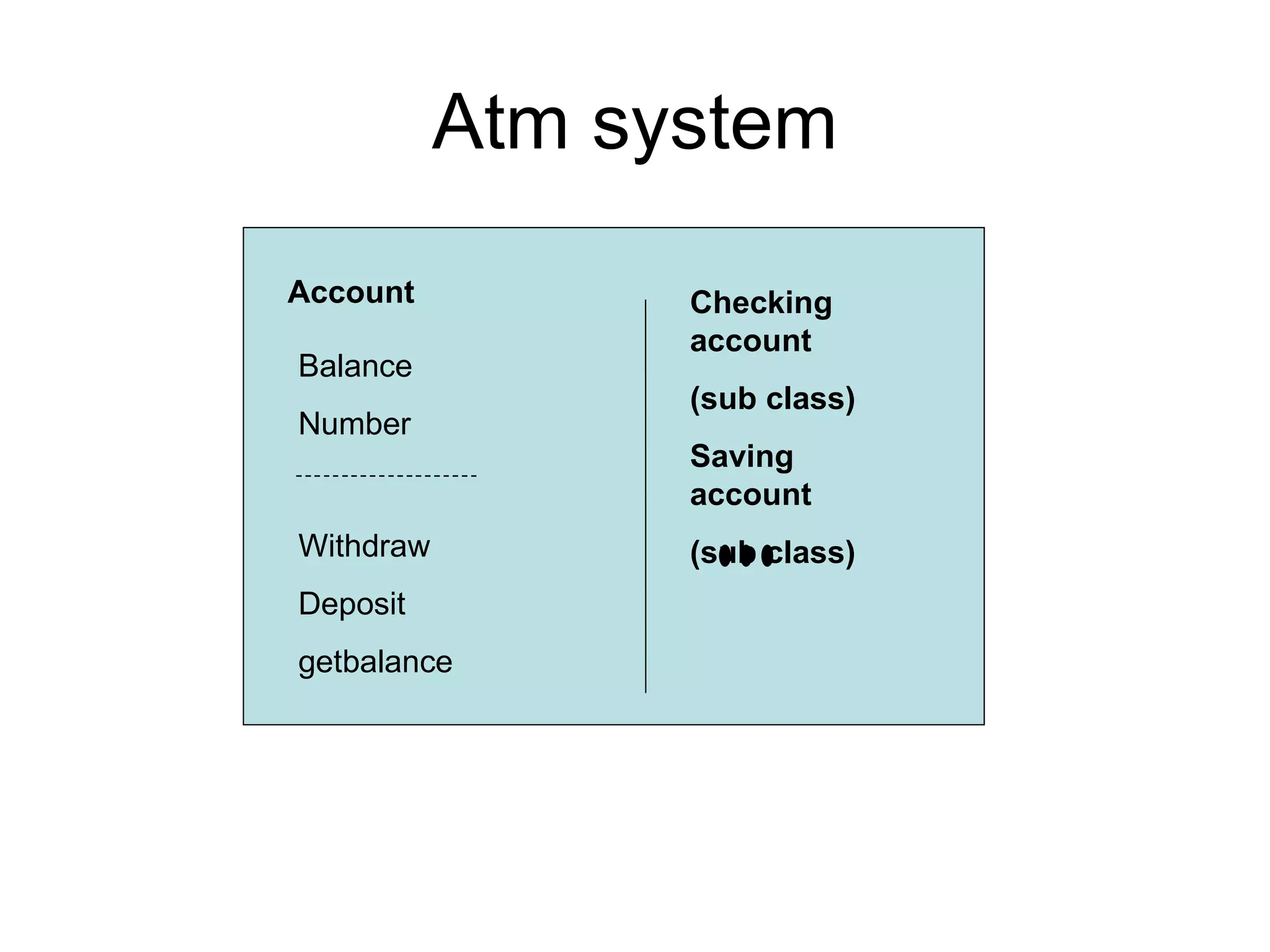
Atm system
Account          Checking
                 account
Balance
                 (sub class)
Number
                 Saving
                 account
Withdraw         (sub class)
Deposit
getbalance
Guidelines: Naming class
•   Singular
•   Use standard vocabulary
•   Reflect its intrinsic feature
•   Readable names

Unit 3 object analysis-classification

  • 1.
    Object Analysis classification
  • 2.
    Classification theory • Processof checking to see if an object belongs to a category or a class
  • 3.
    Approaches for identifyingclasses 1. Noun phrase approach 2. Common class patterns approach 3. Use case driven ,sequence/collaboration approach 4. Classes, responsibilities and Collaborators (CRC) approach
  • 4.
    Noun phrase approach •Identify Noun phrases from requirements or use cases • Nouns - classes • Verbs - methods • All plurals singular • Create a List of nouns – Divided into 3 categories • Relevant classes Candidate classes • Fuzzy classes • Irrelevant classes Removed safely
  • 5.
    cont… • Identifying tentativeclasses • Guidelines – Look for nouns and noun phrases in the use case – Some classes are implicit and taken from knowledge – Avoid computer implementation classes (defer them to design phase). application domain related classes makes sense – Carefully choose and define class name
  • 6.
    Guidelines :Selecting classesfrom relevant and fuzzy category • Redundant classes – Avoid – Choose more meaningful name and name used by user • Adjective classes – Adjective can suggest • Different kind of object • Different use of same object • Utterly irrelevant eg: adult member and youth member • Attribute classes – Objects used only as value can be treated as attribute instead of classes • Irrelevant classes – Relevant class have statement of purpose. – Irrelevant classes - have no statement of purpose
  • 7.
    Initial list ofnoun classes : in vianet bank • Account • Client • Record • Account balance • Client’s • Savings • Amount account • Savings • Approval process • Currency account • Atm card • Dollar • Step • Atm machine • Envelope • System • Bank • Four digits • Transaction • Bank client • Fund • transaction • Card • Invalid pin history • Cash • Message • Check • Money • Checking • Password • Checking • PIN account • Pin code
  • 8.
    Removing irrelevant classes • Account • Client • Record • Account balance • Client’s • Savings • Amount account • Savings • Approval process • Currency account • Atm card • Dollar • Step • Atm machine • Envelope • System • Bank • Four digits • Transaction • Bank client • Fund • transaction • Card • Invalid pin history • Cash • Message • Check • Money • Checking • Password • Checking • PIN account • Pin code
  • 9.
    Removing redundant classeand building common vocabulary • Account • Client • Record • Account balance • Client’s • Savings • Amount account • Savings • Approval process • Currency account • Atm card • Dollar • Step • Atm machine • Envelope • System • Bank • Four digits • Transaction • Bank client • Fund • transaction • Card • Invalid pin history • Cash • Message • Check • Money • Checking • Password • Checking • PIN account • Pin code
  • 10.
    Reviewing the classescontaining adjectives • When class represented by noun behaves differently when adjective is applied to it, then separate class has to be created • In this ex no such classes
  • 11.
    Reviewing the possibleattributes • Noun phrases used only as values should be treated as attributes
  • 12.
    Reviewing possible attributes • Account • Client • Record • Account balance • Client’s • Savings • Amount account • Savings • Approval process • Currency account • Atm card • Dollar • Step • Atm machine • Envelope • System • Bank • Four digits • Transaction • Bank client • Fund • transaction • Card • Invalid pin history • Cash • Message • Check • Money • Checking • Password • Checking • PIN account • Pin code
  • 13.
    Reviewing the classpurpose • Include classes with – Purpose – Clear definition – Necessary in achieving system goal • Eliminate classes with no purpose • Ex: Candidate class with purpose are – ATM machine class – ATM card class – Bankclient class – Bank class – Account class – Checking account class – Saving account class – Transaction class
  • 14.
    Common class patternapproach • Based on knowledge base of the common classes , • proposed by researchers like shlaer and mellor • Patterns for finding class and object – Concept class • Particular idea or understanding – Ex: performance – Event class • Are points in time tat must be recorded • Ex : account, request, order – Organization class • Collection of people, resources, facilities or groups to which the user belongs • Ex : account dept,bank – People class • Represents different roles user plays in interacting with the system. • Ex : bank client – Places class • Physical location that the system must keep inform about • Ex : – Tangible things and devices • Includes physical objects or group of objects • Ex : atmmachine
  • 15.
    Use case drivenapproach • Identifying classes and their usage through sequence collaboration modelling
  • 16.
    • Recommended approach •Problem driven approach – Prob is considered 1st. Not the relationship bw objects (like in data driven approach) • Atleast one senario be prepared for each significantly different use case instance • Use case diag – high level view of the system • Sequence diag – interaction among objects – By walking through the steps, we can determine what objects necessary for those steps to take place
  • 17.
    client atmmachine Bank client Insert atm card Request pin Enter pin number Verify pin number Bad pin number Bad pin number
  • 18.
    Classes , Responsibilities,and Collaborators • Classes ,responsibilities, collaborators – Leads to identifying its attributes and methods • CRC index card – 4” * 6” card – Cheap, portable, readily available, familiar – Contains all information Class name Collaborators Responsibiliti es in bullet format
  • 19.
    CRC process • 3steps Identify classes responsibility( and identify classes) iterate Assign Identify responsibiliti collaborators es
  • 20.
    Atm system Account Checking account Balance (sub class) Number Saving account Withdraw (sub class) Deposit getbalance
  • 21.
    Guidelines: Naming class • Singular • Use standard vocabulary • Reflect its intrinsic feature • Readable names