Executive Summary 4 
Progress and Opportunity 6 
The Role and Approach of the UNSGSA 10 
Advancing Financial inclusion: Key issues for Advocacy 12 
a. A Diversity of Financial Services, Beginning with 13 
Transactional Accounts and Savings 
b. The Continuum of Finance from Individuals to SMEs 15 
c. Responsible Finance and Financial Literacy 16 
d. Complementarity of Financial Inclusion, Integrity and Stability 18 
e. Data for Effective Policy Making and Financial Product Development 20 
The Road Ahead 22 
Advisory and Administrative Arrangements 24 
Annexes 26 
a. Terms of Reference of the UNSGSA 27 
b. Summary of Selected Activities: September 2010—August 2011 31
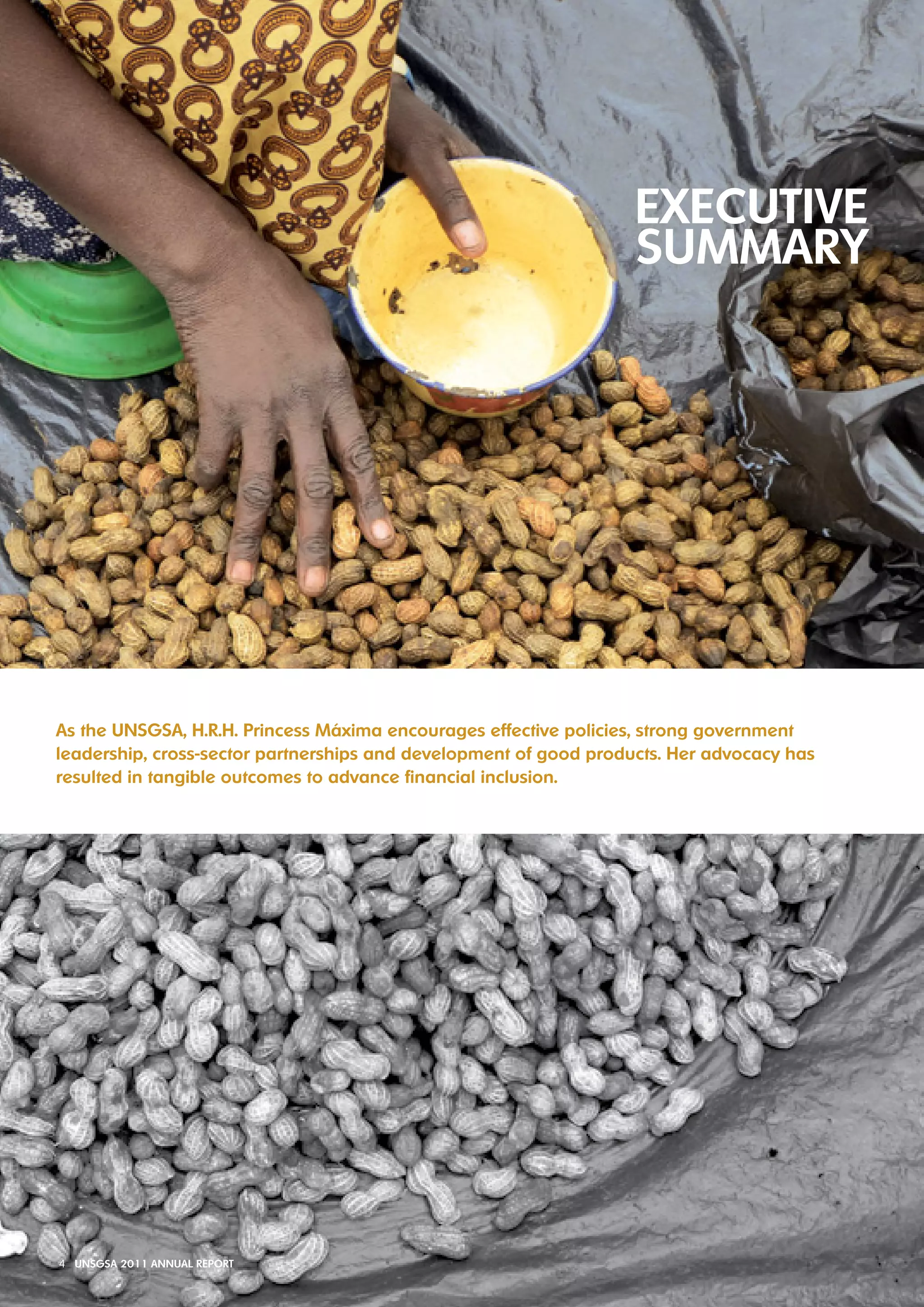
As the UNSGSA, h.R.h. Princess máxima encourages effective policies, strong government 
leadership, cross-sector partnerships and development of good products. her advocacy has 
resulted in tangible outcomes to advance financial inclusion. 
4 UNSGSA 2011 ANNUAL REPORT
UNSGSA 2011 ANNUAL REPORT 5 
In her ongoing dialogue with heads of state, ministers 
of finance and venture capitalists—and with farmers, 
rural mothers and urban tailors—Her Royal Highness 
Princess Máxima of the Netherlands hears first-hand 
how financial inclusion is gaining momentum. She 
sees the difference that access to financial services 
makes to households, small businesses and entire 
communities from Egypt to Mexico, Vietnam to 
Senegal. As the United Nations Secretary-General’s 
Special Advocate (UNSGSA) for Inclusive Finance 
for Development, H.R.H. Princess Máxima calls 
attention to persisting gaps, untapped opportunities 
and notable progress. This progress fuels her long-standing 
commitment to financial inclusion and 
underscores the need for greater advancement. 
Financial inclusion is universal access, at a 
reasonable cost, to a wide range of financial 
services, provided by a variety of sound and 
sustainable institutions. Financial inclusion helps 
families and entrepreneurs generate income, build 
assets, manage cash flow, invest in opportunities 
and strengthen resilience to setbacks. 
Yet more than one-third of the world’s population— 
about 2.7 billion people—lack access to basic financial 
services, such as savings, loans, insurance and more. 
The good news is that there is unprecedented 
potential to change this thanks to growing 
commitment by public and private-sector leaders and 
innovations in financial products. For example, the 
G20, which represents the world’s major economies, 
has put financial inclusion on its development 
agenda. More and more governments are making 
welfare payments through local stores rather than 
requiring recipients to travel considerable distances. 
Illiterate women are saving a couple of dollars at a 
time in a bank, using smart cards that read thumb 
prints. And, mobile phone companies have developed 
money transfer systems that entrepreneurs are using 
widely to pay their bills and buy supplies. 
The progress and potential are exciting. At the same 
time, recent local microfinance crises have taught us 
yet again that growth in financial services must take 
place in a sustainable and responsible way. Effective 
oversight, good internal governance, responsible 
behavior by providers and well-informed clients 
will all help deliver the financial services that meet 
client needs and make a difference. 
Effective advocacy supports the larger financial 
inclusion agenda. For example, at a meeting 
co-chaired by the UNSGSA, financial Standard 
Setting Bodies reached consensus that financial 
inclusion is compatible with their broader mandates 
and will be on their agendas. In Senegal and 
Mali, the UNSGSA discussed the critical need to 
strengthen the soundness of the microfinance 
sector with policymakers and financial institutions, 
and explored the many benefits of a possible 
West African regional credit bureau. 
In Mexico, the UNSGSA and Mexico’s President, 
Mr. Felipe Calderón Hinojosa, discussed opportunities 
for Mexico to accelerate and deepen its progress on 
financial inclusion through government leadership, 
policy, continued innovation and investments. 
At a UN meeting on financial inclusion led by 
the UNSGSA and the Administrator of the UN 
Development Programme, 18 UN agencies came 
together for the first time to deepen collaboration 
on how inclusive financial systems can effectively 
advance diverse development goals. And, more 
than 50 investors signed the new Principles for 
Investors in Inclusive Finance, which the UNSGSA 
developed and launched with partners. 
These are just a few examples of the UNSGSA’s 
activities over the last year. Moving forward, she 
will work with partners to build on these achievements, 
including through her new role as Honorary 
Patron of the G20 Global Partnership for Financial 
Inclusion (GPFI). 
No single magic bullet exists for creating services that 
foster financial inclusion. Ultimately, a combination of 
factors—including strong government leadership, good 
coordination with a cross-section of diverse partners 
and effective policies—will deliver the right financial 
product at the right place and at the right price for 
individuals and businesses alike. The UNSGSA will 
continue to work towards this end.
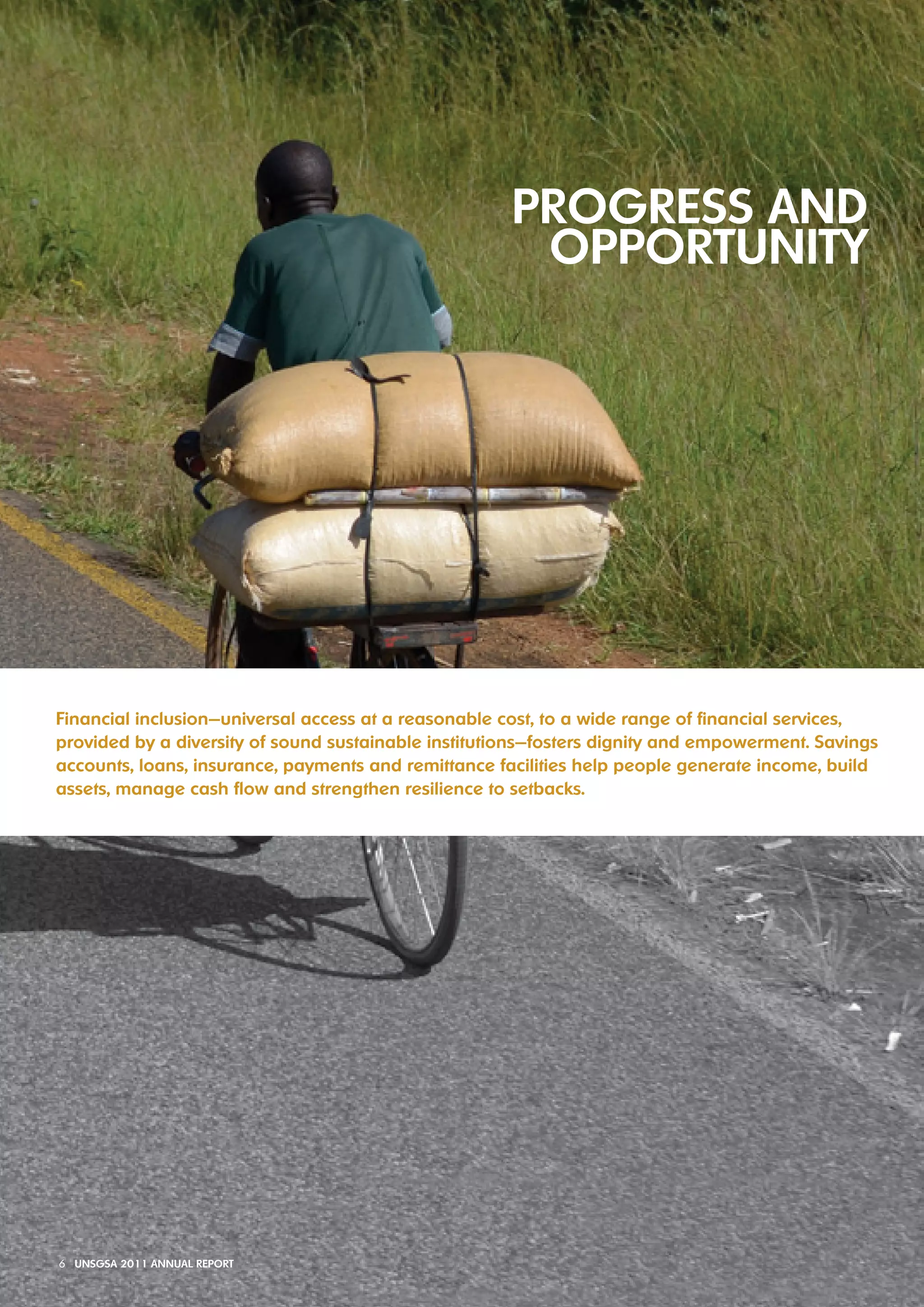
Financial inclusion—universal access at a reasonable cost, to a wide range of financial services, 
provided by a diversity of sound sustainable institutions—fosters dignity and empowerment. Savings 
accounts, loans, insurance, payments and remittance facilities help people generate income, build 
assets, manage cash flow and strengthen resilience to setbacks. 
6 UNSGSA 2011 ANNUAL REPORT
UNSGSA 2011 ANNUAL REPORT 7 
Momentum towards financial inclusion is growing. 
While financial services alone cannot bring people 
out of poverty, they help people build better lives 
and stronger businesses. Policymakers and others 
are more and more aware that financial inclusion 
enhances welfare, productivity and equitable growth, 
and protects against risks. At the same time, new kinds 
of business models, often leveraging technology, 
are extending financial services to populations once 
thought unreachable. Governments—from Colombia 
to Indonesia, Ghana to the Philippines—have 
advanced policies that encourage innovations and 
expansion of financial services, while strengthening 
the soundness and safety of the overall system. 
Financial inclusion is now possible, compared even 
to ten years ago. 
There are many promising approaches; all share 
several traits. They reduce costs significantly, making 
financial services affordable to poor clients and 
sustainable for the provider. They make services 
available where poor clients live and work. And, 
they respond to specific client demands. The promise 
lies in the right product, in the right place, at the right 
price, coupled with robust consumer protection. 
Banking beyond branches is a game-changer. 
Extending services beyond the traditional brick and 
mortar bank building drastically cuts operating costs 
and product prices, and leaps over geographic 
barriers. Mobile phone banking is gaining traction. 
Almost 50 percent of mobile banking clients live in 
Africa, and mobile banking is taking hold in Latin 
America, Asia, the Pacific and beyond.1 Mobile 
banking has also proven a steppingstone to 
expansion of the market and more sophisticated 
services. In Kenya, for example, Safaricom built on 
the highly successful M-PESA platform to launch 
M-KESHO with Equity Bank. Their partnership offers 
customers an interest-bearing savings account, 
personal accident insurance and other financial 
products through mobile phones. 
At the same time, banks are expanding their 
reach through partnerships with retail stores and 
other outlets, commonly known as agent and 
correspondent banking. Vietnam, which the UNSGSA 
visited in March 2011, is in the early stages of 
exploring how to leverage its infrastructure—postal 
system, mobile phone networks, as well as the 
Women’s Union and People’s Credit Funds—to expand 
savings, credit and other financial services for poor 
households. And governments in Brazil, Colombia, 
Fiji, Pakistan, South Africa and elsewhere are utilizing 
bank agents to deliver salaries, payments and welfare 
support more efficiently. This approach also creates 
the high volume that is necessary for a low-cost 
model that is accessible to poor households, and 
sustainable for business providers. 
Innovation and viable business models can be just 
as much about tailoring existing services to meet the 
needs of poor clients. Sometimes, it is about access. 
In southern Africa, banks are using converted buses 
to bring tellers and ATMs to rural villages. Other times, 
it is about creating a full package. For example, Bank 
Tabungan Pensiunan Nasional (BTPN) in Indonesia 
attributes its success to products tailored for diverse 
clients, location of branches, more welcoming 
lobbies, and its client support services, including free 
financial literacy training for micro borrowers, many 
of whom are women.2 Investors everywhere have 
taken note of the market opportunities that these 
approaches represent. 
Around the world, innovative solutions are also 
addressing the financial needs of small and medium 
enterprises (SMEs)—lack of capital being the greatest. 
Donors, venture capital funds and social impact 
investors are providing new kinds and longer-term 
finance, and complementing loans with essential 
support. This is happening in the developing world as 
well as in more advanced economies. For example, 
in the Netherlands, the microcredit organization, 
Qredits, provides finance and mentoring to small 
entrepreneurs starting or running businesses. 
Research and practice are demonstrating what 
services make the biggest difference for households 
and entrepreneurs of all sizes. For example, a 
study showed that farmers in Malawi who used 
“commitment” savings accounts to freeze deposits 
until planting time saved almost twice as much as 
farmers who used regular savings accounts. These 
1 GSMA Mobile Money for the Unbanked (MMU). “Deployment Tracker.” www.wirelessintelligence.com/mobile-money/unbanked. 
Accessed 29 Aug. 2011. 
2 Rich Pickings, “Microlending has helped make BTPN one of Asia’s most profitable banks,” The Economist, 20 April 2011, 
www.economist.com/node/18587177. Accessed 29 Aug. 2011.
Women of a small, rural cooperative demonstrated to the UNSGSA how they manufacture 
local mangos and other fruit into juices, dried fruit and other products. The cooperative 
relies on small loans to buy equipment, but without other financial services, it still struggles 
to manage cash flow and to grow. (Koulikoro, mali, 12 may 2011) 
savings also provided a debt-free way to make 
investments, such as seed and fertilizer. And, 
farmers who used regular savings accounts and 
commitment savings earned more from their 
harvests and then spent more on food (10 and 
25 percent, respectively).3 
As services and innovations expand, governments 
are encouraging further progress through policies 
and by strengthening the enabling environment. 
For example, the Senegalese Government created 
the Observatoire de la Qualité des Services Financiers 
to monitor the quality of financial services. But while 
there has been exciting progress, about 2.7 billion 
adults still do not benefit from savings accounts, 
loans, insurance, payments, pension plans and 
3 L. Brune, x. Giné, J. Goldberg and D. Yang, “Commitments to Save: A Field Experiment in Rural Malawi” (June 2011). 
4 Jenny Marlar, “Few in Sub-Saharan Africa Have Money in a Bank,” Gallup Poll, May 11, 2010, 
www.gallup.com/poll/127901/few-sub-saharan-africa-money-bank.aspx. Accessed 29 Aug. 2011. 
5 Graham Wright and Leonard Mutesasira, “The Relative Risks to the Savings of Poor People,” MicroSave, Nairobi, (2001). 
8 UNSGSA 2011 ANNUAL REPORT 
remittance facilities. The world’s poorest communities 
are disproportionately excluded. In sub-Saharan 
Africa, for example, only 19 percent of families have 
bank accounts.4 
A lack of basic financial services can create particular 
challenges for poor people, whose incomes are not 
only low, but often irregular and less reliable. Poor 
people are often forced to rely on informal financial 
mechanisms to meet daily cash-flow needs, take 
advantage of opportunities and weather tough times. 
These informal financial arrangements, such as 
pawning jewelry, selling livestock or informal loans, 
are time-consuming and expensive, costing as much 
as 22 percent of yearly cash flow.5
UNSGSA 2011 ANNUAL REPORT 9 
The challenge is to find the right approaches that 
overcome long-standing barriers to access, and to 
take successful approaches to scale so that they 
reach all 2.7 billion people, quickly and sustainably. 
This in turn requires even more government policies 
that encourage expansion of financial products that 
respond to the underlying needs of clients. It also 
requires longer-term and responsible investments, 
wide-ranging partnerships, and better data to inform 
good decision-making. The recent microfinance 
crises, triggered by rapid growth of the sector with 
insufficient safeguards, underscore that institutions 
should not only be focused on credit, but offer a full 
range of financial products and consider the situations 
of diverse clients. Where financial services for the 
poor are thriving, rules and practices are protecting 
customers and fostering sound and stable systems. 
In this dynamic context, the UNSGSA is helping to 
bridge the gap between the clear benefits of financial 
inclusion and the wide, unmet demands that persist. 
Her sustained advocacy will encourage continued 
and accelerated progress. 
imPROviNG LivES, BUiLdiNG diGNiTy: 
ThE imPACT OF ExPANdEd ACCESS TO FiNANCiAL SERviCES 
Financial inclusion has impact. It enables people and entrepreneurs to pursue meaningful 
opportunities, and protect themselves from risks. Witness, for example: 
• The coffee farmer in Rwanda who is able to sell his beans for more money in larger towns by 
borrowing a bicycle through a micro-leasing program 
• The small business owner in Egypt who has a secret savings account that she has not told her 
husband about; this is her contingency fund in case all else fails 
• The grandmother in Mexico who picks up government welfare in her village store, and deposits 
it into a savings account at the same place, saving a journey to town, bus fare, and standing in 
line for a half-day to receive the cash 
• The man in South Africa who buries his father with respect through a small insurance policy, and 
doesn’t go into debt 
• The vendor of palm oil in Liberia, who secures a three-year bank loan based on the vats of oil in 
her warehouse and her prior credit history; with that loan, she can begin to export oil, and hire 
several more workers 
• The 16-year-old girl in India who opens a savings account after attending a financial literacy 
workshop; she realizes she will be able to afford vocational school and can have a career
“ What compelled us to honor h.R.h. Princess máxima tonight is her willingness to use her unique 
access to keep issues of financial inclusion on the global agenda that would otherwise have 
fallen off long ago….She has done so not just in the role of prominent spokesperson, but by 
bringing together a powerful combination of passion, commitment and deep-seated knowledge.” 
— Ms. Mary Ellen Iskenderian, President and CEO of Women’s World Banking, at the 2011 Women’s World Banking Global Dinner Celebration 
10 UNSGSA 2011 ANNUAL REPORT
UNSGSA 2011 ANNUAL REPORT 11 
UN Secretary-General Ban Ki-moon designated 
H.R.H. Princess Máxima of the Netherlands as 
Special Advocate (UNSGSA) for Inclusive Finance 
for Development in September 2009. In 2011, 
the Secretary-General re-appointed H.R.H. Princess 
Máxima for a second, two-year term. He selected 
H.R.H. Princess Máxima based on her significant 
experience in banking and emerging markets and her 
demonstrated commitment to financial inclusion. Her 
designation is a strong affirmation of the potential of 
financial inclusion and the need for greater advocacy. 
The UNSGSA raises awareness, encourages 
leadership and fosters action toward financial 
inclusion in partnership with government, financial 
regulators, UN country teams and global staff, 
intergovernmental organizations, civil society, the 
private sector and the media. Her international 
Reference Group serves as a valuable source of 
expertise. The new G20 Global Partnership for 
Financial Inclusion, of which the UNSGSA became 
Honorary Patron in 2011, is another critical vehicle 
for her advocacy. 
Often, the UNSGSA builds commitment by painting 
a big picture of how financial inclusion supports 
national and global priorities such as rural 
development, poverty alleviation, job creation and 
equitable growth. Her country visits reveal concrete 
opportunities at varying stages of financial inclusion— 
and the enthusiasm and many best practices that 
are emerging. 
She shares experiences across countries and 
connects people and institutions through speeches, 
meetings with national and global leaders 
and published articles. She regularly convenes 
stakeholders from diverse sectors, such as political 
leaders together with technical finance experts, phone 
companies, health and agriculture, venture capitalists, 
development partners and more. Through these 
and other activities, the UNSGSA helps all involved 
stakeholders understand how financial inclusion can 
help accelerate progress toward many goals, and 
how to get there. 
H.R.H. Princess Máxima is also an advocate for 
financial inclusion and education, especially for 
youth, in her home country. She is a member of the 
Dutch Committee for Entrepreneurship and Finance, 
which encourages expanded coaching and loans to 
small entrepreneurs in the Netherlands. As Honorary 
Chair of ‘CentiQ, Wiser in Money Matters,’ a Dutch 
partnership of more than 40 organizations from 
finance, education, government and consumer rights, 
H.R.H. Princess Máxima aims to increase people’s 
financial literacy, so that they are better placed to 
make financial decisions throughout their whole lives. 
For more on the role of the UNSGSA, please see 
Annex A or visit www.unsgsa.org. 
h.R.h. Princess máxima presented her 
first annual report as UNSGSA to UN 
Secretary-General, mr. Ban Ki-moon. 
(New york, Ny, USA, 23 September 2010)
The UNSGSA aims to heighten awareness of financial inclusion, deepen appreciation of key 
drivers and generate insights on successful experiences, all of which form the groundwork to give 
poor people greater power over their own lives. 
12 UNSGSA 2011 ANNUAL REPORT
UNSGSA 2011 ANNUAL REPORT 13 
The UNSGSA focuses on cross-cutting issues 
and initiatives that offer the greatest potential for 
broadening and deepening financial inclusion, for 
which her input could make the biggest impact. These 
considerations have led the UNSGSA to prioritize the 
following five themes in her advocacy efforts: 
1. A diversity of financial services, beginning with 
transactional accounts and savings; 
2. The continuum of finance from individuals to small 
and medium enterprises (SMEs); 
3. Responsible finance and financial literacy; 
4. Advancing the complementarity of financial 
inclusion, integrity and stability through global 
standard setters; and 
5. Data for effective policy making and financial 
product development. 
Financial inclusion is not an end in itself, but a means 
of enabling people to save and invest in things that 
make a tangible difference in their lives. For example, 
financial services help people to pay medical bills, buy 
food in between harvests, and afford school fees. 
Financial inclusion enables businesses of all sizes 
to flourish, contributing to job creation and equitable 
economic growth. And inclusive financial systems 
accelerate progress toward numerous other 
development goals. 
The following section describes initiatives that the 
UNSGSA has encouraged together with partners 
to advance progress and shared priorities. 
A divERSiTy OF FiNANCiAL SERviCES, BEGiNNiNG WiTh TRANSACTiONAL 
ACCOUNTS ANd SAviNGS A . 
The UNSGSA advocates for a wide range of financial 
services—especially savings, as well as credit, health 
and weather insurance, payments, pension plans and 
remittances—for individuals and businesses. Energized 
by the many possibilities, the UNSGSA has helped to 
put financial inclusion on the development agenda. 
Policymakers, advocates, service providers and donors 
have expanded their focus beyond microcredit to 
savings to the full spectrum of financial services. 
In September 2010, the UNSGSA, the Dutch Prime 
Minister, Mr. Jan Peter Balkenende, the U.S. Secretary of 
State, Mrs. Hillary Rodham Clinton, and the U.S. Under- 
Secretary of State for Democracy and Global Affairs, 
Ms. María Otero, called attention to the importance 
of financial inclusion during a special event at the 
Millennium Development Goals Summit. They urged 
expanded access to savings and diverse financial 
services in order to accelerate progress toward social 
and economic development objectives. 
The UNSGSA carries similar messages around the 
world. For example, in Egypt, she highlighted how 
greater access to the right financial products would 
save time, reduce costs, and enhance security for 
the metalworkers and tailors whom she met in Old 
Cairo. Their ambitions are fraught with high operating 
costs and ad hoc measures to manage cash. Banks 
are far away, so they hide savings in bales of fabric 
or tins. And they spend Saturday mornings collecting 
payments from customers. They would gain a day of 
work if they had a fast, inexpensive way of receiving 
and making payments. 
The UNSGSA sees great potential in mobile and 
agent banking to meet these kinds of needs. Easy 
access and use, coupled with low-cost, is the genius 
of mobile phone banking. When textile factory workers 
in Pakistan send money to their home villages with 
their phones, they avoid a costly middleman or risks 
that come with carrying cash on a bus. In 2010, the 
UNSGSA spoke with Tanzania’s National Microfinance 
Bank (NMB) about how to reach poor communities 
more effectively and widely, and connected the 
bank with technical experts. NMB has since taken 
steps to this end, such as offering banking services 
on trucks and harnessing mobile technology. 
Accordingly, in all of her country visits, the UNSGSA 
prioritizes conversations with policymakers about 
specific regulations to foster mobile banking. She 
promoted the launch of mobile banking when she
“ When people cannot participate in the formal economy, they often are taken advantage of, they 
are often left without recourse, and the effects of that undermine their own ambitions and hopes for 
families, communities, and even countries.” 
— U.S. Secretary of State, Mrs. Hillary Rodham Clinton, Millennium Development Goals Summit, September 20106 
met with the Central Bank of Egypt and mobile phone 
companies, among others, in November 2010. The 
Central Bank approved money transfers via mobile 
phones in May 2011. 
The UNSGSA is excited by other technological 
advances as well. She regularly encourages 
governments, donors and aid partners to help drive 
financial inclusion by using electronic means to 
deliver government-to-person (G2P) salaries, welfare 
and other payments. She notes that in Brazil and 
the Philippines, trusted retail outlets and post offices 
are increasingly providing payments and bank 
withdrawals, deposits, international remittances 
and other services. These approaches also alleviate 
congestion at existing bank branches. During her 
June 2011 trip to Mexico, the UNSGSA met with 
financial institutions, investors and mobile phone 
companies, stressing the importance of developing 
low-cost, high-volume business models in order to 
reach the populations with the least incomes. 
6 Speech by Mrs. Hillary Rodham Clinton, U.S. Secretary of State, New York, NY, USA, 22 Sept. 2010. www.state.gov/secretary/rm/2010/09/147595. 
htm. Accessed 29 Aug. 2011. 
7 Pascaline Dupas and Jonathan Robinson, Savings Constraints and Microenterprise Development: Evidence from a Field Experiment in Kenya (2008). 
14 UNSGSA 2011 ANNUAL REPORT 
While promoting the need for a range of services, 
the UNSGSA stresses how a safe place to save 
enables choice and opportunity for individuals and 
entrepreneurs alike. Just six months after poor women 
entrepreneurs in western Kenya gained access to 
savings accounts, they spent 13 percent more on 
daily food. And when someone in their family got sick, 
they did not need to liquidate their inventories.7 In 
her outreach, the UNSGSA regularly highlights how 
savings are also the simplest form of insurance. 
Yet, savings accounts are short in supply in most 
poor communities, especially in rural areas. Where 
available, there is very high demand. In response to 
the need for greater attention to savings, the Bill & 
Melinda Gates Foundation hosted the Global Savings 
Forum in November 2010 to stimulate constructive 
debates about how to expand the use of savings 
accounts. At the Forum, the UNSGSA and Foundation 
Co-Chair, Mrs. Melinda French Gates, together stressed 
the importance of new, scalable and sustainable 
At the Global Savings Forum, hosted by the 
Bill & melinda Gates Foundation, h.R.h. Princess 
máxima, together with mrs. melinda French Gates, 
Co-Chair of the foundation, and ms. Sylvia mathews 
Burwell, President of the foundation’s Global 
development initiative, called attention to savings 
accounts as a vital but often overlooked service 
for poor households. (Seattle, Washington, USA, 
16 November 2010)
The Continuum of Finance from Individuals to SMEs B . 
8 M. Ayyagari, A. Demirguc-Kunt, and V. Maksimovic, “Small vs. Young Firms across the World: Contribution to Employment, Job Creation, and 
Growth” (2011). World Bank Policy Research Working Paper. 
9 G20 SME Finance Interim Report. 21 May 21 2010. 
UNSGSA 2011 ANNUAL REPORT 15 
The UNSGSA is an outspoken advocate for access 
to finance at every stage of enterprise growth. 
She believes that finance across the entire value 
chain—from individuals to micro, small and medium 
enterprises (SMEs)—is critical for vibrant businesses 
and economies, and poverty alleviation. She has 
found that too often microfinance and SME finance 
exist in separate silos, and this constrains potential 
and growth. In her address to the SOCAP Europe 
Congress, a group of investors, foundations, and 
social entrepreneurs, the UNSGSA explained: 
“Not every entrepreneur starts by being a mid-sized 
company, but often as a micro-business. And, 
finding finance at these initial stages can be very 
hard….By creating silos, with microfinance here, and 
enterprise finance there, we will not effectively focus 
on the needs of the enterprises. We need to speak 
a common language that connects finance in a 
smooth continuum….Financial products [should be] 
tailored to the cycles, investment needs and nature 
of each industry and value chain.” 
To help build this common language, the UNSGSA 
brings together actors from across sectors in all her 
country visits. In Egypt, for instance, H.R.H. Princess 
Máxima convened high-level representatives from 
the Ministry of Agriculture, Central Bank, Egyptian 
Financial Supervisory Authority, World Bank, UN, donor 
agencies, microfinance institutions, private banks 
and companies, and mobile phone companies in 
a roundtable on financial inclusion. This was the first 
time some stakeholders had sat together. With the 
UNSGSA’s facilitation, they began a dialogue about 
how they could together reach the farthest clients 
with the right products. The UNSGSA held similar 
roundtables in Mali and Senegal, and spoke at 
a seminar for the same purposes in Vietnam. 
In her advocacy, the UNSGSA highlights that SMEs 
are the biggest contributors to employment and are 
critical for job creation in developing countries.8 
Yet, only 18 percent of SMEs in low-income countries 
have access to formal financial services such as credit 
lines, payment systems, current and savings accounts, 
insurance and long-term capital loans.9 Access to 
finance is essential for enterprises to thrive. 
The UNSGSA points out that by strengthening 
supporting infrastructure and enabling environments, 
governments can and are helping SMEs gain 
increased access to finance and capital. The private 
sector, social investment funds, venture capitalists, 
banks and others also have a strong role to play 
through strategic investment and offering more 
kinds of products. 
For example, in Senegal and Mali, the UNSGSA 
discussed with leaders a potential West African 
regional private credit bureau for individuals and 
enterprises. Rated credit history from diverse institutions 
increases transparency, reduces risk in making 
loans and thus lowers costs. Another example: 
the G20 SME Finance Challenge is helping to 
catalyze support for innovative enterprises and 
local SME investment models. Importantly, the 
G20 is also identifying best practices. 
The obstacles faced by small business owners whom 
the UNSGSA met this past year are reminders of why 
her continued advocacy is so important. The women 
savings systems. Mrs. Gates and H.R.H. Princess 
Máxima also called for expanded market research 
to better understand how product design and service 
models impact uptake of savings. The type of savings 
or loan or insurance makes a big difference, and the 
perfect product is of little use if it is too far away. 
The potential is greater than ever. Advocacy by 
the UNSGSA and partners plays an important role 
in calling attention to untapped opportunities in 
innovation, deeper understanding of which products 
have impact, and best practices in policy.
of a rural fruit juice cooperative in Koulikoro, Mali 
need larger, affordable, longer-term loans to invest in 
equipment that will reduce their costs of production. 
They need financial services to help manage cash 
flow needed for the production cycle of a four-month 
mango season. The UNSGSA is keenly aware of 
the specific constraints that female entrepreneurs 
face in accessing finance and becoming successful 
entrepreneurs in Mali, as well as in Senegal, Vietnam, 
Egypt, the Netherlands and beyond. She is a strong 
proponent of the need for business development 
16 UNSGSA 2011 ANNUAL REPORT 
services geared towards women, who own half or 
more of micro enterprises in the developing world. 
As the UNSGSA continues her advocacy, she seeks 
solutions that are context-specific. In West Africa and 
in Mexico, the UNSGSA stressed that services must be 
available locally and adapted for the needs of specific 
industries and sectors. A diversity of financial sector 
providers and government leaders should come 
together to deliver the right product at the right place, 
at the right price, and without silos. 
Responsible Finance and Financial Literacy C . 
The UNSGSA believes that inclusive finance must 
be responsible finance. Regulators, consumers and 
industry all have a role in making sure clients are 
protected from potential abuses and that finance 
leads to the intended benefits for the clients. The 
UNSGSA has advanced efforts by each of these 
groups, not least through her leadership to develop 
the Principles for Investors in Inclusive Finance, as 
well as by stressing the important role of national 
supervision and data in monitoring. 
The UNSGSA uses “three pillars” to guide her 
advocacy on responsible finance: regulation, 
consumer capability and industry action. The first 
pillar involves governments’ legal and regulatory 
roles in building sound financial systems that 
protect consumers while promoting greater access. 
Supervision and treasury management are also 
critical for effective implementation of policies. 
In her keynote address at the Financial Inclusion 
Policymakers Forum, H.R.H. Princess Máxima 
highlighted national examples of regulatory 
leadership, explaining that there is no one-size-fits-all 
approach. For example, Peru’s Superintendency 
gathers interest rates and prices on all loans and 
savings, and publishes them in newspapers. This 
has helped consumers make more informed choices 
and spurred competition. In Malaysia, Bank Negara 
allows banks to impose charges in accordance with 
general principles, and mandates disclosure. But, 
Bank Negara reserves the right to moderate service 
charges it deems to be excessive. 
The second pillar is consumer capability, or the 
ability of people to understand products and 
rights. The UNSGSA advocates that consumers and 
entrepreneurs are better able to choose financial 
products that meet their needs when they grasp 
basic principles such as interest rates, principal, terms 
and fees. This knowledge also enables them to 
develop good financial behavior such as budgeting, 
saving and comparing offers, and it helps them 
avoid unnecessary debt burdens. For example, the 
entrepreneurs in Old Cairo told the UNSGSA that they 
value financial skills training as much as affordable 
loans. The UNSGSA hears similar stories around the 
world, and regularly makes the point that tailored 
training must be paired with practical, hands-on 
experience using financial products. 
At the Responsible Finance and Consumer Protection 
Seminar in Senegal, the UNSGSA explained that 
“it is in everyone’s interest that clients are able to 
understand options, make sound financial decisions, 
and seek recourse when treated unfairly.” Consumer 
capability is best achieved when service providers 
and governments facilitate it, and when clients and 
consumer advocacy groups actively seek it. H.R.H. 
Princess Máxima is a strong advocate for financial 
education and financial literacy in her home country 
as well, particularly for youth.
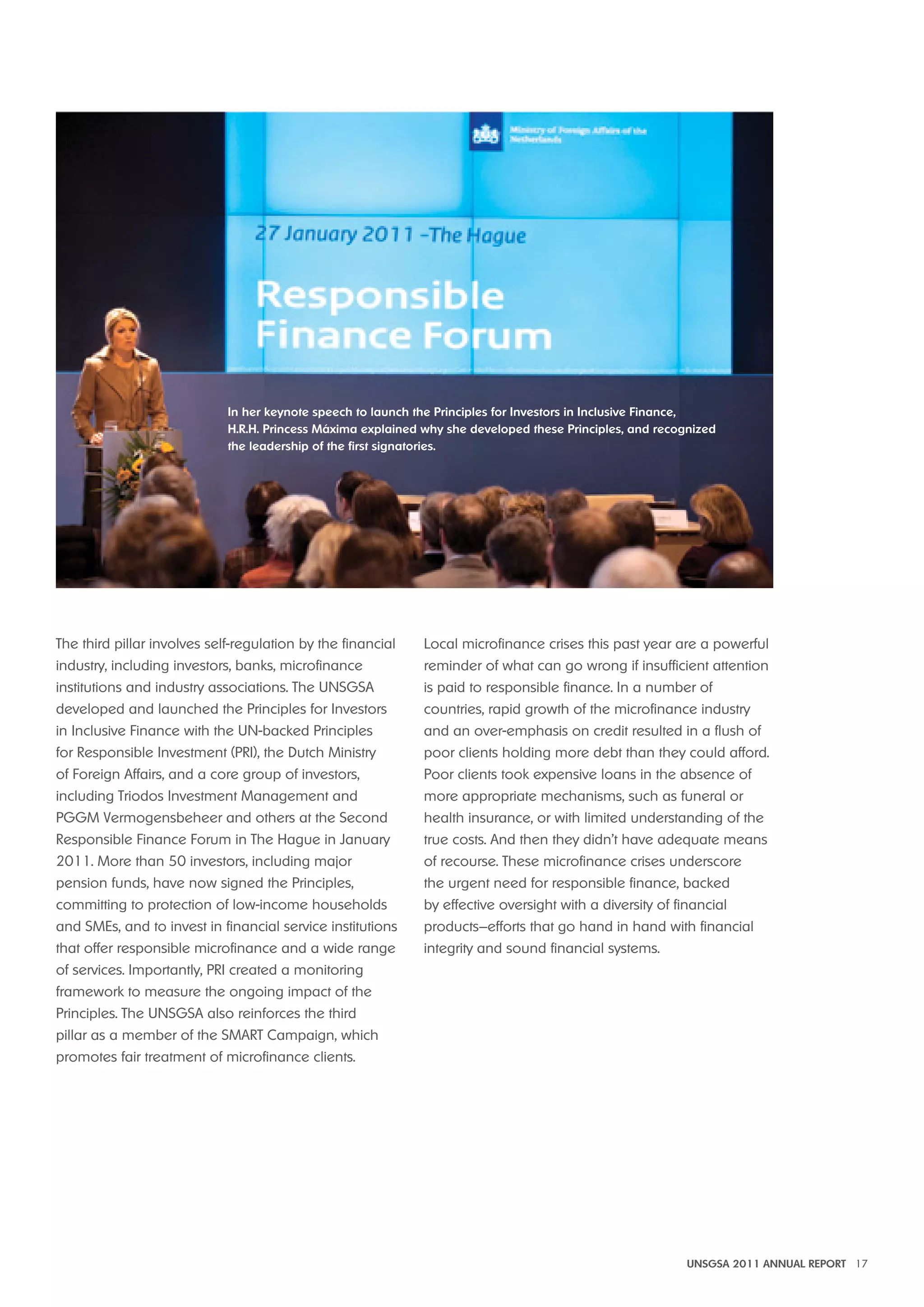
in her keynote speech to launch the Principles for investors in inclusive Finance, 
h.R.h. Princess máxima explained why she developed these Principles, and recognized 
the leadership of the first signatories. 
UNSGSA 2011 ANNUAL REPORT 17 
The third pillar involves self-regulation by the financial 
industry, including investors, banks, microfinance 
institutions and industry associations. The UNSGSA 
developed and launched the Principles for Investors 
in Inclusive Finance with the UN-backed Principles 
for Responsible Investment (PRI), the Dutch Ministry 
of Foreign Affairs, and a core group of investors, 
including Triodos Investment Management and 
PGGM Vermogensbeheer and others at the Second 
Responsible Finance Forum in The Hague in January 
2011. More than 50 investors, including major 
pension funds, have now signed the Principles, 
committing to protection of low-income households 
and SMEs, and to invest in financial service institutions 
that offer responsible microfinance and a wide range 
of services. Importantly, PRI created a monitoring 
framework to measure the ongoing impact of the 
Principles. The UNSGSA also reinforces the third 
pillar as a member of the SMART Campaign, which 
promotes fair treatment of microfinance clients. 
Local microfinance crises this past year are a powerful 
reminder of what can go wrong if insufficient attention 
is paid to responsible finance. In a number of 
countries, rapid growth of the microfinance industry 
and an over-emphasis on credit resulted in a flush of 
poor clients holding more debt than they could afford. 
Poor clients took expensive loans in the absence of 
more appropriate mechanisms, such as funeral or 
health insurance, or with limited understanding of the 
true costs. And then they didn’t have adequate means 
of recourse. These microfinance crises underscore 
the urgent need for responsible finance, backed 
by effective oversight with a diversity of financial 
products—efforts that go hand in hand with financial 
integrity and sound financial systems.
Complementarity of Financial Inclusion, Integrity and Stability D . 
As the UNSGSA, H.R.H. Princess Máxima has 
consistently encouraged policymakers, service 
providers and others to shed a commonly-held 
belief that the integrity of the financial system is 
compromised by greater financial inclusion. Financial 
integrity and stability are in the interests of financial 
providers and clients alike, as well as whole societies. 
Financial integrity calls for adequate and effective 
safeguards against use of finance for illicit purposes. 
Financial stability requires monetary systems that can 
absorb shocks, and promote confidence in financial 
institutions and markets. Certain policies and rules 
that promote integrity and stability, however, such 
as strict guidelines for client identification, can 
inadvertently bar access to financial services for 
poor and marginalized communities. And this can 
drive people to use cash and informal services. 
The UNSGSA has helped to advance the 
understanding that making the formal financial system 
more inclusive benefits individuals and enterprises 
and promotes their stability. By bringing more activity 
into the formal economy, financial inclusion reduces 
the anonymity of informal and cash transactions. This 
makes it easier to monitor the movement and sources 
of money. Financial inclusion, integrity and stability are 
not just compatible; they are mutually reinforcing. 
The UNSGSA has prioritized outreach to global 
Standard Setting Bodies (SSBs) since her designation 
in 2009. For example, she encouraged the Financial 
Action Task Force (FATF), an inter-governmental body 
that develops and promotes policies to combat 
money laundering and terrorist financing [collectively 
known as “AML/CFT”], to examine how countries can 
simultaneously advance inclusion and integrity. Under 
its Dutch Presidency in 2009-2010, FATF considered 
the impact of regulations on financially excluded and 
underserved groups. In June 2011, under its Mexican 
Presidency, FATF adopted a guidance paper that calls 
for flexibility and risk-based approaches to “design 
AML/CFT measures that meet the national goal of 
financial inclusion.”10 
Building on her close collaboration with FATF, the 
UNSGSA and the Chairman of the Basel Committee 
on Banking Supervision (BCBS) co-hosted a meeting 
in January 2011 of six SSBs to build a common 
understanding of financial inclusion.11 It was the first 
time that the SSBs had come together as a group to 
focus on financial inclusion. Participants agreed that 
financial inclusion is compatible with each of their 
broader mandates. The SSBs invited technical partners 
and the G20 to share insights on financial inclusion 
relating to each body’s core mandates–collaboration 
that is ongoing. The G20 Global Partnership for 
Financial Inclusion (GPFI), of which the UNSGSA 
is Honorary Patron, continues to encourage the 
SSBs and the private sector to embed financial 
inclusion in their work. For example, the GPFI is 
exploring ways that assessments of national 
financial systems might take financial inclusion 
into greater consideration. 
The UNSGSA continues to maintain that national 
leadership is paramount, and is encouraged 
by regulators who have designed policies that 
demonstrate the compatibility of financial inclusion, 
integrity and stability. For example, Mexican regulators 
addressed a challenge that prohibits many of the 
world’s poor people from establishing a bank 
account: lack of formal identity documents. In May 
2011, they approved a tiered system that permits 
opening of financial accounts with fewer identification 
requirements at a base level. This system then requires 
more identification as account values and permitted 
transactions increase. 
In the past year, the UNSGSA has advocated for 
similar examples of national action. She joined the 
Chairman of the Egyptian Financial Supervisory 
Authority (EFSA) for the launch of draft regulations for 
supervision of microfinance companies.12 If passed, 
these regulations will encourage growth of financial 
products that reach the poor, backed by a robust 
infrastructure and supervisory framework. The UNSGSA 
raised similar issues in Senegal and Mali, where 
10 FATF. “FATF Guidance on Anti-Money Laundering and Terrorist Financing Measures and Financial Inclusion.” www.fatf-gafi.org/document/4/0,3746, 
en_32250379_32235720_48294212_1_1_1_1,00.html . Accessed 29 Aug. 2011. 
11 BCBS, Committee on Payment and Settlement Systems, Financial Stability Institute, International Association of Deposit Insurers, International As-sociation 
of Insurance Supervisors, and FATF, among other organizations, participated in this meeting. 
12 EFSA. “General Rules for Microfinance Companies in Egypt.” www.efsa.gov.eg/content/efsa2_en/pool_extra_efsa_en/mesakmonta_en.htm 
Accessed 29 Aug. 2011. 
18 UNSGSA 2011 ANNUAL REPORT
mr. Jaime Caruana, General manager of the Bank for international Settlements, h.R.h. Princess máxima, and 
dr. Nout Wellink, President of de Nederlandsche Bank and Chairman, Basel Committee on Banking Supervision, 
led a lively discussion with Standard Setting Bodies on their shared interest in fostering financial inclusion, 
integrity and stability. (Basel, Switzerland, 6 January 2011) 
policymakers and partners are working to strengthen 
the system to enable safe expansion of the sector. The 
UNSGSA also discussed how application of guidance 
and regulations will be just as critical to successful 
implementation. In the long-term, increased electronic 
transactions should make supervision easier. In the 
short-term, however, the introduction of many new 
“ inclusive finance has a fundamental impact on the lives of millions of people. Today a group of 
aligned investors sign up to principles that protect their interests. Together they are committing to the 
creation of inclusive financial sectors that improve lives by providing transparent, financial services 
in a responsible way.” 
— Ms. Marilou van Golstein Brouwers, the Managing Director of Triodos Investment Management, at the launch of the Principles 
UNSGSA 2011 ANNUAL REPORT 19 
for Investors in Inclusive Finance, January 2011 
kinds of services adds some complexity, especially 
with services such as mobile phone banking that 
span traditional supervisory structures. Ultimately, 
national policies will broaden the range of products 
and services offered, strengthen oversight and 
deepen the reach of financial systems to serve the 
world’s poorest communities.
The UNSGSA co-hosted a special event with the United States and the Netherlands during the millennium 
development Goals Summit to emphasize the role of financial inclusion in alleviating poverty. From left to right: 
mr. Jan Peter Balkenende, Prime minister of the Netherlands; mr. hugo martinez, Foreign minister of El Salvador; 
mrs. hillary Rodham Clinton, U.S. Secretary of State; h.R.h. Princess máxima; ms. maría Otero, U.S. Under-Secretary 
of State for democracy and Global Affairs; mr. Porfirio Lobo, President of honduras. (New york, Ny, USA, 
22 September 2010) 
E . dATA FOR EFFECTivE POLiCy mAKiNG ANd FiNANCiAL PROdUCT dEvELOPmENT 
Good data is necessary to monitor progress, 
understand impact and inform effective decision-making— 
a point that H.R.H. Princess Máxima stressed 
even before she was designated UNSGSA. Knowledge 
gleaned from both qualitative and quantitative data 
can fuel design of more appropriate financial services 
and products, greater investment, and more effective 
regulation and policy. National data is most useful 
when it is timely, in-depth and disaggregated to show 
how households and enterprises utilize financial 
services. And harmonized definitions and approaches 
for data collection improve global comparability. 
The UNSGSA helped to catalyze the International 
Monetary Fund (IMF) to strengthen financial inclusion 
data collection and dissemination. The resulting 
Access to Finance Project, which has support from the 
Government of the Netherlands, has released 2009 
and 2010 Financial Access Survey results, with data 
from 160 participating countries in the latest round. 
The World Bank and IMF now use this Survey to collect 
consolidated data on this topic, making data provision 
easier and more efficient for national authorities. 
20 UNSGSA 2011 ANNUAL REPORT 
As Honorary Chair of the G20 SME Finance Data 
Sub-Working Group in 2010, the UNSGSA stressed 
the importance of comparable, timely data. The 
G20 GPFI mandated a Data and Measurement 
Group on both household and SME finance to 
further this progress. 
The UNSGSA has continued to elevate the importance 
of national and global data in her meetings, speaking 
engagements and other outreach. In an article 
published in the World Economic Forum’s Mobile 
Financial Services Development Report 2011, the 
UNSGSA explains: 
“For all that we have learned about micro-financial 
services for the poor, we still know little about how 
enterprises finance themselves and what is available 
to them. As importantly, we need to increase our 
understanding about enterprise demand for services 
and the impact of specific products on individuals 
and enterprises. While respecting consumer privacy 
and commercial confidentiality, we must take 
advantage of the large volume of diverse data, 
often electronic, gathered by private firms.”
UNSGSA 2011 ANNUAL REPORT 21 
National policymakers and international monitoring 
agencies have acknowledged the need for better 
demand- and supply-side data in recent years. For 
example, the Mexican banking and securities regulator 
published two major reports in 2010 on financial 
services supply and gaps, and a third in June 2011.13 
These first reports helped to clarify the strategies of 
state-owned banks, inform the distribution decisions of 
some private sector groups and identify gaps in data. 
The authorities are now planning a national survey 
to assess use and demand by clients. The Bank of 
Thailand similarly incorporated questions on financial 
access, financial literacy and consumer protection into 
its 2010 national household survey.14 
Ultimately, the UNSGSA believes that better and 
more extensive data, research and analysis will 
enable smarter investments and promote more 
effective policy responses. Global Standard Setting 
Bodies, for example, are particularly interested in 
data to examine the impact of regulatory changes 
and analysis of qualitative factors such as gender, 
socioeconomic characteristics, financial literacy and 
consumer protection. As conversations continue, the 
UNSGSA will continue to share the need for studies on 
particular issues, including impact, with research and 
implementing partners to call attention to key findings 
and, encourage data-based decision making. 
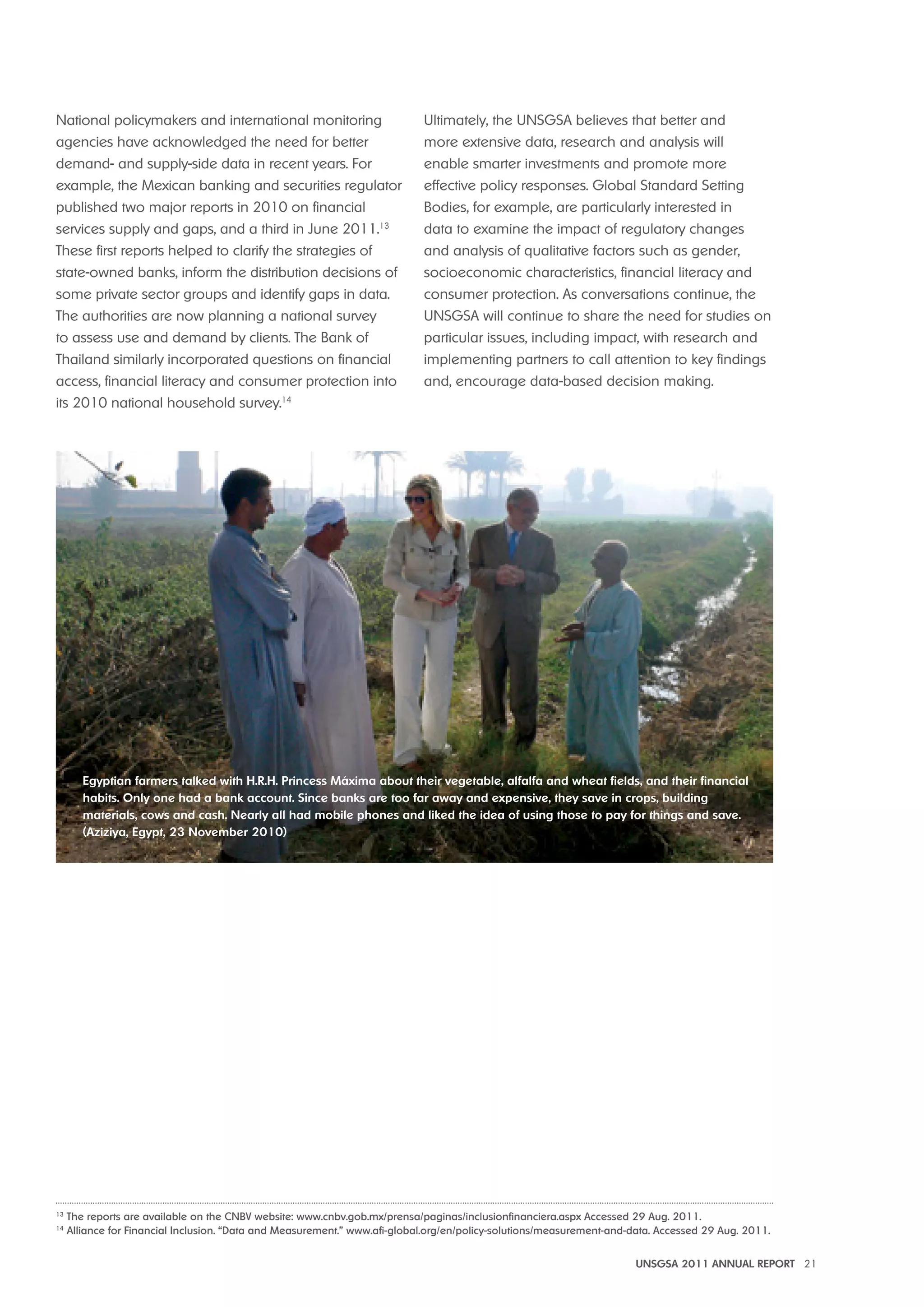
Egyptian farmers talked with h.R.h. Princess máxima about their vegetable, alfalfa and wheat fields, and their financial 
habits. Only one had a bank account. Since banks are too far away and expensive, they save in crops, building 
materials, cows and cash. Nearly all had mobile phones and liked the idea of using those to pay for things and save. 
(Aziziya, Egypt, 23 November 2010) 
13 The reports are available on the CNBV website: www.cnbv.gob.mx/prensa/paginas/inclusionfinanciera.aspx Accessed 29 Aug. 2011. 
14 Alliance for Financial Inclusion. “Data and Measurement.” www.afi-global.org/en/policy-solutions/measurement-and-data. Accessed 29 Aug. 2011.
“ Partnerships can help broaden and deepen the benefits of financial inclusion. Everywhere i go, i try 
to bring together people and institutions who do not typically work together. i bring them together to 
talk and learn from each other, to find common ground, and to identify potential synergies.” 
— H.R.H. Princess Máxima, at the 2010 International Conference on Global Partnerships in Microfinance 
22 UNSGSA 2011 ANNUAL REPORT
UNSGSA 2011 ANNUAL REPORT 23 
Advocacy by the UNSGSA coupled with national 
leadership, innovations from the private sector 
and global collaboration has helped to advance 
financial inclusion over the past year. Policymakers 
are acknowledging that financial inclusion not only 
contributes to poverty alleviation and welfare, but also 
to job creation, protection from risks, and equitable 
growth. Service model innovations and technological 
breakthroughs are extending financial services to 
populations once thought unreachable. But these 
successes need to be augmented, accelerated 
and expanded for financial inclusion to become a 
reality for all—including for those in the most remote 
locations and those living on the bottom rungs of the 
income scale. 
As awareness about the potential—and challenges—of 
financial inclusion increases, the UNSGSA will shift her 
advocacy toward specific actions that can be taken by 
national leaders, policymakers, service providers and 
consumer groups. H.R.H. Princess Máxima will consider 
not just the range of available financial products, but 
whether these products are having the desired impact. 
Are they at the right price and reaching everyone? 
Are the products and services addressing the needs 
of poor clients, and in secure, responsible and timely 
ways? Do they make business sense for providers? 
Are they sustainable? Do they increase government 
efficiency? For example, commitment savings might 
help people to save for their specific needs, be it 
seeds, school fees, or a sewing machine. Or, weather-indexed 
insurance may be a more effective buffer 
against losses due to flooding or drought. All of these 
innovative financial products need to be further 
studied, developed and expanded. 
Towards this end, the UNSGSA will continue to 
advocate for financial inclusion solutions and 
collaboration across sectors. And, the UN can 
continue to serve as a platform for this. Agencies 
including the World Food Program, UNICEF, 
UN Women, and 15 others discussed how inclusive 
financial systems could help them pursue their own 
agendas and diverse development goals more 
effectively, and agreed to deepen collaboration to 
expand inclusive financial systems. 
In the road ahead, the UNSGSA will continue to seek 
opportunities to increase synergies and coherence 
across the UN system and multilateral initiatives. She 
will help to lead global advocacy efforts through her 
UN designation and her role as Honorary Patron of 
the G20 Global Partnership for Financial Inclusion. 
She will also encourage national government 
leadership in developing sound and effective policies, 
including by monitoring financial inclusion with robust 
data. Ultimately, the UNSGSA seeks financial systems 
that are strong and accessible to all. 
ms. helen Clark, Administrator of the UN development Programme and mr. Anthony Lake, UNiCEF Executive 
director, joined the UNSGSA and 16 other UN agencies in a dynamic conversation about the role of financial 
services in reaching health, education, employment and other social welfare goals. The UNSGSA co-chaired 
this meeting. (New york, Ny, USA, 22 march 2011)
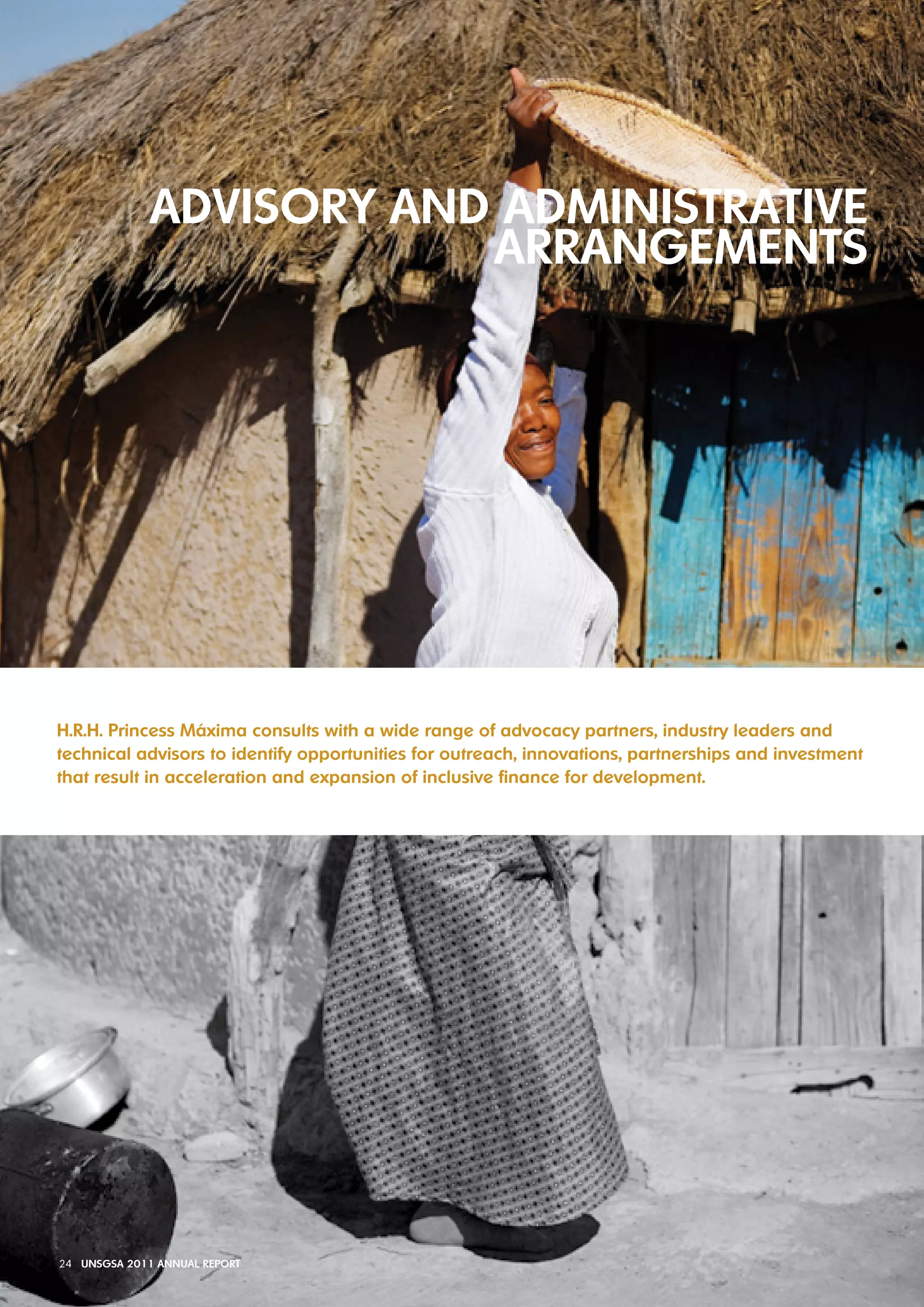
h.R.h. Princess máxima consults with a wide range of advocacy partners, industry leaders and 
technical advisors to identify opportunities for outreach, innovations, partnerships and investment 
that result in acceleration and expansion of inclusive finance for development. 
24 UNSGSA 2011 ANNUAL REPORT
UNSGSA 2011 ANNUAL REPORT 25 
The UNSGSA works closely with an international 
Reference Group, which advises her on strategies, 
messages and opportunities. In a number of 
instances, the UNSGSA and Reference Group 
members partner closely to prepare and undertake 
advocacy activities, such as country outreach and 
visits. In these and other instances, members of 
the Reference Group and close partners contribute 
and facilitate follow-up and implementation of 
specific UNSGSA recommendations through their 
own activities and networks—thus helping to turn 
advocacy into action. 
The Reference Group includes: 
• UN Capital Development Fund (UNCDF); 
• UN Department of Economic and Social Affairs 
(UNDESA); 
• UN Development Programme (UNDP); 
• Bill & Melinda Gates Foundation; 
• Consultative Group to Assist the Poor (CGAP); 
• Alliance for Financial Inclusion (AFI); and 
• International Finance Corporation (IFC). 
Beyond the Reference Group, the UNSGSA consults 
widely with other agencies, UN country teams, the 
World Bank, International Monetary Fund, Financial 
Action Task Force, G20, government leaders, private 
financial institutions and civil society organizations. 
The UNSGSA is grateful to all of her partners for their 
insights and collaboration. 
A small Office of the UNSGSA, housed at UNCDF 
in New York, works closely with the Secretariat of 
H.R.H. Princess Máxima in The Hague to coordinate 
her UN activities in the field of inclusive finance. 
The Office receives generous financial support from 
the Bill & Melinda Gates Foundation. 
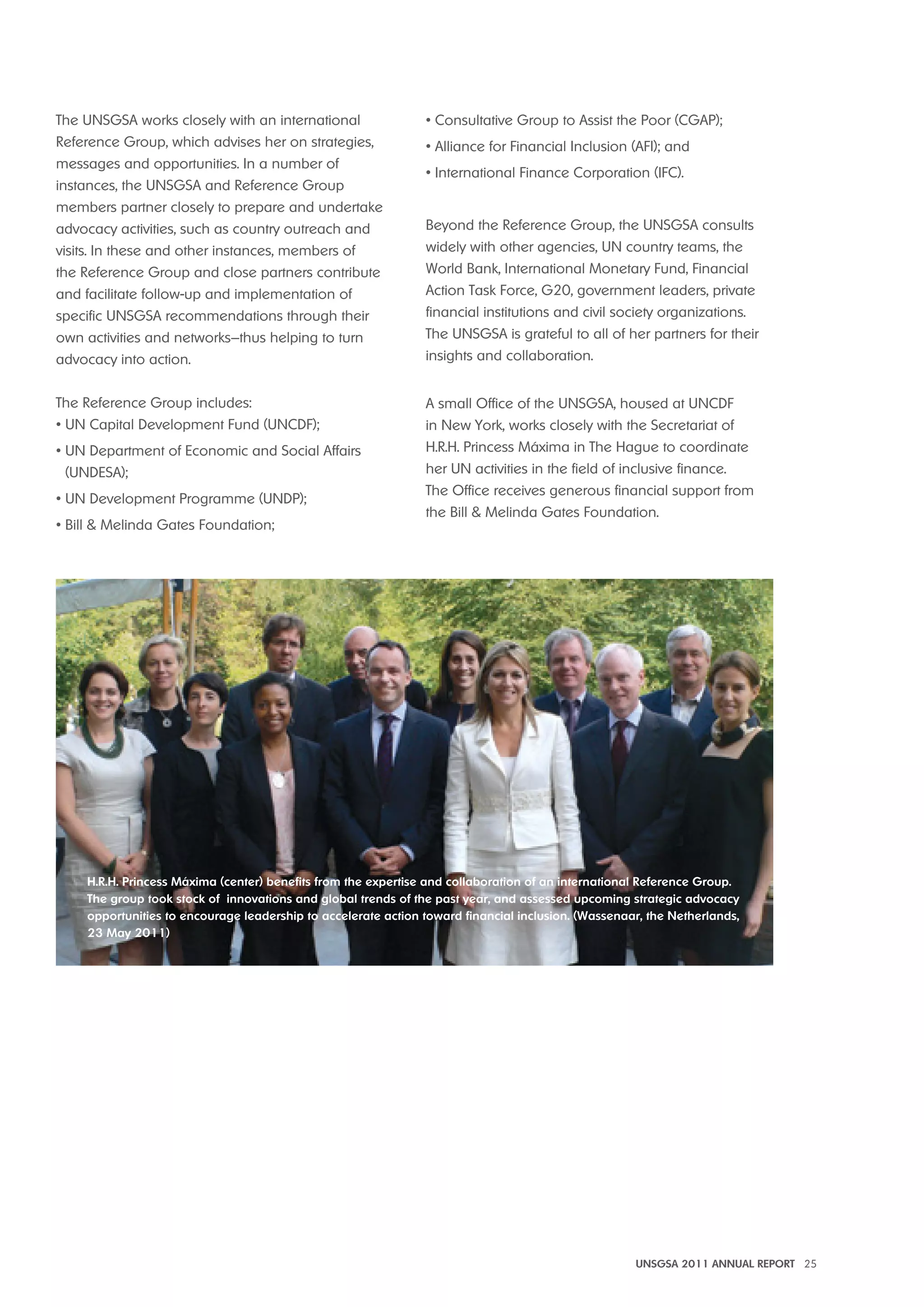
h.R.h. Princess máxima (center) benefits from the expertise and collaboration of an international Reference Group. 
The group took stock of innovations and global trends of the past year, and assessed upcoming strategic advocacy 
opportunities to encourage leadership to accelerate action toward financial inclusion. (Wassenaar, the Netherlands, 
23 may 2011)
“ When providing financial services, we also have an obligation to ask, does the client need this? 
is it the right product for this person? is it good for the health of the system? if not, and if the 
product is not sustainable, we should not offer it.” 
— H.R.H. Princess Máxima, at the American University of Cairo, 2010 
26 UNSGSA 2011 ANNUAL REPORT
Terms of Reference for the designation of her Royal highness Princess 
máxima of the Netherlands as the Secretary-General’s Special Advocate 
for inclusive Finance for development ANNEx A 
1. The following Terms of Reference apply to the designation of Her Royal Highness Princess Máxima of the 
Netherlands (Princess), as the Secretary-General’s Special Advocate for Inclusive Finance for Development. 
ROLE 
2. At the invitation of and in consultation and coordination with the Secretary-General or his designees, the 
Secretary-General’s Special Advocate for Inclusive Finance for Development may, as appropriate: 
a) inform and advocate before Governments, legislators, regulators and international institutions for 
UNSGSA 2011 ANNUAL REPORT 27 
purposes of promoting inclusive finance for development; 
b) identify emerging issues and evolving policy options in promoting inclusive finance in a range of 
countries, with regard to facilitating the achievement of development goals, particularly the Millennium 
Development Goals (MDGs); 
c) contribute to the preparation, follow-up and implementation of outcomes of United Nations 
Conferences, including the Doha Declaration and the Outcome of the Conference on the World 
Financial and Economic Crisis, with regard to inclusive finance for development; 
d) contribute to raising the awareness of multilateral intergovernmental organizations, Governments, 
parliamentary institutions, civil society, private sector and mass media on the importance of developing 
inclusive finance for poverty reduction, equalizing opportunity and achievement of development goals, 
particularly the MDGs; and, 
e) carry out such other activities as may be necessary and appropriate in connection with any 
of the foregoing. 
3. As the Secretary-General’s Special Advocate for Inclusive Finance for Development, the Princess shall act in 
her own capacity and not as an official of the United Nations. The Princess and the Secretary-General or his 
designees shall cooperate to ensure that activities carried out by the Princess in her role as the Secretary- 
General’s Special Advocate for Inclusive Finance for Development are consistent with the aims, activities and 
policies of the United Nations. 
ACTiviTiES 
4. In coordination with the Secretary-General or his designees, the Secretary-General’s Special Advocate for 
Inclusive Finance for Development may engage in such activities as are necessary and appropriate for the 
carrying out of her role as the Secretary-General’s Special Advocate for Inclusive Finance for Development, 
including, inter alia: 
a) initiating and maintaining dialogue with policy-makers and financial regulators in a selected number 
of countries on core issues in developing inclusive financial sectors, policy options and possibilities for 
follow-up and implementation; 
b) delivering presentations at selected national, regional and international meetings on inclusive finance 
for development and on financial regulation; 
c) contributing to the intergovernmental processes of the United Nations on the issue of inclusive finance, 
as requested, such as, follow-up to the Doha Review Conference on Financing for Development and to 
the World Financial and Economic Crisis and its Impact on Development; 
d) participation in media outreach appropriate to fulfilling the role of the Secretary-General’s Special 
Advocate for Inclusive Finance for Development; and, 
e) engaging in such other activities as may be necessary and appropriate in connection with any of 
the foregoing.
Coordination and Guidance 
5. The Secretary-General or his designees will ensure that the special skills and talents of the Secretary-General’s 
Special Advocate for Inclusive Finance for Development are well utilized for the carrying out of her role 
and her activities pursuant to these terms of reference. The Secretary-General or his designees and the 
Secretary-General’s Special Advocate for Inclusive Finance for Development will regularly coordinate on their 
activities and in the implementation of the role and the activities of the Secretary-General’s Special Advocate 
for Inclusive Finance for Development pursuant to these terms of reference. The Secretary-General or his 
designees and the Secretary-General’s Special Advocate for Inclusive Finance for Development shall establish 
focal points for the facilitation of timely and effective communication between them on all matters pertaining 
to the implementation of the role and the activities of the Secretary-General’s Special Advocate for Inclusive 
Finance for Development pursuant to these terms of reference. 
6. The Secretary-General’s Special Advocate for Inclusive Finance for Development will collaborate with the 
Secretary-General or his designees on the establishment and coordination of a Reference Group consisting 
of principal co-operating partners at international level, including, but not limited to: the Consultative Group 
of Assistance to the Poor (CGAP), the United Nations Capital Development Fund (UNCDF), the United Nations 
Department of Economic and Social Affairs (UNDESA), the Bill and Melinda Gates Foundation, and the Alliance 
for Financial Inclusion (AFI). In coordination with the Secretary-General or his designees, such reference group 
will provide inputs and comments on the strategies and plans of the Secretary-General’s Special Advocate 
for Inclusive Finance for Development, periodically discuss progress and strategy for advocacy activities in 
connection therewith, and offer recommendations on coordination with work of the United Nations on 
achievement of the MDGs and the implementation of the Organization’s global development agenda. 
7. In coordination with the Secretary-General or his designees, the Secretary-General’s Special Advocate for 
Inclusive Finance for Development will develop a strategy for advocacy, containing a dynamic list of priority 
countries for advocacy activities and the advocacy tools to be used. Such strategy and associated plans will be 
presented to the reference group for input and will be updated as appropriate. Such identification of priority 
countries will take into consideration, inter alia, the needs and circumstances of such countries, particularly 
those that are lagging in progress in achieving international development goals; the nature and scope of 
national challenges and possible solutions; the availability of proper support, cooperation and follow-up on 
the ground; the added value and convening power of the Secretary-General’s Special Advocate for Inclusive 
Finance for Development in the country or region; the receptiveness of the targeted authorities, and the need 
for flexibility due to political or other circumstances. 
8. In coordination with the Secretary-General or his designees, the Secretary-General’s Special Advocate for 
Inclusive Finance for Development will engage with other major international leaders in Inclusive Finance in 
carrying out her role and her activities pursuant to these terms of reference. 
9. The Key Messages of the United Nations Advisors Group (UNAG) on Inclusive Financial Sectors, as presented 
to the Secretary-General in 2008, will serve as the policy guidelines for the Princess in the carrying out of her 
role and her activities pursuant to these terms of reference.15 In carrying out her role and activities pursuant 
to these terms of reference and in coordination with the Secretary-General or his designees, the Secretary- 
General’s Special Advocate for Inclusive Finance for Development may take into account, when appropriate, 
salient points and recommendations made by international experts, international organizations, regulators 
and policy makers, as well as the impact of the financial crisis on inclusive finance as well as core issues in 
social performance and inclusive finance. 
15 It is acknowledged that the Final Statement of the 2005 International Year of Microcredit, the “Blue Book” on Building Inclusive Financial Sectors 
for Development review and the summary of the Asia Regional Forum and other United Nations Advisers Group Regional Forums formed, among 
others, the basis for these Key Messages. 
28 UNSGSA 2011 ANNUAL REPORT
in her opening speech at the Global Conference on Agriculture, Food Security and Climate Change, h.R.h. 
Princess máxima called attention to how financial services can benefit sustainable agriculture and environmental 
protection. From left to right: mr. Kofi Annan, the seventh UN Secretary-General and Chairman of the Alliance for a 
Green Revolution in Africa; h.R.h. Princess máxima; dr. henk Bleker, minister of Agriculture and Foreign Trade, the 
Netherlands; dr. hans hoogeveen, director-General, ministry of Economic Affairs, Agriculture and innovation, the 
Netherlands. (The hague, the Netherlands, 4 November 2010) 
REPORTiNG 
10. The Secretary-General’s Special Advocate for Inclusive Finance for Development will prepare an annual 
report on her activities and progress. The reports will be presented to the reference group and to the 
Secretary-General or his designees. 
CONdiTiONS OF SERviCE 
11. In performing her role and carrying out her activities pursuant to these terms of reference, the Secretary- 
General’s Special Advocate for Inclusive Finance for Development shall: 
a) receive a symbolic compensation of one dollar (US $1.00) per annum; 
b) coordinate with the Secretary-General or his designees when and if engaged in travel for purposes 
of carrying out her functions as the Secretary-General’s Special Advocate for Inclusive Finance for 
Development; 
c) be considered to be travelling on the official business of the United Nations, when and if engaged in 
such travel for purposes of carrying out her functions as the Secretary-General’s Special Advocate for 
Inclusive Finance for Development; 
d) in the event of death, injury or illness attributable to the performance of activities in accordance with 
these terms of reference, be entitled, in her person or in the person of her dependents, as appropriate, 
to compensation payable in accordance with the provisions of the Secretary-General’s bulletin, ST/ 
SGB/103/Rev.1, as the sole compensation payable by the United Nations in respect of any such death, 
injury or illness; 
e) when performing activities in accordance with these terms of reference and as necessary and 
appropriate within the sole determination of the Secretary-General or his designees, be considered 
to be an Expert on Mission for the United Nations within the meaning of Article VI, Section 22 of the 
Convention on the Privileges and Immunities of the United Nations, adopted by the General Assembly 
on 13 February 1946; 
f) be entirely and fully responsible for arranging, at her sole expense, such life, health and other forms of 
insurance as may be necessary and appropriate in connection with the performance of any activities 
pursuant to these terms of reference; and, 
UNSGSA 2011 ANNUAL REPORT 29
g) not be eligible or entitled to any benefits or entitlements applicable to officials or staff of the United 
Nations, other than those that are specifically enumerated in these terms of reference. 
COmmENCEmENT, TERm ANd TERmiNATiON 
12. Upon the issuance by the Secretary-General of a letter of designation as his Special Advocate for Inclusive 
Finance for Development, the Secretary-General’s Special Advocate for Inclusive Finance for Development 
shall carry her role and activities pursuant to these terms of reference for a two (2)-year period, unless 
terminated sooner in accordance with these terms of reference. The term of designation may be extended 
for such additional period or periods as the Secretary-General and the Secretary-General’s Special Advocate 
for Inclusive Finance for Development may agree, and any such extension shall be effected by a further letter 
of designation by the Secretary-General. 
13. The designation of the Secretary-General’s Special Advocate for Inclusive Finance for Development shall 
expire upon the completion of the period of the designation as the Secretary-General’s Special Advocate 
for Inclusive Finance for Development or may be terminated by mutual agreement or whenever the 
Secretary-General, in his sole consideration, determines that the termination of the designation is in the 
interests of the United Nations. 
This entrepreneur received a loan, mentoring and business skills training from the dutch organization 
Qredits when he began his small business. h.R.h. Princess máxima advocates for this vital combination of 
support for micro, small and medium enterprises throughout the world, including in developed countries. 
(the Netherlands, 2009) 
30 UNSGSA 2011 ANNUAL REPORT
Selected Activities of Her Royal Highness Princess Máxima of the 
Netherlands as UNSGSA: September 2010 – August 2011 annex B 
UNSGSA 2011 ANNUAL REPORT 31 
The full text of speeches and a chronological list can be found at www.unsgsa.org. 
Country Visits 
• Egypt, 22-25 November 2010 
The UNSGSA promoted ways to accelerate access to savings, payments and other financial services for 
individuals and small enterprises (SMEs), including through mobile phone banking, and stressed the importance 
of building a sound system with good oversight. She joined the Chairman of the Egyptian Financial Supervisory 
Authority (EFSA) to launch draft regulations for non-banking financial institutions. The UNSGSA met with the 
Governor of the Central Bank, Minister of Agriculture and Land Reclamation and Minister of Finance and other 
officials. The UNSGSA held a multi-stakeholder meeting on financial inclusion and a roundtable on mobile 
phone banking. She met with small entrepreneurs in Old Cairo at the Business Development Center of the 
First MicroFinance Foundation (FMF-E), and spoke with small farmers in the village of Aziziya to learn about their 
lives and what financial services are available to them. 
Speech, “Building an Inclusive Financial System in Egypt,” American University of Cairo, 24 November 2010 
Congratulating EFSA on the draft regulations, the UNSGSA stressed that financial inclusion should provide 
all Egyptians with the right financial products in the places where they need it, at the right prices. It should be 
competitive and transparent, and protect consumers. 
• Vietnam, 29 March to 2 April 2011 
The UNSGSA met with Mr. Nguyen Sinh Hung, the Vice Premier of Vietnam; Mr. Nguyen Van Giau, the Governor 
of the State Bank of Vietnam; Mr. Vu Van Ninh, the Minister of Finance; and Ms. Nguyen Thi Thanh Hoa, the 
President of Vietnam Women’s Union, to discuss how Vietnam could further increase access to savings and other 
financial services for the poor, and the role of comprehensive data in effective policy making. In particular, the 
UNSGSA discussed the potential in Vietnam for agent and mobile banking: the country’s national post system, 
mobile phone networks, as well as the Women’s Union and People’s Credit Funds, could all be leveraged. 
Keynote speech, Financial Inclusion Seminar, Hanoi, Vietnam, 29 March 2011 
H.R.H. Princess Máxima addressed high-level participants from Vietnamese banks, regulatory bodies, micro-finance 
institutions, international organizations and international businesses. She called attention to exciting 
progress on financial inclusion in Vietnam, including a stronger policy environment and a draft national strategy 
for microfinance. She underscored that advancement of financial inclusion will require strong coordination and 
leadership by government in collaboration with all involved stakeholders.
• SEnEgaL, 8-11 may 2011, and mALi, 12-13 may 2011 
The UNSGSA explored ways to strengthen the soundness of the growing microfinance sector in these countries 
and the region, and to increase access to a diverse range of financial services for individuals and enterprises, 
especially but not only in rural areas. Introduction of mobile phone banking and regionalization creates 
potential for economies of scale, larger markets and transfer of best practices among the countries. The UNSGSA 
met with the President of Senegal, Mr. Abdoulaye Wade, the President of Mali, Mr. Amadou Toumani Touré, and 
ministers overseeing finance, agriculture, enterprise growth, industry, trade and investments, and microfinance. 
She also met with the Special Advisor to the Acting Governor of the Central Bank of Western African States 
(BCEAO) and Senegal and Mali’s National BCEAO Directors to identify further opportunities to strengthen inclusive 
finance through regulations. She held multi-stakeholder consultations on progress and opportunities with the 
West African Economic and Monetary Union (WAEMU), BCEAO, UN, donors, private banks, MFIs and networks, 
and mobile phone companies. The UNSGSA also met with donors and the UN country teams. During a field 
visit to Koulikoro, Mali, she met with a small women’s cooperative and a large chicken farm to better understand 
their financial lives, and what micro and enterprise finance services are available locally and how they use them. 
Keynote speech, Responsible Finance and Consumer Protection Seminar, dakar, Senegal, 11 may 2011 
(Please see section on Responsible Finance, below, for summary.) 
h.R.h. Princess máxima discussed ways regulators can continue to strengthen the soundness of the microfinance 
sector in Senegal with representatives from the National Office for Senegal of the Central Bank of Western African 
States (BCEAO). Front row (left to right): mr. Gerben de Jong, Ambassador of the Kingdom of the Netherlands to 
Senegal; mrs. Fatimatou Zahra diop, National director of BCEAO for Senegal; h.R.h. Princess máxima; mr. Pape Faye, 
Advisor to the National director of BCEAO. (dakar, Senegal, 9 may 2011) 
32 UNSGSA 2011 ANNUAL REPORT
• MEXICO, 14-16 June 2011 
The UNSGSA and Mr. Felipe Calderón Hinojosa, the President of Mexico, discussed opportunities for Mexico 
to accelerate and deepen its good progress on financial inclusion through government leadership, policy, 
continued innovation and investments. She emphasized the opportunity for Mexico to promote financial 
inclusion globally during its presidency of the G20 in 2012. The UNSGSA spoke with officials from the Secretaría 
de Hacienda y Crédito Público (SHCP) and the Comisión Nacional Bancaria y de Valores (CNBV) about 
innovative new regulations. In her conversations with banks, pension funds and mobile phone companies, 
she explored the potential for low-cost, high-volume business models and products to reach the poor 
populations and increase the uptake of financial services. The UNSGSA also met with the outgoing President 
of the Financial Action Task Force (FATF) to discuss continued action on financial inclusion and integrity. 
Overarching Challenges and Opportunities in Financial Inclusion 
• Comments to G20 Financial Inclusion Experts’ Group, Seoul, Korea (via video), 10 September 2010 
The UNSGSA discussed the many facets of financial inclusion and the growing consensus of its role in 
advancing sustainable development and economic growth. 
• Bilateral meetings on financial inclusion, New York, USA, 21-23 September 2010 
The UNSGSA discussed savings, ways to advance financial inclusion and specific advocacy opportunities, among 
other issues, with (separately) Mrs. Melinda French Gates, Co-Chair of the Bill & Melinda Gates Foundation; 
Mr. Dirk Niebel, the German Federal Minister for Economic Cooperation and Development; and Mr. Bill Gates, 
Co-Chair of the Bill & Melinda Gates Foundation, together with His Royal Highness Prince Willem-Alexander of 
the Netherlands. 
• Speech, “Approaches to Cross-Sector Policy Leadership and Coordination for Financial Inclusion” 
(via video), Alliance for Financial Inclusion (AFI) Global Policy Forum: Leader’s Roundtable, Bali, Indonesia, 
27 September 2010 
In her remarks to policymakers from 48 developing and emerging countries, the UNSGSA described how 
increased coordination at three levels can benefit financial inclusion: 1) within countries; 2) at the cross-national 
level among policymakers in different jurisdictions; and, 3) through existing global standard setting organizations. 
The UNSGSA emphasized the importance of universal access within reasonable distance from clients’ homes 
or workplaces. A widespread national payment system provides the critical financial infrastructure for 
development and growth. 
• Keynote address, “Financial Inclusion – Challenges/Initiatives to Advance Progress,” Annual Financial 
Inclusion for Development Conference (FinNet), Washington, DC, USA, 19 October 2010 
The UNSGSA outlined five priorities for action: 1) coordination, especially within countries and with Standard 
Setting Bodies; 2) creation of a continuum of access to finance; 3) use of widespread national payment systems 
as a stepping stone for other financial services; 4) increased piloting of partnerships to combine finance with 
basic services provision; and 5) gathering of more and better data, especially on small and medium enterprises. 
• Meeting on data for financial inclusion, Washington, DC, USA, 26 October 2010 
In follow-up to her activities as Honorary Chair of the G20 SME Finance Data Working Group, the UNSGSA led 
this meeting on key opportunities and next steps regarding data with G20 Financial Inclusion Experts Group 
members and partners. 
UNSGSA 2011 ANNUAL REPORT 33
• Global Savings Forum hosted by the Bill & Melinda Gates Foundation, Seattle, WA, USA, 
15-17 November 2010 
The UNSGSA spoke alongside Mrs. Melinda French Gates, Co-Chair, in the opening panel conversation 
moderated by Ms. Sylvia Mathews Burwell, the President of the foundation’s Global Development initiative. 
The UNSGSA and Mrs. Gates stressed the importance of new, scalable and sustainable savings systems and 
the right products. They called for expanded market research to better understand how product design and 
service delivery will impact uptake of services. The Forum spawned constructive debates about how to expand 
and maximize the types of savings accounts offered. The UNSGSA also met with numerous stakeholders to 
discuss the role of savings in development and opportunities for advocacy and policy action. 
• Author, article, “Financial Inclusion: A Role for Each of Us,” in World Economic Forum Report: 
The Mobile Financial Services Development Report 2011, 17 May 2011 
The UNSGSA pointed out that a well-developed inclusive financial sector is like good transportation system. 
It is critical infrastructure that everyone depends on and brings wide benefits. She emphasized what needs to 
be done by financial service providers, government and consumers to maximize the potential offered by 
financial inclusion in a sustainable, scalable and responsible manner. 
Financial Inclusion as a Path to Development 
• Financial Inclusion: A Path to Millennium Development Goals (MDGs)—a high-level side event during 
the UN MDG Summit and introductory speech by UNSGSA, New York, USA, 22 September 2010 
Mr. Jan Peter Balkenende, the Dutch Prime Minister; Mrs. Hillary Rodham Clinton, the U.S. Secretary of State; 
and Ms. María Otero, the U.S. Under-Secretary of State for Democracy and Global Affairs, joined the UNSGSA 
in co-hosting this event to call attention to how financial inclusion is critical to development. At the event, 
Mr. Porfirio Lobo, the President of Honduras, and Mr. Hugo Martinez, the Foreign Minister of El Salvador, 
announced a new initiative to maximize the development impact of remittances with Secretary Clinton. 
The event included a panel of experts from Kenya, Mexico, Pakistan and UNCDF, discussing the role of 
government, banks, microfinance institutions and mobile phone companies in making savings and other 
services widely available to poor households. 
Introductory speech—The UNSGSA described how financial inclusion helps families and entrepreneurs meet 
their needs, and advances each of the eight MDGs. New innovations, including mobile and agent banking, 
are expanding the reach of financial products at lower costs. The UNSGSA explained that continued taking 
successful approaches to scale requires strong government leadership, and cross-sector collaboration by a 
range of ministries, donors, private sector, and nongovernmental organizations among others. 
• Bilateral meetings at UN, New York, USA, 21 March 2011 
The UNSGSA discussed financial inclusion with the Assistant Secretary-General and Assistant Administrator and 
Director of the Partnerships Bureau, UN Development Programme, and the UN Government Special Advisor 
on Africa and High Representative for the Least Developed Countries to highlight opportunities for alleviating 
poverty through financial inclusion. 
• Co-chair, UN Inter-Agency Meeting on Inclusive Finance for Development, New York, USA, 22 March 2011 
The UNSGSA and Ms. Helen Clark, the UN Development Programme Administrator, convened the first UN inter-agency 
meeting on financial inclusion. Agencies as far reaching as the World Food Program, UN Children’s Fund, 
and UN Women, among 15 others, discussed how inclusive financial systems can help them pursue their own 
mandates and diverse development goals more effectively, and agreed to deepen collaboration in order to 
expand inclusive financial systems. 
34 UNSGSA 2011 ANNUAL REPORT
Speech–The UNSGSA explained that financial inclusion is not an end in itself, but a means to an end. It can help 
poor communities to access health, water, sanitation, energy, employment, food security, and other basic needs 
and accelerate progress toward numerous development goals. Financial inclusion is a cross-cutting issue that 
benefits from partnerships among development institutions. 
Responsible Finance 
• Bilateral meetings, Washington, DC, USA, 26 October 2010 
The UNSGSA discussed responsible finance and client protection with the Managing Director of the Center for 
Financial Inclusion and CEO and President of MFTransparency. 
• The Second Responsible Finance Forum and Launch of Principles for Investors in Inclusive Finance (PII F), 
The Hague, the Netherlands, 27 January 2011 
The UNSGSA developed and launched the Principles with the UN-backed Principles for Responsible Investment 
(PRI), the Dutch Ministry of Foreign Affairs, and a core group of investors, including Triodos Investment 
Management, PGGM Vermogensbeheer and others, at the Second Responsible Finance Forum. 
Keynote address, “Investor Principles for Inclusive Finance: How Investors Can Contribute to Building 
Vibrant and Responsible Financial Systems”— The UNSGSA noted that responsible finance depends on 
government policy action, consumers’ ability to understand choices, products and rights, and action by 
industry. She called out the important role of investors in building a responsible and inclusive financial system. 
The UNSGSA congratulated the first signees of the Principles, which offer practical guidance to help investors 
leverage resources, experience and collective voice to build strong, sustainable and responsible financial 
institutions that not only reach poor clients and SMEs, but put these clients at the center. The Principles have 
been signed by more than 50 investors as of 15 August 2011. (See “Work Streams” section of www.unpri.org 
for more about the Principles.) 
• Speech on consumer protection and responsible finance, Second Microfinance Policymakers Forum 
(via video), Kuala Lumpur, Malaysia, 5 April 2011 
The UNSGSA underlined how consumer protection and responsible finance are inherent parts of a sustainable 
financial system. While there is no one-size-fits-all approach, successful policy approaches share several 
elements. They focus on key goals, including transparency in pricing, fair treatment, effective recourse and 
financial literacy. They also respond to the national context and priorities. The UNSGSA stressed that policymakers 
should work together with industry and consumers to address common goals. 
• Keynote address, Responsible Finance and Consumer Protection Seminar, hosted by CGAP 
(Consultative Group to Assist the Poor), Dakar, Senegal, 11 May 2011 
The UNSGSA emphasized that responsible finance is not only about averting problems, but also about 
maximizing the quality of services for clients. The UNSGSA applauded Senegal for establishing its Observatoire 
de la Qualité des Services Financiers to monitor the quality of financial services. She also praised the Central 
Bank of Western African States (BCEAO) for its on-going efforts to build a strong regulatory framework. She noted 
several outstanding opportunities in Senegal, including development of a national strategy for financial literacy; 
additional policies that further encourage innovation and entry of new kinds of service providers; and, new 
industry standards for client treatment, price transparency and client recourse for illiterate clients. 
UNSGSA 2011 ANNUAL REPORT 35
• Keynote speech, SOCAP (Social Capital Markets) Europe Congress, Amsterdam, the Netherlands, 
30 May 2011 
The UNSGSA discussed the ways in which SMEs can be engines for sustainable development, including in 
agriculture and climate change. Social investors should consider how to expand access to longer-term capital 
for SMEs, as well effective models for technical assistance and business development services. Social investors 
should also consider the balance between impact on sustainable development and financial return. 
Speech, “The Role of Investors in Building Vibrant and Responsible Financial Systems,” BlackRock dinner, 
Amsterdam, the Netherlands, 23 June 2011—The UNSGSA discussed how investors can promote financial 
inclusion by investing in companies that are agents of change and are responsible. Investors have the potential 
to influence how the industry grows and the kinds of financial products that are available to diverse clients. 
She commended BlackRock for joining the Principles for Responsible Investment (PRI) and urged all investors 
to sign the Principles for Investors in Inclusive Finance. 
Global Standards 
• Host, preparatory meeting on outreach to Standard Setting Bodies with partner advocacy organizations, 
Washington, DC, USA, 25 October 2010 
• Co-Chair, meeting of Standard Setting Bodies with the Chairman of the Basel Committee on Banking, 
Basel, Switzerland, 6-7 January 2011 
Representatives from six financial Standard Setting Bodies (SSBs)—the Basel Committee on Banking Supervision, 
Committee on Payment and Settlement Systems, Financial Action Task Force, Financial Stability Institute, 
International Association of Deposit Insurers, and International Association of Insurance Supervisors—gathered 
to build a common understanding of financial inclusion and ways in which it affects their work. They agreed 
that financial inclusion is compatible with each of their broader mandates. The Alliance for Financial Inclusion 
(AFI), Bill & Melinda Gates Foundation, CGAP (Consultative Group to Assist the Poor), G20 Global Partnership 
for Financial Inclusion, International Finance Corporation (IFC) and World Bank also joined. The SSBs invited 
these partners to share insights on financial inclusion relating to each body’s core mandates—collaboration 
that is ongoing. 
Micro- and SME Finance 
• Speech, Conference on Global Partnerships in Microfinance, London, UK, 6 September 2010 
The UNSGSA explained how enterprises need different types of financing at each stage of growth. Innovative 
partnerships, including between banks and mobile phone companies, are reaching larger numbers of clients 
in a more affordable manner and in places where banks have not traditionally been able to go. Government 
agencies are also engaging with banks and other financial service providers to promote the development of 
products tailored for rural clients. 
• Opening speech, 8th Annual International Conference of the European Microfinance Network, 
Amsterdam, the Netherlands, 9 June 2011 
In this speech, delivered in her joint roles as UNSGSA and as a member of the Dutch Council on Microfinance, 
H.R.H. Princess Máxima emphasized that coaching—or technical assistance—can be as critical for new businesses 
as loans. Successful approaches to microfinance are tailored to local needs and conditions. 
36 UNSGSA 2011 ANNUAL REPORT
Women and Financial Inclusion 
• Speech, Women in Financial Services network meeting, Zeist, the Netherlands, 7 February 2011 
The UNSGSA noted that products to advance financial inclusion should be sustainable and consider the needs 
of women, who play a crucial role in economic development. She encouraged investors at the meeting to sign 
the Principles for Investors in Inclusive Finance, which, she said, puts the interests of clients first. 
• Speech, Women’s World Banking Global Dinner Celebration, New York, USA, 21 March 2011 
At a celebration in which the UNSGSA was honored for her “for her tireless efforts to champion financial 
inclusion around the world,” the UNSGSA spoke about why financial services are so critical for the world’s 
poorest people, especially for women. Financial services such as savings can empower women by providing 
privacy and safety. Inclusive financial systems can also meet larger development and growth goals for women 
by: 1) focusing on services to help to meet basic needs such as water, education and health; 2) developing 
financial solutions that are sustainable and scalable; 3) providing a continuum of access for microenterprise 
and SMEs; and, 4) providing longer-term capital and training to develop women’s financial capability. 
UNSGSA Reference Group 
The UNSGSA’s Reference Group held three meetings and one conference call to address specific initiatives and 
advocacy opportunities. It convened twice in New York (September 2010 and March 2011) and in an extended 
meeting for higher-level strategic conversation on advocacy and the policy dimensions of financial inclusion in 
Wassenaar, the Netherlands (May 2011). Select members of the Reference Group together with the Office of 
the UNSGSA also formed small working groups to prepare for and advance specific advocacy opportunities 
and country visits to Senegal and Mali. 
First Year as UNSGSA: September 2009—August 2010 
In her first year as UNSGSA, H.R.H. Princess Máxima addressed policy leaders at the UN, the Clinton Global 
Initiative, the World Bank, and microfinance summits, among other events. She made country visits to Rwanda, 
Tanzania and Liberia, where she met with government leaders including the Liberian President, Ms. Ellen John 
Sirleaf, governors of the Central Banks, and Ministers of Finance; as well as representatives of UN agencies, 
regional development banks, donors, private banks, microfinance institutions, mobile phone companies and 
more. She addressed the plenary of the Financial Action Task Force (FATF) on the ways in which financial 
inclusion and financial integrity are mutually reinforcing and served as Honorary Chair of the G20 SME 
Finance Data Working Group. A full list of activities from the UNSGSA’s first year is available in the first annual 
report. (See www.unsgsa.org.) 
Photo Credits: Cover, Steffen Foerster Photography / Shutterstock.com; Inside Cover/Table of Contents, Wong Kok Choy / Shutterstock.com; Page 4, Africa 
924 / Shutterstock.com; Page 6, Africa 924 / Shutterstock.com; Page 8, Amina Tirana; Page 10, Tan Kian Khoon / Shutterstock.com; Page 11, UN Photo/ 
Eskinder Debebe; Page 12, RJ Lerich / Shutterstock.com; Page 14, Courtesy of Bill & Melinda Gates Foundation / Barbara Kinney; Page 17, The Neth-erlands 
Government Information Services (RVD); Page 19, Klaus Brodhage; Page 20, Chiara Pace; Page 21, Amina Tirana; Page 22, Jeremy Richards / 
Shutterstock.com; Page 23, Maureen Lynch; Page 24, Lucian Coman / Shutterstock.com; Page 26, Chris G. Parkhurst / Shutterstock.com; Page 29, IISD 
Reporting Services / Earth Negotiations Bulletin; Page 30, Willem van Walderveen; Page 32, Amina Tirana; Page 38, Amina Tirana. 
UNSGSA 2011 ANNUAL REPORT 37
38 UNSGSA 2011 ANNUAL REPORT
UNSGSA 2011 ANNUAL REPORT 39
“ As with a good system of roads and public transport, financial inclusion 
enables people, businesses and communities to thrive. Financial inclusion 
helps people achieve what is most important to them, and builds dignity and 
empowerment. We already know many of the solutions to this challenge. 
Some of those solutions, including mobile phone banking, are new and not 
fully realized. Others, such as appropriate policies for providing small-scale 
savings products or ensuring consumer protection and adequate resource, 
are known, but need to be more widely adopted. All these goals are within 
our grasp.” 
—Her Royal Highness Princess Máxima of the Netherlands, 2011 
United Nations Secretary-General’s Special Advocate for Inclusive Finance for Development 
Two UN Plaza, 26th Floor 
New York, NY USA 10017 
Tel: +1 (212) 906-5492 
info@unsgsa.org 
www.unsgsa.org 
Printed on recycled paper.

Unsgsa annual report 2011

  • 3.
    Executive Summary 4 Progress and Opportunity 6 The Role and Approach of the UNSGSA 10 Advancing Financial inclusion: Key issues for Advocacy 12 a. A Diversity of Financial Services, Beginning with 13 Transactional Accounts and Savings b. The Continuum of Finance from Individuals to SMEs 15 c. Responsible Finance and Financial Literacy 16 d. Complementarity of Financial Inclusion, Integrity and Stability 18 e. Data for Effective Policy Making and Financial Product Development 20 The Road Ahead 22 Advisory and Administrative Arrangements 24 Annexes 26 a. Terms of Reference of the UNSGSA 27 b. Summary of Selected Activities: September 2010—August 2011 31
  • 4.
    As the UNSGSA,h.R.h. Princess máxima encourages effective policies, strong government leadership, cross-sector partnerships and development of good products. her advocacy has resulted in tangible outcomes to advance financial inclusion. 4 UNSGSA 2011 ANNUAL REPORT
  • 5.
    UNSGSA 2011 ANNUALREPORT 5 In her ongoing dialogue with heads of state, ministers of finance and venture capitalists—and with farmers, rural mothers and urban tailors—Her Royal Highness Princess Máxima of the Netherlands hears first-hand how financial inclusion is gaining momentum. She sees the difference that access to financial services makes to households, small businesses and entire communities from Egypt to Mexico, Vietnam to Senegal. As the United Nations Secretary-General’s Special Advocate (UNSGSA) for Inclusive Finance for Development, H.R.H. Princess Máxima calls attention to persisting gaps, untapped opportunities and notable progress. This progress fuels her long-standing commitment to financial inclusion and underscores the need for greater advancement. Financial inclusion is universal access, at a reasonable cost, to a wide range of financial services, provided by a variety of sound and sustainable institutions. Financial inclusion helps families and entrepreneurs generate income, build assets, manage cash flow, invest in opportunities and strengthen resilience to setbacks. Yet more than one-third of the world’s population— about 2.7 billion people—lack access to basic financial services, such as savings, loans, insurance and more. The good news is that there is unprecedented potential to change this thanks to growing commitment by public and private-sector leaders and innovations in financial products. For example, the G20, which represents the world’s major economies, has put financial inclusion on its development agenda. More and more governments are making welfare payments through local stores rather than requiring recipients to travel considerable distances. Illiterate women are saving a couple of dollars at a time in a bank, using smart cards that read thumb prints. And, mobile phone companies have developed money transfer systems that entrepreneurs are using widely to pay their bills and buy supplies. The progress and potential are exciting. At the same time, recent local microfinance crises have taught us yet again that growth in financial services must take place in a sustainable and responsible way. Effective oversight, good internal governance, responsible behavior by providers and well-informed clients will all help deliver the financial services that meet client needs and make a difference. Effective advocacy supports the larger financial inclusion agenda. For example, at a meeting co-chaired by the UNSGSA, financial Standard Setting Bodies reached consensus that financial inclusion is compatible with their broader mandates and will be on their agendas. In Senegal and Mali, the UNSGSA discussed the critical need to strengthen the soundness of the microfinance sector with policymakers and financial institutions, and explored the many benefits of a possible West African regional credit bureau. In Mexico, the UNSGSA and Mexico’s President, Mr. Felipe Calderón Hinojosa, discussed opportunities for Mexico to accelerate and deepen its progress on financial inclusion through government leadership, policy, continued innovation and investments. At a UN meeting on financial inclusion led by the UNSGSA and the Administrator of the UN Development Programme, 18 UN agencies came together for the first time to deepen collaboration on how inclusive financial systems can effectively advance diverse development goals. And, more than 50 investors signed the new Principles for Investors in Inclusive Finance, which the UNSGSA developed and launched with partners. These are just a few examples of the UNSGSA’s activities over the last year. Moving forward, she will work with partners to build on these achievements, including through her new role as Honorary Patron of the G20 Global Partnership for Financial Inclusion (GPFI). No single magic bullet exists for creating services that foster financial inclusion. Ultimately, a combination of factors—including strong government leadership, good coordination with a cross-section of diverse partners and effective policies—will deliver the right financial product at the right place and at the right price for individuals and businesses alike. The UNSGSA will continue to work towards this end.
  • 6.
    Financial inclusion—universal accessat a reasonable cost, to a wide range of financial services, provided by a diversity of sound sustainable institutions—fosters dignity and empowerment. Savings accounts, loans, insurance, payments and remittance facilities help people generate income, build assets, manage cash flow and strengthen resilience to setbacks. 6 UNSGSA 2011 ANNUAL REPORT
  • 7.
    UNSGSA 2011 ANNUALREPORT 7 Momentum towards financial inclusion is growing. While financial services alone cannot bring people out of poverty, they help people build better lives and stronger businesses. Policymakers and others are more and more aware that financial inclusion enhances welfare, productivity and equitable growth, and protects against risks. At the same time, new kinds of business models, often leveraging technology, are extending financial services to populations once thought unreachable. Governments—from Colombia to Indonesia, Ghana to the Philippines—have advanced policies that encourage innovations and expansion of financial services, while strengthening the soundness and safety of the overall system. Financial inclusion is now possible, compared even to ten years ago. There are many promising approaches; all share several traits. They reduce costs significantly, making financial services affordable to poor clients and sustainable for the provider. They make services available where poor clients live and work. And, they respond to specific client demands. The promise lies in the right product, in the right place, at the right price, coupled with robust consumer protection. Banking beyond branches is a game-changer. Extending services beyond the traditional brick and mortar bank building drastically cuts operating costs and product prices, and leaps over geographic barriers. Mobile phone banking is gaining traction. Almost 50 percent of mobile banking clients live in Africa, and mobile banking is taking hold in Latin America, Asia, the Pacific and beyond.1 Mobile banking has also proven a steppingstone to expansion of the market and more sophisticated services. In Kenya, for example, Safaricom built on the highly successful M-PESA platform to launch M-KESHO with Equity Bank. Their partnership offers customers an interest-bearing savings account, personal accident insurance and other financial products through mobile phones. At the same time, banks are expanding their reach through partnerships with retail stores and other outlets, commonly known as agent and correspondent banking. Vietnam, which the UNSGSA visited in March 2011, is in the early stages of exploring how to leverage its infrastructure—postal system, mobile phone networks, as well as the Women’s Union and People’s Credit Funds—to expand savings, credit and other financial services for poor households. And governments in Brazil, Colombia, Fiji, Pakistan, South Africa and elsewhere are utilizing bank agents to deliver salaries, payments and welfare support more efficiently. This approach also creates the high volume that is necessary for a low-cost model that is accessible to poor households, and sustainable for business providers. Innovation and viable business models can be just as much about tailoring existing services to meet the needs of poor clients. Sometimes, it is about access. In southern Africa, banks are using converted buses to bring tellers and ATMs to rural villages. Other times, it is about creating a full package. For example, Bank Tabungan Pensiunan Nasional (BTPN) in Indonesia attributes its success to products tailored for diverse clients, location of branches, more welcoming lobbies, and its client support services, including free financial literacy training for micro borrowers, many of whom are women.2 Investors everywhere have taken note of the market opportunities that these approaches represent. Around the world, innovative solutions are also addressing the financial needs of small and medium enterprises (SMEs)—lack of capital being the greatest. Donors, venture capital funds and social impact investors are providing new kinds and longer-term finance, and complementing loans with essential support. This is happening in the developing world as well as in more advanced economies. For example, in the Netherlands, the microcredit organization, Qredits, provides finance and mentoring to small entrepreneurs starting or running businesses. Research and practice are demonstrating what services make the biggest difference for households and entrepreneurs of all sizes. For example, a study showed that farmers in Malawi who used “commitment” savings accounts to freeze deposits until planting time saved almost twice as much as farmers who used regular savings accounts. These 1 GSMA Mobile Money for the Unbanked (MMU). “Deployment Tracker.” www.wirelessintelligence.com/mobile-money/unbanked. Accessed 29 Aug. 2011. 2 Rich Pickings, “Microlending has helped make BTPN one of Asia’s most profitable banks,” The Economist, 20 April 2011, www.economist.com/node/18587177. Accessed 29 Aug. 2011.
  • 8.
    Women of asmall, rural cooperative demonstrated to the UNSGSA how they manufacture local mangos and other fruit into juices, dried fruit and other products. The cooperative relies on small loans to buy equipment, but without other financial services, it still struggles to manage cash flow and to grow. (Koulikoro, mali, 12 may 2011) savings also provided a debt-free way to make investments, such as seed and fertilizer. And, farmers who used regular savings accounts and commitment savings earned more from their harvests and then spent more on food (10 and 25 percent, respectively).3 As services and innovations expand, governments are encouraging further progress through policies and by strengthening the enabling environment. For example, the Senegalese Government created the Observatoire de la Qualité des Services Financiers to monitor the quality of financial services. But while there has been exciting progress, about 2.7 billion adults still do not benefit from savings accounts, loans, insurance, payments, pension plans and 3 L. Brune, x. Giné, J. Goldberg and D. Yang, “Commitments to Save: A Field Experiment in Rural Malawi” (June 2011). 4 Jenny Marlar, “Few in Sub-Saharan Africa Have Money in a Bank,” Gallup Poll, May 11, 2010, www.gallup.com/poll/127901/few-sub-saharan-africa-money-bank.aspx. Accessed 29 Aug. 2011. 5 Graham Wright and Leonard Mutesasira, “The Relative Risks to the Savings of Poor People,” MicroSave, Nairobi, (2001). 8 UNSGSA 2011 ANNUAL REPORT remittance facilities. The world’s poorest communities are disproportionately excluded. In sub-Saharan Africa, for example, only 19 percent of families have bank accounts.4 A lack of basic financial services can create particular challenges for poor people, whose incomes are not only low, but often irregular and less reliable. Poor people are often forced to rely on informal financial mechanisms to meet daily cash-flow needs, take advantage of opportunities and weather tough times. These informal financial arrangements, such as pawning jewelry, selling livestock or informal loans, are time-consuming and expensive, costing as much as 22 percent of yearly cash flow.5
  • 9.
    UNSGSA 2011 ANNUALREPORT 9 The challenge is to find the right approaches that overcome long-standing barriers to access, and to take successful approaches to scale so that they reach all 2.7 billion people, quickly and sustainably. This in turn requires even more government policies that encourage expansion of financial products that respond to the underlying needs of clients. It also requires longer-term and responsible investments, wide-ranging partnerships, and better data to inform good decision-making. The recent microfinance crises, triggered by rapid growth of the sector with insufficient safeguards, underscore that institutions should not only be focused on credit, but offer a full range of financial products and consider the situations of diverse clients. Where financial services for the poor are thriving, rules and practices are protecting customers and fostering sound and stable systems. In this dynamic context, the UNSGSA is helping to bridge the gap between the clear benefits of financial inclusion and the wide, unmet demands that persist. Her sustained advocacy will encourage continued and accelerated progress. imPROviNG LivES, BUiLdiNG diGNiTy: ThE imPACT OF ExPANdEd ACCESS TO FiNANCiAL SERviCES Financial inclusion has impact. It enables people and entrepreneurs to pursue meaningful opportunities, and protect themselves from risks. Witness, for example: • The coffee farmer in Rwanda who is able to sell his beans for more money in larger towns by borrowing a bicycle through a micro-leasing program • The small business owner in Egypt who has a secret savings account that she has not told her husband about; this is her contingency fund in case all else fails • The grandmother in Mexico who picks up government welfare in her village store, and deposits it into a savings account at the same place, saving a journey to town, bus fare, and standing in line for a half-day to receive the cash • The man in South Africa who buries his father with respect through a small insurance policy, and doesn’t go into debt • The vendor of palm oil in Liberia, who secures a three-year bank loan based on the vats of oil in her warehouse and her prior credit history; with that loan, she can begin to export oil, and hire several more workers • The 16-year-old girl in India who opens a savings account after attending a financial literacy workshop; she realizes she will be able to afford vocational school and can have a career
  • 10.
    “ What compelledus to honor h.R.h. Princess máxima tonight is her willingness to use her unique access to keep issues of financial inclusion on the global agenda that would otherwise have fallen off long ago….She has done so not just in the role of prominent spokesperson, but by bringing together a powerful combination of passion, commitment and deep-seated knowledge.” — Ms. Mary Ellen Iskenderian, President and CEO of Women’s World Banking, at the 2011 Women’s World Banking Global Dinner Celebration 10 UNSGSA 2011 ANNUAL REPORT
  • 11.
    UNSGSA 2011 ANNUALREPORT 11 UN Secretary-General Ban Ki-moon designated H.R.H. Princess Máxima of the Netherlands as Special Advocate (UNSGSA) for Inclusive Finance for Development in September 2009. In 2011, the Secretary-General re-appointed H.R.H. Princess Máxima for a second, two-year term. He selected H.R.H. Princess Máxima based on her significant experience in banking and emerging markets and her demonstrated commitment to financial inclusion. Her designation is a strong affirmation of the potential of financial inclusion and the need for greater advocacy. The UNSGSA raises awareness, encourages leadership and fosters action toward financial inclusion in partnership with government, financial regulators, UN country teams and global staff, intergovernmental organizations, civil society, the private sector and the media. Her international Reference Group serves as a valuable source of expertise. The new G20 Global Partnership for Financial Inclusion, of which the UNSGSA became Honorary Patron in 2011, is another critical vehicle for her advocacy. Often, the UNSGSA builds commitment by painting a big picture of how financial inclusion supports national and global priorities such as rural development, poverty alleviation, job creation and equitable growth. Her country visits reveal concrete opportunities at varying stages of financial inclusion— and the enthusiasm and many best practices that are emerging. She shares experiences across countries and connects people and institutions through speeches, meetings with national and global leaders and published articles. She regularly convenes stakeholders from diverse sectors, such as political leaders together with technical finance experts, phone companies, health and agriculture, venture capitalists, development partners and more. Through these and other activities, the UNSGSA helps all involved stakeholders understand how financial inclusion can help accelerate progress toward many goals, and how to get there. H.R.H. Princess Máxima is also an advocate for financial inclusion and education, especially for youth, in her home country. She is a member of the Dutch Committee for Entrepreneurship and Finance, which encourages expanded coaching and loans to small entrepreneurs in the Netherlands. As Honorary Chair of ‘CentiQ, Wiser in Money Matters,’ a Dutch partnership of more than 40 organizations from finance, education, government and consumer rights, H.R.H. Princess Máxima aims to increase people’s financial literacy, so that they are better placed to make financial decisions throughout their whole lives. For more on the role of the UNSGSA, please see Annex A or visit www.unsgsa.org. h.R.h. Princess máxima presented her first annual report as UNSGSA to UN Secretary-General, mr. Ban Ki-moon. (New york, Ny, USA, 23 September 2010)
  • 12.
    The UNSGSA aimsto heighten awareness of financial inclusion, deepen appreciation of key drivers and generate insights on successful experiences, all of which form the groundwork to give poor people greater power over their own lives. 12 UNSGSA 2011 ANNUAL REPORT
  • 13.
    UNSGSA 2011 ANNUALREPORT 13 The UNSGSA focuses on cross-cutting issues and initiatives that offer the greatest potential for broadening and deepening financial inclusion, for which her input could make the biggest impact. These considerations have led the UNSGSA to prioritize the following five themes in her advocacy efforts: 1. A diversity of financial services, beginning with transactional accounts and savings; 2. The continuum of finance from individuals to small and medium enterprises (SMEs); 3. Responsible finance and financial literacy; 4. Advancing the complementarity of financial inclusion, integrity and stability through global standard setters; and 5. Data for effective policy making and financial product development. Financial inclusion is not an end in itself, but a means of enabling people to save and invest in things that make a tangible difference in their lives. For example, financial services help people to pay medical bills, buy food in between harvests, and afford school fees. Financial inclusion enables businesses of all sizes to flourish, contributing to job creation and equitable economic growth. And inclusive financial systems accelerate progress toward numerous other development goals. The following section describes initiatives that the UNSGSA has encouraged together with partners to advance progress and shared priorities. A divERSiTy OF FiNANCiAL SERviCES, BEGiNNiNG WiTh TRANSACTiONAL ACCOUNTS ANd SAviNGS A . The UNSGSA advocates for a wide range of financial services—especially savings, as well as credit, health and weather insurance, payments, pension plans and remittances—for individuals and businesses. Energized by the many possibilities, the UNSGSA has helped to put financial inclusion on the development agenda. Policymakers, advocates, service providers and donors have expanded their focus beyond microcredit to savings to the full spectrum of financial services. In September 2010, the UNSGSA, the Dutch Prime Minister, Mr. Jan Peter Balkenende, the U.S. Secretary of State, Mrs. Hillary Rodham Clinton, and the U.S. Under- Secretary of State for Democracy and Global Affairs, Ms. María Otero, called attention to the importance of financial inclusion during a special event at the Millennium Development Goals Summit. They urged expanded access to savings and diverse financial services in order to accelerate progress toward social and economic development objectives. The UNSGSA carries similar messages around the world. For example, in Egypt, she highlighted how greater access to the right financial products would save time, reduce costs, and enhance security for the metalworkers and tailors whom she met in Old Cairo. Their ambitions are fraught with high operating costs and ad hoc measures to manage cash. Banks are far away, so they hide savings in bales of fabric or tins. And they spend Saturday mornings collecting payments from customers. They would gain a day of work if they had a fast, inexpensive way of receiving and making payments. The UNSGSA sees great potential in mobile and agent banking to meet these kinds of needs. Easy access and use, coupled with low-cost, is the genius of mobile phone banking. When textile factory workers in Pakistan send money to their home villages with their phones, they avoid a costly middleman or risks that come with carrying cash on a bus. In 2010, the UNSGSA spoke with Tanzania’s National Microfinance Bank (NMB) about how to reach poor communities more effectively and widely, and connected the bank with technical experts. NMB has since taken steps to this end, such as offering banking services on trucks and harnessing mobile technology. Accordingly, in all of her country visits, the UNSGSA prioritizes conversations with policymakers about specific regulations to foster mobile banking. She promoted the launch of mobile banking when she
  • 14.
    “ When peoplecannot participate in the formal economy, they often are taken advantage of, they are often left without recourse, and the effects of that undermine their own ambitions and hopes for families, communities, and even countries.” — U.S. Secretary of State, Mrs. Hillary Rodham Clinton, Millennium Development Goals Summit, September 20106 met with the Central Bank of Egypt and mobile phone companies, among others, in November 2010. The Central Bank approved money transfers via mobile phones in May 2011. The UNSGSA is excited by other technological advances as well. She regularly encourages governments, donors and aid partners to help drive financial inclusion by using electronic means to deliver government-to-person (G2P) salaries, welfare and other payments. She notes that in Brazil and the Philippines, trusted retail outlets and post offices are increasingly providing payments and bank withdrawals, deposits, international remittances and other services. These approaches also alleviate congestion at existing bank branches. During her June 2011 trip to Mexico, the UNSGSA met with financial institutions, investors and mobile phone companies, stressing the importance of developing low-cost, high-volume business models in order to reach the populations with the least incomes. 6 Speech by Mrs. Hillary Rodham Clinton, U.S. Secretary of State, New York, NY, USA, 22 Sept. 2010. www.state.gov/secretary/rm/2010/09/147595. htm. Accessed 29 Aug. 2011. 7 Pascaline Dupas and Jonathan Robinson, Savings Constraints and Microenterprise Development: Evidence from a Field Experiment in Kenya (2008). 14 UNSGSA 2011 ANNUAL REPORT While promoting the need for a range of services, the UNSGSA stresses how a safe place to save enables choice and opportunity for individuals and entrepreneurs alike. Just six months after poor women entrepreneurs in western Kenya gained access to savings accounts, they spent 13 percent more on daily food. And when someone in their family got sick, they did not need to liquidate their inventories.7 In her outreach, the UNSGSA regularly highlights how savings are also the simplest form of insurance. Yet, savings accounts are short in supply in most poor communities, especially in rural areas. Where available, there is very high demand. In response to the need for greater attention to savings, the Bill & Melinda Gates Foundation hosted the Global Savings Forum in November 2010 to stimulate constructive debates about how to expand the use of savings accounts. At the Forum, the UNSGSA and Foundation Co-Chair, Mrs. Melinda French Gates, together stressed the importance of new, scalable and sustainable At the Global Savings Forum, hosted by the Bill & melinda Gates Foundation, h.R.h. Princess máxima, together with mrs. melinda French Gates, Co-Chair of the foundation, and ms. Sylvia mathews Burwell, President of the foundation’s Global development initiative, called attention to savings accounts as a vital but often overlooked service for poor households. (Seattle, Washington, USA, 16 November 2010)
  • 15.
    The Continuum ofFinance from Individuals to SMEs B . 8 M. Ayyagari, A. Demirguc-Kunt, and V. Maksimovic, “Small vs. Young Firms across the World: Contribution to Employment, Job Creation, and Growth” (2011). World Bank Policy Research Working Paper. 9 G20 SME Finance Interim Report. 21 May 21 2010. UNSGSA 2011 ANNUAL REPORT 15 The UNSGSA is an outspoken advocate for access to finance at every stage of enterprise growth. She believes that finance across the entire value chain—from individuals to micro, small and medium enterprises (SMEs)—is critical for vibrant businesses and economies, and poverty alleviation. She has found that too often microfinance and SME finance exist in separate silos, and this constrains potential and growth. In her address to the SOCAP Europe Congress, a group of investors, foundations, and social entrepreneurs, the UNSGSA explained: “Not every entrepreneur starts by being a mid-sized company, but often as a micro-business. And, finding finance at these initial stages can be very hard….By creating silos, with microfinance here, and enterprise finance there, we will not effectively focus on the needs of the enterprises. We need to speak a common language that connects finance in a smooth continuum….Financial products [should be] tailored to the cycles, investment needs and nature of each industry and value chain.” To help build this common language, the UNSGSA brings together actors from across sectors in all her country visits. In Egypt, for instance, H.R.H. Princess Máxima convened high-level representatives from the Ministry of Agriculture, Central Bank, Egyptian Financial Supervisory Authority, World Bank, UN, donor agencies, microfinance institutions, private banks and companies, and mobile phone companies in a roundtable on financial inclusion. This was the first time some stakeholders had sat together. With the UNSGSA’s facilitation, they began a dialogue about how they could together reach the farthest clients with the right products. The UNSGSA held similar roundtables in Mali and Senegal, and spoke at a seminar for the same purposes in Vietnam. In her advocacy, the UNSGSA highlights that SMEs are the biggest contributors to employment and are critical for job creation in developing countries.8 Yet, only 18 percent of SMEs in low-income countries have access to formal financial services such as credit lines, payment systems, current and savings accounts, insurance and long-term capital loans.9 Access to finance is essential for enterprises to thrive. The UNSGSA points out that by strengthening supporting infrastructure and enabling environments, governments can and are helping SMEs gain increased access to finance and capital. The private sector, social investment funds, venture capitalists, banks and others also have a strong role to play through strategic investment and offering more kinds of products. For example, in Senegal and Mali, the UNSGSA discussed with leaders a potential West African regional private credit bureau for individuals and enterprises. Rated credit history from diverse institutions increases transparency, reduces risk in making loans and thus lowers costs. Another example: the G20 SME Finance Challenge is helping to catalyze support for innovative enterprises and local SME investment models. Importantly, the G20 is also identifying best practices. The obstacles faced by small business owners whom the UNSGSA met this past year are reminders of why her continued advocacy is so important. The women savings systems. Mrs. Gates and H.R.H. Princess Máxima also called for expanded market research to better understand how product design and service models impact uptake of savings. The type of savings or loan or insurance makes a big difference, and the perfect product is of little use if it is too far away. The potential is greater than ever. Advocacy by the UNSGSA and partners plays an important role in calling attention to untapped opportunities in innovation, deeper understanding of which products have impact, and best practices in policy.
  • 16.
    of a ruralfruit juice cooperative in Koulikoro, Mali need larger, affordable, longer-term loans to invest in equipment that will reduce their costs of production. They need financial services to help manage cash flow needed for the production cycle of a four-month mango season. The UNSGSA is keenly aware of the specific constraints that female entrepreneurs face in accessing finance and becoming successful entrepreneurs in Mali, as well as in Senegal, Vietnam, Egypt, the Netherlands and beyond. She is a strong proponent of the need for business development 16 UNSGSA 2011 ANNUAL REPORT services geared towards women, who own half or more of micro enterprises in the developing world. As the UNSGSA continues her advocacy, she seeks solutions that are context-specific. In West Africa and in Mexico, the UNSGSA stressed that services must be available locally and adapted for the needs of specific industries and sectors. A diversity of financial sector providers and government leaders should come together to deliver the right product at the right place, at the right price, and without silos. Responsible Finance and Financial Literacy C . The UNSGSA believes that inclusive finance must be responsible finance. Regulators, consumers and industry all have a role in making sure clients are protected from potential abuses and that finance leads to the intended benefits for the clients. The UNSGSA has advanced efforts by each of these groups, not least through her leadership to develop the Principles for Investors in Inclusive Finance, as well as by stressing the important role of national supervision and data in monitoring. The UNSGSA uses “three pillars” to guide her advocacy on responsible finance: regulation, consumer capability and industry action. The first pillar involves governments’ legal and regulatory roles in building sound financial systems that protect consumers while promoting greater access. Supervision and treasury management are also critical for effective implementation of policies. In her keynote address at the Financial Inclusion Policymakers Forum, H.R.H. Princess Máxima highlighted national examples of regulatory leadership, explaining that there is no one-size-fits-all approach. For example, Peru’s Superintendency gathers interest rates and prices on all loans and savings, and publishes them in newspapers. This has helped consumers make more informed choices and spurred competition. In Malaysia, Bank Negara allows banks to impose charges in accordance with general principles, and mandates disclosure. But, Bank Negara reserves the right to moderate service charges it deems to be excessive. The second pillar is consumer capability, or the ability of people to understand products and rights. The UNSGSA advocates that consumers and entrepreneurs are better able to choose financial products that meet their needs when they grasp basic principles such as interest rates, principal, terms and fees. This knowledge also enables them to develop good financial behavior such as budgeting, saving and comparing offers, and it helps them avoid unnecessary debt burdens. For example, the entrepreneurs in Old Cairo told the UNSGSA that they value financial skills training as much as affordable loans. The UNSGSA hears similar stories around the world, and regularly makes the point that tailored training must be paired with practical, hands-on experience using financial products. At the Responsible Finance and Consumer Protection Seminar in Senegal, the UNSGSA explained that “it is in everyone’s interest that clients are able to understand options, make sound financial decisions, and seek recourse when treated unfairly.” Consumer capability is best achieved when service providers and governments facilitate it, and when clients and consumer advocacy groups actively seek it. H.R.H. Princess Máxima is a strong advocate for financial education and financial literacy in her home country as well, particularly for youth.
  • 17.
    in her keynotespeech to launch the Principles for investors in inclusive Finance, h.R.h. Princess máxima explained why she developed these Principles, and recognized the leadership of the first signatories. UNSGSA 2011 ANNUAL REPORT 17 The third pillar involves self-regulation by the financial industry, including investors, banks, microfinance institutions and industry associations. The UNSGSA developed and launched the Principles for Investors in Inclusive Finance with the UN-backed Principles for Responsible Investment (PRI), the Dutch Ministry of Foreign Affairs, and a core group of investors, including Triodos Investment Management and PGGM Vermogensbeheer and others at the Second Responsible Finance Forum in The Hague in January 2011. More than 50 investors, including major pension funds, have now signed the Principles, committing to protection of low-income households and SMEs, and to invest in financial service institutions that offer responsible microfinance and a wide range of services. Importantly, PRI created a monitoring framework to measure the ongoing impact of the Principles. The UNSGSA also reinforces the third pillar as a member of the SMART Campaign, which promotes fair treatment of microfinance clients. Local microfinance crises this past year are a powerful reminder of what can go wrong if insufficient attention is paid to responsible finance. In a number of countries, rapid growth of the microfinance industry and an over-emphasis on credit resulted in a flush of poor clients holding more debt than they could afford. Poor clients took expensive loans in the absence of more appropriate mechanisms, such as funeral or health insurance, or with limited understanding of the true costs. And then they didn’t have adequate means of recourse. These microfinance crises underscore the urgent need for responsible finance, backed by effective oversight with a diversity of financial products—efforts that go hand in hand with financial integrity and sound financial systems.
  • 18.
    Complementarity of FinancialInclusion, Integrity and Stability D . As the UNSGSA, H.R.H. Princess Máxima has consistently encouraged policymakers, service providers and others to shed a commonly-held belief that the integrity of the financial system is compromised by greater financial inclusion. Financial integrity and stability are in the interests of financial providers and clients alike, as well as whole societies. Financial integrity calls for adequate and effective safeguards against use of finance for illicit purposes. Financial stability requires monetary systems that can absorb shocks, and promote confidence in financial institutions and markets. Certain policies and rules that promote integrity and stability, however, such as strict guidelines for client identification, can inadvertently bar access to financial services for poor and marginalized communities. And this can drive people to use cash and informal services. The UNSGSA has helped to advance the understanding that making the formal financial system more inclusive benefits individuals and enterprises and promotes their stability. By bringing more activity into the formal economy, financial inclusion reduces the anonymity of informal and cash transactions. This makes it easier to monitor the movement and sources of money. Financial inclusion, integrity and stability are not just compatible; they are mutually reinforcing. The UNSGSA has prioritized outreach to global Standard Setting Bodies (SSBs) since her designation in 2009. For example, she encouraged the Financial Action Task Force (FATF), an inter-governmental body that develops and promotes policies to combat money laundering and terrorist financing [collectively known as “AML/CFT”], to examine how countries can simultaneously advance inclusion and integrity. Under its Dutch Presidency in 2009-2010, FATF considered the impact of regulations on financially excluded and underserved groups. In June 2011, under its Mexican Presidency, FATF adopted a guidance paper that calls for flexibility and risk-based approaches to “design AML/CFT measures that meet the national goal of financial inclusion.”10 Building on her close collaboration with FATF, the UNSGSA and the Chairman of the Basel Committee on Banking Supervision (BCBS) co-hosted a meeting in January 2011 of six SSBs to build a common understanding of financial inclusion.11 It was the first time that the SSBs had come together as a group to focus on financial inclusion. Participants agreed that financial inclusion is compatible with each of their broader mandates. The SSBs invited technical partners and the G20 to share insights on financial inclusion relating to each body’s core mandates–collaboration that is ongoing. The G20 Global Partnership for Financial Inclusion (GPFI), of which the UNSGSA is Honorary Patron, continues to encourage the SSBs and the private sector to embed financial inclusion in their work. For example, the GPFI is exploring ways that assessments of national financial systems might take financial inclusion into greater consideration. The UNSGSA continues to maintain that national leadership is paramount, and is encouraged by regulators who have designed policies that demonstrate the compatibility of financial inclusion, integrity and stability. For example, Mexican regulators addressed a challenge that prohibits many of the world’s poor people from establishing a bank account: lack of formal identity documents. In May 2011, they approved a tiered system that permits opening of financial accounts with fewer identification requirements at a base level. This system then requires more identification as account values and permitted transactions increase. In the past year, the UNSGSA has advocated for similar examples of national action. She joined the Chairman of the Egyptian Financial Supervisory Authority (EFSA) for the launch of draft regulations for supervision of microfinance companies.12 If passed, these regulations will encourage growth of financial products that reach the poor, backed by a robust infrastructure and supervisory framework. The UNSGSA raised similar issues in Senegal and Mali, where 10 FATF. “FATF Guidance on Anti-Money Laundering and Terrorist Financing Measures and Financial Inclusion.” www.fatf-gafi.org/document/4/0,3746, en_32250379_32235720_48294212_1_1_1_1,00.html . Accessed 29 Aug. 2011. 11 BCBS, Committee on Payment and Settlement Systems, Financial Stability Institute, International Association of Deposit Insurers, International As-sociation of Insurance Supervisors, and FATF, among other organizations, participated in this meeting. 12 EFSA. “General Rules for Microfinance Companies in Egypt.” www.efsa.gov.eg/content/efsa2_en/pool_extra_efsa_en/mesakmonta_en.htm Accessed 29 Aug. 2011. 18 UNSGSA 2011 ANNUAL REPORT
  • 19.
    mr. Jaime Caruana,General manager of the Bank for international Settlements, h.R.h. Princess máxima, and dr. Nout Wellink, President of de Nederlandsche Bank and Chairman, Basel Committee on Banking Supervision, led a lively discussion with Standard Setting Bodies on their shared interest in fostering financial inclusion, integrity and stability. (Basel, Switzerland, 6 January 2011) policymakers and partners are working to strengthen the system to enable safe expansion of the sector. The UNSGSA also discussed how application of guidance and regulations will be just as critical to successful implementation. In the long-term, increased electronic transactions should make supervision easier. In the short-term, however, the introduction of many new “ inclusive finance has a fundamental impact on the lives of millions of people. Today a group of aligned investors sign up to principles that protect their interests. Together they are committing to the creation of inclusive financial sectors that improve lives by providing transparent, financial services in a responsible way.” — Ms. Marilou van Golstein Brouwers, the Managing Director of Triodos Investment Management, at the launch of the Principles UNSGSA 2011 ANNUAL REPORT 19 for Investors in Inclusive Finance, January 2011 kinds of services adds some complexity, especially with services such as mobile phone banking that span traditional supervisory structures. Ultimately, national policies will broaden the range of products and services offered, strengthen oversight and deepen the reach of financial systems to serve the world’s poorest communities.
  • 20.
    The UNSGSA co-hosteda special event with the United States and the Netherlands during the millennium development Goals Summit to emphasize the role of financial inclusion in alleviating poverty. From left to right: mr. Jan Peter Balkenende, Prime minister of the Netherlands; mr. hugo martinez, Foreign minister of El Salvador; mrs. hillary Rodham Clinton, U.S. Secretary of State; h.R.h. Princess máxima; ms. maría Otero, U.S. Under-Secretary of State for democracy and Global Affairs; mr. Porfirio Lobo, President of honduras. (New york, Ny, USA, 22 September 2010) E . dATA FOR EFFECTivE POLiCy mAKiNG ANd FiNANCiAL PROdUCT dEvELOPmENT Good data is necessary to monitor progress, understand impact and inform effective decision-making— a point that H.R.H. Princess Máxima stressed even before she was designated UNSGSA. Knowledge gleaned from both qualitative and quantitative data can fuel design of more appropriate financial services and products, greater investment, and more effective regulation and policy. National data is most useful when it is timely, in-depth and disaggregated to show how households and enterprises utilize financial services. And harmonized definitions and approaches for data collection improve global comparability. The UNSGSA helped to catalyze the International Monetary Fund (IMF) to strengthen financial inclusion data collection and dissemination. The resulting Access to Finance Project, which has support from the Government of the Netherlands, has released 2009 and 2010 Financial Access Survey results, with data from 160 participating countries in the latest round. The World Bank and IMF now use this Survey to collect consolidated data on this topic, making data provision easier and more efficient for national authorities. 20 UNSGSA 2011 ANNUAL REPORT As Honorary Chair of the G20 SME Finance Data Sub-Working Group in 2010, the UNSGSA stressed the importance of comparable, timely data. The G20 GPFI mandated a Data and Measurement Group on both household and SME finance to further this progress. The UNSGSA has continued to elevate the importance of national and global data in her meetings, speaking engagements and other outreach. In an article published in the World Economic Forum’s Mobile Financial Services Development Report 2011, the UNSGSA explains: “For all that we have learned about micro-financial services for the poor, we still know little about how enterprises finance themselves and what is available to them. As importantly, we need to increase our understanding about enterprise demand for services and the impact of specific products on individuals and enterprises. While respecting consumer privacy and commercial confidentiality, we must take advantage of the large volume of diverse data, often electronic, gathered by private firms.”
  • 21.
    UNSGSA 2011 ANNUALREPORT 21 National policymakers and international monitoring agencies have acknowledged the need for better demand- and supply-side data in recent years. For example, the Mexican banking and securities regulator published two major reports in 2010 on financial services supply and gaps, and a third in June 2011.13 These first reports helped to clarify the strategies of state-owned banks, inform the distribution decisions of some private sector groups and identify gaps in data. The authorities are now planning a national survey to assess use and demand by clients. The Bank of Thailand similarly incorporated questions on financial access, financial literacy and consumer protection into its 2010 national household survey.14 Ultimately, the UNSGSA believes that better and more extensive data, research and analysis will enable smarter investments and promote more effective policy responses. Global Standard Setting Bodies, for example, are particularly interested in data to examine the impact of regulatory changes and analysis of qualitative factors such as gender, socioeconomic characteristics, financial literacy and consumer protection. As conversations continue, the UNSGSA will continue to share the need for studies on particular issues, including impact, with research and implementing partners to call attention to key findings and, encourage data-based decision making. Egyptian farmers talked with h.R.h. Princess máxima about their vegetable, alfalfa and wheat fields, and their financial habits. Only one had a bank account. Since banks are too far away and expensive, they save in crops, building materials, cows and cash. Nearly all had mobile phones and liked the idea of using those to pay for things and save. (Aziziya, Egypt, 23 November 2010) 13 The reports are available on the CNBV website: www.cnbv.gob.mx/prensa/paginas/inclusionfinanciera.aspx Accessed 29 Aug. 2011. 14 Alliance for Financial Inclusion. “Data and Measurement.” www.afi-global.org/en/policy-solutions/measurement-and-data. Accessed 29 Aug. 2011.
  • 22.
    “ Partnerships canhelp broaden and deepen the benefits of financial inclusion. Everywhere i go, i try to bring together people and institutions who do not typically work together. i bring them together to talk and learn from each other, to find common ground, and to identify potential synergies.” — H.R.H. Princess Máxima, at the 2010 International Conference on Global Partnerships in Microfinance 22 UNSGSA 2011 ANNUAL REPORT
  • 23.
    UNSGSA 2011 ANNUALREPORT 23 Advocacy by the UNSGSA coupled with national leadership, innovations from the private sector and global collaboration has helped to advance financial inclusion over the past year. Policymakers are acknowledging that financial inclusion not only contributes to poverty alleviation and welfare, but also to job creation, protection from risks, and equitable growth. Service model innovations and technological breakthroughs are extending financial services to populations once thought unreachable. But these successes need to be augmented, accelerated and expanded for financial inclusion to become a reality for all—including for those in the most remote locations and those living on the bottom rungs of the income scale. As awareness about the potential—and challenges—of financial inclusion increases, the UNSGSA will shift her advocacy toward specific actions that can be taken by national leaders, policymakers, service providers and consumer groups. H.R.H. Princess Máxima will consider not just the range of available financial products, but whether these products are having the desired impact. Are they at the right price and reaching everyone? Are the products and services addressing the needs of poor clients, and in secure, responsible and timely ways? Do they make business sense for providers? Are they sustainable? Do they increase government efficiency? For example, commitment savings might help people to save for their specific needs, be it seeds, school fees, or a sewing machine. Or, weather-indexed insurance may be a more effective buffer against losses due to flooding or drought. All of these innovative financial products need to be further studied, developed and expanded. Towards this end, the UNSGSA will continue to advocate for financial inclusion solutions and collaboration across sectors. And, the UN can continue to serve as a platform for this. Agencies including the World Food Program, UNICEF, UN Women, and 15 others discussed how inclusive financial systems could help them pursue their own agendas and diverse development goals more effectively, and agreed to deepen collaboration to expand inclusive financial systems. In the road ahead, the UNSGSA will continue to seek opportunities to increase synergies and coherence across the UN system and multilateral initiatives. She will help to lead global advocacy efforts through her UN designation and her role as Honorary Patron of the G20 Global Partnership for Financial Inclusion. She will also encourage national government leadership in developing sound and effective policies, including by monitoring financial inclusion with robust data. Ultimately, the UNSGSA seeks financial systems that are strong and accessible to all. ms. helen Clark, Administrator of the UN development Programme and mr. Anthony Lake, UNiCEF Executive director, joined the UNSGSA and 16 other UN agencies in a dynamic conversation about the role of financial services in reaching health, education, employment and other social welfare goals. The UNSGSA co-chaired this meeting. (New york, Ny, USA, 22 march 2011)
  • 24.
    h.R.h. Princess máximaconsults with a wide range of advocacy partners, industry leaders and technical advisors to identify opportunities for outreach, innovations, partnerships and investment that result in acceleration and expansion of inclusive finance for development. 24 UNSGSA 2011 ANNUAL REPORT
  • 25.
    UNSGSA 2011 ANNUALREPORT 25 The UNSGSA works closely with an international Reference Group, which advises her on strategies, messages and opportunities. In a number of instances, the UNSGSA and Reference Group members partner closely to prepare and undertake advocacy activities, such as country outreach and visits. In these and other instances, members of the Reference Group and close partners contribute and facilitate follow-up and implementation of specific UNSGSA recommendations through their own activities and networks—thus helping to turn advocacy into action. The Reference Group includes: • UN Capital Development Fund (UNCDF); • UN Department of Economic and Social Affairs (UNDESA); • UN Development Programme (UNDP); • Bill & Melinda Gates Foundation; • Consultative Group to Assist the Poor (CGAP); • Alliance for Financial Inclusion (AFI); and • International Finance Corporation (IFC). Beyond the Reference Group, the UNSGSA consults widely with other agencies, UN country teams, the World Bank, International Monetary Fund, Financial Action Task Force, G20, government leaders, private financial institutions and civil society organizations. The UNSGSA is grateful to all of her partners for their insights and collaboration. A small Office of the UNSGSA, housed at UNCDF in New York, works closely with the Secretariat of H.R.H. Princess Máxima in The Hague to coordinate her UN activities in the field of inclusive finance. The Office receives generous financial support from the Bill & Melinda Gates Foundation. h.R.h. Princess máxima (center) benefits from the expertise and collaboration of an international Reference Group. The group took stock of innovations and global trends of the past year, and assessed upcoming strategic advocacy opportunities to encourage leadership to accelerate action toward financial inclusion. (Wassenaar, the Netherlands, 23 may 2011)
  • 26.
    “ When providingfinancial services, we also have an obligation to ask, does the client need this? is it the right product for this person? is it good for the health of the system? if not, and if the product is not sustainable, we should not offer it.” — H.R.H. Princess Máxima, at the American University of Cairo, 2010 26 UNSGSA 2011 ANNUAL REPORT
  • 27.
    Terms of Referencefor the designation of her Royal highness Princess máxima of the Netherlands as the Secretary-General’s Special Advocate for inclusive Finance for development ANNEx A 1. The following Terms of Reference apply to the designation of Her Royal Highness Princess Máxima of the Netherlands (Princess), as the Secretary-General’s Special Advocate for Inclusive Finance for Development. ROLE 2. At the invitation of and in consultation and coordination with the Secretary-General or his designees, the Secretary-General’s Special Advocate for Inclusive Finance for Development may, as appropriate: a) inform and advocate before Governments, legislators, regulators and international institutions for UNSGSA 2011 ANNUAL REPORT 27 purposes of promoting inclusive finance for development; b) identify emerging issues and evolving policy options in promoting inclusive finance in a range of countries, with regard to facilitating the achievement of development goals, particularly the Millennium Development Goals (MDGs); c) contribute to the preparation, follow-up and implementation of outcomes of United Nations Conferences, including the Doha Declaration and the Outcome of the Conference on the World Financial and Economic Crisis, with regard to inclusive finance for development; d) contribute to raising the awareness of multilateral intergovernmental organizations, Governments, parliamentary institutions, civil society, private sector and mass media on the importance of developing inclusive finance for poverty reduction, equalizing opportunity and achievement of development goals, particularly the MDGs; and, e) carry out such other activities as may be necessary and appropriate in connection with any of the foregoing. 3. As the Secretary-General’s Special Advocate for Inclusive Finance for Development, the Princess shall act in her own capacity and not as an official of the United Nations. The Princess and the Secretary-General or his designees shall cooperate to ensure that activities carried out by the Princess in her role as the Secretary- General’s Special Advocate for Inclusive Finance for Development are consistent with the aims, activities and policies of the United Nations. ACTiviTiES 4. In coordination with the Secretary-General or his designees, the Secretary-General’s Special Advocate for Inclusive Finance for Development may engage in such activities as are necessary and appropriate for the carrying out of her role as the Secretary-General’s Special Advocate for Inclusive Finance for Development, including, inter alia: a) initiating and maintaining dialogue with policy-makers and financial regulators in a selected number of countries on core issues in developing inclusive financial sectors, policy options and possibilities for follow-up and implementation; b) delivering presentations at selected national, regional and international meetings on inclusive finance for development and on financial regulation; c) contributing to the intergovernmental processes of the United Nations on the issue of inclusive finance, as requested, such as, follow-up to the Doha Review Conference on Financing for Development and to the World Financial and Economic Crisis and its Impact on Development; d) participation in media outreach appropriate to fulfilling the role of the Secretary-General’s Special Advocate for Inclusive Finance for Development; and, e) engaging in such other activities as may be necessary and appropriate in connection with any of the foregoing.
  • 28.
    Coordination and Guidance 5. The Secretary-General or his designees will ensure that the special skills and talents of the Secretary-General’s Special Advocate for Inclusive Finance for Development are well utilized for the carrying out of her role and her activities pursuant to these terms of reference. The Secretary-General or his designees and the Secretary-General’s Special Advocate for Inclusive Finance for Development will regularly coordinate on their activities and in the implementation of the role and the activities of the Secretary-General’s Special Advocate for Inclusive Finance for Development pursuant to these terms of reference. The Secretary-General or his designees and the Secretary-General’s Special Advocate for Inclusive Finance for Development shall establish focal points for the facilitation of timely and effective communication between them on all matters pertaining to the implementation of the role and the activities of the Secretary-General’s Special Advocate for Inclusive Finance for Development pursuant to these terms of reference. 6. The Secretary-General’s Special Advocate for Inclusive Finance for Development will collaborate with the Secretary-General or his designees on the establishment and coordination of a Reference Group consisting of principal co-operating partners at international level, including, but not limited to: the Consultative Group of Assistance to the Poor (CGAP), the United Nations Capital Development Fund (UNCDF), the United Nations Department of Economic and Social Affairs (UNDESA), the Bill and Melinda Gates Foundation, and the Alliance for Financial Inclusion (AFI). In coordination with the Secretary-General or his designees, such reference group will provide inputs and comments on the strategies and plans of the Secretary-General’s Special Advocate for Inclusive Finance for Development, periodically discuss progress and strategy for advocacy activities in connection therewith, and offer recommendations on coordination with work of the United Nations on achievement of the MDGs and the implementation of the Organization’s global development agenda. 7. In coordination with the Secretary-General or his designees, the Secretary-General’s Special Advocate for Inclusive Finance for Development will develop a strategy for advocacy, containing a dynamic list of priority countries for advocacy activities and the advocacy tools to be used. Such strategy and associated plans will be presented to the reference group for input and will be updated as appropriate. Such identification of priority countries will take into consideration, inter alia, the needs and circumstances of such countries, particularly those that are lagging in progress in achieving international development goals; the nature and scope of national challenges and possible solutions; the availability of proper support, cooperation and follow-up on the ground; the added value and convening power of the Secretary-General’s Special Advocate for Inclusive Finance for Development in the country or region; the receptiveness of the targeted authorities, and the need for flexibility due to political or other circumstances. 8. In coordination with the Secretary-General or his designees, the Secretary-General’s Special Advocate for Inclusive Finance for Development will engage with other major international leaders in Inclusive Finance in carrying out her role and her activities pursuant to these terms of reference. 9. The Key Messages of the United Nations Advisors Group (UNAG) on Inclusive Financial Sectors, as presented to the Secretary-General in 2008, will serve as the policy guidelines for the Princess in the carrying out of her role and her activities pursuant to these terms of reference.15 In carrying out her role and activities pursuant to these terms of reference and in coordination with the Secretary-General or his designees, the Secretary- General’s Special Advocate for Inclusive Finance for Development may take into account, when appropriate, salient points and recommendations made by international experts, international organizations, regulators and policy makers, as well as the impact of the financial crisis on inclusive finance as well as core issues in social performance and inclusive finance. 15 It is acknowledged that the Final Statement of the 2005 International Year of Microcredit, the “Blue Book” on Building Inclusive Financial Sectors for Development review and the summary of the Asia Regional Forum and other United Nations Advisers Group Regional Forums formed, among others, the basis for these Key Messages. 28 UNSGSA 2011 ANNUAL REPORT
  • 29.
    in her openingspeech at the Global Conference on Agriculture, Food Security and Climate Change, h.R.h. Princess máxima called attention to how financial services can benefit sustainable agriculture and environmental protection. From left to right: mr. Kofi Annan, the seventh UN Secretary-General and Chairman of the Alliance for a Green Revolution in Africa; h.R.h. Princess máxima; dr. henk Bleker, minister of Agriculture and Foreign Trade, the Netherlands; dr. hans hoogeveen, director-General, ministry of Economic Affairs, Agriculture and innovation, the Netherlands. (The hague, the Netherlands, 4 November 2010) REPORTiNG 10. The Secretary-General’s Special Advocate for Inclusive Finance for Development will prepare an annual report on her activities and progress. The reports will be presented to the reference group and to the Secretary-General or his designees. CONdiTiONS OF SERviCE 11. In performing her role and carrying out her activities pursuant to these terms of reference, the Secretary- General’s Special Advocate for Inclusive Finance for Development shall: a) receive a symbolic compensation of one dollar (US $1.00) per annum; b) coordinate with the Secretary-General or his designees when and if engaged in travel for purposes of carrying out her functions as the Secretary-General’s Special Advocate for Inclusive Finance for Development; c) be considered to be travelling on the official business of the United Nations, when and if engaged in such travel for purposes of carrying out her functions as the Secretary-General’s Special Advocate for Inclusive Finance for Development; d) in the event of death, injury or illness attributable to the performance of activities in accordance with these terms of reference, be entitled, in her person or in the person of her dependents, as appropriate, to compensation payable in accordance with the provisions of the Secretary-General’s bulletin, ST/ SGB/103/Rev.1, as the sole compensation payable by the United Nations in respect of any such death, injury or illness; e) when performing activities in accordance with these terms of reference and as necessary and appropriate within the sole determination of the Secretary-General or his designees, be considered to be an Expert on Mission for the United Nations within the meaning of Article VI, Section 22 of the Convention on the Privileges and Immunities of the United Nations, adopted by the General Assembly on 13 February 1946; f) be entirely and fully responsible for arranging, at her sole expense, such life, health and other forms of insurance as may be necessary and appropriate in connection with the performance of any activities pursuant to these terms of reference; and, UNSGSA 2011 ANNUAL REPORT 29
  • 30.
    g) not beeligible or entitled to any benefits or entitlements applicable to officials or staff of the United Nations, other than those that are specifically enumerated in these terms of reference. COmmENCEmENT, TERm ANd TERmiNATiON 12. Upon the issuance by the Secretary-General of a letter of designation as his Special Advocate for Inclusive Finance for Development, the Secretary-General’s Special Advocate for Inclusive Finance for Development shall carry her role and activities pursuant to these terms of reference for a two (2)-year period, unless terminated sooner in accordance with these terms of reference. The term of designation may be extended for such additional period or periods as the Secretary-General and the Secretary-General’s Special Advocate for Inclusive Finance for Development may agree, and any such extension shall be effected by a further letter of designation by the Secretary-General. 13. The designation of the Secretary-General’s Special Advocate for Inclusive Finance for Development shall expire upon the completion of the period of the designation as the Secretary-General’s Special Advocate for Inclusive Finance for Development or may be terminated by mutual agreement or whenever the Secretary-General, in his sole consideration, determines that the termination of the designation is in the interests of the United Nations. This entrepreneur received a loan, mentoring and business skills training from the dutch organization Qredits when he began his small business. h.R.h. Princess máxima advocates for this vital combination of support for micro, small and medium enterprises throughout the world, including in developed countries. (the Netherlands, 2009) 30 UNSGSA 2011 ANNUAL REPORT
  • 31.
    Selected Activities ofHer Royal Highness Princess Máxima of the Netherlands as UNSGSA: September 2010 – August 2011 annex B UNSGSA 2011 ANNUAL REPORT 31 The full text of speeches and a chronological list can be found at www.unsgsa.org. Country Visits • Egypt, 22-25 November 2010 The UNSGSA promoted ways to accelerate access to savings, payments and other financial services for individuals and small enterprises (SMEs), including through mobile phone banking, and stressed the importance of building a sound system with good oversight. She joined the Chairman of the Egyptian Financial Supervisory Authority (EFSA) to launch draft regulations for non-banking financial institutions. The UNSGSA met with the Governor of the Central Bank, Minister of Agriculture and Land Reclamation and Minister of Finance and other officials. The UNSGSA held a multi-stakeholder meeting on financial inclusion and a roundtable on mobile phone banking. She met with small entrepreneurs in Old Cairo at the Business Development Center of the First MicroFinance Foundation (FMF-E), and spoke with small farmers in the village of Aziziya to learn about their lives and what financial services are available to them. Speech, “Building an Inclusive Financial System in Egypt,” American University of Cairo, 24 November 2010 Congratulating EFSA on the draft regulations, the UNSGSA stressed that financial inclusion should provide all Egyptians with the right financial products in the places where they need it, at the right prices. It should be competitive and transparent, and protect consumers. • Vietnam, 29 March to 2 April 2011 The UNSGSA met with Mr. Nguyen Sinh Hung, the Vice Premier of Vietnam; Mr. Nguyen Van Giau, the Governor of the State Bank of Vietnam; Mr. Vu Van Ninh, the Minister of Finance; and Ms. Nguyen Thi Thanh Hoa, the President of Vietnam Women’s Union, to discuss how Vietnam could further increase access to savings and other financial services for the poor, and the role of comprehensive data in effective policy making. In particular, the UNSGSA discussed the potential in Vietnam for agent and mobile banking: the country’s national post system, mobile phone networks, as well as the Women’s Union and People’s Credit Funds, could all be leveraged. Keynote speech, Financial Inclusion Seminar, Hanoi, Vietnam, 29 March 2011 H.R.H. Princess Máxima addressed high-level participants from Vietnamese banks, regulatory bodies, micro-finance institutions, international organizations and international businesses. She called attention to exciting progress on financial inclusion in Vietnam, including a stronger policy environment and a draft national strategy for microfinance. She underscored that advancement of financial inclusion will require strong coordination and leadership by government in collaboration with all involved stakeholders.
  • 32.
    • SEnEgaL, 8-11may 2011, and mALi, 12-13 may 2011 The UNSGSA explored ways to strengthen the soundness of the growing microfinance sector in these countries and the region, and to increase access to a diverse range of financial services for individuals and enterprises, especially but not only in rural areas. Introduction of mobile phone banking and regionalization creates potential for economies of scale, larger markets and transfer of best practices among the countries. The UNSGSA met with the President of Senegal, Mr. Abdoulaye Wade, the President of Mali, Mr. Amadou Toumani Touré, and ministers overseeing finance, agriculture, enterprise growth, industry, trade and investments, and microfinance. She also met with the Special Advisor to the Acting Governor of the Central Bank of Western African States (BCEAO) and Senegal and Mali’s National BCEAO Directors to identify further opportunities to strengthen inclusive finance through regulations. She held multi-stakeholder consultations on progress and opportunities with the West African Economic and Monetary Union (WAEMU), BCEAO, UN, donors, private banks, MFIs and networks, and mobile phone companies. The UNSGSA also met with donors and the UN country teams. During a field visit to Koulikoro, Mali, she met with a small women’s cooperative and a large chicken farm to better understand their financial lives, and what micro and enterprise finance services are available locally and how they use them. Keynote speech, Responsible Finance and Consumer Protection Seminar, dakar, Senegal, 11 may 2011 (Please see section on Responsible Finance, below, for summary.) h.R.h. Princess máxima discussed ways regulators can continue to strengthen the soundness of the microfinance sector in Senegal with representatives from the National Office for Senegal of the Central Bank of Western African States (BCEAO). Front row (left to right): mr. Gerben de Jong, Ambassador of the Kingdom of the Netherlands to Senegal; mrs. Fatimatou Zahra diop, National director of BCEAO for Senegal; h.R.h. Princess máxima; mr. Pape Faye, Advisor to the National director of BCEAO. (dakar, Senegal, 9 may 2011) 32 UNSGSA 2011 ANNUAL REPORT
  • 33.
    • MEXICO, 14-16June 2011 The UNSGSA and Mr. Felipe Calderón Hinojosa, the President of Mexico, discussed opportunities for Mexico to accelerate and deepen its good progress on financial inclusion through government leadership, policy, continued innovation and investments. She emphasized the opportunity for Mexico to promote financial inclusion globally during its presidency of the G20 in 2012. The UNSGSA spoke with officials from the Secretaría de Hacienda y Crédito Público (SHCP) and the Comisión Nacional Bancaria y de Valores (CNBV) about innovative new regulations. In her conversations with banks, pension funds and mobile phone companies, she explored the potential for low-cost, high-volume business models and products to reach the poor populations and increase the uptake of financial services. The UNSGSA also met with the outgoing President of the Financial Action Task Force (FATF) to discuss continued action on financial inclusion and integrity. Overarching Challenges and Opportunities in Financial Inclusion • Comments to G20 Financial Inclusion Experts’ Group, Seoul, Korea (via video), 10 September 2010 The UNSGSA discussed the many facets of financial inclusion and the growing consensus of its role in advancing sustainable development and economic growth. • Bilateral meetings on financial inclusion, New York, USA, 21-23 September 2010 The UNSGSA discussed savings, ways to advance financial inclusion and specific advocacy opportunities, among other issues, with (separately) Mrs. Melinda French Gates, Co-Chair of the Bill & Melinda Gates Foundation; Mr. Dirk Niebel, the German Federal Minister for Economic Cooperation and Development; and Mr. Bill Gates, Co-Chair of the Bill & Melinda Gates Foundation, together with His Royal Highness Prince Willem-Alexander of the Netherlands. • Speech, “Approaches to Cross-Sector Policy Leadership and Coordination for Financial Inclusion” (via video), Alliance for Financial Inclusion (AFI) Global Policy Forum: Leader’s Roundtable, Bali, Indonesia, 27 September 2010 In her remarks to policymakers from 48 developing and emerging countries, the UNSGSA described how increased coordination at three levels can benefit financial inclusion: 1) within countries; 2) at the cross-national level among policymakers in different jurisdictions; and, 3) through existing global standard setting organizations. The UNSGSA emphasized the importance of universal access within reasonable distance from clients’ homes or workplaces. A widespread national payment system provides the critical financial infrastructure for development and growth. • Keynote address, “Financial Inclusion – Challenges/Initiatives to Advance Progress,” Annual Financial Inclusion for Development Conference (FinNet), Washington, DC, USA, 19 October 2010 The UNSGSA outlined five priorities for action: 1) coordination, especially within countries and with Standard Setting Bodies; 2) creation of a continuum of access to finance; 3) use of widespread national payment systems as a stepping stone for other financial services; 4) increased piloting of partnerships to combine finance with basic services provision; and 5) gathering of more and better data, especially on small and medium enterprises. • Meeting on data for financial inclusion, Washington, DC, USA, 26 October 2010 In follow-up to her activities as Honorary Chair of the G20 SME Finance Data Working Group, the UNSGSA led this meeting on key opportunities and next steps regarding data with G20 Financial Inclusion Experts Group members and partners. UNSGSA 2011 ANNUAL REPORT 33
  • 34.
    • Global SavingsForum hosted by the Bill & Melinda Gates Foundation, Seattle, WA, USA, 15-17 November 2010 The UNSGSA spoke alongside Mrs. Melinda French Gates, Co-Chair, in the opening panel conversation moderated by Ms. Sylvia Mathews Burwell, the President of the foundation’s Global Development initiative. The UNSGSA and Mrs. Gates stressed the importance of new, scalable and sustainable savings systems and the right products. They called for expanded market research to better understand how product design and service delivery will impact uptake of services. The Forum spawned constructive debates about how to expand and maximize the types of savings accounts offered. The UNSGSA also met with numerous stakeholders to discuss the role of savings in development and opportunities for advocacy and policy action. • Author, article, “Financial Inclusion: A Role for Each of Us,” in World Economic Forum Report: The Mobile Financial Services Development Report 2011, 17 May 2011 The UNSGSA pointed out that a well-developed inclusive financial sector is like good transportation system. It is critical infrastructure that everyone depends on and brings wide benefits. She emphasized what needs to be done by financial service providers, government and consumers to maximize the potential offered by financial inclusion in a sustainable, scalable and responsible manner. Financial Inclusion as a Path to Development • Financial Inclusion: A Path to Millennium Development Goals (MDGs)—a high-level side event during the UN MDG Summit and introductory speech by UNSGSA, New York, USA, 22 September 2010 Mr. Jan Peter Balkenende, the Dutch Prime Minister; Mrs. Hillary Rodham Clinton, the U.S. Secretary of State; and Ms. María Otero, the U.S. Under-Secretary of State for Democracy and Global Affairs, joined the UNSGSA in co-hosting this event to call attention to how financial inclusion is critical to development. At the event, Mr. Porfirio Lobo, the President of Honduras, and Mr. Hugo Martinez, the Foreign Minister of El Salvador, announced a new initiative to maximize the development impact of remittances with Secretary Clinton. The event included a panel of experts from Kenya, Mexico, Pakistan and UNCDF, discussing the role of government, banks, microfinance institutions and mobile phone companies in making savings and other services widely available to poor households. Introductory speech—The UNSGSA described how financial inclusion helps families and entrepreneurs meet their needs, and advances each of the eight MDGs. New innovations, including mobile and agent banking, are expanding the reach of financial products at lower costs. The UNSGSA explained that continued taking successful approaches to scale requires strong government leadership, and cross-sector collaboration by a range of ministries, donors, private sector, and nongovernmental organizations among others. • Bilateral meetings at UN, New York, USA, 21 March 2011 The UNSGSA discussed financial inclusion with the Assistant Secretary-General and Assistant Administrator and Director of the Partnerships Bureau, UN Development Programme, and the UN Government Special Advisor on Africa and High Representative for the Least Developed Countries to highlight opportunities for alleviating poverty through financial inclusion. • Co-chair, UN Inter-Agency Meeting on Inclusive Finance for Development, New York, USA, 22 March 2011 The UNSGSA and Ms. Helen Clark, the UN Development Programme Administrator, convened the first UN inter-agency meeting on financial inclusion. Agencies as far reaching as the World Food Program, UN Children’s Fund, and UN Women, among 15 others, discussed how inclusive financial systems can help them pursue their own mandates and diverse development goals more effectively, and agreed to deepen collaboration in order to expand inclusive financial systems. 34 UNSGSA 2011 ANNUAL REPORT
  • 35.
    Speech–The UNSGSA explainedthat financial inclusion is not an end in itself, but a means to an end. It can help poor communities to access health, water, sanitation, energy, employment, food security, and other basic needs and accelerate progress toward numerous development goals. Financial inclusion is a cross-cutting issue that benefits from partnerships among development institutions. Responsible Finance • Bilateral meetings, Washington, DC, USA, 26 October 2010 The UNSGSA discussed responsible finance and client protection with the Managing Director of the Center for Financial Inclusion and CEO and President of MFTransparency. • The Second Responsible Finance Forum and Launch of Principles for Investors in Inclusive Finance (PII F), The Hague, the Netherlands, 27 January 2011 The UNSGSA developed and launched the Principles with the UN-backed Principles for Responsible Investment (PRI), the Dutch Ministry of Foreign Affairs, and a core group of investors, including Triodos Investment Management, PGGM Vermogensbeheer and others, at the Second Responsible Finance Forum. Keynote address, “Investor Principles for Inclusive Finance: How Investors Can Contribute to Building Vibrant and Responsible Financial Systems”— The UNSGSA noted that responsible finance depends on government policy action, consumers’ ability to understand choices, products and rights, and action by industry. She called out the important role of investors in building a responsible and inclusive financial system. The UNSGSA congratulated the first signees of the Principles, which offer practical guidance to help investors leverage resources, experience and collective voice to build strong, sustainable and responsible financial institutions that not only reach poor clients and SMEs, but put these clients at the center. The Principles have been signed by more than 50 investors as of 15 August 2011. (See “Work Streams” section of www.unpri.org for more about the Principles.) • Speech on consumer protection and responsible finance, Second Microfinance Policymakers Forum (via video), Kuala Lumpur, Malaysia, 5 April 2011 The UNSGSA underlined how consumer protection and responsible finance are inherent parts of a sustainable financial system. While there is no one-size-fits-all approach, successful policy approaches share several elements. They focus on key goals, including transparency in pricing, fair treatment, effective recourse and financial literacy. They also respond to the national context and priorities. The UNSGSA stressed that policymakers should work together with industry and consumers to address common goals. • Keynote address, Responsible Finance and Consumer Protection Seminar, hosted by CGAP (Consultative Group to Assist the Poor), Dakar, Senegal, 11 May 2011 The UNSGSA emphasized that responsible finance is not only about averting problems, but also about maximizing the quality of services for clients. The UNSGSA applauded Senegal for establishing its Observatoire de la Qualité des Services Financiers to monitor the quality of financial services. She also praised the Central Bank of Western African States (BCEAO) for its on-going efforts to build a strong regulatory framework. She noted several outstanding opportunities in Senegal, including development of a national strategy for financial literacy; additional policies that further encourage innovation and entry of new kinds of service providers; and, new industry standards for client treatment, price transparency and client recourse for illiterate clients. UNSGSA 2011 ANNUAL REPORT 35
  • 36.
    • Keynote speech,SOCAP (Social Capital Markets) Europe Congress, Amsterdam, the Netherlands, 30 May 2011 The UNSGSA discussed the ways in which SMEs can be engines for sustainable development, including in agriculture and climate change. Social investors should consider how to expand access to longer-term capital for SMEs, as well effective models for technical assistance and business development services. Social investors should also consider the balance between impact on sustainable development and financial return. Speech, “The Role of Investors in Building Vibrant and Responsible Financial Systems,” BlackRock dinner, Amsterdam, the Netherlands, 23 June 2011—The UNSGSA discussed how investors can promote financial inclusion by investing in companies that are agents of change and are responsible. Investors have the potential to influence how the industry grows and the kinds of financial products that are available to diverse clients. She commended BlackRock for joining the Principles for Responsible Investment (PRI) and urged all investors to sign the Principles for Investors in Inclusive Finance. Global Standards • Host, preparatory meeting on outreach to Standard Setting Bodies with partner advocacy organizations, Washington, DC, USA, 25 October 2010 • Co-Chair, meeting of Standard Setting Bodies with the Chairman of the Basel Committee on Banking, Basel, Switzerland, 6-7 January 2011 Representatives from six financial Standard Setting Bodies (SSBs)—the Basel Committee on Banking Supervision, Committee on Payment and Settlement Systems, Financial Action Task Force, Financial Stability Institute, International Association of Deposit Insurers, and International Association of Insurance Supervisors—gathered to build a common understanding of financial inclusion and ways in which it affects their work. They agreed that financial inclusion is compatible with each of their broader mandates. The Alliance for Financial Inclusion (AFI), Bill & Melinda Gates Foundation, CGAP (Consultative Group to Assist the Poor), G20 Global Partnership for Financial Inclusion, International Finance Corporation (IFC) and World Bank also joined. The SSBs invited these partners to share insights on financial inclusion relating to each body’s core mandates—collaboration that is ongoing. Micro- and SME Finance • Speech, Conference on Global Partnerships in Microfinance, London, UK, 6 September 2010 The UNSGSA explained how enterprises need different types of financing at each stage of growth. Innovative partnerships, including between banks and mobile phone companies, are reaching larger numbers of clients in a more affordable manner and in places where banks have not traditionally been able to go. Government agencies are also engaging with banks and other financial service providers to promote the development of products tailored for rural clients. • Opening speech, 8th Annual International Conference of the European Microfinance Network, Amsterdam, the Netherlands, 9 June 2011 In this speech, delivered in her joint roles as UNSGSA and as a member of the Dutch Council on Microfinance, H.R.H. Princess Máxima emphasized that coaching—or technical assistance—can be as critical for new businesses as loans. Successful approaches to microfinance are tailored to local needs and conditions. 36 UNSGSA 2011 ANNUAL REPORT
  • 37.
    Women and FinancialInclusion • Speech, Women in Financial Services network meeting, Zeist, the Netherlands, 7 February 2011 The UNSGSA noted that products to advance financial inclusion should be sustainable and consider the needs of women, who play a crucial role in economic development. She encouraged investors at the meeting to sign the Principles for Investors in Inclusive Finance, which, she said, puts the interests of clients first. • Speech, Women’s World Banking Global Dinner Celebration, New York, USA, 21 March 2011 At a celebration in which the UNSGSA was honored for her “for her tireless efforts to champion financial inclusion around the world,” the UNSGSA spoke about why financial services are so critical for the world’s poorest people, especially for women. Financial services such as savings can empower women by providing privacy and safety. Inclusive financial systems can also meet larger development and growth goals for women by: 1) focusing on services to help to meet basic needs such as water, education and health; 2) developing financial solutions that are sustainable and scalable; 3) providing a continuum of access for microenterprise and SMEs; and, 4) providing longer-term capital and training to develop women’s financial capability. UNSGSA Reference Group The UNSGSA’s Reference Group held three meetings and one conference call to address specific initiatives and advocacy opportunities. It convened twice in New York (September 2010 and March 2011) and in an extended meeting for higher-level strategic conversation on advocacy and the policy dimensions of financial inclusion in Wassenaar, the Netherlands (May 2011). Select members of the Reference Group together with the Office of the UNSGSA also formed small working groups to prepare for and advance specific advocacy opportunities and country visits to Senegal and Mali. First Year as UNSGSA: September 2009—August 2010 In her first year as UNSGSA, H.R.H. Princess Máxima addressed policy leaders at the UN, the Clinton Global Initiative, the World Bank, and microfinance summits, among other events. She made country visits to Rwanda, Tanzania and Liberia, where she met with government leaders including the Liberian President, Ms. Ellen John Sirleaf, governors of the Central Banks, and Ministers of Finance; as well as representatives of UN agencies, regional development banks, donors, private banks, microfinance institutions, mobile phone companies and more. She addressed the plenary of the Financial Action Task Force (FATF) on the ways in which financial inclusion and financial integrity are mutually reinforcing and served as Honorary Chair of the G20 SME Finance Data Working Group. A full list of activities from the UNSGSA’s first year is available in the first annual report. (See www.unsgsa.org.) Photo Credits: Cover, Steffen Foerster Photography / Shutterstock.com; Inside Cover/Table of Contents, Wong Kok Choy / Shutterstock.com; Page 4, Africa 924 / Shutterstock.com; Page 6, Africa 924 / Shutterstock.com; Page 8, Amina Tirana; Page 10, Tan Kian Khoon / Shutterstock.com; Page 11, UN Photo/ Eskinder Debebe; Page 12, RJ Lerich / Shutterstock.com; Page 14, Courtesy of Bill & Melinda Gates Foundation / Barbara Kinney; Page 17, The Neth-erlands Government Information Services (RVD); Page 19, Klaus Brodhage; Page 20, Chiara Pace; Page 21, Amina Tirana; Page 22, Jeremy Richards / Shutterstock.com; Page 23, Maureen Lynch; Page 24, Lucian Coman / Shutterstock.com; Page 26, Chris G. Parkhurst / Shutterstock.com; Page 29, IISD Reporting Services / Earth Negotiations Bulletin; Page 30, Willem van Walderveen; Page 32, Amina Tirana; Page 38, Amina Tirana. UNSGSA 2011 ANNUAL REPORT 37
  • 38.
    38 UNSGSA 2011ANNUAL REPORT
  • 39.
  • 40.
    “ As witha good system of roads and public transport, financial inclusion enables people, businesses and communities to thrive. Financial inclusion helps people achieve what is most important to them, and builds dignity and empowerment. We already know many of the solutions to this challenge. Some of those solutions, including mobile phone banking, are new and not fully realized. Others, such as appropriate policies for providing small-scale savings products or ensuring consumer protection and adequate resource, are known, but need to be more widely adopted. All these goals are within our grasp.” —Her Royal Highness Princess Máxima of the Netherlands, 2011 United Nations Secretary-General’s Special Advocate for Inclusive Finance for Development Two UN Plaza, 26th Floor New York, NY USA 10017 Tel: +1 (212) 906-5492 info@unsgsa.org www.unsgsa.org Printed on recycled paper.