Empowering the 
Third Billion 
Women and the 
World of Work in 2012 
DeAnne Aguirre 
Leila Hoteit 
Christine Rupp 
Karim Sabbagh 
Leading Research
Booz & Company 
Contact Information 
Abu Dhabi 
Leila Hoteit 
Principal 
+971-2-699-2400 
leila.hoteit@booz.com 
Beirut 
Ghassan Barrage 
Senior Executive Advisor 
+966-1-249-7781 
ghassan.barrage@booz.com 
Cairo 
George Atalla 
Partner 
+20-2-2480-1444 
george.atalla@booz.com 
Dubai 
Karim Sabbagh 
Senior Partner 
+971-4-390-0260 
karim.sabbagh@booz.com 
Milan 
Luigi Pugliese 
Partner 
+39-02-72-50-93-03 
luigi.pugliese@booz.com 
Mumbai 
Jai Sinha 
Partner 
+91-22-6128-1102 
jai.sinha@booz.com 
Munich 
Klaus-Peter Gushurst 
Senior Partner 
+49-89-54525-537 
klaus-peter.gushurst@booz.com 
New York 
Reid Carpenter 
Principal 
+1-212-551-6389 
reid.carpenter@booz.com 
Riyadh 
Mounira Jamjoom 
Senior Research Specialist 
+966 1 249 7781 
mounira.jamjoom@booz.com 
San Francisco 
DeAnne Aguirre 
Senior Partner 
+1-415-627-3330 
deanne.aguirre@booz.com 
São Paulo 
Ivan de Souza 
Senior Partner 
+55-11-5501-6368 
ivan.de.souza@booz.com 
Shanghai 
Sarah Butler 
Partner 
+86-21-2327-9800 
sarah.butler@booz.com 
Stuttgart 
Christine Rupp 
Partner 
+49-711-34226-916 
christine.rupp@booz.com 
Tokyo 
Akiko Karaki 
Senior Associate 
+81-3-6757-8709 
akiko.karaki@booz.com
Booz & Company 1
2 Booz & Company 
• Rajnee Aggarwal, President, Federation 
of Indian Women Entrepreneurs (FIWE) 
• H.E. Fatima Al Jaber, Chairperson, Abu 
Dhabi Business Women’s Council 
• Dr. Haifa Jamal Al-Lail, President, Effat 
University 
• Kim Azzarelli, Vice President of New 
Ventures, Newsweek/Daily Beast Women 
in the World Foundation 
• Poyni Bhatt, CAO of SINE (Society for 
Innovation and Entrepreneurship), IIT 
Bombay 
• Cherie Blair, Founder and Patron, Cherie 
Blair Foundation for Women 
• Elena Bonometti, Consultant, Gender 
and Development Group, World Bank 
• Silvia de Torres Carbonell, Director, IAE 
Entrepreneurship Center, Austral University 
• Veronica Chau, Partner, Dalberg Global 
Development Advisors 
• María Colombo, President of the National 
Women’s Council, Argentina 
• Maria Antonietta Confalonieri, Associate 
Professor, University of Pavia 
• Joshua Cramer-Montes, 
Communications Director, Pro Mujer 
• Tripti Pande Desai, Head of the 
Organizational Behavior Area, the Institute 
for Integrated Learning in Management 
(IILM) in New Delhi 
• Taryn Dinkelman, Assistant Professor, 
Dartmouth College 
• Robert Eberhart, SPRIE Research Fellow, 
Stanford University 
• Dr. Florence Eid, Founder and CEO, 
Arabia Monitor 
• Angie Gifford, Senior Director, Microsoft 
Deutschland GmbH 
• Stephanie Goodell, Program Director, 
Dell Women’s Entrepreneur Network 
• Ana Recio Harvey, Director for Women’s 
Business Ownership, U.S. Small Business 
Administration 
• Sabine Henzler, Head of Unit, European 
Commission, Taxation and Customs Union 
• Sylvia Ann Hewlett, President, Center for 
Talent Innovation 
• Hajime Hori, Japanese Economic 
Planning Ministry 
• Dr. Sumiko Iwao, Professor of Social 
Psychology at Musashi Institute of 
Technology and Member of the Council for 
Gender Equality 
• Ambassador Moushira Khattab, Former 
Minister of Family and Population, Egypt, 
and Vice Chair of U.N. Committee on the 
Rights of the Child 
• Jeni Klugman, Director, Gender and 
Development, World Bank 
• Kara Krautter, Senior Communications 
Advisor, Dell 
• Lena Lavinas, Professor of Welfare 
Economics, Institute of Economics, 
Federal University of Rio de Janeiro 
• Gayle Tzemach Lemmon, Deputy 
Director, Women and Foreign Policy 
Program, Council on Foreign Relations 
• Beena Malikaveetil, Internal 
Communications Expert, Amdocs 
• Flotea Massawe, Owner, Marvelous 
Flotea Company 
• Marika McCauley Sine, International 
Public Affairs Director, the Coca-Cola 
Company 
• Noa Meyer, Global Program Director, 
Goldman Sachs “10,000 Women” 
Program 
• Dr. Precious Moloi-Motsepe, Chair, 
International Women’s Forum of South 
Africa–Business; Executive Director of the 
Motsepe Foundation 
• Dr. Terry Neese, Founder and CEO, 
Institute for Economic Empowerment of 
Women 
• Lubna Olayan, Deputy Chairperson and 
CEO, Olayan Financing Company 
• Donath Olomi, Founding Director, 
University of Dar es Salaam 
Entrepreneurship Centre 
• Dr. Basmah Omair, CEO of Khadijah 
Bint Khouwailid Businesswomen Center, 
Jeddah Chamber of Commerce & Industry 
• Maria Beatriz Orlando, Senior Social 
Development Specialist, World Bank 
• Dr. Karen Otazo, Managing Director, 
Global Leadership Network Inc. 
• Winnie Qian Peng, Associate Director 
of Center for Asian Family Business and 
Entrepreneurship Studies, Hong Kong 
University of Science and Technology 
• Paola Perini, Consultant in Innovation 
Management and Entrepreneurship 
• Valentina Peroni, President, Nutribaby 
SA, Argentina 
• Paola Profeta, Associate Professor of 
Public Economics, Università Bocconi; 
Coauthor of Donne in Attesa. L’Italia Delle 
Disparità di Genere 
• Kavita Ramdas, Former President 
and CEO, Global Fund for Women; 
Executive Director for Program on Social 
Entrepreneurship, Stanford University 
• Elizabeth Rowland, Policy Analyst, the 
American Chamber of Commerce in the 
People’s Republic of China 
• Chiara Saraceno, Former Research 
Professor at the Wissenschaftszentrum 
Berlin fuer Sozialforschung; Honorary 
Fellow at the Collegio Carlo Alberto, Turin, 
Italy 
• Kumi Sato, CEO, Cosmo PR 
• Monika Schulz-Strelow, President, FidAR 
(Frauen in die Aufsichtsräte e.V) 
• Martina Schwenk, Project Manager, 
Bertelsmann Stiftung 
• Professor Linda Scott, DP World Chair for 
Entrepreneurship and Innovation, Oxford 
University 
• Bhanuben Danabhai Solanki, President, 
Self Employed Women’s Association 
• Keiko Suzuki, Vice Chair, Human 
Resources Management Committee, 
American Chamber of Commerce in 
Japan 
• Tina Thomson, Global Director, 
UnitedSucces 
• Sarah Thorn, Senior Director, Federal 
Government Relations, Walmart 
• Anna Valenzuel, Cofounder, Migux 
• Jackie VanderBrug, Managing Director, 
Criterion Ventures 
• Leila Velez, Cofounder, Beleza Naturals 
• Melanne Verveer, U.S. Ambassador-at- 
Large for Global Women’s Issues 
• Paola Villa, Member of the Coordinating 
Team for the European Commission’s 
Expert Group on Gender and Employment 
(EGGE); Professor of Economics, 
University of Trento 
• Tonia Warnecke, Assistant Professor 
of International Business and Research 
Associate of the China Center, Rollins 
College 
• Bedy Yang, Founder, Brazil Innovators 
• Dr. Yu Chan, Project Manager, Women 
Project Initiative, Li Ka Shing Foundation 
• Mona Zulficar, Founding Partner and 
Chair of Executive Committee, Zulficar & 
Partners Law Firm 
Booz & Company wishes to thank the experts who contributed their 
valuable time and insights to the Third Billion Index:
Booz & Company 3 
Contents 
Foreword, by Cherie Blair................................................................. 4 
Executive Summary.......................................................................... 5 
I. The Origin of the Index.............................................................. 10 
Methodology............................................................................... 12 
An Overview of the Findings....................................................... 14 
The Threshold to the Middle Class.............................................. 16 
Quantifying the Economic Contribution of Women..................... 18 
II. Common Challenges around the Globe..................................... 22 
Conclusion.................................................................................. 26 
Third Billion Index Rankings...................................................... 27 
III. Country Profiles....................................................................... 33 
Argentina..................................................................... 33 
Brazil........................................................................... 36 
China........................................................................... 40 
Germany...................................................................... 42 
India............................................................................ 46 
Italy............................................................................. 48 
Japan........................................................................... 52 
South Africa................................................................. 55 
Tanzania...................................................................... 58 
United States................................................................ 61 
Spotlight on the Middle East.......................................................... 64 
Egypt........................................................................... 65 
Saudi Arabia................................................................ 69 
United Arab Emirates................................................... 72 
Coca-Cola: A Top-Down Decision to Empower Entrepreneurs....... 39 
Dell: Connecting with Female Entrepreneurs through Technology.. 51 
Goldman Sachs: Investing in Entrepreneurs.................................... 68 
Notes.............................................................................................. 75 
References...................................................................................... 79 
About the Authors.......................................................................... 81
4 Booz & Company 
FOREWORD This report sheds some much-needed light on the impact that hundreds of millions 
of women around the world are beginning to have as they enter the global 
economy—and the steps that government and business leaders can take to give 
them a stronger voice in their lives and in their societies. 
I am convinced that giving women the chance to become financially independent 
and make the most of their talents is the key to higher living standards and stronger 
economies. This is more true today than ever before. With the global economy still 
struggling through a slow and spotty recovery, it is in everyone’s interest to help 
women make the most of their potential. 
I set up my foundation for women to address this need for support, which not only 
leads to a better quality of life for the women themselves, but also brings benefits 
to their families, communities, and economies as a whole. In the past year, we have 
directly reached some 6,000 women across Africa, Asia, and the Middle East, help-ing 
them develop their skills, build their confidence, and increase their income. 
I’ve met some of these women, and their stories are extremely inspirational. You 
cannot help but be moved when you see for yourself the sheer appetite for learning 
among businesswomen in a fragile economy such as Lebanon, or when you meet 
motivated, energetic female entrepreneurs in Tanzania and hear how they are driv-ing 
their country’s economic growth despite the prejudices they face or the difficulty 
in getting business loans. 
However, despite the admirable efforts of these women—and millions like them 
in rich and poor countries around the world—they need supportive systems to 
succeed. Governments and corporations will need to step in with smarter policies 
that can remove social, cultural, and professional constraints on women and foster 
greater economic opportunities. The kind of quantitative research in the Third 
Billion Index is a crucial part of that process. It can help government and private-sector 
leaders see what works best and identify specific policies and countries as 
models. 
Through the work of my own foundation, it is evident that financial independence 
can give women more control over their own lives and the lives of their children. 
Economic security gives women more influence in tackling injustice and discrimi-nation 
in their communities and wider society. In sum, no real social progress is 
possible without the economic progress of the Third Billion. 
Cherie Blair 
Founder & Patron 
Cherie Blair Foundation for Women
Booz & Company 5 
EXECUTIVE 
SUMMARY 
Nearly 1 billion women around the world could enter the global economy 
during the coming decade. They are poised to play a significant role in 
countries around the world—as significant as that of the billion-plus 
populations of India and China. Yet this Third Billion has not received 
sufficient attention from governments, business leaders, or other key 
decision makers in many countries. 
There is compelling evidence that women can be powerful drivers of eco-nomic 
growth. Our own estimates indicate that raising female employ-ment 
to male levels could have a direct impact on GDP of 5 percent in the 
United States, 9 percent in Japan, 12 percent in the United Arab Emirates, 
and 34 percent in Egypt; but, greater involvement from women has an 
impact beyond what their numbers would suggest. For example, women 
are more likely than men to invest a large proportion of their household 
income in the education of their children. As those children grow up, 
their improved status becomes a positive social and economic factor in 
their society. Thus, even small increases in the opportunities available to 
women, and some release of the cultural and political constraints that 
hold them back, can lead to dramatic economic and social benefits. 
In that context, a critical question of the 21st century becomes: What 
can governments, companies, investors, and NGOs do to ensure that 
the Third Billion realizes its potential? One of the factors that makes the 
Third Billion so powerful—its global reach—also makes that question 
difficult to answer. Any answer must start with an assessment of the 
specific constraints faced by Third Billion constituents in a given region. 
To begin understanding the levers available to decision makers, we 
developed the Third Billion Index, a means of ranking countries in terms 
of how effectively they are empowering women as economic agents 
in the marketplace. The index itself is a composite of established data 
drawn from the World Economic Forum and the Economist Intelligence 
Unit, among other sources. Our composite index is unique, however, 
in that we have chosen to focus on women’s economic and professional 
empowerment. 
The Third Billion Index groups the indicators of women’s economic 
standing into two clusters. The first is “inputs,” meaning steps that 
governments and the private sector can take to improve the economic 
position of women. These inputs include laws and policies regarding 
minimum schooling, employment policies during and after childbirth, and 
access to credit. 
The index also considers “outputs,” meaning the observable aspects 
(social, political, and economic) of women’s participation in the national 
economy. These include the ratio of pay between women and men as well 
as the proportion of women among technical workers, senior business 
leaders, and employees. A combination of the input and output factors 
for a country determines its overall index ranking.
6 Booz & Company 
The results of the index lead to several striking conclusions. First, there 
is a clear correlation between the front-end processes and policies 
regarding women’s economic opportunities (inputs) and the actual 
success of women in national economies (outputs). We discovered this by 
clustering 128 countries into five broad categories based on their index 
rankings. The countries with a strong set of inputs, labeled “on the path 
to success,” universally also have strong outputs. These are typically 
developed economies such as Australia, Canada, Finland, France, 
Germany, and Norway. 
We identified four other clusters of countries. Just behind the top-per-forming 
countries are those that are “taking the right steps.” They have 
implemented a slate of input policies and are just beginning to see their 
efforts pay off. These countries, which include Malaysia, Tunisia, and 
Venezuela, vary widely in other political and social dimensions; however, 
they have all moved onto the path of empowering women. 
We also defined a small number of countries as “forging their own path.” 
They are seeing modest output results, but have not yet established 
a strong foundation of inputs. These countries include Botswana, 
Cambodia, and China. In the future, the countries in these two groups 
are likely to be among the most dynamic in terms of economically 
empowering women. 
The next group of countries, labeled “average,” includes those that have 
taken modest steps to improve inputs to women’s economic progress and 
have seen commensurate output results. These countries, which include 
Colombia, Serbia, and Thailand, will need to invest more on the input 
side to move onto the “path to success.” 
Finally, there are countries that have not yet systematically approached 
the problem at all. They have correspondingly worse performance. 
These are said to be “at the starting gate” and include countries such 
as Indonesia, Laos, and Nigeria. This category accounts for the largest 
number of the 128 countries, suggesting an immense economic opportu-nity 
in many parts of the world. 
Perhaps the most significant finding from the Third Billion Index is the 
impact of women on broader “outcomes.” We defined “outcomes” as 
broader indications of well-being, including per capita GDP, literacy 
rates, access to education, and infant mortality. These transcend gender-related 
effects and represent improvements to society at large. 
The data shows a very strong correlation between index scores and ben-eficial 
outcomes. Such a relationship indicates that positive steps intended 
to economically empower women not only contribute to the immediate 
goals of mobilizing the female workforce, but also lead to broader gains 
for all citizens in such areas as economic prosperity, health, early child-hood 
development, security, and freedom.
Booz & Company 7 
This is a crucial conclusion. The idea has been a consistent theme in the 
literature of women’s issues, but it is typically argued with anecdotal 
rather than quantitative evidence. Our findings give compelling numerical 
evidence of a correlation between women’s economic participation and a 
country’s general economic growth and well-being. They strongly suggest 
that the economic advancement of women doesn’t just empower women 
but also leads to greater overall prosperity. 
In short, even when setting aside legislative measures to improve women’s 
quality of life, or setting standards for the number of high-level positions 
held by women, government leaders have several precise levers they can 
pull to economically empower their female citizens. For example, they can 
foster more forms of financial credit or take steps to improve women’s 
literacy. Countries that pull these levers are producing results. 
The report includes in-depth profiles of 10 countries that have a range of 
geographies and are at varying stages of economic development, which 
Booz & Company compiled in conjunction with local experts in the 
private sector, academia, and government within each nation. 
• Argentina (35th—“On the Path to Success”) 
• Brazil (46th—“On the Path to Success”) 
• China (58th—“Forging Their Own Path”) 
• Germany (8th—“On the Path to Success”) 
• India (115th—“At the Starting Gate”) 
• Italy (33rd—“On the Path to Success”) 
• Japan (43rd—“Taking the Right Steps”) 
• South Africa (36th—“On the Path to Success”) 
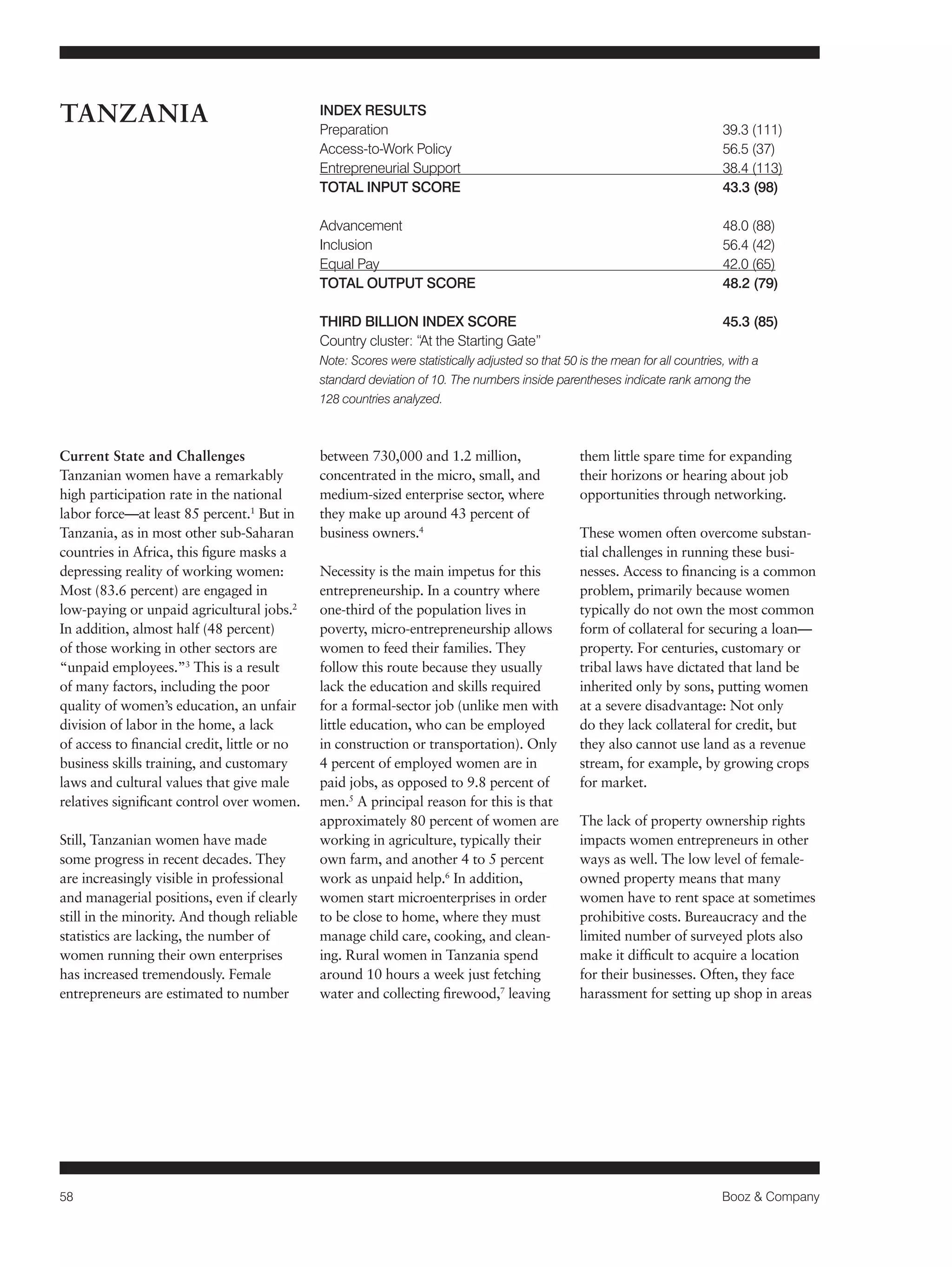
• Tanzania (85th—“At the Starting Gate”) 
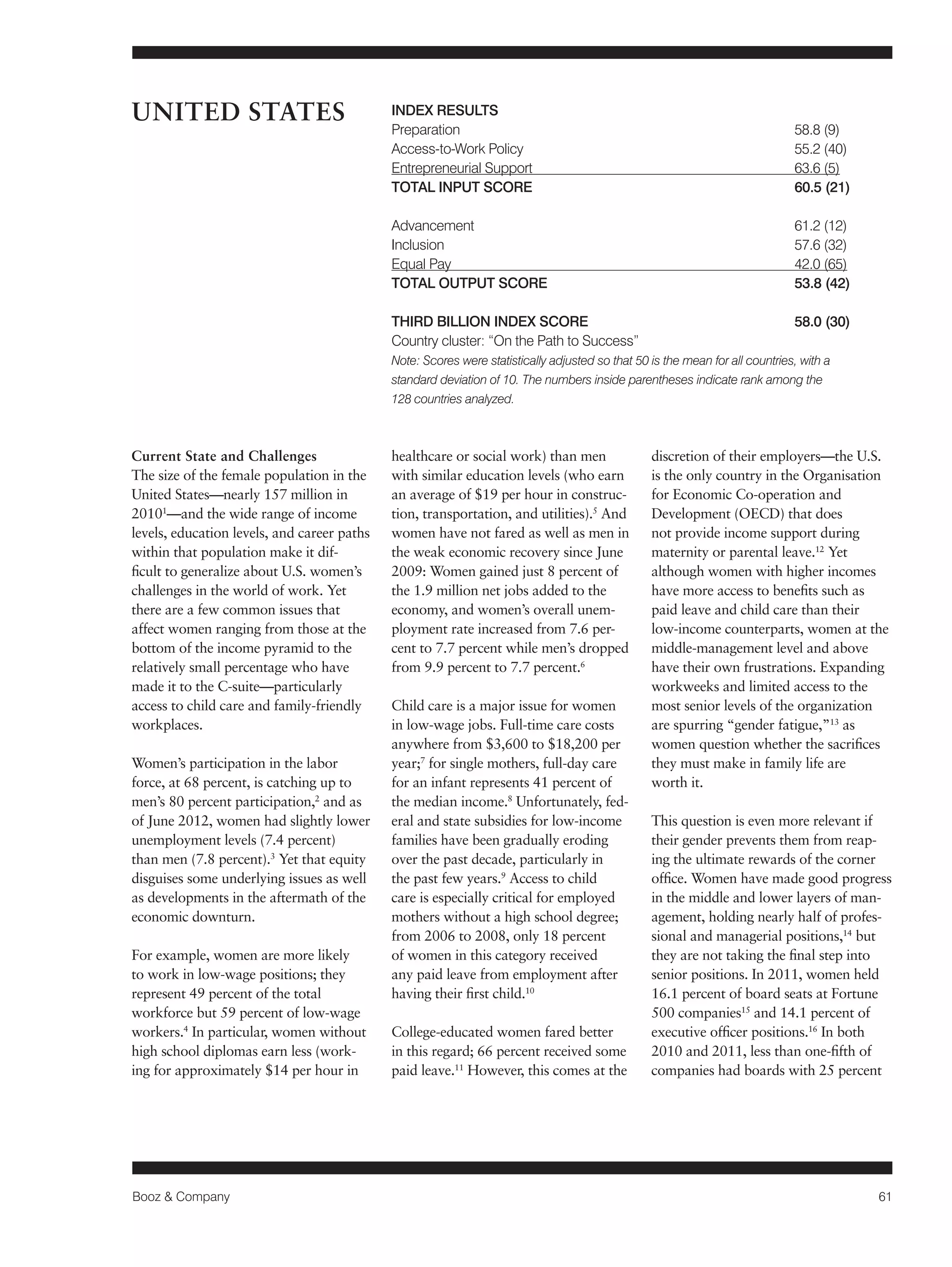
• United States (30th—“On the Path to Success”) 
In addition, we profiled three countries from the Middle East and North 
Africa (MENA) region: Egypt (108th), Saudi Arabia (123rd), and the 
United Arab Emirates (109th), which are all “at the starting gate.” In 
focusing on this region, we wanted to highlight the remarkable socioeco-nomic 
transitions currently under way, and to show that women represent 
a crucial part of those changes. 
At a recent conference on women’s issues held by the Organisation for 
Economic Co-operation and Development(OECD), the organization’s 
secretary-general, Angel Gurria, summed up the challenge: “Women are 
the most underutilized economic asset in the world’s economy.”1 Only 
by correcting this situation through sweeping national, regional, and 
global institutional changes, and ensuring that women everywhere have 
the opportunity to become active economic agents, can we create stable 
prosperity, healthy societies, and a hopeful future.
8 Booz & Company 
“Women are the 
most underutilized 
economic asset in the 
world’s economy.” 
—Angel Gurria, 
Secretary-General, OECD
Booz & Company 9
10 Booz & Company 
Women are poised to play a signifi-cant 
role in the global economy in the 
coming decade—as significant as that 
of the billion-plus populations of India 
and China—yet this Third Billion 
has not yet received sufficient atten-tion 
in many countries from govern-ments, 
business leaders, or other 
key decision makers. This represents 
a missed opportunity; as Melanne 
Verveer, U.S. ambassador-at-large 
for global women’s issues, put it at 
a recent Organisation for Economic 
Co-operation and Development 
(OECD) conference, “The benefits of 
women’s economic participation are 
well documented.”1 However, to more 
effectively leverage the contribution of 
women and empower them economi-cally— 
as employees, producers, and 
business owners—governments will 
need a better understanding of the 
levers they can pull. 
Several global organizations already 
track statistics related to women’s 
issues, and publish their own nation-by- 
nation rankings. In creating the 
Third Billion Index, our aim is to 
focus specifically on women in the 
world of work. The index isolates 
the factors that facilitate women’s 
entry into the workforce—either 
as employees or as entrepreneurs— 
and determines specific drivers 
that can improve their access and 
advancement. 
We recognize, of course, that certain 
foundational needs must be met if 
women are to succeed as profession-als, 
entrepreneurs, and employees. 
These include access to healthcare, 
political participation, and legal status 
equal to that of men. In focusing on 
women’s economic and professional 
empowerment, our intent is not to 
I. THE ORIGIN 
OF THE INDEX
Booz & Company 11 
discount the importance of these other 
issues, or to overlook the fact that all 
aspects of women’s empowerment are 
intertwined. Rather, we look to the 
future, to the day when women world-wide 
can take such rights for granted. 
And we hope to raise a discussion 
about how to help women become 
active economic agents who can 
contribute to their national economy, 
create better lives for their family, and 
empower themselves. 
The Third Billion Index is a composite 
of indicators of women’s potential 
for economic participation, drawn 
from a spectrum of criteria. All were 
taken from existing data compiled 
by the World Economic Forum or 
the Economist Intelligence Unit; both 
organizations have done tremen-dous 
work in this field, and we are 
indebted to their research efforts. The 
Methodology section of this report 
(see page 12) provides a detailed tech-nical 
explanation of the components 
of the index. 
A more general explanation is needed, 
however, to understand the index and 
its implications for helping women 
succeed. The index divides all the indi-cators 
of women’s economic stand-ing 
into two separate clusters. The 
first is “inputs.” These are measures 
that a government (or, in some cases, 
other entities, such as businesses and 
nongovernmental organizations) can 
improve to affect the economic posi-tion 
of women. Such factors reflect 
the direct impact of laws and poli-cies 
regarding minimum schooling, 
employment policies during and after 
childbirth, access to credit, and others. 
We grouped these inputs into three 
composite elements: 
• Women’s level of preparation for 
joining the workforce 
• The country’s access-to-work 
policies 
• Entrepreneurial support 
Next we looked at a set of “outputs.” 
These are observable aspects of 
women’s participation in the national 
economy. They reflect, over the long 
term, the social, political, and eco-nomic 
environment that is influenced 
by the inputs. Our list of outputs 
includes such indicators as the ratio of 
pay between women and men, and the 
number of women among technical 
workers, senior business leaders, and 
employees. As with inputs, these were 
made up of individual data sets for 
each parameter, which we bundled 
into three composite elements: 
• Inclusion in the workforce 
• The degree of advancement in the 
national economy 
• Equal pay for equal work in 
practice 
Broadly, a country’s overall index 
ranking is derived from combining its 
input and output factors.
12 Booz & Company 
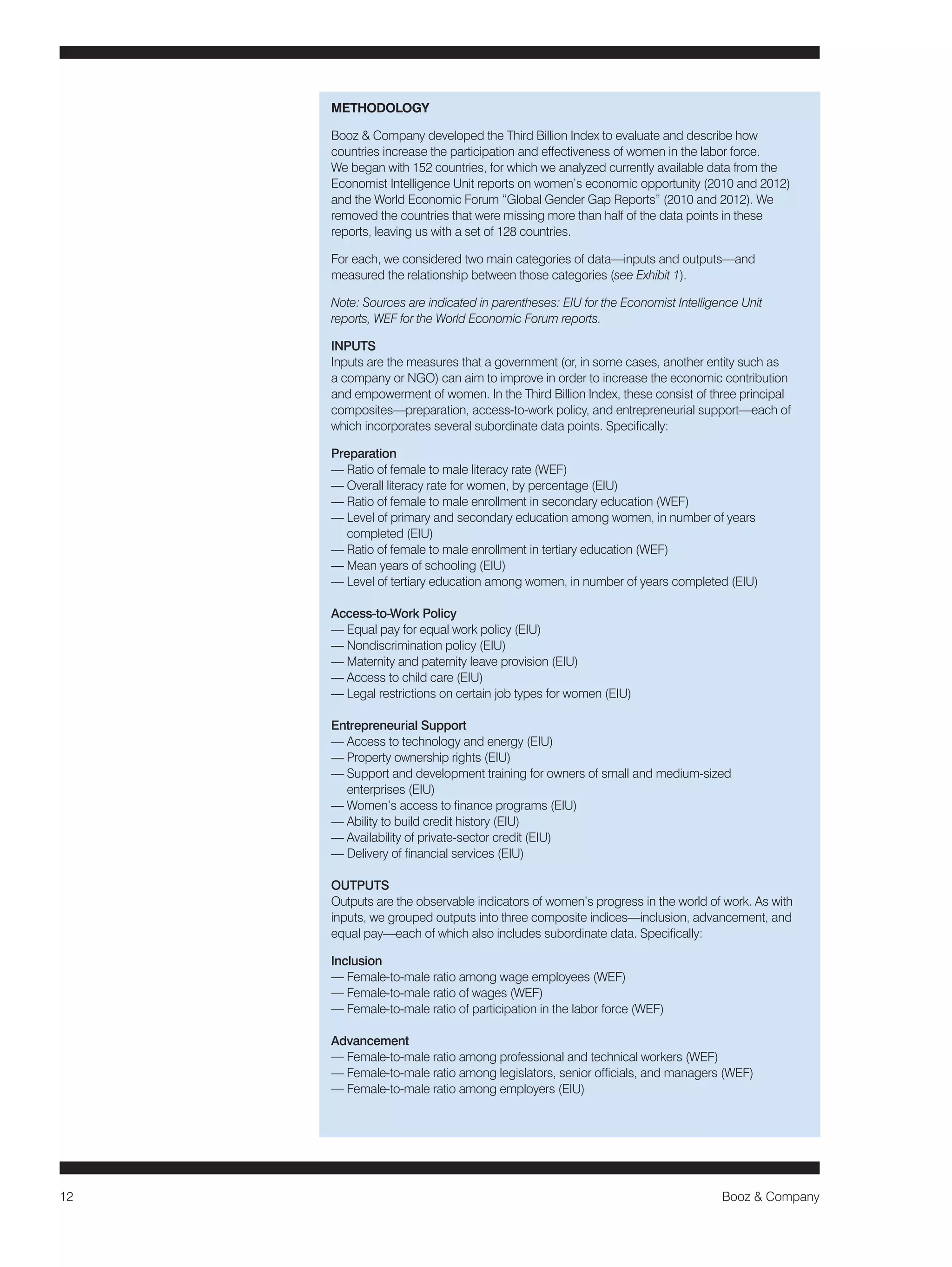
METHODOLOGY 
Booz & Company developed the Third Billion Index to evaluate and describe how 
countries increase the participation and effectiveness of women in the labor force. 
We began with 152 countries, for which we analyzed currently available data from the 
Economist Intelligence Unit reports on women’s economic opportunity (2010 and 2012) 
and the World Economic Forum “Global Gender Gap Reports” (2010 and 2012). We 
removed the countries that were missing more than half of the data points in these 
reports, leaving us with a set of 128 countries. 
For each, we considered two main categories of data—inputs and outputs—and 
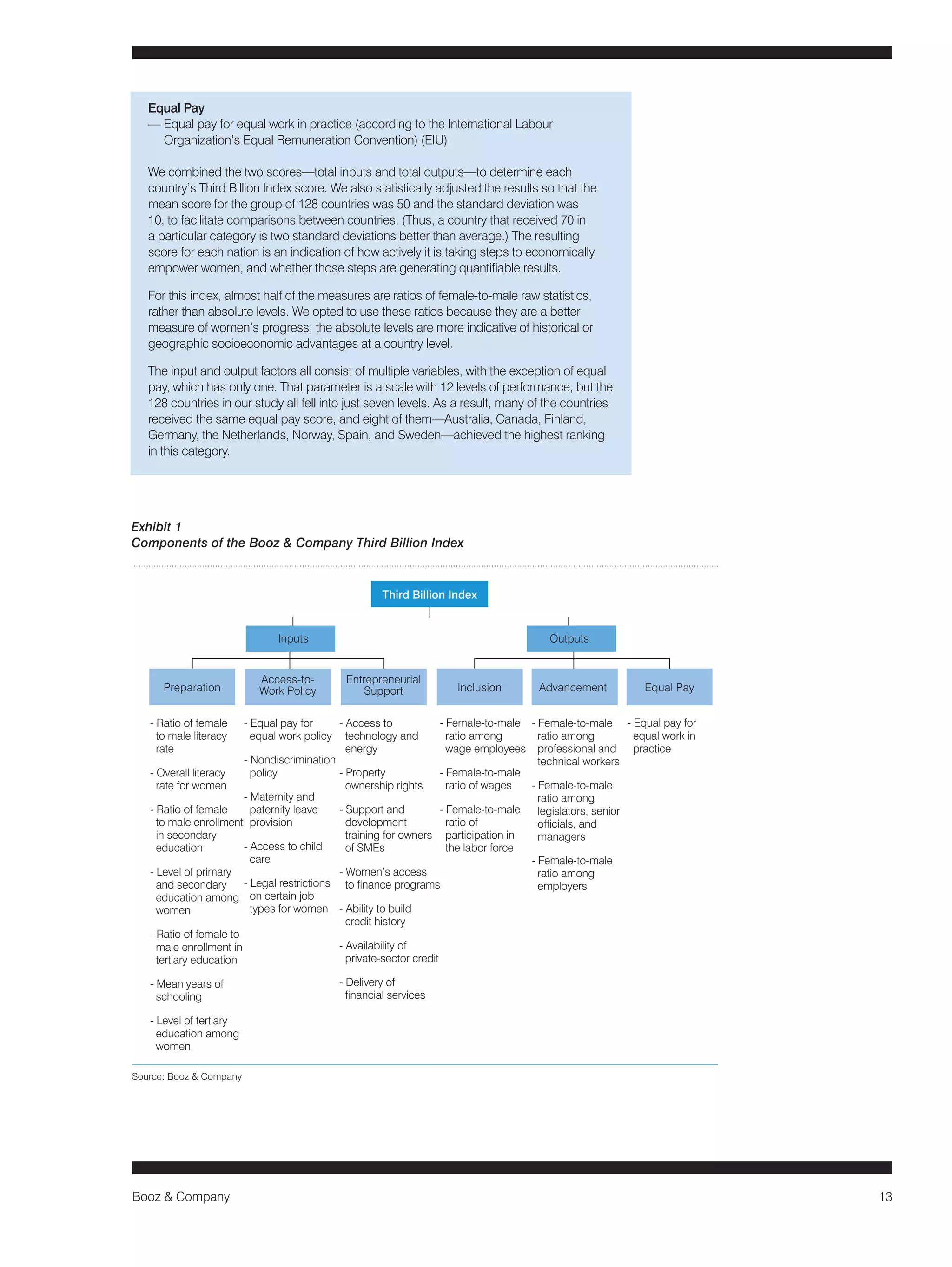
measured the relationship between those categories (see Exhibit 1). 
Note: Sources are indicated in parentheses: EIU for the Economist Intelligence Unit 
reports, WEF for the World Economic Forum reports. 
INPUTS 
Inputs are the measures that a government (or, in some cases, another entity such as 
a company or NGO) can aim to improve in order to increase the economic contribution 
and empowerment of women. In the Third Billion Index, these consist of three principal 
composites—preparation, access-to-work policy, and entrepreneurial support—each of 
which incorporates several subordinate data points. Specifically: 
Preparation 
— Ratio of female to male literacy rate (WEF) 
— Overall literacy rate for women, by percentage (EIU) 
— Ratio of female to male enrollment in secondary education (WEF) 
— Level of primary and secondary education among women, in number of years 
completed (EIU) 
— Ratio of female to male enrollment in tertiary education (WEF) 
— Mean years of schooling (EIU) 
— Level of tertiary education among women, in number of years completed (EIU) 
Access-to-Work Policy 
— Equal pay for equal work policy (EIU) 
— Nondiscrimination policy (EIU) 
— Maternity and paternity leave provision (EIU) 
— Access to child care (EIU) 
— Legal restrictions on certain job types for women (EIU) 
Entrepreneurial Support 
— Access to technology and energy (EIU) 
— Property ownership rights (EIU) 
— Support and development training for owners of small and medium-sized 
enterprises (EIU) 
— Women’s access to finance programs (EIU) 
— Ability to build credit history (EIU) 
— Availability of private-sector credit (EIU) 
— Delivery of financial services (EIU) 
OUTPUTS 
Outputs are the observable indicators of women’s progress in the world of work. As with 
inputs, we grouped outputs into three composite indices—inclusion, advancement, and 
equal pay—each of which also includes subordinate data. Specifically: 
Inclusion 
— Female-to-male ratio among wage employees (WEF) 
— Female-to-male ratio of wages (WEF) 
— Female-to-male ratio of participation in the labor force (WEF) 
Advancement 
— Female-to-male ratio among professional and technical workers (WEF) 
— Female-to-male ratio among legislators, senior officials, and managers (WEF) 
— Female-to-male ratio among employers (EIU)
Booz & Company 13 
Equal Pay 
— Equal pay for equal work in practice (according to the International Labour 
Organization’s Equal Remuneration Convention) (EIU) 
We combined the two scores—total inputs and total outputs—to determine each 
country’s Third Billion Index score. We also statistically adjusted the results so that the 
mean score for the group of 128 countries was 50 and the standard deviation was 
10, to facilitate comparisons between countries. (Thus, a country that received 70 in 
a particular category is two standard deviations better than average.) The resulting 
score for each nation is an indication of how actively it is taking steps to economically 
empower women, and whether those steps are generating quantifiable results. 
For this index, almost half of the measures are ratios of female-to-male raw statistics, 
rather than absolute levels. We opted to use these ratios because they are a better 
measure of women’s progress; the absolute levels are more indicative of historical or 
geographic socioeconomic advantages at a country level. 
The input and output factors all consist of multiple variables, with the exception of equal 
pay, which has only one. That parameter is a scale with 12 levels of performance, but the 
128 countries in our study all fell into just seven levels. As a result, many of the countries 
received the same equal pay score, and eight of them—Australia, Canada, Finland, 
Germany, the Netherlands, Norway, Spain, and Sweden—achieved the highest ranking 
in this category. 
Source: Booz & Company 
Exhibit 1 
Components of the Booz & Company Third Billion Index 
- Ratio of female 
to male literacy 
rate 
- Overall literacy 
rate for women 
- Ratio of female 
to male enrollment 
in secondary 
education 
- Level of primary 
and secondary 
education among 
women 
- Ratio of female to 
male enrollment in 
tertiary education 
- Mean years of 
schooling 
- Level of tertiary 
education among 
women 
Preparation 
Access-to- 
Work Policy 
Entrepreneurial 
Support Inclusion Advancement Equal Pay 
Third Billion Index 
Inputs Outputs 
- Equal pay for 
equal work policy 
- Nondiscrimination 
policy 
- Maternity and 
paternity leave 
provision 
- Access to child 
care 
- Legal restrictions 
on certain job 
types for women 
- Access to 
technology and 
energy 
- Property 
ownership rights 
- Support and 
development 
training for owners 
of SMEs 
- Women’s access 
to finance programs 
- Ability to build 
credit history 
- Availability of 
private-sector credit 
- Delivery of 
financial services 
- Female-to-male 
ratio among 
professional and 
technical workers 
- Female-to-male 
ratio among 
legislators, senior 
officials, and 
managers 
- Female-to-male 
ratio among 
employers 
- Female-to-male 
ratio among 
wage employees 
- Female-to-male 
ratio of wages 
- Female-to-male 
ratio of 
participation in 
the labor force 
- Equal pay for 
equal work in 
practice
14 Booz & Company 
Source: Third Billion Index (Booz & Company); data from World Economic Forum and Economist Intelligence Unit 
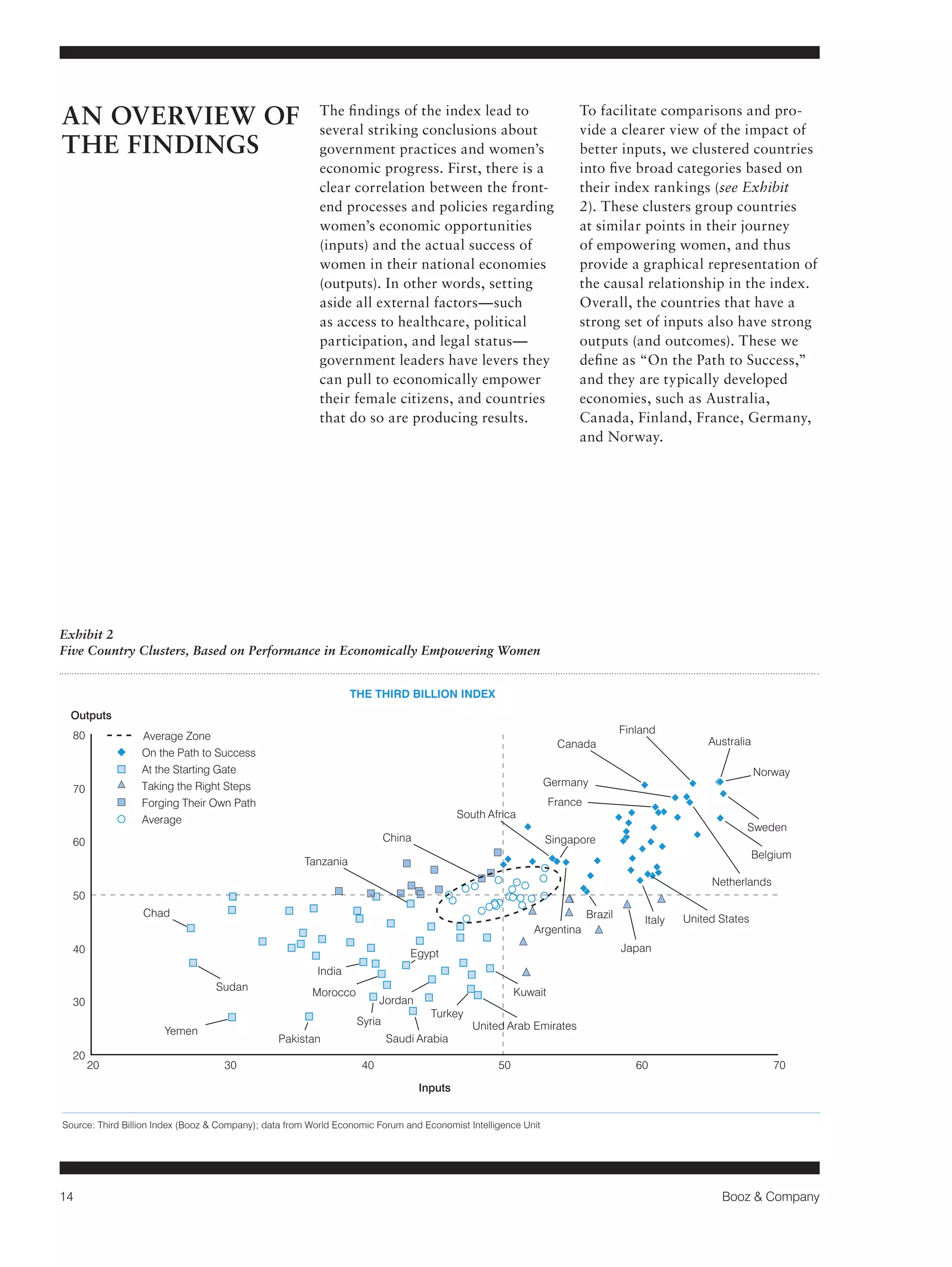
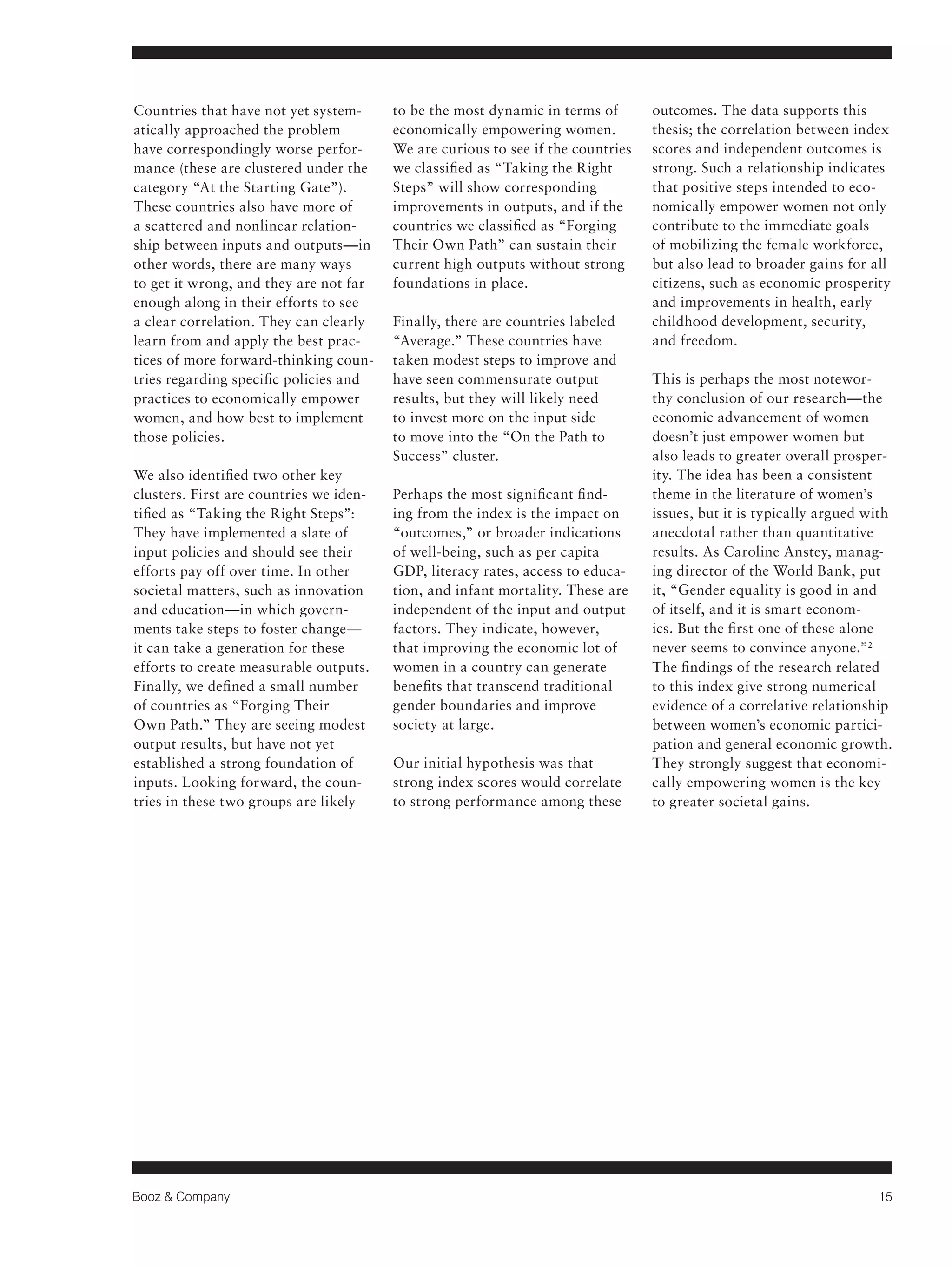
Exhibit 2 
Five Country Clusters, Based on Performance in Economically Empowering Women 
20 
30 
40 
50 
60 
70 
80 
20 30 40 50 60 70 
Argentina 
Australia 
France 
Germany 
Finland 
Tanzania 
Sweden 
Yemen 
China 
Japan 
Pakistan Saudi Arabia 
Syria 
Sudan 
United Arab Emirates 
Turkey 
Singapore 
Morocco 
South Africa 
Jordan 
Netherlands 
Kuwait 
Egypt 
Italy United States 
India 
Chad Brazil 
Canada 
Belgium 
Norway 
Outputs 
Inputs 
THE THIRD BILLION INDEX 
Average Zone 
Average 
Forging Their Own Path 
Taking the Right Steps 
At the Starting Gate 
On the Path to Success 
AN OVERVIEW OF 
THE FINDINGS 
The findings of the index lead to 
several striking conclusions about 
government practices and women’s 
economic progress. First, there is a 
clear correlation between the front-end 
processes and policies regarding 
women’s economic opportunities 
(inputs) and the actual success of 
women in their national economies 
(outputs). In other words, setting 
aside all external factors—such 
as access to healthcare, political 
participation, and legal status— 
government leaders have levers they 
can pull to economically empower 
their female citizens, and countries 
that do so are producing results. 
To facilitate comparisons and pro-vide 
a clearer view of the impact of 
better inputs, we clustered countries 
into five broad categories based on 
their index rankings (see Exhibit 
2). These clusters group countries 
at similar points in their journey 
of empowering women, and thus 
provide a graphical representation of 
the causal relationship in the index. 
Overall, the countries that have a 
strong set of inputs also have strong 
outputs (and outcomes). These we 
define as “On the Path to Success,” 
and they are typically developed 
economies, such as Australia, 
Canada, Finland, France, Germany, 
and Norway.
Booz & Company 15 
Countries that have not yet system-atically 
approached the problem 
have correspondingly worse perfor-mance 
(these are clustered under the 
category “At the Starting Gate”). 
These countries also have more of 
a scattered and nonlinear relation-ship 
between inputs and outputs—in 
other words, there are many ways 
to get it wrong, and they are not far 
enough along in their efforts to see 
a clear correlation. They can clearly 
learn from and apply the best prac-tices 
of more forward-thinking coun-tries 
regarding specific policies and 
practices to economically empower 
women, and how best to implement 
those policies. 
We also identified two other key 
clusters. First are countries we iden-tified 
as “Taking the Right Steps”: 
They have implemented a slate of 
input policies and should see their 
efforts pay off over time. In other 
societal matters, such as innovation 
and education—in which govern-ments 
take steps to foster change— 
it can take a generation for these 
efforts to create measurable outputs. 
Finally, we defined a small number 
of countries as “Forging Their 
Own Path.” They are seeing modest 
output results, but have not yet 
established a strong foundation of 
inputs. Looking forward, the coun-tries 
in these two groups are likely 
to be the most dynamic in terms of 
economically empowering women. 
We are curious to see if the countries 
we classified as “Taking the Right 
Steps” will show corresponding 
improvements in outputs, and if the 
countries we classified as “Forging 
Their Own Path” can sustain their 
current high outputs without strong 
foundations in place. 
Finally, there are countries labeled 
“Average.” These countries have 
taken modest steps to improve and 
have seen commensurate output 
results, but they will likely need 
to invest more on the input side 
to move into the “On the Path to 
Success” cluster. 
Perhaps the most significant find-ing 
from the index is the impact on 
“outcomes,” or broader indications 
of well-being, such as per capita 
GDP, literacy rates, access to educa-tion, 
and infant mortality. These are 
independent of the input and output 
factors. They indicate, however, 
that improving the economic lot of 
women in a country can generate 
benefits that transcend traditional 
gender boundaries and improve 
society at large. 
Our initial hypothesis was that 
strong index scores would correlate 
to strong performance among these 
outcomes. The data supports this 
thesis; the correlation between index 
scores and independent outcomes is 
strong. Such a relationship indicates 
that positive steps intended to eco-nomically 
empower women not only 
contribute to the immediate goals 
of mobilizing the female workforce, 
but also lead to broader gains for all 
citizens, such as economic prosperity 
and improvements in health, early 
childhood development, security, 
and freedom. 
This is perhaps the most notewor-thy 
conclusion of our research—the 
economic advancement of women 
doesn’t just empower women but 
also leads to greater overall prosper-ity. 
The idea has been a consistent 
theme in the literature of women’s 
issues, but it is typically argued with 
anecdotal rather than quantitative 
results. As Caroline Anstey, manag-ing 
director of the World Bank, put 
it, “Gender equality is good in and 
of itself, and it is smart econom-ics. 
But the first one of these alone 
never seems to convince anyone.”2 
The findings of the research related 
to this index give strong numerical 
evidence of a correlative relationship 
between women’s economic partici-pation 
and general economic growth. 
They strongly suggest that economi-cally 
empowering women is the key 
to greater societal gains.
16 Booz & Company 
THE THRESHOLD TO THE MIDDLE CLASS 
There are many reasons that countries around the world have failed to realize 
the economic potential of women. Our analysis of data from the International 
Labour Organization (ILO)—a United Nations agency that tracks global workforce 
statistics—groups these reasons broadly into two deficiencies: Women are either 
(1) not prepared or (2) not enabled to join the workforce. 
The first attribute—“prepared”—refers to having received a sufficient education, 
usually defined as the completion of secondary school. Opportunities for basic 
education and literacy are prerequisites to women’s economic empowerment. 
As women progress through rising education levels, they develop a sense of 
empowerment that allows them to make more decisions and participate in 
the labor market. The ILO measures preparedness, or the lack of it, through a 
combination of factors, including enrollment rates in primary, secondary, and 
tertiary education; literacy rates; and mean years of schooling. 
The second category—“enabled”—refers to having sufficient social and political 
support to engage with the labor market. This support spans family, logistical, 
legal, and financial dimensions. It can be measured by equal opportunity 
employment policies regarding fair pay and nondiscriminatory work environments, 
among other indicators. 
The specific characteristics of these two major constraints vary widely, according 
to local social, cultural, and economic conditions. But all countries have one thing 
in common. As they take steps to alleviate these constraints through increased 
migration to cities, the expansion of education opportunities, changes in local laws 
and cultural norms, and investments in infrastructure that support greater workforce 
participation, the Third Billion will advance into the middle class in accelerating 
numbers. 
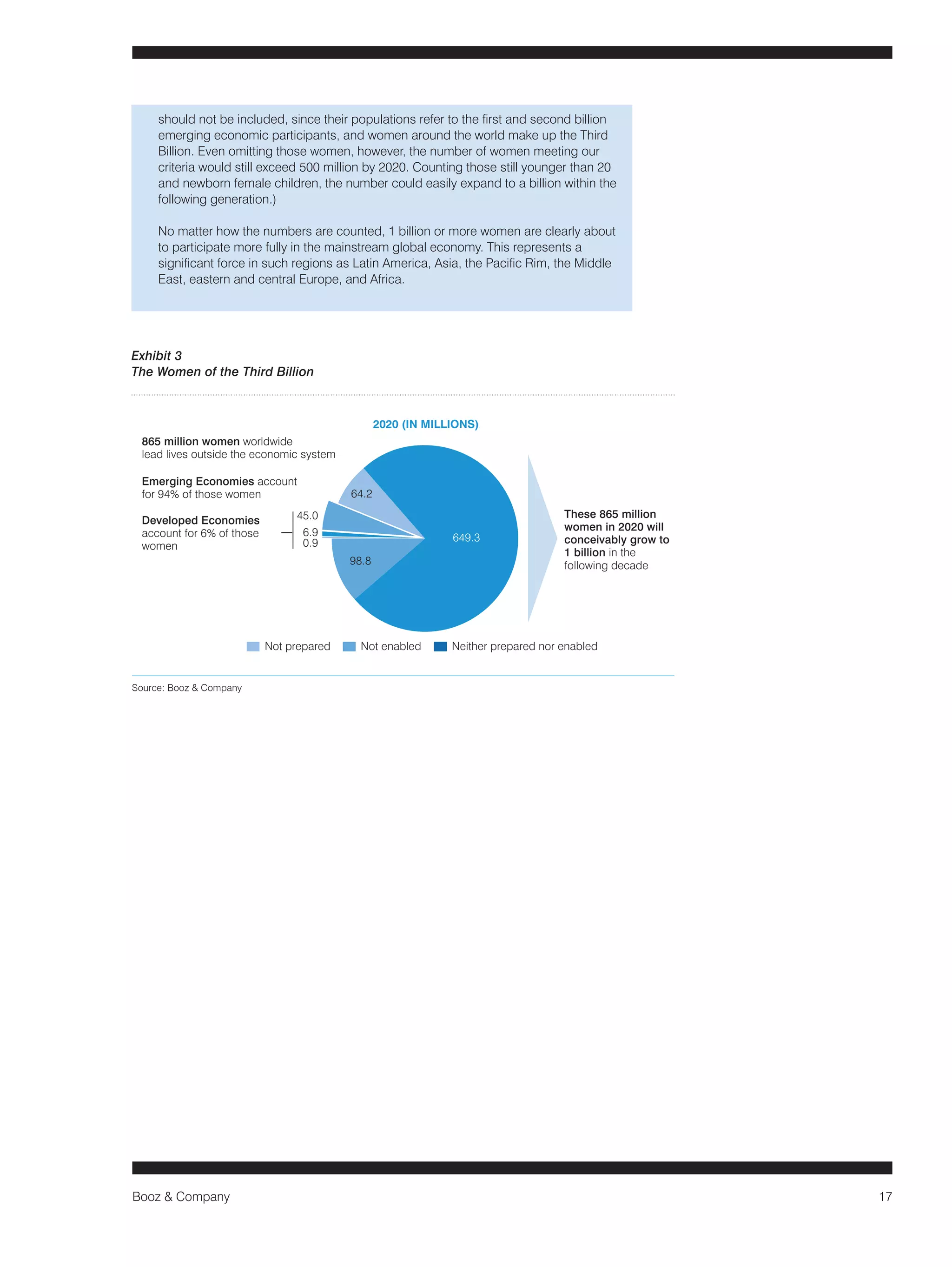
We reached our conclusion that there are 1 billion women with the potential to 
contribute more fully to their national economies by combining the estimated 
number of “not prepared” and “not enabled” women between the ages of 20 
and 65 in 2020, using data from the ILO (see Exhibit 3). The result was 865 
million women. Most of these women—about 812 million—live in emerging 
and developing nations. (Some might argue that the women of China and India
Booz & Company 17 
should not be included, since their populations refer to the first and second billion 
emerging economic participants, and women around the world make up the Third 
Billion. Even omitting those women, however, the number of women meeting our 
criteria would still exceed 500 million by 2020. Counting those still younger than 20 
and newborn female children, the number could easily expand to a billion within the 
following generation.) 
No matter how the numbers are counted, 1 billion or more women are clearly about 
to participate more fully in the mainstream global economy. This represents a 
significant force in such regions as Latin America, Asia, the Pacific Rim, the Middle 
East, eastern and central Europe, and Africa. 
Source: Booz & Company 
Exhibit 3 
The Women of the Third Billion 
2020 (IN MILLIONS) 
649.3 
98.8 
64.2 
45.0 
6.9 
0.9 
These 865 million 
women in 2020 will 
conceivably grow to 
1 billion in the 
following decade 
Not p repared Not enabled Neith er prepared nor enabled 
865 million women worldwide 
lead lives outside the economic system 
Emerging Economies account 
for 94% of those women 
Developed Economies 
account for 6% of those 
women
18 Booz & Company 
QUANTIFYING THE ECONOMIC CONTRIBUTION OF WOMEN 
One can determine the relationship between economic activity (GDP) and 
employment for a given country by using the following equation: 
Per capita GDP = labor productivity x amount of work produced per person 
x employment rate x age factor 
Hence, positive changes in labor productivity, hours worked, employment rate, and 
demographics all positively affect GDP. A more scientific form of the equation looks 
like this: 
Per capita GDP = GDP/H x H/E x E/WAP x WAP/P 
where: 
GDP/H = GDP/hour worked (labor productivity) 
H/E = hour worked/employment (annual average in working hour per employed 
person) 
E/WAP = employment/working-age population (15–64) (employment rate) 
WAP/P = working-age population/population (“youth dividend”) 
A 2007 publication by Goldman Sachs calculated the impact that greater female 
participation in the workforce can have on a national economy.3 That paper 
assumes that raising female employment to the male employment level in a country 
would boost the overall employment rate by a measurable amount—([male rate-to-overall 
rate]/overall rate)—and per capita GDP by a similar amount. 
We believe that, at least in the medium term (through 2020), in calculating the 
economic contribution of new women in the workforce, we need to account for two 
additional factors: 
1. Countries will likely experience a temporary drop in labor productivity, as 
many women will enter the workforce with limited work experience and lesser 
qualifications. (Although women have recently closed the education gap 
in many countries around the world, the average woman is still today less 
educated than the average man.) 
2. Countries will experience a drop in average hours worked across the overall 
population, as many of the women entering and staying in the workforce 
will choose to work part-time. Interruptions in employment to take care of 
family members (young and old) also affect the average hours worked by an 
employed person.
Booz & Company 19 
For the first factor, we can use the productivity drag, or the gap in productivity 
between incumbents and new entrants. In general, the productivity drag eliminates 
30 percent to 40 percent of the potential gain for each incremental entrant in the 
workforce (or a net increase of 0.6 percent to 0.7 percent per 1 percent increase in 
employment). Applying this to the second formula above corresponds to an initial 
dampening factor of 70 percent to the gross increase in GDP estimate. 
For the second factor, we assume that a third of all entrants to the workforce will 
work part-time, at an average of 60 percent of full-time hours. This results in a 
second dampening factor of 87 percent, which should be applied to the gross 
increase in GDP from women entering the workforce. 
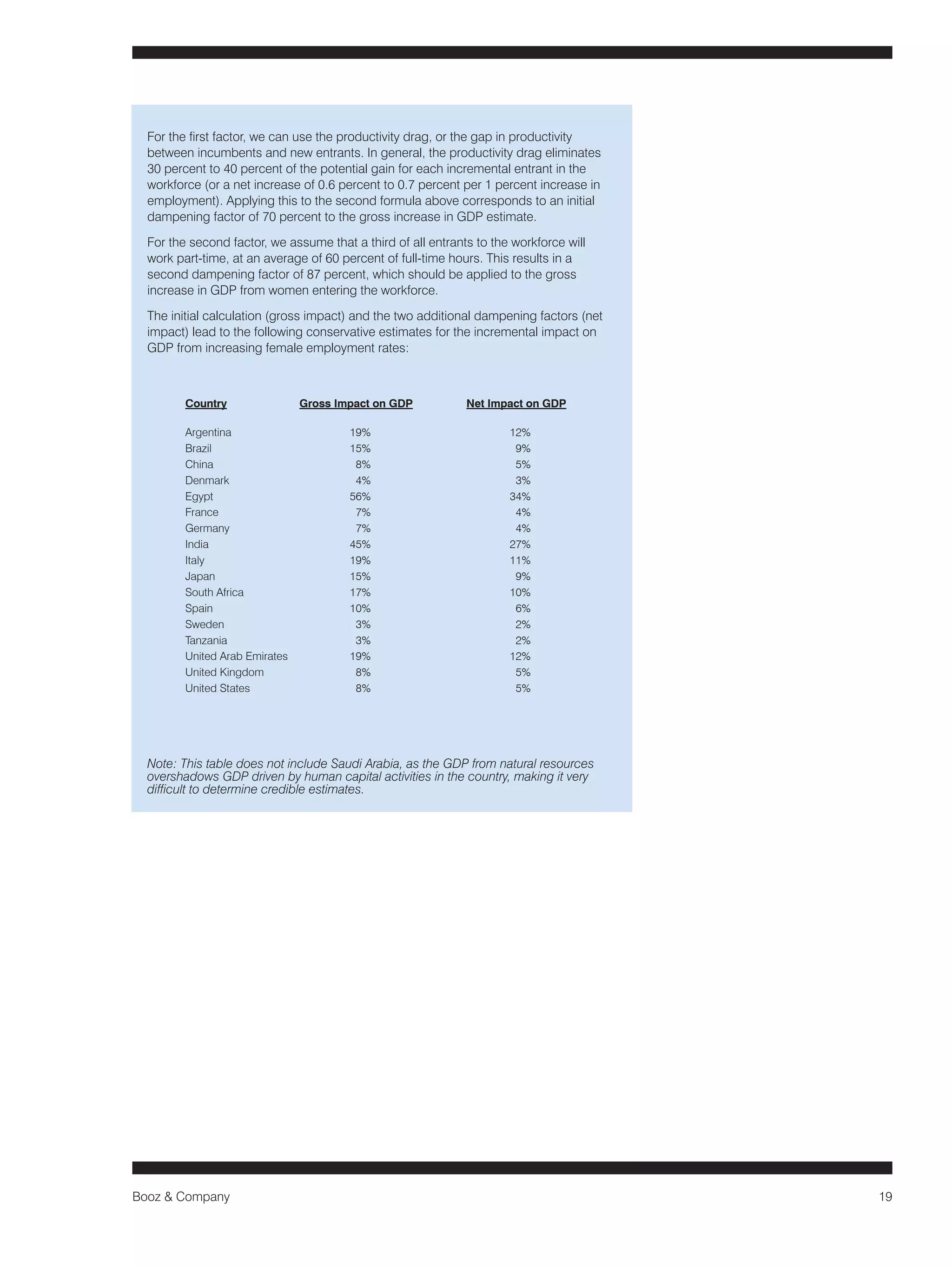
The initial calculation (gross impact) and the two additional dampening factors (net 
impact) lead to the following conservative estimates for the incremental impact on 
GDP from increasing female employment rates: 
Note: This table does not include Saudi Arabia, as the GDP from natural resources 
overshadows GDP driven by human capital activities in the country, making it very 
difficult to determine credible estimates. 
Country Gross Impact on GDP Net Impact on GDP 
Argentina 19% 12% 
Brazil 15% 9% 
China 8% 5% 
Denmark 4% 3% 
Egypt 56% 34% 
France 7% 4% 
Germany 7% 4% 
India 45% 27% 
Italy 19% 11% 
Japan 15% 9% 
South Africa 17% 10% 
Spain 10% 6% 
Sweden 3% 2% 
Tanzania 3% 2% 
United Arab Emirates 19% 12% 
United Kingdom 8% 5% 
United States 8% 5%
20 Booz & Company 
“Gender equality is good in 
and of itself, and it is smart 
economics. But the first one 
of these alone never seems to 
convince anyone.” 
—Caroline Anstey, 
Managing Director, World Bank
Booz & Company 21
22 Booz & Company 
The Third Billion is not a homoge-neous 
demographic bloc. Its members 
represent a multitude of nationalities, 
ethnicities, and religions. They live 
in cities, in small towns, in villages, 
and on farms. They are young and 
old, married and single, experienced 
and inexperienced. Finally, they are 
products of the places where they live, 
with the constraints and opportuni-ties 
unique to those regions, countries, 
states, and cities. And as such, they 
require an array of customized solu-tions 
to help them reach their potential. 
Yet despite those geographic dif-ferences, 
several intertwined themes 
repeatedly cropped up as we conducted 
this global research project. All should 
be top priorities for governments, com-panies, 
and civil societies that hope to 
economically empower women. 
The Care Economy 
Around the world, women are the 
primary caregivers for children, the 
elderly, and the sick. It is a fact so 
obvious that it hardly seems to bear 
mentioning, and yet so fundamental to 
any discussion of women’s roles that it 
cannot be emphasized enough. Women 
in OECD countries spend about 2.4 
hours more than men on unpaid work 
(including care work) each day.1 In 
less-developed countries, unpaid work 
also includes household chores that 
compensate for a lack of infrastructure, 
such as getting water and finding fuel. 
One study found that if care work were 
assigned a monetary value, it would 
constitute between 10 and 39 percent 
of GDP.2 
Countries must walk a fine line in 
determining how to address this issue. 
Such care work is clearly a burden 
that falls largely upon women, and 
thus is a barrier to women’s economic 
development. If companies and 
governments want to see women reach 
their maximum economic potential, 
these organizations must play a 
role in helping to provide care. This 
conclusion is borne out by data: OECD 
countries that have the highest public 
spending as a percentage of GDP 
on child care and education services 
for children under age 5 have higher 
employment among mothers with 
young children.3 
At the same time, however, care 
work—particularly child care—is 
crucial to the future development of 
national economies because it helps 
create a new generation of healthy, 
educated citizens. Governments must 
guard against shifting care work into 
low-quality jobs that are often filled by 
women.4 
II. COMMON 
CHALLENGES 
AROUND THE 
GLOBE
Booz & Company 23 
Although specific solutions will vary 
by country, several elements are critical 
to any approach to care work. These 
include widespread, affordable care 
for children, the elderly, and the sick; 
cultural changes aimed at dividing 
care work more equitably between 
men and women; and private-sector 
recognition of the importance of care 
work for all employees, along with 
accommodations to allow for a healthy 
work–life balance. 
Enabling Women for the Future 
In every country in the world, women 
require investments in their future— 
financial, educational, and cultural. 
None of these elements can stand 
alone. Allocating capital for investment 
in women’s businesses is fruitless if 
women do not have the education 
to run a business successfully, or the 
cultural perception that they can 
compete economically with men. 
Investments in education will only 
lead to frustration if there are no 
financial investments in jobs for 
cohorts of newly educated women, or 
if cultural restrictions prohibit girls 
from attending school. And cultural 
messages of empowerment ring hollow 
if women are not educated enough to 
take their place in rapidly advancing 
societies, or if there is no place in the 
economy for them to make their mark. 
The measures necessary to create 
change in each of these areas will 
vary according to a country’s level of 
economic development. In emerging 
economies, the focus will most likely 
be on: 
• According women equal rights 
in terms of inheritance, property 
ownership, family law, and 
economic independence, while 
encouraging girls and women to 
believe in themselves and pursue 
their ambitions 
• Achieving gender parity in primary 
and secondary schools, as well as 
providing vocational training 
• Helping women shift from low-paying, 
vulnerable jobs with little 
security—such as unpaid family 
work, casual agricultural labor, 
much assembly-line work in urban 
factories and workshops, and 
most domestic service5—to more 
permanent work with a positive 
career path 
In advanced economies, women’s 
empowerment will more likely 
emphasize: 
• Continuing to advance support for 
women’s family responsibilities, such 
as maternity leave and access to 
child care 
• Ensuring that the parity 
achieved in education is reflected 
in employment, through 
nondiscrimination policies 
• Encouraging educated women who 
have already entered the workforce 
in large numbers to insist on 
their right to advancement and to 
challenge remaining gender bias 
In both advanced and emerging 
economies, women’s empowerment 
will require investing in female 
entrepreneurs at all funding levels. The 
emphasis may be different depending 
on a country’s state of economic 
maturity—e.g., advanced countries 
may emphasize access to technology 
and energy, whereas emerging markets 
may focus on factors such as support 
and training for small business 
owners—but this need for investment 
applies worldwide. 
Moving beyond Micro 
The advent of microfinance (the use of 
small loans to foster self-reliant small 
businesses in a community setting, 
where borrowers typically lack access 
to banking and related services) has 
empowered millions of women in
24 Booz & Company 
recent decades, and the stories of these 
women’s accomplishments are truly 
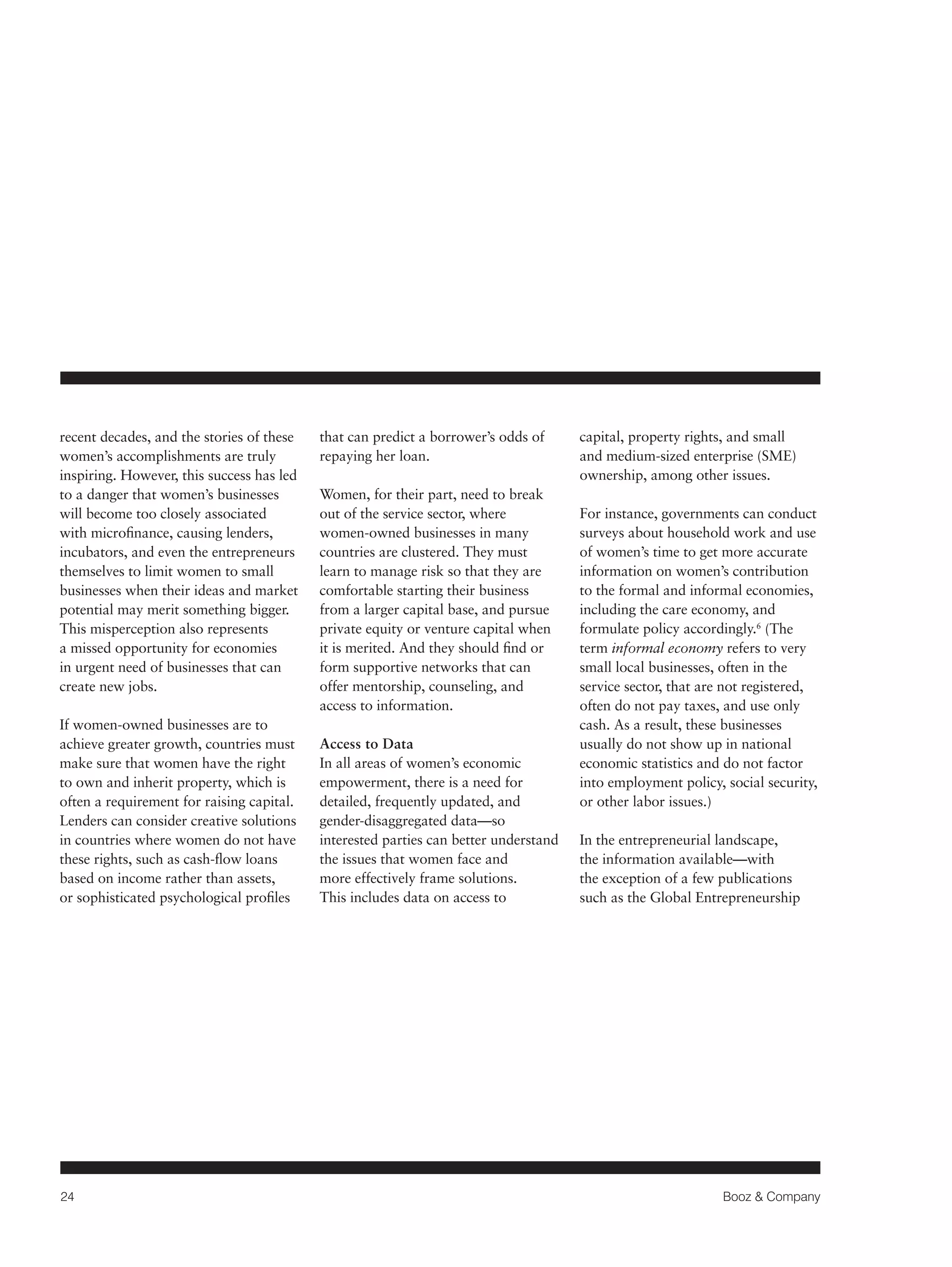
inspiring. However, this success has led 
to a danger that women’s businesses 
will become too closely associated 
with microfinance, causing lenders, 
incubators, and even the entrepreneurs 
themselves to limit women to small 
businesses when their ideas and market 
potential may merit something bigger. 
This misperception also represents 
a missed opportunity for economies 
in urgent need of businesses that can 
create new jobs. 
If women-owned businesses are to 
achieve greater growth, countries must 
make sure that women have the right 
to own and inherit property, which is 
often a requirement for raising capital. 
Lenders can consider creative solutions 
in countries where women do not have 
these rights, such as cash-flow loans 
based on income rather than assets, 
or sophisticated psychological profiles 
that can predict a borrower’s odds of 
repaying her loan. 
Women, for their part, need to break 
out of the service sector, where 
women-owned businesses in many 
countries are clustered. They must 
learn to manage risk so that they are 
comfortable starting their business 
from a larger capital base, and pursue 
private equity or venture capital when 
it is merited. And they should find or 
form supportive networks that can 
offer mentorship, counseling, and 
access to information. 
Access to Data 
In all areas of women’s economic 
empowerment, there is a need for 
detailed, frequently updated, and 
gender-disaggregated data—so 
interested parties can better understand 
the issues that women face and 
more effectively frame solutions. 
This includes data on access to 
capital, property rights, and small 
and medium-sized enterprise (SME) 
ownership, among other issues. 
For instance, governments can conduct 
surveys about household work and use 
of women’s time to get more accurate 
information on women’s contribution 
to the formal and informal economies, 
including the care economy, and 
formulate policy accordingly.6 (The 
term informal economy refers to very 
small local businesses, often in the 
service sector, that are not registered, 
often do not pay taxes, and use only 
cash. As a result, these businesses 
usually do not show up in national 
economic statistics and do not factor 
into employment policy, social security, 
or other labor issues.) 
In the entrepreneurial landscape, 
the information available—with 
the exception of a few publications 
such as the Global Entrepreneurship
Booz & Company 25 
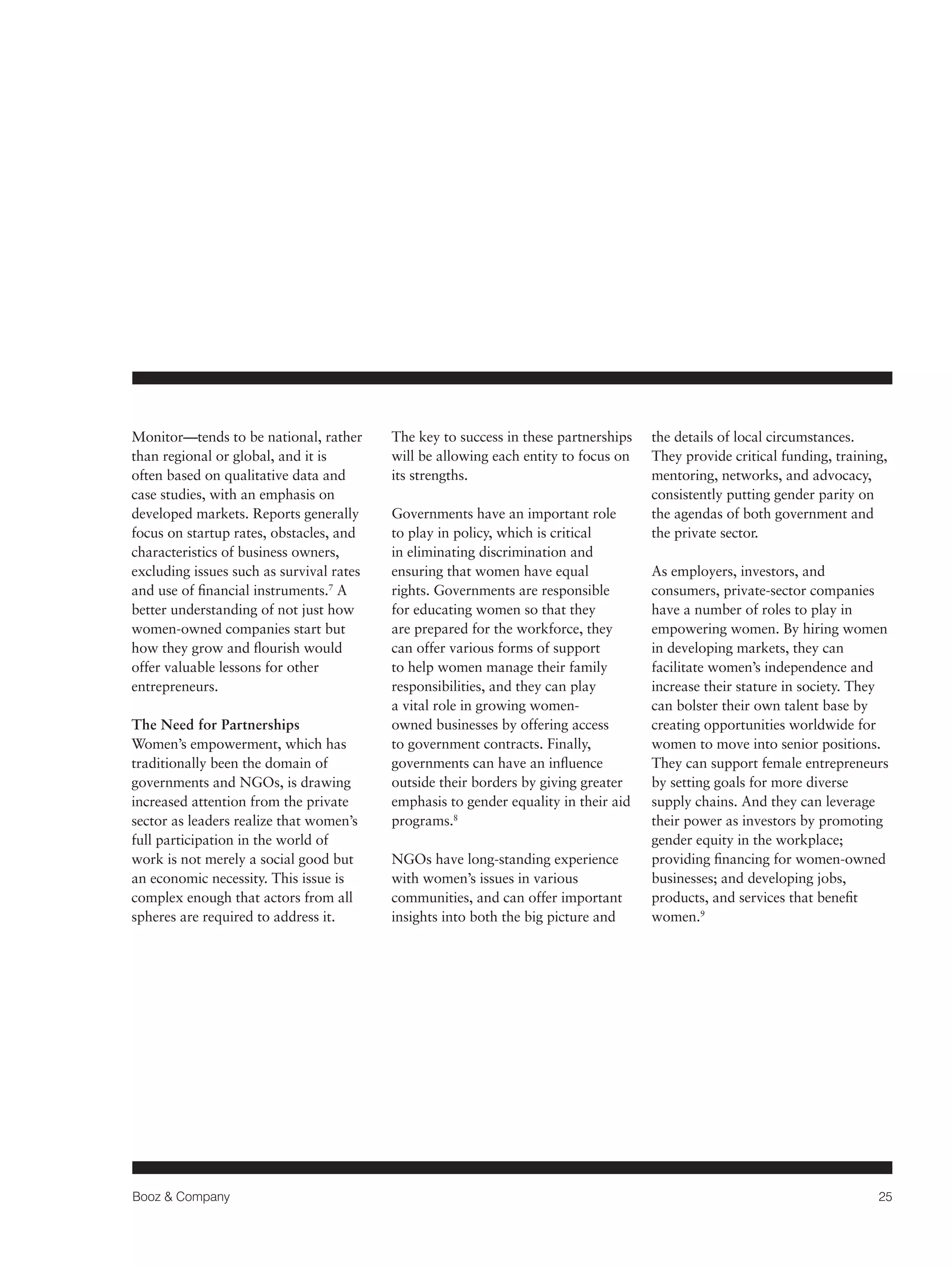
Monitor—tends to be national, rather 
than regional or global, and it is 
often based on qualitative data and 
case studies, with an emphasis on 
developed markets. Reports generally 
focus on startup rates, obstacles, and 
characteristics of business owners, 
excluding issues such as survival rates 
and use of financial instruments.7 A 
better understanding of not just how 
women-owned companies start but 
how they grow and flourish would 
offer valuable lessons for other 
entrepreneurs. 
The Need for Partnerships 
Women’s empowerment, which has 
traditionally been the domain of 
governments and NGOs, is drawing 
increased attention from the private 
sector as leaders realize that women’s 
full participation in the world of 
work is not merely a social good but 
an economic necessity. This issue is 
complex enough that actors from all 
spheres are required to address it. 
The key to success in these partnerships 
will be allowing each entity to focus on 
its strengths. 
Governments have an important role 
to play in policy, which is critical 
in eliminating discrimination and 
ensuring that women have equal 
rights. Governments are responsible 
for educating women so that they 
are prepared for the workforce, they 
can offer various forms of support 
to help women manage their family 
responsibilities, and they can play 
a vital role in growing women-owned 
businesses by offering access 
to government contracts. Finally, 
governments can have an influence 
outside their borders by giving greater 
emphasis to gender equality in their aid 
programs.8 
NGOs have long-standing experience 
with women’s issues in various 
communities, and can offer important 
insights into both the big picture and 
the details of local circumstances. 
They provide critical funding, training, 
mentoring, networks, and advocacy, 
consistently putting gender parity on 
the agendas of both government and 
the private sector. 
As employers, investors, and 
consumers, private-sector companies 
have a number of roles to play in 
empowering women. By hiring women 
in developing markets, they can 
facilitate women’s independence and 
increase their stature in society. They 
can bolster their own talent base by 
creating opportunities worldwide for 
women to move into senior positions. 
They can support female entrepreneurs 
by setting goals for more diverse 
supply chains. And they can leverage 
their power as investors by promoting 
gender equity in the workplace; 
providing financing for women-owned 
businesses; and developing jobs, 
products, and services that benefit 
women.9
26 Booz & Company 
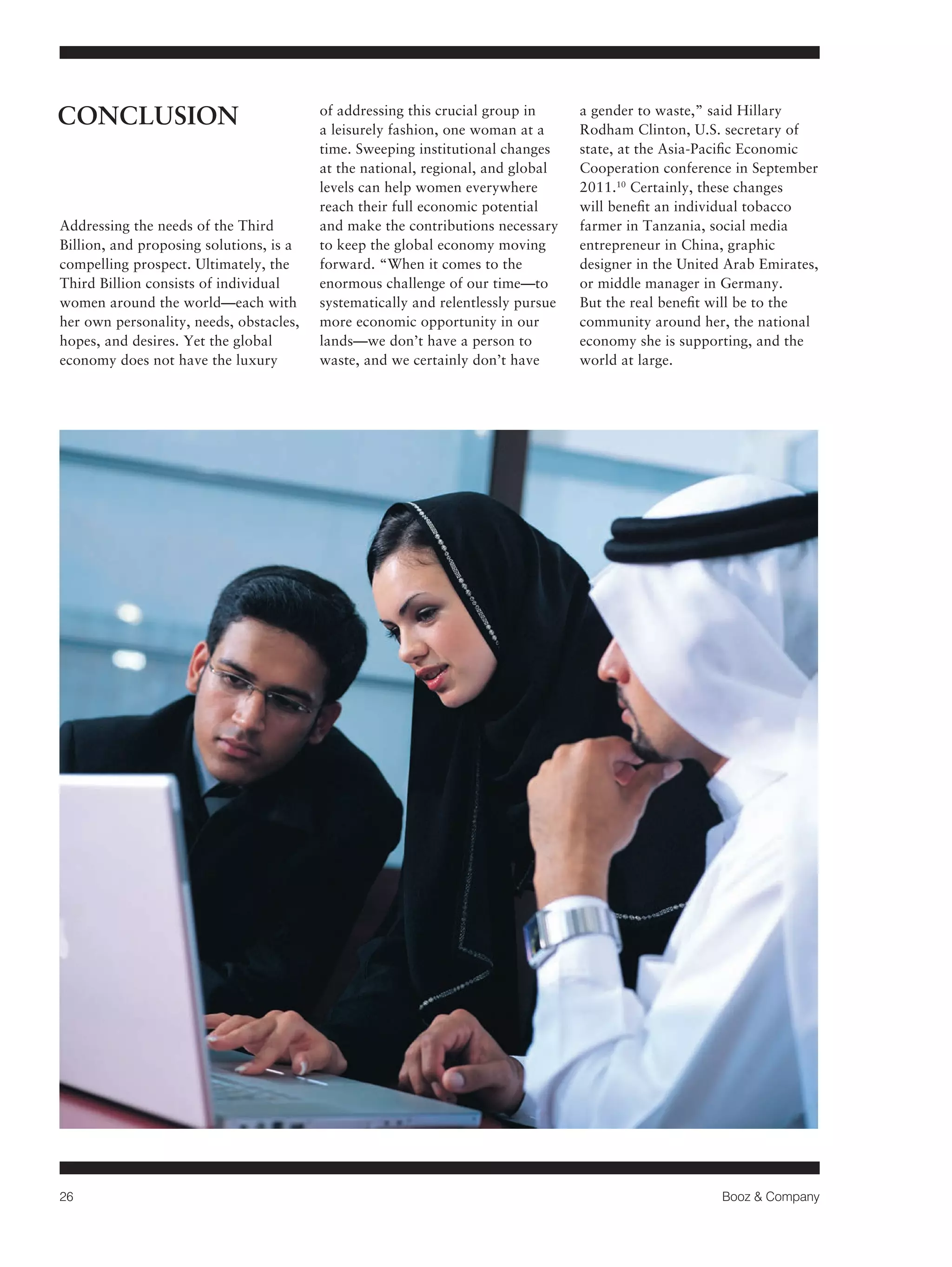
Addressing the needs of the Third 
Billion, and proposing solutions, is a 
compelling prospect. Ultimately, the 
Third Billion consists of individual 
women around the world—each with 
her own personality, needs, obstacles, 
hopes, and desires. Yet the global 
economy does not have the luxury 
of addressing this crucial group in 
a leisurely fashion, one woman at a 
time. Sweeping institutional changes 
at the national, regional, and global 
levels can help women everywhere 
reach their full economic potential 
and make the contributions necessary 
to keep the global economy moving 
forward. “When it comes to the 
enormous challenge of our time—to 
systematically and relentlessly pursue 
more economic opportunity in our 
lands—we don’t have a person to 
waste, and we certainly don’t have 
a gender to waste,” said Hillary 
Rodham Clinton, U.S. secretary of 
state, at the Asia-Pacific Economic 
Cooperation conference in September 
2011.10 Certainly, these changes 
will benefit an individual tobacco 
farmer in Tanzania, social media 
entrepreneur in China, graphic 
designer in the United Arab Emirates, 
or middle manager in Germany. 
But the real benefit will be to the 
community around her, the national 
economy she is supporting, and the 
world at large. 
CONCLUSION
Booz & Company 27 
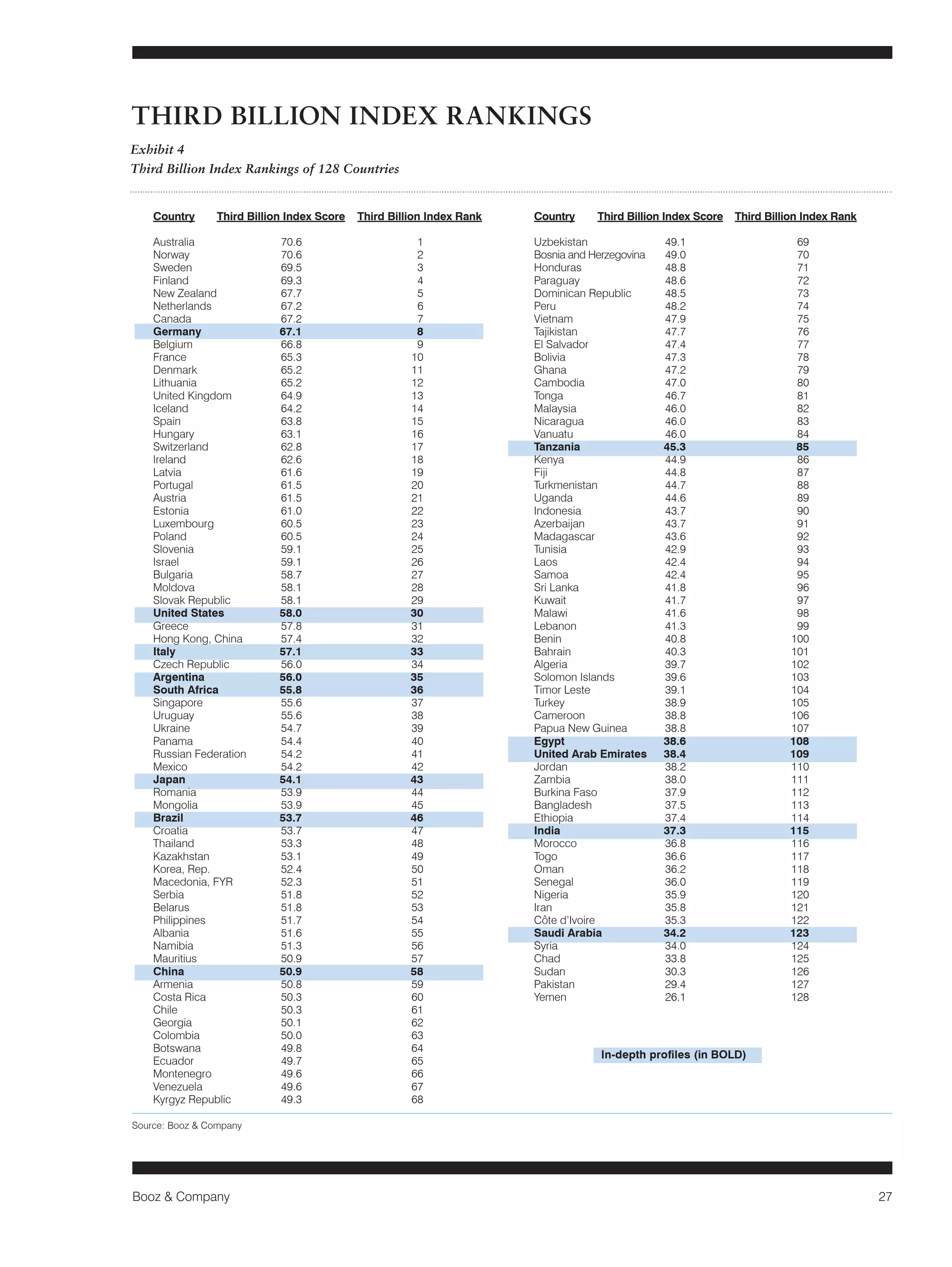
Exhibit 4 
Third Billion Index Rankings of 128 Countries 
Country Third Billion Index Score Third Billion Index Rank 
Australia 70.6 1 
Norway 70.6 2 
Sweden 69.5 3 
Finland 69.3 4 
New Zealand 67.7 5 
Netherlands 67.2 6 
Canada 67.2 7 
Germany 67.1 8 
Belgium 66.8 9 
France 65.3 10 
Denmark 65.2 11 
Lithuania 65.2 12 
United Kingdom 64.9 13 
Iceland 64.2 14 
Spain 63.8 15 
Hungary 63.1 16 
Switzerland 62.8 17 
Ireland 62.6 18 
Latvia 61.6 19 
Portugal 61.5 20 
Austria 61.5 21 
Estonia 61.0 22 
Luxembourg 60.5 23 
Poland 60.5 24 
Slovenia 59.1 25 
Israel 59.1 26 
Bulgaria 58.7 27 
Moldova 58.1 28 
Slovak Republic 58.1 29 
United States 58.0 30 
Greece 57.8 31 
Hong Kong, China 57.4 32 
Italy 57.1 33 
Czech Republic 56.0 34 
Argentina 56.0 35 
South Africa 55.8 36 
Singapore 55.6 37 
Uruguay 55.6 38 
Ukraine 54.7 39 
Panama 54.4 40 
Russian Federation 54.2 41 
Mexico 54.2 42 
Japan 54.1 43 
Romania 53.9 44 
Mongolia 53.9 45 
Brazil 53.7 46 
Croatia 53.7 47 
Thailand 53.3 48 
Kazakhstan 53.1 49 
Korea, Rep. 52.4 50 
Macedonia, FYR 52.3 51 
Serbia 51.8 52 
Belarus 51.8 53 
Philippines 51.7 54 
Albania 51.6 55 
Namibia 51.3 56 
Mauritius 50.9 57 
China 50.9 58 
Armenia 50.8 59 
Costa Rica 50.3 60 
Chile 50.3 61 
Georgia 50.1 62 
Colombia 50.0 63 
Botswana 49.8 64 
Ecuador 49.7 65 
Montenegro 49.6 66 
Venezuela 49.6 67 
Kyrgyz Republic 49.3 68 
Country Third Billion Index Score Third Billion Index Rank 
Uzbekistan 49.1 69 
Bosnia and Herzegovina 49.0 70 
Honduras 48.8 71 
Paraguay 48.6 72 
Dominican Republic 48.5 73 
Peru 48.2 74 
Vietnam 47.9 75 
Tajikistan 47.7 76 
El Salvador 47.4 77 
Bolivia 47.3 78 
Ghana 47.2 79 
Cambodia 47.0 80 
Tonga 46.7 81 
Malaysia 46.0 82 
Nicaragua 46.0 83 
Vanuatu 46.0 84 
Tanzania 45.3 85 
Kenya 44.9 86 
Fiji 44.8 87 
Turkmenistan 44.7 88 
Uganda 44.6 89 
Indonesia 43.7 90 
Azerbaijan 43.7 91 
Madagascar 43.6 92 
Tunisia 42.9 93 
Laos 42.4 94 
Samoa 42.4 95 
Sri Lanka 41.8 96 
Kuwait 41.7 97 
Malawi 41.6 98 
Lebanon 41.3 99 
Benin 40.8 100 
Bahrain 40.3 101 
Algeria 39.7 102 
Solomon Islands 39.6 103 
Timor Leste 39.1 104 
Turkey 38.9 105 
Cameroon 38.8 106 
Papua New Guinea 38.8 107 
Egypt 38.6 108 
United Arab Emirates 38.4 109 
Jordan 38.2 110 
Zambia 38.0 111 
Burkina Faso 37.9 112 
Bangladesh 37.5 113 
Ethiopia 37.4 114 
India 37.3 115 
Morocco 36.8 116 
Togo 36.6 117 
Oman 36.2 118 
Senegal 36.0 119 
Nigeria 35.9 120 
Iran 35.8 121 
Côte d’Ivoire 35.3 122 
Saudi Arabia 34.2 123 
Syria 34.0 124 
Chad 33.8 125 
Sudan 30.3 126 
Pakistan 29.4 127 
Yemen 26.1 128 
In-depth profiles (in BOLD) 
THIRD BILLION INDEX RANKINGS 
Source: Booz & Company
28 Booz & Company 
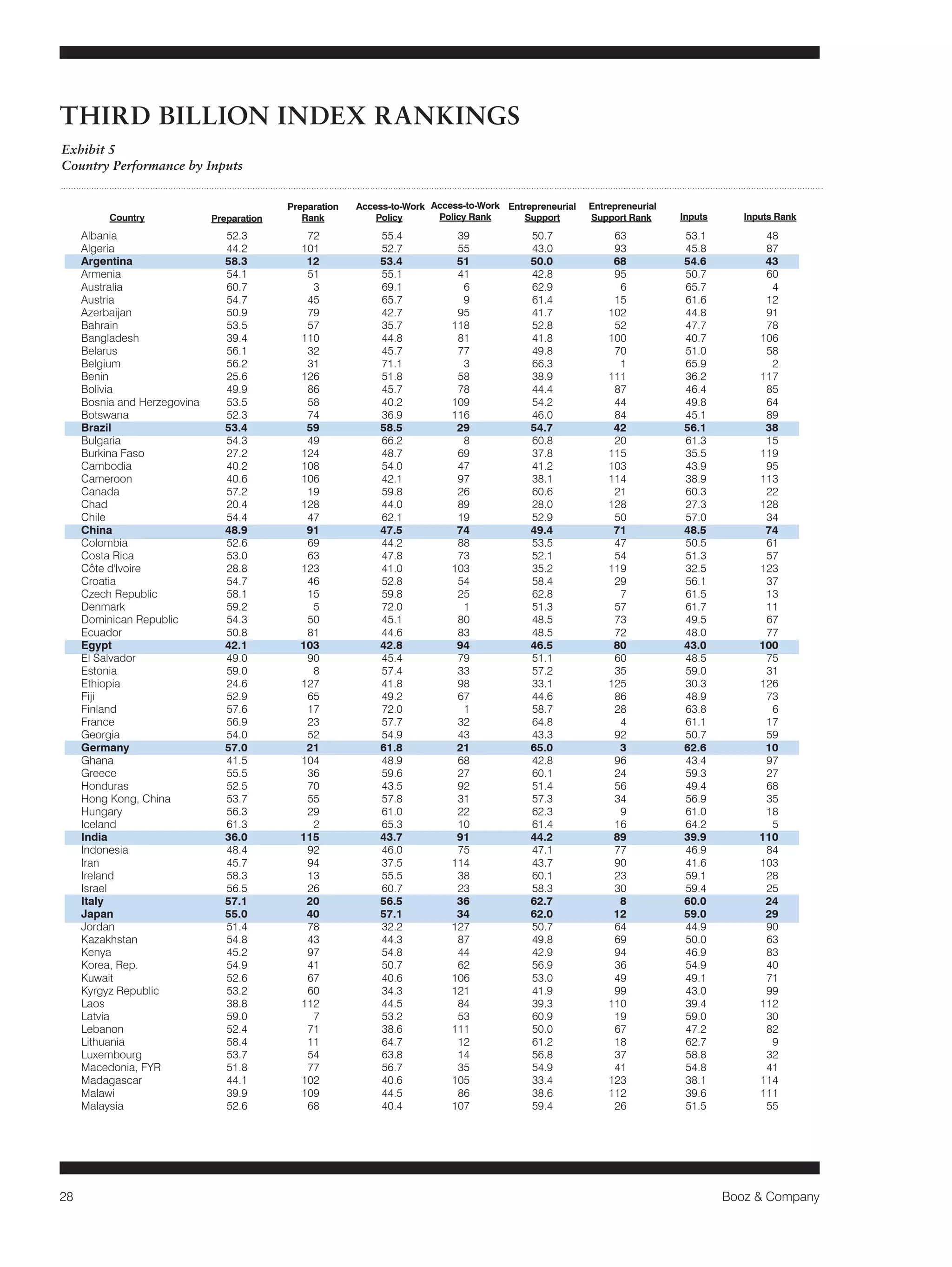
Exhibit 5 
Country Performance by Inputs 
Albania 52.3 72 55.4 39 50.7 63 53.1 48 
Algeria 44.2 101 52.7 55 43.0 93 45.8 87 
Argentina 58.3 12 53.4 51 50.0 68 54.6 43 
Armenia 54.1 51 55.1 41 42.8 95 50.7 60 
Australia 60.7 3 69.1 6 62.9 6 65.7 4 
Austria 54.7 45 65.7 9 61.4 15 61.6 12 
Azerbaijan 50.9 79 42.7 95 41.7 102 44.8 91 
Bahrain 53.5 57 35.7 118 52.8 52 47.7 78 
Bangladesh 39.4 110 44.8 81 41.8 100 40.7 106 
Belarus 56.1 32 45.7 77 49.8 70 51.0 58 
Belgium 56.2 31 71.1 3 66.3 1 65.9 2 
Benin 25.6 126 51.8 58 38.9 111 36.2 117 
Bolivia 49.9 86 45.7 78 44.4 87 46.4 85 
Bosnia and Herzegovina 53.5 58 40.2 109 54.2 44 49.8 64 
Botswana 52.3 74 36.9 116 46.0 84 45.1 89 
Brazil 53.4 59 58.5 29 54.7 42 56.1 38 
Bulgaria 54.3 49 66.2 8 60.8 20 61.3 15 
Burkina Faso 27.2 124 48.7 69 37.8 115 35.5 119 
Cambodia 40.2 108 54.0 47 41.2 103 43.9 95 
Cameroon 40.6 106 42.1 97 38.1 114 38.9 113 
Canada 57.2 19 59.8 26 60.6 21 60.3 22 
Chad 20.4 128 44.0 89 28.0 128 27.3 128 
Chile 54.4 47 62.1 19 52.9 50 57.0 34 
China 48.9 91 47.5 74 49.4 71 48.5 74 
Colombia 52.6 69 44.2 88 53.5 47 50.5 61 
Costa Rica 53.0 63 47.8 73 52.1 54 51.3 57 
Côte d'Ivoire 28.8 123 41.0 103 35.2 119 32.5 123 
Croatia 54.7 46 52.8 54 58.4 29 56.1 37 
Czech Republic 58.1 15 59.8 25 62.8 7 61.5 13 
Denmark 59.2 5 72.0 1 51.3 57 61.7 11 
Dominican Republic 54.3 50 45.1 80 48.5 73 49.5 67 
Ecuador 50.8 81 44.6 83 48.5 72 48.0 77 
Egypt 42.1 103 42.8 94 46.5 80 43.0 100 
El Salvador 49.0 90 45.4 79 51.1 60 48.5 75 
Estonia 59.0 8 57.4 33 57.2 35 59.0 31 
Ethiopia 24.6 127 41.8 98 33.1 125 30.3 126 
Fiji 52.9 65 49.2 67 44.6 86 48.9 73 
Finland 57.6 17 72.0 1 58.7 28 63.8 6 
France 56.9 23 57.7 32 64.8 4 61.1 17 
Georgia 54.0 52 54.9 43 43.3 92 50.7 59 
Germany 57.0 21 61.8 21 65.0 3 62.6 10 
Ghana 41.5 104 48.9 68 42.8 96 43.4 97 
Greece 55.5 36 59.6 27 60.1 24 59.3 27 
Honduras 52.5 70 43.5 92 51.4 56 49.4 68 
Hong Kong, China 53.7 55 57.8 31 57.3 34 56.9 35 
Hungary 56.3 29 61.0 22 62.3 9 61.0 18 
Iceland 61.3 2 65.3 10 61.4 16 64.2 5 
India 36.0 115 43.7 91 44.2 89 39.9 110 
Indonesia 48.4 92 46.0 75 47.1 77 46.9 84 
Iran 45.7 94 37.5 114 43.7 90 41.6 103 
Ireland 58.3 13 55.5 38 60.1 23 59.1 28 
Israel 56.5 26 60.7 23 58.3 30 59.4 25 
Italy 57.1 20 56.5 36 62.7 8 60.0 24 
Japan 55.0 40 57.1 34 62.0 12 59.0 29 
Jordan 51.4 78 32.2 127 50.7 64 44.9 90 
Kazakhstan 54.8 43 44.3 87 49.8 69 50.0 63 
Kenya 45.2 97 54.8 44 42.9 94 46.9 83 
Korea, Rep. 54.9 41 50.7 62 56.9 36 54.9 40 
Kuwait 52.6 67 40.6 106 53.0 49 49.1 71 
Kyrgyz Republic 53.2 60 34.3 121 41.9 99 43.0 99 
Laos 38.8 112 44.5 84 39.3 110 39.4 112 
Latvia 59.0 7 53.2 53 60.9 19 59.0 30 
Lebanon 52.4 71 38.6 111 50.0 67 47.2 82 
Lithuania 58.4 11 64.7 12 61.2 18 62.7 9 
Luxembourg 53.7 54 63.8 14 56.8 37 58.8 32 
Macedonia, FYR 51.8 77 56.7 35 54.9 41 54.8 41 
Madagascar 44.1 102 40.6 105 33.4 123 38.1 114 
Malawi 39.9 109 44.5 86 38.6 112 39.6 111 
Malaysia 52.6 68 40.4 107 59.4 26 51.5 55 
Country Preparation 
Preparation 
Rank 
Access-to-Work 
Policy 
Access-to-Work 
Policy Rank 
Entrepreneurial 
Support 
Entrepreneurial 
Support Rank Inputs Inputs Rank 
THIRD BILLION INDEX RANKINGS
Booz & Company 29 
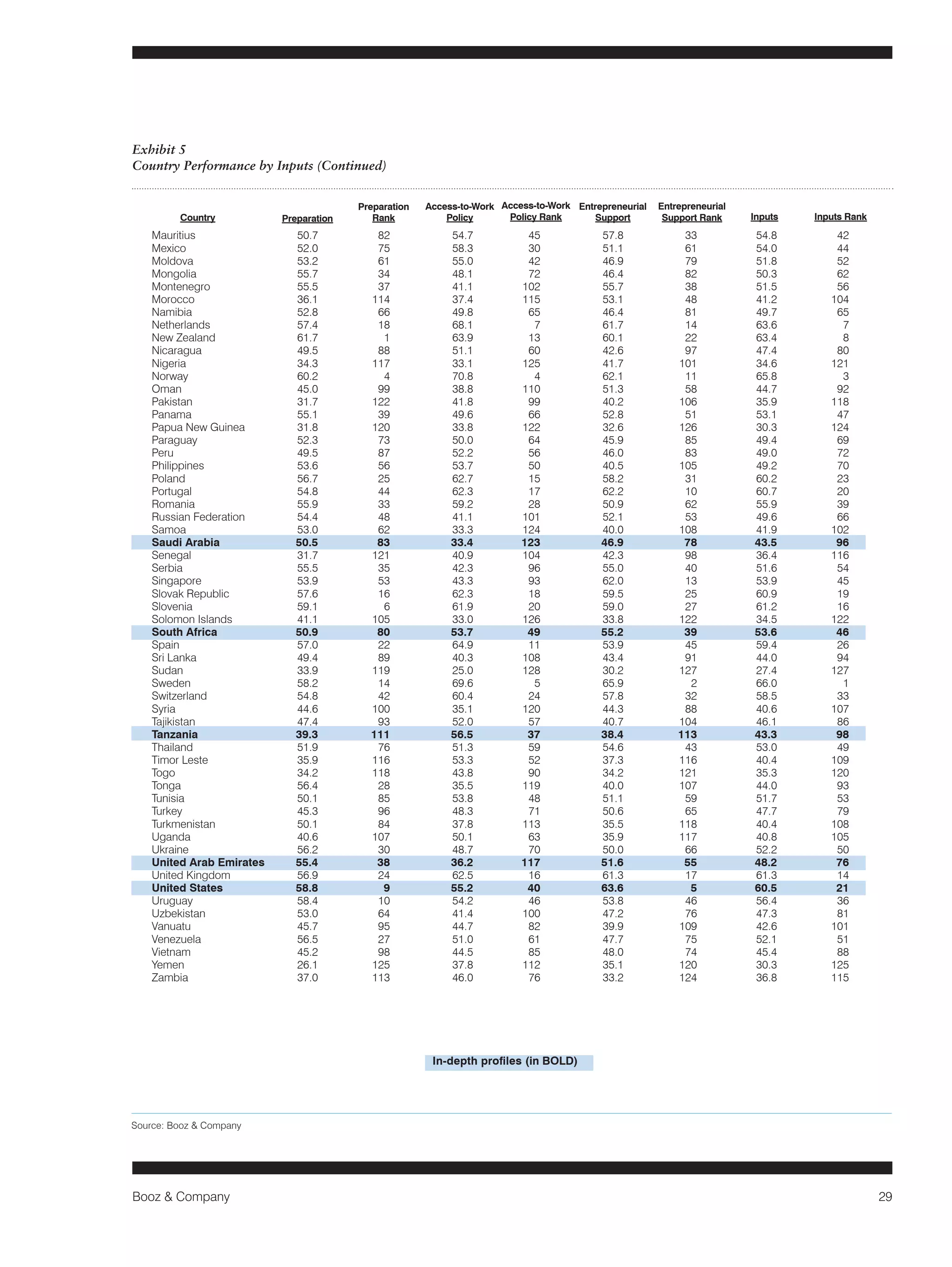
Exhibit 5 
Country Performance by Inputs (Continued) 
Mauritius 50.7 82 54.7 45 57.8 33 54.8 42 
Mexico 52.0 75 58.3 30 51.1 61 54.0 44 
Moldova 53.2 61 55.0 42 46.9 79 51.8 52 
Mongolia 55.7 34 48.1 72 46.4 82 50.3 62 
Montenegro 55.5 37 41.1 102 55.7 38 51.5 56 
Morocco 36.1 114 37.4 115 53.1 48 41.2 104 
Namibia 52.8 66 49.8 65 46.4 81 49.7 65 
Netherlands 57.4 18 68.1 7 61.7 14 63.6 7 
New Zealand 61.7 1 63.9 13 60.1 22 63.4 8 
Nicaragua 49.5 88 51.1 60 42.6 97 47.4 80 
Nigeria 34.3 117 33.1 125 41.7 101 34.6 121 
Norway 60.2 4 70.8 4 62.1 11 65.8 3 
Oman 45.0 99 38.8 110 51.3 58 44.7 92 
Pakistan 31.7 122 41.8 99 40.2 106 35.9 118 
Panama 55.1 39 49.6 66 52.8 51 53.1 47 
Papua New Guinea 31.8 120 33.8 122 32.6 126 30.3 124 
Paraguay 52.3 73 50.0 64 45.9 85 49.4 69 
Peru 49.5 87 52.2 56 46.0 83 49.0 72 
Philippines 53.6 56 53.7 50 40.5 105 49.2 70 
Poland 56.7 25 62.7 15 58.2 31 60.2 23 
Portugal 54.8 44 62.3 17 62.2 10 60.7 20 
Romania 55.9 33 59.2 28 50.9 62 55.9 39 
Russian Federation 54.4 48 41.1 101 52.1 53 49.6 66 
Samoa 53.0 62 33.3 124 40.0 108 41.9 102 
Saudi Arabia 50.5 83 33.4 123 46.9 78 43.5 96 
Senegal 31.7 121 40.9 104 42.3 98 36.4 116 
Serbia 55.5 35 42.3 96 55.0 40 51.6 54 
Singapore 53.9 53 43.3 93 62.0 13 53.9 45 
Slovak Republic 57.6 16 62.3 18 59.5 25 60.9 19 
Slovenia 59.1 6 61.9 20 59.0 27 61.2 16 
Solomon Islands 41.1 105 33.0 126 33.8 122 34.5 122 
South Africa 50.9 80 53.7 49 55.2 39 53.6 46 
Spain 57.0 22 64.9 11 53.9 45 59.4 26 
Sri Lanka 49.4 89 40.3 108 43.4 91 44.0 94 
Sudan 33.9 119 25.0 128 30.2 127 27.4 127 
Sweden 58.2 14 69.6 5 65.9 2 66.0 1 
Switzerland 54.8 42 60.4 24 57.8 32 58.5 33 
Syria 44.6 100 35.1 120 44.3 88 40.6 107 
Tajikistan 47.4 93 52.0 57 40.7 104 46.1 86 
Tanzania 39.3 111 56.5 37 38.4 113 43.3 98 
Thailand 51.9 76 51.3 59 54.6 43 53.0 49 
Timor Leste 35.9 116 53.3 52 37.3 116 40.4 109 
Togo 34.2 118 43.8 90 34.2 121 35.3 120 
Tonga 56.4 28 35.5 119 40.0 107 44.0 93 
Tunisia 50.1 85 53.8 48 51.1 59 51.7 53 
Turkey 45.3 96 48.3 71 50.6 65 47.7 79 
Turkmenistan 50.1 84 37.8 113 35.5 118 40.4 108 
Uganda 40.6 107 50.1 63 35.9 117 40.8 105 
Ukraine 56.2 30 48.7 70 50.0 66 52.2 50 
United Arab Emirates 55.4 38 36.2 117 51.6 55 48.2 76 
United Kingdom 56.9 24 62.5 16 61.3 17 61.3 14 
United States 58.8 9 55.2 40 63.6 5 60.5 21 
Uruguay 58.4 10 54.2 46 53.8 46 56.4 36 
Uzbekistan 53.0 64 41.4 100 47.2 76 47.3 81 
Vanuatu 45.7 95 44.7 82 39.9 109 42.6 101 
Venezuela 56.5 27 51.0 61 47.7 75 52.1 51 
Vietnam 45.2 98 44.5 85 48.0 74 45.4 88 
Yemen 26.1 125 37.8 112 35.1 120 30.3 125 
Zambia 37.0 113 46.0 76 33.2 124 36.8 115 
Country Preparation 
Preparation 
Rank 
Access-to-Work 
Policy 
Access-to-Work 
Policy Rank 
Entrepreneurial 
Support 
Entrepreneurial 
Support Rank Inputs Inputs Rank 
In-depth profiles (in BOLD) 
Source: Booz & Company
30 Booz & Company 
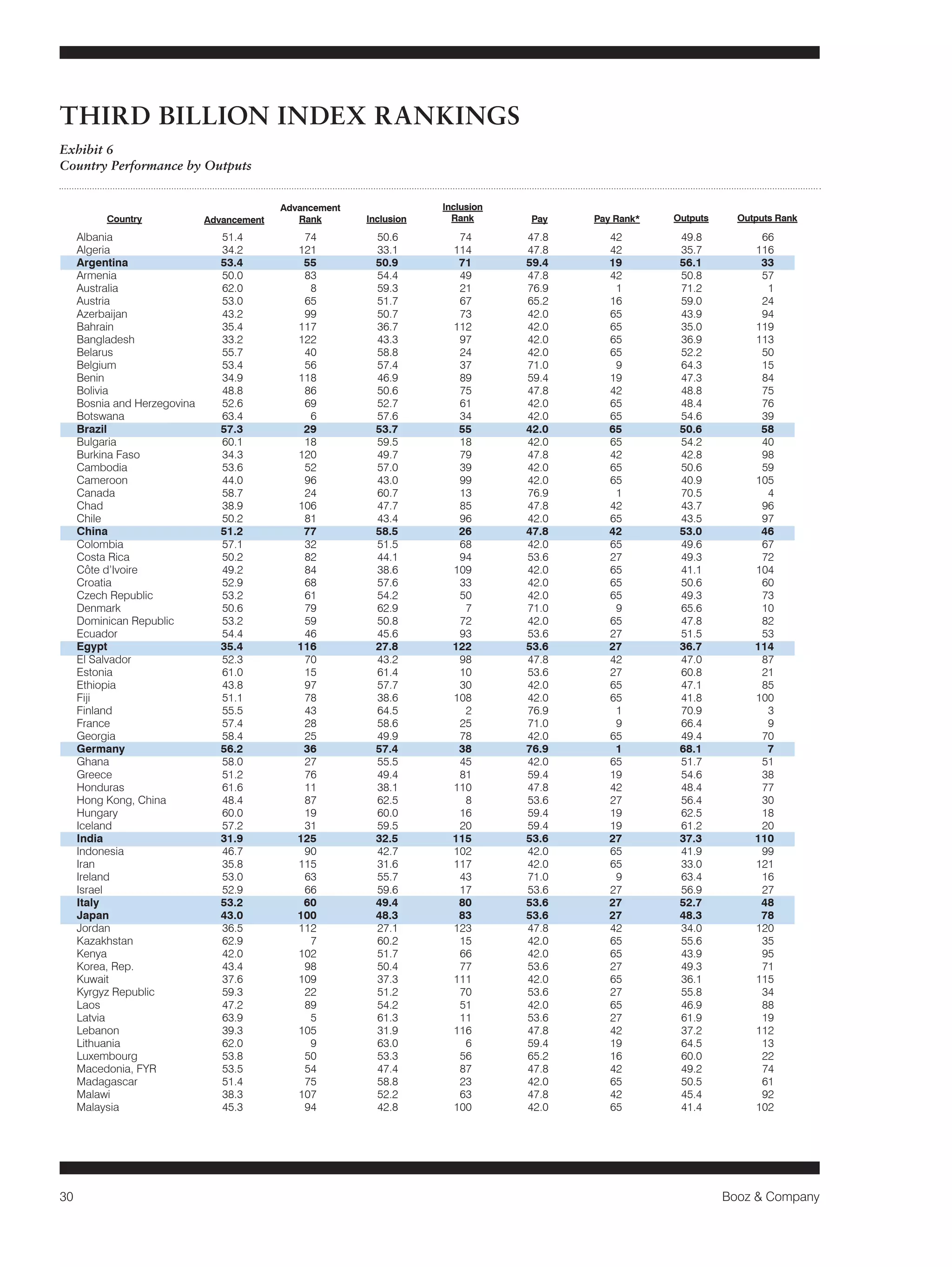
Albania 51.4 74 50.6 74 47.8 42 49.8 66 
Algeria 34.2 121 33.1 114 47.8 42 35.7 116 
Argentina 53.4 55 50.9 71 59.4 19 56.1 33 
Armenia 50.0 83 54.4 49 47.8 42 50.8 57 
Australia 62.0 8 59.3 21 76.9 1 71.2 1 
Austria 53.0 65 51.7 67 65.2 16 59.0 24 
Azerbaijan 43.2 99 50.7 73 42.0 65 43.9 94 
Bahrain 35.4 117 36.7 112 42.0 65 35.0 119 
Bangladesh 33.2 122 43.3 97 42.0 65 36.9 113 
Belarus 55.7 40 58.8 24 42.0 65 52.2 50 
Belgium 53.4 56 57.4 37 71.0 9 64.3 15 
Benin 34.9 118 46.9 89 59.4 19 47.3 84 
Bolivia 48.8 86 50.6 75 47.8 42 48.8 75 
Bosnia and Herzegovina 52.6 69 52.7 61 42.0 65 48.4 76 
Botswana 63.4 6 57.6 34 42.0 65 54.6 39 
Brazil 57.3 29 53.7 55 42.0 65 50.6 58 
Bulgaria 60.1 18 59.5 18 42.0 65 54.2 40 
Burkina Faso 34.3 120 49.7 79 47.8 42 42.8 98 
Cambodia 53.6 52 57.0 39 42.0 65 50.6 59 
Cameroon 44.0 96 43.0 99 42.0 65 40.9 105 
Canada 58.7 24 60.7 13 76.9 1 70.5 4 
Chad 38.9 106 47.7 85 47.8 42 43.7 96 
Chile 50.2 81 43.4 96 42.0 65 43.5 97 
China 51.2 77 58.5 26 47.8 42 53.0 46 
Colombia 57.1 32 51.5 68 42.0 65 49.6 67 
Costa Rica 50.2 82 44.1 94 53.6 27 49.3 72 
Côte d’Ivoire 49.2 84 38.6 109 42.0 65 41.1 104 
Croatia 52.9 68 57.6 33 42.0 65 50.6 60 
Czech Republic 53.2 61 54.2 50 42.0 65 49.3 73 
Denmark 50.6 79 62.9 7 71.0 9 65.6 10 
Dominican Republic 53.2 59 50.8 72 42.0 65 47.8 82 
Ecuador 54.4 46 45.6 93 53.6 27 51.5 53 
Egypt 35.4 116 27.8 122 53.6 27 36.7 114 
El Salvador 52.3 70 43.2 98 47.8 42 47.0 87 
Estonia 61.0 15 61.4 10 53.6 27 60.8 21 
Ethiopia 43.8 97 57.7 30 42.0 65 47.1 85 
Fiji 51.1 78 38.6 108 42.0 65 41.8 100 
Finland 55.5 43 64.5 2 76.9 1 70.9 3 
France 57.4 28 58.6 25 71.0 9 66.4 9 
Georgia 58.4 25 49.9 78 42.0 65 49.4 70 
Germany 56.2 36 57.4 38 76.9 1 68.1 7 
Ghana 58.0 27 55.5 45 42.0 65 51.7 51 
Greece 51.2 76 49.4 81 59.4 19 54.6 38 
Honduras 61.6 11 38.1 110 47.8 42 48.4 77 
Hong Kong, China 48.4 87 62.5 8 53.6 27 56.4 30 
Hungary 60.0 19 60.0 16 59.4 19 62.5 18 
Iceland 57.2 31 59.5 20 59.4 19 61.2 20 
India 31.9 125 32.5 115 53.6 27 37.3 110 
Indonesia 46.7 90 42.7 102 42.0 65 41.9 99 
Iran 35.8 115 31.6 117 42.0 65 33.0 121 
Ireland 53.0 63 55.7 43 71.0 9 63.4 16 
Israel 52.9 66 59.6 17 53.6 27 56.9 27 
Italy 53.2 60 49.4 80 53.6 27 52.7 48 
Japan 43.0 100 48.3 83 53.6 27 48.3 78 
Jordan 36.5 112 27.1 123 47.8 42 34.0 120 
Kazakhstan 62.9 7 60.2 15 42.0 65 55.6 35 
Kenya 42.0 102 51.7 66 42.0 65 43.9 95 
Korea, Rep. 43.4 98 50.4 77 53.6 27 49.3 71 
Kuwait 37.6 109 37.3 111 42.0 65 36.1 115 
Kyrgyz Republic 59.3 22 51.2 70 53.6 27 55.8 34 
Laos 47.2 89 54.2 51 42.0 65 46.9 88 
Latvia 63.9 5 61.3 11 53.6 27 61.9 19 
Lebanon 39.3 105 31.9 116 47.8 42 37.2 112 
Lithuania 62.0 9 63.0 6 59.4 19 64.5 13 
Luxembourg 53.8 50 53.3 56 65.2 16 60.0 22 
Macedonia, FYR 53.5 54 47.4 87 47.8 42 49.2 74 
Madagascar 51.4 75 58.8 23 42.0 65 50.5 61 
Malawi 38.3 107 52.2 63 47.8 42 45.4 92 
Malaysia 45.3 94 42.8 100 42.0 65 41.4 102 
Country Advancement 
Advancement 
Rank Inclusion 
Inclusion 
Rank Pay Pay Rank* Outputs Outputs Rank 
Exhibit 6 
Country Performance by Outputs 
THIRD BILLION INDEX RANKINGS
Booz & Company 31 
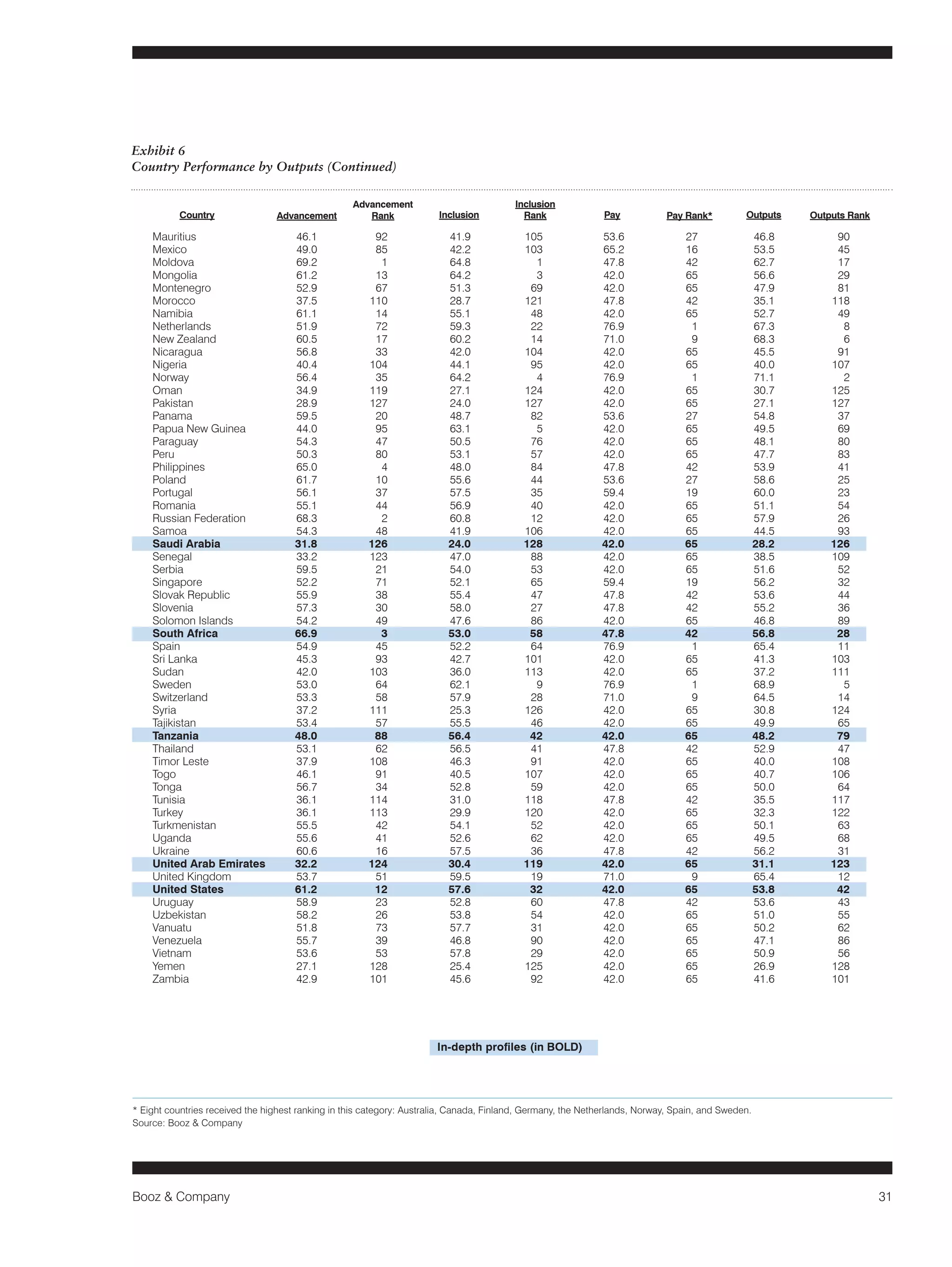
Mauritius 46.1 92 41.9 105 53.6 27 46.8 90 
Mexico 49.0 85 42.2 103 65.2 16 53.5 45 
Moldova 69.2 1 64.8 1 47.8 42 62.7 17 
Mongolia 61.2 13 64.2 3 42.0 65 56.6 29 
Montenegro 52.9 67 51.3 69 42.0 65 47.9 81 
Morocco 37.5 110 28.7 121 47.8 42 35.1 118 
Namibia 61.1 14 55.1 48 42.0 65 52.7 49 
Netherlands 51.9 72 59.3 22 76.9 1 67.3 8 
New Zealand 60.5 17 60.2 14 71.0 9 68.3 6 
Nicaragua 56.8 33 42.0 104 42.0 65 45.5 91 
Nigeria 40.4 104 44.1 95 42.0 65 40.0 107 
Norway 56.4 35 64.2 4 76.9 1 71.1 2 
Oman 34.9 119 27.1 124 42.0 65 30.7 125 
Pakistan 28.9 127 24.0 127 42.0 65 27.1 127 
Panama 59.5 20 48.7 82 53.6 27 54.8 37 
Papua New Guinea 44.0 95 63.1 5 42.0 65 49.5 69 
Paraguay 54.3 47 50.5 76 42.0 65 48.1 80 
Peru 50.3 80 53.1 57 42.0 65 47.7 83 
Philippines 65.0 4 48.0 84 47.8 42 53.9 41 
Poland 61.7 10 55.6 44 53.6 27 58.6 25 
Portugal 56.1 37 57.5 35 59.4 19 60.0 23 
Romania 55.1 44 56.9 40 42.0 65 51.1 54 
Russian Federation 68.3 2 60.8 12 42.0 65 57.9 26 
Samoa 54.3 48 41.9 106 42.0 65 44.5 93 
Saudi Arabia 31.8 126 24.0 128 42.0 65 28.2 126 
Senegal 33.2 123 47.0 88 42.0 65 38.5 109 
Serbia 59.5 21 54.0 53 42.0 65 51.6 52 
Singapore 52.2 71 52.1 65 59.4 19 56.2 32 
Slovak Republic 55.9 38 55.4 47 47.8 42 53.6 44 
Slovenia 57.3 30 58.0 27 47.8 42 55.2 36 
Solomon Islands 54.2 49 47.6 86 42.0 65 46.8 89 
South Africa 66.9 3 53.0 58 47.8 42 56.8 28 
Spain 54.9 45 52.2 64 76.9 1 65.4 11 
Sri Lanka 45.3 93 42.7 101 42.0 65 41.3 103 
Sudan 42.0 103 36.0 113 42.0 65 37.2 111 
Sweden 53.0 64 62.1 9 76.9 1 68.9 5 
Switzerland 53.3 58 57.9 28 71.0 9 64.5 14 
Syria 37.2 111 25.3 126 42.0 65 30.8 124 
Tajikistan 53.4 57 55.5 46 42.0 65 49.9 65 
Tanzania 48.0 88 56.4 42 42.0 65 48.2 79 
Thailand 53.1 62 56.5 41 47.8 42 52.9 47 
Timor Leste 37.9 108 46.3 91 42.0 65 40.0 108 
Togo 46.1 91 40.5 107 42.0 65 40.7 106 
Tonga 56.7 34 52.8 59 42.0 65 50.0 64 
Tunisia 36.1 114 31.0 118 47.8 42 35.5 117 
Turkey 36.1 113 29.9 120 42.0 65 32.3 122 
Turkmenistan 55.5 42 54.1 52 42.0 65 50.1 63 
Uganda 55.6 41 52.6 62 42.0 65 49.5 68 
Ukraine 60.6 16 57.5 36 47.8 42 56.2 31 
United Arab Emirates 32.2 124 30.4 119 42.0 65 31.1 123 
United Kingdom 53.7 51 59.5 19 71.0 9 65.4 12 
United States 61.2 12 57.6 32 42.0 65 53.8 42 
Uruguay 58.9 23 52.8 60 47.8 42 53.6 43 
Uzbekistan 58.2 26 53.8 54 42.0 65 51.0 55 
Vanuatu 51.8 73 57.7 31 42.0 65 50.2 62 
Venezuela 55.7 39 46.8 90 42.0 65 47.1 86 
Vietnam 53.6 53 57.8 29 42.0 65 50.9 56 
Yemen 27.1 128 25.4 125 42.0 65 26.9 128 
Zambia 42.9 101 45.6 92 42.0 65 41.6 101 
In-depth profiles (in BOLD) 
Exhibit 6 
Country Performance by Outputs (Continued) 
* Eight countries received the highest ranking in this category : Australia, Canada, Finland, Germany, the Netherlands, Norway, Spain, and Sweden. 
Source: Booz & Company 
Country Advancement 
Advancement 
Rank Inclusion 
Inclusion 
Rank Pay Pay Rank* Outputs Outputs Rank
32 Booz & Company 
“When it comes to the 
enormous challenge of our 
time—to systematically and 
relentlessly pursue more 
economic opportunity in 
our lands—we don’t have 
a person to waste and 
we certainly don’t have 
a gender to waste.” 
—Hillary Rodham Clinton, 
U.S. Secretary of State
Booz & Company 33 
Current State and Challenges 
In December 2007, Argentina elected 
its first female president, Cristina 
Fernandez de Kirchner. Fernandez de 
Kirchner and her female colleagues, 
who account for 24 percent of the 
national parliament—the highest pro-portion 
in the world1—are prominent 
reminders that Argentina’s women are 
advancing in the public sphere. The vis-ibility 
of female politicians sends a pow-erful 
message of hope to Argentina’s 20 
million women, who make up nearly 
40 percent of the workforce2 and who 
continue to chafe, in varying degrees, 
against the obstacles created by gender 
and economic discrimination. 
Argentina was one of the first Latin 
American countries to enact legisla-tion 
regulating working conditions 
for women and children. Moreover, 
its education system is a significant 
bright spot—more girls complete 
secondary and tertiary education than 
boys, which is reflected in the coun-try’s 
high preparation ranking (12th 
overall). However, the implementation 
of broader reform measures still has a 
long way to go. Although Argentina’s 
female employment rate has increased, 
women in the country hold a dispropor-tionate 
number of lower-paying jobs, 
particularly in minimally skilled service 
roles.3 At lower levels of the socioeco-nomic 
pyramid, Argentine women have 
insufficient access to affordable, quality 
social services, such as affordable 
child care, healthcare, and education, 
particularly in rural areas. Moreover, 
income disparity is prevalent. Although 
more Argentine women than men hold 
university degrees, and women have 
higher rates of schooling, they only 
earn roughly 95 percent of the amount 
that men do for the same jobs. For the 
overall labor market, women make only 
64 percent of what men with the same 
level of education earn.4 
Cultural norms also contribute to 
women’s challenges, both at home and 
in the workplace. A household survey 
carried out by the National Institute 
of Statistics and Censuses (INDEC) 
revealed that seven out of 10 men living 
in Buenos Aires do not participate in 
domestic work, including caring for 
children or the elderly.5 The traditional 
model of the man as breadwinner and 
the woman as homemaker both reflects 
and propagates long-held perceptions 
of gender roles and “machismo” in the 
workplace. When women are expected 
to shoulder the burden of domestic 
responsibilities, that burden—con-sciously 
or unconsciously—becomes 
a liability in the eyes of employers. 
Such a perception only limits women’s 
chances of attaining high-level corporate 
positions. 
Those attempting to start their own 
businesses—often in the informal service 
sector—have difficulty obtaining bank 
loans, an issue that affects women in 
both rural and urban settings. NGOs 
are attempting to fill this gap by offering 
small loans, but microfinance is still in 
its infancy in Argentina, having only 
been regulated in 2006. Only companies 
with long operating histories can qualify 
for lines of credit or overdraft privileges. 
Financing and seed investors are few 
III. COUNTRY 
PROFILES 
ARGENTINA 
INDEX RESULTS 
Preparation 58.3 (12) 
Access-to-Work Policy 53.4 (51) 
Entrepreneurial Support 50.0 (68) 
TOTAL INPUT SCORE 54.6 (43) 
Advancement 53.4 (55) 
Inclusion 50.9 (71) 
Equal Pay 59.4 (19) 
TOTAL OUTPUT SCORE 56.1 (33) 
THIRD BILLION INDEX SCORE 56.0 (35) 
Country cluster: “On the Path to Success” 
Note: Scores were statistically adjusted so that 50 is the mean for all countries, with a 
standard deviation of 10. The numbers inside parentheses indicate rank among the 
128 countries analyzed.
34 Booz & Company 
and far between; small business loans 
are extremely unusual. Women, who 
are more likely to be in the small and 
medium-sized enterprise (SME) sector, 
face even greater obstacles to access-ing 
capital, and tend to rely on private 
sources of financing.6 
Credit is not the only challenge. 
Argentina’s legal and regulatory 
business environment is notoriously 
complex, as evidenced by the country’s 
ranking of 113 on the World Bank’s 
Doing Business index for 2012. In 
general, would-be entrepreneurs face a 
bleak and unsupportive business land-scape 
of labyrinthine and unpredictable 
regulations, rampant inflation, and per-vasive 
corruption. Indeed, in Argentine 
Spanish, the word for businessman, 
empresario, was long synonymous with 
criminal; the word for entrepreneur, 
emprendedor, did not enter the lexicon 
until recently. 
If Argentina is to economically 
empower its women—and by exten-sion, 
its entire society—it must remove 
obstacles to employment success in the 
private sector and promote a culture of 
entrepreneurship. 
Increasing Participation and 
Advancement in the Workforce 
First, the government must better 
enforce existing legislation safeguarding 
women’s rights in the workplace. The 
Ministry of Labor should strengthen its 
cross-ministry and cross-sector partner-ships 
in order to ensure compliance 
with current regulations and ramp up 
its efforts to prosecute offenders. Next, 
it should work to educate women about 
their rights under the law and publicize 
hotlines that women can call in order to 
report instances of gender discrimina-tion 
and sexual harassment in the work-place. 
Government should partner with 
civil society to meet the needs of rural 
women by improving access to social 
services, healthcare, and education. 
In addition, a massive public aware-ness 
campaign—similar to the “anti-machismo” 
print and television 
campaign currently led by well-known 
Argentine men—should encourage the 
public to combat gender discrimination 
in the workplace, and high-profile exec-utives 
should openly pledge that their 
companies will fight sexual harassment 
and discrimination.7 The campaign, 
which should be tailored to the different 
realities of urban and rural women, 
should also highlight the economic con-tributions 
that women make, and the 
opportunities that exist for them when 
they pursue their ambitions. 
The Argentine government should 
implement a second public-service cam-paign 
to encourage fathers to participate 
in child care. Paternity leave should be 
increased from its current level (five 
days) to at least one month, and single 
fathers should be eligible for the same 
90-day benefits as women.8 Access 
to public day-care facilities should be 
increased, particularly in rural areas, 
and the government should monitor 
these facilities to ensure that they meet 
high standards for care. 
Argentina’s Ministry of Labor should 
create a standardized, government-approved 
workplace-empowerment 
program to help companies implement 
gender-sensitive policies, including task 
forces to monitor gender discrimination 
and sexual harassment; anonymous 
hotlines to report these instances; 
online and in-house sensitivity training 
workshops; and parent-friendly work-ing 
options. Companies that successfully 
implement the program should receive 
special accreditation, tax benefits, public 
acknowledgment, and other incentives. 
Management and human resources 
professionals should be trained in its 
execution, and employees should be 
encouraged to share anonymous feed-back 
on a site overseen by the Ministry 
of Labor. 
Because the burden of child care falls 
heavily on the shoulders of Argentine 
women, the private sector should make 
a concerted effort to implement flex-time, 
job-sharing, and telecommuting 
options that promote work–life balance 
and enable mothers to rejoin the work-force. 
Companies should offer on-site 
child-care facilities and rooms for 
nursing mothers, and promote gender 
sensitivity through lectures, courses, and 
brown-bag lunches that focus on com-bating 
machismo, including the belief 
that child-rearing is solely a woman’s 
responsibility. Companies should also 
partner with universities, business 
incubators, and social entrepreneurship 
organizations to offer mentoring and 
networking opportunities for women. 
Boosting Entrepreneurship 
Argentina’s regulatory and business 
landscape must undergo fundamental 
shifts in order to nurture and support 
entrepreneurship—not only for women 
but for all potential entrepreneurs. To 
that end, the government should take 
steps to restore the public’s trust in the 
banking system, after decades of erratic 
policies and financial crises, and should 
work to change the perception of busi-nesspeople 
by discouraging corruption, 
rewarding honesty, and acknowledging 
the social and economic power of entre-preneurship. 
The Ministry of Education, 
the Ministry of Labor, and other 
relevant ministries should partner with
Booz & Company 35 
academia to develop courses on entre-preneurship 
at all levels of schooling. 
Regarding entrepreneurship among 
women, the government should increase 
female entrepreneurs’ access to low-interest 
capital and create tax incentives 
for banks and individuals who grant 
seed money to startups. Government 
could also offer incentives for socially 
and environmentally conscious busi-nesses, 
in order to promote the “double 
bottom line,” or economic gains that 
also provide social benefits. NGOs 
and microfinance organizations can be 
critical partners in helping government 
provide improved access to social ser-vices 
for rural women, thereby allowing 
them to focus on developing their own 
businesses. Vocational courses, men-toring 
services, and training resources 
should be offered across Argentina’s 
rural areas, and both NGOs and lend-ing 
institutions should be empowered to 
provide low-interest loans to rural entre-preneurs, 
including indigenous women, 
through government loan guarantees. 
The private sector should help promote 
entrepreneurship by encouraging its 
employees to innovate and to join net-works 
that provide mentoring services 
to young entrepreneurs. Government 
should partner with the private sector, 
civil society, and the media to com-municate 
the impact that entrepreneurs 
can have on the Argentine economy 
and society at large, and confer awards 
on female entrepreneurs. These entities 
should also establish associations of 
female entrepreneurs, business incuba-tors 
designed to catalyze innovation, 
and business consortiums designed to 
promote collaboration and networking. 
By working to remove the barriers 
to women’s economic empowerment 
and incubating a culture that fosters 
entrepreneurship, Argentina can 
bolster its financial system, strengthen 
its middle class, and nurture a new 
generation of women prepared to lead 
the country toward a more stable and 
prosperous future.
36 Booz & Company 
Current State and Challenges 
Brazil’s exceptional economic perfor-mance 
over the past decade—it is now 
the world’s sixth-largest economy— 
has lifted millions out of poverty and 
brought a majority of the country’s 200 
million citizens into the middle class. 
Women have benefited from this rising 
tide of prosperity. Their participation 
rate in the national labor force is now 
at an all-time high of more than 60 per-cent, 
1 and a growing number of women 
are launching their own companies. 
Women also are much more visible in 
senior positions, holding 45 percent 
of managerial jobs and 30 percent of 
executive positions in 2009.2 
However, women still encounter a 
variety of challenges that collectively 
impede their economic advancement. 
These include traditional attitudes 
regarding women’s participation in 
the workplace and difficulty in finding 
credit. For example, many of Brazil’s 
working women are still concentrated in 
low-paying, informal occupations with 
little job security. Around 17 percent 
of full-time working women, or one 
in six, are domestic workers employed 
by middle- and upper-class Brazilians.3 
Women also face wage disparities. For 
2007 and 2008, the average gender pay 
gap was calculated at 38.5 percent, one 
of the highest in Latin America.4 And 
more women (9 percent) are currently 
unemployed than men (6 percent). 
Family responsibilities are a major 
problem facing working women. The 
school day in Brazil is very short—only 
four hours in some areas—and offers 
few after-school activities; further, atten-dance 
is mandatory only until age 14. 
Day-care facilities for preschool children 
are extremely scarce and expensive, 
affordable only to the well-off. About 
75 percent of children between 1 month 
and 4 years old don’t attend formal 
day care. Moreover, with prosperity 
comes greater longevity, and women 
are increasingly tasked with caring for 
elderly parents. One survey found that 
69 percent of Brazilian women are 
caring for aging relatives.5 
This situation would be intolerable if 
not for three things: relatives, commu-nities, 
and women willing to care for 
other women’s children at relatively low 
wages. Many women, both profession-als 
and low-wage earners, depend on 
informal family networks of grand-mothers, 
aunts, and other relations to 
care for their children while they work. 
Middle- and upper-income women 
also can hire someone to look after 
their children, because domestic help is 
relatively cheap. At lower income levels, 
however, these costs prevent women 
who would like to work from joining 
the labor force; instead, they remain in 
the low-pay informal service sector. 
Despite the country’s recent economic 
progress, millions of women still live 
in poverty, which leads to a range of 
other social issues that impact poten-tial 
employment. For example, poor 
women have only two to three years of 
schooling on average; among very poor 
adults—those earning less than $100 a 
month—27 percent are illiterate. 
Among rural poor, most women work 
in nonmonetary activities, usually 
subsistence agriculture on family farms. 
Women own as little as 11 percent of 
the land,6 typically properties that are 
smaller than those owned by men. 
Another problem for poor rural women 
is isolation, due to insufficient infra-structure 
investment in recent decades. 
For all these reasons, most rural women 
remain dependent on the patriarchal 
relationships that govern traditional 
BRAZIL INDEX RESULTS 
Preparation 53.4 (59) 
Access-to-Work Policy 58.5 (29) 
Entrepreneurial Support 54.7 (42) 
TOTAL INPUT SCORE 56.1 (38) 
Advancement 57.3 (29) 
Inclusion 53.7 (55) 
Equal Pay 42.0 (65) 
TOTAL OUTPUT SCORE 50.6 (58) 
THIRD BILLION INDEX SCORE 53.7 (46) 
Country cluster: “On the Path to Success” 
Note: Scores were statistically adjusted so that 50 is the mean for all countries, with a 
standard deviation of 10. The numbers inside parentheses indicate rank among the 
128 countries analyzed.
Booz & Company 37 
society. Although there is no legal bar-rier 
to women taking better-paying jobs, 
such as driving a bus or a taxi, tradi-tional 
attitudes deem such occupations 
inappropriate for women. 
Education is one trend that is starting to 
favor women. As in many other coun-tries, 
women in Brazil are becoming 
increasingly educated; at least 60 per-cent 
of tertiary degrees go to women.7 
And their career aspirations are running 
high: One study found that more than 
80 percent of women are aiming for a 
senior job in the workplace.8 But social 
expectations of a woman’s role inhibit 
female employees’ upward mobility. It 
is, for example, not generally accept-able 
for a woman to earn more than 
her husband. And politeness is more 
appreciated in a woman than profes-sional 
ambition. These cultural values 
are held not just by men, but also by 
many women. 
Along with Brazil’s machismo tradi-tion, 
such attitudes have led to unhappy 
working conditions for many women. 
Anecdotal evidence suggests that their 
ideas are often not taken seriously by 
male co-workers. They are penalized for 
taking maternity leave or not given suf-ficient 
flexibility for child-care respon-sibilities, 
and typically do not receive 
more senior or prestigious positions in 
their firms. Indeed, one survey found 
that gender bias has led some 40 percent 
of working women to consider quit-ting— 
or at least reining in their career 
expectations.9 Moreover, women often 
find that they have to conform to male-oriented 
leadership styles if they seek to 
move up the corporate ladder.10 
Increasing Participation and 
Advancement in the Workforce 
Changing cultural attitudes in a society 
still dominated by men is a long process 
that will require leadership from gov-ernment, 
the news media, schools, the 
entertainment industry, and the private 
sector, as well as from women’s organi-zations. 
Each can do its part to improve 
the lives of working women and change 
societal attitudes through, for example, 
awards programs, education courses, 
television shows, and public-service 
campaigns on the importance of family-friendly 
work environments. 
More fundamentally, if women are to 
continue joining the workforce, and 
especially entering the ranks of top-level 
management, society, companies, and 
the government must develop solutions 
to provide the infrastructure for child 
care and eldercare. To that end, the gov-ernment 
should work with the private 
sector to introduce parental leave, to 
be taken by either spouse. This would 
help change societal attitudes about the 
responsibility for child care. In addition, 
the government could help working 
women by offering a tax credit for the 
30 percent of all households headed by 
women.11 Right now, a single mother 
with several children pays the same 
taxes as a household with two working 
spouses. 
In addition, courts can play a help-ful 
role in the way that they handle 
discrimination cases, such as unfair or 
illegal wage differentials between men 
and women, or cases in which women 
are informally penalized by employers 
after taking their entitled six months 
of paid maternity leave. Though laws 
proscribe job demotion or firing in 
those situations, violations reportedly 
occur. Indeed, the job insecurity that can 
accompany motherhood is one reason 
that Brazilian women shy away from 
the private sector and have a strong bias 
toward public-sector employment.12 
Mentorship programs are important 
as well. Although Brazil’s expanding 
economy has led to a significant flow 
of women into the workforce, private 
companies have been slow to train and 
mentor their female staff. These pro-grams 
for female employees should be 
more robust and systematic, and should 
be aimed at giving women promotion 
opportunities as well as the prepara-tion 
needed to advance in the private 
sector. Such programs could go hand 
in hand with sensitivity training for 
male employees in order to raise their 
awareness about the changing gender 
dynamics of Brazil’s workplace. These 
in-house efforts should rest on a new 
mind-set that sees women not as acces-sories 
but as essential elements of the 
firm’s workforce. 
Better vocational training for rural 
women is also urgently needed. Too 
often such courses relate to cooking 
and sewing rather than to technologi-cal 
competence, such as learning how 
to run a machine or computer. Also, 
improving rural infrastructure (includ-ing 
sanitation systems, water systems, 
and health clinics) and expanding the 
school day would improve the economic 
condition of poor women. 
Crime is another national problem, and 
although it affects both genders, it is of 
greater concern to women. More than 
half of the women polled in one recent 
survey said they felt unsafe traveling to 
and from work.13 If employers had a 
greater awareness of this concern, and 
took steps to minimize the dangers, such 
as by providing escorts to parked cars 
and a telephone contact to call when 
one feels threatened, it would go a long 
way toward making women feel safer as 
well as engendering loyalty toward and 
appreciation of their employer. 
Finally, the financial sector has a role 
to play as well. Banks in Brazil are now 
using innovative ways, such as mobile 
phones and smart cards, to give poor 
and low-income families access to bank-ing 
services, helping them easily and
38 Booz & Company 
securely save and handle their money. 
This system also presents an opportu-nity 
to extend new models of credit that 
address the needs of women, both wage 
earners and entrepreneurs. 
Boosting Entrepreneurship 
Brazil’s fast-paced economy in recent 
years has put more disposable income 
into the hands of consumers, creating 
more opportunities for women to start 
their own businesses. However, these 
businesses tend to remain small and 
operate in traditionally female-oriented 
sectors. It is still rare to see a major firm 
headed by a woman, and only around 
11 percent of Brazilian companies have 
female CEOs.14 
Tax incentives for women who start 
their own business would be a good 
first step to boost entrepreneurship. 
Another recommendation is to reduce 
the bureaucratic requirements and 
red tape required to start a business. 
According to the World Bank’s 
Global Competitiveness Index, Brazil 
consistently underperforms in a ranking 
of countries based on their ease of 
doing business, ranking 120th out of 
183 countries in 2011, and 126th in 
2012. That puts the country below the 
average ranking of 95 for the region of 
Latin America and the Caribbean as 
a whole. The World Bank noted that 
starting a business in Brazil requires 13 
administrative procedures and takes 
119 days. Although these requirements 
apply to everyone, they are particularly 
daunting for women due to the other 
demands on their time, specifically child 
care and household duties. Because of 
these challenges, many women forgo 
registering their small enterprises and 
remain in the informal economy. 
Similarly, obtaining financing for 
entrepreneurial startups is difficult 
because credit in Brazil is expensive and 
scarce, carrying some of the highest 
interest rates in the world. In early 2012 
Brazil’s average interest rate was 10.5 
percent, more than twice that of many 
other countries and higher even than its 
BRIC peers of India (8.5 percent) and 
China (6.6 percent). Even for those who 
can qualify for a loan and make such 
high payments, the paperwork required 
for loans in Brazil is particularly 
burdensome. 
Microfinance, which might ease 
such paperwork and lower collateral 
requirements, is not yet as extensive 
as it should be, and the industry’s 
penetration rate—the number of people 
below the poverty line who receive a 
microloan compared with the number 
of those who potentially need one— 
is, at 2 percent, lower than in many 
other Latin American countries.15 
That said, microfinance institutions 
have been expanding in the last 
decade, including the state-run Sebrae; 
CrediAmigo, started in 1997 by Banco 
do Nordeste do Brasil (BNB); and even 
programs operated by some major 
commercial banks. Although some 
of these institutions declare women’s 
advancement a priority, they could 
do more to advertise their services to 
female micro-entrepreneurs and launch 
programs targeting women with such 
aspirations. 
Another feature of female entre-preneurship 
and self-employment 
in Brazil is its high concentration 
of traditionally female fields, such 
as cosmetics sales and beauty 
salons. Women are not present in 
sufficient numbers in areas such as 
engineering, computer technology, 
and IT innovation. High school and 
university career counselors should 
encourage female students to explore 
careers in these promising areas in 
order to broaden their outlook. Also, 
business groups, in collaboration with 
universities and the government, should 
establish “hubs,” or locations where 
students of both genders can work 
together on innovative business projects 
and then try to attract venture capital, 
from domestic or foreign sources. 
These entrepreneurial incubators would 
help women build their capacities and 
explore new horizons in the business 
world. A model for these innovation 
clusters is “Start-Up Chile,” a program 
designed to attract foreign investors 
to Chile, in part by linking them with 
domestic entrepreneurial talent. 
Related to this effort is the need for 
role models. Spotlighting successful 
female Brazilian entrepreneurs would 
not only increase the potential career 
options for young women, but also 
help deflect some of the pressures that 
independent businesswomen face, 
including patriarchal attitudes that 
dismiss women’s business acumen and 
seriousness. These perceptions can 
be shaped through the media, films, 
awards programs—such as Sebrae’s 
“Businesswoman Award”—and the 
nation’s popular telenovelas, or televised 
soap operas. Finally, if Brazilian girls 
need additional inspiration to step into a 
leadership role in society, they can look 
to Brazil’s first female president, Dilma 
Rousseff.
Booz & Company 39 
By 2020, 5 million female entrepreneurs in developing 
markets around the world will have received help in growing 
their business—and one of the first people they may want 
to thank will be Muhtar Kent. The chairman and CEO of 
the Coca-Cola Company offers a powerful example of how 
an advocate in the C-suite can give critical support and 
visibility to women’s initiatives. In 2007, Kent announced 
internally that women were the primary buyers of Coca- 
Cola’s products, and that the company needed to better 
understand their needs in order to connect with them 
directly. Within the organization, he thought it was important 
to increase retention and promotion among female talent. 
Kent formed the Women’s Leadership Council to find out 
why women’s careers were stalling out before they reached 
the most senior leadership positions in the company. 
At the same time, Coca-Cola’s sustainability group was 
examining the company’s value chain to analyze how 
it contributed to economic development in the markets 
where it operated. It found that women were key players 
throughout Coca-Cola’s value chain: owning farms, running 
small shops, scavenging bottles for collection. If these 
women had the skills to run their business better, both 
Coca-Cola and the women’s communities would benefit. 
And so the company turned the lens outward and applied 
the same questions it had been developing internally to the 
Women’s Leadership Council—what barriers were women 
facing, and how could the company overcome them? Coca- 
Cola participated in a study with Harvard’s Kennedy School 
of Government and the International Finance Corporation1 
that revealed the major obstacles for female entrepreneurs 
in many of Coca-Cola’s markets: 
• Lack of business skills, including merchandising, 
accounting, and employee management 
• Lack of access to finance, including credit and insurance, 
due in large part to the fact they often did not own the 
means of production 
• Lack of peers and mentors who inspired them to see what 
was possible and aim to create a business beyond the 
subsistence level 
The result was the 5x20 initiative, which aims to empower 5 
million female entrepreneurs by 2020. Coca-Cola rolled out 
education programs in South Africa, India, the Philippines, 
and Brazil in 2011, building on existing retail and distribution 
training programs in both emerging and developed markets. 
By the end of 2011, 130,000 women had already received 
training. Coca-Cola plans to track these women over the 
long term to assess the results of the program—both 
quantitatively, in terms of business metrics, and qualitatively, 
in the feelings of empowerment among these women. The 
company will also perform in-depth follow-up with a smaller 
subset of women in order to continually transform and 
adapt the program. 
Like many other private-sector companies entering this 
arena, Coca-Cola recognizes the need for collaboration 
within the “golden triangle”—public sector, private sector, 
and nonprofit sector—to solve women’s most intractable 
issues and grasp the most significant opportunities. What 
Coca-Cola brings to the table in this case is access to the 
women who can make a contribution to their community 
and their economy, as well as acumen about what these 
women need in order to become more active economic 
agents. In Nairobi alone, for instance, the Coca-Cola sales 
team knows of 20,000 women running businesses. By 
providing much-needed support for these women, Coca- 
Cola is strengthening its own value chain and building a 
foundation for its own success. 
COCA-COLA: A TOP-DOWN DECISION TO EMPOWER ENTREPRENEURS
40 Booz & Company 
Current State and Challenges 
China’s women, who make up 49 
percent of China’s population and 46 
percent of its labor force, are advancing 
at rates nearly as great as the country’s 
overall economic expansion in recent 
years. Half of the world’s self-made 
female billionaires are in China, and a 
quarter of the country’s entrepreneurs 
are female.1 The numbers are also 
impressive for women who haven’t 
started their own firms: At Chinese 
companies, 19 percent of women in 
managerial positions hold the title 
of CEO.2 
However, it is critical to remember 
that there are many Chinas, each with 
its own distinct challenges and needs. 
Hong Kong’s sleek boardrooms are 
worlds away from the women of rural 
China, who often struggle to eke out a 
living while shouldering heavy domes-tic 
responsibilities. In many parts of 
the country, cultural expectations and 
socioeconomic factors put significant 
limits on the economic opportunities for 
women. If China is to realize its nearly 
boundless potential, it must remove 
these obstacles and more effectively 
empower its women. 
Family responsibilities, particularly 
eldercare, remain a significant burden 
for women across the economic spec-trum. 
Eldercare is viewed as a woman’s 
tianzhi, or heavenly duty, and this duty 
directly affects how she can approach 
a career. Some 95 percent of Chinese 
women have eldercare responsibili-ties, 
and 58 percent help support their 
parents financially.3 For urban women 
in the private sector, whose average 
workweek regularly exceeds 70 hours, 
eldercare responsibilities can pose a 
no-win situation. Women may feel pres-sure 
to move to a different city, forgo 
a promotion, or even drop out of the 
workforce entirely in order to care for 
their parents and in-laws. Rural women, 
more and more of whose husbands are 
moving to urban areas to find work, 
are left to shoulder double burdens of 
agricultural work and eldercare. 
This issue will only become more 
acute over time. With 112 million 
Chinese older than 65, a number that 
is projected to nearly triple by 2040, 
the nation faces a daunting demo-graphic 
challenge. Although the largely 
unregulated nursing home and assisted-living 
industry is booming, supply lags 
demand. 
The outsized burden posed by eldercare 
may contribute to gender discrimination 
within the workplace. A 2010 survey by 
Zhaopin.com revealed that 76.4 percent 
of male managers—and 63.3 percent 
of female managers—prefer to promote 
male staff. On average, Chinese 
women earn 30 percent less than men 
for similar work. Compounding this 
disparity, the retirement age for women 
is currently 50, whereas men typically 
retire at 60—a fact that makes men 
more attractive to employers.4 In this 
context, it is perhaps not surprising 
that many women get stuck in middle-manager 
positions. 
These issues have motivated increas-ing 
numbers of Chinese women to 
consider starting their own business, 
and thereby have more control over 
their future. Indeed, due to the nation’s 
rapid economic growth, technological 
advancement, and lack of red tape in 
comparison with more developed econ-omies, 
would-be entrepreneurs have real 
opportunities to succeed—particularly 
in high-tech industries. Private business 
is the fastest-growing sector of China’s 
economy, expanding at an annual rate 
of 20 percent. Small and medium-sized 
enterprises (SMEs) are responsible 
for about 60 percent of the nation’s 
industrial output and employ about 
75 percent of the workforce in China’s 
cities and towns.5 And China is now 
the world’s largest and fastest-growing 
center of entrepreneurial startups.6 
CHINA INDEX RESULTS 
Preparation 48.9 (91) 
Access-to-Work Policy 47.5 (74) 
Entrepreneurial Support 49.4 (71) 
TOTAL INPUT SCORE 48.5 (74) 
Advancement 51.2 (77) 
Inclusion 58.5 (26) 
Equal Pay 47.8 (42) 
TOTAL OUTPUT SCORE 53.0 (46) 
THIRD BILLION INDEX SCORE 50.9 (58) 
Country cluster: “Forging Their Own Path” 
Note: Scores were statistically adjusted so that 50 is the mean for all countries, with a 
standard deviation of 10. The numbers inside parentheses indicate rank among the 
128 countries analyzed.
Booz & Company 41 
Despite this progress, entrepreneurs 
still face many challenges. The banking 
system in China typically bases lending 
criteria for small businesses on col-lateral, 
rather than cash flow,7 which 
makes it difficult for low-income entre-preneurs 
to secure financing. In addi-tion, 
China’s recent policies intended 
to fight inflation have hurt small and 
medium-sized banks and thus decreased 
lending to entrepreneurs. 
These issues are compounded in rural 
areas, where entrepreneurs face the 
additional challenges of limited educa-tion 
and vocational training (issues that 
civil society is beginning to address) 
along with minimal infrastructure and a 
lack of overall resources. 
Increasing Participation and 
Advancement in the Workforce 
In order to facilitate women’s participa-tion 
and advancement in the workforce, 
the Chinese government should relieve 
the burden of eldercare by broadening 
access to high-quality, affordable facili-ties 
and services, including community 
centers, and extending its medical care 
program for the elderly throughout all 
of China’s rural areas. In addition, the 
government could create public-service 
campaigns with the goal of changing 
cultural expectations about eldercare, in 
order to lighten that burden on women 
and enable them to devote more time 
and energy to their careers. 
The Ministry of Education should equip 
girls for success in the global knowledge 
economy by shifting the nation’s educa-tion 
system, which is based on a tradi-tional 
top-down, rote style of learning, 
to one that encourages creative thinking 
and allows graduates to flourish in an 
environment focused on innovation. 
Students should be trained to see chal-lenge 
as opportunity. For example, girls 
should view male-dominated environ-ments, 
such as the technology industry, 
as an opportunity to make their voices 
heard. All levels of schooling should 
offer coursework on entrepreneurship 
and access to networks of mentors. 
Finally, education curricula should 
prominently feature gender-sensitive 
materials that combat discrimination 
and violence against women and girls. 
The private sector can address other 
issues regarding women in the work-force, 
by implementing meaningful 
policies aimed at combating gender 
discrimination and promoting work–life 
balance. Specifically, companies should 
conduct yearly wage reviews to spot 
instances of wage inequality; establish a 
human resources committee dedicated 
to the confidential handling of women’s 
discrimination and harassment com-plaints; 
dismiss male employees found 
guilty of harassment; ensure that man-agers 
who pass up female employees for 
promotions document their reasons for 
doing so in detail; and encourage female 
employees to form in-company support 
networks. The Labor Authority should 
push back women’s retirement age from 
50 to the current male retirement age of 
60, in an effort to remove any excuse 
used to favor men for promotions. 
Companies should also provide men-torship 
and coaching programs, and 
collaborate with female employees on 
specific policies to smooth the transi-tion 
back to work after returning from 
maternity leave. They should implement 
arrangements such as telecommuting, 
flextime, and job sharing in an effort to 
promote work–life balance, and ease the 
burden posed by eldercare. Emergency 
eldercare services should be included 
in company benefits packages, both 
locally and in partnership with private 
eldercare companies in an employee’s 
town or village of origin. In addition, 
companies could provide transportation 
benefits to women who must travel to 
care for elderly parents. 
Finally, companies should create 
awareness-raising campaigns to com-municate 
these policies and promote 
gender sensitivity among employees. 
As part of these campaigns, companies 
should take a proactive approach and 
bring in speakers to present talks on 
topics such as the link between work– 
life balance and productivity, the burden 
posed by eldercare, the need to push 
back women’s retirement age, and the 
obstacles to advancement in the Chinese 
workforce. 
Boosting Entrepreneurship 
Government efforts should also focus 
on increasing entrepreneurship among 
Chinese women. This assistance can 
come in the form of economic support 
for women’s entrepreneurial associa-tions— 
such as grants and tax breaks 
for women business owners—and these 
resources should be widely publicized, 
both online and in community institu-tions 
such as employment centers. 
Government should build stronger sup-port 
systems for rural women, who are 
often left to shoulder heavier burdens 
as their husbands move to urban areas 
to find work. Government can help 
economically empower rural women by 
institutionalizing farm services, building 
infrastructure that connects villages, 
providing access to information about 
the economy and environment, and 
offering free vocational training to pre-pare 
women for a life outside farming. 
These training services can be offered 
in tandem with courses on entrepre-neurship 
and leadership, and should be 
available to women of all ages. 
Among private-sector initiatives, the 
banking system should be encouraged to 
base lending criteria for small businesses 
on cash flow rather than collateral. The 
private sector should also continue to 
collaborate with universities and public 
research institutions, creating incuba-tors 
for innovation. Government should 
encourage women to participate in these 
incubators through financial incentives 
and public service programs. 
If China succeeds in economically 
empowering its women—those who 
“hold up half the sky,” as the local 
saying goes—it will become a nation for 
which the sky is the limit.
42 Booz & Company 
Current State and Challenges 
As a country with a strong, advanced 
economy and a female head of state, 
Germany seems as though it should 
be ideally positioned for women 
to advance in all spheres. Recent 
reforms in areas such as child-care 
infrastructure and parental leave 
entitlements have given women more 
freedom to work if they choose. The 
first tangible results of these efforts 
are already apparent in terms of 
labor participation, entrepreneurial 
activity, and career advancement in 
the corporate world. Further progress 
will likely come in time, given that 
most of the measures and reforms 
have been implemented only in the 
past few years. 
Female participation in the labor 
force has grown steadily over the 
past 15 years and now, at 71 percent 
(up from 61 percent in 1996), is 
high compared with that of many 
other countries. Overall, Germany’s 
labor participation, male as well 
as female, is significantly above the 
European average, though it still lags 
behind some of the country’s best-performing 
neighbors.1 
Women represent a stable 44 percent 
share of the employed workforce, 
defined as standard employment with 
mandatory social insurance. Their 
participation is higher in the service 
sectors (69 percent of total work-force), 
nonprofit organizations (65 
percent), financial services (56 per-cent), 
and public administration (53 
percent), while their male colleagues 
dominate the manufacturing indus-tries 
(female share of employment: 26 
percent), utilities (20 percent), and 
construction (15 percent). 
Regarding equal pay, Germany was 
one of eight countries among the 128 
in our study to achieve the highest 
score. This ranking may surprise 
many in the country, as Germany is 
in the midst of a significant debate 
about income disparity between men 
and women. However, several cave-ats 
are in order. First, unlike other 
elements of the index, this compo-nent 
consists of a single variable— 
a country’s performance on the 
International Labour Organization’s 
Equal Remuneration Convention. 
As a result, all 128 countries are 
clustered in just seven possible per-formance 
levels, and eight countries, 
including Germany, were ranked at 
the highest level. 
In addition, this component doesn’t 
measure current pay levels—which 
depend on a wide range of vari-ables— 
but rather whether the policy 
elements are in place today to foster 
greater pay parity between men and 
women in the future. Germany is 
clearly not at parity yet. Women still 
earn less overall than men, as much 
as 23 percent less, according to the 
latest statistics.2 However, the policy 
measures are in place to correct that 
over time, to a greater degree here 
than in many other countries. 
Another element is that much of 
the disparity in salaries comes from 
structural differences in the types 
of jobs chosen by women. It is still 
extremely difficult for German 
women to rise to the senior-most 
executive levels at many corpora-tions. 
As a result, some women with 
sizable family responsibilities opt 
for careers and jobs that offer more 
flexibility. If one factors in differ-ences 
in job titles and responsibilities, 
qualifications, and tenure, the pay 
difference between men and women 
GERMANY INDEX RESULTS 
Preparation 57.0 (21) 
Access-to-Work Policy 61.8 (21) 
Entrepreneurial Support 65.0 (3) 
TOTAL INPUT SCORE 62.6 (10) 
Advancement 56.2 (36) 
Inclusion 57.4 (38) 
Equal Pay 76.9 (1*) 
TOTAL OUTPUT SCORE 68.1 (7) 
THIRD BILLION INDEX SCORE 67.1 (8) 
Country cluster: “On the Path to Success” 
Note: Scores were statistically adjusted so that 50 is the mean for all countries, with a standard 
deviation of 10. The numbers inside parentheses indicate rank among the 128 countries analyzed. 
* Eight countries received the highest ranking in this category: Australia, Canada, Finland, 
Germany, the Netherlands, Norway, Spain, and Sweden.
Booz & Company 43 
in Germany is far smaller—as low as 
8 percent. By global standards, that is 
significantly better than the situation 
in many other countries. 
Related to this is the issue of senior-ity. 
Women represent 51 percent 
of university graduates, but they 
account for just 31 percent of 
executive positions (i.e., directors and 
chief executives as well as manag-ers 
of small enterprises).3 Among 
Germany’s 500 most important 
enterprises, women represent 2.4 
percent of corporate board members 
and 10 percent of supervisory board 
members (mostly as employee rep-resentatives 
rather than shareholder 
representatives).4 Women who are in 
senior roles tend to be in functions 
such as human resources and legal, 
rather than in business-critical areas 
such as finance, sales, or marketing. 
The country is currently undergoing 
a controversial debate on potential 
quotas for female executives in large 
corporations, as well as in several 
government ministries. 
Corporate culture within many 
German companies is often a sig-nificant 
obstacle for women. Many 
companies still put a strong emphasis 
on face time and have an inher-ent 
bias toward linear career paths 
without breaks. Because Germany 
has a number of metropolitan areas 
and decentralized economic centers, 
rather than a single large commer-cial 
center like France or the U.K., 
a number of jobs and professional 
roles are structured to require travel 
between cities, which can prove 
challenging for women with family 
responsibilities. 
Increasing Participation and 
Advancement in the Workforce 
Perhaps the most critical priority for 
keeping women in the workforce and 
supporting them in their careers is 
addressing the fact that the burden 
for child care falls most heavily on 
women. 
The struggle to balance the demands 
of a career path and family respon-sibilities— 
primarily child care—has 
been a significant impediment to 
professional success for women in 
Germany. A 2010 government study 
of 511 male and female executives 
found that 44 percent of women 
respondents were childless, compared 
with 23 percent of men. In addition, 
28 percent of women were single, 
compared with 15 percent of men.5 
These personal trends have implica-tions 
for the workforce as a whole: 
Germany has among the lowest birth-rates 
of countries in the Organisation 
for Economic Co-operation and 
Development (OECD), at 1.38 (chil-dren 
born to women ages 15 to 49).6 
As the population ages, this issue will 
become more critical. 
In recent years, the country has taken 
strong steps to address this matter, 
by investing in the infrastructure for 
child care. In 2007, just 7 percent 
of children under age 3 in western 
Germany were in child care.7 In 
2011, that ratio had risen to more 
than 20 percent in Germany’s western 
states, and 25.4 percent on average in 
all of Germany. For younger children, 
the numbers are higher; almost half 
(47.2 percent) of 2-year-old children 
were enrolled in child care in 2011. 
All German children are now guaran-teed 
a place in a kindergarten starting 
at age 3, and well over 90 percent 
do attend kindergartens already. The 
2008 reform entails the same guar-antee 
for children who will be 1 year 
old as of 2013.8 The law also requires 
child-care establishments to create 
full day-care capacity to meet the 
demand of the younger age groups. 
Similar improvements can be seen for 
children attending school, although 
there are still significant variances 
by state: For example, North Rhine– 
Westphalia, the most populous state, 
introduced open all-day schooling 
in 2007. 
The government can continue this 
progress by putting better infra-structure 
in place, and so far it has 
taken notable steps. According 
to the Germany National Reform 
Programme 2011, the federal govern-ment 
is committed to investing €4 
billion (US$4.9 billion) through 2013 
in order to create capacity for 35 
percent of all children under 3, and 
contributing an additional €770 mil-lion 
(US$951 million) each year for 
operating costs.9 
The government can also enact new 
policies to improve the situation. It 
recently started offering a bonus of 
two months’ paid leave after the birth 
of a child if that leave is taken by 
the father. This measure has already 
gotten fathers more involved in child 
care: About 8.8 percent of children 
born in 2007, prior to the enact-ment 
of this law, had fathers who 
took parental leave; in 2008, that 
percentage doubled, to more than 17 
percent.10 
The most urgent measure for 
companies is to make the cultural 
changes necessary to create 
opportunities for women at all levels 
of the organization, especially the 
most senior levels, and accommodate 
women’s needs in terms of balancing 
work and family. This begins at the 
recruiting stage, when companies 
must make a more dedicated effort 
to get the best women on the job 
track. The European Union enacted 
antidiscrimination rules that member 
states have adopted; Germany 
adopted them in 2006. However, 
it is unlikely that legislation alone 
will yield significant cultural change.
44 Booz & Company 
Instead, companies need to go 
beyond the legal requirements. 
Companies can also partner with 
high schools and universities to create 
support networks for young women 
in areas where they are currently 
underrepresented, such as science 
and technology. For example, an 
initiative of major German business 
associations and the federal govern-ment 
aims to connect technical busi-nesses 
with young girls: Every April, 
technical enterprises, departments, 
and research centers hold an open 
house for girls ages 10 and up. For 
companies, the program has evolved 
as an important part of their recruit-ing 
policy. And the response from 
German girls has been extremely 
positive.11 The model has already 
been adopted by a number of other 
countries, including Austria, Belgium, 
the Czech Republic, Kosovo, 
Luxembourg, the Netherlands, 
Poland, Spain, and Switzerland. 
Companies should also recruit man-agers 
who have established a track 
record in hiring and managing diverse 
teams. Taking an analytical approach 
to justify bringing in balanced teams 
and developing key performance 
indicators will also help ensure that 
women are better represented within 
the workforce. Unions, which still 
play a strong role in the German 
labor market, can advocate effec-tively 
for more balanced teams to 
create opportunities for their female 
members. Women’s networks can 
also offer forums to allow women to 
discuss the challenges they face in the 
workforce. 
The availability of work arrange-ments 
such as flextime, telecommut-ing, 
and part-time hours has been 
growing strongly among German 
companies recently. For example, 73 
percent of companies offer individu-ally 
negotiated working time arrange-ments 
(up from 56 percent in 2003).12 
An increasing number of German 
companies use a management concept 
called the “audit beruf & familie” 
(“work and family audit”), estab-lished 
by an initiative of the Hertie 
Foundation in 1998. The audit iden-tifies 
companies that have established 
family-oriented human resources 
policies. The criteria include tradi-tional 
measures such as flextime and 
telecommuting, but also management 
and career-oriented measures like 
assessment principles, coaching, and 
active talent management. Many of 
the largest German companies have 
been certified according to these 
criteria, including Deutsche Bank, 
Daimler, E.On, and BASF. In June 
2012, another 371 employers were 
awarded the audit certificate.13 
Yet although that progress is notable, 
flexible work options are nearly 
always associated with a detour from 
a high-potential career track. For 
these measures to be successful, they 
must be offered at all levels of the 
organization, and adopted by senior 
executives in highly visible roles. 
Jobs must be restructured so that 
they can be successfully performed 
part-time. For instance, companies 
can assign people to fewer projects 
of greater depth—projects that can 
be performed within designated time 
parameters—rather than assign-ing 
people to multiple projects 
that require constant monitoring. 
Performance evaluations must be 
restructured to avoid penalizing 
employees, both men and women, 
who take advantage of flexible work 
policies. 
In addition, although these measures 
will keep more women in the job 
market, they will not necessarily help 
them break into senior positions. 
Determining the best way for women 
to open the door to the C-suite is cur-rently 
a subject of intense debate in 
Germany, but it is increasingly clear 
that this will not happen on its own. 
The government survey of 511 execu-tives 
mentioned previously found that 
71 percent of the male respondents 
and 74 percent of the female respon-dents 
believed that the number of 
female executives won’t increase by 
itself, and that supporting measures 
are needed.14 
Much of the recent debate has 
focused on the efficacy of quotas to 
promote gender parity on boards. 
European neighbors France, Iceland, 
Italy, Norway, Spain, and Sweden 
have already adopted such quotas, 
and Germany is investigating the 
possibility; it has made an initial 
recommendation that each company 
determine its own quota.15 However, 
as of 2011, only Deutsche Telekom 
had done so, committing that women 
would make up at least 30 percent of 
its board and executive employees by 
2015. Chancellor Angela Merkel has 
announced that legal quotas are not 
yet appropriate and plans to revisit 
the issue in 2013. The European 
Commission may issue a regulation 
mandating quotas as early as the end 
of 2012; proposals under discussion 
include increasing female representa-tion 
in corporate management bodies 
to 30 percent by 2015 and 40 percent 
by 2020.16 
Companies can stay ahead of these 
looming changes by assessing the 
female talent pool for their indus-try 
and devising realistic targets for 
women at the board and executive 
management levels. They can build 
support for these efforts within risk-averse 
organizations by adopting a 
careful approach to communication, 
avoiding the implication that wom-en’s 
advancement is a zero-sum game 
that undermines men. For instance,
Booz & Company 45 
executives in the German government 
survey were more likely to approve 
measures (e.g., increasing the number 
of women in senior management) if 
they were proposed as advocating for 
having similar numbers of men and 
women in executive positions, rather 
than increasing the number of women 
in executive positions.17 
Finally, German companies should 
take advantage of industry forums 
to discuss successful approaches to 
recruiting, retaining, and advancing 
women. 
Boosting Entrepreneurship 
Small and medium-sized enterprises 
(SMEs) are major contributors to 
the German economy, accounting 
for more than 95 percent of all 
enterprises and employing more than 
60 percent of German workers.18 
This is another area where Germany’s 
results in our index may seem 
surprising. Despite relatively low 
levels of female entrepreneurship, 
the country still ranked third overall 
among countries in support for 
women entrepreneurs. As with the 
equal pay metric, however, this 
variable does not indicate absolute 
performance to date. Rather, it shows 
the extent of policies in place today 
that could support entrepeneurship 
among women going forward. 
Compared to many other countries, 
Germany has an extremely supportive 
environment, with strong physical 
infrastructure; public monetary 
support programs available at 
the federal, state, and local level; 
and relatively low bureaucratic 
requirements for startups. In short, 
the foundation is in place to foster 
greater numbers of female-owned 
startups in the future. 
Thus far, women’s participation in 
entrepreneurship in Germany tends 
to be concentrated at the micro level. 
Whereas women-owned businesses 
account for about 10 percent of 
all businesses with annual revenue 
under €1 million (US$1.2 million), 
their representation drops steadily 
as revenues get larger: Among 
companies with €1 million to €5 
million (US$1.2 million to US$6.2 
million) in revenue, only 6.4 percent 
are owned by women; 3.6 percent of 
companies with €10 million to €50 
million (US$12.3 million to US$61.7 
million) in revenue are owned by 
women; and just 1.5 percent of 
companies with more than €50 
million (US$61.7 million) in revenue 
are owned by women. Traditionally, 
women’s businesses tend to be 
concentrated in service sectors, 
knowledge-oriented services, and the 
health economy. The female share of 
startups in the high-tech sector, by 
contrast, is only around 10 percent. 
In recent years, a large number of 
initiatives have been launched to 
foster and support female entre-preneurship. 
Those efforts include 
private-sector and nonprofit activities 
but also publicly funded programs at 
the federal, state, and municipal level. 
For example, the German agency for 
female entrepreneurs (Bundesweite 
Gründerinnenagentur, or BGA) was 
established in 2004 with the sup-port 
of three federal ministries. The 
BGA provides consultation and a 
networking platform for female 
entrepreneurs. It operates 16 com-petence 
centers, one in each federal 
state, and it partners with more than 
1,700 multipliers to provide support 
for women who want to start their 
own business. The agency won the 
European Commission’s “success 
model for Europe” award in 2009. 
As an economic world leader in the 
21st century, Germany has laid the 
foundation for women to advance 
in all economic spheres. In the past 
few years, the nation—including 
government, nonprofit organizations, 
associations, and the private sector— 
has started to address the principal 
obstacles that have prevented wom-en’s 
economic empowerment thus far. 
This kind of change is difficult and 
takes time. But for Germany, it will 
be essential.
46 Booz & Company 
Current State and Challenges 
In the last few decades, India’s boom-ing 
growth, strong manufacturing 
capabilities, and respected universities 
have positioned it as an emerging world 
leader. With the second-largest popula-tion 
in the world, India generates 14 
percent of the global talent pool, among 
which are the 5.5 million women 
entering India’s workforce each year, all 
overwhelmingly driven to succeed.1 
Yet India’s women—whether in 
Mumbai’s conference rooms or Kerala’s 
backwaters—must navigate a famil-iar 
but daunting set of obstacles and 
challenges in their search for economic 
empowerment and professional success. 
Although the knowledge economy has 
created enormous opportunities, too 
many women are still prevented from 
reaching their full potential by a com-bination 
of cultural restrictions, gender 
discrimination, and lack of resources. 
The country has antidiscrimination 
legislation in place designed to protect 
women, yet implementation has a long 
way to go. Each year, approximately 
1,000 “honor killings” are perpetrated 
against Indian women.2 Along with 
female feticide and infanticide, acid 
attacks, rape, and sexual harassment, 
honor killings are both the symptoms 
of and catalysts for women’s disempow-erment. 
Forty-five percent of women 
believe that they’re treated unfairly at 
work because of their gender; many 
others struggle to rejoin the workforce 
after giving birth. More than 50 percent 
of women report safety concerns related 
to commuting. Meanwhile, female 
entrepreneurs—especially those in 
rural areas and slums—face obstacles 
in attracting startup capital, accessing 
networks, and finding the necessary 
resources to grow their businesses. 
In the economic arena, India is among 
the countries with the greatest gender 
disparity. A World Economic Forum 
survey of Indian employers in 2010 
found that women employees held just 
one in 10 of the senior management 
positions at responding companies. 
The government does not have a much 
better track record. It has several social 
welfare programs in place that pay 
their women employees less than the 
government-mandated minimum wage, 
and offer no benefits such as retirement 
pensions or healthcare.3 
If India is to sustain its rate of growth, 
it will have to break down these sizable 
barriers to women’s empowerment— 
both in the private-sector workforce and 
in the entrepreneurial landscape. 
Increasing Participation and 
Advancement in the Workforce 
First and foremost, India must combat 
dangerous stereotypes, cultural beliefs, 
and practices regarding women. 
Eradicating pervasive gender stereotypes 
in the workplace will never be effective 
as long as such misperceptions continue 
to fester in societies, communities, and 
families. Overcoming these deeply 
ingrained notions requires a well-crafted 
strategy that encompasses every sector, 
along with the support of powerful 
stakeholders. A good starting point 
would be for the government to set an 
example by treating all workers, includ-ing 
those in its social welfare programs, 
fairly, including paying women at least 
minimum wage and offering them other 
benefits commensurate with those of 
male employees at similar levels of civil 
service. 
In addition, many Indian women do 
not have sufficient access to healthcare, 
social services, transportation, and qual-ity 
education. If India is to succeed in 
economically empowering its women, it 
must address these most basic needs. To 
that end, the Ministry of Education and 
INDIA INDEX RESULTS 
Preparation 36.0 (115) 
Access-to-Work Policy 43.7 (91) 
Entrepreneurial Support 44.2 (89) 
TOTAL INPUT SCORE 39.9 (110) 
Advancement 31.9 (125) 
Inclusion 32.5 (115) 
Equal Pay 53.6 (27) 
TOTAL OUTPUT SCORE 37.3 (110) 
THIRD BILLION INDEX SCORE 37.3 (115) 
Country cluster: “At the Starting Gate” 
Note: Scores were statistically adjusted so that 50 is the mean for all countries, with a 
standard deviation of 10. The numbers inside parentheses indicate rank among the 
128 countries analyzed.
Booz & Company 47 
other government entities should ensure 
that all girls—regardless of socioeco-nomic 
status or ethnic affiliation—have 
access to high-quality primary and sec-ondary 
education. Although the nation 
has placed a good deal of emphasis on 
developing its tertiary school system, 
India’s manufacturing boom increas-ingly 
requires vocational skills as well, 
and thus far its education system has 
not kept up with that demand. 
The government should also strengthen 
its transportation infrastructure, 
enabling women across the subcontinent 
to safely access employment opportuni-ties. 
This is especially important in rural 
areas, which often lack any reliable 
public transportation options. Where 
necessary, the government should create 
or increase the number of female-only 
train cars, such as those currently 
offered in Mumbai, which eliminate the 
“eve-teasing,” or sexual harassment, 
that many women experience while 
commuting. 
In the private sector, companies should 
establish policies and programs aimed 
at promoting diversity and inclusivity. 
These include flexible work schedules; 
telecommuting and satellite office 
arrangements; internal job networks 
that help returning mothers foster 
work–life balance while still leveraging 
their skills; nursing stations with on-call 
doctors; day-care centers with free 
shuttle bus service; and an online refer-ral 
system for healthcare and schooling. 
These policies should be communicated 
throughout all levels of the company, 
and both management and human 
resources personnel should be trained 
on their implementation. 
Boosting Entrepreneurship 
In addition to workforce initiatives, gov-ernment 
should economically empower 
women by fostering entrepreneurship. 
This begins with education. The minis-try 
of education should foster the spirit 
of entrepreneurship across all regions 
and socioeconomic levels, beginning in 
primary levels. Schools and community 
centers should implement activities 
and courses that facilitate knowledge 
creation, innovation, and creativity. 
In poor and rural areas, schools should 
offer vocational training at an early age, 
and should include stories of successful 
entrepreneurs from disadvantaged back-grounds 
throughout the curriculum. 
Even basic math problems offer oppor-tunities 
for such material. For example, 
“Sangeeta owns a handloom factory in 
Kerala that employs four other people. 
If Sangeeta fires two people and hires 
seven more, how many employees will 
she have?”4 In addition to strong math 
and science coursework, the Education 
Ministry should ensure that Indian 
students across the subcontinent have 
Internet access. 
To build a repository of knowledge, 
resources, and guidance regarding 
entrepreneurship, key stakeholders in 
government, the private sector, and civil 
society should create a network across 
India, linking women in rural and urban 
centers. This cross-sector initiative 
should provide free business counseling 
to aspiring entrepreneurs, help them 
tap into existing resources, and connect 
them with mentors. 
Government should focus on provid-ing 
easily available credit at preferential 
interest rates to female entrepreneurs, 
and publicize the availability of women-focused 
financial schemes. The Ministry 
of Labour and Employment and the 
Ministry of Micro, Small, and Medium 
Enterprises should reduce the difficulty 
of formally registering a business, and 
ensure that all women can take advan-tage 
of government programs. Finally, 
the government should ensure that 
rural women have access to vocational, 
artisanal, and cooperative centers that 
enable them to profit from traditional 
handicrafts, such as textiles and jewelry, 
and market their wares to broader 
markets. 
As India continues to emerge as a 
global leader, removing the obstacles to 
women’s economic empowerment will 
exponentially increase its power—today, 
tomorrow, and beyond.
48 Booz & Company 
Current State and Challenges 
When it comes to economic empower-ment, 
Italian women face a formidable 
obstacle: the conviction held by most 
men (and even many women) that all 
chores associated with family life— 
cleaning, cooking, caring for children, 
caring for elderly parents—are primar-ily 
the responsibility of women. This 
conviction is reinforced in three ways, 
the first of which is tradition. Women 
have long performed the vast majority 
of domestic duties, and men typically 
refuse to take on a larger share of these 
responsibilities. One study found that 
women spend almost five hours a day 
on housework, while men spend less 
than 90 minutes.1 Employers large and 
small make up the second reinforcer. 
Believing (accurately) that motherhood 
and family duties will be a drain on 
female workers, most companies prefer 
to hire men. The third reinforcer is the 
state, whose policies appear aimed at 
keeping women at home. 
The combination of these factors 
helps explain why Italy’s female labor 
participation rate is the second-lowest in 
Europe, around 51 percent (compared 
with an average of 65 percent for the 27 
countries of the E.U.).2 It also explains 
why so many women burn out and shift 
to part-time work or leave the work-force 
altogether before reaching their 
peak performance years. In 2009, 22.4 
percent of women in Italy left work for 
family reasons. For men, the figure was 
2.9 percent.3 
Two other data points underscore the 
challenges of women’s employment 
in Italy. First, according to the Italian 
National Institute of Statistics (ISTAT), 
young women (between 18 and 29 
years old) have a lower unemployment 
rate than young men (35.4 percent of 
women, compared with 48.4 percent 
of men)—but these statistics may paint 
an inaccurate picture. The country 
has a relatively high percentage of 
women who are available to start 
work immediately but are not actively 
searching for a job—16.6 percent, or 
about four times the European average. 
In addition, young women experience 
greater instability in the workplace. 
Some 35.2 percent of women are on 
temporary employment contracts, 
compared with 27.6 percent of men. 
This is a critical point—women often 
work under a different set of job 
conditions than men do.4 
Disparities also persist between Italy’s 
more industrial north-central region 
(encompassing Rome, Bologna, and 
Milan) and its poorer southern region 
(including Naples and Palermo). In 
the north, 56 percent of women are 
employed, but in the south, where there 
is a much smaller private sector, only 
31 percent are in the labor force.5 The 
south is also more traditional, meaning 
women in that part of the country feel 
the burden of unpaid family care and 
housework more keenly and have a 
lower education level than their peers in 
the north. 
Female salaried employees must contend 
with a range of discriminatory practices 
that hinder their career advancement. 
First, during the job-search process, it 
is not uncommon for job applicants to 
be asked about their family and marital 
status, even though this practice is 
illegal.6 Women retain their jobs while 
on maternity leave (which lasts five 
months nationwide), but this policy has 
an unintended effect: Many companies, 
especially small and medium-sized firms, 
offer young female applicants only 
temporary contracts because they don’t 
want to have their business disrupted by 
an employee’s leave. Some companies 
have resorted to the illegal tactic of forc-ing 
newly hired women to sign undated 
voluntary dismissal or resignation 
letters, which are later retrieved, dated, 
and used to fire an employee if she is 
suspected of being pregnant or after she 
returns from maternity leave.7 
ITALY INDEX RESULTS 
Preparation 57.1 (20) 
Access-to-Work Policy 56.5 (36) 
Entrepreneurial Support 62.7 (8) 
TOTAL INPUT SCORE 60.0 (24) 
Advancement 53.2 (60) 
Inclusion 49.4 (80) 
Equal Pay 53.6 (27) 
TOTAL OUTPUT SCORE 52.7 (48) 
THIRD BILLION INDEX SCORE 57.1 (33) 
Country cluster: “On the Path to Success” 
Note: Scores were statistically adjusted so that 50 is the mean for all countries, with a 
standard deviation of 10. The numbers inside parentheses indicate rank among the 
128 countries analyzed.
Booz & Company 49 
More generally, employers often see 
motherhood as a signal that a female 
employee is not totally committed to 
her job. Women who do return from 
maternity leave typically receive little 
accommodation in balancing work and 
family responsibilities. Those who ask 
for some flexibility are often put into a 
dead-end, low-paying position. What 
comes next is an offer of severance 
pay if she voluntarily quits. Frequently, 
women feel pressure to quit from family 
members who regard a women’s success 
at running a home as more important 
than her professional accomplishments. 
Pay is another area of inequality. 
Women are typically paid less than 
men doing the same job, sometimes 
30 percent less,8 even though Italian 
women are as well educated as men 
these days, if not better educated.9 The 
gender wage gap more adversely affects 
professional, educated women because 
of the strongly unionized labor force in 
the blue-collar sector, where wages are 
subject to collective bargaining. 
Frazzled and discouraged by trying to 
balance family and work, many women 
just give up and resign, often when they 
are about to become most proficient in 
their careers. Their departures thin out 
the pipeline that would normally bring 
women into senior positions. But there 
is at least one positive development on 
the horizon—Italy recently passed a 
law mandating that women must make 
up one-third of the board members for 
publicly listed or state-owned compa-nies 
by 2015. 
The entrepreneurial sector has been a 
more promising area for Italian women, 
where they account for about 25 per-cent 
of those who are self-employed or 
who own micro-firms, those with fewer 
than 10 employees.10 These women-owned 
businesses have typically been 
concentrated in female-oriented fields, 
such as cosmetics, fashion, tourism, 
and exercise clubs. In recent years, 
women have begun expanding into such 
traditionally male-dominated sectors as 
construction, public utilities, transpor-tation, 
and communications. Women 
can also be found at the helm of larger 
businesses; however, those tend to be 
family businesses that were started by 
male relatives. 
The strong streak of entrepreneurship 
among women is a reflection of Italy’s 
overall economy, which has long been 
characterized by small enterprises and 
self-employment. (The country’s very 
strong results in the entrepreneur-ial 
support category, eighth overall, 
reflect this.) Entrepreneurship in Italy 
also arises from advances in women’s 
education. Almost 70 percent of Italian 
women ages 25 to 34 had an upper-secondary 
education in 2004, compared 
with only 60 percent of men. A desire 
for having flexible hours in order to 
better handle the dual responsibilities 
of work and family is also a prime 
motivator for women entrepreneurs, 
cited by 61 percent of those polled in 
one survey.11 And for some women, 
starting their own business is a way to 
escape the glass ceiling they encounter in 
the private sector, where discrimination 
against female employees remains rife. 
Getting access to finance and credit 
has become more difficult for everyone 
in the past several years, but Italian 
female entrepreneurs cite it as a major 
difficulty. One recent study found that 
women running small businesses were 
charged higher interest rates than men 
for overdraft privileges, even though 
the women had slightly better credit 
histories than the men.12 Other difficul-ties 
for women include bureaucratic 
requirements, coming up with original 
business ideas, their own fear of failure, 
and male bias.13 
Increasing Participation and 
Advancement in the Workforce 
Several measures can help address the 
impediments faced by wage-earning 
women in Italy. First, the government 
should stop turning a blind eye to the 
discrimination, both subtle and explicit, 
against women in the private sector. For 
example, the country passed a 2011 
law that requires boards of directors 
of companies listed on the Italian stock 
exchange to gradually increase their 
female membership to 20 percent by 
2012 and to at least 30 percent by 
2015. Companies that fail to meet these 
quotas face penalties including fines 
and the loss of their board’s legal status. 
This was an important step because it is 
likely to have follow-on effects within 
internal company policies, as more 
women gain a voice at firms’ senior 
levels. 
As another step, the government could 
make it illegal to ask about a woman’s 
marital or family status during a job 
interview (and ensure that the law is 
enforced). Tax breaks could encourage 
the hiring of women, allowing firms 
to take deductions for each female 
employed. 
In addition, a greater willingness on 
the part of the private sector to allow 
flexible hours and part-time work 
for employees—especially those with 
higher education levels—would be a 
boon to women trying to balance home 
responsibilities and work. Telework 
is currently very limited in Italy, but 
it presents a new, unexplored frontier 
for women who want to remain in the 
workforce while attending to family 
duties. Although women lag men in the 
use of the Internet by about 10 percent, 
telework has recently expanded more 
rapidly among women.14 
Another important step would be 
to improve existing career guidance 
and employment placement services 
at the regional level so that they have 
greater gender sensitivity, especially as 
concerns young women. These govern-ment 
services, which could expand and 
partner with the private sector, should 
help women find jobs that allow them 
to better combine education, work, and 
child care. Such services could also help
50 Booz & Company 
middle-aged women with a lower level 
of education who want to reenter 
the labor market once their children 
are grown. 
The government and the media, through 
public-service campaigns, could do 
more to promote the idea of men 
taking extended parental leave—which 
is almost always restricted in practice 
to women. This would help balance 
the scale when employers must choose 
between female and male employees 
regarding hiring and promotions. It also 
would help to change societal attitudes 
toward household duties, and encour-age 
men to take on more of those tasks. 
Currently, mandatory maternity leave is 
150 days, during which mothers receive 
80 percent of their wages. Parental 
leave, which can last up to 300 days 
with partial payment (around 30 per-cent) 
of wages, is also available. There is 
no paternity leave.15 
Many of the limitations holding back 
women’s economic empowerment 
in Italy arise from male (and female) 
attitudes about a woman’s place in the 
workforce and her role as a homemaker. 
Changing these attitudes will take 
time. Laws cannot alter them easily or 
quickly. The best approach begins in 
early school years. Teachers can sensi-tize 
students to language that promotes 
stereotypes regarding gender roles. 
The media and television can also play 
important parts in displaying different 
role models for family members. 
Finally, women must become more 
organized and publicly demand 
changes, especially when it comes to 
gender discrimination in the workplace. 
Without their activism, the country will 
make little progress. 
Boosting Entrepreneurship 
Although women’s entrepreneurship is a 
worthwhile goal, some experts caution 
that it should not be seen as a panacea 
for advancing female economic empow-erment. 
The Italian economy is already 
heavily tilted toward micro, small, and 
medium-sized businesses. Women who 
are not ready to be entrepreneurs or 
who are thinking of entering an already 
crowded sector of the economy are 
more likely to fail. 
That said, women who have the talent 
and desire to run their own businesses 
would benefit from several specific 
measures. First, financial tools offered 
by either commercial banks or microfi-nance 
organizations could assist women 
in obtaining credit and loans. Second, 
simpler regulatory requirements for 
startups could eliminate much of the 
bureaucratic burden that all entrepre-neurs 
face. Female entrepreneurs also 
consistently ask for technical advice 
and training on how to organize and 
manage a business.16 Mentoring pro-grams 
run by already well established 
businesswomen and women’s advocacy 
groups could fill this role. 
In schools and universities, female stu-dents 
should be encouraged to envision 
careers as entrepreneurs in fields that 
have not traditionally seen women-run 
businesses, including engineering and IT. 
One way to instill an entrepreneurship 
culture in young women is to steer them 
toward business courses at universities 
and, as part of their instruction, have 
them participate in mixed-gender teams 
that dream up entrepreneurial projects 
and then seek financial backing to build 
them. 
However, the biggest benefit—for both 
female entrepreneurs and female wage 
earners—would come from providing 
better child-care services, which are cur-rently 
inadequate throughout Italy and 
far below the average European level. 
Government-run facilities, at which 
families pay on a sliding scale, cover 
only 12.7 percent of the need, which is 
below the Organisation for Economic 
Co-operation and Development 
(OECD) average of 30 percent cov-erage. 
17 Privately run facilities are 
growing, but they are expensive and 
accessible only to well-off couples. 
The government could incentivize the 
private child-care market through tax 
breaks to increase these services. In 
doing so, it would not only help young 
mothers stay in the labor force— 
whether they are wage earners or entre-preneurs— 
but also provide employment 
for other women who would find jobs 
in proliferating child-care facilities. 
Another important initiative in this 
area is to give families below a certain 
income level a cash benefit that they 
can use to purchase child-care services. 
Although these costs would be tax-deductible, 
this does not give immediate 
relief, because the deductions apply 
retroactively to money already spent. 
Immediate monetary benefits that can 
be used to cover child-care costs have a 
strong positive correlation with female 
participation in the labor market. 
School systems could also help young 
mothers by developing after-school 
activities in the afternoon or by length-ening 
the school day, which currently 
ends at 1 or 2 p.m. in some areas. They 
also could assist by providing transport 
to and from school, something the 
family must now do in the absence of 
school buses in many areas. Finally, the 
country should develop some means of 
support for women who are caring for 
elderly parents as well as children. 
Like other European countries, Italy 
needs economic growth in order to 
escape its current doldrums. A major 
engine of that growth is the untapped 
potential of Italian women. But that 
national resource can be utilized only 
if current constraints on women’s eco-nomic 
contributions are lifted.
Booz & Company 51 
Dell has a longtime commitment to diversity within the 
company—working with women’s organizations, fostering 
internal networks, and creating opportunities for women to 
advance. But it was not until the recent global economic 
downturn that Dell renewed its focus on women, creating a 
network that offers support to female entrepreneurs around 
the world. 
When business lagged during the downturn, Dell believed 
that female entrepreneurs would be a critical segment to 
jump-start growth. But the company also recognized that in 
tough economic times, many entrepreneurs were not in a 
position to make substantial investments in their business. It 
was, however, the right time for Dell to make an investment 
in relationships with these customers. The company 
solicited input from female entrepreneurs on elements 
that would most help them grow their business, and the 
upshot of these conversations was the first Dell Women’s 
Entrepreneur Network event, held in Shanghai in 2010. The 
company held a second event in Rio de Janeiro in 2011 and 
a third event in Delhi in June 2012. 
The purpose of these events is to allow female 
entrepreneurs to network with and learn from each other, 
with an emphasis on the ways in which technology can 
support innovation. In addition to the content of the events, 
Dell supports female entrepreneurs by working with a 
number of women-owned businesses to produce the 
event. 
Ultimately, of course, these events build customer loyalty 
and lead to sales for Dell. But they also genuinely create 
value for the entrepreneurs who participate. The events are 
part of an integrated marketing campaign that also includes 
the network itself, which stays connected on LinkedIn and 
Twitter between events, and digital content aimed at offering 
solutions to entrepreneurs. 
The program has generated a return over the past two 
years, and has offered a measurable boost to Dell’s brand 
and its bottom line. By sticking with it, Dell became an 
excellent example of a company that saw results when it 
figured out how to help women help themselves. 
DELL: CONNECTING WITH FEMALE ENTREPRENEURS THROUGH TECHNOLOGY
52 Booz & Company 
Current State and Challenges 
With the world’s highest literacy rate 
and highest primary and secondary edu-cation 
enrollment rate,1 Japan clearly 
has a rich reserve of potential human 
capital. Yet the country also has an 
aging, shrinking workforce, and to date 
it has not effectively leveraged its human 
capital. To wit: Nearly half of Japanese 
women quit their jobs after marriage— 
the highest rate in the industrialized 
world. In that context, Japan’s first 
order of business is clear. It must create 
opportunities for women to flourish in 
the workforce by removing obstacles to 
their success. In addition, Japan must 
better support female entrepreneurs. By 
economically empowering its women, 
Japan can increase productivity and 
profitability in the private sector, fueling 
its growth for generations to come. 
In some ways, the country already has 
a foundation in place for these efforts. 
The constitution of Japan mandates 
gender equality, and the country passed 
equal opportunity laws in 1986. 
Additional policies have followed, such 
as the 2001 law on Men and Women’s 
Common Social Participation, which 
aims to eliminate discrimination against 
women. 
However, these policies have had a lim-ited 
impact thus far. For example, Japan 
has a relatively high female workforce 
participation rate, yet there are very 
few women in management positions, 
and the private sector typically hires 
women for non–career track posi-tions. 
In addition, salaries for Japanese 
women are more than 30 percent lower 
than those of their male colleagues.2 The 
Ministry of Health, Labour, and Welfare 
has reported a dramatic increase in 
complaints of discrimination in the 
workplace when women attempt to take 
child-care leave or when they announce 
a pregnancy—reflecting the widespread 
view that Japanese women must choose 
between their careers and motherhood. 
The limited availability of affordable, 
quality child care places a great strain 
on women who want to rejoin the 
workforce after having children; 20,000 
children are currently on waiting lists. 
This strain is compounded by rigid 
work schedules, a lack of career devel-opment 
opportunities, and the rela-tive 
absence of concepts like flextime, 
telecommuting, in-house child care, or 
job sharing. Of those Japanese women 
attempting to rejoin the workforce after 
childbirth, only 43 percent succeed in 
finding a job. Yet 44 percent of these 
women are forced to take a pay cut, and 
many others face shrinking prospects 
for promotion.3 
Entrepreneurship is one alternative, 
offering women the opportunity to con-trol 
their future, escape the limitations 
of the private sector, and contribute to 
the economic well-being of their family 
and society at large. However, although 
Japan’s Ministry of Economy, Trade, 
and Industry (METI) has pledged to 
increase the number of female entrepre-neurs, 
women who hope to launch their 
own companies face an uphill battle. 
Major obstacles include the difficulty of 
obtaining startup financing and a lack 
of supportive networks. The country’s 
bankruptcy laws—in which business 
owners are held personally responsible 
for their company’s debts—present 
another strong deterrent to would-be 
entrepreneurs. In addition, there is an 
enormous social stigma attached to 
failure, which extends to one’s entire 
family. Indeed, deeply embedded soci-etal 
views on risk, shame, and gender 
are one of the greatest obstacles to 
Japanese women’s economic empower-ment, 
both as employees and as would-be 
entrepreneurs. 
Despite these challenges, Japan scored 
relatively well in the rankings for entre-preneurial 
support (12th overall). The 
reason is that our index methodology 
for this category includes two elements. 
First is absolute support for entrepre- 
JAPAN INDEX RESULTS 
Preparation 55.0 (40) 
Access-to-Work Policy 57.1 (34) 
Entrepreneurial Support 62.0 (12) 
TOTAL INPUT SCORE 59.0 (29) 
Advancement 43.0 (100) 
Inclusion 48.3 (83) 
Equal Pay 53.6 (27) 
TOTAL OUTPUT SCORE 48.3 (78) 
THIRD BILLION INDEX SCORE 54.1 (43) 
Country cluster: “Taking the Right Steps” 
Note: Scores were statistically adjusted so that 50 is the mean for all countries, with a 
standard deviation of 10. The numbers inside parentheses indicate rank among the 
128 countries analyzed.
Booz & Company 53 
neurs—both male and female—in areas 
such as access to technology and energy, 
and ability to build a credit history, 
among others. The second element con-siders 
the gap between women and men 
in such areas as property ownership 
rights and access to finance programs. 
In both categories, Japan scored highly. 
In other words, there is no gender gap, 
and the building blocks needed to foster 
entrepreneurship are largely in place. 
The country does not have a strong 
tradition of entrepreneurship, but that 
may be primarily a cultural factor. 
In fact, culture plays a strong role 
overall in limiting women’s economic 
empowerment in Japan. The tradi-tional 
perspective of femininity as 
synonymous with being “seen and 
not heard” is severely at odds with 
the skills women need to compete and 
succeed in the workforce: the ability to 
offer their opinions, assert their needs, 
and demand fair and equal treatment. 
Whether seeking employment, nego-tiating 
a salary or promotion, leading 
a project, or championing an idea, 
women must first and foremost believe 
that they deserve to be heard. 
Increasing Participation and 
Advancement in the Workforce 
Deeply ingrained beliefs about gender 
roles cannot be revamped overnight. 
However, a concerted, thoughtful strat-egy 
encompassing every sector of society 
can create powerful change. If Japan 
is to encourage entrepreneurship and 
integrate women more successfully into 
the private sector, it must be prepared to 
implement such a strategy. 
First, Japanese society should invest in a 
broad overhaul of its education system, 
from preschool through university, with 
a focus on gender-sensitive curricula 
that empower both sexes to challenge 
stereotypes, think creatively, and assert 
their opinions. In conjunction with 
local and regional government entities, 
the education system should offer lec-tures 
and courses aimed at challenging 
deeply ingrained views on gender and 
societal roles, such as the value placed 
on kawaii (cuteness) and burriko (fake 
innocence). Instead, curricula should 
include stories of female managers and 
entrepreneurs. 
Along these same lines, the Japanese 
government should partner with 
universities, the media, the entertain-ment 
industry, civil society, and the 
private sector to promote messages that 
empower women and girls, and encour-age 
men to take more of an active role 
at home. 
The Education Ministry and the 
Ministry of Labor, in collaboration with 
the private sector, can create mentor-ship 
opportunities for young women, 
along with “shadowing” opportunities 
and internships. In addition, because 
Japanese women primarily depend on 
private networks when job hunting, 
the government should create more 
expansive networking opportunities in 
partnership with the private sector. 
The Labor Ministry should partner with 
the private sector to offer training pro-grams 
for women that stress leadership 
skills, career development courses, job 
search assistance, and vocational coun-seling. 
It must also vigorously monitor 
the private sector for instances of gender 
discrimination, such as women being 
unjustly passed over for promotions, 
and prosecute offenders. By partnering 
with watchdog groups in civil society 
and the media, the Japanese government 
can send a powerful message to society 
at large that the status quo is no longer 
at play. In the process, it will help boost 
companies’ productivity. 
The private sector should implement 
policies that allow women to flourish 
in the workplace and catalyze a shift 
in cultural perceptions of gender roles. 
Companies should design high-impact 
campaigns for the internal communica-tion 
of these policies; hold information 
meetings and training sessions for senior 
management and human resources per-sonnel; 
and offer lectures and courses 
aimed at increasing awareness about 
gender discrimination and promoting 
gender equality. 
For example, by inviting successful 
female CEOs, managers, entrepreneurs, 
and public figures to speak frankly to 
employees about their successes and 
struggles, companies can raise aware-ness 
in a way that does not seem overly 
aggressive or militant. Similarly, online 
courses artfully “disguised” with titles 
such as “How to be a better employee,” 
“Ensuring your compliance with 
Japanese law,” “Bringing honor to your 
family,” or “Effective workplace com-munication” 
can subtly raise awareness 
about workplace discrimination, gender-sensitive 
behavior, and other relevant 
issues. 
Regarding work–life balance, com-panies 
should offer flexible work 
arrangements, such as telecommuting 
and work-sharing—which would offer 
benefits for both sexes throughout 
their careers. Worksite emergency child 
care should be established. The private 
sector must also fundamentally shift the 
current perception of acceptable work 
arrangements, with an emphasis on 
recognizing and rewarding the content 
of employees’ performance rather than 
the sheer number of hours they spend in 
the office. 
Finally, the government must address 
the acute shortage of high-quality public 
day-care centers by providing emergency
54 Booz & Company 
funding for more facilities and ensuring 
that they meet high standards for 
quality, including the number of meals 
provided and the hours of operation. 
The government should work closely 
with the private sector to ensure that 
it allows fathers as well as mothers 
to take child-care leave: Although 
the government has set a target of 10 
percent of fathers taking leave, only 
1.23 percent of men currently do so.4 
In addition, the Japanese government 
should relax Japan’s strict immigration 
laws, which will increase the pool 
of available caregivers for children 
and the elderly. Such a policy would 
effectively reduce an enormous burden 
on Japanese women and allow them 
to devote more time and energy to 
their careers—whether as employees or 
business owners. 
Boosting Entrepreneurship 
The Japanese government must take 
a lead role in building a supportive 
ecosystem for female entrepreneurs and 
fostering a culture that recognizes them 
as key drivers of economic prosperity. 
With that goal in mind, the Ministry 
of Education should partner with the 
Ministry of Labor, civil society, and 
multinational corporations to develop 
far-reaching curricula that prepare 
children and young adults to compete in 
the global knowledge economy. Schools 
should strive to impart values such as 
egalitarianism, innovation, risk taking, 
and creativity, and encourage girls to 
aim high. 
The government should also establish 
an independent, cabinet-level Office of 
Entrepreneurship. This body should 
reach across sectors to coordinate 
countrywide efforts, and its leadership 
should include talented women, includ-ing 
a position exclusively dedicated to 
empowering female entrepreneurs. Such 
an organization could assist and encour-age 
women by providing them with a 
wide array of information, resources, 
and access to capital, including startup 
funds at extremely low interest rates 
and attractive repayment terms. 
At the same time, the specific business 
categories of entrepreneurship matter as 
well. Currently, the majority of Japanese 
women-owned businesses are tiny 
companies concentrated in retail and 
personal services, which offer limited 
growth.5 If Japan is to truly unleash the 
potential of its human capital, it must 
train and encourage women to intro-duce 
game-changing, disruptive new 
technologies that can position the coun-try 
as a seat of innovation. With that in 
mind, the government should heavily 
invest in and promote sangaku renkei 
(industry–university collaboration), 
particularly with women’s universities, 
and support cross-sector incubators 
that support innovation. In addition, it 
should undertake a campaign aimed at 
acknowledging and rewarding success-ful 
entrepreneurs, with an emphasis on 
women, and acknowledge the critical 
role that these entrepreneurs play in 
shaping the future of Japanese society. 
This campaign must endeavor to change 
Japanese society’s risk-averse culture, by 
acknowledging that failure often creates 
powerful learning opportunities that 
ultimately lead to success. 
Next, the government must craft 
specific policies aimed at improv-ing 
the entrepreneurial landscape for 
women. First, it can reduce would-be 
entrepreneurs’ fear of financial ruin 
by changing the country’s bankruptcy 
laws to exclude personal assets, includ-ing 
homes, and widely publicize such 
changes. Additional legislative changes 
would provide tax-based incentives 
for both entrepreneurs and investors, 
and adjust the policies governing net 
operating losses (which at present can 
be carried forward for only seven years). 
Finally, the government must relax the 
obstacles companies face in getting from 
yugengaisha (limited company) status to 
kabushiki gaisha (joint stock company) 
status. These changes will help ensure 
that female entrepreneurs—in fact, all 
entrepreneurs—in Japan face a support-ive 
business environment that nurtures 
their potential instead of stifling it.
Booz & Company 55 
Current State and Challenges 
Women have enjoyed significant eco-nomic 
progress in South Africa in the 
18 years since the end of apartheid and 
legally sanctioned racial discrimination 
against black people, who make up 90 
percent of this country’s population of 
nearly 50 million people.1 Black women, 
who suffered doubly under apartheid 
from racial and gender discrimination, 
have also benefited from new, post-apartheid 
policies aimed at promoting 
female economic well-being. 
In the past decade, South Africa has 
witnessed a significant increase in 
female employees in the public sector, 
at both the provincial and national 
levels. This is reflected in the political 
sphere as well—in 2009, women made 
up 41 percent of all cabinet ministers 
and 44 percent of National Assembly 
members.2 And the private sector, partly 
in response to government-set criteria 
aimed at furthering black economic 
empowerment, has increasingly hired 
more women. This progress shows up 
in the country’s superior results in the 
advancement category, where it ranked 
third overall. 
National policies have supported these 
women. For example, South Africa 
requires a minimum of four months’ 
maternity leave at a portion of their 
salary—and job security upon return— 
for female employees who have worked 
at a company for at least two years.3 
Another major step was establishing 
a minimum wage and unemployment 
insurance for domestic workers, who 
are overwhelmingly black women. 
Of the more than 1.1 million house-hold 
workers, more than 892,000 
are female.4 They account for a large 
portion—almost 16 percent—of the 
country’s 5.6 million working women.5 
Yet women still lag behind men and face 
significant obstacles to their economic 
advancement. Poverty remains a sub-stantial 
threat, particularly for black 
women. A 2005 survey found that a 
third of all black women were unable 
to meet their basic food needs.6 Women 
overall have a higher unemployment 
rate than men (27.3 percent versus 23.4 
percent for men in 2010); numbers 
among blacks are similar to the overall 
rate (32.1 percent for women compared 
with 27.5 percent for men).7 Women 
make up less than half of the country’s 
wage employees, about 5.6 million of 
the 13 million employed in 2010, or 
45 percent.8 By far, women make up 
the largest segment—62 percent—of 
employees in the informal wage sector,9 
where jobs are precarious and low-paying. 
Regulations governing working 
conditions of domestic workers, for 
example, are poorly monitored, and 
many workers are not registered with 
the government unemployment insur-ance 
fund. 
Overall, women’s earnings are only 
77 percent of men’s,10 even though 
women have equivalent (or higher) 
skills and education and similar levels 
of union membership (22 percent 
of women employees have a tertiary 
education compared with 17 percent 
of men).11 The main reason for this 
is that women are concentrated in 
lower-paying jobs as teachers, nurses, 
and domestic workers. Some experts 
believe that gender discrimination plays 
a role in wage disparity; women receive 
less pay than men for similar work. A 
significant number of female workers 
(40 percent in one study) report that 
sexual harassment and the seeking of 
sexual favors by male managers are 
SOUTH AFRICA INDEX RESULTS 
Preparation 50.9 (80) 
Access-to-Work Policy 53.7 (49) 
Entrepreneurial Support 55.2 (39) 
TOTAL INPUT SCORE 53.6 (46) 
Advancement 66.9 (3) 
Inclusion 53.0 (58) 
Equal Pay 47.8 (42) 
TOTAL OUTPUT SCORE 56.8 (28) 
THIRD BILLION INDEX SCORE 55.8 (36) 
Country cluster: “On the Path to Success” 
Note: Scores were statistically adjusted so that 50 is the mean for all countries, with a 
standard deviation of 10. The numbers inside parentheses indicate rank among the 
128 countries analyzed.
56 Booz & Company 
recurring workplace problems.12 And 
despite advances in private-sector hiring 
of women, they are scarce at the most 
senior levels of the corporate world. 
Women account for only 15.8 percent 
of company board members, and only 
4.4 percent of CEOs.13 
Financing remains a major challenge 
as well. The institutions that are doing 
classic microfinance—that is, assist-ing 
the very poor with basic needs or 
seeding microenterprises with little or 
no collateral—are still too new and 
too sparse in the country to meet its 
needs. Three of the larger groups giving 
special attention to women are the 
Small Enterprise Foundation (SEF), a 
nonprofit whose clients are 99 percent 
female; Marang Financial Services; 
and Women’s Development Businesses 
Group, which also targets the very 
poor. Typical SEF clients are fruit and 
vegetable hawkers, small grocery shop 
owners, dressmakers, and vendors of 
used clothing. 
Perhaps the biggest restraint keeping 
women from joining the labor force or 
launching their own company is the 
burden of unpaid work in caring for 
children and running a home. In this 
realm, South African women do far 
more than men. One study found that 
women do an average of 4.2 hours of 
housework a day, and men do 1.8 hours 
a day.14 Another found that men in the 
country spend only seven minutes a 
day on unpaid work caring for another 
person.15 South Africa’s HIV/AIDS 
epidemic has placed additional unpaid 
work burdens on women, particularly 
in rural areas, who must care for sick 
relatives in addition to undertaking the 
traditional slate of responsibilities. 
Increasing Participation and 
Advancement in the Workforce 
One of the most severe impediments 
to women’s economic advancement 
is insufficient monitoring and enforc-ing 
of labor laws and acceptable work 
conditions, especially with regard to 
minimum wage and wage-equity provi-sions. 
16 As noted earlier, labor laws are 
rarely enforced for female domestic 
workers, especially for the large seg-ment 
of black women who work in the 
informal economy, and many of these 
workers are not registered on govern-ment 
unemployment insurance rolls.17 
More specifically, the country has the 
Employment Equity Act, which bans 
different wages for men and women 
who do similar work—yet government 
must monitor companies and enforce 
these rules more strictly. 
However, the most important mea-sure 
for advancing women’s economic 
empowerment is to bring more women 
into the formal workforce. Programs 
aimed at achieving this should assist 
the poorest women first, since they 
represent the most acute need for 
employment. 
Retention is a priority as well. Private 
firms aggressively seek black female 
employees to meet government-set 
criteria for promoting black economic 
empowerment. As a result, black 
women are persuaded to change jobs 
frequently, resulting in minimal job con-tinuity 
and in performance problems. 
The private sector can address this by 
providing more training and mentoring 
to its female professional staff so that 
they gain the valuable experiences and 
company loyalty that come with job 
continuity. Such training and mentoring 
will also better equip women to perform 
well when they are promoted. 
Another reason for the lack of women 
at senior corporate levels is enduring 
patriarchal attitudes that do not give 
women decision-making authority or 
value their contributions. Participants in 
one survey said that pregnancy caused 
supervisors to view them as “irrespon-sible, 
unreliable...and a nuisance.”18 
Successful women—both white and 
black—report that they are criticized for 
not being at home with their children. 
It is a tall order to change such preju-dicial 
attitudes. But both government, 
especially in its education institutions, 
and the private sector should develop 
public-service campaigns aimed at 
enlightening men about the value of 
work done by women. These organiza-tions 
should also find ways, through 
the media and awards programs, to 
offer role models for black women and 
destigmatize black female success in the 
business world. 
Finally, women’s business organizations 
and female-led labor unions, such as 
Sikhula Sonke in the agricultural sector, 
need to be more collaborative in their 
efforts to advance women’s economic 
empowerment. In recent years, there has 
been a proliferation of such organiza-tions, 
leading to duplicated efforts, 
limited coordination, poor leadership, 
and a lack of fiscal responsibility in 
some groups. Women in all sectors of 
the economy should ensure that the 
organizations representing them have 
competent leaders dedicated to the 
larger goal of female economic advance-ment, 
which means building partner-ships 
with one another, government 
departments, and the private sector. 
Boosting Entrepreneurship 
Entrepreneurship among South African 
women has a long way to go. For poor 
black women, self-employment is often 
the only path available for generating 
income. Black women make up the 
single largest segment of the nation’s 
self-employed, yet women’s share of 
the self-employed segment fell from 53
Booz & Company 57 
percent in 2004 to 47 percent in 2010.19 
Moreover, these women overwhelm-ingly 
operate in the informal sector, 
running small services out of their 
home, such as cooking or sewing. Such 
businesses rarely grow beyond a few 
employees or become part of the formal 
economy. In urban areas, small enter-prises 
are constrained by high levels of 
crime; in rural areas, public transporta-tion 
is expensive and electric power 
supplies unreliable, severely limiting 
markets for these women. 
Entrepreneurs at this level often lack 
business skills such as how to access 
financing, how to make a business plan, 
or how to find markets. In that context, 
education can help—so female high 
school and university students, as well 
as adult women, should have access to 
courses on running small businesses. 
In addition, insufficient financing is a 
major drag on female entrepreneurship. 
The country’s microfinance industry 
includes both formal (regulated banks) 
and informal (neighborhood co-ops or 
group lending organizations) sources of 
credit and loans. Yet this credit is over-whelmingly 
devoted to purposes other 
than building small businesses. Most of 
it is used for consumer lending or creat-ing 
emergency funds for events such as 
funerals. In addition to increasing their 
pipeline of loans, microfinance institu-tions 
need to more aggressively market 
their services.20 
A related problem has been the large 
population of “unbanked” people in 
South Africa. More than half of the 
adult population currently has no 
bank account; 42 percent of these are 
women.21 South Africa’s commercial 
banking sector is currently moving 
in innovative ways to bring financial 
services to these residents. The 
expansion of “branchless banking” 
through new technologies such as 
mobile phones and smart cards— 
exemplified in a project jointly led by 
the World Bank’s International Finance 
Corporation (IFC) and WIZZIT Bank— 
holds great promise for enhancing 
women’s economic prowess by giving 
them direct access to financial services.22 
Also, new models of extending credit 
to such women are potentially possible. 
And banking by card or mobile phone 
offers women living in high-crime areas 
a way to securely store their savings. 
Helping female-run small businesses, 
especially those in rural areas, also 
requires more investment in generating 
reliable, affordable electricity as well as 
easing access to markets by improving 
roads and public transportation. 
Expanding electricity access in rural 
areas, one study found, raised women’s 
employment by almost 10 percentage 
points in five years.23 However, South 
Africa was ranked 124th out of 
183 economies by the World Bank for 
the ease with which new businesses 
could get access to electricity.24 
Female entrepreneurship in the formal 
sector would also be boosted by a 
simplifying of regulations governing 
startups. For example, labor laws 
protecting employees make it somewhat 
difficult to fire a nonproductive worker. 
The paperwork required for setting 
up a legal entity is onerous; it needs 
to be simplified in both its language 
and its length. All the procedures for 
starting a new business can take up to 
21 days.25 Revisions to the tax code to 
better recognize the special needs of 
small businesses would also be helpful. 
For example, the government could 
mandate a lower tax rate during the 
three years after a business is launched, 
which is the period when most 
entrepreneurial failures occur.
58 Booz & Company 
Current State and Challenges 
Tanzanian women have a remarkably 
high participation rate in the national 
labor force—at least 85 percent.1 But in 
Tanzania, as in most other sub-Saharan 
countries in Africa, this figure masks a 
depressing reality of working women: 
Most (83.6 percent) are engaged in 
low-paying or unpaid agricultural jobs.2 
In addition, almost half (48 percent) 
of those working in other sectors are 
“unpaid employees.”3 This is a result 
of many factors, including the poor 
quality of women’s education, an unfair 
division of labor in the home, a lack 
of access to financial credit, little or no 
business skills training, and customary 
laws and cultural values that give male 
relatives significant control over women. 
Still, Tanzanian women have made 
some progress in recent decades. They 
are increasingly visible in professional 
and managerial positions, even if clearly 
still in the minority. And though reliable 
statistics are lacking, the number of 
women running their own enterprises 
has increased tremendously. Female 
entrepreneurs are estimated to number 
between 730,000 and 1.2 million, 
concentrated in the micro, small, and 
medium-sized enterprise sector, where 
they make up around 43 percent of 
business owners.4 
Necessity is the main impetus for this 
entrepreneurship. In a country where 
one-third of the population lives in 
poverty, micro-entrepreneurship allows 
women to feed their families. They 
follow this route because they usually 
lack the education and skills required 
for a formal-sector job (unlike men with 
little education, who can be employed 
in construction or transportation). Only 
4 percent of employed women are in 
paid jobs, as opposed to 9.8 percent of 
men.5 A principal reason for this is that 
approximately 80 percent of women are 
working in agriculture, typically their 
own farm, and another 4 to 5 percent 
work as unpaid help.6 In addition, 
women start microenterprises in order 
to be close to home, where they must 
manage child care, cooking, and clean-ing. 
Rural women in Tanzania spend 
around 10 hours a week just fetching 
water and collecting firewood,7 leaving 
them little spare time for expanding 
their horizons or hearing about job 
opportunities through networking. 
These women often overcome substan-tial 
challenges in running these busi-nesses. 
Access to financing is a common 
problem, primarily because women 
typically do not own the most common 
form of collateral for securing a loan— 
property. For centuries, customary or 
tribal laws have dictated that land be 
inherited only by sons, putting women 
at a severe disadvantage: Not only 
do they lack collateral for credit, but 
they also cannot use land as a revenue 
stream, for example, by growing crops 
for market. 
The lack of property ownership rights 
impacts women entrepreneurs in other 
ways as well. The low level of female-owned 
property means that many 
women have to rent space at sometimes 
prohibitive costs. Bureaucracy and the 
limited number of surveyed plots also 
make it difficult to acquire a location 
for their businesses. Often, they face 
harassment for setting up shop in areas 
TANZANIA INDEX RESULTS 
Preparation 39.3 (111) 
Access-to-Work Policy 56.5 (37) 
Entrepreneurial Support 38.4 (113) 
TOTAL INPUT SCORE 43.3 (98) 
Advancement 48.0 (88) 
Inclusion 56.4 (42) 
Equal Pay 42.0 (65) 
TOTAL OUTPUT SCORE 48.2 (79) 
THIRD BILLION INDEX SCORE 45.3 (85) 
Country cluster: “At the Starting Gate” 
Note: Scores were statistically adjusted so that 50 is the mean for all countries, with a 
standard deviation of 10. The numbers inside parentheses indicate rank among the 
128 countries analyzed.
Booz & Company 59 
not designated as commercial, such as 
alongside roads. 
Other legal constraints on women affect 
their financial independence. Under 
Tanzanian law, there is no presumption 
of joint ownership for property acquired 
during a marriage, and it is not uncom-mon 
for a widow to lose the marital 
home if it is registered in the name of 
her late spouse.8 
Constitutional reforms in recent years 
sought to rectify some aspects of this 
system, by making inheritance an 
equal right of both genders. However, 
these reforms have been systematically 
ignored, and a great many Tanzanian 
women still do not inherit their share of 
land. Even when women do manage to 
inherit and own land, they often have 
to seek permission from men in order to 
use it for their own projects. 
Perhaps the most fundamental chal-lenge 
for Tanzanian women is poor 
education, which leaves most women 
bereft on two levels. First, they lack 
practical business skills. Many women 
do not know how to keep books, 
manage inventory, price their prod-ucts, 
or develop a business plan and a 
budget. This financial literacy is key for 
making good use of credit, especially 
if it is a substantial amount. In some 
cases, anecdotal evidence has found that 
women who managed to obtain large 
loans were unable to put the capital to 
good use because they simply did not 
know how to manage it. They ended up 
in financial disarray, discouraging other 
women who were considering starting 
their own enterprise. 
Insufficient education has failed 
Tanzanian women on a second, more 
intangible, level—they lack creativ-ity 
and innovation. Although this is 
changing slowly, especially for younger 
women, in general female entrepreneurs 
in Tanzania have a hard time imagining 
new ways of making money or creating 
new products that will give them an 
edge. Even more than they need seed 
funding, women need to be able to envi-sion 
what they can do with that capital 
in order to build a successful enterprise. 
Increasing Participation and 
Advancement in the Workforce 
Increasing opportunities for Tanzanian 
women to participate in the formal 
labor force will require overcoming limi-tations 
in education, time, and mobility. 
Better education for girls is a crucial 
first step, giving them the practical 
skills they need for employment, along 
with increased self-esteem. In addition, 
both the private sector and government 
should continue to seek ways to bring 
banking services to women through 
mobile phones and other new technolo-gies. 
Studies have shown that facilitating 
the movement of money in this way, 
sometimes called “branchless banking,” 
improves women’s informal financial 
activities and helps connect them to the 
formal economy. 
However, a more pervasive constraint— 
one that drives all others—is the 
patriarchal cultural attitudes regarding 
women’s role in society. Some men do 
not permit their female relatives and 
spouses to participate in higher educa-tion 
or in networks outside the home 
or formal jobs, because they believe 
that these are not suitable activities for 
women. As a result, many women lack 
the self-confidence to search for and 
secure formal employment. 
To address this cultural barrier, the gov-ernment 
can utilize regulations, laws, 
and the courts to change perceptions of 
appropriate activities for women and 
what they are capable of accomplishing. 
This requires greater efforts to sensitize 
all Tanzanians—men, women, and chil-dren— 
to how necessary gender equality 
is in reducing poverty and fostering 
sustainable prosperity in their country. 
One possible way of raising the national 
consciousness and public debate on this 
issue is through soap operas aired on 
radio, one of the most pervasive forms 
of media communication in Tanzania. 
This approach has already proved suc-cessful 
in altering behavior with regard 
to family planning and contraception. A 
female soap opera character who brings 
added income to the family through her 
wages or small business enterprise could 
have a beneficial effect on the attitudes 
of male listeners. 
Boosting Entrepreneurship 
In order to advance female entrepre-neurship, 
the Tanzanian government 
should implement a number of mea-sures. 
First, it can use the court system 
more aggressively to enforce the laws 
giving women equal rights, especially 
when it comes to inheriting land. In 
addition, it can strengthen the national 
education curricula by incorporat-ing 
basic business skills and financial 
literacy. It also should make a priority of 
identifying and nurturing entrepreneur-ial 
talent among female students. School 
guidance counselors can play an essen-tial 
role here—not just by encouraging 
young girls to be business-minded, but 
also by arranging programs for on-site 
learning with local businesses. 
Outside the education environment, 
training and mentoring programs can 
help identify and support growth-oriented 
businesswomen, especially in
60 Booz & Company 
building their financial competence. 
These programs should avoid being 
general and theoretical; instead, they 
should offer concrete, individually 
tailored advice—including personal 
coaching, on-site evaluations in the 
entrepreneur’s place of business, and 
hands-on assistance with such things as 
product design and development, and 
marketing. In this effort, it is important 
that such programs be flexible enough 
to meet the specific needs of women, 
including accommodating their inability 
to be away from home for several days 
at a time because of family duties, and 
their need to simultaneously attend the 
tiny business enterprises on which many 
depend for daily sustenance. 
Related to this, female entrepreneurs in 
Tanzania would benefit from a network 
of all-female business groups, advo-cacy 
organizations, and platforms for 
sharing their stories and experiences. 
Conferences and seminars are an impor-tant 
way to foster an entrepreneur-ship 
culture. Another way to promote 
entrepreneurship is declaring a “Women 
Entrepreneurs’ Month” filled with 
public activities honoring the achieve-ments 
of female businesswomen.9 
Regarding property restrictions, 
government could create affordable 
workspaces so that women have 
premises where they can establish their 
businesses. Town planners should 
be required to earmark certain land 
as workspace or production centers 
for women-owned microenterprises 
such as bakeries and facilities for food 
processing, soapmaking, batik produc-tion, 
and pottery making. The spaces 
could be magnets for growth-oriented 
women who want to expand their 
enterprises.10 The government also 
should relax onerous licensing and 
registration procedures required even 
for microenterprises. 
Finally, increased access to credit and 
microcredit is essential. Tanzania has 
made good strides in the past 10 to 15 
years to make credit more available to 
women. Successful experiments have 
included “micro-leasing” arrangements 
in which women lease equipment for 
their businesses, and group loans under 
which nonprofit microfinance institu-tions 
use the Grameen Bank model of 
having a group of women, rather than 
an individual, guarantee that a loan 
will be paid back; essentially, the group 
becomes the collateral. Expanding such 
programs and offering more and better 
training in basic business skills are key 
priorities.
Booz & Company 61 
Current State and Challenges 
The size of the female population in the 
United States—nearly 157 million in 
20101—and the wide range of income 
levels, education levels, and career paths 
within that population make it dif-ficult 
to generalize about U.S. women’s 
challenges in the world of work. Yet 
there are a few common issues that 
affect women ranging from those at the 
bottom of the income pyramid to the 
relatively small percentage who have 
made it to the C-suite—particularly 
access to child care and family-friendly 
workplaces. 
Women’s participation in the labor 
force, at 68 percent, is catching up to 
men’s 80 percent participation,2 and as 
of June 2012, women had slightly lower 
unemployment levels (7.4 percent) 
than men (7.8 percent).3 Yet that equity 
disguises some underlying issues as well 
as developments in the aftermath of the 
economic downturn. 
For example, women are more likely 
to work in low-wage positions; they 
represent 49 percent of the total 
workforce but 59 percent of low-wage 
workers.4 In particular, women without 
high school diplomas earn less (work-ing 
for approximately $14 per hour in 
healthcare or social work) than men 
with similar education levels (who earn 
an average of $19 per hour in construc-tion, 
transportation, and utilities).5 And 
women have not fared as well as men in 
the weak economic recovery since June 
2009: Women gained just 8 percent of 
the 1.9 million net jobs added to the 
economy, and women’s overall unem-ployment 
rate increased from 7.6 per-cent 
to 7.7 percent while men’s dropped 
from 9.9 percent to 7.7 percent.6 
Child care is a major issue for women 
in low-wage jobs. Full-time care costs 
anywhere from $3,600 to $18,200 per 
year;7 for single mothers, full-day care 
for an infant represents 41 percent of 
the median income.8 Unfortunately, fed-eral 
and state subsidies for low-income 
families have been gradually eroding 
over the past decade, particularly in 
the past few years.9 Access to child 
care is especially critical for employed 
mothers without a high school degree; 
from 2006 to 2008, only 18 percent 
of women in this category received 
any paid leave from employment after 
having their first child.10 
College-educated women fared better 
in this regard; 66 percent received some 
paid leave.11 However, this comes at the 
discretion of their employers—the U.S. 
is the only country in the Organisation 
for Economic Co-operation and 
Development (OECD) that does 
not provide income support during 
maternity or parental leave.12 Yet 
although women with higher incomes 
have more access to benefits such as 
paid leave and child care than their 
low-income counterparts, women at the 
middle-management level and above 
have their own frustrations. Expanding 
workweeks and limited access to the 
most senior levels of the organization 
are spurring “gender fatigue,”13 as 
women question whether the sacrifices 
they must make in family life are 
worth it. 
This question is even more relevant if 
their gender prevents them from reap-ing 
the ultimate rewards of the corner 
office. Women have made good progress 
in the middle and lower layers of man-agement, 
holding nearly half of profes-sional 
and managerial positions,14 but 
they are not taking the final step into 
senior positions. In 2011, women held 
16.1 percent of board seats at Fortune 
500 companies15 and 14.1 percent of 
executive officer positions.16 In both 
2010 and 2011, less than one-fifth of 
companies had boards with 25 percent 
UNITED STATES INDEX RESULTS 
Preparation 58.8 (9) 
Access-to-Work Policy 55.2 (40) 
Entrepreneurial Support 63.6 (5) 
TOTAL INPUT SCORE 60.5 (21) 
Advancement 61.2 (12) 
Inclusion 57.6 (32) 
Equal Pay 42.0 (65) 
TOTAL OUTPUT SCORE 53.8 (42) 
THIRD BILLION INDEX SCORE 58.0 (30) 
Country cluster: “On the Path to Success” 
Note: Scores were statistically adjusted so that 50 is the mean for all countries, with a 
standard deviation of 10. The numbers inside parentheses indicate rank among the 
128 countries analyzed.
62 Booz & Company 
or more women directors, and about 
one-tenth had no women at all.17 
Worse, research shows that many 
people do not see a problem with the 
status quo, which undermines efforts 
to address it. A 2010 survey of more 
than 4,000 men and women found that 
56 percent of men believe women have 
made considerable progress at their 
company in the last decade; just 39 per-cent 
of women believe that. Similarly, 
49 percent of women think gender bias 
exists in their companies, versus 28 
percent of men.18 
On the entrepreneurial front, the U.S. 
has a healthy level of startup activity 
among women: Women own 7.8 mil-lion 
firms, with average annual revenue 
of $153,456.19 The number of female-owned 
companies has grown exponen-tially 
since 1979, when the Fair Lending 
Act allowed women to get a loan with-out 
a male cosigner. At that time, about 
5 percent of companies were owned 
by women;20 today, women constitute 
about 35 percent of entrepreneurs in the 
U.S.,21 and their businesses are primarily 
clustered in the service sector, including 
health and professional services.22 
Yet as in the private-sector workforce, 
female entrepreneurs still lag behind 
men. Men’s companies were more likely 
to have employees than women’s, at 44 
percent versus 36 percent.23 Three years 
after launching, 19.8 percent of women-owned 
firms have more than $100,000 
in annual revenue, compared with 32.8 
percent of firms owned by men. And 
just 1.8 percent of women-owned firms 
have more than $1 million in revenue, 
compared with 6.3 percent of men-owned 
firms.24 
Anecdotal evidence indicates a small 
surge in the number of women’s 
startups since the downturn, especially 
among women of color, but this may be 
due in part to a lack of opportunities in 
the public- and private-sector work-forces. 
This kind of entrepreneurship, 
based on necessity, generally results in 
microenterprises that are unlikely to 
create jobs and generate substantial eco-nomic 
growth. The U.S. needs to ensure 
that its entrepreneurial talent base has 
the resources to start viable businesses 
that can grow past the micro level. 
Increasing Participation and 
Advancement in the Workforce 
The ability to balance work and family 
is a priority for women at all socio-economic 
levels in the U.S. workforce. 
Given the lack of child-care infra-structure, 
employers can distinguish 
themselves in a competitive talent 
market by providing paid parental leave 
and on-site day care (at large firms) or 
subsidies to cover the cost of such care 
(at smaller firms). Similarly, companies 
can compensate for the lack of a U.S. 
law mandating paid sick time by offer-ing 
it voluntarily, although few currently 
do so: 81 percent of low-wage workers, 
and nearly 40 percent of all private-sector 
workers, don’t have any paid sick 
days.25 
In addition, government can take steps 
to help lower-income women deal 
with this challenge. For instance, the 
U.S. Department of Labor could offer 
outreach on the 2010 law that requires 
breaks to nursing mothers, given that 
many hourly workers remain unaware 
of it. Government programs for low-income 
women can also emphasize 
education, which will eventually get 
women into higher-wage jobs, and into 
traditionally male-dominated sectors 
that pay more, such as construction. 
In the private sector, helping women 
comes down to offering flexibility and 
helping them maintain motivation and 
pride in their day-to-day work. With 
so many outside pressures—especially 
from family responsibilities—women 
who do not feel appreciated are less 
likely to give their all and therefore do 
not succeed. Pride in the work and flex-ibility 
are especially important for those 
employed in businesses with highly 
focused, transactional job activities and 
hourly work, such as call centers. The 
solution is often simple—helping man-agers 
and supervisors facilitate dialogue 
with employees about how to balance 
personal and professional goals. Openly 
discussing personal and professional 
commitments, and then working as a 
group to honor them, breeds trust and 
camaraderie and ultimately improves 
performance. When a supervisor is 
willing to be flexible with an employee, 
that employee is more likely to go the 
extra mile. 
Women in professional and managerial 
positions generally have more auton-omy 
and control over their daily work 
schedules, but the same principles apply. 
If companies are to realize the benefit 
of their talent investments, formal poli-cies 
and programs are needed to help 
women stay in the game and maintain 
a career path throughout life’s many 
phases. These policies may include 
areas such as telecommuting, flex-time, 
and “off-ramp” and “on-ramp” 
career paths that allow highly quali-fied 
women to take time off for family 
obligations without sidelining their 
opportunities for promotion and greater 
responsibility.26 
However, formal policies are only part 
of the solution. True change—for all 
workers, both men and women—will 
happen only when the culture of an 
organization can accept nontraditional 
ways of working without threatening 
the career progression of nontraditional 
workers. Leaders are critical in
Booz & Company 63 
modeling the desired behavior from 
the top to foster greater visibility and 
acceptance. Sample actions include 
utilizing flex policies themselves (e.g., 
taking leave to spend a long vacation 
with family), facilitating a flexible work 
arrangement for a top performer, or 
giving a promotion to someone who 
has taken a nontraditional path. For 
women who seek the highest levels 
of management, it is critical to have 
a sponsor, a leader who will advocate 
for them in this way. Many companies 
are facilitating formal and informal 
programs that pair women with viable 
sponsors to ensure they have the 
support they need to be successful. 
The final issue is seniority, specifically 
the relative dearth of women on cor-porate 
boards and in C-level positions. 
The board quotas that have generated 
so much discussion in Europe have 
gotten less traction in the U.S., perhaps 
because they grate against the country’s 
prevalent culture of individual achieve-ment. 
Instead, measures intended to 
increase gender parity on boards in the 
U.S. have focused on raising awareness, 
developing networks of women direc-tors 
to provide information and assis-tance, 
collecting data and publishing 
reports, using proxy voting to change 
company policies, and recommending 
diversity requirements in consideration 
of candidates.27 Such measures are less 
controversial, but also generate less 
immediate impact than quotas. 
Boosting Entrepreneurship 
Amid the United States’ efforts to jump-start 
its weak economic recovery, entre-preneurship 
has the potential to lend 
a critical burst of energy. Virtually all 
net new jobs in the U.S.— for example, 
an average of 3 million jobs per year 
from 1992 to 2006—are created by 
companies in their first five years of 
existence.28 However, 2009 saw the 
creation of just 400,000 businesses with 
at least one employee, compared with 
between 450,000 and 550,000 from the 
mid-1980s through the mid-2000s.29 
Boosting female entrepreneurship will 
require joint efforts from the public and 
private sectors. The government can 
build upon its existing network of 110 
Women’s Business Centers, funded by 
the U.S. Small Business Administration, 
which offer free or low-cost mentor-ing 
and counseling in such areas as 
creating a business and marketing 
plan, interacting with lenders, and 
using social media to grow a business. 
A wider network that maintains the 
centers’ best practices—such as remain-ing 
open after hours and on weekends, 
when women are better able to access 
their resources—could provide support 
to a greater number of entrepreneurs 
and create more links to underserved 
populations, such as female veterans 
and women of color. 
The public sector can also support 
female entrepreneurship, with more 
specific guidance on winning govern-ment 
contracts. The federal government 
has set a goal of making 5 percent 
of its purchases from women-owned 
businesses, yet it has not achieved even 
this modest goal. Getting to 5 percent 
would mean an additional $4 billion 
per year going to women-owned busi-nesses, 
in addition to the $16 billion 
that the government currently spends. 
Outreach from individual agencies 
could make a difference in this regard: 
The Department of Transportation has 
developed such an outreach program 
for female business owners, and others 
such as the Departments of Agriculture 
and Health and Human Services could 
do the same. 
Private-sector companies, too, have 
a role to play in supporting women-owned 
businesses—for instance, 
diversifying their supply chains and 
using their philanthropic arm to invest 
in entrepreneurship training. Perhaps 
the most critical roles for the private 
sector, however, are investment and 
mentoring. Business leaders can act as 
mentors within startup communities, 
which is especially critical for female 
entrepreneurs: A 2008–09 survey of 
549 entrepreneurs in the U.S. that 
explored their motivations for becom-ing 
entrepreneurs found 56 percent of 
women, compared with 31 percent of 
men, were motivated to become entre-preneurs 
when encouraged by others 
who had founded companies.30 Business 
mentors can also offer counseling and 
technical assistance, which give busi-nesses 
significantly higher survival rates 
than businesses that do not have similar 
support.31 
As the United States struggles to emerge 
from the economic doldrums, female 
talent—both in the workforce and in 
the entrepreneurial landscape—will 
be crucial. But maximizing this talent 
will require more concerted efforts to 
support women’s family responsibilities 
and to ensure that women are receiving 
equal opportunities for advancement 
and growth.
64 Booz & Company 
In the inaugural Third Billion Index, 
we have chosen to feature three 
countries from the Middle East 
and North Africa (MENA) region, 
for several reasons: to highlight 
the remarkable socioeconomic 
transitions happening here, to 
combat some of the popular 
stereotypes about women in this 
part of the world, and to join in the 
discussions currently under way 
about the best path forward for the 
region as a whole and for its women 
in particular. This is a region with 
tremendous potential that is not yet 
being realized—women’s regional 
labor force participation is just 26 
percent, compared with that in 
South Asia (35 percent), East Asia 
and the Pacific (64 percent), and 
sub-Saharan Africa (61 percent).1 
Women hold ownership positions 
in only 20 percent of businesses 
in the MENA region, compared 
with 32 percent in Organisation 
for Economic Co-operation and 
Development (OECD) countries and 
39 percent in Latin America and 
the Caribbean.2 And only about 9 
percent of women in the MENA 
region start businesses, compared 
with 19 percent of men.3 
In terms of the categories of this 
report, Egypt, Saudi Arabia, and 
the United Arab Emirates are 
all “At the Starting Gate,” or in 
the early stages of empowering 
women economically. These three 
countries face substantially different 
challenges at the macroeconomic 
level, and the members of the Third 
Billion in each of these countries 
face unique circumstances as well. 
Governments and companies in these 
countries and throughout the MENA 
region have a powerful opportunity 
to boost their own economic growth 
by opening new doors for women. 
SPOTLIGHT 
ON THE 
MIDDLE EAST
Booz & Company 65 
Current State and Challenges 
Ever since Egyptian women joined 
public protests against British colonial-ism 
in 1919, they have been increasingly 
visible in the country’s public sphere, 
gradually gaining rights, freedoms, and 
some degree of economic agency. More 
recently, women were extremely active 
during the pro-democracy protests in 
Tahrir Square in 2011 and were rec-ognized 
for their contributions, giving 
rise to hopes that they would play a 
significant role in Egypt’s rebuilding, 
both political and economic. Yet a rising 
tide of conservatism and the uncertainty 
of the country’s future in the wake of 
nationwide elections raise questions 
about the future of women in Egypt’s 
economy. Women have been largely 
excluded from the nation-building 
process currently under way. No women 
were included in the committee to form 
the new constitution, and institu-tions 
such as the National Council for 
Women were eliminated or severely 
weakened in the aftermath of the regime 
change. The percentage of women in 
Egypt’s parliament fell in 2012, from 12 
percent to just 2 percent. 
During this time of transition, it is dif-ficult 
to make predictions about Egypt’s 
path in general, and the role of women 
in particular. Before the revolution, 
women had nearly achieved parity 
with men in education, and had gained 
a number of rights that underscored 
women’s increasing stature in society: 
the right to initiate divorce, in 2000; to 
travel without permission, in 2001; and 
to pass citizenship to their children, in 
2007. 
Yet even with that progress, women 
still lagged behind in employment: 
Female labor force participation was 
only 24 percent in 2010, and women 
who were in the labor force faced 23 
percent unemployment, compared with 
6 percent for men.1 The majority of 
female Egyptian workers are clustered 
in a few sectors: agriculture, education, 
public administration, health, and social 
work.2 
These trends are borne out by Egypt’s 
performance in the Third Billion Index. 
The country’s overall index score is 38.6 
(108th out of 128), or more than a full 
standard deviation below the overall 
average for all of the countries we 
analyzed. 
If women are to play a more active 
economic role in Egypt, the country 
must craft policies to formally correct 
societal and legal constraints that are 
hindering their advancement. Egypt cur-rently 
lacks laws against discrimination 
on the basis of gender, and calls from 
women’s activists for more protection 
for pregnant women and mothers have 
not generated results. Government 
subsidies are biased in favor of men: 
Men are entitled to an allowance from 
their employer, public or private, for 
marrying and having children. However, 
women do not receive the same benefit, 
even if they are the primary earner in 
their households—and 30 percent of 
households are headed by women. 
Although private-sector companies 
have begun making efforts to recruit 
women, the process can be undermined 
by individual recruiters who view 
single women with suspicion, believing 
that they will be less committed when 
they marry and have children. This 
view may stem in part from the heavy 
family responsibilities that women bear: 
Egyptian women ages 22 to 29 spend 
a median of three hours per day on 
housework, compared with 30 minutes 
for their male counterparts.3 
A 2008 survey of 1,156 enterprises 
in the manufacturing sector showed 
how this bias can play out in practice. 
Survey respondents were asked to list 
the disadvantages of hiring women, and 
they cited domestic duties and marriage 
EGYPT INDEX RESULTS 
Preparation 42.1 (103) 
Access-to-Work Policy 42.8 (94) 
Entrepreneurial Support 46.5 (80) 
TOTAL INPUT SCORE 43.0 (100) 
Advancement 35.4 (116) 
Inclusion 27.8 (122) 
Equal Pay 53.6 (27) 
TOTAL OUTPUT SCORE 36.7 (114) 
THIRD BILLION INDEX SCORE 38.6 (108) 
Country cluster: “At the Starting Gate” 
Note: Scores were statistically adjusted so that 50 is the mean for all countries, with a 
standard deviation of 10. The numbers inside parentheses indicate rank among the 
128 countries analyzed.
66 Booz & Company 
(49 percent), family responsibilities (43 
percent), and absenteeism (33 percent). 
In terms of potential solutions to help 
women overcome these obstacles, 
23 percent mentioned flexible work-ing 
hours, and 13 percent mentioned 
nurseries. Dishearteningly, 40 percent of 
respondents said there was no solution.4 
Increasing Participation and 
Advancement in the Workforce 
As the Egyptian economy stabilizes, one 
of the top priorities will be to shift the 
bulk of employment from the public 
sector to the private sector—particularly 
for women, who must find employment 
in greater numbers if Egypt is to maxi-mize 
its economic potential. Women 
have managed to take some leadership 
positions in the banking, media, and 
academic sectors; however, they are the 
exceptions. Studies have shown that 
a significant number of private firm 
managers in Egypt report no advantage 
to hiring women.5 
Creating greater private-sector opportu-nities 
for women will require progress 
on a number of fronts. The first require-ment 
is better training and educa-tion. 
The ministries and government 
institutions responsible for industry, 
commerce, health, and education—in 
addition, of course, to the private sector 
itself—must cooperate in order to better 
prepare the workforce for new opportu-nities 
in growth fields such as technol-ogy. 
The education sector, which has 
traditionally urged women to focus on 
areas such as healthcare or secretarial 
work, must encourage them to pursue 
critically important areas such as science 
and engineering. 
In addition, Egypt’s government can 
undertake a number of steps to encour-age 
private firm managers to employ 
women, such as subsidizing the cost 
of motherhood for a limited period of 
time; enforcing equal opportunity laws 
for hiring, training, and promotions; 
and continuing reforms that provide an 
enabling environment for women in the 
private sector. 
Among individual companies, managers 
must take steps to better meet the needs 
of working women, such as providing 
on-site child care. Egypt’s labor law 
guarantees a maternity leave of three 
months as well as two daily breaks for 
nursing mothers, yet the law requires 
that companies provide child-care ser-vices 
only if they employ more than 100 
women. It is unclear how many firms 
comply with this provision and to what 
extent it is being enforced. However, 
only a small percentage of firms provide 
child-care services, and there is anec-dotal 
evidence that some companies 
are responding to the requirement by 
maintaining employment levels below 
100 women. (The raw data used to 
calculate the index supports this: Egypt 
was among the lowest-ranked countries 
regarding access to child care.) 
Flexible work arrangements such as 
telecommuting are one promising 
option to address these needs, espe-cially 
given Egypt’s advanced level of 
telecommunications infrastructure. 
Such an arrangement offers women 
increased access to a greater number of 
employment opportunities, while saving 
them transportation and child-care 
costs. In this regard, local private-sector 
companies should look to the experi-ence 
of multinational companies, which 
have a longer track record with such 
arrangements. 
The NGO sector in Egypt can con-tribute 
significantly to advancing the 
role of women in the workforce. Egypt 
has about 16,000 NGOs, many of 
which are dedicated to women’s health, 
education, and awareness of legal 
rights. These organizations can establish 
connections with the private sector to 
foster corporate social responsibility 
initiatives. A number of existing NGOs 
have managed to encourage private-sector 
companies to establish founda-tions— 
culturally known as waqf—by 
endowing yearly capital for the purpose 
of advancing women’s participation in 
the workforce. NGOs can also launch 
awareness campaigns and lobby for 
equal opportunity and antidiscrimina-tion 
laws to be adopted and imple-mented 
by both the private and public 
sectors. 
Boosting Entrepreneurship 
Entrepreneurship is only beginning 
to take root in Egypt as the country 
emerges from decades of a state-run 
economy in which most people were 
employed in the agriculture and public 
sectors. That said, women’s entre-preneurial 
activity in Egypt is more 
vibrant and diverse than in many other 
developing countries. About 20 percent 
of all firms in Egypt are owned by 
women,6 and unlike the women-owned 
businesses in many other countries, 
which tend to cluster in service sectors, 
these span a broad range of industries. 
In Egypt, women-owned companies 
account for 45 percent of all textiles and 
garment firms, 20 percent of chemical 
and pharmaceutical industry firms, and 
15 percent of firms in the food industry.7 
Egypt’s efforts in the last 15 years to 
make it easier to start companies and 
conduct business have not been targeted 
at women specifically, but the reduced 
bureaucracy has benefited them. 
That said, since the revolution occurred, 
entrepreneurs of both genders have 
faced significantly greater challenges, 
such as restricted mobility and a 
national economy that has ground 
to a halt. Access to capital is limited, 
especially for those at the bottom of the 
pyramid: Egypt has at least 1.5 million 
microenterprises, and more than 95 per-cent 
of the potential demand for startup
Booz & Company 67 
financing is left unmet. Most people 
starting microenterprises finance their 
own ventures or use expensive informal 
financing, such as credit schemes and 
local moneylenders. 
These entrepreneurial challenges are 
exacerbated for women. Although 
women have the same legal rights as 
men regarding access to capital and 
other measures necessary to start a busi-ness, 
they still face cultural barriers in 
these areas. In more traditional families 
and areas of the country, women may 
be discouraged from working outside 
the home and coming into contact with 
the public. They may also face biases 
from loan officers who doubt women’s 
ability to run a business. Yet these 
gender-specific issues are overshadowed 
by the larger political and macroeco-nomic 
issues impacting all entrepreneurs 
in Egypt right now. 
Microfinance programs are one poten-tial 
solution to many of the problems 
facing Egyptian women—the low rate 
of female participation in the labor 
force and the high unemployment rate. 
Within the microfinance framework, 
women gain the opportunity to start 
small businesses in and around their 
homes. Even loans as small as 250 
Egyptian pounds (US$41) can have a 
significant effect in empowering women, 
enabling them to provide sustenance, 
education, and healthcare for their chil-dren. 
In 2008, a national survey studied 
the impact of microfinance on female 
economic empowerment and reported 
improvements in the quality and quan-tity 
of food available to households, in 
education, and in the women’s general 
autonomy. 
Although microfinance programs charge 
high interest rates—since recipients 
typically have no bank accounts or 
credit history—the loan repayment rate 
among women recipients is inordinately 
high, 99 percent in Egypt. Nonetheless, 
these programs require institutional 
coordination to be more effective and 
to truly increase credit access to the 
poor. To that end, commercial banks 
with no microfinance services can work 
hand in hand with NGOs to identify 
microfinance clients and extend access 
to capital to clients in need. 
Egypt can also enable potential 
women entrepreneurs by establishing 
an entrepreneurship ecosystem.8 The 
first ring of this ecosystem consists of 
female mentors and role models, who 
can help potential entrepreneurs gain 
the necessary knowledge, expertise, and 
confidence to start a business. Personal 
stories of success can provide powerful 
motivation for women to take necessary 
and calculated risks. The second ring of 
the ecosystem involves financiers such 
as equity investors, banks, microfi-nance 
loan schemes, and government 
programs. Finally, these ecosystems 
can help increase the sustainability of 
female-owned small and medium-sized 
enterprises (SMEs), which remains an 
ongoing challenge for women in Egypt. 
Many female entrepreneurs who can 
secure funding nonetheless struggle to 
maintain their business owing to a lack 
of marketing capabilities. Thus, entre-preneurship 
ecosystems that support 
women-owned SMEs need to emphasize 
quality control, design, and marketing. 
Given the overwhelming nature of the 
social and political changes currently 
under way in Egypt, some may be will-ing 
to let the issue of women’s economic 
empowerment fall by the wayside until 
the country has stabilized. However, 
women’s participation in the workforce 
and ability to start businesses should 
be among the most urgent items on 
the national agenda. Egypt needs to 
create jobs, grow its economy, and spur 
innovation. It cannot do so while large 
numbers of its talent base are prevented 
from reaching their full potential.
68 Booz & Company 
The Goldman Sachs “10,000 Women” program, launched 
in March 2008, sprang from several ideas that had already 
been germinating around the company. The Goldman 
Sachs Foundation, the company’s philanthropic arm, was 
seeking a macro-level initiative that would tie into the core 
business by advancing economic growth. The company’s 
management team, led by chairman and CEO Lloyd 
Blankfein, wanted to create a meaningful effort that was 
broad and ambitious, yet attainable. And Goldman Sachs 
research in various markets had found increasing evidence 
that women’s participation in the labor market has a 
measurable and positive impact on a country’s GDP. 
These three ideas coalesced into “10,000 Women,” a five-year 
commitment to provide business and management 
education to female entrepreneurs heading small to 
medium-sized businesses. With an initial investment of $100 
million from the Goldman Sachs Foundation, the program 
is now operating in 22 countries and working with more 
than 80 local partners to provide practical training in issues 
such as operations, human resources, and business plan 
development. As of May 2012, more than 6,000 women had 
enrolled in or graduated from the local programs, which last 
between five weeks and six months. 
Those who developed the program at Goldman Sachs 
felt it was important to measure its success, and “10,000 
Women” has thus been designed and analyzed with an 
impressive degree of rigor. The company partnered with the 
Bridgespan Group, a nonprofit strategy consulting firm, to 
develop a plan for evaluating and monitoring the program. 
Each woman who participates fills out a survey six months, 
18 months, and 30 months after she has completed her 
training; these surveys are aggregated into a database to 
deliver insights that will continually improve the program. 
If, for example, the results show that women in a particular 
country have been accessing capital more successfully than 
their counterparts elsewhere, the “10,000 Women” team can 
look more closely to find out why and apply those lessons 
across the program. 
Thus far, the results have been impressive. A recent 
report from training partners in five countries showed 
that 18 months after completing the program, 66 percent 
of graduates had created new jobs, 80 percent had 
experienced revenue growth, and 70 percent had increased 
profitability. These results are fairly consistent with the 
program as a whole. 
As the program has evolved, Goldman Sachs has formed 
partnerships with the public sector and NGOs to increase 
its reach. In March 2011, Blankfein and Secretary of State 
Hillary Rodham Clinton announced that “10,000 Women” 
would tap into the network of U.S. embassies around the 
world to find promising women in countries where the 
initiative is not yet operating. The program also partnered 
with the government of Denmark in December 2011: The 
Danish government will improve access to capital for 
entrepreneurs in Tanzania by providing loan guarantees, 
and “10,000 Women” will identify alumnae from the program 
to participate. The partnership is likely to expand into 
Afghanistan and Kenya in 2012. Finally, in a partnership 
with the Overseas Private Investment Corporation (OPIC) in 
Liberia, “10,000 Women” has trained entrepreneurs to help 
them qualify for capital from OPIC’s loan facility. 
These partnerships illustrate Goldman Sachs’s belief that 
no single entity can effectively address the issues of the 
“missing middle” of female entrepreneurs: those that have 
grown beyond microfinance but may not yet be ready to 
access traditional forms of capital. By forming public–private 
partnerships, “10,000 Women” is bringing the strengths of 
the private sector to this field—and in doing so, it is not just 
supporting women but creating more stable communities 
and economies in which to invest. 
GOLDMAN SACHS: INVESTING IN ENTREPRENEURS
Booz & Company 69 
Current State and Challenges 
Saudi Arabia, with a multitude of cul-tural 
and legal restrictions that hinder 
women’s economic activity, is among 
the most challenging countries in the 
world for women seeking to advance in 
the workforce or start their own busi-ness. 
King Abdullah, who ascended the 
throne in 2005, has indicated his inten-tion 
to more effectively integrate women 
into the labor force—a critical issue for 
a country with a demographic youth 
bulge and very high rates of unemploy-ment 
combined with a significant reli-ance 
on expatriate labor. But although 
the country has made notable progress 
in recent years, much more remains to 
be done. 
Women constitute 57 percent of uni-versity 
graduates in Saudi Arabia,1 but 
they are still severely underrepresented 
in the workforce, with a participation 
rate among female nationals of just 
12 percent in 2008.2 Among those 
women nominally in the labor force, 
many are not working: The unemploy-ment 
rate for women is 28 percent, 
compared with 7 percent for men.3 The 
women who are working are primarily 
employed in the public sector—in 2009, 
just 6.9 percent of female Saudis in the 
workforce worked in the private sector.4 
In sum, these numbers indicate that 
women are not meeting their full poten-tial 
in contributing to Saudi Arabia’s 
economic growth. 
The Saudi government’s determination 
to reduce its dependence on foreign 
workers and nationalize its workforce 
has led to measures to attract more 
women into the workplace. Several 
national policies—including a five-year 
plan, Human Resources Development 
Fund programs, and royal decrees— 
have been aimed at introducing more 
women into the labor force. In addi-tion, 
the country recently took steps 
to empower female lawyers, who 
could not argue cases in court prior 
to reforms. An initial set of reforms 
allowed women to work on family-law 
cases, and more recently the government 
has indicated that they can work on 
internal affairs cases as well.5 
Yet a number of issues must still be 
addressed for women to find more 
opportunities in the private sector. 
Women remain heavily concentrated 
in the fields of education and health-care, 
because these were traditionally 
the only jobs open to them; as a result, 
these sectors are oversaturated, and 
recent graduates struggle to find the 
jobs for which they’re qualified. At the 
same time, there is an acute shortage of 
qualified female nationals in the areas 
that are critical to the economy, such as 
engineering and technology. 
Women also face a hurdle in find-ing 
private-sector jobs, because Saudi 
Arabia has strict laws regarding how 
men and women can interact in the 
workplace. Until 2005, companies were 
required to have separate offices and 
facilities for women; that law has since 
been updated, yet there is still significant 
confusion regarding its precise stipula-tions 
and enforcement. For example, the 
law does not provide clear guidelines 
for how men and women can collabo-rate 
in office settings. Shari’a laws have 
different interpretations, and terms 
such as “suitable” facilities are highly 
subjective. Even if these terms were 
clear, many companies are not aware of 
the change, and still believe it is illegal 
for men and women to work together. 
(Even some government agencies follow 
the old, outdated law.) In the face of 
SAUDI ARABIA INDEX RESULTS 
Preparation 50.5 (83) 
Access-to-Work Policy 33.4 (123) 
Entrepreneurial Support 46.9 (78) 
TOTAL INPUT SCORE 43.5 (96) 
Advancement 31.8 (126) 
Inclusion 24.0 (128) 
Equal Pay 42.0 (65) 
TOTAL OUTPUT SCORE 28.2 (126) 
THIRD BILLION INDEX SCORE 34.2 (123) 
Country cluster: “At the Starting Gate” 
Note: Scores were statistically adjusted so that 50 is the mean for all countries, with a 
standard deviation of 10. The numbers inside parentheses indicate rank among the 
128 countries analyzed.
70 Booz & Company 
such uncertainty, companies tend to 
take a safe route to minimize potential 
risks. A few private-sector companies 
have started actively recruiting women 
and are already reaping the benefits: 
educated, committed, and ambitious 
female employees and a more engaged, 
diverse workforce overall. But for the 
large majority of companies, female 
talent is a missed opportunity. 
Both women in the workforce and 
female entrepreneurs—a small number 
as yet, but growing—are inhibited 
by restrictions on women’s mobility, 
both within Saudi Arabia and abroad. 
Because women are not permitted to 
drive, it is difficult for them to get to 
work; doing so requires either depen-dence 
on a male family member or the 
additional cost of a driver. Women also 
require permission from a male family 
member to travel outside the country, 
which can be restrictive for certain 
careers that require such travel, or for 
those women seeking to grow an inter-national 
business. 
Female entrepreneurs in Saudi Arabia 
are subject to a number of obstacles. For 
instance, female owners of businesses 
that serve both men and women are 
required to have male managers. And 
some restrictions that have been eased 
in theory are still in effect in practice: As 
of 2004, women are no longer required 
to have a wakil, or male guardian, to 
register their business, yet business-women 
report that some government 
officials insist that they must.6 Similarly, 
in 2008 the Ministry of Commerce and 
Industry eliminated a long-standing 
ban on women investing in real estate, 
contracting, and public services, yet 
one survey of 264 female entrepreneurs 
in Saudi Arabia reports that officials 
at the Ministry of Labor have not yet 
received the relevant documentation and 
therefore continue to prevent women 
from investing in these fields.7 Women 
also experience bureaucratic difficulties 
because they must work through the 
female sections of relevant ministries, 
which imposes an additional layer of 
red tape, and because there are no busi-ness 
licenses available for enterprises 
common among female entrepreneurs, 
such as day-care centers and beauty 
salons.8 
In terms of access to capital, female 
entrepreneurs—like their male coun-terparts— 
rely heavily on family and 
friends rather than traditional forms of 
financing. The previously mentioned 
survey of female entrepreneurs found 
that 82.2 percent of registered business-women 
relied on personal savings, and 
12.9 percent sought contributions or 
loans from relatives and friends.9 
Although Saudi women, both employ-ees 
and entrepreneurs, are, thanks to 
extended family networks and cheap 
domestic labor, less burdened by child-care 
issues than their peers in other 
markets, they would still benefit from 
greater availability of subsidized day 
care. 
Increasing Participation and 
Advancement in the Workforce 
As a rapidly emerging market, Saudi 
Arabia cannot afford to let half of its 
population remain idle. A number of 
measures can boost female participation 
in the workforce. 
In addition to setting female nationaliza-tion 
targets, the government can create 
incentives for private-sector companies 
to hire women, and it can create a high-level 
task force to explore the needs of 
women in the labor force, with the aim 
of commissioning research on women’s 
labor issues in order to more effectively 
frame policy decisions. The public sector 
can also effect social change by empha-sizing— 
particularly in schools and 
through the media—the essential value 
of women’s contributions to society 
and the economy, reinforcing the fact 
that women can work and lead outside 
the home without undermining their 
role in the family. (On a positive note, 
the Shura Council, the formal advi-sory 
body of Saudi Arabia, appointed 
six women as advisors in 2006; that 
number has since grown to 12.) 
Finally, the Ministry of Labor could 
coordinate with the Ministry of 
Education to ensure that young 
women are being steered into career 
paths that are critical to growing the 
national economy. This will require 
changes in the education system in 
terms of emphasizing hard skills—in 
math, science, technology, and foreign 
languages—as well as soft skills such as 
writing, teamwork, presentation, and 
communication. 
Companies, too, have a major role 
to play. They can continue women’s 
education with training and mentorship, 
which not only contributes to women’s 
success but makes them more engaged 
in their work. Mentorship is especially 
important given that few women are 
visible in senior positions in Saudi 
Arabia; one-on-one relationships with 
women who have achieved success offer 
crucial support to young women, espe-cially 
at the stage of their careers when 
they are starting families. 
A growing body of research shows that 
the presence of strong role models— 
women who have succeeded at high 
levels in the professional and political 
spheres—is also especially important 
for young women. Although a common 
misperception holds that Saudi Arabia 
has few female role models, there are 
a growing number, in all professional 
spheres. Examples include Lubna 
Olayan (CEO of the Olayan Financing 
Company); Hayat Sindi (the cofounder 
and director of Diagnostics for All, a 
nonprofit that makes low-cost medical 
devices for the developing world); Muna 
AbuSulayman (an influential Arab 
and Muslim media personality and 
former founding secretary general of the 
Alwaleed Bin Talal Foundation);
Booz & Company 71 
Dr. Haifa Jamal Al-Lail (president 
of Effat University); Thoraya Obaid 
(executive director of the United 
Nations Population Fund and an 
undersecretary general of the United 
Nations from 2000 to 2010); and Lama 
Al Sulaiman (who was elected deputy 
chairwoman of the Jeddah Chamber 
of Commerce and Industry in 2009, 
becoming the first woman to hold such 
a post in Saudi history). 
Companies will also need to focus 
significantly on retention, making 
managers’ bonuses contingent upon 
not just hiring but keeping women on 
their teams. Because it is easy to forget 
women when they are literally working 
behind closed doors, companies should 
consciously and diligently create oppor-tunities 
for women’s progress, participa-tion, 
and engagement. Men should also 
receive training on appropriate interac-tion 
with women and on fostering a 
welcoming environment, along with 
information on the benefits that women 
offer to the business, such as insight into 
untapped customer markets. 
Finally, companies should devise fair 
pay packages that take into account 
women’s restrictions in Saudi Arabia. 
In many companies, compensation 
packages are based on salary, housing, 
and transport. Yet some companies do 
not provide the housing component 
to women, assuming they live with 
a male family member. At the same 
time, companies fail to make up the 
additional burden that women shoulder 
in paying for a driver to get to work. 
Companies should consider providing 
transportation to female employees or 
offering compensation to offset the cost. 
Boosting Entrepreneurship 
Saudi Arabia currently lacks a support-ive 
ecosystem for entrepreneurs in gen-eral, 
and for women in particular. There 
is greater social status in working for 
a large, well-known company than in 
starting a business. A Booz & Company 
survey of 175 entrepreneurs in Saudi 
Arabia found that more than three-quarters 
of respondents received no 
encouragement from teachers or men-tors 
to start entrepreneurial ventures. 
For female entrepreneurs, the most 
pressing need is greater insight into 
available opportunities and resources. 
This spans a number of areas. First, the 
Booz & Company survey found that 60 
percent of the female entrepreneurs who 
responded were operating in the retail, 
service, and education sectors. Now 
that women have the right to invest in 
high-growth areas such as real estate 
and construction, they need access to 
networks and contacts in these areas 
to begin identifying opportunities and 
making inroads. Our survey found that 
only 21 percent of Saudi entrepreneurs 
were aware of networking associations; 
of that subset of respondents, only 25 
percent had used them. (There are some 
indications that the network concept is 
spreading among students. For example, 
Effat University, a women’s college, has 
an association for business students that 
meets regularly and connects members 
with successful businesswomen.) Such 
associations could make a more dedi-cated 
effort to foster relationships with 
female entrepreneurs and offer advice 
and encouragement. 
Women can find opportunities to 
expand their business abroad in greater 
numbers than they do currently: 
A survey of female entrepreneurs 
found that only 21.3 percent were 
engaged in import, export, or both.10 
However, international expansion will 
require greater mobility for women 
so they can travel abroad to trade 
conferences. 
Finally, female entrepreneurs need 
support in transitioning from the 
informal economy to the formal 
economy. This requires registration 
categories for businesses that are 
often owned by women, such as 
day-care centers; it also requires 
support and guidance from banks 
and government funds to clarify 
what is necessary to obtain funding. 
Perhaps most important, women 
entrepreneurs must have education 
and training in such areas as accessing 
market data, drafting a business plan, 
and hiring and managing employees. 
Much of this critical information 
currently depends on word-of-mouth, 
rather than standardized channels 
that any woman can access. More 
dedicated approaches to offering these 
tools and services will help women 
increase both the scope and the scale 
of their business. 
Saudi Arabia is at a critical juncture 
in its development, with an enormous 
population of young people who have 
the potential to bring the economy to 
the next level on the world stage. The 
large pool of educated women, whose 
talent remains largely untapped, will 
be crucial to this evolution.
72 Booz & Company 
Current State and Challenges 
The UAE’s rapid advancement on the 
world stage in the past decade has 
been accompanied by a host of public 
declarations from government leaders 
about the importance of women in 
society and the economy—a notable 
acknowledgment in a part of the world 
where women’s contributions have 
frequently been marginalized. In 2004, 
the UAE appointed its first female 
minister, Sheikha Lubna Al Qasimi. 
Today, Sheikha Lubna is the minister of 
foreign trade. However, if the UAE is to 
continue its recent stratospheric growth, 
it must take further steps to integrate 
Emirati women into the economy, 
and especially into the private-sector 
workforce. 
Any examination of women in the UAE 
must make a distinction between female 
nationals and the overall female popula-tion. 
At the end of 2009, expatriates 
accounted for 81.7 percent of the UAE’s 
total population of about 5 million.1 As 
the economy continues to grow more 
quickly than the local population, this 
disparity will continue to grow, and 
some projections indicate that nationals 
could account for less than 4 percent of 
the total workforce in 2020.2 Women 
make up 30 percent of the total popula-tion— 
the ratio is skewed by a large 
number of male immigrants3—and they 
had a labor force participation rate of 
42 percent in 2008.4 
In recent years, the government has 
expressed significant concern about its 
heavy economic reliance on expatriates, 
and has developed long-term strategies 
to nationalize the workforce. Given the 
UAE’s tiny national population and 
substantial ambitions, this strategy is 
indeed very long term—and it needs to 
emphasize the importance of getting 
all Emiratis, including women, into 
the workforce. For that reason, we 
are focusing this analysis exclusively 
on nationals rather than the overall 
population in the UAE. 
Among the national population, Emirati 
women accounted for 49.3 percent of 
all UAE citizens in a 2009 estimation 
based on the 2005 census, and more 
than 70 percent of university graduates.5 
Yet the labor force participation rate 
for female nationals is just 27.5 percent 
(versus 62.5 percent for national men). 
Among female nationals who are in the 
labor force, the unemployment rate is 
high, even by regional standards. For 
national women ages 25 to 34, the 
unemployment rate was 24.2 percent 
as of 2009 (compared with just 5.5 
percent for national men), and for 
women ages 20 to 24, it was 48.7 
percent (versus 12.7 percent for men). 
In addition, of the national women who 
were unemployed, more than 55 percent 
had at least a secondary education 
(compared with only 9.8 percent for 
national unemployed men). 
Although workforce participation 
among women has increased in the past 
decade, women have largely opted to 
work for the UAE federal government 
(42.6 percent of the national female 
labor force) and state governments 
(35.9 percent) rather than in the private 
sector (9.3 percent).6 Emirati men do the 
same: The private sector creates approx-imately 
800,000 jobs each year in the 
UAE, yet Emiratis overall currently hold 
only about 15,000 private-sector jobs.7 
The preference for public-sector work 
largely reflects the government’s shorter 
working days and higher pay relative 
to private companies. Nonetheless, 
Emirati women on average work more 
hours than men—56.6 hours per week, 
compared with 51.6 hours for men.8 
One exception to the public-sector 
employment trend is the banking sector, 
which has been targeted by the UAE 
government as a key area for nation-alization 
strategies, and where Emirati 
women have seized new opportunities, 
currently representing 37.5 percent of 
the workforce.9 
When the private sector is able to recruit 
nationals, it struggles to retain them: Up 
to 10 percent of nationals resign every 
year from private-sector jobs, due to 
perceptions regarding low wages, a lack 
of training and development opportuni-ties, 
negative stereotypes about Emiratis, 
and a lack of trust between employers 
and employees.10 Again, this applies to 
UNITED ARAB 
EMIRATES 
INDEX RESULTS 
Preparation 55.4 (38) 
Access-to-Work Policy 36.2 (117) 
Entrepreneurial Support 51.6 (55) 
TOTAL INPUT SCORE 48.2 (76) 
Advancement 32.2 (124) 
Inclusion 30.4 (119) 
Equal Pay 42.0 (65) 
TOTAL OUTPUT SCORE 31.1 (123) 
THIRD BILLION INDEX SCORE 38.4 (109) 
Country cluster: “At the Starting Gate” 
Note: Scores were statistically adjusted so that 50 is the mean for all countries, with a 
standard deviation of 10. The numbers inside parentheses indicate rank among the 
128 countries analyzed.
Booz & Company 73 
both men and women, but such perva-sive 
issues add to the already long list of 
significant obstacles hindering women’s 
economic advancement. 
Emirati women do face some unique 
constraints relative to their male coun-terparts. 
Prior to 2007, UAE women 
had one of the most generous maternity 
leave policies in the region; however, 
that has recently changed. Today, 
maternity leave is short—just 45 days— 
covered at 100 percent pay after a year 
of employment and 50 percent pay for 
women with shorter tenures.11 (Worth 
noting is that the UAE’s federal human 
resources authority is considering 
amendments to this policy and that the 
emirate of Sharjah has taken a lead by 
legislating a maternity leave of 60 days.) 
Female employees in the private sector 
have reportedly been asked to take 
pregnancy tests during the recruiting 
process, and have been given temporary 
assignments instead of permanent job 
contracts if pregnant.12 
For women who already have children, 
the UAE’s labor laws do not make for 
family-friendly workplaces; there are 
no provisions for part-time and flexible 
work. Moreover, few women hold 
leadership roles in the private sector, 
which leaves an ambitious generation of 
young women lacking role models and 
sometimes feeling unwelcome in male-dominated 
environments. And UAE 
women face cultural barriers to travel-ing 
solo, making it difficult or impos-sible 
for them to take business trips. In 
sum, although cultural stereotypes are 
shifting, they are not shifting rapidly. 
In entrepreneurship, Emirati women 
also face obstacles, but most of them 
are not related to gender: In a 2007 
survey of 110 female entrepreneurs in 
the UAE, only 8 percent felt that their 
gender was a disadvantage to running 
their business.13 The chance to start 
a small business can open doors for 
ambitious, educated young women 
who want to work but feel that the 
long hours required for a traditional 
corporate career path are at odds with 
their desire to be at home with their 
family. Women’s businesses in the UAE, 
as in many other countries, are clustered 
in the service sector, including personal 
services (such as hair care and tailor-ing), 
business services (such as corporate 
event planning), and retail services. 
As yet, however, the entrepreneurial 
spirit is not common in the UAE. 
Small and medium-sized enterprises 
(SMEs) play a relatively small role 
in the economy, contributing just 30 
percent of GDP, compared with 45 
percent in the U.S. and 67 percent in the 
European Union. The support system 
for entrepreneurs in the UAE is still 
relatively immature, and entrepreneurs 
lack a wide range of financing options, 
guidance, networks, and other forms of 
support found in entrepreneurial incu-bators. 
The same 2007 study of female 
entrepreneurs found that 45 percent of 
respondents want financing assistance 
in the form of special loan funds or loan 
guarantee schemes, 37 percent believe 
it costs too much to register a business, 
and 32 percent would like to see the cre-ation 
of a special government advisory 
board for women’s business develop-ment 
issues.14 
Increasing Participation and 
Advancement in the Workforce 
Increasing women’s workforce partici-pation 
must be a joint effort between 
the public and private sectors. This 
begins at the high school and university 
levels, with communication about the 
types of careers open to women beyond 
the public sector, and guidance as to the 
skills and qualifications they will need 
to effectively compete in those sectors. 
Young women should be encouraged 
to develop a combination of techni-cal 
skills (related to software applica-tions 
and computers) and soft skills 
(writing, teamwork, presentation, and 
communication). 
For UAE women already in the work-force, 
who may have come through 
the UAE education system during a 
time when women were mostly pushed 
toward education and healthcare and 
thus lacked the preparation necessary 
for work in the private sector, compa-nies 
can make up the gap with train-ing. 
In particular, technical training, 
interpersonal skills required to deal 
with the public, and business English 
can improve the caliber of a company’s 
workforce while generating loyalty 
among the women who receive these 
development opportunities.15 
In addition to formal training, com-panies 
should consider a mentorship 
program that pairs less-experienced 
staffers with more-experienced women. 
The fact that there are visible women 
in senior positions in the UAE govern-ment, 
including four current ministers, 
is very inspiring for young women who 
plan to enter the public sector. The 
private sector needs to find equivalent 
role models. 
Mentors would also offer junior women 
an opportunity to share their concerns 
and issues. Focused mentoring may 
help women navigate particularly dif-ficult 
transitions in their career, such as 
pregnancy and returning from maternity 
leave, among others. Although the few 
women currently in senior positions in 
UAE companies would need to take 
on large numbers of mentees to get the 
program started, finding appropriate 
mentors will become easier as more 
women enter the talent pipeline. 
Examples of both private- and public-sector 
role models include Sheikha 
Lubna Al Qasimi (UAE’s minister of
74 Booz & Company 
foreign trade); Salma Hareb (CEO of 
Jafza and Economic Zones World); Dr. 
Amina Al Rustamani (CEO of TECOM 
Business Parks, the umbrella organiza-tion 
for nine of Dubai’s free zones); 
Fatima Al Jaber (COO of the Al Jaber 
Group conglomerate); and Raja Easa 
Al Gurg (president of the Federation of 
the UAE Chamber of Commerce and 
Industry Business Women’s Committee). 
Family-friendly work arrangements— 
such as flexible hours, telecommuting, 
the possibility of part-time work, and 
on-site day care and kindergartens—will 
go a long way toward attracting women 
to private-sector work. The government 
has a role to play in terms of creating 
these options and regulating them 
through well-crafted policies. In some 
cases, simply mandating provisions for 
women may backfire—for instance, 
requiring companies with 100 or more 
female employees to offer day care may 
simply prompt companies to hire fewer 
women. 
Instead, the government can encourage 
companies with incentives, and educate 
them by making a clear business case 
for a diverse workforce. Because most 
private-sector companies in the UAE 
do not currently see the benefits of a 
more gender-balanced workforce—due, 
in part, to the fact that there is little in 
the way of regional diversity research— 
governments should adopt a gradual 
process of raising awareness. 
Boosting Entrepreneurship 
Currently, entrepreneurship is not 
widely prevalent in the UAE. Perhaps 
this is not surprising in a country that 
offers a generous social safety net to 
nationals, who have the world’s third-highest 
gross national income per capita 
($59,993).16 However, entrepreneurship 
in the UAE has been rising recently. 
Both men and women are starting more 
businesses than was the case five years 
ago, and a recent study by YouGov 
Siraj and Kipp found that 84 percent of 
respondents in the UAE (all nationals) 
are intent on starting their own busi-ness. 
17 Government should leverage this 
momentum, potentially by tapping into 
the emirates’ cultural legacy—prior to 
the oil boom, it was a nation of traders, 
thanks to its central location in the Gulf. 
However, there are a number of 
resources that female entrepreneurs will 
need, from both the public and private 
sectors. One of the most critical is 
access to capital. In the survey of female 
entrepreneurs mentioned previously, the 
most common financing sources were 
earnings from the business (39 percent), 
savings (44 percent), credit cards (21 
percent), and commercial bank loans 
(19 percent). Two-thirds of the women 
did not have active bank credit; of 
those that did, 57 percent had less than 
AED 367,000 credit (which was then 
about US$122,000) and 27 percent had 
between AED 367,000 and AED 1.8 
million (about US$600,000).18 Female 
entrepreneurs need information about 
the types of financing available and sup-port 
in qualifying for it. 
The survey also showed that female 
entrepreneurs will need other kinds 
of support and education as well: 79 
percent wanted to learn about accessing 
new markets at home and abroad; 69 
percent wanted training on business 
management, leadership, and financial 
management; and 65 percent wanted to 
learn about using technology to grow 
their business.19 
There are currently organizations 
within the UAE that provide such 
information, such as the Khalifa 
Fund in Abu Dhabi, the Mohammed 
Bin Rashid Establishment for Young 
Business Leaders in Dubai, and the 
Sharjah Tatweer Forum. But more such 
organizations are needed. Further, they 
require better staffing and funding, and 
they need to be more geographically 
dispersed throughout the emirates. 
These organizations would also benefit 
from developing relationships with their 
counterparts in the other GCC coun-tries, 
in order to facilitate access to these 
markets for entrepreneurs. 
Additionally, these organizations could 
do more to address female entrepre-neurs’ 
unique needs. For instance, 
women tend to be more risk-averse. 
They typically launch enterprises by 
themselves and with their own money. 
The women who do helm large com-panies 
have often stepped into that 
role within existing family businesses. 
Men, by contrast, are likely to take on 
partners, seek financing, and attempt 
to grow into a larger enterprise at once. 
Education that helps women assess and 
manage risk could potentially spur the 
creation and expansion of businesses 
beyond the micro level. Part of this edu-cation 
should be the idea that failure is a 
critical part of the creative process and, 
in fact, is often necessary for eventual 
success. At present, business failure in 
the UAE carries a heavy stigma that 
hinders entrepreneurs’ second chances.20 
Organizations could also seek out 
female entrepreneurs to hold up as role 
models. The UAE government fre-quently 
highlights female Emirati pilots, 
doctors, and judges to point out the 
progress made by women; entrepreneurs 
should be accorded the same status. 
Entrepreneurship organizations can 
also bring in successful women business 
owners from other countries to let UAE 
women learn from their challenges and 
experiences. 
With high levels of education and 
strong support from their government, 
Emirati women have the opportunity 
to advance rapidly as both workers and 
entrepreneurs. But even the most vocal 
statements of support are not enough 
without the policy, infrastructure, and 
culture change to back them up. Women 
in the UAE need more inclusive work-places 
and dedicated entrepreneurial 
resources to reach their full potential.
Booz & Company 75 
THE THIRD BILLION: THE FUTURE OF THE GLOBAL ECONOMY 
1 From remarks given at the “Growing Economies through Women’s 
Entrepreneurship” event, OECD, Paris, Oct. 31, 2011. 
I. THE ORIGIN OF THE INDEX 
1 From remarks given at the “Growing Economies through Women’s 
Entrepreneurship” event, OECD, Paris, Oct. 31, 2011. 
2 From remarks given at the “Growing Economies through Women’s 
Entrepreneurship” event, OECD, Paris, Oct. 31, 2011. 
3 “Gender Inequality, Growth, and Global Ageing,” Global Economics Paper 
No. 154, Goldman Sachs, 2007, http://pslforum.worldbankgroup.org/docs/ 
Kevin_Daly_Global_Ageing_Gender_Inequality.pdf. 
II. COMMON CHALLENGES AROUND THE GLOBE 
1 “Report on the Gender Initiative: Gender Equality in Education, Employment 
and Entrepreneurship,” OECD, May 2011, p. 34. 
2 “Why Care Matters for Social Development,” UNRISD Research and Policy 
Brief 9, United Nations Research Institute for Social Development, 2010. 
3 “Report on the Gender Initiative,” OECD, pp. 41–42. 
4 “Report on the Gender Initiative,” OECD, p. 52. 
5 “Women’s Economic Empowerment: Issues Paper,” DAC Network on Gender 
Equality (GENDERNET), April 2011, p. 26. 
6 “Women’s Economic Empowerment: Issues Paper,” DAC Network on Gender 
Equality, p. 25. 
7 “Report on the Gender Initiative,” OECD, p. 60. 
8 “Aid in Support of Women’s Economic Empowerment,” OECD-DAC, January 
2011. 
9 “The Landscape of Social Investing in Women: A Map of Opportunities, 
Challenges and Returns,” Criterion Ventures, October 2010, pp. 7–8, 11, http:// 
womeneffectinvestments.files.wordpress.com/2011/11/landscape-women-effect- 
investments-initiative.pdf. 
10 Gayle Tzemach Lemmon, “Hillary: Global Economy Depends on Women,” The 
Daily Beast, Sept. 16, 2011, www.thedailybeast.com/articles/2011/09/16/hillary-clinton- 
s-apec-speech-women-are-key-to-global-economy.html. 
ARGENTINA 
1 “Argentina,” World Bank Country Reports, www.worldbank.org/en/country/ 
argentina. 
2 Donna Goodman, “The Struggle for Women’s Equality in Latin America,” 
Dissident Voice, March 13, 2009. 
3 Goodman, “The Struggle for Women’s Equality in Latin America.” 
4 “Report on Human Rights Practices 2006: Argentina,” United States Bureau of 
Democracy, Human Rights, and Labor, March 6, 2007, www.state.gov/g/drl/rls/ 
hrrpt/2006/78877.htm. 
5 International Labour Organization (ILO), Argentine chapter, “Global Report 
2007: Equality at Work,” cited in Marcela Valente, “Inequality for Women Begins 
at Home,” Inter Press Service, Aug. 8, 2007. 
6 Goodman, “The Struggle for Women’s Equality in Latin America”; Marcela 
Valente, “Argentina: Fighting ‘Machismo’ Is a Guy Thing,” Inter Press Service, 
Nov. 10, 2011. 
7 Valente, “Argentina: Fighting ‘Machismo’ Is a Guy Thing.” 
8 “Argentina: Paternity Leave Extended and Same-Sex Marriage Approved,” 
Global News Brief, Towers Watson, August 2010, www.towerswatson.com/ 
newsletters/global-news-briefs/2668; “Argentina” in Ricardo Hausmann, 
Laura D. Tyson, and Saadia Zahidi, “Global Gender Gap Index 2007,” World 
Economic Forum, 2007, https://members.weforum.org/pdf/gendergap/ggg07_ 
argentina.pdf. 
BRAZIL 
1 “Women’s Economic Opportunities in the Formal Private Sector in Latin 
America and the Caribbean: A Focus on Entrepreneurship,” International Bank 
for Reconstruction and Development/World Bank, 2010, p. 15. 
2 Sylvia Ann Hewlett and Ripa Rashid, Winning the War for Talent in Emerging 
Markets: Why Women Are the Solution (Harvard Business Review Press, 2011), 
p. 59. 
3 “Women’s Economic Opportunities in the Formal Private Sector in Latin 
America and the Caribbean,” p. 102; National Household Surveys published by 
the Brazilian Institute of Geography and Statistics [IBGE]. 
4 “An Overview of Women’s Work and Employment in Brazil,” Decisions for Life 
MDG3 Project, Country Report No. 12, University of Amsterdam /Amsterdam 
Institute for Advanced Labour Studies (AIAS), p. 6; “Women’s Economic 
Opportunities in the Formal Private Sector in Latin America and the Caribbean,” 
p. 107. 
5 Hewlett and Rashid, Winning the War for Talent in Emerging Markets, p. 65. 
6 “World Development Report 2012: Gender Equality and Development,” World 
Bank, 2011, p. 18. 
7 Hewlett and Rashid, Winning the War for Talent in Emerging Markets, p. 60. 
8 Hewlett and Rashid, Winning the War for Talent in Emerging Markets, pp. 60–61. 
9 Hewlett and Rashid, Winning the War for Talent in Emerging Markets, p. 9. 
10 Hewlett and Rashid, Winning the War for Talent in Emerging Markets, p. 71. 
11 “Women’s Economic Opportunities in the Formal Private Sector in Latin 
America and the Caribbean”; IBGE [Brazilian Institute of Geography and 
Statistics] Demographic Census, 2010. 
12 In one study, 65 percent of educated women described working for the 
government as “very desirable,” whereas only 49 percent said the same for 
working at a Brazilian company. See Hewlett and Rashid, Winning the War for 
Talent in Emerging Markets, p. 74. 
13 Hewlett and Rashid, Winning the War for Talent in Emerging Markets, p. 73. 
14 Hewlett and Rashid, Winning the War for Talent in Emerging Markets, p. 59. 
15 Ruban Selvanayagam, “Microfinance in Brazil,” Microfinance Africa, May 5, 
2010, http://microfinanceafrica.net/microfinance-around-the-world/microfinance-in- 
brazil/. Also see “Microfinance: An Emerging Investment Opportunity,” 
Deutsche Bank Research, Dec. 19, 2007, p. 10. 
COCA-COLA 
1 Jane Nelson, Eriko Ishikawa, and Alexis Geaneotes, “Developing Inclusive 
Business Models: A Review of Coca-Cola’s Manual Distribution Centers in 
Ethiopia and Tanzania,” Harvard Kennedy School and International Finance 
Corporation, 2009, www.hks.harvard.edu/m-rcbg/CSRI/publications/other_10_ 
MDC_report.pdf. 
CHINA 
1 “Women’s Economic Opportunity: A New Pilot Index and Global Ranking,” 
Economist Intelligence Unit, June 2010. 
2 Jenara Nereberg, “Nearly 20% of Female Chinese Managers Are CEOs,” Fast 
Company, March 8, 2011. 
3 Center for Work-Life Policy, “New Study Finds the Solution to China’s Talent 
Crunch is in the Hidden Talent Pool of Educated Chinese Women” (press 
release), March 22, 2011, www.worklifepolicy.org/documents/CWLP%20-%20 
China%20Study%20press%20release%20final.pdf. 
4 Nereberg, “Nearly 20% of Female Chinese Managers Are CEOs.” 
5 International Entrepreneurship website, China section: www. 
internationalentrepreneurship.com/asia/china/. 
6 Edward Tse, The China Strategy: Harnessing the Power of the World’s Fastest- 
Growing Economy (Basic Books, 2010). 
7 Douglas Hervey, “China’s Entrepreneurship Problem,” HBR Blog Network, 
Harvard Business Review, Dec. 9, 2011, http://blogs.hbr.org/cs/2011/12/chinas_ 
entrepreneurship_proble.html. 
Notes
76 Booz & Company 
GERMANY 
1 Ricardo Hausmann, Laura D. Tyson, and Saadia Zahidi, “The Global Gender 
Gap Report 2010,” World Economic Forum, 2010, p. 42. 
2 “2011: Verdienstunterschiede von Frauen und Männern bleiben bestehen” 
(“Differences in Earnings between Men and Women Persist”), Statistisches 
Bundesamt (Federal Bureau of Statistics), March 2012, p. 1. 
3 Carsten Wippermann, “Women in Executive Positions: Barriers and Bridges,” 
Federal Ministry for Family Affairs, Senior Citizens, Women and Youth, March 
2010, p. 7. 
4 Tara K. Giunta, ed., Breaking the Glass Ceiling: Women in the Boardroom (Paul 
Hastings, 2011), pp. 13–14. 
5 Wippermann, “Women in Executive Positions: Barriers and Bridges,” p. 29. 
6 “Economic, Environmental and Social Statistics,” OECD Factbook 2010, May 
2010, www.oecd-ilibrary.org/economics/oecd-factbook-2010_factbook-2010-en. 
7 “Falling Behind: Working Women in Germany Grapple with Limited Child-Care 
Options,” Knowledge@Wharton, Mar. 28, 2007: http://knowledge.wharton. 
upenn.edu/article.cfm?articleid=1694&CFID=2102280&CFTOKEN=58408572 
&jsessionid=a83074d2bfc071ee3d12. 
8 “25,4% der unter 3-Jährigen in Kindertagesbetreuung” (“24.5% of children 
under age 3 in day care”), Destatis, 2012, www.destatis.de/DE/ZahlenFakten/ 
GesellschaftStaat/Soziales/Sozialleistungen/KinderJugendhilfe/Aktuell_ 
Kindertagesbetreuung.html. 
9 “Germany: National Reform Program 2011,” European Commission, April 6, 
2011, p. 23, http://ec.europa.eu/europe2020/pdf/nrp/nrp_germany_en.pdf. 
10 “Report on the Gender Initiative,” OECD, p. 44. 
11 “Girls’ Day: Future Prospects for Girls,” German Federal Ministry of 
Education and Research, www.girls-day.de/layout/set/print/Girls_Day_Info/ 
English_Information. 
12 “Aussteigen, Aufsteigen” (“Go or grow”), Institut der deutschen Wirtschraft 
(Cologne Institute for Economic Research), Handelsblatt, May 25, 2012, p. 68. 
13 “371 Arbeitgeber erhalten das Zertifikat zum audit berufundfamilie” (“371 
Employers receive certification from the work and family audit”), June 11, 2012, 
www.bmfsfj.de/BMFSFJ/familie,did=186824.html. 
14 Wippermann, “Women in Executive Positions: Barriers and Bridges,” p. 11. 
15 Giunta, ed., Breaking the Glass Ceiling, p. 8. 
16 Giunta, ed., Breaking the Glass Ceiling, 13–14. 
17 Wippermann, “Women in Executive Positions: Barriers and Bridges,” p. 22. 
18 “Business Register,” Statistisches Bundesamt (Federal Bureau of Statistics), 
2011, www.destatis.de/EN/FactsFigures/NationalEconomyEnvironment/ 
EnterprisesCrafts/EnterprisesCrafts.html; “Mittelstand: Stabil in der Krise 
– auch in Zukunft leistungsstark durch Innovation, KfW-Mittelstandspanel 
2010” (“SME: stable in the crisis — in the future high-performance through 
innovation”), KfW Bankengruppe, Nov. 2010, www.kfw.de/kfw/de/I/II/Download_ 
Center/Fachthemen/Research/PDF-Dokumente_KfW-Mittelstandspanel/ 
KfW-Mittelstandspanel_2010_LF.pdf. 
INDIA 
1 Sylvia Ann Hewlett et al., “The Battle for Female Talent in India,” Center for 
Work-Life Policy, 2010. 
2 Faiz Jamil, “Honour crimes, the scourge of South Asia,” CBC News, Jan. 30, 
2012, www.cbc.ca/news/world/story/2012/01/30/f-honour-killings-south-asia. 
html. 
3 Rema Nagrajan, “Unequal pay for equal work dogs 
working women in India: Study,” Times of India, Mar. 9, 2011, 
http://articles.timesofindia.indiatimes.com/2011-03-09/ 
india/28671960_1_gender-parity-equal-remuneration-act-wage-discrimination. 
4 Dr. Rajagopala Nair and Mohan P. Philip, “Entrepreneurial Motivation in Kerala,” 
Enchanting Kerala, http://enchantingkerala.org/kerala-articles/entrepreneurial-motivation- 
in-kerala.php. 
ITALY 
1 “World Development Report 2012: Gender Equality and Development,” p. 19. 
2 “Labor participation rate, female,” World Bank Country Reports, http://data. 
worldbank.org/indicator/SL.TLF.CACT.FE.ZS. 
3 “Rapporto Annuale 2010” (Annual Report), ISTAT, Rome, 2011, pp. 153–55. 
4 “Information Notice,” ISTAT, March 8, 2011. 
5 “Rapporto Annuale 2010,” ISTAT. 
6 “Women, Business and the Law: Removing barriers to economic inclusion,” 
World Bank, 2012, p. 93, http://wbl.worldbank.org/~/media/FPDKM/WBL/ 
Documents/Reports/2012/Women-Business-and-the-Law-2012.pdf. 
7 Barbara Spinelli, “A List of Critical Issues Concerning the Sixth Periodic Report 
of Italy on CEDAW,” Convention on the Elimination of All Forms of Discrimination 
against Women (CEDAW), October 2010, p. 3. 
8 “Education at a Glance 2011, OECD Indicators,” OECD, Centre for Educational 
Research and Innovation, 2011, Country Note—Italy, p. 2, http://dx.doi. 
org/10.1787/eag-2011-en. 
9 Spinelli, “A List of Critical Issues Concerning the Sixth Periodic Report of Italy on 
CEDAW,” p. 5. 
10 Alberto F. Alesina, Francesca Lotti, and Paolo Emilio Mistrulli, “Do Women Pay 
More for Credit? Evidence from Italy,” Harvard Institute of Economic Research 
Discussion Paper No. 2159, July 2008, p. 2. 
11 “Supporting Women Entrepreneurs,” Unioncamere Toscana, Ufficio Studi, 
January 2010, p. 20. 
12 Alesina et al., “Do Women Pay More for Credit?” 
13 “Supporting Women Entrepreneurs,” p. 21. 
14 “World Development Report 2012: Gender Equality and Development,” figure 
6.7 (p. 263) and figure 6.8 (p. 265). 
15 “Women, Business and the Law,” World Bank, 2011. See specifically: http:// 
wbl.worldbank.org/data/exploreeconomies/italy/2011#getting-a-job. 
16 “Supporting Women Entrepreneurs,” p. 24. 
17 Ylenia Brilli, Daniela Del Boca, and Chiara Pronzato, “Exploring the Impacts of 
Public Childcare on Mothers and Children in Italy: Does Rationing Play a Role?” 
Human Capital and Economic Opportunity Working Group, Institute for the 
Study of Labor (IZA), August 2011, p. 1. 
JAPAN 
1 Hausmann, Tyson, and Zahidi, “The Global Gender Gap Report 2010.” 
2 Kathryn Mori and Carolyn Scearce, Robot Nation: Robots and the Declining 
Japanese Population (ProQuest Discovery Guides, 2010), www.csa.com/ 
discoveryguides/robots/review4.php. 
3 Sylvia Ann Hewlett et al., “Off-Ramps and On-Ramps, Japan: Keeping Talented 
Women on the Road to Success,” Center for Work-Life Policy, 2011. 
4 Mizuho Aoki, “Boosting the Birthrate: Parental leave still finds dads in huge 
minority,” Japan Times, June 2, 2010, www.japantimes.co.jp/text/nn20100602f2. 
html; Dr. Sumiko Iwao, “Keynote Speech: The Challenges and Strategies for 
Gender Equality in Japan,” June 2002, www.gender.go.jp/global/gb01-k1.pdf. 
5 Philippe Debroux, “Female Entrepreneurship in Japan,” EU Institute in Japan, 
Nov. 26, 2004, www.euij-tc.org/pub/research_papers/20041126_Workshop/ 
Workshop-2004-11-26-Debroux.pdf. 
SOUTH AFRICA 
1 “South Africa,” CIA World Factbook, www.cia.gov/library/publications/ 
the-world-factbook/geos/sf.html. 
2 “Promoting Gender Equality in South Africa: A Review on the Implementation of 
Conventions 100 and 111,” International Labour Organization, July 2011, p. 23. 
3 “Promoting Gender Equality in South Africa,” p. 18.
Booz & Company 77 
4 Debbie Budlender and Egines Mudzingwa, “Goal 3: Promote Gender Equality 
and Empower Women,” input paper for South Africa’s Millennium Development 
Goals—Country Report 2010, Statistics South Africa, p. 13. 
5 “Promoting Gender Equality in South Africa,” p. 11. 
6 Sharda Naidoo and Anne Hilton, “Access to Finance for Women Entrepreneurs 
in South Africa: Challenges and Opportunities,” International Finance 
Corporation/Gender Entrepreneurship Markets, Nov. 2006, p. 12. 
7 Budlender and Mudzingwa, “Goal 3,” p. 17. 
8 “Promoting Gender Equality in South Africa,” p. 11. 
9 “Budlender and Mudzingwa, “Goal 3,” p. 16. 
10 “Promoting Gender Equality in South Africa,” p. 14. 
11 “Promoting Gender Equality in South Africa,” p. 13. 
12 Debbie Budlender, “Promoting Gender Equality through Social Dialogue in 
South Africa,” Community Agency for Social Enquiry, Cape Town, June 2010, 
p. 32; published as “Working Paper 16: Gender Equality and Social Dialogue in 
South Africa,” International Labour Organization, December 2010. 
13 “Women in Australia, Canada, Israel, South Africa, & United 
States,” Catalyst, April 2012, www.catalyst.org/publication/239/ 
australia-canada-israel-south-africa-united-states. 
14 “World Development Report 2012: Gender Equality and Development,” figure 
10 (p. 19). 
15 Budlender and Mudzingwa, “Goal 3,” p. 38. 
16 Budlender and Mudzingwa, “Goal 3,” p. 17. 
17 Budlender and Mudzingwa, “Goal 3,” p. 26. 
18 Budlender and Mudzingwa, “Goal 3,” p. 32. 
19 Budlender and Mudzingwa, “Goal 3,” p. 16. 
20 Naidoo and Hilton, “Access to Finance for Women Entrepreneurs in South 
Africa.” 
21 Naidoo and Hilton, “Access to Finance for Women Entrepreneurs in South 
Africa,” chart 4 (p. 16). 
22 Melissa Duscha, “International Finance Corporation (IFC) signs a partnership 
agreement with WIZZIT Bank, introducing microfinance services to the poor 
through their mobile phones,” MicroCapital, Jan. 18, 2008, www.microcapital. 
org/microcapital-story-international-finance-corporation-ifc-signs-a-partnership-agreement- 
with-wizzit-bank-introducing-microfinance-services-to-the-poor-through- 
their-mobile-phones/. 
23 “World Development Report 2012: Gender Equality and Development,” 
p. 155. 
24 “Doing Business 2012: Ease of Doing Business in South Africa,” World Bank. 
25 “Doing Business 2012: Ease of Doing Business in South Africa,” World Bank. 
TANZANIA 
1 World Bank Country Reports. 
2 “World Development Report 2012: Gender Equality and Development,” figure 
5.6 (p. 213). 
3 “World Development Report 2012: Gender Equality and Development,” figure 
5.6 (p. 213). 
4 Lois Stevenson and Annette St-Onge, “Support for Growth-Oriented Women 
Entrepreneurs in Tanzania,” International Labour Organization, 2005, pp. 5 and 
11. 
5 Amanda Ellis et al., “Gender and Economic Growth in Tanzania: Creating 
Opportunities for Women,” International Bank for Reconstruction and 
Development/World Bank, 2007, p. 4. 
6 Ellis et al., “Gender and Economic Growth in Tanzania,” table 1 (p. 4). 
7 Ellis et al., “Gender and Economic Growth in Tanzania,” box 1.2 (p. 30). 
8 Ellis et al., “Gender and Economic Growth in Tanzania,” pp. 51–52. 
9 The recommendation for a month-long campaign highlighting female 
entrepreneurs comes from Stevenson and St-Onge, “Support for Growth- 
Oriented Women Entrepreneurs in Tanzania,” p. 25. In August 2011, the first 
Women of Determination Conference was held in Tanzania’s commercial capital, 
Dar Es Salaam. It was organized to fill a need, according to its Facebook page: 
“There is a lack of adequate fora where young, energetic and aspiring young 
girls and women can share experiences of success,” it said. Intended as an 
opportunity for “creating an entrepreneurship culture” among young women, 
the conference featured well-known Tanzanian businesswomen who shared 
their stories, described the “entrepreneurship traits” needed for success, and 
received awards for being “Women of Determination.” 
10 Stevenson and St-Onge, “Support for Growth-Oriented Women Entrepreneurs 
in Tanzania,” p. 44. 
UNITED STATES 
1 “Age and Sex Composition: 2010,” U.S. Census Bureau, May 2011, www. 
census.gov/prod/cen2010/briefs/c2010br-03.pdf. 
2 Hausmann, Tyson, and Zahidi, “The Global Gender Gap Report 2011,” p. 344. 
3 U.S. Bureau of Labor Statistics: www.bls.gov/. 
4 Motoko Rich, “Gender Gap on Wages Is Slow to Close,” New York Times, Nov. 
3, 2011. 
5 Rich, “Gender Gap on Wages Is Slow to Close.” 
6 “Modest Recovery Reaching Women,” National Women’s Law Center, Aug. 
2012, www.nwlc.org/resource/modest-recovery-reaching-women. 
7 Karen Schulman and Helen Blank, “State Child Care Assistance Policies 2011: 
Reduced Support for Families in Challenging Times,” National Women’s Law 
Center, October 2011. 
8 “Child Care Matters: Building Economic Security for Low-Income 
Women,” Women’s Economic Security Campaign, Sept. 2010, www. 
womensfundingnetwork.org/sites/wfnet.org/files/WESC/Improving-Access-to- 
Child-Care.pdf. 
9 Schulman and Blank, “State Child Care Assistance Policies 2011.” 
10 Nancy Folbre, “Feminism’s Uneven Success,” New York Times, Dec. 19, 2011. 
11 Nancy Folbre, “Feminism’s Uneven Success.” 
12 “Report on the Gender Initiative,” p. 43. 
13 Sylvia Ann Hewlett, “Women on Boards: America Is Falling Behind,” HBR 
Blog Network, Harvard Business Review, May 3, 2011, http://blogs.hbr.org/hbr/ 
hewlett/2011/05/women_on_boards_america.html. 
14 “Women in U.S. Management,” Catalyst, December 2011, www.catalyst.org/ 
publication/206/women-in-us-management. 
15 Rachel Soares et al., “2011 Catalyst Census: Fortune 500 Women Board 
Directors,” Catalyst, December 2011. 
16 “Women in U.S. Management,” Catalyst. 
17 Soares et al., “2011 Catalyst Census: Fortune 500 Women Board Directors.” 
18 Soares et al., “2011 Catalyst Census: Fortune 500 Women Board Directors.” 
19 “2007 Survey of Business Owners,” National Women’s Business Council, 
Nov. 2011, p. 7, www.nwbc.gov/sites/default/files/SBO%20Preliminary%20 
Results%20Report.pdf. 
20 “2007 Survey of Business Owners,” National Women’s Business Council, p. 7. 
21 Lesa Mitchell, “Overcoming the Gender Gap: Women Entrepreneurs as 
Economic Drivers,” Ewing Marion Kauffman Foundation, Sept. 2011, p. 7, 
www.kauffman.org/uploadedFiles/Growing_the_Economy_Women_ 
Entrepreneurs.pdf. 
22 “2007 Survey of Business Owners,” National Women’s Business Council, 
p. 10. 
23 Mitchell, “Overcoming the Gender Gap,” p. 7. 
24 Mitchell, “Overcoming the Gender Gap,” p.7. 
25 National Partnership for Women and Families: www.nationalpartnership.org.
78 Booz & Company 
26 DeAnne Aguirre, Laird Post, and Sylvia Ann Hewlett, “The Talent Innovation 
Imperative,” strategy+business, Autumn 2009, www.strategy-business.com/ 
article/09304?pg=all. 
27 Giunta, ed., Breaking the Glass Ceiling: Women in the Boardroom, p. 36. 
28 Mitchell, “Overcoming the Gender Gap,” p. 4. 
29 Ed Crooks, “US ‘creative destruction’ out of steam,” Financial Times, Dec. 
12, 2011, www.ft.com/intl/cms/s/2/91b582d8-22b2-11e1-8404-00144feabdc0. 
html#axzz23mvjkzP9. 
30 J. McGrath Cohoon, Vivek Wadhwa, and Lesa Mitchell, “The Anatomy of an 
Entrepreneur: Are Successful Women Entrepreneurs Different from Men?” Ewing 
Marion Kauffman Foundation Working Paper Series, May 2010, http://papers. 
ssrn.com/sol3/papers.cfm?abstract_id=1604653. 
31 Lois Stevenson, “Improving Women’s Access to Non-financial Business 
Services” (presentation), OECD-MENA Women’s Business Forum, Paris, Sept. 
27, 2011. 
SPOTLIGHT ON THE MIDDLE EAST 
1 “World Development Report 2012: Gender Equality and Development,” p. 10. 
2 “The Environment for Women’s Entrepreneurship in the Middle East and North 
Africa,” World Bank, Washington, D.C, 2008, http://siteresources.worldbank.org/ 
INTMENA/Resources/Environment_for_Womens_Entrepreneurship_in_MNA_ 
final.pdf. 
3 International Development Research Centre, “GEM-MENA Regional Report, 
2009,” Global Entrepreneurship Monitor, December 2010, www.gemconsortium. 
org/docs/download/691. 
EGYPT 
1 Hausmann, Tyson, and Zahidi, “The Global Gender Gap Report 2011.” 
2 Sahar Nasr, ed., Egyptian Women Workers and Entrepreneurs: Maximizing 
Opportunities in the Economic Sphere (International Bank for Reconstruction 
and Development/World Bank, 2010, http://issuu.com/world.bank.publications/ 
docs/9780821381908. 
3 Heba Handoussa, “Egypt Human Development Report 2010,” United Nations 
Development Programme and the Institute of National Planning, Egypt, 2010. 
4 Nasr, ed., Egyptian Women Workers and Entrepreneurs. 
5 Nasr, ed., Egyptian Women Workers and Entrepreneurs. 
6 Nasr, ed., Egyptian Women Workers and Entrepreneurs. 
7 Nasr, ed., Egyptian Women Workers and Entrepreneurs. 
8 “Accelerating Entrepreneurship in the Arab World,” Booz & Company and the 
World Economic Forum. 
SAUDI ARABIA 
1 Saudi Arabian Monetary Agency, “46th Annual Report,” October 2010. 
2 Saudi Arabia unemployment figures for women include only those registered 
with the Ministry of Labor; actual figures that also include unregistered women 
would almost certainly be significantly higher. Saudi Arabia Ministry of Economy 
and Planning; Saudi Arabia Central Department of Statistics & Information. 
3 KSA Central Department of Statistics & Information (2009); Saudi Arabian 
Monetary Agency, “46th Annual Report.” 
4 Saudi Arabian Monetary Agency, “46th Annual Report.” 
5 “Saudi Arabia to allow female lawyers in court,” Telegraph, Feb. 21, 2010; 
Ikram Al Yacoub, “Saudi women hope to practice law in internal affairs 
departments,” Al Arabiya News, Feb. 28, 2012, http://english.alarabiya.net/ 
articles/2012/02/28/197542.html. 
6 Dr. Mona AlMunajjed, “Women’s Employment in Saudi Arabia: A Major 
Challenge,” Booz & Company, 2010, www.booz.com/media/uploads/Womens_ 
Employment_in_Saudi_Arabia.pdf. 
7 Noura Alturki and Rebekah Braswell, “Businesswomen in Saudi Arabia: 
Characteristics, Challenges, and Aspirations in a Regional Context,” Al-Sayedah 
Khadijah Bint Khuwailid Businesswomen Center and Monitor Group, July 2010. 
8 Alturki and Braswell, “Businesswomen in Saudi Arabia.” 
9 Alturki and Braswell, “Businesswomen in Saudi Arabia.” 
10 Alturki and Braswell, “Businesswomen in Saudi Arabia.” 
UNITED ARAB EMIRATES 
1 “UAE Yearbook 2010,” Trident Press Ltd. and National Media Council, 2010, p. 
146, www.uaeyearbook.com. 
2 “UAE Yearbook 2010,” p. 160. 
3 Sara Hamdan, “Promoting Job Creation by Tearing Down Traditions,” New York 
Times, Nov. 16, 2011, www.nytimes.com/2011/11/17/world/middleeast/17iht- 
M17-WORK.html?_r=2&ref=middleeast. 
4 “Labor Force Survey,” UAE Ministry of Economy, 2008. 
5 “Women in the United Arab Emirates: A Portrait of Progress,” UAE Ministry 
of State for Federal National Council Affairs, 2008, p. 1, http://lib.ohchr.org/ 
HRBodies/UPR/Documents/Session3/AE/UPR_UAE_ANNEX3_E.pdf. 
6 “UAE in Figures, 2009,” UAE National Bureau of Statistics, www.uaestatistics. 
gov.ae:81/en/download.php?id=286. 
7 “UAE Yearbook 2010,” p. 160. 
8 “Labor Force Survey,” UAE Ministry of Economy. 
9 “UAE Yearbook 2010,” p. 189. 
10 “UAE Yearbook 2010,” p. 160. 
11 Eva Fernandes, “Amending UAE Maternity Laws,” Kipp Report, 2011. 
12 Hewlett and Rashid, Winning the War for Talent in Emerging Markets, p. 157. 
13 “Women Business Owners in the United Arab Emirates,” Center of Arab 
Women for Training and Research and the International Finance Corporation, 
Dec. 2007, p. 2. 
14 “Women Business Owners in the United Arab Emirates,” p. 2. 
15 Ramez Shehadi, Dr. Leila Hoteit, Dr. Kamal Tarazi, and Abdulkader Lamaa, 
“Educated, Ambitious, Essential: Women Will Drive the GCC’s Future,” 
Booz & Company, 2011, www.booz.com/media/uploads/BoozCo-Educated- 
Ambitious-Essential.pdf. 
16 “Human Development Report 2011: Sustainability and Equity: A Better Future 
for All,” United Nations Development Programme, 2011. 
17 Precious de Leon, “What’s the Big Idea? Entrepreneurship in the UAE and 
KSA,” Kipp Report, 2011. 
18 “Women Business Owners in the United Arab Emirates,” p. 10. 
19 “Women Business Owners in the United Arab Emirates,” p. 3. 
20 “Accelerating Entrepreneurship in the Arab World.”
Booz & Company 79 
“2007 Survey of Business Owners,” National Women’s Business Council, Nov. 
2011, www.nwbc.gov/sites/default/files/SBO%20Preliminary%20Results%20 
Report.pdf 
“Accelerating Entrepreneurship in the Arab World,” World Economic Forum in 
collaboration with Booz & Company, October 2011; www.weforum.org/reports/ 
accelerating-entrepreneurship-arab-world 
“Aid in Support of Women’s Economic Empowerment,” OECD-DAC, Jan. 2011, 
www.oecd.org/dataoecd/19/8/46864237.pdf 
Hana R. Alberts, “Why China Is an Incubator for Female Billionaires,” Forbes. 
com, March 22, 2010, www.forbes.com/2010/03/22/billionaire-women-entrepreneur- 
china-richest.html 
Alberto F. Alesina, Francesca Lotti, and Paolo Emilio Mistrulli, “Do Women Pay 
More for Credit? Evidence from Italy,” Harvard Institute of Economic Research 
Discussion Paper No. 2159, July 2008, http://papers.ssrn.com/sol3/papers. 
cfm?abstract_id=1185502 
Noura Alturki and Rebekah Braswell, “Businesswomen in Saudi Arabia: 
Characteristics, Challenges, and Aspirations in a Regional Context,” Al-Sayedah 
Khadijah Bint Khuwailid Businesswomen Center and Monitor Group, July 2010, 
www.monitor.com/Portals/0/MonitorContent/imported/MonitorUnitedStates/ 
Articles/PDFs/Monitor_Businesswomen_in_Saudi_Arabia_Dec_6_2010.pdf 
“American Business in China: 2011 White Paper,” Human Resources section, 
American Chamber of Commerce in China, 2011, web.resource.amchamchina. 
org/cmsfile/2011/04/25/f0ceff5e62aeda1f6833df59587a000d.pdf 
Deepali Bagati and Nancy M. Carter, “Leadership Gap in India Inc.: Myths and 
Realities,” Catalyst, November 2010. Accessible at www.catalyst.org/file/408/ 
leadership_gender_gap_in_india-web.pdf 
Debbie Budlender and Egines Mudzingwa, “Goal 3: Promote Gender Equality 
and Empower Women,” input paper for South Africa’s Millennium Development 
Goals—Country Report 2010, Statistics South Africa. 
“Charting a New Course for Growth: Recommendations for Japan’s Leaders,” 
The American Chamber of Commerce in Japan, Nov. 2010, www.accj.or.jp/ 
doclib/advocacy/GSTF_WP_E.pdf 
“China’s Economic Restructuring and the Business Environment for U.S. 
Companies in China,” American Chamber of Commerce in China, 2011, http:// 
web.resource.amchamchina.org/cmsfile/2011/04/28/8ff8c3d4d14f50713e1be8 
f538b43f80.pdf 
Charlotte Clarke, “10 Questions—Jean Lee,” Financial Times, March 15, 
2011, www.ft.com/cms/s/2/7b8b3d24-4f1b-11e0-9c25-00144feab49a. 
html#axzz1dUUIRqqJ 
J. McGrath Cohoon, Vivek Wadhwa, and Lesa Mitchell, “The Anatomy of an 
Entrepreneur: Are Successful Women Entrepreneurs Different from Men?” Ewing 
Marion Kauffman Foundation Working Paper Series, May 2010, http://papers. 
ssrn.com/sol3/papers.cfm?abstract_id=1604653 
“Doing Business 2012: Ease of Doing Business in South Africa,” World Bank, 
2012, www.doingbusiness.org/data/exploreeconomies/south-africa/ 
“Doing Business 2011: Making a Difference for Entrepreneurs,” Argentina 
section, International Bank for Reconstruction and Development/World Bank and 
the International Finance Corporation, 2010, www.doingbusiness.org/~/media/ 
fpdkm/doing%20business/documents/annual-reports/english/db11-fullreport. 
pdf 
“Doing Business in Mainland China,” Grant Thornton, 2011, www.grantthornton. 
ie/db/Attachments/Doing-business-in-China-2011.pdf 
Amanda Ellis et al., “Gender and Economic Growth in Tanzania: Creating 
Opportunities for Women,” International Bank for Reconstruction and 
Development/World Bank, 2007, www.scribd.com/WorldBankPublications/ 
d/15739255-Gender-and-Economic-Growth-in-Tanzania-Creating-Opportunities-for- 
Women 
“Female Entrepreneurship in Europe,” SmartCompEnt Newsletter 2, June 27, 
2008, www.ifoter.it/Leonardo/Newsletter%202.pdf 
Nancy Folbre, “Feminism’s Uneven Success,” New York Times, Dec. 19, 2011, 
http://economix.blogs.nytimes.com/2011/12/19/feminisms-uneven-success/ 
April Fong, “Diligence and Diversity,” Enterprise China, Sept. 2011, http:// 
enterprisechina.net/node/1025 
April Fong and Ada Liu, “Reaching for the top,” Enterprise China, July 2011, 
http://enterprisechina.net/node/412 
Shiho Futagami, “The Significance of Female Entrepreneurship in the 
Japanese Economy,” Japan Inc., March 6, 2009, www.japaninc.com/mgz85/ 
female-entrepreneurship 
Tara K. Giunta, ed., Breaking the Glass Ceiling: Women in the Boardroom, Paul 
Hastings, 2011, pp. 13–14, www.paulhastings.com/paris/PublicationDetail. 
aspx?PublicationId=2036 
“Global Gender Gap Index 2007,” World Economic Forum, www.weforum.org/ 
issues/global-gender-gap 
Mark Godfrey, “China: 400 Million Farmers On the Move,” Enterprise China, 
Sept. 2004, http://enterprisechina.net/node/798 
Kate Gong and Sophie Su, “Mummy Dearest,” Enterprise China, July 2010. 
Accessed at http://enterprisechina.net/node/122 
Donna Goodman, “The Struggle for Women’s Equality in Latin America,” 
Dissident Voice, March 13, 2009, http://dissidentvoice.org/2009/03/ 
the-struggle-for-womens-equality-in-latin-america/ 
Charla Griffy-Brown and Noriko Oakland, “Women Entrepreneurship: There 
Are Indications of Global Changes in Venture Businesses in Japan,” Graziadio 
Business Review, vol. 10, no. 1, 2007, http://gbr.pepperdine.edu/2010/08/ 
women-entrepreneurship/ 
Anil K. Gupta and Haiyan Wang, “Five Myths About India,” Businessweek. 
com, Dec. 24, 2009, www.businessweek.com/globalbiz/content/dec2009/ 
gb20091224_238332.htm 
Anil K. Gupta and Haiyan Wang, Getting China and India Right: Strategies 
for Leveraging the World’s Fastest-Growing Economies for Global Advantage 
(Jossey-Bass, 2009). 
Ricardo Hausmann, Laura D. Tyson, and Saadia Zahidi, “The Global Gender 
Gap Report 2010,” World Economic Forum, 2010, p. 42, www3.weforum.org/ 
docs/WEF_GenderGap_Report_2010.pdf 
Ricardo Hausmann, Laura D. Tyson, and Saadia Zahidi, “The Global 
Gender Gap Report 2007,” World Economic Forum, 2007, www.scribd.com/ 
doc/3217142/Global-Gender-Gap-Report-2007 
Sylvia Ann Hewlett et al., “The Battle for Female Talent in Emerging Markets,” 
Center for Work–Life Policy, June 2010, www.worklifepolicy.org/index.php/ 
section/research_pubs 
Sylvia Ann Hewlett et al., “The Battle for Female Talent in India,” Center for Work– 
Life Policy, 2010, www.worklifepolicy.org/index.php/section/research_pubs 
Sylvia Ann Hewlett et al., “Off-Ramps and On-Ramps Japan: Keeping Talented 
Women on the Road to Success,” Center for Work–Life Policy, 2011, 
www.worklifepolicy.org/index.php/section/research_pubs 
Sylvia Ann Hewlett and Ripa Rashid, Winning the War for Talent in Emerging 
Markets: Why Women Are the Solution (Harvard Business Review Press, 2011). 
Ligia Hougland and Patricia Knebel, “Latin American Women Succeeding in 
Business World,” InfoSurHoy.com, March 8, 2011, http://infosurhoy.com/cocoon/ 
saii/xhtml/en_GB/features/saii/features/main/2011/03/08/feature-01 
Pauline Houl interview, “Crossing Borders,” Enterprise China, Nov. 2011, 
http://enterprisechina.net/agenda/crossing-borders 
International Entrepreneurship website, China section: www. 
internationalentrepreneurship.com/asia/china/ 
Manipadma Jena, “Poor Women Stitch Together New Futures,” Inter Press 
Service, Sept. 28, 2010, http://ipsnews.net/news.asp?idnews=52981 
Kris Kosaka, “Women of Japan, Know Your Place,” Japan Times, March 31, 
2009, www.japantimes.co.jp/text/fl20090331zg.html 
Nicholas Kristof and Sheryl WuDunn, Half the Sky: Turning Oppression into 
Opportunity for Women Worldwide (Knopf, 2009). 
“Labor Force Survey,” UAE Ministry of Economy, 2008. 
“The Landscape of Gender Metrics: Measuring the Impact of Our Investments 
on Women,” Criterion Ventures, 2011, http://womeneffectinvestments.files. 
wordpress.com/2011/11/wei-metrics-3-0-07-01-11.pdf 
References
80 Booz & Company 
“The Landscape of Social Investing in Women: A Map of Opportunities, 
Challenges and Returns,” Criterion Ventures, Oct. 2010, http:// 
womeneffectinvestments.files.wordpress.com/2011/11/landscape-women-effect- 
investments-initiative.pdf 
Mariana Marchionni, “Labor Participation and Earnings for Young Women in 
Argentina,” Working Paper No. 29, Nov. 2005, http://cedlas.econo.unlp.edu.ar/ 
archivos_upload/doc_cedlas29.pdf 
Oscar Martinez, “Las Mujeres Que Manejan los Millones,” Clarin.com, Feb. 28, 
2010, www.ieco.clarin.com/empresas/mujeres-manejan-millones_0_215378496. 
html 
Lesa Mitchell, “Overcoming the Gender Gap: Women Entrepreneurs as 
Economic Drivers,” Ewing Marion Kauffman Foundation, Sept. 2011, www. 
kauffman.org/uploadedFiles/Growing_the_Economy_Women_Entrepreneurs.pdf 
Rhett Morris, “2011 High-Impact Entrepreneurship Global Report,” Center 
for High-Impact Entrepreneurship at Endeavor and Global Entrepreneurship 
Monitor (GEM), 2011, www.gemconsortium.org/docs/download/295 
“Mujer, Trabajo, y Empleo,” Consejo Nacional de las Mujeres, República 
Argentina, www.cnm.gov.ar/AreasDeIntervencion/MujerTrabajoEmpleo.html 
Sharda Naidoo and Anne Hilton, “Access to Finance for Women Entrepreneurs 
in South Africa: Challenges and Opportunities,” International Finance 
Corporation/Gender Entrepreneurship Markets, Nov. 2006. 
Gail Nakada, “Japan’s Female Netpreneurs,” Japan Inc., April 2000, www. 
japaninc.com/article.php?articleID=307 
Gail Nakada, “Technopreneurs—The Big Sell,” Cargonews Asia, Aug. 1, 2000, 
www.cargonewsasia.com/timesnet/data/ab/docs/ab2498.html 
Sahar Nasr, ed., Egyptian Women Workers and Entrepreneurs: Maximizing 
Opportunities in the Economic Sphere (International Bank for Reconstruction 
and Development/World Bank, 2010), http://isuu.com/world.bank.publications/ 
docs/9780821381908 
Jenara Nerenberg, “Nearly 20% of Female Chinese Managers Are 
CEOs,” Fast Company, March 8, 2011, www.fastcompany.com/1736266/ 
china-leads-in-female-ceos 
Raj K. Pathak, “No Sensitiveness Towards Women Entrepreneurs—FIWE 
President Rajnee Aggarwal,” March 2011. Accessible at www.smeworld.org/ 
story/interviews/fiwe-president-rajnee-aggarwal.php 
“Promoting Gender Equity in the Private Sector: Towards an International 
Gender Equity Certification Model (‘GEM’): The Case of Argentina, ‘MEGA 
2009,’” International Bank for Reconstruction and Development/World Bank, 
Report No. AAA46-AR, May 10, 2010, www-wds.worldbank.org/external/default/ 
WDSContentServer/WDSP/IB/2010/05/17/000334955_20100517065237/ 
Rendered/PDF/AAA460ESW0P11610the0Privete0Sector.pdf 
“Rapporto Annuale 2010” (Annual Report 2010), ISTAT (Italian National Institute 
of Statistics), 2011, www3.istat.it/dati/catalogo/20110523_00/ 
“Report on the Gender Initiative: Gender Equality in Education, Employment 
and Entrepreneurship,” OECD, May 2011, p. 34, www.oecd.org/ 
dataoecd/7/5/48111145.pdf 
Motoko Rich, “Gender Gap on Wages Is Slow to Close,” New York 
Times, Nov. 3, 2011, http://economix.blogs.nytimes.com/2011/11/03/ 
gender-gap-on-wages-is-slow-to-close/?ref=business 
Nick Rosen, “China’s Billionaires: Madame Zhou Xiaoguang,” BBC News, June 
21, 2011, www.bbc.co.uk/news/business-13845189 
Saudi Arabian Monetary Agency, “46th Annual Report,” Oct. 2010, http://sama. 
gov.sa/sites/SAMAEN/ReportsStatistics/ReportsStatisticsLib/5600_R_Annual_ 
EN_2010_11_14.pdf 
Karen Schulman and Helen Blank, “State Child Care Assistance Policies 2011: 
Reduced Support for Families in Challenging Times,” National Women’s Law 
Center, Oct. 2011, www.nwlc.org/sites/default/files/pdfs/state_child_care_ 
assistance_policies_report2011_final.pdf 
Rachel Soares et al., “2011 Catalyst Census: Fortune 500 
Women Board Directors,” Catalyst, Dec. 2011, www.catalyst.org/ 
publication/515/2011-catalyst-census-fortune-500-women-board-directors 
“Sodexo’s Rohini Anand: Breaking Gender Barriers & Creating Change,” 
DiversityInc., May 2010, http://diversityinc.com/generaldiversityinformation/ 
sodexos-rohini-anand-breaking-gender-barriers-creating-change/ 
Barbara Spinelli, “A List of Critical Issues Concerning the Sixth Periodic Report of 
Italy on CEDAW,” CEDAW, Oct. 2010, www2.ohchr.org/english/bodies/cedaw/ 
docs/ngos/Lavori_in_CorsaPSWG_en.pdf 
Lois Stevenson, “Improving Women’s Access to Non-financial Business 
Services” (presentation), OECD-MENA Women’s Business Forum, Paris, Sept. 
27, 2011, www.oecd.org/dataoecd/46/33/48778006.pdf 
Lois Stevenson and Annette St-Onge, “Support for Growth-Oriented Women 
Entrepreneurs in Tanzania,” International Labour Organization, 2005, www.afdb. 
org/fileadmin/uploads/afdb/Documents/Policy-Documents/GOWE%20Tanzania. 
pdf 
“Supporting Women Entrepreneurs,” Unioncamere Toscana, Jan. 2010. 
Edward Tse, The China Strategy: Harnessing the Power of the World’s Fastest- 
Growing Economy (Basic Books, 2010). 
“UAE Yearbook 2010,” Trident Press and the National Media Council, 2010, 
www.uaeyearbook.com/yearbook2010.php?lang=ENG 
Marcela Valente, “Argentina: Fighting ‘Machismo’ Is a Guy Thing,” Inter Press 
Service, Nov. 10, 2011, http://ipsnews.net/news.asp?idnews=105792 
Marcela Valente, “Inequality for Women Begins at Home,” Inter Press Service, 
Aug. 8, 2007, http://ipsnews.net/news.asp?idnews=38830 
“What Kind of State? What Kind of Equality?” United Nations Economic 
Commission for Latin America and the Caribbean (ECLAC), 2010, www.eclac.cl/ 
publicaciones/xml/3/40123/What_kind_State_What_kind_equality.pdf 
Carsten Wippermann, “Women in Executive Positions: Barriers and Bridges,” 
Federal Ministry for Family Affairs, Senior Citizens, Women and Youth, March 
2010, www.sinus-institut.de/fileadmin/dokumente/downloadcenter/Soziales_ 
und_Umwelt/Frauen_in_Fuehrungspositionen__Gesamtbericht_englisch_.pdf 
“Women Business Owners in the United Arab Emirates,” Center of Arab Women 
for Training and Research and the International Finance Corporation, Dec. 
2007, http://ifcext.ifc.org/ifcext/sustainability.nsf/AttachmentsByTitle/p_Gender_ 
WomenBusinessOwnersUAE/$FILE/Women+Business+Owners+in+UAE.pdf 
“Women in the United Arab Emirates: A Portrait of Progress,” UAE Ministry of 
State for Federal National Council Affairs, 2008, http://lib.ohchr.org/HRBodies/ 
UPR/Documents/Session3/AE/UPR_UAE_ANNEX3_E.pdf 
“Women in U.S. Management,” Catalyst, Dec. 2011, www.catalyst.org/ 
publication/206/women-in-us-management 
“Women Matter—In All of the Millennium Goals,” United Nations Girls’ Education 
Initiative, Argentina section, www.ungei.org/infobycountry/argentina_1059.html 
“Women’s Economic Empowerment: Issues Paper,” DAC Network on Gender 
Equality (GENDERNET), April 2011, www.oecd.org/dataoecd/50/60/47561694. 
pdf 
“Women’s Economic Opportunities in the Formal Private Sector in Latin America 
and the Caribbean: A Focus on Entrepreneurship,” International Bank for 
Reconstruction and Development/World Bank, 2010, p. 102, http://siteresources. 
worldbank.org/INTLACREGTOPPOVANA/Resources/840442-1260809819258/ 
Book_Womens_Economic_Opportunities.pdf 
“Women’s Economic Opportunity: A New Pilot Index and Global Ranking,” 
Economist Intelligence Unit, June 2010, http://graphics.eiu.com/upload/WEO_ 
report_June_2010.pdf 
“Work–Family Conflict in India: An Emerging Concept? An Interview with Tripti 
Pande Desai, Ph.D.” Sloan Network Research Newsletter (Sloan Work and 
Family Research Network at Boston College), Fall 2003, vol. 5, no. 3, http:// 
workfamily.sas.upenn.edu/sites/workfamily.sas.upenn.edu/files/imported/ 
archive/networknews/TNN5-3.pdf 
“World Development Report 2012: Gender Equality and Development,” 
World Bank, 2011, http://go.worldbank.org/CQCTMSFI40 
Elaine Wu, “Maximum Pressure,” Enterprise China, Aug. 2010, 
http://enterprisechina.net/node/132
Booz & Company 81 
About the Authors 
DeAnne Aguirre is a senior 
partner with Booz & Company 
based in San Francisco. She is 
the global leader for the firm’s 
people and change team, and 
has led transformations in both 
U.S. and global corporations. 
Leila Hoteit is a principal with 
Booz & Company based in 
Abu Dhabi. She specializes in 
policy development, strategic 
planning, and organizational 
development and governance 
for the public sector. She also 
focuses on human capital 
development, which encom-passes 
education, training, 
and women’s economic 
empowerment. 
Christine Rupp is a partner 
with Booz & Company based 
in Stuttgart. She is a telecom-munications 
expert in the 
firm’s communications, media, 
and technology practice. 
Christine’s functional expertise 
is in B2B sales and in cost 
transformation. 
Karim Sabbagh is a senior 
partner with Booz & Company 
in Dubai and Riyadh and the 
Middle East practice leader. 
He specializes in sector-level 
development strategies, 
institutional 
and regulatory 
reforms, large-scale privatiza-tion 
programs, and strategy-based 
transformations. He is 
the chairman of the Ideation 
Center, the firm’s think tank 
in the Middle East focus-ing 
on social and economic 
development. 
Lead editor: Melissa Master Cavanaugh 
Research and development: Mounira Jamjoom, Reid Carpenter, Sindhu Kitty 
Editors: Jeff Garigliano, Paula Margulies, Caryle Murphy 
Marketing lead: Joanne Alam 
Index developer: Fernando Cartwright 
Editorial production: Elizabeth Johnson, Jen Swetzoff, Bob Luckey, Victoria Beliveau, Debaney Shepard 
Editor-in-Chief, Booz & Company: Art Kleiner 
Chief Marketing and Knowledge Officer, Booz & Company: Thomas A. Stewart 
Booz & Company thanks La Pietra Coalition for its diligent efforts to call global attention to the 
importance of empowering the Third Billion.
Booz & Company is a leading global management 
consulting firm focused on serving and shaping the 
senior agenda of the world’s leading institutions. 
Our founder, Edwin Booz, launched the profession 
when he established the first management consulting 
firm in Chicago in 1914. Today, we operate globally 
with more than 3,000 people in 58 offices around 
the world. 
We believe passionately that essential advantage lies 
within and that a few differentiating capabilities 
drive any organization’s identity and success. We 
work with our clients to discover and build those 
capabilities that give them the right to win their 
chosen markets. 
We are a firm of practical strategists known for our 
functional expertise, industry foresight, and “sleeves 
rolled up” approach to working with our clients. 
To learn more about Booz & Company or to access 
its thought leadership, visit booz.com. Our award-winning 
management magazine, strategy+business, 
is available at strategy-business.com. 
The most recent 
list of our offices 
and affiliates, with 
addresses and 
telephone numbers, 
can be found on 
our website, 
booz.com. 
Worldwide Offices 
Asia 
Beijing 
Delhi 
Hong Kong 
Mumbai 
Seoul 
Shanghai 
Taipei 
Tokyo 
Australia, 
New Zealand & 
Southeast Asia 
Bangkok 
Brisbane 
Canberra 
Jakarta 
Kuala Lumpur 
Melbourne 
Sydney 
Europe 
Amsterdam 
Berlin 
Copenhagen 
Düsseldorf 
Frankfurt 
Helsinki 
Istanbul 
London 
Madrid 
Milan 
Moscow 
Munich 
Paris 
Rome 
Stockholm 
Stuttgart 
Vienna 
Warsaw 
Zurich 
Middle East 
Abu Dhabi 
Beirut 
Cairo 
Doha 
Dubai 
Riyadh 
North America 
Atlanta 
Boston 
Chicago 
Cleveland 
Dallas 
DC 
Detroit 
Florham Park 
Houston 
Los Angeles 
Mexico City 
New York City 
Parsippany 
San Francisco 
South America 
Buenos Aires 
Rio de Janeiro 
Santiago 
São Paulo 
©2012 Booz & Company Inc.

Strategy and Empowering the Third Billion Full Report

  • 1.
    Empowering the ThirdBillion Women and the World of Work in 2012 DeAnne Aguirre Leila Hoteit Christine Rupp Karim Sabbagh Leading Research
  • 2.
    Booz & Company Contact Information Abu Dhabi Leila Hoteit Principal +971-2-699-2400 leila.hoteit@booz.com Beirut Ghassan Barrage Senior Executive Advisor +966-1-249-7781 ghassan.barrage@booz.com Cairo George Atalla Partner +20-2-2480-1444 george.atalla@booz.com Dubai Karim Sabbagh Senior Partner +971-4-390-0260 karim.sabbagh@booz.com Milan Luigi Pugliese Partner +39-02-72-50-93-03 luigi.pugliese@booz.com Mumbai Jai Sinha Partner +91-22-6128-1102 jai.sinha@booz.com Munich Klaus-Peter Gushurst Senior Partner +49-89-54525-537 klaus-peter.gushurst@booz.com New York Reid Carpenter Principal +1-212-551-6389 reid.carpenter@booz.com Riyadh Mounira Jamjoom Senior Research Specialist +966 1 249 7781 mounira.jamjoom@booz.com San Francisco DeAnne Aguirre Senior Partner +1-415-627-3330 deanne.aguirre@booz.com São Paulo Ivan de Souza Senior Partner +55-11-5501-6368 ivan.de.souza@booz.com Shanghai Sarah Butler Partner +86-21-2327-9800 sarah.butler@booz.com Stuttgart Christine Rupp Partner +49-711-34226-916 christine.rupp@booz.com Tokyo Akiko Karaki Senior Associate +81-3-6757-8709 akiko.karaki@booz.com
  • 3.
  • 4.
    2 Booz &Company • Rajnee Aggarwal, President, Federation of Indian Women Entrepreneurs (FIWE) • H.E. Fatima Al Jaber, Chairperson, Abu Dhabi Business Women’s Council • Dr. Haifa Jamal Al-Lail, President, Effat University • Kim Azzarelli, Vice President of New Ventures, Newsweek/Daily Beast Women in the World Foundation • Poyni Bhatt, CAO of SINE (Society for Innovation and Entrepreneurship), IIT Bombay • Cherie Blair, Founder and Patron, Cherie Blair Foundation for Women • Elena Bonometti, Consultant, Gender and Development Group, World Bank • Silvia de Torres Carbonell, Director, IAE Entrepreneurship Center, Austral University • Veronica Chau, Partner, Dalberg Global Development Advisors • María Colombo, President of the National Women’s Council, Argentina • Maria Antonietta Confalonieri, Associate Professor, University of Pavia • Joshua Cramer-Montes, Communications Director, Pro Mujer • Tripti Pande Desai, Head of the Organizational Behavior Area, the Institute for Integrated Learning in Management (IILM) in New Delhi • Taryn Dinkelman, Assistant Professor, Dartmouth College • Robert Eberhart, SPRIE Research Fellow, Stanford University • Dr. Florence Eid, Founder and CEO, Arabia Monitor • Angie Gifford, Senior Director, Microsoft Deutschland GmbH • Stephanie Goodell, Program Director, Dell Women’s Entrepreneur Network • Ana Recio Harvey, Director for Women’s Business Ownership, U.S. Small Business Administration • Sabine Henzler, Head of Unit, European Commission, Taxation and Customs Union • Sylvia Ann Hewlett, President, Center for Talent Innovation • Hajime Hori, Japanese Economic Planning Ministry • Dr. Sumiko Iwao, Professor of Social Psychology at Musashi Institute of Technology and Member of the Council for Gender Equality • Ambassador Moushira Khattab, Former Minister of Family and Population, Egypt, and Vice Chair of U.N. Committee on the Rights of the Child • Jeni Klugman, Director, Gender and Development, World Bank • Kara Krautter, Senior Communications Advisor, Dell • Lena Lavinas, Professor of Welfare Economics, Institute of Economics, Federal University of Rio de Janeiro • Gayle Tzemach Lemmon, Deputy Director, Women and Foreign Policy Program, Council on Foreign Relations • Beena Malikaveetil, Internal Communications Expert, Amdocs • Flotea Massawe, Owner, Marvelous Flotea Company • Marika McCauley Sine, International Public Affairs Director, the Coca-Cola Company • Noa Meyer, Global Program Director, Goldman Sachs “10,000 Women” Program • Dr. Precious Moloi-Motsepe, Chair, International Women’s Forum of South Africa–Business; Executive Director of the Motsepe Foundation • Dr. Terry Neese, Founder and CEO, Institute for Economic Empowerment of Women • Lubna Olayan, Deputy Chairperson and CEO, Olayan Financing Company • Donath Olomi, Founding Director, University of Dar es Salaam Entrepreneurship Centre • Dr. Basmah Omair, CEO of Khadijah Bint Khouwailid Businesswomen Center, Jeddah Chamber of Commerce & Industry • Maria Beatriz Orlando, Senior Social Development Specialist, World Bank • Dr. Karen Otazo, Managing Director, Global Leadership Network Inc. • Winnie Qian Peng, Associate Director of Center for Asian Family Business and Entrepreneurship Studies, Hong Kong University of Science and Technology • Paola Perini, Consultant in Innovation Management and Entrepreneurship • Valentina Peroni, President, Nutribaby SA, Argentina • Paola Profeta, Associate Professor of Public Economics, Università Bocconi; Coauthor of Donne in Attesa. L’Italia Delle Disparità di Genere • Kavita Ramdas, Former President and CEO, Global Fund for Women; Executive Director for Program on Social Entrepreneurship, Stanford University • Elizabeth Rowland, Policy Analyst, the American Chamber of Commerce in the People’s Republic of China • Chiara Saraceno, Former Research Professor at the Wissenschaftszentrum Berlin fuer Sozialforschung; Honorary Fellow at the Collegio Carlo Alberto, Turin, Italy • Kumi Sato, CEO, Cosmo PR • Monika Schulz-Strelow, President, FidAR (Frauen in die Aufsichtsräte e.V) • Martina Schwenk, Project Manager, Bertelsmann Stiftung • Professor Linda Scott, DP World Chair for Entrepreneurship and Innovation, Oxford University • Bhanuben Danabhai Solanki, President, Self Employed Women’s Association • Keiko Suzuki, Vice Chair, Human Resources Management Committee, American Chamber of Commerce in Japan • Tina Thomson, Global Director, UnitedSucces • Sarah Thorn, Senior Director, Federal Government Relations, Walmart • Anna Valenzuel, Cofounder, Migux • Jackie VanderBrug, Managing Director, Criterion Ventures • Leila Velez, Cofounder, Beleza Naturals • Melanne Verveer, U.S. Ambassador-at- Large for Global Women’s Issues • Paola Villa, Member of the Coordinating Team for the European Commission’s Expert Group on Gender and Employment (EGGE); Professor of Economics, University of Trento • Tonia Warnecke, Assistant Professor of International Business and Research Associate of the China Center, Rollins College • Bedy Yang, Founder, Brazil Innovators • Dr. Yu Chan, Project Manager, Women Project Initiative, Li Ka Shing Foundation • Mona Zulficar, Founding Partner and Chair of Executive Committee, Zulficar & Partners Law Firm Booz & Company wishes to thank the experts who contributed their valuable time and insights to the Third Billion Index:
  • 5.
    Booz & Company3 Contents Foreword, by Cherie Blair................................................................. 4 Executive Summary.......................................................................... 5 I. The Origin of the Index.............................................................. 10 Methodology............................................................................... 12 An Overview of the Findings....................................................... 14 The Threshold to the Middle Class.............................................. 16 Quantifying the Economic Contribution of Women..................... 18 II. Common Challenges around the Globe..................................... 22 Conclusion.................................................................................. 26 Third Billion Index Rankings...................................................... 27 III. Country Profiles....................................................................... 33 Argentina..................................................................... 33 Brazil........................................................................... 36 China........................................................................... 40 Germany...................................................................... 42 India............................................................................ 46 Italy............................................................................. 48 Japan........................................................................... 52 South Africa................................................................. 55 Tanzania...................................................................... 58 United States................................................................ 61 Spotlight on the Middle East.......................................................... 64 Egypt........................................................................... 65 Saudi Arabia................................................................ 69 United Arab Emirates................................................... 72 Coca-Cola: A Top-Down Decision to Empower Entrepreneurs....... 39 Dell: Connecting with Female Entrepreneurs through Technology.. 51 Goldman Sachs: Investing in Entrepreneurs.................................... 68 Notes.............................................................................................. 75 References...................................................................................... 79 About the Authors.......................................................................... 81
  • 6.
    4 Booz &Company FOREWORD This report sheds some much-needed light on the impact that hundreds of millions of women around the world are beginning to have as they enter the global economy—and the steps that government and business leaders can take to give them a stronger voice in their lives and in their societies. I am convinced that giving women the chance to become financially independent and make the most of their talents is the key to higher living standards and stronger economies. This is more true today than ever before. With the global economy still struggling through a slow and spotty recovery, it is in everyone’s interest to help women make the most of their potential. I set up my foundation for women to address this need for support, which not only leads to a better quality of life for the women themselves, but also brings benefits to their families, communities, and economies as a whole. In the past year, we have directly reached some 6,000 women across Africa, Asia, and the Middle East, help-ing them develop their skills, build their confidence, and increase their income. I’ve met some of these women, and their stories are extremely inspirational. You cannot help but be moved when you see for yourself the sheer appetite for learning among businesswomen in a fragile economy such as Lebanon, or when you meet motivated, energetic female entrepreneurs in Tanzania and hear how they are driv-ing their country’s economic growth despite the prejudices they face or the difficulty in getting business loans. However, despite the admirable efforts of these women—and millions like them in rich and poor countries around the world—they need supportive systems to succeed. Governments and corporations will need to step in with smarter policies that can remove social, cultural, and professional constraints on women and foster greater economic opportunities. The kind of quantitative research in the Third Billion Index is a crucial part of that process. It can help government and private-sector leaders see what works best and identify specific policies and countries as models. Through the work of my own foundation, it is evident that financial independence can give women more control over their own lives and the lives of their children. Economic security gives women more influence in tackling injustice and discrimi-nation in their communities and wider society. In sum, no real social progress is possible without the economic progress of the Third Billion. Cherie Blair Founder & Patron Cherie Blair Foundation for Women
  • 7.
    Booz & Company5 EXECUTIVE SUMMARY Nearly 1 billion women around the world could enter the global economy during the coming decade. They are poised to play a significant role in countries around the world—as significant as that of the billion-plus populations of India and China. Yet this Third Billion has not received sufficient attention from governments, business leaders, or other key decision makers in many countries. There is compelling evidence that women can be powerful drivers of eco-nomic growth. Our own estimates indicate that raising female employ-ment to male levels could have a direct impact on GDP of 5 percent in the United States, 9 percent in Japan, 12 percent in the United Arab Emirates, and 34 percent in Egypt; but, greater involvement from women has an impact beyond what their numbers would suggest. For example, women are more likely than men to invest a large proportion of their household income in the education of their children. As those children grow up, their improved status becomes a positive social and economic factor in their society. Thus, even small increases in the opportunities available to women, and some release of the cultural and political constraints that hold them back, can lead to dramatic economic and social benefits. In that context, a critical question of the 21st century becomes: What can governments, companies, investors, and NGOs do to ensure that the Third Billion realizes its potential? One of the factors that makes the Third Billion so powerful—its global reach—also makes that question difficult to answer. Any answer must start with an assessment of the specific constraints faced by Third Billion constituents in a given region. To begin understanding the levers available to decision makers, we developed the Third Billion Index, a means of ranking countries in terms of how effectively they are empowering women as economic agents in the marketplace. The index itself is a composite of established data drawn from the World Economic Forum and the Economist Intelligence Unit, among other sources. Our composite index is unique, however, in that we have chosen to focus on women’s economic and professional empowerment. The Third Billion Index groups the indicators of women’s economic standing into two clusters. The first is “inputs,” meaning steps that governments and the private sector can take to improve the economic position of women. These inputs include laws and policies regarding minimum schooling, employment policies during and after childbirth, and access to credit. The index also considers “outputs,” meaning the observable aspects (social, political, and economic) of women’s participation in the national economy. These include the ratio of pay between women and men as well as the proportion of women among technical workers, senior business leaders, and employees. A combination of the input and output factors for a country determines its overall index ranking.
  • 8.
    6 Booz &Company The results of the index lead to several striking conclusions. First, there is a clear correlation between the front-end processes and policies regarding women’s economic opportunities (inputs) and the actual success of women in national economies (outputs). We discovered this by clustering 128 countries into five broad categories based on their index rankings. The countries with a strong set of inputs, labeled “on the path to success,” universally also have strong outputs. These are typically developed economies such as Australia, Canada, Finland, France, Germany, and Norway. We identified four other clusters of countries. Just behind the top-per-forming countries are those that are “taking the right steps.” They have implemented a slate of input policies and are just beginning to see their efforts pay off. These countries, which include Malaysia, Tunisia, and Venezuela, vary widely in other political and social dimensions; however, they have all moved onto the path of empowering women. We also defined a small number of countries as “forging their own path.” They are seeing modest output results, but have not yet established a strong foundation of inputs. These countries include Botswana, Cambodia, and China. In the future, the countries in these two groups are likely to be among the most dynamic in terms of economically empowering women. The next group of countries, labeled “average,” includes those that have taken modest steps to improve inputs to women’s economic progress and have seen commensurate output results. These countries, which include Colombia, Serbia, and Thailand, will need to invest more on the input side to move onto the “path to success.” Finally, there are countries that have not yet systematically approached the problem at all. They have correspondingly worse performance. These are said to be “at the starting gate” and include countries such as Indonesia, Laos, and Nigeria. This category accounts for the largest number of the 128 countries, suggesting an immense economic opportu-nity in many parts of the world. Perhaps the most significant finding from the Third Billion Index is the impact of women on broader “outcomes.” We defined “outcomes” as broader indications of well-being, including per capita GDP, literacy rates, access to education, and infant mortality. These transcend gender-related effects and represent improvements to society at large. The data shows a very strong correlation between index scores and ben-eficial outcomes. Such a relationship indicates that positive steps intended to economically empower women not only contribute to the immediate goals of mobilizing the female workforce, but also lead to broader gains for all citizens in such areas as economic prosperity, health, early child-hood development, security, and freedom.
  • 9.
    Booz & Company7 This is a crucial conclusion. The idea has been a consistent theme in the literature of women’s issues, but it is typically argued with anecdotal rather than quantitative evidence. Our findings give compelling numerical evidence of a correlation between women’s economic participation and a country’s general economic growth and well-being. They strongly suggest that the economic advancement of women doesn’t just empower women but also leads to greater overall prosperity. In short, even when setting aside legislative measures to improve women’s quality of life, or setting standards for the number of high-level positions held by women, government leaders have several precise levers they can pull to economically empower their female citizens. For example, they can foster more forms of financial credit or take steps to improve women’s literacy. Countries that pull these levers are producing results. The report includes in-depth profiles of 10 countries that have a range of geographies and are at varying stages of economic development, which Booz & Company compiled in conjunction with local experts in the private sector, academia, and government within each nation. • Argentina (35th—“On the Path to Success”) • Brazil (46th—“On the Path to Success”) • China (58th—“Forging Their Own Path”) • Germany (8th—“On the Path to Success”) • India (115th—“At the Starting Gate”) • Italy (33rd—“On the Path to Success”) • Japan (43rd—“Taking the Right Steps”) • South Africa (36th—“On the Path to Success”) • Tanzania (85th—“At the Starting Gate”) • United States (30th—“On the Path to Success”) In addition, we profiled three countries from the Middle East and North Africa (MENA) region: Egypt (108th), Saudi Arabia (123rd), and the United Arab Emirates (109th), which are all “at the starting gate.” In focusing on this region, we wanted to highlight the remarkable socioeco-nomic transitions currently under way, and to show that women represent a crucial part of those changes. At a recent conference on women’s issues held by the Organisation for Economic Co-operation and Development(OECD), the organization’s secretary-general, Angel Gurria, summed up the challenge: “Women are the most underutilized economic asset in the world’s economy.”1 Only by correcting this situation through sweeping national, regional, and global institutional changes, and ensuring that women everywhere have the opportunity to become active economic agents, can we create stable prosperity, healthy societies, and a hopeful future.
  • 10.
    8 Booz &Company “Women are the most underutilized economic asset in the world’s economy.” —Angel Gurria, Secretary-General, OECD
  • 11.
  • 12.
    10 Booz &Company Women are poised to play a signifi-cant role in the global economy in the coming decade—as significant as that of the billion-plus populations of India and China—yet this Third Billion has not yet received sufficient atten-tion in many countries from govern-ments, business leaders, or other key decision makers. This represents a missed opportunity; as Melanne Verveer, U.S. ambassador-at-large for global women’s issues, put it at a recent Organisation for Economic Co-operation and Development (OECD) conference, “The benefits of women’s economic participation are well documented.”1 However, to more effectively leverage the contribution of women and empower them economi-cally— as employees, producers, and business owners—governments will need a better understanding of the levers they can pull. Several global organizations already track statistics related to women’s issues, and publish their own nation-by- nation rankings. In creating the Third Billion Index, our aim is to focus specifically on women in the world of work. The index isolates the factors that facilitate women’s entry into the workforce—either as employees or as entrepreneurs— and determines specific drivers that can improve their access and advancement. We recognize, of course, that certain foundational needs must be met if women are to succeed as profession-als, entrepreneurs, and employees. These include access to healthcare, political participation, and legal status equal to that of men. In focusing on women’s economic and professional empowerment, our intent is not to I. THE ORIGIN OF THE INDEX
  • 13.
    Booz & Company11 discount the importance of these other issues, or to overlook the fact that all aspects of women’s empowerment are intertwined. Rather, we look to the future, to the day when women world-wide can take such rights for granted. And we hope to raise a discussion about how to help women become active economic agents who can contribute to their national economy, create better lives for their family, and empower themselves. The Third Billion Index is a composite of indicators of women’s potential for economic participation, drawn from a spectrum of criteria. All were taken from existing data compiled by the World Economic Forum or the Economist Intelligence Unit; both organizations have done tremen-dous work in this field, and we are indebted to their research efforts. The Methodology section of this report (see page 12) provides a detailed tech-nical explanation of the components of the index. A more general explanation is needed, however, to understand the index and its implications for helping women succeed. The index divides all the indi-cators of women’s economic stand-ing into two separate clusters. The first is “inputs.” These are measures that a government (or, in some cases, other entities, such as businesses and nongovernmental organizations) can improve to affect the economic posi-tion of women. Such factors reflect the direct impact of laws and poli-cies regarding minimum schooling, employment policies during and after childbirth, access to credit, and others. We grouped these inputs into three composite elements: • Women’s level of preparation for joining the workforce • The country’s access-to-work policies • Entrepreneurial support Next we looked at a set of “outputs.” These are observable aspects of women’s participation in the national economy. They reflect, over the long term, the social, political, and eco-nomic environment that is influenced by the inputs. Our list of outputs includes such indicators as the ratio of pay between women and men, and the number of women among technical workers, senior business leaders, and employees. As with inputs, these were made up of individual data sets for each parameter, which we bundled into three composite elements: • Inclusion in the workforce • The degree of advancement in the national economy • Equal pay for equal work in practice Broadly, a country’s overall index ranking is derived from combining its input and output factors.
  • 14.
    12 Booz &Company METHODOLOGY Booz & Company developed the Third Billion Index to evaluate and describe how countries increase the participation and effectiveness of women in the labor force. We began with 152 countries, for which we analyzed currently available data from the Economist Intelligence Unit reports on women’s economic opportunity (2010 and 2012) and the World Economic Forum “Global Gender Gap Reports” (2010 and 2012). We removed the countries that were missing more than half of the data points in these reports, leaving us with a set of 128 countries. For each, we considered two main categories of data—inputs and outputs—and measured the relationship between those categories (see Exhibit 1). Note: Sources are indicated in parentheses: EIU for the Economist Intelligence Unit reports, WEF for the World Economic Forum reports. INPUTS Inputs are the measures that a government (or, in some cases, another entity such as a company or NGO) can aim to improve in order to increase the economic contribution and empowerment of women. In the Third Billion Index, these consist of three principal composites—preparation, access-to-work policy, and entrepreneurial support—each of which incorporates several subordinate data points. Specifically: Preparation — Ratio of female to male literacy rate (WEF) — Overall literacy rate for women, by percentage (EIU) — Ratio of female to male enrollment in secondary education (WEF) — Level of primary and secondary education among women, in number of years completed (EIU) — Ratio of female to male enrollment in tertiary education (WEF) — Mean years of schooling (EIU) — Level of tertiary education among women, in number of years completed (EIU) Access-to-Work Policy — Equal pay for equal work policy (EIU) — Nondiscrimination policy (EIU) — Maternity and paternity leave provision (EIU) — Access to child care (EIU) — Legal restrictions on certain job types for women (EIU) Entrepreneurial Support — Access to technology and energy (EIU) — Property ownership rights (EIU) — Support and development training for owners of small and medium-sized enterprises (EIU) — Women’s access to finance programs (EIU) — Ability to build credit history (EIU) — Availability of private-sector credit (EIU) — Delivery of financial services (EIU) OUTPUTS Outputs are the observable indicators of women’s progress in the world of work. As with inputs, we grouped outputs into three composite indices—inclusion, advancement, and equal pay—each of which also includes subordinate data. Specifically: Inclusion — Female-to-male ratio among wage employees (WEF) — Female-to-male ratio of wages (WEF) — Female-to-male ratio of participation in the labor force (WEF) Advancement — Female-to-male ratio among professional and technical workers (WEF) — Female-to-male ratio among legislators, senior officials, and managers (WEF) — Female-to-male ratio among employers (EIU)
  • 15.
    Booz & Company13 Equal Pay — Equal pay for equal work in practice (according to the International Labour Organization’s Equal Remuneration Convention) (EIU) We combined the two scores—total inputs and total outputs—to determine each country’s Third Billion Index score. We also statistically adjusted the results so that the mean score for the group of 128 countries was 50 and the standard deviation was 10, to facilitate comparisons between countries. (Thus, a country that received 70 in a particular category is two standard deviations better than average.) The resulting score for each nation is an indication of how actively it is taking steps to economically empower women, and whether those steps are generating quantifiable results. For this index, almost half of the measures are ratios of female-to-male raw statistics, rather than absolute levels. We opted to use these ratios because they are a better measure of women’s progress; the absolute levels are more indicative of historical or geographic socioeconomic advantages at a country level. The input and output factors all consist of multiple variables, with the exception of equal pay, which has only one. That parameter is a scale with 12 levels of performance, but the 128 countries in our study all fell into just seven levels. As a result, many of the countries received the same equal pay score, and eight of them—Australia, Canada, Finland, Germany, the Netherlands, Norway, Spain, and Sweden—achieved the highest ranking in this category. Source: Booz & Company Exhibit 1 Components of the Booz & Company Third Billion Index - Ratio of female to male literacy rate - Overall literacy rate for women - Ratio of female to male enrollment in secondary education - Level of primary and secondary education among women - Ratio of female to male enrollment in tertiary education - Mean years of schooling - Level of tertiary education among women Preparation Access-to- Work Policy Entrepreneurial Support Inclusion Advancement Equal Pay Third Billion Index Inputs Outputs - Equal pay for equal work policy - Nondiscrimination policy - Maternity and paternity leave provision - Access to child care - Legal restrictions on certain job types for women - Access to technology and energy - Property ownership rights - Support and development training for owners of SMEs - Women’s access to finance programs - Ability to build credit history - Availability of private-sector credit - Delivery of financial services - Female-to-male ratio among professional and technical workers - Female-to-male ratio among legislators, senior officials, and managers - Female-to-male ratio among employers - Female-to-male ratio among wage employees - Female-to-male ratio of wages - Female-to-male ratio of participation in the labor force - Equal pay for equal work in practice
  • 16.
    14 Booz &Company Source: Third Billion Index (Booz & Company); data from World Economic Forum and Economist Intelligence Unit Exhibit 2 Five Country Clusters, Based on Performance in Economically Empowering Women 20 30 40 50 60 70 80 20 30 40 50 60 70 Argentina Australia France Germany Finland Tanzania Sweden Yemen China Japan Pakistan Saudi Arabia Syria Sudan United Arab Emirates Turkey Singapore Morocco South Africa Jordan Netherlands Kuwait Egypt Italy United States India Chad Brazil Canada Belgium Norway Outputs Inputs THE THIRD BILLION INDEX Average Zone Average Forging Their Own Path Taking the Right Steps At the Starting Gate On the Path to Success AN OVERVIEW OF THE FINDINGS The findings of the index lead to several striking conclusions about government practices and women’s economic progress. First, there is a clear correlation between the front-end processes and policies regarding women’s economic opportunities (inputs) and the actual success of women in their national economies (outputs). In other words, setting aside all external factors—such as access to healthcare, political participation, and legal status— government leaders have levers they can pull to economically empower their female citizens, and countries that do so are producing results. To facilitate comparisons and pro-vide a clearer view of the impact of better inputs, we clustered countries into five broad categories based on their index rankings (see Exhibit 2). These clusters group countries at similar points in their journey of empowering women, and thus provide a graphical representation of the causal relationship in the index. Overall, the countries that have a strong set of inputs also have strong outputs (and outcomes). These we define as “On the Path to Success,” and they are typically developed economies, such as Australia, Canada, Finland, France, Germany, and Norway.
  • 17.
    Booz & Company15 Countries that have not yet system-atically approached the problem have correspondingly worse perfor-mance (these are clustered under the category “At the Starting Gate”). These countries also have more of a scattered and nonlinear relation-ship between inputs and outputs—in other words, there are many ways to get it wrong, and they are not far enough along in their efforts to see a clear correlation. They can clearly learn from and apply the best prac-tices of more forward-thinking coun-tries regarding specific policies and practices to economically empower women, and how best to implement those policies. We also identified two other key clusters. First are countries we iden-tified as “Taking the Right Steps”: They have implemented a slate of input policies and should see their efforts pay off over time. In other societal matters, such as innovation and education—in which govern-ments take steps to foster change— it can take a generation for these efforts to create measurable outputs. Finally, we defined a small number of countries as “Forging Their Own Path.” They are seeing modest output results, but have not yet established a strong foundation of inputs. Looking forward, the coun-tries in these two groups are likely to be the most dynamic in terms of economically empowering women. We are curious to see if the countries we classified as “Taking the Right Steps” will show corresponding improvements in outputs, and if the countries we classified as “Forging Their Own Path” can sustain their current high outputs without strong foundations in place. Finally, there are countries labeled “Average.” These countries have taken modest steps to improve and have seen commensurate output results, but they will likely need to invest more on the input side to move into the “On the Path to Success” cluster. Perhaps the most significant find-ing from the index is the impact on “outcomes,” or broader indications of well-being, such as per capita GDP, literacy rates, access to educa-tion, and infant mortality. These are independent of the input and output factors. They indicate, however, that improving the economic lot of women in a country can generate benefits that transcend traditional gender boundaries and improve society at large. Our initial hypothesis was that strong index scores would correlate to strong performance among these outcomes. The data supports this thesis; the correlation between index scores and independent outcomes is strong. Such a relationship indicates that positive steps intended to eco-nomically empower women not only contribute to the immediate goals of mobilizing the female workforce, but also lead to broader gains for all citizens, such as economic prosperity and improvements in health, early childhood development, security, and freedom. This is perhaps the most notewor-thy conclusion of our research—the economic advancement of women doesn’t just empower women but also leads to greater overall prosper-ity. The idea has been a consistent theme in the literature of women’s issues, but it is typically argued with anecdotal rather than quantitative results. As Caroline Anstey, manag-ing director of the World Bank, put it, “Gender equality is good in and of itself, and it is smart econom-ics. But the first one of these alone never seems to convince anyone.”2 The findings of the research related to this index give strong numerical evidence of a correlative relationship between women’s economic partici-pation and general economic growth. They strongly suggest that economi-cally empowering women is the key to greater societal gains.
  • 18.
    16 Booz &Company THE THRESHOLD TO THE MIDDLE CLASS There are many reasons that countries around the world have failed to realize the economic potential of women. Our analysis of data from the International Labour Organization (ILO)—a United Nations agency that tracks global workforce statistics—groups these reasons broadly into two deficiencies: Women are either (1) not prepared or (2) not enabled to join the workforce. The first attribute—“prepared”—refers to having received a sufficient education, usually defined as the completion of secondary school. Opportunities for basic education and literacy are prerequisites to women’s economic empowerment. As women progress through rising education levels, they develop a sense of empowerment that allows them to make more decisions and participate in the labor market. The ILO measures preparedness, or the lack of it, through a combination of factors, including enrollment rates in primary, secondary, and tertiary education; literacy rates; and mean years of schooling. The second category—“enabled”—refers to having sufficient social and political support to engage with the labor market. This support spans family, logistical, legal, and financial dimensions. It can be measured by equal opportunity employment policies regarding fair pay and nondiscriminatory work environments, among other indicators. The specific characteristics of these two major constraints vary widely, according to local social, cultural, and economic conditions. But all countries have one thing in common. As they take steps to alleviate these constraints through increased migration to cities, the expansion of education opportunities, changes in local laws and cultural norms, and investments in infrastructure that support greater workforce participation, the Third Billion will advance into the middle class in accelerating numbers. We reached our conclusion that there are 1 billion women with the potential to contribute more fully to their national economies by combining the estimated number of “not prepared” and “not enabled” women between the ages of 20 and 65 in 2020, using data from the ILO (see Exhibit 3). The result was 865 million women. Most of these women—about 812 million—live in emerging and developing nations. (Some might argue that the women of China and India
  • 19.
    Booz & Company17 should not be included, since their populations refer to the first and second billion emerging economic participants, and women around the world make up the Third Billion. Even omitting those women, however, the number of women meeting our criteria would still exceed 500 million by 2020. Counting those still younger than 20 and newborn female children, the number could easily expand to a billion within the following generation.) No matter how the numbers are counted, 1 billion or more women are clearly about to participate more fully in the mainstream global economy. This represents a significant force in such regions as Latin America, Asia, the Pacific Rim, the Middle East, eastern and central Europe, and Africa. Source: Booz & Company Exhibit 3 The Women of the Third Billion 2020 (IN MILLIONS) 649.3 98.8 64.2 45.0 6.9 0.9 These 865 million women in 2020 will conceivably grow to 1 billion in the following decade Not p repared Not enabled Neith er prepared nor enabled 865 million women worldwide lead lives outside the economic system Emerging Economies account for 94% of those women Developed Economies account for 6% of those women
  • 20.
    18 Booz &Company QUANTIFYING THE ECONOMIC CONTRIBUTION OF WOMEN One can determine the relationship between economic activity (GDP) and employment for a given country by using the following equation: Per capita GDP = labor productivity x amount of work produced per person x employment rate x age factor Hence, positive changes in labor productivity, hours worked, employment rate, and demographics all positively affect GDP. A more scientific form of the equation looks like this: Per capita GDP = GDP/H x H/E x E/WAP x WAP/P where: GDP/H = GDP/hour worked (labor productivity) H/E = hour worked/employment (annual average in working hour per employed person) E/WAP = employment/working-age population (15–64) (employment rate) WAP/P = working-age population/population (“youth dividend”) A 2007 publication by Goldman Sachs calculated the impact that greater female participation in the workforce can have on a national economy.3 That paper assumes that raising female employment to the male employment level in a country would boost the overall employment rate by a measurable amount—([male rate-to-overall rate]/overall rate)—and per capita GDP by a similar amount. We believe that, at least in the medium term (through 2020), in calculating the economic contribution of new women in the workforce, we need to account for two additional factors: 1. Countries will likely experience a temporary drop in labor productivity, as many women will enter the workforce with limited work experience and lesser qualifications. (Although women have recently closed the education gap in many countries around the world, the average woman is still today less educated than the average man.) 2. Countries will experience a drop in average hours worked across the overall population, as many of the women entering and staying in the workforce will choose to work part-time. Interruptions in employment to take care of family members (young and old) also affect the average hours worked by an employed person.
  • 21.
    Booz & Company19 For the first factor, we can use the productivity drag, or the gap in productivity between incumbents and new entrants. In general, the productivity drag eliminates 30 percent to 40 percent of the potential gain for each incremental entrant in the workforce (or a net increase of 0.6 percent to 0.7 percent per 1 percent increase in employment). Applying this to the second formula above corresponds to an initial dampening factor of 70 percent to the gross increase in GDP estimate. For the second factor, we assume that a third of all entrants to the workforce will work part-time, at an average of 60 percent of full-time hours. This results in a second dampening factor of 87 percent, which should be applied to the gross increase in GDP from women entering the workforce. The initial calculation (gross impact) and the two additional dampening factors (net impact) lead to the following conservative estimates for the incremental impact on GDP from increasing female employment rates: Note: This table does not include Saudi Arabia, as the GDP from natural resources overshadows GDP driven by human capital activities in the country, making it very difficult to determine credible estimates. Country Gross Impact on GDP Net Impact on GDP Argentina 19% 12% Brazil 15% 9% China 8% 5% Denmark 4% 3% Egypt 56% 34% France 7% 4% Germany 7% 4% India 45% 27% Italy 19% 11% Japan 15% 9% South Africa 17% 10% Spain 10% 6% Sweden 3% 2% Tanzania 3% 2% United Arab Emirates 19% 12% United Kingdom 8% 5% United States 8% 5%
  • 22.
    20 Booz &Company “Gender equality is good in and of itself, and it is smart economics. But the first one of these alone never seems to convince anyone.” —Caroline Anstey, Managing Director, World Bank
  • 23.
  • 24.
    22 Booz &Company The Third Billion is not a homoge-neous demographic bloc. Its members represent a multitude of nationalities, ethnicities, and religions. They live in cities, in small towns, in villages, and on farms. They are young and old, married and single, experienced and inexperienced. Finally, they are products of the places where they live, with the constraints and opportuni-ties unique to those regions, countries, states, and cities. And as such, they require an array of customized solu-tions to help them reach their potential. Yet despite those geographic dif-ferences, several intertwined themes repeatedly cropped up as we conducted this global research project. All should be top priorities for governments, com-panies, and civil societies that hope to economically empower women. The Care Economy Around the world, women are the primary caregivers for children, the elderly, and the sick. It is a fact so obvious that it hardly seems to bear mentioning, and yet so fundamental to any discussion of women’s roles that it cannot be emphasized enough. Women in OECD countries spend about 2.4 hours more than men on unpaid work (including care work) each day.1 In less-developed countries, unpaid work also includes household chores that compensate for a lack of infrastructure, such as getting water and finding fuel. One study found that if care work were assigned a monetary value, it would constitute between 10 and 39 percent of GDP.2 Countries must walk a fine line in determining how to address this issue. Such care work is clearly a burden that falls largely upon women, and thus is a barrier to women’s economic development. If companies and governments want to see women reach their maximum economic potential, these organizations must play a role in helping to provide care. This conclusion is borne out by data: OECD countries that have the highest public spending as a percentage of GDP on child care and education services for children under age 5 have higher employment among mothers with young children.3 At the same time, however, care work—particularly child care—is crucial to the future development of national economies because it helps create a new generation of healthy, educated citizens. Governments must guard against shifting care work into low-quality jobs that are often filled by women.4 II. COMMON CHALLENGES AROUND THE GLOBE
  • 25.
    Booz & Company23 Although specific solutions will vary by country, several elements are critical to any approach to care work. These include widespread, affordable care for children, the elderly, and the sick; cultural changes aimed at dividing care work more equitably between men and women; and private-sector recognition of the importance of care work for all employees, along with accommodations to allow for a healthy work–life balance. Enabling Women for the Future In every country in the world, women require investments in their future— financial, educational, and cultural. None of these elements can stand alone. Allocating capital for investment in women’s businesses is fruitless if women do not have the education to run a business successfully, or the cultural perception that they can compete economically with men. Investments in education will only lead to frustration if there are no financial investments in jobs for cohorts of newly educated women, or if cultural restrictions prohibit girls from attending school. And cultural messages of empowerment ring hollow if women are not educated enough to take their place in rapidly advancing societies, or if there is no place in the economy for them to make their mark. The measures necessary to create change in each of these areas will vary according to a country’s level of economic development. In emerging economies, the focus will most likely be on: • According women equal rights in terms of inheritance, property ownership, family law, and economic independence, while encouraging girls and women to believe in themselves and pursue their ambitions • Achieving gender parity in primary and secondary schools, as well as providing vocational training • Helping women shift from low-paying, vulnerable jobs with little security—such as unpaid family work, casual agricultural labor, much assembly-line work in urban factories and workshops, and most domestic service5—to more permanent work with a positive career path In advanced economies, women’s empowerment will more likely emphasize: • Continuing to advance support for women’s family responsibilities, such as maternity leave and access to child care • Ensuring that the parity achieved in education is reflected in employment, through nondiscrimination policies • Encouraging educated women who have already entered the workforce in large numbers to insist on their right to advancement and to challenge remaining gender bias In both advanced and emerging economies, women’s empowerment will require investing in female entrepreneurs at all funding levels. The emphasis may be different depending on a country’s state of economic maturity—e.g., advanced countries may emphasize access to technology and energy, whereas emerging markets may focus on factors such as support and training for small business owners—but this need for investment applies worldwide. Moving beyond Micro The advent of microfinance (the use of small loans to foster self-reliant small businesses in a community setting, where borrowers typically lack access to banking and related services) has empowered millions of women in
  • 26.
    24 Booz &Company recent decades, and the stories of these women’s accomplishments are truly inspiring. However, this success has led to a danger that women’s businesses will become too closely associated with microfinance, causing lenders, incubators, and even the entrepreneurs themselves to limit women to small businesses when their ideas and market potential may merit something bigger. This misperception also represents a missed opportunity for economies in urgent need of businesses that can create new jobs. If women-owned businesses are to achieve greater growth, countries must make sure that women have the right to own and inherit property, which is often a requirement for raising capital. Lenders can consider creative solutions in countries where women do not have these rights, such as cash-flow loans based on income rather than assets, or sophisticated psychological profiles that can predict a borrower’s odds of repaying her loan. Women, for their part, need to break out of the service sector, where women-owned businesses in many countries are clustered. They must learn to manage risk so that they are comfortable starting their business from a larger capital base, and pursue private equity or venture capital when it is merited. And they should find or form supportive networks that can offer mentorship, counseling, and access to information. Access to Data In all areas of women’s economic empowerment, there is a need for detailed, frequently updated, and gender-disaggregated data—so interested parties can better understand the issues that women face and more effectively frame solutions. This includes data on access to capital, property rights, and small and medium-sized enterprise (SME) ownership, among other issues. For instance, governments can conduct surveys about household work and use of women’s time to get more accurate information on women’s contribution to the formal and informal economies, including the care economy, and formulate policy accordingly.6 (The term informal economy refers to very small local businesses, often in the service sector, that are not registered, often do not pay taxes, and use only cash. As a result, these businesses usually do not show up in national economic statistics and do not factor into employment policy, social security, or other labor issues.) In the entrepreneurial landscape, the information available—with the exception of a few publications such as the Global Entrepreneurship
  • 27.
    Booz & Company25 Monitor—tends to be national, rather than regional or global, and it is often based on qualitative data and case studies, with an emphasis on developed markets. Reports generally focus on startup rates, obstacles, and characteristics of business owners, excluding issues such as survival rates and use of financial instruments.7 A better understanding of not just how women-owned companies start but how they grow and flourish would offer valuable lessons for other entrepreneurs. The Need for Partnerships Women’s empowerment, which has traditionally been the domain of governments and NGOs, is drawing increased attention from the private sector as leaders realize that women’s full participation in the world of work is not merely a social good but an economic necessity. This issue is complex enough that actors from all spheres are required to address it. The key to success in these partnerships will be allowing each entity to focus on its strengths. Governments have an important role to play in policy, which is critical in eliminating discrimination and ensuring that women have equal rights. Governments are responsible for educating women so that they are prepared for the workforce, they can offer various forms of support to help women manage their family responsibilities, and they can play a vital role in growing women-owned businesses by offering access to government contracts. Finally, governments can have an influence outside their borders by giving greater emphasis to gender equality in their aid programs.8 NGOs have long-standing experience with women’s issues in various communities, and can offer important insights into both the big picture and the details of local circumstances. They provide critical funding, training, mentoring, networks, and advocacy, consistently putting gender parity on the agendas of both government and the private sector. As employers, investors, and consumers, private-sector companies have a number of roles to play in empowering women. By hiring women in developing markets, they can facilitate women’s independence and increase their stature in society. They can bolster their own talent base by creating opportunities worldwide for women to move into senior positions. They can support female entrepreneurs by setting goals for more diverse supply chains. And they can leverage their power as investors by promoting gender equity in the workplace; providing financing for women-owned businesses; and developing jobs, products, and services that benefit women.9
  • 28.
    26 Booz &Company Addressing the needs of the Third Billion, and proposing solutions, is a compelling prospect. Ultimately, the Third Billion consists of individual women around the world—each with her own personality, needs, obstacles, hopes, and desires. Yet the global economy does not have the luxury of addressing this crucial group in a leisurely fashion, one woman at a time. Sweeping institutional changes at the national, regional, and global levels can help women everywhere reach their full economic potential and make the contributions necessary to keep the global economy moving forward. “When it comes to the enormous challenge of our time—to systematically and relentlessly pursue more economic opportunity in our lands—we don’t have a person to waste, and we certainly don’t have a gender to waste,” said Hillary Rodham Clinton, U.S. secretary of state, at the Asia-Pacific Economic Cooperation conference in September 2011.10 Certainly, these changes will benefit an individual tobacco farmer in Tanzania, social media entrepreneur in China, graphic designer in the United Arab Emirates, or middle manager in Germany. But the real benefit will be to the community around her, the national economy she is supporting, and the world at large. CONCLUSION
  • 29.
    Booz & Company27 Exhibit 4 Third Billion Index Rankings of 128 Countries Country Third Billion Index Score Third Billion Index Rank Australia 70.6 1 Norway 70.6 2 Sweden 69.5 3 Finland 69.3 4 New Zealand 67.7 5 Netherlands 67.2 6 Canada 67.2 7 Germany 67.1 8 Belgium 66.8 9 France 65.3 10 Denmark 65.2 11 Lithuania 65.2 12 United Kingdom 64.9 13 Iceland 64.2 14 Spain 63.8 15 Hungary 63.1 16 Switzerland 62.8 17 Ireland 62.6 18 Latvia 61.6 19 Portugal 61.5 20 Austria 61.5 21 Estonia 61.0 22 Luxembourg 60.5 23 Poland 60.5 24 Slovenia 59.1 25 Israel 59.1 26 Bulgaria 58.7 27 Moldova 58.1 28 Slovak Republic 58.1 29 United States 58.0 30 Greece 57.8 31 Hong Kong, China 57.4 32 Italy 57.1 33 Czech Republic 56.0 34 Argentina 56.0 35 South Africa 55.8 36 Singapore 55.6 37 Uruguay 55.6 38 Ukraine 54.7 39 Panama 54.4 40 Russian Federation 54.2 41 Mexico 54.2 42 Japan 54.1 43 Romania 53.9 44 Mongolia 53.9 45 Brazil 53.7 46 Croatia 53.7 47 Thailand 53.3 48 Kazakhstan 53.1 49 Korea, Rep. 52.4 50 Macedonia, FYR 52.3 51 Serbia 51.8 52 Belarus 51.8 53 Philippines 51.7 54 Albania 51.6 55 Namibia 51.3 56 Mauritius 50.9 57 China 50.9 58 Armenia 50.8 59 Costa Rica 50.3 60 Chile 50.3 61 Georgia 50.1 62 Colombia 50.0 63 Botswana 49.8 64 Ecuador 49.7 65 Montenegro 49.6 66 Venezuela 49.6 67 Kyrgyz Republic 49.3 68 Country Third Billion Index Score Third Billion Index Rank Uzbekistan 49.1 69 Bosnia and Herzegovina 49.0 70 Honduras 48.8 71 Paraguay 48.6 72 Dominican Republic 48.5 73 Peru 48.2 74 Vietnam 47.9 75 Tajikistan 47.7 76 El Salvador 47.4 77 Bolivia 47.3 78 Ghana 47.2 79 Cambodia 47.0 80 Tonga 46.7 81 Malaysia 46.0 82 Nicaragua 46.0 83 Vanuatu 46.0 84 Tanzania 45.3 85 Kenya 44.9 86 Fiji 44.8 87 Turkmenistan 44.7 88 Uganda 44.6 89 Indonesia 43.7 90 Azerbaijan 43.7 91 Madagascar 43.6 92 Tunisia 42.9 93 Laos 42.4 94 Samoa 42.4 95 Sri Lanka 41.8 96 Kuwait 41.7 97 Malawi 41.6 98 Lebanon 41.3 99 Benin 40.8 100 Bahrain 40.3 101 Algeria 39.7 102 Solomon Islands 39.6 103 Timor Leste 39.1 104 Turkey 38.9 105 Cameroon 38.8 106 Papua New Guinea 38.8 107 Egypt 38.6 108 United Arab Emirates 38.4 109 Jordan 38.2 110 Zambia 38.0 111 Burkina Faso 37.9 112 Bangladesh 37.5 113 Ethiopia 37.4 114 India 37.3 115 Morocco 36.8 116 Togo 36.6 117 Oman 36.2 118 Senegal 36.0 119 Nigeria 35.9 120 Iran 35.8 121 Côte d’Ivoire 35.3 122 Saudi Arabia 34.2 123 Syria 34.0 124 Chad 33.8 125 Sudan 30.3 126 Pakistan 29.4 127 Yemen 26.1 128 In-depth profiles (in BOLD) THIRD BILLION INDEX RANKINGS Source: Booz & Company
  • 30.
    28 Booz &Company Exhibit 5 Country Performance by Inputs Albania 52.3 72 55.4 39 50.7 63 53.1 48 Algeria 44.2 101 52.7 55 43.0 93 45.8 87 Argentina 58.3 12 53.4 51 50.0 68 54.6 43 Armenia 54.1 51 55.1 41 42.8 95 50.7 60 Australia 60.7 3 69.1 6 62.9 6 65.7 4 Austria 54.7 45 65.7 9 61.4 15 61.6 12 Azerbaijan 50.9 79 42.7 95 41.7 102 44.8 91 Bahrain 53.5 57 35.7 118 52.8 52 47.7 78 Bangladesh 39.4 110 44.8 81 41.8 100 40.7 106 Belarus 56.1 32 45.7 77 49.8 70 51.0 58 Belgium 56.2 31 71.1 3 66.3 1 65.9 2 Benin 25.6 126 51.8 58 38.9 111 36.2 117 Bolivia 49.9 86 45.7 78 44.4 87 46.4 85 Bosnia and Herzegovina 53.5 58 40.2 109 54.2 44 49.8 64 Botswana 52.3 74 36.9 116 46.0 84 45.1 89 Brazil 53.4 59 58.5 29 54.7 42 56.1 38 Bulgaria 54.3 49 66.2 8 60.8 20 61.3 15 Burkina Faso 27.2 124 48.7 69 37.8 115 35.5 119 Cambodia 40.2 108 54.0 47 41.2 103 43.9 95 Cameroon 40.6 106 42.1 97 38.1 114 38.9 113 Canada 57.2 19 59.8 26 60.6 21 60.3 22 Chad 20.4 128 44.0 89 28.0 128 27.3 128 Chile 54.4 47 62.1 19 52.9 50 57.0 34 China 48.9 91 47.5 74 49.4 71 48.5 74 Colombia 52.6 69 44.2 88 53.5 47 50.5 61 Costa Rica 53.0 63 47.8 73 52.1 54 51.3 57 Côte d'Ivoire 28.8 123 41.0 103 35.2 119 32.5 123 Croatia 54.7 46 52.8 54 58.4 29 56.1 37 Czech Republic 58.1 15 59.8 25 62.8 7 61.5 13 Denmark 59.2 5 72.0 1 51.3 57 61.7 11 Dominican Republic 54.3 50 45.1 80 48.5 73 49.5 67 Ecuador 50.8 81 44.6 83 48.5 72 48.0 77 Egypt 42.1 103 42.8 94 46.5 80 43.0 100 El Salvador 49.0 90 45.4 79 51.1 60 48.5 75 Estonia 59.0 8 57.4 33 57.2 35 59.0 31 Ethiopia 24.6 127 41.8 98 33.1 125 30.3 126 Fiji 52.9 65 49.2 67 44.6 86 48.9 73 Finland 57.6 17 72.0 1 58.7 28 63.8 6 France 56.9 23 57.7 32 64.8 4 61.1 17 Georgia 54.0 52 54.9 43 43.3 92 50.7 59 Germany 57.0 21 61.8 21 65.0 3 62.6 10 Ghana 41.5 104 48.9 68 42.8 96 43.4 97 Greece 55.5 36 59.6 27 60.1 24 59.3 27 Honduras 52.5 70 43.5 92 51.4 56 49.4 68 Hong Kong, China 53.7 55 57.8 31 57.3 34 56.9 35 Hungary 56.3 29 61.0 22 62.3 9 61.0 18 Iceland 61.3 2 65.3 10 61.4 16 64.2 5 India 36.0 115 43.7 91 44.2 89 39.9 110 Indonesia 48.4 92 46.0 75 47.1 77 46.9 84 Iran 45.7 94 37.5 114 43.7 90 41.6 103 Ireland 58.3 13 55.5 38 60.1 23 59.1 28 Israel 56.5 26 60.7 23 58.3 30 59.4 25 Italy 57.1 20 56.5 36 62.7 8 60.0 24 Japan 55.0 40 57.1 34 62.0 12 59.0 29 Jordan 51.4 78 32.2 127 50.7 64 44.9 90 Kazakhstan 54.8 43 44.3 87 49.8 69 50.0 63 Kenya 45.2 97 54.8 44 42.9 94 46.9 83 Korea, Rep. 54.9 41 50.7 62 56.9 36 54.9 40 Kuwait 52.6 67 40.6 106 53.0 49 49.1 71 Kyrgyz Republic 53.2 60 34.3 121 41.9 99 43.0 99 Laos 38.8 112 44.5 84 39.3 110 39.4 112 Latvia 59.0 7 53.2 53 60.9 19 59.0 30 Lebanon 52.4 71 38.6 111 50.0 67 47.2 82 Lithuania 58.4 11 64.7 12 61.2 18 62.7 9 Luxembourg 53.7 54 63.8 14 56.8 37 58.8 32 Macedonia, FYR 51.8 77 56.7 35 54.9 41 54.8 41 Madagascar 44.1 102 40.6 105 33.4 123 38.1 114 Malawi 39.9 109 44.5 86 38.6 112 39.6 111 Malaysia 52.6 68 40.4 107 59.4 26 51.5 55 Country Preparation Preparation Rank Access-to-Work Policy Access-to-Work Policy Rank Entrepreneurial Support Entrepreneurial Support Rank Inputs Inputs Rank THIRD BILLION INDEX RANKINGS
  • 31.
    Booz & Company29 Exhibit 5 Country Performance by Inputs (Continued) Mauritius 50.7 82 54.7 45 57.8 33 54.8 42 Mexico 52.0 75 58.3 30 51.1 61 54.0 44 Moldova 53.2 61 55.0 42 46.9 79 51.8 52 Mongolia 55.7 34 48.1 72 46.4 82 50.3 62 Montenegro 55.5 37 41.1 102 55.7 38 51.5 56 Morocco 36.1 114 37.4 115 53.1 48 41.2 104 Namibia 52.8 66 49.8 65 46.4 81 49.7 65 Netherlands 57.4 18 68.1 7 61.7 14 63.6 7 New Zealand 61.7 1 63.9 13 60.1 22 63.4 8 Nicaragua 49.5 88 51.1 60 42.6 97 47.4 80 Nigeria 34.3 117 33.1 125 41.7 101 34.6 121 Norway 60.2 4 70.8 4 62.1 11 65.8 3 Oman 45.0 99 38.8 110 51.3 58 44.7 92 Pakistan 31.7 122 41.8 99 40.2 106 35.9 118 Panama 55.1 39 49.6 66 52.8 51 53.1 47 Papua New Guinea 31.8 120 33.8 122 32.6 126 30.3 124 Paraguay 52.3 73 50.0 64 45.9 85 49.4 69 Peru 49.5 87 52.2 56 46.0 83 49.0 72 Philippines 53.6 56 53.7 50 40.5 105 49.2 70 Poland 56.7 25 62.7 15 58.2 31 60.2 23 Portugal 54.8 44 62.3 17 62.2 10 60.7 20 Romania 55.9 33 59.2 28 50.9 62 55.9 39 Russian Federation 54.4 48 41.1 101 52.1 53 49.6 66 Samoa 53.0 62 33.3 124 40.0 108 41.9 102 Saudi Arabia 50.5 83 33.4 123 46.9 78 43.5 96 Senegal 31.7 121 40.9 104 42.3 98 36.4 116 Serbia 55.5 35 42.3 96 55.0 40 51.6 54 Singapore 53.9 53 43.3 93 62.0 13 53.9 45 Slovak Republic 57.6 16 62.3 18 59.5 25 60.9 19 Slovenia 59.1 6 61.9 20 59.0 27 61.2 16 Solomon Islands 41.1 105 33.0 126 33.8 122 34.5 122 South Africa 50.9 80 53.7 49 55.2 39 53.6 46 Spain 57.0 22 64.9 11 53.9 45 59.4 26 Sri Lanka 49.4 89 40.3 108 43.4 91 44.0 94 Sudan 33.9 119 25.0 128 30.2 127 27.4 127 Sweden 58.2 14 69.6 5 65.9 2 66.0 1 Switzerland 54.8 42 60.4 24 57.8 32 58.5 33 Syria 44.6 100 35.1 120 44.3 88 40.6 107 Tajikistan 47.4 93 52.0 57 40.7 104 46.1 86 Tanzania 39.3 111 56.5 37 38.4 113 43.3 98 Thailand 51.9 76 51.3 59 54.6 43 53.0 49 Timor Leste 35.9 116 53.3 52 37.3 116 40.4 109 Togo 34.2 118 43.8 90 34.2 121 35.3 120 Tonga 56.4 28 35.5 119 40.0 107 44.0 93 Tunisia 50.1 85 53.8 48 51.1 59 51.7 53 Turkey 45.3 96 48.3 71 50.6 65 47.7 79 Turkmenistan 50.1 84 37.8 113 35.5 118 40.4 108 Uganda 40.6 107 50.1 63 35.9 117 40.8 105 Ukraine 56.2 30 48.7 70 50.0 66 52.2 50 United Arab Emirates 55.4 38 36.2 117 51.6 55 48.2 76 United Kingdom 56.9 24 62.5 16 61.3 17 61.3 14 United States 58.8 9 55.2 40 63.6 5 60.5 21 Uruguay 58.4 10 54.2 46 53.8 46 56.4 36 Uzbekistan 53.0 64 41.4 100 47.2 76 47.3 81 Vanuatu 45.7 95 44.7 82 39.9 109 42.6 101 Venezuela 56.5 27 51.0 61 47.7 75 52.1 51 Vietnam 45.2 98 44.5 85 48.0 74 45.4 88 Yemen 26.1 125 37.8 112 35.1 120 30.3 125 Zambia 37.0 113 46.0 76 33.2 124 36.8 115 Country Preparation Preparation Rank Access-to-Work Policy Access-to-Work Policy Rank Entrepreneurial Support Entrepreneurial Support Rank Inputs Inputs Rank In-depth profiles (in BOLD) Source: Booz & Company
  • 32.
    30 Booz &Company Albania 51.4 74 50.6 74 47.8 42 49.8 66 Algeria 34.2 121 33.1 114 47.8 42 35.7 116 Argentina 53.4 55 50.9 71 59.4 19 56.1 33 Armenia 50.0 83 54.4 49 47.8 42 50.8 57 Australia 62.0 8 59.3 21 76.9 1 71.2 1 Austria 53.0 65 51.7 67 65.2 16 59.0 24 Azerbaijan 43.2 99 50.7 73 42.0 65 43.9 94 Bahrain 35.4 117 36.7 112 42.0 65 35.0 119 Bangladesh 33.2 122 43.3 97 42.0 65 36.9 113 Belarus 55.7 40 58.8 24 42.0 65 52.2 50 Belgium 53.4 56 57.4 37 71.0 9 64.3 15 Benin 34.9 118 46.9 89 59.4 19 47.3 84 Bolivia 48.8 86 50.6 75 47.8 42 48.8 75 Bosnia and Herzegovina 52.6 69 52.7 61 42.0 65 48.4 76 Botswana 63.4 6 57.6 34 42.0 65 54.6 39 Brazil 57.3 29 53.7 55 42.0 65 50.6 58 Bulgaria 60.1 18 59.5 18 42.0 65 54.2 40 Burkina Faso 34.3 120 49.7 79 47.8 42 42.8 98 Cambodia 53.6 52 57.0 39 42.0 65 50.6 59 Cameroon 44.0 96 43.0 99 42.0 65 40.9 105 Canada 58.7 24 60.7 13 76.9 1 70.5 4 Chad 38.9 106 47.7 85 47.8 42 43.7 96 Chile 50.2 81 43.4 96 42.0 65 43.5 97 China 51.2 77 58.5 26 47.8 42 53.0 46 Colombia 57.1 32 51.5 68 42.0 65 49.6 67 Costa Rica 50.2 82 44.1 94 53.6 27 49.3 72 Côte d’Ivoire 49.2 84 38.6 109 42.0 65 41.1 104 Croatia 52.9 68 57.6 33 42.0 65 50.6 60 Czech Republic 53.2 61 54.2 50 42.0 65 49.3 73 Denmark 50.6 79 62.9 7 71.0 9 65.6 10 Dominican Republic 53.2 59 50.8 72 42.0 65 47.8 82 Ecuador 54.4 46 45.6 93 53.6 27 51.5 53 Egypt 35.4 116 27.8 122 53.6 27 36.7 114 El Salvador 52.3 70 43.2 98 47.8 42 47.0 87 Estonia 61.0 15 61.4 10 53.6 27 60.8 21 Ethiopia 43.8 97 57.7 30 42.0 65 47.1 85 Fiji 51.1 78 38.6 108 42.0 65 41.8 100 Finland 55.5 43 64.5 2 76.9 1 70.9 3 France 57.4 28 58.6 25 71.0 9 66.4 9 Georgia 58.4 25 49.9 78 42.0 65 49.4 70 Germany 56.2 36 57.4 38 76.9 1 68.1 7 Ghana 58.0 27 55.5 45 42.0 65 51.7 51 Greece 51.2 76 49.4 81 59.4 19 54.6 38 Honduras 61.6 11 38.1 110 47.8 42 48.4 77 Hong Kong, China 48.4 87 62.5 8 53.6 27 56.4 30 Hungary 60.0 19 60.0 16 59.4 19 62.5 18 Iceland 57.2 31 59.5 20 59.4 19 61.2 20 India 31.9 125 32.5 115 53.6 27 37.3 110 Indonesia 46.7 90 42.7 102 42.0 65 41.9 99 Iran 35.8 115 31.6 117 42.0 65 33.0 121 Ireland 53.0 63 55.7 43 71.0 9 63.4 16 Israel 52.9 66 59.6 17 53.6 27 56.9 27 Italy 53.2 60 49.4 80 53.6 27 52.7 48 Japan 43.0 100 48.3 83 53.6 27 48.3 78 Jordan 36.5 112 27.1 123 47.8 42 34.0 120 Kazakhstan 62.9 7 60.2 15 42.0 65 55.6 35 Kenya 42.0 102 51.7 66 42.0 65 43.9 95 Korea, Rep. 43.4 98 50.4 77 53.6 27 49.3 71 Kuwait 37.6 109 37.3 111 42.0 65 36.1 115 Kyrgyz Republic 59.3 22 51.2 70 53.6 27 55.8 34 Laos 47.2 89 54.2 51 42.0 65 46.9 88 Latvia 63.9 5 61.3 11 53.6 27 61.9 19 Lebanon 39.3 105 31.9 116 47.8 42 37.2 112 Lithuania 62.0 9 63.0 6 59.4 19 64.5 13 Luxembourg 53.8 50 53.3 56 65.2 16 60.0 22 Macedonia, FYR 53.5 54 47.4 87 47.8 42 49.2 74 Madagascar 51.4 75 58.8 23 42.0 65 50.5 61 Malawi 38.3 107 52.2 63 47.8 42 45.4 92 Malaysia 45.3 94 42.8 100 42.0 65 41.4 102 Country Advancement Advancement Rank Inclusion Inclusion Rank Pay Pay Rank* Outputs Outputs Rank Exhibit 6 Country Performance by Outputs THIRD BILLION INDEX RANKINGS
  • 33.
    Booz & Company31 Mauritius 46.1 92 41.9 105 53.6 27 46.8 90 Mexico 49.0 85 42.2 103 65.2 16 53.5 45 Moldova 69.2 1 64.8 1 47.8 42 62.7 17 Mongolia 61.2 13 64.2 3 42.0 65 56.6 29 Montenegro 52.9 67 51.3 69 42.0 65 47.9 81 Morocco 37.5 110 28.7 121 47.8 42 35.1 118 Namibia 61.1 14 55.1 48 42.0 65 52.7 49 Netherlands 51.9 72 59.3 22 76.9 1 67.3 8 New Zealand 60.5 17 60.2 14 71.0 9 68.3 6 Nicaragua 56.8 33 42.0 104 42.0 65 45.5 91 Nigeria 40.4 104 44.1 95 42.0 65 40.0 107 Norway 56.4 35 64.2 4 76.9 1 71.1 2 Oman 34.9 119 27.1 124 42.0 65 30.7 125 Pakistan 28.9 127 24.0 127 42.0 65 27.1 127 Panama 59.5 20 48.7 82 53.6 27 54.8 37 Papua New Guinea 44.0 95 63.1 5 42.0 65 49.5 69 Paraguay 54.3 47 50.5 76 42.0 65 48.1 80 Peru 50.3 80 53.1 57 42.0 65 47.7 83 Philippines 65.0 4 48.0 84 47.8 42 53.9 41 Poland 61.7 10 55.6 44 53.6 27 58.6 25 Portugal 56.1 37 57.5 35 59.4 19 60.0 23 Romania 55.1 44 56.9 40 42.0 65 51.1 54 Russian Federation 68.3 2 60.8 12 42.0 65 57.9 26 Samoa 54.3 48 41.9 106 42.0 65 44.5 93 Saudi Arabia 31.8 126 24.0 128 42.0 65 28.2 126 Senegal 33.2 123 47.0 88 42.0 65 38.5 109 Serbia 59.5 21 54.0 53 42.0 65 51.6 52 Singapore 52.2 71 52.1 65 59.4 19 56.2 32 Slovak Republic 55.9 38 55.4 47 47.8 42 53.6 44 Slovenia 57.3 30 58.0 27 47.8 42 55.2 36 Solomon Islands 54.2 49 47.6 86 42.0 65 46.8 89 South Africa 66.9 3 53.0 58 47.8 42 56.8 28 Spain 54.9 45 52.2 64 76.9 1 65.4 11 Sri Lanka 45.3 93 42.7 101 42.0 65 41.3 103 Sudan 42.0 103 36.0 113 42.0 65 37.2 111 Sweden 53.0 64 62.1 9 76.9 1 68.9 5 Switzerland 53.3 58 57.9 28 71.0 9 64.5 14 Syria 37.2 111 25.3 126 42.0 65 30.8 124 Tajikistan 53.4 57 55.5 46 42.0 65 49.9 65 Tanzania 48.0 88 56.4 42 42.0 65 48.2 79 Thailand 53.1 62 56.5 41 47.8 42 52.9 47 Timor Leste 37.9 108 46.3 91 42.0 65 40.0 108 Togo 46.1 91 40.5 107 42.0 65 40.7 106 Tonga 56.7 34 52.8 59 42.0 65 50.0 64 Tunisia 36.1 114 31.0 118 47.8 42 35.5 117 Turkey 36.1 113 29.9 120 42.0 65 32.3 122 Turkmenistan 55.5 42 54.1 52 42.0 65 50.1 63 Uganda 55.6 41 52.6 62 42.0 65 49.5 68 Ukraine 60.6 16 57.5 36 47.8 42 56.2 31 United Arab Emirates 32.2 124 30.4 119 42.0 65 31.1 123 United Kingdom 53.7 51 59.5 19 71.0 9 65.4 12 United States 61.2 12 57.6 32 42.0 65 53.8 42 Uruguay 58.9 23 52.8 60 47.8 42 53.6 43 Uzbekistan 58.2 26 53.8 54 42.0 65 51.0 55 Vanuatu 51.8 73 57.7 31 42.0 65 50.2 62 Venezuela 55.7 39 46.8 90 42.0 65 47.1 86 Vietnam 53.6 53 57.8 29 42.0 65 50.9 56 Yemen 27.1 128 25.4 125 42.0 65 26.9 128 Zambia 42.9 101 45.6 92 42.0 65 41.6 101 In-depth profiles (in BOLD) Exhibit 6 Country Performance by Outputs (Continued) * Eight countries received the highest ranking in this category : Australia, Canada, Finland, Germany, the Netherlands, Norway, Spain, and Sweden. Source: Booz & Company Country Advancement Advancement Rank Inclusion Inclusion Rank Pay Pay Rank* Outputs Outputs Rank
  • 34.
    32 Booz &Company “When it comes to the enormous challenge of our time—to systematically and relentlessly pursue more economic opportunity in our lands—we don’t have a person to waste and we certainly don’t have a gender to waste.” —Hillary Rodham Clinton, U.S. Secretary of State
  • 35.
    Booz & Company33 Current State and Challenges In December 2007, Argentina elected its first female president, Cristina Fernandez de Kirchner. Fernandez de Kirchner and her female colleagues, who account for 24 percent of the national parliament—the highest pro-portion in the world1—are prominent reminders that Argentina’s women are advancing in the public sphere. The vis-ibility of female politicians sends a pow-erful message of hope to Argentina’s 20 million women, who make up nearly 40 percent of the workforce2 and who continue to chafe, in varying degrees, against the obstacles created by gender and economic discrimination. Argentina was one of the first Latin American countries to enact legisla-tion regulating working conditions for women and children. Moreover, its education system is a significant bright spot—more girls complete secondary and tertiary education than boys, which is reflected in the coun-try’s high preparation ranking (12th overall). However, the implementation of broader reform measures still has a long way to go. Although Argentina’s female employment rate has increased, women in the country hold a dispropor-tionate number of lower-paying jobs, particularly in minimally skilled service roles.3 At lower levels of the socioeco-nomic pyramid, Argentine women have insufficient access to affordable, quality social services, such as affordable child care, healthcare, and education, particularly in rural areas. Moreover, income disparity is prevalent. Although more Argentine women than men hold university degrees, and women have higher rates of schooling, they only earn roughly 95 percent of the amount that men do for the same jobs. For the overall labor market, women make only 64 percent of what men with the same level of education earn.4 Cultural norms also contribute to women’s challenges, both at home and in the workplace. A household survey carried out by the National Institute of Statistics and Censuses (INDEC) revealed that seven out of 10 men living in Buenos Aires do not participate in domestic work, including caring for children or the elderly.5 The traditional model of the man as breadwinner and the woman as homemaker both reflects and propagates long-held perceptions of gender roles and “machismo” in the workplace. When women are expected to shoulder the burden of domestic responsibilities, that burden—con-sciously or unconsciously—becomes a liability in the eyes of employers. Such a perception only limits women’s chances of attaining high-level corporate positions. Those attempting to start their own businesses—often in the informal service sector—have difficulty obtaining bank loans, an issue that affects women in both rural and urban settings. NGOs are attempting to fill this gap by offering small loans, but microfinance is still in its infancy in Argentina, having only been regulated in 2006. Only companies with long operating histories can qualify for lines of credit or overdraft privileges. Financing and seed investors are few III. COUNTRY PROFILES ARGENTINA INDEX RESULTS Preparation 58.3 (12) Access-to-Work Policy 53.4 (51) Entrepreneurial Support 50.0 (68) TOTAL INPUT SCORE 54.6 (43) Advancement 53.4 (55) Inclusion 50.9 (71) Equal Pay 59.4 (19) TOTAL OUTPUT SCORE 56.1 (33) THIRD BILLION INDEX SCORE 56.0 (35) Country cluster: “On the Path to Success” Note: Scores were statistically adjusted so that 50 is the mean for all countries, with a standard deviation of 10. The numbers inside parentheses indicate rank among the 128 countries analyzed.
  • 36.
    34 Booz &Company and far between; small business loans are extremely unusual. Women, who are more likely to be in the small and medium-sized enterprise (SME) sector, face even greater obstacles to access-ing capital, and tend to rely on private sources of financing.6 Credit is not the only challenge. Argentina’s legal and regulatory business environment is notoriously complex, as evidenced by the country’s ranking of 113 on the World Bank’s Doing Business index for 2012. In general, would-be entrepreneurs face a bleak and unsupportive business land-scape of labyrinthine and unpredictable regulations, rampant inflation, and per-vasive corruption. Indeed, in Argentine Spanish, the word for businessman, empresario, was long synonymous with criminal; the word for entrepreneur, emprendedor, did not enter the lexicon until recently. If Argentina is to economically empower its women—and by exten-sion, its entire society—it must remove obstacles to employment success in the private sector and promote a culture of entrepreneurship. Increasing Participation and Advancement in the Workforce First, the government must better enforce existing legislation safeguarding women’s rights in the workplace. The Ministry of Labor should strengthen its cross-ministry and cross-sector partner-ships in order to ensure compliance with current regulations and ramp up its efforts to prosecute offenders. Next, it should work to educate women about their rights under the law and publicize hotlines that women can call in order to report instances of gender discrimina-tion and sexual harassment in the work-place. Government should partner with civil society to meet the needs of rural women by improving access to social services, healthcare, and education. In addition, a massive public aware-ness campaign—similar to the “anti-machismo” print and television campaign currently led by well-known Argentine men—should encourage the public to combat gender discrimination in the workplace, and high-profile exec-utives should openly pledge that their companies will fight sexual harassment and discrimination.7 The campaign, which should be tailored to the different realities of urban and rural women, should also highlight the economic con-tributions that women make, and the opportunities that exist for them when they pursue their ambitions. The Argentine government should implement a second public-service cam-paign to encourage fathers to participate in child care. Paternity leave should be increased from its current level (five days) to at least one month, and single fathers should be eligible for the same 90-day benefits as women.8 Access to public day-care facilities should be increased, particularly in rural areas, and the government should monitor these facilities to ensure that they meet high standards for care. Argentina’s Ministry of Labor should create a standardized, government-approved workplace-empowerment program to help companies implement gender-sensitive policies, including task forces to monitor gender discrimination and sexual harassment; anonymous hotlines to report these instances; online and in-house sensitivity training workshops; and parent-friendly work-ing options. Companies that successfully implement the program should receive special accreditation, tax benefits, public acknowledgment, and other incentives. Management and human resources professionals should be trained in its execution, and employees should be encouraged to share anonymous feed-back on a site overseen by the Ministry of Labor. Because the burden of child care falls heavily on the shoulders of Argentine women, the private sector should make a concerted effort to implement flex-time, job-sharing, and telecommuting options that promote work–life balance and enable mothers to rejoin the work-force. Companies should offer on-site child-care facilities and rooms for nursing mothers, and promote gender sensitivity through lectures, courses, and brown-bag lunches that focus on com-bating machismo, including the belief that child-rearing is solely a woman’s responsibility. Companies should also partner with universities, business incubators, and social entrepreneurship organizations to offer mentoring and networking opportunities for women. Boosting Entrepreneurship Argentina’s regulatory and business landscape must undergo fundamental shifts in order to nurture and support entrepreneurship—not only for women but for all potential entrepreneurs. To that end, the government should take steps to restore the public’s trust in the banking system, after decades of erratic policies and financial crises, and should work to change the perception of busi-nesspeople by discouraging corruption, rewarding honesty, and acknowledging the social and economic power of entre-preneurship. The Ministry of Education, the Ministry of Labor, and other relevant ministries should partner with
  • 37.
    Booz & Company35 academia to develop courses on entre-preneurship at all levels of schooling. Regarding entrepreneurship among women, the government should increase female entrepreneurs’ access to low-interest capital and create tax incentives for banks and individuals who grant seed money to startups. Government could also offer incentives for socially and environmentally conscious busi-nesses, in order to promote the “double bottom line,” or economic gains that also provide social benefits. NGOs and microfinance organizations can be critical partners in helping government provide improved access to social ser-vices for rural women, thereby allowing them to focus on developing their own businesses. Vocational courses, men-toring services, and training resources should be offered across Argentina’s rural areas, and both NGOs and lend-ing institutions should be empowered to provide low-interest loans to rural entre-preneurs, including indigenous women, through government loan guarantees. The private sector should help promote entrepreneurship by encouraging its employees to innovate and to join net-works that provide mentoring services to young entrepreneurs. Government should partner with the private sector, civil society, and the media to com-municate the impact that entrepreneurs can have on the Argentine economy and society at large, and confer awards on female entrepreneurs. These entities should also establish associations of female entrepreneurs, business incuba-tors designed to catalyze innovation, and business consortiums designed to promote collaboration and networking. By working to remove the barriers to women’s economic empowerment and incubating a culture that fosters entrepreneurship, Argentina can bolster its financial system, strengthen its middle class, and nurture a new generation of women prepared to lead the country toward a more stable and prosperous future.
  • 38.
    36 Booz &Company Current State and Challenges Brazil’s exceptional economic perfor-mance over the past decade—it is now the world’s sixth-largest economy— has lifted millions out of poverty and brought a majority of the country’s 200 million citizens into the middle class. Women have benefited from this rising tide of prosperity. Their participation rate in the national labor force is now at an all-time high of more than 60 per-cent, 1 and a growing number of women are launching their own companies. Women also are much more visible in senior positions, holding 45 percent of managerial jobs and 30 percent of executive positions in 2009.2 However, women still encounter a variety of challenges that collectively impede their economic advancement. These include traditional attitudes regarding women’s participation in the workplace and difficulty in finding credit. For example, many of Brazil’s working women are still concentrated in low-paying, informal occupations with little job security. Around 17 percent of full-time working women, or one in six, are domestic workers employed by middle- and upper-class Brazilians.3 Women also face wage disparities. For 2007 and 2008, the average gender pay gap was calculated at 38.5 percent, one of the highest in Latin America.4 And more women (9 percent) are currently unemployed than men (6 percent). Family responsibilities are a major problem facing working women. The school day in Brazil is very short—only four hours in some areas—and offers few after-school activities; further, atten-dance is mandatory only until age 14. Day-care facilities for preschool children are extremely scarce and expensive, affordable only to the well-off. About 75 percent of children between 1 month and 4 years old don’t attend formal day care. Moreover, with prosperity comes greater longevity, and women are increasingly tasked with caring for elderly parents. One survey found that 69 percent of Brazilian women are caring for aging relatives.5 This situation would be intolerable if not for three things: relatives, commu-nities, and women willing to care for other women’s children at relatively low wages. Many women, both profession-als and low-wage earners, depend on informal family networks of grand-mothers, aunts, and other relations to care for their children while they work. Middle- and upper-income women also can hire someone to look after their children, because domestic help is relatively cheap. At lower income levels, however, these costs prevent women who would like to work from joining the labor force; instead, they remain in the low-pay informal service sector. Despite the country’s recent economic progress, millions of women still live in poverty, which leads to a range of other social issues that impact poten-tial employment. For example, poor women have only two to three years of schooling on average; among very poor adults—those earning less than $100 a month—27 percent are illiterate. Among rural poor, most women work in nonmonetary activities, usually subsistence agriculture on family farms. Women own as little as 11 percent of the land,6 typically properties that are smaller than those owned by men. Another problem for poor rural women is isolation, due to insufficient infra-structure investment in recent decades. For all these reasons, most rural women remain dependent on the patriarchal relationships that govern traditional BRAZIL INDEX RESULTS Preparation 53.4 (59) Access-to-Work Policy 58.5 (29) Entrepreneurial Support 54.7 (42) TOTAL INPUT SCORE 56.1 (38) Advancement 57.3 (29) Inclusion 53.7 (55) Equal Pay 42.0 (65) TOTAL OUTPUT SCORE 50.6 (58) THIRD BILLION INDEX SCORE 53.7 (46) Country cluster: “On the Path to Success” Note: Scores were statistically adjusted so that 50 is the mean for all countries, with a standard deviation of 10. The numbers inside parentheses indicate rank among the 128 countries analyzed.
  • 39.
    Booz & Company37 society. Although there is no legal bar-rier to women taking better-paying jobs, such as driving a bus or a taxi, tradi-tional attitudes deem such occupations inappropriate for women. Education is one trend that is starting to favor women. As in many other coun-tries, women in Brazil are becoming increasingly educated; at least 60 per-cent of tertiary degrees go to women.7 And their career aspirations are running high: One study found that more than 80 percent of women are aiming for a senior job in the workplace.8 But social expectations of a woman’s role inhibit female employees’ upward mobility. It is, for example, not generally accept-able for a woman to earn more than her husband. And politeness is more appreciated in a woman than profes-sional ambition. These cultural values are held not just by men, but also by many women. Along with Brazil’s machismo tradi-tion, such attitudes have led to unhappy working conditions for many women. Anecdotal evidence suggests that their ideas are often not taken seriously by male co-workers. They are penalized for taking maternity leave or not given suf-ficient flexibility for child-care respon-sibilities, and typically do not receive more senior or prestigious positions in their firms. Indeed, one survey found that gender bias has led some 40 percent of working women to consider quit-ting— or at least reining in their career expectations.9 Moreover, women often find that they have to conform to male-oriented leadership styles if they seek to move up the corporate ladder.10 Increasing Participation and Advancement in the Workforce Changing cultural attitudes in a society still dominated by men is a long process that will require leadership from gov-ernment, the news media, schools, the entertainment industry, and the private sector, as well as from women’s organi-zations. Each can do its part to improve the lives of working women and change societal attitudes through, for example, awards programs, education courses, television shows, and public-service campaigns on the importance of family-friendly work environments. More fundamentally, if women are to continue joining the workforce, and especially entering the ranks of top-level management, society, companies, and the government must develop solutions to provide the infrastructure for child care and eldercare. To that end, the gov-ernment should work with the private sector to introduce parental leave, to be taken by either spouse. This would help change societal attitudes about the responsibility for child care. In addition, the government could help working women by offering a tax credit for the 30 percent of all households headed by women.11 Right now, a single mother with several children pays the same taxes as a household with two working spouses. In addition, courts can play a help-ful role in the way that they handle discrimination cases, such as unfair or illegal wage differentials between men and women, or cases in which women are informally penalized by employers after taking their entitled six months of paid maternity leave. Though laws proscribe job demotion or firing in those situations, violations reportedly occur. Indeed, the job insecurity that can accompany motherhood is one reason that Brazilian women shy away from the private sector and have a strong bias toward public-sector employment.12 Mentorship programs are important as well. Although Brazil’s expanding economy has led to a significant flow of women into the workforce, private companies have been slow to train and mentor their female staff. These pro-grams for female employees should be more robust and systematic, and should be aimed at giving women promotion opportunities as well as the prepara-tion needed to advance in the private sector. Such programs could go hand in hand with sensitivity training for male employees in order to raise their awareness about the changing gender dynamics of Brazil’s workplace. These in-house efforts should rest on a new mind-set that sees women not as acces-sories but as essential elements of the firm’s workforce. Better vocational training for rural women is also urgently needed. Too often such courses relate to cooking and sewing rather than to technologi-cal competence, such as learning how to run a machine or computer. Also, improving rural infrastructure (includ-ing sanitation systems, water systems, and health clinics) and expanding the school day would improve the economic condition of poor women. Crime is another national problem, and although it affects both genders, it is of greater concern to women. More than half of the women polled in one recent survey said they felt unsafe traveling to and from work.13 If employers had a greater awareness of this concern, and took steps to minimize the dangers, such as by providing escorts to parked cars and a telephone contact to call when one feels threatened, it would go a long way toward making women feel safer as well as engendering loyalty toward and appreciation of their employer. Finally, the financial sector has a role to play as well. Banks in Brazil are now using innovative ways, such as mobile phones and smart cards, to give poor and low-income families access to bank-ing services, helping them easily and
  • 40.
    38 Booz &Company securely save and handle their money. This system also presents an opportu-nity to extend new models of credit that address the needs of women, both wage earners and entrepreneurs. Boosting Entrepreneurship Brazil’s fast-paced economy in recent years has put more disposable income into the hands of consumers, creating more opportunities for women to start their own businesses. However, these businesses tend to remain small and operate in traditionally female-oriented sectors. It is still rare to see a major firm headed by a woman, and only around 11 percent of Brazilian companies have female CEOs.14 Tax incentives for women who start their own business would be a good first step to boost entrepreneurship. Another recommendation is to reduce the bureaucratic requirements and red tape required to start a business. According to the World Bank’s Global Competitiveness Index, Brazil consistently underperforms in a ranking of countries based on their ease of doing business, ranking 120th out of 183 countries in 2011, and 126th in 2012. That puts the country below the average ranking of 95 for the region of Latin America and the Caribbean as a whole. The World Bank noted that starting a business in Brazil requires 13 administrative procedures and takes 119 days. Although these requirements apply to everyone, they are particularly daunting for women due to the other demands on their time, specifically child care and household duties. Because of these challenges, many women forgo registering their small enterprises and remain in the informal economy. Similarly, obtaining financing for entrepreneurial startups is difficult because credit in Brazil is expensive and scarce, carrying some of the highest interest rates in the world. In early 2012 Brazil’s average interest rate was 10.5 percent, more than twice that of many other countries and higher even than its BRIC peers of India (8.5 percent) and China (6.6 percent). Even for those who can qualify for a loan and make such high payments, the paperwork required for loans in Brazil is particularly burdensome. Microfinance, which might ease such paperwork and lower collateral requirements, is not yet as extensive as it should be, and the industry’s penetration rate—the number of people below the poverty line who receive a microloan compared with the number of those who potentially need one— is, at 2 percent, lower than in many other Latin American countries.15 That said, microfinance institutions have been expanding in the last decade, including the state-run Sebrae; CrediAmigo, started in 1997 by Banco do Nordeste do Brasil (BNB); and even programs operated by some major commercial banks. Although some of these institutions declare women’s advancement a priority, they could do more to advertise their services to female micro-entrepreneurs and launch programs targeting women with such aspirations. Another feature of female entre-preneurship and self-employment in Brazil is its high concentration of traditionally female fields, such as cosmetics sales and beauty salons. Women are not present in sufficient numbers in areas such as engineering, computer technology, and IT innovation. High school and university career counselors should encourage female students to explore careers in these promising areas in order to broaden their outlook. Also, business groups, in collaboration with universities and the government, should establish “hubs,” or locations where students of both genders can work together on innovative business projects and then try to attract venture capital, from domestic or foreign sources. These entrepreneurial incubators would help women build their capacities and explore new horizons in the business world. A model for these innovation clusters is “Start-Up Chile,” a program designed to attract foreign investors to Chile, in part by linking them with domestic entrepreneurial talent. Related to this effort is the need for role models. Spotlighting successful female Brazilian entrepreneurs would not only increase the potential career options for young women, but also help deflect some of the pressures that independent businesswomen face, including patriarchal attitudes that dismiss women’s business acumen and seriousness. These perceptions can be shaped through the media, films, awards programs—such as Sebrae’s “Businesswoman Award”—and the nation’s popular telenovelas, or televised soap operas. Finally, if Brazilian girls need additional inspiration to step into a leadership role in society, they can look to Brazil’s first female president, Dilma Rousseff.
  • 41.
    Booz & Company39 By 2020, 5 million female entrepreneurs in developing markets around the world will have received help in growing their business—and one of the first people they may want to thank will be Muhtar Kent. The chairman and CEO of the Coca-Cola Company offers a powerful example of how an advocate in the C-suite can give critical support and visibility to women’s initiatives. In 2007, Kent announced internally that women were the primary buyers of Coca- Cola’s products, and that the company needed to better understand their needs in order to connect with them directly. Within the organization, he thought it was important to increase retention and promotion among female talent. Kent formed the Women’s Leadership Council to find out why women’s careers were stalling out before they reached the most senior leadership positions in the company. At the same time, Coca-Cola’s sustainability group was examining the company’s value chain to analyze how it contributed to economic development in the markets where it operated. It found that women were key players throughout Coca-Cola’s value chain: owning farms, running small shops, scavenging bottles for collection. If these women had the skills to run their business better, both Coca-Cola and the women’s communities would benefit. And so the company turned the lens outward and applied the same questions it had been developing internally to the Women’s Leadership Council—what barriers were women facing, and how could the company overcome them? Coca- Cola participated in a study with Harvard’s Kennedy School of Government and the International Finance Corporation1 that revealed the major obstacles for female entrepreneurs in many of Coca-Cola’s markets: • Lack of business skills, including merchandising, accounting, and employee management • Lack of access to finance, including credit and insurance, due in large part to the fact they often did not own the means of production • Lack of peers and mentors who inspired them to see what was possible and aim to create a business beyond the subsistence level The result was the 5x20 initiative, which aims to empower 5 million female entrepreneurs by 2020. Coca-Cola rolled out education programs in South Africa, India, the Philippines, and Brazil in 2011, building on existing retail and distribution training programs in both emerging and developed markets. By the end of 2011, 130,000 women had already received training. Coca-Cola plans to track these women over the long term to assess the results of the program—both quantitatively, in terms of business metrics, and qualitatively, in the feelings of empowerment among these women. The company will also perform in-depth follow-up with a smaller subset of women in order to continually transform and adapt the program. Like many other private-sector companies entering this arena, Coca-Cola recognizes the need for collaboration within the “golden triangle”—public sector, private sector, and nonprofit sector—to solve women’s most intractable issues and grasp the most significant opportunities. What Coca-Cola brings to the table in this case is access to the women who can make a contribution to their community and their economy, as well as acumen about what these women need in order to become more active economic agents. In Nairobi alone, for instance, the Coca-Cola sales team knows of 20,000 women running businesses. By providing much-needed support for these women, Coca- Cola is strengthening its own value chain and building a foundation for its own success. COCA-COLA: A TOP-DOWN DECISION TO EMPOWER ENTREPRENEURS
  • 42.
    40 Booz &Company Current State and Challenges China’s women, who make up 49 percent of China’s population and 46 percent of its labor force, are advancing at rates nearly as great as the country’s overall economic expansion in recent years. Half of the world’s self-made female billionaires are in China, and a quarter of the country’s entrepreneurs are female.1 The numbers are also impressive for women who haven’t started their own firms: At Chinese companies, 19 percent of women in managerial positions hold the title of CEO.2 However, it is critical to remember that there are many Chinas, each with its own distinct challenges and needs. Hong Kong’s sleek boardrooms are worlds away from the women of rural China, who often struggle to eke out a living while shouldering heavy domes-tic responsibilities. In many parts of the country, cultural expectations and socioeconomic factors put significant limits on the economic opportunities for women. If China is to realize its nearly boundless potential, it must remove these obstacles and more effectively empower its women. Family responsibilities, particularly eldercare, remain a significant burden for women across the economic spec-trum. Eldercare is viewed as a woman’s tianzhi, or heavenly duty, and this duty directly affects how she can approach a career. Some 95 percent of Chinese women have eldercare responsibili-ties, and 58 percent help support their parents financially.3 For urban women in the private sector, whose average workweek regularly exceeds 70 hours, eldercare responsibilities can pose a no-win situation. Women may feel pres-sure to move to a different city, forgo a promotion, or even drop out of the workforce entirely in order to care for their parents and in-laws. Rural women, more and more of whose husbands are moving to urban areas to find work, are left to shoulder double burdens of agricultural work and eldercare. This issue will only become more acute over time. With 112 million Chinese older than 65, a number that is projected to nearly triple by 2040, the nation faces a daunting demo-graphic challenge. Although the largely unregulated nursing home and assisted-living industry is booming, supply lags demand. The outsized burden posed by eldercare may contribute to gender discrimination within the workplace. A 2010 survey by Zhaopin.com revealed that 76.4 percent of male managers—and 63.3 percent of female managers—prefer to promote male staff. On average, Chinese women earn 30 percent less than men for similar work. Compounding this disparity, the retirement age for women is currently 50, whereas men typically retire at 60—a fact that makes men more attractive to employers.4 In this context, it is perhaps not surprising that many women get stuck in middle-manager positions. These issues have motivated increas-ing numbers of Chinese women to consider starting their own business, and thereby have more control over their future. Indeed, due to the nation’s rapid economic growth, technological advancement, and lack of red tape in comparison with more developed econ-omies, would-be entrepreneurs have real opportunities to succeed—particularly in high-tech industries. Private business is the fastest-growing sector of China’s economy, expanding at an annual rate of 20 percent. Small and medium-sized enterprises (SMEs) are responsible for about 60 percent of the nation’s industrial output and employ about 75 percent of the workforce in China’s cities and towns.5 And China is now the world’s largest and fastest-growing center of entrepreneurial startups.6 CHINA INDEX RESULTS Preparation 48.9 (91) Access-to-Work Policy 47.5 (74) Entrepreneurial Support 49.4 (71) TOTAL INPUT SCORE 48.5 (74) Advancement 51.2 (77) Inclusion 58.5 (26) Equal Pay 47.8 (42) TOTAL OUTPUT SCORE 53.0 (46) THIRD BILLION INDEX SCORE 50.9 (58) Country cluster: “Forging Their Own Path” Note: Scores were statistically adjusted so that 50 is the mean for all countries, with a standard deviation of 10. The numbers inside parentheses indicate rank among the 128 countries analyzed.
  • 43.
    Booz & Company41 Despite this progress, entrepreneurs still face many challenges. The banking system in China typically bases lending criteria for small businesses on col-lateral, rather than cash flow,7 which makes it difficult for low-income entre-preneurs to secure financing. In addi-tion, China’s recent policies intended to fight inflation have hurt small and medium-sized banks and thus decreased lending to entrepreneurs. These issues are compounded in rural areas, where entrepreneurs face the additional challenges of limited educa-tion and vocational training (issues that civil society is beginning to address) along with minimal infrastructure and a lack of overall resources. Increasing Participation and Advancement in the Workforce In order to facilitate women’s participa-tion and advancement in the workforce, the Chinese government should relieve the burden of eldercare by broadening access to high-quality, affordable facili-ties and services, including community centers, and extending its medical care program for the elderly throughout all of China’s rural areas. In addition, the government could create public-service campaigns with the goal of changing cultural expectations about eldercare, in order to lighten that burden on women and enable them to devote more time and energy to their careers. The Ministry of Education should equip girls for success in the global knowledge economy by shifting the nation’s educa-tion system, which is based on a tradi-tional top-down, rote style of learning, to one that encourages creative thinking and allows graduates to flourish in an environment focused on innovation. Students should be trained to see chal-lenge as opportunity. For example, girls should view male-dominated environ-ments, such as the technology industry, as an opportunity to make their voices heard. All levels of schooling should offer coursework on entrepreneurship and access to networks of mentors. Finally, education curricula should prominently feature gender-sensitive materials that combat discrimination and violence against women and girls. The private sector can address other issues regarding women in the work-force, by implementing meaningful policies aimed at combating gender discrimination and promoting work–life balance. Specifically, companies should conduct yearly wage reviews to spot instances of wage inequality; establish a human resources committee dedicated to the confidential handling of women’s discrimination and harassment com-plaints; dismiss male employees found guilty of harassment; ensure that man-agers who pass up female employees for promotions document their reasons for doing so in detail; and encourage female employees to form in-company support networks. The Labor Authority should push back women’s retirement age from 50 to the current male retirement age of 60, in an effort to remove any excuse used to favor men for promotions. Companies should also provide men-torship and coaching programs, and collaborate with female employees on specific policies to smooth the transi-tion back to work after returning from maternity leave. They should implement arrangements such as telecommuting, flextime, and job sharing in an effort to promote work–life balance, and ease the burden posed by eldercare. Emergency eldercare services should be included in company benefits packages, both locally and in partnership with private eldercare companies in an employee’s town or village of origin. In addition, companies could provide transportation benefits to women who must travel to care for elderly parents. Finally, companies should create awareness-raising campaigns to com-municate these policies and promote gender sensitivity among employees. As part of these campaigns, companies should take a proactive approach and bring in speakers to present talks on topics such as the link between work– life balance and productivity, the burden posed by eldercare, the need to push back women’s retirement age, and the obstacles to advancement in the Chinese workforce. Boosting Entrepreneurship Government efforts should also focus on increasing entrepreneurship among Chinese women. This assistance can come in the form of economic support for women’s entrepreneurial associa-tions— such as grants and tax breaks for women business owners—and these resources should be widely publicized, both online and in community institu-tions such as employment centers. Government should build stronger sup-port systems for rural women, who are often left to shoulder heavier burdens as their husbands move to urban areas to find work. Government can help economically empower rural women by institutionalizing farm services, building infrastructure that connects villages, providing access to information about the economy and environment, and offering free vocational training to pre-pare women for a life outside farming. These training services can be offered in tandem with courses on entrepre-neurship and leadership, and should be available to women of all ages. Among private-sector initiatives, the banking system should be encouraged to base lending criteria for small businesses on cash flow rather than collateral. The private sector should also continue to collaborate with universities and public research institutions, creating incuba-tors for innovation. Government should encourage women to participate in these incubators through financial incentives and public service programs. If China succeeds in economically empowering its women—those who “hold up half the sky,” as the local saying goes—it will become a nation for which the sky is the limit.
  • 44.
    42 Booz &Company Current State and Challenges As a country with a strong, advanced economy and a female head of state, Germany seems as though it should be ideally positioned for women to advance in all spheres. Recent reforms in areas such as child-care infrastructure and parental leave entitlements have given women more freedom to work if they choose. The first tangible results of these efforts are already apparent in terms of labor participation, entrepreneurial activity, and career advancement in the corporate world. Further progress will likely come in time, given that most of the measures and reforms have been implemented only in the past few years. Female participation in the labor force has grown steadily over the past 15 years and now, at 71 percent (up from 61 percent in 1996), is high compared with that of many other countries. Overall, Germany’s labor participation, male as well as female, is significantly above the European average, though it still lags behind some of the country’s best-performing neighbors.1 Women represent a stable 44 percent share of the employed workforce, defined as standard employment with mandatory social insurance. Their participation is higher in the service sectors (69 percent of total work-force), nonprofit organizations (65 percent), financial services (56 per-cent), and public administration (53 percent), while their male colleagues dominate the manufacturing indus-tries (female share of employment: 26 percent), utilities (20 percent), and construction (15 percent). Regarding equal pay, Germany was one of eight countries among the 128 in our study to achieve the highest score. This ranking may surprise many in the country, as Germany is in the midst of a significant debate about income disparity between men and women. However, several cave-ats are in order. First, unlike other elements of the index, this compo-nent consists of a single variable— a country’s performance on the International Labour Organization’s Equal Remuneration Convention. As a result, all 128 countries are clustered in just seven possible per-formance levels, and eight countries, including Germany, were ranked at the highest level. In addition, this component doesn’t measure current pay levels—which depend on a wide range of vari-ables— but rather whether the policy elements are in place today to foster greater pay parity between men and women in the future. Germany is clearly not at parity yet. Women still earn less overall than men, as much as 23 percent less, according to the latest statistics.2 However, the policy measures are in place to correct that over time, to a greater degree here than in many other countries. Another element is that much of the disparity in salaries comes from structural differences in the types of jobs chosen by women. It is still extremely difficult for German women to rise to the senior-most executive levels at many corpora-tions. As a result, some women with sizable family responsibilities opt for careers and jobs that offer more flexibility. If one factors in differ-ences in job titles and responsibilities, qualifications, and tenure, the pay difference between men and women GERMANY INDEX RESULTS Preparation 57.0 (21) Access-to-Work Policy 61.8 (21) Entrepreneurial Support 65.0 (3) TOTAL INPUT SCORE 62.6 (10) Advancement 56.2 (36) Inclusion 57.4 (38) Equal Pay 76.9 (1*) TOTAL OUTPUT SCORE 68.1 (7) THIRD BILLION INDEX SCORE 67.1 (8) Country cluster: “On the Path to Success” Note: Scores were statistically adjusted so that 50 is the mean for all countries, with a standard deviation of 10. The numbers inside parentheses indicate rank among the 128 countries analyzed. * Eight countries received the highest ranking in this category: Australia, Canada, Finland, Germany, the Netherlands, Norway, Spain, and Sweden.
  • 45.
    Booz & Company43 in Germany is far smaller—as low as 8 percent. By global standards, that is significantly better than the situation in many other countries. Related to this is the issue of senior-ity. Women represent 51 percent of university graduates, but they account for just 31 percent of executive positions (i.e., directors and chief executives as well as manag-ers of small enterprises).3 Among Germany’s 500 most important enterprises, women represent 2.4 percent of corporate board members and 10 percent of supervisory board members (mostly as employee rep-resentatives rather than shareholder representatives).4 Women who are in senior roles tend to be in functions such as human resources and legal, rather than in business-critical areas such as finance, sales, or marketing. The country is currently undergoing a controversial debate on potential quotas for female executives in large corporations, as well as in several government ministries. Corporate culture within many German companies is often a sig-nificant obstacle for women. Many companies still put a strong emphasis on face time and have an inher-ent bias toward linear career paths without breaks. Because Germany has a number of metropolitan areas and decentralized economic centers, rather than a single large commer-cial center like France or the U.K., a number of jobs and professional roles are structured to require travel between cities, which can prove challenging for women with family responsibilities. Increasing Participation and Advancement in the Workforce Perhaps the most critical priority for keeping women in the workforce and supporting them in their careers is addressing the fact that the burden for child care falls most heavily on women. The struggle to balance the demands of a career path and family respon-sibilities— primarily child care—has been a significant impediment to professional success for women in Germany. A 2010 government study of 511 male and female executives found that 44 percent of women respondents were childless, compared with 23 percent of men. In addition, 28 percent of women were single, compared with 15 percent of men.5 These personal trends have implica-tions for the workforce as a whole: Germany has among the lowest birth-rates of countries in the Organisation for Economic Co-operation and Development (OECD), at 1.38 (chil-dren born to women ages 15 to 49).6 As the population ages, this issue will become more critical. In recent years, the country has taken strong steps to address this matter, by investing in the infrastructure for child care. In 2007, just 7 percent of children under age 3 in western Germany were in child care.7 In 2011, that ratio had risen to more than 20 percent in Germany’s western states, and 25.4 percent on average in all of Germany. For younger children, the numbers are higher; almost half (47.2 percent) of 2-year-old children were enrolled in child care in 2011. All German children are now guaran-teed a place in a kindergarten starting at age 3, and well over 90 percent do attend kindergartens already. The 2008 reform entails the same guar-antee for children who will be 1 year old as of 2013.8 The law also requires child-care establishments to create full day-care capacity to meet the demand of the younger age groups. Similar improvements can be seen for children attending school, although there are still significant variances by state: For example, North Rhine– Westphalia, the most populous state, introduced open all-day schooling in 2007. The government can continue this progress by putting better infra-structure in place, and so far it has taken notable steps. According to the Germany National Reform Programme 2011, the federal govern-ment is committed to investing €4 billion (US$4.9 billion) through 2013 in order to create capacity for 35 percent of all children under 3, and contributing an additional €770 mil-lion (US$951 million) each year for operating costs.9 The government can also enact new policies to improve the situation. It recently started offering a bonus of two months’ paid leave after the birth of a child if that leave is taken by the father. This measure has already gotten fathers more involved in child care: About 8.8 percent of children born in 2007, prior to the enact-ment of this law, had fathers who took parental leave; in 2008, that percentage doubled, to more than 17 percent.10 The most urgent measure for companies is to make the cultural changes necessary to create opportunities for women at all levels of the organization, especially the most senior levels, and accommodate women’s needs in terms of balancing work and family. This begins at the recruiting stage, when companies must make a more dedicated effort to get the best women on the job track. The European Union enacted antidiscrimination rules that member states have adopted; Germany adopted them in 2006. However, it is unlikely that legislation alone will yield significant cultural change.
  • 46.
    44 Booz &Company Instead, companies need to go beyond the legal requirements. Companies can also partner with high schools and universities to create support networks for young women in areas where they are currently underrepresented, such as science and technology. For example, an initiative of major German business associations and the federal govern-ment aims to connect technical busi-nesses with young girls: Every April, technical enterprises, departments, and research centers hold an open house for girls ages 10 and up. For companies, the program has evolved as an important part of their recruit-ing policy. And the response from German girls has been extremely positive.11 The model has already been adopted by a number of other countries, including Austria, Belgium, the Czech Republic, Kosovo, Luxembourg, the Netherlands, Poland, Spain, and Switzerland. Companies should also recruit man-agers who have established a track record in hiring and managing diverse teams. Taking an analytical approach to justify bringing in balanced teams and developing key performance indicators will also help ensure that women are better represented within the workforce. Unions, which still play a strong role in the German labor market, can advocate effec-tively for more balanced teams to create opportunities for their female members. Women’s networks can also offer forums to allow women to discuss the challenges they face in the workforce. The availability of work arrange-ments such as flextime, telecommut-ing, and part-time hours has been growing strongly among German companies recently. For example, 73 percent of companies offer individu-ally negotiated working time arrange-ments (up from 56 percent in 2003).12 An increasing number of German companies use a management concept called the “audit beruf & familie” (“work and family audit”), estab-lished by an initiative of the Hertie Foundation in 1998. The audit iden-tifies companies that have established family-oriented human resources policies. The criteria include tradi-tional measures such as flextime and telecommuting, but also management and career-oriented measures like assessment principles, coaching, and active talent management. Many of the largest German companies have been certified according to these criteria, including Deutsche Bank, Daimler, E.On, and BASF. In June 2012, another 371 employers were awarded the audit certificate.13 Yet although that progress is notable, flexible work options are nearly always associated with a detour from a high-potential career track. For these measures to be successful, they must be offered at all levels of the organization, and adopted by senior executives in highly visible roles. Jobs must be restructured so that they can be successfully performed part-time. For instance, companies can assign people to fewer projects of greater depth—projects that can be performed within designated time parameters—rather than assign-ing people to multiple projects that require constant monitoring. Performance evaluations must be restructured to avoid penalizing employees, both men and women, who take advantage of flexible work policies. In addition, although these measures will keep more women in the job market, they will not necessarily help them break into senior positions. Determining the best way for women to open the door to the C-suite is cur-rently a subject of intense debate in Germany, but it is increasingly clear that this will not happen on its own. The government survey of 511 execu-tives mentioned previously found that 71 percent of the male respondents and 74 percent of the female respon-dents believed that the number of female executives won’t increase by itself, and that supporting measures are needed.14 Much of the recent debate has focused on the efficacy of quotas to promote gender parity on boards. European neighbors France, Iceland, Italy, Norway, Spain, and Sweden have already adopted such quotas, and Germany is investigating the possibility; it has made an initial recommendation that each company determine its own quota.15 However, as of 2011, only Deutsche Telekom had done so, committing that women would make up at least 30 percent of its board and executive employees by 2015. Chancellor Angela Merkel has announced that legal quotas are not yet appropriate and plans to revisit the issue in 2013. The European Commission may issue a regulation mandating quotas as early as the end of 2012; proposals under discussion include increasing female representa-tion in corporate management bodies to 30 percent by 2015 and 40 percent by 2020.16 Companies can stay ahead of these looming changes by assessing the female talent pool for their indus-try and devising realistic targets for women at the board and executive management levels. They can build support for these efforts within risk-averse organizations by adopting a careful approach to communication, avoiding the implication that wom-en’s advancement is a zero-sum game that undermines men. For instance,
  • 47.
    Booz & Company45 executives in the German government survey were more likely to approve measures (e.g., increasing the number of women in senior management) if they were proposed as advocating for having similar numbers of men and women in executive positions, rather than increasing the number of women in executive positions.17 Finally, German companies should take advantage of industry forums to discuss successful approaches to recruiting, retaining, and advancing women. Boosting Entrepreneurship Small and medium-sized enterprises (SMEs) are major contributors to the German economy, accounting for more than 95 percent of all enterprises and employing more than 60 percent of German workers.18 This is another area where Germany’s results in our index may seem surprising. Despite relatively low levels of female entrepreneurship, the country still ranked third overall among countries in support for women entrepreneurs. As with the equal pay metric, however, this variable does not indicate absolute performance to date. Rather, it shows the extent of policies in place today that could support entrepeneurship among women going forward. Compared to many other countries, Germany has an extremely supportive environment, with strong physical infrastructure; public monetary support programs available at the federal, state, and local level; and relatively low bureaucratic requirements for startups. In short, the foundation is in place to foster greater numbers of female-owned startups in the future. Thus far, women’s participation in entrepreneurship in Germany tends to be concentrated at the micro level. Whereas women-owned businesses account for about 10 percent of all businesses with annual revenue under €1 million (US$1.2 million), their representation drops steadily as revenues get larger: Among companies with €1 million to €5 million (US$1.2 million to US$6.2 million) in revenue, only 6.4 percent are owned by women; 3.6 percent of companies with €10 million to €50 million (US$12.3 million to US$61.7 million) in revenue are owned by women; and just 1.5 percent of companies with more than €50 million (US$61.7 million) in revenue are owned by women. Traditionally, women’s businesses tend to be concentrated in service sectors, knowledge-oriented services, and the health economy. The female share of startups in the high-tech sector, by contrast, is only around 10 percent. In recent years, a large number of initiatives have been launched to foster and support female entre-preneurship. Those efforts include private-sector and nonprofit activities but also publicly funded programs at the federal, state, and municipal level. For example, the German agency for female entrepreneurs (Bundesweite Gründerinnenagentur, or BGA) was established in 2004 with the sup-port of three federal ministries. The BGA provides consultation and a networking platform for female entrepreneurs. It operates 16 com-petence centers, one in each federal state, and it partners with more than 1,700 multipliers to provide support for women who want to start their own business. The agency won the European Commission’s “success model for Europe” award in 2009. As an economic world leader in the 21st century, Germany has laid the foundation for women to advance in all economic spheres. In the past few years, the nation—including government, nonprofit organizations, associations, and the private sector— has started to address the principal obstacles that have prevented wom-en’s economic empowerment thus far. This kind of change is difficult and takes time. But for Germany, it will be essential.
  • 48.
    46 Booz &Company Current State and Challenges In the last few decades, India’s boom-ing growth, strong manufacturing capabilities, and respected universities have positioned it as an emerging world leader. With the second-largest popula-tion in the world, India generates 14 percent of the global talent pool, among which are the 5.5 million women entering India’s workforce each year, all overwhelmingly driven to succeed.1 Yet India’s women—whether in Mumbai’s conference rooms or Kerala’s backwaters—must navigate a famil-iar but daunting set of obstacles and challenges in their search for economic empowerment and professional success. Although the knowledge economy has created enormous opportunities, too many women are still prevented from reaching their full potential by a com-bination of cultural restrictions, gender discrimination, and lack of resources. The country has antidiscrimination legislation in place designed to protect women, yet implementation has a long way to go. Each year, approximately 1,000 “honor killings” are perpetrated against Indian women.2 Along with female feticide and infanticide, acid attacks, rape, and sexual harassment, honor killings are both the symptoms of and catalysts for women’s disempow-erment. Forty-five percent of women believe that they’re treated unfairly at work because of their gender; many others struggle to rejoin the workforce after giving birth. More than 50 percent of women report safety concerns related to commuting. Meanwhile, female entrepreneurs—especially those in rural areas and slums—face obstacles in attracting startup capital, accessing networks, and finding the necessary resources to grow their businesses. In the economic arena, India is among the countries with the greatest gender disparity. A World Economic Forum survey of Indian employers in 2010 found that women employees held just one in 10 of the senior management positions at responding companies. The government does not have a much better track record. It has several social welfare programs in place that pay their women employees less than the government-mandated minimum wage, and offer no benefits such as retirement pensions or healthcare.3 If India is to sustain its rate of growth, it will have to break down these sizable barriers to women’s empowerment— both in the private-sector workforce and in the entrepreneurial landscape. Increasing Participation and Advancement in the Workforce First and foremost, India must combat dangerous stereotypes, cultural beliefs, and practices regarding women. Eradicating pervasive gender stereotypes in the workplace will never be effective as long as such misperceptions continue to fester in societies, communities, and families. Overcoming these deeply ingrained notions requires a well-crafted strategy that encompasses every sector, along with the support of powerful stakeholders. A good starting point would be for the government to set an example by treating all workers, includ-ing those in its social welfare programs, fairly, including paying women at least minimum wage and offering them other benefits commensurate with those of male employees at similar levels of civil service. In addition, many Indian women do not have sufficient access to healthcare, social services, transportation, and qual-ity education. If India is to succeed in economically empowering its women, it must address these most basic needs. To that end, the Ministry of Education and INDIA INDEX RESULTS Preparation 36.0 (115) Access-to-Work Policy 43.7 (91) Entrepreneurial Support 44.2 (89) TOTAL INPUT SCORE 39.9 (110) Advancement 31.9 (125) Inclusion 32.5 (115) Equal Pay 53.6 (27) TOTAL OUTPUT SCORE 37.3 (110) THIRD BILLION INDEX SCORE 37.3 (115) Country cluster: “At the Starting Gate” Note: Scores were statistically adjusted so that 50 is the mean for all countries, with a standard deviation of 10. The numbers inside parentheses indicate rank among the 128 countries analyzed.
  • 49.
    Booz & Company47 other government entities should ensure that all girls—regardless of socioeco-nomic status or ethnic affiliation—have access to high-quality primary and sec-ondary education. Although the nation has placed a good deal of emphasis on developing its tertiary school system, India’s manufacturing boom increas-ingly requires vocational skills as well, and thus far its education system has not kept up with that demand. The government should also strengthen its transportation infrastructure, enabling women across the subcontinent to safely access employment opportuni-ties. This is especially important in rural areas, which often lack any reliable public transportation options. Where necessary, the government should create or increase the number of female-only train cars, such as those currently offered in Mumbai, which eliminate the “eve-teasing,” or sexual harassment, that many women experience while commuting. In the private sector, companies should establish policies and programs aimed at promoting diversity and inclusivity. These include flexible work schedules; telecommuting and satellite office arrangements; internal job networks that help returning mothers foster work–life balance while still leveraging their skills; nursing stations with on-call doctors; day-care centers with free shuttle bus service; and an online refer-ral system for healthcare and schooling. These policies should be communicated throughout all levels of the company, and both management and human resources personnel should be trained on their implementation. Boosting Entrepreneurship In addition to workforce initiatives, gov-ernment should economically empower women by fostering entrepreneurship. This begins with education. The minis-try of education should foster the spirit of entrepreneurship across all regions and socioeconomic levels, beginning in primary levels. Schools and community centers should implement activities and courses that facilitate knowledge creation, innovation, and creativity. In poor and rural areas, schools should offer vocational training at an early age, and should include stories of successful entrepreneurs from disadvantaged back-grounds throughout the curriculum. Even basic math problems offer oppor-tunities for such material. For example, “Sangeeta owns a handloom factory in Kerala that employs four other people. If Sangeeta fires two people and hires seven more, how many employees will she have?”4 In addition to strong math and science coursework, the Education Ministry should ensure that Indian students across the subcontinent have Internet access. To build a repository of knowledge, resources, and guidance regarding entrepreneurship, key stakeholders in government, the private sector, and civil society should create a network across India, linking women in rural and urban centers. This cross-sector initiative should provide free business counseling to aspiring entrepreneurs, help them tap into existing resources, and connect them with mentors. Government should focus on provid-ing easily available credit at preferential interest rates to female entrepreneurs, and publicize the availability of women-focused financial schemes. The Ministry of Labour and Employment and the Ministry of Micro, Small, and Medium Enterprises should reduce the difficulty of formally registering a business, and ensure that all women can take advan-tage of government programs. Finally, the government should ensure that rural women have access to vocational, artisanal, and cooperative centers that enable them to profit from traditional handicrafts, such as textiles and jewelry, and market their wares to broader markets. As India continues to emerge as a global leader, removing the obstacles to women’s economic empowerment will exponentially increase its power—today, tomorrow, and beyond.
  • 50.
    48 Booz &Company Current State and Challenges When it comes to economic empower-ment, Italian women face a formidable obstacle: the conviction held by most men (and even many women) that all chores associated with family life— cleaning, cooking, caring for children, caring for elderly parents—are primar-ily the responsibility of women. This conviction is reinforced in three ways, the first of which is tradition. Women have long performed the vast majority of domestic duties, and men typically refuse to take on a larger share of these responsibilities. One study found that women spend almost five hours a day on housework, while men spend less than 90 minutes.1 Employers large and small make up the second reinforcer. Believing (accurately) that motherhood and family duties will be a drain on female workers, most companies prefer to hire men. The third reinforcer is the state, whose policies appear aimed at keeping women at home. The combination of these factors helps explain why Italy’s female labor participation rate is the second-lowest in Europe, around 51 percent (compared with an average of 65 percent for the 27 countries of the E.U.).2 It also explains why so many women burn out and shift to part-time work or leave the work-force altogether before reaching their peak performance years. In 2009, 22.4 percent of women in Italy left work for family reasons. For men, the figure was 2.9 percent.3 Two other data points underscore the challenges of women’s employment in Italy. First, according to the Italian National Institute of Statistics (ISTAT), young women (between 18 and 29 years old) have a lower unemployment rate than young men (35.4 percent of women, compared with 48.4 percent of men)—but these statistics may paint an inaccurate picture. The country has a relatively high percentage of women who are available to start work immediately but are not actively searching for a job—16.6 percent, or about four times the European average. In addition, young women experience greater instability in the workplace. Some 35.2 percent of women are on temporary employment contracts, compared with 27.6 percent of men. This is a critical point—women often work under a different set of job conditions than men do.4 Disparities also persist between Italy’s more industrial north-central region (encompassing Rome, Bologna, and Milan) and its poorer southern region (including Naples and Palermo). In the north, 56 percent of women are employed, but in the south, where there is a much smaller private sector, only 31 percent are in the labor force.5 The south is also more traditional, meaning women in that part of the country feel the burden of unpaid family care and housework more keenly and have a lower education level than their peers in the north. Female salaried employees must contend with a range of discriminatory practices that hinder their career advancement. First, during the job-search process, it is not uncommon for job applicants to be asked about their family and marital status, even though this practice is illegal.6 Women retain their jobs while on maternity leave (which lasts five months nationwide), but this policy has an unintended effect: Many companies, especially small and medium-sized firms, offer young female applicants only temporary contracts because they don’t want to have their business disrupted by an employee’s leave. Some companies have resorted to the illegal tactic of forc-ing newly hired women to sign undated voluntary dismissal or resignation letters, which are later retrieved, dated, and used to fire an employee if she is suspected of being pregnant or after she returns from maternity leave.7 ITALY INDEX RESULTS Preparation 57.1 (20) Access-to-Work Policy 56.5 (36) Entrepreneurial Support 62.7 (8) TOTAL INPUT SCORE 60.0 (24) Advancement 53.2 (60) Inclusion 49.4 (80) Equal Pay 53.6 (27) TOTAL OUTPUT SCORE 52.7 (48) THIRD BILLION INDEX SCORE 57.1 (33) Country cluster: “On the Path to Success” Note: Scores were statistically adjusted so that 50 is the mean for all countries, with a standard deviation of 10. The numbers inside parentheses indicate rank among the 128 countries analyzed.
  • 51.
    Booz & Company49 More generally, employers often see motherhood as a signal that a female employee is not totally committed to her job. Women who do return from maternity leave typically receive little accommodation in balancing work and family responsibilities. Those who ask for some flexibility are often put into a dead-end, low-paying position. What comes next is an offer of severance pay if she voluntarily quits. Frequently, women feel pressure to quit from family members who regard a women’s success at running a home as more important than her professional accomplishments. Pay is another area of inequality. Women are typically paid less than men doing the same job, sometimes 30 percent less,8 even though Italian women are as well educated as men these days, if not better educated.9 The gender wage gap more adversely affects professional, educated women because of the strongly unionized labor force in the blue-collar sector, where wages are subject to collective bargaining. Frazzled and discouraged by trying to balance family and work, many women just give up and resign, often when they are about to become most proficient in their careers. Their departures thin out the pipeline that would normally bring women into senior positions. But there is at least one positive development on the horizon—Italy recently passed a law mandating that women must make up one-third of the board members for publicly listed or state-owned compa-nies by 2015. The entrepreneurial sector has been a more promising area for Italian women, where they account for about 25 per-cent of those who are self-employed or who own micro-firms, those with fewer than 10 employees.10 These women-owned businesses have typically been concentrated in female-oriented fields, such as cosmetics, fashion, tourism, and exercise clubs. In recent years, women have begun expanding into such traditionally male-dominated sectors as construction, public utilities, transpor-tation, and communications. Women can also be found at the helm of larger businesses; however, those tend to be family businesses that were started by male relatives. The strong streak of entrepreneurship among women is a reflection of Italy’s overall economy, which has long been characterized by small enterprises and self-employment. (The country’s very strong results in the entrepreneur-ial support category, eighth overall, reflect this.) Entrepreneurship in Italy also arises from advances in women’s education. Almost 70 percent of Italian women ages 25 to 34 had an upper-secondary education in 2004, compared with only 60 percent of men. A desire for having flexible hours in order to better handle the dual responsibilities of work and family is also a prime motivator for women entrepreneurs, cited by 61 percent of those polled in one survey.11 And for some women, starting their own business is a way to escape the glass ceiling they encounter in the private sector, where discrimination against female employees remains rife. Getting access to finance and credit has become more difficult for everyone in the past several years, but Italian female entrepreneurs cite it as a major difficulty. One recent study found that women running small businesses were charged higher interest rates than men for overdraft privileges, even though the women had slightly better credit histories than the men.12 Other difficul-ties for women include bureaucratic requirements, coming up with original business ideas, their own fear of failure, and male bias.13 Increasing Participation and Advancement in the Workforce Several measures can help address the impediments faced by wage-earning women in Italy. First, the government should stop turning a blind eye to the discrimination, both subtle and explicit, against women in the private sector. For example, the country passed a 2011 law that requires boards of directors of companies listed on the Italian stock exchange to gradually increase their female membership to 20 percent by 2012 and to at least 30 percent by 2015. Companies that fail to meet these quotas face penalties including fines and the loss of their board’s legal status. This was an important step because it is likely to have follow-on effects within internal company policies, as more women gain a voice at firms’ senior levels. As another step, the government could make it illegal to ask about a woman’s marital or family status during a job interview (and ensure that the law is enforced). Tax breaks could encourage the hiring of women, allowing firms to take deductions for each female employed. In addition, a greater willingness on the part of the private sector to allow flexible hours and part-time work for employees—especially those with higher education levels—would be a boon to women trying to balance home responsibilities and work. Telework is currently very limited in Italy, but it presents a new, unexplored frontier for women who want to remain in the workforce while attending to family duties. Although women lag men in the use of the Internet by about 10 percent, telework has recently expanded more rapidly among women.14 Another important step would be to improve existing career guidance and employment placement services at the regional level so that they have greater gender sensitivity, especially as concerns young women. These govern-ment services, which could expand and partner with the private sector, should help women find jobs that allow them to better combine education, work, and child care. Such services could also help
  • 52.
    50 Booz &Company middle-aged women with a lower level of education who want to reenter the labor market once their children are grown. The government and the media, through public-service campaigns, could do more to promote the idea of men taking extended parental leave—which is almost always restricted in practice to women. This would help balance the scale when employers must choose between female and male employees regarding hiring and promotions. It also would help to change societal attitudes toward household duties, and encour-age men to take on more of those tasks. Currently, mandatory maternity leave is 150 days, during which mothers receive 80 percent of their wages. Parental leave, which can last up to 300 days with partial payment (around 30 per-cent) of wages, is also available. There is no paternity leave.15 Many of the limitations holding back women’s economic empowerment in Italy arise from male (and female) attitudes about a woman’s place in the workforce and her role as a homemaker. Changing these attitudes will take time. Laws cannot alter them easily or quickly. The best approach begins in early school years. Teachers can sensi-tize students to language that promotes stereotypes regarding gender roles. The media and television can also play important parts in displaying different role models for family members. Finally, women must become more organized and publicly demand changes, especially when it comes to gender discrimination in the workplace. Without their activism, the country will make little progress. Boosting Entrepreneurship Although women’s entrepreneurship is a worthwhile goal, some experts caution that it should not be seen as a panacea for advancing female economic empow-erment. The Italian economy is already heavily tilted toward micro, small, and medium-sized businesses. Women who are not ready to be entrepreneurs or who are thinking of entering an already crowded sector of the economy are more likely to fail. That said, women who have the talent and desire to run their own businesses would benefit from several specific measures. First, financial tools offered by either commercial banks or microfi-nance organizations could assist women in obtaining credit and loans. Second, simpler regulatory requirements for startups could eliminate much of the bureaucratic burden that all entrepre-neurs face. Female entrepreneurs also consistently ask for technical advice and training on how to organize and manage a business.16 Mentoring pro-grams run by already well established businesswomen and women’s advocacy groups could fill this role. In schools and universities, female stu-dents should be encouraged to envision careers as entrepreneurs in fields that have not traditionally seen women-run businesses, including engineering and IT. One way to instill an entrepreneurship culture in young women is to steer them toward business courses at universities and, as part of their instruction, have them participate in mixed-gender teams that dream up entrepreneurial projects and then seek financial backing to build them. However, the biggest benefit—for both female entrepreneurs and female wage earners—would come from providing better child-care services, which are cur-rently inadequate throughout Italy and far below the average European level. Government-run facilities, at which families pay on a sliding scale, cover only 12.7 percent of the need, which is below the Organisation for Economic Co-operation and Development (OECD) average of 30 percent cov-erage. 17 Privately run facilities are growing, but they are expensive and accessible only to well-off couples. The government could incentivize the private child-care market through tax breaks to increase these services. In doing so, it would not only help young mothers stay in the labor force— whether they are wage earners or entre-preneurs— but also provide employment for other women who would find jobs in proliferating child-care facilities. Another important initiative in this area is to give families below a certain income level a cash benefit that they can use to purchase child-care services. Although these costs would be tax-deductible, this does not give immediate relief, because the deductions apply retroactively to money already spent. Immediate monetary benefits that can be used to cover child-care costs have a strong positive correlation with female participation in the labor market. School systems could also help young mothers by developing after-school activities in the afternoon or by length-ening the school day, which currently ends at 1 or 2 p.m. in some areas. They also could assist by providing transport to and from school, something the family must now do in the absence of school buses in many areas. Finally, the country should develop some means of support for women who are caring for elderly parents as well as children. Like other European countries, Italy needs economic growth in order to escape its current doldrums. A major engine of that growth is the untapped potential of Italian women. But that national resource can be utilized only if current constraints on women’s eco-nomic contributions are lifted.
  • 53.
    Booz & Company51 Dell has a longtime commitment to diversity within the company—working with women’s organizations, fostering internal networks, and creating opportunities for women to advance. But it was not until the recent global economic downturn that Dell renewed its focus on women, creating a network that offers support to female entrepreneurs around the world. When business lagged during the downturn, Dell believed that female entrepreneurs would be a critical segment to jump-start growth. But the company also recognized that in tough economic times, many entrepreneurs were not in a position to make substantial investments in their business. It was, however, the right time for Dell to make an investment in relationships with these customers. The company solicited input from female entrepreneurs on elements that would most help them grow their business, and the upshot of these conversations was the first Dell Women’s Entrepreneur Network event, held in Shanghai in 2010. The company held a second event in Rio de Janeiro in 2011 and a third event in Delhi in June 2012. The purpose of these events is to allow female entrepreneurs to network with and learn from each other, with an emphasis on the ways in which technology can support innovation. In addition to the content of the events, Dell supports female entrepreneurs by working with a number of women-owned businesses to produce the event. Ultimately, of course, these events build customer loyalty and lead to sales for Dell. But they also genuinely create value for the entrepreneurs who participate. The events are part of an integrated marketing campaign that also includes the network itself, which stays connected on LinkedIn and Twitter between events, and digital content aimed at offering solutions to entrepreneurs. The program has generated a return over the past two years, and has offered a measurable boost to Dell’s brand and its bottom line. By sticking with it, Dell became an excellent example of a company that saw results when it figured out how to help women help themselves. DELL: CONNECTING WITH FEMALE ENTREPRENEURS THROUGH TECHNOLOGY
  • 54.
    52 Booz &Company Current State and Challenges With the world’s highest literacy rate and highest primary and secondary edu-cation enrollment rate,1 Japan clearly has a rich reserve of potential human capital. Yet the country also has an aging, shrinking workforce, and to date it has not effectively leveraged its human capital. To wit: Nearly half of Japanese women quit their jobs after marriage— the highest rate in the industrialized world. In that context, Japan’s first order of business is clear. It must create opportunities for women to flourish in the workforce by removing obstacles to their success. In addition, Japan must better support female entrepreneurs. By economically empowering its women, Japan can increase productivity and profitability in the private sector, fueling its growth for generations to come. In some ways, the country already has a foundation in place for these efforts. The constitution of Japan mandates gender equality, and the country passed equal opportunity laws in 1986. Additional policies have followed, such as the 2001 law on Men and Women’s Common Social Participation, which aims to eliminate discrimination against women. However, these policies have had a lim-ited impact thus far. For example, Japan has a relatively high female workforce participation rate, yet there are very few women in management positions, and the private sector typically hires women for non–career track posi-tions. In addition, salaries for Japanese women are more than 30 percent lower than those of their male colleagues.2 The Ministry of Health, Labour, and Welfare has reported a dramatic increase in complaints of discrimination in the workplace when women attempt to take child-care leave or when they announce a pregnancy—reflecting the widespread view that Japanese women must choose between their careers and motherhood. The limited availability of affordable, quality child care places a great strain on women who want to rejoin the workforce after having children; 20,000 children are currently on waiting lists. This strain is compounded by rigid work schedules, a lack of career devel-opment opportunities, and the rela-tive absence of concepts like flextime, telecommuting, in-house child care, or job sharing. Of those Japanese women attempting to rejoin the workforce after childbirth, only 43 percent succeed in finding a job. Yet 44 percent of these women are forced to take a pay cut, and many others face shrinking prospects for promotion.3 Entrepreneurship is one alternative, offering women the opportunity to con-trol their future, escape the limitations of the private sector, and contribute to the economic well-being of their family and society at large. However, although Japan’s Ministry of Economy, Trade, and Industry (METI) has pledged to increase the number of female entrepre-neurs, women who hope to launch their own companies face an uphill battle. Major obstacles include the difficulty of obtaining startup financing and a lack of supportive networks. The country’s bankruptcy laws—in which business owners are held personally responsible for their company’s debts—present another strong deterrent to would-be entrepreneurs. In addition, there is an enormous social stigma attached to failure, which extends to one’s entire family. Indeed, deeply embedded soci-etal views on risk, shame, and gender are one of the greatest obstacles to Japanese women’s economic empower-ment, both as employees and as would-be entrepreneurs. Despite these challenges, Japan scored relatively well in the rankings for entre-preneurial support (12th overall). The reason is that our index methodology for this category includes two elements. First is absolute support for entrepre- JAPAN INDEX RESULTS Preparation 55.0 (40) Access-to-Work Policy 57.1 (34) Entrepreneurial Support 62.0 (12) TOTAL INPUT SCORE 59.0 (29) Advancement 43.0 (100) Inclusion 48.3 (83) Equal Pay 53.6 (27) TOTAL OUTPUT SCORE 48.3 (78) THIRD BILLION INDEX SCORE 54.1 (43) Country cluster: “Taking the Right Steps” Note: Scores were statistically adjusted so that 50 is the mean for all countries, with a standard deviation of 10. The numbers inside parentheses indicate rank among the 128 countries analyzed.
  • 55.
    Booz & Company53 neurs—both male and female—in areas such as access to technology and energy, and ability to build a credit history, among others. The second element con-siders the gap between women and men in such areas as property ownership rights and access to finance programs. In both categories, Japan scored highly. In other words, there is no gender gap, and the building blocks needed to foster entrepreneurship are largely in place. The country does not have a strong tradition of entrepreneurship, but that may be primarily a cultural factor. In fact, culture plays a strong role overall in limiting women’s economic empowerment in Japan. The tradi-tional perspective of femininity as synonymous with being “seen and not heard” is severely at odds with the skills women need to compete and succeed in the workforce: the ability to offer their opinions, assert their needs, and demand fair and equal treatment. Whether seeking employment, nego-tiating a salary or promotion, leading a project, or championing an idea, women must first and foremost believe that they deserve to be heard. Increasing Participation and Advancement in the Workforce Deeply ingrained beliefs about gender roles cannot be revamped overnight. However, a concerted, thoughtful strat-egy encompassing every sector of society can create powerful change. If Japan is to encourage entrepreneurship and integrate women more successfully into the private sector, it must be prepared to implement such a strategy. First, Japanese society should invest in a broad overhaul of its education system, from preschool through university, with a focus on gender-sensitive curricula that empower both sexes to challenge stereotypes, think creatively, and assert their opinions. In conjunction with local and regional government entities, the education system should offer lec-tures and courses aimed at challenging deeply ingrained views on gender and societal roles, such as the value placed on kawaii (cuteness) and burriko (fake innocence). Instead, curricula should include stories of female managers and entrepreneurs. Along these same lines, the Japanese government should partner with universities, the media, the entertain-ment industry, civil society, and the private sector to promote messages that empower women and girls, and encour-age men to take more of an active role at home. The Education Ministry and the Ministry of Labor, in collaboration with the private sector, can create mentor-ship opportunities for young women, along with “shadowing” opportunities and internships. In addition, because Japanese women primarily depend on private networks when job hunting, the government should create more expansive networking opportunities in partnership with the private sector. The Labor Ministry should partner with the private sector to offer training pro-grams for women that stress leadership skills, career development courses, job search assistance, and vocational coun-seling. It must also vigorously monitor the private sector for instances of gender discrimination, such as women being unjustly passed over for promotions, and prosecute offenders. By partnering with watchdog groups in civil society and the media, the Japanese government can send a powerful message to society at large that the status quo is no longer at play. In the process, it will help boost companies’ productivity. The private sector should implement policies that allow women to flourish in the workplace and catalyze a shift in cultural perceptions of gender roles. Companies should design high-impact campaigns for the internal communica-tion of these policies; hold information meetings and training sessions for senior management and human resources per-sonnel; and offer lectures and courses aimed at increasing awareness about gender discrimination and promoting gender equality. For example, by inviting successful female CEOs, managers, entrepreneurs, and public figures to speak frankly to employees about their successes and struggles, companies can raise aware-ness in a way that does not seem overly aggressive or militant. Similarly, online courses artfully “disguised” with titles such as “How to be a better employee,” “Ensuring your compliance with Japanese law,” “Bringing honor to your family,” or “Effective workplace com-munication” can subtly raise awareness about workplace discrimination, gender-sensitive behavior, and other relevant issues. Regarding work–life balance, com-panies should offer flexible work arrangements, such as telecommuting and work-sharing—which would offer benefits for both sexes throughout their careers. Worksite emergency child care should be established. The private sector must also fundamentally shift the current perception of acceptable work arrangements, with an emphasis on recognizing and rewarding the content of employees’ performance rather than the sheer number of hours they spend in the office. Finally, the government must address the acute shortage of high-quality public day-care centers by providing emergency
  • 56.
    54 Booz &Company funding for more facilities and ensuring that they meet high standards for quality, including the number of meals provided and the hours of operation. The government should work closely with the private sector to ensure that it allows fathers as well as mothers to take child-care leave: Although the government has set a target of 10 percent of fathers taking leave, only 1.23 percent of men currently do so.4 In addition, the Japanese government should relax Japan’s strict immigration laws, which will increase the pool of available caregivers for children and the elderly. Such a policy would effectively reduce an enormous burden on Japanese women and allow them to devote more time and energy to their careers—whether as employees or business owners. Boosting Entrepreneurship The Japanese government must take a lead role in building a supportive ecosystem for female entrepreneurs and fostering a culture that recognizes them as key drivers of economic prosperity. With that goal in mind, the Ministry of Education should partner with the Ministry of Labor, civil society, and multinational corporations to develop far-reaching curricula that prepare children and young adults to compete in the global knowledge economy. Schools should strive to impart values such as egalitarianism, innovation, risk taking, and creativity, and encourage girls to aim high. The government should also establish an independent, cabinet-level Office of Entrepreneurship. This body should reach across sectors to coordinate countrywide efforts, and its leadership should include talented women, includ-ing a position exclusively dedicated to empowering female entrepreneurs. Such an organization could assist and encour-age women by providing them with a wide array of information, resources, and access to capital, including startup funds at extremely low interest rates and attractive repayment terms. At the same time, the specific business categories of entrepreneurship matter as well. Currently, the majority of Japanese women-owned businesses are tiny companies concentrated in retail and personal services, which offer limited growth.5 If Japan is to truly unleash the potential of its human capital, it must train and encourage women to intro-duce game-changing, disruptive new technologies that can position the coun-try as a seat of innovation. With that in mind, the government should heavily invest in and promote sangaku renkei (industry–university collaboration), particularly with women’s universities, and support cross-sector incubators that support innovation. In addition, it should undertake a campaign aimed at acknowledging and rewarding success-ful entrepreneurs, with an emphasis on women, and acknowledge the critical role that these entrepreneurs play in shaping the future of Japanese society. This campaign must endeavor to change Japanese society’s risk-averse culture, by acknowledging that failure often creates powerful learning opportunities that ultimately lead to success. Next, the government must craft specific policies aimed at improv-ing the entrepreneurial landscape for women. First, it can reduce would-be entrepreneurs’ fear of financial ruin by changing the country’s bankruptcy laws to exclude personal assets, includ-ing homes, and widely publicize such changes. Additional legislative changes would provide tax-based incentives for both entrepreneurs and investors, and adjust the policies governing net operating losses (which at present can be carried forward for only seven years). Finally, the government must relax the obstacles companies face in getting from yugengaisha (limited company) status to kabushiki gaisha (joint stock company) status. These changes will help ensure that female entrepreneurs—in fact, all entrepreneurs—in Japan face a support-ive business environment that nurtures their potential instead of stifling it.
  • 57.
    Booz & Company55 Current State and Challenges Women have enjoyed significant eco-nomic progress in South Africa in the 18 years since the end of apartheid and legally sanctioned racial discrimination against black people, who make up 90 percent of this country’s population of nearly 50 million people.1 Black women, who suffered doubly under apartheid from racial and gender discrimination, have also benefited from new, post-apartheid policies aimed at promoting female economic well-being. In the past decade, South Africa has witnessed a significant increase in female employees in the public sector, at both the provincial and national levels. This is reflected in the political sphere as well—in 2009, women made up 41 percent of all cabinet ministers and 44 percent of National Assembly members.2 And the private sector, partly in response to government-set criteria aimed at furthering black economic empowerment, has increasingly hired more women. This progress shows up in the country’s superior results in the advancement category, where it ranked third overall. National policies have supported these women. For example, South Africa requires a minimum of four months’ maternity leave at a portion of their salary—and job security upon return— for female employees who have worked at a company for at least two years.3 Another major step was establishing a minimum wage and unemployment insurance for domestic workers, who are overwhelmingly black women. Of the more than 1.1 million house-hold workers, more than 892,000 are female.4 They account for a large portion—almost 16 percent—of the country’s 5.6 million working women.5 Yet women still lag behind men and face significant obstacles to their economic advancement. Poverty remains a sub-stantial threat, particularly for black women. A 2005 survey found that a third of all black women were unable to meet their basic food needs.6 Women overall have a higher unemployment rate than men (27.3 percent versus 23.4 percent for men in 2010); numbers among blacks are similar to the overall rate (32.1 percent for women compared with 27.5 percent for men).7 Women make up less than half of the country’s wage employees, about 5.6 million of the 13 million employed in 2010, or 45 percent.8 By far, women make up the largest segment—62 percent—of employees in the informal wage sector,9 where jobs are precarious and low-paying. Regulations governing working conditions of domestic workers, for example, are poorly monitored, and many workers are not registered with the government unemployment insur-ance fund. Overall, women’s earnings are only 77 percent of men’s,10 even though women have equivalent (or higher) skills and education and similar levels of union membership (22 percent of women employees have a tertiary education compared with 17 percent of men).11 The main reason for this is that women are concentrated in lower-paying jobs as teachers, nurses, and domestic workers. Some experts believe that gender discrimination plays a role in wage disparity; women receive less pay than men for similar work. A significant number of female workers (40 percent in one study) report that sexual harassment and the seeking of sexual favors by male managers are SOUTH AFRICA INDEX RESULTS Preparation 50.9 (80) Access-to-Work Policy 53.7 (49) Entrepreneurial Support 55.2 (39) TOTAL INPUT SCORE 53.6 (46) Advancement 66.9 (3) Inclusion 53.0 (58) Equal Pay 47.8 (42) TOTAL OUTPUT SCORE 56.8 (28) THIRD BILLION INDEX SCORE 55.8 (36) Country cluster: “On the Path to Success” Note: Scores were statistically adjusted so that 50 is the mean for all countries, with a standard deviation of 10. The numbers inside parentheses indicate rank among the 128 countries analyzed.
  • 58.
    56 Booz &Company recurring workplace problems.12 And despite advances in private-sector hiring of women, they are scarce at the most senior levels of the corporate world. Women account for only 15.8 percent of company board members, and only 4.4 percent of CEOs.13 Financing remains a major challenge as well. The institutions that are doing classic microfinance—that is, assist-ing the very poor with basic needs or seeding microenterprises with little or no collateral—are still too new and too sparse in the country to meet its needs. Three of the larger groups giving special attention to women are the Small Enterprise Foundation (SEF), a nonprofit whose clients are 99 percent female; Marang Financial Services; and Women’s Development Businesses Group, which also targets the very poor. Typical SEF clients are fruit and vegetable hawkers, small grocery shop owners, dressmakers, and vendors of used clothing. Perhaps the biggest restraint keeping women from joining the labor force or launching their own company is the burden of unpaid work in caring for children and running a home. In this realm, South African women do far more than men. One study found that women do an average of 4.2 hours of housework a day, and men do 1.8 hours a day.14 Another found that men in the country spend only seven minutes a day on unpaid work caring for another person.15 South Africa’s HIV/AIDS epidemic has placed additional unpaid work burdens on women, particularly in rural areas, who must care for sick relatives in addition to undertaking the traditional slate of responsibilities. Increasing Participation and Advancement in the Workforce One of the most severe impediments to women’s economic advancement is insufficient monitoring and enforc-ing of labor laws and acceptable work conditions, especially with regard to minimum wage and wage-equity provi-sions. 16 As noted earlier, labor laws are rarely enforced for female domestic workers, especially for the large seg-ment of black women who work in the informal economy, and many of these workers are not registered on govern-ment unemployment insurance rolls.17 More specifically, the country has the Employment Equity Act, which bans different wages for men and women who do similar work—yet government must monitor companies and enforce these rules more strictly. However, the most important mea-sure for advancing women’s economic empowerment is to bring more women into the formal workforce. Programs aimed at achieving this should assist the poorest women first, since they represent the most acute need for employment. Retention is a priority as well. Private firms aggressively seek black female employees to meet government-set criteria for promoting black economic empowerment. As a result, black women are persuaded to change jobs frequently, resulting in minimal job con-tinuity and in performance problems. The private sector can address this by providing more training and mentoring to its female professional staff so that they gain the valuable experiences and company loyalty that come with job continuity. Such training and mentoring will also better equip women to perform well when they are promoted. Another reason for the lack of women at senior corporate levels is enduring patriarchal attitudes that do not give women decision-making authority or value their contributions. Participants in one survey said that pregnancy caused supervisors to view them as “irrespon-sible, unreliable...and a nuisance.”18 Successful women—both white and black—report that they are criticized for not being at home with their children. It is a tall order to change such preju-dicial attitudes. But both government, especially in its education institutions, and the private sector should develop public-service campaigns aimed at enlightening men about the value of work done by women. These organiza-tions should also find ways, through the media and awards programs, to offer role models for black women and destigmatize black female success in the business world. Finally, women’s business organizations and female-led labor unions, such as Sikhula Sonke in the agricultural sector, need to be more collaborative in their efforts to advance women’s economic empowerment. In recent years, there has been a proliferation of such organiza-tions, leading to duplicated efforts, limited coordination, poor leadership, and a lack of fiscal responsibility in some groups. Women in all sectors of the economy should ensure that the organizations representing them have competent leaders dedicated to the larger goal of female economic advance-ment, which means building partner-ships with one another, government departments, and the private sector. Boosting Entrepreneurship Entrepreneurship among South African women has a long way to go. For poor black women, self-employment is often the only path available for generating income. Black women make up the single largest segment of the nation’s self-employed, yet women’s share of the self-employed segment fell from 53
  • 59.
    Booz & Company57 percent in 2004 to 47 percent in 2010.19 Moreover, these women overwhelm-ingly operate in the informal sector, running small services out of their home, such as cooking or sewing. Such businesses rarely grow beyond a few employees or become part of the formal economy. In urban areas, small enter-prises are constrained by high levels of crime; in rural areas, public transporta-tion is expensive and electric power supplies unreliable, severely limiting markets for these women. Entrepreneurs at this level often lack business skills such as how to access financing, how to make a business plan, or how to find markets. In that context, education can help—so female high school and university students, as well as adult women, should have access to courses on running small businesses. In addition, insufficient financing is a major drag on female entrepreneurship. The country’s microfinance industry includes both formal (regulated banks) and informal (neighborhood co-ops or group lending organizations) sources of credit and loans. Yet this credit is over-whelmingly devoted to purposes other than building small businesses. Most of it is used for consumer lending or creat-ing emergency funds for events such as funerals. In addition to increasing their pipeline of loans, microfinance institu-tions need to more aggressively market their services.20 A related problem has been the large population of “unbanked” people in South Africa. More than half of the adult population currently has no bank account; 42 percent of these are women.21 South Africa’s commercial banking sector is currently moving in innovative ways to bring financial services to these residents. The expansion of “branchless banking” through new technologies such as mobile phones and smart cards— exemplified in a project jointly led by the World Bank’s International Finance Corporation (IFC) and WIZZIT Bank— holds great promise for enhancing women’s economic prowess by giving them direct access to financial services.22 Also, new models of extending credit to such women are potentially possible. And banking by card or mobile phone offers women living in high-crime areas a way to securely store their savings. Helping female-run small businesses, especially those in rural areas, also requires more investment in generating reliable, affordable electricity as well as easing access to markets by improving roads and public transportation. Expanding electricity access in rural areas, one study found, raised women’s employment by almost 10 percentage points in five years.23 However, South Africa was ranked 124th out of 183 economies by the World Bank for the ease with which new businesses could get access to electricity.24 Female entrepreneurship in the formal sector would also be boosted by a simplifying of regulations governing startups. For example, labor laws protecting employees make it somewhat difficult to fire a nonproductive worker. The paperwork required for setting up a legal entity is onerous; it needs to be simplified in both its language and its length. All the procedures for starting a new business can take up to 21 days.25 Revisions to the tax code to better recognize the special needs of small businesses would also be helpful. For example, the government could mandate a lower tax rate during the three years after a business is launched, which is the period when most entrepreneurial failures occur.
  • 60.
    58 Booz &Company Current State and Challenges Tanzanian women have a remarkably high participation rate in the national labor force—at least 85 percent.1 But in Tanzania, as in most other sub-Saharan countries in Africa, this figure masks a depressing reality of working women: Most (83.6 percent) are engaged in low-paying or unpaid agricultural jobs.2 In addition, almost half (48 percent) of those working in other sectors are “unpaid employees.”3 This is a result of many factors, including the poor quality of women’s education, an unfair division of labor in the home, a lack of access to financial credit, little or no business skills training, and customary laws and cultural values that give male relatives significant control over women. Still, Tanzanian women have made some progress in recent decades. They are increasingly visible in professional and managerial positions, even if clearly still in the minority. And though reliable statistics are lacking, the number of women running their own enterprises has increased tremendously. Female entrepreneurs are estimated to number between 730,000 and 1.2 million, concentrated in the micro, small, and medium-sized enterprise sector, where they make up around 43 percent of business owners.4 Necessity is the main impetus for this entrepreneurship. In a country where one-third of the population lives in poverty, micro-entrepreneurship allows women to feed their families. They follow this route because they usually lack the education and skills required for a formal-sector job (unlike men with little education, who can be employed in construction or transportation). Only 4 percent of employed women are in paid jobs, as opposed to 9.8 percent of men.5 A principal reason for this is that approximately 80 percent of women are working in agriculture, typically their own farm, and another 4 to 5 percent work as unpaid help.6 In addition, women start microenterprises in order to be close to home, where they must manage child care, cooking, and clean-ing. Rural women in Tanzania spend around 10 hours a week just fetching water and collecting firewood,7 leaving them little spare time for expanding their horizons or hearing about job opportunities through networking. These women often overcome substan-tial challenges in running these busi-nesses. Access to financing is a common problem, primarily because women typically do not own the most common form of collateral for securing a loan— property. For centuries, customary or tribal laws have dictated that land be inherited only by sons, putting women at a severe disadvantage: Not only do they lack collateral for credit, but they also cannot use land as a revenue stream, for example, by growing crops for market. The lack of property ownership rights impacts women entrepreneurs in other ways as well. The low level of female-owned property means that many women have to rent space at sometimes prohibitive costs. Bureaucracy and the limited number of surveyed plots also make it difficult to acquire a location for their businesses. Often, they face harassment for setting up shop in areas TANZANIA INDEX RESULTS Preparation 39.3 (111) Access-to-Work Policy 56.5 (37) Entrepreneurial Support 38.4 (113) TOTAL INPUT SCORE 43.3 (98) Advancement 48.0 (88) Inclusion 56.4 (42) Equal Pay 42.0 (65) TOTAL OUTPUT SCORE 48.2 (79) THIRD BILLION INDEX SCORE 45.3 (85) Country cluster: “At the Starting Gate” Note: Scores were statistically adjusted so that 50 is the mean for all countries, with a standard deviation of 10. The numbers inside parentheses indicate rank among the 128 countries analyzed.
  • 61.
    Booz & Company59 not designated as commercial, such as alongside roads. Other legal constraints on women affect their financial independence. Under Tanzanian law, there is no presumption of joint ownership for property acquired during a marriage, and it is not uncom-mon for a widow to lose the marital home if it is registered in the name of her late spouse.8 Constitutional reforms in recent years sought to rectify some aspects of this system, by making inheritance an equal right of both genders. However, these reforms have been systematically ignored, and a great many Tanzanian women still do not inherit their share of land. Even when women do manage to inherit and own land, they often have to seek permission from men in order to use it for their own projects. Perhaps the most fundamental chal-lenge for Tanzanian women is poor education, which leaves most women bereft on two levels. First, they lack practical business skills. Many women do not know how to keep books, manage inventory, price their prod-ucts, or develop a business plan and a budget. This financial literacy is key for making good use of credit, especially if it is a substantial amount. In some cases, anecdotal evidence has found that women who managed to obtain large loans were unable to put the capital to good use because they simply did not know how to manage it. They ended up in financial disarray, discouraging other women who were considering starting their own enterprise. Insufficient education has failed Tanzanian women on a second, more intangible, level—they lack creativ-ity and innovation. Although this is changing slowly, especially for younger women, in general female entrepreneurs in Tanzania have a hard time imagining new ways of making money or creating new products that will give them an edge. Even more than they need seed funding, women need to be able to envi-sion what they can do with that capital in order to build a successful enterprise. Increasing Participation and Advancement in the Workforce Increasing opportunities for Tanzanian women to participate in the formal labor force will require overcoming limi-tations in education, time, and mobility. Better education for girls is a crucial first step, giving them the practical skills they need for employment, along with increased self-esteem. In addition, both the private sector and government should continue to seek ways to bring banking services to women through mobile phones and other new technolo-gies. Studies have shown that facilitating the movement of money in this way, sometimes called “branchless banking,” improves women’s informal financial activities and helps connect them to the formal economy. However, a more pervasive constraint— one that drives all others—is the patriarchal cultural attitudes regarding women’s role in society. Some men do not permit their female relatives and spouses to participate in higher educa-tion or in networks outside the home or formal jobs, because they believe that these are not suitable activities for women. As a result, many women lack the self-confidence to search for and secure formal employment. To address this cultural barrier, the gov-ernment can utilize regulations, laws, and the courts to change perceptions of appropriate activities for women and what they are capable of accomplishing. This requires greater efforts to sensitize all Tanzanians—men, women, and chil-dren— to how necessary gender equality is in reducing poverty and fostering sustainable prosperity in their country. One possible way of raising the national consciousness and public debate on this issue is through soap operas aired on radio, one of the most pervasive forms of media communication in Tanzania. This approach has already proved suc-cessful in altering behavior with regard to family planning and contraception. A female soap opera character who brings added income to the family through her wages or small business enterprise could have a beneficial effect on the attitudes of male listeners. Boosting Entrepreneurship In order to advance female entrepre-neurship, the Tanzanian government should implement a number of mea-sures. First, it can use the court system more aggressively to enforce the laws giving women equal rights, especially when it comes to inheriting land. In addition, it can strengthen the national education curricula by incorporat-ing basic business skills and financial literacy. It also should make a priority of identifying and nurturing entrepreneur-ial talent among female students. School guidance counselors can play an essen-tial role here—not just by encouraging young girls to be business-minded, but also by arranging programs for on-site learning with local businesses. Outside the education environment, training and mentoring programs can help identify and support growth-oriented businesswomen, especially in
  • 62.
    60 Booz &Company building their financial competence. These programs should avoid being general and theoretical; instead, they should offer concrete, individually tailored advice—including personal coaching, on-site evaluations in the entrepreneur’s place of business, and hands-on assistance with such things as product design and development, and marketing. In this effort, it is important that such programs be flexible enough to meet the specific needs of women, including accommodating their inability to be away from home for several days at a time because of family duties, and their need to simultaneously attend the tiny business enterprises on which many depend for daily sustenance. Related to this, female entrepreneurs in Tanzania would benefit from a network of all-female business groups, advo-cacy organizations, and platforms for sharing their stories and experiences. Conferences and seminars are an impor-tant way to foster an entrepreneur-ship culture. Another way to promote entrepreneurship is declaring a “Women Entrepreneurs’ Month” filled with public activities honoring the achieve-ments of female businesswomen.9 Regarding property restrictions, government could create affordable workspaces so that women have premises where they can establish their businesses. Town planners should be required to earmark certain land as workspace or production centers for women-owned microenterprises such as bakeries and facilities for food processing, soapmaking, batik produc-tion, and pottery making. The spaces could be magnets for growth-oriented women who want to expand their enterprises.10 The government also should relax onerous licensing and registration procedures required even for microenterprises. Finally, increased access to credit and microcredit is essential. Tanzania has made good strides in the past 10 to 15 years to make credit more available to women. Successful experiments have included “micro-leasing” arrangements in which women lease equipment for their businesses, and group loans under which nonprofit microfinance institu-tions use the Grameen Bank model of having a group of women, rather than an individual, guarantee that a loan will be paid back; essentially, the group becomes the collateral. Expanding such programs and offering more and better training in basic business skills are key priorities.
  • 63.
    Booz & Company61 Current State and Challenges The size of the female population in the United States—nearly 157 million in 20101—and the wide range of income levels, education levels, and career paths within that population make it dif-ficult to generalize about U.S. women’s challenges in the world of work. Yet there are a few common issues that affect women ranging from those at the bottom of the income pyramid to the relatively small percentage who have made it to the C-suite—particularly access to child care and family-friendly workplaces. Women’s participation in the labor force, at 68 percent, is catching up to men’s 80 percent participation,2 and as of June 2012, women had slightly lower unemployment levels (7.4 percent) than men (7.8 percent).3 Yet that equity disguises some underlying issues as well as developments in the aftermath of the economic downturn. For example, women are more likely to work in low-wage positions; they represent 49 percent of the total workforce but 59 percent of low-wage workers.4 In particular, women without high school diplomas earn less (work-ing for approximately $14 per hour in healthcare or social work) than men with similar education levels (who earn an average of $19 per hour in construc-tion, transportation, and utilities).5 And women have not fared as well as men in the weak economic recovery since June 2009: Women gained just 8 percent of the 1.9 million net jobs added to the economy, and women’s overall unem-ployment rate increased from 7.6 per-cent to 7.7 percent while men’s dropped from 9.9 percent to 7.7 percent.6 Child care is a major issue for women in low-wage jobs. Full-time care costs anywhere from $3,600 to $18,200 per year;7 for single mothers, full-day care for an infant represents 41 percent of the median income.8 Unfortunately, fed-eral and state subsidies for low-income families have been gradually eroding over the past decade, particularly in the past few years.9 Access to child care is especially critical for employed mothers without a high school degree; from 2006 to 2008, only 18 percent of women in this category received any paid leave from employment after having their first child.10 College-educated women fared better in this regard; 66 percent received some paid leave.11 However, this comes at the discretion of their employers—the U.S. is the only country in the Organisation for Economic Co-operation and Development (OECD) that does not provide income support during maternity or parental leave.12 Yet although women with higher incomes have more access to benefits such as paid leave and child care than their low-income counterparts, women at the middle-management level and above have their own frustrations. Expanding workweeks and limited access to the most senior levels of the organization are spurring “gender fatigue,”13 as women question whether the sacrifices they must make in family life are worth it. This question is even more relevant if their gender prevents them from reap-ing the ultimate rewards of the corner office. Women have made good progress in the middle and lower layers of man-agement, holding nearly half of profes-sional and managerial positions,14 but they are not taking the final step into senior positions. In 2011, women held 16.1 percent of board seats at Fortune 500 companies15 and 14.1 percent of executive officer positions.16 In both 2010 and 2011, less than one-fifth of companies had boards with 25 percent UNITED STATES INDEX RESULTS Preparation 58.8 (9) Access-to-Work Policy 55.2 (40) Entrepreneurial Support 63.6 (5) TOTAL INPUT SCORE 60.5 (21) Advancement 61.2 (12) Inclusion 57.6 (32) Equal Pay 42.0 (65) TOTAL OUTPUT SCORE 53.8 (42) THIRD BILLION INDEX SCORE 58.0 (30) Country cluster: “On the Path to Success” Note: Scores were statistically adjusted so that 50 is the mean for all countries, with a standard deviation of 10. The numbers inside parentheses indicate rank among the 128 countries analyzed.
  • 64.
    62 Booz &Company or more women directors, and about one-tenth had no women at all.17 Worse, research shows that many people do not see a problem with the status quo, which undermines efforts to address it. A 2010 survey of more than 4,000 men and women found that 56 percent of men believe women have made considerable progress at their company in the last decade; just 39 per-cent of women believe that. Similarly, 49 percent of women think gender bias exists in their companies, versus 28 percent of men.18 On the entrepreneurial front, the U.S. has a healthy level of startup activity among women: Women own 7.8 mil-lion firms, with average annual revenue of $153,456.19 The number of female-owned companies has grown exponen-tially since 1979, when the Fair Lending Act allowed women to get a loan with-out a male cosigner. At that time, about 5 percent of companies were owned by women;20 today, women constitute about 35 percent of entrepreneurs in the U.S.,21 and their businesses are primarily clustered in the service sector, including health and professional services.22 Yet as in the private-sector workforce, female entrepreneurs still lag behind men. Men’s companies were more likely to have employees than women’s, at 44 percent versus 36 percent.23 Three years after launching, 19.8 percent of women-owned firms have more than $100,000 in annual revenue, compared with 32.8 percent of firms owned by men. And just 1.8 percent of women-owned firms have more than $1 million in revenue, compared with 6.3 percent of men-owned firms.24 Anecdotal evidence indicates a small surge in the number of women’s startups since the downturn, especially among women of color, but this may be due in part to a lack of opportunities in the public- and private-sector work-forces. This kind of entrepreneurship, based on necessity, generally results in microenterprises that are unlikely to create jobs and generate substantial eco-nomic growth. The U.S. needs to ensure that its entrepreneurial talent base has the resources to start viable businesses that can grow past the micro level. Increasing Participation and Advancement in the Workforce The ability to balance work and family is a priority for women at all socio-economic levels in the U.S. workforce. Given the lack of child-care infra-structure, employers can distinguish themselves in a competitive talent market by providing paid parental leave and on-site day care (at large firms) or subsidies to cover the cost of such care (at smaller firms). Similarly, companies can compensate for the lack of a U.S. law mandating paid sick time by offer-ing it voluntarily, although few currently do so: 81 percent of low-wage workers, and nearly 40 percent of all private-sector workers, don’t have any paid sick days.25 In addition, government can take steps to help lower-income women deal with this challenge. For instance, the U.S. Department of Labor could offer outreach on the 2010 law that requires breaks to nursing mothers, given that many hourly workers remain unaware of it. Government programs for low-income women can also emphasize education, which will eventually get women into higher-wage jobs, and into traditionally male-dominated sectors that pay more, such as construction. In the private sector, helping women comes down to offering flexibility and helping them maintain motivation and pride in their day-to-day work. With so many outside pressures—especially from family responsibilities—women who do not feel appreciated are less likely to give their all and therefore do not succeed. Pride in the work and flex-ibility are especially important for those employed in businesses with highly focused, transactional job activities and hourly work, such as call centers. The solution is often simple—helping man-agers and supervisors facilitate dialogue with employees about how to balance personal and professional goals. Openly discussing personal and professional commitments, and then working as a group to honor them, breeds trust and camaraderie and ultimately improves performance. When a supervisor is willing to be flexible with an employee, that employee is more likely to go the extra mile. Women in professional and managerial positions generally have more auton-omy and control over their daily work schedules, but the same principles apply. If companies are to realize the benefit of their talent investments, formal poli-cies and programs are needed to help women stay in the game and maintain a career path throughout life’s many phases. These policies may include areas such as telecommuting, flex-time, and “off-ramp” and “on-ramp” career paths that allow highly quali-fied women to take time off for family obligations without sidelining their opportunities for promotion and greater responsibility.26 However, formal policies are only part of the solution. True change—for all workers, both men and women—will happen only when the culture of an organization can accept nontraditional ways of working without threatening the career progression of nontraditional workers. Leaders are critical in
  • 65.
    Booz & Company63 modeling the desired behavior from the top to foster greater visibility and acceptance. Sample actions include utilizing flex policies themselves (e.g., taking leave to spend a long vacation with family), facilitating a flexible work arrangement for a top performer, or giving a promotion to someone who has taken a nontraditional path. For women who seek the highest levels of management, it is critical to have a sponsor, a leader who will advocate for them in this way. Many companies are facilitating formal and informal programs that pair women with viable sponsors to ensure they have the support they need to be successful. The final issue is seniority, specifically the relative dearth of women on cor-porate boards and in C-level positions. The board quotas that have generated so much discussion in Europe have gotten less traction in the U.S., perhaps because they grate against the country’s prevalent culture of individual achieve-ment. Instead, measures intended to increase gender parity on boards in the U.S. have focused on raising awareness, developing networks of women direc-tors to provide information and assis-tance, collecting data and publishing reports, using proxy voting to change company policies, and recommending diversity requirements in consideration of candidates.27 Such measures are less controversial, but also generate less immediate impact than quotas. Boosting Entrepreneurship Amid the United States’ efforts to jump-start its weak economic recovery, entre-preneurship has the potential to lend a critical burst of energy. Virtually all net new jobs in the U.S.— for example, an average of 3 million jobs per year from 1992 to 2006—are created by companies in their first five years of existence.28 However, 2009 saw the creation of just 400,000 businesses with at least one employee, compared with between 450,000 and 550,000 from the mid-1980s through the mid-2000s.29 Boosting female entrepreneurship will require joint efforts from the public and private sectors. The government can build upon its existing network of 110 Women’s Business Centers, funded by the U.S. Small Business Administration, which offer free or low-cost mentor-ing and counseling in such areas as creating a business and marketing plan, interacting with lenders, and using social media to grow a business. A wider network that maintains the centers’ best practices—such as remain-ing open after hours and on weekends, when women are better able to access their resources—could provide support to a greater number of entrepreneurs and create more links to underserved populations, such as female veterans and women of color. The public sector can also support female entrepreneurship, with more specific guidance on winning govern-ment contracts. The federal government has set a goal of making 5 percent of its purchases from women-owned businesses, yet it has not achieved even this modest goal. Getting to 5 percent would mean an additional $4 billion per year going to women-owned busi-nesses, in addition to the $16 billion that the government currently spends. Outreach from individual agencies could make a difference in this regard: The Department of Transportation has developed such an outreach program for female business owners, and others such as the Departments of Agriculture and Health and Human Services could do the same. Private-sector companies, too, have a role to play in supporting women-owned businesses—for instance, diversifying their supply chains and using their philanthropic arm to invest in entrepreneurship training. Perhaps the most critical roles for the private sector, however, are investment and mentoring. Business leaders can act as mentors within startup communities, which is especially critical for female entrepreneurs: A 2008–09 survey of 549 entrepreneurs in the U.S. that explored their motivations for becom-ing entrepreneurs found 56 percent of women, compared with 31 percent of men, were motivated to become entre-preneurs when encouraged by others who had founded companies.30 Business mentors can also offer counseling and technical assistance, which give busi-nesses significantly higher survival rates than businesses that do not have similar support.31 As the United States struggles to emerge from the economic doldrums, female talent—both in the workforce and in the entrepreneurial landscape—will be crucial. But maximizing this talent will require more concerted efforts to support women’s family responsibilities and to ensure that women are receiving equal opportunities for advancement and growth.
  • 66.
    64 Booz &Company In the inaugural Third Billion Index, we have chosen to feature three countries from the Middle East and North Africa (MENA) region, for several reasons: to highlight the remarkable socioeconomic transitions happening here, to combat some of the popular stereotypes about women in this part of the world, and to join in the discussions currently under way about the best path forward for the region as a whole and for its women in particular. This is a region with tremendous potential that is not yet being realized—women’s regional labor force participation is just 26 percent, compared with that in South Asia (35 percent), East Asia and the Pacific (64 percent), and sub-Saharan Africa (61 percent).1 Women hold ownership positions in only 20 percent of businesses in the MENA region, compared with 32 percent in Organisation for Economic Co-operation and Development (OECD) countries and 39 percent in Latin America and the Caribbean.2 And only about 9 percent of women in the MENA region start businesses, compared with 19 percent of men.3 In terms of the categories of this report, Egypt, Saudi Arabia, and the United Arab Emirates are all “At the Starting Gate,” or in the early stages of empowering women economically. These three countries face substantially different challenges at the macroeconomic level, and the members of the Third Billion in each of these countries face unique circumstances as well. Governments and companies in these countries and throughout the MENA region have a powerful opportunity to boost their own economic growth by opening new doors for women. SPOTLIGHT ON THE MIDDLE EAST
  • 67.
    Booz & Company65 Current State and Challenges Ever since Egyptian women joined public protests against British colonial-ism in 1919, they have been increasingly visible in the country’s public sphere, gradually gaining rights, freedoms, and some degree of economic agency. More recently, women were extremely active during the pro-democracy protests in Tahrir Square in 2011 and were rec-ognized for their contributions, giving rise to hopes that they would play a significant role in Egypt’s rebuilding, both political and economic. Yet a rising tide of conservatism and the uncertainty of the country’s future in the wake of nationwide elections raise questions about the future of women in Egypt’s economy. Women have been largely excluded from the nation-building process currently under way. No women were included in the committee to form the new constitution, and institu-tions such as the National Council for Women were eliminated or severely weakened in the aftermath of the regime change. The percentage of women in Egypt’s parliament fell in 2012, from 12 percent to just 2 percent. During this time of transition, it is dif-ficult to make predictions about Egypt’s path in general, and the role of women in particular. Before the revolution, women had nearly achieved parity with men in education, and had gained a number of rights that underscored women’s increasing stature in society: the right to initiate divorce, in 2000; to travel without permission, in 2001; and to pass citizenship to their children, in 2007. Yet even with that progress, women still lagged behind in employment: Female labor force participation was only 24 percent in 2010, and women who were in the labor force faced 23 percent unemployment, compared with 6 percent for men.1 The majority of female Egyptian workers are clustered in a few sectors: agriculture, education, public administration, health, and social work.2 These trends are borne out by Egypt’s performance in the Third Billion Index. The country’s overall index score is 38.6 (108th out of 128), or more than a full standard deviation below the overall average for all of the countries we analyzed. If women are to play a more active economic role in Egypt, the country must craft policies to formally correct societal and legal constraints that are hindering their advancement. Egypt cur-rently lacks laws against discrimination on the basis of gender, and calls from women’s activists for more protection for pregnant women and mothers have not generated results. Government subsidies are biased in favor of men: Men are entitled to an allowance from their employer, public or private, for marrying and having children. However, women do not receive the same benefit, even if they are the primary earner in their households—and 30 percent of households are headed by women. Although private-sector companies have begun making efforts to recruit women, the process can be undermined by individual recruiters who view single women with suspicion, believing that they will be less committed when they marry and have children. This view may stem in part from the heavy family responsibilities that women bear: Egyptian women ages 22 to 29 spend a median of three hours per day on housework, compared with 30 minutes for their male counterparts.3 A 2008 survey of 1,156 enterprises in the manufacturing sector showed how this bias can play out in practice. Survey respondents were asked to list the disadvantages of hiring women, and they cited domestic duties and marriage EGYPT INDEX RESULTS Preparation 42.1 (103) Access-to-Work Policy 42.8 (94) Entrepreneurial Support 46.5 (80) TOTAL INPUT SCORE 43.0 (100) Advancement 35.4 (116) Inclusion 27.8 (122) Equal Pay 53.6 (27) TOTAL OUTPUT SCORE 36.7 (114) THIRD BILLION INDEX SCORE 38.6 (108) Country cluster: “At the Starting Gate” Note: Scores were statistically adjusted so that 50 is the mean for all countries, with a standard deviation of 10. The numbers inside parentheses indicate rank among the 128 countries analyzed.
  • 68.
    66 Booz &Company (49 percent), family responsibilities (43 percent), and absenteeism (33 percent). In terms of potential solutions to help women overcome these obstacles, 23 percent mentioned flexible work-ing hours, and 13 percent mentioned nurseries. Dishearteningly, 40 percent of respondents said there was no solution.4 Increasing Participation and Advancement in the Workforce As the Egyptian economy stabilizes, one of the top priorities will be to shift the bulk of employment from the public sector to the private sector—particularly for women, who must find employment in greater numbers if Egypt is to maxi-mize its economic potential. Women have managed to take some leadership positions in the banking, media, and academic sectors; however, they are the exceptions. Studies have shown that a significant number of private firm managers in Egypt report no advantage to hiring women.5 Creating greater private-sector opportu-nities for women will require progress on a number of fronts. The first require-ment is better training and educa-tion. The ministries and government institutions responsible for industry, commerce, health, and education—in addition, of course, to the private sector itself—must cooperate in order to better prepare the workforce for new opportu-nities in growth fields such as technol-ogy. The education sector, which has traditionally urged women to focus on areas such as healthcare or secretarial work, must encourage them to pursue critically important areas such as science and engineering. In addition, Egypt’s government can undertake a number of steps to encour-age private firm managers to employ women, such as subsidizing the cost of motherhood for a limited period of time; enforcing equal opportunity laws for hiring, training, and promotions; and continuing reforms that provide an enabling environment for women in the private sector. Among individual companies, managers must take steps to better meet the needs of working women, such as providing on-site child care. Egypt’s labor law guarantees a maternity leave of three months as well as two daily breaks for nursing mothers, yet the law requires that companies provide child-care ser-vices only if they employ more than 100 women. It is unclear how many firms comply with this provision and to what extent it is being enforced. However, only a small percentage of firms provide child-care services, and there is anec-dotal evidence that some companies are responding to the requirement by maintaining employment levels below 100 women. (The raw data used to calculate the index supports this: Egypt was among the lowest-ranked countries regarding access to child care.) Flexible work arrangements such as telecommuting are one promising option to address these needs, espe-cially given Egypt’s advanced level of telecommunications infrastructure. Such an arrangement offers women increased access to a greater number of employment opportunities, while saving them transportation and child-care costs. In this regard, local private-sector companies should look to the experi-ence of multinational companies, which have a longer track record with such arrangements. The NGO sector in Egypt can con-tribute significantly to advancing the role of women in the workforce. Egypt has about 16,000 NGOs, many of which are dedicated to women’s health, education, and awareness of legal rights. These organizations can establish connections with the private sector to foster corporate social responsibility initiatives. A number of existing NGOs have managed to encourage private-sector companies to establish founda-tions— culturally known as waqf—by endowing yearly capital for the purpose of advancing women’s participation in the workforce. NGOs can also launch awareness campaigns and lobby for equal opportunity and antidiscrimina-tion laws to be adopted and imple-mented by both the private and public sectors. Boosting Entrepreneurship Entrepreneurship is only beginning to take root in Egypt as the country emerges from decades of a state-run economy in which most people were employed in the agriculture and public sectors. That said, women’s entre-preneurial activity in Egypt is more vibrant and diverse than in many other developing countries. About 20 percent of all firms in Egypt are owned by women,6 and unlike the women-owned businesses in many other countries, which tend to cluster in service sectors, these span a broad range of industries. In Egypt, women-owned companies account for 45 percent of all textiles and garment firms, 20 percent of chemical and pharmaceutical industry firms, and 15 percent of firms in the food industry.7 Egypt’s efforts in the last 15 years to make it easier to start companies and conduct business have not been targeted at women specifically, but the reduced bureaucracy has benefited them. That said, since the revolution occurred, entrepreneurs of both genders have faced significantly greater challenges, such as restricted mobility and a national economy that has ground to a halt. Access to capital is limited, especially for those at the bottom of the pyramid: Egypt has at least 1.5 million microenterprises, and more than 95 per-cent of the potential demand for startup
  • 69.
    Booz & Company67 financing is left unmet. Most people starting microenterprises finance their own ventures or use expensive informal financing, such as credit schemes and local moneylenders. These entrepreneurial challenges are exacerbated for women. Although women have the same legal rights as men regarding access to capital and other measures necessary to start a busi-ness, they still face cultural barriers in these areas. In more traditional families and areas of the country, women may be discouraged from working outside the home and coming into contact with the public. They may also face biases from loan officers who doubt women’s ability to run a business. Yet these gender-specific issues are overshadowed by the larger political and macroeco-nomic issues impacting all entrepreneurs in Egypt right now. Microfinance programs are one poten-tial solution to many of the problems facing Egyptian women—the low rate of female participation in the labor force and the high unemployment rate. Within the microfinance framework, women gain the opportunity to start small businesses in and around their homes. Even loans as small as 250 Egyptian pounds (US$41) can have a significant effect in empowering women, enabling them to provide sustenance, education, and healthcare for their chil-dren. In 2008, a national survey studied the impact of microfinance on female economic empowerment and reported improvements in the quality and quan-tity of food available to households, in education, and in the women’s general autonomy. Although microfinance programs charge high interest rates—since recipients typically have no bank accounts or credit history—the loan repayment rate among women recipients is inordinately high, 99 percent in Egypt. Nonetheless, these programs require institutional coordination to be more effective and to truly increase credit access to the poor. To that end, commercial banks with no microfinance services can work hand in hand with NGOs to identify microfinance clients and extend access to capital to clients in need. Egypt can also enable potential women entrepreneurs by establishing an entrepreneurship ecosystem.8 The first ring of this ecosystem consists of female mentors and role models, who can help potential entrepreneurs gain the necessary knowledge, expertise, and confidence to start a business. Personal stories of success can provide powerful motivation for women to take necessary and calculated risks. The second ring of the ecosystem involves financiers such as equity investors, banks, microfi-nance loan schemes, and government programs. Finally, these ecosystems can help increase the sustainability of female-owned small and medium-sized enterprises (SMEs), which remains an ongoing challenge for women in Egypt. Many female entrepreneurs who can secure funding nonetheless struggle to maintain their business owing to a lack of marketing capabilities. Thus, entre-preneurship ecosystems that support women-owned SMEs need to emphasize quality control, design, and marketing. Given the overwhelming nature of the social and political changes currently under way in Egypt, some may be will-ing to let the issue of women’s economic empowerment fall by the wayside until the country has stabilized. However, women’s participation in the workforce and ability to start businesses should be among the most urgent items on the national agenda. Egypt needs to create jobs, grow its economy, and spur innovation. It cannot do so while large numbers of its talent base are prevented from reaching their full potential.
  • 70.
    68 Booz &Company The Goldman Sachs “10,000 Women” program, launched in March 2008, sprang from several ideas that had already been germinating around the company. The Goldman Sachs Foundation, the company’s philanthropic arm, was seeking a macro-level initiative that would tie into the core business by advancing economic growth. The company’s management team, led by chairman and CEO Lloyd Blankfein, wanted to create a meaningful effort that was broad and ambitious, yet attainable. And Goldman Sachs research in various markets had found increasing evidence that women’s participation in the labor market has a measurable and positive impact on a country’s GDP. These three ideas coalesced into “10,000 Women,” a five-year commitment to provide business and management education to female entrepreneurs heading small to medium-sized businesses. With an initial investment of $100 million from the Goldman Sachs Foundation, the program is now operating in 22 countries and working with more than 80 local partners to provide practical training in issues such as operations, human resources, and business plan development. As of May 2012, more than 6,000 women had enrolled in or graduated from the local programs, which last between five weeks and six months. Those who developed the program at Goldman Sachs felt it was important to measure its success, and “10,000 Women” has thus been designed and analyzed with an impressive degree of rigor. The company partnered with the Bridgespan Group, a nonprofit strategy consulting firm, to develop a plan for evaluating and monitoring the program. Each woman who participates fills out a survey six months, 18 months, and 30 months after she has completed her training; these surveys are aggregated into a database to deliver insights that will continually improve the program. If, for example, the results show that women in a particular country have been accessing capital more successfully than their counterparts elsewhere, the “10,000 Women” team can look more closely to find out why and apply those lessons across the program. Thus far, the results have been impressive. A recent report from training partners in five countries showed that 18 months after completing the program, 66 percent of graduates had created new jobs, 80 percent had experienced revenue growth, and 70 percent had increased profitability. These results are fairly consistent with the program as a whole. As the program has evolved, Goldman Sachs has formed partnerships with the public sector and NGOs to increase its reach. In March 2011, Blankfein and Secretary of State Hillary Rodham Clinton announced that “10,000 Women” would tap into the network of U.S. embassies around the world to find promising women in countries where the initiative is not yet operating. The program also partnered with the government of Denmark in December 2011: The Danish government will improve access to capital for entrepreneurs in Tanzania by providing loan guarantees, and “10,000 Women” will identify alumnae from the program to participate. The partnership is likely to expand into Afghanistan and Kenya in 2012. Finally, in a partnership with the Overseas Private Investment Corporation (OPIC) in Liberia, “10,000 Women” has trained entrepreneurs to help them qualify for capital from OPIC’s loan facility. These partnerships illustrate Goldman Sachs’s belief that no single entity can effectively address the issues of the “missing middle” of female entrepreneurs: those that have grown beyond microfinance but may not yet be ready to access traditional forms of capital. By forming public–private partnerships, “10,000 Women” is bringing the strengths of the private sector to this field—and in doing so, it is not just supporting women but creating more stable communities and economies in which to invest. GOLDMAN SACHS: INVESTING IN ENTREPRENEURS
  • 71.
    Booz & Company69 Current State and Challenges Saudi Arabia, with a multitude of cul-tural and legal restrictions that hinder women’s economic activity, is among the most challenging countries in the world for women seeking to advance in the workforce or start their own busi-ness. King Abdullah, who ascended the throne in 2005, has indicated his inten-tion to more effectively integrate women into the labor force—a critical issue for a country with a demographic youth bulge and very high rates of unemploy-ment combined with a significant reli-ance on expatriate labor. But although the country has made notable progress in recent years, much more remains to be done. Women constitute 57 percent of uni-versity graduates in Saudi Arabia,1 but they are still severely underrepresented in the workforce, with a participation rate among female nationals of just 12 percent in 2008.2 Among those women nominally in the labor force, many are not working: The unemploy-ment rate for women is 28 percent, compared with 7 percent for men.3 The women who are working are primarily employed in the public sector—in 2009, just 6.9 percent of female Saudis in the workforce worked in the private sector.4 In sum, these numbers indicate that women are not meeting their full poten-tial in contributing to Saudi Arabia’s economic growth. The Saudi government’s determination to reduce its dependence on foreign workers and nationalize its workforce has led to measures to attract more women into the workplace. Several national policies—including a five-year plan, Human Resources Development Fund programs, and royal decrees— have been aimed at introducing more women into the labor force. In addi-tion, the country recently took steps to empower female lawyers, who could not argue cases in court prior to reforms. An initial set of reforms allowed women to work on family-law cases, and more recently the government has indicated that they can work on internal affairs cases as well.5 Yet a number of issues must still be addressed for women to find more opportunities in the private sector. Women remain heavily concentrated in the fields of education and health-care, because these were traditionally the only jobs open to them; as a result, these sectors are oversaturated, and recent graduates struggle to find the jobs for which they’re qualified. At the same time, there is an acute shortage of qualified female nationals in the areas that are critical to the economy, such as engineering and technology. Women also face a hurdle in find-ing private-sector jobs, because Saudi Arabia has strict laws regarding how men and women can interact in the workplace. Until 2005, companies were required to have separate offices and facilities for women; that law has since been updated, yet there is still significant confusion regarding its precise stipula-tions and enforcement. For example, the law does not provide clear guidelines for how men and women can collabo-rate in office settings. Shari’a laws have different interpretations, and terms such as “suitable” facilities are highly subjective. Even if these terms were clear, many companies are not aware of the change, and still believe it is illegal for men and women to work together. (Even some government agencies follow the old, outdated law.) In the face of SAUDI ARABIA INDEX RESULTS Preparation 50.5 (83) Access-to-Work Policy 33.4 (123) Entrepreneurial Support 46.9 (78) TOTAL INPUT SCORE 43.5 (96) Advancement 31.8 (126) Inclusion 24.0 (128) Equal Pay 42.0 (65) TOTAL OUTPUT SCORE 28.2 (126) THIRD BILLION INDEX SCORE 34.2 (123) Country cluster: “At the Starting Gate” Note: Scores were statistically adjusted so that 50 is the mean for all countries, with a standard deviation of 10. The numbers inside parentheses indicate rank among the 128 countries analyzed.
  • 72.
    70 Booz &Company such uncertainty, companies tend to take a safe route to minimize potential risks. A few private-sector companies have started actively recruiting women and are already reaping the benefits: educated, committed, and ambitious female employees and a more engaged, diverse workforce overall. But for the large majority of companies, female talent is a missed opportunity. Both women in the workforce and female entrepreneurs—a small number as yet, but growing—are inhibited by restrictions on women’s mobility, both within Saudi Arabia and abroad. Because women are not permitted to drive, it is difficult for them to get to work; doing so requires either depen-dence on a male family member or the additional cost of a driver. Women also require permission from a male family member to travel outside the country, which can be restrictive for certain careers that require such travel, or for those women seeking to grow an inter-national business. Female entrepreneurs in Saudi Arabia are subject to a number of obstacles. For instance, female owners of businesses that serve both men and women are required to have male managers. And some restrictions that have been eased in theory are still in effect in practice: As of 2004, women are no longer required to have a wakil, or male guardian, to register their business, yet business-women report that some government officials insist that they must.6 Similarly, in 2008 the Ministry of Commerce and Industry eliminated a long-standing ban on women investing in real estate, contracting, and public services, yet one survey of 264 female entrepreneurs in Saudi Arabia reports that officials at the Ministry of Labor have not yet received the relevant documentation and therefore continue to prevent women from investing in these fields.7 Women also experience bureaucratic difficulties because they must work through the female sections of relevant ministries, which imposes an additional layer of red tape, and because there are no busi-ness licenses available for enterprises common among female entrepreneurs, such as day-care centers and beauty salons.8 In terms of access to capital, female entrepreneurs—like their male coun-terparts— rely heavily on family and friends rather than traditional forms of financing. The previously mentioned survey of female entrepreneurs found that 82.2 percent of registered business-women relied on personal savings, and 12.9 percent sought contributions or loans from relatives and friends.9 Although Saudi women, both employ-ees and entrepreneurs, are, thanks to extended family networks and cheap domestic labor, less burdened by child-care issues than their peers in other markets, they would still benefit from greater availability of subsidized day care. Increasing Participation and Advancement in the Workforce As a rapidly emerging market, Saudi Arabia cannot afford to let half of its population remain idle. A number of measures can boost female participation in the workforce. In addition to setting female nationaliza-tion targets, the government can create incentives for private-sector companies to hire women, and it can create a high-level task force to explore the needs of women in the labor force, with the aim of commissioning research on women’s labor issues in order to more effectively frame policy decisions. The public sector can also effect social change by empha-sizing— particularly in schools and through the media—the essential value of women’s contributions to society and the economy, reinforcing the fact that women can work and lead outside the home without undermining their role in the family. (On a positive note, the Shura Council, the formal advi-sory body of Saudi Arabia, appointed six women as advisors in 2006; that number has since grown to 12.) Finally, the Ministry of Labor could coordinate with the Ministry of Education to ensure that young women are being steered into career paths that are critical to growing the national economy. This will require changes in the education system in terms of emphasizing hard skills—in math, science, technology, and foreign languages—as well as soft skills such as writing, teamwork, presentation, and communication. Companies, too, have a major role to play. They can continue women’s education with training and mentorship, which not only contributes to women’s success but makes them more engaged in their work. Mentorship is especially important given that few women are visible in senior positions in Saudi Arabia; one-on-one relationships with women who have achieved success offer crucial support to young women, espe-cially at the stage of their careers when they are starting families. A growing body of research shows that the presence of strong role models— women who have succeeded at high levels in the professional and political spheres—is also especially important for young women. Although a common misperception holds that Saudi Arabia has few female role models, there are a growing number, in all professional spheres. Examples include Lubna Olayan (CEO of the Olayan Financing Company); Hayat Sindi (the cofounder and director of Diagnostics for All, a nonprofit that makes low-cost medical devices for the developing world); Muna AbuSulayman (an influential Arab and Muslim media personality and former founding secretary general of the Alwaleed Bin Talal Foundation);
  • 73.
    Booz & Company71 Dr. Haifa Jamal Al-Lail (president of Effat University); Thoraya Obaid (executive director of the United Nations Population Fund and an undersecretary general of the United Nations from 2000 to 2010); and Lama Al Sulaiman (who was elected deputy chairwoman of the Jeddah Chamber of Commerce and Industry in 2009, becoming the first woman to hold such a post in Saudi history). Companies will also need to focus significantly on retention, making managers’ bonuses contingent upon not just hiring but keeping women on their teams. Because it is easy to forget women when they are literally working behind closed doors, companies should consciously and diligently create oppor-tunities for women’s progress, participa-tion, and engagement. Men should also receive training on appropriate interac-tion with women and on fostering a welcoming environment, along with information on the benefits that women offer to the business, such as insight into untapped customer markets. Finally, companies should devise fair pay packages that take into account women’s restrictions in Saudi Arabia. In many companies, compensation packages are based on salary, housing, and transport. Yet some companies do not provide the housing component to women, assuming they live with a male family member. At the same time, companies fail to make up the additional burden that women shoulder in paying for a driver to get to work. Companies should consider providing transportation to female employees or offering compensation to offset the cost. Boosting Entrepreneurship Saudi Arabia currently lacks a support-ive ecosystem for entrepreneurs in gen-eral, and for women in particular. There is greater social status in working for a large, well-known company than in starting a business. A Booz & Company survey of 175 entrepreneurs in Saudi Arabia found that more than three-quarters of respondents received no encouragement from teachers or men-tors to start entrepreneurial ventures. For female entrepreneurs, the most pressing need is greater insight into available opportunities and resources. This spans a number of areas. First, the Booz & Company survey found that 60 percent of the female entrepreneurs who responded were operating in the retail, service, and education sectors. Now that women have the right to invest in high-growth areas such as real estate and construction, they need access to networks and contacts in these areas to begin identifying opportunities and making inroads. Our survey found that only 21 percent of Saudi entrepreneurs were aware of networking associations; of that subset of respondents, only 25 percent had used them. (There are some indications that the network concept is spreading among students. For example, Effat University, a women’s college, has an association for business students that meets regularly and connects members with successful businesswomen.) Such associations could make a more dedi-cated effort to foster relationships with female entrepreneurs and offer advice and encouragement. Women can find opportunities to expand their business abroad in greater numbers than they do currently: A survey of female entrepreneurs found that only 21.3 percent were engaged in import, export, or both.10 However, international expansion will require greater mobility for women so they can travel abroad to trade conferences. Finally, female entrepreneurs need support in transitioning from the informal economy to the formal economy. This requires registration categories for businesses that are often owned by women, such as day-care centers; it also requires support and guidance from banks and government funds to clarify what is necessary to obtain funding. Perhaps most important, women entrepreneurs must have education and training in such areas as accessing market data, drafting a business plan, and hiring and managing employees. Much of this critical information currently depends on word-of-mouth, rather than standardized channels that any woman can access. More dedicated approaches to offering these tools and services will help women increase both the scope and the scale of their business. Saudi Arabia is at a critical juncture in its development, with an enormous population of young people who have the potential to bring the economy to the next level on the world stage. The large pool of educated women, whose talent remains largely untapped, will be crucial to this evolution.
  • 74.
    72 Booz &Company Current State and Challenges The UAE’s rapid advancement on the world stage in the past decade has been accompanied by a host of public declarations from government leaders about the importance of women in society and the economy—a notable acknowledgment in a part of the world where women’s contributions have frequently been marginalized. In 2004, the UAE appointed its first female minister, Sheikha Lubna Al Qasimi. Today, Sheikha Lubna is the minister of foreign trade. However, if the UAE is to continue its recent stratospheric growth, it must take further steps to integrate Emirati women into the economy, and especially into the private-sector workforce. Any examination of women in the UAE must make a distinction between female nationals and the overall female popula-tion. At the end of 2009, expatriates accounted for 81.7 percent of the UAE’s total population of about 5 million.1 As the economy continues to grow more quickly than the local population, this disparity will continue to grow, and some projections indicate that nationals could account for less than 4 percent of the total workforce in 2020.2 Women make up 30 percent of the total popula-tion— the ratio is skewed by a large number of male immigrants3—and they had a labor force participation rate of 42 percent in 2008.4 In recent years, the government has expressed significant concern about its heavy economic reliance on expatriates, and has developed long-term strategies to nationalize the workforce. Given the UAE’s tiny national population and substantial ambitions, this strategy is indeed very long term—and it needs to emphasize the importance of getting all Emiratis, including women, into the workforce. For that reason, we are focusing this analysis exclusively on nationals rather than the overall population in the UAE. Among the national population, Emirati women accounted for 49.3 percent of all UAE citizens in a 2009 estimation based on the 2005 census, and more than 70 percent of university graduates.5 Yet the labor force participation rate for female nationals is just 27.5 percent (versus 62.5 percent for national men). Among female nationals who are in the labor force, the unemployment rate is high, even by regional standards. For national women ages 25 to 34, the unemployment rate was 24.2 percent as of 2009 (compared with just 5.5 percent for national men), and for women ages 20 to 24, it was 48.7 percent (versus 12.7 percent for men). In addition, of the national women who were unemployed, more than 55 percent had at least a secondary education (compared with only 9.8 percent for national unemployed men). Although workforce participation among women has increased in the past decade, women have largely opted to work for the UAE federal government (42.6 percent of the national female labor force) and state governments (35.9 percent) rather than in the private sector (9.3 percent).6 Emirati men do the same: The private sector creates approx-imately 800,000 jobs each year in the UAE, yet Emiratis overall currently hold only about 15,000 private-sector jobs.7 The preference for public-sector work largely reflects the government’s shorter working days and higher pay relative to private companies. Nonetheless, Emirati women on average work more hours than men—56.6 hours per week, compared with 51.6 hours for men.8 One exception to the public-sector employment trend is the banking sector, which has been targeted by the UAE government as a key area for nation-alization strategies, and where Emirati women have seized new opportunities, currently representing 37.5 percent of the workforce.9 When the private sector is able to recruit nationals, it struggles to retain them: Up to 10 percent of nationals resign every year from private-sector jobs, due to perceptions regarding low wages, a lack of training and development opportuni-ties, negative stereotypes about Emiratis, and a lack of trust between employers and employees.10 Again, this applies to UNITED ARAB EMIRATES INDEX RESULTS Preparation 55.4 (38) Access-to-Work Policy 36.2 (117) Entrepreneurial Support 51.6 (55) TOTAL INPUT SCORE 48.2 (76) Advancement 32.2 (124) Inclusion 30.4 (119) Equal Pay 42.0 (65) TOTAL OUTPUT SCORE 31.1 (123) THIRD BILLION INDEX SCORE 38.4 (109) Country cluster: “At the Starting Gate” Note: Scores were statistically adjusted so that 50 is the mean for all countries, with a standard deviation of 10. The numbers inside parentheses indicate rank among the 128 countries analyzed.
  • 75.
    Booz & Company73 both men and women, but such perva-sive issues add to the already long list of significant obstacles hindering women’s economic advancement. Emirati women do face some unique constraints relative to their male coun-terparts. Prior to 2007, UAE women had one of the most generous maternity leave policies in the region; however, that has recently changed. Today, maternity leave is short—just 45 days— covered at 100 percent pay after a year of employment and 50 percent pay for women with shorter tenures.11 (Worth noting is that the UAE’s federal human resources authority is considering amendments to this policy and that the emirate of Sharjah has taken a lead by legislating a maternity leave of 60 days.) Female employees in the private sector have reportedly been asked to take pregnancy tests during the recruiting process, and have been given temporary assignments instead of permanent job contracts if pregnant.12 For women who already have children, the UAE’s labor laws do not make for family-friendly workplaces; there are no provisions for part-time and flexible work. Moreover, few women hold leadership roles in the private sector, which leaves an ambitious generation of young women lacking role models and sometimes feeling unwelcome in male-dominated environments. And UAE women face cultural barriers to travel-ing solo, making it difficult or impos-sible for them to take business trips. In sum, although cultural stereotypes are shifting, they are not shifting rapidly. In entrepreneurship, Emirati women also face obstacles, but most of them are not related to gender: In a 2007 survey of 110 female entrepreneurs in the UAE, only 8 percent felt that their gender was a disadvantage to running their business.13 The chance to start a small business can open doors for ambitious, educated young women who want to work but feel that the long hours required for a traditional corporate career path are at odds with their desire to be at home with their family. Women’s businesses in the UAE, as in many other countries, are clustered in the service sector, including personal services (such as hair care and tailor-ing), business services (such as corporate event planning), and retail services. As yet, however, the entrepreneurial spirit is not common in the UAE. Small and medium-sized enterprises (SMEs) play a relatively small role in the economy, contributing just 30 percent of GDP, compared with 45 percent in the U.S. and 67 percent in the European Union. The support system for entrepreneurs in the UAE is still relatively immature, and entrepreneurs lack a wide range of financing options, guidance, networks, and other forms of support found in entrepreneurial incu-bators. The same 2007 study of female entrepreneurs found that 45 percent of respondents want financing assistance in the form of special loan funds or loan guarantee schemes, 37 percent believe it costs too much to register a business, and 32 percent would like to see the cre-ation of a special government advisory board for women’s business develop-ment issues.14 Increasing Participation and Advancement in the Workforce Increasing women’s workforce partici-pation must be a joint effort between the public and private sectors. This begins at the high school and university levels, with communication about the types of careers open to women beyond the public sector, and guidance as to the skills and qualifications they will need to effectively compete in those sectors. Young women should be encouraged to develop a combination of techni-cal skills (related to software applica-tions and computers) and soft skills (writing, teamwork, presentation, and communication). For UAE women already in the work-force, who may have come through the UAE education system during a time when women were mostly pushed toward education and healthcare and thus lacked the preparation necessary for work in the private sector, compa-nies can make up the gap with train-ing. In particular, technical training, interpersonal skills required to deal with the public, and business English can improve the caliber of a company’s workforce while generating loyalty among the women who receive these development opportunities.15 In addition to formal training, com-panies should consider a mentorship program that pairs less-experienced staffers with more-experienced women. The fact that there are visible women in senior positions in the UAE govern-ment, including four current ministers, is very inspiring for young women who plan to enter the public sector. The private sector needs to find equivalent role models. Mentors would also offer junior women an opportunity to share their concerns and issues. Focused mentoring may help women navigate particularly dif-ficult transitions in their career, such as pregnancy and returning from maternity leave, among others. Although the few women currently in senior positions in UAE companies would need to take on large numbers of mentees to get the program started, finding appropriate mentors will become easier as more women enter the talent pipeline. Examples of both private- and public-sector role models include Sheikha Lubna Al Qasimi (UAE’s minister of
  • 76.
    74 Booz &Company foreign trade); Salma Hareb (CEO of Jafza and Economic Zones World); Dr. Amina Al Rustamani (CEO of TECOM Business Parks, the umbrella organiza-tion for nine of Dubai’s free zones); Fatima Al Jaber (COO of the Al Jaber Group conglomerate); and Raja Easa Al Gurg (president of the Federation of the UAE Chamber of Commerce and Industry Business Women’s Committee). Family-friendly work arrangements— such as flexible hours, telecommuting, the possibility of part-time work, and on-site day care and kindergartens—will go a long way toward attracting women to private-sector work. The government has a role to play in terms of creating these options and regulating them through well-crafted policies. In some cases, simply mandating provisions for women may backfire—for instance, requiring companies with 100 or more female employees to offer day care may simply prompt companies to hire fewer women. Instead, the government can encourage companies with incentives, and educate them by making a clear business case for a diverse workforce. Because most private-sector companies in the UAE do not currently see the benefits of a more gender-balanced workforce—due, in part, to the fact that there is little in the way of regional diversity research— governments should adopt a gradual process of raising awareness. Boosting Entrepreneurship Currently, entrepreneurship is not widely prevalent in the UAE. Perhaps this is not surprising in a country that offers a generous social safety net to nationals, who have the world’s third-highest gross national income per capita ($59,993).16 However, entrepreneurship in the UAE has been rising recently. Both men and women are starting more businesses than was the case five years ago, and a recent study by YouGov Siraj and Kipp found that 84 percent of respondents in the UAE (all nationals) are intent on starting their own busi-ness. 17 Government should leverage this momentum, potentially by tapping into the emirates’ cultural legacy—prior to the oil boom, it was a nation of traders, thanks to its central location in the Gulf. However, there are a number of resources that female entrepreneurs will need, from both the public and private sectors. One of the most critical is access to capital. In the survey of female entrepreneurs mentioned previously, the most common financing sources were earnings from the business (39 percent), savings (44 percent), credit cards (21 percent), and commercial bank loans (19 percent). Two-thirds of the women did not have active bank credit; of those that did, 57 percent had less than AED 367,000 credit (which was then about US$122,000) and 27 percent had between AED 367,000 and AED 1.8 million (about US$600,000).18 Female entrepreneurs need information about the types of financing available and sup-port in qualifying for it. The survey also showed that female entrepreneurs will need other kinds of support and education as well: 79 percent wanted to learn about accessing new markets at home and abroad; 69 percent wanted training on business management, leadership, and financial management; and 65 percent wanted to learn about using technology to grow their business.19 There are currently organizations within the UAE that provide such information, such as the Khalifa Fund in Abu Dhabi, the Mohammed Bin Rashid Establishment for Young Business Leaders in Dubai, and the Sharjah Tatweer Forum. But more such organizations are needed. Further, they require better staffing and funding, and they need to be more geographically dispersed throughout the emirates. These organizations would also benefit from developing relationships with their counterparts in the other GCC coun-tries, in order to facilitate access to these markets for entrepreneurs. Additionally, these organizations could do more to address female entrepre-neurs’ unique needs. For instance, women tend to be more risk-averse. They typically launch enterprises by themselves and with their own money. The women who do helm large com-panies have often stepped into that role within existing family businesses. Men, by contrast, are likely to take on partners, seek financing, and attempt to grow into a larger enterprise at once. Education that helps women assess and manage risk could potentially spur the creation and expansion of businesses beyond the micro level. Part of this edu-cation should be the idea that failure is a critical part of the creative process and, in fact, is often necessary for eventual success. At present, business failure in the UAE carries a heavy stigma that hinders entrepreneurs’ second chances.20 Organizations could also seek out female entrepreneurs to hold up as role models. The UAE government fre-quently highlights female Emirati pilots, doctors, and judges to point out the progress made by women; entrepreneurs should be accorded the same status. Entrepreneurship organizations can also bring in successful women business owners from other countries to let UAE women learn from their challenges and experiences. With high levels of education and strong support from their government, Emirati women have the opportunity to advance rapidly as both workers and entrepreneurs. But even the most vocal statements of support are not enough without the policy, infrastructure, and culture change to back them up. Women in the UAE need more inclusive work-places and dedicated entrepreneurial resources to reach their full potential.
  • 77.
    Booz & Company75 THE THIRD BILLION: THE FUTURE OF THE GLOBAL ECONOMY 1 From remarks given at the “Growing Economies through Women’s Entrepreneurship” event, OECD, Paris, Oct. 31, 2011. I. THE ORIGIN OF THE INDEX 1 From remarks given at the “Growing Economies through Women’s Entrepreneurship” event, OECD, Paris, Oct. 31, 2011. 2 From remarks given at the “Growing Economies through Women’s Entrepreneurship” event, OECD, Paris, Oct. 31, 2011. 3 “Gender Inequality, Growth, and Global Ageing,” Global Economics Paper No. 154, Goldman Sachs, 2007, http://pslforum.worldbankgroup.org/docs/ Kevin_Daly_Global_Ageing_Gender_Inequality.pdf. II. COMMON CHALLENGES AROUND THE GLOBE 1 “Report on the Gender Initiative: Gender Equality in Education, Employment and Entrepreneurship,” OECD, May 2011, p. 34. 2 “Why Care Matters for Social Development,” UNRISD Research and Policy Brief 9, United Nations Research Institute for Social Development, 2010. 3 “Report on the Gender Initiative,” OECD, pp. 41–42. 4 “Report on the Gender Initiative,” OECD, p. 52. 5 “Women’s Economic Empowerment: Issues Paper,” DAC Network on Gender Equality (GENDERNET), April 2011, p. 26. 6 “Women’s Economic Empowerment: Issues Paper,” DAC Network on Gender Equality, p. 25. 7 “Report on the Gender Initiative,” OECD, p. 60. 8 “Aid in Support of Women’s Economic Empowerment,” OECD-DAC, January 2011. 9 “The Landscape of Social Investing in Women: A Map of Opportunities, Challenges and Returns,” Criterion Ventures, October 2010, pp. 7–8, 11, http:// womeneffectinvestments.files.wordpress.com/2011/11/landscape-women-effect- investments-initiative.pdf. 10 Gayle Tzemach Lemmon, “Hillary: Global Economy Depends on Women,” The Daily Beast, Sept. 16, 2011, www.thedailybeast.com/articles/2011/09/16/hillary-clinton- s-apec-speech-women-are-key-to-global-economy.html. ARGENTINA 1 “Argentina,” World Bank Country Reports, www.worldbank.org/en/country/ argentina. 2 Donna Goodman, “The Struggle for Women’s Equality in Latin America,” Dissident Voice, March 13, 2009. 3 Goodman, “The Struggle for Women’s Equality in Latin America.” 4 “Report on Human Rights Practices 2006: Argentina,” United States Bureau of Democracy, Human Rights, and Labor, March 6, 2007, www.state.gov/g/drl/rls/ hrrpt/2006/78877.htm. 5 International Labour Organization (ILO), Argentine chapter, “Global Report 2007: Equality at Work,” cited in Marcela Valente, “Inequality for Women Begins at Home,” Inter Press Service, Aug. 8, 2007. 6 Goodman, “The Struggle for Women’s Equality in Latin America”; Marcela Valente, “Argentina: Fighting ‘Machismo’ Is a Guy Thing,” Inter Press Service, Nov. 10, 2011. 7 Valente, “Argentina: Fighting ‘Machismo’ Is a Guy Thing.” 8 “Argentina: Paternity Leave Extended and Same-Sex Marriage Approved,” Global News Brief, Towers Watson, August 2010, www.towerswatson.com/ newsletters/global-news-briefs/2668; “Argentina” in Ricardo Hausmann, Laura D. Tyson, and Saadia Zahidi, “Global Gender Gap Index 2007,” World Economic Forum, 2007, https://members.weforum.org/pdf/gendergap/ggg07_ argentina.pdf. BRAZIL 1 “Women’s Economic Opportunities in the Formal Private Sector in Latin America and the Caribbean: A Focus on Entrepreneurship,” International Bank for Reconstruction and Development/World Bank, 2010, p. 15. 2 Sylvia Ann Hewlett and Ripa Rashid, Winning the War for Talent in Emerging Markets: Why Women Are the Solution (Harvard Business Review Press, 2011), p. 59. 3 “Women’s Economic Opportunities in the Formal Private Sector in Latin America and the Caribbean,” p. 102; National Household Surveys published by the Brazilian Institute of Geography and Statistics [IBGE]. 4 “An Overview of Women’s Work and Employment in Brazil,” Decisions for Life MDG3 Project, Country Report No. 12, University of Amsterdam /Amsterdam Institute for Advanced Labour Studies (AIAS), p. 6; “Women’s Economic Opportunities in the Formal Private Sector in Latin America and the Caribbean,” p. 107. 5 Hewlett and Rashid, Winning the War for Talent in Emerging Markets, p. 65. 6 “World Development Report 2012: Gender Equality and Development,” World Bank, 2011, p. 18. 7 Hewlett and Rashid, Winning the War for Talent in Emerging Markets, p. 60. 8 Hewlett and Rashid, Winning the War for Talent in Emerging Markets, pp. 60–61. 9 Hewlett and Rashid, Winning the War for Talent in Emerging Markets, p. 9. 10 Hewlett and Rashid, Winning the War for Talent in Emerging Markets, p. 71. 11 “Women’s Economic Opportunities in the Formal Private Sector in Latin America and the Caribbean”; IBGE [Brazilian Institute of Geography and Statistics] Demographic Census, 2010. 12 In one study, 65 percent of educated women described working for the government as “very desirable,” whereas only 49 percent said the same for working at a Brazilian company. See Hewlett and Rashid, Winning the War for Talent in Emerging Markets, p. 74. 13 Hewlett and Rashid, Winning the War for Talent in Emerging Markets, p. 73. 14 Hewlett and Rashid, Winning the War for Talent in Emerging Markets, p. 59. 15 Ruban Selvanayagam, “Microfinance in Brazil,” Microfinance Africa, May 5, 2010, http://microfinanceafrica.net/microfinance-around-the-world/microfinance-in- brazil/. Also see “Microfinance: An Emerging Investment Opportunity,” Deutsche Bank Research, Dec. 19, 2007, p. 10. COCA-COLA 1 Jane Nelson, Eriko Ishikawa, and Alexis Geaneotes, “Developing Inclusive Business Models: A Review of Coca-Cola’s Manual Distribution Centers in Ethiopia and Tanzania,” Harvard Kennedy School and International Finance Corporation, 2009, www.hks.harvard.edu/m-rcbg/CSRI/publications/other_10_ MDC_report.pdf. CHINA 1 “Women’s Economic Opportunity: A New Pilot Index and Global Ranking,” Economist Intelligence Unit, June 2010. 2 Jenara Nereberg, “Nearly 20% of Female Chinese Managers Are CEOs,” Fast Company, March 8, 2011. 3 Center for Work-Life Policy, “New Study Finds the Solution to China’s Talent Crunch is in the Hidden Talent Pool of Educated Chinese Women” (press release), March 22, 2011, www.worklifepolicy.org/documents/CWLP%20-%20 China%20Study%20press%20release%20final.pdf. 4 Nereberg, “Nearly 20% of Female Chinese Managers Are CEOs.” 5 International Entrepreneurship website, China section: www. internationalentrepreneurship.com/asia/china/. 6 Edward Tse, The China Strategy: Harnessing the Power of the World’s Fastest- Growing Economy (Basic Books, 2010). 7 Douglas Hervey, “China’s Entrepreneurship Problem,” HBR Blog Network, Harvard Business Review, Dec. 9, 2011, http://blogs.hbr.org/cs/2011/12/chinas_ entrepreneurship_proble.html. Notes
  • 78.
    76 Booz &Company GERMANY 1 Ricardo Hausmann, Laura D. Tyson, and Saadia Zahidi, “The Global Gender Gap Report 2010,” World Economic Forum, 2010, p. 42. 2 “2011: Verdienstunterschiede von Frauen und Männern bleiben bestehen” (“Differences in Earnings between Men and Women Persist”), Statistisches Bundesamt (Federal Bureau of Statistics), March 2012, p. 1. 3 Carsten Wippermann, “Women in Executive Positions: Barriers and Bridges,” Federal Ministry for Family Affairs, Senior Citizens, Women and Youth, March 2010, p. 7. 4 Tara K. Giunta, ed., Breaking the Glass Ceiling: Women in the Boardroom (Paul Hastings, 2011), pp. 13–14. 5 Wippermann, “Women in Executive Positions: Barriers and Bridges,” p. 29. 6 “Economic, Environmental and Social Statistics,” OECD Factbook 2010, May 2010, www.oecd-ilibrary.org/economics/oecd-factbook-2010_factbook-2010-en. 7 “Falling Behind: Working Women in Germany Grapple with Limited Child-Care Options,” Knowledge@Wharton, Mar. 28, 2007: http://knowledge.wharton. upenn.edu/article.cfm?articleid=1694&CFID=2102280&CFTOKEN=58408572 &jsessionid=a83074d2bfc071ee3d12. 8 “25,4% der unter 3-Jährigen in Kindertagesbetreuung” (“24.5% of children under age 3 in day care”), Destatis, 2012, www.destatis.de/DE/ZahlenFakten/ GesellschaftStaat/Soziales/Sozialleistungen/KinderJugendhilfe/Aktuell_ Kindertagesbetreuung.html. 9 “Germany: National Reform Program 2011,” European Commission, April 6, 2011, p. 23, http://ec.europa.eu/europe2020/pdf/nrp/nrp_germany_en.pdf. 10 “Report on the Gender Initiative,” OECD, p. 44. 11 “Girls’ Day: Future Prospects for Girls,” German Federal Ministry of Education and Research, www.girls-day.de/layout/set/print/Girls_Day_Info/ English_Information. 12 “Aussteigen, Aufsteigen” (“Go or grow”), Institut der deutschen Wirtschraft (Cologne Institute for Economic Research), Handelsblatt, May 25, 2012, p. 68. 13 “371 Arbeitgeber erhalten das Zertifikat zum audit berufundfamilie” (“371 Employers receive certification from the work and family audit”), June 11, 2012, www.bmfsfj.de/BMFSFJ/familie,did=186824.html. 14 Wippermann, “Women in Executive Positions: Barriers and Bridges,” p. 11. 15 Giunta, ed., Breaking the Glass Ceiling, p. 8. 16 Giunta, ed., Breaking the Glass Ceiling, 13–14. 17 Wippermann, “Women in Executive Positions: Barriers and Bridges,” p. 22. 18 “Business Register,” Statistisches Bundesamt (Federal Bureau of Statistics), 2011, www.destatis.de/EN/FactsFigures/NationalEconomyEnvironment/ EnterprisesCrafts/EnterprisesCrafts.html; “Mittelstand: Stabil in der Krise – auch in Zukunft leistungsstark durch Innovation, KfW-Mittelstandspanel 2010” (“SME: stable in the crisis — in the future high-performance through innovation”), KfW Bankengruppe, Nov. 2010, www.kfw.de/kfw/de/I/II/Download_ Center/Fachthemen/Research/PDF-Dokumente_KfW-Mittelstandspanel/ KfW-Mittelstandspanel_2010_LF.pdf. INDIA 1 Sylvia Ann Hewlett et al., “The Battle for Female Talent in India,” Center for Work-Life Policy, 2010. 2 Faiz Jamil, “Honour crimes, the scourge of South Asia,” CBC News, Jan. 30, 2012, www.cbc.ca/news/world/story/2012/01/30/f-honour-killings-south-asia. html. 3 Rema Nagrajan, “Unequal pay for equal work dogs working women in India: Study,” Times of India, Mar. 9, 2011, http://articles.timesofindia.indiatimes.com/2011-03-09/ india/28671960_1_gender-parity-equal-remuneration-act-wage-discrimination. 4 Dr. Rajagopala Nair and Mohan P. Philip, “Entrepreneurial Motivation in Kerala,” Enchanting Kerala, http://enchantingkerala.org/kerala-articles/entrepreneurial-motivation- in-kerala.php. ITALY 1 “World Development Report 2012: Gender Equality and Development,” p. 19. 2 “Labor participation rate, female,” World Bank Country Reports, http://data. worldbank.org/indicator/SL.TLF.CACT.FE.ZS. 3 “Rapporto Annuale 2010” (Annual Report), ISTAT, Rome, 2011, pp. 153–55. 4 “Information Notice,” ISTAT, March 8, 2011. 5 “Rapporto Annuale 2010,” ISTAT. 6 “Women, Business and the Law: Removing barriers to economic inclusion,” World Bank, 2012, p. 93, http://wbl.worldbank.org/~/media/FPDKM/WBL/ Documents/Reports/2012/Women-Business-and-the-Law-2012.pdf. 7 Barbara Spinelli, “A List of Critical Issues Concerning the Sixth Periodic Report of Italy on CEDAW,” Convention on the Elimination of All Forms of Discrimination against Women (CEDAW), October 2010, p. 3. 8 “Education at a Glance 2011, OECD Indicators,” OECD, Centre for Educational Research and Innovation, 2011, Country Note—Italy, p. 2, http://dx.doi. org/10.1787/eag-2011-en. 9 Spinelli, “A List of Critical Issues Concerning the Sixth Periodic Report of Italy on CEDAW,” p. 5. 10 Alberto F. Alesina, Francesca Lotti, and Paolo Emilio Mistrulli, “Do Women Pay More for Credit? Evidence from Italy,” Harvard Institute of Economic Research Discussion Paper No. 2159, July 2008, p. 2. 11 “Supporting Women Entrepreneurs,” Unioncamere Toscana, Ufficio Studi, January 2010, p. 20. 12 Alesina et al., “Do Women Pay More for Credit?” 13 “Supporting Women Entrepreneurs,” p. 21. 14 “World Development Report 2012: Gender Equality and Development,” figure 6.7 (p. 263) and figure 6.8 (p. 265). 15 “Women, Business and the Law,” World Bank, 2011. See specifically: http:// wbl.worldbank.org/data/exploreeconomies/italy/2011#getting-a-job. 16 “Supporting Women Entrepreneurs,” p. 24. 17 Ylenia Brilli, Daniela Del Boca, and Chiara Pronzato, “Exploring the Impacts of Public Childcare on Mothers and Children in Italy: Does Rationing Play a Role?” Human Capital and Economic Opportunity Working Group, Institute for the Study of Labor (IZA), August 2011, p. 1. JAPAN 1 Hausmann, Tyson, and Zahidi, “The Global Gender Gap Report 2010.” 2 Kathryn Mori and Carolyn Scearce, Robot Nation: Robots and the Declining Japanese Population (ProQuest Discovery Guides, 2010), www.csa.com/ discoveryguides/robots/review4.php. 3 Sylvia Ann Hewlett et al., “Off-Ramps and On-Ramps, Japan: Keeping Talented Women on the Road to Success,” Center for Work-Life Policy, 2011. 4 Mizuho Aoki, “Boosting the Birthrate: Parental leave still finds dads in huge minority,” Japan Times, June 2, 2010, www.japantimes.co.jp/text/nn20100602f2. html; Dr. Sumiko Iwao, “Keynote Speech: The Challenges and Strategies for Gender Equality in Japan,” June 2002, www.gender.go.jp/global/gb01-k1.pdf. 5 Philippe Debroux, “Female Entrepreneurship in Japan,” EU Institute in Japan, Nov. 26, 2004, www.euij-tc.org/pub/research_papers/20041126_Workshop/ Workshop-2004-11-26-Debroux.pdf. SOUTH AFRICA 1 “South Africa,” CIA World Factbook, www.cia.gov/library/publications/ the-world-factbook/geos/sf.html. 2 “Promoting Gender Equality in South Africa: A Review on the Implementation of Conventions 100 and 111,” International Labour Organization, July 2011, p. 23. 3 “Promoting Gender Equality in South Africa,” p. 18.
  • 79.
    Booz & Company77 4 Debbie Budlender and Egines Mudzingwa, “Goal 3: Promote Gender Equality and Empower Women,” input paper for South Africa’s Millennium Development Goals—Country Report 2010, Statistics South Africa, p. 13. 5 “Promoting Gender Equality in South Africa,” p. 11. 6 Sharda Naidoo and Anne Hilton, “Access to Finance for Women Entrepreneurs in South Africa: Challenges and Opportunities,” International Finance Corporation/Gender Entrepreneurship Markets, Nov. 2006, p. 12. 7 Budlender and Mudzingwa, “Goal 3,” p. 17. 8 “Promoting Gender Equality in South Africa,” p. 11. 9 “Budlender and Mudzingwa, “Goal 3,” p. 16. 10 “Promoting Gender Equality in South Africa,” p. 14. 11 “Promoting Gender Equality in South Africa,” p. 13. 12 Debbie Budlender, “Promoting Gender Equality through Social Dialogue in South Africa,” Community Agency for Social Enquiry, Cape Town, June 2010, p. 32; published as “Working Paper 16: Gender Equality and Social Dialogue in South Africa,” International Labour Organization, December 2010. 13 “Women in Australia, Canada, Israel, South Africa, & United States,” Catalyst, April 2012, www.catalyst.org/publication/239/ australia-canada-israel-south-africa-united-states. 14 “World Development Report 2012: Gender Equality and Development,” figure 10 (p. 19). 15 Budlender and Mudzingwa, “Goal 3,” p. 38. 16 Budlender and Mudzingwa, “Goal 3,” p. 17. 17 Budlender and Mudzingwa, “Goal 3,” p. 26. 18 Budlender and Mudzingwa, “Goal 3,” p. 32. 19 Budlender and Mudzingwa, “Goal 3,” p. 16. 20 Naidoo and Hilton, “Access to Finance for Women Entrepreneurs in South Africa.” 21 Naidoo and Hilton, “Access to Finance for Women Entrepreneurs in South Africa,” chart 4 (p. 16). 22 Melissa Duscha, “International Finance Corporation (IFC) signs a partnership agreement with WIZZIT Bank, introducing microfinance services to the poor through their mobile phones,” MicroCapital, Jan. 18, 2008, www.microcapital. org/microcapital-story-international-finance-corporation-ifc-signs-a-partnership-agreement- with-wizzit-bank-introducing-microfinance-services-to-the-poor-through- their-mobile-phones/. 23 “World Development Report 2012: Gender Equality and Development,” p. 155. 24 “Doing Business 2012: Ease of Doing Business in South Africa,” World Bank. 25 “Doing Business 2012: Ease of Doing Business in South Africa,” World Bank. TANZANIA 1 World Bank Country Reports. 2 “World Development Report 2012: Gender Equality and Development,” figure 5.6 (p. 213). 3 “World Development Report 2012: Gender Equality and Development,” figure 5.6 (p. 213). 4 Lois Stevenson and Annette St-Onge, “Support for Growth-Oriented Women Entrepreneurs in Tanzania,” International Labour Organization, 2005, pp. 5 and 11. 5 Amanda Ellis et al., “Gender and Economic Growth in Tanzania: Creating Opportunities for Women,” International Bank for Reconstruction and Development/World Bank, 2007, p. 4. 6 Ellis et al., “Gender and Economic Growth in Tanzania,” table 1 (p. 4). 7 Ellis et al., “Gender and Economic Growth in Tanzania,” box 1.2 (p. 30). 8 Ellis et al., “Gender and Economic Growth in Tanzania,” pp. 51–52. 9 The recommendation for a month-long campaign highlighting female entrepreneurs comes from Stevenson and St-Onge, “Support for Growth- Oriented Women Entrepreneurs in Tanzania,” p. 25. In August 2011, the first Women of Determination Conference was held in Tanzania’s commercial capital, Dar Es Salaam. It was organized to fill a need, according to its Facebook page: “There is a lack of adequate fora where young, energetic and aspiring young girls and women can share experiences of success,” it said. Intended as an opportunity for “creating an entrepreneurship culture” among young women, the conference featured well-known Tanzanian businesswomen who shared their stories, described the “entrepreneurship traits” needed for success, and received awards for being “Women of Determination.” 10 Stevenson and St-Onge, “Support for Growth-Oriented Women Entrepreneurs in Tanzania,” p. 44. UNITED STATES 1 “Age and Sex Composition: 2010,” U.S. Census Bureau, May 2011, www. census.gov/prod/cen2010/briefs/c2010br-03.pdf. 2 Hausmann, Tyson, and Zahidi, “The Global Gender Gap Report 2011,” p. 344. 3 U.S. Bureau of Labor Statistics: www.bls.gov/. 4 Motoko Rich, “Gender Gap on Wages Is Slow to Close,” New York Times, Nov. 3, 2011. 5 Rich, “Gender Gap on Wages Is Slow to Close.” 6 “Modest Recovery Reaching Women,” National Women’s Law Center, Aug. 2012, www.nwlc.org/resource/modest-recovery-reaching-women. 7 Karen Schulman and Helen Blank, “State Child Care Assistance Policies 2011: Reduced Support for Families in Challenging Times,” National Women’s Law Center, October 2011. 8 “Child Care Matters: Building Economic Security for Low-Income Women,” Women’s Economic Security Campaign, Sept. 2010, www. womensfundingnetwork.org/sites/wfnet.org/files/WESC/Improving-Access-to- Child-Care.pdf. 9 Schulman and Blank, “State Child Care Assistance Policies 2011.” 10 Nancy Folbre, “Feminism’s Uneven Success,” New York Times, Dec. 19, 2011. 11 Nancy Folbre, “Feminism’s Uneven Success.” 12 “Report on the Gender Initiative,” p. 43. 13 Sylvia Ann Hewlett, “Women on Boards: America Is Falling Behind,” HBR Blog Network, Harvard Business Review, May 3, 2011, http://blogs.hbr.org/hbr/ hewlett/2011/05/women_on_boards_america.html. 14 “Women in U.S. Management,” Catalyst, December 2011, www.catalyst.org/ publication/206/women-in-us-management. 15 Rachel Soares et al., “2011 Catalyst Census: Fortune 500 Women Board Directors,” Catalyst, December 2011. 16 “Women in U.S. Management,” Catalyst. 17 Soares et al., “2011 Catalyst Census: Fortune 500 Women Board Directors.” 18 Soares et al., “2011 Catalyst Census: Fortune 500 Women Board Directors.” 19 “2007 Survey of Business Owners,” National Women’s Business Council, Nov. 2011, p. 7, www.nwbc.gov/sites/default/files/SBO%20Preliminary%20 Results%20Report.pdf. 20 “2007 Survey of Business Owners,” National Women’s Business Council, p. 7. 21 Lesa Mitchell, “Overcoming the Gender Gap: Women Entrepreneurs as Economic Drivers,” Ewing Marion Kauffman Foundation, Sept. 2011, p. 7, www.kauffman.org/uploadedFiles/Growing_the_Economy_Women_ Entrepreneurs.pdf. 22 “2007 Survey of Business Owners,” National Women’s Business Council, p. 10. 23 Mitchell, “Overcoming the Gender Gap,” p. 7. 24 Mitchell, “Overcoming the Gender Gap,” p.7. 25 National Partnership for Women and Families: www.nationalpartnership.org.
  • 80.
    78 Booz &Company 26 DeAnne Aguirre, Laird Post, and Sylvia Ann Hewlett, “The Talent Innovation Imperative,” strategy+business, Autumn 2009, www.strategy-business.com/ article/09304?pg=all. 27 Giunta, ed., Breaking the Glass Ceiling: Women in the Boardroom, p. 36. 28 Mitchell, “Overcoming the Gender Gap,” p. 4. 29 Ed Crooks, “US ‘creative destruction’ out of steam,” Financial Times, Dec. 12, 2011, www.ft.com/intl/cms/s/2/91b582d8-22b2-11e1-8404-00144feabdc0. html#axzz23mvjkzP9. 30 J. McGrath Cohoon, Vivek Wadhwa, and Lesa Mitchell, “The Anatomy of an Entrepreneur: Are Successful Women Entrepreneurs Different from Men?” Ewing Marion Kauffman Foundation Working Paper Series, May 2010, http://papers. ssrn.com/sol3/papers.cfm?abstract_id=1604653. 31 Lois Stevenson, “Improving Women’s Access to Non-financial Business Services” (presentation), OECD-MENA Women’s Business Forum, Paris, Sept. 27, 2011. SPOTLIGHT ON THE MIDDLE EAST 1 “World Development Report 2012: Gender Equality and Development,” p. 10. 2 “The Environment for Women’s Entrepreneurship in the Middle East and North Africa,” World Bank, Washington, D.C, 2008, http://siteresources.worldbank.org/ INTMENA/Resources/Environment_for_Womens_Entrepreneurship_in_MNA_ final.pdf. 3 International Development Research Centre, “GEM-MENA Regional Report, 2009,” Global Entrepreneurship Monitor, December 2010, www.gemconsortium. org/docs/download/691. EGYPT 1 Hausmann, Tyson, and Zahidi, “The Global Gender Gap Report 2011.” 2 Sahar Nasr, ed., Egyptian Women Workers and Entrepreneurs: Maximizing Opportunities in the Economic Sphere (International Bank for Reconstruction and Development/World Bank, 2010, http://issuu.com/world.bank.publications/ docs/9780821381908. 3 Heba Handoussa, “Egypt Human Development Report 2010,” United Nations Development Programme and the Institute of National Planning, Egypt, 2010. 4 Nasr, ed., Egyptian Women Workers and Entrepreneurs. 5 Nasr, ed., Egyptian Women Workers and Entrepreneurs. 6 Nasr, ed., Egyptian Women Workers and Entrepreneurs. 7 Nasr, ed., Egyptian Women Workers and Entrepreneurs. 8 “Accelerating Entrepreneurship in the Arab World,” Booz & Company and the World Economic Forum. SAUDI ARABIA 1 Saudi Arabian Monetary Agency, “46th Annual Report,” October 2010. 2 Saudi Arabia unemployment figures for women include only those registered with the Ministry of Labor; actual figures that also include unregistered women would almost certainly be significantly higher. Saudi Arabia Ministry of Economy and Planning; Saudi Arabia Central Department of Statistics & Information. 3 KSA Central Department of Statistics & Information (2009); Saudi Arabian Monetary Agency, “46th Annual Report.” 4 Saudi Arabian Monetary Agency, “46th Annual Report.” 5 “Saudi Arabia to allow female lawyers in court,” Telegraph, Feb. 21, 2010; Ikram Al Yacoub, “Saudi women hope to practice law in internal affairs departments,” Al Arabiya News, Feb. 28, 2012, http://english.alarabiya.net/ articles/2012/02/28/197542.html. 6 Dr. Mona AlMunajjed, “Women’s Employment in Saudi Arabia: A Major Challenge,” Booz & Company, 2010, www.booz.com/media/uploads/Womens_ Employment_in_Saudi_Arabia.pdf. 7 Noura Alturki and Rebekah Braswell, “Businesswomen in Saudi Arabia: Characteristics, Challenges, and Aspirations in a Regional Context,” Al-Sayedah Khadijah Bint Khuwailid Businesswomen Center and Monitor Group, July 2010. 8 Alturki and Braswell, “Businesswomen in Saudi Arabia.” 9 Alturki and Braswell, “Businesswomen in Saudi Arabia.” 10 Alturki and Braswell, “Businesswomen in Saudi Arabia.” UNITED ARAB EMIRATES 1 “UAE Yearbook 2010,” Trident Press Ltd. and National Media Council, 2010, p. 146, www.uaeyearbook.com. 2 “UAE Yearbook 2010,” p. 160. 3 Sara Hamdan, “Promoting Job Creation by Tearing Down Traditions,” New York Times, Nov. 16, 2011, www.nytimes.com/2011/11/17/world/middleeast/17iht- M17-WORK.html?_r=2&ref=middleeast. 4 “Labor Force Survey,” UAE Ministry of Economy, 2008. 5 “Women in the United Arab Emirates: A Portrait of Progress,” UAE Ministry of State for Federal National Council Affairs, 2008, p. 1, http://lib.ohchr.org/ HRBodies/UPR/Documents/Session3/AE/UPR_UAE_ANNEX3_E.pdf. 6 “UAE in Figures, 2009,” UAE National Bureau of Statistics, www.uaestatistics. gov.ae:81/en/download.php?id=286. 7 “UAE Yearbook 2010,” p. 160. 8 “Labor Force Survey,” UAE Ministry of Economy. 9 “UAE Yearbook 2010,” p. 189. 10 “UAE Yearbook 2010,” p. 160. 11 Eva Fernandes, “Amending UAE Maternity Laws,” Kipp Report, 2011. 12 Hewlett and Rashid, Winning the War for Talent in Emerging Markets, p. 157. 13 “Women Business Owners in the United Arab Emirates,” Center of Arab Women for Training and Research and the International Finance Corporation, Dec. 2007, p. 2. 14 “Women Business Owners in the United Arab Emirates,” p. 2. 15 Ramez Shehadi, Dr. Leila Hoteit, Dr. Kamal Tarazi, and Abdulkader Lamaa, “Educated, Ambitious, Essential: Women Will Drive the GCC’s Future,” Booz & Company, 2011, www.booz.com/media/uploads/BoozCo-Educated- Ambitious-Essential.pdf. 16 “Human Development Report 2011: Sustainability and Equity: A Better Future for All,” United Nations Development Programme, 2011. 17 Precious de Leon, “What’s the Big Idea? Entrepreneurship in the UAE and KSA,” Kipp Report, 2011. 18 “Women Business Owners in the United Arab Emirates,” p. 10. 19 “Women Business Owners in the United Arab Emirates,” p. 3. 20 “Accelerating Entrepreneurship in the Arab World.”
  • 81.
    Booz & Company79 “2007 Survey of Business Owners,” National Women’s Business Council, Nov. 2011, www.nwbc.gov/sites/default/files/SBO%20Preliminary%20Results%20 Report.pdf “Accelerating Entrepreneurship in the Arab World,” World Economic Forum in collaboration with Booz & Company, October 2011; www.weforum.org/reports/ accelerating-entrepreneurship-arab-world “Aid in Support of Women’s Economic Empowerment,” OECD-DAC, Jan. 2011, www.oecd.org/dataoecd/19/8/46864237.pdf Hana R. Alberts, “Why China Is an Incubator for Female Billionaires,” Forbes. com, March 22, 2010, www.forbes.com/2010/03/22/billionaire-women-entrepreneur- china-richest.html Alberto F. Alesina, Francesca Lotti, and Paolo Emilio Mistrulli, “Do Women Pay More for Credit? Evidence from Italy,” Harvard Institute of Economic Research Discussion Paper No. 2159, July 2008, http://papers.ssrn.com/sol3/papers. cfm?abstract_id=1185502 Noura Alturki and Rebekah Braswell, “Businesswomen in Saudi Arabia: Characteristics, Challenges, and Aspirations in a Regional Context,” Al-Sayedah Khadijah Bint Khuwailid Businesswomen Center and Monitor Group, July 2010, www.monitor.com/Portals/0/MonitorContent/imported/MonitorUnitedStates/ Articles/PDFs/Monitor_Businesswomen_in_Saudi_Arabia_Dec_6_2010.pdf “American Business in China: 2011 White Paper,” Human Resources section, American Chamber of Commerce in China, 2011, web.resource.amchamchina. org/cmsfile/2011/04/25/f0ceff5e62aeda1f6833df59587a000d.pdf Deepali Bagati and Nancy M. Carter, “Leadership Gap in India Inc.: Myths and Realities,” Catalyst, November 2010. Accessible at www.catalyst.org/file/408/ leadership_gender_gap_in_india-web.pdf Debbie Budlender and Egines Mudzingwa, “Goal 3: Promote Gender Equality and Empower Women,” input paper for South Africa’s Millennium Development Goals—Country Report 2010, Statistics South Africa. “Charting a New Course for Growth: Recommendations for Japan’s Leaders,” The American Chamber of Commerce in Japan, Nov. 2010, www.accj.or.jp/ doclib/advocacy/GSTF_WP_E.pdf “China’s Economic Restructuring and the Business Environment for U.S. Companies in China,” American Chamber of Commerce in China, 2011, http:// web.resource.amchamchina.org/cmsfile/2011/04/28/8ff8c3d4d14f50713e1be8 f538b43f80.pdf Charlotte Clarke, “10 Questions—Jean Lee,” Financial Times, March 15, 2011, www.ft.com/cms/s/2/7b8b3d24-4f1b-11e0-9c25-00144feab49a. html#axzz1dUUIRqqJ J. McGrath Cohoon, Vivek Wadhwa, and Lesa Mitchell, “The Anatomy of an Entrepreneur: Are Successful Women Entrepreneurs Different from Men?” Ewing Marion Kauffman Foundation Working Paper Series, May 2010, http://papers. ssrn.com/sol3/papers.cfm?abstract_id=1604653 “Doing Business 2012: Ease of Doing Business in South Africa,” World Bank, 2012, www.doingbusiness.org/data/exploreeconomies/south-africa/ “Doing Business 2011: Making a Difference for Entrepreneurs,” Argentina section, International Bank for Reconstruction and Development/World Bank and the International Finance Corporation, 2010, www.doingbusiness.org/~/media/ fpdkm/doing%20business/documents/annual-reports/english/db11-fullreport. pdf “Doing Business in Mainland China,” Grant Thornton, 2011, www.grantthornton. ie/db/Attachments/Doing-business-in-China-2011.pdf Amanda Ellis et al., “Gender and Economic Growth in Tanzania: Creating Opportunities for Women,” International Bank for Reconstruction and Development/World Bank, 2007, www.scribd.com/WorldBankPublications/ d/15739255-Gender-and-Economic-Growth-in-Tanzania-Creating-Opportunities-for- Women “Female Entrepreneurship in Europe,” SmartCompEnt Newsletter 2, June 27, 2008, www.ifoter.it/Leonardo/Newsletter%202.pdf Nancy Folbre, “Feminism’s Uneven Success,” New York Times, Dec. 19, 2011, http://economix.blogs.nytimes.com/2011/12/19/feminisms-uneven-success/ April Fong, “Diligence and Diversity,” Enterprise China, Sept. 2011, http:// enterprisechina.net/node/1025 April Fong and Ada Liu, “Reaching for the top,” Enterprise China, July 2011, http://enterprisechina.net/node/412 Shiho Futagami, “The Significance of Female Entrepreneurship in the Japanese Economy,” Japan Inc., March 6, 2009, www.japaninc.com/mgz85/ female-entrepreneurship Tara K. Giunta, ed., Breaking the Glass Ceiling: Women in the Boardroom, Paul Hastings, 2011, pp. 13–14, www.paulhastings.com/paris/PublicationDetail. aspx?PublicationId=2036 “Global Gender Gap Index 2007,” World Economic Forum, www.weforum.org/ issues/global-gender-gap Mark Godfrey, “China: 400 Million Farmers On the Move,” Enterprise China, Sept. 2004, http://enterprisechina.net/node/798 Kate Gong and Sophie Su, “Mummy Dearest,” Enterprise China, July 2010. Accessed at http://enterprisechina.net/node/122 Donna Goodman, “The Struggle for Women’s Equality in Latin America,” Dissident Voice, March 13, 2009, http://dissidentvoice.org/2009/03/ the-struggle-for-womens-equality-in-latin-america/ Charla Griffy-Brown and Noriko Oakland, “Women Entrepreneurship: There Are Indications of Global Changes in Venture Businesses in Japan,” Graziadio Business Review, vol. 10, no. 1, 2007, http://gbr.pepperdine.edu/2010/08/ women-entrepreneurship/ Anil K. Gupta and Haiyan Wang, “Five Myths About India,” Businessweek. com, Dec. 24, 2009, www.businessweek.com/globalbiz/content/dec2009/ gb20091224_238332.htm Anil K. Gupta and Haiyan Wang, Getting China and India Right: Strategies for Leveraging the World’s Fastest-Growing Economies for Global Advantage (Jossey-Bass, 2009). Ricardo Hausmann, Laura D. Tyson, and Saadia Zahidi, “The Global Gender Gap Report 2010,” World Economic Forum, 2010, p. 42, www3.weforum.org/ docs/WEF_GenderGap_Report_2010.pdf Ricardo Hausmann, Laura D. Tyson, and Saadia Zahidi, “The Global Gender Gap Report 2007,” World Economic Forum, 2007, www.scribd.com/ doc/3217142/Global-Gender-Gap-Report-2007 Sylvia Ann Hewlett et al., “The Battle for Female Talent in Emerging Markets,” Center for Work–Life Policy, June 2010, www.worklifepolicy.org/index.php/ section/research_pubs Sylvia Ann Hewlett et al., “The Battle for Female Talent in India,” Center for Work– Life Policy, 2010, www.worklifepolicy.org/index.php/section/research_pubs Sylvia Ann Hewlett et al., “Off-Ramps and On-Ramps Japan: Keeping Talented Women on the Road to Success,” Center for Work–Life Policy, 2011, www.worklifepolicy.org/index.php/section/research_pubs Sylvia Ann Hewlett and Ripa Rashid, Winning the War for Talent in Emerging Markets: Why Women Are the Solution (Harvard Business Review Press, 2011). Ligia Hougland and Patricia Knebel, “Latin American Women Succeeding in Business World,” InfoSurHoy.com, March 8, 2011, http://infosurhoy.com/cocoon/ saii/xhtml/en_GB/features/saii/features/main/2011/03/08/feature-01 Pauline Houl interview, “Crossing Borders,” Enterprise China, Nov. 2011, http://enterprisechina.net/agenda/crossing-borders International Entrepreneurship website, China section: www. internationalentrepreneurship.com/asia/china/ Manipadma Jena, “Poor Women Stitch Together New Futures,” Inter Press Service, Sept. 28, 2010, http://ipsnews.net/news.asp?idnews=52981 Kris Kosaka, “Women of Japan, Know Your Place,” Japan Times, March 31, 2009, www.japantimes.co.jp/text/fl20090331zg.html Nicholas Kristof and Sheryl WuDunn, Half the Sky: Turning Oppression into Opportunity for Women Worldwide (Knopf, 2009). “Labor Force Survey,” UAE Ministry of Economy, 2008. “The Landscape of Gender Metrics: Measuring the Impact of Our Investments on Women,” Criterion Ventures, 2011, http://womeneffectinvestments.files. wordpress.com/2011/11/wei-metrics-3-0-07-01-11.pdf References
  • 82.
    80 Booz &Company “The Landscape of Social Investing in Women: A Map of Opportunities, Challenges and Returns,” Criterion Ventures, Oct. 2010, http:// womeneffectinvestments.files.wordpress.com/2011/11/landscape-women-effect- investments-initiative.pdf Mariana Marchionni, “Labor Participation and Earnings for Young Women in Argentina,” Working Paper No. 29, Nov. 2005, http://cedlas.econo.unlp.edu.ar/ archivos_upload/doc_cedlas29.pdf Oscar Martinez, “Las Mujeres Que Manejan los Millones,” Clarin.com, Feb. 28, 2010, www.ieco.clarin.com/empresas/mujeres-manejan-millones_0_215378496. html Lesa Mitchell, “Overcoming the Gender Gap: Women Entrepreneurs as Economic Drivers,” Ewing Marion Kauffman Foundation, Sept. 2011, www. kauffman.org/uploadedFiles/Growing_the_Economy_Women_Entrepreneurs.pdf Rhett Morris, “2011 High-Impact Entrepreneurship Global Report,” Center for High-Impact Entrepreneurship at Endeavor and Global Entrepreneurship Monitor (GEM), 2011, www.gemconsortium.org/docs/download/295 “Mujer, Trabajo, y Empleo,” Consejo Nacional de las Mujeres, República Argentina, www.cnm.gov.ar/AreasDeIntervencion/MujerTrabajoEmpleo.html Sharda Naidoo and Anne Hilton, “Access to Finance for Women Entrepreneurs in South Africa: Challenges and Opportunities,” International Finance Corporation/Gender Entrepreneurship Markets, Nov. 2006. Gail Nakada, “Japan’s Female Netpreneurs,” Japan Inc., April 2000, www. japaninc.com/article.php?articleID=307 Gail Nakada, “Technopreneurs—The Big Sell,” Cargonews Asia, Aug. 1, 2000, www.cargonewsasia.com/timesnet/data/ab/docs/ab2498.html Sahar Nasr, ed., Egyptian Women Workers and Entrepreneurs: Maximizing Opportunities in the Economic Sphere (International Bank for Reconstruction and Development/World Bank, 2010), http://isuu.com/world.bank.publications/ docs/9780821381908 Jenara Nerenberg, “Nearly 20% of Female Chinese Managers Are CEOs,” Fast Company, March 8, 2011, www.fastcompany.com/1736266/ china-leads-in-female-ceos Raj K. Pathak, “No Sensitiveness Towards Women Entrepreneurs—FIWE President Rajnee Aggarwal,” March 2011. Accessible at www.smeworld.org/ story/interviews/fiwe-president-rajnee-aggarwal.php “Promoting Gender Equity in the Private Sector: Towards an International Gender Equity Certification Model (‘GEM’): The Case of Argentina, ‘MEGA 2009,’” International Bank for Reconstruction and Development/World Bank, Report No. AAA46-AR, May 10, 2010, www-wds.worldbank.org/external/default/ WDSContentServer/WDSP/IB/2010/05/17/000334955_20100517065237/ Rendered/PDF/AAA460ESW0P11610the0Privete0Sector.pdf “Rapporto Annuale 2010” (Annual Report 2010), ISTAT (Italian National Institute of Statistics), 2011, www3.istat.it/dati/catalogo/20110523_00/ “Report on the Gender Initiative: Gender Equality in Education, Employment and Entrepreneurship,” OECD, May 2011, p. 34, www.oecd.org/ dataoecd/7/5/48111145.pdf Motoko Rich, “Gender Gap on Wages Is Slow to Close,” New York Times, Nov. 3, 2011, http://economix.blogs.nytimes.com/2011/11/03/ gender-gap-on-wages-is-slow-to-close/?ref=business Nick Rosen, “China’s Billionaires: Madame Zhou Xiaoguang,” BBC News, June 21, 2011, www.bbc.co.uk/news/business-13845189 Saudi Arabian Monetary Agency, “46th Annual Report,” Oct. 2010, http://sama. gov.sa/sites/SAMAEN/ReportsStatistics/ReportsStatisticsLib/5600_R_Annual_ EN_2010_11_14.pdf Karen Schulman and Helen Blank, “State Child Care Assistance Policies 2011: Reduced Support for Families in Challenging Times,” National Women’s Law Center, Oct. 2011, www.nwlc.org/sites/default/files/pdfs/state_child_care_ assistance_policies_report2011_final.pdf Rachel Soares et al., “2011 Catalyst Census: Fortune 500 Women Board Directors,” Catalyst, Dec. 2011, www.catalyst.org/ publication/515/2011-catalyst-census-fortune-500-women-board-directors “Sodexo’s Rohini Anand: Breaking Gender Barriers & Creating Change,” DiversityInc., May 2010, http://diversityinc.com/generaldiversityinformation/ sodexos-rohini-anand-breaking-gender-barriers-creating-change/ Barbara Spinelli, “A List of Critical Issues Concerning the Sixth Periodic Report of Italy on CEDAW,” CEDAW, Oct. 2010, www2.ohchr.org/english/bodies/cedaw/ docs/ngos/Lavori_in_CorsaPSWG_en.pdf Lois Stevenson, “Improving Women’s Access to Non-financial Business Services” (presentation), OECD-MENA Women’s Business Forum, Paris, Sept. 27, 2011, www.oecd.org/dataoecd/46/33/48778006.pdf Lois Stevenson and Annette St-Onge, “Support for Growth-Oriented Women Entrepreneurs in Tanzania,” International Labour Organization, 2005, www.afdb. org/fileadmin/uploads/afdb/Documents/Policy-Documents/GOWE%20Tanzania. pdf “Supporting Women Entrepreneurs,” Unioncamere Toscana, Jan. 2010. Edward Tse, The China Strategy: Harnessing the Power of the World’s Fastest- Growing Economy (Basic Books, 2010). “UAE Yearbook 2010,” Trident Press and the National Media Council, 2010, www.uaeyearbook.com/yearbook2010.php?lang=ENG Marcela Valente, “Argentina: Fighting ‘Machismo’ Is a Guy Thing,” Inter Press Service, Nov. 10, 2011, http://ipsnews.net/news.asp?idnews=105792 Marcela Valente, “Inequality for Women Begins at Home,” Inter Press Service, Aug. 8, 2007, http://ipsnews.net/news.asp?idnews=38830 “What Kind of State? What Kind of Equality?” United Nations Economic Commission for Latin America and the Caribbean (ECLAC), 2010, www.eclac.cl/ publicaciones/xml/3/40123/What_kind_State_What_kind_equality.pdf Carsten Wippermann, “Women in Executive Positions: Barriers and Bridges,” Federal Ministry for Family Affairs, Senior Citizens, Women and Youth, March 2010, www.sinus-institut.de/fileadmin/dokumente/downloadcenter/Soziales_ und_Umwelt/Frauen_in_Fuehrungspositionen__Gesamtbericht_englisch_.pdf “Women Business Owners in the United Arab Emirates,” Center of Arab Women for Training and Research and the International Finance Corporation, Dec. 2007, http://ifcext.ifc.org/ifcext/sustainability.nsf/AttachmentsByTitle/p_Gender_ WomenBusinessOwnersUAE/$FILE/Women+Business+Owners+in+UAE.pdf “Women in the United Arab Emirates: A Portrait of Progress,” UAE Ministry of State for Federal National Council Affairs, 2008, http://lib.ohchr.org/HRBodies/ UPR/Documents/Session3/AE/UPR_UAE_ANNEX3_E.pdf “Women in U.S. Management,” Catalyst, Dec. 2011, www.catalyst.org/ publication/206/women-in-us-management “Women Matter—In All of the Millennium Goals,” United Nations Girls’ Education Initiative, Argentina section, www.ungei.org/infobycountry/argentina_1059.html “Women’s Economic Empowerment: Issues Paper,” DAC Network on Gender Equality (GENDERNET), April 2011, www.oecd.org/dataoecd/50/60/47561694. pdf “Women’s Economic Opportunities in the Formal Private Sector in Latin America and the Caribbean: A Focus on Entrepreneurship,” International Bank for Reconstruction and Development/World Bank, 2010, p. 102, http://siteresources. worldbank.org/INTLACREGTOPPOVANA/Resources/840442-1260809819258/ Book_Womens_Economic_Opportunities.pdf “Women’s Economic Opportunity: A New Pilot Index and Global Ranking,” Economist Intelligence Unit, June 2010, http://graphics.eiu.com/upload/WEO_ report_June_2010.pdf “Work–Family Conflict in India: An Emerging Concept? An Interview with Tripti Pande Desai, Ph.D.” Sloan Network Research Newsletter (Sloan Work and Family Research Network at Boston College), Fall 2003, vol. 5, no. 3, http:// workfamily.sas.upenn.edu/sites/workfamily.sas.upenn.edu/files/imported/ archive/networknews/TNN5-3.pdf “World Development Report 2012: Gender Equality and Development,” World Bank, 2011, http://go.worldbank.org/CQCTMSFI40 Elaine Wu, “Maximum Pressure,” Enterprise China, Aug. 2010, http://enterprisechina.net/node/132
  • 83.
    Booz & Company81 About the Authors DeAnne Aguirre is a senior partner with Booz & Company based in San Francisco. She is the global leader for the firm’s people and change team, and has led transformations in both U.S. and global corporations. Leila Hoteit is a principal with Booz & Company based in Abu Dhabi. She specializes in policy development, strategic planning, and organizational development and governance for the public sector. She also focuses on human capital development, which encom-passes education, training, and women’s economic empowerment. Christine Rupp is a partner with Booz & Company based in Stuttgart. She is a telecom-munications expert in the firm’s communications, media, and technology practice. Christine’s functional expertise is in B2B sales and in cost transformation. Karim Sabbagh is a senior partner with Booz & Company in Dubai and Riyadh and the Middle East practice leader. He specializes in sector-level development strategies, institutional and regulatory reforms, large-scale privatiza-tion programs, and strategy-based transformations. He is the chairman of the Ideation Center, the firm’s think tank in the Middle East focus-ing on social and economic development. Lead editor: Melissa Master Cavanaugh Research and development: Mounira Jamjoom, Reid Carpenter, Sindhu Kitty Editors: Jeff Garigliano, Paula Margulies, Caryle Murphy Marketing lead: Joanne Alam Index developer: Fernando Cartwright Editorial production: Elizabeth Johnson, Jen Swetzoff, Bob Luckey, Victoria Beliveau, Debaney Shepard Editor-in-Chief, Booz & Company: Art Kleiner Chief Marketing and Knowledge Officer, Booz & Company: Thomas A. Stewart Booz & Company thanks La Pietra Coalition for its diligent efforts to call global attention to the importance of empowering the Third Billion.
  • 84.
    Booz & Companyis a leading global management consulting firm focused on serving and shaping the senior agenda of the world’s leading institutions. Our founder, Edwin Booz, launched the profession when he established the first management consulting firm in Chicago in 1914. Today, we operate globally with more than 3,000 people in 58 offices around the world. We believe passionately that essential advantage lies within and that a few differentiating capabilities drive any organization’s identity and success. We work with our clients to discover and build those capabilities that give them the right to win their chosen markets. We are a firm of practical strategists known for our functional expertise, industry foresight, and “sleeves rolled up” approach to working with our clients. To learn more about Booz & Company or to access its thought leadership, visit booz.com. Our award-winning management magazine, strategy+business, is available at strategy-business.com. The most recent list of our offices and affiliates, with addresses and telephone numbers, can be found on our website, booz.com. Worldwide Offices Asia Beijing Delhi Hong Kong Mumbai Seoul Shanghai Taipei Tokyo Australia, New Zealand & Southeast Asia Bangkok Brisbane Canberra Jakarta Kuala Lumpur Melbourne Sydney Europe Amsterdam Berlin Copenhagen Düsseldorf Frankfurt Helsinki Istanbul London Madrid Milan Moscow Munich Paris Rome Stockholm Stuttgart Vienna Warsaw Zurich Middle East Abu Dhabi Beirut Cairo Doha Dubai Riyadh North America Atlanta Boston Chicago Cleveland Dallas DC Detroit Florham Park Houston Los Angeles Mexico City New York City Parsippany San Francisco South America Buenos Aires Rio de Janeiro Santiago São Paulo ©2012 Booz & Company Inc.