Introduction to Django
submitted by
G.Sidhartha 22D41A1223
K.Varsha Sri 22D41A1236
M.Sai Venkat 22D41A1241
R.Ajay 22D41A1252
Django: A Powerful
Python Web
Framework
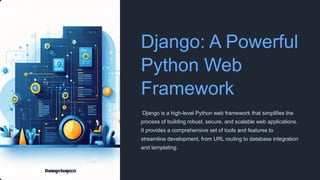
Django is a high-level Python web framework that simplifies the
process of building robust, secure, and scalable web applications.
It provides a comprehensive set of tools and features to
streamline development, from URL routing to database integration
and templating.
Key Django Features
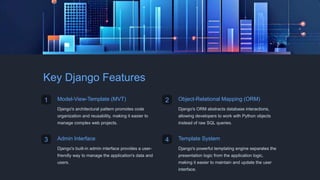
1 Model-View-Template (MVT)
Django's architectural pattern promotes code
organization and reusability, making it easier to
manage complex web projects.
2 Object-Relational Mapping (ORM)
Django's ORM abstracts database interactions,
allowing developers to work with Python objects
instead of raw SQL queries.
3 Admin Interface
Django's built-in admin interface provides a user-
friendly way to manage the application's data and
users.
4 Template System
Django's powerful templating engine separates the
presentation logic from the application logic,
making it easier to maintain and update the user
interface.
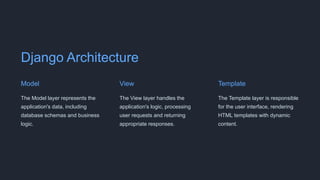
Django Architecture
Model
The Model layer represents the
application's data, including
database schemas and business
logic.
View
The View layer handles the
application's logic, processing
user requests and returning
appropriate responses.
Template
The Template layer is responsible
for the user interface, rendering
HTML templates with dynamic
content.
Django URL Routing
URL Patterns
Django's URL routing system
maps URLs to Python functions,
called views, that handle the
corresponding logic.
URL Parameters
Django allows for dynamic URL
patterns that can capture and
pass parameters to the associated
views.
Namespaced URLs
Django's URL namespacing
feature helps manage complex
URL structures, ensuring unique
and predictable URLs.
Django Models and ORM
1 Model Definition
Django models are Python classes that represent database
tables, defining fields, relationships, and constraints.
2 Database Abstraction
Django's Object-Relational Mapping (ORM) allows developers
to interact with the database using Python code instead of raw
SQL.
3 Migrations
Django's built-in migration system simplifies the process of
managing and versioning database schema changes.
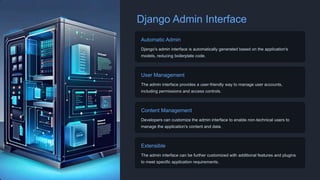
Django Admin Interface
Automatic Admin
Django's admin interface is automatically generated based on the application's
models, reducing boilerplate code.
User Management
The admin interface provides a user-friendly way to manage user accounts,
including permissions and access controls.
Content Management
Developers can customize the admin interface to enable non-technical users to
manage the application's content and data.
Extensible
The admin interface can be further customized with additional features and plugins
to meet specific application requirements.
Django Templates
HTML Templating
Django's template engine allows developers to incorporate dynamic content into HTML pages,
separating the presentation from the application logic.
Template Inheritance
Django's template inheritance system enables code reuse and consistency across the application's
user interface.
Template Tags
Django's template tags provide a powerful set of tools for controlling the flow of the template,
including loops, conditionals, and variable assignment.
Django Forms
Form Definition
Django's forms module simplifies
the process of creating and
validating HTML forms, handling
input validation and rendering.
Form Rendering
Django forms can be easily
rendered in templates, allowing
for consistent and responsive
form layouts across the
application.
Form Handling
Django's form handling system
automatically processes form
submissions, retrieving and
validating the submitted data.
Django Testing
1 Unit Testing
Django's built-in testing framework allows developers to write and run unit tests for
individual components, ensuring the application's functionality.
2 Integration Testing
Django's testing tools support integration testing, which verifies the interactions between
different parts of the application.
3 Automated Testing
Django's test runner makes it easy to run the entire test suite, helping to catch
regressions and ensure the application's reliability.
4 Test-Driven Development
Django's testing capabilities enable a test-driven development (TDD) approach, where
tests are written before the implementation.
Django Deployment
Hosting Platform Django can be deployed on a variety of
hosting platforms, including PaaS (Platform
as a Service) providers like Heroku, AWS
Elastic Beanstalk, and Google App Engine.
Web Server Django applications typically use a web
server like Nginx or Apache, along with a
WSGI (Web Server Gateway Interface)
server like Gunicorn or uWSGI.
Database Django supports a wide range of databases,
including SQLite, PostgreSQL, MySQL, and
Oracle, making it easy to integrate with
existing infrastructure.
Caching Django provides built-in caching
mechanisms to optimize the application's
performance, such as in-memory caching
and database caching.
Thank You !

Introduction to DJANGO, a creative framework

  • 1.
    Introduction to Django submittedby G.Sidhartha 22D41A1223 K.Varsha Sri 22D41A1236 M.Sai Venkat 22D41A1241 R.Ajay 22D41A1252
  • 2.
    Django: A Powerful PythonWeb Framework Django is a high-level Python web framework that simplifies the process of building robust, secure, and scalable web applications. It provides a comprehensive set of tools and features to streamline development, from URL routing to database integration and templating.
  • 3.
    Key Django Features 1Model-View-Template (MVT) Django's architectural pattern promotes code organization and reusability, making it easier to manage complex web projects. 2 Object-Relational Mapping (ORM) Django's ORM abstracts database interactions, allowing developers to work with Python objects instead of raw SQL queries. 3 Admin Interface Django's built-in admin interface provides a user- friendly way to manage the application's data and users. 4 Template System Django's powerful templating engine separates the presentation logic from the application logic, making it easier to maintain and update the user interface.
  • 4.
    Django Architecture Model The Modellayer represents the application's data, including database schemas and business logic. View The View layer handles the application's logic, processing user requests and returning appropriate responses. Template The Template layer is responsible for the user interface, rendering HTML templates with dynamic content.
  • 5.
    Django URL Routing URLPatterns Django's URL routing system maps URLs to Python functions, called views, that handle the corresponding logic. URL Parameters Django allows for dynamic URL patterns that can capture and pass parameters to the associated views. Namespaced URLs Django's URL namespacing feature helps manage complex URL structures, ensuring unique and predictable URLs.
  • 6.
    Django Models andORM 1 Model Definition Django models are Python classes that represent database tables, defining fields, relationships, and constraints. 2 Database Abstraction Django's Object-Relational Mapping (ORM) allows developers to interact with the database using Python code instead of raw SQL. 3 Migrations Django's built-in migration system simplifies the process of managing and versioning database schema changes.
  • 7.
    Django Admin Interface AutomaticAdmin Django's admin interface is automatically generated based on the application's models, reducing boilerplate code. User Management The admin interface provides a user-friendly way to manage user accounts, including permissions and access controls. Content Management Developers can customize the admin interface to enable non-technical users to manage the application's content and data. Extensible The admin interface can be further customized with additional features and plugins to meet specific application requirements.
  • 8.
    Django Templates HTML Templating Django'stemplate engine allows developers to incorporate dynamic content into HTML pages, separating the presentation from the application logic. Template Inheritance Django's template inheritance system enables code reuse and consistency across the application's user interface. Template Tags Django's template tags provide a powerful set of tools for controlling the flow of the template, including loops, conditionals, and variable assignment.
  • 9.
    Django Forms Form Definition Django'sforms module simplifies the process of creating and validating HTML forms, handling input validation and rendering. Form Rendering Django forms can be easily rendered in templates, allowing for consistent and responsive form layouts across the application. Form Handling Django's form handling system automatically processes form submissions, retrieving and validating the submitted data.
  • 10.
    Django Testing 1 UnitTesting Django's built-in testing framework allows developers to write and run unit tests for individual components, ensuring the application's functionality. 2 Integration Testing Django's testing tools support integration testing, which verifies the interactions between different parts of the application. 3 Automated Testing Django's test runner makes it easy to run the entire test suite, helping to catch regressions and ensure the application's reliability. 4 Test-Driven Development Django's testing capabilities enable a test-driven development (TDD) approach, where tests are written before the implementation.
  • 11.
    Django Deployment Hosting PlatformDjango can be deployed on a variety of hosting platforms, including PaaS (Platform as a Service) providers like Heroku, AWS Elastic Beanstalk, and Google App Engine. Web Server Django applications typically use a web server like Nginx or Apache, along with a WSGI (Web Server Gateway Interface) server like Gunicorn or uWSGI. Database Django supports a wide range of databases, including SQLite, PostgreSQL, MySQL, and Oracle, making it easy to integrate with existing infrastructure. Caching Django provides built-in caching mechanisms to optimize the application's performance, such as in-memory caching and database caching.
  • 12.