2013 Global Forum on Financial Inclusion
for Development
Postal financial inclusion is enjoying a boom phase. After banks, postal operators and their postal
financial subsidiaries are the world's second biggest contributor to financial inclusion.
Today, one billion people use the postal sector for savings and deposit accounts, and more than
1.5 billion profit from basic transactional services through the Post. In India alone, 30 million
new postal savings accounts were opened in 2012.
At the core of the UPU Convention is the provision of affordable and efficient universal postal
services to all citizens of the world. Postal services include financial services.
Bishar A. Hussein, Director General, UPU
Donors and policymakers are starting to realize the potential of postal financial services, and the
role that Posts can play in increasing financial inclusion. Following the example of the Bill &
Melinda Gates Foundation, which has shown its commitment to postal financial inclusion,
several donors are now focusing their efforts on leveraging postal networks for financial
inclusion.
The UPU, jointly with the Swiss Federal Department of Foreign Affairs and the International
Organization of La Francophonie, organized a Global Forum on financial inclusion for
development which was established as a platform for dialogue on postal financial inclusion
between governments, postal operators, central banks, private sector players and international
organizations. The summary report is available here.
About financial inclusion
To access the presentations of the 2013 Global Forum on Financial Inclusion for
Development, click here.
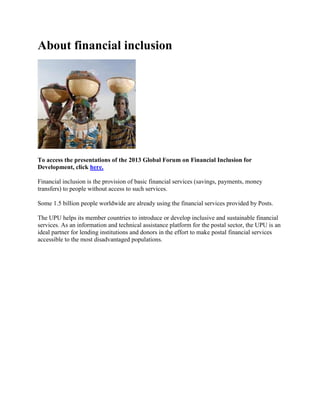
Financial inclusion is the provision of basic financial services (savings, payments, money
transfers) to people without access to such services.
Some 1.5 billion people worldwide are already using the financial services provided by Posts.
The UPU helps its member countries to introduce or develop inclusive and sustainable financial
services. As an information and technical assistance platform for the postal sector, the UPU is an
ideal partner for lending institutions and donors in the effort to make postal financial services
accessible to the most disadvantaged populations.
Global Panorama on Postal Financial Inclusion
This report establishes a panorama of postal financial inclusion and presents, for the very first
time, the current status of this dimension in financial inclusion.
Based on a questionnaire answered by 123 UPU member countries and the concrete lessons
drawn from field missions, the report aims to bridge both the information and awareness gaps on
the role of Posts in financial inclusion by providing updated statistical information on postal
operators. It is intended for decision makers and development partners alike, and is one of the
key tools in solving financial exclusion issues.
Executive summary - French
Executive summary - Arabic
Executive summary - Spanish
Executive summary - Russian
Executive summary - Portuguese
The Bill & Melinda Gates Foundation supports the UPU's work in the area of financial inclusion,
which is aimed at the achievement of three main objectives:
 Research: identify success factors for the delivery of inclusive postal financial services
which are accessible to disadvantaged populations while being profitable for postal
operators.
 Communication: promote towards governments, central banks, designated operators and
international organizations the potential of postal networks as key actors in the field of
financial inclusion.
 Mobilization of resources: identify and select countries with a strong potential for
developing inclusive postal financial services, mobilize resources, and support countries
in their efforts to engage in negotiations and forge partnerships.
More information on financial inclusion
Financial inclusion
 » About financial inclusion
 Meeting documents
 2014 Forum on Financial Inclusion
 2013 Forum on Financial Inclusion
2014 Global Forum on Financial Inclusion
for Development
The role of mobile technologies as a catalyst for financial
inclusion by Posts
5 November 2014, Heinrich VON STEPHAN Hall, UPU Headquarters, Berne,
SWITZERLAND.
Mobile technologies are an essential component of postal financial inclusion strategy at the
national and international levels.
No matter a country's level of development and the degree of financial inclusion of its
population, mobile devices are playing an increasingly important role in the modernization of
postal financial services. This technology is allowing Posts to explore new market segments or
expand their range of products. More important still, it is allowing them to bring these services
closer to consumers, wherever they are and at lower cost, including in rural areas.
The ever-increasing range of innovative business models and promising new applications
represent both an opportunity and a challenge for Posts. With this in mind, the discussions at the
2014 forum on financial inclusion for development will focus on the role of mobile technologies
as a catalyst for financial inclusion, and seek to provide concrete responses to member countries'
questions.
Posts facilitate financial inclusion
Postal financial inclusion brings people excluded from the formal financial sector into a financial
system using the postal network as a gateway. Either the Post offers its own financial services or
partners with a financial institution to give access to such services.
With more than 600,000 post offices in the world, the postal presence in rural areas is unmatched
by any other network. The UPU is building on that strength to help Posts provide rural citizens in
developing countries with financial services such as postal savings accounts, government
payments, loans and insurance, as well as a secure, reliable, efficient and affordable service for
international and national electronic money orders. Offering such services to the unbanked can
lead to poverty reduction and increased economic participation.
Several Posts are already key players in financial inclusion: the Postal Savings Bank of China
has 475 million customers; Brazil’s Correios opened 11 million accounts in 10 years through a
partnership with a bank; Namibia Post banks 20% of the country’s total population; India Post
holds 240 million savings accounts and covers risks for more than 20 million people through its
postal life insurance policy; Papua New Guinea Post offers a mobile wallet and is one of three
main national competitors for mobile financial services; Serbia Post makes 150 million financial
transactions a year in a country of 10 million inhabitants.
The UPU is also helping Posts develop and expand their electronic money transfer services. The
remittance market is hampered by restrictive laws, low levels of competition and costly fees,
leaving customers, especially migrant workers, vulnerable. There is a strong need for a more
streamlined system of sending remittances.
The UPU has entered into valuable partnerships with the International Fund for Agricultural
Development (IFAD), the World Bank, the Alliance for Financial Inclusion and the Bill &
Melinda Gates Foundation, as well as others, to research and develop financial inclusion through
the postal network.
Major projects
 Nearly 700,000 USD from the Bill & Melinda Gates foundation is helping the UPU fund
work on how Posts can enter into partnerships with financial institutions and mobile-
money operators to better serve the underprivileged, the exchange of know-how among
stakeholders and initiating pilot projects
 A UPU-IFAD project in West Africa, involving Benin, Burkina Faso, Mali, Mauritania,
Niger and Senegal, connected 355 post offices in rural areas to the UPU's worldwide
electronic payment network. Rural post offices have been providing the service since
October 2009, while currently, a total of 453 post offices in the six countries offer fund
transfer services. According to postal officials in those countries, the time for receiving
remittances and the transfer costs have been reduced.
 IFAD is financing two additional development projects for postal payment services in
South East Asia and Central Asia to the tune of 750,000 USD. The aim is to help
designated operators in these countries to develop their money transfer services in rural
regions.
 With the World Bank, the UPU is helping the Posts of West and Central Africa countries
improve the quality of their money transfer services.
Facts and figures


 Only 8% of the world’s Posts do not offer financial services (UPU survey)
 51 Posts worldwide hold 1.6 billion savings and deposit accounts
 One billion people are banked through the Post
 Several hundred million people, often without an account, use the post to send and
receive domestic and international transfers, and make government payments and utility
payments
 Remittances to developing countries in 2013 are expected to reach 410 billion USD
(World Bank)
 30 to 40% of remittances go to rural areas, while in many countries the value of
remittances exceeds foreign direct investment (IFAD)


Universal Postal Union - Financial Inclusion

  • 1.
    2013 Global Forumon Financial Inclusion for Development Postal financial inclusion is enjoying a boom phase. After banks, postal operators and their postal financial subsidiaries are the world's second biggest contributor to financial inclusion. Today, one billion people use the postal sector for savings and deposit accounts, and more than 1.5 billion profit from basic transactional services through the Post. In India alone, 30 million new postal savings accounts were opened in 2012. At the core of the UPU Convention is the provision of affordable and efficient universal postal services to all citizens of the world. Postal services include financial services. Bishar A. Hussein, Director General, UPU Donors and policymakers are starting to realize the potential of postal financial services, and the role that Posts can play in increasing financial inclusion. Following the example of the Bill & Melinda Gates Foundation, which has shown its commitment to postal financial inclusion, several donors are now focusing their efforts on leveraging postal networks for financial inclusion. The UPU, jointly with the Swiss Federal Department of Foreign Affairs and the International Organization of La Francophonie, organized a Global Forum on financial inclusion for development which was established as a platform for dialogue on postal financial inclusion between governments, postal operators, central banks, private sector players and international organizations. The summary report is available here.
  • 2.
    About financial inclusion Toaccess the presentations of the 2013 Global Forum on Financial Inclusion for Development, click here. Financial inclusion is the provision of basic financial services (savings, payments, money transfers) to people without access to such services. Some 1.5 billion people worldwide are already using the financial services provided by Posts. The UPU helps its member countries to introduce or develop inclusive and sustainable financial services. As an information and technical assistance platform for the postal sector, the UPU is an ideal partner for lending institutions and donors in the effort to make postal financial services accessible to the most disadvantaged populations.
  • 3.
    Global Panorama onPostal Financial Inclusion This report establishes a panorama of postal financial inclusion and presents, for the very first time, the current status of this dimension in financial inclusion. Based on a questionnaire answered by 123 UPU member countries and the concrete lessons drawn from field missions, the report aims to bridge both the information and awareness gaps on the role of Posts in financial inclusion by providing updated statistical information on postal operators. It is intended for decision makers and development partners alike, and is one of the key tools in solving financial exclusion issues. Executive summary - French Executive summary - Arabic Executive summary - Spanish Executive summary - Russian Executive summary - Portuguese The Bill & Melinda Gates Foundation supports the UPU's work in the area of financial inclusion, which is aimed at the achievement of three main objectives:  Research: identify success factors for the delivery of inclusive postal financial services which are accessible to disadvantaged populations while being profitable for postal operators.  Communication: promote towards governments, central banks, designated operators and international organizations the potential of postal networks as key actors in the field of financial inclusion.  Mobilization of resources: identify and select countries with a strong potential for developing inclusive postal financial services, mobilize resources, and support countries in their efforts to engage in negotiations and forge partnerships. More information on financial inclusion Financial inclusion  » About financial inclusion  Meeting documents  2014 Forum on Financial Inclusion  2013 Forum on Financial Inclusion
  • 4.
    2014 Global Forumon Financial Inclusion for Development The role of mobile technologies as a catalyst for financial inclusion by Posts 5 November 2014, Heinrich VON STEPHAN Hall, UPU Headquarters, Berne, SWITZERLAND. Mobile technologies are an essential component of postal financial inclusion strategy at the national and international levels. No matter a country's level of development and the degree of financial inclusion of its population, mobile devices are playing an increasingly important role in the modernization of postal financial services. This technology is allowing Posts to explore new market segments or expand their range of products. More important still, it is allowing them to bring these services closer to consumers, wherever they are and at lower cost, including in rural areas. The ever-increasing range of innovative business models and promising new applications represent both an opportunity and a challenge for Posts. With this in mind, the discussions at the 2014 forum on financial inclusion for development will focus on the role of mobile technologies as a catalyst for financial inclusion, and seek to provide concrete responses to member countries' questions.
  • 5.
    Posts facilitate financialinclusion Postal financial inclusion brings people excluded from the formal financial sector into a financial system using the postal network as a gateway. Either the Post offers its own financial services or partners with a financial institution to give access to such services. With more than 600,000 post offices in the world, the postal presence in rural areas is unmatched by any other network. The UPU is building on that strength to help Posts provide rural citizens in developing countries with financial services such as postal savings accounts, government payments, loans and insurance, as well as a secure, reliable, efficient and affordable service for international and national electronic money orders. Offering such services to the unbanked can lead to poverty reduction and increased economic participation. Several Posts are already key players in financial inclusion: the Postal Savings Bank of China has 475 million customers; Brazil’s Correios opened 11 million accounts in 10 years through a partnership with a bank; Namibia Post banks 20% of the country’s total population; India Post holds 240 million savings accounts and covers risks for more than 20 million people through its postal life insurance policy; Papua New Guinea Post offers a mobile wallet and is one of three main national competitors for mobile financial services; Serbia Post makes 150 million financial transactions a year in a country of 10 million inhabitants. The UPU is also helping Posts develop and expand their electronic money transfer services. The remittance market is hampered by restrictive laws, low levels of competition and costly fees, leaving customers, especially migrant workers, vulnerable. There is a strong need for a more streamlined system of sending remittances. The UPU has entered into valuable partnerships with the International Fund for Agricultural Development (IFAD), the World Bank, the Alliance for Financial Inclusion and the Bill & Melinda Gates Foundation, as well as others, to research and develop financial inclusion through the postal network. Major projects  Nearly 700,000 USD from the Bill & Melinda Gates foundation is helping the UPU fund work on how Posts can enter into partnerships with financial institutions and mobile- money operators to better serve the underprivileged, the exchange of know-how among stakeholders and initiating pilot projects  A UPU-IFAD project in West Africa, involving Benin, Burkina Faso, Mali, Mauritania, Niger and Senegal, connected 355 post offices in rural areas to the UPU's worldwide electronic payment network. Rural post offices have been providing the service since October 2009, while currently, a total of 453 post offices in the six countries offer fund transfer services. According to postal officials in those countries, the time for receiving remittances and the transfer costs have been reduced.  IFAD is financing two additional development projects for postal payment services in South East Asia and Central Asia to the tune of 750,000 USD. The aim is to help
  • 6.
    designated operators inthese countries to develop their money transfer services in rural regions.  With the World Bank, the UPU is helping the Posts of West and Central Africa countries improve the quality of their money transfer services. Facts and figures 
  Only 8% of the world’s Posts do not offer financial services (UPU survey)  51 Posts worldwide hold 1.6 billion savings and deposit accounts  One billion people are banked through the Post  Several hundred million people, often without an account, use the post to send and receive domestic and international transfers, and make government payments and utility payments  Remittances to developing countries in 2013 are expected to reach 410 billion USD (World Bank)  30 to 40% of remittances go to rural areas, while in many countries the value of remittances exceeds foreign direct investment (IFAD)