Download to read offline
![Which Users Does UD Serve?
Which Trade-Offs are Made?
“Redirecting design towards the needs of those
marginalized by specific physical conditions means
other priorities go unmet. The implication that such
trade-offs are not necessary —that singular
[universally designed] systems can account for all
needs— risks depoliticizing inherently political design
questions about whose interests should be accounted
for and how.”
(Nieusma, 2004)](https://image.slidesharecdn.com/universaldesign-161206125025/75/Universal-design-Towards-a-More-Thorough-Ethical-and-Theoretical-Understanding-11-2048.jpg)
![Universal Design
= Good Design?
• “…no longer talk about the specific needs of certain
categories of people, but talk about human functioning. We
should look at every aspect of human functioning, without
categorizing […] Accessibility will lose its stigma and become
a mainstream issue. We won’t need terms like Design for All
or Universal Design anymore. We will only refer to good
design and bad design.” (future vision of the European Concept for
Accessibility Network, 2001, as quoted by Erlandson 2008)
• Chair at Include 2009 Conference: “I’d like to see the crap
design being inclusive”. One of many “fierce” reactions from
the audience: “If crap design can be inclusive design, what
does that mean for what we mean by inclusive design?” (as
reported by Helighen & Bianchin, 2010)](https://image.slidesharecdn.com/universaldesign-161206125025/75/Universal-design-Towards-a-More-Thorough-Ethical-and-Theoretical-Understanding-12-2048.jpg)
![Gap: Lack of
Theoretical Reflection on UD
“While UD has intuitive appeal, and has quickly gained global reach,
even totemic status, there has been little or no evaluation of its
underlying principles and its theoretical and conceptual content”
Three issues (Imrie, 2012)
1.“Belief in the significance of technology”; too little attention for
social embedding/interaction as important for outcomes (and what
about non-technical solutions?)
2.“Defence of universalism” / “ambivalence towards
particularism”; paradoxically, an abstract, stereotype picture of
human diversity; narrow philosophical anthropology; user as remote
figure / non-involvement users
3.“Propagation of [UD through] market discourses”; risk of
selective response to needs disabled people depending on
costs/profit, weakening of rights discourse](https://image.slidesharecdn.com/universaldesign-161206125025/75/Universal-design-Towards-a-More-Thorough-Ethical-and-Theoretical-Understanding-14-2048.jpg)

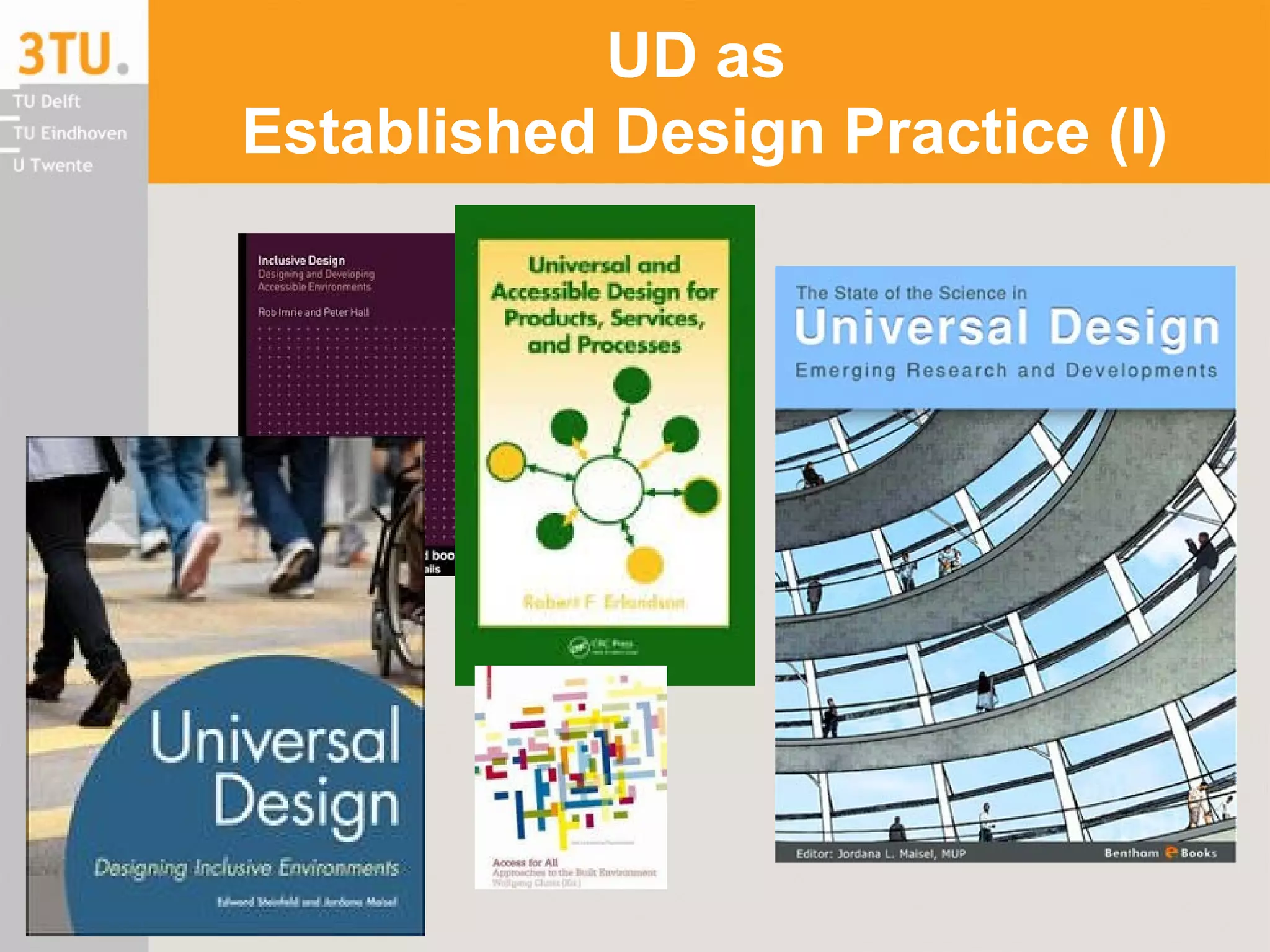
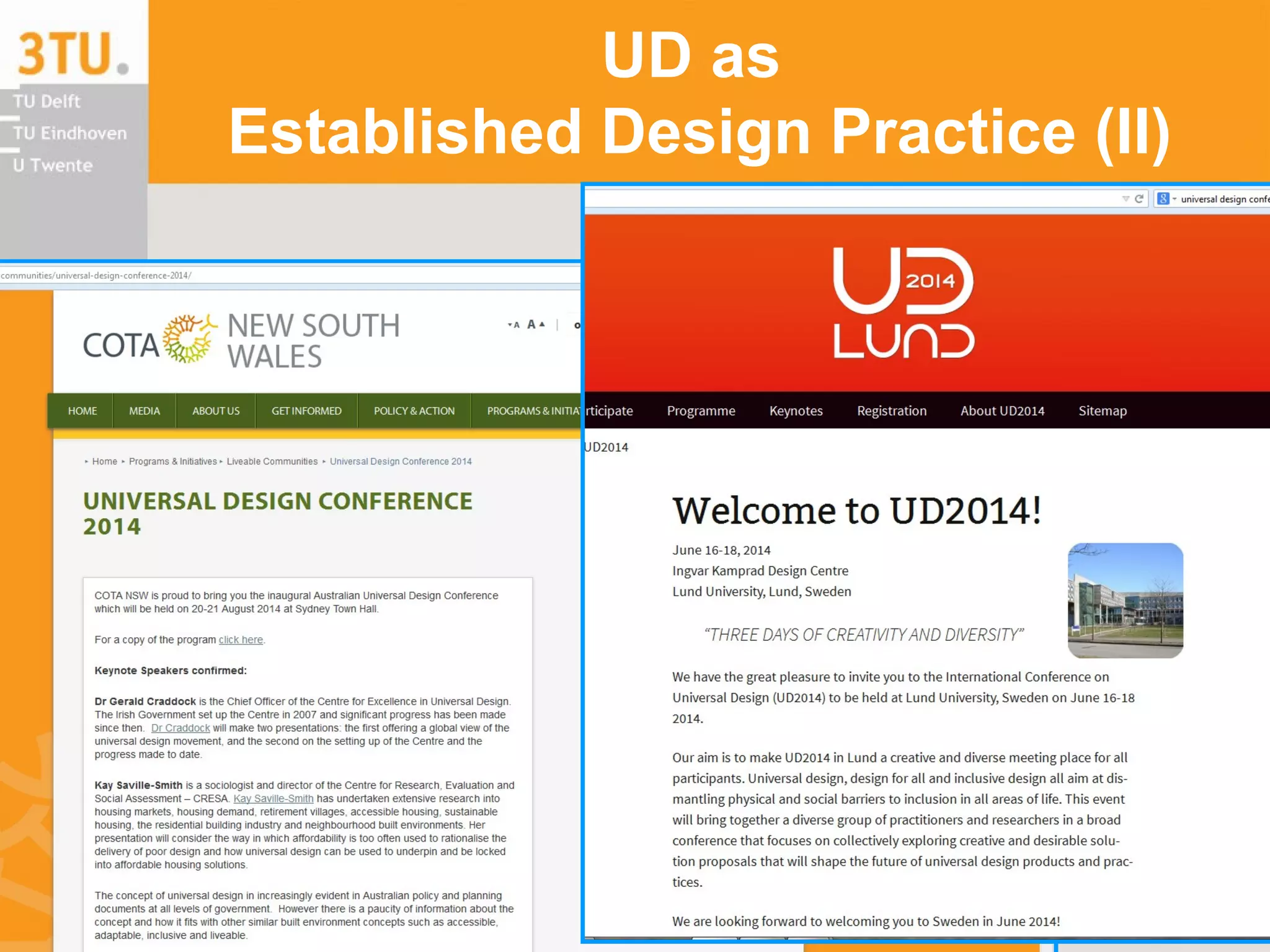
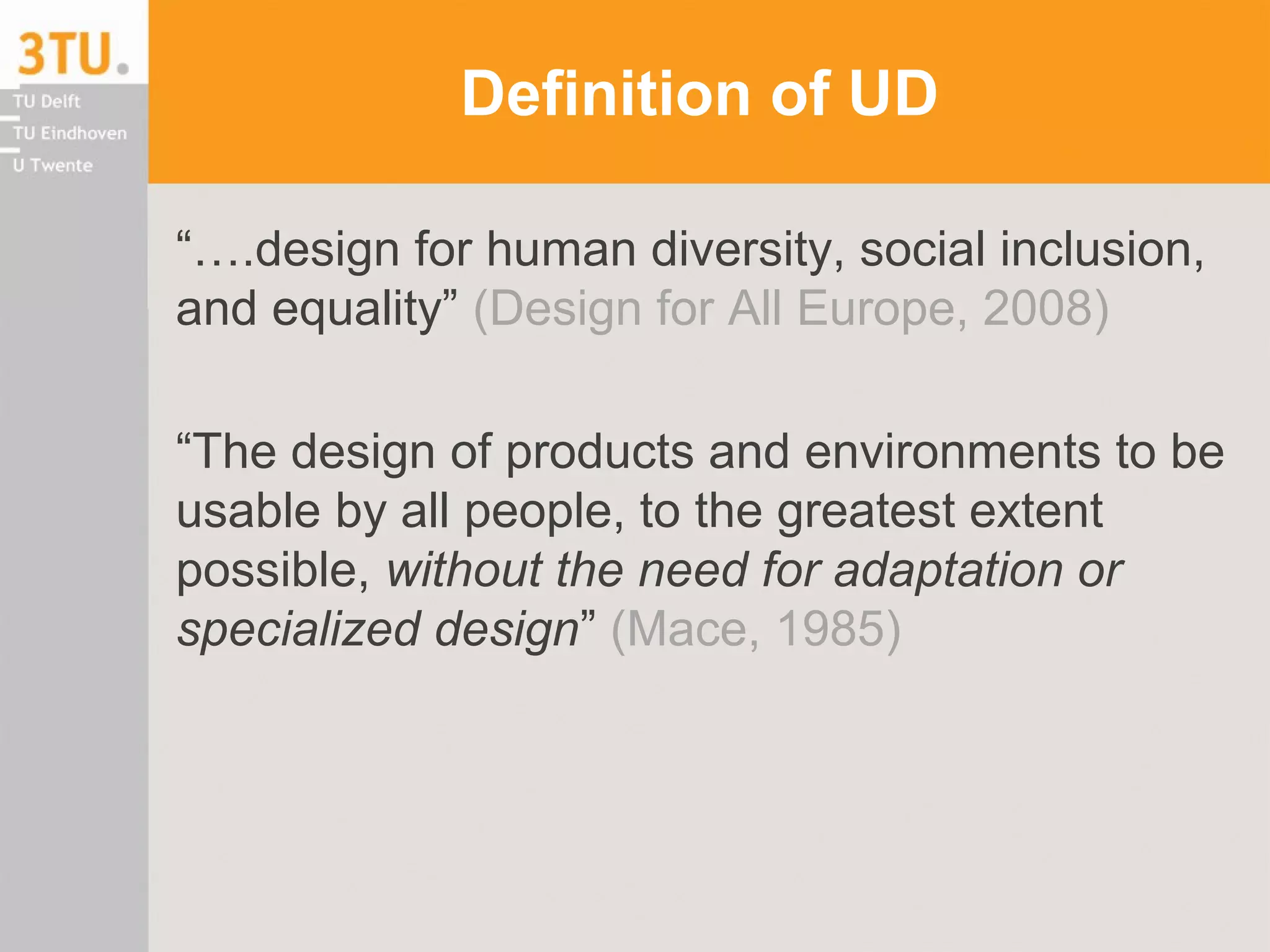
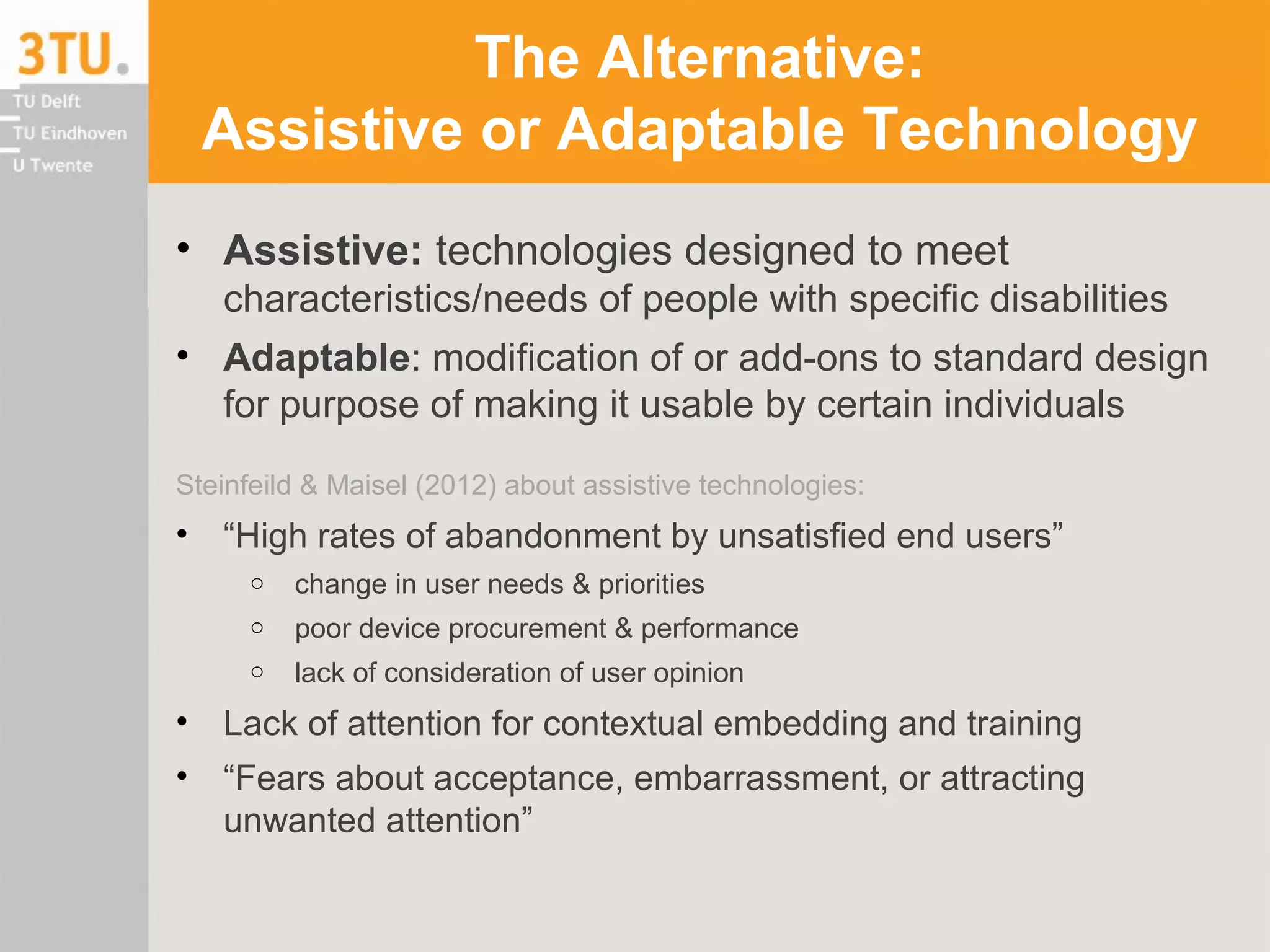
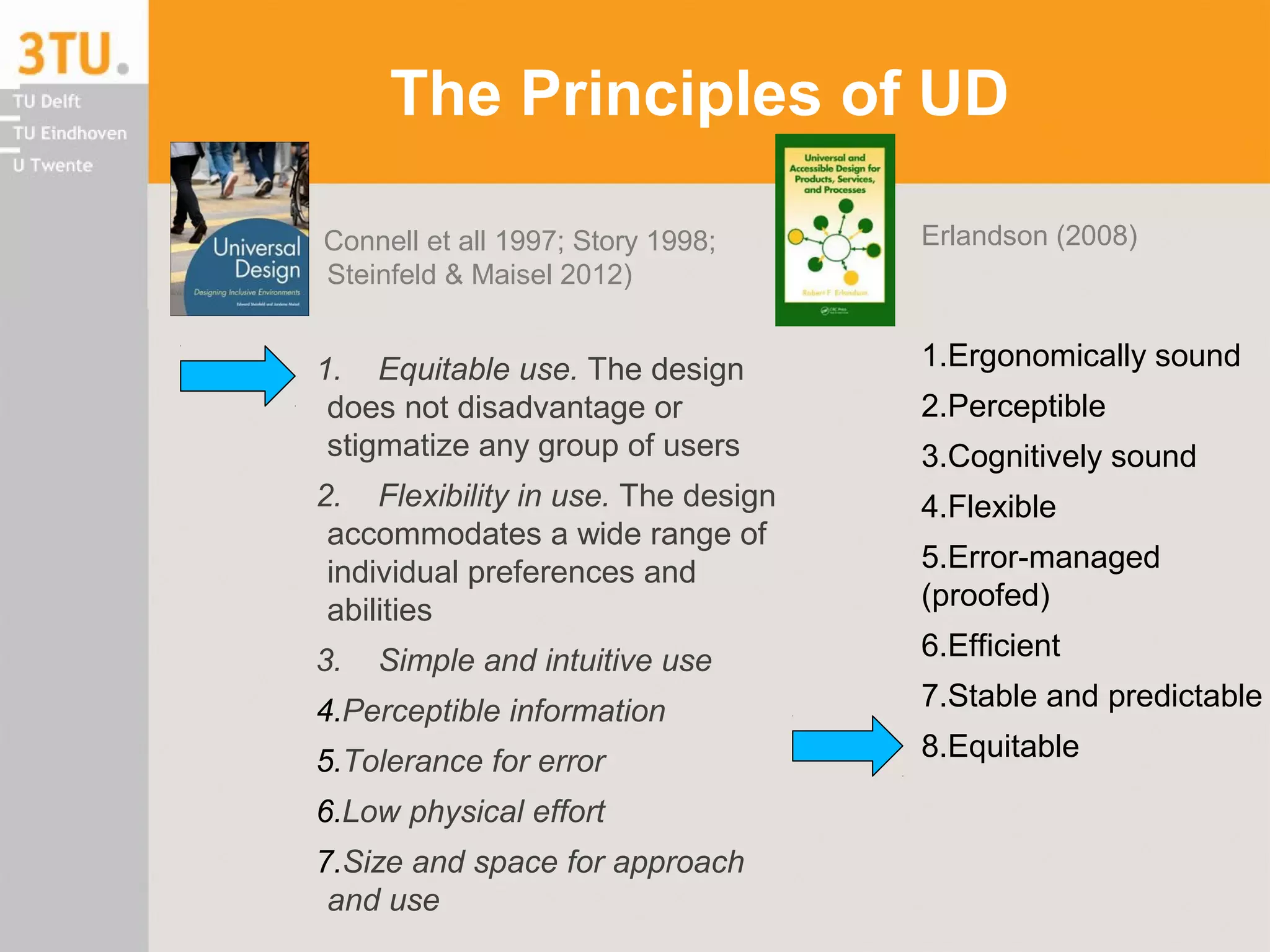
The document discusses universal/inclusive design (UD) as a practice aimed at creating products and environments usable by everyone, emphasizing principles such as equitable use and flexibility. It critiques existing UD frameworks for their limitations, including lack of user involvement and challenges in application across diverse contexts. The author proposes further exploration of the ethical considerations and philosophical implications surrounding UD, particularly concerning marginalized communities and the capability approach.


