Chapter 1
ELEMENTS OF DIFFUSION
           Chapter Report
Diffusion of innovations (3rd edition)
         Everett M. Rogers

        M. Arief Ramdhany
      Administrasi Pendidikan
        UPI Bandung 2012
In the beginning
• To get the bad customs of a country changed and new
  ones, though better, introduced, it is necessary first to
  remove the prejudices of the people, enlighten their
  ignorance, and convince them that their interests will be
  promoted by the proposed changes; and this is not the
  work of a day. Benjamin Franklin (1781)

• There is nothing more difficult to plan, more doubtful of
  success, nor more dangerous to manage than the creation
  of a new order of things. . . . Whenever his enemies have
  occasion to attack the innovator they do so with the
  passion of partisans, while the others defend him sluggishly
  so that the innovator and his party alike are vulnerable.
  Niccolo Machiavelli The Prince (1513)
Being adopted = difficult(?)
• Getting a new idea adopted, even when it has
  obvious advantages, is often very difficult
• Many innovations require a lengthy
  period, often of some years, from the time
  when they become available to the time when
  they are widely adopted
• A common problem for many individuals and
  organizations is how to speed up the rate of
  diffusion of an innovation
Case:
    Water Boiling in a Peruvian Village
• Nelida  Change agency
• Village housewives
   – Custom-Oriented Adopter
   – Persuaded Adopter
   – Rejector
• Why failed? An important factor affecting the adoption rate of any
  innovation is its compatibility with the values, beliefs, and past
  experiences of the social system.
• Nelida was too "innovation-oriented" and not "client-oriented“
  enough. Her attempts at persuasion failed to reach her clients
  because the message was not suited to their needs.  Nelida did
  not begin where the villagers were; instead she talked to them
  about germ theory, which they could not (and probably did not
  need to) understand
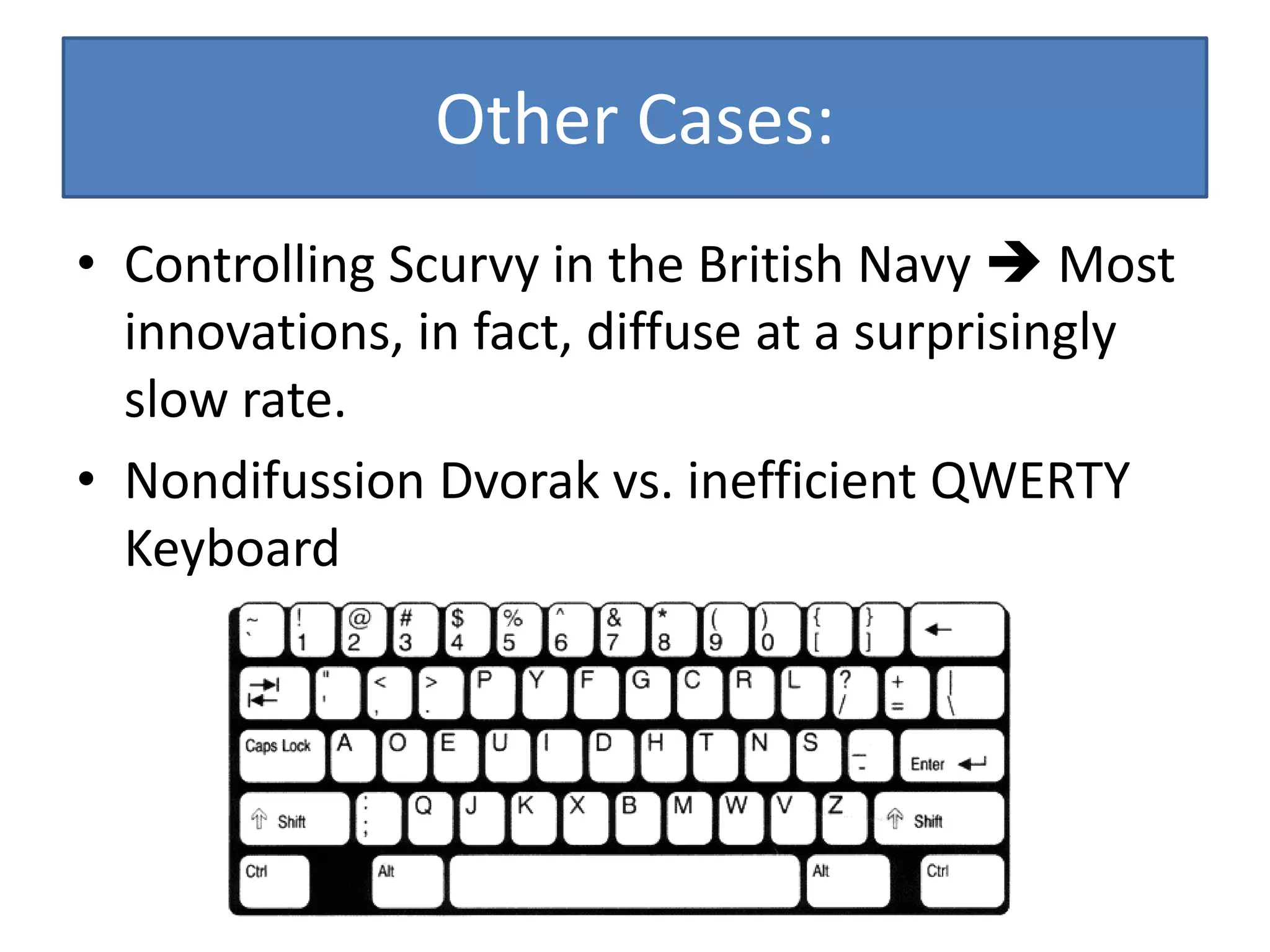
Other Cases:
• Controlling Scurvy in the British Navy  Most
  innovations, in fact, diffuse at a surprisingly
  slow rate.
• Nondifussion Dvorak vs. inefficient QWERTY
  Keyboard
What is Diffusion?
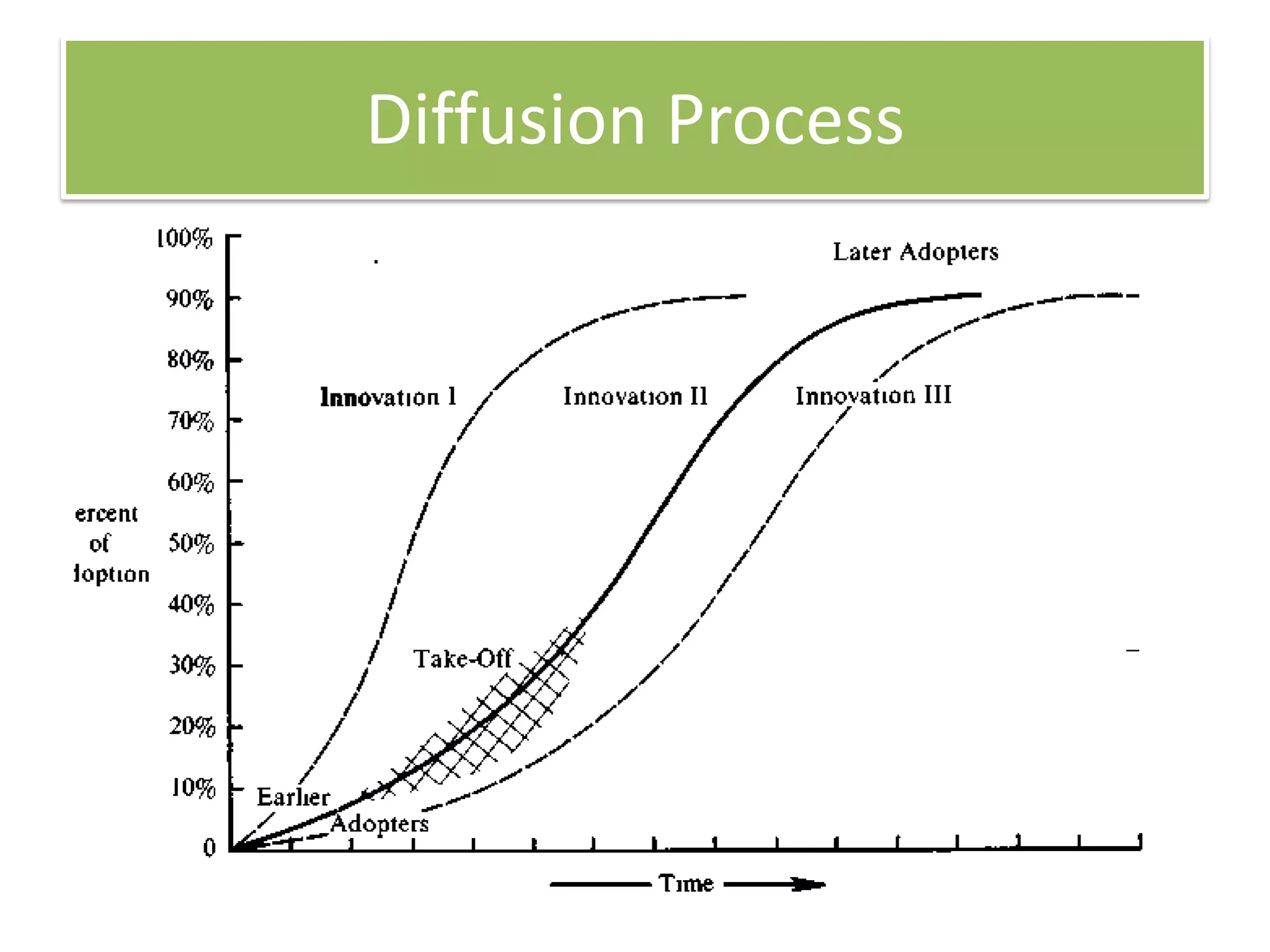
• Diffusion is the process by which an innovation is
  communicated through certain channels over time among
  the members of a social system. It is a special type of
  communication, in that the messages are concerned with
  new ideas
• Communication is a process in which participants create
  and share information with one another in order to reach a
  mutual understanding
•  communication is a process of convergence (or
  divergence) as two or more individuals exchange
  information in order to move toward each other (or apart)
  in the meanings that they ascribe to certain events
•  The newness means that some degree of uncertainty is
  involved.
• Uncertainty is the degree to which a number of
  alternatives are perceived with respect to the
  occurrence of an event and the relative
  probability of these alternatives  implies a lack
  of predictability, of structure, of information
• A technological innovation embodies information
  and thus reduces uncertainty about cause-effect
  relationships in problem solving
• Diffusion is a kind of social change
• Diffusion = dissemination (?)  both the planned
  and the spontaneous spread of new ideas
Four Main Elements
     in the Diffusion of Innovations
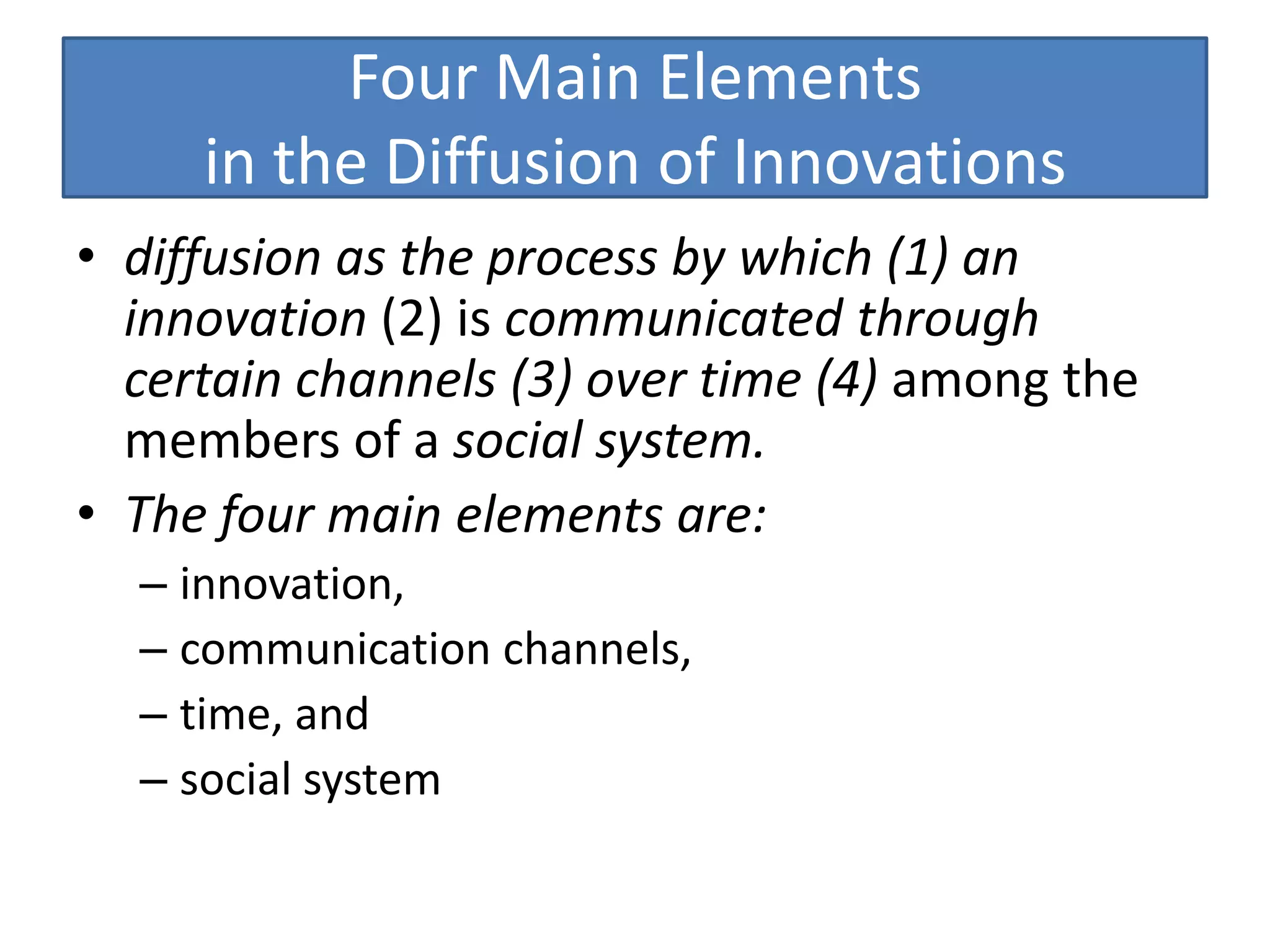
• diffusion as the process by which (1) an
  innovation (2) is communicated through
  certain channels (3) over time (4) among the
  members of a social system.
• The four main elements are:
  – innovation,
  – communication channels,
  – time, and
  – social system
Diffusion Process
1. Innovation
• An innovation is an idea, practice, or object
  that is perceived as new by an individual or
  other unit of adoption
• The "newness" aspect of an innovation may
  be expressed in terms of
  knowledge, persuasion, or a decision to adopt
TECHNOLOGICAL
  INNOVATIONS, INFORMATION, AND
•
                   UNCERTAINTY
  Innovation = technology
• Two components of technology:
   – Hardware  material or physical objects
   – Software  information base for the tool
• The innovation-decision process is essentially an
  information-seeking and information-processing activity in
  which the individual is motivated to reduce uncertainty
  about the advantages and disadvantages of the innovation
• Two kinds of information:
   – Software information, which is embodied in a technology and
     serves to reduce uncertainty about the cause-effect
     relationships involved in achieving a desired outcome
   – Innovation-evaluation information, which is the reduction in
     uncertainty about an innovation's expected consequences
CHARACTERISTICS OF INNOVATIONS
      (perceived by individual)
• Relative Advantage  economic
  terms, prestige, convenience, satisfaction  rate of
  adoption
• Compatibility  being consistent with the existing
  values, past experiences, and needs of potential adopters
• Complexity  new ideas that are simpler to understand
  will be adopted more rapidly than innovations that
  require the adopter to develop new skills and
  understandings
• Trialability  less uncertainty to individual who is
  considering it for adoption; possible to learn by doing
• Observabitily  results of an innovation are visible to
  others  The easier it is for individuals to see the results
  of an innovation, the more likely they are to adopt
Re-invention
• degree to which an innovation is changed or
  modified by a user in the process of its
  adoption and implementation
• degree to which an individual's use of a new
  idea departed from the "mainline" version of
  the innovation that was promoted by a
  change agency (Eveland et al, 1977)
• re-invented by many adopters who implement
  them in different ways
2. Communication Channels
• Diffusion process is the information exchange by which
  one individual communicates a new idea to one or
  several others, involving:
   – (1) an innovation, (2) an individual or other unit of
     adoption that has knowledge of, or experience with
     using, the innovation, (3) another individual or other unit
     that does not yet have knowledge of the innovation, and
     (4) a communication channel connecting the two units.
• Homophily vs. Heterophily
   – degree to which pairs of individuals who interact are
     similar in certain attributes, such as
     beliefs, education, social status, and the like
   – More effective communication occurs when two
     individuals are homophilous
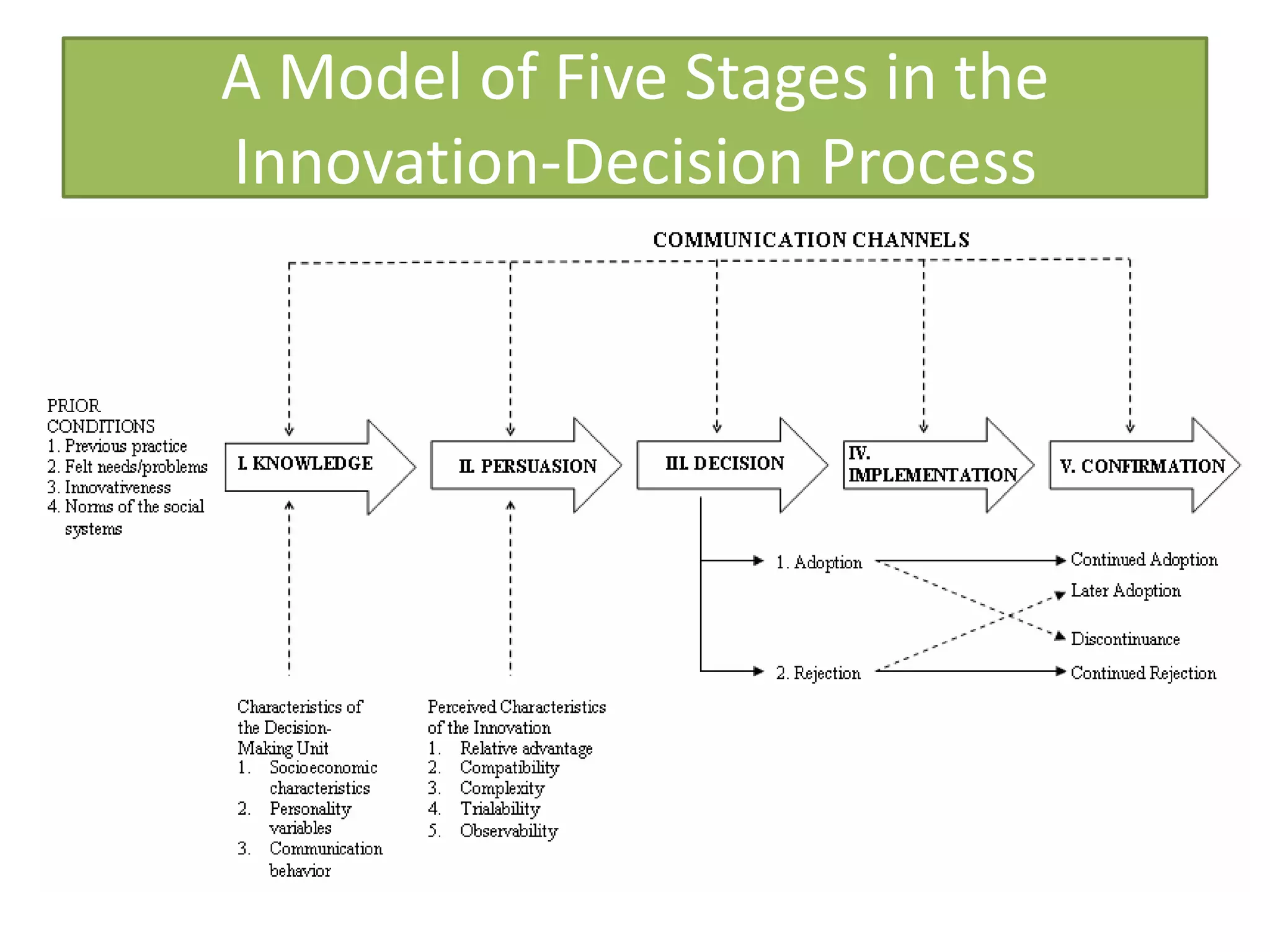
THE INNOVATION-DECISION PROCESS
• The process through which an individual (or other
  decision-making unit) passes from first
  knowledge of an innovation to forming an
  attitude toward the innovation, to a decision to
  adopt or reject, to implementation of the new
  idea, and to confirmation of this decision
• Five main steps in the process:
  –   (1) knowledge  understanding
  –   (2) persuasion  like/dislike
  –   (3) decision  adopt/reject
  –   (4) implementation  use ≈ re-invention occurs
  –   (5) confirmation  reinforcement/reverse
A Model of Five Stages in the
Innovation-Decision Process
3. Time
• The time dimension is involved in diffusion
  – (1) in the innovation decision process by which an
    individual passes from first knowledge of an
    innovation through its adoption or rejection,
  – (2) in the innovativeness of an individual or other unit
    of adoption—that is, the relative earliness/lateness
    with which an innovation is adopted—compared with
    other members of a system, and
  – (3) in an innovation's rate of adoption in a
    system, usually measured as the number of members
    of the system that adopt the innovation in a given
    time period.
INNOVATIVENESS AND ADOPTER
            CATEGORIES
• Degree to which an individual or other unit of
  adoption is relatively earlier in adopting new
  ideas than the other members of a system
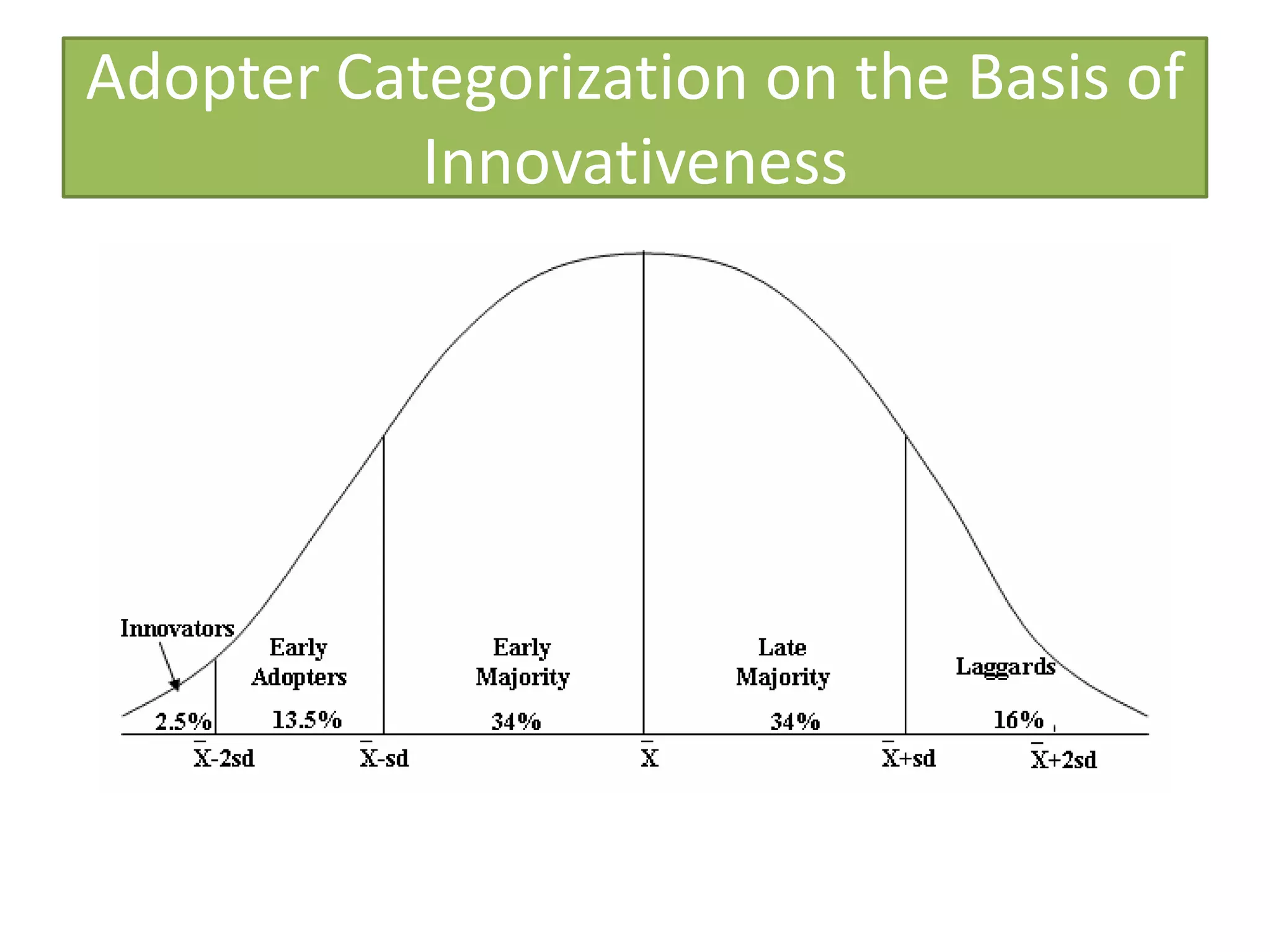
• Five adopter categories:
  – (1) innovators
  – (2) early adopters
  – (3) early majority
  – (4) late majority
  – (5) laggards
Adopter Categorization on the Basis of
           Innovativeness
4. Social System
• …a set of interrelated units that are engaged in
  joint problem solving to accomplish a common
  goal. The members or units of a social system
  may be individuals, informal
  groups, organizations, and/or subsystems:
   –   how the social structure affects diffusion,
   –   the effect of norms on diffusion,
   –   the roles of opinion leaders and change agents,
   –    types of innovation decisions, and
   –   the consequences of innovation
Social System (1)
• A system has structure, defined as the patterned arrangements of
  the units in a system, which gives stability and regularity to
  individual behavior in a system. The social and communication
  structure of a system facilitates or impedes the diffusion of
  innovations in the system.
• Norms are the established behavior patterns for the members of a
  social system. Norms are often exemplified in the behavior of the
  opinion leaders in a system.
• Opinion leadership is the degree to which an individual is able to
  influence informally other individuals' attitudes or overt behavior in
  a desired way with relative frequency. A change agent is an
  individual who attempts to influence clients‘ innovation-decisions in
  a direction that is deemed desirable by a change agency. An aide is
  a less than fully professional change agent who intensively contacts
  clients to influence their innovation-decisions.
Social System (2)
• three main types of innovation-decisions:
   – (1) optional innovation-decisions, choices to adopt or reject an
     innovation that are made by an individual independent of the
     decisions of other members of the system,
   – (2) collective innovation-decisions, choices to adopt or reject an
     innovation that are made by consensus among the members of
     a system, and
   – (3) authority innovation-decisions, choices to adopt or reject an
     innovation that are made by relatively few individuals in a
     system who possess power, status, or technical expertise.
   – A fourth category consists of a sequential combination of two or
     more of these types of innovation-decisions: contingent
     innovation-decisions are choices to adopt or reject that can be
     made only after a prior innovation-decision.
• consequences, the changes that occur to an individual or to
  a social system as a result of the adoption or rejection of an
  innovation
Chapter 2
A HISTORY OF DIFFUSION RESEARCH
              Chapter Report
   Diffusion of innovations (3rd edition)
            Everett M. Rogers

           M. Arief Ramdhany
         Administrasi Pendidikan
           UPI Bandung 2012
• A research tradition is a series of
  investigations on a similar topic in which
  successive studies are influenced by preceding
  inquiries.
• Nine major diffusion traditions:
  – anthropology, early sociology, rural
    sociology, education, medical
    sociology, communication, marketing, geography,
    and general sociology.
• Eight main types of diffusion research are
  identified, and dealt with in detail in future chapters:
   1. Earliness of knowing about innovations.
   2. Rate of adoption of different innovations in a social
      system.
   3. Innovativeness.
   4. Opinion leadership.
   5. Who interacts with whom in diffusion networks.
   6. Rate of adoption in different social systems.
   7. Communication channel usage.
   8. Consequences of innovation.
Chapter 1+2 diffusion of innovation rogers 1983

Chapter 1+2 diffusion of innovation rogers 1983

  • 1.
    Chapter 1 ELEMENTS OFDIFFUSION Chapter Report Diffusion of innovations (3rd edition) Everett M. Rogers M. Arief Ramdhany Administrasi Pendidikan UPI Bandung 2012
  • 2.
    In the beginning •To get the bad customs of a country changed and new ones, though better, introduced, it is necessary first to remove the prejudices of the people, enlighten their ignorance, and convince them that their interests will be promoted by the proposed changes; and this is not the work of a day. Benjamin Franklin (1781) • There is nothing more difficult to plan, more doubtful of success, nor more dangerous to manage than the creation of a new order of things. . . . Whenever his enemies have occasion to attack the innovator they do so with the passion of partisans, while the others defend him sluggishly so that the innovator and his party alike are vulnerable. Niccolo Machiavelli The Prince (1513)
  • 3.
    Being adopted =difficult(?) • Getting a new idea adopted, even when it has obvious advantages, is often very difficult • Many innovations require a lengthy period, often of some years, from the time when they become available to the time when they are widely adopted • A common problem for many individuals and organizations is how to speed up the rate of diffusion of an innovation
  • 4.
    Case: Water Boiling in a Peruvian Village • Nelida  Change agency • Village housewives – Custom-Oriented Adopter – Persuaded Adopter – Rejector • Why failed? An important factor affecting the adoption rate of any innovation is its compatibility with the values, beliefs, and past experiences of the social system. • Nelida was too "innovation-oriented" and not "client-oriented“ enough. Her attempts at persuasion failed to reach her clients because the message was not suited to their needs.  Nelida did not begin where the villagers were; instead she talked to them about germ theory, which they could not (and probably did not need to) understand
  • 5.
    Other Cases: • ControllingScurvy in the British Navy  Most innovations, in fact, diffuse at a surprisingly slow rate. • Nondifussion Dvorak vs. inefficient QWERTY Keyboard
  • 6.
    What is Diffusion? •Diffusion is the process by which an innovation is communicated through certain channels over time among the members of a social system. It is a special type of communication, in that the messages are concerned with new ideas • Communication is a process in which participants create and share information with one another in order to reach a mutual understanding •  communication is a process of convergence (or divergence) as two or more individuals exchange information in order to move toward each other (or apart) in the meanings that they ascribe to certain events •  The newness means that some degree of uncertainty is involved.
  • 7.
    • Uncertainty isthe degree to which a number of alternatives are perceived with respect to the occurrence of an event and the relative probability of these alternatives  implies a lack of predictability, of structure, of information • A technological innovation embodies information and thus reduces uncertainty about cause-effect relationships in problem solving • Diffusion is a kind of social change • Diffusion = dissemination (?)  both the planned and the spontaneous spread of new ideas
  • 8.
    Four Main Elements in the Diffusion of Innovations • diffusion as the process by which (1) an innovation (2) is communicated through certain channels (3) over time (4) among the members of a social system. • The four main elements are: – innovation, – communication channels, – time, and – social system
  • 9.
  • 10.
    1. Innovation • Aninnovation is an idea, practice, or object that is perceived as new by an individual or other unit of adoption • The "newness" aspect of an innovation may be expressed in terms of knowledge, persuasion, or a decision to adopt
  • 11.
    TECHNOLOGICAL INNOVATIONS,INFORMATION, AND • UNCERTAINTY Innovation = technology • Two components of technology: – Hardware  material or physical objects – Software  information base for the tool • The innovation-decision process is essentially an information-seeking and information-processing activity in which the individual is motivated to reduce uncertainty about the advantages and disadvantages of the innovation • Two kinds of information: – Software information, which is embodied in a technology and serves to reduce uncertainty about the cause-effect relationships involved in achieving a desired outcome – Innovation-evaluation information, which is the reduction in uncertainty about an innovation's expected consequences
  • 12.
    CHARACTERISTICS OF INNOVATIONS (perceived by individual) • Relative Advantage  economic terms, prestige, convenience, satisfaction  rate of adoption • Compatibility  being consistent with the existing values, past experiences, and needs of potential adopters • Complexity  new ideas that are simpler to understand will be adopted more rapidly than innovations that require the adopter to develop new skills and understandings • Trialability  less uncertainty to individual who is considering it for adoption; possible to learn by doing • Observabitily  results of an innovation are visible to others  The easier it is for individuals to see the results of an innovation, the more likely they are to adopt
  • 13.
    Re-invention • degree towhich an innovation is changed or modified by a user in the process of its adoption and implementation • degree to which an individual's use of a new idea departed from the "mainline" version of the innovation that was promoted by a change agency (Eveland et al, 1977) • re-invented by many adopters who implement them in different ways
  • 14.
    2. Communication Channels •Diffusion process is the information exchange by which one individual communicates a new idea to one or several others, involving: – (1) an innovation, (2) an individual or other unit of adoption that has knowledge of, or experience with using, the innovation, (3) another individual or other unit that does not yet have knowledge of the innovation, and (4) a communication channel connecting the two units. • Homophily vs. Heterophily – degree to which pairs of individuals who interact are similar in certain attributes, such as beliefs, education, social status, and the like – More effective communication occurs when two individuals are homophilous
  • 15.
    THE INNOVATION-DECISION PROCESS •The process through which an individual (or other decision-making unit) passes from first knowledge of an innovation to forming an attitude toward the innovation, to a decision to adopt or reject, to implementation of the new idea, and to confirmation of this decision • Five main steps in the process: – (1) knowledge  understanding – (2) persuasion  like/dislike – (3) decision  adopt/reject – (4) implementation  use ≈ re-invention occurs – (5) confirmation  reinforcement/reverse
  • 16.
    A Model ofFive Stages in the Innovation-Decision Process
  • 17.
    3. Time • Thetime dimension is involved in diffusion – (1) in the innovation decision process by which an individual passes from first knowledge of an innovation through its adoption or rejection, – (2) in the innovativeness of an individual or other unit of adoption—that is, the relative earliness/lateness with which an innovation is adopted—compared with other members of a system, and – (3) in an innovation's rate of adoption in a system, usually measured as the number of members of the system that adopt the innovation in a given time period.
  • 18.
    INNOVATIVENESS AND ADOPTER CATEGORIES • Degree to which an individual or other unit of adoption is relatively earlier in adopting new ideas than the other members of a system • Five adopter categories: – (1) innovators – (2) early adopters – (3) early majority – (4) late majority – (5) laggards
  • 19.
    Adopter Categorization onthe Basis of Innovativeness
  • 20.
    4. Social System •…a set of interrelated units that are engaged in joint problem solving to accomplish a common goal. The members or units of a social system may be individuals, informal groups, organizations, and/or subsystems: – how the social structure affects diffusion, – the effect of norms on diffusion, – the roles of opinion leaders and change agents, – types of innovation decisions, and – the consequences of innovation
  • 21.
    Social System (1) •A system has structure, defined as the patterned arrangements of the units in a system, which gives stability and regularity to individual behavior in a system. The social and communication structure of a system facilitates or impedes the diffusion of innovations in the system. • Norms are the established behavior patterns for the members of a social system. Norms are often exemplified in the behavior of the opinion leaders in a system. • Opinion leadership is the degree to which an individual is able to influence informally other individuals' attitudes or overt behavior in a desired way with relative frequency. A change agent is an individual who attempts to influence clients‘ innovation-decisions in a direction that is deemed desirable by a change agency. An aide is a less than fully professional change agent who intensively contacts clients to influence their innovation-decisions.
  • 22.
    Social System (2) •three main types of innovation-decisions: – (1) optional innovation-decisions, choices to adopt or reject an innovation that are made by an individual independent of the decisions of other members of the system, – (2) collective innovation-decisions, choices to adopt or reject an innovation that are made by consensus among the members of a system, and – (3) authority innovation-decisions, choices to adopt or reject an innovation that are made by relatively few individuals in a system who possess power, status, or technical expertise. – A fourth category consists of a sequential combination of two or more of these types of innovation-decisions: contingent innovation-decisions are choices to adopt or reject that can be made only after a prior innovation-decision. • consequences, the changes that occur to an individual or to a social system as a result of the adoption or rejection of an innovation
  • 23.
    Chapter 2 A HISTORYOF DIFFUSION RESEARCH Chapter Report Diffusion of innovations (3rd edition) Everett M. Rogers M. Arief Ramdhany Administrasi Pendidikan UPI Bandung 2012
  • 24.
    • A researchtradition is a series of investigations on a similar topic in which successive studies are influenced by preceding inquiries. • Nine major diffusion traditions: – anthropology, early sociology, rural sociology, education, medical sociology, communication, marketing, geography, and general sociology.
  • 25.
    • Eight maintypes of diffusion research are identified, and dealt with in detail in future chapters: 1. Earliness of knowing about innovations. 2. Rate of adoption of different innovations in a social system. 3. Innovativeness. 4. Opinion leadership. 5. Who interacts with whom in diffusion networks. 6. Rate of adoption in different social systems. 7. Communication channel usage. 8. Consequences of innovation.