Integrating Universal
Design into University
Curriculum
Howard Kramer
University of Colorado-Boulder
hkramer@colorado.edu, 303-492-8672
ATIA 2014
Presentation posted at
slideshare
http://slideshare.net/hkramer99/
UD in Curriculum – ATIA
2014.pptx
or
www.atia.org/orlandohandouts
Introduction
Howard Kramer
University of Colorado-Boulder
hkramer@colorado.edu, 303-492-8672



Conference:




Class:




Accessing Higher Ground: Accessible Media, Web &
Technology

Universal Design for Digital Media - 14 week class

Grant Project:


Promoting the Integration of Universal Design in University
Curriculum (UDUC)
Today’s Outline


What do we/I mean by Universal Design



UDUC project info | some preliminary findings








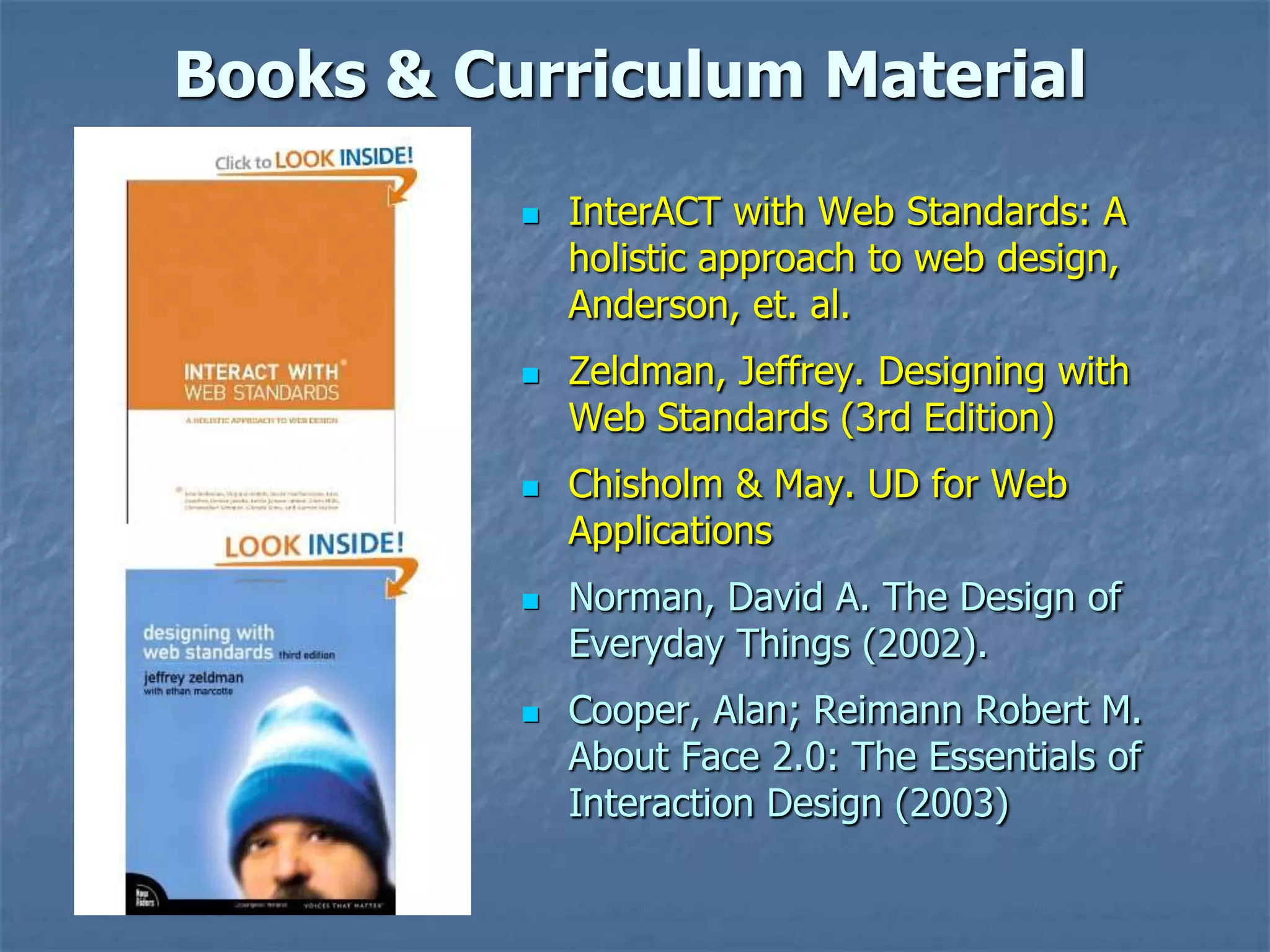


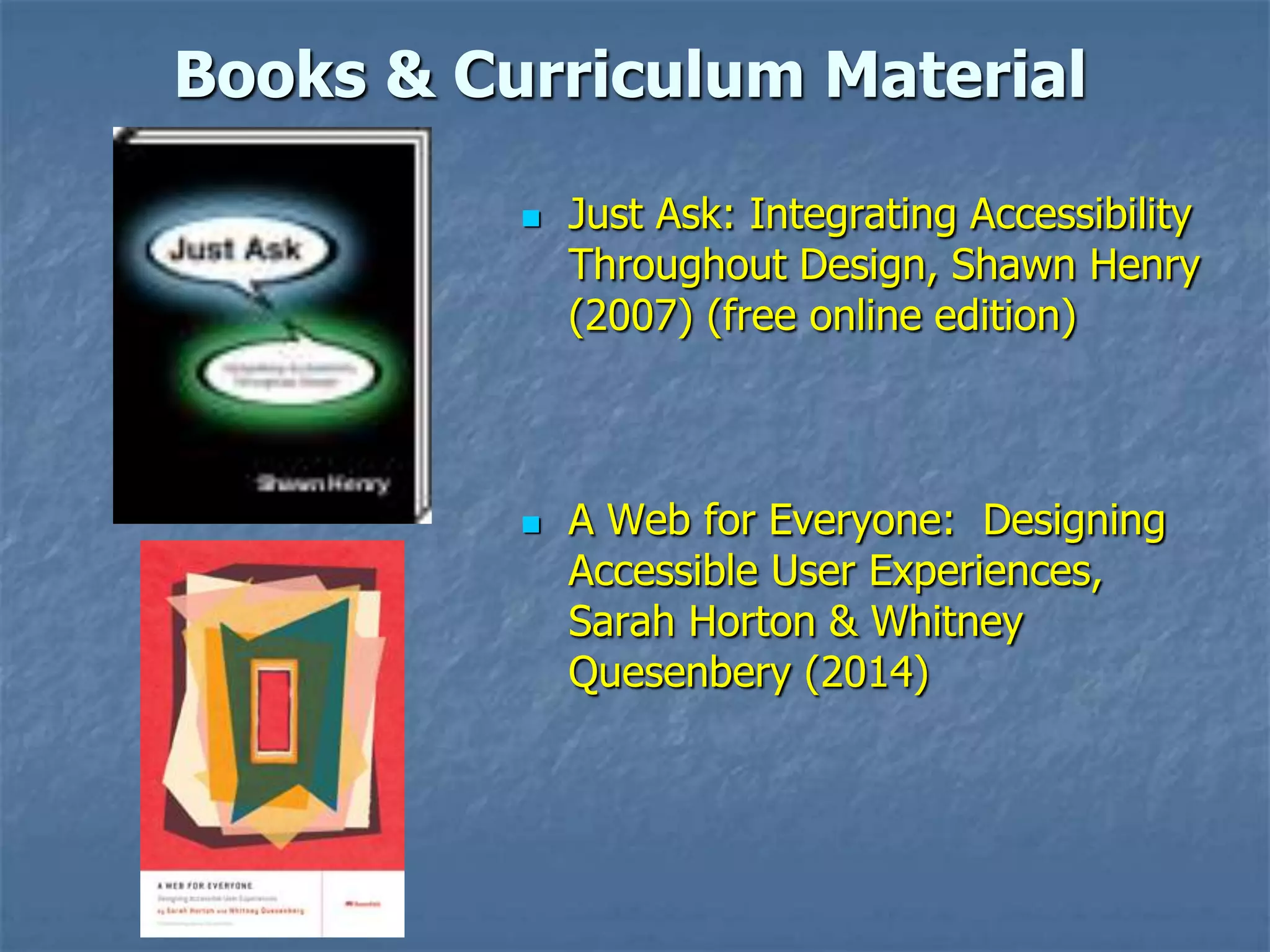
Examples & models for including UD content in
curriculum

How this can intersect/promote accessibility &
UD on campus
UDE example / model
Initiatives, accomplishments & future plans of
UDUC project
Your input, feedback & collaboration
Today’s Objective(s)






Acquire a sampling of examples of UD in
curriculum that you may replicate or build upon
Provide you with ideas for promoting UD
curriculum at your own institutions
Inspire you to become involved with this project
by using our resources or sharing your resources
with us
NEA 2-year Grant
Promoting the Integration of
Universal Design Content into
University Curriculum (UDUC)
Promoting the Integration of UD
into University Curriculum









Determining current inclusion of UD content on
campus
Increasing the amount of classes that address UD
(content) on campus (and beyond)
Determining resource needs for teaching UD
Developing resources for teaching UD – syllabi,
curriculum, teaching resources, etc.

Developing a network of interested faculty – sharing
resources
Universal Design – What do I
mean?


Universal Design (Origins)


Universal Design is the design of products and
environments to be usable by all people, to
the greatest extent possible, without the need
for adaptation or specialized design – Ron
Mace, Architect

Universal Design for the built environment
UD Defined – variations on a theme




…[T]he practice of designing products or
environments that can be effectively and efficiently
used by people with a wide range of abilities
operating in a wide range of situations
(Vanderheiden, 1997, p. 2014).

…[B]uilding products that are robust and
accommodating. Universal designs take account of
differences in sight, hearing, mobility, speech, and
cognition. Universal design helps not only people
with disabilities, but also any of us when we’re
tired, busy, or juggling many tasks (Francik, 1996).


“Universal design implies a process that
goes beyond minimum access codes and
standards, to design environments that
are comfortably usable by people from
childhood into their oldest years.”
- Nasar & Evans-Cowley, eds. 2007. Universal
Design & Visitability.


A framework for the design of buildings,
products and information technology to be
useable by the widest range of users.


Valerie Fletcher, The Institute for Human Centered
Design
Universal Design – Key Points


Goes beyond accessibility



Not a separate accommodation



Goes beyond following legal requirements



Provides an improved product to the nonspecial needs or wider population
National Council on Disability




Design for Inclusion: Creating a New
Marketplace – 2004 Report
Key findings






A market for universally designed products and
services exists.
UD principles can be easily incorporated into current
design practices.
Designing with access in mind can significantly
increase the size of targeted markets for electronic
and information technology (E&IT).
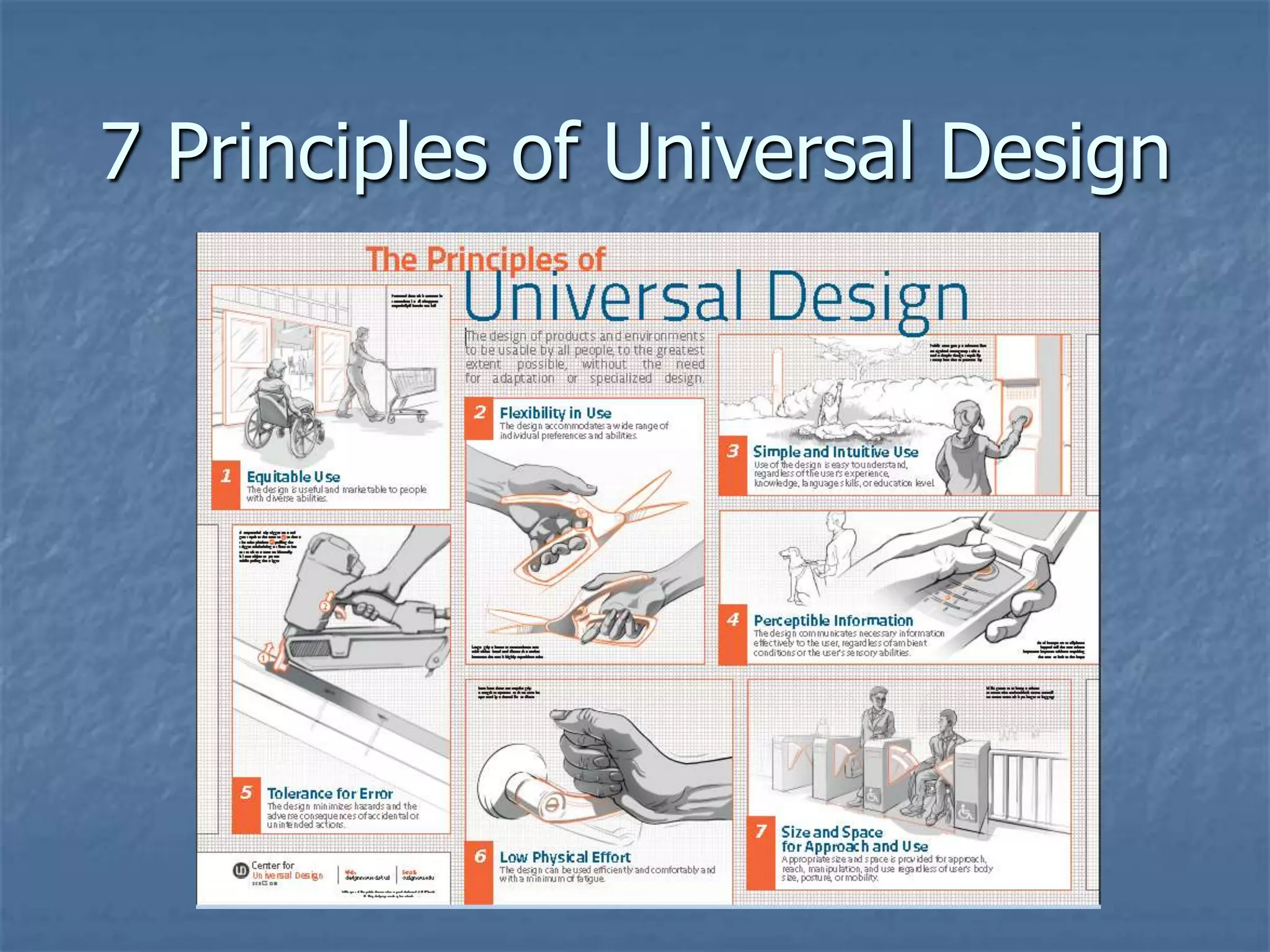
7 Principles of Universal Design










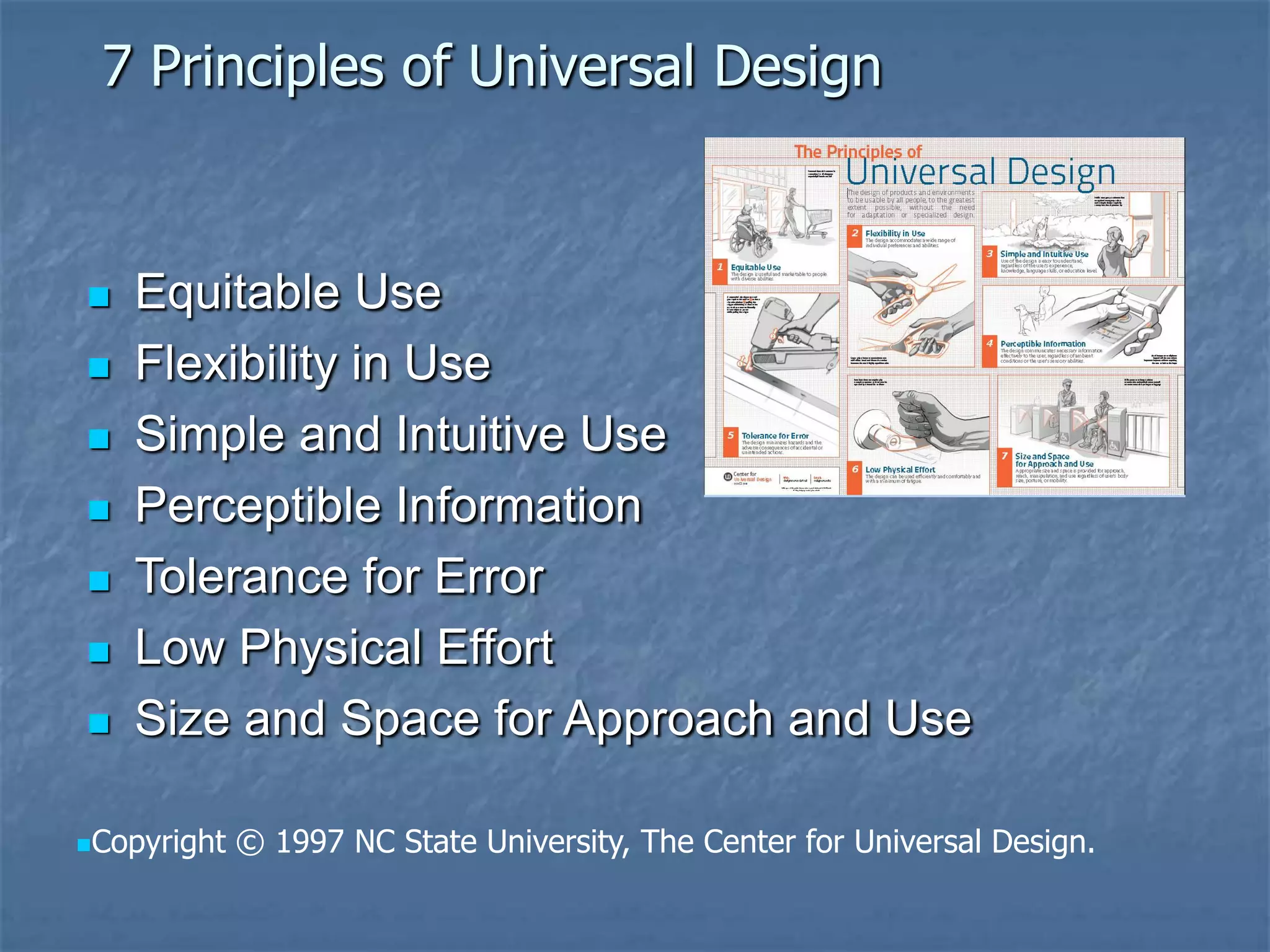
Equitable Use
Flexibility in Use
Simple and Intuitive Use
Perceptible Information
Tolerance for Error
Low Physical Effort
Size and Space for Approach and Use

Copyright

© 1997 NC State University, The Center for Universal Design.
Universal Design – What do I
mean?








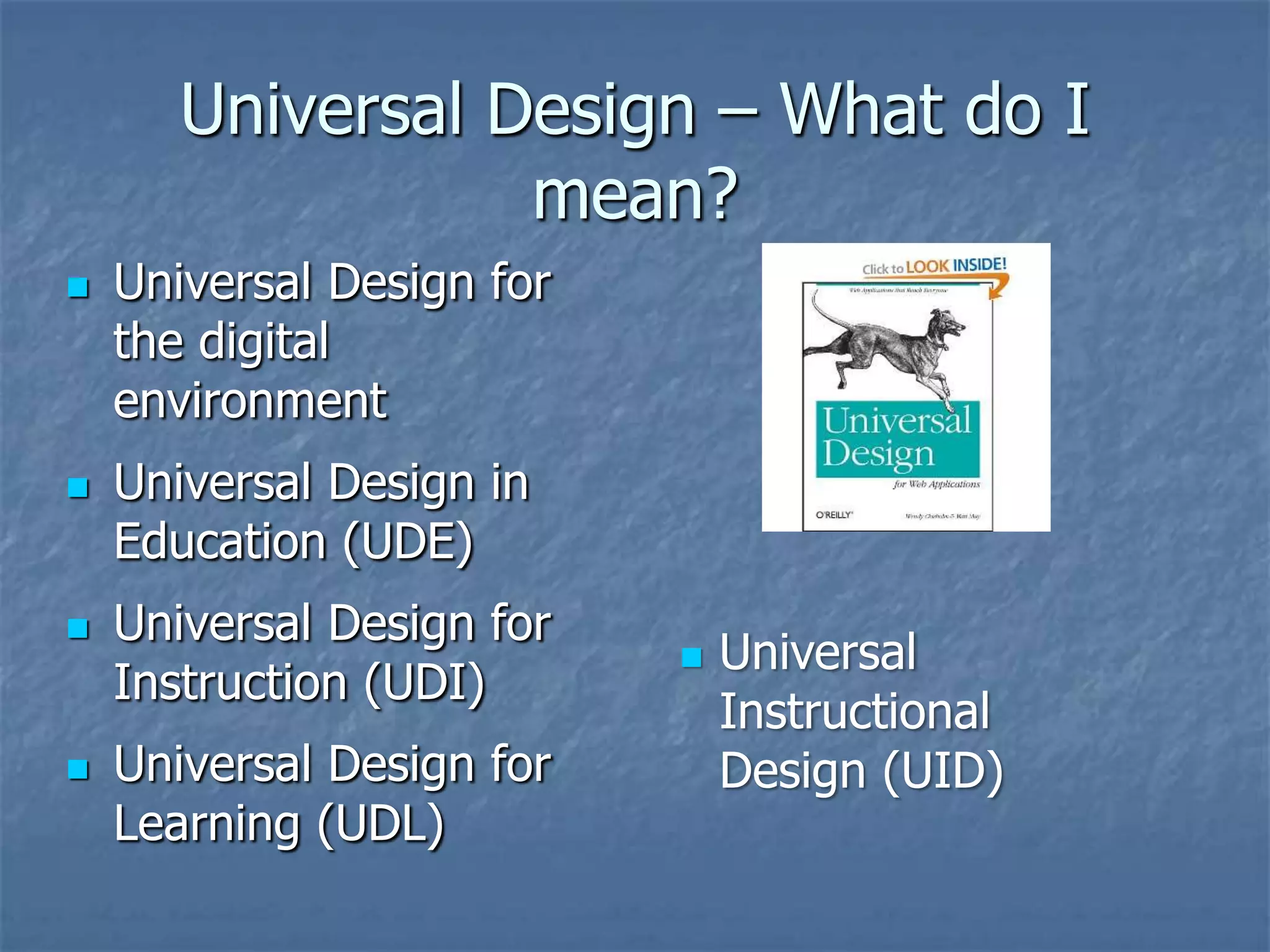
Universal Design for
the digital
environment
Universal Design in
Education (UDE)
Universal Design for
Instruction (UDI)

Universal Design for
Learning (UDL)



Universal
Instructional
Design (UID)
Universal Design
Universal Design
Universal Design for the built
environment
Universal Design for
UDE
UDE
UD
Learnin
Universal Design
Universal Design for
Education UDE
UDWA

Universal Designv
Universal Design for
Universal DeUDL
Learning
UDL
Universal Design sign
for
Universal Design for
Instruction
Instruction


UD
UDE

Universal Design
Content in University

Curriculum
Universal Design


What does Universal Design mean in the
context of today’s talk?
Campus & Faculty Conceptions of
Universal Design






“[F]ew postsecondary administrators, faculty, and staff
are even marginally acquainted with Universal Design or
Universal Instructional Design” (Higbee & Goff, eds.
2008)
Faculty at CU – may not have the definitive definition or
understanding of UD

Confusion on the distinction of “UD content”.
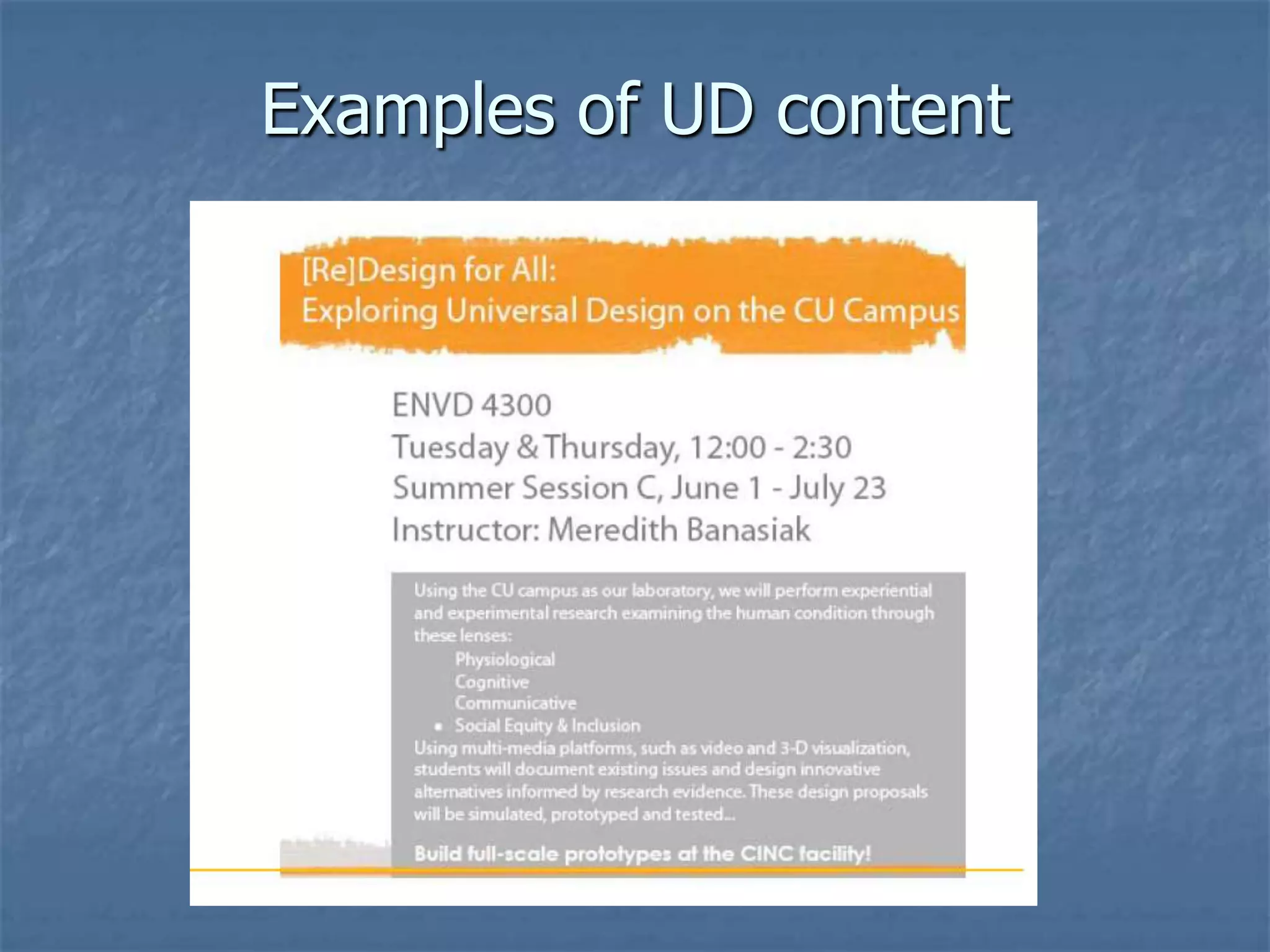
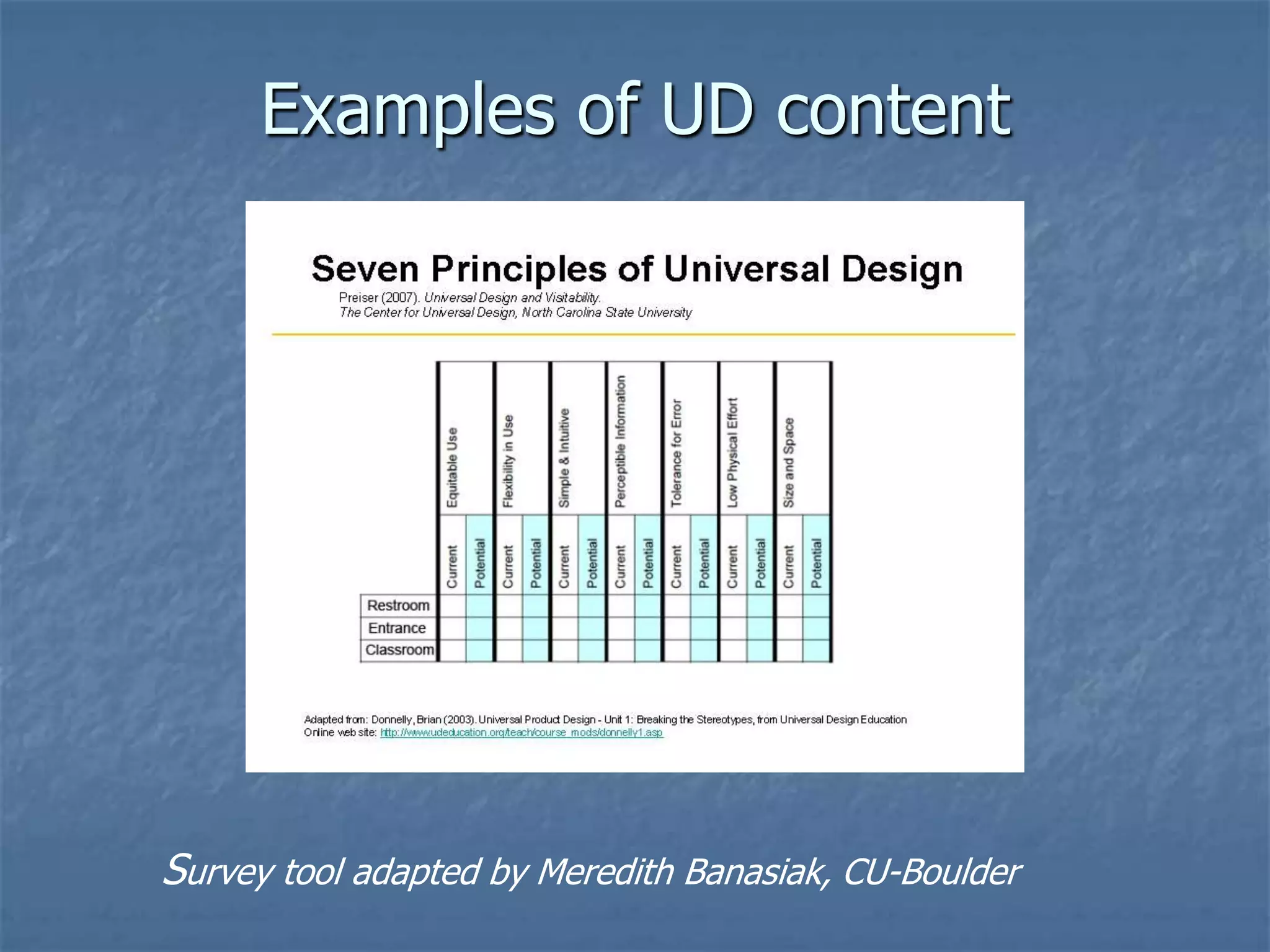
Examples of UD content

Survey tool adapted by Meredith Banasiak, CU-Boulder
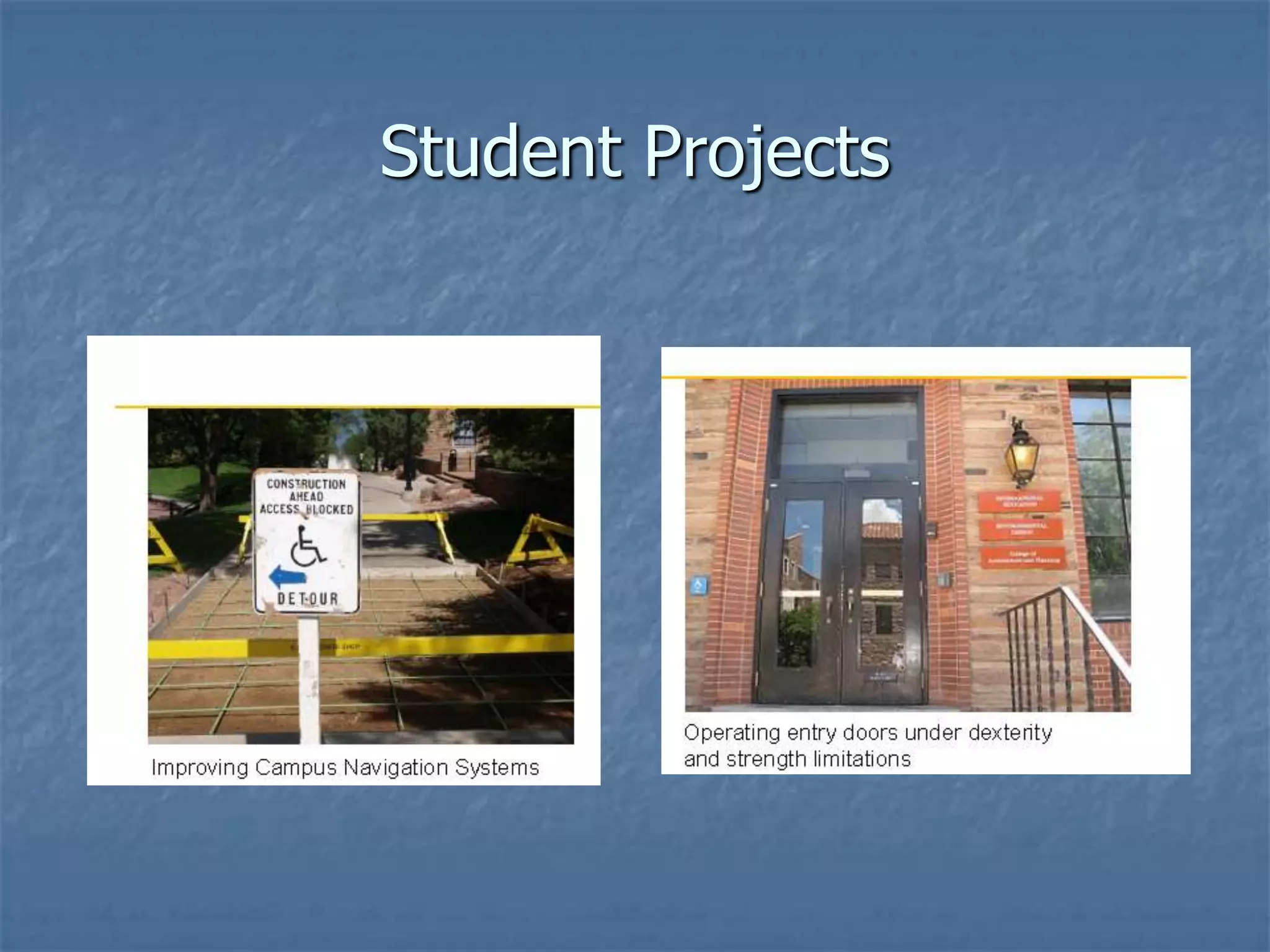
Student Projects
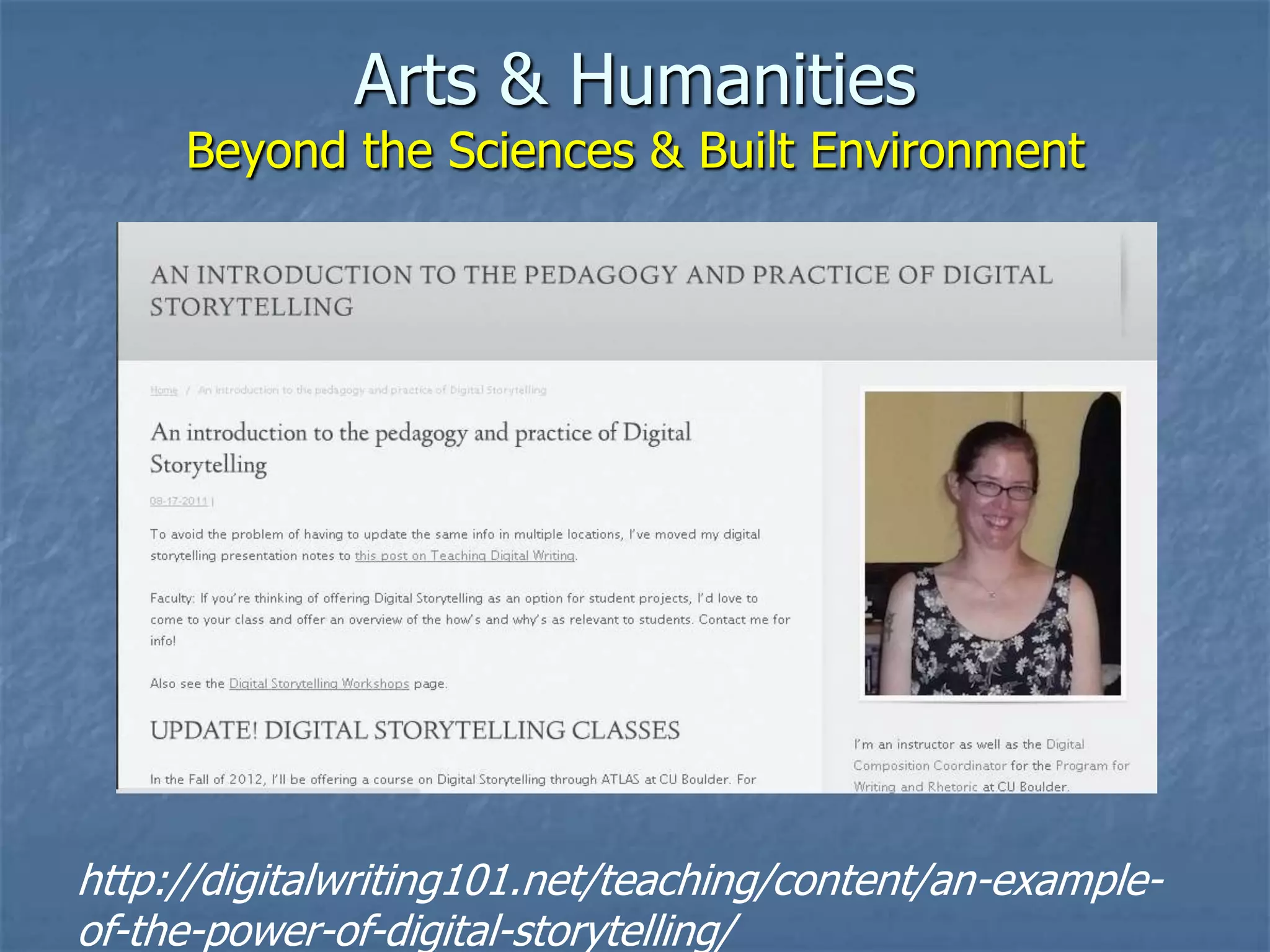
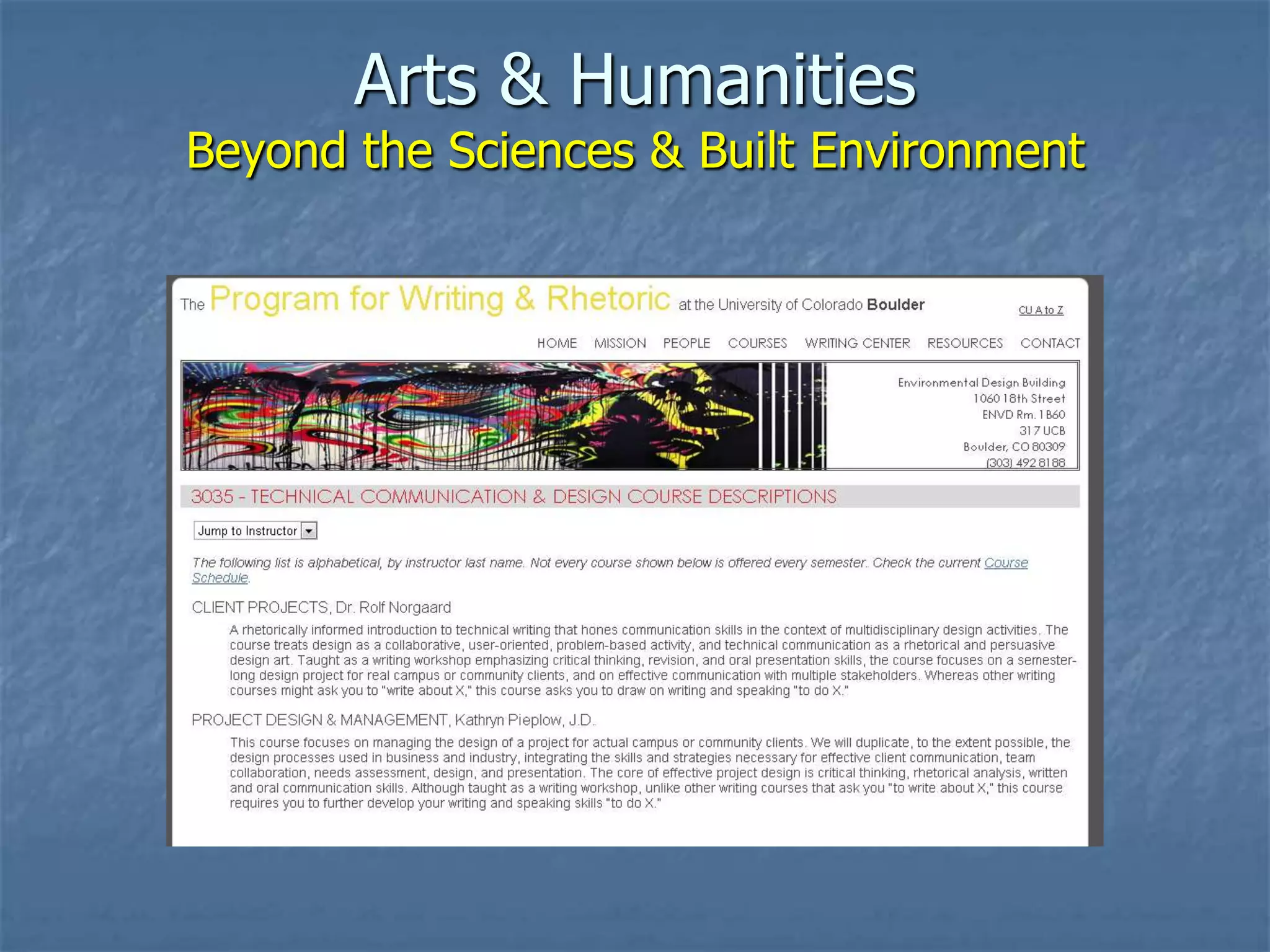
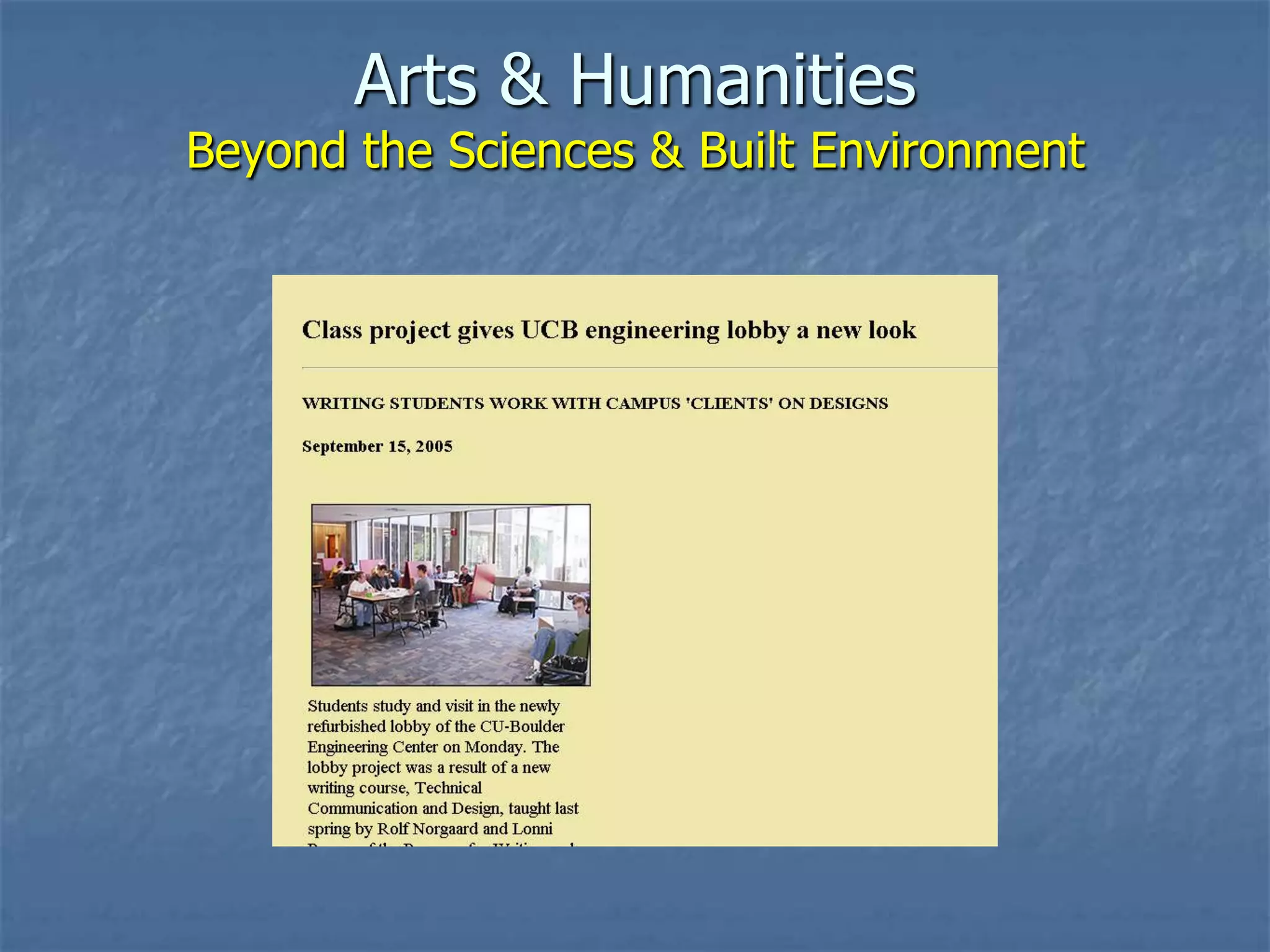
Arts & Humanities

Beyond the Sciences & Built Environment

http://digitalwriting101.net/teaching/content/an-exampleof-the-power-of-digital-storytelling/
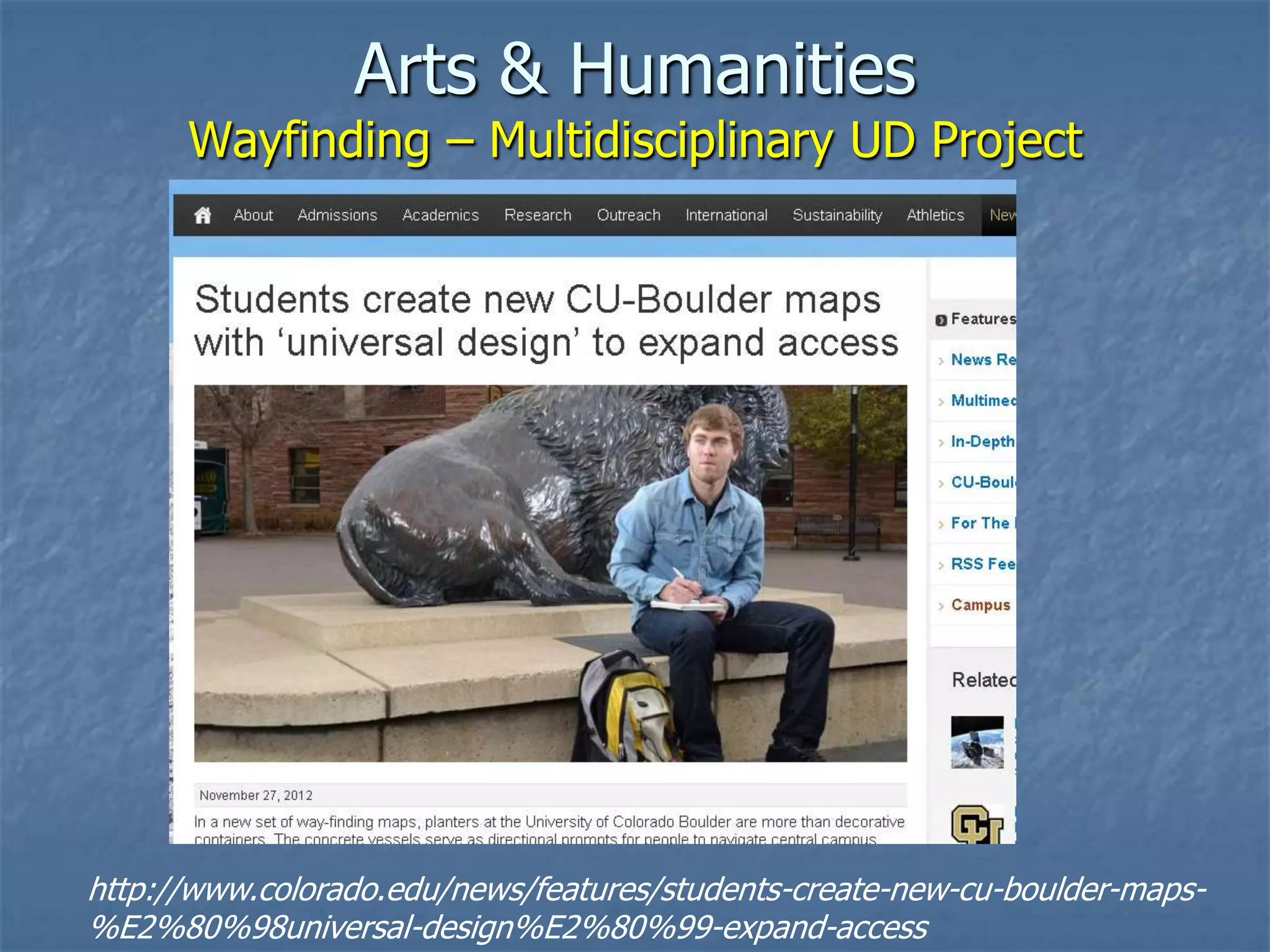
Arts & Humanities

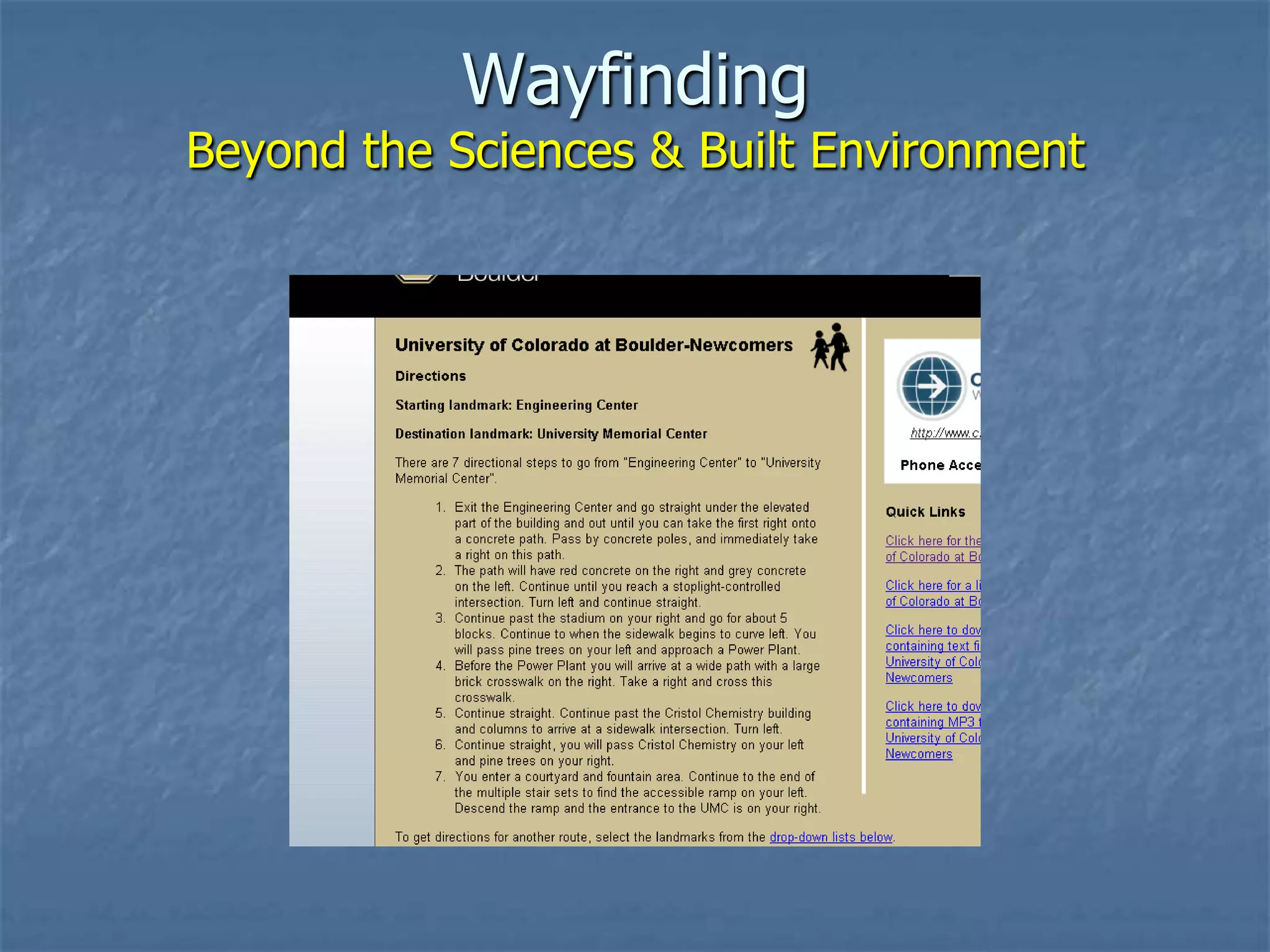
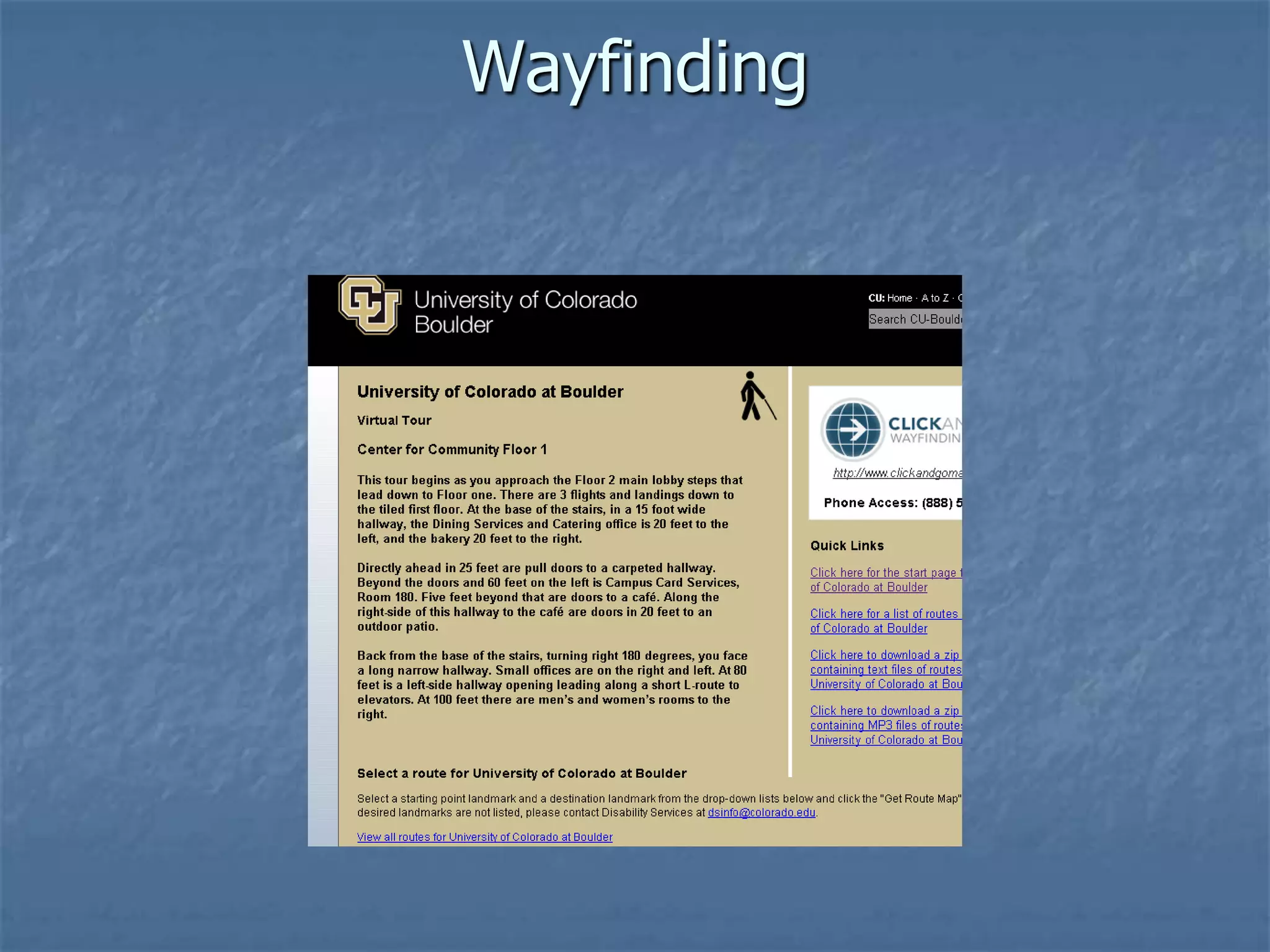
Wayfinding – Multidisciplinary UD Project

http://www.colorado.edu/news/features/students-create-new-cu-boulder-maps%E2%80%98universal-design%E2%80%99-expand-access
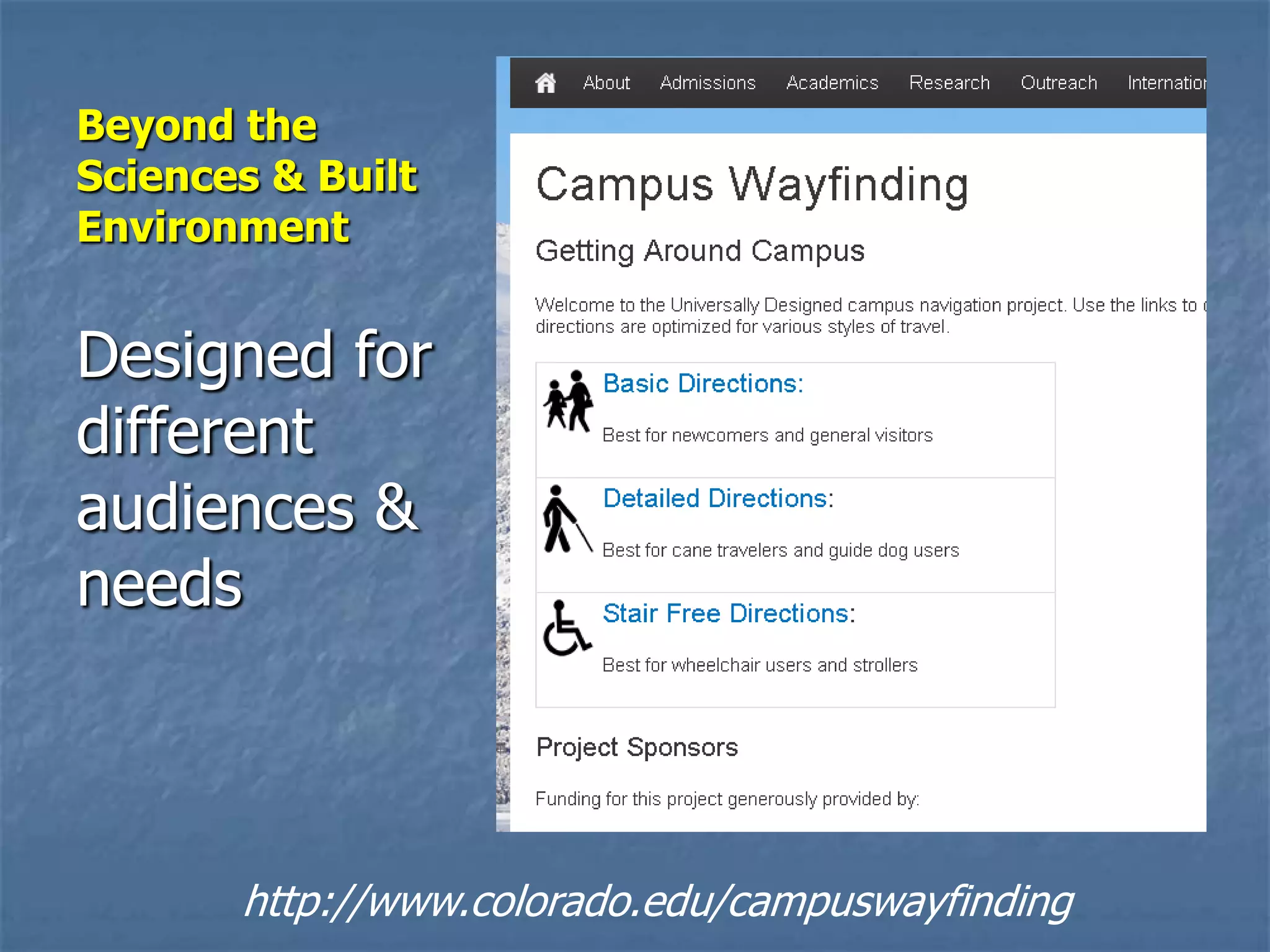
Beyond the
Sciences & Built
Environment

Designed for
different
audiences &
needs

http://www.colorado.edu/campuswayfinding
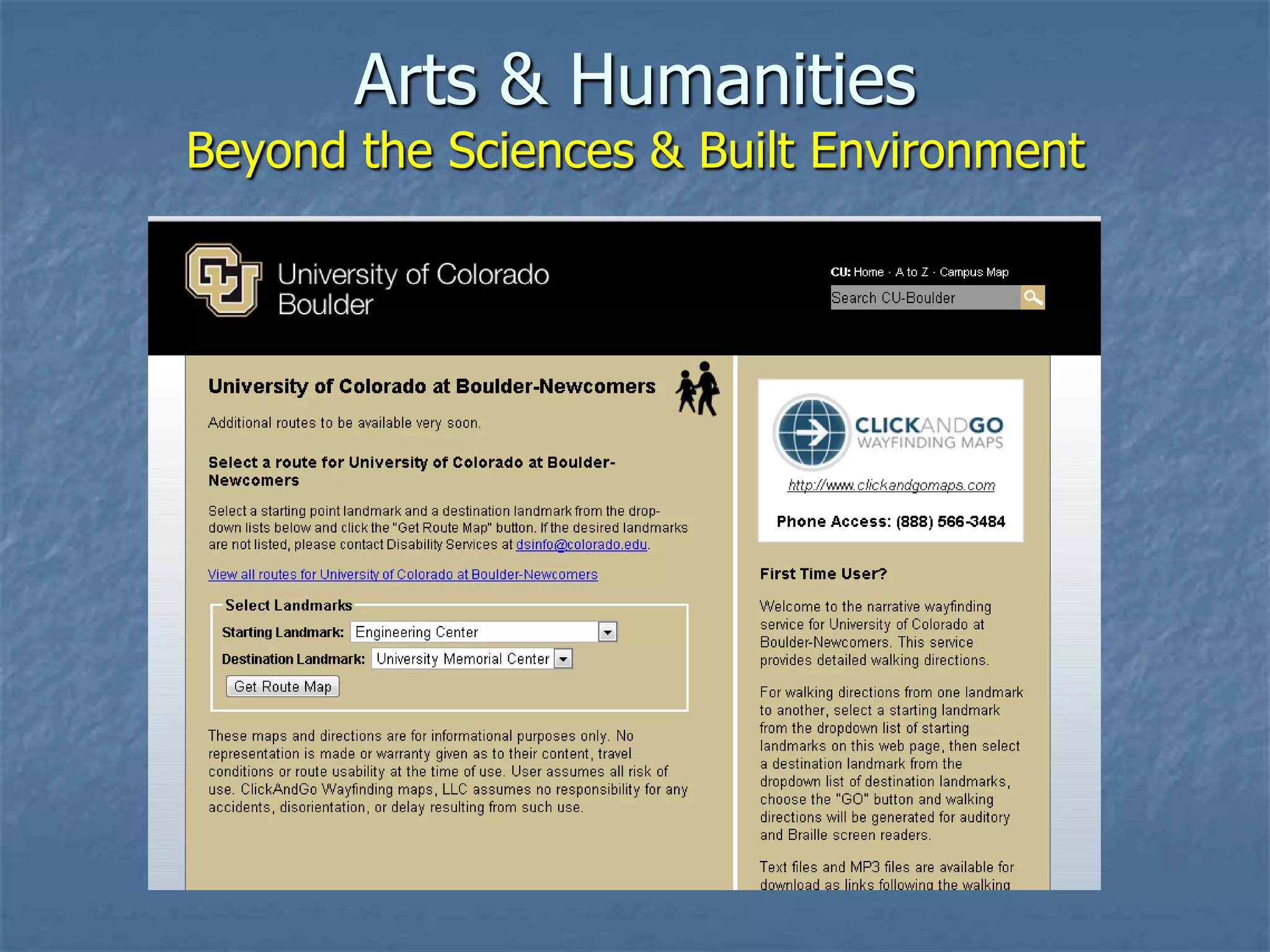
Arts & Humanities

Beyond the Sciences & Built Environment
Wayfinding

Beyond the Sciences & Built Environment
Wayfinding
Arts & Humanities

Beyond the Sciences & Built Environment
Arts & Humanities

Beyond the Sciences & Built Environment
Other Communication & Design
Projects
Beyond the Sciences & Built Environment



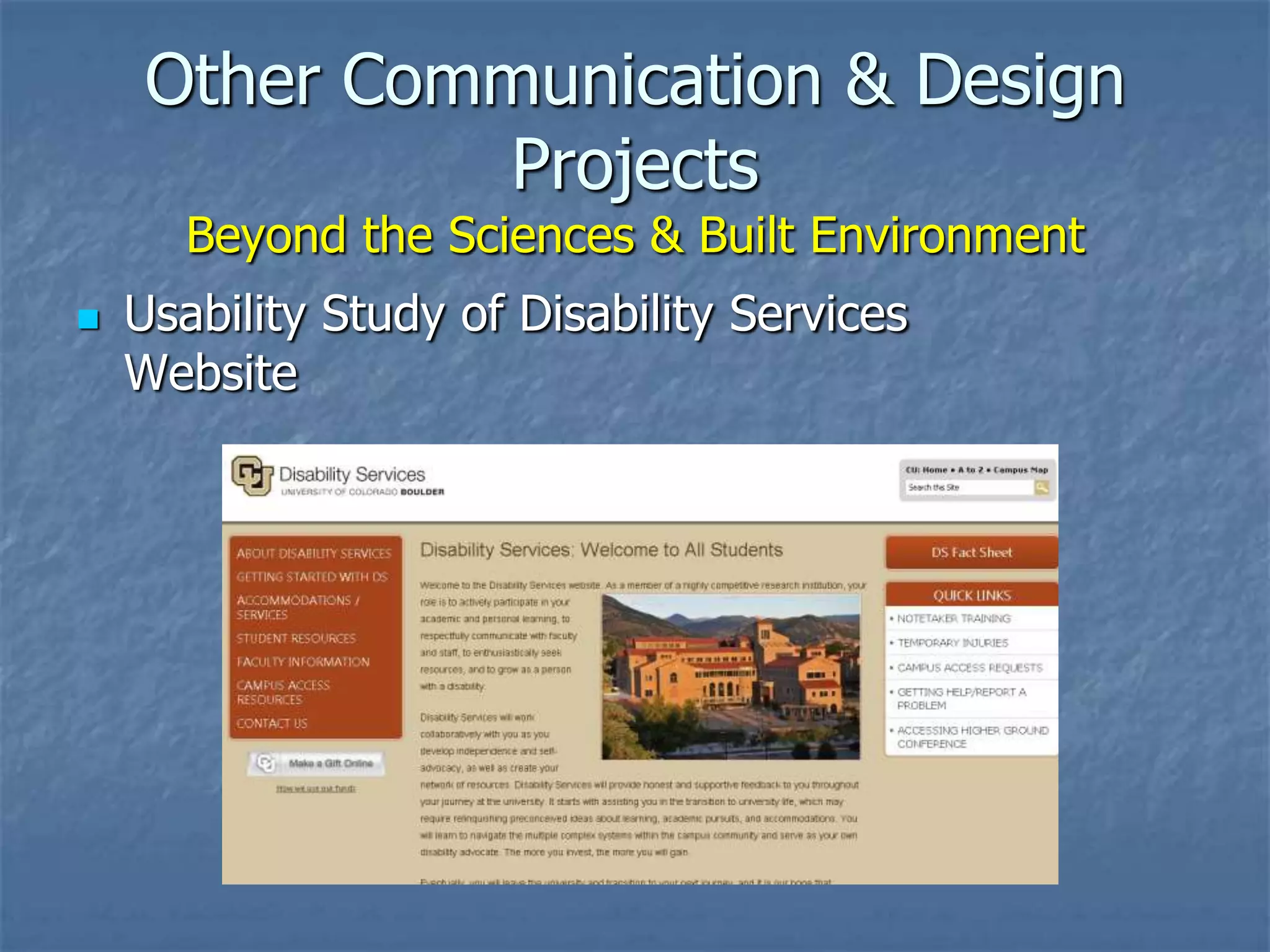
Usability Study of Disability Services
Website
Beyond CU-Boulder
Course Profiles




Human-Computer
Interaction
undergraduate class
Class-wide public policy
projects

Jonathan Lazar. PhD
Towson University
HCI Interaction undergraduate class
Course Profiles


Students learn:


1. international guidelines related to web accessibility



2. how to evaluate web sites for accessibility





3. specific details of federal and state laws related to
web accessibility

The students then perform a series of
accessibility inspections on a group of web sites
that are required under law to be accessible
HCI Interaction undergraduate class
Course Profiles


Watch video of Dr. Lazar’s talk at:

http://uduc.org/show1videosessi
on.php?vpropid=1634
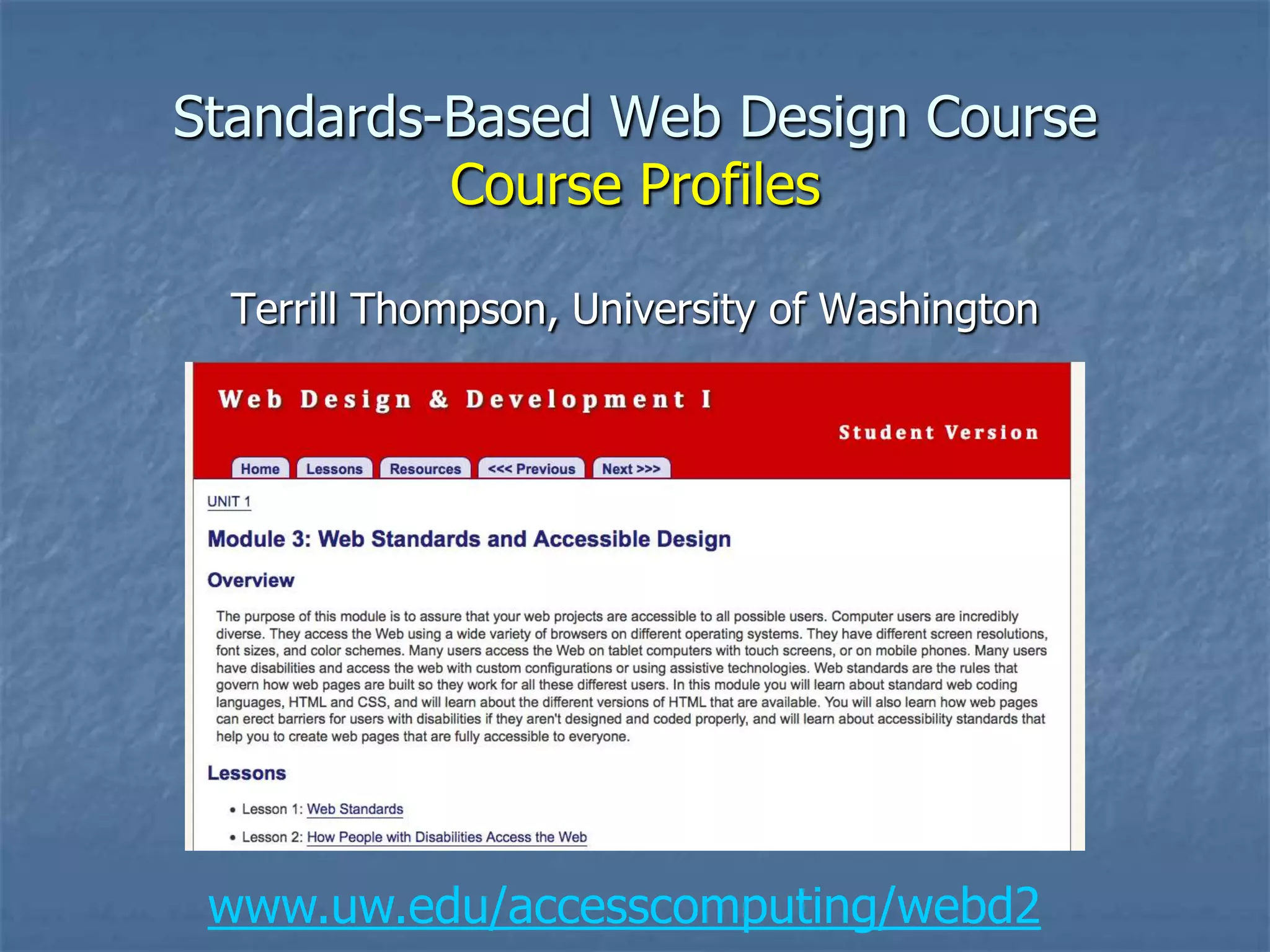
Standards-Based Web Design Course
Course Profiles
Terrill Thompson, University of Washington

www.uw.edu/accesscomputing/webd2
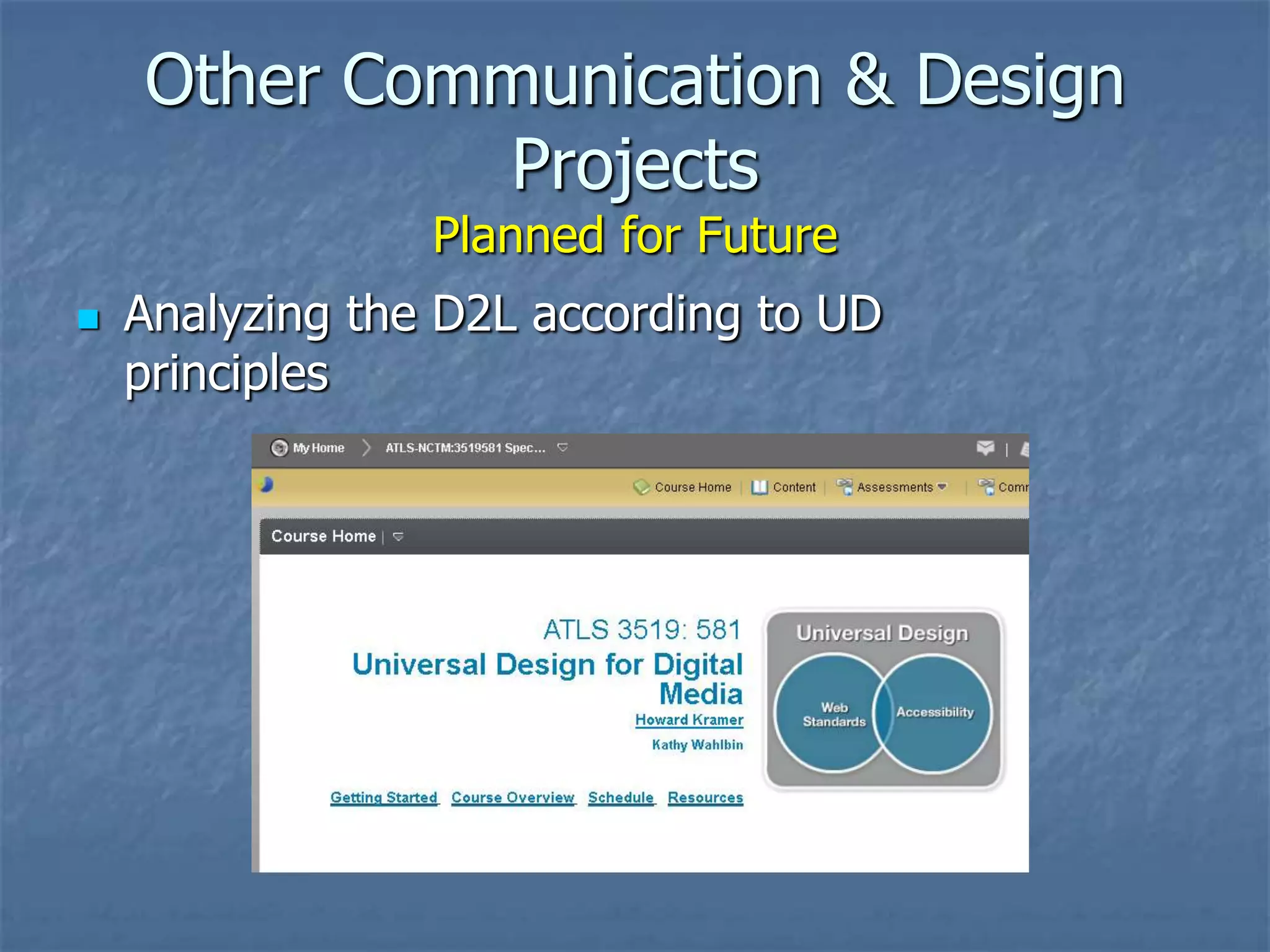
Other Communication & Design
Projects
Planned for Future



Analyzing the D2L according to UD
principles
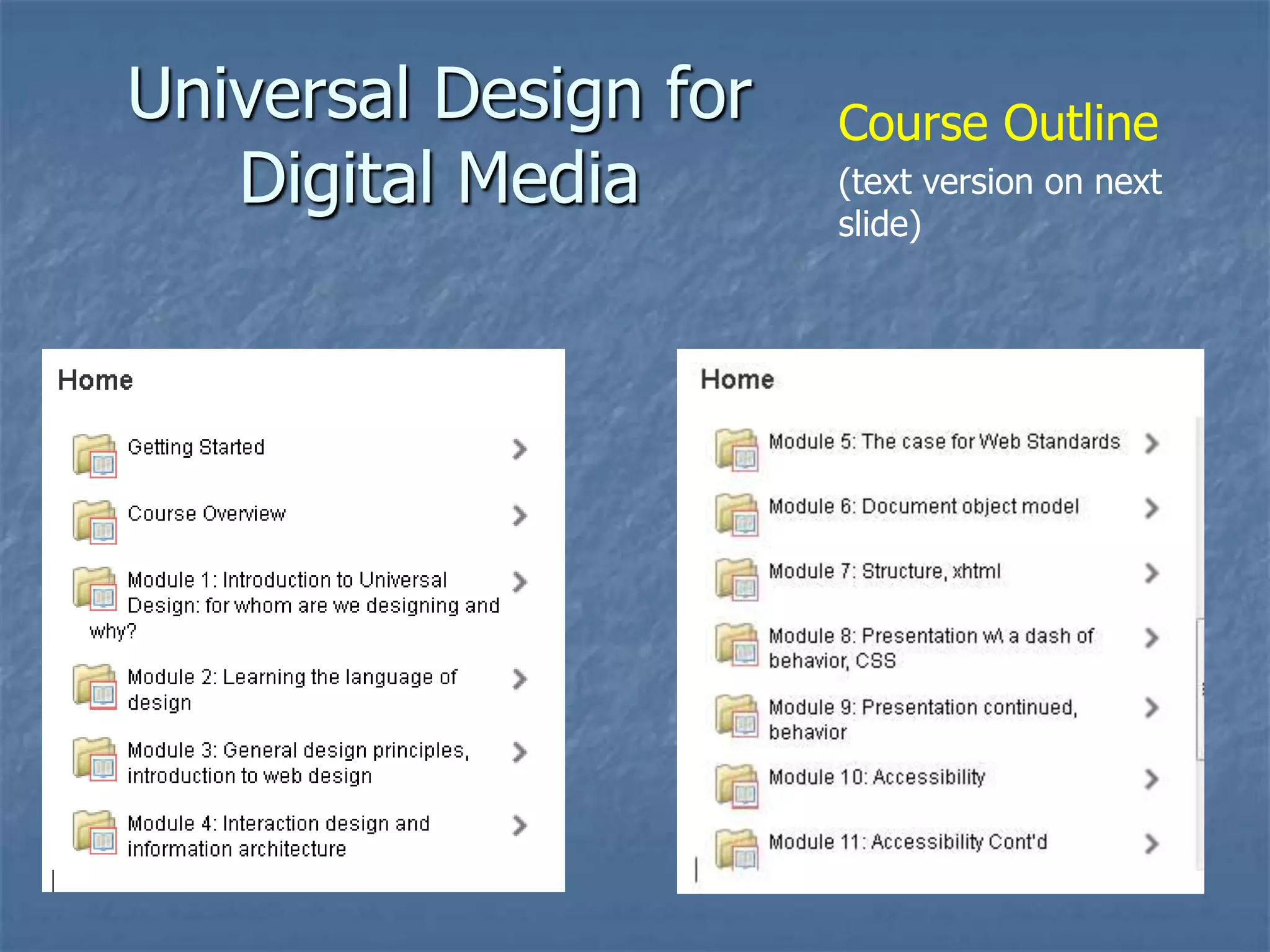
Universal Design for
Digital Media

Course Outline
(text version on next
slide)
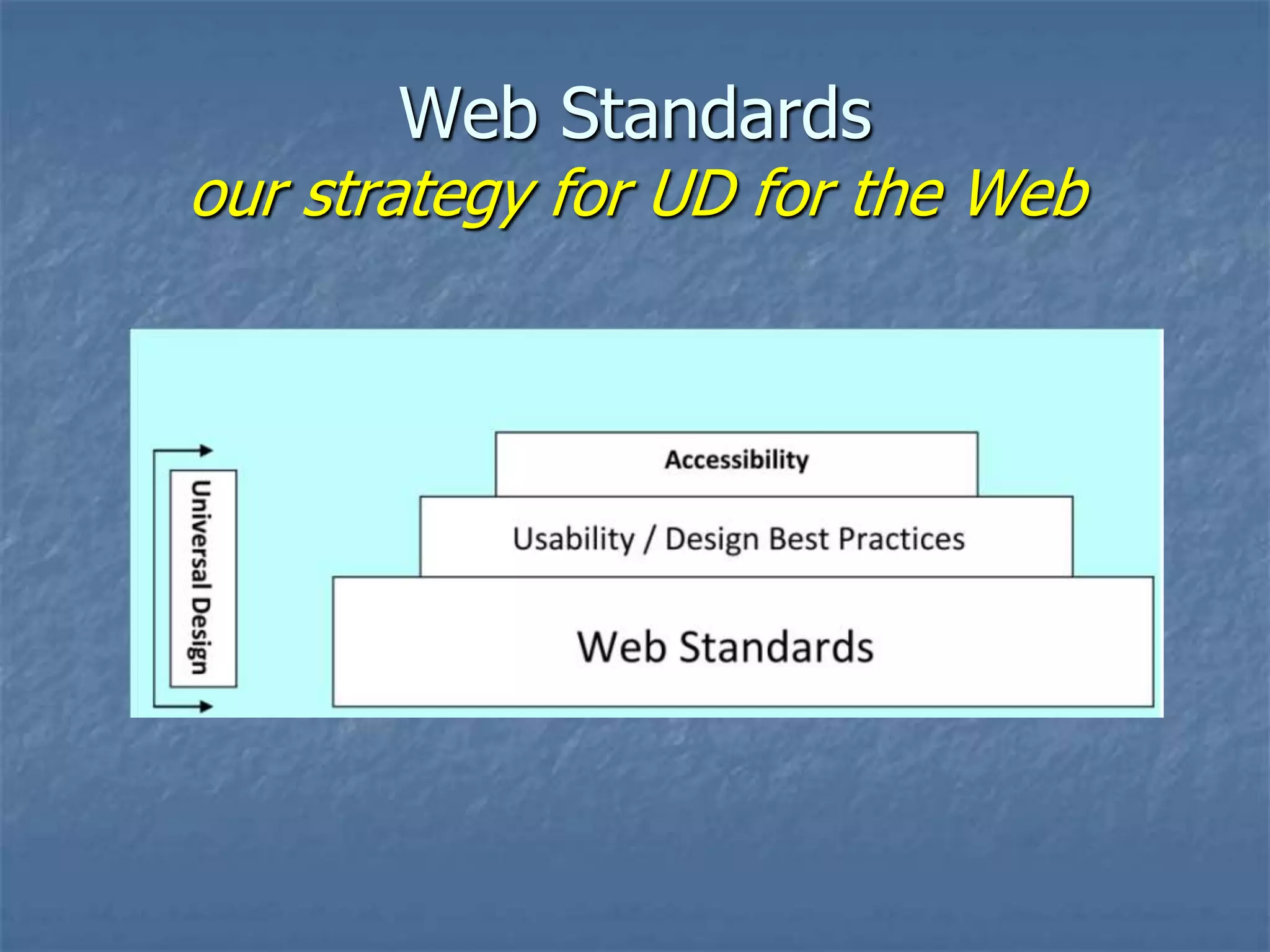
Web Standards

our strategy for UD for the Web
User-Centered Design
Tools for building awareness





Demographics – of disability, of ageing of
population
User profiles http://www.w3.org/WAI/intro/people-useweb/
Aspects of course particularly
effective at promoting UD







Emphasis on multi-faceted benefits –
mobile, SEO, etc.
AT User Interview
Use of screen reader and other
evaluation tools
Opportunity for them to redesign a site
of their choice
Books & Curriculum Material










InterACT with Web Standards: A
holistic approach to web design,
Anderson, et. al.
Zeldman, Jeffrey. Designing with
Web Standards (3rd Edition)
Chisholm & May. UD for Web
Applications
Norman, David A. The Design of
Everyday Things (2002).
Cooper, Alan; Reimann Robert M.
About Face 2.0: The Essentials of
Interaction Design (2003)
Books & Curriculum Material




Just Ask: Integrating Accessibility
Throughout Design, Shawn Henry
(2007) (free online edition)

A Web for Everyone: Designing
Accessible User Experiences,
Sarah Horton & Whitney
Quesenbery (2014)
Other Developments







Self-paced version of ATLAS 3518
Development of Universal Design for
Content Management Systems – focus
on & WordPress (spring 2014)
Planned development of a graduate
certificate program
Website Project Resources – uduc.org
Opportunities for Collaboration


Sharing of Resources



E-text book –



looking for collaborators

Continuation of grant – replicating model
at other campuses
Projects/Resources at CU, AHEAD,
ATHEN


3-credit class: Universal Design for Digital Media




ATHEN – Access Tech. Higher Ed. Network




Athenpro.org

Universal Design in Curriculum Track and them
at Accessing Higher Ground Conference 2013
(Nov. 4 – 8)




http://accessinghigherground.org/wp/udclass/

Accessinghigherground.org

Videos from AHG 2012 –


http://accessinghigherground.org/recordedAHG2012.
html
Other Curriculum Resources


A List Apart - Link-Rodrigue, The Inclusion

Principle,




Dev.opera.com




http://dev.opera.com/articles/view/1-introductionto-the-web-standards-cur/

Usability.gov




http://www.alistapart.com/articles/the-inclusionprinciple/

http://usability.gov/methods/test_refine/heuristic.h
tml

Sitepoint.com


http://articles.sitepoint.com/article/informationarchitecture
Other Curriculum Resources


First Principles of Interaction Design”




“Personas”




http://wiki.fluidproject.org/display/fluid/Personas

WebAIM.org – The Legend of the Typical …




(http://www.asktog.com/basics/firstPrinciples.html
);

http://webaim.org/presentations/2010/csun/screen
readersurvey.pdf

W3C Web Standards Cirruculim


http://www.w3.org/community/webed/wiki/Main_P
age
Other Resources


Web Design Awards & Training at CU




WAVE - WebAIM.org




http://wave.webaim.org/

W3C Web Standards Curriculum




http://www.colorado.edu/ODECE/UDAC/webcomp
2012.html

http://www.w3.org/community/webed/wiki/Main_P
age

Physics Example page


http://www.colorado.edu/ODECE/UDAC/physics%2
0page-2.htm
Accessing Higher Ground
Conference
Accessible Media, Web & Technology






November 17 – 21, 2014
Universal Design in Curriculum Track
Westin Hotel - between Boulder & Denver
www.accessinghigherground.org
Online Resources from UDUC

UDUC.org

Universal Design Content in Curriculum - ATIA 2014

  • 1.
    Integrating Universal Design intoUniversity Curriculum Howard Kramer University of Colorado-Boulder hkramer@colorado.edu, 303-492-8672 ATIA 2014
  • 2.
    Presentation posted at slideshare http://slideshare.net/hkramer99/ UDin Curriculum – ATIA 2014.pptx or www.atia.org/orlandohandouts
  • 3.
    Introduction Howard Kramer University ofColorado-Boulder hkramer@colorado.edu, 303-492-8672  Conference:   Class:   Accessing Higher Ground: Accessible Media, Web & Technology Universal Design for Digital Media - 14 week class Grant Project:  Promoting the Integration of Universal Design in University Curriculum (UDUC)
  • 4.
    Today’s Outline  What dowe/I mean by Universal Design  UDUC project info | some preliminary findings      Examples & models for including UD content in curriculum How this can intersect/promote accessibility & UD on campus UDE example / model Initiatives, accomplishments & future plans of UDUC project Your input, feedback & collaboration
  • 5.
    Today’s Objective(s)    Acquire asampling of examples of UD in curriculum that you may replicate or build upon Provide you with ideas for promoting UD curriculum at your own institutions Inspire you to become involved with this project by using our resources or sharing your resources with us
  • 6.
    NEA 2-year Grant Promotingthe Integration of Universal Design Content into University Curriculum (UDUC)
  • 7.
    Promoting the Integrationof UD into University Curriculum      Determining current inclusion of UD content on campus Increasing the amount of classes that address UD (content) on campus (and beyond) Determining resource needs for teaching UD Developing resources for teaching UD – syllabi, curriculum, teaching resources, etc. Developing a network of interested faculty – sharing resources
  • 8.
    Universal Design –What do I mean?  Universal Design (Origins)  Universal Design is the design of products and environments to be usable by all people, to the greatest extent possible, without the need for adaptation or specialized design – Ron Mace, Architect Universal Design for the built environment
  • 9.
    UD Defined –variations on a theme   …[T]he practice of designing products or environments that can be effectively and efficiently used by people with a wide range of abilities operating in a wide range of situations (Vanderheiden, 1997, p. 2014). …[B]uilding products that are robust and accommodating. Universal designs take account of differences in sight, hearing, mobility, speech, and cognition. Universal design helps not only people with disabilities, but also any of us when we’re tired, busy, or juggling many tasks (Francik, 1996).
  • 10.
     “Universal design impliesa process that goes beyond minimum access codes and standards, to design environments that are comfortably usable by people from childhood into their oldest years.” - Nasar & Evans-Cowley, eds. 2007. Universal Design & Visitability.
  • 11.
     A framework forthe design of buildings, products and information technology to be useable by the widest range of users.  Valerie Fletcher, The Institute for Human Centered Design
  • 12.
    Universal Design –Key Points  Goes beyond accessibility  Not a separate accommodation  Goes beyond following legal requirements  Provides an improved product to the nonspecial needs or wider population
  • 13.
    National Council onDisability   Design for Inclusion: Creating a New Marketplace – 2004 Report Key findings    A market for universally designed products and services exists. UD principles can be easily incorporated into current design practices. Designing with access in mind can significantly increase the size of targeted markets for electronic and information technology (E&IT).
  • 14.
    7 Principles ofUniversal Design
  • 15.
    7 Principles ofUniversal Design        Equitable Use Flexibility in Use Simple and Intuitive Use Perceptible Information Tolerance for Error Low Physical Effort Size and Space for Approach and Use Copyright © 1997 NC State University, The Center for Universal Design.
  • 16.
    Universal Design –What do I mean?     Universal Design for the digital environment Universal Design in Education (UDE) Universal Design for Instruction (UDI) Universal Design for Learning (UDL)  Universal Instructional Design (UID)
  • 17.
    Universal Design Universal Design UniversalDesign for the built environment Universal Design for UDE UDE UD Learnin Universal Design Universal Design for Education UDE UDWA  Universal Designv Universal Design for Universal DeUDL Learning UDL Universal Design sign for Universal Design for Instruction Instruction  UD UDE Universal Design Content in University  Curriculum
  • 18.
    Universal Design  What doesUniversal Design mean in the context of today’s talk?
  • 19.
    Campus & FacultyConceptions of Universal Design    “[F]ew postsecondary administrators, faculty, and staff are even marginally acquainted with Universal Design or Universal Instructional Design” (Higbee & Goff, eds. 2008) Faculty at CU – may not have the definitive definition or understanding of UD Confusion on the distinction of “UD content”.
  • 20.
  • 21.
    Examples of UDcontent Survey tool adapted by Meredith Banasiak, CU-Boulder
  • 22.
  • 23.
    Arts & Humanities Beyondthe Sciences & Built Environment http://digitalwriting101.net/teaching/content/an-exampleof-the-power-of-digital-storytelling/
  • 24.
    Arts & Humanities Wayfinding– Multidisciplinary UD Project http://www.colorado.edu/news/features/students-create-new-cu-boulder-maps%E2%80%98universal-design%E2%80%99-expand-access
  • 25.
    Beyond the Sciences &Built Environment Designed for different audiences & needs http://www.colorado.edu/campuswayfinding
  • 26.
    Arts & Humanities Beyondthe Sciences & Built Environment
  • 27.
    Wayfinding Beyond the Sciences& Built Environment
  • 28.
  • 29.
    Arts & Humanities Beyondthe Sciences & Built Environment
  • 30.
    Arts & Humanities Beyondthe Sciences & Built Environment
  • 31.
    Other Communication &Design Projects Beyond the Sciences & Built Environment  Usability Study of Disability Services Website
  • 32.
    Beyond CU-Boulder Course Profiles   Human-Computer Interaction undergraduateclass Class-wide public policy projects Jonathan Lazar. PhD Towson University
  • 33.
    HCI Interaction undergraduateclass Course Profiles  Students learn:  1. international guidelines related to web accessibility  2. how to evaluate web sites for accessibility   3. specific details of federal and state laws related to web accessibility The students then perform a series of accessibility inspections on a group of web sites that are required under law to be accessible
  • 34.
    HCI Interaction undergraduateclass Course Profiles  Watch video of Dr. Lazar’s talk at: http://uduc.org/show1videosessi on.php?vpropid=1634
  • 35.
    Standards-Based Web DesignCourse Course Profiles Terrill Thompson, University of Washington www.uw.edu/accesscomputing/webd2
  • 36.
    Other Communication &Design Projects Planned for Future  Analyzing the D2L according to UD principles
  • 37.
    Universal Design for DigitalMedia Course Outline (text version on next slide)
  • 38.
    Web Standards our strategyfor UD for the Web
  • 39.
    User-Centered Design Tools forbuilding awareness   Demographics – of disability, of ageing of population User profiles http://www.w3.org/WAI/intro/people-useweb/
  • 40.
    Aspects of courseparticularly effective at promoting UD     Emphasis on multi-faceted benefits – mobile, SEO, etc. AT User Interview Use of screen reader and other evaluation tools Opportunity for them to redesign a site of their choice
  • 41.
    Books & CurriculumMaterial      InterACT with Web Standards: A holistic approach to web design, Anderson, et. al. Zeldman, Jeffrey. Designing with Web Standards (3rd Edition) Chisholm & May. UD for Web Applications Norman, David A. The Design of Everyday Things (2002). Cooper, Alan; Reimann Robert M. About Face 2.0: The Essentials of Interaction Design (2003)
  • 42.
    Books & CurriculumMaterial   Just Ask: Integrating Accessibility Throughout Design, Shawn Henry (2007) (free online edition) A Web for Everyone: Designing Accessible User Experiences, Sarah Horton & Whitney Quesenbery (2014)
  • 43.
    Other Developments     Self-paced versionof ATLAS 3518 Development of Universal Design for Content Management Systems – focus on & WordPress (spring 2014) Planned development of a graduate certificate program Website Project Resources – uduc.org
  • 44.
    Opportunities for Collaboration  Sharingof Resources  E-text book –  looking for collaborators Continuation of grant – replicating model at other campuses
  • 45.
    Projects/Resources at CU,AHEAD, ATHEN  3-credit class: Universal Design for Digital Media   ATHEN – Access Tech. Higher Ed. Network   Athenpro.org Universal Design in Curriculum Track and them at Accessing Higher Ground Conference 2013 (Nov. 4 – 8)   http://accessinghigherground.org/wp/udclass/ Accessinghigherground.org Videos from AHG 2012 –  http://accessinghigherground.org/recordedAHG2012. html
  • 46.
    Other Curriculum Resources  AList Apart - Link-Rodrigue, The Inclusion Principle,   Dev.opera.com   http://dev.opera.com/articles/view/1-introductionto-the-web-standards-cur/ Usability.gov   http://www.alistapart.com/articles/the-inclusionprinciple/ http://usability.gov/methods/test_refine/heuristic.h tml Sitepoint.com  http://articles.sitepoint.com/article/informationarchitecture
  • 47.
    Other Curriculum Resources  FirstPrinciples of Interaction Design”   “Personas”   http://wiki.fluidproject.org/display/fluid/Personas WebAIM.org – The Legend of the Typical …   (http://www.asktog.com/basics/firstPrinciples.html ); http://webaim.org/presentations/2010/csun/screen readersurvey.pdf W3C Web Standards Cirruculim  http://www.w3.org/community/webed/wiki/Main_P age
  • 48.
    Other Resources  Web DesignAwards & Training at CU   WAVE - WebAIM.org   http://wave.webaim.org/ W3C Web Standards Curriculum   http://www.colorado.edu/ODECE/UDAC/webcomp 2012.html http://www.w3.org/community/webed/wiki/Main_P age Physics Example page  http://www.colorado.edu/ODECE/UDAC/physics%2 0page-2.htm
  • 49.
    Accessing Higher Ground Conference AccessibleMedia, Web & Technology     November 17 – 21, 2014 Universal Design in Curriculum Track Westin Hotel - between Boulder & Denver www.accessinghigherground.org
  • 50.
    Online Resources fromUDUC UDUC.org

Editor's Notes

  • #4 To give you more of an understanding of my involvement with universal design and accessibility …Work on a grant to promote the inclusion of universal design content in university curriculum – I’ll talk more about that later if there’s time.Coordinate a conference called Accessing Higher Ground (under AHEAD) – focuses on accessible media.Teach a course on the topic of today’s workshop – it’s called …, which is really focused on UD for the Web.Usually, I teach this subject over the course of 14 weeks – can’t do that here. But will try to cover some of the key concepts that we cover in that class.
  • #5 “This session will talk about integrating Universal Design into Web design, Environmental design and other curriculum at the University of Colorado-Boulder.”“And we’ll also talk about our effort to provide and developresources to promote the inclusion of UD content at other institutions”Lot’s of areas of UD – which area do am I talking about – what areas of UD is our project interested in?Talking to faculty & others(How this can intersect/promote accessibility & UD on campus - in the systems & physical environment on campus)UDE example – from U. of Hawaii – for those whose focus is UDE, not on contentInitiatives/plans of CU-Boulder projectConferencesResourcesMeetingsAudience feedback – this is a work in progress. We want to develop resources that individuals will use and find useful.
  • #6 Want you to also know more about our project and perhaps provide feedback or collaborate
  • #9 So, as I mentioned in the outline, I want to begin by reviewing the history, origins and definition of UD – to make sure we’re all on the same page.UD – term coined by Ron Mace in the 1980s – it grew out of the civil rights, disability rights and accessibility movements (source: . Referred more toward physical environment. It also stemed somewhat from the recognition or the philosophy that accessibility provides not only benefits to persons with disabilities but to many populations across the demographic spectrum. The ubiquitous and most used example of this is the curb cut – not only providing access and egress to persons in wheelchairs but to persons with babystrollers, wheeled luggage, delivery persons or anyone with a wheeled device.In contrast to an accessibility focus, it advocated for the inclusion of accessible environments and products from the beginning of a design project, not after the fact. Above definition – developed by Ron Mace and the Center for Universal Design - is the most common according the Steinfeld and Roger O. Smith from Universal Design for Quality ofLife Technologies, Vol. 100, 0018-9219/$31.00 2012 IEEE No. 8, August 2012 | Proceedings of the IEEE, pg 2539.
  • #11 Going beyond code – thus focusing on user-centered design.
  • #12 One I particularly like
  • #13 Accessible design is a step forward when developing E&IT products, but it tends to lead to technologies that will be used separately, or in addition to, the main E&IT product, which diminishes the effectiveness of designing for all. (From NCD report)Not a separate accommodation – i.e. separate web page or separate vehicle for persons with mobility disabilities
  • #14 Through this research, NCD aims to educate designers and manufacturers about how electronic and information technology intersects with the needs of individuals with disabilities.
  • #16 In 1997, North Carolina State University's Center for Universal Design documented and published seven Principles of Universal Design (1997):Equitable Use: The design is useful and marketable to people with diverse abilities.Flexibility in Use: The design accommodates a wide range of individual preferences and abilities.Simple and Intuitive Use: Use of the design is easy to understand, regardless of the user's experience, knowledge, language skills, or current concentration level.Perceptible Information: The design communicates necessary information effectively to the user, regardless of ambient conditions or the user's sensory abilities.Tolerance for Error: The design minimizes hazards and the adverse consequences of accidental or unintended actions.Low Physical Effort: The design can be used efficiently and comfortably and with a minimum of fatigue.Size and Space for Approach and Use: Appropriate size and space are provided for approach, reach, manipulation, and use, regardless of the user's body size, posture, or mobility.
  • #17 Has also been work done on Universal Design for services.
  • #18 How does our grant regard UD?How does faculty regard UD?
  • #19 The heart of what I’ll be talking about is the promotion of Universal Design Content. The grant focuses on this area. But I’ll be talking a bit about UDE and it will be our strategy to evangelize about UDE as part of our project activities.But the heart of this presentation are examples of the uses of content that involves Universal Design. Sometimes I may cheat a bit and talk about that content that is focused more on disability or accessibility.
  • #20 Although faculty may not be able to provide the classic Ron Mace definition or one of it’s derivatives, they usually associate it with accessibility.Faculty like Karin relate it to the specific techniques they use – separating content from presentation.
  • #22 Chart adapted by Meredith
  • #23 Projects not only teach UD but CU-Boulder directed projects improve campus accessibility
  • #36 Designed for K-12 but has been adopted at a number of community colleges.
  • #39 Good segue to my class – also cover aria
  • #40 Not only about accessibility Although class starts out talking about disability populations, aging demographics and other populations that should be considered when designing with UD principles. And we have 2 weeks of focus on Accessibility
  • #42 Html 4.0 – first web standard for htmlXhtml 1.0Why do I say Web Standards brings you 90% of the way to accessibility?Web Standards have been very good for accessibility – why?Because web standards emphasize semantic markup – including alt text for images and other non-text elements.Because semantic markup - Before Web Standards(perhaps show or have them look at csszen-garden – to demonstrate the power of external style sheets. Remind them to look at high contrast view via style sheet found in web accessibility toolbar in firefox).
  • #43 All the areas we’ll at least try to cover today(Following up on how the other 2 categories correspond to particular features).(Maybe print this as a handout)
  • #54 Show handouts page – mention can buy audio