• Bipolar Junction Transistor: Physical operation,
operating point, load line, self-bias circuit, single
stage CE Amplifier configuration – 4 lectures
• Ideal Op- Amp, inverting, Non-inverting and
Unity gain Amplifiers, integrator, Differentiator,
Summer/ Subtractor – 4 lectures
Unit - IV
Bipolar Junction Transistor (BJT)
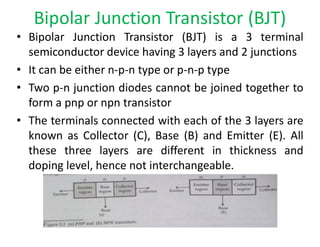
• Bipolar Junction Transistor (BJT) is a 3 terminal
semiconductor device having 3 layers and 2 junctions
• It can be either n-p-n type or p-n-p type
• Two p-n junction diodes cannot be joined together to
form a pnp or npn transistor
• The terminals connected with each of the 3 layers are
known as Collector (C), Base (B) and Emitter (E). All
these three layers are different in thickness and
doping level, hence not interchangeable.
• Since Collector and Emitter are of same type
semiconductor but not interchangeable. So, in
order to differentiate among the two we put an
arrow on the Emitter in the direction of p to n
always irrespective of npn or pnp transistor.
• For a transistor IE = IC + IB always
Bipolar Junction Transistor (BJT)
Base (B) Collector (C) Emitter (E)
Layer Middle Extreme end Extreme end
Current Minimum Moderate Maximum
Doping Level Minimum Moderate Maximum
Thickness Minimum Maximum Moderate
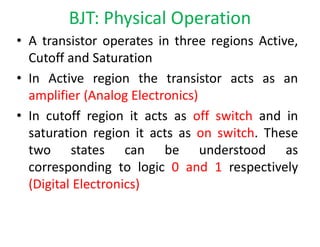
• A transistor operates in three regions Active,
Cutoff and Saturation
• In Active region the transistor acts as an
amplifier (Analog Electronics)
• In cutoff region it acts as off switch and in
saturation region it acts as on switch. These
two states can be understood as
corresponding to logic 0 and 1 respectively
(Digital Electronics)
BJT: Physical Operation
• In CE mode the BJT acts as an amplifier in the
active region
BJT: As an Amplifier
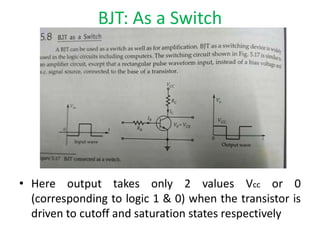
• Here output takes only 2 values Vcc or 0
(corresponding to logic 1 & 0) when the transistor is
driven to cutoff and saturation states respectively
BJT: As a Switch
• Transistor is an active element as it is able to
produce amplified high power replica of the
input waveform at its output for a sufficiently
long period of time, when operates in active
region. It is able to do so by taking power from
the DC sources and converting that DC power
into the desired AC waveform.
• Connecting suitable DC power supply with
desired polarity at the input and output side of
Transistor is known as biasing of the Transistor
BJT: an Active element & Biasing
• Transistor is a 3 terminal device. But we need 4
terminals (2 for input side and another 2 for output
side) to make an amplifier circuit. In order to achieve
this we need to make one of the terminals of transistor
common to both input and output side.
• Hence, a transistor can be operated in three different
configurations viz. Common Emitter (CE); Common
Collector (CC) and Common Base (CB)
• Out of these 3 modes CE mode is most commonly used.
In this mode Emitter terminal is common to both input
and output sides. Out of the remaining two terminals
base is on input side and collector on output side.
BJT: Different Operating modes
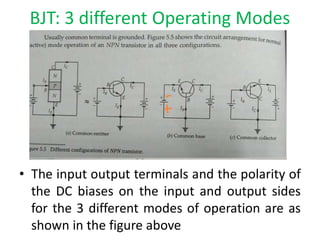
• The input output terminals and the polarity of
the DC biases on the input and output sides
for the 3 different modes of operation are as
shown in the figure above
BJT: 3 different Operating Modes
• There are 2 types of transistor reverse saturation currents
ICBO and ICEO which flows due to minority charge carriers
through the reverse bias junction. The reverse saturation
currents flow due to the flow of minority charge carriers.
Hence, they are independent of applied voltage and
depends on temperature
• ICBO is the reverse saturation current (collector current)
flowing from collector to base when the third terminal
(emitter) is open circuited. ICBO is the output circuit
current of CB mode when input circuit is open circuited.
• ICEO is the reverse saturation current (collector current)
flowing from collector to emitter when the third terminal
(base) is open circuited. ICEO is the output circuit current
of CE mode when input circuit is open circuited.
Transistor Reverse saturation currents
• The CB configuration current gain is defined as the
ratio of output current and input current in CB
configuration such that α = IC/IE= 0.98 – 0.99
• Also, CE configuration current gain is defined as the
ratio of output current and input current in CE
configuration such that β = Ic/IB= 99-100
• ICEO > ICBO such that ICEO = (1+β) ICBO where β is the CE
configuration current gain β = Ic/IB
• Since, IE = IC + IB
• Hence, α = IC/IE = IC/(IB+IC) = β/(1+β)
• Also, β = IC/IB = IC/(IE-IC) = α/(1-α)
BJT: current gains & Reverse saturation currents
BJT: Junction bias for Operating regions
• For a transistor to operate as an amplifier, it should work
in active region i.e. the Emitter-base junction should be
forward biased and collector-base junction should be
reverse biased for all the points of applied AC voltage.
• Hence, the DC operating point should be chosen carefully
so that the transistor remains in active region and not
driven to cutoff or saturation for all the points of applied
AC input signal.
Operation Regions Emitter- Base Junction Collector- Base Junction
Active Forward bias Reverse bias
Cut-off Reverse bias Forward bias
Saturation Forward bias Forward bias
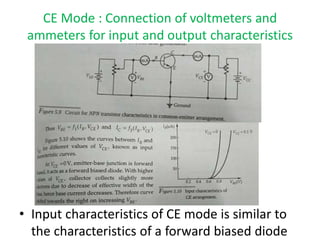
• Input characteristics of CE mode is similar to
the characteristics of a forward biased diode
CE Mode : Connection of voltmeters and
ammeters for input and output characteristics
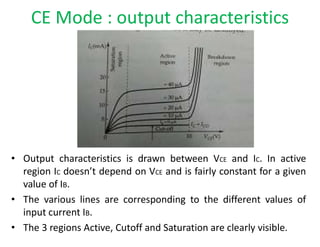
• Output characteristics is drawn between VCE and IC. In active
region IC doesn’t depend on VCE and is fairly constant for a given
value of IB.
• The various lines are corresponding to the different values of
input current IB.
• The 3 regions Active, Cutoff and Saturation are clearly visible.
CE Mode : output characteristics
BJT: Load Line
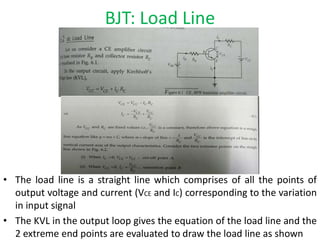
• The load line is a straight line which comprises of all the points of
output voltage and current (VCE and IC) corresponding to the variation
in input signal
• The KVL in the output loop gives the equation of the load line and the
2 extreme end points are evaluated to draw the load line as shown
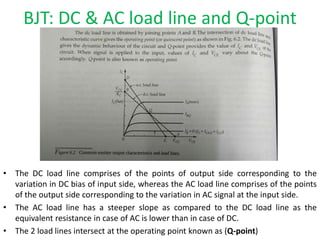
• The DC load line comprises of the points of output side corresponding to the
variation in DC bias of input side, whereas the AC load line comprises of the points
of the output side corresponding to the variation in AC signal at the input side.
• The AC load line has a steeper slope as compared to the DC load line as the
equivalent resistance in case of AC is lower than in case of DC.
• The 2 load lines intersect at the operating point known as (Q-point)
BJT: DC & AC load line and Q-point
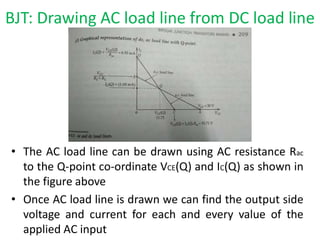
• The AC load line can be drawn using AC resistance Rac
to the Q-point co-ordinate VCE(Q) and IC(Q) as shown in
the figure above
• Once AC load line is drawn we can find the output side
voltage and current for each and every value of the
applied AC input
BJT: Drawing AC load line from DC load line
• In voltage divider bias, on input side 2 resistances are connected to create a voltage
divider such that just one DC source is sufficient for both input and output side
circuit.
• In order to solve this circuit we simply separate the input and output side of the
circuit by connecting the DC source of same magnitude on input and output side.
• Then we find the equivalent Thevenin’s circuit on input side as shown in the figure.
• Finally we apply KVL on both input and output sides to solve the circuit.
BJT: Voltage divider bias or Self Bias
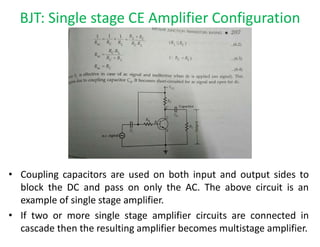
• Coupling capacitors are used on both input and output sides to
block the DC and pass on only the AC. The above circuit is an
example of single stage amplifier.
• If two or more single stage amplifier circuits are connected in
cascade then the resulting amplifier becomes multistage amplifier.
BJT: Single stage CE Amplifier Configuration
• For ideal transistor VBE = 0 and for Si transistor VBE = 0.7 V
Numerical - 1
Numerical - 2
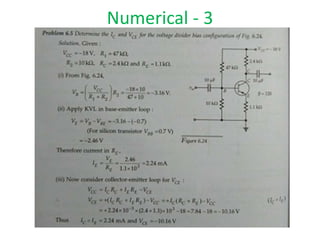
Numerical - 3
• Here the lower point should be taken as
reference at 0 V
Numerical - 4
Unit - IV(i) BJT.pdf

Unit - IV(i) BJT.pdf

  • 1.
    • Bipolar JunctionTransistor: Physical operation, operating point, load line, self-bias circuit, single stage CE Amplifier configuration – 4 lectures • Ideal Op- Amp, inverting, Non-inverting and Unity gain Amplifiers, integrator, Differentiator, Summer/ Subtractor – 4 lectures Unit - IV
  • 2.
    Bipolar Junction Transistor(BJT) • Bipolar Junction Transistor (BJT) is a 3 terminal semiconductor device having 3 layers and 2 junctions • It can be either n-p-n type or p-n-p type • Two p-n junction diodes cannot be joined together to form a pnp or npn transistor • The terminals connected with each of the 3 layers are known as Collector (C), Base (B) and Emitter (E). All these three layers are different in thickness and doping level, hence not interchangeable.
  • 3.
    • Since Collectorand Emitter are of same type semiconductor but not interchangeable. So, in order to differentiate among the two we put an arrow on the Emitter in the direction of p to n always irrespective of npn or pnp transistor. • For a transistor IE = IC + IB always Bipolar Junction Transistor (BJT) Base (B) Collector (C) Emitter (E) Layer Middle Extreme end Extreme end Current Minimum Moderate Maximum Doping Level Minimum Moderate Maximum Thickness Minimum Maximum Moderate
  • 4.
    • A transistoroperates in three regions Active, Cutoff and Saturation • In Active region the transistor acts as an amplifier (Analog Electronics) • In cutoff region it acts as off switch and in saturation region it acts as on switch. These two states can be understood as corresponding to logic 0 and 1 respectively (Digital Electronics) BJT: Physical Operation
  • 5.
    • In CEmode the BJT acts as an amplifier in the active region BJT: As an Amplifier
  • 6.
    • Here outputtakes only 2 values Vcc or 0 (corresponding to logic 1 & 0) when the transistor is driven to cutoff and saturation states respectively BJT: As a Switch
  • 7.
    • Transistor isan active element as it is able to produce amplified high power replica of the input waveform at its output for a sufficiently long period of time, when operates in active region. It is able to do so by taking power from the DC sources and converting that DC power into the desired AC waveform. • Connecting suitable DC power supply with desired polarity at the input and output side of Transistor is known as biasing of the Transistor BJT: an Active element & Biasing
  • 8.
    • Transistor isa 3 terminal device. But we need 4 terminals (2 for input side and another 2 for output side) to make an amplifier circuit. In order to achieve this we need to make one of the terminals of transistor common to both input and output side. • Hence, a transistor can be operated in three different configurations viz. Common Emitter (CE); Common Collector (CC) and Common Base (CB) • Out of these 3 modes CE mode is most commonly used. In this mode Emitter terminal is common to both input and output sides. Out of the remaining two terminals base is on input side and collector on output side. BJT: Different Operating modes
  • 9.
    • The inputoutput terminals and the polarity of the DC biases on the input and output sides for the 3 different modes of operation are as shown in the figure above BJT: 3 different Operating Modes
  • 10.
    • There are2 types of transistor reverse saturation currents ICBO and ICEO which flows due to minority charge carriers through the reverse bias junction. The reverse saturation currents flow due to the flow of minority charge carriers. Hence, they are independent of applied voltage and depends on temperature • ICBO is the reverse saturation current (collector current) flowing from collector to base when the third terminal (emitter) is open circuited. ICBO is the output circuit current of CB mode when input circuit is open circuited. • ICEO is the reverse saturation current (collector current) flowing from collector to emitter when the third terminal (base) is open circuited. ICEO is the output circuit current of CE mode when input circuit is open circuited. Transistor Reverse saturation currents
  • 11.
    • The CBconfiguration current gain is defined as the ratio of output current and input current in CB configuration such that α = IC/IE= 0.98 – 0.99 • Also, CE configuration current gain is defined as the ratio of output current and input current in CE configuration such that β = Ic/IB= 99-100 • ICEO > ICBO such that ICEO = (1+β) ICBO where β is the CE configuration current gain β = Ic/IB • Since, IE = IC + IB • Hence, α = IC/IE = IC/(IB+IC) = β/(1+β) • Also, β = IC/IB = IC/(IE-IC) = α/(1-α) BJT: current gains & Reverse saturation currents
  • 12.
    BJT: Junction biasfor Operating regions • For a transistor to operate as an amplifier, it should work in active region i.e. the Emitter-base junction should be forward biased and collector-base junction should be reverse biased for all the points of applied AC voltage. • Hence, the DC operating point should be chosen carefully so that the transistor remains in active region and not driven to cutoff or saturation for all the points of applied AC input signal. Operation Regions Emitter- Base Junction Collector- Base Junction Active Forward bias Reverse bias Cut-off Reverse bias Forward bias Saturation Forward bias Forward bias
  • 13.
    • Input characteristicsof CE mode is similar to the characteristics of a forward biased diode CE Mode : Connection of voltmeters and ammeters for input and output characteristics
  • 14.
    • Output characteristicsis drawn between VCE and IC. In active region IC doesn’t depend on VCE and is fairly constant for a given value of IB. • The various lines are corresponding to the different values of input current IB. • The 3 regions Active, Cutoff and Saturation are clearly visible. CE Mode : output characteristics
  • 15.
    BJT: Load Line •The load line is a straight line which comprises of all the points of output voltage and current (VCE and IC) corresponding to the variation in input signal • The KVL in the output loop gives the equation of the load line and the 2 extreme end points are evaluated to draw the load line as shown
  • 16.
    • The DCload line comprises of the points of output side corresponding to the variation in DC bias of input side, whereas the AC load line comprises of the points of the output side corresponding to the variation in AC signal at the input side. • The AC load line has a steeper slope as compared to the DC load line as the equivalent resistance in case of AC is lower than in case of DC. • The 2 load lines intersect at the operating point known as (Q-point) BJT: DC & AC load line and Q-point
  • 17.
    • The ACload line can be drawn using AC resistance Rac to the Q-point co-ordinate VCE(Q) and IC(Q) as shown in the figure above • Once AC load line is drawn we can find the output side voltage and current for each and every value of the applied AC input BJT: Drawing AC load line from DC load line
  • 18.
    • In voltagedivider bias, on input side 2 resistances are connected to create a voltage divider such that just one DC source is sufficient for both input and output side circuit. • In order to solve this circuit we simply separate the input and output side of the circuit by connecting the DC source of same magnitude on input and output side. • Then we find the equivalent Thevenin’s circuit on input side as shown in the figure. • Finally we apply KVL on both input and output sides to solve the circuit. BJT: Voltage divider bias or Self Bias
  • 19.
    • Coupling capacitorsare used on both input and output sides to block the DC and pass on only the AC. The above circuit is an example of single stage amplifier. • If two or more single stage amplifier circuits are connected in cascade then the resulting amplifier becomes multistage amplifier. BJT: Single stage CE Amplifier Configuration
  • 20.
    • For idealtransistor VBE = 0 and for Si transistor VBE = 0.7 V Numerical - 1
  • 21.
  • 22.
  • 23.
    • Here thelower point should be taken as reference at 0 V Numerical - 4