REDOX
REACTIONS
REDOX COUPLE
• DEFINITION:A redox couple is defined as
having together the oxidised and reduced
forms of a substance taking part in an
oxidation and reduction half reaction.
• REPRESENTATION: It is represented by a
vertical line or a slash representing an
interface( e.g. solid/solution).
EXPERIMENT-DANIELL CELL
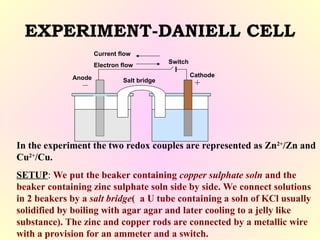
In the experiment the two redox couples are represented as Zn2+
/Zn and
Cu2+
/Cu.
SETUP: We put the beaker containing copper sulphate soln and the
beaker containing zinc sulphate soln side by side. We connect solutions
in 2 beakers by a salt bridge( a U tube containing a soln of KCl usually
solidified by boiling with agar agar and later cooling to a jelly like
substance). The zinc and copper rods are connected by a metallic wire
with a provision for an ammeter and a switch.
Switch
Cathode
Current flow
Electron flow
Anode Salt bridge
WORKING
• When the switch is in the off position, no reaction takes
place in either of the beakers and no current flows through
the metallic wire.
• As soon as the switch is in the on position we make the
following observations:
• The transfer of electrons now does not take place directly
from Zn to Cu2+
but through the metallic wire connecting
the two rods as is apparent from the arrow which indicates
the flow of current.
• The electricity from soln in one beaker to soln in the other
beaker flows by the migration of ions through the salt
bridge. The flow of control is only possible if there is a
potential difference between the copper and zinc rods
known as electrodes.
ELECTRODE POTENTIAL
• The potential associated with each electrode is known as
electrode potential
• If the concentration of each species taking part in the
electrode reaction is unity and further the reaction is
carried out at 298 K, then the potential of each electrode is
said to be the Standard Electrode Potential.
• The electrode potential value for each electrode process is a
measure of the relative tendency of the active species in the
process to remain in the oxidised/ reduced form.
• A negative E means that the redox couple is a stronger
reducing agent than the H+
/H2 couple.
• A positive E means that the redox couple is a weaker
reducing agent than the H+
/H2 couple.
BALANCING OF REDOX REACTION:
Half-Reaction method
Q1) Permanganate [VII] ion, MnO-
4 in basic solution oxidizes iodide ion, I-
to produce molecular iodine
(I) and manganese (IV) oxide (MnO). Write a balanced ionic equation to represent this redox
reaction.
SOLUTION:
STEP 1: First, we write the skeletal ionic equation, which is,
Equation, which is:
MnO-
4 (aq) + I-
(aq)  MnO2(s) + I2(s)
STEP 2: The two half- reactions are:
-1 0
Oxidation half: I-
(aq)  I2(s)
+7 +4
Reduction half: MnO-
4 (aq)  MnO-
2(s)
STEP 3: To balance the I atoms in the oxidation half reaction, we rewrite it as:
2I-
(aq)  I2(s)
STEP 4: To balance the O atoms in the reduction half reaction we add two water molecules on the
right:
MnO-
4
(aq)  MnO2(s) + 2H2O(l)
To balance the H atoms, we add four H+ ions on the left:
MnO-
4 (aq) + 4H+
(aq)  MnO2(s) + 2H2O(l)
As the reaction takes place in a basic solution, therefore, for four H+
, we add four OH-
ions to both
sides of the equation:
MnO-
4 (aq) + 4H+
(aq) + 4OH-
(aq)  MnO2(s) + 2H2O(l) + 4OH- (aq)
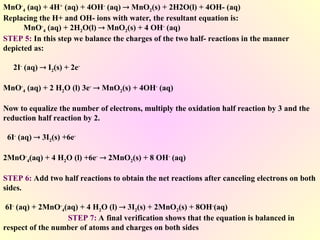
Replacing the H+ and OH- ions with water, the resultant equation is:
MnO-
4 (aq) + 2H2O(l)  MnO2(s) + 4 OH-
(aq)
STEP 5: In this step we balance the charges of the two half- reactions in the manner
depicted as:
2I-
(aq)  I2(s) + 2e-
MnO-
4 (aq) + 2 H2O (l) 3e-
 MnO2(s) + 4OH-
(aq)
Now to equalize the number of electrons, multiply the oxidation half reaction by 3 and the
reduction half reaction by 2.
6I-
(aq)  3I2(s) +6e-
2MnO-
4(aq) + 4 H2O (l) +6e-
 2MnO2(s) + 8 OH-
(aq)
STEP 6: Add two half reactions to obtain the net reactions after canceling electrons on both
sides.
6I-
(aq) + 2MnO-
4(aq) + 4 H2O (l)  3I2(s) + 2MnO2(s) + 8OH-
(aq)
STEP 7: A final verification shows that the equation is balanced in
respect of the number of atoms and charges on both sides
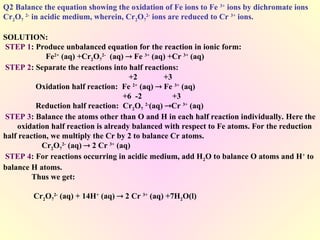
Q2 Balance the equation showing the oxidation of Fe ions to Fe 3+
ions by dichromate ions
Cr2O7
2-
in acidic medium, wherein, Cr2O7
2-
ions are reduced to Cr 3+
ions.
SOLUTION:
STEP 1: Produce unbalanced equation for the reaction in ionic form:
Fe2+
(aq) +Cr2O7
2-
(aq)  Fe 3+
(aq) +Cr 3+
(aq)
STEP 2: Separate the reactions into half reactions:
+2 +3
Oxidation half reaction: Fe 2+
(aq)  Fe 3+
(aq)
+6 -2 +3
Reduction half reaction: Cr2O7
2-
(aq) Cr 3+
(aq)
STEP 3: Balance the atoms other than O and H in each half reaction individually. Here the
oxidation half reaction is already balanced with respect to Fe atoms. For the reduction
half reaction, we multiply the Cr by 2 to balance Cr atoms.
Cr2O7
2-
(aq)  2 Cr 3+
(aq)
STEP 4: For reactions occurring in acidic medium, add H2O to balance O atoms and H+
to
balance H atoms.
Thus we get:
Cr2O7
2-
(aq) + 14H+
(aq)  2 Cr 3+
(aq) +7H2O(l)
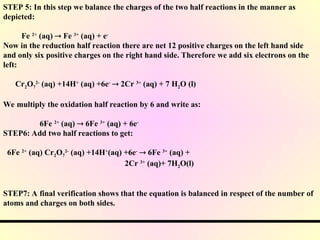
STEP 5: In this step we balance the charges of the two half reactions in the manner as
depicted:
Fe 2+
(aq)  Fe 3+
(aq) + e-
Now in the reduction half reaction there are net 12 positive charges on the left hand side
and only six positive charges on the right hand side. Therefore we add six electrons on the
left:
Cr2O7
2-
(aq) +14H+
(aq) +6e-
 2Cr 3+
(aq) + 7 H2O (l)
We multiply the oxidation half reaction by 6 and write as:
6Fe 2+
(aq)  6Fe 3+
(aq) + 6e-
STEP6: Add two half reactions to get:
6Fe 2+
(aq) Cr2O7
2-
(aq) +14H+
(aq) +6e-
 6Fe 3+
(aq) +
2Cr 3+
(aq)+ 7H2O(l)
STEP7: A final verification shows that the equation is balanced in respect of the number of
atoms and charges on both sides.

unit-8-redox-reactions.ppt class 11 cbse

  • 1.
  • 2.
    REDOX COUPLE • DEFINITION:Aredox couple is defined as having together the oxidised and reduced forms of a substance taking part in an oxidation and reduction half reaction. • REPRESENTATION: It is represented by a vertical line or a slash representing an interface( e.g. solid/solution).
  • 3.
    EXPERIMENT-DANIELL CELL In theexperiment the two redox couples are represented as Zn2+ /Zn and Cu2+ /Cu. SETUP: We put the beaker containing copper sulphate soln and the beaker containing zinc sulphate soln side by side. We connect solutions in 2 beakers by a salt bridge( a U tube containing a soln of KCl usually solidified by boiling with agar agar and later cooling to a jelly like substance). The zinc and copper rods are connected by a metallic wire with a provision for an ammeter and a switch. Switch Cathode Current flow Electron flow Anode Salt bridge
  • 4.
    WORKING • When theswitch is in the off position, no reaction takes place in either of the beakers and no current flows through the metallic wire. • As soon as the switch is in the on position we make the following observations: • The transfer of electrons now does not take place directly from Zn to Cu2+ but through the metallic wire connecting the two rods as is apparent from the arrow which indicates the flow of current. • The electricity from soln in one beaker to soln in the other beaker flows by the migration of ions through the salt bridge. The flow of control is only possible if there is a potential difference between the copper and zinc rods known as electrodes.
  • 5.
    ELECTRODE POTENTIAL • Thepotential associated with each electrode is known as electrode potential • If the concentration of each species taking part in the electrode reaction is unity and further the reaction is carried out at 298 K, then the potential of each electrode is said to be the Standard Electrode Potential. • The electrode potential value for each electrode process is a measure of the relative tendency of the active species in the process to remain in the oxidised/ reduced form. • A negative E means that the redox couple is a stronger reducing agent than the H+ /H2 couple. • A positive E means that the redox couple is a weaker reducing agent than the H+ /H2 couple.
  • 6.
    BALANCING OF REDOXREACTION: Half-Reaction method Q1) Permanganate [VII] ion, MnO- 4 in basic solution oxidizes iodide ion, I- to produce molecular iodine (I) and manganese (IV) oxide (MnO). Write a balanced ionic equation to represent this redox reaction. SOLUTION: STEP 1: First, we write the skeletal ionic equation, which is, Equation, which is: MnO- 4 (aq) + I- (aq)  MnO2(s) + I2(s) STEP 2: The two half- reactions are: -1 0 Oxidation half: I- (aq)  I2(s) +7 +4 Reduction half: MnO- 4 (aq)  MnO- 2(s) STEP 3: To balance the I atoms in the oxidation half reaction, we rewrite it as: 2I- (aq)  I2(s) STEP 4: To balance the O atoms in the reduction half reaction we add two water molecules on the right: MnO- 4 (aq)  MnO2(s) + 2H2O(l) To balance the H atoms, we add four H+ ions on the left: MnO- 4 (aq) + 4H+ (aq)  MnO2(s) + 2H2O(l) As the reaction takes place in a basic solution, therefore, for four H+ , we add four OH- ions to both sides of the equation:
  • 7.
    MnO- 4 (aq) +4H+ (aq) + 4OH- (aq)  MnO2(s) + 2H2O(l) + 4OH- (aq) Replacing the H+ and OH- ions with water, the resultant equation is: MnO- 4 (aq) + 2H2O(l)  MnO2(s) + 4 OH- (aq) STEP 5: In this step we balance the charges of the two half- reactions in the manner depicted as: 2I- (aq)  I2(s) + 2e- MnO- 4 (aq) + 2 H2O (l) 3e-  MnO2(s) + 4OH- (aq) Now to equalize the number of electrons, multiply the oxidation half reaction by 3 and the reduction half reaction by 2. 6I- (aq)  3I2(s) +6e- 2MnO- 4(aq) + 4 H2O (l) +6e-  2MnO2(s) + 8 OH- (aq) STEP 6: Add two half reactions to obtain the net reactions after canceling electrons on both sides. 6I- (aq) + 2MnO- 4(aq) + 4 H2O (l)  3I2(s) + 2MnO2(s) + 8OH- (aq) STEP 7: A final verification shows that the equation is balanced in respect of the number of atoms and charges on both sides
  • 8.
    Q2 Balance theequation showing the oxidation of Fe ions to Fe 3+ ions by dichromate ions Cr2O7 2- in acidic medium, wherein, Cr2O7 2- ions are reduced to Cr 3+ ions. SOLUTION: STEP 1: Produce unbalanced equation for the reaction in ionic form: Fe2+ (aq) +Cr2O7 2- (aq)  Fe 3+ (aq) +Cr 3+ (aq) STEP 2: Separate the reactions into half reactions: +2 +3 Oxidation half reaction: Fe 2+ (aq)  Fe 3+ (aq) +6 -2 +3 Reduction half reaction: Cr2O7 2- (aq) Cr 3+ (aq) STEP 3: Balance the atoms other than O and H in each half reaction individually. Here the oxidation half reaction is already balanced with respect to Fe atoms. For the reduction half reaction, we multiply the Cr by 2 to balance Cr atoms. Cr2O7 2- (aq)  2 Cr 3+ (aq) STEP 4: For reactions occurring in acidic medium, add H2O to balance O atoms and H+ to balance H atoms. Thus we get: Cr2O7 2- (aq) + 14H+ (aq)  2 Cr 3+ (aq) +7H2O(l)
  • 9.
    STEP 5: Inthis step we balance the charges of the two half reactions in the manner as depicted: Fe 2+ (aq)  Fe 3+ (aq) + e- Now in the reduction half reaction there are net 12 positive charges on the left hand side and only six positive charges on the right hand side. Therefore we add six electrons on the left: Cr2O7 2- (aq) +14H+ (aq) +6e-  2Cr 3+ (aq) + 7 H2O (l) We multiply the oxidation half reaction by 6 and write as: 6Fe 2+ (aq)  6Fe 3+ (aq) + 6e- STEP6: Add two half reactions to get: 6Fe 2+ (aq) Cr2O7 2- (aq) +14H+ (aq) +6e-  6Fe 3+ (aq) + 2Cr 3+ (aq)+ 7H2O(l) STEP7: A final verification shows that the equation is balanced in respect of the number of atoms and charges on both sides.