Unit 731
By: Tamarron Austin and Jasmyn Chase
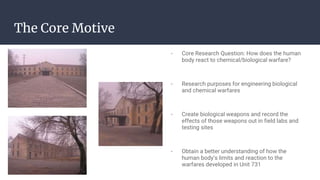
The Core Motive
- Core Research Question: How does the human
body react to chemical/biological warfare?
- Research purposes for engineering biological
and chemical warfares
- Create biological weapons and record the
effects of those weapons out in field labs and
testing sites
- Obtain a better understanding of how the
human body’s limits and reaction to the
warfares developed in Unit 731
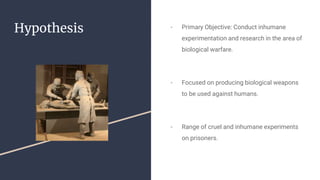
Hypothesis - Primary Objective: Conduct inhumane
experimentation and research in the area of
biological warfare.
- Focused on producing biological weapons
to be used against humans.
- Range of cruel and inhumane experiments
on prisoners.
General Methodology
- Went undercover as a water supply and
epidemic prevention for the Imperial
Japanese Army to hold tests
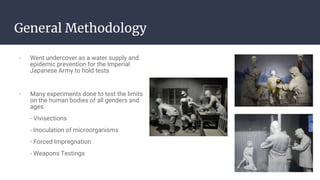
- Many experiments done to test the limits
on the human bodies of all genders and
ages
- Vivisections
- Inoculation of microorganisms
- Forced Impregnation
- Weapons Testings
Other Possible
Procedures
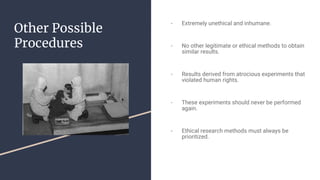
- Extremely unethical and inhumane.
- No other legitimate or ethical methods to obtain
similar results.
- Results derived from atrocious experiments that
violated human rights.
- These experiments should never be performed
again.
- Ethical research methods must always be
prioritized.
Conclusions of Unit
731
- Development of effective biological warfare
weapons
- Effects of diseases and chemicals on the
human body
- The tests ran also help the world treat frostbite
in an effective way
- Efficiency of weapons
- Lack of scientific methodology
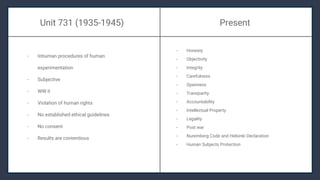
Unit 731 (1935-1945) Present
- Inhuman procedures of human
experimentation
- Subjective
- WW II
- Violation of human rights
- No established ethical guidelines
- No consent
- Results are contentious
- Honesty
- Objectivity
- Integrity
- Carefulness
- Openness
- Transparity
- Accountability
- Intellectual Property
- Legality
- Post war
- Nuremberg Code and Helsinki Declaration
- Human Subjects Protection
Thank You
Any questions?
Works Cited
- Hammond, S. (2018, June 13). The Experiments of Unit 731: Torture in the Name of Warfare. Pacific Atrocities Education.
https://www.pacificatrocities.org/blog/the-experiments-of-unit-731-torture-in-the-name-of-warfare#:~:text=It
- Keiichi, T. (2005, November 24). Unit 731 and the Japanese Imperial Army’s Biological Warfare Program. (John Junkerman
Trans.) Apjjf.org; The Asia-Pacific Journal: Japan Focus. https://apjjf.org/-Tsuneishi-Keiichi/2194/article.html
- Resnik, D. B. (2020, December 23). What Is Ethics in Research & Why Is It Important? National Institute of Environmental Health
Sciences. https://www.niehs.nih.gov/research/resources/bioethics/whatis
- Sabbatani, S. (2014). [The experiments conducted by Japanese on human guinea pigs, and the use of biological weapons during the
Sino-Japanese war (1937-1945)]. Le Infezioni in Medicina, 22(3), 255–266. National Library of Medicine: National Center for
Biotechnology Information. https://pubmed.ncbi.nlm.nih.gov/25269971/
- Cuerda-Galindo, E., Sierra-Valentí, X., González-López, E., & López-Muñoz, F. (2014). Syphilis and Human Experimentation From

Unit 731.pptx

  • 1.
    Unit 731 By: TamarronAustin and Jasmyn Chase
  • 2.
    The Core Motive -Core Research Question: How does the human body react to chemical/biological warfare? - Research purposes for engineering biological and chemical warfares - Create biological weapons and record the effects of those weapons out in field labs and testing sites - Obtain a better understanding of how the human body’s limits and reaction to the warfares developed in Unit 731
  • 3.
    Hypothesis - PrimaryObjective: Conduct inhumane experimentation and research in the area of biological warfare. - Focused on producing biological weapons to be used against humans. - Range of cruel and inhumane experiments on prisoners.
  • 4.
    General Methodology - Wentundercover as a water supply and epidemic prevention for the Imperial Japanese Army to hold tests - Many experiments done to test the limits on the human bodies of all genders and ages - Vivisections - Inoculation of microorganisms - Forced Impregnation - Weapons Testings
  • 5.
    Other Possible Procedures - Extremelyunethical and inhumane. - No other legitimate or ethical methods to obtain similar results. - Results derived from atrocious experiments that violated human rights. - These experiments should never be performed again. - Ethical research methods must always be prioritized.
  • 6.
    Conclusions of Unit 731 -Development of effective biological warfare weapons - Effects of diseases and chemicals on the human body - The tests ran also help the world treat frostbite in an effective way - Efficiency of weapons - Lack of scientific methodology
  • 7.
    Unit 731 (1935-1945)Present - Inhuman procedures of human experimentation - Subjective - WW II - Violation of human rights - No established ethical guidelines - No consent - Results are contentious - Honesty - Objectivity - Integrity - Carefulness - Openness - Transparity - Accountability - Intellectual Property - Legality - Post war - Nuremberg Code and Helsinki Declaration - Human Subjects Protection
  • 8.
  • 9.
    Works Cited - Hammond,S. (2018, June 13). The Experiments of Unit 731: Torture in the Name of Warfare. Pacific Atrocities Education. https://www.pacificatrocities.org/blog/the-experiments-of-unit-731-torture-in-the-name-of-warfare#:~:text=It - Keiichi, T. (2005, November 24). Unit 731 and the Japanese Imperial Army’s Biological Warfare Program. (John Junkerman Trans.) Apjjf.org; The Asia-Pacific Journal: Japan Focus. https://apjjf.org/-Tsuneishi-Keiichi/2194/article.html - Resnik, D. B. (2020, December 23). What Is Ethics in Research & Why Is It Important? National Institute of Environmental Health Sciences. https://www.niehs.nih.gov/research/resources/bioethics/whatis - Sabbatani, S. (2014). [The experiments conducted by Japanese on human guinea pigs, and the use of biological weapons during the Sino-Japanese war (1937-1945)]. Le Infezioni in Medicina, 22(3), 255–266. National Library of Medicine: National Center for Biotechnology Information. https://pubmed.ncbi.nlm.nih.gov/25269971/ - Cuerda-Galindo, E., Sierra-Valentí, X., González-López, E., & López-Muñoz, F. (2014). Syphilis and Human Experimentation From