KAUSHIK JAISWAL
7276888855 kaushjaiswal@gmail.com
MARKETING COMMUNICATION
Marketing communications refer to the strategy used
by a company or individual to reach their target
market through various types of communication.
Marketing communication includes advertising, direct
marketing, branding, packaging, sales presentations,
trade show appearances etc.
15-02-2020
Kaushik Jaiswal
2
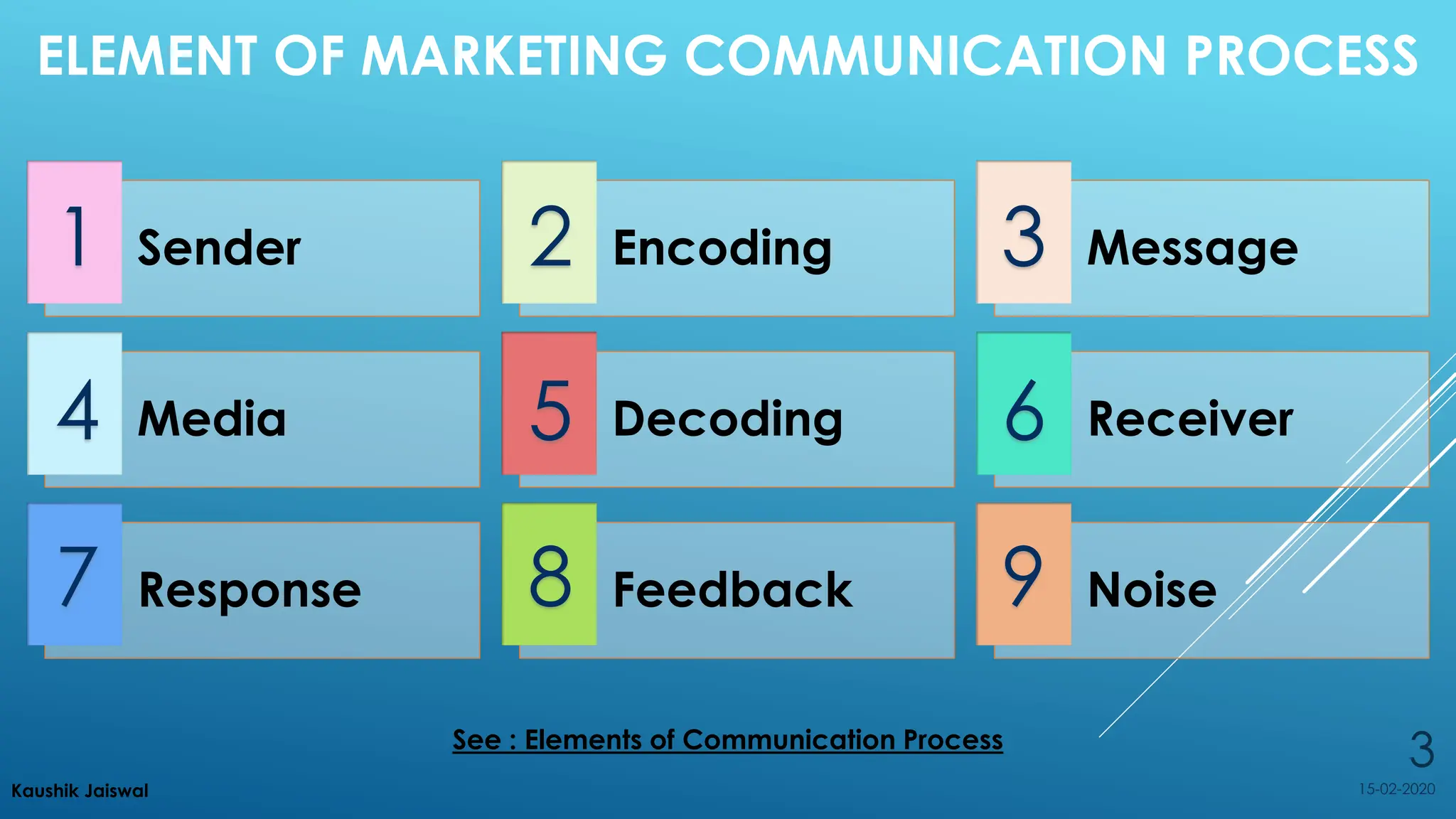
ELEMENT OF MARKETING COMMUNICATION PROCESS
15-02-2020
Kaushik Jaiswal
3
Sender Encoding Message
Media Decoding Receiver
Response Feedback Noise
1 2 3
4 5 6
7 8
See : Elements of Communication Process
9
15-02-2020
Kaushik Jaiswal
4
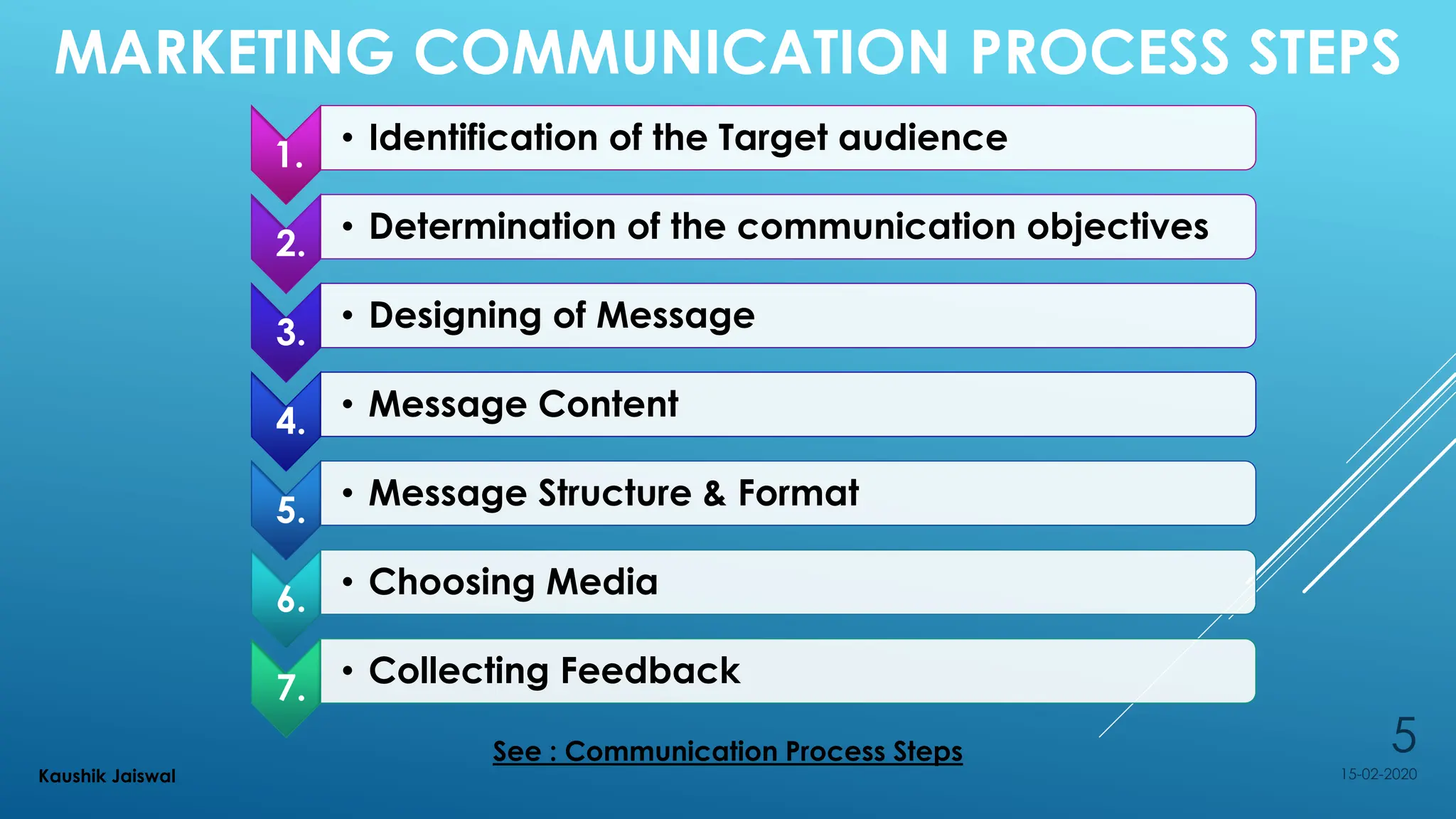
MARKETING COMMUNICATION PROCESS STEPS
15-02-2020
Kaushik Jaiswal
5
1. • Identification of the Target audience
2. • Determination of the communication objectives
3. • Designing of Message
4. • Message Content
5. • Message Structure & Format
6. • Choosing Media
7. • Collecting Feedback
See : Communication Process Steps
7 STEPS TO DEVELOP AN EFFECTIVE MARKETING
COMMUNICATIONS STRATEGY
15-02-2020
Kaushik Jaiswal
6
1. The Better You Know Your Audience, the Better You Can Appeal
to their Interests
2. Uncover Your Unique Selling Proposition
3. Sharpen Your Brand Look and Feel
4. Ensure that All Messaging is Consistent
5. Choose Your Marketing Mix
6. Establish Marcom Success Measurements (Metrics)
7. Manage Leads and Client Data
See : Steps to develop an effective communication strategy
MARKETING COMMUNICATION OBJECTIVES
15-02-2020
Kaushik Jaiswal
7
To Increase Awareness
To Change Attitudes
To Influence Purchase Intent
To stimulate Trial Purchase
To Drive Brand Switching
ADVERTISING COPY
An advertising copy is a term used to describe the main text
used in the advertisement. The text could be a dialogue, a
catchy punch line or a company’s dictum.
It is a print, radio or TV advertising message that aims at
developing and retaining an interest of the target customer and
prompting him to purchase the product within a couple of
seconds.
15-02-2020
Kaushik Jaiswal
8
ADVERTISING COPY - EXAMPLE
15-02-2020
Kaushik Jaiswal
9
ESSENTIALS OF A GOOD ADVERTISEMENT COPY
15-02-2020
Kaushik Jaiswal
10
Attention
Confirming
Apt
Clear
Brief
Assurance of benefits
Credibility
1
2
3
4
5
6
7
15-02-2020
Kaushik Jaiswal
11
❑An ad copy must focus on the credibility or the reliability of the ad.
❑The copywriters should essentially flaunt an element of reliability in the ad
so that the consumers are convinced to go ahead with the product.
❑The credibility of an advertisement is the extent of honesty in the ad
message. Misleading and misinterpreted ads harm the reputation of the
selling house.
Credibility
❑The keywords, punch lines or phrases that seize the attention of the
potential consumers or some component in the ad that attracts the
target audience is essential in a good advertising copy.
Attention
❑An advertisement copy must contain some promise of the benefits that
the product offers if the consumer purchases and uses the product.
Assurance of benefit
15-02-2020
Kaushik Jaiswal
12
❑An ad copy must be brief and clear, i.e. it must be to the point.
❑It doesn’t mean that the copy must omit the important elements
of the ad.
❑A clear copy is easy and quick to be read by the readers.
❑It is self-explanatory, definite, and precise.
Brief and clear
❑The copy must be apt and must match the needs of the prospects.
❑A copywriter has to use the most suitable USP.
❑Every ad copy must meet the conforming standards and rules
acceptable to the advertising media and the laws of the land.
❑A copy that offends the morality challenges religious beliefs of the
people is not welcomed by any media.
Apt and conforming
A WELL DEFINED ADVERTISING COPY MUST
PERFORM THE FOLLOWING FUNCTIONS:
15-02-2020
Kaushik Jaiswal
13
1.
Attract Attention
2.
Command Interest
3.
Create Desire
4.
Inspire Conviction
5.
Provoke Action
15-02-2020
Kaushik Jaiswal
14
Advertising Copy
On the basis of
functions
Educational
Competitive
Institutional
On the basis of
purpose
Goodwill
Selling
On the basis of
appeal
Reason why
Human Interest
On the basis of
mode of conveying
of the message
Expository
Suggestive
Direct
Indirect
Descriptive
Argumentative
On the basis of
forms
Medium Feature
Feature
ADVERTISING
COPY
CLASSIFICATION
See : Classification
EDUCATIONAL COPY
❑ It aims at educating the public, regarding the use of a product.
❑ Such an advertisement copy depicts the specialties of the product, in
contrast to the existing ones.
❑ People keep certain habits which cannot be easily changed. Demand
can be created when such habits are changed.
❑ This type of copy introduces new habits and attracts people towards the
product.
15-02-2020
Kaushik Jaiswal
15
COMPETITIVE COPY
❑ It aims at putting forth the special features of a product.
❑ It promotes to differ one brand from competitors’ brands.
❑ It meets the challenge of the competitors.
15-02-2020
Kaushik Jaiswal
16
INSTITUTIONAL COPY
❑ It sells not the products of the institution but
the name of the institution.
❑ Also known as PRESTIGE or CORPORATE
advertising, this is the type of advertisement
used to present the company’s image.
❑ When a pharmaceutical firm takes space it
describes its research skills, its contribution to
society etc.
❑ The copy aims to develop and maintain a
good-will for the product that the product
comes from a reputed house.
15-02-2020
Kaushik Jaiswal
17
GOODWILL & SELLING COPY
❑ GOODWILL COPY is one which does not try to sell a product but aims to
sell the public some idea on the firm in general, on the quality of its
product, its utility, etc.
❑ SELLING COPY is used by the mail-order house to effect a sale by mail, or
by the manufacturer who sells through retailers, to persuade the buyer to
call for his brand at the retail store.
❑ It is used by the retailer to make an immediate sales of the goods, which
he may have to stock.
15-02-2020
Kaushik Jaiswal
18
REASON WHY COPY
❑ A Reason Why advertising copy offers reasons as to why the consumers
are expected to buy the product of a particular brand.
❑ The reason why copy appeals directly to the intellect or the judgment of
an individual than the emotions.
❑ It tries to explain the product qualities and benefits by giving evidence in
the forms of testimonials, guarantees, customer experiences, and so on.
15-02-2020
Kaushik Jaiswal
19
HUMAN INTEREST COPY
Human interest copy entices the emotions and senses of its prospective
customers rather than the intellect and judgment.
❑ This advertisement copy defines the product to people instead of sticking
to facts.
❑ Human Interest copy gets to selling part indirectly or reluctantly.
❑ It focuses on people’s undying interest in themselves, their families and
friends.
❑ The most important forms of Human Interest Copy are-
15-02-2020
Kaushik Jaiswal
20
Humorous
copy
Fear copy
Predicament
copy
Story copy
15-02-2020
Kaushik Jaiswal
21
• Humorous ad copy is a copy which is designed to make the
reader laugh.
• This copy brings about a smile on the readers face.
HUMOROUS COPY
•Fear ad copy arouses a sense of fear in the reader to save
their lives or to protect themselves from something.
•It creates interest among its consumers by instilling a sense
of fear in them.
•Fear advertisement copies must be designed carefully as it
may carry an unpleasant association on the viewer’s mind
concerning the product.
FEAR COPY
15-02-2020
Kaushik Jaiswal
22
•In a story copy, a story is narrated in a very interesting way to
develop interest amongst its prospects.
•Customer experiences can also be narrated in the form of a
story.
STORY COPY
•In a predicament copy, the copy provides a dramatic
explanation about the product.
•This copy explains all the advantages and benefits of using
the product.
•The predicament copy usually takes over the other three
forms of the advertisement copy.
PREDICAMENT COPY
EXPOSITORY COPY
❑ EXPOSITORY COPY is not to conceal but to expose the facts as they are
clear and concise ideas are given.
❑ It explains the construction, uses, merits, operation and superiority of
advertised articles.
15-02-2020
Kaushik Jaiswal
23
SUGGESTIVE COPY
❑ SUGGESTIVE COPY directly or indirectly conveys the message, which
leads to sales.
15-02-2020
Kaushik Jaiswal
24
DESCRIPTIVE & ARGUMENTATIVE COPY
❑ DESCRIPTIVE COPY conveys the ideas in words or pictures so as to impress
the readers’ mind and thus act upon it.
15-02-2020
Kaushik Jaiswal
25
❑ ARGUMENTATIVE COPY is a message supported by facts.
ELEMENTS OF AN ADVERTISEMENT COPY
15-02-2020
Kaushik Jaiswal
26
1. Attention Value
2. Suggestive Value
3. Conviction Value
4. Sentimental Value
5. Educative Value
6. Memorizing Value
7. Instinctive Value
SALES PROMOTION
Sales promotion is the process of persuading a potential
customer to buy the product.
❑ Sales promotion is designed to be used as a short-term tactic to boost
sales – it is rarely suitable as a method of building long-term customer
loyalty.
❑ Some sales promotions are aimed at consumers. Others are targeted at
intermediaries and at the firm's sales force.
❑ Sales promotion is a type of Pull marketing technique.
15-02-2020
Kaushik Jaiswal
27
OBJECTIVES OF SALES PROMOTION
15-02-2020
Kaushik Jaiswal
28
1. To increase sales by publicity through the media.
2. To disseminate information through salesmen, dealers etc.
3. To stimulate customers to make purchases at the point of purchase.
4. To prompt existing customers to buy more.
5. To introduce new products.
6. To attract new customers.
7. To meet competition from others effectively.
SALES PROMOTION TOOLS
15-02-2020
Kaushik Jaiswal
29
1. Discounts –
Trade /
consumer
2. Gifting 3. Coupons
4. Financing 5. Sampling 6. Bundling
7. Contests
8. Refunds &
Rebates
See : Promotion Tools
SALES PROMOTION TOOLS
15-02-2020
Kaushik Jaiswal
30
9. Exchange
offers
10. Free trial
11. Email
Marketing
12. Exhibitions
13. Trade
Shows
14.
Demonstrations
15. Continuity
programs
16. Quantity
Discount
See : Promotion Tools
DISCOUNTS – TRADE / CONSUMER
❑ The most common type of sales
promotions is consumer discounts or trade
discounts.
❑ If there is a 10% discount on the product
for the consumer, then it is known as
consumer discount.
❑ However, if there is a 10% discount to the
dealer when he is purchasing from the
company, it is known as trade discount.
15-02-2020
Kaushik Jaiswal
31
GIFTING
❑ One of the most common ways to
promote your store during festival time or
when there is a huge walk in expected is
Gifting.
❑ It is also a way to increase the sales of the
products because customers have an
anticipation that they might win a gift from
the store.
❑ Another popular way to use gifting is to
advertise “Assured gifts”.
15-02-2020
Kaushik Jaiswal
32
COUPONS
❑ Used to motivate people to purchase
when they think the price is high or it can
be incentive to buy your product above
the competitors.
❑ Domino’s, Pizza hut and McDonalds very
prominently use coupons in their
marketing.
❑ If you have their coupon in hand, you get
a discount of X amount on the purchase.
15-02-2020
Kaushik Jaiswal
33
FINANCING
❑ Companies which have huge resources
generally act as Financers.
❑ They allow customers to purchase a
product on EMI or on different financing
options. All this happens for a minor
processing fee and less interest.
❑ As a result, the customer, who does not
have complete money to buy the
product, will likely purchase the product
using financing options.
15-02-2020
Kaushik Jaiswal
34
SAMPLING
❑ It is predominantly used in the FMCG
industry for perfumes, deodorants, soaps
or even eatables.
❑ Sampling is an excellent way to introduce
your product in the market and at the
same time to increase the awareness of
the product.
❑ The customers who are being targeted by
sampling carry a huge lifetime value.
Once they get hooked onto your product,
they won’t leave it that early.
15-02-2020
Kaushik Jaiswal
35
BUNDLING
❑ Bundling is when you put a combination of
products on sale for the same price.
❑ We see bundling strongly in retail where a
shampoo might be bundled with a soap
or we can see a bundled combinations of
many different items.
❑ If the products are bundled together and
both products are of an excellent brand,
then the bundled product will sell much
higher quantities and will defeat
competition in numbers.
15-02-2020
Kaushik Jaiswal
36
CONTESTS
❑ There are different forms of contests which
can be run to gather more customer
information or to motivate the customer to
try the product or to create awareness
about the new retail place.
❑ Contests can be as simple as winning a
gift through a scratch card, or it can be an
in house game in a retail showroom or it
can be an online contest for which users
have to enter their information.
15-02-2020
Kaushik Jaiswal
37
REFUNDS & REBATES
❑ Refunds are a marketing tactic when you
get a partial amount refunded to you
based on an action you have taken.
❑ For example – if you bring the parking
ticket to the showroom, your parking
amount will be refunded by the store.
❑ Rebate is a type of partial refund which is
most popular in the United states, though
not much popular in other countries.
❑ In rebates, you fill forms while checking out
of stores.
15-02-2020
Kaushik Jaiswal
38
EXCHANGE OFFERS
❑ In exchange offer, you can exchange an
old product for a new product. You will
receive a discount based on the valuation
of your old product.
❑ So, if you had an old washing machine at
home and there was an Exchange offer in
the market, then you will receive an X
amount for the washing machine which is
decided by the parent company or the
retailer. This X amount will be deducted
from your final payable amount.
15-02-2020
Kaushik Jaiswal
39
FREE TRIAL
❑ Programs where you can use the product
for some time but later on have to
purchase the product to use it completely.
❑ This is done so that the customer gets a
chance to trial run the product before he
pays for the product in full.
❑ Programs
like Adobe Photoshop, Microsoft office 365
and others are known to give free trial
programs of upto a month so that the
customer can know more about the
product, he can try it and then purchase.
15-02-2020
Kaushik Jaiswal
40
EMAIL MARKETING
❑ Email marketing was, is and is touted to
always be one of the best ways to
promote your business.
❑ It is one of the most commonly used types
of sales promotions across the world
because of its ease of implementation
and because of its penetration.
❑ Each and every one of us has an email
account which we access regularly. Thus,
an Email is personal to us when received in
our phone and we are bound to check it
out.
15-02-2020
Kaushik Jaiswal
41
EXHIBITIONS
❑ More commonly used in Food, Jewellery,
Clothing and similar industries where sellers
want to showcase the products they have
to their buyers.
❑ These buyers might be consumers or they
may be industrial buyers.
❑ An exhibition generally consists of one
player who is exhibiting his goods.
❑ However, it can also be a combination of
players who are all there to showcase their
wares.
15-02-2020
Kaushik Jaiswal
42
TRADE SHOWS
❑ While exhibitions are targeted
towards individual buyers, Trade shows are
targeted towards resellers, dealers,
distributors and bulk buyers.
❑ A trade show is typically a display point for
all top companies within an industry.
❑ These companies are there to compete
and grab the maximum eyeballs of
retailers, dealers and distributors.
❑ While Exhibitions are concentrated mostly
on individual buyers, trade shows are
concentrated towards bulk buyers.
15-02-2020
Kaushik Jaiswal
43
DEMONSTRATIONS
❑ Demonstrations are an excellent way to
create more awareness of the product
and to make customers comfortable
towards a technical product.
❑ Technicality of the product can be a
barrier to purchase.
❑ By demonstrating the actual working of a
product, you are removing a barrier to
purchase.
❑ Hence demonstration is a type of sales
promotion mostly used for technical type
of products.
15-02-2020
Kaushik Jaiswal
44
CONTINUITY PROGRAMS
❑ A marking strategy wherein the seller
launches an ongoing promotion in order
to attract and retain customers.
❑ An example is where a supermarket offers
to give away gifts every month for
customers who buy a certain type or
amount of product.
❑ Airline frequent flier discounts are also
examples of a continuity program.
15-02-2020
Kaushik Jaiswal
45
QUANTITY DISCOUNT
❑ The more quantity of the product you buy,
the more is the discount.
❑ So for example, a single soap may cost $1
but a combined package of 5 units of
soap might cost you $4, giving you a 20%
discount on the purchase.
❑ The quantity discount is not applicable
only to consumers.
❑ It is also applicable in trade where a
dealer or distributor might be given a
discount of 5-10% if he purchases a higher
quantity of product.
15-02-2020
Kaushik Jaiswal
46
DISTRIBUTION CHANNEL
A distribution channel is a chain of businesses or
intermediaries through which a good or service passes
until it reaches the final buyer or the end consumer.
Distribution channels can include wholesalers, retailers,
distributors, and even the Internet.
15-02-2020
Kaushik Jaiswal
47
See : Distribution Channel
FUNCTIONS OF DISTRIBUTION CHANNELS
15-02-2020
Kaushik Jaiswal
48
1. Sorting
2. Accumulation
3. Allocation
4. Assorting
5. Product Promotion
6. Negotiation
7. Risk Taking
TYPES OF DISTRIBUTION CHANNELS
15-02-2020
Kaushik Jaiswal
49
Distribution Channel
Direct Channel
Door
to
door
selling
Internet
selling
Mail
order
selling
Company
owned
retail
outlets
Tele
marketing
Indirect Channel
One
Level
Channel
Two
level
channels
Three
level
channels
DIRECT CHANNEL OR ZERO LEVEL CHANNELS
When the producer or the manufacturer directly sells
the goods to the customers without involving any
middlemen, it is known as direct channel or zero
level channel.
❑ It is the simplest and the shortest mode of distribution.
❑ Selling through post, internet or door to door selling etc. are
the examples of this channel.
❑ For example, Mc Donald's, Bata, etc.
15-02-2020
Kaushik Jaiswal
50
INDIRECT CHANNELS
15-02-2020
Kaushik Jaiswal
51
One Level Two Level Three Level
15-02-2020
Kaushik Jaiswal
52
•It is usually adopted for specialty goods.
•For example Tata sells its cars through company approved retailers.
(a) Manufacturer-Retailer-Consumer (One Level Channel):
•This is the most commonly used channel for distributing goods like soap, rice,
wheat, clothes etc.
(b) Manufacturer-Wholesaler-Retailer-Customer (Two level
channels):
•The manufacturers supply the goods to their agents who in turn supply them to
wholesalers and retailers.
• This level is usually used when a manufacturer deal in limited products and yet
wants to cover a wide market.
(c) Manufacturer-Agent-Wholesaler-Retailer-Consumer (Three
level channels):
FACTORS DETERMINING CHOICE OF CHANNELS OF
DISTRIBUTION
15-02-2020
Kaushik Jaiswal
53
Product Related Factors
Company Characteristics
Market Factors
Competitive Factors
Environmental Factor
1
3
5
2
4
FACTORS DETERMINING CHOICE OF CHANNELS OF
DISTRIBUTION
15-02-2020
Kaushik Jaiswal
54
(a) Nature of Product
(b) Perishable and Non- Perishable Products
(c) Value of Product
(d) Product Complexity
1. Product Related Factors
(a) Financial Strength
(b) Control
2. Company
Characteristics
(a) Size of Market
(b) Geographical Concentration
(c) Quantity Purchased
3. Market Factors
THANK YOU..!
KAUSHIK JAISWAL
7276888855 kaushjaiswal@gmail.com
See : Elements of Communication Process
See : Communication Process Steps
See : Steps to develop an effective communication strategy
See : Advertisement Copy Classification
See : Promotion Tools
See : Distribution Channel

Unit 6 - Marketing Communication & Promotion

  • 1.
  • 2.
    MARKETING COMMUNICATION Marketing communicationsrefer to the strategy used by a company or individual to reach their target market through various types of communication. Marketing communication includes advertising, direct marketing, branding, packaging, sales presentations, trade show appearances etc. 15-02-2020 Kaushik Jaiswal 2
  • 3.
    ELEMENT OF MARKETINGCOMMUNICATION PROCESS 15-02-2020 Kaushik Jaiswal 3 Sender Encoding Message Media Decoding Receiver Response Feedback Noise 1 2 3 4 5 6 7 8 See : Elements of Communication Process 9
  • 4.
  • 5.
    MARKETING COMMUNICATION PROCESSSTEPS 15-02-2020 Kaushik Jaiswal 5 1. • Identification of the Target audience 2. • Determination of the communication objectives 3. • Designing of Message 4. • Message Content 5. • Message Structure & Format 6. • Choosing Media 7. • Collecting Feedback See : Communication Process Steps
  • 6.
    7 STEPS TODEVELOP AN EFFECTIVE MARKETING COMMUNICATIONS STRATEGY 15-02-2020 Kaushik Jaiswal 6 1. The Better You Know Your Audience, the Better You Can Appeal to their Interests 2. Uncover Your Unique Selling Proposition 3. Sharpen Your Brand Look and Feel 4. Ensure that All Messaging is Consistent 5. Choose Your Marketing Mix 6. Establish Marcom Success Measurements (Metrics) 7. Manage Leads and Client Data See : Steps to develop an effective communication strategy
  • 7.
    MARKETING COMMUNICATION OBJECTIVES 15-02-2020 KaushikJaiswal 7 To Increase Awareness To Change Attitudes To Influence Purchase Intent To stimulate Trial Purchase To Drive Brand Switching
  • 8.
    ADVERTISING COPY An advertisingcopy is a term used to describe the main text used in the advertisement. The text could be a dialogue, a catchy punch line or a company’s dictum. It is a print, radio or TV advertising message that aims at developing and retaining an interest of the target customer and prompting him to purchase the product within a couple of seconds. 15-02-2020 Kaushik Jaiswal 8
  • 9.
    ADVERTISING COPY -EXAMPLE 15-02-2020 Kaushik Jaiswal 9
  • 10.
    ESSENTIALS OF AGOOD ADVERTISEMENT COPY 15-02-2020 Kaushik Jaiswal 10 Attention Confirming Apt Clear Brief Assurance of benefits Credibility 1 2 3 4 5 6 7
  • 11.
    15-02-2020 Kaushik Jaiswal 11 ❑An adcopy must focus on the credibility or the reliability of the ad. ❑The copywriters should essentially flaunt an element of reliability in the ad so that the consumers are convinced to go ahead with the product. ❑The credibility of an advertisement is the extent of honesty in the ad message. Misleading and misinterpreted ads harm the reputation of the selling house. Credibility ❑The keywords, punch lines or phrases that seize the attention of the potential consumers or some component in the ad that attracts the target audience is essential in a good advertising copy. Attention ❑An advertisement copy must contain some promise of the benefits that the product offers if the consumer purchases and uses the product. Assurance of benefit
  • 12.
    15-02-2020 Kaushik Jaiswal 12 ❑An adcopy must be brief and clear, i.e. it must be to the point. ❑It doesn’t mean that the copy must omit the important elements of the ad. ❑A clear copy is easy and quick to be read by the readers. ❑It is self-explanatory, definite, and precise. Brief and clear ❑The copy must be apt and must match the needs of the prospects. ❑A copywriter has to use the most suitable USP. ❑Every ad copy must meet the conforming standards and rules acceptable to the advertising media and the laws of the land. ❑A copy that offends the morality challenges religious beliefs of the people is not welcomed by any media. Apt and conforming
  • 13.
    A WELL DEFINEDADVERTISING COPY MUST PERFORM THE FOLLOWING FUNCTIONS: 15-02-2020 Kaushik Jaiswal 13 1. Attract Attention 2. Command Interest 3. Create Desire 4. Inspire Conviction 5. Provoke Action
  • 14.
    15-02-2020 Kaushik Jaiswal 14 Advertising Copy Onthe basis of functions Educational Competitive Institutional On the basis of purpose Goodwill Selling On the basis of appeal Reason why Human Interest On the basis of mode of conveying of the message Expository Suggestive Direct Indirect Descriptive Argumentative On the basis of forms Medium Feature Feature ADVERTISING COPY CLASSIFICATION See : Classification
  • 15.
    EDUCATIONAL COPY ❑ Itaims at educating the public, regarding the use of a product. ❑ Such an advertisement copy depicts the specialties of the product, in contrast to the existing ones. ❑ People keep certain habits which cannot be easily changed. Demand can be created when such habits are changed. ❑ This type of copy introduces new habits and attracts people towards the product. 15-02-2020 Kaushik Jaiswal 15
  • 16.
    COMPETITIVE COPY ❑ Itaims at putting forth the special features of a product. ❑ It promotes to differ one brand from competitors’ brands. ❑ It meets the challenge of the competitors. 15-02-2020 Kaushik Jaiswal 16
  • 17.
    INSTITUTIONAL COPY ❑ Itsells not the products of the institution but the name of the institution. ❑ Also known as PRESTIGE or CORPORATE advertising, this is the type of advertisement used to present the company’s image. ❑ When a pharmaceutical firm takes space it describes its research skills, its contribution to society etc. ❑ The copy aims to develop and maintain a good-will for the product that the product comes from a reputed house. 15-02-2020 Kaushik Jaiswal 17
  • 18.
    GOODWILL & SELLINGCOPY ❑ GOODWILL COPY is one which does not try to sell a product but aims to sell the public some idea on the firm in general, on the quality of its product, its utility, etc. ❑ SELLING COPY is used by the mail-order house to effect a sale by mail, or by the manufacturer who sells through retailers, to persuade the buyer to call for his brand at the retail store. ❑ It is used by the retailer to make an immediate sales of the goods, which he may have to stock. 15-02-2020 Kaushik Jaiswal 18
  • 19.
    REASON WHY COPY ❑A Reason Why advertising copy offers reasons as to why the consumers are expected to buy the product of a particular brand. ❑ The reason why copy appeals directly to the intellect or the judgment of an individual than the emotions. ❑ It tries to explain the product qualities and benefits by giving evidence in the forms of testimonials, guarantees, customer experiences, and so on. 15-02-2020 Kaushik Jaiswal 19
  • 20.
    HUMAN INTEREST COPY Humaninterest copy entices the emotions and senses of its prospective customers rather than the intellect and judgment. ❑ This advertisement copy defines the product to people instead of sticking to facts. ❑ Human Interest copy gets to selling part indirectly or reluctantly. ❑ It focuses on people’s undying interest in themselves, their families and friends. ❑ The most important forms of Human Interest Copy are- 15-02-2020 Kaushik Jaiswal 20 Humorous copy Fear copy Predicament copy Story copy
  • 21.
    15-02-2020 Kaushik Jaiswal 21 • Humorousad copy is a copy which is designed to make the reader laugh. • This copy brings about a smile on the readers face. HUMOROUS COPY •Fear ad copy arouses a sense of fear in the reader to save their lives or to protect themselves from something. •It creates interest among its consumers by instilling a sense of fear in them. •Fear advertisement copies must be designed carefully as it may carry an unpleasant association on the viewer’s mind concerning the product. FEAR COPY
  • 22.
    15-02-2020 Kaushik Jaiswal 22 •In astory copy, a story is narrated in a very interesting way to develop interest amongst its prospects. •Customer experiences can also be narrated in the form of a story. STORY COPY •In a predicament copy, the copy provides a dramatic explanation about the product. •This copy explains all the advantages and benefits of using the product. •The predicament copy usually takes over the other three forms of the advertisement copy. PREDICAMENT COPY
  • 23.
    EXPOSITORY COPY ❑ EXPOSITORYCOPY is not to conceal but to expose the facts as they are clear and concise ideas are given. ❑ It explains the construction, uses, merits, operation and superiority of advertised articles. 15-02-2020 Kaushik Jaiswal 23
  • 24.
    SUGGESTIVE COPY ❑ SUGGESTIVECOPY directly or indirectly conveys the message, which leads to sales. 15-02-2020 Kaushik Jaiswal 24
  • 25.
    DESCRIPTIVE & ARGUMENTATIVECOPY ❑ DESCRIPTIVE COPY conveys the ideas in words or pictures so as to impress the readers’ mind and thus act upon it. 15-02-2020 Kaushik Jaiswal 25 ❑ ARGUMENTATIVE COPY is a message supported by facts.
  • 26.
    ELEMENTS OF ANADVERTISEMENT COPY 15-02-2020 Kaushik Jaiswal 26 1. Attention Value 2. Suggestive Value 3. Conviction Value 4. Sentimental Value 5. Educative Value 6. Memorizing Value 7. Instinctive Value
  • 27.
    SALES PROMOTION Sales promotionis the process of persuading a potential customer to buy the product. ❑ Sales promotion is designed to be used as a short-term tactic to boost sales – it is rarely suitable as a method of building long-term customer loyalty. ❑ Some sales promotions are aimed at consumers. Others are targeted at intermediaries and at the firm's sales force. ❑ Sales promotion is a type of Pull marketing technique. 15-02-2020 Kaushik Jaiswal 27
  • 28.
    OBJECTIVES OF SALESPROMOTION 15-02-2020 Kaushik Jaiswal 28 1. To increase sales by publicity through the media. 2. To disseminate information through salesmen, dealers etc. 3. To stimulate customers to make purchases at the point of purchase. 4. To prompt existing customers to buy more. 5. To introduce new products. 6. To attract new customers. 7. To meet competition from others effectively.
  • 29.
    SALES PROMOTION TOOLS 15-02-2020 KaushikJaiswal 29 1. Discounts – Trade / consumer 2. Gifting 3. Coupons 4. Financing 5. Sampling 6. Bundling 7. Contests 8. Refunds & Rebates See : Promotion Tools
  • 30.
    SALES PROMOTION TOOLS 15-02-2020 KaushikJaiswal 30 9. Exchange offers 10. Free trial 11. Email Marketing 12. Exhibitions 13. Trade Shows 14. Demonstrations 15. Continuity programs 16. Quantity Discount See : Promotion Tools
  • 31.
    DISCOUNTS – TRADE/ CONSUMER ❑ The most common type of sales promotions is consumer discounts or trade discounts. ❑ If there is a 10% discount on the product for the consumer, then it is known as consumer discount. ❑ However, if there is a 10% discount to the dealer when he is purchasing from the company, it is known as trade discount. 15-02-2020 Kaushik Jaiswal 31
  • 32.
    GIFTING ❑ One ofthe most common ways to promote your store during festival time or when there is a huge walk in expected is Gifting. ❑ It is also a way to increase the sales of the products because customers have an anticipation that they might win a gift from the store. ❑ Another popular way to use gifting is to advertise “Assured gifts”. 15-02-2020 Kaushik Jaiswal 32
  • 33.
    COUPONS ❑ Used tomotivate people to purchase when they think the price is high or it can be incentive to buy your product above the competitors. ❑ Domino’s, Pizza hut and McDonalds very prominently use coupons in their marketing. ❑ If you have their coupon in hand, you get a discount of X amount on the purchase. 15-02-2020 Kaushik Jaiswal 33
  • 34.
    FINANCING ❑ Companies whichhave huge resources generally act as Financers. ❑ They allow customers to purchase a product on EMI or on different financing options. All this happens for a minor processing fee and less interest. ❑ As a result, the customer, who does not have complete money to buy the product, will likely purchase the product using financing options. 15-02-2020 Kaushik Jaiswal 34
  • 35.
    SAMPLING ❑ It ispredominantly used in the FMCG industry for perfumes, deodorants, soaps or even eatables. ❑ Sampling is an excellent way to introduce your product in the market and at the same time to increase the awareness of the product. ❑ The customers who are being targeted by sampling carry a huge lifetime value. Once they get hooked onto your product, they won’t leave it that early. 15-02-2020 Kaushik Jaiswal 35
  • 36.
    BUNDLING ❑ Bundling iswhen you put a combination of products on sale for the same price. ❑ We see bundling strongly in retail where a shampoo might be bundled with a soap or we can see a bundled combinations of many different items. ❑ If the products are bundled together and both products are of an excellent brand, then the bundled product will sell much higher quantities and will defeat competition in numbers. 15-02-2020 Kaushik Jaiswal 36
  • 37.
    CONTESTS ❑ There aredifferent forms of contests which can be run to gather more customer information or to motivate the customer to try the product or to create awareness about the new retail place. ❑ Contests can be as simple as winning a gift through a scratch card, or it can be an in house game in a retail showroom or it can be an online contest for which users have to enter their information. 15-02-2020 Kaushik Jaiswal 37
  • 38.
    REFUNDS & REBATES ❑Refunds are a marketing tactic when you get a partial amount refunded to you based on an action you have taken. ❑ For example – if you bring the parking ticket to the showroom, your parking amount will be refunded by the store. ❑ Rebate is a type of partial refund which is most popular in the United states, though not much popular in other countries. ❑ In rebates, you fill forms while checking out of stores. 15-02-2020 Kaushik Jaiswal 38
  • 39.
    EXCHANGE OFFERS ❑ Inexchange offer, you can exchange an old product for a new product. You will receive a discount based on the valuation of your old product. ❑ So, if you had an old washing machine at home and there was an Exchange offer in the market, then you will receive an X amount for the washing machine which is decided by the parent company or the retailer. This X amount will be deducted from your final payable amount. 15-02-2020 Kaushik Jaiswal 39
  • 40.
    FREE TRIAL ❑ Programswhere you can use the product for some time but later on have to purchase the product to use it completely. ❑ This is done so that the customer gets a chance to trial run the product before he pays for the product in full. ❑ Programs like Adobe Photoshop, Microsoft office 365 and others are known to give free trial programs of upto a month so that the customer can know more about the product, he can try it and then purchase. 15-02-2020 Kaushik Jaiswal 40
  • 41.
    EMAIL MARKETING ❑ Emailmarketing was, is and is touted to always be one of the best ways to promote your business. ❑ It is one of the most commonly used types of sales promotions across the world because of its ease of implementation and because of its penetration. ❑ Each and every one of us has an email account which we access regularly. Thus, an Email is personal to us when received in our phone and we are bound to check it out. 15-02-2020 Kaushik Jaiswal 41
  • 42.
    EXHIBITIONS ❑ More commonlyused in Food, Jewellery, Clothing and similar industries where sellers want to showcase the products they have to their buyers. ❑ These buyers might be consumers or they may be industrial buyers. ❑ An exhibition generally consists of one player who is exhibiting his goods. ❑ However, it can also be a combination of players who are all there to showcase their wares. 15-02-2020 Kaushik Jaiswal 42
  • 43.
    TRADE SHOWS ❑ Whileexhibitions are targeted towards individual buyers, Trade shows are targeted towards resellers, dealers, distributors and bulk buyers. ❑ A trade show is typically a display point for all top companies within an industry. ❑ These companies are there to compete and grab the maximum eyeballs of retailers, dealers and distributors. ❑ While Exhibitions are concentrated mostly on individual buyers, trade shows are concentrated towards bulk buyers. 15-02-2020 Kaushik Jaiswal 43
  • 44.
    DEMONSTRATIONS ❑ Demonstrations arean excellent way to create more awareness of the product and to make customers comfortable towards a technical product. ❑ Technicality of the product can be a barrier to purchase. ❑ By demonstrating the actual working of a product, you are removing a barrier to purchase. ❑ Hence demonstration is a type of sales promotion mostly used for technical type of products. 15-02-2020 Kaushik Jaiswal 44
  • 45.
    CONTINUITY PROGRAMS ❑ Amarking strategy wherein the seller launches an ongoing promotion in order to attract and retain customers. ❑ An example is where a supermarket offers to give away gifts every month for customers who buy a certain type or amount of product. ❑ Airline frequent flier discounts are also examples of a continuity program. 15-02-2020 Kaushik Jaiswal 45
  • 46.
    QUANTITY DISCOUNT ❑ Themore quantity of the product you buy, the more is the discount. ❑ So for example, a single soap may cost $1 but a combined package of 5 units of soap might cost you $4, giving you a 20% discount on the purchase. ❑ The quantity discount is not applicable only to consumers. ❑ It is also applicable in trade where a dealer or distributor might be given a discount of 5-10% if he purchases a higher quantity of product. 15-02-2020 Kaushik Jaiswal 46
  • 47.
    DISTRIBUTION CHANNEL A distributionchannel is a chain of businesses or intermediaries through which a good or service passes until it reaches the final buyer or the end consumer. Distribution channels can include wholesalers, retailers, distributors, and even the Internet. 15-02-2020 Kaushik Jaiswal 47 See : Distribution Channel
  • 48.
    FUNCTIONS OF DISTRIBUTIONCHANNELS 15-02-2020 Kaushik Jaiswal 48 1. Sorting 2. Accumulation 3. Allocation 4. Assorting 5. Product Promotion 6. Negotiation 7. Risk Taking
  • 49.
    TYPES OF DISTRIBUTIONCHANNELS 15-02-2020 Kaushik Jaiswal 49 Distribution Channel Direct Channel Door to door selling Internet selling Mail order selling Company owned retail outlets Tele marketing Indirect Channel One Level Channel Two level channels Three level channels
  • 50.
    DIRECT CHANNEL ORZERO LEVEL CHANNELS When the producer or the manufacturer directly sells the goods to the customers without involving any middlemen, it is known as direct channel or zero level channel. ❑ It is the simplest and the shortest mode of distribution. ❑ Selling through post, internet or door to door selling etc. are the examples of this channel. ❑ For example, Mc Donald's, Bata, etc. 15-02-2020 Kaushik Jaiswal 50
  • 51.
  • 52.
    15-02-2020 Kaushik Jaiswal 52 •It isusually adopted for specialty goods. •For example Tata sells its cars through company approved retailers. (a) Manufacturer-Retailer-Consumer (One Level Channel): •This is the most commonly used channel for distributing goods like soap, rice, wheat, clothes etc. (b) Manufacturer-Wholesaler-Retailer-Customer (Two level channels): •The manufacturers supply the goods to their agents who in turn supply them to wholesalers and retailers. • This level is usually used when a manufacturer deal in limited products and yet wants to cover a wide market. (c) Manufacturer-Agent-Wholesaler-Retailer-Consumer (Three level channels):
  • 53.
    FACTORS DETERMINING CHOICEOF CHANNELS OF DISTRIBUTION 15-02-2020 Kaushik Jaiswal 53 Product Related Factors Company Characteristics Market Factors Competitive Factors Environmental Factor 1 3 5 2 4
  • 54.
    FACTORS DETERMINING CHOICEOF CHANNELS OF DISTRIBUTION 15-02-2020 Kaushik Jaiswal 54 (a) Nature of Product (b) Perishable and Non- Perishable Products (c) Value of Product (d) Product Complexity 1. Product Related Factors (a) Financial Strength (b) Control 2. Company Characteristics (a) Size of Market (b) Geographical Concentration (c) Quantity Purchased 3. Market Factors
  • 55.
    THANK YOU..! KAUSHIK JAISWAL 7276888855kaushjaiswal@gmail.com See : Elements of Communication Process See : Communication Process Steps See : Steps to develop an effective communication strategy See : Advertisement Copy Classification See : Promotion Tools See : Distribution Channel