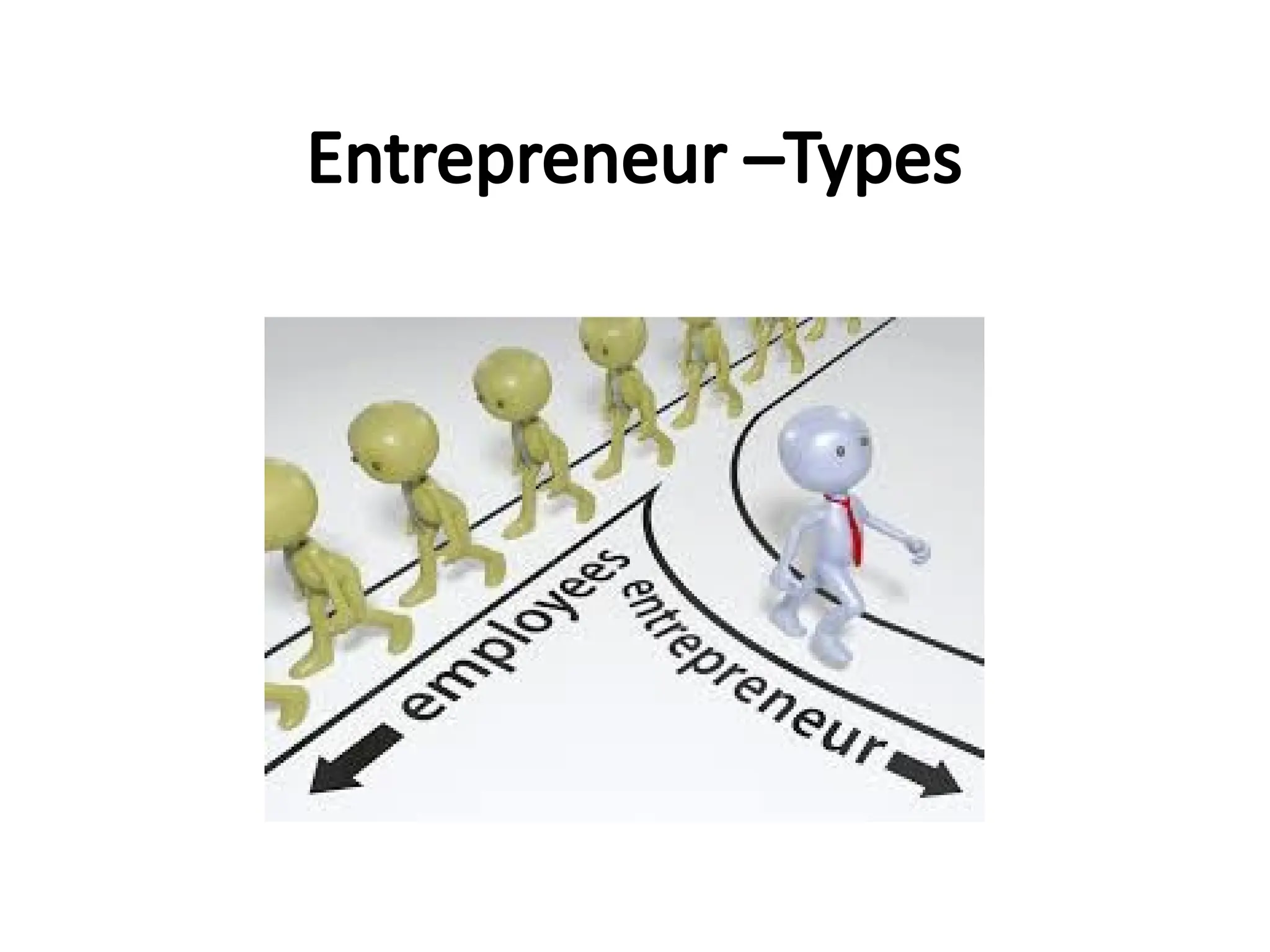
Entrepreneur –Types
Entrepreneur
• An entrepreneur is an individual with knowledge, skills, initiative,
drive and spirit of innovation who aims at achieving goals
• An entrepreneur identifies opportunities and seizes opportunities for
economic benefits
• An entrepreneur is a person who has possession of a new enterprise,
venture or idea and assumes significant accountability for the
inherent risks and the outcome
• The entrepreneur as a person brings in overall change through
innovation for the maximum social good
• An entrepreneur is a person who is willing and able to convert a new
idea or invention into a successful innovation
WHO IS AN ENTREPRENUER
• He is a person who develops and owns his
enterprise
• He is a moderate risk taker and works under
uncertainty for achieving the goal
• He is innovative
• He peruses the deviant pursuits
• Reflects strong urge to be independent
• Persistently tries to do something better
The word Entrepreneur
• The word “Entrepreneur” is derived from the French
verb entrepredre (to undertake the risk of new
enterprise)
• According to Management guru “Peter Drucker” an
entrepreneur is one who always searches for change,
responds to it and exploits it as an opportunity
• French Economist J.B.Say (1800) said “The
Entrepreneur”- shifts economic resources from an area
of lower productivity to an area of higher productivity
and greater yield
• An Entrepreneur uses innovation to exploit or create
change or opportunity for the purpose of making a profit
• Innovation is an instrument of entrepreneurship
• An entrepreneur innovates and creates resources
because there is no such thing as resource until
someone finds a use for something and endows
economic value to it
• In layman’s language, entrepreneur is a person or
group of people who decide to tap market
opportunities
• It must be clearly understood, that the
Entrepreneurs are generally of the “first generation”
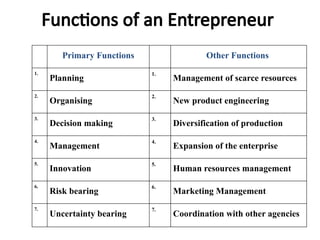
Functions of an Entrepreneur
Primary Functions Other Functions
1.
Planning
1.
Management of scarce resources
2.
Organising
2.
New product engineering
3.
Decision making
3.
Diversification of production
4.
Management
4.
Expansion of the enterprise
5.
Innovation
5.
Human resources management
6.
Risk bearing
6.
Marketing Management
7.
Uncertainty bearing
7.
Coordination with other agencies
Entrepreneurship is…
Process of identifying and pursuing business
opportunities, allocate resources, and create value
Process of creating value by bringing together
resources to exploit an opportunity
This creation of value is often through the identification
of unmet needs or through the identification of
opportunities for change
Set of critical thinking skills; act of being an
entrepreneur
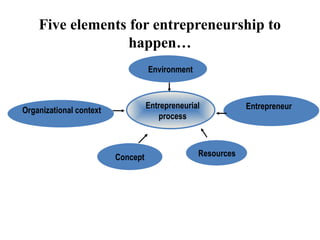
Five elements for entrepreneurship to
happen…
Organizational context Entrepreneur
Resources
Concept
Entrepreneurial
process
Environment
Dhirubhai Ambani
Built India's largest private sector company
• Rewrote Indian corporate history and built a truly global corporate
group. His father was a school teacher
• Started his entrepreneurial career by selling "bhajias"
• At 16, he moved to Aden, Yemen and worked as a gas-station
attendant, and as a clerk in an oil company. Returned to India in 1958
with Rs 50,000 and set up a textile trading company.
• Assisted by his two sons, Mukesh and Anil, Dhiru Bhai Ambani built
India's largest private sector company, Reliance India Limited, from a
scratch.
• Diversified into petrochemicals with additional interests in
telecommunications, information technology, energy, power, retail,
textiles, infrastructure services, capital markets, and logistics
• Dhirubhai Ambani was named the Indian Entrepreneur of the 20th
Century by the Federation of Indian Chambers of Commerce and
Industry (FICCI)
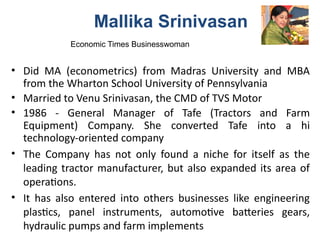
• Did MA (econometrics) from Madras University and MBA
from the Wharton School University of Pennsylvania
• Married to Venu Srinivasan, the CMD of TVS Motor
• 1986 - General Manager of Tafe (Tractors and Farm
Equipment) Company. She converted Tafe into a hi
technology-oriented company
• The Company has not only found a niche for itself as the
leading tractor manufacturer, but also expanded its area of
operations.
• It has also entered into others businesses like engineering
plastics, panel instruments, automotive batteries gears,
hydraulic pumps and farm implements
Mallika Srinivasan
Economic Times Businesswoman
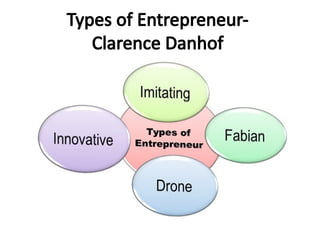
Types of Entrepreneur-
Clarence Danhof
Types of Entrepreneur
• Clarence Danhof classifies entrepreneurs into
four types
– Innovative: One who assembles and synthesis
information and introduces new combinations of
factors of production
– Imitative: Also known as adoptive entrepreneur.
He immediately adopts successful innovation
introduced by others
Contd.,
• Fabian: They do not initiate any inventions but follow
only after they are satisfied with its success rate. They
wait for some time before the innovation becomes
well tested by others and do not result in a huge loss
due to its failure.
• Drone Entrepreneurs: These entrepreneurs are
reluctant to change since they are very conservative
and do not want to make any changes in the
organization. They are happy with their present mode
of business and do not want to change even if they are
suffering the losses.
Aruthur H. Cole
classifies entrepreneurs as
– Empirical
– Rational
– Cognitive
• Empirical : he is an entrepreneur hardly
introduces anything revolutionary and follows
the principle of rule of thumb.
• Rational : the rational entrepreneur is well
informed about the general economic
conditions and introduces changes which look
more revolutionary.
• Cognitive : cognitive entrepreneur is well
informed, draws upon the advice and service
of experts and introduces changes that reflect
complete break from the existing scheme of
enterprise.
Other classifications
• Classification on the Basis of Ownership:
– Private: Private entrepreneur is motivated by profit
and it would not enter those sectors of the
economy in which prospects of monetary rewards
are not very bright
– Public Entrepreneurship: In the undeveloped
countries Government will take the initiative to
start enterprise
Classification Based on the Scale of Enterprise
• Small Scale: Specially popular in the
undeveloped countries. Do not posses the
necessary talents and resources to initiate
large scale production and introduce
revolutionary technological changes
• Large Scale: In developed countries most
entrepreneur deal with large scale enterprises.
Posses financial and necessary recourses to
initiate and introduce new technical changes
Classifications According to the type of business
• Business Entrepreneur:
Business entrepreneurs are individuals who conceive an
idea for a new product or service and-then creates a
business to materialize their idea into reality.
• Trading Entrepreneur:
Trading entrepreneur is one who undertakes trading
activities and is not concerned with the manufacturing
work. He identifies potential markets, stimulates demand
for his product line and creates a desire and interest
among buyers to go in for his product.
• Industrial Entrepreneur:
Industrial entrepreneur is essentially a manufacturer, who
identifies the potential needs of customers and tailors a product
or service to meet the marketing needs. He is a product-oriented
man who starts in an industrial unit because of the possibility of
making some new product.
• Corporate entrepreneur :
Corporate entrepreneur is a person who demonstrates his
innovative skill in organizing and managing corporate
undertaking
• Agricultural Entrepreneur:
Agricultural entrepreneurs are those entrepreneurs who
undertake agricultural activities as raising and marketing of
crops, fertilisers and other inputs of agriculture
According to the technology use
• Technical Entrepreneur:
A technical entrepreneur is essentially compared to a
“craftsman.” He develops improved quality of goods because
of his craftsmanship
• Non-technical Entrepreneur:
Non-technical entrepreneurs are those who are not concerned
with the technical aspects of the product in which they deal
Professional Entrepreneur:
Professional entrepreneur is a person who is interested in
establishing a business, but does not have interest in
managing or operating it once it is established
According to motivation
• Pure Entrepreneur
A pure entrepreneur is an individual who is motivated by psychological and
economic rewards. He undertakes an entrepreneurial activity for his personal
satisfaction in work, ego or status.
• Induced Entrepreneur
Induced entrepreneur is one who is induced to take up an entrepreneurial task
due to the policy measures of the government that provides assistance,
Incentives, concessions and necessary overhead, facilities to start a venture.
• Motivated Entrepreneur
New entrepreneurs are motivated by the desire for self-fulfilment. They come
into being because of the possibility of making and marketing some new
product for the use of consumers.
• Spontaneous Entrepreneur
These entrepreneurs start their business their by Entrepreneur. They are
persons with initiative, boldness and confidence in their_- ability, which
activate, them, underage entrepreneurial activity.
According to the growth
• Growth Entrepreneur:
Growth entrepreneurs are those who necessarily
take up a high growth industry, which has
substantial growth prospects.
• Super-Growth Entrepreneur:
Super-growth entrepreneurs are those who have
shown enormous growth of performance in their
venture. The growth performance is identified by
the liquidity of funds, profitability and gearing.
According to the stages of Development
• First-Generation Entrepreneur:
A first-generation entrepreneur is one who starts an industrial
unit by innovative skill.
• Modern Entrepreneur:
A modern entrepreneur is one who undertakes those ventures,
which go well along with the changing demand in the market.
• Classical Entrepreneur:
A classical entrepreneur is one who is concerned with the
customers and marketing needs through the development of a
self-supporting venture.
Entrepreneur agribusiness management presentation

Entrepreneur agribusiness management presentation

  • 1.
  • 2.
    Entrepreneur • An entrepreneuris an individual with knowledge, skills, initiative, drive and spirit of innovation who aims at achieving goals • An entrepreneur identifies opportunities and seizes opportunities for economic benefits • An entrepreneur is a person who has possession of a new enterprise, venture or idea and assumes significant accountability for the inherent risks and the outcome • The entrepreneur as a person brings in overall change through innovation for the maximum social good • An entrepreneur is a person who is willing and able to convert a new idea or invention into a successful innovation
  • 3.
    WHO IS ANENTREPRENUER • He is a person who develops and owns his enterprise • He is a moderate risk taker and works under uncertainty for achieving the goal • He is innovative • He peruses the deviant pursuits • Reflects strong urge to be independent • Persistently tries to do something better
  • 4.
    The word Entrepreneur •The word “Entrepreneur” is derived from the French verb entrepredre (to undertake the risk of new enterprise) • According to Management guru “Peter Drucker” an entrepreneur is one who always searches for change, responds to it and exploits it as an opportunity • French Economist J.B.Say (1800) said “The Entrepreneur”- shifts economic resources from an area of lower productivity to an area of higher productivity and greater yield • An Entrepreneur uses innovation to exploit or create change or opportunity for the purpose of making a profit
  • 5.
    • Innovation isan instrument of entrepreneurship • An entrepreneur innovates and creates resources because there is no such thing as resource until someone finds a use for something and endows economic value to it • In layman’s language, entrepreneur is a person or group of people who decide to tap market opportunities • It must be clearly understood, that the Entrepreneurs are generally of the “first generation”
  • 6.
    Functions of anEntrepreneur Primary Functions Other Functions 1. Planning 1. Management of scarce resources 2. Organising 2. New product engineering 3. Decision making 3. Diversification of production 4. Management 4. Expansion of the enterprise 5. Innovation 5. Human resources management 6. Risk bearing 6. Marketing Management 7. Uncertainty bearing 7. Coordination with other agencies
  • 7.
    Entrepreneurship is… Process ofidentifying and pursuing business opportunities, allocate resources, and create value Process of creating value by bringing together resources to exploit an opportunity This creation of value is often through the identification of unmet needs or through the identification of opportunities for change Set of critical thinking skills; act of being an entrepreneur
  • 8.
    Five elements forentrepreneurship to happen… Organizational context Entrepreneur Resources Concept Entrepreneurial process Environment
  • 9.
    Dhirubhai Ambani Built India'slargest private sector company • Rewrote Indian corporate history and built a truly global corporate group. His father was a school teacher • Started his entrepreneurial career by selling "bhajias" • At 16, he moved to Aden, Yemen and worked as a gas-station attendant, and as a clerk in an oil company. Returned to India in 1958 with Rs 50,000 and set up a textile trading company. • Assisted by his two sons, Mukesh and Anil, Dhiru Bhai Ambani built India's largest private sector company, Reliance India Limited, from a scratch. • Diversified into petrochemicals with additional interests in telecommunications, information technology, energy, power, retail, textiles, infrastructure services, capital markets, and logistics • Dhirubhai Ambani was named the Indian Entrepreneur of the 20th Century by the Federation of Indian Chambers of Commerce and Industry (FICCI)
  • 10.
    • Did MA(econometrics) from Madras University and MBA from the Wharton School University of Pennsylvania • Married to Venu Srinivasan, the CMD of TVS Motor • 1986 - General Manager of Tafe (Tractors and Farm Equipment) Company. She converted Tafe into a hi technology-oriented company • The Company has not only found a niche for itself as the leading tractor manufacturer, but also expanded its area of operations. • It has also entered into others businesses like engineering plastics, panel instruments, automotive batteries gears, hydraulic pumps and farm implements Mallika Srinivasan Economic Times Businesswoman
  • 11.
  • 12.
    Types of Entrepreneur •Clarence Danhof classifies entrepreneurs into four types – Innovative: One who assembles and synthesis information and introduces new combinations of factors of production – Imitative: Also known as adoptive entrepreneur. He immediately adopts successful innovation introduced by others
  • 13.
    Contd., • Fabian: Theydo not initiate any inventions but follow only after they are satisfied with its success rate. They wait for some time before the innovation becomes well tested by others and do not result in a huge loss due to its failure. • Drone Entrepreneurs: These entrepreneurs are reluctant to change since they are very conservative and do not want to make any changes in the organization. They are happy with their present mode of business and do not want to change even if they are suffering the losses.
  • 14.
    Aruthur H. Cole classifiesentrepreneurs as – Empirical – Rational – Cognitive
  • 15.
    • Empirical :he is an entrepreneur hardly introduces anything revolutionary and follows the principle of rule of thumb. • Rational : the rational entrepreneur is well informed about the general economic conditions and introduces changes which look more revolutionary. • Cognitive : cognitive entrepreneur is well informed, draws upon the advice and service of experts and introduces changes that reflect complete break from the existing scheme of enterprise.
  • 16.
    Other classifications • Classificationon the Basis of Ownership: – Private: Private entrepreneur is motivated by profit and it would not enter those sectors of the economy in which prospects of monetary rewards are not very bright – Public Entrepreneurship: In the undeveloped countries Government will take the initiative to start enterprise
  • 17.
    Classification Based onthe Scale of Enterprise • Small Scale: Specially popular in the undeveloped countries. Do not posses the necessary talents and resources to initiate large scale production and introduce revolutionary technological changes • Large Scale: In developed countries most entrepreneur deal with large scale enterprises. Posses financial and necessary recourses to initiate and introduce new technical changes
  • 18.
    Classifications According tothe type of business • Business Entrepreneur: Business entrepreneurs are individuals who conceive an idea for a new product or service and-then creates a business to materialize their idea into reality. • Trading Entrepreneur: Trading entrepreneur is one who undertakes trading activities and is not concerned with the manufacturing work. He identifies potential markets, stimulates demand for his product line and creates a desire and interest among buyers to go in for his product.
  • 19.
    • Industrial Entrepreneur: Industrialentrepreneur is essentially a manufacturer, who identifies the potential needs of customers and tailors a product or service to meet the marketing needs. He is a product-oriented man who starts in an industrial unit because of the possibility of making some new product. • Corporate entrepreneur : Corporate entrepreneur is a person who demonstrates his innovative skill in organizing and managing corporate undertaking • Agricultural Entrepreneur: Agricultural entrepreneurs are those entrepreneurs who undertake agricultural activities as raising and marketing of crops, fertilisers and other inputs of agriculture
  • 20.
    According to thetechnology use • Technical Entrepreneur: A technical entrepreneur is essentially compared to a “craftsman.” He develops improved quality of goods because of his craftsmanship • Non-technical Entrepreneur: Non-technical entrepreneurs are those who are not concerned with the technical aspects of the product in which they deal Professional Entrepreneur: Professional entrepreneur is a person who is interested in establishing a business, but does not have interest in managing or operating it once it is established
  • 21.
    According to motivation •Pure Entrepreneur A pure entrepreneur is an individual who is motivated by psychological and economic rewards. He undertakes an entrepreneurial activity for his personal satisfaction in work, ego or status. • Induced Entrepreneur Induced entrepreneur is one who is induced to take up an entrepreneurial task due to the policy measures of the government that provides assistance, Incentives, concessions and necessary overhead, facilities to start a venture. • Motivated Entrepreneur New entrepreneurs are motivated by the desire for self-fulfilment. They come into being because of the possibility of making and marketing some new product for the use of consumers. • Spontaneous Entrepreneur These entrepreneurs start their business their by Entrepreneur. They are persons with initiative, boldness and confidence in their_- ability, which activate, them, underage entrepreneurial activity.
  • 22.
    According to thegrowth • Growth Entrepreneur: Growth entrepreneurs are those who necessarily take up a high growth industry, which has substantial growth prospects. • Super-Growth Entrepreneur: Super-growth entrepreneurs are those who have shown enormous growth of performance in their venture. The growth performance is identified by the liquidity of funds, profitability and gearing.
  • 23.
    According to thestages of Development • First-Generation Entrepreneur: A first-generation entrepreneur is one who starts an industrial unit by innovative skill. • Modern Entrepreneur: A modern entrepreneur is one who undertakes those ventures, which go well along with the changing demand in the market. • Classical Entrepreneur: A classical entrepreneur is one who is concerned with the customers and marketing needs through the development of a self-supporting venture.