DAYALBAGH EDUCATIONAL INSTITUTE,
DAYALBAGH, AGRA
VCC202- APRECIATION OF ART II-
ARCHITECTURE
UNIT- 2
RIVER VALLEY
CIVILIZATION
QUESTIONS TO KEEP IN
MIND:
• How did geography impact the first civilizations?
• How did changes in the Neolithic Revolution lead to the
development of River Valley Civilizations?
THE RISE OF CIVILIZATION
• Arose in 4 separate river valleys around 3500 B.C.
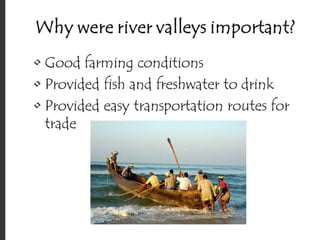
• Fertile soil, mild climate, waterway for transportation, water
for crops & drinking
• Provided for abundant crops and food surpluses
KEY VOCABULARY
• Civilization – form of culture in which some people live in cities and
have complex social institutions, use some form of writing, and are
skilled in science, art, and technology
• Empire – group of territories or nations ruled by a single ruler or
government
• Theocracy – government headed by religious leaders or a leader
regarded as a god
• Polytheistic – belief in many gods
• Monotheistic – belief in only one god
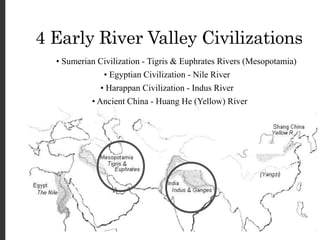
• Sumerian Civilization - Tigris & Euphrates Rivers (Mesopotamia)
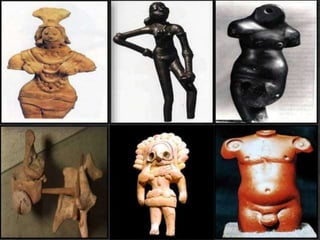
• Egyptian Civilization - Nile River
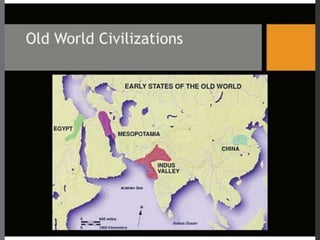
• Harappan Civilization - Indus River
• Ancient China - Huang He (Yellow) River
4 Early River Valley Civilizations
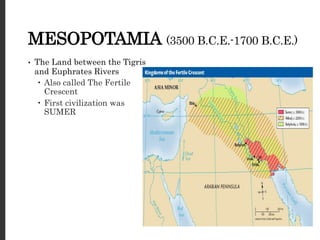
MESOPOTAMIA (3500 B.C.E.-1700 B.C.E.)
• The Land between the Tigris
and Euphrates Rivers
 Also called The Fertile
Crescent
 First civilization was
SUMER
Chapter 2 Lecture Outline:
“The Four Early River Valley Civilizations”
• Sumerian Civilization - Tigris & Euphrates Rivers (Mesopotamia)
City-States in Mesopotamia
Chapter 2 Lecture Outline: “The Four Early River Valley Civilizations”
City-States in Mesopotamia
I. GEOGRAPHY
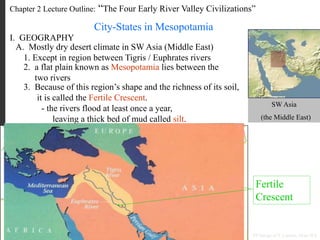
A. Mostly dry desert climate in SW Asia (Middle East)
SW Asia
(the Middle East)
PP Design of T. Loessin; Akins H.S.
Fertile
Crescent
1. Except in region between Tigris / Euphrates rivers
2. a flat plain known as Mesopotamia lies between the
two rivers
3. Because of this region’s shape and the richness of its soil,
it is called the Fertile Crescent.
- the rivers flood at least once a year,
leaving a thick bed of mud called silt.
Chapter 2 Lecture Outline: “The Four Early River Valley Civilizations”
City-States in Mesopotamia
I. GEOGRAPHY
PP Design of T. Loessin; Akins H.S.
3. Because of this region’s shape and the richness of it’s soil,
it is called the Fertile Crescent.
- the rivers flood at least once a year,
leaving a thick bed of mud called silt.
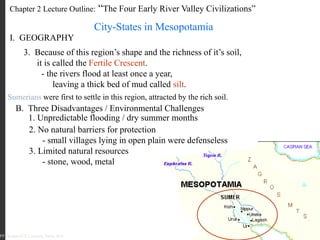
Sumerians were first to settle in this region, attracted by the rich soil.
B. Three Disadvantages / Environmental Challenges
1. Unpredictable flooding / dry summer months
2. No natural barriers for protection
- small villages lying in open plain were defenseless
3. Limited natural resources
- stone, wood, metal
PP Design of T. Loessin; Akins H.S.
Chapter 2 Lecture Outline: “The Four Early River Valley Civilizations”
City-States in Mesopotamia
I. GEOGRAPHY
PP Design of T. Loessin; Akins H.S.
Sumerians were first to settle in this region, attracted by the rich soil.
B. Three Disadvantages / Environmental Challenges
1. Unpredictable flooding / dry summer months
2. No natural barriers for protection
- small villages lying in open plain were defenseless
3. Limited natural resources (stone, wood, metal)
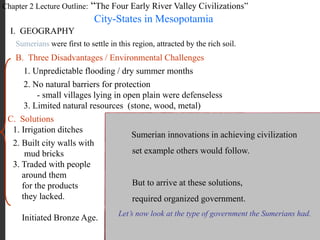
C. Solutions
1. Irrigation ditches
2. Built city walls with
mud bricks
3. Traded with people
around them
for the products
they lacked.
Initiated Bronze Age.
Sumerian innovations in achieving civilization
set example others would follow.
But to arrive at these solutions,
required organized government.
Let’s now look at the type of government the Sumerians had.
Chapter 2 Lecture Outline: “The Four Early River Valley Civilizations”
City-States in Mesopotamia
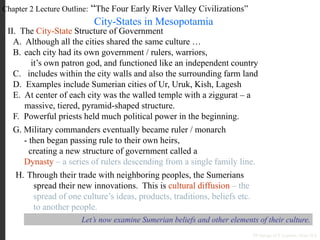
II. The City-State Structure of Government
A. Although all the cities shared the same culture …
B. each city had its own government / rulers, warriors,
it’s own patron god, and functioned like an independent country
C. includes within the city walls and also the surrounding farm land
D. Examples include Sumerian cities of Ur, Uruk, Kish, Lagesh
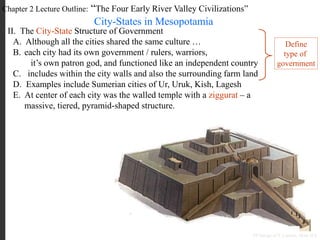
E. At center of each city was the walled temple with a ziggurat – a
massive, tiered, pyramid-shaped structure.
PP Design of T. Loessin; Akins H.S.
Define
type of
government
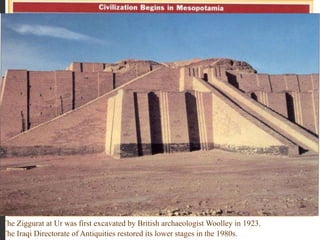
The Ziggurat at Ur was first excavated by British archaeologist Woolley in 1923.
The Iraqi Directorate of Antiquities restored its lower stages in the 1980s.
Chapter 2 Lecture Outline: “The Four Early River Valley Civilizations”
City-States in Mesopotamia
II. The City-State Structure of Government
A. Although all the cities shared the same culture …
B. each city had its own government / rulers, warriors,
it’s own patron god, and functioned like an independent country
C. includes within the city walls and also the surrounding farm land
D. Examples include Sumerian cities of Ur, Uruk, Kish, Lagesh
E. At center of each city was the walled temple with a
ziggurat – a massive, tiered, pyramid-shaped structure.
PP Design of T. Loessin; Akins H.S.
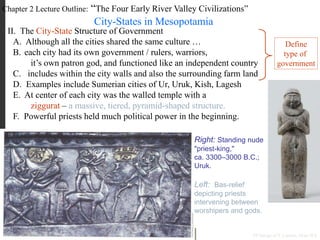
F. Powerful priests held much political power in the beginning.
Right: Standing nude
"priest-king,"
ca. 3300–3000 B.C.;
Uruk.
Left: Bas-relief
depicting priests
intervening between
worshipers and gods.
Define
type of
government
Chapter 2 Lecture Outline: “The Four Early River Valley Civilizations”
City-States in Mesopotamia
II. The City-State Structure of Government
A. Although all the cities shared the same culture …
B. each city had its own government / rulers, warriors,
it’s own patron god, and functioned like an independent country
C. includes within the city walls and also the surrounding farm land
Define
type of
government
D. Examples include Sumerian cities of Ur, Uruk, Kish, Lagesh
E. At center of each city was the walled temple with a ziggurat – a
massive, tiered, pyramid-shaped structure.
F. Powerful priests held much political power in the beginning.
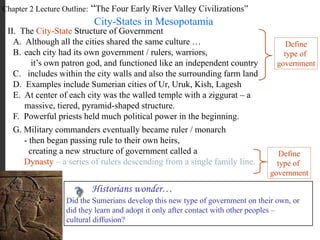
G. Military commanders eventually became ruler / monarch
- then began passing rule to their own heirs,
creating a new structure of government called a
Dynasty – a series of rulers descending from a single family line.
Define
type of
government
Historians wonder…
Did the Sumerians develop this new type of government on their own, or
did they learn and adopt it only after contact with other peoples –
cultural diffusion?
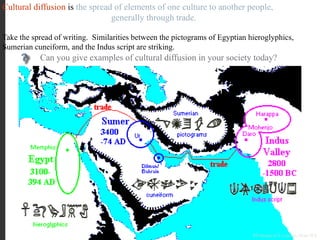
Cultural diffusion is the spread of elements of one culture to another people,
generally through trade.
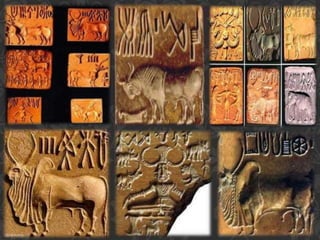
Take the spread of writing. Similarities between the pictograms of Egyptian hieroglyphics,
Sumerian cuneiform, and the Indus script are striking.
Can you give examples of cultural diffusion in your society today?
PP Design of T. Loessin; Akins H.S.
Chapter 2 Lecture Outline: “The Four Early River Valley Civilizations”
City-States in Mesopotamia
II. The City-State Structure of Government
A. Although all the cities shared the same culture …
B. each city had its own government / rulers, warriors,
it’s own patron god, and functioned like an independent country
C. includes within the city walls and also the surrounding farm land
D. Examples include Sumerian cities of Ur, Uruk, Kish, Lagesh
E. At center of each city was the walled temple with a ziggurat – a
massive, tiered, pyramid-shaped structure.
PP Design of T. Loessin; Akins H.S.
F. Powerful priests held much political power in the beginning.
G. Military commanders eventually became ruler / monarch
- then began passing rule to their own heirs,
creating a new structure of government called a
Dynasty – a series of rulers descending from a single family line.
H. Through their trade with neighboring peoples, the Sumerians
spread their new innovations. This is cultural diffusion – the
spread of one culture’s ideas, products, traditions, beliefs etc.
to another people.
Let’s now examine Sumerian beliefs and other elements of their culture.
Chapter 2 Lecture Outline: “The Four Early River Valley Civilizations”
City-States in Mesopotamia
III. SUMERIAN CULTURE
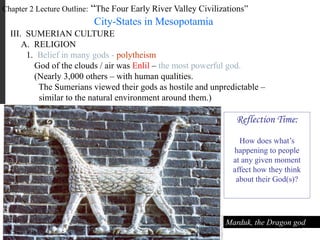
A. RELIGION
A Sumerian warrior-god, gold figurine, ca. 2,400-2,500 B.C.E.
1. Belief in many gods - polytheism
God of the clouds / air was Enlil – the most powerful god.
(Nearly 3,000 others – with human qualities.
The Sumerians viewed their gods as hostile and unpredictable –
similar to the natural environment around them.)
Marduk, the Dragon god
Reflection Time:
How does what’s
happening to people
at any given moment
affect how they think
about their God(s)?
Chapter 2 Lecture Outline: “The Four Early River Valley Civilizations”
City-States in Mesopotamia
III. SUMERIAN CULTURE
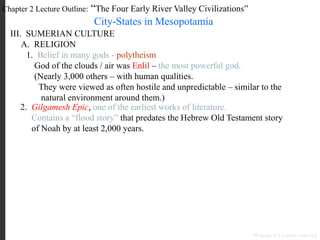
A. RELIGION
1. Belief in many gods - polytheism
God of the clouds / air was Enlil – the most powerful god.
(Nearly 3,000 others – with human qualities.
They were viewed as often hostile and unpredictable – similar to the
natural environment around them.)
2. Gilgamesh Epic, one of the earliest works of literature.
Contains a “flood story” that predates the Hebrew Old Testament story
of Noah by at least 2,000 years.
PP Design of T. Loessin; Akins H.S.
GILGAMESH
Great website to visit: http://gilgamesh.psnc.pl/
COOL WEBSITE to visit:
PP Design of T. Loessin; Akins H.S.
DID YOU KNOW…
Like many ancient civilizations, the Sumerians also had “a flood story.”
That’s not surprising given their challenging environment sitting
between two unpredictable rivers…in their view, such a
cataclysmic event did, indeed, destroy their “entire world.”
The Epic of Gilgamesh is, perhaps, the oldest written story on Earth.
It comes to us from ancient Sumeria, and was originally written on
12 clay tablets in cuneiform script. It is about the adventures of the
cruel King Gilgamesh of Uruk (ca. 2750 and 2500 BCE).
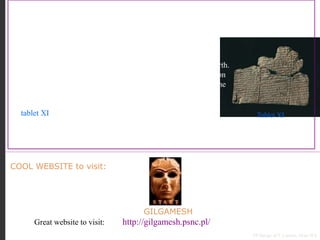
In tablet XI we read about Per-napishtim, a man who built a boat
and was saved from a great flood brought about by angry gods.
On p. 77 in your textbook you can compare Per-napishtim’s story to Noah’s story in the
biblical book of Genesis as well as a “flood story” from India.
Tablet XI
Chapter 2 Lecture Outline: “The Four Early River Valley Civilizations”
City-States in Mesopotamia
III. SUMERIAN CULTURE
A. RELIGION
1. Belief in many gods - polytheism
God of the clouds / air was Enlil – the most powerful god.
(Nearly 3,000 others – with human qualities.
They were viewed as often hostile and unpredictable – similar to the
natural environment around them.)
2. Gilgamesh Epic, one of the earliest works of literature.
Contains a “flood story” that predates the Hebrew Old Testament story
of Noah by at least 2,000 years.
Chapter 2 Lecture Outline: “The Four Early River Valley Civilizations”
City-States in Mesopotamia
III. SUMERIAN CULTURE
B. SOCIETY
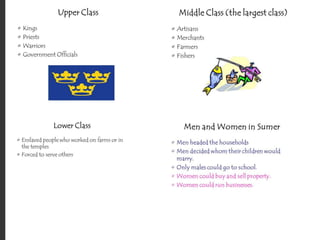
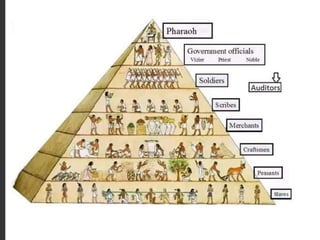
1. Three social classes
a. Priests and royalty (kings)
b. Wealthy merchants
c. Ordinary workers
[Slaves] –were not free citizens and thus not included in class system
2. Women
Left: Statue of Sumerian woman with hands clasped at chest,
ca. 2600-2300 B.C. Right: Gypsum statue of man and
woman at Inanna Temple at Nippur, circa 2600-2300 B.C.
a. Had more rights than in many later civilizations
(could own property, join lower ranks of priesthood)
b. But not allowed to attend schools
(could not read or write)
Chapter 2 Lecture Outline: “The Four Early River Valley Civilizations”
City-States in Mesopotamia
III. SUMERIAN CULTURE
C. SCIENCE & TECHNOLOGY
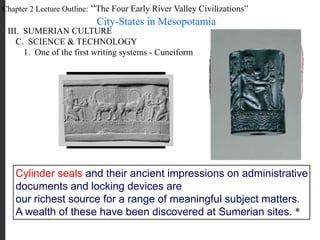
1. One of the first writing systems - Cuneiform
Cylinder seals and their ancient impressions on administrative
documents and locking devices are
our richest source for a range of meaningful subject matters.
A wealth of these have been discovered at Sumerian sites. *
Chapter 2 Lecture Outline: “The Four Early River Valley Civilizations”
City-States in Mesopotamia
III. SUMERIAN CULTURE
C. SCIENCE & TECHNOLOGY
1. One of the first writing systems - Cuneiform
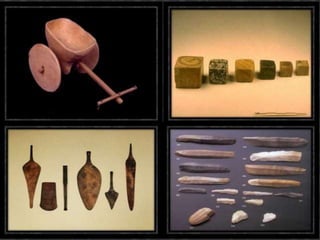
2. Invented wheel, the sail, the plow
3. First to use bronze.
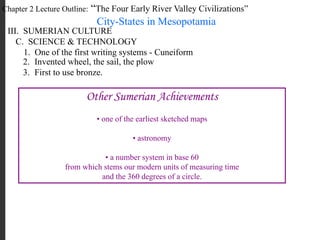
Other Sumerian Achievements
• one of the earliest sketched maps
• astronomy
• a number system in base 60
from which stems our modern units of measuring time
and the 360 degrees of a circle.
Chapter 2 Lecture Outline: “The Four Early River Valley Civilizations”
City-States in Mesopotamia
IV. First EMPIRE Builders
A. 3,000 – 2,000 B.C.E. the City-States began to war with each other.
These internal struggles meant they were too weak to ward off an attack
by an outside enemy.
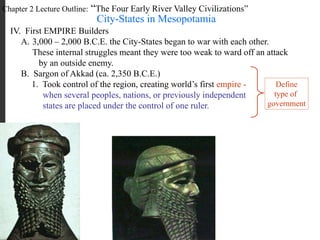
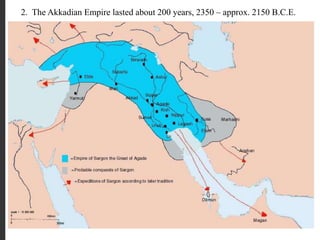
B. Sargon of Akkad (ca. 2,350 B.C.E.)
1. Took control of the region, creating world’s first empire -
when several peoples, nations, or previously independent
states are placed under the control of one ruler.
Define
type of
government
2. The Akkadian Empire lasted about 200 years, 2350 – approx. 2150 B.C.E.
Chapter 2 Lecture Outline: “The Four Early River Valley Civilizations”
City-States in Mesopotamia
IV. First EMPIRE Builders
A. 3,000 – 2,000 B.C.E. the City-States began to war with each other.
These internal struggle meant they were too weak to ward off an attack
by an outside enemy.
B. Sargon of Akkad (ca. 2,350 B.C.E.)
1. Took control of the region, creating world’s first empire -
bringing together several peoples, nations, or previously
independent states and place them under the control
of one ruler.
Define
type of
government
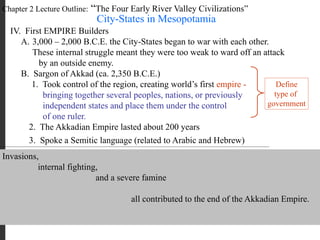
2. The Akkadian Empire lasted about 200 years
3. Spoke a Semitic language (related to Arabic and Hebrew)
Arabic Hebrew
sample Akkadian text
Invasions,
internal fighting,
and a severe famine
all contributed to the end of the Akkadian Empire.
Chapter 2 Lecture Outline: “The Four Early River Valley Civilizations”
City-States in Mesopotamia
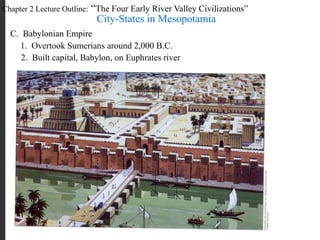
C. Babylonian Empire
1. Overtook Sumerians around 2,000 B.C.
2. Built capital, Babylon, on Euphrates river
Chapter 2 Lecture Outline: “The Four Early River Valley Civilizations”
City-States in Mesopotamia
C. Babylonian Empire
1. Overtook Sumerians around 2,000 B.C.E.
2. Built captial, Babylon, on Euphrates river
PP Design of T. Loessin; Akins H.S.
3. Reign of Hammurabi [1792-1750 B.C.E.]
3. Reign of Hammurabi
a. Famous Code of Law
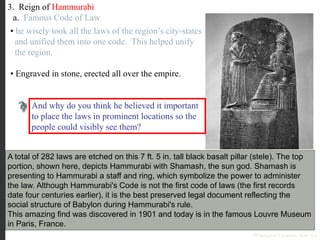
A total of 282 laws are etched on this 7 ft. 5 in. tall black basalt pillar (stele). The top
portion, shown here, depicts Hammurabi with Shamash, the sun god. Shamash is
presenting to Hammurabi a staff and ring, which symbolize the power to administer
the law. Although Hammurabi's Code is not the first code of laws (the first records
date four centuries earlier), it is the best preserved legal document reflecting the
social structure of Babylon during Hammurabi's rule.
This amazing find was discovered in 1901 and today is in the famous Louvre Museum
in Paris, France.
• he wisely took all the laws of the region’s city-states
and unified them into one code. This helped unify
the region.
• Engraved in stone, erected all over the empire.
Why do you think Hammurabi thought it
important to place all the cities within his
Empire under the same uniform code of laws?
And why do you think he believed it important
to place the laws in prominent locations so the
people could visibly see them?
PP Design of T. Loessin; Akins H.S.
3. Babylonian Reign of Hammurabi
a. Famous Code of Law
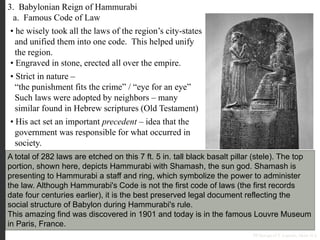
A total of 282 laws are etched on this 7 ft. 5 in. tall black basalt pillar (stele). The top
portion, shown here, depicts Hammurabi with Shamash, the sun god. Shamash is
presenting to Hammurabi a staff and ring, which symbolize the power to administer
the law. Although Hammurabi's Code is not the first code of laws (the first records
date four centuries earlier), it is the best preserved legal document reflecting the
social structure of Babylon during Hammurabi's rule.
This amazing find was discovered in 1901 and today is in the famous Louvre Museum
in Paris, France.
• he wisely took all the laws of the region’s city-states
and unified them into one code. This helped unify
the region.
• Engraved in stone, erected all over the empire.
PP Design of T. Loessin; Akins H.S.
• Strict in nature –
“the punishment fits the crime” / “eye for an eye”
Such laws were adopted by neighbors – many
similar found in Hebrew scriptures (Old Testament)
• His act set an important precedent – idea that the
government was responsible for what occurred in
society.
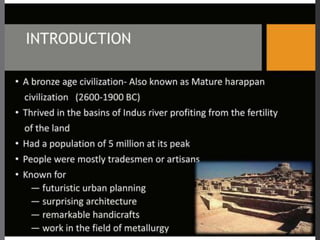
Bronze Age
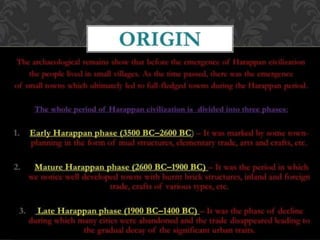
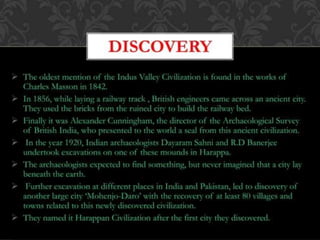
Indus Valley Civilization
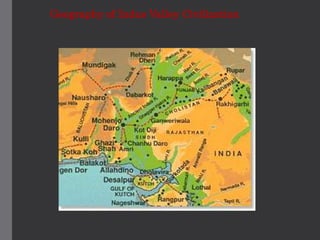
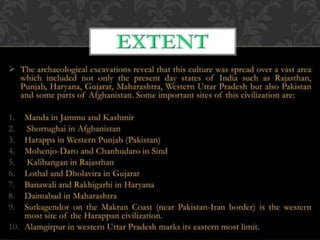
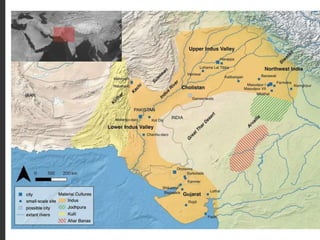
Geography of Indus Valley Civilization
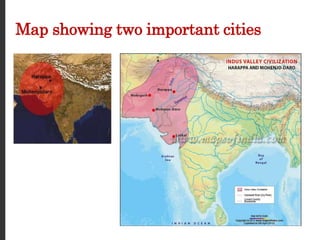
Map showing two important cities
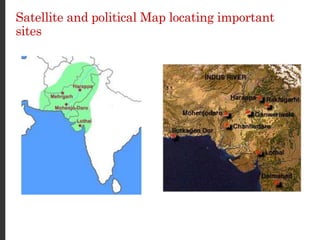
Satellite and political Map locating important
sites
UNIT 2.pptx for architecture students ()

UNIT 2.pptx for architecture students ()

  • 1.
    DAYALBAGH EDUCATIONAL INSTITUTE, DAYALBAGH,AGRA VCC202- APRECIATION OF ART II- ARCHITECTURE UNIT- 2 RIVER VALLEY CIVILIZATION
  • 2.
    QUESTIONS TO KEEPIN MIND: • How did geography impact the first civilizations? • How did changes in the Neolithic Revolution lead to the development of River Valley Civilizations?
  • 5.
    THE RISE OFCIVILIZATION • Arose in 4 separate river valleys around 3500 B.C. • Fertile soil, mild climate, waterway for transportation, water for crops & drinking • Provided for abundant crops and food surpluses
  • 6.
    KEY VOCABULARY • Civilization– form of culture in which some people live in cities and have complex social institutions, use some form of writing, and are skilled in science, art, and technology • Empire – group of territories or nations ruled by a single ruler or government • Theocracy – government headed by religious leaders or a leader regarded as a god • Polytheistic – belief in many gods • Monotheistic – belief in only one god
  • 7.
    • Sumerian Civilization- Tigris & Euphrates Rivers (Mesopotamia) • Egyptian Civilization - Nile River • Harappan Civilization - Indus River • Ancient China - Huang He (Yellow) River 4 Early River Valley Civilizations
  • 8.
    MESOPOTAMIA (3500 B.C.E.-1700B.C.E.) • The Land between the Tigris and Euphrates Rivers  Also called The Fertile Crescent  First civilization was SUMER
  • 9.
    Chapter 2 LectureOutline: “The Four Early River Valley Civilizations” • Sumerian Civilization - Tigris & Euphrates Rivers (Mesopotamia) City-States in Mesopotamia
  • 10.
    Chapter 2 LectureOutline: “The Four Early River Valley Civilizations” City-States in Mesopotamia I. GEOGRAPHY A. Mostly dry desert climate in SW Asia (Middle East) SW Asia (the Middle East) PP Design of T. Loessin; Akins H.S. Fertile Crescent 1. Except in region between Tigris / Euphrates rivers 2. a flat plain known as Mesopotamia lies between the two rivers 3. Because of this region’s shape and the richness of its soil, it is called the Fertile Crescent. - the rivers flood at least once a year, leaving a thick bed of mud called silt.
  • 11.
    Chapter 2 LectureOutline: “The Four Early River Valley Civilizations” City-States in Mesopotamia I. GEOGRAPHY PP Design of T. Loessin; Akins H.S. 3. Because of this region’s shape and the richness of it’s soil, it is called the Fertile Crescent. - the rivers flood at least once a year, leaving a thick bed of mud called silt. Sumerians were first to settle in this region, attracted by the rich soil. B. Three Disadvantages / Environmental Challenges 1. Unpredictable flooding / dry summer months 2. No natural barriers for protection - small villages lying in open plain were defenseless 3. Limited natural resources - stone, wood, metal PP Design of T. Loessin; Akins H.S.
  • 12.
    Chapter 2 LectureOutline: “The Four Early River Valley Civilizations” City-States in Mesopotamia I. GEOGRAPHY PP Design of T. Loessin; Akins H.S. Sumerians were first to settle in this region, attracted by the rich soil. B. Three Disadvantages / Environmental Challenges 1. Unpredictable flooding / dry summer months 2. No natural barriers for protection - small villages lying in open plain were defenseless 3. Limited natural resources (stone, wood, metal) C. Solutions 1. Irrigation ditches 2. Built city walls with mud bricks 3. Traded with people around them for the products they lacked. Initiated Bronze Age. Sumerian innovations in achieving civilization set example others would follow. But to arrive at these solutions, required organized government. Let’s now look at the type of government the Sumerians had.
  • 13.
    Chapter 2 LectureOutline: “The Four Early River Valley Civilizations” City-States in Mesopotamia II. The City-State Structure of Government A. Although all the cities shared the same culture … B. each city had its own government / rulers, warriors, it’s own patron god, and functioned like an independent country C. includes within the city walls and also the surrounding farm land D. Examples include Sumerian cities of Ur, Uruk, Kish, Lagesh E. At center of each city was the walled temple with a ziggurat – a massive, tiered, pyramid-shaped structure. PP Design of T. Loessin; Akins H.S. Define type of government
  • 14.
    The Ziggurat atUr was first excavated by British archaeologist Woolley in 1923. The Iraqi Directorate of Antiquities restored its lower stages in the 1980s.
  • 15.
    Chapter 2 LectureOutline: “The Four Early River Valley Civilizations” City-States in Mesopotamia II. The City-State Structure of Government A. Although all the cities shared the same culture … B. each city had its own government / rulers, warriors, it’s own patron god, and functioned like an independent country C. includes within the city walls and also the surrounding farm land D. Examples include Sumerian cities of Ur, Uruk, Kish, Lagesh E. At center of each city was the walled temple with a ziggurat – a massive, tiered, pyramid-shaped structure. PP Design of T. Loessin; Akins H.S. F. Powerful priests held much political power in the beginning. Right: Standing nude "priest-king," ca. 3300–3000 B.C.; Uruk. Left: Bas-relief depicting priests intervening between worshipers and gods. Define type of government
  • 16.
    Chapter 2 LectureOutline: “The Four Early River Valley Civilizations” City-States in Mesopotamia II. The City-State Structure of Government A. Although all the cities shared the same culture … B. each city had its own government / rulers, warriors, it’s own patron god, and functioned like an independent country C. includes within the city walls and also the surrounding farm land Define type of government D. Examples include Sumerian cities of Ur, Uruk, Kish, Lagesh E. At center of each city was the walled temple with a ziggurat – a massive, tiered, pyramid-shaped structure. F. Powerful priests held much political power in the beginning. G. Military commanders eventually became ruler / monarch - then began passing rule to their own heirs, creating a new structure of government called a Dynasty – a series of rulers descending from a single family line. Define type of government Historians wonder… Did the Sumerians develop this new type of government on their own, or did they learn and adopt it only after contact with other peoples – cultural diffusion?
  • 17.
    Cultural diffusion isthe spread of elements of one culture to another people, generally through trade. Take the spread of writing. Similarities between the pictograms of Egyptian hieroglyphics, Sumerian cuneiform, and the Indus script are striking. Can you give examples of cultural diffusion in your society today? PP Design of T. Loessin; Akins H.S.
  • 18.
    Chapter 2 LectureOutline: “The Four Early River Valley Civilizations” City-States in Mesopotamia II. The City-State Structure of Government A. Although all the cities shared the same culture … B. each city had its own government / rulers, warriors, it’s own patron god, and functioned like an independent country C. includes within the city walls and also the surrounding farm land D. Examples include Sumerian cities of Ur, Uruk, Kish, Lagesh E. At center of each city was the walled temple with a ziggurat – a massive, tiered, pyramid-shaped structure. PP Design of T. Loessin; Akins H.S. F. Powerful priests held much political power in the beginning. G. Military commanders eventually became ruler / monarch - then began passing rule to their own heirs, creating a new structure of government called a Dynasty – a series of rulers descending from a single family line. H. Through their trade with neighboring peoples, the Sumerians spread their new innovations. This is cultural diffusion – the spread of one culture’s ideas, products, traditions, beliefs etc. to another people. Let’s now examine Sumerian beliefs and other elements of their culture.
  • 19.
    Chapter 2 LectureOutline: “The Four Early River Valley Civilizations” City-States in Mesopotamia III. SUMERIAN CULTURE A. RELIGION A Sumerian warrior-god, gold figurine, ca. 2,400-2,500 B.C.E. 1. Belief in many gods - polytheism God of the clouds / air was Enlil – the most powerful god. (Nearly 3,000 others – with human qualities. The Sumerians viewed their gods as hostile and unpredictable – similar to the natural environment around them.) Marduk, the Dragon god Reflection Time: How does what’s happening to people at any given moment affect how they think about their God(s)?
  • 20.
    Chapter 2 LectureOutline: “The Four Early River Valley Civilizations” City-States in Mesopotamia III. SUMERIAN CULTURE A. RELIGION 1. Belief in many gods - polytheism God of the clouds / air was Enlil – the most powerful god. (Nearly 3,000 others – with human qualities. They were viewed as often hostile and unpredictable – similar to the natural environment around them.) 2. Gilgamesh Epic, one of the earliest works of literature. Contains a “flood story” that predates the Hebrew Old Testament story of Noah by at least 2,000 years. PP Design of T. Loessin; Akins H.S.
  • 21.
    GILGAMESH Great website tovisit: http://gilgamesh.psnc.pl/ COOL WEBSITE to visit: PP Design of T. Loessin; Akins H.S. DID YOU KNOW… Like many ancient civilizations, the Sumerians also had “a flood story.” That’s not surprising given their challenging environment sitting between two unpredictable rivers…in their view, such a cataclysmic event did, indeed, destroy their “entire world.” The Epic of Gilgamesh is, perhaps, the oldest written story on Earth. It comes to us from ancient Sumeria, and was originally written on 12 clay tablets in cuneiform script. It is about the adventures of the cruel King Gilgamesh of Uruk (ca. 2750 and 2500 BCE). In tablet XI we read about Per-napishtim, a man who built a boat and was saved from a great flood brought about by angry gods. On p. 77 in your textbook you can compare Per-napishtim’s story to Noah’s story in the biblical book of Genesis as well as a “flood story” from India. Tablet XI
  • 22.
    Chapter 2 LectureOutline: “The Four Early River Valley Civilizations” City-States in Mesopotamia III. SUMERIAN CULTURE A. RELIGION 1. Belief in many gods - polytheism God of the clouds / air was Enlil – the most powerful god. (Nearly 3,000 others – with human qualities. They were viewed as often hostile and unpredictable – similar to the natural environment around them.) 2. Gilgamesh Epic, one of the earliest works of literature. Contains a “flood story” that predates the Hebrew Old Testament story of Noah by at least 2,000 years.
  • 23.
    Chapter 2 LectureOutline: “The Four Early River Valley Civilizations” City-States in Mesopotamia III. SUMERIAN CULTURE B. SOCIETY 1. Three social classes a. Priests and royalty (kings) b. Wealthy merchants c. Ordinary workers [Slaves] –were not free citizens and thus not included in class system 2. Women Left: Statue of Sumerian woman with hands clasped at chest, ca. 2600-2300 B.C. Right: Gypsum statue of man and woman at Inanna Temple at Nippur, circa 2600-2300 B.C. a. Had more rights than in many later civilizations (could own property, join lower ranks of priesthood) b. But not allowed to attend schools (could not read or write)
  • 25.
    Chapter 2 LectureOutline: “The Four Early River Valley Civilizations” City-States in Mesopotamia III. SUMERIAN CULTURE C. SCIENCE & TECHNOLOGY 1. One of the first writing systems - Cuneiform Cylinder seals and their ancient impressions on administrative documents and locking devices are our richest source for a range of meaningful subject matters. A wealth of these have been discovered at Sumerian sites. *
  • 26.
    Chapter 2 LectureOutline: “The Four Early River Valley Civilizations” City-States in Mesopotamia III. SUMERIAN CULTURE C. SCIENCE & TECHNOLOGY 1. One of the first writing systems - Cuneiform 2. Invented wheel, the sail, the plow 3. First to use bronze. Other Sumerian Achievements • one of the earliest sketched maps • astronomy • a number system in base 60 from which stems our modern units of measuring time and the 360 degrees of a circle.
  • 27.
    Chapter 2 LectureOutline: “The Four Early River Valley Civilizations” City-States in Mesopotamia IV. First EMPIRE Builders A. 3,000 – 2,000 B.C.E. the City-States began to war with each other. These internal struggles meant they were too weak to ward off an attack by an outside enemy. B. Sargon of Akkad (ca. 2,350 B.C.E.) 1. Took control of the region, creating world’s first empire - when several peoples, nations, or previously independent states are placed under the control of one ruler. Define type of government
  • 28.
    2. The AkkadianEmpire lasted about 200 years, 2350 – approx. 2150 B.C.E.
  • 29.
    Chapter 2 LectureOutline: “The Four Early River Valley Civilizations” City-States in Mesopotamia IV. First EMPIRE Builders A. 3,000 – 2,000 B.C.E. the City-States began to war with each other. These internal struggle meant they were too weak to ward off an attack by an outside enemy. B. Sargon of Akkad (ca. 2,350 B.C.E.) 1. Took control of the region, creating world’s first empire - bringing together several peoples, nations, or previously independent states and place them under the control of one ruler. Define type of government 2. The Akkadian Empire lasted about 200 years 3. Spoke a Semitic language (related to Arabic and Hebrew) Arabic Hebrew sample Akkadian text Invasions, internal fighting, and a severe famine all contributed to the end of the Akkadian Empire.
  • 30.
    Chapter 2 LectureOutline: “The Four Early River Valley Civilizations” City-States in Mesopotamia C. Babylonian Empire 1. Overtook Sumerians around 2,000 B.C. 2. Built capital, Babylon, on Euphrates river
  • 31.
    Chapter 2 LectureOutline: “The Four Early River Valley Civilizations” City-States in Mesopotamia C. Babylonian Empire 1. Overtook Sumerians around 2,000 B.C.E. 2. Built captial, Babylon, on Euphrates river PP Design of T. Loessin; Akins H.S. 3. Reign of Hammurabi [1792-1750 B.C.E.]
  • 32.
    3. Reign ofHammurabi a. Famous Code of Law A total of 282 laws are etched on this 7 ft. 5 in. tall black basalt pillar (stele). The top portion, shown here, depicts Hammurabi with Shamash, the sun god. Shamash is presenting to Hammurabi a staff and ring, which symbolize the power to administer the law. Although Hammurabi's Code is not the first code of laws (the first records date four centuries earlier), it is the best preserved legal document reflecting the social structure of Babylon during Hammurabi's rule. This amazing find was discovered in 1901 and today is in the famous Louvre Museum in Paris, France. • he wisely took all the laws of the region’s city-states and unified them into one code. This helped unify the region. • Engraved in stone, erected all over the empire. Why do you think Hammurabi thought it important to place all the cities within his Empire under the same uniform code of laws? And why do you think he believed it important to place the laws in prominent locations so the people could visibly see them? PP Design of T. Loessin; Akins H.S.
  • 33.
    3. Babylonian Reignof Hammurabi a. Famous Code of Law A total of 282 laws are etched on this 7 ft. 5 in. tall black basalt pillar (stele). The top portion, shown here, depicts Hammurabi with Shamash, the sun god. Shamash is presenting to Hammurabi a staff and ring, which symbolize the power to administer the law. Although Hammurabi's Code is not the first code of laws (the first records date four centuries earlier), it is the best preserved legal document reflecting the social structure of Babylon during Hammurabi's rule. This amazing find was discovered in 1901 and today is in the famous Louvre Museum in Paris, France. • he wisely took all the laws of the region’s city-states and unified them into one code. This helped unify the region. • Engraved in stone, erected all over the empire. PP Design of T. Loessin; Akins H.S. • Strict in nature – “the punishment fits the crime” / “eye for an eye” Such laws were adopted by neighbors – many similar found in Hebrew scriptures (Old Testament) • His act set an important precedent – idea that the government was responsible for what occurred in society.
  • 34.
  • 38.
    Geography of IndusValley Civilization
  • 40.
    Map showing twoimportant cities
  • 41.
    Satellite and politicalMap locating important sites