Meanings of job, task, position and occupation
1. Job element : A smallest unit of the job. Folding, packing, stitching etc. in garment
industry.
2. Task : A group of job element under a job. e.g. preparing a letter for a
administrative assistant, making payroll for a account assistant, preparing a
drawing of a building for a architect etc.
3. Duty : Group of related task. e.g. preparing payroll, collecting attendance
record, issue bank order for pay deposit into bank, prepare monthly pay
report etc. for an account assistant.
4. Position : Duty to be perform by an individual. There may be number of
position as per the volume to duty to be performed.
5. Job: Title representing no of position. Accounting is a job in the organization
when there are one or more position to perform accounting duties.
6. Job family : Inter related jobs . e.g. accounting, book keeping, store keeping
etc.
7. Occupation : Skill or ability of and individual to perform different job in a job
family. e.g. a person in accounting occupation can perform auditing, costing,
accounting etc.
8. Career : Growth path in an occupation that also represent persons
expectation and professional advancement.
Job design 1
• Concept
• A design is an architecture of anything made to add value and usefulness.
• A design should consider value and norms of the user and the society.
• A job in the organization should also be designed so as to add value of the job
and make easy to perform the duties considering the value and norms of the
organization
• Meaning :
• Job design in an organization mean the contents of duties and methods to
perform.
• Job design not only include technical aspects of the task but also the
psychological and social aspects of the job in the organization
• A design consider for example the health and safety of a person to perform
and right and duties as well as relationship with other jobs.
Job design 2
• Definition
• "Job design is the way in which job tasks are organized into a unit
of work." Decenzo and Robbins.
• "The process of structuring work and designating the specific work
activities of an individual or group of individuals to achieve
organizational objectives." Byars and Rue.
• "Any activity that involves the alteration of specific jobs (or
interdependent systems of jobs) with the intent of increasing both
the quality of the employees' work experience and their on-the-job
productivity." Hackman.
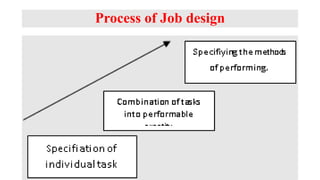
Process of Job design
Benefits
• Helpful to prepare organization structure
• Mach job with human character
• Improve quality of life
• Helpful to improve productivity
• Helpful to improve work motivation
• Helpful to acquire human resource
• Goal focused
Methods
• Classical Methods
• Job/Work simplification method
• Job rotation method
• Job enlargement method
• Job enrichment method
• Socio technical method :
• Considers psychological aspects of job.
• Diversification, learning opportunity, recognition, authority, coordination etc..
• Behavioral method
• Job characteristics method
• Autonomous method
• Modified work schedules method
• Compressed work week method
• Flexible work time method
• Job sharing method
• Part time job method
• Home office method
Job Analysis
• Concept :
• Understanding job elements, Tasks and duties. relationship with other job,
work environment etc.
• Three main characteristics-job contents, context and value of job.
• Make job description, specification and job evaluation.
• Meaning :
• Accumulate job attributes and relevant other information to understand job.
• Identifying job responsibility, authority and accountability of a job.
• Matching job characteristics with human characteristics.
Definition
• Job analysis is the procedure for determining the duties and skills
requirements of a job and the kinds of person who should be hired for
it (Gary Deshler).
• Job analysis provides information about jobs currently being done and
the knowledge, skills and abilities that individuals need to perform the
job adequately. It provides information to develop job description, job
specification and to conduct job evaluation (Decenzo and Robbins).
• ''Systematic process of collecting all information about a specific job,
including skill requirements, roles, responsibilities and processes in
order to create a valid job description and job specification" For our
purpose.
Purpose of job analysis
• Job design and redesign
• Prepare job description and specification.
• Develop performance standard
• Conduct job evaluation
• Identity human resource need
• Support recruitment and selection
• Identify HR development need
• Support HR planning
• Identity health and safety precaution
• Reduce labor dispute
• Help compensation determination
• Identify unassigned duties
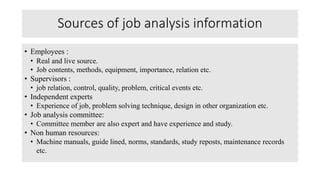
Sources of job analysis information
• Employees :
• Real and live source.
• Job contents, methods, equipment, importance, relation etc.
• Supervisors :
• job relation, control, quality, problem, critical events etc.
• Independent experts
• Experience of job, problem solving technique, design in other organization etc.
• Job analysis committee:
• Committee member are also expert and have experience and study.
• Non human resources:
• Machine manuals, guide lined, norms, standards, study reposts, maintenance records
etc.
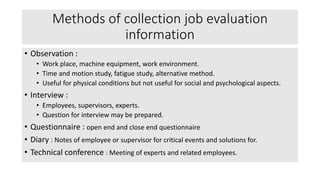
Methods of collection job evaluation
information
• Observation :
• Work place, machine equipment, work environment.
• Time and motion study, fatigue study, alternative method.
• Useful for physical conditions but not useful for social and psychological aspects.
• Interview :
• Employees, supervisors, experts.
• Question for interview may be prepared.
• Questionnaire : open end and close end questionnaire
• Diary : Notes of employee or supervisor for critical events and solutions for.
• Technical conference : Meeting of experts and related employees.
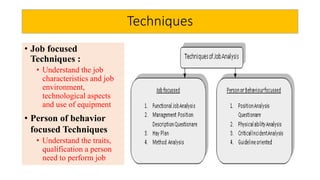
Techniques
• Job focused
Techniques :
• Understand the job
characteristics and job
environment,
technological aspects
and use of equipment
• Person of behavior
focused Techniques
• Understand the traits,
qualification a person
need to perform job
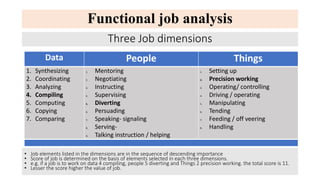
Functional job analysis
Data People Things
1. Synthesizing
2. Coordinating
3. Analyzing
4. Compiling
5. Computing
6. Copying
7. Comparing
1. Mentoring
2. Negotiating
3. Instructing
4. Supervising
5. Diverting
6. Persuading
7. Speaking- signaling
8. Serving-
9. Talking instruction / helping
1. Setting up
2. Precision working
3. Operating/ controlling
4. Driving / operating
5. Manipulating
6. Tending
7. Feeding / off veering
8. Handling
Three Job dimensions
• Job elements listed in the dimensions are in the sequence of descending importance
• Score of job is determined on the basis of elements selected in each three dimensions.
• e.g. if a job is to work on data 4 compiling, people 5 diverting and Things 2 precision working. the total score is 11.
• Lesser the score higher the value of job.
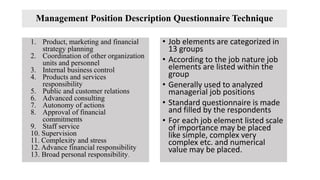
Management Position Description Questionnaire Technique
1. Product, marketing and financial
strategy planning
2. Coordination of other organization
units and personnel
3. Internal business control
4. Products and services
responsibility
5. Public and customer relations
6. Advanced consulting
7. Autonomy of actions
8. Approval of financial
commitments
9. Staff service
10. Supervision
11. Complexity and stress
12. Advance financial responsibility
13. Broad personal responsibility.
• Job elements are categorized in
13 groups
• According to the job nature job
elements are listed within the
group
• Generally used to analyzed
managerial job positions
• Standard questionnaire is made
and filled by the respondents
• For each job element listed scale
of importance may be placed
like simple, complex very
complex etc. and numerical
value may be placed.
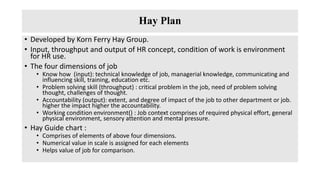
Hay Plan
• Developed by Korn Ferry Hay Group.
• Input, throughput and output of HR concept, condition of work is environment
for HR use.
• The four dimensions of job
• Know how (input): technical knowledge of job, managerial knowledge, communicating and
influencing skill, training, education etc.
• Problem solving skill (throughput) : critical problem in the job, need of problem solving
thought, challenges of thought.
• Accountability (output): extent, and degree of impact of the job to other department or job.
higher the impact higher the accountability.
• Working condition environment() : Job context comprises of required physical effort, general
physical environment, sensory attention and mental pressure.
• Hay Guide chart :
• Comprises of elements of above four dimensions.
• Numerical value in scale is assigned for each elements
• Helps value of job for comparison.
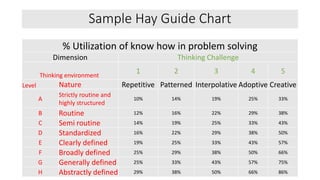
Sample Hay Guide Chart
% Utilization of know how in problem solving
Dimension Thinking Challenge
Thinking environment
1 2 3 4 5
Level Nature Repetitive Patterned Interpolative Adoptive Creative
A
Strictly routine and
highly structured
10% 14% 19% 25% 33%
B Routine 12% 16% 22% 29% 38%
C Semi routine 14% 19% 25% 33% 43%
D Standardized 16% 22% 29% 38% 50%
E Clearly defined 19% 25% 33% 43% 57%
F Broadly defined 25% 29% 38% 50% 66%
G Generally defined 25% 33% 43% 57% 75%
H Abstractly defined 29% 38% 50% 66% 86%
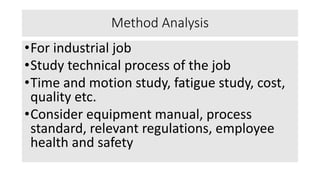
Method Analysis
•For industrial job
•Study technical process of the job
•Time and motion study, fatigue study, cost,
quality etc.
•Consider equipment manual, process
standard, relevant regulations, employee
health and safety
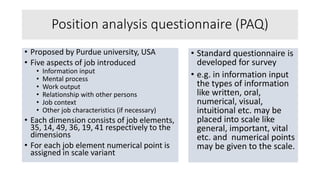
Position analysis questionnaire (PAQ)
• Proposed by Purdue university, USA
• Five aspects of job introduced
• Information input
• Mental process
• Work output
• Relationship with other persons
• Job context
• Other job characteristics (if necessary)
• Each dimension consists of job elements,
35, 14, 49, 36, 19, 41 respectively to the
dimensions
• For each job element numerical point is
assigned in scale variant
• Standard questionnaire is
developed for survey
• e.g. in information input
the types of information
like written, oral,
numerical, visual,
intuitional etc. may be
placed into scale like
general, important, vital
etc. and numerical points
may be given to the scale.
Physical ability analysis
• Analysis of physical ability for the job required
• e.g. workplace sickness, unintended sick leave, leaving
the job, work related mental problem etc. may be
physical ability problem for the job.
• Health and safety, person job fit, person organization
fit analysis are some examples
Critical incident analysis
• Listed critical events in the job previously happened
• Defined the role the position to play at the time of
critical event.
• Managers, supervisors, employees and job experts
may be the source to collect such events
Guideline oriented analysis
• Work manual for the performance of particular
technical job
• Manual specify working method, process, rules of
performance, standard of performance, quality, health
and safety measures etc.
• Manual help analyze general character physical and
mental of the job holder
Job Description
• Understanding the duties and responsibilities of a job in the
organization
• Require for the HR department and also for the job holder about
the duties and responsibilities including the general workplace
environment
• Contains list of duties
• Outcome of job analysis
• Help to prepare job specification
Contents of job description
• No standard format, depend upon the job itself and the purpose
• General contents are
• Job identification
• job summary
• Relationship with other job and units
• Duties and responsibilities
• Authorities
• Performance standard
• Working conditions
• Benefits
• Required qualification
Some guidelines to job description
• Determine the structure and the contents to be included
• Job analysis is required if its new job or first time preparing
• Approved by job description committee.
• Suggestion form supervisor is most helpful
• Job summary may be written in textual form and other should be in list
form
• Use of action verbs like prepare, check, review, communicate in the duty
section
• For the managerial level job responsibility may be grouped as primary
responsibility and duties under primary responsibility
• Where performance standard is mentioned, rights and abailability of
resources should also be mentioned.
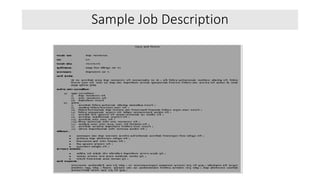
Sample Job Description
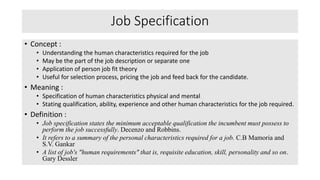
Job Specification
• Concept :
• Understanding the human characteristics required for the job
• May be the part of the job description or separate one
• Application of person job fit theory
• Useful for selection process, pricing the job and feed back for the candidate.
• Meaning :
• Specification of human characteristics physical and mental
• Stating qualification, ability, experience and other human characteristics for the job required.
• Definition :
• Job specification states the minimum acceptable qualification the incumbent must possess to
perform the job successfully. Decenzo and Robbins.
• It refers to a summary of the personal characteristics required for a job. C.B Mamoria and
S.V. Gankar
• A list of job's "human requirements" that is, requisite education, skill, personality and so on.
Gary Dessler.
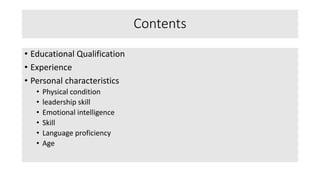
Contents
• Educational Qualification
• Experience
• Personal characteristics
• Physical condition
• leadership skill
• Emotional intelligence
• Skill
• Language proficiency
• Age
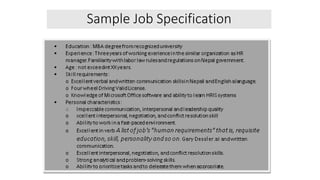
Sample Job Specification
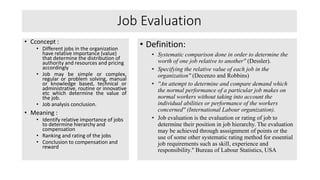
Job Evaluation
• Cconcept :
• Different jobs in the organization
have relative importance (value)
that determine the distribution of
authority and resources and pricing
accordingly
• Job may be simple or complex,
regular or problem solving, manual
or knowledge based, technical or
administrative, routine or innovative
etc which determine the value of
the job.
• Job analysis conclusion.
• Meaning :
• Identify relative importance of jobs
to determine hierarchy and
compensation
• Ranking and rating of the jobs
• Conclusion to compensation and
reward
• Definition:
• Systematic comparison done in order to determine the
worth of one job relative to another'' (Dessler).
• Specifying the relative value of each job in the
organization'' (Decenzo and Robbins)
• ''An attempt to determine and compare demand which
the normal performance of a particular job makes on
normal workers without taking into account the
individual abilities or performance of the workers
concerned'' (International Labour organization).
• Job evaluation is the evaluation or rating of job to
determine their position in job hierarchy. The evaluation
may be achieved through asssignment of points or the
use of some other systematic rating method for essential
job requirements such as skill, experience and
responsibility." Bureau of Labour Statistics, USA
Contents
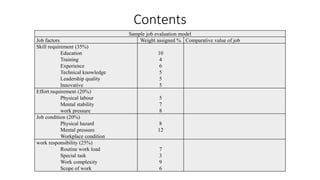
Sample job evaluation model
Job factors Weight assigned % Comparative value of job
Skill requirement (35%)
Education
Training
Experience
Technical knowledge
Leadership quality
Innovative
10
4
6
5
5
5
Effort requirement (20%)
Physical labour
Mental stability
work pressure
5
7
8
Job condition (20%)
Physical hazard
Mental pressure
Workplace condition
8
12
work responsibility (25%)
Routine work load
Special task
Work complexity
Scope of work
7
3
9
6
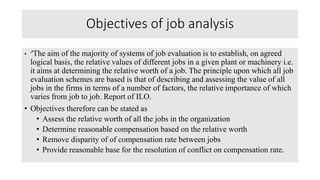
Objectives of job analysis
• ''The aim of the majority of systems of job evaluation is to establish, on agreed
logical basis, the relative values of different jobs in a given plant or machinery i.e.
it aims at determining the relative worth of a job. The principle upon which all job
evaluation schemes are based is that of describing and assessing the value of all
jobs in the firms in terms of a number of factors, the relative importance of which
varies from job to job. Report of ILO.
• Objectives therefore can be stated as
• Assess the relative worth of all the jobs in the organization
• Determine reasonable compensation based on the relative worth
• Remove disparity of of compensation rate between jobs
• Provide reasonable base for the resolution of conflict on compensation rate.
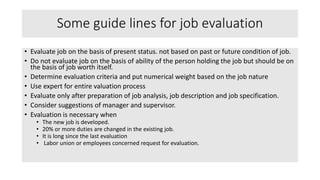
Some guide lines for job evaluation
• Evaluate job on the basis of present status. not based on past or future condition of job.
• Do not evaluate job on the basis of ability of the person holding the job but should be on
the basis of job worth itself.
• Determine evaluation criteria and put numerical weight based on the job nature
• Use expert for entire valuation process
• Evaluate only after preparation of job analysis, job description and job specification.
• Consider suggestions of manager and supervisor.
• Evaluation is necessary when
• The new job is developed.
• 20% or more duties are changed in the existing job.
• It is long since the last evaluation
• Labor union or employees concerned request for evaluation.
Methods of job evaluation 1
• Ranking :
• Listing the jobs in ascending or descending
order based on job worth comparison.
• On the ranking list amount of compensation
range may be placed
• Simple and useful for small and medium size
organization.
• To avoid personal bias a group of expert
should be engaged.
• Job classification/grading ;
• After having job description and specification
classify jobs such as routine, supervisory and
managerial etc. and also departmental
grading.
• The method is simple , useful to smaller to
larger organizations. The grade classification
help determine compensation scale range
• But difficult when there are many technical
jobs.
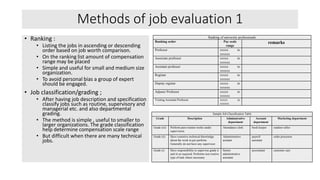
Sample Job Classification Table
Grade Description Adminutrative
department
Account
department
Marketing department
Grade (iii) Perform pure routine works under
supervision
Attendance clerk book keeper outdoor seller
Grade (ii) Have extentive technical khowledge
about the work to per perform.
Generally do not have any supervisor
Administrative
assitant
payroll
assistant
order processor
Grade (i) Have responsibility to supervise grade ii
and iii as required. Performs non routive
type of task where necessary
Senior
administrative
assistant
accountant customer care
Ranking of university professionals
Ranking order Pay scale
range
remarks
Professor xxxxx to
xxxxxx
Associate professor xxxxx to
xxxxxx
Assistant professor xxxxx to
xxxxxx
Registar xxxxx to
xxxxxx
Deputy registar xxxxx to
xxxxxx
Adjunct Professor xxxxx to
xxxxxx
Visiting Assistant Professor xxxxx to
xxxxxx
Methods of job evaluation 2
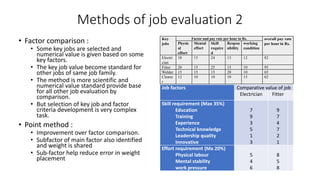
• Factor comparison :
• Some key jobs are selected and
numerical value is given based on some
key factors.
• The key job value become standard for
other jobs of same job family.
• The method is more scientific and
numerical value standard provide base
for all other job evaluation by
comparison.
• But selection of key job and factor
criteria development is very complex
task.
• Point method :
• Improvement over factor comparison.
• Subfactor of main factor also identified
and weight is shared
• Sub-factor help reduce error in weight
placement
Sample Piint Evaluation model
Job factors Comparative value of job
Electrician Fitter
Skill requirement (Max 35%)
Education
Training
Experience
Technical knowledge
Leadership quality
Innovative
7
9
3
5
1
3
9
7
4
7
2
1
Effort requirement (Ma 20%)
Physical labour
Mental stability
work pressure
5
4
6
8
5
8
Key
jobs
Factor and pay rate per hour in Rs. overall pay rate
per hour in Rs.
Physic
al
effort
Mental
effort
Skill
require
d
Respon
sibility
working
condition
Electri
cian
18 15 24 13 12 82
Fitter 20 15 25 15 10 95
Welder 15 15 15 20 10 65
Cleane
r
12 10 10 10 15 62
Methods of job evaluation 3
• Comparative market analysis
• Compare the compensation rate given by competitive other organization for
the same job.
• Government agency's compensation survey, reports of other organization,
labor unions or employers association reports may be source of information.
• Helpful to maintain competitive compensation rate,
• Difficult when competitors compensation rates are varying.

unit 2 job design, analysis and evaluation.pptx

  • 1.
    Meanings of job,task, position and occupation 1. Job element : A smallest unit of the job. Folding, packing, stitching etc. in garment industry. 2. Task : A group of job element under a job. e.g. preparing a letter for a administrative assistant, making payroll for a account assistant, preparing a drawing of a building for a architect etc. 3. Duty : Group of related task. e.g. preparing payroll, collecting attendance record, issue bank order for pay deposit into bank, prepare monthly pay report etc. for an account assistant. 4. Position : Duty to be perform by an individual. There may be number of position as per the volume to duty to be performed. 5. Job: Title representing no of position. Accounting is a job in the organization when there are one or more position to perform accounting duties. 6. Job family : Inter related jobs . e.g. accounting, book keeping, store keeping etc. 7. Occupation : Skill or ability of and individual to perform different job in a job family. e.g. a person in accounting occupation can perform auditing, costing, accounting etc. 8. Career : Growth path in an occupation that also represent persons expectation and professional advancement.
  • 2.
    Job design 1 •Concept • A design is an architecture of anything made to add value and usefulness. • A design should consider value and norms of the user and the society. • A job in the organization should also be designed so as to add value of the job and make easy to perform the duties considering the value and norms of the organization • Meaning : • Job design in an organization mean the contents of duties and methods to perform. • Job design not only include technical aspects of the task but also the psychological and social aspects of the job in the organization • A design consider for example the health and safety of a person to perform and right and duties as well as relationship with other jobs.
  • 3.
    Job design 2 •Definition • "Job design is the way in which job tasks are organized into a unit of work." Decenzo and Robbins. • "The process of structuring work and designating the specific work activities of an individual or group of individuals to achieve organizational objectives." Byars and Rue. • "Any activity that involves the alteration of specific jobs (or interdependent systems of jobs) with the intent of increasing both the quality of the employees' work experience and their on-the-job productivity." Hackman.
  • 4.
  • 5.
    Benefits • Helpful toprepare organization structure • Mach job with human character • Improve quality of life • Helpful to improve productivity • Helpful to improve work motivation • Helpful to acquire human resource • Goal focused
  • 6.
    Methods • Classical Methods •Job/Work simplification method • Job rotation method • Job enlargement method • Job enrichment method • Socio technical method : • Considers psychological aspects of job. • Diversification, learning opportunity, recognition, authority, coordination etc.. • Behavioral method • Job characteristics method • Autonomous method • Modified work schedules method • Compressed work week method • Flexible work time method • Job sharing method • Part time job method • Home office method
  • 7.
    Job Analysis • Concept: • Understanding job elements, Tasks and duties. relationship with other job, work environment etc. • Three main characteristics-job contents, context and value of job. • Make job description, specification and job evaluation. • Meaning : • Accumulate job attributes and relevant other information to understand job. • Identifying job responsibility, authority and accountability of a job. • Matching job characteristics with human characteristics.
  • 8.
    Definition • Job analysisis the procedure for determining the duties and skills requirements of a job and the kinds of person who should be hired for it (Gary Deshler). • Job analysis provides information about jobs currently being done and the knowledge, skills and abilities that individuals need to perform the job adequately. It provides information to develop job description, job specification and to conduct job evaluation (Decenzo and Robbins). • ''Systematic process of collecting all information about a specific job, including skill requirements, roles, responsibilities and processes in order to create a valid job description and job specification" For our purpose.
  • 9.
    Purpose of jobanalysis • Job design and redesign • Prepare job description and specification. • Develop performance standard • Conduct job evaluation • Identity human resource need • Support recruitment and selection • Identify HR development need • Support HR planning • Identity health and safety precaution • Reduce labor dispute • Help compensation determination • Identify unassigned duties
  • 10.
    Sources of jobanalysis information • Employees : • Real and live source. • Job contents, methods, equipment, importance, relation etc. • Supervisors : • job relation, control, quality, problem, critical events etc. • Independent experts • Experience of job, problem solving technique, design in other organization etc. • Job analysis committee: • Committee member are also expert and have experience and study. • Non human resources: • Machine manuals, guide lined, norms, standards, study reposts, maintenance records etc.
  • 11.
    Methods of collectionjob evaluation information • Observation : • Work place, machine equipment, work environment. • Time and motion study, fatigue study, alternative method. • Useful for physical conditions but not useful for social and psychological aspects. • Interview : • Employees, supervisors, experts. • Question for interview may be prepared. • Questionnaire : open end and close end questionnaire • Diary : Notes of employee or supervisor for critical events and solutions for. • Technical conference : Meeting of experts and related employees.
  • 12.
    Techniques • Job focused Techniques: • Understand the job characteristics and job environment, technological aspects and use of equipment • Person of behavior focused Techniques • Understand the traits, qualification a person need to perform job
  • 13.
    Functional job analysis DataPeople Things 1. Synthesizing 2. Coordinating 3. Analyzing 4. Compiling 5. Computing 6. Copying 7. Comparing 1. Mentoring 2. Negotiating 3. Instructing 4. Supervising 5. Diverting 6. Persuading 7. Speaking- signaling 8. Serving- 9. Talking instruction / helping 1. Setting up 2. Precision working 3. Operating/ controlling 4. Driving / operating 5. Manipulating 6. Tending 7. Feeding / off veering 8. Handling Three Job dimensions • Job elements listed in the dimensions are in the sequence of descending importance • Score of job is determined on the basis of elements selected in each three dimensions. • e.g. if a job is to work on data 4 compiling, people 5 diverting and Things 2 precision working. the total score is 11. • Lesser the score higher the value of job.
  • 14.
    Management Position DescriptionQuestionnaire Technique 1. Product, marketing and financial strategy planning 2. Coordination of other organization units and personnel 3. Internal business control 4. Products and services responsibility 5. Public and customer relations 6. Advanced consulting 7. Autonomy of actions 8. Approval of financial commitments 9. Staff service 10. Supervision 11. Complexity and stress 12. Advance financial responsibility 13. Broad personal responsibility. • Job elements are categorized in 13 groups • According to the job nature job elements are listed within the group • Generally used to analyzed managerial job positions • Standard questionnaire is made and filled by the respondents • For each job element listed scale of importance may be placed like simple, complex very complex etc. and numerical value may be placed.
  • 15.
    Hay Plan • Developedby Korn Ferry Hay Group. • Input, throughput and output of HR concept, condition of work is environment for HR use. • The four dimensions of job • Know how (input): technical knowledge of job, managerial knowledge, communicating and influencing skill, training, education etc. • Problem solving skill (throughput) : critical problem in the job, need of problem solving thought, challenges of thought. • Accountability (output): extent, and degree of impact of the job to other department or job. higher the impact higher the accountability. • Working condition environment() : Job context comprises of required physical effort, general physical environment, sensory attention and mental pressure. • Hay Guide chart : • Comprises of elements of above four dimensions. • Numerical value in scale is assigned for each elements • Helps value of job for comparison.
  • 16.
    Sample Hay GuideChart % Utilization of know how in problem solving Dimension Thinking Challenge Thinking environment 1 2 3 4 5 Level Nature Repetitive Patterned Interpolative Adoptive Creative A Strictly routine and highly structured 10% 14% 19% 25% 33% B Routine 12% 16% 22% 29% 38% C Semi routine 14% 19% 25% 33% 43% D Standardized 16% 22% 29% 38% 50% E Clearly defined 19% 25% 33% 43% 57% F Broadly defined 25% 29% 38% 50% 66% G Generally defined 25% 33% 43% 57% 75% H Abstractly defined 29% 38% 50% 66% 86%
  • 17.
    Method Analysis •For industrialjob •Study technical process of the job •Time and motion study, fatigue study, cost, quality etc. •Consider equipment manual, process standard, relevant regulations, employee health and safety
  • 18.
    Position analysis questionnaire(PAQ) • Proposed by Purdue university, USA • Five aspects of job introduced • Information input • Mental process • Work output • Relationship with other persons • Job context • Other job characteristics (if necessary) • Each dimension consists of job elements, 35, 14, 49, 36, 19, 41 respectively to the dimensions • For each job element numerical point is assigned in scale variant • Standard questionnaire is developed for survey • e.g. in information input the types of information like written, oral, numerical, visual, intuitional etc. may be placed into scale like general, important, vital etc. and numerical points may be given to the scale.
  • 19.
    Physical ability analysis •Analysis of physical ability for the job required • e.g. workplace sickness, unintended sick leave, leaving the job, work related mental problem etc. may be physical ability problem for the job. • Health and safety, person job fit, person organization fit analysis are some examples
  • 20.
    Critical incident analysis •Listed critical events in the job previously happened • Defined the role the position to play at the time of critical event. • Managers, supervisors, employees and job experts may be the source to collect such events
  • 21.
    Guideline oriented analysis •Work manual for the performance of particular technical job • Manual specify working method, process, rules of performance, standard of performance, quality, health and safety measures etc. • Manual help analyze general character physical and mental of the job holder
  • 22.
    Job Description • Understandingthe duties and responsibilities of a job in the organization • Require for the HR department and also for the job holder about the duties and responsibilities including the general workplace environment • Contains list of duties • Outcome of job analysis • Help to prepare job specification
  • 23.
    Contents of jobdescription • No standard format, depend upon the job itself and the purpose • General contents are • Job identification • job summary • Relationship with other job and units • Duties and responsibilities • Authorities • Performance standard • Working conditions • Benefits • Required qualification
  • 24.
    Some guidelines tojob description • Determine the structure and the contents to be included • Job analysis is required if its new job or first time preparing • Approved by job description committee. • Suggestion form supervisor is most helpful • Job summary may be written in textual form and other should be in list form • Use of action verbs like prepare, check, review, communicate in the duty section • For the managerial level job responsibility may be grouped as primary responsibility and duties under primary responsibility • Where performance standard is mentioned, rights and abailability of resources should also be mentioned.
  • 25.
  • 26.
    Job Specification • Concept: • Understanding the human characteristics required for the job • May be the part of the job description or separate one • Application of person job fit theory • Useful for selection process, pricing the job and feed back for the candidate. • Meaning : • Specification of human characteristics physical and mental • Stating qualification, ability, experience and other human characteristics for the job required. • Definition : • Job specification states the minimum acceptable qualification the incumbent must possess to perform the job successfully. Decenzo and Robbins. • It refers to a summary of the personal characteristics required for a job. C.B Mamoria and S.V. Gankar • A list of job's "human requirements" that is, requisite education, skill, personality and so on. Gary Dessler.
  • 27.
    Contents • Educational Qualification •Experience • Personal characteristics • Physical condition • leadership skill • Emotional intelligence • Skill • Language proficiency • Age
  • 28.
  • 29.
    Job Evaluation • Cconcept: • Different jobs in the organization have relative importance (value) that determine the distribution of authority and resources and pricing accordingly • Job may be simple or complex, regular or problem solving, manual or knowledge based, technical or administrative, routine or innovative etc which determine the value of the job. • Job analysis conclusion. • Meaning : • Identify relative importance of jobs to determine hierarchy and compensation • Ranking and rating of the jobs • Conclusion to compensation and reward • Definition: • Systematic comparison done in order to determine the worth of one job relative to another'' (Dessler). • Specifying the relative value of each job in the organization'' (Decenzo and Robbins) • ''An attempt to determine and compare demand which the normal performance of a particular job makes on normal workers without taking into account the individual abilities or performance of the workers concerned'' (International Labour organization). • Job evaluation is the evaluation or rating of job to determine their position in job hierarchy. The evaluation may be achieved through asssignment of points or the use of some other systematic rating method for essential job requirements such as skill, experience and responsibility." Bureau of Labour Statistics, USA
  • 30.
    Contents Sample job evaluationmodel Job factors Weight assigned % Comparative value of job Skill requirement (35%) Education Training Experience Technical knowledge Leadership quality Innovative 10 4 6 5 5 5 Effort requirement (20%) Physical labour Mental stability work pressure 5 7 8 Job condition (20%) Physical hazard Mental pressure Workplace condition 8 12 work responsibility (25%) Routine work load Special task Work complexity Scope of work 7 3 9 6
  • 31.
    Objectives of jobanalysis • ''The aim of the majority of systems of job evaluation is to establish, on agreed logical basis, the relative values of different jobs in a given plant or machinery i.e. it aims at determining the relative worth of a job. The principle upon which all job evaluation schemes are based is that of describing and assessing the value of all jobs in the firms in terms of a number of factors, the relative importance of which varies from job to job. Report of ILO. • Objectives therefore can be stated as • Assess the relative worth of all the jobs in the organization • Determine reasonable compensation based on the relative worth • Remove disparity of of compensation rate between jobs • Provide reasonable base for the resolution of conflict on compensation rate.
  • 32.
    Some guide linesfor job evaluation • Evaluate job on the basis of present status. not based on past or future condition of job. • Do not evaluate job on the basis of ability of the person holding the job but should be on the basis of job worth itself. • Determine evaluation criteria and put numerical weight based on the job nature • Use expert for entire valuation process • Evaluate only after preparation of job analysis, job description and job specification. • Consider suggestions of manager and supervisor. • Evaluation is necessary when • The new job is developed. • 20% or more duties are changed in the existing job. • It is long since the last evaluation • Labor union or employees concerned request for evaluation.
  • 33.
    Methods of jobevaluation 1 • Ranking : • Listing the jobs in ascending or descending order based on job worth comparison. • On the ranking list amount of compensation range may be placed • Simple and useful for small and medium size organization. • To avoid personal bias a group of expert should be engaged. • Job classification/grading ; • After having job description and specification classify jobs such as routine, supervisory and managerial etc. and also departmental grading. • The method is simple , useful to smaller to larger organizations. The grade classification help determine compensation scale range • But difficult when there are many technical jobs. Sample Job Classification Table Grade Description Adminutrative department Account department Marketing department Grade (iii) Perform pure routine works under supervision Attendance clerk book keeper outdoor seller Grade (ii) Have extentive technical khowledge about the work to per perform. Generally do not have any supervisor Administrative assitant payroll assistant order processor Grade (i) Have responsibility to supervise grade ii and iii as required. Performs non routive type of task where necessary Senior administrative assistant accountant customer care Ranking of university professionals Ranking order Pay scale range remarks Professor xxxxx to xxxxxx Associate professor xxxxx to xxxxxx Assistant professor xxxxx to xxxxxx Registar xxxxx to xxxxxx Deputy registar xxxxx to xxxxxx Adjunct Professor xxxxx to xxxxxx Visiting Assistant Professor xxxxx to xxxxxx
  • 34.
    Methods of jobevaluation 2 • Factor comparison : • Some key jobs are selected and numerical value is given based on some key factors. • The key job value become standard for other jobs of same job family. • The method is more scientific and numerical value standard provide base for all other job evaluation by comparison. • But selection of key job and factor criteria development is very complex task. • Point method : • Improvement over factor comparison. • Subfactor of main factor also identified and weight is shared • Sub-factor help reduce error in weight placement Sample Piint Evaluation model Job factors Comparative value of job Electrician Fitter Skill requirement (Max 35%) Education Training Experience Technical knowledge Leadership quality Innovative 7 9 3 5 1 3 9 7 4 7 2 1 Effort requirement (Ma 20%) Physical labour Mental stability work pressure 5 4 6 8 5 8 Key jobs Factor and pay rate per hour in Rs. overall pay rate per hour in Rs. Physic al effort Mental effort Skill require d Respon sibility working condition Electri cian 18 15 24 13 12 82 Fitter 20 15 25 15 10 95 Welder 15 15 15 20 10 65 Cleane r 12 10 10 10 15 62
  • 35.
    Methods of jobevaluation 3 • Comparative market analysis • Compare the compensation rate given by competitive other organization for the same job. • Government agency's compensation survey, reports of other organization, labor unions or employers association reports may be source of information. • Helpful to maintain competitive compensation rate, • Difficult when competitors compensation rates are varying.