Introduction to NLP
Introduction to NLP 2
Scope
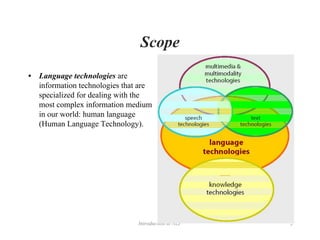
• Language technologies are
information technologies that are
specialized for dealing with the
most complex information medium
in our world: human language
(Human Language Technology).
Introduction to NLP 3
Applications
• Although existing LT systems are far from achieving human ability, they have
numerous possible applications.
• The goal is to create software products that have some knowledge of human
language.
• Such products are going to change our lives.
• They are urgently needed for improving human-machine interaction since the
main obstacle in the interaction between human and computer is merely a
communication problem.
• Today's computers do not understand our language but computer languages are
difficult to learn and do not correspond to the structure of human thought.
• Even if the language the machine understands and its domain of discourse are
very restricted, the use of human language can increase the acceptance of
software and the productivity of its users.
Introduction to NLP 4
Applications
Friendly technology should listen and speak
• Applications of natural language interfaces
– Database queries, information retrieval from texts, so-called expert
systems, and robot control.
• Spoken language needs to be combined with other modes of
communication such as pointing with mouse or finger.
– If such multimodal communication is finally embedded in an effective
general model of cooperation, we have succeeded in turning the machine
into a partner.
– The ultimate goal of research is the omnipresent access to all kinds of
technology and to the global information structure by natural interaction.
Introduction to NLP 5
Applications
Machines can also help people communicate with each other
• One of the original aims of language technology has always been fully
automatic translation between human languages.
– Still far away from achieving the ambitious goal of translating unrestricted texts.
– Nevertheless, they have been able to create software systems that simplify the work
of human translators and clearly improve their productivity.
– Less than perfect automatic translations can also be of great help to information
seekers who have to search through large amounts of texts in foreign languages.
• The most serious bottleneck for e-commerce is the volume of communication
between business and customers or among businesses.
– Language technology can help to sort, filter and route incoming email.
– It can also assist the customer relationship agent to look up information and to
compose a response.
– In cases where questions have been answered before, language technology can find
appropriate earlier replies and automatically respond.
Introduction to NLP 6
Applications
Language is the fabric of the web
• Although the new media combine text, graphics, sound and movies, the whole
world of multimedia information can only be structured, indexed and
navigated through language.
– For browsing, navigating, filtering and processing the information on the web, we
need software that can get at the contents of documents.
• Language technology for content management is a necessary precondition for
turning the wealth of digital information into collective knowledge.
• The increasing multilinguality of the web constitutes an additional challenge
for language technology.
– The global web can only be mastered with the help of multilingual tools for
indexing and navigating.
– Systems for crosslingual information and knowledge management will surmount
language barriers for e-commerce, education and international cooperation.
Introduction to NLP 7
Technologies
• Speech recognition
– Spoken language is recognized and
transformed in into text as in
dictation systems, into commands
as in robot control systems, or into
some other internal representation.
• Speech synthesis
– Utterances in spoken language are
produced from text (text-to-speech
systems) or from internal
representations of words or
sentences (concept-to-speech
systems)
Introduction to NLP 8
Technologies
• Text categorization
– This technology assigns texts to
categories. Texts may belong to
more than one category, categories
may contain other categories.
Filtering is a special case of
categorization with just two
categories.
• Text Summarization
– The most relevant portions of a
text are extracted as a summary.
The task depends on the needed
lengths of the summaries.
Summarization is harder if the
summary has to be specific to a
certain query.
Introduction to NLP 9
Technologies
• Text Indexing
– As a precondition for document
retrieval, texts are stored in an indexed
database. Usually a text is indexed for
all word forms or – after lemmatization
– for all lemmas. Sometimes indexing is
combined with categorization and
summarization.
• Text Retrieval
– Texts are retrieved from a database that
best match a given query or document.
The candidate documents are ordered
with respect to their expected relevance.
Indexing, categorization, summarization
and retrieval are often subsumed under
the term information retrieval.
Introduction to NLP 10
Technologies
• Information Extraction
– Relevant information pieces of
information are discovered and marked
for extraction. The extracted pieces can
be: the topic, named entities such as
company, place or person names, simple
relations such as prices, destinations,
functions etc. or complex relations
describing accidents, company mergers
or football matches.
• Data Fusion and Text Data Mining
– Extracted pieces of information from
several sources are combined in one
database. Previously undetected
relationships may be discovered.
Introduction to NLP 11
Technologies
• Question Answering
– Natural language queries are used
to access information in a database.
The database may be a base of
structured data or a repository of
digital texts in which certain parts
have been marked as potential
answers.
• Report Generation
– A report in natural language is
produced that describes the
essential contents or changes of a
database. The report can contain
accumulated numbers, maxima,
minima and the most drastic
changes.
Introduction to NLP 12
Technologies
• Spoken Dialogue Systems
– The system can carry out a
dialogue with a human user in
which the user can solicit
information or conduct purchases,
reservations or other transactions.
• Translation Technologies
– Technologies that translate texts or
assist human translators.
Automatic translation is called
machine translation. Translation
memories use large amounts of
texts together with existing
translations for efficient look-up of
possible translations for words,
phrases and sentences.
Introduction to NLP 13
Methods and Resources
• The methods of language technology come from several disciplines:
– computer science,
– computational and theoretical linguistics,
– mathematics,
– electrical engineering and
– psychology.
Introduction to NLP 14
Methods and Resources
• Generic CS Methods
– Programming languages, algorithms for generic data types, and software
engineering methods for structuring and organizing software development
and quality assurance.
• Specialized Algorithms
– Dedicated algorithms have been designed for parsing, generation and
translation, for morphological and syntactic processing with finite state
automata/transducers and many other tasks.
• Nondiscrete Mathematical Methods
– Statistical techniques have become especially successful in speech
processing, information retrieval, and the automatic acquisition of
language models. Other methods in this class are neural networks and
powerful techniques for optimization and search.
Introduction to NLP 15
Methods and Resources
• Logical and Linguistic Formalisms
– For deep linguistic processing, constraint based grammar formalisms are
employed. Complex formalisms have been developed for the
representation of semantic content and knowledge.
• Linguistic Knowledge
– Linguistic knowledge resources for many languages are utilized:
dictionaries, morphological and syntactic grammars, rules for semantic
interpretation, pronunciation and intonation.
• Corpora and Corpus Tools
– Large collections of application-specific or generic collections of spoken
and written language are exploited for the acquisition and testing of
statistical or rule-based language models.
Introduction to NLP 16
Background
• Solving the language-related problems and others like them, is the
main concern of the fields known as Natural Language Processing,
Computational Linguistics, and Speech Recognition and Synthesis,
which together we call Speech and Language Processing(SLP).
• Applications of language processing
– spelling correction,
– grammar checking,
– information retrieval, and
– machine translation.
Introduction to NLP 17
1.1 Knowledge in Speech and Language Processing
• By SLP, we have in mind those computational techniques that process
spoken and written human language, as language.
• What distinguishes these language processing applications from other
data processing systems is their use of knowledge of language.
• Unix wc program
– When used to count bytes and lines, wc is an ordinary data processing
application.
– However, when it is used to count the words in a file it requires knowledge
about what it means to be a word, and thus becomes a language
processing system.
Introduction to NLP 18
1.1 Knowledge in Speech and Language Processing
• Both the tasks of being capable of analyzing an incoming audio signal
and recovering the exact sequence of words and generating its
response require knowledge about phonetics and phonology, which
can help model how words are pronounced in colloquial speech
(Chapters 4 and 5).
• Producing and recognizing the variations of individual words (e.g.,
recognizing that doors is plural) requires knowledge about
morphology, which captures information about the shape and behavior
of words in context (Chapters 2 and 3).
Introduction to NLP 19
1.1 Knowledge in Speech and Language Processing
• Syntax: the knowledge needed to order and group words together
HAL, the pod bay door is open.
HAL, is the pod bay door open?
I’m I do, sorry that afraid Dave I’m can’t.
(Dave, I’m sorry I’m afraid I can’t do that.)
Introduction to NLP 20
1.1 Knowledge in Speech and Language Processing
• Lexical semantics: knowledge of the meanings of the component
words
• Compositional semantics: knowledge of how these components
combine to form larger meanings
– To know that Dave’s command is actually about opening the pod bay
door, rather than an inquiry about the day’s lunch menu.
Introduction to NLP 21
1.1 Knowledge in Speech and Language Processing
• Pragmatics: the appropriate use of the kind of polite and indirect
language
No or
No, I won’t open the door.
I’m sorry, I’m afraid, I can’t.
I won’t.
Introduction to NLP 22
1.1 Knowledge in Speech and Language Processing
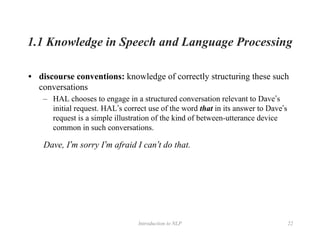
• discourse conventions: knowledge of correctly structuring these such
conversations
– HAL chooses to engage in a structured conversation relevant to Dave’s
initial request. HAL’s correct use of the word that in its answer to Dave’s
request is a simple illustration of the kind of between-utterance device
common in such conversations.
Dave, I’m sorry I’m afraid I can’t do that.
Introduction to NLP 23
1.1 Knowledge in Speech and Language Processing
• Phonetics and Phonology — The study of linguistic sounds
• Morphology —The study of the meaningful components of words
• Syntax —The study of the structural relationships between words
• Semantics — The study of meaning
• Pragmatics — The study of how language is used to accomplish goals
• Discourse—The study of linguistic units larger than a single utterance
Introduction to NLP 24
Introduction to NLP 25
1.2 Ambiguity
• A perhaps surprising fact about the six categories of linguistic
knowledge is that most or all tasks in speech and language processing
can be viewed as resolving ambiguity at one of these levels.
• We say some input is ambiguous
– if there are multiple alternative linguistic structures than can be built for it.
• The spoken sentence, I made her duck, has five different meanings.
– (1.1) I cooked waterfowl for her.
– (1.2) I cooked waterfowl belonging to her.
– (1.3) I created the (plaster?) duck she owns.
– (1.4) I caused her to quickly lower her head or body.
– (1.5) I waved my magic wand and turned her into undifferentiated
waterfowl.
Introduction to NLP 26
1.2 Ambiguity
• These different meanings are caused by a number of ambiguities.
– Duck can be a verb or a noun, while her can be a dative pronoun or a
possessive pronoun.
– The word make can mean create or cook.
– Finally, the verb make is syntactically ambiguous in that it can be
transitive (1.2), or it can be ditransitive (1.5).
– Finally, make can take a direct object and a verb (1.4), meaning that the
object (her) got caused to perform the verbal action (duck).
– In a spoken sentence, there is an even deeper kind of ambiguity; the first
word could have been eye or the second word maid.
Introduction to NLP 27
1.2 Ambiguity
• Ways to resolve or disambiguate these ambiguities:
– Deciding whether duck is a verb or a noun can be solved by part-of-speech tagging
.
– Deciding whether make means “create” or “cook” can be solved by word sense
disambiguation.
– Resolution of part-of-speech and word sense ambiguities are two important kinds of
lexical disambiguation.
• A wide variety of tasks can be framed as lexical disambiguation problems.
– For example, a text-to-speech synthesis system reading the word lead needs to
decide whether it should be pronounced as in lead pipe or as in lead me on.
• Deciding whether her and duck are part of the same entity (as in (1.1) or (1.4))
or are different entity (as in (1.2)) is an example of syntactic disambiguation
and can be addressed by probabilistic parsing.
• Ambiguities that don’t arise in this particular example (like whether a given
sentence is a statement or a question) will also be resolved, for example by
speech act interpretation.
There are two types of ambiguity: Genuine ambiguities, where a sentence
really can have two different meanings to an intelligent hearer, and
"computer" ambiguities, where the meaning is entirely clear to a hearer but a
computer detects more than one meaning.
Genuine ambiguity is not a serious problem for NLP problems; it's
comparatively rare, and you can't expect computers to do better with natural
language than people. Computer ambiguity is a very serious problem; it is
extremely common, and it is where computers do much much worse than
humans.
Introduction to NLP 28
Types of Ambiguity
• Lexical ambiguity
• Words have multiple meanings.
"I saw a bat."
bat = flying mammal / wooden club?
saw = past tense of "see" / present tense of "saw" (to cut with a saw.)
• Syntactic ambiguity.
• A sentence has multiple parse trees.
• "Mary ate a salad with spinach from Califonia for lunch on Tuesday."
Introduction to NLP 29
• Semantic ambiguity.
• Even after the syntax and the meanings of the individual words have
been resolved, there are two ways of reading the sentence. "Lucy owns
a parrot that is larger than a cat", "a parrot" is extenstensionally
quantified, "a cat" is either universally quantified or means "typical
cats." Other examples:
"The dog is chasing the cat." vs. "The dog has been domesticated for
10,000 years." In the first sentence, "The dog" means to a particular
dog; in the second, it means the species "dog".
Introduction to NLP 30
Introduction to NLP 31
1.3 Models and Algorithms
• The most important model:
– state machines,
– formal rule systems,
– logic,
– probability theory and
– other machine learning tools
• The most important algorithms of these models:
– state space search algorithms and
– dynamic programming algorithms
Introduction to NLP 32
1.3 Models and Algorithms
• State machines are
– formal models that consist of states, transitions among states, and an input
representation.
• Some of the variations of this basic model:
– Deterministic and non-deterministic finite-state automata,
– finite-state transducers, which can write to an output device,
– weighted automata, Markov models, and hidden Markov models,
which have a probabilistic component.
Introduction to NLP 33
1.3 Models and Algorithms
• Closely related to the above procedural models are their declarative counterparts: formal
rule systems.
– regular grammars and regular relations, context-free grammars, feature-augmented
grammars, as well as probabilistic variants of them all.
• State machines and formal rule systems are the main tools used when dealing with
knowledge of phonology, morphology, and syntax.
• The algorithms associated with both state-machines and formal rule systems typically
involve a search through a space of states representing hypotheses about an input.
• Representative tasks include
– searching through a space of phonological sequences for a likely input word in speech
recognition, or
– searching through a space of trees for the correct syntactic parse of an input sentence.
• Among the algorithms that are often used for these tasks are well-known graph
algorithms such as depth-first search, as well as heuristic variants such as best-first,
and A* search.
• The dynamic programming paradigm is critical to the computational tractability of many
of these approaches by ensuring that redundant computations are avoided.
Introduction to NLP 34
1.3 Models and Algorithms
• The third model that plays a critical role in capturing knowledge of
language is logic.
• We will discuss
– first order logic, also known as the predicate calculus, as well as
– such related formalisms as feature-structures,
– semantic networks, and
– conceptual dependency.
• These logical representations have traditionally been the tool of choice
when dealing with knowledge of semantics, pragmatics, and discourse
(although, as we will see, applications in these areas are increasingly
relying on the simpler mechanisms used in phonology, morphology,
and syntax).
Introduction to NLP 35
1.3 Models and Algorithms
• Each of the other models (state machines, formal rule systems, and logic) can
be augmented with probabilities.
• One major use of probability theory is to solve the many kinds of ambiguity
problems that we discussed earlier;
– almost any speech and language processing problem can be recast as: “given N
choices for some ambiguous input, choose the most probable one”.
• Another major advantage of probabilistic models is that
– they are one of a class of machine learning models.
• Machine learning research has focused on ways to automatically learn the
various representations described above;
– automata, rule systems, search heuristics, classifiers.
• These systems can be trained on large corpora and can be used as a powerful
modeling technique, especially in places where we don’t yet have good causal
models.
Regular Expressions and Automata 36
2.1 Regular Expressions
• In computer science, RE is a language used for specifying text search
string.
• A regular expression is a formula in a special language that is used for
specifying a simple class of string.
• Formally, a regular expression is an algebraic notation for
characterizing a set of strings.
• RE search requires
– a pattern that we want to search for, and
– a corpus of texts to search through.
Regular Expressions and Automata 37
2.1 Regular Expressions
• A RE search function will search through the corpus returning all texts
that contain the pattern.
– In a Web search engine, they might be the entire documents or Web pages.
– In a word-processor, they might be individual words, or lines of a
document. (We take this paradigm.)
• E.g., the UNIX grep command
Regular Expressions and Automata 38
2.1 Regular Expressions
Basic Regular Expression Patterns
• The use of the brackets [] to specify a disjunction of characters.
• The use of the brackets [] plus the dash - to specify a range.
Regular Expressions and Automata 39
2.1 Regular Expressions
Basic Regular Expression Patterns
• Uses of the caret ^ for negation or just to mean ^
• The question-mark ? marks optionality of the previous expression.
• The use of period . to specify any character
Regular Expressions and Automata 40
2.1 Regular Expressions
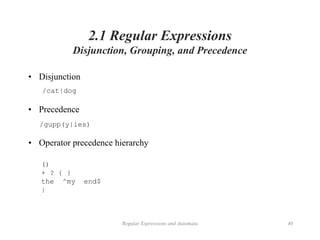
Disjunction, Grouping, and Precedence
• Operator precedence hierarchy
/cat|dog
()
+ ? { }
the ^my end$
|
• Disjunction
/gupp(y|ies)
• Precedence
Regular Expressions and Automata 41
2.1 Regular Expressions
A Simple Example
• To find the English article the
/the/
/[tT]he/
/b[tT]heb/
/[^a-zA-Z][tT]he[^a-zA-Z]
/
/^|[^a-zA-Z][tT]he[^a-zA-Z]
/
Regular Expressions and Automata 42
2.1 Regular Expressions
Advanced Operators
Aliases for common sets of characters
Regular Expressions and Automata 43
2.1 Regular Expressions
Advanced Operators
Regular expression operators for counting
Regular Expressions and Automata 44
2.1 Regular Expressions
Advanced Operators
Some characters that need to be backslashed
Regular Expressions and Automata 45
2.2 Finite-State Automata
• An RE is one way of describing a FSA.
• An RE is one way of characterizing a particular kind of formal
language called a regular language.
Regular Expressions and Automata 46
2.2 Finite-State Automata
Using an FSA to Recognize Sheeptalk
• Automaton (finite automaton, finite-state automaton (FSA))
• State, start state, final state (accepting state)
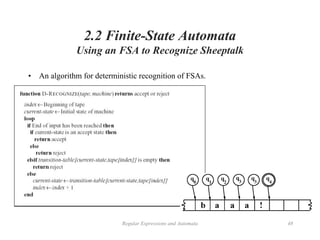
/baa+!/
A tape with cells
The transition-state table
Regular Expressions and Automata 47
2.2 Finite-State Automata
Using an FSA to Recognize Sheeptalk
• A finite automaton is formally defined by the following five
parameters:
– Q: a finite set of N states q0
, q1
, …, qN
– Σ: a finite input alphabet of symbols
– q0
: the start state
– F: the set of final states, F ⊆ Q
– δ(q,i): the transition function or transition matrix between states. Given a
state q ∈ Q and input symbol i ∈ Σ, δ(q,i) returns a new state q’ ∈ Q. δ
is thus a relation from Q × Σ to Q;
Regular Expressions and Automata 48
2.2 Finite-State Automata
Using an FSA to Recognize Sheeptalk
• An algorithm for deterministic recognition of FSAs.
Regular Expressions and Automata 49
2.2 Finite-State Automata
Using an FSA to Recognize Sheeptalk
• Adding a fail state
Regular Expressions and Automata 50
2.2 Finite-State Automata
Formal Languages
• Key concept #1: Formal Language: A model which can both
generate and recognize all and only the strings of a formal language
acts as a definition of the formal language.
• A formal language is a set of strings, each string composed of
symbols from a finite symbol-set call an alphabet.
• The usefulness of an automaton for defining a language is that it can
express an infinite set in a closed form.
• A formal language may bear no resemblance at all to a real language
(natural language), but
– We often use a formal language to model part of a natural language, such
as parts of the phonology, morphology, or syntax.
• The term generative grammar is used in linguistics to mean a
grammar of a formal language.
Regular Expressions and Automata 51
2.2 Finite-State Automata
Another Example
An FSA for the words of English numbers 1-99
FSA for the simple dollars and cents
Regular Expressions and Automata 52
2.2 Finite-State Automata
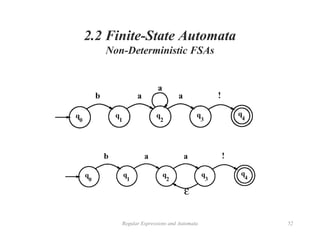
Non-Deterministic FSAs
Regular Expressions and Automata 53
2.2 Finite-State Automata
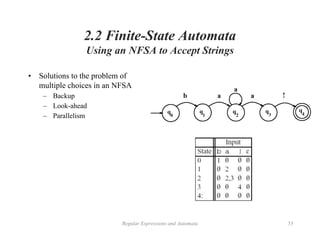
Using an NFSA to Accept Strings
• Solutions to the problem of
multiple choices in an NFSA
– Backup
– Look-ahead
– Parallelism
Regular Expressions and Automata 54
2.2 Finite-State
Automata
Using an NFSA to Accept
Strings
Regular Expressions and Automata 55
2.2 Finite-State Automata
Using an NFSA to Accept Strings
Regular Expressions and Automata 56
2.2 Finite-State Automata
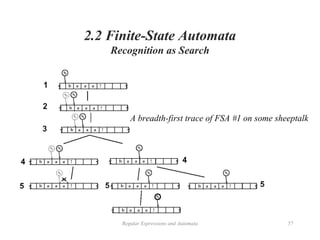
Recognition as Search
• Algorithms such as ND-RECOGNIZE are known as state-space
search
• Depth-first search or Last In First Out (LIFO) strategy
• Breadth-first search or First In First Out (FIFO) strategy
• More complex search techniques such as dynamic programming or
A*
Regular Expressions and Automata 57
2.2 Finite-State Automata
Recognition as Search
A breadth-first trace of FSA #1 on some sheeptalk
Regular Expressions and Automata 58
2.3 Regular Languages and FSAs
• The class of languages that are definable by regular expressions is
exactly the same as the class of languages that are characterizable by
FSA (D or ND).
– These languages are called regular languages.
• The regular languages over Σ is formally defined as:
1. φ is an RL
2. ∀a ∈ Σ, {a} is an RL
3. If L1
and L2
are RLs, then so are:
a) L1
⋅L2
={xy| x ∈ L1
and y ∈ L2
}, the concatenation of L1
and L2
b) L1
∪L2
, the union of L1
and L2
c) L1
*, the Kleene closure of L1
Regular Expressions and Automata 59
2.3 Regular Languages and FSAs
The concatenation of two FSAs
Regular Expressions and Automata 60
2.3 Regular Languages and FSAs
The closure (Kleene *) of an FSAs
Regular Expressions and Automata 61
2.3 Regular Languages and FSAs
The union (|) of two FSAs
Chapter 3. Morphology and
Finite-State Transducers
From: Chapter 3 of An Introduction to Natural Language
Processing, Computational Linguistics, and Speech
Recognition, by Daniel Jurafsky and James H. Martin
Morphology and FSTs 63
Background
• The problem of recognizing that foxes breaks down into the two
morphemes fox and -es is called morphological parsing.
• Similar problem in the information retrieval domain: stemming
• Given the surface or input form going, we might want to produce the
parsed form: VERB-go + GERUND-ing
• In this chapter
– morphological knowledge and
– The finite-state transducer
• It is quite inefficient to list all forms of noun and verb in the dictionary
because the productivity of the forms.
• Morphological parsing is necessary more than just IR, but also
– Machine translation
– Spelling checking
Morphology and FSTs 64
3.1 Survey of (Mostly) English Morphology
• Morphology is the study of the way words are built up from smaller
meaning-bearing units, morphemes.
• Two broad classes of morphemes:
– The stems: the “main” morpheme of the word, supplying the main
meaning, while
– The affixes: add “additional” meaning of various kinds.
• Affixes are further divided into prefixes, suffixes, infixes, and
circumfixes.
– Suffix: eat-s
– Prefix: un-buckle
– Circumfix: ge-sag-t (said) sagen (to say) (in German)
– Infix: hingi (borrow) humingi (the agent of an action) )in Philippine
language Tagalog)
Morphology and FSTs 65
3.1 Survey of (Mostly) English Morphology
• Prefixes and suffixes are often called concatenative morphology.
• A number of languages have extensive non-concatenative
morphology
– The Tagalog infixation example
– Templatic morphology or root-and-pattern morphology, common in
Arabic, Hebrew, and other Semitic languages
• Two broad classes of ways to form words from morphemes:
– Inflection: the combination of a word stem with a grammatical
morpheme, usually resulting in a word of the same class as the original
tem, and usually filling some syntactic function like agreement, and
– Derivation: the combination of a word stem with a grammatical
morpheme, usually resulting in a word of a different class, often with a
meaning hard to predict exactly.
Morphology and FSTs 66
3.1 Survey of (Mostly) English Morphology
Inflectional Morphology
• In English, only nouns, verbs, and sometimes adjectives can be
inflected, and the number of affixes is quite small.
• Inflections of nouns in English:
– An affix marking plural,
• cat(-s), thrush(-es), ox (oxen), mouse (mice)
• ibis(-es), waltz(-es), finch(-es), box(-es),
butterfly(-lies)
– An affix marking possessive
• llama’s, children’s, llamas’, Euripides’ comedies
Morphology and FSTs 67
3.1 Survey of (Mostly) English Morphology
Inflectional Morphology
• Verbal inflection is more complicated than nominal inflection.
– English has three kinds of verbs:
• Main verbs, eat, sleep, impeach
• Modal verbs, can will, should
• Primary verbs, be, have, do
– Morphological forms of regular verbs
stem walk merge try map
-s form walks merges tries maps
-ing principle walking merging trying mapping
Past form or –ed participle walked merged tried mapped
– These regular verbs and forms are significant in the morphology of
English because of their majority and being productive.
Morphology and FSTs 68
3.1 Survey of (Mostly) English Morphology
Inflectional Morphology
– Morphological forms of irregular verbs
stem eat catch cut
-s form eats catches cuts
-ing principle eating catching cutting
Past form ate caught cut
–ed participle eaten caught cut
Morphology and FSTs 69
3.1 Survey of (Mostly) English Morphology
Derivational Morphology
• Nominalization in English:
– The formation of new nouns, often from verbs or adjectives
Suffix Base Verb/Adjective Derived Noun
-action computerize (V) computerization
-ee appoint (V) appointee
-er kill (V) killer
-ness fuzzy (A) fuzziness
– Adjectives derived from nouns or verbs
Suffix Base Noun/Verb Derived Adjective
-al computation (N) computational
-able embrace (V) embraceable
-less clue (A) clueless
Morphology and FSTs 70
3.1 Survey of (Mostly) English Morphology
Derivational Morphology
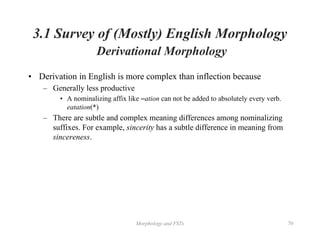
• Derivation in English is more complex than inflection because
– Generally less productive
• A nominalizing affix like –ation can not be added to absolutely every verb.
eatation(*)
– There are subtle and complex meaning differences among nominalizing
suffixes. For example, sincerity has a subtle difference in meaning from
sincereness.
Morphology and FSTs 71
3.2 Finite-State Morphological Parsing
• Parsing English morphology
Input Morphological parsed output
cats
cat
cities
geese
goose
gooses
merging
caught
cat +N +PL
cat +N +SG
city +N +PL
goose +N +PL
(goose +N +SG) or (goose +V)
goose +V +3SG
merge +V +PRES-PART
(caught +V +PAST-PART) or (catch +V +PAST)
Stems and morphological features
Morphology and FSTs 72
3.2 Finite-State Morphological Parsing
• We need at least the following to build a morphological parser:
1. Lexicon: the list of stems and affixes, together with basic information
about them (Noun stem or Verb stem, etc.)
2. Morphotactics: the model of morpheme ordering that explains which
classes of morphemes can follow other classes of morphemes inside a
word. E.g., the rule that English plural morpheme follows the noun rather
than preceding it.
3. Orthographic rules: these spelling rules are used to model the changes
that occur in a word, usually when two morphemes combine (e.g., the
y→ie spelling rule changes city + -s to cities).
Morphology and FSTs 73
3.2 Finite-State Morphological Parsing
The Lexicon and Morphotactics
• A lexicon is a repository for words.
– The simplest one would consist of an explicit list of every word of the language.
Incovenient or impossible!
– Computational lexicons are usually structured with
• a list of each of the stems and
• Affixes of the language together with a representation of morphotactics telling us how
they can fit together.
– The most common way of modeling morphotactics is the finite-state automaton.
Reg-noun Irreg-pl-noun Irreg-sg-noun plural
fox
fat
fog
fardvark
geese
sheep
Mice
goose
sheep
mouse
-s
An FSA for English nominal inflection
Morphology and FSTs 74
3.2 Finite-State Morphological Parsing
The Lexicon and Morphotactics
Reg-verb-stem Irreg-verb-stem Irreg-past-verb past Past-part Pres-part 3sg
walk
fry
talk
impeach
cut
speak
sing
sang
spoken
caught
ate
eaten
-ed -ed -ing -s
An FSA for English verbal inflection
Morphology and FSTs 75
3.2 Finite-State Morphological Parsing
The Lexicon and Morphotactics
• English derivational morphology is more complex than English
inflectional morphology, and so automata of modeling English
derivation tends to be quite complex.
– Some even based on CFG
• A small part of morphosyntactics of English adjectives
big, bigger, biggest
cool, cooler, coolest, coolly
red, redder, reddest
clear, clearer, clearest, clearly, unclear, unclearly
happy, happier, happiest, happily
unhappy, unhappier, unhappiest, unhappily
real, unreal, really
An FSA for a fragment of English adjective
Morphology #1
Morphology and FSTs 76
3.2 Finite-State Morphological Parsing
An FSA for a fragment of English adjective
Morphology #2
• The FSA#1 recognizes all the listed adjectives, and ungrammatical forms
like unbig, redly, and realest.
• Thus #1 is revised to become #2.
• The complexity is expected from English derivation.
Morphology and FSTs 77
3.2 Finite-State Morphological Parsing
An FSA for another fragment of English derivational morphology
Morphology and FSTs 78
3.2 Finite-State Morphological Parsing
• We can now use these FSAs to
solve the problem of
morphological recognition:
– Determining whether an input
string of letters makes up a
legitimate English word or not
– We do this by taking the
morphotactic FSAs, and plugging
in each “sub-lexicon” into the FSA.
– The resulting FSA can then be
defined as the level of the
individual letter.
Morphology and FSTs 79
3.2 Finite-State Morphological Parsing
Morphological Parsing with FST
• Given the input, for example, cats, we would like to produce cat +N +PL.
• Two-level morphology, by Koskenniemi (1983)
– Representing a word as a correspondence between a lexical level
• Representing a simple concatenation of morphemes making up a word, and
– The surface level
• Representing the actual spelling of the final word.
• Morphological parsing is implemented by building mapping rules that maps
letter sequences like cats on the surface level into morpheme and features
sequence like cat +N +PL on the lexical level.
Morphology and FSTs 80
3.2 Finite-State Morphological Parsing
Morphological Parsing with FST
• The automaton we use for performing the mapping between these two
levels is the finite-state transducer or FST.
– A transducer maps between one set of symbols and another;
– An FST does this via a finite automaton.
• Thus an FST can be seen as a two-tape automaton which recognizes or
generates pairs of strings.
• The FST has a more general function than an FSA:
– An FSA defines a formal language
– An FST defines a relation between sets of strings.
• Another view of an FST:
– A machine reads one string and generates another.
Morphology and FSTs 81
3.2 Finite-State Morphological Parsing
Morphological Parsing with FST
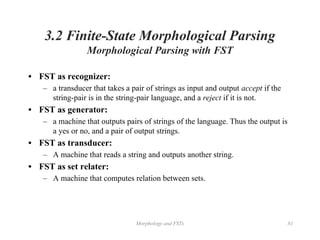
• FST as recognizer:
– a transducer that takes a pair of strings as input and output accept if the
string-pair is in the string-pair language, and a reject if it is not.
• FST as generator:
– a machine that outputs pairs of strings of the language. Thus the output is
a yes or no, and a pair of output strings.
• FST as transducer:
– A machine that reads a string and outputs another string.
• FST as set relater:
– A machine that computes relation between sets.
Morphology and FSTs 82
3.2 Finite-State Morphological Parsing
Morphological Parsing with FST
• A formal definition of FST (based on the Mealy machine extension to
a simple FSA):
– Q: a finite set of N states q0
, q1
,…, qN
– Σ: a finite alphabet of complex symbols. Each complex symbol is
composed of an input-output pair i : o; one symbol I from an input
alphabet I, and one symbol o from an output alphabet O, thus Σ ⊆ I×O. I
and O may each also include the epsilon symbol ε.
– q0
: the start state
– F: the set of final states, F ⊆ Q
– δ(q, i:o): the transition function or transition matrix between states. Given
a state q ∈ Q and complex symbol i:o ∈ Σ, δ(q, i:o) returns a new state q’
∈ Q. δ is thus a relation from Q × Σ to Q.
Morphology and FSTs 83
3.2 Finite-State Morphological Parsing
Morphological Parsing with FST
• FSAs are isomorphic to regular languages, FSTs are isomorphic to
regular relations.
• Regular relations are sets of pairs of strings, a natural extension of the
regular language, which are sets of strings.
• FSTs are closed under union, but generally they are not closed under
difference, complementation, and intersection.
• Two useful closure properties of FSTs:
– Inversion: If T maps from I to O, then the inverse of T, T-1
maps from O
to I.
– Composition: If T1
is a transducer from I1
to O1
and T2
a transducer from
I2
to O2
, then T1
。 T2
maps from I1
to O2
Morphology and FSTs 84
3.2 Finite-State Morphological Parsing
Morphological Parsing with FST
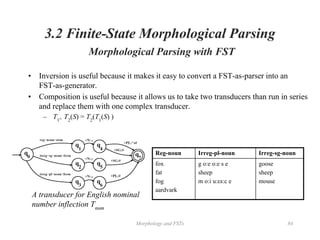
• Inversion is useful because it makes it easy to convert a FST-as-parser into an
FST-as-generator.
• Composition is useful because it allows us to take two transducers than run in series
and replace them with one complex transducer.
– T1
。T2
(S) = T2
(T1
(S) )
Reg-noun Irreg-pl-noun Irreg-sg-noun
fox
fat
fog
aardvark
g o:e o:e s e
sheep
m o:i u:εs:c e
goose
sheep
mouse
A transducer for English nominal
number inflection Tnum
Morphology and FSTs 85
3.2 Finite-State Morphological Parsing
Morphological Parsing with FST
The transducer Tstems
, which maps roots to their root-class
Morphology and FSTs 86
3.2 Finite-State Morphological Parsing
Morphological Parsing with FST
A fleshed-out English nominal inflection FST
Tlex
= Tnum
。Tstems
^: morpheme boundary
#: word boundary
Morphology and FSTs 87
3.2 Finite-State Morphological Parsing
Orthographic Rules and FSTs
• Spelling rules (or orthographic rules)
Name Description of Rule Example
Consonant doubling
E deletion
E insertion
Y replacement
K insertion
1-letter consonant doubled before -ing/-ed
Silent e dropped before -ing and -ed
e added after -s, -z, -x, -ch, -sh, before -s
-y changes to -ie before -s, -i before -ed
Verb ending with vowel + -c add -k
beg/begging
make/making
watch/watches
try/tries
panic/panicked
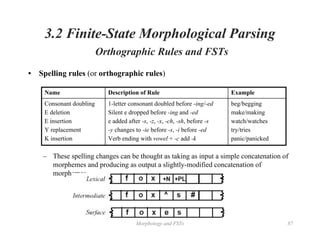
– These spelling changes can be thought as taking as input a simple concatenation of
morphemes and producing as output a slightly-modified concatenation of
morphemes.
Morphology and FSTs 88
3.2 Finite-State Morphological Parsing
Orthographic Rules and FSTs
• “insert an e on the surface tape just when the lexical tape has a
morpheme ending in x (or z, etc) and the next morphemes is -s”
x
ε→ e/ s ^ s#
z
a→ b / c d
• “rewrite a and b when it occurs between c and d”
Morphology and FSTs 89
3.2 Finite-State Morphological Parsing
Orthographic Rules and FSTs
The transducer for the E-insertion rule
Morphology and FSTs 90
3.3 Combining FST Lexicon and Rules
Morphology and FSTs 91
3.3 Combining FST Lexicon and Rules
Morphology and FSTs 92
3.3 Combining FST Lexicon and Rules
• The power of FSTs is that the exact same cascade with the same state
sequences is used
– when machine is generating the surface form from the lexical tape, or
– When it is parsing the lexical tape from the surface tape.
• Parsing can be slightly more complicated than generation, because of
the problem of ambiguity.
– For example, foxes could be fox +V +3SG as well as fox +N +PL
Morphology and FSTs 93
3.4 Lexicon-Free FSTs: the Porter Stemmer
• Information retrieval
• One of the mostly widely used stemmming algorithms is the simple
and efficient Porter (1980) algorithm, which is based on a series of
simple cascaded rewrite rules.
– ATIONAL → ATE (e.g., relational → relate)
– ING → εif stem contains vowel (e.g., motoring → motor)
• Problem:
– Not perfect: error of commision, omission
• Experiments have been made
– Some improvement with smaller documents
– Any improvement is quite small
Word Classes and POS Tagging 94
Background
• Part of speech:
– Noun, verb, pronoun, preposition, adverb, conjunction, particle, and article
• Recent lists of POS (also know as word classes, morphological class, or
lexical tags) have much larger numbers of word classes.
– 45 for Penn Treebank
– 87 for the Brown corpus, and
– 146 for the C7 tagset
• The significance of the POS for language processing is that it gives a
significant amount of information about the word and its neighbors.
• POS can be used in stemming for IR, since
– Knowing a word’s POS can help tell us which morphological affixes it can take.
– They can help an IR application by helping select out nouns or other important
words from a document.
Word Classes and POS Tagging 95
English Word Classes
• Give a more complete definition of the classes of POS.
– Traditionally, the definition of POS has been based on morphological and
syntactic function.
– While, it has tendencies toward semantic coherence (e.g., nouns describe
“people, places, or things and adjectives describe properties), this is not
necessarily the case.
• Two broad subcategories of POS:
1. Closed class
2. Open class
Word Classes and POS Tagging 96
English Word Classes
1. Closed class
– Having relatively fixed membership, e.g., prepositions
– Function words:
– Grammatical words like of, and, or you, which tend to be very short, occur
frequently, and play an important role in grammar.
2. Open class
• Four major open classes occurring in the languages of the world: nouns,
verbs, adjectives, and adverbs.
– Many languages have no adjectives, e.g., the native American language Lakhota,
and Chinese
Word Classes and POS Tagging 97
English Word Classes
Open Class: Noun
• Noun
– The name given to the lexical class in which the words for most people, places, or
things occur
– Since lexical classes like noun are defined functionally (morphological and
syntactically) rather than semantically,
• some words for people, places, or things may not be nouns, and conversely
• some nouns may not be words for people, places, or things.
– Thus, nouns include
• Concrete terms, like ship, and chair,
• Abstractions like bandwidth and relationship, and
• Verb-like terms like pacing
– Noun in English
• Things to occur with determiners (a goat, its bandwidth, Plato’s Republic),
• To take possessives (IBM’s annual revenue), and
• To occur in the plural form (goats, abaci)
Word Classes and POS Tagging 98
English Word Classes
Open Class: Noun
• Nouns are traditionally grouped into proper nouns and common
nouns.
– Proper nouns:
• Regina, Colorado, and IBM
• Not preceded by articles, e.g., the book is upstairs, but Regina is upstairs.
– Common nouns
• Count nouns:
– Allow grammatical enumeration, i.e., both singular and plural (goat/goats), and can
be counted (one goat/ two goats)
• Mass nouns:
– Something is conceptualized as a homogeneous group, snow, salt, and communism.
– Appear without articles where singular nouns cannot (Snow is white but not *Goal
is white)
Word Classes and POS Tagging 99
English Word Classes
Open Class: Verb
• Verbs
– Most of the words referring to actions and processes including main verbs
like draw, provide, differ, and go.
– A number of morphological forms: non-3rd-person-sg (eat),
3rd-person-sg(eats), progressive (eating), past participle (eaten)
– A subclass: auxiliaries (discussed in closed class)
Word Classes and POS Tagging 100
English Word Classes
Open Class: Adjectives
• Adjectives
– Terms describing properties or qualities
– Most languages have adjectives for the concepts of color (white, black),
age (old, young), and value (good, bad), but
– There are languages without adjectives, e.g., Chinese.
Word Classes and POS Tagging 101
English Word Classes
Open Class: Adverbs
• Adverbs
– Words viewed as modifying something (often verbs)
• Directional (or locative) adverbs: specify the direction or location of some
action, hoe, here, downhill
• Degree adverbs: specify the extent of some action, process, or property,
extremely, very, somewhat
• Manner adverb: describe the manner of some action or process, slowly,
slinkily, delicately
• Temporal adverbs: describe the time that some action or event took place,
yesterday, Monday
Word Classes and POS Tagging 102
English Word Classes
closed Classes
• Some important closed classes in English
– Prepositions: on, under, over, near, by, at, from, to, with
– Determiners: a, an, the
– Pronouns: she, who, I, others
– Conjunctions: and, but, or, as, if, when
– Auxiliary verbs: can, may, should, are
– Particles: up, down, on, off, in, out, at, by
– Numerals: one, two, three, first, second, third
Word Classes and POS Tagging 103
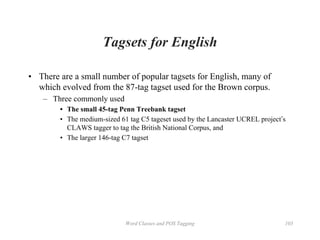
Tagsets for English
• There are a small number of popular tagsets for English, many of
which evolved from the 87-tag tagset used for the Brown corpus.
– Three commonly used
• The small 45-tag Penn Treebank tagset
• The medium-sized 61 tag C5 tageset used by the Lancaster UCREL project’s
CLAWS tagger to tag the British National Corpus, and
• The larger 146-tag C7 tagset
Word Classes and POS Tagging 104
Penn Treebank POS tags
Word Classes and POS Tagging 105
Part-of-Speech Tagging
• POS tagging (tagging)
– The process of assigning a POS or other lexical marker to each word in a
corpus.
– Also applied to punctuation marks
– Thus, tagging for NL is the same process as tokenization for computer
language, although tags for NL are much more ambiguous.
– Taggers play an increasingly important role in speech recognition, NL
parsing and IR
Word Classes and POS Tagging 106
Part-of-Speech Tagging
• The input to a tagging algorithm is a string of words and a specified
tagset of the kind described previously.
VB DT NN .
Book that flight .
VBZ DT NN VB NN ?
Does that flight serve dinner ?
• Automatically assigning a tag to a word is not trivial
– For example, book is ambiguous: it can be a verb or a noun
– Similarly, that can be a determiner, or a complementizer
• The problem of POS-tagging is to resolve the ambiguities,
choosing the proper tag for the context.
Word Classes and POS Tagging 107
Part-of-Speech Tagging
• How hard is the tagging problem?
The number of word types
in Brown corpus by degree
of ambiguity.
• Many of the 40% ambiguous tokens are easy to disambiguate, because
– The various tags associated with a word are not equally likely.
Word Classes and POS Tagging 108
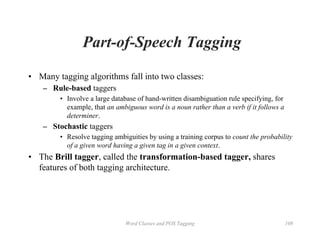
Part-of-Speech Tagging
• Many tagging algorithms fall into two classes:
– Rule-based taggers
• Involve a large database of hand-written disambiguation rule specifying, for
example, that an ambiguous word is a noun rather than a verb if it follows a
determiner.
– Stochastic taggers
• Resolve tagging ambiguities by using a training corpus to count the probability
of a given word having a given tag in a given context.
• The Brill tagger, called the transformation-based tagger, shares
features of both tagging architecture.
Word Classes and POS Tagging 109
Rule-Based Part-of-Speech Tagging
• The earliest algorithms for automatically assigning POS were based on
a two-stage architecture
– First, use a dictionary to assign each word a list of potential POS.
– Second, use large lists of hand-written disambiguation rules to winnow
down this list to a single POS for each word
• The ENGTWOL tagger (1995) is based on the same two stage
architecture, with much more sophisticated lexicon and disambiguation
rules than before.
– Lexicon:
• 56000 entries
• A word with multiple POS is counted as separate entries
Word Classes and POS Tagging 110
Sample lexical entries from the ENGTWOL lexicon.
Word Classes and POS Tagging 111
Rule-Based Part-of-Speech Tagging
• In the first stage of tagger,
– each word is run through the two-level lexicon transducer and
– the entries for all possible POS are returned.
• A set of about 1,100 constraints are then applied to the input sentences
to rule out incorrect POS.
Pavlov PALOV N NOM SG PROPER
had HAVE V PAST VFIN SVO
HAVE PCP2 SVO
shown SHOW PCP2 SVOO SVO SV
that ADV
PRON DEM SG
DET CENTRAL DEM SG
CS
salivation N NOM SG
…
Context Free Grammar for English 112
Background
• Syntax: the way words are arranged together
• Main ideas of syntax:
– Constituency
• Groups of words may behave as a single unit or phrase, called constituent,
e.g., NP
• CFG, a formalism allowing us to model the constituency facts
– Grammatical relations
• A formalization of ideas from traditional grammar about SUBJECT and OBJECT
– Subcategorization and dependencies
• Referring to certain kind of relations between words and phrases, e.g., the verb
want can be followed by an infinite, as in I want to fly to Detroit.
Context Free Grammar for English 113
Background
• All of the kinds of syntactic knowledge can be modeled by various
kinds of CFG-based grammars.
• CFGs are thus backbone of many models of the syntax of NL.
– Being integral to most models of NLU, of grammar checking, and more
recently speech understanding
• They are powerful enough to express sophisticated relations among the
words in a sentence, yet computationally tractable enough that efficient
algorithms exists for parsing sentences with them. (Ch. 10)
• Also probability version of CFG (Ch. 12)
• Example sentences from the Air Traffic Information System (ATIS)
domain
Context Free Grammar for English 114
9.1 Constituency
• NP:
– A sequence of words surrounding at least one noun, e.g.,
• three parties from Brooklyn arrive
• a high-class spot such as Mindy’s attracts
• the Broadway coppers love
• They sit
• Harry the Horse
• the reason he comes into the Hot Box
• Evidences of constituency
– The above NPs can all appear in similar syntactic environment, e.g., before, a verb.
– Preposed or postposed constructions, e.g., the PP, on September seventeenth, can
be placed in a number of different locations
• On September seventeenth, I’d like to fly from Atlanta to Denver.
• I’d like to fly on September seventeenth from Atlanta to Denver.
• I’d like to fly from Atlanta to Denver On September seventeenth.
Context Free Grammar for English 115
9.2 Context-Free Rules and Trees
• CFG (or Phrase-Structure Grammar):
– The most commonly used mathematical system for
modeling constituent structure in English and other
NLs
– Terminals and non-terminals
– Derivation
– Parse tree
– Start symbol
NP
Nom
Noun
flight
Det
a
9.2 Context-Free Rules and Trees
Noun → flight | breeze | trip | morning | …
Verb → is | prefer | like | need | want | fly …
Adjective → cheapest | non-stop | first | latest | other | direct | …
Pronoun → me | I | you | it | …
Proper-Noun → Alaska | Baltimore | Los Angeles | Chicago | United | American | …
Determiner → the | a | an | this | these | that | …
Preposition → from | to | on | near | …
Conjunction → and | or | but | …
The lexicon for L0
S → NP VP I + want a morning flight
NP → Pronoun I
| Proper-Noun Los Angeles
| Det Nominal a + flight
Nominal → Noun Nominal morning + flight
| Noun flights
VP → Verb do
| Verb NP want + a flight
| Verb NP PP leave + Boston + in the morning
| Verb PP leaving + on Thursday
PP → Preposition NP from + Los Angeles The grammar for L0
Context Free Grammar for English 117
9.2 Context-Free Rules and Trees
• Bracket notation of parse tree
• Grammatical vs. ungrammatical sentences
• The use of formal languages to model NLs is called generative
grammar, since the language is defined by the set of possible
sentences “generated” by the grammar.
• The formal definition of a CFG is a 4-tuple.
Context Free Grammar for English 118
9.3 Sentence-Level Constructions
• There are a great number of possible overall sentences structures, but
four are particularly common and important:
– Declarative structure, imperative structure, yes-n-no-question structure,
and wh-question structure.
• Sentences with declarative structure
– A subject NP followed by a VP
• The flight should be eleven a.m. tomorrow.
• I need a flight to Seattle leaving from Baltimore making a stop in Minneapolis.
• The return flight should leave at around seven p.m.
• I would like to find out the flight number for the United flight that arrives in
San Jose around ten p.m.
• I’d like to fly the coach discount class.
• I want a flight from Ontario to Chicago.
• I plan to leave on July first around six thirty in the evening.
Context Free Grammar for English 119
9.3 Sentence-Level Constructions
• Sentence with imperative structure
– Begin with a VP and have no subject.
– Always used for commands and suggestions
• Show the lowest fare.
• Show me the cheapest fare that has lunch.
• Give me Sunday’s flight arriving in Las Vegas from Memphis and New York
City.
• List all flights between five and seven p.m.
• List all flights from Burbank to Denver.
• Show me all flights that depart before ten a.m. and have first class fares.
• Show me all the flights leaving Baltimore.
• Show me flights arriving within thirty minutes of each other.
• Please list the flights from Charlotte to Long Beach arriving after lunch time.
• Show me the last flight to leave.
– S → VP
Context Free Grammar for English 120
9.3 Sentence-Level Constructions
• Sentences with yes-no-question structure
– Begin with auxiliary, followed by a subject NP, followed by a VP.
• Do any of these flights have stops?
• Does American’s flight eighteen twenty five serve dinner?
• Can you give me the same information for United?
– S → Aux NP VP
Context Free Grammar for English 121
9.3 Sentence-Level Constructions
• The wh-subject-question structure
– Identical to the declarative structure, except that the first NP contains
some wh-word.
• What airlines fly from Burbank to Denver?
• Which flights depart Burbank after noon and arrive in Denver by six p.m.?
• Which flights serve breakfast?
• Which of these flights have the longest layover Nashville?
– S → Wh-NP VP
• The wh-non-subject-question structure
• What flights do you have from Burbank to Tacoma Washington?
– S → Wh-NP Aux NP VP
Context Free Grammar for English 122
9.4 The Noun Phrase
• View the NP as revolving around a head, the central noun in the NP.
– The syntax of English allows for both pre-nominal (pre-head) modifiers
and post-nominal (post-head) modifiers.
Context Free Grammar for English 123
9.4 The Noun Phrase
Before the Head Noun
• NPs can begin with a determiner,
– a stop, the flights, that fare, this flight, those flights, any flights, some
flights
• Determiners can be optional,
– Show me flights from San Francisco to Denver on weekdays.
• Mass nouns don’t require determination.
– Substances, like water and snow
– Abstract nouns, music, homework,
– In the ATIS domain, breakfast, lunch, dinner
• Does this flight server dinner?
Context Free Grammar for English 124
9.4 The Noun Phrase
Before the Head Noun
• Predeterminers:
– Word classes appearing in the NP before the determiner
• all the flights, all flights
• Postdeterminers:
– Word classes appearing in the NP between the determiner and the head
noun
• Cardinal numbers: two friends, one stop
• Ordinal numbers: the first one, the next day, the second leg, the last flight,
the other American flight, and other fares
• Quantifiers: many fares
– The quantifiers, much and a little occur only with noncount nouns.
Context Free Grammar for English 125
9.4 The Noun Phrase
Before the Head Noun
• Adjectives occur after quantifiers but before nouns.
– a first-class fare, a nonstop flight, the longest layover, the earliest lunch
flight
• Adjectives can be grouped into a phrase called an adjective phrase or
AP.
– AP can have an adverb before the adjective
• the least expensive fare
• NP → (Det) (Card) (Ord) (Quant) (AP) Nominal
Context Free Grammar for English 126
9.4 The Noun Phrase
After the Head Noun
• A head noun can be followed by postmodifiers.
– Prepositional phrases
• All flights from Cleveland
– Non-finite clauses
• Any flights arriving after eleven a.m.
– Relative clauses
• A flight that serves breakfast
Context Free Grammar for English 127
9.4 The Noun Phrase
After the Head Noun
• PP postmodifiers
– any stopovers [for Delta seven fifty one]
– all flight [from Cleveland] [to Newark]
– arrival [in San Jose] [before seven a.m.]
– a reservation [on flight six oh six] [from Tampa] [to Montreal]
– Nominal → Nominal PP (PP) (PP)
Context Free Grammar for English 128
9.4 The Noun Phrase
After the Head Noun
• The three most common kinds of non-finite postmodifiers are the
gerundive (-ing), -ed, and infinitive form.
– A gerundive consists of a VP begins with the gerundive (-ing)
• any of those [leaving on Thursday]
• any flights [arriving after eleven a.m.]
• flights [arriving within thirty minutes of each other]
Nominal → Nominal GerundVP
GerundVP → GerundV NP | GerundV PP | GerundV |
GerundV NP PP
GerundV → being | preferring | ariving | leaving | …
– Examples of two other common kinds
• the last flight to arrive in Boston
• I need to have dinner served
• Which is the aircraft used by this flight?
Context Free Grammar for English 129
9.4 The Noun Phrase
After the Head Noun
• A postnominal relative clause (more correctly a restrictive relative
clause)
– is a clause that often begins with a relative pronoun (that and who are the
most common).
– The relative pronoun functions as the subject of the embedded verb,
• a flight that serves breakfast
• flights that leave in the morning
• the United flight that arrives in San Jose around ten p.m.
• the one that leaves at ten thirty five
Nominal → Nominal RelClause
RelClause → (who | that) VP
Context Free Grammar for English 130
9.4 The Noun Phrase
After the Head Noun
• The relative pronoun may also function as the object of the embedded
verb,
– the earliest American Airlines flight that I can get
• Various postnominal modifiers can be combined,
– a flight [from Phoenix to Detroit] [leaving Monday evening]
– I need a flight [to Seattle] [leaving from Baltimore] [making a stop in
Minneapolis]
– evening flights [from Nashville to Houston] [that serve dinner]
– a friend [living in Denver] [that would like to visit me here in Washington
DC]
Context Free Grammar for English 131
9.5 Coordination
• NPs and other units can be conjoined with coordinations like and, or,
and but.
– Please repeat [NP
[NP
the flight] and [NP
the coast]]
– I need to know [NP
[NP
the aircraft] and [NP
flight number]]
– I would like to fly from Denver stopping in [NP
[NP
Pittsburgh] and [NP
Atlanta]]
– NP → NP and NP
– VP → VP and VP
– S → S and S
Context Free Grammar for English 132
9.6 Agreement
• Most verbs in English can appear in two forms in the present tense:
– 3sg, or non-3sg
Do [NP
any flights] stop in Chicago?
Do [NP
all of these flights] offer first class service?
Do [NP
I] get dinner on this flight?
Do [NP
you] have a flight from Boston to Forth Worth?
Does [NP
this flight] stop in Dallas?
Does [NP
that flight] serve dinner?
Does [NP
Delta] fly from Atlanta to San Francisco?
What flight leave in the morning?
What flight leaves from Pittsburgh?
*[What flight] leave in the morning?
*Does [NP
you] have a flight from Boston to Fort Worth?
*Do [NP
this flight] stop in Dallas?
S → Aux NP VP
S → 3sgAux 3sgNP VP
S → Non3sgAux Non3sgNP VP
3sgAux → does | has | can | …
Non3sgAux → do | have | can | …
3sgNP → (Det) (Card) (Ord) (Quant)
(AP) SgNominal
Non3sgNP → (Det) (Card) (Ord) (Quant)
(AP) PlNominal
SgNominal → SgNoun | SgNoun SgNoun
PlNominal → PlNoun | SgNoun PlNoun
SgNoun → flight | fare | dollar | reservation | …
PlNoun → flights | fares | dollars | reservation | …
Context Free Grammar for English 133
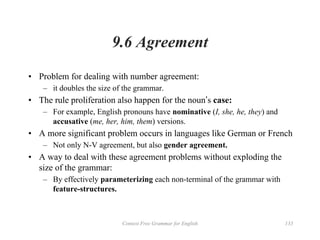
9.6 Agreement
• Problem for dealing with number agreement:
– it doubles the size of the grammar.
• The rule proliferation also happen for the noun’s case:
– For example, English pronouns have nominative (I, she, he, they) and
accusative (me, her, him, them) versions.
• A more significant problem occurs in languages like German or French
– Not only N-V agreement, but also gender agreement.
• A way to deal with these agreement problems without exploding the
size of the grammar:
– By effectively parameterizing each non-terminal of the grammar with
feature-structures.
Context Free Grammar for English 134
9.7 The Verb Phrase and Subcategorization
• The VP consists of the verb and a number of other constituents.
VP → Verb disappear
VP → Verb NP prefer a morning flight
VP → Verb NP PP leave Boston in the morning
VP → Verb PP leaving on Thursday
• An entire embedded sentence, called sentential
complement, can follow the verb.
You [VP
[V
said [S
there were two flights that were the cheapest]]]
You [VP
[V
said [S
you had a two hundred sixty six dollar fare]]]
[VP
[V
Tell] [NP
me] [S
how to get from the airport in Philadelphia to downtown]]
I [VP
[V
think [S
I would like to take the nine thirty flight]]
VP → Verb S
Context Free Grammar for English 135
9.7 The Verb Phrase and Subcategorization
• Another potential constituent of the VP is another VP
– Often the case for verbs like want, would like, try, intent, need
I want [VP
to fly from Milwaukee to Orlando]
Hi, I want [VP
to arrange three flights]
Hello, I’m trying [VP
to find a flight that goes from Pittsburgh to Denver after two p.m.]
• Recall that verbs can also be followed by particles, word
that resemble a preposition but that combine with the verb
to form a phrasal verb, like take off.
– These particles are generally considered to be an integral part of the verb
in a way that other post-verbal elements are not;
– Phrasal verbs are treated as individual verbs composed of two words.
Context Free Grammar for English 136
9.7 The Verb Phrase and Subcategorization
• A VP can have many possible kinds of constituents, not every verb is
compatible with every VP.
– I want a flight …
– I want to fly to …
– *I found to fly to Dallas.
• The idea that verbs are compatible with different kinds of complements
– Traditional grammar subcategorize verbs into two categories (transitive and
intransitive).
– Modern grammars distinguish as many as 100 subcategories
Frame Verb Example
φ
NP
NP NP
PPfrom
PPto
NP PPwith
VPto
VPbrst
S
eat, sleep
prefer, find leave
show, give, find
fly, travel
help, load
prefer, want, need
can, would, might
mean
I want to eat
Find [NP
the flight from Pittsburgh to Boston]
Show [NP
me] [NP
airlines with flights from Pittsburgh]
I would like to fly [PP
from Boston] [PP
to Philadelphia]
Can you help [NP
me] [PP
with a flight]
I would prefer [VPto
to go by United airlines]
I can [VPbrst
fo from Boston]
Does this mean [S
AA has a hub in Boston?]
Context Free Grammar for English 137
9.7 The Verb Phrase and Subcategorization
Verb-with-NP-complement → find | leave | repeat | …
Verb-with-S-complement → think | believe | say | …
Verb-with-Inf-VP-complement → want | try | need | …
VP → Verb-with-no-complement disappear
VP → Verb-with-NP-complement NP prefer a morning flight
VP → Verb-with-S-complement S said there were two flights
Context Free Grammar for English 138
9.8 Auxiliaries
• Auxiliaries or helping verbs
– A subclass of verbs
– Having particular syntactic constraints which can be viewed as a kind of
subcategorization
– Including the modal verb, can, could many, might, must, will, would,
shall, and should
– The perfect auxiliary have,
– The progressive auxiliary be, and
– The passive auxiliary be.
Context Free Grammar for English 139
9.8 Auxiliaries
• Modal verbs subcategorize for a VP whose head verb is a bare stem.
– can go in the morning, will try to find a flight
• The perfect verb have subcategorizes for a VP whose head verb is the
past participle form:
– have booked 3 flights
• The progressive verb be subcategorizes for a VP whose head verb is
the gerundive participle:
– am going from Atlanta
• The passive verb be subcategorizes for a VP who head verb is the past
participle:
– was delayed by inclement weather
Context Free Grammar for English 140
9.8 Auxiliaries
• A sentence may have multiple auxiliary verbs, but they must occur in a
particular order.
– modal < perfect < progressive < passive
modal perfect could have been a contender
modal passive will be married
perfect progressive have been feasting
modal perfect passive might have been prevented
Context Free Grammar for English 141
9.9 Spoken Language Syntax
• Skip
Context Free Grammar for English 142
9.10 Grammar Equivalence and Normal Form
• Two grammars are equivalent if they generate the same set of strings.
• Two kinds of equivalence
– Strong equivalence
• If two grammars generate the same set of strings and if they assign the same
phrase structure to each sentence
– Weak equivalence
• Two grammars generate the same set of strings but do not assign the same
phrase structure to each sentence.
Context Free Grammar for English 143
9.10 Grammar Equivalence and Normal Form
• It is useful to have a normal form for grammars.
– A CFG is in Chomsky normal form (CNF) if it is ε-free and if in
addition each production is either of the form A → B C or A → a
• Any grammar can be converted into a weakly-equivalent CNF
grammar.
– For example A → B C D can be converted into the following CNF rules:
• A → B X
• X → C D
Context Free Grammar for English 144
9.11 Finite-State and Context-Free Grammars
• Recursion problem with finite-state grammars
– Recursion cannot be handled in finite automata
– Recursion is quite common in a complete model of NP
Nominal → Nominal PP
(Det)(Card)(Ord)(Quant)(AP)Nominal
(Det)(Card)(Ord)(Quant)(AP)Nomina (PP)*
(Det)(Card)(Ord)(Quant)(AP)Nomina (P NP)*
(Det)(Card)(Ord)(Quant)(AP)Nomina (RelClause|GerundVP|PP)*
• An augmented version of the FSA: the recursive transition
network or RTN
Chapter 10. Parsing with CFGs
From: Chapter 10 of An Introduction to Natural Language
Processing, Computational Linguistics, and Speech
Recognition, by Daniel Jurafsky and James H. Martin
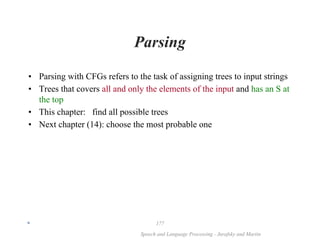
Parsing with CFG 146
Background
• Syntactic parsing
– The task of recognizing a sentence and assigning a syntactic structure to it
• Since CFGs are a declarative formalism, they do not specify how the
parse tree for a given sentence should be computed.
• Parse trees are useful in applications such as
– Grammar checking
– Semantic analysis
– Machine translation
– Question answering
– Information extraction
Parsing with CFG 147
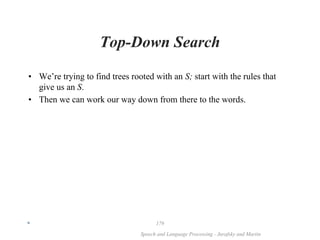
10.1 Parsing as Search
• The parser can be viewed as searching through the space
of all possible parse trees to find the correct parse tree for
the sentence.
• How can we use the grammar to produce the parse tree?
Parsing with CFG 148
10.1 Parsing as Search
• Top-down parsing
Parsing with CFG 149
10.1 Parsing as Search
• Bottom-up parsing
Parsing with CFG 150
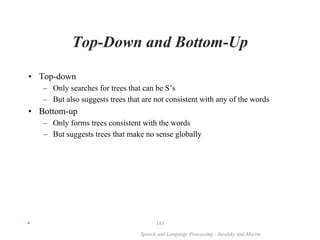
10.1 Parsing as Search
• Comparisons
– The top-down strategy never wastes time exploring trees that cannot result
in an S.
– The bottom-up strategy, by contrast, trees that have no hope to leading to
an S, or fitting in with any of their neighbors, are generated with wild
abandon.
• The left branch of Fig. 10.4 is completely wasted effort.
– Spend considerable effort on S trees that are not consistent with the input.
• The first four of the six trees in Fig. 10.3 cannot match the word book.
Parsing with CFG 151
10.2 A Basic Top-Down Parser
• Use depth-first strategy
Parsing with CFG 152
10.2 A Basic Top-Down Parser
Parsing with CFG 153
10.2 A Basic Top-Down Parser
• A top-down,
depth-first,
left-to-right
derivation
Parsing with CFG 154
10.2 A Basic Top-Down Parser
Parsing with CFG 155
10.2 A Basic Top-Down Parser
• Adding bottom-up filtering
• Left-corner notion
– For nonterminals A and B, B is a left-corner of A if the following relation holds:
A ⇒ Bα
• Using the left-corner notion, it is easy to see that only the S → Aux NP VP rule
is a viable candidate Since the word Does can not server as the left-corner of
other two S-rules.
*
S → NP VP
A → Aux NP
VP
S → VP
Parsing with CFG 156
10.2 A Basic Top-Down Parser
Category Left Corners
S Det, Proper-Noun, Aux, Verb
NP Det, Proper-Noun
Nominal Noun
VP Verb
Parsing with CFG 157
10.3 Problems with the Basic Top-Down Parser
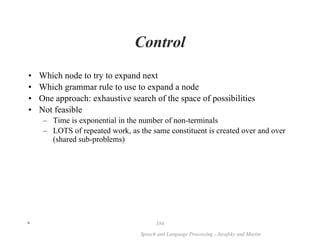
• Problems with the top-down parser
– Left-recursion
– Ambiguity
– Inefficiency reparsing of subtrees
• Then, introducing the Earley algorithm
Parsing with CFG 158
10.3 Problems with the Basic Top-Down Parser
Left-Recursion
• Exploring infinite search space, when left-recursive grammars are
used
• A grammar is left-recursive if it contains at least one NT A, such
that A ⇒ αAβ, for some α and β and α ⇒ε.
* *
NP → Det Nominal
Det → NP ‘s
NP → NP PP
VP → VP PP
S → S and S
Left-recursive rules
Parsing with CFG 159
10.3 Problems with the Basic Top-Down Parser
Left-Recursion
• Two reasonable methods for dealing with left-recursion in a
backtracking top-down parser:
– Rewriting the grammar
– Explicitly managing the depth of the search during parsing
• Rewrite each rule of left-recursion
A → Aβ | α
⇒
A → α A’
A’ → β A | ε
Parsing with CFG 160
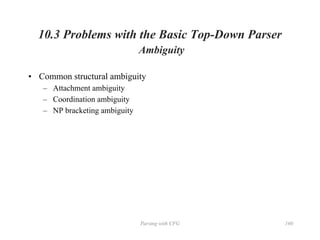
10.3 Problems with the Basic Top-Down Parser
Ambiguity
• Common structural ambiguity
– Attachment ambiguity
– Coordination ambiguity
– NP bracketing ambiguity
Parsing with CFG 161
10.3 Problems with the Basic Top-Down Parser
Ambiguity
• Example of PP attachment
Parsing with CFG 162
10.3 Problems with the Basic Top-Down Parser
Ambiguity
• The gerundive-VP flying to Paris can be
– part of a gerundive sentence, or
– an adjunct modifying the VP
We saw the Eiffel Tower flying
to Paris.
Parsing with CFG 163
10.3 Problems with the Basic Top-Down Parser
Ambiguity
• The sentence “Can you book TWA flights” is ambiguous
– “Can you book flights on behalf of TWA”
– “Can you book flights run by TWA”
Parsing with CFG 164
10.3 Problems with the Basic Top-Down Parser
Ambiguity
• Coordination ambiguity
– Different set of phrases that can be conjoined by a conjunction like and.
– For example old men and women can be
• [old [men and women]] or [old men] and [women]
• Parsing sentence thus requires disambiguation:
– Choosing the correct parse from a multitude of possible parser
– Requiring both statistical (Ch 12) and semantic knowledge (Ch 17)
Parsing with CFG 165
10.3 Problems with the Basic Top-Down Parser
Ambiguity
• Parsers which do not incorporate disambiguators may simply return all
the possible parse trees for a given input.
• We do not want all possible parses from the robust, highly ambiguous,
wide-coverage grammars used in practical applications.
• Reason:
– Potentially exponential number of parses that are possible for certain
inputs
– Given the ATIS example:
• Show me the meal on Flight UA 386 from San Francisco to Denver.
– The three PP’s at the end of this sentence yield a total of 14 parse trees for
this sentence.
Parsing with CFG 166
10.3 Problems with the Basic Top-Down Parser
Repeated Parsing Subtrees
• The parser often builds valid parse
trees for portion of the input, then
discards them during backtracking,
only to find that it has to rebuild
them again.
a flight
From Indianapolis
To Houston
On TWA
A flight from Indianapolis
A flight from Indianapolis to Houston
A flight from Indianapolis to Houston on TWA
4
3
2
1
3
2
1
Parsing with CFG 167
10.4 The Earley Algorithm
• Solving three kinds of problems afflicting standard bottom-up or
top-down parsers
• Dynamic programming providing a framework for solving this
problem
– Systematically fill in tables of solutions to sub-problems.
– When complete, the tables contain solution to all sub-problems needed to
solve the problem as a whole.
– Reducing an exponential-time problem to a polynomial-time one by
eliminating the repetitive solution of sub-problems inherently iin
backtracking approaches
– O(N3
), where N is the number of words in the input
Parsing with CFG 168
10.4 The Earley Algorithm
• (10.7) Book that flight
S → ∙VP, [0,0]
NP → Det ∙Nominal, [1,2]
VP → V NP∙, [0,3]
Parsing with CFG 169
10.4 The Earley
Algorithm
Parsing with CFG 170
10.4 The Earley
Algorithm
Parsing with CFG 171
10.4 The Earley
Algorithm
Sequence of state created in Chart while
parsing Book that flight including
Structural information
Parsing with CFG 172
10.5 Finite-State Parsing Methods
• Partial parsing or shallow parsing
– Some language processing tasks do not require complete parses.
– E.g., information extraction algorithms generally do not extract all the possible
information in a text; they simply extract enough to fill out some sort of template
of required data.
• Many partial parsing systems use cascade of finite-state automata instead of
CFGs.
– Use FSA to recognize basic phrases, such as noun groups, verb groups, locations,
etc.
– FASTUS of SRI
Company
Name:
Verb Group:
Noun Group:
Noun Group:
Verb Group
Noun Group:
Preposition
Location:
Preposition
:
Noun Group:
Conjunction
:
Noun Group:
Verb Group
Noun Group:
Verb Group:
Preposition
Location:
Bridgestone Sports
Co.
said
Friday
it
had set up
a joint venture
in
Taiwan
with
a local concern
and
a Japanese trading
hounse
to produce
golf clubs
to be shipped
to
Japan
Parsing with CFG 173
10.5 Finite-State Parsing Methods
• Detection of noun group
NG → Pronoun | Time-NP | Date-NP she, him, them, yesterday
NG → (DETP) (Adjs) HdNns | DETP Ving HdNns the quick and dirty solution,
the frustrating mathematics problem, the rising index
DETP → DETP-CP | DET-INCP
DETP-CP → …
DETP-INCP → …
Adjs → AdjP …
AdjP → …
HdNns → HdNn …
HdNn → PropN |PreNs …
PreNs → PreN …
PreN → ..
Parsing with CFG 174
10.5 Finite-State Parsing Methods
Parsing
SLP Chapter 13
*
Speech and Language Processing - Jurafsky and Martin
176
Outline
• Parsing with CFGs
– Bottom-up, top-down
– CKY parsing
– Mention of Earley and chart parsing
*
Speech and Language Processing - Jurafsky and Martin
177
Parsing
• Parsing with CFGs refers to the task of assigning trees to input strings
• Trees that covers all and only the elements of the input and has an S at
the top
• This chapter: find all possible trees
• Next chapter (14): choose the most probable one
*
Speech and Language Processing - Jurafsky and Martin
178
Parsing
• parsing involves a search
*
Speech and Language Processing - Jurafsky and Martin
179
Top-Down Search
• We’re trying to find trees rooted with an S; start with the rules that
give us an S.
• Then we can work our way down from there to the words.
*
Speech and Language Processing - Jurafsky and Martin
180
Top Down Space
*
Speech and Language Processing - Jurafsky and Martin
181
Bottom-Up Parsing
• We also want trees that cover the input words.
• Start with trees that link up with the words
• Then work your way up from there to larger and larger trees.
Bottom-Up Space
*
Speech and Language Processing - Jurafsky and Martin
183
Top-Down and Bottom-Up
• Top-down
– Only searches for trees that can be S’s
– But also suggests trees that are not consistent with any of the words
• Bottom-up
– Only forms trees consistent with the words
– But suggests trees that make no sense globally
*
Speech and Language Processing - Jurafsky and Martin
184
Control
• Which node to try to expand next
• Which grammar rule to use to expand a node
• One approach: exhaustive search of the space of possibilities
• Not feasible
– Time is exponential in the number of non-terminals
– LOTS of repeated work, as the same constituent is created over and over
(shared sub-problems)
*
Speech and Language Processing - Jurafsky and Martin
185
Dynamic Programming
• DP search methods fill tables with partial results
and thereby
– Avoid doing avoidable repeated work
– Solve exponential problems in polynomial time (well,
no not really – we’ll return to this point)
– Efficiently store ambiguous structures with shared
sub-parts.
• We’ll cover two approaches that roughly
correspond to bottom-up and top-down
approaches.
– CKY
– Earley
*
Speech and Language Processing - Jurafsky and Martin
186
CKY Parsing
• Consider the rule A →BC
– If there is an A somewhere in the input then there must be a B followed by
a C in the input.
– If the A spans from i to j in the input then there must be some k st. i<k<j
• Ie. The B splits from the C someplace.
*
Speech and Language Processing - Jurafsky and Martin
187
Convert Grammar to CNF
• What if your grammar isn’t binary?
– As in the case of the TreeBank grammar?
• Convert it to binary… any arbitrary CFG can be rewritten into
Chomsky-Normal Form automatically.
– The resulting grammar accepts (and rejects) the same
set of strings as the original grammar.
– But the resulting derivations (trees) are different.
– We saw this in the last set of lecture notes
*
Speech and Language Processing - Jurafsky and Martin
188
Convert Grammar to CNF
• More specifically, we want our rules to be of the form
A →B C
Or
A → w
That is, rules can expand to either 2 non-terminals or to a single terminal.
*
Speech and Language Processing - Jurafsky and Martin
189
Binarization Intuition
• Introduce new intermediate non-terminals into the grammar that distribute
rules with length > 2 over several rules.
– So… S → A B C turns into
S → X C and
X → A B
Where X is a symbol that doesn’t occur
anywhere else in the the grammar.
Converting grammar to CNF
1. Copy all conforming rules to the new grammar unchanged
2. Convert terminals within rules to dummy non-terminals
3. Convert unit productions
4. Make all rules with NTs on the right binary
In lecture: what these mean; apply to example on next two slides
* 190
*
Speech and Language Processing - Jurafsky and Martin
191
Sample L1 Grammar
*
Speech and Language Processing - Jurafsky and Martin
192
CNF Conversion
*
Speech and Language Processing - Jurafsky and Martin
193
CKY
• Build a table so that an A spanning from i to j in the input is placed in
cell [i,j] in the table.
• E.g., a non-terminal spanning an entire string will sit in cell [0, n]
– Hopefully an S
*
Speech and Language Processing - Jurafsky and Martin
194
CKY
• If
– there is an A spanning i,j in the input
– A → B C is a rule in the grammar
• Then
– There must be a B in [i,k] and a C in [k,j] for some i<k<j
*
Speech and Language Processing - Jurafsky and Martin
195
CKY
• The loops to fill the table a column at a time, from left to right, bottom
to top.
– When we’re filling a cell, the parts needed to fill it are already in the table
• to the left and below
*
Speech and Language Processing - Jurafsky and Martin
196
CKY Algorithm
*
Speech and Language Processing - Jurafsky and Martin
197
Example
Go through full example in lecture
*
Speech and Language Processing - Jurafsky and Martin
198
CKY Parsing
• Is that really a parser?
• So, far it is only a recognizer
– Success? an S in cell [0,N]
• To turn it into a parser … see Lecture
*
Speech and Language Processing - Jurafsky and Martin
199
CKY Notes
• Since it’s bottom up, CKY populates the table with a lot of worthless
constituents.
– To avoid this we can switch to a top-down control strategy
– Or we can add some kind of filtering that blocks constituents where they can
not happen in a final analysis.
Dynamic Programming Parsing Methods
• CKY (Cocke-Kasami-Younger) algorithm based on bottom-up parsing
and requires first normalizing the grammar.
• Earley parser is based on top-down parsing and does not require
normalizing grammar but is more complex.
• More generally, chart parsers retain completed phrases in a chart and
can combine top-down and bottom-up search.
200
Conclusions
• Syntax parse trees specify the syntactic structure
of a sentence that helps determine its meaning.
– John ate the spaghetti with meatballs with chopsticks.
– How did John eat the spaghetti?
What did John eat?
• CFGs can be used to define the grammar of a
natural language.
• Dynamic programming algorithms allow
computing a single parse tree in cubic time or all
parse trees in exponential time.
201
Chapter 14. Representing Meaning
From: Chapter 14 of An Introduction to Natural Language
Processing, Computational Linguistics, and Speech
Recognition, by Daniel Jurafsky and James H. Martin
Representing Meaning 203
Background
• Meaning representations
– The meaning of linguistic utterances can be captured in formal structures
• Meaning representation languages
– The frameworks that are used to specify the syntax and semantics of these
representations
• Need for the representations
– Bridging the gap from linguistic inputs to the kind of non-linguistic knowledge
needed to perform a variety of tasks involving the meaning of linguistic inputs
• Language tasks requiring some form of semantic processing
– Answering an essay question on an exam
– Deciding what to order at a restaurant by reading a menu
– Learning to use a new piece of software by reading the manual
– Realizing that you’ve been insulted
– Following a recipe
Representing Meaning 204
Background
• The tasks require access to representation that link the linguistic elements
involved in the task to the non-linguistic knowledge of the world needed to
successfully accomplish.
• Some of the knowledge of the world needed to perform the above tasks
– Answering and grading essay questions requires background knowledge about the
topic of the question, the desired knowledge level of the students, and how such
questions are normally answered.
– Reading a menu and deciding what to order, giving advice about where to go
dinner, following a recipe, and generating new recipes all require deep knowledge
about food, its preparation, what people like to eat and what restaurants are like.
– Leaning to use a piece of software by reading a manual, or giving advice about how
to do the same, requires deep knowledge about current computers, the specific
software in question, similar software applications, and knowledge about users in
general.
Representing Meaning 205
Background
• Semantic analysis
– Taking linguistic inputs and constructing meaning representations that are made up
of the same kind stuff that is used to represent this kind of everyday common sense
knowledge of the world
Representing Meaning 206
Background
• All above representations share a common foundation of the notion
that a meaning representation consists of structures composed from a
set of symbols.
– These symbols structures correspond to objects, relations among objects,
in some world being represented.
Representing Meaning 207
14.1 Compositional Desiderata for
Representations
• Considering the issue of why meaning representations are needed and
what they should do for us
– Verifiability
– Unambiguous representations
– Canonical form
– Inference and variables
– Expressiveness
Representing Meaning 208
14.1 Compositional Desiderata for
Representations
• Verifiability
– It must be possible to use the representation to determine the relationship
between the meaning of a sentence and the world we know it.
– The most straightforward way
• Compare, or match the representation of the meaning of an input against the
representation in its KB, its store of information about its world.
(14.1) Does Maharani serve vegetarian food?
Serves(Maharani, VegetarianFood)
Representing Meaning 209
14.1 Compositional Desiderata for
Representations
• Unambiguous representations
– Single linguistic input can legitimately have different meaning
representations assigned to them.
– (14.2) I wanna eat someplace that’s close to ICSI.
• Ordinary interpretation
• Godzilla’s interpretation
– Regardless of any ambiguity in the raw input, it is critical that a meaning
representation language support representations that have a single
unambiguity interpretation.
– Vagueness, a concept closely related to ambiguity
• (14.3) I want to eat Italian food.
Representing Meaning 210
14.1 Compositional Desiderata for
Representations
• Canonical Form
– Inputs that mean the same thing should have the same meaning
representation
• (14.4) Does Maharani have vegetarian food?
• (14.5) Do they have vegetarian food at Maharani?
• (14.6) Are vegetarian dishes served at Maharani?
• (14.7) Does Maharani serve vegetarian fare?
– Simplify various reasoning tasks
– Complicate the task of semantic analysis
– Word sense and word sense disambiguation
• (14.8) Maharani serves vegetarian food.
• (14.9) Vegetarian dishes are served by Maharani.
Representing Meaning 211
14.1 Compositional Desiderata for
Representations
• Inference and Variables
– Inference: refer generically to a system’s ability to draw valid conclusions
based on the meaning representation of inputs and its store of background
knowledge
• (14.11) I’d like to find a restaurant where I can get vegetarian food.
• Serves(x, VegetarianFood)
Representing Meaning 212
14.1 Compositional Desiderata for
Representations
• Expressiveness
– To be useful, a meaning representation scheme must be expressive enough
to handle an extremely wide range of subject matter.
– Ideal situation: having a single meaning representation language that could
adequately represent the meaning of any sensible natural language
utterance
Representing Meaning 213
14.2 Meaning Structure of Language
• Various methods by which human language convey meaning
– Form-meaning associations,
– Word-order regularities,
– Tense systems,
– Conjunction and quantifiers, and
– A fundamental predicate argument structure
• The last one has great practical influence on the nature of meaning
representation languages.
Representing Meaning 214
14.2 Meaning Structure of Language
Predicate-Argument Structure
• All human language have a form of predicate-argument arrangement at
the core of their semantic structure.
• This predicate-argument structure asserts
– The specific relationships hold among the various concepts underlying the
constituent words and phrases that make up sentences
• This underlying structure permits the creation of a single composite
meaning representation from the meanings of the various parts of an
input
• One of the most important jobs of a grammar is to help organize this
predicate-argument structure.
Representing Meaning 215
14.2 Meaning Structure of Language
Predicate-Argument Structure
• The syntactic frames specify the number, position, and syntactic
category of the arguments that are expected to accompany a verb.
• This kind of information is valuable in capturing a variety important
facts about syntax.
• Two extensions of these frames into the semantic realm:
– Semantic roles
– Semantic restrictions on these roles
(14.12) I want Italian food.
(14.13) I want to spend less than five dollars.
(14.14) I want it to be close by here.
NP want NP
NP want Inf-VP
NP want NP Inf-VP
Representing Meaning 216
14.2 Meaning Structure of Language
Predicate-Argument Structure
• Notion of semantic role
– By looking at (14.12) through (14.14)
• The pre-verbal argument plays the role of the entity doing the wanting, while
• The post-verbal argument plays the role of concept that is wanted.
– By noticing these regularities and labeling them accordingly, we can
associate the surface arguments of a verb with a set of discrete roles in its
underlying semantics.
• Linking of arguments in the surface structure with the semantic roles
– The study of roes associated with specific verbs and across classes of
verbs is referred to as thematic role or case role analysis.
Representing Meaning 217
14.2 Meaning Structure of Language
Predicate-Argument Structure
• Notion of semantic restrictions
– Only certain kinds, or categories, of concepts can play the role of wanter
⎯ selection restriction
• Predicate-argument structures other than verbs
– (14.15) an Italian restaurant under fifteen dollars
Under(ItalianRestaurant, $15)
– (14.16) Make a reservation for this evening for a table for two person at 8.
Reservation(Hearer, Today, 8PM, 2)
• Useful meaning representation language must support
– Variable arity predicate-argument structures
– The semantic labeling of arguments to predicates
– The statement of semantic constraints on the fillers of argument roles
Representing Meaning 218
14.3 First Order Predicate Calculus
• FOPC is a flexible, well-understood, and computationally tractable
approach to the representation of knowledge that satisfies many of the
requirement raised previously for a meaning representation language.
• It provides a sound computational basis for the verifiability, inference,
and expressiveness requirement.
• The most attractive feature of FOPC
– It makes very few specific commitments as to how tings ought to be
represented.
Representing Meaning 219
14.3 First Order Predicate Calculus
Elements of FOPC
Representing Meaning 220
14.3 First Order Predicate Calculus
Elements of FOPC
• Term
– Constants
• Specific objects in the world being described
• A, B, Maharani, Harry
– Functions
• Concepts often expressed in English as genitives,
– the location of Maharani, or Maharani’s location
– LocationOf(Maharani)
• Referring to unique objects, though appearing similarly as predicates
– Variables
• Objects without having to make references to any particular objects
• Depicted as single lower-case letters
Representing Meaning 221
14.3 First Order Predicate Calculus
Elements of FOPC
• Relations hold among objects
– Predicates are symbols refer to, or name, the relations that hold among
some fixed number of objects in a given domain.
• Serves(Maharani,VegetarianFood)
• Restaurant(Maharani)
– Atomic formula
– Complex formula, through the use of logical connectives
• Have(Speaker, FiveDollars) ∧ ¬Have(Speaker, LotOfTime)
Representing Meaning 222
14.3 First Order Predicate Calculus
The Semantics of FOPC
• The various objects, properties, and relations presented on a FOPC knowledge
base acquire their meanings by virtue of their correspondence to objects,
properties, and relations out in the external would being modeled by the
knowledge base.
– FOPC sentences can therefore be assigned a value of True or False
• The interpretations of formulas involving logical connectives is based on the
meaning of the components in the formulas combined with the meaning of
connectives they contain.
Representing Meaning 223
14.3 First Order Predicate Calculus
Variables and Quantifiers
• Variables are used in FOPC
– To refer to particular anonymous objects and
– To refer generically to all objects in a collection
• The two uses are made possible through the use of quantifiers.
– (14.19) a restaurant that serves Mexican food near ICSI
∃x Restaurant(x) ∧
Serves(x, MexicanFood) ∧ Near(LocationOf(x), LocationOf(ICSI))
Restaurant(AyCaramba) ∧
Serves(AyCaramba, MexicanFood) ∧
Near(LocationOf(AyCaramba), LocationOf(ICSI))
– (14.20) All vegetarian restaurants serve vegetarian food.
∀x VegetarianRestaurant(x) ⇒ Serves(x, VegetarianFood)
Representing Meaning 224
14.3 First Order Predicate Calculus
Inferences
• Inference
– The ability to add valid new propositions to a knowledge base, or
– To determine the truth of propositions not explicitly contained within a
knowledge base.
• Modus ponens
α
α⇒β
β
VegetarianRestaurant(Rudys)
∀x VegetarianRestaurant(x) ⇒ Serves(x,
VegetarianFood)
Serves(Rudys, VegetarianFood)
Representing Meaning 225
14.3 First Order Predicate Calculus
Inferences
• Forward chaining systems
– Production systems
• Backward chaining systems
– Prolog programming language
Representing Meaning 226
14.4 Some Linguistically Relevant Concepts
Categories
• Selectional restrictions expressed in the form of semantically-based
categories
• The most common way to represent categories is to create a unary
predicate for each category of interest.
VegetarianRestaurant(Mahrani)
• Using this method, it is difficult to make assertions about categories
themselves.
MostPopular(Maharani, VegetarianRestaurant)
– Not a legal FOPC formula since the arguments to predicates in FOPC
must be Terms, not other predicates.
• Solution: reification
ISA(Maharani, VegetarianRestaurant)
AKO(VegetarianRestaurant, Restaurant)
Representing Meaning 227
14.4 Some Linguistically Relevant Concepts
Events
• So far,
Reservation(Heater, Maharani, Today, 8PM, 2)
• Problems
– Determining the correct number of roles for any given event
– Representing facts about the roles associated with an event
– Ensuring that all the correct inferences can be derived directly from the
representation of an event
– Ensuring that no incorrect inferences can be derived from the
representation of an event
Representing Meaning 228
14.4 Some Linguistically Relevant Concepts
Events
• Problem
– High cost
• Meaning postulates
∀w, x, y, z Eating7
(w, x, y, z) ⇒ Eating6
(w, x, y)
– Scalability problem
(14.22) I ate.
(14.23) I ate a turkey sandwich.
(14.24) I ate a turkey sandwich at my desk.
(14.25) I ate at my desk.
(14.26) I ate lunch.
(14.27) I ate a turkey sandwich for lunch.
(14.28) I ate a turkey sandwich for lunch at my desk.
Eating1
(Speaker)
Eating2
(Speaker, TurkeySanswich)
Eating3
(Speaker , TurkeySanswich, Desk)
Eating4
(Speaker, Desk)
Eating5
(Speaker, Lunch)
Eating6
(Speaker, , TurkeySanswich, Lunch)
Eating7
(Speaker , TurkeySanswich, Lunch, Desk)
Representing Meaning 229
14.4 Some Linguistically Relevant Concepts
Events
• Deficiencies:
– Too many commitments, and
– Does not let us individuate events
∃w, x, y Eating1
(Speaker, w, x, y)
∃ w, x Eating(Speaker, TurkeySanswich, w, x)
∃ w Eating(Speaker , TurkeySanswich, w, Desk)
∃ w, x Eating(Speaker,w, x, Desk)
∃ w, x Eating(Speaker, w, Lunch, x)
∃ w Eating(Speaker, , TurkeySanswich, Lunch,
w)
Eating(Speaker , TurkeySanswich, Lunch, Desk)
Representing Meaning 230
14.4 Some Linguistically Relevant Concepts
Events
• Given the independent facts a and b, it does not conclude c, using the current
representation.
• Employ reification to elevate events to objects that can be quantified and
related to another objects via sets of defined relations.
∃w, x Eating(Speaker, w, x,
Desk)………..(a)
∃ w, x Eating(Speaker, w, Lunch,
x)……...(b)
∃ w, x Eating(Speaker, w, Lunch,
Desk)….(c)
∃w, x ISA(w, Eating) ∧ Eater(w, Speaker) ∧ Eatean(w,
TurkeySandwich)
∃w, x ISA(w, Eating) ∧ Eater(w, Speaker)
∃w, x ISA(w, Eating)
∧ Eater(w, Speaker) ∧ Eatean(w, TurkeySandwich)
∧ MealEaten(w, Lunch)
Representing Meaning 231
14.4 Some Linguistically Relevant Concepts
Representing Time
• The representation of time information in a useful form is the domain
of temporal logic.
• The most straightforward theory of time hold that it flows inexorably
forward, and that events are associated with either points or intervals in
time, as on timeline.
Representing Meaning 232
14.4 Some Linguistically Relevant Concepts
Representing Time
(14.29) I arrived in New York.
∃ i, e, w, t ISA(w, Arriving) ∧ Arriver(w, Speaker) ∧ Destination(w,
NewYork)
∧ IntervalOf(w, i) ∧ EndPoint(i,e) ∧ Precedes(e, Now)
(14.30) I am arriving in New York.
∃ i, e, w, t ISA(w, Arriving) ∧ Arriver(w, Speaker) ∧ Destination(w,
NewYork)
∧ IntervalOf(w, i) ∧ MemberOf(i, Now)
(14.29) I will arrive in New York.
∃ i, e, w, t ISA(w, Arriving) ∧ Arriver(w, Speaker) ∧ Destination(w,
NewYork)
∧ IntervalOf(w, i) ∧ EndPoint(i,e) ∧ Precedes(Now, e)
Representing Meaning 233
14.4 Some Linguistically Relevant Concepts
Representing Time
Representing Meaning 234
14.4 Some Linguistically Relevant Concepts
Aspect
• Aspect
– Concerning a cluster of related topics, including
• whether an event has ended or is ongoing,
• whether it is conceptualized as happening at a point in time or over some
interval, and
• Whether or not any particular state in the world comes about because of it.
• Four general classes
– Stative: I know my departure time.
– Activity: John is flying.
– Accomplishment: Sally booked her flight.
– Achievement: She found her gate.
Representing Meaning 235
14.4 Some Linguistically Relevant Concepts
Representing Beliefs
• Words and expressions for world creating activity
– Their meaning representations contain logical formulas not intended to be
taken as true in the real world, but rather as part of some kind of
hypothetical world.
– For example, believe, want, imagine, and know
– (14.72) I believe that Mary ate British food.
∃ u, v ISA(u, Believing) ∧ ISA(v, Eating) ∧ Believer(u, Speaker)
∧ BelievedProp(u, v) ∧ Eater(v, Mary) ∧ Eaten(v,
BritishFood)
– This results in a statement that there actually was an eating of British food
by Mary.
Representing Meaning 236
14.4 Some Linguistically Relevant Concepts
Representing Beliefs
• Problem: It is not even valid FOPC.
• Solution
• Augment FOPC with operator that allow us to make statement about
full logic formula.
– Introduce an operator called Believes that takes two FOPC formulas as it
arguments
• A formula designating a believer, and
• A formula designating the believed propositions.
Believing(Speaker, Eating(Mary, BritishFood))
Believes(Speaker, ∃ v ISA(v, Eating) ∧ Eater(v, Mary) ∧ Eaten(v,
BritishFood))
Chapter 15. Semantic Analysis
From: Chapter 15 of An Introduction to Natural Language
Processing, Computational Linguistics, and Speech
Recognition, by Daniel Jurafsky and James H. Martin
Semantic Analysis 238
Background
• Semantic analysis
– The process whereby meaning representations are composed and assigned
to linguistic inputs
• Among the source of knowledge typically used are
– the meanings of words,
– the meanings associated with grammatical structures,
– knowledge about the structure of the discourse,
– Knowledge about the context in which the discourse is occurring, and
– Common-sense knowledge about the topic at hand
• Syntax-driven semantic analysis
– Assigning meaning representations to input based solely on static
knowledge from the lexicon and the grammar.
Semantic Analysis 239
15.1 Syntax-Driven Semantic Analysis
• Principle of compositionality
– The meaning of a sentence can be composed from the meanings of its
parts.
• In syntax-driven semantic analysis, the composition of meaning
representations is guided by the syntactic components and relations
provided by the grammars discussed previously.
• Assumption:
– Do not resolve the ambiguities arising from the previous stages.
Semantic Analysis 240
15.1 Syntax-Driven Semantic Analysis
• What does it mean for syntactic constituents to have meaning?
• What do these meanings have to be like so that they can be composed
into larger meanings?
Semantic Analysis 241
15.1 Syntax-Driven Semantic Analysis
Semantic Augmentation to CFG Rules
• Augmenting CFG rules with semantic attachment
A → α1
…αn
{f(αj
.sem, …αk
.sem)}
• Walk through the semantic attachment with the example just shown
PropoerNoun → AyCaramba {AyCaramba}
MassNoun → meat {meat}
NP → ProperNoun {ProperNoun.sem}
NP → MassNoun {MassNoun.sem}
Verb → serves {∃e, x, y Isa(e, Serving)∧Server(e, x)∧Served(e, y)}
Semantic Analysis 242
15.1 Syntax-Driven Semantic Analysis
Semantic Augmentation to CFG Rules
• To move Verb upwards to VP, the VP semantic attachment must have
two capabilities:
– The means to know exactly which variables within the Verb’s semantic
attachment are to be replaced by the semantics of the Verb’s arguments,
and
– The ability to perform such a replacement.
• FOPC does not provide any advice about when and how such things
are done.
– Lambda notation provides exactly the kind of formal parameter
functionality we needed.
λxP(x)
x: variable
P(x): FOPC expression using the variable x
Semantic Analysis 243
15.1 Syntax-Driven Semantic Analysis
Semantic Augmentation to CFG Rules
λxP(x)(A) (λ-reduction)
⇒P(A)
λxλyNear(x, y)
λxλyNear(x, y)(ICSI)
⇒ λyNear(ICSI, y)
λyNear(ICSI, y)(AyCaramba)
⇒Near(ICSI, AyCaramba)
• Currying
– A way of converting a predicate with multiple arguments into a sequence of single
argument predicates
Semantic Analysis 244
15.1 Syntax-Driven Semantic Analysis
Semantic Augmentation to CFG Rules
• With λ-notation
Verb → serves {λx ∃e, y Isa(e, Serving)∧Server(e, y)∧Served(e,
x)}
VP → Verb NP {Verb.sem(NP.sem)}
⇒∃e, y Isa(e, Serving)∧Server(e, y)∧Served(e, Meat)
S → NP VP {VP.sem(NP.sem)}
– Revise Verb attachment
Verb → serves {λx λy ∃e Isa(e, Serving)∧Server(e, y)∧Served(e,
x)}
Semantic Analysis 245
15.1 Syntax-Driven Semantic Analysis
Semantic Augmentation to CFG Rules
Semantic Analysis 246
15.1 Syntax-Driven Semantic Analysis
Semantic Augmentation to CFG Rules
• (15.1) A restaurant serves meat.
– Subject
∃x Isa(x, Restaurant)
– Embed in the Server predicate:
∃e Isa(e, Serving) ∧ Server(e, ∃x Isa(x, Restaurant)) ∧ Served(e,
Meat)
Not a valid FOPC
• Solve this problem by introducing the notion of a complex-term.
– A complex term: < Quantifier variable body >
∃e Isa(e, Serving) ∧ Server(e, <∃x Isa(x, Restaurant>)) ∧ Served(e,
Meat)
– Rewriting a predicate using a complex-term
P(< Quantifier variable body >)
⇒
Quantifier variable body Connective P(variable)
Server(e,< ∃x Isa(x, Restaurant
>)
⇒
∃x Isa(x, Restaurant )
∧Server(e,x)
Semantic Analysis 247
15.1 Syntax-Driven Semantic Analysis
Semantic Augmentation to CFG Rules
• The connective that is used to attach the extracted formula to the front
of the new expression depends on the type of the quantifier being used:
– ∧ is used with ∃, and ⇒ is used with ∀.
• It is useful to access the three components of complex terms.
NP → Det Nominal {<Det.sem x Nominal.sem(x)>}
Det → a {∃}
Nominal → Noun {λ x Isa(x, Noun.sem)>}
Noun → restaurant {Restaurant}
Semantic Analysis 248
15.1 Syntax-Driven Semantic Analysis
Semantic Augmentation to CFG Rules
• We have introduced five concrete mechanisms that instantiate the
abstract functional characterization of semantic attachments
1. The association of normal FOPC expressions with lexical items
2. The association of function-like λ-expressions with lexical items
3. The copying of semantic values from children to parents
4. The function-like application of λ-expressions to the semantics of one or
more children of a constituent
5. The use of complex-terms to allow quantified expressions to be
temporarily treated as terms
• Quasi-logical forms or intermediate representations
– The use of λ-expressions and complex-terms motivated by the gap
between the syntax of FOPC and the syntax of English
Semantic Analysis 249
15.1 Syntax-Driven Semantic Analysis
Quantifier Scoping and the Translation of Complex-Terms
• (15.3) Every restaurant has a menu.
∃e Isa(e, Having)
∧ Haver(e, <∀x Isa(x, Restaurant)>)
∧ Had(e,<∃y Isa(y, Menu)>)
∀x Restaurant(x) ⇒
∃e, y ∧ Having(e) ∧ Haver(e, x) ∧ Isa(y, Menu) ∧ Had(e, y)
∃y Isa(y, Menu) ∧ ∀x Isa(x, Restaurant) ⇒
∃e Having(e) ∧ Haver(e, x) ∧ Had(e, y)
• The problem of ambguous quantifier scoping — a single logical
formula with two complex-terms give rise to two distinct and
incompatible FOC representations.
Semantic Analysis 250
15.2 Attachments for a Fragment of English
Sentences
• (15.4) Flight 487 serves lunch.
S → NP VP {DCL(VP.sem(NP.sem))}
• (15.5) Serve lunch.
S → VP {IMP(VP.sem(DummyYou))
IMP(∃eServing(e)∧Server(e, DummyYou)∧Served(e, Lunch)
Imperatives can be viewed as a kind of speech act.
• (15.6) Does Flight 207 serve lunch?
S → Aux NP VP {YNQ(VP.sem(NP.sem))}
YNQ(∃eServing(e)∧Server(e, Flt207)∧Served(e, Lunch)
• (15.7) Which flights serve lunch?
S → WhWord NP VP {WHQ(NP.sem.var,VP.sem(NP.sem))}
WHQ(x, ∃e, x Isa(e, Serving)∧Server(e, x)∧Served(e, Lunch) ∧ Isa(x,
Flight))
Semantic Analysis 251
15.2 Attachments for a Fragment of English
Sentences
• (15.8) How can I go from Minneapolis to Long Beach?
S → WhWord Aux NP VP {WHQ(WhWord.sem, VP.sem(NP.sem))}
WHQ(How, ∃e Isa(e, Going)∧Goer(e, User)
∧Origin(e, Minn) ∧ Destination(e, LongBeach))
Semantic Analysis 252
15.2 Attachments for a Fragment of English
NPs: Compound Nominals
• The meaning representations for NPs can be either normal FOPC terms
or complex-terms.
• (15.9) Flight schedule
• (15.10) Summer flight schedule
Nominal → Noun
Nominal → Nominal Noun {λx Nominal.sem(x) ∧ NN(Noun.sem,x)}
λx Isa(x, Schedule)∧NN(x, Flight)
λx Isa(x, Schedule)∧NN(x, Flight)∧NN(x, Summer)
Semantic Analysis 253
15.2 Attachments for a Fragment of English
NP: Genitive NPs
• (Ex.) Atlanta’s airport
• (Ex.) Maharani’s menu
NP → ComplexDet Nominal
{<∃xNominal.sem(x)∧GN(x, ComplexDet.sem)>}
ComplexDet → NP’s {NP.sem}
<∃x Isa(x, Airport) ∧GN(x, Atlanta)>
Semantic Analysis 254
15.2 Attachments for a Fragment of English
Adjective Phrases
• (15.11) I don’t mind a cheap restaurant.
• (15.12) This restaurant is cheap.
• For pre-nominal case, an obvious and often incorrect proposal is:
Nominal → Adj Nominal
{λx Nominal.sem(x)∧Isa(x, Adj.sem)}
Adj → cheap {Cheap}
λx Isa(x, Restaurant)∧Isa(x, Cheap) intersective semantics
• Wrong
– small elephant ⇒ λx Isa(x, Elephant)∧Isa(x, Small)
– former friend ⇒ λx Isa(x, Friend)∧Isa(x, Former)
– fake gun ⇒ λx Isa(x, Gun)∧Isa(x, Fake)
Incorrect
interactio
ns
Semantic Analysis 255
15.2 Attachments for a Fragment of English
Adjective Phrases
• The best approach is to simply note the status of a special kind of
modification relation and
– Assume that some further procedure with access to additional relevant
knowledge can replace this vague relation with an appropriate
representation.
Nominal → Adj Nominal
{λx Nominal.sem(x)∧AM(x, Adj.sem)}
Adj → cheap {Cheap}
λx Isa(x, Restaurant)∧AM(x, Cheap)
Semantic Analysis 256
15.2 Attachments for a Fragment of English
VPs: Infinite VPs
• In general, the λ-expression attached to the verb is simply applied to
the semantic attachments of the verb’s arguments.
• However, some special cases, for example, infinite VP
• (15.13) I told Harry to go to Maharani.
– The meaning representation could be:
∃e, f, x Isa(e, Telling)∧Isa(f, Going)
∧Teller(e, Speaker)∧Tellee(e, Harry)∧ToldThing(e, f)
∧Goer(f, Harry)∧Destination(f, x)
– Two things to note:
• It consists of two events, and
• One of the participants, Harry, plays a role in both of the two events.
Semantic Analysis 257
15.2 Attachments for a Fragment of English
VPs: Infinite VPs
• A way to represent the semantic attachment of the verb, tell
λx, yλz∃e Isa(e, Telling)∧Teller(e, z)∧Tell(e, x)∧ToldThing(e,y)
– Providing three semantic roles:
• a person doing the telling,
• a recipient of the telling, and
• the proposition being conveyed
– Problem:
• Harry is not available when the Going event is created within the infinite verb
phrase.
Semantic Analysis 258
15.2 Attachments for a Fragment of English
VPs: Infinite VPs
• Solution:
VP → Verb NP VPto {Verb.sem(NP.sem, VPto.sem)}
VPto → to VP Verb NP {VP.sem}
Verb → tell {λx, y λz
∃e, y.variable Isa(e, Telling)∧ Teller(e, z)∧Tellee(e,x)
∧ToldThing(e, y.variable)∧y(x)}
– The λ-variable x plays the role of the Tellee of the telling and the argument
to the semantics of the infinitive, which is now contained as a
λ-expression in the variable y.
– The expression y(x) represents a λ-reduction that inserts Harry into the
Going event as the Goer.
– The notation y.variable is analogous to the notation used for
complex-terms variables, and gives us access to the event variable
representing Going event within the infinitive’s meaning representation.
Semantic Analysis 259
15.2 Attachments for a Fragment of English
Prepositional Phrases
• At an abstract level, PPs serve two functions:
– They assert binary relations between their heads and the constituents to
which they attached, and
– They signal arguments to constituents that have an argument structure.
• We will consider three places in the grammar where PP serve these
roles:
– Modifiers of NPs
– Modifiers of VPs, and
– Arguments to VPs
Semantic Analysis 260
15.2 Attachments for a Fragment of English
PP: Nominal Modifier
• (15.14) A restaurant on Pearl
∃x Isa(x, Restaurant)∧On(x, Pearl)
NP → Det Nominal
Nominal → Nominal PP {λz Nominal.sem(z)∧PP.sem(z)}
PP → P NP {P.sem(NP.sem)}
P → on {λy λx On(x,y)}
Semantic Analysis 261
15.2 Attachments for a Fragment of English
PP: VP Modifier
• (Ex.) ate dinner in a hurry
VP → VP PP
– The meaning representation of ate dinner
λx∃e Isa(e, Eating)∧Eater(e, x)∧Eaten(e, Dinner)
– The representation of the PP
λx In(x, <∃h Hurry(h)>)
– The correct representation of the modified VP should contain the
conjunction of the two
• With the Eating event variable filling the first argument slot of the In
expression.
VP → VP PP {λy VP.sem(y)∧PP.sem(VP.sem.variable)}
– The result of application
λy∃e Isa(e, Eating)∧Eater(e, y)∧Eaten(e, Dinner)∧In(e , <∃h
Hurry(h)>)
Semantic Analysis 262
15.3 Integrating Semantic Analysis into the
Earley Parser
Semantic Analysis 263
15.4 Idioms and Compositionality
• (15.16) Coupons are just the tip of the iceberg.
• (15.17) The SEC’s allegations are only the tip of the iceberg.
• (15.18) Coronary bypass surgery, hip replacement and intensive-care units are
the tip of the iceberg.
NP → the tip of the iceberg {Beginning}
NP → TipNP of the IcebergNP {Beginning}
• Handling idioms require at least the following changes to the general
composition framework:
– Allow the mixing of lexical items with traditional grammatical constituents.
– Allow the creation of additional idiom-specific constituents needed to handle the
correct range of productivity of the idioms.
– Permit semantic attachments that introduce logical terms and predicates that are not
related to any of the constituents of the rule.
Semantic Analysis 264
15.5 Robust Semantic Analysis
Information Extraction
• The task of IE about
– joint venture from business news,
– understanding weather reports, or
– summarizing simple information about what happened today on the stock
market from a radio report,
do not require detailed understanding.
• Tasks of IE are characterized by two properties:
– The desire knowledge can be described by a relatively simple and fixed
template, or frame, with slots that need to be filled in with material from
the text, and
– Only a small part of the information in the text is relevant for filling in this
frame; the rest can be ignored.
Semantic Analysis 265
15.5 Robust Semantic Analysis
Information Extraction
• Message Understanding Conference, MUC-5 (1993)
– A US Government-organized IE conference
– To extract information about international joint venture from business
news
– Sample article
Bridgestone Sports Co. said Friday it has set up a joint venture in Taiwan with
a local concern and a Japanese trading house to produce golf clubs to be shipped
to Japan.
The joint venture, Bridgestone Sports Taiwan Co., capitalized at 20 million new
Taiwan dollars, will start production in January 1990 with production of 20,000
iron and “metal wood” clubs a month.
– The output of an IE system can be a single template with a certain number
of slots filled in, or a more complex hierarchically related set of objects.
Semantic Analysis 266
15.5 Robust Semantic Analysis
Information Extraction
The templates produced by the
FASTUS IE engine given
the previous input
Semantic Analysis 267
15.5 Robust Semantic Analysis
Information Extraction
• Many IE systems are built around
cascades of FSA, for example
FASTUS.
Semantic Analysis 268
15.5 Robust Semantic Analysis
Information Extraction
• After tokenization, in FASTUS, the second level recognizes
– multiwords like, set up, and joint venture, and
– names like Bridgestone Sports Co.
• The name recognizer is a transducer, composed of a large set of
specific mapping designed to handle
– Locations,
– Personal names, and
– Names of organizations, companies, unions, performing groups, etc.
• Typical rules
Performer-Org → (pre-location) Performer-Noun+ Perf-Org-Suffix
pre-location → locname | nationality
locname → city | region
Perf-Org-Suffix → orchestra, company
Performer-Noun → symphony, opera
nationality → Canadian, American, Mexican
city → San Francisco, London
San Francisco Symphony Orchestra
Canadian Opera Company
Semantic Analysis 269
15.5 Robust Semantic Analysis
Information Extraction
The output of stage 2
of the FASTUS basic
phrase extractor
Semantic Analysis 270
15.5 Robust Semantic Analysis
Information Extraction
The five partial templates
produced by Stage 5 of
the FASTUS system
Semantic Analysis 271
15.5 Robust Semantic Analysis
Chapter 17. Lexical Semantics
From: Chapter 17 of An Introduction to Natural Language
Processing, Computational Linguistics, and Speech
Recognition, by Daniel Jurafsky and James H. Martin
Lexical Semantics 273
Background
• We made minimal use of the notion of the meaning of a word
previously.
• Words and their meanings provided the appropriate bits and pieces
necessary to construct adequate meaning representations for entire
sentences.
• While words may contribute content to the meanings of sentences, they
do not themselves have meanings.
– Words do not refer to the world, cannot be judged to be true or false, or
literal or figurative, or …
• This narrow conception of the role of words in a semantic theory leads
to a view of the lexicon as a simple listing of symbolic fragments
devoid of any systematic structure.
Lexical Semantics 274
Background
• In this chapter,
– the lexicon has a highly systematic structure governing what words can
mean, and
– how they can be used.
• This structure consists of
– Relations among words and their meanings, as well as
– The internal structure of individual words.
• Lexical semantics
Lexical Semantics 275
Background
• Lexeme
– An individual entry in the lexicon
– Be thought of as a pairing of particular orthographic and phonological form with
some form of symbolic meaning representation
• A lexicon = a finite list of lexemes
• Dictionaries are fruitful places to start with.
right adj. located near the right hand esp. being on the right when
facing the same direction as the observer.
left adj. located nearer to this side of the body than the right.
red adj. the color of blood or a ruby.
blood adj. the red liquid that circulates in the heart, arteries and veins of
animal
• Circularity in them
– Dictionaries entries are often not definitions at all, but rather descriptions of
lexemes in terms of other lexemes.
Lexical Semantics 276
Background
• The approach of dictionaries will fail without some ultimate grounding
in the external world.
• Fortunately, there are still wealth of semantic information contained in
this kind of definition.
– Left and right are similar kinds of lexemes, standing in some kind of
alternation, or opposition, to one another.
– Red is a color, it can be applied to both blood and rubies, and blood is a
liquid.
• Given a sufficiently large database of facts like these, many
applications are quite capable of performing sophisticated semantic
tasks (even if they do not really know their right from their left).
Lexical Semantics 277
Background
• To summarize:
– We can capture quite a bit about the semantics of individual lexemes by
analyzing and labeling their relations to other lexemes in various settings.
– We will be interested in accounting for the similarities and differences
among different lexemes in similar settings and
– The nature of relation among lexemes in a single setting (internal
structures of lexemes, 16.3).
Lexical Semantics 278
16.1 Relations among Lexemes and their Senses
• Homonymy
– A relation that holds between words that have the same form with
unrelated meanings.
(16.1) Instead, a bank can hold the investments in a custodial account in the
client’s name.
(16.2) But as agriculture burgeons on the east bank, the river will shrink even
more.
Lexical Semantics 279
16.1 Relations among Lexemes and their Senses
• Polysemy
– Multiple related meanings within a single lexeme
(16.7) While some banks furbish sperm only to married women, other are
much less restrictive.
– Blood bank, egg blank, sperm bank
Lexical Semantics 280
16.1 Relations among Lexemes and their Senses
• Synonym
– Different lexemes with the same meaning
(16.14) How big is that plane?
(16.15) Would I be flying on a large or small plane?
Lexical Semantics 281
16.1 Relations among Lexemes and their Senses
• Hyponym
– Pairings where one lexeme denotes a subclass of the other
– The more specific lexeme as a hyponym of the more general one, and the
more general term as a hypernym of the more specific one
– Car is a hyponym of vehicle, and vehicle is hypernym of car.
Lexical Semantics 282
16.2 WORDNET: A Database of Lexical Relations
• WordNet:
– The most well-developed and widely used lexical DB for English
– Handcrafting from scratch, rather than mining information from existing
dictionaries and thesauri
– Consisting three separate DBs:
• One each for nouns and verbs, and
• A third for adjectives and adverbs
Lexical Semantics 283
16.2 WORDNET: A Database of Lexical Relations
A portion of the WordNet 1.6 entry for the
noun bass
Lexical Semantics 284
16.2 WORDNET: A Database of Lexical Relations
Distribution of senses
Among the verbs in
WordNet
Lexical Semantics 285
16.2 WORDNET: A Database of Lexical Relations
Noun relations in
WordNet
Lexical Semantics 286
16.2 WORDNET: A Database of Lexical Relations
Verb relations in
WordNet
Lexical Semantics 287
16.2 WORDNET: A Database of Lexical Relations
Adjective and adverb relations in
WordNet
Lexical Semantics 288
16.2 WORDNET: A Database of Lexical Relations
Hyponym chains
for
two separate
senses of
the lexeme bass
Lexical Semantics 289
16.3 The Internal Structure of Words
• Thematic roles
– First proposed by Gruber (1965) and Fillmore (1968)
– A set of categories providing a shallow semantic language for
characterizing certain arguments of verbs
(16.22) Houston’s Billy Hatcher broke a bat.
(16.23) He opened a drawer.
∃ e, x, y Isa(e, Breaking)∧Breaker(e, BillyHatcher)
∧BrokenThing(e,y)∧Isa(y,BaseballBat)
∃ e, x, y Isa(e, Opening)∧Opener(h, he)
∧OpenedThing(e, y)∧Isa(y,Door)
– The deep roles are specific to each possible kind of event: Breaking ⇒
Breaker; Open ⇒ Opener …
Lexical Semantics 290
16.3 The Internal Structure of Words
• But Breaker and Opener have something in common
– They are both volitional actors, animate, and they have direct casual
relationship for their events.
• A thematic role is a way for expressing this commonality.
– The subject of both these verbs are agents.
– The thematic role for these objects is theme.
– (16.24) A company soccer game least year got so rough that Mr. Cockwell
(experiencer) broke his collarbone and an associate broke an ankle.
– (16.25) The quake (force) broke glass in several downtown skyscrapers.
– (16.26) It (instrument) broke his jaw.
Lexical Semantics 291
16.3 The Internal Structure of Words
Some commonly-used thematic roles with their
definitions
Lexical Semantics 292
16.3 The Internal Structure of Words
Prototypical examples of various
thematic roles
Lexical Semantics 293
16.3 The Internal Structure of Words
Applications to Linking Theory and Shallow Semantic Interpretation
• A common use of thematic roles in computational system is as a shallow
semantic language. (Ch. 21)
• Another use of thematic roles, was as an intermediary between semantic roles
in conceptual structure or common-sense knowledge like Breaker and
DrivenThing and their more language-specific surface grammatical realizations
as subject and object.
• Thematic hierarchy for assigning the subject role:
AGENT > INSTRUMENT > THEME
(17.27) John opened the door
AGENT THEME
(17.28) John opened the door with the key
AGENT THEME INSTRUMENT
(17.29) The key opened the door
AGENT THEME
(17.30) The door was opened by John
THEME AGENT
Chapter 18. Discourse
From: Chapter 18 of An Introduction to Natural Language
Processing, Computational Linguistics, and Speech
Recognition, by Daniel Jurafsky and James H. Martin
Discourse 295
Background
• Discourse
– Language does not normally consists of isolated, unrelated sentences, but
instead of collected, related groups of sentences.
• Monologue
– Characterized by a speaker (writer), and a hearer (reader)
– Communication flows in only one direction, from the speaker to the
hearer.
• Dialogue
– Each participant periodically takes turns being a speaker and hearer.
– Generally consists of different types of communicative acts:
• Asking questions,
• Giving answers,
• Making corrections,
• And so on
Discourse 296
Background
• HCI, human-computer interaction
– Limitations on the ability of computer systems to participate in free,
unconstrained conversation
• Language is rife with phenomena that operate at the discourse level.
(18.1) John went to Bill’s car dealership to check out an Acura Integra. He
looked at it for about an hour.
– What do pronouns such as he and it denote?
– Can we build a computational model for the resolution of referring
expressions?
• Methods of of interpreting referring expressions (18.1)
• Establishing the coherence of a discourse (18.2)
• Methods of for determining the structure of a discourse (18.3)
Discourse 297
Background
• Algorithms for resolving discourse-level phenomena are essential for a wide
range of language applications.
– For instance, interactions with query interfaces and dialogue interpretation
systems like ATIS frequently contain pronouns and similar types of expressions.
(18.2) I’d like to get from Boston to San Francisco, on either December 5th or December 6th.
It’s okay if it stops in another city along the way.
• It denotes the flight that the user wants to book in order to perform the appropriate action.
– IE systems must frequently extract information from utterances that contain
pronouns
(18.3) First Union Corp is continuing to wrestle with severe problems unleashed by a botched
merger and a troubled business strategy. According to industry insiders at Paine Webber,
their president, John R. Georgius, is planning to retire by the end of the year.
– Text summarization systems employ a procedure for selecting the important
sentences from a source document and using them to form a summary.
Discourse 298
18.1 Reference Resolution
• Terminology
– Reference
• The process by which speakers use expressions like John and he to denote a
person named John.
– Referring expression
• An NL expression used to perform reference
– Referent
• The entity that is referred to
– Corefer
• Two referring expressions used to refer to the same entity: John and he in
(18.1)
• John: the antecedent of he; he: an anaphor (and thus anaphoric) of John
Discourse 299
18.1 Reference Resolution
• NLs provide speakers with a variety of ways to refer to entities.
– Depending op the operative discourse context, you might want to say it,
this, that, this car, that car, the car, the Acura, the Integra, or, my friend’s
car, to refer to your friend’s Acura Integra.
• However, you are not free to choose between any of these
alternative in any context.
– You can not say it or the Acura if the hearer has no prior knowledge of
your friend’s car, it has not been mentioned before, and it is not in the
immediate surroundings of the discourse participants (i.e., the situational
context of the discourse).
Discourse 300
18.1 Reference Resolution
• Each type of referring expression encodes different signals about the place that
the speaker believes the referent occupies within the hearer’s set of beliefs.
• A subset of these beliefs that has a special status from the hearer’s mental
model of the ongoing discourse, which we call a discourse model.
– The discourse model contains
• representations of the entities that have been referred to in the discourse and
• the relationships in which they participate.
• There are two components required by a system to successfully produce and
interpret referring expressions:
– A method for constructing a discourse model that evolves with the
dynamically-changing discourse it represents, and
– A method for mapping between the signals that various referring expression encode
and the set of beliefs
Discourse 301
18.1 Reference Resolution
• Two fundamental operations to the
discourse model
– Evoke
• When a referent is first mentioned in
a discourse, we say that a
representation for it is evoked into
the model.
– Access
• Upon subsequent mention, this
representation is accessed from the
model.
Discourse 302
18.1 Reference Resolution
• We restrict our discussion to reference to entities, although discourses
include reference to many other types of referents.
(18.4) According to John, Bob bought Sue an Integra, and Sue bought Fred a
Legend.
a. But that turned out to be a lie. (a speech act)
b. But that was false. (a proposition)
c. That struck me a funny way to describe the situation. (a manner of
description)
d. That caused Sue to become rather poor. (an event)
e. That caused them both to become rather poor. (a combination of
several events)
Discourse 303
18.1 Reference Resolution
Reference Phenomena
• Five types of referring expression
– Indefinite NPs
– Definite NPs
– Pronouns,
– Demonstratives, and
– One-anaphora
• Three types of referents that complicate the reference resolution
problem
– Inferrables
– Discountinuous sets, and
– Generics
Discourse 304
18.1 Reference Resolution
Reference Phenomena
• Indefinite NPs
– Introducing entities new to the hearer into the discourse context
(18.5) I saw an Acura Integra today. (evoke)
(18.6) Some Acura Integra were being unloaded at the local dealership
today.
(18.7) I saw this awesome Acura Integra today.
(18.8) I am going to the dealership to buy an Acura Integra today.
(specific/non-specific ambiguity)
Discourse 305
18.1 Reference Resolution
Reference Phenomena
• Definite NPs
– Refer to an entity that is identifiable to the hearer, either because
• it has already been mentioned in the discourse context,
• it is contained in the hearer’s set of beliefs about the world, or
• the uniqueness of the objects is implied by the description itself.
(18.9) I saw an Acura Integra today. The Integra was white and needed to
be washed. (context)
(18.10) The Indianapolis 500 is the most popular car race in the US.
(belief)
(18.11) The faster car in the Indianapolis 500 was an Integra.
(uniqueness)
Discourse 306
18.1 Reference Resolution
Reference Phenomena
• Pronouns
– Another form of definite reference is pronominalization.
(18.12) I saw an Acura Integra today. It was white and needed to be washed.
– The constraints on using pronominal reference are stronger than for full definite
NPs,
• Requiring that the referent have a high degree of activation or salience in the discourse
model.
– Pronouns usually refer back no further than one or two sentences back in the
ongoing discourse,
• whereas definite NPs can often refer further back
(18.13) a. John went to Bob’s party, and parked next to a beautiful Acura Integra.
b. He went inside and talked to Bob for more than an hour.
c. Bob told him that he recently got engaged.
d. ?? He also said that he bought it yesterday.
d’. He also said that he bought the Acura Integra yesterday.
Discourse 307
18.1 Reference Resolution
• Pronoun
– Pronouns can also participate in cataphora, in which they are mentioned
before there referents are.
(18.14) Before he bought it, John checked over the Integra very carefully.
– Pronouns can also appear in quantified context in whu=ich they are
considered to be bound.
(18.15) Every woman bought her Acura Integra at the local dealership.
Discourse 308
18.1 Reference Resolution
• Demonstratives
– Demonstrative pronouns, like this and that, can appear either alone or as
determiner, for instance this Acura, that Acura.
– The choice between two demonstratives is generally associated with some
notion of spatial proximity:
• This indicates closeness and that signaling distance
(18.16) [John shows Bob an Acura Integra and a Mazda Miata]
Bob (pointing): I like this better than that.
(18.17) I bought an Integra yesterday. It’s similar to the one I bought five
years ago. That one was really nice, but I like this one even better.
Discourse 309
18.1 Reference Resolution
• One anaphora
– One-anaphora, blends properties of definite and indefinite reference.
(18.18) I saw no less than 6 Acura Integra today. Now I want one.
• One of them
– One may evoke a new entity into the discourse model, but it is necessarily
dependent on an existing referent for the description of this new entity.
– Should be distinguished from the formal, non-specific pronoun usage in
(10.19), and its meaning as the number one in (18.20)
(18.19) One shouldn’t pay more than twenty thousand dollars for an
Acura.
(18.20) John has two Acura, but I only have one.
Discourse 310
18.1 Reference Resolution
• Inferrables
– A referring expression that does not refer to any entity that has been
explicitly evoked in the text, but instead one that is inferentially related to
an evoked entity.
(18.21) I almost bough an Acura Integra today, but a door had a dent and
the engine seemed noisy.
– Inferrables can also specify the results of processes described by
utterances in a discourse.
(18.22) Mix the flour, and water.
a. Kneed the dough until smooth and shiny.
b. Spread the paste over the blueberries.
c. Stir the batter until all lumps are gone.
Discourse 311
18.1 Reference Resolution
• Discontinuous Sets
– Plural referring expressions, like they and them, refer to set of entities that
are
• Evoked together using another plural expressions (their Acura) or
• A conjoinded NPs (John and Mary)
(18.23) John and Mary love their Acuras. They drive them all the time.
(18.24) John has an Acura, and Mary has a Mazda. They drive them all the
time. (a pairwise or respective reading)
Discourse 312
18.1 Reference Resolution
• Generics
– The existence of generics makes the reference problem even more
complicated.
(18.25) I saw no less than 6 Acura Integra today. They are the coolest cars.
– The most natural reading: they ⇒ the class of Integra in general
Discourse 313
18.1 Reference Resolution
Syntactic and Semantic Constraints on Coreference
• Number agreement
(18.26) John has a new Acura. It is red.
(18.27) John has three new Acura. They are red.
(18.28) * John has a new Acura. They are red.
(18.29) * John has three new Acura. It is rad.
Discourse 314
18.1 Reference Resolution
Syntactic and Semantic Constraints on Coreference
• Person and Case Agreement
(18.30) You and I have Acura. We love them.
(18.31) John and Mary has Acuras. They love them.
(18.32) * John and Mary has Acuras. We love them.
(18.29) * You and I have Acura. They love them.
Discourse 315
18.1 Reference Resolution
Syntactic and Semantic Constraints on Coreference
• Gender Agreement
(18.34) John has an Acura. He is attractive. (He=John)
(18.35) John and an Acura. It is attractive. (It=the Acura)
Discourse 316
18.1 Reference Resolution
Syntactic and Semantic Constraints on Coreference
• Syntactic constraints
– Reference relations may also be constrained by the syntactic relationships
between a referential expression and a possible antecedent NP when both
occur in the same sentence.
– reflexives: himself, herself, themselves
(18.36) John bought himself a new Acura. (himself=John)
(18.37) John bought him a new Acura. (him≠John)
(18.38) John said that Bill bought him a new Acura. (him ≠ Bill)
(18.39) John said that Bill bought himself a new Acura. (himself = Bill)
(18.40) He said that he bought John a new Acura. (He≠John; he≠John)
Discourse 317
18.1 Reference Resolution
Syntactic and Semantic Constraints on Coreference
• Syntactic constraints
(18.41) John wanted a new car. Bill bought him a new Acura. [him=John]
(18.42) John wanted a new car. He bought him a new Acura. [He=John;
him≠John]
(18.43) John set the pamphlets about Acuras next to himself.
[himself=John]
(18.44) John set the pamphlets about Acuras next to him. [him=John]
Discourse 318
18.1 Reference Resolution
Syntactic and Semantic Constraints on Coreference
• Selectional Restrictions
– The selectional restrictions that a verb places on its arguments may be
responsible for eliminating referents.
(18.45) John parked his Acura in the garage. He had driven it a around for
hours.
(18.46) John bought a new Acura. It drinks gasoline like you would not
believe. (violation of selectional restriction: metaphorical use of drink)
– Comprehensive knowledge is required to resolve the pronoun it.
(18.47) John parked his Acura in the garage. It is incredibly messy, with
old bike and car parts lying around everywhere.
– One’s knowledge about certain thing (Beverly Hills, here) is required to
resolve pronouns.
(18.48) John parked his Acura in downtown Beverly Hills. It is incredibly
messy, with old bike and car parts lying around everywhere.
Discourse 319
18.1 Reference Resolution
Preferences in Pronoun Interpretation
• Recency
– Entities introduced in recent utterances are more salient than those
introduced from utterances further back.
(18.49) John has an Integra. Bill has a Legend. Mary likes to drive it.
(it=Legend)
Discourse 320
18.1 Reference Resolution
Preferences in Pronoun Interpretation
• Grammatical Role
– Many theories specify a salience hierarchy of entities that is ordered by
grammatical position of the referring expressions which denote them.
– Subject > object > others
(18.50) John went to the Acura dealership with Bill. He bought an Integra.
[he=John]
(18.51) Bill went to the Acura dealership with John. He bought an
Integra. [he= Bill ]
(18.52) Bill and John went to the Acura dealership. He bought an Integra.
[he= ?? ]
Discourse 321
18.1 Reference Resolution
Preferences in Pronoun Interpretation
• Repeated Mention
– Some theories incorporate the idea that entities that have been focused on
in the prior discourse are more likely to continue to be focused on the
subsequent discourse, and hence references to them are more likely to be
pronominalized.
(18.53) John needed a car to get to his new job. He decided that he wanted
something sporty. Bill went to the Acura dealership with him. He bought
an Integra. [he=John]
Discourse 322
18.1 Reference Resolution
Preferences in Pronoun Interpretation
• Parallelism
– The are strong preferences that appear to be induced by parallelism
effects.
(18.54) Mary went with Sue to the Acura dealership. Sally went with her
to the Mazda dealership. [her=Sue]
– This suggests that we might want a heuristic saying that non-subject
pronouns prefer non-subject referents. However, such a heuristic may
not work.
(18.55) Mary went with Sue to the Acura dealership. Sally told her not to
buy anything. [her=Mary]
Discourse 323
18.1 Reference Resolution
Preferences in Pronoun Interpretation
• Verb Semantics
– Certain verbs appear to place a semantically-oriented emphasis on one of
their argument positions, which can have the effect of biasing the manner
in which subsequent pronouns are interpreted.
(18.56) John telephoned Bill. He lost the pamphlet on Acuras. [He=John]
(18.57) John criticized Bill. He lost the pamphlet on Acuras. [He=Bill]
– Some researchers have claimed this effect results from what has been
called “implicit causality” of a verb:
• The implicit cause of “criticizing” event is considered to be its object, whereas
• The implicit cause of a “telephoning” event is considered to be its subject.
Discourse 324
18.1 Reference Resolution
Preferences in Pronoun Interpretation
• Verb Semantics
– Similar preferences have been articulated in terms of the thematic roles.
(18.58) John seized the Acura pamphlet from Bill. He loves reading about
car. (Goal=John, Source=Bill)
(18.59) John passed the Acura pamphlet to Bill. He loves reading about
car. (Goal=Bill, Source=John)
(18.60) The car dealer admired John. He knows Acuras inside and out.
(Stimulus=John, Experiencer=Bill)
(18.61) The car dealer impressed John. He knows Acuras inside and out.
(Stimulus=the car dealer, Experiencer=John)
Discourse 325
18.1 Reference Resolution
An Algorithm for Pronoun Resolution
• Lappin and Leass (1994) describe a straightforward algorithm for
pronoun interpretation that takes many of the preferences into
consideration.
– It employs a simple weighting scheme integrating the effects of recency
and syntactically-based preferences; no semantic preferences are
employed beyond those enforced by agreement.
– Two types of operations performed by the algorithm:
• Discourse model update and pronoun resolution
– When an NP evoking a new entity is encountered, a representation for it
must be added to the discourse model and a degree of salience (a salience
value) computed for it.
– The salience value is calculated as the sum of the weights assigned by a
set of salience factors. (see next page)
Discourse 326
18.1 Reference Resolution
An Algorithm for Pronoun Resolution
• The weights that each factor assigns to an entity in the discourse model are cut
in half each time a new sentence is processed.
• This, along with the added affect of the sentence recency weight, capturing
the Recency preference described previously.
Fig.
18.5
Discourse 327
18.1 Reference Resolution
An Algorithm for Pronoun Resolution
• The next five factors can be view as a way of encoding a grammatical
role preference scheme using the following hierarchy:
– subject > existential predicate nominal > object > indirect object or
oblique > demarcated adverbial PP
(18.62) An Acura Integra is parked in the lot. (subject)
(18.63) There is an Acura Integra parked in the lot. (existential predicate
nominal)
(18.64) John parked an Acura Integra in the lot. (object)
(18.65) John gave his Acura Integra a bath. (indirect object)
(18.66) Inside his Acura Integra, John showed Susan is new CD player.
(demarcated adverbial PP)
Discourse 328
18.1 Reference Resolution
An Algorithm for Pronoun Resolution
• The head noun emphasis factor penalizes referents which are
embedded in larger NP, again by promoting the weights of referents
that are not.
(18.67) The owner’s manual for an Acura Integra is on John’s desk.
• It could be that several NPs in the preceding discourse refer to the
same referent, each being assigned a different level of salience, and
thus we need a way in which to combine the contributions of each.
– L&L associate with each referent an equivalence class that contains all the
NPs having been determined to refer to it.
Discourse 329
18.1 Reference Resolution
An Algorithm for Pronoun Resolution
• Once we have updated the discourse model with new potential referents and
recalculated the salience values associated with them, we are ready to
consider the process of resolving any pronouns that exists within a new
sentence.
Fig.
18.6
Discourse 330
18.1 Reference Resolution
An Algorithm for Pronoun Resolution
• The pronoun resolution algorithm
– Assume that the DM has been updated to reflect the initial salience values for
referents.
1. Collect the potential referents (up to four sentences back)
2. Remove potential referents that do not agree in number or gender with the
pronouns.
3. Remove potential referents that do not pass intrasentential syntactic coreference
constraints.
4. Computed the total salience value of the referent by adding any applicable values
from Fig. 18.6 to the existing salience value previously computed during the
discourse model update step (i.e., the sum of the applicable values from Fig. 18.5)
5. Select the referent with the highest salience value. In the case of ties, select the
closest referent in terms of string position (computed without bias to direction)
Discourse 331
18.1 Reference Resolution
An Algorithm for Pronoun Resolution
• We first process the first sentence to collect potential referents and
computed their initial salience values.
– No pronouns to be resolved in this sentence.
(18.68) John saw a beautiful Acura Integra at the dealership.
He showed it to Bob.
He bought it.
Rec Subj Exist Obj Ind-Obj Non-Adv HeadN Total
John
Integra
dealership
100
100
100
80
50
50
50
50
80
80
80
310
280
230
Discourse 332
18.1 Reference Resolution
An Algorithm for Pronoun Resolution
• We move on to the next sentence.
– Gender filtering: he ⇒ John
(18.68) John saw a beautiful Acura Integra at the dealership.
He showed it to Bob.
He bought it.
Referent Phrases Value
John
Integra
dealership
{John}
{a beautiful Acura Integra}
{the dealership}
155
140
115
Discourse 333
18.1 Reference Resolution
An Algorithm for Pronoun Resolution
• After he is resolved in the second sentence, the DM is updated as below.
– The pronoun in the current sentence (100); Subject position (80); Not in
adverbial (50); Not embedded (80)
– Total 310 added to the current weight for John to become 465
(18.68) John saw a beautiful Acura Integra at the dealership.
He showed it to Bob.
He bought it.
Referent Phrases Value
John
Integra
dealership
{John, he1
}
{a beautiful Acura Integra}
{the dealership}
465
140
115
Discourse 334
18.1 Reference Resolution
An Algorithm for Pronoun Resolution
Referent Phrases Value
John
Integra
Bob
dealership
{John, he1
}
{a beautiful Acura Integra, it1
}
{Bob}
{the dealership}
465
420
270
115
• For the next pronoun it in the second sentence
– The referent Integra satisfies parallelism: 140+35= 175
– The referent dealership: 115
– ∴ the Integra is taken to be the referent
• Update the DM:
– it receives 100+50+50+80=280
– Update to become 420
– Bob= 100+40+50+80=270
Discourse 335
18.1 Reference Resolution
An Algorithm for Pronoun Resolution
Referent Phrases Value
John
Integra
Bob
dealership
{John, he1
}
{a beautiful Acura Integra, it1
}
{Bob}
{the dealership}
232.5
210
135
57.5
• Move on to the next sentence, the DM becomes as follows.
– According to the weights, it is clear to resolve he and it in the last sentence.
Discourse 336
18.1 Reference Resolution
A Tree Search Algorithm
• Hobbs (1978)
Discourse 337
18.1 Reference Resolution
A Centering Algorithm
• Centering theory has an explicit representation of a DM, and incorporate an
additional claim:
– That there is a single entity being “centered” on any given point in the discourse
which is to be distinguished from all other entities that have been evoked.
• Two main representations tracked in the DM:
– The backward looking center of Un
, Cb
(Un
)
• Representing the entity currently being focused on in the discourse after Un
is interpreted.
– The forward looking center of Un
, Cf
(Un
)
• Forming an ordered list containing the entities mentioned in Un
all of which could serve as
the Cb
of the following utterance.
– By definition, Cb
(Un+1
) is the most highly ranked element of Cf
(Un
) mentioned in
Un+1
.
– For simplicity, we use the grammatical role hierarchy in L&L algorithm to order
Cf
(Un
).
• subject > existential predicate nominal > object > indirect object or oblique > demarcated
adverbial PP
Discourse 338
18.1 Reference Resolution
A Centering Algorithm
• The following rules are used by the algorithm
– Rule 1: If any element of Cf
(Un
) is realized by a pronoun in utterance Un+1
, then
Cb
(Un+1
) must be realized as a pronoun also.
– Rule 2: Transition states are ordered. Continue > Retain > Smooth-shift >
Rough-shift
Cb
(Un+1
)= Cb
(Un
) or
undefined Cb
(Un
)
Cb
(Un+1
)≠ Cb
(Un
)
Cb
(Un+1
)= Cp
(Un+1
) Continue Smooth-Shift
Cb
(Un+1
)≠ Cp
(Un+1
) Retain Rough-Shift
Discourse 339
18.1 Reference Resolution
A Centering Algorithm
• The algorithm:
1. Generate possible Cb
-Cf
combinations for each possible set of reference
assignments.
2. Filter by constraints,. E.g., syntactic coreference constraints, selectional
restrictions, centering rules and constraints.
3. Rank by transition ordering.
Discourse 340
18.1 Reference Resolution
A Centering Algorithm
Cf
(U1
): {John, Integra, dealership}
Cp
(U1
): John
Cb(U1
): undefined
(18.68) John saw a beautiful Acura Integra at the dealership.
He showed it to Bob.
He bought it.
Cf
(U2
): {John, Integra, Bob}
Cp
(U2
): John
Cb(U2
): John
Result: Continue Cp
(U2
)= Cb
(U2
);
undefined Cb
(U1
)
Cf
(U2
): {John, dealership, Bob}
Cp
(U2
): John
Cb(U2
): John
Result: Continue Cp
(U2
)= Cb
(U2
);
undefined Cb
(U1
)
Cf
(U3
): {John, Acura}
Cp
(U3
): Bob
Cb(U3
): Bob
Result: Continue Cp
(U3
)= Cb
(U3
)=Cb
(U2
)
Cf
(U3
): {Bob, Acura}
Cp
(U3
): Bob
Cb(U3
): Bob
Result: Smooth-shift Cp
(U3
)= Cb
(U3
);
Cb
(U3
)≠Cb
(U2
)

unit 1 nlp(natural language processing intro)

  • 1.
  • 2.
    Introduction to NLP2 Scope • Language technologies are information technologies that are specialized for dealing with the most complex information medium in our world: human language (Human Language Technology).
  • 3.
    Introduction to NLP3 Applications • Although existing LT systems are far from achieving human ability, they have numerous possible applications. • The goal is to create software products that have some knowledge of human language. • Such products are going to change our lives. • They are urgently needed for improving human-machine interaction since the main obstacle in the interaction between human and computer is merely a communication problem. • Today's computers do not understand our language but computer languages are difficult to learn and do not correspond to the structure of human thought. • Even if the language the machine understands and its domain of discourse are very restricted, the use of human language can increase the acceptance of software and the productivity of its users.
  • 4.
    Introduction to NLP4 Applications Friendly technology should listen and speak • Applications of natural language interfaces – Database queries, information retrieval from texts, so-called expert systems, and robot control. • Spoken language needs to be combined with other modes of communication such as pointing with mouse or finger. – If such multimodal communication is finally embedded in an effective general model of cooperation, we have succeeded in turning the machine into a partner. – The ultimate goal of research is the omnipresent access to all kinds of technology and to the global information structure by natural interaction.
  • 5.
    Introduction to NLP5 Applications Machines can also help people communicate with each other • One of the original aims of language technology has always been fully automatic translation between human languages. – Still far away from achieving the ambitious goal of translating unrestricted texts. – Nevertheless, they have been able to create software systems that simplify the work of human translators and clearly improve their productivity. – Less than perfect automatic translations can also be of great help to information seekers who have to search through large amounts of texts in foreign languages. • The most serious bottleneck for e-commerce is the volume of communication between business and customers or among businesses. – Language technology can help to sort, filter and route incoming email. – It can also assist the customer relationship agent to look up information and to compose a response. – In cases where questions have been answered before, language technology can find appropriate earlier replies and automatically respond.
  • 6.
    Introduction to NLP6 Applications Language is the fabric of the web • Although the new media combine text, graphics, sound and movies, the whole world of multimedia information can only be structured, indexed and navigated through language. – For browsing, navigating, filtering and processing the information on the web, we need software that can get at the contents of documents. • Language technology for content management is a necessary precondition for turning the wealth of digital information into collective knowledge. • The increasing multilinguality of the web constitutes an additional challenge for language technology. – The global web can only be mastered with the help of multilingual tools for indexing and navigating. – Systems for crosslingual information and knowledge management will surmount language barriers for e-commerce, education and international cooperation.
  • 7.
    Introduction to NLP7 Technologies • Speech recognition – Spoken language is recognized and transformed in into text as in dictation systems, into commands as in robot control systems, or into some other internal representation. • Speech synthesis – Utterances in spoken language are produced from text (text-to-speech systems) or from internal representations of words or sentences (concept-to-speech systems)
  • 8.
    Introduction to NLP8 Technologies • Text categorization – This technology assigns texts to categories. Texts may belong to more than one category, categories may contain other categories. Filtering is a special case of categorization with just two categories. • Text Summarization – The most relevant portions of a text are extracted as a summary. The task depends on the needed lengths of the summaries. Summarization is harder if the summary has to be specific to a certain query.
  • 9.
    Introduction to NLP9 Technologies • Text Indexing – As a precondition for document retrieval, texts are stored in an indexed database. Usually a text is indexed for all word forms or – after lemmatization – for all lemmas. Sometimes indexing is combined with categorization and summarization. • Text Retrieval – Texts are retrieved from a database that best match a given query or document. The candidate documents are ordered with respect to their expected relevance. Indexing, categorization, summarization and retrieval are often subsumed under the term information retrieval.
  • 10.
    Introduction to NLP10 Technologies • Information Extraction – Relevant information pieces of information are discovered and marked for extraction. The extracted pieces can be: the topic, named entities such as company, place or person names, simple relations such as prices, destinations, functions etc. or complex relations describing accidents, company mergers or football matches. • Data Fusion and Text Data Mining – Extracted pieces of information from several sources are combined in one database. Previously undetected relationships may be discovered.
  • 11.
    Introduction to NLP11 Technologies • Question Answering – Natural language queries are used to access information in a database. The database may be a base of structured data or a repository of digital texts in which certain parts have been marked as potential answers. • Report Generation – A report in natural language is produced that describes the essential contents or changes of a database. The report can contain accumulated numbers, maxima, minima and the most drastic changes.
  • 12.
    Introduction to NLP12 Technologies • Spoken Dialogue Systems – The system can carry out a dialogue with a human user in which the user can solicit information or conduct purchases, reservations or other transactions. • Translation Technologies – Technologies that translate texts or assist human translators. Automatic translation is called machine translation. Translation memories use large amounts of texts together with existing translations for efficient look-up of possible translations for words, phrases and sentences.
  • 13.
    Introduction to NLP13 Methods and Resources • The methods of language technology come from several disciplines: – computer science, – computational and theoretical linguistics, – mathematics, – electrical engineering and – psychology.
  • 14.
    Introduction to NLP14 Methods and Resources • Generic CS Methods – Programming languages, algorithms for generic data types, and software engineering methods for structuring and organizing software development and quality assurance. • Specialized Algorithms – Dedicated algorithms have been designed for parsing, generation and translation, for morphological and syntactic processing with finite state automata/transducers and many other tasks. • Nondiscrete Mathematical Methods – Statistical techniques have become especially successful in speech processing, information retrieval, and the automatic acquisition of language models. Other methods in this class are neural networks and powerful techniques for optimization and search.
  • 15.
    Introduction to NLP15 Methods and Resources • Logical and Linguistic Formalisms – For deep linguistic processing, constraint based grammar formalisms are employed. Complex formalisms have been developed for the representation of semantic content and knowledge. • Linguistic Knowledge – Linguistic knowledge resources for many languages are utilized: dictionaries, morphological and syntactic grammars, rules for semantic interpretation, pronunciation and intonation. • Corpora and Corpus Tools – Large collections of application-specific or generic collections of spoken and written language are exploited for the acquisition and testing of statistical or rule-based language models.
  • 16.
    Introduction to NLP16 Background • Solving the language-related problems and others like them, is the main concern of the fields known as Natural Language Processing, Computational Linguistics, and Speech Recognition and Synthesis, which together we call Speech and Language Processing(SLP). • Applications of language processing – spelling correction, – grammar checking, – information retrieval, and – machine translation.
  • 17.
    Introduction to NLP17 1.1 Knowledge in Speech and Language Processing • By SLP, we have in mind those computational techniques that process spoken and written human language, as language. • What distinguishes these language processing applications from other data processing systems is their use of knowledge of language. • Unix wc program – When used to count bytes and lines, wc is an ordinary data processing application. – However, when it is used to count the words in a file it requires knowledge about what it means to be a word, and thus becomes a language processing system.
  • 18.
    Introduction to NLP18 1.1 Knowledge in Speech and Language Processing • Both the tasks of being capable of analyzing an incoming audio signal and recovering the exact sequence of words and generating its response require knowledge about phonetics and phonology, which can help model how words are pronounced in colloquial speech (Chapters 4 and 5). • Producing and recognizing the variations of individual words (e.g., recognizing that doors is plural) requires knowledge about morphology, which captures information about the shape and behavior of words in context (Chapters 2 and 3).
  • 19.
    Introduction to NLP19 1.1 Knowledge in Speech and Language Processing • Syntax: the knowledge needed to order and group words together HAL, the pod bay door is open. HAL, is the pod bay door open? I’m I do, sorry that afraid Dave I’m can’t. (Dave, I’m sorry I’m afraid I can’t do that.)
  • 20.
    Introduction to NLP20 1.1 Knowledge in Speech and Language Processing • Lexical semantics: knowledge of the meanings of the component words • Compositional semantics: knowledge of how these components combine to form larger meanings – To know that Dave’s command is actually about opening the pod bay door, rather than an inquiry about the day’s lunch menu.
  • 21.
    Introduction to NLP21 1.1 Knowledge in Speech and Language Processing • Pragmatics: the appropriate use of the kind of polite and indirect language No or No, I won’t open the door. I’m sorry, I’m afraid, I can’t. I won’t.
  • 22.
    Introduction to NLP22 1.1 Knowledge in Speech and Language Processing • discourse conventions: knowledge of correctly structuring these such conversations – HAL chooses to engage in a structured conversation relevant to Dave’s initial request. HAL’s correct use of the word that in its answer to Dave’s request is a simple illustration of the kind of between-utterance device common in such conversations. Dave, I’m sorry I’m afraid I can’t do that.
  • 23.
    Introduction to NLP23 1.1 Knowledge in Speech and Language Processing • Phonetics and Phonology — The study of linguistic sounds • Morphology —The study of the meaningful components of words • Syntax —The study of the structural relationships between words • Semantics — The study of meaning • Pragmatics — The study of how language is used to accomplish goals • Discourse—The study of linguistic units larger than a single utterance
  • 24.
  • 25.
    Introduction to NLP25 1.2 Ambiguity • A perhaps surprising fact about the six categories of linguistic knowledge is that most or all tasks in speech and language processing can be viewed as resolving ambiguity at one of these levels. • We say some input is ambiguous – if there are multiple alternative linguistic structures than can be built for it. • The spoken sentence, I made her duck, has five different meanings. – (1.1) I cooked waterfowl for her. – (1.2) I cooked waterfowl belonging to her. – (1.3) I created the (plaster?) duck she owns. – (1.4) I caused her to quickly lower her head or body. – (1.5) I waved my magic wand and turned her into undifferentiated waterfowl.
  • 26.
    Introduction to NLP26 1.2 Ambiguity • These different meanings are caused by a number of ambiguities. – Duck can be a verb or a noun, while her can be a dative pronoun or a possessive pronoun. – The word make can mean create or cook. – Finally, the verb make is syntactically ambiguous in that it can be transitive (1.2), or it can be ditransitive (1.5). – Finally, make can take a direct object and a verb (1.4), meaning that the object (her) got caused to perform the verbal action (duck). – In a spoken sentence, there is an even deeper kind of ambiguity; the first word could have been eye or the second word maid.
  • 27.
    Introduction to NLP27 1.2 Ambiguity • Ways to resolve or disambiguate these ambiguities: – Deciding whether duck is a verb or a noun can be solved by part-of-speech tagging . – Deciding whether make means “create” or “cook” can be solved by word sense disambiguation. – Resolution of part-of-speech and word sense ambiguities are two important kinds of lexical disambiguation. • A wide variety of tasks can be framed as lexical disambiguation problems. – For example, a text-to-speech synthesis system reading the word lead needs to decide whether it should be pronounced as in lead pipe or as in lead me on. • Deciding whether her and duck are part of the same entity (as in (1.1) or (1.4)) or are different entity (as in (1.2)) is an example of syntactic disambiguation and can be addressed by probabilistic parsing. • Ambiguities that don’t arise in this particular example (like whether a given sentence is a statement or a question) will also be resolved, for example by speech act interpretation.
  • 28.
    There are twotypes of ambiguity: Genuine ambiguities, where a sentence really can have two different meanings to an intelligent hearer, and "computer" ambiguities, where the meaning is entirely clear to a hearer but a computer detects more than one meaning. Genuine ambiguity is not a serious problem for NLP problems; it's comparatively rare, and you can't expect computers to do better with natural language than people. Computer ambiguity is a very serious problem; it is extremely common, and it is where computers do much much worse than humans. Introduction to NLP 28
  • 29.
    Types of Ambiguity •Lexical ambiguity • Words have multiple meanings. "I saw a bat." bat = flying mammal / wooden club? saw = past tense of "see" / present tense of "saw" (to cut with a saw.) • Syntactic ambiguity. • A sentence has multiple parse trees. • "Mary ate a salad with spinach from Califonia for lunch on Tuesday." Introduction to NLP 29
  • 30.
    • Semantic ambiguity. •Even after the syntax and the meanings of the individual words have been resolved, there are two ways of reading the sentence. "Lucy owns a parrot that is larger than a cat", "a parrot" is extenstensionally quantified, "a cat" is either universally quantified or means "typical cats." Other examples: "The dog is chasing the cat." vs. "The dog has been domesticated for 10,000 years." In the first sentence, "The dog" means to a particular dog; in the second, it means the species "dog". Introduction to NLP 30
  • 31.
    Introduction to NLP31 1.3 Models and Algorithms • The most important model: – state machines, – formal rule systems, – logic, – probability theory and – other machine learning tools • The most important algorithms of these models: – state space search algorithms and – dynamic programming algorithms
  • 32.
    Introduction to NLP32 1.3 Models and Algorithms • State machines are – formal models that consist of states, transitions among states, and an input representation. • Some of the variations of this basic model: – Deterministic and non-deterministic finite-state automata, – finite-state transducers, which can write to an output device, – weighted automata, Markov models, and hidden Markov models, which have a probabilistic component.
  • 33.
    Introduction to NLP33 1.3 Models and Algorithms • Closely related to the above procedural models are their declarative counterparts: formal rule systems. – regular grammars and regular relations, context-free grammars, feature-augmented grammars, as well as probabilistic variants of them all. • State machines and formal rule systems are the main tools used when dealing with knowledge of phonology, morphology, and syntax. • The algorithms associated with both state-machines and formal rule systems typically involve a search through a space of states representing hypotheses about an input. • Representative tasks include – searching through a space of phonological sequences for a likely input word in speech recognition, or – searching through a space of trees for the correct syntactic parse of an input sentence. • Among the algorithms that are often used for these tasks are well-known graph algorithms such as depth-first search, as well as heuristic variants such as best-first, and A* search. • The dynamic programming paradigm is critical to the computational tractability of many of these approaches by ensuring that redundant computations are avoided.
  • 34.
    Introduction to NLP34 1.3 Models and Algorithms • The third model that plays a critical role in capturing knowledge of language is logic. • We will discuss – first order logic, also known as the predicate calculus, as well as – such related formalisms as feature-structures, – semantic networks, and – conceptual dependency. • These logical representations have traditionally been the tool of choice when dealing with knowledge of semantics, pragmatics, and discourse (although, as we will see, applications in these areas are increasingly relying on the simpler mechanisms used in phonology, morphology, and syntax).
  • 35.
    Introduction to NLP35 1.3 Models and Algorithms • Each of the other models (state machines, formal rule systems, and logic) can be augmented with probabilities. • One major use of probability theory is to solve the many kinds of ambiguity problems that we discussed earlier; – almost any speech and language processing problem can be recast as: “given N choices for some ambiguous input, choose the most probable one”. • Another major advantage of probabilistic models is that – they are one of a class of machine learning models. • Machine learning research has focused on ways to automatically learn the various representations described above; – automata, rule systems, search heuristics, classifiers. • These systems can be trained on large corpora and can be used as a powerful modeling technique, especially in places where we don’t yet have good causal models.
  • 36.
    Regular Expressions andAutomata 36 2.1 Regular Expressions • In computer science, RE is a language used for specifying text search string. • A regular expression is a formula in a special language that is used for specifying a simple class of string. • Formally, a regular expression is an algebraic notation for characterizing a set of strings. • RE search requires – a pattern that we want to search for, and – a corpus of texts to search through.
  • 37.
    Regular Expressions andAutomata 37 2.1 Regular Expressions • A RE search function will search through the corpus returning all texts that contain the pattern. – In a Web search engine, they might be the entire documents or Web pages. – In a word-processor, they might be individual words, or lines of a document. (We take this paradigm.) • E.g., the UNIX grep command
  • 38.
    Regular Expressions andAutomata 38 2.1 Regular Expressions Basic Regular Expression Patterns • The use of the brackets [] to specify a disjunction of characters. • The use of the brackets [] plus the dash - to specify a range.
  • 39.
    Regular Expressions andAutomata 39 2.1 Regular Expressions Basic Regular Expression Patterns • Uses of the caret ^ for negation or just to mean ^ • The question-mark ? marks optionality of the previous expression. • The use of period . to specify any character
  • 40.
    Regular Expressions andAutomata 40 2.1 Regular Expressions Disjunction, Grouping, and Precedence • Operator precedence hierarchy /cat|dog () + ? { } the ^my end$ | • Disjunction /gupp(y|ies) • Precedence
  • 41.
    Regular Expressions andAutomata 41 2.1 Regular Expressions A Simple Example • To find the English article the /the/ /[tT]he/ /b[tT]heb/ /[^a-zA-Z][tT]he[^a-zA-Z] / /^|[^a-zA-Z][tT]he[^a-zA-Z] /
  • 42.
    Regular Expressions andAutomata 42 2.1 Regular Expressions Advanced Operators Aliases for common sets of characters
  • 43.
    Regular Expressions andAutomata 43 2.1 Regular Expressions Advanced Operators Regular expression operators for counting
  • 44.
    Regular Expressions andAutomata 44 2.1 Regular Expressions Advanced Operators Some characters that need to be backslashed
  • 45.
    Regular Expressions andAutomata 45 2.2 Finite-State Automata • An RE is one way of describing a FSA. • An RE is one way of characterizing a particular kind of formal language called a regular language.
  • 46.
    Regular Expressions andAutomata 46 2.2 Finite-State Automata Using an FSA to Recognize Sheeptalk • Automaton (finite automaton, finite-state automaton (FSA)) • State, start state, final state (accepting state) /baa+!/ A tape with cells The transition-state table
  • 47.
    Regular Expressions andAutomata 47 2.2 Finite-State Automata Using an FSA to Recognize Sheeptalk • A finite automaton is formally defined by the following five parameters: – Q: a finite set of N states q0 , q1 , …, qN – Σ: a finite input alphabet of symbols – q0 : the start state – F: the set of final states, F ⊆ Q – δ(q,i): the transition function or transition matrix between states. Given a state q ∈ Q and input symbol i ∈ Σ, δ(q,i) returns a new state q’ ∈ Q. δ is thus a relation from Q × Σ to Q;
  • 48.
    Regular Expressions andAutomata 48 2.2 Finite-State Automata Using an FSA to Recognize Sheeptalk • An algorithm for deterministic recognition of FSAs.
  • 49.
    Regular Expressions andAutomata 49 2.2 Finite-State Automata Using an FSA to Recognize Sheeptalk • Adding a fail state
  • 50.
    Regular Expressions andAutomata 50 2.2 Finite-State Automata Formal Languages • Key concept #1: Formal Language: A model which can both generate and recognize all and only the strings of a formal language acts as a definition of the formal language. • A formal language is a set of strings, each string composed of symbols from a finite symbol-set call an alphabet. • The usefulness of an automaton for defining a language is that it can express an infinite set in a closed form. • A formal language may bear no resemblance at all to a real language (natural language), but – We often use a formal language to model part of a natural language, such as parts of the phonology, morphology, or syntax. • The term generative grammar is used in linguistics to mean a grammar of a formal language.
  • 51.
    Regular Expressions andAutomata 51 2.2 Finite-State Automata Another Example An FSA for the words of English numbers 1-99 FSA for the simple dollars and cents
  • 52.
    Regular Expressions andAutomata 52 2.2 Finite-State Automata Non-Deterministic FSAs
  • 53.
    Regular Expressions andAutomata 53 2.2 Finite-State Automata Using an NFSA to Accept Strings • Solutions to the problem of multiple choices in an NFSA – Backup – Look-ahead – Parallelism
  • 54.
    Regular Expressions andAutomata 54 2.2 Finite-State Automata Using an NFSA to Accept Strings
  • 55.
    Regular Expressions andAutomata 55 2.2 Finite-State Automata Using an NFSA to Accept Strings
  • 56.
    Regular Expressions andAutomata 56 2.2 Finite-State Automata Recognition as Search • Algorithms such as ND-RECOGNIZE are known as state-space search • Depth-first search or Last In First Out (LIFO) strategy • Breadth-first search or First In First Out (FIFO) strategy • More complex search techniques such as dynamic programming or A*
  • 57.
    Regular Expressions andAutomata 57 2.2 Finite-State Automata Recognition as Search A breadth-first trace of FSA #1 on some sheeptalk
  • 58.
    Regular Expressions andAutomata 58 2.3 Regular Languages and FSAs • The class of languages that are definable by regular expressions is exactly the same as the class of languages that are characterizable by FSA (D or ND). – These languages are called regular languages. • The regular languages over Σ is formally defined as: 1. φ is an RL 2. ∀a ∈ Σ, {a} is an RL 3. If L1 and L2 are RLs, then so are: a) L1 ⋅L2 ={xy| x ∈ L1 and y ∈ L2 }, the concatenation of L1 and L2 b) L1 ∪L2 , the union of L1 and L2 c) L1 *, the Kleene closure of L1
  • 59.
    Regular Expressions andAutomata 59 2.3 Regular Languages and FSAs The concatenation of two FSAs
  • 60.
    Regular Expressions andAutomata 60 2.3 Regular Languages and FSAs The closure (Kleene *) of an FSAs
  • 61.
    Regular Expressions andAutomata 61 2.3 Regular Languages and FSAs The union (|) of two FSAs
  • 62.
    Chapter 3. Morphologyand Finite-State Transducers From: Chapter 3 of An Introduction to Natural Language Processing, Computational Linguistics, and Speech Recognition, by Daniel Jurafsky and James H. Martin
  • 63.
    Morphology and FSTs63 Background • The problem of recognizing that foxes breaks down into the two morphemes fox and -es is called morphological parsing. • Similar problem in the information retrieval domain: stemming • Given the surface or input form going, we might want to produce the parsed form: VERB-go + GERUND-ing • In this chapter – morphological knowledge and – The finite-state transducer • It is quite inefficient to list all forms of noun and verb in the dictionary because the productivity of the forms. • Morphological parsing is necessary more than just IR, but also – Machine translation – Spelling checking
  • 64.
    Morphology and FSTs64 3.1 Survey of (Mostly) English Morphology • Morphology is the study of the way words are built up from smaller meaning-bearing units, morphemes. • Two broad classes of morphemes: – The stems: the “main” morpheme of the word, supplying the main meaning, while – The affixes: add “additional” meaning of various kinds. • Affixes are further divided into prefixes, suffixes, infixes, and circumfixes. – Suffix: eat-s – Prefix: un-buckle – Circumfix: ge-sag-t (said) sagen (to say) (in German) – Infix: hingi (borrow) humingi (the agent of an action) )in Philippine language Tagalog)
  • 65.
    Morphology and FSTs65 3.1 Survey of (Mostly) English Morphology • Prefixes and suffixes are often called concatenative morphology. • A number of languages have extensive non-concatenative morphology – The Tagalog infixation example – Templatic morphology or root-and-pattern morphology, common in Arabic, Hebrew, and other Semitic languages • Two broad classes of ways to form words from morphemes: – Inflection: the combination of a word stem with a grammatical morpheme, usually resulting in a word of the same class as the original tem, and usually filling some syntactic function like agreement, and – Derivation: the combination of a word stem with a grammatical morpheme, usually resulting in a word of a different class, often with a meaning hard to predict exactly.
  • 66.
    Morphology and FSTs66 3.1 Survey of (Mostly) English Morphology Inflectional Morphology • In English, only nouns, verbs, and sometimes adjectives can be inflected, and the number of affixes is quite small. • Inflections of nouns in English: – An affix marking plural, • cat(-s), thrush(-es), ox (oxen), mouse (mice) • ibis(-es), waltz(-es), finch(-es), box(-es), butterfly(-lies) – An affix marking possessive • llama’s, children’s, llamas’, Euripides’ comedies
  • 67.
    Morphology and FSTs67 3.1 Survey of (Mostly) English Morphology Inflectional Morphology • Verbal inflection is more complicated than nominal inflection. – English has three kinds of verbs: • Main verbs, eat, sleep, impeach • Modal verbs, can will, should • Primary verbs, be, have, do – Morphological forms of regular verbs stem walk merge try map -s form walks merges tries maps -ing principle walking merging trying mapping Past form or –ed participle walked merged tried mapped – These regular verbs and forms are significant in the morphology of English because of their majority and being productive.
  • 68.
    Morphology and FSTs68 3.1 Survey of (Mostly) English Morphology Inflectional Morphology – Morphological forms of irregular verbs stem eat catch cut -s form eats catches cuts -ing principle eating catching cutting Past form ate caught cut –ed participle eaten caught cut
  • 69.
    Morphology and FSTs69 3.1 Survey of (Mostly) English Morphology Derivational Morphology • Nominalization in English: – The formation of new nouns, often from verbs or adjectives Suffix Base Verb/Adjective Derived Noun -action computerize (V) computerization -ee appoint (V) appointee -er kill (V) killer -ness fuzzy (A) fuzziness – Adjectives derived from nouns or verbs Suffix Base Noun/Verb Derived Adjective -al computation (N) computational -able embrace (V) embraceable -less clue (A) clueless
  • 70.
    Morphology and FSTs70 3.1 Survey of (Mostly) English Morphology Derivational Morphology • Derivation in English is more complex than inflection because – Generally less productive • A nominalizing affix like –ation can not be added to absolutely every verb. eatation(*) – There are subtle and complex meaning differences among nominalizing suffixes. For example, sincerity has a subtle difference in meaning from sincereness.
  • 71.
    Morphology and FSTs71 3.2 Finite-State Morphological Parsing • Parsing English morphology Input Morphological parsed output cats cat cities geese goose gooses merging caught cat +N +PL cat +N +SG city +N +PL goose +N +PL (goose +N +SG) or (goose +V) goose +V +3SG merge +V +PRES-PART (caught +V +PAST-PART) or (catch +V +PAST) Stems and morphological features
  • 72.
    Morphology and FSTs72 3.2 Finite-State Morphological Parsing • We need at least the following to build a morphological parser: 1. Lexicon: the list of stems and affixes, together with basic information about them (Noun stem or Verb stem, etc.) 2. Morphotactics: the model of morpheme ordering that explains which classes of morphemes can follow other classes of morphemes inside a word. E.g., the rule that English plural morpheme follows the noun rather than preceding it. 3. Orthographic rules: these spelling rules are used to model the changes that occur in a word, usually when two morphemes combine (e.g., the y→ie spelling rule changes city + -s to cities).
  • 73.
    Morphology and FSTs73 3.2 Finite-State Morphological Parsing The Lexicon and Morphotactics • A lexicon is a repository for words. – The simplest one would consist of an explicit list of every word of the language. Incovenient or impossible! – Computational lexicons are usually structured with • a list of each of the stems and • Affixes of the language together with a representation of morphotactics telling us how they can fit together. – The most common way of modeling morphotactics is the finite-state automaton. Reg-noun Irreg-pl-noun Irreg-sg-noun plural fox fat fog fardvark geese sheep Mice goose sheep mouse -s An FSA for English nominal inflection
  • 74.
    Morphology and FSTs74 3.2 Finite-State Morphological Parsing The Lexicon and Morphotactics Reg-verb-stem Irreg-verb-stem Irreg-past-verb past Past-part Pres-part 3sg walk fry talk impeach cut speak sing sang spoken caught ate eaten -ed -ed -ing -s An FSA for English verbal inflection
  • 75.
    Morphology and FSTs75 3.2 Finite-State Morphological Parsing The Lexicon and Morphotactics • English derivational morphology is more complex than English inflectional morphology, and so automata of modeling English derivation tends to be quite complex. – Some even based on CFG • A small part of morphosyntactics of English adjectives big, bigger, biggest cool, cooler, coolest, coolly red, redder, reddest clear, clearer, clearest, clearly, unclear, unclearly happy, happier, happiest, happily unhappy, unhappier, unhappiest, unhappily real, unreal, really An FSA for a fragment of English adjective Morphology #1
  • 76.
    Morphology and FSTs76 3.2 Finite-State Morphological Parsing An FSA for a fragment of English adjective Morphology #2 • The FSA#1 recognizes all the listed adjectives, and ungrammatical forms like unbig, redly, and realest. • Thus #1 is revised to become #2. • The complexity is expected from English derivation.
  • 77.
    Morphology and FSTs77 3.2 Finite-State Morphological Parsing An FSA for another fragment of English derivational morphology
  • 78.
    Morphology and FSTs78 3.2 Finite-State Morphological Parsing • We can now use these FSAs to solve the problem of morphological recognition: – Determining whether an input string of letters makes up a legitimate English word or not – We do this by taking the morphotactic FSAs, and plugging in each “sub-lexicon” into the FSA. – The resulting FSA can then be defined as the level of the individual letter.
  • 79.
    Morphology and FSTs79 3.2 Finite-State Morphological Parsing Morphological Parsing with FST • Given the input, for example, cats, we would like to produce cat +N +PL. • Two-level morphology, by Koskenniemi (1983) – Representing a word as a correspondence between a lexical level • Representing a simple concatenation of morphemes making up a word, and – The surface level • Representing the actual spelling of the final word. • Morphological parsing is implemented by building mapping rules that maps letter sequences like cats on the surface level into morpheme and features sequence like cat +N +PL on the lexical level.
  • 80.
    Morphology and FSTs80 3.2 Finite-State Morphological Parsing Morphological Parsing with FST • The automaton we use for performing the mapping between these two levels is the finite-state transducer or FST. – A transducer maps between one set of symbols and another; – An FST does this via a finite automaton. • Thus an FST can be seen as a two-tape automaton which recognizes or generates pairs of strings. • The FST has a more general function than an FSA: – An FSA defines a formal language – An FST defines a relation between sets of strings. • Another view of an FST: – A machine reads one string and generates another.
  • 81.
    Morphology and FSTs81 3.2 Finite-State Morphological Parsing Morphological Parsing with FST • FST as recognizer: – a transducer that takes a pair of strings as input and output accept if the string-pair is in the string-pair language, and a reject if it is not. • FST as generator: – a machine that outputs pairs of strings of the language. Thus the output is a yes or no, and a pair of output strings. • FST as transducer: – A machine that reads a string and outputs another string. • FST as set relater: – A machine that computes relation between sets.
  • 82.
    Morphology and FSTs82 3.2 Finite-State Morphological Parsing Morphological Parsing with FST • A formal definition of FST (based on the Mealy machine extension to a simple FSA): – Q: a finite set of N states q0 , q1 ,…, qN – Σ: a finite alphabet of complex symbols. Each complex symbol is composed of an input-output pair i : o; one symbol I from an input alphabet I, and one symbol o from an output alphabet O, thus Σ ⊆ I×O. I and O may each also include the epsilon symbol ε. – q0 : the start state – F: the set of final states, F ⊆ Q – δ(q, i:o): the transition function or transition matrix between states. Given a state q ∈ Q and complex symbol i:o ∈ Σ, δ(q, i:o) returns a new state q’ ∈ Q. δ is thus a relation from Q × Σ to Q.
  • 83.
    Morphology and FSTs83 3.2 Finite-State Morphological Parsing Morphological Parsing with FST • FSAs are isomorphic to regular languages, FSTs are isomorphic to regular relations. • Regular relations are sets of pairs of strings, a natural extension of the regular language, which are sets of strings. • FSTs are closed under union, but generally they are not closed under difference, complementation, and intersection. • Two useful closure properties of FSTs: – Inversion: If T maps from I to O, then the inverse of T, T-1 maps from O to I. – Composition: If T1 is a transducer from I1 to O1 and T2 a transducer from I2 to O2 , then T1 。 T2 maps from I1 to O2
  • 84.
    Morphology and FSTs84 3.2 Finite-State Morphological Parsing Morphological Parsing with FST • Inversion is useful because it makes it easy to convert a FST-as-parser into an FST-as-generator. • Composition is useful because it allows us to take two transducers than run in series and replace them with one complex transducer. – T1 。T2 (S) = T2 (T1 (S) ) Reg-noun Irreg-pl-noun Irreg-sg-noun fox fat fog aardvark g o:e o:e s e sheep m o:i u:εs:c e goose sheep mouse A transducer for English nominal number inflection Tnum
  • 85.
    Morphology and FSTs85 3.2 Finite-State Morphological Parsing Morphological Parsing with FST The transducer Tstems , which maps roots to their root-class
  • 86.
    Morphology and FSTs86 3.2 Finite-State Morphological Parsing Morphological Parsing with FST A fleshed-out English nominal inflection FST Tlex = Tnum 。Tstems ^: morpheme boundary #: word boundary
  • 87.
    Morphology and FSTs87 3.2 Finite-State Morphological Parsing Orthographic Rules and FSTs • Spelling rules (or orthographic rules) Name Description of Rule Example Consonant doubling E deletion E insertion Y replacement K insertion 1-letter consonant doubled before -ing/-ed Silent e dropped before -ing and -ed e added after -s, -z, -x, -ch, -sh, before -s -y changes to -ie before -s, -i before -ed Verb ending with vowel + -c add -k beg/begging make/making watch/watches try/tries panic/panicked – These spelling changes can be thought as taking as input a simple concatenation of morphemes and producing as output a slightly-modified concatenation of morphemes.
  • 88.
    Morphology and FSTs88 3.2 Finite-State Morphological Parsing Orthographic Rules and FSTs • “insert an e on the surface tape just when the lexical tape has a morpheme ending in x (or z, etc) and the next morphemes is -s” x ε→ e/ s ^ s# z a→ b / c d • “rewrite a and b when it occurs between c and d”
  • 89.
    Morphology and FSTs89 3.2 Finite-State Morphological Parsing Orthographic Rules and FSTs The transducer for the E-insertion rule
  • 90.
    Morphology and FSTs90 3.3 Combining FST Lexicon and Rules
  • 91.
    Morphology and FSTs91 3.3 Combining FST Lexicon and Rules
  • 92.
    Morphology and FSTs92 3.3 Combining FST Lexicon and Rules • The power of FSTs is that the exact same cascade with the same state sequences is used – when machine is generating the surface form from the lexical tape, or – When it is parsing the lexical tape from the surface tape. • Parsing can be slightly more complicated than generation, because of the problem of ambiguity. – For example, foxes could be fox +V +3SG as well as fox +N +PL
  • 93.
    Morphology and FSTs93 3.4 Lexicon-Free FSTs: the Porter Stemmer • Information retrieval • One of the mostly widely used stemmming algorithms is the simple and efficient Porter (1980) algorithm, which is based on a series of simple cascaded rewrite rules. – ATIONAL → ATE (e.g., relational → relate) – ING → εif stem contains vowel (e.g., motoring → motor) • Problem: – Not perfect: error of commision, omission • Experiments have been made – Some improvement with smaller documents – Any improvement is quite small
  • 94.
    Word Classes andPOS Tagging 94 Background • Part of speech: – Noun, verb, pronoun, preposition, adverb, conjunction, particle, and article • Recent lists of POS (also know as word classes, morphological class, or lexical tags) have much larger numbers of word classes. – 45 for Penn Treebank – 87 for the Brown corpus, and – 146 for the C7 tagset • The significance of the POS for language processing is that it gives a significant amount of information about the word and its neighbors. • POS can be used in stemming for IR, since – Knowing a word’s POS can help tell us which morphological affixes it can take. – They can help an IR application by helping select out nouns or other important words from a document.
  • 95.
    Word Classes andPOS Tagging 95 English Word Classes • Give a more complete definition of the classes of POS. – Traditionally, the definition of POS has been based on morphological and syntactic function. – While, it has tendencies toward semantic coherence (e.g., nouns describe “people, places, or things and adjectives describe properties), this is not necessarily the case. • Two broad subcategories of POS: 1. Closed class 2. Open class
  • 96.
    Word Classes andPOS Tagging 96 English Word Classes 1. Closed class – Having relatively fixed membership, e.g., prepositions – Function words: – Grammatical words like of, and, or you, which tend to be very short, occur frequently, and play an important role in grammar. 2. Open class • Four major open classes occurring in the languages of the world: nouns, verbs, adjectives, and adverbs. – Many languages have no adjectives, e.g., the native American language Lakhota, and Chinese
  • 97.
    Word Classes andPOS Tagging 97 English Word Classes Open Class: Noun • Noun – The name given to the lexical class in which the words for most people, places, or things occur – Since lexical classes like noun are defined functionally (morphological and syntactically) rather than semantically, • some words for people, places, or things may not be nouns, and conversely • some nouns may not be words for people, places, or things. – Thus, nouns include • Concrete terms, like ship, and chair, • Abstractions like bandwidth and relationship, and • Verb-like terms like pacing – Noun in English • Things to occur with determiners (a goat, its bandwidth, Plato’s Republic), • To take possessives (IBM’s annual revenue), and • To occur in the plural form (goats, abaci)
  • 98.
    Word Classes andPOS Tagging 98 English Word Classes Open Class: Noun • Nouns are traditionally grouped into proper nouns and common nouns. – Proper nouns: • Regina, Colorado, and IBM • Not preceded by articles, e.g., the book is upstairs, but Regina is upstairs. – Common nouns • Count nouns: – Allow grammatical enumeration, i.e., both singular and plural (goat/goats), and can be counted (one goat/ two goats) • Mass nouns: – Something is conceptualized as a homogeneous group, snow, salt, and communism. – Appear without articles where singular nouns cannot (Snow is white but not *Goal is white)
  • 99.
    Word Classes andPOS Tagging 99 English Word Classes Open Class: Verb • Verbs – Most of the words referring to actions and processes including main verbs like draw, provide, differ, and go. – A number of morphological forms: non-3rd-person-sg (eat), 3rd-person-sg(eats), progressive (eating), past participle (eaten) – A subclass: auxiliaries (discussed in closed class)
  • 100.
    Word Classes andPOS Tagging 100 English Word Classes Open Class: Adjectives • Adjectives – Terms describing properties or qualities – Most languages have adjectives for the concepts of color (white, black), age (old, young), and value (good, bad), but – There are languages without adjectives, e.g., Chinese.
  • 101.
    Word Classes andPOS Tagging 101 English Word Classes Open Class: Adverbs • Adverbs – Words viewed as modifying something (often verbs) • Directional (or locative) adverbs: specify the direction or location of some action, hoe, here, downhill • Degree adverbs: specify the extent of some action, process, or property, extremely, very, somewhat • Manner adverb: describe the manner of some action or process, slowly, slinkily, delicately • Temporal adverbs: describe the time that some action or event took place, yesterday, Monday
  • 102.
    Word Classes andPOS Tagging 102 English Word Classes closed Classes • Some important closed classes in English – Prepositions: on, under, over, near, by, at, from, to, with – Determiners: a, an, the – Pronouns: she, who, I, others – Conjunctions: and, but, or, as, if, when – Auxiliary verbs: can, may, should, are – Particles: up, down, on, off, in, out, at, by – Numerals: one, two, three, first, second, third
  • 103.
    Word Classes andPOS Tagging 103 Tagsets for English • There are a small number of popular tagsets for English, many of which evolved from the 87-tag tagset used for the Brown corpus. – Three commonly used • The small 45-tag Penn Treebank tagset • The medium-sized 61 tag C5 tageset used by the Lancaster UCREL project’s CLAWS tagger to tag the British National Corpus, and • The larger 146-tag C7 tagset
  • 104.
    Word Classes andPOS Tagging 104 Penn Treebank POS tags
  • 105.
    Word Classes andPOS Tagging 105 Part-of-Speech Tagging • POS tagging (tagging) – The process of assigning a POS or other lexical marker to each word in a corpus. – Also applied to punctuation marks – Thus, tagging for NL is the same process as tokenization for computer language, although tags for NL are much more ambiguous. – Taggers play an increasingly important role in speech recognition, NL parsing and IR
  • 106.
    Word Classes andPOS Tagging 106 Part-of-Speech Tagging • The input to a tagging algorithm is a string of words and a specified tagset of the kind described previously. VB DT NN . Book that flight . VBZ DT NN VB NN ? Does that flight serve dinner ? • Automatically assigning a tag to a word is not trivial – For example, book is ambiguous: it can be a verb or a noun – Similarly, that can be a determiner, or a complementizer • The problem of POS-tagging is to resolve the ambiguities, choosing the proper tag for the context.
  • 107.
    Word Classes andPOS Tagging 107 Part-of-Speech Tagging • How hard is the tagging problem? The number of word types in Brown corpus by degree of ambiguity. • Many of the 40% ambiguous tokens are easy to disambiguate, because – The various tags associated with a word are not equally likely.
  • 108.
    Word Classes andPOS Tagging 108 Part-of-Speech Tagging • Many tagging algorithms fall into two classes: – Rule-based taggers • Involve a large database of hand-written disambiguation rule specifying, for example, that an ambiguous word is a noun rather than a verb if it follows a determiner. – Stochastic taggers • Resolve tagging ambiguities by using a training corpus to count the probability of a given word having a given tag in a given context. • The Brill tagger, called the transformation-based tagger, shares features of both tagging architecture.
  • 109.
    Word Classes andPOS Tagging 109 Rule-Based Part-of-Speech Tagging • The earliest algorithms for automatically assigning POS were based on a two-stage architecture – First, use a dictionary to assign each word a list of potential POS. – Second, use large lists of hand-written disambiguation rules to winnow down this list to a single POS for each word • The ENGTWOL tagger (1995) is based on the same two stage architecture, with much more sophisticated lexicon and disambiguation rules than before. – Lexicon: • 56000 entries • A word with multiple POS is counted as separate entries
  • 110.
    Word Classes andPOS Tagging 110 Sample lexical entries from the ENGTWOL lexicon.
  • 111.
    Word Classes andPOS Tagging 111 Rule-Based Part-of-Speech Tagging • In the first stage of tagger, – each word is run through the two-level lexicon transducer and – the entries for all possible POS are returned. • A set of about 1,100 constraints are then applied to the input sentences to rule out incorrect POS. Pavlov PALOV N NOM SG PROPER had HAVE V PAST VFIN SVO HAVE PCP2 SVO shown SHOW PCP2 SVOO SVO SV that ADV PRON DEM SG DET CENTRAL DEM SG CS salivation N NOM SG …
  • 112.
    Context Free Grammarfor English 112 Background • Syntax: the way words are arranged together • Main ideas of syntax: – Constituency • Groups of words may behave as a single unit or phrase, called constituent, e.g., NP • CFG, a formalism allowing us to model the constituency facts – Grammatical relations • A formalization of ideas from traditional grammar about SUBJECT and OBJECT – Subcategorization and dependencies • Referring to certain kind of relations between words and phrases, e.g., the verb want can be followed by an infinite, as in I want to fly to Detroit.
  • 113.
    Context Free Grammarfor English 113 Background • All of the kinds of syntactic knowledge can be modeled by various kinds of CFG-based grammars. • CFGs are thus backbone of many models of the syntax of NL. – Being integral to most models of NLU, of grammar checking, and more recently speech understanding • They are powerful enough to express sophisticated relations among the words in a sentence, yet computationally tractable enough that efficient algorithms exists for parsing sentences with them. (Ch. 10) • Also probability version of CFG (Ch. 12) • Example sentences from the Air Traffic Information System (ATIS) domain
  • 114.
    Context Free Grammarfor English 114 9.1 Constituency • NP: – A sequence of words surrounding at least one noun, e.g., • three parties from Brooklyn arrive • a high-class spot such as Mindy’s attracts • the Broadway coppers love • They sit • Harry the Horse • the reason he comes into the Hot Box • Evidences of constituency – The above NPs can all appear in similar syntactic environment, e.g., before, a verb. – Preposed or postposed constructions, e.g., the PP, on September seventeenth, can be placed in a number of different locations • On September seventeenth, I’d like to fly from Atlanta to Denver. • I’d like to fly on September seventeenth from Atlanta to Denver. • I’d like to fly from Atlanta to Denver On September seventeenth.
  • 115.
    Context Free Grammarfor English 115 9.2 Context-Free Rules and Trees • CFG (or Phrase-Structure Grammar): – The most commonly used mathematical system for modeling constituent structure in English and other NLs – Terminals and non-terminals – Derivation – Parse tree – Start symbol NP Nom Noun flight Det a
  • 116.
    9.2 Context-Free Rulesand Trees Noun → flight | breeze | trip | morning | … Verb → is | prefer | like | need | want | fly … Adjective → cheapest | non-stop | first | latest | other | direct | … Pronoun → me | I | you | it | … Proper-Noun → Alaska | Baltimore | Los Angeles | Chicago | United | American | … Determiner → the | a | an | this | these | that | … Preposition → from | to | on | near | … Conjunction → and | or | but | … The lexicon for L0 S → NP VP I + want a morning flight NP → Pronoun I | Proper-Noun Los Angeles | Det Nominal a + flight Nominal → Noun Nominal morning + flight | Noun flights VP → Verb do | Verb NP want + a flight | Verb NP PP leave + Boston + in the morning | Verb PP leaving + on Thursday PP → Preposition NP from + Los Angeles The grammar for L0
  • 117.
    Context Free Grammarfor English 117 9.2 Context-Free Rules and Trees • Bracket notation of parse tree • Grammatical vs. ungrammatical sentences • The use of formal languages to model NLs is called generative grammar, since the language is defined by the set of possible sentences “generated” by the grammar. • The formal definition of a CFG is a 4-tuple.
  • 118.
    Context Free Grammarfor English 118 9.3 Sentence-Level Constructions • There are a great number of possible overall sentences structures, but four are particularly common and important: – Declarative structure, imperative structure, yes-n-no-question structure, and wh-question structure. • Sentences with declarative structure – A subject NP followed by a VP • The flight should be eleven a.m. tomorrow. • I need a flight to Seattle leaving from Baltimore making a stop in Minneapolis. • The return flight should leave at around seven p.m. • I would like to find out the flight number for the United flight that arrives in San Jose around ten p.m. • I’d like to fly the coach discount class. • I want a flight from Ontario to Chicago. • I plan to leave on July first around six thirty in the evening.
  • 119.
    Context Free Grammarfor English 119 9.3 Sentence-Level Constructions • Sentence with imperative structure – Begin with a VP and have no subject. – Always used for commands and suggestions • Show the lowest fare. • Show me the cheapest fare that has lunch. • Give me Sunday’s flight arriving in Las Vegas from Memphis and New York City. • List all flights between five and seven p.m. • List all flights from Burbank to Denver. • Show me all flights that depart before ten a.m. and have first class fares. • Show me all the flights leaving Baltimore. • Show me flights arriving within thirty minutes of each other. • Please list the flights from Charlotte to Long Beach arriving after lunch time. • Show me the last flight to leave. – S → VP
  • 120.
    Context Free Grammarfor English 120 9.3 Sentence-Level Constructions • Sentences with yes-no-question structure – Begin with auxiliary, followed by a subject NP, followed by a VP. • Do any of these flights have stops? • Does American’s flight eighteen twenty five serve dinner? • Can you give me the same information for United? – S → Aux NP VP
  • 121.
    Context Free Grammarfor English 121 9.3 Sentence-Level Constructions • The wh-subject-question structure – Identical to the declarative structure, except that the first NP contains some wh-word. • What airlines fly from Burbank to Denver? • Which flights depart Burbank after noon and arrive in Denver by six p.m.? • Which flights serve breakfast? • Which of these flights have the longest layover Nashville? – S → Wh-NP VP • The wh-non-subject-question structure • What flights do you have from Burbank to Tacoma Washington? – S → Wh-NP Aux NP VP
  • 122.
    Context Free Grammarfor English 122 9.4 The Noun Phrase • View the NP as revolving around a head, the central noun in the NP. – The syntax of English allows for both pre-nominal (pre-head) modifiers and post-nominal (post-head) modifiers.
  • 123.
    Context Free Grammarfor English 123 9.4 The Noun Phrase Before the Head Noun • NPs can begin with a determiner, – a stop, the flights, that fare, this flight, those flights, any flights, some flights • Determiners can be optional, – Show me flights from San Francisco to Denver on weekdays. • Mass nouns don’t require determination. – Substances, like water and snow – Abstract nouns, music, homework, – In the ATIS domain, breakfast, lunch, dinner • Does this flight server dinner?
  • 124.
    Context Free Grammarfor English 124 9.4 The Noun Phrase Before the Head Noun • Predeterminers: – Word classes appearing in the NP before the determiner • all the flights, all flights • Postdeterminers: – Word classes appearing in the NP between the determiner and the head noun • Cardinal numbers: two friends, one stop • Ordinal numbers: the first one, the next day, the second leg, the last flight, the other American flight, and other fares • Quantifiers: many fares – The quantifiers, much and a little occur only with noncount nouns.
  • 125.
    Context Free Grammarfor English 125 9.4 The Noun Phrase Before the Head Noun • Adjectives occur after quantifiers but before nouns. – a first-class fare, a nonstop flight, the longest layover, the earliest lunch flight • Adjectives can be grouped into a phrase called an adjective phrase or AP. – AP can have an adverb before the adjective • the least expensive fare • NP → (Det) (Card) (Ord) (Quant) (AP) Nominal
  • 126.
    Context Free Grammarfor English 126 9.4 The Noun Phrase After the Head Noun • A head noun can be followed by postmodifiers. – Prepositional phrases • All flights from Cleveland – Non-finite clauses • Any flights arriving after eleven a.m. – Relative clauses • A flight that serves breakfast
  • 127.
    Context Free Grammarfor English 127 9.4 The Noun Phrase After the Head Noun • PP postmodifiers – any stopovers [for Delta seven fifty one] – all flight [from Cleveland] [to Newark] – arrival [in San Jose] [before seven a.m.] – a reservation [on flight six oh six] [from Tampa] [to Montreal] – Nominal → Nominal PP (PP) (PP)
  • 128.
    Context Free Grammarfor English 128 9.4 The Noun Phrase After the Head Noun • The three most common kinds of non-finite postmodifiers are the gerundive (-ing), -ed, and infinitive form. – A gerundive consists of a VP begins with the gerundive (-ing) • any of those [leaving on Thursday] • any flights [arriving after eleven a.m.] • flights [arriving within thirty minutes of each other] Nominal → Nominal GerundVP GerundVP → GerundV NP | GerundV PP | GerundV | GerundV NP PP GerundV → being | preferring | ariving | leaving | … – Examples of two other common kinds • the last flight to arrive in Boston • I need to have dinner served • Which is the aircraft used by this flight?
  • 129.
    Context Free Grammarfor English 129 9.4 The Noun Phrase After the Head Noun • A postnominal relative clause (more correctly a restrictive relative clause) – is a clause that often begins with a relative pronoun (that and who are the most common). – The relative pronoun functions as the subject of the embedded verb, • a flight that serves breakfast • flights that leave in the morning • the United flight that arrives in San Jose around ten p.m. • the one that leaves at ten thirty five Nominal → Nominal RelClause RelClause → (who | that) VP
  • 130.
    Context Free Grammarfor English 130 9.4 The Noun Phrase After the Head Noun • The relative pronoun may also function as the object of the embedded verb, – the earliest American Airlines flight that I can get • Various postnominal modifiers can be combined, – a flight [from Phoenix to Detroit] [leaving Monday evening] – I need a flight [to Seattle] [leaving from Baltimore] [making a stop in Minneapolis] – evening flights [from Nashville to Houston] [that serve dinner] – a friend [living in Denver] [that would like to visit me here in Washington DC]
  • 131.
    Context Free Grammarfor English 131 9.5 Coordination • NPs and other units can be conjoined with coordinations like and, or, and but. – Please repeat [NP [NP the flight] and [NP the coast]] – I need to know [NP [NP the aircraft] and [NP flight number]] – I would like to fly from Denver stopping in [NP [NP Pittsburgh] and [NP Atlanta]] – NP → NP and NP – VP → VP and VP – S → S and S
  • 132.
    Context Free Grammarfor English 132 9.6 Agreement • Most verbs in English can appear in two forms in the present tense: – 3sg, or non-3sg Do [NP any flights] stop in Chicago? Do [NP all of these flights] offer first class service? Do [NP I] get dinner on this flight? Do [NP you] have a flight from Boston to Forth Worth? Does [NP this flight] stop in Dallas? Does [NP that flight] serve dinner? Does [NP Delta] fly from Atlanta to San Francisco? What flight leave in the morning? What flight leaves from Pittsburgh? *[What flight] leave in the morning? *Does [NP you] have a flight from Boston to Fort Worth? *Do [NP this flight] stop in Dallas? S → Aux NP VP S → 3sgAux 3sgNP VP S → Non3sgAux Non3sgNP VP 3sgAux → does | has | can | … Non3sgAux → do | have | can | … 3sgNP → (Det) (Card) (Ord) (Quant) (AP) SgNominal Non3sgNP → (Det) (Card) (Ord) (Quant) (AP) PlNominal SgNominal → SgNoun | SgNoun SgNoun PlNominal → PlNoun | SgNoun PlNoun SgNoun → flight | fare | dollar | reservation | … PlNoun → flights | fares | dollars | reservation | …
  • 133.
    Context Free Grammarfor English 133 9.6 Agreement • Problem for dealing with number agreement: – it doubles the size of the grammar. • The rule proliferation also happen for the noun’s case: – For example, English pronouns have nominative (I, she, he, they) and accusative (me, her, him, them) versions. • A more significant problem occurs in languages like German or French – Not only N-V agreement, but also gender agreement. • A way to deal with these agreement problems without exploding the size of the grammar: – By effectively parameterizing each non-terminal of the grammar with feature-structures.
  • 134.
    Context Free Grammarfor English 134 9.7 The Verb Phrase and Subcategorization • The VP consists of the verb and a number of other constituents. VP → Verb disappear VP → Verb NP prefer a morning flight VP → Verb NP PP leave Boston in the morning VP → Verb PP leaving on Thursday • An entire embedded sentence, called sentential complement, can follow the verb. You [VP [V said [S there were two flights that were the cheapest]]] You [VP [V said [S you had a two hundred sixty six dollar fare]]] [VP [V Tell] [NP me] [S how to get from the airport in Philadelphia to downtown]] I [VP [V think [S I would like to take the nine thirty flight]] VP → Verb S
  • 135.
    Context Free Grammarfor English 135 9.7 The Verb Phrase and Subcategorization • Another potential constituent of the VP is another VP – Often the case for verbs like want, would like, try, intent, need I want [VP to fly from Milwaukee to Orlando] Hi, I want [VP to arrange three flights] Hello, I’m trying [VP to find a flight that goes from Pittsburgh to Denver after two p.m.] • Recall that verbs can also be followed by particles, word that resemble a preposition but that combine with the verb to form a phrasal verb, like take off. – These particles are generally considered to be an integral part of the verb in a way that other post-verbal elements are not; – Phrasal verbs are treated as individual verbs composed of two words.
  • 136.
    Context Free Grammarfor English 136 9.7 The Verb Phrase and Subcategorization • A VP can have many possible kinds of constituents, not every verb is compatible with every VP. – I want a flight … – I want to fly to … – *I found to fly to Dallas. • The idea that verbs are compatible with different kinds of complements – Traditional grammar subcategorize verbs into two categories (transitive and intransitive). – Modern grammars distinguish as many as 100 subcategories Frame Verb Example φ NP NP NP PPfrom PPto NP PPwith VPto VPbrst S eat, sleep prefer, find leave show, give, find fly, travel help, load prefer, want, need can, would, might mean I want to eat Find [NP the flight from Pittsburgh to Boston] Show [NP me] [NP airlines with flights from Pittsburgh] I would like to fly [PP from Boston] [PP to Philadelphia] Can you help [NP me] [PP with a flight] I would prefer [VPto to go by United airlines] I can [VPbrst fo from Boston] Does this mean [S AA has a hub in Boston?]
  • 137.
    Context Free Grammarfor English 137 9.7 The Verb Phrase and Subcategorization Verb-with-NP-complement → find | leave | repeat | … Verb-with-S-complement → think | believe | say | … Verb-with-Inf-VP-complement → want | try | need | … VP → Verb-with-no-complement disappear VP → Verb-with-NP-complement NP prefer a morning flight VP → Verb-with-S-complement S said there were two flights
  • 138.
    Context Free Grammarfor English 138 9.8 Auxiliaries • Auxiliaries or helping verbs – A subclass of verbs – Having particular syntactic constraints which can be viewed as a kind of subcategorization – Including the modal verb, can, could many, might, must, will, would, shall, and should – The perfect auxiliary have, – The progressive auxiliary be, and – The passive auxiliary be.
  • 139.
    Context Free Grammarfor English 139 9.8 Auxiliaries • Modal verbs subcategorize for a VP whose head verb is a bare stem. – can go in the morning, will try to find a flight • The perfect verb have subcategorizes for a VP whose head verb is the past participle form: – have booked 3 flights • The progressive verb be subcategorizes for a VP whose head verb is the gerundive participle: – am going from Atlanta • The passive verb be subcategorizes for a VP who head verb is the past participle: – was delayed by inclement weather
  • 140.
    Context Free Grammarfor English 140 9.8 Auxiliaries • A sentence may have multiple auxiliary verbs, but they must occur in a particular order. – modal < perfect < progressive < passive modal perfect could have been a contender modal passive will be married perfect progressive have been feasting modal perfect passive might have been prevented
  • 141.
    Context Free Grammarfor English 141 9.9 Spoken Language Syntax • Skip
  • 142.
    Context Free Grammarfor English 142 9.10 Grammar Equivalence and Normal Form • Two grammars are equivalent if they generate the same set of strings. • Two kinds of equivalence – Strong equivalence • If two grammars generate the same set of strings and if they assign the same phrase structure to each sentence – Weak equivalence • Two grammars generate the same set of strings but do not assign the same phrase structure to each sentence.
  • 143.
    Context Free Grammarfor English 143 9.10 Grammar Equivalence and Normal Form • It is useful to have a normal form for grammars. – A CFG is in Chomsky normal form (CNF) if it is ε-free and if in addition each production is either of the form A → B C or A → a • Any grammar can be converted into a weakly-equivalent CNF grammar. – For example A → B C D can be converted into the following CNF rules: • A → B X • X → C D
  • 144.
    Context Free Grammarfor English 144 9.11 Finite-State and Context-Free Grammars • Recursion problem with finite-state grammars – Recursion cannot be handled in finite automata – Recursion is quite common in a complete model of NP Nominal → Nominal PP (Det)(Card)(Ord)(Quant)(AP)Nominal (Det)(Card)(Ord)(Quant)(AP)Nomina (PP)* (Det)(Card)(Ord)(Quant)(AP)Nomina (P NP)* (Det)(Card)(Ord)(Quant)(AP)Nomina (RelClause|GerundVP|PP)* • An augmented version of the FSA: the recursive transition network or RTN
  • 145.
    Chapter 10. Parsingwith CFGs From: Chapter 10 of An Introduction to Natural Language Processing, Computational Linguistics, and Speech Recognition, by Daniel Jurafsky and James H. Martin
  • 146.
    Parsing with CFG146 Background • Syntactic parsing – The task of recognizing a sentence and assigning a syntactic structure to it • Since CFGs are a declarative formalism, they do not specify how the parse tree for a given sentence should be computed. • Parse trees are useful in applications such as – Grammar checking – Semantic analysis – Machine translation – Question answering – Information extraction
  • 147.
    Parsing with CFG147 10.1 Parsing as Search • The parser can be viewed as searching through the space of all possible parse trees to find the correct parse tree for the sentence. • How can we use the grammar to produce the parse tree?
  • 148.
    Parsing with CFG148 10.1 Parsing as Search • Top-down parsing
  • 149.
    Parsing with CFG149 10.1 Parsing as Search • Bottom-up parsing
  • 150.
    Parsing with CFG150 10.1 Parsing as Search • Comparisons – The top-down strategy never wastes time exploring trees that cannot result in an S. – The bottom-up strategy, by contrast, trees that have no hope to leading to an S, or fitting in with any of their neighbors, are generated with wild abandon. • The left branch of Fig. 10.4 is completely wasted effort. – Spend considerable effort on S trees that are not consistent with the input. • The first four of the six trees in Fig. 10.3 cannot match the word book.
  • 151.
    Parsing with CFG151 10.2 A Basic Top-Down Parser • Use depth-first strategy
  • 152.
    Parsing with CFG152 10.2 A Basic Top-Down Parser
  • 153.
    Parsing with CFG153 10.2 A Basic Top-Down Parser • A top-down, depth-first, left-to-right derivation
  • 154.
    Parsing with CFG154 10.2 A Basic Top-Down Parser
  • 155.
    Parsing with CFG155 10.2 A Basic Top-Down Parser • Adding bottom-up filtering • Left-corner notion – For nonterminals A and B, B is a left-corner of A if the following relation holds: A ⇒ Bα • Using the left-corner notion, it is easy to see that only the S → Aux NP VP rule is a viable candidate Since the word Does can not server as the left-corner of other two S-rules. * S → NP VP A → Aux NP VP S → VP
  • 156.
    Parsing with CFG156 10.2 A Basic Top-Down Parser Category Left Corners S Det, Proper-Noun, Aux, Verb NP Det, Proper-Noun Nominal Noun VP Verb
  • 157.
    Parsing with CFG157 10.3 Problems with the Basic Top-Down Parser • Problems with the top-down parser – Left-recursion – Ambiguity – Inefficiency reparsing of subtrees • Then, introducing the Earley algorithm
  • 158.
    Parsing with CFG158 10.3 Problems with the Basic Top-Down Parser Left-Recursion • Exploring infinite search space, when left-recursive grammars are used • A grammar is left-recursive if it contains at least one NT A, such that A ⇒ αAβ, for some α and β and α ⇒ε. * * NP → Det Nominal Det → NP ‘s NP → NP PP VP → VP PP S → S and S Left-recursive rules
  • 159.
    Parsing with CFG159 10.3 Problems with the Basic Top-Down Parser Left-Recursion • Two reasonable methods for dealing with left-recursion in a backtracking top-down parser: – Rewriting the grammar – Explicitly managing the depth of the search during parsing • Rewrite each rule of left-recursion A → Aβ | α ⇒ A → α A’ A’ → β A | ε
  • 160.
    Parsing with CFG160 10.3 Problems with the Basic Top-Down Parser Ambiguity • Common structural ambiguity – Attachment ambiguity – Coordination ambiguity – NP bracketing ambiguity
  • 161.
    Parsing with CFG161 10.3 Problems with the Basic Top-Down Parser Ambiguity • Example of PP attachment
  • 162.
    Parsing with CFG162 10.3 Problems with the Basic Top-Down Parser Ambiguity • The gerundive-VP flying to Paris can be – part of a gerundive sentence, or – an adjunct modifying the VP We saw the Eiffel Tower flying to Paris.
  • 163.
    Parsing with CFG163 10.3 Problems with the Basic Top-Down Parser Ambiguity • The sentence “Can you book TWA flights” is ambiguous – “Can you book flights on behalf of TWA” – “Can you book flights run by TWA”
  • 164.
    Parsing with CFG164 10.3 Problems with the Basic Top-Down Parser Ambiguity • Coordination ambiguity – Different set of phrases that can be conjoined by a conjunction like and. – For example old men and women can be • [old [men and women]] or [old men] and [women] • Parsing sentence thus requires disambiguation: – Choosing the correct parse from a multitude of possible parser – Requiring both statistical (Ch 12) and semantic knowledge (Ch 17)
  • 165.
    Parsing with CFG165 10.3 Problems with the Basic Top-Down Parser Ambiguity • Parsers which do not incorporate disambiguators may simply return all the possible parse trees for a given input. • We do not want all possible parses from the robust, highly ambiguous, wide-coverage grammars used in practical applications. • Reason: – Potentially exponential number of parses that are possible for certain inputs – Given the ATIS example: • Show me the meal on Flight UA 386 from San Francisco to Denver. – The three PP’s at the end of this sentence yield a total of 14 parse trees for this sentence.
  • 166.
    Parsing with CFG166 10.3 Problems with the Basic Top-Down Parser Repeated Parsing Subtrees • The parser often builds valid parse trees for portion of the input, then discards them during backtracking, only to find that it has to rebuild them again. a flight From Indianapolis To Houston On TWA A flight from Indianapolis A flight from Indianapolis to Houston A flight from Indianapolis to Houston on TWA 4 3 2 1 3 2 1
  • 167.
    Parsing with CFG167 10.4 The Earley Algorithm • Solving three kinds of problems afflicting standard bottom-up or top-down parsers • Dynamic programming providing a framework for solving this problem – Systematically fill in tables of solutions to sub-problems. – When complete, the tables contain solution to all sub-problems needed to solve the problem as a whole. – Reducing an exponential-time problem to a polynomial-time one by eliminating the repetitive solution of sub-problems inherently iin backtracking approaches – O(N3 ), where N is the number of words in the input
  • 168.
    Parsing with CFG168 10.4 The Earley Algorithm • (10.7) Book that flight S → ∙VP, [0,0] NP → Det ∙Nominal, [1,2] VP → V NP∙, [0,3]
  • 169.
    Parsing with CFG169 10.4 The Earley Algorithm
  • 170.
    Parsing with CFG170 10.4 The Earley Algorithm
  • 171.
    Parsing with CFG171 10.4 The Earley Algorithm Sequence of state created in Chart while parsing Book that flight including Structural information
  • 172.
    Parsing with CFG172 10.5 Finite-State Parsing Methods • Partial parsing or shallow parsing – Some language processing tasks do not require complete parses. – E.g., information extraction algorithms generally do not extract all the possible information in a text; they simply extract enough to fill out some sort of template of required data. • Many partial parsing systems use cascade of finite-state automata instead of CFGs. – Use FSA to recognize basic phrases, such as noun groups, verb groups, locations, etc. – FASTUS of SRI Company Name: Verb Group: Noun Group: Noun Group: Verb Group Noun Group: Preposition Location: Preposition : Noun Group: Conjunction : Noun Group: Verb Group Noun Group: Verb Group: Preposition Location: Bridgestone Sports Co. said Friday it had set up a joint venture in Taiwan with a local concern and a Japanese trading hounse to produce golf clubs to be shipped to Japan
  • 173.
    Parsing with CFG173 10.5 Finite-State Parsing Methods • Detection of noun group NG → Pronoun | Time-NP | Date-NP she, him, them, yesterday NG → (DETP) (Adjs) HdNns | DETP Ving HdNns the quick and dirty solution, the frustrating mathematics problem, the rising index DETP → DETP-CP | DET-INCP DETP-CP → … DETP-INCP → … Adjs → AdjP … AdjP → … HdNns → HdNn … HdNn → PropN |PreNs … PreNs → PreN … PreN → ..
  • 174.
    Parsing with CFG174 10.5 Finite-State Parsing Methods
  • 175.
  • 176.
    * Speech and LanguageProcessing - Jurafsky and Martin 176 Outline • Parsing with CFGs – Bottom-up, top-down – CKY parsing – Mention of Earley and chart parsing
  • 177.
    * Speech and LanguageProcessing - Jurafsky and Martin 177 Parsing • Parsing with CFGs refers to the task of assigning trees to input strings • Trees that covers all and only the elements of the input and has an S at the top • This chapter: find all possible trees • Next chapter (14): choose the most probable one
  • 178.
    * Speech and LanguageProcessing - Jurafsky and Martin 178 Parsing • parsing involves a search
  • 179.
    * Speech and LanguageProcessing - Jurafsky and Martin 179 Top-Down Search • We’re trying to find trees rooted with an S; start with the rules that give us an S. • Then we can work our way down from there to the words.
  • 180.
    * Speech and LanguageProcessing - Jurafsky and Martin 180 Top Down Space
  • 181.
    * Speech and LanguageProcessing - Jurafsky and Martin 181 Bottom-Up Parsing • We also want trees that cover the input words. • Start with trees that link up with the words • Then work your way up from there to larger and larger trees.
  • 182.
  • 183.
    * Speech and LanguageProcessing - Jurafsky and Martin 183 Top-Down and Bottom-Up • Top-down – Only searches for trees that can be S’s – But also suggests trees that are not consistent with any of the words • Bottom-up – Only forms trees consistent with the words – But suggests trees that make no sense globally
  • 184.
    * Speech and LanguageProcessing - Jurafsky and Martin 184 Control • Which node to try to expand next • Which grammar rule to use to expand a node • One approach: exhaustive search of the space of possibilities • Not feasible – Time is exponential in the number of non-terminals – LOTS of repeated work, as the same constituent is created over and over (shared sub-problems)
  • 185.
    * Speech and LanguageProcessing - Jurafsky and Martin 185 Dynamic Programming • DP search methods fill tables with partial results and thereby – Avoid doing avoidable repeated work – Solve exponential problems in polynomial time (well, no not really – we’ll return to this point) – Efficiently store ambiguous structures with shared sub-parts. • We’ll cover two approaches that roughly correspond to bottom-up and top-down approaches. – CKY – Earley
  • 186.
    * Speech and LanguageProcessing - Jurafsky and Martin 186 CKY Parsing • Consider the rule A →BC – If there is an A somewhere in the input then there must be a B followed by a C in the input. – If the A spans from i to j in the input then there must be some k st. i<k<j • Ie. The B splits from the C someplace.
  • 187.
    * Speech and LanguageProcessing - Jurafsky and Martin 187 Convert Grammar to CNF • What if your grammar isn’t binary? – As in the case of the TreeBank grammar? • Convert it to binary… any arbitrary CFG can be rewritten into Chomsky-Normal Form automatically. – The resulting grammar accepts (and rejects) the same set of strings as the original grammar. – But the resulting derivations (trees) are different. – We saw this in the last set of lecture notes
  • 188.
    * Speech and LanguageProcessing - Jurafsky and Martin 188 Convert Grammar to CNF • More specifically, we want our rules to be of the form A →B C Or A → w That is, rules can expand to either 2 non-terminals or to a single terminal.
  • 189.
    * Speech and LanguageProcessing - Jurafsky and Martin 189 Binarization Intuition • Introduce new intermediate non-terminals into the grammar that distribute rules with length > 2 over several rules. – So… S → A B C turns into S → X C and X → A B Where X is a symbol that doesn’t occur anywhere else in the the grammar.
  • 190.
    Converting grammar toCNF 1. Copy all conforming rules to the new grammar unchanged 2. Convert terminals within rules to dummy non-terminals 3. Convert unit productions 4. Make all rules with NTs on the right binary In lecture: what these mean; apply to example on next two slides * 190
  • 191.
    * Speech and LanguageProcessing - Jurafsky and Martin 191 Sample L1 Grammar
  • 192.
    * Speech and LanguageProcessing - Jurafsky and Martin 192 CNF Conversion
  • 193.
    * Speech and LanguageProcessing - Jurafsky and Martin 193 CKY • Build a table so that an A spanning from i to j in the input is placed in cell [i,j] in the table. • E.g., a non-terminal spanning an entire string will sit in cell [0, n] – Hopefully an S
  • 194.
    * Speech and LanguageProcessing - Jurafsky and Martin 194 CKY • If – there is an A spanning i,j in the input – A → B C is a rule in the grammar • Then – There must be a B in [i,k] and a C in [k,j] for some i<k<j
  • 195.
    * Speech and LanguageProcessing - Jurafsky and Martin 195 CKY • The loops to fill the table a column at a time, from left to right, bottom to top. – When we’re filling a cell, the parts needed to fill it are already in the table • to the left and below
  • 196.
    * Speech and LanguageProcessing - Jurafsky and Martin 196 CKY Algorithm
  • 197.
    * Speech and LanguageProcessing - Jurafsky and Martin 197 Example Go through full example in lecture
  • 198.
    * Speech and LanguageProcessing - Jurafsky and Martin 198 CKY Parsing • Is that really a parser? • So, far it is only a recognizer – Success? an S in cell [0,N] • To turn it into a parser … see Lecture
  • 199.
    * Speech and LanguageProcessing - Jurafsky and Martin 199 CKY Notes • Since it’s bottom up, CKY populates the table with a lot of worthless constituents. – To avoid this we can switch to a top-down control strategy – Or we can add some kind of filtering that blocks constituents where they can not happen in a final analysis.
  • 200.
    Dynamic Programming ParsingMethods • CKY (Cocke-Kasami-Younger) algorithm based on bottom-up parsing and requires first normalizing the grammar. • Earley parser is based on top-down parsing and does not require normalizing grammar but is more complex. • More generally, chart parsers retain completed phrases in a chart and can combine top-down and bottom-up search. 200
  • 201.
    Conclusions • Syntax parsetrees specify the syntactic structure of a sentence that helps determine its meaning. – John ate the spaghetti with meatballs with chopsticks. – How did John eat the spaghetti? What did John eat? • CFGs can be used to define the grammar of a natural language. • Dynamic programming algorithms allow computing a single parse tree in cubic time or all parse trees in exponential time. 201
  • 202.
    Chapter 14. RepresentingMeaning From: Chapter 14 of An Introduction to Natural Language Processing, Computational Linguistics, and Speech Recognition, by Daniel Jurafsky and James H. Martin
  • 203.
    Representing Meaning 203 Background •Meaning representations – The meaning of linguistic utterances can be captured in formal structures • Meaning representation languages – The frameworks that are used to specify the syntax and semantics of these representations • Need for the representations – Bridging the gap from linguistic inputs to the kind of non-linguistic knowledge needed to perform a variety of tasks involving the meaning of linguistic inputs • Language tasks requiring some form of semantic processing – Answering an essay question on an exam – Deciding what to order at a restaurant by reading a menu – Learning to use a new piece of software by reading the manual – Realizing that you’ve been insulted – Following a recipe
  • 204.
    Representing Meaning 204 Background •The tasks require access to representation that link the linguistic elements involved in the task to the non-linguistic knowledge of the world needed to successfully accomplish. • Some of the knowledge of the world needed to perform the above tasks – Answering and grading essay questions requires background knowledge about the topic of the question, the desired knowledge level of the students, and how such questions are normally answered. – Reading a menu and deciding what to order, giving advice about where to go dinner, following a recipe, and generating new recipes all require deep knowledge about food, its preparation, what people like to eat and what restaurants are like. – Leaning to use a piece of software by reading a manual, or giving advice about how to do the same, requires deep knowledge about current computers, the specific software in question, similar software applications, and knowledge about users in general.
  • 205.
    Representing Meaning 205 Background •Semantic analysis – Taking linguistic inputs and constructing meaning representations that are made up of the same kind stuff that is used to represent this kind of everyday common sense knowledge of the world
  • 206.
    Representing Meaning 206 Background •All above representations share a common foundation of the notion that a meaning representation consists of structures composed from a set of symbols. – These symbols structures correspond to objects, relations among objects, in some world being represented.
  • 207.
    Representing Meaning 207 14.1Compositional Desiderata for Representations • Considering the issue of why meaning representations are needed and what they should do for us – Verifiability – Unambiguous representations – Canonical form – Inference and variables – Expressiveness
  • 208.
    Representing Meaning 208 14.1Compositional Desiderata for Representations • Verifiability – It must be possible to use the representation to determine the relationship between the meaning of a sentence and the world we know it. – The most straightforward way • Compare, or match the representation of the meaning of an input against the representation in its KB, its store of information about its world. (14.1) Does Maharani serve vegetarian food? Serves(Maharani, VegetarianFood)
  • 209.
    Representing Meaning 209 14.1Compositional Desiderata for Representations • Unambiguous representations – Single linguistic input can legitimately have different meaning representations assigned to them. – (14.2) I wanna eat someplace that’s close to ICSI. • Ordinary interpretation • Godzilla’s interpretation – Regardless of any ambiguity in the raw input, it is critical that a meaning representation language support representations that have a single unambiguity interpretation. – Vagueness, a concept closely related to ambiguity • (14.3) I want to eat Italian food.
  • 210.
    Representing Meaning 210 14.1Compositional Desiderata for Representations • Canonical Form – Inputs that mean the same thing should have the same meaning representation • (14.4) Does Maharani have vegetarian food? • (14.5) Do they have vegetarian food at Maharani? • (14.6) Are vegetarian dishes served at Maharani? • (14.7) Does Maharani serve vegetarian fare? – Simplify various reasoning tasks – Complicate the task of semantic analysis – Word sense and word sense disambiguation • (14.8) Maharani serves vegetarian food. • (14.9) Vegetarian dishes are served by Maharani.
  • 211.
    Representing Meaning 211 14.1Compositional Desiderata for Representations • Inference and Variables – Inference: refer generically to a system’s ability to draw valid conclusions based on the meaning representation of inputs and its store of background knowledge • (14.11) I’d like to find a restaurant where I can get vegetarian food. • Serves(x, VegetarianFood)
  • 212.
    Representing Meaning 212 14.1Compositional Desiderata for Representations • Expressiveness – To be useful, a meaning representation scheme must be expressive enough to handle an extremely wide range of subject matter. – Ideal situation: having a single meaning representation language that could adequately represent the meaning of any sensible natural language utterance
  • 213.
    Representing Meaning 213 14.2Meaning Structure of Language • Various methods by which human language convey meaning – Form-meaning associations, – Word-order regularities, – Tense systems, – Conjunction and quantifiers, and – A fundamental predicate argument structure • The last one has great practical influence on the nature of meaning representation languages.
  • 214.
    Representing Meaning 214 14.2Meaning Structure of Language Predicate-Argument Structure • All human language have a form of predicate-argument arrangement at the core of their semantic structure. • This predicate-argument structure asserts – The specific relationships hold among the various concepts underlying the constituent words and phrases that make up sentences • This underlying structure permits the creation of a single composite meaning representation from the meanings of the various parts of an input • One of the most important jobs of a grammar is to help organize this predicate-argument structure.
  • 215.
    Representing Meaning 215 14.2Meaning Structure of Language Predicate-Argument Structure • The syntactic frames specify the number, position, and syntactic category of the arguments that are expected to accompany a verb. • This kind of information is valuable in capturing a variety important facts about syntax. • Two extensions of these frames into the semantic realm: – Semantic roles – Semantic restrictions on these roles (14.12) I want Italian food. (14.13) I want to spend less than five dollars. (14.14) I want it to be close by here. NP want NP NP want Inf-VP NP want NP Inf-VP
  • 216.
    Representing Meaning 216 14.2Meaning Structure of Language Predicate-Argument Structure • Notion of semantic role – By looking at (14.12) through (14.14) • The pre-verbal argument plays the role of the entity doing the wanting, while • The post-verbal argument plays the role of concept that is wanted. – By noticing these regularities and labeling them accordingly, we can associate the surface arguments of a verb with a set of discrete roles in its underlying semantics. • Linking of arguments in the surface structure with the semantic roles – The study of roes associated with specific verbs and across classes of verbs is referred to as thematic role or case role analysis.
  • 217.
    Representing Meaning 217 14.2Meaning Structure of Language Predicate-Argument Structure • Notion of semantic restrictions – Only certain kinds, or categories, of concepts can play the role of wanter ⎯ selection restriction • Predicate-argument structures other than verbs – (14.15) an Italian restaurant under fifteen dollars Under(ItalianRestaurant, $15) – (14.16) Make a reservation for this evening for a table for two person at 8. Reservation(Hearer, Today, 8PM, 2) • Useful meaning representation language must support – Variable arity predicate-argument structures – The semantic labeling of arguments to predicates – The statement of semantic constraints on the fillers of argument roles
  • 218.
    Representing Meaning 218 14.3First Order Predicate Calculus • FOPC is a flexible, well-understood, and computationally tractable approach to the representation of knowledge that satisfies many of the requirement raised previously for a meaning representation language. • It provides a sound computational basis for the verifiability, inference, and expressiveness requirement. • The most attractive feature of FOPC – It makes very few specific commitments as to how tings ought to be represented.
  • 219.
    Representing Meaning 219 14.3First Order Predicate Calculus Elements of FOPC
  • 220.
    Representing Meaning 220 14.3First Order Predicate Calculus Elements of FOPC • Term – Constants • Specific objects in the world being described • A, B, Maharani, Harry – Functions • Concepts often expressed in English as genitives, – the location of Maharani, or Maharani’s location – LocationOf(Maharani) • Referring to unique objects, though appearing similarly as predicates – Variables • Objects without having to make references to any particular objects • Depicted as single lower-case letters
  • 221.
    Representing Meaning 221 14.3First Order Predicate Calculus Elements of FOPC • Relations hold among objects – Predicates are symbols refer to, or name, the relations that hold among some fixed number of objects in a given domain. • Serves(Maharani,VegetarianFood) • Restaurant(Maharani) – Atomic formula – Complex formula, through the use of logical connectives • Have(Speaker, FiveDollars) ∧ ¬Have(Speaker, LotOfTime)
  • 222.
    Representing Meaning 222 14.3First Order Predicate Calculus The Semantics of FOPC • The various objects, properties, and relations presented on a FOPC knowledge base acquire their meanings by virtue of their correspondence to objects, properties, and relations out in the external would being modeled by the knowledge base. – FOPC sentences can therefore be assigned a value of True or False • The interpretations of formulas involving logical connectives is based on the meaning of the components in the formulas combined with the meaning of connectives they contain.
  • 223.
    Representing Meaning 223 14.3First Order Predicate Calculus Variables and Quantifiers • Variables are used in FOPC – To refer to particular anonymous objects and – To refer generically to all objects in a collection • The two uses are made possible through the use of quantifiers. – (14.19) a restaurant that serves Mexican food near ICSI ∃x Restaurant(x) ∧ Serves(x, MexicanFood) ∧ Near(LocationOf(x), LocationOf(ICSI)) Restaurant(AyCaramba) ∧ Serves(AyCaramba, MexicanFood) ∧ Near(LocationOf(AyCaramba), LocationOf(ICSI)) – (14.20) All vegetarian restaurants serve vegetarian food. ∀x VegetarianRestaurant(x) ⇒ Serves(x, VegetarianFood)
  • 224.
    Representing Meaning 224 14.3First Order Predicate Calculus Inferences • Inference – The ability to add valid new propositions to a knowledge base, or – To determine the truth of propositions not explicitly contained within a knowledge base. • Modus ponens α α⇒β β VegetarianRestaurant(Rudys) ∀x VegetarianRestaurant(x) ⇒ Serves(x, VegetarianFood) Serves(Rudys, VegetarianFood)
  • 225.
    Representing Meaning 225 14.3First Order Predicate Calculus Inferences • Forward chaining systems – Production systems • Backward chaining systems – Prolog programming language
  • 226.
    Representing Meaning 226 14.4Some Linguistically Relevant Concepts Categories • Selectional restrictions expressed in the form of semantically-based categories • The most common way to represent categories is to create a unary predicate for each category of interest. VegetarianRestaurant(Mahrani) • Using this method, it is difficult to make assertions about categories themselves. MostPopular(Maharani, VegetarianRestaurant) – Not a legal FOPC formula since the arguments to predicates in FOPC must be Terms, not other predicates. • Solution: reification ISA(Maharani, VegetarianRestaurant) AKO(VegetarianRestaurant, Restaurant)
  • 227.
    Representing Meaning 227 14.4Some Linguistically Relevant Concepts Events • So far, Reservation(Heater, Maharani, Today, 8PM, 2) • Problems – Determining the correct number of roles for any given event – Representing facts about the roles associated with an event – Ensuring that all the correct inferences can be derived directly from the representation of an event – Ensuring that no incorrect inferences can be derived from the representation of an event
  • 228.
    Representing Meaning 228 14.4Some Linguistically Relevant Concepts Events • Problem – High cost • Meaning postulates ∀w, x, y, z Eating7 (w, x, y, z) ⇒ Eating6 (w, x, y) – Scalability problem (14.22) I ate. (14.23) I ate a turkey sandwich. (14.24) I ate a turkey sandwich at my desk. (14.25) I ate at my desk. (14.26) I ate lunch. (14.27) I ate a turkey sandwich for lunch. (14.28) I ate a turkey sandwich for lunch at my desk. Eating1 (Speaker) Eating2 (Speaker, TurkeySanswich) Eating3 (Speaker , TurkeySanswich, Desk) Eating4 (Speaker, Desk) Eating5 (Speaker, Lunch) Eating6 (Speaker, , TurkeySanswich, Lunch) Eating7 (Speaker , TurkeySanswich, Lunch, Desk)
  • 229.
    Representing Meaning 229 14.4Some Linguistically Relevant Concepts Events • Deficiencies: – Too many commitments, and – Does not let us individuate events ∃w, x, y Eating1 (Speaker, w, x, y) ∃ w, x Eating(Speaker, TurkeySanswich, w, x) ∃ w Eating(Speaker , TurkeySanswich, w, Desk) ∃ w, x Eating(Speaker,w, x, Desk) ∃ w, x Eating(Speaker, w, Lunch, x) ∃ w Eating(Speaker, , TurkeySanswich, Lunch, w) Eating(Speaker , TurkeySanswich, Lunch, Desk)
  • 230.
    Representing Meaning 230 14.4Some Linguistically Relevant Concepts Events • Given the independent facts a and b, it does not conclude c, using the current representation. • Employ reification to elevate events to objects that can be quantified and related to another objects via sets of defined relations. ∃w, x Eating(Speaker, w, x, Desk)………..(a) ∃ w, x Eating(Speaker, w, Lunch, x)……...(b) ∃ w, x Eating(Speaker, w, Lunch, Desk)….(c) ∃w, x ISA(w, Eating) ∧ Eater(w, Speaker) ∧ Eatean(w, TurkeySandwich) ∃w, x ISA(w, Eating) ∧ Eater(w, Speaker) ∃w, x ISA(w, Eating) ∧ Eater(w, Speaker) ∧ Eatean(w, TurkeySandwich) ∧ MealEaten(w, Lunch)
  • 231.
    Representing Meaning 231 14.4Some Linguistically Relevant Concepts Representing Time • The representation of time information in a useful form is the domain of temporal logic. • The most straightforward theory of time hold that it flows inexorably forward, and that events are associated with either points or intervals in time, as on timeline.
  • 232.
    Representing Meaning 232 14.4Some Linguistically Relevant Concepts Representing Time (14.29) I arrived in New York. ∃ i, e, w, t ISA(w, Arriving) ∧ Arriver(w, Speaker) ∧ Destination(w, NewYork) ∧ IntervalOf(w, i) ∧ EndPoint(i,e) ∧ Precedes(e, Now) (14.30) I am arriving in New York. ∃ i, e, w, t ISA(w, Arriving) ∧ Arriver(w, Speaker) ∧ Destination(w, NewYork) ∧ IntervalOf(w, i) ∧ MemberOf(i, Now) (14.29) I will arrive in New York. ∃ i, e, w, t ISA(w, Arriving) ∧ Arriver(w, Speaker) ∧ Destination(w, NewYork) ∧ IntervalOf(w, i) ∧ EndPoint(i,e) ∧ Precedes(Now, e)
  • 233.
    Representing Meaning 233 14.4Some Linguistically Relevant Concepts Representing Time
  • 234.
    Representing Meaning 234 14.4Some Linguistically Relevant Concepts Aspect • Aspect – Concerning a cluster of related topics, including • whether an event has ended or is ongoing, • whether it is conceptualized as happening at a point in time or over some interval, and • Whether or not any particular state in the world comes about because of it. • Four general classes – Stative: I know my departure time. – Activity: John is flying. – Accomplishment: Sally booked her flight. – Achievement: She found her gate.
  • 235.
    Representing Meaning 235 14.4Some Linguistically Relevant Concepts Representing Beliefs • Words and expressions for world creating activity – Their meaning representations contain logical formulas not intended to be taken as true in the real world, but rather as part of some kind of hypothetical world. – For example, believe, want, imagine, and know – (14.72) I believe that Mary ate British food. ∃ u, v ISA(u, Believing) ∧ ISA(v, Eating) ∧ Believer(u, Speaker) ∧ BelievedProp(u, v) ∧ Eater(v, Mary) ∧ Eaten(v, BritishFood) – This results in a statement that there actually was an eating of British food by Mary.
  • 236.
    Representing Meaning 236 14.4Some Linguistically Relevant Concepts Representing Beliefs • Problem: It is not even valid FOPC. • Solution • Augment FOPC with operator that allow us to make statement about full logic formula. – Introduce an operator called Believes that takes two FOPC formulas as it arguments • A formula designating a believer, and • A formula designating the believed propositions. Believing(Speaker, Eating(Mary, BritishFood)) Believes(Speaker, ∃ v ISA(v, Eating) ∧ Eater(v, Mary) ∧ Eaten(v, BritishFood))
  • 237.
    Chapter 15. SemanticAnalysis From: Chapter 15 of An Introduction to Natural Language Processing, Computational Linguistics, and Speech Recognition, by Daniel Jurafsky and James H. Martin
  • 238.
    Semantic Analysis 238 Background •Semantic analysis – The process whereby meaning representations are composed and assigned to linguistic inputs • Among the source of knowledge typically used are – the meanings of words, – the meanings associated with grammatical structures, – knowledge about the structure of the discourse, – Knowledge about the context in which the discourse is occurring, and – Common-sense knowledge about the topic at hand • Syntax-driven semantic analysis – Assigning meaning representations to input based solely on static knowledge from the lexicon and the grammar.
  • 239.
    Semantic Analysis 239 15.1Syntax-Driven Semantic Analysis • Principle of compositionality – The meaning of a sentence can be composed from the meanings of its parts. • In syntax-driven semantic analysis, the composition of meaning representations is guided by the syntactic components and relations provided by the grammars discussed previously. • Assumption: – Do not resolve the ambiguities arising from the previous stages.
  • 240.
    Semantic Analysis 240 15.1Syntax-Driven Semantic Analysis • What does it mean for syntactic constituents to have meaning? • What do these meanings have to be like so that they can be composed into larger meanings?
  • 241.
    Semantic Analysis 241 15.1Syntax-Driven Semantic Analysis Semantic Augmentation to CFG Rules • Augmenting CFG rules with semantic attachment A → α1 …αn {f(αj .sem, …αk .sem)} • Walk through the semantic attachment with the example just shown PropoerNoun → AyCaramba {AyCaramba} MassNoun → meat {meat} NP → ProperNoun {ProperNoun.sem} NP → MassNoun {MassNoun.sem} Verb → serves {∃e, x, y Isa(e, Serving)∧Server(e, x)∧Served(e, y)}
  • 242.
    Semantic Analysis 242 15.1Syntax-Driven Semantic Analysis Semantic Augmentation to CFG Rules • To move Verb upwards to VP, the VP semantic attachment must have two capabilities: – The means to know exactly which variables within the Verb’s semantic attachment are to be replaced by the semantics of the Verb’s arguments, and – The ability to perform such a replacement. • FOPC does not provide any advice about when and how such things are done. – Lambda notation provides exactly the kind of formal parameter functionality we needed. λxP(x) x: variable P(x): FOPC expression using the variable x
  • 243.
    Semantic Analysis 243 15.1Syntax-Driven Semantic Analysis Semantic Augmentation to CFG Rules λxP(x)(A) (λ-reduction) ⇒P(A) λxλyNear(x, y) λxλyNear(x, y)(ICSI) ⇒ λyNear(ICSI, y) λyNear(ICSI, y)(AyCaramba) ⇒Near(ICSI, AyCaramba) • Currying – A way of converting a predicate with multiple arguments into a sequence of single argument predicates
  • 244.
    Semantic Analysis 244 15.1Syntax-Driven Semantic Analysis Semantic Augmentation to CFG Rules • With λ-notation Verb → serves {λx ∃e, y Isa(e, Serving)∧Server(e, y)∧Served(e, x)} VP → Verb NP {Verb.sem(NP.sem)} ⇒∃e, y Isa(e, Serving)∧Server(e, y)∧Served(e, Meat) S → NP VP {VP.sem(NP.sem)} – Revise Verb attachment Verb → serves {λx λy ∃e Isa(e, Serving)∧Server(e, y)∧Served(e, x)}
  • 245.
    Semantic Analysis 245 15.1Syntax-Driven Semantic Analysis Semantic Augmentation to CFG Rules
  • 246.
    Semantic Analysis 246 15.1Syntax-Driven Semantic Analysis Semantic Augmentation to CFG Rules • (15.1) A restaurant serves meat. – Subject ∃x Isa(x, Restaurant) – Embed in the Server predicate: ∃e Isa(e, Serving) ∧ Server(e, ∃x Isa(x, Restaurant)) ∧ Served(e, Meat) Not a valid FOPC • Solve this problem by introducing the notion of a complex-term. – A complex term: < Quantifier variable body > ∃e Isa(e, Serving) ∧ Server(e, <∃x Isa(x, Restaurant>)) ∧ Served(e, Meat) – Rewriting a predicate using a complex-term P(< Quantifier variable body >) ⇒ Quantifier variable body Connective P(variable) Server(e,< ∃x Isa(x, Restaurant >) ⇒ ∃x Isa(x, Restaurant ) ∧Server(e,x)
  • 247.
    Semantic Analysis 247 15.1Syntax-Driven Semantic Analysis Semantic Augmentation to CFG Rules • The connective that is used to attach the extracted formula to the front of the new expression depends on the type of the quantifier being used: – ∧ is used with ∃, and ⇒ is used with ∀. • It is useful to access the three components of complex terms. NP → Det Nominal {<Det.sem x Nominal.sem(x)>} Det → a {∃} Nominal → Noun {λ x Isa(x, Noun.sem)>} Noun → restaurant {Restaurant}
  • 248.
    Semantic Analysis 248 15.1Syntax-Driven Semantic Analysis Semantic Augmentation to CFG Rules • We have introduced five concrete mechanisms that instantiate the abstract functional characterization of semantic attachments 1. The association of normal FOPC expressions with lexical items 2. The association of function-like λ-expressions with lexical items 3. The copying of semantic values from children to parents 4. The function-like application of λ-expressions to the semantics of one or more children of a constituent 5. The use of complex-terms to allow quantified expressions to be temporarily treated as terms • Quasi-logical forms or intermediate representations – The use of λ-expressions and complex-terms motivated by the gap between the syntax of FOPC and the syntax of English
  • 249.
    Semantic Analysis 249 15.1Syntax-Driven Semantic Analysis Quantifier Scoping and the Translation of Complex-Terms • (15.3) Every restaurant has a menu. ∃e Isa(e, Having) ∧ Haver(e, <∀x Isa(x, Restaurant)>) ∧ Had(e,<∃y Isa(y, Menu)>) ∀x Restaurant(x) ⇒ ∃e, y ∧ Having(e) ∧ Haver(e, x) ∧ Isa(y, Menu) ∧ Had(e, y) ∃y Isa(y, Menu) ∧ ∀x Isa(x, Restaurant) ⇒ ∃e Having(e) ∧ Haver(e, x) ∧ Had(e, y) • The problem of ambguous quantifier scoping — a single logical formula with two complex-terms give rise to two distinct and incompatible FOC representations.
  • 250.
    Semantic Analysis 250 15.2Attachments for a Fragment of English Sentences • (15.4) Flight 487 serves lunch. S → NP VP {DCL(VP.sem(NP.sem))} • (15.5) Serve lunch. S → VP {IMP(VP.sem(DummyYou)) IMP(∃eServing(e)∧Server(e, DummyYou)∧Served(e, Lunch) Imperatives can be viewed as a kind of speech act. • (15.6) Does Flight 207 serve lunch? S → Aux NP VP {YNQ(VP.sem(NP.sem))} YNQ(∃eServing(e)∧Server(e, Flt207)∧Served(e, Lunch) • (15.7) Which flights serve lunch? S → WhWord NP VP {WHQ(NP.sem.var,VP.sem(NP.sem))} WHQ(x, ∃e, x Isa(e, Serving)∧Server(e, x)∧Served(e, Lunch) ∧ Isa(x, Flight))
  • 251.
    Semantic Analysis 251 15.2Attachments for a Fragment of English Sentences • (15.8) How can I go from Minneapolis to Long Beach? S → WhWord Aux NP VP {WHQ(WhWord.sem, VP.sem(NP.sem))} WHQ(How, ∃e Isa(e, Going)∧Goer(e, User) ∧Origin(e, Minn) ∧ Destination(e, LongBeach))
  • 252.
    Semantic Analysis 252 15.2Attachments for a Fragment of English NPs: Compound Nominals • The meaning representations for NPs can be either normal FOPC terms or complex-terms. • (15.9) Flight schedule • (15.10) Summer flight schedule Nominal → Noun Nominal → Nominal Noun {λx Nominal.sem(x) ∧ NN(Noun.sem,x)} λx Isa(x, Schedule)∧NN(x, Flight) λx Isa(x, Schedule)∧NN(x, Flight)∧NN(x, Summer)
  • 253.
    Semantic Analysis 253 15.2Attachments for a Fragment of English NP: Genitive NPs • (Ex.) Atlanta’s airport • (Ex.) Maharani’s menu NP → ComplexDet Nominal {<∃xNominal.sem(x)∧GN(x, ComplexDet.sem)>} ComplexDet → NP’s {NP.sem} <∃x Isa(x, Airport) ∧GN(x, Atlanta)>
  • 254.
    Semantic Analysis 254 15.2Attachments for a Fragment of English Adjective Phrases • (15.11) I don’t mind a cheap restaurant. • (15.12) This restaurant is cheap. • For pre-nominal case, an obvious and often incorrect proposal is: Nominal → Adj Nominal {λx Nominal.sem(x)∧Isa(x, Adj.sem)} Adj → cheap {Cheap} λx Isa(x, Restaurant)∧Isa(x, Cheap) intersective semantics • Wrong – small elephant ⇒ λx Isa(x, Elephant)∧Isa(x, Small) – former friend ⇒ λx Isa(x, Friend)∧Isa(x, Former) – fake gun ⇒ λx Isa(x, Gun)∧Isa(x, Fake) Incorrect interactio ns
  • 255.
    Semantic Analysis 255 15.2Attachments for a Fragment of English Adjective Phrases • The best approach is to simply note the status of a special kind of modification relation and – Assume that some further procedure with access to additional relevant knowledge can replace this vague relation with an appropriate representation. Nominal → Adj Nominal {λx Nominal.sem(x)∧AM(x, Adj.sem)} Adj → cheap {Cheap} λx Isa(x, Restaurant)∧AM(x, Cheap)
  • 256.
    Semantic Analysis 256 15.2Attachments for a Fragment of English VPs: Infinite VPs • In general, the λ-expression attached to the verb is simply applied to the semantic attachments of the verb’s arguments. • However, some special cases, for example, infinite VP • (15.13) I told Harry to go to Maharani. – The meaning representation could be: ∃e, f, x Isa(e, Telling)∧Isa(f, Going) ∧Teller(e, Speaker)∧Tellee(e, Harry)∧ToldThing(e, f) ∧Goer(f, Harry)∧Destination(f, x) – Two things to note: • It consists of two events, and • One of the participants, Harry, plays a role in both of the two events.
  • 257.
    Semantic Analysis 257 15.2Attachments for a Fragment of English VPs: Infinite VPs • A way to represent the semantic attachment of the verb, tell λx, yλz∃e Isa(e, Telling)∧Teller(e, z)∧Tell(e, x)∧ToldThing(e,y) – Providing three semantic roles: • a person doing the telling, • a recipient of the telling, and • the proposition being conveyed – Problem: • Harry is not available when the Going event is created within the infinite verb phrase.
  • 258.
    Semantic Analysis 258 15.2Attachments for a Fragment of English VPs: Infinite VPs • Solution: VP → Verb NP VPto {Verb.sem(NP.sem, VPto.sem)} VPto → to VP Verb NP {VP.sem} Verb → tell {λx, y λz ∃e, y.variable Isa(e, Telling)∧ Teller(e, z)∧Tellee(e,x) ∧ToldThing(e, y.variable)∧y(x)} – The λ-variable x plays the role of the Tellee of the telling and the argument to the semantics of the infinitive, which is now contained as a λ-expression in the variable y. – The expression y(x) represents a λ-reduction that inserts Harry into the Going event as the Goer. – The notation y.variable is analogous to the notation used for complex-terms variables, and gives us access to the event variable representing Going event within the infinitive’s meaning representation.
  • 259.
    Semantic Analysis 259 15.2Attachments for a Fragment of English Prepositional Phrases • At an abstract level, PPs serve two functions: – They assert binary relations between their heads and the constituents to which they attached, and – They signal arguments to constituents that have an argument structure. • We will consider three places in the grammar where PP serve these roles: – Modifiers of NPs – Modifiers of VPs, and – Arguments to VPs
  • 260.
    Semantic Analysis 260 15.2Attachments for a Fragment of English PP: Nominal Modifier • (15.14) A restaurant on Pearl ∃x Isa(x, Restaurant)∧On(x, Pearl) NP → Det Nominal Nominal → Nominal PP {λz Nominal.sem(z)∧PP.sem(z)} PP → P NP {P.sem(NP.sem)} P → on {λy λx On(x,y)}
  • 261.
    Semantic Analysis 261 15.2Attachments for a Fragment of English PP: VP Modifier • (Ex.) ate dinner in a hurry VP → VP PP – The meaning representation of ate dinner λx∃e Isa(e, Eating)∧Eater(e, x)∧Eaten(e, Dinner) – The representation of the PP λx In(x, <∃h Hurry(h)>) – The correct representation of the modified VP should contain the conjunction of the two • With the Eating event variable filling the first argument slot of the In expression. VP → VP PP {λy VP.sem(y)∧PP.sem(VP.sem.variable)} – The result of application λy∃e Isa(e, Eating)∧Eater(e, y)∧Eaten(e, Dinner)∧In(e , <∃h Hurry(h)>)
  • 262.
    Semantic Analysis 262 15.3Integrating Semantic Analysis into the Earley Parser
  • 263.
    Semantic Analysis 263 15.4Idioms and Compositionality • (15.16) Coupons are just the tip of the iceberg. • (15.17) The SEC’s allegations are only the tip of the iceberg. • (15.18) Coronary bypass surgery, hip replacement and intensive-care units are the tip of the iceberg. NP → the tip of the iceberg {Beginning} NP → TipNP of the IcebergNP {Beginning} • Handling idioms require at least the following changes to the general composition framework: – Allow the mixing of lexical items with traditional grammatical constituents. – Allow the creation of additional idiom-specific constituents needed to handle the correct range of productivity of the idioms. – Permit semantic attachments that introduce logical terms and predicates that are not related to any of the constituents of the rule.
  • 264.
    Semantic Analysis 264 15.5Robust Semantic Analysis Information Extraction • The task of IE about – joint venture from business news, – understanding weather reports, or – summarizing simple information about what happened today on the stock market from a radio report, do not require detailed understanding. • Tasks of IE are characterized by two properties: – The desire knowledge can be described by a relatively simple and fixed template, or frame, with slots that need to be filled in with material from the text, and – Only a small part of the information in the text is relevant for filling in this frame; the rest can be ignored.
  • 265.
    Semantic Analysis 265 15.5Robust Semantic Analysis Information Extraction • Message Understanding Conference, MUC-5 (1993) – A US Government-organized IE conference – To extract information about international joint venture from business news – Sample article Bridgestone Sports Co. said Friday it has set up a joint venture in Taiwan with a local concern and a Japanese trading house to produce golf clubs to be shipped to Japan. The joint venture, Bridgestone Sports Taiwan Co., capitalized at 20 million new Taiwan dollars, will start production in January 1990 with production of 20,000 iron and “metal wood” clubs a month. – The output of an IE system can be a single template with a certain number of slots filled in, or a more complex hierarchically related set of objects.
  • 266.
    Semantic Analysis 266 15.5Robust Semantic Analysis Information Extraction The templates produced by the FASTUS IE engine given the previous input
  • 267.
    Semantic Analysis 267 15.5Robust Semantic Analysis Information Extraction • Many IE systems are built around cascades of FSA, for example FASTUS.
  • 268.
    Semantic Analysis 268 15.5Robust Semantic Analysis Information Extraction • After tokenization, in FASTUS, the second level recognizes – multiwords like, set up, and joint venture, and – names like Bridgestone Sports Co. • The name recognizer is a transducer, composed of a large set of specific mapping designed to handle – Locations, – Personal names, and – Names of organizations, companies, unions, performing groups, etc. • Typical rules Performer-Org → (pre-location) Performer-Noun+ Perf-Org-Suffix pre-location → locname | nationality locname → city | region Perf-Org-Suffix → orchestra, company Performer-Noun → symphony, opera nationality → Canadian, American, Mexican city → San Francisco, London San Francisco Symphony Orchestra Canadian Opera Company
  • 269.
    Semantic Analysis 269 15.5Robust Semantic Analysis Information Extraction The output of stage 2 of the FASTUS basic phrase extractor
  • 270.
    Semantic Analysis 270 15.5Robust Semantic Analysis Information Extraction The five partial templates produced by Stage 5 of the FASTUS system
  • 271.
    Semantic Analysis 271 15.5Robust Semantic Analysis
  • 272.
    Chapter 17. LexicalSemantics From: Chapter 17 of An Introduction to Natural Language Processing, Computational Linguistics, and Speech Recognition, by Daniel Jurafsky and James H. Martin
  • 273.
    Lexical Semantics 273 Background •We made minimal use of the notion of the meaning of a word previously. • Words and their meanings provided the appropriate bits and pieces necessary to construct adequate meaning representations for entire sentences. • While words may contribute content to the meanings of sentences, they do not themselves have meanings. – Words do not refer to the world, cannot be judged to be true or false, or literal or figurative, or … • This narrow conception of the role of words in a semantic theory leads to a view of the lexicon as a simple listing of symbolic fragments devoid of any systematic structure.
  • 274.
    Lexical Semantics 274 Background •In this chapter, – the lexicon has a highly systematic structure governing what words can mean, and – how they can be used. • This structure consists of – Relations among words and their meanings, as well as – The internal structure of individual words. • Lexical semantics
  • 275.
    Lexical Semantics 275 Background •Lexeme – An individual entry in the lexicon – Be thought of as a pairing of particular orthographic and phonological form with some form of symbolic meaning representation • A lexicon = a finite list of lexemes • Dictionaries are fruitful places to start with. right adj. located near the right hand esp. being on the right when facing the same direction as the observer. left adj. located nearer to this side of the body than the right. red adj. the color of blood or a ruby. blood adj. the red liquid that circulates in the heart, arteries and veins of animal • Circularity in them – Dictionaries entries are often not definitions at all, but rather descriptions of lexemes in terms of other lexemes.
  • 276.
    Lexical Semantics 276 Background •The approach of dictionaries will fail without some ultimate grounding in the external world. • Fortunately, there are still wealth of semantic information contained in this kind of definition. – Left and right are similar kinds of lexemes, standing in some kind of alternation, or opposition, to one another. – Red is a color, it can be applied to both blood and rubies, and blood is a liquid. • Given a sufficiently large database of facts like these, many applications are quite capable of performing sophisticated semantic tasks (even if they do not really know their right from their left).
  • 277.
    Lexical Semantics 277 Background •To summarize: – We can capture quite a bit about the semantics of individual lexemes by analyzing and labeling their relations to other lexemes in various settings. – We will be interested in accounting for the similarities and differences among different lexemes in similar settings and – The nature of relation among lexemes in a single setting (internal structures of lexemes, 16.3).
  • 278.
    Lexical Semantics 278 16.1Relations among Lexemes and their Senses • Homonymy – A relation that holds between words that have the same form with unrelated meanings. (16.1) Instead, a bank can hold the investments in a custodial account in the client’s name. (16.2) But as agriculture burgeons on the east bank, the river will shrink even more.
  • 279.
    Lexical Semantics 279 16.1Relations among Lexemes and their Senses • Polysemy – Multiple related meanings within a single lexeme (16.7) While some banks furbish sperm only to married women, other are much less restrictive. – Blood bank, egg blank, sperm bank
  • 280.
    Lexical Semantics 280 16.1Relations among Lexemes and their Senses • Synonym – Different lexemes with the same meaning (16.14) How big is that plane? (16.15) Would I be flying on a large or small plane?
  • 281.
    Lexical Semantics 281 16.1Relations among Lexemes and their Senses • Hyponym – Pairings where one lexeme denotes a subclass of the other – The more specific lexeme as a hyponym of the more general one, and the more general term as a hypernym of the more specific one – Car is a hyponym of vehicle, and vehicle is hypernym of car.
  • 282.
    Lexical Semantics 282 16.2WORDNET: A Database of Lexical Relations • WordNet: – The most well-developed and widely used lexical DB for English – Handcrafting from scratch, rather than mining information from existing dictionaries and thesauri – Consisting three separate DBs: • One each for nouns and verbs, and • A third for adjectives and adverbs
  • 283.
    Lexical Semantics 283 16.2WORDNET: A Database of Lexical Relations A portion of the WordNet 1.6 entry for the noun bass
  • 284.
    Lexical Semantics 284 16.2WORDNET: A Database of Lexical Relations Distribution of senses Among the verbs in WordNet
  • 285.
    Lexical Semantics 285 16.2WORDNET: A Database of Lexical Relations Noun relations in WordNet
  • 286.
    Lexical Semantics 286 16.2WORDNET: A Database of Lexical Relations Verb relations in WordNet
  • 287.
    Lexical Semantics 287 16.2WORDNET: A Database of Lexical Relations Adjective and adverb relations in WordNet
  • 288.
    Lexical Semantics 288 16.2WORDNET: A Database of Lexical Relations Hyponym chains for two separate senses of the lexeme bass
  • 289.
    Lexical Semantics 289 16.3The Internal Structure of Words • Thematic roles – First proposed by Gruber (1965) and Fillmore (1968) – A set of categories providing a shallow semantic language for characterizing certain arguments of verbs (16.22) Houston’s Billy Hatcher broke a bat. (16.23) He opened a drawer. ∃ e, x, y Isa(e, Breaking)∧Breaker(e, BillyHatcher) ∧BrokenThing(e,y)∧Isa(y,BaseballBat) ∃ e, x, y Isa(e, Opening)∧Opener(h, he) ∧OpenedThing(e, y)∧Isa(y,Door) – The deep roles are specific to each possible kind of event: Breaking ⇒ Breaker; Open ⇒ Opener …
  • 290.
    Lexical Semantics 290 16.3The Internal Structure of Words • But Breaker and Opener have something in common – They are both volitional actors, animate, and they have direct casual relationship for their events. • A thematic role is a way for expressing this commonality. – The subject of both these verbs are agents. – The thematic role for these objects is theme. – (16.24) A company soccer game least year got so rough that Mr. Cockwell (experiencer) broke his collarbone and an associate broke an ankle. – (16.25) The quake (force) broke glass in several downtown skyscrapers. – (16.26) It (instrument) broke his jaw.
  • 291.
    Lexical Semantics 291 16.3The Internal Structure of Words Some commonly-used thematic roles with their definitions
  • 292.
    Lexical Semantics 292 16.3The Internal Structure of Words Prototypical examples of various thematic roles
  • 293.
    Lexical Semantics 293 16.3The Internal Structure of Words Applications to Linking Theory and Shallow Semantic Interpretation • A common use of thematic roles in computational system is as a shallow semantic language. (Ch. 21) • Another use of thematic roles, was as an intermediary between semantic roles in conceptual structure or common-sense knowledge like Breaker and DrivenThing and their more language-specific surface grammatical realizations as subject and object. • Thematic hierarchy for assigning the subject role: AGENT > INSTRUMENT > THEME (17.27) John opened the door AGENT THEME (17.28) John opened the door with the key AGENT THEME INSTRUMENT (17.29) The key opened the door AGENT THEME (17.30) The door was opened by John THEME AGENT
  • 294.
    Chapter 18. Discourse From:Chapter 18 of An Introduction to Natural Language Processing, Computational Linguistics, and Speech Recognition, by Daniel Jurafsky and James H. Martin
  • 295.
    Discourse 295 Background • Discourse –Language does not normally consists of isolated, unrelated sentences, but instead of collected, related groups of sentences. • Monologue – Characterized by a speaker (writer), and a hearer (reader) – Communication flows in only one direction, from the speaker to the hearer. • Dialogue – Each participant periodically takes turns being a speaker and hearer. – Generally consists of different types of communicative acts: • Asking questions, • Giving answers, • Making corrections, • And so on
  • 296.
    Discourse 296 Background • HCI,human-computer interaction – Limitations on the ability of computer systems to participate in free, unconstrained conversation • Language is rife with phenomena that operate at the discourse level. (18.1) John went to Bill’s car dealership to check out an Acura Integra. He looked at it for about an hour. – What do pronouns such as he and it denote? – Can we build a computational model for the resolution of referring expressions? • Methods of of interpreting referring expressions (18.1) • Establishing the coherence of a discourse (18.2) • Methods of for determining the structure of a discourse (18.3)
  • 297.
    Discourse 297 Background • Algorithmsfor resolving discourse-level phenomena are essential for a wide range of language applications. – For instance, interactions with query interfaces and dialogue interpretation systems like ATIS frequently contain pronouns and similar types of expressions. (18.2) I’d like to get from Boston to San Francisco, on either December 5th or December 6th. It’s okay if it stops in another city along the way. • It denotes the flight that the user wants to book in order to perform the appropriate action. – IE systems must frequently extract information from utterances that contain pronouns (18.3) First Union Corp is continuing to wrestle with severe problems unleashed by a botched merger and a troubled business strategy. According to industry insiders at Paine Webber, their president, John R. Georgius, is planning to retire by the end of the year. – Text summarization systems employ a procedure for selecting the important sentences from a source document and using them to form a summary.
  • 298.
    Discourse 298 18.1 ReferenceResolution • Terminology – Reference • The process by which speakers use expressions like John and he to denote a person named John. – Referring expression • An NL expression used to perform reference – Referent • The entity that is referred to – Corefer • Two referring expressions used to refer to the same entity: John and he in (18.1) • John: the antecedent of he; he: an anaphor (and thus anaphoric) of John
  • 299.
    Discourse 299 18.1 ReferenceResolution • NLs provide speakers with a variety of ways to refer to entities. – Depending op the operative discourse context, you might want to say it, this, that, this car, that car, the car, the Acura, the Integra, or, my friend’s car, to refer to your friend’s Acura Integra. • However, you are not free to choose between any of these alternative in any context. – You can not say it or the Acura if the hearer has no prior knowledge of your friend’s car, it has not been mentioned before, and it is not in the immediate surroundings of the discourse participants (i.e., the situational context of the discourse).
  • 300.
    Discourse 300 18.1 ReferenceResolution • Each type of referring expression encodes different signals about the place that the speaker believes the referent occupies within the hearer’s set of beliefs. • A subset of these beliefs that has a special status from the hearer’s mental model of the ongoing discourse, which we call a discourse model. – The discourse model contains • representations of the entities that have been referred to in the discourse and • the relationships in which they participate. • There are two components required by a system to successfully produce and interpret referring expressions: – A method for constructing a discourse model that evolves with the dynamically-changing discourse it represents, and – A method for mapping between the signals that various referring expression encode and the set of beliefs
  • 301.
    Discourse 301 18.1 ReferenceResolution • Two fundamental operations to the discourse model – Evoke • When a referent is first mentioned in a discourse, we say that a representation for it is evoked into the model. – Access • Upon subsequent mention, this representation is accessed from the model.
  • 302.
    Discourse 302 18.1 ReferenceResolution • We restrict our discussion to reference to entities, although discourses include reference to many other types of referents. (18.4) According to John, Bob bought Sue an Integra, and Sue bought Fred a Legend. a. But that turned out to be a lie. (a speech act) b. But that was false. (a proposition) c. That struck me a funny way to describe the situation. (a manner of description) d. That caused Sue to become rather poor. (an event) e. That caused them both to become rather poor. (a combination of several events)
  • 303.
    Discourse 303 18.1 ReferenceResolution Reference Phenomena • Five types of referring expression – Indefinite NPs – Definite NPs – Pronouns, – Demonstratives, and – One-anaphora • Three types of referents that complicate the reference resolution problem – Inferrables – Discountinuous sets, and – Generics
  • 304.
    Discourse 304 18.1 ReferenceResolution Reference Phenomena • Indefinite NPs – Introducing entities new to the hearer into the discourse context (18.5) I saw an Acura Integra today. (evoke) (18.6) Some Acura Integra were being unloaded at the local dealership today. (18.7) I saw this awesome Acura Integra today. (18.8) I am going to the dealership to buy an Acura Integra today. (specific/non-specific ambiguity)
  • 305.
    Discourse 305 18.1 ReferenceResolution Reference Phenomena • Definite NPs – Refer to an entity that is identifiable to the hearer, either because • it has already been mentioned in the discourse context, • it is contained in the hearer’s set of beliefs about the world, or • the uniqueness of the objects is implied by the description itself. (18.9) I saw an Acura Integra today. The Integra was white and needed to be washed. (context) (18.10) The Indianapolis 500 is the most popular car race in the US. (belief) (18.11) The faster car in the Indianapolis 500 was an Integra. (uniqueness)
  • 306.
    Discourse 306 18.1 ReferenceResolution Reference Phenomena • Pronouns – Another form of definite reference is pronominalization. (18.12) I saw an Acura Integra today. It was white and needed to be washed. – The constraints on using pronominal reference are stronger than for full definite NPs, • Requiring that the referent have a high degree of activation or salience in the discourse model. – Pronouns usually refer back no further than one or two sentences back in the ongoing discourse, • whereas definite NPs can often refer further back (18.13) a. John went to Bob’s party, and parked next to a beautiful Acura Integra. b. He went inside and talked to Bob for more than an hour. c. Bob told him that he recently got engaged. d. ?? He also said that he bought it yesterday. d’. He also said that he bought the Acura Integra yesterday.
  • 307.
    Discourse 307 18.1 ReferenceResolution • Pronoun – Pronouns can also participate in cataphora, in which they are mentioned before there referents are. (18.14) Before he bought it, John checked over the Integra very carefully. – Pronouns can also appear in quantified context in whu=ich they are considered to be bound. (18.15) Every woman bought her Acura Integra at the local dealership.
  • 308.
    Discourse 308 18.1 ReferenceResolution • Demonstratives – Demonstrative pronouns, like this and that, can appear either alone or as determiner, for instance this Acura, that Acura. – The choice between two demonstratives is generally associated with some notion of spatial proximity: • This indicates closeness and that signaling distance (18.16) [John shows Bob an Acura Integra and a Mazda Miata] Bob (pointing): I like this better than that. (18.17) I bought an Integra yesterday. It’s similar to the one I bought five years ago. That one was really nice, but I like this one even better.
  • 309.
    Discourse 309 18.1 ReferenceResolution • One anaphora – One-anaphora, blends properties of definite and indefinite reference. (18.18) I saw no less than 6 Acura Integra today. Now I want one. • One of them – One may evoke a new entity into the discourse model, but it is necessarily dependent on an existing referent for the description of this new entity. – Should be distinguished from the formal, non-specific pronoun usage in (10.19), and its meaning as the number one in (18.20) (18.19) One shouldn’t pay more than twenty thousand dollars for an Acura. (18.20) John has two Acura, but I only have one.
  • 310.
    Discourse 310 18.1 ReferenceResolution • Inferrables – A referring expression that does not refer to any entity that has been explicitly evoked in the text, but instead one that is inferentially related to an evoked entity. (18.21) I almost bough an Acura Integra today, but a door had a dent and the engine seemed noisy. – Inferrables can also specify the results of processes described by utterances in a discourse. (18.22) Mix the flour, and water. a. Kneed the dough until smooth and shiny. b. Spread the paste over the blueberries. c. Stir the batter until all lumps are gone.
  • 311.
    Discourse 311 18.1 ReferenceResolution • Discontinuous Sets – Plural referring expressions, like they and them, refer to set of entities that are • Evoked together using another plural expressions (their Acura) or • A conjoinded NPs (John and Mary) (18.23) John and Mary love their Acuras. They drive them all the time. (18.24) John has an Acura, and Mary has a Mazda. They drive them all the time. (a pairwise or respective reading)
  • 312.
    Discourse 312 18.1 ReferenceResolution • Generics – The existence of generics makes the reference problem even more complicated. (18.25) I saw no less than 6 Acura Integra today. They are the coolest cars. – The most natural reading: they ⇒ the class of Integra in general
  • 313.
    Discourse 313 18.1 ReferenceResolution Syntactic and Semantic Constraints on Coreference • Number agreement (18.26) John has a new Acura. It is red. (18.27) John has three new Acura. They are red. (18.28) * John has a new Acura. They are red. (18.29) * John has three new Acura. It is rad.
  • 314.
    Discourse 314 18.1 ReferenceResolution Syntactic and Semantic Constraints on Coreference • Person and Case Agreement (18.30) You and I have Acura. We love them. (18.31) John and Mary has Acuras. They love them. (18.32) * John and Mary has Acuras. We love them. (18.29) * You and I have Acura. They love them.
  • 315.
    Discourse 315 18.1 ReferenceResolution Syntactic and Semantic Constraints on Coreference • Gender Agreement (18.34) John has an Acura. He is attractive. (He=John) (18.35) John and an Acura. It is attractive. (It=the Acura)
  • 316.
    Discourse 316 18.1 ReferenceResolution Syntactic and Semantic Constraints on Coreference • Syntactic constraints – Reference relations may also be constrained by the syntactic relationships between a referential expression and a possible antecedent NP when both occur in the same sentence. – reflexives: himself, herself, themselves (18.36) John bought himself a new Acura. (himself=John) (18.37) John bought him a new Acura. (him≠John) (18.38) John said that Bill bought him a new Acura. (him ≠ Bill) (18.39) John said that Bill bought himself a new Acura. (himself = Bill) (18.40) He said that he bought John a new Acura. (He≠John; he≠John)
  • 317.
    Discourse 317 18.1 ReferenceResolution Syntactic and Semantic Constraints on Coreference • Syntactic constraints (18.41) John wanted a new car. Bill bought him a new Acura. [him=John] (18.42) John wanted a new car. He bought him a new Acura. [He=John; him≠John] (18.43) John set the pamphlets about Acuras next to himself. [himself=John] (18.44) John set the pamphlets about Acuras next to him. [him=John]
  • 318.
    Discourse 318 18.1 ReferenceResolution Syntactic and Semantic Constraints on Coreference • Selectional Restrictions – The selectional restrictions that a verb places on its arguments may be responsible for eliminating referents. (18.45) John parked his Acura in the garage. He had driven it a around for hours. (18.46) John bought a new Acura. It drinks gasoline like you would not believe. (violation of selectional restriction: metaphorical use of drink) – Comprehensive knowledge is required to resolve the pronoun it. (18.47) John parked his Acura in the garage. It is incredibly messy, with old bike and car parts lying around everywhere. – One’s knowledge about certain thing (Beverly Hills, here) is required to resolve pronouns. (18.48) John parked his Acura in downtown Beverly Hills. It is incredibly messy, with old bike and car parts lying around everywhere.
  • 319.
    Discourse 319 18.1 ReferenceResolution Preferences in Pronoun Interpretation • Recency – Entities introduced in recent utterances are more salient than those introduced from utterances further back. (18.49) John has an Integra. Bill has a Legend. Mary likes to drive it. (it=Legend)
  • 320.
    Discourse 320 18.1 ReferenceResolution Preferences in Pronoun Interpretation • Grammatical Role – Many theories specify a salience hierarchy of entities that is ordered by grammatical position of the referring expressions which denote them. – Subject > object > others (18.50) John went to the Acura dealership with Bill. He bought an Integra. [he=John] (18.51) Bill went to the Acura dealership with John. He bought an Integra. [he= Bill ] (18.52) Bill and John went to the Acura dealership. He bought an Integra. [he= ?? ]
  • 321.
    Discourse 321 18.1 ReferenceResolution Preferences in Pronoun Interpretation • Repeated Mention – Some theories incorporate the idea that entities that have been focused on in the prior discourse are more likely to continue to be focused on the subsequent discourse, and hence references to them are more likely to be pronominalized. (18.53) John needed a car to get to his new job. He decided that he wanted something sporty. Bill went to the Acura dealership with him. He bought an Integra. [he=John]
  • 322.
    Discourse 322 18.1 ReferenceResolution Preferences in Pronoun Interpretation • Parallelism – The are strong preferences that appear to be induced by parallelism effects. (18.54) Mary went with Sue to the Acura dealership. Sally went with her to the Mazda dealership. [her=Sue] – This suggests that we might want a heuristic saying that non-subject pronouns prefer non-subject referents. However, such a heuristic may not work. (18.55) Mary went with Sue to the Acura dealership. Sally told her not to buy anything. [her=Mary]
  • 323.
    Discourse 323 18.1 ReferenceResolution Preferences in Pronoun Interpretation • Verb Semantics – Certain verbs appear to place a semantically-oriented emphasis on one of their argument positions, which can have the effect of biasing the manner in which subsequent pronouns are interpreted. (18.56) John telephoned Bill. He lost the pamphlet on Acuras. [He=John] (18.57) John criticized Bill. He lost the pamphlet on Acuras. [He=Bill] – Some researchers have claimed this effect results from what has been called “implicit causality” of a verb: • The implicit cause of “criticizing” event is considered to be its object, whereas • The implicit cause of a “telephoning” event is considered to be its subject.
  • 324.
    Discourse 324 18.1 ReferenceResolution Preferences in Pronoun Interpretation • Verb Semantics – Similar preferences have been articulated in terms of the thematic roles. (18.58) John seized the Acura pamphlet from Bill. He loves reading about car. (Goal=John, Source=Bill) (18.59) John passed the Acura pamphlet to Bill. He loves reading about car. (Goal=Bill, Source=John) (18.60) The car dealer admired John. He knows Acuras inside and out. (Stimulus=John, Experiencer=Bill) (18.61) The car dealer impressed John. He knows Acuras inside and out. (Stimulus=the car dealer, Experiencer=John)
  • 325.
    Discourse 325 18.1 ReferenceResolution An Algorithm for Pronoun Resolution • Lappin and Leass (1994) describe a straightforward algorithm for pronoun interpretation that takes many of the preferences into consideration. – It employs a simple weighting scheme integrating the effects of recency and syntactically-based preferences; no semantic preferences are employed beyond those enforced by agreement. – Two types of operations performed by the algorithm: • Discourse model update and pronoun resolution – When an NP evoking a new entity is encountered, a representation for it must be added to the discourse model and a degree of salience (a salience value) computed for it. – The salience value is calculated as the sum of the weights assigned by a set of salience factors. (see next page)
  • 326.
    Discourse 326 18.1 ReferenceResolution An Algorithm for Pronoun Resolution • The weights that each factor assigns to an entity in the discourse model are cut in half each time a new sentence is processed. • This, along with the added affect of the sentence recency weight, capturing the Recency preference described previously. Fig. 18.5
  • 327.
    Discourse 327 18.1 ReferenceResolution An Algorithm for Pronoun Resolution • The next five factors can be view as a way of encoding a grammatical role preference scheme using the following hierarchy: – subject > existential predicate nominal > object > indirect object or oblique > demarcated adverbial PP (18.62) An Acura Integra is parked in the lot. (subject) (18.63) There is an Acura Integra parked in the lot. (existential predicate nominal) (18.64) John parked an Acura Integra in the lot. (object) (18.65) John gave his Acura Integra a bath. (indirect object) (18.66) Inside his Acura Integra, John showed Susan is new CD player. (demarcated adverbial PP)
  • 328.
    Discourse 328 18.1 ReferenceResolution An Algorithm for Pronoun Resolution • The head noun emphasis factor penalizes referents which are embedded in larger NP, again by promoting the weights of referents that are not. (18.67) The owner’s manual for an Acura Integra is on John’s desk. • It could be that several NPs in the preceding discourse refer to the same referent, each being assigned a different level of salience, and thus we need a way in which to combine the contributions of each. – L&L associate with each referent an equivalence class that contains all the NPs having been determined to refer to it.
  • 329.
    Discourse 329 18.1 ReferenceResolution An Algorithm for Pronoun Resolution • Once we have updated the discourse model with new potential referents and recalculated the salience values associated with them, we are ready to consider the process of resolving any pronouns that exists within a new sentence. Fig. 18.6
  • 330.
    Discourse 330 18.1 ReferenceResolution An Algorithm for Pronoun Resolution • The pronoun resolution algorithm – Assume that the DM has been updated to reflect the initial salience values for referents. 1. Collect the potential referents (up to four sentences back) 2. Remove potential referents that do not agree in number or gender with the pronouns. 3. Remove potential referents that do not pass intrasentential syntactic coreference constraints. 4. Computed the total salience value of the referent by adding any applicable values from Fig. 18.6 to the existing salience value previously computed during the discourse model update step (i.e., the sum of the applicable values from Fig. 18.5) 5. Select the referent with the highest salience value. In the case of ties, select the closest referent in terms of string position (computed without bias to direction)
  • 331.
    Discourse 331 18.1 ReferenceResolution An Algorithm for Pronoun Resolution • We first process the first sentence to collect potential referents and computed their initial salience values. – No pronouns to be resolved in this sentence. (18.68) John saw a beautiful Acura Integra at the dealership. He showed it to Bob. He bought it. Rec Subj Exist Obj Ind-Obj Non-Adv HeadN Total John Integra dealership 100 100 100 80 50 50 50 50 80 80 80 310 280 230
  • 332.
    Discourse 332 18.1 ReferenceResolution An Algorithm for Pronoun Resolution • We move on to the next sentence. – Gender filtering: he ⇒ John (18.68) John saw a beautiful Acura Integra at the dealership. He showed it to Bob. He bought it. Referent Phrases Value John Integra dealership {John} {a beautiful Acura Integra} {the dealership} 155 140 115
  • 333.
    Discourse 333 18.1 ReferenceResolution An Algorithm for Pronoun Resolution • After he is resolved in the second sentence, the DM is updated as below. – The pronoun in the current sentence (100); Subject position (80); Not in adverbial (50); Not embedded (80) – Total 310 added to the current weight for John to become 465 (18.68) John saw a beautiful Acura Integra at the dealership. He showed it to Bob. He bought it. Referent Phrases Value John Integra dealership {John, he1 } {a beautiful Acura Integra} {the dealership} 465 140 115
  • 334.
    Discourse 334 18.1 ReferenceResolution An Algorithm for Pronoun Resolution Referent Phrases Value John Integra Bob dealership {John, he1 } {a beautiful Acura Integra, it1 } {Bob} {the dealership} 465 420 270 115 • For the next pronoun it in the second sentence – The referent Integra satisfies parallelism: 140+35= 175 – The referent dealership: 115 – ∴ the Integra is taken to be the referent • Update the DM: – it receives 100+50+50+80=280 – Update to become 420 – Bob= 100+40+50+80=270
  • 335.
    Discourse 335 18.1 ReferenceResolution An Algorithm for Pronoun Resolution Referent Phrases Value John Integra Bob dealership {John, he1 } {a beautiful Acura Integra, it1 } {Bob} {the dealership} 232.5 210 135 57.5 • Move on to the next sentence, the DM becomes as follows. – According to the weights, it is clear to resolve he and it in the last sentence.
  • 336.
    Discourse 336 18.1 ReferenceResolution A Tree Search Algorithm • Hobbs (1978)
  • 337.
    Discourse 337 18.1 ReferenceResolution A Centering Algorithm • Centering theory has an explicit representation of a DM, and incorporate an additional claim: – That there is a single entity being “centered” on any given point in the discourse which is to be distinguished from all other entities that have been evoked. • Two main representations tracked in the DM: – The backward looking center of Un , Cb (Un ) • Representing the entity currently being focused on in the discourse after Un is interpreted. – The forward looking center of Un , Cf (Un ) • Forming an ordered list containing the entities mentioned in Un all of which could serve as the Cb of the following utterance. – By definition, Cb (Un+1 ) is the most highly ranked element of Cf (Un ) mentioned in Un+1 . – For simplicity, we use the grammatical role hierarchy in L&L algorithm to order Cf (Un ). • subject > existential predicate nominal > object > indirect object or oblique > demarcated adverbial PP
  • 338.
    Discourse 338 18.1 ReferenceResolution A Centering Algorithm • The following rules are used by the algorithm – Rule 1: If any element of Cf (Un ) is realized by a pronoun in utterance Un+1 , then Cb (Un+1 ) must be realized as a pronoun also. – Rule 2: Transition states are ordered. Continue > Retain > Smooth-shift > Rough-shift Cb (Un+1 )= Cb (Un ) or undefined Cb (Un ) Cb (Un+1 )≠ Cb (Un ) Cb (Un+1 )= Cp (Un+1 ) Continue Smooth-Shift Cb (Un+1 )≠ Cp (Un+1 ) Retain Rough-Shift
  • 339.
    Discourse 339 18.1 ReferenceResolution A Centering Algorithm • The algorithm: 1. Generate possible Cb -Cf combinations for each possible set of reference assignments. 2. Filter by constraints,. E.g., syntactic coreference constraints, selectional restrictions, centering rules and constraints. 3. Rank by transition ordering.
  • 340.
    Discourse 340 18.1 ReferenceResolution A Centering Algorithm Cf (U1 ): {John, Integra, dealership} Cp (U1 ): John Cb(U1 ): undefined (18.68) John saw a beautiful Acura Integra at the dealership. He showed it to Bob. He bought it. Cf (U2 ): {John, Integra, Bob} Cp (U2 ): John Cb(U2 ): John Result: Continue Cp (U2 )= Cb (U2 ); undefined Cb (U1 ) Cf (U2 ): {John, dealership, Bob} Cp (U2 ): John Cb(U2 ): John Result: Continue Cp (U2 )= Cb (U2 ); undefined Cb (U1 ) Cf (U3 ): {John, Acura} Cp (U3 ): Bob Cb(U3 ): Bob Result: Continue Cp (U3 )= Cb (U3 )=Cb (U2 ) Cf (U3 ): {Bob, Acura} Cp (U3 ): Bob Cb(U3 ): Bob Result: Smooth-shift Cp (U3 )= Cb (U3 ); Cb (U3 )≠Cb (U2 )