GOALS OF PSYCHOLOGY
Goal
PSYCHOLOGY AS A SCIENCE
SCIENCE
A body of systematized knowledge
gathered by carefully measuring and
observing events
APPLICATION OF PSYCHOLOGY
 Used to solve ‘real-life’ problems
 Eg: “Are you afraid of the dark?”
 Rheostat Control
 Relaxation Training
 Positive self statements
 Record keeping and feed back
 Rewarding success
 Phasing out rewards
RESEARCH TYPES
 Pure Research
 Fundamental research done just for better insight or
understanding by the researcher
 Applied Research
 Research carried out to solve any specific problem
METHODS IN PSYCHOLOGY
1. Experimental Method
2. Systematic Observation
3. Clinical Method
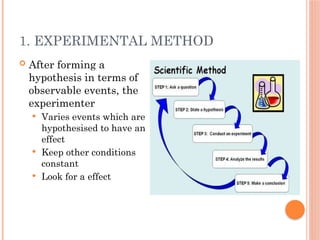
1. EXPERIMENTAL METHOD
 After forming a
hypothesis in terms of
observable events, the
experimenter
 Varies events which are
hypothesised to have an
effect
 Keep other conditions
constant
 Look for a effect
1. EXPERIMENTAL METHOD
 Variables
 An event or condition that can have different values
 Can be measured quantitatively
 Independent Variable
 Dependent variable
 Eg: Meditation training improves tennis skills
 Confounded variable
 Extraneous variable:

- Any variable that has the potential to influence the DV
in an experiment and therefore bias the results.
1. EXPERIMENTAL METHOD
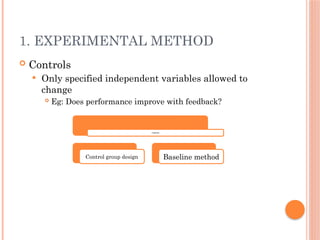
 Controls
 Only specified independent variables allowed to
change
 Eg: Does performance improve with feedback?
Controls
Control group design Baseline method
1. EXPERIMENTAL METHOD
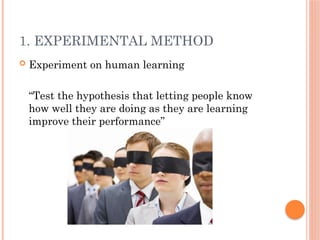
 Experiment on human learning
“Test the hypothesis that letting people know
how well they are doing as they are learning
improve their performance”
1. EXPERIMENTAL METHOD
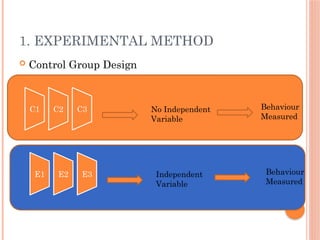
 Control Group Design
 Be
C1 C2 C3 No Independent
Variable
Behaviour
Measured
E1 E2 E3 Independent
Variable
Behaviour
Measured
1. EXPERIMENTAL METHOD
 Control Group Design
 Caution
 Groups should be equivalent
Disadvantage?
1. EXPERIMENTAL METHOD
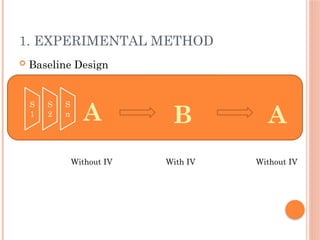
 Baseline Design
S
1
S
2
S
n A A
B
Without IV
Without IV With IV
1. EXPERIMENTAL METHOD
 Baseline Design
 Good when IV does not have a lasting effect
1. EXPERIMENTAL METHOD
 Limitations
 Best, but –
 Cant be used if experiment is dangerous
 Conclusions may not be applicable in natural environment
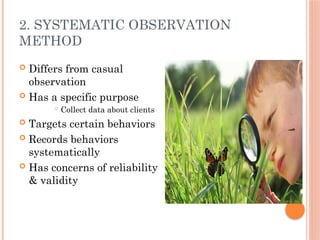
2. SYSTEMATIC OBSERVATION
METHOD
 Differs from casual
observation
 Has a specific purpose
 Collect data about clients
 Targets certain behaviors
 Records behaviors
systematically
 Has concerns of reliability
& validity
3. CLINICAL METHOD
This method is primarily used to collect detailed information on
the behavior problems of maladjusted and deviant cases. The
main objective of this method is to study individual case or
cases of group to detect and diagnose their specific problems
and to suggest therapeutic measures to rehabilitate them in
their environment.
3. CLINICAL METHOD
It involves the following steps : -
1. Interview
2. Information gathering
3. A hypothesis formulate
4. Diagnoses are made
5. Planned a treatment programme
PSYCHOLOGY & EVOLUTION
EVOLUTIONARY PSYCHOLOGY
 Evolutionary psychology is a theoretical approach
to psychology that attempts to explain useful
mental and psychological traits—such as
memory, perception, or language—as
adaptations, i.e., as the functional products of
natural selection.
 Focused on how evolution has shaped the mind and
behavior.
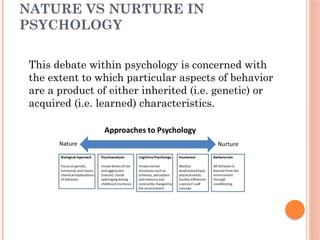
NATURE VS NURTURE IN
PSYCHOLOGY
This debate within psychology is concerned with
the extent to which particular aspects of behavior
are a product of either inherited (i.e. genetic) or
acquired (i.e. learned) characteristics.
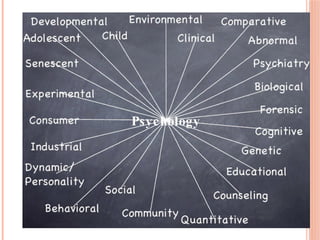
SCOPE AND BRANCHES OF
PSYCHOLOGY
 Abnormal Psychology:
*study unusual pattern of behavior.
 General Psychology:
*study human development, emotions,
motivation, learning, senses, perception,
thinking, memory, intelligence and processing.
 Behavioral Psychology:
*study the behaviors of living
organisms.
 Biological Psychology:
Behavioral neuroscience, also known
as biological psychology, biopsychology, or
psychobiology is the application of the principles
of biology (in particular neurobiology), to the
study of physiological, genetic, and
developmental mechanisms of behavior in
humans and non-human animals.
 Cognitive Psychology:
Cognitive psychology is the study
of mental processes such as "attention, language
use, memory, perception, problem solving,
creativity, and thinking."
 Comparative Psychology:
Comparative psychology refers to
the scientific study of the behavior and mental
processes of non-human animals, especially as
these relate to the phylogenetic history, adaptive
significance, and development of behavior.
 Cross- Cultural Psychology:
Cross-cultural psychology is the
scientific study of human behavior and mental
processes, including both their variability and
invariance, under diverse cultural conditions.
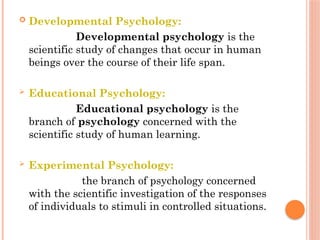
 Developmental Psychology:
Developmental psychology is the
scientific study of changes that occur in human
beings over the course of their life span.
 Educational Psychology:
Educational psychology is the
branch of psychology concerned with the
scientific study of human learning.
 Experimental Psychology:
the branch of psychology concerned
with the scientific investigation of the responses
of individuals to stimuli in controlled situations.
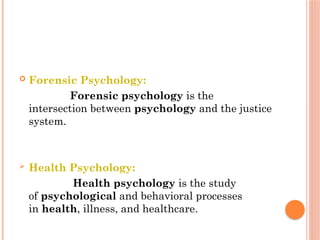
 Forensic Psychology:
Forensic psychology is the
intersection between psychology and the justice
system.
 Health Psychology:
Health psychology is the study
of psychological and behavioral processes
in health, illness, and healthcare.
Unit-1-Evolution-Science-Scope Introduction to Psychology

Unit-1-Evolution-Science-Scope Introduction to Psychology

  • 1.
  • 2.
  • 3.
  • 4.
    SCIENCE A body ofsystematized knowledge gathered by carefully measuring and observing events
  • 5.
    APPLICATION OF PSYCHOLOGY Used to solve ‘real-life’ problems  Eg: “Are you afraid of the dark?”  Rheostat Control  Relaxation Training  Positive self statements  Record keeping and feed back  Rewarding success  Phasing out rewards
  • 6.
    RESEARCH TYPES  PureResearch  Fundamental research done just for better insight or understanding by the researcher  Applied Research  Research carried out to solve any specific problem
  • 7.
    METHODS IN PSYCHOLOGY 1.Experimental Method 2. Systematic Observation 3. Clinical Method
  • 8.
    1. EXPERIMENTAL METHOD After forming a hypothesis in terms of observable events, the experimenter  Varies events which are hypothesised to have an effect  Keep other conditions constant  Look for a effect
  • 9.
    1. EXPERIMENTAL METHOD Variables  An event or condition that can have different values  Can be measured quantitatively  Independent Variable  Dependent variable  Eg: Meditation training improves tennis skills  Confounded variable  Extraneous variable:  - Any variable that has the potential to influence the DV in an experiment and therefore bias the results.
  • 10.
    1. EXPERIMENTAL METHOD Controls  Only specified independent variables allowed to change  Eg: Does performance improve with feedback? Controls Control group design Baseline method
  • 11.
    1. EXPERIMENTAL METHOD Experiment on human learning “Test the hypothesis that letting people know how well they are doing as they are learning improve their performance”
  • 12.
    1. EXPERIMENTAL METHOD Control Group Design  Be C1 C2 C3 No Independent Variable Behaviour Measured E1 E2 E3 Independent Variable Behaviour Measured
  • 13.
    1. EXPERIMENTAL METHOD Control Group Design  Caution  Groups should be equivalent Disadvantage?
  • 14.
    1. EXPERIMENTAL METHOD Baseline Design S 1 S 2 S n A A B Without IV Without IV With IV
  • 15.
    1. EXPERIMENTAL METHOD Baseline Design  Good when IV does not have a lasting effect
  • 16.
    1. EXPERIMENTAL METHOD Limitations  Best, but –  Cant be used if experiment is dangerous  Conclusions may not be applicable in natural environment
  • 17.
    2. SYSTEMATIC OBSERVATION METHOD Differs from casual observation  Has a specific purpose  Collect data about clients  Targets certain behaviors  Records behaviors systematically  Has concerns of reliability & validity
  • 18.
    3. CLINICAL METHOD Thismethod is primarily used to collect detailed information on the behavior problems of maladjusted and deviant cases. The main objective of this method is to study individual case or cases of group to detect and diagnose their specific problems and to suggest therapeutic measures to rehabilitate them in their environment.
  • 19.
    3. CLINICAL METHOD Itinvolves the following steps : - 1. Interview 2. Information gathering 3. A hypothesis formulate 4. Diagnoses are made 5. Planned a treatment programme
  • 20.
  • 21.
    EVOLUTIONARY PSYCHOLOGY  Evolutionarypsychology is a theoretical approach to psychology that attempts to explain useful mental and psychological traits—such as memory, perception, or language—as adaptations, i.e., as the functional products of natural selection.  Focused on how evolution has shaped the mind and behavior.
  • 22.
    NATURE VS NURTUREIN PSYCHOLOGY This debate within psychology is concerned with the extent to which particular aspects of behavior are a product of either inherited (i.e. genetic) or acquired (i.e. learned) characteristics.
  • 23.
    SCOPE AND BRANCHESOF PSYCHOLOGY
  • 24.
     Abnormal Psychology: *studyunusual pattern of behavior.  General Psychology: *study human development, emotions, motivation, learning, senses, perception, thinking, memory, intelligence and processing.  Behavioral Psychology: *study the behaviors of living organisms.
  • 25.
     Biological Psychology: Behavioralneuroscience, also known as biological psychology, biopsychology, or psychobiology is the application of the principles of biology (in particular neurobiology), to the study of physiological, genetic, and developmental mechanisms of behavior in humans and non-human animals.  Cognitive Psychology: Cognitive psychology is the study of mental processes such as "attention, language use, memory, perception, problem solving, creativity, and thinking."
  • 26.
     Comparative Psychology: Comparativepsychology refers to the scientific study of the behavior and mental processes of non-human animals, especially as these relate to the phylogenetic history, adaptive significance, and development of behavior.  Cross- Cultural Psychology: Cross-cultural psychology is the scientific study of human behavior and mental processes, including both their variability and invariance, under diverse cultural conditions.
  • 27.
     Developmental Psychology: Developmentalpsychology is the scientific study of changes that occur in human beings over the course of their life span.  Educational Psychology: Educational psychology is the branch of psychology concerned with the scientific study of human learning.  Experimental Psychology: the branch of psychology concerned with the scientific investigation of the responses of individuals to stimuli in controlled situations.
  • 28.
     Forensic Psychology: Forensicpsychology is the intersection between psychology and the justice system.  Health Psychology: Health psychology is the study of psychological and behavioral processes in health, illness, and healthcare.