UNIT I
DBMS
- ATHILAKSHMI S
Database management concepts
• Database Management Systems (DBMS)
• An example of a database (relational)
• Database schema (e.g. relational)
• Data independence
• Architecture of a DBMS
• Types of DBMS
• Basic DBMS types
• Retrieving and manipulating data: query processing
• Database views
• Data integrity
• Client-Server architectures
• Knowledge Bases and KBS (and area of AI)
• DBMS tasks:
• Managing large quantity of structured data
• Efficient retrieval and modification: query processing and optimization
• Sharing data: multiple users use and manipulate data
• Controlling the access to data: maintaining the data integrity
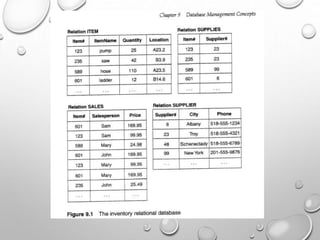
• An example of a database (relational):
• Relations (tables)
• Attributes (columns)
• Tuples (rows)
• Example query: Salesperson='Mary' AND Price>100.
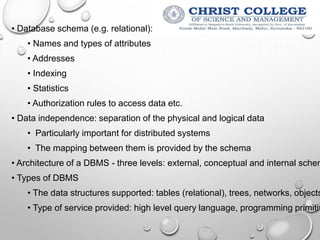
• Database schema (e.g. relational):
• Names and types of attributes
• Addresses
• Indexing
• Statistics
• Authorization rules to access data etc.
• Data independence: separation of the physical and logical data
• Particularly important for distributed systems
• The mapping between them is provided by the schema
• Architecture of a DBMS - three levels: external, conceptual and internal schem
• Types of DBMS
• The data structures supported: tables (relational), trees, networks, objects
• Type of service provided: high level query language, programming primitiv
Basic DBMS types
• Linear files
• Sequence of records with a fixed format usually stored on a single file
• Limitation: single file
• Example query: Salesperson='Mary' AND Price>100
• Hierarchical structure
• Trees of records: one-to-many relationships
• Limitations:
• Requires duplicating records (e.g. many-to-many relationship)
• Problems when updated
• Retrieval requires knowing the structure (limited data independence):
traversing the tree from top to bottom using a procedural language
• Network structure: similar to the hierarchical database with the implementation
of many-to-many relationships
• Relational structure
• Object-Oriented structure
• Objects (collection of data items and procedures) and interactions between
• Is this really a new paradigm, or a special case of network structure?
• Separate implementation vs. implementation on top of a RDBMS
Relational structure
• Relations, attributes, tuples
• Primary key (unique combination of attributes for each tuple)
• Foreign keys: relationships between tuples (many-to-many).
Example: SUPPLIES defines relations between ITEM and SUPPLIER tuples.
• Advantages: many-to-many relationships, high level declarative query language (e.g. S
• SQL example (retrieve all items supplied by a supplier located in Troy):
SELECT ItemName
FROM ITEM, SUPPLIES, SUPPLIER
WHERE SUPPLIER.City = "Troy" AND
SUPPLIER.Supplier# = SUPPLIES.Supplier# AND
SUPPLIES.Item# = ITEM.Item#
• Programming language interfaces: including SQL queries in the code
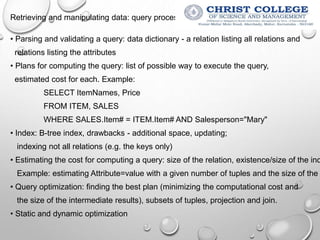
Retrieving and manipulating data: query processing
• Parsing and validating a query: data dictionary - a relation listing all relations and
relations listing the attributes
• Plans for computing the query: list of possible way to execute the query,
estimated cost for each. Example:
SELECT ItemNames, Price
FROM ITEM, SALES
WHERE SALES.Item# = ITEM.Item# AND Salesperson="Mary"
• Index: B-tree index, drawbacks - additional space, updating;
indexing not all relations (e.g. the keys only)
• Estimating the cost for computing a query: size of the relation, existence/size of the ind
Example: estimating Attribute=value with a given number of tuples and the size of the
• Query optimization: finding the best plan (minimizing the computational cost and
the size of the intermediate results), subsets of tuples, projection and join.
• Static and dynamic optimization
Database views
• Creating user defined subsets of the database
• Improving the user interface
• Example:
CREATE VIEW MarySales(ItemName,Price)
AS SELECT ItemName, Price
FROM ITEM, SALES
WHERE ITEM.Item#=SALES.Item# AND Salesperson="Mary"
Then the query:
SELECT ItemName
FROM MarySales
WHERE Proce>100
translates to:
SELECT ItemName
FROM ITEM, SALES
WHERE ITEM.Item#=SALES.Item# AND Salesperson="Mary" AND Price>100
Data integrity
Integrity constraints: semantic conditions on the data
• Individual constraints on data items
• Uniqueness of the primary keys
• Dependencies between relations
Concurrency control
• Steps in executing a query
• Concurrent users of the database, interfering the execution of one query by another
• Transaction: a set of operations that takes the database from one consistent state to another
• Solving the concurrency control problem: making transactions atomic operations (one at a time
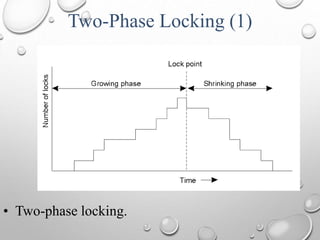
• Concurrent transactions: serializability theory (two-phase locking), read lock (many), write lock
• Serializible transactions: first phase - accumulating locks, second phase - releasing locks.
• Deadlocks: deadlock detection algorithms.
• Distributed execution problems:
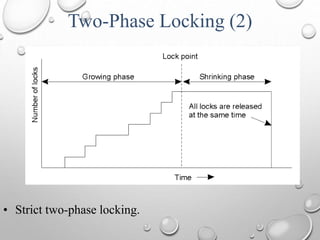
• release a lock at one node (all locks accumulated at the other node?)
• strict two-phase locking
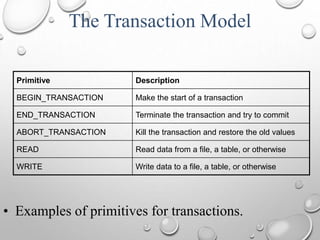
The Transaction Model
• Examples of primitives for transactions.
Primitive Description
BEGIN_TRANSACTION Make the start of a transaction
END_TRANSACTION Terminate the transaction and try to commit
ABORT_TRANSACTION Kill the transaction and restore the old values
READ Read data from a file, a table, or otherwise
WRITE Write data to a file, a table, or otherwise
The Transaction Model
a) Transaction to reserve three flights commits
b) Transaction aborts when third flight is unavailable
BEGIN_TRANSACTION
reserve WP -> JFK;
reserve JFK -> Nairobi;
reserve Nairobi -> Malindi;
END_TRANSACTION
(a)
BEGIN_TRANSACTION
reserve WP -> JFK;
reserve JFK -> Nairobi;
reserve Nairobi -> Malindi full =>
ABORT_TRANSACTION
(b)
Distributed Transactions
a) A nested transaction
b) A distributed transaction
Writeahead Log
• a) A transaction
• b) – d) The log before each statement is executed
x = 0;
y = 0;
BEGIN_TRANSACTION;
x = x + 1;
y = y + 2
x = y * y;
END_TRANSACTION;
(a)
Log
[x = 0 / 1]
(b)
Log
[x = 0 / 1]
[y = 0/2]
(c)
Log
[x = 0 / 1]
[y = 0/2]
[x = 1/4]
(d)
Concurrency Control (1)
• General organization of managers for handling transactions.
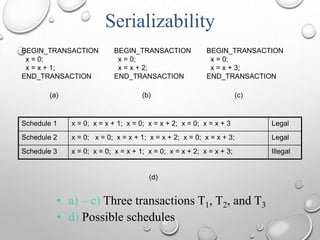
Serializability
• a) – c) Three transactions T1, T2, and T3
• d) Possible schedules
BEGIN_TRANSACTION
x = 0;
x = x + 1;
END_TRANSACTION
(a)
BEGIN_TRANSACTION
x = 0;
x = x + 2;
END_TRANSACTION
(b)
BEGIN_TRANSACTION
x = 0;
x = x + 3;
END_TRANSACTION
(c)
Schedule 1 x = 0; x = x + 1; x = 0; x = x + 2; x = 0; x = x + 3 Legal
Schedule 2 x = 0; x = 0; x = x + 1; x = x + 2; x = 0; x = x + 3; Legal
Schedule 3 x = 0; x = 0; x = x + 1; x = 0; x = x + 2; x = x + 3; Illegal
(d)
Two-Phase Locking (1)
• Two-phase locking.
Two-Phase Locking (2)
• Strict two-phase locking.
Data integrity
Backup and recovery
• The problem of keeping a transaction atomic: successful or failed
What if some of the intermediate steps failed?
• Log of database activity: use the log to undo a failed transaction.
• More problems: when to write the log, failure of the recovery system executing the log.
Security and access control
• Access rules for relations or attributes. Stored in a special relation (part of the data dictiona
• Content-independent and content-dependent access control
• Content-dependent control: access to a view only or query modification
(e.g. and-ing a predicate to the WHERE clause)
• Discretionary and mandatory access control
Knowledge Bases and KBS (and area of AI)
• Information, Data, Knowledge (data in a form that allows reasoning)
• Basic components of a KBS
• Knowledge base
• Inference (reasoning) mechanism (e.g. forward/backward chaining)
• Explanation mechanism/Interface
• Rule-based systems (medical diagnostics, credit evaluation etc.)
Unit 1- dbms.ppt

Unit 1- dbms.ppt

  • 1.
  • 2.
    Database management concepts •Database Management Systems (DBMS) • An example of a database (relational) • Database schema (e.g. relational) • Data independence • Architecture of a DBMS • Types of DBMS • Basic DBMS types • Retrieving and manipulating data: query processing • Database views • Data integrity • Client-Server architectures • Knowledge Bases and KBS (and area of AI)
  • 3.
    • DBMS tasks: •Managing large quantity of structured data • Efficient retrieval and modification: query processing and optimization • Sharing data: multiple users use and manipulate data • Controlling the access to data: maintaining the data integrity • An example of a database (relational): • Relations (tables) • Attributes (columns) • Tuples (rows) • Example query: Salesperson='Mary' AND Price>100.
  • 5.
    • Database schema(e.g. relational): • Names and types of attributes • Addresses • Indexing • Statistics • Authorization rules to access data etc. • Data independence: separation of the physical and logical data • Particularly important for distributed systems • The mapping between them is provided by the schema • Architecture of a DBMS - three levels: external, conceptual and internal schem • Types of DBMS • The data structures supported: tables (relational), trees, networks, objects • Type of service provided: high level query language, programming primitiv
  • 7.
    Basic DBMS types •Linear files • Sequence of records with a fixed format usually stored on a single file • Limitation: single file • Example query: Salesperson='Mary' AND Price>100 • Hierarchical structure • Trees of records: one-to-many relationships • Limitations: • Requires duplicating records (e.g. many-to-many relationship) • Problems when updated • Retrieval requires knowing the structure (limited data independence): traversing the tree from top to bottom using a procedural language • Network structure: similar to the hierarchical database with the implementation of many-to-many relationships • Relational structure • Object-Oriented structure • Objects (collection of data items and procedures) and interactions between • Is this really a new paradigm, or a special case of network structure? • Separate implementation vs. implementation on top of a RDBMS
  • 8.
    Relational structure • Relations,attributes, tuples • Primary key (unique combination of attributes for each tuple) • Foreign keys: relationships between tuples (many-to-many). Example: SUPPLIES defines relations between ITEM and SUPPLIER tuples. • Advantages: many-to-many relationships, high level declarative query language (e.g. S • SQL example (retrieve all items supplied by a supplier located in Troy): SELECT ItemName FROM ITEM, SUPPLIES, SUPPLIER WHERE SUPPLIER.City = "Troy" AND SUPPLIER.Supplier# = SUPPLIES.Supplier# AND SUPPLIES.Item# = ITEM.Item# • Programming language interfaces: including SQL queries in the code
  • 9.
    Retrieving and manipulatingdata: query processing • Parsing and validating a query: data dictionary - a relation listing all relations and relations listing the attributes • Plans for computing the query: list of possible way to execute the query, estimated cost for each. Example: SELECT ItemNames, Price FROM ITEM, SALES WHERE SALES.Item# = ITEM.Item# AND Salesperson="Mary" • Index: B-tree index, drawbacks - additional space, updating; indexing not all relations (e.g. the keys only) • Estimating the cost for computing a query: size of the relation, existence/size of the ind Example: estimating Attribute=value with a given number of tuples and the size of the • Query optimization: finding the best plan (minimizing the computational cost and the size of the intermediate results), subsets of tuples, projection and join. • Static and dynamic optimization
  • 10.
    Database views • Creatinguser defined subsets of the database • Improving the user interface • Example: CREATE VIEW MarySales(ItemName,Price) AS SELECT ItemName, Price FROM ITEM, SALES WHERE ITEM.Item#=SALES.Item# AND Salesperson="Mary" Then the query: SELECT ItemName FROM MarySales WHERE Proce>100 translates to: SELECT ItemName FROM ITEM, SALES WHERE ITEM.Item#=SALES.Item# AND Salesperson="Mary" AND Price>100
  • 11.
    Data integrity Integrity constraints:semantic conditions on the data • Individual constraints on data items • Uniqueness of the primary keys • Dependencies between relations Concurrency control • Steps in executing a query • Concurrent users of the database, interfering the execution of one query by another • Transaction: a set of operations that takes the database from one consistent state to another • Solving the concurrency control problem: making transactions atomic operations (one at a time • Concurrent transactions: serializability theory (two-phase locking), read lock (many), write lock • Serializible transactions: first phase - accumulating locks, second phase - releasing locks. • Deadlocks: deadlock detection algorithms. • Distributed execution problems: • release a lock at one node (all locks accumulated at the other node?) • strict two-phase locking
  • 12.
    The Transaction Model •Examples of primitives for transactions. Primitive Description BEGIN_TRANSACTION Make the start of a transaction END_TRANSACTION Terminate the transaction and try to commit ABORT_TRANSACTION Kill the transaction and restore the old values READ Read data from a file, a table, or otherwise WRITE Write data to a file, a table, or otherwise
  • 13.
    The Transaction Model a)Transaction to reserve three flights commits b) Transaction aborts when third flight is unavailable BEGIN_TRANSACTION reserve WP -> JFK; reserve JFK -> Nairobi; reserve Nairobi -> Malindi; END_TRANSACTION (a) BEGIN_TRANSACTION reserve WP -> JFK; reserve JFK -> Nairobi; reserve Nairobi -> Malindi full => ABORT_TRANSACTION (b)
  • 14.
    Distributed Transactions a) Anested transaction b) A distributed transaction
  • 15.
    Writeahead Log • a)A transaction • b) – d) The log before each statement is executed x = 0; y = 0; BEGIN_TRANSACTION; x = x + 1; y = y + 2 x = y * y; END_TRANSACTION; (a) Log [x = 0 / 1] (b) Log [x = 0 / 1] [y = 0/2] (c) Log [x = 0 / 1] [y = 0/2] [x = 1/4] (d)
  • 16.
    Concurrency Control (1) •General organization of managers for handling transactions.
  • 17.
    Serializability • a) –c) Three transactions T1, T2, and T3 • d) Possible schedules BEGIN_TRANSACTION x = 0; x = x + 1; END_TRANSACTION (a) BEGIN_TRANSACTION x = 0; x = x + 2; END_TRANSACTION (b) BEGIN_TRANSACTION x = 0; x = x + 3; END_TRANSACTION (c) Schedule 1 x = 0; x = x + 1; x = 0; x = x + 2; x = 0; x = x + 3 Legal Schedule 2 x = 0; x = 0; x = x + 1; x = x + 2; x = 0; x = x + 3; Legal Schedule 3 x = 0; x = 0; x = x + 1; x = 0; x = x + 2; x = x + 3; Illegal (d)
  • 18.
    Two-Phase Locking (1) •Two-phase locking.
  • 19.
    Two-Phase Locking (2) •Strict two-phase locking.
  • 20.
    Data integrity Backup andrecovery • The problem of keeping a transaction atomic: successful or failed What if some of the intermediate steps failed? • Log of database activity: use the log to undo a failed transaction. • More problems: when to write the log, failure of the recovery system executing the log. Security and access control • Access rules for relations or attributes. Stored in a special relation (part of the data dictiona • Content-independent and content-dependent access control • Content-dependent control: access to a view only or query modification (e.g. and-ing a predicate to the WHERE clause) • Discretionary and mandatory access control
  • 21.
    Knowledge Bases andKBS (and area of AI) • Information, Data, Knowledge (data in a form that allows reasoning) • Basic components of a KBS • Knowledge base • Inference (reasoning) mechanism (e.g. forward/backward chaining) • Explanation mechanism/Interface • Rule-based systems (medical diagnostics, credit evaluation etc.)