Unidata:
Providing data, developing tools, and
building community for the geosciences
Joshua Young
Community Services Manager
March 2015
Unidata: Community Driven
• Unidata means the entire community
• Unidata Program Center (UPC) means the staff in
Boulder
• UPC is governed by two committees composed of academic
community members ( with ex officio participation from government
partners, etc).
• The Users Committee advises on our services for the community
• The Strategic Advisory Committee advises on the management of
the UPC
• There are many opportunities for community
involvement!
Unidata: Services
• Facilitate access to (real-time) data by the University
research and education community
• Support the community in their use of the data
• Help advocate on behalf of the community
• Develop open source tools and infrastructure for data
access, analysis, visualization, and data management
• Advance metadata standards for the earth science
community
• Support for users of our services at
support@unidata.ucar.edu
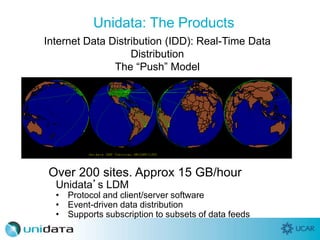
Internet Data Distribution (IDD): Real-Time Data
Distribution
The “Push” Model
Over 200 sites. Approx 15 GB/hour
Unidata’s LDM
• Protocol and client/server software
• Event-driven data distribution
• Supports subscription to subsets of data feeds
Unidata: The Products
The IDD and LDM Data:
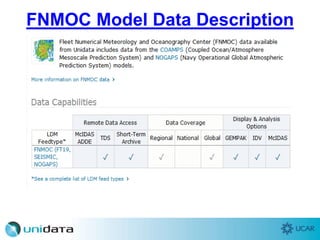
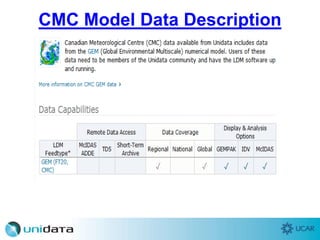
• Forecast Model Outputs from NCEP,
FNMOC, CMC
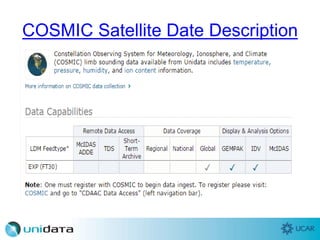
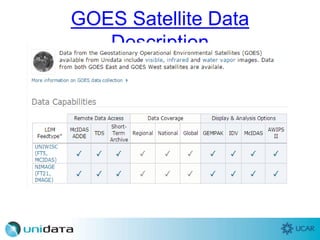
• Satellite data from GOES East & West; and
COSMIC
• RADAR Level II, III, & National Mosaics
• Lightening data
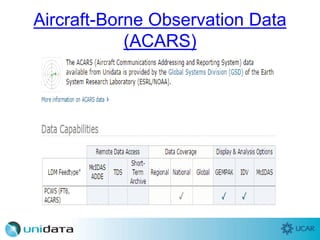
• Aircraft-borne Observation Data
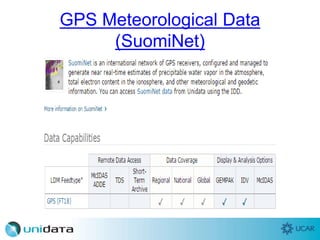
• SuomiNet
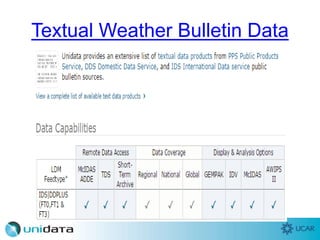
• Textual Weather Bulletin Data
Thematic Real-time Environmental Data
Distribution Services (THREDDS)
•THREDDS is middleware to bridge the gap
between data providers and data users.
•The goal is to simplify the discovery and
use of scientific data and to allow scientific
publications and educational materials to
reference scientific data.
•The THREDDS effort consists of two main
areas: the THREDDS Data Server (TDS)
and the Common Data Model (CDM) /
netCDF-Java library.
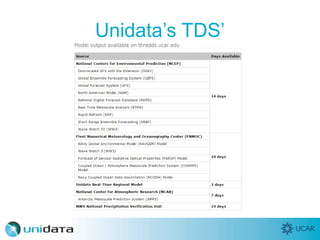
Unidata’s TDS’
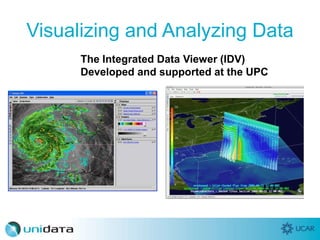
Visualizing and Analyzing Data
The Integrated Data Viewer (IDV)
Developed and supported at the UPC
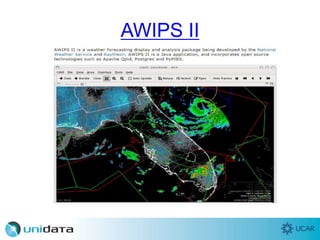
AWIPS II
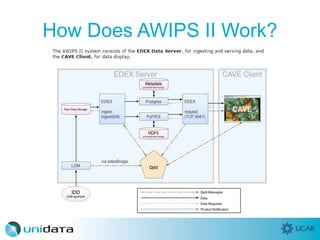
How Does AWIPS II Work?
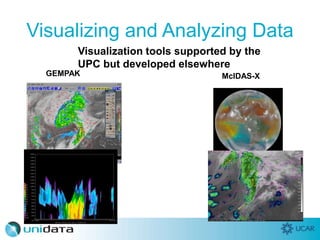
Visualizing and Analyzing Data
GEMPAK McIDAS-X
Visualization tools supported by the
UPC but developed elsewhere
Network Common Data Form
(netCDF)
• A set of software libraries and machine-
independent data formats that support the
creation, access, and sharing of array-oriented
scientific data.
• Data in netCDF format is:
• ™Self-Describing
• ™Portable
• ™Scalable
• ™Appendable
• ™Sharable
• ™Archivable
Rosetta
Rosetta is a web-based service that provides an easy, wizard-
based interface for data collectors to transform their
datalogger generated ASCII output into:
• Climate and Forecast (CF) compliant netCDF files,
• Complete with metadata describing what data are
contained in the file
• Instruments used to collect the data
The use of CF compliant netCDF files allows the use of
standard services; however, with knowing that the
observational community appreciates the ease of use of
ASCII files, methods for transforming the netCDF back into
a user defined CSV or spreadsheet format are also built-in.
RAMADDA
The Repository for Archiving, Managing and Accessing Diverse Data
(RAMADDA), was originally developed at the Unidata Program Center and
is now an Open Source project managed by Geode Systems, LLC.
RAMADDA is a full-featured scientific data management system, allowing
you to:
• store virtually any type of scientific data
• manage access to and sharing of the data
• generate quick visualizations of many data types
Unidata continues to be actively involved with the RAMADDA community in
numerous ways:
• RAMADDA is tightly integrated with the IDV
• Unidata's Teaching Resources project relies on RAMADDA
• Unidata's Motherlode RAMADDA server makes a wide selection of
observational data and forecast model output available
Teaching Resources Network
The Teaching Resources Network allows educators to
create, access, and share collections of resource
material related to atmospheric, oceanic, and other earth
system phenomena.
It is designed for sharing scientific data and products,
teaching tools such as lesson plans and guided
exercises, and tools for displaying data.
To access the Teaching Resources Network visit:
• http://motherlode.ucar.edu/repository/alias/TeachingRe
sourceNetwork
Unidata: Community Opportunities
• Annual Training from July 20th to August 5th covering
Unidata tech and Python, TDS, LDM, AWIPS II, and IDV
with RAMADDA
• Unidata Users Workshop June 22nd to 25th
• Nominations for the DeSouza Award and committee
memberships
• Summer internships
• Equipment awards
Unidata: The Future
The Challenges/Opportunties:
• Exponential growth in data
• Decreasing community capacity for
hardware and system administration
Some of our Responses:
• Move to the Cloud
• Leverage the community support for
Python
Unidata: The Contacts
The UPC:
• http://www.unidata.ucar.edu/
• support@unidata.ucar.edu
• @unidata
• www.facebook.com/Unidata Support
Me:
• jwyoung@ucar.edu
• @unidata_josh
• www.slideshare.net/JoshYoung8
• 303-497-8646
Unidata is one of the University Corporation
for Atmospheric Research (UCAR)'s
Community Programs (UCP), and is
funded primarily by the National Science
Foundation (Grant NSF-1344155).
Back-up Slides
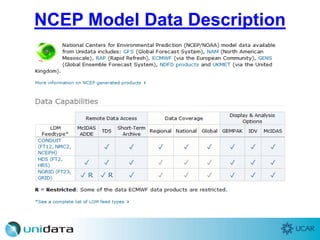
NCEP Model Data Description
FNMOC Model Data Description
CMC Model Data Description
COSMIC Satellite Date Description
GOES Satellite Data
Description
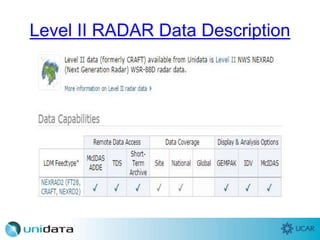
Level II RADAR Data Description
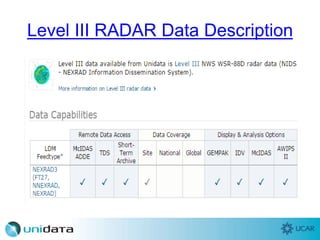
Level III RADAR Data Description
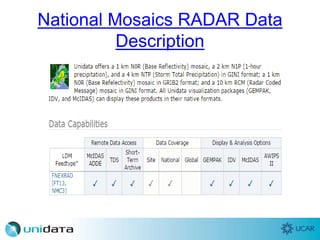
National Mosaics RADAR Data
Description
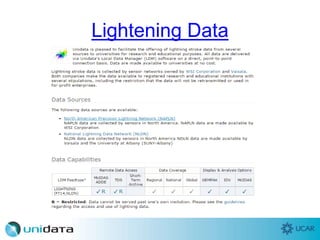
Lightening Data
Aircraft-Borne Observation Data
(ACARS)
GPS Meteorological Data
(SuomiNet)
Textual Weather Bulletin Data

Unidata Overview 3.6.15

  • 1.
    Unidata: Providing data, developingtools, and building community for the geosciences Joshua Young Community Services Manager March 2015
  • 2.
    Unidata: Community Driven •Unidata means the entire community • Unidata Program Center (UPC) means the staff in Boulder • UPC is governed by two committees composed of academic community members ( with ex officio participation from government partners, etc). • The Users Committee advises on our services for the community • The Strategic Advisory Committee advises on the management of the UPC • There are many opportunities for community involvement!
  • 3.
    Unidata: Services • Facilitateaccess to (real-time) data by the University research and education community • Support the community in their use of the data • Help advocate on behalf of the community • Develop open source tools and infrastructure for data access, analysis, visualization, and data management • Advance metadata standards for the earth science community • Support for users of our services at support@unidata.ucar.edu
  • 4.
    Internet Data Distribution(IDD): Real-Time Data Distribution The “Push” Model Over 200 sites. Approx 15 GB/hour Unidata’s LDM • Protocol and client/server software • Event-driven data distribution • Supports subscription to subsets of data feeds Unidata: The Products
  • 5.
    The IDD andLDM Data: • Forecast Model Outputs from NCEP, FNMOC, CMC • Satellite data from GOES East & West; and COSMIC • RADAR Level II, III, & National Mosaics • Lightening data • Aircraft-borne Observation Data • SuomiNet • Textual Weather Bulletin Data
  • 6.
    Thematic Real-time EnvironmentalData Distribution Services (THREDDS) •THREDDS is middleware to bridge the gap between data providers and data users. •The goal is to simplify the discovery and use of scientific data and to allow scientific publications and educational materials to reference scientific data. •The THREDDS effort consists of two main areas: the THREDDS Data Server (TDS) and the Common Data Model (CDM) / netCDF-Java library.
  • 7.
  • 8.
    Visualizing and AnalyzingData The Integrated Data Viewer (IDV) Developed and supported at the UPC
  • 9.
  • 10.
  • 11.
    Visualizing and AnalyzingData GEMPAK McIDAS-X Visualization tools supported by the UPC but developed elsewhere
  • 12.
    Network Common DataForm (netCDF) • A set of software libraries and machine- independent data formats that support the creation, access, and sharing of array-oriented scientific data. • Data in netCDF format is: • ™Self-Describing • ™Portable • ™Scalable • ™Appendable • ™Sharable • ™Archivable
  • 13.
    Rosetta Rosetta is aweb-based service that provides an easy, wizard- based interface for data collectors to transform their datalogger generated ASCII output into: • Climate and Forecast (CF) compliant netCDF files, • Complete with metadata describing what data are contained in the file • Instruments used to collect the data The use of CF compliant netCDF files allows the use of standard services; however, with knowing that the observational community appreciates the ease of use of ASCII files, methods for transforming the netCDF back into a user defined CSV or spreadsheet format are also built-in.
  • 14.
    RAMADDA The Repository forArchiving, Managing and Accessing Diverse Data (RAMADDA), was originally developed at the Unidata Program Center and is now an Open Source project managed by Geode Systems, LLC. RAMADDA is a full-featured scientific data management system, allowing you to: • store virtually any type of scientific data • manage access to and sharing of the data • generate quick visualizations of many data types Unidata continues to be actively involved with the RAMADDA community in numerous ways: • RAMADDA is tightly integrated with the IDV • Unidata's Teaching Resources project relies on RAMADDA • Unidata's Motherlode RAMADDA server makes a wide selection of observational data and forecast model output available
  • 15.
    Teaching Resources Network TheTeaching Resources Network allows educators to create, access, and share collections of resource material related to atmospheric, oceanic, and other earth system phenomena. It is designed for sharing scientific data and products, teaching tools such as lesson plans and guided exercises, and tools for displaying data. To access the Teaching Resources Network visit: • http://motherlode.ucar.edu/repository/alias/TeachingRe sourceNetwork
  • 16.
    Unidata: Community Opportunities •Annual Training from July 20th to August 5th covering Unidata tech and Python, TDS, LDM, AWIPS II, and IDV with RAMADDA • Unidata Users Workshop June 22nd to 25th • Nominations for the DeSouza Award and committee memberships • Summer internships • Equipment awards
  • 17.
    Unidata: The Future TheChallenges/Opportunties: • Exponential growth in data • Decreasing community capacity for hardware and system administration Some of our Responses: • Move to the Cloud • Leverage the community support for Python
  • 18.
    Unidata: The Contacts TheUPC: • http://www.unidata.ucar.edu/ • support@unidata.ucar.edu • @unidata • www.facebook.com/Unidata Support Me: • jwyoung@ucar.edu • @unidata_josh • www.slideshare.net/JoshYoung8 • 303-497-8646
  • 19.
    Unidata is oneof the University Corporation for Atmospheric Research (UCAR)'s Community Programs (UCP), and is funded primarily by the National Science Foundation (Grant NSF-1344155).
  • 20.
  • 21.
    NCEP Model DataDescription
  • 22.
    FNMOC Model DataDescription
  • 23.
    CMC Model DataDescription
  • 24.
  • 25.
  • 26.
    Level II RADARData Description
  • 27.
    Level III RADARData Description
  • 28.
    National Mosaics RADARData Description
  • 29.
  • 30.
  • 31.
  • 32.