1
CONTENTS
1.
2. GOVERNANCE
UNEP GOVERNINGCOUNCIL
EXECUTIVE FUNCTION
3.
MILESTONES 1972-2005
4.
UNEP AROUND THE WORLD
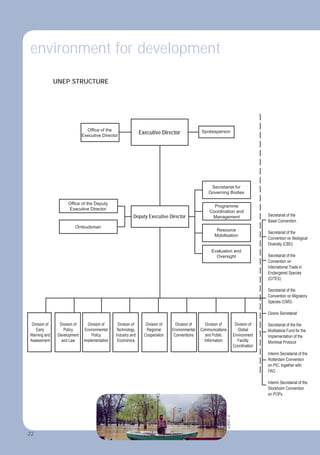
UNEP STRUCTURE
UNEP IN ACTION
5.
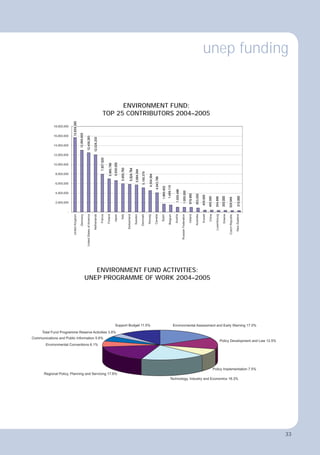
UNEP FUNDING
6.
ORGANIZATION PROFILE
MISSION STATEMENT
UNITED NATIONS ENVIRONMENT PROGRAMME (UNEP)
MEMBER STATES OF THE UNEP GOVERNING COUNCIL 2006-2009
GLOBAL MINISTERIAL ENVIRONMENT FORUM
COMMITTEE OF PERMANENT REPRESENTATIVES
A BRIEF HISTORY OF UNEP
ENVIRONMENT FOR DEVELOPMENT
UNEP’S RESPONSIBILITIES
UNEP’S OBJECTIVES
UNEP’S PRIORITIES
EARLY WARNING AND ASSESSMENT
TECHNOLOGY, INDUSTRY AND ECONOMICS
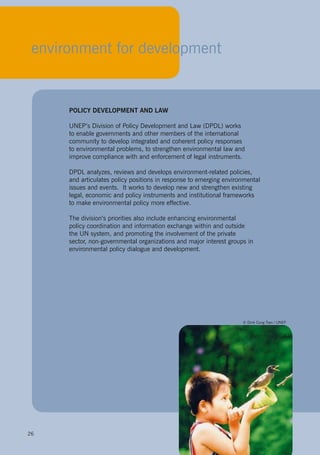
POLICY DEVELOPMENT AND LAW
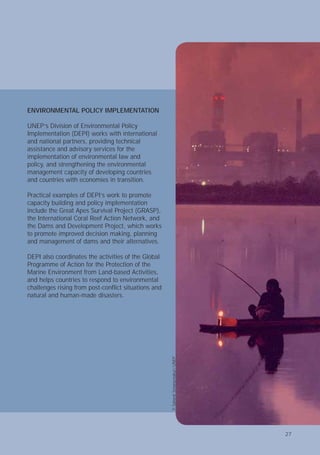
ENVIRONMENTAL POLICY IMPLEMENTATION
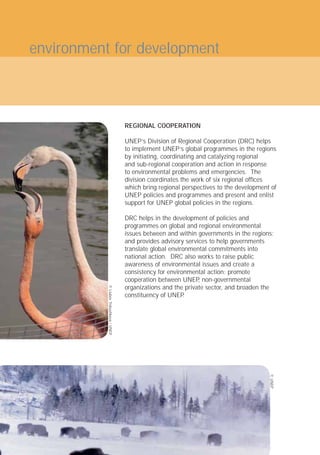
REGIONAL COOPERATION
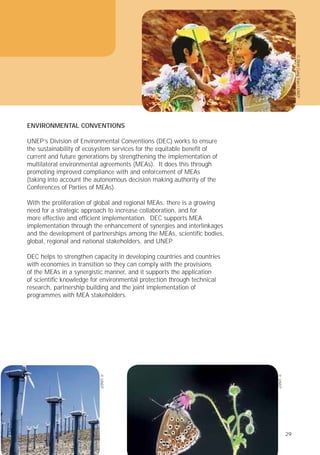
ENVIRONMENTAL CONVENTIONS
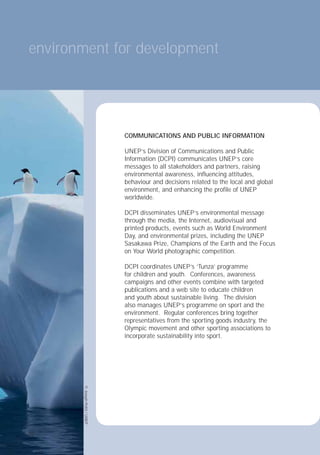
COMMUNICATIONS AND PUBLIC INFORMATION
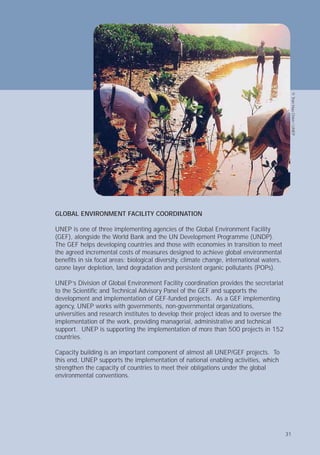
GLOBAL ENVIRONMENT FACILITY COORDINATION
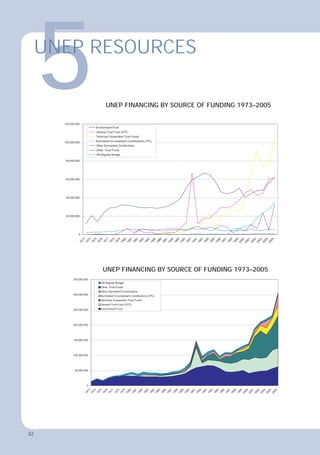
UNEP RESOURCES
UNEP STAFF
UNEP ADDRESSES
7
EXECUTIVE FUNCTION
The ExecutiveDirector of UNEP is responsible for all the activities of the Secretariat,
including its administration. The Executive Director provides environmental policy
leadership within the world community and identifies emerging environmental issues
of global significance for the attention of governments and other partners.
The Executive Director provides management oversight and leadership to UNEP
and directs the implementation of the UNEP programme of work, which is decided
by the UNEP Governing Council. As well as overseeing the organization’s work,
the Executive Director promotes close links with UNEP’s partners, including
governments, UN bodies and international organizations, non-governmental
organizations and private sector entities.
The Office of the Executive Director coordinates an extensive schedule of
appointments and visits with the purpose of raising global awareness about the
importance of environment for development and the work of UNEP
. The Executive
Director’s spokesperson and the Division of Communications and Public Information
(DCPI) implement a proactive media strategy in close collaboration with information
officers stationed in UNEP’s six regional offices.
The Executive Director is assisted in the performance of his or her functions by
a Deputy Executive Director, who advises the Executive Director on substantive
matters, and assists in strategic planning and the development of management tools
and instruments to enhance UNEP’s performance in its overall mission.
The Deputy Executive Director manages the Environment Programme, supervising
all divisions and regional offices, and is directly responsible for the mechanisms
for coordinating and monitoring the implementation of UNEP’s programme of work
and the various activities earmarked for support by donors. The Deputy Executive
Director also manages the project approval process and coordination of UNEP’s
project portfolios with the UN Foundation and other private sector partners, as well
as the UN Development Account.
7
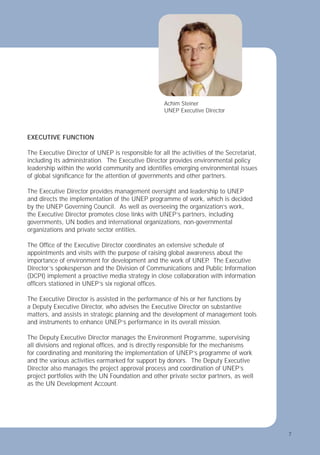
Achim Steiner
UNEP Executive Director
9.
8
FROM STOCKHOLM TORIO, 1972-1992
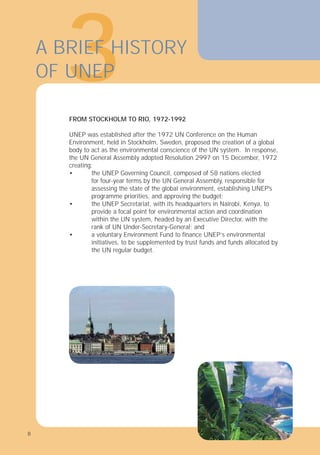
UNEP was established after the 1972 UN Conference on the Human
Environment, held in Stockholm, Sweden, proposed the creation of a global
body to act as the environmental conscience of the UN system. In response,
the UN General Assembly adopted Resolution 2997 on 15 December, 1972
creating:
• the UNEP Governing Council, composed of 58 nations elected
for four-year terms by the UN General Assembly, responsible for
assessing the state of the global environment, establishing UNEP's
programme priorities, and approving the budget;
• the UNEP Secretariat, with its headquarters in Nairobi, Kenya, to
provide a focal point for environmental action and coordination
within the UN system, headed by an Executive Director, with the
rank of UN Under-Secretary-General; and
• a voluntary Environment Fund to finance UNEP’s environmental
initiatives, to be supplemented by trust funds and funds allocated by
the UN regular budget.
3
A BRIEF HISTORY
OF UNEP
8
4
ENVIRONMENT FOR
DEVELOPMENT
UNEP’S RESPONSIBILITIESINCLUDE:
• Promoting international cooperation in the
field of the environment and recommending
appropriate policies.
• Monitoring the status of the global
environment and gathering and
disseminating environmental information.
• Catalyzing environmental awareness and
action to address major environmental
threats among governments, the private
sector and civil society.
• Facilitating the coordination of UN activities
on matters concerned with the environment,
and ensuring, through cooperation, liaison
and participation, that their activities take
environmental considerations into account.
• Developing regional programmes for
environmental sustainability.
• Helping, upon request, environment
ministries and other environmental
authorities, in particular in developing
countries and countries with economies
in transition, to formulate and implement
environmental policies.
• Providing country-level environmental
capacity building and technology support.
• Helping to develop international
environmental law, and providing expert
advice on the development and use of
environmental concepts and instruments.
18
18
23
UNEP IN ACTION
UNEPis the voice for the environment in the UN system. It
is an advocate, educator, catalyst and facilitator, promoting
the wise use of the planet’s natural assets for sustainable
development. The organization works with many partners,
including UN entities, international organizations, national
governments, non-governmental organizations, business,
industry, the media and civil society.
UNEP’s work includes:
• Assessing global, regional and national
environmental conditions and trends.
• Developing international and national environmental
agreements and legal instruments.
• Strengthening institutions for the wise management
of the environment.
• Integrating economic development and
environmental protection.
• Facilitating the transfer of knowledge and technology
for sustainable development.
• Encouraging new partnerships and approaches
within civil society and the private sector.
UNEP’s programme of work to promote and facilitate sound
environmental management for sustainable development is
implemented by eight divisions:
• Early Warning and Assessment.
• Policy Development and Law.
• Environmental Policy Implementation.
• Technology, Industry and Economics.
• Regional Cooperation.
• Environmental Conventions.
• Communications and Public Information.
• Global Environment Facility (GEF) Coordination.
23