Emissions Gap Report 2023
Broken Record
Temperatures hit new highs, yet world
fails to cut emissions (again)
Emissions Gap Report 2023: Broken Record
© 2023 United Nations Environment Programme
ISBN: 		 978-92-807-4098-1
Job number: DEW/2589/NA
DOI: 		 https://doi.org/10.59117/20.500.11822/43922
This publication may be reproduced in whole or in part and in any form for educational or non-profit services without
special permission from the copyright holder, provided acknowledgement of the source is made. The United Nations
Environment Programme would appreciate receiving a copy of any publication that uses this publication as a source. No
use of this publication may be made for resale or any other commercial purpose whatsoever without prior permission
in writing from the United Nations Environment Programme. Applications for such permission, with a statement of the
purpose and extent of the reproduction, should be addressed to unep-communication-director@un.org.
Disclaimers
The designations employed and the presentation of the material in this publication do not imply the expression of any
opinion whatsoever on the part of the Secretariat of the United Nations concerning the legal status of any country,
territory or city or area or its authorities, or concerning the delimitation of its frontiers or boundaries.
Mention of a commercial company or product in this document does not imply endorsement by the United Nations
Environment Programme or the authors. The use of information from this document for publicity or advertising is not
permitted. Trademark names and symbols are used in an editorial fashion with no intention on infringement of trademark
or copyright laws.
The views expressed in this publication are those of the authors and do not necessarily reflect the views of the United
Nations Environment Programme. We regret any errors or omissions that may have been unwittingly made.
© Maps, photos, and illustrations as specified
Suggested citation
United Nations Environment Programme (2023). Emissions Gap Report 2023: Broken Record – Temperatures hit new
highs, yet world fails to cut emissions (again). Nairobi. https://doi.org/10.59117/20.500.11822/43922.
Production: Nairobi
URL:		 https://www.unep.org/emissions-gap-report-2023
Supported by:
Co-produced with:
Broken Record
Temperatures hit new highs,
yet world fails to cut emissions (again)
Emissions Gap Report 2023
V
Emissions Gap Report 2023: Broken Record
The United Nations Environment Programme (UNEP) would
like to thank the members of the steering committee, the lead
and contributing authors, the reviewers and the Secretariat
for their contribution to the preparation of this assessment
report. Authors and reviewers have contributed to the report
in their individual capacities. Their affiliations are only
mentioned for identification purposes.
Steering committee
Muna Alamoodi (Ministry of Climate Change and Environment,
United Arab Emirates), Juliane Berger (German Environment
Agency), Ruta Bubniene (Secretariat of the United Nations
Framework Convention on Climate Change [UNFCCC]); John
Christensen (UNEP Copenhagen Climate Centre [UNEP-
CCC]), María Paz Cigaran (Libélula); Navroz K. Dubash (Centre
for Policy Research), Simon Evans (Carbon Brief) (steering
committee observer), Jian Liu (UNEP), Gerd Leipold (Climate
Transparency) (steering committee observer), Simon
Maxwell (independent), Shonali Pachauri (International
Institute for Applied Systems Analysis [IIASA]); Dan Plechaty
(ClimateWorks Foundation), Katia Simeonova (independent),
Youba Sokona (Intergovernmental Panel on Climate Change
[IPCC]), Oksana Tarasova (World Meteorological Organization)
and Iman Ustadi (Office of the UAE Special Envoy for Climate
Change, United Arab Emirates)
Authors
Chapter 1
Authors: Anne Olhoff (CONCITO – Denmark’s green think
tank, Denmark) and John Christensen (UNEP-CCC, Denmark)
Chapter 2
Lead authors: William F. Lamb (Mercator Research Institute
on Global Commons and Climate Change, Germany; University
of Leeds, United Kingdom of Great Britain and Northern
Ireland) and Minal Pathak (Ahmedabad University, India)
Contributing authors: Lucas Chancel (World Inequality Lab,
Paris School of Economics, France), Monica Crippa (European
Commission, Joint Research Centre [JRC], Italy), Giacomo
Grassi (European Commission, JRC, Italy), Diego Guizzardi
(European Commission, JRC, Italy), Jing Meng (University
College London, United Kingdom), Glen P. Peters (CICERO
Center for International Climate Research, Norway) and Julia
Pongratz (Ludwig-Maximilians University Munich, Germany)
Chapter 3
Lead authors: Takeshi Kuramochi (NewClimate Institute,
Germany), Michel den Elzen (PBL Netherlands Environmental
Assessment Agency, the Netherlands) and Taryn Fransen
(World Resources Institute, United States of America)
Contributing authors: Jesse Burton (University of Cape Town
and E3G, South Africa), Ioannis Dafnomilis (PBL Netherlands
Environmental Assessment Agency, the Netherlands), Ipek
Gençsü (ODI, United Kingdom), Archie Gilmour (ODI, United
Kingdom), Mariana Gutiérrez Grados (Climate Transparency,
Germany), Frederic Hans (NewClimate Institute, Germany),
Sarah Heck (Climate Analytics, Germany), Niklas Höhne
(NewClimate Institute, Germany), Camilla Hyslop (Oxford
University, United Kingdom), Anna Kanduth (Canadian Climate
Institute, Canada), Ben King (Rhodium Group, United States
of America), Hannah Kolus (Rhodium Group, United States
of America), Ho-Mi Lee (Korea Energy Economics Institute,
Republic of Korea), Jared Lewis (Climate Resource, Australia),
Swithin Lui (NewClimate Institute, Germany), Natasha Lutz
(Oxford University, United Kingdom), Andrew Marquard
(University of Cape Town, South Africa), Silke Mooldijk
(NewClimate Institute, Germany), Leonardo Nascimento
(NewClimate Institute, Germany), Analuz Presbítero (Iniciativa
Climática de México [ICM], Mexico), Jazmín Rocco Predassi
(Farn, Argentina), Joeri Rogelj (Imperial College London,
United Kingdom; International Institute for Applied Systems
Analysis [IIASA], Austria), Clea Schumer (World Resources
Institute, United States of America), Alister Self (Climate
Resource, Australia), Kentaro Tamura (Institute for Global
Environmental Strategies [IGES], Japan) and Jorge Villarreal
(ICM, Mexico)
Data contributors: Johannes Gütschow (Potsdam Institute for
Climate Impact Research, Germany), Christopher Henderson
(World Resources Institute, United States of America), Elena
Hooijschuur (PBL Netherlands Environmental Assessment
Agency, the Netherlands), Kimon Keramidas (European
Commission, JRC, Spain), Mia Moisio (NewClimate Institute,
Germany), Mika Pflüger (Climate Resource, Germany) and
Claire Stockwell (Climate Analytics, Germany)
Chapter 4
Lead authors: Joeri Rogelj (Imperial College London, United
Kingdom; IIASA, Austria), Michel den Elzen (PBL Netherlands
Environmental Assessment Agency, the Netherlands) and
Joana Portugal-Pereira (Graduate School of Engineering
[COPPE], Universidade Federal do Rio de Janeiro, Brazil)
Contributing authors: Taryn Fransen (World Resources
Institute, United States of America), Jarmo Kikstra (Imperial
College London, United Kingdom), Robin Lamboll (Imperial
College London, United Kingdom), Malte Meinshausen
(University of Melbourne, Australia) and Isabela Schmidt
Tagomori (PBL Netherlands Environmental Assessment
Agency, the Netherlands)
Data contributors: Ioannis Dafnomilis (PBL Netherlands
Environmental Assessment Agency, the Netherlands) and
Kimon Keramidas (European Commission, JRC, Spain)
Acknowledgements
VI
Emissions Gap Report 2023: Broken Record
Chapter 5
Lead authors: Jesse Burton (University of Cape Town and
E3G, South Africa) and Greg Muttitt (International Institute for
Sustainable Development [IISD], United Kingdom)
Contributing authors: Fatima Denton (United Nations
University Institute for Natural Resources in Africa, Ghana),
Sivan Kartha (Stockholm Environment Institute, United
States of America), Narasimha Rao (Yale School of the
Environment, Yale University, United States of America),
Joeri Rogelj (Imperial College London, United Kingdom;
IIASA, Austria), Saritha Sudharmma Vishwanathan (Indian
Institute of Management Ahmedabad, India; National
Institute for Environmental Studies, Japan), Dan Tong
(Tsinghua University, China), Marta Torres Gunfaus (IDDRI,
France) and William Wills (Centro Brasil no Clima, Brazil; Eos
Consulting, Brazil)
Chapter 6
Lead authors: Narasimha Rao (Yale School of the
Environment, Yale University, United States of America) and
Yacob Mulugetta (University College London, United Kingdom)
Contributing authors: Jesse Burton (University Cape Town
and E3G, South Africa), Joisa Dutra Saraiva (Getulio Vargas
Foundation [FGV], Brazil), Ashwin Gambhir (Prayas Energy
Group, India), Jessica Omukuti (University of Oxford, United
Kingdom), Nadia S. Ouedraogo (United Nations Economic
Commission for Africa [UNECA], Ethiopia), Setu Pelz (IIASA,
Austria), Fei Teng (Tsinghua University, China) and Meron
Tesfamichael (University College London, United Kingdom)
Chapter 7
Lead authors: Oliver Geden (German Institute of International
and Security Affairs, Germany), Mai Bui (Imperial College
London, United Kingdom), Matthew Gidden (IIASA, Austria)
and Mercedes Bustamante (Universidade de Brasília, Brazil)
Contributing authors: HollyBuck(StateUniversityofNewYork
at Buffalo, United States of America), Sabine Fuss (Mercator
Research Institute on Global Commons and Climate Change,
Germany), Jan Minx (Mercator Research Institute on Global
Commons and Climate Change, Germany), Gregory Nemet
(University of Wisconsin-Madison, United States of America),
Joana Portugal-Pereira (COPPE, Universidade Federal do Rio
de Janeiro, Brazil), Gaurav Ganti (Climate Analytics, Germany),
Stephanie Roe (World Wide Fund for Nature [WWF], United
States of America), Steve Smith (University of Oxford, United
Kingdom), and Julia Pongratz (University of Munich and Max
Planck Institute for Meteorology, Germany)
Reviewers
Muna Alamoodi (Ministry of Climate Change and
Environment, United Arab Emirates), Jesica Lelynn Andrews
(UNEP Finance Initiative), Oluleke Babayomi (Shandong
University), Juliane Berger (German Environment Agency),
Marie Blanche Ting (UNEP-CCC), Pierre Boileau (UNEP),
Olivier Bois von Kursk (IISD), Raymond Brandes (UNEP), Ruta
Bubniene (Secretariat of the UNFCCC), David Carlin (UNEP
Finance Initiative), Rob Dellink (Organisation for Economic
Co-operation and Development [OECD]), Subash Dhar (UNEP-
CCC), Paul Dowling (European Commission), Swati Dsouza
(International Energy Agency [IEA]), Simon Evans (Carbon
Brief), Ivetta Gerasimchuk (IISD), Niklas Hagelberg (UNEP),
Yasuko Kameyama (University of Tokyo), Maarten Kappelle
(UNEP), Alaa Al Khourdajie (Imperial College London),
Thaddeus Idi Kiplimo (UNEP), Andrea Klaric (European
Commission), Gabriel Labbate (UNEP), Kate Larsen (Rhodium
Group), Gerd Leipold (Climate Transparency), Jian Liu (UNEP),
Bert Metz (independent), Bavelyne Mibei (UNEP), Shonali
Pachauri (IIASA), María Paz Cigaran (Libélula), Balakrishna
Pisupati (UNEP), Dan Plechaty (ClimateWorks Foundation),
Rula Qalyoubi (UNEP), Mark Radka (independent), Zoltán
Rakonczay (European Commission), Andy Reisinger
(Independent), Jade Roberts Maron (UNEP), Yann Robiou
du Pont (Climate Energy College, Utrecht University), Gregor
Semieniuk (University of Massachusetts Amherst), Yuli Shan
(University of Birmingham), Katia Simeonova (independent),
Jim Skea (Imperial College London/IPCC), Youba Sokona
(IPCC), Masahiro Sugiyama (University of Tokyo), Oksana
Tarasova (WMO), Iman Ustadi (Office of the UAE Special
Envoy for Climate Change, United Arab Emirates), José Maria
Valenzuela (University of Oxford), Chris Vivian (Joint Group
of Experts on the Scientific Aspects of Marine Environmental
Protection [GESAMP]), Adrien Vogt-Schilb (Inter-American
Development Bank [IDB]), Daniel Wetzel (IEA), Zhao Xiusheng
(Tshingua University), Maya Zenko Ulezic (European
Commission) and Jinhua Zhang (UNEP)
Chief scientific editors
Anne Olhoff (CONCITO – Denmark’s green think tank), John
Christensen (UNEP-CCC), Simon Maxwell (independent) and
Navroz Dubash (Centre for Policy Research)
Secretariat, production and coordination
Anne Olhoff (CONCITO - Denmark’s green think tank), Julia
Rocha Romero (UNEP-CCC), Kaisa Uusimaa (UNEP) and
Maarten Kappelle (UNEP)
Media and launch support
UNEP Communication Division and UNEP-CCC
communication team
VII
Emissions Gap Report 2023: Broken Record
Design and layout
Weeks.de Werbeagentur GmbH (figures), Strategic Agenda
(layout) and Beverley McDonald, UNEP (cover design)
Translation of the executive summary and
language editing
Strategic Agenda
Thanks also to:
Siska Adriani Ringbo (UNEP-CCC), Angeline Djampou (UNEP),
Dany Ghafari (UNEP), Selma Hedges (UNEP), Andrea Hinwood
(UNEP), Christian Ibsen (CONCITO – Denmark’s green think
tank), Jason Jabbour (UNEP), Jarl Krausing (CONCITO –
Denmark’s green think tank), Thomas Laursen (UNEP-CCC),
Anita Mujumdar (UNEP), Pia Riis Kofoed-Hansen (UNEP-
CCC), Ignacio Sánchez Díaz (UNEP), Pinya Sarasas (UNEP),
Ying Wang (UNEP) and Edoardo Zandri (UNEP)
The 2023 edition of the Emissions Gap Report is supported
by the Environment Fund, UNEP’s core financial fund. UNEP
would like to thank the ClimateWorks Foundation, the Danish
Ministry of Foreign Affairs, the Dutch Ministry of Economic
Affairs and Climate Policy, and the German Government and
its International Climate Initiative (IKI), for their support for the
production of the Emissions Gap Report 2023.
VIII
Emissions Gap Report 2023: Broken Record
IX
Emissions Gap Report 2023: Broken Record
This glossary is compiled drawing on glossaries and
other resources available on the websites of the following
organizations, networks and projects: the Intergovernmental
Panel on Climate Change, United Nations Environment
Programme, United Nations Framework Convention on
Climate Change (UNFCCC), and World Resources Institute.
Annex I Parties: Consists of the group of countries listed in
Annex I to the UNFCCC. Under Articles 4.2 (a) and 4.2 (b) of
the UNFCCC, Annex I Parties were committed to adopting
national policies and measures with the non-legally binding
aim to return their greenhouse gas (GHG) emissions to 1990
levels by 2000. The group is largely similar to the Annex B
Parties to the Kyoto Protocol that also adopted emissions
reduction targets for 2008–2012. By default, the other
countries are referred to as Non-Annex I Parties (see below).
Annex II Parties: The group of countries listed in Annex II to
the UNFCCC. Under Article 4 of the UNFCCC, these countries
have a special obligation to provide financial resources to
meet the agreed full incremental costs of implementing
measures mentioned under Article 12, paragraph 1. They
are also obliged to provide financial resources, including for
the transfer of technology, to meet the agreed incremental
costs of implementing measures covered by Article 12,
paragraph 1 and agreed between developing country Parties
and international entities referred to in Article 11 of the
UNFCCC. This group of countries shall also assist countries
that are particularly vulnerable to the adverse effects of
climate change.
Anthropogenic emissions: Emissions derived from human
activities.
Baseline/reference: The state against which change is
measured. In the context of climate change transformation
pathways, the term “baseline scenarios” refers to scenarios
based on the assumption that no mitigation policies or
measures will be implemented beyond those already in
force and/or legislated or planned to be adopted. Baseline
scenarios are not intended to be predictions of the future,
but rather counterfactual constructions that can serve to
highlight the level of emissions that would occur without
further policy efforts. Typically, baseline scenarios are
compared to mitigation scenarios that are constructed
to meet different goals for GHG emissions, atmospheric
concentrations or temperature change. The term “baseline
scenario” is used interchangeably with “reference scenario”
and “no-policy scenario”.
Carbon dioxide emission budget (or carbon budget): For
a given temperature rise limit, for example a 1.5°C or 2°C
long-term limit, the corresponding carbon budget reflects
the total amount of carbon emissions that can be emitted
for temperatures to stay below that limit. Stated differently,
a carbon budget is an area under a carbon dioxide (CO2)
emission trajectory that satisfies assumptions about limits
on cumulative emissions estimated to avoid a certain level
of global mean surface temperature rise.
Carbon dioxide equivalent (CO2e): A way to place emissions
of various radiative forcing agents on a common footing by
accounting for their effect on the climate. It describes, for
a given mixture and amount of GHGs, the amount of CO2
that would have the same global warming ability, when
measured over a specified time period. For the purpose of
this report, unless otherwise specified, GHG emissions are
the sum of the basket of GHGs listed in Annex A to the Kyoto
Protocol, expressed as CO2e, assuming a 100-year global
warming potential.
Carbon dioxide removal (CDR): Refers to anthropogenic
activities removing CO2 from the atmosphere and durably
storing it in geological, terrestrial or ocean reservoirs, or in
products. It includes existing and potential anthropogenic
enhancement of biological or geochemical sinks and direct
air capture and storage, but excludes natural CO2 uptake not
directly caused by human activities.
Carbon markets: A term for a carbon trading system through
which countries and/or companies may buy or sell units of
GHG emissions to offset their GHG emissions by acquiring
carbon credits from entities that either minimize or eliminate
their own emissions. The term comes from the fact that CO2
is the predominant GHG, and other gases are measured in
units called CO2 equivalents.
Carbon neutrality: Is achieved when an actor’s net
contribution to global CO2 emissions is zero. Any CO2
emissions attributable to an actor’s activities are fully
compensated by CO2 reductions or removals exclusively
claimed by the actor, irrespective of the time period or the
relative magnitude of emissions and removals involved.
Carbon price: The price for a voided or released CO2 or CO2e
emissions. This may refer to the rate of a carbon tax or the
price of emission permits. In many models used to assess
the economic costs of mitigation, carbon prices are used as
a proxy to represent the level of effort in mitigation policies.
Glossary
X
Emissions Gap Report 2023: Broken Record
Conditional nationally determined contribution: A
nationally determined contribution (NDC – see below)
proposed by some countries that is contingent on a range
of possible conditions, such as the ability of national
legislatures to enact the necessary laws, ambitious action
from other countries, realization of finance and technical
support, or other factors.
Conference of the Parties to the United Nations Framework
Convention on Climate Change (COP): The supreme body
of the UNFCCC. It currently meets once a year to review the
UNFCCC’s progress.
Emissions pathway: The trajectory of annual GHG emissions
over time.
Emissions trading: A market-based instrument used to
limit emissions. The environmental objective or sum of
total allowed emissions is expressed as an emissions cap.
The cap is divided in tradable emission permits that are
allocated – either by auctioning or handing out for free – to
entities within the jurisdiction of the trading scheme. Entities
need to surrender emission permits equal to the amount of
their emissions (e.g. tons of CO2). An entity may sell excess
permits. Trading schemes occur at the intracompany,
domestic and international levels, and may apply to CO2,
other GHGs or other substances. Emissions trading is also
one of the mechanisms specified under the Kyoto Protocol.
Gross national income: Gross national income, abbreviated
as GNI, is the sum of the incomes of residents of an
economy in a given period. It is equal to GDP minus primary
income payable by resident units to non-resident units, plus
primary income receivable from the rest of the world (from
non-resident units to resident units).
Global stocktake: The global stocktake was established
under Article 14 of the Paris Agreement. It is a process for
Member States and stakeholders to assess whether they are
collectively making progress towards meeting the goals of
the Paris Climate Change Agreement. The global stocktake
assesses everything related to where the world stands
on climate action and support, identifying the gaps, and
working together to agree on solutions pathways, to 2030
and beyond. The first global stocktake takes place at COP
28 in 2023.
Global warming potential: An index representing the
combined effect of the differing times GHGs remain in the
atmosphere and their relative effectiveness in absorbing
outgoing infrared radiation.
Greenhouse gases (GHGs): The atmospheric gases
responsible for causing global warming and climatic change.
The major GHGs are CO2, methane (CH4) and nitrous oxide
(N2O). Less prevalent, but very powerful, GHGs include
hydrofluorocarbons (HFCs), perfluorocarbons (PFCs) and
sulphur hexafluoride (SF6).
Integrated assessment models: Models that seek to
combine knowledge from multiple disciplines in the form
of equations and/or algorithms, in order to explore complex
environmental problems. As such, they describe the full
chain of climate change, from the production of GHGs to
atmospheric responses. This necessarily includes relevant
links and feedback between socioeconomic and biophysical
processes.
Intended nationally determined contribution (NDC):
Intended NDCs are submissions from countries describing
the national actions that they intend to take to reach the
Paris Agreement’s long-term temperature goal of limiting
warming to well below 2°C. Once a country has ratified
the Paris Agreement, its intended NDC is automatically
converted to its NDC, unless it chooses to further update it.
Kyoto Protocol: An international agreement signed in 1997
and which came into force in 2005, standing on its own, and
requiring separate ratification by Governments, but linked
to the UNFCCC. The Kyoto Protocol, among other things,
sets binding targets for the reduction of GHG emissions by
industrialized countries.
Land use, land-use change and forestry (LULUCF): A GHG
inventory sector that covers emissions and removals of
GHGs resulting from direct human-induced land use, land-
use change and forestry activities.
Least-cost pathway: Least-cost pathway scenarios identify
the least expensive combination of mitigation options to
fulfil a specific climate target. A least-cost scenario is based
on the premise that, if an overarching climate objective is
set, society wants to achieve this at the lowest possible
cost over time. It also assumes that global actions start
at the base year of model simulations (usually close to the
current year) and are implemented following a cost-optimal
(cost-efficient) sharing of the mitigation burden between
current and future generations, depending on the social
discount rate.
Likely chance: A likelihood greater than 66 per cent chance.
Used in this assessment to convey the probabilities of
meeting temperature limits.
Mitigation: In the context of climate change, mitigation
relates to a human intervention to reduce the sources or
enhance the sinks of GHGs. Examples include using fossil
fuels more efficiently for industrial processes or electricity
generation, switching to solar energy or wind power,
improving the insulation of buildings, and expanding forests
and other “sinks” to remove greater amounts of CO2 from
the atmosphere.
XI
Emissions Gap Report 2023: Broken Record
Nationally determined contribution (NDC): Submissions
by countries that have ratified the Paris Agreement which
present their national efforts to reach the Paris Agreement’s
long-term temperature goal of limiting warming to well
below 2°C. New or updated NDCs are to be submitted in
2020 and every five years thereafter. NDCs thus represent a
country’s current ambition or target for reducing emissions
nationally.
Non-Annex I Parties: These consist mostly of developing
countries. Certain groups of developing countries are
recognized by the UNFCCC as being especially vulnerable
to the adverse impacts of climate change, including
countries with low-lying coastal areas and those prone
to desertification and drought. Others, such as countries
that rely heavily on income from fossil fuel production and
commerce, feel more vulnerable to the potential economic
impacts of climate change response measures. The
UNFCCC emphasizes activities that promise to answer the
special needs and concerns of these vulnerable countries,
such as investment, insurance and technology transfer.
Offset: In climate policy, a unit of CO2e emissions that
is reduced, avoided or sequestered to compensate for
emissions occurring elsewhere.
Scenario: A description of how the future may unfold, based
on “if-then” propositions. Scenarios typically include an initial
socioeconomic situation and a description of the key driving
forces and future changes in emissions, temperatures or
other climate change-related variables.
Source: Any process, activity or mechanism that releases
a GHG, an aerosol or a precursor of a GHG or aerosol into
the atmosphere.
XII
Emissions Gap Report 2023: Broken Record
XIII
Emissions Gap Report 2023: Broken Record
Contents
Acknowledgements V
Glossary		 IX
Foreword		 XV
Executive summary XVI
Chapter 1 Introduction 1
1.1		 Context and framing of the Emissions Gap Report 2023 1
1.2		 Approach and structure of the report 2
Chapter 2 Global emissions trends 3
2.1		 Introduction 3
2.2		 Global emissions trends 4
2.3		 Emissions trends of major emitters 6
2.4		 Some countries have peaked in emissions, meanwhile global per capita levels remain
highly unequal 7
2.5		 Contributions to climate change are unequal 8
Chapter 3 Nationally determined contributions and long-term pledges: The global landscape and G20
member progress 11
3.1		 Introduction 11
3.2		 Global progress of NDCs is negligible since COP 27, but there is some progress
since the adoption of the Paris Agreement 12
3.3		 Implementation progress of G20 members continues, but must be accelerated 13
3.4		 Developments in long-term and net-zero pledges: The number continues to increase,
but confidence in their implementation remains low 20
Chapter 4 The emissions gap in 2030 and beyond 23
4.1		 Introduction 23
4.2		 A set of scenarios is needed to assess the emissions gap and global temperature outcomes 23
4.3		 Pathways matter for the carbon budget, the interpretation of emissions gaps and the chance
of achieving the Paris Agreement’s temperature goal 27
4.4		 The emissions gap in 2030 and 2035 must be bridged through action in this decade 28
4.5		 The emissions gap has severe implications for global warming projections 30
Chapter 5 Global energy transformation in the context of the Paris Agreement 34
5.1		 Introduction 34
5.2		 Avoiding new fossil fuel capacity will limit the existing infrastructure that must be retired early
to achieve Paris Agreement goals 34
5.3		 Meeting the basic energy needs of people living in poverty would have a limited impact
on global GHG emissions 36
5.4		 Delivering change requires global cooperation that reflects the equity and fairness principles
of the Paris Agreement 36
Chapter 6 Energy transitions for low-carbon development futures in low- and middle-income countries:
Challenges and opportunities 38
6.1		 Introduction 38
6.2		 Development and energy are interlinked 38
6.3		 The political economy of clean energy transitions is challenging 41
6.4		 Clean energy transitions also bring opportunities 42
6.5		 Adequate international finance is an essential enabler of clean energy transitions 44
6.6		 Low- and middle-income countries can take concrete steps towards clean energy transitions 45
Chapter 7 The role of carbon dioxide removal in achieving the Paris Agreement’s long-term
temperature goal 48
7.1		 Introduction 48
7.2		 The land sector dominates current CDR levels 51
7.3		 The risks of depending on large-scale CDR to meet climate goals 53
7.4		 Equity and differentiated responsibilities associated with deploying CDR 54
7.5		 Scaling up CDR will require dedicated policies and innovation 56
7.6		 Political priorities for action are needed 56
References		 60
XV
Emissions Gap Report 2023: Broken Record
Humanity is breaking all the wrong records when it comes
to climate change. Greenhouse gas emissions reached
a new high in 2022. In September 2023, global average
temperatures were 1.8°C above pre-industrial levels.
When this year is over, according to the European Union’s
Copernicus Climate Change Service, it is almost certain to
be the warmest year on record.
The 2023 edition of the Emissions Gap Report tells us that
the world must change track, or we will be saying the same
thing next year – and the year after, and the year after, like
a broken record. The report finds that fully implementing
and continuing mitigation efforts of unconditional nationally
determined contributions (NDCs) made under the Paris
Agreement for 2030 would put the world on course for
limiting temperature rise to 2.9°C this century. Fully
implementing conditional NDCs would lower this to 2.5°C.
Given the intense climate impacts we are already seeing,
neither outcome is desirable.
Progress since the Paris Agreement was signed in 2015 has
shown that the world is capable of change. Greenhouse gas
emissions in 2030, based on policies in place, were projected
to increase by 16 per cent at the time of the agreement’s
adoption. Today, the projected increase is 3 per cent.
However, predicted 2030 greenhouse gas emissions must
fall by 28 per cent for the Paris Agreement 2°C pathway and
42 per cent for the 1.5°C pathway.
Change must come faster in the form of economy-wide,
low-carbon development transformations, with a focus
on the energy transition. Countries with greater capacity
and responsibility for emissions will need to take more
ambitious action and provide financial and technical support
to developing nations. Low- and middle-income countries,
which already account for more than two thirds of global
emissions, should meet their development needs with low-
emissions growth, which would provide universal access
to energy, lift millions out of poverty, and expand strategic
industries.
The first global stocktake, concluding at COP 28 in Dubai
this year, will inform the next round of NDCs, which will set
new national emissions targets for 2035. Ambition in these
NDCs must bring greenhouse gas emissions in 2035 to
levels consistent with the 2°C and 1.5°C pathways. Stronger
implementation in this decade will help to make this
possible. The world needs to lift the needle out of the groove
of insufficient ambition and action, and start setting new
records on cutting emissions, green and just transitions, and
climate finance – starting now.
Inger Andersen
Executive Director
United Nations Environment Programme
Foreword
XVI
Emissions Gap Report 2023: Broken Record
Executive summary
Stocktake during a year of broken records
The world is witnessing a disturbing acceleration in the
number, speed and scale of broken climate records. At
the time of writing, 86 days have been recorded with
temperatures exceeding 1.5°C above pre-industrial levels
this year. Not only was September the hottest month ever,
it also exceeded the previous record by an unprecedented
0.5°C, with global average temperatures at 1.8°C above
pre-industrial levels. These records were accompanied by
devastating extreme events, which the Intergovernmental
Panel on Climate Change (IPCC) has warned us are merely
a meek beginning. While the records do not imply that the
world has exceeded the 1.5°C temperature limit specified in
the Paris Agreement, which refers to global warming levels
based on multi-decadal averages, they signal that we are
getting closer.
This fourteenth Emissions Gap Report is published ahead of
the twenty-eighth session of the Conference of the Parties
to the United Nations Framework Convention on Climate
Change (COP 28). It provides an annual, independent
science-based assessment of the gap between the pledged
greenhouse gas (GHG) emissions reductions and the
reductions required to align with the long-term temperature
goal of the Paris Agreement, as well as opportunities to
bridge this gap. COP 28 marks the conclusion of the first
global stocktake under the Paris Agreement, held every five
years to assess the global response to the climate crisis and
chart a better way forward. This closely mirrors the objective
of the Emissions Gap Report, and the report aims to provide
findings relevant to the concluding discussions under the
global stocktake.
To inform COP 28 – including on the outcomes needed
from the global stocktake – and set the scene for the next
round of nationally determined contributions (NDCs) that
countries are requested to submit in 2025, which will include
emissions reduction targets for 2035, this report looks at
what is required this decade and beyond 2030 to maintain
the possibility of achieving the long-term temperature goal
of the Paris Agreement. It underscores that maintaining this
possibility hinges on relentlessly strengthening mitigation
action this decade to narrow the emissions gap. This will
facilitate significantly more ambitious targets for 2035 in
the next round of NDCs, and pave the way for enhancing
the credibility and feasibility of the net-zero pledges that by
now cover around 80 per cent of global emissions. Failure to
bring global GHG emissions in 2030 below the levels implied
by current NDCs will make it impossible to limit warming to
1.5°C with no or limited overshoot and strongly increase the
challenge of limiting warming to 2°C.
As this report shows, not only temperature records continue
to be broken – global GHG emissions and atmospheric
concentrations of carbon dioxide (CO2) also set new records
in 2022. Due to the failure to stringently reduce emissions
in high-income and high-emitting countries (which bear
the greatest responsibility for past emissions) and to limit
emissions growth in low- and middle-income countries
(which account for the majority of current emissions),
unprecedented action is now needed by all countries. For
high-income countries, this implies further accelerating
domestic emissions reductions, committing to reaching
net zero as soon as possible – and sooner than the global
averages from the latest IPCC report implies – and at the
same time providing financial and technical support to low-
and middle-income countries. For low- and middle-income
countries, it means that pressing development needs
must be met alongside a transition away from fossil fuels.
Furthermore, the delay in stringent mitigation action will
likely increase future dependence on carbon dioxide removal
(CDR) from the atmosphere, but availability of large-scale
CDR options in the future cannot be taken for granted. This
year, the report thus explores opportunities and challenges
associated with energy transitions as well as development
and deployment of CDR.
1. Global GHG emissions set new record of
57.4 GtCO2e in 2022
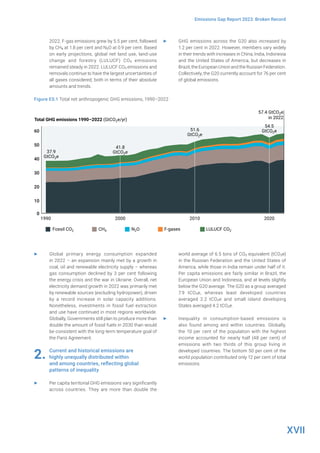
▶ Global GHG emissions increased by 1.2 per cent from
2021 to 2022 to reach a new record of 57.4 gigatons of
CO2 equivalent (GtCO2e) (figure ES.1). All sectors apart
from transport have fully rebounded from the drop in
emissions induced by the COVID-19 pandemic and
now exceed 2019 levels. CO2 emissions from fossil
fuel combustion and industrial processes were the
main contributors to the overall increase, accounting
for about two thirds of current GHG emissions.
Emissions of methane (CH4), nitrous oxide (N2O) and
fluorinated gases (F-gases), which have higher global
warming potentials and account for about one quarter
of current GHG emissions, are increasing rapidly: in
XVII
Emissions Gap Report 2023: Broken Record
2022, F-gas emissions grew by 5.5 per cent, followed
by CH4 at 1.8 per cent and N2O at 0.9 per cent. Based
on early projections, global net land use, land-use
change and forestry (LULUCF) CO2 emissions
remained steady in 2022. LULUCF CO2 emissions and
removals continue to have the largest uncertainties of
all gases considered, both in terms of their absolute
amounts and trends.
▶ GHG emissions across the G20 also increased by
1.2 per cent in 2022. However, members vary widely
in their trends with increases in China, India, Indonesia
and the United States of America, but decreases in
Brazil, the European Union and the Russian Federation.
Collectively, the G20 currently account for 76 per cent
of global emissions.
Figure ES.1 Total net anthropogenic GHG emissions, 1990–2022
▶ Global primary energy consumption expanded
in 2022 – an expansion mainly met by a growth in
coal, oil and renewable electricity supply – whereas
gas consumption declined by 3 per cent following
the energy crisis and the war in Ukraine. Overall, net
electricity demand growth in 2022 was primarily met
by renewable sources (excluding hydropower), driven
by a record increase in solar capacity additions.
Nonetheless, investments in fossil fuel extraction
and use have continued in most regions worldwide.
Globally, Governments still plan to produce more than
double the amount of fossil fuels in 2030 than would
be consistent with the long-term temperature goal of
the Paris Agreement.
2. Current and historical emissions are
highly unequally distributed within
and among countries, reflecting global
patterns of inequality
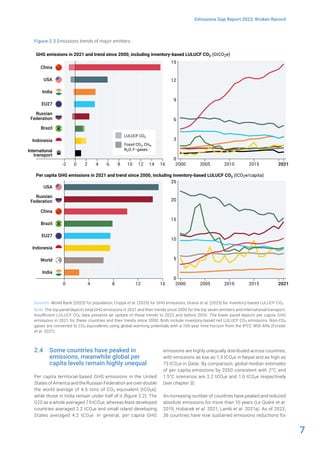
▶ Per capita territorial GHG emissions vary significantly
across countries. They are more than double the
world average of 6.5 tons of CO2 equivalent (tCO2e)
in the Russian Federation and the United States of
America, while those in India remain under half of it.
Per capita emissions are fairly similar in Brazil, the
European Union and Indonesia, and at levels slightly
below the G20 average. The G20 as a group averaged
7.9 tCO2e, whereas least developed countries
averaged 2.2 tCO2e and small island developing
States averaged 4.2 tCO2e.
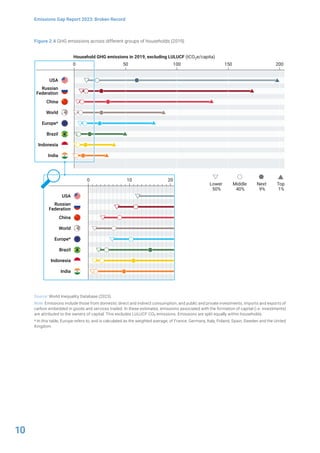
▶ Inequality in consumption-based emissions is
also found among and within countries. Globally,
the 10 per cent of the population with the highest
income accounted for nearly half (48 per cent) of
emissions with two thirds of this group living in
developed countries. The bottom 50 per cent of the
world population contributed only 12 per cent of total
emissions.
1990 2000 2010 2020
0
10
20
30
40
50
60
Total GHG emissions 1990–2022 (GtCO2e/yr)
Fossil CO2 CH4 N2O F-gases LULUCF CO2
54.5
GtCO2e
57.4 GtCO2e
in 2022
51.6
GtCO2e
41.8
GtCO2e
37.9
GtCO2e
XVIII
Emissions Gap Report 2023: Broken Record
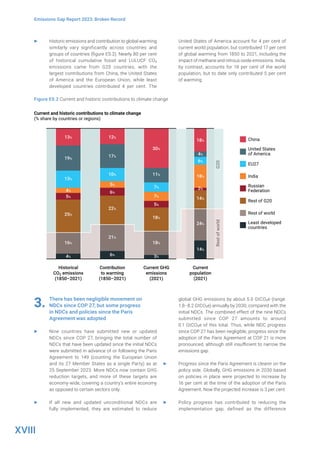
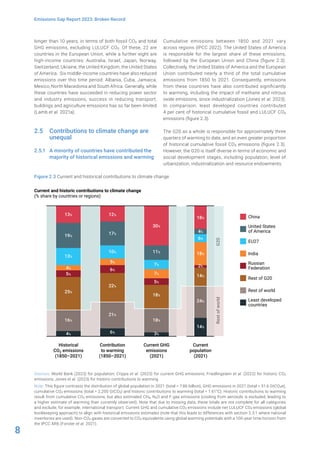
▶ Historic emissions and contribution to global warming
similarly vary significantly across countries and
groups of countries (figure ES.2). Nearly 80 per cent
of historical cumulative fossil and LULUCF CO2
emissions came from G20 countries, with the
largest contributions from China, the United States
of America and the European Union, while least
developed countries contributed 4 per cent. The
United States of America account for 4 per cent of
current world population, but contributed 17 per cent
of global warming from 1850 to 2021, including the
impact of methane and nitrous oxide emissions. India,
by contrast, accounts for 18 per cent of the world
population, but to date only contributed 5 per cent
of warming.
Figure ES.2 Current and historic contributions to climate change
3. There has been negligible movement on
NDCs since COP 27, but some progress
in NDCs and policies since the Paris
Agreement was adopted
▶ Nine countries have submitted new or updated
NDCs since COP 27, bringing the total number of
NDCs that have been updated since the initial NDCs
were submitted in advance of or following the Paris
Agreement to 149 (counting the European Union
and its 27 Member States as a single Party) as at
25 September 2023. More NDCs now contain GHG
reduction targets, and more of these targets are
economy-wide, covering a country’s entire economy
as opposed to certain sectors only.
▶ If all new and updated unconditional NDCs are
fully implemented, they are estimated to reduce
global GHG emissions by about 5.0 GtCO2e (range:
1.8–8.2 GtCO2e) annually by 2030, compared with the
initial NDCs. The combined effect of the nine NDCs
submitted since COP 27 amounts to around
0.1 GtCO2e of this total. Thus, while NDC progress
since COP 27 has been negligible, progress since the
adoption of the Paris Agreement at COP 21 is more
pronounced, although still insufficient to narrow the
emissions gap.
▶ Progress since the Paris Agreement is clearer on the
policy side. Globally, GHG emissions in 2030 based
on policies in place were projected to increase by
16 per cent at the time of the adoption of the Paris
Agreement. Now the projected increase is 3 per cent.
▶ Policy progress has contributed to reducing the
implementation gap, defined as the difference
Current and historic contributions to climate change
(% share by countries or regions)
India
Rest of world
EU27
China
Russian
Federation
Rest of G20
United States
of America
Least developed
countries
G20
Rest
of
world
12%
5%
10%
17%
6%
22%
21%
6%
13%
4%
13%
19%
5%
25%
16%
18%
18%
6%
4%
2%
14%
24%
14%
4%
30%
7%
7%
11%
3%
5%
18%
18%
Historical
CO2 emissions
(1850–2021)
Contribution
to warming
(1850–2021)
Current GHG
emissions
(2021)
Current
population
(2021)
XIX
Emissions Gap Report 2023: Broken Record
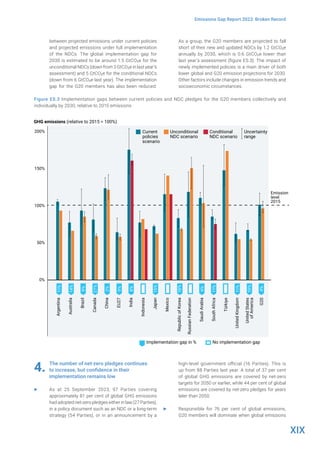
between projected emissions under current policies
and projected emissions under full implementation
of the NDCs. The global implementation gap for
2030 is estimated to be around 1.5 GtCO2e for the
unconditional NDCs (down from 3 GtCO2e in last year’s
assessment) and 5 GtCO2e for the conditional NDCs
(down from 6 GtCO2e last year). The implementation
gap for the G20 members has also been reduced.
As a group, the G20 members are projected to fall
short of their new and updated NDCs by 1.2 GtCO2e
annually by 2030, which is 0.6 GtCO2e lower than
last year’s assessment (figure ES.3). The impact of
newly implemented policies is a main driver of both
lower global and G20 emission projections for 2030.
Other factors include changes in emission trends and
socioeconomic circumstances.
Figure ES.3 Implementation gaps between current policies and NDC pledges for the G20 members collectively and
individually by 2030, relative to 2015 emissions
4. The number of net-zero pledges continues
to increase, but confidence in their
implementation remains low
▶ As at 25 September 2023, 97 Parties covering
approximately 81 per cent of global GHG emissions
had adopted net-zero pledges either in law (27 Parties),
in a policy document such as an NDC or a long-term
strategy (54 Parties), or in an announcement by a
high-level government official (16 Parties). This is
up from 88 Parties last year. A total of 37 per cent
of global GHG emissions are covered by net-zero
targets for 2050 or earlier, while 44 per cent of global
emissions are covered by net-zero pledges for years
later than 2050.
▶ Responsible for 76 per cent of global emissions,
G20 members will dominate when global emissions
GHG emissions (relative to 2015 = 100%)
200%
150%
100%
50%
0%
Emission
level
2015
Argentina
Australia
Brazil
Canada
China
EU27
India
Indonesia
Japan
Mexico
Republic
of
Korea
Russian
Federation
Saudi
Arabia
South
Africa
Türkiye
United
Kingdom
United
States
of
America
G20
Current
policies
scenario
Unconditional
NDC scenario
Conditional
NDC scenario
Uncertainty
range
Implementation gap in % No implementation gap
11
11%
14%
9%
27%
2%
9%
8%
15%
18%
6%
11%
11%
19%
4%
XX
Emissions Gap Report 2023: Broken Record
reach net zero. Encouragingly, all G20 members
except Mexico have set net-zero targets, and over
the past year, some members have taken important
steps towards strengthening and implementing their
targets. Overall, however, limited progress has been
made on key indicators of confidence in net-zero
implementation among G20 members, including legal
status, the existence and quality of implementation
plans, and alignment of near-term emissions
trajectories with net-zero targets. Most concerningly,
none of the G20 members are currently reducing
emissions at a pace consistent with meeting their
net-zero targets.
5. The emissions gap in 2030 remains high:
current unconditional NDCs imply a 14 GtCO2e
gap for a 2°C goal and a 22 GtCO2e gap for
the 1.5°C goal. The additional implementation
of the conditional NDCs reduces these
estimates by 3 GtCO2e
▶ The emissions gap is defined as the difference
between the estimated global GHG emissions resulting
from full implementation of the latest NDCs and those
under least-cost pathways aligned with the long-term
temperature goal of the Paris Agreement.
▶ These least-cost pathways assume stringent
emissions reductions starting in 2020, which current
trends contradict. Since emissions today are higher
than in 2020, this implies that the world has already
further depleted the limited remaining carbon budget
and committed to slightly higher global warming
than indicated by the least-cost pathways, unless
there is further acceleration of emissions reductions
after emissions levels consistent with the least-cost
pathways are met. The emissions gap estimates are
thus likely to be lower-bound, as they do not account
for the excess emissions since 2020 compared with
the least-cost pathways, and should be read with this
caveat in mind.
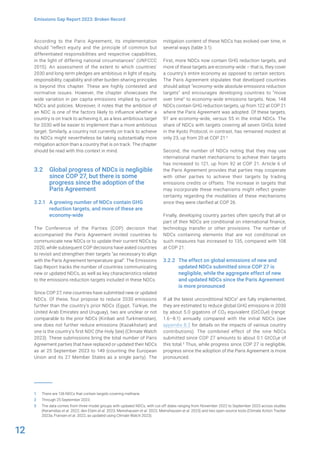
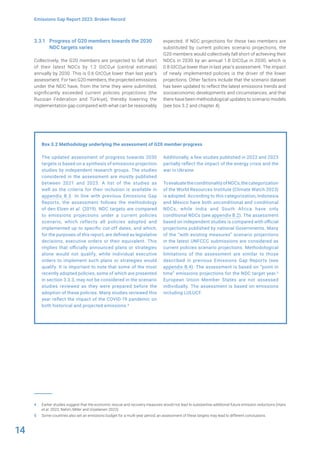
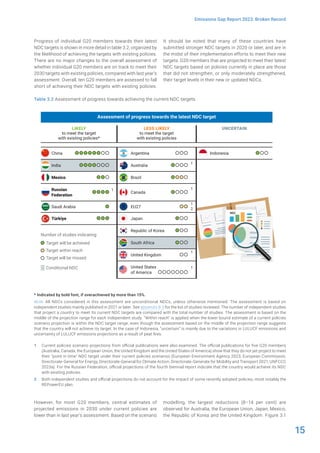
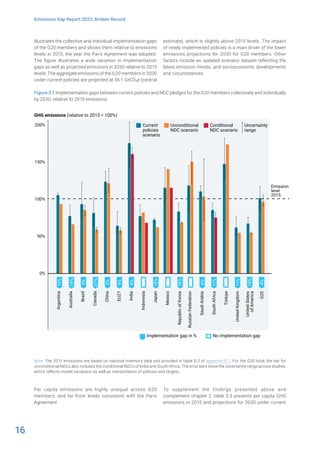
▶ The emissions gap for 2030 remains largely
unchanged compared with last year’s assessment.
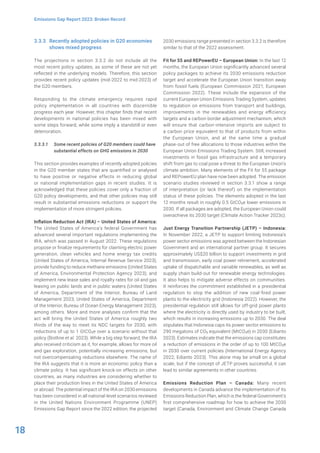
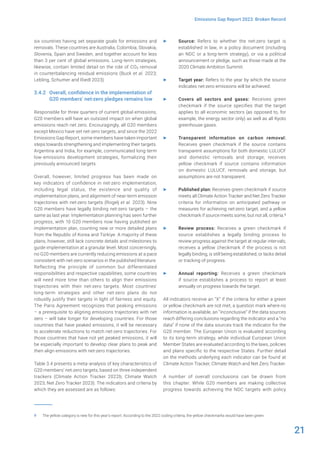
Full implementation of unconditional NDCs is
estimated to result in a gap with below 2°C pathways
of about 14 GtCO2e (range: 13–16) with at least
66 per cent chance. If the conditional NDCs are also
fully implemented, the below 2°C emissions gap is
reduced to 11 GtCO2e (range: 9–15) (table ES.1 and
figure ES.4).
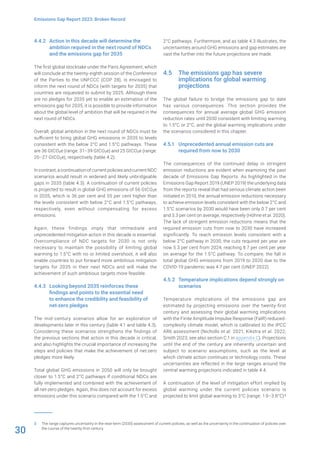
Table ES.1 Global total GHG emissions in 2030, 2035 and 2050, and estimated gaps under different scenarios
Scenario
GHG emissions
(GtCO2e)
Estimated gap to least-cost pathways consistent with
limiting global warming to specific levels (GtCO2e)
Median and range Below 2°C Below 1.8°C Below 1.5°C
2030
Current policies 56 (52–60) 16 (11–19) 22 (17–25) 24 (19–27)
Unconditional NDCs 55 (54–57) 14 (13–16) 20 (19–22) 22 (21–24)
Conditional NDCs 52 (50–55) 11 (9–15) 17 (15–20) 19 (17–23)
2035
Current policies continued 56 (45–64) 20 (9–28) 29 (18–37) 31 (20–39)
Unconditional NDCs continued 54 (47–60) 18 (11–25) 27 (20–34) 29 (22–36)
Conditional NDCs continued 51 (43–58) 15 (8–22) 24 (17–31) 26 (19–33)
2050
Current policies continued 55 (24–72) 35 (4–52) 43 (12–60) 46 (16–63)
Unconditional NDCs and net-zero pledges
using strict criteria
44 (26–58) 24 (6–38) 32 (14–46) 36 (18–49)
Conditional NDCs and all net-zero pledges 21 (6–33) 1 (-14–13) 9 (-6–21) 12 (-2–25)
XXI
Emissions Gap Report 2023: Broken Record
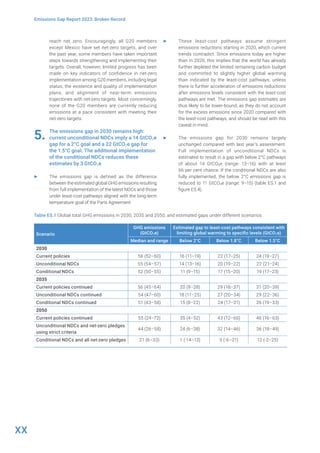
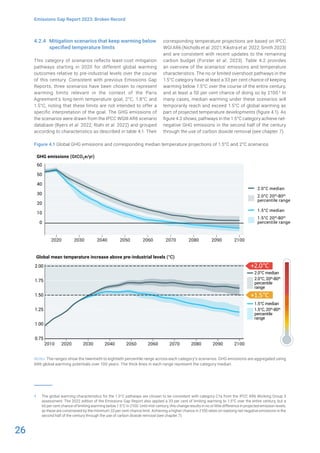
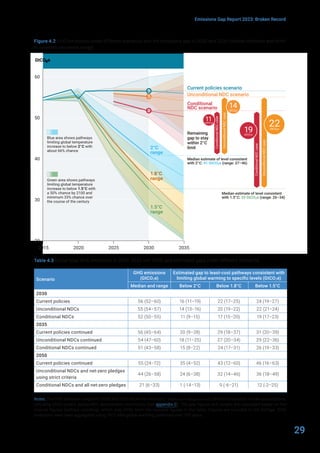
Figure ES.4 Global GHG emissions under different scenarios and the emissions gap in 2030 and 2035 (median estimate
and tenth to ninetieth percentile range)
▶ The emissions gap in 2030 between unconditional
NDCs and 1.5°C pathways is about 22 GtCO2e
(range: 21–24) with at least 50 per cent chance. If the
conditional NDCs are also fully implemented, the 1.5°C
emissions gap is reduced to 19 GtCO2e (range: 17–23).
▶ Unconditional and conditional NDCs for 2030 are
estimated to reduce global emissions by 2 per cent and
9 per cent respectively, compared with current policy
projections and assuming they are fully implemented.
To get to levels consistent with least-cost pathways
limiting global warming to below 2°C and 1.5°C, global
GHG emissions must be reduced by 28 per cent and
42 per cent respectively. This is 2 percentage points
lower than last year’s assessment, illustrating the
progress in narrowing the implementation gap between
current policies and NDCs.
▶ Nonetheless, immediate, accelerated and relentless
mitigation action is needed to bring about the deep
annual emission cuts that are required from now to
2030 to narrow the emissions gap, with unparalleled
annual cuts required to bridge the gap, even without
accounting for excess emissions since 2020.
6. Action in this decade will determine the
ambition required in the next round of NDCs
for 2035, and the feasibility of achieving
the long-term temperature goal of the
Paris Agreement
▶ The first global stocktake under the Paris Agreement
is envisaged to inform the next round of NDCs that
countries are requested to submit in 2025, which will
include targets for 2035. Overall, global ambition in the
next round of NDCs must be sufficient to bring global
GHG emissions in 2035 to the levels consistent with
below 2°C and 1.5°C pathways of 36 GtCO2e (range:
31–39) and 25 GtCO2e (range: 20–27) respectively
(table ES.2), while also compensating for excess
emissions until levels consistent with these pathways
are achieved.
▶ In contrast, a continuation of current policies and
NDC scenarios would result in widened and likely
unbridgeable gaps in 2035 (table ES.1). A continuation
of current policies is projected to result in global
GHG emissions of 56 GtCO2e in 2035 (table ES.1),
which is 36 per cent and 55 per cent higher than the
Blue area shows pathways
limiting global temperature
increase to below 2°C with
about 66% chance
Green area shows pathways
limiting global temperature
increase to below 1.5°C with
a 50% chance by 2100 and
minimum 33% likelihood over
the course of the century
Current policies scenario
Conditional
NDC
case
Unconditional
NDC
case
Conditional
NDC
case
Unconditional
NDC
case
Remaining
gap to stay
within 2°C
limit
Remaining
gap to stay
within 2°C
limit
Conditional
NDC scenario
Unconditional NDC scenario
14
GtCO2e
22
GtCO2e
19
GtCO2e
Median estimate of level consistent
with 2°C: 41 GtCO2e (range: 37–46)
Median estimate of level consistent
with 1.5°C: 33 GtCO2e (range: 26–34)
GtCO2e
11
GtCO2e
20
30
40
50
60
2015 2020 2025 2030 2035
2°C
range
1.5°C
range
XXII
Emissions Gap Report 2023: Broken Record
levels consistent with below 2°C and 1.5°C pathways
respectively (table ES.2), without compensating for
excess emissions.
▶ Again, these findings underline that immediate and
unprecedented mitigation action in this decade
is essential. Over-complying with current NDC
targets for 2030 will enable countries to put forward
more ambitious mitigation targets for 2035 in their
next NDCs, and it will make the realization of such
ambitious targets for 2035 more feasible.
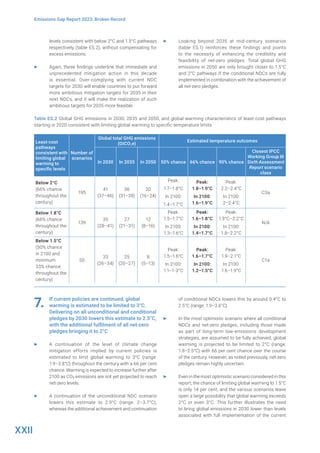
▶ Looking beyond 2035 at mid-century scenarios
(table ES.1) reinforces these findings and points
to the necessity of enhancing the credibility and
feasibility of net-zero pledges. Total global GHG
emissions in 2050 are only brought closer to 1.5°C
and 2°C pathways if the conditional NDCs are fully
implemented in combination with the achievement of
all net-zero pledges.
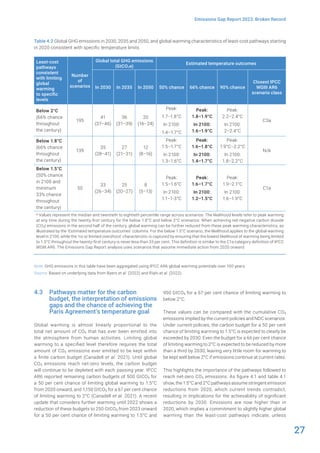
Table ES.2 Global GHG emissions in 2030, 2035 and 2050, and global warming characteristics of least-cost pathways
starting in 2020 consistent with limiting global warming to specific temperature limits
Least-cost
pathways
consistent with
limiting global
warming to
specific levels
Number of
scenarios
Global total GHG emissions
(GtCO2e)
Estimated temperature outcomes
In 2030 In 2035 In 2050 50% chance 66% chance 90% chance
Closest IPCC
Working Group III
Sixth Assessment
Report scenario
class
Below 2°C
(66% chance
throughout the
century)
195
41
(37–46)
36
(31–39)
20
(16–24)
Peak:
1.7–1.8°C
In 2100:
1.4–1.7°C
Peak:
1.8–1.9°C
In 2100:
1.6–1.9°C
Peak:
2.2–2.4°C
In 2100:
2–2.4°C
C3a
Below 1.8°C
(66% chance
throughout the
century)
139
35
(28–41)
27
(21–31)
12
(8–16)
Peak:
1.5–1.7°C
In 2100:
1.3–1.6°C
Peak:
1.6–1.8°C
In 2100:
1.4–1.7°C
Peak:
1.9°C–2.2°C
In 2100:
1.8–2.2°C
N/A
Below 1.5°C
(50% chance
in 2100 and
minimum
33% chance
throughout the
century)
50
33
(26–34)
25
(20–27)
8
(5–13)
Peak:
1.5–1.6°C
In 2100:
1.1–1-3°C
Peak:
1.6–1.7°C
In 2100:
1.2–1.5°C
Peak:
1.9–2.1°C
In 2100:
1.6–1.9°C
C1a
7. If current policies are continued, global
warming is estimated to be limited to 3°C.
Delivering on all unconditional and conditional
pledges by 2030 lowers this estimate to 2.5°C,
with the additional fulfilment of all net-zero
pledges bringing it to 2°C
▶ A continuation of the level of climate change
mitigation efforts implied by current policies is
estimated to limit global warming to 3°C (range:
1.9–3.8°C) throughout the century with a 66 per cent
chance. Warming is expected to increase further after
2100 as CO2 emissions are not yet projected to reach
net-zero levels.
▶ A continuation of the unconditional NDC scenario
lowers this estimate to 2.9°C (range: 2–3.7°C),
whereas the additional achievement and continuation
of conditional NDCs lowers this by around 0.4°C to
2.5°C (range: 1.9–3.6°C).
▶ In the most optimistic scenario where all conditional
NDCs and net-zero pledges, including those made
as part of long-term low-emissions development
strategies, are assumed to be fully achieved, global
warming is projected to be limited to 2°C (range:
1.8–2.5°C) with 66 per cent chance over the course
of the century. However, as noted previously, net-zero
pledges remain highly uncertain.
▶ Even in the most optimistic scenario considered in this
report, the chance of limiting global warming to 1.5°C
is only 14 per cent, and the various scenarios leave
open a large possibility that global warming exceeds
2°C or even 3°C. This further illustrates the need
to bring global emissions in 2030 lower than levels
associated with full implementation of the current
XXIII
Emissions Gap Report 2023: Broken Record
NDCs, to expand the coverage of net-zero pledges to
all GHG emissions and to achieve these pledges.
▶ Central temperature projections are slightly higher
than in the 2022 edition of the Emissions Gap Report,
as a larger number of models have been included
in the estimation of future emissions. However, the
projections are consistent with those from other
major assessments, such as the International Energy
Agency’s 2023 Announced Pledges Scenario, the
Climate Action Tracker and the United Nations
Framework Convention on Climate Change 2023
NDC Synthesis Report, noting that these report
temperature projections with a 50 per cent rather than
a 66 per cent chance.
8. The failure to stringently reduce emissions
in high-income countries and to prevent
further emissions growth in low- and
middle-income countries implies that
all countries must urgently accelerate
economy-wide, low-carbon transformations to
achieve the long-term temperature goal of the
Paris Agreement
▶ Delivering transformational change requires
unprecedented global cooperation reflecting the Paris
Agreement principle of common but differentiated
responsibilities and respective capabilities in light of
national circumstances. This principle implies that
countries with greater capacity and greater historic
responsibility for emissions – particularly high-
income and high-emitting countries among the G20
– will need to take more ambitious and rapid action,
setting the course and demonstrating the viability
of fossil-free development. However, this will not
be sufficient as low- and middle-income countries
already account for more than two thirds of global
GHG emissions. Accordingly, the Climate Solidarity
Pact proposed by the United Nations Secretary-
General calls on all big emitters to make extra efforts
to cut emissions and wealthier countries to provide
financial and technical resources to support low- and
middle-income countries in their transformation,
reflecting differentiated timelines.
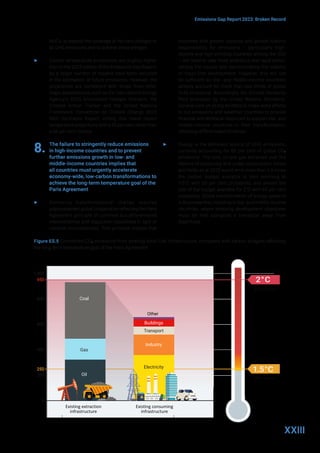
▶ Energy is the dominant source of GHG emissions,
currently accounting for 86 per cent of global CO2
emissions. The coal, oil and gas extracted over the
lifetime of producing and under-construction mines
and fields as at 2018 would emit more than 3.5 times
the carbon budget available to limit warming to
1.5°C with 50 per cent probability, and almost the
size of the budget available for 2°C with 67 per cent
probability. Global transformation of energy systems
is thus essential, including in low- and middle-income
countries, where pressing development objectives
must be met alongside a transition away from
fossil fuels.
Figure ES.5 Committed CO2 emissions from existing fossil fuel infrastructure, compared with carbon budgets reflecting
the long-term temperature goal of the Paris Agreement
Emissions (GtCO2)
Committed emissions
1,000
800
600
400
200
0
250
950
Carbon budget
Carbon budget
(67% chance)
(67% chance)
(50% chance)
(50% chance)
Existing extraction
infrastructure
Existing consuming
infrastructure
Coal
Other
Gas
Oil
Carbon budget
Carbon budget
Electricity
Industry
Transport
Buildings
2°C
1.5°C
XXIV
Emissions Gap Report 2023: Broken Record
9. Low- and middle-income countries face
substantial economic and institutional
challenges in low-carbon energy transitions,
but can also exploit opportunities
▶ Energytransitionsinlow-andmiddle-incomecountries
are shaped by the overarching objective of pursuing
development. Low- and middle-income countries
face several common challenges in having to bring
millions out of poverty, expand strategic industries,
urbanize and deal with the political challenges of a
transition away from fossil fuel use. Meeting basic
energy needs of people living in poverty would have
a limited impact on global GHG emissions. Yet today,
2.4 billion people lack access to clean cooking and
775 million to electricity, with women and children
disproportionately affected. Meeting energy needs for
broader human development will lead to significant
energy demand growth, but there is scope to meet
this growth more efficiently and equitably, and with
low-carbon energy as renewables get cheaper.
▶ National circumstances vary with natural resource
endowments and economic conditions, and will shape
energy transition pathways. Capacity and institutions
are often weak in low- and middle-income countries,
and they may face different and additional political
economic challenges from high-income countries,
especially in view of the required speed of transition.
▶ Low- and lower-middle-income countries are in the
greatest need of affordable finance as they are already
saddled with debt, receive disproportionately low clean
energy investments, are more vulnerable to volatile
fossil fuel markets either as exporters or importers,
and may face future stranded fossil fuel assets.
Upper-middle-income countries are typically further
along in building clean energy economies, but still
face risks of stranded assets and related employment
implications and macroeconomic shocks.
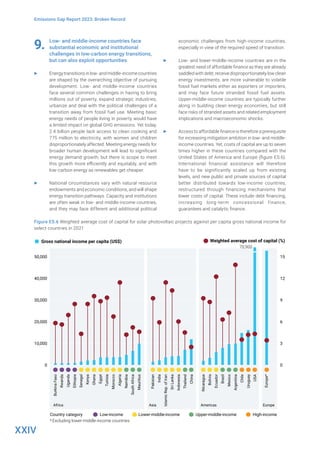
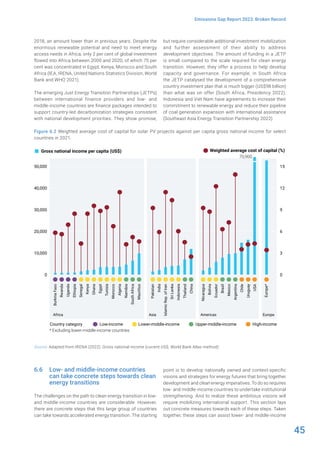
▶ Access to affordable finance is therefore a prerequisite
for increasing mitigation ambition in low- and middle-
income countries. Yet, costs of capital are up to seven
times higher in these countries compared with the
United States of America and Europe (figure ES.6).
International financial assistance will therefore
have to be significantly scaled up from existing
levels, and new public and private sources of capital
better distributed towards low-income countries,
restructured through financing mechanisms that
lower costs of capital. These include debt financing,
increasing long-term concessional finance,
guarantees and catalytic finance.
Figure ES.6 Weighted average cost of capital for solar photovoltaic projects against per capita gross national income for
select countries in 2021
Gross national income per capita (US$) Weighted average cost of capital (%)
Burkina
Faso
Rwanda
Uganda
Ethiopia
Senegal
Kenya
Ghana
Egypt
Tunisia
Morocco
Algeria
Namibia
South
Africa
Mauritius
Pakistan
India
Islamic
Rep.
of
Iran
Sri
Lanka
Indonesia
Thailand
China
Nicaragua
Bolivia
Ecuador
Brazil
Mexico
Argentina
Chile
Uruguay
USA
Europe*
Country category
* Excluding lower-middle-income countries
Americas
Asia Europe
70,900
Africa
Low-income Lower-middle-income Upper-middle-income High-income
50,000
40,000
30,000
20,000
10,000
0
15
12
9
6
3
0
XXV
Emissions Gap Report 2023: Broken Record
▶ Low- and middle-income countries can take
ownership of their low-carbon development agenda
by laying out national low-carbon development
strategies suited to their national context, including by
adopting measures in key energy-intensive demand
sectors, such as housing, transport and food, which
have known synergies between climate mitigation and
human development. This will require strengthening
domestic energy and climate institutions to undertake
strategic planning and enhanced coordination
across sectors. Furthermore, strong stakeholder
engagement is needed to ensure just outcomes and
economic diversification.
▶ The preparation of the next round of NDCs offers an
opportunity for low- and middle-income countries
to develop nationally driven road maps with broad
domestic visions for ambitious development and
climate policies and targets, for which implementation
progress can be measured, finance and technology
needs are clearly specified, and detailed investment-
ready implementation plans are prepared. With less
than two years left until the next round of NDCs are
due, COP 28 would be a timely occasion to call for
international support to prepare such robust and
ambitious NDCs that integrate development and
climate objectives.
10.		Further delay of stringent global GHG
emissions reductions will increase future
reliance on CDR to meet the long-term
temperature goal of the Paris Agreement
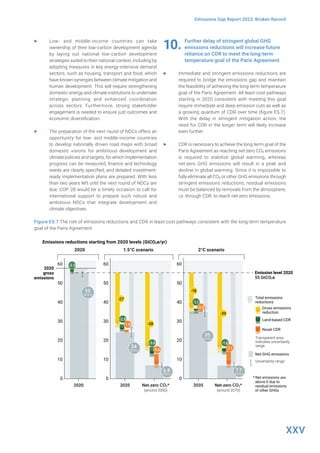
▶ Immediate and stringent emissions reductions are
required to bridge the emissions gap and maintain
the feasibility of achieving the long-term temperature
goal of the Paris Agreement. All least-cost pathways
starting in 2020 consistent with meeting this goal
require immediate and deep emission cuts as well as
a growing quantum of CDR over time (figure ES.7).
With the delay in stringent mitigation action, the
need for CDR in the longer term will likely increase
even further.
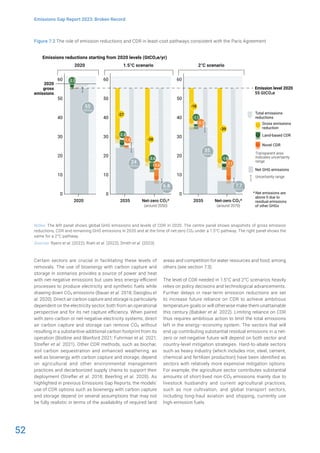
▶ CDR is necessary to achieve the long-term goal of the
Paris Agreement as reaching net-zero CO2 emissions
is required to stabilize global warming, whereas
net-zero GHG emissions will result in a peak and
decline in global warming. Since it is impossible to
fully eliminate all CO2 or other GHG emissions through
stringent emissions reductions, residual emissions
must be balanced by removals from the atmosphere,
i.e. through CDR, to reach net-zero emissions.
Figure ES.7 The role of emissions reductions and CDR in least-cost pathways consistent with the long-term temperature
goal of the Paris Agreement
Emissions reductions starting from 2020 levels (GtCO2e/yr)
2020 1.5°C scenario 2°C scenario
2020
60
50
40
30
20
10
0
60
50
40
30
20
10
0
Net-zero CO2*
(around 2070)
60
50
40
30
20
10
0
2035 2035
Net-zero CO2*
(around 2050)
GtCO2e
24
GtCO2e
35
GtCO2e
6.8
GtCO2e
7.7
GtCO2e
55
-27
-2.8
-2.0
-38
-3.6
-39
-1.6
-18
-1.1
-1.0
-0.3
-5.6 -7.1
Emission level 2020
55 GtCO2e
Gross emissions
reduction
Land-based CDR
Novel CDR
Transparent area
indicates uncertainty
range
Uncertainty range
Net GHG emissions
* Net emissions are
above 0 due to
residual emissions
of other GHGs
Total emissions
reductions
2020
gross
emissions
XXVI
Emissions Gap Report 2023: Broken Record
▶ CDR is already deployed today – mainly in the
form of conventional land-based methods, such
as afforestation, reforestation and management
of existing forests, with a large share located in
developing countries. Present-day direct removals
through conventional land-based methods are
estimated to be 2.0 (±0.9) GtCO2 annually, almost
entirely through conventional land-based methods.
Direct removals through novel CDR methods, such
as bioenergy with carbon capture and storage,
biochar, direct air carbon capture and storage, and
enhanced weathering, are currently miniscule at
0.002 GtCO2 annually.
▶ Nonetheless, 1.5°C and 2°C least-cost pathways
assume significant increases in both conventional and
novel CDR over time (figure ES.7). Conventional CDR
grows to up to 6 GtCO2 annually by 2050 under these
pathways and novel CDR up to 4 GtCO2 annually by
2050. Conventional land-based CDR plays a stronger
role in the near- and mid-term, while novel CDR plays a
stronger role later in the century to reach net-negative
emissions, noting that levels depend on the underlying
economic and technological assumptions as well
as the magnitude of temperature drawdown after
achieving net-zero CO2 emissions.
▶ Achievement of the gigaton levels of CDR implied later
in this century by pathways consistent with the Paris
Agreement is uncertain and associated with several
risks. Increased reliance on conventional land-based
CDR is risky due to issues of land competition,
protection of Indigenous and traditional communities’
land tenure and rights, and sustainability, biodiversity
and permanence risks of forest-based CDR, including
from forest fires and other disturbances. Novel CDR
methodsaregenerallyatanearlystageofdevelopment
and are associated with different types of risks,
including that the technical, economic and political
requirements for large-scale deployment may not
materialize in time. Furthermore, public acceptance
is still uncertain, particularly for approaches involving
carbon capture and storage, or the open ocean. These
risks can negatively affect the prospects for scale-up,
despite technical potentials.
▶ To spur innovation and enable scaling up of novel CDR
technologies, these technologies will first need to go
through a formative phase, which will require strong
policy and financial support. Given the time it takes to
mature technologies, the next decade will be crucial
for novel CDR methods. Failure to create momentum
in this formative phase will result in a widening
discrepancy between the levels of novel CDR needed
and available by 2050 and beyond.
▶ This points to four important areas for political action:
1) Setting and signalling CDR priorities
2) Developing robust measurement, reporting and
verification systems to enhance credibility
3) Harnessing synergies and co-benefits with
other efforts
4) Accelerating innovation.
1
Emissions Gap Report 2023: Broken Record
Introduction
Authors:
Anne Olhoff (CONCITO – Denmark’s green think tank, Denmark) and John Christensen ((UNEP Copenhagen Climate Centre
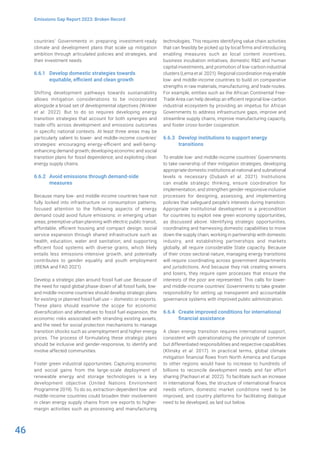
[UNEP-CCC], Denmark)
1
1.1 Context and framing of the Emissions
Gap Report 2023
The world is witnessing a disturbing acceleration in the
number, speed and scale of broken climate records: 2023 is
on track to become the warmest year on record. At the time
of writing, 86 days have been recorded with temperatures
exceeding 1.5°C above pre-industrial levels. Not only
was September the hottest month ever, it exceeded the
previous record by an unprecedented 0.5°C, with global
average temperatures at 1.8°C above pre-industrial levels
(Copernicus Climate Change Services 2023a; Copernicus
Climate Change Services 2023b). This does not imply
that the world has exceeded the 1.5°C temperature limit
specified in the Paris Agreement, which refers to global
warming levels based on multi-decadal averages. However,
it does signal that we are getting closer to that point. These
temperature records were accompanied by devastating
extreme events, which the Intergovernmental Panel on
Climate Change (IPCC) has warned us are merely a meek
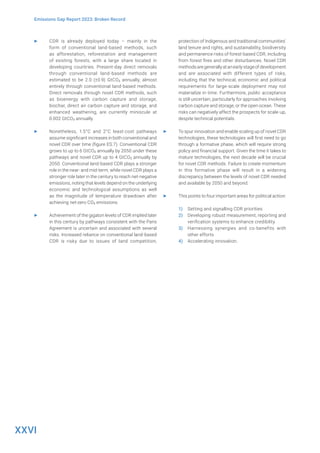
beginning. Every increment of warming results in rapidly
escalating hazards with extensive implications for human
livelihoods and ecosystems (IPCC 2023).
This is the fourteenth Emissions Gap Report by UNEP,
published ahead of the twenty-eighth session of the
Conference of the Parties to the United Nations Framework
Convention on Climate Change (COP 28). COP 28 is special,
as it marks the conclusion of the first global stocktake
under the Paris Agreement. The global stocktakes are held
every five years to assess the global response to the climate
crisis and chart a better way forward. This objective closely
mirrors that of the Emissions Gap Report, which is to provide
an annual, independent science-based assessment of the
gap between pledged greenhouse gas (GHG) emissions
reductions and the reductions required to align with the
long-term temperature goal of the Paris Agreement, and
opportunities to bridge this gap.
To inform the discussions at COP 28 – including on the
outcomes needed from the global stocktake – and set
the scene for the next round of nationally determined
contributions (NDCs) that countries are requested to submit
in 2025, which will include emissions reduction targets for
2035, this report looks at what is required this decade and
beyond 2030 to maintain the possibility of achieving the
long-term temperature goal of the Paris Agreement.
The IPCC concluded that global emissions levels by 2030
resulting from the implementation of the current NDCs will
make it impossible to limit warming to 1.5°C with no or limited
overshoot, and strongly increase the challenge of limiting
warming to 2°C (Pathak et al. 2022). This finding is reiterated
in this report. It highlights that maintaining the possibility of
achieving the long-term goal of the Paris Agreement hinges
on relentlessly strengthening ambition and implementation
this decade, thereby facilitating significantly more ambitious
targets for 2035 in the next round of NDCs and paving the
way for operationalizing and implementing the net-zero
pledges by countries that currently cover around 80 per cent
of global emissions.
The report shows that movement on the NDCs has been
negligible since COP 27, and although the ambition of the
NDCs has been strengthened since the adoption of the Paris
Agreement at COP 21 in 2015, it has been insufficient to
narrow the 2030 emissions gap.
Progress since the adoption of the Paris Agreement is more
visible on the policy implementation side. Globally, GHG
emissions in 2030 based on policies in place were projected
to increase by 16 per cent at the time of the adoption of the
Paris Agreement. Now the projected increase is 3 per cent.
However, the challenge remains immense. In just seven
years, global GHG emissions must be reduced by 28–42
per cent compared to where they are headed under policies
currently in place, to get to levels consistent with pathways
that limit global warming to well below 2.0°C and 1.5°C
respectively.
Due to the failure to stringently reduce emissions in high-
income countries – which bear the greatest responsibility
for past emissions – and to limit emissions growth in
low- and middle-income countries, which account for the
majority of current emissions, unprecedented action is now
2
Emissions Gap Report 2023: Broken Record
needed by all countries. For high-income countries, this
implies further accelerating domestic emissions reductions,
committing to reaching net-zero as soon as possible – and
sooner than the global averages from the latest IPCC report
implies – and at the same time providing financial and
technical support to low- and middle-income countries. For
low- and middle-income countries, this means that pressing
development needs must be met alongside a transition
away from fossil fuels.
Furthermore, the delay in stringent mitigation action
will likely increase future dependence on carbon dioxide
removal (CDR) from the atmosphere. However, availability
of large-scale CDR opportunities in the future cannot be
taken for granted. The second part of the report explores
the opportunities and challenges associated with energy
transformation, and development and deployment of CDR.
The feasibility of the necessary transformation hinges
on reconciling development and climate objectives in all
countries. As has been amply illustrated during the COVID-19
pandemic and the energy crisis, development choices and
responses to economic shocks are inseparable from – and
often determine – climate outcomes. Previous editions of
the Emissions Gap Report have illustrated that well planned
and socially just transformations can bring economic
benefits, create new jobs, advance gender equality, and
empower people, communities and societies. All available
evidence confirms the availability of a wide range of mature,
efficient and economically attractive options to reduce GHG
emissions. They just need to be deployed, immediately and
at unprecedented rates (Pathak et al. 2022; International
Energy Agency 2023; Lee et al. 2023).
Doing so could simultaneously help reverse the concerning
general international setback on the achievement of
the global Sustainable Development Goals for 2030. A
preliminary assessment shows that of the around 140
targets for which data is available, only 12 per cent are on
track, whereas more than half are moderately or severely
off track, and around 30 per cent have either seen no
movement or have regressed below the 2015 baseline
(United Nations 2023).
1.2 Approach and structure of the report
The Emissions Gap Report is an assessment report. It
provides an evaluation of scientifically and technically
credible knowledge on emissions trends, progress, gaps and
opportunities, based on a synthesis of the latest scientific
literature, models, and data analysis and interpretation,
including that published by the IPCC.
As in previous years, this Emissions Gap Report has been
prepared by an international team of leading experts. This
year, 79 leading scientists from 47 expert institutions
across 22 countries have been engaged in producing the
report. The assessment process has been overseen by an
international steering committee and has been transparent
and participatory. Geographical diversity and gender balance
has been considered to the extent possible. All chapters
have undergone external review, and the assessment
methodology and preliminary findings were made available
to the Governments of the countries specifically mentioned
in the report, to provide them with the opportunity to
comment on the findings.
The report is organized into seven chapters, including this
introduction. Chapter 2 assesses the trends in global GHG
emissions. Chapter 3 provides a global update of NDCs and
long-term net-zero emissions pledges, and assesses the
progress of G20 members towards achieving their NDCs
and net-zero emissions pledges. Chapter 4 updates the
assessment of the emissions gap by 2030 based on the
latest NDCs, and looks at potential gaps beyond 2030. It
also considers the implications of the emissions gap on
the feasibility of achieving the long-term temperature goal
of the Paris Agreement. Chapter 5 frames the second part
of the report, laying out global issues related to energy
transformation and CDR. Chapter 6 assesses challenges
and opportunities for accelerating energy transitions in
low- and middle-income countries, while meeting critical
development needs and priorities. Finally, chapter 7
considers the role, status and scope for CDR in achieving
the long-term temperature goal of the Paris Agreement.
3
Emissions Gap Report 2023: Broken Record
Global emissions trends
Lead authors:
William F. Lamb (Mercator Research Institute on Global Commons and Climate Change, Germany; University of Leeds,
United Kingdom of Great Britain and Northern Ireland) and Minal Pathak (Ahmedabad University, India)
Contributing authors:
Lucas Chancel (World Inequality Lab, Paris School of Economics, France), Monica Crippa (European Commission, Joint
Research Centre [JRC], Italy), Giacomo Grassi (European Commission, JRC, Italy), Diego Guizzardi (European Commission,
JRC, Italy), Jing Meng (University College London, United Kingdom), Glen P. Peters (CICERO Center for International Climate
Research, Norway) and Julia Pongratz (Ludwig-Maximilians University Munich, Germany)
2
2.1 Introduction
This chapter assesses greenhouse gas (GHG) emissions
trends up to and including 2022. Starting from global
emissions trends by GHG and sector (section 2.2), it describes
the emissions of the G20 and top emitters (section 2.3)
before covering household and consumption-based
emissions (sections 2.4 and 2.5). In doing so, it sets the
stage for subsequent chapters on G20 policies and the
emissions gap.1 Importantly, this chapter provides multiple
perspectives on national emissions, including absolute, per
capita and historical cumulative emissions. Each of these
perspectives offer insight into inequalities in contributions
to climate change, while highlighting that turning around
global emissions growth now requires ambitious and
urgent efforts from all countries to reduce fossil fuel use
and deforestation.
As in previous years, the Emissions Gap Report focuses
on total net GHG emissions across all major groups of
anthropogenic sources and sinks reported under the
United Nations Framework Convention on Climate Change
(UNFCCC). This includes carbon dioxide (CO2) emissions
from fossil fuel and industry (fossil CO2), CO2 emissions
and removals from land use, land-use change and forestry
(LULUCF CO2), methane (CH4) and nitrous oxide (N2O)
emissions. It includes fluorinated gas (F-gas) emissions
reported under the UNFCCC, but excludes F-gas emissions
regulated under the Montreal Protocol on ozone depleting
substances, which accounted for approximately 1.6 gigatons
1 The African Union became a permanent member of the G20 in September 2023, which was after the assessments for this report had been completed.
Consequently, the African Union is not included in the G20 assessment this year.
of CO2 equivalent (GtCO2e) in 2021 (Forster et al. 2023).
Non-CO2 LULUCF emissions are also excluded due to data
limitations.
Following the change in methodology outlined in the
Emissions Gap Report 2022 (United Nations Environment
Programme [UNEP] 2022), the global bookkeeping approach
is used to report global estimates of net LULUCF CO2
emissions and the national inventory approach to report
national estimates of net LULUCF CO2 emissions. This
ensures that global estimates are consistent with the
mitigation scenarios presented in chapter 4, as well as the
carbon cycle and climate science literature; while national
estimates are consistent with those reported by countries
to the UNFCCC. As this chapter reports, total net LULUCF
CO2 emissions differ substantially between these two
approaches, due to known differences in system boundaries
and other assumptions.
Where GHG emissions are aggregated to CO2 equivalents
in this report, 100-year global warming potentials from the
latest Intergovernmental Panel on Climate Change (IPCC)
Working Group (WG) I Sixth Assessment Report (AR6)
(Forster et al. 2021) are used. Alternative metrics can be
used – for instance, global warming potentials with a
20-year time horizon would highlight the relative importance
of CH4 on near-term warming – but are not explored here.
Uncertainties in emissions estimates are reported following
the IPCC WGIII AR6 of ±8 per cent for fossil CO2, ±70 per cent
for LULUCF CO2, ±30 per cent for CH4 and F-gases, and
4
Emissions Gap Report 2023: Broken Record
±60 per cent for N2O (Dhakal et al. 2022). This chapter follows
a territorial-based accounting of emissions (i.e. emissions
are allocated to the sectors and nations where they occur)
unless otherwise noted. Indirect and consumption-based
perspectives are considered in section 2.5, in particular in
the context of household emissions.
The principal sources in this chapter include the Emissions
Database for Global Atmospheric Research dataset for
fossil CO2, CH4, N2O and F-gas emissions (Crippa et al.
2023); the Global Carbon Budget for global LULUCF CO2
estimates, taking the average of three bookkeeping models
(Friedlingstein et al. 2022); and Grassi et al. (2022; 2023)
for national inventory-based LULUCF CO2 (with updates to
the latest inventories for the top emitters). The latest years
of data in these sources should be treated as preliminary –
particularly in the case of LULUCF CO2 and non-CO2 GHG
emissions – due to the use of provisional methodologies
based on available activity data. Emissions are generally
reported up to 2022. However, due to data limitations, this
is not possible for inventory-based LULUCF CO2. Complete
national totals including LULUCF CO2 are therefore only
given up to 2021. Lamb (2023) contains the code and data
used to produce all emissions estimates in this chapter.
2.2 Global emissions trends
2.2.1 Global emissions increased to record levels in
2022
Global GHG emissions reached a record high of 57.4 GtCO2e
in 2022, growing by 1.2 per cent (0.6 GtCO2e) from the
previous year (figure 2.1 and table 2.1). This rate is slightly
above the average rate in the decade preceding the
COVID-19 pandemic (2010–2019), when GHG emissions
growth averaged 0.9 per cent per year, but was slower
than the emissions growth of the 1990s (1.2 per cent per
year) and 2000s (2.2 per cent per year). Atmospheric CO2
concentrations grew to 417.9 ± 0.2 parts per million in 2022
(World Meteorological Organization 2023), and will continue
to grow until annual emissions are reduced sufficiently to
be balanced by removals. In contrast, as shown in chapter 4
of this report, global GHG emissions must decline to levels
between 33 and 41 GtCO2e by 2030 (chapter 4 and table 4.2)
to get on a least-cost pathway to meeting the temperature
goal of the Paris Agreement.
Fossil CO2 emissions account for approximately two
thirds of current GHG emissions using 100-year global
warming potentials. According to multiple datasets, fossil
CO2 emissions grew between 0.8–1.5 per cent in 2022 and
were the main contributor to the overall increase in GHG
emissions (Friedlingstein et al. 2022; Energy Institute 2023;
International Energy Agency 2023; Liu et al. 2023). CH4, N2O
and F-gas emissions account for about one quarter of current
GHG emissions. Although their absolute contribution to the
overall increase in 2022 was lower since they represent a
much smaller share of the total, emissions of these gases
are increasing rapidly: in 2022, F-gas emissions grew by
5.5 per cent, followed by CH4 at 1.8 per cent and N2O at
0.9 per cent.
Global net LULUCF CO2 emissions – using the global
bookkeeping approach – remained steady in 2022, but
are based on an early projection of land-use activity with
relatively high uncertainties (Friedlingstein et al. 2022).
Updated estimates indicate that net LULUCF CO2 emissions
slowly declined in the past two decades, with average
emissions of 4.5 gigatons of CO2 (GtCO2) per year during
2012–2021, compared with 4.9 GtCO2 per year during
2002–2011. The primary driver behind the decline is an
increase in removals on forest land (from 3.0 to 3.5 GtCO2 per
year), including afforestation/reforestation, while emissions
from deforestation remained high (6.8 and 6.7 GtCO2 per
year for 2002–2011 and 2012–2021, respectively). LULUCF
CO2 emissions and removals continue to have the largest
uncertainties of all gases considered here, both in terms of
their absolute amounts and trends.
Global bookkeeping and national inventory-based accounts
of LULUCF CO2 emissions diverged by approximately
6.4 GtCO2 in 2021 (table 2.1). This is due to known differences
in system boundaries between each approach, in particular
the fact that bookkeeping models consider only “direct”
human-induced fluxes as anthropogenic (e.g. deforestation,
afforestation and other land use-related vegetation
changes), whereas national inventories typically also include
most of the “indirect” human-induced fluxes (e.g. enhanced
vegetation growth due to increased atmospheric CO2) that
occur on managed land (Grassi et al. 2021; UNEP 2022, p. 4).
5
Emissions Gap Report 2023: Broken Record
Figure 2.1 Total net anthropogenic GHG emissions, 1990–2022
Sources: Crippa et al. (2023) for GHG emissions; Friedlingstein et al. (2022) for bookkeeping LULUCF CO2; Grassi et al. (2023) for
inventory-based LULUCF CO2.
Note: GHG emissions include fossil CO2, LULUCF CO2, CH4, N2O and F-gas emissions. Bookkeeping-based net LULUCF CO2 emissions are
depicted. Non-CO2 gases are converted to CO2 equivalents using global warming potentials with a 100-year time horizon from the IPCC
AR6 (Forster et al. 2021).
Global primary energy consumption expanded in 2022,
and was mainly met by a growth in coal, oil and renewable
electricity supply (Energy Institute 2023; International Energy
Agency 2023). Gas consumption declined by 3 per cent in
2022 following the war in Ukraine (Energy Institute 2023).
Coal consumption increased, in part driven by switching from
gas to coal, as well as the steady growth of coal-fired power
production in some emerging economies. Net electricity
demand growth in 2022 was primarily met by renewable
sources (excluding hydropower), in particular driven by a
record increase in solar capacity additions (Energy Institute
2023). Overall, while investments in renewables increased
globally, investments in coal, oil and gas have continued and
even increased in some countries.
Table 2.1 Total global emissions by source
GtCO2e 2010–2019 (average) 2020 2021 2022
GHG 54.6 ± 5.55 54.5 ± 5.36 56.8 ± 5.45 57.4 ± 5.48
Fossil CO2 36.1 ± 2.89 35.9 ± 2.88 38.1 ± 3.05 38.5 ± 3.08
LULUCF CO2
(global bookkeeping)
4.72 ± 3.3 4.06 ± 2.84 3.94 ± 2.76 3.87 ± 2.71
LULUCF CO2
(national inventory)*
-2.64 ± -1.85 -2.49 ± -1.74 -2.4 ± -1.68 N/A
CH4 10.1 ± 3.03 10.4 ± 3.13 10.6 ± 3.18 10.8 ± 3.23
N2O 2.47 ± 1.48 2.57 ± 1.54 2.63 ± 1.58 2.65 ± 1.59
F-gases 1.17 ± 0.351 1.46 ± 0.439 1.54 ± 0.461 1.62 ± 0.486
Note: * Inventory-based LULUCF CO2 is excluded from total GHG emissions. Non-CO2 greenhouse gases are converted to CO2 equivalents
using global warming potentials with a 100-year time horizon from the IPCC WGI AR6 (Forster et al. 2021).
1990 2000 2010 2020
0
10
20
30
40
50
60
Total GHG emissions 1990–2022 (GtCO2e/yr)
Fossil CO2 CH4 N2O F-gases LULUCF CO2
54.5
GtCO2e
57.4 GtCO2e
in 2022
51.6
GtCO2e
41.8
GtCO2e
37.9
GtCO2e
6
Emissions Gap Report 2023: Broken Record
2.2.2 Emissions rebounded across most global
sectors following the COVID-19 pandemic
Emissions can be split into five major economic sectors:
energy supply, industry, agriculture and LULUCF, transport
and buildings. In 2022, energy supply was the largest
source of emissions at 20.9 GtCO2e (36 per cent of the
total), which is mainly due to combustion emissions in
the power sector (14.8 GtCO2e) and emissions from fossil
fuel production including fugitive methane (6.1 GtCO2e).
The energy supply sector is the largest contributor to the
increase in emissions over the past decades, largely due
to the worldwide expansion of coal- and gas-fired power
generation (International Energy Agency 2023). However, it
is also one of the only sectors where some countries have
made progress in reducing emissions by switching to lower
emission fuels and by scaling up renewable sources.
Industry is the second largest sector when accounting by
direct emissions (14.4 GtCO2e, 25 per cent of the total),
followed by agriculture and LULUCF CO2 (global bookkeeping
approach) (10.3 GtCO2e, 18 per cent), transport (8.1 GtCO2e,
14 per cent) and buildings (3.8 GtCO2e, 6.7 per cent).
However, if power sector emissions are reallocated to final
sectors based on their use of electricity and heat (i.e. indirect
emissions, which highlight a demand perspective), then the
contribution of the industry and buildings sectors increase
significantly (to 34 per cent and 16 per cent, respectively)
(Lamb et al. 2021b).
The latest data up to 2022 indicate that most global sectors
have fully rebounded from the drop in 2020 emissions, which
was induced by COVID-19, and now exceed 2019 levels with
little change in the overall composition of sector emissions
(Liu et al. 2023). An exception is aviation emissions, which
remain at 74 per cent of their 2019 peak of 1.0 GtCO2e, but
are likely to continue to rebound in 2023 as air passenger
numbers start to reach pre-pandemic levels (International
Air Transport Association 2023).
2.3 Emissions trends of major emitters
2.3.1 Emissions of the G20 members increased in
2022 and accounted for three quarters of the
total
Preliminary estimates for 2022 (which exclude LULUCF CO2
for which data is only available up to 2021) show an increase
in GHG emissions compared with 2021 in Indonesia
(+10 per cent), India (+5.1 per cent), the United States of
America (+1.6 per cent) and China (+0.3 per cent), and a
decrease in the European Union (-0.8 per cent), the Russian
Federation (-1 per cent) and Brazil (-2.5 per cent). International
transport emissions rapidly increased (+11.4 per cent), but
remain below pre-pandemic levels. Total emissions of the
G20 also increased (+1.2 per cent).
The top seven global emitters remain the same as
in 2021: Brazil, China, India, Indonesia, the European
Union, the Russian Federation and the United States of
America (figure 2.2). Collectively, and with the addition of
international transport, these emitters accounted for a total
of 33 GtCO2e in 2021, or 65 per cent of global emissions
on a territorial basis, including national inventory-based
LULUCF CO2. Combined, the G20 accounted for 76 per cent
of global emissions. By contrast, least developed countries
accounted for 3.8 per cent of global emissions, while small
island developing States contributed less than 1 per cent.
Generally, global emissions have shifted from high-income to
low- and middle-income countries in the past two decades.
High-income countries, which include eight members of
the G20 (Australia, Canada, the European Union, Japan,
Saudi Arabia, the Republic of Korea, the United Kingdom
of Great Britain and Northern Ireland and the United States
of America) contributed 43 per cent of GHG emissions in
2000, but 28 per cent in 2021. Conversely, low- and middle-
income countries, which include nine members of the
G20 (Argentina, Brazil, China, India, Indonesia, Mexico, the
Russian Federation, South Africa and Türkiye) contributed
53 per cent in 2000 and 69 per cent in 2021.
There is some evidence that the global energy crisis and
the international sanctions following the war in Ukraine
have impacted regional economic activity and emissions,
with highly uncertain long-term implications (International
Energy Agency 2022). Direct emissions from military
operations, vehicles and installations are likely non-
trivial, but remain insufficiently accounted under UNFCCC
reporting conventions, and there is limited evidence in
the literature on the scope, scale, composition or trend of
these emissions (Rajaeifar et al. 2022). The energy crisis
has driven efforts towards a clean energy transition, with
increased investments in renewables and support for
clean energy policies and phasing out fossil fuels in some
countries (Steffen and Patt 2022; Tollefson 2022). At the
same time, some countries have expanded domestic fossil
fuel extraction, citing energy security concerns (United
Kingdom 2022). There is evidence of an increase in energy
prices and a shift in regional energy supplies, particularly
in Europe, which took active measures to decrease fossil
imports from the Russian Federation (Steffen and Patt
2022). Rising costs of energy and products dependent
on fossil fuels could push millions of people globally into
poverty, in addition to the hundreds of millions already living
under hardship (Guan et al. 2023).
Net LULUCF CO2 emissions, especially from deforestation
and land-use change, continue to be concentrated in
tropical regions, with Brazil, Indonesia and the Democratic
Republic of the Congo contributing 58 per cent of the global
total in 2021 – albeit with extremely high uncertainties
(Friedlingstein et al. 2022). Countries such as these that
have a higher contribution from LULUCF CO2 also tend to
experience larger annual fluctuations in GHG emissions due
to policy-induced land-use changes, deforestation, wildfires
on managed land or shifts towards forest protection
(figure 2.2).
7
Emissions Gap Report 2023: Broken Record
Figure 2.2 Emissions trends of major emitters
Sources: World Bank (2023) for population; Crippa et al. (2023) for GHG emissions; Grassi et al. (2023) for inventory-based LULUCF CO2.
Note: The top panel depicts total GHG emissions in 2021 and their trends since 2000 for the top seven emitters and international transport.
Insufficient LULUCF CO2 data prevents an update of these trends to 2022 and before 2000. The lower panel depicts per capita GHG
emissions in 2021 for these countries and their trends since 2000. Both include inventory-based net LULUCF CO2 emissions. Non-CO2
gases are converted to CO2 equivalents using global warming potentials with a 100-year time horizon from the IPCC WGI AR6 (Forster
et al. 2021).
2.4 Some countries have peaked in
emissions, meanwhile global per
capita levels remain highly unequal
Per capita territorial-based GHG emissions in the United
States of America and the Russian Federation are over double
the world average of 6.5 tons of CO2 equivalent (tCO2e),
while those in India remain under half of it (figure 2.2). The
G20 as a whole averaged 7.9 tCO2e, whereas least developed
countries averaged 2.2 tCO2e and small island developing
States averaged 4.2 tCO2e. In general, per capita GHG
emissions are highly unequally distributed across countries,
with emissions as low as 1.3 tCO2e in Nepal and as high as
73 tCO2e in Qatar. By comparison, global median estimates
of per capita emissions by 2050 consistent with 2°C and
1.5°C scenarios are 2.2 tCO2e and 1.0 tCO2e respectively
(see chapter 3).
An increasing number of countries have peaked and reduced
absolute emissions for more than 10 years (Le Quéré et al.
2019; Hubacek et al. 2021; Lamb et al. 2021a). As of 2022,
36 countries have now sustained emissions reductions for
2000 2005 2015
2010
2021
2000 2005 2015
2010
0
5
10
15
20
25
0
3
6
9
12
15
0 4 8 12 16
India
World
Indonesia
EU27
Brazil
China
Russian
Federation
USA
4 8 12 16
International
transport
Brazil
Russian
Federation
EU27
India
USA
China
Per capita GHG emissions in 2021 and trend since 2000, including inventory-based LULUCF CO2 (tCO2e/capita)
0 2 6 10 14
-2
GHG emissions in 2021 and trend since 2000, including inventory-based LULUCF CO2 (GtCO2e)
2021
LULUCF CO2
Fossil CO2, CH4,
N2O, F−gases
Indonesia
8
Emissions Gap Report 2023: Broken Record
longer than 10 years, in terms of both fossil CO2 and total
GHG emissions, excluding LULUCF CO2. Of these, 22 are
countries in the European Union, while a further eight are
high-income countries: Australia, Israel, Japan, Norway,
Switzerland, Ukraine, the United Kingdom, the United States
of America. Six middle-income countries have also reduced
emissions over this time period: Albania, Cuba, Jamaica,
Mexico, North Macedonia and South Africa. Generally, while
these countries have succeeded in reducing power sector
and industry emissions, success in reducing transport,
buildings and agriculture emissions has so far been limited
(Lamb et al. 2021a).
2.5 Contributions to climate change are
unequal
2.5.1 A minority of countries have contributed the
majority of historical emissions and warming
Cumulative emissions between 1850 and 2021 vary
across regions (IPCC 2022). The United States of America
is responsible for the largest share of these emissions,
followed by the European Union and China (figure 2.3).
Collectively, the United States of America and the European
Union contributed nearly a third of the total cumulative
emissions from 1850 to 2021. Consequently, emissions
from these countries have also contributed significantly
to warming, including the impact of methane and nitrous
oxide emissions, since industrialization (Jones et al. 2023).
In comparison, least developed countries contributed
4 per cent of historical cumulative fossil and LULUCF CO2
emissions (figure 2.3).
The G20 as a whole is responsible for approximately three
quarters of warming to date, and an even greater proportion
of historical cumulative fossil CO2 emissions (figure 2.3).
However, the G20 is itself diverse in terms of economic and
social development stages, including population, level of
urbanization, industrialization and resource endowments.
Figure 2.3 Current and historical contributions to climate change
Sources: World Bank (2023) for population; Crippa et al. (2023) for current GHG emissions; Friedlingstein et al. (2022) for historic CO2
emissions; Jones et al. (2023) for historic contributions to warming.
Note: This figure contrasts the distribution of global population in 2021 (total = 7.86 billion), GHG emissions in 2021 (total = 51.6 GtCO2e),
cumulative CO2 emissions (total = 2,200 GtCO2) and historic contributions to warming (total = 1.61°C). Historic contributions to warming
result from cumulative CO2 emissions, but also estimated CH4, N2O and F-gas emissions (cooling from aerosols is excluded, leading to
a higher estimate of warming than currently observed). Note that due to missing data, these totals are not complete for all categories
and exclude, for example, international transport. Current GHG and cumulative CO2 emissions include net LULUCF CO2 emissions (global
bookkeeping approach) to align with historical emissions estimates (note that this leads to differences with section 2.3.1 where national
inventories are used). Non-CO2 gases are converted to CO2 equivalents using global warming potentials with a 100-year time horizon from
the IPCC AR6 (Forster et al. 2021).
Current and historic contributions to climate change
(% share by countries or regions)
India
Rest of world
EU27
China
Russian
Federation
Rest of G20
United States
of America
Least developed
countries
G20
Rest
of
world
12%
5%
10%
17%
6%
22%
21%
6%
13%
4%
13%
19%
5%
25%
16%
18%
18%
6%
4%
2%
14%
24%
14%
4%
30%
7%
7%
11%
3%
5%
18%
18%
Historical
CO2 emissions
(1850–2021)
Contribution
to warming
(1850–2021)
Current GHG
emissions
(2021)
Current
population
(2021)
9
Emissions Gap Report 2023: Broken Record
2.5.2 Wealthy households contribute nearly half of
consumption-based emissions worldwide
Globally, emissions inequality exists among households
across and within countries, reflecting underlying
inequalities in wealth and income (Bruckner et al. 2022). A
consistent finding in the literature is that households with
the highest income or wealth contribute a disproportionate
amount of emissions worldwide. Emissions of the global
top 10 per cent of individuals (ranked according to income,
wealth or emissions) contributed 45 per cent to 49 per cent
of total global emissions, while the global bottom 50 per cent
emitted 7 per cent to 13 per cent of the total (Chancel and
Piketty 2015; Kartha et al. 2020; Chancel 2022; Bruckner
et al. 2022;).
Estimates of household-level emissions can include those
associated with the direct consumption of energy for
heating, cooling and transportation, as well as the indirect
emissions associated with the consumption of goods and
services, or with financial investments (Starr et al. 2023).
There are high emitters in all regions and countries.
However, emissions of the high-income households in South
and Southeast Asia and sub-Saharan Africa appear to be
significantly lower compared to other regions (figure 2.4).
The emissions of the top 1 per cent households in the United
States of America, the Russian Federation and China far
exceed their counterparts from developing countries such
as Brazil, India and Indonesia.
Emissions trends also vary across income groups. For the
United States of America, Starr et al. (2023) found that the
top 1 per cent consumption-based per capita emissions
increased over the recent period, while they decreased for
other groups of the population. Zheng et al. (2023) found
that emissions of the top 20 per cent declined less rapidly
than that of other groups in most high-income countries. At
the global level, the top 1 per cent contributed to a quarter
of the growth in per capita emissions over 1990–2019
(Chancel 2022).
These inequalities in consumption-based emissions reflect
income and wealth inequality, and unequal consumption
and savings patterns both within and between countries
(Cheng et al. 2021; Duarte, Miranda-Buetas and Sarasa
2021). Drivers of high energy consumption in wealthier
countries include living space (very large homes or
secondary homes), the use of large vehicles such as sport-
utility vehicles, leisure and work that involve driving and air
travel, and the high consumption of meat, dairy and fast
fashion (Wiedmann et al. 2020; Hickel and Slamersak 2022).
Emissions from investments can also lead to significant
inequalities between high- and low-income households
(Starr et al. 2023). Evidence from China shows a positive
relationship between income and wealth inequality, and
high-consumption lifestyles and emissions (Liu et al.
2019; Mi et al. 2020; Qin et al. 2022). In the United States
of America, emissions from high-income households are
due to higher energy needs resulting from lifestyle choices
such as preference for larger homes and higher dependence
on private transport (Feng, Hubacek and Song 2021).
Evidence of emissions inequalities between high- and low-
income households has been reported for India, Mexico
and the Philippines (Santillán Vera and de la Vega Navarro
2020; Seriño 2020; Sri and Banerjee 2023). Climate policy
instruments have not always been successful in reducing
emissions-intensive consumption or investments, and in
many cases have increased the burden on low- and middle-
income households (Chancel 2022).
Materials and energy are also required to sustain decent
living standards, such as shelter, mobility, nutrition and
healthcare – however, the estimated impact of satisfying
these needs is relatively small (Pachauri 2014; Rao, Min
and Mastrucci 2019; Vélez-Henao and Pauliuk 2023; see
also chapter 5). Achieving targets of the Sustainable
Development Goals including eradicating extreme poverty,
providing clean energy access and providing decent living
standards to these regions are consequently global priorities
alongside deep emissions reductions (chapters 5 and 6).
10
Emissions Gap Report 2023: Broken Record
Figure 2.4 GHG emissions across different groups of households (2019)
Source: World Inequality Database (2023).
Note: Emissions include those from domestic direct and indirect consumption, and public and private investments, imports and exports of
carbon embedded in goods and services traded. In these estimates, emissions associated with the formation of capital (i.e. investments)
are attributed to the owners of capital. This excludes LULUCF CO2 emissions. Emissions are split equally within households.
* In this table, Europe refers to, and is calculated as the weighted average, of France, Germany, Italy, Poland, Spain, Sweden and the United
Kingdom.
USA
Russian
Federation
China
World
Europe*
Brazil
Indonesia
India
0 50 100 150 200
Household GHG emissions in 2019, excluding LULUCF (tCO2e/capita)
Lower
50%
Middle
40%
Next
9%
Top
1%
USA
Russian
Federation
China
World
Europe*
Brazil
Indonesia
India
0 10 20
11
Emissions Gap Report 2023: Broken Record
Nationally determined contributions and
long-term pledges: The global landscape
and G20 member progress
Lead authors:
Takeshi Kuramochi (NewClimate Institute, Germany), Michel den Elzen (PBL Netherlands Environmental Assessment
Agency, the Netherlands) and Taryn Fransen (World Resources Institute, United States of America)
Contributing authors:
Jesse Burton (University of Cape Town and E3G, South Africa), Ioannis Dafnomilis (PBL Netherlands Environmental
Assessment Agency, the Netherlands), Ipek Gençsü (Overseas Development Institute [ODI], United Kingdom), Archie Gilmour
(ODI, United Kingdom), Mariana Gutiérrez Grados (Climate Transparency, Germany), Frederic Hans (NewClimate Institute,
Germany), Sarah Heck (Climate Analytics, Germany), Niklas Höhne (NewClimate Institute, Germany), Camilla Hyslop (Oxford
University, United Kingdom), Anna Kanduth (Canadian Climate Institute, Canada), Ben King (Rhodium Group, United States
of America), Hannah Kolus (Rhodium Group, United States of America), Ho-Mi Lee (Korea Energy Economics Institute,
Republic of Korea), Jared Lewis (Climate Resource, Australia), Swithin Lui (NewClimate Institute, Germany), Natasha Lutz
(Oxford University, United Kingdom), Andrew Marquard (University of Cape Town, South Africa), Silke Mooldijk (NewClimate
Institute, Germany), Leonardo Nascimento (NewClimate Institute, Germany), Analuz Presbítero (Iniciativa Climática de
México [ICM], Mexico), Jazmín Rocco Predassi (Farn, Argentina), Joeri Rogelj (Imperial College London, United Kingdom;
International Institute for Applied Systems Analysis [IIASA], Austria), Clea Schumer (World Resources Institute, United States
of America), Alister Self (Climate Resource, Australia), Kentaro Tamura (Institute for Global Environmental Strategies, Japan)
and Jorge Villarreal (ICM, Mexico)
Data contributors:
Johannes Gütschow (Potsdam Institute for Climate Impact Research, Germany), Christopher Henderson (World Resources
Institute, United States of America), Elena Hooijschuur (PBL Netherlands Environmental Assessment Agency, the
Netherlands), Kimon Keramidas (European Commission, Joint Research Centre, Spain), Mia Moisio (NewClimate Institute,
Germany), Mika Pflüger (Climate Resource, Germany) and Claire Stockwell (Climate Analytics, Germany)
3
3.1 Introduction
This chapter provides a global update of greenhouse gas
(GHG) emissions reduction pledges for 2030 and beyond,
as well as an assessment of G20 members’ implementation
progress. The chapter addresses the following three
questions:
1 How have the nationally determined contributions
(NDCs) evolved since the twenty-seventh session of
the Conference of the Parties to the United Nations
Framework Convention on Climate Change (COP 27)
and since the Paris Agreement was adopted, and
what does this imply for global GHG emissions in
2030? (section 3.2)
2 What progress have G20 members made towards
achieving their NDC targets since COP 27, and what
new policies are they implementing? (section 3.3)
3 To what extent have net-zero targets been
strengthened and moved towards implementation
since COP 27? (section 3.4)
The cut-off date for the literature and data assessed in
this chapter is 25 September 2023. In line with the other
chapters of this report, all GHG emissions numbers are
expressed using the 100-year global warming potentials
from the Intergovernmental Panel on Climate Change Sixth
Assessment Report (IPCC AR6). For historical emissions,
this chapter refers to the national inventory reports
submitted to the United Nations Framework Convention on
Climate Change (UNFCCC), unless otherwise noted. The
methodology and preliminary findings of this chapter were
made available to the Governments of the G20 members
to provide them with the opportunity to comment on
the findings.
12
Emissions Gap Report 2023: Broken Record
According to the Paris Agreement, its implementation
should “reflect equity and the principle of common but
differentiated responsibilities and respective capabilities,
in the light of differing national circumstances” (UNFCCC
2015). An assessment of the extent to which countries’
2030 and long-term pledges are ambitious in light of equity,
responsibility, capability and other burden-sharing principles
is beyond this chapter. These are highly contested and
normative issues. However, the chapter showcases the
wide variation in per capita emissions implied by current
NDCs and policies. Moreover, it notes that the ambition of
an NDC is one of the factors likely to influence whether a
country is on track to achieving it, as a less ambitious target
for 2030 will be easier to implement than a more ambitious
target. Similarly, a country not currently on track to achieve
its NDCs might nevertheless be taking substantially more
mitigation action than a country that is on track. The chapter
should be read with this context in mind.
3.2 Global progress of NDCs is negligible
since COP 27, but there is some
progress since the adoption of the
Paris Agreement
3.2.1 A growing number of NDCs contain GHG
reduction targets, and more of these are
economy-wide
The Conference of the Parties (COP) decision that
accompanied the Paris Agreement invited countries to
communicate new NDCs or to update their current NDCs by
2020, while subsequent COP decisions have asked countries
to revisit and strengthen their targets “as necessary to align
with the Paris Agreement temperature goal”. The Emissions
Gap Report tracks the number of countries communicating
new or updated NDCs, as well as key characteristics related
to the emissions reduction targets included in these NDCs.
Since COP 27, nine countries have submitted new or updated
NDCs. Of these, four propose to reduce 2030 emissions
further than the country’s prior NDCs (Egypt, Türkiye, the
United Arab Emirates and Uruguay), two are unclear or not
comparable to the prior NDCs (Kiribati and Turkmenistan),
one does not further reduce emissions (Kazakhstan) and
one is the country’s first NDC (the Holy See) (Climate Watch
2023). These submissions bring the total number of Paris
Agreement parties that have replaced or updated their NDCs
as at 25 September 2023 to 149 (counting the European
Union and its 27 Member States as a single party). The
1 There are 136 NDCs that contain targets covering methane.
2 Through 25 September 2023.
3 The data comes from three model groups with updated NDCs, with cut-off dates ranging from November 2022 to September 2023 across studies
(Keramidas et al. 2022; den Elzen et al. 2023; Meinshausen et al. 2022; Meinshausen et al. 2023) and two open-source tools (Climate Action Tracker
2023a; Fransen et al. 2022, as updated using Climate Watch 2023).
mitigation content of these NDCs has evolved over time, in
several ways (table 3.1).
First, more NDCs now contain GHG reduction targets, and
more of these targets are economy-wide – that is, they cover
a country’s entire economy as opposed to certain sectors.
The Paris Agreement stipulates that developed countries
should adopt “economy-wide absolute emissions reduction
targets” and encourages developing countries to “move
over time” to economy-wide emissions targets. Now, 148
NDCs contain GHG reduction targets, up from 122 at COP 21
where the Paris Agreement was adopted. Of these targets,
97 are economy-wide, versus 55 in the initial NDCs. The
share of NDCs with targets covering all seven GHGs listed
in the Kyoto Protocol, in contrast, has remained modest at
only 23, up from 20 at COP 21.1
Second, the number of NDCs noting that they may use
international market mechanisms to achieve their targets
has increased to 121, up from 92 at COP 21. Article 6 of
the Paris Agreement provides that parties may cooperate
with other parties to achieve their targets by trading
emissions credits or offsets. The increase in targets that
may incorporate these mechanisms might reflect greater
certainty regarding the modalities of these mechanisms
since they were clarified at COP 26.
Finally, developing country parties often specify that all or
part of their NDCs are conditional on international finance,
technology transfer or other provisions. The number of
NDCs containing elements that are not conditional on
such measures has increased to 135, compared with 108
at COP 21.
3.2.2 The effect on global emissions of new and
updated NDCs submitted since COP 27 is
negligible, while the aggregate effect of new
and updated NDCs since the Paris Agreement
is more pronounced
If all the latest unconditional NDCs2
are fully implemented,
they are estimated to reduce global GHG emissions in 2030
by about 5.0 gigatons of CO2 equivalent (GtCO2e) (range:
1.6–8.1) annually compared with the initial NDCs (see
appendix B.2 for details on the impacts of various country
contributions). The combined effect of the nine NDCs
submitted since COP 27 amounts to about 0.1 GtCO2e of
this total.3
Thus, while progress since COP 27 is negligible,
progress since the adoption of the Paris Agreement is more
pronounced.
13
Emissions Gap Report 2023: Broken Record
Table 3.1 Trends in global NDC characteristics since the Paris Agreement
NDC characteristics
COP 28
(2023)
COP 27
(2022)
COP 26
(2021)
COP 21
(2015)
Number of NDCs Number (percentage of global emissions)
That reduce 2030 emissions relative to initial NDCs 81 (79%) 79 (79%) 65 (63%) N/A
That contain a GHG reduction target 148 (90%) 147 (90%) 143 (89%) 122 (85%)
That contain a GHG target covering all sectors (energy,
industry, waste; agriculture, forestry and other land-use
change; or agriculture and land use, land-use change and
forestry [LULUCF])
97 (54%) 96 (53%) 91 (52%) 55 (44%)
That contain a GHG target covering all GHGs listed in the
Kyoto Protocol (carbon dioxide [CO2], methane, nitrous oxide,
hydrofluorocarbons, perfluorocarbons, sulfur hexafluoride and
nitrogen trifluoride)
23 (30%) 23 (30%) 23 (30%) 20 (29%)
That may be achieved using international market mechanisms 121 (39%) 120 (39%) 120 (37%) 92 (24%)
That contain elements not conditional on international support 135 (82%) 134 (82%) 131 (81%) 108 (77%)
Note: Numbers in parentheses refer to the share of global GHG emissions from countries communicating NDCs with the characteristic
shown in the first column. The last day of each COP is used as the cut-off date for each column, except for COP 28, for which the cut-off
date is 25 September 2023.
3.3 Implementation progress of G20
members continues, but must be
accelerated
This section provides an update on the progress of G20
members towards their latest NDC targets. It assesses
collective and individual progress of G20 members in
bridging the implementation gap, defined as the difference
between projected emissions under current policies and
projected emissions under full implementation of the NDCs
(section 3.3.1). This is accompanied by consideration of
recent major policy developments that are not yet fully
reflected in emissions projection studies (section 3.3.2).
To take stock, box 3.1 concludes on the predecessor of
the NDCs (the Cancun Pledges for 2020) against which the
Emissions Gap Reports (until 2015) assessed the emissions
gap for 2020.
Box 3.1 Did the G20 achieve the Cancun Pledges for 2020?
As part of the 2010 Cancun Agreements, developed
country parties communicated emissions reduction
targets for 2020 and developing country parties
communicated nationally appropriate mitigation
actions, many of which also contained 2020 emissions
targets (UNFCCC 2011). Thirteen of the G20 members
made such pledges (counting the European Union
Members – France, Germany, Italy and the United
Kingdom – as a single entity), while three countries
(Argentina, Saudi Arabia and Türkiye) did not. GHG
inventory data for 2020 are now available for all
Annex I countries and some non-Annex I countries,
making it possible to assess whether these pledges
were achieved.
Collectively, G20 members achieved the Cancun
Pledges (see appendix B.1). Ten G20 members
(Australia, Brazil, China, the European Union [including
the United Kingdom], India, Japan, Mexico, South
Africa, the Russian Federation and the United States
of America) achieved their Cancun Pledges, while two
members (Canada and the Republic of Korea) did not
achieve them. Some countries, such as Indonesia,
need to update their national data and information to
enable tracking progress towards their pledges.
However, the achievement of the Cancun Pledges still
resulted in a large emissions gap in 2020. The failure
to bridge the 2020 emissions gap has added further to
the present mitigation challenge and the feasibility of
bridging the 2030 emissions gap.
The assessment is based on a comparison of 2020
GHG emissions with the trajectories associated
with the achievement of these parties’ pledges (see
appendix B.1 for further detail). Emissions data is
sourced from official GHG inventories (where available)
or from independent data sources (chapter 2).
14
Emissions Gap Report 2023: Broken Record
3.3.1 Progress of G20 members towards the 2030
NDC targets varies
Collectively, the G20 members are projected to fall short
of their latest NDCs by 1.2 GtCO2e (central estimate)
annually by 2030. This is 0.6 GtCO2e lower than last year’s
assessment. For two G20 members, the projected emissions
under the NDC have, from the time they were submitted,
significantly exceeded current policies projections (the
Russian Federation and Türkiye), thereby lowering the
implementation gap compared with what can be reasonably
4 Earlier studies suggest that the economic rescue and recovery measures would not lead to substantive additional future emission reductions (Hans
et al. 2022; Nahm, Miller and Urpelainen 2022).
5 Some countries also set an emissions budget for a multi-year period; an assessment of these targets may lead to different conclusions.
expected. If NDC projections for these two members are
substituted by current policies scenario projections, the
G20 members would collectively fall short of achieving their
NDCs in 2030 by an annual 1.8 GtCO2e in 2030, which is
0.8 GtCO2e lower than in last year’s assessment. The impact
of newly implemented policies is the driver of the lower
projections. Other factors include that the scenario dataset
has been updated to reflect the latest emissions trends and
socioeconomic developments and circumstances, and that
there have been methodological updates to scenario models
(see box 3.2 and chapter 4).
Box 3.2 Methodology underlying the assessment of G20 member progress
The updated assessment of progress towards 2030
targets is based on a synthesis of emissions projection
studies by independent research groups. The studies
considered in the assessment are mostly published
between 2021 and 2023. A list of the studies as
well as the criteria for their inclusion is available in
appendix B.3. In line with previous Emissions Gap
Reports, the assessment follows the methodology
of den Elzen et al. (2019). NDC targets are compared
to emissions projections under a current policies
scenario, which reflects all policies adopted and
implemented up to specific cut-off dates, and which,
for the purposes of this report, are defined as legislative
decisions, executive orders or their equivalent. This
implies that officially announced plans or strategies
alone would not qualify, while individual executive
orders to implement such plans or strategies would
qualify. It is important to note that some of the most
recently adopted policies, some of which are presented
in section 3.3.3, may not be considered in the scenario
studies reviewed as they were prepared before the
adoption of these policies. Many studies reviewed this
year reflect the impact of the COVID-19 pandemic on
both historical and projected emissions.4
Additionally, a few studies published in 2022 and 2023
partially reflect the impact of the energy crisis and the
war in Ukraine.
ToevaluatetheconditionalityofNDCs,thecategorization
of the World Resources Institute (Climate Watch 2023)
is adopted. According to this categorization, Indonesia
and Mexico have both unconditional and conditional
NDCs, while India and South Africa have only
conditional NDCs (see appendix B.2). The assessment
based on independent studies is compared with official
projections published by national Governments. Many
of the “with existing measures” scenario projections
in the latest UNFCCC submissions are considered as
current policies scenario projections. Methodological
limitations of the assessment are similar to those
described in previous Emissions Gap Reports (see
appendix B.4). The assessment is based on “point in
time” emissions projections for the NDC target year.5
European Union Member States are not assessed
individually. The assessment is based on emissions
including LULUCF.
15
Emissions Gap Report 2023: Broken Record
Progress of individual G20 members towards their latest
NDC targets is shown in more detail in table 3.2, organized by
the likelihood of achieving the targets with existing policies.
There are no major changes to the overall assessment of
whether individual G20 members are on track to meet their
2030 targets with existing policies, compared with last year’s
assessment. Overall, ten G20 members are assessed to fall
short of achieving their NDC targets with existing policies.
It should be noted that many of these countries have
submitted stronger NDC targets in 2020 or later, and are in
the midst of their implementation efforts to meet their new
targets. G20 members that are projected to meet their latest
NDC targets based on policies currently in place are those
that did not strengthen, or only moderately strengthened,
their target levels in their new or updated NDCs.
Table 3.2 Assessment of progress towards achieving the current NDC targets
* Indicated by bold font, if overachieved by more than 15%.
Note: All NDCs considered in this assessment are unconditional NDCs, unless otherwise mentioned. The assessment is based on
independent studies mainly published in 2021 or later. See appendix B.3 for the list of studies reviewed. The number of independent studies
that project a country to meet its current NDC targets are compared with the total number of studies. The assessment is based on the
middle of the projection range for each independent study. “Within reach” is applied when the lower bound estimate of a current policies
scenario projection is within the NDC target range, even though the assessment based on the middle of the projection range suggests
that the country will not achieve its target. In the case of Indonesia, “uncertain” is mainly due to the variations in LULUCF emissions and
uncertainty of LULUCF emissions projections as a result of peat fires.
1 Current policies scenario projections from official publications were also examined. The official publications for five G20 members
(Australia, Canada, the European Union, the United Kingdom and the United States of America) show that they do not yet project to meet
their “point in time” NDC target under their current policies scenarios (European Environment Agency 2023; European Commission,
Directorate-General for Energy, Directorate-General for Climate Action, Directorate-Generate for Mobility and Transport 2021; UNFCCC
2023a). For the Russian Federation, official projections of the fourth biennial report indicate that the country would achieve its NDC
with existing policies.
2 Both independent studies and official projections do not account for the impact of some recently adopted policies, most notably the
REPowerEU plan.
However, for most G20 members, central estimates of
projected emissions in 2030 under current policies are
lower than in last year’s assessment. Based on the scenario
modelling, the largest reductions (8–14 per cent) are
observed for Australia, the European Union, Japan, Mexico,
the Republic of Korea and the United Kingdom. Figure 3.1
1
Table 3.2
Assessment of progress towards the latest NDC target
LIKELY
to meet the target
with existing policies*
LESS LIKELY
to meet the target
with existing policies
UNCERTAIN
China Argentina Indonesia
India Australia
Mexico Brazil
Russian
Federation
Canada
Saudi Arabia EU27
Türkiye Japan
Republic of Korea
South Africa
United Kingdom
United States
of America
1
1
1
1
1
1
2
European
Union*
Mexico
Saudi
Arabia
Russian
Federation
Indonesia
China
Argentina
India
South
Africa
Australia
Turkey
Republic
of
Korea
United
States
Brazil
Canada
France
United
Kingdom
Japan
Italy
Germany
European
Union*
Mexico
Saudi
Arabia
Russian
Federation
Indonesia
China
Argentina
India
Australia
Turkey
Republic
of
Korea
United
States
Brazil
Canada
France
United
Kingdom
Japan
Italy
European
Union*
Mexico
Saudi
Arabia
Russian
Federation
Indonesia
China
Australia
Turkey
Republic
of
Korea
United
States
Brazil
Canada
France
United
Kingdom
European
Union*
Mexico
Saudi
Arabia
Russian
Federation
Indonesia
China
Argentina
India
South
Africa
Australia
Turkey
Republic
of
Korea
United
States
Brazil
Canada
France
United
Kingdom
Japan
Italy
Germany
European
Union*
Mexico
Saudi
Arabia
Russian
Federation
Indonesia
China
Argentina
India
South
Africa
Australia
Turkey
Republic
of
Korea
United
States
Brazil
Canada
France
United
Kingdom
Japan
Italy
Germany
European
Union*
Mexico
Saudi
Arabia
Australia
Turkey
Republic
of
Korea
United
States
Brazil
European
Union*
Mexico
Saudi
Arabia
Russian
Federation
Indonesia
China
Argentina
India
South
Africa
Australia
Turkey
Republic
of
Korea
United
States
Brazil
Canada
France
United
Kingdom
Japan
Italy
Germany
European
Union*
Mexico
Saudi
Arabia
Russian
Federation
Indonesia
China
Argentina
India
South
Africa
Australia
Turkey
Republic
of
Korea
United
States
Brazil
Canada
France
United
Kingdom
Japan
Italy
Germany
European
Union*
Mexico
Saudi
Arabia
Russian
Federation
Indonesia
China
Argentina
Australia
Turkey
Republic
of
Korea
United
States
Brazil
Canada
France
United
Kingdom
Japan
European
Union*
Mexico
Saudi
Arabia
Russian
Federation
Indonesia
China
Argentina
India
South
Africa
Australia
Turkey
Republic
of
Korea
United
States
Brazil
Canada
France
United
Kingdom
Japan
Italy
Germany
European
Union*
Mexico
Saudi
Arabia
Russian
Federation
Indonesia
China
Argentina
India
South
Africa
Australia
Turkey
Republic
of
Korea
United
States
Brazil
Canada
France
United
Kingdom
Japan
Italy
Germany
European
Union*
Mexico
Saudi
Arabia
Russian
Federation
Indonesia
Australia
Turkey
Republic
of
Korea
United
States
Brazil
Canada
France
European
Union*
Mexico
Saudi
Arabia
Russian
Federation
Indonesia
China
Argentina
India
South
Africa
Australia
Turkey
Republic
of
Korea
United
States
Brazil
Canada
France
United
Kingdom
Japan
Italy
Germany
European
Union*
Mexico
Saudi
Arabia
Russian
Federation
Indonesia
China
Argentina
India
South
Africa
Australia
Turkey
Republic
of
Korea
United
States
Brazil
Canada
France
United
Kingdom
Japan
Italy
Germany
European
Union*
Mexico
Saudi
Arabia
Russian
Federation
Indonesia
China
Argentina
India
South
Africa
Australia
Turkey
Republic
of
Korea
United
States
Brazil
Canada
France
United
Kingdom
Japan
Italy
Germany
European
Union*
Mexico
Saudi
Arabia
Russian
Federation
Indonesia
China
Argentina
India
South
Africa
Australia
Turkey
Republic
of
Korea
United
States
Brazil
Canada
France
United
Kingdom
Japan
Italy
Germany
European
Union*
Mexico
Saudi
Arabia
Russian
Federation
Indonesia
China
Argentina
India
South
Africa
Australia
Turkey
Republic
of
Korea
United
States
Brazil
Canada
France
United
Kingdom
Japan
Italy
Germany
Target will be achieved
Target within reach
Target will be missed
Number of studies indicating:
Conditional NDC
16
Emissions Gap Report 2023: Broken Record
illustrates the collective and individual implementation gaps
of the G20 members and shows them relative to emissions
levels in 2015, the year the Paris Agreement was adopted.
The figure illustrates a wide variation in implementation
gaps as well as projected emissions in 2030 relative to 2015
levels. The aggregate emissions of the G20 members in 2030
under current policies are projected at 36.1 GtCO2e (central
estimate), which is slightly above 2015 levels. The impact
of newly implemented policies is a main driver of the lower
emissions projections for 2030 for G20 members. Other
factors include an updated scenario dataset reflecting the
latest emission trends, and socioeconomic developments
and circumstances.
Figure 3.1 Implementation gaps between current policies and NDC pledges for the G20 members collectively and individually
by 2030, relative to 2015 emissions
Note: The 2015 emissions are based on national inventory data and provided in table B.2 of appendix B.2. For the G20 total, the bar for
unconditional NDCs also includes the conditional NDCs of India and South Africa. The error bars show the uncertainty range across studies,
which reflects model variations as well as interpretation of policies and targets.
Per capita emissions are highly unequal across G20
members, and far from levels consistent with the Paris
Agreement
To supplement the findings presented above and
complement chapter 2, table 3.3 presents per capita GHG
emissions in 2015 and projections for 2030 under current
GHG emissions (relative to 2015 = 100%)
200%
150%
100%
50%
0%
Emission
level
2015
Argentina
Australia
Brazil
Canada
China
EU27
India
Indonesia
Japan
Mexico
Republic
of
Korea
Russian
Federation
Saudi
Arabia
South
Africa
Türkiye
United
Kingdom
United
States
of
America
G20
Current
policies
scenario
Unconditional
NDC scenario
Conditional
NDC scenario
Uncertainty
range
Implementation gap in % No implementation gap
11
11%
14%
9%
27%
2%
9%
8%
15%
18%
6%
11%
11%
19%
4%
17
Emissions Gap Report 2023: Broken Record
NDC targets and current policies scenario.6 There are only
small changes compared with last year. The average per
capita emissions in 2030 of G20 members under the latest
NDCs are projected to be only marginally lower (6.8 tons
of CO2 equivalent [tCO2e]) than under the current policies
scenario (7.1 tCO2e). They are still very far from the median
estimates implied by 2°C and 1.5°C scenarios by 2050,
which are 2.2 tCO2e (fifth and ninety-fifth percentile range:
1.4–2.8) and 1.0 tCO2e (0.1–1.6), respectively.7
Echoing the findings of chapter 2, table 3.3 shows that
per capita emissions range widely across G20 members.
6 Note that the 2015 estimates are not identical to those of chapter 2, due to the differences in data sources and the consideration of LULUCF emissions.
7 Estimated based on the IPCC AR6 scenario database (Byers et al. 2022; Riahi et al. 2022) and United Nations population projections, medium fertility
variant (United Nations 2022).
Australia, the European Union, the United Kingdom and the
United States of America are projected to reduce their per
capita emissions by more than one-third between 2015 and
2030 under current policies, and by between 40 per cent
and 50 per cent under unconditional NDCs. For five G20
members (China, India, Mexico, the Russian Federation and
Türkiye), per capita emissions are projected to increase
between 2015 and 2030 under both current unconditional
NDC targets and current policies. Furthermore, per capita
emissions are projected to stay above 10 tCO2e in 2030 for
several G20 members, both under current policies and under
full implementation of the unconditional NDCs.
Table 3.3 G20 member per capita emissions implied by current policies and unconditional NDCs
Country
Unconditional NDC: Per capita GHG emissions 1 Current policies scenario: Per capita GHG
emissions 1
tCO2e/cap in 2030 2, 3
vs. 2015 levels tCO2e/cap in 2030 2, 3
vs. 2015 levels
G20 4
6.8 -10% 7.1 -6%
Argentina 7.5 -16% 8.4 -5%
Australia 12.7 -44% 14.7 -35%
Brazil 6.1 -23% 6.7 -15%
Canada 10.5 -49% 14.5 -30%
China 10.0 +19% 10.2 +21%
EU27 4.6 -42% 5.0 -37%
India 4
2.8 +40% 3.1 +52%
Indonesia 6.9 -28% 6.5 -32%
Japan 6.5 -35% 7.6 -23%
Mexico 5.8 +25% 4.8 +3%
Republic of Korea 8.7 -32% 10.6 -18%
Russian Federation 15.8 +54% 12.4 +21%
Saudi Arabia 16.1 -16% 17.2 -11%
South Africa 4
6.0 -35% 6.8 -27%
Türkiye 7.9 +55% 6.7 +31%
United Kingdom 4.0 -49% 4.5 -43%
United States of
America
9.4 -50% 11.7 -38%
Notes: The figures presented here may not exactly match those presented in other chapters of this report (including figure 2.2) and official
estimates by the national Governments, due to the differences in data sources.
1 Emissions estimates include LULUCF.
2 Central estimates are the median value when five or more studies were available, otherwise they are average values.
3 Data on historical and projected (medium fertility variant) population per country are taken from the United Nations World Population
Prospects 2022 (United Nations 2022).
4 To estimate G20 total emissions for the NDC pledges scenario, emissions projections under the current policies scenario were used
for India, the Russian Federation and Türkiye.
18
Emissions Gap Report 2023: Broken Record
3.3.3 Recently adopted policies in G20 economies
shows mixed progress
The projections in section 3.3.2 do not include all the
most recent policy updates, as some of these are not yet
reflected in the underlying models. Therefore, this section
provides recent policy updates (mid-2022 to mid-2023) of
the G20 members.
Responding to the climate emergency requires rapid
policy implementation in all countries with discernible
progress each year. However, this chapter finds that recent
developments in national policies has been mixed with
some steps forward, while some imply a standstill or even
deterioration.
3.3.3.1 Some recent policies of G20 members could have
substantial effects on GHG emissions in 2030
This section provides examples of recently adopted policies
in the G20 member states that are quantified or analysed
to have positive or negative effects in reducing global
or national implementation gaps in recent studies. It is
acknowledged that these policies cover only a fraction of
G20 policy developments, and that other policies may still
result in substantial emissions reductions or support the
implementation of more stringent policies.
Inflation Reduction Act (IRA) – United States of America:
The United States of America’s federal Government has
advanced several important regulations implementing the
IRA, which was passed in August 2022. These regulations
propose or finalize requirements for claiming electric power
generation, clean vehicles and home energy tax credits
(United States of America, Internal Revenue Service 2023);
provide funding to reduce methane emissions (United States
of America, Environmental Protection Agency 2023); and
implement new lease sales and royalty rates for oil and gas
leasing on public lands and in public waters (United States
of America, Department of the Interior, Bureau of Land
Management 2023; United States of America, Department
of the Interior, Bureau of Ocean Energy Management 2023),
among others. More and more analyses confirm that the
act will bring the United States of America roughly two
thirds of the way to meet its NDC targets for 2030, with
reductions of up to 1 GtCO2e over a scenario without that
policy (Bistline et al. 2023). While a big step forward, the IRA
also received criticism as it, for example, allows for more oil
and gas exploration, potentially increasing emissions, but
not overcompensating reductions elsewhere. The name of
the IRA suggests that it is more an economic policy than a
climate policy. It has significant knock-on effects on other
countries, as many industries are considering whether to
place their production lines in the United States of America
or abroad. The potential impact of the IRA on 2030 emissions
has been considered in all national-level scenarios reviewed
in the United Nations Environment Programme (UNEP)
Emissions Gap Report since the 2022 edition; the projected
2030 emissions range presented in section 3.3.2 is therefore
similar to that of the 2022 assessment.
Fit for 55 and REPowerEU – European Union: In the last 12
months, the European Union significantly advanced several
policy packages to achieve its 2030 emissions reduction
target and accelerate the European Union transition away
from fossil fuels (European Commission 2021; European
Commission 2022). These include the expansion of the
current European Union Emissions Trading System, updates
to regulation on emissions from transport and buildings,
improvements in the renewables and energy efficiency
targets and a carbon border adjustment mechanism, which
will ensure that carbon-intensive imports are subject to
a carbon price equivalent to that of products from within
the European Union, and at the same time a gradual
phase-out of free allocations to those industries within the
European Union Emissions Trading System. Still, increased
investments in fossil gas infrastructure and a temporary
shift from gas to coal pose a threat to the European Union’s
climate ambition. Many elements of the Fit for 55 package
and REPowerEU plan have now been adopted. The emission
scenario studies reviewed in section 3.3.1 show a range
of interpretation (or lack thereof) on the implementation
status of these policies. The elements adopted in the last
12 months result in roughly 0.5 GtCO2e lower emissions in
2030. If all packages are adopted, the European Union could
overachieve its 2030 target (Climate Action Tracker 2023c).
Just Energy Transition Partnership (JETP) – Indonesia:
In November 2022, a JETP to support limiting Indonesia’s
power sector emissions was agreed between the Indonesian
Government and an international partner group. It secures
approximately US$20 billion to support investments in grid
and transmission, early coal power retirement, accelerated
uptake of dispatchable and variable renewables, as well as
supply chain build-out for renewable energy technologies.
It also helps to mitigate adverse effects on communities.
It reinforces the commitment established in a presidential
regulation to stop the addition of new coal-fired power
plants to the electricity grid (Indonesia 2022). However, the
presidential regulation still allows for off-grid power plants
where the electricity is directly used by industry to be built,
which results in increasing emissions up to 2030. The deal
stipulates that Indonesia caps its power sector emissions to
290 megatons of CO2 equivalent (MtCO2e) in 2030 (Edianto
2023). Estimates indicate that the emissions cap constitutes
a reduction of emissions in the order of up to 100 MtCO2e
in 2030 over current policies (International Energy Agency
2022; Edianto 2023). This alone may be small on a global
scale, but if the concept of JETP proves successful, it can
lead to similar agreements in other countries.
Emissions Reduction Plan – Canada: Many recent
developments in Canada advance the implementation of its
Emissions Reduction Plan, which is the federal Government’s
first comprehensive roadmap for how to achieve the 2030
target (Canada, Environment and Climate Change Canada
19
Emissions Gap Report 2023: Broken Record
2022). The federal Government’s Clean Fuel Regulations
were finalized in June 2022 and came into effect in July 2023
(Canada 2022). The regulations require all fuel importers
or producers to gradually reduce the life-cycle emissions
intensity of their fuels. Beginning in 2023, the federal
carbon price rose from CA$50/tCO2e to CA$65/tCO2e, and
is scheduled to increase linearly to CA$170/tCO2e in 2030.
Additionally, the 2023 budget made significant investments
to expand clean electricity and accelerate low-carbon
growth. The federal budget contained over CA$40 billion
in new or reallocated funds for emissions-reducing actions
by 2034/2035, including a number of new investment tax
credits for carbon capture, utilization and storage, clean
electricity, clean hydrogen, clean technology and clean
technology manufacturing. While some of the tax credits
are not yet in force, once legislated, many of the credits will
be retroactively available to businesses. The implementation
of legislated and developing policies in Canada results in
emissions at approximately 520 MtCO2e in 2030, bringing
Canada more than halfway through meeting its 2030 target
(Sawyer et al. 2022) and roughly 100 MtCO2e lower than last
year without the policies (Climate Action Tracker 2022a).
Fossil fuel expansion in the G20: Although many policies
constitute progress in the past year, an opposite trend of
fossil fuel infrastructure expansion is at odds with global
climate goals. Over the past year, many countries increased
their plans for fossil fuel extraction and production. Several
major G20 economies, such as Australia, Canada, the
United Kingdom and the United States of America issued
new licences for oil and gas explorations, and Argentina
pursued expansion (NewClimate Institute and Climate
Analytics 2023; International Energy Agency 2023). In
addition, rather than declining, fossil fuel subsidies have
increased significantly. The International Monetary Fund
reports that explicit subsidies more than doubled globally
from 2020 to 2022 (Black et al. 2023). The United States
of America is now the largest fossil fuel producer in the
world, with oil production doubling and gas production
increasing by around 60 per cent since 2010 (United States
of America, Energy Information Administration 2023). The
recent increase in fossil fuel production and exports of the
G20 members result in domestic emissions and undermine
global GHG emission reductions. This year’s edition of the
Production Gap Report (Stockholm Environment Institute
et al. 2023) shows that globally, Governments still plan to
produce more than double the amount of fossil fuels in
2030 than would be consistent with the collective goals
of the Paris Agreement. G20 Governments account for the
majority of current fossil fuel production (73 per cent on an
energy basis [International Energy Agency 2023]).
3.3.3.2 The effect of other selected policy developments
cannot yet be quantified
Several other policies have been adopted by G20 members,
but in many cases their impacts remain unclear. Some of the
key policy developments since the last edition of the UNEP
Emissions Gap Report are described below.
Argentina: In December 2022, Argentina published its
new National Climate Change Adaptation and Mitigation
Plan (Argentina, Ministry of Environment and Sustainable
Development 2022). This strategy includes targets for
the decarbonization of the transport sector, incentives to
increase energy efficiency in buildings, and measures to
reduce food loss and waste. It also includes agroecological
practices measures, which affect one of Argentina’s biggest
productive sectors. The plan, however, does not include any
new renewable energy targets, nor does it include a plan to
reduce absolute emissions from livestock, one of Argentina’s
major emissions sources. Additionally, the plan proposes
measures related to oil and gas expansion (focusing
on the Vaca Muerta shale fields), as well as hydrogen
production without clarifying if the hydrogen is produced
from electricity (Argentina, Ministry of Environment and
Sustainable Development 2022).
China: Policy developments in China go both ways. On
one hand, the Government is rapidly implementing its
double strategy of overarching carbon peaking before
2030 and carbon neutrality before 2060 goals, and has
issued supporting sectoral peaking plans. The Central
Comprehensively Deepening Reforms Commission of
China announced in 2023 the transition of the economy
from targeting energy consumption and intensity reduction
to limiting carbon (intensity and reduction) – a clear sign of
support for clean energy (Xinhua 2023). Non-fossil energy
capacity has surpassed 50 per cent of all installed capacity,
reaching a 2025 milestone target early, and was forecasted
to grow in 2023 by another 180 gigawatts (GW) off the
back of a strong year for solar and wind (China Electricity
Council 2023; Xinhuanet 2023). On the other hand, energy
security concerns are leading to the continued expansion
and overcapacity of the coal-fired power fleet: 243 GW of
coal-fired power plants are currently either permitted or in
construction (Global Energy Monitor et al. 2023). Energy
demand has increased in 2023, with domestic production
and consumption of coal, gas and oil up compared to last
year (China, National Energy Administration 2023).
Japan: A new law that proposes a carbon levy, an emissions
trading scheme and issuance of new government bonds
was adopted in June 2023 (Japan 2021). However, its
impact on emissions remains unclear due to lack of
clarity on the level of carbon pricing. The Government will
mobilize JP¥20 trillion through the issuance of the Green
Transformation (GX) Economy Transition Bonds (Japan,
Ministry of Economy, Trade and Industry 2023). The Basic
Hydrogen Strategy was also revised and now sets new
hydrogen supply targets for 2030, 2040 and 2050, and an
investment plan of US$107.5 billion over the next 15 years
(Japan, Cabinet Secretariat 2023).
Mexico: In February 2023, Mexico announced a renewables
energies plan – the Sonora Plan – aiming at deploying
renewable energy as well as low-carbon investments in the
north of the country (Conan 2023). The Sonora Plan is a
step in the right direction to accelerate the energy transition,
20
Emissions Gap Report 2023: Broken Record
but is the only new renewable energy project announced by
this administration. In May 2023, the Energy Regulatory
Commission revised the criteria to calculate clean energy.
The Commission states that a portion (30 per cent) of the
electricity generation from combined cycle power plants
using fossil gas could be legally considered as “clean”
energy. Clean Energy Certificates could also be granted to
fossil fuel-based power plants (Mexico, Secretariat of the
Government 2023). This regulation has been provisionally
suspended, and further legal processes are expected to
address environmental concerns. The Government has
also updated the new light vehicle fleet’s fuel efficiency
standard (NOM-163), but captured only half of the potential.
The adopted standard lowers emissions by 9 MtCO2 by
2030 (Jiménez and Pineda 2022), while a more ambitious
standard could have achieved up to 19.5 MtCO2 by 2030
(Iniciativa Climática de México 2022).
Republic of Korea: In April 2023, the Government of the
Republic of Korea released its National Basic Plan for Carbon
Neutrality and Green Growth (the Basic Plan) (Republic of
Korea, Climate Change Strategy Division 2023). The new
plan reaffirmed the Republic of Korea’s commitment to
carbon neutrality by 2050 and a 40 per cent reduction of GHG
emissions below 2018 levels by 2030. The plan introduces
12 measures to realize carbon neutrality, including making
the most of domestically available low-carbon energy
sources and transitioning to low-carbon industry structure
and circular economy. In line with the tenor of the Basic
Plan, several sectoral targets in the national 2030 scenario
were revised (for power generation and industry, among
others). Among the major changes are an increased role of
nuclear energy in power generation mix and expanded use
of overseas carbon offset programmes.
South Africa: In response to the supply pressure facing the
state-owned utility Eskom, South Africa opened the electricity
market in 2022, enabling generation at large-scale for own-
use or sale to others. The pipeline of new privately developed
generation is significant, especially considering new wind
and solar. A total of 33 GW of variable renewable energy and
batteries either has approval or is in the process of applying
for environmental licencing (i.e. is relatively advanced).
Overall, there are 66 GW of new wind, solar, battery and
gas projects under development, albeit at varying stages
of project development and certainty, up to 2028 (Eskom,
South African Photovoltaic Industry Association and South
African Wind Energy Association 2023). This constitutes
a major projected increase compared to the 6 GW of
renewable installed capacity operational in 2022. The uptake
is driven largely by supply insecurity and declining costs –
exemplified in recent auctions where the average cost of the
portfolio, across technologies, was approximately US$0.026
per kilowatt-hour, similar to Eskom’s coal plant fuel costs
(Independent Power Producers Office 2023). South Africa’s
Just Energy Transition Investment Plan, which supports
8 These figures do not count parties where net-zero pledges are under discussion but do not yet take one of the forms listed above.
South Africa’s transition away from coal and towards
clean energy with US$8.5 billion, is the first of its kind and
if successful, can lead the way to similar partnerships. But
its success depends on the partners spelling out the exact
detail of what they are offering and how the local political
dynamics can be overcome.
United Kingdom: The United Kingdom Government made
a U-turn on climate policies in September 2023 and
announced the country is to delay in phasing out new petrol
and diesel cars, to delay in phasing out gas boilers and
to eliminate the requirement for landlords to improve the
energy efficiency of their homes, among other measures.
This undermines progress made, for example, on emissions
standards for cars and in heavy industry. As a response, the
United Kingdom’s Climate Change Committee (the national
scientific oversight body) remains “concerned about the
likelihood of achieving the United Kingdom’s future targets,
especially the substantial policy gap to the United Kingdom’s
2030 goal” (Dooks 2023).
3.4 Developments in long-term and
net-zero pledges: The number
continues to increase, but confidence
in their implementation remains low
3.4.1 The number of net-zero targets has inched
upwards
As at 25 September 2023, 97 parties representing 101
countries and covering approximately 82 per cent of global
GHG emissions had adopted net-zero pledges either in law
(27 parties), in a policy document such as an NDC or a long-
term strategy (54 parties), or in an announcement by a high-
level government official (16 parties).8 This is up from 88
parties as at last year’s report. An additional nine parties
covering an additional 2 per cent of global GHG emissions
have another (non-net zero) GHG mitigation target as part
of their long-term strategy. A total of 37 per cent of global
GHG emissions are covered by net-zero targets for 2050 or
earlier, while 44 per cent of global emissions are covered by
net-zero pledges for years later than 2050.
Net-zero targets vary in their scope, with some applying to
all GHGs and sectors of the economy and others applying to
a subset of sectors and gases. A total of 69 net-zero targets
cover all sectors, while the remainder do not specify sectoral
coverage. A total of 48 cover all gases, 11 cover fewer than all
gases and 38 do not specify. The vast majority of countries
with net-zero targets fail to specify whether their targets
cover international shipping and aviation, and whether they
permit the use of international offsets.
Likewise, few net-zero strategies yet clarify the role of
CO2 removal in achieving their net-zero targets, with only
21
Emissions Gap Report 2023: Broken Record
six countries having set separate goals for emissions and
removals. These countries are Australia, Colombia, Slovakia,
Slovenia, Spain and Sweden, and together account for less
than 3 per cent of global emissions. Long-term strategies,
likewise, contain limited detail on the role of CO2 removal
in counterbalancing residual emissions (Buck et al. 2023;
Lebling, Schumer and Riedl 2023).
3.4.2 Overall, confidence in the implementation of
G20 members’ net-zero pledges remains low
Responsible for three quarters of current global emissions,
G20 members will have an outsized impact on when global
emissions reach net zero. Encouragingly, all G20 members
except Mexico have set net-zero targets, and since the 2022
Emissions Gap Report, some members have taken important
steps towards strengthening and implementing their targets.
Argentina and India, for example, communicated long-term
low-emissions development strategies, formalizing their
previously announced targets.
Overall, however, limited progress has been made on
key indicators of confidence in net-zero implementation,
including legal status, the existence and quality of
implementation plans, and alignment of near-term emission
trajectories with net-zero targets (Rogelj et al. 2023). Nine
G20 members have legally binding net-zero targets – the
same as last year. Implementation planning has seen further
progress, with 10 G20 members now having published an
implementation plan, counting new or more detailed plans
from the Republic of Korea and Türkiye. A majority of these
plans, however, still lack concrete details and milestones to
guide implementation at a granular level. Most concerningly,
no G20 members are currently reducing emissions at a pace
consistent with net-zero scenarios in the published literature.
Reflecting the principle of common but differentiated
responsibilities and respective capabilities, some countries
will need more time than others to align their emissions
trajectories with their net-zero targets. Most countries’
long-term strategies and other net-zero plans do not
robustly justify their targets in light of fairness and equity.
The Paris Agreement recognizes that peaking emissions
– a prerequisite to aligning emissions trajectories with net
zero – will take longer for developing countries. For those
countries that have peaked emissions, it will be necessary
to accelerate reductions to match net-zero trajectories. For
those countries that have not yet peaked emissions, it will
be especially important to develop clear plans to peak and
then align emissions with net-zero trajectories.
Table 3.4 presents a meta-analysis of key characteristics of
G20 members’ net-zero targets, based on three independent
trackers (Climate Action Tracker 2022b; Climate Watch
2023; Net Zero Tracker 2023). The indicators and criteria by
which they are assessed are as follows:
9 The yellow category is new for this year’s report. According to the 2022 coding criteria, the yellow checkmarks would have been green.
▶ Source: Refers to whether the net-zero target is
established in law, in a policy document (including
an NDC or a long-term strategy), or via a political
announcement or pledge, such as those made at the
2020 Climate Ambition Summit.
▶ Target year: Refers to the year by which the source
indicates net-zero emissions will be achieved.
▶ Covers all sectors and gases: Receives green
checkmark if the source specifies that the target
applies to all economic sectors (as opposed to, for
example, the energy sector only) as well as all Kyoto
greenhouse gases.
▶ Transparent information on carbon removal:
Receives green checkmark if the source contains
transparent assumptions for both domestic LULUCF
and domestic removals and storage; receives
yellow checkmark if source contains information
on domestic LULUCF, removals and storage, but
assumptions are not transparent.
▶ Published plan: Receives green checkmark if source
meets all Climate Action Tracker and Net Zero Tracker
criteria for information on anticipated pathway or
measures for achieving net-zero target, and a yellow
checkmark if source meets some, but not all, criteria.9
▶ Review process: Receives a green checkmark if
source establishes a legally binding process to
review progress against the target at regular intervals;
receives a yellow checkmark if the process is not
legally binding, is still being established, or lacks detail
or tracking of progress.
▶ Annual reporting: Receives a green checkmark
if source establishes a process to report at least
annually on progress towards the target.
All indicators receive an “X” if the criteria for either a green
or yellow checkmark are not met, a question mark where no
information is available, an “inconclusive” if the data sources
reach differing conclusions regarding the indicator and a “no
data” if none of the data sources track the indicator for the
G20 member. The European Union is evaluated according
to its long-term strategy, while individual European Union
Member States are evaluated according to the laws, policies
and plans specific to the respective States. Further detail
on the methods underlying each indicator can be found at
Climate Action Tracker, Climate Watch and Net Zero Tracker.
A number of overall conclusions can be drawn from
this chapter. While G20 members are making collective
progress towards achieving the NDC targets with policy
22
Emissions Gap Report 2023: Broken Record
implementation, there is wide variation and the speed
of progress needs to be accelerated. Few countries have
responded to the calls of the COP 27 decision, the COP
28 presidency and the recently published synthesis
report from the technical dialogue of the global stocktake
process (UNFCCC 2023b) to put forward more ambitious
NDCs for 2030. As the next chapter shows, this results in
a large emissions gap in 2030. Relentlessly strengthening
implementation is key to go beyond the existing 2030 targets,
open the way for more ambitious targets for both 2030 and
2035, and ultimately achieve long-term net-zero goals.
Table 3.4 Key characteristics of G20 members’ net-zero targets
Sources: Climate Action Tracker 2022b, Climate Watch 2023; Net Zero Tracker 2023.
2
Table 3.4
Fulfilled Partially fulfilled Not fulfilled No information
Countries Source Target year
Covers
all sectors
and gases
Transparent
information
on carbon
removal
Published
plan
Review
process
Annual
reporting
High-income G20 members
Australia law 2050 inconclusive
Canada law 2050
European Union law 2050
France law 2050
Germany law 2045 inconclusive
Italy policy 2050 not evaluated
Japan law 2050 inconclusive
Republic of Korea law 2050 ? inconclusive
Saudi Arabia
announce-
ment
2060 ? ?
United Kingdom law 2050
United States
of America
policy 2050
Lower- and upper-middle-income G20 members
Argentina policy 2050 ?
Brazil policy 2050 ? ?
China policy 2060 ?
India policy 2070 ? ?
Indonesia policy 2060 inconclusive ?
Mexico
no net-zero
target
Russian
Federation
law 2060
South Africa policy 2050 ?
Türkiye policy 2053 ? ?
European
Union*
Mexico
Australia
Turkey
Republic
of
Korea
United
States
European
Union*
Mexico
Saudi
Arabia
Russian
Federation
Indonesia
China
Argentina
Australia
Turkey
Republic
of
Korea
United
States
Brazil
Canada
France
United
Kingdom
Japan
European
Union*
Mexico
Saudi
Arabia
Russian
Federation
Australia
Turkey
Republic
of
Korea
United
States
Brazil
Canada
European
Union*
Mexico
Saudi
Arabia
Russian
Federation
Indonesia
China
Argentina
India
Australia
Turkey
Republic
of
Korea
United
States
Brazil
Canada
France
United
Kingdom
Japan
Italy
European
Union*
Mexico
Saudi
Arabia
Russian
Federation
Indonesia
China
Argentina
India
South
Africa
Australia
Turkey
Republic
of
Korea
United
States
Brazil
Canada
France
United
Kingdom
Japan
Italy
Germany
European
Union*
Mexico
Saudi
Arabia
Russian
Federation
Indonesia
China
Argentina
India
South
Africa
Australia
Turkey
Republic
of
Korea
United
States
Brazil
Canada
France
United
Kingdom
Japan
Italy
Germany
European
Union*
Mexico
Saudi
Arabia
Russian
Federation
Indonesia
China
Argentina
India
South
Africa
Australia
Turkey
Republic
of
Korea
United
States
Brazil
Canada
France
United
Kingdom
Japan
Italy
Germany
European
Union*
Mexico
Saudi
Arabia
Russian
Federation
Indonesia
China
Argentina
Australia
Turkey
Republic
of
Korea
United
States
Brazil
Canada
France
United
Kingdom
Japan
Union*
exico
rabia
Australia
Turkey
Republic
of
Korea
United
States
Brazil
European
Union*
Mexico
Saudi
Arabia
Russian
Federation
Indonesia
China
Argentina
India
South
Africa
Australia
Turkey
Republic
of
Korea
United
States
Brazil
Canada
France
United
Kingdom
Japan
Italy
Germany
European
Union*
Mexico
Saudi
Arabia
Russian
Federation
Indonesia
Australia
Turkey
Republic
of
Korea
United
States
Brazil
Canada
France
European
Union*
Mexico
Saudi
Arabia
Russian
Federation
Indonesia
China
Argentina
India
South
Africa
Australia
Turkey
Republic
of
Korea
United
States
Brazil
Canada
France
United
Kingdom
Japan
Italy
Germany
European
Union*
Mexico
Saudi
Arabia
Russian
Federation
Indonesia
China
Australia
Turkey
Republic
of
Korea
United
States
Brazil
Canada
France
United
Kingdom
European
Union*
Mexico
Saudi
Arabia
Russian
Federation
Indonesia
China
Argentina
India
South
Africa
Australia
Turkey
Republic
of
Korea
United
States
Brazil
Canada
France
United
Kingdom
Japan
Italy
Germany
European
Union*
Mexico
Saudi
Arabia
Russian
Federation
Indonesia
China
Argentina
India
South
Africa
Australia
Turkey
Republic
of
Korea
United
States
Brazil
Canada
France
United
Kingdom
Japan
Italy
Germany
European
Union*
Mexico
Saudi
Arabia
Russian
Federation
Indonesia
China
Argentina
India
Australia
Turkey
Republic
of
Korea
United
States
Brazil
Canada
France
United
Kingdom
Japan
Italy
European
Union*
Mexico
Saudi
Arabia
Russian
Federation
Indonesia
Australia
Turkey
Republic
of
Korea
United
States
Brazil
Canada
France
European
Union*
Mexico
Saudi
Arabia
Russian
Federation
Indonesia
China
Australia
Turkey
Republic
of
Korea
United
States
Brazil
Canada
France
United
Kingdom
European
Union*
Mexico
Saudi
Arabia
Russian
Federation
Indonesia
China
Argentina
India
South
Africa
Australia
Turkey
Republic
of
Korea
United
States
Brazil
Canada
France
United
Kingdom
Japan
Italy
Germany
European
Union*
Mexico
Saudi
Arabia
Federation
Australia
Turkey
Republic
of
Korea
United
States
Brazil
Canada
?
23
Emissions Gap Report 2023: Broken Record
The emissions gap in 2030 and beyond
Lead authors:
Joeri Rogelj (Imperial College London, United Kingdom; International Institute for Applied Systems Analysis [IIASA], Austria),
Michel den Elzen (PBL Netherlands Environmental Assessment Agency, the Netherlands) and Joana Portugal-Pereira
(Graduate School of Engineering, Universidade Federal do Rio de Janeiro, Brazil)
Contributing authors:
Taryn Fransen (World Resources Institute, United States of America), Jarmo Kikstra (Imperial College London, United
Kingdom), Robin Lamboll (Imperial College London, United Kingdom), Malte Meinshausen (University of Melbourne,
Australia) and Isabela Tagomori (PBL Netherlands Environmental Assessment Agency, the Netherlands)
Data contributors:
Ioannis Dafnomilis (PBL Netherlands Environmental Assessment Agency, the Netherlands) and Kimon Keramidas (European
Commission, Joint Research Centre, Spain)
4
4.1 Introduction
This chapter provides an updated assessment of the
emissions gap, which is the difference between the
estimated global greenhouse gas (GHG) emissions resulting
from the full implementation of the latest country pledges,
and those under least-cost pathways aligned with the
Paris Agreement’s long-term temperature goal to limit
the global average temperature increase to well below
2°C, while pursuing efforts to limit it to 1.5°C compared
with pre-industrial levels. Put simply, the emissions gap
represents the discrepancy between pledged GHG emission
reductions and the reductions required to align with the Paris
Agreement. This chapter also assesses the discrepancy
between pledged GHG emission reductions and those
associated with current policies or a continuation thereof.
This is referred to as the implementation gap.
This year’s assessment is particularly relevant as 2023
marks the conclusion of the first global stocktake. To inform
the stocktake and the next round of nationally determined
contributions (NDCs) to be put forward by 2025 (which
should include emission reduction targets for 2035), this
update addresses the following questions:
▶ What is the emissions gap in 2030 under the latest
NDCs and various policy assumptions?
▶ What are the implications for the emissions gap in
2035 and for the global level of ambition required in
the next round of NDCs?
▶ What are the implications of delayed stringent
mitigation action for the emissions gap and global
warming over the century?
The scenarios that form the basis for assessing the
emissions gap are described in section 4.2, with a summary
of the implications of delayed mitigation action provided
in section 4.3. The assessment of the emissions gap in
2030 and beyond is presented in section 4.4, while section
4.5 assesses the implications for global temperature
projections.
4.2 A set of scenarios is needed to
assess the emissions gap and global
temperature outcomes
The emissions gap assessment draws on a set of scenarios
(table 4.1) that are updated in this section. These scenarios
are organized into four categories: a current policies
reference scenario, NDC scenarios, mid-century scenarios
and least-cost mitigation scenarios starting in 2020 and
aligned with specific temperature limits. These scenarios
form the basis for estimating the emissions gap in 2030 and
the global temperature outcomes in section 4.5.
It is worth noting that emissions projections, especially
beyond 2030, rely on the assumptions and choices of
modelling teams in how to interpret scenarios in the
longer term.
24
Emissions Gap Report 2023: Broken Record
Table 4.1 Summary of scenarios selected for the emissions gap assessment
Category Scenario cases Cut-off year Scenario description
Reference
scenario
Current
policies
2022
This scenario projects the GHG implications of climate mitigation
policies that have been adopted and implemented as at November
2022, including the short-term and midterm socioeconomic
impacts of COVID-19. Where necessary, these implications have
been adjusted to account for the impact of recent policies, such
as the Inflation Reduction Act of the United States of America.
NDC scenarios
Unconditional
NDCs
2023
This scenario projects the GHG implications of the full
implementation of the most recent NDCs that do not depend on
explicit external support (cut-off date: 25 September 2023). When
extended beyond 2030, the scenario assumes a continuation of
efforts at a similar level of ambition.
Conditional
NDCs
2023
Additional to the unconditional NDCs, this scenario encompasses
the most recent NDC targets for which implementation is
contingent on receiving international support, such as finance,
technology transfer and/or capacity-building (cut-off date:
November 2022). When extended beyond 2030, it assumes a
continuation of efforts at a similar level of ambition.
Mid-century
scenarios
Current
policies
continuing
2022
This scenario projects GHG implications per the current policies
scenario and assumes mitigation policies continue similar
reduction efforts when extended beyond 2030 (see appendix C.1).
Unconditional
NDCs plus
net-zero
pledges using
strict criteria
2022
This scenario assumes an extension of the unconditional NDC
scenario plus net-zero pledges (including those made in long-term
low emissions development strategies) after 2030 that live up to
strict criteria regarding the comprehensiveness of implementation
plans and current emission trajectories (see also appendix C.1).
Conditional
NDCs plus
all net-zero
pledges
2022
This is the most optimistic scenario included. It assumes the
achievement of the conditional NDC scenario until 2030 and all
net-zero or other long-term low emissions development strategy
pledges thereafter.
Mitigation
scenarios
consistent
with limiting
global
warming to
specific levels
Below 2°C N/A
A least-cost pathway starting from 2020 and consistent with
keeping global warming below 2°C throughout the twenty-first
century with at least a 66 per cent chance.
Below 1.8°C N/A
A least-cost pathway starting from 2020 and consistent with
keeping global warming below 1.8°C throughout the twenty-first
century with at least a 66 per cent chance.
Below 1.5°C N/A
A least-cost pathway starting from 2020 and ensuring that global
warming is kept below 1.5°C with at least a 33 per cent chance
throughout the entire century and is brought below 1.5°C with at
least a 50 per cent chance by 2100. This pathway reaches net-zero
GHG emissions in the second half of the century.
Note: Details are available in the subsequent sections and in table C.1 in appendix C.
4.2.1 The current policies scenario is a reference
scenario
The current policies scenario projects global GHG emissions
based on the assumption that currently adopted and
implemented policies (defined as legislative decisions,
executive orders or equivalent) are achieved but with
no further measures undertaken since 2022. Typically,
selected policies are based on literature research, input
from the Climate Policy Database (NewClimate Institute
2023) and country expert reviews of the policies identified,
and are then implemented in global models following a
detailed protocol, which is continuously updated and builds
on the work of Roelfsema et al. (2020; 2022). The data for
25
Emissions Gap Report 2023: Broken Record
this scenario are based on the four modelling estimates
that underpin the current policies assessment of the
Intergovernmental Panel on Climate Change Working Group
III Sixth Assessment Report (IPCC WGIII AR6) (Lecocq et al.
2022), and have been updated by the respective research
teams. These data updates use a policy cut-off date of
November 2022 and apply the most recent AR6 global
warming potentials over 100 years (Riahi et al. 2021; Climate
Action Tracker 2022; den Elzen et al. 2022; Keramidas
et al. 2022; Nascimento et al. 2022; den Elzen et al. 2023;
Schmidt Tagomori, Hooijschuur and Muyasyaroh 2023; van
Ruijven et al. 2023). The scenario considers the effects of
the COVID-19 pandemic and the impact of recent policies,
such as the expected emission reductions from the Inflation
Reduction Act introduced in the United States of America.
The scenarios do not include the impact of the energy
crisis and the war in Ukraine on energy flows and related
emission levels. The resulting median estimate of global
GHG emissions in 2030 and 2035 under current policies is
56 gigatons of carbon dioxide equivalent (GtCO2e) (range:
52–60 GtCO2e) and 57 GtCO2e (range: 46–61 GtCO2e),
respectively (see table C.4 in appendix C). The median 2030
estimate is about 1.5 GtCO2e lower than the median estimate
of the Emissions Gap Report 2022, which is due to multiple
factors, including updated polices first and foremost, but
also latest emission trends, socioeconomic projections
and methodological updates. In line with the findings on
the emission trends of G20 members (see chapter 3), the
current policies projections have shown a flattening trend
since 2019, and are now significantly lower than those at
the time of the Paris Agreement’s adoption (United Nations
Environment Programme [UNEP] 2015), which indicated that
2030 emissions would increase by 16 per cent.
4.2.2 NDC scenarios project emissions based on
the full achievement of NDCs
The NDC scenarios project global GHG emissions based
on the full achievement of the latest unconditional and
conditional NDCS submitted by Parties to the United Nations
Framework Convention on Climate Change (UNFCCC). The
estimates are derived using an approach similar to that
used in Lecocq et al. (2022) and reflect the latest updates
available as at November 2022. The scenarios are based
on findings from four modelling exercises: Climate Action
Tracker (2022), Keramidas et al. (2022), den Elzen et al.
(2023) and Meinshausen et al. (2023). The unconditional
and conditional NDC scenario estimates result in median
global GHG emissions in 2030 of 55 GtCO2e (range:
54–57 GtCO2e) and 52 GtCO2e (range: 50–55 GtCO2e),
respectively (see table 4.3; further information is provided
in appendix C). The ranges mainly stem from uncertainty in
socioeconomic baselines and current policies projections,
as well as uncertainty from the conditionality or range of
NDC targets (den Elzen et al. 2023). The projected emissions
in 2030 assuming the full achievement of NDCs are similar
to the median estimates of the Emissions Gap Report 2022
(UNEP 2022).
4.2.3 Mid-century scenarios are subject to much
larger uncertainty
The mid-century scenarios describe how GHG emission
trajectories might evolve in the longer term. Since GHG
projections to mid-century are subject to much larger policy
uncertainty than projections to 2030, three scenarios are
presented to reflect the range of possible outcomes. The
least ambitious mid-century scenario involves a simple
extension of current policies continuing at the current level
of climate policy effort after 2030. The most optimistic
scenario assumes the full achievement of all conditional
NDCs and all net-zero pledges, including those made as
part of long-term low emissions development strategies
and announced by 25 September 2023. Finally, a scenario
that uses the unconditional NDC scenario as a base and
also includes net-zero pledges that fulfil strict criteria
on operationalization and implementation progress is
considered.
The assessment of progress towards net-zero pledges is
based on a set of criteria as defined in Rogelj et al. (2023):
(i) whether the long-term target is legally binding; (ii) whether
a credible policy plan has been published supporting its
implementation; and (iii) whether short-term emissions
under current policies are on a downward path over the next
decade (at least 10 per cent below 2019 levels) (for further
information, see appendix C). Only net-zero pledges that
live up to the second and third criteria on credible policy
plans and downward emission trajectories are considered
in the scenario based on unconditional NDCs plus net-zero
pledges that comply with strict criteria. Relatively few
net-zero pledges fulfil these two criteria, with those made
by New Zealand, the United States of America and the
European Union among the few that do (see table 3.4
in chapter 3). Currently, more than 80 per cent of global
emissions are not covered by long-term pledges that fulfil
these criteria (see table C.4 in appendix C). It is important
to note that compliance with the strict operationalization
and implementation criteria does not necessarily mean
that the net-zero pledges will be achieved. As chapter 3
(section 3.4) illustrates, all countries need to enhance the
operationalization and implementation of their net-zero
pledges to increase their credibility and feasibility. Similarly,
it should be noted that non-compliance with these criteria
does not imply that net-zero pledges cannot be achieved
or that progress is not being made. Rather, it reflects that
some countries are further along with operationalizing and
implementing their net-zero pledges than others.
Emissions projections for all mid-century scenarios are
provided in appendix C (table C.5), including a comparison
with the ranges from the corresponding four individual
modelling studies used for the current policies and NDC
scenarios (Climate Action Tracker 2022; Keramidas
et al. 2022; Dafnomilis den Elzen and van Vuuren 2023; van
Ruijven et al. 2023).
26
Emissions Gap Report 2023: Broken Record
4.2.4 Mitigation scenarios that keep warming below
specified temperature limits
This category of scenarios reflects least-cost mitigation
pathways starting in 2020 for different global warming
outcomes relative to pre-industrial levels over the course
of this century. Consistent with previous Emissions Gap
Reports, three scenarios have been chosen to represent
warming limits relevant in the context of the Paris
Agreement’s long-term temperature goal, 2°C, 1.8°C and
1.5°C, noting that these limits are not intended to offer a
specific interpretation of the goal. The GHG emissions of
the scenarios were drawn from the IPCC WGIII AR6 scenario
database (Byers et al. 2022; Riahi et al. 2022) and grouped
according to characteristics as described in table 4.1. Their
1 The global warming characteristics for the 1.5°C pathways are chosen to be consistent with category C1a from the IPCC AR6 Working Group 3
assessment. The 2022 edition of the Emissions Gap Report also applied a 33 per cent of limiting warming to 1.5°C over the entire century, but a
66 per cent chance of limiting warming below 1.5°C in 2100. Until mid-century, this change results in no or little difference in projected emission levels,
as these are constrained by the minimum 33 per cent chance limit. Achieving a higher chance in 2100 relies on realizing net-negative emissions in the
second half of the century through the use of carbon dioxide removal (see chapter 7).
corresponding temperature projections are based on IPCC
WGI AR6 (Nicholls et al. 2021; Kikstra et al. 2022; Smith 2023)
and are consistent with recent updates to the remaining
carbon budget (Forster et al. 2023). Table 4.2 provides
an overview of the scenarios’ emissions and temperature
characteristics. The no or limited overshoot pathways in the
1.5°C category have at least a 33 per cent chance of keeping
warming below 1.5°C over the course of the entire century,
and at least a 50 per cent chance of doing so by 2100.1 In
many cases, median warming under these scenarios will
temporarily reach and exceed 1.5°C of global warming as
part of projected temperature developments (figure 4.1). As
figure 4.2 shows, pathways in the 1.5°C category achieve net-
negative GHG emissions in the second half of the century
through the use of carbon dioxide removal (see chapter 7).
Figure 4.1 Global GHG emissions and corresponding median temperature projections of 1.5°C and 2°C scenarios
Notes: The ranges show the twentieth to eightieth percentile range across each category’s scenarios. GHG emissions are aggregated using
AR6 global warming potentials over 100 years. The thick lines in each range represent the category median.
2020 2030 2040 2050 2060 2070 2080 2090 2100
GHG emissions (GtCO2e/yr)
1.5°C median
1.5°C 20th
-80th
percentile range
2.0°C median
2.0°C 20th
-80th
percentile range
2020
2010 2030 2040 2050 2060 2070 2080 2090 2100
Global mean temperature increase above pre-industrial levels (°C)
60
50
40
30
20
10
0
+1.5°C
+2.0°C
2.0°C median
2.0°C, 20th
-80th
percentile
range
1.5°C median
1.5°C, 20th
-80th
percentile
range
2.00
1.75
1.50
1.25
1.00
0.75
27
Emissions Gap Report 2023: Broken Record
Table 4.2 Global GHG emissions in 2030, 2035 and 2050, and global warming characteristics of least-cost pathways starting
in 2020 consistent with specific temperature limits
Least-cost
pathways
consistent
with limiting
global
warming
to specific
levels
Number
of
scenarios
Global total GHG emissions
(GtCO2e)
Estimated temperature outcomes
In 2030 In 2035 In 2050 50% chance 66% chance 90% chance
Closest IPCC
WGIII AR6
scenario class
Below 2°C
(66% chance
throughout
the century)
195
41
(37–46)
36
(31–39)
20
(16–24)
Peak:
1.7–1.8°C
In 2100:
1.4–1.7°C
Peak:
1.8–1.9°C
In 2100:
1.6–1.9°C
Peak:
2.2–2.4°C
In 2100:
2–2.4°C
C3a
Below 1.8°C
(66% chance
throughout
the century)
139
35
(28–41)
27
(21–31)
12
(8–16)
Peak:
1.5–1.7°C
In 2100:
1.3–1.6°C
Peak:
1.6–1.8°C
In 2100:
1.4–1.7°C
Peak:
1.9°C–2.2°C
In 2100:
1.8–2.2°C
N/A
Below 1.5°C
(50% chance
in 2100 and
minimum
33% chance
throughout
the century)
50
33
(26–34)
25
(20–27)
8
(5–13)
Peak:
1.5–1.6°C
In 2100:
1.1–1-3°C
Peak:
1.6–1.7°C
In 2100:
1.2–1.5°C
Peak:
1.9–2.1°C
In 2100:
1.6–1.9°C
C1a
* Values represent the median and twentieth to eightieth percentile range across scenarios. The likelihood levels refer to peak warming
at any time during the twenty-first century for the below 1.8°C and below 2°C scenarios. When achieving net-negative carbon dioxide
(CO2) emissions in the second half of the century, global warming can be further reduced from these peak warming characteristics, as
illustrated by the ‘Estimated temperature outcomes’ columns. For the below 1.5°C scenario, the likelihood applies to the global warming
level in 2100, while the ‘no or limited overshoot’ characteristic is captured by ensuring that the lowest likelihood of warming being limited
to 1.5°C throughout the twenty-first century is never less than 33 per cent. This definition is similar to the C1a category definition of IPCC
WGIII AR6. The Emissions Gap Report analysis uses scenarios that assume immediate action from 2020 onward.
Note: GHG emissions in this table have been aggregated using IPCC AR6 global warming potentials over 100 years.
Source: Based on underlying data from Byers et al. (2022) and Riahi et al. (2022).
4.3 Pathways matter for the carbon
budget, the interpretation of emissions
gaps and the chance of achieving the
Paris Agreement’s temperature goal
Global warming is almost linearly proportional to the
total net amount of CO2 that has ever been emitted into
the atmosphere from human activities. Limiting global
warming to a specified level therefore requires the total
amount of CO2 emissions ever emitted to be kept within
a finite carbon budget (Canadell et al. 2021). Until global
CO2 emissions reach net-zero levels, the carbon budget
will continue to be depleted with each passing year. IPCC
AR6 reported remaining carbon budgets of 500 GtCO2 for
a 50 per cent chance of limiting global warming to 1.5°C
from 2020 onward, and 1,150 GtCO2 for a 67 per cent chance
of limiting warming to 2°C (Canadell et al. 2021). A recent
update that considers further warming until 2022 shows a
reduction of these budgets to 250 GtCO2 from 2023 onward
for a 50 per cent chance of limiting warming to 1.5°C and
950 GtCO2 for a 67 per cent chance of limiting warming to
below 2°C.
These values can be compared with the cumulative CO2
emissions implied by the current policies and NDC scenarios.
Under current policies, the carbon budget for a 50 per cent
chance of limiting warming to 1.5°C is expected to clearly be
exceeded by 2030. Even the budget for a 66 per cent chance
of limiting warming to 2°C is expected to be reduced by more
than a third by 2030, leaving very little room for warming to
be kept well below 2°C if emissions continue at current rates.
This highlights the importance of the pathways followed to
reach net-zero CO2 emissions. As figure 4.1 and table 4.1
show, the 1.5°C and 2°C pathways assume stringent emission
reductions from 2020, which current trends contradict,
resulting in implications for the achievability of significant
reductions by 2030. Emissions are now higher than in
2020, which implies a commitment to slightly higher global
warming than the least-cost pathways indicate, unless
28
Emissions Gap Report 2023: Broken Record
there is further acceleration of emission reductions after
emissions levels consistent with the least-cost pathways are
met. The emissions gap estimates are therefore likely to be a
lower bound as they do not account for the excess emissions
since 2020 compared with the least-cost pathways.
The emissions gap estimates in section 4.4 should be
read with this caveat in mind, while section 4.5 shows that
following a delayed path compared with 1.5°C and 2°C
pathways is associated with higher warming and a lower
likelihood of achieving the Paris Agreement’s long-term
temperature goal.
4.4 The emissions gap in 2030 and 2035
must be bridged through action in this
decade
This section provides an updated assessment of the
emissions gap in 2030 based on the scenarios described in
section 4.2, findings on the global level of ambition needed
in the next round of NDCs (which will contain targets for
2035) and implications for emissions by 2050.
Action in this decade will not only determine the ambition
required in the next round of NDCs, but also the feasibility of
achieving the Paris Agreement’s long-term temperature goal.
Unless current NDC targets are over-complied with globally,
it will become impossible to limit warming to 1.5°C with no
or limited overshoot, and strongly increase the challenge
of limiting warming to well below 2°C. Furthermore, the
feasibility and credibility of net-zero emission pledges must
be enhanced.
4.4.1 The emissions gap in 2030 remains
significant
The emissions gap for 2030 is defined as the difference
between the estimated total global GHG emissions resulting
from the full implementation of NDCs and the total global
GHG emissions from least-cost scenarios that keep global
warming to 2°C, 1.8°C or 1.5°C, with varying levels of
2 These estimates are based on original, unrounded scenario figures and therefore differ from those that can be derived from table 4.3.
likelihood. As noted in section 4.3, this is an underestimate
as it does not account for excess emissions since 2020
compared with the least-cost pathways.
Figure 4.2 shows the emissions gap in 2030, with table 4.3
providing further information. Current NDCs remain highly
insufficient to bridge the emissions gap in 2030. Full
implementation of unconditional and conditional NDCs for
2030 reduces expected emissions in 2030 under current
policies by only 2 per cent and 9 per cent, respectively,
whereas 28 per cent and 42 per cent is needed for 2°C or
1.5°C, respectively (table 4.2 and table 4.3). These estimates
are two percentage points lower than the 2022 assessment,
illustrating the progress in narrowing the implementation
gap (defined as the difference between projected emissions
under current policies and projected emissions under the
full implementation of NDCs) (chapter 3). This difference
is now around 1.5 GtCO2e for unconditional NDCs (down
from 3 GtCO2e in the 2022 assessment) and 5 GtCO2e
for conditional NDCs (down from 6 GtCO2e in the 2022
assessment) in 2030.2 Nonetheless, unprecedented annual
emission cuts are required from now to 2030 to achieve the
reductions required.
Full implementation of the latest unconditional NDCs is
estimated to result in an 1.5°C emissions gap of 22 GtCO2e
(range: 21–24 GtCO2e) with at least a 66 per cent chance
(table 4.3 and figure 4.2). If conditional NDCs are also fully
implemented, the 1.5°C emissions gap reduces to 19 GtCO2e
(range: 17–23 GtCO2e). The emissions gap for the below
2°C pathways is about 14 GtCO2e (range: 13–16 GtCO2e),
assuming the full implementation of unconditional NDCs. If
conditional NDCs are also fully implemented, the below 2°C
emissions gap reduces to 11 GtCO2e (range: 9–15 GtCO2e).
These figures remain largely unchanged compared with
the 2022 assessment, with some small differences due
to rounding.
In conclusion, immediate and unprecedented mitigation
action is needed in this decade to reduce total global GHG
emissions compared with levels implied by the current NDCs,
and to ultimately narrow the emissions gap.
29
Emissions Gap Report 2023: Broken Record
Figure 4.2 GHG emissions under different scenarios and the emissions gap in 2030 and 2035 (median estimate and tenth
to ninetieth percentile range)
Table 4.3 Global total GHG emissions in 2030, 2035 and 2050, and estimated gaps under different scenarios
Scenario
GHG emissions
(GtCO2e)
Estimated gap to least-cost pathways consistent with
limiting global warming to specific levels (GtCO2e)
Median and range Below 2°C Below 1.8°C Below 1.5°C
2030
Current policies 56 (52–60) 16 (11–19) 22 (17–25) 24 (19–27)
Unconditional NDCs 55 (54–57) 14 (13–16) 20 (19–22) 22 (21–24)
Conditional NDCs 52 (50–55) 11 (9–15) 17 (15–20) 19 (17–23)
2035
Current policies continued 56 (45–64) 20 (9–28) 29 (18–37) 31 (20–39)
Unconditional NDCs continued 54 (47–60) 18 (11–25) 27 (20–34) 29 (22–36)
Conditional NDCs continued 51 (43–58) 15 (8–22) 24 (17–31) 26 (19–33)
2050
Current policies continued 55 (24–72) 35 (4–52) 43 (12–60) 46 (16–63)
Unconditional NDCs and net-zero pledges
using strict criteria
44 (26–58) 24 (6–38) 32 (14–46) 36 (18–49)
Conditional NDCs and all net-zero pledges 21 (6–33) 1 (-14–13) 9 (-6–21) 12 (-2–25)
Notes: The GHG emission ranges for 2035 and 2050 show the minimum–maximum range across different projection-model assumptions,
including 2030 current policy/NDC assessment uncertainty (see appendix C). The gap figures and ranges are calculated based on the
original figures (without rounding), which may differ from the rounded figures in the table. Figures are rounded to full GtCO2e. GHG
emissions have been aggregated using IPCC AR6 global warming potentials over 100 years.
Blue area shows pathways
limiting global temperature
increase to below 2°C with
about 66% chance
Green area shows pathways
limiting global temperature
increase to below 1.5°C with
a 50% chance by 2100 and
minimum 33% chance over
the course of the century
Current policies scenario
Conditional
NDC
case
Unconditional
NDC
case
Conditional
NDC
case
Unconditional
NDC
case
Remaining
gap to stay
within 2°C
limit
Remaining
gap to stay
within 2°C
limit
Conditional
NDC scenario
Unconditional NDC scenario
14
GtCO2e
22
GtCO2e
19
GtCO2e
Median estimate of level consistent
with 2°C: 41 GtCO2e (range: 37–46)
Median estimate of level consistent
with 1.5°C: 33 GtCO2e (range: 26–34)
GtCO2e
11
GtCO2e
20
30
40
50
60
2015 2020 2025 2030 2035
2°C
range
1.5°C
range
1.8°C
range
30
Emissions Gap Report 2023: Broken Record
4.4.2 Action in this decade will determine the
ambition required in the next round of NDCs
and the emissions gap for 2035
The first global stocktake under the Paris Agreement, which
will conclude at the twenty-eighth session of the Conference
of the Parties to the UNFCCC (COP 28), is envisaged to
inform the next round of NDCs (with targets for 2035) that
countries are requested to submit by 2025. Although there
are no pledges for 2035 yet to enable an estimation of the
emissions gap for 2035, it is possible to provide information
about the global level of ambition that will be required in the
next round of NDCs.
Overall, global ambition in the next round of NDCs must be
sufficient to bring global GHG emissions in 2035 to levels
consistent with the below 2°C and 1.5°C pathways. These
are 36 GtCO2e (range: 31–39 GtCO2e) and 25 GtCO2e (range:
20–27 GtCO2e), respectively (table 4.2).
In contrast, a continuation of current policies and current NDC
scenarios would result in widened and likely unbridgeable
gaps in 2035 (table 4.3). A continuation of current policies
is projected to result in global GHG emissions of 56 GtCO2e
in 2035, which is 36 per cent and 55 per cent higher than
the levels consistent with below 2°C and 1.5°C pathways,
respectively, even without compensating for excess
emissions.
Again, these findings imply that immediate and
unprecedented mitigation action in this decade is essential.
Overcompliance of NDC targets for 2030 is not only
necessary to maintain the possibility of limiting global
warming to 1.5°C with no or limited overshoot, it will also
enable countries to put forward more ambitious mitigation
targets for 2035 in their next NDCs and will make the
achievement of such ambitious targets more feasible.
4.4.3 Looking beyond 2035 reinforces these
findings and points to the essential need
to enhance the credibility and feasibility of
net-zero pledges
The mid-century scenarios allow for an exploration of
developments later in this century (table 4.1 and table 4.3).
Considering these scenarios strengthens the findings of
the previous sections that action in this decade is critical,
and also highlights the crucial importance of increasing the
steps and policies that make the achievement of net-zero
pledges more likely.
Total global GHG emissions in 2050 will only be brought
closer to 1.5°C and 2°C pathways if conditional NDCs are
fully implemented and combined with the achievement of
all net-zero pledges. Again, this does not account for excess
emissions under this scenario compared with the 1.5°C and
3 The range captures uncertainty in the near-term (2030) assessment of current policies, as well as the uncertainty in the continuation of policies over
the course of the twenty-first century.
2°C pathways. Furthermore, and as table 4.3 illustrates, the
uncertainties around GHG emissions and gap estimates are
vast the further into the future projections are made.
4.5 The emissions gap has severe
implications for global warming
projections
The global failure to bridge the emissions gap to date
has various consequences. This section provides the
consequences for annual average global GHG emission
reduction rates until 2030 consistent with limiting warming
to 1.5°C or 2°C, and the global warming implications under
the scenarios considered in this chapter.
4.5.1 Unprecedented annual emission cuts are
required from now to 2030
The consequences of the continued delay in stringent
emission reductions are evident when examining the past
decade of Emissions Gap Reports. As highlighted in the
Emissions Gap Report 2019 (UNEP 2019) the underlying data
from the reports reveal that had serious climate action been
initiated in 2010, the annual emission reductions necessary
to achieve emission levels consistent with the below 2°C and
1.5°C scenarios by 2030 would have been only 0.7 per cent
and 3.3 per cent on average, respectively (Höhne et al. 2020).
The lack of stringent emission reductions means that the
required emission cuts from now to 2030 have increased
significantly. To reach emission levels consistent with a
below 2°C pathway in 2030, the cuts required per year are
now 5.3 per cent from 2024, reaching 8.7 per cent per year
on average for the 1.5°C pathway. To compare, the fall in
total global GHG emissions from 2019 to 2020 due to the
COVID-19 pandemic was 4.7 per cent (UNEP 2022).
4.5.2 Temperature implications depend strongly on
scenarios
Temperature implications of the emissions gap are
estimated by projecting emissions over the twenty-first
century and assessing their global warming implications
with the Finite Amplitude Impulse Response (FaIR) reduced-
complexity climate model, which is calibrated to the IPCC
AR6 assessment (Nicholls et al. 2021; Kikstra et al. 2022;
Smith 2023; see also section C.1 in appendix C). Projections
until the end of the century are inherently uncertain and
subject to scenario assumptions, such as the level at
which climate action continues or technology costs. These
uncertainties are reflected in the large ranges around the
central warming projections indicated in table 4.4.
A continuation of the level of mitigation effort implied by
global warming under the current policies scenario is
projected to limit global warming to 3°C (range: 1.9–3.8°C)3
31
Emissions Gap Report 2023: Broken Record
with a 66 per cent chance (table 4.4). A continuation of the
unconditional NDC scenario lowers this estimate to 2.9°C
(range: 2.0–3.7°C), whereas the additional achievement
4 Current policies and unconditional and conditional NDC scenarios in the Emissions Gap Report 2022 were estimated to keep warming with a 66 per
cent chance to 2.8°C (range: 1.9–3.3°C), 2.6°C (range: 1.9–3.1°C) and 2.4°C (range: 1.8–3.0°C), respectively. The most optimistic case, combining
unconditional and conditional NDCs with all long-term net-zero targets, resulted in an estimate of 1.8°C (range: 1.7–1.9°C).
5 See appendix C and the joint technical note by UNFCCC and UNEP, both available online, for more detailed comparisons.
and continuation of conditional NDCs lowers this by around
0.4°C to 2.5°C (range: 1.9–3.6°C).
Table 4.4 Global warming projections under the scenarios assessed
Peak warming throughout the twenty-first century (°C)
Scenario 50% chance 66% chance 90% chance
Current policies continuing 2.7°C (range: 1.8–3.5) 3.0°C (range: 1.9–3.8) 3.5°C (range: 2.3–4.5)
Unconditional NDCs continuing 2.6°C (range: 1.8–3.4) 2.9°C (range: 2.0–3.7) 3.4°C (range: 2.3–4.4)
Conditional NDCs continuing 2.3°C (range: 1.7–3.3) 2.5°C (range: 1.9–3.6) 3.0°C (range: 2.2–4.2)
Unconditional NDCs and net-zero pledges
using strict criteria
2.5°C (range: 1.8–3.2) 2.7°C (range: 1.9–3.5) 3.2°C (range: 2.3–4.1)
Conditional NDCs and all net-zero pledges
(most optimistic case)
1.8°C (range: 1.6–2.3) 2.0°C (range: 1.8–2.5) 2.4°C (range: 2.0–3.0)
Likelihood of limiting warming to below a specific warming limit (%)
Scenario 1.5°C 2°C 3°C
Current policies continuing 0% (range: 0–16) 4% (range: 0–73) 68% (range: 16–99)
Unconditional NDCs continuing 0% (range: 0–12) 6% (range: 0–69) 75% (range: 24–99)
Conditional NDCs continuing 0% (range: 0–20) 19% (range: 0–78) 90% (range: 30–100)
Unconditional NDCs and net-zero pledges
using strict criteria
0% (range: 0–16) 11% (range: 0–74) 83% (range: 42–99)
Conditional NDCs and all net-zero pledges
(most optimistic case)
14% (range: 1–27) 69% (range: 22–85) 99% (range: 89–100)
Notes: The range between brackets reflects the scenario uncertainty, taking into account the range of emission estimates for 2030 and the
variations in their extensions (see section C.1 in appendix C). The Emissions Gap Report typically presents temperature projections with a
66 per cent chance. Other likelihoods are included for completeness. Values for 2100 are given in table C.6 in appendix C.
Under the scenario where unconditional NDCs are combined
with the net-zero pledges that currently comply with strict
criteria on implementation progress, global warming is
estimated to be limited to 2.7°C (range: 1.9–3.5°C) with a
66 per cent chance over the course of this century.
In the most optimistic scenario, where conditional NDCs
and all net-zero pledges (including those specified in long-
term low emissions development strategies) are assumed
to be achieved, global warming is projected to be limited to
2°C (range: 1.8–2.5°C) with a 66 per cent chance over the
course of this century. However, as chapter 3 shows, the
achievement of net-zero pledges remains highly uncertain.
Values for other likelihoods and for 2100 are provided in
table 4.4 and table C.6 in appendix C. Central temperature
projections are slightly higher than in the Emissions Gap
Report 2022, but uncertainty ranges strongly overlap.4 This
is because a larger number of models has been included in
the estimation of future emissions for the 2023 assessment
(see section C.1 in appendix C). The Emissions Gap Report’s
best estimated temperature projections are consistent with
those from other major assessments, such as the 2023
Announced Pledges Scenario of the International Energy
Agency, Climate Action Tracker and the 2023 UNFCCC NDC
synthesis report (all of which report temperature projections
with a 50 per cent chance).5
32
Emissions Gap Report 2023: Broken Record
Projected maximum global warming over 21st
century (°C)
5.0°
4.0°
Current policies continuing
Unconditional NDCs and net-zero
pledges using strict criteria
Conditional NDCs and all
net-zero pledges
Hot temperature extremes over land
Heavy precipitation over land
Agricultural and ecological
droughts in drying regions
3.0°
2.0°
1.5°
1.0°
0°
Present, 1.1°C 2.0°C
1.5°C
Future global warming levels
4.0°C
1850–1900
Frequency of an agricultural and
ecological drought event that
occurred once in 10 years
on average in a climate
without human
influence
10-year
event
50-year
event
10-year
event
10-year
event
Once
now likely
to occur
2.8 times
(1.8–3.2)
will likely
occur
4.1 times
(2.8–4.7)
will likely
occur
5.6 times
(3.8–6.0)
will likely
occur
9.4 times
(8.3–9.6)
Once
now likely
to occur
4.8 times
(2.3–6.4)
will likely
occur
8.6 times
(4.3–10.7)
will likely
occur
13.9 times
(6.9–16.6)
will likely
occur
39.2 times
(27.0–41.4)
Once
now likely
to occur
1.3 times
(1.2–1.4)
will likely
occur
1.5 times
(1.4–1.7)
will likely
occur
1.7 times
(1.6–2.0)
will likely
occur
2.7 times
(2.3–3.6)
Once
now likely
to occur
1.7 times
(0.7–4.1)
will likely
occur
2.0 times
(1.0–5.1)
will likely
occur
2.4 times
(1.3–5.8)
will likely
occur
4.1 times
(1.7–7.2)
Frequency of heavy 1-day
precipitation event that
occurred once in 10
years on average in a
climate without
human influence
Frequency of extreme temperature
event that occurred once in
10 years on average in a
climate without human
influence
Frequency of extreme temperature
event that occurred once in
50 years on average in a
climate without human
influence
66% chance best estimate
Best estimate distribution
Min-max variations due to
emissions projection assumptions
Figure 4.3 Temperature implications of key scenarios assessed in this chapter and the associated risks of extreme events
Notes: Peak global warming outcomes for emissions projections following the best estimate (solid histograms) and variations across
different models and projection assumptions and including 2030 current policy/NDC assessment uncertainty (line histograms). The thin
horizontal lines indicate the median estimate. Projections of extremes are taken from figure SPM.6 of IPCC WGI AR6 (IPCC 2021).
33
Emissions Gap Report 2023: Broken Record
Even in this most optimistic scenario, the likelihood
of limiting global warming to 1.5°C is only 14 per cent
(table 4.4), and the various scenarios leave open a large
possibility that global warming will exceed 2°C or even 3°C
(table 4.4 and figure 4.3). This further illustrates the need
to reduce global emissions by 2030 to less than the levels
associated with the full implementation of current NDCs, as
well as the need to expand the coverage of net-zero pledges
to all GHG emissions and to achieve these pledges. Climate
impacts and extremes increase with every increment of
global warming, emphasizing the significant risks that result
from insufficient near-term mitigation action (figure 4.3).
34
Emissions Gap Report 2023: Broken Record
Global energy transformation in the
context of the Paris Agreement
Lead authors:
Jesse Burton (University of Cape Town and E3G, South Africa) and Greg Muttitt (International Institute for Sustainable
Development [IISD], United Kingdom)
Contributing authors:
Fatima Denton (United Nations University Institute for Natural Resources in Africa, Ghana), Sivan Kartha (Stockholm
Environment Institute, United States of America), Narasimha Rao (Yale School of the Environment, Yale University, United
States of America), Joeri Rogelj (Imperial College London, United Kingdom; International Institute for Applied Systems
Analysis [IIASA], Austria), Saritha Sudharmma Vishwanathan (Indian Institute of Management Ahmedabad, India; National
Institute for Environmental Studies, Japan), Dan Tong (Tsinghua University, China), Marta Torres Gunfaus (IDDRI, France)
and William Wills (Centro Brasil no Clima and Eos Consulting, Brazil)
5
5.1 Introduction
Previous chapters document the continued delay in strong
mitigation action and the implications for the carbon budget
and projected global warming. The second part of the report
focuses on two issues which result from these findings and
that are central for the possibility of achieving the long-
term temperature goal of the Paris Agreement (United
Nations 2015).
First, all countries must accelerate economy-wide, low-
carbon transformations. Energy sector transformation is
essential, as energy is the dominant source of greenhouse
gas (GHG) emissions. Accelerated mitigation by high-
income countries is urgent and a priority to reflect the
United Nations Framework Convention on Climate
Change (UNFCCC) principle of common but differentiated
responsibilities and respective capabilities. However, this
will not be sufficient, given that low- and middle-income
countries already account for more than two thirds of global
greenhouse gas emissions today (see appendix A). Thus,
energy sector transformation is also necessary in low- and
middle-income countries, but must be aligned with meeting
pressing development needs (chapter 6).
Second, all pathways consistent with meeting the Paris
Agreement long-term temperature goal require a growing
quantum of carbon dioxide removal in the longer term,
alongside rapid and immediate GHG emission reductions.
Chapter 7 explores the implications of this.
Energy transformation and development of approaches to
carbon dioxide removal will need to be pursued in parallel,
rather than more of one justifying less of the other. Action
on both must be consistent with the UNFCCC principle of
common but differentiated responsibility and respective
capabilities, and requires global collaboration.
This chapter outlines some of the major issues related to
global energy transformation, setting the scene for the
subsequent chapter on energy transition in low- and middle-
income countries (chapter 6).
5.2 Avoiding new fossil fuel capacity will
limit the existing infrastructure that
must be retired early to achieve Paris
Agreement goals
Energy consumption and production account for 86 per cent
of global carbon dioxide (CO2) emissions, comprising 37 per
cent from coal, 29 per cent from oil and 20 per cent from
gas (Friedlingstein et al. 2022; see also chapter 2). Achieving
the Paris Agreement goals thus requires a policy-driven
transformation of the global energy system.
The coal, oil and gas extracted over the lifetime of producing
and under-construction mines and fields, as at 2018, would
emit 936 gigatons of CO2 if fully used (Trout et al. 2022)
– around 3.5 times the carbon budget available to limit
warming to 1.5°C with 50 per cent probability, and almost
the size of the budget available for 2°C with 67 per cent
probability (figure 5.1). Yet as described in chapter 3, new
fields and mines continue to be opened.
35
Emissions Gap Report 2023: Broken Record
Similarly, at the other end of the supply chain, the CO2
emissions from full-lifetime operation of power stations,
industrial plants, transportation and buildings already in
existence exceed the budget available for 1.5°C warming by a
factor of 2.5, and amount to around two thirds of the budget
for 2°C (Tong et al. 2021; figure 5.1). Again, new energy-
consuming infrastructure continues to expand (chapter 3).
Figure 5.1. Committed CO2 emissions from existing fossil fuel infrastructure, compared to carbon budgets reflecting the
long-term temperature goal of the Paris Agreement
Source: Adapted from Bustamente et al. (2023).
Note: Bars show future emissions implied by full-lifetime operation of fossil fuel-extracting infrastructure (Trout et al. 2022) and of fossil
fuel-consuming infrastructure (Tong et al. 2019). These are compared with carbon budgets remaining at the start of 2023 (chapter 4).
“Existing” generally means that infrastructure has been invested or committed, as at the start of 2018 (see previously cited sources for
further details on methods). Since that time, while full data are not available, more infrastructure has been added than retired; hence this
figure is an underestimate of the committed emissions problem.
In contrast, carbon budgets aligned with the long-term
temperature goal of the Paris Agreement require that much
of the existing capital stock will need to be retired early,
retrofitted with carbon capture and storage, and/or operated
below capacity (Trout et al. 2022; Intergovernmental Panel
on Climate Change [IPCC] 2022; IEA 2023), while ensuring
a just transition for workers and affected communities
(International Labour Organization 2015; Smith 2017;
McCauley and Heffron 2018). Globally, this leaves no room
for new fossil fuel infrastructure, unless an even greater
quantity of existing stock is stranded. Instead, new energy
investments should focus on clean energy supply and end-
use electrification to avoid further increasing committed
emissions (International Energy Agency [IEA] 2021; IISD
2022; IEA 2023; Stockholm Environment Institute et al. 2023).
As low-carbon technology costs have fallen, wind and
solar now offer the lowest-cost means of generating
electricity in most of the world (UNEP 2019). The fall in the
cost of renewables generally means that the “transition
fuel” argument for higher-emissions and higher-cost gas
is becoming increasingly invalid. However, there can be
barriers to immediate transitions, including where finance
for renewable remains prohibitively expensive in poorer
countries (see chapter 6).
All this creates a dilemma for poorer countries with fossil fuel
resources, between trying to use those resources to meet
their development needs, versus avoiding the economic
risk of stranded assets as the world decarbonizes (United
Nations University Institute for Natural Resources in Africa
2019; see also chapter 6).
Emissions (GtCO2)
Committed emissions
1,000
800
600
400
200
0
250
950
Carbon budget
Carbon budget
(67% chance)
(67% chance)
(50% chance)
(50% chance)
Existing extraction
infrastructure
Existing consuming
infrastructure
Coal
Other
Gas
Oil
Carbon budget
Carbon budget
Electricity
Industry
Transport
Buildings
2°C
1.5°C
36
Emissions Gap Report 2023: Broken Record
While all countries face stranded asset risk, stranded assets
are likely to intensify existing systemic inequities and related
vulnerabilities, including fiscal deficits, indebtedness, high
borrowing costs and currency devaluation, especially in
poorer countries (Sokona et al. 2023).
5.3 Meeting the basic energy needs of
people living in poverty would have
a limited impact on global GHG
emissions
Access to affordable, reliable and modern energy services
is critical to human welfare and livelihoods, linking together
social equity, economic development and environmental
sustainability (United Nations Department of Economic
and Social Affairs 2022; see also chapter 6). Energy access
enables food security and improved nutrition; reduces
drudgery for women and girls from the collection of
traditional fuels; provides light and frees time for education
and studying; improves health and well-being, both through
access to medicines and by reducing the burden of air
pollution; and is a critical input for small business and for
economic development.
Yet energy poverty persists, with women and children
disproportionately affected. In 2022, the number of people
without electricity access increased for the first time in a
decade (Cozzi et al. 2022), while annual investments would
need to triple to achieve universal access by 2030 (IEA et al.
2023; see also chapter 6).
Increasing consumption among the poorest to achieve
developmental outcomes would have limited impact on
GHG emissions (IPCC 2022; Wollburg et al. 2023). This is
because at very low levels of development, measured by
the Human Development Index, gains can quickly be made
through small increases in energy access and use (Garg
2020; Clarke et al. 2022).
The energy that is required to deliver the basic elements of
living standards that enable well-being – including thermal
comfort, nutritious food, health and education, mobility,
and civic engagement (IPCC 2022) – ranges from 12 to
40 gigajoules per person (taking into account differences
in climate, geography, economic structure and culture),
well below the average global energy consumption of 47
gigajoules per person (Kikstra et al. 2021). Considering the
unequal distribution of emissions across income groups
within and between countries documented in chapter 2,
the energy needed to achieve the basic elements of living
standards that enable well-being worldwide could even
be supplied while decreasing aggregate global energy use
(Millward-Hopkins et al. 2020), if increases for some people
and countries were counterbalanced by decreases in the
high per capita energy consumption of the world’s wealthiest
people (Rao et al. 2019; UNEP 2020; Kikstra et al. 2021).
5.4 Delivering change requires global
cooperation that reflects the equity
and fairness principles of the Paris
Agreement
Limiting global warming to well below 2°C, while
pursuing efforts to limit the increase to 1.5°C, requires an
unprecedented degree of global cooperation. Fairness of
effort-sharing is central to the intergovernmental trust-
building that is essential to the bottom-up process of the
Paris Agreement (Holz et al. 2023). Reflecting this, the
Paris Agreement builds on the principle of common but
differentiated responsibilities and respective capabilities in
light of national circumstances.
This principle implies that countries with greater capacity and
greater historic responsibility for emissions – particularly
high-income countries– will need to take more ambitious
and rapid action, setting the course and demonstrating the
viability of fossil-free development. For example, the Climate
Solidarity Pact, proposed by the United Nations Secretary-
General, calls on all big emitters to make extra efforts to
cut emissions, and wealthier countries to provide financial
and technical resources to support low- and middle-income
countries. Specifically, the Pact calls on developed countries
to reach net zero as close as possible to 2040, and emerging
economies to commit to reaching net zero as close as
possible to 2050 (United Nations Secretary-General 2023).
Differentiated timelines are important for the feasibility of
pathways aligned with the long-term temperature goal of the
Paris Agreement, which is an aspect that global modelling
tends to overlook. To illustrate, the median of 1.5°C pathways
reviewed by the IPCC sees unabated coal power decline by
88 per cent from 2020 to 2030 (Muttitt et al. 2023), which
in coal-dependent countries such as China, India and South
Africa would require transition at a historically implausible
rate, effectively replacing almost the entire fleet of power
stations within a decade, likely making a just transition
impossible (Vinichenko et al. 2021). This is compared to
a 14 per cent reduction in gas power and 10 per cent for
all uses of oil (primary energy), implying slower transition
rates for most high-income countries, which generally
depend more on oil and gas than on coal. Adjusting to a
more feasible coal phase-out pace in all countries would
require correspondingly faster declines in oil and gas use,
and greater efforts by high-income countries (Muttitt et
al. 2023). Thus, while global modelling is important to
align overall ambition, it needs to be complemented by
national models, which are better positioned to understand
societal feasibility constraints, national realities, enabling
conditions, and integration with national development
strategies (La Rovere et al. 2018; Waisman et al. 2019; Deep
Decarbonization Pathways 2021; Gunfaus and Waisman
2021; Svensson 2023).
37
Emissions Gap Report 2023: Broken Record
The Paris Agreement furthermore recognizes that
international support of at least three types is crucial for
climate action: finance, technology transfer and capacity-
building (UNFCCC 2015). This includes access to sufficient,
affordable and quality finance that addresses sectoral
transformations in different contexts (Ameli et al. 2021;
Pachauri et al. 2022; Svensson 2023), access to clean
technology that has been proven through deployment by the
North; and technical assistance to drive nationally-defined
and investment-ready low-carbon development pathways
(Dubash 2023). Decarbonization will require affordable
finance, considerably above current levels: limiting warming
to 1.5°C while achieving the Sustainable Development Goals
will require several trillion US$ per year (Organisation for
Economic Co-operation and Development 2020; UNFCCC
Standing Committee on Finance 2022; UNEP 2022; IEA and
International Finance Corporation 2023).
Pressing development needs, existing resource profiles,
political economy constraints, and limited political and
institutional capacity all constrain and challenge countries
to achieve transformations in power, transport and demand
sectors at pace, and avoid new emissions as they develop.
Thus, as discussed in chapter 6, a country’s capacity to
initiate the transformation of its energy system and the
pace of transition that can be achieved will depend strongly
on national circumstances, in the context of national
developmental priorities (Mulugetta et al. 2022).
38
Emissions Gap Report 2023: Broken Record
Energy transitions for low-carbon development
futures in low- and middle-income countries:
Challenges and opportunities
Lead authors:
Narasimha Rao (Yale School of the Environment, Yale University, United States of America) and Yacob Mulugetta (University
College London, United Kingdom)
Contributing authors:
Jesse Burton (University Cape Town and E3G, South Africa), Joisa Dutra Saraiva (Getulio Vargas Foundation, Brazil), Ashwin
Gambhir (Prayas Energy Group, India), Jessica Omukuti (University of Oxford, United Kingdom), Nadia S. Ouedraogo (United
Nations Economic Commission for Africa, Ethiopia), Setu Pelz (International Institute for Applied Systems Analysis [IIASA],
Austria), Fei Teng (Tsinghua University, China) and Meron Tesfamichael (University College London, United Kingdom)
6
6.1 Introduction
This chapter focuses on the relationship between energy
transitions1 and low-carbon development futures in low-
and middle-income countries,2 whose emissions account
for more than two thirds of global greenhouse gases (see
chapter 5). Globally, the role for low- and middle-income
countries in climate action is framed by historical patterns
of development, as recognized by the Paris Agreement
principle of common but differentiated responsibility and
respective capabilities in light of national circumstances.
Low- and middle-income countries share the challenge of
bringing millions out of poverty, including through energy
demand growth, while shifting to a clean energy system. Even
as they face some common challenges, their pathways will
vary, driven by different starting points, economic structures
and natural resource endowments. The objective of this
chapter is to place these countries’ future opportunities
for energy transition in the context of their heterogeneous
starting points and development priorities, while exploring
the scope for an internationally supported energy transition.
1 Consistent with IPCC usage, the term “transition” is used here to denote the process of changing from one state or condition to another in a given
period of time. Transitions are related to achieving a “transformation”, or a change in the fundamental attributes of natural and human systems, but
emphasize the process of this change (IPCC 2023).
2 Low-and-middle-income countries are defined as countries with an annual per capita gross national income of less than US$13,205 in 2022 (Hamadeh
et al. 2022). This includes low-, lower-middle- and upper-middle-income countries. In this chapter, “middle-income countries” refers to both lower- and
upper-middle-income countries together.
6.2 Development and energy are
interlinked
Energy transitions in low- and middle-income countries
are shaped by the overarching objective of pursuing
development. The historical expansion of the energy sector
has enabled development by providing energy services to
households and industry, and in some cases generating
export revenues. Low- and middle-income countries’ future
energy transitions, and their low-carbon implications, will in
turn be shaped by their development context. This section
examines past and likely future links between development
and energy trends, and the importance of local context in
shaping these links.
6.2.1 Development drives energy transitions
Energy transitions have historically been driven by the
requirements of providing clean cooking and electricity
services to homes, and infrastructure needed to improve
livingstandards.Inlow-andmiddle-incomecountries,climate
mitigation measures have frequently been adopted as part
of development policies that offer multiple environmental
and social benefits (Ürge-Vorsatz et al. 2014). For example,
the policies database of the International Energy Agency
(IEA) illustrates that policies often target achieving a mix of
energy efficiency, green growth, air pollution reduction and
affordability objectives (IEA undated).
39
Emissions Gap Report 2023: Broken Record
The cooking transition is a good example of how energy
transitions are development-driven. Driven by health
objectives and national context, electric or biogas stoves
offer the most attractive long-term pathways for the sector,
effectively leading to decarbonizing cooking and heating
(Pachauri et al. 2021). Driven by this logic, about 600 million
people have transitioned from solid fuel to liquid petroleum
gas and electric stoves since 2012, resulting not only in
mitigation but in fewer premature deaths and diseases
among women and children (World Health Organization
[WHO] 2014; WHO 2022) and easing the burden on women
in carrying out their productive activities (Maji et al. 2021).
However, the transition is yet incomplete; close to 2.4 billion
people continue to use solid fuels.
Electricity access through off-grid systems has been
enabled by steeply decreasing costs of solar photovoltaics
(PV), albeit offset in low-income countries to an extent by
high borrowing costs (section 6.5). Over 100 million people,
half of whom reside in sub-Saharan Africa, and 29 per cent in
South Asia, had solar-based access through off-grid systems
by 2019 (IEA et al. 2021). However, about 775 million people
still lack electricity access (Cozzi et al. 2022); over 3.5 billion
suffer unreliable supply and electricity consumption remains
low (Ayaburi et al. 2020); and the share of renewables in
total energy consumption is only 17 per cent, and scarcely
keeping up with energy demand growth. Moreover, services
from off-grid systems are typically limited to basic lighting
and phone charging, neglecting longer-term energy services
and productive uses that would have transformative local
development benefits (Groenewoudt and Romjin 2022).
Notwithstanding these concerns, the scale-up of affordable
renewable-based access solutions offers an opportunity for
stimulating development and raising living standards, while
avoiding emissions growth from the power sector.
National energy needs for broader human development,
including for poverty eradication and further quality of
life improvements, will require significant energy demand
growth (Kikstra et al. 2021). In 2021, average per capita
energy demand in sub-Saharan Africa and South Asia was
19 and 16 gigajoules respectively, in contrast to 51 gigajoules
in China, 83 gigajoules in Western Europe and 181 gigajoules
in North America. However, as discussed in section 6.4.1,
there is scope for meeting energy demand more efficient
and equitable, and meet energy needs with low-carbon
energy as renewables get cheaper (see chapter 5).
6.2.2 Countries have different starting points and
priorities for future clean energy transitions
The challenges faced by countries in bringing about
clean energy transitions are shaped by differing national
circumstances (Mulugetta et al. 2022). Yet, these challenges
fall into patterns based on countries’ stage of development,
economic structures, and fuel resource endowments, as
mapped out in figure 6.1. Low-income countries not only
contribute the least to global greenhouse gas emissions but
also face acute development challenges that limit their ability
to invest in clean energy opportunities without affordable
finance. Middle-income countries with a manufacturing and
services base may require a greater focus on decarbonizing
industry, while those with a services and agriculture
and silviculture base may give precedence to reducing
deforestation. Fuel endowments also matter: countries
with renewable (e.g. hydro) capacity, those with abundant
fossil reserves for domestic use and/or exports, and those
dependent on energy imports, will all face different sets of
challenges and opportunities.
The overarching economic context in low-income countries
and some lower middle-income countries, is low human
development and high levels of debt. With underdeveloped
power sectors and industry, clean energy access for cooking
and electricity to reduce traditional biomass dependence
is a priority (Chen et al. 2022). However, financing energy
access expansion has been a challenge. Many low-income
countries have depleted public savings either to counter
the economic fallout of the COVID-19 pandemic, to cope
with volatile commodity prices or to service external debt.
In 2021, Governments in sub-Saharan Africa spent 16.5
per cent of their revenues servicing external debt, up from
less than 5 per cent in 2010 (World Bank, Office of the Chief
Economist for the Africa Region 2023). Today, 60 per cent of
low-income countries are in or at high risk of debt distress,
up from 49 per cent in 2019 (World Bank 2022).
The risks from undertaking a clean energy transition, and
its implications for broader economic outcomes, varies
by resource base. For instance, in net fuel importing low-
income countries, such as Mali, threats to fossil fuel
supply may exacerbate trade deficits and debt burdens.
Consequently, they are likely to prioritize energy security,
and value clean energy investments to replace imports (de
Hoog, Bodnar and Smid 2023).
Low-income countries with cheap energy due to abundant
hydro resources, such as Ethiopia or Nepal (recently
classified as lower-middle-income), may choose to export
low-carbon electricity to earn revenues while easing their
foreign exchange bottlenecks. They also have more flexibility
to accelerate emission reductions because they do not face
stranded fossil fuel asset costs. Bhutan, for example, is
among the few countries that have pledged to achieve carbon
neutrality in its second nationally determined contribution
(NDC) targets, based on its significant hydropower potential
and over 70 per cent forest cover (Yangka et al. 2019).
40
Emissions Gap Report 2023: Broken Record
Figure 6.1 Country groups based on development stage and fuel endowments share these challenges in the energy
transition, among other country-specific circumstances
Some low-income countries and a few middle-income
countries already do or plan to rely on fossil fuel exports,
and could benefit from economic diversification. These
countries face common risks, such as fuel price volatility
and locking into future stranded assets. For example,
a 50 per cent decline in oil prices during the pandemic
contracted revenues and depleted foreign currency reserves
in oil exporting countries (Akinola et al. 2022; Gerval and
Hansen 2022). These circumstances pose a considerable
threat to countries such as Angola and South Sudan, where
energy accounts for up to 90 per cent share of their export
earnings (International Monetary Fund [IMF] 2022; IMF
2023). In addition to incumbent producers in North and West
Africa, several African countries including, Mozambique,
Namibia, Senegal and Uganda, have made new discoveries
of significant oil and gas reserves. Countries such as
these seeking new sources of growth will avoid fossil fuel
expansion only if they have credible alternative choices.
Energy sources
Fossil fuel
producer
(export-dependent)
Stranded
sector
risks
Fossil fuel
producer
(domestic
use)
Renewable
producer
(mainly hydro)
Energy
importer
(low resources)
Risks
Low-income
countries
Lower- and upper-middle
income countries
Agriculture and
forestry
Democratic
Republic
of the Congo
Afghanistan
Debt and lack of
affordable finance
Land-use conflict
Mali
Morocco
Jamaica
Mauritius
Kenya
Costa Rica
Bhutan
Senegal
Myanmar
Côte d’Ivoire
China
India
Viet Nam
Brazil
Indonesia
Burkina Faso
Cameroon
Equatorial Guinea
Algeria
Ecuador
Nigeria
Manufacturing
and services
Climate risks
for energy
supply
Energy
security
risks
Common barriers
41
Emissions Gap Report 2023: Broken Record
At the same time, oil and gas projects are capital-intensive,
difficult to execute, and often face cost and time overruns
(Mihalyi and Scurfield 2020). Because of long lead times to
develop their industries, countries will be in a race against
time to reap the economic benefits of the oil and gas trade.
As renewables and other low-carbon technologies become
competitive, the prospects of declining future demand could
risk lock-in and asset stranding over the long term (Anwar,
Neary and Huixham 2022). These fossil fuel-dependent low-
income countries may benefit from economic diversification.
Angola is an example of a country that has sought to
diversify exports, as reflected in the country’s 2025 Strategy
and 2018–2022 Sector Development Plan.
Most middle-income countries, in contrast, typically have
larger urban centres, more developed energy infrastructure,
and better access to capital. Those that are major coal
producers, such as China, India and South Africa, face
the risk of stranded assets, large-scale unemployment
and energy insecurity if coal is rapidly phased down. The
speed of transition required poses a particular challenge.
Energy transition consistent with Intergovernmental Panel
on Climate Change (IPCC)-modelled pathways to 1.5°
would require declines in coal generation at historically
unprecedented rates (Muttit et al. 2023). However,
the clean energy transition also offers opportunities,
contingent on international support. Notably, all three of
the countries mentioned have developed ambitious plans
for mainstreaming climate into long-term development
strategies (South Africa 2019; India, Ministry of Environment,
Forest and Climate Change [MoEFCC] 2022).
In China, for example, to meet the projected rate of emissions
decline, the country’s energy infrastructure investment could
triple compared to the NDC scenario. In one 1.5° scenario,
these investments account for more than 2.6 per cent of its
gross domestic product (GDP) (He et al. 2022). Since much
of China’s energy infrastructure, including coal plants, has
been constructed in the past two decades, a rapid phase-
out of coal could result in trillion-dollar stranded assets (Cui
2019). Conversion to peaking plants (Cui 2021), and retrofits
with CCS or biomass co-generation (Xing et al. 2021), are
partial solutions to this challenge.
South Africa, a coal-producing and -exporting economy, has
rapidly expanded renewable energy development, yet faces
a long road to replace its coal dependence. In 2019, South
Africa had planned for 30 GW of variable renewable energy
in its Integrated Resource Plan (South Africa, Department
of Mineral Resources and Energy 2019), and by 2022 had
18 GW in the grid connection queue and 33 GW of variable
renewable energy and batteries at an advanced stage of
approval (South African Photovoltaic Industry Association
2023). Yet to meet South Africa’s ambitious NDC targets
would require adding over 6 GW of variable renewable
energy every year to 2030, an amount equivalent to the
current installed capacity of variable renewable energy,
as well as investments in grid backbone (South Africa,
Presidency 2022). Without enhanced international financial
support, the country risks short-term negative impacts on
growth, exacerbating poverty and inequality, and failing to
capture future low-carbon industrial opportunities (World
Bank Group 2022).
India faces the challenge of mobilizing investment to
achieve its ambitious clean energy transition plans. These
plans include increasing non-fossil fuel capacity in the
power sector to 65 per cent by 2030 (India, Ministry of
Power, Central Electrical Authority 2023), exceeding its
NDC commitment of 50 per cent, implementing building
and industrial energy efficiency standards and markets, and
undertaking electric vehicle, biofuels and green hydrogen
promotion programmes (India, MoEFCC 2022; India,
Ministry of New and Renewable Energy 2023). To fully
achieve this transition will require complementary measures
such as a smooth transition away from coal, strengthening
an already stretched electric grid, and decarbonizing the
fertilizer, cement and steel industries. There is also scope to
exploit potential linkages between social development and
climate mitigation (Bhatia 2023), such as through electric
public transit and two- or three-wheeler vehicles, passive
designs for affordable housing (the Pradhan Mantri Awas
Yojana programme) and efficient cooling solutions.
In industrializing middle-income countries with strong
agriculture and forestry sectors, like Brazil and Indonesia,
curbing deforestation through forest management reform
may be a critical lever, though also with political challenges.
For example, Brazil had success in reducing deforestation
from 2004 to 2012 through stronger monitoring and
enforcement and incentive programmes, such as conditional
access to credit in rural areas with illegal practices
(Assunção, Gandour and Rocha 2015), but some regression
has occurred with changes in political cycles. Such reforms
have had to contend with the conflict between conservation
and the protection of indigenous rights, and land-grabbing
for agriculture (Brito et al. 2019).
6.3 The political economy of clean energy
transitions is challenging
Ensuring rapid, smooth and just national clean energy
transitions will require addressing many political and
institutional challenges at the national and global levels.
Central to these challenges is the reality that greenhouse
gas emissions contributions and the capacity to mitigate
them have been, and will likely continue to be, highly
unequal (see chapters 2 and 5). Global inequalities carry
implications for financing and other means of international
support for energy transitions, as discussed in section 6.5.
National inequalities reflect unequal access to institutions
and resources, concentration of power among elites and
contestation among rival political interests. This section
focuses on the implications for energy transitions of national
development challenges, in particular capacity constraints,
weak institutions and complex political economies.
42
Emissions Gap Report 2023: Broken Record
6.3.1 Clean energy transitions are limited by
capacity constraints
Ensuring that clean energy transition processes account
for national circumstances requires deep capacity,
including autonomy to take decisions in the national
interest, inclusive processes, and the building and sharing
of required knowledge (Klinsky and Sagar 2022). Yet
differences in wealth mirror differences in capacities to
undertake a clean energy transition. Low-income countries
typically have limited resources and are often saddled with
weak institutions and governance mechanisms to plan and
manage their transitions (Sokona 2021).
Yet, capacity-building processes are often shaped more by
the interests of international actors than by local needs (Nago
and Krott 2020). For example, mitigation actions focused
on climate outcomes may privilege training and knowledge
acquisition on climate transparency, such as emissions
reporting, over knowledge on social benefits or assessing
needs for international support (Klinsky and Sagar 2022).
Such “knowledge politics” also require attention in capacity-
building processes.
6.3.2 Institutional requirements are substantial
Clean energy transition processes are characterized by
lock-ins and path dependence (Sovacool 2016), and require
structural changes including building new industries,
infrastructure and human capital (Muttitt and Kartha 2020).
Climate institutions, notwithstanding political challenges
in establishing them, can help shape policy and serve
governance functions needed for low-carbon transitions
(Dubash et al. 2021).
Institutions that enable coordination across sector areas
are necessary because multiple and competing institutions
operating in silos are often in charge of energy- and
development-related sectors, with implications for carbon
outcomes (Newell 2019). Enhancing policy coherence
through coordination between energy and the rest of the
economy is critical to capitalize on the systemic benefits
from the energy transition (Shawoo et al. 2021). For
example, finance ministries are well placed to introduce
development- and climate-related conditionalities to the use
of public funds.
The careful design of decarbonization processes can help
build consensus for complex transitions and broaden the
knowledge base on which they are built. For example, Costa
Rica put in place a data-driven, stakeholder-co-designed
National Decarbonization Plan, which has also been an
important foundation on which significant international
concessional finance was mobilized (Jaramillo et al. 2023).
Elements of this approach include a deliberative process,
and carefully crafted long-term scenarios based on open-
source models with scope for input from broad research,
practice and policy communities.
6.3.3 Political economy challenges include
entrenched fossil fuel interests
Undertaking clean energy transitions requires structural
changes in political economy, with impacts on existing
economic structures and interests as well as new political
constituencies. For example, in South Africa, the historically
powerful alliance of coal mining and the main electricity
utility Eskom have maintained their defence of incumbent
fossil fuel, while new alliances composed of parts of the
State and civil society have lined up in favour of expanding
renewables (Hochstetler 2020). The chasm between these
coalitions has made it difficult for policymakers to commit
fully to either climate action or renewable energy. In Latin
American countries where livestock cultivation contributes
to deforestation, mitigation may threaten the political
influence of the cattle industry and increase the importance
of food policies to reduce beef demand (Dumas et al. 2022).
The political acceptability of sustaining transitions depends
on how their economic impacts are distributed through
labour shifts, energy price and macroeconomic impacts.
Labour retrenchment is a concern in coal-dependent
economies such as China, India, Indonesia, and South
Africa. Because the coal sector supports millions of people
directly and indirectly, a phase-down from coal would also
cause spillover effects in local economies and community
well-being (Ruppert Bulmer et al. 2021). Similarly, Algeria
employs 350,000 workers directly and 1.7 million people
indirectly in its oil and gas sector. Not least, the transition
out of fossil fuels could bring macroeconomic shocks with
political economy implications. For example, countries
that seek to exploit fossil fuel reserves for future economic
growth face the risk of dwindling revenues as the rest of the
world transitions to renewables-based economies (Solano-
Rodriquez et al. 2021).
6.4 Clean energy transitions also bring
opportunities
In addition to challenges, low emission energy transitions
bring potential opportunities for low- and middle-income
countries, including multiple social and environmental co-
benefits. Many mitigation options bring both synergies and
trade-offs with the Sustainable Development Goals, but
the prevalence of synergies is greater than of trade-offs
(Allan et al. 2021 p. 22). For example, sustainable transport
strategies could yield co-benefits such as air quality and
health improvements, equitable access to transportation
services including enhanced gender equality, and improved
access to education (Doblas-Reyes et al. 2021, p. 1389).
Widening access to clean cooking options could improve
health outcomes considerably, especially for women, while
reducing forest degradation and deforestation. Realizing
these co-benefits also depends on policy choices that
intentionally maximize co-benefits and minimize trade-offs.
43
Emissions Gap Report 2023: Broken Record
The scope for these sectoral co-benefits is well recognized.
This section focuses on the complementary question of how
broader structural economic changes could help generate
opportunities, across a wide spectrum of low- and middle-
income countries, while keeping their specific national
contexts in mind. It discusses two such sets of opportunities:
demand-side changes that result in more efficient growth;
and moving up the clean energy supply chain.
6.4.1 Demand-side changes bring efficiency and
social benefits
Demand-side changes could bring social benefits and,
through enhanced efficiency, reduce the need for supply
expansion (Creutzig et al. 2018). The most energy-intensive
demand sectors include housing, transport and food (Rao
et al. 2019). Avoiding lock-in in these sectors require shifting
how low- and middle-income countries develop urban
areas where the most energy demand growth and lock-in
is expected. Given that future demand growth is dominated
by urban areas, the potential for avoided emissions is
greatest there.
Because urban and industrial infrastructure is still being
built in low- and middle-income countries, these countries
can avoid locking into energy- and carbon-intensive
infrastructure, thereby avoiding future emissions (Lwasa
et al. 2022). Urban planning and housing policies that
encourage more dense and affordable multifamily housing
can reduce commuting needs and building energy demand.
Building energy efficiency measures, coupled with financial
support to maintain affordability, such as for appliances
and housing construction practices, can save households
money and reduce emissions. In the transport sector, shifts
from investments in road infrastructure to facilitate shared
transit, such as buses, mass transit rail or even car-sharing,
can significantly reduce transport-related emissions, with
numerous social and environmental benefits (McCollum
et al. 2018).
In the food sector, energy investments at scale are
essential to support expected growth in food production
of 70 per cent by 2050 to meet the needs of a growing
population, increased urbanization, and dietary changes
(International Renewable Energy Agency [IRENA] and
Food and Agriculture Organization of the United Nations
[FAO] 2021). For example, improved access to modern
energy for cooling and mechanical power in the agrifood
supply chain can reduce waste in storage and increase
productivity in agroprocessing. Policies that support diets
with healthy coarse grains (Davis et al. 2019) and less meat
(Willet et al. 2019) can have nutritional, environmental and
economic benefits.
Shifts in development strategies that prioritize the poor or
broad public interests over private consumption can reduce
emissions growth. In South Africa, models show that
macroeconomic policies that prioritize energy security and
employment can favour renewables over fossil investments
in the power sector (Winkler et al. 2022). Shifts in investments
towards shared infrastructure that serve basic needs, such
as health or education facilities, and water and sanitation,
would reduce inequality in human development and limit
emissions growth (Kikstra et al. 2021; Millward-Hopkins and
Oswald 2023).
6.4.2 Participating in clean energy supply chains
can bring jobs and revenue
Moving from mineral extraction to the final product end
of the clean energy supply chain provides considerable
opportunities to low- and middle-income countries. Doing
so can create new revenue opportunities for the industry
and new jobs for the public, and, in some cases, help fossil
fuel-dependent economies to diversify.
The rise in the electric vehicle industry will require a material
shift from a liquid-based to a minerals-intensive energy
system, estimated to result in a six-fold increase in mineral
inputs in 2040 relative to today (IEA 2021a). By 2025, the
six segments of the US$8.8 trillion global electric vehicle
batteries value chain will include mineral exploitation (US$11
billion), minerals-to-metals transformation (US$44 billion),
production of precursors (US$217 billion), battery cell
manufacture (US$387 billion), cell assembly (US$1.8 trillion)
and electric vehicle manufacture (at least US$7 trillion).
Moving from the first segment to the third would allow
countries in Central Africa to capture gains beyond the very
first and least profitable stage of the chain (BloombergNEF
2021; Ouedraogo and Gasser 2022).
Low- and middle-income countries today are competitive in
exploration and mining of critical minerals, but lack capacity
for processing or refining operations, cell assembly, and
manufacturing of components necessary for electric vehicle
production. For example, almost all the cobalt mined in the
Democratic Republic of the Congo is exported to Belgium
or China for refining, with insignificant economic benefits
accruing to the country (Bridle et al. 2021). Achieving the
transformative potential of lower- and middle-income
countries’ resources requires a new way of thinking
about minerals and their place in the industrialization and
diversification of economies.
Low- and middle-income countries that have been successful
in taking advantage of downstream opportunities in the
renewables value chain have done so through the support
of robust institutions, cross-sectoral coordination, industrial
policies to strengthen local manufacturing capabilities, and
development of export partnerships. China’s PV programme,
for example, has established an industrial ecosystem with
strong synergy between upstream and downstream sectors.
China’s PV industry promoted sustained cooperation
between local firms, universities and industry associations
across the PV value chain. Starting from portable lighting
devices, then moving to solar PV panels, and ultimately
creating domestic cell and wafer industry for export, the
Chinese PV industry has gradually become one of the pillars
44
Emissions Gap Report 2023: Broken Record
of the Chinese manufacturing sector (Huang et al. 2016;
Zhang and Gallagher 2016). Conversely, India’s National Solar
Mission prioritized low-cost deployment of PV over building
domestic manufacturing capability, paying insufficient
attention to training and research and development (R&D)
(Behuria 2020). India’s relatively limited success in creating
opportunities for localizing manufacturing has therefore
resulted in high dependence on solar PV imports.
Prior expertise in related industries matters. For instance,
Viet Nam has had substantial experience producing
internal combustion engine based two-wheelers for several
decades, and has become the second-largest electrical two-
wheelers market worldwide, second only to China (Hiep et
al. 2023). As part of the effort for upscaling electric vehicles,
the Government of Viet Nam agreed to reduce the excise
tax on domestically manufactured, assembled and imported
electric cars. A preferential import tax on raw materials
and components is currently under review (Le, Posada
and Yang 2022). However, Viet Nam still lacks a clear and
comprehensive e-mobility policy and regulatory framework
to plan for significant future investment.
Starting down the pathway to harness gains from the
energy supply chain may require taking early bold steps. For
instance, Peru reformed its copper royalty regime in 2021
to increase government revenue from the mining sector.
Indonesia has banned the export of unprocessed nickel to
encourage value-added activities within its borders. Namibia
has also been actively exploring the development of green
hydrogen, mainly for export. Although it lacks the industrial
capacity and sectoral system capabilities of countries
further ahead, Namibia has established strong international
R&D interactions and collaborations to ensure the social
benefits of employment and local learning take place (United
Nations Conference on Trade and Development 2023). The
initiative is expected to create an additional 600,000 jobs
by 2040 in Namibia, but the social, political and resource-
related risks would need to be carefully assessed.
6.5 Adequate international finance is an
essential enabler of clean energy
transitions
Decarbonizing energy systems in low- and middle-income
countries requires mobilizing capital at an unprecedented
scale. Without affordable external climate finance
assistance, the majority of low- and middle-income countries
will struggle to achieve their development objectives and
reduce emissions. Global clean energy investment stands at
US$1.3 trillion today, and is projected to rise to US$2 trillion
by 2030 (though US$4 trillion is needed to stay on track
with the net-zero scenario) (IEA 2021b). Low- and middle-
income countries account for two-thirds of the global
population, yet received only a fifth of all energy transitions
investments (IEA 2021c). The implementation of the NDCs
alone, for instance in Africa, are projected to require close
to US$3 trillion of conditional and unconditional finance for
implementation, a sum close to one year of Africa’s GDP in
current terms (UNECA 2020).
Enabling an energy transition in low- and middle-income
countries will require scaling up financial flows in strained
financial systems. In many cases, challenges of food
sovereignty, energy sovereignty, and the low value-added
content of exports relative to imports (Sokona et al. 2023)
contribute to structural trade deficits, weakened currencies
and persistent indebtedness. In low- and middle-income
countries with fossil fuel industries, affordable finance
is important not only for scaling clean energy, but also to
manage the economic shocks from retiring fossil fuel assets.
For example, coal-fired power plants support the viability of
India’s rail system through coal freight charges and finance
state budgets (Tongia, Sehgal and Kamboj [eds.] 2020).
Moreover, reduction in fossil fuel exports could threaten
fiscal solvency in countries such as Algeria, where oil and
gas revenues accounted for 38 per cent of government
revenue between 2016 and 2021, increasing to more than
50 per cent in 2022 and 2023 (Oxford Analytica 2023).
Against this challenging backdrop, energy transitions in
low- and middle-income countries are impeded by nominal
financing costs that are up to seven times higher than those
in the United States of America and Europe (IEA 2021c). The
weighted average cost of capital varied between 5 and 21
per cent for solar and wind projects in lower- and middle-
income countries (see figure 6.2). The regional weighted
average cost of capital for solar PV in 2021 was 7 per cent in
Africa and Asia and 4 per cent in Europe (IRENA 2022). Some
low- and middle-income countries face a climate investment
trap, where the high costs of capital that limit financial flows
are due in part to limited experience with these markets.
Perceived risks of investment are exacerbated by sovereign
credit scores and ratings, and the lack of concessional
finance, catalytic finance and guarantees (Mithatcan et
al. 2022).
Reducing costs of capital can significantly increase the
scope for low-carbon energy investments to provide
affordable energy services to wider populations (Ameli
et al. 2021). To do so, reforms are needed in international
finance as well as in domestic markets where clean energy
is sold. International climate finance needs to be re-oriented
towards long-tenor and low-interest concessional finance,
guarantees and catalytic finance need to be provided,
and new public and private sources of finance should be
encouraged. New innovative models for finance are needed
that restore debt sustainability and restructure the rules of
international financial institutions (United Nations 2023).
In domestic markets, risks of energy off-take need to be
reduced by improving the financial viability of purchasing
utilities, developing reliable market design and rules, and
strengthening electric grids to ensure reliable delivery.
Further, climate finance is less forthcoming for countries
that need it the most. The 46 least developed countries
received 2.8 billion in energy transition investments in
45
Emissions Gap Report 2023: Broken Record
2018, an amount lower than in previous years. Despite the
enormous renewable potential and need to meet energy
access needs in Africa, only 2 per cent of global investment
flowed into Africa between 2000 and 2020, of which 75 per
cent was concentrated in Egypt, Kenya, Morocco and South
Africa (IEA, IRENA, United Nations Statistics Division, World
Bank and WHO 2021).
The emerging Just Energy Transition Partnerships (JETPs)
between international finance providers and low- and
middle-income countries are finance packages intended to
support country-led decarbonization strategies consistent
with national development priorities. They show promise,
but require considerable additional investment mobilization
and further assessment of their ability to address
development objectives. The amount of funding in a JETP
is small compared to the scale required for clean energy
transition. However, they offer a process to help develop
capacity and governance. For example, in South Africa
the JETP catalysed the development of a comprehensive
country investment plan that is much bigger (US$98 billion)
than what was on offer (South Africa, Presidency 2022).
Indonesia and Viet Nam have agreements to increase their
commitment to renewable energy and reduce their pipeline
of coal generation expansion with international assistance
(Southeast Asia Energy Transition Partnership 2022).
Figure 6.2 Weighted average cost of capital for solar PV projects against per capita gross national income for select
countries in 2021.
Source: Adapted from IRENA (2022). Gross national income (current US$, World Bank Atlas method).
6.6 Low- and middle-income countries
can take concrete steps towards clean
energy transitions
The challenges on the path to clean energy transition in low-
and middle-income countries are considerable. However,
there are concrete steps that this large group of countries
can take towards accelerated energy transition. The starting
point is to develop nationally owned and context-specific
visions and strategies for energy futures that bring together
development and clean energy imperatives. To do so requires
low- and middle-income countries to undertake institutional
strengthening. And to realize these ambitious visions will
require mobilizing international support. This section lays
out concrete measures towards each of these steps. Taken
together, these steps can assist lower- and middle-income
Gross national income per capita (US$) Weighted average cost of capital (%)
Burkina
Faso
Rwanda
Uganda
Ethiopia
Senegal
Kenya
Ghana
Egypt
Tunisia
Morocco
Algeria
Namibia
South
Africa
Mauritius
Pakistan
India
Islamic
Rep.
of
Iran
Sri
Lanka
Indonesia
Thailand
China
Nicaragua
Bolivia
Ecuador
Brazil
Mexico
Argentina
Chile
Uruguay
USA
Europe*
Country category
* Excluding lower-middle-income countries
Americas
Asia Europe
70,900
Africa
Low-income Lower-middle-income Upper-middle-income High-income
50,000
40,000
30,000
20,000
10,000
0
15
12
9
6
3
0
46
Emissions Gap Report 2023: Broken Record
countries’ Governments in preparing investment-ready
climate and development plans that scale up mitigation
ambition through articulated policies and strategies, and
their investment needs.
6.6.1 Develop domestic strategies towards
equitable, efficient and clean growth
Shifting development pathways towards sustainability
allows mitigation considerations to be incorporated
alongside a broad set of developmental objectives (Winkler
et al. 2022). But to do so requires developing energy
transition strategies that account for both synergies and
trade-offs across development and emissions outcomes
in specific national contexts. At least three areas may be
particularly salient to lower- and middle-income countries’
strategies: encouraging energy-efficient and well-being-
enhancing demand growth; developing economic and social
transition plans for fossil dependence; and exploiting clean
energy supply chains.
6.6.2 Avoid emissions through demand-side
measures
Because many low- and middle-income countries have not
fully locked into infrastructure or consumption patterns,
focused attention to the following aspects of energy
demand could avoid future emissions: in emerging urban
areas, preemptive urban planning with electric public transit,
affordable, efficient housing and compact design; social
service expansion through shared infrastructure such as
health, education, water and sanitation; and supporting
efficient food systems with diverse grains, which likely
entails less emissions-intensive growth, and potentially
contributes to gender equality and youth employment
(IRENA and FAO 2021).
Develop a strategic plan around fossil fuel use: Because of
the need for rapid global phase-down of all fossil fuels, low-
and middle-income countries should develop strategic plans
for existing or planned fossil fuel use – domestic or exports.
These plans should examine the scope for economic
diversification and alternatives to fossil fuel expansion, the
economic risks associated with stranding existing assets,
and the need for social protection mechanisms to manage
transition shocks such as unemployment and higher energy
prices. The process of formulating these strategic plans
should be inclusive and gender-responsive, to identify and
involve affected communities.
Foster green industrial opportunities: Capturing economic
and social gains from the large-scale deployment of
renewable energy and storage technologies is a key
development objective (United Nations Environment
Programme 2019). To do so, extraction-dependent low- and
middle-income countries could broaden their involvement
in clean energy supply chains from ore exports to higher-
margin activities such as processing and manufacturing
technologies. This requires identifying value chain activities
that can feasibly be picked up by local firms and introducing
enabling measures such as local content incentives,
business incubation initiatives, domestic R&D and human
capital investments, and promotion of low-carbon industrial
clusters (Lema et al. 2021). Regional coordination may enable
low- and middle-income countries to build on comparative
strengths in raw materials, manufacturing, and trade routes.
For example, entities such as the African Continental Free-
Trade Area can help develop an efficient regional low-carbon
industrial ecosystem by providing an impetus for African
Governments to address infrastructure gaps, improve and
streamline supply chains, improve manufacturing capacity,
and foster cross-border cooperation.
6.6.3 Develop institutions to support energy
transitions
To enable low- and middle-income countries’ Governments
to take ownership of their mitigation strategies, developing
appropriate domestic institutions at national and subnational
levels is necessary (Dubash et al. 2021). Institutions
can enable strategic thinking, ensure coordination for
implementation, and strengthen gender-responsive inclusive
processes for designing, assessing, and implementing
policies that safeguard people’s interests during transition.
Appropriate institutional development is a precondition
for countries to exploit new green economy opportunities,
as discussed above. Identifying strategic opportunities,
coordinating and harnessing domestic capabilities to move
down the supply chain, working in partnership with domestic
industry, and establishing partnerships and markets
globally, all require considerable State capacity. Because
of their cross-sectoral nature, managing energy transitions
will require coordinating across government departments
and jurisdictions. And because they risk creating winners
and losers, they require open processes that ensure the
interests of the poor are represented. This calls for lower-
and middle-income countries’ Governments to take greater
responsibility for setting up transparent and accountable
governance systems with improved public administration.
6.6.4 Create improved conditions for international
financial assistance
A clean energy transition requires international support,
consistent with operationalizing the principle of common
but differentiated responsibilities and respective capabilities
(Klinsky et al. 2017). In practical terms, global climate
mitigation financial flows from North America and Europe
to other regions would have to increase to hundreds of
billions to reconcile development needs and fair effort
sharing (Pachauri et al. 2022). To facilitate such an increase
in international flows, the structure of international finance
needs reform, domestic market conditions need to be
improved, and country platforms for facilitating dialogue
need to be developed, as laid out below.
47
Emissions Gap Report 2023: Broken Record
Fundamental to the goal of restructuring international
finance is to reduce costs of capital. This will require
de-risking early-stage investment, enabling long-tenor and
low-cost concessional finance, introducing catalytic finance
and guarantees, and creating market conditions that provide
long-term certainty (Mithatcan et al. 2022). Mobilizing capital
at the scale required may require attracting private capital
through blended capital with international or domestic
financial institutions (IEA 2021c).
Domestic market conditions need to provide investor
confidence. In some low- and middle-income countries,
market design rules and regulations that enable the
private sector to invest in clean energy need to be put in
place (Fazekas et al. 2022). Stable and robust legal and
regulatory institutions are important to investors. Domestic
financial institutions can provide support to enhance the
financial viability of projects. The India Infrastructure Project
Development Fund is an example of such an institution
that bore early-stage risk in large infrastructure projects.3
As discussed in section 6.5, the viability of clean energy
investments in electricity production also depends on
reliable electricity policies, grid reliability and on the financial
viability of utilities.
Matching reformed and scaled up international finance
with domestic mitigation strategies requires appropriate
mechanisms to facilitate international cooperation.
The preparation of the next round of NDCs due in less
than two years, which will include mitigation targets for
2035, provides an opportunity in this context. Most of the
3 See https://ppp.worldbank.org/public-private-partnership/library/india-project-development-fund-ipdf.
NDCs for 2030 are unconditional. However, some low-
and middle-income countries have submitted conditional
NDCs – i.e. commitments with more ambitious emission
reduction targets for 2030 than those of unconditional
NDCs, but which are contingent on the provision of support.
Current NDCs often lack specificity on policies and on
investment needs (Pauw et al. 2018). A few countries list
policies associated with higher ambition, while some others
have merely listed sectoral policies in their NDC. The next
round of NDCs offers the opportunity for low- and middle-
income countries to develop road maps for more ambitious
low-carbon development futures that include policies with
accompanying targets and investment needs, against
which finance and technology support can be negotiated
and implementation progress can be measured. The
twenty-eighth session of the Conference of the Parties
to the United Nations Framework Convention on Climate
Change (COP 28) is a timely opportunity to call on low- and
middle-income countries to lead the preparation of such
plans, and for industrialized countries to commit financial
and technical support towards them.
In addition, JETPs offer a semi-structured approach to link
support to low-carbon development outcomes. However,
they are likely to be more useful if they embrace a broad
domestic vision for national economic transformation and
fund broader programmes rather than individual projects
for coal or other fossil-fuel phase-down. Moreover, they can
offer a process to help develop capacity and governance
in key areas, such as project tracking, data management
and outcome measurement, and identify needs in line with
national goals and a vision of a just transition.
48
Emissions Gap Report 2023: Broken Record
The role of carbon dioxide removal in achieving
the Paris Agreement’s long-term temperature goal
Lead authors:
Oliver Geden (German Institute for International and Security Affairs, Germany), Mai Bui (Imperial College London, United
Kingdom), Matthew Gidden (International Institute for Applied Systems Analysis [IIASA], Austria) and Mercedes Bustamante
(Universidade de Brasília, Brazil)
Contributing authors:
Holly Buck (State University of New York at Buffalo, United States of America), Sabine Fuss (Mercator Research Institute on
Global Commons and Climate Change, Germany), Jan Minx (Mercator Research Institute on Global Commons and Climate
Change, Germany), Gregory Nemet (University of Wisconsin-Madison, United States of America), Joana Portugal-Pereira
(Graduate School of Engineering [COPPE], Universidade Federal do Rio de Janeiro, Brazil ), Gaurav Ganti (Climate Analytics,
Germany), Stephanie Roe (World Wide Fund for Nature [WWF], United States of America), Steve Smith (University of Oxford,
United Kingdom) and Julia Pongratz (University of Munich and Max Planck Institute for Meteorology, Germany)
7
7.1 Introduction
Under current or planned emission reduction efforts, as
presented in chapter 4, the expanded use of carbon dioxide
removal (CDR) is unavoidable if the Paris Agreement long-
term temperature goal is to remain within reach.
CDR is already being deployed, mainly in the form of
conventional land-based methods and mostly in the
developing countries. As described in section 7.1.1, there
are various current and emerging approaches for CDR.
These approaches are at varying levels of maturity and
have different types of risks that are either method- or
implementation-specific (e.g. relating to land competition,
sustainability, biodiversity, durability or high energy
requirements) or of a more systemic nature, such as the
potential to undermine the priority of emission reductions
or overestimating the future efficacy of CDR.
It is important to note that all mitigation scenarios assessed
by the Intergovernmental Panel on Climate Change (IPCC)
(Riahi et al. 2022) that are aligned with the Paris Agreement
temperature goal make use of CDR to some extent,
especially to achieve and even go beyond net-zero carbon
dioxide (CO2) emissions and eventually all greenhouse gas
(GHG) emissions. The gigaton-level application of CDR
in these scenarios imply a need for substantial growth in
nascent technologies. For this to happen, both national
and international policy and governance regimes will need
to be developed to better incorporate CDR constraints
and opportunities. Beyond a commitment to formally
integrating CDR in existing climate policy frameworks, four
important areas for political action can be identified: setting
and signalling priorities; developing robust measurement,
reporting and verification systems; harnessing synergies
and co-benefits; and accelerating needed innovation.
7.1.1 CDR methods and characteristics differ
As a result of the continued increase in GHG emissions
worldwide, CDR has gradually become an increasingly
essential element of scenarios consistent with limiting
global warming to 1.5°C or well below 2°C (Pathak et al.
2022; Riahi et al. 2022). Achieving these targets will still
require the rapid decarbonization of industry, transport, heat
and power systems, but will need to be combined with the
scale-up of CDR technologies to address residual emissions
from so-called hard-to-abate sectors, such as aviation,
shipping, heavy industry and some agricultural activities.
49
Emissions Gap Report 2023: Broken Record
When discussing CDR, it is vital to clearly differentiate
between a set of related but different options for managing
carbon emissions:
▶ CDR is only the direct removal of CO2 from the
atmosphere and its durable storage in geological,
terrestrial or ocean reservoirs, or in products.
▶ While carbon capture and storage and carbon capture
and utilization share components with some CDR
methods, their application on CO2 emissions from
fossil fuels can never result in CO2 removal from the
atmosphere.
▶ Carbon capture and storage involves the capture of
CO2 from point-source emissions, industrial process
streams or the atmosphere, which is then transferred
into permanent CO2 storage (e.g. long-term geological
storage). Some CDR processes require carbon
capture and storage technologies to be considered for
CDR (e.g. bioenergy with carbon capture and storage
or direct air carbon capture and storage).
▶ Carbon capture and utilization involves the capture of
CO2 from a point source or the atmosphere, which is
then used to produce other products, such as fuels
and chemicals. The key difference of this approach
from CDR and carbon capture and storage is that
most carbon capture and utilization products will
eventually be combusted, resulting in the re-release
of the CO2 back into atmosphere.
Methods that can provide direct removal of CO2 from the
atmosphere and durably store it include afforestation,
reforestation, coastal blue carbon management, enhanced
weathering, biochar, soil carbon sequestration, direct
air carbon capture and storage, bioenergy with carbon
capture and storage, ocean alkalinity enhancement and
ocean fertilization (Fuss et al. 2018; National Academies
of Sciences, Engineering, and Medicine 2019; Babiker
et al. 2022; Bui and Mac Dowell [eds.] 2022).1 Figure 7.1
summarizes the main characteristics of CDR methods.
Conventional approaches such as afforestation and
reforestation have been practised for centuries, but not at
the scale assumed in IPCC-assessed mitigation scenarios,
1 There is conceptual overlap between biological removal methods (such as reforestation, soil carbon sequestration or blue carbon management) and
nature-based solutions, defined by the International Union for Conservation of Nature as actions to protect, sustainably manage and restore natural
or modified ecosystems that address societal challenges (e.g. climate change mitigation) effectively and adaptively, while simultaneously providing
human well-being and biodiversity benefits (Cohen-Shacham et al. 2016). Considering that nature-based solutions encompass both emission
reductions/avoidance and removals, the term is not used in this chapter due to the focus on CDR.
and will therefore need to be backed by improved inventory
methods for credibility. Other so-called novel CDR methods
are in the early stages of development, or have reached
pilot, demonstration and even commercialization stages,
for example bioenergy with carbon capture and storage,
direct air carbon capture and storage, biochar or enhanced
weathering (Smith et al. 2023).
CDR efficiency is the fraction of CO2 captured that is
permanently removed from the atmosphere, having
also accounted for any GHG emissions arising along the
supply chain. CDR potential and scalability of each CDR
implementation pathway will depend on the method used.
Specific CDR approaches will have different co-benefits (e.g.
soil improvements), risks and adverse consequences (e.g.
land competition for food production).
The timescale of CDR from different CDR approaches is an
important factor to consider in terms of the possible speed
at which global warming is reduced. For instance, forest
carbon sinks can take decades to centuries to establish and
saturate, while the mineral carbonation process of enhanced
rock weathering can take months to years, or even decades
to proceed to completion. In contrast, direct air capture
removes CO2 on much more immediate timescales (Chiquier
et al. 2022).
CDR permanence is the duration of time for which the
captured carbon is stored and is also referred to as carbon
storage durability. Depending on the CDR method, this can
vary from decades to thousands of years, or even longer
(figure 7.1). Each carbon storage option will have some level
of risk of reversal, which refers to the risk associated with
the re-release of the stored carbon through an unintended
event or activity.
To accurately measure net CDR, measurement, reporting and
verification methodologies are being developed for different
CDR options, which will provide standardized guidance on
project eligibility criteria, required field measurements, best
practice principles (e.g. to avoid the reversal of CDR) and
life cycle assessment boundaries to quantify the carbon
stored and emitted. The ease of measurement, reporting
and verification will have an impact on the cost, feasibility
and even the perception of CDR implementation options
(Mercer and Burke 2023).
50
Emissions Gap Report 2023: Broken Record
Figure 7.1 Overview of CDR methods and their main characteristics
Note: The coloured circles indicate the level of progress for different metrics based on current development of the technology. Green
corresponds to progress being close to the target levels required for wider adoption, whereas red indicates no progress or limited progress
towards the target.
Sources: Adapted from Geden et al. (2022) and Pisciotta, Davids and Wilcox (2022).
7.1.2 CDR plays different roles in current and future
mitigation
Robust strategies for limiting a global temperature increase
include both immediate and stringent emission reductions
and the active removal of CO2 from the atmosphere. Global
mitigation scenarios assessed by the IPCC Working Group
II Sixth Assessment Report (WGII AR6) show that the main
mitigation focus until net-zero CO2 emissions are reached is
on reducing emissions, mainly by substantially reducing the
use of all fossil fuels, electrifying energy end-use sectors
(including mobility), reducing energy demand through
energy efficiency measures and reducing deforestation and
ecosystem degradation (Riahi et al. 2022).
CDR can support ambitious mitigation strategies in three
ways. Firstly, it can contribute to the reduction of net
emissions in the near term, primarily through sustainable
land-use practices and the expansion of forested land.
Secondly, in the medium term it can compensate for
remaining emissions from challenging sectors, such as CO2
from industrial activities (e.g. the production of chemicals,
iron, steel and cement) and long-distance transport (e.g.
aviation and shipping), as well as methane and nitrous oxide
from agricultural activity (e.g. animal husbandry and fertilizer
production), thereby supporting the achievement of net-
zero CO2 emissions and eventually net-zero GHG emissions
later in the century. Lastly, in the long term, deploying CDR
at levels surpassing annual residual gross GHG emissions
would result in net-negative emissions that would then
facilitate a decline in the global mean temperature, and a
move towards the Paris Agreement long-term temperature
goal after a temporary overshoot (Fuss et al. 2014; Minx
et al. 2018; Rogelj et al. 2018).
Soil
carbon
seques-
tration Biochar
Bioenergy
with
carbon
capture &
storage
Direct air
carbon
capture
and
storage
Enhanced
weathering
Peatland
and
coastal
wetland
restoration
Blue
carbon
manage-
ment
Ocean
alkalinity
enhance-
ment
Ocean
fertilization
Land-based
biological
Land-based
biological
Land-based
biological
Land-based
biological
Land-based
biological
Ocean-based
biological
Ocean-based
biological
Geochemical Geochemical
Chemical
Decades to centuries Decades to centuries
Centuries
to
millennia
10,000 or longer
10,000
years or
longer
Buildings, vegetation, soils
and sediments
Minerals Minerals
Marine
sediments
Vegetation, soils and
sediments
Geological reservoirs
Significant
progress
Moderate
progress
Some
progress
No/very limited
progress
Metric performance
< 100 < 100 < 100 < 100
100–500 100–500 100–500
> 800
Afforest-
ation and re-
forestation
Too early to quantify
Technology
Capture
mechanism
Feasibility/
readiness
Scalability
Ease of MRV*
Potential
consequences
Public
perception
Cost
(US$/tCO2)
Storage
medium
Permanence
* Monitoring, reporting and verification. For example, ease of MRV indicates the level of development in practices for MRV of CO₂ for a given CDR option.
Green suggests MRV is well developed, where the methodology and techniques are well-established and standardized due to comprehensive and
demonstration trials providing valuable learnings. Red corresponds to either a lack of practical experience, or technical difficulties with the MRV
development for a CDR approach.
51
Emissions Gap Report 2023: Broken Record
7.2 The land sector dominates current
CDR levels
CDR is already in use, with removals mostly taking place
in the land sector. These carbon removals are largely
carried out via conventional methods that have been used
for decades (or even centuries), often for reasons other
than climate change mitigation. Conventional methods
include afforestation, reforestation, enhanced soil carbon
sequestration, peatland and wetland restoration, agroforestry
and forest management, including the transfer of biomass to
durable harvested wood products, in which CO2 is taken up
by photosynthesis and is stored in terrestrial vegetation, soil
or as wood products. Countries already report these carbon
removals as standard practice under their land use, land-
use change and forestry (LULUCF) activities. Bookkeeping
methods estimate present-day direct removals through
these conventional methods to be 2.0±0.9 gigatons (Gt) of
CO2 per year, primarily from afforestation and reforestation
and the management of existing forests (Smith et al. 2023).
The majority (about two thirds) of these removals occur on
land in non-Annex I countries (Friedlingstein et al. 2022).
Total CO2 uptake in the LULUCF sector is substantially
larger than that estimated for CDR alone: gross removals
in the LULUCF sector amount to 9.6±1.4 GtCO2 per year
averaged over 2012–2021, with a net (removal) flux on
forested land of 3.5±1.0 GtCO2 per year (Friedlingstein et al.
2022). However, these additional removals through forest
regrowth are linked to land-use activities that also cause
emissions, particularly from slash and burn practices, soil
carbon and product decomposition in forestry and the
clearing of forests by shifting cultivation. Only a transfer
to durable storage, such as long-lived harvested wood
products, is counted towards CDR (estimated to about 0.2
GtCO2 in 2022) (Powis et al. 2023). Indirect anthropogenic
effects, such as carbon fertilization, enhance the ability of
the LULUCF sector to remove carbon from the atmosphere
even further but are counted towards the natural terrestrial
land sink and are not directly attributable to CDR activities in
scientific assessments (Friedlingstein et al. 2022), although
they are partly included in national GHG inventories (Grassi
et al. 2023). Additional efforts to remove CO2 through
enhancing natural sinks include coastal wetland (blue
carbon) management (Smith et al. 2023).
Other removal methods, including bioenergy with carbon
capture and storage, biochar, direct air carbon capture
and storage and enhanced weathering (collectively
referred to here as novel CDR) are currently at lower
levels of technological readiness and are at smaller pilot
or experimental scales of implementation (Babiker et al.
2022). Estimates indicate that present-day removals from
these approaches are small compared with removals from
conventional methods, amounting to approximately 2.3
megatons (Mt) of CO2 per year, primarily from a small number
of bioenergy with carbon capture and storage facilities,
which remove 1.8 MtCO2 per year, with approximately
0.5 MtCO2 of removals per year occurring from biochar
production (Powis et al. 2023). Smaller contributions come
from a range of other projects that use methods such as
direct air carbon capture and storage and enhanced rock
weathering. It is important to note that CO2 captured by
these methods is only considered CDR if the captured CO2
is durably and permanently stored. Thus, captured CO2 that
is used in short-lived products (e.g. for sustainable aviation
fuels) is not considered CDR. Similarly, captured CO2 that
is used for enhanced oil recovery raises serious carbon
accounting concerns (Schenuit et al. 2023).
7.2.1 CDR contributes to global mitigation pathways
In least-cost mitigation pathways assessed in IPCC WII
AR6 and considered in chapter 4, the amount of mitigation
achieved by reducing gross emissions (e.g. switching from
fossil fuels to renewable energy, increasing energy efficiency
or reducing the demand for emission-intensive goods and
services) compared with actively removing CO2 from the
atmosphere depends on various factors, most notably the
magnitude and timing of the peak temperature achieved in a
scenario as well as the degree of temperature reduced after
the peak. Across all pathways assessed here, the primary
mitigation activity both in the near and long term is reducing
gross emissions (figure 7.2).
In the near term, 1.5°C and 1.8°C pathways both see
rapid gross emission reductions, further highlighting the
importance of reducing emissions this decade. However,
these pathways differ, as the 1.5°C pathways tend to scale
up land-based carbon removals more ambitiously, resulting
in greater net emission reductions by 2035 compared
with the 1.8°C pathways. In both cases, novel CDR plays
a relatively minor role until at least 2035, as the various
technologies begin to scale up to provide removals later in
these scenarios. Less ambitious climate targets such as 2°C
see slower gross emission reductions and lower levels of
both land-based and novel CDR in comparison (figure 7.2).
Net-zero CO2 emissions are achieved at different times
depending on the temperature target, with 1.5°C pathways
by mid-century and other pathways one or two decades
thereafter. By the time net-zero CO2 emissions are reached,
most mitigation efforts across all scenarios continue to be
in the form of gross emission reductions, through which
roughly 80 per cent of total efforts occur (figure 7.2, panel
c). The pathways mostly differ in the relative contribution
of land-based CDR and novel CDR for the remaining 20 per
cent of efforts. In 1.5°C pathways, land-based removals
from afforestation and reforestation increase to 6.2 (4.5–
6.8) GtCO2 per year (median and interquartile range) by mid-
century, while novel forms of CDR increase to around 4.2
(3.7–6.2) GtCO2 per year, which is approximately 1,500 times
more than present levels. Because net-zero CO2 emissions
are reached later in 1.8°C and 2.0°C pathways, larger relative
contributions to total CDR come from novel methods. In all
cases, novel CDR begins to overtake land-based CDR, on
average, by around 2060, and is the main contributor to total
CDR by the end of the century.
52
Emissions Gap Report 2023: Broken Record
Figure 7.2 The role of emission reductions and CDR in least-cost pathways consistent with the Paris Agreement
Notes: The left panel shows global GHG emissions and levels of CDR in 2020. The centre panel shows snapshots of gross emission
reductions, CDR and remaining GHG emissions in 2035 and at the time of net-zero CO2 under a 1.5°C pathway. The right panel shows the
same for a 2°C pathway.
Sources: Byers et al. (2022); Riahi et al. (2022); Smith et al. (2023).
Certain sectors are crucial in facilitating these levels of
removals. The use of bioenergy with carbon capture and
storage in scenarios provides a source of power and heat
with net-negative emissions but uses less energy-efficient
processes to produce electricity and synthetic fuels while
drawing down CO2 emissions (Bauer et al. 2018; Daioglou et
al. 2020). Direct air carbon capture and storage is particularly
dependent on the electricity sector, both from an operational
perspective and for its net capture efficiency. When paired
with zero-carbon or net-negative electricity systems, direct
air carbon capture and storage can remove CO2 without
resulting in a substantive additional carbon footprint from its
operation (Bistline and Blanford 2021; Fuhrman et al. 2021;
Strefler et al. 2021). Other CDR methods, such as biochar,
soil carbon sequestration and enhanced weathering, as
well as bioenergy with carbon capture and storage, depend
on agricultural and other environmental management
practices and decarbonized supply chains to support their
deployment (Strefler et al. 2018; Beerling et al. 2020). As
highlighted in previous Emissions Gap Reports, the models’
use of CDR options such as bioenergy with carbon capture
and storage depend on several assumptions that may not
be fully realistic in terms of the availability of required land
areas and competition for water resources and food, among
others (see section 7.3).
The level of CDR needed in 1.5°C and 2°C scenarios heavily
relies on policy decisions and technological advancements.
Further delays in near-term emission reductions are set
to increase future reliance on CDR to achieve ambitious
temperature goals or will otherwise make them unattainable
this century (Babiker et al. 2022). Limiting reliance on CDR
thus requires ambitious action to limit the total emissions
left in the energy–economy system. The sectors that will
end up contributing substantial residual emissions in a net-
zero or net-negative future will depend on both sector and
country-level mitigation strategies. Hard-to-abate sectors
such as heavy industry (which includes iron, steel, cement,
chemical and fertilizer production) have been identified as
sectors with relatively more expensive mitigation options.
For example, the agriculture sector contributes substantial
amounts of short-lived non-CO2 emissions mainly due to
livestock husbandry and current agricultural practices,
such as rice cultivation, and global transport sectors,
including long-haul aviation and shipping, currently use
high-emission fuels.
Emissions reductions starting from 2020 levels (GtCO2e/yr)
2020 1.5°C scenario 2°C scenario
2020
60
50
40
30
20
10
0
60
50
40
30
20
10
0
Net-zero CO2*
(around 2070)
60
50
40
30
20
10
0
2035 2035
Net-zero CO2*
(around 2050)
GtCO2e
24
GtCO2e
35
GtCO2e
6.8
GtCO2e
7.7
GtCO2e
55
-27
-2.8
-2.0
-38
-3.6
-39
-1.6
-18
-1.1
-1.0
-0.3
-5.6 -7.1
Emission level 2020
55 GtCO2e
Gross emissions
reduction
Land-based CDR
Novel CDR
Transparent area
indicates uncertainty
range
Uncertainty range
Net GHG emissions
* Net emissions are
above 0 due to
residual emissions
of other GHGs
Total emissions
reductions
2020
gross
emissions
53
Emissions Gap Report 2023: Broken Record
7.2.2 National climate strategies focus on
land-based CDR
Many countries currently report net-negative LULUCF
emissions in their national GHG inventories, and thus
already include land-based CDR, which is part of the
negative component of gross LULUCF fluxes (see section
7.2). At present, many nationally determined contributions
(NDCs) for 2030 and net-zero pledges made by countries do
not specify how much they will depend on CDR, nor the level
of residual emissions they plan to maintain when achieving
net-zero CO2 and GHG emission targets (Buck et al. 2023b).
Removals from the land sector form the bulk of current
CDR estimates implied by existing NDCs, with 2030 levels
estimated to be between 2.1 and 2.6 GtCO2 of removals per
year, depending on the conditionality of the NDC. Current
literature estimates of the implied levels of land-based
removals in long-term strategies and net-zero pledges are
2.1–2.9 GtCO2 of removals per year by 2050, though this is
based on an incomplete sample of 53 countries (updated
from Smith et al. 2023). It is also important to note that the
literature estimates vary based on whether they exclude
indirect anthropogenic effects (see chapter 2). In general,
very little information is available from country submissions
to the United Nations Framework Convention on Climate
Change (UNFCCC) in terms of the expected use of novel
CDR to achieve net-zero targets, with aggregate estimates
around 600–1,000 MtCO2 per year by 2050 (Smith et al.
2023). As figure 7.2 illustrates, these levels implied by
country pledges are substantially below the levels in least-
cost pathways consistent with the Paris Agreement’s long-
term temperature goal.
At present, countries do not separate their planned gross
emission reductions from their planned use of CDR in
national target setting, and thus can in principle achieve
their national climate targets by pursuing different mitigation
strategies. Countries choose their mitigation strategies
based on their capabilities, which in turn has significant
impacts on the amount of CDR required to meet their
climate targets. Countries with significant dependence on
land-based removals may find their targets more difficult
to achieve since these removals weaken with increasing
climate action (Gidden, Gasser et al. 2023).
Large-scale CDR deployment may face significant
ecological, environmental and social constraints (Fujimori
et al. 2022). In many regions of the world, significant
expansion of land-based CDR will require much stronger
governance structures and will compete with agricultural
production. CDR that involves energy use, such as direct air
carbon capture and storage and enhanced weathering, will
require net-zero energy supply to be truly carbon negative
(Realmonte et al. 2019; Grant et al. 2021). Furthermore,
these options may face opposition from citizens concerned
with the impacts of new infrastructure, the cost of CDR, the
ability of Governments to safely regulate geological CO2
storage and unintended consequences, among others (Cox,
Spence and Pidgeon 2020).
7.3 The risks of depending on large-scale
CDR to meet climate goals
Relying on large-scale CDR has various risks. The main
climate-related risks include the durability of conventional
land-based CDR approaches and an inability to deliver novel
CDR approaches at the envisaged scale, while the main
sustainability-related risks include impacts on biodiversity,
water resources, nutrient loading, food security and
livelihoods.
7.3.1 Climate risks include issues with durability
and acceptance
Currently, terrestrial ecosystems are responsible for
absorbing a quarter of anthropogenic carbon emissions, with
ecosystem restoration (including the expansion of forest
cover through reforestation) the most cost-effective and
scalable CDR option. The maintenance of the existing land
carbon sink and its enhancement represent a substantial
contribution to mitigation pledges and scenarios. However,
the permanence of carbon stored in forests, peatlands,
coastal wetlands and soils under both climate change and
direct human intervention is uncertain (Windisch, Davin and
Seneviratne 2021). Storing carbon in plant biomass and
soils is limited to timescales of several decades to centuries,
with the carbon storing ability saturating over time. Natural
and managed ecosystems are also subject to natural and
anthropogenic disturbances, such as fires, degradation and
deforestation, which release the stored carbon back into the
atmosphere.
The durability of carbon sequestered in the biosphere,
including conventional CDR methods, is less than that of
novel CDR measures that rely on geological storage (see
figure 7.1) (Fuss et al. 2018; National Academies of Sciences,
Engineering, and Medicine 2019; Bui and Mac Dowell [eds.]
2022; IPCC 2022a). However, the value of these options for
climate policy (Fuss, Golub and Lubowski 2021; Kalkuhl et
al. 2022) should not be underestimated as they are often
associated with substantial ecosystem services and
livelihood co-benefits (Smith et al. 2019; Ruseva et al. 2020).
For climate policy to be effective, it is crucial to understand
the effects of CDR and emissions, potential interlinkages
and the timing of effects. Due to the impact of natural
disturbances on forests, the risk of such disturbances has
been integrated into forest management with a focus on
timber production rather than carbon benefits. A few risk-
accounting methods have been introduced, specifically for
hurricanes and wildfires at site, region or country-specific
scales (Chiquier, Fajardy and Mac Dowell 2022).
While novel CDR approaches that store carbon in the
geosphere have greater storage durability, there is a risk that
the technical, economic and political requirements for large-
scale deployment may not materialize in time. Controversies
in the debate in many countries show that public acceptance
is still uncertain for various CDR methods, particularly
54
Emissions Gap Report 2023: Broken Record
approaches involving carbon capture and storage or the
open ocean (Cox, Spence and Pidgeon 2020; Merk et al. 2022;
Nawaz, Peterson St-Laurent and Satterfield 2023; Satterfield,
Nawaz and St-Laurent 2023), which can negatively affect
the prospects for scale-up, despite the technical potential
of the approach. Furthermore, transparent and robust
measurement, reporting and verification is needed to build
trust and support CDR scale-up (de Coninck et al. 2022).
At both the national and international levels, overly-optimistic
dependence on future CDR could be used to design policies
that divert the focus from stringent near-term emission
reduction efforts (Lenzi et al. 2018; Markusson, McLaren
and Tyfield 2018) or mask insufficient mitigation policies
(Geden 2016; Carton 2019).
A broad CDR portfolio that balances these trade-offs and
potential benefits will be important for mitigating the outlined
risks. Furthermore, energy-intensive methods such as direct
air carbon capture and storage or enhanced weathering in
the near to medium term will only be an option in pathways
with a quick and comprehensive phase-out of all fossil fuels
(i.e. that involve a largely decarbonized energy mix and/or
lower energy demand).2 Carbon capture and storage will still
be needed in this transition to capture and store industrial
emissions (Bashmakov et al. 2022) that cannot easily be
reduced to zero or at least not quickly enough (Lecocq
et al. 2022). Carbon capture and storage thus has a dual
role of addressing residual emissions from fossil fuel and
industry in the medium term, and of removing CO2 from the
atmosphere in the longer term as part of direct air carbon
capture and storage and bioenergy with carbon capture
and storage.
Even if the risks described in this section could be mitigated,
key uncertainties exist with respect to how much CDR will
be needed, as scenario-based assessments do not currently
account for the full range of uncertainties in Earth system
responses. Asymmetries in the climate response to net-
positive and net-negative emissions (Zickfeld et al. 2021), as
well as the expected warming when CO2 emissions cease
(MacDougall et al. 2020; Koven, Sanderson and Swann
2023) can affect the levels of CDR needed to achieve a given
climate outcome.
7.3.2 Addressing sustainability risks will be
essential
Strategies underlying national net-zero pledges and
NDCs generally tend to feature only conventional land-
based CDR, most of which is centred around forestry and
agriculture (Smith et al. 2023). Sustainability-related risks
of conventional CDR (e.g. afforestation, reforestation,
agroforestry, ecosystem restoration and soil carbon
sequestration) are perceived to be less than those associated
2 See Fasihi, Efimova and Breyer (2019) for an in-depth assessment of direct air carbon capture and storage energy requirements.
with novel biological CDR methods (e.g. bioenergy with
carbon capture and storage) due to environmental concerns
including land-use change, fertilizer use or irrigation. Co-
benefits for biodiversity, ecosystem services and livelihoods,
as well as co-delivery on other international and national
commitments on biodiversity, land degradation and people,
have also propelled the use of conventional CDR approaches.
However, the risks and benefits of CDR depend on the
method used and its implementation and management
(e.g. reforestation with native species versus afforestation
of non-forest biomes with non-native monocultures).
Competition for land is a pressing issue due to numerous
global demands, including for food production, resource
extraction, infrastructure development, biodiversity and
ecosystem services conservation and climate change
mitigation. Environmental changes, such as climate change,
may exacerbate land-use competition, due to complex
feedback processes between human and biophysical
components in the land system (Haberl et al. 2014). Cropland
and urban expansion therefore also compete with land-
based CDR options. Modelling efforts show that cropland
expansion to fulfil future food demand is the primary cause
of such competition, with more severe impacts seen in the
tropics due to their greater land-based mitigation potential
(Zheng et al. 2022). Such findings highlight that careful
spatial planning is essential for sustainable climate policies.
Various land-based CDR options have the potential to
enhance biodiversity. An assessment of the biodiversity
impacts of 20 land-based mitigation options showed that
most options benefit biodiversity. However, a quarter of the
assessed options, including bioenergy with carbon capture
and storage, decreased mean species abundance, while
afforestation and forest management either positively or
negatively affected biodiversity depending on the local
implementation method and forest conservation schemes
adopted (Nunez, Verboom and Alkemade 2020). Recent
studies explore how ambitious objectives and multiple
targets of biodiversity and climate conventions can be
operationalized spatially and pursued concurrently (e.g.
Soto-Navarro et al. 2020; Jung et al. 2021; Duncanson et
al. 2023). Given potential land competition, it is crucial
to identify land areas where the greatest synergies can
be achieved.
7.4 Equity and differentiated
responsibilities associated with
deploying CDR
Equity and the principle of “common but differentiated
responsibilities and respective capabilities” are key
normative pillars of the Paris Agreement. Scientists, analysts
and policymakers have long debated how to operationalize
55
Emissions Gap Report 2023: Broken Record
this principle, with a focus on how to set equitable emission
reduction targets (Robiou du Pont et al. 2017; Holz et al. 2018;
Kartha et al. 2018), regional carbon budgets (Raupach et al.
2014) and fair mitigation financial obligations (Pachauri et
al. 2022; Semieniuk, Ghosh and Folbre 2023). Relatively little
attention has been paid so far to extending this principle to
equitable CDR targets, with some notable exceptions (Fyson
et al. 2020; Mohan et al. 2021; Yuwono et al. 2023).
The global achievement of net-zero GHG emissions does
not imply that all regions achieve net zero at the same
time or contribute the same amount of carbon removal.
The integrated assessment modelling pathways assessed
in section 7.2.1 and in chapter 4, show specific regional
3 The approach is adapted from the original paper in the following ways: (1) the starting year for the calculation of excess emissions is 2005 as opposed
to 1990, because the data set developed by Gidden, Brutschin et al. (2023) models are increasing the technical representation of novel CDR since 2005;
and (2) the approach is applied to net CO2 emissions (considering only the direct land component) as opposed to the aggregated six GHGs listed in
Annex A of the Kyoto Protocol (the Kyoto “basket”).
patterns associated with cost-effective CDR deployment.
When accounting for cumulative removals between 2020
and 2050, the highest shares of removals are in Asia and
Latin America consistently across scenarios (table 7.1).
Both regions tend to have higher removal levels than the
Organisation for Economic Co-operation and Development
(OECD) region when considering both land-based and novel
removals, while other regions have consistently lower levels.
Importantly, these results come from integrated assessment
modelling approaches to achieve climate targets in a global
cost-effective manner and are not necessarily oriented
towards identifying an equitable distribution of efforts
(Bauer et al. 2020).
Table 7.1 Shares of cumulative removals in different scenarios between 2020 and 2050 by IPCC WGIII modelling region
IPCC modelling regions
Asia
Latin
America
OECD
Reformed
economies
(R5REF)
Middle East
and Africa
(R5MAF)
Scenarios consistent with limiting global
warming to specific temperature limits
1.5°C 34 (29–36)% 22 (20–26)% 20 (16–24)% 5 (5–6)% 16 (11–17)%
1.8°C 37 (34–43)% 20 (16–23)% 18 (17–25)% 7 (5–8)% 13 (9–17)%
2.0°C 38 (36–43)% 23 (19–25)% 19 (18–23)% 8 (6–9)% 12 (9–15)%
Note: The median value is shown with the interquartile range in brackets.
Equitable distributions can differ quite significantly from
cost-effective deployment of mitigation options. Fyson et al.
(2020) suggest one possible approach to allocating global
CDR deployment fairly: allocating regional CDR in proportion
to regional emissions that exceed a counterfactual equal per
capita emission pathway. A slightly adapted version of this
approach3 is applied to the pathways assessed in section
7.2.1 to illustrate the difference of equitable distributions
from cost-effective deployment. Under this approach,
developed countries (taken as the OECD region from chapter
3 of IPCC WGIII AR6) have equitable allocations of around 80
per cent of the cumulative removals deployed between 2020
and 2050 across the three pathway categories (1.5°C, 1.8°C
and 2°C) assessed in section 7.2. This illustrative calculation
demonstrates the importance of extending considerations
of equity under the Paris Agreement while deploying CDR.
Achieving more equitable outcomes in the 2020–2035 time
frame will require two broad strategies, even when novel
forms of CDR such as direct air carbon capture and storage
are available (Gidden, Brutschin et al. 2023), models are
increasing the technical representation of novel CDR: (1)
deploying financial transfers at scale to facilitate emission
reductions (Pachauri et al. 2022; Ganti et al. 2023); (2)
investing in a broad range of CDR options both domestically
and internationally to ensure a portfolio of approaches is
available. The latter is significant as many novel CDR options
are still in the early stages of innovation. Whether they will
be used to help reduce temperatures and in turn long-term
impacts will be decided by future generations.
CDR deployment decisions will also need to take into
account domestic equity considerations. Countries will have
to weigh the potential regressivity of payment schemes as
well as concerns around land competition and food prices
(for afforestation, reforestation and bioenergy with carbon
capture and storage), water scarcity and nitrogen pollution
(bioenergy with carbon capture and storage), additional
energy demand (direct air carbon capture and storage)
and health issues due to fine dust (enhanced weathering),
among others (Strefler et al. 2021; Babiker et al. 2022). Land-
based CDR deployment raises many of the same equity
concerns as other land-based mitigation activities, including
land tenure conflicts and dispossession, and mainly impacts
poorer and more marginalized rural farmers and workers
(McElwee 2023) and Indigenous Peoples, who manage a
significant portion of the world’s land area (Garnett et al.
2018). Unequal power relations and poor governance might
further reduce confidence in and public acceptance of land-
based CDR options (DeFries et al. 2022).
56
Emissions Gap Report 2023: Broken Record
Frameworks to guide national priorities in balancing
domestic equity considerations, intergenerational equity
concerns and the possible contribution of CDR to meet NDCs
through emerging carbon markets for removals are currently
missing and will be important to advance policy discussions
as a foundation for equitable future CDR deployment.
7.5 Scaling up CDR will require dedicated
policies and innovation
Deliberate CDR policymaking is still scarce, apart from in the
European Union, the United Kingdom and the United States
of America. CDR has only just entered the climate policy
debate in recent years, mainly as an unavoidable component
of meeting net-zero CO2 and GHG targets (IPCC 2022a). Only
a few Governments have begun to specify the role of CDR
in domestic climate policy explicitly through CDR strategies
and policies. Overall, robust plans for CDR implementation
are still scarce and policymaking remains largely incremental
(Smith et al. 2023). While more than 100 countries have
set net-zero emission targets, only a few countries include
clear information on CDR in their NDCs and long-term low-
emission development strategies. Most Governments have
not yet expressed how large the contribution of CDR should
be in reaching net-zero emissions and which CDR methods
this might entail. Where this has been specified, removal via
forests and soils is the most common approach, even in
mid-century strategies (Smith, Vaughan and Forster 2022;
Smith et al. 2023). Examples of dedicated CDR policy and
governance exist mainly at the national level and primarily
in developed countries (Schenuit et al. 2021). In multilateral
initiatives, CDR only has a limited role at present (e.g. the
Mission Innovation CDR). In the context of the UNFCCC,
the Article 6.4 Supervisory Body has been mandated by the
Parties to provide methodological guidance on CDR before
the twenty-eighth session of the Conference of the Parties
to the UNFCCC (COP 28).
This lack of concrete incentive frameworks is one of the
reasons why there is currently almost no CDR deployment
beyond the LULUCF sector. Comparing the current CDR level
of 2 GtCO2 to mid-century annual removals in scenarios
compatible with reaching the Paris Agreement long-term
temperature goal reveals a large discrepancy of several
gigatons per year. In the absence of a more supportive policy
environment than that indicated in existing NDCs and long-
term low-emission development strategies, or the lack of
CDR in national climate policy (Schenuit et al. 2021; Smith
et al. 2023), this discrepancy is likely to persist and even
grow, considering that the transition from first commercial
deployment of a new technology to widespread adoption
takes decades and not just a few years.
A large body of innovation research shows that new
technologies must pass through a formative phase:
the period between first commercial deployment to
the beginning of widespread adoption (Jacobsson and
Bergek 2004; Grubler and Wilson eds. 2013). Given the
scale of removals at the time of net-zero CO2 or GHG
emissions described in scenarios, this platform for scaling
up technologies is essential. The empirical literature on
formative phases shows that the length of this period is
highly variable, with an average estimate of around 20 years
(Bento and Wilson 2016).
The highly successful technology of solar photovoltaics
(PV) is a specific example of a technology in a formative
phase and offers insight for the development of CDR
approaches, such as small-scale direct air carbon capture
and storage. In this case, the first commercial application
of solar PV occurred in 1957, took 60 years to become
cost-competitive and is now still a couple of decades away
from widespread adoption. If small-scale direct air carbon
capture and storage were to follow the path of solar PV,
it would require a much faster progression through its
formative phase to reach gigaton scale by mid-century. The
development of expectations of large, reliable and growing
markets is a repeated finding in innovation studies, as
already emphasized in the Emissions Gap Report 2018, and
will be crucial for CDR too. The research literature highlights
the importance of local context and distinct factors, and
the crucial but gradual progression in the period just before
scale-up that takes decades rather than years. Two robust
common implications are first, the need for strong policy
support and second, urgency in delivering that support given
the inherent lags in the innovation system.
There are already signs that CDR innovations are in motion.
As Smith et al. (2023) show, the number of CDR-related
patents have increased and are spread across a broader
set of CDR technologies, indicating an acceleration in
inventive activity and a healthy innovation system. Funding
and entrepreneurial activity in CDR are also increasing.
Furthermore, niche markets, such as voluntary purchase
for removals, are providing the early support for novel
CDR demand, with the possibility of initiating a positive
feedback process of learning in which adoption begets cost
reductions and performance improvements. Still, this is
just the beginning. Stronger support is becoming an urgent
priority if novel CDR is to play a gigaton-scale role in the
longer term.
7.6 Political priorities for action are
needed
With the enhancement of carbon sinks forming part of
climate change mitigation (Honegger, Burns and Morrow
2021), CDR governance challenges are in many respects
similar to those related to emission reductions, and similar
policy instruments, such as research, development and
demonstration funding, carbon pricing, tax or investment
credits, certification schemes and public procurement, will
be relevant (Babiker et al. 2022). Effectively integrating CDR
into Governments’ climate policy portfolios should therefore
57
Emissions Gap Report 2023: Broken Record
build on pre-existing rules, procedures and instruments.
Furthermore, there is a need to include learnings from
shortcomings in the governance of land-based mitigation
and to have a special focus on local conditions (Fridahl et
al. 2020; Mace et al. 2021; Rickels et al. 2021; IPCC 2022b).
Beyond a political commitment to formally integrate CDR
into existing climate policy frameworks, four priority policy
action areas can be identified for the short to medium term.
7.6.1 Political priorities need to be established and
signalled
For countries with net-zero or net-negative emission targets,
the core governance question is not whether CDR should
be mobilized, but which CDR approaches Governments
want to see deployed by whom, by when, at which volumes
and in which ways (Babiker et al. 2022). The choice of CDR
approaches and the scale and timing of their deployment
will depend on the respective ambitions for gross emission
reductions, feasibility and viability limitations, how their
unintended impacts can be managed and how political
preferences and social acceptability evolve (Bellamy 2018;
Forster et al. 2020; Waller et al. 2020; Smith et al. 2023).
To avoid CDR being misperceived as a substitute for deep
emission reductions, the prioritization of emission cuts can
be signalled and achieved with differentiated target setting
for reductions and removals (Geden, Peters and Scott 2019;
McLaren et al. 2019).
This needs to include the LULUCF sector, for which only
net fluxes tend to be highlighted in NDCs, long-term low-
emission development strategies (Fyson and Jeffery
2019) and national strategies, whereas national inventory
reports differentiate between land-based emissions and
removals. Similarly, subtargets are conceivable for different
types of CDR, to prioritize preferred methods according
to characteristics such as removal processes or storage
timescales (Smith 2021). Transparent information about
expected levels and types of CDR (e.g. through mandatory
inclusion in the ‘information to facilitate clarity, transparency
and understanding’ tables in NDCs) will also enable policy
debates about assumptions around the level of residual
emissions in and beyond the first year of net-zero emissions
(Buck et al. 2023a).
7.6.2 Robust measurement, reporting and
verification systems are needed
To maintain credibility in the CDR sector while driving
innovation and growth, measurement, reporting and
verification frameworks for CDR methods will need to be
developed and adapted to new CDR approaches (e.g. new
measurement techniques or modelling tools).
Some measurement, reporting and verification
methodologies already exist for project-based accounting
of both LULUCF-related and novel CDR methods, but a
lack of coordination and minimum standards, especially
for voluntary carbon markets, leads to an inconsistent
patchwork of measurement, reporting and verification
approaches (Arcusa and Sprenkle-Hyppolite 2022; Mercer
and Burke 2023). In contrast, accounting for national
inventories under the UNFCCC has been established for
conventional land-based CDR methods and some novel
methods such as biochar and bioenergy with carbon capture
and storage, but similar methods have yet to be developed
and agreed upon for direct air carbon capture and storage
or enhanced rock weathering, for example. Such agreed
methodologies are crucial to make deployment eligible for
consideration under national or supranational compliance
regimes (Lebling, Schumer and Riedl 2023).
In the context of the UNFCCC, the priority must be to
develop accounting rules for CDR and establish trusted
measurement, reporting and verification frameworks, mainly
based on methodological work carried out by the IPCC’s Task
Force on National Greenhouse Gas Inventories. This can be
done, on the one hand, by strengthening rules for land-based
biological removals (most importantly addressing pre-
existing permanence and saturation challenges – see Mace
et al. 2021), and on the other hand, by creating additional
guidance for novel CDR methods, for which there is a
need. For some methods, the measurement, reporting and
verification of carbon flows will be relatively straightforward
(e.g. direct air carbon capture and storage), whereas other
methods still lack foundational science, particularly those
operating in open-loop systems (e.g. enhanced weathering)
(Mercer and Burke 2023).
Currently, measurement, reporting and verification and
certification methodologies for novel CDR methods beyond
LULUCF are being developed mainly in the European Union,
the United Kingdom and the United States of America, with
the latter already investigating measurement, reporting and
verification for a wide range of marine methods (Cross et
al. 2023). In the medium term, such methodologies will be
relevant not only for national inventory reporting but also
in the context of establishing international carbon trading
under the Paris Agreement’s article 6.4 mechanism.
However, these methodologies need to be globally vetted
and accepted as part of UNFCCC reporting standards as
well as national inventory rules. The latter are currently
based on IPCC guidelines from 2006 and 2019, which are
unlikely to be expanded without the explicit request of
national Governments.
7.6.3 The need to enhance synergies and
co-benefits
CDR approaches can have multiple benefits for adaptation,
mitigation and other social and environmental goals. In some
cases, these benefits may be a core motivator for adoption.
For example, improved soil water retention is a key motivator
for farmers to adopt practices that sequester soil carbon
(Fleming et al. 2019; Gosnell, Gill and Voyer 2019; Buck
and Palumbo-Compton 2022), and farm resilience, income
diversification and food security can be important drivers of
58
Emissions Gap Report 2023: Broken Record
agroforestry adoption (Muthee et al. 2022). Co-benefits are
not limited to land-based CDR. In fact, scientists are studying
how forest biomass with carbon capture and storage can
reduce the risk of wildfires when paired with forest thinning
projects (Sanchez et al. 2021; Elias et al. 2023). Social co-
benefits for industrial CDR with carbon capture and storage
could include jobs or economic revenue in areas and fields
affected by the energy transition (Romig 2021).
Dedicated policy design can enhance such synergies.
For example, through government action to support
improvements in CDR measurement, reporting and
verification so that adaptation projects can have an
additional revenue stream (Buck et al. 2020), or through
planned actions that consider decarbonization and CDR
together, and not just in terms of developing bioenergy
via carbon capture and sequestration for hydrogen and
electricity generation, but also considering how hydrogen
or synthetic fuels may be co-products of direct ocean-based
capture and sequestration (Digdaya et al. 2020). Considering
CDR in mitigation and adaptation infrastructure planning
can help ensure that potential co-benefits from CDR come
to fruition.
7.6.4 Innovation and learning needs to be
accelerated
Proceeding through the early years of CDR’s formative
phase will require various demonstration projects, for which
a cost-reducing learning-by-doing process can be put in
place (Lackner and Azarabadi 2021). For example, OECD
Development Assistance Committee (DAC) projects funded
through the Department of Energy of the United States of
America will provide US$3.5 billion in federal support for
four regional DAC hubs, with the United States Government
also funding the feasibility and design studies of 19 other
DAC projects at varying stages of technological readiness.
Similarly, emerging programmes for bioenergy with carbon
capture and storage in Sweden and the United Kingdom
will provide valuable progress during the “middle” of the
formative phase for CDR technologies.
Furthermore, the coming years of CDR development provide
an opportunity for societal learning about the sustainability
impacts of novel CDR (Honegger, Michaelowa and Roy 2021;
Madhu et al. 2021; Fuhrman et al. 2023). Insight on a large set
of issues can be gleaned from experiments, demonstrations
and small-scale deployment. These issues include public
acceptance, distributional effects, affordability, life cycle
analysis, biodiversity, resource consumption, competition
for land and interactions among CDR approaches (Buck
2016; Erans et al. 2022; Owen, Burke and Serin 2022), as
well as future costs (Shayegh, Bosetti and Tavoni 2021).
59
Emissions Gap Report 2023: Broken Record
60
Emissions Gap Report 2023: Broken Record
References
Chapter 1
Copernicus Climate Change Services (2023a). Tracking breaches of the 1.5°C global warming threshold, 15
June. https://climate.copernicus.eu/tracking-breaches-150c-global-warming-threshold. Accessed 25
October 2023.
__________ (2023b). Copernicus: September 2023 – unprecedented temperature anomalies; 2023 on track to
be the warmest year on record, 5 October. https://climate.copernicus.eu/copernicus-september-2023-
unprecedented-temperature-anomalies. Accessed 25 October 2023.
International Energy Agency (2023). World Energy Outlook. Paris. https://iea.blob.core.windows.net/
assets/26ca51d0-4a42-4649-a7c0-552d75ddf9b2/WorldEnergyOutlook2023.pdf.
Lee, H., Calvin, K., Dasgupta, D., Krinner, G., Mukherji, A., Thorne, P. et al. (2023). Climate Change 2023: Synthesis
Report. Contribution of Working Groups I, II and III to the Sixth Assessment Report of the Intergovernmental
Panel on Climate Change. Geneva: Intergovernmental Panel on Climate Change. https://www.ipcc.ch/report/
ar6/syr/downloads/report/IPCC_AR6_SYR_FullVolume.pdf.
Pathak, M., Slade, R., Shukla, P.R., Skea, J., Pichs-Madruga, R., Ürge-Vorsatz, D. et al. (2022). Technical
summary. In Climate Change 2022: Mitigation of Climate Change. Contribution of Working Group III to
the Sixth Assessment Report of the Intergovernmental Panel on Climate Change. Cambridge and New
York: Cambridge University Press. https://www.ipcc.ch/report/ar6/wg3/downloads/report/IPCC_AR6_
WGIII_TS.pdf.
United Nations (2023). The Sustainable Development Goals Report 2023: Special Edition. New York: United Nations
Department Of Economic and Social Affairs. https://unstats.un.org/sdgs/report/2023/.
Chapter 2
Bruckner, B., Hubacek, K., Shan, Y., Zhong, H. and Feng, K. (2022). Impacts of poverty alleviation on national and
global carbon emissions. Nature Sustainability 5, 311-320. https://doi.org/10.1038/s41893-021-00842-z.
Cerutti, N., Lamb, W.F., Crippa, M., Leip, A., Solazzo, E., Tubiello, F.N. et al. (2023). Food system emissions: A review
of trends, drivers, and policy approaches, 1990–2018. Environmental Research Letters 18, 074030. https://
doi.org/10.1088/1748-9326/acddfd.
Chancel, L. (2022). Global carbon inequality over 1990–2019. Nature Sustainability 5, 931-938. https://doi.
org/10.1038/s41893-022-00955-z.
Chancel, L. and Piketty, T. (2015). Carbon and Inequality: From Kyoto to Paris. Trends in the Global Inequality of
Carbon Emissions (1998–2013) & Prospects for an Equitable Adaptation Fund. Paris: World Inequality Lab.
https://shs.hal.science/halshs-02655266.
Cheng, Y., Wang, Y., Chen, W., Wang, Q. and Zhao, G. (2021). Does income inequality affect direct and indirect
household CO2 emissions? A quantile regression approach. Clean Technologies and Environmental Policy
23, 1199-1213. https://doi.org/10.1007/s10098-020-01980-2.
Crippa, M., Guizzardi, D., Pagani, F., Banja, M., Muntean, M., Schaaf, E. et al. (2023). GHG Emissions of All World
Countries. Luxembourg: Publications Office of the European Union. https://doi.org/10.2760/953322.
Crippa, M., Solazzo, E., Guizzardi, D., Monforti-Ferrario, F. and Leip, A. (2021). Food systems are responsible for
a third of global anthropogenic GHG emissions. Nature Food 2, 198-209. https://doi.org/10.1038/s43016-
021-00225-9.
Dhakal, S., Minx, J.C., Toth, F.L., Abdel-Aziz, A., Meza, M.J.F., Hubacek, K. et al. (2022). Emissions trends and
drivers. In Climate Change 2022: Mitigation of Climate Change. Contribution of Working Group III to the
Sixth Assessment Report of the Intergovernmental Panel on Climate Change. Cambridge and New York:
Cambridge University Press. Chapter 2. 214-294. https://www.ipcc.ch/report/ar6/wg3/downloads/report/
IPCC_AR6_WGIII_Chapter02.pdf.
Duarte, R., Miranda-Buetas, S. and Sarasa, C. (2021). Household consumption patterns and income inequality in
EU countries: Scenario analysis for a fair transition towards low-carbon economies. Energy Economics 104,
105614. https://doi.org/10.1016/j.eneco.2021.105614.
C
I
L
P
U
B
C
D
61
Emissions Gap Report 2023: Broken Record
Energy Institute (2023). Statistical Review of World Energy (72nd edition). London. https://www.energyinst.org/
statistical-review.
Feng, K., Hubacek, K. and Song, K. (2021). Household carbon inequality in the U.S. Journal of Cleaner Production
278, 123994. https://doi.org/10.1016/j.jclepro.2020.123994.
Forster, P.M., Smith, C.J., Walsh, T., Lamb, W.F., Lamboll, R., Hauser, M. et al. (2023). Indicators of Global Climate
Change 2022: Annual update of large-scale indicators of the state of the climate system and human
influence. Earth System Science Data 15, 2295-2327. https://doi.org/10.5194/essd-15-2295-2023.
Forster, P., Storelvmo, T., Armour, K., Collins, W., Dufresne, J.-L., Frame, D. et al. (2021). The Earth’s energy budget,
climate feedbacks and climate sensitivity. In Climate Change 2021: The Physical Science Basis. Contribution
of Working Group I to the Sixth Assessment Report of the Intergovernmental Panel on Climate Change.
Masson-Delmotte, V., Zhai, P., Pirani, A., Connors, S.L., Péan, C., Berger, S. et al. (eds.). Cambridge and New
York: Cambridge University Press. Chapter 7. 923-1054. https://doi.org/10.1017/9781009157896.009.
Friedlingstein, P., Jones, M.W., O’Sullivan, M., Andrew, R.M., Bakker, D.C.E., Hauck, J. et al. (2022). Global Carbon
Budget 2021. Earth System Science Data 14(4), 1917-2005. https://doi.org/10.5194/essd-14-1917-2022.
Gidden, M., Gasser, T., Grassi, G., Forsell, N., Janssens, I., Lamb, W.F. et al. (2022). Policy guidance and pitfalls
aligning IPCC scenarios to national land emissions inventories. 24 October. https://essopenarchive.org/doi/
full/10.1002/essoar.10512676.2.
Grassi, G., Conchedda, G., Federici, S., Abad Viñas, R., Korosuo, A., Melo, J. et al. (2022). Carbon fluxes from land
2000–2020: Bringing clarity to countries’ reporting. Earth System Science Data 14(10), 4643-4666. https://
doi.org/10.5194/essd-14-4643-2022.
Grassi, G., Schwingshackl, C., Gasser, T., Houghton, R.A., Sitch, S., Canadell, J.G. et al. (2023). Harmonising the
land-use flux estimates of global models and national inventories for 2000–2020. Earth System Science
Data 15(3), 1093-1114. https://doi.org/10.5194/essd-15-1093-2023.
Grassi, G., Stehfest, E., Rogelj, J., van Vuuren, D., Cescatti, A., House, J. et al. (2021). Critical adjustment of land
mitigation pathways for assessing countries’ climate progress. Nature Climate Change 11, 425-434. https://
doi.org/10.1038/s41558-021-01033-6.
Guan, Y., Yan, J., Shan, Y., Zhou, Y., Hang, Y., Li, R. et al. (2023). Burden of the global energy price crisis on
households. Nature Energy 8, 304-316. https://doi.org/10.1038/s41560-023-01209-8.
Hickel, J. and Slamersak, A. (2022). Existing climate mitigation scenarios perpetuate colonial inequalities. The
Lancet Planetary Health 6(7), E628-E631. https://doi.org/10.1016/S2542-5196(22)00092-4.
Hubacek, K., Baiocchi, G., Feng, K., Castillo, R.-M., Sun, L. and Xue, J. (2017). Global carbon inequality. Energy,
Ecology and Environment 2, 361-369. https://link.springer.com/article/10.1007/s40974-017-0072-9.
Hubacek, K., Chen, X., Feng, K., Wiedmann, T. and Shan, Y. (2021). Evidence of decoupling consumption-based CO2
emissions from economic growth. Advances in Applied Energy 4, 100074. https://doi.org/10.1007/s40974-
017-0072-9.
Indonesia, Ministry of Energy and Mineral Resources (2023). Handbook of Energy & Economic Statistics of
Indonesia 2022. Jakarta.
International Air Transport Association (2023). Air Passenger Market Analysis. Montreal. https://www.iata.org/
en/iata-repository/publications/economic-reports/air-passenger-market-analysis2/.
International Energy Agency (2022). World Energy Outlook 2022. Paris. https://iea.blob.core.windows.net/
assets/830fe099-5530-48f2-a7c1-11f35d510983/WorldEnergyOutlook2022.pdf.
__________ (2023). CO2 Emissions in 2022. Paris. https://iea.blob.core.windows.net/assets/3c8fa115-35c4-4474-
b237-1b00424c8844/CO2Emissionsin2022.pdf.
Intergovernmental Panel on Climate Change (2022). Climate Change 2022: Mitigation of Climate Change.
Contribution of Working Group III to the Sixth Assessment Report of the Intergovernmental Panel on Climate
Change. Shukla, P.R., Skea, J., Reisinger, A., Slade, R., Fradera, R., Pathak, M. et al. (eds.). Cambridge and New
York: Cambridge University Press. https://www.ipcc.ch/report/ar6/wg3.
Jones, M.W., Peters, G.P., Gasser, T., Andrew, R.M., Schwingshackl, C., Gütschow, J. et al. (2023). National
contributions to climate change due to historical emissions of carbon dioxide, methane, and nitrous oxide
since 1850. Scientific Data 10, 155. https://doi.org/10.1038/s41597-023-02041-1.
Kartha, S., Kemp-Benedict, E., Ghosh, E., Nazareth, A. and Gore, T. (2020). The Carbon Inequality Era: An
Assessment of the Global Distribution of Consumption Emissions Among Individuals from 1990 to 2015 and
Beyond. Oxford: Oxfam and Stockholm Environment Institute. https://oxfamilibrary.openrepository.com/
handle/10546/621049.
Lamb, W.F. (2023). UNEP Gap Report 2023 Chapter 2. https://github.com/lambwf/UNEP-Gap-Report-2023-
Chapter-2. Accessed 25 October 2023.
Lamb, W.F., Grubb, M., Diluiso, F. and Minx, J.C. (2021a). Countries with sustained greenhouse gas emissions
reductions: An analysis of trends and progress by sector. Climate Policy 22(1), 1-17. https://doi.org/10.108
0/14693062.2021.1990831.
E
F
G
H
I
J
K
L
62
Emissions Gap Report 2023: Broken Record
Lamb, W.F., Wiedmann, T., Pongratz, J., Andrew, R., Crippa, M., Olivier, J.G.J. et al. (2021b). A review of trends and
drivers of greenhouse gas emissions by sector from 1990 to 2018. Environmental Research Letters 16(7),
073005. https://doi.org/10.1088/1748-9326/abee4e/meta.
Le Quéré, C., Korsbakken, J.I., Wilson, C., Tosun, J., Andrew, R., Andres, R.J. et al. (2019). Drivers of declining CO2
emissions in 18 developed economies. Nature Climate Change 9, 213–217. https://doi.org/10.1038/s41558-
019-0419-7.
Liu, X., Wang, X., Song, J., Wang, H. and Wang, S. (2019). Indirect carbon emissions of urban households in China:
Patterns, determinants and inequality. Journal of Cleaner Production 241, 118335. https://doi.org/10.1016/j.
jclepro.2019.118335.
Liu, Z., Deng, Z., Davis, S. and Ciais, P. (2023). Monitoring global carbon emissions in 2022. Nature Reviews Earth
& Environment 4, 205-206. https://doi.org/10.1038/s43017-023-00406-z.
Mi, Z., Zheng, J., Meng, J., Ou, J., Hubacek, K., Liu, Z. et al. (2020). Economic development and converging
household carbon footprints in China. Nature Sustainability 3, 529-537. https://doi.org/10.1038/s41893-
020-0504-y.
Oswald, Y., Owen, A. and Steinberger, J.K. (2020). Large inequality in international and intranational energy
footprints between income groups and across consumption categories. Nature Energy 5, 231-239. https://
doi.org/10.1038/s41560-020-0579-8.
Pachauri, S. (2014). Household electricity access a trivial contributor to CO2 emissions growth in India. Nature
Climate Change 4, 1073-1076. https://doi.org/10.1038/nclimate2414.
Pan, X., Wang, H., Lu, X., Zheng, X., Wang, L. and Chen, W. (2022). Implications of the consumption-based
accounting for future national emissions budgets. Climate Policy 22(9/10), 1306-1318. https://doi.org/10.1
080/14693062.2022.2067113.
Qin, X., Wu, H., Zhang, X. and Wang, W. (2022). The widening wealth inequality as a contributor to increasing
household carbon emissions. Frontiers Earth Science 10, 872806. https://www.doi.org/10.3389/
feart.2022.872806/full.
Rajaeifar, M.A., Belcher, O., Parkinson, S., Neimark, B., Weir, D., Ashworth, K. et al. (2022). Decarbonize the military
— mandate emissions reporting. Nature 611, 29-32. https://doi.org/10.1038/d41586-022-03444-7.
Rao, N.D., Min, J. and Mastrucci, A. (2019). Energy requirements for decent living in India, Brazil and South Africa.
Nature Energy 4, 1025-1032. https://doi.org/10.1038/s41560-019-0497-9.
Santillán Vera, M. and de la Vega Navarro, A. (2020). Do the rich pollute more? Mexican household consumption by
income level and CO emissions. International Journal of Energy Sector Management 13(3), 694-712. https://
doi.org/10.1108/IJESM-07-2018-0016.
Seriño, M.N.V. (2020). Rising carbon footprint inequality in the Philippines. Environmental Economics and Policy
Studies 22, 173-195. https://doi.org/10.1007/s10018-019-00253-7.
Sri, P. and Banerjee, R. (2023). Characteristics, temporal trends, and driving factors of household carbon inequality
in India. Sustainable Production and Consumption 35, 668-683. https://doi.org/10.1016/j.spc.2022.11.017.
Starr, J., Nicolson, C., Ash, M., Markowitz, E.M. and Moran, D. (2023) Income-based U.S. household carbon
footprints (1990–2019) offer new insights on emissions inequality and climate finance. PLOS Climate 2(8),
e0000190. https://doi.org/10.1371/journal.pclm.0000190.
Steffen, B. and Patt, A. (2022). A historical turning point? Early evidence on how the Russia-Ukraine war changes
public support for clean energy policies. Energy Research & Social Science 91, 102758. https://doi.
org/10.1016/j.erss.2022.102758.
Tollefson, J. (2022). What the war in Ukraine means for energy, climate and food. Nature 604, 232-233. https://
doi.org/10.1038/d41586-022-00969-9.
United Kingdom (2022). UK Government takes next steps to boost domestic energy production. 22 September.
https://www.gov.uk/government/news/uk-government-takes-next-steps-to-boost-domestic-energy-
production.
United Nations Environment Programme (2021). Emissions Gap Report 2021: The Heat Is On – A world of climate
promises not yet delivered. Nairobi. https://www.unep.org/resources/emissions-gap-report-2021.
__________ (2022). Emissions Gap Report 2022: The Closing Window – Climate crisis calls for rapid transformation
of societies. Nairobi. https://www.unep.org/emissions-gap-report-2022.
Vélez-Henao, J.A. and Pauliuk, S. (2023). Material requirements of decent living standards. Environmental Science
& Technology 57, 14206-14217. https://doi.org/10.1021/acs.est.3c03957.
Vogel, J. and Hickel, J. (2023). Is green growth happening? An empirical analysis of achieved versus Paris-
compliant CO2–GDP decoupling in high-income countries. The Lancet Planetary Health 7(9), E759-E769.
https://doi.org/10.1016/S2542-5196(23)00174-2.
Wiedmann, T., Lenzen, M., Keyßer, L.T. and Steinberger, J.K. (2020). Scientists’ warning on affluence. Nature
Communications 11, 3107, 1-10. https://doi.org/10.1038/s41467-020-16941-y.
M
O
P
Q
R
S
T
U
V
W
63
Emissions Gap Report 2023: Broken Record
World Bank (2023). World Development Indicators. https://datacatalog.worldbank.org/search/dataset/0037712/
World-Development-Indicators. Accessed 25 October 2023.
World Inequality Database (2023). World Inequality Database. https://wid.world/. Accessed 25 October 2023.
World Meteorological Organization (2023). WMO Greenhouse Gas Bulletin. Geneva. https://public.wmo.int/en/
greenhouse-gas-bulletin.
Zheng, H., Wood, R., Moran, D., Feng, K., Tisserant, A., Jiang, M. et al. (2023). Rising carbon inequality and its
driving factors from 2005 to 2015. Global Environmental Change 82, 102704. https://doi.org/10.1016/j.
gloenvcha.2023.102704.
Chapter 3
Argentina, Ministry of Environment and Sustainable Development (2022). Plan Nacional de Adaptación y Mitigación
al Cambio Climático. https://www.argentina.gob.ar/ambiente/cambio-climatico/plan-nacional.
Bistline, J., Blanford, G., Brown, M., Burtraw, D., Domeshek, M., Farbes, J. et al. (2023). Emissions and energy impacts
of the Inflation Reduction Act. Science 380(6652), 1324-1327. https://doi.org/10.1126/science.adg3781.
Black, S., Liu, A.A., Parry, I. and Vernon, N. (2023). IMF fossil fuel subsidies data: 2023 update. IMF Working Paper
No. 2023/169. Washington, August. https://www.imf.org/en/Publications/WP/Issues/2023/08/22/IMF-
Fossil-Fuel-Subsidies-Data-2023-Update-537281.
Buck, H.J., Carton, W., Lund, J.F. and Markusson, N. (2023). Why residual emissions matter right now. Nature
Climate Change 13, 351-358. https://doi.org/10.1038/s41558-022-01592-2.
Byers, E., Krey, V., Kriegler, E., Riahi, K., Schaeffer, R., Kikstra, J. et al. (2022). AR6 Scenarios Database. https://
pure.iiasa.ac.at/id/eprint/18399/. Accessed 6 November 2023.
Canada (2022). Clean Fuel Regulations: SOR/2022-140. Canada Gazette part II, 156(14). https://www.
canadagazette.gc.ca/rp-pr/p2/2022/2022-07-06/html/sor-dors140-eng.html. Accessed 6 November.
Canada, Environment and Climate Change Canada (2022). 2030 Emissions Reduction Plan: Canada’s Next Steps
for Clean Air and a Strong Economy. Gatineau: Minister of Environment and Climate Change Canada. https://
publications.gc.ca/collections/collection_2022/eccc/En4-460-2022-eng.pdf.
China Electricity Council (2023). Analysis and forecast of China power demand-supply situation in the first
quarter of 2023, 28 April. https://english.cec.org.cn/#/newsdetails?id=1658663989908951042. Accessed
6 November 2023.
China, National Energy Administration (2023). Transcript of the National Energy Administration’s online press
conference for the third quarter of 2023, 31 July. https://www.nea.gov.cn/2023-07/31/c_1310734825.htm.
Accessed 6 November 2023.
Climate Action Tracker (2022a). Canada (Update of 20 December 2022). https://climateactiontracker.org/
countries/canada/. Accessed 6 November 2023.
Climate Action Tracker (2022b). CAT net zero target evaluations, 10 November. https://climateactiontracker.org/
global/cat-net-zero-target-evaluations/.
Climate Action Tracker (2023a). CAT Climate Target Update Tracker. https://climateactiontracker.org/climate-
target-update-tracker-2022/. Accessed 6 November 2023.
Climate Action Tracker (2023b). Countries, 30 August. https://climateactiontracker.org/countries/. Accessed 27
October 2023.
Climate Action Tracker (2023c). European Union (Update of June 2023). https://climateactiontracker.org/
countries/eu/. Accessed 6 November 2023.
Climate Analytics and NewClimate Institute (2022). Climate Action Tracker: Warming Projections Global Update –
November 2022. Berlin. https://climateactiontracker.org/documents/1094/CAT_2022-11-10_GlobalUpdate_
COP27.pdf.
Climate Change Committee (2023). Progress in Reducing Emissions: 2023 Report to Parliament. London. https://
www.theccc.org.uk/wp-content/uploads/2023/06/Progress-in-reducing-UK-emissions-2023-Report-to-
Parliament.pdf.
Climate Resource (2022). NDC factsheets. https://www.climate-resource.com/tools/ndcs. Accessed
27 October 2023.
Climate Watch (2023). NDC Enhancement Tracker. https://www.climatewatchdata.org/2020-ndc-tracker.
Accessed 27 October 2023.
Conan, R. (2023). Sonora Plan to boost Mexico nearshoring: Fitch, 12 April. https://www.argusmedia.com/en/
news/2438614-sonora-plan-to-boost-mexico-nearshoring-fitch. Accessed 27 October 2023.
Dafnomilis, I., den Elzen, M. and van Vuuren, D.P. (2023). Achieving net-zero emissions targets: An analysis of
long-term scenarios using an integrated assessment model. Annals of the New York Academy of Sciences
1522(1), 98- 108. https://doi.org/10.1111/nyas.14970.
W
Z
A
B
C
D
64
Emissions Gap Report 2023: Broken Record
den Elzen, M., Kuramochi, T., Höhne, N., Cantzler, J., Esmeijer, K., Fekete, H. et al. (2019). Are the G20 economies
making enough progress to meet their NDC targets? Energy Policy 126, 238-250. https://doi.org/10.1016/j.
enpol.2018.11.027.
den Elzen, M.G.J., Dafnomilis, I., Hof, A.F., Olsson, M., Beusen, A., Botzen, W.J.W. et al. (2023). The impact of policy
and model uncertainties on emissions projections of the Paris Agreement pledges. Environmental Research
Letters 18(5), 054026. https://dx.doi.org/10.1088/1748-9326/acceb7.
Dooks, T. (2023). CCC assessment of recent announcements and developments on Net Zero, 12 October. https://
www.theccc.org.uk/2023/10/12/ccc-assessment-of-recent-announcements-and-developments-on-net-
zero/. Accessed 27 October 2023.
Edianto, A.S. (2023). JETP: A reflection of Indonesia’s commitment to transform its power sector, 26 January.
https://ember-climate.org/insights/commentary/jetp-indonesia/. Accessed 27 October 2023.
Eskom, South African Photovoltaic Industry Association and South African Wind Energy Association (2023). 2023
South African Renewable Energy Grid Survey. https://www.eskom.co.za/wp-content/uploads/2023/06/RE_
Survey_202304rev0_Pub.pdf.
European Commission (2021). ‘Fit for 55’: Delivering the EU’s 2030 Climate Target on the Way to Climate Neutrality.
Communication from the Commission to the European Parliament, the Council, the European Economic
and Social Committee and the Committee of The Regions Empty. Brussels, July. https://eur-lex.europa.eu/
legal-content/EN/TXT/HTML/?uri=CELEX%3A52021DC0550.
European Commission (2022). REPowerEU: A plan to rapidly reduce dependence on Russian fossil fuels and fast
forward the green transition*. 18 May. https://ec.europa.eu/commission/presscorner/detail/en/ip_22_3131.
European Commission, Directorate-General for Energy, Directorate-General for Climate Action, Directorate-
Generate for Mobility and Transport (2021). EU Reference Scenario 2020: Energy, transport and GHG
emissions – Trends to 2050. Luxembourg: Publications Office of the European Union. https://op.europa.eu/
en/publication-detail/-/publication/96c2ca82-e85e-11eb-93a8-01aa75ed71a1/language-en.
European Environment Agency (2023). Member States’ greenhouse gas (GHG) emission projections, 24 October.
https://www.eea.europa.eu/en/datahub/datahubitem-view/4b8d94a4-aed7-4e67-a54c-0623a50f48e8.
Accessed 27 October 2023.
Fransen, T., Henderson, C., O’Connor, R., Alayza, N., Caldwell, M., Chakrabarty, S. et al. (2022). The State of
Nationally Determined Contributions: 2022. Washington: World Resources Institute. https://files.wri.org/d8/
s3fs-public/2022-10/state-of-ndcs-2022.pdf?VersionId=VqrCpyQHmf5utPcHCScbqeTgU2p2SOam.
Garaffa, R., Weitzel, M., Vandyck, T., Keramidas, K., Dowling, P., Fosse, F. et al. (2022). Global and regional energy
and employment transition implied by climate policy pledges. 21 June. https://papers.ssrn.com/sol3/
papers.cfm?abstract_id=4141955.
Global Energy Monitor, Centre for Research on Energy and Clean Air, E3G, Reclaim Finance, Sierra Club,
Solutions for Our Climate et al. (2023). Boom and Bust Coal: Tracking the global coal plant pipeline. https://
globalenergymonitor.org/wp-content/uploads/2023/03/Boom-Bust-Coal-2023.pdf.
Gütschow, J. and Pflüger, M. (2023). The PRIMAP-Hist National Historical Emissions Time Series (1750–2021).
Zenodo. https://zenodo.org/records/7727475. Accessed 27 October 2023.
Hans, F., Woollands, S., Nascimento, L., Höhne, N. and Kuramochi, T. (2022). Unpacking the COVID-19 rescue
and recovery spending: An assessment of implications on greenhouse gas emissions towards 2030 for key
emitters. Climate Action 1, 3. https://doi.org/10.1007/s44168-022-00002-9.
Independent Power Producers Office (2023). Publications, 2 May. IPP Projects. https://www.ipp-projects.co.za/
Publications. Accessed 6 November 2023.
Indonesia, Presidential Regulation No. 112 of 2022 concerning the Acceleration of Development of Renewable
Energy for Electric Power Supply.
Iniciativa Climática de México (2022). Una Propuesta Desde La Sociedad Civil Para Aumentar La Ambición
Mediante Un Enfoque De Justicia Climática. Mexico City. https://iniciativaclimatica.org/ndc/wp-content/
uploads/2022/11/Una-propuesta-desde-la-sociedad-civil-091122.pdf.
International Energy Agency (IEA) (2023). World Energy Investment 2023. Paris. https://iea.blob.core.windows.
net/assets/8834d3af-af60-4df0-9643-72e2684f7221/WorldEnergyInvestment2023.pdf.
__________ (2022). An Energy Sector Roadmap to Net Zero Emissions in Indonesia. Paris. https://
iea.blob.core.windows.net/assets/b496b141-8c3b-47fc-adb2-90740eb0b3b8/AnEnergySector
RoadmaptoNetZeroEmissionsinIndonesia.pdf.
__________ (2023). World Energy Statistics and Balances (2022 edition). https://doi.org/10.1787/enestats-data-
en. Accessed 27 October 2023.
Japan (2021). Act on Promotion of Smooth Transition to a Decarbonized Growth Economic Structure. Law No. 32 of
2021. https://elaws.e-gov.go.jp/document?lawid=505AC0000000032_20230630_000000000000000.
Accessed 6 November 2023.
E
F
G
H
I
J
65
Emissions Gap Report 2023: Broken Record
Japan, Cabinet Secretariat (2023). Hydrogen Basic Strategy. Tokyo. https://www.cas.go.jp/jp/seisaku/saisei_
energy/pdf/hydrogen_basic_strategy_kaitei.pdf.
Japan, Ministry of Economy, Trade and Industry (2023). The Basic Policy for the Realization of GX: A Roadmap for
the Next 10 Years. Tokyo. https://www.meti.go.jp/english/press/2023/pdf/0210_003a.pdf.
Jiménez, C. and Pineda, L. (2022). Proyecto de modificación de la norma mexicana de rendimiento de
combustible para vehículos ligeros – NOM-163-SEMARNAT-ENER-SCFI-2013, 7 November. https://theicct.
org/publication/mexico-lvs-nom163-update-nov22/. Accessed 27 October 2023.
Keramidas, K., Fosse, F., Diaz Rincon, A., Dowling, P., Garaffa, R., Ordonez, J. et al. (2022). Global Energy and
Climate Outlook 2022: Energy Trade in a Decarbonised World. Luxembourg: Publications Office of the
European Union. https://publications.jrc.ec.europa.eu/repository/handle/JRC131864.
Lebling, K., Schumer, C. and Riedl, D. (2023). International governance of technological carbon removal: Surfacing
questions, exploring solutions. Washington, D.C.: World Resources Institute. https://doi.org/10.46830/
wriwp.23.00013.
Meinshausen, M., Lewis, J., McGlade, C., Gütschow, J., Nicholls, Z., Burdon, R. et al. (2022). Realization of Paris
Agreement pledges may limit warming just below 2 °C. Nature 604, 304-309. https://doi.org/10.1038/
s41586-022-04553-z.
Meinshausen, M., Lewis, J., Nicholls, Z.R.J. and Guetschow, J. (2023). NDC factsheets. Zenodo. https://doi.
org/10.5281/zenodo.8010081. Accessed 6 November 2023.
Mexico, Secretariat of the Government (2023). Agreement No. A/018/2023 of the Energy Regulatory Commission
which updates the reference values of the methodologies for calculating the efficiency of electrical energy
cogeneration systems and the criteria for determining efficient cogeneration, as well as the efficiency criteria
and calculation methodology to determine the percentage of fuel-free energy established in resolutions
RES/003/2011, RES/2016/2014, RES 291/2012 and RES/1838/2016, respectively. https://www.dof.gob.mx/
nota_detalle.php?codigo=5690142&fecha=26/05/2023#gsc.tab=0.
Nahm, J.M., Miller, S.M. and Urpelainen, J. (2022). G20’s US$14-trillion economic stimulus reneges on emissions
pledges. Nature 603, 28-31. https://doi.org/10.1038/d41586-022-00540-6.
Nascimento, L., Kuramochi, T., Woollands, S., Moiso, M., de Villafranca Casas, M.J., Hans, F. et al. (2022).
Greenhouse Gas Mitigation Scenarios For Major Emitting Countries: Analysis of Current Climate Policies and
Mitigation Commitments – 2022 Update. Cologne and Berlin: NewClimate Institute for Climate Policy and
Global Sustainability. https://newclimate.org/sites/default/files/2022-10/EC-PBL2022_CurrentPolicies_
Oct22.pdf.
Net Zero Tracker (2023). Data Explorer. https://zerotracker.net/. Accessed 27 October 2023.
NewClimate Institute and Climate Analytics (2023). Countdown to COP28: Time for World to Focus on Oil and Gas
Phase-out, Renewables Target – Not Distractions Like CCS – June 2023. https://climateactiontracker.org/
documents/1144/CAT_2023-06-08_Briefing_PhaseOutOilGas.pdf.
Republic of Korea, Climate Change Strategy Division (2023). The Yoon administration’s blueprint for achieving
carbon neutrality and green growth revealed. 30 March. https://m.me.go.kr/eng/file/readDownloadFile.
do?fileId=255266&fileSeq=1.
Riahi, K., Schaeffer, R., Arango, J., Calvin, K., Jiang, K., Kriegler, E. et al. (2022). Mitigation pathways compatible
with long-term goals. In Climate Change 2022: Mitigation of Climate Change. Contribution of Working Group
III to the Sixth Assessment Report of the Intergovernmental Panel on Climate Change. Shukla, P.R., Skea, J.,
Reisinger, A., Slade, R., Fradera, R., Pathak, M. et al. (eds.). Cambridge and New York: Cambridge University
Press. Chapter 3. 295-408. https://www.ipcc.ch/report/ar6/wg3/downloads/report/IPCC_AR6_WGIII_
Chapter03.pdf.
Roelfsema, M., van Soest, H.L., Harmsen, M., van Vuuren, D.P., Bertram, C., den Elzen, M. et al. (2020). Taking stock
of national climate policies to evaluate implementation of the Paris Agreement. Nature Communications 11,
2096. https://doi.org/10.1038/s41467-020-15414-6.
Rogelj, J., Fransen, T., den Elzen, M.G.J., Lamboll, R.D., Schumer, C., Kuramochi, T. et al. (2023). Credibility gap in
net-zero climate targets leaves world at high risk. Science 380(6649), 1014-1016. https://www.science.org/
doi/10.1126/science.adg6248.
Sawyer, D., Griffin, B., Beugin, D., Förg, F. and Smith, R. (2022). Independent Assessment: 2030 Emissions Reduction
Plan. Canadian Climate Institute. https://climateinstitute.ca/wp-content/uploads/2022/04/ERP-Volume-
2-FINAL.pdf.
South Africa, Presidency (2022). South Africa’s Just Energy Transition Investment Plan (JET IP): For the Initial
Period 2023–2027. Pretoria: Presidency, Republic of South Africa. https://pccommissionflo.imgix.net/
uploads/images/South-Africas-Just-Energy-Transition-Investment-Plan-JET-IP-2023-2027-FINAL.pdf.
Stockholm Environment Institute, Climate Analytics, E3G, International Institute for Sustainable Development
and United Nations Environment Programme (2023). The Production Gap: Phasing Down or Phasing Up?
K
L
M
N
R
S
66
Emissions Gap Report 2023: Broken Record
Top Fossil Fuel Producers Plan Even More Extraction Despite Climate Promises. Stockholm: Stockholm
Environment Institute. https://doi.org/10.51414/sei2023.050.
United Kingdom (2023). Carbon Budget Delivery Plan. Policy paper. March. https://assets.publishing.service.gov.
uk/government/uploads/system/uploads/attachment_data/file/1147369/carbon-budget-delivery-plan.pdf.
United Nations (2022). World Population Prospects 2022. https://population.un.org/wpp/. Accessed
27 October 2023.
United Nations Environment Programme (UNEP) (2015). The Emissions Gap Report 2015. Nairobi: UNEP. https://
www.un-ilibrary.org/content/books/9789210479677.
United Nations, Framework Convention on Climate Change (2011). Report of the Conference of the Parties on its
sixteenth session, held in Cancun from 29 November to 10 December 2010, Addendum, Part Two: Action taken
by the Conference of the Parties at its sixteenth session. 15 March. FCCC/CP/2010/7/Add.1. http://unfccc.
int/resource/docs/2010/cop16/eng/07a01.pdf.
__________ (2015). Paris Agreement. https://unfccc.int/sites/default/files/english_paris_agreement.pdf.
__________ (2023). Fifth Biennial Reports – Annex I. https://unfccc.int/BR5. Accessed 27 October 2023.
__________ (2023). Technical dialogue of the first global stocktake. Synthesis report by the co-facilitators on the
technical dialogue, 8 September. https://unfccc.int/documents/631600. Accessed 27 October 2023.
United States of America, Department of the Interior, Bureau of Land Management (2023). Final draft of the
proposed Onshore Oil and Gas Leasing Rule. https://www.blm.gov/sites/default/files/docs/2023-07/Final-
Draft-Proposed-Onshore-Oil-and-Gas-Leasing-Rule-07-18-2023.pdf.
United States of America, Department of the Interior, Bureau of Ocean Energy Management (2023). Lease Sale
259. https://www.boem.gov/oil-gas-energy/leasing/lease-sale-259.
United States of America, Energy Information Administration (2023). International. https://www.eia.gov/
international/data/world. Accessed 27 October 2023.
United States of America, Environmental Protection Agency (2023). Methane Emissions Reduction Program, 23
October. https://www.epa.gov/inflation-reduction-act/methane-emissions-reduction-program. Accessed
27 October 2023.
United States of America, Internal Revenue Service (2023). Inflation Reduction Act of 2022, 20 October. https://
www.irs.gov/inflation-reduction-act-of-2022. Accessed 27 October 2023.
Xinhua (2023). Xi stresses higher-standard open economy, energy transition, 12 July. The State Council
Information Office of the People’s Republic of China. http://english.scio.gov.cn/m/topnews/2023-07/12/
content_91999967.htm. Accessed 6 November 2023.
Xinhuanet (2023). Non-fossil energy power generation installed capacity accounts for more than 50%, 11 June.
http://www.news.cn/2023-06/11/c_1129686294.htm. Accessed 6 November 2023.
Chapter 4
Byers, E., Krey, V., Kriegler, E., Riahi, K., Schaeffer, R., Kikstra, J. et al. (2022). AR6 Scenarios Database. https://
pure.iiasa.ac.at/id/eprint/18399/. Accessed 1 November 2023.
Canadell, J.G., Monteiro, P.M.S., Costa, M.H., da Cunha, L.C., Cox, P.M., Eliseev, A.V. et al. (2021). Global carbon
and other biogeochemical cycles and feedbacks. In Climate Change 2021: The Physical Science Basis.
Contribution of Working Group I to the Sixth Assessment Report of the Intergovernmental Panel on Climate
Change. Masson-Delmotte, V., Zhai, P., Pirani, A., Connors, S.L., Péan, C., Berger, S. et al. (eds.). Cambridge and
New York: Cambridge University Press. Chapter 5. 673-816. https://doi.org/10.1017/9781009157896.007.
Climate Action Tracker (2022). Warming Projections Global Update – November 2022. https://climateactiontracker.
org/documents/1094/CAT_2022-11-10_GlobalUpdate_COP27.pdf.
Dafnomilis, I., den Elzen, M. and van Vuuren, D.P. (2023). Achieving net‐zero emissions targets: An analysis of
long‐term scenarios using an integrated assessment model. Annals of the New York Academy of Sciences
1522(1), 98-108. https://doi.org/10.1111/nyas.14970.
den Elzen, M.G.J., Dafnomilis, I., Forsell, N., Fragkos, P., Fragkiadakis, K., Höhne, N. et al. (2022). Updated nationally
determined contributions collectively raise ambition levels but need strengthening further to keep Paris
goals within reach. Mitigation and Adaptation Strategies for Global Change 27, 33. https://doi.org/10.1007/
s11027-022-10008-7.
den Elzen, M.G.J., Dafnomilis, I., Hof, A.F., Olsson, M., Beusen, A., Botzen, W.J.W. et al. (2023). The impact of policy
and model uncertainties on emissions projections of the Paris Agreement pledges. Environmental Research
Letters 18(5), 054026. https://doi.org/10.1088/1748-9326/acceb7.
Forster, P.M., Smith, C.J., Walsh, T., Lamb, W.F., Lamboll, R., Hauser, M. et al. (2023). Indicators of Global Climate
Change 2022: Annual update of large-scale indicators of the state of the climate system and human
influence. Earth System Science Data 15(6), 2295-2327. https://doi.org/10.5194/essd-15-2295-2023.
U
X
B
C
D
F
67
Emissions Gap Report 2023: Broken Record
Höhne, N., den Elzen, M., Rogelj, J., Metz, B., Fransen, T., Kuramochi, T. et al. (2020). Emissions: World has four times
the work or one-third of the time. Nature 579(7797), 25-28. https://doi.org/10.1038/d41586-020-00571-x.
Intergovernmental Panel on Climate Change (2021). Climate Change 2021: The Physical Science Basis. Contribution
of Working Group I to the Sixth Assessment Report of the Intergovernmental Panel on Climate Change.
Masson-Delmotte, V., Zhai, P., Pirani, A., Connors, S.L., Péan, C., Berger, S. et al. (eds.). Cambridge and New
York: Cambridge University Press. https://doi.org/10.1017/9781009157896.
Keramidas, K., Fosse, F., Diaz Rincon, A., Dowling, P., Garaffa, R., Ordonez, J. et al. (2022). Global Energy and
Climate Outlook 2022: Energy Trade in a Decarbonised World. Luxembourg: Publications Office of the
European Union. https://doi.org/10.2760/863694.
Kikstra, J.S., Nicholls, Z.R.J., Smith, C.J., Lewis, J., Lamboll, R.D., Byers, E. et al. (2022). The IPCC
Sixth Assessment Report WGIII climate assessment of mitigation pathways: From emissions to global
temperatures. Geoscientific Model Development 15(24), 9075-9109. https://doi.org/10.5194/gmd-15-
9075-2022.
Lecocq, F., Winkler, H., Daka, J.P., Fu, S., Gerber, J., Kartha, S. et al. (2022). Mitigation and development pathways in
the near- to mid-term. In Climate Change 2022: Mitigation of Climate Change. Contribution of Working Group
III to the Sixth Assessment Report of the Intergovernmental Panel on Climate Change. Shukla, P.R., Skea, J.,
Reisinger, A., Slade, R., Fradera, R., Pathak, M. et al. (eds.). Cambridge and New York: Cambridge University
Press. Chapter 4. 409-502. https://doi.org/10.1017/9781009157926.006.
Meinshausen, M., Lewis, J., Nicholls, Z.R.J. and Guetschow, J. (2023). NDC factsheets. Zenodo. https://doi.
org/10.5281/zenodo.8010081. Accessed 6 November 2023.
Nascimento, L., Kuramochi, T., Woollands, S., Moiso, M., de Villafranca Casas, M.J., Hans, F. et al. (2022).
Greenhouse Gas Mitigation Scenarios for Major Emitting Countries: Analysis of Current Climate Policies and
Mitigation Commitments – 2022 Update. Cologne and Berlin: NewClimate Institute for Climate Policy and
Global Sustainability. https://newclimate.org/sites/default/files/2022-10/EC-PBL2022_CurrentPolicies_
Oct22.pdf.
NewClimate Institute (2023). Climate Policy Database. https://climatepolicydatabase.org/. Accessed
1 November 2023.
Nicholls, Z.R.J., Meinshausen, M., Forster, P., Armour, K., Berntsen, T., Collins, W. et al. (2021). Cross-chapter
box 7.1: Physical emulation of Earth System Models for scenario classification and knowledge integration
in AR6. In Climate Change 2021: The Physical Science Basis. Contribution of Working Group I to the
Sixth Assessment Report of the Intergovernmental Panel on Climate Change. Masson-Delmotte, V., Zhai, P.,
Pirani, A., Connors, S.L., Péan, C., Berger, S. et al. (eds.). Cambridge and New York: Cambridge University
Press. 962-967. https://doi.org/10.1017/9781009157896.009.
Riahi, K., Bertram, C., Huppmann, D., Rogelj, J., Bosetti, V., Cabardos, A.-M. et al. (2021). Cost and attainability
of meeting stringent climate targets without overshoot. Nature Climate Change 11, 1063-1069. https://doi.
org/10.21203/rs.3.rs-127847/v1.
Riahi, K., Schaeffer, R., Arango, J., Calvin, K., Guivarch, C., Hasegawa, T. et al. (2022). Mitigation pathways
compatible with long-term goals. In Climate Change 2022: Mitigation of Climate Change. Contribution of
Working Group III to the Sixth Assessment Report of the Intergovernmental Panel on Climate Change. Shukla,
P.R., Skea, J., Reisinger, A., Slade, R., Fradera, R., Pathak, M. et al. (eds.). Cambridge and New York: Cambridge
University Press. Chapter 3. 295-408. https://doi.org/10.1017/9781009157926.005.
Roelfsema, M., van Soest, H.L., Harmsen, M., van Vuuren, D.P., Bertram, C., den Elzen, M. et al. (2020). Taking stock
of national climate policies to evaluate implementation of the Paris Agreement. Nature Communications
11(1), 2096. https://doi.org/10.1038/s41467-020-15414-6.
Roelfsema, M., van Soest, H.L., den Elzen, M., de Coninck, H., Kuramochi, T., Harmsen, M. et al. (2022). Developing
scenarios in the context of the Paris Agreement and application in the integrated assessment model IMAGE:
A framework for bridging the policy-modelling divide. Environmental Science & Policy 135, 104-116. https://
doi.org/10.1016/j.envsci.2022.05.001.
Rogelj, J., Fransen, T., den Elzen, M., Lamboll, R.D., Schumer, C., Kuramochi, T. et al. (2023). Credibility gap in
net-zero climate targets leaves world at high risk. Science 380(6649), 1014-1016. https://doi.org/10.1126/
science.adg6248.
Smith, C. (2023). FaIR calibration data (FaIR v2.1.0). https://doi.org/10.5281/zenodo.7740606. Accessed 1
November 2023.
Schmidt Tagomori, I., Hooijschuur, E. and Muyasyaroh, A. (2023). Promising climate progress. IIASA Policy Brief
No. 34. Laxenburg: International Institute for Applied Systems Analysis. http://www.engage-climate.org/
wp-content/uploads/2023/10/PB34_Engage-policy-briefweb_0.pdf.
United Nations Environment Programme (2015). The Emissions Gap Report 2015. Nairobi. https://www.unep.org/
resources/emissions-gap-report-2015.
H
I
K
L
M
N
R
S
U
68
Emissions Gap Report 2023: Broken Record
__________ (2019). Emissions Gap Report 2019. Nairobi. https://www.unep.org/resources/emissions-gap-
report-2019.
__________ (2022). The Closing Window: Climate Crisis Calls for Rapid Transformation of Societies. Emissions
Gap Report 2022. Nairobi. https://www.unep.org/resources/emissions-gap-report-2022.
van Ruijven, B., Jäger, J., Riahi, K., Battersby, S., Bertram, C., Bosetti, V. et al. (2023). Plausible pathways that meet
the Paris and Glasgow targets. In ENGAGE Summary for Policymakers. Laxenburg, Austria: International
Institute for Applied Systems Analysis. 23-26. https://pure.iiasa.ac.at/id/eprint/19116/.
Chapter 5
Ameli, N., Dessens, O., Winning, M., Cronin, J., Chenet, H., Drummond, P. et al. (2021). Higher cost of finance
exacerbates a climate investment trap in developing economies. Nature Communications 12, 4046. https://
doi.org/10.1038/s41467-021-24305-3.
Bustamente, M. et al. Ten new insights in climate science 2023. Global Sustainability. In review.
Clarke, L., Wei, Y.M., de la Vega Navarro, A., Garg, A., Hahmann, A.N., Khennas, S. et al. (2022). Energy
systems. In Climate Change 2022: Mitigation of Climate Change. Contribution of Working Group III to the
Sixth Assessment Report of the Intergovernmental Panel on Climate Change. Shukla, P.R., Skea, J., Reisinger,
A., Slade, R., Fradera, R., Pathak, M. et al. (eds.). Cambridge and New York: Cambridge University Press.
Chapter 6. 613-746. https://doi.org/10.1017/9781009157926.008.
Cozzi, L., Wetzel, D., Tonolo, G. and Hyppolite II, J. (2022). For the first time in decades, the number of people
without access to electricity is set to increase in 2022, 3 November. https://www.iea.org/commentaries/for-
the-first-time-in-decades-the-number-of-people-without-access-to-electricity-is-set-to-increase-in-2022.
Accessed 26 October 2023.
Deep Decarbonization Pathways (2021). Policy Lessons on Deep Decarbonization in Large Emerging Economies:
Brazil, India, Indonesia and South Africa. Paris: IDDRI. https://www.ddpinitiative.org/wp-content/pdf/DDP_
BIICS_CountryReport.pdf.
Dubash, N.K. (2023). The G20 should forge a pact to support nations’ shifts to a low-carbon future. Nature 619(9).
https://doi.org/10.1038/d41586-023-02208-1.
Friedlingstein, P., O’Sullivan, M., Jones, M.W., Andrew, R.M., Gregor, L., Hauck, J. et al. (2022). Global carbon budget
2022. Earth System Science Data 14(11), 4811-4900. https://doi.org/10.5194/essd-14-4811-2022.
Garg, A. (2020) Synchronizing carbon mitigation and the Sustainable Development Goals. Carbon Management
11(3), 203-204. https://doi.org/10.1080/17583004.2020.1757338.
Gunfaus, M.T. and Waisman, H. (2021). Assessing the adequacy of the global response to the Paris Agreement:
Toward a full appraisal of climate ambition and action. Earth System Governance 8, 100102. https://doi.
org/10.1016/j.esg.2021.100102.
Holz, C., Cunliffe, G., Mbeva, K., Pauw, P.W. and Winkler, H. (2023). Tempering and enabling ambition: How equity
is considered in domestic processes preparing NDCs. International Environmental Agreements: Politics, Law
and Economics 23, 271-292. https://doi.org/10.1007/s10784-023-09599-6.
Intergovernmental Panel on Climate Change (2022). Climate Change 2022: Mitigation of Climate Change.
Contribution of Working Group III to the Sixth Assessment Report of the Intergovernmental Panel on Climate
Change. Shukla, P.R., Skea, J., Reisinger, A., Slade, R., Fradera, R., Pathak, M. et al. (eds.). Cambridge and New
York: Cambridge University Press. https://www.ipcc.ch/report/ar6/wg3/.
International Energy Agency (2021). Net Zero by 2050: A Roadmap for the Global Energy Sector. Paris: International
Energy Agency. Paris. https://www.iea.org/reports/net-zero-by-2050.
__________ (2023). Net Zero Roadmap: A Global Pathway to Keep the 1.5°C Goal in Reach. 2023 Update. Paris.
https://www.iea.org/reports/net-zero-roadmap-a-global-pathway-to-keep-the-15-0c-goal-in-reach.
International Energy Agency and International Finance Corporation (2023). Scaling up Private Finance for Clean
Energy in Emerging and Developing Economies. Paris. https://www.iea.org/reports/scaling-up-private-
finance-for-clean-energy-in-emerging-and-developing-economies.
International Energy Agency, International Renewable Energy Agency, United Nations Statistics Division, World
Bank and World Health Organization (2023). Tracking SDG 7: The Energy Progress Report 2023. Washington,
D.C.: World Bank. https://trackingsdg7.esmap.org/data/files/download-documents/sdg7-report2023-full_
report.pdf.
International Labour Organization (2015). Guidelines for a Just Transition Towards Environmentally Sustainable
Economies and Societies for All. Geneva. https://www.ilo.org/wcmsp5/groups/public/@ed_emp/@emp_
ent/documents/publication/wcms_432859.pdf.
Kikstra, J., Mastrucci, A., Min, J., Riahi, K. and Rao, N. (2021). Decent living gaps and energy needs around the
world. Environmental Research Letters 16, 095006. https://doi.org/10.1088/1748-9326/ac1c27.
V
A
B
C
D
F
G
H
I
K
69
Emissions Gap Report 2023: Broken Record
La Rovere, E.L., Grottera, C. and Wills, W. (2018) Overcoming the financial barrier to a low emission development
strategy in Brazil. International Economics 155, 61-68. https://doi.org/10.1016/j.inteco.2017.12.004.
McCauley, D. and Heffron, R. (2018). Just transition: Integrating climate, energy and environmental justice. Energy
Policy 119, 1-7. https://doi.org/10.1016/j.enpol.2018.04.014.
Millward-Hopkins, J., Steinberger, J.K., Rao, N.D. and Oswald, Y. (2020). Providing decent living with
minimum energy: A global scenario. Global Environmental Change 65, 102168. https://doi.org/10.1016/j.
gloenvcha.2020.102168.
Mulugetta, Y., Sokona, Y., Trotter, P.A., Fankhauser, S., Omukuti, J., Croxatto, L.S. et al. (2022). Africa needs context-
relevant evidence to shape its clean energy future. Nature Energy 7, 1015-1022. https://doi.org/10.1038/
s41560-022-01152-0.
Muttitt, G. and Kartha, S. (2020). Equity, climate justice and fossil fuel extraction: Principles for a managed phase
out. Climate Policy 20(8), 1024-1042. https://doi.org/10.1080/14693062.2020.1763900.
Muttitt, G., Price, J., Pye, S. and Welsby, D. (2023). Socio-political feasibility of coal power phase-out and its role
in mitigation pathways. Nature Climate Change 13, 140-147. https://doi.org/10.1038/s41558-022-01576-2.
Organisation for Economic Co-operation and Development (2020). Global Outlook on Financing for Sustainable
Development 2021: A New Way to Invest for People and Planet. Paris. https://doi.org/10.1787/e3c30a9a-en.
Pachauri, S., Pelz, S., Bertram, C., Kriebiehl, S., Rao, N.D., Sokona, Y. et al. (2022). Fairness considerations in global
mitigation investments. Science 378(6624), 1057-1059. https://doi.org/10.1126/science.adf0067.
Rao, N.D., Min, J. and Mastrucci, A. (2019). Energy requirements for decent living in India, Brazil and South Africa.
Nature Energy 4, 1025-1032. https://doi.org/10.1038/s41560-019-0497-9.
Smith, S. (2017). Just Transition: A Report for the OECD. Brussels: International Trade Union Confederation.
https://www.oecd.org/environment/cc/g20-climate/collapsecontents/Just-Transition-Centre-report-just-
transition.pdf.
Sokona, Y., Mulugetta, Y., Tesfamichael, M., Kaboub, F., Hällström, N., Stilwell, M. et al. (2023). Just Transition: A
Climate, Energy and Development Vision for Africa. Power Shift Africa. https://www.powershiftafrica.org/
publications/just-transition-a-climate-energy-and-development-vision-for-africa.
Stockholm Environment Institute, Climate Analytics, E3G, International Institute for Sustainable Development and
United Nations Environment Programme (2023). The Production Gap Report 2023. Stockholm: Stockholm
Environment Institute. http://productiongap.org/2023report.
Svensson, J. (2023). IDDRI submission to the GST on behalf of the IMAGINE project: Using the Global Stocktake
to identify and design opportunities for enhanced global collaboration that accelerates national climate
and development action: The case of international finance. March. https://unfccc.int/sites/default/files/
resource/202303101031---GST_submission_finance_final.pdf.
Tong, D., Zhang, Q., Zheng, Y., Caldeira, K., Shearer, C., Hong, C. et al. (2019). Committed emissions from existing
energy infrastructure jeopardize 1.5°C climate target. Nature 572, 373-377. https://doi.org/10.1038/s41586-
019-1364-3.
Trout, K., Muttitt, G., Lafleur, D., Van de Graaf, T., Mendelevitch, R. Mei, L. et al. (2022). Existing fossil fuel
extraction would warm the world beyond 1.5°C. Environmental Research Letters 17(6), 064010. https://doi.
org/10.1088/1748-9326/ac6228.
United Nations (2015). Paris Agreement. https://unfccc.int/files/essential_background/convention/application/
pdf/english_paris_agreement.pdf.
United Nations Department of Economic and Social Affairs (2022). Addressing Energy’s Interlinkages with
Other SDGs: Policy Briefs in Support of the High-level Political Forum 2022. New York: United Nations.
https://sdgs.un.org/sites/default/files/2022-06/Policy%20Briefs%20-2022%20Energy%27s%20
Interlinkages%20With%20Other%20SDGs.pdf.
United Nations Environment Programme (2019). Emissions Gap Report 2019. Nairobi. https://www.unep.org/
resources/emissions-gap-report-2019.
__________ (2020). Emissions Gap Report 2020. Nairobi. https://www.unep.org/emissions-gap-report-2020.
__________ (2022). The Closing Window: Climate Crisis Calls for Rapid Transformation of Societies. Emissions Gap
Report 2022. Nairobi. https://www.unep.org/resources/emissions-gap-report-2022.
United Nations Framework Convention on Climate Change Standing Committee on Finance (2022). First Report
on the Determination of the Needs of Developing Country Parties Related to Implementing the Convention
and the Paris Agreement. Bonn: United Nations Framework Convention on Climate Change. https://unfccc.
int/topics/climate-finance/workstreams/determination-of-the-needs-of-developing-country-parties/first-
report-on-the-determination-of-the-needs-of-developing-country-parties-related-to-implementing.
United Nations Secretary-General (2023). Secretary-General calls on States to tackle climate change ‘time bomb’
through new solidarity pact, acceleration agenda, at launch of Intergovernmental Panel report, 20 March.
https://press.un.org/en/2023/sgsm21730.doc.htm. Accessed 26 October 2023.
L
M
O
P
R
S
T
U
70
Emissions Gap Report 2023: Broken Record
United Nations University Institute for Natural Resources in Africa (2019). Africa’s Development in the Age of
Stranded Assets: Discussion Paper 2019. Accra. https://i.unu.edu/media/inra.unu.edu/publication/5247/
DIscussion-paper-Africas-Development-in-the-age-of-stranded-Assets_INRAReport2019-.pdf.
Vinichenko, V., Cherp, A. and Jewell, J. (2021). Historical precedents and feasibility of rapid coal and gas decline
required for the 1.5°C target. One Earth 4(10), 1477-1490. https://doi.org/10.1016/j.oneear.2021.09.012.
Waisman, H., Bataille, C., Winkler, H., Jotzo, F., Shukla, P., Colombier, M. et al. (2019). A pathway design framework
for national low greenhouse gas emission development strategies. Nature Climate Change 9(4), 261-268.
https://doi.org/10.1038/s41558-019-0442-8.
Wollburg, P., Hallegatte, S. and Mahler, D. (2023). The Climate Implications of Ending Global Poverty. Policy
Research Working Paper 10318. Washington, D.C.: World Bank Group. https://documents1.worldbank.org/
curated/en/099557002242323911/pdf/IDU0bbf17510061a9045530b57a0ccaba7a1dc79.pdf.
Chapter 6
Akinola, O., Olawade, D.B. and David-Olawade, A.C. (2022) What lessons can African nations learn from the
COVID-19 pandemic? Tropical Medicine and Health 50, 89. https://doi.org/10.1186/s41182-022-00480-x.
Allan,R.P.,Arias,P.A.,Berger,S.Canadell,J.G.,Cassou,C.,Chen,D.etal.(2021).Summaryforpolicymakers.InClimate
Change 2021: The Physical Science Basis. Contribution of Working Group I to the Sixth Assessment Report
of the Intergovernmental Panel on Climate Change. Masson-Delmotte, V., Zhai, P., Pirani, A., Connors,
S.L., Péan, C., Berger, S. et al. (eds.). Cambridge and New York: Cambridge University Press. https://doi.
org/10.1017/9781009157896.001.
Ameli, N., Dessens, O., Winning, M., Cronin, J., Chenet, H., Drummond, P. et al. (2021). Higher cost of finance
exacerbates a climate investment trap in developing economies. Nature Communications, 12(1), 4046.
https://doi.org/10.1038/s41467-021-24305-3.
Anwar, M., Neary, P. and Huixham, M. (2022). Natural Gas in Africa Amid a Global Low Carbon Energy Transition. Cape
Town: African Climate Foundation. https://africanclimatefoundation.org/wp-content/uploads/2022/10/
ACF-GAS-REPORT-2.0-African-Landscape-Final-Web.pdf.
Assunção, J., Gandour, C. and Rocha, R. (2015). Deforestation slowdown in the Brazilian Amazon: Prices or policies?
Environment and Development Economics 20(6), 697-722. https://doi.org/10.1017/S1355770X15000078.
Ayaburi, J., Bazilian, M., Kincer, J. and Moss, T. (2020). Measuring “reasonably reliable” access to electricity
services. The Electricity Journal 33(7), 106828. https://doi.org/10.1016/j.tej.2020.106828.
Behuria, P. (2020). The politics of late late development in renewable energy sectors: Dependency and contradictory
tensions in India’s National Solar Mission. World Development 126, 104726. https://doi.org/10.1016/j.
worlddev.2019.104726.
Bhatia, P., Chandra, M., Dubash, N.K. and Srivastava, A. (2023). Keeping development at the forefront of India’s
long-term climate strategy, 5 June. https://www.ideasforindia.in/topics/environment/keeping-development-
at-the-forefront-of-india-s-long-term-climate-strategy.html. Accessed 31 October 2023.
BloombergNEF (2021). The Cost of Producing Battery Precursors in the DRC. New York: Bloomberg. https://assets.
bbhub.io/professional/sites/24/BNEF-The-Cost-of-Producing-Battery-Precursors-in-the-DRC_FINAL.pdf.
Bridle, R., Bellmann, C., Loyola, V., Mostafa, M., Moerenhout, T. et al. (2021). Driving Demand: Assessing the Impacts
and Opportunities of the Electric Vehicle Revolution on Cobalt and Lithium Raw Material Production and Trade.
Manitoba: International Institute for Sustainable Development. https://www.iisd.org/system/files/2021-07/
electric-vehicle-cobalt-lithium-production-trade.pdf.
Brito, B., Barreto, P., Brandão Jr., A., Baimaa, S. and Gomes, P.H. (2019). Stimulus for land grabbing and deforestation
in the Brazilian Amazon. Environmental Research Letters 14(6), 064018. https://doi.org/10.1088/1748-
9326/ab1e24.
Chen, P., Wu, Y., Meng, J., He, P., Li, D., Coffman, D. et al. (2022). The heterogeneous role of energy policies in the
energy transition of Asia-Pacific emerging economies. Nature Energy 7, 588-596. https://doi.org/10.1038/
s41560-022-01029-2.
Cozzi, L., Wetzel, D., Tonolo, G. and Hyppolite II, J. (2022). For the first time in decades, the number of people
without access to electricity is set to increase in 2022, 3 November. https://www.iea.org/commentaries/for-
the-first-time-in-decades-the-number-of-people-without-access-to-electricity-is-set-to-increase-in-2022.
Accessed 26 October 2023.
Creutzig, F., Roy, J., Lamb, W.F., Azevedo, I.M., Bruine de Bruin, W., Dalkmann, H. 2018. Towards demand-side
solutions for mitigating climate change. Nature Climate Change 8(4), 260-263. https://doi.org/10.1038/
s41558-018-0121-1.
V
W
A
B
C
71
Emissions Gap Report 2023: Broken Record
Cui, R.Y., Hultman, N., Cui, D., McJeon, H., Yu, S., Edwards, M.R. et al. (2021). A plant-by-plant strategy for high-
ambition coal power phaseout in China. Nature Communications 12(1), 1468. https://doi.org/10.1038/
s41467-021-21786-0.
Cui, R.Y., Hultman, N., Edwards, M.R., He, L., Sen, A., Surana, K. et al. (2019). Quantifying operational lifetimes for
coal power plants under the Paris goals. Nature Communications 10, 4759. https://doi.org/10.1038/s41467-
019-12618-3.
Davis, K.F., Chhatre, A., Rao, N.D., Singh, D., Ghosh-Jerath, S., Mridul, A. et al. (2019). Assessing the sustainability
of post-Green Revolution cereals in India. Proceedings of the National Academy of Sciences 116(50), 25034-
25041. https://doi.org/10.1073/pnas.1910935116.
de Hoog, N., Bodnar, D. and Smid, T. (2023). Energy transition not a panacea for fuel importers, 4 April.
https://group.atradius.com/publications/economic-research/energy-transition-not-a-panacea-for-fuel-
importers.html. Accessed 31 October 2023.
Doblas-Reyes, F.J., Sörensson, A.A., Almazroui, M., Dosio, A. Gutowski, W.J., Haarsma, R. et al. (2021). Linking
global to regional climate change. In Climate Change 2021: The Physical Science Basis. Contribution of
Working Group I to the Sixth Assessment Report of the Intergovernmental Panel on Climate Change. Masson-
Delmotte, V., Zhai, P., Pirani, A., Connors, S.L., Péan, C., Berger, S. et al. (eds.). Cambridge and New York:
Cambridge University Press. Chapter 10. 1363-1512. https://doi.org/10.1017/9781009157896.012.
Dubash, N.K., Pillai, A.V., Flachsland, C., Harrison, K., Hochstetler, K., Lockwood, M. et al. (2021). National climate
institutions complement targets and policies. Science 374(6568), 690-693. https://doi.org/10.1126/
science.abm1157.
Dumas, P., Wirsenius, S., Searchinger, T., Andrieu, N. and Vogt-Schilb, A. (2022). Options to Achieve Net-zero
Emissions from Agriculture and Land Use Changes in Latin America and the Caribbean. IDB Working
Paper Series No. IDB-WP-01377. Washington, D.C.: Inter-American Development Bank. https://doi.
org/10.18235/0004427.
Fazekas, A., Bataille, C. and Vogt-Schilb, A. (2022). Achieving Net-Zero Prosperity: How Governments Can
Unlock 15 Essential Transformations. Washington, D.C.: Inter-American Development Bank. http://dx.doi.
org/10.18235/0004364.
Gerval, A. and Hansen, J. (2022). COVID-19 Working Paper: Single Commodity Export Dependence and the Impacts
of COVID-19 in Sub-Saharan Africa. Washington, D.C.: United States Department of Agriculture Economic
Research Service. https://ageconsearch.umn.edu/record/323866.
Groenewoudt, A.C. and Romijn, H.A. (2022). Limits of the corporate-led market approach to off-grid energy
access: A review. Environmental Innovation and Societal Transitions, 42: 27-43. https://doi.org/10.1016/j.
eist.2021.10.027.
Hamadeh, N., van Rompaey, C., Metreau, E. and Eapen, S.G. (2022). New World Bank country classifications
by income level: 2022–2023, 1 July. https://blogs.worldbank.org/opendata/new-world-bank-country-
classifications-income-level-2022-2023. Accessed 30 October 2023.
He, J., Li, Z., Zhang, X., Wang, H. Dong, W., Du, E. et al. (2022). Towards carbon neutrality: A study on China’s long-
term low-carbon transition pathways and strategies. Environmental Science and Ecotechnology 9, 100134.
https://doi.org/10.1016/j.ese.2021.100134.
Hiep, D.V., Tran, N.H., Tuan, N.A., Hung, T.M., Duc, N.V. and Tung, H. (2023). Assessment of electric two-wheelers
development in establishing a national e-mobility roadmap to promote sustainable transport in Vietnam.
Sustainability 15(9), 7411. https://doi.org/10.3390/su15097411.
Hochstetler, K. (2020). Political Economies of Energy Transition in Brazil and South Africa. Cambridge: Cambridge
University Press.
Huang, P., Negro, S.O., Hekkert, M.P. and Bi, K. (2016). How China became a leader in solar PV: An innovation
system analysis. Renewable and Sustainable Energy Reviews 64, 777-789. https://doi.org/10.1016/j.
rser.2016.06.061.
India, Ministry of Environment, Forest and Climate Change (2022). India’s Long-term Low-carbon Development
Strategy: Submission to the United Nations Framework Convention on Climate Change. New Delhi. https://
unfccc.int/documents/623511.
India, Ministry of New and Renewable Energy (2023). National Green Hydrogen Mission. New Delhi. https://mnre.
gov.in/img/documents/uploads/file_f-1673581748609.pdf.
India, Ministry of Power, Central Electrical Authority (2023). Report on Optimal Generation Capacity Mix for
2029–30, Version 2.0. New Delhi. https://cea.nic.in/wp-content/uploads/irp/2023/05/Optimal_mix_
report__2029_30_Version_2.0__For_Uploading.pdf.
International Energy Agency (2021a). Mineral Requirements for Clean Energy Transitions. Paris. https://www.
iea.org/reports/the-role-of-critical-minerals-in-clean-energy-transitions/mineral-requirements-for-clean-
energy-transitions.
D
F
G
H
I
72
Emissions Gap Report 2023: Broken Record
__________ (2021b). Net Zero by 2050: A Roadmap for the Global Energy Sector. Paris. https://www.iea.org/
reports/net-zero-by-2050.
__________ (2021c). Financing Clean Energy Transitions in Emerging and Developing Countries. Paris. https://www.
iea.org/reports/financing-clean-energy-transitions-in-emerging-and-developing-economies.
__________ (undated). Policies Database. https://www.iea.org/policies. Accessed 30 October 2023.
International Energy Agency, International Renewable Energy Agency, United Nations Statistics Division, World
Bank and World Health Organization (2021). Tracking SDG7: The Energy Progress Report. Washington, D.C.:
World Bank. https://www.iea.org/reports/tracking-sdg7-the-energy-progress-report-2021.
__________ (2023). Tracking SDG 7: The Energy Progress Report 2023. Washington, D.C.: World Bank. https://
trackingsdg7.esmap.org/data/files/download-documents/sdg7-report2023-full_report.pdf.
International Monetary Fund (2022). Angola: Selected Issues. IMF Country Report No. 22/12. Washington, D.C.
https://www.elibrary.imf.org/view/journals/002/2022/012/article-A001-en.xml.
__________ (2023). Republic of South Sudan. IMF Country Report No. 23/108. Washington, D.C. https://www.imf.
org/-/media/Files/Publications/CR/2023/English/1SSDEA2023001.ashx.
International Renewable Energy Agency (2022). Renewable Power Generation Costs in 2021. Abu Dhabi.
https://www.irena.org/-/media/Files/IRENA/Agency/Publication/2022/Jul/IRENA_Power_Generation_
Costs_2021.pdf.
International Renewable Energy Agency and Food and Agriculture Organization of the United Nations (2021).
Renewable Energy for Agri-food Systems: Towards the Sustainable Development Goals and the Paris
Agreement. Abu Dhabi and Rome: International Renewable Energy Agency and Food and Agriculture
Organization of the United Nations. https://doi.org/10.4060/cb7433en.
Jaramillo, M., Quirs-Torts, J., Vogt-Schilb, A., Money, A. and Howells, M. (2023). Data-to-deal (D2D): Open data
and modelling of long term strategies to financial resource mobilization – the case of Costa Rica, 19 March.
https://doi.org/10.33774/coe-2023-sqbfm-v5. Accessed 31 October 2023.
Kikstra, J.S., Mastrucci, A., Min, J., Riahi, K. and Rao, N.D. (2021). Decent living gaps and energy needs around the
world. Environmental Research Letters, 16(9), 095006. https://doi.org/10.1088/1748-9326/ac1c27.
Klinsky, S. and Sagar, A.D. (2022). The why, what and how of capacity building: Some exploration. Climate Policy
22(5), 549-556. https://doi.org/10.1080/14693062.2022.2065059.
Klinsky, S., Waskow, D., Northrop, E. and Bevins, W. (2017). Operationalizing equity and supporting ambition:
Identifying a more robust approach to ‘respective capabilities’. Climate and Development 9(4), 287-297.
https://www.tandfonline.com/doi/abs/10.1080/17565529.2016.1146121.
Le, H., Posada, F. and Yang, Z. (2022). Electric Two-Wheeler Market Growth in Vietnam: An Overview. San Francisco:
International Council on Clean Transportation. https://theicct.org/wp-content/uploads/2022/10/asia-
pacific-lvs-NDC-TIA-E2W-mkt-growth-Vietnam-nov22.pdf.
Lema, R., Andersen, M.H., Hanlin, R. and Nzila, C. (2021). Renewable electrification pathways and sustainable
industrialisation: Lessons learned and their implications. In Building Innovation Capabilities for Sustainable
Industrialisation. Lema, R., Andersen, M.H., Hanlin, R. and Nzila, C. (eds.). London: Routledge. 249-269.
https://www.taylorfrancis.com/chapters/oa-edit/10.4324/9781003054665-12/renewable-electrification-
pathways-sustainable-industrialisation-rasmus-lema-margrethe-holm-andersen-rebecca-hanlin-
charles-nzila.
Lwasa, S., Seto, K.C., Bai, X., Blanco, H., Gurney, K.R., Kılkış, Ş. Et al. (2022). Urban systems and other
settlements. In Climate Change 2022: Mitigation of Climate Change. Contribution of Working Group III to the
Sixth Assessment Report of the Intergovernmental Panel on Climate Change. Shukla, P.R., Skea, J., Reisinger,
A., Slade, R., Fradera, R., Pathak, M. et al. (eds.). Cambridge and New York: Cambridge University Press.
Chapter 8. 861-952. https://doi.org/10.1017/9781009157926.010.
Maji, P., Mehrabi, Z. and Kandlikar, M. (2021). Incomplete transitions to clean household energy reinforce gender
inequality by lowering women’s respiratory health and household labour productivity. World Development
139: 105309. https://doi.org/10.1016/j.worlddev.2020.105309.
McCollum, D.L., Echeverri, L.G., Busch, S., Pachauri, S., Parkinson, S., Rogelj, J. et al. (2018). Connecting the
sustainable development goals by their energy inter-linkages. Environmental Research Letters, 13(3), 033006.
https://doi.org/10.1088/1748-9326/aaafe3.
Mihalyi, D. and Scurfield, T. (2020). How Did Africa’s Prospective Petroleum Producers Fall Victim to the Presource
Curse? Policy Research Working Paper 9384. Washington, D.C.: World Bank Group. https://openknowledge.
worldbank.org/server/api/core/bitstreams/5856f832-cb86-5417-bd72-39c2471c51a2/content.
Millward-Hopkins, J. and Oswald, Y. (2023). Reducing global inequality to secure human wellbeing and climate
safety: A modelling study. The Lancet Planetary Health 7(2), e147-e154. https://doi.org/10.1016/S2542-
5196(23)00004-9.
Mithatcan A., Toledano, P., Brauch, M.D., Mehranvar, L., Iliopoulos, T. And Sasmal, S. (2022). Scaling Investment
in Renewable Energy Generation to Achieve Sustainable Development Goals 7 (Affordable and Clean Energy)
J
K
L
M
73
Emissions Gap Report 2023: Broken Record
and 13 (Climate Action) and the Paris Agreement: Roadblocks and Drivers. New York: Columbia Center on
Sustainable Investment. https://ccsi.columbia.edu/sites/default/files/content/docs/publications/ccsi-
renewable-energy-investment-roadblocks-drivers.pdf.
Mulugetta, Y., Sokona, Y., Trotter, P.A., Fankhauser, S., Omukuti, J., Croxatto, L.S. et al. (2022). Africa needs context-
relevant evidence to shape its clean energy future. Nature Energy 7, 1015-1022. https://doi.org/10.1038/
s41560-022-01152-0.
Muttitt, G. and Kartha, S. (2020). Equity, climate justice and fossil fuel extraction: Principles for a managed phase
out. Climate Policy 20(8), 1024-1042. https://doi.org/10.1080/14693062.2020.1763900.
Muttitt, G., Price, J., Pye, S. and Welsby, D. (2023). Socio-political feasibility of coal power phase-out and its role
in mitigation pathways. Nature Climate Change 13, 140-147. https://doi.org/10.1038/s41558-022-01576-2.
Nago, M. and Krott, M. (2022). Systemic failures in north–south climate change knowledge transfer: A case study
of the Congo basin. Climate Policy 22(5), 623-636. https://doi.org/10.1080/14693062.2020.1820850.
Ouedraogo, S.N.D. and Gasser, T.S. (2022). Renewable Energy Development for Industrialization and Economic
Diversification in Central Africa. ECA Policy Brief. Addis Ababa: United Nations Economic Commission for
Africa. https://repository.uneca.org/bitstream/handle/10855/49371/b12024235.pdf.
Oxford Analytica (2023). Algerian Efforts to Diversify the Economy Will Be Slow. Expert Briefing. Oxford: Oxford
Analytica. https://doi.org/10.1108/OXAN-DB280723.
Pachauri, S., Pelz, S., Bertram, C., Kreibiehl, S., Rao, N.D., Sokona, Y. et al. (2022). Fairness considerations in global
mitigation investments. Science 378(6624), 1057-1059. https://doi.org/10.1126/science.adf0067.
Pachauri, S., Poblete-Cazenave, M., Aktas, A. and Gidden, M.J. (2021). Access to clean cooking services in energy
and emission scenarios after COVID-19. Nature Energy 6(11), 1067-1076. https://doi.org/10.1038/s41560-
021-00911-9.
Pauw, W.P., Klein, R.J.T., Mbeva, K., Dzebo, A., Cassanmagnago, D. and Rudloff, A. (2018). Beyond headline
mitigation numbers: We need more transparent and comparable NDCs to achieve the Paris Agreement on
climate change. Climatic Change 147, 23-29. https://doi.org/10.1007/s10584-017-2122-x.
Rao, N.D., Min, J. and Mastrucci, A. (2019). Energy requirements for decent living in India, Brazil and South Africa.
Nature Energy 4, 1025-1032. https://doi.org/10.1038/s41560-019-0497-9.
Ruppert Bulmer, E., Pela, K., Eberhard-Ruiz, A. and Montoya, J. (2021). Global Perspective on Coal Jobs and
Managing Labor Transition out of Coal: Key Issues and Policy Responses. Washington, D.C.: World Bank.
http://hdl.handle.net/10986/37118.
Shawoo, Z., Maltais, A., Dzebo, A. and Pickering, J. (2022). Political drivers of policy coherence for sustainable
development: An analytical framework. Environmental Policy and Governance 33(4), 339-350. https://doi.
org/10.1002/eet.2039.
Sokona Y. (2021): Building capacity for ‘energy for development’ in Africa: Four decades and counting. Climate
Policy 22(5), 671-679. https://doi.org/10.1080/14693062.2020.1870915.
Sokona Y., Mulugetta, Y., Tesfamichael, M., Kaboub, F., Hällström, N., Stilwell, M. et al. (2023). Just Transition:
A Climate, Energy and Development Vision for Africa. Independent Expert Group on Just Transition and
Development. https://justtransitionafrica.org/wp-content/uploads/2023/05/Just-Transition-Africa-report-
ENG_single-pages.pdf.
Solano-Rodríguez, B., Pye, S., Li, P., Ekins, P., Manzano, O. and Vogt-Schilb, A. (2021). Implications of climate
targets on oil production and fiscal revenues in Latin America and the Caribbean. Energy and Climate Change
2, 100037. https://doi.org/10.1016/j.egycc.2021.100037.
South Africa, Department of Mineral Resources and Energy (2019). Integrated Resource Plan 2019. Pretoria.
https://www.energy.gov.za/irp/2019/IRP-2019.pdf.
South Africa, Presidency (2022). South Africa’s Just Energy Transition Investment Plan (JET IP) for the Initial Period
2023–2027. Pretoria. https://pccommissionflo.imgix.net/uploads/images/South-Africas-Just-Energy-
Transition-Investment-Plan-JET-IP-2023-2027-FINAL.pdf.
South African Photovoltaic Industry Association (2023). SA Renewable Energy Grid Survey results presentation
– PV only, 7 June. https://sapvia.co.za/sa-renewable-energy-grid-survey-results-presentation-pv-only/.
Accessed 31 October 2023.
Southeast Asia Energy Transition Partnership (2022). 2022 Annual Report. Bangkok: United Nations Office for
Project Services. https://www.energytransitionpartnership.org/uploads/2023/03/2022-ETP-Annual-
Report-Final-1.pdf.
Sovacool, B.K. (2016). How long will it take? Conceptualizing the temporal dynamics of energy transitions. Energy
Research & Social Science 13: 202-215. https://doi.org/10.1016/j.erss.2015.12.020.
Tongia, R., Sehgal, A. and Kamboj, P. (eds.) (2020). Future of Coal in India: Smooth Transition or Bumpy Road
Ahead? Chennai and New Delhi: Notion Press and Brookings India.
United Nations (2023). With clock ticking for the SDGs, UN Chief and Barbados Prime Minister call for urgent
action to transform broken global financial system. 26 April. https://www.un.org/sustainabledevelopment/
N
O
P
R
S
T
U
74
Emissions Gap Report 2023: Broken Record
blog/2023/04/press-release-with-clock-ticking-for-the-sdgs-un-chief-and-barbados-prime-minister-call-
for-urgent-action-to-transform-broken-global-financial-system/.
United Nations Conference on Trade and Development (2023). Formulating Strategic Policy Responses to Open
Green Windows of Opportunity. Policy Brief No. 108. Geneva: United Nations Conference on Trade and
Development. https://unctad.org/system/files/official-document/presspb2023d2_en.pdf.
United Nations Economic Commission for Africa (2020). Economic Report on Africa 2020: Innovative Finance for
Private Sector Development in Africa. Addis Ababa. https://uneca.org/era2020.
United Nations Environment Programme (2019). Emissions Gap Report 2019. Nairobi. https://www.unep.org/
resources/emissions-gap-report-2019.
Ürge-Vorsatz, D., Herrero, S.T., Dubash, N.K. and Lecocq, F. (2014). Measuring the co-benefits of climate change
mitigation. Annual Review of Environment and Resources 39, 549-582. https://doi.org/10.1146/annurev-
environ-031312-125456.
Willett, W., Rockström, J., Loken, B., Springmann, M., Lang, T., Vermeulen, S. et al. (2019). Food in the Anthropocene:
The EAT-Lancet Commission on healthy diets from sustainable food systems. The Lancet 393(10170), 447-
492. https://doi.org/10.1016/S0140-6736(18)31788-4.
World Bank (2022). International Debt Report 2022: Updated International Debt Statistics. Washington, D.C. http://
hdl.handle.net/10986/38045.
World Bank Group (2022). South Africa: Country Climate and Development Report. Washington, D.C. http://hdl.
handle.net/10986/38216.
World Bank, Office of the Chief Economist for the Africa Region (2023). Africa’s Pulse. April 2023, Volume 27:
Leveraging Resource Wealth During the Low Carbon Transition. Washington, D.C.: World Bank. http://hdl.
handle.net/10986/39615.
World Health Organization (2014). WHO Guidelines for Indoor Air Quality: Household Fuel Combustion. Geneva.
https://iris.who.int/bitstream/handle/10665/141496/9789241548885_eng.pdf.
__________ (2022). Household air pollution, 28 November. https://www.who.int/news-room/fact-sheets/detail/
household-air-pollution-and-health. Accessed 31 October 2023.
Winkler, H., Lecocq, F., Lofgren, H., Vilariño, M.V., Kartha, S. and Portugal-Pereira, J. (2022). Examples of shifting
development pathways: lessons on how to enable broader, deeper, and faster climate action. Climate Action
1, 27 (2022). https://doi.org/10.1007/s44168-022-00026-1.
Xing, X., Wang, R., Bauer, N., Ciais, P., Cao, J., Chen, J. et al. (2021). Spatially explicit analysis identifies significant
potential for bioenergy with carbon capture and storage in China. Nature Communications 12(1), 3159.
https://doi.org/10.1038/s41467-021-23282-x.
Yangka, D., Rauland, V. and Newman, P. (2019) Carbon neutral policy in action: The case of Bhutan. Climate Policy
19(6), 672-687. https://doi.org/10.1080/14693062.2018.1551187.
Zhang, F. and Gallagher, K. (2016). Innovation and technology transfer through global value chains: Evidence from
China’s PV industry. Energy Policy 94, 191-203. https://doi.org/10.1016/j.enpol.2016.04.014.
Chapter 7
Arcusa, S. and Sprenkle-Hyppolite, S. (2022). Snapshot of the carbon dioxide removal certification and standards
ecosystem (2021–2022). Climate Policy 22(9-10), 1319-1332. https://doi.org/10.1080/14693062.2
022.2094308.
Babiker, M., Berndes, G., Blok, K., Cohen, B., Cowie, A., Geden, O. et al. (2022). Cross-sectoral perspectives. In Climate
Change 2022: Mitigation of Climate Change. Contribution of Working Group III to the Sixth Assessment Report
of the Intergovernmental Panel on Climate Change. Shukla, P.R., Skea, J., Reisinger, A., Slade, R., Fradera,
R., Pathak, M. et al. (eds.). Cambridge and New York: Cambridge University Press. Chapter 12. 1245-1354.
https://doi.org/10.1017/9781009157926.014.
Bashmakov, I.A., Nilsson, L.J., Acquaye, A., Bataille, C., Cullen, J.M., de la Rue du Can, S. et al. (2022).
Industry. In Climate Change 2022: Mitigation of Climate Change. Contribution of Working Group III to the
Sixth Assessment Report of the Intergovernmental Panel on Climate Change. Shukla, P.R., Skea, J., Reisinger,
A., Slade, R., Fradera, R., Pathak, M. et al. (eds.). Cambridge and New York: Cambridge University Press.
Chapter 11. 1161-1243. https://doi.org/10.1017/9781009157926.013.
Bauer, N., Rose, S.K., Fujimori, S., van Vuuren, D.P., Weyant, J., Wise, M. et al. (2018). Global energy sector emission
reductions and bioenergy use: Overview of the bioenergy demand phase of the EMF-33 model comparison.
Climatic Change 163, 1553-1568. https://doi.org/10.1007/s10584-018-2226-y.
Bauer, N., Bertram, C., Schultes, A., Klein, D., Luderer, G., Kriegler, E. et al. (2020). Quantification of an efficiency–
sovereignty trade-off in climate policy. Nature 588(7837), 261-266. https://doi.org/10.1038/s41586-
020-2982-5.
W
X
Z
A
B
75
Emissions Gap Report 2023: Broken Record
Beerling, D.J., Kantzas, E.P., Lomas, M.R., Wade, P., Eufrasio, R.M., Renforth, P. et al. (2020). Potential for large-
scale CO2 removal via enhanced rock weathering with croplands. Nature 583(7815), 242-248. https://doi.
org/10.1038/s41586-020-2448-9.
Bellamy, R. (2018). Incentivize negative emissions responsibly. Nature Energy 3(7), 532-534. https://doi.
org/10.1038/s41560-018-0156-6.
Bento, N. and Wilson, C. (2016). Measuring the duration of formative phases for energy technologies. Environmental
Innovation and Societal Transitions 21, 95-112. https://doi.org/10.1016/j.eist.2016.04.004.
Bistline, J.E.T. and Blanford, G.J. (2021). Impact of carbon dioxide removal technologies on deep decarbonization
of the electric power sector. Nature Communications 12(1), 3732. https://doi.org/10.1038/s41467-
021-23554-6.
Buck, H.J. (2016). Rapid scale-up of negative emissions technologies: Social barriers and social implications.
Climatic Change 139(2), 155-167. https://doi.org/10.1007/s10584-016-1770-6.
Buck, H.J., Furhman, J., Morrow, D.R., Sanchez, D.L. and Wang, F.M. (2020). Adaptation and carbon removal. One
Earth 3(4), 425-435. https://doi.org/10.1016/j.oneear.2020.09.008.
Buck, H.J. and Palumbo-Compton, A. (2022). Soil carbon sequestration as a climate strategy: What do farmers
think? Biogeochemistry 161(1), 59-70. https://doi.org/10.1007/s10533-022-00948-2.
Buck, H.J., Carton, W., Lund, J.F. and Markusson, N. (2023a). Why residual emissions matter right now. Nature
Climate Change 13(4), 351-358. https://doi.org/10.1038/s41558-022-01592-2.
__________ (2023b). Countries’ long-term climate strategies fail to define residual emissions. Nature Climate
Change 13(4), 317-319. https://doi.org/10.1038/s41558-023-01614-7.
Bui, M. and Mac Dowell, N. (eds.) (2022). Greenhouse Gas Removal Technologies. London: Royal Society of
Chemistry. https://doi.org/10.1039/9781839165245.
Byers, E., Krey, V., Kriegler, E., Riahi, K., Schaeffer, R., Kikstra, J. et al. (2022). AR6 Scenarios Database. https://
pure.iiasa.ac.at/id/eprint/18399/. Accessed 27 October 2023.
Carton, W. (2019). ‘Fixing’ climate change by mortgaging the future: Negative emissions, spatiotemporal fixes, and
the political economy of delay. Antipode 51(3), 750-769. https://doi.org/10.1111/anti.12532.
Chiquier, S., Fajardy, M. and Mac Dowell, N. (2022). CO2 removal and 1.5°C: What, when, where, and how? Energy
Advances 1(8), 524-561. https://doi.org/10.1039/D2YA00108J.
Chiquier, S., Patrizio, P., Bui, M., Sunny, N. and Mac Dowell, N. (2022). A comparative analysis of the efficiency,
timing, and permanence of CO2 removal pathways. Energy & Environmental Science 15(10), 4389-4403.
https://doi.org/10.1039/D2EE01021F.
Cohen-Shacham, E., Walters, G., Janzen, C. and Maginnis, S. (2016). Nature-based solutions: From theory to
practice. In Nature-based Solutions to Address Global Societal Challenges. Part A. Gland: International Union
for Conservation of Nature. Chapter 1. 2-32. https://portals.iucn.org/library/node/46191.
Cox, E., Spence, E. and Pidgeon, N. (2020). Public perceptions of carbon dioxide removal in the United States and
the United Kingdom. Nature Climate Change 10(8), 744-749. https://doi.org/10.1038/s41558-020-0823-z.
Cross, J.N., Sweeney, C., Jewett, E.B., Feely, R.A., McElhany, P., Carter, B. et al. (2023). Strategy for NOAA Carbon
Dioxide Removal (CDR) Research: A White Paper Documenting a Potential NOAA CDR Science Strategy as
an Element of NOAA’s Climate Intervention Portfolio. Washington, D.C.: NOAA. https://doi.org/10.25923/
GZKE-8730.
Daioglou, V., Rose, S.K., Bauer, N., Kitous, A., Muratori, M., Sano, F. et al. (2020). Bioenergy technologies in long-run
climate change mitigation: Results from the EMF-33 study. Climatic Change 163(3), 1603-1620. https://doi.
org/10.1007/s10584-020-02799-y.
de Coninck, H., Revi, A., Babiker, M., Bakker, S., Bazaz, A., Belfer, E. et al. (2022). Strengthening and implementing
the global response. In Global Warming of 1.5°C: IPCC Special Report on Impacts of Global Warming of
1.5°C above Pre-Industrial Levels in Context of Strengthening Response to Climate Change, Sustainable
Development, and Efforts to Eradicate Poverty. Masson-Delmotte, V., Pörtner, H.-O., Skea, J., Zhai, P., Roberts,
D., Shukla, P.R. et al. (eds.). Cambridge and New York: Cambridge University Press. Chapter 4. 313-444.
https://doi.org/10.1017/9781009157940.006.
DeFries, R., Ahuja, R., Friedman, J., Gordon, D.R., Hamburg, S.P., Kerr, S. et al. (2022). Land management can
contribute to net zero. Science 376(6598), 1163-1165. https://doi.org/10.1126/science.abo0613.
Digdaya, I.A., Sullivan, I., Lin, M., Han, L., Cheng, W.-H., Atwater, H.A. et al. (2020). A direct coupled electrochemical
system for capture and conversion of CO2 from oceanwater. Nature Communications 11(1), 4412. https://
doi.org/10.1038/s41467-020-18232-y.
Duncanson, L., Liang, M., Leitold, V., Armston, J., Krishna Moorthy S.M., Dubayah, R. et al. (2023). The effectiveness
of global protected areas for climate change mitigation. Nature Communications 14(1), 2908. https://doi.
org/10.1038/s41467-023-38073-9.
C
D
76
Emissions Gap Report 2023: Broken Record
Elias, M., Dees, J., Cabiyo, B., Saksa, P. and Sanchez, D.L. (2023). Financial analysis of innovative wood products
and carbon finance to support forest restoration in California. Forest Products Journal 73(1), 31-42. https://
doi.org/10.13073/FPJ-D-22-00049.
Erans, M., Sanz-Pérez, E.S., Hanak, D.P., Clulow, Z., Reiner, D.M. and Mutch, G.A. (2022). Direct air capture: Process
technology, techno-economic and socio-political challenges. Energy & Environmental Science 15(4), 1360-
1405. https://doi.org/10.1039/D1EE03523A.
Fasihi, M., Efimova, O. and Breyer, C. (2019). Techno-economic assessment of CO2 direct air capture plants.
Journal of Cleaner Production 224, 957-980. https://doi.org/10.1016/j.jclepro.2019.03.086.
Fleming, A., Stitzlein, C., Jakku, E. and Fielke, S. (2019). Missed opportunity? Framing actions around co-benefits
for carbon mitigation in Australian agriculture. Land Use Policy 85, 230-238. https://doi.org/10.1016/j.
landusepol.2019.03.050.
Forster, J., Vaughan, N.E., Gough, C., Lorenzoni, I. and Chilvers, J. (2020). Mapping feasibilities of greenhouse gas
removal: Key issues, gaps and opening up assessments. Global Environmental Change 63, 102073. https://
doi.org/10.1016/j.gloenvcha.2020.102073.
Fridahl, M., Bellamy, R., Hansson, A. and Haikola, S. (2020). Mapping multi-level policy incentives for bioenergy
with carbon capture and storage in Sweden. Frontiers in Climate 2, 604787. https://doi.org/10.3389/
fclim.2020.604787.
Friedlingstein, P., O’Sullivan, M., Jones, M.W., Andrew, R.M., Gregor, L., Hauck, J. et al. (2022). Global carbon budget
2022. Earth System Science Data 14(11), 4811-4900. https://doi.org/10.5194/essd-14-4811-2022.
Fuhrman, J., Clarens, A., Calvin, K., Doney, S.C., Edmonds, J.A., O’Rourke, P. et al. (2021). The role of direct air
capture and negative emissions technologies in the shared socioeconomic pathways towards +1.5 °C and
+2 °C futures. Environmental Research Letters 16(11), 114012. https://doi.org/10.1088/1748-9326/ac2db0.
Fuhrman, J., Bergero, C., Weber, M., Monteith, S., Wang, F.M., Clarens, A.F. et al. (2023). Diverse carbon dioxide
removal approaches could reduce impacts on the energy–water–land system. Nature Climate Change 13,
341-350. https://doi.org/10.1038/s41558-023-01604-9.
Fujimori, S., Wu, W., Doelman, J., Frank, S., Hristov, J., Kyle, P., Sands, R. et al. (2022). Land-based climate change
mitigation measures can affect agricultural markets and food security. Nature Food 3(2), 110-121. https://
doi.org/10.1038/s43016-022-00464-4.
Fuss, S., Canadell, J.G., Peters, G.P., Tavoni, M., Andrew, R.M., Ciais, P. et al. (2014). Betting on negative emissions.
Nature Climate Change 4, 850-853. https://doi.org/10.1038/nclimate2392.
Fuss, S., Lamb, W.F., Callaghan, M.W., Hilaire, J., Creutzig, F., Amann, T. et al. (2018). Negative emissions—
Part 2: Costs, potentials and side effects. Environmental Research Letters 13(6), 063002. https://doi.
org/10.1088/1748-9326/aabf9f.
Fuss, S., Golub, A. and Lubowski, R. (2021). The economic value of tropical forests in meeting global climate
stabilization goals. Global Sustainability 4, e1. https://doi.org/10.1017/sus.2020.34.
Fyson, C.L. and Jeffery, M.L. (2019). Ambiguity in the land use component of mitigation contributions toward the
Paris Agreement goals. Earth’s Future 7(8), 873-891. https://doi.org/10.1029/2019EF001190.
Fyson, C.L., Baur, S. Gidden, M. and Schleussner, C.-F. (2020). Fair-share carbon dioxide removal increases major
emitter responsibility. Nature Climate Change 10(9), 836-841. https://doi.org/10.1038/s41558-020-0857-2.
Ganti, G., Gidden, M.J., Smith, C.J., Fyson, C., Nauels, A., Riahi, K. et al. (2023). Uncompensated claims to fair
emission space risk putting Paris Agreement goals out of reach. Environmental Research Letters 18(2),
024040. https://doi.org/10.1088/1748-9326/acb502.
Garnett, S.T., Burgess, N.D., Fa, J.E., Fernández-Llamazares, Á., Molnár, Z., Robinson, C.J. et al. (2018). A spatial
overview of the global importance of Indigenous lands for conservation. Nature Sustainability 1(7), 369-374.
https://doi.org/10.1038/s41893-018-0100-6.
Geden, O. (2016). The Paris Agreement and the inherent inconsistency of climate policymaking. WIREs Climate
Change 7(6), 790-797. https://doi.org/10.1002/wcc.427.
Geden, O., Peters, G.P. and Scott, V. (2019). Targeting carbon dioxide removal in the European Union. Climate Policy
19(4), 487-494. https://doi.org/10.1080/14693062.2018.1536600.
Geden, O., Khourdajie, A.A., Bataille, C., Berndes, G., Buck, H.J., Calvin, K. et al. Cross-chapter box 8: Carbon dioxide
removal – key characteristics and multiple roles in mitigation strategies. In Climate Change 2022: Mitigation
of Climate Change. Contribution of Working Group III to the Sixth Assessment Report of the Intergovernmental
Panel on Climate Change. Shukla, P.R., Skea, J., Reisinger, A., Slade, R., Fradera, R., Pathak, M. et al. (eds.).
Cambridge and New York: Cambridge University Press. 1261-1263. https://www.ipcc.ch/report/ar6/wg3/.
Gidden, M.J., Brutschin, E., Ganti, G., Unlu, G., Zakeri, B., Fricko, O. et al. (2023). Fairness and feasibility in deep
mitigation pathways with novel carbon dioxide removal considering institutional capacity to mitigate.
Environmental Research Letters 18(7), 074006. https://doi.org/10.1088/1748-9326/acd8d5.
E
F
G
77
Emissions Gap Report 2023: Broken Record
Gidden, M.J., Gasser, T., Grassi, G., Forsell, N., Janssens, I., Lamb, W.F. et al. (2023). Aligning IPCC scenarios to
national land emissions inventories shifts global mitigation benchmarks. https://d197for5662m48.cloudfront.
net/documents/publicationstatus/125532/preprint_pdf/86adfe1dcbe096720eb2f2156377e00a.pdf.
Gosnell, H., Gill, N. and Voyer, M. (2019). Transformational adaptation on the farm: Processes of change and
persistence in transitions to ‘climate-smart’ regenerative agriculture. Global Environmental Change 59,
101965. https://doi.org/10.1016/j.gloenvcha.2019.101965.
Grant, N., Hawkes, A., Mittal, S. and Gambhir, A. (2021). The policy implications of an uncertain carbon dioxide
removal potential. Joule 5(10), 2593-2605. https://doi.org/10.1016/j.joule.2021.09.004.
Grassi, G., Schwingshackl, C., Gasser, T., Houghton, R.A., Sitch, S., Canadell, J.G. et al. (2023). Harmonising the
land-use flux estimates of global models and national inventories for 2000–2020. Earth System Science
Data 15(3), 1093-1114. https://doi.org/10.5194/essd-15-1093-2023.
Grubler, A. and Wilson, C. (eds.) (2013). Energy Technology Innovation: Learning from Historical Successes and
Failures. Cambridge: Cambridge University Press. https://doi.org/10.1017/CBO9781139150880.
Haberl, H., Mbow, C., Deng, X., Irwin, E.G., Kerr, S., Kuemmerle, T. et al. (2014). Finite land resources and competition.
In Rethinking Global Land Use in an Urban Era. Seto, K.C. and Reenberg, A. (eds.). Cambridge, MA: MIT Press.
Chapter 4. 35-69. https://doi.org/10.7551/mitpress/9780262026901.003.0004.
Holz, C., Siegel, L.S., Johnston, E., Jones, A.P. and Sterman, J. (2018). Ratcheting ambition to limit warming to 1.5
°C–trade-offs between emission reductions and carbon dioxide removal. Environmental Research Letters
13(6), 064028. https://doi.org/10.1088/1748-9326/aac0c1.
Honegger, M., Burns, W. and Morrow, D.R. (2021). Is carbon dioxide removal ‘mitigation of climate change’?
Review of European, Comparative & International Environmental Law 30(3), 327-335. https://doi.org/10.1111/
reel.12401.
Honegger, M., Michaelowa, A. and Roy, J. (2021). Potential implications of carbon dioxide removal for the
Sustainable Development Goals. Climate Policy 21(5), 678-698. https://doi.org/10.1080/14693062.2
020.1843388.
Intergovernmental Panel on Climate Change (2022a). Climate Change 2022: Mitigation of Climate Change.
Contribution of Working Group III to the Sixth Assessment Report of the Intergovernmental Panel on Climate
Change. Shukla, P.R., Skea, J., Reisinger, A., Slade, R., Fradera, R., Pathak, M. et al. (eds.). Cambridge and New
York: Cambridge University Press. https://www.ipcc.ch/report/ar6/wg3/.
__________ (2022b). Climate Change and Land: IPCC Special Report on Climate Change, Desertification, Land
Degradation, Sustainable Land Management, Food Security, and Greenhouse Gas Fluxes in Terrestrial
Ecosystems. Masson-Delmotte, V., Zhai, P., Pörtner, H.-O., Roberts, D., Skea, J., Shukla, P.R. et al. (eds.).
Cambridge: Cambridge University Press. https://doi.org/10.1017/9781009157988.
Jacobsson, S. and Bergek, A. (2004). Transforming the energy sector: The evolution of technological systems
in renewable energy technology. Industrial and Corporate Change 13(5), 815-849. https://doi.org/10.1093/
icc/dth032.
Jung, M., Arnell, A., De Lamo, X., García-Rangel, S., Lewis, M., Mark, J. et al. (2021). Areas of global importance for
conserving terrestrial biodiversity, carbon and water. Nature Ecology & Evolution 5(11), 1499-1509. https://
doi.org/10.1038/s41559-021-01528-7.
Kalkuhl, M., Franks, M., Gruner, F., Lessmann, K. and Edenhofer, O. (2022). Pigou’s advice and Sisyphus’ warning:
Carbon pricing with non-permanent carbon-dioxide removal. CESifo Working Paper No. 10169. Munich:
CESifo. https://doi.org/10.2139/ssrn.4315996.
Kartha, S., Caney, S., Dubash, N.K. and Muttitt, G. (2018). Whose carbon is burnable? Equity considerations in the
allocation of a ‘right to extract’. Climatic Change 150(1), 117-129. https://doi.org.10.1007/s10584-018-2209-z.
Koven, C.D., Sanderson, B.M. and Swann, A.L.S. (2023). Much of zero emissions commitment occurs before
reaching net zero emissions. Environmental Research Letters 18(1), 014017. https://doi.org/10.1088/1748-
9326/acab1a.
Lebling, K., Schumer, C. and Riedl, D. (2023). International governance of technological carbon removal: Surfacing
questions, exploring solutions. Washington, D.C.: World Resources Institute. https://doi.org/10.46830/
wriwp.23.00013.
Lackner, K.S. and Azarabadi, H. (2021). Buying down the cost of direct air capture. Industrial & Engineering
Chemistry Research 60(22), 8196-8208. https://doi.org/10.1021/acs.iecr.0c04839.
Lecocq, F., Winkler, H., Daka, J.P., Fu, S., Gerber, J.S., Kartha, S. et al. (2022). Mitigation and development pathways
in the near- to mid-term. In Climate Change 2022: Mitigation of Climate Change. Contribution of Working
Group III to the Sixth Assessment Report of the Intergovernmental Panel on Climate Change. Shukla, P.R.,
Skea, J., Reisinger, A., Slade, R., Fradera, R., Pathak, M. et al. (eds.). Cambridge and New York: Cambridge
University Press. Chapter 4. 409-502. https://doi.org/10.1017/9781009157926.006.
Lenzi, D., Lamb, W.F., Hilaire, J., Kowarsch, M. and Minx, J.C. (2018). Don’t deploy negative emissions technologies
without ethical analysis. Nature 561, 303-305. https://doi.org/10.1038/d41586-018-06695-5.
H
I
J
K
L
78
Emissions Gap Report 2023: Broken Record
MacDougall, A.H., Frölicher, T.L., Jones, C.D., Rogelj, J., Matthews, H.D., Zickfeld, K., Arora, V.K. et al. (2020).
Is there warming in the pipeline? A multi-model analysis of the zero emissions commitment from CO2.
Biogeosciences 17(11), 2987-3016. https://doi.org/10.5194/bg-17-2987-2020.
Mace, M.J., Fyson, C.L., Schaeffer, M. and Hare, W.L. (2021). Large-scale carbon dioxide removal to meet the
1.5°C limit: Key governance gaps, challenges and priority responses. Global Policy 12(S1), 67-81. https://
doi.org/10.1111/1758-5899.12921.
Madhu, K., Pauliuk, S., Dhathri, S. and Creutzig, F. (2021). Understanding environmental trade-offs and resource
demand of direct air capture technologies through comparative life-cycle assessment. Nature Energy 6(11),
1035-1044. https://doi.org/10.1038/s41560-021-00922-6.
Markusson, N., McLaren, D. and Tyfield, D. (2018). Towards a cultural political economy of mitigation deterrence
by negative emissions technologies (NETs). Global Sustainability 1, e10. https://doi.org/10.1017/sus.2018.10.
McElwee, P. (2023). Advocating afforestation, betting on BECCS: Land-based negative emissions technologies
(NETs) and agrarian livelihoods in the Global South. The Journal of Peasant Studies 50(1), 185-214. https://
doi.org/10.1080/03066150.2022.2117032.
McLaren, D.P., Tyfield, D.P., Willis, R., Szerszynski, B. and Markusson, N.O. (2019). Beyond ‘net-zero’: A case for
separate targets for emissions reduction and negative emissions. Frontiers in Climate 1, 4. https://doi.
org/10.3389/fclim.2019.00004.
Mercer, L. and Burke, J. (2023). Strengthening MRV Standards for Greenhouse Gas Removals to Improve Climate
Governance. London: Grantham Research Institute on Climate Change and the Environment and Centre
for Climate Change Economics and Policy, London School of Economics and Political Science. https://
www.cccep.ac.uk/wp-content/uploads/2023/05/Strengthening-MRV-standards-for-greenhouse-gas-
removals.pdf.
Merk, C., Dyrnes Nordø, Å., Andersen, G., Lægreid, O.M. and Tvinnereim, E. (2022). Don’t send us your waste gases:
Public attitudes toward international carbon dioxide transportation and storage in Europe. Energy Research
& Social Science 87, 102450. https://doi.org/10.1016/j.erss.2021.102450.
Minx, J.C., Lamb, W.F., Callaghan, M.W., Fuss, S., Hilaire, J., Creutzig, F. et al. (2018). Negative emissions—
Part 1: Research landscape and synthesis. Environmental Research Letters 13(6), 063001. https://doi.
org/10.1088/1748-9326/aabf9b.
Mohan, A., Geden, O., Fridahl, M., Buck, H.J. and Peters, G.P. (2021). UNFCCC must confront the political economy
of net-negative emissions. One Earth 4(10), 1348-1051. https://doi.org/10.1016/j.oneear.2021.10.001.
Muthee, K., Duguma, L., Majale, C., Mucheru-Muna, M., Wainaina, P. and Minang, P. (2022). A quantitative appraisal
of selected agroforestry studies in the sub-Saharan Africa. Heliyon 8(9), e10670. https://doi.org/10.1016/j.
heliyon.2022.e10670.
National Academies of Sciences, Engineering, and Medicine (2019). Negative Emissions Technologies and
Reliable Sequestration: A Research Agenda. Washington, D.C.: The National Academies Press. https://doi.
org/10.17226/25259.
Nawaz, S., Peterson St-Laurent, G. and Satterfield, T. (2023). Public evaluations of four approaches to ocean-based
carbon dioxide removal. Climate Policy 23(3), 379-394. https://doi.org/10.1080/14693062.2023.2179589.
Nunez, S., Verboom, J. and Alkemade, R. (2020). Assessing land-based mitigation implications for biodiversity.
Environmental Science & Policy 106, 68-76. https://doi.org/10.1016/j.envsci.2020.01.006.
Owen, A., Burke, J. and Serin, E. (2022). Who pays for BECCS and DACCS in the UK: Designing equitable climate
policy. Climate Policy 22(8), 1050-1068. https://doi.org/10.1080/14693062.2022.2104793.
Pachauri, S., Pelz, S., Bertram, C., Kreibiehl, S., Rao, N.D., Sokona, Y. et al. (2022). Fairness considerations in global
mitigation investments. Science 378(6624), 1057-1059. https://doi.org/10.1126/science.adf0067.
Pathak, M., Slade, R., Shukla, P.R., Skea, J., Pichs-Madruga, R. and Ürge-Vorsatz, D. (2022). Technical
summary. In Climate Change 2022: Mitigation of Climate Change. Contribution of Working Group III to the
Sixth Assessment Report of the Intergovernmental Panel on Climate Change. Shukla, P.R., Skea, J., Reisinger,
A., Slade, R., Fradera, R., Pathak, M. et al. (eds.). Cambridge and New York: Cambridge University Press.
51-147. https://doi.org/10.1017/9781009157926.
Pisciotta, M., Davids, J. and Wilcox, J. (2022). Greenhouse gas removal: Overview and current status of
deployment. In Greenhouse Gas Removal Technologies. Bui, M. and Mac Dowell, N. (eds.) London: Royal
Society of Chemistry. https://doi.org/10.1039/9781839165245-00006.
Powis, C.M., Smith, S.M., Minx, J.C. and Gasser, T. (2023). Quantifying global carbon dioxide removal deployment.
Environmental Research Letters 18(2), 024022. https://doi.org/10.1088/1748-9326/acb450.
Raupach, M.R., Davis, S.J., Peters, G.P., Andrew, R.M., Canadell, J.G., Ciais, P. et al. (2014). Sharing a quota on
cumulative carbon emissions. Nature Climate Change 4(10), 873-879. https://doi.org/10.1038/nclimate2384.
Realmonte, G., Drouet, L., Gambhir, A., Glynn, J., Hawkes, A., Köberle, A.C. et al. (2019). An inter-model assessment
of the role of direct air capture in deep mitigation pathways. Nature Communications 10(1), 3277. https://
doi.org/10.1038/s41467-019-10842-5.
M
N
O
P
R
79
Emissions Gap Report 2023: Broken Record
Riahi, K., Schaeffer, R., Arango, J., Calvin, K., Guivarch, C., Hasegawa, T. et al. (2022). Mitigation pathways
compatible with long-term goals. In Climate Change 2022: Mitigation of Climate Change. Contribution of
Working Group III to the Sixth Assessment Report of the Intergovernmental Panel on Climate Change. Shukla,
P.R., Skea, J., Reisinger, A., Slade, R., Fradera, R., Pathak, M. et al. (eds.). Cambridge and New York: Cambridge
University Press. Chapter 3. 295-408. https://doi.org/10.1017/9781009157926.005.
Rickels, W., Proelß, A., Geden, O., Burhenne, J. and Fridahl, M. (2021). Integrating carbon dioxide removal into
European emissions trading. Frontiers in Climate 3, 690023. https://doi.org/10.3389/fclim.2021.690023.
Robiou du Pont, Y., Jeffery, M.L., Gütschow, J., Rogelj, J., Christoff, P. and Meinshausen, M. (2017). Equitable
mitigation to achieve the Paris Agreement goals. Nature Climate Change 7(1), 38-43. https://doi.org/10.1038/
nclimate3186.
Rogelj, J., Popp, A., Calvin, K.V., Luderer, G., Emmerling, J., Gernaat, D. et al. (2018). Scenarios towards limiting
global mean temperature increase below 1.5 °C. Nature Climate Change 8, 325-332. https://doi.org/10.1038/
s41558-018-0091-3.
Romig, K.D. (2021). Workers have a stake in CCUS. The Electricity Journal 34(7), 107001. https://doi.org/10.1016/j.
tej.2021.107001.
Ruseva, T., Hedrick, J., Marland, G., Tovar, H., Sabou, C. and Besombes, E. (2020). Rethinking standards of
permanence for terrestrial and coastal carbon: Implications for governance and sustainability. Current
Opinion in Environmental Sustainability 45, 69-77. https://doi.org/10.1016/j.cosust.2020.09.009.
Sanchez, D.L., Fingerman, K., Herbert, C. and Uden, S. (2021). Policy options for deep decarbonization and wood
utilization in California’s Low Carbon Fuel Standard. Frontiers in Climate 3, 665778. https://doi.org/10.3389/
fclim.2021.665778.
Satterfield, T., Nawaz, S. and Peterson St-Laurent, G. (2023). Exploring public acceptability of direct air carbon
capture with storage: Climate urgency, moral hazards and perceptions of the ‘whole versus the parts’.
Climatic Change 176, 14. https://doi.org/10.1007/s10584-023-03483-7.
Schenuit, F., Colvin, R., Fridahl, M., McMullin, B., Reisinger, A., Sanchez, D.L. et al. (2021). Carbon dioxide removal
policy in the making: Assessing developments in 9 OECD cases. Frontiers in Climate 3, 638805. https://doi.
org/10.3389/fclim.2021.638805.
Schenuit, F., Gidden, M.J., Boettcher, M., Brutschin, E., Fyson, C., Gasser, T. et al. (2023). Secure robust carbon
dioxide removal policy through credible certification. Communications Earth & Environment 4, 349. https://
doi.org/10.1038/s43247-023-01014-x.
Semieniuk, G., Ghosh, J. and Folbre, N. (2023). Technical comment on ‘Fairness considerations in global mitigation
investments.’ Science 380(6646), eadg5893. https://doi.org/10.1126/science.adg5893.
Shayegh, S., Bosetti, V. and Tavoni, M. (2021). Future prospects of direct air capture technologies: Insights from
an expert elicitation survey. Frontiers in Climate 3, 630893. https://doi.org/10.3389/fclim.2021.630893.
Smith, P., Adams, J., Beerling, D.J., Beringer, T., Calvin, K.V., Fuss, S. et al. (2019). Land-management options
for greenhouse gas removal and their impacts on ecosystem services and the Sustainable Development
Goals. Annual Review of Environment and Resources 44(1), 255-286. https://doi.org/10.1146/annurev-
environ-101718-033129.
Smith, S.M. (2021). A case for transparent net-zero carbon targets. Communications Earth & Environment 2(1),
24. https://doi.org/10.1038/s43247-021-00095-w.
Smith, H.B., Vaughan, N.E. and Forster, J. (2022). Long-term national climate strategies bet on forests and
soils to reach net-zero. Communications Earth & Environment 3(1), 305. https://doi.org/10.1038/s43247-
022-00636-x.
Smith, S.M., Geden, O., Nemet, G.F., Gidden, M.J., Lamb, W.F., Powis, C. et al. (2023). The State of Carbon Dioxide
Removal - First Edition. The State of Carbon Dioxide Removal. https://www.stateofcdr.org.
Soto-Navarro, C., Ravilious, C., Arnell, A., De Lamo, X., Harfoot, M., Hill, S.L.L. et al. (2020). Mapping Co-Benefits
for carbon storage and biodiversity to inform conservation policy and action. Philosophical Transactions of
the Royal Society B 375(1794), 20190128. https://doi.org/10.1098/rstb.2019.0128.
Strefler, J., Amann, T., Bauer, N., Kriegler, E. and Hartmann, J. (2018). Potential and costs of carbon dioxide
removal by enhanced weathering of rocks. Environmental Research Letters 13(3), 034010. https://doi.
org/10.1088/1748-9326/aaa9c4.
Strefler, J., Bauer, N., Humpenöder, F., Klein, D., Popp, A. and Kriegler, E. (2021). Carbon dioxide removal technologies
are not born equal. Environmental Research Letters 16(7), 074021. https://doi.org/10.1088/1748-
9326/ac0a11.
Waller, L., Rayner, T., Chilvers, J., Gough, C.A., Lorenzoni, I., Jordan, A. et al. (2020). Contested framings of
greenhouse gas removal and its feasibility: Social and political dimensions. WIREs Climate Change 11(4),
e649. https://doi.org/10.1002/wcc.649.
S
W
80
Emissions Gap Report 2023: Broken Record
Windisch, M.G., Davin, E.L. and Seneviratne, S.I. (2021). Prioritizing forestation based on biogeochemical and
local biogeophysical impacts. Nature Climate Change 11(10), 867-871. https://doi.org/10.1038/s41558-
021-01161-z.
Yuwono, B., Yowargana, P., Fuss, S., Griscom, B.W., Smith, P. and Kraxner, F. (2023). Doing burden-sharing right
to deliver natural climate solutions for carbon dioxide removal. Nature-Based Solutions 3, 100048. https://
doi.org/10.1016/j.nbsj.2022.100048.
Zheng, Q., Siman, K., Zeng, Y., Teo, H.C., Sarira, T.V., Sreekar, R. and Koh, L.P. (2022). Future land-use competition
constrains natural climate solutions. Science of The Total Environment 838, 156409. https://doi.org/10.1016/j.
scitotenv.2022.156409.
Zickfeld, K., Azevedo, D., Mathesius, S. and Matthews, H.D. (2021). Asymmetry in the climate–carbon cycle
response to positive and negative CO2 emissions. Nature Climate Change 11(7), 613-617. https://doi.
org/10.1038/s41558-021-01061-2.
Y
Z
For more information:
United Nations Avenue, Gigiri
P O Box 30552, 00100
Nairobi, Kenya
unep-communication-director@un.org
unep.org
This publication is supported by the Environment Fund – UNEP’s core financial fund. The Fund is used to provide scientific evidence on the
state of the global environment, identify emerging environmental issues and innovative solutions, raise awareness and advocacy, bring together
stakeholders to agree on action, and for building capacity of partners. Core funding gives UNEP the strength and flexibility to implement the
programme of work (in support of the 2030 Agenda) as approved by its Member States, and to strategically respond to emerging challenges.
UNEP is grateful to all the Member States that contribute to the Environment Fund.
For more information: unep.org/environment-fund

UNEP Emission Gap Report 2023

  • 1.
    Emissions Gap Report2023 Broken Record Temperatures hit new highs, yet world fails to cut emissions (again)
  • 2.
    Emissions Gap Report2023: Broken Record © 2023 United Nations Environment Programme ISBN: 978-92-807-4098-1 Job number: DEW/2589/NA DOI: https://doi.org/10.59117/20.500.11822/43922 This publication may be reproduced in whole or in part and in any form for educational or non-profit services without special permission from the copyright holder, provided acknowledgement of the source is made. The United Nations Environment Programme would appreciate receiving a copy of any publication that uses this publication as a source. No use of this publication may be made for resale or any other commercial purpose whatsoever without prior permission in writing from the United Nations Environment Programme. Applications for such permission, with a statement of the purpose and extent of the reproduction, should be addressed to unep-communication-director@un.org. Disclaimers The designations employed and the presentation of the material in this publication do not imply the expression of any opinion whatsoever on the part of the Secretariat of the United Nations concerning the legal status of any country, territory or city or area or its authorities, or concerning the delimitation of its frontiers or boundaries. Mention of a commercial company or product in this document does not imply endorsement by the United Nations Environment Programme or the authors. The use of information from this document for publicity or advertising is not permitted. Trademark names and symbols are used in an editorial fashion with no intention on infringement of trademark or copyright laws. The views expressed in this publication are those of the authors and do not necessarily reflect the views of the United Nations Environment Programme. We regret any errors or omissions that may have been unwittingly made. © Maps, photos, and illustrations as specified Suggested citation United Nations Environment Programme (2023). Emissions Gap Report 2023: Broken Record – Temperatures hit new highs, yet world fails to cut emissions (again). Nairobi. https://doi.org/10.59117/20.500.11822/43922. Production: Nairobi URL: https://www.unep.org/emissions-gap-report-2023 Supported by: Co-produced with:
  • 3.
    Broken Record Temperatures hitnew highs, yet world fails to cut emissions (again) Emissions Gap Report 2023
  • 5.
    V Emissions Gap Report2023: Broken Record The United Nations Environment Programme (UNEP) would like to thank the members of the steering committee, the lead and contributing authors, the reviewers and the Secretariat for their contribution to the preparation of this assessment report. Authors and reviewers have contributed to the report in their individual capacities. Their affiliations are only mentioned for identification purposes. Steering committee Muna Alamoodi (Ministry of Climate Change and Environment, United Arab Emirates), Juliane Berger (German Environment Agency), Ruta Bubniene (Secretariat of the United Nations Framework Convention on Climate Change [UNFCCC]); John Christensen (UNEP Copenhagen Climate Centre [UNEP- CCC]), María Paz Cigaran (Libélula); Navroz K. Dubash (Centre for Policy Research), Simon Evans (Carbon Brief) (steering committee observer), Jian Liu (UNEP), Gerd Leipold (Climate Transparency) (steering committee observer), Simon Maxwell (independent), Shonali Pachauri (International Institute for Applied Systems Analysis [IIASA]); Dan Plechaty (ClimateWorks Foundation), Katia Simeonova (independent), Youba Sokona (Intergovernmental Panel on Climate Change [IPCC]), Oksana Tarasova (World Meteorological Organization) and Iman Ustadi (Office of the UAE Special Envoy for Climate Change, United Arab Emirates) Authors Chapter 1 Authors: Anne Olhoff (CONCITO – Denmark’s green think tank, Denmark) and John Christensen (UNEP-CCC, Denmark) Chapter 2 Lead authors: William F. Lamb (Mercator Research Institute on Global Commons and Climate Change, Germany; University of Leeds, United Kingdom of Great Britain and Northern Ireland) and Minal Pathak (Ahmedabad University, India) Contributing authors: Lucas Chancel (World Inequality Lab, Paris School of Economics, France), Monica Crippa (European Commission, Joint Research Centre [JRC], Italy), Giacomo Grassi (European Commission, JRC, Italy), Diego Guizzardi (European Commission, JRC, Italy), Jing Meng (University College London, United Kingdom), Glen P. Peters (CICERO Center for International Climate Research, Norway) and Julia Pongratz (Ludwig-Maximilians University Munich, Germany) Chapter 3 Lead authors: Takeshi Kuramochi (NewClimate Institute, Germany), Michel den Elzen (PBL Netherlands Environmental Assessment Agency, the Netherlands) and Taryn Fransen (World Resources Institute, United States of America) Contributing authors: Jesse Burton (University of Cape Town and E3G, South Africa), Ioannis Dafnomilis (PBL Netherlands Environmental Assessment Agency, the Netherlands), Ipek Gençsü (ODI, United Kingdom), Archie Gilmour (ODI, United Kingdom), Mariana Gutiérrez Grados (Climate Transparency, Germany), Frederic Hans (NewClimate Institute, Germany), Sarah Heck (Climate Analytics, Germany), Niklas Höhne (NewClimate Institute, Germany), Camilla Hyslop (Oxford University, United Kingdom), Anna Kanduth (Canadian Climate Institute, Canada), Ben King (Rhodium Group, United States of America), Hannah Kolus (Rhodium Group, United States of America), Ho-Mi Lee (Korea Energy Economics Institute, Republic of Korea), Jared Lewis (Climate Resource, Australia), Swithin Lui (NewClimate Institute, Germany), Natasha Lutz (Oxford University, United Kingdom), Andrew Marquard (University of Cape Town, South Africa), Silke Mooldijk (NewClimate Institute, Germany), Leonardo Nascimento (NewClimate Institute, Germany), Analuz Presbítero (Iniciativa Climática de México [ICM], Mexico), Jazmín Rocco Predassi (Farn, Argentina), Joeri Rogelj (Imperial College London, United Kingdom; International Institute for Applied Systems Analysis [IIASA], Austria), Clea Schumer (World Resources Institute, United States of America), Alister Self (Climate Resource, Australia), Kentaro Tamura (Institute for Global Environmental Strategies [IGES], Japan) and Jorge Villarreal (ICM, Mexico) Data contributors: Johannes Gütschow (Potsdam Institute for Climate Impact Research, Germany), Christopher Henderson (World Resources Institute, United States of America), Elena Hooijschuur (PBL Netherlands Environmental Assessment Agency, the Netherlands), Kimon Keramidas (European Commission, JRC, Spain), Mia Moisio (NewClimate Institute, Germany), Mika Pflüger (Climate Resource, Germany) and Claire Stockwell (Climate Analytics, Germany) Chapter 4 Lead authors: Joeri Rogelj (Imperial College London, United Kingdom; IIASA, Austria), Michel den Elzen (PBL Netherlands Environmental Assessment Agency, the Netherlands) and Joana Portugal-Pereira (Graduate School of Engineering [COPPE], Universidade Federal do Rio de Janeiro, Brazil) Contributing authors: Taryn Fransen (World Resources Institute, United States of America), Jarmo Kikstra (Imperial College London, United Kingdom), Robin Lamboll (Imperial College London, United Kingdom), Malte Meinshausen (University of Melbourne, Australia) and Isabela Schmidt Tagomori (PBL Netherlands Environmental Assessment Agency, the Netherlands) Data contributors: Ioannis Dafnomilis (PBL Netherlands Environmental Assessment Agency, the Netherlands) and Kimon Keramidas (European Commission, JRC, Spain) Acknowledgements
  • 6.
    VI Emissions Gap Report2023: Broken Record Chapter 5 Lead authors: Jesse Burton (University of Cape Town and E3G, South Africa) and Greg Muttitt (International Institute for Sustainable Development [IISD], United Kingdom) Contributing authors: Fatima Denton (United Nations University Institute for Natural Resources in Africa, Ghana), Sivan Kartha (Stockholm Environment Institute, United States of America), Narasimha Rao (Yale School of the Environment, Yale University, United States of America), Joeri Rogelj (Imperial College London, United Kingdom; IIASA, Austria), Saritha Sudharmma Vishwanathan (Indian Institute of Management Ahmedabad, India; National Institute for Environmental Studies, Japan), Dan Tong (Tsinghua University, China), Marta Torres Gunfaus (IDDRI, France) and William Wills (Centro Brasil no Clima, Brazil; Eos Consulting, Brazil) Chapter 6 Lead authors: Narasimha Rao (Yale School of the Environment, Yale University, United States of America) and Yacob Mulugetta (University College London, United Kingdom) Contributing authors: Jesse Burton (University Cape Town and E3G, South Africa), Joisa Dutra Saraiva (Getulio Vargas Foundation [FGV], Brazil), Ashwin Gambhir (Prayas Energy Group, India), Jessica Omukuti (University of Oxford, United Kingdom), Nadia S. Ouedraogo (United Nations Economic Commission for Africa [UNECA], Ethiopia), Setu Pelz (IIASA, Austria), Fei Teng (Tsinghua University, China) and Meron Tesfamichael (University College London, United Kingdom) Chapter 7 Lead authors: Oliver Geden (German Institute of International and Security Affairs, Germany), Mai Bui (Imperial College London, United Kingdom), Matthew Gidden (IIASA, Austria) and Mercedes Bustamante (Universidade de Brasília, Brazil) Contributing authors: HollyBuck(StateUniversityofNewYork at Buffalo, United States of America), Sabine Fuss (Mercator Research Institute on Global Commons and Climate Change, Germany), Jan Minx (Mercator Research Institute on Global Commons and Climate Change, Germany), Gregory Nemet (University of Wisconsin-Madison, United States of America), Joana Portugal-Pereira (COPPE, Universidade Federal do Rio de Janeiro, Brazil), Gaurav Ganti (Climate Analytics, Germany), Stephanie Roe (World Wide Fund for Nature [WWF], United States of America), Steve Smith (University of Oxford, United Kingdom), and Julia Pongratz (University of Munich and Max Planck Institute for Meteorology, Germany) Reviewers Muna Alamoodi (Ministry of Climate Change and Environment, United Arab Emirates), Jesica Lelynn Andrews (UNEP Finance Initiative), Oluleke Babayomi (Shandong University), Juliane Berger (German Environment Agency), Marie Blanche Ting (UNEP-CCC), Pierre Boileau (UNEP), Olivier Bois von Kursk (IISD), Raymond Brandes (UNEP), Ruta Bubniene (Secretariat of the UNFCCC), David Carlin (UNEP Finance Initiative), Rob Dellink (Organisation for Economic Co-operation and Development [OECD]), Subash Dhar (UNEP- CCC), Paul Dowling (European Commission), Swati Dsouza (International Energy Agency [IEA]), Simon Evans (Carbon Brief), Ivetta Gerasimchuk (IISD), Niklas Hagelberg (UNEP), Yasuko Kameyama (University of Tokyo), Maarten Kappelle (UNEP), Alaa Al Khourdajie (Imperial College London), Thaddeus Idi Kiplimo (UNEP), Andrea Klaric (European Commission), Gabriel Labbate (UNEP), Kate Larsen (Rhodium Group), Gerd Leipold (Climate Transparency), Jian Liu (UNEP), Bert Metz (independent), Bavelyne Mibei (UNEP), Shonali Pachauri (IIASA), María Paz Cigaran (Libélula), Balakrishna Pisupati (UNEP), Dan Plechaty (ClimateWorks Foundation), Rula Qalyoubi (UNEP), Mark Radka (independent), Zoltán Rakonczay (European Commission), Andy Reisinger (Independent), Jade Roberts Maron (UNEP), Yann Robiou du Pont (Climate Energy College, Utrecht University), Gregor Semieniuk (University of Massachusetts Amherst), Yuli Shan (University of Birmingham), Katia Simeonova (independent), Jim Skea (Imperial College London/IPCC), Youba Sokona (IPCC), Masahiro Sugiyama (University of Tokyo), Oksana Tarasova (WMO), Iman Ustadi (Office of the UAE Special Envoy for Climate Change, United Arab Emirates), José Maria Valenzuela (University of Oxford), Chris Vivian (Joint Group of Experts on the Scientific Aspects of Marine Environmental Protection [GESAMP]), Adrien Vogt-Schilb (Inter-American Development Bank [IDB]), Daniel Wetzel (IEA), Zhao Xiusheng (Tshingua University), Maya Zenko Ulezic (European Commission) and Jinhua Zhang (UNEP) Chief scientific editors Anne Olhoff (CONCITO – Denmark’s green think tank), John Christensen (UNEP-CCC), Simon Maxwell (independent) and Navroz Dubash (Centre for Policy Research) Secretariat, production and coordination Anne Olhoff (CONCITO - Denmark’s green think tank), Julia Rocha Romero (UNEP-CCC), Kaisa Uusimaa (UNEP) and Maarten Kappelle (UNEP) Media and launch support UNEP Communication Division and UNEP-CCC communication team
  • 7.
    VII Emissions Gap Report2023: Broken Record Design and layout Weeks.de Werbeagentur GmbH (figures), Strategic Agenda (layout) and Beverley McDonald, UNEP (cover design) Translation of the executive summary and language editing Strategic Agenda Thanks also to: Siska Adriani Ringbo (UNEP-CCC), Angeline Djampou (UNEP), Dany Ghafari (UNEP), Selma Hedges (UNEP), Andrea Hinwood (UNEP), Christian Ibsen (CONCITO – Denmark’s green think tank), Jason Jabbour (UNEP), Jarl Krausing (CONCITO – Denmark’s green think tank), Thomas Laursen (UNEP-CCC), Anita Mujumdar (UNEP), Pia Riis Kofoed-Hansen (UNEP- CCC), Ignacio Sánchez Díaz (UNEP), Pinya Sarasas (UNEP), Ying Wang (UNEP) and Edoardo Zandri (UNEP) The 2023 edition of the Emissions Gap Report is supported by the Environment Fund, UNEP’s core financial fund. UNEP would like to thank the ClimateWorks Foundation, the Danish Ministry of Foreign Affairs, the Dutch Ministry of Economic Affairs and Climate Policy, and the German Government and its International Climate Initiative (IKI), for their support for the production of the Emissions Gap Report 2023.
  • 8.
    VIII Emissions Gap Report2023: Broken Record
  • 9.
    IX Emissions Gap Report2023: Broken Record This glossary is compiled drawing on glossaries and other resources available on the websites of the following organizations, networks and projects: the Intergovernmental Panel on Climate Change, United Nations Environment Programme, United Nations Framework Convention on Climate Change (UNFCCC), and World Resources Institute. Annex I Parties: Consists of the group of countries listed in Annex I to the UNFCCC. Under Articles 4.2 (a) and 4.2 (b) of the UNFCCC, Annex I Parties were committed to adopting national policies and measures with the non-legally binding aim to return their greenhouse gas (GHG) emissions to 1990 levels by 2000. The group is largely similar to the Annex B Parties to the Kyoto Protocol that also adopted emissions reduction targets for 2008–2012. By default, the other countries are referred to as Non-Annex I Parties (see below). Annex II Parties: The group of countries listed in Annex II to the UNFCCC. Under Article 4 of the UNFCCC, these countries have a special obligation to provide financial resources to meet the agreed full incremental costs of implementing measures mentioned under Article 12, paragraph 1. They are also obliged to provide financial resources, including for the transfer of technology, to meet the agreed incremental costs of implementing measures covered by Article 12, paragraph 1 and agreed between developing country Parties and international entities referred to in Article 11 of the UNFCCC. This group of countries shall also assist countries that are particularly vulnerable to the adverse effects of climate change. Anthropogenic emissions: Emissions derived from human activities. Baseline/reference: The state against which change is measured. In the context of climate change transformation pathways, the term “baseline scenarios” refers to scenarios based on the assumption that no mitigation policies or measures will be implemented beyond those already in force and/or legislated or planned to be adopted. Baseline scenarios are not intended to be predictions of the future, but rather counterfactual constructions that can serve to highlight the level of emissions that would occur without further policy efforts. Typically, baseline scenarios are compared to mitigation scenarios that are constructed to meet different goals for GHG emissions, atmospheric concentrations or temperature change. The term “baseline scenario” is used interchangeably with “reference scenario” and “no-policy scenario”. Carbon dioxide emission budget (or carbon budget): For a given temperature rise limit, for example a 1.5°C or 2°C long-term limit, the corresponding carbon budget reflects the total amount of carbon emissions that can be emitted for temperatures to stay below that limit. Stated differently, a carbon budget is an area under a carbon dioxide (CO2) emission trajectory that satisfies assumptions about limits on cumulative emissions estimated to avoid a certain level of global mean surface temperature rise. Carbon dioxide equivalent (CO2e): A way to place emissions of various radiative forcing agents on a common footing by accounting for their effect on the climate. It describes, for a given mixture and amount of GHGs, the amount of CO2 that would have the same global warming ability, when measured over a specified time period. For the purpose of this report, unless otherwise specified, GHG emissions are the sum of the basket of GHGs listed in Annex A to the Kyoto Protocol, expressed as CO2e, assuming a 100-year global warming potential. Carbon dioxide removal (CDR): Refers to anthropogenic activities removing CO2 from the atmosphere and durably storing it in geological, terrestrial or ocean reservoirs, or in products. It includes existing and potential anthropogenic enhancement of biological or geochemical sinks and direct air capture and storage, but excludes natural CO2 uptake not directly caused by human activities. Carbon markets: A term for a carbon trading system through which countries and/or companies may buy or sell units of GHG emissions to offset their GHG emissions by acquiring carbon credits from entities that either minimize or eliminate their own emissions. The term comes from the fact that CO2 is the predominant GHG, and other gases are measured in units called CO2 equivalents. Carbon neutrality: Is achieved when an actor’s net contribution to global CO2 emissions is zero. Any CO2 emissions attributable to an actor’s activities are fully compensated by CO2 reductions or removals exclusively claimed by the actor, irrespective of the time period or the relative magnitude of emissions and removals involved. Carbon price: The price for a voided or released CO2 or CO2e emissions. This may refer to the rate of a carbon tax or the price of emission permits. In many models used to assess the economic costs of mitigation, carbon prices are used as a proxy to represent the level of effort in mitigation policies. Glossary
  • 10.
    X Emissions Gap Report2023: Broken Record Conditional nationally determined contribution: A nationally determined contribution (NDC – see below) proposed by some countries that is contingent on a range of possible conditions, such as the ability of national legislatures to enact the necessary laws, ambitious action from other countries, realization of finance and technical support, or other factors. Conference of the Parties to the United Nations Framework Convention on Climate Change (COP): The supreme body of the UNFCCC. It currently meets once a year to review the UNFCCC’s progress. Emissions pathway: The trajectory of annual GHG emissions over time. Emissions trading: A market-based instrument used to limit emissions. The environmental objective or sum of total allowed emissions is expressed as an emissions cap. The cap is divided in tradable emission permits that are allocated – either by auctioning or handing out for free – to entities within the jurisdiction of the trading scheme. Entities need to surrender emission permits equal to the amount of their emissions (e.g. tons of CO2). An entity may sell excess permits. Trading schemes occur at the intracompany, domestic and international levels, and may apply to CO2, other GHGs or other substances. Emissions trading is also one of the mechanisms specified under the Kyoto Protocol. Gross national income: Gross national income, abbreviated as GNI, is the sum of the incomes of residents of an economy in a given period. It is equal to GDP minus primary income payable by resident units to non-resident units, plus primary income receivable from the rest of the world (from non-resident units to resident units). Global stocktake: The global stocktake was established under Article 14 of the Paris Agreement. It is a process for Member States and stakeholders to assess whether they are collectively making progress towards meeting the goals of the Paris Climate Change Agreement. The global stocktake assesses everything related to where the world stands on climate action and support, identifying the gaps, and working together to agree on solutions pathways, to 2030 and beyond. The first global stocktake takes place at COP 28 in 2023. Global warming potential: An index representing the combined effect of the differing times GHGs remain in the atmosphere and their relative effectiveness in absorbing outgoing infrared radiation. Greenhouse gases (GHGs): The atmospheric gases responsible for causing global warming and climatic change. The major GHGs are CO2, methane (CH4) and nitrous oxide (N2O). Less prevalent, but very powerful, GHGs include hydrofluorocarbons (HFCs), perfluorocarbons (PFCs) and sulphur hexafluoride (SF6). Integrated assessment models: Models that seek to combine knowledge from multiple disciplines in the form of equations and/or algorithms, in order to explore complex environmental problems. As such, they describe the full chain of climate change, from the production of GHGs to atmospheric responses. This necessarily includes relevant links and feedback between socioeconomic and biophysical processes. Intended nationally determined contribution (NDC): Intended NDCs are submissions from countries describing the national actions that they intend to take to reach the Paris Agreement’s long-term temperature goal of limiting warming to well below 2°C. Once a country has ratified the Paris Agreement, its intended NDC is automatically converted to its NDC, unless it chooses to further update it. Kyoto Protocol: An international agreement signed in 1997 and which came into force in 2005, standing on its own, and requiring separate ratification by Governments, but linked to the UNFCCC. The Kyoto Protocol, among other things, sets binding targets for the reduction of GHG emissions by industrialized countries. Land use, land-use change and forestry (LULUCF): A GHG inventory sector that covers emissions and removals of GHGs resulting from direct human-induced land use, land- use change and forestry activities. Least-cost pathway: Least-cost pathway scenarios identify the least expensive combination of mitigation options to fulfil a specific climate target. A least-cost scenario is based on the premise that, if an overarching climate objective is set, society wants to achieve this at the lowest possible cost over time. It also assumes that global actions start at the base year of model simulations (usually close to the current year) and are implemented following a cost-optimal (cost-efficient) sharing of the mitigation burden between current and future generations, depending on the social discount rate. Likely chance: A likelihood greater than 66 per cent chance. Used in this assessment to convey the probabilities of meeting temperature limits. Mitigation: In the context of climate change, mitigation relates to a human intervention to reduce the sources or enhance the sinks of GHGs. Examples include using fossil fuels more efficiently for industrial processes or electricity generation, switching to solar energy or wind power, improving the insulation of buildings, and expanding forests and other “sinks” to remove greater amounts of CO2 from the atmosphere.
  • 11.
    XI Emissions Gap Report2023: Broken Record Nationally determined contribution (NDC): Submissions by countries that have ratified the Paris Agreement which present their national efforts to reach the Paris Agreement’s long-term temperature goal of limiting warming to well below 2°C. New or updated NDCs are to be submitted in 2020 and every five years thereafter. NDCs thus represent a country’s current ambition or target for reducing emissions nationally. Non-Annex I Parties: These consist mostly of developing countries. Certain groups of developing countries are recognized by the UNFCCC as being especially vulnerable to the adverse impacts of climate change, including countries with low-lying coastal areas and those prone to desertification and drought. Others, such as countries that rely heavily on income from fossil fuel production and commerce, feel more vulnerable to the potential economic impacts of climate change response measures. The UNFCCC emphasizes activities that promise to answer the special needs and concerns of these vulnerable countries, such as investment, insurance and technology transfer. Offset: In climate policy, a unit of CO2e emissions that is reduced, avoided or sequestered to compensate for emissions occurring elsewhere. Scenario: A description of how the future may unfold, based on “if-then” propositions. Scenarios typically include an initial socioeconomic situation and a description of the key driving forces and future changes in emissions, temperatures or other climate change-related variables. Source: Any process, activity or mechanism that releases a GHG, an aerosol or a precursor of a GHG or aerosol into the atmosphere.
  • 12.
    XII Emissions Gap Report2023: Broken Record
  • 13.
    XIII Emissions Gap Report2023: Broken Record Contents Acknowledgements V Glossary IX Foreword XV Executive summary XVI Chapter 1 Introduction 1 1.1 Context and framing of the Emissions Gap Report 2023 1 1.2 Approach and structure of the report 2 Chapter 2 Global emissions trends 3 2.1 Introduction 3 2.2 Global emissions trends 4 2.3 Emissions trends of major emitters 6 2.4 Some countries have peaked in emissions, meanwhile global per capita levels remain highly unequal 7 2.5 Contributions to climate change are unequal 8 Chapter 3 Nationally determined contributions and long-term pledges: The global landscape and G20 member progress 11 3.1 Introduction 11 3.2 Global progress of NDCs is negligible since COP 27, but there is some progress since the adoption of the Paris Agreement 12 3.3 Implementation progress of G20 members continues, but must be accelerated 13 3.4 Developments in long-term and net-zero pledges: The number continues to increase, but confidence in their implementation remains low 20 Chapter 4 The emissions gap in 2030 and beyond 23 4.1 Introduction 23 4.2 A set of scenarios is needed to assess the emissions gap and global temperature outcomes 23 4.3 Pathways matter for the carbon budget, the interpretation of emissions gaps and the chance of achieving the Paris Agreement’s temperature goal 27 4.4 The emissions gap in 2030 and 2035 must be bridged through action in this decade 28 4.5 The emissions gap has severe implications for global warming projections 30 Chapter 5 Global energy transformation in the context of the Paris Agreement 34 5.1 Introduction 34 5.2 Avoiding new fossil fuel capacity will limit the existing infrastructure that must be retired early to achieve Paris Agreement goals 34 5.3 Meeting the basic energy needs of people living in poverty would have a limited impact on global GHG emissions 36 5.4 Delivering change requires global cooperation that reflects the equity and fairness principles of the Paris Agreement 36 Chapter 6 Energy transitions for low-carbon development futures in low- and middle-income countries: Challenges and opportunities 38 6.1 Introduction 38 6.2 Development and energy are interlinked 38 6.3 The political economy of clean energy transitions is challenging 41 6.4 Clean energy transitions also bring opportunities 42 6.5 Adequate international finance is an essential enabler of clean energy transitions 44 6.6 Low- and middle-income countries can take concrete steps towards clean energy transitions 45 Chapter 7 The role of carbon dioxide removal in achieving the Paris Agreement’s long-term temperature goal 48 7.1 Introduction 48 7.2 The land sector dominates current CDR levels 51 7.3 The risks of depending on large-scale CDR to meet climate goals 53 7.4 Equity and differentiated responsibilities associated with deploying CDR 54 7.5 Scaling up CDR will require dedicated policies and innovation 56 7.6 Political priorities for action are needed 56 References 60
  • 15.
    XV Emissions Gap Report2023: Broken Record Humanity is breaking all the wrong records when it comes to climate change. Greenhouse gas emissions reached a new high in 2022. In September 2023, global average temperatures were 1.8°C above pre-industrial levels. When this year is over, according to the European Union’s Copernicus Climate Change Service, it is almost certain to be the warmest year on record. The 2023 edition of the Emissions Gap Report tells us that the world must change track, or we will be saying the same thing next year – and the year after, and the year after, like a broken record. The report finds that fully implementing and continuing mitigation efforts of unconditional nationally determined contributions (NDCs) made under the Paris Agreement for 2030 would put the world on course for limiting temperature rise to 2.9°C this century. Fully implementing conditional NDCs would lower this to 2.5°C. Given the intense climate impacts we are already seeing, neither outcome is desirable. Progress since the Paris Agreement was signed in 2015 has shown that the world is capable of change. Greenhouse gas emissions in 2030, based on policies in place, were projected to increase by 16 per cent at the time of the agreement’s adoption. Today, the projected increase is 3 per cent. However, predicted 2030 greenhouse gas emissions must fall by 28 per cent for the Paris Agreement 2°C pathway and 42 per cent for the 1.5°C pathway. Change must come faster in the form of economy-wide, low-carbon development transformations, with a focus on the energy transition. Countries with greater capacity and responsibility for emissions will need to take more ambitious action and provide financial and technical support to developing nations. Low- and middle-income countries, which already account for more than two thirds of global emissions, should meet their development needs with low- emissions growth, which would provide universal access to energy, lift millions out of poverty, and expand strategic industries. The first global stocktake, concluding at COP 28 in Dubai this year, will inform the next round of NDCs, which will set new national emissions targets for 2035. Ambition in these NDCs must bring greenhouse gas emissions in 2035 to levels consistent with the 2°C and 1.5°C pathways. Stronger implementation in this decade will help to make this possible. The world needs to lift the needle out of the groove of insufficient ambition and action, and start setting new records on cutting emissions, green and just transitions, and climate finance – starting now. Inger Andersen Executive Director United Nations Environment Programme Foreword
  • 16.
    XVI Emissions Gap Report2023: Broken Record Executive summary Stocktake during a year of broken records The world is witnessing a disturbing acceleration in the number, speed and scale of broken climate records. At the time of writing, 86 days have been recorded with temperatures exceeding 1.5°C above pre-industrial levels this year. Not only was September the hottest month ever, it also exceeded the previous record by an unprecedented 0.5°C, with global average temperatures at 1.8°C above pre-industrial levels. These records were accompanied by devastating extreme events, which the Intergovernmental Panel on Climate Change (IPCC) has warned us are merely a meek beginning. While the records do not imply that the world has exceeded the 1.5°C temperature limit specified in the Paris Agreement, which refers to global warming levels based on multi-decadal averages, they signal that we are getting closer. This fourteenth Emissions Gap Report is published ahead of the twenty-eighth session of the Conference of the Parties to the United Nations Framework Convention on Climate Change (COP 28). It provides an annual, independent science-based assessment of the gap between the pledged greenhouse gas (GHG) emissions reductions and the reductions required to align with the long-term temperature goal of the Paris Agreement, as well as opportunities to bridge this gap. COP 28 marks the conclusion of the first global stocktake under the Paris Agreement, held every five years to assess the global response to the climate crisis and chart a better way forward. This closely mirrors the objective of the Emissions Gap Report, and the report aims to provide findings relevant to the concluding discussions under the global stocktake. To inform COP 28 – including on the outcomes needed from the global stocktake – and set the scene for the next round of nationally determined contributions (NDCs) that countries are requested to submit in 2025, which will include emissions reduction targets for 2035, this report looks at what is required this decade and beyond 2030 to maintain the possibility of achieving the long-term temperature goal of the Paris Agreement. It underscores that maintaining this possibility hinges on relentlessly strengthening mitigation action this decade to narrow the emissions gap. This will facilitate significantly more ambitious targets for 2035 in the next round of NDCs, and pave the way for enhancing the credibility and feasibility of the net-zero pledges that by now cover around 80 per cent of global emissions. Failure to bring global GHG emissions in 2030 below the levels implied by current NDCs will make it impossible to limit warming to 1.5°C with no or limited overshoot and strongly increase the challenge of limiting warming to 2°C. As this report shows, not only temperature records continue to be broken – global GHG emissions and atmospheric concentrations of carbon dioxide (CO2) also set new records in 2022. Due to the failure to stringently reduce emissions in high-income and high-emitting countries (which bear the greatest responsibility for past emissions) and to limit emissions growth in low- and middle-income countries (which account for the majority of current emissions), unprecedented action is now needed by all countries. For high-income countries, this implies further accelerating domestic emissions reductions, committing to reaching net zero as soon as possible – and sooner than the global averages from the latest IPCC report implies – and at the same time providing financial and technical support to low- and middle-income countries. For low- and middle-income countries, it means that pressing development needs must be met alongside a transition away from fossil fuels. Furthermore, the delay in stringent mitigation action will likely increase future dependence on carbon dioxide removal (CDR) from the atmosphere, but availability of large-scale CDR options in the future cannot be taken for granted. This year, the report thus explores opportunities and challenges associated with energy transitions as well as development and deployment of CDR. 1. Global GHG emissions set new record of 57.4 GtCO2e in 2022 ▶ Global GHG emissions increased by 1.2 per cent from 2021 to 2022 to reach a new record of 57.4 gigatons of CO2 equivalent (GtCO2e) (figure ES.1). All sectors apart from transport have fully rebounded from the drop in emissions induced by the COVID-19 pandemic and now exceed 2019 levels. CO2 emissions from fossil fuel combustion and industrial processes were the main contributors to the overall increase, accounting for about two thirds of current GHG emissions. Emissions of methane (CH4), nitrous oxide (N2O) and fluorinated gases (F-gases), which have higher global warming potentials and account for about one quarter of current GHG emissions, are increasing rapidly: in
  • 17.
    XVII Emissions Gap Report2023: Broken Record 2022, F-gas emissions grew by 5.5 per cent, followed by CH4 at 1.8 per cent and N2O at 0.9 per cent. Based on early projections, global net land use, land-use change and forestry (LULUCF) CO2 emissions remained steady in 2022. LULUCF CO2 emissions and removals continue to have the largest uncertainties of all gases considered, both in terms of their absolute amounts and trends. ▶ GHG emissions across the G20 also increased by 1.2 per cent in 2022. However, members vary widely in their trends with increases in China, India, Indonesia and the United States of America, but decreases in Brazil, the European Union and the Russian Federation. Collectively, the G20 currently account for 76 per cent of global emissions. Figure ES.1 Total net anthropogenic GHG emissions, 1990–2022 ▶ Global primary energy consumption expanded in 2022 – an expansion mainly met by a growth in coal, oil and renewable electricity supply – whereas gas consumption declined by 3 per cent following the energy crisis and the war in Ukraine. Overall, net electricity demand growth in 2022 was primarily met by renewable sources (excluding hydropower), driven by a record increase in solar capacity additions. Nonetheless, investments in fossil fuel extraction and use have continued in most regions worldwide. Globally, Governments still plan to produce more than double the amount of fossil fuels in 2030 than would be consistent with the long-term temperature goal of the Paris Agreement. 2. Current and historical emissions are highly unequally distributed within and among countries, reflecting global patterns of inequality ▶ Per capita territorial GHG emissions vary significantly across countries. They are more than double the world average of 6.5 tons of CO2 equivalent (tCO2e) in the Russian Federation and the United States of America, while those in India remain under half of it. Per capita emissions are fairly similar in Brazil, the European Union and Indonesia, and at levels slightly below the G20 average. The G20 as a group averaged 7.9 tCO2e, whereas least developed countries averaged 2.2 tCO2e and small island developing States averaged 4.2 tCO2e. ▶ Inequality in consumption-based emissions is also found among and within countries. Globally, the 10 per cent of the population with the highest income accounted for nearly half (48 per cent) of emissions with two thirds of this group living in developed countries. The bottom 50 per cent of the world population contributed only 12 per cent of total emissions. 1990 2000 2010 2020 0 10 20 30 40 50 60 Total GHG emissions 1990–2022 (GtCO2e/yr) Fossil CO2 CH4 N2O F-gases LULUCF CO2 54.5 GtCO2e 57.4 GtCO2e in 2022 51.6 GtCO2e 41.8 GtCO2e 37.9 GtCO2e
  • 18.
    XVIII Emissions Gap Report2023: Broken Record ▶ Historic emissions and contribution to global warming similarly vary significantly across countries and groups of countries (figure ES.2). Nearly 80 per cent of historical cumulative fossil and LULUCF CO2 emissions came from G20 countries, with the largest contributions from China, the United States of America and the European Union, while least developed countries contributed 4 per cent. The United States of America account for 4 per cent of current world population, but contributed 17 per cent of global warming from 1850 to 2021, including the impact of methane and nitrous oxide emissions. India, by contrast, accounts for 18 per cent of the world population, but to date only contributed 5 per cent of warming. Figure ES.2 Current and historic contributions to climate change 3. There has been negligible movement on NDCs since COP 27, but some progress in NDCs and policies since the Paris Agreement was adopted ▶ Nine countries have submitted new or updated NDCs since COP 27, bringing the total number of NDCs that have been updated since the initial NDCs were submitted in advance of or following the Paris Agreement to 149 (counting the European Union and its 27 Member States as a single Party) as at 25 September 2023. More NDCs now contain GHG reduction targets, and more of these targets are economy-wide, covering a country’s entire economy as opposed to certain sectors only. ▶ If all new and updated unconditional NDCs are fully implemented, they are estimated to reduce global GHG emissions by about 5.0 GtCO2e (range: 1.8–8.2 GtCO2e) annually by 2030, compared with the initial NDCs. The combined effect of the nine NDCs submitted since COP 27 amounts to around 0.1 GtCO2e of this total. Thus, while NDC progress since COP 27 has been negligible, progress since the adoption of the Paris Agreement at COP 21 is more pronounced, although still insufficient to narrow the emissions gap. ▶ Progress since the Paris Agreement is clearer on the policy side. Globally, GHG emissions in 2030 based on policies in place were projected to increase by 16 per cent at the time of the adoption of the Paris Agreement. Now the projected increase is 3 per cent. ▶ Policy progress has contributed to reducing the implementation gap, defined as the difference Current and historic contributions to climate change (% share by countries or regions) India Rest of world EU27 China Russian Federation Rest of G20 United States of America Least developed countries G20 Rest of world 12% 5% 10% 17% 6% 22% 21% 6% 13% 4% 13% 19% 5% 25% 16% 18% 18% 6% 4% 2% 14% 24% 14% 4% 30% 7% 7% 11% 3% 5% 18% 18% Historical CO2 emissions (1850–2021) Contribution to warming (1850–2021) Current GHG emissions (2021) Current population (2021)
  • 19.
    XIX Emissions Gap Report2023: Broken Record between projected emissions under current policies and projected emissions under full implementation of the NDCs. The global implementation gap for 2030 is estimated to be around 1.5 GtCO2e for the unconditional NDCs (down from 3 GtCO2e in last year’s assessment) and 5 GtCO2e for the conditional NDCs (down from 6 GtCO2e last year). The implementation gap for the G20 members has also been reduced. As a group, the G20 members are projected to fall short of their new and updated NDCs by 1.2 GtCO2e annually by 2030, which is 0.6 GtCO2e lower than last year’s assessment (figure ES.3). The impact of newly implemented policies is a main driver of both lower global and G20 emission projections for 2030. Other factors include changes in emission trends and socioeconomic circumstances. Figure ES.3 Implementation gaps between current policies and NDC pledges for the G20 members collectively and individually by 2030, relative to 2015 emissions 4. The number of net-zero pledges continues to increase, but confidence in their implementation remains low ▶ As at 25 September 2023, 97 Parties covering approximately 81 per cent of global GHG emissions had adopted net-zero pledges either in law (27 Parties), in a policy document such as an NDC or a long-term strategy (54 Parties), or in an announcement by a high-level government official (16 Parties). This is up from 88 Parties last year. A total of 37 per cent of global GHG emissions are covered by net-zero targets for 2050 or earlier, while 44 per cent of global emissions are covered by net-zero pledges for years later than 2050. ▶ Responsible for 76 per cent of global emissions, G20 members will dominate when global emissions GHG emissions (relative to 2015 = 100%) 200% 150% 100% 50% 0% Emission level 2015 Argentina Australia Brazil Canada China EU27 India Indonesia Japan Mexico Republic of Korea Russian Federation Saudi Arabia South Africa Türkiye United Kingdom United States of America G20 Current policies scenario Unconditional NDC scenario Conditional NDC scenario Uncertainty range Implementation gap in % No implementation gap 11 11% 14% 9% 27% 2% 9% 8% 15% 18% 6% 11% 11% 19% 4%
  • 20.
    XX Emissions Gap Report2023: Broken Record reach net zero. Encouragingly, all G20 members except Mexico have set net-zero targets, and over the past year, some members have taken important steps towards strengthening and implementing their targets. Overall, however, limited progress has been made on key indicators of confidence in net-zero implementation among G20 members, including legal status, the existence and quality of implementation plans, and alignment of near-term emissions trajectories with net-zero targets. Most concerningly, none of the G20 members are currently reducing emissions at a pace consistent with meeting their net-zero targets. 5. The emissions gap in 2030 remains high: current unconditional NDCs imply a 14 GtCO2e gap for a 2°C goal and a 22 GtCO2e gap for the 1.5°C goal. The additional implementation of the conditional NDCs reduces these estimates by 3 GtCO2e ▶ The emissions gap is defined as the difference between the estimated global GHG emissions resulting from full implementation of the latest NDCs and those under least-cost pathways aligned with the long-term temperature goal of the Paris Agreement. ▶ These least-cost pathways assume stringent emissions reductions starting in 2020, which current trends contradict. Since emissions today are higher than in 2020, this implies that the world has already further depleted the limited remaining carbon budget and committed to slightly higher global warming than indicated by the least-cost pathways, unless there is further acceleration of emissions reductions after emissions levels consistent with the least-cost pathways are met. The emissions gap estimates are thus likely to be lower-bound, as they do not account for the excess emissions since 2020 compared with the least-cost pathways, and should be read with this caveat in mind. ▶ The emissions gap for 2030 remains largely unchanged compared with last year’s assessment. Full implementation of unconditional NDCs is estimated to result in a gap with below 2°C pathways of about 14 GtCO2e (range: 13–16) with at least 66 per cent chance. If the conditional NDCs are also fully implemented, the below 2°C emissions gap is reduced to 11 GtCO2e (range: 9–15) (table ES.1 and figure ES.4). Table ES.1 Global total GHG emissions in 2030, 2035 and 2050, and estimated gaps under different scenarios Scenario GHG emissions (GtCO2e) Estimated gap to least-cost pathways consistent with limiting global warming to specific levels (GtCO2e) Median and range Below 2°C Below 1.8°C Below 1.5°C 2030 Current policies 56 (52–60) 16 (11–19) 22 (17–25) 24 (19–27) Unconditional NDCs 55 (54–57) 14 (13–16) 20 (19–22) 22 (21–24) Conditional NDCs 52 (50–55) 11 (9–15) 17 (15–20) 19 (17–23) 2035 Current policies continued 56 (45–64) 20 (9–28) 29 (18–37) 31 (20–39) Unconditional NDCs continued 54 (47–60) 18 (11–25) 27 (20–34) 29 (22–36) Conditional NDCs continued 51 (43–58) 15 (8–22) 24 (17–31) 26 (19–33) 2050 Current policies continued 55 (24–72) 35 (4–52) 43 (12–60) 46 (16–63) Unconditional NDCs and net-zero pledges using strict criteria 44 (26–58) 24 (6–38) 32 (14–46) 36 (18–49) Conditional NDCs and all net-zero pledges 21 (6–33) 1 (-14–13) 9 (-6–21) 12 (-2–25)
  • 21.
    XXI Emissions Gap Report2023: Broken Record Figure ES.4 Global GHG emissions under different scenarios and the emissions gap in 2030 and 2035 (median estimate and tenth to ninetieth percentile range) ▶ The emissions gap in 2030 between unconditional NDCs and 1.5°C pathways is about 22 GtCO2e (range: 21–24) with at least 50 per cent chance. If the conditional NDCs are also fully implemented, the 1.5°C emissions gap is reduced to 19 GtCO2e (range: 17–23). ▶ Unconditional and conditional NDCs for 2030 are estimated to reduce global emissions by 2 per cent and 9 per cent respectively, compared with current policy projections and assuming they are fully implemented. To get to levels consistent with least-cost pathways limiting global warming to below 2°C and 1.5°C, global GHG emissions must be reduced by 28 per cent and 42 per cent respectively. This is 2 percentage points lower than last year’s assessment, illustrating the progress in narrowing the implementation gap between current policies and NDCs. ▶ Nonetheless, immediate, accelerated and relentless mitigation action is needed to bring about the deep annual emission cuts that are required from now to 2030 to narrow the emissions gap, with unparalleled annual cuts required to bridge the gap, even without accounting for excess emissions since 2020. 6. Action in this decade will determine the ambition required in the next round of NDCs for 2035, and the feasibility of achieving the long-term temperature goal of the Paris Agreement ▶ The first global stocktake under the Paris Agreement is envisaged to inform the next round of NDCs that countries are requested to submit in 2025, which will include targets for 2035. Overall, global ambition in the next round of NDCs must be sufficient to bring global GHG emissions in 2035 to the levels consistent with below 2°C and 1.5°C pathways of 36 GtCO2e (range: 31–39) and 25 GtCO2e (range: 20–27) respectively (table ES.2), while also compensating for excess emissions until levels consistent with these pathways are achieved. ▶ In contrast, a continuation of current policies and NDC scenarios would result in widened and likely unbridgeable gaps in 2035 (table ES.1). A continuation of current policies is projected to result in global GHG emissions of 56 GtCO2e in 2035 (table ES.1), which is 36 per cent and 55 per cent higher than the Blue area shows pathways limiting global temperature increase to below 2°C with about 66% chance Green area shows pathways limiting global temperature increase to below 1.5°C with a 50% chance by 2100 and minimum 33% likelihood over the course of the century Current policies scenario Conditional NDC case Unconditional NDC case Conditional NDC case Unconditional NDC case Remaining gap to stay within 2°C limit Remaining gap to stay within 2°C limit Conditional NDC scenario Unconditional NDC scenario 14 GtCO2e 22 GtCO2e 19 GtCO2e Median estimate of level consistent with 2°C: 41 GtCO2e (range: 37–46) Median estimate of level consistent with 1.5°C: 33 GtCO2e (range: 26–34) GtCO2e 11 GtCO2e 20 30 40 50 60 2015 2020 2025 2030 2035 2°C range 1.5°C range
  • 22.
    XXII Emissions Gap Report2023: Broken Record levels consistent with below 2°C and 1.5°C pathways respectively (table ES.2), without compensating for excess emissions. ▶ Again, these findings underline that immediate and unprecedented mitigation action in this decade is essential. Over-complying with current NDC targets for 2030 will enable countries to put forward more ambitious mitigation targets for 2035 in their next NDCs, and it will make the realization of such ambitious targets for 2035 more feasible. ▶ Looking beyond 2035 at mid-century scenarios (table ES.1) reinforces these findings and points to the necessity of enhancing the credibility and feasibility of net-zero pledges. Total global GHG emissions in 2050 are only brought closer to 1.5°C and 2°C pathways if the conditional NDCs are fully implemented in combination with the achievement of all net-zero pledges. Table ES.2 Global GHG emissions in 2030, 2035 and 2050, and global warming characteristics of least-cost pathways starting in 2020 consistent with limiting global warming to specific temperature limits Least-cost pathways consistent with limiting global warming to specific levels Number of scenarios Global total GHG emissions (GtCO2e) Estimated temperature outcomes In 2030 In 2035 In 2050 50% chance 66% chance 90% chance Closest IPCC Working Group III Sixth Assessment Report scenario class Below 2°C (66% chance throughout the century) 195 41 (37–46) 36 (31–39) 20 (16–24) Peak: 1.7–1.8°C In 2100: 1.4–1.7°C Peak: 1.8–1.9°C In 2100: 1.6–1.9°C Peak: 2.2–2.4°C In 2100: 2–2.4°C C3a Below 1.8°C (66% chance throughout the century) 139 35 (28–41) 27 (21–31) 12 (8–16) Peak: 1.5–1.7°C In 2100: 1.3–1.6°C Peak: 1.6–1.8°C In 2100: 1.4–1.7°C Peak: 1.9°C–2.2°C In 2100: 1.8–2.2°C N/A Below 1.5°C (50% chance in 2100 and minimum 33% chance throughout the century) 50 33 (26–34) 25 (20–27) 8 (5–13) Peak: 1.5–1.6°C In 2100: 1.1–1-3°C Peak: 1.6–1.7°C In 2100: 1.2–1.5°C Peak: 1.9–2.1°C In 2100: 1.6–1.9°C C1a 7. If current policies are continued, global warming is estimated to be limited to 3°C. Delivering on all unconditional and conditional pledges by 2030 lowers this estimate to 2.5°C, with the additional fulfilment of all net-zero pledges bringing it to 2°C ▶ A continuation of the level of climate change mitigation efforts implied by current policies is estimated to limit global warming to 3°C (range: 1.9–3.8°C) throughout the century with a 66 per cent chance. Warming is expected to increase further after 2100 as CO2 emissions are not yet projected to reach net-zero levels. ▶ A continuation of the unconditional NDC scenario lowers this estimate to 2.9°C (range: 2–3.7°C), whereas the additional achievement and continuation of conditional NDCs lowers this by around 0.4°C to 2.5°C (range: 1.9–3.6°C). ▶ In the most optimistic scenario where all conditional NDCs and net-zero pledges, including those made as part of long-term low-emissions development strategies, are assumed to be fully achieved, global warming is projected to be limited to 2°C (range: 1.8–2.5°C) with 66 per cent chance over the course of the century. However, as noted previously, net-zero pledges remain highly uncertain. ▶ Even in the most optimistic scenario considered in this report, the chance of limiting global warming to 1.5°C is only 14 per cent, and the various scenarios leave open a large possibility that global warming exceeds 2°C or even 3°C. This further illustrates the need to bring global emissions in 2030 lower than levels associated with full implementation of the current
  • 23.
    XXIII Emissions Gap Report2023: Broken Record NDCs, to expand the coverage of net-zero pledges to all GHG emissions and to achieve these pledges. ▶ Central temperature projections are slightly higher than in the 2022 edition of the Emissions Gap Report, as a larger number of models have been included in the estimation of future emissions. However, the projections are consistent with those from other major assessments, such as the International Energy Agency’s 2023 Announced Pledges Scenario, the Climate Action Tracker and the United Nations Framework Convention on Climate Change 2023 NDC Synthesis Report, noting that these report temperature projections with a 50 per cent rather than a 66 per cent chance. 8. The failure to stringently reduce emissions in high-income countries and to prevent further emissions growth in low- and middle-income countries implies that all countries must urgently accelerate economy-wide, low-carbon transformations to achieve the long-term temperature goal of the Paris Agreement ▶ Delivering transformational change requires unprecedented global cooperation reflecting the Paris Agreement principle of common but differentiated responsibilities and respective capabilities in light of national circumstances. This principle implies that countries with greater capacity and greater historic responsibility for emissions – particularly high- income and high-emitting countries among the G20 – will need to take more ambitious and rapid action, setting the course and demonstrating the viability of fossil-free development. However, this will not be sufficient as low- and middle-income countries already account for more than two thirds of global GHG emissions. Accordingly, the Climate Solidarity Pact proposed by the United Nations Secretary- General calls on all big emitters to make extra efforts to cut emissions and wealthier countries to provide financial and technical resources to support low- and middle-income countries in their transformation, reflecting differentiated timelines. ▶ Energy is the dominant source of GHG emissions, currently accounting for 86 per cent of global CO2 emissions. The coal, oil and gas extracted over the lifetime of producing and under-construction mines and fields as at 2018 would emit more than 3.5 times the carbon budget available to limit warming to 1.5°C with 50 per cent probability, and almost the size of the budget available for 2°C with 67 per cent probability. Global transformation of energy systems is thus essential, including in low- and middle-income countries, where pressing development objectives must be met alongside a transition away from fossil fuels. Figure ES.5 Committed CO2 emissions from existing fossil fuel infrastructure, compared with carbon budgets reflecting the long-term temperature goal of the Paris Agreement Emissions (GtCO2) Committed emissions 1,000 800 600 400 200 0 250 950 Carbon budget Carbon budget (67% chance) (67% chance) (50% chance) (50% chance) Existing extraction infrastructure Existing consuming infrastructure Coal Other Gas Oil Carbon budget Carbon budget Electricity Industry Transport Buildings 2°C 1.5°C
  • 24.
    XXIV Emissions Gap Report2023: Broken Record 9. Low- and middle-income countries face substantial economic and institutional challenges in low-carbon energy transitions, but can also exploit opportunities ▶ Energytransitionsinlow-andmiddle-incomecountries are shaped by the overarching objective of pursuing development. Low- and middle-income countries face several common challenges in having to bring millions out of poverty, expand strategic industries, urbanize and deal with the political challenges of a transition away from fossil fuel use. Meeting basic energy needs of people living in poverty would have a limited impact on global GHG emissions. Yet today, 2.4 billion people lack access to clean cooking and 775 million to electricity, with women and children disproportionately affected. Meeting energy needs for broader human development will lead to significant energy demand growth, but there is scope to meet this growth more efficiently and equitably, and with low-carbon energy as renewables get cheaper. ▶ National circumstances vary with natural resource endowments and economic conditions, and will shape energy transition pathways. Capacity and institutions are often weak in low- and middle-income countries, and they may face different and additional political economic challenges from high-income countries, especially in view of the required speed of transition. ▶ Low- and lower-middle-income countries are in the greatest need of affordable finance as they are already saddled with debt, receive disproportionately low clean energy investments, are more vulnerable to volatile fossil fuel markets either as exporters or importers, and may face future stranded fossil fuel assets. Upper-middle-income countries are typically further along in building clean energy economies, but still face risks of stranded assets and related employment implications and macroeconomic shocks. ▶ Access to affordable finance is therefore a prerequisite for increasing mitigation ambition in low- and middle- income countries. Yet, costs of capital are up to seven times higher in these countries compared with the United States of America and Europe (figure ES.6). International financial assistance will therefore have to be significantly scaled up from existing levels, and new public and private sources of capital better distributed towards low-income countries, restructured through financing mechanisms that lower costs of capital. These include debt financing, increasing long-term concessional finance, guarantees and catalytic finance. Figure ES.6 Weighted average cost of capital for solar photovoltaic projects against per capita gross national income for select countries in 2021 Gross national income per capita (US$) Weighted average cost of capital (%) Burkina Faso Rwanda Uganda Ethiopia Senegal Kenya Ghana Egypt Tunisia Morocco Algeria Namibia South Africa Mauritius Pakistan India Islamic Rep. of Iran Sri Lanka Indonesia Thailand China Nicaragua Bolivia Ecuador Brazil Mexico Argentina Chile Uruguay USA Europe* Country category * Excluding lower-middle-income countries Americas Asia Europe 70,900 Africa Low-income Lower-middle-income Upper-middle-income High-income 50,000 40,000 30,000 20,000 10,000 0 15 12 9 6 3 0
  • 25.
    XXV Emissions Gap Report2023: Broken Record ▶ Low- and middle-income countries can take ownership of their low-carbon development agenda by laying out national low-carbon development strategies suited to their national context, including by adopting measures in key energy-intensive demand sectors, such as housing, transport and food, which have known synergies between climate mitigation and human development. This will require strengthening domestic energy and climate institutions to undertake strategic planning and enhanced coordination across sectors. Furthermore, strong stakeholder engagement is needed to ensure just outcomes and economic diversification. ▶ The preparation of the next round of NDCs offers an opportunity for low- and middle-income countries to develop nationally driven road maps with broad domestic visions for ambitious development and climate policies and targets, for which implementation progress can be measured, finance and technology needs are clearly specified, and detailed investment- ready implementation plans are prepared. With less than two years left until the next round of NDCs are due, COP 28 would be a timely occasion to call for international support to prepare such robust and ambitious NDCs that integrate development and climate objectives. 10. Further delay of stringent global GHG emissions reductions will increase future reliance on CDR to meet the long-term temperature goal of the Paris Agreement ▶ Immediate and stringent emissions reductions are required to bridge the emissions gap and maintain the feasibility of achieving the long-term temperature goal of the Paris Agreement. All least-cost pathways starting in 2020 consistent with meeting this goal require immediate and deep emission cuts as well as a growing quantum of CDR over time (figure ES.7). With the delay in stringent mitigation action, the need for CDR in the longer term will likely increase even further. ▶ CDR is necessary to achieve the long-term goal of the Paris Agreement as reaching net-zero CO2 emissions is required to stabilize global warming, whereas net-zero GHG emissions will result in a peak and decline in global warming. Since it is impossible to fully eliminate all CO2 or other GHG emissions through stringent emissions reductions, residual emissions must be balanced by removals from the atmosphere, i.e. through CDR, to reach net-zero emissions. Figure ES.7 The role of emissions reductions and CDR in least-cost pathways consistent with the long-term temperature goal of the Paris Agreement Emissions reductions starting from 2020 levels (GtCO2e/yr) 2020 1.5°C scenario 2°C scenario 2020 60 50 40 30 20 10 0 60 50 40 30 20 10 0 Net-zero CO2* (around 2070) 60 50 40 30 20 10 0 2035 2035 Net-zero CO2* (around 2050) GtCO2e 24 GtCO2e 35 GtCO2e 6.8 GtCO2e 7.7 GtCO2e 55 -27 -2.8 -2.0 -38 -3.6 -39 -1.6 -18 -1.1 -1.0 -0.3 -5.6 -7.1 Emission level 2020 55 GtCO2e Gross emissions reduction Land-based CDR Novel CDR Transparent area indicates uncertainty range Uncertainty range Net GHG emissions * Net emissions are above 0 due to residual emissions of other GHGs Total emissions reductions 2020 gross emissions
  • 26.
    XXVI Emissions Gap Report2023: Broken Record ▶ CDR is already deployed today – mainly in the form of conventional land-based methods, such as afforestation, reforestation and management of existing forests, with a large share located in developing countries. Present-day direct removals through conventional land-based methods are estimated to be 2.0 (±0.9) GtCO2 annually, almost entirely through conventional land-based methods. Direct removals through novel CDR methods, such as bioenergy with carbon capture and storage, biochar, direct air carbon capture and storage, and enhanced weathering, are currently miniscule at 0.002 GtCO2 annually. ▶ Nonetheless, 1.5°C and 2°C least-cost pathways assume significant increases in both conventional and novel CDR over time (figure ES.7). Conventional CDR grows to up to 6 GtCO2 annually by 2050 under these pathways and novel CDR up to 4 GtCO2 annually by 2050. Conventional land-based CDR plays a stronger role in the near- and mid-term, while novel CDR plays a stronger role later in the century to reach net-negative emissions, noting that levels depend on the underlying economic and technological assumptions as well as the magnitude of temperature drawdown after achieving net-zero CO2 emissions. ▶ Achievement of the gigaton levels of CDR implied later in this century by pathways consistent with the Paris Agreement is uncertain and associated with several risks. Increased reliance on conventional land-based CDR is risky due to issues of land competition, protection of Indigenous and traditional communities’ land tenure and rights, and sustainability, biodiversity and permanence risks of forest-based CDR, including from forest fires and other disturbances. Novel CDR methodsaregenerallyatanearlystageofdevelopment and are associated with different types of risks, including that the technical, economic and political requirements for large-scale deployment may not materialize in time. Furthermore, public acceptance is still uncertain, particularly for approaches involving carbon capture and storage, or the open ocean. These risks can negatively affect the prospects for scale-up, despite technical potentials. ▶ To spur innovation and enable scaling up of novel CDR technologies, these technologies will first need to go through a formative phase, which will require strong policy and financial support. Given the time it takes to mature technologies, the next decade will be crucial for novel CDR methods. Failure to create momentum in this formative phase will result in a widening discrepancy between the levels of novel CDR needed and available by 2050 and beyond. ▶ This points to four important areas for political action: 1) Setting and signalling CDR priorities 2) Developing robust measurement, reporting and verification systems to enhance credibility 3) Harnessing synergies and co-benefits with other efforts 4) Accelerating innovation.
  • 27.
    1 Emissions Gap Report2023: Broken Record Introduction Authors: Anne Olhoff (CONCITO – Denmark’s green think tank, Denmark) and John Christensen ((UNEP Copenhagen Climate Centre [UNEP-CCC], Denmark) 1 1.1 Context and framing of the Emissions Gap Report 2023 The world is witnessing a disturbing acceleration in the number, speed and scale of broken climate records: 2023 is on track to become the warmest year on record. At the time of writing, 86 days have been recorded with temperatures exceeding 1.5°C above pre-industrial levels. Not only was September the hottest month ever, it exceeded the previous record by an unprecedented 0.5°C, with global average temperatures at 1.8°C above pre-industrial levels (Copernicus Climate Change Services 2023a; Copernicus Climate Change Services 2023b). This does not imply that the world has exceeded the 1.5°C temperature limit specified in the Paris Agreement, which refers to global warming levels based on multi-decadal averages. However, it does signal that we are getting closer to that point. These temperature records were accompanied by devastating extreme events, which the Intergovernmental Panel on Climate Change (IPCC) has warned us are merely a meek beginning. Every increment of warming results in rapidly escalating hazards with extensive implications for human livelihoods and ecosystems (IPCC 2023). This is the fourteenth Emissions Gap Report by UNEP, published ahead of the twenty-eighth session of the Conference of the Parties to the United Nations Framework Convention on Climate Change (COP 28). COP 28 is special, as it marks the conclusion of the first global stocktake under the Paris Agreement. The global stocktakes are held every five years to assess the global response to the climate crisis and chart a better way forward. This objective closely mirrors that of the Emissions Gap Report, which is to provide an annual, independent science-based assessment of the gap between pledged greenhouse gas (GHG) emissions reductions and the reductions required to align with the long-term temperature goal of the Paris Agreement, and opportunities to bridge this gap. To inform the discussions at COP 28 – including on the outcomes needed from the global stocktake – and set the scene for the next round of nationally determined contributions (NDCs) that countries are requested to submit in 2025, which will include emissions reduction targets for 2035, this report looks at what is required this decade and beyond 2030 to maintain the possibility of achieving the long-term temperature goal of the Paris Agreement. The IPCC concluded that global emissions levels by 2030 resulting from the implementation of the current NDCs will make it impossible to limit warming to 1.5°C with no or limited overshoot, and strongly increase the challenge of limiting warming to 2°C (Pathak et al. 2022). This finding is reiterated in this report. It highlights that maintaining the possibility of achieving the long-term goal of the Paris Agreement hinges on relentlessly strengthening ambition and implementation this decade, thereby facilitating significantly more ambitious targets for 2035 in the next round of NDCs and paving the way for operationalizing and implementing the net-zero pledges by countries that currently cover around 80 per cent of global emissions. The report shows that movement on the NDCs has been negligible since COP 27, and although the ambition of the NDCs has been strengthened since the adoption of the Paris Agreement at COP 21 in 2015, it has been insufficient to narrow the 2030 emissions gap. Progress since the adoption of the Paris Agreement is more visible on the policy implementation side. Globally, GHG emissions in 2030 based on policies in place were projected to increase by 16 per cent at the time of the adoption of the Paris Agreement. Now the projected increase is 3 per cent. However, the challenge remains immense. In just seven years, global GHG emissions must be reduced by 28–42 per cent compared to where they are headed under policies currently in place, to get to levels consistent with pathways that limit global warming to well below 2.0°C and 1.5°C respectively. Due to the failure to stringently reduce emissions in high- income countries – which bear the greatest responsibility for past emissions – and to limit emissions growth in low- and middle-income countries, which account for the majority of current emissions, unprecedented action is now
  • 28.
    2 Emissions Gap Report2023: Broken Record needed by all countries. For high-income countries, this implies further accelerating domestic emissions reductions, committing to reaching net-zero as soon as possible – and sooner than the global averages from the latest IPCC report implies – and at the same time providing financial and technical support to low- and middle-income countries. For low- and middle-income countries, this means that pressing development needs must be met alongside a transition away from fossil fuels. Furthermore, the delay in stringent mitigation action will likely increase future dependence on carbon dioxide removal (CDR) from the atmosphere. However, availability of large-scale CDR opportunities in the future cannot be taken for granted. The second part of the report explores the opportunities and challenges associated with energy transformation, and development and deployment of CDR. The feasibility of the necessary transformation hinges on reconciling development and climate objectives in all countries. As has been amply illustrated during the COVID-19 pandemic and the energy crisis, development choices and responses to economic shocks are inseparable from – and often determine – climate outcomes. Previous editions of the Emissions Gap Report have illustrated that well planned and socially just transformations can bring economic benefits, create new jobs, advance gender equality, and empower people, communities and societies. All available evidence confirms the availability of a wide range of mature, efficient and economically attractive options to reduce GHG emissions. They just need to be deployed, immediately and at unprecedented rates (Pathak et al. 2022; International Energy Agency 2023; Lee et al. 2023). Doing so could simultaneously help reverse the concerning general international setback on the achievement of the global Sustainable Development Goals for 2030. A preliminary assessment shows that of the around 140 targets for which data is available, only 12 per cent are on track, whereas more than half are moderately or severely off track, and around 30 per cent have either seen no movement or have regressed below the 2015 baseline (United Nations 2023). 1.2 Approach and structure of the report The Emissions Gap Report is an assessment report. It provides an evaluation of scientifically and technically credible knowledge on emissions trends, progress, gaps and opportunities, based on a synthesis of the latest scientific literature, models, and data analysis and interpretation, including that published by the IPCC. As in previous years, this Emissions Gap Report has been prepared by an international team of leading experts. This year, 79 leading scientists from 47 expert institutions across 22 countries have been engaged in producing the report. The assessment process has been overseen by an international steering committee and has been transparent and participatory. Geographical diversity and gender balance has been considered to the extent possible. All chapters have undergone external review, and the assessment methodology and preliminary findings were made available to the Governments of the countries specifically mentioned in the report, to provide them with the opportunity to comment on the findings. The report is organized into seven chapters, including this introduction. Chapter 2 assesses the trends in global GHG emissions. Chapter 3 provides a global update of NDCs and long-term net-zero emissions pledges, and assesses the progress of G20 members towards achieving their NDCs and net-zero emissions pledges. Chapter 4 updates the assessment of the emissions gap by 2030 based on the latest NDCs, and looks at potential gaps beyond 2030. It also considers the implications of the emissions gap on the feasibility of achieving the long-term temperature goal of the Paris Agreement. Chapter 5 frames the second part of the report, laying out global issues related to energy transformation and CDR. Chapter 6 assesses challenges and opportunities for accelerating energy transitions in low- and middle-income countries, while meeting critical development needs and priorities. Finally, chapter 7 considers the role, status and scope for CDR in achieving the long-term temperature goal of the Paris Agreement.
  • 29.
    3 Emissions Gap Report2023: Broken Record Global emissions trends Lead authors: William F. Lamb (Mercator Research Institute on Global Commons and Climate Change, Germany; University of Leeds, United Kingdom of Great Britain and Northern Ireland) and Minal Pathak (Ahmedabad University, India) Contributing authors: Lucas Chancel (World Inequality Lab, Paris School of Economics, France), Monica Crippa (European Commission, Joint Research Centre [JRC], Italy), Giacomo Grassi (European Commission, JRC, Italy), Diego Guizzardi (European Commission, JRC, Italy), Jing Meng (University College London, United Kingdom), Glen P. Peters (CICERO Center for International Climate Research, Norway) and Julia Pongratz (Ludwig-Maximilians University Munich, Germany) 2 2.1 Introduction This chapter assesses greenhouse gas (GHG) emissions trends up to and including 2022. Starting from global emissions trends by GHG and sector (section 2.2), it describes the emissions of the G20 and top emitters (section 2.3) before covering household and consumption-based emissions (sections 2.4 and 2.5). In doing so, it sets the stage for subsequent chapters on G20 policies and the emissions gap.1 Importantly, this chapter provides multiple perspectives on national emissions, including absolute, per capita and historical cumulative emissions. Each of these perspectives offer insight into inequalities in contributions to climate change, while highlighting that turning around global emissions growth now requires ambitious and urgent efforts from all countries to reduce fossil fuel use and deforestation. As in previous years, the Emissions Gap Report focuses on total net GHG emissions across all major groups of anthropogenic sources and sinks reported under the United Nations Framework Convention on Climate Change (UNFCCC). This includes carbon dioxide (CO2) emissions from fossil fuel and industry (fossil CO2), CO2 emissions and removals from land use, land-use change and forestry (LULUCF CO2), methane (CH4) and nitrous oxide (N2O) emissions. It includes fluorinated gas (F-gas) emissions reported under the UNFCCC, but excludes F-gas emissions regulated under the Montreal Protocol on ozone depleting substances, which accounted for approximately 1.6 gigatons 1 The African Union became a permanent member of the G20 in September 2023, which was after the assessments for this report had been completed. Consequently, the African Union is not included in the G20 assessment this year. of CO2 equivalent (GtCO2e) in 2021 (Forster et al. 2023). Non-CO2 LULUCF emissions are also excluded due to data limitations. Following the change in methodology outlined in the Emissions Gap Report 2022 (United Nations Environment Programme [UNEP] 2022), the global bookkeeping approach is used to report global estimates of net LULUCF CO2 emissions and the national inventory approach to report national estimates of net LULUCF CO2 emissions. This ensures that global estimates are consistent with the mitigation scenarios presented in chapter 4, as well as the carbon cycle and climate science literature; while national estimates are consistent with those reported by countries to the UNFCCC. As this chapter reports, total net LULUCF CO2 emissions differ substantially between these two approaches, due to known differences in system boundaries and other assumptions. Where GHG emissions are aggregated to CO2 equivalents in this report, 100-year global warming potentials from the latest Intergovernmental Panel on Climate Change (IPCC) Working Group (WG) I Sixth Assessment Report (AR6) (Forster et al. 2021) are used. Alternative metrics can be used – for instance, global warming potentials with a 20-year time horizon would highlight the relative importance of CH4 on near-term warming – but are not explored here. Uncertainties in emissions estimates are reported following the IPCC WGIII AR6 of ±8 per cent for fossil CO2, ±70 per cent for LULUCF CO2, ±30 per cent for CH4 and F-gases, and
  • 30.
    4 Emissions Gap Report2023: Broken Record ±60 per cent for N2O (Dhakal et al. 2022). This chapter follows a territorial-based accounting of emissions (i.e. emissions are allocated to the sectors and nations where they occur) unless otherwise noted. Indirect and consumption-based perspectives are considered in section 2.5, in particular in the context of household emissions. The principal sources in this chapter include the Emissions Database for Global Atmospheric Research dataset for fossil CO2, CH4, N2O and F-gas emissions (Crippa et al. 2023); the Global Carbon Budget for global LULUCF CO2 estimates, taking the average of three bookkeeping models (Friedlingstein et al. 2022); and Grassi et al. (2022; 2023) for national inventory-based LULUCF CO2 (with updates to the latest inventories for the top emitters). The latest years of data in these sources should be treated as preliminary – particularly in the case of LULUCF CO2 and non-CO2 GHG emissions – due to the use of provisional methodologies based on available activity data. Emissions are generally reported up to 2022. However, due to data limitations, this is not possible for inventory-based LULUCF CO2. Complete national totals including LULUCF CO2 are therefore only given up to 2021. Lamb (2023) contains the code and data used to produce all emissions estimates in this chapter. 2.2 Global emissions trends 2.2.1 Global emissions increased to record levels in 2022 Global GHG emissions reached a record high of 57.4 GtCO2e in 2022, growing by 1.2 per cent (0.6 GtCO2e) from the previous year (figure 2.1 and table 2.1). This rate is slightly above the average rate in the decade preceding the COVID-19 pandemic (2010–2019), when GHG emissions growth averaged 0.9 per cent per year, but was slower than the emissions growth of the 1990s (1.2 per cent per year) and 2000s (2.2 per cent per year). Atmospheric CO2 concentrations grew to 417.9 ± 0.2 parts per million in 2022 (World Meteorological Organization 2023), and will continue to grow until annual emissions are reduced sufficiently to be balanced by removals. In contrast, as shown in chapter 4 of this report, global GHG emissions must decline to levels between 33 and 41 GtCO2e by 2030 (chapter 4 and table 4.2) to get on a least-cost pathway to meeting the temperature goal of the Paris Agreement. Fossil CO2 emissions account for approximately two thirds of current GHG emissions using 100-year global warming potentials. According to multiple datasets, fossil CO2 emissions grew between 0.8–1.5 per cent in 2022 and were the main contributor to the overall increase in GHG emissions (Friedlingstein et al. 2022; Energy Institute 2023; International Energy Agency 2023; Liu et al. 2023). CH4, N2O and F-gas emissions account for about one quarter of current GHG emissions. Although their absolute contribution to the overall increase in 2022 was lower since they represent a much smaller share of the total, emissions of these gases are increasing rapidly: in 2022, F-gas emissions grew by 5.5 per cent, followed by CH4 at 1.8 per cent and N2O at 0.9 per cent. Global net LULUCF CO2 emissions – using the global bookkeeping approach – remained steady in 2022, but are based on an early projection of land-use activity with relatively high uncertainties (Friedlingstein et al. 2022). Updated estimates indicate that net LULUCF CO2 emissions slowly declined in the past two decades, with average emissions of 4.5 gigatons of CO2 (GtCO2) per year during 2012–2021, compared with 4.9 GtCO2 per year during 2002–2011. The primary driver behind the decline is an increase in removals on forest land (from 3.0 to 3.5 GtCO2 per year), including afforestation/reforestation, while emissions from deforestation remained high (6.8 and 6.7 GtCO2 per year for 2002–2011 and 2012–2021, respectively). LULUCF CO2 emissions and removals continue to have the largest uncertainties of all gases considered here, both in terms of their absolute amounts and trends. Global bookkeeping and national inventory-based accounts of LULUCF CO2 emissions diverged by approximately 6.4 GtCO2 in 2021 (table 2.1). This is due to known differences in system boundaries between each approach, in particular the fact that bookkeeping models consider only “direct” human-induced fluxes as anthropogenic (e.g. deforestation, afforestation and other land use-related vegetation changes), whereas national inventories typically also include most of the “indirect” human-induced fluxes (e.g. enhanced vegetation growth due to increased atmospheric CO2) that occur on managed land (Grassi et al. 2021; UNEP 2022, p. 4).
  • 31.
    5 Emissions Gap Report2023: Broken Record Figure 2.1 Total net anthropogenic GHG emissions, 1990–2022 Sources: Crippa et al. (2023) for GHG emissions; Friedlingstein et al. (2022) for bookkeeping LULUCF CO2; Grassi et al. (2023) for inventory-based LULUCF CO2. Note: GHG emissions include fossil CO2, LULUCF CO2, CH4, N2O and F-gas emissions. Bookkeeping-based net LULUCF CO2 emissions are depicted. Non-CO2 gases are converted to CO2 equivalents using global warming potentials with a 100-year time horizon from the IPCC AR6 (Forster et al. 2021). Global primary energy consumption expanded in 2022, and was mainly met by a growth in coal, oil and renewable electricity supply (Energy Institute 2023; International Energy Agency 2023). Gas consumption declined by 3 per cent in 2022 following the war in Ukraine (Energy Institute 2023). Coal consumption increased, in part driven by switching from gas to coal, as well as the steady growth of coal-fired power production in some emerging economies. Net electricity demand growth in 2022 was primarily met by renewable sources (excluding hydropower), in particular driven by a record increase in solar capacity additions (Energy Institute 2023). Overall, while investments in renewables increased globally, investments in coal, oil and gas have continued and even increased in some countries. Table 2.1 Total global emissions by source GtCO2e 2010–2019 (average) 2020 2021 2022 GHG 54.6 ± 5.55 54.5 ± 5.36 56.8 ± 5.45 57.4 ± 5.48 Fossil CO2 36.1 ± 2.89 35.9 ± 2.88 38.1 ± 3.05 38.5 ± 3.08 LULUCF CO2 (global bookkeeping) 4.72 ± 3.3 4.06 ± 2.84 3.94 ± 2.76 3.87 ± 2.71 LULUCF CO2 (national inventory)* -2.64 ± -1.85 -2.49 ± -1.74 -2.4 ± -1.68 N/A CH4 10.1 ± 3.03 10.4 ± 3.13 10.6 ± 3.18 10.8 ± 3.23 N2O 2.47 ± 1.48 2.57 ± 1.54 2.63 ± 1.58 2.65 ± 1.59 F-gases 1.17 ± 0.351 1.46 ± 0.439 1.54 ± 0.461 1.62 ± 0.486 Note: * Inventory-based LULUCF CO2 is excluded from total GHG emissions. Non-CO2 greenhouse gases are converted to CO2 equivalents using global warming potentials with a 100-year time horizon from the IPCC WGI AR6 (Forster et al. 2021). 1990 2000 2010 2020 0 10 20 30 40 50 60 Total GHG emissions 1990–2022 (GtCO2e/yr) Fossil CO2 CH4 N2O F-gases LULUCF CO2 54.5 GtCO2e 57.4 GtCO2e in 2022 51.6 GtCO2e 41.8 GtCO2e 37.9 GtCO2e
  • 32.
    6 Emissions Gap Report2023: Broken Record 2.2.2 Emissions rebounded across most global sectors following the COVID-19 pandemic Emissions can be split into five major economic sectors: energy supply, industry, agriculture and LULUCF, transport and buildings. In 2022, energy supply was the largest source of emissions at 20.9 GtCO2e (36 per cent of the total), which is mainly due to combustion emissions in the power sector (14.8 GtCO2e) and emissions from fossil fuel production including fugitive methane (6.1 GtCO2e). The energy supply sector is the largest contributor to the increase in emissions over the past decades, largely due to the worldwide expansion of coal- and gas-fired power generation (International Energy Agency 2023). However, it is also one of the only sectors where some countries have made progress in reducing emissions by switching to lower emission fuels and by scaling up renewable sources. Industry is the second largest sector when accounting by direct emissions (14.4 GtCO2e, 25 per cent of the total), followed by agriculture and LULUCF CO2 (global bookkeeping approach) (10.3 GtCO2e, 18 per cent), transport (8.1 GtCO2e, 14 per cent) and buildings (3.8 GtCO2e, 6.7 per cent). However, if power sector emissions are reallocated to final sectors based on their use of electricity and heat (i.e. indirect emissions, which highlight a demand perspective), then the contribution of the industry and buildings sectors increase significantly (to 34 per cent and 16 per cent, respectively) (Lamb et al. 2021b). The latest data up to 2022 indicate that most global sectors have fully rebounded from the drop in 2020 emissions, which was induced by COVID-19, and now exceed 2019 levels with little change in the overall composition of sector emissions (Liu et al. 2023). An exception is aviation emissions, which remain at 74 per cent of their 2019 peak of 1.0 GtCO2e, but are likely to continue to rebound in 2023 as air passenger numbers start to reach pre-pandemic levels (International Air Transport Association 2023). 2.3 Emissions trends of major emitters 2.3.1 Emissions of the G20 members increased in 2022 and accounted for three quarters of the total Preliminary estimates for 2022 (which exclude LULUCF CO2 for which data is only available up to 2021) show an increase in GHG emissions compared with 2021 in Indonesia (+10 per cent), India (+5.1 per cent), the United States of America (+1.6 per cent) and China (+0.3 per cent), and a decrease in the European Union (-0.8 per cent), the Russian Federation (-1 per cent) and Brazil (-2.5 per cent). International transport emissions rapidly increased (+11.4 per cent), but remain below pre-pandemic levels. Total emissions of the G20 also increased (+1.2 per cent). The top seven global emitters remain the same as in 2021: Brazil, China, India, Indonesia, the European Union, the Russian Federation and the United States of America (figure 2.2). Collectively, and with the addition of international transport, these emitters accounted for a total of 33 GtCO2e in 2021, or 65 per cent of global emissions on a territorial basis, including national inventory-based LULUCF CO2. Combined, the G20 accounted for 76 per cent of global emissions. By contrast, least developed countries accounted for 3.8 per cent of global emissions, while small island developing States contributed less than 1 per cent. Generally, global emissions have shifted from high-income to low- and middle-income countries in the past two decades. High-income countries, which include eight members of the G20 (Australia, Canada, the European Union, Japan, Saudi Arabia, the Republic of Korea, the United Kingdom of Great Britain and Northern Ireland and the United States of America) contributed 43 per cent of GHG emissions in 2000, but 28 per cent in 2021. Conversely, low- and middle- income countries, which include nine members of the G20 (Argentina, Brazil, China, India, Indonesia, Mexico, the Russian Federation, South Africa and Türkiye) contributed 53 per cent in 2000 and 69 per cent in 2021. There is some evidence that the global energy crisis and the international sanctions following the war in Ukraine have impacted regional economic activity and emissions, with highly uncertain long-term implications (International Energy Agency 2022). Direct emissions from military operations, vehicles and installations are likely non- trivial, but remain insufficiently accounted under UNFCCC reporting conventions, and there is limited evidence in the literature on the scope, scale, composition or trend of these emissions (Rajaeifar et al. 2022). The energy crisis has driven efforts towards a clean energy transition, with increased investments in renewables and support for clean energy policies and phasing out fossil fuels in some countries (Steffen and Patt 2022; Tollefson 2022). At the same time, some countries have expanded domestic fossil fuel extraction, citing energy security concerns (United Kingdom 2022). There is evidence of an increase in energy prices and a shift in regional energy supplies, particularly in Europe, which took active measures to decrease fossil imports from the Russian Federation (Steffen and Patt 2022). Rising costs of energy and products dependent on fossil fuels could push millions of people globally into poverty, in addition to the hundreds of millions already living under hardship (Guan et al. 2023). Net LULUCF CO2 emissions, especially from deforestation and land-use change, continue to be concentrated in tropical regions, with Brazil, Indonesia and the Democratic Republic of the Congo contributing 58 per cent of the global total in 2021 – albeit with extremely high uncertainties (Friedlingstein et al. 2022). Countries such as these that have a higher contribution from LULUCF CO2 also tend to experience larger annual fluctuations in GHG emissions due to policy-induced land-use changes, deforestation, wildfires on managed land or shifts towards forest protection (figure 2.2).
  • 33.
    7 Emissions Gap Report2023: Broken Record Figure 2.2 Emissions trends of major emitters Sources: World Bank (2023) for population; Crippa et al. (2023) for GHG emissions; Grassi et al. (2023) for inventory-based LULUCF CO2. Note: The top panel depicts total GHG emissions in 2021 and their trends since 2000 for the top seven emitters and international transport. Insufficient LULUCF CO2 data prevents an update of these trends to 2022 and before 2000. The lower panel depicts per capita GHG emissions in 2021 for these countries and their trends since 2000. Both include inventory-based net LULUCF CO2 emissions. Non-CO2 gases are converted to CO2 equivalents using global warming potentials with a 100-year time horizon from the IPCC WGI AR6 (Forster et al. 2021). 2.4 Some countries have peaked in emissions, meanwhile global per capita levels remain highly unequal Per capita territorial-based GHG emissions in the United States of America and the Russian Federation are over double the world average of 6.5 tons of CO2 equivalent (tCO2e), while those in India remain under half of it (figure 2.2). The G20 as a whole averaged 7.9 tCO2e, whereas least developed countries averaged 2.2 tCO2e and small island developing States averaged 4.2 tCO2e. In general, per capita GHG emissions are highly unequally distributed across countries, with emissions as low as 1.3 tCO2e in Nepal and as high as 73 tCO2e in Qatar. By comparison, global median estimates of per capita emissions by 2050 consistent with 2°C and 1.5°C scenarios are 2.2 tCO2e and 1.0 tCO2e respectively (see chapter 3). An increasing number of countries have peaked and reduced absolute emissions for more than 10 years (Le Quéré et al. 2019; Hubacek et al. 2021; Lamb et al. 2021a). As of 2022, 36 countries have now sustained emissions reductions for 2000 2005 2015 2010 2021 2000 2005 2015 2010 0 5 10 15 20 25 0 3 6 9 12 15 0 4 8 12 16 India World Indonesia EU27 Brazil China Russian Federation USA 4 8 12 16 International transport Brazil Russian Federation EU27 India USA China Per capita GHG emissions in 2021 and trend since 2000, including inventory-based LULUCF CO2 (tCO2e/capita) 0 2 6 10 14 -2 GHG emissions in 2021 and trend since 2000, including inventory-based LULUCF CO2 (GtCO2e) 2021 LULUCF CO2 Fossil CO2, CH4, N2O, F−gases Indonesia
  • 34.
    8 Emissions Gap Report2023: Broken Record longer than 10 years, in terms of both fossil CO2 and total GHG emissions, excluding LULUCF CO2. Of these, 22 are countries in the European Union, while a further eight are high-income countries: Australia, Israel, Japan, Norway, Switzerland, Ukraine, the United Kingdom, the United States of America. Six middle-income countries have also reduced emissions over this time period: Albania, Cuba, Jamaica, Mexico, North Macedonia and South Africa. Generally, while these countries have succeeded in reducing power sector and industry emissions, success in reducing transport, buildings and agriculture emissions has so far been limited (Lamb et al. 2021a). 2.5 Contributions to climate change are unequal 2.5.1 A minority of countries have contributed the majority of historical emissions and warming Cumulative emissions between 1850 and 2021 vary across regions (IPCC 2022). The United States of America is responsible for the largest share of these emissions, followed by the European Union and China (figure 2.3). Collectively, the United States of America and the European Union contributed nearly a third of the total cumulative emissions from 1850 to 2021. Consequently, emissions from these countries have also contributed significantly to warming, including the impact of methane and nitrous oxide emissions, since industrialization (Jones et al. 2023). In comparison, least developed countries contributed 4 per cent of historical cumulative fossil and LULUCF CO2 emissions (figure 2.3). The G20 as a whole is responsible for approximately three quarters of warming to date, and an even greater proportion of historical cumulative fossil CO2 emissions (figure 2.3). However, the G20 is itself diverse in terms of economic and social development stages, including population, level of urbanization, industrialization and resource endowments. Figure 2.3 Current and historical contributions to climate change Sources: World Bank (2023) for population; Crippa et al. (2023) for current GHG emissions; Friedlingstein et al. (2022) for historic CO2 emissions; Jones et al. (2023) for historic contributions to warming. Note: This figure contrasts the distribution of global population in 2021 (total = 7.86 billion), GHG emissions in 2021 (total = 51.6 GtCO2e), cumulative CO2 emissions (total = 2,200 GtCO2) and historic contributions to warming (total = 1.61°C). Historic contributions to warming result from cumulative CO2 emissions, but also estimated CH4, N2O and F-gas emissions (cooling from aerosols is excluded, leading to a higher estimate of warming than currently observed). Note that due to missing data, these totals are not complete for all categories and exclude, for example, international transport. Current GHG and cumulative CO2 emissions include net LULUCF CO2 emissions (global bookkeeping approach) to align with historical emissions estimates (note that this leads to differences with section 2.3.1 where national inventories are used). Non-CO2 gases are converted to CO2 equivalents using global warming potentials with a 100-year time horizon from the IPCC AR6 (Forster et al. 2021). Current and historic contributions to climate change (% share by countries or regions) India Rest of world EU27 China Russian Federation Rest of G20 United States of America Least developed countries G20 Rest of world 12% 5% 10% 17% 6% 22% 21% 6% 13% 4% 13% 19% 5% 25% 16% 18% 18% 6% 4% 2% 14% 24% 14% 4% 30% 7% 7% 11% 3% 5% 18% 18% Historical CO2 emissions (1850–2021) Contribution to warming (1850–2021) Current GHG emissions (2021) Current population (2021)
  • 35.
    9 Emissions Gap Report2023: Broken Record 2.5.2 Wealthy households contribute nearly half of consumption-based emissions worldwide Globally, emissions inequality exists among households across and within countries, reflecting underlying inequalities in wealth and income (Bruckner et al. 2022). A consistent finding in the literature is that households with the highest income or wealth contribute a disproportionate amount of emissions worldwide. Emissions of the global top 10 per cent of individuals (ranked according to income, wealth or emissions) contributed 45 per cent to 49 per cent of total global emissions, while the global bottom 50 per cent emitted 7 per cent to 13 per cent of the total (Chancel and Piketty 2015; Kartha et al. 2020; Chancel 2022; Bruckner et al. 2022;). Estimates of household-level emissions can include those associated with the direct consumption of energy for heating, cooling and transportation, as well as the indirect emissions associated with the consumption of goods and services, or with financial investments (Starr et al. 2023). There are high emitters in all regions and countries. However, emissions of the high-income households in South and Southeast Asia and sub-Saharan Africa appear to be significantly lower compared to other regions (figure 2.4). The emissions of the top 1 per cent households in the United States of America, the Russian Federation and China far exceed their counterparts from developing countries such as Brazil, India and Indonesia. Emissions trends also vary across income groups. For the United States of America, Starr et al. (2023) found that the top 1 per cent consumption-based per capita emissions increased over the recent period, while they decreased for other groups of the population. Zheng et al. (2023) found that emissions of the top 20 per cent declined less rapidly than that of other groups in most high-income countries. At the global level, the top 1 per cent contributed to a quarter of the growth in per capita emissions over 1990–2019 (Chancel 2022). These inequalities in consumption-based emissions reflect income and wealth inequality, and unequal consumption and savings patterns both within and between countries (Cheng et al. 2021; Duarte, Miranda-Buetas and Sarasa 2021). Drivers of high energy consumption in wealthier countries include living space (very large homes or secondary homes), the use of large vehicles such as sport- utility vehicles, leisure and work that involve driving and air travel, and the high consumption of meat, dairy and fast fashion (Wiedmann et al. 2020; Hickel and Slamersak 2022). Emissions from investments can also lead to significant inequalities between high- and low-income households (Starr et al. 2023). Evidence from China shows a positive relationship between income and wealth inequality, and high-consumption lifestyles and emissions (Liu et al. 2019; Mi et al. 2020; Qin et al. 2022). In the United States of America, emissions from high-income households are due to higher energy needs resulting from lifestyle choices such as preference for larger homes and higher dependence on private transport (Feng, Hubacek and Song 2021). Evidence of emissions inequalities between high- and low- income households has been reported for India, Mexico and the Philippines (Santillán Vera and de la Vega Navarro 2020; Seriño 2020; Sri and Banerjee 2023). Climate policy instruments have not always been successful in reducing emissions-intensive consumption or investments, and in many cases have increased the burden on low- and middle- income households (Chancel 2022). Materials and energy are also required to sustain decent living standards, such as shelter, mobility, nutrition and healthcare – however, the estimated impact of satisfying these needs is relatively small (Pachauri 2014; Rao, Min and Mastrucci 2019; Vélez-Henao and Pauliuk 2023; see also chapter 5). Achieving targets of the Sustainable Development Goals including eradicating extreme poverty, providing clean energy access and providing decent living standards to these regions are consequently global priorities alongside deep emissions reductions (chapters 5 and 6).
  • 36.
    10 Emissions Gap Report2023: Broken Record Figure 2.4 GHG emissions across different groups of households (2019) Source: World Inequality Database (2023). Note: Emissions include those from domestic direct and indirect consumption, and public and private investments, imports and exports of carbon embedded in goods and services traded. In these estimates, emissions associated with the formation of capital (i.e. investments) are attributed to the owners of capital. This excludes LULUCF CO2 emissions. Emissions are split equally within households. * In this table, Europe refers to, and is calculated as the weighted average, of France, Germany, Italy, Poland, Spain, Sweden and the United Kingdom. USA Russian Federation China World Europe* Brazil Indonesia India 0 50 100 150 200 Household GHG emissions in 2019, excluding LULUCF (tCO2e/capita) Lower 50% Middle 40% Next 9% Top 1% USA Russian Federation China World Europe* Brazil Indonesia India 0 10 20
  • 37.
    11 Emissions Gap Report2023: Broken Record Nationally determined contributions and long-term pledges: The global landscape and G20 member progress Lead authors: Takeshi Kuramochi (NewClimate Institute, Germany), Michel den Elzen (PBL Netherlands Environmental Assessment Agency, the Netherlands) and Taryn Fransen (World Resources Institute, United States of America) Contributing authors: Jesse Burton (University of Cape Town and E3G, South Africa), Ioannis Dafnomilis (PBL Netherlands Environmental Assessment Agency, the Netherlands), Ipek Gençsü (Overseas Development Institute [ODI], United Kingdom), Archie Gilmour (ODI, United Kingdom), Mariana Gutiérrez Grados (Climate Transparency, Germany), Frederic Hans (NewClimate Institute, Germany), Sarah Heck (Climate Analytics, Germany), Niklas Höhne (NewClimate Institute, Germany), Camilla Hyslop (Oxford University, United Kingdom), Anna Kanduth (Canadian Climate Institute, Canada), Ben King (Rhodium Group, United States of America), Hannah Kolus (Rhodium Group, United States of America), Ho-Mi Lee (Korea Energy Economics Institute, Republic of Korea), Jared Lewis (Climate Resource, Australia), Swithin Lui (NewClimate Institute, Germany), Natasha Lutz (Oxford University, United Kingdom), Andrew Marquard (University of Cape Town, South Africa), Silke Mooldijk (NewClimate Institute, Germany), Leonardo Nascimento (NewClimate Institute, Germany), Analuz Presbítero (Iniciativa Climática de México [ICM], Mexico), Jazmín Rocco Predassi (Farn, Argentina), Joeri Rogelj (Imperial College London, United Kingdom; International Institute for Applied Systems Analysis [IIASA], Austria), Clea Schumer (World Resources Institute, United States of America), Alister Self (Climate Resource, Australia), Kentaro Tamura (Institute for Global Environmental Strategies, Japan) and Jorge Villarreal (ICM, Mexico) Data contributors: Johannes Gütschow (Potsdam Institute for Climate Impact Research, Germany), Christopher Henderson (World Resources Institute, United States of America), Elena Hooijschuur (PBL Netherlands Environmental Assessment Agency, the Netherlands), Kimon Keramidas (European Commission, Joint Research Centre, Spain), Mia Moisio (NewClimate Institute, Germany), Mika Pflüger (Climate Resource, Germany) and Claire Stockwell (Climate Analytics, Germany) 3 3.1 Introduction This chapter provides a global update of greenhouse gas (GHG) emissions reduction pledges for 2030 and beyond, as well as an assessment of G20 members’ implementation progress. The chapter addresses the following three questions: 1 How have the nationally determined contributions (NDCs) evolved since the twenty-seventh session of the Conference of the Parties to the United Nations Framework Convention on Climate Change (COP 27) and since the Paris Agreement was adopted, and what does this imply for global GHG emissions in 2030? (section 3.2) 2 What progress have G20 members made towards achieving their NDC targets since COP 27, and what new policies are they implementing? (section 3.3) 3 To what extent have net-zero targets been strengthened and moved towards implementation since COP 27? (section 3.4) The cut-off date for the literature and data assessed in this chapter is 25 September 2023. In line with the other chapters of this report, all GHG emissions numbers are expressed using the 100-year global warming potentials from the Intergovernmental Panel on Climate Change Sixth Assessment Report (IPCC AR6). For historical emissions, this chapter refers to the national inventory reports submitted to the United Nations Framework Convention on Climate Change (UNFCCC), unless otherwise noted. The methodology and preliminary findings of this chapter were made available to the Governments of the G20 members to provide them with the opportunity to comment on the findings.
  • 38.
    12 Emissions Gap Report2023: Broken Record According to the Paris Agreement, its implementation should “reflect equity and the principle of common but differentiated responsibilities and respective capabilities, in the light of differing national circumstances” (UNFCCC 2015). An assessment of the extent to which countries’ 2030 and long-term pledges are ambitious in light of equity, responsibility, capability and other burden-sharing principles is beyond this chapter. These are highly contested and normative issues. However, the chapter showcases the wide variation in per capita emissions implied by current NDCs and policies. Moreover, it notes that the ambition of an NDC is one of the factors likely to influence whether a country is on track to achieving it, as a less ambitious target for 2030 will be easier to implement than a more ambitious target. Similarly, a country not currently on track to achieve its NDCs might nevertheless be taking substantially more mitigation action than a country that is on track. The chapter should be read with this context in mind. 3.2 Global progress of NDCs is negligible since COP 27, but there is some progress since the adoption of the Paris Agreement 3.2.1 A growing number of NDCs contain GHG reduction targets, and more of these are economy-wide The Conference of the Parties (COP) decision that accompanied the Paris Agreement invited countries to communicate new NDCs or to update their current NDCs by 2020, while subsequent COP decisions have asked countries to revisit and strengthen their targets “as necessary to align with the Paris Agreement temperature goal”. The Emissions Gap Report tracks the number of countries communicating new or updated NDCs, as well as key characteristics related to the emissions reduction targets included in these NDCs. Since COP 27, nine countries have submitted new or updated NDCs. Of these, four propose to reduce 2030 emissions further than the country’s prior NDCs (Egypt, Türkiye, the United Arab Emirates and Uruguay), two are unclear or not comparable to the prior NDCs (Kiribati and Turkmenistan), one does not further reduce emissions (Kazakhstan) and one is the country’s first NDC (the Holy See) (Climate Watch 2023). These submissions bring the total number of Paris Agreement parties that have replaced or updated their NDCs as at 25 September 2023 to 149 (counting the European Union and its 27 Member States as a single party). The 1 There are 136 NDCs that contain targets covering methane. 2 Through 25 September 2023. 3 The data comes from three model groups with updated NDCs, with cut-off dates ranging from November 2022 to September 2023 across studies (Keramidas et al. 2022; den Elzen et al. 2023; Meinshausen et al. 2022; Meinshausen et al. 2023) and two open-source tools (Climate Action Tracker 2023a; Fransen et al. 2022, as updated using Climate Watch 2023). mitigation content of these NDCs has evolved over time, in several ways (table 3.1). First, more NDCs now contain GHG reduction targets, and more of these targets are economy-wide – that is, they cover a country’s entire economy as opposed to certain sectors. The Paris Agreement stipulates that developed countries should adopt “economy-wide absolute emissions reduction targets” and encourages developing countries to “move over time” to economy-wide emissions targets. Now, 148 NDCs contain GHG reduction targets, up from 122 at COP 21 where the Paris Agreement was adopted. Of these targets, 97 are economy-wide, versus 55 in the initial NDCs. The share of NDCs with targets covering all seven GHGs listed in the Kyoto Protocol, in contrast, has remained modest at only 23, up from 20 at COP 21.1 Second, the number of NDCs noting that they may use international market mechanisms to achieve their targets has increased to 121, up from 92 at COP 21. Article 6 of the Paris Agreement provides that parties may cooperate with other parties to achieve their targets by trading emissions credits or offsets. The increase in targets that may incorporate these mechanisms might reflect greater certainty regarding the modalities of these mechanisms since they were clarified at COP 26. Finally, developing country parties often specify that all or part of their NDCs are conditional on international finance, technology transfer or other provisions. The number of NDCs containing elements that are not conditional on such measures has increased to 135, compared with 108 at COP 21. 3.2.2 The effect on global emissions of new and updated NDCs submitted since COP 27 is negligible, while the aggregate effect of new and updated NDCs since the Paris Agreement is more pronounced If all the latest unconditional NDCs2 are fully implemented, they are estimated to reduce global GHG emissions in 2030 by about 5.0 gigatons of CO2 equivalent (GtCO2e) (range: 1.6–8.1) annually compared with the initial NDCs (see appendix B.2 for details on the impacts of various country contributions). The combined effect of the nine NDCs submitted since COP 27 amounts to about 0.1 GtCO2e of this total.3 Thus, while progress since COP 27 is negligible, progress since the adoption of the Paris Agreement is more pronounced.
  • 39.
    13 Emissions Gap Report2023: Broken Record Table 3.1 Trends in global NDC characteristics since the Paris Agreement NDC characteristics COP 28 (2023) COP 27 (2022) COP 26 (2021) COP 21 (2015) Number of NDCs Number (percentage of global emissions) That reduce 2030 emissions relative to initial NDCs 81 (79%) 79 (79%) 65 (63%) N/A That contain a GHG reduction target 148 (90%) 147 (90%) 143 (89%) 122 (85%) That contain a GHG target covering all sectors (energy, industry, waste; agriculture, forestry and other land-use change; or agriculture and land use, land-use change and forestry [LULUCF]) 97 (54%) 96 (53%) 91 (52%) 55 (44%) That contain a GHG target covering all GHGs listed in the Kyoto Protocol (carbon dioxide [CO2], methane, nitrous oxide, hydrofluorocarbons, perfluorocarbons, sulfur hexafluoride and nitrogen trifluoride) 23 (30%) 23 (30%) 23 (30%) 20 (29%) That may be achieved using international market mechanisms 121 (39%) 120 (39%) 120 (37%) 92 (24%) That contain elements not conditional on international support 135 (82%) 134 (82%) 131 (81%) 108 (77%) Note: Numbers in parentheses refer to the share of global GHG emissions from countries communicating NDCs with the characteristic shown in the first column. The last day of each COP is used as the cut-off date for each column, except for COP 28, for which the cut-off date is 25 September 2023. 3.3 Implementation progress of G20 members continues, but must be accelerated This section provides an update on the progress of G20 members towards their latest NDC targets. It assesses collective and individual progress of G20 members in bridging the implementation gap, defined as the difference between projected emissions under current policies and projected emissions under full implementation of the NDCs (section 3.3.1). This is accompanied by consideration of recent major policy developments that are not yet fully reflected in emissions projection studies (section 3.3.2). To take stock, box 3.1 concludes on the predecessor of the NDCs (the Cancun Pledges for 2020) against which the Emissions Gap Reports (until 2015) assessed the emissions gap for 2020. Box 3.1 Did the G20 achieve the Cancun Pledges for 2020? As part of the 2010 Cancun Agreements, developed country parties communicated emissions reduction targets for 2020 and developing country parties communicated nationally appropriate mitigation actions, many of which also contained 2020 emissions targets (UNFCCC 2011). Thirteen of the G20 members made such pledges (counting the European Union Members – France, Germany, Italy and the United Kingdom – as a single entity), while three countries (Argentina, Saudi Arabia and Türkiye) did not. GHG inventory data for 2020 are now available for all Annex I countries and some non-Annex I countries, making it possible to assess whether these pledges were achieved. Collectively, G20 members achieved the Cancun Pledges (see appendix B.1). Ten G20 members (Australia, Brazil, China, the European Union [including the United Kingdom], India, Japan, Mexico, South Africa, the Russian Federation and the United States of America) achieved their Cancun Pledges, while two members (Canada and the Republic of Korea) did not achieve them. Some countries, such as Indonesia, need to update their national data and information to enable tracking progress towards their pledges. However, the achievement of the Cancun Pledges still resulted in a large emissions gap in 2020. The failure to bridge the 2020 emissions gap has added further to the present mitigation challenge and the feasibility of bridging the 2030 emissions gap. The assessment is based on a comparison of 2020 GHG emissions with the trajectories associated with the achievement of these parties’ pledges (see appendix B.1 for further detail). Emissions data is sourced from official GHG inventories (where available) or from independent data sources (chapter 2).
  • 40.
    14 Emissions Gap Report2023: Broken Record 3.3.1 Progress of G20 members towards the 2030 NDC targets varies Collectively, the G20 members are projected to fall short of their latest NDCs by 1.2 GtCO2e (central estimate) annually by 2030. This is 0.6 GtCO2e lower than last year’s assessment. For two G20 members, the projected emissions under the NDC have, from the time they were submitted, significantly exceeded current policies projections (the Russian Federation and Türkiye), thereby lowering the implementation gap compared with what can be reasonably 4 Earlier studies suggest that the economic rescue and recovery measures would not lead to substantive additional future emission reductions (Hans et al. 2022; Nahm, Miller and Urpelainen 2022). 5 Some countries also set an emissions budget for a multi-year period; an assessment of these targets may lead to different conclusions. expected. If NDC projections for these two members are substituted by current policies scenario projections, the G20 members would collectively fall short of achieving their NDCs in 2030 by an annual 1.8 GtCO2e in 2030, which is 0.8 GtCO2e lower than in last year’s assessment. The impact of newly implemented policies is the driver of the lower projections. Other factors include that the scenario dataset has been updated to reflect the latest emissions trends and socioeconomic developments and circumstances, and that there have been methodological updates to scenario models (see box 3.2 and chapter 4). Box 3.2 Methodology underlying the assessment of G20 member progress The updated assessment of progress towards 2030 targets is based on a synthesis of emissions projection studies by independent research groups. The studies considered in the assessment are mostly published between 2021 and 2023. A list of the studies as well as the criteria for their inclusion is available in appendix B.3. In line with previous Emissions Gap Reports, the assessment follows the methodology of den Elzen et al. (2019). NDC targets are compared to emissions projections under a current policies scenario, which reflects all policies adopted and implemented up to specific cut-off dates, and which, for the purposes of this report, are defined as legislative decisions, executive orders or their equivalent. This implies that officially announced plans or strategies alone would not qualify, while individual executive orders to implement such plans or strategies would qualify. It is important to note that some of the most recently adopted policies, some of which are presented in section 3.3.3, may not be considered in the scenario studies reviewed as they were prepared before the adoption of these policies. Many studies reviewed this year reflect the impact of the COVID-19 pandemic on both historical and projected emissions.4 Additionally, a few studies published in 2022 and 2023 partially reflect the impact of the energy crisis and the war in Ukraine. ToevaluatetheconditionalityofNDCs,thecategorization of the World Resources Institute (Climate Watch 2023) is adopted. According to this categorization, Indonesia and Mexico have both unconditional and conditional NDCs, while India and South Africa have only conditional NDCs (see appendix B.2). The assessment based on independent studies is compared with official projections published by national Governments. Many of the “with existing measures” scenario projections in the latest UNFCCC submissions are considered as current policies scenario projections. Methodological limitations of the assessment are similar to those described in previous Emissions Gap Reports (see appendix B.4). The assessment is based on “point in time” emissions projections for the NDC target year.5 European Union Member States are not assessed individually. The assessment is based on emissions including LULUCF.
  • 41.
    15 Emissions Gap Report2023: Broken Record Progress of individual G20 members towards their latest NDC targets is shown in more detail in table 3.2, organized by the likelihood of achieving the targets with existing policies. There are no major changes to the overall assessment of whether individual G20 members are on track to meet their 2030 targets with existing policies, compared with last year’s assessment. Overall, ten G20 members are assessed to fall short of achieving their NDC targets with existing policies. It should be noted that many of these countries have submitted stronger NDC targets in 2020 or later, and are in the midst of their implementation efforts to meet their new targets. G20 members that are projected to meet their latest NDC targets based on policies currently in place are those that did not strengthen, or only moderately strengthened, their target levels in their new or updated NDCs. Table 3.2 Assessment of progress towards achieving the current NDC targets * Indicated by bold font, if overachieved by more than 15%. Note: All NDCs considered in this assessment are unconditional NDCs, unless otherwise mentioned. The assessment is based on independent studies mainly published in 2021 or later. See appendix B.3 for the list of studies reviewed. The number of independent studies that project a country to meet its current NDC targets are compared with the total number of studies. The assessment is based on the middle of the projection range for each independent study. “Within reach” is applied when the lower bound estimate of a current policies scenario projection is within the NDC target range, even though the assessment based on the middle of the projection range suggests that the country will not achieve its target. In the case of Indonesia, “uncertain” is mainly due to the variations in LULUCF emissions and uncertainty of LULUCF emissions projections as a result of peat fires. 1 Current policies scenario projections from official publications were also examined. The official publications for five G20 members (Australia, Canada, the European Union, the United Kingdom and the United States of America) show that they do not yet project to meet their “point in time” NDC target under their current policies scenarios (European Environment Agency 2023; European Commission, Directorate-General for Energy, Directorate-General for Climate Action, Directorate-Generate for Mobility and Transport 2021; UNFCCC 2023a). For the Russian Federation, official projections of the fourth biennial report indicate that the country would achieve its NDC with existing policies. 2 Both independent studies and official projections do not account for the impact of some recently adopted policies, most notably the REPowerEU plan. However, for most G20 members, central estimates of projected emissions in 2030 under current policies are lower than in last year’s assessment. Based on the scenario modelling, the largest reductions (8–14 per cent) are observed for Australia, the European Union, Japan, Mexico, the Republic of Korea and the United Kingdom. Figure 3.1 1 Table 3.2 Assessment of progress towards the latest NDC target LIKELY to meet the target with existing policies* LESS LIKELY to meet the target with existing policies UNCERTAIN China Argentina Indonesia India Australia Mexico Brazil Russian Federation Canada Saudi Arabia EU27 Türkiye Japan Republic of Korea South Africa United Kingdom United States of America 1 1 1 1 1 1 2 European Union* Mexico Saudi Arabia Russian Federation Indonesia China Argentina India South Africa Australia Turkey Republic of Korea United States Brazil Canada France United Kingdom Japan Italy Germany European Union* Mexico Saudi Arabia Russian Federation Indonesia China Argentina India Australia Turkey Republic of Korea United States Brazil Canada France United Kingdom Japan Italy European Union* Mexico Saudi Arabia Russian Federation Indonesia China Australia Turkey Republic of Korea United States Brazil Canada France United Kingdom European Union* Mexico Saudi Arabia Russian Federation Indonesia China Argentina India South Africa Australia Turkey Republic of Korea United States Brazil Canada France United Kingdom Japan Italy Germany European Union* Mexico Saudi Arabia Russian Federation Indonesia China Argentina India South Africa Australia Turkey Republic of Korea United States Brazil Canada France United Kingdom Japan Italy Germany European Union* Mexico Saudi Arabia Australia Turkey Republic of Korea United States Brazil European Union* Mexico Saudi Arabia Russian Federation Indonesia China Argentina India South Africa Australia Turkey Republic of Korea United States Brazil Canada France United Kingdom Japan Italy Germany European Union* Mexico Saudi Arabia Russian Federation Indonesia China Argentina India South Africa Australia Turkey Republic of Korea United States Brazil Canada France United Kingdom Japan Italy Germany European Union* Mexico Saudi Arabia Russian Federation Indonesia China Argentina Australia Turkey Republic of Korea United States Brazil Canada France United Kingdom Japan European Union* Mexico Saudi Arabia Russian Federation Indonesia China Argentina India South Africa Australia Turkey Republic of Korea United States Brazil Canada France United Kingdom Japan Italy Germany European Union* Mexico Saudi Arabia Russian Federation Indonesia China Argentina India South Africa Australia Turkey Republic of Korea United States Brazil Canada France United Kingdom Japan Italy Germany European Union* Mexico Saudi Arabia Russian Federation Indonesia Australia Turkey Republic of Korea United States Brazil Canada France European Union* Mexico Saudi Arabia Russian Federation Indonesia China Argentina India South Africa Australia Turkey Republic of Korea United States Brazil Canada France United Kingdom Japan Italy Germany European Union* Mexico Saudi Arabia Russian Federation Indonesia China Argentina India South Africa Australia Turkey Republic of Korea United States Brazil Canada France United Kingdom Japan Italy Germany European Union* Mexico Saudi Arabia Russian Federation Indonesia China Argentina India South Africa Australia Turkey Republic of Korea United States Brazil Canada France United Kingdom Japan Italy Germany European Union* Mexico Saudi Arabia Russian Federation Indonesia China Argentina India South Africa Australia Turkey Republic of Korea United States Brazil Canada France United Kingdom Japan Italy Germany European Union* Mexico Saudi Arabia Russian Federation Indonesia China Argentina India South Africa Australia Turkey Republic of Korea United States Brazil Canada France United Kingdom Japan Italy Germany Target will be achieved Target within reach Target will be missed Number of studies indicating: Conditional NDC
  • 42.
    16 Emissions Gap Report2023: Broken Record illustrates the collective and individual implementation gaps of the G20 members and shows them relative to emissions levels in 2015, the year the Paris Agreement was adopted. The figure illustrates a wide variation in implementation gaps as well as projected emissions in 2030 relative to 2015 levels. The aggregate emissions of the G20 members in 2030 under current policies are projected at 36.1 GtCO2e (central estimate), which is slightly above 2015 levels. The impact of newly implemented policies is a main driver of the lower emissions projections for 2030 for G20 members. Other factors include an updated scenario dataset reflecting the latest emission trends, and socioeconomic developments and circumstances. Figure 3.1 Implementation gaps between current policies and NDC pledges for the G20 members collectively and individually by 2030, relative to 2015 emissions Note: The 2015 emissions are based on national inventory data and provided in table B.2 of appendix B.2. For the G20 total, the bar for unconditional NDCs also includes the conditional NDCs of India and South Africa. The error bars show the uncertainty range across studies, which reflects model variations as well as interpretation of policies and targets. Per capita emissions are highly unequal across G20 members, and far from levels consistent with the Paris Agreement To supplement the findings presented above and complement chapter 2, table 3.3 presents per capita GHG emissions in 2015 and projections for 2030 under current GHG emissions (relative to 2015 = 100%) 200% 150% 100% 50% 0% Emission level 2015 Argentina Australia Brazil Canada China EU27 India Indonesia Japan Mexico Republic of Korea Russian Federation Saudi Arabia South Africa Türkiye United Kingdom United States of America G20 Current policies scenario Unconditional NDC scenario Conditional NDC scenario Uncertainty range Implementation gap in % No implementation gap 11 11% 14% 9% 27% 2% 9% 8% 15% 18% 6% 11% 11% 19% 4%
  • 43.
    17 Emissions Gap Report2023: Broken Record NDC targets and current policies scenario.6 There are only small changes compared with last year. The average per capita emissions in 2030 of G20 members under the latest NDCs are projected to be only marginally lower (6.8 tons of CO2 equivalent [tCO2e]) than under the current policies scenario (7.1 tCO2e). They are still very far from the median estimates implied by 2°C and 1.5°C scenarios by 2050, which are 2.2 tCO2e (fifth and ninety-fifth percentile range: 1.4–2.8) and 1.0 tCO2e (0.1–1.6), respectively.7 Echoing the findings of chapter 2, table 3.3 shows that per capita emissions range widely across G20 members. 6 Note that the 2015 estimates are not identical to those of chapter 2, due to the differences in data sources and the consideration of LULUCF emissions. 7 Estimated based on the IPCC AR6 scenario database (Byers et al. 2022; Riahi et al. 2022) and United Nations population projections, medium fertility variant (United Nations 2022). Australia, the European Union, the United Kingdom and the United States of America are projected to reduce their per capita emissions by more than one-third between 2015 and 2030 under current policies, and by between 40 per cent and 50 per cent under unconditional NDCs. For five G20 members (China, India, Mexico, the Russian Federation and Türkiye), per capita emissions are projected to increase between 2015 and 2030 under both current unconditional NDC targets and current policies. Furthermore, per capita emissions are projected to stay above 10 tCO2e in 2030 for several G20 members, both under current policies and under full implementation of the unconditional NDCs. Table 3.3 G20 member per capita emissions implied by current policies and unconditional NDCs Country Unconditional NDC: Per capita GHG emissions 1 Current policies scenario: Per capita GHG emissions 1 tCO2e/cap in 2030 2, 3 vs. 2015 levels tCO2e/cap in 2030 2, 3 vs. 2015 levels G20 4 6.8 -10% 7.1 -6% Argentina 7.5 -16% 8.4 -5% Australia 12.7 -44% 14.7 -35% Brazil 6.1 -23% 6.7 -15% Canada 10.5 -49% 14.5 -30% China 10.0 +19% 10.2 +21% EU27 4.6 -42% 5.0 -37% India 4 2.8 +40% 3.1 +52% Indonesia 6.9 -28% 6.5 -32% Japan 6.5 -35% 7.6 -23% Mexico 5.8 +25% 4.8 +3% Republic of Korea 8.7 -32% 10.6 -18% Russian Federation 15.8 +54% 12.4 +21% Saudi Arabia 16.1 -16% 17.2 -11% South Africa 4 6.0 -35% 6.8 -27% Türkiye 7.9 +55% 6.7 +31% United Kingdom 4.0 -49% 4.5 -43% United States of America 9.4 -50% 11.7 -38% Notes: The figures presented here may not exactly match those presented in other chapters of this report (including figure 2.2) and official estimates by the national Governments, due to the differences in data sources. 1 Emissions estimates include LULUCF. 2 Central estimates are the median value when five or more studies were available, otherwise they are average values. 3 Data on historical and projected (medium fertility variant) population per country are taken from the United Nations World Population Prospects 2022 (United Nations 2022). 4 To estimate G20 total emissions for the NDC pledges scenario, emissions projections under the current policies scenario were used for India, the Russian Federation and Türkiye.
  • 44.
    18 Emissions Gap Report2023: Broken Record 3.3.3 Recently adopted policies in G20 economies shows mixed progress The projections in section 3.3.2 do not include all the most recent policy updates, as some of these are not yet reflected in the underlying models. Therefore, this section provides recent policy updates (mid-2022 to mid-2023) of the G20 members. Responding to the climate emergency requires rapid policy implementation in all countries with discernible progress each year. However, this chapter finds that recent developments in national policies has been mixed with some steps forward, while some imply a standstill or even deterioration. 3.3.3.1 Some recent policies of G20 members could have substantial effects on GHG emissions in 2030 This section provides examples of recently adopted policies in the G20 member states that are quantified or analysed to have positive or negative effects in reducing global or national implementation gaps in recent studies. It is acknowledged that these policies cover only a fraction of G20 policy developments, and that other policies may still result in substantial emissions reductions or support the implementation of more stringent policies. Inflation Reduction Act (IRA) – United States of America: The United States of America’s federal Government has advanced several important regulations implementing the IRA, which was passed in August 2022. These regulations propose or finalize requirements for claiming electric power generation, clean vehicles and home energy tax credits (United States of America, Internal Revenue Service 2023); provide funding to reduce methane emissions (United States of America, Environmental Protection Agency 2023); and implement new lease sales and royalty rates for oil and gas leasing on public lands and in public waters (United States of America, Department of the Interior, Bureau of Land Management 2023; United States of America, Department of the Interior, Bureau of Ocean Energy Management 2023), among others. More and more analyses confirm that the act will bring the United States of America roughly two thirds of the way to meet its NDC targets for 2030, with reductions of up to 1 GtCO2e over a scenario without that policy (Bistline et al. 2023). While a big step forward, the IRA also received criticism as it, for example, allows for more oil and gas exploration, potentially increasing emissions, but not overcompensating reductions elsewhere. The name of the IRA suggests that it is more an economic policy than a climate policy. It has significant knock-on effects on other countries, as many industries are considering whether to place their production lines in the United States of America or abroad. The potential impact of the IRA on 2030 emissions has been considered in all national-level scenarios reviewed in the United Nations Environment Programme (UNEP) Emissions Gap Report since the 2022 edition; the projected 2030 emissions range presented in section 3.3.2 is therefore similar to that of the 2022 assessment. Fit for 55 and REPowerEU – European Union: In the last 12 months, the European Union significantly advanced several policy packages to achieve its 2030 emissions reduction target and accelerate the European Union transition away from fossil fuels (European Commission 2021; European Commission 2022). These include the expansion of the current European Union Emissions Trading System, updates to regulation on emissions from transport and buildings, improvements in the renewables and energy efficiency targets and a carbon border adjustment mechanism, which will ensure that carbon-intensive imports are subject to a carbon price equivalent to that of products from within the European Union, and at the same time a gradual phase-out of free allocations to those industries within the European Union Emissions Trading System. Still, increased investments in fossil gas infrastructure and a temporary shift from gas to coal pose a threat to the European Union’s climate ambition. Many elements of the Fit for 55 package and REPowerEU plan have now been adopted. The emission scenario studies reviewed in section 3.3.1 show a range of interpretation (or lack thereof) on the implementation status of these policies. The elements adopted in the last 12 months result in roughly 0.5 GtCO2e lower emissions in 2030. If all packages are adopted, the European Union could overachieve its 2030 target (Climate Action Tracker 2023c). Just Energy Transition Partnership (JETP) – Indonesia: In November 2022, a JETP to support limiting Indonesia’s power sector emissions was agreed between the Indonesian Government and an international partner group. It secures approximately US$20 billion to support investments in grid and transmission, early coal power retirement, accelerated uptake of dispatchable and variable renewables, as well as supply chain build-out for renewable energy technologies. It also helps to mitigate adverse effects on communities. It reinforces the commitment established in a presidential regulation to stop the addition of new coal-fired power plants to the electricity grid (Indonesia 2022). However, the presidential regulation still allows for off-grid power plants where the electricity is directly used by industry to be built, which results in increasing emissions up to 2030. The deal stipulates that Indonesia caps its power sector emissions to 290 megatons of CO2 equivalent (MtCO2e) in 2030 (Edianto 2023). Estimates indicate that the emissions cap constitutes a reduction of emissions in the order of up to 100 MtCO2e in 2030 over current policies (International Energy Agency 2022; Edianto 2023). This alone may be small on a global scale, but if the concept of JETP proves successful, it can lead to similar agreements in other countries. Emissions Reduction Plan – Canada: Many recent developments in Canada advance the implementation of its Emissions Reduction Plan, which is the federal Government’s first comprehensive roadmap for how to achieve the 2030 target (Canada, Environment and Climate Change Canada
  • 45.
    19 Emissions Gap Report2023: Broken Record 2022). The federal Government’s Clean Fuel Regulations were finalized in June 2022 and came into effect in July 2023 (Canada 2022). The regulations require all fuel importers or producers to gradually reduce the life-cycle emissions intensity of their fuels. Beginning in 2023, the federal carbon price rose from CA$50/tCO2e to CA$65/tCO2e, and is scheduled to increase linearly to CA$170/tCO2e in 2030. Additionally, the 2023 budget made significant investments to expand clean electricity and accelerate low-carbon growth. The federal budget contained over CA$40 billion in new or reallocated funds for emissions-reducing actions by 2034/2035, including a number of new investment tax credits for carbon capture, utilization and storage, clean electricity, clean hydrogen, clean technology and clean technology manufacturing. While some of the tax credits are not yet in force, once legislated, many of the credits will be retroactively available to businesses. The implementation of legislated and developing policies in Canada results in emissions at approximately 520 MtCO2e in 2030, bringing Canada more than halfway through meeting its 2030 target (Sawyer et al. 2022) and roughly 100 MtCO2e lower than last year without the policies (Climate Action Tracker 2022a). Fossil fuel expansion in the G20: Although many policies constitute progress in the past year, an opposite trend of fossil fuel infrastructure expansion is at odds with global climate goals. Over the past year, many countries increased their plans for fossil fuel extraction and production. Several major G20 economies, such as Australia, Canada, the United Kingdom and the United States of America issued new licences for oil and gas explorations, and Argentina pursued expansion (NewClimate Institute and Climate Analytics 2023; International Energy Agency 2023). In addition, rather than declining, fossil fuel subsidies have increased significantly. The International Monetary Fund reports that explicit subsidies more than doubled globally from 2020 to 2022 (Black et al. 2023). The United States of America is now the largest fossil fuel producer in the world, with oil production doubling and gas production increasing by around 60 per cent since 2010 (United States of America, Energy Information Administration 2023). The recent increase in fossil fuel production and exports of the G20 members result in domestic emissions and undermine global GHG emission reductions. This year’s edition of the Production Gap Report (Stockholm Environment Institute et al. 2023) shows that globally, Governments still plan to produce more than double the amount of fossil fuels in 2030 than would be consistent with the collective goals of the Paris Agreement. G20 Governments account for the majority of current fossil fuel production (73 per cent on an energy basis [International Energy Agency 2023]). 3.3.3.2 The effect of other selected policy developments cannot yet be quantified Several other policies have been adopted by G20 members, but in many cases their impacts remain unclear. Some of the key policy developments since the last edition of the UNEP Emissions Gap Report are described below. Argentina: In December 2022, Argentina published its new National Climate Change Adaptation and Mitigation Plan (Argentina, Ministry of Environment and Sustainable Development 2022). This strategy includes targets for the decarbonization of the transport sector, incentives to increase energy efficiency in buildings, and measures to reduce food loss and waste. It also includes agroecological practices measures, which affect one of Argentina’s biggest productive sectors. The plan, however, does not include any new renewable energy targets, nor does it include a plan to reduce absolute emissions from livestock, one of Argentina’s major emissions sources. Additionally, the plan proposes measures related to oil and gas expansion (focusing on the Vaca Muerta shale fields), as well as hydrogen production without clarifying if the hydrogen is produced from electricity (Argentina, Ministry of Environment and Sustainable Development 2022). China: Policy developments in China go both ways. On one hand, the Government is rapidly implementing its double strategy of overarching carbon peaking before 2030 and carbon neutrality before 2060 goals, and has issued supporting sectoral peaking plans. The Central Comprehensively Deepening Reforms Commission of China announced in 2023 the transition of the economy from targeting energy consumption and intensity reduction to limiting carbon (intensity and reduction) – a clear sign of support for clean energy (Xinhua 2023). Non-fossil energy capacity has surpassed 50 per cent of all installed capacity, reaching a 2025 milestone target early, and was forecasted to grow in 2023 by another 180 gigawatts (GW) off the back of a strong year for solar and wind (China Electricity Council 2023; Xinhuanet 2023). On the other hand, energy security concerns are leading to the continued expansion and overcapacity of the coal-fired power fleet: 243 GW of coal-fired power plants are currently either permitted or in construction (Global Energy Monitor et al. 2023). Energy demand has increased in 2023, with domestic production and consumption of coal, gas and oil up compared to last year (China, National Energy Administration 2023). Japan: A new law that proposes a carbon levy, an emissions trading scheme and issuance of new government bonds was adopted in June 2023 (Japan 2021). However, its impact on emissions remains unclear due to lack of clarity on the level of carbon pricing. The Government will mobilize JP¥20 trillion through the issuance of the Green Transformation (GX) Economy Transition Bonds (Japan, Ministry of Economy, Trade and Industry 2023). The Basic Hydrogen Strategy was also revised and now sets new hydrogen supply targets for 2030, 2040 and 2050, and an investment plan of US$107.5 billion over the next 15 years (Japan, Cabinet Secretariat 2023). Mexico: In February 2023, Mexico announced a renewables energies plan – the Sonora Plan – aiming at deploying renewable energy as well as low-carbon investments in the north of the country (Conan 2023). The Sonora Plan is a step in the right direction to accelerate the energy transition,
  • 46.
    20 Emissions Gap Report2023: Broken Record but is the only new renewable energy project announced by this administration. In May 2023, the Energy Regulatory Commission revised the criteria to calculate clean energy. The Commission states that a portion (30 per cent) of the electricity generation from combined cycle power plants using fossil gas could be legally considered as “clean” energy. Clean Energy Certificates could also be granted to fossil fuel-based power plants (Mexico, Secretariat of the Government 2023). This regulation has been provisionally suspended, and further legal processes are expected to address environmental concerns. The Government has also updated the new light vehicle fleet’s fuel efficiency standard (NOM-163), but captured only half of the potential. The adopted standard lowers emissions by 9 MtCO2 by 2030 (Jiménez and Pineda 2022), while a more ambitious standard could have achieved up to 19.5 MtCO2 by 2030 (Iniciativa Climática de México 2022). Republic of Korea: In April 2023, the Government of the Republic of Korea released its National Basic Plan for Carbon Neutrality and Green Growth (the Basic Plan) (Republic of Korea, Climate Change Strategy Division 2023). The new plan reaffirmed the Republic of Korea’s commitment to carbon neutrality by 2050 and a 40 per cent reduction of GHG emissions below 2018 levels by 2030. The plan introduces 12 measures to realize carbon neutrality, including making the most of domestically available low-carbon energy sources and transitioning to low-carbon industry structure and circular economy. In line with the tenor of the Basic Plan, several sectoral targets in the national 2030 scenario were revised (for power generation and industry, among others). Among the major changes are an increased role of nuclear energy in power generation mix and expanded use of overseas carbon offset programmes. South Africa: In response to the supply pressure facing the state-owned utility Eskom, South Africa opened the electricity market in 2022, enabling generation at large-scale for own- use or sale to others. The pipeline of new privately developed generation is significant, especially considering new wind and solar. A total of 33 GW of variable renewable energy and batteries either has approval or is in the process of applying for environmental licencing (i.e. is relatively advanced). Overall, there are 66 GW of new wind, solar, battery and gas projects under development, albeit at varying stages of project development and certainty, up to 2028 (Eskom, South African Photovoltaic Industry Association and South African Wind Energy Association 2023). This constitutes a major projected increase compared to the 6 GW of renewable installed capacity operational in 2022. The uptake is driven largely by supply insecurity and declining costs – exemplified in recent auctions where the average cost of the portfolio, across technologies, was approximately US$0.026 per kilowatt-hour, similar to Eskom’s coal plant fuel costs (Independent Power Producers Office 2023). South Africa’s Just Energy Transition Investment Plan, which supports 8 These figures do not count parties where net-zero pledges are under discussion but do not yet take one of the forms listed above. South Africa’s transition away from coal and towards clean energy with US$8.5 billion, is the first of its kind and if successful, can lead the way to similar partnerships. But its success depends on the partners spelling out the exact detail of what they are offering and how the local political dynamics can be overcome. United Kingdom: The United Kingdom Government made a U-turn on climate policies in September 2023 and announced the country is to delay in phasing out new petrol and diesel cars, to delay in phasing out gas boilers and to eliminate the requirement for landlords to improve the energy efficiency of their homes, among other measures. This undermines progress made, for example, on emissions standards for cars and in heavy industry. As a response, the United Kingdom’s Climate Change Committee (the national scientific oversight body) remains “concerned about the likelihood of achieving the United Kingdom’s future targets, especially the substantial policy gap to the United Kingdom’s 2030 goal” (Dooks 2023). 3.4 Developments in long-term and net-zero pledges: The number continues to increase, but confidence in their implementation remains low 3.4.1 The number of net-zero targets has inched upwards As at 25 September 2023, 97 parties representing 101 countries and covering approximately 82 per cent of global GHG emissions had adopted net-zero pledges either in law (27 parties), in a policy document such as an NDC or a long- term strategy (54 parties), or in an announcement by a high- level government official (16 parties).8 This is up from 88 parties as at last year’s report. An additional nine parties covering an additional 2 per cent of global GHG emissions have another (non-net zero) GHG mitigation target as part of their long-term strategy. A total of 37 per cent of global GHG emissions are covered by net-zero targets for 2050 or earlier, while 44 per cent of global emissions are covered by net-zero pledges for years later than 2050. Net-zero targets vary in their scope, with some applying to all GHGs and sectors of the economy and others applying to a subset of sectors and gases. A total of 69 net-zero targets cover all sectors, while the remainder do not specify sectoral coverage. A total of 48 cover all gases, 11 cover fewer than all gases and 38 do not specify. The vast majority of countries with net-zero targets fail to specify whether their targets cover international shipping and aviation, and whether they permit the use of international offsets. Likewise, few net-zero strategies yet clarify the role of CO2 removal in achieving their net-zero targets, with only
  • 47.
    21 Emissions Gap Report2023: Broken Record six countries having set separate goals for emissions and removals. These countries are Australia, Colombia, Slovakia, Slovenia, Spain and Sweden, and together account for less than 3 per cent of global emissions. Long-term strategies, likewise, contain limited detail on the role of CO2 removal in counterbalancing residual emissions (Buck et al. 2023; Lebling, Schumer and Riedl 2023). 3.4.2 Overall, confidence in the implementation of G20 members’ net-zero pledges remains low Responsible for three quarters of current global emissions, G20 members will have an outsized impact on when global emissions reach net zero. Encouragingly, all G20 members except Mexico have set net-zero targets, and since the 2022 Emissions Gap Report, some members have taken important steps towards strengthening and implementing their targets. Argentina and India, for example, communicated long-term low-emissions development strategies, formalizing their previously announced targets. Overall, however, limited progress has been made on key indicators of confidence in net-zero implementation, including legal status, the existence and quality of implementation plans, and alignment of near-term emission trajectories with net-zero targets (Rogelj et al. 2023). Nine G20 members have legally binding net-zero targets – the same as last year. Implementation planning has seen further progress, with 10 G20 members now having published an implementation plan, counting new or more detailed plans from the Republic of Korea and Türkiye. A majority of these plans, however, still lack concrete details and milestones to guide implementation at a granular level. Most concerningly, no G20 members are currently reducing emissions at a pace consistent with net-zero scenarios in the published literature. Reflecting the principle of common but differentiated responsibilities and respective capabilities, some countries will need more time than others to align their emissions trajectories with their net-zero targets. Most countries’ long-term strategies and other net-zero plans do not robustly justify their targets in light of fairness and equity. The Paris Agreement recognizes that peaking emissions – a prerequisite to aligning emissions trajectories with net zero – will take longer for developing countries. For those countries that have peaked emissions, it will be necessary to accelerate reductions to match net-zero trajectories. For those countries that have not yet peaked emissions, it will be especially important to develop clear plans to peak and then align emissions with net-zero trajectories. Table 3.4 presents a meta-analysis of key characteristics of G20 members’ net-zero targets, based on three independent trackers (Climate Action Tracker 2022b; Climate Watch 2023; Net Zero Tracker 2023). The indicators and criteria by which they are assessed are as follows: 9 The yellow category is new for this year’s report. According to the 2022 coding criteria, the yellow checkmarks would have been green. ▶ Source: Refers to whether the net-zero target is established in law, in a policy document (including an NDC or a long-term strategy), or via a political announcement or pledge, such as those made at the 2020 Climate Ambition Summit. ▶ Target year: Refers to the year by which the source indicates net-zero emissions will be achieved. ▶ Covers all sectors and gases: Receives green checkmark if the source specifies that the target applies to all economic sectors (as opposed to, for example, the energy sector only) as well as all Kyoto greenhouse gases. ▶ Transparent information on carbon removal: Receives green checkmark if the source contains transparent assumptions for both domestic LULUCF and domestic removals and storage; receives yellow checkmark if source contains information on domestic LULUCF, removals and storage, but assumptions are not transparent. ▶ Published plan: Receives green checkmark if source meets all Climate Action Tracker and Net Zero Tracker criteria for information on anticipated pathway or measures for achieving net-zero target, and a yellow checkmark if source meets some, but not all, criteria.9 ▶ Review process: Receives a green checkmark if source establishes a legally binding process to review progress against the target at regular intervals; receives a yellow checkmark if the process is not legally binding, is still being established, or lacks detail or tracking of progress. ▶ Annual reporting: Receives a green checkmark if source establishes a process to report at least annually on progress towards the target. All indicators receive an “X” if the criteria for either a green or yellow checkmark are not met, a question mark where no information is available, an “inconclusive” if the data sources reach differing conclusions regarding the indicator and a “no data” if none of the data sources track the indicator for the G20 member. The European Union is evaluated according to its long-term strategy, while individual European Union Member States are evaluated according to the laws, policies and plans specific to the respective States. Further detail on the methods underlying each indicator can be found at Climate Action Tracker, Climate Watch and Net Zero Tracker. A number of overall conclusions can be drawn from this chapter. While G20 members are making collective progress towards achieving the NDC targets with policy
  • 48.
    22 Emissions Gap Report2023: Broken Record implementation, there is wide variation and the speed of progress needs to be accelerated. Few countries have responded to the calls of the COP 27 decision, the COP 28 presidency and the recently published synthesis report from the technical dialogue of the global stocktake process (UNFCCC 2023b) to put forward more ambitious NDCs for 2030. As the next chapter shows, this results in a large emissions gap in 2030. Relentlessly strengthening implementation is key to go beyond the existing 2030 targets, open the way for more ambitious targets for both 2030 and 2035, and ultimately achieve long-term net-zero goals. Table 3.4 Key characteristics of G20 members’ net-zero targets Sources: Climate Action Tracker 2022b, Climate Watch 2023; Net Zero Tracker 2023. 2 Table 3.4 Fulfilled Partially fulfilled Not fulfilled No information Countries Source Target year Covers all sectors and gases Transparent information on carbon removal Published plan Review process Annual reporting High-income G20 members Australia law 2050 inconclusive Canada law 2050 European Union law 2050 France law 2050 Germany law 2045 inconclusive Italy policy 2050 not evaluated Japan law 2050 inconclusive Republic of Korea law 2050 ? inconclusive Saudi Arabia announce- ment 2060 ? ? United Kingdom law 2050 United States of America policy 2050 Lower- and upper-middle-income G20 members Argentina policy 2050 ? Brazil policy 2050 ? ? China policy 2060 ? India policy 2070 ? ? Indonesia policy 2060 inconclusive ? Mexico no net-zero target Russian Federation law 2060 South Africa policy 2050 ? Türkiye policy 2053 ? ? European Union* Mexico Australia Turkey Republic of Korea United States European Union* Mexico Saudi Arabia Russian Federation Indonesia China Argentina Australia Turkey Republic of Korea United States Brazil Canada France United Kingdom Japan European Union* Mexico Saudi Arabia Russian Federation Australia Turkey Republic of Korea United States Brazil Canada European Union* Mexico Saudi Arabia Russian Federation Indonesia China Argentina India Australia Turkey Republic of Korea United States Brazil Canada France United Kingdom Japan Italy European Union* Mexico Saudi Arabia Russian Federation Indonesia China Argentina India South Africa Australia Turkey Republic of Korea United States Brazil Canada France United Kingdom Japan Italy Germany European Union* Mexico Saudi Arabia Russian Federation Indonesia China Argentina India South Africa Australia Turkey Republic of Korea United States Brazil Canada France United Kingdom Japan Italy Germany European Union* Mexico Saudi Arabia Russian Federation Indonesia China Argentina India South Africa Australia Turkey Republic of Korea United States Brazil Canada France United Kingdom Japan Italy Germany European Union* Mexico Saudi Arabia Russian Federation Indonesia China Argentina Australia Turkey Republic of Korea United States Brazil Canada France United Kingdom Japan Union* exico rabia Australia Turkey Republic of Korea United States Brazil European Union* Mexico Saudi Arabia Russian Federation Indonesia China Argentina India South Africa Australia Turkey Republic of Korea United States Brazil Canada France United Kingdom Japan Italy Germany European Union* Mexico Saudi Arabia Russian Federation Indonesia Australia Turkey Republic of Korea United States Brazil Canada France European Union* Mexico Saudi Arabia Russian Federation Indonesia China Argentina India South Africa Australia Turkey Republic of Korea United States Brazil Canada France United Kingdom Japan Italy Germany European Union* Mexico Saudi Arabia Russian Federation Indonesia China Australia Turkey Republic of Korea United States Brazil Canada France United Kingdom European Union* Mexico Saudi Arabia Russian Federation Indonesia China Argentina India South Africa Australia Turkey Republic of Korea United States Brazil Canada France United Kingdom Japan Italy Germany European Union* Mexico Saudi Arabia Russian Federation Indonesia China Argentina India South Africa Australia Turkey Republic of Korea United States Brazil Canada France United Kingdom Japan Italy Germany European Union* Mexico Saudi Arabia Russian Federation Indonesia China Argentina India Australia Turkey Republic of Korea United States Brazil Canada France United Kingdom Japan Italy European Union* Mexico Saudi Arabia Russian Federation Indonesia Australia Turkey Republic of Korea United States Brazil Canada France European Union* Mexico Saudi Arabia Russian Federation Indonesia China Australia Turkey Republic of Korea United States Brazil Canada France United Kingdom European Union* Mexico Saudi Arabia Russian Federation Indonesia China Argentina India South Africa Australia Turkey Republic of Korea United States Brazil Canada France United Kingdom Japan Italy Germany European Union* Mexico Saudi Arabia Federation Australia Turkey Republic of Korea United States Brazil Canada ?
  • 49.
    23 Emissions Gap Report2023: Broken Record The emissions gap in 2030 and beyond Lead authors: Joeri Rogelj (Imperial College London, United Kingdom; International Institute for Applied Systems Analysis [IIASA], Austria), Michel den Elzen (PBL Netherlands Environmental Assessment Agency, the Netherlands) and Joana Portugal-Pereira (Graduate School of Engineering, Universidade Federal do Rio de Janeiro, Brazil) Contributing authors: Taryn Fransen (World Resources Institute, United States of America), Jarmo Kikstra (Imperial College London, United Kingdom), Robin Lamboll (Imperial College London, United Kingdom), Malte Meinshausen (University of Melbourne, Australia) and Isabela Tagomori (PBL Netherlands Environmental Assessment Agency, the Netherlands) Data contributors: Ioannis Dafnomilis (PBL Netherlands Environmental Assessment Agency, the Netherlands) and Kimon Keramidas (European Commission, Joint Research Centre, Spain) 4 4.1 Introduction This chapter provides an updated assessment of the emissions gap, which is the difference between the estimated global greenhouse gas (GHG) emissions resulting from the full implementation of the latest country pledges, and those under least-cost pathways aligned with the Paris Agreement’s long-term temperature goal to limit the global average temperature increase to well below 2°C, while pursuing efforts to limit it to 1.5°C compared with pre-industrial levels. Put simply, the emissions gap represents the discrepancy between pledged GHG emission reductions and the reductions required to align with the Paris Agreement. This chapter also assesses the discrepancy between pledged GHG emission reductions and those associated with current policies or a continuation thereof. This is referred to as the implementation gap. This year’s assessment is particularly relevant as 2023 marks the conclusion of the first global stocktake. To inform the stocktake and the next round of nationally determined contributions (NDCs) to be put forward by 2025 (which should include emission reduction targets for 2035), this update addresses the following questions: ▶ What is the emissions gap in 2030 under the latest NDCs and various policy assumptions? ▶ What are the implications for the emissions gap in 2035 and for the global level of ambition required in the next round of NDCs? ▶ What are the implications of delayed stringent mitigation action for the emissions gap and global warming over the century? The scenarios that form the basis for assessing the emissions gap are described in section 4.2, with a summary of the implications of delayed mitigation action provided in section 4.3. The assessment of the emissions gap in 2030 and beyond is presented in section 4.4, while section 4.5 assesses the implications for global temperature projections. 4.2 A set of scenarios is needed to assess the emissions gap and global temperature outcomes The emissions gap assessment draws on a set of scenarios (table 4.1) that are updated in this section. These scenarios are organized into four categories: a current policies reference scenario, NDC scenarios, mid-century scenarios and least-cost mitigation scenarios starting in 2020 and aligned with specific temperature limits. These scenarios form the basis for estimating the emissions gap in 2030 and the global temperature outcomes in section 4.5. It is worth noting that emissions projections, especially beyond 2030, rely on the assumptions and choices of modelling teams in how to interpret scenarios in the longer term.
  • 50.
    24 Emissions Gap Report2023: Broken Record Table 4.1 Summary of scenarios selected for the emissions gap assessment Category Scenario cases Cut-off year Scenario description Reference scenario Current policies 2022 This scenario projects the GHG implications of climate mitigation policies that have been adopted and implemented as at November 2022, including the short-term and midterm socioeconomic impacts of COVID-19. Where necessary, these implications have been adjusted to account for the impact of recent policies, such as the Inflation Reduction Act of the United States of America. NDC scenarios Unconditional NDCs 2023 This scenario projects the GHG implications of the full implementation of the most recent NDCs that do not depend on explicit external support (cut-off date: 25 September 2023). When extended beyond 2030, the scenario assumes a continuation of efforts at a similar level of ambition. Conditional NDCs 2023 Additional to the unconditional NDCs, this scenario encompasses the most recent NDC targets for which implementation is contingent on receiving international support, such as finance, technology transfer and/or capacity-building (cut-off date: November 2022). When extended beyond 2030, it assumes a continuation of efforts at a similar level of ambition. Mid-century scenarios Current policies continuing 2022 This scenario projects GHG implications per the current policies scenario and assumes mitigation policies continue similar reduction efforts when extended beyond 2030 (see appendix C.1). Unconditional NDCs plus net-zero pledges using strict criteria 2022 This scenario assumes an extension of the unconditional NDC scenario plus net-zero pledges (including those made in long-term low emissions development strategies) after 2030 that live up to strict criteria regarding the comprehensiveness of implementation plans and current emission trajectories (see also appendix C.1). Conditional NDCs plus all net-zero pledges 2022 This is the most optimistic scenario included. It assumes the achievement of the conditional NDC scenario until 2030 and all net-zero or other long-term low emissions development strategy pledges thereafter. Mitigation scenarios consistent with limiting global warming to specific levels Below 2°C N/A A least-cost pathway starting from 2020 and consistent with keeping global warming below 2°C throughout the twenty-first century with at least a 66 per cent chance. Below 1.8°C N/A A least-cost pathway starting from 2020 and consistent with keeping global warming below 1.8°C throughout the twenty-first century with at least a 66 per cent chance. Below 1.5°C N/A A least-cost pathway starting from 2020 and ensuring that global warming is kept below 1.5°C with at least a 33 per cent chance throughout the entire century and is brought below 1.5°C with at least a 50 per cent chance by 2100. This pathway reaches net-zero GHG emissions in the second half of the century. Note: Details are available in the subsequent sections and in table C.1 in appendix C. 4.2.1 The current policies scenario is a reference scenario The current policies scenario projects global GHG emissions based on the assumption that currently adopted and implemented policies (defined as legislative decisions, executive orders or equivalent) are achieved but with no further measures undertaken since 2022. Typically, selected policies are based on literature research, input from the Climate Policy Database (NewClimate Institute 2023) and country expert reviews of the policies identified, and are then implemented in global models following a detailed protocol, which is continuously updated and builds on the work of Roelfsema et al. (2020; 2022). The data for
  • 51.
    25 Emissions Gap Report2023: Broken Record this scenario are based on the four modelling estimates that underpin the current policies assessment of the Intergovernmental Panel on Climate Change Working Group III Sixth Assessment Report (IPCC WGIII AR6) (Lecocq et al. 2022), and have been updated by the respective research teams. These data updates use a policy cut-off date of November 2022 and apply the most recent AR6 global warming potentials over 100 years (Riahi et al. 2021; Climate Action Tracker 2022; den Elzen et al. 2022; Keramidas et al. 2022; Nascimento et al. 2022; den Elzen et al. 2023; Schmidt Tagomori, Hooijschuur and Muyasyaroh 2023; van Ruijven et al. 2023). The scenario considers the effects of the COVID-19 pandemic and the impact of recent policies, such as the expected emission reductions from the Inflation Reduction Act introduced in the United States of America. The scenarios do not include the impact of the energy crisis and the war in Ukraine on energy flows and related emission levels. The resulting median estimate of global GHG emissions in 2030 and 2035 under current policies is 56 gigatons of carbon dioxide equivalent (GtCO2e) (range: 52–60 GtCO2e) and 57 GtCO2e (range: 46–61 GtCO2e), respectively (see table C.4 in appendix C). The median 2030 estimate is about 1.5 GtCO2e lower than the median estimate of the Emissions Gap Report 2022, which is due to multiple factors, including updated polices first and foremost, but also latest emission trends, socioeconomic projections and methodological updates. In line with the findings on the emission trends of G20 members (see chapter 3), the current policies projections have shown a flattening trend since 2019, and are now significantly lower than those at the time of the Paris Agreement’s adoption (United Nations Environment Programme [UNEP] 2015), which indicated that 2030 emissions would increase by 16 per cent. 4.2.2 NDC scenarios project emissions based on the full achievement of NDCs The NDC scenarios project global GHG emissions based on the full achievement of the latest unconditional and conditional NDCS submitted by Parties to the United Nations Framework Convention on Climate Change (UNFCCC). The estimates are derived using an approach similar to that used in Lecocq et al. (2022) and reflect the latest updates available as at November 2022. The scenarios are based on findings from four modelling exercises: Climate Action Tracker (2022), Keramidas et al. (2022), den Elzen et al. (2023) and Meinshausen et al. (2023). The unconditional and conditional NDC scenario estimates result in median global GHG emissions in 2030 of 55 GtCO2e (range: 54–57 GtCO2e) and 52 GtCO2e (range: 50–55 GtCO2e), respectively (see table 4.3; further information is provided in appendix C). The ranges mainly stem from uncertainty in socioeconomic baselines and current policies projections, as well as uncertainty from the conditionality or range of NDC targets (den Elzen et al. 2023). The projected emissions in 2030 assuming the full achievement of NDCs are similar to the median estimates of the Emissions Gap Report 2022 (UNEP 2022). 4.2.3 Mid-century scenarios are subject to much larger uncertainty The mid-century scenarios describe how GHG emission trajectories might evolve in the longer term. Since GHG projections to mid-century are subject to much larger policy uncertainty than projections to 2030, three scenarios are presented to reflect the range of possible outcomes. The least ambitious mid-century scenario involves a simple extension of current policies continuing at the current level of climate policy effort after 2030. The most optimistic scenario assumes the full achievement of all conditional NDCs and all net-zero pledges, including those made as part of long-term low emissions development strategies and announced by 25 September 2023. Finally, a scenario that uses the unconditional NDC scenario as a base and also includes net-zero pledges that fulfil strict criteria on operationalization and implementation progress is considered. The assessment of progress towards net-zero pledges is based on a set of criteria as defined in Rogelj et al. (2023): (i) whether the long-term target is legally binding; (ii) whether a credible policy plan has been published supporting its implementation; and (iii) whether short-term emissions under current policies are on a downward path over the next decade (at least 10 per cent below 2019 levels) (for further information, see appendix C). Only net-zero pledges that live up to the second and third criteria on credible policy plans and downward emission trajectories are considered in the scenario based on unconditional NDCs plus net-zero pledges that comply with strict criteria. Relatively few net-zero pledges fulfil these two criteria, with those made by New Zealand, the United States of America and the European Union among the few that do (see table 3.4 in chapter 3). Currently, more than 80 per cent of global emissions are not covered by long-term pledges that fulfil these criteria (see table C.4 in appendix C). It is important to note that compliance with the strict operationalization and implementation criteria does not necessarily mean that the net-zero pledges will be achieved. As chapter 3 (section 3.4) illustrates, all countries need to enhance the operationalization and implementation of their net-zero pledges to increase their credibility and feasibility. Similarly, it should be noted that non-compliance with these criteria does not imply that net-zero pledges cannot be achieved or that progress is not being made. Rather, it reflects that some countries are further along with operationalizing and implementing their net-zero pledges than others. Emissions projections for all mid-century scenarios are provided in appendix C (table C.5), including a comparison with the ranges from the corresponding four individual modelling studies used for the current policies and NDC scenarios (Climate Action Tracker 2022; Keramidas et al. 2022; Dafnomilis den Elzen and van Vuuren 2023; van Ruijven et al. 2023).
  • 52.
    26 Emissions Gap Report2023: Broken Record 4.2.4 Mitigation scenarios that keep warming below specified temperature limits This category of scenarios reflects least-cost mitigation pathways starting in 2020 for different global warming outcomes relative to pre-industrial levels over the course of this century. Consistent with previous Emissions Gap Reports, three scenarios have been chosen to represent warming limits relevant in the context of the Paris Agreement’s long-term temperature goal, 2°C, 1.8°C and 1.5°C, noting that these limits are not intended to offer a specific interpretation of the goal. The GHG emissions of the scenarios were drawn from the IPCC WGIII AR6 scenario database (Byers et al. 2022; Riahi et al. 2022) and grouped according to characteristics as described in table 4.1. Their 1 The global warming characteristics for the 1.5°C pathways are chosen to be consistent with category C1a from the IPCC AR6 Working Group 3 assessment. The 2022 edition of the Emissions Gap Report also applied a 33 per cent of limiting warming to 1.5°C over the entire century, but a 66 per cent chance of limiting warming below 1.5°C in 2100. Until mid-century, this change results in no or little difference in projected emission levels, as these are constrained by the minimum 33 per cent chance limit. Achieving a higher chance in 2100 relies on realizing net-negative emissions in the second half of the century through the use of carbon dioxide removal (see chapter 7). corresponding temperature projections are based on IPCC WGI AR6 (Nicholls et al. 2021; Kikstra et al. 2022; Smith 2023) and are consistent with recent updates to the remaining carbon budget (Forster et al. 2023). Table 4.2 provides an overview of the scenarios’ emissions and temperature characteristics. The no or limited overshoot pathways in the 1.5°C category have at least a 33 per cent chance of keeping warming below 1.5°C over the course of the entire century, and at least a 50 per cent chance of doing so by 2100.1 In many cases, median warming under these scenarios will temporarily reach and exceed 1.5°C of global warming as part of projected temperature developments (figure 4.1). As figure 4.2 shows, pathways in the 1.5°C category achieve net- negative GHG emissions in the second half of the century through the use of carbon dioxide removal (see chapter 7). Figure 4.1 Global GHG emissions and corresponding median temperature projections of 1.5°C and 2°C scenarios Notes: The ranges show the twentieth to eightieth percentile range across each category’s scenarios. GHG emissions are aggregated using AR6 global warming potentials over 100 years. The thick lines in each range represent the category median. 2020 2030 2040 2050 2060 2070 2080 2090 2100 GHG emissions (GtCO2e/yr) 1.5°C median 1.5°C 20th -80th percentile range 2.0°C median 2.0°C 20th -80th percentile range 2020 2010 2030 2040 2050 2060 2070 2080 2090 2100 Global mean temperature increase above pre-industrial levels (°C) 60 50 40 30 20 10 0 +1.5°C +2.0°C 2.0°C median 2.0°C, 20th -80th percentile range 1.5°C median 1.5°C, 20th -80th percentile range 2.00 1.75 1.50 1.25 1.00 0.75
  • 53.
    27 Emissions Gap Report2023: Broken Record Table 4.2 Global GHG emissions in 2030, 2035 and 2050, and global warming characteristics of least-cost pathways starting in 2020 consistent with specific temperature limits Least-cost pathways consistent with limiting global warming to specific levels Number of scenarios Global total GHG emissions (GtCO2e) Estimated temperature outcomes In 2030 In 2035 In 2050 50% chance 66% chance 90% chance Closest IPCC WGIII AR6 scenario class Below 2°C (66% chance throughout the century) 195 41 (37–46) 36 (31–39) 20 (16–24) Peak: 1.7–1.8°C In 2100: 1.4–1.7°C Peak: 1.8–1.9°C In 2100: 1.6–1.9°C Peak: 2.2–2.4°C In 2100: 2–2.4°C C3a Below 1.8°C (66% chance throughout the century) 139 35 (28–41) 27 (21–31) 12 (8–16) Peak: 1.5–1.7°C In 2100: 1.3–1.6°C Peak: 1.6–1.8°C In 2100: 1.4–1.7°C Peak: 1.9°C–2.2°C In 2100: 1.8–2.2°C N/A Below 1.5°C (50% chance in 2100 and minimum 33% chance throughout the century) 50 33 (26–34) 25 (20–27) 8 (5–13) Peak: 1.5–1.6°C In 2100: 1.1–1-3°C Peak: 1.6–1.7°C In 2100: 1.2–1.5°C Peak: 1.9–2.1°C In 2100: 1.6–1.9°C C1a * Values represent the median and twentieth to eightieth percentile range across scenarios. The likelihood levels refer to peak warming at any time during the twenty-first century for the below 1.8°C and below 2°C scenarios. When achieving net-negative carbon dioxide (CO2) emissions in the second half of the century, global warming can be further reduced from these peak warming characteristics, as illustrated by the ‘Estimated temperature outcomes’ columns. For the below 1.5°C scenario, the likelihood applies to the global warming level in 2100, while the ‘no or limited overshoot’ characteristic is captured by ensuring that the lowest likelihood of warming being limited to 1.5°C throughout the twenty-first century is never less than 33 per cent. This definition is similar to the C1a category definition of IPCC WGIII AR6. The Emissions Gap Report analysis uses scenarios that assume immediate action from 2020 onward. Note: GHG emissions in this table have been aggregated using IPCC AR6 global warming potentials over 100 years. Source: Based on underlying data from Byers et al. (2022) and Riahi et al. (2022). 4.3 Pathways matter for the carbon budget, the interpretation of emissions gaps and the chance of achieving the Paris Agreement’s temperature goal Global warming is almost linearly proportional to the total net amount of CO2 that has ever been emitted into the atmosphere from human activities. Limiting global warming to a specified level therefore requires the total amount of CO2 emissions ever emitted to be kept within a finite carbon budget (Canadell et al. 2021). Until global CO2 emissions reach net-zero levels, the carbon budget will continue to be depleted with each passing year. IPCC AR6 reported remaining carbon budgets of 500 GtCO2 for a 50 per cent chance of limiting global warming to 1.5°C from 2020 onward, and 1,150 GtCO2 for a 67 per cent chance of limiting warming to 2°C (Canadell et al. 2021). A recent update that considers further warming until 2022 shows a reduction of these budgets to 250 GtCO2 from 2023 onward for a 50 per cent chance of limiting warming to 1.5°C and 950 GtCO2 for a 67 per cent chance of limiting warming to below 2°C. These values can be compared with the cumulative CO2 emissions implied by the current policies and NDC scenarios. Under current policies, the carbon budget for a 50 per cent chance of limiting warming to 1.5°C is expected to clearly be exceeded by 2030. Even the budget for a 66 per cent chance of limiting warming to 2°C is expected to be reduced by more than a third by 2030, leaving very little room for warming to be kept well below 2°C if emissions continue at current rates. This highlights the importance of the pathways followed to reach net-zero CO2 emissions. As figure 4.1 and table 4.1 show, the 1.5°C and 2°C pathways assume stringent emission reductions from 2020, which current trends contradict, resulting in implications for the achievability of significant reductions by 2030. Emissions are now higher than in 2020, which implies a commitment to slightly higher global warming than the least-cost pathways indicate, unless
  • 54.
    28 Emissions Gap Report2023: Broken Record there is further acceleration of emission reductions after emissions levels consistent with the least-cost pathways are met. The emissions gap estimates are therefore likely to be a lower bound as they do not account for the excess emissions since 2020 compared with the least-cost pathways. The emissions gap estimates in section 4.4 should be read with this caveat in mind, while section 4.5 shows that following a delayed path compared with 1.5°C and 2°C pathways is associated with higher warming and a lower likelihood of achieving the Paris Agreement’s long-term temperature goal. 4.4 The emissions gap in 2030 and 2035 must be bridged through action in this decade This section provides an updated assessment of the emissions gap in 2030 based on the scenarios described in section 4.2, findings on the global level of ambition needed in the next round of NDCs (which will contain targets for 2035) and implications for emissions by 2050. Action in this decade will not only determine the ambition required in the next round of NDCs, but also the feasibility of achieving the Paris Agreement’s long-term temperature goal. Unless current NDC targets are over-complied with globally, it will become impossible to limit warming to 1.5°C with no or limited overshoot, and strongly increase the challenge of limiting warming to well below 2°C. Furthermore, the feasibility and credibility of net-zero emission pledges must be enhanced. 4.4.1 The emissions gap in 2030 remains significant The emissions gap for 2030 is defined as the difference between the estimated total global GHG emissions resulting from the full implementation of NDCs and the total global GHG emissions from least-cost scenarios that keep global warming to 2°C, 1.8°C or 1.5°C, with varying levels of 2 These estimates are based on original, unrounded scenario figures and therefore differ from those that can be derived from table 4.3. likelihood. As noted in section 4.3, this is an underestimate as it does not account for excess emissions since 2020 compared with the least-cost pathways. Figure 4.2 shows the emissions gap in 2030, with table 4.3 providing further information. Current NDCs remain highly insufficient to bridge the emissions gap in 2030. Full implementation of unconditional and conditional NDCs for 2030 reduces expected emissions in 2030 under current policies by only 2 per cent and 9 per cent, respectively, whereas 28 per cent and 42 per cent is needed for 2°C or 1.5°C, respectively (table 4.2 and table 4.3). These estimates are two percentage points lower than the 2022 assessment, illustrating the progress in narrowing the implementation gap (defined as the difference between projected emissions under current policies and projected emissions under the full implementation of NDCs) (chapter 3). This difference is now around 1.5 GtCO2e for unconditional NDCs (down from 3 GtCO2e in the 2022 assessment) and 5 GtCO2e for conditional NDCs (down from 6 GtCO2e in the 2022 assessment) in 2030.2 Nonetheless, unprecedented annual emission cuts are required from now to 2030 to achieve the reductions required. Full implementation of the latest unconditional NDCs is estimated to result in an 1.5°C emissions gap of 22 GtCO2e (range: 21–24 GtCO2e) with at least a 66 per cent chance (table 4.3 and figure 4.2). If conditional NDCs are also fully implemented, the 1.5°C emissions gap reduces to 19 GtCO2e (range: 17–23 GtCO2e). The emissions gap for the below 2°C pathways is about 14 GtCO2e (range: 13–16 GtCO2e), assuming the full implementation of unconditional NDCs. If conditional NDCs are also fully implemented, the below 2°C emissions gap reduces to 11 GtCO2e (range: 9–15 GtCO2e). These figures remain largely unchanged compared with the 2022 assessment, with some small differences due to rounding. In conclusion, immediate and unprecedented mitigation action is needed in this decade to reduce total global GHG emissions compared with levels implied by the current NDCs, and to ultimately narrow the emissions gap.
  • 55.
    29 Emissions Gap Report2023: Broken Record Figure 4.2 GHG emissions under different scenarios and the emissions gap in 2030 and 2035 (median estimate and tenth to ninetieth percentile range) Table 4.3 Global total GHG emissions in 2030, 2035 and 2050, and estimated gaps under different scenarios Scenario GHG emissions (GtCO2e) Estimated gap to least-cost pathways consistent with limiting global warming to specific levels (GtCO2e) Median and range Below 2°C Below 1.8°C Below 1.5°C 2030 Current policies 56 (52–60) 16 (11–19) 22 (17–25) 24 (19–27) Unconditional NDCs 55 (54–57) 14 (13–16) 20 (19–22) 22 (21–24) Conditional NDCs 52 (50–55) 11 (9–15) 17 (15–20) 19 (17–23) 2035 Current policies continued 56 (45–64) 20 (9–28) 29 (18–37) 31 (20–39) Unconditional NDCs continued 54 (47–60) 18 (11–25) 27 (20–34) 29 (22–36) Conditional NDCs continued 51 (43–58) 15 (8–22) 24 (17–31) 26 (19–33) 2050 Current policies continued 55 (24–72) 35 (4–52) 43 (12–60) 46 (16–63) Unconditional NDCs and net-zero pledges using strict criteria 44 (26–58) 24 (6–38) 32 (14–46) 36 (18–49) Conditional NDCs and all net-zero pledges 21 (6–33) 1 (-14–13) 9 (-6–21) 12 (-2–25) Notes: The GHG emission ranges for 2035 and 2050 show the minimum–maximum range across different projection-model assumptions, including 2030 current policy/NDC assessment uncertainty (see appendix C). The gap figures and ranges are calculated based on the original figures (without rounding), which may differ from the rounded figures in the table. Figures are rounded to full GtCO2e. GHG emissions have been aggregated using IPCC AR6 global warming potentials over 100 years. Blue area shows pathways limiting global temperature increase to below 2°C with about 66% chance Green area shows pathways limiting global temperature increase to below 1.5°C with a 50% chance by 2100 and minimum 33% chance over the course of the century Current policies scenario Conditional NDC case Unconditional NDC case Conditional NDC case Unconditional NDC case Remaining gap to stay within 2°C limit Remaining gap to stay within 2°C limit Conditional NDC scenario Unconditional NDC scenario 14 GtCO2e 22 GtCO2e 19 GtCO2e Median estimate of level consistent with 2°C: 41 GtCO2e (range: 37–46) Median estimate of level consistent with 1.5°C: 33 GtCO2e (range: 26–34) GtCO2e 11 GtCO2e 20 30 40 50 60 2015 2020 2025 2030 2035 2°C range 1.5°C range 1.8°C range
  • 56.
    30 Emissions Gap Report2023: Broken Record 4.4.2 Action in this decade will determine the ambition required in the next round of NDCs and the emissions gap for 2035 The first global stocktake under the Paris Agreement, which will conclude at the twenty-eighth session of the Conference of the Parties to the UNFCCC (COP 28), is envisaged to inform the next round of NDCs (with targets for 2035) that countries are requested to submit by 2025. Although there are no pledges for 2035 yet to enable an estimation of the emissions gap for 2035, it is possible to provide information about the global level of ambition that will be required in the next round of NDCs. Overall, global ambition in the next round of NDCs must be sufficient to bring global GHG emissions in 2035 to levels consistent with the below 2°C and 1.5°C pathways. These are 36 GtCO2e (range: 31–39 GtCO2e) and 25 GtCO2e (range: 20–27 GtCO2e), respectively (table 4.2). In contrast, a continuation of current policies and current NDC scenarios would result in widened and likely unbridgeable gaps in 2035 (table 4.3). A continuation of current policies is projected to result in global GHG emissions of 56 GtCO2e in 2035, which is 36 per cent and 55 per cent higher than the levels consistent with below 2°C and 1.5°C pathways, respectively, even without compensating for excess emissions. Again, these findings imply that immediate and unprecedented mitigation action in this decade is essential. Overcompliance of NDC targets for 2030 is not only necessary to maintain the possibility of limiting global warming to 1.5°C with no or limited overshoot, it will also enable countries to put forward more ambitious mitigation targets for 2035 in their next NDCs and will make the achievement of such ambitious targets more feasible. 4.4.3 Looking beyond 2035 reinforces these findings and points to the essential need to enhance the credibility and feasibility of net-zero pledges The mid-century scenarios allow for an exploration of developments later in this century (table 4.1 and table 4.3). Considering these scenarios strengthens the findings of the previous sections that action in this decade is critical, and also highlights the crucial importance of increasing the steps and policies that make the achievement of net-zero pledges more likely. Total global GHG emissions in 2050 will only be brought closer to 1.5°C and 2°C pathways if conditional NDCs are fully implemented and combined with the achievement of all net-zero pledges. Again, this does not account for excess emissions under this scenario compared with the 1.5°C and 3 The range captures uncertainty in the near-term (2030) assessment of current policies, as well as the uncertainty in the continuation of policies over the course of the twenty-first century. 2°C pathways. Furthermore, and as table 4.3 illustrates, the uncertainties around GHG emissions and gap estimates are vast the further into the future projections are made. 4.5 The emissions gap has severe implications for global warming projections The global failure to bridge the emissions gap to date has various consequences. This section provides the consequences for annual average global GHG emission reduction rates until 2030 consistent with limiting warming to 1.5°C or 2°C, and the global warming implications under the scenarios considered in this chapter. 4.5.1 Unprecedented annual emission cuts are required from now to 2030 The consequences of the continued delay in stringent emission reductions are evident when examining the past decade of Emissions Gap Reports. As highlighted in the Emissions Gap Report 2019 (UNEP 2019) the underlying data from the reports reveal that had serious climate action been initiated in 2010, the annual emission reductions necessary to achieve emission levels consistent with the below 2°C and 1.5°C scenarios by 2030 would have been only 0.7 per cent and 3.3 per cent on average, respectively (Höhne et al. 2020). The lack of stringent emission reductions means that the required emission cuts from now to 2030 have increased significantly. To reach emission levels consistent with a below 2°C pathway in 2030, the cuts required per year are now 5.3 per cent from 2024, reaching 8.7 per cent per year on average for the 1.5°C pathway. To compare, the fall in total global GHG emissions from 2019 to 2020 due to the COVID-19 pandemic was 4.7 per cent (UNEP 2022). 4.5.2 Temperature implications depend strongly on scenarios Temperature implications of the emissions gap are estimated by projecting emissions over the twenty-first century and assessing their global warming implications with the Finite Amplitude Impulse Response (FaIR) reduced- complexity climate model, which is calibrated to the IPCC AR6 assessment (Nicholls et al. 2021; Kikstra et al. 2022; Smith 2023; see also section C.1 in appendix C). Projections until the end of the century are inherently uncertain and subject to scenario assumptions, such as the level at which climate action continues or technology costs. These uncertainties are reflected in the large ranges around the central warming projections indicated in table 4.4. A continuation of the level of mitigation effort implied by global warming under the current policies scenario is projected to limit global warming to 3°C (range: 1.9–3.8°C)3
  • 57.
    31 Emissions Gap Report2023: Broken Record with a 66 per cent chance (table 4.4). A continuation of the unconditional NDC scenario lowers this estimate to 2.9°C (range: 2.0–3.7°C), whereas the additional achievement 4 Current policies and unconditional and conditional NDC scenarios in the Emissions Gap Report 2022 were estimated to keep warming with a 66 per cent chance to 2.8°C (range: 1.9–3.3°C), 2.6°C (range: 1.9–3.1°C) and 2.4°C (range: 1.8–3.0°C), respectively. The most optimistic case, combining unconditional and conditional NDCs with all long-term net-zero targets, resulted in an estimate of 1.8°C (range: 1.7–1.9°C). 5 See appendix C and the joint technical note by UNFCCC and UNEP, both available online, for more detailed comparisons. and continuation of conditional NDCs lowers this by around 0.4°C to 2.5°C (range: 1.9–3.6°C). Table 4.4 Global warming projections under the scenarios assessed Peak warming throughout the twenty-first century (°C) Scenario 50% chance 66% chance 90% chance Current policies continuing 2.7°C (range: 1.8–3.5) 3.0°C (range: 1.9–3.8) 3.5°C (range: 2.3–4.5) Unconditional NDCs continuing 2.6°C (range: 1.8–3.4) 2.9°C (range: 2.0–3.7) 3.4°C (range: 2.3–4.4) Conditional NDCs continuing 2.3°C (range: 1.7–3.3) 2.5°C (range: 1.9–3.6) 3.0°C (range: 2.2–4.2) Unconditional NDCs and net-zero pledges using strict criteria 2.5°C (range: 1.8–3.2) 2.7°C (range: 1.9–3.5) 3.2°C (range: 2.3–4.1) Conditional NDCs and all net-zero pledges (most optimistic case) 1.8°C (range: 1.6–2.3) 2.0°C (range: 1.8–2.5) 2.4°C (range: 2.0–3.0) Likelihood of limiting warming to below a specific warming limit (%) Scenario 1.5°C 2°C 3°C Current policies continuing 0% (range: 0–16) 4% (range: 0–73) 68% (range: 16–99) Unconditional NDCs continuing 0% (range: 0–12) 6% (range: 0–69) 75% (range: 24–99) Conditional NDCs continuing 0% (range: 0–20) 19% (range: 0–78) 90% (range: 30–100) Unconditional NDCs and net-zero pledges using strict criteria 0% (range: 0–16) 11% (range: 0–74) 83% (range: 42–99) Conditional NDCs and all net-zero pledges (most optimistic case) 14% (range: 1–27) 69% (range: 22–85) 99% (range: 89–100) Notes: The range between brackets reflects the scenario uncertainty, taking into account the range of emission estimates for 2030 and the variations in their extensions (see section C.1 in appendix C). The Emissions Gap Report typically presents temperature projections with a 66 per cent chance. Other likelihoods are included for completeness. Values for 2100 are given in table C.6 in appendix C. Under the scenario where unconditional NDCs are combined with the net-zero pledges that currently comply with strict criteria on implementation progress, global warming is estimated to be limited to 2.7°C (range: 1.9–3.5°C) with a 66 per cent chance over the course of this century. In the most optimistic scenario, where conditional NDCs and all net-zero pledges (including those specified in long- term low emissions development strategies) are assumed to be achieved, global warming is projected to be limited to 2°C (range: 1.8–2.5°C) with a 66 per cent chance over the course of this century. However, as chapter 3 shows, the achievement of net-zero pledges remains highly uncertain. Values for other likelihoods and for 2100 are provided in table 4.4 and table C.6 in appendix C. Central temperature projections are slightly higher than in the Emissions Gap Report 2022, but uncertainty ranges strongly overlap.4 This is because a larger number of models has been included in the estimation of future emissions for the 2023 assessment (see section C.1 in appendix C). The Emissions Gap Report’s best estimated temperature projections are consistent with those from other major assessments, such as the 2023 Announced Pledges Scenario of the International Energy Agency, Climate Action Tracker and the 2023 UNFCCC NDC synthesis report (all of which report temperature projections with a 50 per cent chance).5
  • 58.
    32 Emissions Gap Report2023: Broken Record Projected maximum global warming over 21st century (°C) 5.0° 4.0° Current policies continuing Unconditional NDCs and net-zero pledges using strict criteria Conditional NDCs and all net-zero pledges Hot temperature extremes over land Hot temperature extremes over land Heavy precipitation over land Agricultural and ecological droughts in drying regions 3.0° 2.0° 1.5° 1.0° 0° Present, 1.1°C 2.0°C 1.5°C Future global warming levels 4.0°C 1850–1900 Frequency of an agricultural and ecological drought event that occurred once in 10 years on average in a climate without human influence 10-year event 50-year event 10-year event 10-year event Once now likely to occur 2.8 times (1.8–3.2) will likely occur 4.1 times (2.8–4.7) will likely occur 5.6 times (3.8–6.0) will likely occur 9.4 times (8.3–9.6) Once now likely to occur 4.8 times (2.3–6.4) will likely occur 8.6 times (4.3–10.7) will likely occur 13.9 times (6.9–16.6) will likely occur 39.2 times (27.0–41.4) Once now likely to occur 1.3 times (1.2–1.4) will likely occur 1.5 times (1.4–1.7) will likely occur 1.7 times (1.6–2.0) will likely occur 2.7 times (2.3–3.6) Once now likely to occur 1.7 times (0.7–4.1) will likely occur 2.0 times (1.0–5.1) will likely occur 2.4 times (1.3–5.8) will likely occur 4.1 times (1.7–7.2) Frequency of heavy 1-day precipitation event that occurred once in 10 years on average in a climate without human influence Frequency of extreme temperature event that occurred once in 10 years on average in a climate without human influence Frequency of extreme temperature event that occurred once in 50 years on average in a climate without human influence 66% chance best estimate Best estimate distribution Min-max variations due to emissions projection assumptions Figure 4.3 Temperature implications of key scenarios assessed in this chapter and the associated risks of extreme events Notes: Peak global warming outcomes for emissions projections following the best estimate (solid histograms) and variations across different models and projection assumptions and including 2030 current policy/NDC assessment uncertainty (line histograms). The thin horizontal lines indicate the median estimate. Projections of extremes are taken from figure SPM.6 of IPCC WGI AR6 (IPCC 2021).
  • 59.
    33 Emissions Gap Report2023: Broken Record Even in this most optimistic scenario, the likelihood of limiting global warming to 1.5°C is only 14 per cent (table 4.4), and the various scenarios leave open a large possibility that global warming will exceed 2°C or even 3°C (table 4.4 and figure 4.3). This further illustrates the need to reduce global emissions by 2030 to less than the levels associated with the full implementation of current NDCs, as well as the need to expand the coverage of net-zero pledges to all GHG emissions and to achieve these pledges. Climate impacts and extremes increase with every increment of global warming, emphasizing the significant risks that result from insufficient near-term mitigation action (figure 4.3).
  • 60.
    34 Emissions Gap Report2023: Broken Record Global energy transformation in the context of the Paris Agreement Lead authors: Jesse Burton (University of Cape Town and E3G, South Africa) and Greg Muttitt (International Institute for Sustainable Development [IISD], United Kingdom) Contributing authors: Fatima Denton (United Nations University Institute for Natural Resources in Africa, Ghana), Sivan Kartha (Stockholm Environment Institute, United States of America), Narasimha Rao (Yale School of the Environment, Yale University, United States of America), Joeri Rogelj (Imperial College London, United Kingdom; International Institute for Applied Systems Analysis [IIASA], Austria), Saritha Sudharmma Vishwanathan (Indian Institute of Management Ahmedabad, India; National Institute for Environmental Studies, Japan), Dan Tong (Tsinghua University, China), Marta Torres Gunfaus (IDDRI, France) and William Wills (Centro Brasil no Clima and Eos Consulting, Brazil) 5 5.1 Introduction Previous chapters document the continued delay in strong mitigation action and the implications for the carbon budget and projected global warming. The second part of the report focuses on two issues which result from these findings and that are central for the possibility of achieving the long- term temperature goal of the Paris Agreement (United Nations 2015). First, all countries must accelerate economy-wide, low- carbon transformations. Energy sector transformation is essential, as energy is the dominant source of greenhouse gas (GHG) emissions. Accelerated mitigation by high- income countries is urgent and a priority to reflect the United Nations Framework Convention on Climate Change (UNFCCC) principle of common but differentiated responsibilities and respective capabilities. However, this will not be sufficient, given that low- and middle-income countries already account for more than two thirds of global greenhouse gas emissions today (see appendix A). Thus, energy sector transformation is also necessary in low- and middle-income countries, but must be aligned with meeting pressing development needs (chapter 6). Second, all pathways consistent with meeting the Paris Agreement long-term temperature goal require a growing quantum of carbon dioxide removal in the longer term, alongside rapid and immediate GHG emission reductions. Chapter 7 explores the implications of this. Energy transformation and development of approaches to carbon dioxide removal will need to be pursued in parallel, rather than more of one justifying less of the other. Action on both must be consistent with the UNFCCC principle of common but differentiated responsibility and respective capabilities, and requires global collaboration. This chapter outlines some of the major issues related to global energy transformation, setting the scene for the subsequent chapter on energy transition in low- and middle- income countries (chapter 6). 5.2 Avoiding new fossil fuel capacity will limit the existing infrastructure that must be retired early to achieve Paris Agreement goals Energy consumption and production account for 86 per cent of global carbon dioxide (CO2) emissions, comprising 37 per cent from coal, 29 per cent from oil and 20 per cent from gas (Friedlingstein et al. 2022; see also chapter 2). Achieving the Paris Agreement goals thus requires a policy-driven transformation of the global energy system. The coal, oil and gas extracted over the lifetime of producing and under-construction mines and fields, as at 2018, would emit 936 gigatons of CO2 if fully used (Trout et al. 2022) – around 3.5 times the carbon budget available to limit warming to 1.5°C with 50 per cent probability, and almost the size of the budget available for 2°C with 67 per cent probability (figure 5.1). Yet as described in chapter 3, new fields and mines continue to be opened.
  • 61.
    35 Emissions Gap Report2023: Broken Record Similarly, at the other end of the supply chain, the CO2 emissions from full-lifetime operation of power stations, industrial plants, transportation and buildings already in existence exceed the budget available for 1.5°C warming by a factor of 2.5, and amount to around two thirds of the budget for 2°C (Tong et al. 2021; figure 5.1). Again, new energy- consuming infrastructure continues to expand (chapter 3). Figure 5.1. Committed CO2 emissions from existing fossil fuel infrastructure, compared to carbon budgets reflecting the long-term temperature goal of the Paris Agreement Source: Adapted from Bustamente et al. (2023). Note: Bars show future emissions implied by full-lifetime operation of fossil fuel-extracting infrastructure (Trout et al. 2022) and of fossil fuel-consuming infrastructure (Tong et al. 2019). These are compared with carbon budgets remaining at the start of 2023 (chapter 4). “Existing” generally means that infrastructure has been invested or committed, as at the start of 2018 (see previously cited sources for further details on methods). Since that time, while full data are not available, more infrastructure has been added than retired; hence this figure is an underestimate of the committed emissions problem. In contrast, carbon budgets aligned with the long-term temperature goal of the Paris Agreement require that much of the existing capital stock will need to be retired early, retrofitted with carbon capture and storage, and/or operated below capacity (Trout et al. 2022; Intergovernmental Panel on Climate Change [IPCC] 2022; IEA 2023), while ensuring a just transition for workers and affected communities (International Labour Organization 2015; Smith 2017; McCauley and Heffron 2018). Globally, this leaves no room for new fossil fuel infrastructure, unless an even greater quantity of existing stock is stranded. Instead, new energy investments should focus on clean energy supply and end- use electrification to avoid further increasing committed emissions (International Energy Agency [IEA] 2021; IISD 2022; IEA 2023; Stockholm Environment Institute et al. 2023). As low-carbon technology costs have fallen, wind and solar now offer the lowest-cost means of generating electricity in most of the world (UNEP 2019). The fall in the cost of renewables generally means that the “transition fuel” argument for higher-emissions and higher-cost gas is becoming increasingly invalid. However, there can be barriers to immediate transitions, including where finance for renewable remains prohibitively expensive in poorer countries (see chapter 6). All this creates a dilemma for poorer countries with fossil fuel resources, between trying to use those resources to meet their development needs, versus avoiding the economic risk of stranded assets as the world decarbonizes (United Nations University Institute for Natural Resources in Africa 2019; see also chapter 6). Emissions (GtCO2) Committed emissions 1,000 800 600 400 200 0 250 950 Carbon budget Carbon budget (67% chance) (67% chance) (50% chance) (50% chance) Existing extraction infrastructure Existing consuming infrastructure Coal Other Gas Oil Carbon budget Carbon budget Electricity Industry Transport Buildings 2°C 1.5°C
  • 62.
    36 Emissions Gap Report2023: Broken Record While all countries face stranded asset risk, stranded assets are likely to intensify existing systemic inequities and related vulnerabilities, including fiscal deficits, indebtedness, high borrowing costs and currency devaluation, especially in poorer countries (Sokona et al. 2023). 5.3 Meeting the basic energy needs of people living in poverty would have a limited impact on global GHG emissions Access to affordable, reliable and modern energy services is critical to human welfare and livelihoods, linking together social equity, economic development and environmental sustainability (United Nations Department of Economic and Social Affairs 2022; see also chapter 6). Energy access enables food security and improved nutrition; reduces drudgery for women and girls from the collection of traditional fuels; provides light and frees time for education and studying; improves health and well-being, both through access to medicines and by reducing the burden of air pollution; and is a critical input for small business and for economic development. Yet energy poverty persists, with women and children disproportionately affected. In 2022, the number of people without electricity access increased for the first time in a decade (Cozzi et al. 2022), while annual investments would need to triple to achieve universal access by 2030 (IEA et al. 2023; see also chapter 6). Increasing consumption among the poorest to achieve developmental outcomes would have limited impact on GHG emissions (IPCC 2022; Wollburg et al. 2023). This is because at very low levels of development, measured by the Human Development Index, gains can quickly be made through small increases in energy access and use (Garg 2020; Clarke et al. 2022). The energy that is required to deliver the basic elements of living standards that enable well-being – including thermal comfort, nutritious food, health and education, mobility, and civic engagement (IPCC 2022) – ranges from 12 to 40 gigajoules per person (taking into account differences in climate, geography, economic structure and culture), well below the average global energy consumption of 47 gigajoules per person (Kikstra et al. 2021). Considering the unequal distribution of emissions across income groups within and between countries documented in chapter 2, the energy needed to achieve the basic elements of living standards that enable well-being worldwide could even be supplied while decreasing aggregate global energy use (Millward-Hopkins et al. 2020), if increases for some people and countries were counterbalanced by decreases in the high per capita energy consumption of the world’s wealthiest people (Rao et al. 2019; UNEP 2020; Kikstra et al. 2021). 5.4 Delivering change requires global cooperation that reflects the equity and fairness principles of the Paris Agreement Limiting global warming to well below 2°C, while pursuing efforts to limit the increase to 1.5°C, requires an unprecedented degree of global cooperation. Fairness of effort-sharing is central to the intergovernmental trust- building that is essential to the bottom-up process of the Paris Agreement (Holz et al. 2023). Reflecting this, the Paris Agreement builds on the principle of common but differentiated responsibilities and respective capabilities in light of national circumstances. This principle implies that countries with greater capacity and greater historic responsibility for emissions – particularly high-income countries– will need to take more ambitious and rapid action, setting the course and demonstrating the viability of fossil-free development. For example, the Climate Solidarity Pact, proposed by the United Nations Secretary- General, calls on all big emitters to make extra efforts to cut emissions, and wealthier countries to provide financial and technical resources to support low- and middle-income countries. Specifically, the Pact calls on developed countries to reach net zero as close as possible to 2040, and emerging economies to commit to reaching net zero as close as possible to 2050 (United Nations Secretary-General 2023). Differentiated timelines are important for the feasibility of pathways aligned with the long-term temperature goal of the Paris Agreement, which is an aspect that global modelling tends to overlook. To illustrate, the median of 1.5°C pathways reviewed by the IPCC sees unabated coal power decline by 88 per cent from 2020 to 2030 (Muttitt et al. 2023), which in coal-dependent countries such as China, India and South Africa would require transition at a historically implausible rate, effectively replacing almost the entire fleet of power stations within a decade, likely making a just transition impossible (Vinichenko et al. 2021). This is compared to a 14 per cent reduction in gas power and 10 per cent for all uses of oil (primary energy), implying slower transition rates for most high-income countries, which generally depend more on oil and gas than on coal. Adjusting to a more feasible coal phase-out pace in all countries would require correspondingly faster declines in oil and gas use, and greater efforts by high-income countries (Muttitt et al. 2023). Thus, while global modelling is important to align overall ambition, it needs to be complemented by national models, which are better positioned to understand societal feasibility constraints, national realities, enabling conditions, and integration with national development strategies (La Rovere et al. 2018; Waisman et al. 2019; Deep Decarbonization Pathways 2021; Gunfaus and Waisman 2021; Svensson 2023).
  • 63.
    37 Emissions Gap Report2023: Broken Record The Paris Agreement furthermore recognizes that international support of at least three types is crucial for climate action: finance, technology transfer and capacity- building (UNFCCC 2015). This includes access to sufficient, affordable and quality finance that addresses sectoral transformations in different contexts (Ameli et al. 2021; Pachauri et al. 2022; Svensson 2023), access to clean technology that has been proven through deployment by the North; and technical assistance to drive nationally-defined and investment-ready low-carbon development pathways (Dubash 2023). Decarbonization will require affordable finance, considerably above current levels: limiting warming to 1.5°C while achieving the Sustainable Development Goals will require several trillion US$ per year (Organisation for Economic Co-operation and Development 2020; UNFCCC Standing Committee on Finance 2022; UNEP 2022; IEA and International Finance Corporation 2023). Pressing development needs, existing resource profiles, political economy constraints, and limited political and institutional capacity all constrain and challenge countries to achieve transformations in power, transport and demand sectors at pace, and avoid new emissions as they develop. Thus, as discussed in chapter 6, a country’s capacity to initiate the transformation of its energy system and the pace of transition that can be achieved will depend strongly on national circumstances, in the context of national developmental priorities (Mulugetta et al. 2022).
  • 64.
    38 Emissions Gap Report2023: Broken Record Energy transitions for low-carbon development futures in low- and middle-income countries: Challenges and opportunities Lead authors: Narasimha Rao (Yale School of the Environment, Yale University, United States of America) and Yacob Mulugetta (University College London, United Kingdom) Contributing authors: Jesse Burton (University Cape Town and E3G, South Africa), Joisa Dutra Saraiva (Getulio Vargas Foundation, Brazil), Ashwin Gambhir (Prayas Energy Group, India), Jessica Omukuti (University of Oxford, United Kingdom), Nadia S. Ouedraogo (United Nations Economic Commission for Africa, Ethiopia), Setu Pelz (International Institute for Applied Systems Analysis [IIASA], Austria), Fei Teng (Tsinghua University, China) and Meron Tesfamichael (University College London, United Kingdom) 6 6.1 Introduction This chapter focuses on the relationship between energy transitions1 and low-carbon development futures in low- and middle-income countries,2 whose emissions account for more than two thirds of global greenhouse gases (see chapter 5). Globally, the role for low- and middle-income countries in climate action is framed by historical patterns of development, as recognized by the Paris Agreement principle of common but differentiated responsibility and respective capabilities in light of national circumstances. Low- and middle-income countries share the challenge of bringing millions out of poverty, including through energy demand growth, while shifting to a clean energy system. Even as they face some common challenges, their pathways will vary, driven by different starting points, economic structures and natural resource endowments. The objective of this chapter is to place these countries’ future opportunities for energy transition in the context of their heterogeneous starting points and development priorities, while exploring the scope for an internationally supported energy transition. 1 Consistent with IPCC usage, the term “transition” is used here to denote the process of changing from one state or condition to another in a given period of time. Transitions are related to achieving a “transformation”, or a change in the fundamental attributes of natural and human systems, but emphasize the process of this change (IPCC 2023). 2 Low-and-middle-income countries are defined as countries with an annual per capita gross national income of less than US$13,205 in 2022 (Hamadeh et al. 2022). This includes low-, lower-middle- and upper-middle-income countries. In this chapter, “middle-income countries” refers to both lower- and upper-middle-income countries together. 6.2 Development and energy are interlinked Energy transitions in low- and middle-income countries are shaped by the overarching objective of pursuing development. The historical expansion of the energy sector has enabled development by providing energy services to households and industry, and in some cases generating export revenues. Low- and middle-income countries’ future energy transitions, and their low-carbon implications, will in turn be shaped by their development context. This section examines past and likely future links between development and energy trends, and the importance of local context in shaping these links. 6.2.1 Development drives energy transitions Energy transitions have historically been driven by the requirements of providing clean cooking and electricity services to homes, and infrastructure needed to improve livingstandards.Inlow-andmiddle-incomecountries,climate mitigation measures have frequently been adopted as part of development policies that offer multiple environmental and social benefits (Ürge-Vorsatz et al. 2014). For example, the policies database of the International Energy Agency (IEA) illustrates that policies often target achieving a mix of energy efficiency, green growth, air pollution reduction and affordability objectives (IEA undated).
  • 65.
    39 Emissions Gap Report2023: Broken Record The cooking transition is a good example of how energy transitions are development-driven. Driven by health objectives and national context, electric or biogas stoves offer the most attractive long-term pathways for the sector, effectively leading to decarbonizing cooking and heating (Pachauri et al. 2021). Driven by this logic, about 600 million people have transitioned from solid fuel to liquid petroleum gas and electric stoves since 2012, resulting not only in mitigation but in fewer premature deaths and diseases among women and children (World Health Organization [WHO] 2014; WHO 2022) and easing the burden on women in carrying out their productive activities (Maji et al. 2021). However, the transition is yet incomplete; close to 2.4 billion people continue to use solid fuels. Electricity access through off-grid systems has been enabled by steeply decreasing costs of solar photovoltaics (PV), albeit offset in low-income countries to an extent by high borrowing costs (section 6.5). Over 100 million people, half of whom reside in sub-Saharan Africa, and 29 per cent in South Asia, had solar-based access through off-grid systems by 2019 (IEA et al. 2021). However, about 775 million people still lack electricity access (Cozzi et al. 2022); over 3.5 billion suffer unreliable supply and electricity consumption remains low (Ayaburi et al. 2020); and the share of renewables in total energy consumption is only 17 per cent, and scarcely keeping up with energy demand growth. Moreover, services from off-grid systems are typically limited to basic lighting and phone charging, neglecting longer-term energy services and productive uses that would have transformative local development benefits (Groenewoudt and Romjin 2022). Notwithstanding these concerns, the scale-up of affordable renewable-based access solutions offers an opportunity for stimulating development and raising living standards, while avoiding emissions growth from the power sector. National energy needs for broader human development, including for poverty eradication and further quality of life improvements, will require significant energy demand growth (Kikstra et al. 2021). In 2021, average per capita energy demand in sub-Saharan Africa and South Asia was 19 and 16 gigajoules respectively, in contrast to 51 gigajoules in China, 83 gigajoules in Western Europe and 181 gigajoules in North America. However, as discussed in section 6.4.1, there is scope for meeting energy demand more efficient and equitable, and meet energy needs with low-carbon energy as renewables get cheaper (see chapter 5). 6.2.2 Countries have different starting points and priorities for future clean energy transitions The challenges faced by countries in bringing about clean energy transitions are shaped by differing national circumstances (Mulugetta et al. 2022). Yet, these challenges fall into patterns based on countries’ stage of development, economic structures, and fuel resource endowments, as mapped out in figure 6.1. Low-income countries not only contribute the least to global greenhouse gas emissions but also face acute development challenges that limit their ability to invest in clean energy opportunities without affordable finance. Middle-income countries with a manufacturing and services base may require a greater focus on decarbonizing industry, while those with a services and agriculture and silviculture base may give precedence to reducing deforestation. Fuel endowments also matter: countries with renewable (e.g. hydro) capacity, those with abundant fossil reserves for domestic use and/or exports, and those dependent on energy imports, will all face different sets of challenges and opportunities. The overarching economic context in low-income countries and some lower middle-income countries, is low human development and high levels of debt. With underdeveloped power sectors and industry, clean energy access for cooking and electricity to reduce traditional biomass dependence is a priority (Chen et al. 2022). However, financing energy access expansion has been a challenge. Many low-income countries have depleted public savings either to counter the economic fallout of the COVID-19 pandemic, to cope with volatile commodity prices or to service external debt. In 2021, Governments in sub-Saharan Africa spent 16.5 per cent of their revenues servicing external debt, up from less than 5 per cent in 2010 (World Bank, Office of the Chief Economist for the Africa Region 2023). Today, 60 per cent of low-income countries are in or at high risk of debt distress, up from 49 per cent in 2019 (World Bank 2022). The risks from undertaking a clean energy transition, and its implications for broader economic outcomes, varies by resource base. For instance, in net fuel importing low- income countries, such as Mali, threats to fossil fuel supply may exacerbate trade deficits and debt burdens. Consequently, they are likely to prioritize energy security, and value clean energy investments to replace imports (de Hoog, Bodnar and Smid 2023). Low-income countries with cheap energy due to abundant hydro resources, such as Ethiopia or Nepal (recently classified as lower-middle-income), may choose to export low-carbon electricity to earn revenues while easing their foreign exchange bottlenecks. They also have more flexibility to accelerate emission reductions because they do not face stranded fossil fuel asset costs. Bhutan, for example, is among the few countries that have pledged to achieve carbon neutrality in its second nationally determined contribution (NDC) targets, based on its significant hydropower potential and over 70 per cent forest cover (Yangka et al. 2019).
  • 66.
    40 Emissions Gap Report2023: Broken Record Figure 6.1 Country groups based on development stage and fuel endowments share these challenges in the energy transition, among other country-specific circumstances Some low-income countries and a few middle-income countries already do or plan to rely on fossil fuel exports, and could benefit from economic diversification. These countries face common risks, such as fuel price volatility and locking into future stranded assets. For example, a 50 per cent decline in oil prices during the pandemic contracted revenues and depleted foreign currency reserves in oil exporting countries (Akinola et al. 2022; Gerval and Hansen 2022). These circumstances pose a considerable threat to countries such as Angola and South Sudan, where energy accounts for up to 90 per cent share of their export earnings (International Monetary Fund [IMF] 2022; IMF 2023). In addition to incumbent producers in North and West Africa, several African countries including, Mozambique, Namibia, Senegal and Uganda, have made new discoveries of significant oil and gas reserves. Countries such as these seeking new sources of growth will avoid fossil fuel expansion only if they have credible alternative choices. Energy sources Fossil fuel producer (export-dependent) Stranded sector risks Fossil fuel producer (domestic use) Renewable producer (mainly hydro) Energy importer (low resources) Risks Low-income countries Lower- and upper-middle income countries Agriculture and forestry Democratic Republic of the Congo Afghanistan Debt and lack of affordable finance Land-use conflict Mali Morocco Jamaica Mauritius Kenya Costa Rica Bhutan Senegal Myanmar Côte d’Ivoire China India Viet Nam Brazil Indonesia Burkina Faso Cameroon Equatorial Guinea Algeria Ecuador Nigeria Manufacturing and services Climate risks for energy supply Energy security risks Common barriers
  • 67.
    41 Emissions Gap Report2023: Broken Record At the same time, oil and gas projects are capital-intensive, difficult to execute, and often face cost and time overruns (Mihalyi and Scurfield 2020). Because of long lead times to develop their industries, countries will be in a race against time to reap the economic benefits of the oil and gas trade. As renewables and other low-carbon technologies become competitive, the prospects of declining future demand could risk lock-in and asset stranding over the long term (Anwar, Neary and Huixham 2022). These fossil fuel-dependent low- income countries may benefit from economic diversification. Angola is an example of a country that has sought to diversify exports, as reflected in the country’s 2025 Strategy and 2018–2022 Sector Development Plan. Most middle-income countries, in contrast, typically have larger urban centres, more developed energy infrastructure, and better access to capital. Those that are major coal producers, such as China, India and South Africa, face the risk of stranded assets, large-scale unemployment and energy insecurity if coal is rapidly phased down. The speed of transition required poses a particular challenge. Energy transition consistent with Intergovernmental Panel on Climate Change (IPCC)-modelled pathways to 1.5° would require declines in coal generation at historically unprecedented rates (Muttit et al. 2023). However, the clean energy transition also offers opportunities, contingent on international support. Notably, all three of the countries mentioned have developed ambitious plans for mainstreaming climate into long-term development strategies (South Africa 2019; India, Ministry of Environment, Forest and Climate Change [MoEFCC] 2022). In China, for example, to meet the projected rate of emissions decline, the country’s energy infrastructure investment could triple compared to the NDC scenario. In one 1.5° scenario, these investments account for more than 2.6 per cent of its gross domestic product (GDP) (He et al. 2022). Since much of China’s energy infrastructure, including coal plants, has been constructed in the past two decades, a rapid phase- out of coal could result in trillion-dollar stranded assets (Cui 2019). Conversion to peaking plants (Cui 2021), and retrofits with CCS or biomass co-generation (Xing et al. 2021), are partial solutions to this challenge. South Africa, a coal-producing and -exporting economy, has rapidly expanded renewable energy development, yet faces a long road to replace its coal dependence. In 2019, South Africa had planned for 30 GW of variable renewable energy in its Integrated Resource Plan (South Africa, Department of Mineral Resources and Energy 2019), and by 2022 had 18 GW in the grid connection queue and 33 GW of variable renewable energy and batteries at an advanced stage of approval (South African Photovoltaic Industry Association 2023). Yet to meet South Africa’s ambitious NDC targets would require adding over 6 GW of variable renewable energy every year to 2030, an amount equivalent to the current installed capacity of variable renewable energy, as well as investments in grid backbone (South Africa, Presidency 2022). Without enhanced international financial support, the country risks short-term negative impacts on growth, exacerbating poverty and inequality, and failing to capture future low-carbon industrial opportunities (World Bank Group 2022). India faces the challenge of mobilizing investment to achieve its ambitious clean energy transition plans. These plans include increasing non-fossil fuel capacity in the power sector to 65 per cent by 2030 (India, Ministry of Power, Central Electrical Authority 2023), exceeding its NDC commitment of 50 per cent, implementing building and industrial energy efficiency standards and markets, and undertaking electric vehicle, biofuels and green hydrogen promotion programmes (India, MoEFCC 2022; India, Ministry of New and Renewable Energy 2023). To fully achieve this transition will require complementary measures such as a smooth transition away from coal, strengthening an already stretched electric grid, and decarbonizing the fertilizer, cement and steel industries. There is also scope to exploit potential linkages between social development and climate mitigation (Bhatia 2023), such as through electric public transit and two- or three-wheeler vehicles, passive designs for affordable housing (the Pradhan Mantri Awas Yojana programme) and efficient cooling solutions. In industrializing middle-income countries with strong agriculture and forestry sectors, like Brazil and Indonesia, curbing deforestation through forest management reform may be a critical lever, though also with political challenges. For example, Brazil had success in reducing deforestation from 2004 to 2012 through stronger monitoring and enforcement and incentive programmes, such as conditional access to credit in rural areas with illegal practices (Assunção, Gandour and Rocha 2015), but some regression has occurred with changes in political cycles. Such reforms have had to contend with the conflict between conservation and the protection of indigenous rights, and land-grabbing for agriculture (Brito et al. 2019). 6.3 The political economy of clean energy transitions is challenging Ensuring rapid, smooth and just national clean energy transitions will require addressing many political and institutional challenges at the national and global levels. Central to these challenges is the reality that greenhouse gas emissions contributions and the capacity to mitigate them have been, and will likely continue to be, highly unequal (see chapters 2 and 5). Global inequalities carry implications for financing and other means of international support for energy transitions, as discussed in section 6.5. National inequalities reflect unequal access to institutions and resources, concentration of power among elites and contestation among rival political interests. This section focuses on the implications for energy transitions of national development challenges, in particular capacity constraints, weak institutions and complex political economies.
  • 68.
    42 Emissions Gap Report2023: Broken Record 6.3.1 Clean energy transitions are limited by capacity constraints Ensuring that clean energy transition processes account for national circumstances requires deep capacity, including autonomy to take decisions in the national interest, inclusive processes, and the building and sharing of required knowledge (Klinsky and Sagar 2022). Yet differences in wealth mirror differences in capacities to undertake a clean energy transition. Low-income countries typically have limited resources and are often saddled with weak institutions and governance mechanisms to plan and manage their transitions (Sokona 2021). Yet, capacity-building processes are often shaped more by the interests of international actors than by local needs (Nago and Krott 2020). For example, mitigation actions focused on climate outcomes may privilege training and knowledge acquisition on climate transparency, such as emissions reporting, over knowledge on social benefits or assessing needs for international support (Klinsky and Sagar 2022). Such “knowledge politics” also require attention in capacity- building processes. 6.3.2 Institutional requirements are substantial Clean energy transition processes are characterized by lock-ins and path dependence (Sovacool 2016), and require structural changes including building new industries, infrastructure and human capital (Muttitt and Kartha 2020). Climate institutions, notwithstanding political challenges in establishing them, can help shape policy and serve governance functions needed for low-carbon transitions (Dubash et al. 2021). Institutions that enable coordination across sector areas are necessary because multiple and competing institutions operating in silos are often in charge of energy- and development-related sectors, with implications for carbon outcomes (Newell 2019). Enhancing policy coherence through coordination between energy and the rest of the economy is critical to capitalize on the systemic benefits from the energy transition (Shawoo et al. 2021). For example, finance ministries are well placed to introduce development- and climate-related conditionalities to the use of public funds. The careful design of decarbonization processes can help build consensus for complex transitions and broaden the knowledge base on which they are built. For example, Costa Rica put in place a data-driven, stakeholder-co-designed National Decarbonization Plan, which has also been an important foundation on which significant international concessional finance was mobilized (Jaramillo et al. 2023). Elements of this approach include a deliberative process, and carefully crafted long-term scenarios based on open- source models with scope for input from broad research, practice and policy communities. 6.3.3 Political economy challenges include entrenched fossil fuel interests Undertaking clean energy transitions requires structural changes in political economy, with impacts on existing economic structures and interests as well as new political constituencies. For example, in South Africa, the historically powerful alliance of coal mining and the main electricity utility Eskom have maintained their defence of incumbent fossil fuel, while new alliances composed of parts of the State and civil society have lined up in favour of expanding renewables (Hochstetler 2020). The chasm between these coalitions has made it difficult for policymakers to commit fully to either climate action or renewable energy. In Latin American countries where livestock cultivation contributes to deforestation, mitigation may threaten the political influence of the cattle industry and increase the importance of food policies to reduce beef demand (Dumas et al. 2022). The political acceptability of sustaining transitions depends on how their economic impacts are distributed through labour shifts, energy price and macroeconomic impacts. Labour retrenchment is a concern in coal-dependent economies such as China, India, Indonesia, and South Africa. Because the coal sector supports millions of people directly and indirectly, a phase-down from coal would also cause spillover effects in local economies and community well-being (Ruppert Bulmer et al. 2021). Similarly, Algeria employs 350,000 workers directly and 1.7 million people indirectly in its oil and gas sector. Not least, the transition out of fossil fuels could bring macroeconomic shocks with political economy implications. For example, countries that seek to exploit fossil fuel reserves for future economic growth face the risk of dwindling revenues as the rest of the world transitions to renewables-based economies (Solano- Rodriquez et al. 2021). 6.4 Clean energy transitions also bring opportunities In addition to challenges, low emission energy transitions bring potential opportunities for low- and middle-income countries, including multiple social and environmental co- benefits. Many mitigation options bring both synergies and trade-offs with the Sustainable Development Goals, but the prevalence of synergies is greater than of trade-offs (Allan et al. 2021 p. 22). For example, sustainable transport strategies could yield co-benefits such as air quality and health improvements, equitable access to transportation services including enhanced gender equality, and improved access to education (Doblas-Reyes et al. 2021, p. 1389). Widening access to clean cooking options could improve health outcomes considerably, especially for women, while reducing forest degradation and deforestation. Realizing these co-benefits also depends on policy choices that intentionally maximize co-benefits and minimize trade-offs.
  • 69.
    43 Emissions Gap Report2023: Broken Record The scope for these sectoral co-benefits is well recognized. This section focuses on the complementary question of how broader structural economic changes could help generate opportunities, across a wide spectrum of low- and middle- income countries, while keeping their specific national contexts in mind. It discusses two such sets of opportunities: demand-side changes that result in more efficient growth; and moving up the clean energy supply chain. 6.4.1 Demand-side changes bring efficiency and social benefits Demand-side changes could bring social benefits and, through enhanced efficiency, reduce the need for supply expansion (Creutzig et al. 2018). The most energy-intensive demand sectors include housing, transport and food (Rao et al. 2019). Avoiding lock-in in these sectors require shifting how low- and middle-income countries develop urban areas where the most energy demand growth and lock-in is expected. Given that future demand growth is dominated by urban areas, the potential for avoided emissions is greatest there. Because urban and industrial infrastructure is still being built in low- and middle-income countries, these countries can avoid locking into energy- and carbon-intensive infrastructure, thereby avoiding future emissions (Lwasa et al. 2022). Urban planning and housing policies that encourage more dense and affordable multifamily housing can reduce commuting needs and building energy demand. Building energy efficiency measures, coupled with financial support to maintain affordability, such as for appliances and housing construction practices, can save households money and reduce emissions. In the transport sector, shifts from investments in road infrastructure to facilitate shared transit, such as buses, mass transit rail or even car-sharing, can significantly reduce transport-related emissions, with numerous social and environmental benefits (McCollum et al. 2018). In the food sector, energy investments at scale are essential to support expected growth in food production of 70 per cent by 2050 to meet the needs of a growing population, increased urbanization, and dietary changes (International Renewable Energy Agency [IRENA] and Food and Agriculture Organization of the United Nations [FAO] 2021). For example, improved access to modern energy for cooling and mechanical power in the agrifood supply chain can reduce waste in storage and increase productivity in agroprocessing. Policies that support diets with healthy coarse grains (Davis et al. 2019) and less meat (Willet et al. 2019) can have nutritional, environmental and economic benefits. Shifts in development strategies that prioritize the poor or broad public interests over private consumption can reduce emissions growth. In South Africa, models show that macroeconomic policies that prioritize energy security and employment can favour renewables over fossil investments in the power sector (Winkler et al. 2022). Shifts in investments towards shared infrastructure that serve basic needs, such as health or education facilities, and water and sanitation, would reduce inequality in human development and limit emissions growth (Kikstra et al. 2021; Millward-Hopkins and Oswald 2023). 6.4.2 Participating in clean energy supply chains can bring jobs and revenue Moving from mineral extraction to the final product end of the clean energy supply chain provides considerable opportunities to low- and middle-income countries. Doing so can create new revenue opportunities for the industry and new jobs for the public, and, in some cases, help fossil fuel-dependent economies to diversify. The rise in the electric vehicle industry will require a material shift from a liquid-based to a minerals-intensive energy system, estimated to result in a six-fold increase in mineral inputs in 2040 relative to today (IEA 2021a). By 2025, the six segments of the US$8.8 trillion global electric vehicle batteries value chain will include mineral exploitation (US$11 billion), minerals-to-metals transformation (US$44 billion), production of precursors (US$217 billion), battery cell manufacture (US$387 billion), cell assembly (US$1.8 trillion) and electric vehicle manufacture (at least US$7 trillion). Moving from the first segment to the third would allow countries in Central Africa to capture gains beyond the very first and least profitable stage of the chain (BloombergNEF 2021; Ouedraogo and Gasser 2022). Low- and middle-income countries today are competitive in exploration and mining of critical minerals, but lack capacity for processing or refining operations, cell assembly, and manufacturing of components necessary for electric vehicle production. For example, almost all the cobalt mined in the Democratic Republic of the Congo is exported to Belgium or China for refining, with insignificant economic benefits accruing to the country (Bridle et al. 2021). Achieving the transformative potential of lower- and middle-income countries’ resources requires a new way of thinking about minerals and their place in the industrialization and diversification of economies. Low- and middle-income countries that have been successful in taking advantage of downstream opportunities in the renewables value chain have done so through the support of robust institutions, cross-sectoral coordination, industrial policies to strengthen local manufacturing capabilities, and development of export partnerships. China’s PV programme, for example, has established an industrial ecosystem with strong synergy between upstream and downstream sectors. China’s PV industry promoted sustained cooperation between local firms, universities and industry associations across the PV value chain. Starting from portable lighting devices, then moving to solar PV panels, and ultimately creating domestic cell and wafer industry for export, the Chinese PV industry has gradually become one of the pillars
  • 70.
    44 Emissions Gap Report2023: Broken Record of the Chinese manufacturing sector (Huang et al. 2016; Zhang and Gallagher 2016). Conversely, India’s National Solar Mission prioritized low-cost deployment of PV over building domestic manufacturing capability, paying insufficient attention to training and research and development (R&D) (Behuria 2020). India’s relatively limited success in creating opportunities for localizing manufacturing has therefore resulted in high dependence on solar PV imports. Prior expertise in related industries matters. For instance, Viet Nam has had substantial experience producing internal combustion engine based two-wheelers for several decades, and has become the second-largest electrical two- wheelers market worldwide, second only to China (Hiep et al. 2023). As part of the effort for upscaling electric vehicles, the Government of Viet Nam agreed to reduce the excise tax on domestically manufactured, assembled and imported electric cars. A preferential import tax on raw materials and components is currently under review (Le, Posada and Yang 2022). However, Viet Nam still lacks a clear and comprehensive e-mobility policy and regulatory framework to plan for significant future investment. Starting down the pathway to harness gains from the energy supply chain may require taking early bold steps. For instance, Peru reformed its copper royalty regime in 2021 to increase government revenue from the mining sector. Indonesia has banned the export of unprocessed nickel to encourage value-added activities within its borders. Namibia has also been actively exploring the development of green hydrogen, mainly for export. Although it lacks the industrial capacity and sectoral system capabilities of countries further ahead, Namibia has established strong international R&D interactions and collaborations to ensure the social benefits of employment and local learning take place (United Nations Conference on Trade and Development 2023). The initiative is expected to create an additional 600,000 jobs by 2040 in Namibia, but the social, political and resource- related risks would need to be carefully assessed. 6.5 Adequate international finance is an essential enabler of clean energy transitions Decarbonizing energy systems in low- and middle-income countries requires mobilizing capital at an unprecedented scale. Without affordable external climate finance assistance, the majority of low- and middle-income countries will struggle to achieve their development objectives and reduce emissions. Global clean energy investment stands at US$1.3 trillion today, and is projected to rise to US$2 trillion by 2030 (though US$4 trillion is needed to stay on track with the net-zero scenario) (IEA 2021b). Low- and middle- income countries account for two-thirds of the global population, yet received only a fifth of all energy transitions investments (IEA 2021c). The implementation of the NDCs alone, for instance in Africa, are projected to require close to US$3 trillion of conditional and unconditional finance for implementation, a sum close to one year of Africa’s GDP in current terms (UNECA 2020). Enabling an energy transition in low- and middle-income countries will require scaling up financial flows in strained financial systems. In many cases, challenges of food sovereignty, energy sovereignty, and the low value-added content of exports relative to imports (Sokona et al. 2023) contribute to structural trade deficits, weakened currencies and persistent indebtedness. In low- and middle-income countries with fossil fuel industries, affordable finance is important not only for scaling clean energy, but also to manage the economic shocks from retiring fossil fuel assets. For example, coal-fired power plants support the viability of India’s rail system through coal freight charges and finance state budgets (Tongia, Sehgal and Kamboj [eds.] 2020). Moreover, reduction in fossil fuel exports could threaten fiscal solvency in countries such as Algeria, where oil and gas revenues accounted for 38 per cent of government revenue between 2016 and 2021, increasing to more than 50 per cent in 2022 and 2023 (Oxford Analytica 2023). Against this challenging backdrop, energy transitions in low- and middle-income countries are impeded by nominal financing costs that are up to seven times higher than those in the United States of America and Europe (IEA 2021c). The weighted average cost of capital varied between 5 and 21 per cent for solar and wind projects in lower- and middle- income countries (see figure 6.2). The regional weighted average cost of capital for solar PV in 2021 was 7 per cent in Africa and Asia and 4 per cent in Europe (IRENA 2022). Some low- and middle-income countries face a climate investment trap, where the high costs of capital that limit financial flows are due in part to limited experience with these markets. Perceived risks of investment are exacerbated by sovereign credit scores and ratings, and the lack of concessional finance, catalytic finance and guarantees (Mithatcan et al. 2022). Reducing costs of capital can significantly increase the scope for low-carbon energy investments to provide affordable energy services to wider populations (Ameli et al. 2021). To do so, reforms are needed in international finance as well as in domestic markets where clean energy is sold. International climate finance needs to be re-oriented towards long-tenor and low-interest concessional finance, guarantees and catalytic finance need to be provided, and new public and private sources of finance should be encouraged. New innovative models for finance are needed that restore debt sustainability and restructure the rules of international financial institutions (United Nations 2023). In domestic markets, risks of energy off-take need to be reduced by improving the financial viability of purchasing utilities, developing reliable market design and rules, and strengthening electric grids to ensure reliable delivery. Further, climate finance is less forthcoming for countries that need it the most. The 46 least developed countries received 2.8 billion in energy transition investments in
  • 71.
    45 Emissions Gap Report2023: Broken Record 2018, an amount lower than in previous years. Despite the enormous renewable potential and need to meet energy access needs in Africa, only 2 per cent of global investment flowed into Africa between 2000 and 2020, of which 75 per cent was concentrated in Egypt, Kenya, Morocco and South Africa (IEA, IRENA, United Nations Statistics Division, World Bank and WHO 2021). The emerging Just Energy Transition Partnerships (JETPs) between international finance providers and low- and middle-income countries are finance packages intended to support country-led decarbonization strategies consistent with national development priorities. They show promise, but require considerable additional investment mobilization and further assessment of their ability to address development objectives. The amount of funding in a JETP is small compared to the scale required for clean energy transition. However, they offer a process to help develop capacity and governance. For example, in South Africa the JETP catalysed the development of a comprehensive country investment plan that is much bigger (US$98 billion) than what was on offer (South Africa, Presidency 2022). Indonesia and Viet Nam have agreements to increase their commitment to renewable energy and reduce their pipeline of coal generation expansion with international assistance (Southeast Asia Energy Transition Partnership 2022). Figure 6.2 Weighted average cost of capital for solar PV projects against per capita gross national income for select countries in 2021. Source: Adapted from IRENA (2022). Gross national income (current US$, World Bank Atlas method). 6.6 Low- and middle-income countries can take concrete steps towards clean energy transitions The challenges on the path to clean energy transition in low- and middle-income countries are considerable. However, there are concrete steps that this large group of countries can take towards accelerated energy transition. The starting point is to develop nationally owned and context-specific visions and strategies for energy futures that bring together development and clean energy imperatives. To do so requires low- and middle-income countries to undertake institutional strengthening. And to realize these ambitious visions will require mobilizing international support. This section lays out concrete measures towards each of these steps. Taken together, these steps can assist lower- and middle-income Gross national income per capita (US$) Weighted average cost of capital (%) Burkina Faso Rwanda Uganda Ethiopia Senegal Kenya Ghana Egypt Tunisia Morocco Algeria Namibia South Africa Mauritius Pakistan India Islamic Rep. of Iran Sri Lanka Indonesia Thailand China Nicaragua Bolivia Ecuador Brazil Mexico Argentina Chile Uruguay USA Europe* Country category * Excluding lower-middle-income countries Americas Asia Europe 70,900 Africa Low-income Lower-middle-income Upper-middle-income High-income 50,000 40,000 30,000 20,000 10,000 0 15 12 9 6 3 0
  • 72.
    46 Emissions Gap Report2023: Broken Record countries’ Governments in preparing investment-ready climate and development plans that scale up mitigation ambition through articulated policies and strategies, and their investment needs. 6.6.1 Develop domestic strategies towards equitable, efficient and clean growth Shifting development pathways towards sustainability allows mitigation considerations to be incorporated alongside a broad set of developmental objectives (Winkler et al. 2022). But to do so requires developing energy transition strategies that account for both synergies and trade-offs across development and emissions outcomes in specific national contexts. At least three areas may be particularly salient to lower- and middle-income countries’ strategies: encouraging energy-efficient and well-being- enhancing demand growth; developing economic and social transition plans for fossil dependence; and exploiting clean energy supply chains. 6.6.2 Avoid emissions through demand-side measures Because many low- and middle-income countries have not fully locked into infrastructure or consumption patterns, focused attention to the following aspects of energy demand could avoid future emissions: in emerging urban areas, preemptive urban planning with electric public transit, affordable, efficient housing and compact design; social service expansion through shared infrastructure such as health, education, water and sanitation; and supporting efficient food systems with diverse grains, which likely entails less emissions-intensive growth, and potentially contributes to gender equality and youth employment (IRENA and FAO 2021). Develop a strategic plan around fossil fuel use: Because of the need for rapid global phase-down of all fossil fuels, low- and middle-income countries should develop strategic plans for existing or planned fossil fuel use – domestic or exports. These plans should examine the scope for economic diversification and alternatives to fossil fuel expansion, the economic risks associated with stranding existing assets, and the need for social protection mechanisms to manage transition shocks such as unemployment and higher energy prices. The process of formulating these strategic plans should be inclusive and gender-responsive, to identify and involve affected communities. Foster green industrial opportunities: Capturing economic and social gains from the large-scale deployment of renewable energy and storage technologies is a key development objective (United Nations Environment Programme 2019). To do so, extraction-dependent low- and middle-income countries could broaden their involvement in clean energy supply chains from ore exports to higher- margin activities such as processing and manufacturing technologies. This requires identifying value chain activities that can feasibly be picked up by local firms and introducing enabling measures such as local content incentives, business incubation initiatives, domestic R&D and human capital investments, and promotion of low-carbon industrial clusters (Lema et al. 2021). Regional coordination may enable low- and middle-income countries to build on comparative strengths in raw materials, manufacturing, and trade routes. For example, entities such as the African Continental Free- Trade Area can help develop an efficient regional low-carbon industrial ecosystem by providing an impetus for African Governments to address infrastructure gaps, improve and streamline supply chains, improve manufacturing capacity, and foster cross-border cooperation. 6.6.3 Develop institutions to support energy transitions To enable low- and middle-income countries’ Governments to take ownership of their mitigation strategies, developing appropriate domestic institutions at national and subnational levels is necessary (Dubash et al. 2021). Institutions can enable strategic thinking, ensure coordination for implementation, and strengthen gender-responsive inclusive processes for designing, assessing, and implementing policies that safeguard people’s interests during transition. Appropriate institutional development is a precondition for countries to exploit new green economy opportunities, as discussed above. Identifying strategic opportunities, coordinating and harnessing domestic capabilities to move down the supply chain, working in partnership with domestic industry, and establishing partnerships and markets globally, all require considerable State capacity. Because of their cross-sectoral nature, managing energy transitions will require coordinating across government departments and jurisdictions. And because they risk creating winners and losers, they require open processes that ensure the interests of the poor are represented. This calls for lower- and middle-income countries’ Governments to take greater responsibility for setting up transparent and accountable governance systems with improved public administration. 6.6.4 Create improved conditions for international financial assistance A clean energy transition requires international support, consistent with operationalizing the principle of common but differentiated responsibilities and respective capabilities (Klinsky et al. 2017). In practical terms, global climate mitigation financial flows from North America and Europe to other regions would have to increase to hundreds of billions to reconcile development needs and fair effort sharing (Pachauri et al. 2022). To facilitate such an increase in international flows, the structure of international finance needs reform, domestic market conditions need to be improved, and country platforms for facilitating dialogue need to be developed, as laid out below.
  • 73.
    47 Emissions Gap Report2023: Broken Record Fundamental to the goal of restructuring international finance is to reduce costs of capital. This will require de-risking early-stage investment, enabling long-tenor and low-cost concessional finance, introducing catalytic finance and guarantees, and creating market conditions that provide long-term certainty (Mithatcan et al. 2022). Mobilizing capital at the scale required may require attracting private capital through blended capital with international or domestic financial institutions (IEA 2021c). Domestic market conditions need to provide investor confidence. In some low- and middle-income countries, market design rules and regulations that enable the private sector to invest in clean energy need to be put in place (Fazekas et al. 2022). Stable and robust legal and regulatory institutions are important to investors. Domestic financial institutions can provide support to enhance the financial viability of projects. The India Infrastructure Project Development Fund is an example of such an institution that bore early-stage risk in large infrastructure projects.3 As discussed in section 6.5, the viability of clean energy investments in electricity production also depends on reliable electricity policies, grid reliability and on the financial viability of utilities. Matching reformed and scaled up international finance with domestic mitigation strategies requires appropriate mechanisms to facilitate international cooperation. The preparation of the next round of NDCs due in less than two years, which will include mitigation targets for 2035, provides an opportunity in this context. Most of the 3 See https://ppp.worldbank.org/public-private-partnership/library/india-project-development-fund-ipdf. NDCs for 2030 are unconditional. However, some low- and middle-income countries have submitted conditional NDCs – i.e. commitments with more ambitious emission reduction targets for 2030 than those of unconditional NDCs, but which are contingent on the provision of support. Current NDCs often lack specificity on policies and on investment needs (Pauw et al. 2018). A few countries list policies associated with higher ambition, while some others have merely listed sectoral policies in their NDC. The next round of NDCs offers the opportunity for low- and middle- income countries to develop road maps for more ambitious low-carbon development futures that include policies with accompanying targets and investment needs, against which finance and technology support can be negotiated and implementation progress can be measured. The twenty-eighth session of the Conference of the Parties to the United Nations Framework Convention on Climate Change (COP 28) is a timely opportunity to call on low- and middle-income countries to lead the preparation of such plans, and for industrialized countries to commit financial and technical support towards them. In addition, JETPs offer a semi-structured approach to link support to low-carbon development outcomes. However, they are likely to be more useful if they embrace a broad domestic vision for national economic transformation and fund broader programmes rather than individual projects for coal or other fossil-fuel phase-down. Moreover, they can offer a process to help develop capacity and governance in key areas, such as project tracking, data management and outcome measurement, and identify needs in line with national goals and a vision of a just transition.
  • 74.
    48 Emissions Gap Report2023: Broken Record The role of carbon dioxide removal in achieving the Paris Agreement’s long-term temperature goal Lead authors: Oliver Geden (German Institute for International and Security Affairs, Germany), Mai Bui (Imperial College London, United Kingdom), Matthew Gidden (International Institute for Applied Systems Analysis [IIASA], Austria) and Mercedes Bustamante (Universidade de Brasília, Brazil) Contributing authors: Holly Buck (State University of New York at Buffalo, United States of America), Sabine Fuss (Mercator Research Institute on Global Commons and Climate Change, Germany), Jan Minx (Mercator Research Institute on Global Commons and Climate Change, Germany), Gregory Nemet (University of Wisconsin-Madison, United States of America), Joana Portugal-Pereira (Graduate School of Engineering [COPPE], Universidade Federal do Rio de Janeiro, Brazil ), Gaurav Ganti (Climate Analytics, Germany), Stephanie Roe (World Wide Fund for Nature [WWF], United States of America), Steve Smith (University of Oxford, United Kingdom) and Julia Pongratz (University of Munich and Max Planck Institute for Meteorology, Germany) 7 7.1 Introduction Under current or planned emission reduction efforts, as presented in chapter 4, the expanded use of carbon dioxide removal (CDR) is unavoidable if the Paris Agreement long- term temperature goal is to remain within reach. CDR is already being deployed, mainly in the form of conventional land-based methods and mostly in the developing countries. As described in section 7.1.1, there are various current and emerging approaches for CDR. These approaches are at varying levels of maturity and have different types of risks that are either method- or implementation-specific (e.g. relating to land competition, sustainability, biodiversity, durability or high energy requirements) or of a more systemic nature, such as the potential to undermine the priority of emission reductions or overestimating the future efficacy of CDR. It is important to note that all mitigation scenarios assessed by the Intergovernmental Panel on Climate Change (IPCC) (Riahi et al. 2022) that are aligned with the Paris Agreement temperature goal make use of CDR to some extent, especially to achieve and even go beyond net-zero carbon dioxide (CO2) emissions and eventually all greenhouse gas (GHG) emissions. The gigaton-level application of CDR in these scenarios imply a need for substantial growth in nascent technologies. For this to happen, both national and international policy and governance regimes will need to be developed to better incorporate CDR constraints and opportunities. Beyond a commitment to formally integrating CDR in existing climate policy frameworks, four important areas for political action can be identified: setting and signalling priorities; developing robust measurement, reporting and verification systems; harnessing synergies and co-benefits; and accelerating needed innovation. 7.1.1 CDR methods and characteristics differ As a result of the continued increase in GHG emissions worldwide, CDR has gradually become an increasingly essential element of scenarios consistent with limiting global warming to 1.5°C or well below 2°C (Pathak et al. 2022; Riahi et al. 2022). Achieving these targets will still require the rapid decarbonization of industry, transport, heat and power systems, but will need to be combined with the scale-up of CDR technologies to address residual emissions from so-called hard-to-abate sectors, such as aviation, shipping, heavy industry and some agricultural activities.
  • 75.
    49 Emissions Gap Report2023: Broken Record When discussing CDR, it is vital to clearly differentiate between a set of related but different options for managing carbon emissions: ▶ CDR is only the direct removal of CO2 from the atmosphere and its durable storage in geological, terrestrial or ocean reservoirs, or in products. ▶ While carbon capture and storage and carbon capture and utilization share components with some CDR methods, their application on CO2 emissions from fossil fuels can never result in CO2 removal from the atmosphere. ▶ Carbon capture and storage involves the capture of CO2 from point-source emissions, industrial process streams or the atmosphere, which is then transferred into permanent CO2 storage (e.g. long-term geological storage). Some CDR processes require carbon capture and storage technologies to be considered for CDR (e.g. bioenergy with carbon capture and storage or direct air carbon capture and storage). ▶ Carbon capture and utilization involves the capture of CO2 from a point source or the atmosphere, which is then used to produce other products, such as fuels and chemicals. The key difference of this approach from CDR and carbon capture and storage is that most carbon capture and utilization products will eventually be combusted, resulting in the re-release of the CO2 back into atmosphere. Methods that can provide direct removal of CO2 from the atmosphere and durably store it include afforestation, reforestation, coastal blue carbon management, enhanced weathering, biochar, soil carbon sequestration, direct air carbon capture and storage, bioenergy with carbon capture and storage, ocean alkalinity enhancement and ocean fertilization (Fuss et al. 2018; National Academies of Sciences, Engineering, and Medicine 2019; Babiker et al. 2022; Bui and Mac Dowell [eds.] 2022).1 Figure 7.1 summarizes the main characteristics of CDR methods. Conventional approaches such as afforestation and reforestation have been practised for centuries, but not at the scale assumed in IPCC-assessed mitigation scenarios, 1 There is conceptual overlap between biological removal methods (such as reforestation, soil carbon sequestration or blue carbon management) and nature-based solutions, defined by the International Union for Conservation of Nature as actions to protect, sustainably manage and restore natural or modified ecosystems that address societal challenges (e.g. climate change mitigation) effectively and adaptively, while simultaneously providing human well-being and biodiversity benefits (Cohen-Shacham et al. 2016). Considering that nature-based solutions encompass both emission reductions/avoidance and removals, the term is not used in this chapter due to the focus on CDR. and will therefore need to be backed by improved inventory methods for credibility. Other so-called novel CDR methods are in the early stages of development, or have reached pilot, demonstration and even commercialization stages, for example bioenergy with carbon capture and storage, direct air carbon capture and storage, biochar or enhanced weathering (Smith et al. 2023). CDR efficiency is the fraction of CO2 captured that is permanently removed from the atmosphere, having also accounted for any GHG emissions arising along the supply chain. CDR potential and scalability of each CDR implementation pathway will depend on the method used. Specific CDR approaches will have different co-benefits (e.g. soil improvements), risks and adverse consequences (e.g. land competition for food production). The timescale of CDR from different CDR approaches is an important factor to consider in terms of the possible speed at which global warming is reduced. For instance, forest carbon sinks can take decades to centuries to establish and saturate, while the mineral carbonation process of enhanced rock weathering can take months to years, or even decades to proceed to completion. In contrast, direct air capture removes CO2 on much more immediate timescales (Chiquier et al. 2022). CDR permanence is the duration of time for which the captured carbon is stored and is also referred to as carbon storage durability. Depending on the CDR method, this can vary from decades to thousands of years, or even longer (figure 7.1). Each carbon storage option will have some level of risk of reversal, which refers to the risk associated with the re-release of the stored carbon through an unintended event or activity. To accurately measure net CDR, measurement, reporting and verification methodologies are being developed for different CDR options, which will provide standardized guidance on project eligibility criteria, required field measurements, best practice principles (e.g. to avoid the reversal of CDR) and life cycle assessment boundaries to quantify the carbon stored and emitted. The ease of measurement, reporting and verification will have an impact on the cost, feasibility and even the perception of CDR implementation options (Mercer and Burke 2023).
  • 76.
    50 Emissions Gap Report2023: Broken Record Figure 7.1 Overview of CDR methods and their main characteristics Note: The coloured circles indicate the level of progress for different metrics based on current development of the technology. Green corresponds to progress being close to the target levels required for wider adoption, whereas red indicates no progress or limited progress towards the target. Sources: Adapted from Geden et al. (2022) and Pisciotta, Davids and Wilcox (2022). 7.1.2 CDR plays different roles in current and future mitigation Robust strategies for limiting a global temperature increase include both immediate and stringent emission reductions and the active removal of CO2 from the atmosphere. Global mitigation scenarios assessed by the IPCC Working Group II Sixth Assessment Report (WGII AR6) show that the main mitigation focus until net-zero CO2 emissions are reached is on reducing emissions, mainly by substantially reducing the use of all fossil fuels, electrifying energy end-use sectors (including mobility), reducing energy demand through energy efficiency measures and reducing deforestation and ecosystem degradation (Riahi et al. 2022). CDR can support ambitious mitigation strategies in three ways. Firstly, it can contribute to the reduction of net emissions in the near term, primarily through sustainable land-use practices and the expansion of forested land. Secondly, in the medium term it can compensate for remaining emissions from challenging sectors, such as CO2 from industrial activities (e.g. the production of chemicals, iron, steel and cement) and long-distance transport (e.g. aviation and shipping), as well as methane and nitrous oxide from agricultural activity (e.g. animal husbandry and fertilizer production), thereby supporting the achievement of net- zero CO2 emissions and eventually net-zero GHG emissions later in the century. Lastly, in the long term, deploying CDR at levels surpassing annual residual gross GHG emissions would result in net-negative emissions that would then facilitate a decline in the global mean temperature, and a move towards the Paris Agreement long-term temperature goal after a temporary overshoot (Fuss et al. 2014; Minx et al. 2018; Rogelj et al. 2018). Soil carbon seques- tration Biochar Bioenergy with carbon capture & storage Direct air carbon capture and storage Enhanced weathering Peatland and coastal wetland restoration Blue carbon manage- ment Ocean alkalinity enhance- ment Ocean fertilization Land-based biological Land-based biological Land-based biological Land-based biological Land-based biological Ocean-based biological Ocean-based biological Geochemical Geochemical Chemical Decades to centuries Decades to centuries Centuries to millennia 10,000 or longer 10,000 years or longer Buildings, vegetation, soils and sediments Minerals Minerals Marine sediments Vegetation, soils and sediments Geological reservoirs Significant progress Moderate progress Some progress No/very limited progress Metric performance < 100 < 100 < 100 < 100 100–500 100–500 100–500 > 800 Afforest- ation and re- forestation Too early to quantify Technology Capture mechanism Feasibility/ readiness Scalability Ease of MRV* Potential consequences Public perception Cost (US$/tCO2) Storage medium Permanence * Monitoring, reporting and verification. For example, ease of MRV indicates the level of development in practices for MRV of CO₂ for a given CDR option. Green suggests MRV is well developed, where the methodology and techniques are well-established and standardized due to comprehensive and demonstration trials providing valuable learnings. Red corresponds to either a lack of practical experience, or technical difficulties with the MRV development for a CDR approach.
  • 77.
    51 Emissions Gap Report2023: Broken Record 7.2 The land sector dominates current CDR levels CDR is already in use, with removals mostly taking place in the land sector. These carbon removals are largely carried out via conventional methods that have been used for decades (or even centuries), often for reasons other than climate change mitigation. Conventional methods include afforestation, reforestation, enhanced soil carbon sequestration, peatland and wetland restoration, agroforestry and forest management, including the transfer of biomass to durable harvested wood products, in which CO2 is taken up by photosynthesis and is stored in terrestrial vegetation, soil or as wood products. Countries already report these carbon removals as standard practice under their land use, land- use change and forestry (LULUCF) activities. Bookkeeping methods estimate present-day direct removals through these conventional methods to be 2.0±0.9 gigatons (Gt) of CO2 per year, primarily from afforestation and reforestation and the management of existing forests (Smith et al. 2023). The majority (about two thirds) of these removals occur on land in non-Annex I countries (Friedlingstein et al. 2022). Total CO2 uptake in the LULUCF sector is substantially larger than that estimated for CDR alone: gross removals in the LULUCF sector amount to 9.6±1.4 GtCO2 per year averaged over 2012–2021, with a net (removal) flux on forested land of 3.5±1.0 GtCO2 per year (Friedlingstein et al. 2022). However, these additional removals through forest regrowth are linked to land-use activities that also cause emissions, particularly from slash and burn practices, soil carbon and product decomposition in forestry and the clearing of forests by shifting cultivation. Only a transfer to durable storage, such as long-lived harvested wood products, is counted towards CDR (estimated to about 0.2 GtCO2 in 2022) (Powis et al. 2023). Indirect anthropogenic effects, such as carbon fertilization, enhance the ability of the LULUCF sector to remove carbon from the atmosphere even further but are counted towards the natural terrestrial land sink and are not directly attributable to CDR activities in scientific assessments (Friedlingstein et al. 2022), although they are partly included in national GHG inventories (Grassi et al. 2023). Additional efforts to remove CO2 through enhancing natural sinks include coastal wetland (blue carbon) management (Smith et al. 2023). Other removal methods, including bioenergy with carbon capture and storage, biochar, direct air carbon capture and storage and enhanced weathering (collectively referred to here as novel CDR) are currently at lower levels of technological readiness and are at smaller pilot or experimental scales of implementation (Babiker et al. 2022). Estimates indicate that present-day removals from these approaches are small compared with removals from conventional methods, amounting to approximately 2.3 megatons (Mt) of CO2 per year, primarily from a small number of bioenergy with carbon capture and storage facilities, which remove 1.8 MtCO2 per year, with approximately 0.5 MtCO2 of removals per year occurring from biochar production (Powis et al. 2023). Smaller contributions come from a range of other projects that use methods such as direct air carbon capture and storage and enhanced rock weathering. It is important to note that CO2 captured by these methods is only considered CDR if the captured CO2 is durably and permanently stored. Thus, captured CO2 that is used in short-lived products (e.g. for sustainable aviation fuels) is not considered CDR. Similarly, captured CO2 that is used for enhanced oil recovery raises serious carbon accounting concerns (Schenuit et al. 2023). 7.2.1 CDR contributes to global mitigation pathways In least-cost mitigation pathways assessed in IPCC WII AR6 and considered in chapter 4, the amount of mitigation achieved by reducing gross emissions (e.g. switching from fossil fuels to renewable energy, increasing energy efficiency or reducing the demand for emission-intensive goods and services) compared with actively removing CO2 from the atmosphere depends on various factors, most notably the magnitude and timing of the peak temperature achieved in a scenario as well as the degree of temperature reduced after the peak. Across all pathways assessed here, the primary mitigation activity both in the near and long term is reducing gross emissions (figure 7.2). In the near term, 1.5°C and 1.8°C pathways both see rapid gross emission reductions, further highlighting the importance of reducing emissions this decade. However, these pathways differ, as the 1.5°C pathways tend to scale up land-based carbon removals more ambitiously, resulting in greater net emission reductions by 2035 compared with the 1.8°C pathways. In both cases, novel CDR plays a relatively minor role until at least 2035, as the various technologies begin to scale up to provide removals later in these scenarios. Less ambitious climate targets such as 2°C see slower gross emission reductions and lower levels of both land-based and novel CDR in comparison (figure 7.2). Net-zero CO2 emissions are achieved at different times depending on the temperature target, with 1.5°C pathways by mid-century and other pathways one or two decades thereafter. By the time net-zero CO2 emissions are reached, most mitigation efforts across all scenarios continue to be in the form of gross emission reductions, through which roughly 80 per cent of total efforts occur (figure 7.2, panel c). The pathways mostly differ in the relative contribution of land-based CDR and novel CDR for the remaining 20 per cent of efforts. In 1.5°C pathways, land-based removals from afforestation and reforestation increase to 6.2 (4.5– 6.8) GtCO2 per year (median and interquartile range) by mid- century, while novel forms of CDR increase to around 4.2 (3.7–6.2) GtCO2 per year, which is approximately 1,500 times more than present levels. Because net-zero CO2 emissions are reached later in 1.8°C and 2.0°C pathways, larger relative contributions to total CDR come from novel methods. In all cases, novel CDR begins to overtake land-based CDR, on average, by around 2060, and is the main contributor to total CDR by the end of the century.
  • 78.
    52 Emissions Gap Report2023: Broken Record Figure 7.2 The role of emission reductions and CDR in least-cost pathways consistent with the Paris Agreement Notes: The left panel shows global GHG emissions and levels of CDR in 2020. The centre panel shows snapshots of gross emission reductions, CDR and remaining GHG emissions in 2035 and at the time of net-zero CO2 under a 1.5°C pathway. The right panel shows the same for a 2°C pathway. Sources: Byers et al. (2022); Riahi et al. (2022); Smith et al. (2023). Certain sectors are crucial in facilitating these levels of removals. The use of bioenergy with carbon capture and storage in scenarios provides a source of power and heat with net-negative emissions but uses less energy-efficient processes to produce electricity and synthetic fuels while drawing down CO2 emissions (Bauer et al. 2018; Daioglou et al. 2020). Direct air carbon capture and storage is particularly dependent on the electricity sector, both from an operational perspective and for its net capture efficiency. When paired with zero-carbon or net-negative electricity systems, direct air carbon capture and storage can remove CO2 without resulting in a substantive additional carbon footprint from its operation (Bistline and Blanford 2021; Fuhrman et al. 2021; Strefler et al. 2021). Other CDR methods, such as biochar, soil carbon sequestration and enhanced weathering, as well as bioenergy with carbon capture and storage, depend on agricultural and other environmental management practices and decarbonized supply chains to support their deployment (Strefler et al. 2018; Beerling et al. 2020). As highlighted in previous Emissions Gap Reports, the models’ use of CDR options such as bioenergy with carbon capture and storage depend on several assumptions that may not be fully realistic in terms of the availability of required land areas and competition for water resources and food, among others (see section 7.3). The level of CDR needed in 1.5°C and 2°C scenarios heavily relies on policy decisions and technological advancements. Further delays in near-term emission reductions are set to increase future reliance on CDR to achieve ambitious temperature goals or will otherwise make them unattainable this century (Babiker et al. 2022). Limiting reliance on CDR thus requires ambitious action to limit the total emissions left in the energy–economy system. The sectors that will end up contributing substantial residual emissions in a net- zero or net-negative future will depend on both sector and country-level mitigation strategies. Hard-to-abate sectors such as heavy industry (which includes iron, steel, cement, chemical and fertilizer production) have been identified as sectors with relatively more expensive mitigation options. For example, the agriculture sector contributes substantial amounts of short-lived non-CO2 emissions mainly due to livestock husbandry and current agricultural practices, such as rice cultivation, and global transport sectors, including long-haul aviation and shipping, currently use high-emission fuels. Emissions reductions starting from 2020 levels (GtCO2e/yr) 2020 1.5°C scenario 2°C scenario 2020 60 50 40 30 20 10 0 60 50 40 30 20 10 0 Net-zero CO2* (around 2070) 60 50 40 30 20 10 0 2035 2035 Net-zero CO2* (around 2050) GtCO2e 24 GtCO2e 35 GtCO2e 6.8 GtCO2e 7.7 GtCO2e 55 -27 -2.8 -2.0 -38 -3.6 -39 -1.6 -18 -1.1 -1.0 -0.3 -5.6 -7.1 Emission level 2020 55 GtCO2e Gross emissions reduction Land-based CDR Novel CDR Transparent area indicates uncertainty range Uncertainty range Net GHG emissions * Net emissions are above 0 due to residual emissions of other GHGs Total emissions reductions 2020 gross emissions
  • 79.
    53 Emissions Gap Report2023: Broken Record 7.2.2 National climate strategies focus on land-based CDR Many countries currently report net-negative LULUCF emissions in their national GHG inventories, and thus already include land-based CDR, which is part of the negative component of gross LULUCF fluxes (see section 7.2). At present, many nationally determined contributions (NDCs) for 2030 and net-zero pledges made by countries do not specify how much they will depend on CDR, nor the level of residual emissions they plan to maintain when achieving net-zero CO2 and GHG emission targets (Buck et al. 2023b). Removals from the land sector form the bulk of current CDR estimates implied by existing NDCs, with 2030 levels estimated to be between 2.1 and 2.6 GtCO2 of removals per year, depending on the conditionality of the NDC. Current literature estimates of the implied levels of land-based removals in long-term strategies and net-zero pledges are 2.1–2.9 GtCO2 of removals per year by 2050, though this is based on an incomplete sample of 53 countries (updated from Smith et al. 2023). It is also important to note that the literature estimates vary based on whether they exclude indirect anthropogenic effects (see chapter 2). In general, very little information is available from country submissions to the United Nations Framework Convention on Climate Change (UNFCCC) in terms of the expected use of novel CDR to achieve net-zero targets, with aggregate estimates around 600–1,000 MtCO2 per year by 2050 (Smith et al. 2023). As figure 7.2 illustrates, these levels implied by country pledges are substantially below the levels in least- cost pathways consistent with the Paris Agreement’s long- term temperature goal. At present, countries do not separate their planned gross emission reductions from their planned use of CDR in national target setting, and thus can in principle achieve their national climate targets by pursuing different mitigation strategies. Countries choose their mitigation strategies based on their capabilities, which in turn has significant impacts on the amount of CDR required to meet their climate targets. Countries with significant dependence on land-based removals may find their targets more difficult to achieve since these removals weaken with increasing climate action (Gidden, Gasser et al. 2023). Large-scale CDR deployment may face significant ecological, environmental and social constraints (Fujimori et al. 2022). In many regions of the world, significant expansion of land-based CDR will require much stronger governance structures and will compete with agricultural production. CDR that involves energy use, such as direct air carbon capture and storage and enhanced weathering, will require net-zero energy supply to be truly carbon negative (Realmonte et al. 2019; Grant et al. 2021). Furthermore, these options may face opposition from citizens concerned with the impacts of new infrastructure, the cost of CDR, the ability of Governments to safely regulate geological CO2 storage and unintended consequences, among others (Cox, Spence and Pidgeon 2020). 7.3 The risks of depending on large-scale CDR to meet climate goals Relying on large-scale CDR has various risks. The main climate-related risks include the durability of conventional land-based CDR approaches and an inability to deliver novel CDR approaches at the envisaged scale, while the main sustainability-related risks include impacts on biodiversity, water resources, nutrient loading, food security and livelihoods. 7.3.1 Climate risks include issues with durability and acceptance Currently, terrestrial ecosystems are responsible for absorbing a quarter of anthropogenic carbon emissions, with ecosystem restoration (including the expansion of forest cover through reforestation) the most cost-effective and scalable CDR option. The maintenance of the existing land carbon sink and its enhancement represent a substantial contribution to mitigation pledges and scenarios. However, the permanence of carbon stored in forests, peatlands, coastal wetlands and soils under both climate change and direct human intervention is uncertain (Windisch, Davin and Seneviratne 2021). Storing carbon in plant biomass and soils is limited to timescales of several decades to centuries, with the carbon storing ability saturating over time. Natural and managed ecosystems are also subject to natural and anthropogenic disturbances, such as fires, degradation and deforestation, which release the stored carbon back into the atmosphere. The durability of carbon sequestered in the biosphere, including conventional CDR methods, is less than that of novel CDR measures that rely on geological storage (see figure 7.1) (Fuss et al. 2018; National Academies of Sciences, Engineering, and Medicine 2019; Bui and Mac Dowell [eds.] 2022; IPCC 2022a). However, the value of these options for climate policy (Fuss, Golub and Lubowski 2021; Kalkuhl et al. 2022) should not be underestimated as they are often associated with substantial ecosystem services and livelihood co-benefits (Smith et al. 2019; Ruseva et al. 2020). For climate policy to be effective, it is crucial to understand the effects of CDR and emissions, potential interlinkages and the timing of effects. Due to the impact of natural disturbances on forests, the risk of such disturbances has been integrated into forest management with a focus on timber production rather than carbon benefits. A few risk- accounting methods have been introduced, specifically for hurricanes and wildfires at site, region or country-specific scales (Chiquier, Fajardy and Mac Dowell 2022). While novel CDR approaches that store carbon in the geosphere have greater storage durability, there is a risk that the technical, economic and political requirements for large- scale deployment may not materialize in time. Controversies in the debate in many countries show that public acceptance is still uncertain for various CDR methods, particularly
  • 80.
    54 Emissions Gap Report2023: Broken Record approaches involving carbon capture and storage or the open ocean (Cox, Spence and Pidgeon 2020; Merk et al. 2022; Nawaz, Peterson St-Laurent and Satterfield 2023; Satterfield, Nawaz and St-Laurent 2023), which can negatively affect the prospects for scale-up, despite the technical potential of the approach. Furthermore, transparent and robust measurement, reporting and verification is needed to build trust and support CDR scale-up (de Coninck et al. 2022). At both the national and international levels, overly-optimistic dependence on future CDR could be used to design policies that divert the focus from stringent near-term emission reduction efforts (Lenzi et al. 2018; Markusson, McLaren and Tyfield 2018) or mask insufficient mitigation policies (Geden 2016; Carton 2019). A broad CDR portfolio that balances these trade-offs and potential benefits will be important for mitigating the outlined risks. Furthermore, energy-intensive methods such as direct air carbon capture and storage or enhanced weathering in the near to medium term will only be an option in pathways with a quick and comprehensive phase-out of all fossil fuels (i.e. that involve a largely decarbonized energy mix and/or lower energy demand).2 Carbon capture and storage will still be needed in this transition to capture and store industrial emissions (Bashmakov et al. 2022) that cannot easily be reduced to zero or at least not quickly enough (Lecocq et al. 2022). Carbon capture and storage thus has a dual role of addressing residual emissions from fossil fuel and industry in the medium term, and of removing CO2 from the atmosphere in the longer term as part of direct air carbon capture and storage and bioenergy with carbon capture and storage. Even if the risks described in this section could be mitigated, key uncertainties exist with respect to how much CDR will be needed, as scenario-based assessments do not currently account for the full range of uncertainties in Earth system responses. Asymmetries in the climate response to net- positive and net-negative emissions (Zickfeld et al. 2021), as well as the expected warming when CO2 emissions cease (MacDougall et al. 2020; Koven, Sanderson and Swann 2023) can affect the levels of CDR needed to achieve a given climate outcome. 7.3.2 Addressing sustainability risks will be essential Strategies underlying national net-zero pledges and NDCs generally tend to feature only conventional land- based CDR, most of which is centred around forestry and agriculture (Smith et al. 2023). Sustainability-related risks of conventional CDR (e.g. afforestation, reforestation, agroforestry, ecosystem restoration and soil carbon sequestration) are perceived to be less than those associated 2 See Fasihi, Efimova and Breyer (2019) for an in-depth assessment of direct air carbon capture and storage energy requirements. with novel biological CDR methods (e.g. bioenergy with carbon capture and storage) due to environmental concerns including land-use change, fertilizer use or irrigation. Co- benefits for biodiversity, ecosystem services and livelihoods, as well as co-delivery on other international and national commitments on biodiversity, land degradation and people, have also propelled the use of conventional CDR approaches. However, the risks and benefits of CDR depend on the method used and its implementation and management (e.g. reforestation with native species versus afforestation of non-forest biomes with non-native monocultures). Competition for land is a pressing issue due to numerous global demands, including for food production, resource extraction, infrastructure development, biodiversity and ecosystem services conservation and climate change mitigation. Environmental changes, such as climate change, may exacerbate land-use competition, due to complex feedback processes between human and biophysical components in the land system (Haberl et al. 2014). Cropland and urban expansion therefore also compete with land- based CDR options. Modelling efforts show that cropland expansion to fulfil future food demand is the primary cause of such competition, with more severe impacts seen in the tropics due to their greater land-based mitigation potential (Zheng et al. 2022). Such findings highlight that careful spatial planning is essential for sustainable climate policies. Various land-based CDR options have the potential to enhance biodiversity. An assessment of the biodiversity impacts of 20 land-based mitigation options showed that most options benefit biodiversity. However, a quarter of the assessed options, including bioenergy with carbon capture and storage, decreased mean species abundance, while afforestation and forest management either positively or negatively affected biodiversity depending on the local implementation method and forest conservation schemes adopted (Nunez, Verboom and Alkemade 2020). Recent studies explore how ambitious objectives and multiple targets of biodiversity and climate conventions can be operationalized spatially and pursued concurrently (e.g. Soto-Navarro et al. 2020; Jung et al. 2021; Duncanson et al. 2023). Given potential land competition, it is crucial to identify land areas where the greatest synergies can be achieved. 7.4 Equity and differentiated responsibilities associated with deploying CDR Equity and the principle of “common but differentiated responsibilities and respective capabilities” are key normative pillars of the Paris Agreement. Scientists, analysts and policymakers have long debated how to operationalize
  • 81.
    55 Emissions Gap Report2023: Broken Record this principle, with a focus on how to set equitable emission reduction targets (Robiou du Pont et al. 2017; Holz et al. 2018; Kartha et al. 2018), regional carbon budgets (Raupach et al. 2014) and fair mitigation financial obligations (Pachauri et al. 2022; Semieniuk, Ghosh and Folbre 2023). Relatively little attention has been paid so far to extending this principle to equitable CDR targets, with some notable exceptions (Fyson et al. 2020; Mohan et al. 2021; Yuwono et al. 2023). The global achievement of net-zero GHG emissions does not imply that all regions achieve net zero at the same time or contribute the same amount of carbon removal. The integrated assessment modelling pathways assessed in section 7.2.1 and in chapter 4, show specific regional 3 The approach is adapted from the original paper in the following ways: (1) the starting year for the calculation of excess emissions is 2005 as opposed to 1990, because the data set developed by Gidden, Brutschin et al. (2023) models are increasing the technical representation of novel CDR since 2005; and (2) the approach is applied to net CO2 emissions (considering only the direct land component) as opposed to the aggregated six GHGs listed in Annex A of the Kyoto Protocol (the Kyoto “basket”). patterns associated with cost-effective CDR deployment. When accounting for cumulative removals between 2020 and 2050, the highest shares of removals are in Asia and Latin America consistently across scenarios (table 7.1). Both regions tend to have higher removal levels than the Organisation for Economic Co-operation and Development (OECD) region when considering both land-based and novel removals, while other regions have consistently lower levels. Importantly, these results come from integrated assessment modelling approaches to achieve climate targets in a global cost-effective manner and are not necessarily oriented towards identifying an equitable distribution of efforts (Bauer et al. 2020). Table 7.1 Shares of cumulative removals in different scenarios between 2020 and 2050 by IPCC WGIII modelling region IPCC modelling regions Asia Latin America OECD Reformed economies (R5REF) Middle East and Africa (R5MAF) Scenarios consistent with limiting global warming to specific temperature limits 1.5°C 34 (29–36)% 22 (20–26)% 20 (16–24)% 5 (5–6)% 16 (11–17)% 1.8°C 37 (34–43)% 20 (16–23)% 18 (17–25)% 7 (5–8)% 13 (9–17)% 2.0°C 38 (36–43)% 23 (19–25)% 19 (18–23)% 8 (6–9)% 12 (9–15)% Note: The median value is shown with the interquartile range in brackets. Equitable distributions can differ quite significantly from cost-effective deployment of mitigation options. Fyson et al. (2020) suggest one possible approach to allocating global CDR deployment fairly: allocating regional CDR in proportion to regional emissions that exceed a counterfactual equal per capita emission pathway. A slightly adapted version of this approach3 is applied to the pathways assessed in section 7.2.1 to illustrate the difference of equitable distributions from cost-effective deployment. Under this approach, developed countries (taken as the OECD region from chapter 3 of IPCC WGIII AR6) have equitable allocations of around 80 per cent of the cumulative removals deployed between 2020 and 2050 across the three pathway categories (1.5°C, 1.8°C and 2°C) assessed in section 7.2. This illustrative calculation demonstrates the importance of extending considerations of equity under the Paris Agreement while deploying CDR. Achieving more equitable outcomes in the 2020–2035 time frame will require two broad strategies, even when novel forms of CDR such as direct air carbon capture and storage are available (Gidden, Brutschin et al. 2023), models are increasing the technical representation of novel CDR: (1) deploying financial transfers at scale to facilitate emission reductions (Pachauri et al. 2022; Ganti et al. 2023); (2) investing in a broad range of CDR options both domestically and internationally to ensure a portfolio of approaches is available. The latter is significant as many novel CDR options are still in the early stages of innovation. Whether they will be used to help reduce temperatures and in turn long-term impacts will be decided by future generations. CDR deployment decisions will also need to take into account domestic equity considerations. Countries will have to weigh the potential regressivity of payment schemes as well as concerns around land competition and food prices (for afforestation, reforestation and bioenergy with carbon capture and storage), water scarcity and nitrogen pollution (bioenergy with carbon capture and storage), additional energy demand (direct air carbon capture and storage) and health issues due to fine dust (enhanced weathering), among others (Strefler et al. 2021; Babiker et al. 2022). Land- based CDR deployment raises many of the same equity concerns as other land-based mitigation activities, including land tenure conflicts and dispossession, and mainly impacts poorer and more marginalized rural farmers and workers (McElwee 2023) and Indigenous Peoples, who manage a significant portion of the world’s land area (Garnett et al. 2018). Unequal power relations and poor governance might further reduce confidence in and public acceptance of land- based CDR options (DeFries et al. 2022).
  • 82.
    56 Emissions Gap Report2023: Broken Record Frameworks to guide national priorities in balancing domestic equity considerations, intergenerational equity concerns and the possible contribution of CDR to meet NDCs through emerging carbon markets for removals are currently missing and will be important to advance policy discussions as a foundation for equitable future CDR deployment. 7.5 Scaling up CDR will require dedicated policies and innovation Deliberate CDR policymaking is still scarce, apart from in the European Union, the United Kingdom and the United States of America. CDR has only just entered the climate policy debate in recent years, mainly as an unavoidable component of meeting net-zero CO2 and GHG targets (IPCC 2022a). Only a few Governments have begun to specify the role of CDR in domestic climate policy explicitly through CDR strategies and policies. Overall, robust plans for CDR implementation are still scarce and policymaking remains largely incremental (Smith et al. 2023). While more than 100 countries have set net-zero emission targets, only a few countries include clear information on CDR in their NDCs and long-term low- emission development strategies. Most Governments have not yet expressed how large the contribution of CDR should be in reaching net-zero emissions and which CDR methods this might entail. Where this has been specified, removal via forests and soils is the most common approach, even in mid-century strategies (Smith, Vaughan and Forster 2022; Smith et al. 2023). Examples of dedicated CDR policy and governance exist mainly at the national level and primarily in developed countries (Schenuit et al. 2021). In multilateral initiatives, CDR only has a limited role at present (e.g. the Mission Innovation CDR). In the context of the UNFCCC, the Article 6.4 Supervisory Body has been mandated by the Parties to provide methodological guidance on CDR before the twenty-eighth session of the Conference of the Parties to the UNFCCC (COP 28). This lack of concrete incentive frameworks is one of the reasons why there is currently almost no CDR deployment beyond the LULUCF sector. Comparing the current CDR level of 2 GtCO2 to mid-century annual removals in scenarios compatible with reaching the Paris Agreement long-term temperature goal reveals a large discrepancy of several gigatons per year. In the absence of a more supportive policy environment than that indicated in existing NDCs and long- term low-emission development strategies, or the lack of CDR in national climate policy (Schenuit et al. 2021; Smith et al. 2023), this discrepancy is likely to persist and even grow, considering that the transition from first commercial deployment of a new technology to widespread adoption takes decades and not just a few years. A large body of innovation research shows that new technologies must pass through a formative phase: the period between first commercial deployment to the beginning of widespread adoption (Jacobsson and Bergek 2004; Grubler and Wilson eds. 2013). Given the scale of removals at the time of net-zero CO2 or GHG emissions described in scenarios, this platform for scaling up technologies is essential. The empirical literature on formative phases shows that the length of this period is highly variable, with an average estimate of around 20 years (Bento and Wilson 2016). The highly successful technology of solar photovoltaics (PV) is a specific example of a technology in a formative phase and offers insight for the development of CDR approaches, such as small-scale direct air carbon capture and storage. In this case, the first commercial application of solar PV occurred in 1957, took 60 years to become cost-competitive and is now still a couple of decades away from widespread adoption. If small-scale direct air carbon capture and storage were to follow the path of solar PV, it would require a much faster progression through its formative phase to reach gigaton scale by mid-century. The development of expectations of large, reliable and growing markets is a repeated finding in innovation studies, as already emphasized in the Emissions Gap Report 2018, and will be crucial for CDR too. The research literature highlights the importance of local context and distinct factors, and the crucial but gradual progression in the period just before scale-up that takes decades rather than years. Two robust common implications are first, the need for strong policy support and second, urgency in delivering that support given the inherent lags in the innovation system. There are already signs that CDR innovations are in motion. As Smith et al. (2023) show, the number of CDR-related patents have increased and are spread across a broader set of CDR technologies, indicating an acceleration in inventive activity and a healthy innovation system. Funding and entrepreneurial activity in CDR are also increasing. Furthermore, niche markets, such as voluntary purchase for removals, are providing the early support for novel CDR demand, with the possibility of initiating a positive feedback process of learning in which adoption begets cost reductions and performance improvements. Still, this is just the beginning. Stronger support is becoming an urgent priority if novel CDR is to play a gigaton-scale role in the longer term. 7.6 Political priorities for action are needed With the enhancement of carbon sinks forming part of climate change mitigation (Honegger, Burns and Morrow 2021), CDR governance challenges are in many respects similar to those related to emission reductions, and similar policy instruments, such as research, development and demonstration funding, carbon pricing, tax or investment credits, certification schemes and public procurement, will be relevant (Babiker et al. 2022). Effectively integrating CDR into Governments’ climate policy portfolios should therefore
  • 83.
    57 Emissions Gap Report2023: Broken Record build on pre-existing rules, procedures and instruments. Furthermore, there is a need to include learnings from shortcomings in the governance of land-based mitigation and to have a special focus on local conditions (Fridahl et al. 2020; Mace et al. 2021; Rickels et al. 2021; IPCC 2022b). Beyond a political commitment to formally integrate CDR into existing climate policy frameworks, four priority policy action areas can be identified for the short to medium term. 7.6.1 Political priorities need to be established and signalled For countries with net-zero or net-negative emission targets, the core governance question is not whether CDR should be mobilized, but which CDR approaches Governments want to see deployed by whom, by when, at which volumes and in which ways (Babiker et al. 2022). The choice of CDR approaches and the scale and timing of their deployment will depend on the respective ambitions for gross emission reductions, feasibility and viability limitations, how their unintended impacts can be managed and how political preferences and social acceptability evolve (Bellamy 2018; Forster et al. 2020; Waller et al. 2020; Smith et al. 2023). To avoid CDR being misperceived as a substitute for deep emission reductions, the prioritization of emission cuts can be signalled and achieved with differentiated target setting for reductions and removals (Geden, Peters and Scott 2019; McLaren et al. 2019). This needs to include the LULUCF sector, for which only net fluxes tend to be highlighted in NDCs, long-term low- emission development strategies (Fyson and Jeffery 2019) and national strategies, whereas national inventory reports differentiate between land-based emissions and removals. Similarly, subtargets are conceivable for different types of CDR, to prioritize preferred methods according to characteristics such as removal processes or storage timescales (Smith 2021). Transparent information about expected levels and types of CDR (e.g. through mandatory inclusion in the ‘information to facilitate clarity, transparency and understanding’ tables in NDCs) will also enable policy debates about assumptions around the level of residual emissions in and beyond the first year of net-zero emissions (Buck et al. 2023a). 7.6.2 Robust measurement, reporting and verification systems are needed To maintain credibility in the CDR sector while driving innovation and growth, measurement, reporting and verification frameworks for CDR methods will need to be developed and adapted to new CDR approaches (e.g. new measurement techniques or modelling tools). Some measurement, reporting and verification methodologies already exist for project-based accounting of both LULUCF-related and novel CDR methods, but a lack of coordination and minimum standards, especially for voluntary carbon markets, leads to an inconsistent patchwork of measurement, reporting and verification approaches (Arcusa and Sprenkle-Hyppolite 2022; Mercer and Burke 2023). In contrast, accounting for national inventories under the UNFCCC has been established for conventional land-based CDR methods and some novel methods such as biochar and bioenergy with carbon capture and storage, but similar methods have yet to be developed and agreed upon for direct air carbon capture and storage or enhanced rock weathering, for example. Such agreed methodologies are crucial to make deployment eligible for consideration under national or supranational compliance regimes (Lebling, Schumer and Riedl 2023). In the context of the UNFCCC, the priority must be to develop accounting rules for CDR and establish trusted measurement, reporting and verification frameworks, mainly based on methodological work carried out by the IPCC’s Task Force on National Greenhouse Gas Inventories. This can be done, on the one hand, by strengthening rules for land-based biological removals (most importantly addressing pre- existing permanence and saturation challenges – see Mace et al. 2021), and on the other hand, by creating additional guidance for novel CDR methods, for which there is a need. For some methods, the measurement, reporting and verification of carbon flows will be relatively straightforward (e.g. direct air carbon capture and storage), whereas other methods still lack foundational science, particularly those operating in open-loop systems (e.g. enhanced weathering) (Mercer and Burke 2023). Currently, measurement, reporting and verification and certification methodologies for novel CDR methods beyond LULUCF are being developed mainly in the European Union, the United Kingdom and the United States of America, with the latter already investigating measurement, reporting and verification for a wide range of marine methods (Cross et al. 2023). In the medium term, such methodologies will be relevant not only for national inventory reporting but also in the context of establishing international carbon trading under the Paris Agreement’s article 6.4 mechanism. However, these methodologies need to be globally vetted and accepted as part of UNFCCC reporting standards as well as national inventory rules. The latter are currently based on IPCC guidelines from 2006 and 2019, which are unlikely to be expanded without the explicit request of national Governments. 7.6.3 The need to enhance synergies and co-benefits CDR approaches can have multiple benefits for adaptation, mitigation and other social and environmental goals. In some cases, these benefits may be a core motivator for adoption. For example, improved soil water retention is a key motivator for farmers to adopt practices that sequester soil carbon (Fleming et al. 2019; Gosnell, Gill and Voyer 2019; Buck and Palumbo-Compton 2022), and farm resilience, income diversification and food security can be important drivers of
  • 84.
    58 Emissions Gap Report2023: Broken Record agroforestry adoption (Muthee et al. 2022). Co-benefits are not limited to land-based CDR. In fact, scientists are studying how forest biomass with carbon capture and storage can reduce the risk of wildfires when paired with forest thinning projects (Sanchez et al. 2021; Elias et al. 2023). Social co- benefits for industrial CDR with carbon capture and storage could include jobs or economic revenue in areas and fields affected by the energy transition (Romig 2021). Dedicated policy design can enhance such synergies. For example, through government action to support improvements in CDR measurement, reporting and verification so that adaptation projects can have an additional revenue stream (Buck et al. 2020), or through planned actions that consider decarbonization and CDR together, and not just in terms of developing bioenergy via carbon capture and sequestration for hydrogen and electricity generation, but also considering how hydrogen or synthetic fuels may be co-products of direct ocean-based capture and sequestration (Digdaya et al. 2020). Considering CDR in mitigation and adaptation infrastructure planning can help ensure that potential co-benefits from CDR come to fruition. 7.6.4 Innovation and learning needs to be accelerated Proceeding through the early years of CDR’s formative phase will require various demonstration projects, for which a cost-reducing learning-by-doing process can be put in place (Lackner and Azarabadi 2021). For example, OECD Development Assistance Committee (DAC) projects funded through the Department of Energy of the United States of America will provide US$3.5 billion in federal support for four regional DAC hubs, with the United States Government also funding the feasibility and design studies of 19 other DAC projects at varying stages of technological readiness. Similarly, emerging programmes for bioenergy with carbon capture and storage in Sweden and the United Kingdom will provide valuable progress during the “middle” of the formative phase for CDR technologies. Furthermore, the coming years of CDR development provide an opportunity for societal learning about the sustainability impacts of novel CDR (Honegger, Michaelowa and Roy 2021; Madhu et al. 2021; Fuhrman et al. 2023). Insight on a large set of issues can be gleaned from experiments, demonstrations and small-scale deployment. These issues include public acceptance, distributional effects, affordability, life cycle analysis, biodiversity, resource consumption, competition for land and interactions among CDR approaches (Buck 2016; Erans et al. 2022; Owen, Burke and Serin 2022), as well as future costs (Shayegh, Bosetti and Tavoni 2021).
  • 85.
    59 Emissions Gap Report2023: Broken Record
  • 86.
    60 Emissions Gap Report2023: Broken Record References Chapter 1 Copernicus Climate Change Services (2023a). Tracking breaches of the 1.5°C global warming threshold, 15 June. https://climate.copernicus.eu/tracking-breaches-150c-global-warming-threshold. Accessed 25 October 2023. __________ (2023b). Copernicus: September 2023 – unprecedented temperature anomalies; 2023 on track to be the warmest year on record, 5 October. https://climate.copernicus.eu/copernicus-september-2023- unprecedented-temperature-anomalies. Accessed 25 October 2023. International Energy Agency (2023). World Energy Outlook. Paris. https://iea.blob.core.windows.net/ assets/26ca51d0-4a42-4649-a7c0-552d75ddf9b2/WorldEnergyOutlook2023.pdf. Lee, H., Calvin, K., Dasgupta, D., Krinner, G., Mukherji, A., Thorne, P. et al. (2023). Climate Change 2023: Synthesis Report. Contribution of Working Groups I, II and III to the Sixth Assessment Report of the Intergovernmental Panel on Climate Change. Geneva: Intergovernmental Panel on Climate Change. https://www.ipcc.ch/report/ ar6/syr/downloads/report/IPCC_AR6_SYR_FullVolume.pdf. Pathak, M., Slade, R., Shukla, P.R., Skea, J., Pichs-Madruga, R., Ürge-Vorsatz, D. et al. (2022). Technical summary. In Climate Change 2022: Mitigation of Climate Change. Contribution of Working Group III to the Sixth Assessment Report of the Intergovernmental Panel on Climate Change. Cambridge and New York: Cambridge University Press. https://www.ipcc.ch/report/ar6/wg3/downloads/report/IPCC_AR6_ WGIII_TS.pdf. United Nations (2023). The Sustainable Development Goals Report 2023: Special Edition. New York: United Nations Department Of Economic and Social Affairs. https://unstats.un.org/sdgs/report/2023/. Chapter 2 Bruckner, B., Hubacek, K., Shan, Y., Zhong, H. and Feng, K. (2022). Impacts of poverty alleviation on national and global carbon emissions. Nature Sustainability 5, 311-320. https://doi.org/10.1038/s41893-021-00842-z. Cerutti, N., Lamb, W.F., Crippa, M., Leip, A., Solazzo, E., Tubiello, F.N. et al. (2023). Food system emissions: A review of trends, drivers, and policy approaches, 1990–2018. Environmental Research Letters 18, 074030. https:// doi.org/10.1088/1748-9326/acddfd. Chancel, L. (2022). Global carbon inequality over 1990–2019. Nature Sustainability 5, 931-938. https://doi. org/10.1038/s41893-022-00955-z. Chancel, L. and Piketty, T. (2015). Carbon and Inequality: From Kyoto to Paris. Trends in the Global Inequality of Carbon Emissions (1998–2013) & Prospects for an Equitable Adaptation Fund. Paris: World Inequality Lab. https://shs.hal.science/halshs-02655266. Cheng, Y., Wang, Y., Chen, W., Wang, Q. and Zhao, G. (2021). Does income inequality affect direct and indirect household CO2 emissions? A quantile regression approach. Clean Technologies and Environmental Policy 23, 1199-1213. https://doi.org/10.1007/s10098-020-01980-2. Crippa, M., Guizzardi, D., Pagani, F., Banja, M., Muntean, M., Schaaf, E. et al. (2023). GHG Emissions of All World Countries. Luxembourg: Publications Office of the European Union. https://doi.org/10.2760/953322. Crippa, M., Solazzo, E., Guizzardi, D., Monforti-Ferrario, F. and Leip, A. (2021). Food systems are responsible for a third of global anthropogenic GHG emissions. Nature Food 2, 198-209. https://doi.org/10.1038/s43016- 021-00225-9. Dhakal, S., Minx, J.C., Toth, F.L., Abdel-Aziz, A., Meza, M.J.F., Hubacek, K. et al. (2022). Emissions trends and drivers. In Climate Change 2022: Mitigation of Climate Change. Contribution of Working Group III to the Sixth Assessment Report of the Intergovernmental Panel on Climate Change. Cambridge and New York: Cambridge University Press. Chapter 2. 214-294. https://www.ipcc.ch/report/ar6/wg3/downloads/report/ IPCC_AR6_WGIII_Chapter02.pdf. Duarte, R., Miranda-Buetas, S. and Sarasa, C. (2021). Household consumption patterns and income inequality in EU countries: Scenario analysis for a fair transition towards low-carbon economies. Energy Economics 104, 105614. https://doi.org/10.1016/j.eneco.2021.105614. C I L P U B C D
  • 87.
    61 Emissions Gap Report2023: Broken Record Energy Institute (2023). Statistical Review of World Energy (72nd edition). London. https://www.energyinst.org/ statistical-review. Feng, K., Hubacek, K. and Song, K. (2021). Household carbon inequality in the U.S. Journal of Cleaner Production 278, 123994. https://doi.org/10.1016/j.jclepro.2020.123994. Forster, P.M., Smith, C.J., Walsh, T., Lamb, W.F., Lamboll, R., Hauser, M. et al. (2023). Indicators of Global Climate Change 2022: Annual update of large-scale indicators of the state of the climate system and human influence. Earth System Science Data 15, 2295-2327. https://doi.org/10.5194/essd-15-2295-2023. Forster, P., Storelvmo, T., Armour, K., Collins, W., Dufresne, J.-L., Frame, D. et al. (2021). The Earth’s energy budget, climate feedbacks and climate sensitivity. In Climate Change 2021: The Physical Science Basis. Contribution of Working Group I to the Sixth Assessment Report of the Intergovernmental Panel on Climate Change. Masson-Delmotte, V., Zhai, P., Pirani, A., Connors, S.L., Péan, C., Berger, S. et al. (eds.). Cambridge and New York: Cambridge University Press. Chapter 7. 923-1054. https://doi.org/10.1017/9781009157896.009. Friedlingstein, P., Jones, M.W., O’Sullivan, M., Andrew, R.M., Bakker, D.C.E., Hauck, J. et al. (2022). Global Carbon Budget 2021. Earth System Science Data 14(4), 1917-2005. https://doi.org/10.5194/essd-14-1917-2022. Gidden, M., Gasser, T., Grassi, G., Forsell, N., Janssens, I., Lamb, W.F. et al. (2022). Policy guidance and pitfalls aligning IPCC scenarios to national land emissions inventories. 24 October. https://essopenarchive.org/doi/ full/10.1002/essoar.10512676.2. Grassi, G., Conchedda, G., Federici, S., Abad Viñas, R., Korosuo, A., Melo, J. et al. (2022). Carbon fluxes from land 2000–2020: Bringing clarity to countries’ reporting. Earth System Science Data 14(10), 4643-4666. https:// doi.org/10.5194/essd-14-4643-2022. Grassi, G., Schwingshackl, C., Gasser, T., Houghton, R.A., Sitch, S., Canadell, J.G. et al. (2023). Harmonising the land-use flux estimates of global models and national inventories for 2000–2020. Earth System Science Data 15(3), 1093-1114. https://doi.org/10.5194/essd-15-1093-2023. Grassi, G., Stehfest, E., Rogelj, J., van Vuuren, D., Cescatti, A., House, J. et al. (2021). Critical adjustment of land mitigation pathways for assessing countries’ climate progress. Nature Climate Change 11, 425-434. https:// doi.org/10.1038/s41558-021-01033-6. Guan, Y., Yan, J., Shan, Y., Zhou, Y., Hang, Y., Li, R. et al. (2023). Burden of the global energy price crisis on households. Nature Energy 8, 304-316. https://doi.org/10.1038/s41560-023-01209-8. Hickel, J. and Slamersak, A. (2022). Existing climate mitigation scenarios perpetuate colonial inequalities. The Lancet Planetary Health 6(7), E628-E631. https://doi.org/10.1016/S2542-5196(22)00092-4. Hubacek, K., Baiocchi, G., Feng, K., Castillo, R.-M., Sun, L. and Xue, J. (2017). Global carbon inequality. Energy, Ecology and Environment 2, 361-369. https://link.springer.com/article/10.1007/s40974-017-0072-9. Hubacek, K., Chen, X., Feng, K., Wiedmann, T. and Shan, Y. (2021). Evidence of decoupling consumption-based CO2 emissions from economic growth. Advances in Applied Energy 4, 100074. https://doi.org/10.1007/s40974- 017-0072-9. Indonesia, Ministry of Energy and Mineral Resources (2023). Handbook of Energy & Economic Statistics of Indonesia 2022. Jakarta. International Air Transport Association (2023). Air Passenger Market Analysis. Montreal. https://www.iata.org/ en/iata-repository/publications/economic-reports/air-passenger-market-analysis2/. International Energy Agency (2022). World Energy Outlook 2022. Paris. https://iea.blob.core.windows.net/ assets/830fe099-5530-48f2-a7c1-11f35d510983/WorldEnergyOutlook2022.pdf. __________ (2023). CO2 Emissions in 2022. Paris. https://iea.blob.core.windows.net/assets/3c8fa115-35c4-4474- b237-1b00424c8844/CO2Emissionsin2022.pdf. Intergovernmental Panel on Climate Change (2022). Climate Change 2022: Mitigation of Climate Change. Contribution of Working Group III to the Sixth Assessment Report of the Intergovernmental Panel on Climate Change. Shukla, P.R., Skea, J., Reisinger, A., Slade, R., Fradera, R., Pathak, M. et al. (eds.). Cambridge and New York: Cambridge University Press. https://www.ipcc.ch/report/ar6/wg3. Jones, M.W., Peters, G.P., Gasser, T., Andrew, R.M., Schwingshackl, C., Gütschow, J. et al. (2023). National contributions to climate change due to historical emissions of carbon dioxide, methane, and nitrous oxide since 1850. Scientific Data 10, 155. https://doi.org/10.1038/s41597-023-02041-1. Kartha, S., Kemp-Benedict, E., Ghosh, E., Nazareth, A. and Gore, T. (2020). The Carbon Inequality Era: An Assessment of the Global Distribution of Consumption Emissions Among Individuals from 1990 to 2015 and Beyond. Oxford: Oxfam and Stockholm Environment Institute. https://oxfamilibrary.openrepository.com/ handle/10546/621049. Lamb, W.F. (2023). UNEP Gap Report 2023 Chapter 2. https://github.com/lambwf/UNEP-Gap-Report-2023- Chapter-2. Accessed 25 October 2023. Lamb, W.F., Grubb, M., Diluiso, F. and Minx, J.C. (2021a). Countries with sustained greenhouse gas emissions reductions: An analysis of trends and progress by sector. Climate Policy 22(1), 1-17. https://doi.org/10.108 0/14693062.2021.1990831. E F G H I J K L
  • 88.
    62 Emissions Gap Report2023: Broken Record Lamb, W.F., Wiedmann, T., Pongratz, J., Andrew, R., Crippa, M., Olivier, J.G.J. et al. (2021b). A review of trends and drivers of greenhouse gas emissions by sector from 1990 to 2018. Environmental Research Letters 16(7), 073005. https://doi.org/10.1088/1748-9326/abee4e/meta. Le Quéré, C., Korsbakken, J.I., Wilson, C., Tosun, J., Andrew, R., Andres, R.J. et al. (2019). Drivers of declining CO2 emissions in 18 developed economies. Nature Climate Change 9, 213–217. https://doi.org/10.1038/s41558- 019-0419-7. Liu, X., Wang, X., Song, J., Wang, H. and Wang, S. (2019). Indirect carbon emissions of urban households in China: Patterns, determinants and inequality. Journal of Cleaner Production 241, 118335. https://doi.org/10.1016/j. jclepro.2019.118335. Liu, Z., Deng, Z., Davis, S. and Ciais, P. (2023). Monitoring global carbon emissions in 2022. Nature Reviews Earth & Environment 4, 205-206. https://doi.org/10.1038/s43017-023-00406-z. Mi, Z., Zheng, J., Meng, J., Ou, J., Hubacek, K., Liu, Z. et al. (2020). Economic development and converging household carbon footprints in China. Nature Sustainability 3, 529-537. https://doi.org/10.1038/s41893- 020-0504-y. Oswald, Y., Owen, A. and Steinberger, J.K. (2020). Large inequality in international and intranational energy footprints between income groups and across consumption categories. Nature Energy 5, 231-239. https:// doi.org/10.1038/s41560-020-0579-8. Pachauri, S. (2014). Household electricity access a trivial contributor to CO2 emissions growth in India. Nature Climate Change 4, 1073-1076. https://doi.org/10.1038/nclimate2414. Pan, X., Wang, H., Lu, X., Zheng, X., Wang, L. and Chen, W. (2022). Implications of the consumption-based accounting for future national emissions budgets. Climate Policy 22(9/10), 1306-1318. https://doi.org/10.1 080/14693062.2022.2067113. Qin, X., Wu, H., Zhang, X. and Wang, W. (2022). The widening wealth inequality as a contributor to increasing household carbon emissions. Frontiers Earth Science 10, 872806. https://www.doi.org/10.3389/ feart.2022.872806/full. Rajaeifar, M.A., Belcher, O., Parkinson, S., Neimark, B., Weir, D., Ashworth, K. et al. (2022). Decarbonize the military — mandate emissions reporting. Nature 611, 29-32. https://doi.org/10.1038/d41586-022-03444-7. Rao, N.D., Min, J. and Mastrucci, A. (2019). Energy requirements for decent living in India, Brazil and South Africa. Nature Energy 4, 1025-1032. https://doi.org/10.1038/s41560-019-0497-9. Santillán Vera, M. and de la Vega Navarro, A. (2020). Do the rich pollute more? Mexican household consumption by income level and CO emissions. International Journal of Energy Sector Management 13(3), 694-712. https:// doi.org/10.1108/IJESM-07-2018-0016. Seriño, M.N.V. (2020). Rising carbon footprint inequality in the Philippines. Environmental Economics and Policy Studies 22, 173-195. https://doi.org/10.1007/s10018-019-00253-7. Sri, P. and Banerjee, R. (2023). Characteristics, temporal trends, and driving factors of household carbon inequality in India. Sustainable Production and Consumption 35, 668-683. https://doi.org/10.1016/j.spc.2022.11.017. Starr, J., Nicolson, C., Ash, M., Markowitz, E.M. and Moran, D. (2023) Income-based U.S. household carbon footprints (1990–2019) offer new insights on emissions inequality and climate finance. PLOS Climate 2(8), e0000190. https://doi.org/10.1371/journal.pclm.0000190. Steffen, B. and Patt, A. (2022). A historical turning point? Early evidence on how the Russia-Ukraine war changes public support for clean energy policies. Energy Research & Social Science 91, 102758. https://doi. org/10.1016/j.erss.2022.102758. Tollefson, J. (2022). What the war in Ukraine means for energy, climate and food. Nature 604, 232-233. https:// doi.org/10.1038/d41586-022-00969-9. United Kingdom (2022). UK Government takes next steps to boost domestic energy production. 22 September. https://www.gov.uk/government/news/uk-government-takes-next-steps-to-boost-domestic-energy- production. United Nations Environment Programme (2021). Emissions Gap Report 2021: The Heat Is On – A world of climate promises not yet delivered. Nairobi. https://www.unep.org/resources/emissions-gap-report-2021. __________ (2022). Emissions Gap Report 2022: The Closing Window – Climate crisis calls for rapid transformation of societies. Nairobi. https://www.unep.org/emissions-gap-report-2022. Vélez-Henao, J.A. and Pauliuk, S. (2023). Material requirements of decent living standards. Environmental Science & Technology 57, 14206-14217. https://doi.org/10.1021/acs.est.3c03957. Vogel, J. and Hickel, J. (2023). Is green growth happening? An empirical analysis of achieved versus Paris- compliant CO2–GDP decoupling in high-income countries. The Lancet Planetary Health 7(9), E759-E769. https://doi.org/10.1016/S2542-5196(23)00174-2. Wiedmann, T., Lenzen, M., Keyßer, L.T. and Steinberger, J.K. (2020). Scientists’ warning on affluence. Nature Communications 11, 3107, 1-10. https://doi.org/10.1038/s41467-020-16941-y. M O P Q R S T U V W
  • 89.
    63 Emissions Gap Report2023: Broken Record World Bank (2023). World Development Indicators. https://datacatalog.worldbank.org/search/dataset/0037712/ World-Development-Indicators. Accessed 25 October 2023. World Inequality Database (2023). World Inequality Database. https://wid.world/. Accessed 25 October 2023. World Meteorological Organization (2023). WMO Greenhouse Gas Bulletin. Geneva. https://public.wmo.int/en/ greenhouse-gas-bulletin. Zheng, H., Wood, R., Moran, D., Feng, K., Tisserant, A., Jiang, M. et al. (2023). Rising carbon inequality and its driving factors from 2005 to 2015. Global Environmental Change 82, 102704. https://doi.org/10.1016/j. gloenvcha.2023.102704. Chapter 3 Argentina, Ministry of Environment and Sustainable Development (2022). Plan Nacional de Adaptación y Mitigación al Cambio Climático. https://www.argentina.gob.ar/ambiente/cambio-climatico/plan-nacional. Bistline, J., Blanford, G., Brown, M., Burtraw, D., Domeshek, M., Farbes, J. et al. (2023). Emissions and energy impacts of the Inflation Reduction Act. Science 380(6652), 1324-1327. https://doi.org/10.1126/science.adg3781. Black, S., Liu, A.A., Parry, I. and Vernon, N. (2023). IMF fossil fuel subsidies data: 2023 update. IMF Working Paper No. 2023/169. Washington, August. https://www.imf.org/en/Publications/WP/Issues/2023/08/22/IMF- Fossil-Fuel-Subsidies-Data-2023-Update-537281. Buck, H.J., Carton, W., Lund, J.F. and Markusson, N. (2023). Why residual emissions matter right now. Nature Climate Change 13, 351-358. https://doi.org/10.1038/s41558-022-01592-2. Byers, E., Krey, V., Kriegler, E., Riahi, K., Schaeffer, R., Kikstra, J. et al. (2022). AR6 Scenarios Database. https:// pure.iiasa.ac.at/id/eprint/18399/. Accessed 6 November 2023. Canada (2022). Clean Fuel Regulations: SOR/2022-140. Canada Gazette part II, 156(14). https://www. canadagazette.gc.ca/rp-pr/p2/2022/2022-07-06/html/sor-dors140-eng.html. Accessed 6 November. Canada, Environment and Climate Change Canada (2022). 2030 Emissions Reduction Plan: Canada’s Next Steps for Clean Air and a Strong Economy. Gatineau: Minister of Environment and Climate Change Canada. https:// publications.gc.ca/collections/collection_2022/eccc/En4-460-2022-eng.pdf. China Electricity Council (2023). Analysis and forecast of China power demand-supply situation in the first quarter of 2023, 28 April. https://english.cec.org.cn/#/newsdetails?id=1658663989908951042. Accessed 6 November 2023. China, National Energy Administration (2023). Transcript of the National Energy Administration’s online press conference for the third quarter of 2023, 31 July. https://www.nea.gov.cn/2023-07/31/c_1310734825.htm. Accessed 6 November 2023. Climate Action Tracker (2022a). Canada (Update of 20 December 2022). https://climateactiontracker.org/ countries/canada/. Accessed 6 November 2023. Climate Action Tracker (2022b). CAT net zero target evaluations, 10 November. https://climateactiontracker.org/ global/cat-net-zero-target-evaluations/. Climate Action Tracker (2023a). CAT Climate Target Update Tracker. https://climateactiontracker.org/climate- target-update-tracker-2022/. Accessed 6 November 2023. Climate Action Tracker (2023b). Countries, 30 August. https://climateactiontracker.org/countries/. Accessed 27 October 2023. Climate Action Tracker (2023c). European Union (Update of June 2023). https://climateactiontracker.org/ countries/eu/. Accessed 6 November 2023. Climate Analytics and NewClimate Institute (2022). Climate Action Tracker: Warming Projections Global Update – November 2022. Berlin. https://climateactiontracker.org/documents/1094/CAT_2022-11-10_GlobalUpdate_ COP27.pdf. Climate Change Committee (2023). Progress in Reducing Emissions: 2023 Report to Parliament. London. https:// www.theccc.org.uk/wp-content/uploads/2023/06/Progress-in-reducing-UK-emissions-2023-Report-to- Parliament.pdf. Climate Resource (2022). NDC factsheets. https://www.climate-resource.com/tools/ndcs. Accessed 27 October 2023. Climate Watch (2023). NDC Enhancement Tracker. https://www.climatewatchdata.org/2020-ndc-tracker. Accessed 27 October 2023. Conan, R. (2023). Sonora Plan to boost Mexico nearshoring: Fitch, 12 April. https://www.argusmedia.com/en/ news/2438614-sonora-plan-to-boost-mexico-nearshoring-fitch. Accessed 27 October 2023. Dafnomilis, I., den Elzen, M. and van Vuuren, D.P. (2023). Achieving net-zero emissions targets: An analysis of long-term scenarios using an integrated assessment model. Annals of the New York Academy of Sciences 1522(1), 98- 108. https://doi.org/10.1111/nyas.14970. W Z A B C D
  • 90.
    64 Emissions Gap Report2023: Broken Record den Elzen, M., Kuramochi, T., Höhne, N., Cantzler, J., Esmeijer, K., Fekete, H. et al. (2019). Are the G20 economies making enough progress to meet their NDC targets? Energy Policy 126, 238-250. https://doi.org/10.1016/j. enpol.2018.11.027. den Elzen, M.G.J., Dafnomilis, I., Hof, A.F., Olsson, M., Beusen, A., Botzen, W.J.W. et al. (2023). The impact of policy and model uncertainties on emissions projections of the Paris Agreement pledges. Environmental Research Letters 18(5), 054026. https://dx.doi.org/10.1088/1748-9326/acceb7. Dooks, T. (2023). CCC assessment of recent announcements and developments on Net Zero, 12 October. https:// www.theccc.org.uk/2023/10/12/ccc-assessment-of-recent-announcements-and-developments-on-net- zero/. Accessed 27 October 2023. Edianto, A.S. (2023). JETP: A reflection of Indonesia’s commitment to transform its power sector, 26 January. https://ember-climate.org/insights/commentary/jetp-indonesia/. Accessed 27 October 2023. Eskom, South African Photovoltaic Industry Association and South African Wind Energy Association (2023). 2023 South African Renewable Energy Grid Survey. https://www.eskom.co.za/wp-content/uploads/2023/06/RE_ Survey_202304rev0_Pub.pdf. European Commission (2021). ‘Fit for 55’: Delivering the EU’s 2030 Climate Target on the Way to Climate Neutrality. Communication from the Commission to the European Parliament, the Council, the European Economic and Social Committee and the Committee of The Regions Empty. Brussels, July. https://eur-lex.europa.eu/ legal-content/EN/TXT/HTML/?uri=CELEX%3A52021DC0550. European Commission (2022). REPowerEU: A plan to rapidly reduce dependence on Russian fossil fuels and fast forward the green transition*. 18 May. https://ec.europa.eu/commission/presscorner/detail/en/ip_22_3131. European Commission, Directorate-General for Energy, Directorate-General for Climate Action, Directorate- Generate for Mobility and Transport (2021). EU Reference Scenario 2020: Energy, transport and GHG emissions – Trends to 2050. Luxembourg: Publications Office of the European Union. https://op.europa.eu/ en/publication-detail/-/publication/96c2ca82-e85e-11eb-93a8-01aa75ed71a1/language-en. European Environment Agency (2023). Member States’ greenhouse gas (GHG) emission projections, 24 October. https://www.eea.europa.eu/en/datahub/datahubitem-view/4b8d94a4-aed7-4e67-a54c-0623a50f48e8. Accessed 27 October 2023. Fransen, T., Henderson, C., O’Connor, R., Alayza, N., Caldwell, M., Chakrabarty, S. et al. (2022). The State of Nationally Determined Contributions: 2022. Washington: World Resources Institute. https://files.wri.org/d8/ s3fs-public/2022-10/state-of-ndcs-2022.pdf?VersionId=VqrCpyQHmf5utPcHCScbqeTgU2p2SOam. Garaffa, R., Weitzel, M., Vandyck, T., Keramidas, K., Dowling, P., Fosse, F. et al. (2022). Global and regional energy and employment transition implied by climate policy pledges. 21 June. https://papers.ssrn.com/sol3/ papers.cfm?abstract_id=4141955. Global Energy Monitor, Centre for Research on Energy and Clean Air, E3G, Reclaim Finance, Sierra Club, Solutions for Our Climate et al. (2023). Boom and Bust Coal: Tracking the global coal plant pipeline. https:// globalenergymonitor.org/wp-content/uploads/2023/03/Boom-Bust-Coal-2023.pdf. Gütschow, J. and Pflüger, M. (2023). The PRIMAP-Hist National Historical Emissions Time Series (1750–2021). Zenodo. https://zenodo.org/records/7727475. Accessed 27 October 2023. Hans, F., Woollands, S., Nascimento, L., Höhne, N. and Kuramochi, T. (2022). Unpacking the COVID-19 rescue and recovery spending: An assessment of implications on greenhouse gas emissions towards 2030 for key emitters. Climate Action 1, 3. https://doi.org/10.1007/s44168-022-00002-9. Independent Power Producers Office (2023). Publications, 2 May. IPP Projects. https://www.ipp-projects.co.za/ Publications. Accessed 6 November 2023. Indonesia, Presidential Regulation No. 112 of 2022 concerning the Acceleration of Development of Renewable Energy for Electric Power Supply. Iniciativa Climática de México (2022). Una Propuesta Desde La Sociedad Civil Para Aumentar La Ambición Mediante Un Enfoque De Justicia Climática. Mexico City. https://iniciativaclimatica.org/ndc/wp-content/ uploads/2022/11/Una-propuesta-desde-la-sociedad-civil-091122.pdf. International Energy Agency (IEA) (2023). World Energy Investment 2023. Paris. https://iea.blob.core.windows. net/assets/8834d3af-af60-4df0-9643-72e2684f7221/WorldEnergyInvestment2023.pdf. __________ (2022). An Energy Sector Roadmap to Net Zero Emissions in Indonesia. Paris. https:// iea.blob.core.windows.net/assets/b496b141-8c3b-47fc-adb2-90740eb0b3b8/AnEnergySector RoadmaptoNetZeroEmissionsinIndonesia.pdf. __________ (2023). World Energy Statistics and Balances (2022 edition). https://doi.org/10.1787/enestats-data- en. Accessed 27 October 2023. Japan (2021). Act on Promotion of Smooth Transition to a Decarbonized Growth Economic Structure. Law No. 32 of 2021. https://elaws.e-gov.go.jp/document?lawid=505AC0000000032_20230630_000000000000000. Accessed 6 November 2023. E F G H I J
  • 91.
    65 Emissions Gap Report2023: Broken Record Japan, Cabinet Secretariat (2023). Hydrogen Basic Strategy. Tokyo. https://www.cas.go.jp/jp/seisaku/saisei_ energy/pdf/hydrogen_basic_strategy_kaitei.pdf. Japan, Ministry of Economy, Trade and Industry (2023). The Basic Policy for the Realization of GX: A Roadmap for the Next 10 Years. Tokyo. https://www.meti.go.jp/english/press/2023/pdf/0210_003a.pdf. Jiménez, C. and Pineda, L. (2022). Proyecto de modificación de la norma mexicana de rendimiento de combustible para vehículos ligeros – NOM-163-SEMARNAT-ENER-SCFI-2013, 7 November. https://theicct. org/publication/mexico-lvs-nom163-update-nov22/. Accessed 27 October 2023. Keramidas, K., Fosse, F., Diaz Rincon, A., Dowling, P., Garaffa, R., Ordonez, J. et al. (2022). Global Energy and Climate Outlook 2022: Energy Trade in a Decarbonised World. Luxembourg: Publications Office of the European Union. https://publications.jrc.ec.europa.eu/repository/handle/JRC131864. Lebling, K., Schumer, C. and Riedl, D. (2023). International governance of technological carbon removal: Surfacing questions, exploring solutions. Washington, D.C.: World Resources Institute. https://doi.org/10.46830/ wriwp.23.00013. Meinshausen, M., Lewis, J., McGlade, C., Gütschow, J., Nicholls, Z., Burdon, R. et al. (2022). Realization of Paris Agreement pledges may limit warming just below 2 °C. Nature 604, 304-309. https://doi.org/10.1038/ s41586-022-04553-z. Meinshausen, M., Lewis, J., Nicholls, Z.R.J. and Guetschow, J. (2023). NDC factsheets. Zenodo. https://doi. org/10.5281/zenodo.8010081. Accessed 6 November 2023. Mexico, Secretariat of the Government (2023). Agreement No. A/018/2023 of the Energy Regulatory Commission which updates the reference values of the methodologies for calculating the efficiency of electrical energy cogeneration systems and the criteria for determining efficient cogeneration, as well as the efficiency criteria and calculation methodology to determine the percentage of fuel-free energy established in resolutions RES/003/2011, RES/2016/2014, RES 291/2012 and RES/1838/2016, respectively. https://www.dof.gob.mx/ nota_detalle.php?codigo=5690142&fecha=26/05/2023#gsc.tab=0. Nahm, J.M., Miller, S.M. and Urpelainen, J. (2022). G20’s US$14-trillion economic stimulus reneges on emissions pledges. Nature 603, 28-31. https://doi.org/10.1038/d41586-022-00540-6. Nascimento, L., Kuramochi, T., Woollands, S., Moiso, M., de Villafranca Casas, M.J., Hans, F. et al. (2022). Greenhouse Gas Mitigation Scenarios For Major Emitting Countries: Analysis of Current Climate Policies and Mitigation Commitments – 2022 Update. Cologne and Berlin: NewClimate Institute for Climate Policy and Global Sustainability. https://newclimate.org/sites/default/files/2022-10/EC-PBL2022_CurrentPolicies_ Oct22.pdf. Net Zero Tracker (2023). Data Explorer. https://zerotracker.net/. Accessed 27 October 2023. NewClimate Institute and Climate Analytics (2023). Countdown to COP28: Time for World to Focus on Oil and Gas Phase-out, Renewables Target – Not Distractions Like CCS – June 2023. https://climateactiontracker.org/ documents/1144/CAT_2023-06-08_Briefing_PhaseOutOilGas.pdf. Republic of Korea, Climate Change Strategy Division (2023). The Yoon administration’s blueprint for achieving carbon neutrality and green growth revealed. 30 March. https://m.me.go.kr/eng/file/readDownloadFile. do?fileId=255266&fileSeq=1. Riahi, K., Schaeffer, R., Arango, J., Calvin, K., Jiang, K., Kriegler, E. et al. (2022). Mitigation pathways compatible with long-term goals. In Climate Change 2022: Mitigation of Climate Change. Contribution of Working Group III to the Sixth Assessment Report of the Intergovernmental Panel on Climate Change. Shukla, P.R., Skea, J., Reisinger, A., Slade, R., Fradera, R., Pathak, M. et al. (eds.). Cambridge and New York: Cambridge University Press. Chapter 3. 295-408. https://www.ipcc.ch/report/ar6/wg3/downloads/report/IPCC_AR6_WGIII_ Chapter03.pdf. Roelfsema, M., van Soest, H.L., Harmsen, M., van Vuuren, D.P., Bertram, C., den Elzen, M. et al. (2020). Taking stock of national climate policies to evaluate implementation of the Paris Agreement. Nature Communications 11, 2096. https://doi.org/10.1038/s41467-020-15414-6. Rogelj, J., Fransen, T., den Elzen, M.G.J., Lamboll, R.D., Schumer, C., Kuramochi, T. et al. (2023). Credibility gap in net-zero climate targets leaves world at high risk. Science 380(6649), 1014-1016. https://www.science.org/ doi/10.1126/science.adg6248. Sawyer, D., Griffin, B., Beugin, D., Förg, F. and Smith, R. (2022). Independent Assessment: 2030 Emissions Reduction Plan. Canadian Climate Institute. https://climateinstitute.ca/wp-content/uploads/2022/04/ERP-Volume- 2-FINAL.pdf. South Africa, Presidency (2022). South Africa’s Just Energy Transition Investment Plan (JET IP): For the Initial Period 2023–2027. Pretoria: Presidency, Republic of South Africa. https://pccommissionflo.imgix.net/ uploads/images/South-Africas-Just-Energy-Transition-Investment-Plan-JET-IP-2023-2027-FINAL.pdf. Stockholm Environment Institute, Climate Analytics, E3G, International Institute for Sustainable Development and United Nations Environment Programme (2023). The Production Gap: Phasing Down or Phasing Up? K L M N R S
  • 92.
    66 Emissions Gap Report2023: Broken Record Top Fossil Fuel Producers Plan Even More Extraction Despite Climate Promises. Stockholm: Stockholm Environment Institute. https://doi.org/10.51414/sei2023.050. United Kingdom (2023). Carbon Budget Delivery Plan. Policy paper. March. https://assets.publishing.service.gov. uk/government/uploads/system/uploads/attachment_data/file/1147369/carbon-budget-delivery-plan.pdf. United Nations (2022). World Population Prospects 2022. https://population.un.org/wpp/. Accessed 27 October 2023. United Nations Environment Programme (UNEP) (2015). The Emissions Gap Report 2015. Nairobi: UNEP. https:// www.un-ilibrary.org/content/books/9789210479677. United Nations, Framework Convention on Climate Change (2011). Report of the Conference of the Parties on its sixteenth session, held in Cancun from 29 November to 10 December 2010, Addendum, Part Two: Action taken by the Conference of the Parties at its sixteenth session. 15 March. FCCC/CP/2010/7/Add.1. http://unfccc. int/resource/docs/2010/cop16/eng/07a01.pdf. __________ (2015). Paris Agreement. https://unfccc.int/sites/default/files/english_paris_agreement.pdf. __________ (2023). Fifth Biennial Reports – Annex I. https://unfccc.int/BR5. Accessed 27 October 2023. __________ (2023). Technical dialogue of the first global stocktake. Synthesis report by the co-facilitators on the technical dialogue, 8 September. https://unfccc.int/documents/631600. Accessed 27 October 2023. United States of America, Department of the Interior, Bureau of Land Management (2023). Final draft of the proposed Onshore Oil and Gas Leasing Rule. https://www.blm.gov/sites/default/files/docs/2023-07/Final- Draft-Proposed-Onshore-Oil-and-Gas-Leasing-Rule-07-18-2023.pdf. United States of America, Department of the Interior, Bureau of Ocean Energy Management (2023). Lease Sale 259. https://www.boem.gov/oil-gas-energy/leasing/lease-sale-259. United States of America, Energy Information Administration (2023). International. https://www.eia.gov/ international/data/world. Accessed 27 October 2023. United States of America, Environmental Protection Agency (2023). Methane Emissions Reduction Program, 23 October. https://www.epa.gov/inflation-reduction-act/methane-emissions-reduction-program. Accessed 27 October 2023. United States of America, Internal Revenue Service (2023). Inflation Reduction Act of 2022, 20 October. https:// www.irs.gov/inflation-reduction-act-of-2022. Accessed 27 October 2023. Xinhua (2023). Xi stresses higher-standard open economy, energy transition, 12 July. The State Council Information Office of the People’s Republic of China. http://english.scio.gov.cn/m/topnews/2023-07/12/ content_91999967.htm. Accessed 6 November 2023. Xinhuanet (2023). Non-fossil energy power generation installed capacity accounts for more than 50%, 11 June. http://www.news.cn/2023-06/11/c_1129686294.htm. Accessed 6 November 2023. Chapter 4 Byers, E., Krey, V., Kriegler, E., Riahi, K., Schaeffer, R., Kikstra, J. et al. (2022). AR6 Scenarios Database. https:// pure.iiasa.ac.at/id/eprint/18399/. Accessed 1 November 2023. Canadell, J.G., Monteiro, P.M.S., Costa, M.H., da Cunha, L.C., Cox, P.M., Eliseev, A.V. et al. (2021). Global carbon and other biogeochemical cycles and feedbacks. In Climate Change 2021: The Physical Science Basis. Contribution of Working Group I to the Sixth Assessment Report of the Intergovernmental Panel on Climate Change. Masson-Delmotte, V., Zhai, P., Pirani, A., Connors, S.L., Péan, C., Berger, S. et al. (eds.). Cambridge and New York: Cambridge University Press. Chapter 5. 673-816. https://doi.org/10.1017/9781009157896.007. Climate Action Tracker (2022). Warming Projections Global Update – November 2022. https://climateactiontracker. org/documents/1094/CAT_2022-11-10_GlobalUpdate_COP27.pdf. Dafnomilis, I., den Elzen, M. and van Vuuren, D.P. (2023). Achieving net‐zero emissions targets: An analysis of long‐term scenarios using an integrated assessment model. Annals of the New York Academy of Sciences 1522(1), 98-108. https://doi.org/10.1111/nyas.14970. den Elzen, M.G.J., Dafnomilis, I., Forsell, N., Fragkos, P., Fragkiadakis, K., Höhne, N. et al. (2022). Updated nationally determined contributions collectively raise ambition levels but need strengthening further to keep Paris goals within reach. Mitigation and Adaptation Strategies for Global Change 27, 33. https://doi.org/10.1007/ s11027-022-10008-7. den Elzen, M.G.J., Dafnomilis, I., Hof, A.F., Olsson, M., Beusen, A., Botzen, W.J.W. et al. (2023). The impact of policy and model uncertainties on emissions projections of the Paris Agreement pledges. Environmental Research Letters 18(5), 054026. https://doi.org/10.1088/1748-9326/acceb7. Forster, P.M., Smith, C.J., Walsh, T., Lamb, W.F., Lamboll, R., Hauser, M. et al. (2023). Indicators of Global Climate Change 2022: Annual update of large-scale indicators of the state of the climate system and human influence. Earth System Science Data 15(6), 2295-2327. https://doi.org/10.5194/essd-15-2295-2023. U X B C D F
  • 93.
    67 Emissions Gap Report2023: Broken Record Höhne, N., den Elzen, M., Rogelj, J., Metz, B., Fransen, T., Kuramochi, T. et al. (2020). Emissions: World has four times the work or one-third of the time. Nature 579(7797), 25-28. https://doi.org/10.1038/d41586-020-00571-x. Intergovernmental Panel on Climate Change (2021). Climate Change 2021: The Physical Science Basis. Contribution of Working Group I to the Sixth Assessment Report of the Intergovernmental Panel on Climate Change. Masson-Delmotte, V., Zhai, P., Pirani, A., Connors, S.L., Péan, C., Berger, S. et al. (eds.). Cambridge and New York: Cambridge University Press. https://doi.org/10.1017/9781009157896. Keramidas, K., Fosse, F., Diaz Rincon, A., Dowling, P., Garaffa, R., Ordonez, J. et al. (2022). Global Energy and Climate Outlook 2022: Energy Trade in a Decarbonised World. Luxembourg: Publications Office of the European Union. https://doi.org/10.2760/863694. Kikstra, J.S., Nicholls, Z.R.J., Smith, C.J., Lewis, J., Lamboll, R.D., Byers, E. et al. (2022). The IPCC Sixth Assessment Report WGIII climate assessment of mitigation pathways: From emissions to global temperatures. Geoscientific Model Development 15(24), 9075-9109. https://doi.org/10.5194/gmd-15- 9075-2022. Lecocq, F., Winkler, H., Daka, J.P., Fu, S., Gerber, J., Kartha, S. et al. (2022). Mitigation and development pathways in the near- to mid-term. In Climate Change 2022: Mitigation of Climate Change. Contribution of Working Group III to the Sixth Assessment Report of the Intergovernmental Panel on Climate Change. Shukla, P.R., Skea, J., Reisinger, A., Slade, R., Fradera, R., Pathak, M. et al. (eds.). Cambridge and New York: Cambridge University Press. Chapter 4. 409-502. https://doi.org/10.1017/9781009157926.006. Meinshausen, M., Lewis, J., Nicholls, Z.R.J. and Guetschow, J. (2023). NDC factsheets. Zenodo. https://doi. org/10.5281/zenodo.8010081. Accessed 6 November 2023. Nascimento, L., Kuramochi, T., Woollands, S., Moiso, M., de Villafranca Casas, M.J., Hans, F. et al. (2022). Greenhouse Gas Mitigation Scenarios for Major Emitting Countries: Analysis of Current Climate Policies and Mitigation Commitments – 2022 Update. Cologne and Berlin: NewClimate Institute for Climate Policy and Global Sustainability. https://newclimate.org/sites/default/files/2022-10/EC-PBL2022_CurrentPolicies_ Oct22.pdf. NewClimate Institute (2023). Climate Policy Database. https://climatepolicydatabase.org/. Accessed 1 November 2023. Nicholls, Z.R.J., Meinshausen, M., Forster, P., Armour, K., Berntsen, T., Collins, W. et al. (2021). Cross-chapter box 7.1: Physical emulation of Earth System Models for scenario classification and knowledge integration in AR6. In Climate Change 2021: The Physical Science Basis. Contribution of Working Group I to the Sixth Assessment Report of the Intergovernmental Panel on Climate Change. Masson-Delmotte, V., Zhai, P., Pirani, A., Connors, S.L., Péan, C., Berger, S. et al. (eds.). Cambridge and New York: Cambridge University Press. 962-967. https://doi.org/10.1017/9781009157896.009. Riahi, K., Bertram, C., Huppmann, D., Rogelj, J., Bosetti, V., Cabardos, A.-M. et al. (2021). Cost and attainability of meeting stringent climate targets without overshoot. Nature Climate Change 11, 1063-1069. https://doi. org/10.21203/rs.3.rs-127847/v1. Riahi, K., Schaeffer, R., Arango, J., Calvin, K., Guivarch, C., Hasegawa, T. et al. (2022). Mitigation pathways compatible with long-term goals. In Climate Change 2022: Mitigation of Climate Change. Contribution of Working Group III to the Sixth Assessment Report of the Intergovernmental Panel on Climate Change. Shukla, P.R., Skea, J., Reisinger, A., Slade, R., Fradera, R., Pathak, M. et al. (eds.). Cambridge and New York: Cambridge University Press. Chapter 3. 295-408. https://doi.org/10.1017/9781009157926.005. Roelfsema, M., van Soest, H.L., Harmsen, M., van Vuuren, D.P., Bertram, C., den Elzen, M. et al. (2020). Taking stock of national climate policies to evaluate implementation of the Paris Agreement. Nature Communications 11(1), 2096. https://doi.org/10.1038/s41467-020-15414-6. Roelfsema, M., van Soest, H.L., den Elzen, M., de Coninck, H., Kuramochi, T., Harmsen, M. et al. (2022). Developing scenarios in the context of the Paris Agreement and application in the integrated assessment model IMAGE: A framework for bridging the policy-modelling divide. Environmental Science & Policy 135, 104-116. https:// doi.org/10.1016/j.envsci.2022.05.001. Rogelj, J., Fransen, T., den Elzen, M., Lamboll, R.D., Schumer, C., Kuramochi, T. et al. (2023). Credibility gap in net-zero climate targets leaves world at high risk. Science 380(6649), 1014-1016. https://doi.org/10.1126/ science.adg6248. Smith, C. (2023). FaIR calibration data (FaIR v2.1.0). https://doi.org/10.5281/zenodo.7740606. Accessed 1 November 2023. Schmidt Tagomori, I., Hooijschuur, E. and Muyasyaroh, A. (2023). Promising climate progress. IIASA Policy Brief No. 34. Laxenburg: International Institute for Applied Systems Analysis. http://www.engage-climate.org/ wp-content/uploads/2023/10/PB34_Engage-policy-briefweb_0.pdf. United Nations Environment Programme (2015). The Emissions Gap Report 2015. Nairobi. https://www.unep.org/ resources/emissions-gap-report-2015. H I K L M N R S U
  • 94.
    68 Emissions Gap Report2023: Broken Record __________ (2019). Emissions Gap Report 2019. Nairobi. https://www.unep.org/resources/emissions-gap- report-2019. __________ (2022). The Closing Window: Climate Crisis Calls for Rapid Transformation of Societies. Emissions Gap Report 2022. Nairobi. https://www.unep.org/resources/emissions-gap-report-2022. van Ruijven, B., Jäger, J., Riahi, K., Battersby, S., Bertram, C., Bosetti, V. et al. (2023). Plausible pathways that meet the Paris and Glasgow targets. In ENGAGE Summary for Policymakers. Laxenburg, Austria: International Institute for Applied Systems Analysis. 23-26. https://pure.iiasa.ac.at/id/eprint/19116/. Chapter 5 Ameli, N., Dessens, O., Winning, M., Cronin, J., Chenet, H., Drummond, P. et al. (2021). Higher cost of finance exacerbates a climate investment trap in developing economies. Nature Communications 12, 4046. https:// doi.org/10.1038/s41467-021-24305-3. Bustamente, M. et al. Ten new insights in climate science 2023. Global Sustainability. In review. Clarke, L., Wei, Y.M., de la Vega Navarro, A., Garg, A., Hahmann, A.N., Khennas, S. et al. (2022). Energy systems. In Climate Change 2022: Mitigation of Climate Change. Contribution of Working Group III to the Sixth Assessment Report of the Intergovernmental Panel on Climate Change. Shukla, P.R., Skea, J., Reisinger, A., Slade, R., Fradera, R., Pathak, M. et al. (eds.). Cambridge and New York: Cambridge University Press. Chapter 6. 613-746. https://doi.org/10.1017/9781009157926.008. Cozzi, L., Wetzel, D., Tonolo, G. and Hyppolite II, J. (2022). For the first time in decades, the number of people without access to electricity is set to increase in 2022, 3 November. https://www.iea.org/commentaries/for- the-first-time-in-decades-the-number-of-people-without-access-to-electricity-is-set-to-increase-in-2022. Accessed 26 October 2023. Deep Decarbonization Pathways (2021). Policy Lessons on Deep Decarbonization in Large Emerging Economies: Brazil, India, Indonesia and South Africa. Paris: IDDRI. https://www.ddpinitiative.org/wp-content/pdf/DDP_ BIICS_CountryReport.pdf. Dubash, N.K. (2023). The G20 should forge a pact to support nations’ shifts to a low-carbon future. Nature 619(9). https://doi.org/10.1038/d41586-023-02208-1. Friedlingstein, P., O’Sullivan, M., Jones, M.W., Andrew, R.M., Gregor, L., Hauck, J. et al. (2022). Global carbon budget 2022. Earth System Science Data 14(11), 4811-4900. https://doi.org/10.5194/essd-14-4811-2022. Garg, A. (2020) Synchronizing carbon mitigation and the Sustainable Development Goals. Carbon Management 11(3), 203-204. https://doi.org/10.1080/17583004.2020.1757338. Gunfaus, M.T. and Waisman, H. (2021). Assessing the adequacy of the global response to the Paris Agreement: Toward a full appraisal of climate ambition and action. Earth System Governance 8, 100102. https://doi. org/10.1016/j.esg.2021.100102. Holz, C., Cunliffe, G., Mbeva, K., Pauw, P.W. and Winkler, H. (2023). Tempering and enabling ambition: How equity is considered in domestic processes preparing NDCs. International Environmental Agreements: Politics, Law and Economics 23, 271-292. https://doi.org/10.1007/s10784-023-09599-6. Intergovernmental Panel on Climate Change (2022). Climate Change 2022: Mitigation of Climate Change. Contribution of Working Group III to the Sixth Assessment Report of the Intergovernmental Panel on Climate Change. Shukla, P.R., Skea, J., Reisinger, A., Slade, R., Fradera, R., Pathak, M. et al. (eds.). Cambridge and New York: Cambridge University Press. https://www.ipcc.ch/report/ar6/wg3/. International Energy Agency (2021). Net Zero by 2050: A Roadmap for the Global Energy Sector. Paris: International Energy Agency. Paris. https://www.iea.org/reports/net-zero-by-2050. __________ (2023). Net Zero Roadmap: A Global Pathway to Keep the 1.5°C Goal in Reach. 2023 Update. Paris. https://www.iea.org/reports/net-zero-roadmap-a-global-pathway-to-keep-the-15-0c-goal-in-reach. International Energy Agency and International Finance Corporation (2023). Scaling up Private Finance for Clean Energy in Emerging and Developing Economies. Paris. https://www.iea.org/reports/scaling-up-private- finance-for-clean-energy-in-emerging-and-developing-economies. International Energy Agency, International Renewable Energy Agency, United Nations Statistics Division, World Bank and World Health Organization (2023). Tracking SDG 7: The Energy Progress Report 2023. Washington, D.C.: World Bank. https://trackingsdg7.esmap.org/data/files/download-documents/sdg7-report2023-full_ report.pdf. International Labour Organization (2015). Guidelines for a Just Transition Towards Environmentally Sustainable Economies and Societies for All. Geneva. https://www.ilo.org/wcmsp5/groups/public/@ed_emp/@emp_ ent/documents/publication/wcms_432859.pdf. Kikstra, J., Mastrucci, A., Min, J., Riahi, K. and Rao, N. (2021). Decent living gaps and energy needs around the world. Environmental Research Letters 16, 095006. https://doi.org/10.1088/1748-9326/ac1c27. V A B C D F G H I K
  • 95.
    69 Emissions Gap Report2023: Broken Record La Rovere, E.L., Grottera, C. and Wills, W. (2018) Overcoming the financial barrier to a low emission development strategy in Brazil. International Economics 155, 61-68. https://doi.org/10.1016/j.inteco.2017.12.004. McCauley, D. and Heffron, R. (2018). Just transition: Integrating climate, energy and environmental justice. Energy Policy 119, 1-7. https://doi.org/10.1016/j.enpol.2018.04.014. Millward-Hopkins, J., Steinberger, J.K., Rao, N.D. and Oswald, Y. (2020). Providing decent living with minimum energy: A global scenario. Global Environmental Change 65, 102168. https://doi.org/10.1016/j. gloenvcha.2020.102168. Mulugetta, Y., Sokona, Y., Trotter, P.A., Fankhauser, S., Omukuti, J., Croxatto, L.S. et al. (2022). Africa needs context- relevant evidence to shape its clean energy future. Nature Energy 7, 1015-1022. https://doi.org/10.1038/ s41560-022-01152-0. Muttitt, G. and Kartha, S. (2020). Equity, climate justice and fossil fuel extraction: Principles for a managed phase out. Climate Policy 20(8), 1024-1042. https://doi.org/10.1080/14693062.2020.1763900. Muttitt, G., Price, J., Pye, S. and Welsby, D. (2023). Socio-political feasibility of coal power phase-out and its role in mitigation pathways. Nature Climate Change 13, 140-147. https://doi.org/10.1038/s41558-022-01576-2. Organisation for Economic Co-operation and Development (2020). Global Outlook on Financing for Sustainable Development 2021: A New Way to Invest for People and Planet. Paris. https://doi.org/10.1787/e3c30a9a-en. Pachauri, S., Pelz, S., Bertram, C., Kriebiehl, S., Rao, N.D., Sokona, Y. et al. (2022). Fairness considerations in global mitigation investments. Science 378(6624), 1057-1059. https://doi.org/10.1126/science.adf0067. Rao, N.D., Min, J. and Mastrucci, A. (2019). Energy requirements for decent living in India, Brazil and South Africa. Nature Energy 4, 1025-1032. https://doi.org/10.1038/s41560-019-0497-9. Smith, S. (2017). Just Transition: A Report for the OECD. Brussels: International Trade Union Confederation. https://www.oecd.org/environment/cc/g20-climate/collapsecontents/Just-Transition-Centre-report-just- transition.pdf. Sokona, Y., Mulugetta, Y., Tesfamichael, M., Kaboub, F., Hällström, N., Stilwell, M. et al. (2023). Just Transition: A Climate, Energy and Development Vision for Africa. Power Shift Africa. https://www.powershiftafrica.org/ publications/just-transition-a-climate-energy-and-development-vision-for-africa. Stockholm Environment Institute, Climate Analytics, E3G, International Institute for Sustainable Development and United Nations Environment Programme (2023). The Production Gap Report 2023. Stockholm: Stockholm Environment Institute. http://productiongap.org/2023report. Svensson, J. (2023). IDDRI submission to the GST on behalf of the IMAGINE project: Using the Global Stocktake to identify and design opportunities for enhanced global collaboration that accelerates national climate and development action: The case of international finance. March. https://unfccc.int/sites/default/files/ resource/202303101031---GST_submission_finance_final.pdf. Tong, D., Zhang, Q., Zheng, Y., Caldeira, K., Shearer, C., Hong, C. et al. (2019). Committed emissions from existing energy infrastructure jeopardize 1.5°C climate target. Nature 572, 373-377. https://doi.org/10.1038/s41586- 019-1364-3. Trout, K., Muttitt, G., Lafleur, D., Van de Graaf, T., Mendelevitch, R. Mei, L. et al. (2022). Existing fossil fuel extraction would warm the world beyond 1.5°C. Environmental Research Letters 17(6), 064010. https://doi. org/10.1088/1748-9326/ac6228. United Nations (2015). Paris Agreement. https://unfccc.int/files/essential_background/convention/application/ pdf/english_paris_agreement.pdf. United Nations Department of Economic and Social Affairs (2022). Addressing Energy’s Interlinkages with Other SDGs: Policy Briefs in Support of the High-level Political Forum 2022. New York: United Nations. https://sdgs.un.org/sites/default/files/2022-06/Policy%20Briefs%20-2022%20Energy%27s%20 Interlinkages%20With%20Other%20SDGs.pdf. United Nations Environment Programme (2019). Emissions Gap Report 2019. Nairobi. https://www.unep.org/ resources/emissions-gap-report-2019. __________ (2020). Emissions Gap Report 2020. Nairobi. https://www.unep.org/emissions-gap-report-2020. __________ (2022). The Closing Window: Climate Crisis Calls for Rapid Transformation of Societies. Emissions Gap Report 2022. Nairobi. https://www.unep.org/resources/emissions-gap-report-2022. United Nations Framework Convention on Climate Change Standing Committee on Finance (2022). First Report on the Determination of the Needs of Developing Country Parties Related to Implementing the Convention and the Paris Agreement. Bonn: United Nations Framework Convention on Climate Change. https://unfccc. int/topics/climate-finance/workstreams/determination-of-the-needs-of-developing-country-parties/first- report-on-the-determination-of-the-needs-of-developing-country-parties-related-to-implementing. United Nations Secretary-General (2023). Secretary-General calls on States to tackle climate change ‘time bomb’ through new solidarity pact, acceleration agenda, at launch of Intergovernmental Panel report, 20 March. https://press.un.org/en/2023/sgsm21730.doc.htm. Accessed 26 October 2023. L M O P R S T U
  • 96.
    70 Emissions Gap Report2023: Broken Record United Nations University Institute for Natural Resources in Africa (2019). Africa’s Development in the Age of Stranded Assets: Discussion Paper 2019. Accra. https://i.unu.edu/media/inra.unu.edu/publication/5247/ DIscussion-paper-Africas-Development-in-the-age-of-stranded-Assets_INRAReport2019-.pdf. Vinichenko, V., Cherp, A. and Jewell, J. (2021). Historical precedents and feasibility of rapid coal and gas decline required for the 1.5°C target. One Earth 4(10), 1477-1490. https://doi.org/10.1016/j.oneear.2021.09.012. Waisman, H., Bataille, C., Winkler, H., Jotzo, F., Shukla, P., Colombier, M. et al. (2019). A pathway design framework for national low greenhouse gas emission development strategies. Nature Climate Change 9(4), 261-268. https://doi.org/10.1038/s41558-019-0442-8. Wollburg, P., Hallegatte, S. and Mahler, D. (2023). The Climate Implications of Ending Global Poverty. Policy Research Working Paper 10318. Washington, D.C.: World Bank Group. https://documents1.worldbank.org/ curated/en/099557002242323911/pdf/IDU0bbf17510061a9045530b57a0ccaba7a1dc79.pdf. Chapter 6 Akinola, O., Olawade, D.B. and David-Olawade, A.C. (2022) What lessons can African nations learn from the COVID-19 pandemic? Tropical Medicine and Health 50, 89. https://doi.org/10.1186/s41182-022-00480-x. Allan,R.P.,Arias,P.A.,Berger,S.Canadell,J.G.,Cassou,C.,Chen,D.etal.(2021).Summaryforpolicymakers.InClimate Change 2021: The Physical Science Basis. Contribution of Working Group I to the Sixth Assessment Report of the Intergovernmental Panel on Climate Change. Masson-Delmotte, V., Zhai, P., Pirani, A., Connors, S.L., Péan, C., Berger, S. et al. (eds.). Cambridge and New York: Cambridge University Press. https://doi. org/10.1017/9781009157896.001. Ameli, N., Dessens, O., Winning, M., Cronin, J., Chenet, H., Drummond, P. et al. (2021). Higher cost of finance exacerbates a climate investment trap in developing economies. Nature Communications, 12(1), 4046. https://doi.org/10.1038/s41467-021-24305-3. Anwar, M., Neary, P. and Huixham, M. (2022). Natural Gas in Africa Amid a Global Low Carbon Energy Transition. Cape Town: African Climate Foundation. https://africanclimatefoundation.org/wp-content/uploads/2022/10/ ACF-GAS-REPORT-2.0-African-Landscape-Final-Web.pdf. Assunção, J., Gandour, C. and Rocha, R. (2015). Deforestation slowdown in the Brazilian Amazon: Prices or policies? Environment and Development Economics 20(6), 697-722. https://doi.org/10.1017/S1355770X15000078. Ayaburi, J., Bazilian, M., Kincer, J. and Moss, T. (2020). Measuring “reasonably reliable” access to electricity services. The Electricity Journal 33(7), 106828. https://doi.org/10.1016/j.tej.2020.106828. Behuria, P. (2020). The politics of late late development in renewable energy sectors: Dependency and contradictory tensions in India’s National Solar Mission. World Development 126, 104726. https://doi.org/10.1016/j. worlddev.2019.104726. Bhatia, P., Chandra, M., Dubash, N.K. and Srivastava, A. (2023). Keeping development at the forefront of India’s long-term climate strategy, 5 June. https://www.ideasforindia.in/topics/environment/keeping-development- at-the-forefront-of-india-s-long-term-climate-strategy.html. Accessed 31 October 2023. BloombergNEF (2021). The Cost of Producing Battery Precursors in the DRC. New York: Bloomberg. https://assets. bbhub.io/professional/sites/24/BNEF-The-Cost-of-Producing-Battery-Precursors-in-the-DRC_FINAL.pdf. Bridle, R., Bellmann, C., Loyola, V., Mostafa, M., Moerenhout, T. et al. (2021). Driving Demand: Assessing the Impacts and Opportunities of the Electric Vehicle Revolution on Cobalt and Lithium Raw Material Production and Trade. Manitoba: International Institute for Sustainable Development. https://www.iisd.org/system/files/2021-07/ electric-vehicle-cobalt-lithium-production-trade.pdf. Brito, B., Barreto, P., Brandão Jr., A., Baimaa, S. and Gomes, P.H. (2019). Stimulus for land grabbing and deforestation in the Brazilian Amazon. Environmental Research Letters 14(6), 064018. https://doi.org/10.1088/1748- 9326/ab1e24. Chen, P., Wu, Y., Meng, J., He, P., Li, D., Coffman, D. et al. (2022). The heterogeneous role of energy policies in the energy transition of Asia-Pacific emerging economies. Nature Energy 7, 588-596. https://doi.org/10.1038/ s41560-022-01029-2. Cozzi, L., Wetzel, D., Tonolo, G. and Hyppolite II, J. (2022). For the first time in decades, the number of people without access to electricity is set to increase in 2022, 3 November. https://www.iea.org/commentaries/for- the-first-time-in-decades-the-number-of-people-without-access-to-electricity-is-set-to-increase-in-2022. Accessed 26 October 2023. Creutzig, F., Roy, J., Lamb, W.F., Azevedo, I.M., Bruine de Bruin, W., Dalkmann, H. 2018. Towards demand-side solutions for mitigating climate change. Nature Climate Change 8(4), 260-263. https://doi.org/10.1038/ s41558-018-0121-1. V W A B C
  • 97.
    71 Emissions Gap Report2023: Broken Record Cui, R.Y., Hultman, N., Cui, D., McJeon, H., Yu, S., Edwards, M.R. et al. (2021). A plant-by-plant strategy for high- ambition coal power phaseout in China. Nature Communications 12(1), 1468. https://doi.org/10.1038/ s41467-021-21786-0. Cui, R.Y., Hultman, N., Edwards, M.R., He, L., Sen, A., Surana, K. et al. (2019). Quantifying operational lifetimes for coal power plants under the Paris goals. Nature Communications 10, 4759. https://doi.org/10.1038/s41467- 019-12618-3. Davis, K.F., Chhatre, A., Rao, N.D., Singh, D., Ghosh-Jerath, S., Mridul, A. et al. (2019). Assessing the sustainability of post-Green Revolution cereals in India. Proceedings of the National Academy of Sciences 116(50), 25034- 25041. https://doi.org/10.1073/pnas.1910935116. de Hoog, N., Bodnar, D. and Smid, T. (2023). Energy transition not a panacea for fuel importers, 4 April. https://group.atradius.com/publications/economic-research/energy-transition-not-a-panacea-for-fuel- importers.html. Accessed 31 October 2023. Doblas-Reyes, F.J., Sörensson, A.A., Almazroui, M., Dosio, A. Gutowski, W.J., Haarsma, R. et al. (2021). Linking global to regional climate change. In Climate Change 2021: The Physical Science Basis. Contribution of Working Group I to the Sixth Assessment Report of the Intergovernmental Panel on Climate Change. Masson- Delmotte, V., Zhai, P., Pirani, A., Connors, S.L., Péan, C., Berger, S. et al. (eds.). Cambridge and New York: Cambridge University Press. Chapter 10. 1363-1512. https://doi.org/10.1017/9781009157896.012. Dubash, N.K., Pillai, A.V., Flachsland, C., Harrison, K., Hochstetler, K., Lockwood, M. et al. (2021). National climate institutions complement targets and policies. Science 374(6568), 690-693. https://doi.org/10.1126/ science.abm1157. Dumas, P., Wirsenius, S., Searchinger, T., Andrieu, N. and Vogt-Schilb, A. (2022). Options to Achieve Net-zero Emissions from Agriculture and Land Use Changes in Latin America and the Caribbean. IDB Working Paper Series No. IDB-WP-01377. Washington, D.C.: Inter-American Development Bank. https://doi. org/10.18235/0004427. Fazekas, A., Bataille, C. and Vogt-Schilb, A. (2022). Achieving Net-Zero Prosperity: How Governments Can Unlock 15 Essential Transformations. Washington, D.C.: Inter-American Development Bank. http://dx.doi. org/10.18235/0004364. Gerval, A. and Hansen, J. (2022). COVID-19 Working Paper: Single Commodity Export Dependence and the Impacts of COVID-19 in Sub-Saharan Africa. Washington, D.C.: United States Department of Agriculture Economic Research Service. https://ageconsearch.umn.edu/record/323866. Groenewoudt, A.C. and Romijn, H.A. (2022). Limits of the corporate-led market approach to off-grid energy access: A review. Environmental Innovation and Societal Transitions, 42: 27-43. https://doi.org/10.1016/j. eist.2021.10.027. Hamadeh, N., van Rompaey, C., Metreau, E. and Eapen, S.G. (2022). New World Bank country classifications by income level: 2022–2023, 1 July. https://blogs.worldbank.org/opendata/new-world-bank-country- classifications-income-level-2022-2023. Accessed 30 October 2023. He, J., Li, Z., Zhang, X., Wang, H. Dong, W., Du, E. et al. (2022). Towards carbon neutrality: A study on China’s long- term low-carbon transition pathways and strategies. Environmental Science and Ecotechnology 9, 100134. https://doi.org/10.1016/j.ese.2021.100134. Hiep, D.V., Tran, N.H., Tuan, N.A., Hung, T.M., Duc, N.V. and Tung, H. (2023). Assessment of electric two-wheelers development in establishing a national e-mobility roadmap to promote sustainable transport in Vietnam. Sustainability 15(9), 7411. https://doi.org/10.3390/su15097411. Hochstetler, K. (2020). Political Economies of Energy Transition in Brazil and South Africa. Cambridge: Cambridge University Press. Huang, P., Negro, S.O., Hekkert, M.P. and Bi, K. (2016). How China became a leader in solar PV: An innovation system analysis. Renewable and Sustainable Energy Reviews 64, 777-789. https://doi.org/10.1016/j. rser.2016.06.061. India, Ministry of Environment, Forest and Climate Change (2022). India’s Long-term Low-carbon Development Strategy: Submission to the United Nations Framework Convention on Climate Change. New Delhi. https:// unfccc.int/documents/623511. India, Ministry of New and Renewable Energy (2023). National Green Hydrogen Mission. New Delhi. https://mnre. gov.in/img/documents/uploads/file_f-1673581748609.pdf. India, Ministry of Power, Central Electrical Authority (2023). Report on Optimal Generation Capacity Mix for 2029–30, Version 2.0. New Delhi. https://cea.nic.in/wp-content/uploads/irp/2023/05/Optimal_mix_ report__2029_30_Version_2.0__For_Uploading.pdf. International Energy Agency (2021a). Mineral Requirements for Clean Energy Transitions. Paris. https://www. iea.org/reports/the-role-of-critical-minerals-in-clean-energy-transitions/mineral-requirements-for-clean- energy-transitions. D F G H I
  • 98.
    72 Emissions Gap Report2023: Broken Record __________ (2021b). Net Zero by 2050: A Roadmap for the Global Energy Sector. Paris. https://www.iea.org/ reports/net-zero-by-2050. __________ (2021c). Financing Clean Energy Transitions in Emerging and Developing Countries. Paris. https://www. iea.org/reports/financing-clean-energy-transitions-in-emerging-and-developing-economies. __________ (undated). Policies Database. https://www.iea.org/policies. Accessed 30 October 2023. International Energy Agency, International Renewable Energy Agency, United Nations Statistics Division, World Bank and World Health Organization (2021). Tracking SDG7: The Energy Progress Report. Washington, D.C.: World Bank. https://www.iea.org/reports/tracking-sdg7-the-energy-progress-report-2021. __________ (2023). Tracking SDG 7: The Energy Progress Report 2023. Washington, D.C.: World Bank. https:// trackingsdg7.esmap.org/data/files/download-documents/sdg7-report2023-full_report.pdf. International Monetary Fund (2022). Angola: Selected Issues. IMF Country Report No. 22/12. Washington, D.C. https://www.elibrary.imf.org/view/journals/002/2022/012/article-A001-en.xml. __________ (2023). Republic of South Sudan. IMF Country Report No. 23/108. Washington, D.C. https://www.imf. org/-/media/Files/Publications/CR/2023/English/1SSDEA2023001.ashx. International Renewable Energy Agency (2022). Renewable Power Generation Costs in 2021. Abu Dhabi. https://www.irena.org/-/media/Files/IRENA/Agency/Publication/2022/Jul/IRENA_Power_Generation_ Costs_2021.pdf. International Renewable Energy Agency and Food and Agriculture Organization of the United Nations (2021). Renewable Energy for Agri-food Systems: Towards the Sustainable Development Goals and the Paris Agreement. Abu Dhabi and Rome: International Renewable Energy Agency and Food and Agriculture Organization of the United Nations. https://doi.org/10.4060/cb7433en. Jaramillo, M., Quirs-Torts, J., Vogt-Schilb, A., Money, A. and Howells, M. (2023). Data-to-deal (D2D): Open data and modelling of long term strategies to financial resource mobilization – the case of Costa Rica, 19 March. https://doi.org/10.33774/coe-2023-sqbfm-v5. Accessed 31 October 2023. Kikstra, J.S., Mastrucci, A., Min, J., Riahi, K. and Rao, N.D. (2021). Decent living gaps and energy needs around the world. Environmental Research Letters, 16(9), 095006. https://doi.org/10.1088/1748-9326/ac1c27. Klinsky, S. and Sagar, A.D. (2022). The why, what and how of capacity building: Some exploration. Climate Policy 22(5), 549-556. https://doi.org/10.1080/14693062.2022.2065059. Klinsky, S., Waskow, D., Northrop, E. and Bevins, W. (2017). Operationalizing equity and supporting ambition: Identifying a more robust approach to ‘respective capabilities’. Climate and Development 9(4), 287-297. https://www.tandfonline.com/doi/abs/10.1080/17565529.2016.1146121. Le, H., Posada, F. and Yang, Z. (2022). Electric Two-Wheeler Market Growth in Vietnam: An Overview. San Francisco: International Council on Clean Transportation. https://theicct.org/wp-content/uploads/2022/10/asia- pacific-lvs-NDC-TIA-E2W-mkt-growth-Vietnam-nov22.pdf. Lema, R., Andersen, M.H., Hanlin, R. and Nzila, C. (2021). Renewable electrification pathways and sustainable industrialisation: Lessons learned and their implications. In Building Innovation Capabilities for Sustainable Industrialisation. Lema, R., Andersen, M.H., Hanlin, R. and Nzila, C. (eds.). London: Routledge. 249-269. https://www.taylorfrancis.com/chapters/oa-edit/10.4324/9781003054665-12/renewable-electrification- pathways-sustainable-industrialisation-rasmus-lema-margrethe-holm-andersen-rebecca-hanlin- charles-nzila. Lwasa, S., Seto, K.C., Bai, X., Blanco, H., Gurney, K.R., Kılkış, Ş. Et al. (2022). Urban systems and other settlements. In Climate Change 2022: Mitigation of Climate Change. Contribution of Working Group III to the Sixth Assessment Report of the Intergovernmental Panel on Climate Change. Shukla, P.R., Skea, J., Reisinger, A., Slade, R., Fradera, R., Pathak, M. et al. (eds.). Cambridge and New York: Cambridge University Press. Chapter 8. 861-952. https://doi.org/10.1017/9781009157926.010. Maji, P., Mehrabi, Z. and Kandlikar, M. (2021). Incomplete transitions to clean household energy reinforce gender inequality by lowering women’s respiratory health and household labour productivity. World Development 139: 105309. https://doi.org/10.1016/j.worlddev.2020.105309. McCollum, D.L., Echeverri, L.G., Busch, S., Pachauri, S., Parkinson, S., Rogelj, J. et al. (2018). Connecting the sustainable development goals by their energy inter-linkages. Environmental Research Letters, 13(3), 033006. https://doi.org/10.1088/1748-9326/aaafe3. Mihalyi, D. and Scurfield, T. (2020). How Did Africa’s Prospective Petroleum Producers Fall Victim to the Presource Curse? Policy Research Working Paper 9384. Washington, D.C.: World Bank Group. https://openknowledge. worldbank.org/server/api/core/bitstreams/5856f832-cb86-5417-bd72-39c2471c51a2/content. Millward-Hopkins, J. and Oswald, Y. (2023). Reducing global inequality to secure human wellbeing and climate safety: A modelling study. The Lancet Planetary Health 7(2), e147-e154. https://doi.org/10.1016/S2542- 5196(23)00004-9. Mithatcan A., Toledano, P., Brauch, M.D., Mehranvar, L., Iliopoulos, T. And Sasmal, S. (2022). Scaling Investment in Renewable Energy Generation to Achieve Sustainable Development Goals 7 (Affordable and Clean Energy) J K L M
  • 99.
    73 Emissions Gap Report2023: Broken Record and 13 (Climate Action) and the Paris Agreement: Roadblocks and Drivers. New York: Columbia Center on Sustainable Investment. https://ccsi.columbia.edu/sites/default/files/content/docs/publications/ccsi- renewable-energy-investment-roadblocks-drivers.pdf. Mulugetta, Y., Sokona, Y., Trotter, P.A., Fankhauser, S., Omukuti, J., Croxatto, L.S. et al. (2022). Africa needs context- relevant evidence to shape its clean energy future. Nature Energy 7, 1015-1022. https://doi.org/10.1038/ s41560-022-01152-0. Muttitt, G. and Kartha, S. (2020). Equity, climate justice and fossil fuel extraction: Principles for a managed phase out. Climate Policy 20(8), 1024-1042. https://doi.org/10.1080/14693062.2020.1763900. Muttitt, G., Price, J., Pye, S. and Welsby, D. (2023). Socio-political feasibility of coal power phase-out and its role in mitigation pathways. Nature Climate Change 13, 140-147. https://doi.org/10.1038/s41558-022-01576-2. Nago, M. and Krott, M. (2022). Systemic failures in north–south climate change knowledge transfer: A case study of the Congo basin. Climate Policy 22(5), 623-636. https://doi.org/10.1080/14693062.2020.1820850. Ouedraogo, S.N.D. and Gasser, T.S. (2022). Renewable Energy Development for Industrialization and Economic Diversification in Central Africa. ECA Policy Brief. Addis Ababa: United Nations Economic Commission for Africa. https://repository.uneca.org/bitstream/handle/10855/49371/b12024235.pdf. Oxford Analytica (2023). Algerian Efforts to Diversify the Economy Will Be Slow. Expert Briefing. Oxford: Oxford Analytica. https://doi.org/10.1108/OXAN-DB280723. Pachauri, S., Pelz, S., Bertram, C., Kreibiehl, S., Rao, N.D., Sokona, Y. et al. (2022). Fairness considerations in global mitigation investments. Science 378(6624), 1057-1059. https://doi.org/10.1126/science.adf0067. Pachauri, S., Poblete-Cazenave, M., Aktas, A. and Gidden, M.J. (2021). Access to clean cooking services in energy and emission scenarios after COVID-19. Nature Energy 6(11), 1067-1076. https://doi.org/10.1038/s41560- 021-00911-9. Pauw, W.P., Klein, R.J.T., Mbeva, K., Dzebo, A., Cassanmagnago, D. and Rudloff, A. (2018). Beyond headline mitigation numbers: We need more transparent and comparable NDCs to achieve the Paris Agreement on climate change. Climatic Change 147, 23-29. https://doi.org/10.1007/s10584-017-2122-x. Rao, N.D., Min, J. and Mastrucci, A. (2019). Energy requirements for decent living in India, Brazil and South Africa. Nature Energy 4, 1025-1032. https://doi.org/10.1038/s41560-019-0497-9. Ruppert Bulmer, E., Pela, K., Eberhard-Ruiz, A. and Montoya, J. (2021). Global Perspective on Coal Jobs and Managing Labor Transition out of Coal: Key Issues and Policy Responses. Washington, D.C.: World Bank. http://hdl.handle.net/10986/37118. Shawoo, Z., Maltais, A., Dzebo, A. and Pickering, J. (2022). Political drivers of policy coherence for sustainable development: An analytical framework. Environmental Policy and Governance 33(4), 339-350. https://doi. org/10.1002/eet.2039. Sokona Y. (2021): Building capacity for ‘energy for development’ in Africa: Four decades and counting. Climate Policy 22(5), 671-679. https://doi.org/10.1080/14693062.2020.1870915. Sokona Y., Mulugetta, Y., Tesfamichael, M., Kaboub, F., Hällström, N., Stilwell, M. et al. (2023). Just Transition: A Climate, Energy and Development Vision for Africa. Independent Expert Group on Just Transition and Development. https://justtransitionafrica.org/wp-content/uploads/2023/05/Just-Transition-Africa-report- ENG_single-pages.pdf. Solano-Rodríguez, B., Pye, S., Li, P., Ekins, P., Manzano, O. and Vogt-Schilb, A. (2021). Implications of climate targets on oil production and fiscal revenues in Latin America and the Caribbean. Energy and Climate Change 2, 100037. https://doi.org/10.1016/j.egycc.2021.100037. South Africa, Department of Mineral Resources and Energy (2019). Integrated Resource Plan 2019. Pretoria. https://www.energy.gov.za/irp/2019/IRP-2019.pdf. South Africa, Presidency (2022). South Africa’s Just Energy Transition Investment Plan (JET IP) for the Initial Period 2023–2027. Pretoria. https://pccommissionflo.imgix.net/uploads/images/South-Africas-Just-Energy- Transition-Investment-Plan-JET-IP-2023-2027-FINAL.pdf. South African Photovoltaic Industry Association (2023). SA Renewable Energy Grid Survey results presentation – PV only, 7 June. https://sapvia.co.za/sa-renewable-energy-grid-survey-results-presentation-pv-only/. Accessed 31 October 2023. Southeast Asia Energy Transition Partnership (2022). 2022 Annual Report. Bangkok: United Nations Office for Project Services. https://www.energytransitionpartnership.org/uploads/2023/03/2022-ETP-Annual- Report-Final-1.pdf. Sovacool, B.K. (2016). How long will it take? Conceptualizing the temporal dynamics of energy transitions. Energy Research & Social Science 13: 202-215. https://doi.org/10.1016/j.erss.2015.12.020. Tongia, R., Sehgal, A. and Kamboj, P. (eds.) (2020). Future of Coal in India: Smooth Transition or Bumpy Road Ahead? Chennai and New Delhi: Notion Press and Brookings India. United Nations (2023). With clock ticking for the SDGs, UN Chief and Barbados Prime Minister call for urgent action to transform broken global financial system. 26 April. https://www.un.org/sustainabledevelopment/ N O P R S T U
  • 100.
    74 Emissions Gap Report2023: Broken Record blog/2023/04/press-release-with-clock-ticking-for-the-sdgs-un-chief-and-barbados-prime-minister-call- for-urgent-action-to-transform-broken-global-financial-system/. United Nations Conference on Trade and Development (2023). Formulating Strategic Policy Responses to Open Green Windows of Opportunity. Policy Brief No. 108. Geneva: United Nations Conference on Trade and Development. https://unctad.org/system/files/official-document/presspb2023d2_en.pdf. United Nations Economic Commission for Africa (2020). Economic Report on Africa 2020: Innovative Finance for Private Sector Development in Africa. Addis Ababa. https://uneca.org/era2020. United Nations Environment Programme (2019). Emissions Gap Report 2019. Nairobi. https://www.unep.org/ resources/emissions-gap-report-2019. Ürge-Vorsatz, D., Herrero, S.T., Dubash, N.K. and Lecocq, F. (2014). Measuring the co-benefits of climate change mitigation. Annual Review of Environment and Resources 39, 549-582. https://doi.org/10.1146/annurev- environ-031312-125456. Willett, W., Rockström, J., Loken, B., Springmann, M., Lang, T., Vermeulen, S. et al. (2019). Food in the Anthropocene: The EAT-Lancet Commission on healthy diets from sustainable food systems. The Lancet 393(10170), 447- 492. https://doi.org/10.1016/S0140-6736(18)31788-4. World Bank (2022). International Debt Report 2022: Updated International Debt Statistics. Washington, D.C. http:// hdl.handle.net/10986/38045. World Bank Group (2022). South Africa: Country Climate and Development Report. Washington, D.C. http://hdl. handle.net/10986/38216. World Bank, Office of the Chief Economist for the Africa Region (2023). Africa’s Pulse. April 2023, Volume 27: Leveraging Resource Wealth During the Low Carbon Transition. Washington, D.C.: World Bank. http://hdl. handle.net/10986/39615. World Health Organization (2014). WHO Guidelines for Indoor Air Quality: Household Fuel Combustion. Geneva. https://iris.who.int/bitstream/handle/10665/141496/9789241548885_eng.pdf. __________ (2022). Household air pollution, 28 November. https://www.who.int/news-room/fact-sheets/detail/ household-air-pollution-and-health. Accessed 31 October 2023. Winkler, H., Lecocq, F., Lofgren, H., Vilariño, M.V., Kartha, S. and Portugal-Pereira, J. (2022). Examples of shifting development pathways: lessons on how to enable broader, deeper, and faster climate action. Climate Action 1, 27 (2022). https://doi.org/10.1007/s44168-022-00026-1. Xing, X., Wang, R., Bauer, N., Ciais, P., Cao, J., Chen, J. et al. (2021). Spatially explicit analysis identifies significant potential for bioenergy with carbon capture and storage in China. Nature Communications 12(1), 3159. https://doi.org/10.1038/s41467-021-23282-x. Yangka, D., Rauland, V. and Newman, P. (2019) Carbon neutral policy in action: The case of Bhutan. Climate Policy 19(6), 672-687. https://doi.org/10.1080/14693062.2018.1551187. Zhang, F. and Gallagher, K. (2016). Innovation and technology transfer through global value chains: Evidence from China’s PV industry. Energy Policy 94, 191-203. https://doi.org/10.1016/j.enpol.2016.04.014. Chapter 7 Arcusa, S. and Sprenkle-Hyppolite, S. (2022). Snapshot of the carbon dioxide removal certification and standards ecosystem (2021–2022). Climate Policy 22(9-10), 1319-1332. https://doi.org/10.1080/14693062.2 022.2094308. Babiker, M., Berndes, G., Blok, K., Cohen, B., Cowie, A., Geden, O. et al. (2022). Cross-sectoral perspectives. In Climate Change 2022: Mitigation of Climate Change. Contribution of Working Group III to the Sixth Assessment Report of the Intergovernmental Panel on Climate Change. Shukla, P.R., Skea, J., Reisinger, A., Slade, R., Fradera, R., Pathak, M. et al. (eds.). Cambridge and New York: Cambridge University Press. Chapter 12. 1245-1354. https://doi.org/10.1017/9781009157926.014. Bashmakov, I.A., Nilsson, L.J., Acquaye, A., Bataille, C., Cullen, J.M., de la Rue du Can, S. et al. (2022). Industry. In Climate Change 2022: Mitigation of Climate Change. Contribution of Working Group III to the Sixth Assessment Report of the Intergovernmental Panel on Climate Change. Shukla, P.R., Skea, J., Reisinger, A., Slade, R., Fradera, R., Pathak, M. et al. (eds.). Cambridge and New York: Cambridge University Press. Chapter 11. 1161-1243. https://doi.org/10.1017/9781009157926.013. Bauer, N., Rose, S.K., Fujimori, S., van Vuuren, D.P., Weyant, J., Wise, M. et al. (2018). Global energy sector emission reductions and bioenergy use: Overview of the bioenergy demand phase of the EMF-33 model comparison. Climatic Change 163, 1553-1568. https://doi.org/10.1007/s10584-018-2226-y. Bauer, N., Bertram, C., Schultes, A., Klein, D., Luderer, G., Kriegler, E. et al. (2020). Quantification of an efficiency– sovereignty trade-off in climate policy. Nature 588(7837), 261-266. https://doi.org/10.1038/s41586- 020-2982-5. W X Z A B
  • 101.
    75 Emissions Gap Report2023: Broken Record Beerling, D.J., Kantzas, E.P., Lomas, M.R., Wade, P., Eufrasio, R.M., Renforth, P. et al. (2020). Potential for large- scale CO2 removal via enhanced rock weathering with croplands. Nature 583(7815), 242-248. https://doi. org/10.1038/s41586-020-2448-9. Bellamy, R. (2018). Incentivize negative emissions responsibly. Nature Energy 3(7), 532-534. https://doi. org/10.1038/s41560-018-0156-6. Bento, N. and Wilson, C. (2016). Measuring the duration of formative phases for energy technologies. Environmental Innovation and Societal Transitions 21, 95-112. https://doi.org/10.1016/j.eist.2016.04.004. Bistline, J.E.T. and Blanford, G.J. (2021). Impact of carbon dioxide removal technologies on deep decarbonization of the electric power sector. Nature Communications 12(1), 3732. https://doi.org/10.1038/s41467- 021-23554-6. Buck, H.J. (2016). Rapid scale-up of negative emissions technologies: Social barriers and social implications. Climatic Change 139(2), 155-167. https://doi.org/10.1007/s10584-016-1770-6. Buck, H.J., Furhman, J., Morrow, D.R., Sanchez, D.L. and Wang, F.M. (2020). Adaptation and carbon removal. One Earth 3(4), 425-435. https://doi.org/10.1016/j.oneear.2020.09.008. Buck, H.J. and Palumbo-Compton, A. (2022). Soil carbon sequestration as a climate strategy: What do farmers think? Biogeochemistry 161(1), 59-70. https://doi.org/10.1007/s10533-022-00948-2. Buck, H.J., Carton, W., Lund, J.F. and Markusson, N. (2023a). Why residual emissions matter right now. Nature Climate Change 13(4), 351-358. https://doi.org/10.1038/s41558-022-01592-2. __________ (2023b). Countries’ long-term climate strategies fail to define residual emissions. Nature Climate Change 13(4), 317-319. https://doi.org/10.1038/s41558-023-01614-7. Bui, M. and Mac Dowell, N. (eds.) (2022). Greenhouse Gas Removal Technologies. London: Royal Society of Chemistry. https://doi.org/10.1039/9781839165245. Byers, E., Krey, V., Kriegler, E., Riahi, K., Schaeffer, R., Kikstra, J. et al. (2022). AR6 Scenarios Database. https:// pure.iiasa.ac.at/id/eprint/18399/. Accessed 27 October 2023. Carton, W. (2019). ‘Fixing’ climate change by mortgaging the future: Negative emissions, spatiotemporal fixes, and the political economy of delay. Antipode 51(3), 750-769. https://doi.org/10.1111/anti.12532. Chiquier, S., Fajardy, M. and Mac Dowell, N. (2022). CO2 removal and 1.5°C: What, when, where, and how? Energy Advances 1(8), 524-561. https://doi.org/10.1039/D2YA00108J. Chiquier, S., Patrizio, P., Bui, M., Sunny, N. and Mac Dowell, N. (2022). A comparative analysis of the efficiency, timing, and permanence of CO2 removal pathways. Energy & Environmental Science 15(10), 4389-4403. https://doi.org/10.1039/D2EE01021F. Cohen-Shacham, E., Walters, G., Janzen, C. and Maginnis, S. (2016). Nature-based solutions: From theory to practice. In Nature-based Solutions to Address Global Societal Challenges. Part A. Gland: International Union for Conservation of Nature. Chapter 1. 2-32. https://portals.iucn.org/library/node/46191. Cox, E., Spence, E. and Pidgeon, N. (2020). Public perceptions of carbon dioxide removal in the United States and the United Kingdom. Nature Climate Change 10(8), 744-749. https://doi.org/10.1038/s41558-020-0823-z. Cross, J.N., Sweeney, C., Jewett, E.B., Feely, R.A., McElhany, P., Carter, B. et al. (2023). Strategy for NOAA Carbon Dioxide Removal (CDR) Research: A White Paper Documenting a Potential NOAA CDR Science Strategy as an Element of NOAA’s Climate Intervention Portfolio. Washington, D.C.: NOAA. https://doi.org/10.25923/ GZKE-8730. Daioglou, V., Rose, S.K., Bauer, N., Kitous, A., Muratori, M., Sano, F. et al. (2020). Bioenergy technologies in long-run climate change mitigation: Results from the EMF-33 study. Climatic Change 163(3), 1603-1620. https://doi. org/10.1007/s10584-020-02799-y. de Coninck, H., Revi, A., Babiker, M., Bakker, S., Bazaz, A., Belfer, E. et al. (2022). Strengthening and implementing the global response. In Global Warming of 1.5°C: IPCC Special Report on Impacts of Global Warming of 1.5°C above Pre-Industrial Levels in Context of Strengthening Response to Climate Change, Sustainable Development, and Efforts to Eradicate Poverty. Masson-Delmotte, V., Pörtner, H.-O., Skea, J., Zhai, P., Roberts, D., Shukla, P.R. et al. (eds.). Cambridge and New York: Cambridge University Press. Chapter 4. 313-444. https://doi.org/10.1017/9781009157940.006. DeFries, R., Ahuja, R., Friedman, J., Gordon, D.R., Hamburg, S.P., Kerr, S. et al. (2022). Land management can contribute to net zero. Science 376(6598), 1163-1165. https://doi.org/10.1126/science.abo0613. Digdaya, I.A., Sullivan, I., Lin, M., Han, L., Cheng, W.-H., Atwater, H.A. et al. (2020). A direct coupled electrochemical system for capture and conversion of CO2 from oceanwater. Nature Communications 11(1), 4412. https:// doi.org/10.1038/s41467-020-18232-y. Duncanson, L., Liang, M., Leitold, V., Armston, J., Krishna Moorthy S.M., Dubayah, R. et al. (2023). The effectiveness of global protected areas for climate change mitigation. Nature Communications 14(1), 2908. https://doi. org/10.1038/s41467-023-38073-9. C D
  • 102.
    76 Emissions Gap Report2023: Broken Record Elias, M., Dees, J., Cabiyo, B., Saksa, P. and Sanchez, D.L. (2023). Financial analysis of innovative wood products and carbon finance to support forest restoration in California. Forest Products Journal 73(1), 31-42. https:// doi.org/10.13073/FPJ-D-22-00049. Erans, M., Sanz-Pérez, E.S., Hanak, D.P., Clulow, Z., Reiner, D.M. and Mutch, G.A. (2022). Direct air capture: Process technology, techno-economic and socio-political challenges. Energy & Environmental Science 15(4), 1360- 1405. https://doi.org/10.1039/D1EE03523A. Fasihi, M., Efimova, O. and Breyer, C. (2019). Techno-economic assessment of CO2 direct air capture plants. Journal of Cleaner Production 224, 957-980. https://doi.org/10.1016/j.jclepro.2019.03.086. Fleming, A., Stitzlein, C., Jakku, E. and Fielke, S. (2019). Missed opportunity? Framing actions around co-benefits for carbon mitigation in Australian agriculture. Land Use Policy 85, 230-238. https://doi.org/10.1016/j. landusepol.2019.03.050. Forster, J., Vaughan, N.E., Gough, C., Lorenzoni, I. and Chilvers, J. (2020). Mapping feasibilities of greenhouse gas removal: Key issues, gaps and opening up assessments. Global Environmental Change 63, 102073. https:// doi.org/10.1016/j.gloenvcha.2020.102073. Fridahl, M., Bellamy, R., Hansson, A. and Haikola, S. (2020). Mapping multi-level policy incentives for bioenergy with carbon capture and storage in Sweden. Frontiers in Climate 2, 604787. https://doi.org/10.3389/ fclim.2020.604787. Friedlingstein, P., O’Sullivan, M., Jones, M.W., Andrew, R.M., Gregor, L., Hauck, J. et al. (2022). Global carbon budget 2022. Earth System Science Data 14(11), 4811-4900. https://doi.org/10.5194/essd-14-4811-2022. Fuhrman, J., Clarens, A., Calvin, K., Doney, S.C., Edmonds, J.A., O’Rourke, P. et al. (2021). The role of direct air capture and negative emissions technologies in the shared socioeconomic pathways towards +1.5 °C and +2 °C futures. Environmental Research Letters 16(11), 114012. https://doi.org/10.1088/1748-9326/ac2db0. Fuhrman, J., Bergero, C., Weber, M., Monteith, S., Wang, F.M., Clarens, A.F. et al. (2023). Diverse carbon dioxide removal approaches could reduce impacts on the energy–water–land system. Nature Climate Change 13, 341-350. https://doi.org/10.1038/s41558-023-01604-9. Fujimori, S., Wu, W., Doelman, J., Frank, S., Hristov, J., Kyle, P., Sands, R. et al. (2022). Land-based climate change mitigation measures can affect agricultural markets and food security. Nature Food 3(2), 110-121. https:// doi.org/10.1038/s43016-022-00464-4. Fuss, S., Canadell, J.G., Peters, G.P., Tavoni, M., Andrew, R.M., Ciais, P. et al. (2014). Betting on negative emissions. Nature Climate Change 4, 850-853. https://doi.org/10.1038/nclimate2392. Fuss, S., Lamb, W.F., Callaghan, M.W., Hilaire, J., Creutzig, F., Amann, T. et al. (2018). Negative emissions— Part 2: Costs, potentials and side effects. Environmental Research Letters 13(6), 063002. https://doi. org/10.1088/1748-9326/aabf9f. Fuss, S., Golub, A. and Lubowski, R. (2021). The economic value of tropical forests in meeting global climate stabilization goals. Global Sustainability 4, e1. https://doi.org/10.1017/sus.2020.34. Fyson, C.L. and Jeffery, M.L. (2019). Ambiguity in the land use component of mitigation contributions toward the Paris Agreement goals. Earth’s Future 7(8), 873-891. https://doi.org/10.1029/2019EF001190. Fyson, C.L., Baur, S. Gidden, M. and Schleussner, C.-F. (2020). Fair-share carbon dioxide removal increases major emitter responsibility. Nature Climate Change 10(9), 836-841. https://doi.org/10.1038/s41558-020-0857-2. Ganti, G., Gidden, M.J., Smith, C.J., Fyson, C., Nauels, A., Riahi, K. et al. (2023). Uncompensated claims to fair emission space risk putting Paris Agreement goals out of reach. Environmental Research Letters 18(2), 024040. https://doi.org/10.1088/1748-9326/acb502. Garnett, S.T., Burgess, N.D., Fa, J.E., Fernández-Llamazares, Á., Molnár, Z., Robinson, C.J. et al. (2018). A spatial overview of the global importance of Indigenous lands for conservation. Nature Sustainability 1(7), 369-374. https://doi.org/10.1038/s41893-018-0100-6. Geden, O. (2016). The Paris Agreement and the inherent inconsistency of climate policymaking. WIREs Climate Change 7(6), 790-797. https://doi.org/10.1002/wcc.427. Geden, O., Peters, G.P. and Scott, V. (2019). Targeting carbon dioxide removal in the European Union. Climate Policy 19(4), 487-494. https://doi.org/10.1080/14693062.2018.1536600. Geden, O., Khourdajie, A.A., Bataille, C., Berndes, G., Buck, H.J., Calvin, K. et al. Cross-chapter box 8: Carbon dioxide removal – key characteristics and multiple roles in mitigation strategies. In Climate Change 2022: Mitigation of Climate Change. Contribution of Working Group III to the Sixth Assessment Report of the Intergovernmental Panel on Climate Change. Shukla, P.R., Skea, J., Reisinger, A., Slade, R., Fradera, R., Pathak, M. et al. (eds.). Cambridge and New York: Cambridge University Press. 1261-1263. https://www.ipcc.ch/report/ar6/wg3/. Gidden, M.J., Brutschin, E., Ganti, G., Unlu, G., Zakeri, B., Fricko, O. et al. (2023). Fairness and feasibility in deep mitigation pathways with novel carbon dioxide removal considering institutional capacity to mitigate. Environmental Research Letters 18(7), 074006. https://doi.org/10.1088/1748-9326/acd8d5. E F G
  • 103.
    77 Emissions Gap Report2023: Broken Record Gidden, M.J., Gasser, T., Grassi, G., Forsell, N., Janssens, I., Lamb, W.F. et al. (2023). Aligning IPCC scenarios to national land emissions inventories shifts global mitigation benchmarks. https://d197for5662m48.cloudfront. net/documents/publicationstatus/125532/preprint_pdf/86adfe1dcbe096720eb2f2156377e00a.pdf. Gosnell, H., Gill, N. and Voyer, M. (2019). Transformational adaptation on the farm: Processes of change and persistence in transitions to ‘climate-smart’ regenerative agriculture. Global Environmental Change 59, 101965. https://doi.org/10.1016/j.gloenvcha.2019.101965. Grant, N., Hawkes, A., Mittal, S. and Gambhir, A. (2021). The policy implications of an uncertain carbon dioxide removal potential. Joule 5(10), 2593-2605. https://doi.org/10.1016/j.joule.2021.09.004. Grassi, G., Schwingshackl, C., Gasser, T., Houghton, R.A., Sitch, S., Canadell, J.G. et al. (2023). Harmonising the land-use flux estimates of global models and national inventories for 2000–2020. Earth System Science Data 15(3), 1093-1114. https://doi.org/10.5194/essd-15-1093-2023. Grubler, A. and Wilson, C. (eds.) (2013). Energy Technology Innovation: Learning from Historical Successes and Failures. Cambridge: Cambridge University Press. https://doi.org/10.1017/CBO9781139150880. Haberl, H., Mbow, C., Deng, X., Irwin, E.G., Kerr, S., Kuemmerle, T. et al. (2014). Finite land resources and competition. In Rethinking Global Land Use in an Urban Era. Seto, K.C. and Reenberg, A. (eds.). Cambridge, MA: MIT Press. Chapter 4. 35-69. https://doi.org/10.7551/mitpress/9780262026901.003.0004. Holz, C., Siegel, L.S., Johnston, E., Jones, A.P. and Sterman, J. (2018). Ratcheting ambition to limit warming to 1.5 °C–trade-offs between emission reductions and carbon dioxide removal. Environmental Research Letters 13(6), 064028. https://doi.org/10.1088/1748-9326/aac0c1. Honegger, M., Burns, W. and Morrow, D.R. (2021). Is carbon dioxide removal ‘mitigation of climate change’? Review of European, Comparative & International Environmental Law 30(3), 327-335. https://doi.org/10.1111/ reel.12401. Honegger, M., Michaelowa, A. and Roy, J. (2021). Potential implications of carbon dioxide removal for the Sustainable Development Goals. Climate Policy 21(5), 678-698. https://doi.org/10.1080/14693062.2 020.1843388. Intergovernmental Panel on Climate Change (2022a). Climate Change 2022: Mitigation of Climate Change. Contribution of Working Group III to the Sixth Assessment Report of the Intergovernmental Panel on Climate Change. Shukla, P.R., Skea, J., Reisinger, A., Slade, R., Fradera, R., Pathak, M. et al. (eds.). Cambridge and New York: Cambridge University Press. https://www.ipcc.ch/report/ar6/wg3/. __________ (2022b). Climate Change and Land: IPCC Special Report on Climate Change, Desertification, Land Degradation, Sustainable Land Management, Food Security, and Greenhouse Gas Fluxes in Terrestrial Ecosystems. Masson-Delmotte, V., Zhai, P., Pörtner, H.-O., Roberts, D., Skea, J., Shukla, P.R. et al. (eds.). Cambridge: Cambridge University Press. https://doi.org/10.1017/9781009157988. Jacobsson, S. and Bergek, A. (2004). Transforming the energy sector: The evolution of technological systems in renewable energy technology. Industrial and Corporate Change 13(5), 815-849. https://doi.org/10.1093/ icc/dth032. Jung, M., Arnell, A., De Lamo, X., García-Rangel, S., Lewis, M., Mark, J. et al. (2021). Areas of global importance for conserving terrestrial biodiversity, carbon and water. Nature Ecology & Evolution 5(11), 1499-1509. https:// doi.org/10.1038/s41559-021-01528-7. Kalkuhl, M., Franks, M., Gruner, F., Lessmann, K. and Edenhofer, O. (2022). Pigou’s advice and Sisyphus’ warning: Carbon pricing with non-permanent carbon-dioxide removal. CESifo Working Paper No. 10169. Munich: CESifo. https://doi.org/10.2139/ssrn.4315996. Kartha, S., Caney, S., Dubash, N.K. and Muttitt, G. (2018). Whose carbon is burnable? Equity considerations in the allocation of a ‘right to extract’. Climatic Change 150(1), 117-129. https://doi.org.10.1007/s10584-018-2209-z. Koven, C.D., Sanderson, B.M. and Swann, A.L.S. (2023). Much of zero emissions commitment occurs before reaching net zero emissions. Environmental Research Letters 18(1), 014017. https://doi.org/10.1088/1748- 9326/acab1a. Lebling, K., Schumer, C. and Riedl, D. (2023). International governance of technological carbon removal: Surfacing questions, exploring solutions. Washington, D.C.: World Resources Institute. https://doi.org/10.46830/ wriwp.23.00013. Lackner, K.S. and Azarabadi, H. (2021). Buying down the cost of direct air capture. Industrial & Engineering Chemistry Research 60(22), 8196-8208. https://doi.org/10.1021/acs.iecr.0c04839. Lecocq, F., Winkler, H., Daka, J.P., Fu, S., Gerber, J.S., Kartha, S. et al. (2022). Mitigation and development pathways in the near- to mid-term. In Climate Change 2022: Mitigation of Climate Change. Contribution of Working Group III to the Sixth Assessment Report of the Intergovernmental Panel on Climate Change. Shukla, P.R., Skea, J., Reisinger, A., Slade, R., Fradera, R., Pathak, M. et al. (eds.). Cambridge and New York: Cambridge University Press. Chapter 4. 409-502. https://doi.org/10.1017/9781009157926.006. Lenzi, D., Lamb, W.F., Hilaire, J., Kowarsch, M. and Minx, J.C. (2018). Don’t deploy negative emissions technologies without ethical analysis. Nature 561, 303-305. https://doi.org/10.1038/d41586-018-06695-5. H I J K L
  • 104.
    78 Emissions Gap Report2023: Broken Record MacDougall, A.H., Frölicher, T.L., Jones, C.D., Rogelj, J., Matthews, H.D., Zickfeld, K., Arora, V.K. et al. (2020). Is there warming in the pipeline? A multi-model analysis of the zero emissions commitment from CO2. Biogeosciences 17(11), 2987-3016. https://doi.org/10.5194/bg-17-2987-2020. Mace, M.J., Fyson, C.L., Schaeffer, M. and Hare, W.L. (2021). Large-scale carbon dioxide removal to meet the 1.5°C limit: Key governance gaps, challenges and priority responses. Global Policy 12(S1), 67-81. https:// doi.org/10.1111/1758-5899.12921. Madhu, K., Pauliuk, S., Dhathri, S. and Creutzig, F. (2021). Understanding environmental trade-offs and resource demand of direct air capture technologies through comparative life-cycle assessment. Nature Energy 6(11), 1035-1044. https://doi.org/10.1038/s41560-021-00922-6. Markusson, N., McLaren, D. and Tyfield, D. (2018). Towards a cultural political economy of mitigation deterrence by negative emissions technologies (NETs). Global Sustainability 1, e10. https://doi.org/10.1017/sus.2018.10. McElwee, P. (2023). Advocating afforestation, betting on BECCS: Land-based negative emissions technologies (NETs) and agrarian livelihoods in the Global South. The Journal of Peasant Studies 50(1), 185-214. https:// doi.org/10.1080/03066150.2022.2117032. McLaren, D.P., Tyfield, D.P., Willis, R., Szerszynski, B. and Markusson, N.O. (2019). Beyond ‘net-zero’: A case for separate targets for emissions reduction and negative emissions. Frontiers in Climate 1, 4. https://doi. org/10.3389/fclim.2019.00004. Mercer, L. and Burke, J. (2023). Strengthening MRV Standards for Greenhouse Gas Removals to Improve Climate Governance. London: Grantham Research Institute on Climate Change and the Environment and Centre for Climate Change Economics and Policy, London School of Economics and Political Science. https:// www.cccep.ac.uk/wp-content/uploads/2023/05/Strengthening-MRV-standards-for-greenhouse-gas- removals.pdf. Merk, C., Dyrnes Nordø, Å., Andersen, G., Lægreid, O.M. and Tvinnereim, E. (2022). Don’t send us your waste gases: Public attitudes toward international carbon dioxide transportation and storage in Europe. Energy Research & Social Science 87, 102450. https://doi.org/10.1016/j.erss.2021.102450. Minx, J.C., Lamb, W.F., Callaghan, M.W., Fuss, S., Hilaire, J., Creutzig, F. et al. (2018). Negative emissions— Part 1: Research landscape and synthesis. Environmental Research Letters 13(6), 063001. https://doi. org/10.1088/1748-9326/aabf9b. Mohan, A., Geden, O., Fridahl, M., Buck, H.J. and Peters, G.P. (2021). UNFCCC must confront the political economy of net-negative emissions. One Earth 4(10), 1348-1051. https://doi.org/10.1016/j.oneear.2021.10.001. Muthee, K., Duguma, L., Majale, C., Mucheru-Muna, M., Wainaina, P. and Minang, P. (2022). A quantitative appraisal of selected agroforestry studies in the sub-Saharan Africa. Heliyon 8(9), e10670. https://doi.org/10.1016/j. heliyon.2022.e10670. National Academies of Sciences, Engineering, and Medicine (2019). Negative Emissions Technologies and Reliable Sequestration: A Research Agenda. Washington, D.C.: The National Academies Press. https://doi. org/10.17226/25259. Nawaz, S., Peterson St-Laurent, G. and Satterfield, T. (2023). Public evaluations of four approaches to ocean-based carbon dioxide removal. Climate Policy 23(3), 379-394. https://doi.org/10.1080/14693062.2023.2179589. Nunez, S., Verboom, J. and Alkemade, R. (2020). Assessing land-based mitigation implications for biodiversity. Environmental Science & Policy 106, 68-76. https://doi.org/10.1016/j.envsci.2020.01.006. Owen, A., Burke, J. and Serin, E. (2022). Who pays for BECCS and DACCS in the UK: Designing equitable climate policy. Climate Policy 22(8), 1050-1068. https://doi.org/10.1080/14693062.2022.2104793. Pachauri, S., Pelz, S., Bertram, C., Kreibiehl, S., Rao, N.D., Sokona, Y. et al. (2022). Fairness considerations in global mitigation investments. Science 378(6624), 1057-1059. https://doi.org/10.1126/science.adf0067. Pathak, M., Slade, R., Shukla, P.R., Skea, J., Pichs-Madruga, R. and Ürge-Vorsatz, D. (2022). Technical summary. In Climate Change 2022: Mitigation of Climate Change. Contribution of Working Group III to the Sixth Assessment Report of the Intergovernmental Panel on Climate Change. Shukla, P.R., Skea, J., Reisinger, A., Slade, R., Fradera, R., Pathak, M. et al. (eds.). Cambridge and New York: Cambridge University Press. 51-147. https://doi.org/10.1017/9781009157926. Pisciotta, M., Davids, J. and Wilcox, J. (2022). Greenhouse gas removal: Overview and current status of deployment. In Greenhouse Gas Removal Technologies. Bui, M. and Mac Dowell, N. (eds.) London: Royal Society of Chemistry. https://doi.org/10.1039/9781839165245-00006. Powis, C.M., Smith, S.M., Minx, J.C. and Gasser, T. (2023). Quantifying global carbon dioxide removal deployment. Environmental Research Letters 18(2), 024022. https://doi.org/10.1088/1748-9326/acb450. Raupach, M.R., Davis, S.J., Peters, G.P., Andrew, R.M., Canadell, J.G., Ciais, P. et al. (2014). Sharing a quota on cumulative carbon emissions. Nature Climate Change 4(10), 873-879. https://doi.org/10.1038/nclimate2384. Realmonte, G., Drouet, L., Gambhir, A., Glynn, J., Hawkes, A., Köberle, A.C. et al. (2019). An inter-model assessment of the role of direct air capture in deep mitigation pathways. Nature Communications 10(1), 3277. https:// doi.org/10.1038/s41467-019-10842-5. M N O P R
  • 105.
    79 Emissions Gap Report2023: Broken Record Riahi, K., Schaeffer, R., Arango, J., Calvin, K., Guivarch, C., Hasegawa, T. et al. (2022). Mitigation pathways compatible with long-term goals. In Climate Change 2022: Mitigation of Climate Change. Contribution of Working Group III to the Sixth Assessment Report of the Intergovernmental Panel on Climate Change. Shukla, P.R., Skea, J., Reisinger, A., Slade, R., Fradera, R., Pathak, M. et al. (eds.). Cambridge and New York: Cambridge University Press. Chapter 3. 295-408. https://doi.org/10.1017/9781009157926.005. Rickels, W., Proelß, A., Geden, O., Burhenne, J. and Fridahl, M. (2021). Integrating carbon dioxide removal into European emissions trading. Frontiers in Climate 3, 690023. https://doi.org/10.3389/fclim.2021.690023. Robiou du Pont, Y., Jeffery, M.L., Gütschow, J., Rogelj, J., Christoff, P. and Meinshausen, M. (2017). Equitable mitigation to achieve the Paris Agreement goals. Nature Climate Change 7(1), 38-43. https://doi.org/10.1038/ nclimate3186. Rogelj, J., Popp, A., Calvin, K.V., Luderer, G., Emmerling, J., Gernaat, D. et al. (2018). Scenarios towards limiting global mean temperature increase below 1.5 °C. Nature Climate Change 8, 325-332. https://doi.org/10.1038/ s41558-018-0091-3. Romig, K.D. (2021). Workers have a stake in CCUS. The Electricity Journal 34(7), 107001. https://doi.org/10.1016/j. tej.2021.107001. Ruseva, T., Hedrick, J., Marland, G., Tovar, H., Sabou, C. and Besombes, E. (2020). Rethinking standards of permanence for terrestrial and coastal carbon: Implications for governance and sustainability. Current Opinion in Environmental Sustainability 45, 69-77. https://doi.org/10.1016/j.cosust.2020.09.009. Sanchez, D.L., Fingerman, K., Herbert, C. and Uden, S. (2021). Policy options for deep decarbonization and wood utilization in California’s Low Carbon Fuel Standard. Frontiers in Climate 3, 665778. https://doi.org/10.3389/ fclim.2021.665778. Satterfield, T., Nawaz, S. and Peterson St-Laurent, G. (2023). Exploring public acceptability of direct air carbon capture with storage: Climate urgency, moral hazards and perceptions of the ‘whole versus the parts’. Climatic Change 176, 14. https://doi.org/10.1007/s10584-023-03483-7. Schenuit, F., Colvin, R., Fridahl, M., McMullin, B., Reisinger, A., Sanchez, D.L. et al. (2021). Carbon dioxide removal policy in the making: Assessing developments in 9 OECD cases. Frontiers in Climate 3, 638805. https://doi. org/10.3389/fclim.2021.638805. Schenuit, F., Gidden, M.J., Boettcher, M., Brutschin, E., Fyson, C., Gasser, T. et al. (2023). Secure robust carbon dioxide removal policy through credible certification. Communications Earth & Environment 4, 349. https:// doi.org/10.1038/s43247-023-01014-x. Semieniuk, G., Ghosh, J. and Folbre, N. (2023). Technical comment on ‘Fairness considerations in global mitigation investments.’ Science 380(6646), eadg5893. https://doi.org/10.1126/science.adg5893. Shayegh, S., Bosetti, V. and Tavoni, M. (2021). Future prospects of direct air capture technologies: Insights from an expert elicitation survey. Frontiers in Climate 3, 630893. https://doi.org/10.3389/fclim.2021.630893. Smith, P., Adams, J., Beerling, D.J., Beringer, T., Calvin, K.V., Fuss, S. et al. (2019). Land-management options for greenhouse gas removal and their impacts on ecosystem services and the Sustainable Development Goals. Annual Review of Environment and Resources 44(1), 255-286. https://doi.org/10.1146/annurev- environ-101718-033129. Smith, S.M. (2021). A case for transparent net-zero carbon targets. Communications Earth & Environment 2(1), 24. https://doi.org/10.1038/s43247-021-00095-w. Smith, H.B., Vaughan, N.E. and Forster, J. (2022). Long-term national climate strategies bet on forests and soils to reach net-zero. Communications Earth & Environment 3(1), 305. https://doi.org/10.1038/s43247- 022-00636-x. Smith, S.M., Geden, O., Nemet, G.F., Gidden, M.J., Lamb, W.F., Powis, C. et al. (2023). The State of Carbon Dioxide Removal - First Edition. The State of Carbon Dioxide Removal. https://www.stateofcdr.org. Soto-Navarro, C., Ravilious, C., Arnell, A., De Lamo, X., Harfoot, M., Hill, S.L.L. et al. (2020). Mapping Co-Benefits for carbon storage and biodiversity to inform conservation policy and action. Philosophical Transactions of the Royal Society B 375(1794), 20190128. https://doi.org/10.1098/rstb.2019.0128. Strefler, J., Amann, T., Bauer, N., Kriegler, E. and Hartmann, J. (2018). Potential and costs of carbon dioxide removal by enhanced weathering of rocks. Environmental Research Letters 13(3), 034010. https://doi. org/10.1088/1748-9326/aaa9c4. Strefler, J., Bauer, N., Humpenöder, F., Klein, D., Popp, A. and Kriegler, E. (2021). Carbon dioxide removal technologies are not born equal. Environmental Research Letters 16(7), 074021. https://doi.org/10.1088/1748- 9326/ac0a11. Waller, L., Rayner, T., Chilvers, J., Gough, C.A., Lorenzoni, I., Jordan, A. et al. (2020). Contested framings of greenhouse gas removal and its feasibility: Social and political dimensions. WIREs Climate Change 11(4), e649. https://doi.org/10.1002/wcc.649. S W
  • 106.
    80 Emissions Gap Report2023: Broken Record Windisch, M.G., Davin, E.L. and Seneviratne, S.I. (2021). Prioritizing forestation based on biogeochemical and local biogeophysical impacts. Nature Climate Change 11(10), 867-871. https://doi.org/10.1038/s41558- 021-01161-z. Yuwono, B., Yowargana, P., Fuss, S., Griscom, B.W., Smith, P. and Kraxner, F. (2023). Doing burden-sharing right to deliver natural climate solutions for carbon dioxide removal. Nature-Based Solutions 3, 100048. https:// doi.org/10.1016/j.nbsj.2022.100048. Zheng, Q., Siman, K., Zeng, Y., Teo, H.C., Sarira, T.V., Sreekar, R. and Koh, L.P. (2022). Future land-use competition constrains natural climate solutions. Science of The Total Environment 838, 156409. https://doi.org/10.1016/j. scitotenv.2022.156409. Zickfeld, K., Azevedo, D., Mathesius, S. and Matthews, H.D. (2021). Asymmetry in the climate–carbon cycle response to positive and negative CO2 emissions. Nature Climate Change 11(7), 613-617. https://doi. org/10.1038/s41558-021-01061-2. Y Z
  • 108.
    For more information: UnitedNations Avenue, Gigiri P O Box 30552, 00100 Nairobi, Kenya unep-communication-director@un.org unep.org This publication is supported by the Environment Fund – UNEP’s core financial fund. The Fund is used to provide scientific evidence on the state of the global environment, identify emerging environmental issues and innovative solutions, raise awareness and advocacy, bring together stakeholders to agree on action, and for building capacity of partners. Core funding gives UNEP the strength and flexibility to implement the programme of work (in support of the 2030 Agenda) as approved by its Member States, and to strategically respond to emerging challenges. UNEP is grateful to all the Member States that contribute to the Environment Fund. For more information: unep.org/environment-fund