Windows provide our homes with natural lighting and ventilation, as
well as help keep our home sealed and protected from the elements.
As such, it is only right for every homeowner to find the time to learn
about how they can take better care of their windows. And this starts
with understanding this important home component, which involves
understandingtheirbasicconditionsandcommonissues-andknowing
what we can do to prevent them from destroying our investment.
External Weather Elements
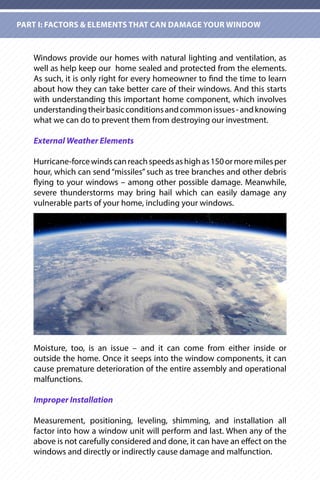
Hurricane-forcewindscanreachspeedsashighas150ormoremilesper
hour, which can send “missiles” such as tree branches and other debris
flying to your windows – among other possible damage. Meanwhile,
severe thunderstorms may bring hail which can easily damage any
vulnerable parts of your home, including your windows.
Moisture, too, is an issue – and it can come from either inside or
outside the home. Once it seeps into the window components, it can
cause premature deterioration of the entire assembly and operational
malfunctions.
Improper Installation
Measurement, positioning, leveling, shimming, and installation all
factor into how a window unit will perform and last. When any of the
above is not carefully considered and done, it can have an effect on the
windows and directly or indirectly cause damage and malfunction.
PART I: FACTORS & ELEMENTS THAT CAN DAMAGE YOUR WINDOW
Structural Movement
Structural movement does not only refer to earthquakes. It can also
be attributed to the movement of your house and its foundations
due to a number of factors such as a nearby construction, excessive
loading, defective construction, high wind pressure, excavation, and
deterioration of the building itself. And when the structure moves, the
windows may get displaced. Unnecessary pressure on the unit may also
cause cracks and gaps, which can lead to water penetration and thus
greatly damage the windows.
Age and General Wear and Tear
Your windows are bound to show mild to serious signs of wear and
tear, as with anything that ages. Sometimes, these signs of age, wear,
and tear may not be just signs – but are actual warnings of impending
issues and damage.
Other Factors
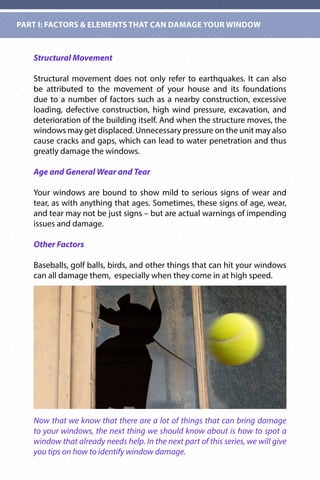
Baseballs, golf balls, birds, and other things that can hit your windows
can all damage them, especially when they come in at high speed.
Now that we know that there are a lot of things that can bring damage
to your windows, the next thing we should know about is how to spot a
window that already needs help. In the next part of this series, we will give
you tips on how to identify window damage.
PART I: FACTORS & ELEMENTS THAT CAN DAMAGE YOUR WINDOW
As important as windows are to your home, you must be able to notice
the signs of damage that they might be trying to tell you. This is the
only way for you to prevent more serious and costly problems. In this
post, we aim to give you some tips on how you can identify possible
window damage.
Check changes in ease of window operation
If your windows won’t open and shut easily and smoothly, then their
movingpartsaremostlikelysufferingfromsomeformofdamage.While
a change in the ease of the windows’ operation may be attributed to
humidity and weather – especially in the case of wood windows that
tend to swell when exposed to temperature changes – it is still best to
inspect the entire window for any signs of mechanical failure for you to
know the next best thing to do.
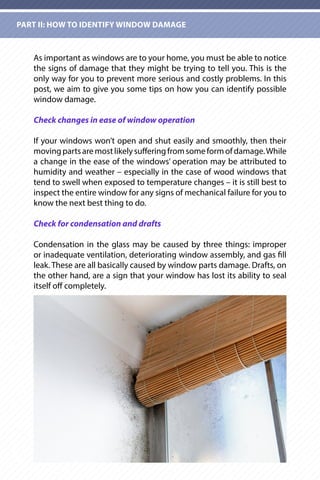
Check for condensation and drafts
Condensation in the glass may be caused by three things: improper
or inadequate ventilation, deteriorating window assembly, and gas fill
leak. These are all basically caused by window parts damage. Drafts, on
the other hand, are a sign that your window has lost its ability to seal
itself off completely.
PART II: HOW TO IDENTIFY WINDOW DAMAGE
Check out for warping frames and cracking or peeling paint.
Warping frames and peeling paint are telltale signs of frame rot,
especially in solid wood windows. They also indicate water damage.
Look out for water leaking around the windows.
If you notice water leaking around the windows when it’s raining, then
it is possible that their structure and positioning have already been
compromised – and you can bet that water can cause more problems
in the long run, too.
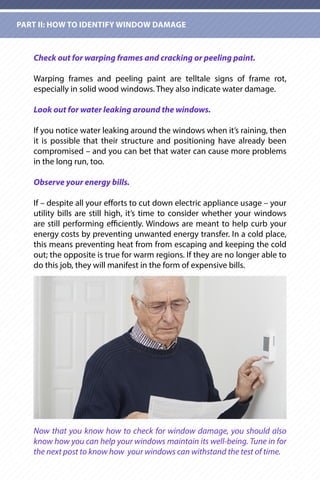
Observe your energy bills.
If – despite all your efforts to cut down electric appliance usage – your
utility bills are still high, it’s time to consider whether your windows
are still performing efficiently. Windows are meant to help curb your
energy costs by preventing unwanted energy transfer. In a cold place,
this means preventing heat from from escaping and keeping the cold
out; the opposite is true for warm regions. If they are no longer able to
do this job, they will manifest in the form of expensive bills.
Now that you know how to check for window damage, you should also
know how you can help your windows maintain its well-being. Tune in for
the next post to know how your windows can withstand the test of time.
PART II: HOW TO IDENTIFY WINDOW DAMAGE
Inthefirsttwopartsofourblogseries,wetalkedaboutfactorsandelements
thatcandamagethewindow,aswellassignsthatyourwindowisdamaged.
Now to cap it all off, we will find out how you can prevent damage to your
windows.
Youmayhavethebestandmostexpensivewindowproductintheworld,
but without knowing about the things that can help them withstand
damage and wear and tear, they won’t last as long as you expect them
to. In this post, we will give you the basic factors and measures that can
help you protect your windows – and your home investment.
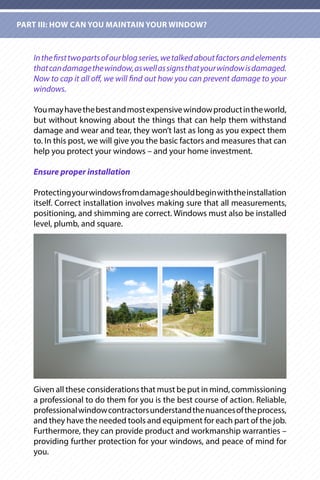
Ensure proper installation
Protectingyourwindowsfromdamageshouldbeginwiththeinstallation
itself. Correct installation involves making sure that all measurements,
positioning, and shimming are correct. Windows must also be installed
level, plumb, and square.
Given all these considerations that must be put in mind, commissioning
a professional to do them for you is the best course of action. Reliable,
professionalwindowcontractorsunderstandthenuancesoftheprocess,
and they have the needed tools and equipment for each part of the job.
Furthermore, they can provide product and workmanship warranties –
providing further protection for your windows, and peace of mind for
you.
PART III: HOW CAN YOU MAINTAIN YOUR WINDOW?
Perform routine maintenance
Now here’s where you can actively take part.Your windows need regular
and proper maintenance in order for them to reach their designated
average lifespan, and even exceed it. Routine maintenance includes the
following tasks:
	 • Clean out dirt and debris from sills and tracks
	 • Clean the frame, sash, and grilles using recommended
	 cleaning solutions
	 • Lubricate moving parts with recommended lubricants
Do not delay repairs or replacements
Evenwhenyou’veensuredproperinstallationandroutinemaintenance,
there are instances when your windows are bound to be damaged
because of factors that are out of your control. Once you notice any
signs of problems or issues, make it a point to call your contractor or
manufacturer and ask them for recommended solutions.
If you think the problem is a little more serious, have it repaired or
remedied immediately! Moreover, if you just purchased a house and
noticedthatthewindowsarenolongerworthsaving,askyourcontractor
if replacement will be a better option.
PART III: HOW CAN YOU MAINTAIN YOUR WINDOW?
Renewal by Andersen
of Greater Philadelphia
761 5th Ave #3 King of Prussia,
PA 19406
610-563-2190
ChooseBetterWindows.com

Understanding Window Condition and Damage

  • 3.
    Windows provide ourhomes with natural lighting and ventilation, as well as help keep our home sealed and protected from the elements. As such, it is only right for every homeowner to find the time to learn about how they can take better care of their windows. And this starts with understanding this important home component, which involves understandingtheirbasicconditionsandcommonissues-andknowing what we can do to prevent them from destroying our investment. External Weather Elements Hurricane-forcewindscanreachspeedsashighas150ormoremilesper hour, which can send “missiles” such as tree branches and other debris flying to your windows – among other possible damage. Meanwhile, severe thunderstorms may bring hail which can easily damage any vulnerable parts of your home, including your windows. Moisture, too, is an issue – and it can come from either inside or outside the home. Once it seeps into the window components, it can cause premature deterioration of the entire assembly and operational malfunctions. Improper Installation Measurement, positioning, leveling, shimming, and installation all factor into how a window unit will perform and last. When any of the above is not carefully considered and done, it can have an effect on the windows and directly or indirectly cause damage and malfunction. PART I: FACTORS & ELEMENTS THAT CAN DAMAGE YOUR WINDOW
  • 4.
    Structural Movement Structural movementdoes not only refer to earthquakes. It can also be attributed to the movement of your house and its foundations due to a number of factors such as a nearby construction, excessive loading, defective construction, high wind pressure, excavation, and deterioration of the building itself. And when the structure moves, the windows may get displaced. Unnecessary pressure on the unit may also cause cracks and gaps, which can lead to water penetration and thus greatly damage the windows. Age and General Wear and Tear Your windows are bound to show mild to serious signs of wear and tear, as with anything that ages. Sometimes, these signs of age, wear, and tear may not be just signs – but are actual warnings of impending issues and damage. Other Factors Baseballs, golf balls, birds, and other things that can hit your windows can all damage them, especially when they come in at high speed. Now that we know that there are a lot of things that can bring damage to your windows, the next thing we should know about is how to spot a window that already needs help. In the next part of this series, we will give you tips on how to identify window damage. PART I: FACTORS & ELEMENTS THAT CAN DAMAGE YOUR WINDOW
  • 6.
    As important aswindows are to your home, you must be able to notice the signs of damage that they might be trying to tell you. This is the only way for you to prevent more serious and costly problems. In this post, we aim to give you some tips on how you can identify possible window damage. Check changes in ease of window operation If your windows won’t open and shut easily and smoothly, then their movingpartsaremostlikelysufferingfromsomeformofdamage.While a change in the ease of the windows’ operation may be attributed to humidity and weather – especially in the case of wood windows that tend to swell when exposed to temperature changes – it is still best to inspect the entire window for any signs of mechanical failure for you to know the next best thing to do. Check for condensation and drafts Condensation in the glass may be caused by three things: improper or inadequate ventilation, deteriorating window assembly, and gas fill leak. These are all basically caused by window parts damage. Drafts, on the other hand, are a sign that your window has lost its ability to seal itself off completely. PART II: HOW TO IDENTIFY WINDOW DAMAGE
  • 7.
    Check out forwarping frames and cracking or peeling paint. Warping frames and peeling paint are telltale signs of frame rot, especially in solid wood windows. They also indicate water damage. Look out for water leaking around the windows. If you notice water leaking around the windows when it’s raining, then it is possible that their structure and positioning have already been compromised – and you can bet that water can cause more problems in the long run, too. Observe your energy bills. If – despite all your efforts to cut down electric appliance usage – your utility bills are still high, it’s time to consider whether your windows are still performing efficiently. Windows are meant to help curb your energy costs by preventing unwanted energy transfer. In a cold place, this means preventing heat from from escaping and keeping the cold out; the opposite is true for warm regions. If they are no longer able to do this job, they will manifest in the form of expensive bills. Now that you know how to check for window damage, you should also know how you can help your windows maintain its well-being. Tune in for the next post to know how your windows can withstand the test of time. PART II: HOW TO IDENTIFY WINDOW DAMAGE
  • 9.
    Inthefirsttwopartsofourblogseries,wetalkedaboutfactorsandelements thatcandamagethewindow,aswellassignsthatyourwindowisdamaged. Now to capit all off, we will find out how you can prevent damage to your windows. Youmayhavethebestandmostexpensivewindowproductintheworld, but without knowing about the things that can help them withstand damage and wear and tear, they won’t last as long as you expect them to. In this post, we will give you the basic factors and measures that can help you protect your windows – and your home investment. Ensure proper installation Protectingyourwindowsfromdamageshouldbeginwiththeinstallation itself. Correct installation involves making sure that all measurements, positioning, and shimming are correct. Windows must also be installed level, plumb, and square. Given all these considerations that must be put in mind, commissioning a professional to do them for you is the best course of action. Reliable, professionalwindowcontractorsunderstandthenuancesoftheprocess, and they have the needed tools and equipment for each part of the job. Furthermore, they can provide product and workmanship warranties – providing further protection for your windows, and peace of mind for you. PART III: HOW CAN YOU MAINTAIN YOUR WINDOW?
  • 10.
    Perform routine maintenance Nowhere’s where you can actively take part.Your windows need regular and proper maintenance in order for them to reach their designated average lifespan, and even exceed it. Routine maintenance includes the following tasks: • Clean out dirt and debris from sills and tracks • Clean the frame, sash, and grilles using recommended cleaning solutions • Lubricate moving parts with recommended lubricants Do not delay repairs or replacements Evenwhenyou’veensuredproperinstallationandroutinemaintenance, there are instances when your windows are bound to be damaged because of factors that are out of your control. Once you notice any signs of problems or issues, make it a point to call your contractor or manufacturer and ask them for recommended solutions. If you think the problem is a little more serious, have it repaired or remedied immediately! Moreover, if you just purchased a house and noticedthatthewindowsarenolongerworthsaving,askyourcontractor if replacement will be a better option. PART III: HOW CAN YOU MAINTAIN YOUR WINDOW?
  • 11.
    Renewal by Andersen ofGreater Philadelphia 761 5th Ave #3 King of Prussia, PA 19406 610-563-2190 ChooseBetterWindows.com