What is theStatement of Comprehensive
Income?
Reports Equity Changes
Tracks all shifts in equity from non-owner
sources over a specific period, reflecting a
broader financial impact.
Combines Key Metrics
Integrates traditional Net Income with
Other Comprehensive Income (OCI) to offer
a consolidated financial view.
Fuller Financial Picture
Goes beyond the basic income statement,
revealing aspects of performance often
overlooked in conventional reports.
3.
Key Elements ofthe SCI with Examples
Revenues: Driving Growth
These are the core earnings from selling goods or services. For
instance, a tech company might report $1.29 million in software
sales, reflecting its primary income stream.
Expenses: Operational Costs
Costs incurred to generate revenue, including salaries for employees,
rent for office spaces, and the cost of goods sold (COGS). Effective
management of these expenses is crucial for profitability.
Net Income: The Bottom Line
Calculated as total revenues minus total expenses. This figure often
represents the traditional measure of a company's profitability, such
as a $400,000 profit after all costs.
Other Comprehensive Income (OCI):
Hidden Value
Captures unrealized gains or losses that bypass the net income
calculation but still impact equity. Examples include foreign currency
translation adjustments, unrealized gains on available-for-sale
securities, and pension plan adjustments.
4.
Why Include OtherComprehensive Income
(OCI)?
Other Comprehensive Income (OCI) provides a crucial lens into a company's financial health, capturing value and risks that the traditional income
statement might miss. It includes items that affect equity but are not yet realized through normal operations.
Captures Unrealized Gains/Losses
OCI accounts for gains or losses that impact shareholder equity
but have not yet been "realized" through a transaction, like
changes in the fair value of certain financial instruments.
Cash Flow Hedge Adjustments
Gains or losses from derivative instruments designated as cash
flow hedges are recorded in OCI until the hedged item affects
earnings.
Debt Securities Revaluation
Changes in the fair value of available-for-sale debt securities are
reported in OCI, providing transparency on potential future
impacts to net income.
Foreign Currency Impact
Fluctuations in foreign exchange rates can lead to translation
adjustments for foreign operations, which are recognized in OCI,
showing the true impact on global investments.
By including OCI, investors gain a more comprehensive understanding of a company's performance, revealing hidden value and potential risks not
immediately visible in net income.
5.
Preparing an SCIfor a Merchandising
Business (Perpetual Inventory System)
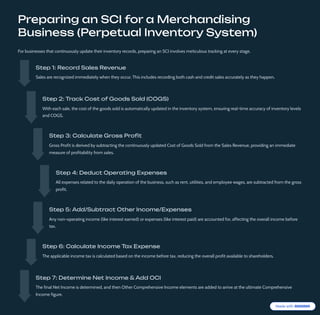
For businesses that continuously update their inventory records, preparing an SCI involves meticulous tracking at every stage.
Step 1: Record Sales Revenue
Sales are recognized immediately when they occur. This includes recording both cash and credit sales accurately as they happen.
Step 2: Track Cost of Goods Sold (COGS)
With each sale, the cost of the goods sold is automatically updated in the inventory system, ensuring real-time accuracy of inventory levels
and COGS.
Step 3: Calculate Gross Profit
Gross Profit is derived by subtracting the continuously updated Cost of Goods Sold from the Sales Revenue, providing an immediate
measure of profitability from sales.
Step 4: Deduct Operating Expenses
All expenses related to the daily operation of the business, such as rent, utilities, and employee wages, are subtracted from the gross
profit.
Step 5: Add/Subtract Other Income/Expenses
Any non-operating income (like interest earned) or expenses (like interest paid) are accounted for, affecting the overall income before
tax.
Step 6: Calculate Income Tax Expense
The applicable income tax is calculated based on the income before tax, reducing the overall profit available to shareholders.
Step 7: Determine Net Income & Add OCI
The final Net Income is determined, and then Other Comprehensive Income elements are added to arrive at the ultimate Comprehensive
Income figure.
6.
Sample SCI forMerchandising Business
(Perpetual System)
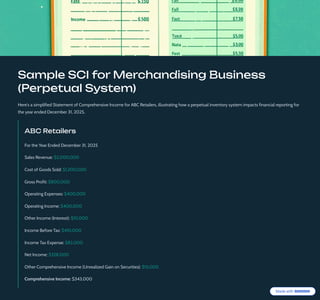
Here's a simplified Statement of Comprehensive Income for ABC Retailers, illustrating how a perpetual inventory system impacts financial reporting for
the year ended December 31, 2025.
ABC Retailers
For the Year Ended December 31, 2025
Sales Revenue: $2,000,000
Cost of Goods Sold: $1,200,000
Gross Profit: $800,000
Operating Expenses: $400,000
Operating Income: $400,000
Other Income (Interest): $10,000
Income Before Tax: $410,000
Income Tax Expense: $82,000
Net Income: $328,000
Other Comprehensive Income (Unrealized Gain on Securities): $15,000
Comprehensive Income: $343,000
7.
Forms of BusinessOrganization: Overview
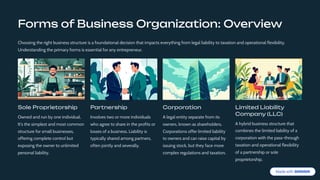
Choosing the right business structure is a foundational decision that impacts everything from legal liability to taxation and operational flexibility.
Understanding the primary forms is essential for any entrepreneur.
Sole Proprietorship
Owned and run by one individual.
It's the simplest and most common
structure for small businesses,
offering complete control but
exposing the owner to unlimited
personal liability.
Partnership
Involves two or more individuals
who agree to share in the profits or
losses of a business. Liability is
typically shared among partners,
often jointly and severally.
Corporation
A legal entity separate from its
owners, known as shareholders.
Corporations offer limited liability
to owners and can raise capital by
issuing stock, but they face more
complex regulations and taxation.
Limited Liability
Company (LLC)
A hybrid business structure that
combines the limited liability of a
corporation with the pass-through
taxation and operational flexibility
of a partnership or sole
proprietorship.
8.
Key Differences AmongBusiness Forms
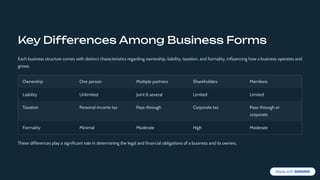
Each business structure comes with distinct characteristics regarding ownership, liability, taxation, and formality, influencing how a business operates and
grows.
Ownership One person Multiple partners Shareholders Members
Liability Unlimited Joint & several Limited Limited
Taxation Personal income tax Pass-through Corporate tax Pass-through or
corporate
Formality Minimal Moderate High Moderate
These differences play a significant role in determining the legal and financial obligations of a business and its owners.
9.
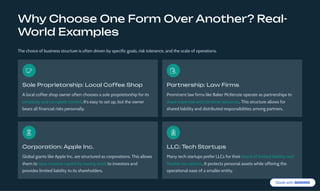
Why Choose OneForm Over Another? Real-
World Examples
The choice of business structure is often driven by specific goals, risk tolerance, and the scale of operations.
Sole Proprietorship: Local Coffee Shop
A local coffee shop owner often chooses a sole proprietorship for its
simplicity and complete control. It's easy to set up, but the owner
bears all financial risks personally.
Partnership: Law Firms
Prominent law firms like Baker McKenzie operate as partnerships to
share expertise and combine resources. This structure allows for
shared liability and distributed responsibilities among partners.
Corporation: Apple Inc.
Global giants like Apple Inc. are structured as corporations. This allows
them to raise massive capital by issuing stock to investors and
provides limited liability to its shareholders.
LLC: Tech Startups
Many tech startups prefer LLCs for their blend of limited liability and
flexible tax options. It protects personal assets while offering the
operational ease of a smaller entity.
10.
Summary & Takeaway
Aclear understanding of financial statements and business structures is paramount for informed decision-making.
SCI: A Holistic Financial View
The Statement of Comprehensive Income offers a complete
picture of a company's financial performance, integrating both
traditional net income and unrealized gains/losses from other
comprehensive income, crucial for assessing overall equity
changes.
Merchandising Business &
Perpetual Inventory
For merchandising businesses, particularly those using a perpetual
inventory system, the SCI accurately tracks Costs of Goods Sold
(COGS) continuously, providing real-time data for more precise
financial reporting and operational insights.
Strategic Business Forms
The choice of business organization4whether a sole
proprietorship, partnership, corporation, or LLC4significantly
impacts legal liability, tax obligations, and administrative
complexity, guiding long-term strategic planning.
Empowering Financial Decisions
By grasping the nuances of the SCI and the implications of various
business forms, stakeholders can make more robust financial
decisions, anticipate risks, and unlock strategic growth
opportunities.