Understanding the Software Development Frameworks.pdf
Software development frameworks are pre-established platforms that provide a foundation for developing software applications. They include libraries, tools, and best practices that streamline the development process.
Understanding the Software Development Frameworks.pdf
1.
Understanding the Software
DevelopmentFrameworks
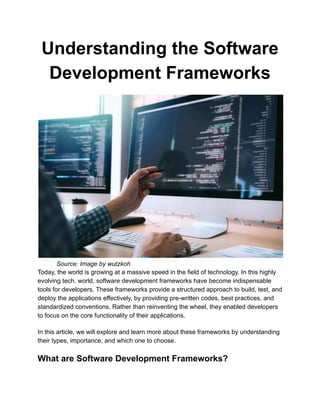
Source: Image by wutzkoh
Today, the world is growing at a massive speed in the field of technology. In this highly
evolving tech. world, software development frameworks have become indispensable
tools for developers. These frameworks provide a structured approach to build, test, and
deploy the applications effectively, by providing pre-written codes, best practices, and
standardized conventions. Rather than reinventing the wheel, they enabled developers
to focus on the core functionality of their applications.
In this article, we will explore and learn more about these frameworks by understanding
their types, importance, and which one to choose.
What are Software Development Frameworks?
2.
Software development frameworksare pre-established platforms that provide a
foundation for developing software applications. They include libraries, tools, and best
practices that streamline the development process. These frameworks help developers
follow a systematic approach, ensuring code reusability, maintainability, and scalability.
There are different types of frameworks tailored for specific programming languages,
development methodologies, and application types. Whether it’s web development,
mobile app creation, or enterprise software, choosing the right framework can
significantly impact a project’s success.
What are the Importance of Software Development
Frameworks?
Image by Ngampol Thongsai _ EyeEm from Getty Images
These frameworks offer several benefits that enhance the efficiency and reliability of
software projects:
1. Faster Development: By providing pre-built components and tools, frameworks
reduce the time needed to develop applications.
3.
2. Code Reusability:Developers can reuse existing modules, minimizing
redundancy and reducing the likelihood of errors.
3. Enhanced Security: Many frameworks come with built-in security features that
protect against common vulnerabilities like SQL injection and cross-site
scripting (XSS).
4. Scalability: Frameworks support structured and modular code, making it easier
to scale applications as needed.
5. Community Support: Popular frameworks have large developer communities
that contribute to improvements, plugins, and troubleshooting solutions.
Types of Software Development Frameworks
Frameworks can be categorized based on their application domains. Below are some of
the most widely used types:
1. Web Development Frameworks
Web development frameworks simplify the creation of websites and web applications.
They offer tools for server-side scripting, front-end development, and database
integration. Some popular web development frameworks include:
● React.js – A JavaScript library for building dynamic user interfaces.
● Angular – A TypeScript-based framework for building single-page applications
(SPAs).
● Django – A Python framework that emphasizes rapid development and clean
design.
● Ruby on Rails – A Ruby-based framework known for its
convention-over-configuration approach.
2. Mobile App Development Frameworks
Mobile app development frameworks provide the tools needed to create applications for
iOS and Android. These frameworks support native, hybrid, or cross-platform
development. Some leading frameworks include:
● Flutter – A Google-backed framework using the Dart language for
cross-platform applications.
● React Native – Allows developers to build mobile apps using JavaScript and
React.
4.
● Xamarin –A Microsoft framework enabling cross-platform development with
C#.
● SwiftUI – An Apple framework for building native iOS applications with Swift.
3. Backend Development Frameworks
Image by luis gomes from Pexels
Backend frameworks handle server-side operations, database management, and API
development. These frameworks ensure efficient handling of requests, user
authentication, and data processing. Notable backend frameworks include:
● Express.js – A minimalistic Node.js framework for building web servers and
APIs.
● Spring Boot – A Java framework designed for microservices and enterprise
applications.
● Laravel – A PHP framework that simplifies web application development.
● ASP.NET Core – A Microsoft framework for developing high-performance web
applications.
4. Enterprise Software Development Frameworks
5.
Enterprise software developmentframeworks cater to large-scale businesses, providing
robust tools for managing operations, customer relations, and analytics. Some
commonly used frameworks include:
● SAP NetWeaver – A comprehensive framework for enterprise resource
planning (ERP).
● Oracle ADF – A Java-based framework for enterprise applications.
● Microsoft Dynamics 365 – A suite of business applications for CRM and ERP.
Choosing the Right Software Development Framework
Selecting the right software development framework depends on several factors,
including:
● Project Requirements: Consider whether you need a framework for web,
mobile, or backend development.
● Programming Language Preference: Choose a framework that aligns with
your team’s expertise.
● Scalability Needs: Ensure the framework supports the long-term growth of
your application.
● Community and Support: Opt for a framework with an active developer
community for better troubleshooting and updates.
● Security Features: Check if the framework offers built-in security measures to
protect user data.
The Future of Software Development Frameworks
6.
Image by oliadanilevich from Pexels
As technology evolves, software development frameworks continue to adapt to
emerging trends. Some key developments shaping the future of these frameworks
include:
● AI and Machine Learning Integration: Many frameworks are incorporating AI
capabilities to automate processes and enhance decision-making.
● Low-Code and No-Code Platforms: Frameworks like Bubble and OutSystems
are enabling non-developers to create applications with minimal coding.
● Cloud-Native Development: Serverless architectures and cloud-based
frameworks are becoming increasingly popular.
● Microservices and API-First Design: Modern frameworks emphasize
microservices architecture for greater flexibility and scalability.
Final Thoughts
In conclusion, Software development frameworks are important tools that can
streamline the development processes by enhancing security and improving efficiency.
If you want to make your project a success, choosing the right framework can make a
significant change, no matter whether you are working with web applications, mobile
7.
applications, backend services,or enterprise solutions. Technology is growing very fast,
so staying updated with the latest frameworks and trends is very crucial for developers,
who want to build high-performing and scalable applications.