Chapter 8: Functions and
Procedures
Fernando Hernandez
Amilcar Hernandez
David Donovan
Luis Cornejo
Creation Option
2
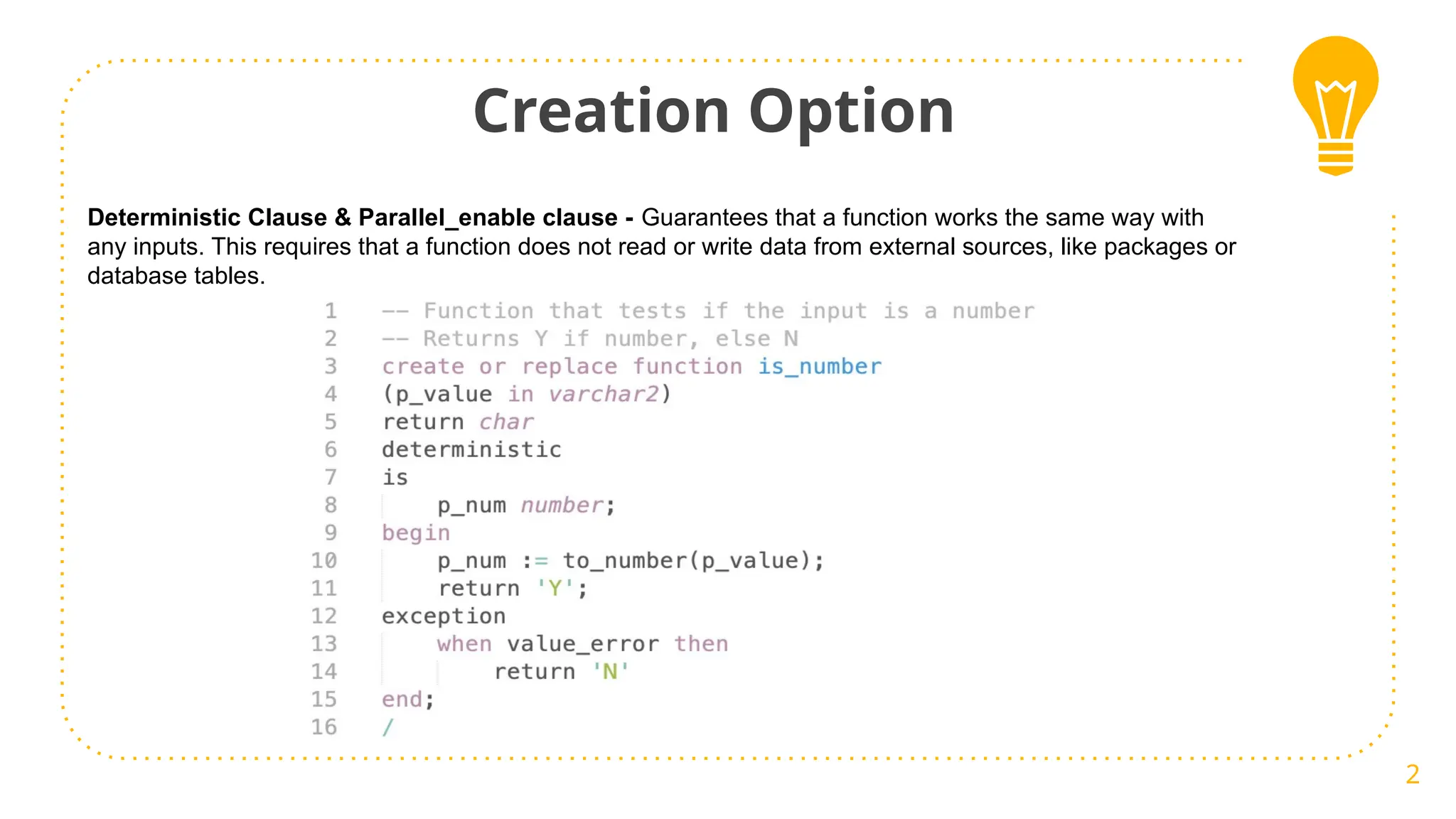
Deterministic Clause & Parallel_enable clause - Guarantees that a function works the same way with
any inputs. This requires that a function does not read or write data from external sources, like packages or
database tables.
Creation Option Cont’d
3
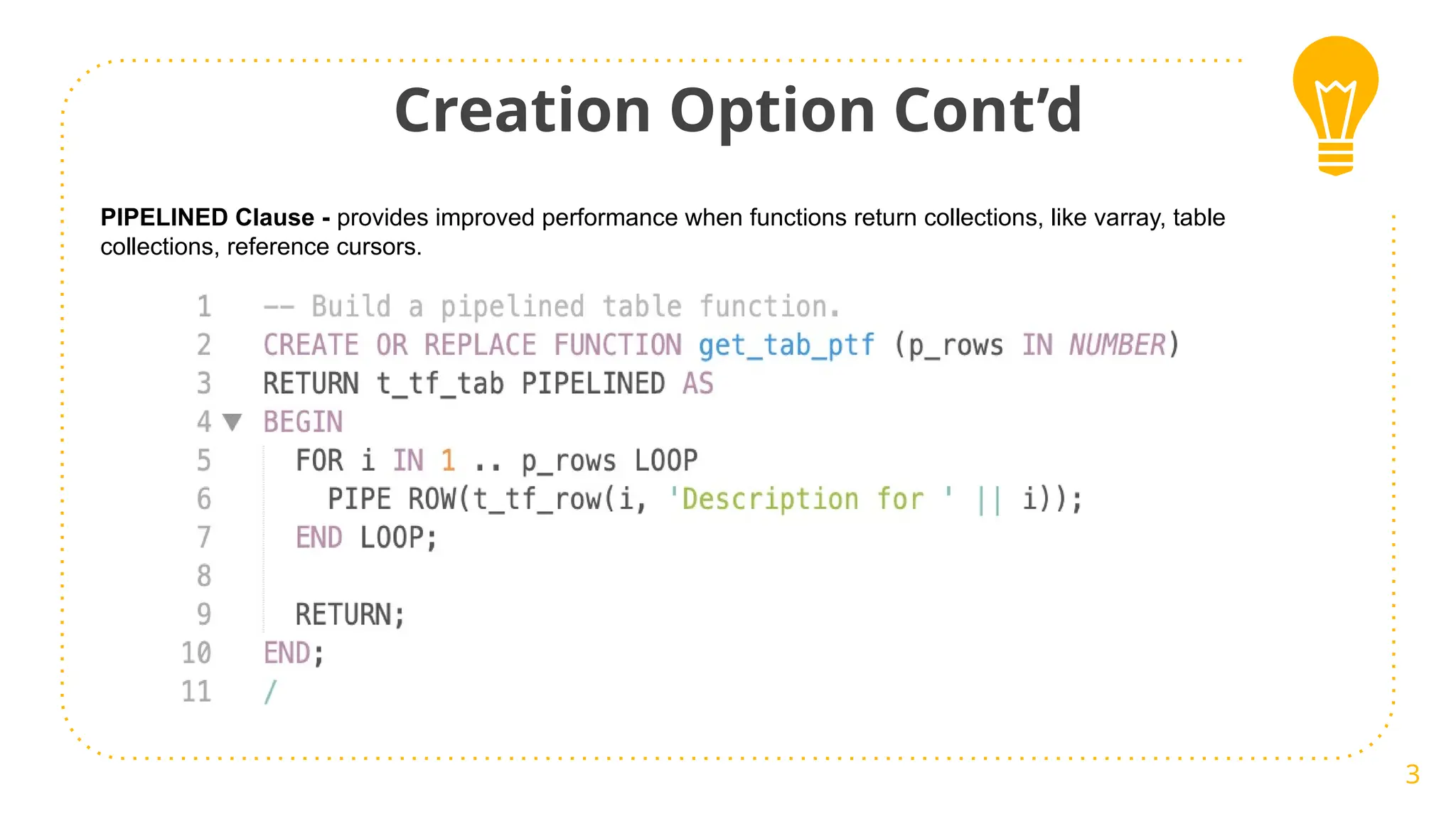
PIPELINED Clause - provides improved performance when functions return collections, like varray, table
collections, reference cursors.
Understand positional, named, and mixed call notation.
Calling notation is a way of providing values to the parameters of a subroutine such as
PL/SQL function or a stored procedure.
4
Types of Calling
Notations
● Positional Notation
● Named Notation and
● Mixed calling notation
Positional Calling Notations
● Is the most common calling notation
● Specify the value for each formal parameter in a sequential
manner
Named Calling Notations
● Pass values to the formal parameters using their names
● Useful when you have a subroutine with parameters where some
of those parameters are mandatory
Mixed Calling Notation
● Call subroutines using the combination of named as well as
positional
● Helpful where the parameter list is defined with all mandatory
parameters first and optional parameters next
5
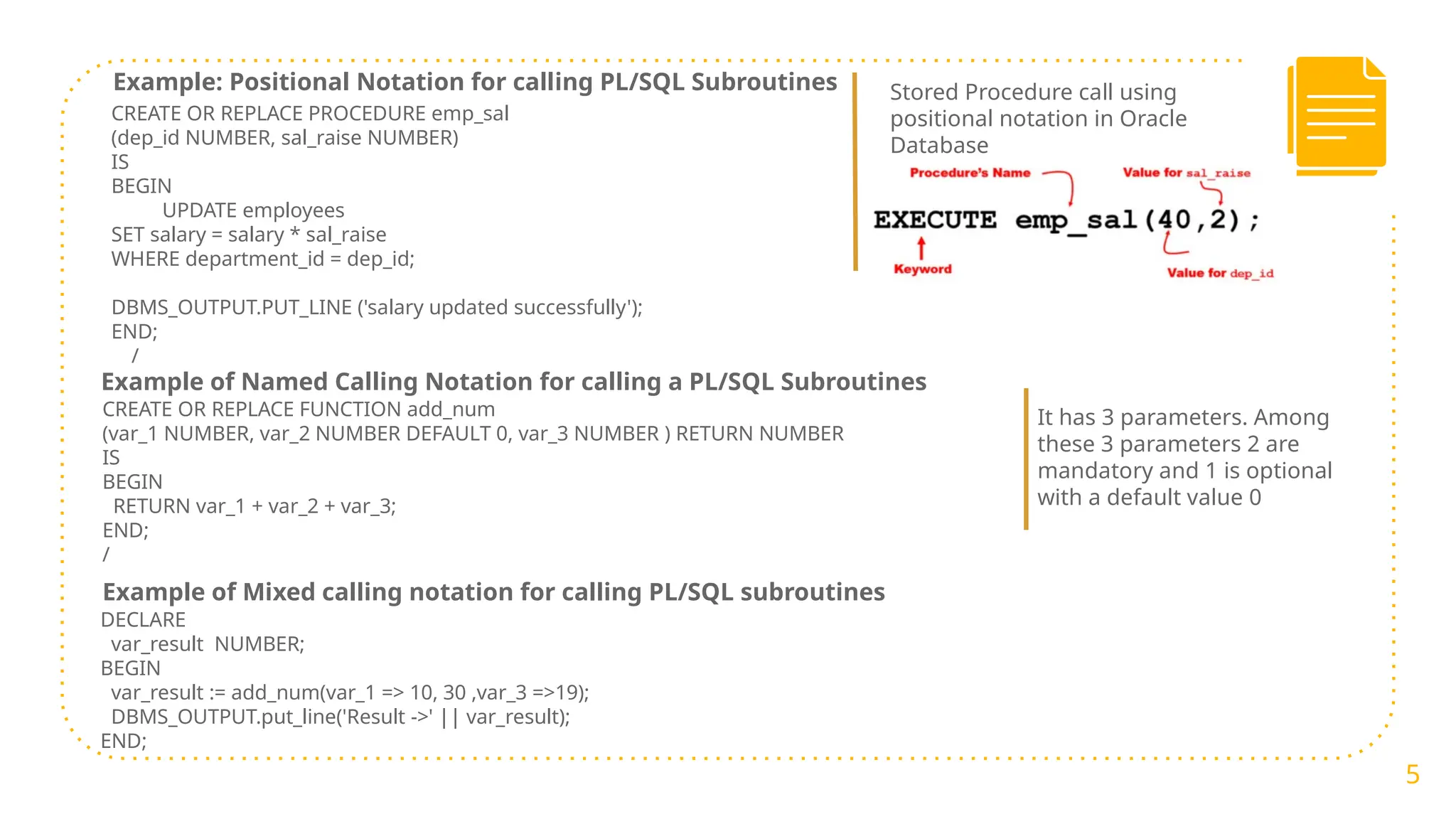
Example of Named Calling Notation for calling a PL/SQL Subroutines
It has 3 parameters. Among
these 3 parameters 2 are
mandatory and 1 is optional
with a default value 0
DECLARE
var_result NUMBER;
BEGIN
var_result := add_num(var_1 => 10, 30 ,var_3 =>19);
DBMS_OUTPUT.put_line('Result ->' || var_result);
END;
CREATE OR REPLACE PROCEDURE emp_sal
(dep_id NUMBER, sal_raise NUMBER)
IS
BEGIN
UPDATE employees
SET salary = salary * sal_raise
WHERE department_id = dep_id;
DBMS_OUTPUT.PUT_LINE ('salary updated successfully');
END;
/
Stored Procedure call using
positional notation in Oracle
Database
Example of Mixed calling notation for calling PL/SQL subroutines
CREATE OR REPLACE FUNCTION add_num
(var_1 NUMBER, var_2 NUMBER DEFAULT 0, var_3 NUMBER ) RETURN NUMBER
IS
BEGIN
RETURN var_1 + var_2 + var_3;
END;
/
Example: Positional Notation for calling PL/SQL Subroutines
Pass-by-value functions
● They receive a copy of the values and not the real variable. They
return a value but the Original values do not change.
● The return value must be assign to a variable in a PL/SQL block or be
returned as an expression in a SQL query.
6
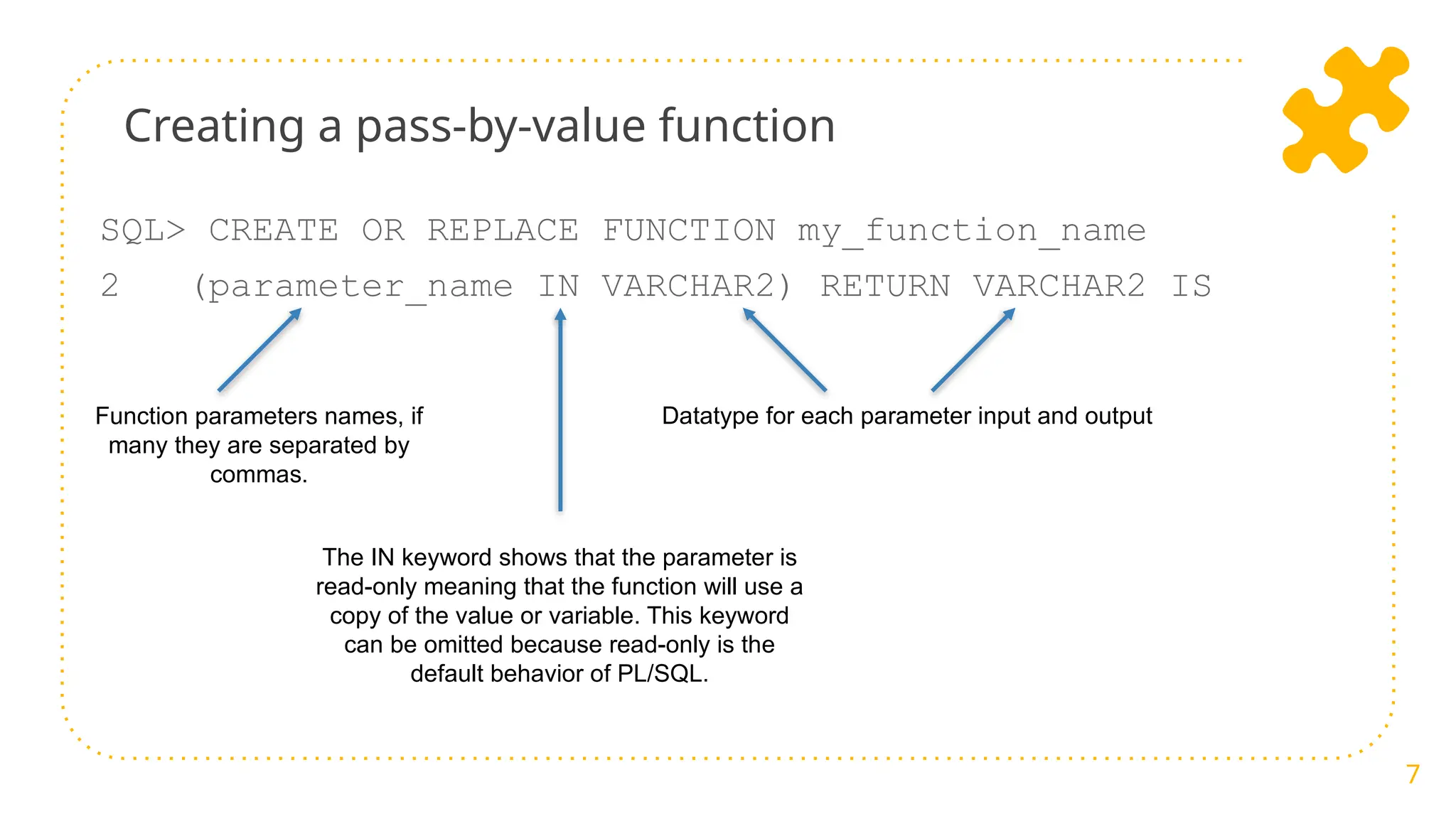
Creating a pass-by-value function
SQL> CREATE OR REPLACE FUNCTION my_function_name
2 (parameter_name IN VARCHAR2) RETURN VARCHAR2 IS
7
Function parameters names, if
many they are separated by
commas.
Datatype for each parameter input and output
The IN keyword shows that the parameter is
read-only meaning that the function will use a
copy of the value or variable. This keyword
can be omitted because read-only is the
default behavior of PL/SQL.
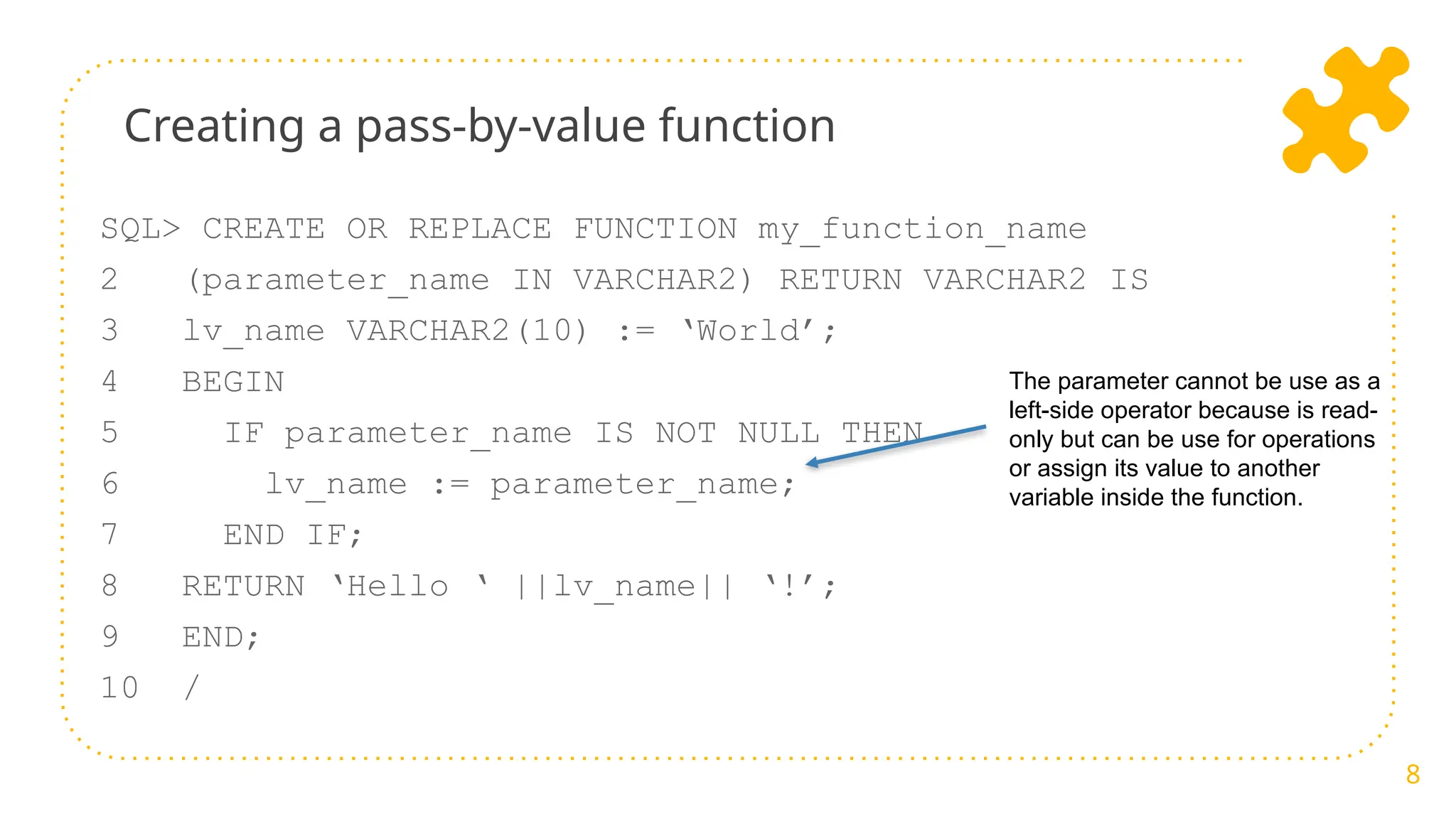
Creating a pass-by-value function
8
SQL> CREATE OR REPLACE FUNCTION my_function_name
2 (parameter_name IN VARCHAR2) RETURN VARCHAR2 IS
3 lv_name VARCHAR2(10) := ‘World’;
4 BEGIN
5 IF parameter_name IS NOT NULL THEN
6 lv_name := parameter_name;
7 END IF;
8 RETURN ‘Hello ‘ ||lv_name|| ‘!’;
9 END;
10 /
The parameter cannot be use as a
left-side operator because is read-
only but can be use for operations
or assign its value to another
variable inside the function.
Understand pass-by-reference functions
You use pass-by-reference functions when you want to perform an
operation, return a value from the function, and alter one or more
actual parameters. These functions can only act inside the scope of
another program or environment.
9
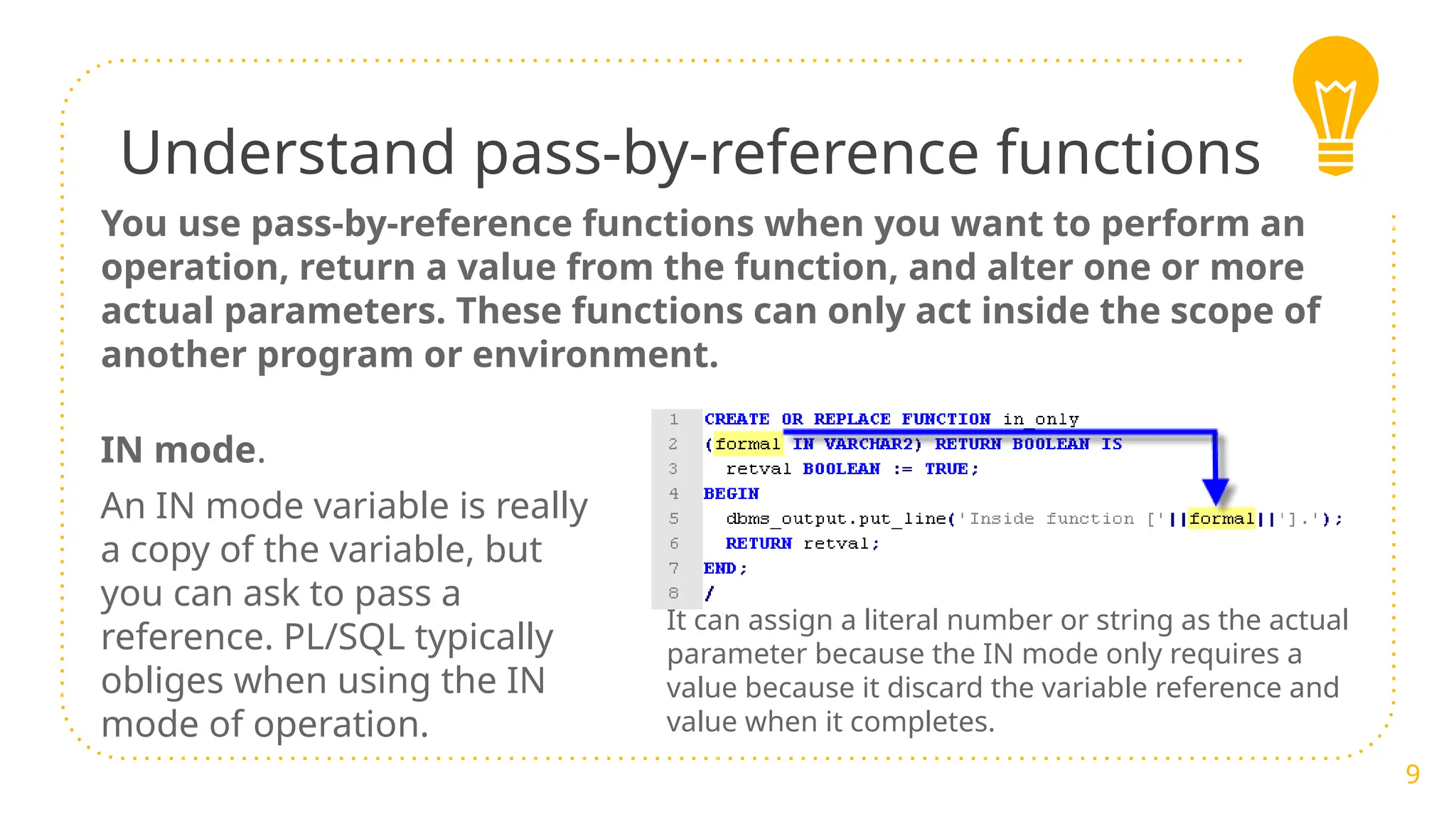
IN mode.
An IN mode variable is really
a copy of the variable, but
you can ask to pass a
reference. PL/SQL typically
obliges when using the IN
mode of operation.
It can assign a literal number or string as the actual
parameter because the IN mode only requires a
value because it discard the variable reference and
value when it completes.
Understand pass-by-reference functions
10
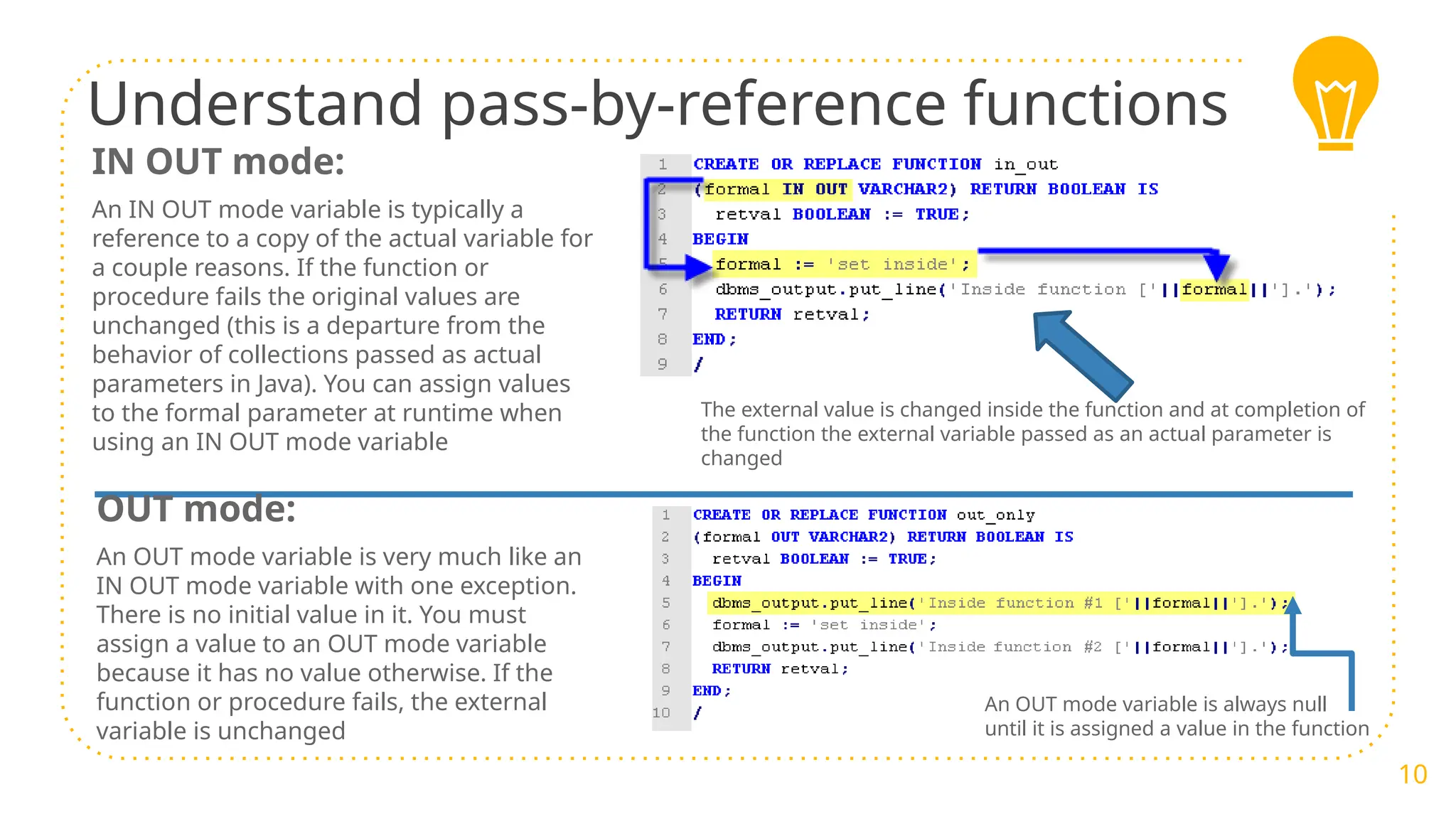
IN OUT mode:
An IN OUT mode variable is typically a
reference to a copy of the actual variable for
a couple reasons. If the function or
procedure fails the original values are
unchanged (this is a departure from the
behavior of collections passed as actual
parameters in Java). You can assign values
to the formal parameter at runtime when
using an IN OUT mode variable
The external value is changed inside the function and at completion of
the function the external variable passed as an actual parameter is
changed
OUT mode:
An OUT mode variable is very much like an
IN OUT mode variable with one exception.
There is no initial value in it. You must
assign a value to an OUT mode variable
because it has no value otherwise. If the
function or procedure fails, the external
variable is unchanged
An OUT mode variable is always null
until it is assigned a value in the function
11
Thanks!
For Watching!

Understanding pass by value and pass by reference is essential for effective programming. These concepts determine how data is passed to functions and procedures

  • 1.
    Chapter 8: Functionsand Procedures Fernando Hernandez Amilcar Hernandez David Donovan Luis Cornejo
  • 2.
    Creation Option 2 Deterministic Clause& Parallel_enable clause - Guarantees that a function works the same way with any inputs. This requires that a function does not read or write data from external sources, like packages or database tables.
  • 3.
    Creation Option Cont’d 3 PIPELINEDClause - provides improved performance when functions return collections, like varray, table collections, reference cursors.
  • 4.
    Understand positional, named,and mixed call notation. Calling notation is a way of providing values to the parameters of a subroutine such as PL/SQL function or a stored procedure. 4 Types of Calling Notations ● Positional Notation ● Named Notation and ● Mixed calling notation Positional Calling Notations ● Is the most common calling notation ● Specify the value for each formal parameter in a sequential manner Named Calling Notations ● Pass values to the formal parameters using their names ● Useful when you have a subroutine with parameters where some of those parameters are mandatory Mixed Calling Notation ● Call subroutines using the combination of named as well as positional ● Helpful where the parameter list is defined with all mandatory parameters first and optional parameters next
  • 5.
    5 Example of NamedCalling Notation for calling a PL/SQL Subroutines It has 3 parameters. Among these 3 parameters 2 are mandatory and 1 is optional with a default value 0 DECLARE var_result NUMBER; BEGIN var_result := add_num(var_1 => 10, 30 ,var_3 =>19); DBMS_OUTPUT.put_line('Result ->' || var_result); END; CREATE OR REPLACE PROCEDURE emp_sal (dep_id NUMBER, sal_raise NUMBER) IS BEGIN UPDATE employees SET salary = salary * sal_raise WHERE department_id = dep_id; DBMS_OUTPUT.PUT_LINE ('salary updated successfully'); END; / Stored Procedure call using positional notation in Oracle Database Example of Mixed calling notation for calling PL/SQL subroutines CREATE OR REPLACE FUNCTION add_num (var_1 NUMBER, var_2 NUMBER DEFAULT 0, var_3 NUMBER ) RETURN NUMBER IS BEGIN RETURN var_1 + var_2 + var_3; END; / Example: Positional Notation for calling PL/SQL Subroutines
  • 6.
    Pass-by-value functions ● Theyreceive a copy of the values and not the real variable. They return a value but the Original values do not change. ● The return value must be assign to a variable in a PL/SQL block or be returned as an expression in a SQL query. 6
  • 7.
    Creating a pass-by-valuefunction SQL> CREATE OR REPLACE FUNCTION my_function_name 2 (parameter_name IN VARCHAR2) RETURN VARCHAR2 IS 7 Function parameters names, if many they are separated by commas. Datatype for each parameter input and output The IN keyword shows that the parameter is read-only meaning that the function will use a copy of the value or variable. This keyword can be omitted because read-only is the default behavior of PL/SQL.
  • 8.
    Creating a pass-by-valuefunction 8 SQL> CREATE OR REPLACE FUNCTION my_function_name 2 (parameter_name IN VARCHAR2) RETURN VARCHAR2 IS 3 lv_name VARCHAR2(10) := ‘World’; 4 BEGIN 5 IF parameter_name IS NOT NULL THEN 6 lv_name := parameter_name; 7 END IF; 8 RETURN ‘Hello ‘ ||lv_name|| ‘!’; 9 END; 10 / The parameter cannot be use as a left-side operator because is read- only but can be use for operations or assign its value to another variable inside the function.
  • 9.
    Understand pass-by-reference functions Youuse pass-by-reference functions when you want to perform an operation, return a value from the function, and alter one or more actual parameters. These functions can only act inside the scope of another program or environment. 9 IN mode. An IN mode variable is really a copy of the variable, but you can ask to pass a reference. PL/SQL typically obliges when using the IN mode of operation. It can assign a literal number or string as the actual parameter because the IN mode only requires a value because it discard the variable reference and value when it completes.
  • 10.
    Understand pass-by-reference functions 10 INOUT mode: An IN OUT mode variable is typically a reference to a copy of the actual variable for a couple reasons. If the function or procedure fails the original values are unchanged (this is a departure from the behavior of collections passed as actual parameters in Java). You can assign values to the formal parameter at runtime when using an IN OUT mode variable The external value is changed inside the function and at completion of the function the external variable passed as an actual parameter is changed OUT mode: An OUT mode variable is very much like an IN OUT mode variable with one exception. There is no initial value in it. You must assign a value to an OUT mode variable because it has no value otherwise. If the function or procedure fails, the external variable is unchanged An OUT mode variable is always null until it is assigned a value in the function
  • 11.