Understanding
Leveling
Systems
Kate Todd
Understanding
Leveling
Systems
Presented by Kate Todd
ALSC Education Committee
ALA Annual Conference
June 29, 2013
http://levels.pbworks.com
Are you?
•Library Media Specialist
•Children’s librarian in public
library
•Other public library staff
•College Librarian
•Library School Faculty
3
Do your schools use?
•Accelerated Reader
•Reading Counts
•Lexiles
•Fountas & Pinnell Guided Reading
•Reading Recovery
•Degrees of Reading Power (DRP)
4
5
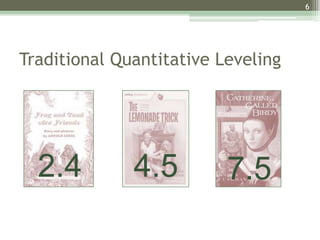
Traditional Quantitative Leveling
2.4 4.5 7.5
6
Predictors of text difficulty
•Semantic (word) complexity
▫ Word length (number of letters or
number of syllables), or
▫ Vocabulary lists of words known to
students in particular grades
•Syntactic (sentence) difficulty
▫ Number of words per sentence
7
SMOG Readability Formula
Grade level = + 3
Number of
Polysyllabic
words
8
FryReadabilityGraph
9
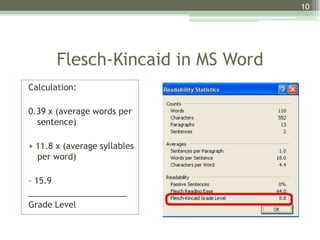
Flesch-Kincaid in MS Word
Calculation:
0.39 x (average words per
sentence)
+ 11.8 x (average syllables
per word)
– 15.9
_____________________
Grade Level
10
Accelerated Reader ATOS Formula
Book (or grade) level =
1.95 x (AvgWords per sentence)
+ .46 x (AvgGrade of 100 most
frequent words)
+ 1.74 x (AvgCharacters per
word)
-8.54
11
AR Book Finder
IL
Interest Level
BL
Book or grade
level
AR Pts
Quiz points
available
12
2nd Generation Quantitative
400L 760L 1170L
13
Lexile: Find A Book
14
Compare Text Analyzers
15
Qualitative Leveling
K Q X
16
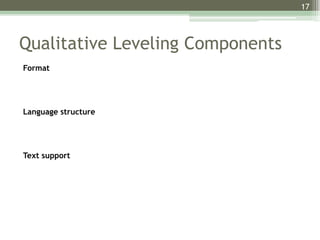
Qualitative Leveling Components
Format
Language structure
Text support
17
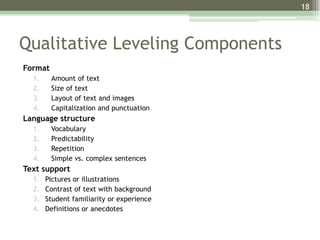
Qualitative Leveling Components
Format
1. Amount of text
2. Size of text
3. Layout of text and images
4. Capitalization and punctuation
Language structure
1. Vocabulary
2. Predictability
3. Repetition
4. Simple vs. complex sentences
Text support
1. Pictures or illustrations
2. Contrast of text with background
3. Student familiarity or experience
4. Definitions or anecdotes
18
Scholastic Book Wizard
Leveling Searches:
Grade Level
Guided Reading
DRA
Lexile Measure
19
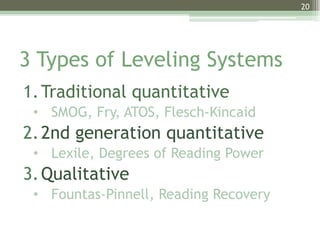
3 Types of Leveling Systems
1.Traditional quantitative
• SMOG, Fry, ATOS, Flesch-Kincaid
2.2nd generation quantitative
• Lexile, Degrees of Reading Power
3.Qualitative
• Fountas-Pinnell, Reading Recovery
20
Positive Aspects of Leveling
1. Match students and books for
instruction
2. Success motivates continued reading
3. Not too easy, not too hard reading
results in progress
4. Identifying book levels assists with
selection
21
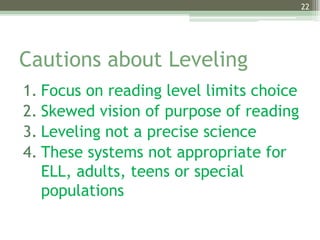
Cautions about Leveling
1. Focus on reading level limits choice
2. Skewed vision of purpose of reading
3. Leveling not a precise science
4. These systems not appropriate for
ELL, adults, teens or special
populations
22
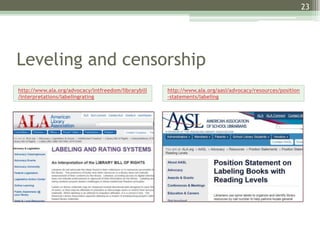
Leveling and censorship
http://www.ala.org/advocacy/intfreedom/librarybill
/interpretations/labelingrating
http://www.ala.org/aasl/advocacy/resources/position
-statements/labeling
23
24
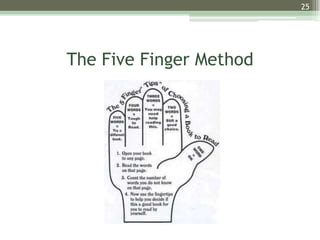
The Five Finger Method
25
Understanding
Leveling
Systems
http://levels.pbworks.com
EduKateTodd@gmail.com

Understanding Leveling Systems