Understanding
Intangible Assets
and Real Estate
National Conference of State Tax Judges
36th Annual Meeting
Portland, Oregon
September 8-10, 2016
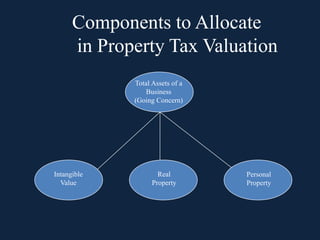
Real
Property
Personal
Property
Intangible
Value
Components to Allocate
in Property Tax Valuation
Total Assets of a
Business
(Going Concern)
3
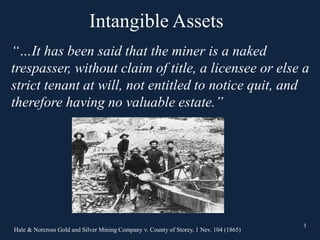
“…It has been said that the miner is a naked
trespasser, without claim of title, a licensee or else a
strict tenant at will, not entitled to notice quit, and
therefore having no valuable estate.”
Hale & Norcross Gold and Silver Mining Company v. County of Storey, 1 Nev. 104 (1865)
3
Intangible Assets
Section 1 – Identifying Intangible Assets
Section 2 – Why it is necessary to Allocate Intangible Assets
Section 3 – Methods for Estimating Intangible Value
Section 4 – Special Topics
Section 5 – Legal Perspective
Intangible Assets
Section 1: Identifying Intangible Assets
5
Identifying Intangible Assets
Intangible Assets: Nonphysical assets, including
but not limited to franchises, trademarks, patents,
copyrights, goodwill, equities, securities, and
contracts as distinguished from physical assets
such as facilities and equipment.
Appraisal Institute 2015
Dictionary of Real Estate Appraisal – 6th Edition.
7
Intangible Assets
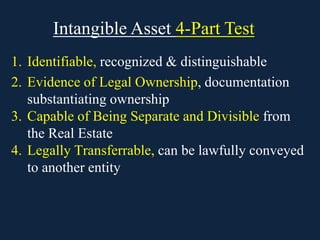
Intangible Asset 4-Part Test
1. Identifiable, recognized & distinguishable
2. Evidence of Legal Ownership, documentation
substantiating ownership
3. Capable of Being Separate and Divisible from
the Real Estate
4. Legally Transferrable, can be lawfully conveyed
to another entity
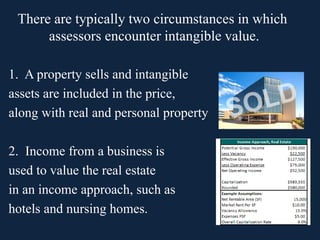
1. A property sells and intangible
assets are included in the price,
along with real and personal property
2. Income from a business is
used to value the real estate
in an income approach, such as
hotels and nursing homes.
There are typically two circumstances in which
assessors encounter intangible value.
Selected Property Types and Intangible Assets
10
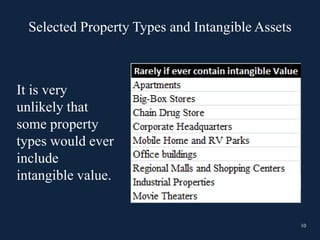
It is very
unlikely that
some property
types would ever
include
intangible value.
Selected Property Types and Intangible Assets
11
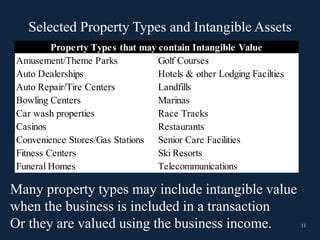
Amusement/Theme Parks Golf Courses
Auto Dealerships Hotels & other Lodging Facilties
Auto Repair/Tire Centers Landfills
Bowling Centers Marinas
Car wash properties Race Tracks
Casinos Restaurants
Convenience Stores/Gas Stations Senior Care Facilities
Fitness Centers Ski Resorts
Funeral Homes Telecommunications
Property Types that may contain Intangible Value
Many property types may include intangible value
when the business is included in a transaction
Or they are valued using the business income.
• Accounting purposes
• Business purposes
• Real estate purposes
12
Section 2. Why it is necessary to allocate
the value of Intangible Assets.
Accounting Purposes for Allocating Intangibles
13
• Financial Reporting – Annual reports,
balance sheets, income statements.
• Tax Reporting – Internal Revenue
Service (IRS)
14
• Financial Reporting – Governed by the Financial
Accounting Standards Board (FASB)
• Follow Generally Accepted Accounting Principles
(GAAP)
• Intangible valuation/allocation based on FASB’s
Accounting Standards Codification topic 805, (ASC-
805) Business Combinations
Accounting Purposes for Allocating Intangibles
15
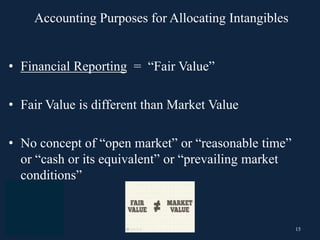
• Financial Reporting = “Fair Value”
• Fair Value is different than Market Value
• No concept of “open market” or “reasonable time”
or “cash or its equivalent” or “prevailing market
conditions”
Accounting Purposes for Allocating Intangibles
16
• Tax Reporting –Internal
Revenue Service
• Intangible valuation and
allocation based on Internal
Revenue Code 1060 (IRC-
1060)
Accounting Purposes for Allocating Intangibles
17
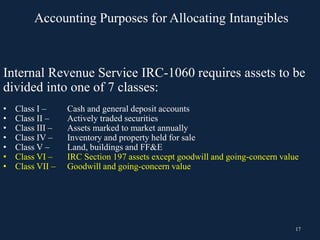
Internal Revenue Service IRC-1060 requires assets to be
divided into one of 7 classes:
• Class I – Cash and general deposit accounts
• Class II – Actively traded securities
• Class III – Assets marked to market annually
• Class IV – Inventory and property held for sale
• Class V – Land, buildings and FF&E
• Class VI – IRC Section 197 assets except goodwill and going-concern value
• Class VII – Goodwill and going-concern value
Accounting Purposes for Allocating Intangibles
18
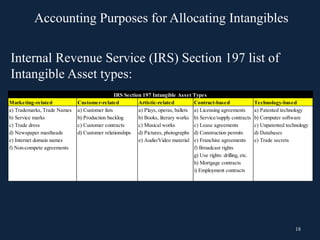
Internal Revenue Service (IRS) Section 197 list of
Intangible Asset types:
Marketing-related Customer-related Artistic-related Contract-based Technology-based
a) Trademarks, Trade Names a) Customer lists a) Plays, operas, ballets a) Licensing agreements a) Patented technology
b) Service marks b) Production backlog b) Books, literary works b) Service/supply contracts b) Computer software
c) Trade dress c) Customer contracts c) Musical works c) Lease agreements c) Unpatented technology
d) Newspaper mastheads d) Customer relationships d) Pictures, photographs d) Construction permits d) Databases
e) Internet domain names e) Audio/Video material e) Franchise agreements e) Trade secrets
f) Non-compete agreements f) Broadcast rights
g) Use rights: drilling, etc.
h) Mortgage contracts
i) Employment contracts
IRS Section 197 Intangible Asset Types
Accounting Purposes for Allocating Intangibles
19
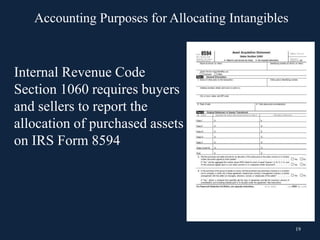
Internal Revenue Code
Section 1060 requires buyers
and sellers to report the
allocation of purchased assets
on IRS Form 8594
Accounting Purposes for Allocating Intangibles
20
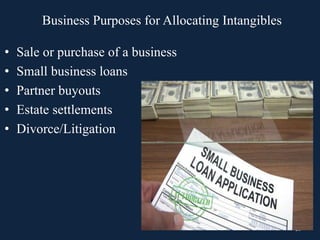
• Sale or purchase of a business
• Small business loans
• Partner buyouts
• Estate settlements
• Divorce/Litigation
Business Purposes for Allocating Intangibles
21
• The valuation and
allocation of a business
is usually performed by
a business appraiser.
Business Purposes for Allocating Intangibles
22
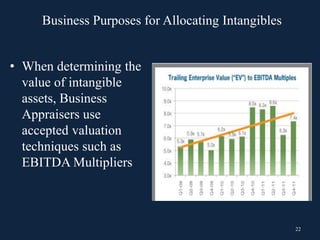
• When determining the
value of intangible
assets, Business
Appraisers use
accepted valuation
techniques such as
EBITDA Multipliers
Business Purposes for Allocating Intangibles
23
• Eminent Domain
• Real Estate Financing
• Property Tax Assessments
Real Estate Purposes for Allocating Intangibles
24
• Eminent Domain
appraisals are
usually performed
by real estate
appraisers. But…..
Real Estate Purposes for Allocating Intangibles
25
• Appraisals for financing
are performed by real
estate appraisers who
follow the Uniform
Standards of
Professional Appraisal
Practice (USPAP)
Real Estate Purposes for Allocating Intangibles
26
USPAP – FAQ 193
Question: There are also occasions when the
client does not specifically request separate
valuations of non-real property assets, even
though they may be present. Is the appraiser
still required to value those assets separately?
Answer: No. This is a scope of work decision
to be made by the appraiser; Standards Rule 1-
4(g) does not require separate appraisals of
these different types of assets.
Real Estate Purposes for Allocating Intangibles
27
• Valuations for
property tax purposes
are typically
governed by state
law, with guidance
from the IAAO and
the Appraisal
Institute.
Real Estate Purposes for Allocating Intangibles
28
State laws vary but most
do not directly address
the treatment of
intangibles for property
tax purposes
Real Estate Purposes for Allocating Intangibles
29
Unlike financial reporting, tax reporting, and
business appraising, until now there has been no
accepted guidelines for valuing intangibles for
property tax assessment purposes.
Section 3. Methods for Estimating or
Allocating Intangible Assets
30
Real Estate Appraisers & Assessors
• Estimate real property value independent of
intangible assets
• Not always necessary to value intangible assets to
determine real property value
• Going concern appraisals are not performed by
assessors
• Real property appraisers rarely value going
concerns unless they have the requisite knowledge,
skills, and experience 31
• Cost Approach
• Market Approach
Market Survey Method
•Income Approach
 Management Fee Method
Methods for Estimating or Allocating Intangible Assets
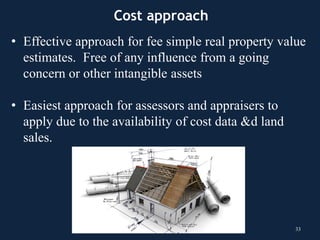
Cost approach
• Effective approach for fee simple real property value
estimates. Free of any influence from a going
concern or other intangible assets
• Easiest approach for assessors and appraisers to
apply due to the availability of cost data &d land
sales.
33
34
Criticism of the Cost Approach
 Difficult to measure depreciation or
obsolescence.
 Not considered by market participants.
35
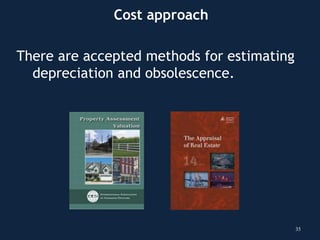
There are accepted methods for estimating
depreciation and obsolescence.
Cost approach
36
“…Boehm’s rejection of the cost approach is based
on his reasoning that a purchaser of the CCRC
would consider only the going concern value. This
is contrary to what the assessor seeks to do
determining the value of the real estate for the
purpose of taxation, not the value of the CCRC as
a business.”
Redding Life Care, LLC v. Town of Redding, 2011 Conn. Lexis 433
(Conn. Super. Ct. Feb.23, 2011)aff’d 61A.3d 461 (Conn.2012)
Cost approach
Market Approach
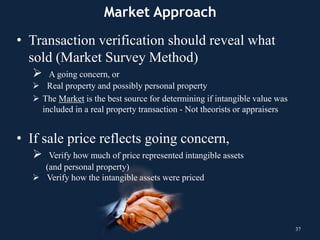
• Transaction verification should reveal what
sold (Market Survey Method)
 A going concern, or
 Real property and possibly personal property
 The Market is the best source for determining if intangible value was
included in a real property transaction - Not theorists or appraisers
• If sale price reflects going concern,
 Verify how much of price represented intangible assets
(and personal property)
 Verify how the intangible assets were priced
37
• Company annual reports and U.S. Security and
Exchange Commission documents (8K, 10K,
etc.)
 Show price allocations by publicly traded companies
• IRS Form 8594 – Asset Acquisition Statement
 Required when a business is purchased
38
Market Approach
39
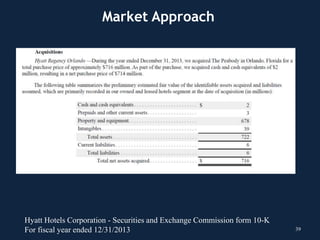
Market Approach
Hyatt Hotels Corporation - Securities and Exchange Commission form 10-K
For fiscal year ended 12/31/2013
• Buyer and sellers don’t often know how much of
a purchase price was intangible versus real
property.
• Allocations for intangibles found in annual
reports and other documents are usually an
accounting function and may not reflect real
property market value
40
Criticism of the Market Approach
Income approach
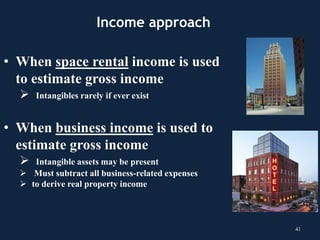
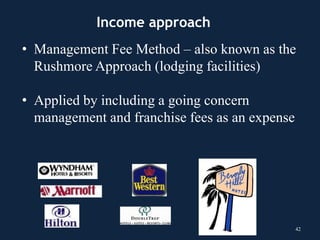
• When space rental income is used
to estimate gross income
 Intangibles rarely if ever exist
• When business income is used to
estimate gross income
 Intangible assets may be present
 Must subtract all business-related expenses
 to derive real property income
41
• Management Fee Method – also known as the
Rushmore Approach (lodging facilities)
• Applied by including a going concern
management and franchise fees as an expense
42
Income approach
• Simply capitalizing the management fee and franchise
fee, (or including them as operating expenses), does
not go far enough to capture all the intangible value.
• Management fees and franchise fees are nothing more
than a normal cost of doing business. They do not go
far enough in accounting for business value.
43
Criticism of the Management Fee Method
Defense of the Management Fee Method
• Market participants (buyers and sellers) capitalize
real property NOI after applying the management
fee method of removing intangible assets
• Assessors and real property appraisers should
value hotels in the same way that investors analyze
deals
44
Section 4. Special Appeal Topics
45
SKILLED/ASSEMBLED WORKFORCE
46
SKILLED/ASSEMBLED
WORKFORCE
Argument: The workforce is an intangible asset that
should be removed from the assessment.
• Argued in service-oriented property tax appeals
• Accounting world considers workforce intangible
• Workforce “Asset” does not meet 4-part intangible test
• Expenses for training workforce already included in
the income approach. No need for another deduction.
47
48
Start-Up Costs
START-UP COSTS
Argument: The property owner is entitled to a return on
the original start-up costs of the business
• Required costs before opening for business
• Mostly soft costs – marketing, training, etc.
• Benefit non-existent in a vacant property
• No evidence for adjustment from market participants
• May apply to new property and change of use
49
50
Leases in Place and Above/Below Market Leases
LEASES-IN-PLACE & ABOVE/BELOW
MARKET LEASES
Argument: Leases-in-place and above-market leases
represent intangible value – not real property.
• Considered intangible by accountants
• Results from business combinations ASC-805
• For appraisers, leases create Real Property
intangibles
• Real property intangibles are “property rights”
that include easements, air rights, minerals,
possessory rights, permits, zoning & leases
51
52
GOODWILL
Argument: After deducting the value of identified
assets, the remainder is “Goodwill” that should not
be assessed.
• Unidentified intangible assets
• Acquisition price less identified asset values
• Also known as “blue sky”
• Usually only argued when a property sells
53
54
Go Dark Valuation
GO DARK VALUATION
• Argument: Property should be valued “as vacant”
since value as-occupied resulted from management
effort – an intangible asset.
• For accountants “leases-in-place” are intangibles
• “As If Vacant” or “Dark Store” valuation
• Fee Simple = Leased at market rent & occupancy
• Occupancy should be recognized, just like condition
• Assumed vacancy is a hypothetical condition
(contrary to what actually exists) & a liquidation
55
56
BEV Approach
BEV APPROACH
Argument: Appraisers and assessors should include
adjustments for workforce, start-up costs, and return on
personal property, in addition to management fee and
franchise fee adjustments already included in
management fee approach.
• Advanced by property tax appellants
• Long history, but not universally accepted
• Mostly malls and hotels
• Widely rejected by the courts
57
Section 5. Legal Perspective
58
Around the World in 80 days
59
Personal property tax on film
negative of the motion
picture “Around the World In
Eighty Days.”
Was the copyright a non-
assessable intangible?
Michael Todd Co. v. County of Los Angeles, 57 Cal. 2d 684 [21 Cal.Rptr. 604, 371 P.2d 340] (1962)
59
60
"Market value" for assessment
purposes is the value of property
when put to beneficial or productive
use; it is not merely whatever
residual value may remain after the
property is demolished, melted
down, or otherwise reduced to its
constituent elements.”
60
Around the World in 80 days
Michael Todd Co. v. County of Los Angeles, 57 Cal. 2d 684 [21 Cal.Rptr. 604, 371 P.2d 340] (1962)
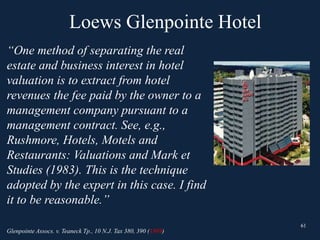
Loews Glenpointe Hotel
61
“One method of separating the real
estate and business interest in hotel
valuation is to extract from hotel
revenues the fee paid by the owner to a
management company pursuant to a
management contract. See, e.g.,
Rushmore, Hotels, Motels and
Restaurants: Valuations and Mark et
Studies (1983). This is the technique
adopted by the expert in this case. I find
it to be reasonable.”
Glenpointe Assocs. v. Teaneck Tp., 10 N.J. Tax 380, 390 (1989)
61
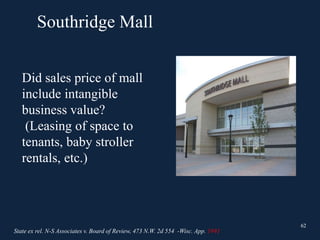
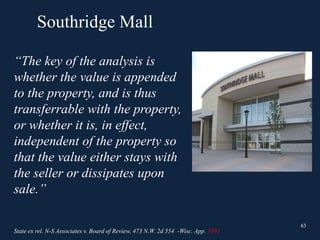
Southridge Mall
62
Did sales price of mall
include intangible
business value?
(Leasing of space to
tenants, baby stroller
rentals, etc.)
State ex rel. N-S Associates v. Board of Review, 473 N.W. 2d 554 -Wisc. App. 1991
62
Southridge Mall
63
“The key of the analysis is
whether the value is appended
to the property, and is thus
transferrable with the property,
or whether it is, in effect,
independent of the property so
that the value either stays with
the seller or dissipates upon
sale.”
63
State ex rel. N-S Associates v. Board of Review, 473 N.W. 2d 554 -Wisc. App. 1991
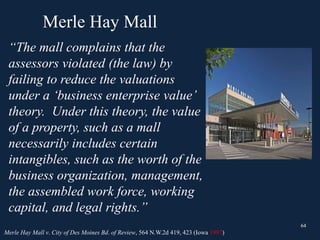
Merle Hay Mall
64
“The mall complains that the
assessors violated (the law) by
failing to reduce the valuations
under a ‘business enterprise value’
theory. Under this theory, the value
of a property, such as a mall
necessarily includes certain
intangibles, such as the worth of the
business organization, management,
the assembled work force, working
capital, and legal rights.”
Merle Hay Mall v. City of Des Moines Bd. of Review, 564 N.W.2d 419, 423 (Iowa 1997)
64
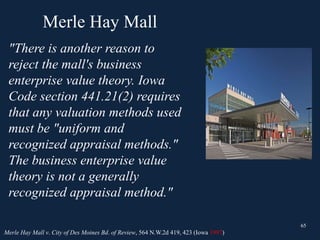
Merle Hay Mall
65
"There is another reason to
reject the mall's business
enterprise value theory. Iowa
Code section 441.21(2) requires
that any valuation methods used
must be "uniform and
recognized appraisal methods."
The business enterprise value
theory is not a generally
recognized appraisal method."
65
Merle Hay Mall v. City of Des Moines Bd. of Review, 564 N.W.2d 419, 423 (Iowa 1997)
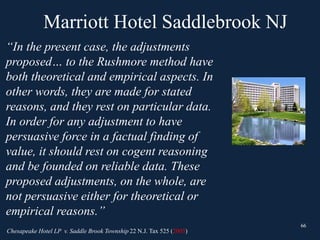
Marriott Hotel Saddlebrook NJ
66
“In the present case, the adjustments
proposed… to the Rushmore method have
both theoretical and empirical aspects. In
other words, they are made for stated
reasons, and they rest on particular data.
In order for any adjustment to have
persuasive force in a factual finding of
value, it should rest on cogent reasoning
and be founded on reliable data. These
proposed adjustments, on the whole, are
not persuasive either for theoretical or
empirical reasons.”
Chesapeake Hotel LP v. Saddle Brook Township 22 N.J. Tax 525 (2005)
66
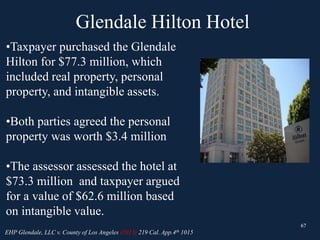
Glendale Hilton Hotel
67
EHP Glendale, LLC v. County of Los Angeles (2013) 219 Cal. App.4th 1015
67
•Taxpayer purchased the Glendale
Hilton for $77.3 million, which
included real property, personal
property, and intangible assets.
•Both parties agreed the personal
property was worth $3.4 million
•The assessor assessed the hotel at
$73.3 million and taxpayer argued
for a value of $62.6 million based
on intangible value.
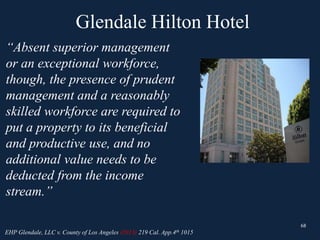
Glendale Hilton Hotel
68
“Absent superior management
or an exceptional workforce,
though, the presence of prudent
management and a reasonably
skilled workforce are required to
put a property to its beneficial
and productive use, and no
additional value needs to be
deducted from the income
stream.”
68
EHP Glendale, LLC v. County of Los Angeles (2013) 219 Cal. App.4th 1015
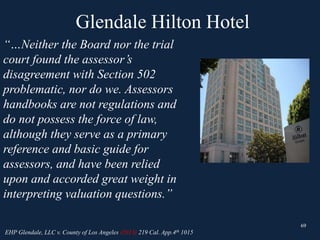
Glendale Hilton Hotel
69
“…Neither the Board nor the trial
court found the assessor’s
disagreement with Section 502
problematic, nor do we. Assessors
handbooks are not regulations and
do not possess the force of law,
although they serve as a primary
reference and basic guide for
assessors, and have been relied
upon and accorded great weight in
interpreting valuation questions.”
69
EHP Glendale, LLC v. County of Los Angeles (2013) 219 Cal. App.4th 1015
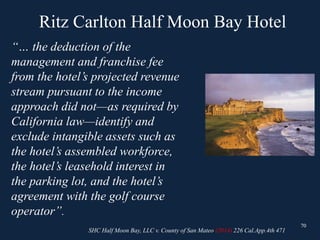
Ritz Carlton Half Moon Bay Hotel
70
“… the deduction of the
management and franchise fee
from the hotel’s projected revenue
stream pursuant to the income
approach did not—as required by
California law—identify and
exclude intangible assets such as
the hotel’s assembled workforce,
the hotel’s leasehold interest in
the parking lot, and the hotel’s
agreement with the golf course
operator”.
70
SHC Half Moon Bay, LLC v. County of San Mateo (2014) 226 Cal.App.4th 471
Capital Hilton Hotel – Washington D.C.
71
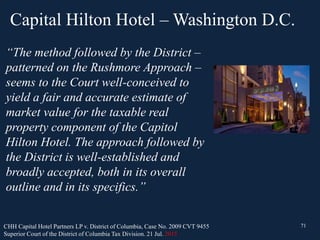
“The method followed by the District –
patterned on the Rushmore Approach –
seems to the Court well-conceived to
yield a fair and accurate estimate of
market value for the taxable real
property component of the Capitol
Hilton Hotel. The approach followed by
the District is well-established and
broadly accepted, both in its overall
outline and in its specifics.”
CHH Capital Hotel Partners LP v. District of Columbia, Case No. 2009 CVT 9455
Superior Court of the District of Columbia Tax Division. 21 Jul. 2015
71
72
Summary
• Four-part test for intangibles assists identification
• Accountants value intangibles differently than real
property appraisers and assessors
• All three approaches to value can be used to ensure
intangibles are excluded in assessments.
• The Management Fee method is the most widely
used and accepted method in the income approach
• Other methods for extracting intangibles, such as
assembled workforce, start-up costs, and the BEV
Approach have not been accepted by the appraisal
community or courts.
Thank you!
Tim Wilmath, MAI - Director of Valuation
Hillsborough County Property Appraiser’s Office
Tampa, Florida
Phone: (813) 276-8859
Email: Wilmatht@hcpafl.org

Understanding Intangible Assets and Real Estate

  • 1.
    Understanding Intangible Assets and RealEstate National Conference of State Tax Judges 36th Annual Meeting Portland, Oregon September 8-10, 2016
  • 2.
    Real Property Personal Property Intangible Value Components to Allocate inProperty Tax Valuation Total Assets of a Business (Going Concern)
  • 3.
    3 “…It has beensaid that the miner is a naked trespasser, without claim of title, a licensee or else a strict tenant at will, not entitled to notice quit, and therefore having no valuable estate.” Hale & Norcross Gold and Silver Mining Company v. County of Storey, 1 Nev. 104 (1865) 3 Intangible Assets
  • 4.
    Section 1 –Identifying Intangible Assets Section 2 – Why it is necessary to Allocate Intangible Assets Section 3 – Methods for Estimating Intangible Value Section 4 – Special Topics Section 5 – Legal Perspective Intangible Assets
  • 5.
    Section 1: IdentifyingIntangible Assets 5
  • 6.
    Identifying Intangible Assets IntangibleAssets: Nonphysical assets, including but not limited to franchises, trademarks, patents, copyrights, goodwill, equities, securities, and contracts as distinguished from physical assets such as facilities and equipment. Appraisal Institute 2015 Dictionary of Real Estate Appraisal – 6th Edition.
  • 7.
  • 8.
    Intangible Asset 4-PartTest 1. Identifiable, recognized & distinguishable 2. Evidence of Legal Ownership, documentation substantiating ownership 3. Capable of Being Separate and Divisible from the Real Estate 4. Legally Transferrable, can be lawfully conveyed to another entity
  • 9.
    1. A propertysells and intangible assets are included in the price, along with real and personal property 2. Income from a business is used to value the real estate in an income approach, such as hotels and nursing homes. There are typically two circumstances in which assessors encounter intangible value.
  • 10.
    Selected Property Typesand Intangible Assets 10 It is very unlikely that some property types would ever include intangible value.
  • 11.
    Selected Property Typesand Intangible Assets 11 Amusement/Theme Parks Golf Courses Auto Dealerships Hotels & other Lodging Facilties Auto Repair/Tire Centers Landfills Bowling Centers Marinas Car wash properties Race Tracks Casinos Restaurants Convenience Stores/Gas Stations Senior Care Facilities Fitness Centers Ski Resorts Funeral Homes Telecommunications Property Types that may contain Intangible Value Many property types may include intangible value when the business is included in a transaction Or they are valued using the business income.
  • 12.
    • Accounting purposes •Business purposes • Real estate purposes 12 Section 2. Why it is necessary to allocate the value of Intangible Assets.
  • 13.
    Accounting Purposes forAllocating Intangibles 13 • Financial Reporting – Annual reports, balance sheets, income statements. • Tax Reporting – Internal Revenue Service (IRS)
  • 14.
    14 • Financial Reporting– Governed by the Financial Accounting Standards Board (FASB) • Follow Generally Accepted Accounting Principles (GAAP) • Intangible valuation/allocation based on FASB’s Accounting Standards Codification topic 805, (ASC- 805) Business Combinations Accounting Purposes for Allocating Intangibles
  • 15.
    15 • Financial Reporting= “Fair Value” • Fair Value is different than Market Value • No concept of “open market” or “reasonable time” or “cash or its equivalent” or “prevailing market conditions” Accounting Purposes for Allocating Intangibles
  • 16.
    16 • Tax Reporting–Internal Revenue Service • Intangible valuation and allocation based on Internal Revenue Code 1060 (IRC- 1060) Accounting Purposes for Allocating Intangibles
  • 17.
    17 Internal Revenue ServiceIRC-1060 requires assets to be divided into one of 7 classes: • Class I – Cash and general deposit accounts • Class II – Actively traded securities • Class III – Assets marked to market annually • Class IV – Inventory and property held for sale • Class V – Land, buildings and FF&E • Class VI – IRC Section 197 assets except goodwill and going-concern value • Class VII – Goodwill and going-concern value Accounting Purposes for Allocating Intangibles
  • 18.
    18 Internal Revenue Service(IRS) Section 197 list of Intangible Asset types: Marketing-related Customer-related Artistic-related Contract-based Technology-based a) Trademarks, Trade Names a) Customer lists a) Plays, operas, ballets a) Licensing agreements a) Patented technology b) Service marks b) Production backlog b) Books, literary works b) Service/supply contracts b) Computer software c) Trade dress c) Customer contracts c) Musical works c) Lease agreements c) Unpatented technology d) Newspaper mastheads d) Customer relationships d) Pictures, photographs d) Construction permits d) Databases e) Internet domain names e) Audio/Video material e) Franchise agreements e) Trade secrets f) Non-compete agreements f) Broadcast rights g) Use rights: drilling, etc. h) Mortgage contracts i) Employment contracts IRS Section 197 Intangible Asset Types Accounting Purposes for Allocating Intangibles
  • 19.
    19 Internal Revenue Code Section1060 requires buyers and sellers to report the allocation of purchased assets on IRS Form 8594 Accounting Purposes for Allocating Intangibles
  • 20.
    20 • Sale orpurchase of a business • Small business loans • Partner buyouts • Estate settlements • Divorce/Litigation Business Purposes for Allocating Intangibles
  • 21.
    21 • The valuationand allocation of a business is usually performed by a business appraiser. Business Purposes for Allocating Intangibles
  • 22.
    22 • When determiningthe value of intangible assets, Business Appraisers use accepted valuation techniques such as EBITDA Multipliers Business Purposes for Allocating Intangibles
  • 23.
    23 • Eminent Domain •Real Estate Financing • Property Tax Assessments Real Estate Purposes for Allocating Intangibles
  • 24.
    24 • Eminent Domain appraisalsare usually performed by real estate appraisers. But….. Real Estate Purposes for Allocating Intangibles
  • 25.
    25 • Appraisals forfinancing are performed by real estate appraisers who follow the Uniform Standards of Professional Appraisal Practice (USPAP) Real Estate Purposes for Allocating Intangibles
  • 26.
    26 USPAP – FAQ193 Question: There are also occasions when the client does not specifically request separate valuations of non-real property assets, even though they may be present. Is the appraiser still required to value those assets separately? Answer: No. This is a scope of work decision to be made by the appraiser; Standards Rule 1- 4(g) does not require separate appraisals of these different types of assets. Real Estate Purposes for Allocating Intangibles
  • 27.
    27 • Valuations for propertytax purposes are typically governed by state law, with guidance from the IAAO and the Appraisal Institute. Real Estate Purposes for Allocating Intangibles
  • 28.
    28 State laws varybut most do not directly address the treatment of intangibles for property tax purposes Real Estate Purposes for Allocating Intangibles
  • 29.
    29 Unlike financial reporting,tax reporting, and business appraising, until now there has been no accepted guidelines for valuing intangibles for property tax assessment purposes.
  • 30.
    Section 3. Methodsfor Estimating or Allocating Intangible Assets 30
  • 31.
    Real Estate Appraisers& Assessors • Estimate real property value independent of intangible assets • Not always necessary to value intangible assets to determine real property value • Going concern appraisals are not performed by assessors • Real property appraisers rarely value going concerns unless they have the requisite knowledge, skills, and experience 31
  • 32.
    • Cost Approach •Market Approach Market Survey Method •Income Approach  Management Fee Method Methods for Estimating or Allocating Intangible Assets
  • 33.
    Cost approach • Effectiveapproach for fee simple real property value estimates. Free of any influence from a going concern or other intangible assets • Easiest approach for assessors and appraisers to apply due to the availability of cost data &d land sales. 33
  • 34.
    34 Criticism of theCost Approach  Difficult to measure depreciation or obsolescence.  Not considered by market participants.
  • 35.
    35 There are acceptedmethods for estimating depreciation and obsolescence. Cost approach
  • 36.
    36 “…Boehm’s rejection ofthe cost approach is based on his reasoning that a purchaser of the CCRC would consider only the going concern value. This is contrary to what the assessor seeks to do determining the value of the real estate for the purpose of taxation, not the value of the CCRC as a business.” Redding Life Care, LLC v. Town of Redding, 2011 Conn. Lexis 433 (Conn. Super. Ct. Feb.23, 2011)aff’d 61A.3d 461 (Conn.2012) Cost approach
  • 37.
    Market Approach • Transactionverification should reveal what sold (Market Survey Method)  A going concern, or  Real property and possibly personal property  The Market is the best source for determining if intangible value was included in a real property transaction - Not theorists or appraisers • If sale price reflects going concern,  Verify how much of price represented intangible assets (and personal property)  Verify how the intangible assets were priced 37
  • 38.
    • Company annualreports and U.S. Security and Exchange Commission documents (8K, 10K, etc.)  Show price allocations by publicly traded companies • IRS Form 8594 – Asset Acquisition Statement  Required when a business is purchased 38 Market Approach
  • 39.
    39 Market Approach Hyatt HotelsCorporation - Securities and Exchange Commission form 10-K For fiscal year ended 12/31/2013
  • 40.
    • Buyer andsellers don’t often know how much of a purchase price was intangible versus real property. • Allocations for intangibles found in annual reports and other documents are usually an accounting function and may not reflect real property market value 40 Criticism of the Market Approach
  • 41.
    Income approach • Whenspace rental income is used to estimate gross income  Intangibles rarely if ever exist • When business income is used to estimate gross income  Intangible assets may be present  Must subtract all business-related expenses  to derive real property income 41
  • 42.
    • Management FeeMethod – also known as the Rushmore Approach (lodging facilities) • Applied by including a going concern management and franchise fees as an expense 42 Income approach
  • 43.
    • Simply capitalizingthe management fee and franchise fee, (or including them as operating expenses), does not go far enough to capture all the intangible value. • Management fees and franchise fees are nothing more than a normal cost of doing business. They do not go far enough in accounting for business value. 43 Criticism of the Management Fee Method
  • 44.
    Defense of theManagement Fee Method • Market participants (buyers and sellers) capitalize real property NOI after applying the management fee method of removing intangible assets • Assessors and real property appraisers should value hotels in the same way that investors analyze deals 44
  • 45.
    Section 4. SpecialAppeal Topics 45
  • 46.
  • 47.
    SKILLED/ASSEMBLED WORKFORCE Argument: The workforceis an intangible asset that should be removed from the assessment. • Argued in service-oriented property tax appeals • Accounting world considers workforce intangible • Workforce “Asset” does not meet 4-part intangible test • Expenses for training workforce already included in the income approach. No need for another deduction. 47
  • 48.
  • 49.
    START-UP COSTS Argument: Theproperty owner is entitled to a return on the original start-up costs of the business • Required costs before opening for business • Mostly soft costs – marketing, training, etc. • Benefit non-existent in a vacant property • No evidence for adjustment from market participants • May apply to new property and change of use 49
  • 50.
    50 Leases in Placeand Above/Below Market Leases
  • 51.
    LEASES-IN-PLACE & ABOVE/BELOW MARKETLEASES Argument: Leases-in-place and above-market leases represent intangible value – not real property. • Considered intangible by accountants • Results from business combinations ASC-805 • For appraisers, leases create Real Property intangibles • Real property intangibles are “property rights” that include easements, air rights, minerals, possessory rights, permits, zoning & leases 51
  • 52.
  • 53.
    GOODWILL Argument: After deductingthe value of identified assets, the remainder is “Goodwill” that should not be assessed. • Unidentified intangible assets • Acquisition price less identified asset values • Also known as “blue sky” • Usually only argued when a property sells 53
  • 54.
  • 55.
    GO DARK VALUATION •Argument: Property should be valued “as vacant” since value as-occupied resulted from management effort – an intangible asset. • For accountants “leases-in-place” are intangibles • “As If Vacant” or “Dark Store” valuation • Fee Simple = Leased at market rent & occupancy • Occupancy should be recognized, just like condition • Assumed vacancy is a hypothetical condition (contrary to what actually exists) & a liquidation 55
  • 56.
  • 57.
    BEV APPROACH Argument: Appraisersand assessors should include adjustments for workforce, start-up costs, and return on personal property, in addition to management fee and franchise fee adjustments already included in management fee approach. • Advanced by property tax appellants • Long history, but not universally accepted • Mostly malls and hotels • Widely rejected by the courts 57
  • 58.
    Section 5. LegalPerspective 58
  • 59.
    Around the Worldin 80 days 59 Personal property tax on film negative of the motion picture “Around the World In Eighty Days.” Was the copyright a non- assessable intangible? Michael Todd Co. v. County of Los Angeles, 57 Cal. 2d 684 [21 Cal.Rptr. 604, 371 P.2d 340] (1962) 59
  • 60.
    60 "Market value" forassessment purposes is the value of property when put to beneficial or productive use; it is not merely whatever residual value may remain after the property is demolished, melted down, or otherwise reduced to its constituent elements.” 60 Around the World in 80 days Michael Todd Co. v. County of Los Angeles, 57 Cal. 2d 684 [21 Cal.Rptr. 604, 371 P.2d 340] (1962)
  • 61.
    Loews Glenpointe Hotel 61 “Onemethod of separating the real estate and business interest in hotel valuation is to extract from hotel revenues the fee paid by the owner to a management company pursuant to a management contract. See, e.g., Rushmore, Hotels, Motels and Restaurants: Valuations and Mark et Studies (1983). This is the technique adopted by the expert in this case. I find it to be reasonable.” Glenpointe Assocs. v. Teaneck Tp., 10 N.J. Tax 380, 390 (1989) 61
  • 62.
    Southridge Mall 62 Did salesprice of mall include intangible business value? (Leasing of space to tenants, baby stroller rentals, etc.) State ex rel. N-S Associates v. Board of Review, 473 N.W. 2d 554 -Wisc. App. 1991 62
  • 63.
    Southridge Mall 63 “The keyof the analysis is whether the value is appended to the property, and is thus transferrable with the property, or whether it is, in effect, independent of the property so that the value either stays with the seller or dissipates upon sale.” 63 State ex rel. N-S Associates v. Board of Review, 473 N.W. 2d 554 -Wisc. App. 1991
  • 64.
    Merle Hay Mall 64 “Themall complains that the assessors violated (the law) by failing to reduce the valuations under a ‘business enterprise value’ theory. Under this theory, the value of a property, such as a mall necessarily includes certain intangibles, such as the worth of the business organization, management, the assembled work force, working capital, and legal rights.” Merle Hay Mall v. City of Des Moines Bd. of Review, 564 N.W.2d 419, 423 (Iowa 1997) 64
  • 65.
    Merle Hay Mall 65 "Thereis another reason to reject the mall's business enterprise value theory. Iowa Code section 441.21(2) requires that any valuation methods used must be "uniform and recognized appraisal methods." The business enterprise value theory is not a generally recognized appraisal method." 65 Merle Hay Mall v. City of Des Moines Bd. of Review, 564 N.W.2d 419, 423 (Iowa 1997)
  • 66.
    Marriott Hotel SaddlebrookNJ 66 “In the present case, the adjustments proposed… to the Rushmore method have both theoretical and empirical aspects. In other words, they are made for stated reasons, and they rest on particular data. In order for any adjustment to have persuasive force in a factual finding of value, it should rest on cogent reasoning and be founded on reliable data. These proposed adjustments, on the whole, are not persuasive either for theoretical or empirical reasons.” Chesapeake Hotel LP v. Saddle Brook Township 22 N.J. Tax 525 (2005) 66
  • 67.
    Glendale Hilton Hotel 67 EHPGlendale, LLC v. County of Los Angeles (2013) 219 Cal. App.4th 1015 67 •Taxpayer purchased the Glendale Hilton for $77.3 million, which included real property, personal property, and intangible assets. •Both parties agreed the personal property was worth $3.4 million •The assessor assessed the hotel at $73.3 million and taxpayer argued for a value of $62.6 million based on intangible value.
  • 68.
    Glendale Hilton Hotel 68 “Absentsuperior management or an exceptional workforce, though, the presence of prudent management and a reasonably skilled workforce are required to put a property to its beneficial and productive use, and no additional value needs to be deducted from the income stream.” 68 EHP Glendale, LLC v. County of Los Angeles (2013) 219 Cal. App.4th 1015
  • 69.
    Glendale Hilton Hotel 69 “…Neitherthe Board nor the trial court found the assessor’s disagreement with Section 502 problematic, nor do we. Assessors handbooks are not regulations and do not possess the force of law, although they serve as a primary reference and basic guide for assessors, and have been relied upon and accorded great weight in interpreting valuation questions.” 69 EHP Glendale, LLC v. County of Los Angeles (2013) 219 Cal. App.4th 1015
  • 70.
    Ritz Carlton HalfMoon Bay Hotel 70 “… the deduction of the management and franchise fee from the hotel’s projected revenue stream pursuant to the income approach did not—as required by California law—identify and exclude intangible assets such as the hotel’s assembled workforce, the hotel’s leasehold interest in the parking lot, and the hotel’s agreement with the golf course operator”. 70 SHC Half Moon Bay, LLC v. County of San Mateo (2014) 226 Cal.App.4th 471
  • 71.
    Capital Hilton Hotel– Washington D.C. 71 “The method followed by the District – patterned on the Rushmore Approach – seems to the Court well-conceived to yield a fair and accurate estimate of market value for the taxable real property component of the Capitol Hilton Hotel. The approach followed by the District is well-established and broadly accepted, both in its overall outline and in its specifics.” CHH Capital Hotel Partners LP v. District of Columbia, Case No. 2009 CVT 9455 Superior Court of the District of Columbia Tax Division. 21 Jul. 2015 71
  • 72.
    72 Summary • Four-part testfor intangibles assists identification • Accountants value intangibles differently than real property appraisers and assessors • All three approaches to value can be used to ensure intangibles are excluded in assessments. • The Management Fee method is the most widely used and accepted method in the income approach • Other methods for extracting intangibles, such as assembled workforce, start-up costs, and the BEV Approach have not been accepted by the appraisal community or courts.
  • 73.
    Thank you! Tim Wilmath,MAI - Director of Valuation Hillsborough County Property Appraiser’s Office Tampa, Florida Phone: (813) 276-8859 Email: Wilmatht@hcpafl.org

Editor's Notes

  • #2 Thank you for the invitation to speak about the issue of intangible assets and real estate. I am honored to be speaking in front of this group. My name is Tim Wilmath – I am the Director of Valuation for the Hillsborough County Property Appraiser’s office in Tampa Fl. We have about ½ million parcels and tax roll of about $110 billion dollars. In my position, I have the opportunity not only to value complex commercial properties, but also to defend them in administrative hearings and circuit court. Because of the money involved in property taxes, often these complex appraisal issues are argued in the property tax arena. That certainly true for intangible.
  • #3 In most U.S. jurisdictions, assessors are responsible for estimating a fee simple market value for real property and/or personal property. Laws can vary from state to state, but for the majority of jurisdictions, intangible assets are not taxable, at least not as part of the real estate assessment. As a result, assessors must ensure their real estate assessments are free of any intangible value. Different interpretations of law and proper appraisal approaches for valuing intangibles sometimes result in disputes between taxpayers and assessors. Unfortunately, the identification and valuation of intangible assets is unsettled in the appraisal and assessment community.
  • #4 The issue of intangible value and property tax assessment has been a hot topic over the past couple decades, but it’s really nothing new in the property tax arena. One of the oldest cases involving intangible value came from the gold mines of Nevada. In 1865, the year the Civil War ended, a case called Hale & Norcross Gold and Silver Mining Company v. Storey County decided the issue of whether possessory rights of a gold and silver mine were taxable, as was alleged by the assessor. The mine argued that any possessory rights were created by virtue of the miner’s expertise and without it, had no value. The court sided with the assessor and rejected the “naked trespasser” argument on the basis that the possessory interest was not an intangible asset but instead part of the real property.
  • #5 150 years after Hale & Norcross Gold and Silver Mining Company v. Storey County, the issue of intangibles is still unsettled. The appraisal and assessment community does not agree on the proper methodology to identify and remove intangibles. In 2015, the IAAO created a committee to study the issue of intangible assets. I was the chair of the committee and Mr. Korpacz was one of it’s members. Our committee just completed a 55-page position paper on the topic and we hope it assists appraisers, assessors and even the courts – have a better understanding of intangibles and how they should be valued. This presentation today will touch on these five major topics, which is essentially a summary of our position paper.
  • #7 There are many definitions of intangible assets. Most of them include language similar to this one, which references non-physical assets. This definition is from the dictionary of real estate appraisal by the Appraisal Institute. This definition includes a few examples of intangible assets.
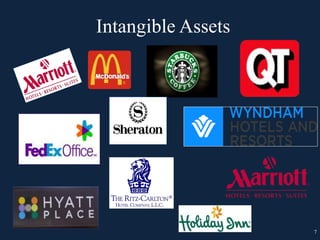
  • #8 In the real estate world, intangible assets are often represented by brand name, such as these. A common argument in property tax appeals, is that the assessment includes value resulting from the business, which is not taxable in most states.
  • #9 One of the things our committee strived to do, was to provide appraisers and assessors with a test to be able to determine if an intangible is truly an asset that should be excluded from the assessment. Intangible and tangible property are often intertwined, making that determination difficult. For an intangible asset to exist, it must be identifiable. In some cases, intangible value is presumed but not specifically identified. An intangible asset should also possess evidence of legal ownership. There are many documents that evidence ownership of intangible assets, such as contracts, licenses, franchise agreements, and management agreements. An intangible asset should also be capable of being separate and divisible from the real property. Items like liquor licenses, franchise agreements or a certificate of need for a nursing home are intangible assets that can separated from the property. Am intangible asset must be able to be legally transferred to another entity. For example, the owner of an ice cream store or liquor store can sell the business separate from the real estate. But sometimes the intangible cannot be separated from the real estate – such as a view, or a historical building.
  • #10 As the slide says – there are typically 2 occasions when assessor’s encounter intangible value A property sells with intangible assets included the price. For example, the sale of nursing home, where the price included the real estate, the personal property and the business. Another case that arises, is when the income used to value the real estate, is from the business. For example, its very common to value hotels using the revenue generated from the hotel business. The rates that people pay at hotels, include both rent for the space you are occupying, the use of the personal property in the room, such as the desk, bed and TV and also includes services that come with the room, such as room service and housekeeping. Those rates are used to value the real estate, and the methods used to ensure that intangible value is excluded, is what we are discussing today.
  • #11 Some property types just don’t have this problem. Apartments, big-box stores, drugstores, office buildings never sell as part of a business. When they sell, you are buying the sticks and bricks only. That doesn’t stop some taxpayers from arguing that intangible value exists, but within the industry, most would agree that there is no intangible value present in these property types.
  • #12 But for many property types, there is a possibility that they possess intangible value. Again - The reason these property types might contain intangible value, is because: 1. The real property is often sold with the business 2. Or they are typically valued using the business income like I just described for hotels.
  • #31 Which takes us to section 3 – methods to value intangible assets. I should tell you that there are many, many methods and books have been written on this topic. As I described, accountants and business appraisers use methods much different than real estate appraisers. That’s because real estate appraisers and assessors typically want to exclude intangible value, not measure it directly.
  • #32 I should tell you that there are many, many methods and books have been written on this topic. As I described earlier, accountants and business appraisers use methods much different than real estate appraisers. They are often seeking the specific value of the intangible asset. That’s not so with real property appraisers and assessors’ who typically want to exclude intangible value, not measure it directly.
  • #33 There are 3 methods of valuation, and that’s no different when intangible assets are involved. The only difference is there are certain techniques within the 3 approaches that assist the appraiser or assessor in excluding the intangible value. I’m going to talk about 3 of those methods – (Read slide)
  • #34 The first is the cost approach. This technique simply values the property by estimating the replacement cost, applying depreciation, and adding land value. It’s an excellent approach when there are intangibles involved, because it inherently excludes intangible value. You are only estimating the value of the sticks and bricks and not adding any cost related to the business.
  • #35 The cost approach does have its critics. It’s difficult to measure depreciation and/or functional and external obsolescence. Market participants don’t widely use it when making pricing decisions.
  • #36 The response to those criticisms, is: There are standard measures of depreciation that are widely embraced by appraisers and assessors. If a property does have functional or external obsolescence, there are accepted techniques for measuring that.
  • #37 The 2nd criticism of the cost approach is that market participants don’t use when making pricing decisions. This is an interesting one, because it’s true. For some property types, market participants don’t use the cost approach. For certain property types, for example senior care properties, market participants generally buy what’s called a going concern, which is a different value than what assessors typically seek. This case of a CCRC – continuing Care retirement facility illustrates the issue. The court rejected the taxpayer’s appraisal that valued the going concern and adjusted for intangible value. Court dismissed that logic because the buyer of a CCRC is buying the business, but the city property appraiser is valuing the real estate only, and cost is relevant in that scenario. So the cost approach is a valid and maybe even critical method.
  • #38 Let’s talk about the market approach In this approach, appraisers and assessors attempt to verify how much of a sale price included intangible assets.
  • #39 Another approach is to review annual reports from publicly held companies or IRS forms where intangibles are reported.
  • #40 This is an example – this is an excerpt from Hyatt Hotels Corporation – Annual Report. These numbers are in millions – Intangibles represented approximately 5.4% of Hyatt’s $716 million purchase price of the Peabody Hotel in Orlando.
  • #41 The market approach does have it’s detractors. Some argue that buyers and sellers may not know exactly what they purchased, and that appraisers and assessors are better equipped to decide. Others, including myself, say that the market is the best source for determining if any intangible value was included in a transaction. Some also argue that the figures reported in these reports are not accurate, but instead done for tax purposes. In other words, they want to use one figure when reporting to shareholders and the IRS, but a completely different number when appealing property taxes. Although it may often represent an accounting function, it can also reveal what the buyers were thinking when they bought a property.
  • #42 Let’s talk about the income approach. As I mentioned earlier, for most property types, the income used in the income approach is from the rental of the building. But for some property types, it’s traditional to use the business income to value the real property, with adjustments to exclude the business.
  • #43 The most common approach, and the one we recommend in our position paper, is the management fee method. This approach is applied by including a management fee and franchise fee in the income approach as an expense. A management company can be hired to run the hotel. The management company does everything – marketing, hiring, firing, staffing, accounting, housekeeping, everything. The property owner is basically a silent partner. The theory of this approach is that no one would pay more for the hotel business, than it would cost to replicate.
  • #44 There are critics of the management fee method. Mainly that it does not go far enough in capturing the intangible value. They argue that management fees and franchise fees are normal costs of doing business.
  • #45 But research shows that market participants use that method when pricing a property.
  • #46 I want to talk a little about some special topics. Some of these are specialized appeal arguments.
  • #47 For example – the first one is the skilled/assembled workforce argument.