What is front-end development?
Overview:
It focuses on user experience, enhancing the user experience through coding and Front-end
development focuses on user experience, utilizing coding and design techniques to create an
elegant, user-friendly, fast, and secure interface. Key skills include text color, images, graphs,
tables, buttons, and color schemes. Front-end apps also include interactive elements like sliders,
pop-up forms, and custom interactive maps. Navigational menus are crucial for user interaction.
Front-end developers need proficiency in coding languages like HTML, CSS, JavaScript, and
jQuery, as well as server-side CSS processing techniques. They must also be skilled in
TypeScript, a superset of JavaScript. With the latest design trends, front-end web development
has become a specialized field that requires deep expertise. APIs act as translators between the
front end and back end, ensuring seamless communication. The growing trend in front-end
development is the growth of applications for mobile and smart devices, making it a challenging
task to deliver a consistent, high-quality user experience across all devices and usage scenarios.
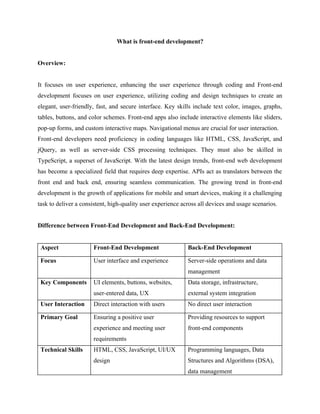
Difference between Front-End Development and Back-End Development:
Aspect Front-End Development Back-End Development
Focus User interface and experience Server-side operations and data
management
Key Components UI elements, buttons, websites,
user-entered data, UX
Data storage, infrastructure,
external system integration
User Interaction Direct interaction with users No direct user interaction
Primary Goal Ensuring a positive user
experience and meeting user
requirements
Providing resources to support
front-end components
Technical Skills HTML, CSS, JavaScript, UI/UX
design
Programming languages, Data
Structures and Algorithms (DSA),
data management
Tools &
Technologies
Frameworks like React, Angular,
Vue.js, and testing tools
Databases, servers, APIs, and
server-side programming
Emerging
Concepts
Micro-frontends for scalability and
maintainability
N/A
Career
Development
Focus
Building an online portfolio,
cultivating communication and
teamwork skills
Mastering back-end technologies
and data management techniques
Front-End Web Development Programming Languages:
● HTML: Defines the structure and meaning of web content, enabling browsers to display
text or load elements.
● Cloudinary: Offers on-the-fly transformations for images, saving on storage space and
hosting costs.
● CSS: Standard language for displaying HTML content, controlling design layout and
components for various devices.
● JavaScript: Extends website functionality beyond HTML and CSS, allowing dynamic
page refresh and user action response. JS allows modeling animated UI components like
pop-ups, image sliders, and navigation menus.
Front-End Development Frameworks:
● Angular: An open-source JavaScript framework that delivers dynamic results through
HTML syntax. It follows the MVC architecture, dividing the website structure into
model, view, and controller (MVC).
● React: An open-source, declarative JavaScript framework that simplifies web application
development. It facilitates efficient updates of views with the virtual Document Object
Model (VDOM).
● jQuery: An open-source JavaScript library that edits CSS properties and applies effects
to website elements. It simplifies the processes of implementing HTML DOM changes,
event handling, and Asynchronous JavaScript and XML (Ajax).
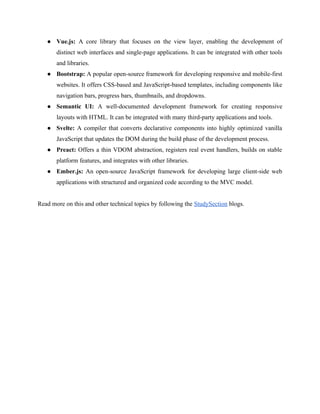
● Vue.js: A core library that focuses on the view layer, enabling the development of
distinct web interfaces and single-page applications. It can be integrated with other tools
and libraries.
● Bootstrap: A popular open-source framework for developing responsive and mobile-first
websites. It offers CSS-based and JavaScript-based templates, including components like
navigation bars, progress bars, thumbnails, and dropdowns.
● Semantic UI: A well-documented development framework for creating responsive
layouts with HTML. It can be integrated with many third-party applications and tools.
● Svelte: A compiler that converts declarative components into highly optimized vanilla
JavaScript that updates the DOM during the build phase of the development process.
● Preact: Offers a thin VDOM abstraction, registers real event handlers, builds on stable
platform features, and integrates with other libraries.
● Ember.js: An open-source JavaScript framework for developing large client-side web
applications with structured and organized code according to the MVC model.
Read more on this and other technical topics by following the StudySection blogs.

Understanding Front-End Development: Skills, Tools, and Trends

  • 1.
    What is front-enddevelopment? Overview: It focuses on user experience, enhancing the user experience through coding and Front-end development focuses on user experience, utilizing coding and design techniques to create an elegant, user-friendly, fast, and secure interface. Key skills include text color, images, graphs, tables, buttons, and color schemes. Front-end apps also include interactive elements like sliders, pop-up forms, and custom interactive maps. Navigational menus are crucial for user interaction. Front-end developers need proficiency in coding languages like HTML, CSS, JavaScript, and jQuery, as well as server-side CSS processing techniques. They must also be skilled in TypeScript, a superset of JavaScript. With the latest design trends, front-end web development has become a specialized field that requires deep expertise. APIs act as translators between the front end and back end, ensuring seamless communication. The growing trend in front-end development is the growth of applications for mobile and smart devices, making it a challenging task to deliver a consistent, high-quality user experience across all devices and usage scenarios. Difference between Front-End Development and Back-End Development: Aspect Front-End Development Back-End Development Focus User interface and experience Server-side operations and data management Key Components UI elements, buttons, websites, user-entered data, UX Data storage, infrastructure, external system integration User Interaction Direct interaction with users No direct user interaction Primary Goal Ensuring a positive user experience and meeting user requirements Providing resources to support front-end components Technical Skills HTML, CSS, JavaScript, UI/UX design Programming languages, Data Structures and Algorithms (DSA), data management
  • 2.
    Tools & Technologies Frameworks likeReact, Angular, Vue.js, and testing tools Databases, servers, APIs, and server-side programming Emerging Concepts Micro-frontends for scalability and maintainability N/A Career Development Focus Building an online portfolio, cultivating communication and teamwork skills Mastering back-end technologies and data management techniques Front-End Web Development Programming Languages: ● HTML: Defines the structure and meaning of web content, enabling browsers to display text or load elements. ● Cloudinary: Offers on-the-fly transformations for images, saving on storage space and hosting costs. ● CSS: Standard language for displaying HTML content, controlling design layout and components for various devices. ● JavaScript: Extends website functionality beyond HTML and CSS, allowing dynamic page refresh and user action response. JS allows modeling animated UI components like pop-ups, image sliders, and navigation menus. Front-End Development Frameworks: ● Angular: An open-source JavaScript framework that delivers dynamic results through HTML syntax. It follows the MVC architecture, dividing the website structure into model, view, and controller (MVC). ● React: An open-source, declarative JavaScript framework that simplifies web application development. It facilitates efficient updates of views with the virtual Document Object Model (VDOM). ● jQuery: An open-source JavaScript library that edits CSS properties and applies effects to website elements. It simplifies the processes of implementing HTML DOM changes, event handling, and Asynchronous JavaScript and XML (Ajax).
  • 3.
    ● Vue.js: Acore library that focuses on the view layer, enabling the development of distinct web interfaces and single-page applications. It can be integrated with other tools and libraries. ● Bootstrap: A popular open-source framework for developing responsive and mobile-first websites. It offers CSS-based and JavaScript-based templates, including components like navigation bars, progress bars, thumbnails, and dropdowns. ● Semantic UI: A well-documented development framework for creating responsive layouts with HTML. It can be integrated with many third-party applications and tools. ● Svelte: A compiler that converts declarative components into highly optimized vanilla JavaScript that updates the DOM during the build phase of the development process. ● Preact: Offers a thin VDOM abstraction, registers real event handlers, builds on stable platform features, and integrates with other libraries. ● Ember.js: An open-source JavaScript framework for developing large client-side web applications with structured and organized code according to the MVC model. Read more on this and other technical topics by following the StudySection blogs.