WHAT IS WEBDEVELOPMENT :
Web development is the process of creating and maintaining websites and web applications
that run online on a browser. It includes everything from building simple static web pages to
complex dynamic web apps, e-commerce sites, and social networks.
Web development usually has three main parts:
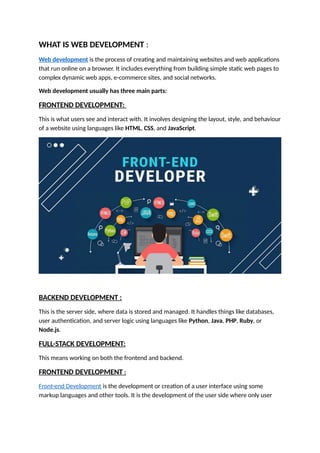
FRONTEND DEVELOPMENT:
This is what users see and interact with. It involves designing the layout, style, and behaviour
of a website using languages like HTML, CSS, and JavaScript.
BACKEND DEVELOPMENT :
This is the server side, where data is stored and managed. It handles things like databases,
user authentication, and server logic using languages like Python, Java, PHP, Ruby, or
Node.js.
FULL-STACK DEVELOPMENT:
This means working on both the frontend and backend.
FRONTEND DEVELOPMENT :
Front-end Development is the development or creation of a user interface using some
markup languages and other tools. It is the development of the user side where only user
2.
interaction will becounted. It consists of the interface where buttons, texts, alignments, etc
are involved and used by the user.
LANGUAGES FOR FRONTEND DEVELOPMENT :
Frontend is the part that easily for the user only. It should be user-friendly and designed and
self- explanatory only. So to understand this there are the basic languages which can used to
create better interactive web pages.
HTML: It was introduced in 1993 and currently at version HTML5, is a foundational
language for creating structured web content. It facilitates the creation of forms, tables, and
structured data, essential for input elements and organizing information on web pages.
HTML's evolution continues to shape the internet by enabling developers to design
interactive and accessible user interfaces across various platforms and devices.
CSS: CSS, introduced on 17 December 1996 and currently at version CSS3, stands for
Cascading Style Sheets. It complements HTML by styling web pages, managing colors, and
enabling the creation of responsive designs. CSS empowers web developers to enhance user
interfaces, ensuring visually appealing and consistent layouts across different devices and
screen sizes.
JAVASCRIPT: ECMAScript, introduced on 4 December 1995 and currently at version
ECMAScript 2022, is a lightweight, cross-platform, single-threaded programming language. It
enables dynamic changes and event handling in web development, making it essential for
creating interactive and responsive user interfaces.
Frontend Development Framework:
JQuery : Introduced in August 2006 and now at version 3.7.1, is an open-source JavaScript
library specializing in DOM manipulation, CSS editing, event handling, AJAX requests,
animations, and DOM traversal. It simplifies web development by offering a streamlined
approach to interactive web design and client-side scripting, enhancing user interface
responsiveness across different web applications.
REACT: Introduced in May 2013 and now at version 18.2.0, is a JavaScript UI library
designed for building SPAs. It emphasizes component-based development, efficient state
management, and utilizes a virtual DOM for fast updates. React simplifies complex UI tasks,
promotes code reusability, and is widely used in modern web application development.
ANGULAR: Introduced on October 20, 2010, and currently at version 17.0.3, is an open-
source JavaScript framework by Google that follows the MVC pattern. It is used for building
single-page applications (SPAs), ensuring fast page reloads, and providing a modern,
modular structure for web development.
3.
Veu.js : Introducedin February 2014 and currently at version 3.3.0, is a JavaScript
framework similar to ReactJS for designing UI layers. It features reactive data binding, a
component-based architecture, Vue directives, and Vue Router for navigation, making it
ideal for building dynamic and interactive web applications.
BOOTSTRAP: Introduced in February 2014 and currently at version 3.3.0, is a JavaScript
framework similar to ReactJS for designing UI layers. It features reactive data binding, a
component-based architecture, Vue directives, and Vue Router for navigation, making it
ideal for building dynamic and interactive web applications.
WHAT DOES FRONTEND DEVELOPER DO : Front-end developers are responsible for
creating enjoyable user interface (UI) . The term UI refers to the graphical layout, or,
everything you can see when you interact with a website or application. In this role, you'll
determine where to place images, what the navigation should look like, and the general
layout of the website. You'll create navigation tools such as drop-down lists and search bars.
Much of their work involves ensuring the appearance and layout of the site or application is
easy to navigate and intuitive for the user.
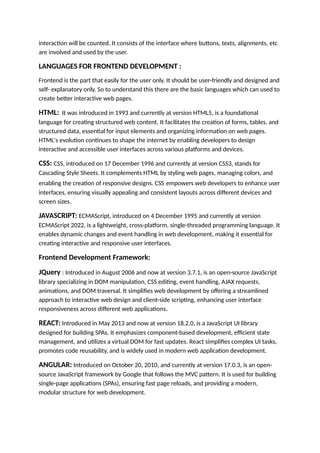
BACKEND DEVELOPMENT : Backend Development involves the logic, database, and
other operations that are built behind the scenes to run the web servers efficiently. Backend
Development refers to the server-side development of the web application. It is the part of
the application where the server and database reside and the logics is build to perform
operations. It includes the main features and functionalities of the application on the server.
Programming languages for the backend are mainly Node. JS (for JavaScript), Django (for
Python), Spring (Java), etc.
4.
Backend development isthe development of the client-side (server-side) of the
application. This process involves knowledge of APIs, databases and apps. APIs play a major
role in backend development, it takes care of fetching the data from the backend and
passing it to the frontend.
The actual operation in backend development is that it allows a database to communicate
with the application, thus transferring the data to the frontend from the backend. In contrast
to front-end development where customers can have a look at the UI, back-end
development works on compiling code for the integration of a database with an application.
WHO IS BACKEND DEVELOPER : A backend developer is a professional who works on
creating the server side of the web application. Backend developers build and maintain the
application to process data and perform operations on the website. They are responsible for
data processing, storage, and retrieval.
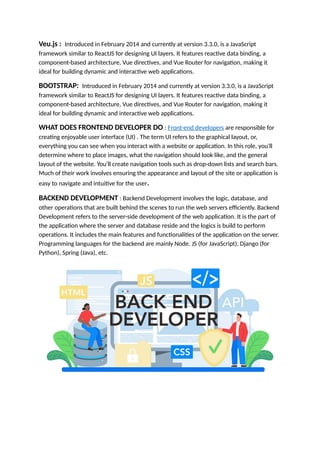
FULL STACK DEVELOPMENT : Full Stack Development refers to the development of both
the front end (client side) and back end (server side) portions of a web application.
A Full Stack Developer is someone who can work on:
Front-end: What users see (website/app interface)
Back-end: The server, database, and application logic
Main Components :
1. Front-end ( Client Side )
5.
Goal: Buildthe part of the website/app users interact with.
Languages/Tools:
HTML (Structure)
CSS (Styling)
JavaScript (Behavior and interactivity)
2. Back-end (Server Side):
Goal: Handle data, business logic, authentication, etc.
Languages:
JavaScript (Node.js)
Python (Django, Flask, FastAPI)
Ruby (Ruby on Rails)
PHP (Laravel, Symfony)
Java (Spring Boot)
C# (ASP.NET Core
Tasks:
Build APIs
Manage databases
Handle authentication/authorization
Manage server, hosting environment
3. DevOps (Optional, but valuable):
Goal: Manage servers, deploy applications, CI/CD pipelines.
Tools:
Git and GitHub/GitLab
Docker (Containerization)
Kubernetes (Orchestration)
AWS, Azure, Google Cloud (Cloud services)
Jenkins, GitHub Actions (CI/CD)
FRONTEND DEVELOPMENT : Frontend development is the part of web development
that deals with what users see and interact with on a website or app.
In simple term:
It's everything you see on a website — like layouts, buttons, menus, images, text, and
animations.
Frontend developers build these things using HTML, CSS, and JavaScript (and
frameworks like React, Angular, or Vue).
USE OF FRONTEND DEVELOPMENT :
Create user interfaces (UI): Designing how a site looks and feels.
Improve user experience (UX): Making the website easy, fast, and enjoyable to use.
6.
Connect tobackend systems: Frontend often communicates with backend servers to
get data (like loading products in an online store).
Make websites responsive: So they work well on phones, tablets, and desktops.
Brand identity: Reflecting the company's style and values visually.
BLOGGER PROFILE :
NAME: Shashwat Singh
DICRIPTION: I am a Digital Marketer in Softsynth Software Solutions
WEBSITE: https://softsynthsoftware.com



![谷歌留痕技术教程[ 𝙩𝙤𝙥 𝟮𝟯𝟯. 𝙘 𝙤𝙢 ]](https://cdn.slidesharecdn.com/ss_thumbnails/top233-260130173900-2eb784f9-thumbnail.jpg?width=640&height=640&fit=bounds)


