Introduction
to food labels
and FSSAI
regulations
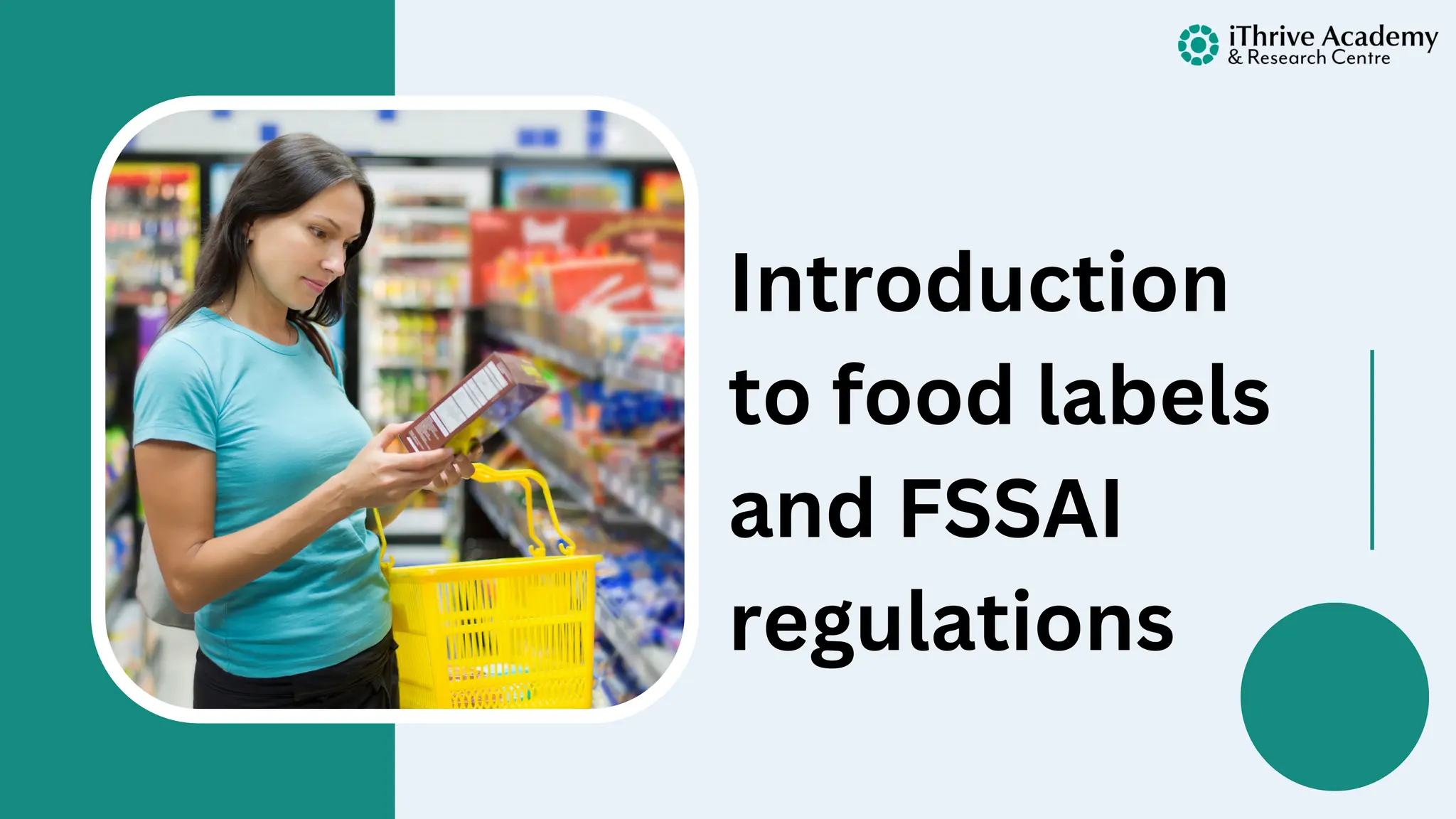
Food labels are written and pictorial information on a
packaged food product which help the consumer make
informed choices about buying.
This includes details about the following:
Type of food product
Nutritional information
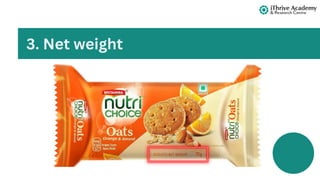
Net weight
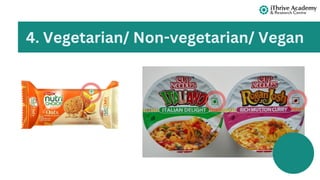
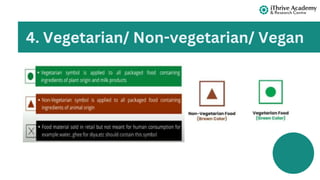
Vegetarian/ Non-vegetarian/ Vegan
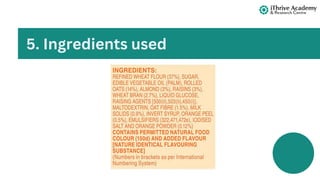
Ingredients used
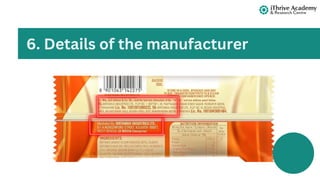
Detials of the manufacturer
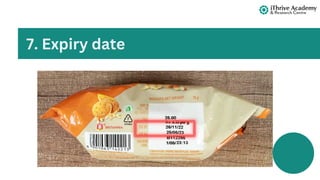
Expiry date
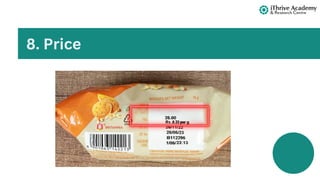
Price
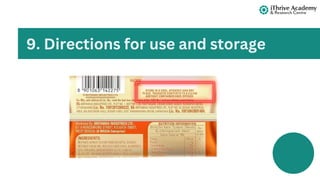
Directions for use and storage
Country of origin
Allergen information
Health claims, if any and others
What are food labels?
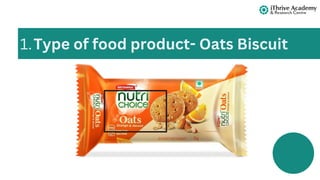
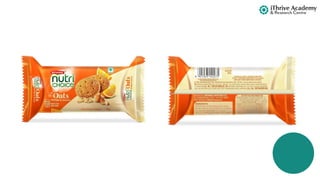
Type of food product- Oats Biscuit
1.
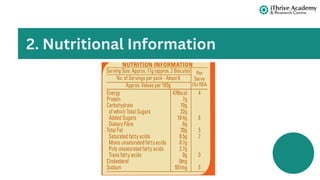
2. Nutritional Information
3. Net weight
4. Vegetarian/ Non-vegetarian/ Vegan
5. Ingredients used
6. Details of the manufacturer
7. Expiry date
8. Price
9. Directions for use and storage
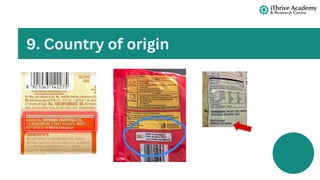
9. Country of origin
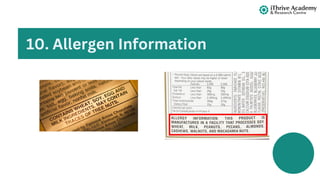
10. Allergen Information
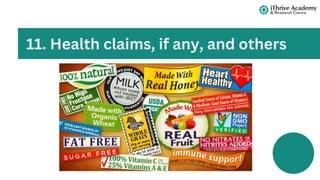
11. Health claims, if any, and others
Front-of-package (FOP)
Back-of-package (BOP)
As per the food safety and standards (labelling and display) regulations 2020,
general and mandatory requirements, every package shall carry certain information
on the front and back of package
Types of food labels
Decoding
Ingredients
on a food
label
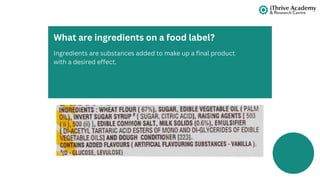
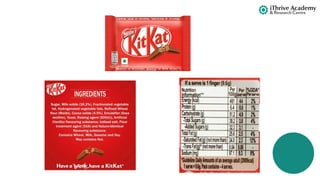
Ingredients are substances added to make up a final product
with a desired effect.
What are ingredients on a food label?
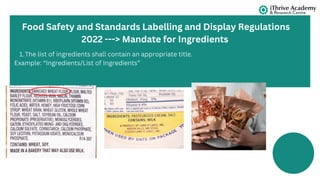
The list of ingredients shall contain an appropriate title.
1.
Example: “Ingredients/List of Ingredients”
Food Safety and Standards Labelling and Display Regulations
2022 ---> Mandate for Ingredients
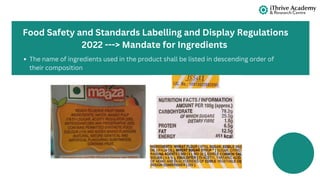
The name of ingredients used in the product shall be listed in descending order of
their composition
Food Safety and Standards Labelling and Display Regulations
2022 ---> Mandate for Ingredients
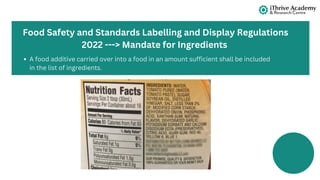
A food additive carried over into a food in an amount sufficient shall be included
in the list of ingredients.
Food Safety and Standards Labelling and Display Regulations
2022 ---> Mandate for Ingredients
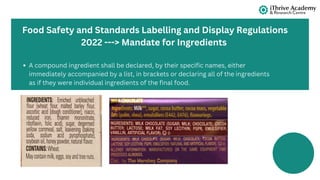
A compound ingredient shall be declared, by their specific names, either
immediately accompanied by a list, in brackets or declaring all of the ingredients
as if they were individual ingredients of the final food.
Food Safety and Standards Labelling and Display Regulations
2022 ---> Mandate for Ingredients
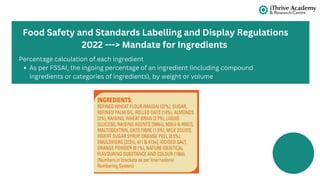
Percentage calculation of each ingredient
As per FSSAI, the ingoing percentage of an ingredient (including compound
ingredients or categories of ingredients), by weight or volume
Food Safety and Standards Labelling and Display Regulations
2022 ---> Mandate for Ingredients
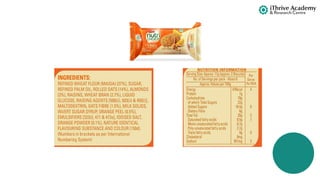
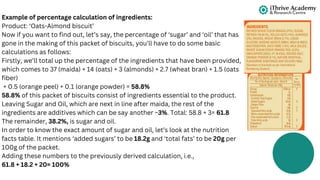
Example of percentage calculation of ingredients:
Product: ‘Oats-Almond biscuit’
Now if you want to find out, let’s say, the percentage of ‘sugar’ and ‘oil’ that has
gone in the making of this packet of biscuits, you’ll have to do some basic
calculations as follows:
Firstly, we’ll total up the percentage of the ingredients that have been provided,
which comes to 37 (maida) + 14 (oats) + 3 (almonds) + 2.7 (wheat bran) + 1.5 (oats
fiber)
+ 0.5 (orange peel) + 0.1 (orange powder) = 58.8%
58.8% of this packet of biscuits consist of ingredients essential to the product.
Leaving Sugar and Oil, which are next in line after maida, the rest of the
ingredients are additives which can be say another ~3%. Total: 58.8 + 3= 61.8
The remainder, 38.2%, is sugar and oil.
In order to know the exact amount of sugar and oil, let’s look at the nutrition
facts table. It mentions ‘added sugars’ to be 18.2g and ‘total fats’ to be 20g per
100g of the packet.
Adding these numbers to the previously derived calculation, i.e.,
61.8 + 18.2 + 20= 100%
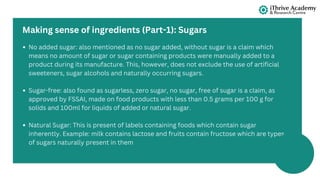
No added sugar: also mentioned as no sugar added, without sugar is a claim which
means no amount of sugar or sugar containing products were manually added to a
product during its manufacture. This, however, does not exclude the use of artificial
sweeteners, sugar alcohols and naturally occurring sugars.
Sugar-free: also found as sugarless, zero sugar, no sugar, free of sugar is a claim, as
approved by FSSAI, made on food products with less than 0.5 grams per 100 g for
solids and 100ml for liquids of added or natural sugar.
Natural Sugar: This is present of labels containing foods which contain sugar
inherently. Example: milk contains lactose and fruits contain fructose which are types
of sugars naturally present in them
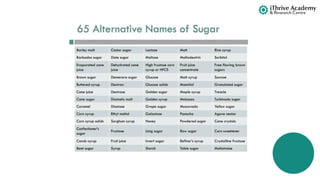
Making sense of ingredients (Part-1): Sugars
Making sense of ingredients (Part-2): Food Additives
Food additives are chemical substances added to food to maintain its quality
(preservatives), nutrition value, taste (flavouring agents), and appearance
(colouring agents).
Sources of food additives can be:
Natural — eg, red colour from beetroots, purple colour from grape skins
(anthocyanins)
Synthetic manufacture of products not found in nature (eg, aspartame, an
alternative to sugar)
Synthetic manufacture of natural products (eg, ascorbic acid), as synthetic
production is often less expensive.
E numbers and INS numbers are used to identify food additives that are used to improve
the quality of the food product.
INS numbers consist of three or four digits, optionally followed by an alphabetical suffix to
further characterize individual additives.
On packaging in the European Union (EU), approved food additives are written with a prefix
of E.
INS numbers generally correspond to E numbers for the same compound, e.g. INS 102,
Tartrazine, is also E102.
Food manufacturers in India use both the E number system and the INS system to label
their products.
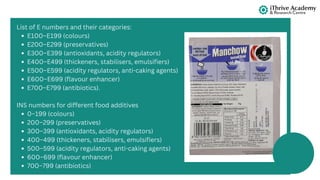
List of E numbers and their categories:
E100–E199 (colours)
E200–E299 (preservatives)
E300–E399 (antioxidants, acidity regulators)
E400–E499 (thickeners, stabilisers, emulsifiers)
E500–E599 (acidity regulators, anti-caking agents)
E600–E699 (flavour enhancer)
E700–E799 (antibiotics).
INS numbers for different food additives
0–199 (colours)
200–299 (preservatives)
300–399 (antioxidants, acidity regulators)
400–499 (thickeners, stabilisers, emulsifiers)
500–599 (acidity regulators, anti-caking agents)
600–699 (flavour enhancer)
700–799 (antibiotics)
CLASSES OF ADDITIVES AND
THEIR HEALTH IMPACTS
Colours: Visual appeal is considered to be as important as taste or smell. This is
where food colours come into play. Research conducted on lab animals has shown
that the long-term use of synthetic colours, and especially the three that account
for 90% of the use of all synthetic colours (Allura red, tartrazine, and sunset yellow),
can cause cancer, allergies, and chromosome mutations.
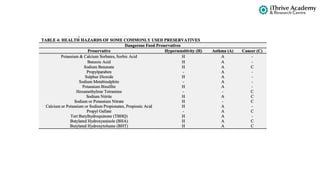
Preservatives: Preservatives slow down or prevent the growth of bacteria, molds,
and yeasts in food, avoiding its degradation or toxin development. Preservatives are
classified as Class I (natural preservatives) and Class II. Both, natural and synthetic
preservatives are categorized into 3 types: Anti-microbials, Anti oxidants, Anti-
enzymatic preservatives.
Exploring the harmful effects of Food Additives
Acidity regulators: Acidity regulators help to preserve the original taste and color of
the food and contribute to its healthiness through the pH control as a guarantee for
preventing the development of dangerous microorganisms. Commonly used acidity
regulators such as, acetic acid, for instance, can irritate mucous membranes and
citric acid is known to cause allergies, stomach issues, skin damage and teeth
erosion.
Firming additives: The additives that are vital in terms of processing are firming
additives. They create or stabilise the desirable product structure and consistency.
Firming agents include gelling, thickening, emulsifying, bulking, binding, and rising
agents, humectants, and modified starches. The highest status among these
substances is enjoyed by hydrocolloids. Consumed in large quantities, they can
have laxative effects.
Exploring the harmful effects of Food Additives
Product consistency and texture are also adjusted using modified starches. In order
to enhance starch properties, phosphates are often added during starch
modification. The human body needs phosphorus, but its excess can negatively
affect the bones, kidneys, and the circulatory system
Anti caking agents: Most ‘caking’ or clumping of products happens because of
moisture, interactions between particles and fat content that also reduce the flow
ability of the product. This is where anti-caking agents come into play. The potential
health risks associated with anti-caking agents are: Respiratory problems, kidney
damage, GI problems.
Flavour enhancers: Flavor enhancers, also called taste enhancers, are food
chemicals that add more taste or smell sensations to a food. They simply enhance
the flavor or taste of food. Monosodium glutamate (MSG), salt, and sweeteners are
flavor enhancers that add more savory, salty, or sweet properties to foods. There
are natural, nature-identical, and synthetic flavours.
Exploring the harmful effects of Food Additives
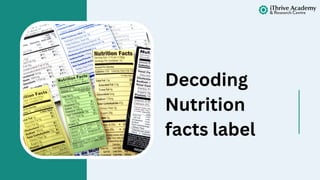
Decoding
Nutrition
facts label
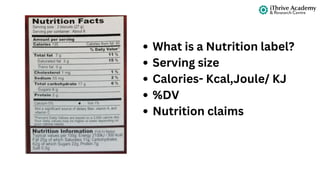
What is a Nutrition label?
Serving size
Calories- Kcal,Joule/ KJ
%DV
Nutrition claims
Nutrition label displays information, intended to inform the consumer of nutritional
properties of the ingredients contained in a food product.
Inclusions in the nutrition facts label as per the Food Safety and Standards Labelling
and Display Regulations 2022 contain:
Nutrients: Nutrients mean a constituent of food, which: provides energy; has
specific metabolic or physiological functions; or is needed for growth and
development and maintenance of healthy life. As per FSSAI (Food Safety and
Standards Authority of India), the following nutriton information should be declared
on the label as per 100g/ml or as per a single consumption pack of the product:
-Energy (kcal)
-Protein (g)
-Carbohydrate (g), Total Sugars (g), Added Sugars (g)
-Total Fat (g), Saturated Fat (g) and Trans Fat (g)
-Sodium (mg)
-Nutrients for which claims are made on the label.
Serving size: It is the quantity of a food or beverage consumed by a person at one
go. It is decided by the manufacturer as there are no mandates in place for serving
sizes of different packed foods and beverages.
Calories and Joule: Calorie is the CGS unit of energy while Joule is the SI unit of
energy. The amount of energy that a food product contains is measured in calories
(cal) or joules (J). 1 calorie is equal to 4.2 joule
Kcal, Kj: Kilocalorie (kCal) or kilojoule (kJ) is a unit of energy of one thousand calories
or joules. The terms Cal and kCal are used interchangeably and do not require
conversion.
Daily value (DV); % DV/ per serve % Recommended Dietary Allowance (RDA) or
Daily Allowance/ Daily Value% or per serving percentage contribution to RDA
denote the percentage daily requirements of particular nutrients that are fulfilled
by a food product. If a nutrient’s DV is listed as 10% then it meets 10% of the total
amount of that nutrient is needed per day to function properly.
Declaration of % Daily Value on food labels
FSSAI has mandated the declaration of per serve percentage (%) contribution to
Recommended Dietary Allowance should be calculated on the basis of 2000kcal
energy, 67 g total fat, 22 g saturated fat, 2 g trans fat, 50 g added sugar and 2000 mg of
sodium (5 g salt) requirement for average adult per day.
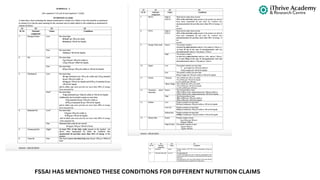
FSSAI HAS MENTIONED THESE CONDITIONS FOR DIFFERENT NUTRITION CLAIMS
Understanding
‘Health‘ and
‘Nutrition‘
claims
Claim means any representation which is printed, oral, audio or
visual and states, suggests, or implies that a food has particular
qualities relating to its origin, nutritional properties, nature,
processing, composition or otherwise
What is a claim on food labels?
Nutrition claim
Health claim
Types of claims on food labels
Nutrition claim is defined as any representation that states,
suggests or implies that a food has a particular nutrition
property including, which is not limited to the energy value but
includes protein fat and carbohydrates, vitamins and minerals.
Nutrition claim
Health claim means any representation that states, suggests or
implies that a relationship exists between a food or a food
constant of that food and health and includes the nutrition
claims which describe the physiological role of the nutrient in
growth, development, and normal functions of the body.
Health claim
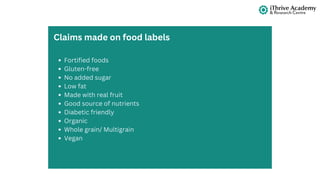
Fortified foods
Gluten-free
No added sugar
Low fat
Made with real fruit
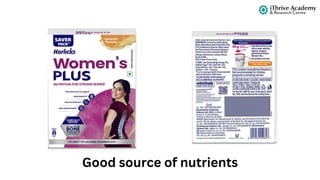
Good source of nutrients
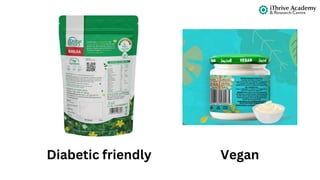
Diabetic friendly
Organic
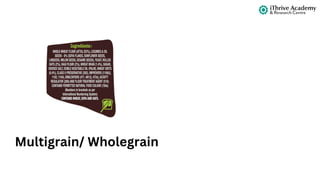
Whole grain/ Multigrain
Vegan
Claims made on food labels
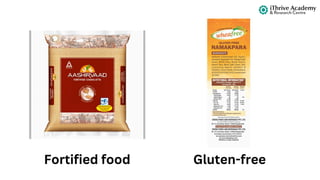
Fortified food Gluten-free
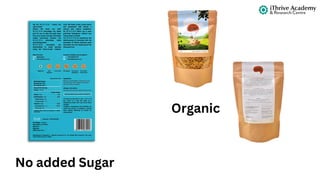
No added Sugar
Organic
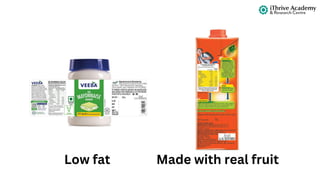
Low fat Made with real fruit
Good source of nutrients
Diabetic friendly Vegan
Multigrain/ Wholegrain
DAY 5:
How to make
informed
choices while
buying foods
and beverages
A rule of thumb-
-no single brand has got it all right;
-go for products that contain less and clean ingredients
-free of additives,
-contains no refined and hidden sugar,
-vegetable or seed oil free,
-soy free,
-non-GMO,
-non-fortified;
-serves the health/nutrition claim made;
-serves the purpose of buying (specific dietary need- e.g., lactose intolerance, protein-rich;
sugar-free dessert, etc.);
-not expired.
Risks of non-compliance with food labelling-
-Fines and penalties;
-Consumer complaints and legal actions;
-Packaging costs;
-Food recall costs;
-Loss of reputation and consumer trust
Thank you!

Understanding Food Labels Certification.

  • 1.
  • 2.
    Food labels arewritten and pictorial information on a packaged food product which help the consumer make informed choices about buying. This includes details about the following: Type of food product Nutritional information Net weight Vegetarian/ Non-vegetarian/ Vegan Ingredients used Detials of the manufacturer Expiry date Price Directions for use and storage Country of origin Allergen information Health claims, if any and others What are food labels?
  • 3.
    Type of foodproduct- Oats Biscuit 1.
  • 4.
  • 5.
  • 6.
  • 7.
  • 8.
  • 9.
    6. Details ofthe manufacturer
  • 10.
  • 11.
  • 12.
    9. Directions foruse and storage
  • 13.
  • 14.
  • 15.
    11. Health claims,if any, and others
  • 16.
    Front-of-package (FOP) Back-of-package (BOP) Asper the food safety and standards (labelling and display) regulations 2020, general and mandatory requirements, every package shall carry certain information on the front and back of package Types of food labels
  • 18.
  • 19.
    Ingredients are substancesadded to make up a final product with a desired effect. What are ingredients on a food label?
  • 22.
    The list ofingredients shall contain an appropriate title. 1. Example: “Ingredients/List of Ingredients” Food Safety and Standards Labelling and Display Regulations 2022 ---> Mandate for Ingredients
  • 23.
    The name ofingredients used in the product shall be listed in descending order of their composition Food Safety and Standards Labelling and Display Regulations 2022 ---> Mandate for Ingredients
  • 24.
    A food additivecarried over into a food in an amount sufficient shall be included in the list of ingredients. Food Safety and Standards Labelling and Display Regulations 2022 ---> Mandate for Ingredients
  • 25.
    A compound ingredientshall be declared, by their specific names, either immediately accompanied by a list, in brackets or declaring all of the ingredients as if they were individual ingredients of the final food. Food Safety and Standards Labelling and Display Regulations 2022 ---> Mandate for Ingredients
  • 26.
    Percentage calculation ofeach ingredient As per FSSAI, the ingoing percentage of an ingredient (including compound ingredients or categories of ingredients), by weight or volume Food Safety and Standards Labelling and Display Regulations 2022 ---> Mandate for Ingredients
  • 27.
    Example of percentagecalculation of ingredients: Product: ‘Oats-Almond biscuit’ Now if you want to find out, let’s say, the percentage of ‘sugar’ and ‘oil’ that has gone in the making of this packet of biscuits, you’ll have to do some basic calculations as follows: Firstly, we’ll total up the percentage of the ingredients that have been provided, which comes to 37 (maida) + 14 (oats) + 3 (almonds) + 2.7 (wheat bran) + 1.5 (oats fiber) + 0.5 (orange peel) + 0.1 (orange powder) = 58.8% 58.8% of this packet of biscuits consist of ingredients essential to the product. Leaving Sugar and Oil, which are next in line after maida, the rest of the ingredients are additives which can be say another ~3%. Total: 58.8 + 3= 61.8 The remainder, 38.2%, is sugar and oil. In order to know the exact amount of sugar and oil, let’s look at the nutrition facts table. It mentions ‘added sugars’ to be 18.2g and ‘total fats’ to be 20g per 100g of the packet. Adding these numbers to the previously derived calculation, i.e., 61.8 + 18.2 + 20= 100%
  • 28.
    No added sugar:also mentioned as no sugar added, without sugar is a claim which means no amount of sugar or sugar containing products were manually added to a product during its manufacture. This, however, does not exclude the use of artificial sweeteners, sugar alcohols and naturally occurring sugars. Sugar-free: also found as sugarless, zero sugar, no sugar, free of sugar is a claim, as approved by FSSAI, made on food products with less than 0.5 grams per 100 g for solids and 100ml for liquids of added or natural sugar. Natural Sugar: This is present of labels containing foods which contain sugar inherently. Example: milk contains lactose and fruits contain fructose which are types of sugars naturally present in them Making sense of ingredients (Part-1): Sugars
  • 30.
    Making sense ofingredients (Part-2): Food Additives Food additives are chemical substances added to food to maintain its quality (preservatives), nutrition value, taste (flavouring agents), and appearance (colouring agents). Sources of food additives can be: Natural — eg, red colour from beetroots, purple colour from grape skins (anthocyanins) Synthetic manufacture of products not found in nature (eg, aspartame, an alternative to sugar) Synthetic manufacture of natural products (eg, ascorbic acid), as synthetic production is often less expensive.
  • 31.
    E numbers andINS numbers are used to identify food additives that are used to improve the quality of the food product. INS numbers consist of three or four digits, optionally followed by an alphabetical suffix to further characterize individual additives. On packaging in the European Union (EU), approved food additives are written with a prefix of E. INS numbers generally correspond to E numbers for the same compound, e.g. INS 102, Tartrazine, is also E102. Food manufacturers in India use both the E number system and the INS system to label their products.
  • 32.
    List of Enumbers and their categories: E100–E199 (colours) E200–E299 (preservatives) E300–E399 (antioxidants, acidity regulators) E400–E499 (thickeners, stabilisers, emulsifiers) E500–E599 (acidity regulators, anti-caking agents) E600–E699 (flavour enhancer) E700–E799 (antibiotics). INS numbers for different food additives 0–199 (colours) 200–299 (preservatives) 300–399 (antioxidants, acidity regulators) 400–499 (thickeners, stabilisers, emulsifiers) 500–599 (acidity regulators, anti-caking agents) 600–699 (flavour enhancer) 700–799 (antibiotics)
  • 33.
    CLASSES OF ADDITIVESAND THEIR HEALTH IMPACTS
  • 34.
    Colours: Visual appealis considered to be as important as taste or smell. This is where food colours come into play. Research conducted on lab animals has shown that the long-term use of synthetic colours, and especially the three that account for 90% of the use of all synthetic colours (Allura red, tartrazine, and sunset yellow), can cause cancer, allergies, and chromosome mutations. Preservatives: Preservatives slow down or prevent the growth of bacteria, molds, and yeasts in food, avoiding its degradation or toxin development. Preservatives are classified as Class I (natural preservatives) and Class II. Both, natural and synthetic preservatives are categorized into 3 types: Anti-microbials, Anti oxidants, Anti- enzymatic preservatives. Exploring the harmful effects of Food Additives
  • 36.
    Acidity regulators: Acidityregulators help to preserve the original taste and color of the food and contribute to its healthiness through the pH control as a guarantee for preventing the development of dangerous microorganisms. Commonly used acidity regulators such as, acetic acid, for instance, can irritate mucous membranes and citric acid is known to cause allergies, stomach issues, skin damage and teeth erosion. Firming additives: The additives that are vital in terms of processing are firming additives. They create or stabilise the desirable product structure and consistency. Firming agents include gelling, thickening, emulsifying, bulking, binding, and rising agents, humectants, and modified starches. The highest status among these substances is enjoyed by hydrocolloids. Consumed in large quantities, they can have laxative effects. Exploring the harmful effects of Food Additives
  • 37.
    Product consistency andtexture are also adjusted using modified starches. In order to enhance starch properties, phosphates are often added during starch modification. The human body needs phosphorus, but its excess can negatively affect the bones, kidneys, and the circulatory system Anti caking agents: Most ‘caking’ or clumping of products happens because of moisture, interactions between particles and fat content that also reduce the flow ability of the product. This is where anti-caking agents come into play. The potential health risks associated with anti-caking agents are: Respiratory problems, kidney damage, GI problems. Flavour enhancers: Flavor enhancers, also called taste enhancers, are food chemicals that add more taste or smell sensations to a food. They simply enhance the flavor or taste of food. Monosodium glutamate (MSG), salt, and sweeteners are flavor enhancers that add more savory, salty, or sweet properties to foods. There are natural, nature-identical, and synthetic flavours. Exploring the harmful effects of Food Additives
  • 38.
  • 39.
    What is aNutrition label? Serving size Calories- Kcal,Joule/ KJ %DV Nutrition claims
  • 40.
    Nutrition label displaysinformation, intended to inform the consumer of nutritional properties of the ingredients contained in a food product. Inclusions in the nutrition facts label as per the Food Safety and Standards Labelling and Display Regulations 2022 contain: Nutrients: Nutrients mean a constituent of food, which: provides energy; has specific metabolic or physiological functions; or is needed for growth and development and maintenance of healthy life. As per FSSAI (Food Safety and Standards Authority of India), the following nutriton information should be declared on the label as per 100g/ml or as per a single consumption pack of the product: -Energy (kcal) -Protein (g) -Carbohydrate (g), Total Sugars (g), Added Sugars (g) -Total Fat (g), Saturated Fat (g) and Trans Fat (g) -Sodium (mg) -Nutrients for which claims are made on the label.
  • 41.
    Serving size: Itis the quantity of a food or beverage consumed by a person at one go. It is decided by the manufacturer as there are no mandates in place for serving sizes of different packed foods and beverages. Calories and Joule: Calorie is the CGS unit of energy while Joule is the SI unit of energy. The amount of energy that a food product contains is measured in calories (cal) or joules (J). 1 calorie is equal to 4.2 joule Kcal, Kj: Kilocalorie (kCal) or kilojoule (kJ) is a unit of energy of one thousand calories or joules. The terms Cal and kCal are used interchangeably and do not require conversion. Daily value (DV); % DV/ per serve % Recommended Dietary Allowance (RDA) or Daily Allowance/ Daily Value% or per serving percentage contribution to RDA denote the percentage daily requirements of particular nutrients that are fulfilled by a food product. If a nutrient’s DV is listed as 10% then it meets 10% of the total amount of that nutrient is needed per day to function properly.
  • 42.
    Declaration of %Daily Value on food labels FSSAI has mandated the declaration of per serve percentage (%) contribution to Recommended Dietary Allowance should be calculated on the basis of 2000kcal energy, 67 g total fat, 22 g saturated fat, 2 g trans fat, 50 g added sugar and 2000 mg of sodium (5 g salt) requirement for average adult per day.
  • 43.
    FSSAI HAS MENTIONEDTHESE CONDITIONS FOR DIFFERENT NUTRITION CLAIMS
  • 44.
  • 45.
    Claim means anyrepresentation which is printed, oral, audio or visual and states, suggests, or implies that a food has particular qualities relating to its origin, nutritional properties, nature, processing, composition or otherwise What is a claim on food labels?
  • 46.
    Nutrition claim Health claim Typesof claims on food labels
  • 47.
    Nutrition claim isdefined as any representation that states, suggests or implies that a food has a particular nutrition property including, which is not limited to the energy value but includes protein fat and carbohydrates, vitamins and minerals. Nutrition claim
  • 48.
    Health claim meansany representation that states, suggests or implies that a relationship exists between a food or a food constant of that food and health and includes the nutrition claims which describe the physiological role of the nutrient in growth, development, and normal functions of the body. Health claim
  • 49.
    Fortified foods Gluten-free No addedsugar Low fat Made with real fruit Good source of nutrients Diabetic friendly Organic Whole grain/ Multigrain Vegan Claims made on food labels
  • 50.
  • 51.
  • 52.
    Low fat Madewith real fruit
  • 53.
    Good source ofnutrients
  • 54.
  • 55.
  • 56.
    DAY 5: How tomake informed choices while buying foods and beverages
  • 57.
    A rule ofthumb- -no single brand has got it all right; -go for products that contain less and clean ingredients -free of additives, -contains no refined and hidden sugar, -vegetable or seed oil free, -soy free, -non-GMO, -non-fortified; -serves the health/nutrition claim made; -serves the purpose of buying (specific dietary need- e.g., lactose intolerance, protein-rich; sugar-free dessert, etc.); -not expired.
  • 58.
    Risks of non-compliancewith food labelling- -Fines and penalties; -Consumer complaints and legal actions; -Packaging costs; -Food recall costs; -Loss of reputation and consumer trust
  • 59.