Regular dental checkups using the right tools can prevent painful conditions, improve feeding efficiency, and enhance performance, especially for working or competitive horses. Shop all Our products at: https://powerfloat.net/shop/
Understanding Equine DentistryTools: Essentials for Horse Health
Proper dental care is crucial for a horse’s overall health, comfort, and performance. Like humans, horses
require regular dental checkups to ensure their teeth are in good condition. However, equine dentistry
is quite different from human dentistry, mainly because of the unique anatomy of a horse’s mouth and
the wear patterns of their teeth. To manage Equine Dental Care effectively, specialized tools have been
developed. In this article, we explore the key tools used in equine dentistry and their importance in
maintaining your horse’s wellbeing.
Why Equine Dental Care Matters
Horses have hypsodont teeth, meaning their teeth continuously erupt throughout their lives. They often
develop sharp points, uneven wear, or dental diseases that can interfere with eating, cause pain, and
lead to behavioral problems. Routine dental exams and corrections are essential, and skilled equine
dentists rely on a variety of tools to perform these tasks safely and effectively.
Essential Equine Dentistry Tools
1. Full Mouth Speculum
The full mouth speculum is perhaps the most iconic and critical tool in equine dentistry. It is a metal
device placed in the horse's mouth to keep it open during examination and treatment. Without a
2.
speculum, it wouldbe nearly impossible to perform a thorough oral inspection or corrective procedures.
Modern speculums are padded for comfort and adjustable to fit different sizes of horses.
2. Dental Mirrors and Lights
Visibility inside the horse’s mouth is limited. Dental mirrors allow veterinarians or equine dentists to
inspect hard-to-see areas like the back molars. These are often used in conjunction with headlamps or
specialized dental lights to illuminate the oral cavity, ensuring no problem areas are missed.
3. Hand Floats
Hand floats are traditional tools used to file down sharp points and smooth out uneven surfaces on the
horse's teeth. They consist of a handle and an abrasive surface (often replaceable blades) designed to
rasp teeth manually. Although time-consuming and requiring physical strength, hand floating remains a
fundamental skill and method, especially in situations where power tools are impractical.
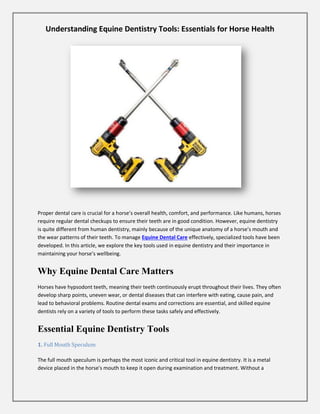
4. Power Floats
In modern equine dentistry, power floats have become increasingly popular. These are motorized tools
that use rotating disks or burrs to grind and smooth teeth more quickly and precisely than manual floats.
Power floats reduce fatigue for the practitioner and typically allow for more thorough and less stressful
dental procedures.
5. Extraction Forceps and Elevators
Sometimes, a horse may require tooth extraction due to damage, infection, or severe decay. Extraction
forceps and elevators are specialized tools used for this purpose. Elevators help loosen the tooth from
the socket, while forceps are used to grip and remove the tooth carefully.
6. Dental Picks and Probes
These small, pointed tools are used to check for cavities, periodontal disease, or feed packing between
teeth. Probes help measure pocket depths around teeth, while picks are used to remove debris and
diagnose small cracks or fractures that might not be immediately visible.
7. Sedation Equipment
Although not a tool applied directly in the mouth, sedation equipment is essential for many equine
dental procedures. Horses must remain calm and relaxed to ensure the dentist can work safely and
effectively. Administering sedation properly requires knowledge and the correct veterinary equipment.
Equine Dentistry Tools have come a long way, evolving to meet the demands of both traditional and
modern dental practices. Whether using simple hand floats or advanced power floats, the goal remains
the same: ensuring the horse’s oral health and, by extension, their overall wellbeing.
3.
Regular dental checkupsusing the right tools can prevent painful conditions, improve feeding efficiency,
and enhance performance, especially for working or competitive horses. Always consult with a qualified
equine dental professional to ensure your horse receives the best care with the appropriate tools.