Meaning of Education
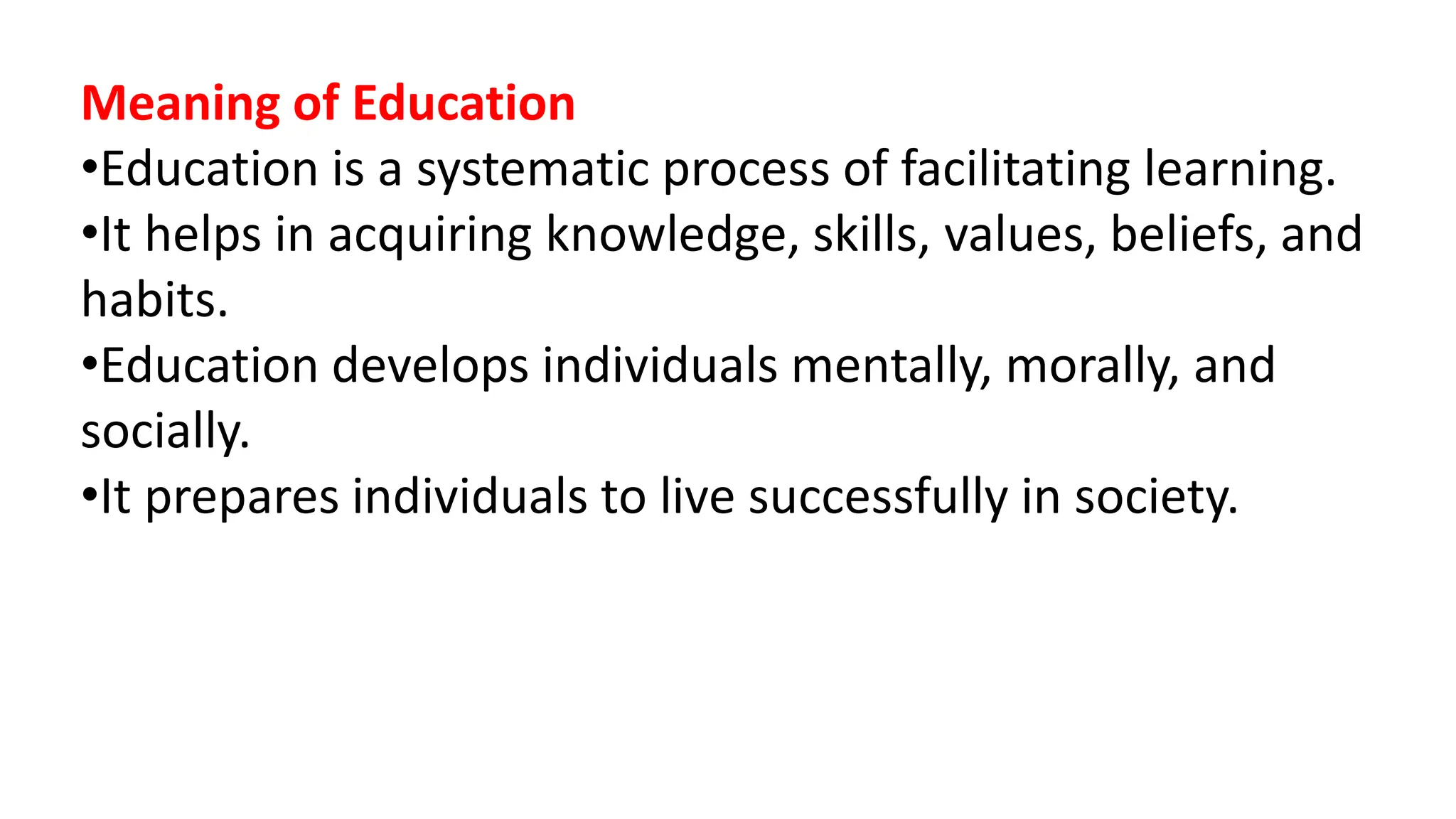
•Educationis a systematic process of facilitating learning.
•It helps in acquiring knowledge, skills, values, beliefs, and
habits.
•Education develops individuals mentally, morally, and
socially.
•It prepares individuals to live successfully in society.
4.
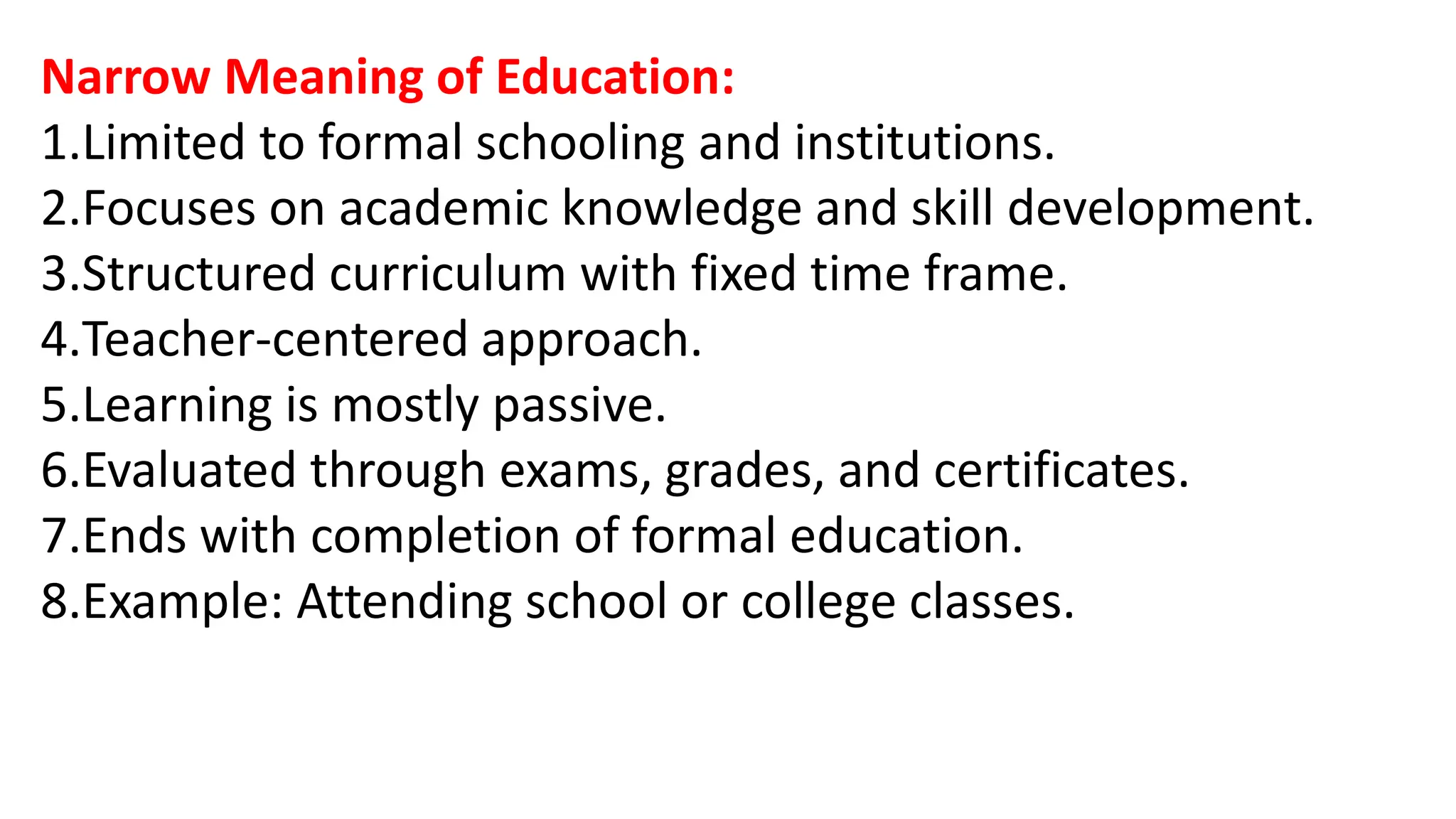
Narrow Meaning ofEducation:
1.Limited to formal schooling and institutions.
2.Focuses on academic knowledge and skill development.
3.Structured curriculum with fixed time frame.
4.Teacher-centered approach.
5.Learning is mostly passive.
6.Evaluated through exams, grades, and certificates.
7.Ends with completion of formal education.
8.Example: Attending school or college classes.
5.
Broader Meaning ofEducation:
1.Lifelong and continuous process.
2.Includes formal, non-formal, and informal learning.
3.Aims at overall development – physical, mental, emotional, moral,
and social.
4.Learning happens at home, in society, through media, and life
experiences.
5.Learner is active and self-motivated.
6.Teacher is a guide or facilitator, not the only source.
7.No fixed curriculum or time limit.
8.Example: Learning values from parents or problem-solving from life
experiences.
6.
Etymological Meaning ofEducation
•Derived from Latin words:
• Educare – to bring up or nourish.
• Educere – to draw out or lead out.
• Educatum – the act of teaching or training.
7.
Nature of Education
•Bi-polarProcess – Teacher and learner interaction.
•Tri-polar Process – Teacher, learner, and environment.
•Lifelong Process – From birth to death.
•Holistic Development – Physical, mental, emotional, moral.
•Child-centered – Focus on learners’ needs and abilities.
8.
1. Bipolar Conceptof Education
Meaning:
The bipolar concept sees education as an interaction between two main poles
– the teacher and the learner.
Key Points:
•Education is a process where the teacher influences the learner.
•The teacher is active; the learner is passive.
•Knowledge flows from teacher to student.
Introduced by:
John Adams (a British educationist) in the early 20th century.
Structure:
•Pole 1: Teacher
•Pole 2: Learner
9.
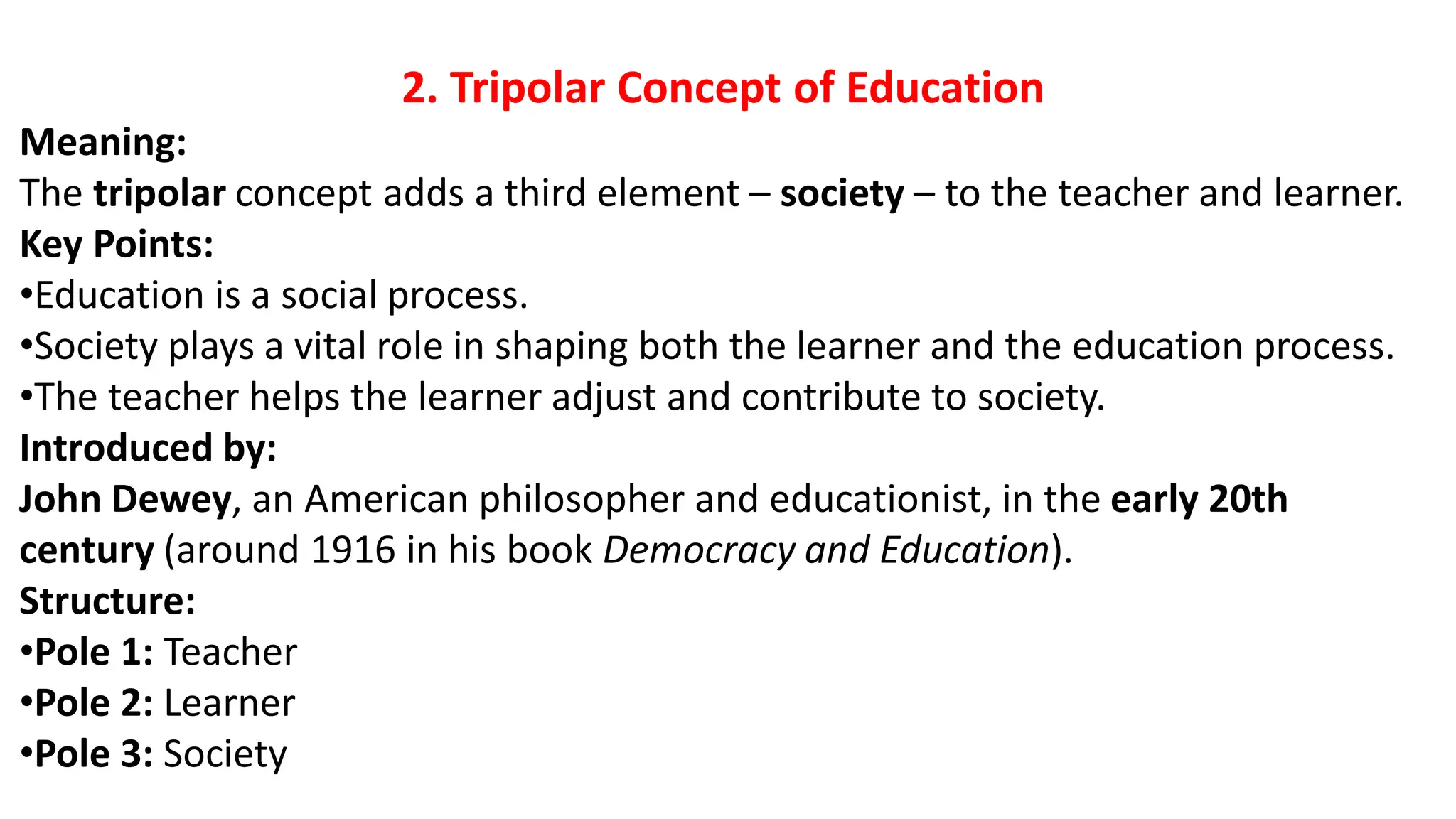
2. Tripolar Conceptof Education
Meaning:
The tripolar concept adds a third element – society – to the teacher and learner.
Key Points:
•Education is a social process.
•Society plays a vital role in shaping both the learner and the education process.
•The teacher helps the learner adjust and contribute to society.
Introduced by:
John Dewey, an American philosopher and educationist, in the early 20th
century (around 1916 in his book Democracy and Education).
Structure:
•Pole 1: Teacher
•Pole 2: Learner
•Pole 3: Society
10.
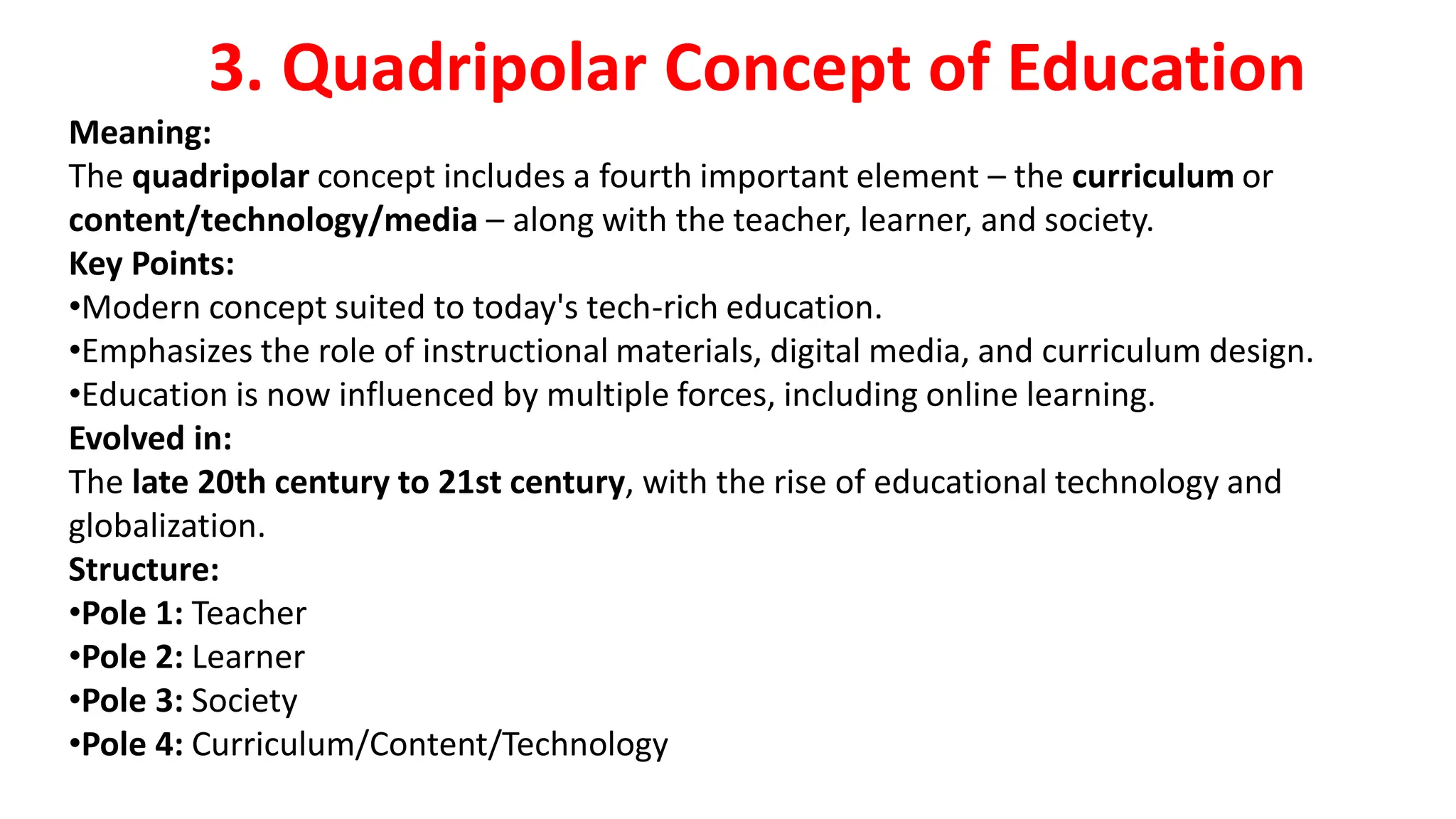
3. Quadripolar Conceptof Education
Meaning:
The quadripolar concept includes a fourth important element – the curriculum or
content/technology/media – along with the teacher, learner, and society.
Key Points:
•Modern concept suited to today's tech-rich education.
•Emphasizes the role of instructional materials, digital media, and curriculum design.
•Education is now influenced by multiple forces, including online learning.
Evolved in:
The late 20th century to 21st century, with the rise of educational technology and
globalization.
Structure:
•Pole 1: Teacher
•Pole 2: Learner
•Pole 3: Society
•Pole 4: Curriculum/Content/Technology
11.
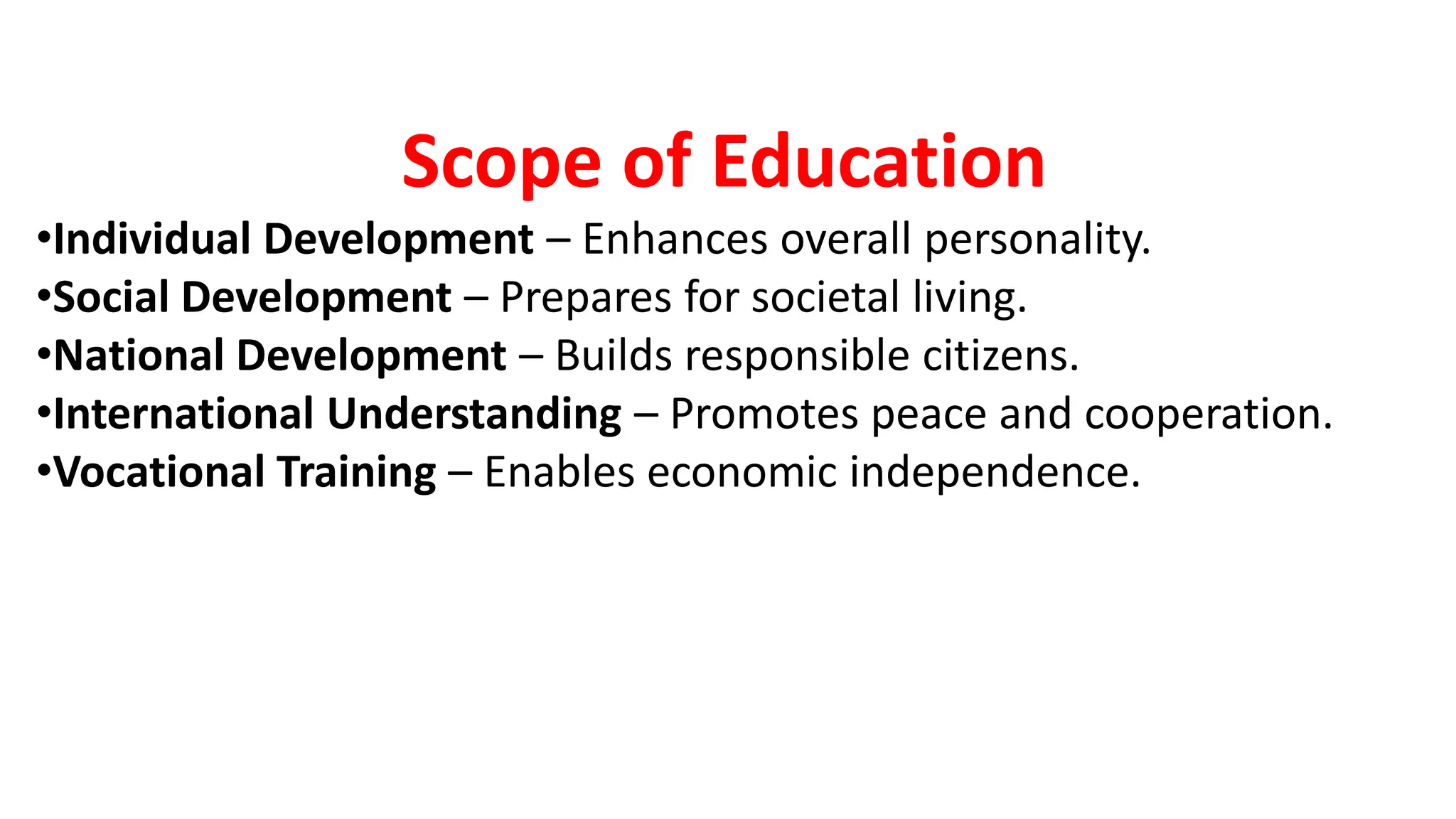
Scope of Education
•IndividualDevelopment – Enhances overall personality.
•Social Development – Prepares for societal living.
•National Development – Builds responsible citizens.
•International Understanding – Promotes peace and cooperation.
•Vocational Training – Enables economic independence.
12.
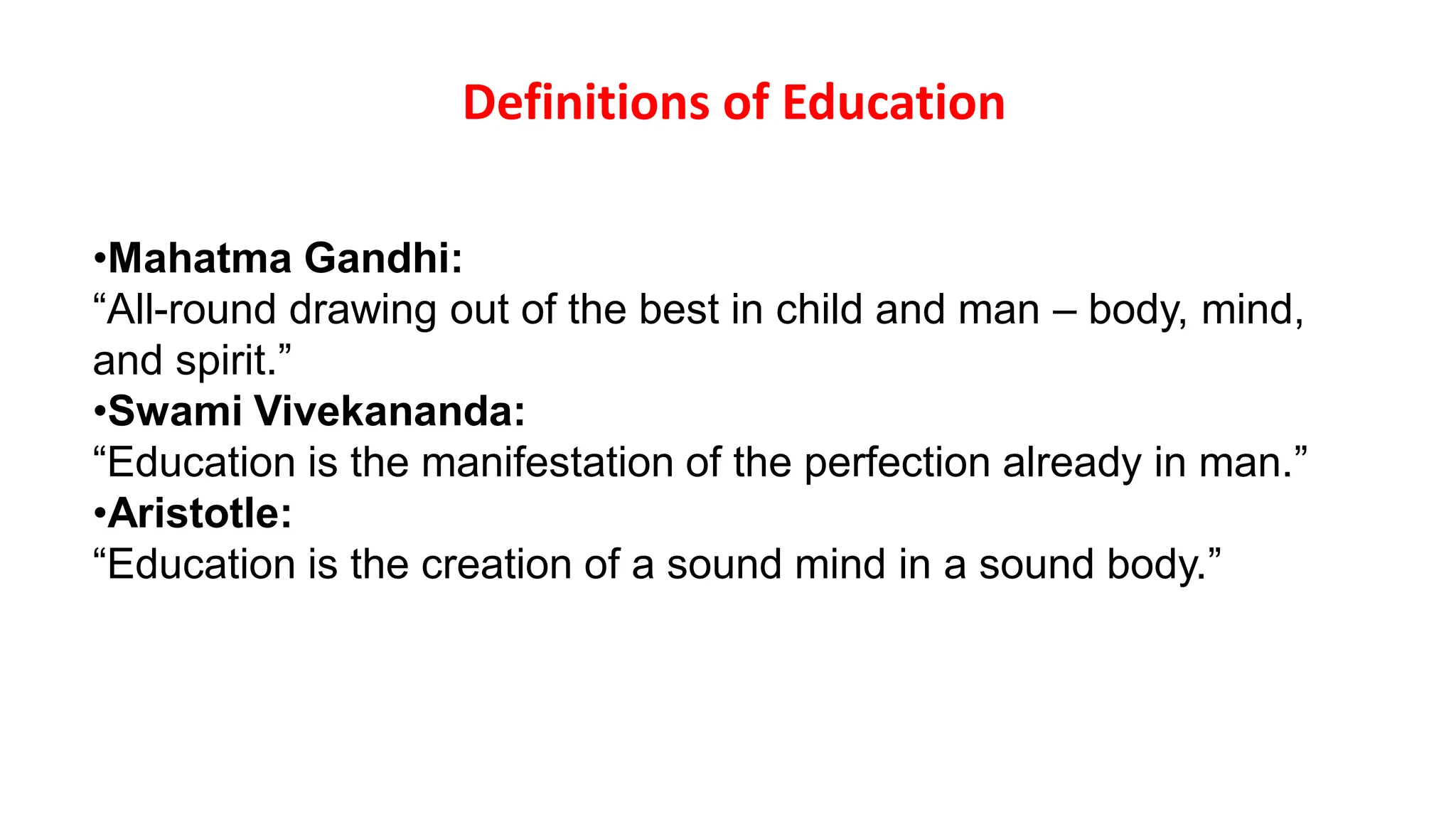
Definitions of Education
•MahatmaGandhi:
“All-round drawing out of the best in child and man – body, mind,
and spirit.”
•Swami Vivekananda:
“Education is the manifestation of the perfection already in man.”
•Aristotle:
“Education is the creation of a sound mind in a sound body.”
13.
•John Dewey:
“Education isnot preparation for life; education is life itself.”
•Plato:
“Education is the capacity to feel pleasure and pain at the right
moment.”
•Rabindranath Tagore:
“Education enables the mind to find the ultimate truth… not power
but love.”
14.
•Froebel:
“Education is theunfoldment of the inherent powers of the
child.”
•Dr. Zakir Husain:
“Education is the process of the individual mind getting to
its full possible development.”
15.
Branches of education
1.PhilosophicalEducation
2.Psychological Education
3.Sociological Education
4.Historical Education
5.Comparative Education
6.Curriculum and Instruction
7.Educational Technology
8.Educational Administration and Management
9.Guidance and Counselling
10.Special and Inclusive Education
11.Adult and Continuing Education
12.Environmental and Value Education
13.Educational Research and Statistics
1. What isthe etymological meaning of the word 'Education' derived
from Latin 'Educere'?
A. To nourish
B. To teach
C. To lead out or draw out
D. To punish
✅ Correct Answer: C. To lead out or draw out
Explanation:
The Latin word Educere means "to draw out" or "to lead out," reflecting
the idea of drawing out the inner potential of a person through
education.
18.
2. Which branchof education is organized but takes place outside
the formal system?
A. Formal Education
B. Informal Education
C. Special Education
D. Non-Formal Education
✅ Correct Answer: D. Non-Formal Education
Explanation:
Non-formal education includes organized educational activities
outside the established formal system, such as adult education or
skill training programs.
19.
3. Who said,“Education is the manifestation of the perfection
already in man”?
A. Mahatma Gandhi
B. Swami Vivekananda
C. Plato
D. John Dewey
✅ Correct Answer: B. Swami Vivekananda
Explanation:
Swami Vivekananda believed that education should uncover and
develop the perfection inherent in every human being.
20.
4. Which ofthe following describes education as a tri-polar
process?
A. Teacher, learner, and environment
B. Child, teacher, and parents
C. Student, syllabus, and teacher
D. Curriculum, exam, and school
✅ Correct Answer: A. Teacher, learner, and environment
Explanation:
Education as a tri-polar process involves interaction among the
teacher, the learner, and the social environment.
21.
5. According toMahatma Gandhi, education should develop
which three aspects of a person?
A. Body, Mind, and Speech
B. Head, Hand, and Heart
C. Body, Mind, and Spirit
D. Memory, Reasoning, and Thinking
✅ Correct Answer: C. Body, Mind, and Spirit
Explanation:
Mahatma Gandhi defined education as an all-round development
involving the body, mind, and spirit.
22.
6. Which branchof education is primarily aimed at preparing
individuals for specific careers or trades?
A. Vocational Education
B. Formal Education
C. Informal Education
D. Special Education
✅ Correct Answer: A. Vocational Education
Explanation:
Vocational education is designed to equip individuals with skills
required for specific jobs or careers.
23.
7. Which philosophersaid, “Education is not preparation for life;
education is life itself”?
A. John Dewey
B. Aristotle
C. Froebel
D. Plato
✅ Correct Answer: A. John Dewey
Explanation:
John Dewey viewed education as a continuous process integral to
life, not just preparation for it.
24.
8. Which typeof education occurs through day-to-day
experiences and interactions?
A. Formal Education
B. Informal Education
C. Non-formal Education
D. Special Education
✅ Correct Answer: B. Informal Education
Explanation:
Informal education occurs through life experiences, media,
conversations, etc., without a structured curriculum.
25.
9. The natureof education includes which of the following?
A. One-time process
B. Teacher-centered only
C. Holistic and life-long
D. Limited to classrooms
✅ Correct Answer: C. Holistic and life-long
Explanation:
Education is a continuous, lifelong process that addresses the development
of a person in all aspects: physical, mental, emotional, and moral.
26.
10. Which thinkerdescribed education as “the unfoldment of the
inherent powers of the child”?
A. Froebel
B. Plato
C. Tagore
D. Aristotle
✅ Correct Answer: A. Froebel
Explanation:
Friedrich Froebel, the father of kindergarten, emphasized that
education should help unfold the natural abilities and creativity of
children.
27.
11.Which of thefollowing correctly matches the concept of
education with its respective components?
A. Bipolar – Teacher, Learner, Society
B. Tripolar – Teacher, Learner
C. Quadripolar – Teacher, Learner, Society,
Curriculum/Technology
D. Bipolar – Teacher, Learner, Curriculum, Media
Correct Answer:
C. Quadripolar – Teacher, Learner, Society, Curriculum/Technology