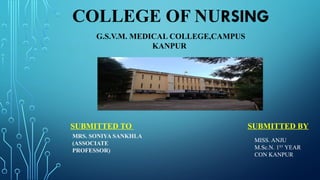
COLLEGE OF NURSING
G.S.V.M.MEDICAL COLLEGE,CAMPUS
KANPUR
SUBMITTED TO SUBMITTED BY
MRS. SONIYA SANKHLA
(ASSOCIATE
PROFESSOR)
MISS. ANJU
M.Sc.N. 1ST
YEAR
CON KANPUR
INTRODUCTION
•“ Education isthe process of facilitating
learning through teaching and the
acquisition of knowledge, skills, values, and
habits, aiming to develop an individual's
intellectual, social, and emotional capacities
and prepare them for life and society”
5.
MEANING OF EDUCATION
•Education is the process of facilitating learning or
acquisition of knowledge ,skills, values and beliefs
•It is derived from Latin words
•‘Educo’ means to lead out
• ‘Educare’ means to bring out and
•‘Educatum’ means an act of teaching or training.
•It means ‘I lead out of darkness into light’
•Education helps to develop the inherent capacities
already in an individual.
6.
DEFINITION
•Various scholars andphilosopher’s have given the
Indian concept of education
•Swami Vivekananda:-
•“Education is manifestation of divine perfection
already existing in man.”
•Mohandas Karamchand Gandhi
•“By education ‘I mean an all-round drawing out of
best in child and man body –mind and spirit”
7.
•Guru Nanak :-
•“Educationis self realization and service of the
people”
•Chanakya:-
•“Education means training for the country and love
for the nation
• Shankara charya:-
•“ Education is the self realization of self”
8.
WESTERN CONCEPT
Various scholarsand texts have given the western
concept of education.
ARISTOTLE :-
“Education is creation of sound mind in sound
body”
JOHN DEWEY :-
“Education is the process of living through
continuous reconstruction of experiences”
9.
• Froebel :-
•“Educationis a process by which the child
develops its inner potentials so as to participate
meaningfully in external environment”
• Pestalozzi :-
•“Education is natural, harmonious and
progressive development of man’s innate powers”
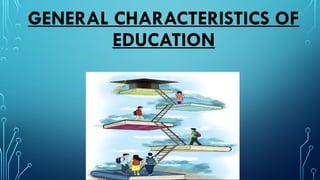
•Bipolar/Tripolar Process:
•Education canbe seen as a bipolar (teacher-learner)
or tripolar (teacher-learner-environment) process,
emphasizing the interaction between participants
and the learning context.
•Child-Centered:
• It is often described as a child-centered process,
focusing on the development of the learner.
12.
•Lifelong Process:
•Education isa continuous, lifelong journey of knowledge
acquisition and personal growth.
•More Than Literacy or Information:
•It goes beyond basic literacy or simply imparting information
to develop a wider range of knowledge, skills, and attitudes.
•Sociological and Psychological Process:
•Education is influenced by and influences society, and it is
also a psychological process involving the mental and
emotional development of the individual.
•
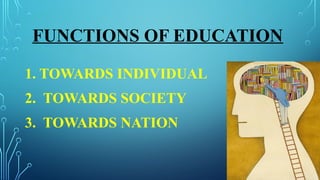
•TOWARDS INDIVIDUAL
• Education As Growth-
• Education deliberately and systematically influences mature
influences of teacher through instruction, discipline and harmonious
development
• Education As Direction-
• Teacher should consider external factor of environment and innate
tendency of learning. Direction imply growth from within, brought
about by cooperation of pupil and teacher.
15.
• TOWARS SOCIETY
• Socialization-
• Education is a powerful tool to bring about positive socialization
process. An individual is sum total of his interactions with his social
environment. The elders of society have profound influence on the
on growth and development of younger. In this way, the continuity
of societal function is maintained.
• Reconstruction Of Experiences-
• Education has ability to reconstruct life experiences for growth of
society on whole. Education provides learner with rich resources to
shape his life, personality, character and his experiences and
interactions in society.
16.
• TOWARDS NATION
• Civic And Social Responsibility-
•True education provides learners to understand their rights and duties
as individual citizens. The very existence and progress of nation
depends on educational system of state.
• Training For Leadership-
• Efficient functioning in all spheres such as social, political, religious
and educational activities depend on quality of education . thus
function of good educational system is to develop such qualities
among learners so as to promote a comprehensive development of
individual and state.
17.
• Emotional Integration
•Educationsystem aims at promoting unity in
diversity in terms of unity in areas of religion,
language, dress etc.
• National Integration
True education aims to raise individuals to break
down 2 min narrow prejudices of caste, community,
region and look to a broad national outlook.
18.
SUMMARY
•Today we havelearnt about the meaning
and definition of education, concept,
General characteristic of education.
Hereby, I conclude the session. Hope
everyone has understood the topic well.



![SecurityBoat_Service_Pitch_Deck[24158].pdf](https://cdn.slidesharecdn.com/ss_thumbnails/securityboatservicepitchdeck24158-260121113056-452683e3-thumbnail.jpg?width=640&height=640&fit=bounds)


